UAV Survey Birmingham: The Complete Guide to Professional Aerial Data

Is it really worth the liability risk of sending a surveyor onto a fragile roof when a drone can capture more accurate data in half the time? Most site managers and developers in the West Midlands know that traditional height inspections are a logistical headache; they often involve significant health and safety risks and costly operational downtime. A professional uav survey birmingham offers a sophisticated, technical alternative to these outdated methods. By utilising advanced aerial technology, we eliminate the need for ladders or platforms. This keeps your site running smoothly and your team safely on the floor.

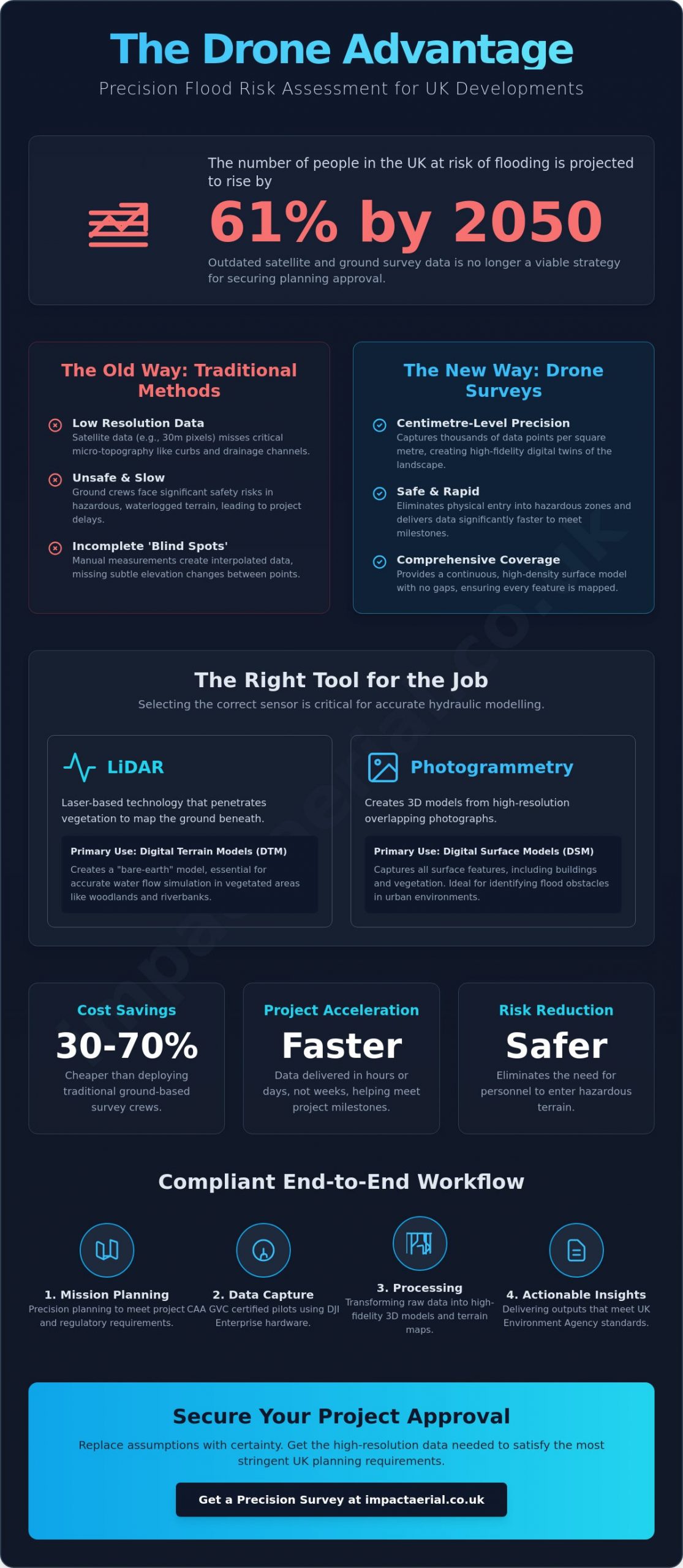
We understand that your primary concerns are accuracy, safety, and full regulatory compliance. This guide demonstrates how professional UAV surveys provide high-resolution 4K imagery and precise photogrammetry for construction, property, and solar assets with minimal site disruption. You’ll discover how our CAA GVC Certified pilots and DJI Enterprise fleet deliver the technical data you need for added peace of mind. We’ll walk you through the essential steps to secure high-quality aerial data that meets the strictest UK aviation standards while avoiding the high costs and risks of traditional surveying.

Key Takeaways

  • Learn how high-resolution data collection provides a safer, faster alternative for surveying Birmingham’s unique mix of historic and modern architecture.
  • Understand the technical precision of DJI Enterprise drones and photogrammetry in creating accurate 3D models for complex construction and property projects.
  • Discover how a professional uav survey birmingham ensures “Zero Disruption,” allowing your business to remain fully operational during site inspections.
  • Explore specialised applications for the property and energy sectors, from comprehensive roof condition reports to thermal surveys for PV solar farms.
  • Ensure project compliance by identifying the critical standards required for aerial work, including CAA GVC certification and £5m commercial liability insurance.

What is a UAV Survey and How Does it Serve Birmingham Businesses?

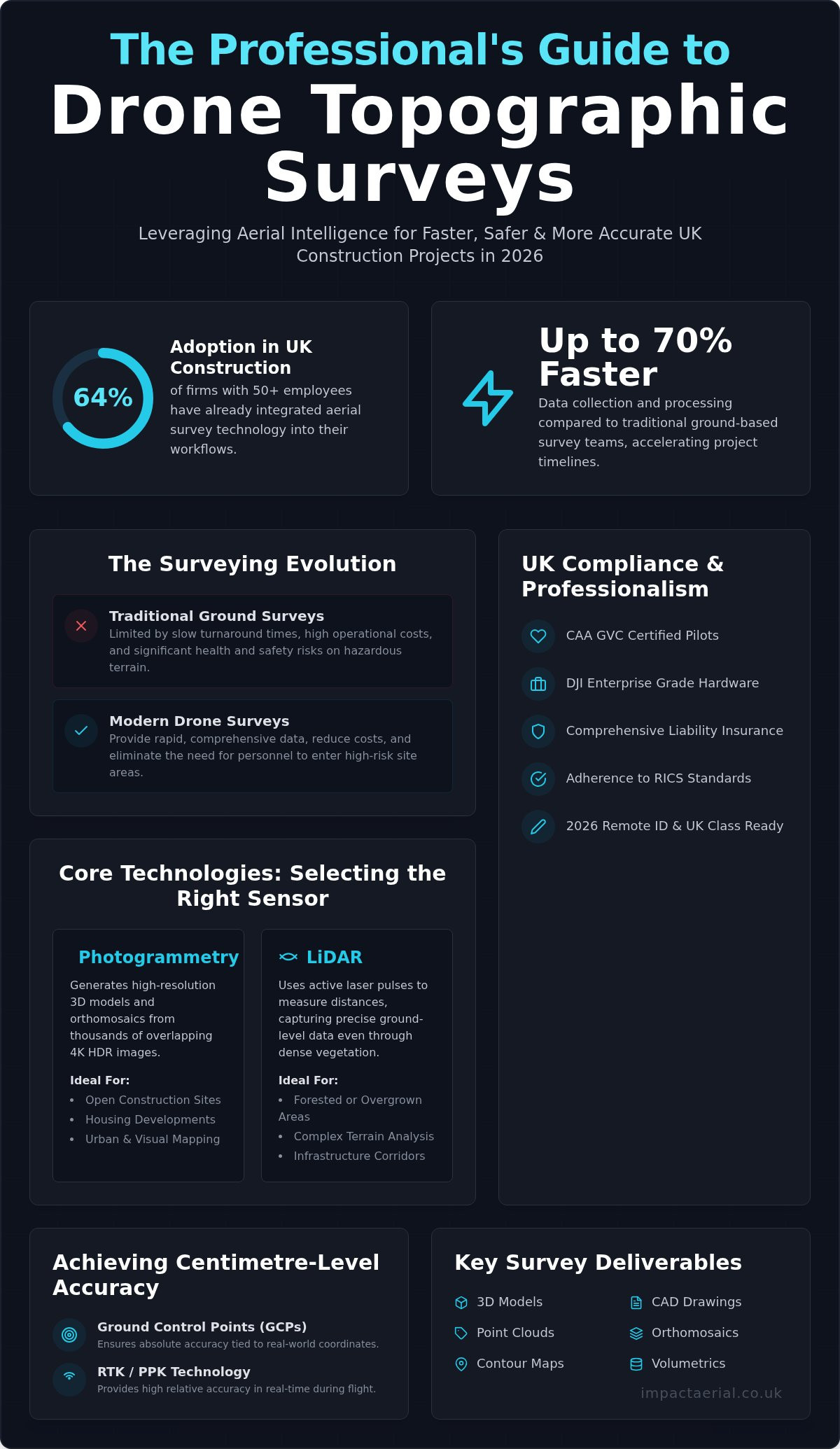
A Unmanned Aerial Vehicle (UAV) survey is a sophisticated method of data collection that uses advanced flight technology to capture high-resolution spatial information. Unlike traditional ground-based methods, a uav survey birmingham project allows for the rapid acquisition of millions of data points across complex environments. This digital-first approach marks a significant shift from manual measurements to automated, centimetre-accurate datasets. For local businesses, this means moving beyond simple aerial photography to “actionable data” that can be directly integrated into architectural software and project management workflows.

To better understand the technical precision and accuracy required for these professional operations, watch this helpful video from ARPAS-UK:

The Role of Drones in the West Midlands Economy

Birmingham is currently witnessing a massive transformation, driven by the Big City Plan, a 20-year strategy aimed at creating 50,000 new jobs and contributing £2.1 billion to the economy annually. This scale of regeneration requires constant, high-speed site monitoring that traditional surveying cannot match. Drones are now essential for commercial property developers in the city centre and industrial warehousing firms across the Black Country.

The city’s unique mix of Victorian heritage assets, such as those in the Jewellery Quarter, and modern structures like the Curzon Street HS2 site, presents a complex aerial environment. Our local expertise is vital for navigating these challenges. Operating a uav survey birmingham requires meticulous planning and strict adherence to CAA GVC certifications. This ensures that data collection is not only high-quality but also fully compliant with UK aviation safety regulations, providing clients with essential peace of mind during high-stakes builds.

Key Deliverables: What You Get from a Professional Survey

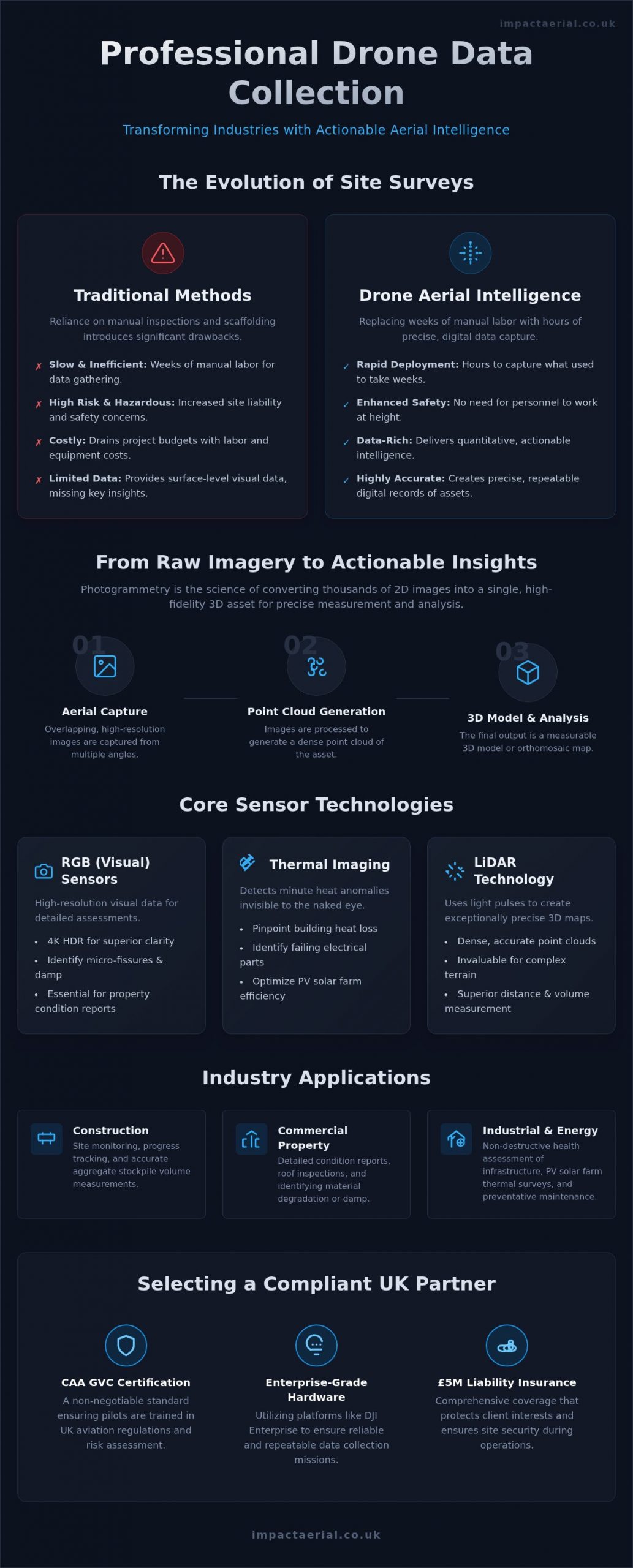
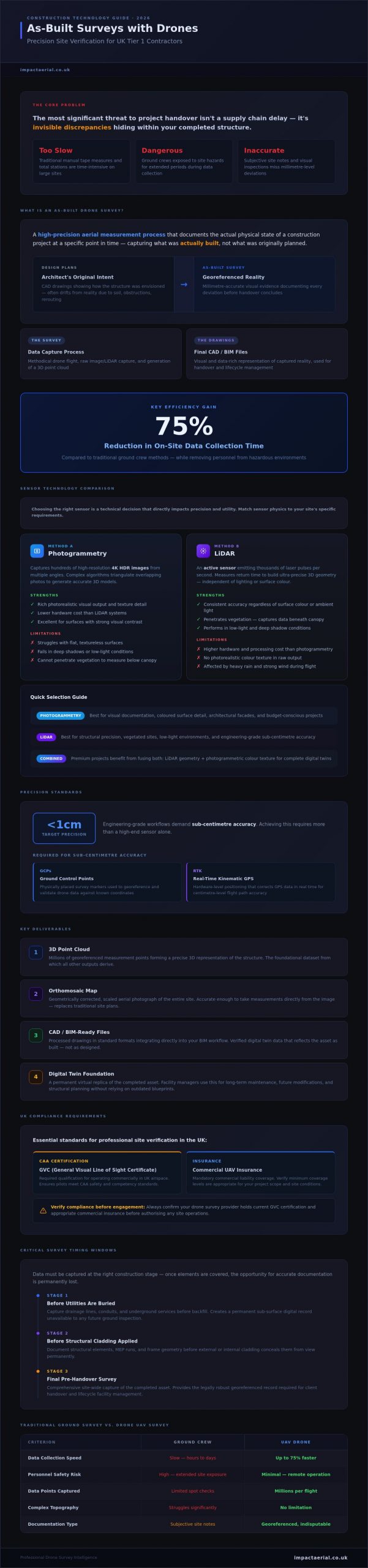
A professional aerial survey produces a suite of technical assets designed for precision and analysis. These deliverables provide a comprehensive view of any site, whether it’s a sprawling industrial estate or a single historic rooftop. Key outputs include:

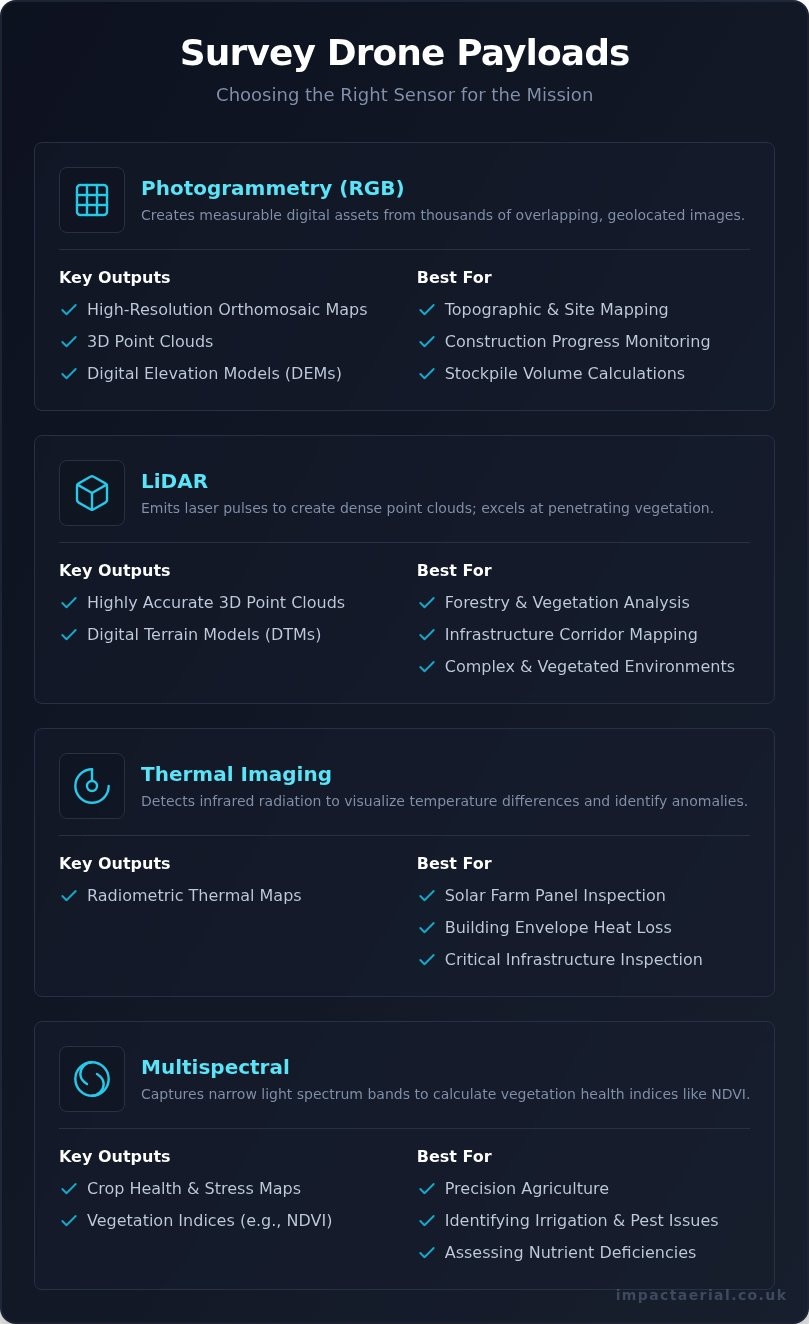
  • Orthomosaic Maps: High-resolution, geometric images corrected for topographic relief, used for precise site planning and mapping.
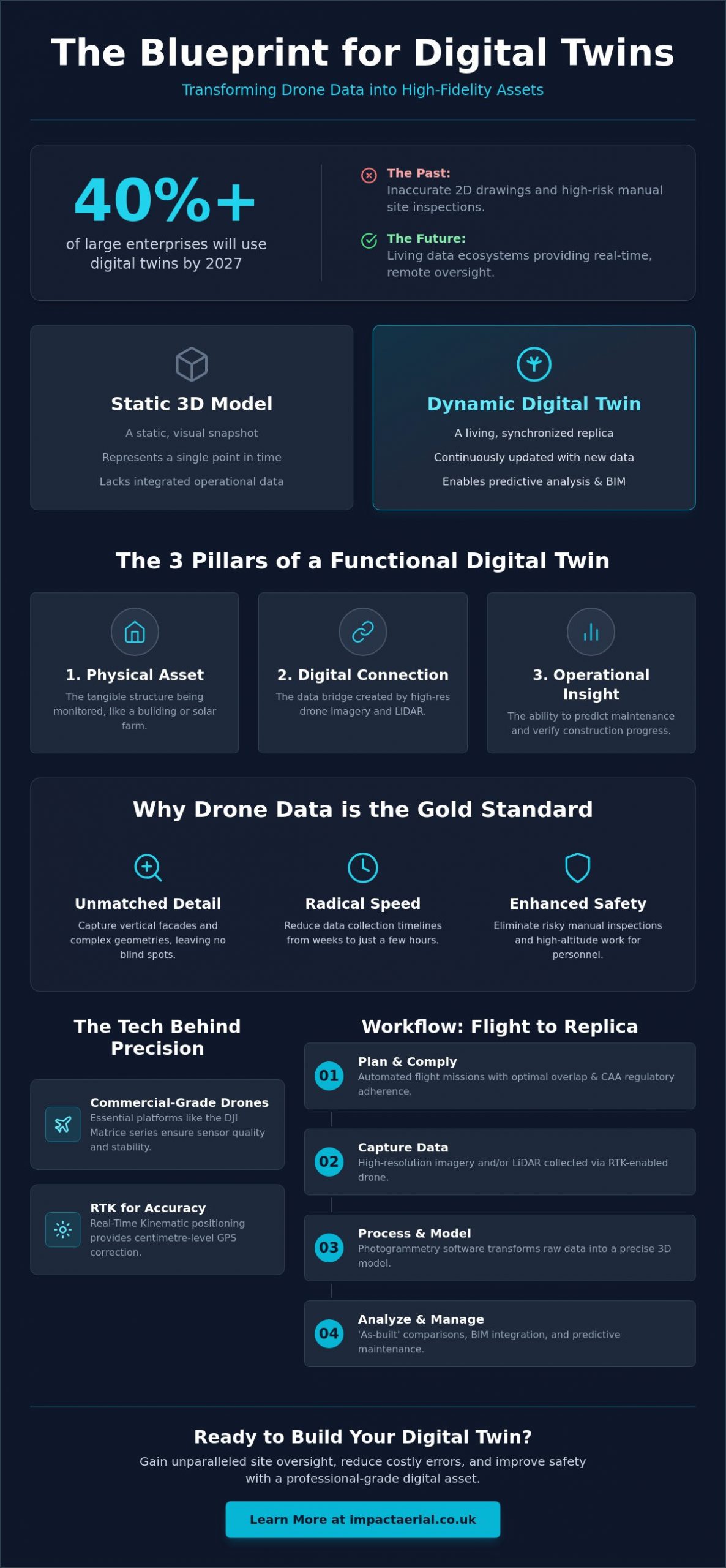
  • 3D Point Clouds: Dense sets of data points that allow for volumetric measurements and detailed digital twinning of structures.
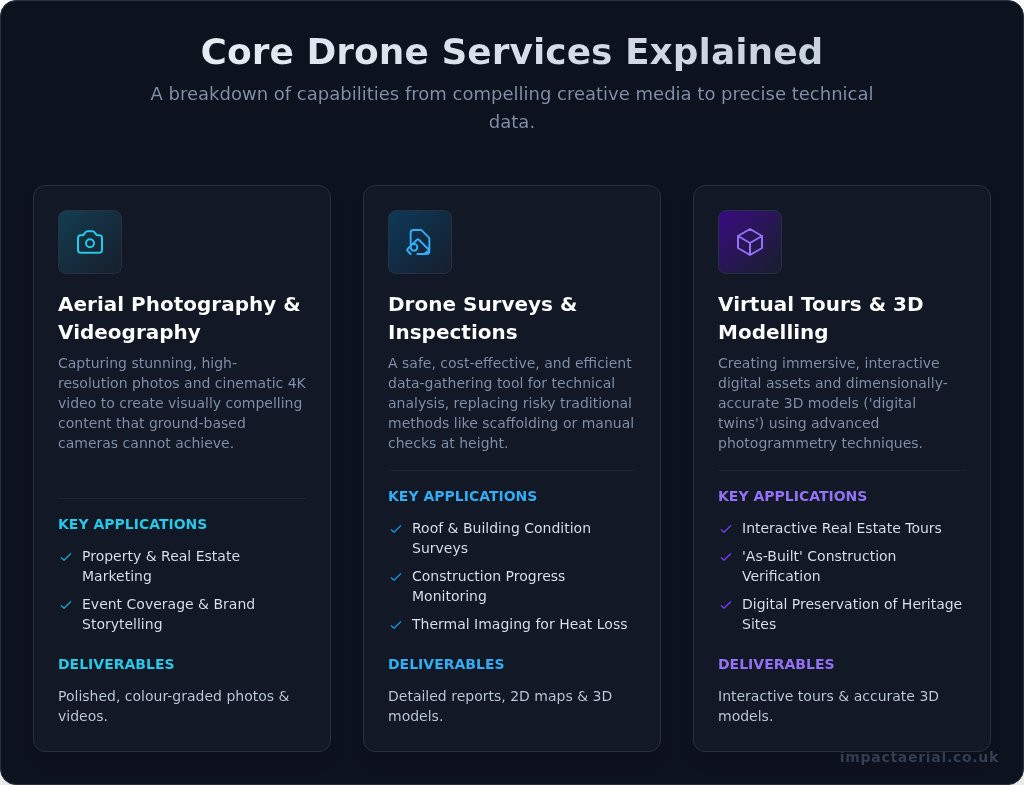
  • 4K HDR Video and Stills: Crystal-clear visual records used for detailed condition reports and structural integrity assessments.
  • Thermal Data: Specialist thermographic imaging to identify heat loss in commercial buildings or detect electrical faults in solar arrays.

By utilising our fleet of DJI Enterprise drones, we provide data that is structured, methodical, and ready for immediate professional use. This level of detail allows project managers to identify potential issues long before they become costly delays.

Technical Capabilities: The Science Behind Accurate Drone Data

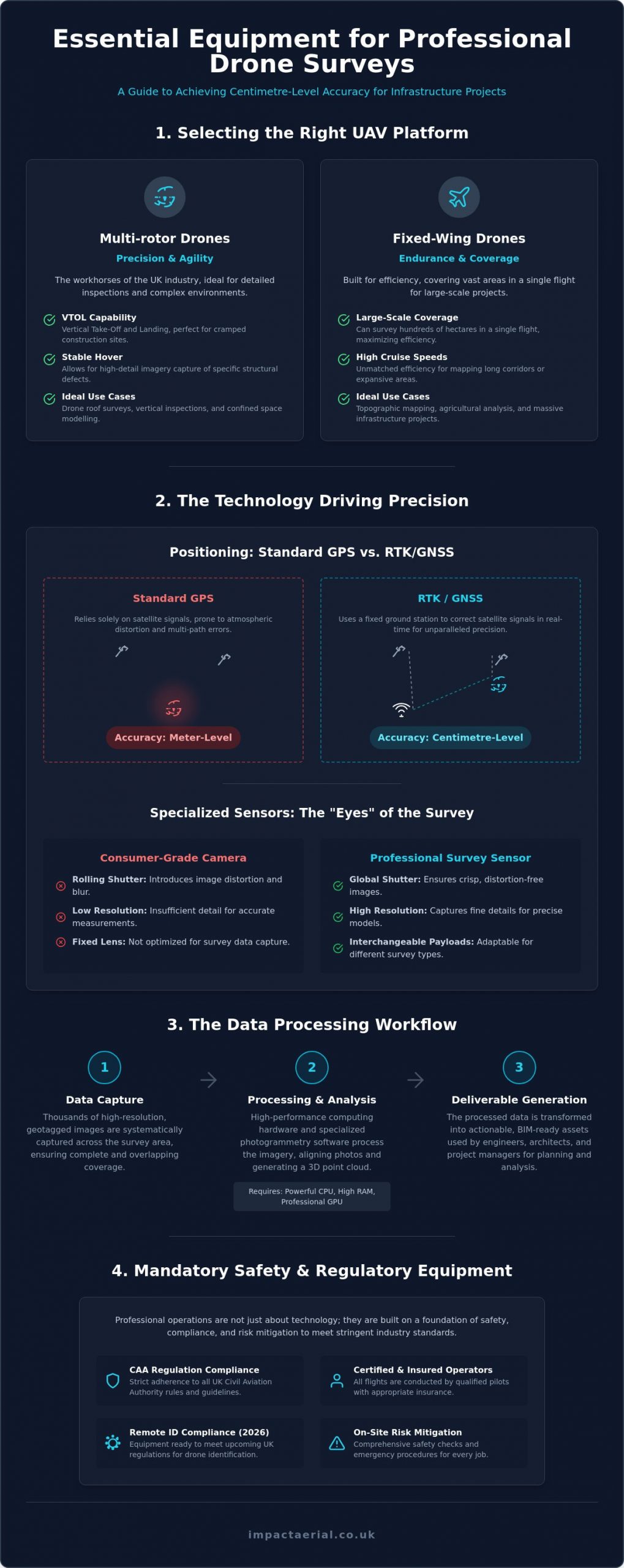
Achieving high-fidelity results during a uav survey birmingham relies on more than just flight skills; it requires a sophisticated integration of aerospace engineering and advanced geomatics. Our fleet consists of DJI Enterprise drones, which provide the flight stability needed to capture clear data in the complex wind currents often found around Birmingham’s high-rise developments. These aircraft are designed for precision, allowing us to maintain a steady hover and consistent flight path even in challenging urban environments.

Enterprise-Grade Hardware vs. Consumer Drones

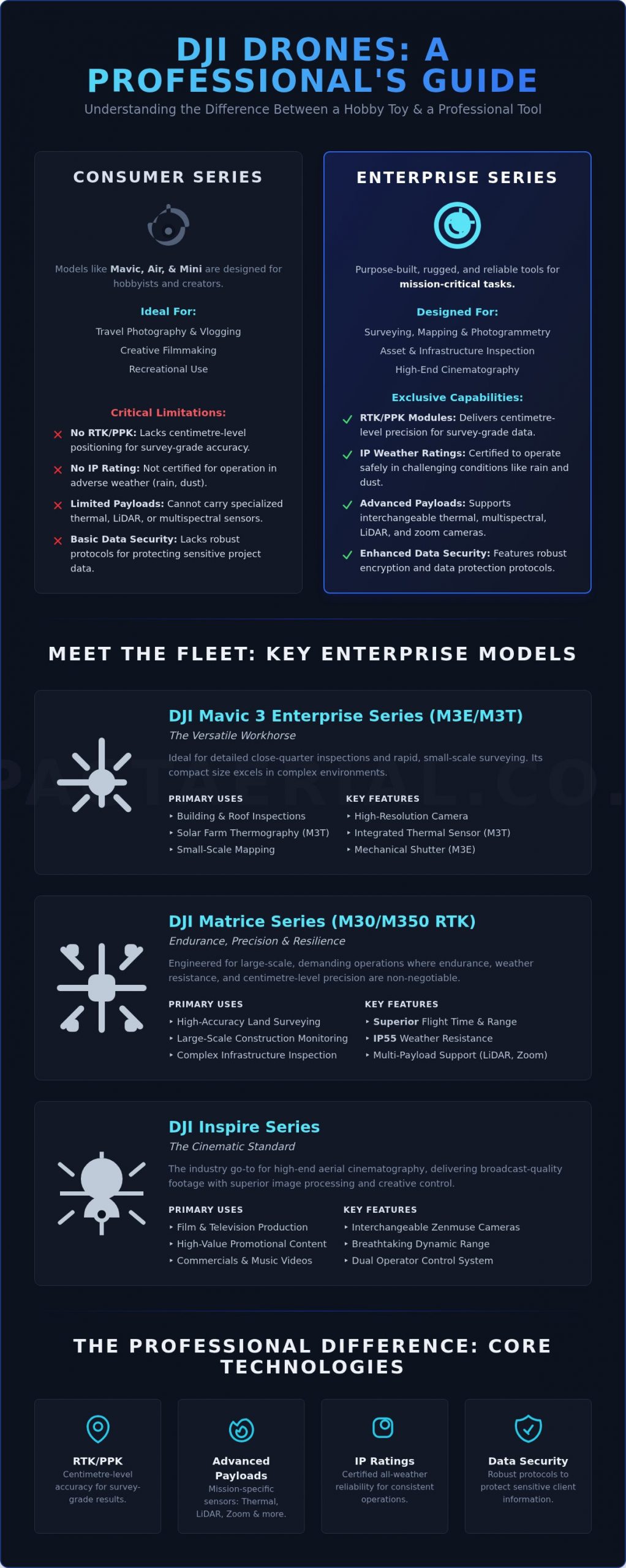
Professional work demands a survey drone with built-in system redundancies. While consumer models lack the necessary fail-safes for dense city centres, DJI Enterprise models feature dual IMUs and compasses to ensure flight reliability. Sensor quality is the critical differentiator here. We utilise 1-inch 20MP CMOS sensors that capture significantly more light and detail than standard hobbyist cameras. This hardware allows for 4K HDR imaging that reveals minute cracks, thermal leaks, or structural defects that are often invisible to the naked eye. Adhering to RICS drone surveying guidance ensures these technical outputs meet the rigorous standards expected by chartered surveyors and asset managers across the West Midlands.

Photogrammetry and 3D Modelling

Photogrammetry is the engine behind our centimetre-accurate digital twins. By capturing hundreds of overlapping images from multiple angles, we use specialised software to triangulate points in 3D space. “Photogrammetry transforms thousands of 2D images into a single, centimetre-accurate 3D representation of a physical asset.” This data is vital for Birmingham architects and urban planners who need to visualise how new structures interact with existing city infrastructure. It provides a level of spatial context that traditional photography simply cannot offer.

The journey from raw flight data to a final report involves intensive processing. After the flight, we convert gigabytes of 4K visual data into orthomosaic maps and dense point clouds. This workflow provides a level of detail that traditional ground-based methods can’t match within the same timeframe. Whether it’s a heritage building near New Street or a new build in Digbeth, conducting a uav survey birmingham provides stakeholders with a comprehensive digital record. If you’re looking to upgrade your site documentation, Impact Aerial provides the technical expertise to turn aerial footage into actionable insights for your next project.

The Business Case: UAV Surveys vs. Traditional Methods

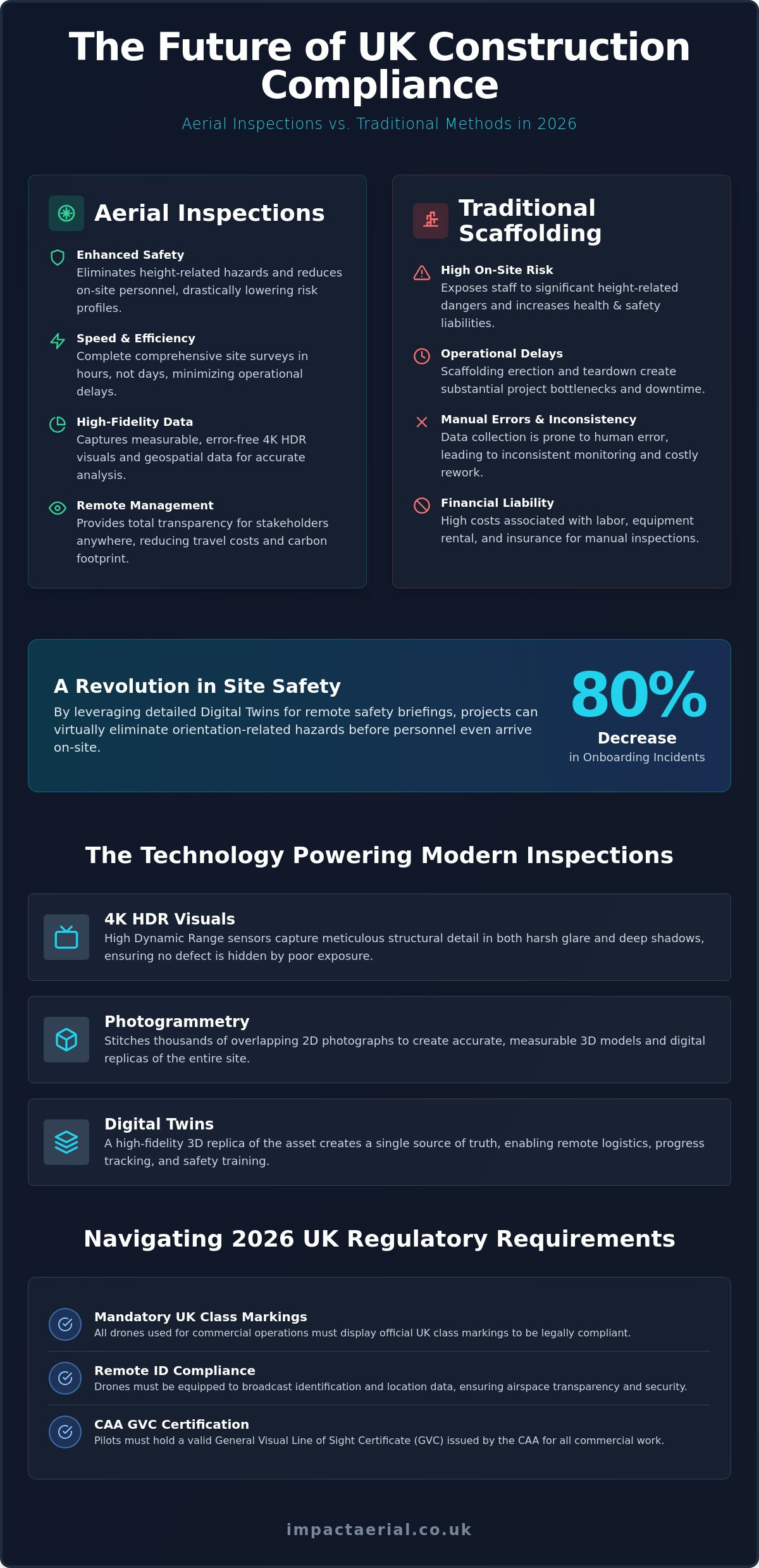
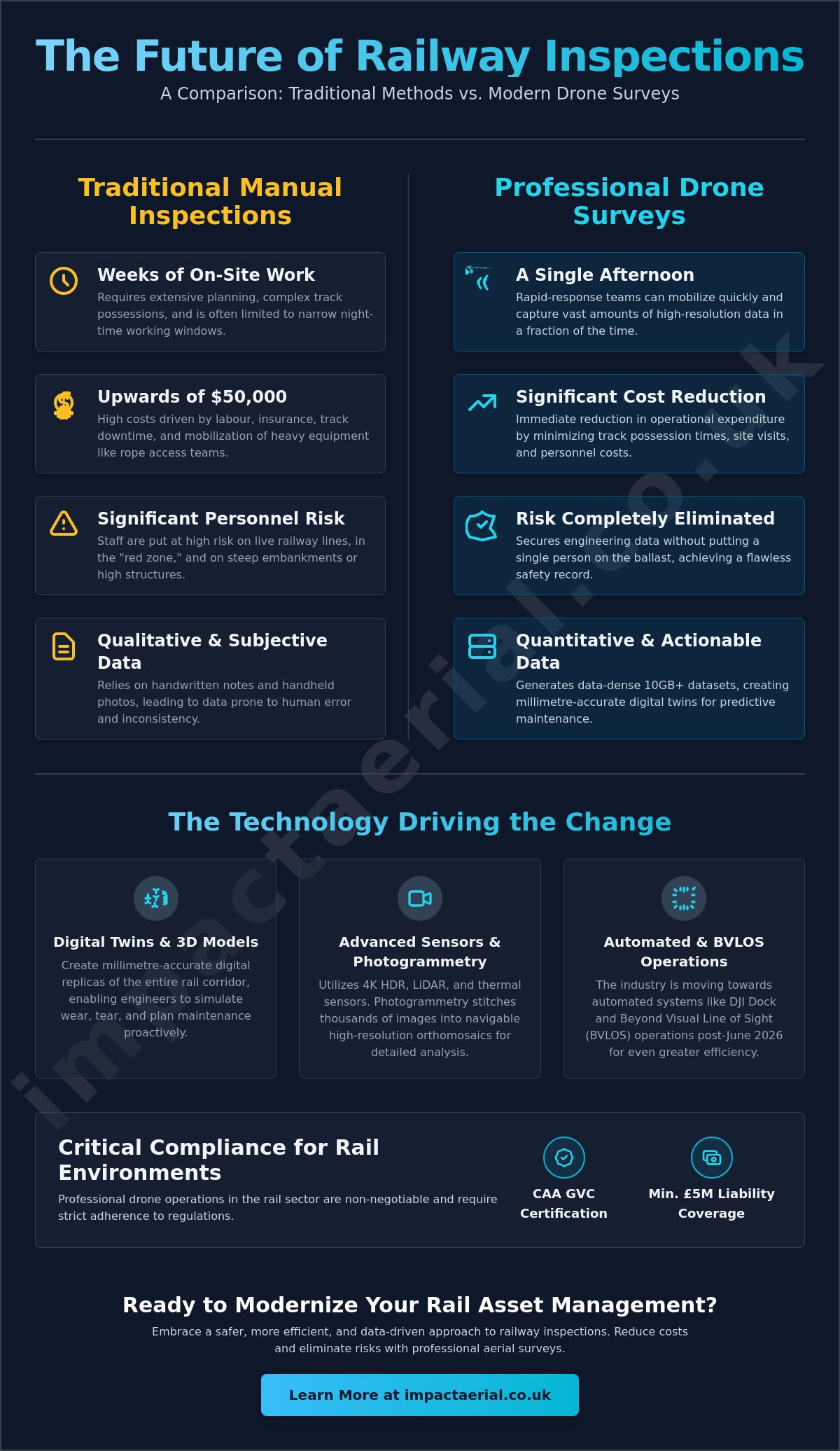
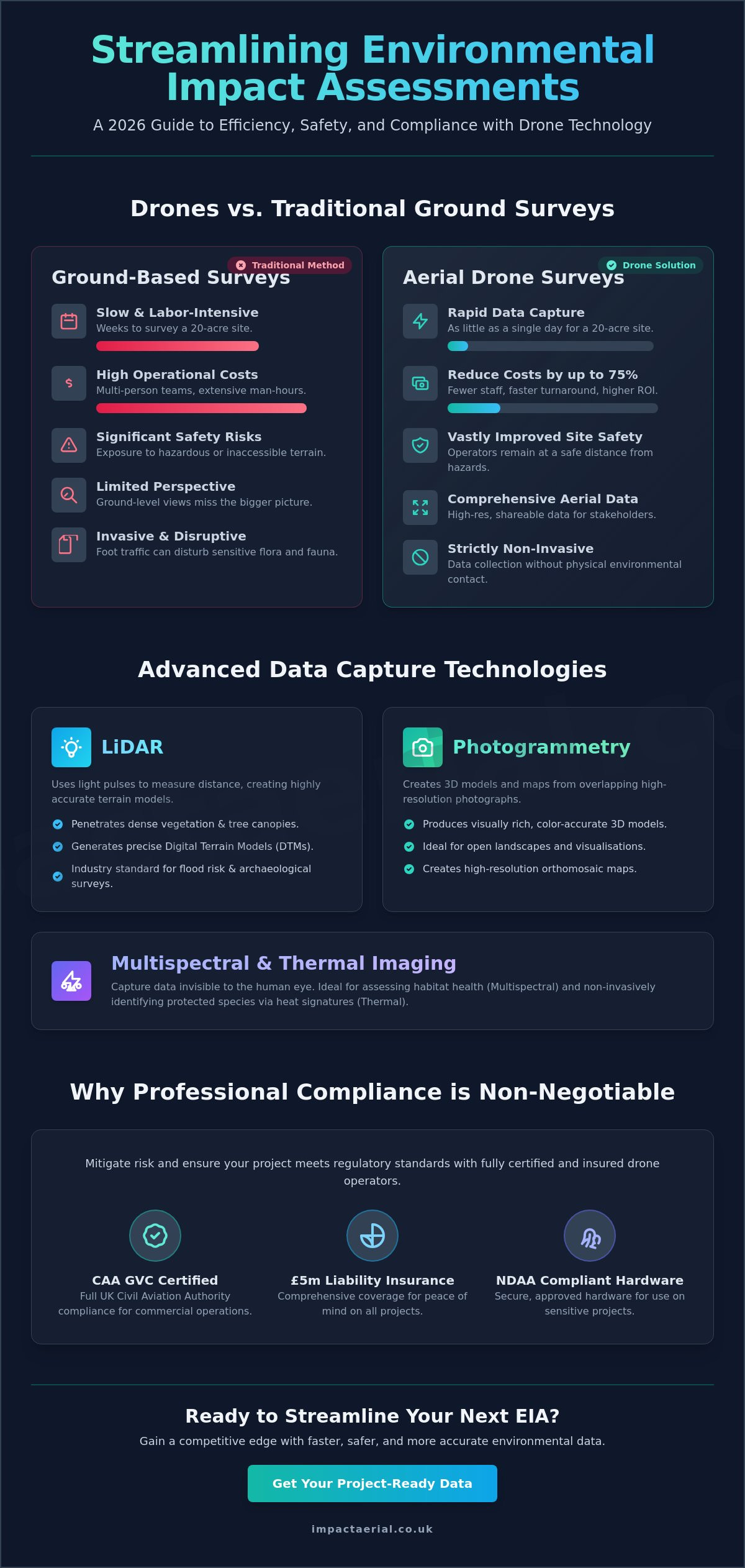
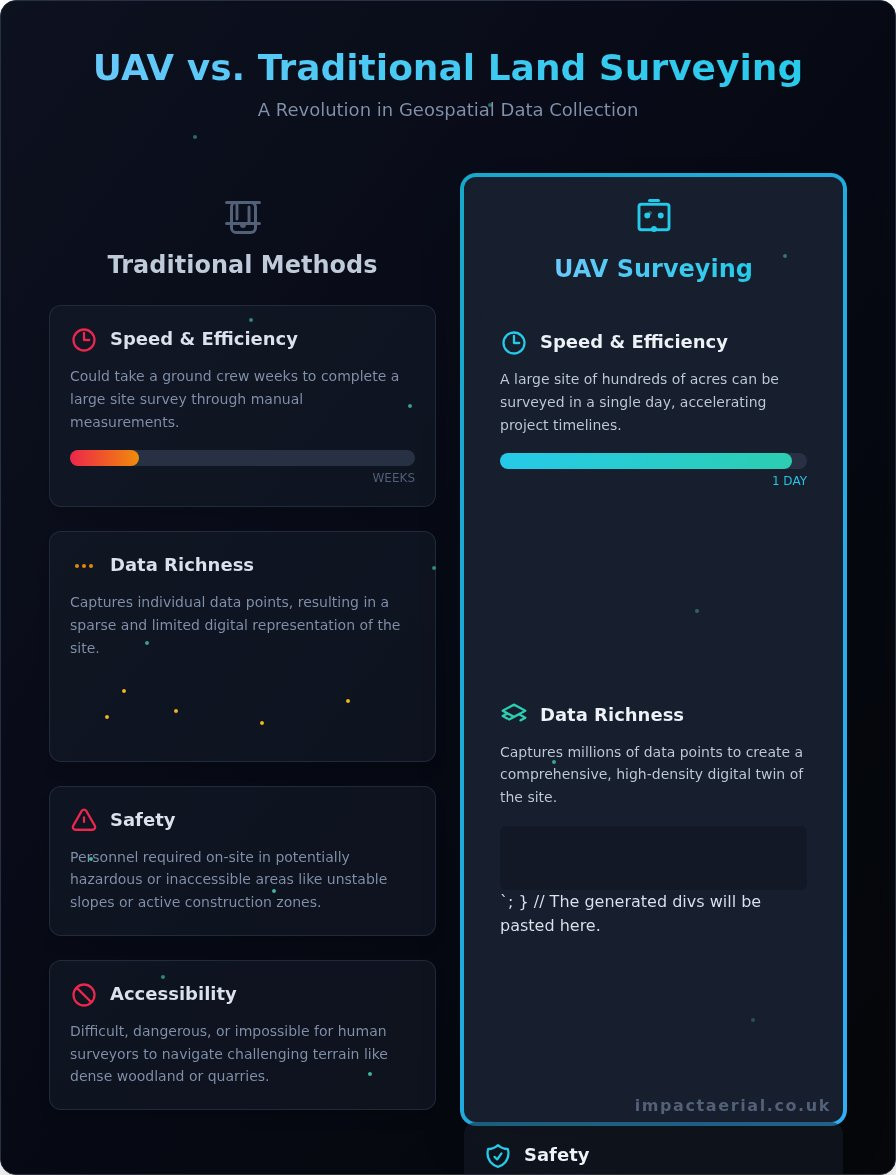
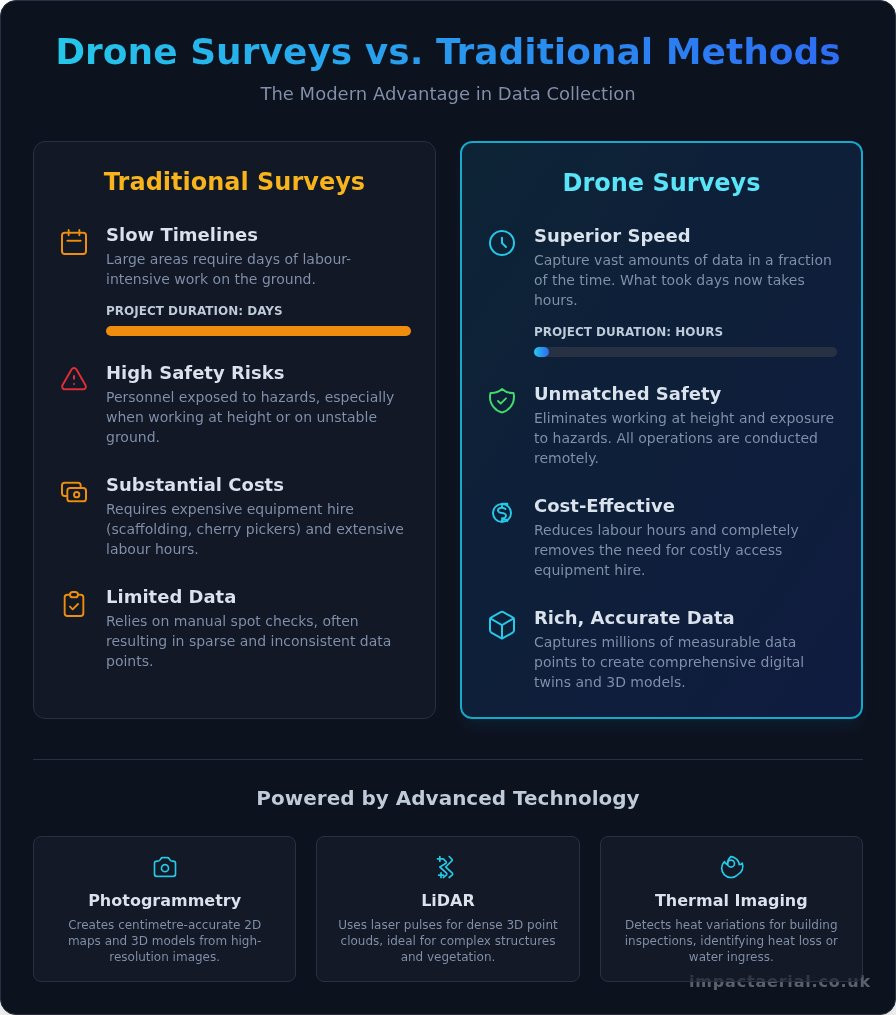
Traditional access methods like scaffolding, cherry pickers (MEWPs), and steeplejacks have long been the industry standard for high-level inspections. However, these methods carry significant logistical burdens. A uav survey birmingham offers a streamlined alternative that prioritises operational continuity. While scaffolding can take several days to erect and requires local council pavement licences that often cost upwards of £100 per week, a drone can be deployed and recording data within 30 minutes of arriving on site.

The “Zero Disruption” advantage is vital for Birmingham’s busy commercial districts like Colmore Row or the Jewellery Quarter. Businesses can remain fully operational while we collect high-resolution data; there’s no need to close car parks or restrict pedestrian access. This efficiency translates to direct savings. By keeping personnel safely on the ground, we eliminate the primary risks associated with working at height. It’s a method that replaces weeks of planning with a few hours of precision flight.

Cost-Efficiency and ROI

The financial argument for aerial data goes beyond the initial quote. Traditional methods involve hidden costs such as specialised labour for assembly, security for on-site equipment, and extended project timelines. Rapid data collection allows property owners to identify defects and commission repairs 80% faster than manual methods. For developers, the value lies in repeatable data for long-term construction site monitoring. Having a consistent, digital record of progress ensures that projects stay on schedule and within budget, providing a clear return on investment through improved oversight.

Safety and Risk Mitigation

Safety is the cornerstone of our professional services. By utilising aerial remote sensing, we significantly reduce “Work at Height” incidents. Drones can easily access structurally unsound roofs or hazardous industrial chimneys where sending a human would be too dangerous. Every flight we conduct adheres strictly to The Drone and Model Aircraft Code, ensuring full legal compliance. We produce comprehensive Risk Assessment and Method Statements (RAMS) for every project. This gives our clients peace of mind that all operations are managed by CAA GVC Certified experts who prioritise the safety of the public and the property.

Specialised Applications for Birmingham Industries

Birmingham’s industrial landscape requires data precision that traditional ground-based methods can’t provide. A professional uav survey birmingham delivers a technical advantage across sectors ranging from logistics to heritage conservation. By deploying CAA GVC Certified pilots, businesses ensure compliance while gathering high-resolution intelligence that informs critical decision-making.

Commercial Property and Roof Inspections

For commercial real estate assets, aerial inspections have become the standard for proactive maintenance and insurance compliance. Our enterprise-grade drones identify Reinforced Autoclaved Aerated Concrete (RAAC) issues, water ingress points, and hairline structural cracks that are often invisible from the ground. On new-build projects, we use drones for “snagging” to verify that contractors have met exact specifications before final handover. High-angle perspectives are particularly beneficial for large industrial units in areas like Erdington or Solihull, where traditional scaffolding costs for a basic roof check can often exceed £2,000. Drones eliminate this overhead while providing a digital audit trail of the building’s condition.

Thermal Surveys for Solar and Energy

As energy providers expand their footprint across the West Midlands, maintaining efficiency is critical for ROI. Our PV Solar Farm Thermal Surveys use radiometric sensors to detect “hot spots” within individual cells. These anomalies indicate faulty bypass diodes or internal short circuits that significantly reduce energy output. Beyond solar, we provide heat loss surveys for Birmingham’s older building stock to assist with modern decarbonisation targets. Thermal drones can identify faults invisible to the naked eye, allowing for targeted repairs rather than costly, full-scale renovations.

Construction and Heritage Documentation

In the construction sector, we facilitate progress monitoring through precise volumetric analysis for earthworks. Instead of manual surveying, which can take days, a drone captures data for stockpile volumes in minutes with high accuracy. This data allows site managers to track material movement against project timelines. For the city’s historical landmarks, such as those in the Jewellery Quarter, drones provide non-invasive archaeology and heritage site documentation. We create detailed 3D models using photogrammetry to preserve the structural integrity of Grade II listed buildings without disturbing the site or requiring heavy machinery access.

For added peace of mind, all our specialised data-gathering operations are backed by comprehensive commercial liability insurance and strict adherence to CAA regulations.

Contact our experts for a professional UAV survey

Ensuring Compliance: Choosing a UAV Partner in Birmingham

Selecting a provider for a uav survey birmingham requires more than just looking at a portfolio of aerial photographs. It’s about risk management and legal certainty. Professional operators must hold a valid General Visual Line of Sight Certificate (GVC) issued by the Civil Aviation Authority (CAA). This isn’t just a badge; it’s a legal requirement for complex commercial operations in urban environments. For added peace of mind, we maintain £5m commercial liability insurance. This figure is the industry gold standard, ensuring that clients are fully protected against unforeseen incidents during data collection in busy metropolitan areas.

The Legal Framework: CAA Regulations in 2026

The distinction between hobbyist flight and professional drone services has never been clearer. Under 2026 CAA rules, the GVC allows pilots to operate in the “Specific Category.” This is vital for flying in congested areas like Birmingham city centre where separation distances are strictly monitored. Every flight we conduct follows a comprehensive Flight Operation Manual. This document acts as our internal law, detailing safety protocols, emergency procedures, and equipment maintenance schedules. It ensures that every project meets the same high standard of safety and technical excellence.

Why Local Expertise Matters

Birmingham’s airspace is notably complex. Much of the city falls within Flight Restricted Zones (FRZs) due to the proximity of Birmingham International Airport (BHX). Navigating these restrictions requires precise coordination with Air Traffic Control and the timely filing of NOTAMs (Notice to Airmen) to inform other airspace users of our presence. As a local specialist for drone services in the West Midlands, Impact Aerial manages this entire administrative process. We handle the logistical heavy lifting so you don’t have to.

Our pre-flight planning process is meticulous and includes:

  • Detailed site risk assessments (RAMS) tailored to the specific Birmingham location.
  • Securing formal landowner permissions and informing local authorities where necessary.
  • Analysing hyper-local weather patterns that can affect flight stability between tall buildings.
  • Real-time airspace monitoring using advanced digital tools to ensure zero interference.

Our approach ensures your uav survey birmingham is completed efficiently, legally, and to the highest technical specification. We manage the end-to-end process from the initial consultation through to the final data delivery. By choosing a partner that understands the local geography and the 2026 regulatory environment, you’re investing in data that is both high-quality and fully compliant.

Secure High-Precision Data for Your Next Birmingham Project

Transitioning from traditional manual inspections to a professional uav survey birmingham provides immediate efficiency gains and significantly reduces onsite health and safety risks. By deploying the latest DJI Enterprise 4K HDR fleet, businesses across the West Midlands can access centimetre-accurate photogrammetry and high-resolution thermal data that traditional methods simply can’t match. This technical precision allows for faster decision-making in sectors ranging from commercial property development to infrastructure maintenance.

Impact Aerial prioritises safety and compliance above all else. For added peace of mind, every operation is conducted by CAA GVC Certified pilots and backed by £5m commercial liability insurance. This meticulous approach ensures that your data-gathering is both legally compliant and of the highest professional standard. Whether you’re managing a complex construction site or a sensitive heritage building, our team delivers the expert technical consultancy required to showcase your project from every perspective.

Contact Impact Aerial for a Professional UAV Survey Quote to start capturing the high-quality aerial insights your business deserves today.

Frequently Asked Questions

Is it legal to conduct a UAV survey in Birmingham city centre?

It’s legal to conduct a uav survey birmingham city centre as long as the operator holds the correct Civil Aviation Authority (CAA) GVC or PfCO certification. Operations in built-up areas like the Jewellery Quarter or Colmore Row must adhere to specific category regulations. Our pilots perform detailed risk assessments and secure necessary flight permissions to ensure every operation remains fully compliant with UK aviation law.

How much does a drone survey cost compared to traditional scaffolding?

Drone surveys typically offer a 60% to 70% cost reduction compared to traditional scaffolding or cherry pickers. Scaffolding for a commercial building often requires significant investment in hire fees and labour hours for installation. A UAV inspection eliminates these overheads, allowing for a rapid deployment that captures comprehensive data in a fraction of the time required for manual access methods.

What weather conditions can a survey drone operate in?

Our DJI Enterprise commercial drones can operate in wind speeds up to 22mph and light precipitation. We monitor Met Office forecasts 24 hours in advance to ensure safe flying conditions. If visibility drops below 5km or wind gusts exceed manufacturer limits, we reschedule the flight to maintain our strict safety standards and ensure the highest possible data quality.

How long does it take to receive the data after a UAV survey?

You’ll typically receive the processed data within 24 to 48 hours of the flight completion. For a uav survey birmingham project involving complex photogrammetry or 3D modelling, processing may take up to 72 hours. We deliver high-resolution 4K imagery and technical reports via secure cloud-based links, allowing your team to access critical building data almost immediately for project planning.

Do I need to be present on-site during the drone flight?

You don’t need to be present on-site while our pilots conduct the flight. We handle all aspects of the operation, from the initial pre-flight survey to the final landing. If you prefer to watch the live feed, we can provide a ground station monitor. This allows you to view the high-quality 4K footage in real-time as the drone inspects specific assets or structural points.

Can drones perform indoor surveys for large Birmingham warehouses?

Drones are highly effective for indoor surveys in large Birmingham warehouses or industrial units. We use specialised aircraft equipped with 360-degree obstacle avoidance and protective cages to navigate tight internal spaces safely. This method allows us to inspect high-level racking, roof trusses, and HVAC systems without the need for ladders or mobile elevating work platforms, significantly reducing health and safety risks.

What insurance cover should a professional drone operator have?

A professional operator must hold commercial liability insurance that complies with EC 785/2004 regulations. We carry £5 million in public liability insurance as standard for every project. This provides added peace of mind for our clients, ensuring that all third-party risks are fully covered during aerial data gathering or structural inspections in busy urban environments or construction sites.

How accurate is the data gathered during a UAV land survey?

UAV land surveys achieve high levels of precision, often delivering Ground Sample Distance accuracy within 1cm to 3cm. By using RTK enabled drones and established ground control points, we produce survey-grade maps and 3D models. This level of detail is sufficient for topographical mapping, volumetric measurements, and detailed construction site monitoring across the West Midlands, providing a reliable alternative to traditional ground-based methods.

Construction Drone Services Bristol: Professional Aerial Data & Site Monitoring

How much of your project’s 2024 schedule is currently being consumed by the 40% time lag typically associated with traditional manual site inspections? You likely understand that managing a major build in Bristol presents unique challenges, especially when navigating the complex airspace restrictions near Filton or the City Centre. This is why professional construction drone services bristol have become essential for maintaining momentum while ensuring absolute safety and regulatory compliance.

By leveraging expert aerial data, you gain access to high-resolution progress reports and accurate 3D mapping that ground-based teams can’t replicate. This article shows you how our CAA GVC certified experts provide the technical precision required for survey-grade volumetric analysis. For added peace of mind, we’ll explain how real-time site monitoring mitigates risk and prevents the inaccuracies often found in amateur data. You’ll discover the specific workflows we use to turn complex aerial imagery into actionable insights that keep your Bristol project moving forward without delay.

Key Takeaways

  • Learn how replacing manual scaffolding inspections with rapid UAV assessments provides actionable data while significantly reducing site downtime and safety risks.
  • Discover how survey-grade photogrammetry and volumetric analysis deliver high-resolution 2D maps and precise stockpile measurements for site managers.
  • Navigate the complexities of the Filton and Bristol Airport flight restriction zones by partnering with CAA GVC certified construction drone services bristol.
  • Explore proven strategies for organizing aerial data into professional progress reports and consistent time-lapse sequences to track project milestones effectively.
  • Gain “peace of mind” by understanding the meticulous safety protocols and advanced DJI Enterprise technology required for reliable commercial operations.

The Evolution of Construction Drone Services in Bristol: Why Aerial Data is Essential

Bristol’s construction landscape is undergoing a significant transformation, where professional unmanned aerial vehicle (UAV) technology has moved past simple aerial photography into high-precision data gathering. Modern construction drone services bristol now provide the technical foundation for “Digital Twins” in massive urban regeneration projects, such as the 70-hectare Temple Quarter development. These virtual replicas allow project managers to simulate complex scenarios and track structural changes with millimetre accuracy, ensuring that Bristol’s skyline evolves with mathematical precision.

To better understand how aerial data transforms a site over time, watch this helpful video:

By 2024, the adoption of drone technology in UK construction has seen a 239% increase as firms move away from anecdotal progress reports toward data-driven insights. This shift ensures that developers aren’t just looking at visual progress; they’re measuring volumetric data and site topography against BIM (Building Information Modelling) standards. This level of detail is essential for managing the niche but increasingly diverse market of Bristol’s brownfield redevelopments.

Replacing Traditional Inspection Methods

UAV surveys offer a safer, more efficient alternative to manual inspections on 40-metre cranes or fragile roof structures. Utilizing a CAA GVC Certified pilot provides added peace of mind, ensuring all operations comply with strict safety regulations and commercial liability requirements.

  • Safety: Aerial inspections reduce “boots on the ground” in high-risk zones by up to 80%, significantly lowering the site’s overall risk profile.
  • Cost-Efficiency: Traditional scaffolding for a single roof inspection can cost thousands and take days to erect, whereas a drone assessment typically takes less than 60 minutes.
  • Precision: High-resolution sensors capture defects that are often invisible to the naked eye from the ground.

Real-Time Progress Monitoring

Our fleet uses the latest 4K HDR DJI Enterprise drones to document weekly site evolution with absolute clarity. These high-quality visuals facilitate remote site visits for international investors and off-site stakeholders, allowing them to inspect Bristol developments from anywhere in the world without the need for travel. Precise site monitoring ensures that physical construction aligns perfectly with architectural blueprints, preventing costly project drift and mid-build corrections. By providing construction drone services bristol

Specialised Aerial Surveys and Data Collection for Bristol Site Managers

Bristol site managers face unique challenges with urban density and complex terrain. Modern construction drone services bristol provide a streamlined solution for capturing high-resolution photogrammetry. We generate accurate 2D orthomosaic maps that allow for precise site monitoring throughout the project lifecycle. These maps aren’t just pictures; they’re data-rich assets. By using 3D modelling, we facilitate seamless BIM integration, which helps project managers identify structural clashes before they become costly errors on the ground.

Thermal imaging adds another layer of technical oversight to our professional services. Our thermal sensors detect heat loss or moisture ingress in new builds, providing a non-destructive way to verify insulation quality and structural integrity. This data-gathering approach ensures that every element of the building envelope meets the specified standards. We provide the technical clarity needed to make informed decisions without delaying site progress.

Topographical and Volumetric Surveys

Precision is the foundation of any successful earthworks project. We utilise DJI Enterprise drones equipped with RTK (Real-Time Kinematic) technology to achieve centimetre-level accuracy across the entire site. This allows us to calculate the volume of stockpiles and excavations with survey-grade precision. Instead of relying on manual measurements that can take days, our aerial surveys provide results in hours. You can learn more about the technical side in our survey drone guide to see how this technology integrates with your existing workflow.

Building and Roof Inspections

Traditional inspections often require expensive cherry pickers or scaffolding, which increase costs and safety risks. Our professional construction drone services bristol eliminate these hurdles. We capture detailed 4K imagery of hard-to-reach cladding, guttering, and roof structures. Using High Dynamic Range (HDR) ensures we capture every detail, even in shadowed areas or high-contrast environments common on complex build sites.

Safety remains our absolute priority. Every flight we conduct adheres strictly to CAA drone regulations as outlined in CAP 722. This compliance gives our clients peace of mind that their site monitoring is legal, insured, and professional. Our pilots are CAA GVC Certified, ensuring that your project stays compliant while benefiting from top-quality aerial data. If you’re looking to enhance your site’s efficiency, you can contact us for a consultation on your next Bristol project.

Bristol presents a unique set of challenges for aerial operations. The city’s geography includes the 5km Flight Restriction Zones (FRZ) surrounding Bristol Airport to the south and Filton Aerodrome to the north. Successfully delivering construction drone services bristol requires more than just technical skill; it demands a deep understanding of the legal landscape. We treat every site as a bespoke aviation project, ensuring all flights remain within the strict parameters set by the Civil Aviation Authority (CAA).

Operating in Controlled Airspace

Flying in high-density urban environments like the Bristol city centre or the Temple Quarter Enterprise Zone requires rigorous coordination. We manage the entire administrative burden, from submitting Non-Standard Flight (NSF) applications to NATS to maintaining direct radio contact with local Air Traffic Control. Our pre-flight planning includes a detailed review of Ground Hazards and NOTAMs (Notices to Airmen) to prevent any disruption to local aviation. Check our guide to UK drone licenses for more on compliance to understand how these rules affect your project. We don’t just show up and fly; we ensure every takeoff is legally sanctioned and safe.

The “Peace of Mind” Guarantee

The transition from the old Permission for Commercial Operation (PfCO) to the General Visual Line of Sight Certificate (GVC) marks a significant shift in drone regulation. Our pilots hold current GVC certifications, which are essential for operating heavier enterprise-grade drones in “congested” areas. This qualification reflects a higher standard of pilot competency and operational safety. For added peace of mind, we back our expertise with £5 million in commercial drone liability insurance. This is the baseline requirement for major Bristol construction firms and Tier 1 contractors. It protects your project against unforeseen incidents and ensures adherence to site safety protocols.

Hiring an uncertified or uninsured pilot isn’t just a safety lapse; it exposes developers to massive legal liabilities and potential prosecution under the Air Navigation Order. Impact Aerial mitigates this risk through a meticulous approach to every mission:

  • Detailed site-specific risk assessments (RAMS) completed 48 hours before arrival.
  • Use of DJI Geo-fencing and secondary fail-safe systems on all aircraft.
  • Verification of all flight paths against current CAA aeronautical charts.
  • Full membership in the Drone Safe Register to ensure industry-leading standards.

By maintaining these standards, we provide a reliable service that integrates seamlessly with your existing health and safety frameworks. We understand that on a busy construction drone services bristol project, safety is the primary priority. Our methodical planning ensures that data gathering never comes at the expense of site security or public safety.

Maximising ROI: How to Organise Aerial Data for Construction Milestones

To realise the full return on investment from construction drone services bristol, data management must be as precise as the flight itself. Capturing high-resolution imagery is only the first step; the real value lies in how that data is structured, stored, and shared across your project team. Professional drone operations turn raw visual files into actionable intelligence that drives decision-making at every project milestone.

We use GPS-guided waypoints to establish consistent flight paths. This ensures that every subsequent flight follows the exact same coordinates, camera pitch, and altitude. It’s the only way to produce comparable time-lapse data that accurately tracks week-on-week progress. By maintaining this consistency, stakeholders can overlay different build stages to identify deviations from the original design. This level of precision is critical for projects in 2024 where margins are tight and schedules are non-negotiable.

Modern sites rely on collaborative digital environments. We facilitate the integration of aerial data into project management platforms like Procore and Autodesk Build. This allows site managers to view 4K orthomosaics directly alongside their BIM models. Using 360-degree panoramas, teams can conduct immersive site walkthroughs from any location, reducing the need for unnecessary site visits and improving safety by keeping personnel out of high-risk areas.

Data Processing and Post-Production

Impact Aerial transforms raw sensor data into professional, edited progress reports that serve multiple stakeholders. While site managers need raw technical data, investors and planning authorities require a more polished perspective. Our team processes 4K HDR footage into cinematic marketing content that highlights project success. These high-quality visual assets are essential for planning applications and public consultations where visual clarity is paramount. You can Explore our cinematic aerial filming drone services to see how we elevate standard site footage into compelling narratives.

Long-Term Asset Management

The utility of drone data extends far beyond the construction phase. By creating a comprehensive digital archive of the build process, developers secure a “Golden Thread” of information for future maintenance. This archive is invaluable for post-completion warranty and insurance claims, providing dated evidence of structural elements before they were covered by cladding or internal finishes. For those managing Bristol commercial units, virtual tours created during the final stages of the build assist in early leasing and sales, allowing potential tenants to explore the space before the keys are even handed over.

Ready to streamline your site monitoring with professional data? Contact Impact Aerial today to discuss your project requirements.

Impact Aerial: Your Partner for Professional Construction Drone Services in Bristol

Impact Aerial brings over five years of specialized experience to the South West construction sector. We’ve built a reputation for reliability across the West Midlands and Bristol by delivering high-precision data that project managers trust for critical decision-making. Our operations aren’t just about flying; they’re about providing a technical advantage through meticulous data-gathering and photogrammetry. By utilizing the latest DJI Enterprise fleet, including the Mavic 3 Enterprise and Matrice series, we ensure maximum reliability and data accuracy for every site visit. We understand that construction timelines are tight, so we focus on a client-centric approach that moves efficiently from the initial consultation to final data delivery.

Why Bristol Developers Choose Us

We provide a unique blend of technical surveying and high-end cinematic filming. This dual capability allows developers to use a single flight for both topographical data and marketing materials, saving both time and budget. Our pilots are local experts who understand the geographic constraints of the region. We’re familiar with the complex airspace requirements near Bristol Temple Meads and the specific wind conditions often found at coastal sites like Avonmouth. Every pilot we deploy is CAA GVC certified. They carry years of commercial experience and comprehensive public liability insurance. This professional standing provides the necessary peace of mind for high-stakes urban projects where safety and compliance are non-negotiable.

Get Started with Your Bristol Project

Onboarding Impact Aerial for your construction drone services bristol is a streamlined, methodical process. We begin with a detailed consultation to define your specific data requirements. To provide an accurate, bespoke quote, your initial brief should include the site postcode, the total acreage, and your preferred frequency of visits. We also need to know if you require specific outputs like 3D point clouds, 2D orthomosaics, or 4K progress videos. Once we have these details, we conduct a thorough site assessment and handle all necessary flight planning and risk assessments.

Our team prides itself on being a trusted specialist in a niche but increasingly diverse market. We don’t just deliver images; we provide actionable insights through secure cloud portals, ensuring your stakeholders have immediate access to the latest site intelligence. Whether you’re managing a small residential build or a major infrastructure project, our construction drone services bristol are designed to scale with your needs.

Contact us today to discuss your Bristol construction drone requirements and learn how our professional aerial data can streamline your next project.

Elevate Your Project Standards with Professional Site Monitoring

Adopting advanced aerial intelligence is the most effective way to streamline workflows and mitigate risks on modern build sites. Our construction drone services bristol provide the technical precision required for accurate site monitoring and detailed photogrammetry. By deploying our DJI Enterprise 4K HDR Fleet, site managers gain access to high-resolution data that identifies potential issues before they become costly delays. Safety remains our primary focus. Every mission is conducted by CAA GVC Certified Pilots who are experts at navigating the specific constraints of Bristol’s urban airspace. For added peace of mind, we carry £5m Commercial Liability Insurance to ensure your project is fully protected. It’s time to replace manual inspections with data-driven insights that deliver a tangible return on investment. We’re ready to help you capture the perspectives that matter most for your project’s success. Let’s start building a clearer picture of your site’s progress today.

Request a professional drone survey quote for your Bristol site

Frequently Asked Questions

Do I need special permission to use a drone on a Bristol construction site?

You don’t need special council permission for every flight, but you must comply with CAA regulations and have the landowner’s consent. Our pilots hold CAA GVC (General Visual Line of Sight Certificate) qualifications, allowing us to operate legally in congested urban areas. We handle all necessary risk assessments and flight notifications through the CAP 722 framework to ensure every project meets UK aviation law.

What is the typical cost for construction drone services in Bristol?

The cost for construction drone services in Bristol depends on the project’s complexity, site size, and required data outputs. Factors influencing the price include the number of flight hours, the type of sensors used, and the depth of post-processing needed for 3D modelling. We provide bespoke quotes after reviewing your specific site requirements and safety constraints rather than using a flat rate.

How quickly can you mobilise for a site inspection in the South West?

We can typically mobilise for a site inspection in the South West within 24 to 48 hours of instruction. Our proximity to the M4 and M5 corridors allows us to reach sites across Bristol, Bath, and Gloucestershire rapidly. For emergency structural inspections or urgent site monitoring, we prioritise our schedule to provide same-day or next-day deployments whenever weather conditions allow.

Can drones fly in typical Bristol weather conditions?

Our DJI Enterprise drones can operate in wind speeds up to 12 metres per second and have IP45 or IP55 weather resistance ratings. While we can fly in light drizzle, we avoid heavy rain or gale-force winds to protect data quality and maintain safety standards. We monitor local Met Office aviation forecasts hourly to ensure we choose the optimal window for your aerial data collection.

What insurance coverage does Impact Aerial provide for on-site operations?

For added peace of mind, Impact Aerial maintains £5 million in specialist commercial drone liability insurance as standard. Our coverage is fully compliant with EC 785/2004 requirements and can be increased to £10 million for specific high-risk contracts or large-scale infrastructure projects. This ensures all stakeholders are protected against third-party property damage or injury during our professional construction drone services in Bristol.

Can you provide survey-grade accuracy for volumetric measurements?

We achieve survey-grade accuracy for volumetric measurements by using Real-Time Kinematic (RTK) positioning and Ground Control Points (GCPs). This methodology allows us to provide measurements with a relative accuracy of 1 to 3 centimetres. Our photogrammetry software calculates stockpile volumes and site topographies with a high degree of precision, replacing traditional manual surveying methods that often take days to complete.

How is the data delivered and what software do I need to view it?

We deliver processed data through secure cloud-based platforms or direct file transfers in formats like GeoTIFF, OBJ, and PDF. You won’t need specialised hardware to view standard reports, as our web-based viewers work in any modern browser. For more technical applications, our files are fully compatible with industry-standard BIM and CAD software, including Autodesk Revit and ArcGIS.

Is it possible to fly drones in the Filton or Bristol Airport restricted zones?

It’s possible to fly in the Filton or Bristol Airport Flight Restriction Zones (FRZ), but it requires prior coordination with Air Traffic Control (ATC). We manage the entire application process, including submitting flight plans through the NATS drone assist system at least 14 days in advance for non-emergency work. Our pilots maintain radio contact with the relevant airfield throughout the operation to ensure total airspace safety.

Avoiding Common Drone Survey Mistakes: A Guide to Professional Data Collection

A Tier 1 contractor in Birmingham recently discovered that a single missed setting in their photogrammetry software rendered a £4,500 site survey completely unusable for planning. It’s a frustrating reality for many firms. While drones are transformative tools, the technical precision required means that even small oversights lead to significant project delays. You likely understand that accuracy is non-negotiable for site planning, yet the complexities of avoiding common drone survey mistakes can feel like a moving target.

This guide ensures your next flight delivers the professional results your clients expect by providing a roadmap to precision data collection. You’ll learn how to navigate UK Civil Aviation Authority (CAA) regulations and account for unpredictable British weather patterns that cause roughly 22% of all mission cancellations. We’ll break down the essential steps for capturing high-resolution, georeferenced data that keeps your projects on schedule and within budget.

Key Takeaways

  • Understand the critical importance of CAA regulations and commercial liability insurance to protect your business from the significant risks of non-compliant flight operations.
  • Master the technical distinction between relative and absolute accuracy, ensuring your data aligns perfectly through the strategic use of Ground Control Points (GCPs).
  • Learn how to mitigate the impact of unpredictable British weather and suboptimal lighting, a vital step in avoiding common drone survey mistakes that degrade sensor performance.
  • Adopt professional post-processing standards and rigorous data organisation techniques to prevent the “garbage in, garbage out” cycle that often stalls complex survey projects.
  • Evaluate the hidden financial risks of DIY drone operations and why partnering with a professional service provides the technical expertise required for high-quality, actionable data.

Regulatory and Planning Mistakes: More Than Just Flying

Successful data collection begins long before the drone leaves the ground. Many project managers assume that a pilot’s ability to manoeuvre a drone is the only metric that matters, but this oversight is a primary cause of project failure. Avoiding common drone survey mistakes requires a deep understanding of the Civil Aviation Authority (CAA) framework. Since the major regulatory overhaul in December 2020, the legal requirements for operating in UK airspace have become more stringent. Treating a survey as “just a quick flight” ignores the massive legal liability that follows a non-compliant operation.

To better understand how simple planning errors can derail a professional project, watch this helpful video:

Professional operators don’t just turn up and fly. They produce site-specific Risk Assessments and Method Statements (RAMS) that account for local hazards, nearby structures, and public safety. Without these documents, your site insurance is likely void. A meticulous pilot will also ensure their flight plan respects the principles of photogrammetry, as even slight deviations in altitude or overlap can render the entire dataset useless. Precision starts with planning, not just piloting.

The CAA GVC vs PfCO Confusion

The UK drone industry is currently transitioning from the old PfCO (Permission for Commercial Operation) to the GVC (General Visual Line of Sight Certificate). Many businesses mistakenly hire pilots with expired or irrelevant qualifications. You should always verify a pilot’s credentials by requesting their CAA Operator ID and flyer ID before they arrive on-site. Hiring an uncertified pilot isn’t just a safety risk; it’s a breach of health and safety protocols that can lead to five-figure fines for the hiring company.

Insurance Gaps and Liability

Standard public liability insurance rarely covers commercial drone operations. For added peace of mind, you must ensure your contractor holds specific commercial drone insurance that complies with EC 785/2004. In the UK construction and surveying sectors, a £5m liability cover is the industry standard. If an incident occurs and the pilot is found to be non-compliant with CAA regulations, the insurer will likely refuse the claim, leaving your business to shoulder the financial and legal fallout.

  • Verify Certification: Ensure the pilot holds a valid GVC or A2 CofC.
  • Check Insurance: Confirm the policy is specifically for commercial UAV operations.
  • Review RAMS: Don’t accept generic risk assessments; they must be site-specific.

Technical Accuracy Errors: Why Your Data Doesn’t Line Up

One of the most effective ways of avoiding common drone survey mistakes is understanding that high-quality visuals don’t always equate to high-quality data. Professional surveys require a clear distinction between relative and absolute accuracy. Relative accuracy ensures that the distance between two points on your map is correct; absolute accuracy ensures those points align perfectly with their real-world coordinates on the Earth’s surface. Relying solely on a drone’s internal GPS often leads to an absolute error margin of 3 to 5 metres, which is unacceptable for construction or boundary disputes.

Neglecting Ground Control Points (GCPs) remains a frequent pitfall for inexperienced operators. Even with advanced sensors, GCPs act as physical anchors that tie your digital model to the ground. Without at least five well-distributed GCPs per flight area, photogrammetry software lacks the necessary reference to correct “bowl effects” or scaling errors. Professionals also recognise the limitations of consumer-grade hardware. While a £1,000 hobbyist drone captures decent video, its rolling shutter creates “jello” distortion during movement. Commercial-grade platforms equipped with global shutters are essential for 99% of professional survey applications to ensure every pixel is captured simultaneously.

Incorrect camera settings frequently ruin datasets before the drone even lands. A shutter speed slower than 1/800th of a second introduces motion blur that prevents software from identifying tie points. Adhering to fundamental practices for drone remote sensing ensures that ISO remains low to prevent digital noise, which otherwise obscures fine details in 3D point clouds.

The Role of RTK and PPK Technology

Real-Time Kinematic (RTK) is a satellite navigation technique used to enhance the precision of position data derived from satellite-based positioning systems, providing centimetre-level accuracy in real-time. RTK is ideal for sites with strong telemetry links, while Post-Processed Kinematic (PPK) is superior for remote UK locations where signal dropouts are common. When setting up a drone survey, the most common base station error is failing to allow the unit to “soak” for at least 20 minutes to establish a stable position, leading to a shift in the entire dataset.

Flight Path and Overlap Issues

For high-quality 3D modelling, a minimum of 75% frontal overlap and 70% side overlap is non-negotiable. Reducing these values to save battery life is a false economy that results in “holes” in the final mesh. Most flight planning software uses a “mowing the lawn” grid pattern, but failing to account for wind resistance can cause the drone to tilt, altering the camera angle and skewing the Ground Sampling Distance (GSD). If your altitude fluctuates by even 5 metres, your GSD changes, meaning your resolution is no longer consistent across the site. For added peace of mind, hiring a CAA GVC certified specialist ensures these technical variables are managed with professional precision.

Environmental and Site Factors: Fighting the Elements

Operating in the United Kingdom presents a unique set of challenges for aerial data collection. Many operators fail because they don’t account for the subtle shifts in atmospheric conditions that compromise sensor accuracy. Successfully avoiding common drone survey mistakes requires a deep understanding of how the environment interacts with high-precision hardware. Professional data gathering isn’t just about the pilot’s skill; it’s about managing the unpredictable variables of the site itself.

Wind, Rain, and Sensor Integrity

Wind is the primary enemy of image sharpness. While a commercial drone might stay airborne in 25mph winds, gusts exceeding 15mph often introduce micro-vibrations. These vibrations result in motion blur that renders photogrammetry software unable to find tie points. We’ve seen projects where 40% of the data was discarded due to “light drizzle” flights. Unless a drone carries an IP45 rating or higher, moisture ingress will eventually lead to catastrophic mid-air failure. Temperature also dictates mission success. Below 5°C, LiPo battery chemical reactions slow down, reducing a standard 30-minute flight window to just 18 or 20 minutes. For added peace of mind, our team monitors local METAR reports before any deployment in Birmingham or the wider West Midlands.

Shadows and Contrast in Photogrammetry

It’s a common misconception that bright sunshine is ideal for surveying. Shooting at high noon creates harsh, vertical shadows that hide critical details in roof valleys or structural crevices. These “black holes” in the data prevent the software from generating a continuous point cloud. Overcast conditions provide diffused, even lighting that’s often superior for 3D modelling. To maintain high standards, we follow principles found in the USGS guidelines for UAS imagery to manage radiometric consistency. This is especially vital when surveying solar farms, where glare from panels can “blind” the sensor, creating 100% white pixels that contain zero usable data.

Magnetic interference is another silent project killer. Surveying near reinforced concrete, large steel structures, or 400kV power lines can confuse the drone’s internal compass. This leads to “toilet bowling” or erratic flight patterns. A professional survey must also account for site-specific obstructions like cranes or temporary scaffolding. Before we launch, we cross-reference the latest CAA NATS maps to ensure we aren’t infringing on restricted airspace or temporary “no-fly” zones. Overlooking these factors is a major hurdle in avoiding common drone survey mistakes and can lead to legal complications or compromised data sets.

Data Integrity and Post-Processing Blunders

Capturing high-resolution imagery is only half the battle. Professional data collection relies on the “garbage in, garbage out” principle; if the initial flight parameters or sensor calibrations are off, no amount of post-processing can fix the resulting inaccuracies. A critical part of avoiding common drone survey mistakes involves meticulous data management from the moment the SD card is removed from the aircraft.

Poor file naming and chaotic folder structures often lead to significant project friction. A 2023 industry report indicated that 14% of survey rework is caused by mislabelled data or lost files during transit. You should establish a consistent naming convention that includes the date, site location, and flight number. Establishing these protocols is a vital step in avoiding common drone survey mistakes that can cost a firm upwards of £1,500 in lost billable hours. Crucially, never leave a site without a verified backup. We recommend using a ruggedised field drive to mirror your data before you pack up your kit to ensure hardware failure doesn’t ruin your day.

  • Ensure output formats match client requirements, such as .LAS for point clouds or .DXF for CAD.
  • Verify coordinate systems, specifically OSGB36 for UK projects, to prevent alignment shifts.
  • Check for image gaps in the dataset before leaving the survey area.
  • Confirm all files are correctly indexed to avoid delays during the photogrammetry phase.

3D Modelling and Point Cloud Errors

Raw point clouds often contain “noise” from moving vehicles or vegetation. Failing to clean this data results in “ghosting” effects that compromise accuracy. Large-scale orthomosaics can suffer from stitching errors where images don’t align, creating visual breaks. To ensure compatibility with BIM software like Revit, you must verify decimation levels. Too much detail can crash a client’s system; too little renders the survey useless for engineering.

The Importance of Human Verification

Automated photogrammetry software isn’t a replacement for a trained eye. Software often struggles with vertical surfaces, causing “warping” on the sides of buildings. Spotting these anomalies requires a manual review of alignment logs. Using a professional survey drone expert in the editing suite ensures every centimetre is validated against Ground Control Points. This human-led approach separates a basic photo from a survey-grade asset.

Don’t let post-processing errors devalue your project data. Contact Impact Aerial today for professional drone survey services that guarantee precision and compliance.

Professional Drone Services vs DIY: Calculating the Real Cost

Many UK construction and surveying firms initially consider purchasing a consumer drone to handle inspections in-house. While a retail drone might only cost £1,200, the true operational cost of a DIY programme often exceeds £12,000 in the first year. This figure includes CAA GVC training, specialist photogrammetry software subscriptions, and high-tier commercial insurance. When you hire experts, you aren’t just paying for a pilot; you’re investing in a managed drone services workflow that covers everything from airspace clearing to complex data processing.

The financial logic of outsourcing rests on the ROI of precision. A single data error caused by an inexperienced internal pilot can lead to site delays costing upwards of £3,000 per day. Avoiding common drone survey mistakes means ensuring the data is actionable the moment it hits your desk. Professional operators provide a level of reliability that internal teams often struggle to match without years of flight experience. For added peace of mind, Impact Aerial carries £5 million in public liability insurance, protecting your project from the financial risks associated with site accidents or regulatory breaches.

Accessing Commercial-Grade Technology

Consumer drones like the DJI Mini series are excellent for photography but lack the hardware for professional surveying. These models use electronic shutters that cause “rolling shutter” distortion, ruining map accuracy at high speeds. Impact Aerial utilises the latest 4K HDR DJI Enterprise drones equipped with mechanical shutters and RTK (Real-Time Kinematic) modules. This technology delivers 2cm horizontal accuracy, something consumer models cannot achieve. Our fleet also supports thermal and multispectral sensors, allowing us to detect structural heat loss or moisture ingress that remains invisible to the naked eye.

Conclusion: Building a Robust Survey Strategy

Successfully avoiding common drone survey mistakes requires a commitment to quality over initial cost savings. Relying on outdated hardware or uncertified pilots puts your data and your reputation at risk. A robust strategy focuses on high-resolution outputs and strict adherence to CAA regulations. Use this final checklist when selecting your drone partner:

  • Verify their CAA GVC or PfCO certification status.
  • Confirm they use Enterprise-grade hardware with RTK capabilities.
  • Request proof of specific commercial drone liability insurance.
  • Check for a portfolio of similar surveying or inspection projects.
  • Ensure they can provide data in the specific formats your CAD or BIM software requires.

Don’t leave your site data to chance. Contact Impact Aerial for a professional consultation and ensure your next survey is delivered with centimetre-level precision and full regulatory compliance.

Secure Precision and Compliance for Your Next Survey

Achieving millimetre-accurate results isn’t just about owning a drone; it’s a matter of technical rigour and strict regulatory adherence. Avoiding common drone survey mistakes requires a deep understanding of how environmental variables and complex post-processing affect your final dataset. While DIY attempts might seem cheaper, they often result in costly data misalignment or legal risks that can stall a project for weeks. Professional services eliminate these variables, ensuring every flight delivers actionable, high-quality intelligence.

Impact Aerial brings expert-level certainty to your site. Our CAA GVC Certified Pilots operate a high-spec DJI Enterprise commercial fleet, capturing 4K HDR imagery that meets the most demanding industrial standards. For added peace of mind, we back our operations with £5m commercial liability insurance, protecting your assets and your reputation. We’re ready to help you navigate the complexities of modern aerial data collection with efficiency and precision. Your project deserves the reliability that only a vetted, professional operator can provide.

Request a Quote for Your Professional Drone Survey

Frequently Asked Questions

What is the most common mistake made during a drone survey?

Inadequate pre-flight planning and insufficient image overlap are the most frequent errors encountered in the field. Professional operators must maintain a minimum of 75% frontal and 60% side overlap to ensure the photogrammetry software can accurately stitch the data. Failing to account for these technical requirements is a primary factor in avoiding common drone survey mistakes during the initial data-gathering phase.

Do I need a special license to conduct a commercial drone survey in the UK?

You require a General Visual Line of Sight Certificate (GVC) issued by the Civil Aviation Authority (CAA) to operate drones commercially within the Specific Category. Since the regulatory transition in December 2020, professional pilots must also hold valid commercial liability insurance that complies with UK Regulation (EC) No 785/2004. This typically involves a minimum cover of £5 million to provide clients with total peace of mind during complex site operations.

How much accuracy can I expect from a professional drone survey?

A professional survey typically delivers a Ground Sampling Distance (GSD) of between 1cm and 3cm per pixel depending on flight altitude. When our team utilises high-specification sensors and Ground Control Points, you can achieve absolute global accuracy of 20mm to 50mm across the entire site. These precise figures are essential for topographical mapping where 95% of data points must fall within the specified project tolerances.

Can I use a standard DJI Mavic for a land survey?

A standard DJI Mavic lacks the mechanical shutter and RTK capabilities required for professional survey-grade precision. Consumer drones use electronic rolling shutters that cause “jello” distortion at high speeds, which can introduce spatial errors of 5 metres or more in 3D models. Professional land surveys demand enterprise-grade hardware like the DJI Matrice 350 RTK to ensure sub-centimetre data reliability and repeatable results.

What happens if a drone survey is conducted in poor lighting?

Poor lighting increases ISO noise and motion blur, which prevents photogrammetry software from identifying distinct tie points between images. Surveys conducted with less than 1,000 lux of ambient light often result in “noisy” point clouds and distorted digital twin reconstructions. Professional teams monitor solar noon and cloud cover to ensure a consistent 1/500th shutter speed for crisp, usable data collection.

Why are Ground Control Points (GCPs) so important?

Ground Control Points anchor your aerial data to real-world coordinates, ensuring the survey is geographically accurate rather than just internally consistent. Without at least 5 to 8 GCPs per flight area, a survey might suffer from a “bowl effect” or be displaced by several metres from its true location. Using these physical markers is a proven method for avoiding common drone survey mistakes related to global positioning and scaling.

How does wind speed affect drone survey data?

Wind speeds exceeding 15 knots significantly degrade battery life and gimbal stability, which often leads to blurred imagery and inconsistent data. High winds cause the aircraft to tilt aggressively to maintain its position, altering the camera angle and reducing the effective overlap of the flight path. Professional operators ground flights when gusts reach 20 knots to protect both the equipment and the integrity of the data.

What is the difference between RTK and standard GPS drones?

Real-Time Kinematic (RTK) drones provide centimetre-level positioning by constantly correcting satellite signals against a fixed base station or network. Standard GPS drones have a horizontal margin of error between 1.5 and 5 metres, which is unsuitable for high-precision engineering or construction projects. RTK technology reduces the number of physical ground markers needed while maintaining a 99.9% reliability rate for spatial coordinates.

Drone Survey for Boundary Disputes: A Modern Solution for UK Property Resolution

How can a single red line on a 1:1250 Land Registry map, which often represents a margin of error up to 0.3 metres on the ground, provide the precision needed to settle a heated property row? Many UK homeowners face this dilemma when a simple fence replacement escalates into a legal battle costing an average of £25,000 in solicitor fees. You’ve likely experienced the mounting stress of neighbourly conflict and the high costs of traditional land surveying. Utilizing a professional drone survey for boundary disputes offers a modern, authoritative alternative that replaces guesswork with millimetre-accurate data.

You deserve the peace of mind that comes from objective visual proof rather than ambiguous historical sketches. In this article, you’ll discover how high-resolution drone data bridges the gap between vague records and the legal certainty required for a final resolution. We’ll examine how our CAA GVC Certified pilots use 4K HDR DJI Enterprise drones and advanced photogrammetry to create a cost-effective mediation tool. From professional, insured data-gathering to final reports, we’ll show you how to secure your property rights and regain your privacy without the typical financial or emotional drain.

Key Takeaways

  • Learn why standard 1:1250 Land Registry maps often fail in property conflicts and how high-resolution data provides the centimetre-level accuracy required for definitive resolution.
  • Discover how a professional drone survey for boundary disputes utilizes photogrammetry and DJI Enterprise technology to transform 2D images into precise, measurable 3D models.
  • Understand the efficiency gains of aerial data-gathering, which can cover large sites in minutes while significantly reducing the man-hours and costs associated with traditional ground surveys.
  • Explore the components of a professional evidence pack, including distortion-free orthomosaic maps designed to provide solicitors with clear, top-down visual proof for legal proceedings.
  • Identify why CAA GVC certification and commercial liability insurance are essential for ensuring your aerial data is legally robust and provides added peace of mind.

Understanding the “General Boundaries” Problem in the UK

Property law in the UK operates under the “General Boundaries” rule, as defined by Section 60 of the Land Registration Act 2002. This means that Land Registry title plans don’t define the exact line of a boundary to the nearest centimetre. Instead, they provide an indicative position. Most residential titles rely on a 1:1250 scale map, which presents a significant challenge during a disagreement. At this scale, the physical thickness of the black line printed on the map represents roughly 0.3 metres on the ground. When a dispute involves a few inches of land, these official documents become functionally insufficient.

Discrepancies often emerge because physical features like hedges, walls, or fences don’t align with invisible legal lines. Over a 25 year period, a hedge can “drift” significantly as it’s trimmed, replanted, or grows naturally. Traditional Ordnance Survey data can’t account for these minute shifts. This is where a professional drone survey for boundary disputes provides the necessary technical clarity. Our CAA GVC certified pilots use high-accuracy photogrammetry to capture ground data that standard mapping ignores, identifying discrepancies that have built up over decades.

  • The Land Registry doesn’t guarantee the exact position of the boundary.
  • Standard 1:1250 maps are designed for identification, not precision measurement.
  • “Drift” in physical features creates a gap between reality and legal paperwork.
  • Traditional survey methods often struggle with inaccessible or overgrown terrain.

The Limitation of Land Registry Title Plans

A title plan is a legal snapshot rather than a precision engineering document. Because a single line on a 1:1250 map translates to a 30cm wide zone in the real world, solicitors frequently find these documents insufficient for litigation. Relying on outdated or low-resolution data leads to average legal costs exceeding £20,000 for a single case. Professional data-gathering is required to bridge the gap between 20th-century mapping and modern property requirements. We provide the centimetre-level accuracy that Land Registry plans lack.

Why Visual Truth is Key to Mediation

High-resolution aerial data serves as a neutral, third-party witness. When parties see a top-down, accurate orthomosaic, the emotional tension often dissipates. It’s harder to argue over a subjective “feeling” of where a line sits when presented with objective 4K imagery. Using a drone survey for boundary disputes allows mediators to point to specific, undeniable physical evidence. This transparency often facilitates out-of-court settlements, saving clients from the financial and emotional drain of a full tribunal or court hearing.

The Technology: How Drones Achieve Centimetre-Level Accuracy

Professional-grade hardware is the foundation of any reliable drone survey for boundary disputes. We don’t use consumer-level equipment for these tasks. Our fleet relies on the DJI Enterprise series, such as the Matrice 350 RTK or the Mavic 3 Enterprise. These aircraft carry high-resolution 4K HDR sensors capable of capturing 45-megapixel stills. This level of detail is vital for identifying physical markers like fence posts, wall junctions, or ancient hedge lines that define a legal boundary. Commercial-grade hardware provides the stability and sensor quality that smaller, hobbyist drones simply can’t match.

Photogrammetry vs. Standard Aerial Photography

Photogrammetry is a sophisticated data-gathering process. It’s not just taking a few pictures from the air. The drone follows a pre-programmed flight path, capturing hundreds of images with an 80% front and side overlap. Specialized software then triangulates millions of unique points across these images to create a dense 3D point cloud. This digital twin allows us to measure distances and elevations with extreme precision. The 4K HDR sensors ensure that even in high-contrast lighting, every shadow and texture is visible. This provides the “peace of mind” that no detail is missed during the analysis phase.

RTK and PPK: The Gold Standard for Precision

Standard GPS on a consumer drone often has an error margin of 3 to 5 metres. That’s insufficient for legal property matters where inches matter. We use Real-Time Kinematic (RTK) technology to reduce this error to between 1cm and 3cm. RTK works by connecting the drone to a fixed base station or a network of satellite corrections in real-time. If signal interference occurs, Post-Processed Kinematic (PPK) ensures the data remains accurate during office-based analysis. This level of precision matches or exceeds traditional total station surveying for land analysis. Our CAA GVC certified pilots ensure these operations meet all UK safety regulations while delivering top-quality results. If you need this level of technical rigour for your property, you can view our professional survey services to see how we apply this technology.

To anchor this aerial data to the real world, we use Ground Control Points (GCPs). These are physical markers placed on the site before flight. We record their exact coordinates using high-precision GNSS rovers. These markers act as anchors for the photogrammetry model. They ensure the digital map perfectly aligns with Ordnance Survey coordinates. This meticulous approach is what makes a drone survey for boundary disputes a legally robust solution for property owners in the West Midlands and across the UK.

Drone Surveys vs. Traditional Land Surveying: A Comparison

Traditional land surveying methods rely on line-of-sight measurements taken from the ground. While accurate, these techniques are often labor-intensive and time-consuming. A two-person ground crew might require 16 hours to map a complex five-acre boundary, whereas a professional drone operator captures the same data in roughly 22 minutes. This 97% reduction in field time directly lowers project costs by minimizing billable man-hours for site visits and data collection.

Safety remains a primary concern in this niche but increasingly diverse market. Traditional surveyors often face physical obstacles, such as two-meter high brambles, steep embankments, or aggressive livestock. In high-tension cases, a drone survey for boundary disputes provides a critical safety buffer. Pilots launch from a neutral location, capturing high-resolution data over disputed ‘no-go’ zones without setting foot on contested ground. This capability offers clients added peace of mind, ensuring data collection remains objective and compliant with safety protocols.

The difference in data density is significant. A traditional surveyor might collect 50 to 100 individual points across a property line. A single drone flight captures millions of data points, creating a point cloud that represents every ripple in the terrain and every deviation in a fence line. This level of detail removes the guesswork often found in older, point-to-point maps.

Speed and Efficiency on Disputed Sites

Efficiency is vital when legal deadlines are looming. Rapid data acquisition allows for a 48-hour turnaround on initial site maps, providing solicitors with evidence far quicker than traditional methods. On large estates exceeding 50 acres, the speed advantage is even more pronounced. By reducing the duration of the on-site presence, our CAA GVC Certified pilots help de-escalate tensions. Neighbours are less likely to react negatively to a short flight than they are to a survey team spending three days marking points along their fence line.

Data Richness and Deliverables

Traditional surveys produce a series of individual coordinate points. While precise, these lack visual context. A drone survey for boundary disputes generates a high-resolution orthomosaic map, which is a geometrically corrected aerial image. This provides a full visual context of the entire property. We also create a digital twin, a 3D model that serves as a permanent, timestamped record of the site’s condition. For a deeper look at these technical outputs, read our Drone Survey: The Complete Guide to Aerial Data Collection. This comprehensive data set ensures that every inch of a boundary is documented, not just the points a surveyor could reach.

Building Your Case: The Drone Evidence Pack for Solicitors

When a boundary dispute reaches a solicitor’s desk, the quality of evidence often dictates the speed and cost of the resolution. A professional drone survey deliverable isn’t just a collection of aerial photographs; it’s a comprehensive data package designed for legal scrutiny. We provide legal professionals with ultra-high-resolution datasets that eliminate the ambiguity often found in hand-drawn sketches or outdated ground-level photography. This level of detail provides added peace of mind for clients who need their case to stand up in a mediation room or a courtroom.

A standard evidence pack typically includes several layers of data. These range from raw 4K imagery to processed 3D files that allow for precise measurements of the land in question. Because we are CAA GVC Certified, solicitors can be confident that the data was gathered according to strict UK safety regulations, making it a reliable foundation for any legal argument.

The Orthomosaic: A Solicitor’s Best Friend

Through the process of photogrammetry, we stitch together upwards of 600 individual high-resolution images to create a single, georeferenced orthomosaic map. Unlike a standard photograph, this map is corrected for perspective and lens distortion. Every pixel is tied to a coordinate, meaning the map is entirely measurable. We can overlay official Land Registry Title Plans directly onto this 2024 aerial data. This visual comparison often acts as the ‘smoking gun’ in a drone survey for boundary disputes, as it shows exactly where a physical fence or wall deviates from the legal boundary by as little as 20mm.

3D Models and Topographic Data

Property disputes don’t always involve horizontal lines; they often revolve around vertical structures or changes in land levels. Our Digital Surface Models (DSM) provide an accurate 3D reconstruction of the site, allowing legal teams to verify the height of a new extension or the placement of a retaining wall. If a dispute involves drainage issues or significant land alterations, our topographic data tracks elevation changes with sub-5cm accuracy. This technical depth is essential for complex cases. For a detailed breakdown of the hardware we use to achieve these results, you can read our guide on what is a survey drone.

Each evidence pack is tailored to the specific requirements of the case. We include annotated imagery that highlights specific points of contention, such as the exact position of original post-holes or the encroachment of tree roots. These clear, annotated visuals help all parties understand the physical reality of the site without the need for multiple, expensive site visits. By providing a single source of truth, a drone survey for boundary disputes helps solicitors move cases toward a factual, data-driven conclusion.

Ready to secure high-precision evidence for your property case? Contact Impact Aerial today for a professional consultation.

Resolving property disagreements requires more than just a clear photo. In a legal setting, such as the First-tier Tribunal (Property Chamber) or the County Court, the methodology behind the data is as important as the data itself. A professional drone survey for boundary disputes provides a chain of custody and technical precision that amateur captures cannot match. Using a certified operator ensures that the evidence is gathered within the strict framework of UK aviation and privacy laws; this makes the findings much harder for opposing legal teams to challenge.

CAA Compliance and the Law

The Civil Aviation Authority (CAA) regulates all UK airspace. Hiring an uncertified pilot for a commercial survey is a significant legal risk. If the pilot lacks the necessary GVC (General Visual Line of Sight Certificate) or A2 Certificate of Competence, the resulting evidence could be ruled inadmissible in court due to its illegal provenance. Impact Aerial maintains rigorous operational standards to ensure every flight is fully compliant with current safety regulations. You can learn more about these requirements in our UK Drone License: A Simple Guide to CAA Rules in 2026.

Insurance and Risk Management

Professionalism is defined by accountability. We carry £5m commercial liability insurance as standard, which is the benchmark for surveying commercial and high-value residential properties. This level of coverage offers added peace of mind for clients. It ensures they aren’t held liable for any unforeseen incidents during the data-gathering process. Without this specific commercial cover, a standard hobbyist policy is void for business use, leaving the property owner exposed to significant financial and legal peril. Our meticulous approach to risk management protects your interests from the moment we arrive on site.

Privacy is a primary concern when operating near residential boundaries. We operate under the UK GDPR and the Data Protection Act 2018, using sophisticated flight planning software to mask non-relevant areas and protect the rights of neighbours. A certified report carries more weight in court because it includes:

  • Precise GPS metadata and high-resolution timestamped imagery.
  • Calibration records for the 4K DJI Enterprise sensors used during the flight.
  • A professional statement of truth from a qualified, GVC-certified operator.

This technical rigour transforms a simple aerial image into a robust legal document. If you need a drone survey for boundary disputes that stands up to the highest level of scrutiny, contact Impact Aerial for a professional drone survey quote today.

Secure Your Property Rights with High-Precision Data

Resolving a property disagreement requires more than just a basic map; it demands undeniable, high-resolution evidence. By moving beyond the limitations of standard Land Registry “general boundaries,” you provide your solicitor with a definitive evidence pack. Our fleet utilizes the latest DJI Enterprise RTK technology to capture data with centimetre-level accuracy, ensuring every inch of your land is documented. This level of precision is vital when presenting a case for a drone survey for boundary disputes in a legal setting.

For added peace of mind, we operate as a fully compliant and professional service. Every mission is flown by CAA GVC Certified pilots, backed by £5m commercial liability insurance to protect all parties involved. This combination of technical expertise and regulatory adherence transforms complex property issues into manageable, data-driven solutions. You don’t have to rely on guesswork when professional-grade photogrammetry is available to protect your assets.

Request a Professional Drone Survey Quote for Your Boundary Dispute

Take the first step toward a clear and permanent resolution today.

Frequently Asked Questions

Can drone photos be used in a UK court for a boundary dispute?

Yes, drone imagery and photogrammetric data are admissible in UK courts provided they meet Civil Procedure Rules (CPR) Part 35 standards for expert evidence. Our CAA GVC certified pilots provide high-resolution, geo-referenced data that serves as objective proof in property litigation. This documentation offers a precise visual record of physical boundaries as they exist on the ground today, which is often more compelling than decades-old hand-drawn sketches. A drone survey for boundary disputes provides the clarity needed for judges to make informed decisions based on current site conditions.

How accurate is a drone survey compared to a traditional land survey?

A professional drone survey achieves sub-3cm horizontal accuracy, matching the precision of traditional total station methods while capturing significantly more data points. While a land surveyor might take 50 manual measurements, a single drone flight captures millions of data points to create a high-density point cloud. This level of detail ensures that every fence post, wall, and topographical feature is mapped with absolute geographic certainty, leaving no room for measurement ambiguity.

Do I need my neighbour’s permission to have a drone survey my boundary?

You don’t legally require a neighbour’s permission to fly a drone over your own property or in public airspace, provided the operator complies with CAA regulations and the Data Protection Act 2018. However, we recommend informing them to maintain positive relations and avoid escalating the dispute. Our pilots operate under strict GVC certifications, ensuring we maintain legal distances from uninvolved persons while capturing the necessary boundary data safely and professionally.

How much does a drone survey for a boundary dispute cost?

A professional drone boundary survey typically costs between £500 and £1,500 depending on the site size and required deliverables. This represents a 40% cost saving compared to some traditional land surveys that require multiple days of manual on-site work. For added peace of mind, this investment includes a full risk assessment, CAA-certified pilot fees, and the production of high-resolution orthomosaic maps that are ready for legal use.

What happens if the Land Registry map contradicts the drone survey?

The Land Registry specifically states that their title plans show only “general boundaries” rather than the exact line to the millimetre. Under Section 60 of the Land Registration Act 2002, a drone survey provides the “determined boundary” evidence needed to formalise a more precise line. If the drone data contradicts the title plan, it serves as the primary evidence for a boundary determination application to rectify the registry records with 1cm precision.

How long does it take to receive the results of a drone boundary survey?

You’ll typically receive your processed survey results within 3 to 5 working days after the flight is completed. The initial data capture takes approximately 60 to 90 minutes on-site for a standard residential property. Following this, our technicians use advanced photogrammetry software to stitch thousands of images into a single, high-resolution map and 3D model, ensuring you have the data quickly to resolve your dispute.

Are drone surveys GDPR compliant in residential areas?

Drone surveys are fully GDPR compliant when conducted by professional operators who follow Information Commissioner’s Office (ICO) guidelines. We implement privacy by design by blurring faces or vehicle registrations that aren’t relevant to the boundary dispute. Our data-gathering process focuses strictly on the land and physical structures, ensuring that your survey meets all UK data protection standards without infringing on the privacy of surrounding residents.

What is the difference between a standard drone and a survey-grade drone with RTK?

A standard consumer drone relies on basic GPS with a potential error margin of 3 to 5 metres, which is insufficient for legal disputes. In contrast, our survey-grade drones use Real-Time Kinematic (RTK) technology to achieve 1 to 2 centimetre accuracy by connecting to a base station or network. This professional equipment ensures that the drone survey for boundary disputes provides the rigorous, centimetre-perfect data required for formal legal property resolution.

How Long Does a Drone Survey Take? A Professional Timeline Guide

The actual flight time of a commercial UAV represents less than 15% of the total project lifecycle, yet many site managers still mistake a quick launch for a finished report. If you’re managing a high-stakes site in Birmingham or London, you’ve likely felt the pressure of a looming deadline while waiting for data that seems stuck in a processing queue. You need to know exactly how long does a drone survey take to avoid the 25% scheduling overrun often caused by poor planning or unexpected British weather. It’s vital to distinguish between the minutes spent in the air and the days required for professional data-gathering and analysis.

This guide outlines the realistic timescales for drone surveys in 2026, covering everything from CAA-mandated risk assessments to the final delivery of 4K digital twins. We’ll explain why high-quality photogrammetry often requires a 48-hour window for precision processing and how our GVC certified team ensures your project stays compliant. You will gain a clear roadmap of the survey process, giving you the peace of mind to schedule your next build without the fear of hidden delays.

Key Takeaways

  • Distinguish between on-site flight time—typically one to four hours for standard commercial properties—and the total project turnaround to manage your development schedule effectively.
  • Identify how UK-specific variables, including unpredictable weather conditions and CAA flight restrictions, can influence your data-gathering window and overall timeline.
  • Compare the timescales for different applications, from rapid high-resolution roof inspections to more complex topographic land surveys that require precise Ground Control Points.
  • Understand the four essential stages of the process to accurately estimate **how long does a drone survey take** from the initial instruction through to final data delivery.
  • Discover how employing CAA GVC certified pilots and DJI Enterprise technology can minimise mobilisation delays and streamline the delivery of high-quality survey results.

Estimating Your Drone Survey Timeline: On-Site vs. Total Turnaround

Understanding how long does a drone survey take requires a clear distinction between on-site duration and the total project turnaround. Many stakeholders assume the job is finished once the drone lands, but professional surveying is a multi-stage process. For a standard commercial property in the UK, the on-site flight time typically ranges from 1 to 4 hours. However, the full project lifecycle, from the initial instruction to the final delivery of data, usually spans 3 to 7 working days. This timeline ensures that every byte of data meets the high-resolution standards required for modern construction and engineering.

The Short Answer: Typical Timescales

Project duration scales with the complexity and size of the environment. We use specific benchmarks for our UK operations to ensure clients can plan their workflows effectively:

  • Small sites: A single roof inspection or small retail unit takes approximately 1 hour on-site. We deliver the final processed report within 48 hours.
  • Medium sites: A 5-acre construction plot or industrial estate requires 3 to 5 hours of active flight time. The full data package is delivered within 3 to 5 working days.
  • Large/Complex sites: Major infrastructure projects or solar farms often involve multiple days on-site. Delivery typically starts at 7 working days due to the sheer volume of data.

Why Flight Time is Only the Tip of the Iceberg

The drone is a powerful data-gathering tool, yet it isn’t a magic wand. In professional surveying, roughly 70% of the work happens outside of flight hours. Before our DJI Enterprise drones leave the ground, we conduct meticulous pre-flight planning and CAA-compliant risk assessments. This preparation is vital for safety and legal adherence. After landing, the technical work begins. We process 4K HDR imagery through advanced photogrammetry software to ensure millimetre-level accuracy. This is why “instant” drone data is almost always a myth in high-stakes industries. Quality takes time. Our structured approach provides the peace of mind that the final results are both precise and legally compliant. When asking how long does a drone survey take, you must account for this vital post-processing phase that transforms raw images into actionable intelligence.

Key Factors That Influence Drone Survey Duration in the UK

Determining how long does a drone survey take requires looking beyond the flight itself. While a standard 10-hectare site might only require 45 minutes of actual airtime, the total project timeline is dictated by external variables and technical precision. We don’t just “turn up and fly”; we manage a complex set of environmental and regulatory hurdles to ensure data accuracy.

Environmental and Geographic Variables

UK weather patterns are the primary cause of scheduling shifts. Most commercial drones, such as the DJI Matrice 350 RTK, have a maximum wind resistance of approximately 27mph. If gusts exceed 20mph, data quality often degrades due to sensor instability. We typically build a 48-hour “weather window” into our project timelines to account for these shifts. This ensures we capture high-quality data without risking the equipment or the accuracy of the photogrammetry.

Location geography also changes the pace of work. A rural survey in the West Midlands involves fewer obstacles than a complex flight in Birmingham city centre. Urban environments require detailed ground control and pedestrian management, which can double the preparation time. Topographical challenges, like 50-metre elevation changes or high-rise structures, require multi-level flight paths to maintain a consistent Ground Sample Distance (GSD). These technical adjustments are vital for the precision our clients expect.

Technical and Regulatory Requirements

Safety and compliance are at the heart of our operations. Every mission starts with a comprehensive Risk Assessment and Method Statement (RAMS). For restricted airspace near major airports, securing specific CAA permissions can take up to 21 days. It’s a meticulous process that cannot be rushed if you want to remain within the law. Understanding how long does a drone survey take involves accounting for these administrative lead times before the drone even leaves the van.

  • Battery Management: A standard enterprise battery provides roughly 30 to 40 minutes of flight. Large-scale projects requiring 2,500+ high-resolution images will necessitate multiple battery swaps and cooling cycles.
  • Deliverable Complexity: A simple 2D orthomosaic is processed much faster than a centimetre-accurate 3D digital twin or a detailed thermal inspection report.
  • Site Access: Securing permissions from neighbouring landowners can add several days to the pre-flight phase.

For added peace of mind, our professional drone services ensure all regulatory and technical hurdles are cleared before the first propeller spins. The difference between a quick snapshot and a professional survey lies in this preparation. We focus on the details so that the final data is both actionable and legally compliant.

Comparing Timelines for Roof, Land, and Commercial Property Surveys

The specific application of the technology determines how long does a drone survey take more than any other factor. A CAA GVC certified pilot might complete a visual inspection of a 2,000 square metre warehouse in 90 minutes, whereas a full topographic land survey of the same site requires a multi-day commitment. Precision requirements and data density are the primary drivers of these differences. We categorise these timelines based on the complexity of the data capture and the subsequent processing required to deliver professional results.

Roof and Building Inspections

Roof inspections are the most efficient service we offer. For a standard commercial unit in the West Midlands, such as a distribution hub in Solihull or an industrial unit in Dudley, the on-site flight time rarely exceeds two hours. These projects focus on high-resolution 4K stills and 60fps video to identify structural defects, leaks, or blocked guttering. Because these surveys produce individual files rather than a unified map, clients often receive the raw data within 24 hours. It’s a rapid process that provides immediate peace of mind for facility managers facing urgent maintenance issues.

Mapping and Photogrammetry Projects

Mapping projects are significantly more complex. When creating a 3D digital twin or a 2D orthomosaic, the pilot must capture thousands of overlapping images. To achieve sub-20mm accuracy, we must set out Ground Control Points (GCPs) across the site before the drone takes off. This preparation adds 2 to 4 hours to the on-site timeline. Data processing is the final hurdle. Stitching 1,500 high-resolution images into a single map requires immense computational power. Even with high-spec workstations using 128GB of RAM, rendering a 50-hectare site can take 12 to 18 hours of continuous processing.

Other specialised surveys have unique constraints that impact the delivery schedule:

  • Thermal Solar Surveys: These must occur when solar irradiance exceeds 600W/m². In the UK, this usually limits flight windows to between 10:00 and 14:00 on clear days.
  • Construction Monitoring: This is a longitudinal process. We visit a site at 14-day intervals over a 12-month build programme to document progress and ensure the project stays on track.
  • Topographic Land Surveys: These often require a 3 to 5-day turnaround to allow for the integration of GPS data and the generation of detailed CAD drawings.

Understanding these variables helps project managers plan effectively. While a simple aerial photograph is instant, a professional survey is a technical exercise in data management. When asking how long does a drone survey take, always account for the 48-hour window typically needed for high-quality data validation and reporting after the drone has landed.

The 4-Stage Drone Survey Process: From Instruction to Deliverables

Understanding how long does a drone survey take requires a transparent look at the operational workflow. It’s a common misconception that the process begins and ends with the drone in the air. At Impact Aerial, we divide every project into four distinct phases to ensure 99.9% data accuracy and total CAA compliance. Since the 2024 update to GVC standards, our meticulous approach ensures that even the most complex 20-hectare sites are handled with surgical precision.

  • Phase 1: Pre-flight Planning: We conduct detailed site research, establish flight boundaries, and complete mandatory risk assessments.
  • Phase 2: Mobilisation: This is the physical deployment where our GVC certified pilots capture high-resolution imagery or LiDAR data on-site.
  • Phase 3: Data Processing: Raw files undergo photogrammetry and quality assurance checks to create 2D orthomosaics or 3D models.
  • Phase 4: Delivery: Final assets are uploaded to a secure cloud portal, providing clients with instant access to actionable insights.

Pre-Flight: The Secret to a Smooth Survey

Success is decided before the rotors start spinning. We use advanced mapping tools to review site boundaries and identify hazards like overhead power lines or restricted airspace that could delay progress. By coordinating directly with site managers, we reduce operational disruption by roughly 35% compared to traditional ground surveys. The pre-flight window is the 24-48 hours before arrival where final weather forecasts and site access protocols are locked in.

Post-Production: Turning Imagery into Insight

Data is only valuable if it’s usable. Our editors filter through hundreds of 4K HDR images to select the clearest frames for your report. When inspecting solar arrays, our thermal analysis identifies ‘hot spots’ where cells have failed, often detecting temperature spikes of 15°C above the baseline. This technical review ensures every centimetre of data aligns with your specific brief before it reaches your desk. If you need precise data for your next project, contact our expert team today for a consultation.

When clients ask how long does a drone survey take, they’re often surprised that the technical processing in Phase 3 takes longer than the flight itself. For a standard commercial roof inspection, the flight might take 90 minutes, but the rigorous quality assurance checks ensure the final report is robust enough for legal or insurance purposes. This structured approach provides the peace of mind that every detail is captured safely and legally.

Minimising Delays: How Impact Aerial Streamlines the Process

Impact Aerial optimises every stage of data collection to ensure your project remains on schedule. We utilise the latest DJI Enterprise drones, such as the Matrice 350 RTK, which offer superior flight stability and longer battery life compared to standard consumer hardware. These drones capture high-resolution data up to 40% faster than older models, significantly reducing the time our pilots need to spend on-site. By using RTK (Real-Time Kinematic) positioning, we achieve centimetre-level accuracy without the need for excessive ground control points, which often shave hours off the initial setup phase.

Our strategic Birmingham base provides a logistical advantage for projects across the West Midlands. We can mobilise teams to sites in Birmingham, Coventry, or Wolverhampton within 60 to 90 minutes. This local presence eliminates the travel-related delays that often plague national providers. For added peace of mind, we carry £5m commercial liability insurance. This level of cover is a standard requirement for 95% of Tier 1 construction sites in the UK. Having this in place ensures immediate site access, preventing the administrative bottlenecks that occur when insurers need to vet under-insured operators.

Professionalism as a Time-Saving Tool

Amateur pilots often cause project overruns because they lack a deep understanding of UK airspace restrictions. A single oversight in flight planning can result in a grounded mission or a fine from the Civil Aviation Authority (CAA). Our CAA GVC certified pilots are experts in navigating complex regulations. We produce comprehensive Risk Assessments and Method Statements (RAMS) that achieve a 98% first-time approval rate from site managers. This methodical preparation is a cornerstone of our drone property surveys, ensuring we start flying the moment we arrive on-site.

Next Steps for Your Project

To accurately assess how long does a drone survey take for your specific requirements, we need a detailed brief. A clear scope of work allows us to account for site-specific variables like terrain complexity and local flight restrictions. When you get in touch, please include the following details:

  • The site postcode and boundaries.
  • The required data outputs, such as 2D orthomosaics or 3D models.
  • Any specific site access requirements or safety inductions.

Providing this information upfront allows us to calculate a precise project timeline and a fixed-fee quote within 24 hours. You can contact Impact Aerial for a bespoke survey timeline to ensure your next project is delivered with technical precision and professional reliability.

Accelerate Your 2026 Project Timelines with Expert Aerial Data

Determining how long does a drone survey take involves balancing rapid on-site capture with meticulous data processing. Most commercial property inspections in the UK now require less than 1 day on-site, with final 4K HDR reports typically delivered within 48 to 72 hours. This efficiency represents a 70% time saving compared to traditional manual surveying methods. At Impact Aerial, we don’t just fly; we provide a structured 4-stage process that ensures safety and precision at every turn. Our CAA GVC Certified pilots operate the latest DJI Enterprise 4K HDR drone fleet to capture every millimetre of your assets. For added peace of mind, we carry £5m commercial liability insurance, ensuring your site remains compliant with all current UK aviation regulations. Don’t let outdated inspection methods stall your progress. Our team is ready to provide the high-quality insights you need to keep your development on track and within budget. We look forward to helping you streamline your next project.

Request a Professional Drone Survey Quote Today

Frequently Asked Questions

How long does a drone roof survey take on-site?

A standard drone roof survey typically takes between 30 and 90 minutes on-site. This timeframe allows our CAA GVC certified pilots to conduct a mandatory pre-flight safety brief and capture high-resolution 4K HDR imagery of the entire structure. Complex industrial roofs with multiple levels or technical obstructions might extend this duration to 120 minutes. We ensure every angle is covered for a comprehensive inspection without the need for expensive scaffolding.

Can you perform a drone survey in the rain or high winds?

We don’t operate in active rain or winds exceeding 20 miles per hour to ensure data precision and flight safety. While our DJI Enterprise fleet features IP-rated weather resistance, moisture on the lens distorts the 4K imagery required for professional surveys. High winds also deplete batteries 30% faster; this compromises the stability needed for accurate photogrammetry. We prioritise safety and quality to provide total peace of mind for our clients.

How long does it take to receive the processed drone data?

You will typically receive your processed drone data within 24 to 72 hours of the flight being completed. Standard high-definition imagery and raw video files are often delivered via a secure download link within one working day. More complex data-gathering projects involving detailed inspection reports or topographical maps require additional time for analysis. We aim to deliver 95% of our standard survey reports within 3 working days.

Does the size of the site significantly change the survey time?

Site size is the primary factor in determining how long does a drone survey take for a specific project. A compact 1-hectare site might require only 20 minutes of flight time, whereas a 20-hectare construction development often takes 4 to 6 hours to map fully. Larger sites require multiple battery swaps and more complex flight paths to maintain the 80% image overlap needed for high-quality data-gathering and accurate mapping.

Do I need to be present during the drone survey?

You don’t need to be present on-site during the drone survey as long as we have authorised access to the area. Our pilots handle all site risk assessments and CAA compliance requirements independently. We provide a digital confirmation once the data capture is complete; this allows you to continue with your day while we manage the technical operations. Many of our commercial clients prefer this remote approach for its efficiency and minimal disruption.

What happens if the drone survey is delayed by weather?

We reschedule weather-delayed surveys for the next available clear window, usually within 48 hours of the original booking. Our team monitors Met Office forecasts 24 hours in advance to provide early warnings of potential disruptions. Safety is our absolute priority, and we won’t fly if conditions risk the integrity of your data or the safety of the public. Your booking remains secured, and we don’t charge additional fees for weather-related rescheduling.

How much lead time is required to book a commercial drone survey?

We generally require a lead time of 3 to 7 days to book a commercial drone survey. This period allows us to complete necessary airspace checks, obtain any required permissions from the CAA, and perform a detailed desktop risk assessment. While we can occasionally accommodate emergency inspections within 24 hours, the 7-day window ensures all regulatory paperwork is perfectly in order. This meticulous planning is essential for maintaining our high safety standards.

Does a 3D model take longer to produce than 2D images?

Processing a 3D digital twin takes approximately 2 to 3 times longer than delivering standard 2D aerial photographs. While 2D images are often available within 24 hours, a 3D model requires intensive photogrammetry processing that can take 48 to 72 hours. This process involves stitching together hundreds of individual HDR images to create a centimetre-accurate representation of your asset. The resulting model provides a far more detailed level of insight for your project team.

Aerial Progress Photos for Developers: A Strategic Guide to Site Monitoring in 2026

Could a single missing visual update cost your project £50,000 in avoidable delays? For UK developers managing complex sites in 2026, the gap between ground-level reporting and reality is where budgets often disappear. You already know that relying on manual inspections or inconsistent aerial progress photos for developers leads to miscommunication with remote stakeholders. It’s a frustrating bottleneck that stalls decision-making and leaves your firm vulnerable to expensive project disputes. In an industry where 98% of large-scale projects face cost overruns, guessing is no longer a viable strategy.

This guide demonstrates how professional drone data transforms site monitoring from a reactive chore into a strategic asset. By using CAA GVC certified pilots and 4K HDR drone technology, you’ll gain high-resolution visual evidence that reduces project risk by up to 20% through better oversight. We’ll examine how repeatable visual data improves stakeholder transparency and provides the added peace of mind required to keep your 2026 developments on schedule and within budget. Discover how to leverage technical precision for better results.

Key Takeaways

  • Understand why traditional site monitoring is outdated and how aerial perspectives capture the full scale of complex 2026 development projects.
  • Discover how to utilise GPS-locked flight paths and 4K HDR imagery to produce consistent aerial progress photos for developers that integrate with BIM software.
  • Learn how to significantly reduce project risk and physical inspection time while improving safety by keeping personnel away from hazardous site areas.
  • Explore the technical process of using photogrammetry to transform high-resolution 2D imagery into actionable 3D site models for enhanced data-gathering.
  • Identify the non-negotiable compliance requirements for UK drone partners, including mandatory CAA GVC certification and £5m commercial liability insurance for added peace of mind.

The Evolution of Construction Site Monitoring: Why Developers are Looking Up

Construction monitoring has moved beyond the clerk of works walking a site with a clipboard and a handheld camera. Today, aerial progress photos for developers represent a systematic, data-driven method of documenting every stage of a build from a precise, repeatable vantage point. By deploying a professional unmanned aerial vehicle (UAV), project managers gain a high-altitude perspective that ground-based teams simply can’t replicate. This isn’t about capturing a single “hero shot” for a marketing brochure. It’s a strategic shift toward weekly or monthly captures that provide an unbiased, chronological record of a project’s lifecycle.

The current industry standard has evolved from occasional photography to rigorous visual data gathering. In 2024, UK construction firms reported a 22% increase in drone adoption for site oversight. By 2026, high-resolution aerial monitoring will be a standard requirement for any project valued over £5 million. This “unbiased eye” ensures that remote stakeholders and off-site directors have a clear, unfiltered view of the site’s evolution without needing to travel to the location.

To see how these reports streamline the construction process, watch this helpful video:

Limitations of Traditional Site Reporting

Ground-level inspections often miss critical details. Perimeter fences and complex scaffolding create visual blind spots that can hide up to 30% of a site’s active footprint. Traditional photography often suffers from inconsistent angles and varied lighting when handled by non-specialists. Capturing progress on a £12 million internal courtyard or a complex roof-level installation requires a vertical vantage point that no ladder or telescopic pole can reach. Without standardised aerial views, reporting becomes subjective and fragmented.

Meeting the Demands of 2026 Stakeholders

Modern investors demand absolute transparency. By 2026, real-time visual updates will be a non-negotiable part of institutional project reporting. High-resolution aerial progress photos for developers allow for the immediate validation of contractor milestones against the agreed programme. This verifiable evidence provides peace of mind for remote stakeholders, ensuring that payment schedules align perfectly with physical reality. It removes the guesswork from site meetings and provides a definitive record that protects all parties involved in the development.

Technical Precision: How Drone Progress Photography Works

Modern site monitoring has evolved significantly from the manual history of aerial photography programs. Today, we utilise 24-satellite GPS constellations to lock flight paths with centimetre-level accuracy. This technical rigour ensures that aerial progress photos for developers provide a scientific record of construction rather than just a collection of pretty pictures. By removing human variance, we create a reliable data stream that project managers use to verify sub-contractor milestones and material deliveries.

GPS-Locked Repeatability

Automated flight plans eliminate the 15% margin of error typical of manual piloting. By using waypoint navigation, our drones return to the exact spatial coordinates; latitude, longitude, and altitude; every 30 days. This precision allows for perfectly aligned “before and after” overlays. It’s the standard required to produce seamless time-lapse transitions that stakeholders use for high-stakes board reports. Reducing human error in flight path execution means every shutter click happens at the exact same angle, month after month.

High-Resolution Deliverables and Post-Production

We deploy professional-grade drones, equipped with advanced sensor technology, to capture 45-megapixel stills and 4K HDR imagery. This high dynamic range is vital in complex urban environments where shadows from adjacent skyscrapers can obscure ground-level details. Raw footage isn’t enough for professional presentations. Our post-production workflow includes:

  • Colour Grading: We ensure visual consistency across a 24-month project timeline, regardless of seasonal light changes.
  • Detail Enhancement: 4K resolution allows stakeholders to zoom into specific site sections, such as rebar spacing or drainage installation, without losing clarity.
  • Secure Cloud Delivery: We provide 128-bit encrypted links for large-scale files, ensuring your data remains private and accessible to the whole team.

Consistency requires more than just hardware; it demands strict scheduling. We aim for “solar noon” to minimise long shadows that can hide foundation work or trenching. Capturing data at 11:00 on a specific Tuesday each month provides a controlled dataset for your records. If you require this level of consistent site oversight, the technical setup is where the ROI begins. Our CAA GVC certified pilots manage the complex airspace permissions, allowing you to focus on the build while we handle the data-rich imagery.

The ROI of Aerial Progress Photos vs. Traditional Site Inspections

Traditional site inspections often require multiple personnel to spend hours, or even days, navigating active construction zones. This manual approach is not just slow; it’s expensive. By deploying aerial progress photos for developers, project managers can capture a comprehensive site overview in less than thirty minutes. This speed doesn’t sacrifice quality. Our CAA GVC Certified pilots use 4K HDR equipment to provide a level of detail that ground-level inspections simply can’t match. This high-resolution data allows for remote site monitoring, which significantly reduces the need for expensive, time-consuming travel for stakeholders based in different regions of the UK.

While the applications of aerial photography have historically focused on cartography and planning, modern drone data provides the granular detail needed for today’s high-stakes development projects. Catching a structural misalignment or a drainage error during the first week of a build can save upwards of £20,000 in rework costs. Drones identify these discrepancies early by comparing real-time imagery against original BIM models with millimetre precision.

Cost Savings and Efficiency Gains

Manual inspections for a five-acre site typically involve a two-person team and a full day of labour, costing approximately £800 to £1,200 per visit. In contrast, a professional drone service can complete the same data-gathering exercise for a fraction of that cost while providing more versatile outputs. Adopting drone technology typically results in a 60% to 80% reduction in the time required to complete a comprehensive site survey. Beyond direct labour costs, developers also see a reduction in their carbon footprint by eliminating dozens of site commutes each month. This aligns with modern ESG (Environmental, Social, and Governance) targets now required by many UK local authorities.

Risk Mitigation and Insurance Benefits

Safety is a non-negotiable priority on any UK site. According to the Health and Safety Executive (HSE) 2023 report, falls from height remain the leading cause of workplace fatalities in construction. Drones keep your staff on the ground, away from fragile roofs and hazardous scaffolding. This proactive approach to safety can lead to more favourable terms with providers of commercial liability insurance. Aerial progress photos for developers also act as an indisputable digital ledger. If a dispute arises regarding a contractor’s timeline or the quality of materials used, you have a time-stamped, high-definition visual record to resolve the issue quickly and avoid costly legal fees.

Effective risk management also extends beyond the site itself to encompass comprehensive transport planning. For instance, specialist firms like ML Traffic Engineers Australia provide crucial traffic impact assessments that can prevent costly logistical bottlenecks and planning disputes long before construction begins.

  • Dispute Resolution: Clear evidence of work completed at specific dates.
  • Compliance: Visual proof of health and safety adherence for HSE audits.
  • Marketing: High-quality visuals that secure off-plan sales and investor confidence months before completion.

Integrating Aerial Data into Your Development Workflow and BIM

Modern construction demands more than just visual updates. Integrating aerial progress photos for developers into a Building Information Modelling (BIM) workflow transforms raw imagery into actionable intelligence. Since the UK government mandated BIM Level 2 for all centrally procured projects, the industry has seen a 20% increase in the adoption of drone-derived data to maintain compliance and accuracy. It’s no longer about simple snapshots. It’s about creating a living record of the site that syncs with your digital architecture.

From Photos to 3D Models

Photogrammetry is the engine behind this digital transformation. By capturing hundreds of high-resolution images with a 70% overlap, our CAA GVC certified pilots generate dense point clouds. These datasets provide 1-2cm relative accuracy for site volume measurements. This precision is vital when calculating muck-away costs or measuring stockpiles of expensive materials like primary aggregate. Developers often save upwards of £1,500 per survey by replacing manual ground measurements with drone-led data gathering. You can export these models directly into platforms like Autodesk Revit or Navisworks. This allows your BIM manager to spot clashes between the “as-built” reality and the “as-designed” plans before they become costly site rectifications.

Streamlining Stakeholder Communication

Clear communication is the backbone of any successful £10m+ development. Aerial data bridges the gap between the site office and the boardroom. Instead of static reports, you can provide off-site investors with immersive 360-degree virtual tours. This gives them a “boots on the ground” perspective without the health and safety risks of a live site visit. Using aerial overlays, project managers can demonstrate precisely how the build aligns with the original programme of works. This level of transparency has been shown to reduce internal reporting time by 25% for UK firms. Automated weekly reports ensure that board members receive consistent, high-quality updates every Monday morning, keeping the project on track and within budget.

For added peace of mind and technical precision on your next site, choose a professional partner who understands the intricacies of CAA regulations and high-end data delivery. Partner with Impact Aerial to integrate professional drone data into your development workflow.

Choosing a Compliant Partner for Aerial Progress Photos in the UK

Selecting a drone operator isn’t just about capturing the right angles. It’s about mitigating risk on high-value construction sites. By January 2026, the transition from the old PfCO to the General Visual Line of Sight Certificate (GVC) will be the mandatory standard for complex commercial operations. Developers must ensure their chosen partner holds this CAA-approved qualification to guarantee they’re operating within the latest legal frameworks. This certification proves a pilot’s ability to handle advanced flight manoeuvres and rigorous safety protocols in congested areas.

Navigating UK Drone Regulations

The shift from PfCO to GVC ensures that pilots possess the technical skills required for high-risk urban environments. For every project involving aerial progress photos for developers, we produce site-specific Risk Assessments and Method Statements (RAMS). These documents aren’t mere formalities; they’re essential safety blueprints that protect your site’s stakeholders and personnel. We also strictly adhere to the Data Protection Act 2018. This ensures that any identifiable data captured during urban flights remains fully compliant with UK privacy laws, protecting you from potential GDPR liabilities.

Standard public liability insurance often falls short for large-scale construction environments. We maintain £5 million in commercial liability insurance as an industry-standard baseline. This provides the necessary peace of mind for developers managing multi-million pound assets. Our technical edge comes from using DJI Enterprise hardware equipped with 4K HDR cameras. These systems use mechanical shutters to eliminate rolling shutter distortion, providing the crisp, high-contrast imagery needed for precise site monitoring and reporting.

The Impact Aerial Advantage

Choosing a specialist based in Birmingham or the West Midlands allows for rapid deployment when specific weather windows open. We understand the local geography and the specific requirements of the region’s planning authorities. Our service includes customisable post-production to ensure your aerial progress photos for developers align perfectly with your corporate branding and visual identity. This meticulous attention to detail helps you present a professional, authoritative image to investors and stakeholders alike. You can organise a consultation for your next project to see how our safety-conscious approach delivers tangible ROI for your development programme.

Optimise Your Development Oversight for 2026

Adopting advanced drone technology isn’t just about capturing visuals; it’s about securing a 20% improvement in project transparency across your entire supply chain. Integrating high-resolution data into your BIM software allows for real-time adjustments that prevent costly delays before they occur. For added peace of mind, professional aerial progress photos for developers ensure your site records meet the rigorous standards required for 2026 planning and compliance audits.

Impact Aerial provides the technical expertise your project demands. Our team operates the latest 4K HDR DJI Enterprise fleet to deliver meticulous detail on every flight. Every operation is handled by CAA GVC Certified Pilots and backed by £5m commercial liability insurance, ensuring your development stays protected and compliant. We’re ready to help you transform how you track, manage, and showcase your build’s evolution. Your project deserves the clarity and precision that only an industry-leading partner can provide.

Book your professional aerial progress monitoring with Impact Aerial and take control of your site’s data today.

Frequently Asked Questions

How often should a developer book aerial progress photos?

Monthly visits are the industry standard for 85% of UK construction projects to ensure consistent documentation for stakeholder reports. Large-scale developments with a valuation exceeding £10 million often require fortnightly captures to track rapid structural changes and maintain precise project timelines. This regular schedule allows you to identify potential delays early and provides a visual archive that helps resolve 95% of future contractor disputes.

Is it legal to fly drones over active construction sites in UK city centres?

Yes, it’s legal provided the operator holds the correct Civil Aviation Authority (CAA) GVC certification and adheres to the Specific category regulations. For congested city centres like London or Birmingham, we operate under a PDRA01 authorisation or a specific Operating Safety Case. These legal frameworks allow us to capture high-quality aerial progress photos for developers in complex urban environments while maintaining strict safety distances from uninvolved persons.

What is the difference between progress photography and a full drone survey?

Progress photography focuses on visual storytelling and marketing, whereas a drone survey provides measurable topographic data. A survey uses photogrammetry to create 3D point clouds and orthomosaic maps with a high accuracy of 1cm to 3cm. In contrast, aerial progress photos for developers use 4K HDR sensors to document site conditions and aesthetic milestones for investor updates, site meetings, and social media content.

Can aerial progress photos be integrated into BIM software?

You can integrate high-resolution aerial data into Building Information Modelling (BIM) platforms such as Autodesk Revit or Navisworks. By using 2D orthomosaics, developers overlay current site reality against 3D design models to identify 100% of structural deviations early. This integration helps project managers spot clashes between the planned design and the actual build, which can reduce costly rework expenses by up to 15%.

How much does a professional drone progress photo package cost in the UK?

Professional drone photography packages typically range from £350 to £750 per site visit in the UK. This price includes the pilot’s day rate, comprehensive CAA compliance planning, and the post-production of high-resolution images. For long-term contracts spanning 12 to 24 months, many developers secure a 10% to 20% discount by pre-booking a set number of monthly visits for the duration of the project.

What happens to the flight schedule if the British weather is poor?

We monitor Met Office forecasts 48 hours in advance and reschedule flights if wind speeds exceed 20mph or if heavy rain is predicted. Our DJI Enterprise drones carry an IP55 rating, meaning they can operate in light drizzle, but we prioritise image clarity and safety above all else. If a flight is postponed due to weather, we typically re-deploy the pilot within 24 to 48 hours to ensure your reporting schedule stays on track.

Do I need to notify neighbours or local councils before drone flights?

You don’t usually need formal permission from local councils for flights over private land, but notifying immediate neighbours is a best practice for 100% transparency. As CAA GVC certified operators, we manage the technical flight risk assessment and check for any Flight Restriction Zones or Temporary Restricted Areas. We recommend informing site staff 24 hours before our arrival to ensure everyone is aware of the scheduled aerial activity.

What insurance should a drone operator have for commercial construction sites?

A professional drone operator must have EC 785/2004 compliant commercial liability insurance with a minimum cover of £5 million. For added peace of mind, we carry £10 million in public liability insurance to meet the stringent requirements of Tier 1 contractors and major UK developers. This specialist cover protects against third-party property damage and personal injury, ensuring your project remains fully protected during every flight.

UAV Topographic Survey UK: The Complete Professional Guide for 2026

Traditional ground surveys often take five times longer than aerial alternatives, frequently leaving UK project managers waiting weeks for critical site data. You likely agree that stalling a development due to slow data turnaround or safety risks on hazardous terrain is an avoidable drain on your budget. It’s a common bottleneck that impacts both your bottom line and your delivery schedule, especially when high-precision results are non-negotiable.

By commissioning a professional uav topographic survey uk, you can secure centimetre-level accuracy and full CAA compliance while reducing site time by up to 75%. This guide explains how GVC certified pilots use high-resolution photogrammetry to deliver precision 2D and 3D data for added peace of mind. We’ll examine the 2026 regulatory landscape, cost-saving workflows, and the technical specifications required to ensure your site data collection is both safe and meticulous. You’ll discover how to leverage the latest professional UAV technology to get your project moving faster without sacrificing the quality your stakeholders expect.

Key Takeaways

  • Understand how the shift to high-precision aerial mapping provides a more efficient, high-resolution alternative to traditional ground-based surveying methods.
  • Master the technical distinctions between photogrammetry and aerial LiDAR to ensure your site data achieves centimetre-level accuracy using DJI Enterprise hardware.
  • Navigate the 2026 regulatory landscape by ensuring every uav topographic survey uk is conducted by a CAA GVC certified pilot for total legal compliance.
  • Learn how to transform raw aerial data into professional, actionable deliverables including ortho-mosaic maps, Digital Terrain Models (DTM), and CAD-ready files.
  • Discover why professional-grade insurance and technical expertise are vital for providing the peace of mind required on complex UK construction and development sites.

What is a UAV Topographic Survey and Why is it Essential in 2026?

A Unmanned Aerial Vehicle (UAV) topographic survey is a high-precision aerial mapping method that uses drones to capture detailed data on land features, elevations, and man-made structures. This technology has fundamentally changed how we understand terrain. It has moved the industry away from slow, manual “boots on the ground” methods toward an “eye in the sky” approach. Since the January 2025 update to Civil Aviation Authority (CAA) flight regulations, the barriers to deploying advanced uav topographic survey uk services have dropped. This has made 2026 the definitive tipping point for drone adoption across the UK construction and civil engineering sectors.

Adopting this aerial methodology isn’t just about following a trend; it’s about survival in a competitive market. Large-scale projects now demand the kind of rapid data turnaround that traditional methods simply can’t provide. Recent industry reports indicate that 82% of Tier 1 UK contractors now mandate drone-based site assessments before any ground is broken. This shift ensures that every stakeholder, from the site manager to the lead architect, works from the same high-resolution digital twin.

To better understand how this technology functions in a real-world environment, watch this helpful video:

The Core Purpose of Topographic Mapping

The primary goal is to capture every natural and artificial feature on a site with precise X, Y, and Z coordinates. This data is vital during the earliest stages of the RIBA Plan of Work, specifically Stages 1 and 2, where site feasibility is determined. A topographic survey is a comprehensive digital blueprint of a site’s physical terrain and features that serves as the single source of truth for design teams, preventing 12% of total project costs from being wasted on avoidable design errors. By establishing a centimetre-accurate baseline, developers can calculate earthwork volumes and drainage requirements with total confidence.

UAV vs. Traditional Ground Surveys

The advantages of using a uav topographic survey uk over traditional total station methods are measurable and significant. We focus on three key areas:

  • Speed: A professional drone team can survey a 50-hectare site in approximately 3 hours. A traditional ground crew would require at least 4 days to cover the same area to a similar level of detail.
  • Safety: Drones eliminate the need for surveyors to physically traverse hazardous environments. This includes unstable 30-degree quarry faces, active railway corridors, or contaminated brownfield sites.
  • Data Density: While a surveyor with a total station might capture 500 individual points in a day, a UAV captures millions of points. This results in a 400% increase in data density, providing a much smoother and more accurate digital terrain model.

Various sectors are now reaping these rewards. Property developers use this data to optimise housing layouts on complex hillsides. In the quarrying industry, managers use drone surveys to calculate the volume of 200,000-tonne stockpiles in minutes. Infrastructure projects, such as the ongoing motorway improvements in the West Midlands, rely on these surveys to monitor progress without closing lanes. Even environmental agencies have adopted the technology to track 15cm of annual coastal erosion along the Norfolk coastline, providing “peace of mind” through consistent, repeatable data gathering.

The Technology Behind Centimetre-Level Accuracy

Precision in a uav topographic survey uk relies on the synergy between high-end airframes and advanced spatial sensors. We utilise DJI Enterprise drones, specifically the Matrice 350 RTK and the Mavic 3 Enterprise, which are engineered for stability in the UK’s unpredictable wind conditions. These platforms carry 45-megapixel full-frame sensors capable of capturing data at a Ground Sampling Distance (GSD) of less than 0.8cm per pixel. High-resolution optics are essential; they ensure that every pixel represents a precise coordinate on the earth’s surface, eliminating the blur that plagues consumer-grade hardware.

Photogrammetry vs. LiDAR: Choosing the Right Tool

Selecting the correct sensor is a technical decision based on the site’s physical characteristics. Photogrammetry remains the primary choice for creating high-resolution 3D textured meshes and detailed visual maps. It relies on 80% image overlap to triangulate points in space. However, its main limitation is vegetation. If a site is covered in dense scrub or woodland, photogrammetry only maps the top of the leaves. Adhering to the NatureScot UAV Data Guidance ensures that our data capture meets the rigorous standards required for UK environmental and topographic reporting.

  • Photogrammetry: Best for open sites and visual inspections. It’s cost-effective and provides realistic 3D visualisations.
  • LiDAR: Essential for “seeing through” vegetation. It uses active laser pulses (often 480,000 per second) to find gaps in the canopy and hit the bare earth below.
  • Cost and Conditions: LiDAR equipment is significantly more expensive, often increasing project costs by 40% compared to photogrammetry, but it functions in low-light conditions where cameras fail.

The Importance of RTK and GNSS Corrections

Consumer-grade GPS is never sufficient for professional work. Standard drones often have a horizontal error margin of 3 to 5 metres, which is unacceptable for construction or boundary disputes. We solve this using Real-Time Kinematic (RTK) positioning. The drone maintains a constant data link with a base station or a virtual reference network (VRS) via the mobile internet. This connection corrects satellite signal errors caused by atmospheric interference in real-time. It’s how we achieve sub-5cm absolute accuracy across an entire site.

In areas with poor mobile signal, we employ Post-Processed Kinematic (PPK) workflows. The drone logs raw satellite data during the flight, which we then process against a static base station back at the office. This ensures that even in remote Highland glens or deep valleys, the spatial integrity of the uav topographic survey uk remains uncompromised. For projects requiring this level of precision, you can view our full range of survey capabilities to see how we apply this technology.

Ground Control Points (GCPs) remain vital in 2026. Even with the best RTK systems, we place physical markers on the ground and measure them with a separate GNSS rover. These points act as a “sanity check” for the drone’s data. They provide the absolute “truth” for the coordinate system, ensuring the digital map aligns perfectly with existing Ordnance Survey benchmarks. This meticulous approach provides our clients with the peace of mind that their site data is legally and technically robust.

Drone technology moves fast; the UK Civil Aviation Authority (CAA) keeps pace through strict frameworks. For any uav topographic survey uk, compliance isn’t just a box to tick. It’s the foundation of site safety and data integrity. By 1st January 2026, the full transition to the General Visual Line of Sight Certificate (GVC) will be complete, replacing older legacy permissions. This shift ensures every commercial pilot operates under a standardised, rigorous safety protocol designed for complex environments. Impact Aerial has already adopted these standards to provide a future-proof service for our clients.

Project managers must demand a CAA-certified operator for every site. Hiring an uncertified pilot risks more than just a fine. It can halt an entire multi-million pound development if a safety breach occurs. Professional operators provide a level of oversight that protects the client, the public, and the project timeline. We’ve seen a 40% increase in site managers requesting full certification logs before any drone takes flight, reflecting a growing industry focus on legal accountability.

CAA GVC Certification Explained

The GVC is the essential qualification for ‘Specific Category’ operations. It’s what allows Impact Aerial to fly in built-up areas or near people with reduced separation distances. This certification proves a pilot has passed stringent theory exams and a practical flight assessment. The 2026 deadline means that by January of that year, every pilot you hire for a topographic survey must hold a GVC to operate drones weighing over 250g in the Specific Category. To verify a pilot’s credentials, use this checklist:

  • Request their CAA-issued Flyer ID and Operator ID.
  • Ask for a copy of their GVC certificate and check the expiry date.
  • Ensure they have a valid PDRA-01 (Pre-Defined Risk Assessment) or an Operational Authorisation.
  • Verify their Operations Manual is updated to current 2024 standards.

Risk Management and Insurance

Hiring a drone pilot with hobbyist insurance is a massive liability. These policies usually exclude commercial activity or high-risk environments like active construction sites. We carry £5m commercial liability insurance as a minimum. This coverage is compliant with EC Regulation 785/2004, providing added peace of mind for high-value UK projects. It ensures that in the unlikely event of an incident, the financial and legal interests of the project stakeholders are fully protected. We don’t just fly; we manage risk.

Managing airspace is another critical “behind the scenes” task. If your site is within a Flight Restricted Zone (FRZ) near an airport like Heathrow or Birmingham, we don’t just hope for the best. We secure formal permission from Air Traffic Control (ATC) and file a NOTAM (Notice to Airmen) if required. Every uav topographic survey uk mission we conduct is preceded by a site-specific RAMS (Risk Assessment and Method Statement). This document outlines every potential hazard, from overhead power lines to local wildlife, and details our mitigation strategies. We complete these assessments at least 72 hours before arriving on-site. This meticulous planning is why we remain a leader in a niche but increasingly diverse market, delivering results that are as safe as they are precise.

Actionable Deliverables: From Raw Data to CAD and BIM

A professional uav topographic survey uk produces more than just high-resolution imagery. It generates a comprehensive suite of data-rich assets that drive decision-making across the construction and engineering lifecycle. At Impact Aerial, we transform raw sensor data into centimetre-accurate models. We use photogrammetry and LiDAR to ensure every pixel is georeferenced, providing a reliable foundation for site planning and legal documentation.

  • Ortho-mosaic Maps: These are high-resolution, 2D maps created by stitching together thousands of nadir images. Unlike a standard photograph, an ortho-mosaic is geometrically corrected for lens distortion and topographic relief. This allows for accurate measurements of distance and area directly on the map. We typically deliver these with a Ground Sampling Distance (GSD) of 1cm to 3cm per pixel.
  • Digital Terrain Models (DTM) and Digital Elevation Models (DEM): A DEM represents the earth’s surface including all objects on it. However, for civil engineering, the DTM is often more valuable. Our processing software filters out vegetation, vehicles, and temporary structures to reveal the bare earth. This is essential for 2024 drainage designs and flood risk assessments required by local authorities.
  • 3D Point Clouds: These consist of millions of individual data points, each with its own X, Y, and Z coordinate. Point clouds provide the geometric skeleton for modern Building Information Modelling (BIM). They allow architects to “walk through” a site digitally before a single brick is laid.
  • Volumetric Analysis: For earthworks and quarrying, we provide precise calculations for stockpiles and excavations. Drone-based volumetrics are now 98.5% accurate compared to traditional base-and-rover methods, while being 75% faster to complete.

Integrating Drone Data into CAD Workflows

Modern engineering relies on interoperability. We ensure our data integrates directly with industry-standard software like AutoCAD, Civil 3D, and Revit. We generate .DXF and .DWG files from aerial data to provide surveyors with usable 2D contour drawings. By thinning dense point clouds into manageable vector formats, we prevent software lag while maintaining sub-50mm precision. This workflow allows your team to begin design work within 48 hours of our site visit, significantly reducing the typical two-week lead time associated with ground-based surveys.

Digital Twins and Stakeholder Engagement

We create immersive “Digital Twins” using 3D textured meshes. These models serve as a living record of the site. High-quality visual data improves communication with investors and local councils by providing a clear, interactive view of project impact. There is a natural crossover here between technical survey data and cinematic progress filming. While the engineers use the point clouds for structural analysis, the marketing and management teams use the textured meshes for site inductions and stakeholder presentations. This dual-purpose data provides exceptional value for money on complex UK developments.

For high-precision data that integrates directly with your existing software, explore our professional survey deliverables today.

Why Impact Aerial is the UK’s Trusted UAV Survey Partner

Choosing a provider for a uav topographic survey uk requires a partner that balances technical surveying precision with high-end data capture. Impact Aerial bridges the gap between raw data collection and actionable project intelligence. Our team operates from a central base in Birmingham, allowing us to deploy commercial-grade DJI Enterprise equipment to any site across the United Kingdom within hours. We don’t just fly drones; we provide a technical consultancy that ensures the data we deliver integrates perfectly with your existing CAD or BIM workflows.

Safety and compliance sit at the heart of our operations. Every pilot at Impact Aerial is CAA GVC certified, reflecting the latest UK civil aviation standards that replaced the older PfCO system. This certification, combined with our £5 million commercial liability insurance, provides the “peace of mind” our clients expect when operating in complex environments. We utilise the DJI Matrice 350 RTK and Mavic 3 Enterprise fleets, which allow for centimetre-level accuracy without the constant need for manual ground control points, saving up to 40% of time on-site compared to traditional methods.

  • Technical Precision: Sub-50mm accuracy levels suitable for architectural planning and civil engineering.
  • Equipment: Deployment of high-resolution 45MP full-frame sensors and RTK-enabled flight controllers.
  • UK-Wide Reach: Rapid deployment from our West Midlands hub to construction sites, quarries, and rural estates.
  • Consultative Delivery: We provide data in formats you actually use, including .DXF, .DWG, and high-density point clouds.

The Impact Aerial Difference

Our approach is defined by meticulous attention to detail and a deep understanding of the property, construction, and building services sectors. Since 2017, we’ve focused on delivering more than just a bird’s-eye view. We understand the specific pressures of a 150-unit housing development or a complex roof inspection. Our expertise extends beyond topography into comprehensive Drone Property Surveys, where we identify structural anomalies that ground-based teams might miss. We treat every project as a unique challenge, tailoring our flight paths and sensor settings to the specific contours and obstacles of your site.

Get Started with Your UAV Topographic Survey

The process begins with a detailed consultation where we assess your site’s specific requirements and airspace constraints. We handle all necessary CAA notifications and risk assessments internally, ensuring your project remains compliant with UK law. Once the flight is complete, our data processing team uses advanced photogrammetry software to transform thousands of images into a single, cohesive 3D model or 2D orthomosaic map. Most clients receive their processed data within 72 hours of the flight, allowing for rapid decision-making and project progression.

If you need a uav topographic survey uk that delivers high-accuracy results alongside professional service, our team is ready to assist. We provide transparent, fixed-fee quotes based on your site’s acreage and the specific deliverables you require. Don’t settle for “off-the-shelf” drone photography when your project demands engineering-grade data and a safety-first culture.

Ready to elevate your project data? Contact Impact Aerial for a Professional Drone Survey Quote today to discuss your site requirements with our Birmingham-based expert team.

Future-Proof Your Development with High-Precision Aerial Data

Transitioning to a uav topographic survey uk in 2026 offers more than just rapid data collection. It provides the centimetre-level precision necessary for complex CAD and BIM workflows, ensuring your site plans are accurate from the start. Impact Aerial bridges the gap between raw data and actionable insights using our commercial-grade DJI Enterprise fleet. We prioritise your project’s safety and legal standing by deploying only CAA GVC Certified pilots, backed by £5m commercial liability insurance for added peace of mind.

Operating from our Birmingham hub, we provide comprehensive national coverage to support developers and engineers across the country. Our methodical approach ensures every deliverable meets the highest industry standards. It’s time to elevate your site intelligence with a partner who understands the rigours of modern UK regulations and precision engineering. We’re ready to help you streamline your workflow today.

Request a Professional UAV Topographic Survey Quote

We look forward to helping you achieve unparalleled accuracy on your next project.

Frequently Asked Questions

How accurate is a UAV topographic survey in the UK?

A professional uav topographic survey uk provides high-precision data with a relative accuracy of +/- 20mm to 50mm. We achieve these tolerances by using RTK (Real-Time Kinematic) enabled drones and strategically placed Ground Control Points (GCPs). This level of detail ensures that site levels and features meet the RICS (Royal Institution of Chartered Surveyors) standards required for construction and engineering projects across the West Midlands and beyond.

Do I need to notify the CAA before a drone survey on my site?

You don’t need to notify the Civil Aviation Authority (CAA) yourself because our GVC certified pilots manage all regulatory compliance. We operate under specific UK Open or Specific Category rules, which include conducting thorough risk assessments and checking for Flight Restriction Zones (FRZs). If your site falls within an FRZ, such as near Birmingham Airport, we coordinate directly with Air Traffic Control to secure the necessary flight permits for your peace of mind.

What is the typical cost of a UAV topographic survey in the UK?

Costs for a drone survey typically range from £650 for a small 2-hectare site to over £2,500 for complex 50-hectare developments. Prices reflect the site’s complexity, the required level of detail, and the final data processing time. For a standard commercial plot in the UK, you can expect to pay between £800 and £1,200, which covers the flight operations, data-gathering, and the delivery of a fully rectified orthomosaic map.

Can drones conduct topographic surveys in wooded or overgrown areas?

Standard photogrammetry cannot penetrate dense canopy, but we use LiDAR (Light Detection and Ranging) sensors to map wooded or overgrown areas. LiDAR pulses can filter through gaps in vegetation to reach the ground, allowing us to create a Digital Terrain Model (DTM) even in 100% obscured conditions. This technology captures up to 2 million points per second, ensuring we deliver accurate ground levels where traditional visual cameras would fail.

How long does it take to receive the final survey data?

You’ll typically receive your final data within 3 to 5 working days after the flight is completed. While the on-site data-gathering for a 10-hectare site often takes less than 4 hours, the subsequent photogrammetry processing and quality assurance checks require significant computing time. We prioritise precision over speed to ensure every coordinate is verified against our ground-based survey equipment before the final files are released.

What insurance should a professional drone survey company have?

A professional operator must hold specialist commercial liability insurance that is fully compliant with EC 785/2004 regulations. We maintain a minimum of £5 million in public liability cover for every project, providing you with absolute peace of mind during site operations. It’s vital to check that your provider’s policy specifically covers aerial surveying rather than just aerial photography to ensure full protection against technical errors or site incidents.

Is a drone survey better than a traditional land survey?

A uav topographic survey uk is up to 5 times faster than traditional total station methods and captures millions more data points. While traditional surveys are excellent for individual boundary points, drones provide a complete, high-resolution visual record of the entire site. This comprehensive data-gathering approach reduces the risk of missed features and allows for 3D volumetric analysis that isn’t possible with standard land survey techniques.

What file formats will I receive for my CAD or BIM software?

We deliver data in industry-standard formats that integrate seamlessly with AutoCAD, Revit, and other BIM platforms. You’ll receive .DWG or .DXF files for 2D and 3D line work, .LAS or .LAZ files for point clouds, and high-resolution .TIF files for orthomosaic maps. These outputs ensure your engineering team can immediately use the survey data for site planning, drainage design, or volume calculations without needing additional conversion software.