Construction Site Monitoring in Birmingham: The 2026 Guide to Drone Technology

If you are managing a multi-million pound development in Digbeth or the Jewellery Quarter, can you truly say you know exactly what happened on-site at 2:00 PM yesterday? Relying on ground-level snapshots often leaves critical gaps in construction site monitoring birmingham developers can no longer afford to ignore. Traditional reporting is frequently plagued by inaccuracies that lead to project delays, while the high costs of manual surveying and traditional manned guarding continue to squeeze margins in an increasingly competitive market.

It is understandable that you want total oversight without the logistical headache of constant physical inspections. This guide explores how drone-based monitoring provides the data-rich, 360-degree perspective you need to track progress, ensure safety, and manage complex sites with absolute precision. We’ll look at the latest 2026 DJI Enterprise hardware, the necessity of CAA GVC certified pilots, and how high-resolution aerial evidence is now the industry standard for maintaining project timelines and safety compliance across the West Midlands.

Key Takeaways

  • Learn how high-resolution UAV imagery and 3D data capture are transforming site management from reactive security to proactive project oversight.
  • Understand the safety and cost advantages of replacing manual surveying with aerial inspections that identify hazards without risking personnel.
  • Discover the specific regulatory requirements for construction site monitoring birmingham projects, including CAA GVC certifications and navigating local Flight Restriction Zones.
  • Compare the limitations of static 2D security cameras against the mobility and depth of 3D photogrammetry models produced by DJI Enterprise hardware.
  • Identify why local expertise and professional-grade equipment are essential for maintaining a single source of truth across complex West Midlands developments.

What is Modern Construction Site Monitoring?

Modern construction site monitoring birmingham is no longer defined by a guard at a gate or a static camera on a pole. In 2026, it represents a sophisticated integration of an Unmanned aerial vehicle (UAV) to capture high-resolution imagery and 3D data. This shift allows developers to move from reactive security measures toward proactive project management. Instead of just preventing theft, you’re now using aerial data to track every phase of the build with surgical precision.

Birmingham’s skyline is evolving rapidly with high-rise developments in areas like Great Charles Street and Broad Street. This vertical growth makes traditional ground-level inspections nearly impossible to conduct accurately. Drones provide the necessary perspective to maintain a ‘digital twin’ of the site. This is a living 3D model that reflects the exact state of construction at any given moment, allowing for immediate comparison against original BIM designs and schedules.

To better understand how these flights operate in practice, watch this helpful video:

The Difference Between Security and Progress Monitoring

Fixed CCTV cameras are excellent for boundary protection, but they inevitably leave blind spots as a building grows taller and more complex. Progress monitoring focuses on what’s happening inside the structure and across the upper floors. It provides measurable data points rather than just a grainy video feed. This level of detail supports stakeholder reporting by giving investors a clear, high-definition view of where their money is going. It turns visual evidence into a tool for transparency and accountability that ground-level security simply cannot match.

Key Technologies Used in 2026

The standard for professional monitoring has moved far beyond hobbyist equipment. At Impact Aerial, we utilise DJI Enterprise drones with 4K HDR cameras to ensure every bolt and weld is visible in the final output. Beyond simple photos, we use orthomosaic mapping to stitch thousands of images together into a single, geometrically corrected map with site-wide accuracy. Additionally, thermal imaging is now a vital part of the 2026 workflow. By detecting heat signatures, we can identify structural damp or electrical faults long before they become expensive repair jobs, ensuring the site remains both safe and on budget.

The Benefits of Drone-Based Monitoring for Birmingham Projects

Integrating drone technology into your workflow offers advantages that traditional methods cannot match. While competitors often focus solely on perimeter security, professional construction site monitoring birmingham provides a comprehensive toolkit for risk management and operational efficiency. By deploying enterprise-grade UAVs, developers gain a level of oversight that is both safer and more cost-effective than manual site walks.

Improving Site Safety and Risk Mitigation

Traditional roof inspections often involve scaffolding or cherry pickers, which present inherent risks to personnel. Drones eliminate these hazards by capturing high-resolution data from a safe distance. Beyond elevations, aerial views are essential for identifying plant machinery bottlenecks and optimizing traffic flow within tight urban sites. By adhering to UK Civil Aviation Authority drone regulations, we ensure that every flight is conducted with the highest safety standards. Aerial perspectives provide a comprehensive view of the site that allows project managers to identify and rectify potential hazards before they result in accidents.

Data Accuracy and Project Timelines

One of the most significant advantages of drone-based monitoring is the ability to compare “as-built” data directly against original CAD designs. This ensures that any deviations are caught early, preventing costly rework later in the project. We use time-lapse drone footage to document every phase of the build, creating a verifiable historical record. This high-resolution evidence significantly speeds up sign-offs from valuers and surveyors, as they can review the site’s progress remotely with total confidence in the data’s accuracy. If you’re looking to streamline your reporting, our construction site monitoring services provide the precision you need.

Cost-efficiency is a primary driver for adopting this technology. A single flight can replace hours of manual surveying, reducing labor costs and freeing up staff for high-value tasks. Additionally, the environmental impact is reduced through fewer site visits and more efficient resource allocation. By capturing the “big picture” alongside specific technical close-ups, drones offer a dual-purpose solution that serves both the boardroom and the site office.
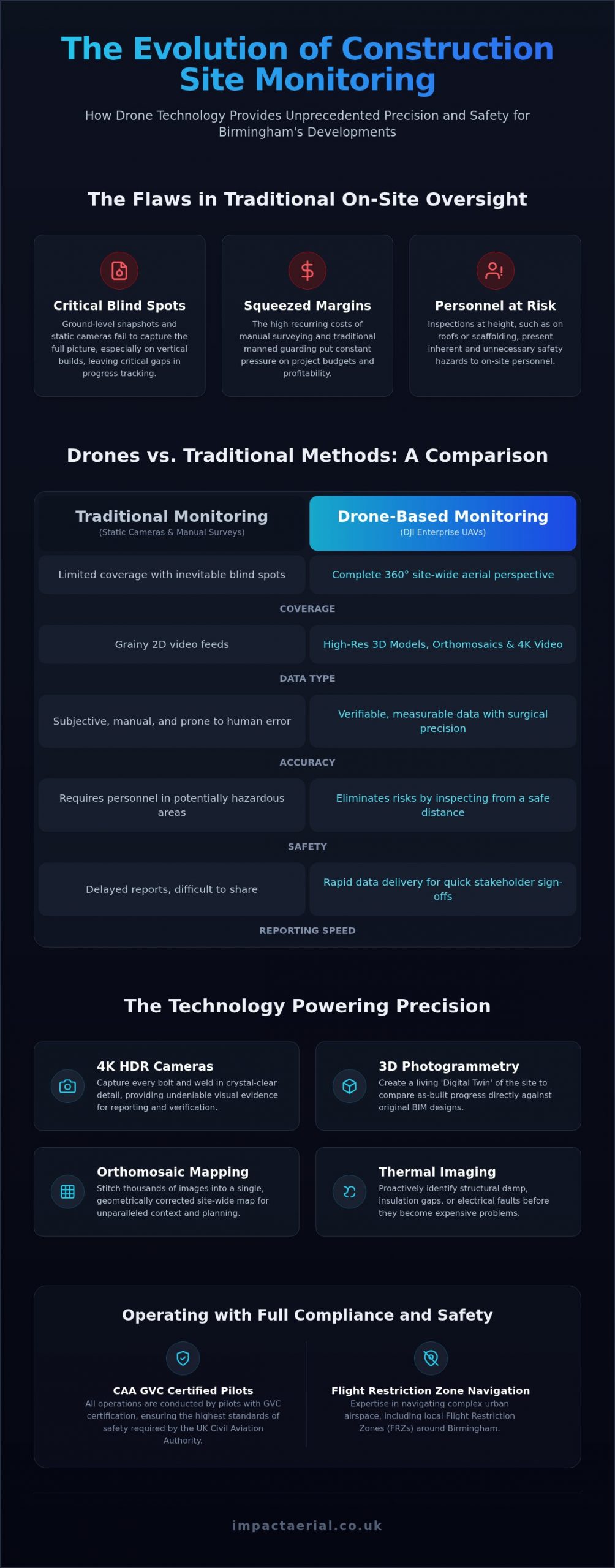
Construction Site Monitoring in Birmingham: The 2026 Guide to Drone Technology

Drones vs. Traditional Site Monitoring: A Comparison

Static surveillance has long been the backbone of site security, yet it often fails to provide the dynamic data required for modern construction site monitoring birmingham projects. While a fixed camera can monitor a primary entrance, it cannot verify the structural integrity of a fifth-floor slab or identify a leak in a remote corner of a sprawling development. A DJI Enterprise drone moves with the project. It covers significantly more ground than a traditional guard in a fraction of the time, providing a level of mobility that static infrastructure simply cannot match. This shift from 2D security footage to 3D photogrammetry models allows for a depth of analysis that was previously impossible.

The setup process also highlights a stark contrast between old and new methods. Traditional monitoring requires a heavy investment in cabling, permanent poles, and consistent power supplies. Drones are operational in minutes. This agility allows for rapid incident response; if a project manager needs to inspect a high-elevation hazard, a drone reaches that location in seconds. It provides real-time 4K visual data without the need for scaffolding or risky manual climbs, ensuring that “eyes on the ground” are supported by a superior “eye in the sky.”

Cost-Benefit Analysis

Comparing the Total Cost of Ownership reveals that drone-based monitoring is often more economical than 24/7 manned guarding. While physical security is vital for perimeter control, it lacks the sophisticated data-gathering capabilities of a UAV. A single aerial survey can replace several specialized teams, consolidating progress reporting, safety audits, and topographical updates into one efficient flight. This professional approach is underpinned by the UK drone safety and registration rules, which ensure that commercial operations are conducted within a strict legal framework. The high-resolution evidence captured also serves as indisputable proof in contract disputes or insurance claims, protecting your margins from unforeseen costs.

Integration with Existing Security

Drones shouldn’t replace every ground-based measure. Instead, they should form the top layer of a multi-tiered security and monitoring strategy for Birmingham sites. When integrated with biometric access control and ground-level CCTV, drones provide the context that validates ground-level alerts. For complex urban sites with high-value plant machinery, this layered approach ensures there are no blind spots. If a ground sensor is triggered, a drone can be deployed immediately to provide a wide-angle view of the situation. This allows for a faster and more informed response than a guard on foot could ever manage, creating a more resilient and secure site environment. For developers seeking to enhance their project’s physical protection, asel.co.uk offers integrated solutions to safeguard high-value assets and organisations.

Compliance and Safety: Flying in Birmingham Airspace

Birmingham’s urban environment presents unique challenges that demand a meticulous approach to compliance. Unlike rural projects, construction site monitoring birmingham requires navigating a complex web of aviation laws and local restrictions. Operating a drone commercially in the UK in 2026 necessitates a General Visual Line of Sight Certificate (GVC) issued by the Civil Aviation Authority (CAA). This qualification ensures that pilots possess the technical knowledge to manage risks in congested areas. Hiring an uncertified hobbyist isn’t just a safety risk; it exposes your business to significant legal liabilities and potential fines from the CAA.

Regulatory Standards for 2026

Impact Aerial stays current with all legislative transitions, ensuring our operations remain fully compliant with the latest UK drone safety and registration rules. Our pilots hold current Flyer IDs and Operator IDs, which are mandatory for all professional flights. We implement specific safety protocols when flying over active construction personnel, including defined take-off zones and emergency fail-safe procedures. This level of meticulousness provides the psychological comfort that your project is being monitored within the strictest legal boundaries.

Local Birmingham Airspace Challenges

The city’s geography includes several sensitive zones that require expert navigation. Managing flights near the Birmingham Airport Flight Restriction Zone (FRZ) or the Queen Elizabeth Hospital helipad demands direct coordination with Air Traffic Control (ATC). We also account for specific infrastructure projects like HS2 Curzon Street, which may have temporary airspace restrictions. Our team conducts a detailed pre-flight risk assessment for every deployment, identifying potential hazards before the drone even leaves the ground. This includes working with local authorities to secure permissions for city centre operations.

Privacy, Insurance, and GDPR

In densely populated areas like Digbeth or the Jewellery Quarter, privacy is a paramount concern. We adhere to strict GDPR best practices, ensuring that data capture is focused solely on the site and that any incidental footage of the public is handled according to legal standards. Safety is reinforced by our £5m commercial liability insurance, a necessary safeguard for high-stakes urban infrastructure. This level of coverage is essential for protecting your assets and maintaining professional standards across the West Midlands.

If you need a partner who understands the complexities of urban aviation law, you can book a compliant site survey with our expert team today.

Why Choose Impact Aerial for Birmingham Site Monitoring?

Impact Aerial is more than just a drone operator; we’re a technical consultant for the West Midlands’ most ambitious developments. Our approach to construction site monitoring birmingham is built on a foundation of local knowledge and high-tier hardware. Being based in the heart of the region allows us to provide a level of responsiveness that national agencies simply can’t match. We understand the specific logistical challenges of the city, from navigating complex urban canyons to coordinating with local authorities for city-centre permissions.

We utilize DJI Enterprise-grade hardware equipped with 4K HDR cameras. This provides a level of visual clarity that reveals technical details often missed by consumer-grade equipment. However, the flight is only the first step. Our post-production excellence ensures that raw data is processed into actionable insights for your engineering and management teams. We don’t just deliver a folder of images. We provide structured, high-resolution evidence that supports every stage of the build, from initial groundworks to final completion. This commitment to quality has established our proven track record across the property, construction, and advertising sectors.

Our Birmingham-Centric Approach

Our team is deeply involved in supporting major regeneration projects, including high-profile developments in the Jewellery Quarter and surrounding districts. We align our safety protocols with the rigorous requirements of Tier 1 contractors, ensuring that our presence on-site never compromises operational standards. Because we’re local, we offer fast response times for site managers who need urgent inspections or rapid progress updates; this efficiency is vital when coordinating with heavy machinery specialists like Bewlake Lift & Haul Ltd to ensure lifting operations are safe and well-documented. This proximity allows us to be an integrated part of your project team, providing the local expertise needed to manage complex West Midlands developments.

Request a Consultation for Your Next Project

Every project has unique milestones, and we tailor our monitoring packages to meet those specific needs. Whether you require weekly progress reports for internal tracking or monthly high-resolution surveys for stakeholder meetings, our process is designed for reliability. We start with an initial consultation to understand your data requirements and site constraints. From there, we handle all flight planning, risk assessments, and post-production, delivering the final data through a streamlined digital workflow. Professional construction site monitoring birmingham is about more than just pictures; it is about providing the psychological comfort and tangible data that keeps projects on track.

If you’re ready to enhance your project oversight with precision data, contact Impact Aerial today for a professional site monitoring quote.

Future-Proofing Your Birmingham Development

The landscape of West Midlands infrastructure is shifting toward a data-first approach. By moving beyond traditional ground-level security, developers are now using 3D photogrammetry and 4K HDR imagery to maintain a single source of truth for their projects. Professional construction site monitoring birmingham ensures that every phase of your build is documented with surgical precision. This reduces the risk of costly delays and provides high-resolution evidence for all stakeholders, from investors to site managers.

The transition from reactive security to proactive management allows for better safety compliance and significant cost reductions across the project lifecycle. Our team of West Midlands local experts is ready to support your next development with the meticulousness your project deserves. We bring the reassurance of CAA GVC certified pilots and £5m commercial liability insurance to every flight, ensuring your site remains compliant and secure in even the most congested urban environments.

Take the next step in optimizing your site’s efficiency and safety. Book Your Birmingham Construction Site Monitoring Consultation today and gain the 360-degree perspective your project needs to succeed.

Frequently Asked Questions

Is drone monitoring legal on construction sites in Birmingham city centre?

Drone monitoring is entirely legal in Birmingham city centre when conducted by a CAA GVC certified pilot. While the city has complex airspace, including Flight Restriction Zones near the airport and helipads, professional operators coordinate directly with Air Traffic Control. We ensure every flight adheres to strict safety protocols and is backed by £5m commercial liability insurance to protect your assets in congested urban areas.

How often should we fly the drone for effective site monitoring?

The frequency of flights usually aligns with your specific project milestones or valuation cycles. Many developers opt for weekly construction site monitoring birmingham visits to track rapid progress, while others prefer monthly high-resolution surveys for stakeholder reporting. We tailor these schedules to provide a consistent “single source of truth” that matches your project’s pace and reporting requirements.

Can drone monitoring help with insurance claims on construction sites?

High-resolution aerial data serves as undisputable evidence in the event of an insurance claim or contract dispute. Because drone captures are time-stamped and geometrically accurate, they provide a clear record of site conditions at specific dates. This documentation is invaluable for verifying “as-built” progress against CAD designs or proving that safety protocols were in place before an incident occurred.

What kind of data will I receive from a drone monitoring session?

You’ll receive a suite of data-rich deliverables tailored to your team’s needs. This typically includes 4K HDR progress photography, orthomosaic maps for site-wide accuracy, and 3D photogrammetry models. We also provide post-production services to ensure the raw data is edited and processed into professional reports that are ready for immediate use by stakeholders and project managers.

Do I need to inform my neighbours about drone flights for site monitoring?

Notifying neighbours is considered a best practice for maintaining transparency and ensuring GDPR compliance. While your site is private property, professional drone operators conduct thorough pre-flight risk assessments that include stakeholder management. We handle the logistical side of privacy, ensuring that any incidental data capture of the surrounding Birmingham community is managed according to current data protection laws.

Can drones fly in the typical Birmingham wind and rain?

Enterprise-grade drones are designed to operate in challenging weather conditions, including light rain and moderate winds. Our hardware features high IP ratings for moisture resistance and can maintain stability in wind speeds of approximately 12 metres per second. While we prioritize safety and will ground flights in extreme storms, the reliability of modern technology ensures minimal disruption to your monitoring schedule.

How does drone monitoring integrate with my existing BIM software?

Drone data integrates seamlessly with most Building Information Modelling (BIM) and project management software. We export files in standard formats such as .OBJ, .LAS, or .TIFF, which allow you to overlay 3D aerial models onto your original CAD designs. This creates a “digital twin” that helps identify structural deviations early, ensuring the project stays aligned with the intended architectural plans.

What is the difference between a survey drone and a standard filming drone?

The primary difference lies in data precision and specialized sensor technology. While standard filming drones capture high-quality visuals, survey drones utilize RTK (Real-Time Kinematic) positioning for centimetre-level accuracy. They also feature mechanical shutters to eliminate image distortion and can carry thermal sensors. These technical capabilities are essential for generating the measurable data points required for professional site monitoring.
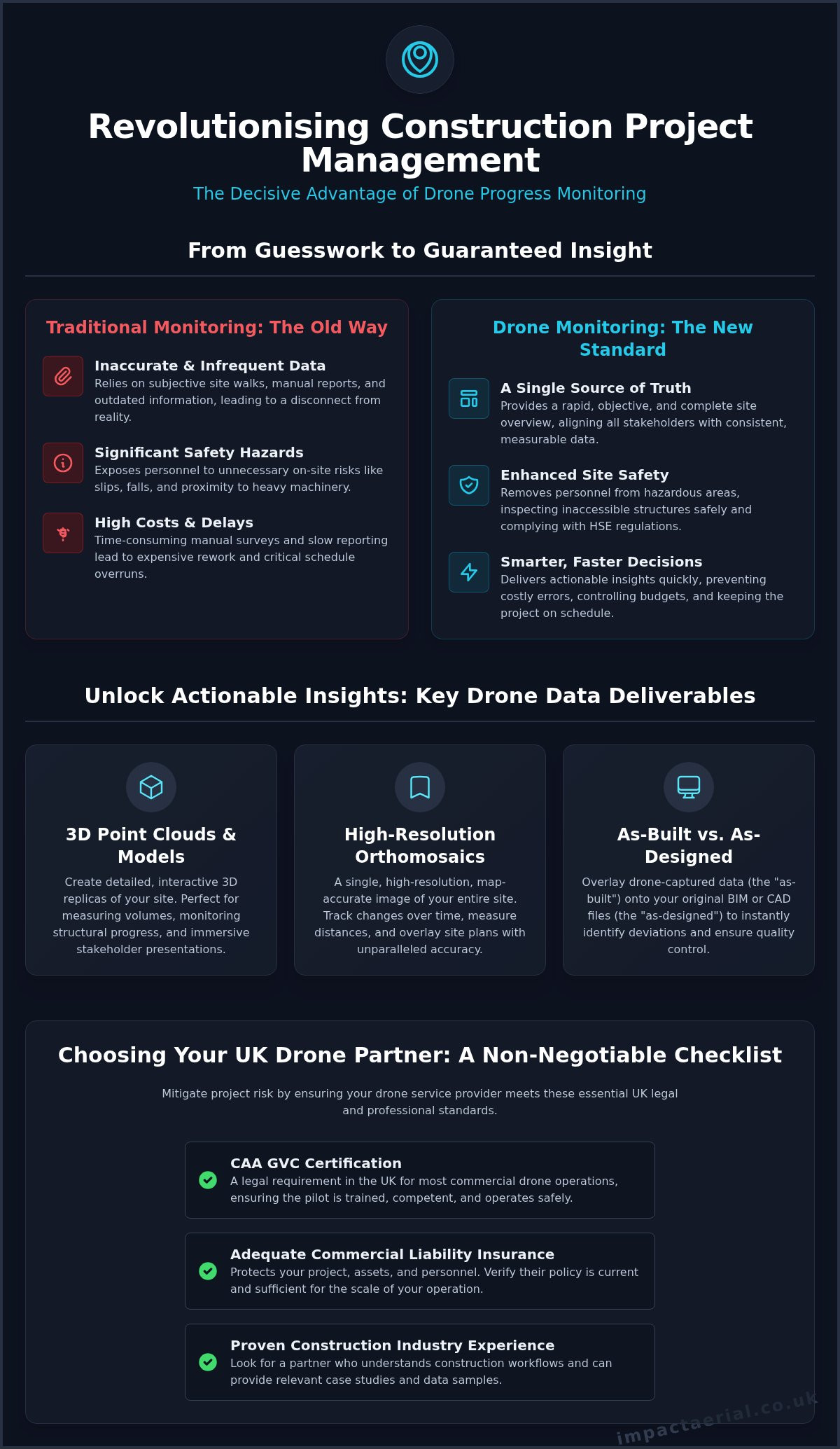
Construction Drone Services Bristol: Professional Aerial Data & Site Monitoring

How much of your project’s 2024 schedule is currently being consumed by the 40% time lag typically associated with traditional manual site inspections? You likely understand that managing a major build in Bristol presents unique challenges, especially when navigating the complex airspace restrictions near Filton or the City Centre. This is why professional construction drone services bristol have become essential for maintaining momentum while ensuring absolute safety and regulatory compliance.

By leveraging expert aerial data, you gain access to high-resolution progress reports and accurate 3D mapping that ground-based teams can’t replicate. This article shows you how our CAA GVC certified experts provide the technical precision required for survey-grade volumetric analysis. For added peace of mind, we’ll explain how real-time site monitoring mitigates risk and prevents the inaccuracies often found in amateur data. You’ll discover the specific workflows we use to turn complex aerial imagery into actionable insights that keep your Bristol project moving forward without delay.

Key Takeaways

  • Learn how replacing manual scaffolding inspections with rapid UAV assessments provides actionable data while significantly reducing site downtime and safety risks.
  • Discover how survey-grade photogrammetry and volumetric analysis deliver high-resolution 2D maps and precise stockpile measurements for site managers.
  • Navigate the complexities of the Filton and Bristol Airport flight restriction zones by partnering with CAA GVC certified construction drone services bristol.
  • Explore proven strategies for organizing aerial data into professional progress reports and consistent time-lapse sequences to track project milestones effectively.
  • Gain “peace of mind” by understanding the meticulous safety protocols and advanced DJI Enterprise technology required for reliable commercial operations.

The Evolution of Construction Drone Services in Bristol: Why Aerial Data is Essential

Bristol’s construction landscape is undergoing a significant transformation, where professional unmanned aerial vehicle (UAV) technology has moved past simple aerial photography into high-precision data gathering. Modern construction drone services bristol now provide the technical foundation for “Digital Twins” in massive urban regeneration projects, such as the 70-hectare Temple Quarter development. These virtual replicas allow project managers to simulate complex scenarios and track structural changes with millimetre accuracy, ensuring that Bristol’s skyline evolves with mathematical precision.

To better understand how aerial data transforms a site over time, watch this helpful video:

By 2024, the adoption of drone technology in UK construction has seen a 239% increase as firms move away from anecdotal progress reports toward data-driven insights. This shift ensures that developers aren’t just looking at visual progress; they’re measuring volumetric data and site topography against BIM (Building Information Modelling) standards. This level of detail is essential for managing the niche but increasingly diverse market of Bristol’s brownfield redevelopments.

Replacing Traditional Inspection Methods

UAV surveys offer a safer, more efficient alternative to manual inspections on 40-metre cranes or fragile roof structures. Utilizing a CAA GVC Certified pilot provides added peace of mind, ensuring all operations comply with strict safety regulations and commercial liability requirements.

  • Safety: Aerial inspections reduce “boots on the ground” in high-risk zones by up to 80%, significantly lowering the site’s overall risk profile.
  • Cost-Efficiency: Traditional scaffolding for a single roof inspection can cost thousands and take days to erect, whereas a drone assessment typically takes less than 60 minutes.
  • Precision: High-resolution sensors capture defects that are often invisible to the naked eye from the ground.

Real-Time Progress Monitoring

Our fleet uses the latest 4K HDR DJI Enterprise drones to document weekly site evolution with absolute clarity. These high-quality visuals facilitate remote site visits for international investors and off-site stakeholders, allowing them to inspect Bristol developments from anywhere in the world without the need for travel. Precise site monitoring ensures that physical construction aligns perfectly with architectural blueprints, preventing costly project drift and mid-build corrections. By providing construction drone services bristol

Specialised Aerial Surveys and Data Collection for Bristol Site Managers

Bristol site managers face unique challenges with urban density and complex terrain. Modern construction drone services bristol provide a streamlined solution for capturing high-resolution photogrammetry. We generate accurate 2D orthomosaic maps that allow for precise site monitoring throughout the project lifecycle. These maps aren’t just pictures; they’re data-rich assets. By using 3D modelling, we facilitate seamless BIM integration, which helps project managers identify structural clashes before they become costly errors on the ground.

Thermal imaging adds another layer of technical oversight to our professional services. Our thermal sensors detect heat loss or moisture ingress in new builds, providing a non-destructive way to verify insulation quality and structural integrity. This data-gathering approach ensures that every element of the building envelope meets the specified standards. We provide the technical clarity needed to make informed decisions without delaying site progress.

Topographical and Volumetric Surveys

Precision is the foundation of any successful earthworks project. We utilise DJI Enterprise drones equipped with RTK (Real-Time Kinematic) technology to achieve centimetre-level accuracy across the entire site. This allows us to calculate the volume of stockpiles and excavations with survey-grade precision. Instead of relying on manual measurements that can take days, our aerial surveys provide results in hours. You can learn more about the technical side in our survey drone guide to see how this technology integrates with your existing workflow.

Building and Roof Inspections

Traditional inspections often require expensive cherry pickers or scaffolding, which increase costs and safety risks. Our professional construction drone services bristol eliminate these hurdles. We capture detailed 4K imagery of hard-to-reach cladding, guttering, and roof structures. Using High Dynamic Range (HDR) ensures we capture every detail, even in shadowed areas or high-contrast environments common on complex build sites.

Safety remains our absolute priority. Every flight we conduct adheres strictly to CAA drone regulations as outlined in CAP 722. This compliance gives our clients peace of mind that their site monitoring is legal, insured, and professional. Our pilots are CAA GVC Certified, ensuring that your project stays compliant while benefiting from top-quality aerial data. If you’re looking to enhance your site’s efficiency, you can contact us for a consultation on your next Bristol project.

Bristol presents a unique set of challenges for aerial operations. The city’s geography includes the 5km Flight Restriction Zones (FRZ) surrounding Bristol Airport to the south and Filton Aerodrome to the north. Successfully delivering construction drone services bristol requires more than just technical skill; it demands a deep understanding of the legal landscape. We treat every site as a bespoke aviation project, ensuring all flights remain within the strict parameters set by the Civil Aviation Authority (CAA).

Operating in Controlled Airspace

Flying in high-density urban environments like the Bristol city centre or the Temple Quarter Enterprise Zone requires rigorous coordination. We manage the entire administrative burden, from submitting Non-Standard Flight (NSF) applications to NATS to maintaining direct radio contact with local Air Traffic Control. Our pre-flight planning includes a detailed review of Ground Hazards and NOTAMs (Notices to Airmen) to prevent any disruption to local aviation. Check our guide to UK drone licenses for more on compliance to understand how these rules affect your project. We don’t just show up and fly; we ensure every takeoff is legally sanctioned and safe.

The “Peace of Mind” Guarantee

The transition from the old Permission for Commercial Operation (PfCO) to the General Visual Line of Sight Certificate (GVC) marks a significant shift in drone regulation. Our pilots hold current GVC certifications, which are essential for operating heavier enterprise-grade drones in “congested” areas. This qualification reflects a higher standard of pilot competency and operational safety. For added peace of mind, we back our expertise with £5 million in commercial drone liability insurance. This is the baseline requirement for major Bristol construction firms and Tier 1 contractors. It protects your project against unforeseen incidents and ensures adherence to site safety protocols.

Hiring an uncertified or uninsured pilot isn’t just a safety lapse; it exposes developers to massive legal liabilities and potential prosecution under the Air Navigation Order. Impact Aerial mitigates this risk through a meticulous approach to every mission:

  • Detailed site-specific risk assessments (RAMS) completed 48 hours before arrival.
  • Use of DJI Geo-fencing and secondary fail-safe systems on all aircraft.
  • Verification of all flight paths against current CAA aeronautical charts.
  • Full membership in the Drone Safe Register to ensure industry-leading standards.

By maintaining these standards, we provide a reliable service that integrates seamlessly with your existing health and safety frameworks. We understand that on a busy construction drone services bristol project, safety is the primary priority. Our methodical planning ensures that data gathering never comes at the expense of site security or public safety.

Maximising ROI: How to Organise Aerial Data for Construction Milestones

To realise the full return on investment from construction drone services bristol, data management must be as precise as the flight itself. Capturing high-resolution imagery is only the first step; the real value lies in how that data is structured, stored, and shared across your project team. Professional drone operations turn raw visual files into actionable intelligence that drives decision-making at every project milestone.

We use GPS-guided waypoints to establish consistent flight paths. This ensures that every subsequent flight follows the exact same coordinates, camera pitch, and altitude. It’s the only way to produce comparable time-lapse data that accurately tracks week-on-week progress. By maintaining this consistency, stakeholders can overlay different build stages to identify deviations from the original design. This level of precision is critical for projects in 2024 where margins are tight and schedules are non-negotiable.

Modern sites rely on collaborative digital environments. We facilitate the integration of aerial data into project management platforms like Procore and Autodesk Build. This allows site managers to view 4K orthomosaics directly alongside their BIM models. Using 360-degree panoramas, teams can conduct immersive site walkthroughs from any location, reducing the need for unnecessary site visits and improving safety by keeping personnel out of high-risk areas.

Data Processing and Post-Production

Impact Aerial transforms raw sensor data into professional, edited progress reports that serve multiple stakeholders. While site managers need raw technical data, investors and planning authorities require a more polished perspective. Our team processes 4K HDR footage into cinematic marketing content that highlights project success. These high-quality visual assets are essential for planning applications and public consultations where visual clarity is paramount. You can Explore our cinematic aerial filming drone services to see how we elevate standard site footage into compelling narratives.

Long-Term Asset Management

The utility of drone data extends far beyond the construction phase. By creating a comprehensive digital archive of the build process, developers secure a “Golden Thread” of information for future maintenance. This archive is invaluable for post-completion warranty and insurance claims, providing dated evidence of structural elements before they were covered by cladding or internal finishes. For those managing Bristol commercial units, virtual tours created during the final stages of the build assist in early leasing and sales, allowing potential tenants to explore the space before the keys are even handed over.

Ready to streamline your site monitoring with professional data? Contact Impact Aerial today to discuss your project requirements.

Impact Aerial: Your Partner for Professional Construction Drone Services in Bristol

Impact Aerial brings over five years of specialized experience to the South West construction sector. We’ve built a reputation for reliability across the West Midlands and Bristol by delivering high-precision data that project managers trust for critical decision-making. Our operations aren’t just about flying; they’re about providing a technical advantage through meticulous data-gathering and photogrammetry. By utilizing the latest DJI Enterprise fleet, including the Mavic 3 Enterprise and Matrice series, we ensure maximum reliability and data accuracy for every site visit. We understand that construction timelines are tight, so we focus on a client-centric approach that moves efficiently from the initial consultation to final data delivery.

Why Bristol Developers Choose Us

We provide a unique blend of technical surveying and high-end cinematic filming. This dual capability allows developers to use a single flight for both topographical data and marketing materials, saving both time and budget. Our pilots are local experts who understand the geographic constraints of the region. We’re familiar with the complex airspace requirements near Bristol Temple Meads and the specific wind conditions often found at coastal sites like Avonmouth. Every pilot we deploy is CAA GVC certified. They carry years of commercial experience and comprehensive public liability insurance. This professional standing provides the necessary peace of mind for high-stakes urban projects where safety and compliance are non-negotiable.

Get Started with Your Bristol Project

Onboarding Impact Aerial for your construction drone services bristol is a streamlined, methodical process. We begin with a detailed consultation to define your specific data requirements. To provide an accurate, bespoke quote, your initial brief should include the site postcode, the total acreage, and your preferred frequency of visits. We also need to know if you require specific outputs like 3D point clouds, 2D orthomosaics, or 4K progress videos. Once we have these details, we conduct a thorough site assessment and handle all necessary flight planning and risk assessments.

Our team prides itself on being a trusted specialist in a niche but increasingly diverse market. We don’t just deliver images; we provide actionable insights through secure cloud portals, ensuring your stakeholders have immediate access to the latest site intelligence. Whether you’re managing a small residential build or a major infrastructure project, our construction drone services bristol are designed to scale with your needs.

Contact us today to discuss your Bristol construction drone requirements and learn how our professional aerial data can streamline your next project.

Elevate Your Project Standards with Professional Site Monitoring

Adopting advanced aerial intelligence is the most effective way to streamline workflows and mitigate risks on modern build sites. Our construction drone services bristol provide the technical precision required for accurate site monitoring and detailed photogrammetry. By deploying our DJI Enterprise 4K HDR Fleet, site managers gain access to high-resolution data that identifies potential issues before they become costly delays. Safety remains our primary focus. Every mission is conducted by CAA GVC Certified Pilots who are experts at navigating the specific constraints of Bristol’s urban airspace. For added peace of mind, we carry £5m Commercial Liability Insurance to ensure your project is fully protected. It’s time to replace manual inspections with data-driven insights that deliver a tangible return on investment. We’re ready to help you capture the perspectives that matter most for your project’s success. Let’s start building a clearer picture of your site’s progress today.

Request a professional drone survey quote for your Bristol site

Frequently Asked Questions

Do I need special permission to use a drone on a Bristol construction site?

You don’t need special council permission for every flight, but you must comply with CAA regulations and have the landowner’s consent. Our pilots hold CAA GVC (General Visual Line of Sight Certificate) qualifications, allowing us to operate legally in congested urban areas. We handle all necessary risk assessments and flight notifications through the CAP 722 framework to ensure every project meets UK aviation law.

What is the typical cost for construction drone services in Bristol?

The cost for construction drone services in Bristol depends on the project’s complexity, site size, and required data outputs. Factors influencing the price include the number of flight hours, the type of sensors used, and the depth of post-processing needed for 3D modelling. We provide bespoke quotes after reviewing your specific site requirements and safety constraints rather than using a flat rate.

How quickly can you mobilise for a site inspection in the South West?

We can typically mobilise for a site inspection in the South West within 24 to 48 hours of instruction. Our proximity to the M4 and M5 corridors allows us to reach sites across Bristol, Bath, and Gloucestershire rapidly. For emergency structural inspections or urgent site monitoring, we prioritise our schedule to provide same-day or next-day deployments whenever weather conditions allow.

Can drones fly in typical Bristol weather conditions?

Our DJI Enterprise drones can operate in wind speeds up to 12 metres per second and have IP45 or IP55 weather resistance ratings. While we can fly in light drizzle, we avoid heavy rain or gale-force winds to protect data quality and maintain safety standards. We monitor local Met Office aviation forecasts hourly to ensure we choose the optimal window for your aerial data collection.

What insurance coverage does Impact Aerial provide for on-site operations?

For added peace of mind, Impact Aerial maintains £5 million in specialist commercial drone liability insurance as standard. Our coverage is fully compliant with EC 785/2004 requirements and can be increased to £10 million for specific high-risk contracts or large-scale infrastructure projects. This ensures all stakeholders are protected against third-party property damage or injury during our professional construction drone services in Bristol.

Can you provide survey-grade accuracy for volumetric measurements?

We achieve survey-grade accuracy for volumetric measurements by using Real-Time Kinematic (RTK) positioning and Ground Control Points (GCPs). This methodology allows us to provide measurements with a relative accuracy of 1 to 3 centimetres. Our photogrammetry software calculates stockpile volumes and site topographies with a high degree of precision, replacing traditional manual surveying methods that often take days to complete.

How is the data delivered and what software do I need to view it?

We deliver processed data through secure cloud-based platforms or direct file transfers in formats like GeoTIFF, OBJ, and PDF. You won’t need specialised hardware to view standard reports, as our web-based viewers work in any modern browser. For more technical applications, our files are fully compatible with industry-standard BIM and CAD software, including Autodesk Revit and ArcGIS.

Is it possible to fly drones in the Filton or Bristol Airport restricted zones?

It’s possible to fly in the Filton or Bristol Airport Flight Restriction Zones (FRZ), but it requires prior coordination with Air Traffic Control (ATC). We manage the entire application process, including submitting flight plans through the NATS drone assist system at least 14 days in advance for non-emergency work. Our pilots maintain radio contact with the relevant airfield throughout the operation to ensure total airspace safety.

Construction Site Progress Monitoring with Drones: The Definitive Guide

In the UK construction industry, managing a project’s timeline and budget is a constant battle against unforeseen delays and subjective reporting. The challenge of gaining a complete, objective overview often means costly errors are missed and stakeholder updates lack clarity. This is precisely where a construction site progress monitoring drone provides a decisive advantage. By leveraging advanced aerial data-gathering, project managers can move beyond guesswork and gain unparalleled insight into every phase of development, ensuring compliance and enhancing on-site safety from day one.

This definitive guide explores how professional, CAA GVC Certified drone services are revolutionising project management. We will demonstrate how this technology delivers the accurate, measurable data needed to keep your project on schedule and within budget. You will learn to provide clear, visual progress updates to clients and investors, identify potential issues before they escalate, and ultimately make better-informed decisions that drive efficiency and profitability, giving you and your stakeholders complete peace of mind.

Key Takeaways

  • Move beyond slow, manual site walk-throughs. Drones provide a rapid and accurate single source of truth, helping to keep all project stakeholders aligned and informed.
  • Unlock actionable insights that go far beyond simple aerial photos. Learn how data-rich outputs like 3D models and as-built vs. as-designed overlays drive smarter project decisions.
  • Implementing a construction site progress monitoring drone strategy significantly enhances site safety while providing the real-time data needed to control budgets and prevent schedule overruns.
  • Understand the essential criteria for choosing a professional drone partner in the UK, including the legal requirement for CAA GVC certification and adequate commercial liability insurance to mitigate project risk.

Why Traditional Construction Progress Monitoring is Falling Short

For construction project managers in the UK, every day is a battle against the clock and budget. Traditional methods of tracking progress-relying on manual site walks, paper-based reports, and subjective photographs-are increasingly proving inadequate for the complexity and scale of modern projects. These outdated practices are not just inefficient; they introduce significant risks and hidden costs that can derail a project’s success, highlighting the urgent need for a more advanced, data-driven approach.

To better understand the limitations of ground-level views, the following demonstration showcases the comprehensive perspective that aerial data provides.

Inaccurate and Infrequent Data

Manual progress reports are inherently subjective and prone to human error. A site foreman’s estimate can differ significantly from reality, and vital details can be missed during a site walk. Furthermore, data is captured infrequently-often weekly or bi-weekly-meaning critical decisions are based on outdated information. This creates a dangerous disconnect between the project plan and the on-the-ground reality. It is impossible to gain a truly holistic, top-down view of an entire site simultaneously, a key advantage now being leveraged across many drone applications in construction where comprehensive data-gathering is paramount.

Significant Safety Hazards and Accessibility Issues

Active construction sites are hazardous environments, and manual inspections require personnel to navigate them directly. This exposes staff to unnecessary risks, from slips and falls to proximity to heavy machinery and work at height. Adhering to stringent Health and Safety Executive (HSE) regulations is a constant challenge. Physically inaccessible areas, such as complex roof structures or the centre of large excavations, are often poorly inspected or missed entirely, creating critical blind spots in progress assessment and quality control.

High Costs and Project Delays

The time and labour required for manual surveys represent a significant operational cost. Compiling reports, cross-referencing blueprints, and communicating findings is a slow process that delays crucial decision-making. When inaccuracies are discovered late, the result is often expensive rework, costing thousands of pounds and causing substantial schedule overruns. These compounding issues demonstrate why a modern construction site progress monitoring drone is no longer a luxury but an essential tool for maintaining control over complex projects and protecting the bottom line.

How Drones Revolutionise Construction Site Monitoring

Traditional site monitoring methods, often reliant on manual walk-throughs and ground-level photography, are slow, subjective, and frequently incomplete. They create data silos and leave project managers grappling with outdated information. A professional construction site progress monitoring drone provides a comprehensive, data-driven solution that transforms project oversight by delivering unparalleled speed, accuracy, safety, and communication. This technology establishes a definitive ‘single source of truth’ accessible to all stakeholders, from the site office to the boardroom.

A Complete, Objective View: The Single Source of Truth

Where ground teams might take days to survey a large site, a drone can capture high-resolution imagery and data of the entire area in a matter of hours. This data-gathering process is not only rapid but also entirely objective. It replaces subjective handwritten notes and guesswork with measurable orthomosaic maps, 3D models, and detailed photographs. By conducting regular, automated flights, you create a consistent, time-stamped visual record, allowing for precise tracking of progress against the project schedule.

Enhancing Site Safety and Reducing Risk

Maintaining a safe site is the highest priority for any project manager. Drones fundamentally reduce risk by removing personnel from potentially hazardous situations. Instead of sending a surveyor to inspect unstable ground or an engineer up expensive scaffolding, a drone can capture the necessary data from a safe distance. This proactive approach allows you to:

  • Inspect structures at height, such as roofing, facades, and scaffolding, without physical access.
  • Identify potential hazards like unsecured materials, water pooling, or unsafe access points from an aerial perspective.
  • Minimise on-site foot traffic and the operation of heavy access equipment.

Operating a drone commercially requires strict adherence to official guidelines. A certified professional understands the nuances of UK construction drone regulations set by the CAA, ensuring all operations are conducted safely and legally, giving you complete peace of mind.

Improving Stakeholder Communication and Transparency

Effectively communicating progress to clients, investors, and internal teams is critical for project success. A construction site progress monitoring drone delivers clear, compelling visual updates that are easily understood by everyone, regardless of their technical background. Time-stamped aerial imagery provides indisputable evidence to resolve disputes with subcontractors over work completion or material delivery. In meetings, this visual data moves discussions from abstract plans to tangible reality, enabling faster, more informed decision-making. See how our drone services can bring this level of clarity and efficiency to your next project.

Construction Site Progress Monitoring with Drones: The Definitive Guide

The Key Deliverables: What Data Do Drones Actually Provide?

While high-quality aerial photos and videos are a standard output, the true value of a professional drone service lies in the actionable data it generates. A modern construction site progress monitoring drone is a sophisticated data-gathering tool, designed to capture precise, measurable information that integrates directly into your project management workflows. These datasets provide objective insights, reduce manual surveying time, and empower site managers to make informed decisions with confidence. The industry has widely recognised how drones are helping construction companies move beyond simple visuals to leverage data for improved safety, planning, and efficiency.

Here are the core data deliverables that provide tangible benefits to your construction project:

High-Resolution Orthomosaic Maps

An orthomosaic map is far more than a simple aerial photograph. It is a geographically accurate, high-resolution site map created by stitching hundreds or thousands of individual images together. This process removes distortion, resulting in a single, top-down view that is true to scale.

  • Practical Application: Use the map to take precise measurements of distances, perimeters, and areas directly on your screen. You can also overlay CAD or BIM design files to visually verify that work on the ground aligns perfectly with the project plans, identifying discrepancies early.

3D Point Clouds and Digital Twins

Using advanced photogrammetry techniques, a drone captures data that can be processed into a dense 3D point cloud. This is a digital file containing millions of data points, each with precise X, Y, and Z coordinates, which together form a detailed 3D replica of your site. This forms the foundation of a ‘Digital Twin’.

  • Practical Application: This model allows for ‘as-built’ versus ‘as-designed’ analysis within BIM software. By comparing the reality on-site with your original designs, your team can immediately identify deviations, clashes, or construction errors, preventing costly rework down the line.

Cut/Fill and Stockpile Volumetric Analysis

One of the most powerful applications for a construction site progress monitoring drone is calculating volumes with exceptional accuracy. This technology eliminates guesswork and time-consuming manual measurements for earthworks and material management.

  • Practical Application: Track cut-and-fill progress to ensure earthworks are on schedule and budget. Accurately measure the volume of stockpiles (e.g., aggregate, sand, soil) to manage inventory, verify deliveries, and prevent material shortages or over-ordering.

Progressive Timelapse Videos

While primarily a visual tool, a professionally produced timelapse video is a critical data asset for communication. By capturing footage from the same flight path at regular intervals (e.g., weekly or monthly), we can create a compelling video that documents the entire project lifecycle.

  • Practical Application: These videos provide an easily digestible and powerful overview of progress for stakeholder meetings, client updates, and internal reviews. They also serve as an invaluable marketing asset, showcasing your company’s capabilities from foundation to completion.

Drone Monitoring Across the Entire Project Lifecycle

The true value of a drone in construction is not found in a single flight, but in its consistent application across every phase of the project. By integrating aerial data from the initial survey to the final handover, project managers can create a ‘golden thread’ of verifiable information. This comprehensive approach transforms a construction site progress monitoring drone from a simple imaging tool into a core project management asset, providing clarity, accountability, and unparalleled oversight.

Phase 1: Pre-Construction and Site Planning

Before the first machine arrives on site, our professional drone services provide critical baseline data. We conduct high-precision topographical surveys using photogrammetry to generate accurate 3D models and digital elevation maps. This data is essential for validating site boundaries, assessing existing conditions, and informing initial design and planning decisions. This creates an immutable digital record of the site in its original state, which is invaluable for dispute resolution and progress validation later on.

Phase 2: Earthworks and Foundations

During the groundworks phase, efficiency and accuracy are paramount. Drones provide a fast and safe method for tracking earthworks progress with precision. Key applications include:

  • Volumetric Calculations: Accurately measure stockpile volumes to manage materials, track cut-and-fill progress, and verify contractor work.
  • Grading Verification: Overlay drone-captured surface models with design plans to ensure site grading and levelling meet project specifications.
  • Foundation Checks: Quickly verify the position and alignment of foundation work against digital plans, catching costly errors before they are built upon.

Phase 3: Vertical Construction

As the structure rises, a construction site progress monitoring drone becomes the ultimate tool for stakeholder communication and quality control. Regular flights capture high-resolution imagery and video, allowing teams to monitor structural progress against the project schedule (e.g., Gantt charts). This data facilitates remote quality assurance inspections of facades, roofing, and other hard-to-reach areas, significantly improving site safety while ensuring key components are installed correctly and on time.

Phase 4: Handover and As-Built Documentation

In the final stages, drone data provides the definitive record of the completed project. We can generate centimetre-accurate as-built 3D models and orthomosaics for the client’s records, offering a far more detailed and reliable alternative to traditional documentation. Furthermore, thermal imaging inspections can be conducted to verify insulation performance and identify potential energy loss, providing complete peace of mind. This comprehensive visual documentation streamlines project close-out and serves as an invaluable asset for future facilities management. For more information on our end-to-end services, please contact us.

Choosing a Professional Drone Monitoring Partner: A Checklist

Selecting the right drone services provider is a critical decision that directly impacts the quality of your data, the safety of your site, and the overall return on your investment. Using an unqualified or uninsured operator exposes your project to significant financial and legal risks. This checklist outlines the non-negotiable criteria your partner must meet to deliver professional and compliant services.

Essential CAA Certification (GVC) and Permissions

In the UK, any commercial drone operation is strictly regulated by the Civil Aviation Authority (CAA). Your chosen provider must hold a valid General Visual Line of Sight Certificate (GVC) and an Operational Authorisation from the CAA. This is not just a recommendation; it is a legal requirement. These certifications prove the operator is trained, competent, and has had their safety procedures professionally assessed, ensuring all flights are conducted safely and legally.

Comprehensive Commercial Liability Insurance

Accidents are rare with professional operators, but robust insurance is essential for complete peace of mind. Verify that your provider holds a comprehensive commercial liability insurance policy with a minimum coverage of £5 million. This protects your project, property, and personnel in the unlikely event of an incident. Do not hesitate to ask for a copy of their current insurance certificate before any work begins.

Proven Construction Industry Experience

A pilot who understands construction workflows and terminology will provide far more valuable insights. Look for a provider with a demonstrable portfolio of construction projects. An experienced partner knows what to look for on-site, understands project milestones, and can tailor their data-gathering to your specific needs. Ask for case studies or references to ensure they have a successful track record using a construction site progress monitoring drone to deliver actionable results for clients like you.

Professional-Grade Equipment and Software

The quality of your data is directly linked to the quality of the tools used. Consumer-grade drones are not suitable for professional survey work. Your provider should operate enterprise-level aircraft, purpose-built for commercial and industrial applications, offering superior stability, camera quality, and reliability. Furthermore, they must use specialised photogrammetry and data processing software to transform raw imagery into the accurate 2D maps, 3D models, and progress reports your project demands.

A partner who meets these standards is not just a service provider but a valuable asset to your project management team, delivering reliable data while mitigating risk.

Impact Aerial meets all these criteria. Contact our experts today.

Elevate Your Project Management with Professional Drone Monitoring

The era of relying solely on manual surveys and ground-level photography is drawing to a close. As we’ve explored, drones provide an unparalleled perspective, delivering precise, high-resolution data that enhances site safety, streamlines stakeholder communication, and provides accurate tracking against project timelines.

Integrating a professional construction site progress monitoring drone service into your workflow is a strategic decision that delivers tangible returns. From detailed 2D orthomosaics to interactive 3D models, this data-driven approach empowers project managers to mitigate risks, control costs, and make critical decisions with confidence throughout the entire project lifecycle.

Ready to harness this technology for your site? Partnering with a certified expert is crucial. At Impact Aerial, our team of CAA GVC Certified Pilots has extensive experience across the UK construction sector. For your complete peace of mind, all our operations are backed by £5m in commercial liability insurance. Discover how our expert aerial data services can reduce costs and improve project outcomes.

Get a tailored quote for your construction project from our certified experts.

Frequently Asked Questions

How often should a construction site be monitored by a drone?

The optimal frequency for drone monitoring depends on your project’s timeline and complexity. For fast-paced projects with significant weekly changes, bi-weekly or even weekly flights are ideal for tracking earthworks, foundations, and structural progress. For longer-term projects, monthly flights may be sufficient for high-level stakeholder reporting and milestone verification. We will consult with you to establish a schedule that aligns perfectly with your project’s specific reporting requirements and key phases.

What is the typical cost of drone progress monitoring services in the UK?

Costs are determined by site size, complexity, and the required data outputs. A single visit to a standard site typically ranges from £350 to £600. For ongoing projects, we offer cost-effective packages; a contract for weekly flights could be in the region of £1,200 – £2,000+ per month. This fee includes flight planning, on-site data capture by our CAA GVC certified pilots, and processing of deliverables such as 2D maps or 3D models.

Can drones fly in bad weather like rain or high winds?

For safety and data quality, we do not operate our drones in rain or fog. Our professional-grade equipment has a degree of weather resistance, but precipitation can compromise image clarity and sensor integrity. Operations are also restricted by wind speeds, typically adhering to a manufacturer and CAA limit of around 22 mph. We always conduct thorough pre-flight weather assessments and will reschedule if conditions are unsafe or would negatively impact the quality of the data.

What information do I need to provide to get an accurate quote?

To provide a precise and comprehensive quote, we require several key details about your project. Please provide the full site address or postcode, the total site area (in acres or hectares), and the desired frequency of flights (e.g., weekly, bi-weekly, monthly). It is also essential to specify the data deliverables you need, such as high-resolution photographs, 4K video, 2D orthomosaic maps, or 3D point cloud models for BIM integration.

Is drone monitoring data accurate enough for BIM and CAD software?

Yes, absolutely. By utilising Ground Control Points (GCPs), our photogrammetry data can achieve survey-grade accuracy, often down to 20-50mm. This high level of precision ensures that the outputs, including 3D point clouds and digital terrain models, are fully compatible with industry-standard BIM and CAD software like Autodesk Revit or Civil 3D. This allows for direct comparison of as-built conditions against design plans for accurate progress verification and clash detection.

How quickly can I receive the data after a drone flight?

Our data processing workflow is optimised for a swift turnaround. Standard deliverables such as high-resolution aerial photographs and unedited video footage are typically delivered within 24 hours. More complex datasets from our construction site progress monitoring drone services, such as processed 2D orthomosaics and 3D models, require more intensive processing and are usually available within 48 to 72 hours, ensuring your team receives actionable insights promptly.