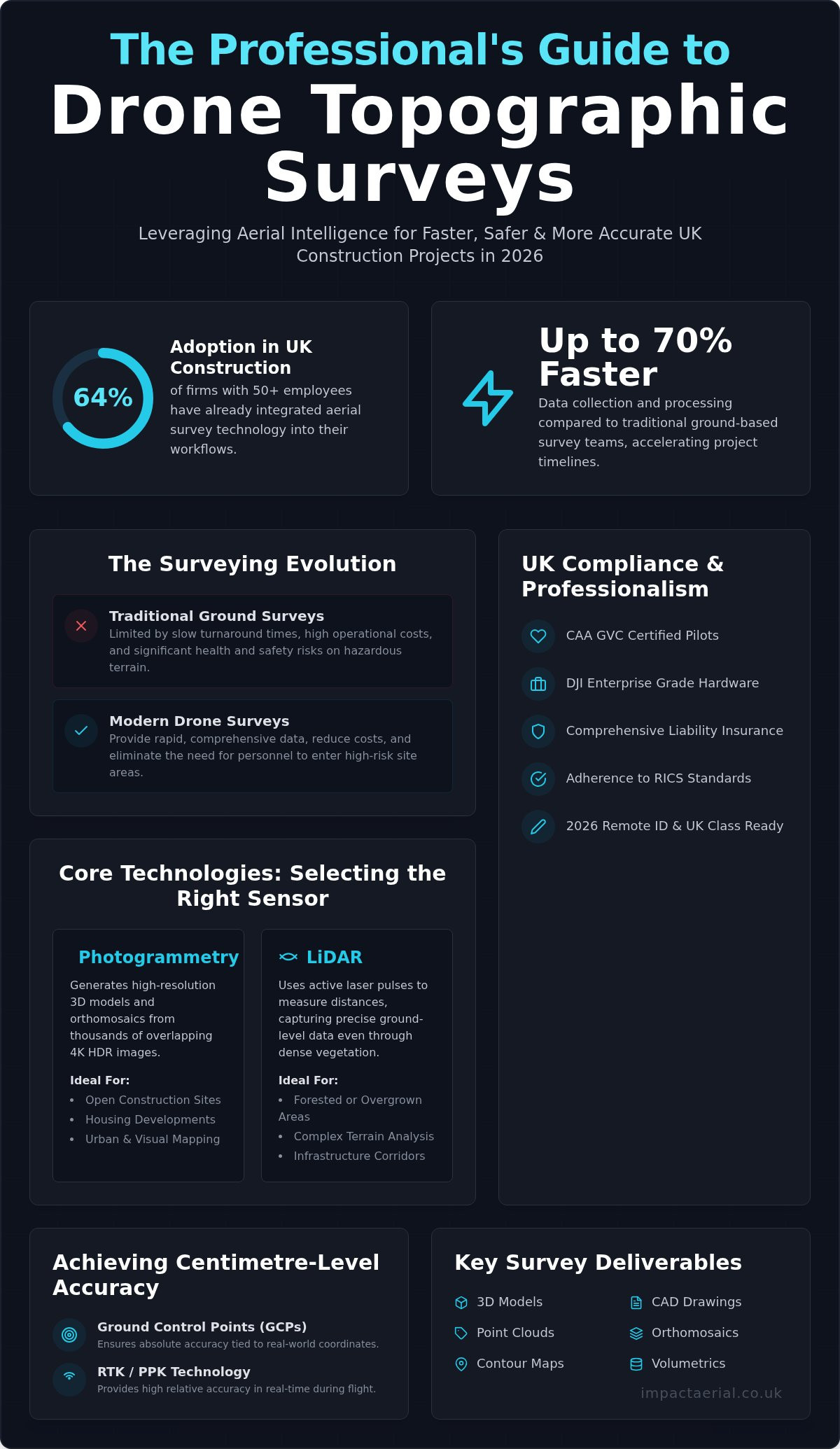
Traditional ground surveys often take five times longer than aerial alternatives, frequently leaving UK project managers waiting weeks for critical site data. You likely agree that stalling a development due to slow data turnaround or safety risks on hazardous terrain is an avoidable drain on your budget. It’s a common bottleneck that impacts both your bottom line and your delivery schedule, especially when high-precision results are non-negotiable.
By commissioning a professional uav topographic survey uk, you can secure centimetre-level accuracy and full CAA compliance while reducing site time by up to 75%. This guide explains how GVC certified pilots use high-resolution photogrammetry to deliver precision 2D and 3D data for added peace of mind. We’ll examine the 2026 regulatory landscape, cost-saving workflows, and the technical specifications required to ensure your site data collection is both safe and meticulous. You’ll discover how to leverage the latest professional UAV technology to get your project moving faster without sacrificing the quality your stakeholders expect.
Key Takeaways
Understand how the shift to high-precision aerial mapping provides a more efficient, high-resolution alternative to traditional ground-based surveying methods.
Master the technical distinctions between photogrammetry and aerial LiDAR to ensure your site data achieves centimetre-level accuracy using DJI Enterprise hardware.
Navigate the 2026 regulatory landscape by ensuring every uav topographic survey uk is conducted by a CAA GVC certified pilot for total legal compliance.
Learn how to transform raw aerial data into professional, actionable deliverables including ortho-mosaic maps, Digital Terrain Models (DTM), and CAD-ready files.
Discover why professional-grade insurance and technical expertise are vital for providing the peace of mind required on complex UK construction and development sites.
What is a UAV Topographic Survey and Why is it Essential in 2026?
A Unmanned Aerial Vehicle (UAV) topographic survey is a high-precision aerial mapping method that uses drones to capture detailed data on land features, elevations, and man-made structures. This technology has fundamentally changed how we understand terrain. It has moved the industry away from slow, manual “boots on the ground” methods toward an “eye in the sky” approach. Since the January 2025 update to Civil Aviation Authority (CAA) flight regulations, the barriers to deploying advanced uav topographic survey uk services have dropped. This has made 2026 the definitive tipping point for drone adoption across the UK construction and civil engineering sectors.
Adopting this aerial methodology isn’t just about following a trend; it’s about survival in a competitive market. Large-scale projects now demand the kind of rapid data turnaround that traditional methods simply can’t provide. Recent industry reports indicate that 82% of Tier 1 UK contractors now mandate drone-based site assessments before any ground is broken. This shift ensures that every stakeholder, from the site manager to the lead architect, works from the same high-resolution digital twin.
To better understand how this technology functions in a real-world environment, watch this helpful video:
The Core Purpose of Topographic Mapping
The primary goal is to capture every natural and artificial feature on a site with precise X, Y, and Z coordinates. This data is vital during the earliest stages of the RIBA Plan of Work, specifically Stages 1 and 2, where site feasibility is determined. A topographic survey is a comprehensive digital blueprint of a site’s physical terrain and features that serves as the single source of truth for design teams, preventing 12% of total project costs from being wasted on avoidable design errors. By establishing a centimetre-accurate baseline, developers can calculate earthwork volumes and drainage requirements with total confidence.
UAV vs. Traditional Ground Surveys
The advantages of using a uav topographic survey uk over traditional total station methods are measurable and significant. We focus on three key areas:
Speed: A professional drone team can survey a 50-hectare site in approximately 3 hours. A traditional ground crew would require at least 4 days to cover the same area to a similar level of detail.
Safety: Drones eliminate the need for surveyors to physically traverse hazardous environments. This includes unstable 30-degree quarry faces, active railway corridors, or contaminated brownfield sites.
Data Density: While a surveyor with a total station might capture 500 individual points in a day, a UAV captures millions of points. This results in a 400% increase in data density, providing a much smoother and more accurate digital terrain model.
Various sectors are now reaping these rewards. Property developers use this data to optimise housing layouts on complex hillsides. In the quarrying industry, managers use drone surveys to calculate the volume of 200,000-tonne stockpiles in minutes. Infrastructure projects, such as the ongoing motorway improvements in the West Midlands, rely on these surveys to monitor progress without closing lanes. Even environmental agencies have adopted the technology to track 15cm of annual coastal erosion along the Norfolk coastline, providing “peace of mind” through consistent, repeatable data gathering.
The Technology Behind Centimetre-Level Accuracy
Precision in a uav topographic survey uk relies on the synergy between high-end airframes and advanced spatial sensors. We utilise DJI Enterprise drones, specifically the Matrice 350 RTK and the Mavic 3 Enterprise, which are engineered for stability in the UK’s unpredictable wind conditions. These platforms carry 45-megapixel full-frame sensors capable of capturing data at a Ground Sampling Distance (GSD) of less than 0.8cm per pixel. High-resolution optics are essential; they ensure that every pixel represents a precise coordinate on the earth’s surface, eliminating the blur that plagues consumer-grade hardware.
Photogrammetry vs. LiDAR: Choosing the Right Tool
Selecting the correct sensor is a technical decision based on the site’s physical characteristics. Photogrammetry remains the primary choice for creating high-resolution 3D textured meshes and detailed visual maps. It relies on 80% image overlap to triangulate points in space. However, its main limitation is vegetation. If a site is covered in dense scrub or woodland, photogrammetry only maps the top of the leaves. Adhering to the NatureScot UAV Data Guidance ensures that our data capture meets the rigorous standards required for UK environmental and topographic reporting.
Photogrammetry: Best for open sites and visual inspections. It’s cost-effective and provides realistic 3D visualisations.
LiDAR: Essential for “seeing through” vegetation. It uses active laser pulses (often 480,000 per second) to find gaps in the canopy and hit the bare earth below.
Cost and Conditions: LiDAR equipment is significantly more expensive, often increasing project costs by 40% compared to photogrammetry, but it functions in low-light conditions where cameras fail.
The Importance of RTK and GNSS Corrections
Consumer-grade GPS is never sufficient for professional work. Standard drones often have a horizontal error margin of 3 to 5 metres, which is unacceptable for construction or boundary disputes. We solve this using Real-Time Kinematic (RTK) positioning. The drone maintains a constant data link with a base station or a virtual reference network (VRS) via the mobile internet. This connection corrects satellite signal errors caused by atmospheric interference in real-time. It’s how we achieve sub-5cm absolute accuracy across an entire site.
In areas with poor mobile signal, we employ Post-Processed Kinematic (PPK) workflows. The drone logs raw satellite data during the flight, which we then process against a static base station back at the office. This ensures that even in remote Highland glens or deep valleys, the spatial integrity of the uav topographic survey uk remains uncompromised. For projects requiring this level of precision, you can view our full range of survey capabilities to see how we apply this technology.
Ground Control Points (GCPs) remain vital in 2026. Even with the best RTK systems, we place physical markers on the ground and measure them with a separate GNSS rover. These points act as a “sanity check” for the drone’s data. They provide the absolute “truth” for the coordinate system, ensuring the digital map aligns perfectly with existing Ordnance Survey benchmarks. This meticulous approach provides our clients with the peace of mind that their site data is legally and technically robust.
Navigating the UK Regulatory Landscape: Safety and Compliance
Drone technology moves fast; the UK Civil Aviation Authority (CAA) keeps pace through strict frameworks. For any uav topographic survey uk, compliance isn’t just a box to tick. It’s the foundation of site safety and data integrity. By 1st January 2026, the full transition to the General Visual Line of Sight Certificate (GVC) will be complete, replacing older legacy permissions. This shift ensures every commercial pilot operates under a standardised, rigorous safety protocol designed for complex environments. Impact Aerial has already adopted these standards to provide a future-proof service for our clients.
Project managers must demand a CAA-certified operator for every site. Hiring an uncertified pilot risks more than just a fine. It can halt an entire multi-million pound development if a safety breach occurs. Professional operators provide a level of oversight that protects the client, the public, and the project timeline. We’ve seen a 40% increase in site managers requesting full certification logs before any drone takes flight, reflecting a growing industry focus on legal accountability.
CAA GVC Certification Explained
The GVC is the essential qualification for ‘Specific Category’ operations. It’s what allows Impact Aerial to fly in built-up areas or near people with reduced separation distances. This certification proves a pilot has passed stringent theory exams and a practical flight assessment. The 2026 deadline means that by January of that year, every pilot you hire for a topographic survey must hold a GVC to operate drones weighing over 250g in the Specific Category. To verify a pilot’s credentials, use this checklist:
Request their CAA-issued Flyer ID and Operator ID.
Ask for a copy of their GVC certificate and check the expiry date.
Ensure they have a valid PDRA-01 (Pre-Defined Risk Assessment) or an Operational Authorisation.
Verify their Operations Manual is updated to current 2024 standards.
Risk Management and Insurance
Hiring a drone pilot with hobbyist insurance is a massive liability. These policies usually exclude commercial activity or high-risk environments like active construction sites. We carry £5m commercial liability insurance as a minimum. This coverage is compliant with EC Regulation 785/2004, providing added peace of mind for high-value UK projects. It ensures that in the unlikely event of an incident, the financial and legal interests of the project stakeholders are fully protected. We don’t just fly; we manage risk.
Managing airspace is another critical “behind the scenes” task. If your site is within a Flight Restricted Zone (FRZ) near an airport like Heathrow or Birmingham, we don’t just hope for the best. We secure formal permission from Air Traffic Control (ATC) and file a NOTAM (Notice to Airmen) if required. Every uav topographic survey uk mission we conduct is preceded by a site-specific RAMS (Risk Assessment and Method Statement). This document outlines every potential hazard, from overhead power lines to local wildlife, and details our mitigation strategies. We complete these assessments at least 72 hours before arriving on-site. This meticulous planning is why we remain a leader in a niche but increasingly diverse market, delivering results that are as safe as they are precise.
Actionable Deliverables: From Raw Data to CAD and BIM
A professional uav topographic survey uk produces more than just high-resolution imagery. It generates a comprehensive suite of data-rich assets that drive decision-making across the construction and engineering lifecycle. At Impact Aerial, we transform raw sensor data into centimetre-accurate models. We use photogrammetry and LiDAR to ensure every pixel is georeferenced, providing a reliable foundation for site planning and legal documentation.
Ortho-mosaic Maps: These are high-resolution, 2D maps created by stitching together thousands of nadir images. Unlike a standard photograph, an ortho-mosaic is geometrically corrected for lens distortion and topographic relief. This allows for accurate measurements of distance and area directly on the map. We typically deliver these with a Ground Sampling Distance (GSD) of 1cm to 3cm per pixel.
Digital Terrain Models (DTM) and Digital Elevation Models (DEM): A DEM represents the earth’s surface including all objects on it. However, for civil engineering, the DTM is often more valuable. Our processing software filters out vegetation, vehicles, and temporary structures to reveal the bare earth. This is essential for 2024 drainage designs and flood risk assessments required by local authorities.
3D Point Clouds: These consist of millions of individual data points, each with its own X, Y, and Z coordinate. Point clouds provide the geometric skeleton for modern Building Information Modelling (BIM). They allow architects to “walk through” a site digitally before a single brick is laid.
Volumetric Analysis: For earthworks and quarrying, we provide precise calculations for stockpiles and excavations. Drone-based volumetrics are now 98.5% accurate compared to traditional base-and-rover methods, while being 75% faster to complete.
Integrating Drone Data into CAD Workflows
Modern engineering relies on interoperability. We ensure our data integrates directly with industry-standard software like AutoCAD, Civil 3D, and Revit. We generate .DXF and .DWG files from aerial data to provide surveyors with usable 2D contour drawings. By thinning dense point clouds into manageable vector formats, we prevent software lag while maintaining sub-50mm precision. This workflow allows your team to begin design work within 48 hours of our site visit, significantly reducing the typical two-week lead time associated with ground-based surveys.
Digital Twins and Stakeholder Engagement
We create immersive “Digital Twins” using 3D textured meshes. These models serve as a living record of the site. High-quality visual data improves communication with investors and local councils by providing a clear, interactive view of project impact. There is a natural crossover here between technical survey data and cinematic progress filming. While the engineers use the point clouds for structural analysis, the marketing and management teams use the textured meshes for site inductions and stakeholder presentations. This dual-purpose data provides exceptional value for money on complex UK developments.
For high-precision data that integrates directly with your existing software, explore our professional survey deliverables today.
Why Impact Aerial is the UK’s Trusted UAV Survey Partner
Choosing a provider for a uav topographic survey uk requires a partner that balances technical surveying precision with high-end data capture. Impact Aerial bridges the gap between raw data collection and actionable project intelligence. Our team operates from a central base in Birmingham, allowing us to deploy commercial-grade DJI Enterprise equipment to any site across the United Kingdom within hours. We don’t just fly drones; we provide a technical consultancy that ensures the data we deliver integrates perfectly with your existing CAD or BIM workflows.
Safety and compliance sit at the heart of our operations. Every pilot at Impact Aerial is CAA GVC certified, reflecting the latest UK civil aviation standards that replaced the older PfCO system. This certification, combined with our £5 million commercial liability insurance, provides the “peace of mind” our clients expect when operating in complex environments. We utilise the DJI Matrice 350 RTK and Mavic 3 Enterprise fleets, which allow for centimetre-level accuracy without the constant need for manual ground control points, saving up to 40% of time on-site compared to traditional methods.
Technical Precision: Sub-50mm accuracy levels suitable for architectural planning and civil engineering.
Equipment: Deployment of high-resolution 45MP full-frame sensors and RTK-enabled flight controllers.
UK-Wide Reach: Rapid deployment from our West Midlands hub to construction sites, quarries, and rural estates.
Consultative Delivery: We provide data in formats you actually use, including .DXF, .DWG, and high-density point clouds.
The Impact Aerial Difference
Our approach is defined by meticulous attention to detail and a deep understanding of the property, construction, and building services sectors. Since 2017, we’ve focused on delivering more than just a bird’s-eye view. We understand the specific pressures of a 150-unit housing development or a complex roof inspection. Our expertise extends beyond topography into comprehensive Drone Property Surveys, where we identify structural anomalies that ground-based teams might miss. We treat every project as a unique challenge, tailoring our flight paths and sensor settings to the specific contours and obstacles of your site.
Get Started with Your UAV Topographic Survey
The process begins with a detailed consultation where we assess your site’s specific requirements and airspace constraints. We handle all necessary CAA notifications and risk assessments internally, ensuring your project remains compliant with UK law. Once the flight is complete, our data processing team uses advanced photogrammetry software to transform thousands of images into a single, cohesive 3D model or 2D orthomosaic map. Most clients receive their processed data within 72 hours of the flight, allowing for rapid decision-making and project progression.
If you need a uav topographic survey uk that delivers high-accuracy results alongside professional service, our team is ready to assist. We provide transparent, fixed-fee quotes based on your site’s acreage and the specific deliverables you require. Don’t settle for “off-the-shelf” drone photography when your project demands engineering-grade data and a safety-first culture.
Future-Proof Your Development with High-Precision Aerial Data
Transitioning to a uav topographic survey uk in 2026 offers more than just rapid data collection. It provides the centimetre-level precision necessary for complex CAD and BIM workflows, ensuring your site plans are accurate from the start. Impact Aerial bridges the gap between raw data and actionable insights using our commercial-grade DJI Enterprise fleet. We prioritise your project’s safety and legal standing by deploying only CAA GVC Certified pilots, backed by £5m commercial liability insurance for added peace of mind.
Operating from our Birmingham hub, we provide comprehensive national coverage to support developers and engineers across the country. Our methodical approach ensures every deliverable meets the highest industry standards. It’s time to elevate your site intelligence with a partner who understands the rigours of modern UK regulations and precision engineering. We’re ready to help you streamline your workflow today.
We look forward to helping you achieve unparalleled accuracy on your next project.
Frequently Asked Questions
How accurate is a UAV topographic survey in the UK?
A professional uav topographic survey uk provides high-precision data with a relative accuracy of +/- 20mm to 50mm. We achieve these tolerances by using RTK (Real-Time Kinematic) enabled drones and strategically placed Ground Control Points (GCPs). This level of detail ensures that site levels and features meet the RICS (Royal Institution of Chartered Surveyors) standards required for construction and engineering projects across the West Midlands and beyond.
Do I need to notify the CAA before a drone survey on my site?
You don’t need to notify the Civil Aviation Authority (CAA) yourself because our GVC certified pilots manage all regulatory compliance. We operate under specific UK Open or Specific Category rules, which include conducting thorough risk assessments and checking for Flight Restriction Zones (FRZs). If your site falls within an FRZ, such as near Birmingham Airport, we coordinate directly with Air Traffic Control to secure the necessary flight permits for your peace of mind.
What is the typical cost of a UAV topographic survey in the UK?
Costs for a drone survey typically range from £650 for a small 2-hectare site to over £2,500 for complex 50-hectare developments. Prices reflect the site’s complexity, the required level of detail, and the final data processing time. For a standard commercial plot in the UK, you can expect to pay between £800 and £1,200, which covers the flight operations, data-gathering, and the delivery of a fully rectified orthomosaic map.
Can drones conduct topographic surveys in wooded or overgrown areas?
Standard photogrammetry cannot penetrate dense canopy, but we use LiDAR (Light Detection and Ranging) sensors to map wooded or overgrown areas. LiDAR pulses can filter through gaps in vegetation to reach the ground, allowing us to create a Digital Terrain Model (DTM) even in 100% obscured conditions. This technology captures up to 2 million points per second, ensuring we deliver accurate ground levels where traditional visual cameras would fail.
How long does it take to receive the final survey data?
You’ll typically receive your final data within 3 to 5 working days after the flight is completed. While the on-site data-gathering for a 10-hectare site often takes less than 4 hours, the subsequent photogrammetry processing and quality assurance checks require significant computing time. We prioritise precision over speed to ensure every coordinate is verified against our ground-based survey equipment before the final files are released.
What insurance should a professional drone survey company have?
A professional operator must hold specialist commercial liability insurance that is fully compliant with EC 785/2004 regulations. We maintain a minimum of £5 million in public liability cover for every project, providing you with absolute peace of mind during site operations. It’s vital to check that your provider’s policy specifically covers aerial surveying rather than just aerial photography to ensure full protection against technical errors or site incidents.
Is a drone survey better than a traditional land survey?
A uav topographic survey uk is up to 5 times faster than traditional total station methods and captures millions more data points. While traditional surveys are excellent for individual boundary points, drones provide a complete, high-resolution visual record of the entire site. This comprehensive data-gathering approach reduces the risk of missed features and allows for 3D volumetric analysis that isn’t possible with standard land survey techniques.
What file formats will I receive for my CAD or BIM software?
We deliver data in industry-standard formats that integrate seamlessly with AutoCAD, Revit, and other BIM platforms. You’ll receive .DWG or .DXF files for 2D and 3D line work, .LAS or .LAZ files for point clouds, and high-resolution .TIF files for orthomosaic maps. These outputs ensure your engineering team can immediately use the survey data for site planning, drainage design, or volume calculations without needing additional conversion software.
Planning a critical project based on outdated satellite imagery or committing to the significant costs and timelines of traditional land surveying can introduce unacceptable risks and inefficiencies. For professionals across the UK’s construction, infrastructure, and environmental sectors, obtaining accurate, up-to-date topographical data is paramount. Fortunately, advanced drone technology has revolutionised this process. Professional high resolution aerial mapping uk services now deliver superior data with unparalleled speed, safety, and precision, directly addressing the limitations of older methods.
This comprehensive 2026 guide is designed to provide you with the essential knowledge to leverage this technology. We will demystify the process, explaining exactly what high-resolution aerial mapping entails, how photogrammetry works, and the key differences between drone, plane, and satellite data capture. You will discover the powerful outputs available-from detailed orthomosaics to interactive 3D models-and, crucially, learn how to select a fully qualified, CAA GVC Certified professional drone service in the UK that can meet your project’s specific requirements, ensuring top-quality results and complete peace of mind.
Key Takeaways
Understand how high-resolution mapping transforms hundreds of individual drone images into a single, highly detailed, and measurable digital asset for your site.
Learn the critical differences between drone, airplane, and satellite data capture to determine which method offers the best accuracy for your project’s budget and objectives.
Discover the diverse commercial applications for high resolution aerial mapping uk, from construction site monitoring to agricultural analysis, and how it drives tangible ROI.
Identify the essential credentials for a UK provider, focusing on CAA GVC certification and commercial liability insurance to ensure a safe, compliant, and successful outcome.
What is High-Resolution Aerial Mapping?
While standard satellite views from platforms like Google Maps offer a basic overview, they often lack the detail and currency required for professional decision-making. High-resolution aerial mapping moves beyond these limitations, using advanced drones to capture hundreds or thousands of overlapping, geo-tagged photographs of a site. For businesses across the country, professional high resolution aerial mapping UK services provide an unparalleled level of detail. This data-gathering technique, a modern application of aerial survey principles, is the foundation for creating powerful digital assets for analysis and planning.
To see this process in action, the following video provides a clear overview of a high-resolution aerial survey:
These individual images are then processed using sophisticated software. The science that powers this transformation is known as photogrammetry, which uses the photographs to create precise, measurable 2D maps and 3D models. The result is not just a picture, but a powerful digital asset that enables UK businesses to make critical, data-driven decisions with complete confidence, based on an accurate and up-to-date representation of their site.
Key Terminology Explained: GSD, Orthomosaics, and DSMs
Understanding a few core terms is essential when commissioning an aerial survey. These concepts define the quality and utility of the final data products:
Ground Sample Distance (GSD): This is the real-world size of a single pixel in your map. A lower GSD means higher detail. For example, a 2cm GSD allows you to identify features as small as a minor crack in pavement or individual roof fixings.
Orthomosaic Map: This is a single, geometrically corrected image created by stitching all the individual photos together. It has a uniform scale, removing perspective distortion, and can be used as a true-to-scale base map for measurements and planning.
Digital Surface Models (DSM): A DSM is a 3D map that captures the elevation of the terrain and all surface features, including buildings, vegetation, machinery, and stockpiles. It is invaluable for volume calculations, line-of-sight analysis, and drainage planning.
High-Resolution Drone Maps vs. Google Maps: A Comparison
The difference between professionally captured drone data and freely available satellite imagery is significant. For commercial applications, these distinctions are critical:
Resolution: Drone maps offer a GSD measured in centimetres (typically 1-5cm per pixel). Satellite imagery is usually measured in metres per pixel. This is the difference between seeing a car and being able to read its license plate.
Timeliness: Drone surveys are conducted on-demand, providing a snapshot of your site as it exists today. Public satellite imagery can be months or even years out of date, failing to reflect current construction progress or site conditions.
Detail: The superior clarity of drone maps allows you to identify specific site assets, monitor safety hazards, assess roof conditions, or measure stockpile volumes with a high degree of precision-details completely lost in standard satellite views.
Aerial Mapping Methods: Drones vs. Airplanes vs. Satellites
When commissioning high resolution aerial mapping UK wide, the first critical decision is selecting the right data capture method. Not all aerial imagery is created equal, and the platform used to acquire it fundamentally dictates the quality, cost, and suitability for your project. The choice between drones, manned aircraft, and satellites depends entirely on your specific requirements for project size, accuracy, and budget. Understanding these differences ensures you invest in the right tool for the job.
Drone (UAV) Mapping: Precision and Flexibility
Unmanned Aerial Vehicles (UAVs), or drones, provide unparalleled detail for site-specific projects. They are the ideal solution for construction sites, quarries, individual property developments, and detailed asset inspections. By flying at lower altitudes, drones can achieve an exceptional Ground Sample Distance (GSD) of 1-5cm. This method is highly flexible, allowing for on-demand deployment that is extremely cost-effective for smaller, targeted areas and for capturing complex vertical details on structures.
For projects requiring coverage of entire cities, transport corridors, or counties, manned aircraft are the most efficient solution. This method is the backbone for national datasets, mapping vast areas in a single operation. It’s the approach used by large data providers to create the detailed imagery layers found in products like the Ordnance Survey MasterMap. The trade-off is typically a lower resolution (5-20cm GSD) and less frequent updates, often on an annual or bi-annual cycle, making it less suitable for monitoring rapid site changes.
Satellite Imagery: Global Scale, Lower Detail
Satellite imagery offers the broadest coverage, capable of capturing data on a national or even global scale. This makes it a valuable tool for large-scale environmental monitoring, agricultural analysis, or tracking weather systems over remote areas where other methods are impractical. However, its primary limitation for most commercial projects is its significantly lower resolution (typically 30cm GSD or more). Furthermore, operations are often hampered by cloud cover, a frequent challenge in the UK climate, which can obscure the area of interest.
The Professional Drone Mapping Process: From Plan to Product
Achieving survey-grade accuracy with high-resolution aerial mapping in the UK demands more than just a drone. It requires a meticulous, multi-stage process managed by certified professionals. This structured approach ensures every mission is safe, compliant with Civil Aviation Authority (CAA) regulations, and delivers the actionable data your business needs. It is this rigorous methodology that separates a professional data-gathering operation from a hobbyist flight, providing you with reliable results and complete peace of mind.
Step 1: Project Scoping and Safety Planning
Every successful mission begins on the ground. The first step is a detailed consultation to define your project’s specific goals, from the required Ground Sample Distance (GSD) to the final data formats you need. Following this, we conduct a comprehensive risk assessment and pre-flight survey. This crucial stage involves creating a strategic flight plan to guarantee 100% site coverage while operating in full compliance with all CAA operational authorisations, ensuring a safe and efficient data capture.
Step 2: On-Site Data Acquisition
With planning complete, our on-site team executes the flight mission with precision. For projects requiring the highest level of accuracy, we establish a network of Ground Control Points (GCPs), which are precisely measured coordinates that anchor the aerial data to the real world. Our CAA GVC Certified pilots then fly automated grid patterns using commercial-grade drones, capturing thousands of overlapping high-resolution images. This on-site precision is fundamental to professional high-resolution aerial mapping with UAVs, with our team constantly monitoring flight conditions and safety parameters throughout the operation.
Step 3: Data Processing and Deliverables
Once the raw data is captured, it is transferred to our powerful processing workstations. Using advanced photogrammetry software, the individual images are stitched together and georeferenced to create a seamless, accurate digital representation of your site. From this single dataset, we generate a suite of valuable outputs tailored to your needs.
Digital Surface/Terrain Models (DSM/DTM): Detailed elevation data for analysis.
3D Models & Point Clouds: Rich, interactive models for visualisation and measurement.
All deliverables are provided in industry-standard formats, ready for direct integration into your existing CAD or GIS software workflows.
Applications of High-Resolution Mapping Across UK Industries
Modern aerial maps are far more than just images; they are powerful data-gathering tools that deliver a significant return on investment across a diverse range of commercial sectors. The value lies in translating detailed, up-to-date imagery into actionable intelligence that enhances efficiency, improves safety, and reduces operational costs. For businesses across the country, professional high resolution aerial mapping uk services provide the critical data needed to make informed, strategic decisions with confidence.
Construction and Civil Engineering
On a dynamic construction site, accurate and timely information is paramount. High-resolution aerial data provides project managers with an unparalleled overview, enabling precise monitoring and management from project inception to completion.
Progress Monitoring: Conduct weekly or monthly flights to track site progress against architectural plans and schedules, providing clear evidence for stakeholder reports.
Volume Calculations: Accurately measure stockpile volumes of aggregates, soil, or waste, leading to precise inventory management and cost control.
Site Safety: Generate detailed terrain models (DTMs) and digital surface models (DSMs) to identify potential hazards, plan safe access routes, and ensure HSE compliance.
Property Development and Surveying
From marketing a new development to maintaining existing assets, aerial mapping offers a safe, fast, and cost-effective solution. It captures comprehensive data of buildings and land, supporting surveyors and developers throughout the property lifecycle.
Marketing Materials: Create compelling, high-quality aerial photographs and 3D models of properties and development sites that showcase them in the best possible light.
Condition Surveys: Safely inspect roofs, facades, and other hard-to-reach structures without the need for expensive scaffolding or access platforms, identifying defects early.
As-Built Surveys: Provide verifiable, accurate as-built data for planning applications, boundary disputes, and legal documentation, ensuring full compliance.
Agriculture and Environmental Management
The versatility of drone-captured data makes it an indispensable tool for managing vast areas of land and monitoring sensitive environments. This technology supports sustainable practices and provides crucial data for environmental impact assessments and conservation efforts.
Precision Agriculture: Use multispectral imagery to assess crop health, detect stress, and optimise the application of water and fertilisers, increasing yields and reducing waste.
Environmental Monitoring: Track land use changes, monitor habitat regeneration, or map the extent of flooding and soil erosion over time with repeatable, high-precision surveys.
Coastal and Habitat Mapping: Conduct detailed coastal erosion surveys or map delicate ecosystems with centimetre-level accuracy, providing essential data for conservation bodies and local authorities.
The applications are extensive, demonstrating how professional high resolution aerial mapping uk services can be tailored to meet the unique data requirements of any industry. To understand how our CAA GVC certified pilots can support your project, contact our team today.
How to Choose a UK Aerial Mapping Provider
Selecting the right partner is the single most critical decision for the success of your project. The quality, accuracy, and legal compliance of your data depend entirely on the operator you choose. When evaluating providers for high resolution aerial mapping UK services, it’s essential to look beyond a polished portfolio and scrutinise their professional credentials and operational standards. Arming yourself with the right questions will help you distinguish a truly professional operator from a hobbyist.
Non-Negotiable Credentials: Certification and Insurance
A professional provider will always be transparent about their qualifications. For your peace of mind and project security, ensure any potential partner holds a valid CAA GVC (General Visual Line of Sight Certificate), the legal requirement for commercial drone operations in the UK. Furthermore, they must have adequate commercial liability insurance; a minimum of £5m is the industry standard and protects you, your assets, and the public. Finally, ask for relevant case studies or client testimonials that demonstrate a proven track record in your sector.
Key Questions to Ask Your Provider
Before committing, a detailed discussion about your project’s technical requirements is vital. Use these questions to vet their expertise and ensure they can meet your specific needs:
What Ground Sample Distance (GSD) and absolute accuracy can you achieve for my project? This determines the level of detail and precision in the final data.
Do you use Ground Control Points (GCPs) for your surveys? For survey-grade accuracy, the use of GCPs is often essential.
What are your standard safety procedures and contingency plans? A professional operator will have robust risk assessments and emergency protocols.
In what formats will the final data be delivered? Ensure they can provide outputs compatible with your existing software (e.g., GeoTIFF, LAS, OBJ, DWG).
Why Impact Aerial is Your Trusted Partner
At Impact Aerial, we provide a professional, end-to-end service built on a foundation of safety, expertise, and cutting-edge technology. We are fully CAA GVC certified and hold £5m commercial liability insurance as standard. Our expert pilots utilise the latest DJI Enterprise drones to deliver superior data quality for every project. From initial flight planning and risk assessment to final data processing and delivery, we manage the entire workflow, ensuring you receive actionable, high-accuracy results you can rely on.
As we’ve explored, the landscape of project management and data analysis is being fundamentally transformed by aerial data. From the unparalleled detail captured by advanced drones to its diverse applications across UK industries, the benefits are undeniable. This makes choosing a professional partner for your high resolution aerial mapping uk project not just a preference, but a necessity for achieving accurate, reliable, and legally compliant results.
At Impact Aerial, we provide this essential combination of technical expertise and regulatory diligence. Our operations are conducted by fully CAA GVC Certified pilots and are covered by £5m commercial liability insurance for your complete peace of mind. As specialists in DJI Enterprise drone technology, we are equipped to deliver the top-quality data your project demands.
The accuracy of our high-resolution drone mapping is exceptionally high, often achieving survey-grade precision. Using advanced drones with RTK/PPK technology and strategically placed Ground Control Points (GCPs), we can deliver data with an absolute accuracy of down to 1-3cm. This level of detail is critical for applications in construction, land surveying, and asset management, ensuring you receive reliable and actionable data for your project.
What does a typical aerial mapping project cost in the UK?
The cost for a high resolution aerial mapping uk project typically starts from £500 for a small, straightforward site. The final price is dependent on factors such as the total area, site complexity, access restrictions, and the specific data deliverables required, like 3D models or detailed orthomosaics. We provide a detailed, fixed-price quotation following our initial project consultation to ensure complete transparency and for your added peace of mind.
How long does it take to map a site and receive the data?
The on-site data capture for a standard site of up to 20 hectares can often be completed within a few hours. Following the flight, our team undertakes rigorous data processing and quality assurance. You can typically expect to receive the finalised high-resolution maps, models, and reports within 3-5 business days. We will always provide a clear project timeline from the outset, keeping you informed at every stage of the process.
What is the maximum area you can map with a drone?
While there is no theoretical maximum area, operational logistics determine what can be covered in a single day. A single flight team can typically map between 50 and 100 hectares per day, depending on the site’s shape and terrain. For larger projects spanning hundreds or thousands of hectares, we develop a phased flight plan over multiple days, ensuring consistent data quality and full compliance with all CAA (Civil Aviation Authority) regulations.
Are your drone mapping services available across the entire UK?
Yes, our professional services are available across the entire United Kingdom. Our CAA GVC Certified pilots are equipped to operate nationwide, including in England, Scotland, Wales, and Northern Ireland. While we are based in the Midlands, we regularly undertake projects from Cornwall to the Scottish Highlands. Projects located further from our base may include pre-agreed travel and accommodation costs, which will be clearly itemised in your quotation.
What happens if the weather is bad on the scheduled flight day?
Client and public safety is our highest priority, and we operate in strict accordance with CAA safety regulations. We cannot fly in rain, high winds, or other adverse weather conditions. Our team constantly monitors the forecast in the days leading up to a scheduled flight. If the weather is deemed unsuitable, we will liaise with you to reschedule the operation for the next suitable day at no additional cost to you.