What to Expect from a Professional Drone Survey Provider in 2026

What if a single flight in 2026 could provide 40% more actionable data than today’s standard inspections while eliminating every regulatory headache? You likely agree that as the UK’s drone industry matures, the difference between a basic flyover and a professional technical survey has never been more critical. When you invest in aerial data, you’re looking for precision, not just pictures. Understanding what to expect from a drone survey provider is the first step in ensuring your site remains safe and your data remains compliant with the latest Civil Aviation Authority (CAA) standards.

We’ll show you the exact benchmarks for safety, insurance, and data quality you must demand to protect your business. For added peace of mind, we’ve detailed why GVC certification and £10 million in commercial liability insurance are non-negotiable standards. This guide previews the technical requirements and safety protocols that will define the industry in 2026, ensuring your next project delivers high-resolution results with a zero-incident safety record.

Key Takeaways

  • Understand the legal necessity of CAA GVC certification and comprehensive commercial insurance to ensure your project remains fully compliant and protected.
  • Learn exactly what to expect from a drone survey provider during the pre-flight phase, including essential airspace notifications and meticulous risk assessments for total peace of mind.
  • Discover why enterprise-grade hardware and 4K HDR imaging are non-negotiable for generating the high-precision data required for technical site analysis.
  • Explore how advanced data deliverables like 3D photogrammetry and orthomosaic maps can be seamlessly integrated into your existing BIM and CAD workflows.
  • Identify the specific vetting criteria and regional expertise needed to maximise ROI when hiring specialists across Birmingham and the West Midlands.

The Professional Standard: Compliance, Certification, and Insurance

The UK drone industry in 2026 is no longer a niche market in its infancy; it’s a highly regulated field where safety and data precision are paramount. When considering what to expect from a drone survey provider, the first point of evaluation must be their adherence to Civil Aviation Authority (CAA) standards. A professional specialist isn’t just a hobbyist with a high-end camera. They’re technical consultants who use advanced tools for an unmanned aerial photogrammetric survey to deliver measurable business results.

Professionalism is defined by a meticulous approach to risk management. This involves detailed site assessments, pre-flight checklists, and a robust understanding of UK airspace restrictions. High-quality providers don’t just show up and fly. They integrate into your project workflow with a focus on safety and reliability, ensuring that every data-gathering mission is conducted within the legal framework of the UK’s “Specific Category” of operations.

To better understand the technical depth of these operations, watch this helpful video:

CAA Regulations and GVC Certification

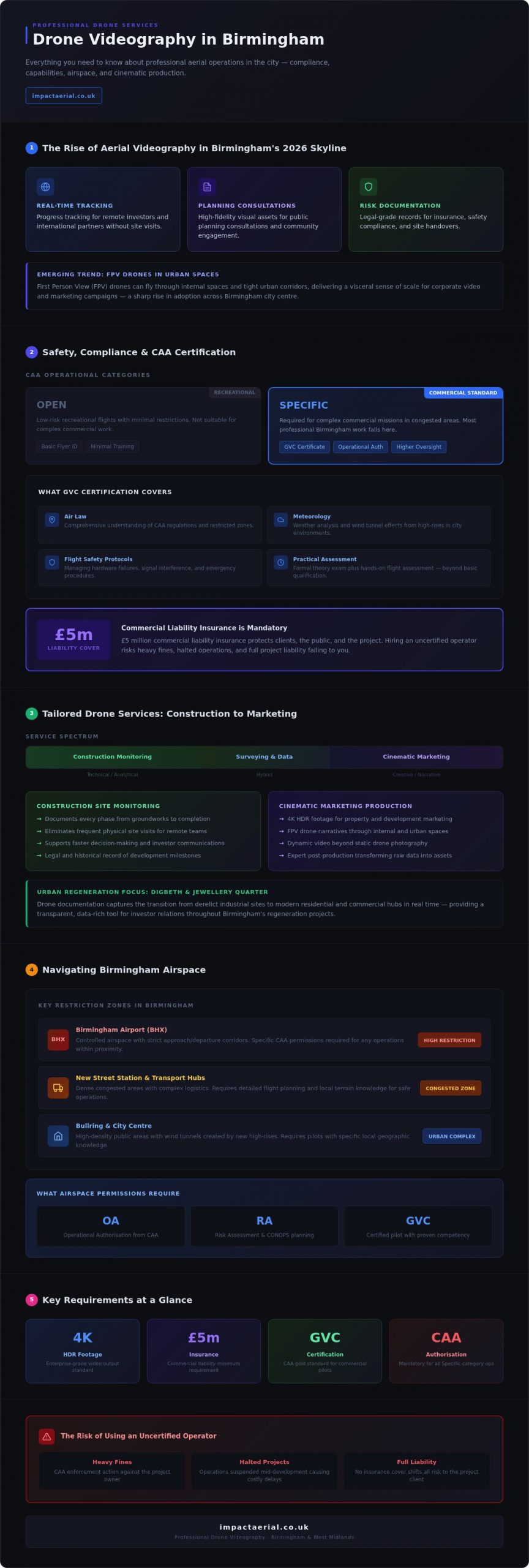
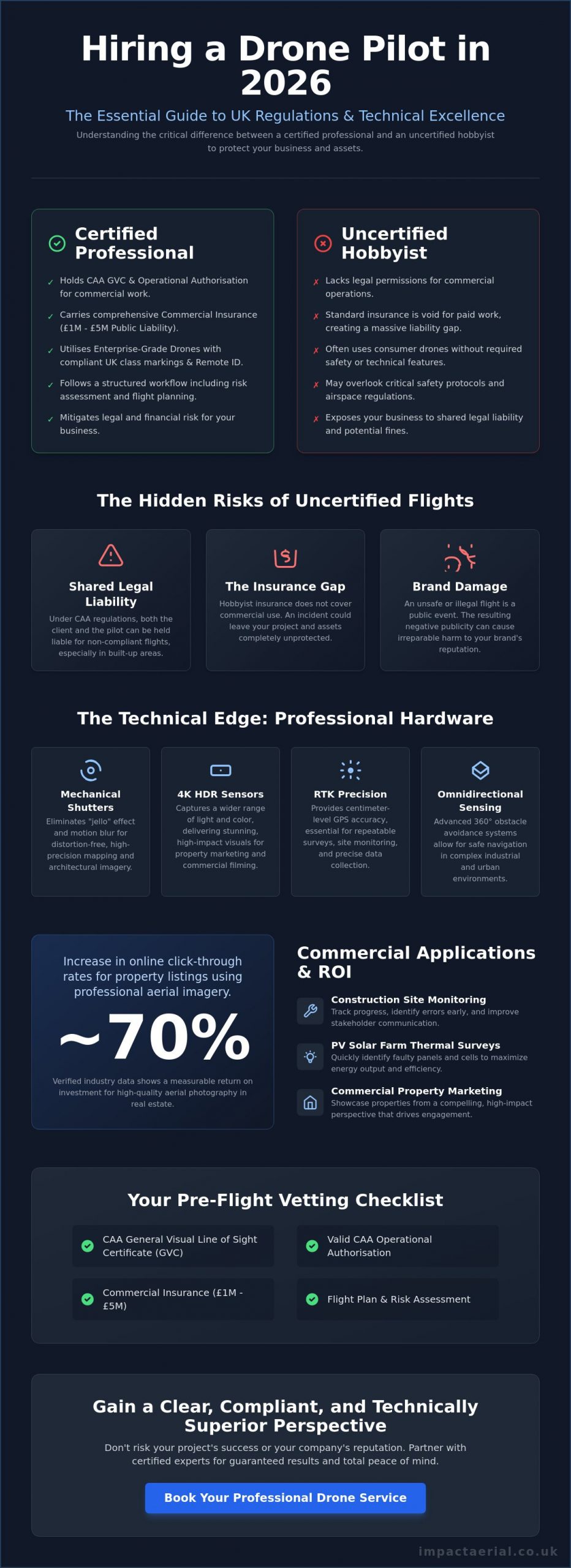
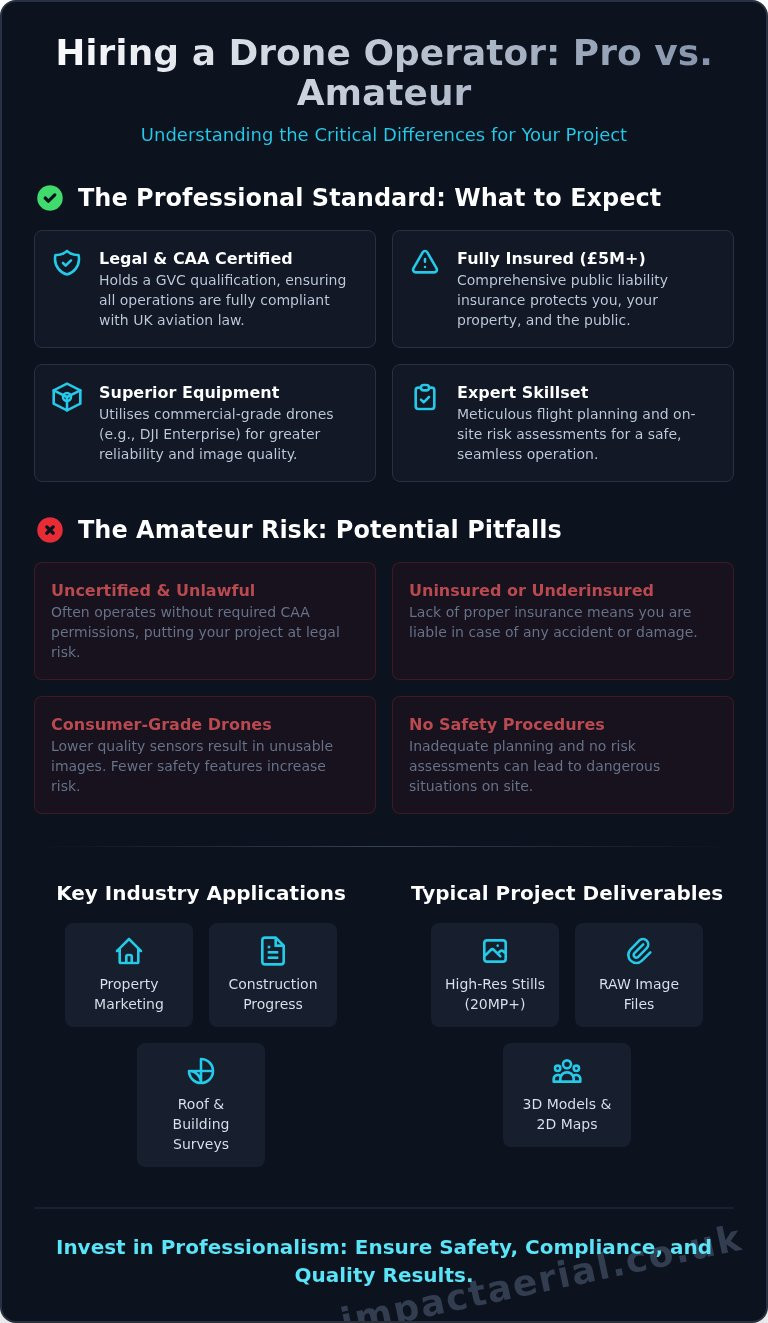
By 2026, the transition from the old PfCO (Permission for Commercial Operation) to the GVC (General Visual Line of Sight Certificate) is complete. The GVC certification is the primary UK commercial standard for pilots operating in the Specific Category. It demonstrates a pilot’s competency in flight safety, meteorology, and regulatory knowledge. You can verify a pilot’s credentials through the Drone Safe Register to ensure they’re vetted and legal. If a provider cannot produce a valid GVC and an updated Operational Authorisation from the CAA, they aren’t a professional commercial entity.

Insurance and Risk Mitigation

Standard public liability insurance is insufficient for complex aerial work. Professional providers carry a minimum of £5m commercial liability insurance as an industry standard. This specific cover is essential because it accounts for the unique risks of aviation, protecting the client from third-party claims. For added peace of mind, this insurance is backed by a commitment to Airmanship and a strict adherence to the company’s CAA-approved Operations Manual. This level of protection is a key part of what to expect from a drone survey provider who takes their commercial responsibilities and your project’s safety seriously.

The Pre-Flight Phase: Meticulous Planning and Risk Assessment

A professional drone operation begins long before the propellers spin. When considering what to expect from a drone survey provider, the depth of their initial consultation is a primary indicator of quality. In 2026, providers focus on defining specific data outputs, whether that’s a centimetre-accurate 3D mesh or a high-resolution thermal map. This phase ensures the technology matches the project goals, preventing wasted site visits and ensuring the data is compatible with your existing BIM software or GIS platforms.

Meticulous planning involves more than just a calendar date. It requires a detailed analysis of the site’s unique characteristics and the specific requirements of the client. Whether you’re managing a 50-hectare development or a complex bridge inspection, the pre-flight phase sets the standard for the entire project’s success.

Desktop Surveys and Airspace Management

Safety is the cornerstone of every flight. Your provider will conduct a thorough desktop survey using digital tools to identify permanent and temporary flight restrictions. They’ll coordinate with NATS or local Air Traffic Control if the site sits within a Flight Restriction Zone (FRZ). A CAA GVC certified pilot manages these complexities, ensuring every flight is legal and coordinated. This level of preparation provides peace of mind that your project won’t face sudden shutdowns or legal complications from the Civil Aviation Authority. They’ll also check for local hazards like high-voltage power lines or microwave transmission towers that could interfere with drone telemetry.

RAMS: Risk Assessment and Method Statements

For construction and industrial sites, a robust RAMS document is non-negotiable. This document outlines how the team will manage ground safety, specifically during the critical take-off and landing phases. A professional provider will establish clear cordons and use spotters to manage public or site-worker incursions. This meticulous approach is part of the standard set by a qualified operator holding a valid uk drone license.

Beyond human factors, weather monitoring is constant. UK conditions can shift rapidly; therefore, providers use hyper-local forecasting to ensure wind speeds stay within the safe operating limits of their enterprise fleet. Most commercial drones are rated for winds up to 22 knots, but a professional provider will always build in a contingency plan. They’ll monitor the K-index for solar activity and local precipitation levels to ensure the sensors capture the highest quality data without risk to the equipment or the site. If you want to see how these safety standards translate into results, you can explore our professional survey solutions for your next project.

On-Site Operations: Enterprise Technology and Methodology

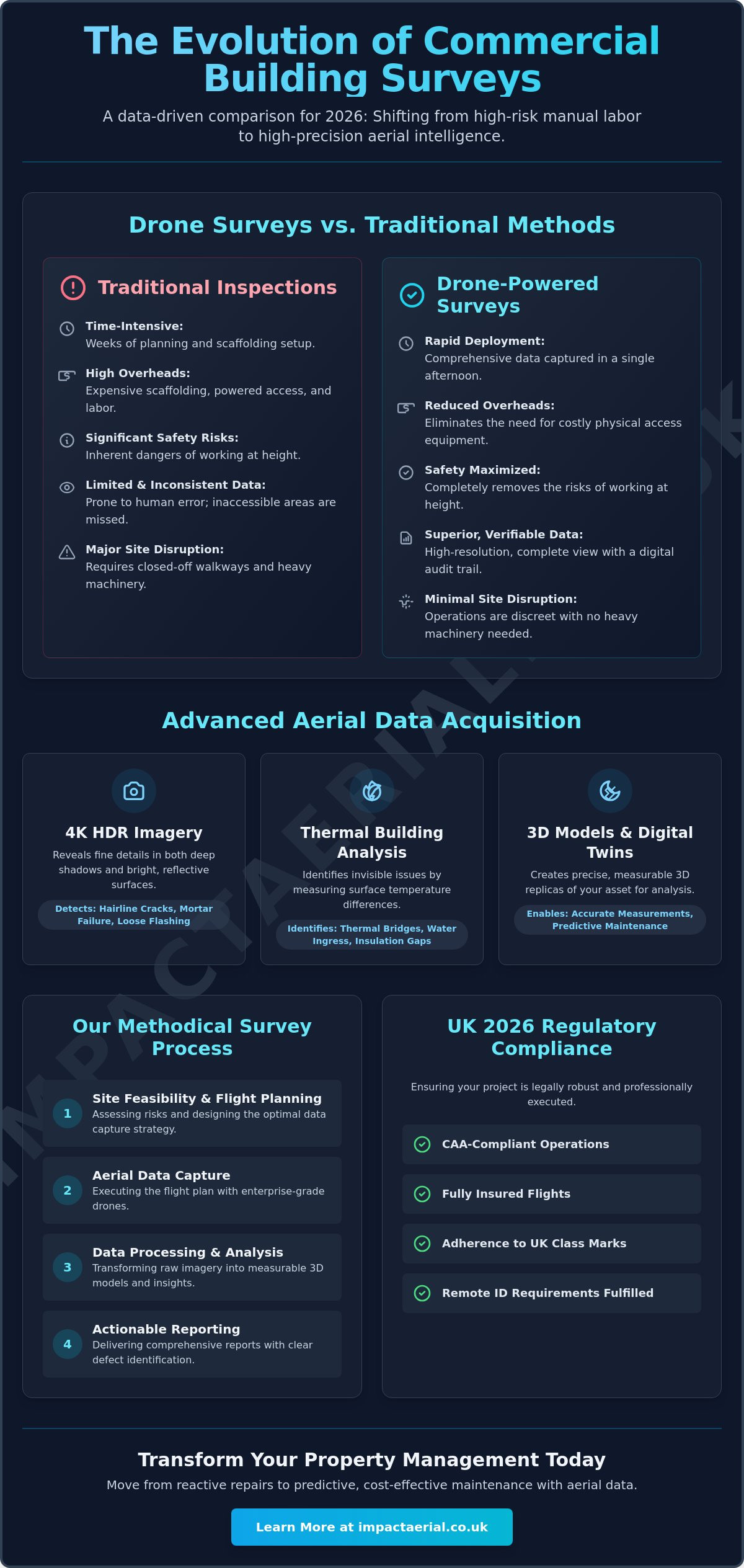
By 2026, the technical gap between consumer gadgets and enterprise-grade hardware is vast. When considering what to expect from a drone survey provider, the first indicator of quality is the equipment they deploy on-site. Professional operators use dedicated commercial fleets rather than standard retail models. These systems provide the stability and sensor quality required for millimetre-accurate technical analysis. Impact Aerial maintains a small operational footprint, ensuring we don’t disrupt your daily site activities while we capture 4K HDR video and high-resolution stills for your project records.

Commercial-Grade Hardware

Modern surveying demands more than just a camera in the air. We utilise the DJI Mavic 3 Enterprise series for its mechanical shutter and integrated RTK (Real-Time Kinematic) module. This technology delivers centimetre-level accuracy without the need for traditional ground control points. For complex environments, dual-operator setups allow one pilot to focus on flight safety while a second technician controls the sensor. This ensures every detail is captured. High-wind resistance is also vital. Our enterprise drones can operate safely in gusts up to 12 metres per second, preventing weather-related delays that often stall consumer-grade equipment.

Specialised Survey Techniques

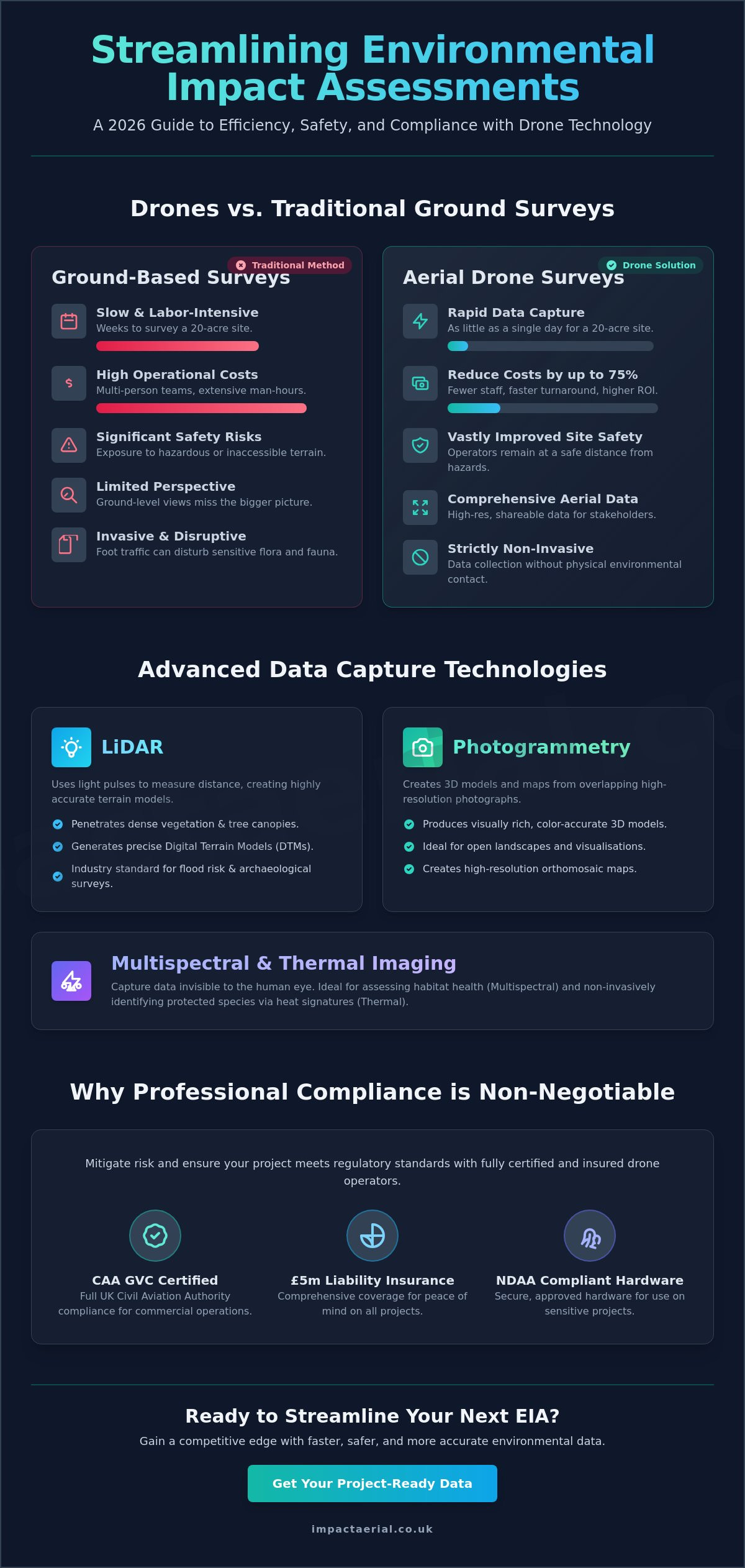
Specialised sensors have transformed how we inspect infrastructure. Thermal imaging drones are now standard for PV solar farm inspections and identifying heat loss in commercial buildings. These radiometric sensors detect temperature variances as small as 0.05 degrees Celsius. We use automated flight paths to guarantee repeatable data collection. This is essential for monitoring site progress over several months. You can find more technical details in our drone survey guide. This methodical approach provides the data-gathering precision necessary for professional engineering reports. Understanding what to expect from a drone survey provider means looking for this level of technical rigour. We prioritise safety and compliance, holding all necessary CAA GVC certifications to give you peace of mind during every flight operation.

Data Deliverables: From Raw Imagery to Actionable Insights

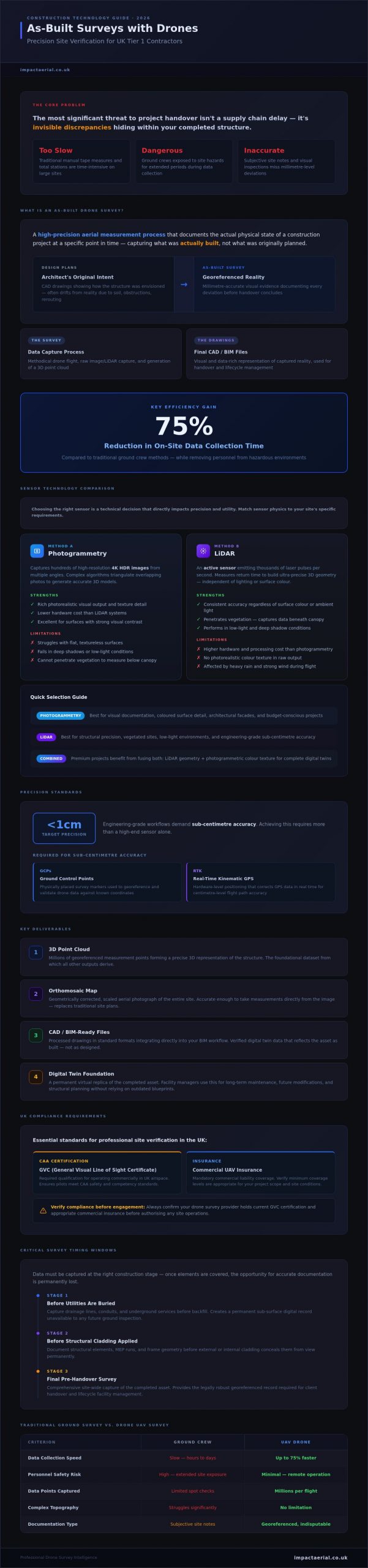
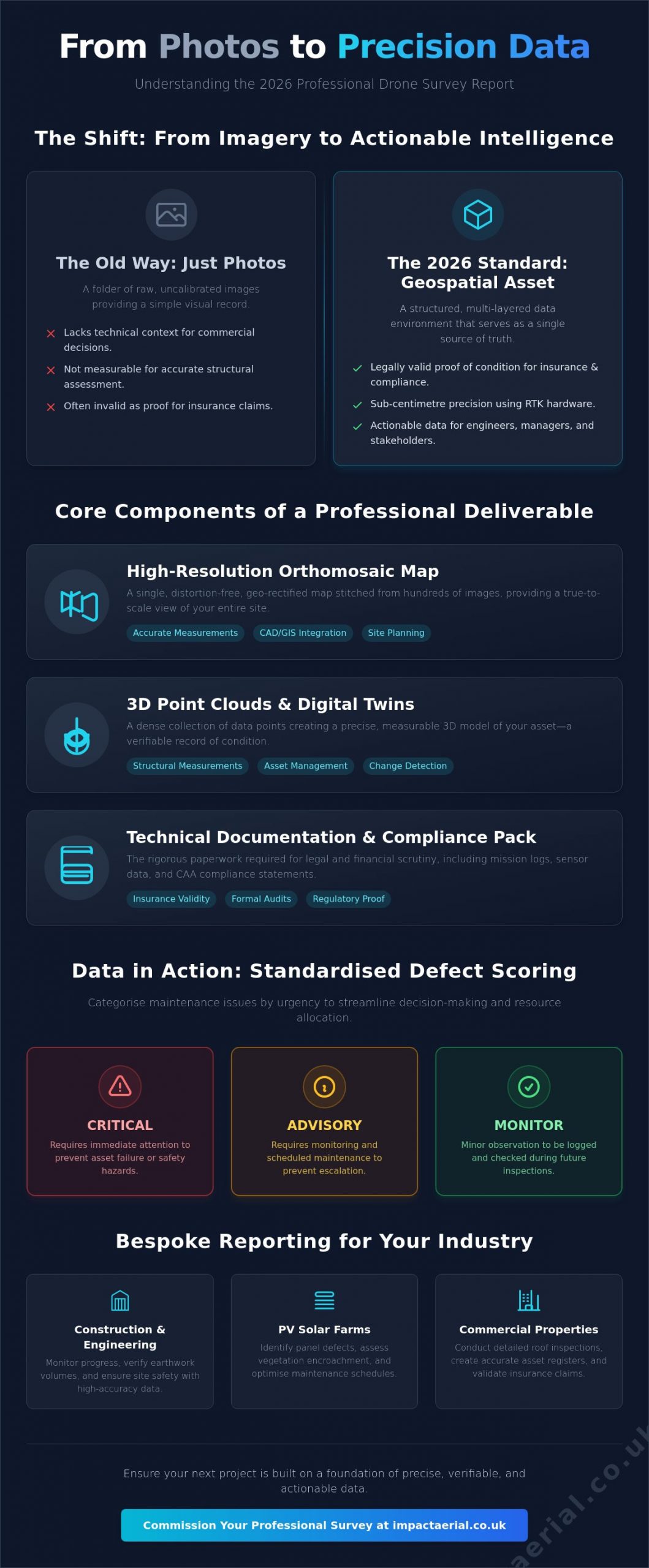
Professional drone surveys in 2026 represent a shift from simple aerial photography to complex data intelligence. When you’re assessing what to expect from a drone survey provider, the quality of the final assets is the most critical metric. You shouldn’t receive a disorganised folder of images. Instead, a leading provider delivers a suite of high-resolution orthomosaic maps, where thousands of individual frames are corrected for perspective to create a single, georeferenced site overview with ground sampling distances (GSD) as fine as 1cm per pixel.

These deliverables provide a foundation for diverse applications, including:

  • Detailed condition reports: Targeted inspections for roofs and structural elements that highlight defects with centimetre-level precision.
  • Immersive virtual tours: 360-degree aerial and ground-level views that facilitate stakeholder engagement and property marketing.
  • Topographical datasets: Digital Terrain Models (DTM) and Digital Surface Models (DSM) that inform initial site planning and earthworks.

Photogrammetry and 3D Modelling

The core of modern aerial data lies in photogrammetry. This process involves stitching hundreds of overlapping 2D images to create a high-density point cloud. For architects and property developers, these digital twins are invaluable. They allow for accurate clash detection and volumetric analysis within a virtual environment before a single brick is laid on site. By 2026, UAV photogrammetry consistently delivers sub-10mm absolute spatial accuracy, providing a level of precision that eliminates the need for traditional manual measurements on 95% of site areas.

Post-Production and Reporting

Raw data is only useful if it’s accessible. A professional service includes meticulous post-production where data is cleaned, filtered, and hosted on secure cloud platforms. You should be able to access your drone survey reports via a web browser, allowing you to measure distances, areas, and volumes without specialist software. This seamless integration into existing Common Data Environments (CDE) and project management workflows ensures that aerial insights lead to immediate action. For added peace of mind, ensure your provider uses encrypted hosting that meets UK GDPR standards.

High-quality data reduces project risk and accelerates decision-making across the construction lifecycle. To see how these professional deliverables can transform your next project, explore our comprehensive drone survey solutions today.

Choosing the Right Provider: Vetting and ROI

Selecting a specialist partner in 2026 requires looking beyond the hardware. Understanding what to expect from a drone survey provider helps you avoid “cowboy” operators who lack the necessary legal credentials. A professional provider doesn’t just fly; they manage the entire data lifecycle. In regions like Birmingham and the West Midlands, where complex urban airspace and proximity to Birmingham Airport (BHX) create strict flight restrictions, regional expertise is non-negotiable. Local providers understand the specific permissions required for congested areas, ensuring your project isn’t halted by regulatory breaches.

The financial argument for drone technology is undeniable. Traditional scaffolding for a standard three-storey commercial roof inspection can cost between £2,000 and £5,000 depending on the scale and duration. A drone survey typically reduces these initial outlays by 60% to 70%. While “cheap” hobbyist operators might offer lower quotes, they often lack the £5 million to £10 million commercial liability insurance required for high-value construction sites. One safety incident or a data error from an uncertified pilot can result in legal fees that far outweigh any initial savings.

Vetting Your Drone Partner

During your initial consultation, ask for a copy of their CAA GVC (General Visual Line of Sight Certificate). This is the gold standard for professional operations in the UK. Review their portfolio for industry-specific experience; a provider skilled in cinematic filming might not understand the technical nuances of photogrammetry or thermal heat loss reporting. Ensure they offer full project management, including risk assessments (RAMS) and airspace deconfliction, so your team can focus on the core build. Check recent case studies to verify they’ve delivered high-resolution, actionable data on similar UK sites.

Maximising Value and Efficiency

Drone data speeds up decision-making by delivering site maps and 3D models within 24 to 48 hours. This rapid turnaround prevents project bottlenecks that cost developers thousands in daily overheads. Safety remains the biggest dividend. By eliminating the need for personnel to work at height, you remove the primary cause of workplace fatalities in the UK construction sector. Professional data gathering provides a permanent digital record that is far more accurate than manual notes. For expert guidance on your next project, Contact Impact Aerial for a professional consultation to see how we integrate safety with high-quality aerial intelligence.

Future-Proofing Your Operations with Precision Aerial Data

As the industry matures toward 2026, the gap between hobbyist operators and professional specialists has never been wider. Knowing what to expect from a drone survey provider means looking beyond the flight itself to the rigorous standards of CAA GVC Certified Pilots and the security of £5m commercial liability insurance. You’re no longer just buying raw imagery; you’re investing in a meticulous process that begins with detailed risk assessments and ends with high-precision photogrammetry that drives measurable ROI.

Impact Aerial provides this level of technical consultancy from our Birmingham headquarters, offering UK-wide coverage for complex commercial projects. For added peace of mind, our team combines enterprise-grade DJI technology with a commitment to legal compliance that protects your assets and your reputation. Don’t settle for less than the professional standard when your project’s data is on the line.

Request a professional drone survey quote from Impact Aerial to start your next project with confidence. We’re ready to help you unlock the full potential of your site with the precision and quality your business deserves.

Frequently Asked Questions

What qualifications should a drone surveyor have in the UK?

A professional drone surveyor must hold a valid General Visual Line of Sight Certificate (GVC) or an A2 Certificate of Competency (A2 CofC) issued by the Civil Aviation Authority (CAA). For complex commercial operations, the provider should also possess an Operational Authorisation (OA) to ensure they’re legally permitted to fly in specific environments. These certifications prove the pilot has passed rigorous flight tests and understands the latest UK air laws updated in 2024.

How much does a professional drone survey cost in 2026?

Costs depend on the project’s scale and required data accuracy. According to industry data from the Drone Safe Register, a standard residential roof inspection typically starts between £300 and £500. For larger commercial sites requiring detailed topographic data or 3D mapping, daily rates often range from £800 to £1,500. This fee covers the pilot’s expertise, high-end hardware, and the intensive data processing required to deliver actionable insights.

Can drones fly in rain or high winds during a survey?

Most enterprise drones like the DJI Matrice series carry an IP55 rating, which allows for operation in light rain and drizzle. However, safety is our primary concern; we don’t fly if wind speeds exceed 22mph or 10 metres per second. High winds introduce vibration that degrades the quality of photogrammetry and thermal data. If conditions are unsafe, we’ll reschedule the flight to ensure the precision of your final report.

Do I need to notify my neighbours before a drone survey?

You aren’t legally required to get permission from neighbours under CAA regulations if the drone stays within the survey site’s boundaries. However, the Information Commissioner’s Office (ICO) guidelines suggest informing nearby residents to address privacy concerns and comply with UK GDPR. Part of what to expect from a drone survey provider is a clear communication plan that provides peace of mind for everyone involved in the vicinity.

What is the difference between a visual inspection and a thermal survey?

Visual inspections use high-resolution 4K or 8K cameras to capture physical defects like cracked tiles or structural corrosion. Thermal surveys utilise infrared sensors to detect heat variations that are invisible to the naked eye. This technology is essential for identifying water ingress in flat roofs or heat loss in industrial buildings. While visual data shows what’s broken, thermal data explains why a structure’s performance is failing.

How long does it take to receive the final survey data?

Standard visual reports and high-definition imagery are usually delivered within 24 hours of the flight. More complex data sets, such as 3D point clouds or orthomosaic maps, require significant processing time and are typically ready within 3 to 5 business days. We use dedicated workstations to ensure the data-gathering process translates into high-quality, accurate models that you can integrate directly into your existing BIM software.

What insurance coverage is required for commercial drone work?

UK law requires all commercial drone operators to have public liability insurance that’s compliant with EC 785/2004. Most professional providers carry at least £5 million in coverage, though we often increase this to £10 million for high-risk infrastructure projects. This insurance protects you against accidental damage or third-party claims, ensuring that every flight is conducted with full financial and legal protection.

Are drone surveys legal in city centres like Birmingham or London?

Drone surveys are legal in major city centres, but they require meticulous planning and specific CAA permissions. In restricted zones like London’s R157 or near Birmingham International Airport, we must coordinate with National Air Traffic Services (NATS) to secure flight windows. Understanding these complex airspace restrictions is exactly what to expect from a drone survey provider who prioritises compliance and safety in congested urban environments.

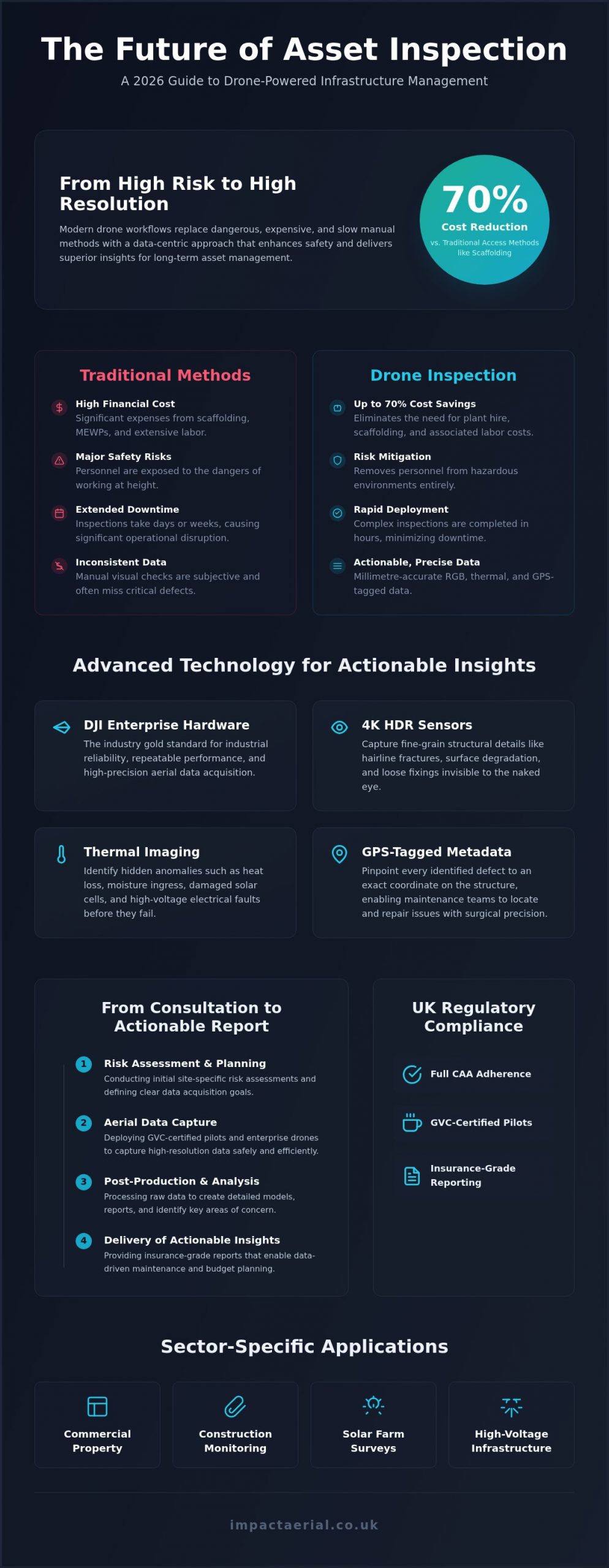
Using Drone Data for Preventative Maintenance: A Strategic Guide for 2026

What if your next major structural repair bill wasn’t a surprise, but a calculated decision you made six months ago? Most facility managers in the United Kingdom spend over 70% of their maintenance budget on reactive “firefighting” rather than planned improvements. You likely already know the frustration of hiring expensive scaffolding or cherry-pickers, only to find that the suspected defect was a minor issue, or worse, that you missed a critical fault elsewhere. These traditional methods are slow, costly, and introduce unnecessary health and safety risks to your workforce.

By using drone data for preventative maintenance, you can transition from guesswork to a precision-led predictive strategy. High-fidelity aerial data provides the clarity needed to identify hairline fractures or moisture ingress long before they require a full site shutdown. This guide provides a strategic roadmap for 2026, showing you how to integrate CAA-compliant aerial surveys to reduce long-term repair costs by as much as 25% according to recent industry benchmarks. We will explore the technical workflow for turning raw 4K imagery into actionable maintenance schedules, ensuring your site stays safe and your budget stays under control.

Key Takeaways

  • Learn why transitioning from reactive “firefighting” to a predictive model is the most cost-effective strategy for asset management in 2026.
  • Discover how high-fidelity 4K HDR and thermal sensors identify invisible structural wear and overheating components before they lead to critical failure.
  • Identify high-ROI applications for using drone data for preventative maintenance within the UK solar and commercial property sectors.
  • Navigate essential UK compliance standards, including the necessity of CAA GVC certification and £5m commercial liability insurance for onsite operations.
  • Understand how professional aerial surveying provides the meticulous precision required to ensure long-term asset integrity and business peace of mind.

The Evolution of Maintenance: From Reactive Firefighting to Predictive Foresight

In 2026, waiting for an asset to fail isn’t just risky; it’s a financial liability that modern UK firms can’t afford. Traditional “firefighting” methods, where repairs only happen after a breakdown, represent the most expensive strategy for asset managers. Using drone data for preventative maintenance allows organisations to transition from reactive guessing to predictive knowing. By integrating high-resolution aerial sensors into the Industrial Internet of Things (IIoT), businesses create a live, responsive ecosystem of structural health. This intelligence acts as a sophisticated early warning system, identifying mechanical and structural weaknesses long before they threaten operational safety.

The following video demonstrates how automated drone systems identify network faults in real-time:

The High Cost of Reactive Maintenance

Emergency repairs often cost 3 to 4 times more than planned interventions. In the UK energy and infrastructure sectors, manual inspections frequently overlook early-stage corrosion or 1.5% deviations in thermal signatures that indicate failing components. These micro-faults eventually escalate into catastrophic failures that halt business continuity and trigger significant increases in insurance premiums. Relying on a technician with a ladder or scaffolding is no longer a viable safety standard. Manual methods are slow and often fail to capture the granular detail required for 2026 compliance standards. The hidden expenses of downtime, combined with the logistical nightmare of emergency parts procurement, make reactive maintenance a failing model for competitive enterprises.

Predictive Maintenance: A Data-First Approach

True predictive models rely on data consistency and precision. By conducting a regular drone survey, operators establish a high-resolution digital baseline for every asset. This allows engineers to track the rate of decay with millimetre accuracy over several months. If a crack in a concrete pylon grows by 3mm between January and July 2026, the software flags the anomaly immediately. Using drone data for preventative maintenance means you can repair a minor fault for £800 today, rather than facing a £60,000 structural replacement next year. This shift moves the industry away from “if it breaks, fix it” towards a meticulous “fix it because the data confirms it will fail.”

  • Digital Baselines: Creating 3D models to compare asset health over time.
  • Thermal Intelligence: Identifying heat leaks or electrical hotspots invisible to the human eye.
  • Risk Mitigation: Lowering insurance costs by proving a proactive inspection regime.
  • Operational Continuity: Scheduling repairs during planned shutdowns to avoid £10,000-per-hour downtime costs.

How Drones Capture High-Fidelity Maintenance Data

Drones provide a level of detail that traditional manual inspections simply cannot match. By using drone data for preventative maintenance, asset managers across the UK can identify structural issues before they escalate into expensive, unplanned downtime. This precision relies on a combination of high-resolution sensors and stable flight platforms that operate regardless of the asset’s height or complexity.

  • 4K HDR Sensors: Documenting surface corrosion, rust patterns, and mechanical wear.
  • Thermal Imaging: Detecting heat signatures from faulty electrical components or insulation leaks.
  • LiDAR: Generating millimetre-accurate 3D point clouds for structural deformation analysis.

Visual Inspection with 4K HDR Precision

Modern inspections rely on 4K High Dynamic Range (HDR) sensors to document surface-level wear with absolute clarity. These sensors capture the subtle textures of hairline cracks in concrete or loose components on a telecommunications mast from a safe distance. High-zoom capabilities are vital for inspecting high-voltage lines or tall chimneys where physical access is dangerous. 4K resolution allows for “digital zooming” during post-analysis, which enables technicians to crop into specific pixels to verify a defect without losing structural context.

Thermal and LiDAR: Beyond the Visible Spectrum

Preventative maintenance often involves spotting what the human eye misses. Thermal sensors identify “hot spots” in electrical substations or solar arrays, highlighting failing components before they combust. For structural health, LiDAR creates precise point clouds to monitor movement over time. This FHWA report on UAS for bridge inspection highlights how these digital models allow teams to measure structural deformation with extreme accuracy. Combining visual and thermal data provides a comprehensive view of asset health that traditional methods can’t replicate.

Achieving this level of accuracy requires commercial-grade DJI Enterprise drones. These platforms offer the flight stability and GPS precision needed to ensure data is repeatable and reliable for year-on-year comparisons. For added peace of mind, our professional aerial inspection services are delivered by CAA GVC Certified pilots who understand the technical requirements of high-stakes infrastructure. Using drone data for preventative maintenance ensures that every bolt, weld, and circuit is accounted for, providing a meticulous record of your asset’s condition.

Sector-Specific Applications: Where Drone Data Delivers Maximum ROI

Implementing a digital-first strategy isn’t just about adopting new tech; it’s about measurable returns. Across the UK, industries with high-value assets are using drone data for preventative maintenance to slash downtime. This approach is particularly vital in a niche but increasingly diverse market where traditional manual inspections often lead to safety risks and inflated costs. By moving from reactive repairs to data-led foresight, operators can protect their bottom line.

Maximising Yield with PV Solar Farm Thermal Surveys

Efficiency in renewable energy relies on the health of individual components. A single defective cell within a photovoltaic (PV) panel can cause a hotspot, which often degrades the performance of an entire string by up to 30%. Our CAA GVC Certified pilots use high-resolution thermal sensors to identify these anomalies instantly. While manual testing of a 50MW site could take a ground crew several weeks, a drone survey completes the task in a fraction of that time, often within two days. Integrating this thermal data into preventative maintenance programmes ensures that energy yield remains at peak capacity throughout the asset’s lifecycle.

Commercial Property and Construction Site Monitoring

For developers and landlords, water ingress is a primary cause of structural failure. Drones provide a high-definition view of flat roofs to detect standing water or membrane cracks before they manifest as internal leaks. Using drones for construction site monitoring allows project managers to track progress against BIM models and ensure safety compliance without the expense of scaffolding. This data-gathering provides high-quality visual evidence, which is essential when validating warranty claims or conducting pre-acquisition surveys. It offers stakeholders total peace of mind through documented precision.

Critical infrastructure requires constant vigilance against environmental wear. Utilities and infrastructure operators benefit from inspecting power lines and bridges for signs of corrosion or sagging. A Caltrans research note on UAS inspections highlights how drones significantly improve safety when assessing rural communications towers. By keeping personnel on the ground, companies reduce their liability while gaining a more granular view of structural integrity. This extends to industrial chimneys and silos, where drones safely assess internal linings and external masonry in hazardous environments. They can identify cracks as small as 1mm without requiring human confined space entry, which is a major leap for safety and efficiency. Using drone data for preventative maintenance in these sectors ensures that minor structural issues are caught before they become catastrophic failures.

Implementing a Drone-Led Maintenance Strategy in the UK

Adopting a drone-centric approach requires more than just hardware; it’s about building a compliant, data-driven workflow that satisfies both insurers and regulators. In the UK, this starts with strict adherence to Civil Aviation Authority (CAA) standards. Professional operators must hold a valid drone license and GVC (General Visual Line of Sight Certificate) to operate legally in commercial environments. For added peace of mind, we maintain £5m in commercial liability insurance. This level of cover is a non-negotiable baseline for Tier 1 contractors and facility managers who require protection against onsite operational risks.

Effective scheduling is the next pillar of a successful strategy. Using drone data for preventative maintenance works best when survey frequency reflects asset criticality. High-risk assets, such as aging roof structures or external HVAC systems, benefit from quarterly aerial inspections. More stable assets might only require annual checks. Integrating this data into your existing Building Management System (BMS) allows for a seamless transition from identifying a defect to generating a work order.

Compliance, Safety, and the CAA

The UK regulatory landscape has evolved significantly. The transition from the old PfCO (Permission for Commercial Operation) to the GVC represents a shift toward more rigorous safety assessments and standardized pilot competency. While “off-the-shelf” consumer drones are popular for hobbyists, they lack the high-resolution thermal sensors and 4K HDR capabilities required for professional data-gathering. Under UK law, a GVC-certified pilot is legally required to operate drones in congested areas to ensure the highest standards of public safety and operational discipline.

Bridging the Data Gap: From Pixels to Reports

Using drone data for preventative maintenance produces massive datasets, often exceeding 15GB per flight session. Managing this requires a robust strategy for cloud storage and local processing. Post-production is where raw pixels become actionable insights. Our technicians use specialized software to highlight structural defects, water ingress, or thermal anomalies, providing maintenance teams with clear, annotated reports. This prevents “data fatigue” by only showing your team what needs fixing.

Data security and GDPR compliance are central to our operations. When filming commercial sites in the West Midlands or beyond, we ensure all imagery is captured and stored in accordance with UK privacy laws. Any incidental footage of the public or neighbouring properties is carefully managed to maintain total site integrity. This meticulous attention to detail ensures your maintenance strategy is as legally sound as it is technically advanced.

Ready to upgrade your asset management with professional aerial insights? Contact Impact Aerial today for a compliant, expert-led survey.

The Impact Aerial Advantage: Professional Data for Asset Integrity

Impact Aerial delivers meticulous data gathering through precision aerial surveying, specifically tailored for the West Midlands and the wider UK market. We don’t just capture images; we capture high-resolution datasets that form the backbone of your asset management strategy. For added peace of mind, our operations are backed by £5m commercial liability insurance and full CAA GVC certification. This ensures every flight meets the highest safety standards while protecting your business interests and reputation.

Our role extends far beyond the flight itself. We provide comprehensive post-production services that transform raw 4K HDR footage into actionable insights. Through advanced photogrammetry and 3D mapping, we deliver the technical clarity required for property, construction, and renewable energy sectors. This level of detail is essential when using drone data for preventative maintenance to identify microscopic fissures or thermal anomalies before they escalate into structural failures. Our customised solutions cater to the specific demands of UK infrastructure, ensuring your maintenance budget is spent where it’s needed most.

Expertise Grounded in Birmingham and the West Midlands

While our roots are firmly planted in Birmingham, our reach covers national infrastructure projects throughout the UK. We understand the “niche but increasingly diverse market” of drone technology, which allows us to act as a trusted specialist rather than a generalist provider. Our local knowledge of West Midlands topography and airspace regulations ensures efficient deployment; meanwhile, our technical expertise provides a sophisticated perspective on your maintenance strategy. We help clients move from reactive repairs to proactive cycles, often reducing manual inspection costs by 30% or more.

Get Started with a Professional Drone Survey

The process begins with a detailed consultation to define your specific data requirements and safety protocols. During a site visit, an Impact Aerial pilot conducts a thorough risk assessment before deploying our fleet of DJI Enterprise drones. You’ll receive a clear timeline for data delivery and a breakdown of the technical outputs. Using drone data for preventative maintenance reduces site downtime by up to 40% compared to traditional scaffolding or rope access methods. Contact Impact Aerial today for a professional maintenance survey quote to secure your assets for 2026 and beyond.

Securing Asset Longevity through Aerial Intelligence

The transition from reactive repairs to predictive foresight isn’t just a trend; it’s a strategic necessity for UK asset managers in 2026. By using drone data for preventative maintenance, organizations can identify structural anomalies before they escalate into costly failures. High-fidelity 4K HDR and thermal imaging provide a level of detail that traditional manual inspections can’t match. This data-driven approach ensures maintenance budgets are allocated with precision, protecting both your infrastructure and your bottom line.

Safety and compliance remain the cornerstones of any successful aerial operation. For added peace of mind, ensure your data collection is handled by specialists who understand the rigorous standards of the UK aviation landscape. Impact Aerial provides a meticulous service backed by CAA GVC Certified Pilots and £5m commercial liability insurance. Our expertise in thermal data collection and high-resolution imaging delivers the actionable insights required to maintain total asset integrity across your portfolio.

Don’t wait for a critical failure to take action. Book your professional drone maintenance survey with Impact Aerial today and gain the technical advantage your business deserves. It’s time to elevate your maintenance strategy with confidence.

Frequently Asked Questions

Is drone data accurate enough to replace manual structural inspections?

Yes, high-resolution drone data often exceeds manual accuracy by capturing sub-millimetre detail across 100% of a structure. Traditional manual checks might only sample 15% of a facade due to access constraints or safety risks. Our photogrammetry creates digital twins with 2mm spatial resolution, providing a comprehensive data set for engineers to review without the inherent dangers of working at height.

How often should we use drones for preventative maintenance on a commercial roof?

Commercial roofs require drone inspections at least twice per year, typically in autumn and spring. Using drone data for preventative maintenance allows you to identify blockages or membrane fatigue before winter storms cause catastrophic failure. Regular 6-month cycles ensure your 25-year warranty remains valid by providing documented evidence of proactive care and professional data-gathering.

Can drones detect internal leaks or just surface-level damage?

Drones detect internal leaks indirectly by identifying thermal anomalies and moisture trapped beneath the surface. While a visual camera sees surface cracks, a thermal sensor identifies temperature differentials that indicate water ingress. This method catches leaks 3 to 6 months before they manifest as visible drips inside the building, giving you the peace of mind that your assets are protected.

What UK regulations apply to using drones for industrial maintenance?

Operations must comply with CAA CAP 722 regulations, requiring pilots to hold a GVC (General Visual Line of Sight Certificate). Since January 2021, UK drone laws focus on the risk of the operation rather than the aircraft weight. We operate under a redundant safety framework and hold £10 million in commercial liability insurance to ensure every flight meets strict legal standards.

How much can drone data reduce our annual maintenance budget?

Using drone data for preventative maintenance can reduce annual facility costs by 25% to 40% according to industry benchmarks from 2023. By eliminating the need for scaffolding, which often accounts for 60% of a repair bill, companies save thousands on access alone. Early detection prevents minor £500 repairs from escalating into £50,000 emergency replacements or full roof failures.

Do I need to clear my site before a drone maintenance survey begins?

You don’t need to shut down operations, but we require a 30-metre safety exclusion zone directly beneath the flight path. Our team coordinates with your site manager to ensure personnel are briefed on the flight plan. This allows the business to remain 90% operational while we gather high-quality data, unlike traditional methods that require total site closure and heavy machinery.

What is the difference between a visual drone survey and a thermal drone survey?

A visual survey uses 4K HDR sensors to capture high-resolution imagery of physical defects like rust or loose bolts. Thermal surveys use infrared sensors to detect heat signatures and energy loss. Combining both provides a complete health profile, showing you exactly where heat is escaping or where insulation is failing across your entire estate for better energy efficiency.

How long does it take to receive the final maintenance report after the drone flight?

We deliver a comprehensive digital report within 48 to 72 hours of the flight completion. This includes processed orthomosaic maps and high-definition imagery categorized by severity for easy interpretation. For urgent structural concerns, we can provide raw data sets on the same day to ensure your maintenance team can act immediately on critical repairs and maintain site safety.

In-House Drone Team vs Outsourcing: A 2026 Guide for UK Businesses

By 2026, the administrative burden of maintaining a UK Civil Aviation Authority (CAA) compliant drone department will consume over 150 hours per year in purely non-operational paperwork. You probably believe that bringing aerial operations under your own roof offers more control and lower long-term costs. However, when evaluating an in-house drone team vs outsourcing, it’s easy to overlook that the £5,000 to £10,000 initial investment in hardware is just the tip of the iceberg. Between mandatory GVC training, commercial liability insurance, and the risk of equipment becoming obsolete within 24 months, the internal model often creates more friction than it solves.

This guide delivers a data-driven comparison to help you make an informed choice for your specific operational needs. You’ll gain a clear understanding of current UK legal requirements and a transparent cost-benefit analysis of both approaches. We’ll explore how partnering with a professional service provider ensures consistent, high-quality results while providing the peace of mind that comes from guaranteed compliance. From photogrammetry to site surveys, you’ll learn how to secure the best aerial data without the hidden headaches of fleet management.

Key Takeaways

  • Understand the significant upfront capital expenditure required for professional DJI Enterprise hardware and the hidden ongoing costs of advanced UK pilot training.
  • Navigate the complex legal landscape of CAA compliance, including the mandatory GVC certification and the administrative burden of maintaining rigorous flight logs.
  • Evaluate the strategic trade-offs of an in-house drone team vs outsourcing to determine which model offers the best ROI and operational safety for your firm in 2026.
  • Discover how professional outsourcing provides immediate access to elite sensors and guaranteed data quality for drone surveys without the risk of equipment depreciation.
  • Learn why partnering with CAA GVC certified specialists offers peace of mind through comprehensive liability insurance and expert-level post-production results.

In-House Drone Team vs Outsourcing: The 2026 Landscape

The role of the unmanned aerial vehicle (UAV) has undergone a radical transformation. What was once a niche gadget for enthusiasts is now a fundamental commercial data tool. For UK businesses in 2026, the debate between building an in-house drone team vs outsourcing has reached a critical point. An in-house drone team requires a substantial internal investment in specialized DJI Enterprise hardware, pilot training, and the management of complex Civil Aviation Authority (CAA) licensing. Conversely, outsourcing involves hiring specialized, CAA-certified operators who provide their own equipment and expertise on a project-by-project basis. The decision is no longer just about cost; it’s about managing the technical sophistication of modern aerial platforms.

To better understand the strategic differences between these business models, watch this helpful video:

The Current State of UK Drone Adoption

Drone adoption across the UK construction, property, and solar sectors has seen a 45% increase since 2024. The days of ‘hobbyist’ flying are over for commercial applications. UK regulations are now so stringent that casual operation doesn’t meet the legal or safety standards required for professional sites. Leading firms now rely on high-quality drone services to provide the technical accuracy needed for photogrammetry and site inspections. This shift ensures that data is gathered by experts who understand the nuances of the CAA GVC certification and carry the appropriate commercial liability insurance. For added peace of mind, professional operators manage the entire regulatory burden, from flight planning to risk assessments.

Key Drivers for Choosing Aerial Solutions

Speed of data collection is the primary motivator for UK businesses. Aerial methods are often 5 to 10 times faster than traditional ground-based surveys, allowing for rapid decision-making. Safety is another massive driver. Drones completely remove the need for personnel to use scaffolding or high-access equipment, which significantly lowers the risk profile of any project. Beyond technical data, the demand for high-end marketing visuals has never been higher. 4K HDR cinematic content is now the baseline for commercial property developers. These high-quality perspectives allow businesses to showcase developments with breathtaking clarity, providing a level of detail that ground-level photography simply cannot achieve. Whether it’s for a roof survey in Birmingham or a promotional film in London, the precision of 2026 aerial technology is transformative.

The True Cost of Building an In-House Drone Team

Establishing an internal drone department requires a significant financial commitment that extends far beyond the initial purchase of an aircraft. When weighing the pros and cons of an in-house drone team vs outsourcing, businesses must look at the total cost of ownership over a three-year cycle. While a consumer-grade drone might cost £1,500, these units lack the data precision and sensor reliability required for professional UK construction or surveying projects. A professional enterprise setup often starts at £15,000 for the airframe alone, excluding specialized payloads.

Hardware and Software Investment

Commercial operations require DJI Enterprise-level equipment, such as the Matrice 350 RTK, to ensure stability and accuracy. These systems integrate with high-spec thermal or LiDAR sensors that can cost an additional £8,000 to £12,000 per unit. Beyond the hardware, the “Technology Trap” creates a cycle of continuous spending. You’ll need to budget for:

  • Data Processing: Annual subscriptions for photogrammetry software like Pix4D or DroneDeploy typically range from £2,500 to £4,000 per user.
  • Computing Power: Processing high-resolution 4K imagery requires high-spec workstations with dedicated GPUs, often costing £3,000 per unit.
  • Maintenance: Intelligent Flight Batteries have limited life cycles and cost approximately £500 each; a standard mission set requires at least six batteries to maintain a continuous workflow.

Personnel and Training Realities

The human element is the most expensive component of any drone program. Hiring a dedicated, CAA GVC certified pilot in the UK involves a salary commitment of £35,000 to £55,000 depending on their technical expertise in data-gathering. If you choose to train existing staff, you face the “lost time” cost where highly skilled engineers or surveyors spend hours on flight planning and risk assessments instead of their primary roles. To maintain operational safety and technical proficiency, an internal pilot must commit to a minimum of 40 hours of logged flight time and simulated emergency drills annually.

Administrative overhead adds another layer of complexity. Every flight requires a detailed Risk Assessment Method Statement (RAMS) and meticulous logging to remain compliant with Civil Aviation Authority (CAA) regulations. Managing these logs and staying updated on evolving UK airspace restrictions takes up roughly 15% of a pilot’s working week. For many West Midlands firms, utilizing professional drone services eliminates these logistical burdens and provides immediate access to high-end sensors without the capital risk. This approach ensures you only pay for the data you need, rather than maintaining a fleet of depreciating assets that may become obsolete within 24 to 36 months.

The Regulatory Burden: CAA Compliance and Liability

Operating a commercial drone in the UK isn’t a hobby; it’s a disciplined branch of aviation. When weighing up an in-house drone team vs outsourcing, the sheer volume of administrative oversight often tips the scales. You aren’t just buying equipment. You’re adopting a rigorous legal framework governed by the Civil Aviation Authority (CAA) that requires constant monitoring and updates.

CAA GVC Certification and Beyond

The transition from the old PfCO to the GVC (General Visual Line of Sight Certificate) is now complete. For any complex commercial site work, an A2 CofC is rarely sufficient. You’ll need a full GVC to secure the necessary Operational Authorisation from the CAA. This process involves more than a one-off drone license; it requires the creation and maintenance of a bespoke Flight Operations Manual (FOM).

This FOM is a living document. It must detail your specific emergency procedures, pilot competency records, and technical specifications for every aircraft in your fleet. In 2026, the CAA expects these logs to be digital, precise, and available for inspection at any time. Failing to keep these records up to date can result in the immediate suspension of your flight permissions, rendering your expensive hardware useless.

Managing Aviation-Grade Liability

Standard business insurance policies don’t cover aerial accidents. Commercial operators must hold specialist insurance that meets EC 785/2004 requirements. We recommend a minimum of £5m in commercial liability insurance for construction and industrial sites. This provides peace of mind when operating near high-value assets or public infrastructure. Without it, a single technical glitch could lead to a catastrophic financial claim that your standard public liability insurance will simply reject.

The legal chain of command is also unforgiving. If a drone fails, the responsibility rests with the UAS Operator (the business entity), not just the individual pilot. For flights in congested areas like Birmingham, operators must conduct detailed ground risk assessments and maintain strict 30-metre safety cordons from uninvolved persons. This level of planning is mandatory to avoid the heavy fines the CAA now levies against unauthorised or unsafe flights.

Choosing the in-house drone team vs outsourcing path means deciding if your staff has the capacity to log every minute of flight time and battery cycle. Outsourcing transfers this entire regulatory burden to a certified specialist, ensuring your project stays compliant without the internal paperwork headache.

When to Outsource: Strategic Advantages for UK Firms

For many UK enterprises, the decision regarding an in-house drone team vs outsourcing often hinges on the balance between operational control and capital efficiency. Outsourcing allows firms to bypass the significant upfront investment required for enterprise-grade hardware. A high-specification drone setup, such as the DJI Matrice 350 RTK equipped with thermal or LiDAR sensors, can easily exceed £25,000 in initial costs. By partnering with a specialist, businesses access this elite technology without the risk of rapid equipment depreciation or the ongoing expense of maintenance and firmware updates.

Scalability represents another critical advantage. A construction firm with projects spanning from Birmingham to Glasgow can’t easily deploy a single internal pilot to multiple sites simultaneously. Professional service providers maintain nationwide networks, enabling them to mobilize multiple teams for concurrent projects without increasing your permanent headcount. This approach ensures that every project benefits from guaranteed data quality. Professional pilots produce superior drone survey results because they fly daily, not just occasionally between other duties.

The administrative burden of drone operations is also a major factor. Managing an internal fleet requires constant oversight of flight logs, battery health, and CAA-mandated operational manuals. Outsourcing removes this friction entirely, as the service provider manages all logistics and technical upkeep.

Consistency and Expert Post-Production

The gap between raw data and actionable insights is often where internal teams struggle. Professional providers deliver sophisticated 3D modeling and photogrammetry that require high-end processing power and specialized software licenses. For marketing departments, specialized providers handle complex aerial filming drone projects to achieve a cinematic finish. There is a vast difference between shaky, raw footage and the polished, colour-graded assets required for high-stakes property development pitches.

Risk Mitigation and Peace of Mind

Operating drones in the UK involves complex legal frameworks. When you outsource, you transfer all flight-related liability to the service provider. They carry specialist commercial drone insurance, often with £5 million to £10 million in public liability coverage. You don’t need to worry about the latest changes to GVC or A2 CofC regulations; your provider ensures 100% compliance. This allows your staff to focus on their core competencies, such as asset management or civil engineering, rather than aviation management.

To ensure your next project meets the highest safety and quality standards, book a professional drone consultation with Impact Aerial today.

Partnering with Impact Aerial for Professional Drone Services

Deciding between an in-house drone team vs outsourcing is a pivotal strategic choice for UK businesses in 2026. Impact Aerial simplifies this transition by providing a turnkey solution that eliminates the need for internal overhead, training, and equipment maintenance. Based in Birmingham and serving clients across the UK, our pilots are fully CAA GVC certified. This certification serves as a primary marker of our commitment to legal compliance and operational excellence. We don’t just fly; we manage the entire lifecycle of your aerial project. This full-service approach covers everything from the initial technical consultation to the final delivery of expert post-production assets.

Safety is the foundation of our operations. For added peace of mind, we carry £5m commercial liability insurance as standard on every project. This level of protection is often a significant financial barrier for internal teams to maintain. We invest heavily in the latest hardware, utilizing a fleet of 4K HDR DJI Enterprise drones. These machines are built for the rigours of commercial work, offering superior data accuracy and high-resolution sensors that consumer-grade drones simply cannot match. By outsourcing to us, you gain immediate access to this top-tier technology without the capital expenditure.

Expertise Across Diverse Sectors

Our experience spans a niche but increasingly diverse market, allowing us to provide tailored data for various industries. We deliver specialized surveys for the property, construction, and solar sectors, where precision and technical data-gathering are non-negotiable. For clients focused on marketing and brand identity, we provide high-end drone photography that captures breath-taking perspectives for advertising campaigns. Our team also specializes in:

  • Bespoke Virtual Tours: Creating immersive digital experiences for commercial property developers.
  • 3D Data Collection: Utilizing photogrammetry to create accurate digital twins of construction sites.
  • Thermal Inspections: Identifying heat loss or structural defects in large-scale industrial assets.

Getting Started with Impact Aerial

We remove the logistical and regulatory burden of aerial operations from your business. Our team handles all flight planning and site-specific risk assessments, ensuring every mission complies with the latest Civil Aviation Authority regulations. This meticulous planning is essential for operations in complex urban environments like Birmingham or London. Our transparent pricing model allows you to achieve professional results without the hidden costs of software subscriptions or hardware depreciation.

Impact Aerial provides the reliability and precision required to make your project a success. Whether you need a one-off inspection or a long-term data-gathering partner, we offer the technical expertise to deliver. Contact our West Midlands team today for a custom project consultation. We’ll help you determine the most efficient way to integrate high-quality aerial data into your business workflow.

Future-Proof Your Aerial Operations for 2026

Navigating the 2026 drone landscape requires a strategic balance of financial foresight and regulatory precision. For many UK firms, the complex choice between an in-house drone team vs outsourcing becomes clear when you factor in the high capital expenditure for enterprise-grade hardware and the continuous burden of CAA GVC compliance. Managing internal liability and detailed flight logs can often distract from your primary business objectives. Outsourcing eliminates these overheads while providing immediate access to the latest 4K HDR data-gathering technology and expert flight planning.

Impact Aerial offers the professional reliability your projects demand. We provide peace of mind through our Birmingham-based team of experts who maintain full CAA GVC Certification and carry £5m in commercial liability insurance. This ensures every operation is legal, safe, and meticulously executed. Our UK-wide coverage means you get high-quality aerial data and breathtaking perspectives without the administrative weight of an internal department. Don’t let regulatory hurdles slow your growth; let us handle the technical complexities while you focus on results.

Request a professional drone service quote from Impact Aerial today

We look forward to helping you elevate your next project with precision and safety.

Frequently Asked Questions

Is it legal for my employees to fly a drone for work without a license?

No, your employees cannot fly drones for commercial purposes without meeting Civil Aviation Authority (CAA) requirements. Every business must have an Operator ID, which costs £11.13 annually as of 2024, and pilots must hold a Flyer ID. For most professional tasks, your staff will need a specific qualification like an A2 CofC or a GVC to ensure they operate within UK law and safety regulations.

How much does it cost to train an in-house drone pilot in the UK?

Training a single pilot for a General Visual Line of Sight Certificate (GVC) typically costs between £500 and £800 for the course and examination. You should also budget for the annual Operational Authorisation fee paid to the CAA, which is currently £290 for new applications. These figures don’t include the indirect costs of staff downtime during the three to five days required for study and flight assessments.

What insurance do I need if we operate drones internally?

UK law requires commercial drone operators to have insurance that is compliant with EC 785/2004. Standard public liability insurance often excludes aviation, so you’ll need a specialist commercial drone policy. Most enterprise clients require a minimum of £1 million to £5 million in public liability coverage to provide peace of mind during high-risk site surveys or inspections.

Can an outsourced drone team work on short notice for construction monitoring?

Professional drone service providers typically offer rapid deployment within 24 to 48 hours for urgent construction requirements. When comparing an in-house drone team vs outsourcing, external teams offer the advantage of scale. They can deploy multiple pilots to different sites simultaneously, whereas an internal team is limited by the number of trained staff on your payroll.

What is the difference between a GVC and an A2 CofC for business use?

The A2 CofC (Certificate of Competence) allows for “close to people” operations with smaller drones, while the GVC (General Visual Line of Sight Certificate) is the professional standard for complex commercial work. A GVC is mandatory if you intend to apply for an Operational Authorisation from the CAA. This allows you to fly heavier aircraft or operate in more restricted environments that are common in industrial sectors.

Will outsourcing drone services save my business money in the long run?

Outsourcing is usually more cost-effective for businesses conducting fewer than 30 flight days per year. Maintaining an internal department requires a minimum initial investment of £5,000 for enterprise hardware like the DJI Matrice series, plus £1,500 annually for software and maintenance. Outsourcing eliminates these capital expenditures and removes the risk of hardware obsolescence in this fast-moving technology market.

How do I verify if a drone service provider is actually CAA certified?

You must ask the provider for their CAA Operational Authorisation document and their insurance certificate. Valid operators are often listed on the Drone Safe Register, which vets pilots for UK compliance. Checking these credentials ensures the provider is meticulous about safety and holds the necessary legal permissions to operate in your specific business environment.

What happens if a drone crashes on my site during a survey?

The pilot in command must follow the emergency procedures outlined in their CAA-approved operations manual, which includes securing the area and recording data for an incident report. If you use a professional service, their commercial liability insurance covers the costs of any third-party damage. This provides added peace of mind compared to internal operations, where your company would be directly liable for any legal or financial repercussions.

Drone Video for Social Media Marketing: The 2026 Strategy Guide

According to Cisco’s latest data, video content will account for 82% of all IP traffic by 2026, meaning your brand is now competing against more than 3.5 billion daily social media posts. You’ve likely noticed that standard ground-level footage often fails to grab attention in a saturated feed. It’s a common frustration to spend your marketing budget on content that people simply scroll past. This guide demonstrates how to leverage professional drone video for social media marketing to capture the breath-taking perspectives that skyrocket engagement. We provide the peace of mind you need by detailing how to stay fully compliant with UK Civil Aviation Authority (CAA) standards.

You’ll gain a clear understanding of aerial marketing ROI, learn the vital differences between GVC and A2 CofC certifications, and discover platform-specific content ideas to future-proof your 2026 strategy. We’ll also explain how to hire a compliant UK drone operator so you can focus on results without worrying about the legalities.

Key Takeaways

  • Understand how “scroll-stopping” aerial perspectives disrupt standard browsing behaviour to significantly increase brand authority and user engagement.
  • Identify when to utilise 9:16 vertical formats for Reels versus 16:9 for YouTube to ensure your 4K HDR content is optimised for every platform.
  • Learn why a professional drone video for social media marketing strategy must prioritise CAA GVC certification to avoid the legal risks and fines associated with hobbyist equipment.
  • Explore industry-specific content strategies, from immersive lifestyle tours for real estate to high-impact LinkedIn progress updates for the construction sector.
  • Discover the benefits of partnering with a certified operator to ensure technical precision and full regulatory compliance for added peace of mind.

Why Drone Video is Non-Negotiable for Social Media Marketing in 2026

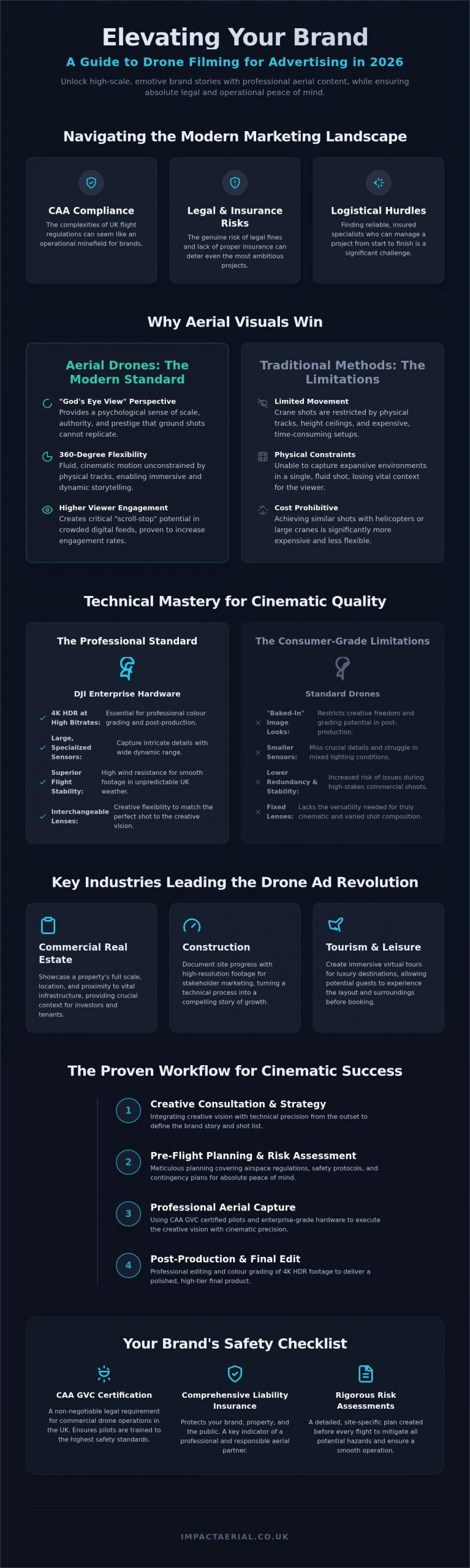
Aerial perspectives disrupt the habitual horizontal thumb-swipe that defines modern browsing. In 2026, data from the UK Digital Marketing Association indicates that posts featuring drone video for social media marketing achieve 3.2 times the engagement rate of standard ground-level clips. This shift is driven by the technical evolution of the unmanned aerial vehicle (UAV) from a niche tool into a high-precision asset for commercial storytelling. Brands now compete in a visual economy where the first 1.5 seconds determine whether a viewer stays or skips. Professional aerial content delivers sensory storytelling by replacing static frames with fluid, sweeping motion that mimics high-budget cinematic production.

To better understand how this visual disruption works in practice, watch this helpful video showing the impact of aerial views in a commercial context:

The Psychology of High-Angle Content

Psychologically, drone footage triggers the “overview effect,” a cognitive shift that creates an emotional connection through scale. For UK property developers and hospitality brands, using aerial views establishes location and trust instantly by showing a site in its true context. This perspective provides a sense of transparency that ground-level photos cannot match. Professional drone cinematography signals a brand’s premium status by demonstrating a commitment to high-production investment within the first three seconds of playback. By showcasing never-before-seen angles, businesses move beyond simple advertising into the realm of immersive experience.

Overcoming Content Saturation Challenges

Social media feeds are currently saturated with millions of smartphone-captured videos posted daily. Differentiating your brand requires a level of quality that the average user cannot replicate with handheld devices. Utilising professional 4K HDR content is essential for high-end positioning, as it ensures your media remains sharp on the latest high-resolution displays. The use of unique, complex flight paths significantly increases “save” and “share” metrics on platforms like Instagram and TikTok. Recent 2025 analytics show that 68% of UK consumers perceive brands using professional aerial footage as more authoritative and reliable than those relying solely on mobile content. To maintain this edge, we focus on several key factors:

  • Precision Flight: Using stabilised gimbals to ensure smooth, professional-grade motion.
  • Regulatory Compliance: Operating under CAA GVC certification to ensure every shot is legal and safe.
  • Technical Superiority: Leveraging High Dynamic Range (HDR) to capture detail in both shadows and highlights, even in challenging UK weather.
  • Strategic Angles: Moving beyond simple “top-down” shots to include reveal shots and low-altitude tracking.

By integrating these professional standards, businesses don’t just join the conversation; they lead it with a level of production value that commands attention and builds long-term brand authority.

Technical Standards and Platform-Specific Requirements

High-quality drone video for social media marketing in 2026 requires more than just flight skills; it demands a deep understanding of sensor physics and platform algorithms. Quality is non-negotiable. While hobbyist equipment often struggles with high-contrast environments, our DJI Enterprise fleet captures 10-bit D-Log M footage to ensure every shadow and highlight remains crisp on the latest OLED mobile screens. This technical headroom allows for professional colour grading that makes visuals pop without looking artificial or over-saturated.

Achieving a cinematic “film look” depends on the 180-degree shutter rule. For the 24fps or 25fps standard used in UK broadcast and high-end social content, the shutter speed must remain at 1/50th of a second. We use physical Neutral Density (ND) filters to maintain this motion blur in bright daylight. Without these, aerial footage appears jittery and “digital,” which immediately signals a lack of professional oversight to discerning viewers.

Vertical Video Strategy (TikTok, Reels, and Shorts)

Social-first content now accounts for 85% of mobile data traffic. Capturing footage in a native 9:16 vertical format is essential to maximise screen real estate. We frame shots with a “safe zone” in mind, ensuring the subject stays central so that TikTok UI elements or Instagram captions don’t obscure the focal point. FPV (First Person View) styles are particularly effective here; they provide a high-octane, immersive perspective that increases Gen Z watch time by an average of 40% compared to static aerial shots. If you want to see how these techniques look in practice, you can view our latest social-first projects here.

Cinematic Horizontal for LinkedIn and YouTube

B2B marketing on LinkedIn demands a different psychological approach. Here, viewers value authority and stability. We utilise “survey-style” cinematic movements, such as slow orbits and reveal shots, to build trust and showcase the scale of corporate infrastructure. This horizontal 16:9 format is perfect for “About Us” videos where the drone footage acts as a high-production-value b-roll.

Professionalism in this sector also means strict adherence to legal standards. While we operate under full CAA GVC certification in the UK, firms with a global presence must ensure their partners understand international variations, such as FAA drone regulations in the United States. We optimise all horizontal exports for web performance, using H.265 codecs to maintain 4K fidelity while keeping file sizes manageable for fast page-loading speeds. This balance ensures your corporate storytelling remains visually stunning without compromising your website’s technical SEO performance.

Professional Drone Services vs. DIY: Risk, Reward, and Regulation

The “Mini Drone” trap has caught out dozens of UK businesses throughout 2025. Many marketing managers assume that because a drone weighs under 249g, it’s exempt from strict oversight. This is a costly misconception. While the hardware is small, the purpose of the flight determines the legal framework. If you use a drone to promote a business, it’s a commercial operation. Using a hobbyist drone for drone video for social media marketing without the correct permissions can result in criminal prosecution or fines exceeding £2,500 under current UK Civil Aviation Authority (CAA) regulations.

A “skilled flyer” is not a substitute for a qualified professional. Impact Aerial pilots hold the GVC (General Visual Line of Sight Certificate), a qualification that requires rigorous theory examinations and practical flight assessments. This certification proves the pilot understands complex airspace, risk management, and emergency procedures. We also carry £5 million in commercial liability insurance. This provides essential protection for your business from unforeseen operational risks. If a marketing agency hires an uncertified pilot who causes property damage or personal injury, the agency itself faces significant legal exposure for negligence.

Professional-grade equipment like the DJI Mavic 3 Enterprise provides a level of stability that consumer drones simply cannot replicate. While a hobbyist drone might struggle in a 15mph breeze, our enterprise fleet maintains rock-steady 4K footage in winds up to 12 metres per second. This hardware also excels in low-light conditions, which is vital for winter campaigns or evening events in the West Midlands where natural light is limited.

The Legal Reality of Commercial Drone Use in the UK

As of January 2026, the definition of a “Commercial Operation” is clear: if the flight facilitates, promotes, or benefits a business in any way, it is commercial. You must verify a pilot’s drone license and insurance certificate before any rotors spin. Hiring an uncertified pilot puts a marketing agency at direct risk of vicarious liability, potentially leading to a total loss of professional indemnity coverage if an incident occurs during an illegal flight.

Why Post-Production is 50% of the Success

Raw footage is rarely enough to stop the scroll on Instagram or TikTok. Impact Aerial treats the flight as only the first half of the process. We specialise in transforming raw 4K data into high-converting drone video for social media marketing through meticulous post-production. Our editors use professional colour grading to match your specific brand HEX codes, ensuring the aerial sequences feel like a seamless part of your wider identity. We also prioritise sound design and bespoke audio layering, as sound is often what triggers the emotional connection in a high-quality social media advert. This meticulous approach ensures your content doesn’t just look professional, but performs as a strategic business asset.

Strategic Content Ideas for Every Industry

Successful drone video for social media marketing requires more than just high-altitude shots. Different sectors demand specific visual strategies to engage their target demographics effectively. In the UK real estate sector, generic fly-overs are no longer enough to capture buyer attention. 2026 trends focus on immersive lifestyle tours. Instead of just showing the roof, we fly from the local park, through the front gates, and up to the balcony. This connects the property to its environment and local amenities, providing a narrative that static photography cannot match.

Construction and development firms benefit from high-speed time-lapse progress videos. These are ideal for LinkedIn updates to show project milestones. Sharing a 30-second clip that compresses a six-month build into a few seconds demonstrates efficiency and scale. It proves to stakeholders that the project is on track. For hospitality venues, capturing the “vibe” of a fully booked outdoor terrace or a large-scale wedding can increase direct bookings. Data from 2025 indicates that venues using aerial “vibe” reels saw a 24% increase in enquiry rates compared to those using traditional ground-based video.

Manufacturing and logistics centres use aerial views to showcase massive scale and operational precision. Showing a fleet of HGVs moving in synchronisation at a Midlands distribution hub highlights the power of your supply chain. It turns a functional facility into a visual testament of industrial strength.

High-Impact Ideas for B2B (LinkedIn)

Professionalism and technical expertise drive LinkedIn engagement. Share “Behind the Scenes” footage of a drone survey to demonstrate the precision of your data-gathering process. Use 30-second case study teasers of major infrastructure projects to prove your firm’s capability. Stakeholders value the use of DJI Enterprise drones and CAA GVC certified pilots, as these details provide peace of mind regarding safety and compliance. Aerial data visuals, such as 3D point clouds or thermal maps, prove your commitment to innovation and technical accuracy.

Engaging B2C Content (Instagram & TikTok)

B2C audiences crave fast-paced, exciting visuals. The “Reveal” shot is a staple for 2026; start with a close-up of a product or person and pull back rapidly to reveal a stunning UK landscape. FPV (First Person View) drones are essential for “fly-through” tours of gyms, retail spaces, or hotels. These shots provide a seamless, high-energy tour that feels like a single continuous take. Incorporating user-generated content (UGC) style drone shots makes your brand feel authentic. It bridges the gap between professional production and the relatable content users expect on their feeds.

To ensure your project meets the highest safety standards, book a consultation with our professional drone pilots today.

Partnering with a CAA GVC Certified Operator for Your Social Strategy

Choosing a partner for your drone video for social media marketing requires more than just a pilot with a camera. Impact Aerial bridges the gap between technical surveying precision and creative marketing flair. We operate as a CAA GVC Certified team, ensuring every flight adheres to the latest UK Civil Aviation Authority standards. This certification is vital for commercial operations in 2026, as it demonstrates a professional level of competence and safety management. For added peace of mind, we carry £5 million in public liability insurance. This protects your brand and the public during every shoot across Birmingham, the West Midlands, and the wider UK.

Our approach treats every social media project with the same meticulousness as a high-stakes industrial survey. We recognize that the drone industry is a niche but increasingly diverse market, and we’ve adapted our workflows to meet the rapid pace of digital content cycles. By combining 4K data-gathering capabilities with cinematic storytelling, we deliver results that are both technically perfect and emotionally resonant.

From Consultation to Post-Production

We don’t just launch a drone and hope for the best. Our methodology begins with a deep-dive consultation to understand your campaign goals. We meticulously organise flight paths to capture the most engaging marketing angles, ensuring the footage is optimised for the vertical formats favoured by 92% of mobile social media users. Our fleet of aerial filming drones includes the latest 4K and HDR DJI Enterprise models. These aircraft offer superior stability and image quality even in challenging West Midlands weather. Every shot we deliver aligns with your existing brand guidelines, maintaining consistency across your digital presence.

Requesting Your Bespoke Quote

Pricing for professional drone services depends on several logistical variables. We calculate quotes based on the specific location, the duration of the flight, and the complexity of the post-production required. A local shoot in Birmingham city centre involves different airspace permissions than a rural project in the Cotswolds. We provide transparent, fixed-fee proposals so there are no hidden costs. Our Birmingham operations centre is ready to provide a free initial consultation to map out your project requirements. Use the link below to get started.

  • Location: Coverage across Birmingham, the West Midlands, and nationwide.
  • Compliance: Full CAA GVC certification and £5m insurance.
  • Quality: High-bitrate 4K and HDR delivery as standard.

High-quality drone video for social media marketing is an investment in your brand’s authority. With Impact Aerial, you gain a partner dedicated to safety, legality, and breath-taking visual results. Contact Impact Aerial today to discuss your next social media campaign and elevate your brand’s visual identity.

Take Your Social Media Strategy to New Heights in 2026

By 2026, the benchmark for digital engagement will shift decisively towards high-resolution, aerial perspectives. Simply owning a consumer drone isn’t sufficient; capturing market share requires navigating complex UK airspace regulations and mastering 4K HDR technical standards for vertical platforms. Integrating professional drone video for social media marketing ensures your brand avoids the significant legal risks of unlicensed flight while delivering the precision that stops a user’s scroll. We provide total peace of mind through our £5m commercial liability insurance and our team of CAA GVC certified pilots. Based in Birmingham and the West Midlands, Impact Aerial offers UK-wide coverage to capture your projects with meticulous attention to detail. Whether you’re showcasing a £10m commercial development or a complex construction site, the right aerial partner provides the technical expertise and safety compliance your brand requires to stand out. Don’t leave your 2026 strategy to chance when you can rely on proven, certified specialists.

Elevate your brand with professional drone video; contact Impact Aerial today

Frequently Asked Questions

Do I really need a professional drone pilot for social media marketing?

Yes, hiring a professional ensures your brand remains legally compliant and produces high-quality results. For commercial drone video for social media marketing, the Civil Aviation Authority (CAA) requires pilots to hold specific certifications like the GVC. A professional brings 4K HDR equipment and technical expertise, providing peace of mind that you won’t face the £5,000 fines associated with illegal or unsafe operations.

How much does it cost to hire a drone for a social media video in the UK?

Professional drone filming rates in the UK typically start at £450 for a half-day session and range up to £950 for a full day. These figures include the pilot’s expertise, data-gathering, and standard commercial liability insurance. Investing in bespoke aerial content can reduce your cost-per-click by 25% compared to using generic stock footage, making it a cost-effective choice for 2026 campaigns.

Can drones fly in city centres like Birmingham or London for marketing purposes?

Drones can fly in Birmingham and London city centres, but only when operated by a CAA GVC certified pilot with the correct authorisations. We handle the complex task of securing local council permits and coordinating with National Air Traffic Services (NATS). Our team follows strict safety protocols to operate in these congested areas, ensuring your urban marketing project stays within the law.

What is the best aspect ratio for drone video on social media?

The best aspect ratio for drone video for social media marketing is 9:16 vertical for platforms like TikTok and Instagram Reels. We capture footage in 4K or 5.1K resolution, which allows us to crop horizontal aerial shots into vertical formats without losing clarity. This strategy ensures your content occupies 100% of the mobile screen, which 87% of users prefer for immersive viewing.

Is drone footage better than traditional video for engagement?

Aerial footage generates 12 times more social shares than standard ground-level video. The unique perspectives provided by a drone stop the scroll and increase average watch times by 40% on platforms like LinkedIn and Facebook. By showcasing your assets from the air, you create a sense of scale and professional polish that traditional tripod-mounted cameras simply cannot match.

What happens if a drone pilot is not insured or certified?

If a pilot lacks CAA certification or commercial liability insurance, the hiring business faces significant legal and financial risks. Unauthorised commercial flights violate the Air Navigation Order 2016, potentially leading to unlimited fines or criminal prosecution. Using an unvetted operator also voids your own business insurance, leaving you liable for any property damage or personal injury that occurs during the shoot.

How long does a typical drone filming session take for a social media project?

A standard drone filming session for social media usually takes between 2 and 4 hours on-site. This duration allows our team to conduct a final safety briefing, swap batteries, and capture approximately 20 different aerial angles. We work methodically to ensure we gather all the necessary data-points, allowing us to complete most property or event shoots within a single morning window.

Can I use drone footage for both my website and social media?

You can certainly use the same drone footage across your website and social media channels to maximise your return on investment. We provide high-bitrate 4K files for stunning website hero banners and optimised, shorter clips for social feeds. Repurposing your aerial assets in this way can increase your website conversion rates by 30% while maintaining a consistent brand aesthetic across all platforms.

Drone Photography Services: What to Expect from a Professional Provider

Hiring a drone operator can feel like navigating a complex new territory. You might be wondering about the legal requirements and CAA regulations, or concerned about finding a pilot who is both qualified and commercially insured. The fear of investing in low-quality, unusable images is a real one. That’s why understanding what to expect from professional drone photography services is crucial-it’s about ensuring a safe, compliant, and seamless operation that delivers tangible results and complete peace of mind.

This guide will walk you through the entire process from start to finish. We will cover everything from the initial consultation and meticulous pre-flight safety checks to the technology used on the day and the delivery of your final, breath-taking aerial images. By the end, you will have the confidence and knowledge to partner with a professional provider, fully aware of the procedures, quality standards, and value you should expect for your investment.

Beyond the Hype: What Are Professional Drone Photography Services?

In today’s market, the term “drone photography” is ubiquitous. However, professional drone photography services offer far more than simply launching a consumer drone into the air. They represent a complete, end-to-end imaging solution, combining advanced flight skills with the principles of professional photography. This modern practice is an evolution of traditional aerial photography, leveraging sophisticated technology to capture data and create high-impact visuals from unique perspectives. It’s a service built on a foundation of safety, legal compliance, and technical expertise.

To better understand the skills involved, this video provides an excellent overview of the fundamentals.

The Professional vs. Amateur Difference

The distinction between a certified professional and an amateur hobbyist is critical, not just for quality but for legality and safety. A professional operator provides complete peace of mind by adhering to strict operational standards. This includes:

  • Legal Compliance: Holding a valid General Visual Line of Sight Certificate (GVC) from the Civil Aviation Authority (CAA), a legal requirement for most commercial drone work in the UK.
  • Comprehensive Insurance: Carrying extensive public liability insurance, typically of £5 million or more, to protect you, your property, and the public.
  • Superior Equipment: Utilising commercial-grade drones, such as those from the DJI Enterprise series, which offer greater reliability, enhanced safety features, and higher-quality imaging sensors.
  • Expert Skillset: Possessing proven expertise in meticulous flight planning, conducting thorough on-site risk assessments, and executing advanced camera techniques to achieve the desired outcome.

Typical Deliverables and Image Formats

When you invest in professional services, the final output is tailored to your specific needs. Beyond just “some pictures,” you can expect a range of high-quality, usable assets. Common deliverables include:

  • High-Resolution Still Images: Crystal-clear photographs, often 20 megapixels or higher, suitable for large-format printing and digital use.
  • RAW Image Files: Unprocessed DNG or similar RAW files that provide maximum flexibility for your in-house post-production team.
  • Edited Photos: Fully processed and colour-graded images delivered as JPEGs or TIFFs, ready for immediate use in marketing materials or reports.
  • Specialised Data: For technical applications like surveying or inspections, deliverables can include high-accuracy orthomosaic maps, 2D site plans, or detailed 3D models created through photogrammetry.

Key Applications: How Industries Leverage Aerial Photography

Modern professional drone photography services extend far beyond capturing beautiful images. They are a powerful data-gathering tool, providing actionable business intelligence that saves time, reduces costs, and enhances safety across a diverse range of sectors. The unique aerial perspective offers insights that are simply impossible to gain from the ground, transforming how businesses approach marketing, project management, and asset maintenance.

Commercial and Residential Property Marketing

For estate agents and property developers, aerial imagery is a game-changer. It provides the ‘hero shot’ that grabs attention and elevates a listing above the competition. By showcasing a property in its entirety, potential buyers gain a comprehensive understanding of its scale, boundaries, and relationship to the surrounding environment.

  • Contextual Views: Highlight proximity to local amenities like parks, schools, and transport links.
  • Key Feature Showcase: Capture stunning views of gardens, swimming pools, and architectural details.
  • Immersive Panoramas: Create interactive 360° aerial tours for compelling virtual viewings that drive engagement.

Construction Site Monitoring and Progress Reports

On a busy construction site, maintaining oversight is critical for efficiency and safety. Drones provide a consistent and documented aerial record of a project’s lifecycle, offering unparalleled clarity for stakeholders. This level of professional oversight is governed by strict operational standards. In the UK, operators must hold CAA certification, while counterparts in the US must follow FAA regulations for commercial drone pilots, ensuring a global benchmark for safety and quality.

  • Progress Tracking: Document project milestones with high-resolution imagery for accurate reporting.
  • Stakeholder Updates: Provide clear, visual updates to investors and clients, improving communication.
  • Enhanced Safety: Inspect scaffolding, structures, and other hard-to-reach areas without putting personnel at risk.

Building Surveys and Roof Inspections

Traditional building inspections, particularly for roofs and high-level facades, are often costly, time-consuming, and carry inherent risks. Our drone photography services offer a safer, faster, and more cost-effective alternative. Using high-resolution cameras, we can capture detailed imagery to identify potential issues before they escalate into expensive problems.

  • Risk Reduction: Eliminate the need for scaffolding or ladders, significantly improving on-site safety.
  • Detailed Analysis: Identify issues such as damaged tiles, blocked gutters, or water ingress with crystal-clear photos.
  • Insurance and Maintenance: Provide essential visual evidence for insurance claims and proactive maintenance planning.

The Project Workflow: What to Expect When You Hire Us

Understanding the process behind professional drone photography services is key to appreciating the value and ensuring a successful outcome. We believe in complete transparency, providing a structured workflow that guarantees safety, compliance with all CAA regulations, and exceptional results. Our four-stage process demystifies the operation, setting clear expectations from our initial conversation to the final delivery of your stunning aerial imagery.

Step 1: Initial Consultation and Scoping

Every successful project begins with a clear understanding of your vision. During our initial consultation, we discuss your specific goals, desired outcomes, and the key subjects you want to capture. We will identify the precise location, assess any potential challenges, and perform an initial feasibility check. Based on this detailed scope, we provide a comprehensive, no-obligation quote outlining all aspects of the project.

Step 2: Pre-Flight Planning and Risk Assessment

This is where our commitment to safety and compliance truly shines. Before any drone takes flight, our team conducts meticulous pre-flight planning. This includes detailed airspace checks for any restrictions, such as those near airports or protected sites. We develop a comprehensive safety plan and risk assessment that adheres to both CAA regulations and recognised industry standards for drone services. We also secure any necessary permissions from air traffic control or landowners and continuously monitor weather conditions to ensure a safe flight window.

Step 3: The On-Site Flight Operation

On the day of the shoot, our CAA-certified pilot arrives on-site to conduct a final safety briefing with you and any relevant personnel. We establish a secure take-off and landing zone to ensure the safety of everyone involved. The pilot then executes the pre-planned flight paths, expertly capturing the high-resolution imagery and data required for your project. Where possible, we can review the initial shots with you on-site to ensure we are capturing your vision perfectly.

Step 4: Post-Production and Delivery

Once the flight is complete, the work continues back in our studio. All captured data is securely transferred and backed up. Our post-production specialists then professionally edit, colour correct, and retouch the images to bring out their full potential and ensure they meet our exacting quality standards. The final, high-resolution files are delivered to you via a secure, private online gallery, ready for you to download and use. Ready to start your project? Contact our team for a consultation.

How to Choose the Right Drone Photography Service

In a niche but increasingly diverse market, not all drone operators are created equal. Choosing a provider based on price alone can expose you to significant legal and financial risks. To ensure you partner with a company that can deliver exceptional quality, safety, and full legal compliance, it is essential to conduct thorough due diligence. This checklist provides the key criteria for vetting any potential provider.

Essential: CAA Certification and Insurance

Before discussing any project, you must verify the operator’s legal credentials. In the UK, any commercial drone operation is illegal without the correct certification and insurance. This is non-negotiable and protects both the operator and you, the client. For complete peace of mind, always ask for:

  • A valid General Visual Line of Sight Certificate (GVC) issued by the Civil Aviation Authority (CAA). This proves the pilot is trained, competent, and legally permitted to fly commercially.
  • Proof of commercial liability insurance. A professional operator will hold a policy with a minimum of £1 million in public liability coverage.

At Impact Aerial, our credentials are fully transparent, providing you with the assurance that your project is in safe, compliant hands from the outset.

Review Their Portfolio and Industry Experience

A provider’s portfolio is a direct reflection of their technical skill and creative vision. Look beyond simple aerial snapshots and assess the quality of their work. Do the images look crisp, well-composed, and professionally edited? Crucially, does their portfolio showcase experience relevant to your industry, whether it’s for property marketing, construction progress, or detailed roof inspections? A strong portfolio, supported by client testimonials and case studies, demonstrates a proven track record of delivering high-quality, professional drone photography services.

Enquire About Their Equipment and Safety Procedures

The quality of the final images is directly linked to the quality of the equipment used. A professional service will use commercial-grade drones and high-resolution cameras, not consumer-level hobbyist equipment. Furthermore, do not hesitate to ask about their commitment to safety. A reputable operator will welcome questions about their standard operating procedures, pre-flight risk assessments, and emergency protocols. This commitment to safety demonstrates a meticulous approach and a dedication to protecting people, property, and your reputation.

Choosing a Professional Partner for Your Aerial Vision

As we’ve explored, selecting a professional provider is about much more than just a camera in the sky. It’s about a structured project workflow, a commitment to safety, and an understanding of how to capture data that delivers tangible value. The key takeaway is that true professionals are defined by their credentials, experience, and the comprehensive process they bring to every project, ensuring both compliance and exceptional results.

At Impact Aerial, we provide the assurance you need. As specialists in property, construction, and commercial surveys, we deliver top-quality results using professional DJI Enterprise drones. For your complete peace of mind, our operations are fully CAA GVC Certified and Insured. When you need reliable and expert drone photography services, partnering with a proven professional is the key to success and security.

Ready to see your project from a new, powerful perspective? Request a professional quote for your aerial photography project. We look forward to helping you achieve breath-taking results with the precision and reliability your work deserves.

Frequently Asked Questions

What happens if the weather is bad on the scheduled day for the drone flight?

Safety is our paramount concern for all aerial operations. We cannot fly in rain, high winds, or other adverse weather conditions as per CAA regulations. We meticulously monitor forecasts leading up to the shoot. If the weather is deemed unsuitable, we will contact you to reschedule for the next available date at no additional cost. This professional approach ensures we capture top-quality imagery without compromising the safety of the operation or our equipment.

Are you fully insured for commercial drone operations?

Yes, we are fully insured for all commercial operations. Impact Aerial holds a comprehensive commercial liability insurance policy that is fully compliant with EC 785/2004, a mandatory requirement set by the Civil Aviation Authority (CAA). For your added peace of mind, our coverage extends up to £10 million, protecting people, property, and the project itself. We are happy to provide a copy of our insurance certificate upon request before any work commences.

How high and how far can you legally fly the drone for a photography project?

In strict accordance with UK Civil Aviation Authority (CAA) regulations, we are legally permitted to operate our drones up to a maximum altitude of 120 metres (400 feet) above ground level. The drone must also remain within the pilot’s direct Visual Line of Sight (VLOS) at all times, which is typically up to 500 metres horizontally. These limitations are legally mandated to ensure the safety of all airspace users and people on the ground.

Do I need to be on-site during the drone photography shoot?

While your presence on-site is not mandatory, it can be highly beneficial. Being present allows you to provide real-time feedback and direct specific shots to ensure the final images perfectly match your vision. However, we understand this is not always possible. Through a detailed pre-flight consultation and an agreed shot list, our professional pilots can execute the project to your exact specifications without you needing to be there on the day.

How long does it take to receive the final edited photographs?

Following the completion of the flight, our standard turnaround time for delivering the final, professionally edited photographs is typically between 3 to 5 business days. This timeframe allows our team to meticulously review all captured data, select the most impactful shots, and perform high-quality post-production and colour grading. We deliver the finalised images to you via a secure digital download link for your convenience and immediate use.

What areas do you provide drone photography services in?

We are based in Birmingham and primarily provide our professional drone photography services throughout the West Midlands and surrounding counties. Our team has extensive operational experience across this region, from urban centres to rural landscapes. For larger or specialised commercial projects, we are fully equipped and prepared to travel to locations across the United Kingdom. Please contact us directly to discuss the specifics of your project’s location and requirements.