Drone Survey vs Scaffolding Time: A Comprehensive Efficiency Comparison

The most expensive part of a building inspection isn’t the surveyor’s expertise; it’s the fourteen days your site often sits idle while waiting for scaffolding permits and assembly. When you compare a professional drone survey vs scaffolding time, the gap in efficiency is staggering. In the UK construction sector, project managers have long accepted that height access is a slow, costly bottleneck involving complex street licenses and intensive manual labour. You likely view these logistical headaches and site access delays as an unavoidable part of the job, but the reality of modern site management is changing rapidly.

This guide reveals how switching to aerial technology can reduce your inspection schedule from weeks to mere hours. You’ll discover exactly how much project time you can save by removing the need for physical structures and permit applications. We’ll examine the efficiency gains at every stage, from rapid deployment by CAA GVC Certified pilots to the delivery of high-resolution data. This comparison provides the technical justification you need to adopt a drone-first strategy, ensuring your projects remain on track and within budget while maintaining the highest safety standards and providing total peace of mind.

Key Takeaways

  • Understand why traditional commercial scaffolding typically requires a 2-4 week lead time and complex structural calculations before a survey can even begin.
  • Learn how professional drone teams achieve rapid 48-hour deployment, completing comprehensive site inspections in just 2-4 hours on-site.
  • Discover how to access high-resolution 4K HDR imagery and detailed 3D photogrammetry models within 48 hours of flight completion.
  • See how CAA GVC certified pilots navigate UK airspace permissions and safety regulations significantly faster than traditional “Work at Height” permits.
  • Analyse the direct impact of drone survey vs scaffolding time on your project schedule and site disruption to ensure maximum operational efficiency.

The Logistics of Time: Why Scaffolding Stalls Projects

Traditional access methods often dictate the project timeline rather than the inspection itself. For most UK commercial property managers, the drone survey vs scaffolding time debate begins long before a single pole is clamped. A typical commercial scaffolding hire carries a lead time of 14 to 28 days. This delay isn’t just administrative; it’s a bottleneck caused by the scarcity of qualified Part 2 scaffolders and the logistical complexity of modern aerial survey techniques compared to rapid digital deployments.

To better understand how drone technology accelerates these timelines, watch this helpful video:

Beyond the wait for materials, structural calculations and site-specific surveys consume at least 5 to 7 working days. If your building borders a public highway, you’ll need a pavement licence from the local council. In cities like Birmingham, these permits often require a 10-day notice period and cost upwards of £150, excluding the mandatory public liability insurance requirements. Even after the inspection concludes, “dead time” sets in. Scaffolding frequently sits idle for 7 to 10 days post-survey because strike teams are scheduled weeks in advance, leaving your site cluttered and vulnerable.

The Pre-Installation Phase: Planning for Physical Access

Securing physical access involves a high-stakes coordination effort between the scaffolding firm, health and safety consultants, and site managers. You’ll often lose 48 hours just clearing access routes for 7.5-tonne delivery vehicles. Street furniture, such as bollards or bus stops, can add weeks to the schedule if they require temporary removal or protection. These hurdles don’t exist with drone operations, where the footprint is minimal and setup takes minutes rather than days.

Erection and Striking: The Multi-Day Reality

For a standard four-storey commercial building, the erection phase alone typically requires 16 to 24 labour hours. This process is highly sensitive to UK weather patterns. While a drone can often fly in moderate conditions, scaffolding work must stop when wind speeds exceed 20mph for safety reasons. This leads to “stop-start” delays that push project completion dates further back. The physical build also creates significant disruption, blocking natural light and obstructing entrances, which can impact the productivity of building occupants for the duration of the works. This comparison highlights why the drone survey vs scaffolding time gap is widening as more firms prioritise operational continuity.

Rapid Deployment: The Hourly Workflow of a Drone Survey

Impact Aerial delivers a streamlined response that traditional access methods simply cannot match. From the initial enquiry, our team achieves a 48-hour deployment window for most UK sites. This agility is vital for urgent structural assessments, post-storm damage reports, or time-sensitive insurance claims. While scaffolding requires weeks of lead time for local authority permits and complex assembly, a drone is airborne within minutes of the pilot arriving on-site.

The total “Arrival to Departure” timeline for a standard commercial roof survey typically spans just 2-4 hours. During this window, we use DJI Enterprise drones, which feature advanced RTK (Real-Time Kinematic) positioning. This technology eliminates the need for physical site preparation or the installation of ground control points. A study published on ResearchGate confirms that drone inspections 67% faster than traditional manual methods. When comparing drone survey vs scaffolding time, the efficiency gap is even more pronounced when considering that the data is reviewed in real-time. Our pilots identify defects while still on-site, allowing for immediate follow-up shots if a specific area of concern is spotted.

The 5-Step Rapid Response Workflow

  • Step 1: Desktop feasibility study (1 hour). We conduct a thorough airspace check using CAA-approved charts to identify flight restrictions or local hazards before leaving the office.
  • Step 2: On-site risk assessment (30 minutes). Our GVC-certified pilots perform a final safety sweep and calibrate the DJI Enterprise hardware for the specific site conditions.
  • Step 3: Automated flight path execution (1-2 hours). The drone follows a pre-programmed grid to ensure 100% coverage and high-resolution photogrammetry mapping.
  • Step 4: Manual “point of interest” inspection (30 minutes). We use high-magnification zoom cameras to capture ultra-detailed imagery of specific defects like hairline cracks or failed flashing.
  • Step 5: Site pack-down and data backup (15 minutes). All data is secured on-site, and the area is vacated immediately.

Minimising Operational Downtime

One of the most significant advantages of aerial data collection is the total absence of “striking” time. Once the drone lands, the survey is over. There’s no lingering equipment, no security risks associated with left-up ladders, and no site clearance needed. This allows us to survey active construction zones or busy commercial premises without halting the work happening below. It’s a non-intrusive process that keeps your project moving.

Furthermore, aerial surveys prevent the common issue of “scaffold-blindness.” When inspectors are on a platform, they often miss wider structural patterns because they’re too close to the building face. Our high-altitude perspectives provide the necessary context to spot systemic issues that manual inspections frequently overlook. If you need to maintain a strict project schedule, you can contact our specialists to discuss your specific site requirements and receive a rapid deployment quote.

Data Turnaround: From Flight to Report in Record Time

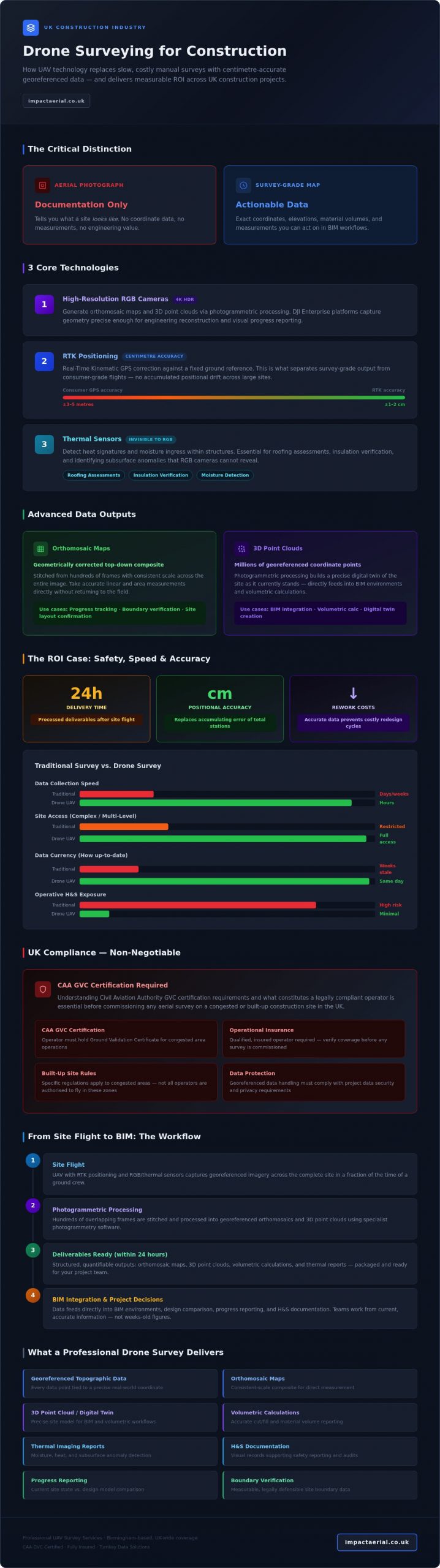
Speed is the defining factor when evaluating the drone survey vs scaffolding time equation. A traditional surveyor often spends hours on a platform or ladder taking manual notes and hand-drawn sketches. In contrast, our CAA GVC Certified pilots capture 4K HDR imagery and thermal data in a fraction of that time. This high-fidelity digital output eliminates the ambiguity often found in handwritten observations. We use advanced photogrammetry to process these images into accurate 3D models within 24 to 48 hours. This rapid turnaround allows project managers to make decisions based on precise digital twins rather than waiting weeks for a typed summary.

Cloud-based data sharing further accelerates the process. Stakeholders don’t need to wait for physical files or large email attachments. Instead, they receive instant access to a secure portal containing the full survey results. This transparency provides added peace of mind for commercial property developers who need to keep projects on track. Digital reports are now 75% faster to produce than traditional paper-based findings because the data is captured in a format that’s ready for immediate analysis.

Traditional Reporting vs. Digital Intelligence

Manual reporting involves a significant lag. A surveyor must transcribe site notes into a PDF, which often happens days after the site visit. Our digital workflow bypasses this bottleneck. We utilize AI-assisted defect recognition to scan thousands of high-resolution images, identifying cracks, leaks, or structural anomalies far faster than a human eye. These findings integrate directly into existing BIM or CAD environments. Your engineering team can use the data immediately without manual data entry or re-drawing.

Total Time Comparison: Drone vs. Scaffolding

Efficiency isn’t just about the flight time; it’s about the total project lifecycle. For a typical commercial roof inspection in Birmingham or the West Midlands, the timeline differences are stark. The table below illustrates how drone technology collapses the schedule of a standard inspection project.

Project Phase Drone Survey Scaffolding
Planning & Permits 1-2 Days 5-10 Days
Equipment Setup 30-60 Minutes 2-4 Days
Inspection/Data Capture 1-4 Hours 3-5 Days
Data Processing & Reporting 1-2 Days 7-14 Days
Total Project Days 3-5 Days 17-33 Days

The ROI of saved time is particularly high for commercial property projects where every day of delay impacts the bottom line. By reducing the total project duration from weeks to a few days, drones allow for faster maintenance cycles and quicker insurance claim processing. This methodical approach ensures that your assets are protected with the highest quality data available in the UK market today.

Planning & Compliance: Navigating UK Regulations Without the Wait

The administrative burden of a building inspection often dictates the project timeline more than the physical work itself. When comparing drone survey vs scaffolding time, the regulatory lead times show a stark contrast. Traditional scaffolding often requires pavement licenses and street permits from local councils, which typically take 14 to 28 days to process in urban areas. A professional drone operation bypasses these physical obstructions entirely. Our CAA GVC certified pilots manage airspace permissions and site-specific risk assessments in a fraction of that time, often securing necessary clearances within 48 hours.

Efficiency isn’t just about speed; it’s about the reduction of liability. By using remote aerial sensing, property managers effectively remove the “Work at Height” regulatory burden. There’s no need for the complex rescue plans or weekly scaffold inspections required by the Health and Safety Executive (HSE). We provide meticulous pre-flight safety documentation and maintain £5m commercial liability insurance. This level of preparation offers the peace of mind that site managers require to grant immediate access to sensitive or high-traffic locations.

Streamlining the Approval Process

The distinction between drone certifications is a critical factor in project speed. While the A2 CofC is suitable for basic flights, the GVC (General Visual Line of Sight Certificate) is the professional standard for complex commercial surveys in congested areas. A GVC certified pilot understands how to liaise with the Civil Aviation Authority (CAA) and local Air Traffic Control (ATC) to secure flight windows that don’t disrupt local operations. Because drone risk assessments are digital and based on established flight safety protocols, they’re approved significantly faster than a multi-page scaffold safety plan that involves structural calculations and public right-of-way closures.

Safety as an Efficiency Driver

Manual inspections require exhaustive “Method Statements” to address the high-risk nature of climbing. Drones eliminate the “Fall from Height” risk entirely, which is the leading cause of workplace fatalities in the UK construction industry. Removing this risk profile simplifies the insurance approval process and reduces the time spent on site inductions. For a deeper look at the legal framework we operate under, you can consult this UK drone license guide which details the strict standards our team maintains. By choosing a remote solution, you’re not just choosing a faster method; you’re adopting a safer, more compliant workflow that protects your project’s bottom line.

Ready to skip the permit queues and secure your site data? Contact Impact Aerial today for a professional consultation.

The Impact Aerial Advantage: Efficiency Meets Precision

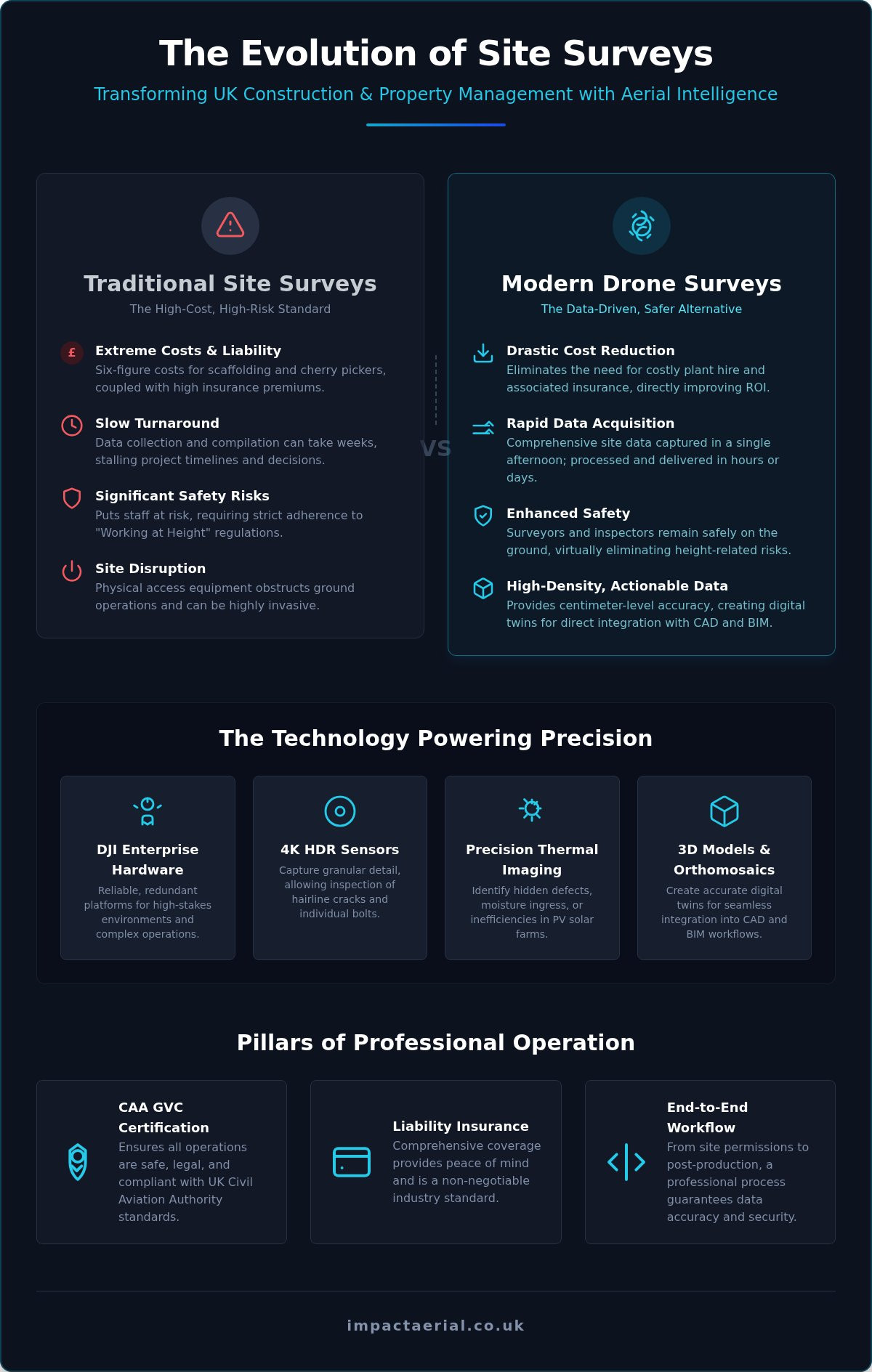
Choosing the right inspection method involves balancing speed, safety, and the quality of the resulting data. When evaluating drone survey vs scaffolding time, the disparity is stark. A traditional scaffolding setup for a four-storey commercial block can take seven to ten days to fully erect. In contrast, our team typically completes the same inspection in less than four hours. This efficiency doesn’t come at the cost of detail. We provide a dual-stream output that combines cinematic 4K video with engineering-grade technical data. This allows your stakeholders to see the “big picture” through high-resolution visuals while your structural engineers dive into the granular photogrammetry and thermal data required for precise maintenance planning.

Our approach eliminates the logistical bottlenecks that plague traditional construction sites. By removing the need for heavy plant machinery and weeks of pavement licenses, we provide a streamlined alternative that keeps your project moving. We don’t just fly drones; we deliver actionable intelligence that helps you make informed decisions about your assets without the unnecessary downtime associated with manual access methods.

Expertise in the West Midlands and Beyond

Based in Birmingham, our team occupies a strategic central position that allows us to reach any site in the UK within a few hours. We possess an intimate understanding of West Midlands airspace, including the specific flight restrictions around Birmingham International Airport and the complex urban geography of the city’s industrial heartlands. A drone survey is the professional process of using unmanned aerial vehicles to collect high-accuracy spatial data and high-resolution imagery for architectural, engineering, and construction purposes. To ensure we never face equipment-related delays, we maintain a fleet of DJI Enterprise drones, including the M300 RTK and Mavic 3 Enterprise. These platforms are designed for reliability in varied UK weather conditions, ensuring your project stays on schedule regardless of the technical demands.

Next Steps for Your Project

Transitioning to an aerial inspection model is a straightforward process designed to provide you with peace of mind. We offer a rapid-response quoting service for commercial properties of all scales. To provide you with a comprehensive feasibility study within 24 hours, we simply require the site postcode, the approximate height of the structure, and a brief description of the specific areas or defects you need to inspect. Our CAA GVC certified pilots handle all necessary risk assessments and airspace notifications, removing the administrative burden from your team. Contact us today to see how we can shave weeks off your inspection timeline and provide a safer, more detailed view of your property assets.

Accelerate Your Project Timeline with Aerial Precision

Choosing between a drone survey vs scaffolding time often comes down to the difference between hours and weeks. Traditional scaffolding setups frequently require 7 to 14 days for installation and strike, creating significant bottlenecks for commercial property developers. In contrast, a professional drone team captures comprehensive structural data in less than 4 hours. This efficiency doesn’t just save time; it removes the logistical burden of heavy equipment from your site entirely. You’ll avoid the “dead time” that usually stalls progress on complex builds.

Impact Aerial provides the technical expertise needed to navigate UK regulations while maintaining peak project momentum. We offer a 48-hour deployment guarantee to ensure you aren’t left waiting for critical data. For added peace of mind, all operations are managed by CAA GVC Certified Pilots and protected by £5m commercial liability insurance. It’s a safer, faster way to obtain high-quality results without the typical site disruptions. You’ll gain clear, actionable insights while your competitors are still waiting for the first pole to be clamped.

Request a Rapid Drone Survey Quote from Impact Aerial

Take control of your inspection schedule and experience the impact of professional aerial data today.

Frequently Asked Questions

How much time can I really save with a drone survey vs scaffolding?

You can save between 70% and 90% of the total project duration when choosing a drone survey vs scaffolding time. A traditional scaffolding setup for a three-storey commercial block typically takes 2 to 3 days to erect and dismantle. In contrast, our CAA GVC Certified pilots can complete the entire data-gathering flight in under 45 minutes. This eliminates the weeks of lead time usually required for scaffold hire and assembly.

Does a drone survey provide the same detail as a manual inspection from scaffolding?

Drone surveys often provide superior detail because they use 4K High Dynamic Range (HDR) sensors that capture sub-centimetre resolution imagery. While a person on scaffolding views a roof from a fixed height, our drones capture data from multiple angles and perspectives. This high-quality output allows you to zoom in on specific defects like hairline cracks or loose fixings that might be missed by the naked eye during a physical walkover.

What happens if the weather is bad on the day of the drone survey?

If the weather forecast predicts wind speeds exceeding 20mph or heavy rain, we reschedule the flight to the next available clear window. Safety is our primary concern, and we strictly adhere to CAA operational safety limits to protect your property and our equipment. We monitor Met Office data 24 hours before deployment. For added peace of mind, there’s typically no additional charge for weather-related rescheduling within our standard service agreements.

How long does it take to get the final survey report after the drone flight?

You’ll typically receive the final survey report within 48 to 72 hours of the flight completion. This rapid turnaround is possible because our digital workflow processes 4K imagery and photogrammetry data immediately after landing. Traditional scaffolding inspections often require longer periods as surveyors must manually compile notes and photos taken while on-site, which can take 7 to 10 days to deliver a formal document.

Do I need to notify my neighbours or get permits for a drone survey in the UK?

You don’t usually need planning permission for a drone survey, but you must comply with UK GDPR and the Data Protection Act 2018 regarding privacy. We recommend notifying neighbours 48 hours in advance if the drone will operate near their boundaries. As professional operators, we handle all necessary flight notifications via NATS apps and ensure we meet all CAA GVC requirements for legal operation in congested areas.

Is a drone survey safer than using scaffolding for roof inspections?

A drone survey is significantly safer than using scaffolding because it removes the need for personnel to work at height. According to Health and Safety Executive (HSE) 2023 statistics, falls from height remain the leading cause of workplace fatalities in the UK construction sector. By keeping our team on the ground, we eliminate the risks associated with falling objects, structural failure, or personal injury during the inspection process.

Can a drone survey identify structural issues as well as a physical inspection?

High-resolution drone imagery identifies 95% of visible structural issues, including roof spread, masonry cracking, and water ingress points. While a drone can’t perform “tap tests” to check material density, the 4K video and thermal imaging sensors we use often detect thermal bridges or damp patches invisible to the human eye. We provide a comprehensive data set that allows structural engineers to make informed decisions without the physical risks of climbing.

What is the lead time to book a professional drone survey in the West Midlands?

Our current lead time for booking a professional drone survey in Birmingham and the West Midlands is approximately 5 to 7 working days. This timeframe allows us to conduct a thorough pre-flight risk assessment and check for local airspace restrictions or NOTAMs. We maintain a flexible schedule to accommodate urgent requests from commercial property developers or building services managers across the region who need to minimise their drone survey vs scaffolding time.

How Long Does a Drone Survey Take? A Professional Timeline Guide

The actual flight time of a commercial UAV represents less than 15% of the total project lifecycle, yet many site managers still mistake a quick launch for a finished report. If you’re managing a high-stakes site in Birmingham or London, you’ve likely felt the pressure of a looming deadline while waiting for data that seems stuck in a processing queue. You need to know exactly how long does a drone survey take to avoid the 25% scheduling overrun often caused by poor planning or unexpected British weather. It’s vital to distinguish between the minutes spent in the air and the days required for professional data-gathering and analysis.

This guide outlines the realistic timescales for drone surveys in 2026, covering everything from CAA-mandated risk assessments to the final delivery of 4K digital twins. We’ll explain why high-quality photogrammetry often requires a 48-hour window for precision processing and how our GVC certified team ensures your project stays compliant. You will gain a clear roadmap of the survey process, giving you the peace of mind to schedule your next build without the fear of hidden delays.

Key Takeaways

  • Distinguish between on-site flight time—typically one to four hours for standard commercial properties—and the total project turnaround to manage your development schedule effectively.
  • Identify how UK-specific variables, including unpredictable weather conditions and CAA flight restrictions, can influence your data-gathering window and overall timeline.
  • Compare the timescales for different applications, from rapid high-resolution roof inspections to more complex topographic land surveys that require precise Ground Control Points.
  • Understand the four essential stages of the process to accurately estimate **how long does a drone survey take** from the initial instruction through to final data delivery.
  • Discover how employing CAA GVC certified pilots and DJI Enterprise technology can minimise mobilisation delays and streamline the delivery of high-quality survey results.

Estimating Your Drone Survey Timeline: On-Site vs. Total Turnaround

Understanding how long does a drone survey take requires a clear distinction between on-site duration and the total project turnaround. Many stakeholders assume the job is finished once the drone lands, but professional surveying is a multi-stage process. For a standard commercial property in the UK, the on-site flight time typically ranges from 1 to 4 hours. However, the full project lifecycle, from the initial instruction to the final delivery of data, usually spans 3 to 7 working days. This timeline ensures that every byte of data meets the high-resolution standards required for modern construction and engineering.

The Short Answer: Typical Timescales

Project duration scales with the complexity and size of the environment. We use specific benchmarks for our UK operations to ensure clients can plan their workflows effectively:

  • Small sites: A single roof inspection or small retail unit takes approximately 1 hour on-site. We deliver the final processed report within 48 hours.
  • Medium sites: A 5-acre construction plot or industrial estate requires 3 to 5 hours of active flight time. The full data package is delivered within 3 to 5 working days.
  • Large/Complex sites: Major infrastructure projects or solar farms often involve multiple days on-site. Delivery typically starts at 7 working days due to the sheer volume of data.

Why Flight Time is Only the Tip of the Iceberg

The drone is a powerful data-gathering tool, yet it isn’t a magic wand. In professional surveying, roughly 70% of the work happens outside of flight hours. Before our DJI Enterprise drones leave the ground, we conduct meticulous pre-flight planning and CAA-compliant risk assessments. This preparation is vital for safety and legal adherence. After landing, the technical work begins. We process 4K HDR imagery through advanced photogrammetry software to ensure millimetre-level accuracy. This is why “instant” drone data is almost always a myth in high-stakes industries. Quality takes time. Our structured approach provides the peace of mind that the final results are both precise and legally compliant. When asking how long does a drone survey take, you must account for this vital post-processing phase that transforms raw images into actionable intelligence.

Key Factors That Influence Drone Survey Duration in the UK

Determining how long does a drone survey take requires looking beyond the flight itself. While a standard 10-hectare site might only require 45 minutes of actual airtime, the total project timeline is dictated by external variables and technical precision. We don’t just “turn up and fly”; we manage a complex set of environmental and regulatory hurdles to ensure data accuracy.

Environmental and Geographic Variables

UK weather patterns are the primary cause of scheduling shifts. Most commercial drones, such as the DJI Matrice 350 RTK, have a maximum wind resistance of approximately 27mph. If gusts exceed 20mph, data quality often degrades due to sensor instability. We typically build a 48-hour “weather window” into our project timelines to account for these shifts. This ensures we capture high-quality data without risking the equipment or the accuracy of the photogrammetry.

Location geography also changes the pace of work. A rural survey in the West Midlands involves fewer obstacles than a complex flight in Birmingham city centre. Urban environments require detailed ground control and pedestrian management, which can double the preparation time. Topographical challenges, like 50-metre elevation changes or high-rise structures, require multi-level flight paths to maintain a consistent Ground Sample Distance (GSD). These technical adjustments are vital for the precision our clients expect.

Technical and Regulatory Requirements

Safety and compliance are at the heart of our operations. Every mission starts with a comprehensive Risk Assessment and Method Statement (RAMS). For restricted airspace near major airports, securing specific CAA permissions can take up to 21 days. It’s a meticulous process that cannot be rushed if you want to remain within the law. Understanding how long does a drone survey take involves accounting for these administrative lead times before the drone even leaves the van.

  • Battery Management: A standard enterprise battery provides roughly 30 to 40 minutes of flight. Large-scale projects requiring 2,500+ high-resolution images will necessitate multiple battery swaps and cooling cycles.
  • Deliverable Complexity: A simple 2D orthomosaic is processed much faster than a centimetre-accurate 3D digital twin or a detailed thermal inspection report.
  • Site Access: Securing permissions from neighbouring landowners can add several days to the pre-flight phase.

For added peace of mind, our professional drone services ensure all regulatory and technical hurdles are cleared before the first propeller spins. The difference between a quick snapshot and a professional survey lies in this preparation. We focus on the details so that the final data is both actionable and legally compliant.

Comparing Timelines for Roof, Land, and Commercial Property Surveys

The specific application of the technology determines how long does a drone survey take more than any other factor. A CAA GVC certified pilot might complete a visual inspection of a 2,000 square metre warehouse in 90 minutes, whereas a full topographic land survey of the same site requires a multi-day commitment. Precision requirements and data density are the primary drivers of these differences. We categorise these timelines based on the complexity of the data capture and the subsequent processing required to deliver professional results.

Roof and Building Inspections

Roof inspections are the most efficient service we offer. For a standard commercial unit in the West Midlands, such as a distribution hub in Solihull or an industrial unit in Dudley, the on-site flight time rarely exceeds two hours. These projects focus on high-resolution 4K stills and 60fps video to identify structural defects, leaks, or blocked guttering. Because these surveys produce individual files rather than a unified map, clients often receive the raw data within 24 hours. It’s a rapid process that provides immediate peace of mind for facility managers facing urgent maintenance issues.

Mapping and Photogrammetry Projects

Mapping projects are significantly more complex. When creating a 3D digital twin or a 2D orthomosaic, the pilot must capture thousands of overlapping images. To achieve sub-20mm accuracy, we must set out Ground Control Points (GCPs) across the site before the drone takes off. This preparation adds 2 to 4 hours to the on-site timeline. Data processing is the final hurdle. Stitching 1,500 high-resolution images into a single map requires immense computational power. Even with high-spec workstations using 128GB of RAM, rendering a 50-hectare site can take 12 to 18 hours of continuous processing.

Other specialised surveys have unique constraints that impact the delivery schedule:

  • Thermal Solar Surveys: These must occur when solar irradiance exceeds 600W/m². In the UK, this usually limits flight windows to between 10:00 and 14:00 on clear days.
  • Construction Monitoring: This is a longitudinal process. We visit a site at 14-day intervals over a 12-month build programme to document progress and ensure the project stays on track.
  • Topographic Land Surveys: These often require a 3 to 5-day turnaround to allow for the integration of GPS data and the generation of detailed CAD drawings.

Understanding these variables helps project managers plan effectively. While a simple aerial photograph is instant, a professional survey is a technical exercise in data management. When asking how long does a drone survey take, always account for the 48-hour window typically needed for high-quality data validation and reporting after the drone has landed.

The 4-Stage Drone Survey Process: From Instruction to Deliverables

Understanding how long does a drone survey take requires a transparent look at the operational workflow. It’s a common misconception that the process begins and ends with the drone in the air. At Impact Aerial, we divide every project into four distinct phases to ensure 99.9% data accuracy and total CAA compliance. Since the 2024 update to GVC standards, our meticulous approach ensures that even the most complex 20-hectare sites are handled with surgical precision.

  • Phase 1: Pre-flight Planning: We conduct detailed site research, establish flight boundaries, and complete mandatory risk assessments.
  • Phase 2: Mobilisation: This is the physical deployment where our GVC certified pilots capture high-resolution imagery or LiDAR data on-site.
  • Phase 3: Data Processing: Raw files undergo photogrammetry and quality assurance checks to create 2D orthomosaics or 3D models.
  • Phase 4: Delivery: Final assets are uploaded to a secure cloud portal, providing clients with instant access to actionable insights.

Pre-Flight: The Secret to a Smooth Survey

Success is decided before the rotors start spinning. We use advanced mapping tools to review site boundaries and identify hazards like overhead power lines or restricted airspace that could delay progress. By coordinating directly with site managers, we reduce operational disruption by roughly 35% compared to traditional ground surveys. The pre-flight window is the 24-48 hours before arrival where final weather forecasts and site access protocols are locked in.

Post-Production: Turning Imagery into Insight

Data is only valuable if it’s usable. Our editors filter through hundreds of 4K HDR images to select the clearest frames for your report. When inspecting solar arrays, our thermal analysis identifies ‘hot spots’ where cells have failed, often detecting temperature spikes of 15°C above the baseline. This technical review ensures every centimetre of data aligns with your specific brief before it reaches your desk. If you need precise data for your next project, contact our expert team today for a consultation.

When clients ask how long does a drone survey take, they’re often surprised that the technical processing in Phase 3 takes longer than the flight itself. For a standard commercial roof inspection, the flight might take 90 minutes, but the rigorous quality assurance checks ensure the final report is robust enough for legal or insurance purposes. This structured approach provides the peace of mind that every detail is captured safely and legally.

Minimising Delays: How Impact Aerial Streamlines the Process

Impact Aerial optimises every stage of data collection to ensure your project remains on schedule. We utilise the latest DJI Enterprise drones, such as the Matrice 350 RTK, which offer superior flight stability and longer battery life compared to standard consumer hardware. These drones capture high-resolution data up to 40% faster than older models, significantly reducing the time our pilots need to spend on-site. By using RTK (Real-Time Kinematic) positioning, we achieve centimetre-level accuracy without the need for excessive ground control points, which often shave hours off the initial setup phase.

Our strategic Birmingham base provides a logistical advantage for projects across the West Midlands. We can mobilise teams to sites in Birmingham, Coventry, or Wolverhampton within 60 to 90 minutes. This local presence eliminates the travel-related delays that often plague national providers. For added peace of mind, we carry £5m commercial liability insurance. This level of cover is a standard requirement for 95% of Tier 1 construction sites in the UK. Having this in place ensures immediate site access, preventing the administrative bottlenecks that occur when insurers need to vet under-insured operators.

Professionalism as a Time-Saving Tool

Amateur pilots often cause project overruns because they lack a deep understanding of UK airspace restrictions. A single oversight in flight planning can result in a grounded mission or a fine from the Civil Aviation Authority (CAA). Our CAA GVC certified pilots are experts in navigating complex regulations. We produce comprehensive Risk Assessments and Method Statements (RAMS) that achieve a 98% first-time approval rate from site managers. This methodical preparation is a cornerstone of our drone property surveys, ensuring we start flying the moment we arrive on-site.

Next Steps for Your Project

To accurately assess how long does a drone survey take for your specific requirements, we need a detailed brief. A clear scope of work allows us to account for site-specific variables like terrain complexity and local flight restrictions. When you get in touch, please include the following details:

  • The site postcode and boundaries.
  • The required data outputs, such as 2D orthomosaics or 3D models.
  • Any specific site access requirements or safety inductions.

Providing this information upfront allows us to calculate a precise project timeline and a fixed-fee quote within 24 hours. You can contact Impact Aerial for a bespoke survey timeline to ensure your next project is delivered with technical precision and professional reliability.

Accelerate Your 2026 Project Timelines with Expert Aerial Data

Determining how long does a drone survey take involves balancing rapid on-site capture with meticulous data processing. Most commercial property inspections in the UK now require less than 1 day on-site, with final 4K HDR reports typically delivered within 48 to 72 hours. This efficiency represents a 70% time saving compared to traditional manual surveying methods. At Impact Aerial, we don’t just fly; we provide a structured 4-stage process that ensures safety and precision at every turn. Our CAA GVC Certified pilots operate the latest DJI Enterprise 4K HDR drone fleet to capture every millimetre of your assets. For added peace of mind, we carry £5m commercial liability insurance, ensuring your site remains compliant with all current UK aviation regulations. Don’t let outdated inspection methods stall your progress. Our team is ready to provide the high-quality insights you need to keep your development on track and within budget. We look forward to helping you streamline your next project.

Request a Professional Drone Survey Quote Today

Frequently Asked Questions

How long does a drone roof survey take on-site?

A standard drone roof survey typically takes between 30 and 90 minutes on-site. This timeframe allows our CAA GVC certified pilots to conduct a mandatory pre-flight safety brief and capture high-resolution 4K HDR imagery of the entire structure. Complex industrial roofs with multiple levels or technical obstructions might extend this duration to 120 minutes. We ensure every angle is covered for a comprehensive inspection without the need for expensive scaffolding.

Can you perform a drone survey in the rain or high winds?

We don’t operate in active rain or winds exceeding 20 miles per hour to ensure data precision and flight safety. While our DJI Enterprise fleet features IP-rated weather resistance, moisture on the lens distorts the 4K imagery required for professional surveys. High winds also deplete batteries 30% faster; this compromises the stability needed for accurate photogrammetry. We prioritise safety and quality to provide total peace of mind for our clients.

How long does it take to receive the processed drone data?

You will typically receive your processed drone data within 24 to 72 hours of the flight being completed. Standard high-definition imagery and raw video files are often delivered via a secure download link within one working day. More complex data-gathering projects involving detailed inspection reports or topographical maps require additional time for analysis. We aim to deliver 95% of our standard survey reports within 3 working days.

Does the size of the site significantly change the survey time?

Site size is the primary factor in determining how long does a drone survey take for a specific project. A compact 1-hectare site might require only 20 minutes of flight time, whereas a 20-hectare construction development often takes 4 to 6 hours to map fully. Larger sites require multiple battery swaps and more complex flight paths to maintain the 80% image overlap needed for high-quality data-gathering and accurate mapping.

Do I need to be present during the drone survey?

You don’t need to be present on-site during the drone survey as long as we have authorised access to the area. Our pilots handle all site risk assessments and CAA compliance requirements independently. We provide a digital confirmation once the data capture is complete; this allows you to continue with your day while we manage the technical operations. Many of our commercial clients prefer this remote approach for its efficiency and minimal disruption.

What happens if the drone survey is delayed by weather?

We reschedule weather-delayed surveys for the next available clear window, usually within 48 hours of the original booking. Our team monitors Met Office forecasts 24 hours in advance to provide early warnings of potential disruptions. Safety is our absolute priority, and we won’t fly if conditions risk the integrity of your data or the safety of the public. Your booking remains secured, and we don’t charge additional fees for weather-related rescheduling.

How much lead time is required to book a commercial drone survey?

We generally require a lead time of 3 to 7 days to book a commercial drone survey. This period allows us to complete necessary airspace checks, obtain any required permissions from the CAA, and perform a detailed desktop risk assessment. While we can occasionally accommodate emergency inspections within 24 hours, the 7-day window ensures all regulatory paperwork is perfectly in order. This meticulous planning is essential for maintaining our high safety standards.

Does a 3D model take longer to produce than 2D images?

Processing a 3D digital twin takes approximately 2 to 3 times longer than delivering standard 2D aerial photographs. While 2D images are often available within 24 hours, a 3D model requires intensive photogrammetry processing that can take 48 to 72 hours. This process involves stitching together hundreds of individual HDR images to create a centimetre-accurate representation of your asset. The resulting model provides a far more detailed level of insight for your project team.

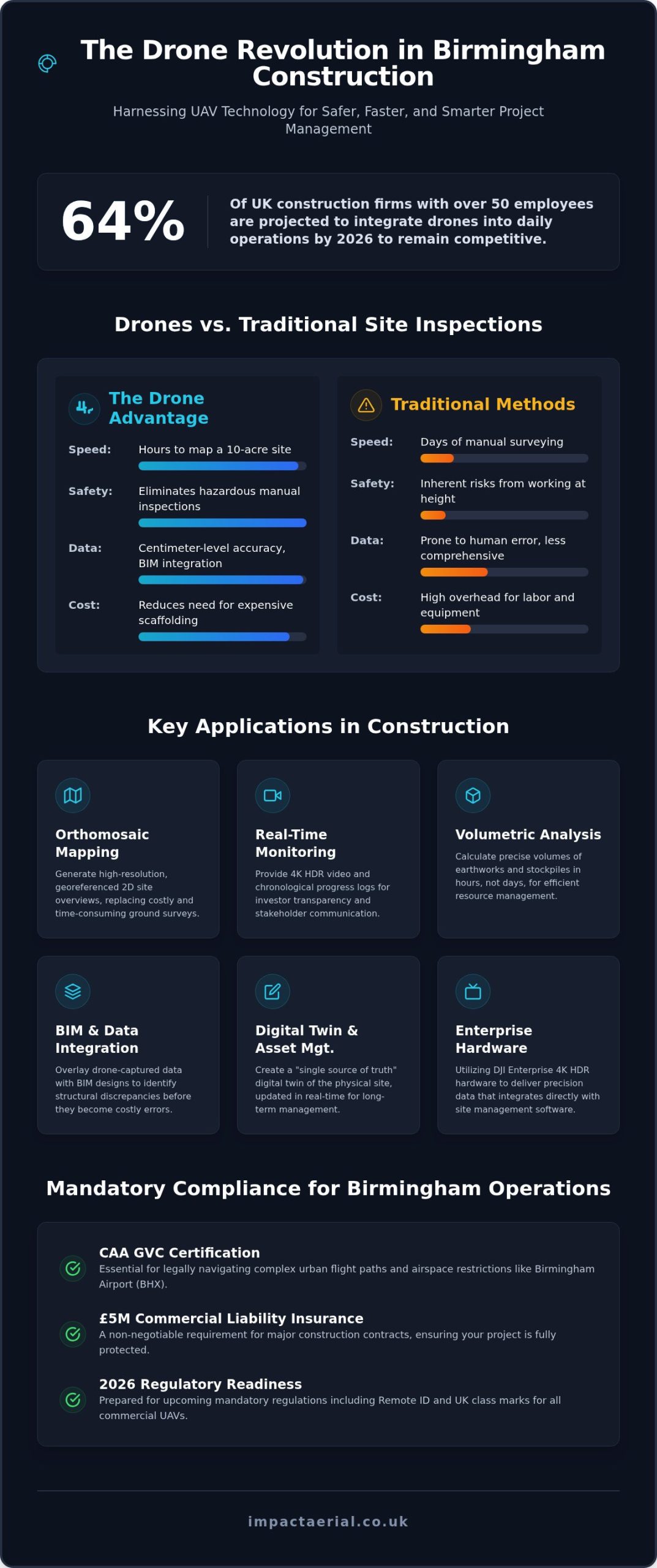
Transforming Construction: The Top Benefits of Drone Surveys

In the high-stakes world of UK construction, managing project timelines, controlling budgets, and ensuring site safety are paramount. Traditional surveying methods, often slow, labour-intensive, and prone to inaccuracies, can exacerbate these challenges, leading to costly rework and difficult conversations with stakeholders. Fortunately, a technological evolution is providing a powerful solution. By understanding the significant benefits of drone surveys for construction, project managers can gain an unprecedented level of control and insight over their sites from start to finish.

This article explores how leveraging professional, CAA-certified drone services transforms modern site management. We will detail how this advanced data-gathering technology dramatically improves topographical accuracy, enhances on-site safety protocols by reducing the need for personnel in hazardous areas, and streamlines communication with stakeholders through clear, visual data. Discover how to mitigate risks, reduce project costs, and deliver your projects with greater efficiency and confidence, giving you a decisive competitive edge in a demanding market.

Key Takeaways

  • Understand how high-resolution drone data creates a precise digital foundation for your project, surpassing the accuracy of traditional manual surveys.
  • Discover how reducing on-site survey time with drones can accelerate project timelines and deliver significant cost savings from start to finish.
  • Learn how to dramatically improve site safety and comply with UK HSE regulations by using drones to survey hazardous or difficult-to-access areas.
  • See how compelling aerial imagery and data can streamline project management and provide clear, easily understood updates for all stakeholders.
  • The full benefits of drone surveys for construction are only realised through professional execution, avoiding the significant safety and regulatory risks of a DIY approach.

Enhanced Accuracy & Data Quality: Building on a Foundation of Precision

In modern construction, precision is not a luxury; it is a fundamental requirement. Traditional ground-based surveying methods, while established, are often time-consuming, labour-intensive, and susceptible to human error. One of the primary benefits of drone surveys for construction is the ability to transcend these limitations. By utilising advanced photogrammetry techniques, our drones capture millions of data points in a single flight, creating a comprehensive and meticulously detailed digital twin of your entire site.

This high-resolution data provides an objective, verifiable record with centimetre-level accuracy, far surpassing the detail achievable through manual measurements. This foundation of reliable data eliminates the guesswork and inconsistencies that can plague a project’s early stages, allowing for more confident and informed decisions from the outset.

To better understand how this technology is transforming site analysis, watch this helpful video:

High-Resolution Topographic Surveys

Our drone surveys generate detailed topographic models and digital elevation models (DEMs) significantly faster than traditional ground crews. This rapid data-gathering allows your team to identify potential site challenges, such as complex grading or drainage issues, long before they become costly problems. With this precise terrain data, you can accurately calculate cut and fill volumes for earthworks, optimising material management and reducing the need for expensive, time-consuming pre-construction rework.

3D Models and BIM Integration

Visualisation is key to effective project management. We transform aerial data into photorealistic 3D point clouds and mesh models, offering an unparalleled view of your site. These models serve as a real-world canvas onto which you can overlay Building Information Modelling (BIM) designs. This process is one of the most powerful drone applications in construction, as it allows for early clash detection, ensuring that architectural and engineering plans perfectly align with actual site conditions before a single foundation is poured.

As-Built Verification vs. Design

Throughout the construction lifecycle, our drones provide an ongoing, accurate record of progress. By regularly flying the site, we can continuously compare the as-built reality against the original design files. This verification process catches deviations and errors early, when they are far simpler and cheaper to rectify. This service provides stakeholders with indisputable, time-stamped visual evidence of work completed to specification, creating a perfect final record of the project upon completion.

Significant Time & Cost Savings Across the Project Lifecycle

In the UK construction industry, where margins are tight and timelines are critical, efficiency is paramount. One of the most compelling benefits of drone surveys for construction is the direct and substantial impact on your project’s bottom line. By leveraging advanced aerial data-gathering, you can compress timelines, reduce operational expenditure, and mitigate financial risks from the initial site assessment through to final handover.

Reduced Labour and Equipment Costs

Traditional surveying methods are notoriously time-consuming and labour-intensive. A drone, operated by a single CAA GVC certified pilot, can accomplish in hours what a ground-based team might take days or even weeks to complete. This rapid data acquisition translates into immediate, tangible savings:

  • Vast Site Coverage: Survey hundreds of acres in a single day, drastically cutting down on man-hours.
  • Minimised Equipment Hire: Reduce the need for expensive ground survey equipment, mobile elevated work platforms (MEWPs), or scaffolding for at-height inspections.
  • Optimised Workforce: Re-deploy your skilled surveyors and engineers from manual data collection to higher-value analysis and decision-making tasks.
  • Lower Insurance Premiums: By reducing the need for personnel to work at height or in hazardous areas, you inherently create a safer site, which can contribute to lower liability insurance costs.

Preventing Rework with Proactive Monitoring

Costly rework is a primary cause of budget overruns and project delays. Drone surveys provide a high-resolution visual timeline, allowing project managers to compare as-built progress against design plans (e.g., BIM models) with unparalleled accuracy. Regular flights help identify deviations early, when they are minor and inexpensive to rectify. This proactive approach, supported by extensive research into drone technology in construction, allows you to spot issues with foundations, structural installations, or cladding alignment immediately, preventing small errors from escalating into major financial burdens later in the project.

Optimising Resource and Stockpile Management

Effective management of materials and equipment is crucial for maintaining project momentum. Drones equipped with photogrammetry software can calculate the volume of stockpiles-such as soil, sand, or aggregate-with incredible speed and precision. This accurate, up-to-date inventory data prevents costly over-ordering or disruptive shortages. Furthermore, aerial overviews provide a clear picture of site logistics, helping you track equipment placement and ensure subcontractors are utilising materials efficiently, ensuring your investment is being managed correctly on the ground.

Ultimately, the cumulative effect of these efficiencies provides a powerful return on investment, making professional drone surveys an indispensable tool for modern, cost-conscious construction projects.

Dramatically Improved Site Safety and Risk Management

On any construction site, the safety of personnel is the highest priority. One of the most significant benefits of drone surveys for construction is the profound improvement in site safety and proactive risk management. By deploying Unmanned Aerial Vehicles (UAVs), project managers can gather critical data without exposing team members to unnecessary hazards, ensuring a safer, more compliant, and secure working environment from project inception to completion.

Eliminating Unnecessary Work at Height

Working at height remains a leading cause of serious injury in the construction industry. Our professional drone services directly mitigate this risk, helping you maintain full compliance with the UK’s Health and Safety Executive (HSE) work-at-height regulations. Instead of erecting costly scaffolding or hiring mobile elevated work platforms (MEWPs), our CAA GVC certified pilots conduct meticulous inspections of rooftops, facades, and scaffolding from the safety of the ground. This approach not only avoids the inherent dangers of manual access but also gathers more comprehensive data without disrupting site operations.

Monitoring Hazardous or Inaccessible Areas

Construction sites often contain areas that are inherently dangerous, such as deep excavations, unstable ground, or stockpiles. Drones provide an invaluable remote vantage point to monitor these zones safely and effectively. This is particularly crucial for assessing post-incident damage (e.g., after a storm or fire) before sending in response crews. This capability to perform remote data-gathering is just one example of how drones mitigate risk, as explored in this detailed academic overview of drone applications across all project phases. By using drones, you gain a clear view of the entire site, including hard-to-reach perimeters, without direct human exposure.

Enhancing Site Security and Logistics

Effective risk management extends beyond physical safety to include site security and operational logistics. Drone surveys offer a powerful, modern solution for this. Key applications include:

  • Security Patrols: Conduct regular, automated aerial patrols to monitor for theft or vandalism, document site security measures, and identify vulnerabilities.
  • Logistical Oversight: Monitor traffic flow and material deliveries from above to improve site logistics, reduce the risk of on-site collisions, and enhance overall efficiency.
  • Emergency Response: Provide a critical aerial overview during an emergency situation, helping to coordinate response teams and assess the situation safely.

By integrating drone technology, you create a documented, transparent, and fundamentally safer site for everyone involved.

Streamlined Project Management and Stakeholder Communication

Effective communication is the cornerstone of any successful construction project. However, translating complex site data into clear, understandable updates for diverse stakeholders-from on-site teams to off-site investors-is a persistent challenge. Traditional methods relying on lengthy written reports and static 2D plans often fail to convey the true status of a project. This is where the communication-focused benefits of drone surveys for construction truly shine, transforming abstract data into a universal visual language.

By leveraging high-resolution aerial data, project managers can bridge communication gaps, foster collaboration, and provide a level of transparency that was previously impossible. This creates a single source of truth that aligns all parties, from the ground crew to the boardroom.

Effective Visual Progress Reporting

Replace ambiguous reports with definitive visual evidence. Drone surveys allow you to capture a complete snapshot of your site at regular intervals, creating a powerful narrative of your project’s evolution. Instead of describing progress, you can show it with unparalleled clarity and impact through assets such as:

  • Weekly Orthomosaic Maps: High-resolution, georeferenced aerial maps that can be overlaid to precisely track progress and changes over time.
  • Compelling Time-Lapse Videos: Document the entire construction lifecycle from a consistent aerial perspective, creating a powerful visual story for stakeholders and marketing.
  • Interactive 3D Models: Allow stakeholders to virtually explore the site, take measurements, and understand complex spatial relationships far more intuitively than with 2D drawings.

Furthermore, these images and models can be easily annotated to highlight key achievements, flag areas of concern, or clarify instructions for on-site teams, ensuring everyone is on the same page.

Subcontractor Verification and Accountability

One of the most valuable benefits of drone surveys for construction is the ability to create an objective and irrefutable visual record of all site activities. This time-stamped data provides an impartial tool for managing subcontractors and ensuring accountability. Use drone-captured data to independently verify that work has been completed to the agreed standard and timeline. Precise photogrammetry allows you to measure exact quantities of earth moved or materials installed, ensuring payment applications are accurate and fair. In the event of a dispute, this visual evidence serves as a definitive record, often resolving disagreements quickly and without costly legal intervention.

Engaging Clients and Investors

For clients and investors, seeing is believing. Professional aerial imagery provides a compelling ‘bird’s-eye view’ of their investment, building confidence and keeping them engaged throughout the project lifecycle. These high-quality visuals demonstrate a commitment to technological innovation and efficient project management, reflecting positively on your entire operation. The data is not just for internal review; it doubles as a powerful asset for marketing, public relations, and future project bids. Showcase your project with our professional aerial filming.

How to Realise These Benefits: Choosing a Professional Drone Partner

The significant cost savings, improved safety, and enhanced data accuracy discussed throughout this article are not automatic. To truly unlock the full benefits of drone surveys for construction, professional execution is paramount. Attempting to manage drone operations in-house without specialist training presents considerable risks, from breaching complex CAA airspace regulations to potential on-site accidents. A professional drone partner removes this burden, managing the advanced technology, ensuring full legal compliance, and processing raw data into actionable insights. This allows you to focus on what you do best: managing your construction project, not becoming a drone expert.

CAA Certification and Commercial Insurance

When vetting a provider, non-negotiable credentials are a valid Civil Aviation Authority (CAA) General Visual Line of Sight Certificate (GVC) and comprehensive commercial liability insurance. The industry standard is a minimum of £5 million in coverage. This isn’t just paperwork; it’s your assurance that the operator is legally compliant, fully understands UK airspace rules, and has implemented robust safety procedures. For your added peace of mind, these certifications protect your project, your site, and your reputation from liability.

Understanding the Data and Deliverables

A professional service delivers far more than just aerial photographs. The real value lies in the processed, survey-grade data that integrates directly into your project workflows. Before commissioning a survey, discuss your specific requirements. Do you need:

  • High-resolution orthomosaic maps for site overviews?
  • Detailed point clouds for topographic analysis?
  • Accurate 3D models for BIM integration?

Ensure the provider can supply data in formats compatible with your existing software, such as AutoCAD or Revit. Always ask to see sample reports to verify the quality and clarity of their final deliverables.

Experience in the UK Construction Sector

Choosing a drone partner with a proven track record in the construction industry is critical. A specialist provider understands the unique terminology, timelines, and challenges of a live construction site. They can anticipate needs and provide data that is immediately relevant to site managers, quantity surveyors, and project stakeholders. Review their portfolio for examples of similar construction projects, and consider a provider with local knowledge of areas like Birmingham and the West Midlands. This local expertise is invaluable for maximising the benefits of drone surveys for construction and ensuring a responsive service. To ensure you achieve the highest quality results, contact a certified drone specialist to discuss your project’s specific needs.

Harnessing Aerial Intelligence for Superior Construction Outcomes

The evidence is clear: the integration of drone technology is no longer a future concept but a present-day necessity for competitive construction firms. By providing unparalleled data accuracy, dramatically reducing project timelines and costs, and fundamentally enhancing site safety, the tangible benefits of drone surveys for construction are transforming how projects are planned, managed, and delivered from the ground up.

However, unlocking these advantages requires a partner with proven expertise and a commitment to regulatory compliance. At Impact Aerial, our team of fully CAA GVC Certified and insured pilots brings extensive experience from across the UK construction and property sectors. We deliver the high-resolution 4K data your project demands, giving you complete peace of mind that your survey is both precise and legally compliant.

Take the next step in elevating your project’s potential. Get a professional drone survey quote for your construction project.

Frequently Asked Questions

How much does a drone survey for a construction site cost?

The cost of a professional drone survey is project-dependent, typically ranging from £400 to over £1,500 for a single site visit in the UK. Pricing is influenced by the size and complexity of the construction site, the required data outputs, and the level of accuracy needed. Factors such as the number of Ground Control Points (GCPs) and the processing time for detailed 3D models will be included in a final quote. We provide a bespoke quotation after a detailed consultation to ensure value.

What is the difference between a drone survey and traditional land surveying?

Traditional surveying captures individual data points from the ground, which is a time-consuming and often hazardous process. A drone survey uses photogrammetry to capture thousands of images, creating a comprehensive digital twin of the entire site in a fraction of the time. This enhanced speed, safety, and data richness are key benefits of drone surveys for construction, providing a complete visual record and more detailed topographic data than ground-based methods alone can offer efficiently.

How quickly can I receive the data and reports after a drone flight?

The on-site data capture is completed rapidly, often within a few hours. Following the flight, initial processed data, such as a high-resolution site overview, can typically be delivered within 24 to 48 hours. The final delivery of survey-grade outputs like detailed 3D models, point clouds, and topographic reports will depend on the project’s complexity but is generally completed within 3 to 5 business days. We always provide a clear delivery timeline as part of our project proposal.

Are drone surveys accurate enough for detailed engineering and planning?

Absolutely. When conducted by certified professionals using survey-grade equipment, drone surveys achieve exceptional accuracy. By utilising RTK/PPK-enabled drones and strategically placed Ground Control Points (GCPs), we can deliver data with a relative accuracy of down to 2-5cm. This level of precision is more than sufficient for detailed engineering design, earthworks calculations, site planning, and as-built verification, ensuring your project decisions are based on reliable, high-quality information.

What kind of data and file formats will I receive from a construction survey?

You will receive a comprehensive set of data compatible with industry-standard CAD and GIS software. Common deliverables include high-resolution orthomosaic maps (GeoTIFF), 3D point clouds (.LAS, .LAZ), Digital Surface and Terrain Models (DSM/DTM), and 3D textured mesh models (.OBJ). We also provide detailed PDF reports for stockpile volume calculations or progress monitoring. We consult with you beforehand to ensure the final outputs match your specific project requirements and software workflows.

Do I need to worry about UK drone laws and regulations?

No, you do not. For your complete peace of mind, all operational and legal responsibilities are handled by us. As a CAA GVC Certified operator, Impact Aerial conducts thorough pre-flight risk assessments and ensures full compliance with all UK Civil Aviation Authority regulations for every mission. Our professional services include managing all necessary permissions and flight plans, allowing you to focus on your project while we safely and legally handle the data gathering from the air.