For years, aerial imagery was viewed as a luxury visual extra for final reports, but in the current UK planning landscape, it has become a non-negotiable data layer for defensible environmental consultancy. Relying on manual habitat mapping often leads to inaccuracies, while traditional ground surveying in hazardous or inaccessible terrain presents significant safety risks and high operational costs. You likely find that these traditional methods struggle to keep pace with the rigorous demands of modern project timelines and the precision required for high-stakes reporting.
This guide demonstrates how professional aerial photography for environmental consultants transforms these challenges into streamlined, high-resolution workflows. By integrating advanced drone data, you can achieve the accuracy required for mandatory 10% Biodiversity Net Gain (BNG) assessments while significantly reducing site time. We will explore the shift toward centimetre-accurate orthomosaic maps for GIS, faster Environmental Impact Assessment (EIA) delivery, and the necessity of using CAA GVC certified pilots. You’ll learn how to secure legally compliant data that strengthens planning applications and ensures your projects remain on schedule and within budget.
Key Takeaways
- Learn how high-resolution data ensures compliance with the mandatory 10% Biodiversity Net Gain (BNG) requirement for UK planning applications.
- Discover how professional aerial photography for environmental consultants produces centimetre-accurate orthomosaics for precise habitat and hydrology mapping.
- Understand why advanced enterprise-grade drone hardware is essential for maintaining data integrity and meeting rigorous technical reporting standards.
- Master the workflow of converting raw 2D aerial imagery into actionable 3D models compatible with ArcGIS, QGIS, and AutoCAD.
- Identify the critical safety credentials, including CAA GVC certification and £5m liability insurance, required for surveying complex or hazardous rural environments.
The Strategic Value of Aerial Photography for Environmental Consultants
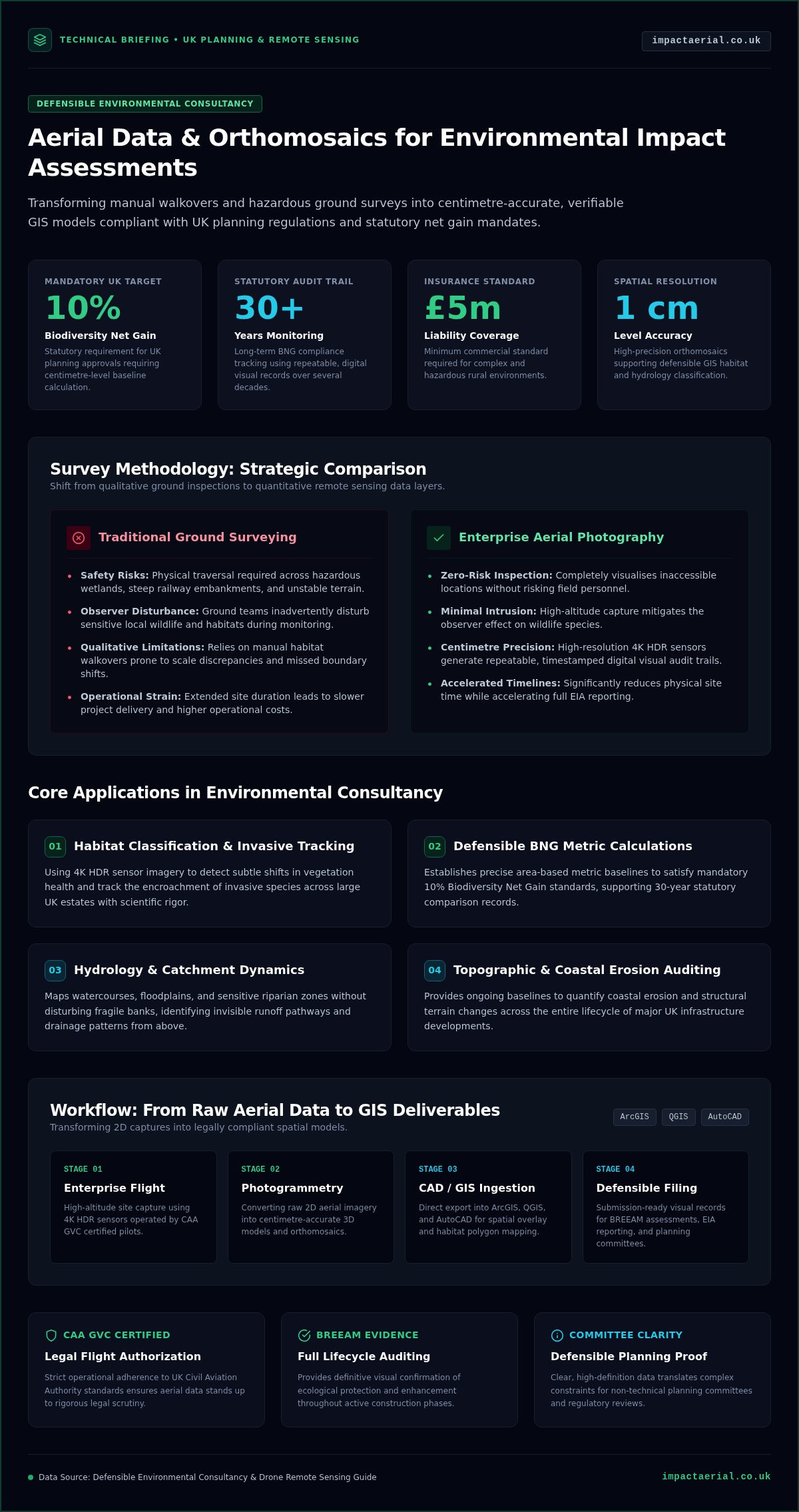
High-resolution data serves as more than just a visual aid; it’s the technical foundation for a robust Environmental Impact Assessment (EIA). While traditional ground-based surveys have their place, they’re increasingly insufficient for the scale and complexity of modern UK developments. The industry is seeing a decisive shift from qualitative visual checks toward quantitative remote sensing data. By integrating professional aerial photography for environmental consultants, teams gain access to precise, measurable insights that ground teams simply can’t match within the same timeframe. This transition to a data-first approach reduces site time and drastically improves consultant safety by removing the need to physically traverse hazardous or unstable terrain. Clear, high-definition imagery also enhances stakeholder communication, making complex environmental constraints easy to understand for non-technical planning committees.
Overcoming Traditional Survey Limitations
Professional drone hardware allows environmental teams to visualise inaccessible areas like deep wetlands, dense ancient woodland, or steep railway embankments without risking personnel. It also mitigates the “observer effect” on local wildlife. Ground-based teams often inadvertently disturb the very species they’re trying to monitor. In contrast, high-altitude capture using aerial photography allows for ecological monitoring that’s far less intrusive. This technology creates a repeatable, timestamped visual record. You can return to the exact same coordinates month after month to provide a verifiable audit trail for long-term monitoring projects. Having this consistent data set is vital for identifying subtle changes in vegetation health or habitat encroachment over several seasons. Precision matters.
Meeting Modern Compliance Standards
The introduction of mandatory 10% Biodiversity Net Gain (BNG) in England has raised the bar for data accuracy. Professional aerial photography for environmental consultants provides the high-resolution baseline needed to calculate these gains with confidence. This data serves as defensible evidence during planning committees and regulatory reviews, where vague descriptions aren’t enough. For projects targeting BREEAM certification, comprehensive site documentation from the air offers a clear record of ecological protection and enhancement measures throughout the construction lifecycle. Relying on CAA GVC certified pilots ensures that all data is captured within the strict legal frameworks required for formal planning submissions. This level of compliance is essential for mitigating risk and ensuring that project data stands up to legal scrutiny.
Core Applications: From Habitat Mapping to Hydrology
The application of aerial photography for environmental consultants extends far beyond simple site overviews. High-resolution orthomosaics allow for meticulous habitat classification that manual walkovers often miss due to scale or perspective. By using 4K HDR sensors, consultants can identify subtle changes in vegetation health or track the encroachment of invasive species across large UK estates with precision. This data provides a technical baseline for topographic changes and coastal erosion monitoring throughout a project’s lifecycle, ensuring that environmental shifts are documented with scientific rigor. Digital surveys capture every detail of the terrain, enabling a level of analysis that traditional methods simply can’t replicate within the same budget.
Biodiversity Net Gain (BNG) Monitoring
Establishing an accurate baseline is the most critical step in meeting the mandatory 10% Biodiversity Net Gain (BNG) requirement for UK developments. Aerial data allows you to calculate area-based metrics with centimetre-level precision, providing a defensible starting point for planning applications. Because BNG requires ongoing monitoring for at least 30 years, having a repeatable, digital visual record is invaluable. It’s a tool that allows for consistent comparison over decades, proving that the promised ecological enhancements are actually being delivered on the ground. This long-term data integrity is vital for maintaining project compliance and stakeholder trust.
Hydrology and Catchment Management
Managing watercourses and floodplains requires a comprehensive understanding of catchment dynamics. Aerial surveys identify drainage patterns and potential runoff risks that are invisible from ground level. You can map sensitive riparian zones and assess watercourse health without disturbing fragile banks or local ecosystems. This non-invasive approach is particularly useful for visualising floodplain dynamics during the early stages of environmental planning. When you need to present complex hydrological data to regulatory bodies, professional aerial photography for environmental consultants offers the clarity required for successful planning approvals. Utilising professional aerial data collection ensures your GIS outputs are built on a foundation of accuracy and regulatory compliance.
Technical Standards: Hardware, Sensors, and UK Compliance
Precision in environmental reporting starts with the hardware. While hobbyist drones produce visually pleasing images, professional data collection requires industrial-grade equipment designed for repeatability and accuracy. High-resolution 4K HDR sensors are non-negotiable in this field. These sensors provide the dynamic range necessary to distinguish between subtle vegetation shades or identify small invasive species in varying light conditions. Relying on DJI Enterprise hardware ensures flight stability and data integrity, offering integrated GPS accuracy that consumer models simply cannot match. This technical distinction is vital when your findings must stand up to scrutiny during a public inquiry or a formal planning committee meeting.
Risk mitigation is equally important. Professional operators carry £5m commercial liability insurance as an industry standard. This coverage provides the necessary reassurance for consultants working on large-scale infrastructure projects or sensitive habitats. It ensures that every aspect of the operation, from take-off to data delivery, is backed by a framework of professional accountability. When you commission aerial photography for environmental consultants, you aren’t just buying images; you’re investing in a compliant, technical service that prioritises site safety and data precision.
The Necessity of CAA GVC Certification
The UK drone regulatory framework has undergone significant changes, transitioning from the old PfCO (Permission for Commercial Operations) to the current GVC (General Visual Line of Sight Certificate) and A2 CofC standards. For environmental consultants, hiring a pilot with the correct GVC certification is a legal requirement for many complex operations. This is particularly true when flying near congested areas, public infrastructure, or construction sites. A GVC-certified pilot has demonstrated the advanced flight skills and safety knowledge required to operate within these strict legal boundaries. This certification is your guarantee that the data collection process is fully compliant with Civil Aviation Authority (CAA) regulations, protecting your project from legal delays or liabilities.
Sensor Selection for Environmental Data
Different environmental assessments demand specific sensor capabilities. Standard RGB sensors are the primary tool for high-resolution habitat mapping and general site monitoring. However, complex projects often require more specialised data. Thermal imaging is essential for monitoring nocturnal species or identifying heat signatures in PV solar farm surveys. Multispectral sensors take this further by capturing data across different light wavelengths to assess plant health through NDVI (Normalised Difference Vegetation Index). This level of technical detail allows aerial photography for environmental consultants to provide deep analytical insights into ecosystem vitality and moisture levels that are impossible to capture through traditional photography alone.
Workflow Integration: From Raw Data to GIS Insights
Raw imagery is only the starting point. The true value of aerial photography for environmental consultants lies in the post-production phase, where technical expertise converts thousands of 2D images into centimetre-accurate 3D models and georeferenced maps. This process, known as photogrammetry, uses advanced algorithms to triangulate points across overlapping photos. The result is a high-density point cloud that provides a foundation for detailed environmental analysis. These data sets are designed for immediate use, exporting seamlessly into industry-standard software such as ArcGIS, QGIS, and AutoCAD. This ensures that your environmental findings are integrated into the existing project ecosystem without manual digitisation errors.
Beyond technical mapping, virtual tours provide stakeholders with immersive site walkthroughs that static photos can’t match. These tours allow planning committees and clients to visit the site remotely, viewing environmental constraints from any angle. For long-term projects, archiving this data creates a robust audit trail for environmental compliance. It provides an indisputable record of site conditions at specific intervals, which is essential for defending against potential regulatory challenges or verifying mitigation measures years after project completion.
Creating Accurate Orthomosaics
Developing a reliable orthomosaic requires a methodical three-step technical workflow. First, we plan autonomous flight paths to ensure consistent overlap, typically 75% to 80%, which is critical for stitching accuracy. Second, the imagery is processed through photogrammetry software to create a single, georeferenced map that accounts for lens distortion and terrain relief. Finally, this aerial data is overlaid with existing topographical surveys to provide a comprehensive view of the site. This layered approach ensures that your GIS insights are both visually clear and spatially accurate.
Interactive Data and Reporting
Modern environmental reporting demands more than just text and tables. High-impact aerial videography and 3D terrain models bring client reports to life, making them more persuasive during stakeholder engagement and public consultations. These interactive assets help non-experts visualise complex environmental data, such as flood risk zones or habitat corridors. By integrating high-resolution data into your existing drone survey workflows, you ensure that every project phase is backed by defensible, technical evidence. If you’re ready to enhance your reporting precision, you can book a consultation for our technical data collection services today.
Choosing an Aerial Partner for Environmental Projects
Selecting a provider for aerial photography for environmental consultants requires a shift in perspective. You aren’t simply hiring a photographer; you’re engaging a technical partner who understands the rigours of Environmental Impact Assessments (EIAs) and the legal weight of planning data. The UK’s rural environments present unique challenges, from unpredictable weather patterns to complex airspace near infrastructure. A partner must demonstrate more than just flight skill. They need a deep understanding of how to capture data that is spatially accurate and legally defensible. This expertise ensures that the data collected serves as a reliable foundation for your professional reporting.
What to Look for in a Drone Service Provider
The first step in your evaluation is verifying regulatory compliance. You must check for CAA GVC certified status and ensure the provider carries at least £5m in commercial liability insurance. Beyond paperwork, scrutinise their portfolio for technical environmental data collection rather than just cinematic marketing shots. High-resolution habitat mapping requires different flight parameters than creative filming, such as specific overlap percentages and consistent altitudes. Finally, ensure they utilise commercial-grade DJI Enterprise hardware. These platforms are built for the stability and sensor precision required to produce centimetre-accurate orthomosaics. Using consumer drones for professional environmental reporting risks data degradation and project delays.
Partnering with Impact Aerial
Impact Aerial operates as a technical consultant to your environmental team. We don’t just provide raw files; we deliver actionable insights through meticulous post-production and data processing. Our pilots are experts in navigating hazardous or inaccessible terrain, ensuring that your ground teams remain safe while we capture the necessary site data. With our national UK coverage and local expertise from our West Midlands base, we provide a responsive service that aligns with your project timelines. This local grounding allows us to understand regional planning nuances while maintaining a national standard of excellence.
We integrate seamlessly with your existing workflows, providing data that slots directly into your GIS or CAD software. Our commitment to safety and precision means you can trust the integrity of every map, model, and report we generate. This professional approach provides the psychological comfort and tangible business benefits needed to secure planning approvals and meet BNG targets. If you’re ready to elevate your project data, Contact Impact Aerial for a professional drone survey quote to discuss your specific requirements.
Elevating Environmental Data with Precision Aerial Insights
The shift toward data-driven environmental reporting is no longer optional for UK consultants. High-resolution orthomosaics and 3D terrain models provide the defensible evidence required for mandatory 10% Biodiversity Net Gain (BNG) targets and complex planning applications. By moving beyond traditional ground surveys, you eliminate safety risks in hazardous terrain while gaining centimetre-accurate insights that integrate directly into your GIS workflows. These technical assets ensure your findings stand up to the most rigorous regulatory scrutiny.
Implementing aerial photography for environmental consultants requires a partner who prioritises technical compliance and data integrity. Working with CAA GVC certified pilots ensures your project adheres to strict UK aviation regulations, while £5m public liability insurance provides the necessary operational reassurance. Our use of DJI Enterprise 4K HDR drones guarantees that every pixel contributes to a robust, professional report. This meticulous approach to data collection allows your team to focus on analysis rather than manual mapping.
Precision data is the foundation of successful environmental stewardship and project approval. We are ready to help you transform your site surveys into powerful analytical assets. Request a Technical Consultation for Your Environmental Project today and secure the high-tier data your consultancy deserves. We look forward to supporting your next project with expert aerial insights.
Frequently Asked Questions
Is a specific drone license required for environmental surveys in the UK?
Yes, a specific qualification is necessary for professional environmental surveys in the UK. Commercial operators must hold a General Visual Line of Sight Certificate (GVC) or an A2 Certificate of Competence (A2 CofC) issued by the Civil Aviation Authority. These certifications ensure the pilot understands the legal framework and safety protocols required for complex site work. Hiring a GVC certified pilot provides the legal assurance that your data collection is compliant with current national aviation standards.
How accurate is drone data for land-use mapping compared to traditional methods?
Drone data offers significantly higher precision than traditional manual walkovers, especially across large or complex terrains. When using professional hardware, we achieve centimetre-level accuracy in our orthomosaic maps. This level of detail is essential for aerial photography for environmental consultants who need to calculate precise habitat areas for Biodiversity Net Gain (BNG) assessments. It replaces the estimations of ground surveys with georeferenced, technical data that integrates directly into GIS software for exact land-use classification.
Can drones be used for nocturnal wildlife monitoring?
Yes, drones equipped with advanced thermal sensors are highly effective for monitoring nocturnal species without causing significant disturbance. These sensors detect heat signatures against the cooler ground, allowing consultants to track wildlife movement or identify roosting sites in total darkness. This non-invasive method provides a safer and more efficient alternative to traditional night-time ground surveys. It’s particularly useful for protected species surveys where maintaining a distance is critical for ethical and legal compliance.
What insurance coverage should an aerial photographer have for commercial sites?
A professional aerial service provider should carry a minimum of £5m in commercial liability insurance for work on environmental or commercial sites. This level of coverage is considered the industry standard for commercial operations in the UK. It protects both the consultant and the client against unforeseen incidents during data collection. We maintain this high level of indemnity to provide psychological comfort and ensure our operations meet the strict risk assessment requirements of large-scale infrastructure projects.
How does weather affect aerial photography for environmental projects?
Weather conditions play a critical role in flight safety and data quality. High winds, heavy rain, or thick fog generally prevent drone operations to protect the hardware and ensure data integrity. However, overcast conditions are often ideal for aerial photography for environmental consultants because they provide soft, consistent lighting without harsh shadows. This uniformity makes it easier to stitch images together and accurately identify vegetation types across a site. We monitor local forecasts meticulously to schedule flights during optimal windows.
What file formats are typically provided for GIS integration?
We provide data in various industry-standard formats to ensure seamless integration with your existing software. For 2D mapping and orthomosaics, GeoTIFF files are the standard for ArcGIS and QGIS. If you require 3D terrain models or topographic data, we can deliver files in .obj, .dxf, or .las formats for use in AutoCAD. These technical outputs allow environmental consultants to overlay aerial data with historical site maps and topographical surveys without any loss of spatial accuracy.
Are drones allowed to fly over protected SSSI sites?
Drones can operate over Sites of Special Scientific Interest (SSSI), but the process requires careful planning and specific permissions. You often need to secure consent from Natural England or the relevant local authority before take-off. Professional operators conduct thorough risk assessments to ensure the flight doesn’t disturb sensitive habitats or nesting birds. Using a certified pilot ensures that these legal requirements are managed correctly, providing a non-invasive way to monitor these protected areas without physical site entry.
How much does a professional aerial survey cost for a consultant?
Professional survey costs vary based on the site’s geographic size, the complexity of the terrain, and the specific data outputs required. A simple habitat map for a small planning application involves different resources than a multi-day survey of a large industrial estate. We provide bespoke quotes tailored to your project’s technical needs. Factors like sensor selection and post-production processing time also influence the total investment. Requesting a specific project estimate ensures your budget aligns with the data quality needed.
Virtual Tours for Care Homes: 2026 Marketing Guide
What if your most effective sales tool wasn’t a physical viewing, but a digital experience that builds more trust before a family even steps through your front door? Choosing a care home is one of the most emotionally charged decisions a family will ever make, and you’re likely aware that many initial enquiries come from a place of deep anxiety. You understand the frustration of hosting time-consuming physical viewings for ‘tyre-kickers’ who don’t convert, especially when your staff’s time is better spent on resident care. Implementing a high-quality virtual tour for care homes addresses these challenges by providing immediate, transparent access to your facilities.
This guide demonstrates how professional virtual tours build immediate psychological comfort and streamline the admissions process for 2026. We’ll examine how combining internal 360-degree views with CAA GVC certified aerial photography allows you to showcase extensive grounds and high-end interiors effectively. You’ll learn how to leverage technical precision and £5m commercial liability insurance standards to protect your brand’s reputation. By the end of this article, you’ll have a clear roadmap for reducing wasted viewings and increasing your tour-to-admission conversion rates through authoritative digital storytelling.
Key Takeaways
- Learn how a virtual tour for care homes aligns with CQC ‘well-led’ criteria by providing radical transparency and psychological comfort to families from the very first click.
- Understand the technical differences between internal 360-degree walk-throughs and cinematic drone fly-throughs to effectively showcase both high-end interiors and expansive grounds.
- Navigate complex privacy requirements and GDPR compliance while ensuring operational safety by working with CAA GVC certified pilots experienced in populated care environments.
- Discover how to integrate immersive visuals into your website and Google Business Profile to increase dwell time and convert more digital enquiries into actual admissions.
- See how professional post-production and £5m commercial liability insurance protect your brand’s reputation while delivering a high-tier, polished marketing asset.
Why Virtual Tours are Essential for Care Homes in 2026
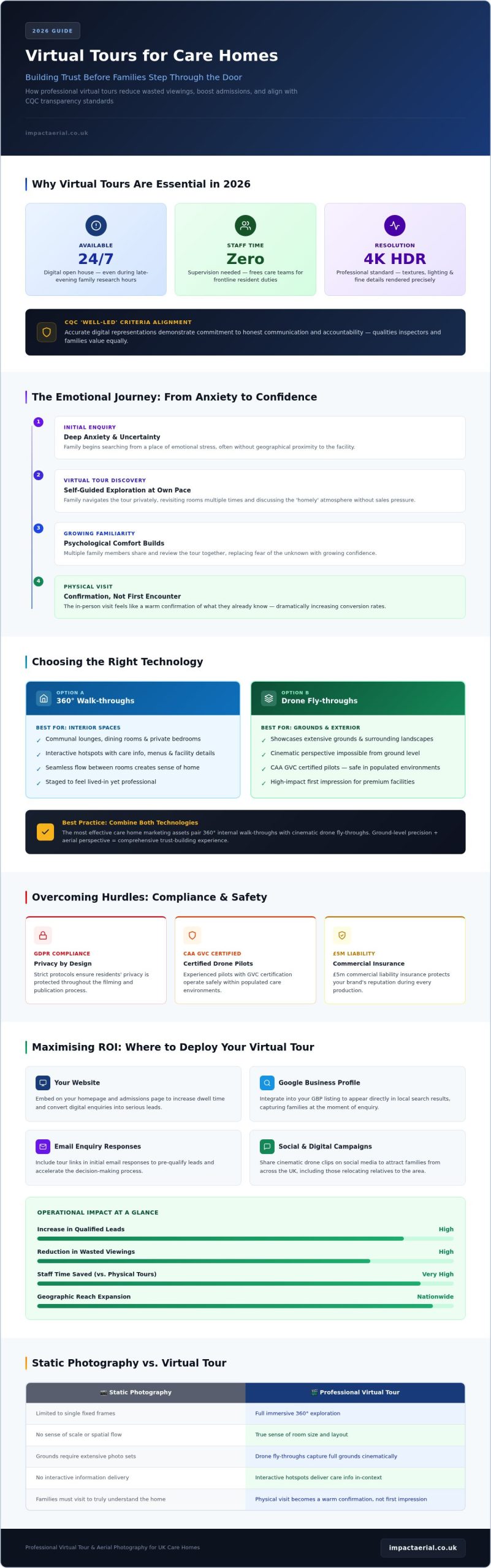
In the current UK care sector, transparency is the cornerstone of trust. A professional virtual tour for care homes serves as a 24/7 digital open house, allowing prospective residents and their families to explore facilities without the immediate pressure of a supervised visit. This technology is no longer just a visual luxury; it’s a vital tool for bridging the geographical gap when family members live far from the facility. By providing an immersive, high-fidelity view of the living spaces and communal areas, you offer a level of reassurance that static photography cannot match.
This level of digital openness aligns directly with the Care Quality Commission (CQC) ‘well-led’ inspection criteria. Demonstrating transparency through accessible, accurate digital representations shows a commitment to honest communication. It provides a clear record of the environment you provide, fostering a culture of accountability that inspectors and families value equally. Using professional-grade 4K HDR captures ensures that every detail is presented with technical precision, reinforcing the reliability of your brand.
The Emotional Impact on Prospective Families
The transition into residential care is often fraught with anxiety for both the resident and their loved ones. High-quality visual storytelling reduces the fear of the ‘unknown’ by allowing families to navigate your home at their own pace. They can revisit the tour multiple times, showing different family members and discussing the ‘homely’ atmosphere in private. This self-guided exploration builds psychological comfort, making the eventual physical visit feel like a confirmation rather than a first encounter. It removes the sales pressure often felt during initial site visits, replacing it with a sense of control and familiarity.
Operational Efficiency and Occupancy Rates
Implementing a virtual tour for care homes significantly streamlines the admissions process. It acts as a powerful filter, pre-qualifying leads so that your front-of-house staff spend less time on ‘tyre-kicker’ viewings and more time with serious enquiries. This reduces ‘tour fatigue’ for existing residents, as foot traffic from casual visitors is minimised. From a marketing perspective, the benefits are tangible:
- Increased Reach: You can attract families from across the UK who may be relocating a relative to a specific area.
- Staff Resource: Digital tours require zero supervision, freeing up care teams for frontline duties.
- 24/7 Accessibility: Your doors are effectively open even during late evening hours when families often conduct their research.
By integrating these immersive experiences, care providers can maintain a high-end, transparent brand image while simultaneously reducing the administrative burden on their teams. It’s a strategic investment that converts passive interest into confident admissions.
Choosing the Right Technology: 360° Walk-throughs vs. Drone Fly-throughs
Selecting the right technology for a virtual tour for care homes determines whether the final product feels like a clinical record or a welcoming home. While many providers offer basic 360-degree walk-throughs, the most effective marketing assets in 2026 combine internal precision with cinematic drone fly-throughs. This dual approach provides a comprehensive perspective that ground-level photography alone cannot achieve. Using 4K HDR resolution is a non-negotiable standard for professional care home marketing; it ensures that textures, lighting, and fine details are rendered accurately, which is essential for building trust with meticulous families.
To increase the utility of these tours, interactive hotspots should be integrated throughout the digital experience. These clickable points provide immediate information on care types, daily menus, or specific facility features without cluttering the visual field. This data-centric approach allows families to gather facts while they emotionally connect with the space. It transforms a static viewing into an informative tool that aids decision-making.
Internal 360° Photography: The Room Level Experience
Internal photography must create a seamless flow through communal lounges, dining rooms, and private bedrooms. Staging is critical here; the goal is to showcase a lived-in yet professional environment that reflects high standards of care. High-fidelity visuals allow prospective residents to inspect accessibility features, such as wet rooms or specialist furniture, from the comfort of their current home. This level of detail reduces the administrative burden on your front-of-house staff by answering technical questions before a physical viewing is even scheduled.
Aerial Integration: The Exterior and Neighbourhood Context
A significant gap in standard care home marketing is the failure to show the facility’s relationship with its surroundings. Aerial ‘Hero’ shots are essential for showcasing secure sensory gardens and the impressive scale of the grounds. By using professional drone photography, you provide families with a vital sense of place within the local UK community. This exterior context is particularly reassuring for families concerned about resident safety and the quality of outdoor spaces.
Combining these perspectives creates a powerful synergy. You aren’t just showing a room; you’re showing a lifestyle and a secure, well-managed environment. For providers looking to elevate their brand, investing in professional virtual tour creation ensures that every angle of your facility is captured with technical mastery and regulatory compliance.
Overcoming Hurdles: Privacy, Safety, and Compliance
Developing a comprehensive virtual tour for care homes involves more than just technical skill; it requires a deep understanding of the regulatory landscape governing residential care. In a sensitive environment where residents’ well-led status is paramount, the filming process must be handled with extreme care. Compliance with UK GDPR is the first priority. This means ensuring that every individual captured on camera has provided explicit, informed consent, or more effectively, designing the shoot to avoid capturing residents entirely. Professional operators act as technical consultants here, helping you navigate these legal requirements while maintaining a high-tier brand image.
Risk mitigation is another critical factor that separates professional services from hobbyist attempts. Standard commercial operations should always carry £5m commercial liability insurance. This level of coverage is the industry benchmark for working in populated, high-value environments. It provides psychological comfort to stakeholders, knowing that the facility is protected against any unforeseen operational incidents. Managing the ‘on-site’ day effectively is a matter of precision; schedules are coordinated to minimise disruption to daily routines, ensuring that the care home continues to function smoothly while the data is collected.
Resident Privacy and Dignity Protocols
Maintaining resident dignity is a non-negotiable aspect of the filming process. We typically recommend an ’empty-room’ strategy for communal areas and private bedrooms to ensure total privacy. If residents are present in the background of wider shots, advanced post-production techniques like blurred-face technology can be employed. Clear communication is essential; we recommend placing signage throughout the facility at least 48 hours before the shoot. Scheduling filming during low-activity periods, such as mid-morning after breakfast routines, further protects the residents’ environment from unnecessary intrusion.
Drone Safety in Sensitive Environments
When capturing the exterior scale of a facility, safety protocols are strictly enforced. It’s vital to use CAA GVC certified pilots who understand the complexities of flying in populated UK areas. Unlike standard consumer drones, DJI Enterprise-grade hardware is used to ensure maximum flight stability and signal reliability. These professional systems allow for precise flight paths over gardens and grounds without overflying sensitive neighbouring properties. For those requiring detailed external assessments alongside marketing visuals, a professional drone survey can be integrated into the project to provide a dual-purpose data set for both maintenance and marketing teams.
Maximising ROI: Where to Use Your Care Home Virtual Tour
Investing in a professional virtual tour for care homes is only the first step towards increasing your occupancy rates. To see a genuine return on investment, this asset must be integrated strategically across your entire digital admissions pipeline. A high-fidelity tour shouldn’t sit idle on a single landing page; it should function as a versatile sales tool that provides psychological comfort to families at every touchpoint. By deploying this technology effectively, you ensure that your facility remains visible and authoritative in a competitive UK market.
One of the most effective ways to use your tour is during initial phone enquiries. Training your admissions team to ‘walk through’ the facility with a family member over the phone can transform a standard enquiry into a guided digital experience. Staff can direct the caller to specific rooms or communal areas, answering technical questions about accessibility or layout in real-time. This proactive approach builds immediate trust and demonstrates a level of transparency that sets your home apart from providers relying on static imagery.
SEO and Google Business Profile Integration
Search engines prioritise rich media that improves user experience. Embedding 360-degree content directly onto your website signals to Google that your site provides high-value, relevant information for local searchers. Immersive virtual content increases website dwell time by providing interactive, high-value visual data that keeps users engaged with your brand for longer periods. This increased engagement often leads to higher local search rankings, making your home more visible to families searching for care in your specific region.
Your Google Business Profile is often the first point of contact for local families. By uploading 360-degree photos and tour links to your Google Maps listing, you provide an immediate window into your home. This level of accessibility can significantly increase click-through rates from search results to your website, as families are more likely to engage with a brand that offers a transparent view of its facilities.
Social Media and Email Marketing Tactics
Social media platforms like Facebook and Instagram are primary research tools for the children of prospective residents. You can repurpose your tour by creating short ‘teaser’ clips that highlight specific features, such as a secure sensory garden or a high-end dining area. These clips act as high-performance advertisements that drive traffic back to the full immersive experience on your website. Additionally, including a direct link to the tour in your admissions team’s email signatures ensures that every piece of correspondence reinforces your professional brand image.
Digital brochures and PDF welcome packs should also feature prominent links to the virtual tour. This allows families to share the experience with other relatives who may be involved in the decision-making process but cannot visit in person. To start building a more transparent and effective admissions process, contact us to discuss professional virtual tour creation for your facility.
The Impact Aerial Approach: Expertise in Care Home Visuals
Impact Aerial understands that a virtual tour for care homes is far more than a simple marketing asset; it is a vital window into a living community. We combine technical drone mastery with a meticulous, professional approach that respects the unique privacy and routines of your residents. Our team provides comprehensive end-to-end project management, guiding you from the initial consultation through to the final post-production editing phase. This ensures a seamless, stress-free experience for care home managers who must maintain their primary focus on resident wellbeing while we handle the technical complexities of data collection.
We don’t just capture images; we build transparency tools that align with your operational goals. Our methodology is data-centric and grounded in professional service standards, ensuring that every frame of your tour serves a specific purpose in building trust with prospective families. By choosing a specialist rather than a general creative agency, you benefit from a partner who understands the specific regulatory and emotional requirements of the UK care sector.
Our Technical Credentials
Our pilots operate with full CAA GVC certification, ensuring every flight over your facility adheres to the latest safety protocols and national regulations. We utilise DJI Enterprise-grade hardware to deliver 4K HDR cinematic output, which is the benchmark for high-end care brands seeking to project a reliable and authoritative image. Based in Birmingham, our central location allows for responsive UK-wide deployment, enabling us to serve care groups with multiple sites across various regions with consistent quality. This specialized expertise makes us a leading choice for professional drone services tailored to the healthcare sector. We carry £5m commercial liability insurance as standard, providing the psychological comfort required when working in sensitive residential environments.
Start Your Virtual Tour Project
Successful projects begin with thorough preparation and a clear understanding of your facility’s unique selling points. We recommend staging communal areas to highlight a welcoming, homely atmosphere and briefing your staff on the filming schedule to ensure zero disruption to care delivery. We provide a structured pre-shoot checklist that covers everything from garden maintenance to bedroom staging, ensuring the final tour has the highest possible visual impact. Whether you manage a single boutique residence or an extensive national care portfolio, we offer tailored consultations to align our technology with your specific occupancy targets.
To begin your journey towards a more transparent and effective admissions process, you can Contact Impact Aerial for a Virtual Tour Quote. Our team is ready to help you build immediate trust with families through precision-engineered visual storytelling and technical excellence.
Future-Proofing Your Care Home Admissions
Implementing a virtual tour for care homes is no longer an optional marketing upgrade; it’s a fundamental requirement for building transparency and trust in 2026. By combining immersive 360-degree internal views with high-fidelity drone perspectives, you provide families with the psychological comfort they need during a difficult transition. This guide has demonstrated how technical precision, from 4K HDR resolution to interactive hotspots, transforms your facility into a 24/7 digital open house that pre-qualifies leads and reduces staff burden.
Our team brings specialized expertise to every project, ensuring your brand is protected through meticulous adherence to safety protocols. As specialists in West Midlands property visuals with a Birmingham base, we offer responsive UK-wide deployment for care groups of all sizes. We operate with full CAA GVC Certified Pilots and carry £5m Commercial Liability Insurance, giving you total peace of mind during the filming process. Elevating your digital presence is the most effective way to increase occupancy and streamline your admissions pipeline.
Request a Professional Virtual Tour Consultation to see how we can showcase your facility’s unique environment and build immediate trust with prospective families.
Frequently Asked Questions
How long does it take to film a virtual tour for a care home?
A typical filming session for a virtual tour for care homes takes between one and two days; the exact duration depends on the facility’s size and the scale of the grounds. We manage the entire process from initial consultation to final post-production to ensure minimal disruption to your daily operations. Larger facilities with extensive sensory gardens or multiple communal areas may require additional time for precise aerial data collection. We provide a detailed schedule beforehand so your team can prepare accordingly.
Do we need to move residents out of the way during filming?
You don’t need to relocate residents, but we recommend filming communal areas during low-activity periods to maintain a professional environment. Our “empty-room” strategy for private bedrooms ensures total privacy and dignity for every resident. If individuals are present in wider shots, we use advanced post-production techniques like blurred-face technology to maintain GDPR compliance. We work closely with your staff to coordinate the shoot around established daily routines and care schedules.
Is a drone safe to fly around a care home with elderly residents?
Drone operations are entirely safe when conducted by our CAA GVC certified pilots using DJI Enterprise-grade hardware. These commercial drones feature redundant safety systems and high-precision sensors to maintain absolute stability in sensitive environments. We plan specific flight paths that avoid overflying residents or neighbouring properties. This technical precision ensures we capture impressive aerial perspectives of your grounds without compromising the safety or psychological comfort of those in your care.
Can we update the virtual tour if we renovate a specific room?
Yes, your virtual tour for care homes can be updated modularly as your facility evolves. If you renovate a specific bedroom, lounge, or sensory garden, we can reshoot just those sections and integrate them into the existing tour. This ensures your digital marketing assets remain accurate and transparent without the cost of a full reproduction. Keeping your tour current is vital for maintaining the trust of prospective families and meeting CQC transparency standards.
What insurance cover do you have for filming on-site?
We maintain £5m commercial liability insurance for all on-site operations, which is the industry benchmark for professional drone services in the UK. This coverage provides essential protection for your property, staff, and residents during the filming process. We’re happy to provide copies of our insurance certificates and risk assessments as part of our standard professional service. This level of indemnity reinforces our commitment to safety-conscious and reliable operations within the residential care sector.
How do families actually view the virtual tour?
Families view the tour through a standard web browser on your facility’s website or via your Google Business Profile listing on Google Maps. The experience is fully interactive; it allows users to click and “walk” through rooms or communal spaces at their own pace. You can also send direct links to the tour via email or include them in digital welcome packs. This accessibility ensures that family members living far away can explore your home at any time.
Will a virtual tour work on mobile phones and tablets?
Every virtual tour we create is fully responsive and works seamlessly across mobile phones, tablets, and desktop computers. Since many families conduct their initial research on mobile devices, ensuring a high-quality experience on smaller screens is essential for engagement. The interface adjusts automatically to the user’s device, maintaining 4K HDR visual quality and smooth navigation. This technical flexibility ensures your home is accessible to prospective families wherever they choose to browse.
Do you provide the raw footage or just the finished virtual tour?
We typically deliver a polished, ready-to-use virtual tour that includes full post-production and professional editing. This finished product is optimized for web performance and immediate integration into your marketing channels. While our primary service focuses on delivering high-end interactive experiences, we can discuss the provision of raw 4K footage if you require it for other internal projects. Most clients prefer the end-to-end management we provide for a hassle-free, professional result.
Aerial Photography for Civil Engineering: 2026 Guide
What if you could eliminate the highest safety risks on your site while simultaneously capturing data with centimetre-level precision? For project managers, the traditional methods of manual inspection and ground-based surveying often feel like a choice between high costs and safety compromises. You already know that keeping a complex site on schedule requires constant, accurate visibility, yet the complexity of 2026 UK drone regulations can be a significant barrier to entry. Integrating professional aerial photography for civil engineering projects is no longer just a trend; it’s a critical safety and data layer that transforms how you monitor progress.
This guide explores how high-resolution drone imagery and DJI Enterprise hardware deliver the precision data needed for modern infrastructure. We’ll show you how to maintain full CAA compliance under the latest UK class marking standards while reducing site risk through remote inspections. You’ll see how £5m commercial liability insurance and GVC-certified pilots provide the operational security your project requires. We’re going to preview the tools and processes that streamline stakeholder communication and protect your site’s bottom line.
Key Takeaways
- Understand how modern drone technology provides high-precision data that goes beyond basic imagery to support technical engineering requirements.
- Learn how aerial photography for civil engineering projects improves stakeholder communication through high-resolution progress documentation and professional post-production.
- Identify the essential hardware and sensor specifications, such as DJI Enterprise systems, required for reliable data collection in challenging site conditions.
- Navigate the latest 2026 UK drone regulations to ensure your site remains compliant with CAA GVC standards and adequate liability coverage.
- Discover how professional aerial surveys reduce onsite risks by replacing high-risk manual inspections with safe, remote monitoring solutions.
The Role of Aerial Photography in Modern Civil Engineering
In the context of 2026 infrastructure development, aerial photography for civil engineering projects has evolved from a marketing luxury into a fundamental technical requirement. It involves the systematic capture of high-resolution imagery to support site analysis, progress tracking, and risk management. While basic photography focuses on aesthetics, the engineering application prioritises data-driven visual assets that provide a measurable record of site conditions. Understanding what is an aerial survey helps clarify how these methods differ from standard photography, specifically through the integration of geospatial data and high-precision sensors. This technology effectively bridges the gap between ground-level detail and the broad, often outdated perspective of satellite imagery, offering a real-time, high-fidelity view of the worksite.
Visualising Scale and Complexity
Modern civil engineering sites are often too expansive to monitor effectively from the ground. Aerial photography allows project managers to capture the entire project footprint within a single high-resolution frame, providing a holistic view of logistics and material placement. This perspective is vital for identifying site bottlenecks, such as plant congestion or drainage issues, which are frequently invisible from a pedestrian viewpoint. By utilising 4K HDR sensors, we document intricate structural details with enough clarity to support remote inspections of bridge piers, roof structures, or high-rise facades. This level of visual documentation ensures that every phase of the project is recorded with technical precision, facilitating better communication with stakeholders and regulatory bodies.
Reducing Human Risk and Site Disruption
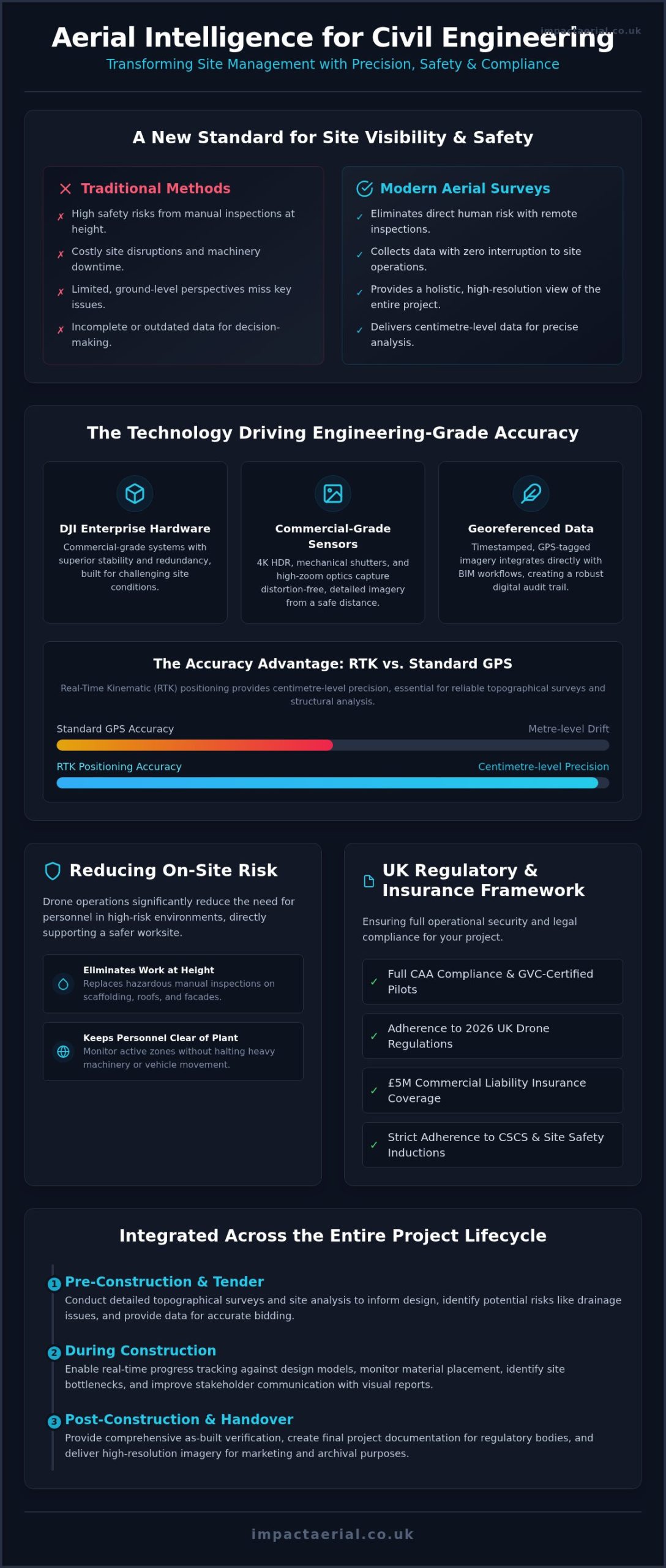
Safety remains the primary concern on any UK construction site. Professional drone operations significantly enhance safety protocols by eliminating the need for personnel to work at height for routine visual inspections. Instead of deploying scaffolding or mobile elevating work platforms (MEWPs) for a simple roof check, a drone can complete the task in minutes without any physical risk to staff. We can monitor active zones without halting heavy machinery or plant movement, ensuring that progress continues uninterrupted while data is collected. Using drones for site inspections directly supports a safer working environment by keeping personnel out of high-risk areas while maintaining strict adherence to CSCS standards and site-specific safety inductions.
Technical Precision: Hardware and Data Accuracy
Achieving professional-grade results in aerial photography for civil engineering projects requires more than off-the-shelf consumer equipment. We utilise DJI Enterprise hardware because these systems are designed for the rigours of commercial environments, offering superior stability and redundancy. A critical component for engineering accuracy is RTK (Real-Time Kinematic) positioning. Unlike standard GPS which can drift by several metres, RTK provides centimetre-level precision. This ensures that every image is precisely located in 3D space, making the data viable for topographical surveys and structural analysis. Adhering to the latest UK drone regulations ensures these advanced systems are deployed legally and safely, providing the technical reliability that large-scale infrastructure projects demand.
Commercial-Grade Sensors and Optics
Commercial-grade sensors differ significantly from consumer models. We prioritise drones equipped with mechanical shutters. These are vital for civil works because they eliminate the “rolling shutter” distortion that occurs when capturing moving site elements or flying at speed. Combined with 4K HDR sensors, we capture a high dynamic range that preserves detail in both deep shadows and bright highlights. This clarity is essential when inspecting dark structural voids or bright concrete surfaces in midday sun. High-zoom optics also play a key role, allowing us to document intricate details like weld joints or bolt integrity from a safe distance, maintaining site safety without sacrificing visual quality.
Data Reliability and Georeferencing
Data reliability is the foundation of any successful aerial survey. Every image we capture is automatically timestamped and GPS-tagged, creating a robust digital audit trail for project records. This georeferenced data integrates directly with Building Information Modelling (BIM) workflows, allowing engineers to overlay real-world progress against original design models. To ensure week-on-week accuracy, we use automated flight paths. By flying the exact same coordinates and camera angles at regular intervals, we provide stakeholders with consistent, comparable data for precise timeline monitoring. For projects requiring this level of technical rigour, partnering with a specialist in aerial filming and photography ensures your data meets strict engineering standards.
Mapping the Project Lifecycle: From Tender to Completion
Professional aerial photography for civil engineering projects provides a continuous thread of visual evidence from the initial bid to the final handover. It isn’t just about capturing progress; it’s about creating a verifiable record that supports decision-making at every milestone. This phased approach aligns with Purdue University research on aerial photography in engineering, which highlights how aerial assets are essential for planning and site characterisation. By integrating these visuals early, firms move from reactive site management to a proactive, data-led strategy that ensures transparency for all parties involved.
Pre-Construction and Tender Support
Winning a major civil contract requires a compelling narrative of site understanding. Capturing baseline conditions before any ground is broken allows teams to provide clear context for environmental impact assessments (EIA). These high-resolution visuals create high-impact bid documents and support public consultations by showing exactly how the proposed works fit into the existing landscape. It demonstrates a level of meticulousness that builds trust with clients before the first plant arrives on site. This early-stage documentation also serves as a legal baseline, protecting contractors against future claims regarding pre-existing site damage.
Active Construction Monitoring
Once the project is live, the focus shifts to verifying programme milestones. Weekly or monthly flights allow project managers to track earthworks, foundation progress, and structural assembly with total clarity. Using a combination of time-lapse sequences and high-resolution stills, you can provide internal and external stakeholders with undeniable proof of progress. For projects requiring more technical mapping or volumetric calculations, a comprehensive drone survey can be integrated into these regular flights to provide deeper topographical insights alongside the visual documentation. This consistent monitoring keeps projects on schedule and provides an early warning system for potential delays.
Handover and Legacy Documentation
The final phase of any project is as critical as the first. Final site inspections from above help identify snagging issues that might be missed at ground level, such as drainage pooling on roofs or alignment errors in large-scale paving. Documenting “as-built” conditions provides a permanent visual record for future maintenance and repairs, which is invaluable for the asset owner. Beyond the technical requirements, the post-production of professional videography allows your firm to create corporate case studies that showcase the completed infrastructure in its best possible light. We ensure all final assets are delivered to a professional standard, providing a lasting legacy of your project’s success.
Safety, Compliance, and UK Drone Regulations
Operating aerial photography for civil engineering projects requires a rigorous approach to legal compliance and risk management. As of January 2026, UK drone regulations have evolved, making it mandatory for commercial drones to broadcast Remote ID and adhere to specific UK class markings. For project managers, the primary concern is often liability. This is why a minimum of £5m commercial liability insurance, compliant with EC Regulation 785/2004, is the standard for any professional operation on a civil site. Hiring an uncertified or under-insured operator doesn’t just risk the flight; it creates a shared liability for the client in the event of an incident.
The Importance of CAA Certification
Professional pilots must hold the General Visual Line of Sight Certificate (GVC) to operate in the “Specific Category,” which covers most commercial work on complex sites. While the A2 Certificate of Competence (A2 CofC) allows for lower-risk operations, the GVC is the gold standard for infrastructure projects. It demonstrates that the pilot has undergone formal training and maintains an Operations Manual approved by the CAA. You should always verify your pilot’s credentials on the official CAA register to ensure they’re authorised for the current year. For a full breakdown of these legal requirements, consult our UK drone license guide.
Risk Mitigation and Flight Planning
Safety on an active site is managed through a comprehensive Risk Assessment and Method Statement (RAMS). This document isn’t a formality; it’s a technical blueprint for the flight that identifies hazards like tower cranes, overhead power lines, and personnel movement. Every flight we conduct is preceded by a desktop survey to check for temporary airspace restrictions or NOTAMs (Notices to Airmen) that might affect the site. We provide the reassurance that every operational risk has been calculated and mitigated before the hardware leaves the ground.
Impact Aerial follows a meticulous four-step preparation process for high-risk civil sites:
- Desktop Airspace Analysis: We check aeronautical charts and the latest 2026 Remote ID requirements to ensure the site is clear for flight.
- Site-Specific RAMS: We develop a custom risk assessment that defines exclusion zones and emergency landing procedures tailored to your site’s layout.
- Physical Site Survey: Our pilots conduct a ground-level inspection to identify dynamic hazards like moving plant machinery or changing weather conditions.
- Stakeholder Safety Briefing: We coordinate directly with your site safety officer to ensure our flight times don’t conflict with critical site operations.
If you require a compliant and safety-focused partner for your next project, contact us to discuss our construction site monitoring services.
The Impact Aerial Advantage for Civil Engineering
Impact Aerial provides a specialised partnership that combines local West Midlands expertise with the logistical capacity for nationwide UK coverage. We understand that civil engineering projects are complex, high-stakes environments where operational reliability isn’t optional. Based in Birmingham, we’re ideally positioned to serve the central infrastructure hub while maintaining the mobility to support large-scale works across the country. Our operations are built on a foundation of CAA GVC certification and £5m commercial liability insurance, providing the reassurance that every flight meets the highest professional standards. By choosing a dedicated specialist, you gain an end-to-end service that manages everything from initial airspace consultations to the final delivery of high-precision aerial photography for civil engineering projects.
Professional Post-Production and Reporting
Raw footage is rarely sufficient for a technical boardroom presentation or a formal stakeholder report. Our post-production team transforms high-resolution 4K imagery and stills into actionable assets that deliver genuine value to your engineering team. We provide bespoke reporting that includes precise annotations, site boundary overlays, and milestone markers to provide clear context for every frame. These assets are delivered via secure, cloud-based platforms, ensuring that your remote project teams and off-site consultants can access the latest site data almost immediately. This streamlined delivery ensures that decision-makers always have the most current visual evidence at their fingertips, regardless of their physical location.
Your Trusted UK Drone Partner
Civil engineering firms across the UK choose Impact Aerial for long-term contracts because we offer more than just a camera in the sky. We provide a safety-first culture that is meticulously ingrained in every operation, integrating seamlessly with your existing site safety protocols and CSCS requirements. Our commitment to the latest DJI Enterprise technology ensures we remain at the forefront of data accuracy and operational reliability. Whether you’re monitoring a single bridge construction or a multi-year road infrastructure project, our team provides the consistent, high-tier results required for professional documentation. We don’t just capture images; we provide a reliable data layer that protects your project’s timeline and reputation.
For a broader look at how our technology supports various commercial sectors, you can view our professional drone services overview. If you’re ready to enhance your site monitoring with high-precision data and authoritative reporting, Contact Impact Aerial for a civil engineering project quote to discuss your specific requirements.
Elevating Site Intelligence Through Precision Data
The adoption of professional drone technology has fundamentally shifted how infrastructure is managed in 2026. By moving beyond simple visual records to data-centric outputs, firms now ensure centimetre-level accuracy and full regulatory compliance. Integrating professional aerial photography for civil engineering projects provides a definitive audit trail from the initial tender through to the final handover. This approach doesn’t just streamline project management; it actively reduces site risk by replacing hazardous manual inspections with safe, remote monitoring.
Success on complex sites relies on the combination of expert operators and commercial-grade hardware. Impact Aerial delivers this through our CAA GVC Certified Pilots and Expert DJI Enterprise Operators, backed by £5m Commercial Liability Insurance. We provide the technical rigour and operational security required to protect your project’s reputation and timeline. Whether you’re based in the West Midlands or managing a nationwide infrastructure scheme, our team is ready to deliver high-precision results.
Request a Consultation for Your Engineering Project
We look forward to helping you reach new heights in project efficiency and site safety.
Frequently Asked Questions
Do drone pilots need special permits to fly over civil engineering sites?
Yes, commercial pilots must hold a General Visual Line of Sight Certificate (GVC) to operate on complex civil sites. This certification allows flights in the Specific Category, which is necessary for most engineering environments. Pilots must also have a valid CAA Operator ID and conduct a full risk assessment before taking off. Adhering to these legal requirements ensures that the operation remains compliant with current UK aviation laws and site safety standards.
What is the difference between a drone survey and aerial photography?
While they’re related, the primary difference lies in the output. Aerial photography for civil engineering projects produces high-resolution visual assets for progress monitoring and stakeholder reporting. In contrast, a drone survey captures technical data for creating measurable 3D models or topographical maps. Photography provides the visual context, showing site status, while a survey provides the geospatial data that integrates directly with Building Information Modelling (BIM) workflows.
Can drones fly in high winds or rain on a construction site?
Commercial-grade hardware, such as DJI Enterprise drones, can operate in moderate winds and light moisture due to their high IP ratings. However, we typically ground flights if wind speeds exceed 15 metres per second or during heavy downpours. Safety is our absolute priority on any active site. If conditions are unsafe for flight, we reschedule to ensure we don’t risk personnel, plant machinery, or the precision of the data being collected.
How much does aerial photography for civil engineering cost in the UK?
Costs for professional aerial services in the UK are determined by several project-specific variables. These include the site’s location, the frequency of visits required for progress monitoring, and the complexity of the post-production editing. Because every civil project has unique technical requirements, we provide bespoke quotes rather than fixed rates. This ensures you receive a service tailored to your engineering goals without paying for unnecessary extras or compromising on data quality.
Why is £5m drone insurance necessary for engineering projects?
A minimum of £5m commercial liability insurance is required to meet the risk management standards of the UK construction and civil engineering industries. This level of coverage protects both the operator and the client against significant financial claims resulting from accidental damage or injury. Most Tier 1 contractors and infrastructure owners mandate this specific insurance level as a prerequisite for site access, ensuring that all operational risks are professionally mitigated.
How long does it take to receive the aerial footage after a shoot?
We typically deliver raw high-resolution imagery and 4K footage within 24 hours of the site visit. For more complex outputs, such as annotated progress reports or edited corporate videography, the turnaround is usually between 48 and 72 hours. We use secure cloud-based platforms for delivery, allowing your project teams to access and share the data immediately. This rapid turnaround ensures that your stakeholder meetings always feature the most current site information.
What drone hardware is best for inspecting structural civil engineering?
DJI Enterprise drones are the industry standard for structural inspections due to their stability and advanced sensor options. Systems equipped with high-zoom optics allow our pilots to inspect bolt integrity or weld joints from a safe distance, maintaining site safety. Additionally, 4K HDR sensors ensure that structural details remain visible even in challenging lighting conditions. These tools provide the technical precision required for bridge inspections, roof surveys, and high-rise structural assessments.
Virtual Tours for Museums & Galleries: 2026 Guide
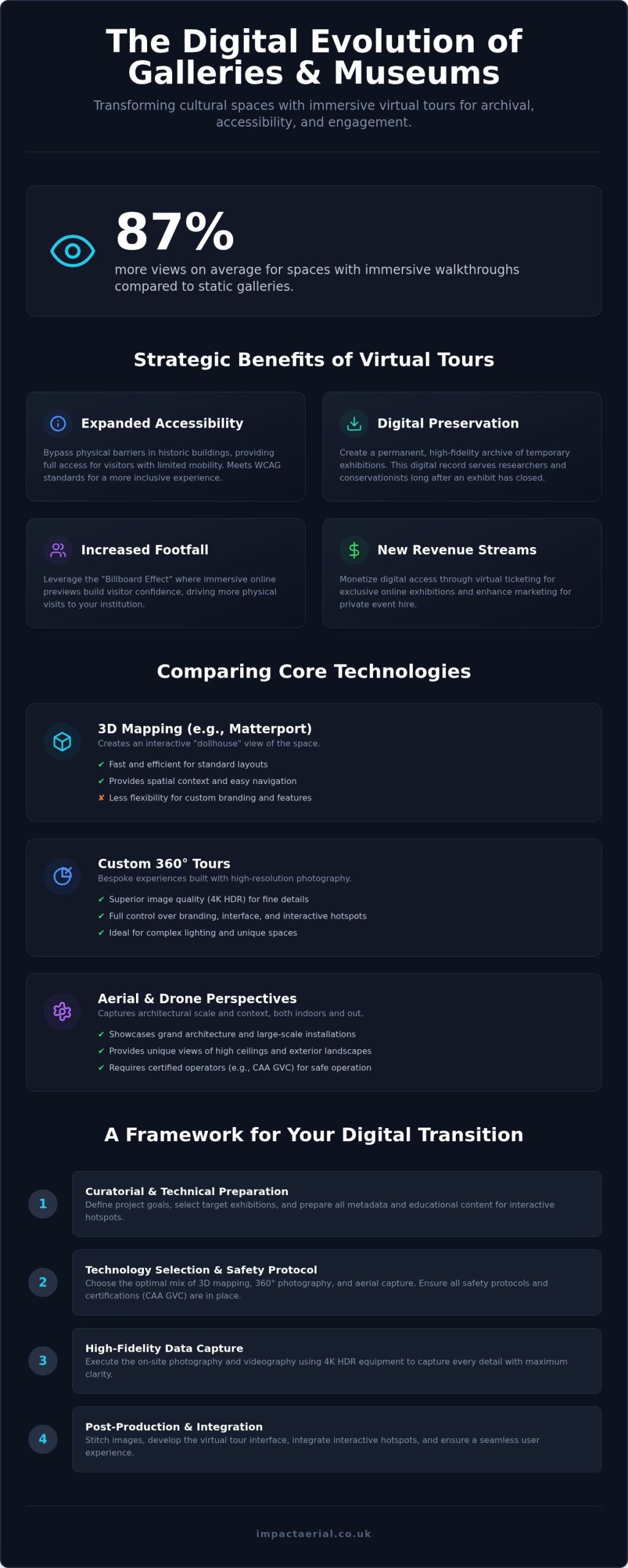
Did you know that digital spaces featuring immersive walkthroughs receive 87% more views on average than static galleries? For UK curators and heritage managers, providing a professional virtual tour for art galleries and museums is no longer just a digital trend; it’s a vital tool for institutional survival. You’ve likely experienced the frustration of low footfall during the winter months or the difficulty of making historic, multi-level buildings fully accessible to every visitor. It’s equally challenging to see a temporary exhibition, which took months to curate, disappear forever once the physical installation is dismantled.
We recognize that your priority is to protect your collection while expanding its reach. This guide promises to demonstrate how cutting-edge 3D mapping and aerial technology can transform your gallery into a global educational resource. We’ll explore the technical requirements for high-fidelity archival preservation, the benefits of 4K HDR drone perspectives for architectural context, and the safety protocols necessary when operating in sensitive environments. By the end of this article, you’ll understand how to create a permanent digital legacy that serves schools, researchers, and art lovers across the world.
Key Takeaways
- Learn how to select the optimal technology, ranging from 3D mapping to 4K aerial perspectives, to accurately reflect your institution’s architectural scale and collection detail.
- Discover how a bespoke virtual tour for art galleries and museums can bypass physical accessibility barriers while creating a permanent digital archive of temporary exhibitions.
- Understand the strategic role of immersive digital assets in driving revenue through virtual ticketing and enhanced private event hire marketing.
- Identify the essential safety protocols and CAA GVC certification requirements necessary for deploying advanced drone technology within sensitive heritage environments.
- Gain a clear, step-by-step framework for curatorial and technical preparation to ensure a seamless and high-fidelity digital transition.
The Evolution of Digital Engagement in Museums and Galleries
The landscape of cultural engagement has shifted from passive viewing to active immersion. Static photo galleries, once the gold standard for online presence, no longer satisfy a public accustomed to high-definition interactivity. Modern curators are now adopting a virtual tour for art galleries and museums to provide a spatial context that flat images simply cannot replicate. By creating a digital twin of a physical space, institutions can offer a comprehensive what is a virtual museum experience that serves as both a marketing tool and a scholarly resource.
Accessibility remains a significant hurdle for many UK heritage sites housed in listed buildings. Structural constraints often make physical modifications for disabled access difficult or impossible. Virtual experiences provide a solution by meeting WCAG (Web Content Accessibility Guidelines) standards; they allow visitors with limited mobility or neurodivergent needs to explore collections at their own pace from a secure environment.
There is a common misconception that digital access discourages physical attendance. In reality, the “Billboard Effect” suggests the opposite. Data indicates that immersive previews actually drive physical footfall by building confidence in the visitor’s mind. When a potential guest can navigate a 3D space online, they’re more likely to commit to a physical visit, knowing exactly what to expect from the venue’s layout and facilities.
Meeting Modern Visitor Expectations
Digital-native audiences demand “anytime, anywhere” access without compromising on visual fidelity. Using 4K HDR photography and video ensures that fine textures in oil paintings or the intricate details of sculptures are preserved. Integrating interactive metadata and educational hotspots allows visitors to click on an object to reveal its history; this creates a layered engagement that goes beyond a simple walkthrough. This level of detail satisfies the high expectations of global researchers and casual enthusiasts alike.
Digital Preservation and Archiving
Temporary exhibitions represent months of curatorial effort, yet they are often lost once the physical loan period ends. A professional virtual tour for art galleries and museums acts as a vital archival tool, creating a permanent, navigable record of time-limited displays. This high-resolution data collection is also essential for conservation. It provides a baseline for monitoring physical changes or environmental damage to fragile artifacts over time, ensuring that the institutional record remains intact even if the physical items are relocated or returned to lenders. This same ethos of preservation extends to personal histories; to discover how to archive family narratives, visit Lumenairi.
Comparing Technologies: 3D Mapping, 360 Tours, and Aerial Perspectives
Selecting the right platform is critical for a successful virtual tour for art galleries and museums. While Matterport offers an efficient “dollhouse” view ideal for standard layouts, custom 360 tours provide greater flexibility for bespoke branding and higher resolution. Institutions like the National Park Service virtual exhibits demonstrate how tailored digital experiences can bridge the gap between physical distance and cultural education. For grand UK estates or modern galleries with complex lighting, a custom approach often yields superior results in capturing the nuance of the space without the limitations of automated hosting platforms.
Technological advancements now allow for photogrammetry, where hundreds of high-resolution photos are stitched together to create interactive 3D digital objects. This allows a visitor to rotate a fragile Roman bust or a contemporary sculpture, viewing it from angles that would be physically impossible in a gallery setting. A hybrid strategy that combines these ground-level details with aerial data offers the most comprehensive visitor experience, effectively guiding the user from the external landscape into the heart of the collection.
The Power of Aerial Videography Indoors
Grand museum architecture often features cathedral-height ceilings that are difficult to appreciate from eye level. Using specialized indoor drones, we can capture the scale of these grand halls from perspectives previously reserved for maintenance crews. Filming large-scale installations from above provides a sense of proportion that ground-level photography lacks. Safety is our primary concern. Operating in sensitive environments requires meticulous planning and adherence to CAA standards. Our pilots are CAA GVC certified and operate under £5m commercial liability insurance, ensuring total risk mitigation when flying near high-value assets or historic plasterwork. We use 4K HDR commercial-grade drones to ensure the output meets the highest professional standards.
Ground-Level Immersion and Detail
While aerial views provide context, ground-level immersion delivers the intimacy required for fine art. We utilize 4K HDR technology to capture the exact textures of oil paintings and the subtle patina of bronze works. The navigational flow must feel intuitive, mirroring a natural walkthrough that guides the user through the curatorial narrative. Achieving this level of cohesion requires integrating these elements with professional drone services to create a unified visual strategy. If you’re looking to elevate your institution’s digital presence, you can consult with our technical team to discuss a bespoke capture plan that respects the integrity of your collection.
Strategic Benefits: Why Museums are Investing in Virtual Tours
Institutional leaders are moving beyond viewing digital assets as mere novelties. A professional virtual tour for art galleries and museums is now a strategic requirement for maintaining relevance in a competitive cultural landscape. By providing 24/7 access, museums can engage international researchers and tourists who might never have the opportunity to visit the UK in person. This global reach extends the institution’s influence far beyond its physical walls, turning a local collection into a worldwide educational resource.
Sponsorship and funding opportunities often depend on an institution’s ability to demonstrate innovation. Grant bodies and private donors are increasingly looking for projects that future-proof collections and expand public engagement. Implementing sophisticated 3D and aerial capture shows a commitment to technological leadership. The best virtual museum and art gallery tours globally have proven that these investments pay dividends in institutional prestige and long-term donor confidence.
Accessibility and Inclusivity
Accessibility involves more than just physical ramps; it includes psychological comfort. Virtual tours provide a risk-free “pre-visit” environment for neurodivergent visitors, allowing them to familiarise themselves with the layout, lighting, and soundscapes before they arrive. This reduces anxiety and makes the physical museum more welcoming. For historic UK buildings where lift access is structurally impossible, digital twins provide an uncompromising way for visitors with limited mobility to explore upper floors or restricted areas. Virtual tours democratise art access in the 2026 digital landscape by providing an equitable platform where cultural engagement is determined by interest rather than physical or financial mobility.
Commercial and Marketing ROI
The commercial benefits of immersive media are measurable and significant. For institutions that rely on private event hire or film location scouting, a high-fidelity virtual tour shortens the sales cycle by allowing clients to conduct initial site inspections remotely. This saves time for the curatorial team and reduces the need for repeated physical walkthroughs. From a marketing perspective, these assets improve SEO performance by increasing “dwell time” on your website. Statistics show that properties featuring virtual tours receive 87% more views on average. These 3D environments also provide a wealth of content for social media and immersive advertising, allowing you to extract 4K stills and video clips for multi-channel campaigns without the cost of additional shoots.
Planning Your Virtual Exhibition: A Step-by-Step Guide
Executing a high-fidelity virtual tour for art galleries and museums requires a meticulous blend of curatorial precision and technical expertise. Before the capture phase begins, the curatorial team must finalise sightlines and ensure all object labels are correctly positioned for high-resolution legibility. A technical site survey is equally vital; this involves assessing Wi-Fi signal strength for interactive elements and mapping out safe drone flight paths through grand halls or stairwells. Every commercial operation must strictly adhere to current CAA regulations and the specific requirements of a UK drone license to ensure legal and safe deployment within public spaces.
Post-production is where the raw data becomes a functional institutional asset. This stage includes the integration of interactive hotspots, audio guides, and multilingual support to serve a global audience. These digital layers allow researchers to access deep-dive metadata that might not be physically present on a gallery wall, effectively turning a visual walkthrough into a comprehensive educational database.
Safety Protocols in High-Value Environments
Operating technical hardware in proximity to priceless artefacts demands a specialist approach to risk mitigation. It’s essential that your service provider is CAA GVC certified for indoor commercial work. This certification demonstrates a pilot’s competence in managing the unique aerodynamic challenges of enclosed heritage spaces. To provide institutional peace of mind, we carry £5m commercial liability insurance, which is a standard requirement for working in high-value UK environments. Our safety protocols include the use of propeller guards and obstacle-avoidance sensors to ensure drones never make physical contact with delicate structures or artwork.
Optimising Lighting and Visual Quality
Lighting for digital capture must be balanced against the preservation needs of the collection. We work closely with conservation teams to manage natural light levels and respect existing UV filters, preventing any risk of light-induced damage during the shoot. Achieving 4K HDR quality is a priority; this ensures strict colour accuracy and detail retention for digital art historians and conservators. By coordinating with aerial filming drone experts, we can create cinematic transitions that provide a seamless sense of movement through the exhibition space. If you’re ready to plan your institution’s digital transition, contact Impact Aerial for a detailed technical consultation.
Why Impact Aerial is the Trusted Partner for UK Institutions
Impact Aerial provides a specialized service that bridges the gap between traditional photography and advanced spatial data. We deliver a comprehensive virtual tour for art galleries and museums by integrating ground-level 360-degree immersion with sophisticated aerial perspectives. This dual approach ensures that every aspect of your institution, from the macro scale of its architecture to the micro details of its artifacts, is captured with precision. Our team manages the entire workflow, allowing curators to focus on their collections while we handle the technical complexities of digital twin creation.
We recognize that museums are high-stakes environments where safety is the primary concern. Our operations are built on a foundation of technical expertise and strict adherence to professional standards. By utilizing the latest 4K HDR DJI Enterprise drones, we provide the stability and visual fidelity required for high-end institutional output. This technology allows us to document spaces with a level of detail that satisfies both casual visitors and professional researchers.
Authority and Reliability in Drone Services
Reliability in high-value cultural environments is built on rigorous safety protocols. We are fully CAA GVC certified, which ensures our pilots are trained to the highest national standards for commercial drone operations in the UK. Our £5m commercial liability insurance provides essential risk mitigation for institutions managing priceless collections and historic property. While our expertise spans the property, construction, and advertising sectors, we apply a bespoke methodology to the arts. We work directly alongside your curatorial and conservation teams to ensure our flight paths and capture methods protect the integrity of the exhibition space. This meticulousness has made us a trusted specialist for organizations that value external validation and industry-leading standards.
Get Started with Your Virtual Transformation
Every institution has unique goals, whether it’s increasing global accessibility or creating a permanent digital record of a temporary show. Our consultation process begins with an in-depth understanding of these institutional objectives. We don’t offer a generic solution; instead, we customize the virtual tour for art galleries and museums to meet the specific needs of your target audience. This might include adding multilingual support for international tourists or integrating educational hotspots for remote school groups.
The transition from a physical gallery to a digital asset is managed entirely by our technical team. We handle everything from the initial site survey to final post-production editing and hosting. This end-to-end service ensures a cohesive visual narrative that reflects your institution’s brand and curatorial standards. If you’re ready to explore how immersive technology can benefit your collection, the next step is to request a bespoke quote tailored to your venue’s specific layout. You can contact our team today to speak with a technical consultant about your project.
Elevate Your Institutional Reach with Immersive Technology
The transition toward immersive digital engagement is a fundamental shift in how cultural heritage is preserved and shared. By implementing a high-fidelity virtual tour for art galleries and museums, your institution can bypass physical accessibility barriers while creating a permanent, high-resolution archive of temporary exhibitions. We’ve explored how the integration of 4K HDR ground-level detail and sophisticated aerial perspectives provides a sense of scale that traditional photography lacks.
Success in this space requires a partner that understands the unique risks associated with high-value environments. Impact Aerial brings technical precision and meticulous safety standards to every project; ensuring your collection is both protected and promoted. Our team of CAA GVC certified pilots operates with £5m commercial liability insurance. This provides the reassurance necessary for technical operations within historic UK buildings.
Ready to transform your visitor experience? You can Request a bespoke virtual tour quote from Impact Aerial to begin your digital transition. We look forward to helping you share your collection with a global audience.
Frequently Asked Questions
Can you safely use drones inside an art gallery or museum?
Yes, drones can be operated safely within sensitive indoor environments when managed by CAA GVC certified pilots. We utilize commercial-grade DJI Enterprise drones equipped with 360-degree obstacle avoidance sensors and propeller guards to prevent any contact with artifacts or historic structures. Every flight is preceded by a meticulous site survey to map out safe paths. This technical approach ensures that high-value collections remain protected while capturing cinematic perspectives that traditional ground-level cameras cannot achieve.
How long does it take to film a professional virtual tour?
The timeline for filming a professional virtual tour for art galleries and museums typically ranges from one to three days for the on-site capture phase. This duration depends on the total square footage and the complexity of the lighting. Smaller galleries might be completed in a single morning; whereas larger institutions with multiple wings require more extensive data collection. Following the shoot, our post-production team spends approximately two weeks editing the 4K HDR content and integrating interactive features.
What is the difference between a 360 tour and a 3D virtual tour?
A 360 tour consists of flat, panoramic images stitched together to show a view from a fixed point. In contrast, a 3D virtual tour uses spatial data to create a “digital twin” of the venue. This allows visitors to move freely through the space rather than just jumping between set locations. We use 3D mapping technology to provide a more immersive experience; which is essential for capturing the architectural scale of grand museum halls and complex exhibition layouts.
Do virtual tours work on mobile devices and VR headsets?
Yes, our virtual tours are fully optimized for cross-platform use, including smartphones, tablets, and desktop computers. They’re also compatible with major VR headsets like the Meta Quest or Apple Vision Pro for a truly immersive experience. We ensure that the 4K HDR visual quality remains consistent across all devices. This accessibility allows your institution to reach a global audience; providing a high-fidelity experience regardless of the hardware the visitor is using to access the collection.
How often should a museum update its virtual tour?
We recommend updating your tour whenever a major temporary exhibition is installed or if the permanent gallery layout undergoes significant changes. For institutions with static collections, a refresh every two to three years is advisable to take advantage of advancements in browser technology and visual fidelity. Regular updates ensure that your digital presence remains an accurate reflection of the physical site; maintaining its value as both a marketing tool and a reliable archival record for researchers.
Will a virtual tour decrease our physical visitor numbers?
Evidence suggests that a virtual tour for art galleries and museums doesn’t decrease physical footfall; it actually enhance it by acting as a digital billboard. Many visitors use the tour as a “pre-visit” tool to familiarize themselves with the building’s facilities and layout. This is particularly beneficial for international tourists and neurodivergent visitors who feel more confident visiting a site they’ve explored online. By showcasing the beauty of your collection, you’re more likely to convert online interest into a physical visit.
What insurance coverage is required for filming in a gallery?
Professional drone operators must carry specialized commercial liability insurance to work within UK cultural institutions. Impact Aerial maintains £5m in commercial liability insurance; which is the standard requirement for high-value museum environments. This coverage is essential for mitigating risks associated with operating technical hardware near priceless artifacts or listed architectural features. Always verify that your provider’s insurance specifically covers indoor drone operations and adheres to current CAA regulations before allowing any filming to commence on your site.
Can we add audio guides and interactive links to the tour?
Yes, our post-production services allow for the seamless integration of audio guides, video clips, and interactive hotspots. You can link specific artifacts directly to your collection management system or online gift shop. These features transform a simple visual walkthrough into a multi-layered educational resource. Visitors can click on a painting to hear a curator’s commentary or view high-resolution metadata; providing a level of engagement that rivals a physical guided tour while serving a global digital audience.
Construction Drone Documentation: The 2026 Guide to Reality Capture and Site Monitoring
What if the difference between a profitable handover and a costly legal dispute was sitting in a 4K HDR data file? In the high-stakes environment of UK infrastructure, relying on manual inspections and subjective progress reports is no longer a viable strategy for risk management. Professional construction drone documentation has evolved from a visual luxury into a critical operational requirement, providing a meticulous, timestamped record of every site development phase.
You likely understand the headache of schedule slips caused by inaccurate data or the difficulty of resolving subcontractor disagreements when visual evidence is lacking. It’s a common pain point that drains resources and complicates stakeholder communication. This 2026 guide demonstrates how professional aerial reality capture provides a definitive single source of truth for your project. By the end of this article, you’ll understand how integrating CAA GVC certified drone operations and Impact Aerial’s advanced reality capture solutions streamlines jobsite management while potentially reducing insurance premiums. We will explore the latest UK regulatory standards, the rise of AI-driven site monitoring, and why expert-managed aerial data is the most reliable way to protect your project’s bottom line.
Key Takeaways
- Understand why modern construction drone documentation has shifted from basic photography to high-fidelity reality capture, providing a permanent, timestamped digital record of every project phase.
- Discover how utilizing 4K HDR visuals and 3D site models allows for the detection of minor material defects that manual ground-based inspections often miss.
- Learn how to leverage aerial data as a ‘single source of truth’ to resolve subcontractor disputes and significantly mitigate project insurance risks.
- Identify the critical UK regulatory standards for 2026, ensuring your site operations remain fully compliant with CAA GVC certification requirements.
- Explore the operational advantages of a managed aerial service that handles complex hardware and regulatory filings on your behalf.
What is Construction Drone Documentation in the Digital Age?
Professional construction drone documentation is the systematic, recurring capture of aerial data to establish a permanent, timestamped record of site progress. In 2026, the industry has moved decisively beyond simple aerial photography. We now operate in an era of reality capture, where high-resolution sensors, photogrammetry, and LiDAR create precise digital replicas of physical assets. This transition allows project managers to interrogate a site remotely with a level of detail that traditional ground-based inspections simply cannot match. It’s no longer about taking a few “snaps” for a newsletter; it’s about generating a legally defensible dataset.
Relying on manual site walk-throughs often results in subjective reporting and significant visual gaps. These gaps become massive liabilities when disputes arise or when adhering to the “Golden Thread” of information required by UK building safety regulations. By maintaining a continuous digital record, firms ensure that every structural decision and installation phase is documented with indisputable visual evidence. This level of transparency is essential for modern drone applications in construction, where data integrity is just as important as the physical build itself.
The Core Components of a Visual Record
- Orthomosaic mapping: These high-resolution, georeferenced top-down views allow for accurate site overviews and precise on-screen measurements of areas or stockpiles.
- Oblique photography: By capturing images at an angle, we provide the depth needed for structural assessments and detailed façade inspections that vertical shots miss.
- 4K HDR video: This is the gold standard for immersive progress reporting and stakeholder presentations, ensuring that even minor material defects are visible to the remote eye.
Documentation vs. Traditional Surveying
It’s vital to distinguish between routine construction drone documentation and a formal drone survey. While documentation supports surveying by providing context and visual proof, it doesn’t replace the legal land boundaries established by a chartered surveyor. The primary difference lies in the factor of frequency. A topographic survey might happen once or twice during a project’s lifecycle, whereas documentation typically occurs weekly or fortnightly to track the pulse of the build. Visual records provide the qualitative context that breathes life into quantitative technical data sets, creating a holistic view of the site’s evolution.
Technical Capabilities: From 4K HDR Visuals to 3D Site Models
High-tier hardware is the foundation of reliable construction drone documentation. We utilize DJI Enterprise grade hardware because it provides the sensor size and mechanical shutter capabilities required for professional-grade reality capture. These systems offer the flight stability needed to operate in the unpredictable UK climate, ensuring that every frame is sharp and georeferenced. The inclusion of 4K HDR (High Dynamic Range) is not merely an aesthetic choice. It is a technical necessity for identifying hairline fractures in concrete or minor material defects that standard sensors might blow out in bright sunlight or lose in deep shadows.
This data integrates seamlessly with Building Information Modelling (BIM) workflows, allowing for a direct comparison between the “as-built” conditions and the original design intent. Raw data is useless without context. Our post-production services transform gigabytes of visual information into actionable PDF reports and interactive models. By processing raw files into structured datasets, we provide project teams with a clear, visual audit trail that supports every stage of the construction lifecycle.
High-Resolution Progress Monitoring
Consistency is key for effective oversight. We establish repeatable, automated flight paths to create precise “time-lapse” comparisons over months of construction. While these missions are primarily technical, they can also utilize aerial filming drone techniques to produce cinematic content for high-level stakeholder reviews. Additionally, thermal sensors allow us to document the integrity of insulation and HVAC systems before they are sealed behind cladding, identifying heat loss or moisture ingress early in the build.
3D Reality Capture and Digital Twins
Beyond 2D images, we use photogrammetry to convert aerial captures into high-density 3D point clouds and digital twins. This allows site managers to measure volumes of earthwork or stockpile sizes directly from their desks with high precision. For off-site stakeholders, professional virtual tour creation provides 360-degree site access. This means a project director based in London can inspect a Birmingham jobsite in granular detail without the time or safety risks of a physical visit. These advancements in digital twins and sustainable construction are frequently explored at global forums like Construction Technology ConFeX KSA. If you require a technologically adept partner to manage your site’s digital record, consult with our specialist team to discuss your project requirements.
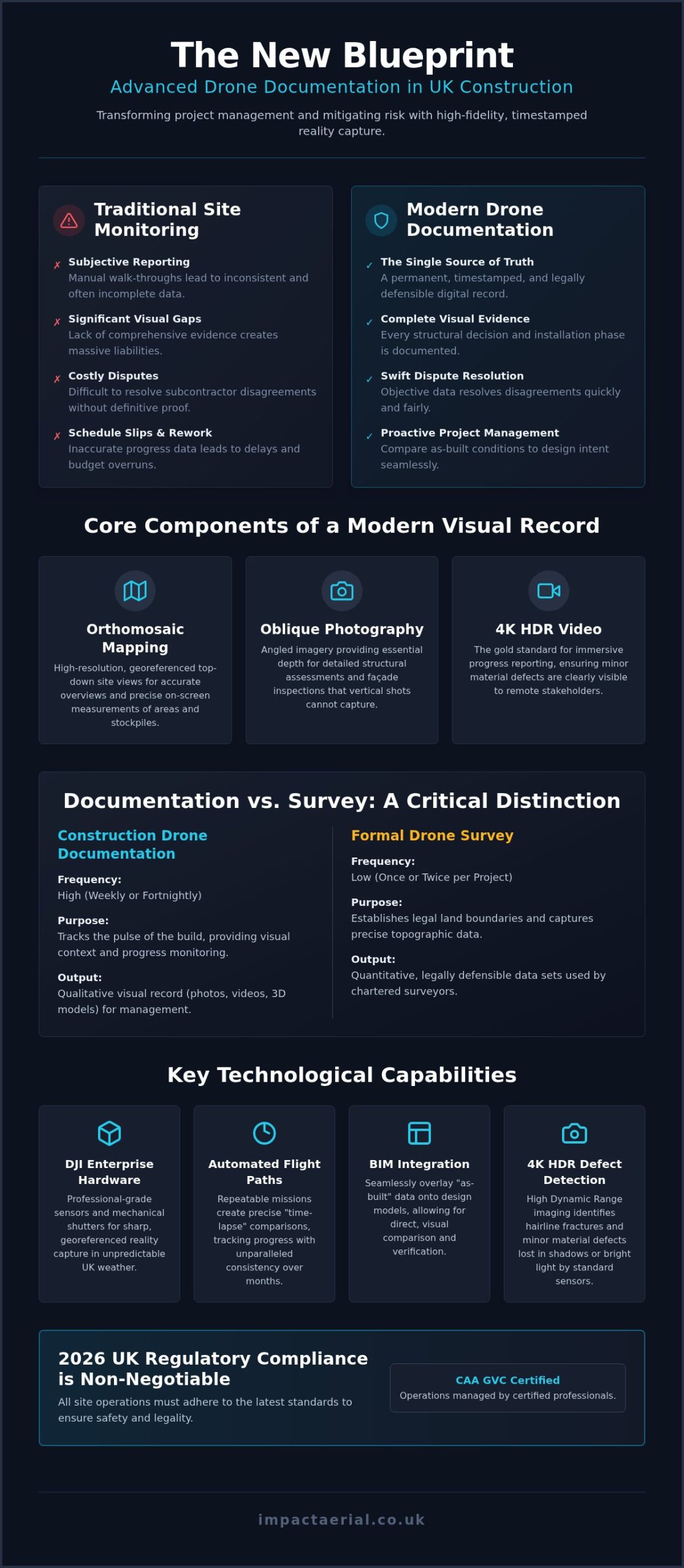
Strategic Risk Management and ROI Analysis
Strategic implementation of construction drone documentation acts as a visual insurance policy for modern infrastructure projects. By maintaining a georeferenced, timestamped archive of every site development, project managers can settle subcontractor disputes with indisputable evidence. Instead of relying on conflicting site diaries or subjective memory, you have a single source of truth to verify exactly when a specific task was completed or when a material delivery arrived. This transparency mitigates the risk of “he-said-she-said” conflicts that often lead to costly legal delays and fractured professional relationships.
Beyond legal protection, aerial oversight fundamentally enhances site safety. Drones identify potential hazards, such as perimeter breaches or unsecured materials on high-level floors, before they lead to reportable incidents. This proactive approach significantly reduces the need for high-risk manual inspections. For instance, using drones to inspect a roof or a tower crane eliminates the requirement for scaffolding or cherry pickers. This directly lowers the site’s overall risk profile and associated operational costs while keeping your team on the ground and out of harm’s way.
In the UK construction market, the presence of a rigorous visual audit trail can also influence insurance negotiations. Insurers increasingly recognize that firms utilizing construction drone documentation are better equipped to defend against fraudulent claims and prove compliance with strict safety protocols. This level of meticulous record-keeping provides the reassurance that underwriters look for, which may lead to more favourable commercial premiums over the project’s lifecycle.
Reducing On-Site Footfall and Hazards
Professional drone services minimize the necessity for staff to enter ‘red zones’ or high-traffic areas during peak operational hours. By providing remote site oversight, project directors can conduct virtual inspections from a central office, reducing on-site footfall without sacrificing granular detail. We’ve seen instances where high-resolution aerial captures spotted a structural anomaly, such as a misaligned steel connection, during the early assembly phase. Identifying this issue from the air saved the client thousands of pounds in potential rework and prevented a significant schedule slip.
The ROI of Professional Data Collection
The financial argument for a managed drone service is clear when compared to the compounding costs of project delays. Traditional surveying or manual inspections often take days to coordinate and execute; however, aerial data is typically processed and delivered within hours. This rapid turnaround allows for real-time decision-making that keeps the critical path on track. Comprehensive aerial documentation prevents ‘hidden’ costs during the project closeout phase by providing an indisputable ‘as-built’ record that simplifies the handover process to the client or facility manager.
Establishing a Compliant Documentation Workflow on UK Sites
Operating a drone on a live UK construction site in 2026 requires more than just technical skill; it demands total adherence to the Civil Aviation Authority (CAA) regulatory framework. For any commercial project, hiring a pilot with a General Visual Line of Sight Certificate (GVC) is a legal necessity. This certification ensures the operator understands the complexities of the 2026 drone classifications and the mandatory Remote ID requirements for UK1, UK2, and UK3 class drones. When your project is located in a congested urban area, these qualifications become even more critical to ensure the safety of the public and site personnel.
Insurance is another non-negotiable pillar of a professional construction drone documentation strategy. While the law requires third-party liability for commercial drones, the industry standard for major UK infrastructure projects is £5m commercial liability insurance. This level of coverage provides the necessary reassurance for tier-one contractors and stakeholders. Additionally, data privacy remains a priority. Professional operators must implement strict GDPR protocols to ensure that the privacy of site workers and neighbouring properties is respected during the reality capture process, typically by blurring faces or sensitive off-site information during post-production.
Pre-Flight and Site Integration
Success begins before the drone leaves the ground. We develop site-specific Risk Assessments and Method Statements (RAMS) that integrate with your existing health and safety documentation. This includes coordinating with site managers to establish flight windows that don’t interfere with crane movements or critical deliveries. For projects requiring sub-centimetre accuracy, we establish Ground Control Points (GCPs) across the site. These physical markers act as anchors, ensuring that the digital record aligns perfectly with real-world coordinates and your BIM software.
The 5-Step Documentation Cycle
To maintain a robust visual audit trail, we follow a methodical five-step cycle:
- Step 1: Define capture frequency based on critical project milestones, such as foundation pours or structural topping out.
- Step 2: Execute automated flight paths to ensure data is repeatable and consistent for time-lapse comparisons.
- Step 3: Upload and process raw data into high-density 3D models or 2D orthomosaic maps.
- Step 4: Distribute detailed progress reports to stakeholders via secure cloud platforms.
- Step 5: Archive the visual record as a permanent ‘as-built’ reference for the building’s lifecycle.
Implementing a compliant workflow protects your project from both legal liability and operational delays. If you need an expert partner to handle the complexities of CAA regulations and site safety, contact Impact Aerial today to secure professional construction drone documentation for your next project.
Impact Aerial: Professional Documentation for the UK Construction Sector
Impact Aerial provides a specialized suite of services tailored to the rigorous demands of the UK built environment. While our operations are headquartered in Birmingham, we provide comprehensive national coverage for projects ranging from local residential developments to high-value national infrastructure. Our approach to construction drone documentation is centered on technical precision and regulatory excellence. We don’t just capture images; we manage the entire data lifecycle to ensure your project has a definitive visual record.
Safety and compliance are the foundations of our service. We maintain a current drone license and strictly adhere to the latest CAA GVC standards. With £5m commercial liability insurance as standard, we provide the legal and financial reassurance that tier-one contractors and stakeholders require. Our expert post-production team then transforms raw aerial data into professional assets suitable for both internal jobsite management and high-end stakeholder marketing.
Why Partner with a Managed Service Provider?
Establishing an in-house drone program often presents a significant administrative and financial burden. Partnering with a managed service provider removes the weight of hardware maintenance and pilot training from your internal team. You gain immediate access to the latest DJI Enterprise technology without the capital expenditure or the need to monitor evolving aviation laws. Reliability is a core benefit; professional pilots ensure that construction drone documentation is captured consistently, regardless of the internal site pressures or competing priorities that often sideline in-house efforts.
Get Started with Your Site Record
Every project has unique documentation requirements based on its scale and complexity. We begin every partnership with a consultation to map your project’s specific needs, whether you require weekly progress overviews or milestone-based visits for critical structural phases. Our scheduling remains flexible, adapting to your site’s timeline to ensure no development goes unrecorded. This methodical approach ensures that your “as-built” record is complete, georeferenced, and ready for handover. Contact Impact Aerial to secure your construction site monitoring partner today and establish a single source of truth for your project.
Securing the Future of Your Project Site
Adopting professional construction drone documentation is no longer a choice between technology and tradition; it’s a strategic move toward evidence-based project management. You’ve seen how reality capture provides a definitive single source of truth that settles disputes, improves stakeholder communication, and mitigates on-site risks. By integrating high-resolution 4K HDR visuals with precise BIM-ready data, your team can identify structural anomalies and material defects before they impact the critical path or your project’s bottom line.
Impact Aerial provides the technical expertise and regulatory reassurance needed to maintain a compliant digital record. With our Birmingham-based team of CAA GVC certified pilots and £5m commercial liability insurance, we offer a managed service that scales across the entire UK. We handle the complexities of hardware maintenance and aviation compliance so you can focus on delivering high-quality infrastructure. Take the next step in streamlining your site monitoring and risk management strategy today. Request a Professional Drone Documentation Quote and ensure your project remains on schedule and fully documented for its entire lifecycle.
Frequently Asked Questions
Is a special license required for drones on UK construction sites?
Yes, commercial drone operations on UK jobsites require specific certifications from the Civil Aviation Authority. Our pilots hold the CAA GVC (General Visual Line of Sight Certificate), which is the standard for professional construction drone documentation in 2026. This ensures every flight adheres to strict safety protocols and legal requirements. We also maintain £5m commercial liability insurance to protect all stakeholders during our operations.
How often should we document our construction site with drones?
The ideal frequency depends on your project’s pace and complexity. Many of our clients opt for weekly or bi-weekly visits to capture consistent progress data for stakeholder reporting. Alternatively, you can schedule visits around critical milestones, such as foundation pours or structural completion. Regular construction drone documentation creates a robust visual audit trail that is invaluable for resolving potential subcontractor disputes or scheduling delays.
Can drone documentation integrate with our existing BIM software?
High-quality aerial data is designed for seamless integration with Building Information Modelling (BIM) workflows. We provide georeferenced orthomosaics and 3D point clouds that plug directly into platforms like Autodesk Revit. This allows site managers to overlay “as-built” reality capture data against original design models. It’s an efficient way to spot deviations early, ensuring the project remains compliant with the initial structural specifications and safety standards.
What happens if the weather is poor on the scheduled flight day?
Safety is our primary concern, so we don’t fly in heavy rain or high winds that exceed our hardware’s operational limits. We monitor local weather forecasts leading up to your scheduled visit. If conditions are unsuitable, we coordinate with your site manager to reschedule for the next available clear window. This flexibility ensures we always capture high-quality, stable 4K HDR footage without compromising on-site safety or data integrity.
Does drone documentation replace traditional land surveying?
Aerial documentation is a powerful tool for progress monitoring, but it doesn’t replace the legal role of a chartered land surveyor. While our drones provide highly accurate volumetric data and topographic overviews, they complement the formal boundary markers and legal records established by traditional surveying. Think of drone data as the “visual layer” that adds real-time context to your project’s quantitative technical datasets, creating a more comprehensive site record.
How secure is the aerial data once it has been captured?
We treat your site data with the same level of security as any sensitive commercial asset. Once captured, raw files are processed and stored on secure, encrypted cloud platforms with restricted access for authorized stakeholders only. We also strictly follow UK GDPR regulations. This includes ensuring that the privacy of neighbouring properties and site workers is protected through careful flight planning and meticulous post-production editing to blur sensitive information.
What is the typical turnaround time for a site progress report?
Efficiency is a hallmark of our managed service. Standard visual progress reports and 4K HDR videos are typically delivered within 24 to 48 hours of the flight. If your project requires complex 3D reality capture or detailed photogrammetry processing, the turnaround might extend slightly depending on the data volume. To ensure your team has the bandwidth to download and review these large datasets without delay, you can learn more about high-speed connectivity solutions. We prioritize rapid delivery so your team can make informed, data-driven decisions without waiting days for processed results.
While not always a strict legal requirement if we’re operating within CAA safety distances, we strongly recommend informing neighbouring properties as a courtesy. Good community relations are vital for any major UK construction project. Our team can provide technical details about our flight paths and safety protocols to help reassure residents. We also use post-production techniques to ensure that off-site privacy is maintained throughout the documentation process.
Drone Filming for UK Advertising: Guide for Brands
A single cinematic aerial shot can do more for your brand’s authority than a thousand words of copy, yet the distance between a breathtaking visual and a £2,500 Civil Aviation Authority fine is often just a few meters of non-compliance. You likely want to elevate your campaign with high-end perspectives, but the logistics of drone filming for advertising UK often feel like a regulatory minefield. It’s natural to worry about public disruption or the complex legalities of flying near urban crowds. You need more than just a pilot; you need a technical partner who understands that safety and cinematic excellence are inseparable.
This guide reveals how professional aerial cinematography transforms your brand’s narrative through technical precision and seamless production integration. You’ll discover how to achieve award-winning visuals while maintaining zero-stress permit management and full CAA GVC compliance. We’ll explore the specific shot types that drive engagement and how to leverage £5m commercial liability insurance to protect your reputation. From understanding the 2026 registration thresholds to managing on-site noise, this overview ensures your next project is as smooth as the 4K HDR footage we produce.
Key Takeaways
- Learn how to elevate your brand storytelling using specialized aerial perspectives that capture the scale and prestige of your projects.
- Understand the critical role of CAA GVC certification and £5m commercial liability insurance in executing safe, legal drone filming for advertising UK.
- Discover specific cinematic techniques, such as tracking shots and reveals, that build anticipation and drive audience engagement for lifestyle and automotive brands.
- Simplify your production workflow by integrating professional site surveys and feasibility checks during the initial consultation phase to prevent project delays.
- Explore the technical advantages of using DJI Enterprise hardware to achieve consistent, high-end 4K HDR output for national advertising campaigns.
The Role of Aerial Filming in Modern UK Advertising
Professional drone filming for advertising UK is the strategic application of Unmanned Aerial Vehicles (UAVs) to capture cinematic, high-resolution marketing assets. It’s not merely about height; it’s about using precision flight paths and advanced sensors to tell a brand’s story from a perspective that ground-based cameras cannot reach. While the history of aerial filming began with fixed-wing aircraft and balloons, modern drone technology offers a level of agility and cost-efficiency that was previously impossible.
For global brands and UK SMEs alike, these aerial perspectives have transitioned from a luxury addition to a core requirement. Drones have effectively replaced the prohibitive costs and logistical delays of traditional helicopter shoots. They allow directors to move seamlessly between low-level tracking shots and sweeping panoramic vistas, providing a “bird’s eye view” that psychologically communicates authority and scale to the viewer. This perspective creates an immediate sense of prestige and professionalism, elevating the perceived value of the product or service being advertised.
To better understand this concept, watch this helpful video:
Breaking the ‘Stock Footage’ Barrier
Authenticity is the cornerstone of effective advertising. While stock video is readily available, it often lacks the specific UK landmarks or local context necessary to build trust with a regional audience. Bespoke drone filming for advertising UK allows brands to showcase their own assets, such as a West Midlands manufacturing facility or a specific property development, with absolute precision. Integrating these custom shots into a broader aerial filming drone strategy ensures your visual identity remains unique and untainted by generic imagery.
To further strengthen this visual identity, Ain Creatives provides integrated creative solutions and branding services that help businesses maintain a consistent and professional image across all platforms.
Cross-Platform Versatility
High-end 4K HDR drone footage offers incredible flexibility across multiple channels. A single flight can provide assets for traditional TV commercials, wide-format Digital Out of Home (DOOH) screens, and vertical content for mobile-first platforms. Vertical drone filming is particularly effective for lifestyle brands looking to capture dynamic movement for TikTok or Instagram Reels. Beyond pre-recorded content, drones are increasingly used for live event streaming and “behind the scenes” brand content, offering a transparent and engaging look at corporate activities that resonates with modern consumers.
The demand for such versatile content is driven by the growth of innovative out-of-home strategies; for example, TexWood Media provides mobile advertising services that bring high-impact visuals directly to audiences in busy metropolitan areas, complementing the reach of aerial campaigns.
Cinematic Techniques: Elevating Brand Visuals from the Sky
High-end brand storytelling requires a deliberate choice of movement and framing. By transforming commercial advertising through dynamic perspectives, drones offer a toolkit of cinematic maneuvers that drive audience engagement and return on investment. For professional drone filming for advertising UK, we select specific flight patterns based on the psychological response required by the creative brief. These techniques move beyond simple “fly-overs” to become sophisticated narrative tools.
The ‘Reveal’ shot is a foundational technique for property developments and product launches. By starting on a close-up detail or behind an obstacle and pulling back, the drone builds anticipation before uncovering the full scale of the project. Tracking shots are equally vital, particularly for automotive and lifestyle brands. These require the pilot to maintain a precise distance and speed relative to a moving subject, capturing a sense of performance and fluid motion. For a more immersive experience, we use orbiting or point-of-interest maneuvers. These provide a 360-degree view that emphasizes the architectural prominence or geographic context of a site. In contrast, the top-down “flat lay” perspective offers a geometric, architectural view that is increasingly popular for urban planning and infrastructure advertisements.
FPV vs. Standard Aerial Cinematography
The choice of hardware significantly impacts the final aesthetic. Standard stabilized DJI Enterprise drones are the preferred choice for smooth, cinematic establishing shots and high-resolution commercial work. These platforms offer exceptional stability and 4K HDR sensors that perform well in varying light conditions. However, for high-adrenaline brand content, FPV (First Person View) drones provide a visceral, high-speed perspective that standard drones cannot replicate. FPV is ideal for “fly-through” shots in manufacturing facilities or chasing fast-moving subjects at close proximity. Our team helps you select the right equipment based on whether your campaign requires calm, authoritative visuals or high-energy movement.
Post-Production Integration
Quality aerial content is designed with the edit suite in mind. Capturing footage in 4K HDR or RAW formats ensures that colour graders have the necessary data to match drone shots with ground-based footage seamlessly. This technical depth is crucial for high-end VFX and CGI integration, where the aerial data acts as a plate for digital overlays. Beyond video, professional drone photography provides the high-resolution assets needed for print and digital campaign collateral. If you are unsure which techniques best suit your project, we recommend a consultation with the specialists at Impact Aerial to align our technical capabilities with your creative vision.
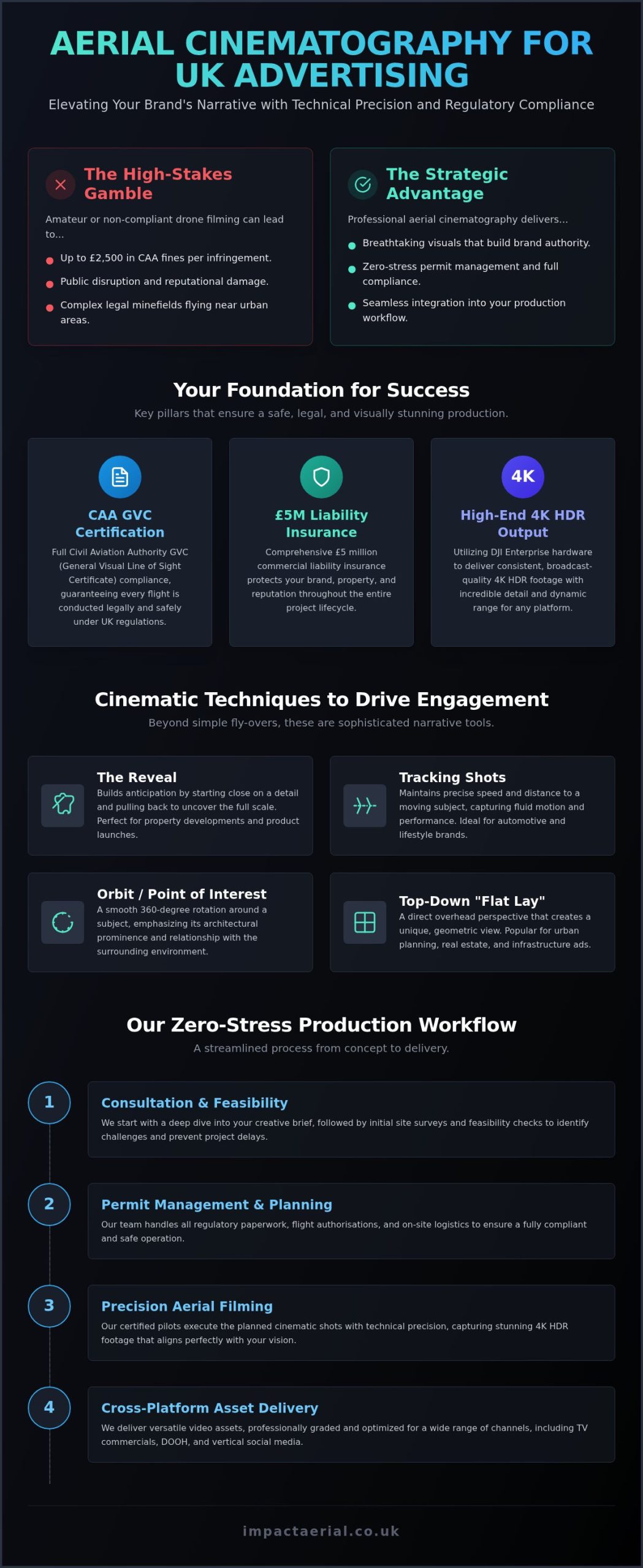
Navigating UK Drone Regulations for Brand Campaigns
Compliance is the foundation of any successful advertising project. For brands, the legalities of drone filming for advertising UK are not merely administrative hurdles; they are critical safeguards against litigation and reputational damage. The Civil Aviation Authority (CAA) maintains strict oversight of the UK’s busy airspace, particularly when flight operations occur near people, vehicles, or property. It’s essential to recognize that the responsibility for safety is shared between the production team and the operator.
Why a CAA GVC Certified Pilot is Mandatory
The distinction between a hobbyist and a professional is defined by their drone license and specific certification level. For commercial advertising, a General Visual Line of Sight Certificate (GVC) is the primary qualification required. This certification demonstrates that the pilot has undergone rigorous theoretical and practical assessments regarding air law, meteorology, and flight safety. It’s the required standard for higher-risk operations, especially those involving heavier aircraft or closer proximity to people.
Hiring a GVC-certified pilot ensures that your production adheres to the latest safety protocols. These professionals are trained to manage:
- Safe separation distances from the public, cast, and crew members.
- Emergency procedures and technical fail-safe protocols.
- Adherence to current 2026 requirements, such as the mandatory flashing green light for night-time filming.
You can verify an operator’s credentials through the official CAA register. It’s a vital step in your due diligence to confirm their Flyer ID and Operator ID before any equipment leaves the ground.
Managing Permissions and Airspace
Beyond the flight path, brands must navigate privacy and GDPR. Professional operators use meticulous, data-centric processes to ensure that public filming during brand activations remains compliant with UK law. This operational rigor is supported by our £5m commercial liability insurance. This level of coverage is now the de facto industry standard for commercial work in the UK, providing the necessary protection and psychological comfort for brands executing high-stakes national campaigns.
Successful drone filming for advertising UK relies on a structured, meticulous workflow that begins long before the aircraft leaves the ground. From our West Midlands base, we provide UK-wide reach for national campaigns, treating our role as a strategic production partnership. We’ll align our technical capabilities with your creative brief from the very first consultation. This initial stage is where we translate your brand’s vision into a flight plan that’s both cinematically ambitious and legally compliant. By addressing technical feasibility early, we’ll eliminate the risk of project delays or creative compromises on the day of the shoot.
Following the consultation, we’ll conduct comprehensive site surveys. These assessments go beyond a simple map check. We evaluate the technical viability of the location, identifying potential signal interference, physical hazards, and airspace restrictions. This data-centric approach provides the psychological comfort that your production’s in expert hands. It ensures every shot’s planned with precision, allowing the creative director to focus on the narrative while we manage the operational complexities.
Briefing Your Drone Pilot
A precise brief is the most effective tool for ensuring high-end output during drone filming for advertising UK. You should provide a detailed shot list that defines specific flight paths and key brand focal points. Integrating professional drone services into a multi-day production schedule requires careful coordination. We’ll work closely with your ground crews to ensure the drone’s in the air at the optimal time for lighting and cast availability, ensuring a seamless integration with your existing workflow.
Safety and On-Set Logistics
On the day of the shoot, we establish secure take-off and landing zones, particularly when operating in public spaces or at brand events. Clear communication protocols are essential; we maintain constant contact between the pilot, the visual observer, and the production team. This safety-first operation ensures minimal disruption to the main shoot schedule. Our pilots focus on executing the creative vision while strictly adhering to the safety protocols established during the pre-flight briefing.
The final stage of our workflow is the structured handover of 4K HDR data. We’ll ensure that high-bitrate files are delivered promptly, allowing your edit suite to begin post-production without delay. If you’re ready to ensure your next campaign is executed with cinematic precision, you can consult with Impact Aerial to discuss your project feasibility.
Why Impact Aerial is the Strategic Partner for UK Advertising
Choosing a partner for drone filming for advertising UK involves more than just hiring a pilot; it requires a strategic production partnership where technical certification meets cinematic vision. Impact Aerial bridges the gap between complex CAA regulations and high-end brand storytelling. We don’t just capture footage; we provide a meticulous, data-centric service that ensures every frame serves the overarching creative brief while remaining strictly compliant with UK aviation law. Our role is to act as your technical consultants, ensuring that your creative ambition is never limited by operational uncertainty.
Our technical advantage lies in our use of 4K HDR commercial-grade DJI Enterprise equipment. These platforms offer superior sensor technology and flight stability, ensuring that visual quality remains consistent across diverse environments, from rural property developments to complex city-centre shoots. This hardware reliability is matched by our operational security. Every project we undertake is protected by £5m commercial liability insurance and a rigorous, bespoke risk assessment process. This commitment to safety provides the reassurance and psychological comfort that global brands and national agencies require when executing high-stakes campaigns.
While we’re based in the West Midlands, our reach is UK-wide. We combine the logistical benefits of a central hub with a global standard of aerial cinematography. This enables us to provide a responsive, professional service for national advertising projects, regardless of the location’s complexity or the scale of the production.
A Track Record of Professionalism
Our expertise in drone filming for advertising UK spans multiple sectors, including commercial property, large-scale construction monitoring, and high-end lifestyle advertising. Brands trust our methodical approach because we manage the entire project lifecycle. From the initial feasibility study to the final post-production delivery, we maintain a focus on quality and precision. This end-to-end management reduces the administrative burden on your production team, allowing for a seamless integration into your existing workflow without the stress of permit management or regulatory breaches.
Ready to Elevate Your Next Campaign?
Complex urban shoots or high-adrenaline brand activations require early-stage consultation to navigate airspace permissions and logistical challenges. We invite you to engage with our team during the pre-production phase to ensure your creative vision is technically viable and legally sound. We provide tailored quotes based on the specific requirements of your brief, ensuring transparency and professional alignment from the start of our collaboration.
Contact Impact Aerial today to discuss your creative brief and discover how our professional drone services can transform your UK advertising strategy with cinematic precision and expert compliance.
Elevate Your Brand with Cinematic Precision
Integrating professional drone filming for advertising UK into your marketing strategy provides a visual depth that ground-based cameras cannot achieve. Success in this specialized field requires more than just high-resolution sensors; it demands a technical partnership rooted in regulatory expertise and operational safety. By prioritizing certified operators and meticulous pre-flight planning, you ensure your campaign captures the scale and prestige your brand deserves without the risk of compliance breaches.
Impact Aerial provides the end-to-end expertise required for high-stakes commercial projects. Our CAA GVC certified pilots, supported by £5m commercial liability insurance, manage every logistical detail from site surveys to full post-production editing services. This methodical approach guarantees that your creative vision is executed with technical excellence and absolute reliability. We’re ready to help you transform your next campaign through the power of professional aerial cinematography.
Request a Professional Aerial Filming Quote from Impact Aerial and let’s begin planning your next award-winning production.
Frequently Asked Questions
Do I need special permission to film with a drone in a UK city centre?
Yes, filming in a UK city centre requires specialized planning and specific permissions due to the “congested area” designation. While a GVC certified pilot has the base qualification, we must often coordinate with local authorities, secure council filming permits, and notify the police. These urban environments demand rigorous risk assessments to ensure safety for the public and property while capturing high-end drone filming for advertising UK.
What is the difference between an A2 CofC and a GVC drone certification?
The GVC (General Visual Line of Sight Certificate) is the primary professional standard for high-end commercial operations in the UK. While the A2 CofC allows for closer proximity with lighter drones, the GVC is required for more complex flights in congested areas or when using heavier enterprise equipment. Impact Aerial operates with GVC certified pilots to ensure full compliance and safety during sophisticated advertising shoots across the country.
How much insurance should a professional drone pilot carry for advertising shoots?
While the legal minimum for public liability insurance is lower, the de facto industry standard for professional commercial work in the UK is £5 million. Impact Aerial carries £5m commercial liability insurance as standard for every project. This level of coverage is often a mandatory requirement for local authorities and large-scale brand events, providing essential protection and psychological comfort for our clients during complex productions.
Can drones film in 4K HDR for high-end TV commercials?
Yes, our commercial-grade DJI Enterprise drones are specifically designed to capture 4K HDR content suitable for high-end TV commercials and Digital Out of Home (DOOH) advertising. This high-bitrate data allows for extensive colour grading in post-production, ensuring aerial shots integrate seamlessly with ground-based footage. We provide end-to-end services, from the initial flight to professional post-production editing, to deliver broadcast-ready assets for your brand.
What happens if the weather is bad on the day of the drone shoot?
Safety is our primary priority, so we monitor meteorological data closely leading up to a shoot. If conditions such as high winds or heavy rain exceed the safe operating limits of our hardware, we’ll work with your production team to utilize pre-arranged weather windows or reschedule the flight. Our methodical project management ensures that weather contingencies are built into the schedule to prevent unnecessary disruption to your campaign timeline.
How long can a professional drone stay in the air for a single take?
Modern enterprise drones typically offer a flight duration of 25 to 30 minutes per battery. While this is sufficient for most cinematic takes, we utilize a multi-battery rotation system to ensure continuous operation throughout a shoot day. This allows us to capture extended tracking shots or multiple angles of a location without significant downtime, maintaining the momentum of your production schedule while ensuring optimal 4K HDR output.
Do I need to notify the police before a drone shoot in the UK?
Police notification isn’t a universal requirement for every flight, but it’s often a necessary step for shoots in sensitive urban areas or near government buildings. Part of our methodical project management includes identifying when these notifications are required. We handle the liaison with local authorities and the police as part of our comprehensive permit management process, ensuring your drone filming for advertising UK is fully authorized and compliant.
Can drones be used for live streaming brand events?
Yes, drones are an exceptional tool for live streaming brand events, providing a dynamic perspective that traditional cameras cannot replicate. We can provide a high-definition downlink from the aircraft directly into your live production gallery or social media broadcast. This service is ideal for product launches, festivals, or corporate activations, offering real-time engagement and a unique “bird’s eye view” for your global audience.
Drone Videography Services Birmingham: The Professional Guide to Aerial Film in 2026
In 2026, the difference between a high-end commercial production and a significant legal liability often comes down to a single UK class mark. You likely recognize that aerial visuals are no longer just a luxury; they’re a requirement for staying competitive in the West Midlands market. However, with the January 2026 implementation of mandatory Remote ID broadcasting and new UK class markings, the technical barrier to entry has never been higher. It’s natural to feel overwhelmed by the choice between FPV agility and standard cinematic stability, or to worry about the complexities of CAA GVC certification and insurance requirements.
This guide demonstrates how Impact Aerial’s professional drone videography services in Birmingham can bridge the gap between creative ambition and operational safety. You’ll learn how a meticulous approach to flight planning and 4K HDR capture delivers a tangible return on investment for your commercial projects. We’ll preview the essential hardware standards for 2026, the importance of £5m commercial liability insurance, and how certified pilots manage every regulatory hurdle from initial risk assessment to final post-production. By the end, you’ll understand how to secure cinematic content that is both visually stunning and fully compliant with current UK aviation law.
Key Takeaways
- Discover how professional drone videography services Birmingham combine cinematic 4K HDR filming with strict 2026 UK aviation compliance to elevate commercial projects.
- Understand the critical regulatory shifts in 2026, including mandatory Remote ID broadcasting and why CAA GVC certification is essential for legal commercial operations.
- Learn to leverage aerial data for construction site monitoring and high-end property marketing to effectively track progress and showcase scale across the West Midlands.
- Explore the technical advantages of advanced professional drone hardware and how professional post-production transforms raw aerial footage into high-tier marketing assets.
- Identify the hallmarks of a reliable operator, including £5m commercial liability insurance and comprehensive project management from initial consultation to delivery.
Defining Professional Drone Videography Services in 2026
Professional drone videography is no longer just about taking pictures from the sky. It’s a highly specialized discipline within the operation of an Unmanned Aerial Vehicle (UAV) that requires technical mastery and strict adherence to CAA protocols. In 2026, the industry has reached a turning point. Businesses in the West Midlands are moving away from simple ‘aerial footage’ toward ‘integrated visual data’. This shift means every frame serves a dual purpose: high-impact marketing and precise technical documentation.
To see how these principles translate into cinematic results, watch this example of professional work in the region:
The gap between a consumer recording and professional drone videography services Birmingham is defined by hardware and pilot skill. While hobbyist drones might capture decent images in perfect light, professional-grade 4K HDR output ensures maximum dynamic range and detail retention. This level of precision allows for sophisticated color grading in post-production. It ensures that commercial property developments or infrastructure projects are presented with the clarity required for high-stakes stakeholder engagement. Leading industries in Birmingham, particularly construction, commercial real estate, and large-scale manufacturing, now rely on these visuals to drive their procurement and marketing strategies.
The Evolution of Aerial Film Standards
The industry has moved far beyond basic 1080p resolution. Today, cinematic 4K HDR is the baseline for professional delivery, providing the depth needed for large-scale displays and digital advertising. Advanced stabilized gimbals are essential; they eliminate vibration and allow for ‘Hollywood-style’ sweeping movements that once required expensive cranes. We define drone videography as a versatile tool for both high-end marketing and rigorous technical documentation. This evolution allows for a level of detail that supports everything from architectural visualization to detailed site inspections.
Why Birmingham Businesses Choose Aerial Perspectives
UAVs unlock perspectives that are physically impossible for ground-based crews or traditional scaffolding. Birmingham’s rapid urban expansion and the development of the West Midlands industrial sector demand a view that captures both scale and context. Choosing an aerial perspective provides several advantages:
- Cost Efficiency: Replacing manned helicopters or complex scaffolding systems significantly reduces project overheads and setup times.
- Unique Angles: Capturing bird’s-eye views and low-altitude orbits provides a comprehensive understanding of site layout and spatial relationships.
- Stakeholder Impact: High-production-value visuals build immediate trust and psychological buy-in during investment pitches or public consultations.
By integrating these perspectives, companies can demonstrate progress and value with a clarity that ground-level photography cannot match.
The Technical Edge: Commercial Hardware and Pilot Expertise
High-tier drone videography services Birmingham rely on hardware that far exceeds consumer capabilities. We utilize DJI Enterprise platforms because they offer the stability and redundancy required for operating in complex urban environments like Birmingham city centre. These systems aren’t just drones; they’re aerial workstations designed for precision. For complex cinematic sequences, we often deploy dual-operator setups. This allows one specialist to focus entirely on flight safety and navigation while the second operator manages the camera gimbal. This division of labor is essential for capturing perfectly framed 4K HDR footage while moving through tight architectural spaces.
Enterprise Drones vs. Consumer Models
The distinction between consumer drones and enterprise hardware lies in reliability and output quality. Commercial UAVs feature larger sensors and interchangeable lenses that are critical for professional color grading and detail retention in varying light conditions. While a hobbyist drone might struggle with digital noise in the shadows of high-rise developments, enterprise sensors maintain clarity across the entire dynamic range. This technical edge allows our team to deliver high-tier visuals that stand up to the scrutiny of large-scale marketing campaigns.
Reliability is equally important for maintaining project schedules. Enterprise models often include weather-resistance ratings, such as IP55, which protect against light rain and dust. This capability ensures that a shoot doesn’t have to be abandoned at the first sign of typical West Midlands drizzle. These drones also feature redundant batteries and propulsion systems. This redundancy provides an extra layer of safety when flying near valuable infrastructure or in busy commercial districts.
The Skillset of a CAA GVC Certified Pilot
Technical hardware is only half of the equation; the pilot’s expertise is what transforms a flight into a cinematic asset. Every professional operation must strictly adhere to UK Civil Aviation Authority drone regulations to ensure public safety and legal compliance. Our pilots hold the General Visual Line of Sight Certificate (GVC), a qualification that demonstrates a deep understanding of air law, meteorology, and emergency procedures. This certification is the gold standard for commercial drone work in the UK.
However, a certified pilot must also be a creative director. This requires a unique blend of technical aviation knowledge and a cinematic vision for composition, lighting, and movement. For a deeper look at how these standards apply to your project, see our A Complete Guide to Professional Drone Services in the UK. When you choose a specialist who understands both the lens and the law, you’re investing in a final product that is as safe as it is visually striking. If you’re ready to discuss the technical requirements of your next shoot, contact our Birmingham team for a professional consultation.
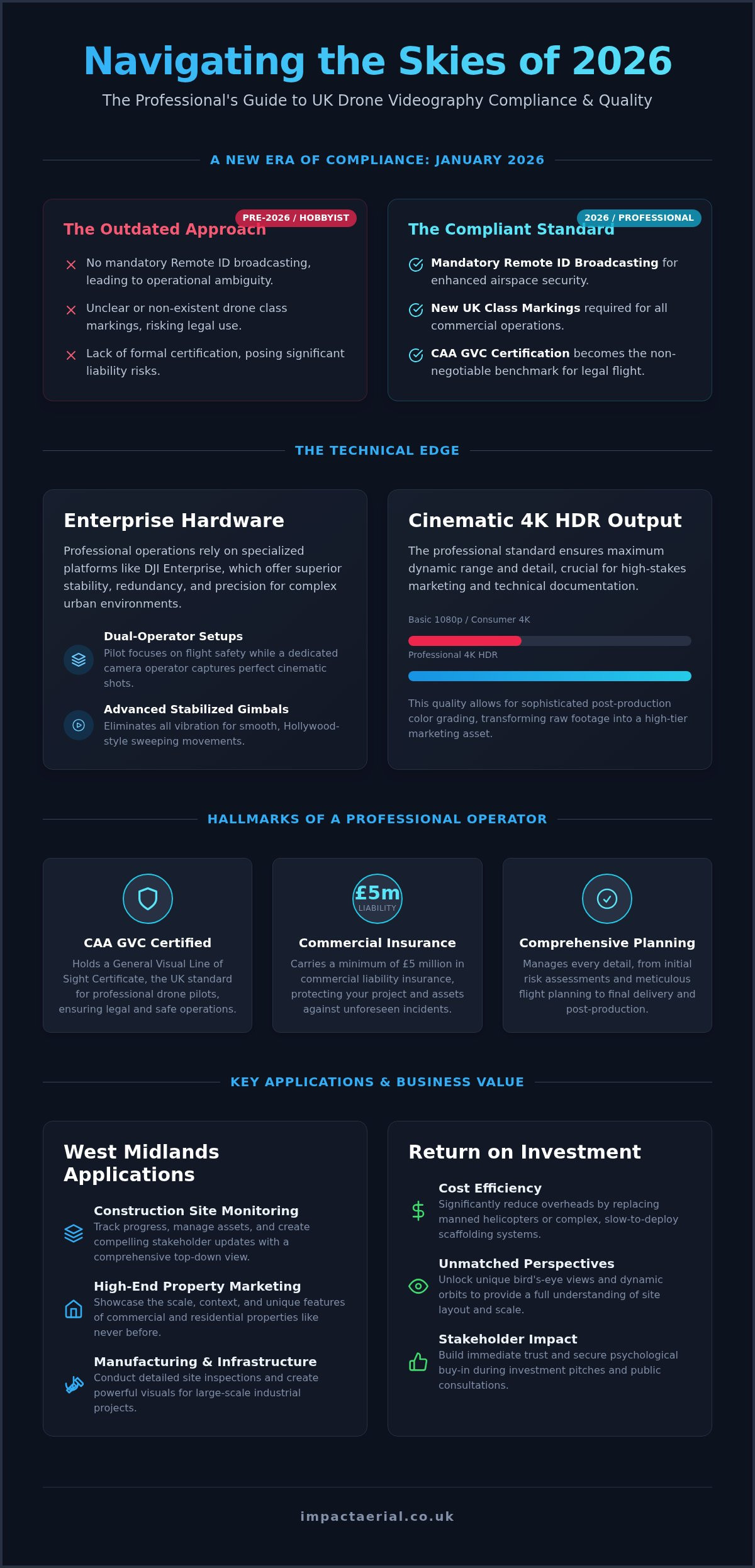
Key Applications for Drone Videography in Birmingham
Professional drone videography services Birmingham provide more than just aesthetic value; they offer essential operational insights across the region’s most active sectors. From the sprawling industrial hubs in the Black Country to the high-density redevelopment of Birmingham city centre, aerial film is used to solve complex logistical and marketing challenges. In 2026, the application of this technology has branched into four primary areas: commercial property marketing, construction site monitoring, corporate brand storytelling, and technical infrastructure inspections.
Real Estate and Property Development
In the competitive West Midlands property market, static images often fail to convey the true scale of a development. Aerial video provides a comprehensive view of a project’s footprint, its proximity to transport links like HS2, and its relationship with the surrounding urban landscape. This perspective is vital for securing planning permissions and maintaining stakeholder engagement throughout the build lifecycle. For projects requiring high-resolution stills alongside cinematic film, our Drone Photography: The Ultimate Guide to Aerial Imagery explains how to integrate these assets into a cohesive marketing strategy.
Construction and Infrastructure Surveys
The construction sector remains the largest adopter of UAV technology in Birmingham. Regular site monitoring through 4K video allows project managers to track progress against milestones with precision while creating a visual record that is far more detailed than ground-based reporting. It also serves as a robust tool for safety audits. By deploying drones for high-risk inspections, firms can remove personnel from dangerous environments such as fragile roofs or high-rise scaffolding. All such operations must strictly follow the UK Drone Regulations to ensure site safety and legal compliance.
For teams needing detailed technical analysis, our Drone Survey: The Complete Guide to Aerial Data Collection provides a deep dive into how video data is converted into actionable site reports. This methodical approach to data collection ensures that every flight contributes to the project’s overall safety and efficiency.
Advertising and Technical Inspections
Local businesses use aerial film to tell high-impact brand stories that resonate with a modern audience. Whether it’s showcasing a manufacturing facility or creating a promotional film for a city centre event, the cinematic quality of 2026 drone technology provides a level of production value previously reserved for big-budget agencies. Simultaneously, technical surveys use the same high-resolution video for roof inspections and infrastructure checks. This allows for the identification of defects without the need for costly plant hire, scaffolding, or road closures in busy metropolitan areas.
Compliance and Safety: UK Drone Regulations in 2026
The legal landscape for drone videography services Birmingham has evolved significantly since the January 2026 regulatory updates. Operating under the current Civil Aviation Authority (CAA) framework requires more than just a Flyer ID; it demands a comprehensive understanding of the Open and Specific categories of flight. While hobbyists can operate within strict limits for recreation, any flight conducted for commercial gain or project data falls under professional requirements. This distinction is critical for businesses. Hiring a hobbyist for a commercial project doesn’t just produce inferior results; it creates a substantial legal risk for the client if an incident occurs.
Safety is not an afterthought. It’s built into the “invisible” work of risk assessments and flight planning that occurs long before the drone leaves the ground. Professional operators spend hours analyzing site-specific hazards and coordinating with local authorities. £5m commercial liability insurance is the recognized industry standard for commercial site access in the West Midlands. Most main contractors and property managers will not grant site entry without proof of this specific level of cover. Commercial liability insurance is a prerequisite for commercial site entry.
Understanding the UK Drone License
In 2026, the General Visual Line of Sight Certificate (GVC) remains the essential qualification for pilots operating in the Specific category. This certification proves the pilot has undergone rigorous training in air law, meteorology, and emergency handling. Hiring an unlicensed operator exposes your business to potential fines and the immediate voiding of any existing site insurance. For a detailed breakdown of these requirements, read our UK Drone License: A Simple Guide to CAA Rules in 2026. Ensuring your pilot is current with these standards is the only way to guarantee a legally compliant shoot.
Risk Mitigation and Public Safety
Operating drone videography services Birmingham in the city centre presents unique challenges, from high-density crowds to complex wind tunnels created by high-rise architecture. Professional operators manage these risks by conducting pre-flight site surveys and checking NOTAMs (Notice to Airmen) for temporary airspace restrictions. This is particularly vital in Birmingham due to the proximity of the international airport and various restricted helipads. We utilize advanced telemetry to monitor the airspace in real-time, ensuring that every flight remains within legal and safe parameters. To ensure your project meets every legal and safety requirement, consult with our CAA-certified team in Birmingham today.
Planning Your Project with Impact Aerial
Integrating professional drone videography services Birmingham into your commercial workflow requires a structured, four-step methodology designed to mitigate risk while maximizing visual impact. We begin every project with a comprehensive initial consultation to define your specific cinematic vision and project objectives. This phase is critical for aligning our technical capabilities with your brand’s narrative goals. Following this, we conduct a rigorous feasibility study. We assess the target location for physical obstacles, restricted airspaces, and necessary CAA-compliant flight planning. Our team leverages deep local knowledge of the West Midlands to secure permissions and identify optimal launch sites that external operators might overlook.
On-site execution is handled by our CAA GVC certified pilots utilizing DJI Enterprise hardware. This equipment ensures maximum data security and flight stability in the challenging urban environments typical of the Birmingham city centre. Unlike a basic “camera only” hire, our team manages the entire operational environment, from ground-level safety cordons to the final 4K HDR capture. This professional oversight guarantees that your project remains on schedule and within all legal boundaries. While we are a Birmingham-based team, we maintain a nationwide reach, providing consistent high-tier quality across the UK.
The Post-Production Process
Raw aerial footage is simply the foundation of a professional film. Our post-production services transform raw 4K HDR files into brand-consistent stories through meticulous editing and color grading. We use advanced grading techniques to ensure that the visual tone aligns perfectly with your corporate identity. Sound design and professional pacing are then applied to create a high-impact narrative that holds stakeholder attention. For a deeper understanding of these cinematic techniques, see our guide on Aerial Filming Drone: The Ultimate Guide to Professional Cinematic Video.
Requesting a Professional Quote
Every aerial project in the West Midlands presents unique variables that influence the final scope of work. Factors such as the complexity of the location in high-density urban areas, total flight duration, and the specific sensors required for the shoot will determine the project requirements. Choosing full project management provides a significant return on investment compared to hiring an uncertified hobbyist. You gain the psychological comfort of £5m commercial liability insurance and the assurance that all content is legally compliant for commercial use. To begin your project with a team that understands the intersection of the lens and the law, contact Impact Aerial for a professional drone videography consultation and receive a tailored proposal for your specific needs.
Elevating Your Commercial Vision in the West Midlands
Professional aerial film in 2026 is defined by a rigorous commitment to safety and technical precision. As we’ve explored, the transition to integrated visual data requires more than just a camera in the sky; it demands a deep understanding of current CAA frameworks and the creative expertise to deliver cinematic 4K HDR content. By choosing specialized drone videography services Birmingham, you ensure your project benefits from a local team that understands both the regional landscape and the complexities of modern aviation law.
Impact Aerial provides the reassurance of CAA GVC Certified Pilots and £5m Commercial Liability Insurance, ensuring every flight is legally compliant and fully protected. Our end-to-end service includes full post-production editing to transform raw footage into a brand-consistent narrative that drives stakeholder engagement. Whether you’re monitoring a major construction site or marketing a high-rise development, the right aerial perspective offers a tangible return on investment that ground-based photography can’t replicate.
Ready to transform your next project with high-tier aerial visuals? Request a Professional Drone Videography Quote today and let us help you capture the scale and detail your business deserves. We look forward to bringing your vision to life safely and professionally.
Frequently Asked Questions
Is drone videography legal in the UK?
Drone videography is legal in the UK when conducted by certified operators who adhere to the Civil Aviation Authority (CAA) framework. For commercial drone videography services Birmingham, pilots must hold a valid Flyer ID and Operator ID. Operations in the Specific category require a General Visual Line of Sight Certificate (GVC). This ensures the pilot has undergone rigorous training in air law and safety protocols to operate legally and safely in public spaces.
What insurance does a professional drone pilot need for commercial work?
Professional pilots must maintain insurance that is compliant with EC 785/2004 regulations for commercial operations. We carry £5m commercial liability insurance as standard; this is often a prerequisite for accessing construction sites and managed commercial properties in the West Midlands. This level of cover provides essential protection for both the operator and the client. It covers potential third-party property damage or injury, ensuring all stakeholders are fully protected during the project.
Can you fly drones in Birmingham city centre or near the airport?
Flying in Birmingham city centre or within the Flight Restriction Zone (FRZ) of Birmingham Airport is possible but requires advanced coordination. Professional operators must secure permissions from Air Traffic Control (ATC) and potentially the local police for specific urban areas. We handle all necessary applications and liaison with NATS to ensure every flight is authorized. This methodical approach allows us to capture high-impact visuals even in the most restricted metropolitan environments.
What is the difference between FPV and standard drone filming?
Standard drone filming uses GPS-stabilized platforms to produce smooth, cinematic shots ideal for property and corporate film. FPV (First Person View) videography involves the pilot wearing goggles to fly more agile, high-speed drones. This technique creates immersive, “one-take” style footage that can fly through tight gaps or follow fast-moving subjects. While standard filming focuses on stability, FPV offers a dynamic, high-energy perspective that is increasingly popular for promotional brand stories.
How much does professional drone videography cost in 2026?
The cost of professional drone services depends on the project’s specific requirements, such as location complexity, flight duration, and the level of post-production needed. Factors like the requirement for dual-operator setups in busy city centres also influence the scope. We provide tailored quotes following an initial consultation to ensure the pricing reflects the technical demands of your vision. This approach ensures you receive a high-tier product without paying for unnecessary extras.
What happens if the weather is poor on the day of the shoot?
Safety is our primary concern, and flights are subject to suitable meteorological conditions. If wind speeds exceed safe operational limits or if precipitation is heavy, we’ll reschedule the shoot to the next available window. Modern enterprise hardware can handle light drizzle, but we always prioritize the safety of the public and the quality of the final 4K HDR footage. This ensures that your project is never compromised by avoidable environmental risks.
Do I need to provide a risk assessment for the drone pilot?
You don’t need to provide a risk assessment, as this is a core responsibility of the certified drone pilot. As part of our professional drone videography services Birmingham, we conduct a comprehensive site-specific risk assessment (SSRA) before every flight. This document identifies potential hazards, such as overhead power lines or public footpaths, and outlines our mitigation strategies. This process is a mandatory requirement under our CAA operating safety case and ensures a secure environment.
What is the typical turnaround time for an edited drone video?
Turnaround times vary based on the complexity of the shoot and the depth of editing required. A standard promotional video typically involves 4K HDR capture followed by professional color grading and sound design in post-production. We aim to deliver initial drafts within a timeframe discussed during your consultation; this ensures the final narrative is brand-consistent and ready for distribution. This structured workflow allows us to maintain high-tier quality while meeting your project’s specific deadlines.
UK Commercial Real Estate: 2026 Drone Photography Guide
A recent 2026 survey revealed that 82% of high-value property listings now rely on aerial perspectives to secure signatures, a trend that’s rapidly becoming the baseline for the industrial and retail sectors. You’ve likely found that static, ground-level imagery fails to capture the true scale of a multi-unit logistics hub or the strategic connectivity of a major retail park. However, integrating drone photography for commercial real estate UK wide involves more than just a camera in the air. It requires navigating dense urban flight paths and adhering to strict CAA safety protocols to mitigate operational risk.
We recognize the pressure to accelerate sales while managing the safety concerns and inconsistent quality that often come with uncertified operators. This guide provides the clarity you need to use professional aerial data for faster transactions and more accurate asset management. You’ll learn about the latest GVC certification requirements, the impact of the 2026 drone class marking system, and how fully insured, technical specialists provide the peace of mind required for complex site surveys. We’ll show you how to turn high-tier aerial data into a powerful tool for your commercial property portfolio.
Key Takeaways
- Understand the 2026 regulatory landscape and why CAA GVC certification is now the industry benchmark for complex urban property operations.
- Discover how professional drone photography for commercial real estate UK integrates high-end marketing visuals with technical data for faster site assessments.
- Learn how to optimize your project budget by utilizing a single flight for both cinematic 4K HDR filming and detailed roof or site surveys.
- Explore the shift from basic aerial shots to integrated aerial intelligence that enhances construction monitoring and long-term asset management.
- Identify the essential hardware standards and portfolio benchmarks required to choose a reliable technical partner in the UK commercial sector.
The Evolution of Aerial Photography in Commercial Real Estate
The history of aerial photography has transitioned from simple observation to the sophisticated DJI Enterprise systems used in modern property management. In the 2026 UK market, drone photography for commercial real estate UK represents a definitive shift toward “aerial intelligence.” This means we don’t just provide photos; we deliver technical data that informs the entire property lifecycle. High-stakes transactions now require a level of visual precision that only 4K HDR imagery can provide.
This technology is applied across several core UK sectors:
- Industrial: Showcasing the scale of logistics hubs and warehouse footprints.
- Retail: Highlighting car park layouts and accessibility for consumers.
- Office: Placing city-centre developments within their urban landscape.
- Mixed-Use: Capturing the complex relationship between residential and commercial zones.
Why Traditional Photography is No Longer Sufficient
Ground-based photography often fails to capture the full story of a large-scale asset. For a 500,000 sq ft industrial park, a standard camera can’t show how the site interacts with local transport links. Aerial views provide the essential context of surrounding infrastructure, which is vital for logistics-heavy businesses. We define “Aerial Context” as the visual relationship between a property and its local geography. This perspective is crucial for identifying site boundaries and understanding the proximity to major arterial roads or rail networks. For professionals seeking these same high standards in the US market, Flight Time Media specializes in real estate photography and videography across the Twin Cities.
The 2026 Standard for Professional Visuals
In 2026, 4K cinematic video is the gold standard for engaging remote investors and international stakeholders. These high-resolution assets allow for detailed digital zooming, enabling off-site teams to inspect site conditions with meticulous clarity. It’s vital that your aerial content matches the branding and quality of your ground-based photography to maintain a professional digital portfolio. By utilizing enterprise-grade hardware, we ensure that every frame of your drone photography for commercial real estate UK project meets the rigorous standards of the modern property market. This technical approach builds trust and provides the reassurance that your asset is being represented with absolute accuracy.
Technical Standards and CAA Compliance for UK Drone Operations
Operating a drone in the UK’s commercial sector requires strict adherence to Civil Aviation Authority (CAA) regulations. As of January 1, 2026, the regulatory environment has become more stringent, with the mandatory registration weight threshold lowered to 100g. This means almost every professional aircraft used for drone photography for commercial real estate UK must have a valid Operator ID, which currently carries an annual fee of £12.34. The introduction of the UK class marking system (UK0 to UK6) ensures that hardware meets specific safety and performance criteria before takeoff.
For commercial real estate projects, the distinction between the Open and Specific operational categories is critical. While an A2 Certificate of Competency (A2 CofC) allows for some low-risk flights, most professional work in congested urban environments like London or Birmingham requires a General Visual Line of Sight Certificate (GVC). A GVC allows pilots to apply for an Operational Authorisation, a necessity for flying closer to people and buildings than the standard rules permit. As of April 2025, the fee for a PDRA-01 Operational Authorisation stands at £500 per year, reflecting the increased administrative and safety oversight required for complex missions.
The Importance of GVC Certification
GVC certification is the industry benchmark for complex property surveys. It demonstrates that a pilot has undergone rigorous theoretical and practical testing, specifically focusing on risk mitigation in built-up areas. Hiring a certified professional isn’t just about image quality; it’s about legal security. Unlicensed operations can result in heavy fines and the invalidation of your project’s data. All Impact Aerial pilots are fully CAA GVC certified, ensuring that every flight is conducted within the legal framework of the Specific category.
Insurance and Liability: Protecting Your Asset
Insurance isn’t optional. It protects your interests. While hobbyists might fly for fun, professional drone photography for commercial real estate UK requires robust commercial liability insurance. We maintain £5m in commercial liability coverage as standard. This protects your asset, third-party property, and public safety during every mission. We also handle all necessary airspace notifications and flight permissions. This removes the administrative burden from your team. If you’re planning a project in a high-risk urban zone, you can request a technical safety consultation to ensure your site is covered.
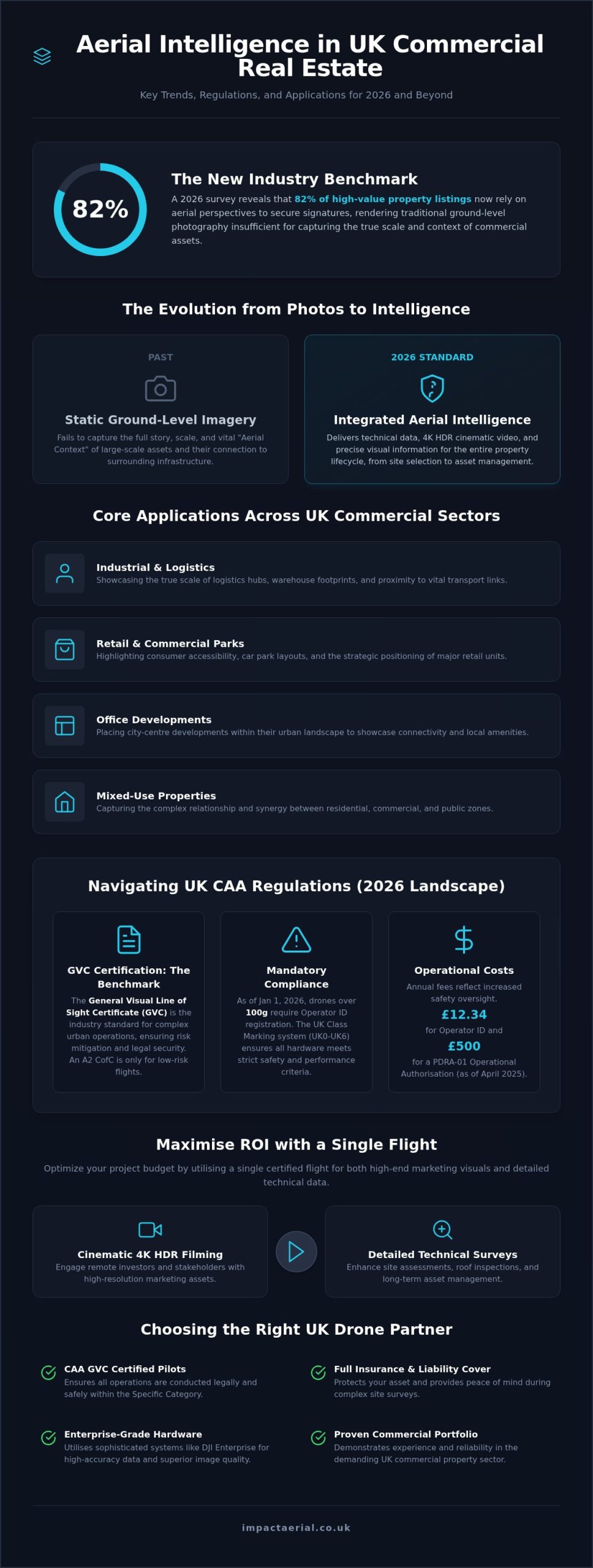
Strategic Applications: From Site Selection to Sale
By 2026, the integration of drones into the property lifecycle has shifted from a marketing extra to a fundamental technical requirement. Aerial intelligence now guides every stage of the process, from initial land surveys and topographic data collection to the final marketing of a completed asset. These data-rich perspectives allow developers to identify site constraints early, often saving significant time and resources during the groundwork phase. High-resolution imagery also plays a pivotal role in planning applications, providing an objective view of how a development integrates with existing transport links and green spaces.
During the build, construction site monitoring provides a chronological record of progress. By using consistent aerial overlays, project managers can track milestones and share visual updates with off-site stakeholders. When presenting these findings to local authorities or investors, following UK Civil Aviation Authority drone regulations ensures that your data is compliant and your operations are fully insured. This level of professionalism is essential for securing planning permissions and maintaining stakeholder trust through transparent reporting.
Industrial and Logistics: Capturing Scale
The massive scale of modern logistics hubs requires a perspective that ground-based photography simply cannot provide. Utilizing drone photography for commercial real estate UK enables agents to showcase warehouse footprints, loading bays, and yard space in a single, comprehensive frame. These wide-angle views are critical for highlighting a property’s proximity to major UK motorways and rail hubs, which are key selling points for logistics tenants. For more information on how we collect this technical data, read our Drone Survey guide. Showcasing these assets isn’t just about the visual; it’s about demonstrating operational efficiency to potential occupiers.
Retail and Office: Selling the Experience
In the retail and office sectors, the focus is on the prestige and connectivity of the asset. We use immersive 360-degree panoramas to allow potential tenants to explore office facades, amenities, and retail park layouts from anywhere in the world. These cinematic fly-throughs capture the essence of high-rise city centre developments, providing a sense of scale and luxury that ground-level shots lack. In 2026, a high percentage of premium listings include these aerial assets to demonstrate parking capacity and footfall flow. This approach helps remote investors make informed decisions through professional drone photography for commercial real estate UK, ensuring the asset’s best features are highlighted with technical precision.
Maximising ROI: Integrating Marketing with Technical Surveys
In the competitive 2026 property market, achieving a high return on investment requires a more integrated approach to aerial data. Many firms still treat marketing imagery and technical surveys as separate silos, which often leads to redundant site visits and inflated costs. By consolidating these requirements into a single flight operation, you can capture high-resolution visual assets for your sales brochures while simultaneously gathering the technical data needed for structural roof inspections or site surveys.
This four-step workflow ensures maximum efficiency from every deployment:
- Step 1: Conduct a single flight for dual-purpose data and visual capture, reducing the logistical burden on site managers.
- Step 2: Utilize high-res imagery for both marketing brochures and detailed roof inspections, providing value to both the sales and maintenance departments.
- Step 3: Leverage professional post-production to create distinct assets, such as cinematic clips for investors and technical reports for engineers.
- Step 4: Distribute the tailored content across digital platforms, including LinkedIn and dedicated property portals, to maximize exposure.
Dual-Purpose Flights: Efficiency in Action
A marketing-focused shoot for drone photography for commercial real estate UK can easily double as a preliminary drone property survey. During the same flight window, our pilots capture the 4K HDR footage required for cinematic reels while also documenting the condition of gutters, HVAC systems, and roofing membranes. This technical overlap significantly reduces site visit costs and minimizes the operational downtime associated with multiple drone deployments. To understand the full scope of these integrated capabilities, you can read our Drone Services guide. By capturing technical data during the visual shoot, you provide your asset management team with actionable intelligence without increasing the project budget.
Post-Production: Turning Raw Data into Narrative
The true value of drone photography for commercial real estate UK is realized during the post-production phase. We use 4K HDR editing to ensure that raw footage is transformed into professional-grade marketing assets that stand out on high-traffic property portals. Adding dynamic graphics and callouts to aerial footage allows you to highlight key features, such as net internal area or specific access points, directly within the video. Creating immersive virtual tours also provides a 24/7 “open house” experience, which is particularly effective for engaging international buyers who cannot visit the site in person. If you’re ready to enhance your property’s digital presence, you can book a post-production consultation to discuss your specific branding requirements.
Choosing the Right Drone Partner in the UK
Selecting a provider for drone photography for commercial real estate UK requires a shift in focus from creative flair to technical compliance. While many operators offer aerial services, the commercial sector demands a partner who understands the complexities of industrial sites and urban retail environments. You should prioritize firms that utilize DJI Enterprise grade hardware; these systems are designed for the rigors of professional work, offering superior stability and 4K HDR visual data that consumer models cannot match. This hardware ensures that the final output meets the high-tier quality expected by international investors and stakeholders.
Always scrutinize a potential partner’s portfolio for specific commercial experience. A pilot who specializes in weddings or landscapes may lack the operational knowledge required to navigate a congested construction site or a high-traffic logistics hub. Meticulous flight planning and risk assessment are the hallmarks of a professional specialist. Before hiring, use this essential checklist to verify their credentials:
- CAA GVC Certification: The essential benchmark for 2026 legal compliance in congested areas.
- £5m Commercial Liability Insurance: The industry standard for protecting your assets and third-party property.
- Enterprise-Grade Hardware: Ensuring high-end output, reliability, and advanced safety features.
- Post-Production Capability: The ability to turn raw 4K footage into cinematic marketing assets or technical survey reports.
Impact Aerial: Professionalism and Precision
We maintain a safety-first approach to every project, ensuring full adherence to the latest CAA protocols and risk mitigation strategies. Our Birmingham-based headquarters provides a strategic advantage for West Midlands projects while allowing for rapid, national UK-wide deployment. By utilizing DJI Enterprise 4K HDR drones, we provide the precision required for both marketing visuals and technical surveys. This meticulousness, combined with our £5m liability coverage, provides the reassurance that your property portfolio is in expert hands.
Next Steps for Your Property Portfolio
Moving from a conceptual project to final delivery involves a structured and methodical workflow. It begins with meticulous flight planning and airspace clearance, followed by the on-site capture of 4K HDR assets. Our team then manages the post-production phase to ensure your content is ready for immediate distribution across digital portals. If you’re ready to integrate professional drone photography for commercial real estate UK into your marketing or asset management strategy, you can Request a professional drone photography quote from Impact Aerial to begin your initial consultation.
Advancing Your Property Strategy with Aerial Intelligence
The transition from simple imagery to integrated aerial intelligence is now a fundamental requirement for the UK property market. By leveraging dual-purpose flights, you can secure high-resolution marketing assets while simultaneously fulfilling technical survey requirements. This approach doesn’t just save time; it provides a comprehensive data set that informs every stage of the property lifecycle. Navigating the 2026 regulatory landscape requires a partner who prioritizes safety and compliance through formal certification.
Integrating professional drone photography for commercial real estate UK ensures your assets are represented with the precision remote investors expect. We offer a meticulous service backed by CAA GVC certified pilots, £5m commercial liability insurance, and the latest DJI Enterprise 4K HDR technology. This combination of expertise and high-end hardware provides the reassurance you need for complex urban operations.
Ready to elevate your digital property portfolio? You can Contact Impact Aerial for a Professional Commercial Drone Quote to discuss your specific site requirements. We look forward to helping you accelerate your transactions with professional aerial data.
Frequently Asked Questions
Do I need special permission to fly a drone over a commercial property in the UK?
You need the land owner’s permission for takeoff and landing. For commercial flights in congested areas, pilots must adhere to specific CAA regulations. If your property is located within restricted airspace, we must obtain specific ATC clearance before the flight. We manage all flight planning and airspace notifications as part of our service to ensure your project remains fully compliant with UK aviation law.
What is the difference between a standard drone pilot and a GVC certified one?
A GVC (General Visual Line of Sight Certificate) certified pilot has completed advanced theoretical and practical assessments required for complex operations. Unlike the basic A2 CofC, a GVC is the prerequisite for an Operational Authorisation from the CAA. This allows us to operate enterprise-grade drones in urban environments where standard distance rules are too restrictive for professional commercial property work.
How much does drone photography for commercial real estate cost?
Project costs vary based on the site’s scale, the complexity of the airspace, and specific data requirements. Factors like thermal sensor use and the level of post-production editing also influence the final investment. We provide bespoke pricing for drone photography for commercial real estate UK to ensure you receive a tailored package that meets your specific marketing and surveying needs without unnecessary overheads.
Can drones fly in rain or high winds during a property shoot?
While DJI Enterprise drones feature robust wind resistance, we don’t fly in heavy rain or winds exceeding 20mph. Precipitation can degrade image quality and potentially damage sensitive electronic components. We monitor regional weather forecasts meticulously and will proactively reschedule your session if conditions threaten the safety of the aircraft or the precision of the 4K HDR visual data we provide.
How long does a typical commercial drone photography session take?
A standard session for a single commercial asset typically takes between two and four hours on-site. This timeframe includes the mandatory pre-flight safety assessment, hardware setup, and the actual capture of aerial stills and cinematic video. Larger industrial hubs or mixed-use developments may require a full day or multiple site visits to ensure we document every technical data point required for your stakeholders.
What insurance should a professional drone company have in the UK?
Professional drone companies must carry specialist commercial liability insurance compliant with EC 785/2004 standards. We maintain £5m in commercial liability insurance to protect our clients, the public, and third-party property during every mission. It’s vital to verify this coverage, as standard public liability insurance often excludes aviation risks. This insurance provides the necessary reassurance when operating drones in complex or high-value environments.
Can drones be used for internal commercial property photography?
Drones are excellent for internal filming in large warehouse units or expansive office lobbies. We use specialized, smaller aircraft equipped with 360-degree propeller guards to ensure safety within confined spaces. This technique provides a unique perspective on the net internal area and structural features. Internal flights require a pilot with significant manual flight experience to safely navigate around lighting fixtures and interior structural elements.
How soon will I receive the edited aerial photos and videos?
Final delivery times depend on the complexity of the project. We usually provide raw previews within 24 hours of the flight. The fully edited 4K HDR videos and high-resolution stills are typically delivered within three to five working days. This allows our post-production team to add technical graphics and branding, ensuring your drone photography for commercial real estate UK assets are ready for immediate use.
Drone Stockpile Measurement: Volumetric Survey Guide
Every time a surveyor climbs a loose aggregate pile to take manual measurements, your business is one slip away from a major health and safety incident. Traditional surveying methods aren’t just hazardous; they’re also notoriously slow and prone to human error, often resulting in inventory discrepancies that lead to significant financial losses. You likely already know that relying on ground-based estimates is a bottleneck for your site’s efficiency and a risk to your staff.
Using a professional drone for stockpile measurement transforms this high-risk task into a streamlined, data-centric process. By deploying commercial-grade DJI Enterprise technology, operators can capture highly accurate 3D models of your site inventory in hours rather than days. This guide explores how CAA GVC certified pilots deliver centimetre-accurate volumetric data while ensuring your operations remain fully compliant with safety regulations. We will examine the transition from manual data capture to autonomous aerial intelligence, providing you with the technical insights needed to eliminate guesswork and secure your bottom line through precise digital twins. You’ll discover how to achieve full H&S compliance while maintaining 1 to 3cm accuracy across your entire site inventory.
Key Takeaways
- Transition from manual “walking the pile” methods to autonomous aerial capture to eliminate fall risks and improve data consistency across your site.
- Discover how deploying a professional drone for stockpile measurement delivers centimetre-accurate 3D models using advanced photogrammetry and Ground Sampling Distance (GSD) calculations.
- Learn why aerial surveys reduce site time from days to hours, allowing for more frequent inventory audits without disrupting active workflows.
- Understand the critical importance of CAA GVC certification and £5m liability insurance when selecting a technical partner for high-risk industrial environments.
- Explore industry-specific applications, from tracking cut-and-fill balances in construction to managing high-value aggregate inventory in mining and quarrying.
What is Drone Stockpile Measurement and Volumetric Analysis?
Volumetric drone surveys represent a technical leap in how industrial sites quantify their assets. Instead of traditional ground-based methods, this process uses high-resolution aerial data to calculate the precise volume of material stockpiles. Using a drone for stockpile measurement allows site managers to move away from the hazardous practice of “walking the pile” with GPS rovers. It replaces manual estimation with autonomous, high-precision data capture.
This technology creates a high-fidelity “digital twin” of your entire site. This isn’t just a static image; it’s a geometrically accurate 3D model that serves as a single source of truth for inventory management. In sectors like aggregates and mining, centimetre-level accuracy has become the expected standard. It ensures that what’s recorded in the ledger matches what’s physically on the ground, providing psychological comfort to stakeholders through verified data.
The Evolution of Volumetric Surveying
Historically, site surveys relied on laser scanning or manual GPS points. These methods are often limited by the surveyor’s ability to safely access every part of a pile. Because ground-based surveyors can’t see the top or the far side of large mounds, traditional methods frequently lead to volume errors between 10% and 20%. These discrepancies quickly compound into significant financial losses over a fiscal year.
Modern surveys use The Science of Precision: How Photogrammetry Calculates Volume to overcome these limitations. By capturing hundreds of overlapping images from an aerial perspective, a drone for stockpile measurement can map complex, irregular shapes that ground teams simply cannot reach. This top-down view ensures every contour is accounted for, providing a level of detail that was previously impossible or too expensive to obtain regularly.
Key Metrics: Volume, Mass, and Density
Once the aerial data is captured, specialised software converts the 3D point cloud into cubic metre measurements. However, volume is only half of the equation. To provide actionable data, these cubic measurements are paired with known material density factors to calculate total tonnage. This allows for a granular understanding of site resources that manual methods can’t match.
Having access to this data in near real-time is vital for accurate financial reporting and rigorous auditing. Site managers don’t have to wait days for a report to be processed by an external agency. Precise inventory audits can be completed in hours, ensuring that month-end figures are based on verified, survey-grade data. This level of meticulousness is what separates professional aerial surveys from basic photography.
The Science of Precision: How Photogrammetry Calculates Volume
Capturing data with a drone for stockpile measurement relies on photogrammetry, the technical process of extracting 3D measurements from 2D imagery. By capturing hundreds of high-resolution photos with significant overlap, specialized software identifies common points across multiple frames. These points are then projected into a 3D coordinate system to create a dense point cloud. This cloud forms the basis of a Digital Surface Model (DSM), which provides a centimetre-accurate representation of every contour in your inventory. Academic research into Drones vs. Traditional Surveying confirms that this aerial approach is a viable, safe, and cost-effective alternative to manual methods, often achieving vertical accuracy within 20mm to 50mm.
Ground Sampling Distance (GSD) Explained
The precision of your volumetric report depends heavily on Ground Sampling Distance (GSD). GSD is the actual distance on the ground represented by a single pixel in a digital image. For example, a GSD of 1cm means each pixel in the 3D model represents exactly 1cm² of the physical stockpile. Lower GSD values lead to higher volumetric precision because the software has more detail to work with when defining the pile’s boundaries.
Several factors dictate the GSD of a survey:
- Flight Altitude: Flying lower increases detail but requires more images to cover the site.
- Camera Sensor: High-performance sensors, like the 4/3 CMOS found on the DJI Mavic 3E, allow for superior data capture even at higher altitudes.
- Lens Quality: Professional-grade optics reduce distortion, ensuring that the spatial data remains consistent across the entire site.
RTK vs. Non-RTK Drone Surveys
When deploying a drone for stockpile measurement, the choice between RTK (Real-Time Kinematic) and non-RTK hardware is critical for your data’s integrity. RTK drones communicate with a base station or a satellite network to provide centimetre-accurate positioning data in real-time. This technology is vital for establishing absolute accuracy, ensuring your site’s data aligns perfectly with global coordinates and previous surveys.
Using RTK significantly reduces the need for Ground Control Points (GCPs). In a non-RTK survey, staff must manually place and measure multiple physical markers across the site to “pin” the drone data to the ground. RTK hardware streamlines this process, reducing site time and improving safety by keeping personnel away from active machinery. If you’re looking to integrate this level of precision into your workflow, our team at Impact Aerial can provide the technical consultancy needed to get started.
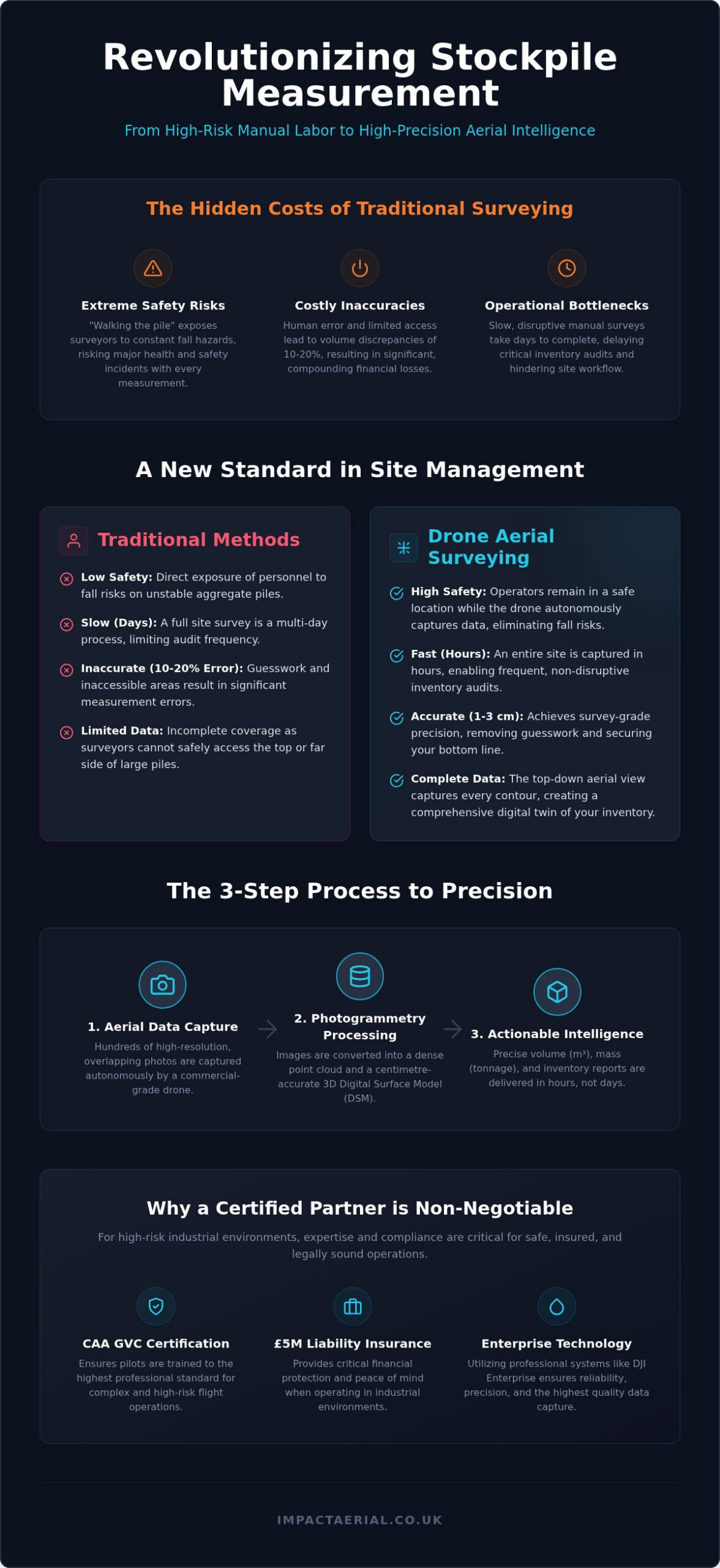
Drones vs. Traditional Surveying: Speed, Safety, and ROI
Traditional topographic surveys are often a significant drain on site resources. For a large-scale industrial operation, a ground team might spend several days traversing hazardous terrain to capture enough data points for a volume estimate. In contrast, using a drone for stockpile measurement allows the same area to be mapped in just a few hours. This drastic reduction in site time translates directly into lower labour costs and, more importantly, minimal disruption to your daily operations. You don’t have to halt plant movements or clear the area for days on end; the drone operates above the workflow, capturing data while your site remains productive.
The return on investment extends beyond immediate time savings. Because aerial surveys are so efficient, site managers can move from infrequent quarterly audits to weekly or even daily inventory updates. This high-frequency data prevents over-ordering and ensures that financial reporting is always based on current site conditions rather than outdated estimates. When you consider the cost of inventory discrepancies, the ability to maintain a precise, real-time ledger provides a clear financial advantage that traditional methods simply cannot match.
The Safety Advantage: Mitigating Site Risks
The most compelling argument for aerial surveys is the immediate improvement in health and safety compliance. Traditional methods require surveyors to physically climb unstable stockpiles of sand, gravel, or coal. This presents a high risk of slips and falls, especially in the unpredictable UK weather. By deploying a drone for stockpile measurement, you remove personnel from these dangerous locations entirely. This approach supports a “Zero Harm” site culture by keeping staff away from active heavy machinery zones and precarious heights. Our CAA GVC certified pilots operate from safe stand-off distances, backed by £5m commercial liability insurance, ensuring that data collection never compromises your site safety protocols.
Data Consistency and Transparency
Manual measurements often suffer from subjective “eye-balling” or inconsistent point density, which leads to human error in volume calculations. Drones eliminate this variability by capturing millions of data points across the entire surface of the pile. This creates a permanent, high-resolution visual record that serves as a robust audit trail. If a dispute arises with a supplier or contractor, you have a time-stamped 3D model to verify the exact inventory levels at that moment. These models can be easily shared across departments via cloud-based platforms, ensuring that procurement, finance, and site operations are all working from the same verified dataset.
Industry Applications for Aerial Volumetric Surveys
The utility of a drone for stockpile measurement extends across diverse industrial sectors where material volume directly impacts the balance sheet. While the core technology remains consistent, the specific applications vary to meet the unique operational requirements of different environments. From managing high-value mineral assets to monitoring site progress, aerial data provides a level of granular detail that traditional ground-based methods cannot replicate. This transition to digital inventory management ensures that managers have access to a single, verified source of truth for their site resources.
Construction and Infrastructure Management
In the construction sector, maintaining an accurate record of earthworks is essential for financial transparency and project timelines. Site managers use comprehensive drone survey data to verify subcontractor invoices by calculating the exact volume of material moved or imported. This objective data eliminates disputes and ensures that payments are based on physical reality rather than estimates.
Sequential 3D mapping allows teams to monitor site progress over time, comparing the current state of the terrain against the original design. This volumetric data can be directly linked to Building Information Modelling (BIM) workflows, providing a seamless integration between the physical site and the digital project plan. It allows for precise tracking of cut-and-fill balances, ensuring that material is moved efficiently across the site to minimize haulage costs.
Quarrying and Bulk Material Handling
For quarrying and mining operations, material is the primary asset. Using a drone for stockpile measurement is now a standard requirement for year-end inventory audits. These surveys provide the meticulous accuracy needed for financial compliance, ensuring that “dead” stock at the bottom of a pile is distinguished from active inventory turnover. This level of detail is critical for accurate asset valuation and tax reporting.
The data also serves a vital logistical purpose. By understanding the exact volume of available aggregate, site managers can optimize their haulage and logistics schedules. This prevents bottlenecks in production and ensures that customer orders are fulfilled from the most accessible stockpiles. Real-time volume data allows for better planning of extraction rates and storage capacity, maximizing the overall efficiency of the quarry.
Other sectors also benefit from this aerial intelligence:
- Waste Management: Monitoring landfill capacity and quantifying processed recycling material to ensure regulatory compliance.
- Agriculture: Measuring bulk fertilizer storage and grain silos to manage seasonal supply chains more effectively.
If you need to improve the accuracy of your inventory audits or site monitoring, contact Impact Aerial to discuss our professional drone data services.
Why Hire a CAA GVC Certified Partner for Your Site?
While many businesses consider purchasing hardware for in-house use, the true value of a drone for stockpile measurement lies in the expertise of the operator and the rigour of their safety protocols. For commercial operations in the UK, holding a valid drone license is a strict legal requirement. This isn’t just a bureaucratic hurdle; it’s a verification of technical competence. Hiring a certified partner ensures your site remains compliant with Civil Aviation Authority (CAA) regulations, shielding your business from the legal and financial repercussions of unauthorised flights.
Professional operators provide a level of risk mitigation that DIY solutions cannot match. Impact Aerial carries £5m in commercial liability insurance, specifically tailored for high-risk industrial environments. This provides psychological comfort and tangible security for site managers. It ensures your company’s interests are fully protected. Every flight is conducted under strict CAA safety protocols, including detailed pre-flight risk assessments and site-specific safety briefings.
The Importance of GVC Certification
The General Visual Line of Sight Certificate (GVC) represents the industry standard for professional drone operations. It ensures safety and precision. Pilots are trained to manage complex airspace and navigate site-specific restrictions, such as proximity to power lines or active machinery. This meticulousness extends to data privacy. Professional partners are well-versed in GDPR compliance, ensuring any aerial data collection respects the privacy of site staff and neighbouring properties. By choosing a GVC-certified specialist, you’re prioritising reliability over the unpredictable results of amateur flight.
Beyond the Flight: Expert Data Processing
The value of using a drone for stockpile measurement is only realised through high-end data processing. Professional teams use specialised photogrammetry software to turn raw imagery into actionable business intelligence. Instead of just a folder of photos, you receive comprehensive PDF reports and CSV exports. These files can be directly integrated into your existing CAD or GIS software. This ensures the volumetric data is immediately useful for your finance or engineering departments.
If you’re ready to secure your site inventory with survey-grade accuracy, Contact Impact Aerial for a professional stockpile survey quote today.
Securing Your Site Inventory with Aerial Intelligence
Adopting professional drone technology is a strategic necessity for modern industrial sites. By transitioning from manual estimations to high-precision digital twins, you eliminate the safety risks associated with “walking the pile” while gaining centimetre-accurate data for your financial reporting. Using a professional drone for stockpile measurement ensures that your inventory audits are based on verified, survey-grade results rather than subjective guesswork. This methodical approach protects your staff and secures your bottom line through precise asset valuation.
Impact Aerial provides the technical expertise and regulatory compliance required for high-risk environments. Our CAA GVC Certified Pilots deliver centimetre-accurate RTK data, backed by £5m commercial liability insurance for your reassurance. Whether you’re managing construction earthworks or aggregate inventory, we provide the actionable intelligence you need to optimise your operations. Request a Professional Drone Survey Quote from Impact Aerial today and take the first step toward a safer, more efficient site. We’re ready to help you transform your data collection processes.
Frequently Asked Questions
How accurate are drone stockpile measurements compared to traditional methods?
A professional drone for stockpile measurement typically achieves accuracy within 1cm to 3cm. Traditional GPS rover methods often result in 10% to 20% volume discrepancies due to limited access and human estimation. In contrast, aerial surveys capture millions of data points across the entire surface. This results in a vertical accuracy range of 20mm to 50mm, providing a far more reliable digital twin for your financial reporting and inventory audits.
What types of materials can be measured using a drone?
Drones can measure almost any bulk material with a defined surface. Common applications include aggregates like sand, gravel, and crushed stone in quarries, as well as coal, minerals, and ores in mining. In the recycling sector, they quantify processed waste and woodchip piles. Agricultural sites use them for grain and bulk fertilizer storage. Provided the material is visible from the air, photogrammetry can accurately calculate its volume and mass.
Do I need to clear the site or stop work during a drone survey?
One of the primary benefits of aerial surveying is that it doesn’t require site downtime. Unlike ground-based teams that need clear access and machinery exclusion zones, a professional drone operates at a safe altitude above active workflows. While we conduct pre-flight safety briefings and maintain a stand-off distance from heavy plant machinery, your site can typically remain fully operational throughout the entire data collection process without any major disruptions.
How long does it take to get the volumetric report after the flight?
Turnaround times are significantly faster than traditional methods. While a manual survey might take days to process, drone data can often be delivered within 24 to 48 hours. The initial flight typically takes less than a day, even for large sites. Once the raw imagery is processed through specialised photogrammetry software, you receive actionable PDF reports and CSV exports that integrate directly into your existing CAD or GIS workflows.
Is it cheaper to buy a drone or hire a professional service for stockpile measurements?
For most businesses, hiring a professional service like Impact Aerial is more cost-effective than managing an in-house program. DIY operations face significant overheads, including the £524 annual CAA Operational Authorisation fee and the cost of GVC training. Professional partners provide high-end DJI Enterprise hardware, £5m liability insurance, and expert data processing. Choosing a drone for stockpile measurement through a specialist eliminates the need for you to manage complex regulatory compliance and software licensing.
What weather conditions are required for an accurate drone survey?
Optimal results are achieved in dry conditions with moderate wind speeds, typically below 20mph. While commercial-grade drones have some weather resistance, heavy rain or thick fog can obscure the material surface and degrade the accuracy of the photogrammetry. High-quality data depends on clear visibility and consistent lighting. Our pilots monitor local forecasts meticulously to ensure that every flight is conducted in conditions that support centimetre-accurate data capture for your inventory.
Can drones measure stockpiles inside warehouses or covered areas?
Standard GPS-based drones are primarily designed for outdoor use. Measuring stockpiles inside warehouses or covered sheds is more complex because of signal interference and poor lighting. While specialised indoor drones or LiDAR technology can be used in these environments, they require different flight protocols. If your material is stored under cover, we recommend a technical consultation to determine if aerial capture or alternative scanning methods are the most suitable for your specific facility.
What insurance and certifications should a drone pilot have for industrial sites?
Any pilot operating on a commercial site must hold a CAA GVC (General Visual Line of Sight) certificate. This ensures they are trained in strict safety protocols and airspace management. Additionally, they should carry at least £5m in commercial liability insurance to protect against site-specific risks. At Impact Aerial, our pilots are fully certified and insured, providing the professional reassurance needed for high-risk industrial environments and ensuring full health and safety compliance.
Drone Thermal Roof Inspection UK: The Complete 2026 Guide to Aerial Thermography
You’re likely losing thousands of pounds through your roof right now, and you can’t even see it. It’s a frustrating reality for UK commercial property managers and homeowners alike. Between skyrocketing energy prices and the eye-watering cost of erecting scaffolding just to “have a look,” traditional maintenance often feels like a financial trap. You already know that hidden moisture ingress or failing insulation could be compromising your building’s structural integrity, but the safety risks of working at height and the potential for site downtime often lead to expensive delays.
A professional drone thermal roof inspection uk changes this dynamic by turning invisible heat loss into actionable data. By choosing a specialist who operates under strict CAA GVC certification and carries £5m commercial liability insurance, you gain a high-tier aerial perspective that ladders simply can’t match. This complete 2026 guide explains how we use DJI Enterprise thermography to identify defects faster and more safely than ever before. We’ll walk you through the latest UK drone regulations, the science of moisture detection, and how these detailed thermal reports provide the evidence you need for insurance claims or repair tenders without the need for a single pole of scaffolding.
Key Takeaways
- Learn how infrared sensors detect non-destructive temperature variations to help your property meet the UK’s stricter 2026 energy efficiency standards.
- Understand the technical distinction between visual context and thermal performance to ensure your survey identifies hidden moisture ingress instead of just surface defects.
- Discover how a professional drone thermal roof inspection uk eliminates the high costs and safety risks of scaffolding while surveying large commercial areas in hours.
- Identify the essential compliance markers, such as CAA GVC certification and £5m liability insurance, required to operate safely in congested urban environments.
- See how sub-degree temperature accuracy and dual-sensor payloads provide the precise evidence needed for insurance claims and repair tenders.
What is a Drone Thermal Roof Inspection and Why is it Essential in 2026?
A drone thermal roof inspection uk is a specialised, non-destructive survey that utilises high-resolution infrared sensors to map temperature variations across a building’s envelope. Unlike a standard photograph, which only captures visible light, a thermal survey detects the heat energy emitted by the structure. This data allows property managers to see exactly where a building is failing. In 2026, this technology has become indispensable as the UK government enforces stricter building regulations focused on reducing carbon footprints and improving energy efficiency. For owners of industrial warehouses, commercial offices, and heritage buildings, these surveys provide the data-centric evidence required for modern compliance.
To better understand how this technology visualises heat and identifies defects, watch this helpful video:
Visual inspections often fail because they can’t detect what lies beneath the surface. Water ingress and insulation gaps frequently remain hidden until they cause structural damage or lead to astronomical energy bills. By the time a leak is visible from the inside, the damage is usually extensive. Aerial thermography identifies these issues at the earliest possible stage, ensuring that maintenance teams can target specific areas rather than replacing entire sections of a roof. This precision is vital for managing large-scale UK property portfolios where traditional manual inspections are both slow and prohibitively expensive.
Detecting the Invisible: Heat Loss and Moisture Ingress
Thermal sensors are exceptionally effective at identifying “cold bridging,” where heat escapes through structural elements or gaps in insulation. Our pilots use DJI Enterprise hardware to capture these thermal signatures with sub-degree accuracy. The process leverages the science of thermal mass; water-saturated insulation retains heat longer than dry materials. This means that after sunset, wet areas on a flat roof will appear as “hot spots” on the thermal map. Identifying these early-stage leaks prevents structural rot and ensures the building’s thermal envelope remains intact.
The Role of Aerial Thermography in Building Maintenance
Implementing aerial data allows property managers to transition from reactive, emergency repairs to proactive asset management. These detailed surveys directly support BREEAM assessments and EPC ratings by providing empirical proof of a building’s thermal performance. To clarify the technology, What is Thermography? Thermography is the measurement of emitted infrared radiation rather than reflected light. By integrating a drone thermal roof inspection uk into your annual maintenance schedule, you ensure your assets remain compliant with 2026 energy standards while avoiding the downtime associated with traditional scaffolding.
Thermal Imaging vs. Visual Drone Surveys: A Technical Comparison
While a visual drone survey is excellent for identifying physical damage like slipped tiles or blocked gutters, it only captures “what it looks like.” In contrast, a drone thermal roof inspection uk captures “how it performs.” Visual imagery remains surface-level; it can’t detect the moisture trapped beneath a waterproof membrane or the heat escaping through a gap in the insulation. By 2026, commercial reporting standards have evolved to require both visual and thermal data sets to provide a truly comprehensive overview of building health. This ensures that maintenance teams aren’t just looking for cracks, but are diagnosing the fundamental integrity of the structure.
Using dual-sensor payloads, such as those found on DJI Enterprise hardware, allows our pilots to overlay high-resolution RGB images with thermal data. This provides vital context. Without a visual reference, a heat signature might just be a reflection or a different material. Following the BS EN 13187 inspection standard ensures that we aren’t just taking pictures, but conducting a qualitative detection of thermal irregularities. This scientific approach separates professional thermography from basic aerial photography and provides the technical rigour required for industrial asset management.
When to Choose Thermal Over Visual
There are specific scenarios where thermal data is the only viable diagnostic tool. For flat roofs, the entry point of a leak is rarely directly above the internal damp patch. Thermal imaging identifies the moisture trail within the substrate, saving thousands in unnecessary repairs. Large-scale industrial units also benefit during energy audits, as thermal sensors highlight failing cladding or “cold bridges” that visual cameras miss entirely. Additionally, for properties with integrated renewables, we use these sensors for PV solar farm thermal surveys to identify defective cells that are overheating and reducing energy yield.
Understanding Emissivity and Atmospheric Conditions
The success of a thermal survey depends heavily on the “window of opportunity” provided by UK weather. High winds or recent rain can mask thermal signatures, which is why our meticulous planning process is so critical. Different materials also emit heat differently; a bitumen felt roof is far easier to read than a highly reflective metal surface. This is due to emissivity, the material’s effectiveness in emitting energy as thermal radiation. Thermal inspections are typically conducted at dusk or night to ensure accurate Delta-T readings once solar loading from the sun has dissipated. This ensures the data we collect is precise, reliable, and legally defensible for insurance or maintenance tenders.
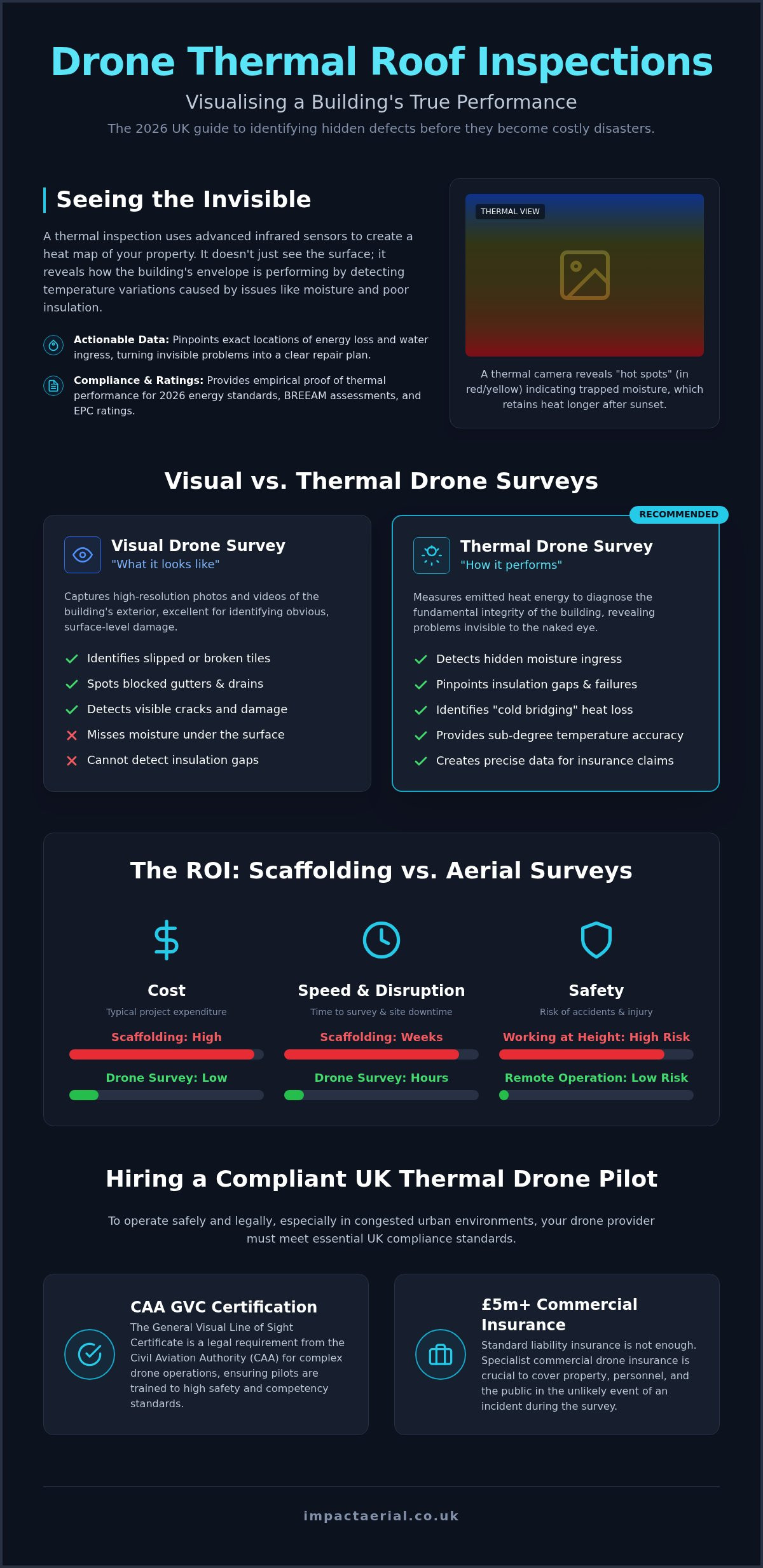
The ROI of Drone Inspections: Scaffolding vs. Aerial Surveys
The financial argument for a drone thermal roof inspection uk is compelling when compared to the heavy logistics of traditional access. For a large commercial property, erecting scaffolding often involves an entry price exceeding £2,000 before a single inspector has even stepped onto the roof. Aerial surveys provide a high-tier diagnostic output for a fraction of that cost. Speed is another critical factor. A manual survey of a 50,000 sq ft industrial facility can take several days of hazardous ladder work. A drone completes the same task in a matter of hours, delivering GPS-tagged imagery that is far more accurate than hand-written notes or handheld photos taken from a precarious angle.
Risk mitigation is at the heart of professional aerial operations. By using drones for initial assessments, we effectively remove the “Working at Height” requirement for your staff and contractors. Our pilots maintain £5m commercial liability insurance and follow strict safety protocols, providing the reassurance that your site remains compliant with national safety standards. This data-centric approach doesn’t just save money; it provides a definitive record of building health that can be referenced for years to come.
Reducing Operational Downtime
One of the most significant benefits of aerial thermography is the lack of disruption. Traditional inspections often require cordoned-off areas or site-wide shutdowns to accommodate scaffolding or cherry pickers. Drones operate from a distance, allowing your business to continue uninterrupted. We also simplify the administrative burden by reducing the need for extensive, site-wide Risk Assessment Method Statements (RAMS) typically required for physical roof access. This streamlined workflow allows for the easy integration of thermal data into existing Building Information Modelling (BIM) systems, enhancing your long-term asset management strategy.
Insurance and Warranty Validation
A professional thermal report is a powerful tool for satisfying UK insurance underwriters. These documents serve as a robust “Schedule of Condition,” providing empirical evidence of a roof’s integrity. For new builds or recent refurbishments, we provide the necessary data to validate contractor warranty sign-offs, ensuring that any installation defects are identified before they lead to structural failure. For a deeper look at how we process this information, refer to our drone survey guide. This proactive approach ensures your property remains protected by valid warranties and comprehensive insurance coverage.
UK Regulations and Safety: Hiring a Compliant Thermal Drone Pilot
Commercial drone operations in the UK are strictly governed by the Civil Aviation Authority (CAA). For any drone thermal roof inspection uk, the pilot must hold a General Visual Line of Sight Certificate (GVC). This is a legal requirement for complex commercial tasks. The GVC demonstrates that the operator has undergone rigorous theoretical and practical testing. They understand the intricacies of the UK’s specific airspace and can manage the risks associated with high-value assets. Hiring an uncertified pilot for commercial work is not just a safety risk; it can invalidate your property insurance.
Operating in congested urban hubs like Birmingham, London, or Manchester requires even greater technical precision. National aviation laws dictate strict separation distances from uninvolved people and buildings. To mitigate these risks, professional operators maintain £5m in commercial liability insurance as a standard benchmark. This level of coverage ensures that the client is fully protected during industrial or commercial surveys. Before any flight, a meticulous pilot conducts a comprehensive risk assessment, ensuring the operation is safe, legal, and efficient.
CAA Compliance and Certification
A significant gap exists between an amateur flyer and a professional drone license holder. Under 2026 regulations, professional operators must adhere to stricter logging and maintenance schedules for enterprise-grade hardware. This includes broadcasting Remote ID information as part of the UK’s updated safety standards. Every operator must also display a valid Operator ID on their aircraft, while the pilot must hold a current Flyer ID. These systems ensure accountability and safety across the UK’s increasingly busy skies.
Safety Protocols for Roof Inspections
Safety begins long before the drone leaves the ground. A professional pilot conducts a detailed pre-flight site survey and checks for a “Notice to Airmen” (NOTAM). This identifies temporary hazards such as crane operations or restricted airspace. We also prioritise privacy by ensuring that our flight paths are focused strictly on the target structure. In complex urban environments, we often deploy a Visual Observer to maintain a constant eye on the surrounding area. This allows the pilot to focus entirely on the precision of the thermal data collection. If you require a risk-managed survey for your property, contact the experts at Impact Aerial today.
Impact Aerial: Expert Thermal Data Collection and Reporting
Impact Aerial operates from a strategic Birmingham base, providing nationwide coverage for every drone thermal roof inspection uk we conduct. Our team leverages high-end DJI Enterprise thermal sensors to achieve sub-degree temperature accuracy, ensuring that even the most subtle thermal anomalies are recorded. We manage the entire lifecycle of the survey, from the initial regulatory flight planning to the complex post-production analysis of infrared data. This end-to-end service is underpinned by our deep sector expertise in commercial property and construction, alongside our specialised work in PV solar farm surveys. Our pilots are trained to identify the unique thermal signatures of different roofing substrates, ensuring that the data collected is both accurate and relevant to your specific building type.
The Impact Aerial Reporting Standard
A professional thermal report must be more than a collection of infrared images; it needs to be a diagnostic tool. We provide high-resolution thermal maps that use MSX overlays, a process that embosses visual detail onto thermal imagery to provide better structural context. This allows your maintenance team to see exactly where a defect sits in relation to roof vents, seams, or drainage points. We categorise every finding using a defect prioritisation scale, helping you allocate repair budgets where they are needed most. For clients managing extensive asset portfolios, we can integrate this thermal data with virtual tour creation, providing a comprehensive digital twin of your building’s exterior and thermal performance. This multi-layered approach ensures that the data is accessible to both technical engineers and commercial stakeholders.
Booking Your UK Thermal Roof Inspection
Our consultation process begins by defining your specific survey goals, whether you are validating a new installation or investigating a persistent leak. Because we are based in the West Midlands, we offer rapid deployment times across the UK, ensuring that we can hit the narrow weather windows required for accurate thermography. Once the flight is complete, our post-production specialists process the raw data to create actionable insights, delivering a final report that is both technically rigorous and easy to interpret. This meticulous attention to detail ensures that your maintenance decisions are based on empirical evidence rather than guesswork. To secure your survey date or request more information, Contact Impact Aerial for a professional thermal roof survey quote and ensure your property is managed with data-centric precision.
Protecting Your Assets with Precision Aerial Data
Transitioning to a data-centric maintenance strategy is no longer optional in 2026; it’s a necessity for energy efficiency and structural longevity. By moving beyond the limitations of visual surveys, you can identify moisture ingress and insulation failures before they escalate into costly structural repairs. A professional drone thermal roof inspection uk provides the high-tier evidence required for insurance validation and proactive asset management, all while eliminating the safety risks of working at height.
Our team at Impact Aerial combines technical rigour with operational excellence. We utilise DJI Enterprise Thermal Technology and deploy CAA GVC Certified Pilots to ensure every survey meets the highest national standards. With £5m Commercial Liability Insurance, we provide the reassurance you need to operate safely in any environment. Don’t leave your property’s health to guesswork or outdated manual inspections. Take the proactive step towards securing your building’s future today.
Request a Professional Drone Thermal Survey Quote and discover how our specialised aerial insights can protect your commercial portfolio.
Frequently Asked Questions
How much does a drone thermal roof inspection cost in the UK?
Costs vary based on the property size, roof complexity, and the specific level of data analysis required for your project. While a basic visual survey is the entry point, a drone thermal roof inspection uk requires specialised sensors and post-production expertise, which influences the total investment. We recommend requesting a bespoke quote to ensure the survey goals align with your specific requirements. Factors like location and the necessity for urban flight permissions will also affect the final pricing structure.
Can a thermal drone see through a roof to find leaks?
Thermal drones don’t see through solid objects; instead, they detect infrared radiation emitted from the roof surface. This technology identifies temperature variations caused by moisture trapped within the substrate or failing insulation. Because wet materials retain heat longer than dry ones, “hot spots” appear on the thermal map after sunset. This non-destructive method provides a clear diagnostic of subsurface issues without the need to physically dismantle any part of the structure or membrane.
What is the best time of day for a thermal roof survey?
The most accurate results are typically achieved at dusk or during the night. This timing ensures that “solar loading” from the sun has dissipated, allowing the thermal sensors to detect the true temperature of the building materials. A significant temperature difference, known as Delta-T, between the internal and external environment is essential. This contrast makes it much easier to identify insulation gaps, cold bridging, and moisture ingress across the entire roof surface with precision.
Do I need to notify my neighbours before a drone inspection?
You aren’t legally required to notify neighbours if the operation stays within the boundaries of the law and CAA regulations. However, we consider it best practice to inform adjacent property owners when conducting a drone thermal roof inspection uk in sensitive or residential areas. Our pilots prioritise privacy by focusing sensors strictly on the target structure. We always operate under strict safety protocols to ensure the survey is as discreet and professional as possible for all parties.
How long does it take to get the thermal inspection report?
Most clients receive their comprehensive thermal report within 48 to 72 hours of the flight. This timeframe allows our post-production team to process the raw infrared data, overlay visual imagery for context, and prioritise any detected defects. For large-scale industrial surveys or complex asset portfolios, the analysis might take slightly longer to ensure accuracy. We ensure that the final document is an actionable diagnostic tool rather than just a collection of raw infrared images.
Are drone roof inspections accepted by UK insurance companies?
Yes, UK insurance underwriters increasingly accept and even request drone thermal reports as empirical evidence of building health. These surveys provide a robust “Schedule of Condition” that can be used for warranty validation or insurance claims. Because our pilots are CAA GVC certified and carry £5m commercial liability insurance, the data we provide is considered technically accurate and legally defensible. This documentation offers a clear, high-tier record of maintenance for your professional property files.
What weather conditions prevent a thermal drone flight?
Flight operations are prevented by heavy rain, snow, or winds exceeding the drone’s safe operating limits, which is usually around 20 to 25mph. Moisture on the roof surface can mask thermal signatures, leading to inaccurate data collection. We constantly monitor local weather patterns to identify the ideal “window of opportunity” for your survey. If conditions aren’t perfect, we reschedule to ensure the data we collect for your property is of the highest possible quality and technical rigour.
Do you need special permission to fly a drone in a city centre like Birmingham?
Flying in a city centre like Birmingham requires specific CAA Operational Authorisation and adherence to strict urban flight laws. Our pilots hold the necessary GVC certification to operate in congested areas safely and legally. We manage the entire permission process, including site-specific risk assessments and notifying the relevant authorities where required. This meticulous planning ensures that your urban property survey is completed without legal complications, site downtime, or safety risks to the general public.
Professional Drone Building Inspection in Birmingham: The 2026 Expert Guide
Relying on scaffolding for a routine roof survey in 2026 isn’t just an operational bottleneck; it’s a financial liability that many Birmingham firms can no longer justify. You’re likely all too familiar with the disruption of blocking a busy city street or the high insurance premiums associated with sending personnel onto the ageing industrial roofs of the Black Country. In a landscape as dense and regulated as the West Midlands, the traditional ways of working are increasingly becoming the riskiest choice.
We understand that safety and compliance are your non-negotiables, especially when operating within the strict Flight Restriction Zones near Birmingham Airport. This expert guide shows you how a professional drone building inspection in Birmingham provides a safer, faster, and more detailed alternative to manual surveys. You’ll discover how Impact Aerial’s cutting-edge drone technology captures 4K HDR imagery of hard-to-reach defects while ensuring your project stays fully insured and compliant with the latest CAA GVC standards. We’ll walk through the technical requirements, the necessity of £5m public liability coverage, and how to secure high-resolution data without the logistical headache of traditional access methods.
Key Takeaways
- Learn why traditional scaffolding is becoming a last resort as Birmingham property managers shift toward proactive, data-driven maintenance strategies.
- Understand the strict legal requirements for a drone building inspection Birmingham, including the vital role of CAA GVC certification in urban environments.
- Compare the strategic ROI of aerial surveys against manual methods and see how removing “Working at Height” risks improves your site safety metrics.
- Access a professional 5-step checklist for vetting contractors to ensure they possess the DJI Enterprise hardware and £5m insurance required for 2026 operations.
- Discover how technical surveying and post-production editing combine to provide high-resolution 4K HDR insights into hard-to-reach structural defects.
The Evolution of Building Inspections in Birmingham’s Growing Skyline
Birmingham’s skyline has undergone a radical transformation under the Big City Plan. This rapid development means that property managers are moving away from reactive “fix on failure” models toward proactive maintenance strategies. In 2026, the use of an Unmanned Aerial Vehicle (UAV) has become the cornerstone of these strategies. By integrating high-resolution aerial data into a modern drone survey, stakeholders can identify hairline fractures or blocked drainage systems long before they cause internal damage.
To better understand the practical application of this technology, watch this helpful video demonstrating how aerial tools identify specific roof defects:
Traditional access methods like scaffolding are increasingly viewed as a last resort. In a city where street space is at a premium, the cost and logistical delay of erecting steel frames can exceed the cost of the actual repair. Whether you’re managing a Grade II listed warehouse in Digbeth or a contemporary glass tower in Colmore Row, a professional drone building inspection Birmingham offers a non-invasive way to assess structural integrity without the footprint of heavy machinery. The ability to pivot between the intricate masonry of heritage sites and the reflective surfaces of modern skyscrapers makes this technology indispensable for the 2026 property market.
Overcoming the High-Rise Hurdle
Visualising defects on 20+ story buildings in the City Centre used to require expensive mechanical lifts or specialized rope access teams. Today, DJI Enterprise drones provide crystal clear 4K HDR imagery of cladding and window seals at heights that were previously inaccessible. For West Midlands office blocks, we use thermal sensors to conduct energy efficiency audits, pinpointing heat loss that isn’t visible to the naked eye. When storms hit the city, the speed of deployment allows for immediate assessments of large-span roofs, ensuring safety is maintained without waiting weeks for scaffolding permits.
Reducing Public Disruption in Busy Districts
In areas like the Jewellery Quarter, pavement closures for inspections can trigger complex pedestrian management requirements and expensive council permits. A drone building inspection Birmingham eliminates these hurdles by operating from a small, controlled take-off point. These operations are remarkably quiet; this makes them the preferred choice for residential developments in Edgbaston where noise pollution is a primary concern for residents. This “invisible” inspection process ensures that the building’s aesthetics remain unmarred by unsightly scaffolding, providing a professional experience for both tenants and owners alike.
Navigating Birmingham’s Complex Airspace and Regulations
Flying a drone in a major city like Birmingham requires more than technical skill. It demands a deep understanding of UK drone regulations to ensure every mission is legal. For any drone building inspection Birmingham property managers require, compliance is the absolute priority. This isn’t just about avoiding fines; it’s about protecting the public and the assets being surveyed.
Birmingham’s geography creates specific challenges due to its proximity to Birmingham Airport (BHX). Large sections of the city, especially the east and south-east corridors, are situated within the Flight Restricted Zone (FRZ). Operating here without explicit permission is illegal. Professional operators must coordinate with NATS and local Air Traffic Control. We handle these complex notifications so your project stays on schedule.
The Role of CAA GVC Certification
A General Visual Line of Sight Certificate (GVC) is the mandatory standard for pilots working in “congested areas” like Birmingham City Centre. This certification proves the pilot has the technical knowledge to manage risk in high-density environments. Unlike hobbyist flyers, GVC-certified pilots maintain rigorous flight logs and conduct site-specific risk assessments. This level of professionalism is what defines high-tier drone services in the commercial property sector.
Securing Permissions: NATS and Landowners
Securing the right to fly involves a structured process of coordination. For projects near BHX, we manage the “Non-Standard Flight” (NSF) application. This ensures the drone building inspection Birmingham operation is visible to other aircraft. We also work with landowners and, where necessary, the West Midlands Police to secure take-off and landing points. Privacy is equally important. We strictly follow GDPR guidelines to ensure that neighbouring properties and uninvolved people aren’t captured in our data sets.
Safety is reinforced by our £5m commercial liability insurance. This is the industry benchmark for West Midlands projects, providing the reassurance that all risks are managed by experts. If you need to survey a property in a complex urban zone, you can explore our drone services to see how we simplify these regulatory hurdles.

Drone vs. Traditional Access: A Strategic ROI Comparison
Birmingham’s commercial property market demands high-speed data without the logistical friction of traditional access. When comparing a professional drone building inspection Birmingham to scaffolding or Mobile Elevated Work Platforms (MEWPs), the return on investment isn’t just about the initial invoice. It’s about total project lifecycle costs and risk mitigation. Traditional methods carry inherent inefficiencies that modern aerial technology simply eliminates.
Removing the “Working at Height” risk is the most critical safety metric for property managers in 2026. By keeping human surveyors on the ground, firms eliminate the primary cause of workplace fatalities in the UK construction sector. This strategic shift is supported by evolving UK drone inspection regulations, which continue to streamline how professional operators manage complex infrastructure assessments in urban environments.
Cost and Time Efficiency in the West Midlands
Consider a standard 50,000 sq. ft. warehouse in an area like Castle Vale. A traditional scaffolding setup can take up to two weeks to fully erect and dismantle, requiring significant lead times for planning and safety inspections. In contrast, a drone survey is typically completed in a single day. On average, drone-based surveys are 70-80% faster than traditional access methods.
The hidden costs of traditional access in Birmingham’s busy districts often include:
- Permit Fees: Birmingham City Council charges for pavement or road closures.
- Parking Suspensions: The cost of suspending on-street parking bays in areas like the Jewellery Quarter.
- Security: The need for 24/7 site security to prevent unauthorized climbing on scaffolding structures.
Electric drones also provide a distinct environmental advantage. They operate with zero site emissions, contrasting sharply with the carbon-heavy logistics of transporting and operating diesel-powered cherry pickers across the city.
Quality of Deliverables for RICS Surveyors
For flat commercial roofs, thermal imaging identifies water ingress and heat loss by detecting temperature differentials invisible to the naked eye. We also use repeatable flight paths to ensure monitoring is consistent year-on-year. This allows for precise progress tracking on construction sites, providing a reliable digital twin of the asset over time.
5 Essential Criteria for Hiring a Drone Inspection Firm
Selecting a partner for a drone building inspection Birmingham requires a technical eye. It isn’t just about who has the best camera; it’s about who understands the operational complexity of the West Midlands. Property managers must look beyond flashy marketing and focus on the technical and regulatory foundations of the operator. A failure to vet your contractor correctly can lead to significant legal liabilities or, at worst, an unsafe operation in a crowded city centre.
To ensure your project remains compliant and provides the data density required for structural analysis, use this 5-step checklist when reviewing potential firms:
- Regulatory Verification: Confirm the pilot holds a current CAA GVC and is listed on the official register.
- Insurance Depth: Ensure the firm carries at least £5m in commercial public liability insurance specifically for drone operations.
- Hardware Grade: Verify the use of DJI Enterprise equipment rather than consumer-level drones.
- Data Reporting: Ask for sample reports to ensure they provide high-resolution 4K HDR imagery with annotated defect locations.
- Local Expertise: Prioritise firms with a track record of securing NATS permissions within Birmingham’s Flight Restricted Zones.
Vetting Pilot Credentials and Insurance
Checking a pilot’s drone license status is the first line of defence. In 2026, you should verify these credentials via the public CAA register to ensure they’re current. For complex urban flights, such as those near New Street Station or the Bullring, look for firms with specific “Operational Authorisations” (OA). These documents prove the operator has undergone rigorous safety assessments for high-density environments. A professional firm will always provide site-specific risk assessments that account for Birmingham’s unique wind tunnels and pedestrian traffic.
Hardware and Sensor Specifications
The quality of your survey depends entirely on the sensors used. 4K HDR cameras are non-negotiable for structural integrity checks; they provide the dynamic range needed to see into shadows under eaves or identify cracks on bright, reflective cladding. In tight urban alleyways, drones must have omnidirectional obstacle avoidance sensors to maintain safe distances from assets. We also look for redundancy systems, such as dual-battery setups and the ability to maintain stable flight in GPS-denied environments near tall skyscrapers. These technical safeguards ensure the drone building inspection Birmingham remains safe even if signal interference occurs.
If you’re ready to secure a compliant survey for your property, you can book a professional drone survey with our Birmingham-based specialist team today.
The Impact Aerial Approach to Birmingham Building Inspections
Impact Aerial operates as a technical consultancy, bridging the critical gap between high-end cinematic quality and rigorous structural surveying. For a drone building inspection Birmingham, we provide a service that satisfies both the meticulous requirements of RICS surveyors and the visual standards needed for board-level reporting. We don’t just capture images; we provide a comprehensive data solution tailored to the Birmingham property and construction sectors.
Our end-to-end workflow is designed to handle the specific logistical challenges of the West Midlands. This process begins with detailed CAA planning and NATS coordination, ensuring all flights within Birmingham’s complex airspace are fully authorised. By leveraging commercial-grade DJI Enterprise technology, we deliver a level of reliability and data precision that consumer-grade hardware cannot match. This professional approach ensures that every survey is conducted safely, legally, and with maximum technical output.
Precision Data Collection and Post-Production
The core of our service lies in the quality of our data. We capture high-resolution stills and smooth 4K video that allow stakeholders to inspect structural details from every angle. For commercial assets with flat roofs or PV solar farms, we utilise advanced thermal sensors to detect water ingress or electrical inefficiencies that are invisible to the naked eye. These immersive visual assets are particularly valuable for large-scale developments in the West Midlands, where clear communication between developers and planners is essential for project success.
Secure Delivery and Expert Consultation
Data is only valuable if it’s actionable. Our specialist post-production team processes raw footage to highlight specific defects, turning a collection of files into a structured inspection report. We understand that property managers need to share these insights quickly with maintenance teams and insurers. We use secure cloud delivery platforms, allowing you to access and distribute your survey data from any location with full encryption and privacy compliance.
Protecting your assets starts with professional oversight. You can request a consultation to see how our Birmingham drone services can integrate into your property management strategy and provide the long-term reliability your portfolio deserves.
Securing the Future of Your West Midlands Assets
Birmingham’s urban landscape is evolving rapidly, and your maintenance strategy must keep pace. By transitioning from traditional scaffolding to a professional drone building inspection Birmingham, you eliminate the logistical friction and high costs associated with outdated access methods. The ability to capture 4K HDR imagery and thermal data allows for proactive decision-making that protects both your budget and your structural integrity. This modern approach ensures that minor issues are identified before they escalate into expensive repairs.
Our team provides the peace of mind that comes with CAA GVC Certified Pilots and £5m Commercial Liability Insurance. We utilise DJI Enterprise 4K HDR Technology to deliver the precision data required for modern surveying standards. Whether you’re managing a heritage site in Digbeth or a high-rise in the City Centre, we ensure your operations remain fully compliant and incredibly efficient. We handle the technical complexities so you can focus on managing your portfolio.
Request a Professional Birmingham Drone Inspection Quote and take the first step toward a safer, data-driven approach to property management. We look forward to helping you safeguard your investments with the highest standards of aerial precision.
Frequently Asked Questions
Is it legal to fly a drone for building inspections in Birmingham City Centre?
Yes, it’s legal when conducted by a CAA GVC certified pilot. We manage the entire regulatory process, including site-specific risk assessments for congested urban environments. For a drone building inspection Birmingham, we ensure every flight complies with the latest UK safety standards. This includes maintaining safe distances from uninvolved people and coordinating with local authorities to ensure the operation is transparent and fully insured for your peace of mind.
How much does a drone building inspection cost compared to scaffolding?
While we don’t provide fixed pricing without a site assessment, drone surveys are typically more cost-effective than traditional scaffolding. You save significantly by eliminating the costs of steel hire, labour for assembly, and pavement closure permits. Drones also reduce the disruption to your tenants and the general public. Property managers find that the speed of aerial data collection provides a much higher return on investment than manual access methods.
Do you need special permission to fly near Birmingham Airport (BHX)?
Yes, any mission within the Flight Restricted Zone (FRZ) requires explicit permission from Air Traffic Control. Impact Aerial manages the entire “Non-Standard Flight” (NSF) application process through NATS. We coordinate these windows to ensure your survey is legally authorised and visible to other aircraft. Our experience with BHX regulations ensures that your project avoids legal penalties while maintaining the highest safety standards in the local airspace.
What kind of reports do I receive after a drone survey?
You’ll receive a comprehensive suite of digital assets, including high-resolution 4K HDR stills and smooth video footage. Our specialist post-production team processes this raw data into actionable reports that highlight specific structural defects or maintenance requirements. These reports are delivered via a secure cloud platform, making it easy to share insights with RICS surveyors, insurance adjusters, or maintenance teams for immediate review and project planning.
How do you ensure privacy for residents during a building inspection?
We take privacy seriously and strictly follow UK GDPR guidelines. Before a drone building inspection Birmingham, we recommend notifying residents about the scheduled flight. During the survey, our pilots use focused camera angles to avoid capturing the interior of private dwellings. Any uninvolved people or sensitive information captured accidentally are blurred during our post-production process to ensure your project remains fully compliant with privacy laws and ethical standards.
Can drones detect water leaks or heat loss on a commercial roof?
Yes, our DJI Enterprise hardware can be equipped with thermal sensors specifically designed for this purpose. These sensors detect temperature differentials that indicate water ingress under flat roof membranes or heat loss through failing insulation. This technology is also essential for PV solar farm surveys to identify malfunctioning cells. By pinpointing these invisible issues, you can target repairs precisely rather than replacing entire sections of a commercial roof.
What happens if the weather is bad on the day of the inspection?
Safety is our primary concern, so we don’t operate in heavy rain or high winds that exceed manufacturer safety limits. If the West Midlands weather prevents a safe flight, we’ll coordinate with you to reschedule the inspection for the next available clear window. We monitor local forecasts closely in the days leading up to your survey to ensure we capture the highest quality 4K HDR data possible.
How long does a typical drone building inspection take to complete?
Most aerial surveys are completed within a few hours to a single day, depending on the building’s complexity. This is a fraction of the time required for scaffolding, which can take weeks to commission and erect. While the on-site data capture is rapid, our post-production team typically requires a few additional business days to process the high-resolution imagery into the final technical report you’ll use for your maintenance planning.
Aerial Photography Birmingham: Elevate Your Project 2026
As Birmingham’s skyline reaches new heights with projects like the 155-meter One Eastside tower, the view from the ground no longer tells the full story of your development’s progress. You likely recognize that capturing the scale of these “supertall” structures requires more than just a standard camera; it demands precision and absolute compliance with the 2026 UK drone regulations. Relying on uncertified operators isn’t just a risk to your marketing quality, it’s a liability you can’t afford in a dense urban environment.
This article demonstrates how professional aerial photography services Birmingham can transform your project through high-resolution 4K HDR visuals and a meticulous, safety-first approach. We’ll explore how CAA GVC certified pilots and DJI Enterprise technology ensure your marketing assets and construction monitoring remain both stunning and fully compliant with the latest Remote ID and night-flying requirements. You’ll discover how to leverage £5m commercial liability insurance and expert post-production to secure a zero-incident safety record while obtaining elite visual data for the West Midlands’ most ambitious developments, from the Beorma Quarter to the HS2 Curzon Street Station terminus.
Key Takeaways
- Learn why Birmingham’s vertical expansion, including landmark projects like One Eastside, makes aerial perspectives essential for modern property marketing and urban planning.
- Discover how utilizing 4K HDR DJI Enterprise technology provides the stability and visual clarity needed to showcase large-scale developments in dense urban environments.
- Understand the critical role of CAA GVC certification and £5m liability insurance when selecting aerial photography services Birmingham to ensure full regulatory compliance.
- Explore how construction site monitoring and commercial surveys provide accurate, high-resolution data for tracking project milestones from the ground up.
- Gain insights into the benefits of partnering with local West Midlands specialists who offer end-to-end support from initial flight planning to final post-production editing.
Birmingham’s Skyline Evolution: The Role of Aerial Photography in 2026
Birmingham is undergoing a radical vertical transformation. Driven by the ambitious “Big City Plan,” the skyline is being reshaped by supertall structures like the 155-metre One Eastside residential tower, which stands as a testament to the city’s regeneration. In 2026, these developments represent more than just architectural milestones; they’re complex engineering feats that require precise documentation. Traditional ground-level photography often fails to capture the sheer scale of these sites. This is why professional aerial photography services Birmingham have become an operational necessity, providing the elevation needed to document progress that’s simply invisible from the street.
The transition from using drones as a novelty marketing tool to an essential piece of project documentation is now complete. While the history of aerial photography began with rudimentary cameras on balloons, today’s DJI Enterprise drones offer a level of stability and technical precision that was previously impossible in dense urban wind tunnels. Impact Aerial supports this evolution by providing high-resolution data that serves as a single source of truth for project managers, ensuring that every phase of the West Midlands’ growth is recorded with clinical accuracy.
To better understand the operational environment and visual potential of drones in the West Midlands, watch this helpful video:
Capturing the Big City Plan
Visualising the transformation of Curzon Street Station and the surrounding HS2 developments requires a comprehensive perspective. We provide developers with a bird’s eye view that’s vital for stakeholder meetings and planning permissions. For high-density residential projects, a drone can illustrate how a building interacts with its environment, showing proximity to transport links and public spaces. This aerial context is indispensable for projects like the Paradise redevelopment, where multiple phases must be coordinated within a tight city-centre footprint.
Marketing Birmingham’s New Landmarks
Professional Drone Photography Services: Technical Excellence in the West Midlands
Delivering professional aerial photography services Birmingham requires more than just a drone; it requires a mobile data-capture platform. Birmingham’s city centre is notorious for wind tunnels created by high-rise clusters like the Paradise redevelopment. Consumer-grade drones often struggle with stability in these conditions, leading to motion blur or inconsistent framing. We utilise DJI Enterprise drones specifically for their advanced propulsion systems and redundant sensors, which maintain rock-solid stability even in challenging West Midlands weather. This hardware choice isn’t just about safety; it’s about the precision of the data we collect for your project.
Our operations are strictly aligned with UK drone safety regulations, ensuring that every flight is planned with meticulous attention to detail. This technical discipline extends to the resolution of our outputs. For large-format print and billboard marketing, standard digital stills aren’t sufficient. We provide ultra-high-resolution stills that maintain clarity even when scaled for massive site hoardings or corporate displays. This level of detail is essential for developers who need to present their vision with absolute clarity to stakeholders and potential investors.
Enterprise-Grade Drone Technology
DJI Enterprise models provide a level of data precision that consumer drones can’t match, particularly regarding GPS accuracy and sensor reliability. In the often-overcast light of the West Midlands, high-dynamic-range (HDR) sensors are essential for capturing detail in both deep shadows and bright highlights simultaneously. 4K HDR aerial filming is the industry standard for 2026 clarity, providing a visual depth that standard 4K simply cannot reproduce. This technology ensures that every architectural nuance of your Birmingham project is visible, regardless of the time of day or lighting conditions.
Post-Production and Final Delivery
Providing high-tier aerial photography services Birmingham involves managing every technical variable, from the initial flight plan to the final pixel. The capture is only the first stage of our full project management approach. Our post-production team handles the colour grading and editing to create cinematic reels that are ready for immediate use. We deliver assets in various formats, including:
- High-bitrate 4K HDR video for corporate presentations and TV advertising.
- Optimised social media clips for Instagram and LinkedIn campaigns.
- Uncompressed high-res stills for billboards and site hoardings.
For a deeper look at how these visuals are created, read our comprehensive drone photography guide. If you’re ready to showcase your development’s progress, our team provides professional aerial filming and photography to ensure your project stands out.
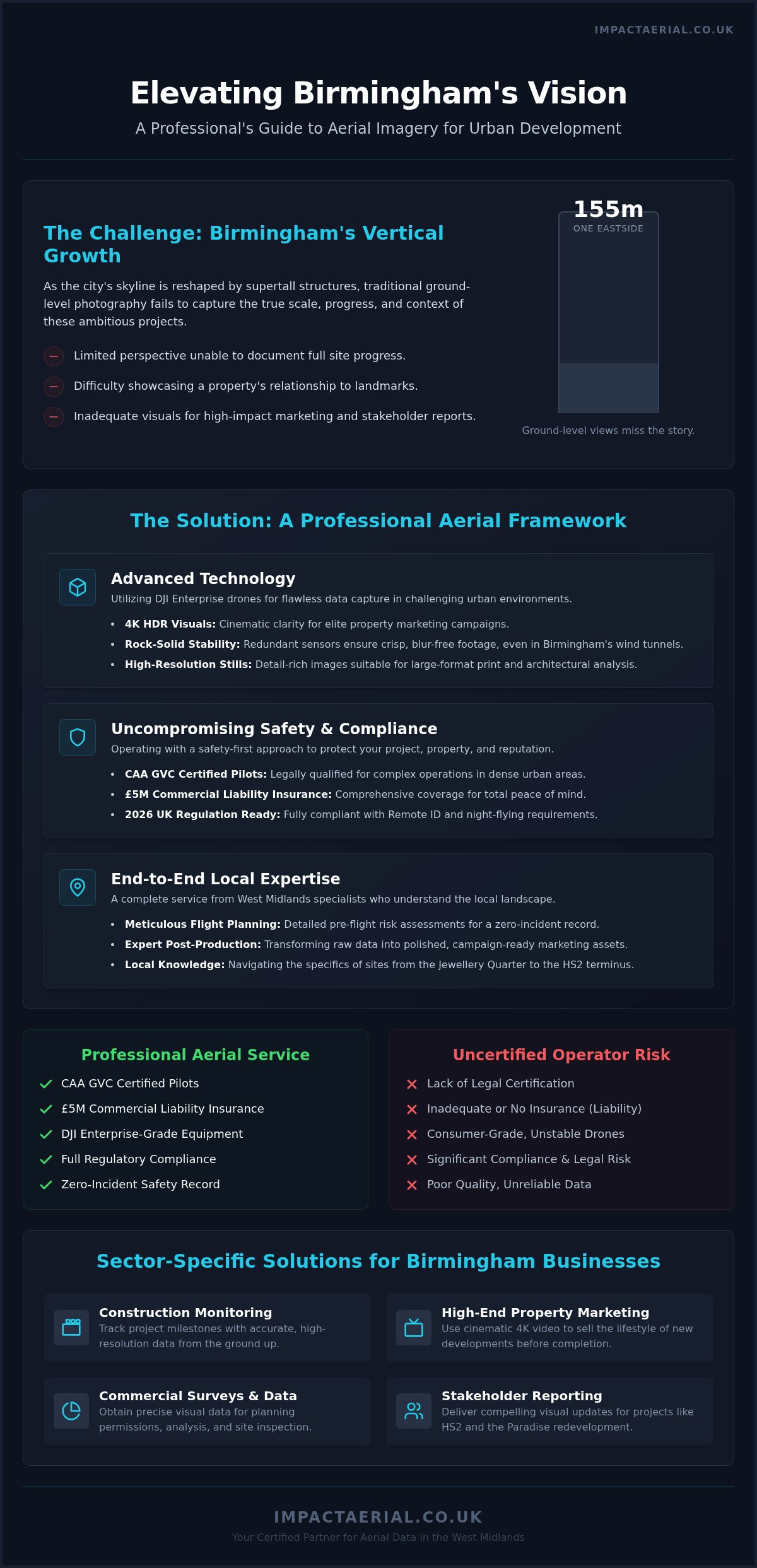
Safety and Compliance: Navigating Birmingham’s Airspace
Birmingham’s urban environment presents a dense network of obstacles, from the high-traffic corridors around Birmingham New Street to the strictly controlled airspace surrounding the international airport. Operating a drone here isn’t just about getting the shot; it’s about meticulous risk mitigation. Every flight we conduct follows the UK’s official Drone and Model Aircraft Code, ensuring that safety remains the primary objective. For commercial projects in the West Midlands, ignoring these protocols can lead to heavy fines and significant legal liabilities for both the operator and the client. Professional aerial photography services Birmingham require a deep understanding of these local restrictions to ensure every mission is legally sound.
Why GVC Certification is Non-Negotiable
As of 2026, the General Visual Line of Sight Certificate (GVC) is the essential standard for any pilot operating in the Specific Category, which covers most urban commercial missions. While some operators may still reference older PfCO standards, the GVC is the current benchmark for competency in congested areas. Our pilots have undergone rigorous assessments to prove their expertise in emergency procedures and airspace management. This qualification is a core requirement for a valid uk drone license for commercial work, providing the legal framework needed to fly near buildings and people that would otherwise be off-limits.
Privacy and GDPR compliance are equally critical when flying in high-density residential areas like the Jewellery Quarter or the newly developed Perry Barr. We employ strict data-handling protocols, including flight path planning that avoids residential windows and post-production techniques such as pixel blurring for sensitive information. This meticulous approach ensures your project documentation doesn’t inadvertently breach privacy laws or cause local friction.
The Value of £5m Liability Insurance
Corporate sites in Birmingham, particularly those involving major infrastructure or high-value real estate, require robust financial protection. Standard consumer insurance often falls short, providing limited coverage that doesn’t account for the specific complexities of a commercial construction site. We carry £5m commercial liability insurance as a standard provision. This high level of indemnity isn’t just a number; it’s a reassurance to your stakeholders that every potential risk, however unlikely, has been fully accounted for.
Our safety-first operational philosophy means we won’t fly if the conditions aren’t right. Whether it’s unpredictable wind speeds around the city’s “supertall” towers or potential GPS interference near heavy rail infrastructure, our pilots make informed decisions based on safety rather than just the project schedule. This reliability is why leading developers choose our aerial photography services Birmingham to protect their reputation and their site assets.
Sector-Specific Solutions for Birmingham Businesses
Birmingham’s diverse economy requires tailored aerial solutions. From the massive logistics hubs near the M6 to the retail density of the Bullring, our aerial photography services Birmingham provide the specific visual data needed for different commercial objectives. We don’t just capture images; we deliver sector-specific intelligence that helps project managers and marketing directors make informed decisions. Whether your focus is on the “Big City Plan” developments or infrastructure maintenance, our approach is always dictated by your specific project requirements.
Construction Site Monitoring and Progress
Construction projects in the West Midlands move at a rapid pace. We provide regular flight schedules that turn complex builds into manageable time-lapse documentation. This isn’t just for marketing; it allows project managers to track progress against milestones with high-resolution precision. By conducting remote inspections of roofs and high-level structures, we significantly reduce the need for scaffolding and risky manual checks. This improves site safety and lowers operational costs across the board. For a full breakdown of these capabilities, see our drone survey guide.
Property and Advertising Excellence
Marketing high-end real estate in Birmingham’s creative districts like Digbeth requires a specific aesthetic. We use DJI Enterprise drones to capture the “vibe” of these areas, providing unique perspectives for corporate advertising campaigns that ground-level cameras can’t achieve. Our 4K HDR visuals are designed for immediate use in professional listings, ensuring that office and retail spaces are presented with the prestige they deserve. Our virtual tour creation service provides an immersive marketing experience, allowing potential tenants to explore Birmingham’s new office developments from anywhere in the world. This is particularly effective for large-scale projects like the Beorma Quarter, where high-resolution 360-degree views can accelerate the leasing process.
Beyond visuals, we support the region’s green energy transition through specialised technical services. Our PV Solar Farm Thermal Surveys use calibrated sensors to detect cell defects that are invisible to the naked eye, ensuring maximum efficiency for renewable energy assets. This data-centric approach extends to infrastructure assessments, where we provide high-resolution mapping for Birmingham’s expanding transport network and HS2-related works. If your business needs accurate data or cinematic marketing assets, our team provides professional drone commercial property surveys and filming to elevate your next project.
Partnering with Impact Aerial: Your Local Birmingham Experts
Choosing the right partner for aerial photography services Birmingham involves more than just comparing technical specifications. It requires a specialist who understands the intricate geography of the West Midlands, from the restricted zones near Birmingham International Airport to the high-density construction sites in the city centre. We don’t just provide imagery; we offer a comprehensive technical partnership that manages every risk and captures every detail. Our local expertise ensures that we anticipate flight challenges before they impact your schedule, allowing for a seamless integration of drone data into your existing workflows.
The Impact Aerial Difference
Local knowledge is vital when navigating Birmingham’s unique flight restrictions. Our pilots are deeply familiar with the specific requirements for operating near major infrastructure like the M6 Spaghetti Junction and the city’s expanding rail networks. We combine this geographic intuition with enterprise-grade DJI technology to ensure that every mission is executed with clinical precision. Unlike many operators who simply deliver raw files, we provide a full post-production service. This means you receive marketing-ready assets that have been professionally colour-graded and edited to meet high-tier corporate standards.
Our £5m commercial liability insurance serves as a cornerstone of our professional reliability, providing stakeholders with total peace of mind during complex urban operations. This level of indemnity, combined with our CAA GVC certifications, reflects our deep commitment to quality and regulatory compliance. We maintain a meticulous approach to every project, ensuring that safety protocols are never compromised for the sake of a shot. This disciplined methodology is why leading firms across the West Midlands trust us to document their most significant developments.
Start Your Project Today
Beginning your aerial project with us is a straightforward, methodical process designed to provide maximum value from the initial consultation. We start by understanding your specific objectives, whether you require high-resolution progress monitoring for a construction site or cinematic 4K HDR footage for a high-end property listing. Our team then conducts a thorough site assessment and flight feasibility study, ensuring all regulatory permissions are secured well in advance of the shoot date.
During your first consultation, we’ll discuss the technical requirements of your project and provide a bespoke quote tailored to your needs. We believe in transparency and clear communication, guiding you through the operational plan so you know exactly what to expect on-site. Once the flight is complete, our post-production experts work to deliver your final assets in the formats best suited for your marketing or data analysis needs. If you’re ready to elevate your project with industry-leading visuals, Contact Impact Aerial for professional drone services today to discuss your requirements with our Birmingham-based team.
Future-Proofing Your Birmingham Development with Professional Aerial Insights
Birmingham’s transformation into a hub of supertall architecture and complex infrastructure requires a sophisticated approach to site documentation and marketing. As we’ve explored, the combination of DJI Enterprise 4K HDR technology and CAA GVC certified pilots is a fundamental requirement for operating safely within the city’s dense urban corridors. By prioritizing technical excellence and strict regulatory adherence, you ensure that your project’s visual assets are both stunning and fully compliant with current standards.
Securing a partner with deep West Midlands knowledge and £5m commercial liability insurance protects your site’s integrity. It delivers elite data for construction monitoring or property advertising. Investing in professional aerial photography services Birmingham allows you to capture the full scale of the city’s regeneration with absolute precision. Whether you’re documenting the foundations of a new residential tower or launching a high-impact marketing campaign, the right aerial perspective provides the clarity needed for commercial success.
Request a Professional Aerial Photography Quote for Birmingham to begin your consultation. We look forward to helping you elevate your next project.
Frequently Asked Questions
Do I need special permission for drone photography in Birmingham city centre?
Yes, operating within Birmingham’s dense urban centre often requires specific airspace permissions, especially when flying near the airport’s flight restriction zone or major rail infrastructure. Our team handles all necessary coordination with the Civil Aviation Authority and local air traffic control to ensure legal compliance. We perform detailed pre-flight site assessments to identify any temporary flight restrictions, ensuring your project proceeds without legal interruptions or safety risks.
What happens if it rains on the day of my aerial shoot?
Safety is our primary operational priority, so we don’t fly in active rain or high winds that exceed the technical limits of our DJI Enterprise drones. If the West Midlands weather proves unsuitable on your scheduled date, we simply move the shoot to the next available clear-weather window at no additional cost. We monitor specialized aviation forecasts 48 hours in advance to keep you updated on any potential scheduling adjustments.
How much does professional aerial photography in Birmingham cost?
The cost for professional aerial photography services Birmingham depends entirely on the specific requirements of your project, such as the location’s airspace complexity and the required flight duration. Factors like the type of data capture needed and the extent of post-production editing also influence the final quote. We provide bespoke pricing for every client to ensure you only pay for the specific expertise and equipment required for your Birmingham-based development.
Are your pilots CAA GVC certified for commercial work?
Every pilot at Impact Aerial holds the General Visual Line of Sight Certificate (GVC) issued by the Civil Aviation Authority. This certification is the modern industry standard for conducting commercial drone operations in congested urban environments like Birmingham. It demonstrates that our pilots have undergone rigorous practical and theoretical assessments, ensuring they possess the technical expertise required to manage complex flight paths while maintaining absolute safety and regulatory compliance.
Can you provide drone surveys for construction sites in the West Midlands?
We provide comprehensive construction site monitoring and data collection surveys across the entire West Midlands region. Our DJI Enterprise drones capture high-resolution 4K HDR visuals that allow project managers to track progress from foundations to completion with extreme precision. These surveys are essential for remote roof inspections and structural assessments, providing a safer and more cost-effective alternative to traditional scaffolding or manual site checks for large-scale developments.
How long does it take to receive the final edited photos and videos?
We typically deliver initial raw data or proofs within 24 to 48 hours of completing the flight. For projects requiring full post-production, such as cinematic marketing reels or colour-graded 4K HDR video, the final delivery usually occurs within five to seven working days. This timeline allows our editing team to meticulously process your assets, ensuring they meet the high-tier quality standards required for corporate presentations or advertising campaigns.
What is the benefit of £5m drone insurance for my project?
Carrying £5m commercial liability insurance provides essential financial protection and psychological comfort for your business and stakeholders. In the high-stakes environment of Birmingham’s urban construction and commercial sectors, this level of indemnity is often a mandatory requirement for site access. It ensures that your project is fully protected against unforeseen incidents, reflecting our commitment to professional reliability and a safety-first operational philosophy that standard consumer-grade insurance cannot match.
Do you offer post-production and colour grading for drone filming?
Our service includes comprehensive post-production and professional colour grading to ensure your aerial photography services Birmingham result in marketing-ready assets. We use advanced editing software to enhance the visual depth of our 4K HDR footage, tailoring the final look to match your brand’s specific aesthetic. Whether you need cinematic promotional videos for Digbeth developments or high-resolution stills for site hoardings, we manage the entire creative process from capture to final delivery.
Drone Zoom Inspection Services UK: High-Resolution Asset Analysis in 2026
Traditional scaffolding and cherry pickers are no longer the gold standard for structural surveys; they are often an unnecessary financial and safety burden. As we move through 2026, the industry is shifting toward precision stand-off tools that deliver microscopic detail without the proximity risk of traditional flights. Utilizing professional drone zoom inspection services UK wide allows asset managers to capture millimetre-accurate data from a safe distance. This approach eliminates the need for personnel to work at height while providing a level of visual clarity that was previously impossible from the ground.
It’s understandable if you’re skeptical about whether a remote camera can truly replace a physical hands-on inspection. You need to see hairline cracks, corroded bolts, or faded serial numbers to make informed maintenance decisions. This article explores how advanced DJI Enterprise hardware and CAA GVC certified pilots provide ultra-high-resolution inspection data that meets strict regulatory standards. We’ll preview the latest 2026 compliance requirements, the cost-saving benefits of reduced downtime, and how high-resolution zoom technology ensures your asset reporting remains fully insured and audit-ready.
Key Takeaways
- Learn how high-magnification optical sensors allow for detailed structural analysis without the risks associated with close-proximity flights or manual access.
- Discover how professional drone zoom inspection services UK wide provide millimetre-accurate visual data for identifying hairline cracks and serial numbers on critical infrastructure.
- Understand the specific advantages of zoom-led surveys for high-rise facade inspections and complex utility monitoring in the property and construction sectors.
- Identify the essential regulatory requirements for 2026, including the necessity of CAA GVC certification and comprehensive £5m commercial liability insurance for site safety.
- Explore the transition from raw aerial imagery to actionable reporting through professional post-production and consultative project management.
The Evolution of Industrial Asset Inspection in the UK
Industrial asset management has undergone a fundamental shift in how we approach structural integrity. For decades, inspecting high-rise facades or critical infrastructure meant weeks of logistical planning for scaffolding or rope access. By 2026, the reliance on these cumbersome methods has diminished as Unmanned Aerial Vehicles (UAVs) have reached a new level of operational maturity. 2026 represents a turning point where drone autonomy and sensor resolution have converged. Automated flight paths and AI-assisted zoom now allow for repeatable, high-precision data capture that was previously impossible. Professional drone zoom inspection services UK wide now offer a safer, more efficient alternative that meets the rigorous demands of modern engineering sign-offs.
Why Traditional Access is Becoming Obsolete
Traditional access methods involve heavy hidden costs that extend far beyond the initial hire quote. Scaffolding requires lengthy lead times, creates significant site disruption, and introduces the inherent risks of working at height. The UK Health and Safety Executive (HSE) prioritizes the elimination of hazards through its hierarchy of risk control. Drones fulfill this requirement by removing the human element from high-risk environments entirely. This transition lowers liability and can reduce insurance premiums for site owners. Deployment is now on-demand. Instead of waiting days for a cherry picker, a CAA GVC certified pilot can be on-site capturing data within hours. This agility reduces inspection downtime, allowing for a rapid response to suspected structural failures or routine maintenance checks without halting site operations.
The Role of High-Resolution Imagery in Modern Surveying
Modern surveying has moved beyond standard photography into the era of forensic-level data. The adoption of 4K HDR sensors on DJI Enterprise hardware allows for structural sign-offs that are as reliable as a physical “hands-on” inspection. These sensors capture microscopic details, such as hairline cracks or corroded fasteners, from a safe stand-off distance. This high-resolution output isn’t just a standalone file. It’s a vital component of digital twins and Building Information Modelling (BIM) models. In 2026, the integration of aerial data into these digital platforms allows for sophisticated predictive maintenance. Using drone zoom inspection services UK ensures that every pixel provides a clear, audit-ready trail of an asset’s condition. This data-centric approach provides a level of precision that traditional “naked eye” inspections simply cannot match, especially when dealing with hard-to-reach areas of a property or construction site.
Understanding Drone Zoom Technology: Precision from a Distance
Drone zoom technology is a specialized field within aerial surveying that prioritizes stand-off capabilities. This method utilizes high-magnification optical sensors to capture minute details from a distance, rather than flying the aircraft within centimeters of an asset. This Safe Distance principle is critical when inspecting sensitive infrastructure like live telecommunications towers or fragile historic masonry where proximity introduces unnecessary turbulence or collision risk. Professional drone zoom inspection services UK providers use these advanced optics to maintain a secure flight path while delivering millimetre-accurate visual data.
Maintaining a steady shot at high magnification is a significant technical challenge. Professional-grade gimbals use three-axis stabilization to counteract wind gusts and vibration, ensuring that even at maximum zoom, the image remains rock-steady. Without this mechanical precision, high-magnification shots would be too blurred for professional reporting. Using commercial-grade DJI Enterprise drones ensures that every frame of your survey is usable data for your structural engineers.
Optical vs. Digital Zoom for Inspections
For structural sign-offs, the distinction between optical and digital zoom is vital. Digital zoom essentially crops and enlarges an image, which often leads to pixelation and the loss of critical detail like hairline cracks. Optical zoom uses the physical movement of lens elements to increase magnification, maintaining full 4K resolution at significant distances. In the context of the UK’s Drone and Model Aircraft Code, stand-off distance refers to the safety buffer maintained between the aircraft and an object to ensure operational safety while complying with legal separation requirements. High-quality optical sensors ensure that even at 30x magnification, the imagery remains sharp enough for forensic engineering analysis.
Hardware Focus: DJI Enterprise Capabilities
The deployment of DJI Enterprise hardware has redefined the possibilities of portable zoom inspections. The DJI Mavic 3 Enterprise series, for example, offers a 56x hybrid zoom capability that allows pilots to identify defects from over 50 meters away. For more complex utility and solar assets, the DJI Matrice 30T provides dual-sensor capabilities, combining a 16x optical zoom with high-resolution thermal imaging. This allows for the simultaneous detection of structural cracks and thermal anomalies like hot spots in PV panels. These drones also feature integrated laser range finders, which are essential for repeatability. By recording the exact distance and coordinates of a defect, surveyors can return months later to monitor the same point for signs of degradation. If you’re managing a large portfolio of assets, our drone commercial property surveys provide the technical precision needed for long-term monitoring.
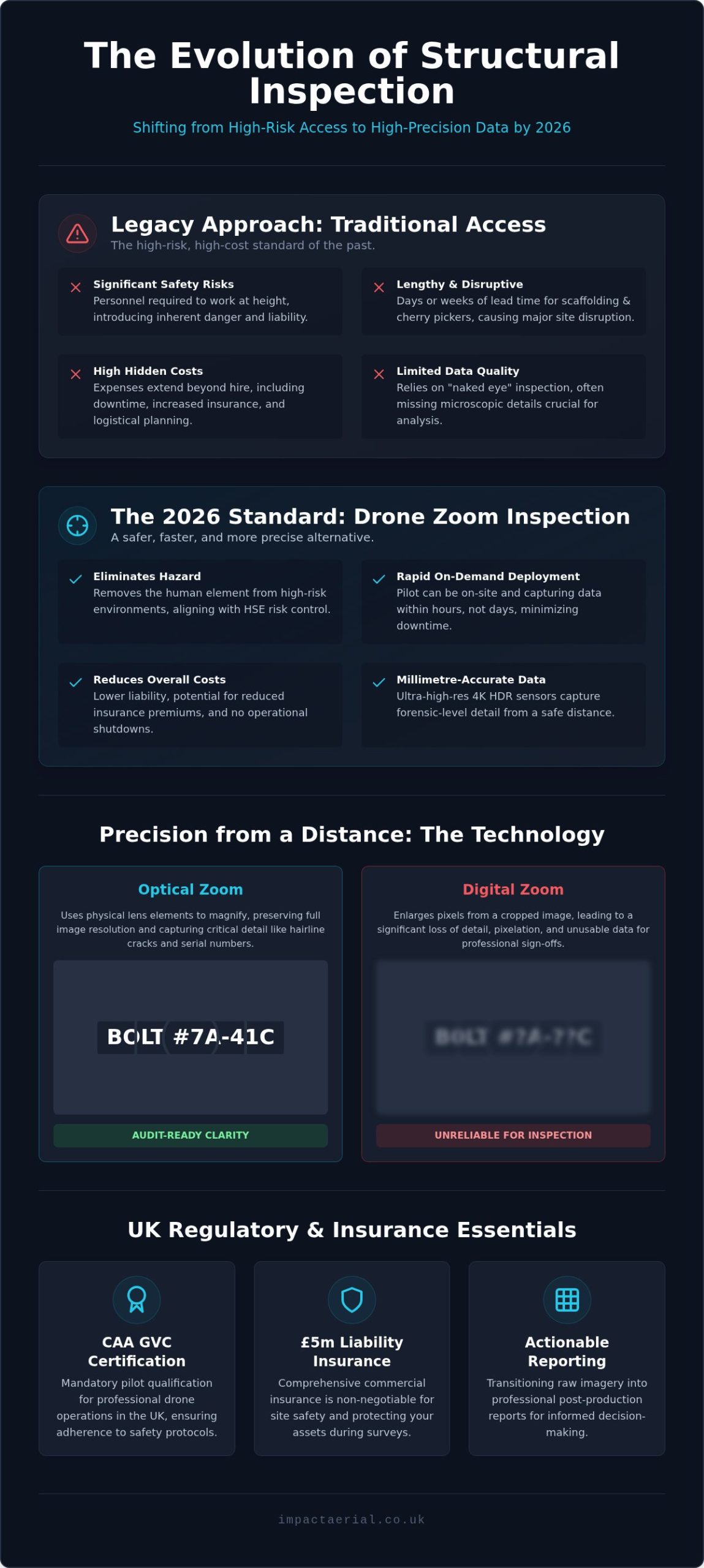
Key Applications: Where Zoom Inspections Deliver Maximum Value
High-magnification sensors have transformed how we assess vertical and high-value assets. In high-rise facade inspections, drone zoom inspection services UK wide allow for the identification of loose masonry and seal failures that are invisible to the naked eye. This forensic level of detail is equally critical for infrastructure monitoring. Bridges, pylons, and cell towers require regular structural checks to ensure public safety and operational continuity. By using optical zoom, we can verify the condition of rivets, bolts, and insulators without needing to climb or power down high-voltage equipment.
Solar farm maintenance is another area where high-resolution zoom provides a significant competitive edge. While thermal imaging identifies heat signatures, visual zoom is necessary to spot physical micro-cracks or debris on PV panels that could lead to long-term degradation. All operations are conducted in strict accordance with UK Civil Aviation Authority (CAA) regulations, ensuring that data collection is both legal and safe. This meticulous approach to data capture ensures that every survey meets the high standards required for engineering sign-offs and long-term asset management.
Commercial Property & Roof Surveys
Roof inspections often present the highest risk and cost for property managers. Using high-resolution zoom, we can identify “dead” gutters, blocked drainage points, and minor roof leaks without the need for risky roof walking. This provides insurance-grade documentation that is essential for property transactions and dilapidation claims. Our comprehensive drone property surveys bridge the gap between raw aerial imagery and professional structural reporting, giving stakeholders the clarity needed for capital expenditure planning. It’s a reliable way to get eyes on an asset without the setup time of traditional access.
Construction Site Monitoring & Safety
On active construction sites, verifying the integrity of welds and fixings at height is a constant challenge. High-magnification drones allow for real-time verification of structural integrity during the build phase. This capability significantly reduces the need for site-wide shutdowns or the deployment of heavy access machinery. Integrating construction site monitoring into your project management workflow ensures that quality control is maintained without compromising the build schedule. It’s about providing actionable data that keeps the project moving safely and on budget.
Why Safety & Certification are Non-Negotiable in the UK
Operating a drone for industrial purposes is a highly regulated professional service that requires significantly more than basic flight skills. In the complex environments of construction and infrastructure, safety is the primary metric of success. Professional drone zoom inspection services UK providers must adhere to strict operational limits to protect people, property, and the integrity of the data collected. This begins with a thorough understanding of the legal framework and ends with a meticulous approach to every flight, ensuring that all risks are identified and mitigated before the aircraft leaves the ground.
The Importance of CAA GVC Certification
The General Visual Line of Sight Certificate (GVC) is the professional standard for commercial drone pilots in the UK. Unlike hobbyist flyers or those operating under basic authorizations, GVC certified pilots have undergone rigorous theoretical and practical assessments approved by the Civil Aviation Authority. This certification is essential for operating in the “Specific Category,” allowing for complex missions in congested areas or near sensitive infrastructure. Professional pilots are trained to manage complicated airspace, coordinating with Air Traffic Control when working near airports or within restricted city centres. Understanding the nuances of a UK drone license ensures that your project remains fully compliant with 2026 aviation laws, avoiding the heavy fines and legal liabilities associated with unauthorized flights.
Insurance & Risk Mitigation
For any industrial or commercial site, standard public liability insurance is insufficient. Professional drone operators carry specialist commercial UAV insurance that complies with EC 785/2004 requirements. We maintain £5m in commercial liability insurance as a baseline for all UK operations, providing the financial protection necessary for high-value asset inspections. Beyond financial coverage, our risk mitigation strategies include strict hardware failure protocols and pre-flight “fly-away” risk assessments. Impact Aerial provides site managers with the peace of mind that every flight is backed by meticulous planning, comprehensive insurance, and a total commitment to zero-incident operations. This disciplined approach ensures that our presence on your site is a benefit, not a liability.
Data protection is a critical yet often overlooked component of aerial surveying. Handling high-resolution imagery of public spaces or private assets requires strict adherence to GDPR and data privacy laws. We conduct Privacy Impact Assessments for every project, ensuring that any captured identifiable data is handled, stored, and deleted according to legal requirements. If you require a safety-first partner for your next structural survey, book our professional drone services to ensure your project is handled with the highest level of technical and legal expertise.
Partnering with Impact Aerial for Your UK Inspection Projects
Partnering with a specialist for drone zoom inspection services UK ensures that your structural data is captured and managed with technical precision from inception to delivery. Impact Aerial operates as a technical consultant rather than a simple flight agency. We understand that high-resolution imagery is only valuable if it’s actionable, compliant, and integrated into your existing maintenance workflows. Our team handles the entire project lifecycle, providing a seamless transition from raw aerial data to professional engineering reports that stand up to audit and insurance scrutiny.
Our consultative approach begins with a deep understanding of your specific asset requirements. We don’t just provide a pilot; we provide a full project management team that prioritizes safety and data integrity. This meticulousness is what sets us apart in the expanding market for drone zoom inspection services UK. By focusing on high-tier quality and adherence to strict professional standards, we ensure that every pixel of data we deliver serves a clear business purpose for your stakeholders.
The Impact Aerial Workflow
Our methodical approach ensures that every project meets our high standards for safety and precision. We follow a structured three-step process designed to minimize risk and maximize data quality:
- Step 1: Desktop Feasibility and Airspace Check: Before any hardware is deployed, we conduct a comprehensive analysis of the site. This includes checking for airspace restrictions, identifying ground hazards, and ensuring all operations will be fully compliant with CAA regulations and local bylaws.
- Step 2: On-site Execution: Using commercial-grade DJI Enterprise hardware, our pilots capture high-magnification optical data from safe stand-off distances. This phase is conducted with minimal site disruption, allowing your operations to continue while we gather forensic-level imagery.
- Step 3: Data Processing and Secure Delivery: Raw 4K HDR imagery is processed through our professional post-production suite. We turn high-resolution files into organized, actionable reports that highlight specific defects like hairline cracks or corrosion, ensuring your team has the clarity they need for structural sign-offs.
Ready to Elevate Your Inspections?
Based in our Birmingham hub, Impact Aerial is perfectly positioned to serve the West Midlands and provide rapid deployment across the entire UK. Our central location allows us to reach major infrastructure and construction hubs efficiently, ensuring your inspection timelines are met without delay. We offer bespoke quotes tailored to the technical requirements of your asset, whether you manage a single commercial property or a national portfolio of utility sites. Our commitment to reliability and compliance provides the reassurance that your assets are in safe, expert hands. Request a professional drone zoom inspection from Impact Aerial to secure the high-resolution data your project demands.
Securing the Future of Your Industrial Assets
The transition to high-resolution aerial data marks a definitive end to the era of expensive, high-risk manual access. By leveraging drone zoom inspection services UK wide, asset managers can now obtain millimetre-accurate visual data without the logistical burden of scaffolding or site shutdowns. We’ve explored how advanced optical sensors and stabilized gimbals deliver forensic-level clarity from a safe distance; this ensures that your structural sign-offs are backed by undeniable evidence. Compliance remains the cornerstone of professional operations, with 2026 regulations demanding a meticulous approach to airspace and data privacy.
Impact Aerial is ready to support your next project with our team of CAA GVC Certified Pilots, £5m Commercial Liability Insurance, and the latest DJI Enterprise Hardware. We handle everything from desktop feasibility to high-end post-production, turning raw imagery into actionable intelligence. Book a Professional Drone Zoom Inspection with Impact Aerial to ensure your assets are monitored with technical excellence and total regulatory peace of mind. We look forward to helping you elevate your site safety and data precision.
Frequently Asked Questions
What is the maximum zoom range for a professional inspection drone?
Professional inspection drones like the DJI Matrice 30T offer a 16x optical zoom and up to 200x digital magnification. The compact DJI Mavic 3 Enterprise features a 56x hybrid zoom capability. These ranges allow pilots to capture high-resolution data from a safe stand-off distance. Using such advanced hardware ensures that fine details are visible without flying the aircraft dangerously close to sensitive infrastructure or high-voltage equipment.
Can drone zoom inspections identify hairline cracks in concrete?
Yes, drone zoom inspection services UK providers use 4K HDR sensors and high-magnification optical lenses to detect hairline cracks as small as a millimetre. The stability provided by three-axis gimbals on DJI Enterprise hardware ensures that these images are sharp and forensic in quality. This level of detail is essential for structural engineers who need to sign off on the integrity of bridges, facades, or industrial chimneys without manual rope access.
Is a drone inspection legal in a congested UK city centre?
Drone inspections in UK city centres are legal when conducted by CAA GVC certified pilots who adhere to strict safety protocols. These operations require detailed flight planning and risk assessments to manage complex airspace and public safety. Impact Aerial pilots are trained to coordinate with local authorities and Air Traffic Control where necessary. Holding £5m commercial liability insurance is a standard requirement for operating in these high-density urban environments.
How much does a drone zoom inspection service cost in the UK?
The cost of a professional drone survey depends on the project’s complexity, site location, and the specific data requirements. Factors such as the need for specialized sensors, the duration of the flight, and the depth of post-production reporting all influence the final quote. We provide bespoke pricing based on a technical consultation to ensure the service matches your asset’s needs. This tailored approach guarantees you receive the most efficient and cost-effective data collection strategy.
Do I need to be present on-site during the drone inspection?
You don’t need to be present on-site during the inspection. Our pilots handle all aspects of the flight, from the initial airspace check to the final data capture. However, having a site representative available can be beneficial for providing access to specific areas or clarifying survey priorities. We provide full project management and can deliver the final high-resolution reports and imagery through secure digital platforms once the survey and post-production are complete.
What kind of report will I receive after the drone survey?
After a drone zoom inspection services UK survey, you’ll receive a comprehensive data package. This typically includes high-resolution 4K HDR imagery, stabilized video footage, and a detailed inspection report. Our post-production team processes raw data to highlight specific defects or areas of concern. These reports are designed to be actionable for structural engineers and property managers, often integrating directly into digital twins or Building Information Modelling (BIM) systems for long-term tracking.
Can drones perform zoom inspections in wet or windy weather?
Modern enterprise drones like the DJI Matrice 30T have an IP55 rating, which allows them to operate in light rain and dusty conditions. However, high winds can affect the stability of zoom shots and overall flight safety. We monitor weather forecasts closely and will reschedule a flight if conditions exceed the safe operating limits of the aircraft. Prioritizing safety ensures that the data collected is of the highest quality and that the mission remains fully insured.
How does zoom technology improve safety for solar farm inspections?
Zoom technology allows pilots to inspect PV panels from a significant height or distance, removing the risk of the drone colliding with sensitive equipment. By using high-magnification sensors, we can spot physical micro-cracks or debris without flying low over the arrays. This stand-off capability is particularly effective when combined with thermal sensors to identify hot spots. It ensures a comprehensive survey of the solar farm while maintaining a safe operating buffer from the ground and infrastructure.
Construction Drone Services Birmingham: The 2026 Site Manager’s Guide
By 2026, approximately 64% of UK construction firms with over 50 employees have integrated drones into their daily operations to stay competitive. If you’re managing a major project in the West Midlands, you already know that the traditional costs of scaffolding for simple inspections and the inherent safety risks of manual site surveys are becoming unsustainable. Utilizing professional construction drone services Birmingham is no longer a luxury; it’s a critical safety and compliance infrastructure for the city’s current development surge.
We understand that your primary focus is keeping projects on track while meeting rigorous safety standards. This guide will show you how to leverage drone technology to secure high-resolution progress reports and accurate volumetric data for earthworks without the overhead of manual methods. We’ll preview the essential 2026 regulatory landscape, including mandatory Remote ID and UK class marks, while explaining how CAA GVC certified pilots with £5m commercial liability insurance ensure your site remains fully compliant in complex urban environments.
Key Takeaways
- Understand how professional construction drone services Birmingham provide high-resolution orthomosaic mapping and real-time monitoring to replace expensive scaffolding and manual inspections.
- Learn why CAA GVC certification and £5m commercial liability insurance are mandatory for navigating complex urban flight paths and Birmingham Airport (BHX) airspace restrictions.
- Discover the efficiency gains of UAV technology, which can map a 10-acre site in hours rather than days, providing precise volumetric data for earthworks.
- Explore the role of DJI Enterprise 4K HDR hardware in delivering precision data that integrates directly with project timelines and site management software.
- Gain insights into the 2026 Birmingham skyline transformation and how local specialists tailor flight plans to meet specific regional infrastructure requirements.
The Evolution of Construction Drone Services in Birmingham
Construction drone services Birmingham have transitioned from simple aerial photography to a sophisticated data ecosystem. In 2026, the city’s skyline is undergoing a massive transformation. Major infrastructure projects like the Big City Plan and the continued evolution of Curzon Street require a level of oversight that ground-based teams can’t provide alone. Site managers no longer view Unmanned Aerial Vehicles (UAVs) as optional gadgets. They’re essential instruments for precision surveying, reporting, and long-term asset management.
Traditional site monitoring is becoming obsolete in dense urban environments. Manual surveys often involve high costs and safety risks, especially when inspecting vertical structures or sprawling earthworks. By integrating drone applications in construction, project leads capture high-resolution data that traditional scaffolding simply can’t reach. This shift ensures every inch of a Birmingham development is documented with mathematical accuracy, providing a digital twin of the physical site that updates in real-time.
To see how these aerial perspectives are currently supporting major local infrastructure, watch this continuous overflight of the HS2 Birmingham route:
The Role of Drones in Modern Site Management
Drones provide a “single source of truth” for site conditions, which is vital for managing complex relationships with stakeholders and investors. Real-time tracking allows managers to document project timelines with visual evidence that isn’t up for debate. This data-centric approach offers several advantages:
- Investor Transparency: Share 4K HDR progress videos that prove milestones are met on schedule.
- Risk Mitigation: Reduce hazardous manual inspections at height, protecting your workforce from unnecessary danger.
- Data Integration: Overlay drone maps with BIM designs to spot structural discrepancies before they become expensive errors.
Why Local Expertise Matters in the West Midlands
Operating in the West Midlands requires a deep understanding of its specific development zones. From the historic Jewellery Quarter to the industrial sprawl of Digbeth, every site has unique flight constraints and safety protocols. Having a pilot based in the West Midlands allows for rapid deployment of construction drone services Birmingham when weather windows open. Impact Aerial brings this local expertise to every project, combining DJI Enterprise hardware with a meticulous approach to CAA GVC compliance. Our team carries £5m commercial liability insurance as standard, which is a non-negotiable requirement for major construction contracts in central Birmingham. We don’t just fly; we provide a technical consultancy that understands the regional property sector’s demands.
Key Applications: From Site Monitoring to Technical Surveys
Professional construction drone services Birmingham provide a dual benefit by delivering both high-precision engineering data and high-impact marketing assets. In 2026, site managers use these tools to replace fragmented reporting with a unified digital record. Weekly or monthly site monitoring sessions create a chronological visual log, which is essential for settling contractor disputes or documenting progress for insurance purposes. This methodical approach ensures that every phase of the build, from initial groundworks to the final “topping out,” is recorded with consistent accuracy.
Technical surveys have evolved significantly through the use of high-resolution orthomosaic mapping. By capturing hundreds of overlapping images, we create 2D site overviews where every pixel is georeferenced. This allows for precise volumetric analysis of earthworks and stockpile management. Instead of waiting days for manual calculations, managers receive volume data in hours. This efficiency is supported by academic research on construction drones, which highlights how photogrammetry and 3D modeling reduce errors in large-scale infrastructure projects. We also deploy thermal sensors to conduct building fabric inspections and PV solar farm surveys, identifying heat leaks or faulty cells that are invisible to the naked eye. To complement these aerial insights, many projects also require detailed subterranean data; for example, Drainamic Ltd provides professional CCTV drain surveys and MSCC5-coded reporting to ensure that below-ground infrastructure is as well-documented as the skyline.
Capturing survey-grade data requires specialized hardware and a meticulous flight plan. We utilize DJI Enterprise drones to ensure high-precision data capture that integrates seamlessly into existing BIM and CAD workflows. This compatibility allows site engineers to overlay current aerial data onto original designs to detect structural deviations early. By providing a “digital twin” of the West Midlands site, we help teams maintain the rigorous standards required for modern urban development. If you need to verify site conditions against your project timeline, our construction site monitoring services offer a reliable, data-centric solution.
Marketing and Stakeholder Visuals
While the technical data drives the build, 4K HDR cinematic filming drives the business. High-end visuals are vital for investor relations and public consultations. We produce immersive virtual tours that allow potential buyers to explore off-plan properties before the first brick is laid. This level of detail builds confidence and accelerates sales cycles. Many firms now view professional drone photography as a primary tool for stakeholder engagement, turning a complex construction site into a compelling narrative for future residents and commercial tenants.
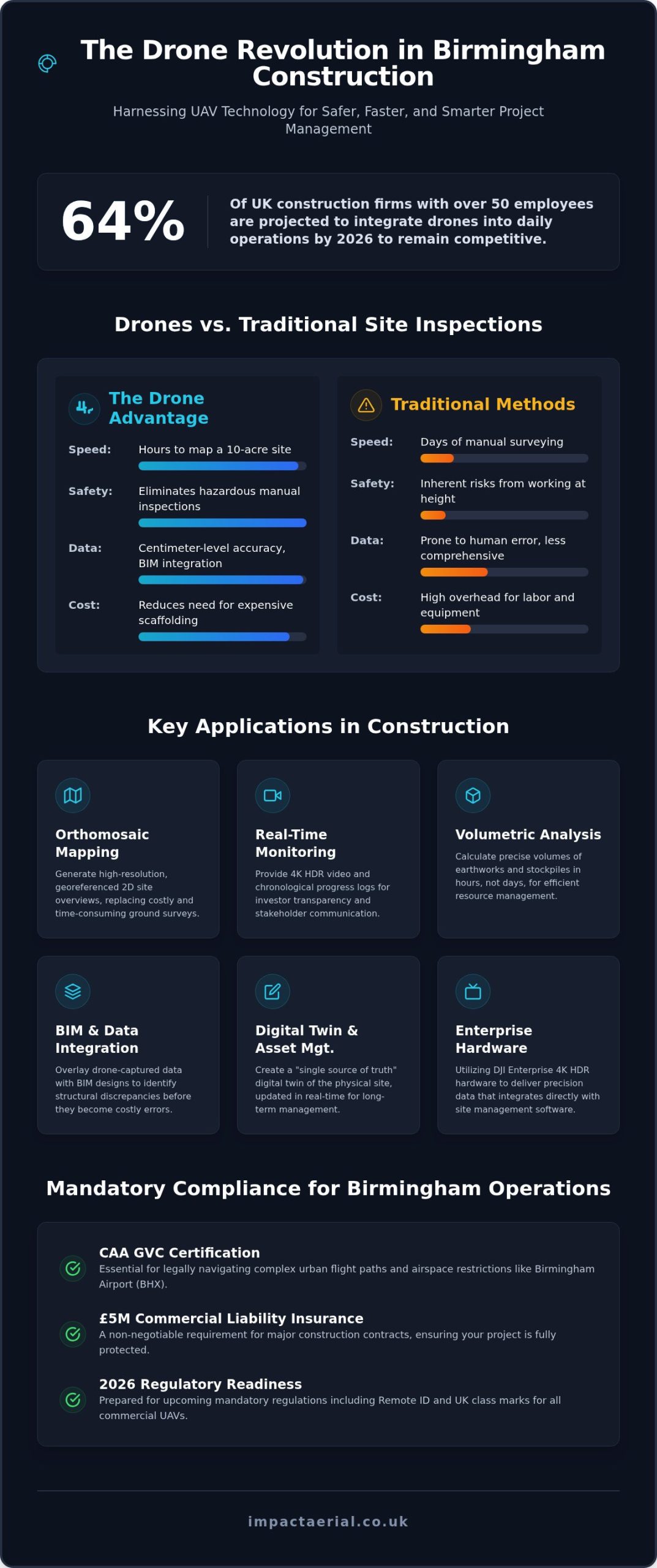
Safety, Compliance, and Birmingham Airspace Regulations
Operating a drone in an urban environment requires more than technical skill; it demands a deep understanding of the Civil Aviation Authority (CAA) framework. Birmingham’s airspace is particularly complex due to the Flight Restriction Zone (FRZ) surrounding Birmingham Airport (BHX). Any construction drone services Birmingham operating in Sheldon, Solihull, or central development zones must secure specific permissions from Air Traffic Control. Impact Aerial manages these logistics through established protocols, ensuring every flight is authorized and logged before the rotors even spin.
Tier 1 contractors and large-scale developers require a level of professional indemnity and public liability that hobbyists cannot provide. Impact Aerial carries £5m commercial liability insurance as a standard, meeting the rigorous procurement requirements of major West Midlands projects. This insurance, combined with our GVC certification, provides the reassurance that all liabilities are managed. We conduct exhaustive site-specific risk assessments (RAMS) for every deployment, covering everything from local bird populations to nearby power lines and high-rise structures.
Understanding UK Drone Laws in 2026
The regulatory environment has matured significantly. By 2026, the transition from the A2 CofC to the GVC (General Visual Line of Sight Certificate) has become the standard for commercial pilots working on major infrastructure. New hardware now carries mandatory UK class marks, and Remote ID is a legal requirement for almost all commercial flights. Operating in “Congested Areas” like the Birmingham city centre involves strict legal mandates regarding distances from uninvolved people. You can find more detail on these specific requirements in our drone license guide.
Risk Mitigation on Active Construction Sites
Managing an active site involves constant movement, making coordination between the pilot and the site manager essential. We establish clear take-off and landing zones that remain isolated from plant machinery and heavy traffic. Urban environments present unique technical challenges, such as electromagnetic interference from steel-framed buildings. We mitigate this by using enterprise-grade hardware with redundant signal systems. Our flight operations are also dictated by strict weather criteria. We don’t fly if wind gusts exceed 22mph or if precipitation threatens the integrity of the data. This safety-first culture ensures that our presence on your site never adds to your risk register.
Comparing Drone Surveys to Traditional Site Inspections
For decades, site managers across the West Midlands relied on physical access for inspections. Scaffolding, cherry pickers, and rope access teams were the standard. These methods are notoriously slow and carry high operational costs. Utilizing professional construction drone services Birmingham provides a leaner, more agile alternative. A drone can inspect a facade or a high-reach structural element in minutes; scaffolding can take days to erect and dismantle. This transition isn’t just about speed. It’s about the safety ROI. By drastically reducing “Man-at-Risk” hours, projects lower their overall risk profile and insurance liabilities.
The ROI of Aerial Site Monitoring
The financial return on drone technology extends well beyond the initial survey day. High-resolution aerial evidence is a definitive tool for dispute resolution. If a subcontractor claims work is complete or a milestone is met, you have dated visual proof to verify the claim immediately. Identifying construction defects early is another significant cost-saver. Spotting a building fabric leak or a structural alignment issue during the early phases prevents expensive rework during the final stages. You can explore more about the drone survey benefits for long-term asset management to see how this data persists throughout the building’s lifecycle.
Integration with Modern Construction Tech
In 2026, drone data is no longer a standalone asset. It integrates directly into your existing digital ecosystem. Scan-to-BIM workflows utilize aerial photogrammetry to create high-fidelity Digital Twins of the site. These models allow remote stakeholders to conduct virtual walkthroughs from any location, reducing the need for frequent site visits. Health and safety audits also gain an objective layer of oversight. Aerial imagery provides a clear record of site cleanliness, material storage, and PPE compliance. It’s an essential component of a transparent, data-driven site management strategy. To see how these surveys can be tailored to your specific project goals, consult with the specialists at Impact Aerial.
Partnering with Impact Aerial for Your Birmingham Project
Choosing the right provider for construction drone services Birmingham involves more than just selecting a pilot. It requires a partner who understands the high-stakes nature of West Midlands development. Our approach is strictly consultation-led. We start by identifying your specific site goals, whether that’s verifying earthworks volumes or creating high-end marketing films for stakeholders. This ensures every flight plan is tailored to deliver maximum value without redundant data capture. We don’t just fly; we act as technical consultants to ensure the data you receive is fit for purpose.
We rely on DJI Enterprise hardware for all our construction deployments. These systems are designed for reliability in demanding urban environments, offering 4K HDR visual clarity and the signal redundancy needed for precise mapping. The work doesn’t end when the drone lands. Our post-production team processes the raw data into actionable reports, georeferenced maps, or professionally edited films ready for investor presentations. This end-to-end service ensures you receive high-tier quality from the initial briefing to the final delivery, backed by the reassurance of our £5m commercial liability insurance.
Our End-to-End Project Management
We manage every aspect of the aerial operation so your site team can stay focused on the build. Our meticulous management process includes:
- Initial Assessment: We handle all necessary airspace clearances, including formal coordination with Birmingham Airport (BHX) for sites within the Flight Restriction Zone.
- On-Site Execution: Our pilots are CAA GVC certified and operate with minimal disruption to your ground crews, adhering to strict site-specific RAMS.
- Secure Delivery: Data is delivered via secure portals in your required formats, ensuring seamless integration with your existing BIM or CAD workflows.
Get a Quote for Your West Midlands Site
Pricing for our services is transparent and project-specific. Several factors influence the final cost, including the total acreage of the site, the frequency of monitoring visits, and the complexity of the local airspace. We offer flexible options, ranging from one-off structural inspections to long-term monitoring contracts that cover the entire project lifecycle. This flexibility allows us to support both niche developments and major infrastructure projects across the region.
If you’re looking for more details on industry standards and what to expect from a specialist operator, read our professional drone services guide. To initiate a survey on your Birmingham site, contact our team to discuss your requirements and receive a tailored quote. We’re ready to provide the precision data and visual oversight your project demands.
Securing Your Project’s Future with Precision Data
The 2026 development landscape in the West Midlands demands a level of data precision and operational safety that traditional methods can’t provide. By integrating construction drone services Birmingham into your project workflow, you replace expensive scaffolding and manual spot checks with high-resolution mapping and real-time monitoring. This transition doesn’t just save time; it provides a definitive digital record that protects your business from disputes and identifies defects before they become costly liabilities.
Partnering with a specialist ensures that your site remains fully compliant with evolving CAA regulations and complex airspace restrictions around Birmingham Airport. Our team brings expert West Midlands knowledge, CAA GVC certified pilots, and £5m public liability insurance to every contract, offering the reliability Tier 1 contractors expect. Whether you need a one-off inspection or a long-term monitoring partner, we provide the technical expertise to keep your project moving forward safely and efficiently.
Ready to transform your site oversight with industry-leading aerial technology? Request a Professional Drone Service Quote for Your Birmingham Project and let’s discuss your specific site goals. We look forward to supporting your next build with the precision it deserves.
Frequently Asked Questions
Do I need special permission to use a drone on my Birmingham construction site?
Yes, you must grant permission as the landowner or site manager, while the pilot manages all regulatory authorizations. For construction drone services Birmingham, this involves checking the CAA’s interactive maps and coordinating with local authorities if the site is in a restricted zone. Professional operators handle the risk assessments and flight notifications, ensuring your project remains compliant with the latest 2026 drone safety standards.
How much do construction drone services cost in Birmingham?
The cost of drone services varies based on the complexity of the site and the specific data outputs required. Factors such as the frequency of site monitoring visits, the need for technical mapping, and the post-production requirements for stakeholder videos all influence the final quote. We provide tailored pricing for both one-off structural inspections and long-term asset management contracts to ensure you only pay for the data you need.
Can drones fly in central Birmingham near the airport?
Drones can operate in central Birmingham and areas near the airport, provided the pilot secures permission from Air Traffic Control (ATC). Sites within the Flight Restriction Zone (FRZ) require formal coordination and a specific flight window. Our GVC certified pilots are experienced in managing these complex logistics, ensuring that your project’s aerial surveys are conducted legally and safely within the busy West Midlands airspace.
What data formats do you provide for construction surveys?
We provide data in various industry-standard formats to ensure seamless integration with your existing workflows. For mapping and surveying, this typically includes:
- GeoTIFF and orthomosaic maps for 2D overviews
- OBJ or LAS files for 3D modeling and point clouds
- High-resolution JPEG images and 4K HDR MP4 video files
These formats are compatible with most major BIM and CAD software platforms used in modern construction.
How quickly can you deploy a drone pilot to a West Midlands site?
Our base in the West Midlands allows for rapid deployment to sites across Birmingham. We can often be on-site within 24 to 48 hours, depending on the complexity of the required airspace clearances. Early consultation is always recommended for sites near the airport or in restricted urban zones; these require additional time for formal authorizations from the Civil Aviation Authority or local ATC.
What happens if the weather is bad on the day of the flight?
Safety is our primary concern, so we don’t operate if the weather conditions exceed our strict safety thresholds. We typically don’t fly in heavy rain or if wind gusts exceed 22mph; this can compromise both safety and data accuracy. If a flight is postponed due to weather, we work closely with your site manager to reschedule the operation for the earliest possible safe window.
Is £5m insurance enough for a major UK construction project?
Yes, £5m commercial liability insurance is the standard requirement for most Tier 1 contractors and major UK construction projects. This level of coverage provides the necessary reassurance for operating in high-density urban environments. It protects all stakeholders against unforeseen incidents and is a non-negotiable proof point for any professional drone operator working on significant regional infrastructure or commercial property developments.
Can drones assist with BREEAM or environmental assessments?
Drones are increasingly used to support environmental assessments and BREEAM certifications. Our thermal surveys identify heat loss through the building fabric, while high-resolution mapping helps document land use and biodiversity metrics. These data-driven insights allow site managers to prove compliance with environmental standards and optimize the energy efficiency of new builds, providing clear evidence for sustainability audits and long-term project reporting.
Drone Topographic Survey UK: The Professional Guide to Aerial Mapping 2026
Did you know that 64% of UK construction firms with 50 or more employees have already integrated aerial technology into their site surveying workflows? It’s a clear signal that the industry is moving away from the limitations of traditional methods. You’ve likely experienced the common frustrations of ground-based surveying: the slow turnaround times, the high costs, and the genuine safety risks involved in sending personnel onto hazardous or uneven terrain. Relying on inconsistent data from uncertified operators can jeopardize your entire project timeline and budget.
This professional guide explores how a precision drone topographic survey UK provides a faster, safer, and more accurate data solution for your 2026 property and construction projects. We’ll show you how to leverage CAA GVC certified expertise and DJI Enterprise hardware to produce high-resolution 3D models and CAD drawings that meet strict RICS standards. From navigating the 2026 CAA registration thresholds to choosing between photogrammetry and LiDAR, you’ll learn how to secure reliable site intelligence while maintaining full regulatory compliance and operational safety.
Key Takeaways
- Learn the technical distinctions between photogrammetry for high-resolution 3D models and LiDAR for capturing ground-level data through dense vegetation.
- Discover how to achieve centimetre-level relative and absolute accuracy for your site data using Ground Control Points and RTK technology.
- Understand the essential regulatory requirements for a drone topographic survey UK, including the necessity of CAA GVC certified pilots and comprehensive liability insurance.
- Identify why choosing a technical consultant with DJI Enterprise hardware provides superior data quality and safety compared to standard commercial drone operators.
Understanding Drone Topographic Surveys in the UK Construction Sector
A professional drone topographic survey UK is no longer a luxury reserved for high-budget infrastructure projects; it’s a foundational requirement for modern site management. At its core, drone topography involves the systematic capture of georeferenced data points to create a precise digital twin of a landscape. Unlike standard aerial photography, these surveys utilize high-precision sensors to record X, Y, and Z coordinates, allowing for the creation of detailed 3D models and contour maps. This technical approach ensures that every change in elevation and every physical feature is documented with centimetre-level accuracy.
The UK construction industry is currently undergoing a rapid digital transformation, with 64% of firms employing 50 or more people now utilizing drones for site surveys. This shift is largely driven by the principles of Digital Value Engineering (DVE). By integrating aerial data into the early stages of design and planning, project managers can identify potential site constraints before they become costly errors. The efficiency gains are undeniable. Professional aerial methods allow for data collection that is up to 70% faster than traditional ground-based teams. Furthermore, it eliminates the need for surveyors to navigate hazardous terrain or active plant machinery, which significantly reduces the overall health and safety risk profile of a project.
The Evolution of Land Surveying
Land surveying has evolved significantly from the era of total stations and manual GPS rovers. While traditional tools remain essential for specific setting-out tasks, they are often too slow for large-scale site characterisation. Modern aerial survey techniques provide a much denser data set in a fraction of the time. By 2026, the professional landscape has been further refined by the introduction of the UK class marking system (UK0 to UK6) and mandatory Remote ID. These regulatory updates ensure that only compliant, high-spec hardware is used on commercial sites. These advancements mean that the precision of a drone-led survey now consistently meets the RICS global professional standards for measured surveys of land and buildings.
Commercial Applications Across the UK
The versatility of drone mapping makes it applicable across various sectors in the UK. For housing developments, these surveys are vital for land adoption, drainage planning, and ensuring compliance with local planning authorities. In the realm of infrastructure, drones provide essential highways mapping without the need for expensive and disruptive road closures. The quarrying and mining industries also rely heavily on this technology for volumetric analysis. Drones can calculate the exact volume of stockpiles or excavations with high precision, providing data that would be dangerous and time-consuming to gather through manual methods. Whether it’s a small development in the West Midlands or a nationwide infrastructure project, the data remains consistent, reliable, and compliant.
The Technical Edge: LiDAR vs. Photogrammetry for Terrain Mapping
The efficiency of a drone topographic survey UK depends heavily on selecting the correct sensor for your site’s specific environmental conditions. While both photogrammetry and LiDAR generate high-density point clouds, they operate on different principles. Photogrammetry relies on overlapping 4K HDR imagery to triangulate 3D coordinates. LiDAR, conversely, uses active laser pulses to measure distances. Professional operators must evaluate site terrain, vegetation density, and required deliverables before deployment. Adhering to the UK Drone and Model Aircraft Code ensures these technical operations remain safe and compliant within British airspace.
When to Choose Aerial Photogrammetry
Photogrammetry is the industry standard for open construction sites, housing developments, and urban mapping projects where visual clarity is as important as spatial data. By using DJI Enterprise hardware capable of 4K HDR capture, we can produce detailed orthomosaics and textured 3D models. This method is highly cost-effective for sites with clear lines of sight to the ground. It provides a rich visual record that aids in stakeholder communication and site monitoring. If your project requires high-resolution visual documentation alongside centimetre-accurate mapping, photogrammetry is often the optimal choice.
The Power of Aerial LiDAR
Aerial LiDAR (Light Detection and Ranging) is the superior choice for complex environments such as dense woodland or overgrown brownfield sites. Unlike cameras, LiDAR sensors emit laser pulses that can slip through gaps in foliage, reaching the earth’s surface beneath. In the context of UK forestry or overgrown brownfield sites, LiDAR provides the necessary penetration to achieve sub-50mm vertical accuracy by filtering out surface clutter to find the true ground level. This capability allows for the generation of precise Digital Elevation Models (DEM) even in areas where the ground is completely obscured from view.
Processing LiDAR data is typically faster than photogrammetry because the sensor directly records 3D coordinates rather than requiring the intensive image-matching calculations associated with photogrammetry. This speed can be a significant advantage for large-scale infrastructure projects or volumetric analysis in quarries. For projects with challenging terrain, a technical consultation can help determine whether LiDAR’s precision is required for your drone topographic survey UK or if photogrammetry suffices for your specific deliverables.
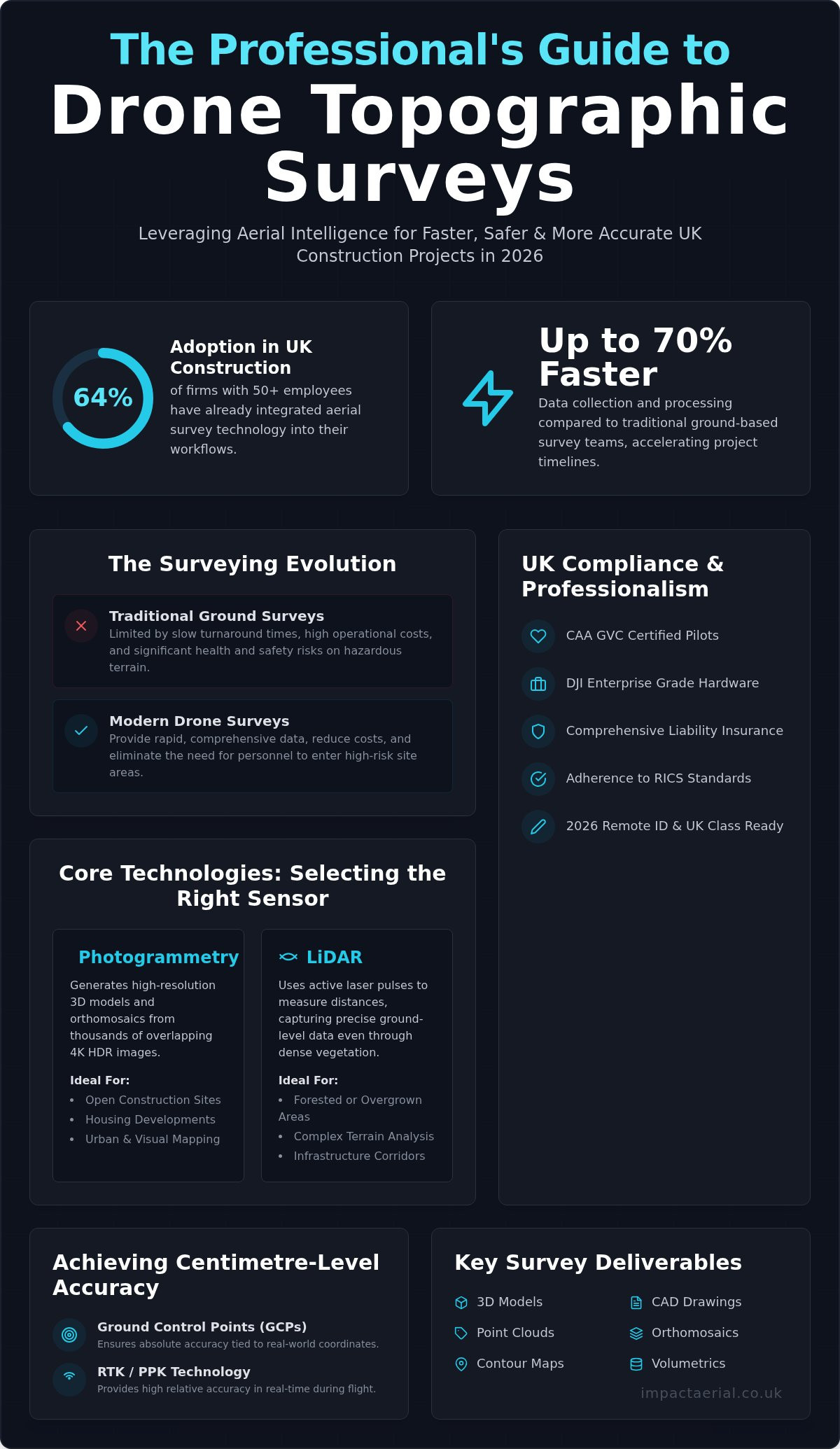
Accuracy Standards and Deliverables: From Point Clouds to CAD
The value of a professional drone topographic survey UK lies in the bridge between raw aerial data and actionable engineering assets. Achieving centimetre-level relative and absolute accuracy isn’t accidental; it requires a combination of high-end DJI Enterprise hardware and rigorous ground-truthing. We utilize Real-Time Kinematic (RTK) or Post-Processed Kinematic (PPK) technology to ensure the drone’s position is corrected in real-time against a base station. To verify these results, we deploy physical Ground Control Points (GCPs) across the site, which act as fixed anchors for the digital model. This dual-layer approach ensures the final data aligns perfectly with national grid coordinates.
Adhering to the RICS professional standard for aerial surveys is vital for maintaining industry-recognised quality. For high-precision engineering projects, we target Band A accuracy, which typically requires tolerances within ±15mm to ±25mm. This level of precision allows architectural and engineering teams to rely on our data for critical design decisions, from calculating drainage gradients to verifying foundation placements.
Essential Survey Deliverables
Standard outputs from a modern aerial survey go far beyond simple photographs. We provide a suite of georeferenced assets designed for immediate use:
- Orthomosaic Maps: These are high-resolution, undistorted 2D maps created by stitching thousands of 4K HDR images together. Every pixel contains coordinate data, allowing for accurate measurements of distance and area.
- 3D Point Clouds: Comprising millions of individual data points, these clouds provide a geometric representation of the entire site, including buildings, stockpiles, and terrain.
- 2D/3D CAD Drawings: We translate raw point cloud data into structured DWG or DXF files, featuring contour lines and identified site features for use in CAD software.
Data Interoperability and Software
Modern construction workflows increasingly rely on Building Information Modelling (BIM). Our data is formatted for seamless integration with industry-standard tools like AutoCAD and Revit. The raw data from a drone flight is rarely ready for engineering use. High-end post-production editing is essential to remove noise, filter out unwanted objects like moving vehicles, and ensure the point cloud is clear and manageable. This meticulous processing turns massive datasets into lightweight, usable files that can be shared via cloud-based platforms for instant stakeholder collaboration. It ensures that everyone from the site manager to the lead architect is working from a single, accurate source of truth.
Navigating UK Regulations and Safety for Aerial Site Surveys
Operating a commercial drone in British airspace is strictly governed by the Civil Aviation Authority (CAA). For any drone topographic survey UK, legal compliance is just as critical as technical precision. The regulatory landscape has shifted significantly as of January 1, 2026, with new weight thresholds and class markings (UK0 to UK6) dictating where and how drones can fly. Every pilot we deploy holds a GVC (General Visual Line of Sight Certificate), which is the professional benchmark for operating in the “Specific” category. This qualification allows us to fly more capable, heavier enterprise hardware closer to uninvolved persons than standard “Open” category flyers. For a deeper look at these requirements, you can consult our UK Drone License guide.
Safety on a construction site or industrial facility isn’t a secondary concern. It’s a fundamental part of our operational workflow. Before any mission begins, we conduct a comprehensive site-specific risk assessment. This process identifies potential hazards such as overhead power lines, active plant machinery, and congested areas. By integrating these safety protocols into our flight planning, we ensure that data collection never compromises site personnel or public safety.
The Importance of £5m Commercial Liability Insurance
Major UK construction firms and land developers typically mandate a minimum insurance threshold before allowing a drone operator on site. We maintain £5m commercial liability insurance to meet these rigorous B2B requirements. This coverage protects our clients against unforeseen operational risks and provides the psychological comfort that they’re partnering with a meticulous, well-vetted specialist. Our insurance isn’t just a certificate; it’s a commitment to professional accountability and risk mitigation in high-stakes environments.
Operating in Restricted UK Airspace
Securing flight permissions for urban sites in cities like London or Birmingham requires a sophisticated understanding of restricted airspace. We manage the entire coordination process with local authorities and NATS (National Air Traffic Services) to secure the necessary clearances. Our DJI Enterprise hardware is equipped with advanced safety features like AirSense (ADS-B), which provides our pilots with real-time alerts about nearby crewed aircraft. This technology, combined with our strict adherence to the UK SORA (Specific Operations Risk Assessment) framework, allows us to operate safely even in the most complex environments. If you’re planning a project in a sensitive or restricted area, contact our technical team to discuss how we can secure the necessary flight permissions for your site.
Choosing a Professional Drone Survey Partner in the UK
Selecting a partner for a drone topographic survey UK involves more than just hiring a pilot with a camera. The distinction between a generic ‘drone for hire’ operator and a technical consultant is found in the quality of the final deliverables. A professional consultant understands the nuances of coordinate systems, ground control, and the specific requirements of UK engineering teams. This expertise ensures that the data you receive is a reliable asset rather than a liability. For a broader perspective on selecting a provider, you can explore our Complete Guide to Professional Drone Services.
The hardware used is equally critical. We utilize DJI Enterprise drones, which are specifically engineered for survey-grade precision. These systems feature integrated RTK modules for real-time positioning and 4K HDR sensors for maximum visual clarity. Using consumer-grade hardware for a topographic survey often results in ‘rolling shutter’ distortion, which compromises the accuracy of the 3D model. Our enterprise-level equipment eliminates these errors, providing the stability and data density required for centimetre-accurate mapping.
Impact Aerial’s Methodical Approach
Our process is structured to provide psychological comfort and tangible business benefits. It begins with an initial consultation to define your project-specific data requirements, whether that’s high-density point clouds or detailed contour maps. We then move into meticulous flight planning, accounting for site hazards and regulatory constraints. The final stage involves expert post-production. We don’t just deliver raw imagery; we provide high-tier technical outputs that have been cleaned, georeferenced, and formatted for your existing CAD or BIM workflows. This end-to-end project management ensures that the data is ready for immediate use by your design team.
Nationwide Coverage from a West Midlands Base
While we are proudly based in the West Midlands, our operational reach is nationwide. We regularly serve clients in Birmingham, London, and across the wider UK, bringing local expertise to every site. Our central location allows us to deploy quickly while maintaining the high professional standards our clients expect. We manage every aspect of the project, from the first risk assessment to the final data delivery. This comprehensive service model is designed to reduce project timelines while maintaining full regulatory compliance. If you are looking for a reliable partner to provide precision site data, request a technical consultation for your next project to see how we can support your development goals.
Elevating Your Site Intelligence for 2026
Adopting advanced aerial mapping is no longer just a trend; it’s a strategic necessity for UK construction and property developers who value precision and safety. By integrating a professional drone topographic survey UK into your workflow, you replace slow, hazardous ground surveys with centimetre-accurate 3D data and CAD-ready deliverables. This approach ensures your project benefits from the latest DJI Enterprise technical expertise, turning raw site data into actionable engineering assets that integrate seamlessly with your BIM processes.
Safety and compliance remain at the heart of every mission. Partnering with a specialist team ensures your site is managed by CAA GVC certified pilots backed by £5m commercial liability insurance. This combination of high-tier hardware and meticulous regulatory adherence provides the psychological comfort and technical reliability required for complex UK developments. The right data provides a foundation for success. Contact Impact Aerial for a Professional Drone Survey Consultation to discuss your specific site requirements today. We’re ready to help you streamline your next project with precision aerial mapping.
Frequently Asked Questions
How accurate are drone topographic surveys compared to traditional methods?
A professional drone topographic survey UK achieves centimetre-level accuracy that is fully comparable to traditional ground-based methods. By utilizing RTK-enabled DJI Enterprise hardware and physical Ground Control Points, we meet the rigorous RICS global standards for measured surveys. While traditional total stations are still used for specific setting-out tasks, drones provide a much denser point cloud. This results in a comprehensive digital twin of the entire terrain rather than isolated data points.
What is the typical turnaround time for a drone survey in the UK?
The data collection phase is typically 70% faster than traditional ground methods. For most mid-sized UK construction sites, we can complete the aerial data acquisition within a single working day. The subsequent post-production and technical processing usually take between three to five business days. This depends on the complexity of the required CAD drawings or 3D models. This rapid turnaround helps project managers maintain momentum on tight development schedules.
Do I need to clear the site before a drone topographic survey?
You don’t need to clear the site of all machinery, but a less cluttered environment produces cleaner initial data. Our expert post-production team can filter out “noise” such as moving vehicles or temporary plant equipment from the final deliverables. However, the ground must be visible for the sensors to map the terrain accurately. If specific areas are completely obscured by large stockpiles, the survey will reflect the height of those materials.
Can drones perform topographic surveys in wooded or heavily vegetated areas?
Drones can map vegetated areas effectively if the correct sensor is deployed. While standard photogrammetry is best for open sites, LiDAR sensors emit laser pulses that penetrate through gaps in foliage to reach the ground level. This allows us to generate accurate Digital Elevation Models even under dense tree canopies. For heavily overgrown brownfield sites, we recommend a technical consultation to determine whether LiDAR is the most appropriate solution for your project.
What insurance and certifications should a professional drone surveyor have?
A professional operator must hold a CAA GVC (General Visual Line of Sight Certificate) and significant commercial insurance. At Impact Aerial, our pilots are GVC certified, which is the mandatory benchmark for commercial operations in the UK Specific category. We also maintain £5m in commercial liability insurance. This level of coverage is a standard requirement for major UK construction firms and ensures all stakeholders are protected against unforeseen operational risks.
What file formats will I receive after the drone survey is complete?
We deliver data in several industry-standard formats to ensure seamless integration with your existing software. Most engineering teams receive 2D and 3D CAD drawings in DWG or DXF formats. For BIM workflows, we provide high-density point clouds as LAS or XYZ files. Additionally, georeferenced orthomosaic maps are typically delivered as high-resolution GeoTIFFs. These files are ready for immediate use in AutoCAD, Revit, or other common architectural and GIS tools.
How do weather conditions in the UK affect drone surveying schedules?
UK weather conditions significantly influence flight schedules because drones shouldn’t operate in heavy rain or high winds. Our enterprise hardware is rated for moderate conditions, but we monitor NATS and local meteorological data closely to ensure flight safety. If a scheduled drone topographic survey UK is postponed due to weather, we coordinate with your site team to re-deploy at the earliest safe opportunity. This cautious approach ensures data quality and operational safety.
Are drone surveys legal in congested UK town and city centres?
Drone surveys are perfectly legal in congested town and city centres provided the operator holds the correct CAA permissions. Our GVC certification and operational safety case allow us to fly in these complex urban environments after conducting a rigorous risk assessment. We manage the entire coordination process, including securing permissions from local authorities and NATS for restricted airspace. This ensures your urban development project receives high-resolution data while remaining fully compliant.
Professional Drone Services in the West Midlands: The 2026 Commercial Guide
In 2026, the margin for error in aerial operations has vanished; a single uncertified flight over a congested Birmingham street now carries significant legal and financial risks that many project managers don’t fully realise. As the UK transition to mandatory UK class markings and Remote ID takes full effect, the distinction between a hobbyist with a camera and professional drone services West Midlands companies can legally hire has never been more critical. You likely recognise the immense value of high-resolution 4K HDR data for surveys or marketing, yet the fear of regulatory blowback or safety incidents often stalls ambitious projects.
We’re here to bridge that gap by providing a definitive roadmap for professional UAV operations this year. You’ll learn how to master the complex landscape of 2026 regulations, from the new 100g Flyer ID threshold to the necessity of £5m commercial liability insurance. This guide explores the technical applications that make drone technology a cost-effective alternative to traditional filming, ensuring your next project is both cinematically stunning and meticulously compliant.
Key Takeaways
- Understand how professional drone services West Midlands providers navigate the complex urban airspace of Birmingham using end-to-end project management.
- Identify mandatory 2026 safety standards, specifically the CAA GVC and the requirement for Operational Authorisation in congested urban hubs.
- Explore high-value technical applications, including construction site monitoring, PV solar farm thermal surveys, and high-resolution virtual tour creation.
- Learn how a structured production workflow manages site permissions and risk assessments to ensure full regulatory compliance on every flight.
- Discover the logistical benefits of a central West Midlands base for rapid, cost-effective deployment across the United Kingdom.
The Scope of Professional Drone Services in the West Midlands
Professional drone services West Midlands teams provide have transitioned from simple aerial photography into comprehensive data management systems. In 2026, these operations manage the entire lifecycle of visual assets and technical data. A professional provider acts as a strategic consultant, handling the intricate legalities and safety protocols required for complex urban environments like Birmingham city centre. This partnership ensures every mission is compliant with the Civil Aviation Authority (CAA) while meeting specific commercial objectives. It isn’t just about flying; it’s about precision.
Modern aerial operations require a structured workflow that encompasses site-specific risk assessments and meticulous post-production. Whether you’re commissioning a technical survey or a high-end marketing film, the provider manages the “headache-free” logistics so your team can focus on core tasks. By integrating advanced flight planning with high-spec hardware, professional services deliver a level of precision that consumer equipment cannot match.
To see how these aerial systems support regional safety and infrastructure, watch this overview from the West Midlands Fire Service:
The Evolution of UAV Technology for Business
The industry has moved decisively toward DJI Enterprise platforms, which offer the reliability needed for high-stakes commercial work. High-bitrate 4K HDR sensors now provide the clarity required for broadcast-quality cinematography and detailed inspections. FPV (First Person View) technology is also changing how we create immersive commercial tours by allowing drones to move fluidly through tight internal spaces. These tools support a wide range of commercial applications of drones, providing both aesthetic and technical value without the limitations of older hardware.
Economic Benefits for West Midlands Industries
For regional industries, the financial benefits are clear. Using a drone for a property survey is far more efficient than traditional plant hire like scaffolding or cherry pickers. It keeps staff safely on the ground, significantly lowering health and safety risks during infrastructure checks. Construction firms use regular aerial monitoring to maintain an auditable trail of progress for stakeholders. Property developers also gain a competitive edge by showcasing the connectivity and scale of their West Midlands sites from unique perspectives that ground-based assets cannot replicate.
Regulatory Compliance: The 2026 Standard for West Midlands Pilots
Operating a commercial UAV in 2026 requires a sophisticated understanding of the UK’s evolving aviation laws. For any business commissioning drone services West Midlands wide, the legal landscape has shifted towards stricter accountability and clear technical benchmarks. The primary standard for professional pilots is now the CAA GVC (General Visual Line of Sight Certificate). This qualification demonstrates a pilot’s competency in flight safety, emergency procedures, and airspace management, moving beyond the basic flyer IDs used by hobbyists.
Compliance isn’t just about the pilot’s skills; it’s about the specific permissions granted by the regulator. In congested urban environments like Birmingham or Coventry, standard flight rules often aren’t enough. Professional operators must hold an Operational Authorisation from the CAA to fly closer to people and buildings than the “Open Category” allows. This document is a critical safety barrier that ensures urban missions are conducted without endangering the public or local infrastructure.
Navigating CAA GVC and Operational Authorisation
The transition from the old PfCO standards to the current GVC requirements reflects a more rigorous approach to urban flight. Professional pilots manage complex permissions in restricted West Midlands airspace by coordinating with Air Traffic Control and monitoring local restrictions. If you’re unsure which category your project falls into, understanding the requirements for a valid drone license is the first step toward a legal and successful operation.
Risk Assessment and Safety Protocols
Every professional flight begins long before the propellers spin. A meticulous pre-flight process involves site surveys, weather monitoring, and checking NOTAMs (Notices to Air Missions) for temporary airspace restrictions. This technical preparation aligns with the latest Civil Aviation Authority drone guidance, ensuring that data privacy and public safety are never compromised. In high-traffic commercial environments, these protocols are the only way to mitigate risk effectively.
Risk mitigation also extends to financial protection. All commercial drone work in the UK legally requires third-party insurance that complies with EC 785/2004. We maintain £5m commercial liability insurance as a non-negotiable standard. This high level of coverage provides psychological comfort to our clients, ensuring they aren’t exposed to liability should an unforeseen incident occur. When you prioritise these regulatory benchmarks, you ensure your project stays on the right side of the law. If you need assistance verifying the compliance of your next site, our team can help you assess your specific regulatory needs.
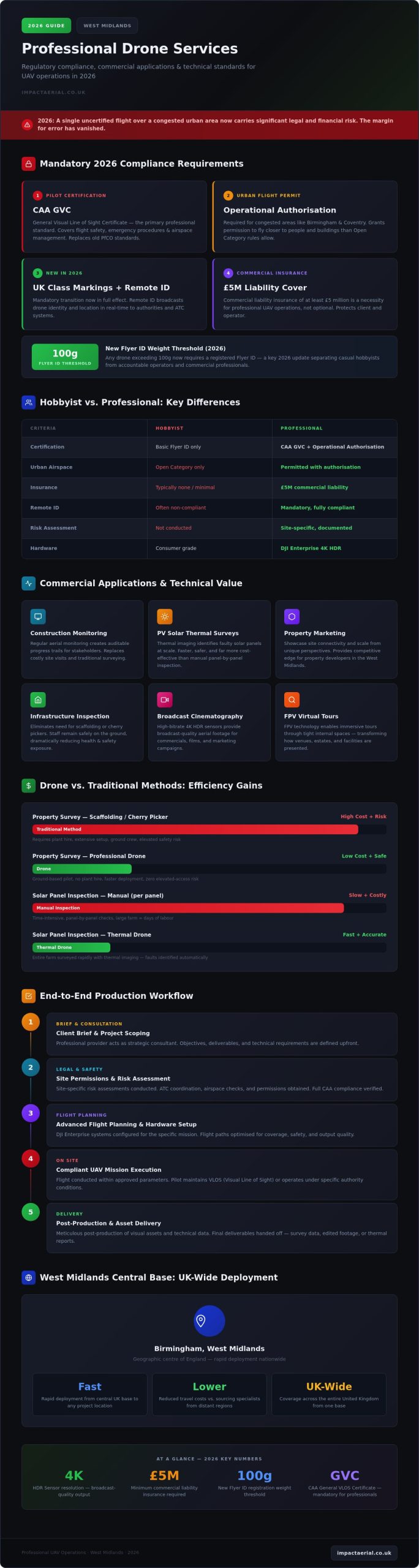
Commercial Applications: From Marketing to Technical Data
Professional drone services West Midlands teams provide now deliver a sophisticated dual-stream output: high-impact cinematic production and precision technical data. This integration is a cornerstone of the expanding commercial drone use in the UK, where aerial platforms act as both creative assets and critical survey instruments. By utilizing 4K HDR sensors, we capture “hero” shots for brand campaigns while simultaneously providing the high-bitrate footage required for detailed infrastructure assessments. This versatility allows businesses to extract maximum value from a single deployment.
Property and Real Estate Visuals
In the competitive West Midlands commercial market, capturing the scale and connectivity of an estate is vital. Aerial imagery highlights strategic transport links, such as proximity to major motorway networks or regional rail hubs, providing context that ground-based photography lacks. Implementing professional drone photography is a proven method for accelerating commercial enquiries; it allows prospective tenants and investors to grasp the full layout of a development instantly. Beyond static images, we create immersive virtual tours that facilitate remote stakeholder engagement, ensuring that project milestones are visible to decision-makers regardless of their location.
Drones in Construction and Infrastructure
Construction site monitoring has evolved into a mandatory requirement for modern project management. Regular aerial filming provides an auditable visual trail of progress, serving as both a PR tool and essential health and safety documentation. Instead of relying on manual inspections that require scaffolding or cherry pickers, drones allow for the safe assessment of roofs and complex structures. This data-centric approach integrates seamlessly into wider drone survey workflows, where 4K video assets are used to identify structural anomalies or thermal leaks in PV solar farms.
For infrastructure projects, time-lapse aerial filming offers long-term documentation that is invaluable for stakeholder reporting. By capturing consistent perspectives over several months, we provide a clear narrative of the project’s evolution. This level of technical oversight ensures that potential issues are identified early, reducing the risk of costly delays and enhancing the overall ROI of the construction phase. By choosing a partner who understands both the aesthetic and technical requirements, you ensure that your data is both accurate and persuasive.
The End-to-End Production Process: From Brief to Delivery
Hiring drone services West Midlands teams shouldn’t feel like a gamble. A professional operation functions as a technical consultancy, managing every variable from the initial brief to the final export. This process begins with a consultation to define your creative goals and technical requirements while assessing legal feasibility. We don’t just ask what you want to see; we determine what’s legally permissible under 2026 CAA regulations. This meticulous approach ensures that your project is built on a foundation of safety and compliance from day one.
Once feasibility is confirmed, the pre-production phase handles the logistical heavy lifting. This includes managing site permissions, conducting detailed risk assessments, and issuing local authority notifications. For projects in dense urban hubs like Birmingham, we coordinate with local councils and the police to ensure operations in public spaces, such as those near Birmingham New Street, don’t disrupt the community. This “headache-free” management is what separates a professional consultant from a basic operator.
Planning for Success in the West Midlands
Operating in the heart of the UK requires a sophisticated understanding of the local environment. We manage the “weather window” through constant monitoring and contingency planning, ensuring that your project stays on track despite the unpredictable UK climate. Every aerial filming drone deployment follows a site-specific safety brief. This isn’t just a formality; it’s a vital requirement for maintaining our £5m commercial liability coverage and protecting your business from legal exposure. On-site execution is carried out using commercial-grade DJI Enterprise hardware, which provides the reliability and data security that professional projects demand.
Post-Production and Technical Delivery
The value of a professional service is often defined in the editing suite. Raw data is transformed into polished commercial assets through 4K HDR colour grading, sound design, and professional editing. For technical clients, we can add data overlays, branding, and graphics to survey videos, making complex information easy for stakeholders to digest. This ensures that the final product isn’t just a video file, but a functional business tool.
Delivery formats are optimized for your specific needs, whether that’s high-bitrate files for web use or high-resolution presentations for board meetings. Our methodical approach removes the uncertainty from aerial projects, delivering high-tier quality through a structured, compliant workflow. If you’re ready to secure professional assets for your business, you can book a consultation with our West Midlands experts today.
Choosing a West Midlands Partner for UK-Wide Deployment
Selecting the right partner for drone services West Midlands goes beyond simple proximity. While many operators position themselves as local pilots for hire, a professional partner offers a technical consultancy that leverages the West Midlands as a strategic central hub for national operations. This geographic advantage translates into tangible benefits for clients, including reduced travel overheads and a centralised logistics model that ensures consistent data quality across multiple UK project sites. By choosing a provider with a central base, you gain a partner capable of rapid deployment while maintaining a single, authoritative point of contact for complex project management.
Before commissioning any aerial work, conducting thorough due diligence is essential to protect your business from legal liability. You should always verify a provider’s current Operational Authorisation and request up-to-date insurance documents. A professional operation won’t hesitate to provide these credentials. It’s also vital to review their portfolio to ensure they have specific experience in your commercial sector, whether that involves high-end cinematography or technical infrastructure surveys. This verification process ensures that the team on your site possesses the expertise to handle the sophisticated DJI Enterprise hardware required for 2026 standards.
The Strategic Advantage of a Birmingham Hub
A Birmingham-based hub provides a unique logistical edge for national infrastructure and construction projects. We offer rapid response times for construction monitoring and urgent survey requirements that out-of-region providers often struggle to match. Our pilots possess a deep, localized understanding of West Midlands airspace and specific flight restrictions, allowing us to navigate complex urban corridors with precision. For organisations with assets spread across the country, this central location acts as a pivot point. It enables efficient deployment to any corner of the United Kingdom while ensuring that safety protocols and data delivery formats remain uniform across every site.
Impact Aerial: Precision and Compliance
Our operation is built on a commitment to the highest safety standards and meticulously managed risk mitigation. We maintain £5m commercial liability insurance as our baseline standard, providing the reassurance that corporate stakeholders and legal teams demand in 2026. We specialise in bridging the gap between creative vision and technical data requirements, ensuring that every asset we deliver serves a clear business purpose. Our CAA GVC certified pilots are trained to handle the “headache-free” management of site permissions and local authority notifications, removing the regulatory burden from your team.
Taking the next step in your project is straightforward. You can secure professional oversight and high-tier visual assets by booking an initial consultation for drone services in 2026. This technical review will define your creative goals, verify legal feasibility, and ensure your site operations are fully compliant and optimized for maximum ROI. We’re ready to help you master the landscape of professional UAV operations from our central West Midlands hub.
Securing the Future of Your Aerial Projects
Professional drone services West Midlands providers now offer a critical blend of technical precision and regulatory expertise. As we move through 2026, the transition to stricter CAA standards means that hiring uncertified operators is no longer a viable risk for any commercial enterprise. By choosing a partner with a central Birmingham hub, you ensure rapid deployment and consistent quality across your entire UK portfolio. Whether you’re capturing high-resolution marketing assets or conducting complex infrastructure surveys, the right equipment and certification are non-negotiable requirements for success.
Our team utilizes DJI Enterprise 4K HDR equipment and operates with CAA GVC certified pilots to deliver results that meet the highest professional standards. We back every mission with £5m commercial liability insurance, providing the technical reassurance your stakeholders require for urban and industrial operations. You can request a bespoke quote for your West Midlands drone project to begin defining your project’s technical and creative requirements. We look forward to helping you transform your perspective and elevate your commercial data this year.
Frequently Asked Questions
Do I need a special permit for drone filming in Birmingham city centre?
Yes, flying in Birmingham city centre typically requires an Operational Authorisation from the Civil Aviation Authority (CAA) because it is a congested urban area. Professional drone services West Midlands providers handle these complex permissions by liaising with local councils and West Midlands Police. We manage the entire application process, ensuring that flights over high-traffic zones like the Bullring or New Street are conducted legally and safely without disrupting the public.
What is the difference between CAA GVC and A2 CofC certifications?
The CAA GVC (General Visual Line of Sight Certificate) is the mandatory professional standard for complex commercial operations in the Specific category, such as urban filming. In contrast, the A2 CofC is a basic competency for lighter drones in the Open category. For high-stakes projects in the West Midlands, the GVC is preferred as it allows for the Operational Authorisation required to fly commercial-grade hardware closer to people and buildings.
How much does professional drone hire cost in the West Midlands?
Professional drone hire costs vary based on the project’s technical complexity, location, and required outputs. Factors such as the need for specialized thermal sensors for solar farm surveys or high-end post-production for virtual tours will influence the final quote. We provide bespoke pricing tailored to your specific goals, ensuring you receive a transparent breakdown that includes flight planning, regulatory compliance management, and the delivery of high-resolution 4K HDR assets.
Can drones fly in the rain or high winds in the UK?
Flight feasibility depends strictly on the hardware’s technical specifications and safety thresholds. While DJI Enterprise drones offer enhanced stability, we typically don’t fly in heavy rain or winds exceeding 22mph to ensure the safety of the airframe and the quality of the data. Our pilots monitor live weather telemetry and maintain a weather window strategy, providing contingency dates to ensure your project is captured under optimal conditions for visual clarity.
What insurance should a professional drone operator carry?
A professional operator must carry third-party liability insurance that is fully compliant with EC 785/2004 regulations. This is a legal requirement for all drone services West Midlands companies provide. We maintain £5m in commercial liability coverage to protect our clients from unforeseen risks. This high level of insurance is a hallmark of a vetted specialist and provides essential financial reassurance when operating near high-value infrastructure or in busy urban hubs.
How long does a typical aerial video shoot take to complete?
The duration of an aerial shoot depends on the scope of the brief and the size of the site. A standard commercial property survey or marketing session typically takes between two and four hours on-site. More complex projects, such as large-scale construction site monitoring or detailed thermal surveys of solar farms, may require a full day of flight operations to capture all necessary data points and ensure comprehensive coverage for post-production.
Do you provide raw drone footage or only fully edited videos?
We offer both raw 4K HDR footage and fully edited commercial assets depending on your internal requirements. Many clients prefer our end-to-end post-production services, which include professional colour grading, sound design, and the integration of technical data overlays. However, if you have an in-house creative team, we can provide the high-bitrate raw files immediately after the shoot, ensuring you have the flexible source material needed for your own marketing or survey workflows.
Are drones safe for indoor filming in commercial spaces?
Drones are highly effective for indoor filming in large commercial spaces like warehouses, factories, or retail atria. We utilize specialized hardware, including FPV drones with protective prop guards, to navigate tight internal environments safely. This approach is ideal for creating immersive virtual tours that showcase the scale and layout of a facility. Every indoor mission includes a specific internal risk assessment to manage obstacles and ensure the safety of staff and property.
Professional Drone Services in the UK: The 2026 Buyer’s Guide
In 2026, the difference between a hobbyist with a camera and a certified technical consultant isn’t just about the hardware; it’s about the legal and financial security of your entire operation. You likely know that aerial data, such as PV solar farm thermal surveys UK, can radically improve your asset management, yet the fear of CAA non-compliance or receiving low-grade data often stalls the decision to hire. It’s difficult to distinguish between a casual flyer and a specialist who understands the nuances of professional standards and risk mitigation.
This guide ensures you can leverage professional drone technology for cinematic 4K HDR media and precise technical data collection while maintaining total regulatory compliance. We’ll show you how to secure accurate, actionable results through a hassle-free, fully insured flight operation. We’ll break down the latest 2026 UK class markings, the necessity of CAA GVC certification, and the specific DJI Enterprise hardware required to deliver the industry-leading quality your business demands.
Key Takeaways
- Understand the mandatory legal requirements for 2026, including why CAA GVC certification is the baseline for any professional commercial drone operation in the UK.
- Learn how to use high-resolution PV solar farm thermal surveys UK to identify anomalies and optimize energy output through accurate, actionable data collection.
- Discover the operational workflow for construction site monitoring and property surveys that prioritizes site safety and comprehensive risk assessments.
- Evaluate the benefits of integrating 4K HDR aerial filming with post-production services to create high-impact visual content for the property and advertising sectors.
- Identify the essential insurance benchmarks, such as £5m commercial liability, required to protect your business from legal risks during complex aerial projects.
The Evolution of Professional Drone Services in the UK
Professional drone services have transitioned from being viewed as high-tech novelties to becoming critical infrastructure tools for UK businesses. Today, an Unmanned aerial vehicle is no longer just a flying camera; it’s a sophisticated data collection platform. These integrated solutions provide a bridge between cinematic media and technical datasets, offering insights that were previously cost-prohibitive or physically impossible to obtain. As we enter 2026, the industry is defined by a “Safer, Faster, Cheaper, Greener” framework. By replacing traditional methods with aerial technology, companies significantly reduce their carbon footprint and operational overheads while improving safety standards across the board.
Under the 2026 regulatory landscape, the Civil Aviation Authority (CAA) has tightened the standards for commercial operators. Simply owning a drone is not enough for complex industrial work. Professional services now require GVC (General Visual Line of Sight Certificate) certified pilots who understand the nuances of risk assessment and airspace management. This ensures that every flight is not only productive but fully compliant and insured, providing the reassurance that your business is protected from legal liability.
The Business Case for Aerial Integration
The most immediate benefit of drone adoption is the mitigation of health and safety risks. By utilizing drones for roof inspections or tall structure assessments, you eliminate the need for scaffolding, cherry pickers, or ladders. This doesn’t just save money; it protects your workforce. Rapid deployment allows for real-time data access, meaning project managers can make informed decisions in hours rather than days. We provide unique perspectives that ground-based teams simply cannot replicate, ensuring every angle of a site is documented with 4K HDR precision.
Commercial Applications Across UK Industries
UK industries are increasingly reliant on these specialized services to maintain a competitive edge. In property and real estate, high-impact visuals are standard for marketing, while construction firms use drones for site monitoring and structural integrity checks. The renewable energy sector has seen a significant shift toward data-driven maintenance. Specialized PV solar farm thermal surveys UK are now a requirement for efficient asset management. These surveys use high-resolution thermal sensors to detect cell defects or “hot spots” that are invisible to the naked eye. By identifying these issues early, operators can prevent failures and maximize energy yield across the grid. This technical approach transforms a simple flight into a vital maintenance strategy.
From Cinematic Media to Technical Data: Key Service Categories
Professional drone operations in 2026 are categorized by their output: either high-fidelity creative content or precision technical data. While hobbyists might focus on a single shot, a professional operator integrates hardware like DJI Enterprise drones to deliver multi-layered results. This includes everything from immersive virtual tours for commercial galleries to specialized industrial inspections. The shift toward data-centric services means that aerial platforms are now essential for maintaining large-scale infrastructure and high-value property assets.
Professional Aerial Videography and Post-Production
High-quality marketing requires more than raw footage. Using an aerial filming drone with 4K HDR sensors ensures every frame meets broadcast standards. The true value lies in the post-production phase. Professional editing turns raw clips into a cinematic brand story through expert color grading and pacing. This is essential for property developers and agencies who need to showcase the scale and quality of their projects with total clarity.
Precision Drone Surveying and Data Collection
Data-centric applications have revolutionized building maintenance and infrastructure management. A professional drone survey allows for comprehensive roof and building inspections without the safety risks or costs associated with high-access equipment like scaffolding or cherry pickers. For the renewable energy sector, this technology is indispensable. Implementing PV solar farm thermal surveys UK allows operators to identify defective cells or bypass diode failures that compromise energy output.
According to guidelines on PV system maintenance, early detection of thermal anomalies is critical for maximizing the lifecycle and ROI of solar assets. These specialized PV solar farm thermal surveys UK use radiometric sensors to provide precise temperature data across thousands of panels in a single flight. This technical consultancy approach ensures that maintenance teams can target specific repairs rather than conducting manual, time-consuming inspections across the entire site. If you’re looking to protect your infrastructure investments, it’s wise to consult with a technical drone specialist to discuss your specific data requirements.
Beyond technical data, immersive virtual tours offer an interactive experience by combining aerial perspectives with ground-based content. This holistic approach is particularly effective for large-scale commercial real estate and tourist attractions. It allows potential clients or visitors to explore a site remotely with a level of detail that traditional photography cannot match. By integrating these diverse service categories, businesses can secure both the marketing assets and the technical data they need to thrive in a competitive market.
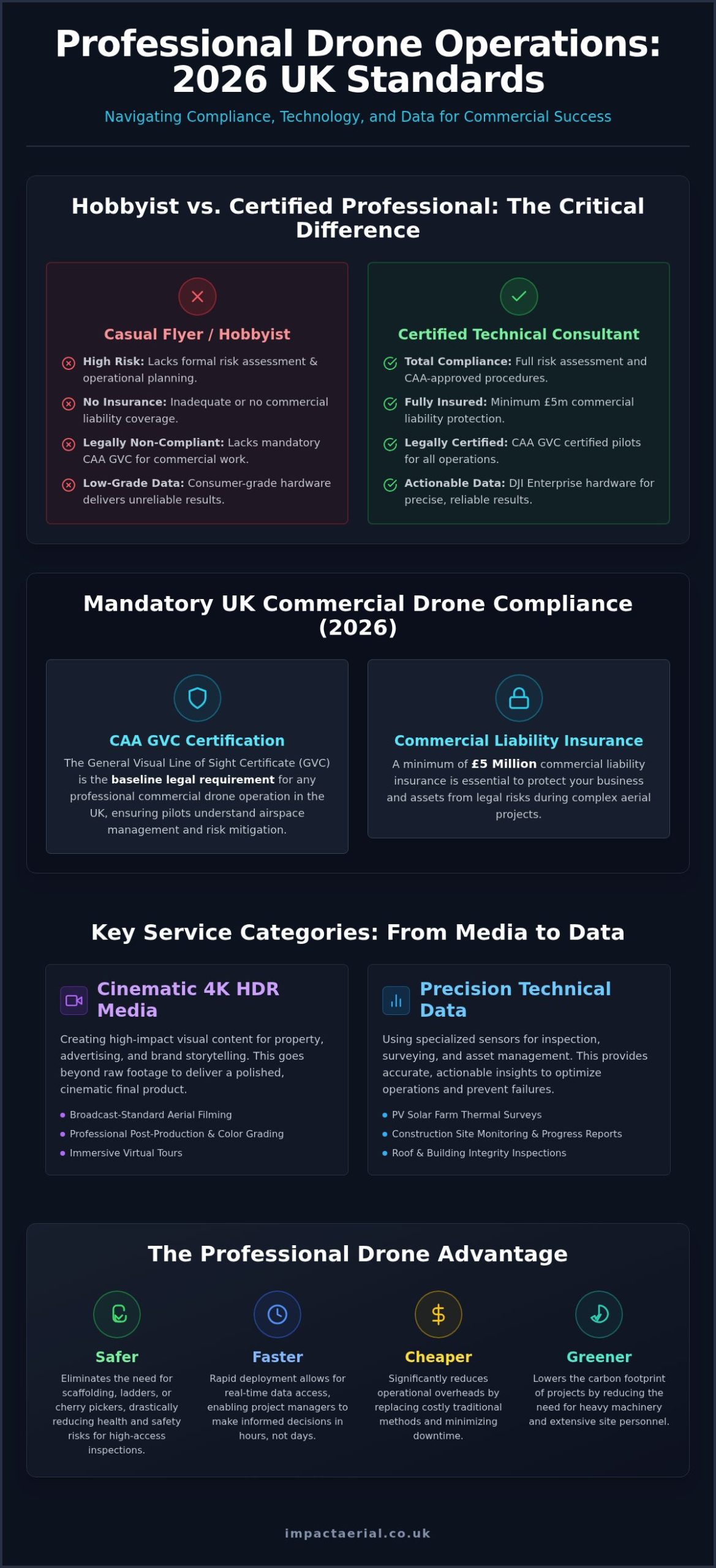
Understanding Compliance: Why CAA GVC Certification and Insurance Matter
Compliance is the non-negotiable foundation of any professional drone operation. By 2026, the UK Civil Aviation Authority (CAA) drone regulations have evolved to include mandatory Remote ID broadcasting for most commercial-grade aircraft. Any pilot conducting work for “valuable consideration” must hold a valid drone license. This ensures the operator has passed the necessary competency tests and is registered with the CAA. For technical applications like PV solar farm thermal surveys UK, operating without these credentials isn’t just a safety risk; it’s a significant legal liability for the client. Professional operators act as technical consultants, managing the complex paperwork and site-specific risk assessments so you don’t have to.
GVC vs. A2 CofC: What Clients Need to Know
It’s vital to distinguish between the A2 Certificate of Competency (A2 CofC) and the General Visual Line of Sight Certificate (GVC). While the A2 CofC is suitable for lightweight drones in open spaces, the GVC is the gold standard for industrial work. It requires a pilot to maintain a detailed Operations Manual and secure a PDRA01 Operational Authorisation from the CAA, which currently carries an annual fee of £524. This certification allows for much greater flexibility, especially for projects in congested areas or when using heavy DJI Enterprise hardware. Verifying these credentials before the first flight protects your project from being grounded by local authorities or failing a safety audit.
Insurance and Liability in Professional Operations
Risk mitigation extends beyond pilot skill to include robust financial protection. Hobbyist insurance policies are insufficient for commercial risks. Professional operators carry specialist liability cover that meets the requirements of EC 785/2004. While some freelancers carry minimal cover, £5m commercial liability insurance is the standard for reputable UK firms serving the construction and energy sectors. This level of insurance is essential when performing PV solar farm thermal surveys UK, where drones fly in close proximity to high-value assets. It covers third-party injury and property damage, ensuring that your business is fully insulated from financial loss. This meticulous approach to safety and regulation is what separates a professional service from a casual operator.
Planning Your Project: The Workflow of a Professional Drone Operation
A successful drone mission is built on a foundation of methodical planning and technical precision. It isn’t merely about launching an aircraft; it’s a structured workflow designed to deliver specific business outcomes. The process begins with an initial consultation where we define your project goals, required deliverables, and any site-specific constraints. For example, executing PV solar farm thermal surveys UK requires a different flight profile compared to a cinematic marketing shoot. We establish the technical parameters early to ensure the data collected is both accurate and actionable for your maintenance teams.
The Importance of Pre-Flight Risk Assessment
Meticulous pre-flight planning is the hallmark of a professional operator and a core requirement for CAA compliance. Before arriving on-site, we conduct a comprehensive site survey and risk assessment to identify potential hazards like overhead power lines, tall structures, or public access points. We also manage the complex task of checking airspace restrictions via NOTAMs (Notices to Air Missions). If your site is within a Flight Restriction Zone (FRZ) near an airport, we secure the necessary permissions from Air Traffic Control well in advance. Weather monitoring is equally critical; we track wind speeds and precipitation levels to ensure the operation can proceed safely without compromising the quality of the 4K HDR visuals or radiometric data.
On-site execution is handled by GVC certified pilots using specialized DJI Enterprise hardware. This equipment is designed for industrial reliability, allowing us to capture high-resolution imagery and precise thermal data even in challenging environments. This phase is characterized by a “safety-first” approach, where the pilot-in-command maintains constant situational awareness to protect your assets and personnel throughout the flight duration.
Post-Production and Deliverable Formats
The final phase involves transforming raw captures into professional-grade assets that drive value for your business. For marketing-focused drone photography, post-production is where we apply color correction and retouching to ensure the visuals align with your brand identity. Technical projects, such as PV solar farm thermal surveys UK, require specialized software analysis to produce orthomosaic maps or detailed thermal reports that highlight specific panel anomalies. Delivery timelines typically range from 24 to 72 hours depending on the complexity of the data processing required. If you’re ready to start your project with a compliant and expert team, you can book your professional drone consultation today to discuss your specific requirements.
Why Partner with Impact Aerial for Your UK Drone Requirements
Impact Aerial stands at the intersection of creative excellence and technical precision. We provide a comprehensive suite of professional services that bridge the gap between high-end cinematography and industrial data collection. As a technical consultant, we don’t just fly; we manage the entire lifecycle of your project. This includes everything from the initial brief to the final delivery of broadcast-quality media or actionable technical reports. Our commitment to the highest safety standards is evidenced by our CAA GVC certification and £5m commercial liability insurance, providing the reassurance you need when operating near high-value assets.
West Midlands Roots, Nationwide Reach
Based in Birmingham, we leverage our regional knowledge of the West Midlands while maintaining the logistical capability for nationwide deployment. Providing consistent drone services across the UK requires a meticulous approach to travel planning, local airspace permissions, and risk management. We’ve successfully delivered projects for the property, construction, and advertising sectors nationwide. This reach ensures that multi-site organizations receive a uniform standard of data and media quality across their entire portfolio, regardless of the specific location.
Our Technology and Post-Production Edge
We utilize the latest DJI Enterprise hardware to ensure superior flight stability and image resolution. This equipment is specifically designed for the rigors of industrial work, making it the ideal platform for PV solar farm thermal surveys UK. However, the Impact Aerial difference lies in our post-production capabilities. While many operators simply hand over raw files, we provide full post-production editing as part of our service. This turns raw 4K HDR footage into compelling brand stories and transforms complex radiometric data into clear, prioritized maintenance schedules.
Our client-centric approach focuses on reliability and precision. When conducting PV solar farm thermal surveys UK, we understand that your ROI depends on the accuracy of our findings. By combining high-end sensors with expert data analysis, we identify defects that others might miss. This meticulous attention to detail ensures your project is completed on time and to the highest professional standards. We act as your trusted specialist, allowing you to focus on your core business while we handle the complexities of the aerial environment.
Securing Your Competitive Edge with Professional Aerial Solutions
Choosing a drone partner in 2026 is a strategic decision that impacts both operational safety and the quality of your business data. We’ve explored how the transition to professional standards requires more than just high-end hardware; it demands a meticulous approach to CAA GVC certification and comprehensive risk management. Whether you’re looking to enhance your marketing with 4K HDR media or require technical PV solar farm thermal surveys UK to protect your infrastructure, the focus must always remain on precision and legal compliance.
Impact Aerial provides the reassurance of CAA GVC Certified Pilots and £5m commercial liability insurance, ensuring your project is handled by technical consultants rather than just operators. Our expert post-production services turn raw data into actionable insights and cinematic stories that drive results. You can Request a Professional Drone Service Quote from Impact Aerial today to discuss your specific site requirements. We look forward to helping you leverage the full potential of professional drone technology for your next project.
Frequently Asked Questions
Do I need a special license to hire a drone service in the UK?
You don’t need a personal license to hire a service, but the operator you contract must hold a valid UK Civil Aviation Authority (CAA) commercial authorization. For most professional work in 2026, this means hiring a pilot with a General Visual Line of Sight Certificate (GVC). This certification ensures the pilot is trained in complex risk assessments and maintains a formal Operations Manual, protecting your business from legal liability during aerial projects.
What is the difference between a professional drone pilot and a hobbyist?
The primary differences lie in regulatory compliance, insurance, and technical hardware. Professional pilots hold GVC certification and carry commercial-grade liability insurance, whereas hobbyists typically lack these legal protections. Professionals use DJI Enterprise drones capable of capturing specialized data, such as PV solar farm thermal surveys UK. They act as technical consultants who understand airspace management and post-production, rather than individuals simply capturing casual imagery without a structured safety framework.
How much does it cost to hire professional drone services?
Costs for professional drone services vary based on the project’s complexity, location, and the specific hardware required. Factors such as the need for specialized thermal sensors or extensive post-production editing will influence the final quote. While we don’t provide fixed price lists, a professional service includes the cost of CAA compliance, £5m liability insurance, and expert data analysis. It’s best to request a tailored consultation to define your specific deliverables and site constraints.
Can drones fly in rain or high winds?
Most professional drones shouldn’t fly in heavy rain or winds exceeding 20 to 25mph, though some Enterprise models have higher weather resistance ratings. Safety is the priority; high winds can destabilize the gimbal, affecting the quality of 4K HDR visuals or technical data. We monitor weather patterns closely in the days leading up to a shoot. If conditions are unsafe, we reschedule the flight to ensure the integrity of your data and the safety of the aircraft.
Are there restrictions on where drones can fly in UK cities?
Yes, there are significant restrictions on flying drones in UK cities, particularly within Flight Restriction Zones (FRZs) near airports. Professional operators must secure specific permissions from Air Traffic Control and the CAA when flying in congested areas. We handle all airspace authorizations and local council notifications as part of our project management. This meticulous planning ensures that your urban construction monitoring or property filming stays fully compliant with the latest 2026 aviation laws.
How long does a typical drone survey or filming session take?
A typical session ranges from a few hours for a property survey to several days for large-scale industrial sites. The duration depends on the total area and the density of data required. Conducting PV solar farm thermal surveys UK involves methodical flight paths to capture every panel with radiometric precision. We provide a detailed timeline during the initial consultation so you know exactly how long the on-site execution and subsequent data processing will take.
What insurance coverage should a professional drone company have?
A professional drone company must have specialist commercial liability insurance that complies with EC 785/2004 regulations. Standard hobbyist or public liability policies often exclude aviation risks, leaving you vulnerable. We carry £5m in commercial liability insurance as an industry standard for high-value sectors like construction and energy. This coverage protects your business against third-party injury or property damage, providing essential reassurance and financial security throughout the duration of the flight operation.
What deliverables will I receive after a drone survey?
Deliverables are tailored to your project goals and can include raw 4K HDR footage, edited cinematic videos, or high-resolution orthomosaic maps. For technical inspections like PV solar farm thermal surveys UK, you’ll receive detailed reports and annotated imagery highlighting specific anomalies. We also provide full post-production services, ensuring your marketing content is polished and your technical data is actionable. All files are typically delivered via a secure digital link within 24 to 72 hours after the flight.
Drone Filming for UK Advertising: Aerial Marketing Guide
A breathtaking aerial shot can be the difference between a campaign that fades into the digital background and one that captures the national imagination; however, in the UK, cinematic ambition must always be anchored by strict aviation discipline. You likely recognize that high-quality 4K HDR footage is now the gold standard for standout social media and television content. Despite this, the logistical hurdles of drone filming for advertising UK often feel like a significant barrier. It’s natural to worry about the complexities of CAA compliance, the unpredictability of British weather, or whether the final output justifies the investment. You need certainty.
This guide demonstrates how to leverage professional drone filming to create high-impact, fully compliant advertising content that elevates your brand in the UK market. We’ll show you how to navigate technical requirements while ensuring your project is protected by robust insurance and expert risk mitigation. You will learn how a meticulous approach to aerial cinematography, from our Birmingham base to the furthest reaches of the UK, transforms raw 4K data into a polished narrative. We cover everything from GVC certification and £5m liability coverage to the post-production techniques that make your brand’s story resonate with your target audience.
Key Takeaways
- Understand why CAA GVC certification and £5m commercial liability insurance are the essential benchmarks for legal and safe brand protection in the UK.
- Discover how 4K HDR capabilities and commercial-grade DJI Enterprise drones provide the high-tier visual precision required for modern TV and social media campaigns.
- Learn how to integrate drone filming for advertising UK into your marketing strategy to achieve unconstrained camera movement and deeper emotional resonance.
- Identify the critical steps in the production process, from the initial technical consultation to managing unpredictable UK weather with flexible scheduling.
- See how a centralized Birmingham hub facilitates rapid, expert deployment for high-impact aerial projects across the entire country.
The Evolution of Drone Filming for Advertising in the UK
Aerial advertising serves as a powerful medium for scale and perspective. It isn’t just about high angles; it’s about the emotional resonance that comes from seeing a brand’s environment in its entirety. While traditional ground-based filming relies on fixed tracks or handheld stabilization, modern UAVs provide unconstrained movement across three axes. This technical freedom allows for cinematic sweeps that were previously impossible without massive production budgets. Modern drone filming for advertising UK has evolved from a niche specialty into a primary tool for establishing brand authority.
To better understand the creative possibilities of this technology, watch this demonstration of aerial advertising in action:
By 2026, 4K HDR has moved from a luxury feature to the absolute minimum standard for UK broadcast and digital advertising. This level of chromatic accuracy ensures that footage remains vibrant and sharp across all platforms, from mobile social feeds to large-scale TV displays. In sectors like property and tourism, this “Big Picture” approach triggers a psychological response of awe and trust. It provides the viewer with a comprehensive understanding of a location that ground-level shots simply cannot replicate. Professional drone filming for advertising UK now sets the benchmark for visual storytelling by combining technical precision with creative vision.
Why Ground-Level Content is No Longer Enough
Social media platforms are saturated with traditional video content. To cut through the noise, brands must offer something distinct. Aerial perspectives provide an instant premium feel, signaling high production value to the consumer. For industrial or hospitality clients, drones are essential for showing context. Whether it’s the sprawling footprint of a manufacturing facility or the secluded luxury of a coastal resort, a drone captures the entire value proposition in a single frame. This perspective validates the size and scope of a business more effectively than any ground-level montage.
The Shift from Novelty to Essential Marketing Tool
The transition is clear: drones have replaced expensive helicopter shoots for approximately 90% of UK commercial work. This shift has democratized high-end cinematography, allowing for seamless integration into multi-channel campaigns across TV, web, and social media. Utilizing DJI Enterprise commercial-grade drones, we capture data with a level of stability and detail that was once the preserve of major film studios. High-quality aerial visuals in high-value property marketing provide the comprehensive spatial context buyers require to justify a premium investment. This strategic use of technology ensures that the marketing budget is spent on high-impact visuals rather than logistical overheads.
Cinematic Perspectives: From 4K HDR to High-Speed FPV
The “cinematic look” in modern marketing isn’t an accident. It’s the result of precise technical choices involving frame rates, lighting, and HDR colour grading. To achieve the high-tier quality required for 2026 broadcast standards, we utilize a fleet of DJI Enterprise commercial-grade drones. These systems are designed to capture 4K HDR data, which is essential for maintaining detail in the highlights and shadows of the often unpredictable UK light. By shooting at 24 frames per second for traditional narrative flow or higher rates for crisp slow-motion, drone filming for advertising UK provides a versatile toolkit for any creative brief.
The choice of hardware determines the emotional impact of the footage. While one project might require the steady, authoritative sweep of a stabilized gimbal, another might demand the high-octane energy of a First Person View (FPV) system. Professional pilots prioritize the right tool for the specific creative problem, ensuring the visual narrative aligns with the brand’s identity.
Standard Professional Drones for Smooth, Grand Vistas
For projects requiring stability and grandeur, standard professional drones are the industry workhorse. These platforms use three-axis stabilized gimbals to eliminate micro-vibrations, producing rock-steady 4K footage even in moderate winds. They’re the optimal choice for capturing construction milestones, sprawling real estate developments, and the scenic expanses of the hospitality sector. In the UK, where the light can shift from bright sun to heavy cloud in minutes, the high dynamic range (HDR) capabilities of these drones ensure that the final edit remains vibrant and professional without losing detail in the grey “flat” light often found in the West Midlands or northern regions.
FPV Drones: The New Frontier of Dynamic Storytelling
FPV (First Person View) drones represent a significant shift in aerial cinematography. Unlike standard drones, FPV units are controlled via goggles that provide the pilot with a truly immersive view. This allows for “fly-through” shots that can transition from an outdoor landscape, through a narrow office window, and into a warehouse or event space in one continuous, adrenaline-fueled motion. This level of immersion is perfect for high-speed advertising and brand launches that want to convey energy and technical edge.
Operational safety for these high-speed maneuvers is governed by the Civil Aviation Authority Drone Guidance, ensuring that even the most aggressive shots remain within legal and safety bounds. Because FPV requires exceptional manual dexterity and split-second decision-making, it’s a specialized skill set that separates technical consultants from hobbyists. Our team combines technical mastery with high-end aerial filming and photography to deliver results that meet these rigorous standards while pushing creative boundaries.
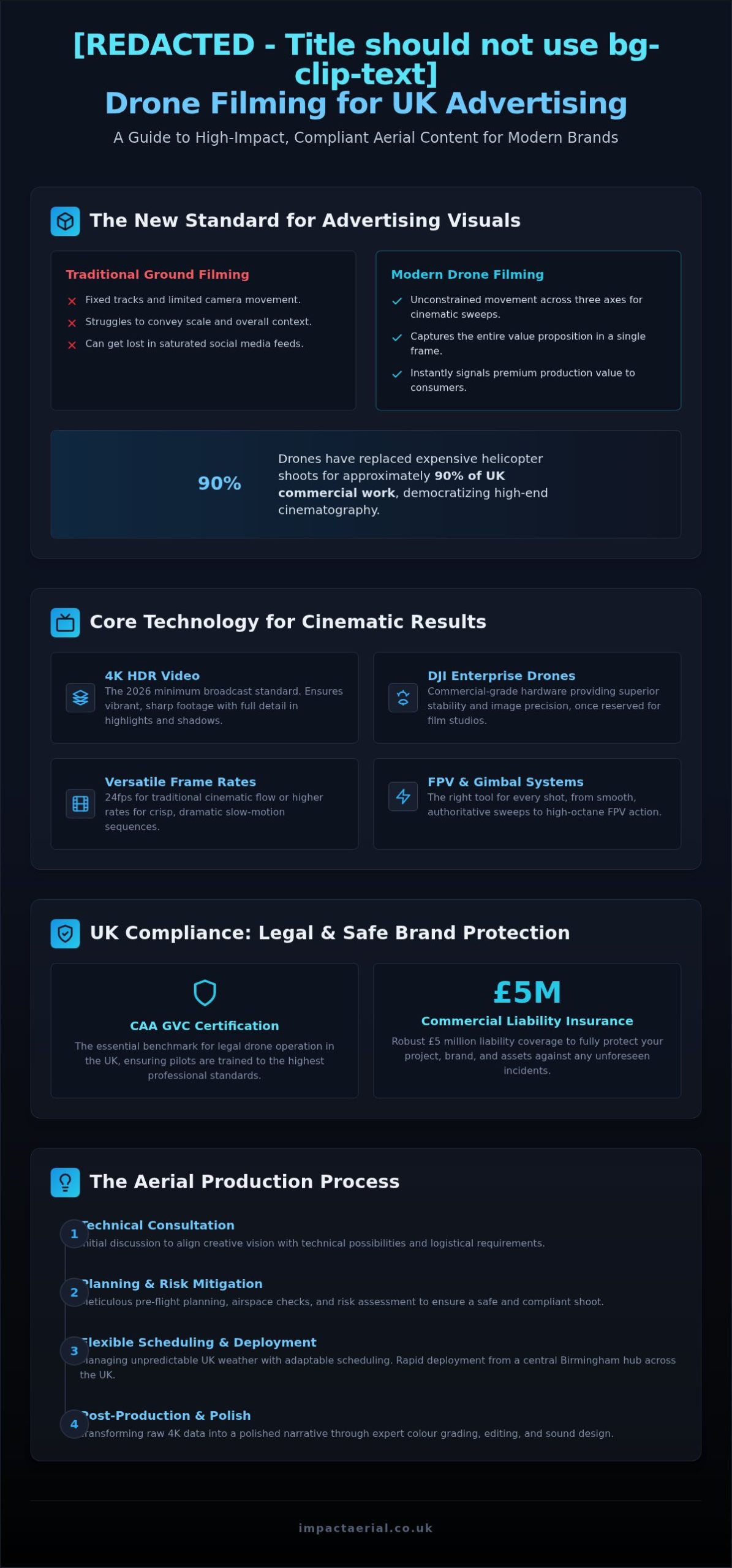
Vetting Your Partner: Safety, Insurance, and CAA Compliance
Hiring an unlicensed pilot for drone filming for advertising UK represents a critical liability that can jeopardize your brand’s reputation and legal standing. Beyond the immediate threat of Civil Aviation Authority (CAA) enforcement, using an unvetted operator often voids corporate insurance policies and exposes your business to severe repercussions if an incident occurs. A professional drone license isn’t just a piece of paper; it’s the primary indicator of an operator’s commitment to rigorous safety standards and national aviation law.
While many entry-level pilots hold an A2 Certificate of Competency (A2 CofC), the General Visual Line of Sight Certificate (GVC) is the professional gold standard for commercial advertising work. This certification requires a deeper level of pilot training, including a formal practical flight assessment and a comprehensive understanding of complex UK airspace. Choosing a GVC-certified partner ensures that your production team possesses the technical proficiency to manage high-stakes filming environments safely and effectively.
Understanding CAA Regulations for Commercial Work
The distinction between hobbyist flight and commercial work is defined by the concept of “valuable consideration.” If any form of payment, benefit, or commercial gain is exchanged for the footage, the flight is classified as commercial. Professional pilots must manage permissions in restricted or urban UK airspace through a methodical planning process. At Impact Aerial, we handle the administrative burden of flight permissions, which includes:
- Developing site-specific risk assessments for every location.
- Maintaining an approved Operational Manual that dictates safety protocols.
- Securing necessary clearances from Air Traffic Control (ATC) when operating in controlled zones near airports or city centres.
This meticulous preparation allows us to operate legally in areas where hobbyists cannot, protecting your production from mid-shoot shutdowns by authorities.
Protecting Your Brand Reputation with Professional Insurance
Standard public liability insurance rarely covers the specific risks associated with aerial operations. We carry £5m commercial liability insurance specifically tailored for drone filming. This level of coverage is essential for advertising shoots, as it protects against property damage, public injury, and potential data privacy claims. Our approach to risk mitigation involves a technical consultation phase to identify hazards before the drone ever leaves the ground. This provides you with the reassurance that your project is handled by specialists who prioritize operational security as much as the final cinematic output. By integrating these safety protocols into the creative process, we ensure a smooth production that respects both the law and your brand’s integrity.
Planning a Successful Aerial Advertising Shoot in the UK
Successful drone filming for advertising UK requires more than just launching a UAV; it demands a methodical approach to pre-production and stakeholder management. Our Birmingham-based team coordinates UK-wide shoots by first aligning your creative vision with technical flight feasibility. This initial consultation is critical for identifying potential logistical constraints before they impact your budget. Managing the UK’s variable weather is a core part of our operational reliability. We utilize advanced meteorological monitoring and build flexible “Plan B” dates into the production schedule to ensure your campaign stays on track regardless of the forecast.
Pre-Production: From Brief to Flight Plan
This phase focuses on defining the “hero shots” that will define the campaign’s success. We conduct comprehensive site surveys to identify local hazards such as power lines, tall buildings, or sensitive infrastructure. If your creative brief requires filming in congested urban areas, we handle the necessary Civil Aviation Authority notifications and local stakeholder communications. Informing neighbours and local authorities is a standard part of our risk mitigation strategy, ensuring that the shoot proceeds without interruption or public concern. This meticulous preparation provides the psychological comfort that your brand’s production is being handled by meticulous specialists.
The Shoot Day and Post-Production Workflow
On the day of the shoot, we provide safety briefings for all on-site personnel and offer live monitor viewing so you can review the 4K HDR footage in real-time. This collaborative approach allows for immediate adjustments to framing or flight paths. The transition from raw data collection to a professional aerial filming drone cinematic output occurs in our dedicated post-production suite. Here, our editors apply precise colour grading and music synchronization to elevate the raw visuals. We also ensure the final formats are optimized for your specific distribution channels, whether that involves 9:16 vertical crops for social media or full 16:9 ratios for television advertising.
To begin your pre-production roadmap and secure your shoot dates, you can consult with our technical production team for a detailed feasibility assessment and project quote.
Impact Aerial: Your Professional Drone Partner in the UK
Impact Aerial represents a unique fusion of technical certification and creative expertise within the British market. We provide a streamlined transition from the initial technical consultation to the final cinematic edit, ensuring every frame meets the highest standards of 4K HDR quality. Our comprehensive drone services span multiple sectors, ranging from high-tier advertising to detailed construction site monitoring and commercial property surveys. By maintaining a meticulous focus on CAA GVC certification and operational compliance, we protect both the visual shot and your brand’s legal integrity. Choosing a specialist for drone filming for advertising UK involves more than just selecting a camera; it requires a partner who understands the rigorous demands of commercial aviation and high-end production.
Nationwide Coverage with a Local Professionalism
Our Birmingham headquarters serves as a strategic hub for rapid UK-wide deployment. This central location allows us to mobilize quickly for projects in London, Manchester, and beyond, providing a level of responsiveness that regional operators often struggle to match. We possess a deep understanding of UK-specific urban filming challenges, including the complex permissions required for congested city centres and sensitive industrial zones. This local knowledge, combined with our national reach, ensures your production remains on schedule and fully compliant with all aviation protocols. We invite you to consult with our technical team regarding your specific 2026 marketing goals to see how our expertise can support your brand’s vision.
A Full-Service Approach to Visual Content
Our capabilities extend well beyond standard cinematography. We offer a full-service approach that includes high-resolution drone photography and the creation of immersive virtual tours for the property and hospitality sectors. Utilizing a fleet of DJI Enterprise commercial-grade drones, we ensure hardware reliability and high-end data security for every client. This technological edge is balanced with a commitment to human expertise; our pilots are trained to handle the most demanding creative briefs with precision and safety. Every project is backed by £5m commercial liability insurance, providing the final layer of reassurance for your business. We don’t just capture raw footage; we deliver a secure, high-impact production environment that allows your creative output to stand out without technical or legal compromise.
Elevating Your Brand Perspective in 2026
Integrating aerial visuals into your marketing strategy is no longer a luxury; it’s a requirement for brands that want to command attention. You’ve seen how the right technical approach, from smooth 4K HDR vistas to high-speed FPV fly-throughs, creates a premium feel that ground-level shots cannot match. Choosing a specialist for drone filming for advertising UK ensures that your creative ambition is supported by rigorous safety protocols and national aviation compliance.
Professional production requires more than just high-end hardware. It demands the reassurance provided by CAA GVC certified pilots and the security of £5m commercial liability insurance. At Impact Aerial, we combine these technical credentials with expert 4K HDR post-production to deliver content that stands out on any platform. Our Birmingham-based team is ready to mobilize nationwide to bring your vision to life.
Request a Professional Drone Filming Quote from Impact Aerial Today. We look forward to helping you capture the big picture and elevate your brand’s narrative.
Frequently Asked Questions
Do I need a special permit for drone filming for advertising in the UK?
Commercial drone filming for advertising UK requires specific certification from the Civil Aviation Authority (CAA). For most professional advertising projects, a General Visual Line of Sight Certificate (GVC) is the required standard. This isn’t a “permit” in the casual sense but a legal requirement for any “valuable consideration” work. We manage all additional flight permissions required for restricted zones or urban environments to ensure your production remains fully compliant with national aviation laws.
How much does professional drone filming for an ad campaign cost?
Project costs are determined by the specific requirements of your creative brief rather than a flat fee. Factors influencing the investment include the location’s complexity, the type of hardware required, and the extent of post-production services needed. We provide bespoke quotes after an initial technical consultation. This ensures the budget aligns with the high-tier 4K HDR output and safety standards your brand requires for a professional campaign without inventing arbitrary pricing.
Can you fly drones in central London or other UK city centres for advertising?
Flying in central London or other major UK city centres is possible but requires meticulous planning and specific clearances. These operations often involve coordinating with Air Traffic Control and securing permissions from the CAA for flight in congested areas. Our team handles the administrative burden of these notifications and risk assessments. This proactive approach allows us to capture stunning urban perspectives while maintaining the highest levels of operational security and public safety.
What happens if the weather is bad on the scheduled day of the drone shoot?
We prioritize flight safety and will reschedule if weather conditions, such as high winds or heavy rain, exceed operational limits. Our team utilizes advanced meteorological monitoring to provide early warnings; we typically build “Plan B” dates into the production schedule. This flexible approach ensures that we capture your 4K HDR footage in the best possible light without compromising the safety of the crew, the public, or the equipment during the shoot.
Is drone filming for advertising covered by standard business insurance?
Standard business insurance policies almost always exclude aviation activities, making specialized commercial drone insurance a necessity. Professional operators must carry insurance that specifically covers third-party liability and data privacy for aerial work. We maintain £5m in commercial liability insurance, which provides the necessary protection for your brand during a shoot. This coverage is a critical component of our risk mitigation strategy and offers the reassurance that your project is fully protected.
How long does it take to get the final edited drone video back?
The timeline for delivering final edited content typically ranges from a few days to two weeks, depending on the project’s complexity. This duration allows for a comprehensive post-production workflow, including 4K HDR colour grading, music synchronization, and format optimization for various social media platforms. We discuss specific deadlines during the pre-production phase to ensure your content is ready for your campaign launch, maintaining a steady rhythm from the shoot to the final edit.
What is the difference between a standard drone and an FPV drone for ads?
Standard drones use stabilized gimbals to produce smooth, grand vistas and are ideal for property or landscape marketing. In contrast, FPV (First Person View) drones offer an immersive, high-speed perspective that can fly through tight spaces like warehouses or offices. While standard drones provide an authoritative “big picture” view, FPV units deliver a dynamic, adrenaline-fueled experience. Both tools solve different creative problems and are often used together in a comprehensive drone filming for advertising UK campaign.
Do I need to notify the police before a drone advertising shoot?
You don’t usually need to notify the police for a standard drone shoot, provided you are operating legally within CAA regulations. However, we consider informing local authorities and neighbours a best practice for risk mitigation and stakeholder management. This proactive communication prevents unnecessary interruptions and ensures that the local community is aware of the professional nature of the operation. We handle these notifications as part of our comprehensive pre-flight planning process to ensure a stress-free production.
Drone Data Collection Services: A Professional Guide to Aerial Intelligence in 2026
What if the most hazardous and expensive stages of your project’s data gathering could be completed without a single person leaving the ground? For many UK industries, traditional reliance on scaffolding and manual inspections isn’t just slow; it’s a significant liability that drains budgets and increases site risk. Professional drone data collection services are no longer a futuristic concept; they’re a standard requirement for meticulous project management in 2026. By integrating high-resolution aerial intelligence, businesses can replace weeks of manual labour with hours of precise, digital data capture.
You likely understand the frustration of waiting for site surveys while costs mount and safety protocols grow more complex. We’ll show you how professional aerial intelligence transforms these bottlenecks into competitive advantages. This guide explores how to leverage advanced sensor integration and AI-powered analytics to achieve faster project turnarounds and superior accuracy. We also examine the critical 2026 UK drone regulations, including Remote ID requirements and CAA GVC certification, to ensure your operations remain fully compliant while delivering actionable insights that drive efficiency.
Key Takeaways
- Understand how professional drone data collection services move beyond simple imagery to provide quantitative, actionable aerial intelligence for commercial decision-making.
- Explore the technical capabilities of RGB, Thermal, and LiDAR sensors and how photogrammetry converts 2D captures into high-precision 3D models and orthomosaics.
- Evaluate the “speed to insight” advantages and significant safety improvements gained by replacing manual high-access inspections with rapid aerial deployments.
- Learn how to apply aerial data to specific workflows, from construction site monitoring and progress tracking to detailed commercial property condition reports.
- Identify the essential criteria for selecting a compliant UK partner by verifying CAA GVC pilot credentials and enterprise-grade hardware standards.
What are Professional Drone Data Collection Services?
Professional drone data collection services involve the systematic gathering of aerial imagery and sensor-based information for rigorous commercial analysis. This process goes beyond simple observation; it turns an Unmanned Aerial Vehicle (UAV) into a sophisticated data acquisition tool. By using professional-grade hardware, such as DJI Enterprise platforms, we capture high-resolution perspectives that ground-based methods simply cannot reach. This systematic approach ensures that every flight mission produces a reliable, repeatable digital record of a physical asset.
The Shift from Visual Imagery to Actionable Data
There’s a fundamental difference between aerial photography and technical data collection. While photography focuses on aesthetics, professional data collection prioritises quantitative accuracy. Our DJI Enterprise 4K HDR sensors capture minute details that are often invisible to the naked eye from the ground. This level of precision is essential for identifying structural micro-fissures or thermal anomalies. Every image we capture is embedded with precise metadata and geotagging. This allows us to stitch thousands of individual captures into a single, cohesive map or 3D model where every point is geographically referenced. We call this “Actionable Aerial Intelligence” because it provides the specific facts needed to make informed business decisions.
UK Regulatory Compliance: The Foundation of Reliable Data
Operating in the UK requires a meticulous approach to legality and safety. For commercial drone data collection services, CAA GVC certification is a non-negotiable standard. This qualification ensures that the pilot is fully trained in the latest aviation regulations and risk assessment procedures. Our commitment to these protocols means the data we deliver is legally robust and suitable for professional surveying reports or insurance assessments. Safety isn’t just about flying; it’s about comprehensive risk mitigation. We back every project with £5m commercial liability insurance. This level of coverage protects our clients’ interests and ensures that high-stakes environments, such as construction sites or industrial facilities, remain secure throughout the data capture process. Our pilots are not just operators; they are technical consultants dedicated to maintaining the highest industry standards.
Key Technologies Powering Modern Aerial Surveys
The accuracy of modern drone data collection services depends entirely on the precision of the sensors deployed. We typically utilise a triad of core technologies: RGB (Visual), Thermal, and LiDAR. While standard RGB cameras provide the high-resolution visual context needed for 4K HDR assessments, thermal and LiDAR sensors provide depth and heat-based data that visual inspections simply can’t match. This multi-sensor approach allows us to deliver a comprehensive digital twin of any site or asset. High-contrast 4K HDR cameras are particularly vital for property inspections, as they reveal subtle colour variations that might indicate damp or material degradation on a commercial roof.
Photogrammetry and 3D Modelling
Photogrammetry is the science of making reliable measurements through photographs. By capturing a series of overlapping images from various angles, we can generate dense “point clouds” that represent the physical world in a digital space. These models allow for precise volume and distance measurements, which are invaluable for construction teams managing aggregate stockpiles or tracking earthwork progress. It’s a method that turns hundreds of individual 2D images into a single, high-fidelity 3D asset that project managers can interact with from their desks. This transition from raw imagery to quantitative data ensures that every measurement is repeatable and verifiable.
Thermal Imaging for Industrial Inspections
Thermal technology has revolutionised how we approach preventative maintenance and industrial health. By detecting minute heat anomalies, we can identify failing components in electrical infrastructure or significant heat loss in building envelopes. This is particularly effective for PV solar farm thermal surveys, where identifying a single malfunctioning cell can significantly improve overall energy yield. These specialized sensors allow us to spot structural weaknesses or insulation gaps before they escalate into costly failures. Our thermal data provides a non-destructive way to assess the health of complex assets without interrupting daily operations.
Integrating this thermal data into broader commercial drone surveys provides a layer of intelligence that traditional ground-based inspections miss. While we gather this technical data, our pilots strictly adhere to UK drone privacy rules to ensure all captured information is handled with total professionalism and legal compliance. This adherence to official standards ensures the data remains admissible for official reporting. If you’re looking to enhance your site’s safety and efficiency, our team can help you select the right sensor package for your specific project requirements.
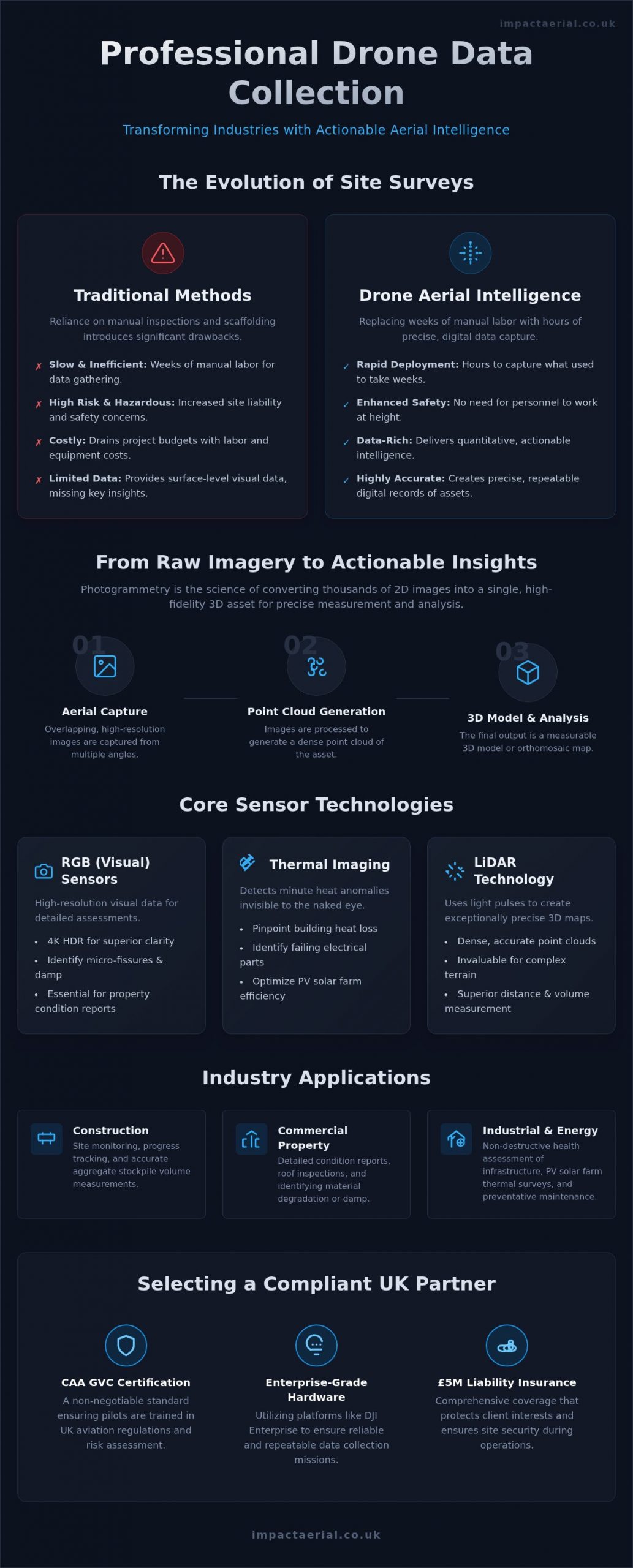
Drone Data vs. Traditional Surveying: A Comparison
Traditional surveying methods often involve extensive lead times and significant logistical hurdles. In contrast, drone data collection services offer a rapid “speed to insight” that manual ground surveys cannot replicate. While a traditional team might spend days setting up equipment and navigating site obstacles, a professional drone deployment can be airborne in minutes. This agility doesn’t just save time; it provides a level of repeatability that is essential for longitudinal site monitoring. Because our drones follow precise, GPS-guided flight paths, we can capture the exact same data points week after week, providing a clear, chronological record of project progress.
Enhanced Site Safety and Risk Mitigation
Removing the need for human personnel to work at height is perhaps the most significant advantage of aerial intelligence. Roof inspections and structural surveys traditionally require scaffolding or high-access equipment, both of which introduce substantial “Work at Height” risks. By using drones, we eliminate these hazards entirely. Our pilots can access confined or unstable areas that would be too dangerous for staff to enter, capturing high-resolution data from a safe distance. This safety-first culture provides immense psychological comfort for project managers. They can rest assured that their site is being meticulously monitored by experts without the administrative and safety burdens associated with manual high-access work.
Efficiency and Cost-Benefit Analysis
The financial argument for aerial data is compelling. By reducing the reliance on expensive plant hire, such as cherry pickers or complex scaffolding systems, we significantly lower the overheads of any survey. On large-scale construction sites, it’s common to see survey timelines compressed from several days to just a few hours. This efficiency also extends to environmental impact. Replacing heavy, diesel-powered machinery with agile, electric UAVs helps firms lower their carbon footprint while maintaining high data standards. The true return on investment, however, is found in preventative maintenance. Early detection of a minor defect via drone data can prevent it from becoming a catastrophic failure, saving thousands of pounds in remedial costs and avoiding project delays.
Industry Applications: Turning Data into Decisions
Professional drone data collection services provide specific value across diverse UK sectors by converting raw aerial captures into structured intelligence. While previous sections detailed the technology and its safety advantages, the true impact is felt in the operational decisions these insights empower. From the initial site survey to the final marketing phase, aerial data acts as a single source of truth for all stakeholders involved in high-stakes projects. This systematic approach ensures that every project phase is backed by verifiable, high-resolution evidence.
In the building sector, construction site monitoring allows project managers to track progress with centimetre-level accuracy. This visibility is essential for managing subcontractors and ensuring that project timelines remain on schedule. Similarly, for property managers, drone property surveys provide a non-destructive way to assess roof conditions and dilapidations. This data-centric approach is also vital for infrastructure maintenance, where inspecting bridges or telecommunications towers manually would be prohibitively expensive and risky.
BIM and CAD Integration for Construction
A significant advantage of modern aerial surveys is the seamless compatibility with existing professional workflows. We export captured data into industry-standard formats, such as LAS point clouds or DXF files, which integrate directly into Building Information Modelling (BIM) and CAD software. This addresses a common industry gap by ensuring that aerial data isn’t just a standalone visual, but a functional part of the design process. Digital twins enable architects and engineers to overlay as-built drone data with original design models to identify discrepancies early. In large-scale UK infrastructure projects, these models allow remote teams to collaborate on a single, high-fidelity digital representation of the site.
Property and Asset Management
For commercial real estate, aerial intelligence serves both maintenance and investment purposes. High-resolution virtual tours and 3D data allow remote investors to explore properties in detail without the need for site visits. This is particularly effective for Grade I and II listed buildings, where meticulous documentation is required for heritage preservation. Routine aerial inspections of gutters and roof structures also prevent water ingress, protecting the long-term structural integrity of the asset. When high-end visuals are required for advertising, our aerial filming and photography services combine technical precision with cinematic quality to showcase assets at their best.
If you’re ready to integrate these insights into your next project, book a consultation with our technical team to discuss a tailored data collection strategy.
Choosing the Right Drone Data Partner in the UK
Selecting a provider for drone data collection services requires more than just looking at a portfolio of impressive images. It’s about vetting the operational standards that underpin the data’s reliability. A professional partner should act as a technical consultant, ensuring that every flight mission is compliant, insured, and tailored to your specific project goals. Without this level of scrutiny, you risk receiving data that’s either legally inadmissible or technically flawed.
- Verify pilot credentials: Commercial operations in the UK require CAA GVC certified pilots who understand the nuances of 2026 aviation regulations.
- Assess the hardware: Enterprise-grade equipment ensures data integrity through high-resolution sensors and stable flight performance in varied conditions.
- Confirm insurance: A minimum of £5m commercial liability coverage is essential for risk mitigation on industrial and construction sites.
- Review post-production: Determine if the provider delivers raw files or offers comprehensive data analysis and professional editing to make the data actionable.
The Impact Aerial Professional Standard
Our Birmingham-based team provides expert, “human-in-the-loop” consultation for projects across the UK. We don’t just fly; we meticulously plan every mission to meet the highest safety standards and regulatory requirements. We provide an end-to-end service, managing everything from the initial technical consultation to the final post-production editing of your data sets. This meticulous approach ensures that the aerial intelligence you receive is ready for immediate integration into your professional workflows, providing the reassurance that your project is in expert hands.
Requesting a Quote and Project Planning
To provide an accurate quote for drone data collection services, we need specific details about your site location, the required deliverables, and any known access constraints. Project timelines are often influenced by weather conditions and airspace restrictions, such as Temporary Restricted Areas (TRAs) or NOTAMs. We handle these administrative burdens by conducting thorough pre-flight site assessments and monitoring meteorological data in real-time. Getting started is straightforward. A brief consultation allows us to align our technical capabilities with your project’s unique requirements, ensuring a structured and methodical path toward capturing the data you need.
Future-Proofing Your Operations with Aerial Intelligence
The transition to sophisticated drone data collection services has redefined how UK industries manage risk and capture site information. By moving beyond simple imagery toward quantitative data, you gain a repeatable, high-precision record that integrates directly into your professional workflows. This shift doesn’t just save time. It fundamentally improves site safety by removing personnel from hazardous environments.
Success in 2026 requires a partner who understands the intersection of advanced technology and strict regulatory compliance. Our team provides the reliability of CAA GVC certified pilots and £5m commercial liability insurance, ensuring your data is captured safely and legally. We provide an end-to-end solution that includes expert post-production editing, turning raw captures into clear, actionable business intelligence.
Ready to enhance your project’s accuracy and efficiency? Request a Professional Drone Data Quote from Impact Aerial today. Let’s elevate your site intelligence together.
Frequently Asked Questions
What is the difference between a drone survey and drone data collection?
Professional drone data collection services involve the systematic gathering of raw aerial information, such as high-resolution imagery or LiDAR points, using specialized sensors. A drone survey is the application of that captured data to a specific professional standard or report. Collection is the technical acquisition phase. The survey represents the final interpreted intelligence used by architects or engineers to make informed site decisions based on that raw data.
How accurate is drone data for construction measurements?
Aerial data is highly precise, often achieving a sub-centimetre Ground Sample Distance (GSD). When we use DJI Enterprise hardware combined with precise Ground Control Points (GCPs), the resulting 3D models provide the centimetre-level accuracy required for volumetric calculations. This level of detail allows project managers to track earthwork progress or material stockpiles with a degree of precision that matches or exceeds traditional manual ground-based surveying methods.
Do I need to notify the CAA before hiring a drone data collection service?
You don’t need to notify the Civil Aviation Authority (CAA) yourself when hiring a professional operator. As a CAA GVC certified service, Impact Aerial handles all necessary flight planning, risk assessments, and airspace notifications. We ensure every mission complies with the latest UK drone regulations. Our team manages the administrative burden, including checking for restricted zones or temporary flight restrictions, so your project remains fully compliant without additional effort.
What file formats can drone data be exported in for BIM or CAD?
We export aerial intelligence into several industry-standard formats to ensure seamless integration with professional workflows. Common exports include .LAS or .LAZ for dense point clouds, .DXF or .DWG for CAD drawings, and .OBJ for 3D textured models. We also provide high-resolution GeoTIFFs for orthomosaic maps. These formats allow architects and engineers to overlay “as-built” aerial data directly onto their design models for precise discrepancy analysis and project tracking.
Can drones collect data in built-up urban areas like London or Birmingham?
Drones can operate in built-up urban environments like Birmingham and London, provided the pilot holds the correct CAA certifications. Our GVC certified pilots are trained to operate safely in congested areas by conducting meticulous site-specific risk assessments. We coordinate with local authorities and air traffic control when necessary to secure flight permissions. Operating in urban centres requires a safety-first culture and high-end hardware to mitigate risks associated with signal interference.
How much does professional drone data collection cost in the UK?
The cost of professional drone data collection services varies depending on several factors, including the site’s scale, the complexity of the airspace, and the specific sensors required. A simple visual inspection of a commercial roof differs in scope from a multi-day LiDAR survey for a large infrastructure project. We provide tailored quotes based on a thorough consultation to ensure the pricing reflects your project’s specific data requirements and safety protocols.
What happens if the weather is bad on the day of the drone survey?
Safety is our primary concern, so we don’t fly in conditions that exceed the operational limits of our DJI Enterprise hardware. If high winds or heavy rain are forecast for your survey, we’ll coordinate with you to reschedule the flight for the next available safe weather window. Our pilots monitor real-time meteorological data to make informed “go or no-go” decisions. This ensures that data integrity is never compromised by adverse environmental factors.
Why is £5m liability insurance necessary for drone services?
Carrying £5m commercial liability insurance is a standard requirement for operating on professional construction and industrial sites in the UK. This level of coverage provides essential reassurance and risk mitigation for our clients. It ensures that in the unlikely event of an incident, all parties are protected against third-party property damage or injury. High-value insurance is a hallmark of a professional operator who takes the operational and legal side of their business seriously.
Construction Site Drone Monitoring UK: The 2026 Professional Guide
By 2026, the standard for project oversight has shifted from occasional site walks to a continuous, digital audit trail. Relying on manual reporting isn’t just inefficient; it’s a significant risk to your project’s timeline and personnel safety. Professional construction site drone monitoring UK now provides the verifiable data needed to settle stakeholder disputes before they escalate. It’s frustrating when traditional surveys come back with high costs and low-resolution data that doesn’t integrate with your BIM workflows.
You already know that maintaining a safe, compliant site is your top priority. This guide will show you how to leverage commercial-grade drone technology to create a transparent record of progress while keeping your team out of harm’s way. We’ll examine the latest 2026 CAA GVC regulations, the transition to Remote ID requirements, and how high-quality 4K HDR assets can provide the precision your investors demand. From initial risk assessments to post-production data delivery, you’ll discover how to build a more reliable, data-driven construction environment.
Key Takeaways
- Learn how automated UAV data collection is replacing manual site walks to create a more accurate and systematic digital record of your project.
- Understand the technical advantages of high-resolution orthomosaics and 3D point clouds for seamless integration into your existing BIM workflows.
- Discover how construction site drone monitoring UK enhances site safety by eliminating the need for personnel to navigate hazardous or uneven terrain.
- Navigate the 2026 regulatory landscape, including the critical importance of CAA GVC certification and £5m commercial liability insurance for site compliance.
- Explore how using professional-grade DJI Enterprise hardware ensures high-precision 4K data for reliable project milestone tracking and stakeholder reporting.
What is Construction Site Drone Monitoring?
Construction site drone monitoring UK represents a fundamental shift in how project managers oversee active builds. At its core, this process involves the systematic use of Unmanned Aerial Vehicles (UAVs) to capture dated, georeferenced data across a project’s entire footprint. While traditional site walks rely on manual observation and subjective reporting, drone-based systems automate data collection to ensure every measurement is accurate and repeatable. Understanding the full scope of drone applications in construction is essential for firms looking to modernize their workflows in 2026.
By scheduling weekly or fortnightly flights, contractors can create a chronological digital twin of the build. This record provides an indisputable evidence trail that tracks progress against the master schedule. Construction monitoring is the intersection of surveying and visual documentation.
To better understand this concept, watch this helpful video:
Visual Progress vs. Technical Data
Modern UK projects demand a hybrid approach that satisfies both marketing and engineering requirements. Visual monitoring utilizes high-resolution photography and 4K HDR video to provide stakeholders with clear, easy-to-digest updates. In contrast, technical monitoring focuses on photogrammetry, 3D point clouds, and orthomosaic mapping. These data-rich assets allow for precise site measurements and seamless integration with existing project management software. Combining these methods ensures that while investors see the visual progress, the site team has the raw data needed for technical audits.
The Role of the Professional Drone Operator
Professional operators do more than just fly drones; they manage the scientific consistency of the site’s data. This involves meticulously planning automated flight paths to ensure that data captured on different dates is perfectly aligned for chronological comparison. They handle site-specific risk assessments and coordinate with site managers, ensuring that aerial operations don’t interrupt active ground crews or compromise safety. By adhering to strict CAA GVC protocols, the operator ensures every flight serves as a repeatable, scientific measurement rather than a simple visual capture. This meticulous approach provides the reassurance that your project’s digital record is legally compliant and technically sound.
The Data Deliverables: Beyond Simple Aerial Photos
Professional construction site drone monitoring UK has evolved significantly beyond basic photography. In 2026, the true value lies in the raw data and high-fidelity digital assets that drive project management. These deliverables don’t just show what the site looks like; they provide measurable, actionable insights for engineers and stakeholders alike. By moving away from static images, contractors gain a dynamic understanding of their project’s health.
- High-resolution orthomosaics: These are scaled, top-down maps used for precise site measurements and boundary verification.
- 3D point clouds: Essential for BIM integration, these models allow for detailed analysis within project management software.
- Volumetric analysis: Drones accurately measure material stockpiles and earthworks from the air, saving hours of manual labour.
- 4K HDR video reels: Cinematic progress updates specifically designed for high-level boardroom presentations and marketing.
Orthophotos and Site Mapping
Georeferenced orthophotos are essential for modern contractors. By using these scaled maps, teams can perform clash detection, comparing the “as-built” progress against the original CAD designs. This identifies discrepancies early, preventing expensive rework. Because these records are dated and unalterable, they serve as a critical evidence trail in contractual disputes. This provides the psychological comfort that your project is protected by a verifiable digital record. Measuring material quantities used to involve slow, manual ground surveys, but drones now calculate volumes of soil or gravel in minutes, ensuring you only pay for what’s actually on-site.
3D Models and Virtual Tours
Remote stakeholder management is now a standard requirement for large-scale builds. We create immersive virtual tours that allow investors to walk through a site from their office. These 3D models are also used by site managers to plan complex logistics, such as vehicle access routes and crane positioning. Our DJI Enterprise drones use 4K HDR sensors to capture fine details, such as structural structural elements or drainage issues, that traditional site cameras often miss. This level of clarity provides a comprehensive visual record that ground-based photography simply cannot match.
Every flight is conducted in strict accordance with UK Civil Aviation Authority (CAA) drone regulations, ensuring your data is collected within a compliant and safe framework. If you’re ready to transition to a data-driven site, our professional construction site monitoring services provide the technical precision your project requires.
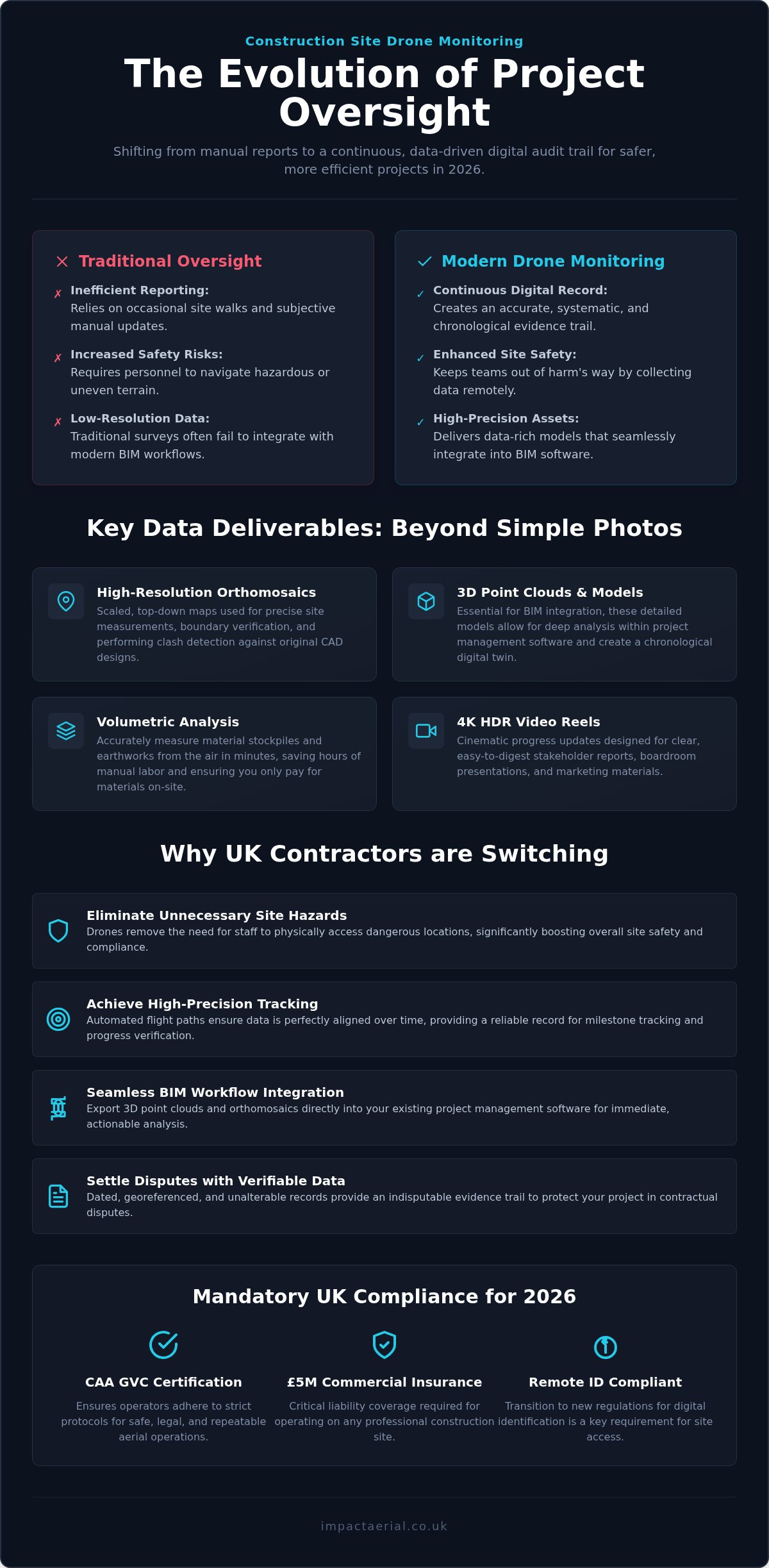
Why UK Contractors are Switching to Drone-Based Progress Tracking
The adoption of construction site drone monitoring UK is driven by a fundamental need for better risk management and operational efficiency. In 2026, the construction industry faces tighter margins and stricter safety standards than ever before. Traditional methods of site oversight are struggling to keep pace with these demands. By integrating aerial data, contractors are replacing subjective reports with objective, high-resolution truth.
- Enhanced Site Safety: Drones remove the need for personnel to navigate hazardous stockpiles, uneven terrain, or active machinery zones.
- Cost-to-Value Ratio: Aerial monitoring provides a significantly higher density of data than ground surveys in a fraction of the time.
- Stakeholder Transparency: Clear visual evidence supports payment certificates and reduces disputes over the timing of completed work.
- Verifiable Data: Precision drone surveys validate earthworks and grading against the original site design.
Solving the ‘Manual Walk’ Problem
Manual site walks are inherently inconsistent. They’re prone to human error, where a project manager might miss a subtle structural issue or overlook a specific area of the site. Documentation often has gaps between visits, leaving contractors vulnerable to claims. A professional drone can capture comprehensive data across a 50-acre site in minutes rather than the hours required for a ground-based inspection. This speed ensures that site managers spend less time walking and more time making data-driven decisions. It’s about creating a systematic, repeatable process that ground teams can rely on week after week.
Investor and Client Reporting
Building trust with project funders requires more than just spreadsheets. High-quality aerial filming provides cinematic updates that resonate in the boardroom. These visual assets allow remote stakeholders to see the exact status of a build without the cost or time of a physical site visit. Using time-lapse drone footage, you can showcase project milestones over several months, providing a powerful narrative of the project’s success. This level of transparency reassures investors that their capital is being managed effectively, while reducing the logistical burden on the site team. It’s a professional standard that modern UK contractors now consider essential for high-tier projects.
Compliance and Safety: Navigating UK Drone Regulations in 2026
As of January 1, 2026, the regulatory framework for construction site drone monitoring UK has become significantly more robust. The introduction of mandatory Remote ID for all UK class-marked drones ensures that every commercial flight is traceable and accountable. For contractors, this means that compliance isn’t just a legal checkbox; it’s a critical component of site risk management. Operating a drone on an active build requires more than technical skill. It demands a deep understanding of the Civil Aviation Authority (CAA) framework to protect the main contractor from liability.
- CAA GVC Certification: This is the professional standard for commercial operations within visual line of sight.
- £5m Commercial Liability Insurance: This is the industry minimum for protecting personnel and assets on UK sites.
- Remote ID Compliance: Ensuring all hardware broadcasts a valid Operator ID as required by 2026 legislation.
- FRZ Management: Coordinating with Air Traffic Control when sites fall within Flight Restriction Zones or urban centres.
Understanding the GVC Certification
The General Visual Line of Sight Certificate (GVC) is the essential UK drone license for any pilot conducting commercial work on a construction site. Hiring an uncertified hobbyist or a pilot without a valid GVC creates immense legal risk. If an incident occurs, using an uncertified operator typically voids the site’s primary insurance policy. We maintain meticulous records of our certifications and CAA permissions, providing the psychological comfort that your project remains fully compliant with current national aviation standards.
Insurance and Risk Mitigation
Safety on a high-pressure site begins long before the drone takes off. Our £5m commercial liability insurance is specifically tailored for the construction sector, providing a level of protection that consumer policies cannot match. Every mission includes a comprehensive pre-flight planning phase. This involves checking NOTAMs (Notices to Air Missions), monitoring localized weather patterns, and conducting site-specific safety briefings with your site manager.
Urban sites present unique challenges, such as signal interference and tight physical constraints. Our DJI Enterprise drones feature redundant safety systems, including multi-directional obstacle avoidance and “return-to-home” protocols that trigger if a connection is lost. These technical safeguards, combined with our rigorous risk assessments, ensure that data collection never compromises ground crew safety. If you need a partner that prioritizes regulatory excellence, contact us to discuss our professional drone monitoring services for your next project.
Implementing Drone Monitoring with Impact Aerial
Integrating construction site drone monitoring UK into your project requires a partner who understands the nuances of the national construction landscape. Based in Birmingham, we provide specialized services across the West Midlands and the wider UK, ensuring that aerial data is not just captured but utilized effectively to drive project success. Our approach centers on meticulous planning to ensure that every flight aligns perfectly with your specific project milestones and reporting cycles.
We utilize commercial-grade DJI Enterprise drones equipped with high-performance 4K HDR camera equipment. This hardware advantage ensures that we capture high-precision data even in challenging lighting or environmental conditions. Whether you’re tracking a new build in a dense urban environment or monitoring a sprawling infrastructure project, our technology provides the qualitative and technical output required for modern industry leadership. Our pilots are CAA GVC certified, providing the reassurance that every operation is conducted with the highest regard for safety and compliance.
The Impact Aerial Workflow
Our workflow is structured and methodical, designed to provide psychological comfort through total reliability. It begins with a comprehensive initial site assessment and a rigorous regulatory check to identify any Flight Restriction Zones or specific safety requirements. Once the parameters are established, we conduct scheduled flight missions that can be weekly, monthly, or based on critical project milestones. All captured data is processed and delivered via secure cloud platforms, allowing your team to access georeferenced maps and progress updates from any location without delay.
From Raw Data to Post-Production
One of our primary strengths is the end-to-end service model. We don’t just provide raw files; our post-production services transform raw data into professional reports and cinematic videos. For your internal engineering teams, we provide CAD-ready files that integrate directly into existing project management software, facilitating accurate measurements and clash detection. Simultaneously, we edit footage into high-end marketing assets for investor presentations, bridging the gap between technical data and visual storytelling. By acting as a single partner from the initial consultation to the final edit, we ensure a seamless integration with your project workflows and maintain a consistent standard of high-tier quality throughout the entire build lifecycle.
Securing the Future of Your Site Oversight
Professional construction site drone monitoring UK has transitioned from an optional visual aid to a critical digital audit trail. By 2026, the integration of high-precision DJI Enterprise hardware and CAA-compliant flight protocols has set a new standard for project transparency. You now have the tools to replace manual site walks with verifiable 4K data, reducing safety risks while providing stakeholders with undeniable proof of progress. This meticulous approach ensures your project remains on schedule and protected from potential contractual disputes.
Based in the West Midlands with full UK coverage, Impact Aerial provides the technical expertise your project requires. Our pilots are CAA GVC certified and backed by £5m commercial liability insurance, ensuring your site operations are both safe and legally compliant. We handle everything from initial risk assessments to the delivery of CAD-ready files and high-end marketing assets. Request a Professional Drone Monitoring Consultation to transform your site into a data-driven environment. We look forward to helping you build with greater precision and confidence.
Frequently Asked Questions
Do I need to notify the CAA for drone monitoring on my site?
Professional pilots handle all regulatory notifications. While you don’t need to contact the CAA yourself, your operator must ensure the flight is compliant with 2026 Remote ID requirements and any local Flight Restriction Zones. We manage all necessary permissions and risk assessments as part of our service. This ensures your project remains within the law without adding administrative burden to your site management team.
How often should drone monitoring be conducted for a large project?
Frequency typically depends on the pace of your build and specific project milestones. Most UK contractors opt for weekly or fortnightly missions to maintain a consistent digital twin. For large-scale infrastructure, monthly flights might suffice for high-level oversight. We align our flight schedule with your reporting requirements, ensuring that every data capture provides meaningful progress tracking for your payment certificates and stakeholder updates.
Can drones operate in typical UK weather conditions?
Modern DJI Enterprise drones are designed to handle moderate wind and light precipitation common in the UK. However, for safety and data quality, we don’t fly in heavy rain or wind speeds exceeding the manufacturer’s safety limits. We monitor localized weather patterns meticulously to reschedule flights if conditions are unsuitable. This ensures the 4K HDR data we capture is clear, accurate, and gathered without risking personnel or equipment.
What is the difference between a drone survey and drone monitoring?
A drone survey is generally a one-off technical exercise focused on high-precision measurements like topographic mapping or volumetric analysis. In contrast, construction site drone monitoring UK is a recurring service designed to track progress over time. While monitoring uses survey-grade data, its primary goal is creating a chronological record of the build. This allows project managers to compare as-built progress against the original design throughout the construction lifecycle.
Is drone monitoring safe on a busy site with cranes and machinery?
Yes, professional monitoring is safe when conducted by CAA GVC certified pilots. We use hardware with multi-directional obstacle avoidance and redundant safety systems to navigate around cranes and machinery. Every mission begins with a site-specific risk assessment to identify potential hazards. By maintaining a safe distance from active plant and following strict visual line of sight protocols, we capture data without ever interrupting your ground crews’ workflow.
How much does construction site drone monitoring cost in the UK?
Pricing for monitoring services depends on the site size, flight frequency, and the specific data deliverables required. While we don’t provide fixed price lists, factors such as the complexity of the airspace and the level of post-production editing also influence the final cost. We focus on providing a high cost-to-value ratio by delivering accurate, digital audit trails that reduce the need for slow, manual site inspections.
What file formats will I receive for my BIM software?
We provide data in various industry-standard formats that integrate seamlessly with your existing BIM and CAD workflows. Common deliverables include .TIFF files for orthomosaic maps, .LAS or .XYZ files for 3D point clouds, and .OBJ files for textured 3D models. These CAD-ready assets allow your engineering team to perform precise measurements and clash detection. We also deliver high-resolution 4K video reels for your non-technical stakeholder presentations.
Does the drone pilot need to be on-site at all times?
No, our pilots are only on-site during the active data capture phase. A typical mission for construction site drone monitoring UK takes between one and four hours depending on the site’s acreage and complexity. Once the flight is complete and the raw data is verified, our team handles all processing and post-production at our Birmingham base. You receive the final reports and digital assets via a secure cloud platform shortly after the flight.
Professional Aerial Video Editing Services: Transforming Raw Drone Footage into High-Impact Content
With 52% of real estate agents now using drone video as a standard marketing tool, aerial perspectives have shifted from a luxury to a baseline requirement for UK businesses. However, capturing high-bitrate 4K HDR footage is only the first step in a complex technical workflow. You likely understand the frustration of reviewing raw files only to find the horizon is slightly tilted, the colors appear flat, or the motion feels jittery due to mismatched frame rates. Managing these massive data sets in-house often proves inefficient and technically demanding for most marketing teams.
Professional aerial video editing services bridge the gap between raw data and a polished, high-impact deliverable. This guide explains how expert post-production transforms unrefined drone captures into cinematic marketing assets that drive ROI and precise commercial surveys for site monitoring. We will examine the essential role of specialized software, the importance of working with CAA GVC certified professionals who carry £5m commercial liability insurance, and the methods used to seamlessly integrate ground-based footage with aerial views for a cohesive, professional result in 2026.
Key Takeaways
- Understand why professional aerial video editing services are essential for managing high-bitrate 4K HDR files and transforming raw data into high-impact content.
- Learn how expert post-production solves common drone-specific issues like micro-vibration and inconsistent colour grading between aerial and ground-based sensors.
- Compare the security advantages of using a UK-based agency with £5m commercial liability insurance versus anonymous freelance marketplaces for sensitive site data.
- Master the preparation process by defining clear objectives and organising raw UAV files to ensure a seamless transition from flight to final cut.
What Are Professional Aerial Video Editing Services?
Rooted in a discipline that stretches back further than most people realise, the history of aerial videography shows that capturing the world from above has always demanded a distinct technical approach. Today, that principle is no different. Professional aerial video editing services are a specialised post-production discipline focused on transforming raw UAV captures into structured, commercially purposeful narratives. It’s a process that demands far more than a competent editor and a fast computer; it requires a precise understanding of drone-specific file formats, flight-induced artefacts, and the visual language required to communicate value to a target audience.
The core challenge is the raw material itself. DJI Enterprise drones capture footage in log colour profiles, such as D-Log M, to preserve the maximum possible dynamic range across bright skies and shadowed ground detail simultaneously. These flat, desaturated files are deliberately unfinished. Without expert colour science applied in post-production, the footage looks washed out and unprofessional. A skilled editor interprets that raw data and grades it into a final image that reflects what the human eye actually perceives on site.
The Distinction Between Basic Cutting and Professional Post-Production
Basic cutting is a trim-and-join operation. Clips are shortened, arranged in sequence, and exported. Professional post-production is an entirely different workflow. It involves colour grading calibrated to the specific log format used, sound design that reinforces the visual pace, motion stabilisation to eliminate wind-induced jitter, and a narrative-led editorial structure that guides a viewer from opening context through to a clear commercial conclusion. For property marketing or construction site monitoring, that structure is what converts a viewer into an enquiry.
The Importance of Specialised Tools for Drone Footage
Handling high-bitrate 4K HDR files demands industry-standard software. Platforms like DaVinci Resolve and Adobe Premiere Pro are built to manage the processing load these codecs require and provide the colour management pipelines necessary to work accurately within log colour spaces. Critically, specialised software also applies lens correction profiles that mathematically counteract the wide-angle barrel distortion inherent in drone camera optics, ensuring that straight building lines and site boundaries are rendered accurately in the final output.
This level of technical rigour is precisely what separates a professional service from a low-cost clip-trimming solution. For UK businesses commissioning drone content for property sales, commercial surveys, or construction monitoring, the quality of post-production directly determines the commercial value of the asset delivered.
Technical Challenges Solved by Expert Aerial Editors
Capturing raw data with a drone is only half the battle. Even with high-end DJI Enterprise hardware, environmental factors like wind resistance and light fluctuations introduce technical flaws that can undermine a project’s credibility. Professional aerial video editing services exist to rectify these specific issues, ensuring that the final deliverable meets the rigorous requirements of commercial stakeholders. By applying advanced post-production techniques, editors can salvage footage that would otherwise be unusable due to optical distortions or mechanical vibrations.
Stabilisation and Motion Smoothing
The physics of drone flight means that a UAV is constantly fighting against air resistance and turbulence. While modern 3-axis gimbals are remarkably effective, they cannot eliminate every micro-vibration. Professional editors use software-based stabilisation, often employing optical flow algorithms and point-tracking to smooth out the flight path. This process is essential for removing the “jello effect,” a common rolling shutter artifact caused by the CMOS sensor’s sequential line scanning. By correcting these timing discrepancies, the editor ensures the motion feels cinematic and fluid rather than mechanical and distracting.
Advanced Colour Grading for Commercial Impact
Most commercial drone footage is recorded in “Log” profiles to preserve the maximum amount of data in highlights and shadows. However, this leaves the raw files looking grey and desaturated. Editors must transform these profiles using precise colour science to achieve true-to-life vibrancy while maintaining brand consistency across multiple sites. Expert colour grading enhances the emotional appeal of real estate drone photography by creating a warm, inviting atmosphere that resonates with potential buyers. Adhering to professional standards in aerial imaging, these adjustments ensure that the visual output remains accurate for technical surveys while being aesthetically compelling for marketing.
Managing the dynamic range in 4K HDR files is another critical task. In high-contrast environments, such as a construction site at midday, the sky often appears “blown out” while the ground detail is lost in shadow. A skilled editor uses secondary colour correction and masking to recover these details, providing a balanced image that shows the full scope of a project. If your current raw data lacks this professional polish, our specialists at Impact Aerial can refine your footage into a high-impact commercial asset.
Finally, wide-angle lenses used on most drones naturally produce barrel distortion, making straight lines appear curved. This “fisheye” effect is particularly problematic for property and construction surveys where accuracy is paramount. Professional post-production applies mathematical lens correction profiles to straighten these lines, ensuring the structural integrity of the subject is represented correctly in every frame.
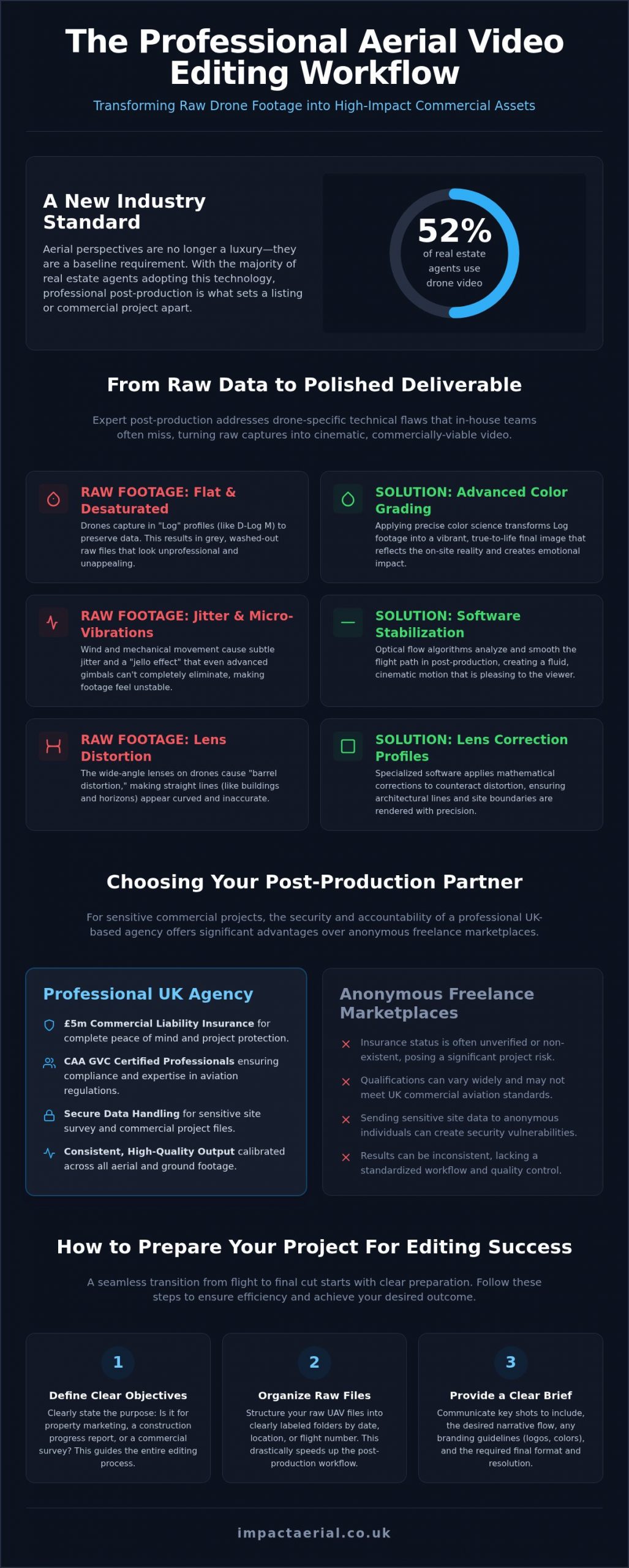
Professional Agency vs. Freelance Marketplaces: A Comparison
Selecting a partner for aerial video editing services often involves a choice between the perceived convenience of global freelance marketplaces and the structured reliability of a dedicated UK agency. For commercial projects, particularly in property and construction, the latter provides a level of accountability that anonymous platforms cannot match. A professional agency operates under UK-based contracts; this ensures that project management is transparent and that legal protections are in place for both parties. This structure is essential for businesses that require reliable delivery timelines and clear communication throughout the post-production cycle.
Security is a primary concern when handling high-resolution data from sensitive sites. Freelance platforms often involve offshore processing, which introduces significant risks regarding data protection and secure file handling. In contrast, a professional agency implements rigorous internal protocols to protect client data. This commitment to risk mitigation is evidenced by maintaining substantial £5m commercial liability insurance. While some may assume insurance only applies to the flight phase, it remains a critical marker of a business’s stability and professional standing throughout the entire service lifecycle in 2026.
The Risks of Low-Cost Offshore Editing
Low-cost offshore solutions frequently result in hidden costs that aren’t immediately apparent. Communication barriers often lead to excessive revision cycles, as editors may lack an understanding of specific UK property and construction standards. There is also a heightened risk of copyright infringement. Professional agencies ensure all music, stock assets, and fonts are correctly licensed for commercial use. This protects your business from future legal complications that can arise from using unlicensed assets found on unregulated marketplaces.
The Value of Integrated End-to-End Services
There is a distinct advantage to using a provider that understands the nuances of the flight itself. Our aerial filming drone services benefit directly from an integrated post-production workflow. When the editors are also experts in flight data and DJI Enterprise systems, they can interpret metadata more effectively to correct the technical optical issues discussed earlier. This streamlined approach, from the flight deck to the final export, ensures consistency in quality across multiple regional projects. By keeping the workflow in-house, we maintain a high standard of cinematic output while ensuring that technical survey data remains precise and secure.
How to Prepare Your Aerial Project for Editing Success
Efficient post-production begins long before the first clip is imported into the timeline. To maximise the ROI of your aerial video editing services, you need a structured approach to project preparation. Without a clear workflow, the technical complexities of 4K and 8K drone data can lead to extended revision cycles and increased costs. Following a methodical four-step process ensures that the transition from raw footage to a high-impact deliverable is seamless and secure.
- Step 1: Define the objective. Clearly state whether the output is a cinematic marketing promo designed for high engagement or a technical survey requiring precise data visualisation.
- Step 2: Organise raw files. Group your data by date, location, and shot type. This structure allows editors to locate specific assets quickly, saving billable hours.
- Step 3: Provide a comprehensive brief. Include your brand guidelines, preferred colour palettes, and licensed music references to ensure the final cut aligns with your corporate identity.
- Step 4: Establish a feedback loop. Define who has final sign-off authority and set clear dates for draft reviews to keep the project on schedule.
Defining Your Narrative and Project Scope
Before any cutting occurs, you must identify your target audience and key messaging. A marketing video for a luxury property development requires a different editorial rhythm than a construction progress report. You should also specify your required aspect ratios early. While 16:9 remains the standard for websites and presentations, 2026 social media trends often demand 9:16 vertical versions for platforms like LinkedIn or Instagram. Setting these parameters at the start allows the editor to frame shots correctly during the stabilisation and cropping phases.
Data Management and File Transfer
Handling massive 4K and 8K datasets requires high-speed cloud transfer solutions. We recommend using professional platforms that maintain the integrity of your files without compression. This is especially critical for technical projects. While marketing videos focus on aesthetics, drone survey data requires specific handling to preserve original metadata. This metadata contains essential flight information and GPS coordinates that are vital for survey accuracy. If you’re ready to transform your raw data into a professional commercial asset, you can contact our Birmingham-based team to discuss your specific project requirements.
Partner with Impact Aerial for UK-Based Video Editing Excellence
Centrally based in Birmingham, Impact Aerial provides a robust technical infrastructure for clients across the UK and international markets. Our aerial video editing services are built on a foundation of professional reliability and meticulous attention to detail. We specialise in high-stakes sectors where precision is non-negotiable, including commercial property, large-scale construction monitoring, and PV solar farm thermal surveys. By maintaining a strict focus on safety and compliance, we ensure that every project meets the rigorous standards required by corporate stakeholders and national regulatory bodies in 2026.
Our operation is underpinned by £5m commercial liability insurance and a team of CAA GVC certified professionals. This isn’t just about flight safety; it’s a commitment to professional accountability throughout the entire post-production lifecycle. We understand that raw drone data is a significant investment. Our role is to protect that investment by applying advanced DJI Enterprise workflows that preserve the integrity of your 4K HDR footage while delivering a polished, high-impact final product that drives tangible business results.
Our Post-Production Toolkit and Expertise
The Impact Aerial team combines creative flair with technical precision to ensure every edit serves a specific commercial purpose. We don’t just cut clips; we understand the nuances of aerial cinematography, such as how to manage parallax and depth of field from a moving UAV. This specialised knowledge allows us to highlight architectural features or site progress with a level of insight that generalist editors often miss. Our client-focused communication ensures your vision is realised on time, with a structured feedback loop that guarantees the final export aligns perfectly with your project requirements.
Ready to Elevate Your Aerial Content?
Choosing a partner with an integrated workflow offers significant advantages over fragmented service models. When you work with a comprehensive drone services provider, you benefit from a seamless transition from the flight deck to the final cut. This end-to-end approach eliminates the data loss and communication gaps that often occur when handing off files to third-party freelancers. It ensures that the technical survey data remains precise and that the marketing assets remain consistent with your brand identity.
If you have raw footage that needs a professional touch or are planning a new project from scratch, our team is ready to assist. We provide bespoke quotes tailored to the complexity and scale of your specific requirements. Contact Impact Aerial today for professional drone video editing and discover how we can transform your aerial data into high-impact commercial content.
Maximise the Commercial Value of Your Aerial Data
Professional post-production is the final, critical step in converting raw UAV data into a high-impact commercial asset. As the industry evolves in 2026, the technical requirements for handling 4K HDR drone files have become increasingly demanding. Relying on expert aerial video editing services ensures that your footage is not just trimmed, but technically corrected for lens distortion, colour-graded for brand consistency, and stabilised for a cinematic finish. This process turns raw data into a narrative that resonates with stakeholders.
Choosing a UK-based partner like Impact Aerial provides the security and accountability your business needs for sensitive site data. Our operation is grounded in meticulous safety standards, featuring CAA GVC Certified Pilots and £5m commercial liability insurance. We utilise expert DJI Enterprise workflows to maintain the highest levels of precision from the flight deck to the final export. By integrating these specialised skills, you can deliver precise technical surveys or compelling marketing narratives that drive real ROI.
If you’re ready to transform your raw footage into professional content, our Birmingham-based team is here to help. Request a Quote for Professional Aerial Video Editing today and take the first step toward elevating your aerial perspective.
Frequently Asked Questions
How much do aerial video editing services cost in the UK?
Costing for professional post-production depends on the project’s complexity, the volume of raw data, and the required final deliverable. Technical surveys for construction sites often involve different processing than cinematic property promos. Most UK agencies provide bespoke quotes based on your specific brief rather than fixed rates. This ensures you only pay for the exact level of colour grading and stabilisation your project requires in 2026.
Can you edit drone footage that I recorded myself?
Yes, we can process and refine raw footage provided by clients, provided the files meet professional technical standards. To achieve a high-impact finish, the original data should ideally be recorded in a high-bitrate 4K log format. Our aerial video editing services can correct common issues like horizon tilt or wind jitter. However, the final quality depends heavily on the source material’s resolution and the sensor capabilities used during the flight.
What is the typical turnaround time for a professional drone video edit?
Turnaround times vary based on the project’s scope, but a standard marketing edit typically takes between three to five working days once all files are received. More complex technical surveys or construction progress videos requiring detailed motion graphics may take longer. We establish clear timelines during the initial consultation to ensure your vision is realised on schedule. Efficient data management and a clear brief are the best ways to expedite this process.
Do I need to provide the music for my aerial video?
You don’t need to provide music, as we handle the sourcing and licensing of audio tracks for you. Using unlicensed music leads to significant legal risks and copyright strikes on commercial platforms. We use professional libraries to select high-quality, royalty-free tracks that match the tone of your footage. If you have specific brand-approved audio, we can integrate that into the final cut provided you hold the necessary commercial usage rights.
What file formats do you need for professional drone editing?
We work with most industry-standard formats, but we prefer receiving raw, uncompressed files directly from the SD card. Formats like .MOV or .MP4 recorded in D-Log or D-Cinelike are ideal for preserving dynamic range. For technical surveys, maintaining original metadata is essential for accuracy. We recommend using high-speed cloud transfers to send large 4K or 8K datasets without the quality loss associated with standard email attachments or messaging apps.
Can you add motion graphics or callouts to my construction drone video?
Yes, we specialise in adding technical overlays such as site boundaries, point-of-interest callouts, and motion-tracked labels to construction footage. These graphics are essential for communicating project progress to stakeholders or identifying specific structural elements in commercial surveys. By combining creative flair with technical precision, we ensure these elements are integrated seamlessly into the moving image. This provides a clear and professional overview of the site’s development for your project reports.
Why is colour grading so important for drone footage?
Colour grading is vital because raw drone footage is often captured in a “flat” profile to maximise the data stored in shadows and highlights. Without grading, the video appears grey and desaturated. Professional editors use colour science to restore vibrancy and ensure brand consistency across different lighting conditions. This process enhances the emotional appeal of property videos and ensures technical surveys are clear, accurate, and professional in appearance for every commercial stakeholder.
Is it better to hire a local UK editor or an offshore service?
Hiring a local UK editor provides significant advantages in terms of accountability and security. Impact Aerial is centrally based in Birmingham and operates under UK contracts with £5m commercial liability insurance. Offshore services often lack an understanding of UK property standards and present risks regarding data protection for sensitive sites. Working with a domestic agency ensures clear communication and a shared understanding of the regulatory landscape, providing psychological comfort and tangible business benefits.
Thermal Drone Building Inspections UK: 2026 Guide
What if you could identify every hidden structural defect and heat leak in your facility without ever erecting a single piece of scaffolding? For many UK property managers, the true cost of maintenance isn’t just the repair itself, but the expensive and often dangerous manual inspections required to find the source of the problem. You likely already know that rising energy costs and undetected water ingress are silent threats to your asset’s value. It’s frustrating to pay for high-access equipment just to confirm a suspected leak or identify thermal bridges that remain invisible to the naked eye.
This 2026 guide explains how professional thermal drone building inspections UK services provide a sophisticated, non-invasive solution to these operational challenges. We’ll show you how high-resolution aerial thermography identifies structural defects while ensuring your property data meets the latest regulatory standards, including mandatory Remote ID and night-flight lighting requirements. You’ll discover how to generate a clear map of heat loss for EPC improvements and secure the precise evidence needed for insurance claims. We’ll also cover the essential safety protocols and CAA GVC certifications that define a professional, compliant operation in a highly regulated industry.
Key Takeaways
- Identify invisible structural threats like moisture trapped in flat roofs and thermal bridging that standard visual surveys often miss.
- Learn how radiometric sensors on DJI Enterprise drones provide precise temperature data for every pixel, ensuring high-tier accuracy in defect detection.
- Navigate the updated 2026 legal requirements for thermal drone building inspections UK, including mandatory Remote ID and CAA GVC certification.
- Discover how professional aerial reports provide the technical evidence needed for insurance claims, EPC improvements, and long-term asset management.
- Reduce maintenance overheads and safety risks by replacing traditional scaffolding with a faster, non-invasive surveying alternative.
Why Thermal Drone Building Inspections are Essential for UK Property
Aerial thermography is the process of using infrared sensors to detect and map temperature variations across a building’s envelope. By capturing the thermal radiation emitted by surfaces, these sensors identify anomalies that remain invisible to the naked eye. Understanding How Aerial Thermography Works is fundamental for property managers who need to diagnose structural health without invasive testing. In the UK, the 2026 business environment places a heavy emphasis on achieving Net Zero targets. Thermal drone building inspections UK wide are now a primary tool for validating energy efficiency and ensuring that commercial assets maintain high EPC ratings to preserve their market value.
To better understand this concept, watch this helpful video:
The shift toward proactive maintenance is driven by the need to identify “invisible” defects before they escalate into structural failures. Moisture trapped within the insulation of a flat roof or thermal bridging in a building’s elevations can go unnoticed for years. These issues don’t just cause structural decay; they represent a significant drain on operational budgets through heat loss and increased insurance premiums. By detecting these temperature signatures early, owners can mitigate risks and protect the long-term integrity of their property.
The Cost of “Not Knowing”: Hidden Building Risks
Minor leaks often transition into major structural failures when they’re left undetected by standard visual surveys. In large-scale industrial units, energy inefficiency is a silent financial drain that compounds over time. While ground-based thermography is useful for internal checks, it often fails on high-rise structures or complex roof layouts where “point and shoot” angles are obstructed. Aerial data provides a comprehensive top-down view, ensuring no cold spots or moisture pockets are missed during the diagnostic process.
Drone Surveys vs. Traditional Access Methods
The efficiency gains of modern aerial technology are undeniable. A 20-minute flight can capture data that would traditionally require days of planning, scaffolding, or expensive cherry picker hire. From a health and safety perspective, removing personnel from height is a significant HSE win that reduces on-site risk. This drone survey technology has disrupted traditional surveying timelines by delivering high-resolution, actionable data in a fraction of the time. By choosing a professional operator with CAA GVC certification and £5m commercial liability insurance, clients receive the reassurance that their survey is both technically accurate and fully compliant with UK aviation law.
The Technology: How Aerial Thermography Works
Professional thermal drone building inspections UK rely on commercial-grade DJI Enterprise hardware equipped with high-resolution radiometric sensors. Unlike basic thermal cameras that merely display a heat map, radiometric sensors record the specific temperature of every individual pixel within the frame. This data-centric approach allows surveyors to interrogate the imagery during post-processing, extracting precise thermal readings from any point on the building envelope. To achieve this level of accuracy in the UK climate, we typically require a “Delta T” (temperature difference) of at least 10°C between the building’s interior and the external environment. This makes the winter months, specifically from November to March, the optimal window for identifying significant heat loss or insulation gaps.
Radiometric Data and Temperature Accuracy
Capturing reliable thermal data requires more than just flying a drone. Factors such as surface emissivity and atmospheric conditions significantly influence the quality of the readings. In a professional UK setting, we account for these variables using advanced post-processing software that calibrates the raw data into detailed thermographic reports. Consumer-grade drones often lack the sensor sensitivity and radiometric capabilities needed for this level of analysis. By following the latest guidance on Navigating UK Drone Regulations and Safety Standards, professional operators ensure that data is collected safely and to a technical standard that architects and engineers can trust.
Visual Context: 4K HDR and Zoom Capabilities
Thermal data rarely tells the whole story on its own. A “hot spot” on a roof could indicate a serious internal leak, but it could also be a patch of moss or a reflective surface. Our dual-sensor approach captures 4K HDR visual imagery alongside the thermal feed to provide essential context. High-zoom visual cameras allow our pilots to perform detailed snagging and inspection from a safe distance, removing the need to fly dangerously close to the structure. This combination of visual and thermal data provides a comprehensive evidence base for insurance claims or structural repairs. For complex assets, Impact Aerial’s specialized surveying provides the technical clarity needed for informed decision-making without the high costs of traditional access.
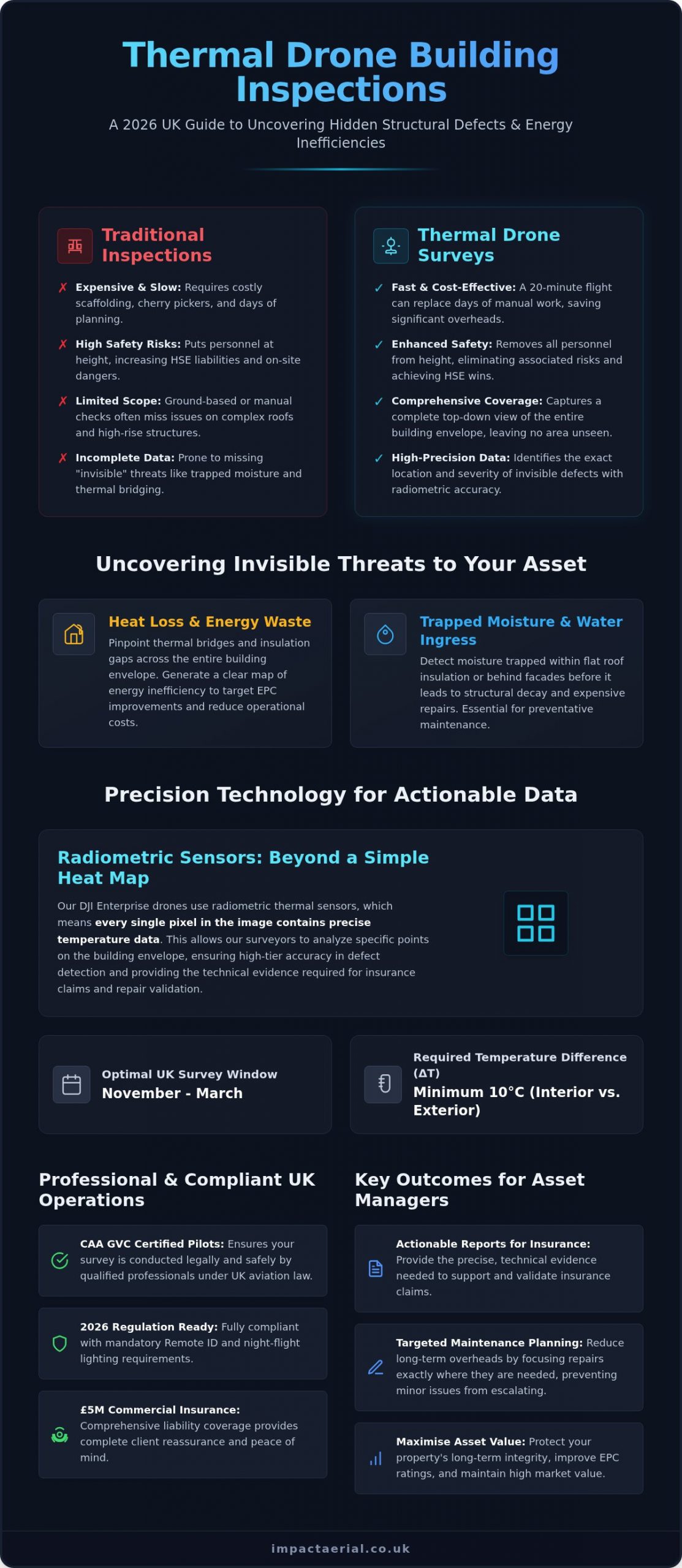
Detecting Hidden Defects: From Heat Loss to Water Ingress
The practical application of thermal drone building inspections UK wide extends far beyond simple heat maps. By leveraging the physical principles of thermal mass and solar loading, professional surveys identify specific structural failures that remain hidden during standard visual inspections. This technology is particularly effective for large-scale assets, including commercial warehouses and complex industrial units. Beyond the building envelope, specialized sensors are also used for PV solar farm thermal surveys to identify bypassed or faulty cells, ensuring maximum energy yield and preventing fire risks caused by localized hotspots.
Flat Roof Moisture Mapping
Flat roofs are notorious for hidden water ingress that can compromise structural integrity. Professional surveys utilize the concept of thermal mass to map moisture pockets within insulation layers. During a sunny day, the entire roof structure absorbs solar energy. After sunset, dry insulation cools rapidly, while wet insulation, which has a higher thermal mass, retains heat for much longer. By conducting a survey during this specific post-sunset window, we visualize the “thermal signature” of trapped water with high precision. This data is invaluable for insurance claims and planned preventative maintenance (PPM), allowing for targeted repairs rather than expensive, full-roof replacements.
Building Envelope and Insulation Surveys
Thermal drones provide a non-invasive method to verify the real-world performance of a building’s envelope against design specifications. We frequently identify missing cavity wall insulation or defective cladding panels that compromise a structure’s U-value. These surveys also highlight snags in HVAC systems and external pipework where insulation has degraded, leading to significant energy waste. For UK property managers, this level of detail is essential for meeting modern sustainability standards and reducing operational overheads. When inspecting UK warehouses and industrial facilities, our pilots typically identify several recurring issues:
- Thermal Bridging: Heat escaping through structural steelwork or poorly insulated window frames.
- Compressed Insulation: Areas where insulation has settled or been incorrectly installed, reducing its R-value.
- Air Leakage: Unintended gaps in the building fabric, often found around loading bay doors or roof lights.
- HVAC Duct Failures: Leaks in external ductwork that force heating and cooling systems to overcompensate.
- Sub-surface Moisture: Trapped water in roof membranes that leads to long-term structural decay if left unaddressed.
By identifying these issues early, businesses can move from reactive repairs to a more strategic, data-driven maintenance model. Our CAA GVC certified pilots use commercial-grade DJI Enterprise hardware to ensure every survey is delivered with the precision required by surveyors and structural engineers.
Navigating UK Drone Regulations and Safety Standards
Safety and legal compliance are the foundational pillars of professional thermal drone building inspections UK wide. In a highly regulated aviation environment, conducting aerial surveys requires more than just high-end hardware; it demands a deep understanding of the Civil Aviation Authority (CAA) framework. For property managers and industrial site owners, ensuring your contractor operates within the law is essential for risk mitigation and maintaining the validity of your own corporate insurance policies. Professional operators don’t just fly; they manage complex aerial operations that prioritize the safety of people and property on the ground.
CAA GVC Certification Explained
There’s a significant legal distinction between hobbyist flyers and those authorized for commercial work. Under the current CAA drone regulations, any pilot conducting building inspections for “valuable consideration” must hold a General Visual Line of Sight Certificate (GVC). This isn’t a simple online test. A GVC-certified pilot undergoes rigorous theoretical training and a practical flight assessment specifically designed for operating in congested urban and industrial areas. Hiring an uncertified pilot is a major liability; it risks heavy fines from the CAA and almost certainly voids your business insurance should an incident occur. Our pilots are fully GVC certified, ensuring every survey is conducted with the technical discipline required for complex UK environments.
Insurance and Risk Mitigation
Standard public liability insurance is insufficient for commercial drone operations. The industry standard for professional thermal drone building inspections UK is £5m commercial liability insurance, which is specifically tailored to cover aerial risks on industrial and urban sites. This level of coverage provides psychological comfort and tangible financial protection for our clients. Every project begins with a methodical risk management process, including:
- Pre-flight Planning: Detailed site surveys and check of airspace restrictions.
- NOTAMs: Filing “Notices to Airmen” where necessary to alert other aircraft to our presence.
- On-site Safety: Establishing cordons and emergency landing zones.
- GDPR Compliance: Managing privacy concerns by using data-centric processes that redact or avoid capturing identifiable personal information in populated areas.
This meticulous approach ensures that we deliver high-tier data while strictly adhering to safety protocols. If you require a survey that meets the highest professional standards, you can secure your compliant project with Impact Aerial’s drone commercial property surveys today.
Maximising Asset Value with Impact Aerial’s Surveying
Impact Aerial combines deep technical expertise with commercial-grade DJI Enterprise technology to deliver high-tier results for every client. While our operations are headquartered at our Birmingham base, we provide nationwide coverage, serving the entire UK with the same meticulous attention to detail. We position thermal drone building inspections UK as a strategic investment in a building’s long-term lifecycle rather than a simple maintenance check. By identifying issues early, we help asset managers bridge the gap between raw data and informed structural decision-making. Our Birmingham base allows us to respond rapidly to West Midlands projects, though our logistical capabilities ensure we maintain a consistent presence across the country. Using DJI Enterprise hardware means we capture 4K HDR visual data alongside radiometric thermal feeds, ensuring that every report is underpinned by high-quality evidence.
From Data to Actionable Reports
A professional survey is only as effective as the data it produces. Our clients receive a comprehensive suite of deliverables, including high-resolution thermal maps, detailed visual snagging lists, and expert analysis of identified anomalies. These reports are structured to integrate directly into modern Building Information Modelling (BIM) workflows. This allows structural engineers and facility managers to overlay radiometric data onto existing digital twins or structural plans for a complete view of building health. Our specialized post-production services ensure that complex thermal data is distilled into a professional format that is ready for insurance submissions or internal stakeholder reviews. We focus on providing a clear, evidence-based narrative that justifies maintenance spends and informs long-term capital planning for complex industrial and commercial assets.
The ROI of Aerial Thermography
The return on investment for aerial thermography is measured in both capital savings and operational efficiency. By isolating specific areas of moisture ingress or insulation failure, property owners can perform targeted repairs instead of committing to the high costs of full roof replacements. This data-centric approach significantly reduces the carbon footprint of a facility, directly aligning with the UK’s 2026 sustainability and Net Zero objectives. Better thermal management leads to improved EPC ratings, which directly enhances the market value of commercial property. Identifying a single failed HVAC duct or a pocket of wet insulation early can save thousands in energy waste and secondary structural damage. If you are ready to secure your asset’s future and reduce your maintenance overheads, you can Request a quote for thermal building inspections from Impact Aerial to begin your survey process.
Securing Your Property Assets Through Aerial Innovation
The landscape of property maintenance in 2026 demands a shift from reactive repairs to data-driven asset management. By integrating thermal drone building inspections UK into your surveying workflow, you gain the ability to visualize invisible structural threats before they escalate into costly failures. From identifying moisture trapped within flat roof insulation to pinpointing energy inefficiencies that impact your EPC rating, aerial thermography provides a non-invasive and high-precision alternative to traditional scaffolding.
Operating with technical excellence and total compliance is the foundation of our service. Our CAA GVC certified pilots utilize expert DJI Enterprise technology to capture radiometric data that structural engineers and insurers can trust. With £5m commercial liability insurance as standard, we provide the psychological comfort and operational security required for complex industrial and urban environments. Don’t leave your building’s health to chance; invest in a surveying solution that protects your long-term ROI and supports your sustainability goals. Book Your Professional Thermal Drone Survey Today and take the first step toward a safer, more efficient property portfolio. We look forward to helping you secure your assets with precision.
Frequently Asked Questions
What is the best time of year for a thermal drone building inspection in the UK?
The optimal time for thermal drone building inspections UK wide is during the winter months, typically between November and March. Accurate results require a significant temperature difference, or “Delta T,” between the building’s interior and the external environment. We usually perform these surveys at night or in the early morning. This timing avoids solar radiation interference and ensures that heat loss or moisture pockets are clearly visible to the radiometric sensors.
Can a thermal drone see through walls or roof materials?
Thermal sensors don’t see through walls or roof materials in the way an X-ray would. Instead, they detect infrared radiation emitted from the surface. By measuring these temperature variations, we identify sub-surface anomalies. For example, wet insulation has a higher thermal mass and retains heat longer than dry materials. This creates a distinct thermal signature on the surface that reveals hidden water ingress without requiring invasive physical testing.
How much does a thermal drone building survey cost in the UK?
The cost of a professional survey varies significantly based on the structure’s size, location, and complexity. Commercial inspections for large industrial units or high-rise buildings require more flight time and data processing than smaller residential projects. Rather than searching for a flat rate, property managers should request a bespoke quote that includes CAA-compliant flight planning and detailed radiometric reporting. This ensures you receive high-tier data that meets insurance and structural engineering standards.
Do I need to notify my neighbours or local council before a drone inspection?
You aren’t legally required to notify the local council for most standard thermal drone building inspections UK operations. However, professional pilots always conduct a site-specific risk assessment and may inform immediate neighbours as a courtesy. If the flight occurs in restricted airspace, we handle the necessary NOTAM filings with the CAA. We also follow strict GDPR protocols to ensure that identifiable personal data is redacted or avoided during the surveying process.
What is the difference between a visual drone survey and a thermal one?
A visual drone survey uses standard RGB cameras to capture high-resolution 4K imagery of visible snags like cracked tiles or damaged cladding. In contrast, a thermal survey uses infrared sensors to map heat signatures. At Impact Aerial, we use a dual-sensor approach. This allows us to overlay thermal data onto visual imagery, providing essential context so we don’t mistake a reflective surface or a patch of moss for a genuine structural defect.
How long does it take to get the results of a thermal drone inspection?
While the flight itself might only take twenty to forty minutes, generating an actionable report takes longer. We typically deliver the final results within forty-eight to seventy-two hours. This window allows our technical team to perform radiometric post-processing and expert analysis. We ensure the data is formatted for Building Information Modelling (BIM) workflows, providing you with a professional document that is ready for engineers or insurance adjusters to review.
Are thermal drone inspections accurate for identifying flat roof leaks?
Aerial thermography is exceptionally accurate for identifying moisture ingress in flat roofs. It relies on the principle that wet insulation holds heat longer than dry insulation. By surveying the roof after sunset, we can clearly see the “hot spots” where moisture is trapped. This method allows for targeted repairs, which often prevents the need for a total roof replacement. It’s a highly effective tool for planned preventative maintenance.
What qualifications should I look for when hiring a drone pilot for a building survey?
When hiring a pilot, you must verify they hold a current CAA GVC (General Visual Line of Sight) certification for commercial work. This ensures they’ve undergone rigorous training for urban and industrial environments. You should also confirm they carry at least £5m in commercial liability insurance. Finally, look for operators who use professional-grade DJI Enterprise drones and have experience in radiometric data analysis, as hobbyist-level equipment cannot provide the accuracy required for structural surveys.
Drone Virtual Tour Services: The Complete Guide to Immersive Aerial Experiences in 2026
If your property marketing relies on static ground-level shots, you aren’t just missing the view; you’re losing the true scale of the entire investment. It’s frustrating when standard photography fails to capture the full footprint of a large-scale development or complex industrial site, leaving potential stakeholders guessing about the layout. You need a way to provide context and depth that traditional lenses simply cannot reach.
We understand that while the visual potential of aerial data is exciting, the logistics of drone virtual tour services can feel daunting. You might worry about the complexities of 2026 UK CAA regulations or wonder how to safely integrate high-resolution 360° panoramas into your website without compromising performance. This guide is designed to provide professional clarity and reassurance. You’ll discover how high-precision aerial data transforms site inspections and marketing into immersive, interactive experiences.
We’ll walk you through the essential technical requirements, from using commercial-grade DJI Enterprise hardware to ensuring your project is backed by CAA GVC certified pilots and £5m commercial liability insurance. By the end of this article, you’ll know exactly how to leverage these digital twins to mitigate business risk, increase engagement, and maintain full regulatory compliance across the UK.
Key Takeaways
- Discover how interactive, 360-degree aerial environments provide a comprehensive sense of scale that standard ground-level photography simply cannot match.
- Learn why professional-grade hardware, including 4K HDR sensors and GPS-locked stability, is critical for creating high-precision digital twins of your assets.
- Evaluate the specific use cases for aerial perspectives versus ground-based tours to ensure you’re using the most effective visual tool for your property.
- See how industries like construction and commercial real estate use these assets to reduce unnecessary site visits and accelerate stakeholder reporting cycles.
- Understand the business value of hiring professional drone virtual tour services that prioritize safety through CAA GVC certification and £5m public liability insurance.
The Evolution of Property Perspectives: What Are Drone Virtual Tour Services?
Professional drone virtual tour services have redefined how stakeholders interact with physical assets. Unlike a standard aerial photograph that provides a single fixed perspective, a virtual tour is a dynamic, interactive 360-degree environment. Users can rotate their view, zoom in on specific details, and navigate between multiple vantage points across a site. In 2026, these assets have shifted from being high-end marketing novelties to essential digital infrastructure for property developers, surveyors, and site managers.
The realism of these tours depends heavily on the use of high-resolution 4K HDR imagery. This technology ensures that lighting remains consistent across the entire spherical capture, preventing the “blown-out” skies or dark shadows often seen in amateur attempts. By providing a seamless, high-fidelity experience, businesses can offer a level of transparency that builds immediate trust with remote investors and project partners. It’s about delivering a digital twin that feels as tangible as a physical site visit.
How 360° Aerial Imaging Differs from Ground Tours
Ground-based tours are excellent for internal room layouts, but they lack the ability to show a property in its wider geographic context. Aerial imaging provides unrestricted vantage points that ground cameras simply cannot reach. This perspective is vital for showing the scale of industrial complexes or the proximity of a development to critical transport links. It’s a balance between the “wow factor” of a sweeping view and the practical data required for site analysis. You aren’t just looking at a building; you’re understanding its relationship with the surrounding environment.
Key advantages of the aerial perspective include:
- Unrestricted Vantage Points: Capturing views from heights and angles impossible for tripod-mounted cameras.
- Contextual Awareness: Showing the surrounding infrastructure, access roads, and neighbouring sites in a single view.
- Scale Perception: Providing a true sense of the footprint for large land parcels or multi-building estates.
The Technology Behind the Immersion
Capturing these environments requires meticulous flight planning and commercial-grade hardware. The use of DJI Enterprise drones ensures maximum stability during the 360-degree rotation. This stability is crucial for the post-production stage, where individual images are stitched together to create a fluid, navigable interface. Many advanced tours now incorporate photogrammetry techniques to add depth and measurable data to the visual experience. These tours can be integrated into existing platforms like Matterport or delivered via custom-coded web overlays, ensuring they fit perfectly into your current digital workflow.
Technical Requirements for Professional Aerial Virtual Tours
High-quality drone virtual tour services rely on a sophisticated stack of hardware and software to deliver usable, high-fidelity data. It isn’t just about capturing a series of images; it’s about maintaining absolute visual consistency across a 360-degree panorama. To achieve this, we utilize 4K HDR sensors that manage the extreme dynamic range found in aerial environments. These sensors prevent the “blown-out” highlights in the sky and the loss of detail in shadowed areas on the ground. Precision is further maintained through GPS-locked hovering. This ensures the aircraft remains at an exact coordinate while rotating, allowing for perfect image alignment during the stitching process.
Compatibility is another critical technical hurdle. In 2026, a professional tour must be fully responsive. It should perform seamlessly whether a stakeholder is viewing it on a mobile device in the field, a desktop in the office, or through a VR headset for a fully immersive experience. Delivering this level of performance requires optimized hosting solutions that prioritize speed without sacrificing the resolution of the 360-degree environment.
Hardware Matters: Why Consumer Drones Aren’t Enough
Consumer-grade aircraft often lack the flight stability required for commercial projects, especially on UK coastal or hilltop sites where wind speeds are unpredictable. Professional DJI Enterprise drones provide the motor power and advanced flight controllers necessary to hold a steady position in challenging conditions. This stability is essential for preventing motion blur and ensuring that every frame of the 360-degree capture is sharp. Furthermore, the increased sensor size on enterprise models provides the dynamic range needed to produce professional results in varied lighting conditions. Larger battery capacities also ensure we can cover massive commercial footprints in a single session, reducing the need for frequent landings and battery swaps.
Post-Production and Hosting
The raw data captured in the field undergoes a rigorous post-production process to create a cinematic and professional finish. This involves “zenith patching” to digitally reconstruct the sky where the drone’s own hardware would be visible, as well as the careful removal of the drone’s shadow from the ground. These meticulous edits maintain the professional illusion of a floating, detached perspective. For projects requiring more than just a visual overview, we can add interactive hotspots. These links can connect the viewer to detailed drone survey data, site maps, or floor plans.
Safety remains the foundation of our technical workflow. Every flight is conducted in strict accordance with UK drone safety and compliance regulations. Our pilots are CAA GVC certified and we carry £5m in public liability insurance to mitigate risk on every project. If you need a technical partner for your next development, you can view our full range of aerial services to see how we deliver precision data across the UK.
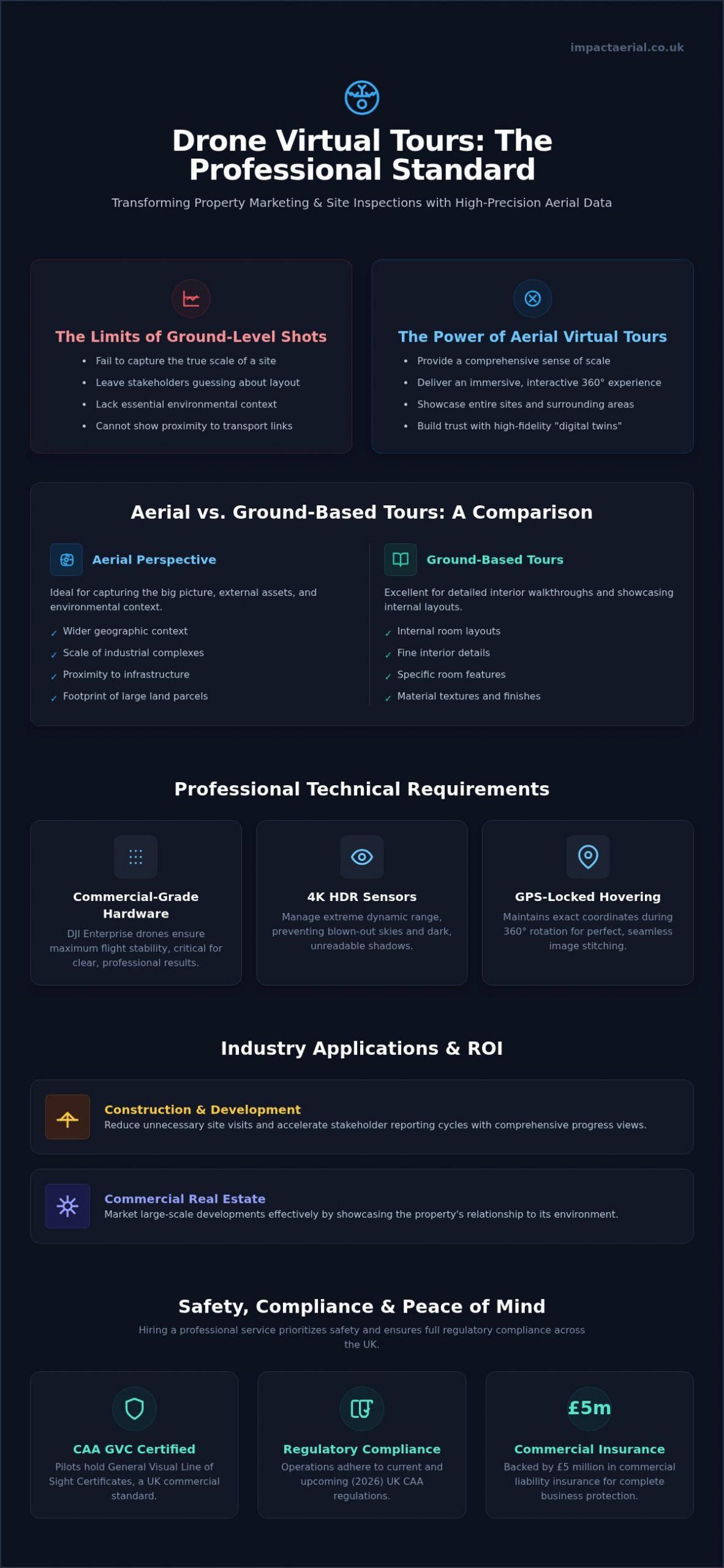
Aerial vs. Ground-Based Tours: A Comparison Framework
Choosing between aerial and ground-based perspectives depends on the specific data requirements of your project. Ground-based solutions, such as Matterport, remain the industry standard for internal room layouts and high-detail floor plans. They allow a user to walk through a building at eye level, providing an intimate sense of space. However, these systems can’t capture the broader environment or the structural integrity of a roof. When you invest in drone virtual tour services, you’re securing a high-precision asset that bridges the gap between ground-level detail and bird’s-eye context.
The deployment process also varies significantly. Ground tours require physical access to every room, which is often time-consuming for expansive industrial complexes. In contrast, aerial tours require meticulous pre-flight planning and strict adherence to 2026 CAA regulations. Our CAA GVC certified pilots manage these legal complexities. They ensure that the data collection process is both compliant and safe. This technical expertise allows us to capture data that ground-based tripods simply can’t reach, especially in complex or hazardous environments.
When to Choose Aerial Virtual Tours
Aerial perspectives are the superior choice for roof inspections, land development, and large commercial assets. For high-end real estate, showing the neighbourhood context is often more valuable than seeing the interior alone. Stakeholders need to see the proximity to transport links, green spaces, and neighbouring infrastructure. Additionally, these services are vital for monitoring construction progress. By capturing the same coordinates over several months, we create time-lapse virtual tours that provide an undeniable record of site development. This level of remote monitoring reduces the need for frequent site visits, saving time and operational costs.
The Hybrid Approach: The Best of Both Worlds
For many 2026 projects, the most effective solution is a hybrid model. This involves transitioning seamlessly from an aerial fly-in to a ground-based 3D walkthrough. We often integrate high-fidelity aerial videography within these interactive tours to provide a cinematic introduction before the user begins their self-guided exploration. Based in Birmingham, we provide these hybrid solutions across the West Midlands and the wider UK. This unified approach ensures a professional user experience. It provides consistent branding across all marketing and survey assets. By combining these technologies, you provide a comprehensive digital twin that serves both marketing and technical reporting needs.
Maximising ROI: Industry-Specific Applications in 2026
Measuring the return on investment for aerial data requires looking beyond the initial visual impact. In 2026, drone virtual tour services have become high-precision instruments for risk mitigation and operational efficiency across several UK sectors. By providing a navigable, 360-degree environment, these assets allow stakeholders to conduct detailed site inspections from any location, significantly reducing the costs associated with travel and physical site access. Whether you’re managing a massive industrial footprint or a sensitive heritage site, the ability to remotely monitor conditions with 4K clarity provides a tangible competitive advantage.
In addition to commercial projects, tourism and heritage organisations use these digital twins to preserve and promote UK landmarks. These interactive environments allow the public to explore restricted or fragile areas without causing physical wear, supporting both conservation and educational outreach. For insurance and surveying purposes, this level of documentation is invaluable. It provides a meticulous record of site conditions that can be used for accurate risk assessment and the resolution of claims with objective, high-fidelity evidence.
Drone Virtual Tours for Construction Site Monitoring
The construction and AEC sectors benefit most from the transition toward “Digital Twins.” By capturing regular 360-degree aerial panoramas, project managers can track on-site progress against Building Information Modelling (BIM) data with high accuracy. This process isn’t just about documentation; it’s a critical safety tool. Using drones to inspect high-elevation structures reduces the requirement for personnel to work at height, directly lowering the risk profile of the project. Drone virtual tours act as a visual ‘time capsule’ for site audits, providing a permanent, verifiable record of every project phase.
High-End Property and Marketing
In the competitive commercial and residential markets, cinematic aerial perspectives create an emotional connection that ground-level shots cannot replicate. Integrating these tours with professional real estate photography allows developers to differentiate their listings on crowded property portals. We’ve seen that immersive content significantly increases time-on-site for prospective buyers, as they can explore the neighbourhood context and site boundaries at their own pace. This transparency speeds up the sales cycle by filtering out less-interested parties before a physical viewing is even scheduled.
From our base in Birmingham, we help businesses across the West Midlands and the wider UK turn aerial data into actionable business assets. If you’re ready to enhance your project reporting or property marketing, you can book our professional drone services to start building your digital twin today.
Safety, Compliance, and Choosing a Professional UK Provider
Operating a drone commercially in the UK is a highly regulated activity. In 2026, the Civil Aviation Authority (CAA) maintains strict standards to ensure public safety and airspace security. For any business commissioning drone virtual tour services, checking for a General Visual Line of Sight Certificate (GVC) is the first step in due diligence. This certification isn’t just a badge; it’s proof that the pilot has undergone rigorous theoretical and practical assessments to operate safely in complex environments. Without this, your project is legally non-compliant from the moment the rotors spin.
Risk mitigation is another cornerstone of professional operations. While a hobbyist might offer lower rates, they often lack the necessary £5m commercial public liability insurance required for industrial or commercial sites. This insurance protects your business from the financial consequences of accidental damage or injury. Beyond insurance, a professional provider conducts comprehensive pre-flight planning and site-specific risk assessments. This meticulous preparation identifies potential hazards like overhead power lines, restricted flight zones, or high-density pedestrian areas before the aircraft even leaves the ground.
Privacy and data protection are equally critical. Aerial photography naturally captures the surrounding area, which may include private residences or individuals. A compliant provider adheres to strict GDPR protocols, ensuring that any identifiable data is handled legally or redacted during the post-production phase. This commitment to privacy protects your brand from potential legal challenges and ensures your digital assets remain a benefit rather than a liability for your organisation.
The Impact Aerial Standard
Based in Birmingham, we provide specialized expertise across the West Midlands while maintaining a robust UK-wide reach. Our approach to drone services is defined by a commitment to safety and technical precision. We manage every aspect of the project, from the initial airspace consultation to the final 360-degree edit. This end-to-end management ensures that your virtual tour is not only visually stunning but also fully compliant with the latest 2026 aviation standards.
Vetting Your Drone Service Provider
Hiring an uncertified pilot is a significant liability that can result in heavy fines or voided insurance policies. A “hobbyist” pilot simply cannot provide the level of operational security required for a commercial contract. Use this checklist to ensure your provider meets professional standards:
- CAA GVC Certification: Verify the pilot’s current credentials and Operator ID.
- Commercial Insurance: Confirm a minimum of £5m public liability coverage.
- Specialized Hardware: Ensure they use commercial-grade DJI Enterprise drones for stability.
- Data Portfolio: Review previous 360-degree projects for quality and consistency.
If you’re ready to elevate your property marketing or site monitoring with a trusted partner, contact Impact Aerial for a consultation today. We provide the technical expertise and regulatory reassurance you need for a successful aerial project.
Securing Your Competitive Advantage through Aerial Data
The transition from static aerial photography to interactive digital twins represents a fundamental shift in how UK businesses monitor assets and market high-value properties. By integrating high-precision 360° data with professional post-production, you provide stakeholders with a transparent, immersive experience that builds immediate trust. Technical success depends on high-fidelity sensors and strict adherence to the 2026 CAA regulatory framework.
Choosing professional drone virtual tour services ensures your project is handled with the meticulous care it deserves. Impact Aerial provides a specialized, safety-first approach to every flight. We are Birmingham based but offer UK-wide coverage, supported by CAA GVC certified pilots and £5m commercial liability insurance. This combination of local expertise and national reach allows us to deliver high-end results that mitigate business risk while maximizing engagement.
If you’re ready to transform your property perspectives and streamline your site reporting, our team is prepared to assist. Take the first step toward creating a high-precision digital asset for your business today. Request a Professional Drone Virtual Tour Quote
Frequently Asked Questions
Are drone virtual tours legal in urban areas like Birmingham?
Yes, provided the operator holds the correct CAA certifications. We operate regularly in Birmingham and across the UK using CAA GVC certified pilots. Legal urban flight requires meticulous planning, risk assessments, and adherence to specific distance requirements from people and property. By following the 2026 UK drone regulations, we manage all necessary permissions and airspace notifications to ensure your drone virtual tour services remain fully compliant and safe in built-up environments.
How much do drone virtual tour services cost in the UK?
Pricing for professional drone virtual tour services depends on several project-specific factors. These include the total number of 360-degree capture points required, the complexity of the airspace, and any post-production requirements like interactive hotspots or custom branding. While basic packages exist for smaller properties, large-scale commercial sites require bespoke quotes. We recommend discussing your specific deliverables with a certified provider to receive an accurate estimate tailored to your site’s unique operational needs and data requirements.
What is the difference between a 360 drone photo and a virtual tour?
A 360 drone photo is a single spherical image that allows a user to look in every direction from one fixed point. In contrast, a virtual tour is an interactive environment composed of multiple 360-degree images linked together. This allows users to move through the site by clicking on navigation points. A tour provides a navigable, comprehensive digital twin of the entire property rather than just a single panoramic view captured from the air.
Can I view drone virtual tours on my mobile phone?
Yes, all professional tours are designed to be fully responsive across mobile devices, tablets, and desktops. We use optimized hosting solutions that ensure the 4K HDR imagery loads quickly without compromising resolution on smaller screens. Many tours also support gyro-navigation; this means the view moves as you rotate your phone, providing a more intuitive experience. This cross-platform compatibility is essential for stakeholders who need to access immersive site data while working in the field.
How long does it take to capture a drone virtual tour for a commercial site?
The time required for on-site data capture varies based on the size and complexity of the property. For a standard commercial site, the flight operations typically take between two and four hours. This includes the time needed for pre-flight safety checks and capturing multiple 360-degree panoramas at various heights. Larger industrial complexes or multi-building construction sites may require a full day of operation to ensure every critical vantage point is documented with technical precision.
Do I need special software to host a drone virtual tour on my website?
You don’t need any specialized software on your own server to host a tour. We typically provide a simple embed code or a direct URL that works just like a YouTube video or an interactive map. The tour is hosted on a high-performance, dedicated server that handles all the data-heavy processing. This approach ensures that your website remains fast and responsive while providing users with a seamless, high-resolution immersive experience without technical overhead.
What happens if the weather is bad on the day of the shoot?
Safety is our primary concern, so we monitor weather forecasts meticulously leading up to the project date. If high winds or heavy rain make flight operations unsafe or compromise image quality, we’ll reschedule the shoot for the next available clear day. Our commercial DJI Enterprise drones can handle moderate conditions, but we prioritize optimal lighting and stability to ensure your virtual tour meets our high-fidelity quality standards without putting people or property at risk.
Is a drone virtual tour better than standard aerial photography?
It isn’t necessarily better, but it serves a different purpose. Standard aerial photography is excellent for high-impact marketing images and fixed technical reports. However, a virtual tour provides an interactive, navigable perspective that allows stakeholders to explore the site at their own pace. For complex site monitoring or remote inspections, the ability to zoom in and rotate the view provides significantly more context and data than a series of static images alone.
Professional Drone Filming Services UK: The 2026 Commercial Guide
Hiring a drone pilot based solely on a creative portfolio is a significant commercial risk in 2026. As the UK drone market continues its rapid expansion, the distinction between hobbyist operators and professional drone filming services UK has become a matter of legal and financial security. You likely recognize the value of high-end 4K HDR visuals for construction monitoring or property marketing, yet the fear of CAA non-compliance fines and unreliable communication often stalls vital projects.
We understand that you need more than just a camera in the sky; you require a technical partner who manages risk as effectively as they capture footage. This guide will show you how to secure cinematic results through a framework of strict legal compliance and £5m liability insurance. We will examine the latest 2026 UK drone regulations, the importance of GVC certification, and the methodical project management required to deliver professional aerial data. By the end of this article, you’ll know exactly how to integrate expert aerial filming into your workflow without the headache of hidden costs or safety oversights.
Key Takeaways
- Understand why CAA GVC certification and £5m liability insurance are mandatory requirements for legal commercial drone operations in 2026.
- Learn how to distinguish between basic aerial shots and high-end 4K HDR deliverables suitable for professional property and construction marketing.
- Discover the technical benefits of integrating professional drone filming services UK into your project for precise site monitoring and thermal surveys.
- Master the production workflow, including the critical initial feasibility studies and airspace risk assessments required before any flight.
- Identify the strategic advantages of working with a Birmingham-based specialist to ensure rapid deployment and consistent project management across the UK.
Understanding Professional Drone Filming Services in the UK
Professional drone filming services UK represent the convergence of advanced aviation technology and high-end cinematography. An Unmanned Aerial Vehicle (UAV) in the hands of a certified pilot is a precision tool rather than a recreational device. The industry has moved beyond simple aerial snapshots; today’s commercial standard requires 4K HDR deliverables that integrate seamlessly into professional production timelines. UK businesses across various sectors now prioritize these aerial perspectives to provide transparent site documentation and immersive marketing assets that ground-level photography cannot replicate.
The Difference Between Consumer and Commercial Drones
The technical gap between standard consumer drones and DJI Enterprise systems is vast. Professional operators utilize enterprise-grade hardware engineered for stability in the UK’s unpredictable coastal and inland weather conditions. These systems feature redundant sensors and robust signal processing to maintain link integrity in signal-heavy urban environments. Capturing footage in High Dynamic Range (HDR) is essential for commercial projects. It provides the necessary data for professional colour grading, ensuring the final visuals maintain detail in both bright highlights and deep shadows, which is a hallmark of high-tier production.
Core Industries Benefiting from Aerial Filming
Several key sectors have integrated drone technology as a standard part of their operational and marketing strategies:
- Property and Real Estate: High-impact visuals create immediate engagement, showcasing property boundaries, surrounding infrastructure, and architectural scale to potential investors or buyers.
- Construction and Infrastructure: Aerial site monitoring offers a methodical way to track project milestones and verify site safety protocols. It provides a permanent record of progress that is invaluable for stakeholder reporting.
- Advertising and PR: Capturing unique brand perspectives from the air helps companies stand out in a saturated market, using cinematic movement to convey a sense of scale and prestige.
A professional operator manages the entire lifecycle of the mission. This starts with an initial consultation to determine feasibility and ends with a polished final edit. Between these stages, the pilot handles complex airspace permissions and rigorous risk assessments. This meticulous approach ensures that every flight is fully compliant with Civil Aviation Authority (CAA) regulations, providing clients with the psychological comfort that their project is being handled by a safety-conscious specialist.
UK Drone Laws: Why GVC Certification and Insurance are Non-Negotiable
Compliance is the barrier between a professional operation and a significant legal liability. In the UK, commercial drone work is strictly governed to protect the public, the airspace, and the hiring organization. Professional drone filming services UK manage the complexity of UK Civil Aviation Authority (CAA) drone regulations so the client doesn’t have to. This involves more than just flying. It includes managing flight notifications, checking for Temporary Restricted Areas (TRAs), and producing detailed Risk Assessment and Method Statements (RAMS) before any deployment. This methodical preparation ensures that flights are not only cinematic but also fully legal and safe.
What is a CAA GVC Certified Pilot?
The GVC (General Visual Line of Sight Certificate) is the current standard for professional pilots. It replaced the older PfCO (Permission for Commercial Operations) framework to align with updated safety categories. This certification represents a rigorous assessment of technical flight competency and a deep knowledge of aviation law. GVC certification is the benchmark for UK commercial drone operations in 2026. It proves that an operator can safely manage a drone in the “Specific” category. This is often required for filming in congested urban areas or near industrial infrastructure where standard “Open” category rules are too restrictive.
Risk Management and £5m Liability Insurance
For corporate clients, insurance is a critical prerequisite. Standard business insurance policies often exclude aerial activities; this leaves the hiring company exposed if an incident occurs. Professional drone filming services UK carry specialist aviation policies that cover public liability, equipment damage, and data protection risks. We maintain £5m commercial liability insurance as our standard. This level of cover is frequently a mandatory requirement for accessing high-security construction sites, national heritage locations, and critical infrastructure projects. It provides the financial protection and psychological comfort necessary for operations involving expensive assets or dense populations.
Managing flight over congested areas requires more than just skill. It requires a deep understanding of risk mitigation strategies, such as using drones with redundant power systems and establishing clear ground safety cordons. A professional operator takes full responsibility for these logistics, providing a headache-free experience for the project manager. This meticulous approach to safety allows for creative freedom without the risk of regulatory fines or site accidents. If you’re planning a project on a sensitive site, you can view our safety credentials to see how we manage complex flight logistics and maintain strict compliance.
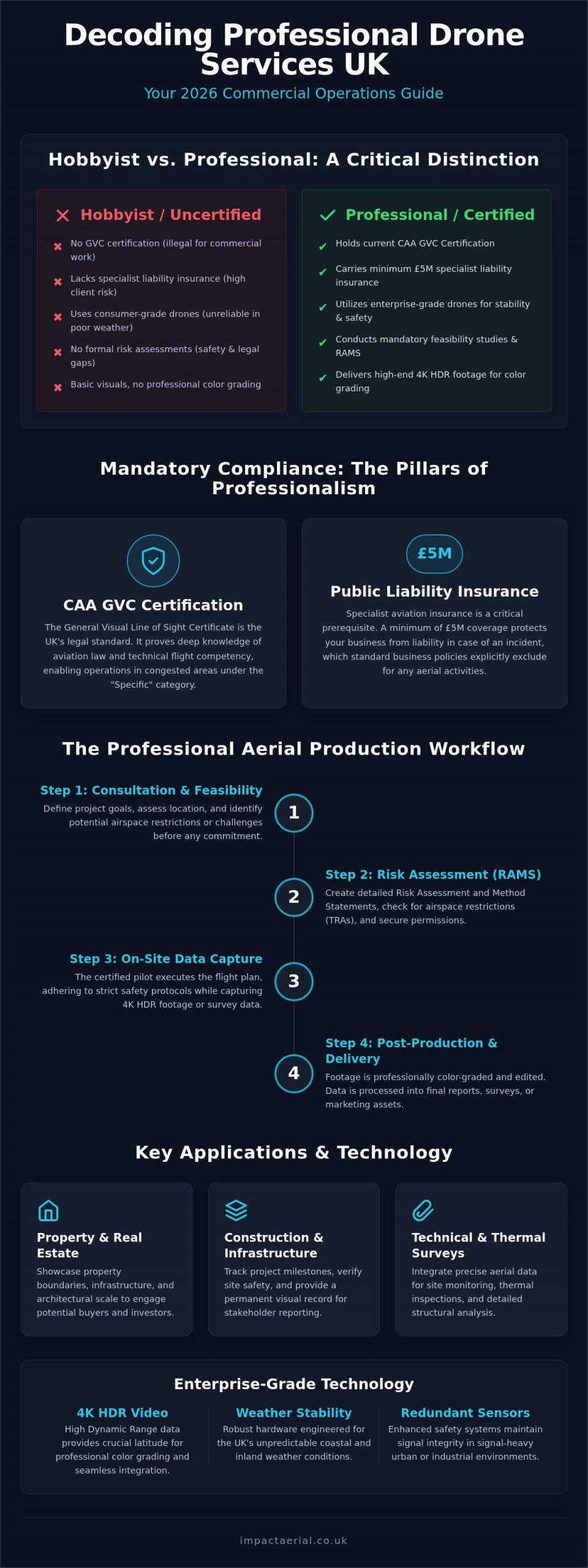
From Cinematic Video to Technical Surveys: Key Service Applications
Professional drone filming services UK have evolved into a multi-disciplinary technical offering. While cinematic video remains the cornerstone for high-end visual marketing, the integration of advanced sensors has expanded the utility of aerial platforms into data-centric fields. This shift aligns with the UK government’s vision for commercial drones, which highlights the transition toward automated, high-precision data collection in the construction and energy sectors. By capturing 4K HDR footage, businesses can produce advertising assets that ground-level cameras simply cannot replicate, providing a sense of scale and prestige that defines modern brand storytelling.
Commercial Property and Construction Surveys
Roof inspections and high-level building assessments are now significantly safer and more cost-effective. Utilizing a drone for a Drone survey allows surveyors to capture high-resolution imagery of inaccessible areas without the logistical burden or safety risks associated with scaffolding and cherry pickers. This rapid data collection provides a comprehensive view of structural health, from guttering conditions to chimney stacks, delivered in a fraction of the time. The ability to zoom in on specific defects with high-resolution sensors ensures that no detail is missed during a building assessment, facilitating faster maintenance decisions and reducing long-term repair costs.
Immersive Virtual Tours and 3D Data
Virtual tours represent a sophisticated application of drone technology, offering an immersive 360-degree experience that ground photography alone cannot match. By combining high-altitude aerial perspectives with ground-level 360-degree photography, we create a cohesive narrative for commercial real estate listings. This increases engagement by allowing potential investors to explore a property and its surrounding infrastructure remotely. For construction projects, this technology facilitates the creation of a ‘digital twin’. This 3D representation of the site serves as a permanent record for future maintenance and allows project managers to track progress against architectural plans with high precision.
Solar Farm and Thermal Inspections
Thermal surveys for PV solar farms maximize ROI by identifying cell failures and ‘hot spots’ that are invisible to the naked eye. Drone-based inspections cover large-scale assets in a fraction of the time required for manual ground checks, often completing in hours what would take days on foot. We use specialized thermal sensors to detect temperature anomalies that indicate faulty components or debris buildup. The resulting data is delivered in structured reports, enabling asset managers to prioritize maintenance and ensure peak energy production across the entire site. This proactive approach to asset management prevents minor faults from escalating into significant power losses.
The Professional Aerial Production Workflow: What to Expect
A professional engagement is a structured four-phase process designed to mitigate risk while maximizing visual quality. For reputable drone filming services UK, the workflow is a technical consultancy that ensures every frame captured meets commercial standards and legal requirements. This starts with a feasibility study where we analyze the specific airspace and ground hazards of your site. We don’t just show up and fly; we integrate our operations into your existing project timeline to ensure a seamless delivery that respects site safety protocols.
Pre-Flight Planning and Airspace Management
Planning is the most critical phase of any aerial mission. We meticulously check NOTAMs (Notices to Airmen) and temporary flight restrictions that could affect the mission. This often requires direct liaison with local authorities or Air Traffic Control (ATC) to secure the necessary permissions for flight in controlled zones. Professional planning typically takes longer than the flight itself to ensure 100% safety. Our pilots also produce site-specific Risk Assessment and Method Statements (RAMS), which are essential for compliance on industrial and construction sites. This preparation provides the legal framework required to operate safely in congested or sensitive areas.
On the shoot day, the focus shifts to operational efficiency and safety. We establish clear ground cordons and maintain constant communication with site managers. Using DJI Enterprise hardware allows us to capture high-resolution data and cinematic footage rapidly, minimizing disruption to your ongoing site activities. This disciplined approach on-site ensures that we capture the required assets while maintaining the highest safety standards for both personnel and property.
Post-Production and Final Delivery
The process doesn’t end when the batteries are depleted. Our post-production services transform raw 4K HDR files into a cohesive narrative through expert editing and colour grading. This phase is where we apply professional sound design and tailor the content for its intended platform. We provide a range of delivery formats, from high-resolution master files for corporate presentations to optimized crops for social media engagement. This end-to-end management ensures that the final output is ready for immediate commercial use.
If you’re ready to start the planning phase for your next project, you can book a consultation with our Birmingham-based team to discuss your specific requirements and receive a detailed feasibility report.
Impact Aerial: Your Partner for Drone Filming Services in the UK
Choosing a technical partner for your aerial project requires a balance of creative vision and operational discipline. Impact Aerial provides comprehensive drone filming services UK, positioning ourselves as a specialist consultancy rather than just a camera operator. Our approach is built on a foundation of rigorous safety protocols and technical expertise. We utilize commercial-grade DJI Enterprise equipment to deliver 4K HDR visuals that meet the exacting standards of the property, construction, and advertising industries. Every mission we undertake is backed by £5m commercial liability insurance and executed by GVC-certified pilots who understand the complexities of the UK’s evolving regulatory framework.
Our commitment to a “consultation to final edit” workflow ensures that your project remains on track from the initial feasibility study to the delivery of processed data. This end-to-end management removes the logistical burden from your team, allowing you to focus on your core business objectives while we handle the airspace permissions and risk mitigation. For a deeper look at our operational standards, you can explore our Professional drone services guide.
Why Choose Our Birmingham-Based Team?
Based in Birmingham, we occupy a strategic hub that allows for rapid deployment across the West Midlands and the wider UK. This central location offers a distinct logistical advantage, reducing travel times and costs for projects in central England while maintaining a national reach. Our pilots possess extensive local knowledge of the West Midlands’ urban and industrial landscapes, which is vital when planning complex flights in congested areas. We don’t just provide a service; we provide regional expertise that ensures 100% compliance with local airspace restrictions and site-specific safety requirements.
Get a Quote for Your Aerial Project
Securing an accurate quote for your project starts with a clear brief. When contacting us, providing details such as the site location, desired deliverables, and any specific site hazards allows us to conduct a preliminary feasibility check. Several technical factors influence aerial filming prices UK, including:
- Airspace Complexity: Missions within controlled airspace require additional liaison with Air Traffic Control.
- Deliverable Requirements: The difference between raw data collection and a fully edited cinematic production.
- Site Risk Profile: Requirements for additional ground crew or specialized safety cordons in high-traffic areas.
- Project Duration: Whether the task is a single-day shoot or long-term construction site monitoring.
We invite you to contact Impact Aerial for an initial feasibility consultation. Our team will review your requirements and provide a structured proposal that outlines the technical execution, safety plan, and transparent cost breakdown for your project. This methodical approach ensures there are no hidden fees or regulatory surprises, providing you with the psychological comfort that your aerial assets are in expert hands.
Securing Your Aerial Perspective for 2026 and Beyond
Professional aerial production in 2026 is defined by a strict adherence to safety and technical precision. The transition from simple photography to complex 4K HDR data collection requires a partner who manages risk as effectively as they capture visuals. Prioritizing GVC-certified pilots and comprehensive insurance isn’t just a legal necessity; it’s a strategic move to protect your commercial interests and ensure uninterrupted site access. This methodical approach ensures that every flight adds tangible value to your project without introducing regulatory friction.
Impact Aerial provides the expertise needed to integrate these advanced perspectives into your workflow. Based in Birmingham, we offer the central logistics and technical capability to support projects across the country. Whether you’re tracking construction progress or creating high-end marketing assets, our team delivers results backed by £5m liability insurance and meticulous planning. You can Request a Professional Drone Filming Quote from Impact Aerial today to begin your feasibility study. We look forward to helping you transform your project with industry-leading drone filming services UK.
Frequently Asked Questions
Do I need a permit for drone filming in a UK city?
Yes, filming in a UK city typically requires specific permissions. Flights in congested urban areas often fall under the “Specific” category, requiring the pilot to hold a GVC and a valid Operational Authorisation from the CAA. We manage the entire process, including checking for restricted airspace and liaising with local authorities or police. This ensures your project remains fully compliant with urban flight regulations and safety protocols.
What is the typical cost of hiring a professional drone pilot in the UK?
The cost of drone filming services UK varies based on the complexity of the mission and the required deliverables. Factors such as the level of risk assessment, the type of specialized hardware used, and the extent of post-production editing all influence the final quote. We provide bespoke pricing that reflects the technical requirements of your project; this ensures you receive a transparent breakdown of costs without hidden fees.
Can drones fly in the rain or high winds in the UK?
Professional drones have specific operational limits for wind and precipitation. While enterprise-grade models offer enhanced stability and water resistance, safety remains the priority. We typically don’t fly in heavy rain or winds exceeding 22mph to protect the equipment and ensure high-quality, stable footage. Our pilots monitor real-time weather data to determine the safest and most effective window for your shoot, ensuring the highest production standards.
What insurance does a commercial drone operator need?
Commercial operators must carry specialist aviation liability insurance that complies with EC Regulation 785/2004. Standard business insurance is insufficient for aerial work. We maintain £5m in commercial liability insurance as standard, which covers public liability, equipment, and data risks. This high level of cover is often a mandatory requirement for working on corporate, industrial, or high-security construction sites across the UK, providing essential risk mitigation for our clients.
How long can a professional drone fly on one battery?
Flight times depend on the specific DJI Enterprise model and environmental conditions. Most professional drones offer between 30 and 45 minutes of flight time per battery. To ensure continuous operation on-site, we carry multiple battery sets and portable charging solutions. This allows us to maintain a steady workflow throughout the day, capturing all necessary 4K HDR footage or technical survey data without significant downtime or project delays.
What is the difference between a drone survey and drone filming?
Drone filming focuses on cinematic storytelling and high-end visual marketing using 4K HDR sensors. In contrast, a drone survey is a technical process designed to capture precise data for structural inspections or mapping. Surveys often utilize specialized sensors like thermal cameras to produce measurable outputs such as 3D models or heat maps. Both services utilize the same aviation expertise but deliver different commercial outcomes tailored to your specific project needs.
Do I own the copyright to the drone footage once the project is finished?
Under UK law, the creator usually owns the copyright, but our commercial agreements typically transfer these rights to the client upon final payment. This ensures you have full ownership of the 4K HDR footage for use across your marketing channels, websites, and presentations. We provide the master files in your preferred format, allowing for long-term use of the assets without additional licensing fees or complicated usage restrictions.
Is a drone pilot required to have a license in the UK?
Yes, commercial pilots in the UK must hold specific certifications to operate legally. This includes a Flyer ID and an Operator ID issued by the Civil Aviation Authority. For most professional drone filming services UK, pilots also need a General Visual Line of Sight Certificate (GVC). This qualification proves the pilot has met the rigorous standards for safety and technical competency required to operate in more complex or congested environments.
Professional Aerial Drone Services in Birmingham: The 2026 Business Guide
In the complex, high-stakes airspace of the West Midlands, the difference between a breathtaking 4K marketing reel and a significant legal liability often rests on a single certification. As the city’s skyline evolves, the demand for aerial drone services Birmingham has shifted from simple photography to a requirement for meticulous risk mitigation. You’ve likely seen the potential for aerial views to revolutionise your project, yet the fear of uninsured mishaps or inaccurate survey data often stalls progress.
We understand that managing urban flight restrictions and the latest 2026 CAA regulations feels like a minefield. This guide demonstrates how expert drone integration can transform your operations by delivering high-precision surveying and cinematic photography that’s as safe as it is visually stunning. You’ll learn exactly how to leverage CAA GVC-certified expertise and £5m liability insurance to secure high-resolution 4K HDR content. We’ll also break down the technical requirements for site monitoring and solar farm inspections, ensuring your next project is backed by actionable data and total regulatory compliance.
Key Takeaways
- Identify why CAA GVC certification and £5m commercial liability insurance are the essential benchmarks for safe drone operations in urban Birmingham.
- Discover how professional aerial drone services Birmingham can reduce traditional surveying costs by up to 70% while improving data accuracy.
- Learn how to elevate your brand storytelling by converting raw 4K HDR aerial footage into cinematic marketing content through expert post-production.
- Navigate the updated 2026 UK drone regulations to ensure your property and construction projects remain fully compliant in restricted airspace.
- Follow a proven 5-step vetting process to select a technical specialist who bridges the gap between creative filming and rigorous aeronautical safety.
The Landscape of Aerial Drone Services in Birmingham (2026)
Professional drone operations in 2026 are defined by the ability to operate safely within high-density urban environments. While hobbyist flights focus on basic imagery, professional aerial drone services Birmingham rely on CAA GVC certification and industrial-grade hardware to deliver results. This distinction is vital as the city undergoes massive transformation under the Big City Plan. From the historic streets of the Jewellery Quarter to the sprawling construction sites near the new Curzon Street station, drones provide a level of oversight that traditional methods cannot match.
Local expertise in the West Midlands is essential for project success. Planning a flight over the Bullring or the commercial districts of Solihull requires an intimate knowledge of local micro-climates and terrain. Our teams understand how the wind tunnels created by Birmingham’s newest high-rises affect flight stability. This regional focus ensures every mission is planned with the highest safety margins, protecting both the public and your project’s timeline.
To better understand the scale of the city’s modern architecture from a unique perspective, watch this footage:
The Shift from Visuals to Actionable Data
The industry has moved beyond “nice-to-have” photography. Clients now demand 4K HDR resolution for the clarity it provides in technical drone surveys and inspections. Whether you’re identifying a hairline fracture in a commercial roof or monitoring a multi-million-pound regeneration project, the quality of the output dictates the value of the insights. Today’s professional drone service is a sophisticated hybrid of aviation and IT, where the flight is merely the method of data acquisition. This evolution supports a vast range of commercial drone applications, ensuring every frame captured serves a specific business purpose.
Why Birmingham is a Unique Hub for UAV Operations
Birmingham is a primary engine for the UK’s drone economy. The concentration of engineering talent and large-scale infrastructure projects makes it a testing ground for advanced aerial solutions. Operating in the City Centre, Edgbaston, or Solihull presents specific challenges, from managing radio frequency interference to coordinating with Birmingham City Council for permits. Since January 1, 2026, all UK1, UK2, and UK3 class drones must have their Remote ID functions active, a requirement our fleet strictly follows. Successful flight planning around landmarks like the Library of Birmingham requires a meticulous approach to risk assessment that only a specialist provider can offer. This level of precision is exactly what distinguishes professional drone services from casual operators.
Precision Drone Surveying: Transforming West Midlands Property and Construction
Traditional surveying often involves high costs and significant logistical hurdles. By switching to drone surveys, West Midlands firms can reduce traditional data collection costs by up to 70%. This efficiency doesn’t sacrifice quality. Instead, it enhances it. Using professional aerial drone services Birmingham allows site managers to monitor construction progress in real-time, providing a perspective that identifies bottlenecks before they delay a project.
Safety is a non-negotiable priority in urban construction. Drones eliminate the need for scaffolding or cherry pickers during initial inspections, drastically reducing health and safety risks. We utilise DJI Enterprise drones because they offer technical advantages that consumer models lack:
- Centimetre-level positioning accuracy via RTK (Real-Time Kinematic) modules.
- Advanced obstacle avoidance sensors for navigating tight urban sites.
- Interchangeable payloads, including high-resolution thermal and zoom cameras.
All operations are conducted in strict accordance with UK drone regulations, ensuring that data collection is both legal and safe. This meticulous approach provides the reassurance that your site data is accurate and your liability is managed. When you hire aerial drone services Birmingham for roof inspections, you receive a comprehensive digital record that traditional methods simply can’t match.
Specialised PV Solar Farm Thermal Surveys
Solar assets in the West Midlands require consistent monitoring to maintain peak output. Our thermal surveys use high-sensitivity sensors to detect cell defects and hotspot anomalies that are invisible to the naked eye. Regular aerial inspections provide a significant ROI by preventing small issues from becoming costly system failures. We process this raw thermal data into actionable maintenance reports, allowing your engineers to target specific panels with surgical precision. You can learn more about our data-led approach to see how these tools integrate with your current maintenance workflow.
Commercial Property and Roof Inspections
Managing large estates in Birmingham involves constant structural vigilance. Drones are now the primary tool for identifying RAAC (Reinforced Autoclaved Aerated Concrete) and other building material defects in hard-to-reach areas. We capture high-detail imagery that serves as robust evidence for insurance claims and structural assessments. Beyond simple photos, we create digital twins and 3D models that allow property managers to virtually walk through their assets. This level of detail is essential for long-term asset management and identifying preventative maintenance needs before they escalate into emergency repairs.
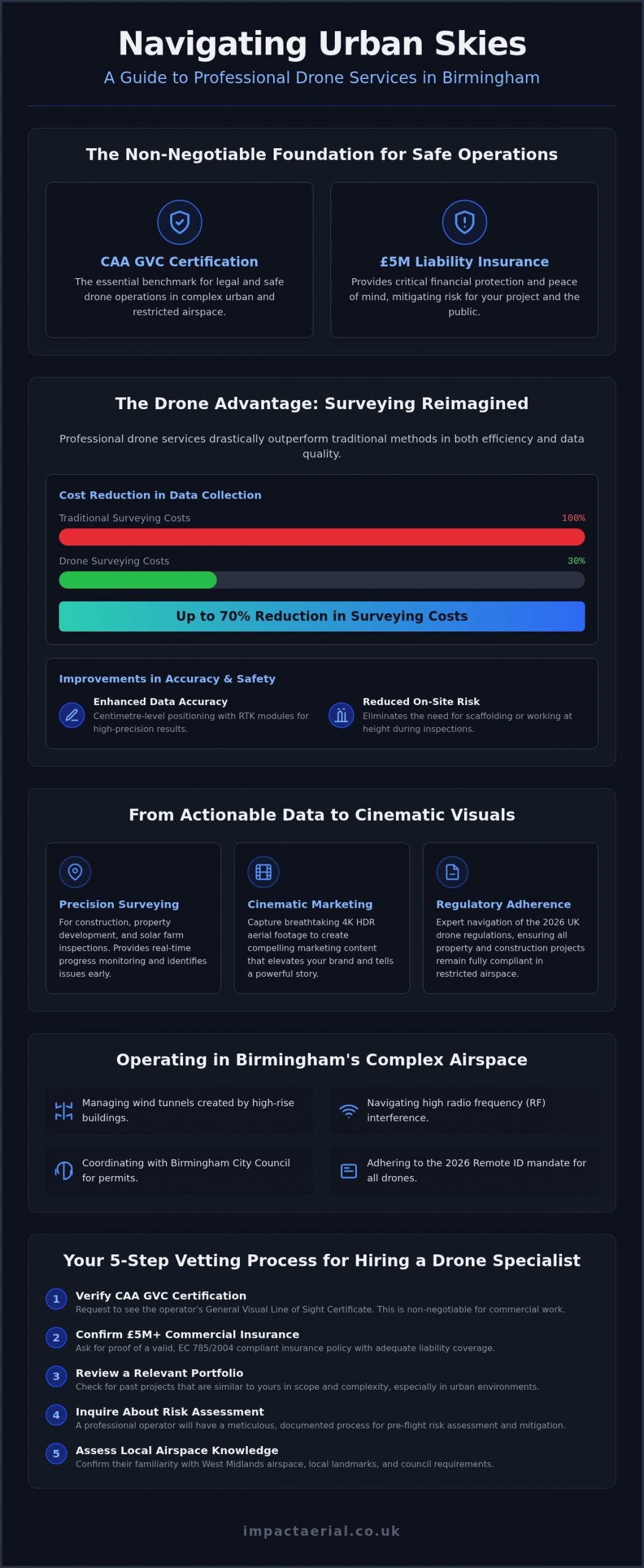
Creative Aerial Filming: High-End Visuals for Birmingham Brands
Birmingham’s competitive market requires more than just standard video. High-end brands are using aerial filming drone technology to capture perspectives that were previously only possible with expensive helicopter charters. By integrating professional aerial drone services Birmingham into their marketing strategy, businesses can create cinematic narratives that resonate on both social media and broadcast platforms. This isn’t just about height; it’s about movement and the ability to weave a story through the city’s architectural landscape.
First-Person View (FPV) drones are transforming how we experience Birmingham venues. These agile aircraft can navigate through tight indoor spaces, providing a continuous, high-speed tour that feels visceral and immersive. When these shots are combined with ground-based filming, the result is a cohesive narrative that guides the viewer from the exterior skyline into the heart of the brand’s physical location. Every creative mission follows UK Civil Aviation Authority regulations, ensuring that even the most complex shots are executed with absolute safety and compliance.
Virtual Tours and Immersive Experiences
Interactive 360-degree aerial panoramas have become the benchmark for Birmingham’s luxury real estate and corporate sectors. Our workflow for virtual tour creation involves capturing high-resolution imagery that is stitched into a seamless, interactive environment. This allows prospective buyers or stakeholders to explore a property from every angle before a site visit. In 2026, these immersive experiences are no longer optional for high-value listings; they are the standard for engagement in professional aerial drone services Birmingham packages.
Post-Production: Turning Raw Footage into Content
Capturing the footage is only the first stage of the process. Raw data is transformed into polished content through our dedicated post-production suite. Professional colour grading ensures that every frame matches the brand’s visual identity, while meticulous sound design adds depth to the cinematic experience. We manage the entire lifecycle from the initial storyboard to the final edit, delivering content optimised for 4K HDR displays and mobile platforms. This end-to-end service ensures that the technical precision of the flight translates directly into a high-tier marketing asset.
Urban Flight Safety: Navigating Birmingham Airspace and Regulations
Operating in a major city like Birmingham requires a deep understanding of aviation law and local bylaws. For any commercial project, holding a valid UK drone license is the absolute minimum requirement. However, for complex urban missions, the CAA GVC (General Visual Line of Sight Certificate) is the gold standard. This certification proves that a pilot has the advanced training necessary to manage risks in high-density environments. When commissioning aerial drone services Birmingham, verifying these credentials is your first line of defence against project liability.
Risk management in a city centre isn’t a formality; it’s a meticulous process. A professional Birmingham flight risk assessment involves mapping every potential obstacle, from the BT Tower to the overhead lines of the West Midlands Metro. We establish clear flight corridors and identify emergency landing zones long before the drone leaves the ground. This level of preparation is backed by our £5m commercial liability insurance, providing the financial reassurance that corporate clients require for large-scale urban projects.
Birmingham City Council and Airspace Restrictions
Navigating the specific bylaws of Birmingham City Council is essential for legal compliance. Flying over city parks like Cannon Hill or busy thoroughfares requires specific permissions and a clear understanding of local restrictions. Coordination with Birmingham Airport (BHX) is also a critical step for projects within its Flight Restriction Zone. Within the context of Birmingham City Centre, the “Congested Area” rule strictly prohibits flying drones within 150 metres of any residential, commercial, industrial, or recreational area unless the operator holds specific CAA authorisations. You can contact our compliance team to discuss the specific permits required for your next city-based project.
Data Protection and Privacy (GDPR) in Aerial Photography
Professional aerial drone services Birmingham must balance high-quality visuals with strict adherence to GDPR. Capturing footage in a busy metropolitan area inevitably involves recording members of the public. We use advanced data storage protocols and person-redaction techniques to protect individual privacy. While the operator handles the technical side of data security, clients also share a responsibility to ensure the final content is used ethically. We provide clear guidance on these responsibilities during the planning phase, ensuring your project is compliant from capture to delivery.
Hiring Professional Drone Services: A Checklist for Success
Hiring a specialist for aerial drone services Birmingham is a critical decision that impacts both the visual quality of your project and your legal standing. Vetting a drone services provider requires looking beyond a flashy website. You’re hiring an aviation partner, not just a photographer. While it’s tempting to compare quotes based on price alone, the cheapest drone hire can be the most expensive mistake. If an operator lacks the proper GVC certification or the necessary £5m liability insurance, a single incident on a Birmingham construction site could result in catastrophic financial and legal consequences for your business.
A professional engagement follows a structured 5-step process to ensure consistent results:
- Consultation: Defining the technical requirements and creative goals of the project.
- Planning: Conducting detailed risk assessments and securing Birmingham City Council permits.
- Flight: Executing the mission using industrial-grade hardware and certified pilots.
- Data Processing: Converting raw files into 4K HDR assets or survey-grade maps.
- Delivery: Providing the final assets via secure digital transfer or integrated reporting platforms.
Evaluating the Portfolio and Technical Specs
A professional showreel should demonstrate more than just pretty pictures. Look for stability in the footage, precise camera movements, and variety in high-density urban environments. It’s also vital to understand the hardware being used. There’s a significant gap between consumer-grade drones and the DJI Enterprise hardware we employ. Enterprise models offer redundant battery systems and RTK accuracy, which are essential for high-precision data collection and safety in professional aerial drone services Birmingham. Always ask if the drone used is suited for the specific task; a cinematic FPV drone for an indoor tour is a very different tool from a thermal-equipped drone for a solar farm survey.
Booking and Project Management Workflow
Weather in the West Midlands is notoriously unpredictable. A reliable operator always monitors the forecast and builds “Plan B” dates into the schedule to ensure project timelines aren’t derailed by rain or high winds. You should also account for lead times when booking. While some flights can be authorised quickly, complex missions in restricted Birmingham airspace or those requiring specific council permits can take several weeks to finalise. The final stage of the workflow is post-production. We ensure that our editing suite aligns the final output with your brand’s specific goals, whether that’s a cinematic marketing reel or a technical structural report. This end-to-end management is what separates a professional service from a casual hire.
Future-Proofing Your Birmingham Projects with Aerial Intelligence
The integration of advanced UAV technology is no longer a luxury for West Midlands businesses; it’s a strategic necessity. From the high-precision data required for solar farm thermal inspections to the cinematic storytelling used by leading brands, the scope of aerial drone services Birmingham continues to expand. You’ve seen how professional operators bridge the gap between raw data and actionable business insights while maintaining strict compliance with evolving aviation laws. Safety is the foundation of every successful flight.
Success in the city’s complex airspace depends on meticulous planning and technical expertise. By prioritising CAA GVC certified pilots and robust £5m commercial liability insurance, you protect your assets and ensure the highest standards of operational safety. As Birmingham’s skyline continues its rapid transformation, having a trusted technical partner is essential for capturing the data and visuals that drive growth.
Ready to elevate your next project with industry-leading precision and creative excellence? Request a professional drone service quote from Impact Aerial today and partner with Birmingham and West Midlands specialists who understand the unique demands of urban flight. We’re ready to help you reach new heights.
Frequently Asked Questions
Do I need a permit to fly a drone in Birmingham city centre?
Yes, commercial drone operations in Birmingham city centre require specific authorisations. You must comply with CAA regulations and typically need to liaise with Birmingham City Council for land use permissions. Professional aerial drone services Birmingham handle this by conducting pre-flight risk assessments and securing necessary flight clearances from local authorities and Birmingham Airport (BHX) when operating within its Flight Restriction Zone. This ensures your project remains fully legal and avoids liability issues.
What is the difference between a standard drone pilot and a CAA GVC certified one?
A CAA GVC (General Visual Line of Sight Certificate) is the professional standard for complex urban flight. While a standard flyer might hold a basic Flyer ID or A2 CofC, a GVC-certified pilot has undergone rigorous training specifically for operating in congested areas. This certification is essential for many commercial projects in Birmingham. It allows for greater operational flexibility while maintaining the highest safety protocols required by national aviation authorities for urban environments.
How much does professional drone hire cost in Birmingham for 2026?
Professional drone service costs vary based on the technical complexity and the specific outputs required for your project. Factors such as the need for thermal sensors, high-precision RTK data, or cinematic post-production will influence the final quote. Rather than looking for the lowest price, businesses should evaluate the value of CAA compliance and insurance. We provide bespoke quotes that reflect the specific hardware and expertise needed for high-resolution 4K HDR marketing or technical survey data.
Can drones fly in the rain or high winds common in the West Midlands?
While DJI Enterprise drones feature advanced IP ratings for moisture resistance, we always prioritise flight safety. High winds or heavy rain common in the West Midlands can affect both data accuracy and aircraft stability. We monitor local weather forecasts meticulously and typically schedule “Plan B” dates to ensure your aerial drone services Birmingham are conducted during optimal conditions. This approach guarantees the highest quality visuals and protects the integrity of the collected data.
How long does a typical drone roof survey take to complete?
A typical drone roof survey for a commercial property in Birmingham usually takes between one and four hours on-site. This duration depends on the building’s footprint and the level of detail required for structural assessments or insurance claims. Because drones eliminate the need for scaffolding or cherry pickers, the process is significantly faster than traditional methods. This allows for rapid data collection without disrupting your daily business operations or site activities.
What insurance coverage should a professional drone company have?
A professional drone operator must carry specialist commercial third-party liability insurance. We maintain £5m of commercial liability coverage, which is the standard requirement for most corporate and construction projects in the UK. This insurance provides essential protection against unforeseen incidents, offering you psychological comfort and financial security. It’s vital to never hire an operator who only carries hobbyist insurance, as this won’t cover commercial activities and leaves your business exposed.
Can drones be used for indoor filming in Birmingham venues?
Yes, drones are highly effective for indoor filming in Birmingham venues, particularly when using specialised FPV (First-Person View) aircraft. These smaller, agile drones are designed with prop guards to operate safely within tight interior spaces, creating immersive “fly-through” tours. This technology is perfect for showcasing event spaces, manufacturing facilities, or retail environments. It provides a continuous and engaging perspective that traditional ground-based cameras simply cannot replicate for your brand storytelling.
How quickly can I receive the final edited footage or survey data?
Turnaround times depend on the complexity of the project and the required level of post-production. Raw imagery or basic survey data can often be delivered within 24 to 48 hours. However, cinematic marketing videos or detailed thermal survey reports that require professional colour grading and data analysis typically take five to ten working days. We manage the entire workflow from capture to final edit, ensuring the output meets your specific brand standards and technical requirements.
Commercial Drone Surveys UK: The Definitive Guide for 2026
What if you could eliminate the six-figure liability of scaffolding and the weeks-long wait for site data with a single afternoon of flight? For years, the UK construction and property sectors have accepted high costs and safety risks as the unavoidable price of doing business. You’re likely all too familiar with the slow turnaround of traditional land surveys and the psychological weight of putting staff at height just to inspect a roof or a bridge. It’s a bottleneck that doesn’t just eat your budget; it stalls your entire project timeline.
This definitive guide for 2026 reveals how professional commercial drone surveys UK are transforming these outdated workflows into high-speed data engines. We’ll show you how to leverage CAA GVC certified expertise and DJI Enterprise hardware to achieve centimeter-level accuracy while virtually eliminating the need for cherry pickers. You’ll learn how technical consultancy and precision thermal imaging bridge the gap between site reality and digital planning. We’re moving beyond simple aerial photography to explore the regulatory standards, hardware capabilities, and ROI-driven processes that define current industry leadership. From PV solar farm thermal surveys to complex construction monitoring, discover the roadmap to safer, smarter, and more profitable site management.
Key Takeaways
- Learn why modern commercial drone surveys UK have evolved from simple aerial photography into high-precision geospatial data instruments essential for precision site planning.
- Understand the critical role of DJI Enterprise hardware and 4K HDR sensors in providing the granular detail required for accurate roof inspections and construction monitoring.
- Identify why CAA GVC certification and comprehensive liability insurance are the industry standards for ensuring safe, legal, and compliant aerial operations.
- Discover how drone technology reduces project overheads and safety risks by replacing traditional access methods like scaffolding and cherry pickers.
- Explore the professional end-to-end workflow that ensures data accuracy, from initial site permissions through to final post-production delivery.
What is a Commercial Drone Survey and Why is it Essential?
A commercial drone survey is a systematic process of capturing high-precision geospatial data using Unmanned Aerial Vehicles (UAVs). Unlike standard aerial photography, which captures a moment in time, a professional survey focuses on measurable, actionable intelligence. In the context of commercial drone surveys UK, this transition from “pretty pictures” to “data-centric outputs” allows project managers to integrate aerial findings directly into CAD and BIM workflows. This methodology, often referred to as an Unmanned Aerial Photogrammetric Survey, provides a digital twin of a site that is accurate to within millimeters.
To better understand the technical depth and practical realities of this industry, watch this helpful video:
In 2026, the reliance on heavy access equipment is fading. Scaffolding and cherry pickers are no longer the default choice for initial site assessments. These traditional methods are slow to erect and carry high insurance premiums. By contrast, commercial drone surveys UK offer a non-invasive alternative that captures comprehensive site data without disrupting ongoing ground operations. This rapid deployment capability ensures that project timelines remain intact while stakeholders receive higher-density data than a manual inspection could ever provide.
The Evolution of Aerial Data Collection
The leap from hobbyist RC aircraft to DJI Enterprise intelligence has redefined professional standards. We’ve moved beyond simple visuals into the realm of multi-spectral analysis. High-resolution 4K HDR sensors capture granular detail, while thermal imaging identifies hidden defects in PV solar farms or commercial roofing. This technological maturity supports Digital Value Engineering, allowing firms to identify potential issues before they become costly structural failures. It’s a proactive approach that replaces guesswork with empirical evidence.
Key Industry Drivers for Drone Adoption
Stricter adherence to “Working at Height” regulations remains a massive driver for UK businesses. The legal and financial consequences of site accidents mean that any technology reducing human exposure to height is a priority. Drones provide this safety buffer, keeping surveyors firmly on the ground. Financial pressures also play a significant role. Property managers and construction firms are under constant demand to reduce overheads.
- Rapid Turnaround: Data that once took weeks to compile is now available in days or even hours.
- Site Monitoring: Real-time updates allow for better coordination and stockpile volumetrics.
- Cost Efficiency: Eliminating plant hire for cherry pickers directly improves project ROI.
The Technology Behind High-Precision UAV Surveying
Professional-grade results in commercial drone surveys UK depend entirely on the distinction between consumer-grade equipment and enterprise-grade hardware. While hobbyist drones are capable of capturing decent imagery, they lack the sensor stability, redundancy, and data-precision required for technical consultancy. We utilize DJI Enterprise platforms because they provide the reliability needed for high-stakes environments, such as active construction sites or offshore assets. These systems are designed to operate within the strict safety parameters defined by the UK Civil Aviation Authority (CAA) Drone Guidance, ensuring every flight is both legal and insured.
The core of our capability lies in the 4K HDR sensors. These cameras capture granular detail that allows surveyors to zoom into a single bolt on a telecommunications mast or a hairline crack in a chimney stack without losing clarity. This level of resolution is a prerequisite for generating high-fidelity 2D orthomosaics and 3D point clouds. When you need to bridge the gap between raw telemetry and architectural planning, these precision instruments provide the definitive data set your project team requires.
Visual vs. Thermal Sensors
RGB sensors are the standard choice for property marketing, roof inspections, and schedule of condition reports. They provide a clear, natural-light perspective that stakeholders can easily interpret. However, visual light only tells half the story. Thermal sensors are essential for identifying heat loss in building envelopes and diagnosing defects in renewable energy infrastructure. Thermal surveys identify “hot spots” in solar arrays by detecting localized heat anomalies that indicate cell failure or electrical resistance. This allows for targeted maintenance that preserves the efficiency of the entire site.
Data Processing and Post-Production
Capturing raw aerial data is only the first stage of the workflow. The true value of commercial drone surveys UK emerges during post-production. We transform thousands of individual images into actionable reports through photogrammetry. This process creates high-density point clouds and 3D models that integrate seamlessly with existing CAD and BIM software. For property developers, this means the aerial data can be used directly for site volumetrics or virtual tour creation.
Our meticulous approach to data handling ensures that the final output is a precision instrument. If you require a technical assessment for a complex asset, exploring professional drone commercial property surveys is a logical next step. By providing high-end output and specialized thermal analysis, we ensure your data is accurate, compliant, and ready for immediate use in your digital planning environment.
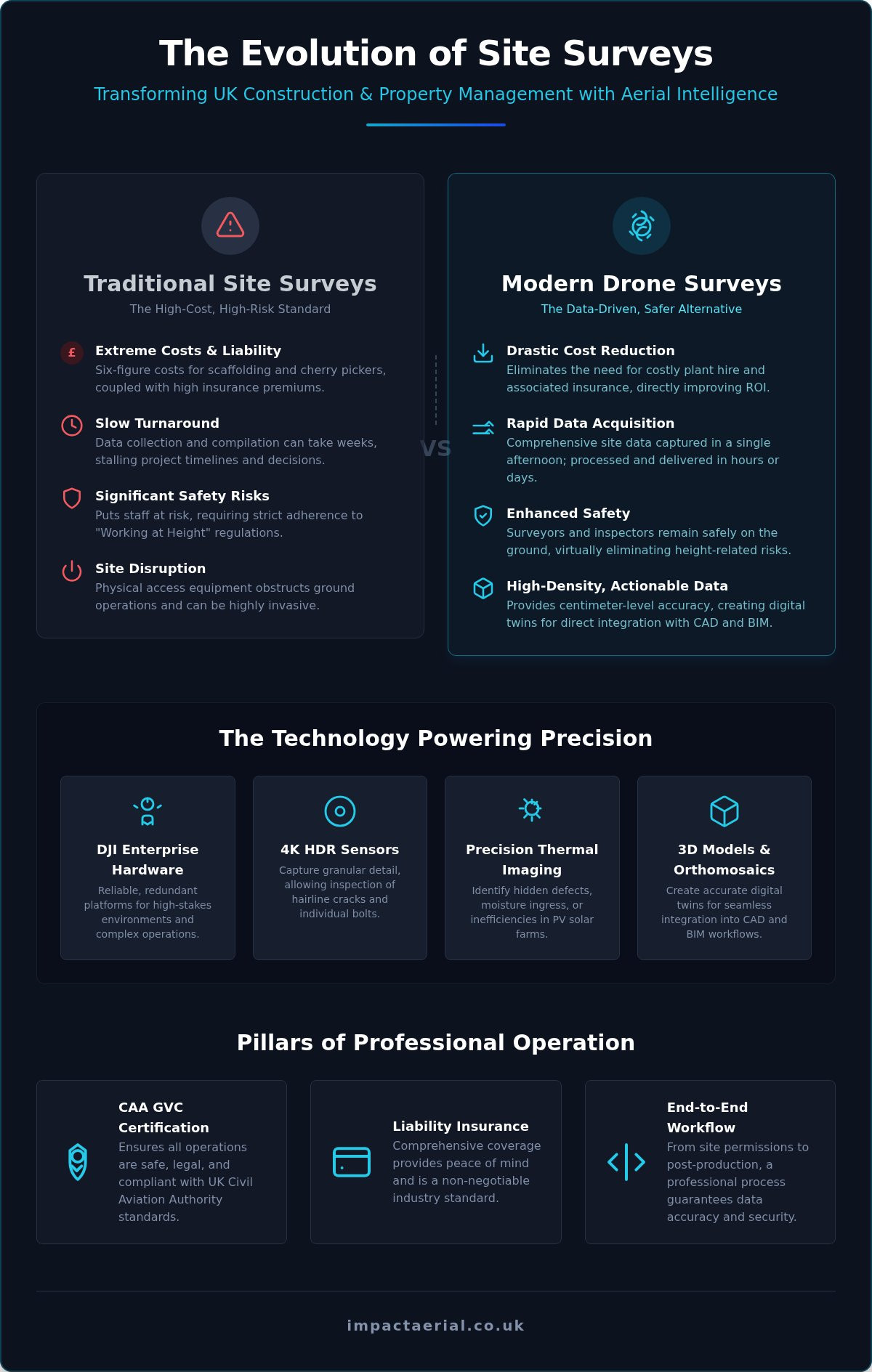
Compliance and Safety: The UK Regulatory Landscape
Operating within the UK’s airspace requires more than just technical skill; it demands a deep commitment to the legal frameworks established by the Civil Aviation Authority (CAA). For any business commissioning commercial drone surveys UK, understanding these regulations isn’t just about ticking boxes. It’s about ensuring the safety of personnel and the legality of the data collected. The CAA framework is designed to manage risk, particularly when operating near people or in built-up areas. Professional operators don’t just “fly”; they navigate a complex set of operational authorizations that grant them the legal right to conduct work where others cannot.
The General Visual Line of Sight Certificate (GVC) is the gold standard for pilots in this sector. It demonstrates a level of competency and theoretical knowledge far beyond the basic tests required for recreational use. When you hire an operator with GVC certification, you’re hiring a professional who understands the nuances of The Drone and Model Aircraft Code and can apply it to complex site conditions. This meticulous adherence to national standards is what separates a technical consultant from a casual operator.
The Legal Requirement for Commercial Work
Hiring a hobbyist or an uncertified pilot for a commercial site survey is a significant legal risk. In the UK, any “valuable consideration” exchanged for drone work classifies it as commercial operation. Hobbyists lack the specific operational authorizations needed to fly in congested areas or close to buildings, which are common requirements for property and construction projects. If an incident occurs, an uncertified pilot will likely have no valid insurance, leaving your business exposed to massive liability. We maintain strict compliance to provide total psychological comfort to our clients. You can read more about the specific requirements in our guide to the UK Drone License: A Simple Guide to CAA Rules in 2026.
Insurance and Liability Reassurance
Risk mitigation is at the heart of our operational planning. While we use DJI Enterprise hardware with built-in redundancies, we also carry £5m commercial liability insurance as a standard safeguard. This coverage protects your business from third-party risks and operational accidents that standard public liability policies often exclude. Our safety protocols involve a layered approach to protection:
- Site-Specific Risk Assessments: Detailed RAMS (Risk Assessment Method Statements) are produced for every project before we arrive on-site.
- Pre-flight Planning: We check NOTAMs (Notices to Airmen) and local flight restrictions to ensure the airspace is clear.
- On-site Safety Checks: Establishing clear take-off and landing zones to keep the public and site staff safe during the flight.
This disciplined approach ensures that every one of our commercial drone surveys UK is conducted with the highest tier of professional safety. We don’t just meet the minimum legal requirements; we set a benchmark for operational excellence in the aerial surveying industry.
Primary Applications of Drone Surveys Across Sectors
The utility of commercial drone surveys UK has expanded rapidly, moving from specialized niche applications to becoming a fundamental requirement for large-scale project management. Across the construction, property, and energy sectors, the ability to capture high-density data from a safe, ground-based position has redefined operational standards. By integrating aerial intelligence into daily workflows, businesses can move beyond reactive maintenance toward a model of proactive asset management and precision planning.
Construction and Infrastructure Monitoring
Modern construction sites rely on constant data flow to remain on schedule and within budget. Drones have replaced traditional, labor-intensive land surveys by providing high-accuracy site topography and stockpile volumetrics in a fraction of the time. This rapid data acquisition allows for real-time progress monitoring, ensuring that the digital twin of the site matches the physical reality. Safety is also significantly improved; by using UAVs, you remove personnel from hazardous zones, unstable terrains, and heights. For a deeper look at these methodologies, see our Drone Survey: The Complete Guide to Aerial Data Collection.
Commercial Property and Asset Management
In the property sector, the primary pain point has always been the cost and logistical complexity of access. Commercial drone surveys UK eliminate the need for expensive scaffolding or cherry pickers for routine roof inspections and schedule of condition reports. We capture 4K HDR imagery that provides granular detail of building envelopes, identifying structural issues that manual inspections might miss. These assets also serve a dual purpose for property advertising, providing high-end aerial filming and immersive 3D virtual tours that help secure tenancies or sales for commercial real estate.
Specialised Thermal Surveys for Solar Farms
The renewable energy sector benefits immensely from the integration of thermal sensors. Large-scale PV solar farms require regular monitoring to maintain peak efficiency, yet manual ground inspections are often impractical. Our specialized thermal surveys identify defective cells and string failures by detecting heat anomalies that indicate electrical resistance or cell damage. This precision data allows for targeted maintenance, maximizing the energy output and overall ROI of the solar asset. Regular aerial inspections ensure that minor defects don’t escalate into site-wide performance drops.
Whether you are managing a national infrastructure project or a localized property portfolio, our technical consultancy ensures you receive the highest tier of data accuracy and safety. If you are ready to modernize your site data, contact us today to discuss our professional drone surveying services and how we can support your specific project requirements.
The Impact Aerial Workflow: From Consultation to Delivery
The effectiveness of commercial drone surveys UK is rooted in a structured, methodical workflow that prioritizes data integrity and operational safety. We don’t just deploy pilots; we act as technical consultants to ensure the raw telemetry captured on-site translates into high-value business intelligence. This end-to-end process is designed to provide psychological comfort to project stakeholders while delivering the granular detail required for complex architectural and engineering decisions.
Step 1: Consultation and Planning
The initial phase centers on defining your specific data requirements. We assess site constraints, such as proximity to congested areas or restricted airspace, and determine the optimal resolution needed for your deliverables. Whether you require centimeter-level accuracy for land topography or high-resolution visual data for a schedule of condition report, we provide a transparent, professional quote based on the project’s technical scope. Securing necessary airspace clearances and conducting preliminary site research ensures that when we arrive, the operation proceeds without legal or logistical delays.
Step 2: On-Site Data Collection
Execution begins with meticulous pre-flight safety checks and the establishment of dedicated take-off and landing zones. Our pilots deploy DJI Enterprise drones, capturing 4K HDR and thermal imagery according to the pre-defined flight plan. We understand that your site is an active working environment. Our workflow is designed to minimize disruption to your daily operations, allowing work to continue while we gather data from a safe, non-invasive distance. This ground-based safety approach is a core benefit of modern commercial drone surveys UK, removing the need for heavy machinery and personnel at height.
Step 3: Post-Production and Reporting
The final stage is where raw data is transformed into precision models. Our post-production team uses specialized software to stitch thousands of individual images into 2D orthomosaics, 3D point clouds, or virtual tours. We deliver final reports in your preferred format, whether that’s a PDF summary or files ready for immediate CAD and BIM integration. For a broader look at how these technical workflows integrate with business needs, explore A Complete Guide to Professional Drone Services in the UK. This disciplined approach ensures that the data you receive is not just a visual record, but a precision instrument for your project’s success.
Future-Proofing Your Site Data with Precision Aerial Surveys
Adopting commercial drone surveys UK is no longer just a technological upgrade; it’s a strategic move towards total site safety and data-centric project management. We’ve explored how transitioning from traditional access methods to DJI Enterprise aerial platforms eliminates the risks of working at height while delivering millimeter-accurate geospatial data. By integrating these high-resolution outputs directly into your CAD and BIM workflows, you’re ensuring every decision is backed by empirical, real-time evidence. Whether you’re managing a solar farm, a construction site, or a commercial property portfolio, the goal remains the same: maximizing ROI through meticulous technical consultancy.
Impact Aerial provides the professional infrastructure your projects deserve. Our team of CAA GVC certified pilots operates with £5m commercial liability insurance, providing total psychological comfort and operational security across our UK-wide coverage. Don’t let outdated survey methods bottleneck your progress or compromise your safety standards. It’s time to leverage high-end output that bridges the gap between site reality and digital planning. You can Request a Professional Drone Survey Quote from Impact Aerial today to see how our expertise transforms your operational efficiency. We look forward to helping you elevate your next project.
Frequently Asked Questions
How much does a commercial drone survey cost in the UK?
Costs for a drone survey vary based on site size, complexity, and the specific data deliverables you require. A large construction site needing 3D point clouds requires a different investment than a small residential roof inspection. We provide transparent, project-specific quotes following an initial consultation. This ensures you only pay for the precision and sensor technology your specific asset management needs without any hidden fees.
Do I need a special license to hire a drone surveyor?
You don’t need a license to hire a professional, but the operator must hold valid CAA authorizations. Specifically, for commercial drone surveys UK, you should verify the pilot has a General Visual Line of Sight Certificate (GVC). This ensures they’re legally compliant and have passed rigorous safety assessments. Hiring uncertified hobbyists can void your insurance and lead to significant legal liabilities for your business.
How accurate are drone land surveys compared to traditional methods?
Drone surveys offer centimeter-level accuracy that rivals traditional ground-based methods while capturing significantly higher data density. By using RTK (Real-Time Kinematic) technology and DJI Enterprise hardware, we can produce digital twins that are precise enough for CAD and BIM integration. While traditional land surveys are still valuable for specific subsurface work, aerial photogrammetry provides a much faster and more comprehensive overview of surface topography and site structures.
Can drones fly in rain or high winds during a survey?
Professional drones have specific weather limitations, though enterprise models offer improved ingress protection ratings. We typically don’t fly in heavy rain or winds exceeding 20mph to ensure data quality and operational safety. High winds can cause sensor vibration, which degrades the granular detail of 4K HDR imagery. If weather conditions aren’t optimal, we’ll reschedule the flight to maintain our commitment to high-end output and precision.
How long does a typical commercial drone survey take to complete?
On-site data collection is remarkably efficient, often taking between one hour and a full day depending on the site’s scale. A standard roof inspection might be completed in under 60 minutes, while a large PV solar farm thermal survey could take several hours of flight time. The majority of the project timeline is spent in post-production, where raw telemetry is stitched into precision models and final reports for delivery.
Is my site suitable for a drone survey if it is in a restricted area?
Most restricted areas are accessible if the operator follows the correct CAA procedures for flight permissions. We handle the logistical heavy lifting, including coordinating with local Air Traffic Control or securing specific authorizations for congested UK areas. Our GVC certified pilots are trained to navigate complex airspace safely. Even if your site is near an airport or sensitive infrastructure, we can usually secure the necessary legal clearances to proceed.
What insurance should a professional drone company have?
A reputable operator must carry specialized commercial drone insurance that is compliant with EC Regulation 785/2004. For high-stakes commercial drone surveys UK, we recommend hiring companies with at least £5m in commercial liability insurance. This level of coverage provides reassurance against third-party risks and operational accidents. Always ask to see a valid insurance certificate before work begins to ensure your business is fully protected during the flight.
What kind of data files will I receive after the survey?
You’ll receive data in formats that integrate seamlessly with your existing professional software. Common deliverables include high-resolution 4K HDR images, 2D orthomosaic maps, and 3D models such as point clouds or textured meshes. For thermal surveys, we provide specialized reports identifying heat anomalies. We deliver these files via secure digital transfer, ensuring your technical team can begin analysis or CAD integration immediately after the post-production phase.
PV Solar Farm Thermal Surveys: The 2026 Guide to Maximising Energy ROI
Relying on manual IV curve testing and ground-based inspections is no longer a sustainable strategy for maintaining utility-scale solar assets in 2026. You already understand that even a minor undetected string failure or a cluster of faulty bypass diodes can significantly compromise your annual energy yield. The traditional approach to site maintenance is often slow, prohibitively expensive, and introduces unnecessary health and safety risks to your technical teams on the ground.
This guide demonstrates how professional PV solar farm thermal surveys use high-resolution aerial thermography to pinpoint faults with centimetre-level precision. By transitioning to a data-driven inspection model, asset managers can identify issues that remain invisible to the naked eye. We’ll explore how IEC-compliant data collection and actionable fault reporting eliminate guesswork, streamline your maintenance workflows, and ensure your solar farm operates at its peak technical capacity. You’ll learn the specific methodologies required to secure maximum energy production while maintaining strict regulatory compliance across your entire UK portfolio. From identifying sub-module defects to verifying the integrity of entire strings, this approach provides the technical clarity needed to protect your long-term investment.
Key Takeaways
- Understand how modern O&M strategies integrate infrared sensors to detect temperature anomalies before they cause significant yield loss.
- Learn to categorise faults from cell hotspots to full string failures using PV solar farm thermal surveys, while identifying environmental issues like soiling or vegetation shading.
- Discover why aerial inspections are significantly more efficient than manual testing, allowing a 5MW farm to be surveyed in hours rather than days.
- Ensure your asset management meets UK industry standards by verifying CAA GVC certifications and the necessity of £5m commercial liability insurance.
- See how high-resolution thermal imaging hardware provides the precise thermal data needed for actionable maintenance reports and IEC-compliant documentation.
What are PV Solar Farm Thermal Surveys?
A professional thermal survey is a specialised diagnostic process involving Unmanned Aerial Vehicles (UAVs) equipped with high-resolution radiometric infrared sensors. These PV solar farm thermal surveys are designed to detect minute temperature anomalies across a photovoltaic power station that indicate underlying electrical or mechanical issues. While traditional ground-based inspections rely on the naked eye, thermal imaging reveals heat signatures that signify energy loss or potential component failure long before they become visible to a technician.
The role of aerial thermography has become a cornerstone of modern Operations and Maintenance (O&M) strategies. Relying solely on visual inspections is insufficient because internal electrical faults, such as bypass diode failures or micro-cracks, rarely show physical symptoms on the module surface. The rapid evolution of survey drone technology has transitioned these inspections from experimental procedures to essential, IEC-compliant industry standards in the renewable energy sector.
To better understand the technical precision involved in these inspections, watch this demonstration of high-resolution aerial thermography:
The Science of Thermal Imaging in Photovoltaics
Infrared sensors identify “hotspots” which are localised areas of high temperature caused by resistive heating. This occurs when a cell or module is no longer producing energy but is instead consuming it. For data to be technically valid, PV solar farm thermal surveys must be conducted under specific irradiance conditions, typically a minimum of 600W/m², to ensure the panels are under sufficient load. Accurate data also requires a meticulous understanding of emissivity; the glass surface of a solar panel can be highly reflective, so our pilots adjust flight angles to avoid “thermal glint” that could skew the results.
Why Regular Thermal Monitoring is Essential
Safety is the primary driver for consistent monitoring. Identifying overheating diodes and connectors early prevents catastrophic fire risks that could jeopardise the entire site. Beyond safety, thermal data provides objective evidence needed to validate manufacturer warranty claims. If a module is underperforming due to a manufacturing defect, a radiometric report is often the only proof accepted by suppliers. This proactive approach ensures you’re optimising energy yield by identifying non-performing strings early, protecting the long-term ROI of your UK energy portfolio.
Identifying Solar Faults: From Cell Hotspots to String Failures
Effective PV solar farm thermal surveys don’t just find heat; they categorise it into actionable data. We classify anomalies into four distinct levels: cell, multi-cell, module, and string faults. A single cell hotspot might indicate a micro-crack, while a full string failure usually suggests a disconnected cable or inverter issue. Distinguishing these from environmental factors like bird droppings, soiling, or vegetation shading is critical. These external factors create “false positives” that can distract maintenance teams if they aren’t correctly identified during the analysis phase.
Professional data collection involves both qualitative and quantitative analysis. Qualitative work involves scanning the site to identify anomalies, while quantitative analysis measures the specific temperature difference (Delta-T) between the fault and the surrounding healthy modules. This level of detail is why high-quality drone survey data is so valuable. It integrates seamlessly with asset management platforms, allowing O&M teams to track degradation over time. If you’re looking to enhance your site’s health monitoring, our team provides specialist solar thermography services across the UK.
Common Electrical Faults Detected
Bypass diode failures are among the most common issues we detect. When a diode fails, it can cause a third or even the entirety of a module to go offline, appearing as a distinct rectangular heat signature. String outages are even more severe. These occur when entire rows of panels are disconnected, often due to blown fuses or damaged cabling. We also look for Potential Induced Degradation (PID), which manifests as a “checkerboard” pattern of heat across panels near the negative pole of the string, indicating a significant loss in efficiency.
IEC 62446 Standards and Reporting
Adherence to IEC 62446-3:2017 is the gold standard for any commercial PV solar farm thermal surveys. This international standard dictates the environmental conditions and technical requirements needed for a valid report. We utilise high-resolution 640×512 thermal sensors to ensure every pixel provides accurate radiometric data, meeting the strict requirements for technical due diligence. Orthomosaic mapping creates a geometrically corrected, high-resolution map of the entire site that allows technicians to locate specific faulty modules with absolute geographical precision.
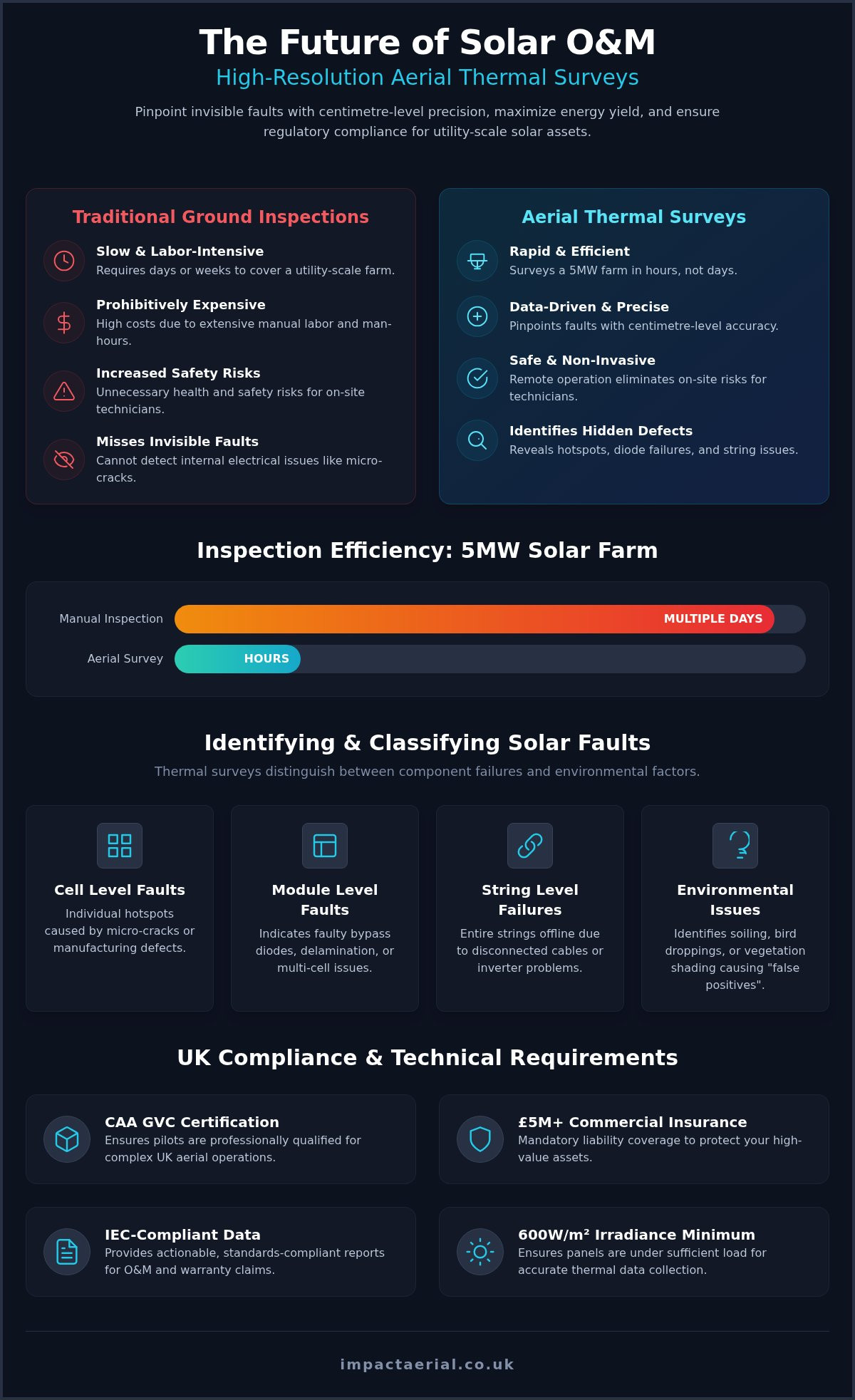
Drones vs. Traditional Inspections: ROI and Efficiency
Traditional manual inspections are often a bottleneck in solar asset management. A ground team equipped with handheld thermal cameras might take several days to walk a 5MW site, often missing faults due to poor viewing angles or simple human fatigue. In contrast, professional PV solar farm thermal surveys can cover the same 5MW area in roughly two to three hours. This speed doesn’t just save on labour costs. It allows for inspections during the narrow windows of peak irradiance required for technically valid data.
The difference in data density is staggering. While manual teams perform spot-checks, a drone captures millions of radiometric data points across every module on the site. These non-contact inspections mean your system remains fully operational throughout the process. There’s no need for costly shutdowns or string isolations. Additionally, using electric UAVs for monitoring aligns perfectly with the sustainability goals of any renewable energy project, reducing the carbon footprint of the maintenance programme itself.
Cost-Benefit Analysis for Asset Managers
Calculating the payback period for a thermal survey is straightforward when you consider the cost of undetected energy loss. A single failed string can result in thousands of pounds in lost revenue over a single season. Early detection prevents these minor issues from escalating into catastrophic component failures or site fires. By moving inspections to the air, you also significantly reduce “Working at Height” risks and other ground-based hazards. This proactive safety stance, supported by our £5m commercial liability insurance, provides the reassurance required when managing high-value UK infrastructure.
Precision and Repeatability
Consistency is vital for long-term asset health. We use GPS-tagged data to ensure that every identified anomaly is tied to a specific coordinate. This allows for precise year-on-year performance tracking, making it easy to see if a minor hotspot is stable or degrading. The technical gap between DJI Enterprise sensors and budget handheld alternatives is significant; high-end hardware provides the thermal sensitivity needed to see through the “noise” of solar reflections. Automated flight paths ensure 100% site coverage by maintaining consistent overlaps and altitudes that human-controlled inspections simply cannot match.
UK Regulations: Navigating CAA Compliance in 2026
Compliance in the UK drone industry is no longer a grey area; it is a strict legal requirement that protects both the operator and the asset owner. In 2026, the Civil Aviation Authority (CAA) enforces rigorous standards for any commercial operation. A valid drone license is mandatory for pilots conducting PV solar farm thermal surveys. This certification ensures that the flight team understands the complexities of the UK’s congested airspace, particularly when operating near critical infrastructure, power lines, or restricted military zones often found near rural solar sites.
Managing flight permissions requires more than just technical skill. It demands a thorough understanding of the specific airspace around your facility. Meticulous flight planning and on-site risk assessments are the bedrock of our safety-first approach. We also maintain strict GDPR and privacy protocols to ensure that data collection remains focused solely on the solar asset, protecting the privacy of neighbouring landowners. For asset managers seeking a fully compliant partner, our Birmingham-based team provides accredited thermal inspection services across the West Midlands and the wider UK.
The Importance of CAA GVC Certification
The General Visual Line of Sight Certificate (GVC) is the professional standard for UAV operations in the UK. This qualification confirms that a pilot has been formally assessed on flight safety, meteorology, and emergency procedures. “Hobbyist” pilots or uncertified operators represent a massive liability risk for solar farm owners. Without a GVC, an operator is not legally permitted to fly the sophisticated DJI Enterprise hardware required for radiometric data collection. Using an uncertified pilot could potentially void your site’s operational insurance and leave you vulnerable to CAA enforcement action.
Insurance and Risk Mitigation
Standard public liability insurance is rarely sufficient for high-value energy infrastructure. We carry £5m commercial liability insurance that is specifically designed for professional UAV operations. This level of coverage is the industry standard for high-value assets, providing the financial reassurance that asset managers require. Professional indemnity insurance is also essential, as it protects the integrity and technical validity of the resulting survey reports. The UK regulatory landscape has now finalised the transition from PfCO to GVC standards, reflecting a more robust and professionalised approach to aerial data collection.
Impact Aerial: Specialist Solar Surveys in Birmingham and the UK
Impact Aerial operates as a high-end technical consultancy, providing specialised PV solar farm thermal surveys from our central hub in Birmingham. Our location in the West Midlands isn’t just a geographical detail; it’s a strategic advantage that enables rapid deployment to any site across the UK. We utilise the latest DJI Enterprise hardware, which allows us to capture dual-stream data: high-resolution radiometric thermal imagery alongside 4K HDR visual video. This combination ensures that every anomaly detected is cross-referenced with a visual high-definition record, making it easier to distinguish between internal electrical failures and external physical damage. Our comprehensive drone services are built on a foundation of CAA GVC certification and £5m commercial liability insurance, offering the technical reassurance that utility-scale asset managers require.
Our Process: Data Capture to Actionable Insights
Success begins long before the drone leaves the ground. Our meticulous process starts with site feasibility and irradiance window planning, ensuring that we only fly when conditions meet the minimum 600W/m² threshold required for accurate data. During the high-precision flight execution, our pilots use automated flight paths to maintain consistent overlaps and altitudes. This methodical approach guarantees 100% site coverage without gaps. Once the raw data is captured, it’s analysed by qualified thermographers who produce annotated technical reports. These documents don’t just list temperatures; they provide clear, actionable maintenance priorities that your ground teams can use to execute repairs immediately.
Why Choose a West Midlands Based Specialist?
The UK weather is notoriously unpredictable, making flexible scheduling essential for solar inspections. Being based in Birmingham allows us to monitor local weather patterns and deploy teams at short notice when optimal solar windows appear. We have a deep understanding of the local regulatory environments and complex UK airspace, ensuring every flight is fully compliant with the latest CAA standards. Unlike many providers who focus solely on raw data, we bridge the gap between technical thermography and professional visual documentation. We provide cinematic 4K visuals that are ideal for stakeholder presentations and annual health reviews, giving you a complete 360-degree perspective of your asset’s condition. This dual-purpose output ensures that you receive both the diagnostic data needed for O&M and the high-end visual assets required for corporate reporting.
Securing Your Solar Asset’s Future Performance
Transitioning to aerial thermography is no longer just a technical upgrade; it’s a strategic necessity for protecting your long-term energy yield. Professional PV solar farm thermal surveys provide the technical clarity needed to identify sub-module defects and string failures with absolute precision. By moving away from slow, manual inspections, you reduce site risk and ensure that your maintenance budget is focused exactly where it’s needed most. This data-centric approach doesn’t just improve efficiency; it validates warranty claims and secures the technical viability of your portfolio.
Our expert Birmingham-based technical team is ready to help you navigate the complexities of 2026 UK drone regulations. With CAA GVC certified pilots and £5m commercial liability insurance, we provide the professional reassurance required to operate on high-value infrastructure. Don’t leave your energy ROI to chance. Take the first step toward comprehensive site health monitoring by clicking below.
Request a PV Solar Farm Thermal Survey Quote today and ensure your panels are operating at peak technical capacity.
Frequently Asked Questions
Are drone thermal surveys legal for solar farms in the UK?
Yes, aerial inspections are entirely legal in the UK when conducted by a CAA-authorised operator. Commercial drone pilots must hold a General Visual Line of Sight Certificate (GVC) to fly sophisticated thermal hardware. We ensure all flights are conducted within the Specific Category framework, maintaining strict adherence to safety protocols and airspace permissions. This compliance provides asset managers with the legal reassurance required for utility-scale infrastructure projects across the country.
What is the best time of year to conduct a PV solar farm thermal survey?
The optimal period for PV solar farm thermal surveys is between April and September. This window provides the high solar irradiance levels, typically a minimum of 600W/m², necessary to put the panels under sufficient electrical load. Without high irradiance, thermal anomalies may not manifest clearly enough for accurate detection. We monitor weather patterns closely to ensure data is captured during these peak conditions to maintain strict technical validity.
Can a thermal drone detect faults that are not visible to the naked eye?
Yes, thermal sensors detect infrared radiation that is completely invisible to the human eye. While a module might look physically intact, the sensor identifies heat signatures caused by internal electrical resistance. This allows us to pinpoint bypass diode failures, micro-cracks, and Potential Induced Degradation (PID) that would otherwise remain undetected. Identifying these hidden faults early is essential for preventing yield loss and potential fire hazards across your entire solar site.
How much does a commercial PV solar farm thermal survey cost?
Pricing for a professional inspection depends on several variables, including the total megawatt (MW) capacity of the site and the specific reporting requirements. Factors such as site location, terrain complexity, and the depth of data analysis needed also influence the final investment. We provide bespoke quotes based on these technical parameters to ensure you receive a survey tailored to your asset’s specific operational needs and long-term maintenance goals.
Do I need to shut down the solar farm during the drone survey?
No, the solar farm must remain fully operational during the inspection. In fact, the panels need to be generating power and under significant load for thermal anomalies to be visible. If the system is shut down, the modules will cool, and electrical faults like hotspots or string failures will disappear from the thermal spectrum. This non-intrusive method allows for comprehensive site health checks without any interruption to your energy production.
What resolution thermal camera is required for IEC-compliant surveys?
To meet IEC 62446-3 standards, a thermal sensor with a minimum resolution of 640×512 pixels is required. This high-resolution hardware ensures that each pixel represents a specific radiometric temperature reading, providing the technical detail needed to distinguish between individual cell faults. Using lower-resolution sensors can result in blurred data, making it impossible to accurately categorise anomalies or provide the technical due diligence required by asset owners and insurers.
How long does it take to receive the final solar farm inspection report?
Delivery times for a final technical report typically range from five to ten working days after the flight is completed. This duration allows our thermographers to meticulously analyse the raw radiometric data, categorise every identified anomaly, and cross-reference them with high-definition visual imagery. Larger utility-scale sites may require additional processing time to ensure the orthomosaic mapping and annotated fault reports meet our strict internal quality and precision standards.
What is the difference between a qualitative and quantitative thermal survey?
A qualitative survey focuses on identifying the presence of thermal anomalies and categorising their patterns to find faults. A quantitative PV solar farm thermal survey goes further by measuring the specific temperature of the anomaly and comparing it to a healthy reference module. This temperature difference, known as Delta-T, is vital for assessing the severity of a fault and determining whether it requires immediate maintenance intervention or long-term performance monitoring.
Drone Commercial Property Photography: The Professional UK Guide
In 2026, a high-resolution aerial view of a Birmingham logistics hub or a London office development isn’t just a marketing luxury; it’s a strategic data asset that must balance cinematic appeal with strict UK regulatory compliance. You’ve likely seen how poor quality imagery fails to do justice to high-value portfolios, or perhaps you’ve felt the headache of managing multiple contractors for different visual needs. It’s a common frustration for asset managers who need to attract premium tenants while mitigating the corporate risk of hiring uninsured or non-compliant operators.
This professional guide explores how to leverage drone commercial property photography to document and manage real estate assets with precision. You’ll learn how to integrate cinematic 4K HDR drone footage with brochure-ready architectural shots to create a compelling narrative for your property. We’ll also cover the essential safety standards, including the necessity of CAA GVC certified pilots and DJI Enterprise hardware, ensuring your visual marketing is as legally robust as it is visually stunning. By the end of this guide, you’ll understand how to coordinate high-tier visual assets that satisfy both marketing departments and compliance officers.
Key Takeaways
- Learn how to integrate drone commercial property photography with ground-based architectural shots to create a comprehensive digital twin for high-value UK assets.
- Understand the critical legal requirements for 2026, including the necessity of CAA GVC certified pilots and £5m commercial liability insurance to mitigate corporate risk.
- Discover why DJI Enterprise hardware and 4K HDR post-production are essential for producing brochure-ready visuals that attract premium tenants.
- Gain insights into the tactical selection between drone, mast, and ground-level photography based on specific site restrictions and marketing objectives.
- Master the briefing process to ensure your site surveys identify hazards and optimal lighting windows before the first flight begins.
What is Commercial Property Photography in 2026?
In 2026, commercial property photography has evolved into a high-precision discipline that integrates aerial and ground-based data. It’s no longer just about aesthetic marketing; it’s a specialist service designed to document, manage, and inspect high-value real estate assets. While the history of aerial photography began with balloons and fixed-wing aircraft, modern drone commercial property photography uses DJI Enterprise UAVs to create seamless digital twins of complex UK structures. All operations must be conducted by CAA GVC certified pilots to ensure safety and legality on site.
Today’s industry standard demands 4K HDR imagery and high-resolution rectified shots that eliminate lens distortion. These assets serve a dual purpose. They provide cinematic marketing material for high-end brochures while offering technical data for ESG (Environmental, Social, and Governance) reporting. For example, high-resolution imagery helps asset managers document solar panel health or green roof biodiversity, providing tangible evidence for sustainability audits. In many cases, these photos are captured during a wider drone survey to ensure no part of the building envelope is overlooked.
Commercial vs. Residential Photography Workflows
The logistics required for a 1.2 million sq. ft distribution centre in the Midlands are vastly different from a residential shoot. Professional workflows must account for institutional stakeholders, such as pension funds and global asset managers, who require technical accuracy over lifestyle filters. This necessitates maintaining geometrically correct lines in every architectural shot. If a building’s vertical lines aren’t perfectly straight, the asset looks unstable and unprofessional to potential investors. We use tilt-shift techniques and post-production software to ensure every structure appears exactly as the architect intended.
Key Sectors Served in the UK Market
The UK market has distinct requirements across different asset classes, each demanding a specific technical approach:
- Industrial and Logistics: We use wide-angle aerials to showcase the sheer scale of warehouses and their proximity to critical transport links like the M1 or M6. Drone commercial property photography is essential here to capture the entire site footprint in a single frame.
- Retail and Hospitality: The focus shifts to the vibrancy of shopping centres and hotel foyers. This often requires a mix of drone fly-throughs and detailed interior stills to show the flow of foot traffic and high-end finishes.
- Office and Corporate: We highlight amenities, breakout spaces, and local infrastructure. High-quality imagery captures the building’s exterior within its urban context, helping to attract premium corporate tenants who value location and prestige.
The Impact of Aerial Drone Technology on Property Marketing
Aerial technology has fundamentally changed how institutional investors perceive a site’s potential. Unlike traditional mast photography, which is tethered to a ground position and limited in height, drone commercial property photography provides a three-dimensional understanding of a development. This dynamic perspective is essential for elevating your listing with drone video, showcasing not just the building, but its relationship to critical infrastructure. For commercial valuation, demonstrating immediate proximity to arterial road networks and rail terminals is often as vital as the architectural design itself. Institutional investors don’t just want to see a building; they want to see an asset in motion. Using a specialised aerial filming drone allows us to create immersive marketing reels that guide a viewer through the site as if they were arriving in person. These cinematic fly-throughs trigger a sense of scale and prestige that static images cannot replicate.
Cinematic Video vs. High-Resolution Stills
Selecting the right medium depends on the intended platform. We deploy 4K video for website hero sections and social media reels to capture attention within seconds. Cinematic sequences create a narrative flow that ground-based shots lack, providing a “big picture” view of the property. Conversely, high-resolution stills remain the gold standard for large-format site hoardings and printed marketing brochures where every pixel is scrutinised. Combining both into a unified drone photography strategy ensures your property is represented across all digital and physical touchpoints. This integrated approach allows asset managers to maintain a consistent brand identity across their entire portfolio while providing the technical detail required by surveyors and architects.
Hardware Standards: DJI Enterprise and 4K HDR
Prosumer drones often fall short in professional commercial environments due to limited sensor sizes and poor signal stability. We utilise DJI Enterprise hardware because it delivers the precision and reliability required for complex UK sites. A critical feature is High Dynamic Range (HDR) capability, which allows us to capture intricate detail in deep shadows without blowing out bright skies. This technical edge is especially important in the unpredictable weather of the West Midlands, where lighting can change rapidly. By using DJI Enterprise hardware for drone commercial property photography, we ensure that every shot meets the technical specifications required for high-end architectural rendering. Our equipment ensures crisp, stable imagery even in challenging conditions, providing the reliability you need for high-stakes property launches. You can explore our full range of professional aerial services to see how we maintain these rigorous standards.
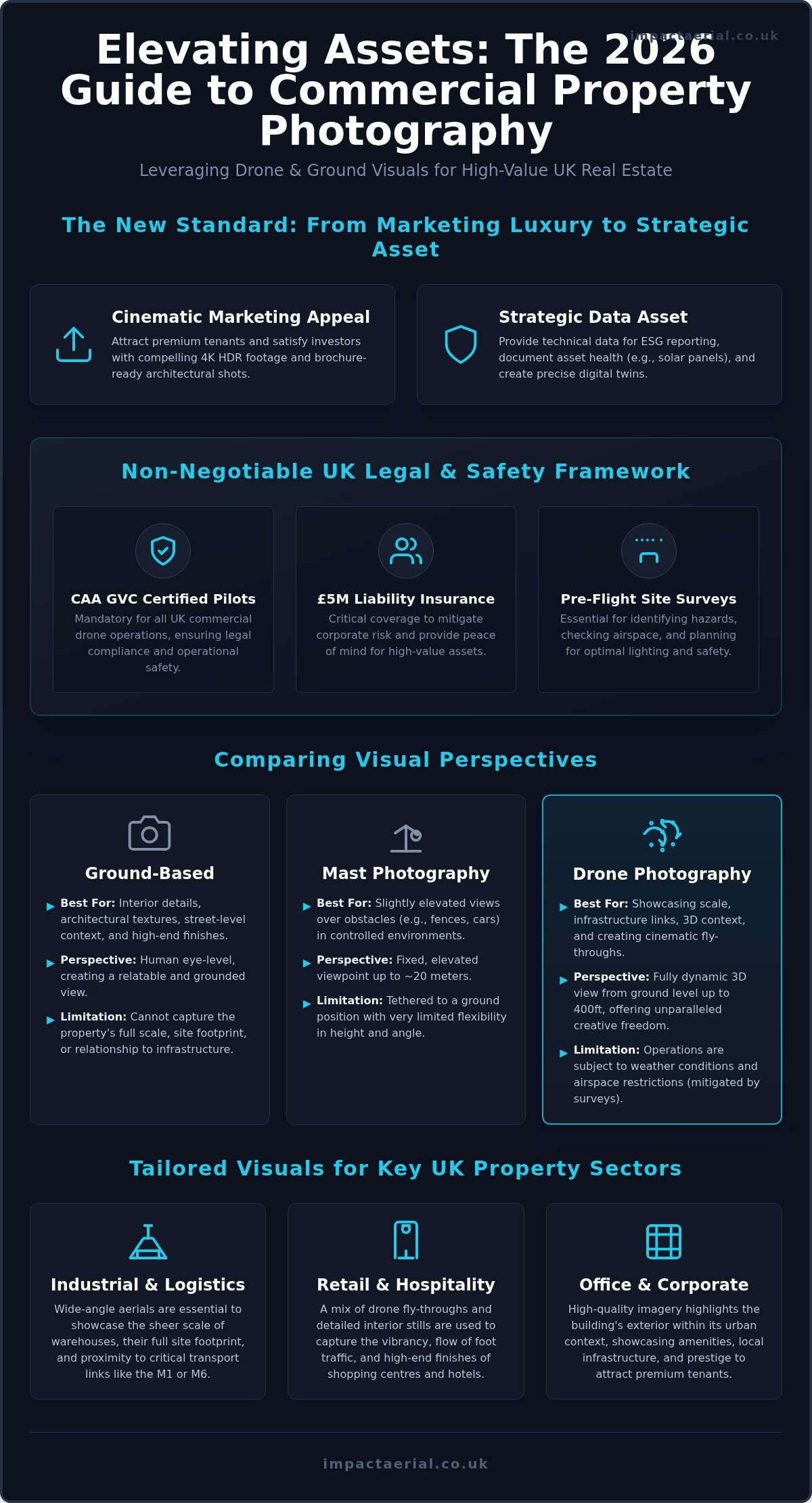
Comparing Ground-Based, Mast, and Drone Photography
Professional property marketing requires a multi-layered approach. While drone commercial property photography offers unmatched site-wide perspectives, it’s most effective when integrated with ground-based and mast-mounted imagery. Each platform serves a specific technical purpose. Ground-level shots provide the tactile detail of interiors, while elevated masts offer a tactical solution for extremely restricted UK city centres where flight might be prohibited under The Drone and Model Aircraft Code. Drones remain the gold standard for cinematic marketing content and comprehensive site overviews, but a hybrid strategy ensures every angle of the asset is documented with precision.
When to Prioritise Ground-Based Interiors
Capturing the internal “feel” of a corporate space requires the nuance of ground-based architectural photography. Drones are exceptional for exteriors, but they cannot replicate the subtle interplay of natural light and texture found in modern foyers or breakout areas. We use wide-angle, non-distorted lenses to document amenities like gyms and cafes, ensuring the vertical lines remain perfectly straight. This human-eye perspective is vital for attracting premium tenants who need to visualise their daily workflow within the building. It’s about documenting the flow of the space, from the reception desk to the high-end finishes of a boardroom, providing a sense of scale that aerial shots might miss.
The Drone Advantage for Site Planning
For large-scale developments, drones provide a perspective that masts and ground crews simply cannot match. They allow us to capture the full facade of tall structures without the perspective distortion common in ground-up shots. This is particularly useful for site planning and construction monitoring. By adopting a survey drone perspective, asset managers can view a 10-acre site footprint in minutes rather than hours. This speed of deployment doesn’t just save time; it provides a geometrically accurate overview that is essential for development planning and site-wide marketing. It’s a technical consultant’s approach to visual data, ensuring that drone commercial property photography contributes to both the marketing brochure and the project management file.
Compliance, Safety, and the 2026 UK Legal Landscape
Executing drone commercial property photography missions in 2026 requires more than just technical skill; it demands a deep understanding of UK aviation law. As assets become more complex and urban environments more crowded, the margin for error disappears. You must ensure your provider holds a CAA GVC certified status, which is the gold standard for pilots operating in the “Specific Category.” This certification isn’t just a badge; it’s a legal requirement for most commercial operations involving heavier enterprise hardware near buildings and people.
Professional pilots mitigate corporate risk by producing comprehensive Risk Assessment and Method Statements (RAMS) for every flight. These documents identify site-specific hazards, from overhead power lines to public footpaths, ensuring the operation remains within the law. Privacy and GDPR also play a significant role in 2026. Capturing imagery in busy urban environments requires a meticulous approach to data management, ensuring that bystanders and neighbouring properties aren’t unlawfully identified in your marketing materials. Our team handles these complexities as part of our standard drone services, providing you with peace of mind and legally compliant assets.
Understanding the UK Drone Licence in 2026
The distinction between an A2 CofC and a GVC (General Visual Line of Sight Certificate) is critical for property managers to understand. While the A2 CofC is suitable for lighter drones in less restricted areas, the GVC is essential for “Congested Areas” found in UK city centres. This qualification allows for more flexible operating distances from uninvolved persons, which is often the only way to legally capture a high-rise office block or a central retail development. The Civil Aviation Authority (CAA) strictly regulates these permissions, and operating without the correct qualification can lead to heavy fines and the invalidation of insurance policies.
Corporate Responsibility and Insurance
Hiring an uncertified hobbyist for drone commercial property photography isn’t just a safety risk; it’s a significant financial liability. Most standard public liability policies won’t cover commercial drone activity unless the pilot is specifically qualified and insured for it. We maintain £5m commercial liability insurance as a minimum standard for all corporate property sites. This level of cover protects the property owner and the asset manager against third-party damage or injury during the shoot. When vetting your supplier, use this checklist for your procurement team:
- Verify the pilot’s CAA Flyer ID and Operator ID.
- Request a copy of the current GVC or OA (Operational Authorisation) document.
- Confirm the insurance policy specifically mentions EC 785/2004 compliance.
- Review past RAMS for similar urban property environments.
If you need to ensure your next project is fully compliant and professionally executed, you can book a consultation with our CAA-certified team today.
Hiring and Briefing Your Commercial Property Photographer
Securing high-quality visual assets for a multi-million pound development starts with a clear objective. When hiring a specialist for drone commercial property photography, you must first define the primary goal of the project. Are these images intended for a high-end marketing brochure, an institutional annual report, or a technical drone survey? Each requirement demands a different flight plan and sensor configuration. A technical survey focuses on data density and overlap, whereas marketing photography prioritises “golden hour” lighting and cinematic composition to evoke an emotional response from potential tenants.
A professional team doesn’t just show up and fly. We conduct a meticulous pre-shoot site survey to identify physical hazards like telecommunication masts or overhead lines. This phase also includes solar path analysis to determine the optimal lighting windows for each building elevation. When requesting a quote, provide the exact site location, access requirements, and the specific list of deliverables you need. This allows us to prepare the necessary RAMS and ensure the operation is both safe and efficient from the moment we arrive on site.
Creating a Comprehensive Creative Brief
A detailed creative brief is the foundation of a successful shoot. You should specify a comprehensive shot list that includes hero aerials, wide context shots showing transport links, and ground-based detailed architectural features. Technical requirements are equally important. Institutional investors often require high-resolution RAW files for maximum flexibility, while marketing teams might prefer 4K ProRes video for website hero sections. We manage the entire timeline, from the initial site risk assessment to the final delivery of edited, brochure-ready assets, typically within an agreed post-production window. This phase is where RAW data is transformed through colour grading and geometric correction to ensure every vertical line is perfectly straight.
Why a Local Specialist with National Reach Matters
Choosing a Birmingham-based team provides a significant tactical advantage for rapid deployment across the West Midlands and the wider UK. We understand the local geography and the specific lighting conditions of the region’s major industrial hubs. However, consistency is the primary reason why asset managers trust us to travel nationwide. Using a single professional partner ensures that your entire property portfolio maintains a uniform visual standard, regardless of location. We don’t just provide photos; we deliver strategic assets that support your commercial objectives. To discuss your next project and ensure your marketing is as legally robust as it is visually stunning, you can request a professional commercial property photography quote from Impact Aerial today.
Securing Your Property Assets with Technical Precision
In 2026, the standard for marketing and managing high-value UK real estate has shifted toward integrated, data-rich visual assets. Professional drone commercial property photography now serves as a critical bridge between cinematic marketing and technical site documentation. By combining CAA GVC certified pilots with DJI Enterprise 4K HDR hardware, asset managers can ensure their portfolios are represented with absolute precision while maintaining full legal compliance.
The key to success lies in vetting your partners as thoroughly as your investments. Relying on experts who provide £5m public liability insurance and meticulous risk assessments isn’t just a safety precaution; it’s a commitment to corporate responsibility. Whether you’re documenting a national logistics hub or a central London office development, the right imagery attracts premium tenants and provides a clear record for ESG reporting.
Ready to transform your property’s visual narrative? Elevate your property marketing with Impact Aerial; Book your professional shoot today. We’re here to provide the technical expertise and creative vision your assets deserve.
Frequently Asked Questions
Do I need permission from the CAA for a drone shoot at my commercial property?
Commercial drone operations in the UK require an Operational Authorisation from the Civil Aviation Authority (CAA). While you, as the property owner, provide land access permission, the pilot is responsible for ensuring the flight complies with aviation law. Professional operators hold a GVC (General Visual Line of Sight Certificate) to fly enterprise-grade equipment in urban areas. This ensures the drone commercial property photography mission is conducted safely and remains legally compliant with current standards.
How much does commercial property photography cost in the UK?
Pricing for commercial property photography in the UK depends on several technical factors, including the scale of the asset, its geographical location, and the specific deliverables required. A large industrial distribution centre requires more flight time and post-production than a single retail unit. You should request a bespoke quote that accounts for pre-flight site surveys, the complexity of the airspace, and whether you require 4K HDR video alongside high-resolution stills.
Can drones fly in central Birmingham or London for property photos?
Drones can operate in major city centres like Birmingham and London, provided the pilot has the correct CAA certifications and local airspace clearances. These environments are often classified as congested areas or Flight Restriction Zones (FRZs) near airports. Professional pilots conduct thorough risk assessments and coordinate with National Air Traffic Services (NATS) where necessary. Using DJI Enterprise hardware with stable signal technology is essential for maintaining safety in these high-interference urban settings.
What is the difference between architectural photography and commercial property photography?
Architectural photography focuses on the artistic design and aesthetic intent of a building, often for portfolio use by designers. Commercial property photography is a broader, asset-focused discipline designed to market, document, and manage real estate. It prioritises the property’s relationship to its environment, transport links, and technical state. This discipline often involves integrating drone commercial property photography with ground-based shots to provide a comprehensive overview for institutional investors and asset managers.
How long does a typical commercial drone shoot take?
A typical drone shoot for a commercial asset usually takes between half a day and a full day on site. The duration depends on the complexity of the shot list and the size of the property. For example, a 10-acre industrial site requires more time for comprehensive coverage than a standalone office block. This timeframe includes the initial safety setup, multiple flight rotations to capture different lighting angles, and the necessary ground-based photography.
What insurance should a professional commercial drone photographer have?
Professional operators must carry specialist commercial drone insurance that complies with EC 785/2004 regulations. We recommend a minimum of £5 million in public liability insurance for all corporate property sites. This level of cover is a standard requirement for procurement teams and asset managers to mitigate corporate risk. It protects against third-party damage or injury, ensuring that the property owner isn’t held liable for incidents occurring during the aerial operation.
Can you provide 360-degree virtual tours for large commercial spaces?
We provide comprehensive virtual tour creation for large-scale commercial spaces, including warehouses, office floors, and retail developments. These tours allow potential tenants or investors to navigate the property remotely, providing a detailed sense of scale and layout. By integrating high-resolution 360-degree panoramas with aerial site overviews, we create an immersive digital twin of the asset. It’s a highly effective tool for international stakeholders who can’t visit the UK site in person.
What happens if the weather is bad on the scheduled day of the shoot?
Safety is our primary concern, so we don’t fly in heavy rain or high winds that exceed the technical limits of our DJI Enterprise drones. If the forecast indicates poor weather, we monitor the conditions closely in the 48 hours leading up to the shoot. In the event of a weather-related cancellation, we reschedule the session for the next available window with optimal lighting. This ensures your property is captured in the best possible conditions.
Drone Filming for UK Ads: Aerial Marketing Guide
Did you know that incorporating aerial perspectives can increase social media engagement by up to 80% compared to standard video? It’s no secret that cinematic scale captures attention in a crowded digital market, but the logistics of drone filming for advertising UK campaigns often feel like a regulatory minefield. You likely want the sweeping 4K HDR visuals that define high-end brands; however, the fear of CAA fines or the complexity of securing permissions in cities like London and Birmingham can stall a project before it starts. We know that for professional marketers, the “wow factor” is only valuable if it’s delivered without legal or operational risk.
This guide explains how professional drone filming transforms advertising through cinematic visuals and uncompromising CAA compliance. We’ll show you how to integrate high-end aerial data into your workflow seamlessly. We’ll also cover the essential technical standards, from DJI Enterprise 4K HDR capabilities to the peace of mind provided by £5m commercial liability insurance and GVC certified pilots.
Key Takeaways
- Understand how the shift from costly helicopter charters to agile UAV platforms has made high-resolution 4K HDR imagery the standard for modern UK brand campaigns.
- Learn the critical legal requirements for drone filming for advertising UK, including the necessity of CAA GVC certification and the protection offered by £5m commercial liability insurance.
- Discover how aerial visuals significantly increase social media engagement and web dwell time, providing a versatile asset for everything from short teasers to corporate films.
- Identify the essential steps for planning a shoot, from conducting airspace checks in complex urban environments to defining a creative brief that ensures seamless marketing integration.
- Explore the technical advantages of using a professional DJI Enterprise fleet to ensure your content meets the highest industry standards for precision and safety.
The Evolution of Drone Filming for UK Advertising Campaigns
The visual landscape of British marketing has undergone a radical shift. In the past, capturing an aerial perspective required a full helicopter charter, a specialized camera crew, and a significant budget that only the largest corporations could justify. Today, that barrier has vanished. The Evolution of Drone Filming has replaced expensive rotary aircraft with agile, high-resolution UAV platforms. This transition isn’t just about saving money; it’s about the creative freedom that comes with agility. Using drone filming for advertising UK allows brands to move beyond the physical constraints of traditional jibs and cranes. While a crane is limited by its mechanical arm, a professional drone offers a limitless range of motion, allowing for seamless transitions from ground level to 400 feet.
Modern UK brand standards now demand 4K HDR imagery as the baseline. In a digital environment where users decide to keep scrolling in less than a second, high-dynamic-range visuals provide the “stop the scroll” factor. These cinematic perspectives create an immediate sense of authority and scale, positioning a brand as an industry leader before a single word of dialogue is spoken. The ability to track moving subjects or sweep over landscapes with precision ensures that every frame contributes to a premium brand image.
From Hollywood Blockbusters to Boutique Brand Stories
Advanced stabilization technology has democratized cinematic quality. Small and medium-sized enterprises (SMEs) can now utilize the same visual language once reserved for Hollywood blockbusters. This is particularly effective in property and tourism sectors, where “The Grand Reveal” shot—starting close on a detail before pulling back to reveal a vast landscape—creates a powerful psychological connection with the viewer. Drone filming provides high-tier cinematic production value at a fraction of the cost associated with traditional helicopter charters or heavy machinery. This efficiency makes drone filming for advertising UK accessible for projects ranging from social media teasers to full-scale television commercials, allowing for more ambitious creative briefs without the logistical headaches of legacy equipment. For those inspired by these aerial perspectives who wish to experience the thrill of flight from the cockpit, Fun Flying Aviation Ltd offers structured microlight training and experience flights.
Why Aerial Filming is Essential for Modern Storytelling
Aerial perspectives provide context that ground-based cameras simply cannot achieve. They allow a viewer to understand the scale of a construction site or the layout of a retail park in a single, comprehensive shot. Beyond the sky, professional drones are increasingly used to film indoor spaces and tight environments, offering unique fly-through perspectives that guide the viewer through a physical location. Integrating these shots into a cinematic drone video workflow ensures that your marketing content maintains a cohesive, high-end narrative from start to finish. This versatility makes the UAV a mandatory tool for any competitive UK advertising strategy, providing the technical precision needed to tell complex stories with visual ease.
Navigating UK Regulations: CAA Compliance and Safety Standards
Commercial drone operations in the United Kingdom are governed by a strict legal framework managed by the Civil Aviation Authority (CAA). When commissioning drone filming for advertising UK, it is vital to understand that projects in populated areas typically fall under the “Specific Category.” This classification requires an Operational Authorisation from the CAA, a document that proves the operator has submitted a comprehensive risk assessment and safety manual. Unlike amateur hobbyists, professional operators must also adhere to data protection laws overseen by the Information Commissioner’s Office (ICO). This includes conducting a Data Protection Impact Assessment (DPIA) to ensure that the privacy of the public is respected during high-profile advertising shoots.
The “invisible work” of a professional shoot begins long before the drone takes flight. It involves meticulous pre-flight planning, including airspace checks through National Air Traffic Services (NATS) and obtaining landowner permissions for take-off and landing. In major hubs like London, this process often requires coordinating with local borough film services and notifying the Metropolitan Police Service Film Unit. This level of technical consultancy ensures that your brand remains protected from the legal and reputational risks associated with unauthorized flights.
Why Your Pilot Needs CAA GVC Certification
The General Visual Line of Sight Certificate (GVC) is the gold standard for drone pilots operating in the Specific Category. It demonstrates a high level of theoretical knowledge and practical flight skill, specifically regarding the safety of people and property in congested environments. A CAA GVC certified operator is trained to manage complex airspace permissions, which is essential for advertising projects in urban centers like Birmingham or London. Hiring a certified pilot ensures that your production meets all current 2026 regulatory requirements, preventing costly project shutdowns or legal repercussions.
Insurance and Risk Mitigation for Brand Safety
Standard public liability insurance often excludes aviation activities, leaving brands vulnerable if an incident occurs. For professional drone filming for advertising UK, a minimum of £5m commercial liability insurance is the industry standard for corporate risk management. This level of coverage is a non-negotiable requirement for many local authorities and private estates. Impact Aerial manages site-specific safety protocols, including cordoning off take-off zones and utilizing spotters to monitor the environment in real-time. The peace of mind provided by comprehensive commercial drone insurance allows marketing teams to focus on the creative vision while we handle the technical and safety complexities. If you are ready to secure a compliant partner for your next campaign, you can view our full range of certified aerial services.
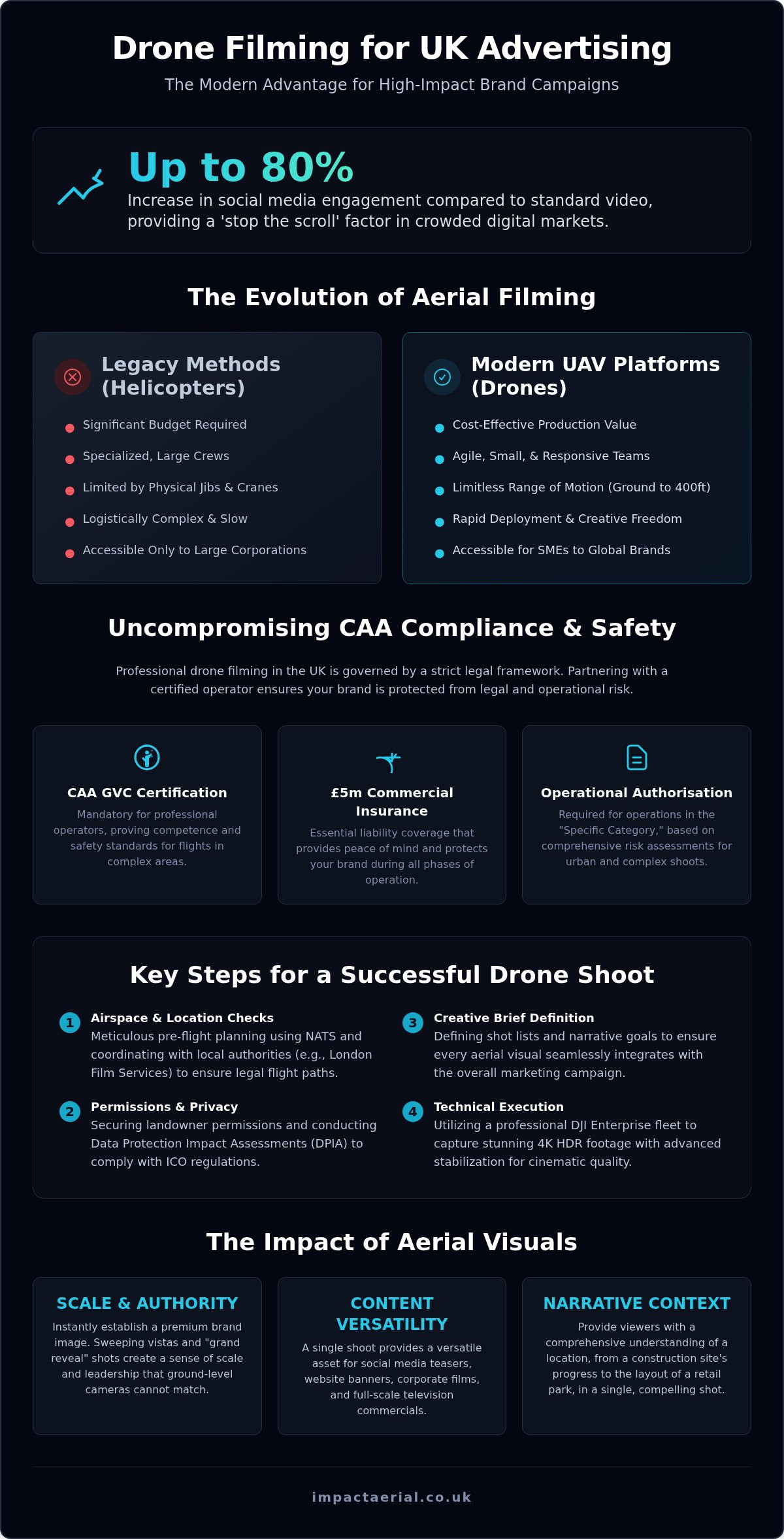
Maximising Engagement: The Impact of Aerial Visuals on Brand ROI
Integrating drone filming for advertising UK into a marketing strategy is a proven method for increasing Return on Investment (ROI). High-impact aerial visuals don’t just look professional; they fundamentally change how audiences interact with your content. Research indicates that videos incorporating aerial perspectives can increase social media engagement by up to 80% compared to standard video content. This isn’t just about aesthetic appeal. It’s about providing a sense of scale and perspective that ground cameras cannot replicate. Data also shows that videos featuring drone footage are shared up to 30% more often, extending your brand’s organic reach without additional ad spend.
For property developers and industrial firms, the ability to showcase “The Bigger Picture” provides essential context. A single aerial shot can highlight a site’s proximity to transport links, local infrastructure, and its sheer geographic footprint. To add an immersive edge, many brands now utilize FPV (First Person View) drones. These agile platforms fly through tight spaces or follow fast-moving subjects with surgical precision, creating high-energy sequences that are perfect for disruptive, modern advertising.
Optimising Content for Social Media and Digital Ads
Digital marketing requires versatility across multiple platforms. A professional drone shoot can yield a massive library of B-roll content that serves multi-channel campaigns for months. Capturing footage in 4K HDR ensures that files can be cropped for vertical formats like TikTok and Instagram Reels without a loss in quality, while still providing stunning horizontal content for YouTube or TV. The “first 3 seconds” rule is vital here; starting a social ad with a dramatic aerial reveal captures attention immediately, preventing the user from scrolling past. This technical foresight ensures that every second of your production budget contributes to viewer retention.
Storytelling Through Perspective
Drones allow brands to tell a more complete story by visualizing “the journey.” In logistics or automotive advertising, aerial shots track vehicles across iconic UK landscapes or through complex urban hubs, grounding the brand in a real-world environment. This geographic context is a powerful tool for regional marketing, as it highlights local landmarks that resonate with specific demographics. Ultimately, professional drone video production enhances brand prestige by delivering the technical excellence and cinematic scale associated with industry leaders. It’s an investment in authority that pays dividends across all digital marketing touchpoints.
Strategic Planning for Your UK Drone Shoot: Urban vs. Rural
Successful drone filming for advertising UK relies on a methodical five-step preparation phase to ensure both cinematic quality and operational safety. The process begins by defining a precise creative brief that outlines key deliverables, such as specific 4K HDR sweeps or immersive fly-throughs. Once the brief is set, we conduct a preliminary site assessment and airspace check to identify restricted zones or physical hazards. Securing permissions is the third critical stage; this may involve coordinating with local councils, private landowners, or National Air Traffic Services (NATS) for clearance. Because the British weather is notoriously unpredictable, we build flexible scheduling into every project to wait for the optimal window of clear light and low wind. The final step is on-site execution, where we offer real-time reviews of the 4K HDR footage to ensure all creative requirements are met before the mission concludes.
Filming in Urban Centres: Birmingham and Beyond
Operating in congested city environments like Birmingham and the wider West Midlands requires a higher level of technical precision and coordination. Managing flight paths in built-up areas involves accounting for electromagnetic interference, tall structures, and public safety. We coordinate directly with local authorities for street-level filming or when capturing iconic landmarks to ensure the project remains fully compliant with local bylaws. Our pilots use DJI Enterprise hardware designed for stable performance in high-interference zones, allowing us to capture the vibrant energy of urban life without compromising on safety or signal reliability.
Rural and Industrial Site Logistics
For industrial marketing, filming over vast construction sites or solar farms presents a different set of logistical challenges. Health and Safety coordination is paramount on active worksites, requiring close communication with site managers to deconflict drone flights with heavy machinery operations. We often leverage drone survey data to produce technical marketing visuals that showcase project progress or structural scale with mathematical accuracy. This data-driven approach allows brands to demonstrate their capabilities through high-resolution imagery that ground-based photography simply cannot match. If you need a partner who understands the technical nuances of urban and rural flight, contact our technical consultants today to discuss your project requirements.
Partnering with Impact Aerial for Professional Advertising Content
Impact Aerial acts as a trusted technical consultant for brands looking to push the boundaries of their visual identity. While previous sections detailed the regulations and ROI of aerial content, the success of a campaign ultimately relies on the partnership between the creative team and the drone operator. When you choose drone filming for advertising UK with us, you gain access to a meticulous workflow that prioritizes both cinematic excellence and operational safety. We maintain CAA GVC certification and £5m commercial liability insurance as standard, ensuring that every project is executed with the professionalism your corporate stakeholders expect.
Our central base in Birmingham makes us a strategic partner for drone filming for advertising UK. This location allows for efficient deployment to major urban hubs or remote industrial sites, providing a consistent production standard across multiple locations. We handle the entire lifecycle of the aerial content, ensuring that the technical precision of the flight translates directly into the creative impact of the final edit.
Advanced DJI Enterprise Technology
Unlike many operators who rely on consumer-grade hardware, our fleet consists of DJI Enterprise drones. This distinction is critical for professional advertising, as commercial-grade sensors provide the high-bitrate 4K HDR footage necessary for advanced color grading in post-production. These platforms also offer superior flight stability and signal reliability in challenging UK weather conditions, ensuring that your shoot isn’t compromised by technical limitations. By using industry-leading hardware, we guarantee that the raw data we capture meets the highest broadcast and digital standards.
Full Project Management and Post-Production
Our service extends far beyond capturing raw data; we provide a comprehensive end-to-end solution. We collaborate closely with your creative team to ensure brand alignment from the very first consultation. Our in-house post-production suite then turns raw 4K HDR files into polished advertising assets, ready for immediate deployment across television and digital channels. This holistic approach eliminates the friction of managing multiple vendors and ensures a cohesive final narrative. If you’re ready to elevate your brand’s perspective, you can book our drone filming services to begin your initial technical consultation.
Elevating Your Brand Perspective with Technical Precision
The transition toward high-resolution aerial content has redefined modern brand standards. By integrating drone filming for advertising UK into your marketing strategy, you gain a significant competitive edge through cinematic scale and immersive storytelling. Success in this field requires more than just a creative eye; it demands rigorous adherence to CAA safety protocols and meticulous project management. We’ve explored how professional equipment and expert planning mitigate the risks associated with urban filming while maximizing audience engagement across digital platforms.
Impact Aerial provides the technical expertise and creative vision necessary to deliver stunning 4K HDR results without the logistical burden. Our team combines the reliability of CAA GVC Certified Pilots with the security of £5m Commercial Liability Insurance and expert post-production services to ensure your campaign is both legal and impactful. Whether you’re planning a complex shoot in Birmingham or a sweeping rural reveal, our end-to-end service guarantees a seamless integration into your existing workflow.
Ready to transform your next advertising project? Request a Professional Quote from Impact Aerial Today and take your marketing to new heights.
Frequently Asked Questions
Is a license required for drone filming for advertising in the UK?
Yes, any individual or organization conducting drone filming for advertising UK must comply with Civil Aviation Authority (CAA) regulations. Professional pilots typically hold a General Visual Line of Sight Certificate (GVC). This qualification allows for operations in the “Specific Category,” which is often necessary for filming in populated or urban areas. Operating without the correct authorization can result in significant legal penalties and voided insurance coverage for the brand involved.
How much does professional drone filming for advertising cost in the UK?
The cost of a professional shoot is determined by several technical and logistical variables. These include the complexity of the airspace, the required flight duration, and the extent of post-production services needed. Urban projects in cities like London often involve higher coordination costs for permissions compared to rural shoots. We provide tailored quotations based on the specific creative brief and technical requirements of each advertising campaign to ensure accurate project budgeting.
Can drones film in central London or Birmingham city centres?
Drones can operate in major city centres, but the process requires meticulous planning and multiple permissions. Filming in central London often involves coordination with the Metropolitan Police, National Air Traffic Services (NATS), and the relevant borough film office. Our team manages these complex permit applications and conducts rigorous risk assessments to ensure that urban flights are fully compliant with local bylaws and national aviation safety standards.
What happens if the weather is bad on the day of the drone shoot?
Safety is our primary operational priority. If high winds or heavy rain make flight unsafe or technically impossible, we utilize flexible scheduling to move the shoot to the next available clear window. We monitor specialized aviation weather forecasts in the days leading up to a project. This proactive approach ensures that we capture high-quality 4K HDR footage in optimal lighting conditions while maintaining strict safety protocols on-site.
What is the difference between a hobbyist drone and a DJI Enterprise drone?
The primary difference lies in sensor quality, signal reliability, and data security. DJI Enterprise drones are designed for professional environments where high-bitrate 4K HDR footage is required for cinematic colour grading. These platforms feature advanced obstacle avoidance and redundant systems that provide superior stability in challenging UK conditions. Unlike consumer models, enterprise hardware is built to deliver the technical precision and reliability expected by corporate marketing departments.
Does Impact Aerial provide the raw footage or a finished edited video?
We offer a comprehensive end-to-end service that covers both raw data collection and professional post-production. Clients can choose to receive high-bitrate raw files for their own internal teams or utilize our expert editing suite to produce a finished advertising asset. Our post-production workflow ensures that aerial visuals are seamlessly integrated with your brand’s existing marketing collateral, resulting in a polished, broadcast-ready final product.
How much public liability insurance should a drone pilot have?
For professional drone filming for advertising UK, a minimum of £5m commercial liability insurance is the standard requirement for corporate and industrial sites. Standard public liability policies often exclude aviation activities, which can leave a brand exposed to significant risk. We maintain specialized aviation insurance that meets the requirements of local authorities and major landowners, providing essential financial protection and peace of mind for our clients.
Can drones be used for indoor advertising shoots?
Indoor drone filming is a highly effective way to create immersive fly-through tours of retail spaces, factories, or offices. We use specialized, smaller drones equipped with propeller guards or agile FPV platforms to navigate tight interior environments safely. These shots provide a unique perspective that traditional cameras cannot achieve, allowing you to showcase the interior scale and layout of a facility with cinematic precision and fluid motion.
Construction Drone Services UK: The Professional Guide to Aerial Data & Site Monitoring
Scaling a scaffold for a routine inspection isn’t just a logistical headache; it’s a liability that often costs UK firms thousands in unnecessary downtime and safety risks. You’re likely already aware that traditional site monitoring is slow, expensive, and frequently puts personnel in harm’s way. In an industry where margins are tight and deadlines are non-negotiable, waiting days for manual data collection is no longer a viable strategy for project success.
Professional construction drone services UK have transitioned from a specialist novelty to a critical data-management tool for risk mitigation and lifecycle efficiency. By integrating high-resolution aerial imaging and precision thermal data, sites can significantly reduce downtime and eliminate the high costs of manual height inspections. This guide provides a professional overview of how these services enhance safety and accuracy across the UK construction lifecycle. We’ll explore the technical capabilities of DJI Enterprise hardware, the importance of CAA GVC certification, and how to navigate the latest 2026 regulatory shifts. From our base in Birmingham to projects nationwide, we’ll show you how to leverage aerial data for better project outcomes and meticulous site monitoring.
Key Takeaways
- Learn how modern UAV technology provides more than just photography, acting as a technical data-collection tool for precise topographical and volumetric analysis.
- Discover how construction drone services UK mitigate site risks by replacing high-risk manual inspections with safer, more efficient aerial site monitoring.
- Understand the critical importance of CAA GVC certification and current UK regulatory compliance to ensure your operations remain legally sound in complex urban environments.
- See how integrating data from enterprise-grade DJI hardware into your existing BIM software streamlines reporting and enhances long-term project decision-making.
- Explore the Impact Aerial approach to full-service project management, ensuring precision from the initial consultation through to final data delivery.
What are Construction Drone Services and Why Do They Matter?
Professional construction drone services UK represent the expert application of Unmanned Aerial Vehicles (UAVs) to capture high-resolution technical data, imagery, and video across the build lifecycle. While early adoption often focused on simple marketing photography, the sector has evolved into a rigorous, data-centric discipline. Today, drones are essential for site monitoring, providing stakeholders with verifiable evidence of progress and structural integrity. For UK contractors, this technology provides a definitive solution to the “working at height” dilemma, significantly reducing the risks associated with manual inspections.
The value of these services lies in their precision and reliability. Professional operators don’t just fly; they manage complex data-gathering missions that inform critical decision-making. By leveraging commercial-grade hardware, firms can achieve a level of site oversight that was previously impossible without enormous expense or physical risk. This shift ensures that every flight delivers a tangible return on investment through enhanced safety and rapid data turnaround.
The Evolution of Aerial Data in the UK Build Sector
The industry has moved far beyond basic aerial snapshots. Modern workflows now rely on sophisticated survey drone technology to generate actionable intelligence. By integrating DJI Enterprise hardware capable of 4K HDR output, operators can identify structural snags, thermal leaks, or installation errors that remain invisible from the ground. This transition into technical data collection ensures that aerial insights are no longer just “nice-to-haves” but are instead integrated directly into project management software to track milestones with precision. This data-first approach allows for better resource allocation and ensures that project timelines remain on track through every phase of the build.
Replacing Traditional Access Methods
Consider the logistical burden of traditional access. Scaffolding, Mobile Elevated Work Platforms (MEWPs), and manual roof walking require extensive planning, permit applications, and significant hire costs. They also introduce substantial health and safety hazards for site personnel. In contrast, professional construction drone services UK offer a safer, non-invasive alternative that eliminates the need for personnel to leave the ground for routine checks.
A typical manual roof inspection might take several days to coordinate and execute, often causing site disruption and downtime. A professional drone deployment can often complete the same survey in one to two hours. This rapid turnaround allows site managers to receive high-fidelity data without pausing construction activities or compromising the safety of their workforce. By removing the need for physical access equipment, contractors can redirect budgets toward project delivery rather than temporary infrastructure.
Core Applications: Construction Site Monitoring and Data Collection
Effective site management requires more than occasional snapshots; it demands a systematic approach to data acquisition. Professional construction drone services UK provide a continuous record of a project’s evolution, from the first ground-breaking ceremony to the final handover. This lifecycle approach ensures that every stakeholder, from site managers to remote investors, has access to a single source of visual truth. By utilising commercial-grade equipment, we capture precise metrics that inform topographical analysis and volumetric calculations. It’s about the data. Tracking material stockpiles and earthworks with high accuracy ensures that logistical planning remains grounded in reality rather than estimates.
Progress Monitoring and Stakeholder Communication
Regular monitoring relies on repeatable flight paths. By using automated mission planning, we ensure that images are captured from the exact same coordinates every week or month. This consistency allows for the creation of high-quality time-lapse sequences and side-by-side comparisons that document build phases with absolute clarity. Beyond the raw data, professional drone photography serves as a powerful communication tool. Our post-production services transform these technical assets into polished progress reports that facilitate smoother project meetings and provide clear evidence for investor updates. It keeps everyone on the same page.
Technical Surveys: Thermal and 3D Modelling
Technical applications extend into specialised surveying, where thermal imaging and 3D modelling provide insights that traditional methods miss. For building envelopes, thermal-capable UAVs identify heat loss and moisture ingress without requiring invasive testing or expensive scaffolding. We also provide dedicated PV solar farm thermal surveys to detect faulty cells or string failures across vast arrays quickly. These “evidence-first” data sets support qualified surveyors by providing detailed orthomosaics and 3D models for precise geometry measurements. The result is a comprehensive digital twin of the site that can be referenced long after the physical work is complete. If you’re looking to enhance your project’s oversight, exploring professional site monitoring can provide the technical edge your team needs.
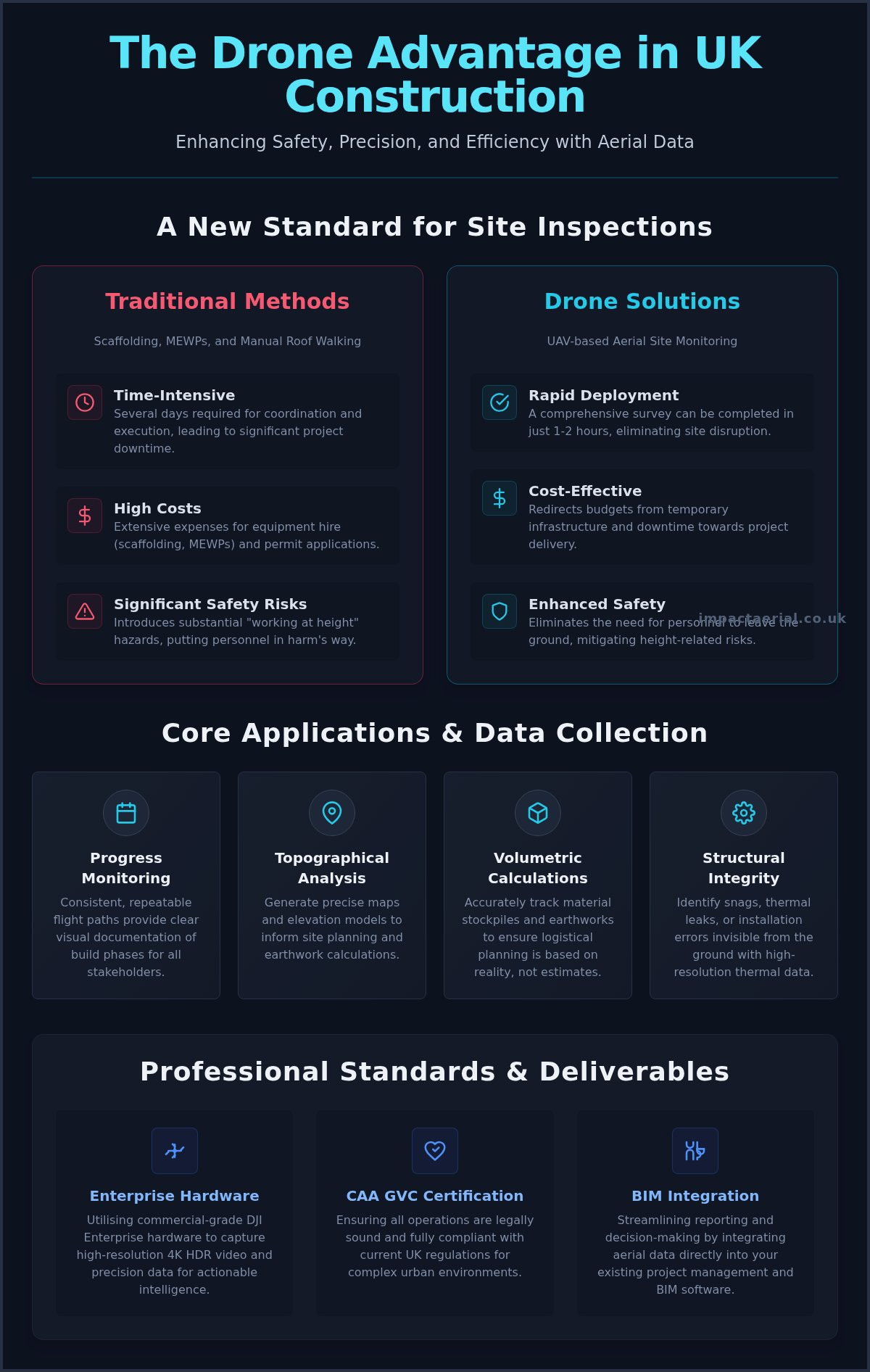
Safety and Compliance: UK Drone Regulations for Construction
Safety is the cornerstone of every successful build, and the integration of construction drone services UK must be managed with the same rigour as any other heavy plant operation. Operating a UAV on a busy site isn’t merely about flight; it’s about adhering to a strict regulatory framework designed to protect people, property, and project timelines. For any commercial deployment, the legal and operational responsibilities are significant. Engaging a provider that treats compliance as a baseline requirement ensures that your project remains protected from the legal and financial repercussions of unauthorised flight.
Risk mitigation begins long before the drone leaves the ground. Professional operators conduct thorough pre-flight assessments and establish site-specific safety protocols that align with your existing health and safety management systems. This meticulous planning is backed by £5m commercial liability insurance, providing the necessary reassurance that project risks are professionally managed. In an industry where liability is a constant concern, this level of coverage is a non-negotiable standard for professional service providers.
Navigating the CAA Regulatory Framework
Understanding the distinction between different certifications is vital for project managers. While an A2 CofC allows for some basic operations, the gold standard for complex construction environments is hiring CAA GVC certified pilots. The General Visual Line of Sight Certificate (GVC) is a professional qualification that requires a robust Operations Manual and a practical flight test, proving the pilot can handle the specific demands of the “Specific Category” of flight.
Hiring “hobbyist” pilots or uncertified staff poses a massive risk. These individuals often lack the required insurance and the operational experience to navigate congested areas safely. Furthermore, professional providers must be registered with the Information Commissioner’s Office (ICO). Because drones capture high-resolution imagery that may include identifiable individuals or private property, being ICO-compliant ensures that your project’s data handling meets UK GDPR standards, protecting you from privacy-related litigation.
Operational Safety on Busy Sites
Executing a safe flight on an active site requires clear communication and defined boundaries. We establish dedicated take-off and landing (TOAL) zones that are cordoned off from site traffic and personnel. Coordination with site managers is essential; we ensure that all flight times are scheduled to avoid interfering with crane movements or high-risk ground activities.
Urban environments and city-centre sites introduce additional complexities, such as flight restrictions and signal interference from tall structures. Navigating these challenges requires advanced DJI Enterprise hardware equipped with obstacle avoidance and redundant systems. By maintaining constant communication with site leads and following a methodical checklist, we ensure that construction drone services UK remain a safe, seamless addition to your site’s operational workflow.
The Deliverables: How Drone Data Aids Decision Making
Data is the primary currency of modern construction. In the context of construction drone services UK, the deliverables we provide are designed to be actionable technical assets rather than just visual records. We understand that site managers and surveyors don’t have time to sift through thousands of unsorted files. We implement rigorous file structure and naming conventions that align with industry-standard project management workflows. This methodical approach ensures that aerial data integrates seamlessly into existing surveyor reports and Building Information Modelling (BIM) software, allowing for immediate comparison between “as-built” and “as-designed” plans. This keeps everyone on the same page.
For those seeking professional construction drone services UK, the end product must provide clarity and precision. Whether it’s a high-resolution map or a detailed structural inspection, the goal is to provide a single source of truth that reduces ambiguity and accelerates project timelines. While our focus remains on technical precision, for projects that also require high-impact creative storytelling, Dark Falcon Productions offers the specialist production expertise needed to showcase your build in its best light. By delivering data that is ready for immediate review, we help teams identify potential issues before they become costly delays.
Structural integrity checks require the highest possible fidelity. By using 4K HDR sensors, we capture structural details that are often invisible to the naked eye from the ground. We provide a tiered delivery system: RAW data for engineering analysis and post-produced video for stakeholder communication. This versatility ensures that a single flight serves multiple departments. Our live-streaming capabilities also allow for remote site inspections, enabling real-time collaboration between on-site teams and off-site experts. Cloud-based delivery ensures these assets are accessible the moment post-production is complete, removing delays in the decision-making chain.
3D Orthomosaics and Volumetric Data
Using advanced photogrammetry, we convert aerial imagery into geometrically corrected 3D maps. These orthomosaics allow for precise measurements of distance, area, and volume directly from a digital interface. Calculating stockpile volumes or monitoring excavation progress becomes a matter of minutes rather than hours of manual surveying. This data provides a level of accuracy for topographical assessments that significantly reduces the margin for error in material planning and logistics.
Beyond technical maps, we create immersive virtual tours that provide a 360-degree orientation of the site. These tours are essential for complex site inductions and investor walkthroughs, offering a clear perspective on project scale and progress. If you’re looking to enhance your site’s data accuracy, reach out to Impact Aerial for professional survey and monitoring deliverables.
Choosing a UK Drone Service Provider: The Impact Aerial Approach
Selecting a partner for construction drone services UK requires a fundamental shift in perspective. It isn’t enough to hire an operator who can simply “fly and film”; modern build projects demand a technical consultant mindset. At Impact Aerial, we approach every mission as a data-gathering exercise that must integrate with your site’s existing safety and operational workflows. We provide full-service project management, guiding you from the initial consultation through to the final delivery of post-produced technical assets. This comprehensive oversight ensures that the data we capture is accurate, relevant, and immediately useful for your engineering and management teams.
Reliability is non-negotiable in commercial environments. We exclusively utilise DJI Enterprise-grade hardware, which offers the redundancy and precision required for 4K HDR structural inspections and thermal surveys. While we’re proudly based in Birmingham and deeply rooted in the West Midlands, our operations extend UK-wide. This regional expertise, combined with a national reach, allows us to provide a consistent, high-tier service across multiple project locations for Tier 1 contractors and independent developers alike.
Our Professional Standards and Certifications
Our commitment to safety is evidenced by our meticulous adherence to CAA regulations. Every pilot in our team is CAA GVC certified, ensuring they possess the specific qualifications needed to operate in the “Specific Category” within complex urban environments. We don’t just maintain these standards; we actively track transitions in industry regulations to ensure our clients remain compliant. To provide absolute peace of mind, we maintain £5m commercial liability insurance. This level of coverage is essential for managing the inherent risks of active construction sites and ensures that we meet the stringent vetting requirements of the UK’s leading build firms.
Partnering for Long-Term Project Success
We don’t view our work as one-off site visits. We aim to build long-term partnerships that support your project from ground-breaking to final handover. We offer tailored drone services for property, construction, and advertising, ensuring that the visual data we provide serves multiple departments within your organisation. Whether you need regular site monitoring or a specialised thermal survey for a PV solar farm, we adapt our flight missions to meet your specific technical requirements.
Requesting a site-specific risk assessment and quote is the first step toward more efficient site oversight. We provide detailed, evidence-first proposals that outline exactly how our aerial data will benefit your project’s bottom line. Contact Impact Aerial today to discuss your next project and discover how our professional approach to construction drone services UK can enhance your site’s safety and efficiency.
Advancing Site Intelligence with Professional Aerial Data
The integration of professional drone technology represents a fundamental shift toward data-centric site management for the UK build sector. By replacing high-risk manual inspections with high-resolution site monitoring, contractors achieve greater accuracy while significantly reducing operational downtime. Technical deliverables like 3D orthomosaics and thermal surveys provide a single source of truth that streamlines decision-making and ensures project transparency from ground-breaking to handover.
Choosing a partner for construction drone services UK means prioritising safety and technical expertise. As a Birmingham based specialist with UK wide coverage, Impact Aerial provides the regulatory assurance Tier 1 contractors require. Our CAA GVC certified pilots and £5m commercial liability insurance ensure that every mission is conducted with meticulous attention to risk mitigation and compliance. We’re ready to help you transform your site data into a powerful asset for long-term project success.
Request a Professional Construction Drone Quote today to enhance your next project’s safety and efficiency. We look forward to supporting your site’s operational goals with precision and reliability.
Frequently Asked Questions
Are drone surveys legal on UK construction sites?
Yes, drone surveys are entirely legal provided the pilot holds the correct CAA certifications and follows site-specific safety protocols. For commercial work on active sites, pilots must have a valid Flyer ID and Operator ID, along with specific operational authorisations. We ensure all flights comply with current UK aviation laws, including the 2026 regulatory updates regarding weight thresholds. Legal compliance protects the contractor from liability and ensures data is admissible for official reports.
How much does a construction drone survey cost in the UK?
Pricing for a professional survey varies based on the project’s scale, the technical deliverables required, and the complexity of the site environment. While industry rates often distinguish between rapid progress updates and complex topographical mapping, every project requires a tailored quote. Factors like the need for thermal sensors or 3D modelling will influence the final cost. Clients should request a site-specific assessment to ensure the quote covers all necessary insurance and regulatory permissions.
What insurance coverage should a professional drone pilot have?
A professional operator must hold specialist commercial drone insurance that is compliant with EC 785/2004. For Tier 1 construction projects, a minimum of £5m commercial liability insurance is the industry standard to manage potential risks effectively. This coverage protects the client, the public, and property in the event of an incident. We maintain this level of insurance as a baseline to ensure our clients are fully protected during every deployment on active build sites.
Can drones fly in rain or high winds on a construction site?
Operational limits depend on the specific hardware used, though most enterprise drones can handle moderate winds up to 22mph. While DJI Enterprise models have ingress protection ratings that allow for flight in light precipitation, heavy rain or gale-force winds will ground a flight for safety and data quality reasons. We constantly monitor local meteorological data to schedule flights during optimal windows, ensuring the captured 4K HDR imagery remains clear and technically accurate.
What is the difference between GVC and A2 CofC for construction?
The GVC is the professional standard for complex construction drone services UK, allowing for flight in the “Specific Category” near people and property. It requires a robust Operations Manual and a practical flight test. In contrast, the A2 CofC is a more basic certification for lower-risk “Open Category” flights. For congested or high-risk construction environments, the GVC provides the higher level of regulatory authorisation and safety assurance that most contractors require.
How quickly can I receive the data after a drone site survey?
Initial high-resolution imagery and RAW video can often be delivered via cloud-based platforms within 24 hours of the flight. More complex technical deliverables, such as 3D orthomosaics, volumetric data, or post-produced progress reports, typically require 48 to 72 hours for processing and quality assurance. Our methodical post-production workflow ensures that all data is correctly named and structured, making it immediately ready for integration into your BIM software or surveyor reports.
Do I need to clear the site before a drone flight?
Full site clearance is rarely necessary, but we do require a cordoned-off take-off and landing zone for safety. We coordinate closely with site managers to ensure the flight path avoids active crane movements or high-risk ground operations. By establishing clear communication protocols and using drones equipped with 360-degree obstacle avoidance, we can conduct construction drone services UK without disrupting the ongoing work of your subcontractors or heavy plant machinery.
Can drones capture thermal data for building inspections?
Yes, enterprise drones equipped with radiometric thermal sensors are highly effective for identifying heat loss, moisture ingress, and structural anomalies. This technology is particularly valuable for building envelope assessments and PV solar farm surveys, where it can detect faulty cells or insulation gaps invisible to the naked eye. The resulting thermal maps provide “evidence-first” data that allows surveyors to pinpoint issues without the need for invasive testing or expensive scaffolding.
Professional Drone Filming in London: The 2026 Guide to Compliance and Quality
In the high-stakes environment of drone filming london, the gap between a successful cinematic shoot and a heavy regulatory fine often rests on a single overlooked notification to the Metropolitan Police. You likely recognize that capturing the city’s iconic skyline or a complex construction site isn’t as simple as launching a drone and hitting record. It’s understandable why many commercial project managers feel overwhelmed by the bureaucracy involved in modern aerial operations. You need the visual impact of high-tier footage without the legal headache of a compliance breach.
This 2026 guide is designed to help you master these complexities and secure the high-resolution 4K HDR footage your brand deserves. We’ll clarify the current distinctions between CAA GVC and A2 CofC certifications, ensuring your project remains fully compliant from takeoff to delivery. You will learn how a professional, safety-led approach manages the logistics of council permissions and risk mitigation, allowing your team to focus on the creative results. We’ll examine the essential hardware and coordination strategies that deliver elite visual perspectives with zero disruption to your daily site operations.
Key Takeaways
- Understand why professional drone filming london requires operating within the “Specific Category” to legally bypass standard consumer flight restrictions.
- Master the logistics of Flight Restriction Zones, including the essential notification processes for the Metropolitan Police and local borough councils.
- Discover how 4K HDR cinematic filming and technical construction monitoring provide high-end visual assets for complex commercial projects.
- Identify the specific DJI Enterprise hardware and post-production standards required to achieve industry-leading results in dense urban environments.
- Learn how to mitigate operational risk through CAA GVC certified pilots and the security of £5m commercial liability insurance.
Navigating London’s Airspace: The Rules for Professional Drone Filming
London’s airspace is a complex grid of flight restriction zones and high-density urban corridors. For anyone pursuing drone filming london, understanding that standard consumer rules simply don’t apply is the first step toward a successful project. Most recreational flyers operate in the “Open Category,” which carries severe limitations on where a drone can fly relative to people and buildings. In a metropolis like London, these restrictions make professional work nearly impossible without moving into the “Specific Category.” This classification is reserved for operators who have demonstrated a higher level of competency and safety management.
To better understand the visual potential of these operations within the capital, watch this helpful video:
The Civil Aviation Authority (CAA) acts as the ultimate arbiter for flight safety in the UK. For professional drone filming london, the CAA requires a comprehensive risk assessment for every flight within congested areas. This includes detailed plans for emergency procedures and site-specific safety measures. By operating under a current Operational Authorisation, we provide a level of oversight that consumer-grade operators cannot match. This ensures your project moves forward without the risk of being shut down by local authorities or the police.
The Legal Framework: GVC vs A2 CofC
The distinction between the GVC (General Visual Line of Sight Certificate) and the A2 CofC (A2 Certificate of Competency) is critical for commercial stakeholders. While the A2 CofC allows for some basic commercial work, the GVC is the professional standard required to hold an Operational Authorisation. This document is the legal key that allows us to fly in the capital’s congested areas. It proves we’ve undergone rigorous flight examinations and maintain a detailed Operations Manual vetted by the CAA to ensure maximum safety.
Safety and the Necessity of £5m Insurance
Safety in London isn’t just a preference; it’s a legal mandate. Standard rules often require maintaining a 50-metre horizontal distance from uninvolved persons. In high-density environments like the City or Canary Wharf, achieving this is difficult without specific permissions and risk mitigations. This is why our £5m commercial liability insurance is a non-negotiable asset. Most London boroughs and private estates won’t even consider a filming application without proof of high-tier indemnity. It provides the financial and legal security necessary for operations near high-value assets and public thoroughfares.
Privacy, Copyright, and Data Protection
Filming in populated London squares involves more than just flight physics. It requires strict adherence to GDPR. We manage the “reasonable expectation of privacy” by ensuring no identifiable personal data is captured or stored unnecessarily. Every frame of your aerial videography is legally cleared for commercial use. This meticulous approach to data protection ensures your project isn’t just visually stunning, but also legally resilient against privacy claims.
Specialist Applications: From Cinematic Marketing to Commercial Surveys
London’s commercial landscape demands more than just a camera in the air. Success in the capital requires a dual-purpose approach that blends high-end cinematic aesthetics with precision data collection. While some providers focus solely on creative media, professional drone filming london often serves multiple stakeholders, from marketing departments needing 4K HDR assets to site managers requiring accurate project milestones. This versatility is essential for projects in the City and Canary Wharf, where operational efficiency is as valuable as the visual output. It’s about delivering a complete project management solution from the initial consultation to the final post-production phase.
Aerial Filming for Brand and Advertising
Capturing London’s iconic skyline requires a sophisticated eye for corporate identity and broadcast standards. We deliver 4K HDR content that seamlessly integrates with ground-level footage, creating a cohesive narrative for luxury property marketing and advertising campaigns. By adhering to the strict safety codes of the Civil Aviation Authority (CAA), we ensure that high-stakes shoots are conducted legally within the city’s complex airspace. This meticulous planning results in high-bitrate, broadcast-ready footage that elevates a brand’s visual presence. It’s a reliable way to secure elite perspectives without the logistical risks associated with uncertified operators.
Technical Surveys and Data Collection
Beyond marketing, drones have revolutionized how property developers and asset managers gather critical site information. Utilizing drone surveys significantly reduces the costs and safety risks associated with traditional roof inspections or extensive scaffolding. In dense urban areas, the speed of aerial data collection is a strategic advantage that keeps site operations moving.
Our technical team uses specialized hardware to capture precise aerial data that property developers rely on for verifying project milestones. This data-centric process includes:
- Thermal imaging to identify energy efficiency gaps in commercial buildings.
- High-resolution sensors for detailed building envelope inspections.
- Construction site monitoring to provide stakeholders with clear, visual progress reports.
Integrating these technical capabilities with cinematic quality provides a comprehensive solution for London’s commercial real estate sector. Whether you’re coordinating a virtual tour for a new development or need a thermal survey of a solar installation, our drone filming london services provide the necessary precision. You can explore how these specialized aerial services can benefit your next project by consulting with our technical team today.
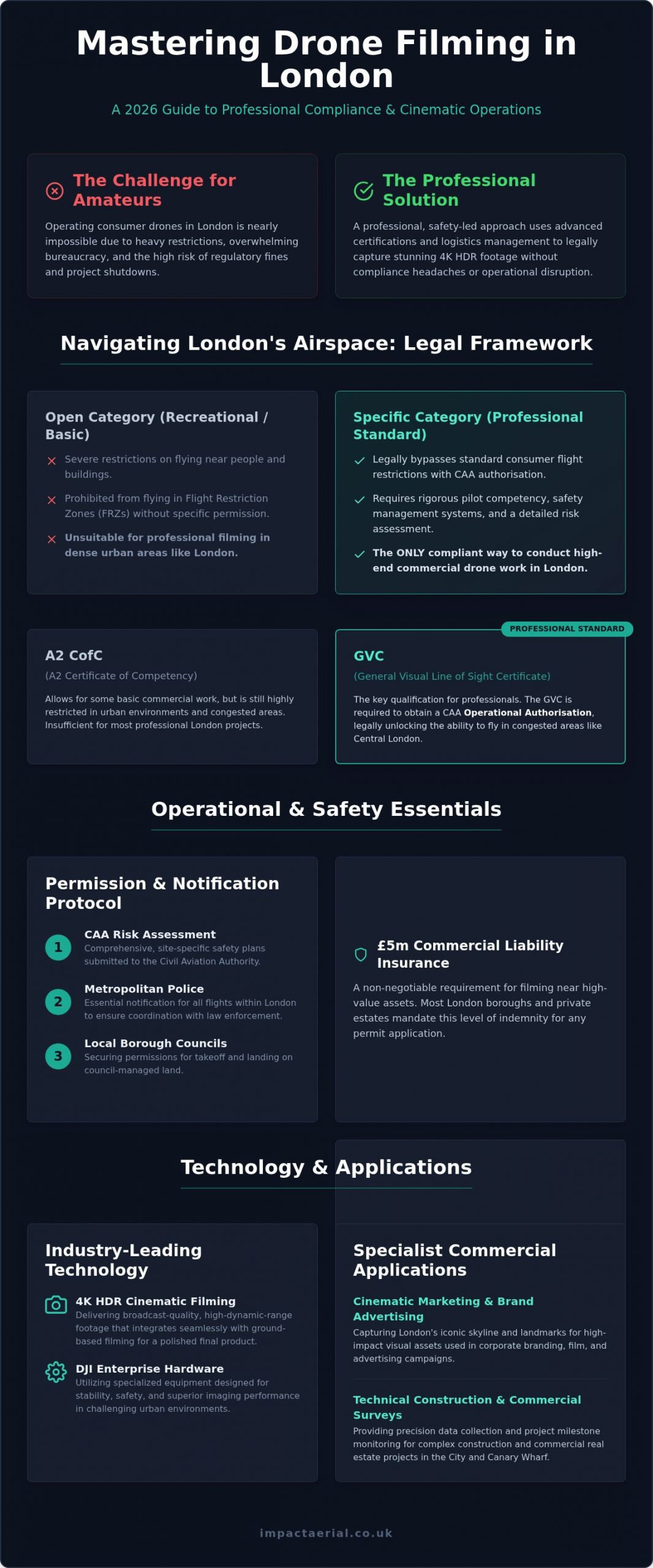
Securing Permissions: The Logistics of Filming in Restricted Zones
London is one of the most heavily regulated airspaces in the world. For anyone planning drone filming london, it’s vital to recognize that the city is effectively a patchwork of Flight Restriction Zones (FRZ) and prohibited areas. These restrictions exist to protect critical infrastructure, government buildings, and the heavy traffic corridors of Heathrow and London City Airport. We manage these complexities by treating every shoot as a logistical operation where safety and compliance are established long before the drone leaves the ground. This meticulous preparation is what allows for the capture of high-end cinematic content without the risk of legal complications.
The 5-Step London Permission Process
Securing a “yes” from the authorities requires a structured approach. Unlike rural operations, London shoots demand a lead time that accounts for multiple layers of approval. We follow a methodical timeline to ensure every project is legally resilient and fully vetted by the necessary agencies.
- Initial Feasibility Check: We analyze the specific GPS coordinates against current NATS charts to identify permanent or temporary restrictions that may affect the flight path.
- NATS and ATC Coordination: If the site falls within an Aerodrome Traffic Zone, we submit flight plans to National Air Traffic Services. This is critical for areas near Heathrow or London City Airport approach paths.
- Landowner Take-off and Landing (TOL): We secure formal agreements from the owners of the launch site. This includes managing permissions for private rooftops, balconies, or public spaces managed by local councils.
- Metropolitan Police Notification: We notify the relevant authorities to secure a CAD (Computer Aided Despatch) reference number. This typically requires a lead time of at least 14 days for complex urban environments.
- Final Site Safety Audit: On the day of the shoot, a final risk assessment is conducted to account for local weather, public density, and any new temporary flight restrictions issued by the CAA.
Working Near London Landmarks
Filming near the capital’s most famous structures involves additional specialist coordination. The “R157” zone covers much of the City of London and requires specific non-standard flight permissions that go beyond a basic license. If your project involves the River Thames, we coordinate directly with the Port of London Authority (PLA). They oversee the tidal river and have specific requirements for drones operating over the water or near iconic bridges. Managing these logistics allows us to schedule shoots for the best lighting conditions while ensuring the highest standards of public safety. By handling the bureaucracy, we provide the reassurance that your drone filming london project will proceed without the threat of fines or site shutdowns.
The Tech Behind the Lens: Why DJI Enterprise & FPV Matter
Professional drone filming london requires hardware that prioritizes signal stability and mechanical redundancy. We utilize DJI Enterprise systems because they’re engineered for the high-interference environments of Central London. Unlike consumer models, these drones feature omnidirectional obstacle sensing and dual-redundancy systems that ensure flight stability near skyscrapers and high-voltage infrastructure. This level of technical reliability is the foundation of our safety-first approach. It’s why we can operate in tight urban corridors where lesser equipment might struggle with signal attenuation or GPS multipathing.
Cinematic Excellence with 4K HDR
High-bitrate recording is essential for capturing the complex textures of London’s glass and steel architecture. Standard 8-bit footage often fails to resolve the subtle gradients found in urban skylines, leading to “banding” or loss of detail in high-contrast scenes. By shooting in 4K HDR, we preserve a wider dynamic range, allowing for professional colour grading in post-production. This meticulous attention to data quality ensures that the final output is broadcast-ready, whether it’s destined for a large-scale corporate display or a high-impact social media campaign. Our post-production services transform raw aerial data into a polished cinematic story that reflects your brand’s leadership.
The FPV Advantage for London Interiors
FPV (First Person View) drones provide a dynamic perspective that traditional platforms cannot replicate. These specialized aircraft allow for immersive “fly-through” shots, navigating commercial interiors and tight urban environments with surgical precision. It’s an ideal solution for showcasing the scale of a new London development or providing a virtual tour of a corporate headquarters. The unique “one-take” perspective creates a sense of continuous motion that keeps viewers engaged from start to finish. Because FPV drones are smaller and more agile, they can transition from outdoor aerials to indoor detail shots in a single flight, offering a seamless visual experience.
Our commitment to using the latest hardware, such as the DJI Mavic 3 Enterprise, ensures that every project benefits from advanced safety features and elite imaging sensors. This technology allows our team to operate with confidence in the most challenging locations while delivering superior visual results. You can explore our full range of technical drone services to see how we equip our teams for professional London projects.
Partnering with Impact Aerial for Your London Project
Choosing a provider for drone filming london is a decision that impacts your project’s legal standing as much as its visual quality. We operate with a compliance-led mindset, ensuring that every flight is anchored in strict CAA standards and meticulous safety protocols. While our strategic base in Birmingham allows for efficient national coverage, we maintain a specialized focus on the capital’s unique operational requirements. We don’t just provide a pilot; we offer a technical consultancy that manages the entire lifecycle of your aerial project, from the first feasibility check to the final post-production edit.
A primary differentiator for our corporate clients is the security provided by our £5m commercial liability insurance. In high-density urban environments, standard indemnity levels are often insufficient for the requirements of major landowners, borough councils, and the Port of London Authority. This high-tier coverage is a non-negotiable asset for operations near high-value assets or public thoroughfares. It provides the essential reassurance that your business is protected against the unique risks of urban drone operations. We take full responsibility for the logistical burden, allowing your team to focus on the creative and commercial objectives of the shoot.
Why Corporate Clients Trust Impact Aerial
Our expertise in professional drone services is built on years of experience within the property, construction, and advertising sectors. We understand that a London construction site or a luxury property development requires a different approach than a rural shoot. Every mission is preceded by a site-specific risk assessment that accounts for local footfall, signal interference, and airspace restrictions. We also believe in a transparent commercial relationship. You can easily access information regarding aerial filming prices in the UK to ensure your project remains within budget while maintaining the highest possible quality standards.
Starting Your London Drone Project
The process begins with an initial consultation where we define your creative and technical goals. Whether you need high-resolution 4K HDR footage for a marketing campaign or precise data for a commercial survey, we tailor our hardware and flight plans to your specific needs. Our team handles the entire bureaucratic process, including NATS coordination and police notifications, so you don’t have to manage the paperwork. We’re committed to delivering high-end cinematic content with minimal disruption to your daily operations. Contact us today to discuss your vision for the London skyline and let our experts handle the complexities of your next aerial mission.
Elevate Your Commercial Vision with Compliant Aerial Operations
Successful drone filming london in 2026 requires a meticulous balance between high-end cinematic output and strict regulatory adherence. You’ve seen that navigating the capital’s restricted airspace is a structured process involving complex NATS coordination and mandatory Metropolitan Police notifications. By prioritizing certified expertise and advanced DJI Enterprise hardware, your project benefits from both visual excellence and total operational safety. This approach ensures your commercial goals are met without the logistical risks of site shutdowns or legal breaches.
Our team of CAA GVC Certified Pilots specializes in securing restricted airspace permissions for high-stakes urban environments. With the added security of £5m public liability insurance, we provide the professional reassurance corporate clients require for complex London shoots. We handle every bureaucratic detail, from the initial feasibility check to the final post-production delivery, so you don’t have to manage the administrative burden.
Ready to capture the capital from a new perspective? Book your London drone filming consultation with Impact Aerial to ensure your next project is handled with precision and full legal compliance. We look forward to helping you transform the London skyline into your most compelling visual asset yet.
Frequently Asked Questions
Do I need a special permit for drone filming in London?
Yes, commercial drone filming london requires an Operational Authorisation from the CAA. Additionally, specific areas like the City of London (R157) or land managed by the Royal Parks require separate landowner permits. It’s not just about the pilot’s license; it’s about the specific site permissions and risk assessments. We handle this entire logistical process, ensuring that all necessary notifications and CAD reference numbers are secured before any mission commences.
How much does professional drone filming in London cost?
Professional aerial service pricing depends on the complexity of the airspace and the specific project requirements. Factors like the number of police notifications, council fees, and the level of post-production influence the final quote. Because every London project carries unique logistical challenges, we provide bespoke estimates after an initial consultation. This ensures your technical goals are met while maintaining a transparent approach to the overall project budget.
Can drones fly over the River Thames?
Drones can fly over the River Thames, but this requires direct coordination with the Port of London Authority (PLA). The PLA manages the tidal river and has strict safety requirements for any aerial activity within their jurisdiction. Pilots must demonstrate a robust safety case and often need to secure specific take-off and landing permissions from riverside landowners. We manage these multi-agency permissions to ensure your riverfront shoot is fully compliant.
How long does it take to get permission for a London drone shoot?
You should typically allow at least 14 to 21 days to secure the necessary permissions for a London drone shoot. This timeframe accounts for Metropolitan Police notifications, local borough council approvals, and coordination with NATS for airport restricted zones. Complex missions involving iconic landmarks or public events may require longer lead times. Planning ahead is essential to ensure every legal requirement is met without delaying your production schedule.
Are there weight restrictions for drones flying in Central London?
Weight restrictions depend on the drone’s classification and the pilot’s specific Operational Authorisation. For professional drone filming london, we utilize DJI Enterprise aircraft that fall within weight categories optimized for urban safety. These systems allow us to maintain required separation distances from uninvolved people while delivering high-bitrate 4K HDR footage. The specific weight and class of the drone dictate the safety protocols we must follow in high-density areas.
What happens if a drone pilot flies illegally in London?
Unauthorized drone flights in London can lead to significant fines, equipment seizure, and criminal prosecution. The Metropolitan Police monitor the city’s airspace using sophisticated detection technology to identify illegal operators. Beyond the legal risks, flying without the correct CAA certifications or commercial insurance puts the project owner at massive financial risk. Hiring a compliant operator ensures your brand isn’t associated with unsafe or illegal aerial activity.
Can you fly drones at night in London?
Night flights are possible and often provide spectacular views of the city’s illuminated architecture. Pilots must hold a valid Operational Authorisation and perform a specific night-time risk assessment. These missions require hardware with advanced sensors and obstacle avoidance to manage the reduced visibility. We often recommend night shoots for projects where public density needs to be minimized, provided that all safety lighting and battery management protocols are strictly followed.
Is £5m liability insurance standard for London drone operations?
While smaller commercial shoots elsewhere might use lower indemnity, £5m public liability insurance is the standard requirement for London drone operations. Most local authorities, major landowners, and the Port of London Authority won’t grant filming permits without proof of this level of coverage. It provides the essential financial protection needed for high-risk urban environments. We carry £5m insurance as a baseline to ensure our clients have total peace of mind.
Drone Surveyor Birmingham: The Professional Guide to Aerial Inspections
The traditional roof survey is rapidly becoming an expensive relic for Birmingham’s commercial property sector. You’ve likely felt the frustration of paying for weeks of scaffolding or hiring MEWPs just to identify a minor leak, all while worrying about the safety risks of manual inspections. Partnering with a professional drone surveyor birmingham allows you to bypass these high-cost, high-disruption methods that often feel outdated in a modern, data-driven world.
Professional aerial inspections solve these logistical bottlenecks by delivering precision data without the site downtime. We agree that your priority is maintaining site safety while securing accurate, actionable building reports. This guide demonstrates how drone technology provides 4K HDR visual clarity and thermal insights with zero disruption to your daily operations. You’ll learn about the technical requirements, from CAA GVC certifications to £5m liability insurance, ensuring your project remains fully compliant, meticulously documented, and safer for everyone involved.
Key Takeaways
- Discover how aerial inspections significantly reduce project lead times and overheads by removing the need for costly scaffolding and heavy machinery.
- Understand the technical advantages of using DJI Enterprise hardware with 4K HDR sensors to identify minute structural defects that are often missed by ground-based surveys.
- Identify the essential regulatory requirements for hiring a professional drone surveyor birmingham, including the necessity of CAA GVC certification and £5m commercial liability insurance.
- Explore how professional drone surveying ensures zero-disruption to site operations, allowing your business to continue as normal during complex structural assessments.
- Learn how high-resolution survey data is processed through professional post-production to create detailed, authoritative, and actionable building reports.
Why Drone Surveying is Essential for Birmingham Property & Construction
Birmingham’s skyline is a complex mosaic of Victorian heritage, brutalist landmarks, and glass-fronted skyscrapers. Traditional surveying methods often struggle with these tight urban spaces, where erecting scaffolding is both logistically difficult and prohibitively expensive. A professional drone surveyor birmingham provides the agility required to capture data from perspectives that are physically impossible for ground-based teams to reach safely. This technology has transitioned from a niche alternative to a core industry standard across the West Midlands, offering a fusion of technical precision and operational efficiency.
The primary advantage of aerial data collection lies in its non-invasive nature and the unprecedented depth of information it provides. By utilizing high-resolution UAVs, surveyors can identify hairline fractures, displaced tiles, or blocked guttering in a fraction of the time it takes to mobilize a manual inspection team. This speed does not come at the cost of quality; instead, it delivers a level of visual clarity that allows for more informed decision-making and long-term asset management.
To better understand how this technology is applied in professional surveying projects, watch this helpful video:
The Shift in West Midlands Site Management
A drone survey is a non-invasive aerial inspection method that uses unmanned aerial vehicles to capture high-resolution imagery and structural data. In Birmingham, construction leads are increasingly adopting this method for progress monitoring, allowing stakeholders to oversee multi-million pound developments through weekly visual updates. This data is vital for urban planning and large-scale regeneration projects, as it provides a comprehensive overview of how new structures interact with the city’s existing infrastructure and transport links.
Key Applications for Local Commercial Property
The application of drone technology is particularly effective for historic city-centre structures where traditional access might damage fragile masonry. By using photogrammetry, surveyors can create accurate 3D models of listed buildings to plan restoration works with surgical precision. Industrial zones around the city also utilize these surveys for thermal imaging to conduct energy efficiency audits. Meanwhile, in rapidly developing areas like Digbeth, drone data is essential for initial site investigations, providing developers with clear topographical insights before the first shovel hits the ground.
The Technology Behind High-Precision Aerial Data Collection
Precision in aerial surveying isn’t just about the pilot’s skill; it’s about the technical capabilities of the hardware. For a drone surveyor birmingham, the choice of equipment determines whether a structural defect is identified or overlooked. DJI Enterprise drones represent the industry gold standard because they combine airframe stability with sophisticated sensor payloads. These systems are designed to operate within strict Civil Aviation Authority (CAA) regulations, ensuring that every flight is both legal and safe while capturing high-fidelity data.
Hardware Spotlight: DJI Enterprise Capabilities
The ability to maintain flight stability is critical when navigating Birmingham’s narrow urban corridors and high-rise wind tunnels. DJI Enterprise hardware excels here, providing a steady platform for high-zoom lenses that allow for detailed asset inspection from a safe standoff distance. This means surveyors don’t need to fly dangerously close to structures to capture minute details. If you’re interested in the specific technical specs of these aircraft, you can read our guide on survey drones to see how they differ from consumer models.
While some competitors focus solely on laser scanning, the value of 4K HDR visual data shouldn’t be underestimated. High dynamic range sensors capture details in both deep shadows and bright highlights, which is essential for spotting hairline fractures in masonry or corrosion on metal roofing. This visual clarity is complemented by thermal imaging sensors, which are indispensable for PV solar farm surveys. These sensors detect “hot spots” in solar panels or identify significant heat loss in industrial units, providing a layer of data that the human eye simply cannot see.
From Raw Data to Post-Production Excellence
Every professional drone surveyor birmingham knows that raw footage is rarely enough for a commercial stakeholder to make a critical decision. The transition from raw data to an actionable report happens in post-production. Professional editing clarifies findings, highlights areas of concern, and organizes hours of flight time into concise, high-impact video summaries. This process makes the data easier for stakeholders to digest and act upon quickly.
This technical workflow often includes creating immersive virtual tours, which allow property managers to remotely inspect a site from any location. This level of documentation provides a permanent, high-resolution record of a building’s condition that traditional methods cannot match. If you need this level of detail for your next project, our team provides comprehensive drone commercial property surveys tailored to the specific needs of the West Midlands market.
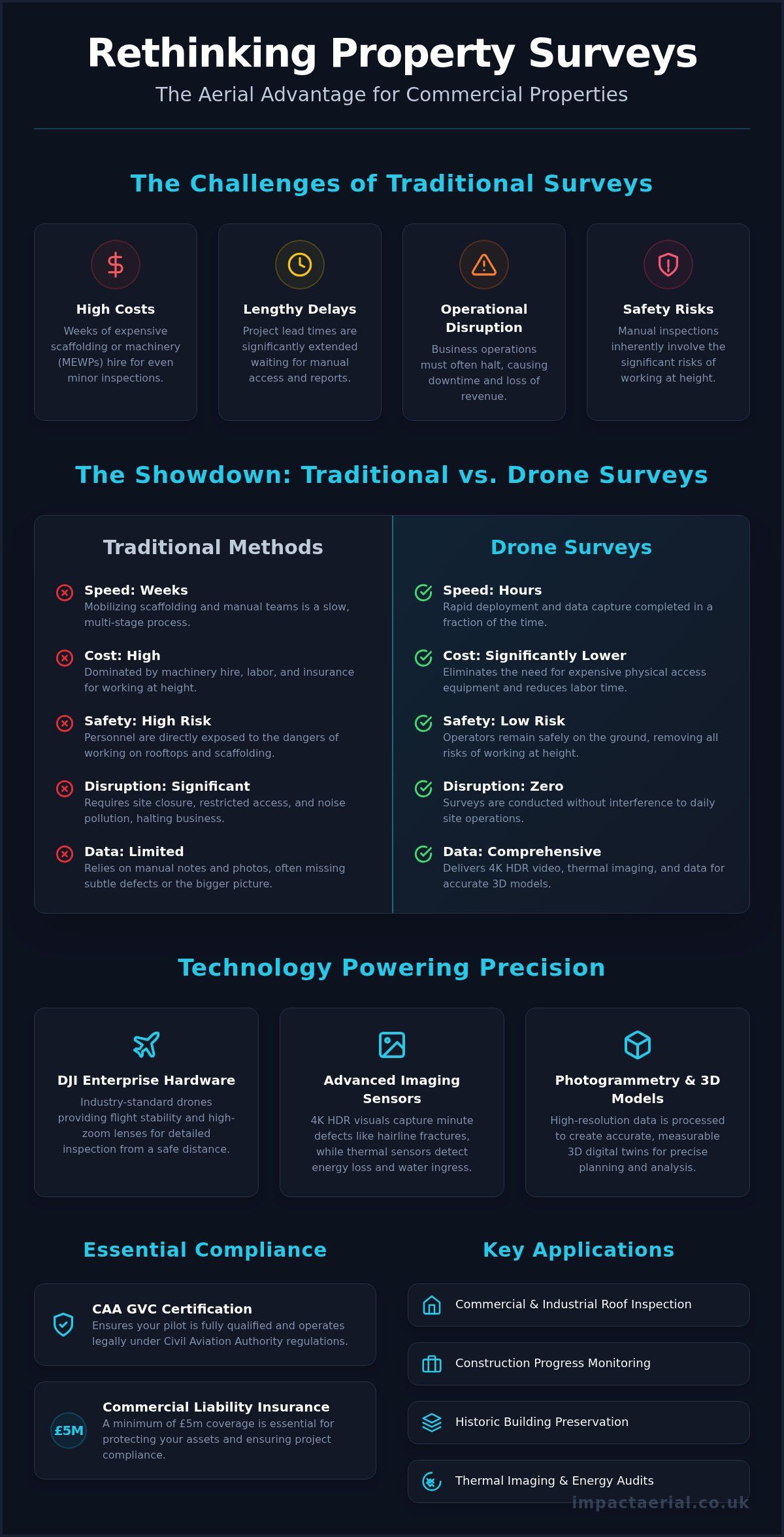
Drone Surveys vs. Traditional Access: Cost, Safety, and Speed
Choosing a drone surveyor birmingham transforms how structural health is assessed by removing the single greatest liability in the construction industry: working at height. Traditional inspections often require personnel to navigate precarious rooflines or balance on ladders to get a clear view of defects. By keeping boots on the ground, property managers significantly reduce their risk profile while obtaining superior data from angles that were previously inaccessible.
Speed is another critical differentiator that makes aerial methods the modern standard. While a manual inspection of a large Birmingham warehouse might take days of preparation and execution, an aerial survey is often completed in just a few hours. This rapid turnaround allows for faster reporting and quicker remedial action, which is vital when dealing with active leaks or structural instability that could worsen during the time it takes to organize traditional access.
Financial efficiency is perhaps the most tangible benefit for commercial clients. Some industry professionals report that drone surveys typically cost between 60% and 70% less than traditional scaffolding or MEWP (Mobile Elevated Work Platform) hire. This financial saving is coupled with the benefit of zero disruption; your business remains fully operational without the sight of steel poles or the obstruction of essential parking spaces and site access routes.
The Safety Advantage
Safety isn’t just about avoiding falls; it’s about data integrity and liability management. Using professional drone services ensures that even the most unreachable areas, such as church spires or high-rise facades, are inspected without physical contact that could damage fragile historic masonry. All operations are conducted under strict Civil Aviation Authority regulations, providing an additional layer of professional reassurance and legal compliance for corporate clients and insurers.
Economic Impact for Property Managers
For property managers, the return on investment for aerial monitoring is found in early defect detection. Identifying a loose tile or a blocked valley gutter through regular surveys prevents the catastrophic costs of internal water damage and business interruption. Often, these maintenance tasks require the expertise of tradespeople who have qualified through an intensive plumbing course UK to ensure long-term property maintenance. Additionally, drones eliminate the logistical nightmare and high fees associated with city-centre road closures often required for large cherry pickers. A drone can be deployed and complete a full roof survey in the time it takes a scaffolding team to merely unload their equipment and begin assembly.
Operating a drone in a densely populated urban centre like Birmingham requires more than just technical skill; it demands a deep understanding of the legal framework established by the Civil Aviation Authority (CAA). For a drone surveyor birmingham, compliance isn’t a checkbox but a prerequisite for every flight. Urban environments present unique challenges, such as proximity to pedestrians and the complexities of Birmingham City Council’s specific land-use policies. A professional operator must conduct rigorous risk assessments to mitigate these factors before the aircraft even leaves the ground.
The city’s geography adds layers of complexity that hobbyists simply aren’t equipped to handle. From the high-rise corridors of the city centre to the sensitive airspace surrounding Birmingham Airport, every flight path must be meticulously planned. Professional surveyors use specialized software to identify “No Fly Zones” and temporary flight restrictions, ensuring that your project doesn’t inadvertently breach national aviation laws. This level of preparation provides the psychological comfort that your business is protected from both legal repercussions and safety incidents.
The Importance of CAA Certification
The General Visual Line of Sight Certificate (GVC) is the non-negotiable standard for commercial drone operations in the UK. Unlike hobbyist flyers, GVC-certified pilots have undergone rigorous theoretical and practical examinations to prove their competence in complex environments. This certification is particularly vital when managing flights within controlled airspace or near congested areas. For a detailed breakdown of these requirements, you can consult our UK drone license guide, which explains the current 2026 standards and what they mean for commercial clients.
Commercial liability insurance is the bedrock of professional reassurance. While basic cover might suffice for rural flights, the industry minimum for urban surveying is £5m. This level of protection ensures that property owners and site managers are fully shielded against unforeseen incidents. It’s essential to verify that your chosen surveyor holds specific commercial drone insurance rather than a generic public liability policy, as the latter often excludes aviation-related risks.
A Checklist for Hiring Your Drone Surveyor
To ensure your project is handled with the necessary technical and legal precision, follow this vetting process:
- Verify CAA credentials: Ask for the operator’s Flyer ID and Operator ID, and confirm their GVC status is current.
- Review Birmingham-based projects: Experience in the local West Midlands landscape ensures they understand specific city-centre flight corridors and local restrictions.
- Confirm sensor capabilities: Ensure their hardware, such as DJI Enterprise models, matches the specific data depth you require for structural or thermal analysis.
- Evaluate the data delivery plan: Confirm how the raw footage will be processed into an actionable survey report that your stakeholders can easily interpret.
If you require a fully compliant aerial inspection for your site, our team provides drone commercial property surveys that adhere to the highest safety and regulatory standards in the West Midlands.
Impact Aerial: Your Leading Drone Survey Partner in the West Midlands
Impact Aerial operates as a specialized drone surveyor birmingham, providing a seamless bridge between raw technical data and high-end visual reporting. Being based directly in the West Midlands gives us an intimate understanding of the local architectural landscape and the specific regulatory requirements of the region. We don’t just capture imagery; we provide a comprehensive end-to-end service that manages every aspect of your project, from the initial airspace risk assessment to the final post-production edit.
Our methodology focuses on delivering psychological comfort through meticulous compliance. We understand that commercial clients require more than just a drone in the air; they need the assurance that comes with CAA GVC certified pilots and £5m commercial liability insurance. This professional foundation allows us to operate in complex Birmingham city-centre environments while maintaining the “zero disruption” standard that modern site management demands.
Our Local Expertise
Our track record in Birmingham includes a wide range of commercial property surveys and large-scale construction site monitoring projects. We utilize DJI Enterprise 4K HDR hardware to ensure that every pixel of data is sharp, clear, and actionable for your engineering teams. Beyond technical surveys, our expertise in drone photography for construction allows us to provide stakeholders with visually stunning progress reports that are as cinematic as they are accurate. This combination of technical precision and visual excellence ensures that findings are easily understood by all project stakeholders.
We offer specialized solutions tailored to the needs of the West Midlands industrial and energy sectors. This includes PV solar farm thermal surveys to identify underperforming cells and detailed property condition reports for historic city-centre assets. By combining technical precision with professional post-production, we turn complex aerial data into immersive virtual tours and structured reports that simplify your decision-making process.
Ready to Start Your Project?
Every site in Birmingham has its own set of challenges, from urban congestion to sensitive airspace near the airport. We begin every project with a thorough consultation to define your specific data and visual requirements. This ensures that the flight plan we develop is optimized for both safety and data depth, providing you with the most relevant information for your asset management needs. If you’re ready to secure faster, safer, and more accurate building data, you can Contact Impact Aerial for a Professional Drone Survey today to request a tailored quote for your site.
Future-Proofing Your Property Strategy with Aerial Intelligence
The transition to drone-led inspections represents a significant advancement for the West Midlands’ property and construction sectors. By replacing slow, hazardous manual methods with high-resolution 4K data, you gain a level of structural insight that was previously unattainable. Choosing a qualified drone surveyor birmingham ensures that your site remains fully operational while you benefit from technical precision that reduces overheads significantly. It’s no longer just an alternative; it’s the professional standard for modern asset management.
We combine deep local knowledge with the highest safety standards to deliver actionable reports. Our team of CAA GVC Certified Pilots operates with £5m Public Liability Insurance, providing the professional reassurance your business requires in complex city-centre environments. You don’t have to compromise on safety or data depth to achieve speed. Book Your Professional Birmingham Drone Survey Today and take the first step toward a safer, more efficient site monitoring process. We look forward to helping you elevate your next project.
Frequently Asked Questions
Do I need a permit for a drone survey in Birmingham city centre?
Professional drone operations in Birmingham city centre require strict adherence to CAA regulations and often specific permissions from the local authority if taking off from public land. A qualified drone surveyor birmingham will conduct a comprehensive risk assessment and handle all necessary notifications before the flight. This meticulous planning ensures your project remains fully compliant with national aviation laws while avoiding potential fines or legal complications associated with unauthorized urban flights.
How much does a professional drone survey cost in the UK?
Professional survey costs are determined by the specific requirements of your site, including the total acreage and the technical depth of the data required. Factors such as the proximity to sensitive airspace and the need for specialized thermal sensors will influence the final investment. We focus on providing a cost-effective alternative to heavy machinery, ensuring the price reflects the high-tier hardware used and the expert post-production necessary to create actionable building reports.
Can drones perform roof surveys in bad weather?
Flight safety and data quality are our primary concerns, so we don’t operate in heavy rain or high winds. Most enterprise-grade drones have specific wind resistance limits, typically around 22mph. If the weather conditions are unsuitable, we reschedule the survey to ensure the 4K HDR imagery is clear and the aircraft remains stable. This commitment to quality ensures the structural defects we identify are captured with absolute precision.
What is the difference between a drone survey and drone photography?
The primary difference lies in the technical intent and the equipment used. Drone photography focuses on aesthetic visuals for marketing or promotional use. In contrast, a survey conducted by a professional drone surveyor birmingham utilizes technical sensors to identify structural defects, thermal leaks, or maintenance requirements. The output is a data-centric report designed for engineers and property managers rather than a creative agency, emphasizing accuracy and structural integrity over visual flair.
How accurate is drone data for topographical land surveys?
When integrated with Ground Control Points (GCPs) and RTK technology, drone data is exceptionally accurate for topographical mapping. It can achieve sub-centimetre horizontal and vertical precision, providing developers with detailed terrain models. This level of accuracy is essential for initial site investigations and construction monitoring, allowing for precise volume calculations and structural alignment checks that match or exceed the results of traditional ground-based surveying methods.
Is drone surveying safer than traditional methods?
Drone surveying is inherently safer because it removes the requirement for staff to work at height. By keeping surveyors on the ground, you eliminate the risks associated with ladders, fragile roof surfaces, and scaffolding. This proactive approach to safety reduces your corporate liability and insurance burden while ensuring that even unreachable structural elements are inspected thoroughly without putting human life at risk during the data collection process.
How long does a typical drone inspection take to complete?
Efficiency is a hallmark of aerial inspections. A typical survey for a commercial warehouse or office block in Birmingham is often completed in two to four hours. This speed allows for minimal site disruption, as there is no need for lengthy equipment setup or road closures. Once the flight is finished, the data is moved into post-production, significantly reducing the total project lead time compared to traditional manual inspection methods.
What deliverables will I receive after a drone survey?
You will receive a comprehensive suite of digital assets tailored to your project goals. This typically includes:
- High-resolution 4K HDR imagery of structural defects
- Edited video summaries highlighting areas of concern
- Thermal maps for energy efficiency audits
- 3D models or orthomosaic maps for construction sites
All data is processed through professional post-production to ensure the final report is organized, authoritative, and ready for immediate review by your technical stakeholders.
Drone Survey Manchester: Professional Aerial Inspections & Data Collection
Why would a property manager risk the liability and high cost of traditional scaffolding when a drone survey manchester can capture superior data in a single afternoon? It’s a question more Manchester businesses are asking as they face the dual challenges of aging infrastructure and some of the most complex urban airspace in the UK. You’re likely already aware that manual roof inspections aren’t just slow; they’re inherently dangerous and often fail to provide the granular detail needed for modern asset management.
We understand that navigating the strict flight restrictions around Manchester Airport or HMP Manchester feels like a bureaucratic hurdle that’s often easier to avoid. This guide shows how professional aerial inspections provide a safer, faster, and more accurate alternative to traditional methods. You’ll discover how the combination of CAA GVC certified pilots and DJI Enterprise hardware delivers high-resolution 4K imagery with minimal operational downtime. We’ll also explain the essential compliance standards, including £5m commercial liability insurance, required to operate safely and legally within the city’s unique environment.
Key Takeaways
- Aerial inspections significantly reduce operational downtime and costs compared to traditional scaffolding, making them ideal for Manchester’s dense urban environments.
- Learn how to navigate the complex legal requirements of a drone survey manchester, including the specific flight permissions needed for areas near Manchester Airport.
- High-resolution 4K data and thermal imaging offer superior accuracy for identifying structural defects or heat loss in both heritage mills and modern skyscrapers.
- Discover how utilizing CAA certified pilots and professional-grade hardware eliminates the safety risks associated with manual ‘work at height’ inspections.
- Gain insights into the specialized deliverables available for Manchester property managers, ranging from warehouse roof surveys to comprehensive solar farm thermal reports.
Why Drone Surveys are Essential for Manchester’s Property Sector
Manchester’s skyline is a testament to its evolution; it’s a place where red-brick Victorian mills sit alongside the sleek glass of modern skyscrapers. This architectural diversity creates a complex environment for property inspections. A professional drone survey manchester offers the most efficient way to bridge the gap between these different eras of construction. By utilizing commercial-grade DJI Enterprise drones, we provide a perspective that traditional ground-based surveys simply can’t match.
Traditional access methods like scaffolding or cherry pickers are often impractical in dense urban areas like Spinningfields or the Northern Quarter. The logistical planning required to block a busy city-centre pavement can take weeks and cost thousands before an inspection even begins. Aerial data collection eliminates this friction, allowing for rapid deployment and minimal disruption to daily business operations. To provide a technical foundation for these techniques, it helps to define the process. What is an aerial survey? It is the science of collecting precise georeferenced data from an airborne platform, which is exactly what we provide for Manchester’s commercial sector.
To better understand how this technology maps the local landscape, watch this helpful video:
Inspecting Manchester’s Industrial Heritage
Manchester’s history is written in its industrial masonry. However, surveying these aging structures presents significant safety risks and technical challenges. Hidden defects in high-level chimneys, parapets, and complex valley gutters are often impossible to see from street level. We use high-resolution 4K HDR imagery to create a comprehensive ‘Schedule of Condition’ for these heritage assets. This allows owners to identify structural issues early, providing insurance-grade data without the need for personnel to work at dangerous heights.
Supporting Modern Construction in Greater Manchester
The pace of residential and commercial development in the city centre is relentless. Tier 1 contractors now rely on construction site monitoring to keep projects on track. A drone survey manchester can provide weekly progress updates, site safety audits, and highly accurate stockpile volumetrics. This level of data-centric oversight ensures that large-scale projects across Greater Manchester remain compliant and efficient. Our CAA GVC certified pilots navigate these high-rise environments with precision, delivering the qualitative output needed for modern Building Information Modeling (BIM) workflows.
Navigating Manchester’s Airspace: Compliance and Safety
A professional drone survey manchester is a CAA-regulated operation that demands more than technical skill; it requires a meticulous approach to aviation law. Manchester’s airspace is some of the most congested in the North West. Every commercial flight must adhere to the latest Civil Aviation Authority drone rules to ensure the safety of the public and other aircraft. Operating without these legal frameworks in place puts both the operator and the client at significant legal and financial risk.
The city is home to several complex Flight Restriction Zones (FRZs) that require expert navigation. Manchester Airport’s FRZ extends significantly into the surrounding residential and commercial areas, including parts of Wythenshawe and Altrincham. Furthermore, HMP Manchester (Strangeways) has its own protected airspace that must be respected at all times. Operating within these zones without explicit permission is illegal and can result in severe penalties. Professional operators manage these complexities through formal coordination with National Air Traffic Services (NATS) and the airport’s control tower well in advance of the flight date.
Securing Permissions in Restricted Zones
Coordination is a critical component of safety. For projects in busy urban hubs, we often coordinate with the Greater Manchester Police and Manchester City Council. Filing a NOTAM (Notice to Airmen) is a standard part of our pre-flight process; it alerts other aviators to our presence in the area. Risk mitigation in the city centre involves more than just mapping flight paths. It requires a detailed understanding of potential signal interference from skyscrapers and managing pedestrian flow on busy thoroughfares like Deansgate or Cross Street to ensure a sterile take-off and landing zone.
The Importance of Certified Pilots
Hobbyist pilots are legally prohibited from performing commercial work in the UK. In complex urban environments, the technical requirements for pilots are even higher. While an A2 CofC (Certificate of Competence) allows for basic operations, the GVC (General Visual Line of Sight Certificate) is the industry standard for professional urban surveys. This certification demonstrates a superior level of pilot training, operational safety, and risk assessment. You can understand the UK drone license requirements more deeply in our simple guide to the 2026 rules.
Finally, insurance is a non-negotiable factor for any commercial project. Standard consumer policies don’t cover commercial property damage or public liability in a high-density city-centre setting. We maintain £5m in commercial liability insurance, providing the reassurance and reliability our clients expect when we operate near their high-value assets. If you have concerns about site-specific restrictions, our team can provide a pre-flight feasibility assessment to ensure your project is fully compliant and insured.
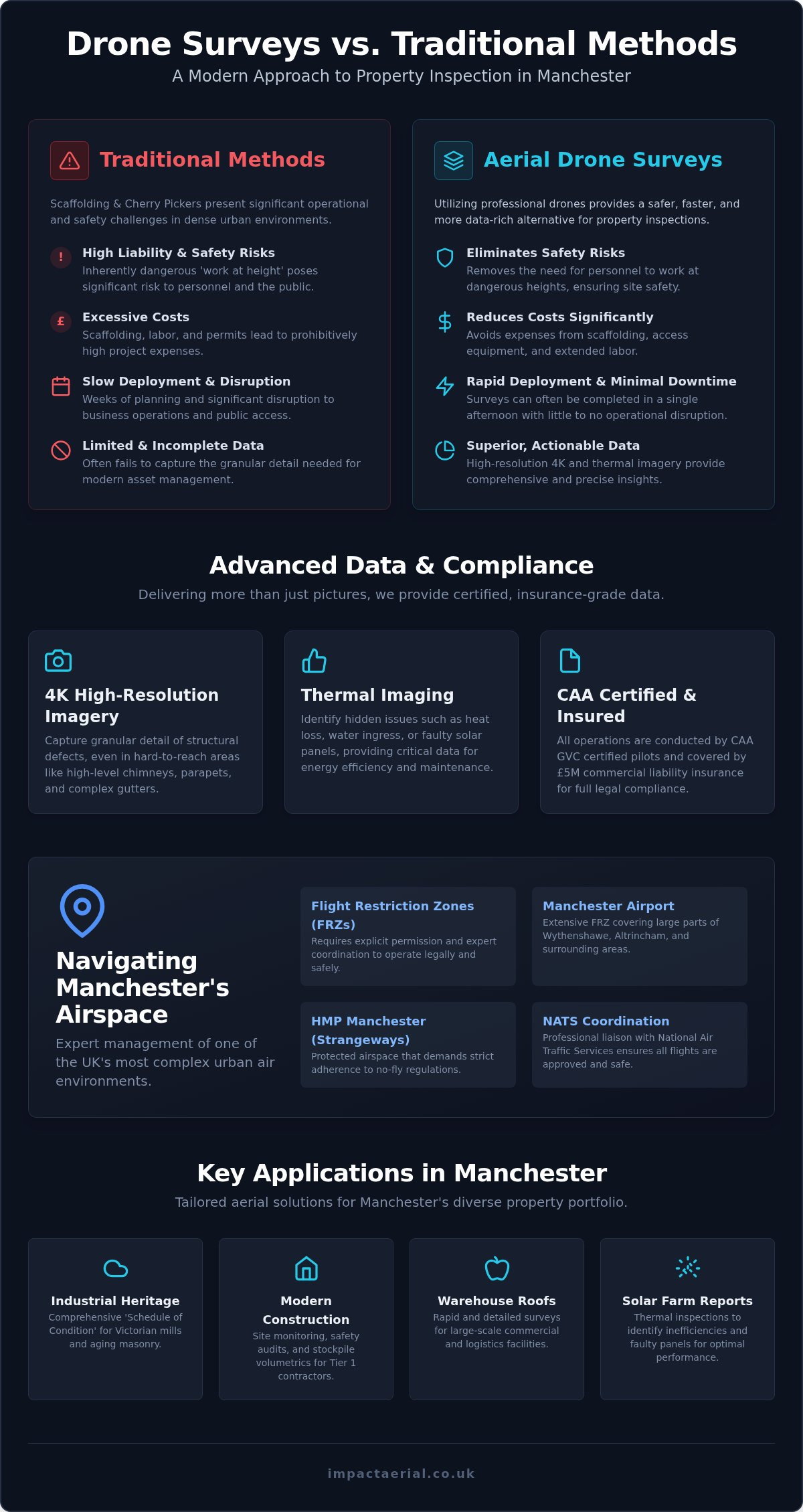
Comparing Drone Surveys to Traditional Access Methods
For many property managers, the decision between traditional access and aerial data collection comes down to a simple calculation of speed and risk. A professional drone survey manchester can be completed in a matter of hours, whereas erecting scaffolding for a similar inspection can take days or even weeks of logistical planning. This rapid turnaround doesn’t just save time; it allows for a more agile approach to building maintenance where issues are identified and resolved before they escalate into costly structural failures.
The difference in data resolution is equally stark. Ground-based inspections or surveys conducted from ladders provide a limited, oblique view of a building’s upper reaches. Our DJI Enterprise drones capture high-resolution 4K imagery from vertical and top-down perspectives that are physically impossible to achieve from the ground. This provides a level of detail that allows surveyors to zoom in on individual brick ties, mortar joints, or hairline cracks in chimney stacks with absolute clarity.
Scaffolding vs. Drone Inspections
Scaffolding, while once the only viable option for high-level work, carries significant hidden costs that go beyond the initial hire fee. In Manchester’s city centre, you have to account for pavement licenses, local authority permits, and the potential for building downtime. There’s also the security risk of leaving a climbing frame attached to your property for weeks. A drone survey manchester bypasses these hurdles entirely. We can access difficult areas like internal courtyards and deep valley gutters that would be prohibitively expensive to reach with traditional platforms. Additionally, drone operations are zero-emission, offering a more sustainable alternative to the heavy machinery and transport required for large-scale scaffolding projects.
Safety and Risk Mitigation
Safety remains the most compelling reason to choose aerial inspections. Removing the need for personnel to work at height significantly reduces the risk profile of any construction or maintenance site. Since falls from height are a leading cause of workplace injuries in the UK, eliminating this requirement provides immediate psychological comfort and tangible liability reduction for site owners. Our thermal imaging capabilities add another layer of safety by identifying dampness or heat loss without the need for invasive testing. You can see our guide to drone inspections for a deeper technical breakdown of how we use these advanced sensors to protect your assets and your workforce. By choosing a provider with £5m commercial liability insurance and CAA GVC certified pilots, you ensure that your survey is not only accurate but fully compliant with the highest industry standards.
Applications of Aerial Data Collection in Manchester
Energy efficiency is a primary concern for Greater Manchester’s ‘Green Building’ initiatives. We use DJI Enterprise thermal sensors to create high-accuracy heat-loss maps, helping property owners identify insulation gaps and structural thermal bridges. This technology is particularly effective for identifying issues with Reinforced Autoclaved Aerated Concrete (RAAC) in older public and commercial buildings, where thermal anomalies can indicate moisture ingress within the panels. Our specialized PV solar farm thermal surveys are another critical application. By detecting faulty cells that have overheated, we help operators maximize their return on investment and maintain peak performance across their renewable energy portfolios.
Post-Production and Data Analysis
The value of a professional drone survey manchester lies in what happens after the drone lands. Raw 4K footage is just a starting point; the real power comes from our post-production and data analysis pipeline. We transform thousands of individual images into high-resolution orthomosaic maps. These are georeferenced, 2D representations of a site that allow for precise measurements of area and distance with centimetre-level accuracy. For construction clients, this data can be integrated into Scan-to-BIM workflows, providing a digital twin of the project at specific points in time. Our specialists edit this raw data into actionable architectural reports, ensuring you have the qualitative evidence required for insurance claims or planning applications. If you’re ready to move from raw data to actionable insights, you can book a professional drone survey for your next project.
Choosing Impact Aerial for Your Manchester Drone Project
Selecting a partner for a drone survey manchester requires more than just looking at a portfolio of aerial photographs. It’s about choosing an operator who understands the gravity of industrial safety and the intricate requirements of urban aviation law. We’ve built our reputation on being a meticulous technical consultant rather than a flashy creative agency. Our focus remains on delivering the reassurance and reliability that commercial clients need when inspecting high-value property or monitoring multi-million pound construction sites across the North West. We treat every flight as a precision operation where data accuracy and regulatory compliance are the primary objectives.
Our Professional Standards
Our operations are underpinned by a commitment to the highest industry standards. Every pilot in our team is CAA GVC certified, which represents the gold standard for visual line of sight operations in congested urban areas. We don’t just show up and fly. Our process begins with a detailed feasibility study and a site-specific risk assessment that accounts for the unique challenges of the Manchester landscape. This meticulous planning is backed by £5m in commercial liability insurance, providing essential psychological comfort to asset managers and stakeholders. We utilize commercial-grade DJI Enterprise drones equipped with 4K HDR sensors and thermal imaging capabilities. These are high-precision industrial tools designed for data integrity. Our in-house post-production team then processes this raw data into the orthomosaic maps and architectural reports discussed earlier, ensuring a seamless end-to-end service from the initial consultation to final data delivery.
Get a Quote for Your Manchester Survey
Initiating your project is a straightforward and transparent process. When you contact us, we’ll discuss your specific site location and survey objectives to determine the most effective flight plan and sensor choice. Whether you need a detailed condition report for a warehouse in Trafford Park or a thermal inspection for a renewable energy asset, we provide a clear roadmap for data collection. We believe in a transparent approach to project management. This means providing clear timelines for airspace permissions and being upfront about the risk assessment outcomes for flights near restricted zones like Manchester Airport. Our goal is to act as a technical extension of your team, providing the specialist knowledge required to operate safely in complex environments. We’re ready to help you unlock the benefits of aerial data for your next project. Contact Impact Aerial today for a professional drone survey quote.
Elevating Property Intelligence in Manchester
Manchester’s architectural landscape is evolving fast, and traditional inspection methods can’t keep pace with the efficiency and safety required for modern asset management. By choosing a professional drone survey manchester, you eliminate the inherent safety risks of working at height while gaining access to high-resolution 4K HDR data that ground-based teams simply can’t provide. We’ve explored how navigating the city’s complex flight restriction zones requires a meticulous approach to compliance and coordination with local authorities.
Our commitment to your project’s security is backed by CAA GVC certified pilots and £5m in commercial liability insurance. We use industrial DJI Enterprise hardware to ensure that every pixel of data is accurate and actionable for your architectural or maintenance reports. Whether you’re managing a heritage mill renovation or a high-rise construction project, we provide the technical expertise to deliver results without the logistical downtime of scaffolding.
Ready to optimize your property data? Request a Professional Drone Survey Quote for Manchester and take the first step toward a safer, more efficient inspection process. We look forward to supporting your next project with precision aerial insights.
Frequently Asked Questions
Is it legal to fly a drone for a survey in Manchester city centre?
Yes, it is entirely legal provided the operator holds the correct Civil Aviation Authority (CAA) certifications and operational authorizations. In a dense urban environment like Manchester, a professional pilot must hold a General Visual Line of Sight Certificate (GVC). This ensures the flight is conducted within a strict safety framework. We manage all necessary legal permissions to ensure your aerial inspection is fully compliant with UK aviation law.
What are the Flight Restriction Zones (FRZs) in Manchester?
The most significant Flight Restriction Zones in the region are Manchester Airport and HMP Manchester. The airport’s FRZ is particularly large, extending into several surrounding residential and commercial districts. Conducting a drone survey manchester within these areas requires formal coordination with National Air Traffic Services (NATS) and the airport’s air traffic control tower. We handle this complex bureaucratic process to secure the required flight windows safely.
How much does a drone survey in Manchester typically cost?
Project costs are determined by several variables, including the site’s location, the complexity of the airspace, and the specific data sensors required. A simple visual roof inspection has a different cost profile than a large-scale topographic map or a thermal solar farm survey. We provide bespoke, transparent quotes based on your specific survey objectives and data deliverables, ensuring you receive a professional service tailored to your budget.
Do you need permission from Manchester City Council for a drone flight?
Permission is generally required if the drone’s take-off or landing point is on council-owned land or a public thoroughfare. For flights over private property, the primary requirement is the consent of the landowner. As part of our meticulous planning process, we verify current Manchester City Council policies for 2026. This ensures all local bylaws are respected and that the operation causes zero disruption to the public.
How long does a typical drone roof survey take to complete?
A standard commercial roof survey usually takes between two and four hours on-site. This rapid turnaround is one of the primary benefits of aerial data collection compared to traditional scaffolding, which can take days to erect. The exact duration depends on the building’s footprint and architectural complexity. Our DJI Enterprise hardware allows for efficient data capture, ensuring we minimize our time on-site while maximizing the resolution of the imagery collected.
What insurance coverage is required for professional drone surveys?
Professional operators must hold specialist commercial drone liability insurance that meets EC 785/2004 standards. We maintain £5m in commercial liability insurance, which is the recognized industry standard for high-value urban projects. This level of coverage provides essential reassurance and reliability for asset managers. It ensures that your business is fully protected against third-party risks while we operate in the challenging environments of Manchester’s busy commercial districts.
Can drones perform inspections in bad weather like rain or high winds?
While industrial drones have high wind resistance and certain IP ratings for moisture, we prioritize data quality and safety. Heavy rain can obscure camera lenses and affect the accuracy of thermal sensors. If weather conditions exceed our strict safety parameters, we reschedule the flight to the next available clear window. This commitment to safety-first operations ensures that the data you receive is always of the highest professional standard.
What kind of data will I receive after the drone survey is finished?
You will receive a comprehensive data package tailored to your project. This typically includes high-resolution 4K HDR imagery and, where requested, specialized thermal heat-loss maps or georeferenced orthomosaic overlays. For construction clients, we provide data compatible with BIM workflows and precise site measurements. Our post-production team processes the raw data into an actionable architectural report, identifying structural defects or maintenance issues with high-tier precision and clarity.
Professional Drone Asset Inspection: The 2026 UK Industry Guide
Did you know that modern drone asset inspection can reduce your survey costs by as much as 70% when compared to traditional scaffolding and high-access equipment? For many UK facility managers, the financial burden of plant hire and the safety risks of personnel working at height are constant, expensive headaches. You’ve likely struggled with inconsistent data from manual visual inspections that leave your long-term maintenance planning in a state of guesswork.
We agree that structural integrity and site safety shouldn’t be a compromise. This 2026 industry guide reveals how professional drone asset inspection provides millimetre-accurate RGB and thermal data while maintaining full CAA compliance and risk mitigation. You’ll learn how to eliminate inspection downtime and leverage high-resolution advanced drone technology to generate actionable insights for your infrastructure. We’ll examine the latest UK class marking mandates, the importance of GVC-certified pilots, and how to integrate high-tier data into your maintenance strategy. By the end of this guide, you’ll understand how to transition from basic aerial photography to a rigorous, data-centric approach that protects both your budget and your assets.
Key Takeaways
- Learn how transitioning from traditional access methods to UAV workflows can reduce inspection costs by up to 70% while eliminating the safety risks associated with working at height.
- Understand the critical role of DJI Enterprise hardware and 4K HDR sensors in capturing the millimetre-accurate structural data required for insurance-grade reporting.
- Navigate the 2026 UK regulatory landscape, ensuring your drone asset inspection remains fully compliant with Civil Aviation Authority (CAA) GVC standards and insurance requirements.
- Discover sector-specific applications for construction site monitoring and commercial property surveys that provide high-resolution thermal and RGB data for maintenance planning.
- Explore the end-to-end operational workflow, from initial site-specific risk assessments to the delivery of actionable post-production data.
What is Drone Asset Inspection and Why is it Essential in 2026?
Professional drone asset inspection is a sophisticated remote sensing methodology that replaces traditional, high-risk manual surveys with precise aerial data acquisition. By deploying an Unmanned aerial vehicle (UAV) equipped with high-specification sensors, surveyors can capture comprehensive visual data without the logistical burden of scaffolding or Mobile Elevated Work Platforms (MEWPs). This technological leap is essential for modern infrastructure management. It allows for rapid emergency structural assessments and the implementation of robust preventative maintenance schedules that were previously cost-prohibitive.
The Shift from Manual to Digital Asset Management
The year 2026 represents a definitive tipping point for the UK’s industrial landscape. We’ve moved beyond simple aerial photography into an era of semi-autonomous workflows and digital twins. Utilizing high-end DJI Enterprise hardware is now the industry benchmark. These systems use 4K HDR imagery to document structural integrity with surgical precision. This digital-first approach removes the need for personnel to work at height, significantly reducing site-side liability. By capturing fine-grain detail from a safe distance, we ensure that every bolt, weld, and surface texture is accounted for in a secure, repeatable manner.
Key Benefits: ROI, Safety, and Data Fidelity
The financial argument for aerial surveys is undeniable. Industry data indicates that switching to drone-based workflows can reduce inspection costs by up to 70% compared to traditional access methods. This saving is largely achieved by eliminating the weeks of labour required to erect and dismantle scaffolding. Beyond the balance sheet, the data fidelity provided by professional sensors is superior to manual visual checks. Drones identify critical defects such as micro-cracks, early-stage corrosion, and thermal leaks that the human eye often misses from a distance.
- Reduced Downtime: Inspections that once took days are now completed in hours.
- Historical Records: Each flight creates a timestamped visual baseline for long-term asset monitoring.
- Risk Mitigation: Full CAA GVC compliance ensures that operations are conducted within the strictest safety frameworks.
Technical Capabilities: Sensors, Thermal Imaging, and DJI Enterprise Hardware
Commercial-grade DJI Enterprise drones represent the current gold standard for drone asset inspection. These systems aren’t consumer-grade toys; they’re high-precision instruments built for industrial reliability and repeatable performance. We utilize 4K HDR sensors because they capture the fine-grain structural detail necessary to identify hairline fractures, surface degradation, or loose fixings that traditional visual checks might overlook. Every frame captured is embedded with GPS-tagged metadata. This allows our team to map assets with surgical precision, ensuring that every identified defect is linked to an exact coordinate on the structure for your maintenance teams to locate and repair.
Thermal Camera Drones for Asset Integrity
Thermography is the science of using infrared sensors to detect heat signatures and temperature variations on an asset’s surface. In the context of asset health, it’s an essential tool for identifying anomalies before they escalate into catastrophic failures. Our PV solar farm thermal surveys use these specialized sensors to pinpoint ‘hot spots’, such as damaged cells or faulty string connections, that remain invisible to the naked eye. This technology is equally effective for identifying heat loss in commercial roofing or electrical faults in high-voltage infrastructure. Adhering to the UK’s regulatory framework for drones is vital here, as industrial thermal work often requires specific operational clearances when flying near complex plant machinery or in congested areas.
3D Modelling and Digital Twins
Raw data only becomes valuable when it’s actionable for your engineers and stakeholders. We convert aerial datasets into immersive 3D models and digital twins that allow you to inspect assets from the safety of your desk. These models provide a comprehensive view of remote or high-access structures, facilitating better collaborative decision-making and precise measurements. If you’re wondering what is a survey drone in a technical sense, it’s essentially a flying data-collection hub capable of millimetre-accurate reconstruction. Our virtual tour creation service further enhances this by providing a 360-degree perspective of your site. This level of data fidelity is a cornerstone of our drone commercial property surveys, ensuring that your maintenance planning is based on high-resolution evidence rather than guesswork.
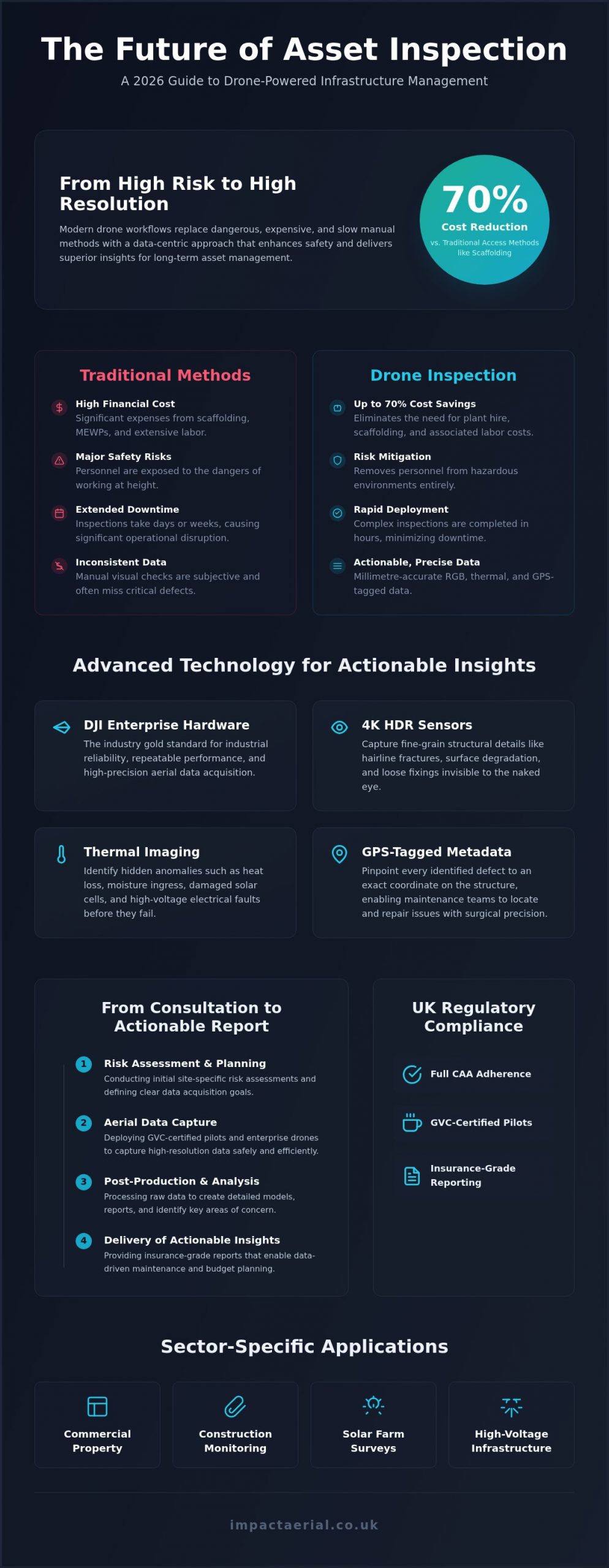
UK Compliance and Safety: The Regulatory Framework for Asset Managers
Legality isn’t just a box-ticking exercise; it’s a fundamental pillar of structural risk management. For any professional drone asset inspection, the General Visual Line of Sight Certificate (GVC) from the Civil Aviation Authority (CAA) is non-negotiable. This certification demonstrates that the pilot has undergone rigorous theoretical and practical testing to handle complex aircraft in commercial environments. Operating without these credentials doesn’t just void insurance; it exposes the asset manager to significant legal liability under the Air Navigation Order.
Flying in congested UK areas, such as city centres or busy industrial estates, requires a deep understanding of the specific permissions granted by the CAA. We manage these complexities through site-specific Risk Assessment Method Statements (RAMS) and comprehensive pre-flight surveys. These documents outline every potential hazard, from localized magnetic interference to public right-of-way management. To provide complete peace of mind, we carry £5m commercial liability insurance as standard. This ensures that your assets and personnel are fully protected against unforeseen incidents during the survey.
Vetting Your Drone Service Provider
Asset managers must be meticulous when selecting a partner. Always ask for a copy of the pilot’s Flyer ID and GVC certification, and verify that their insurance specifically covers the type of asset being inspected. If you’re unsure about the current requirements, our UK drone license guide provides a clear breakdown of the rules in 2026. Checking these credentials ensures you’re working with a vetted professional who understands the gravity of industrial safety standards. We recommend verifying these documents at the start of the procurement process to avoid project delays.
Operational Safety in High-Risk Environments
Inspecting live construction sites or active industrial zones presents unique challenges. Safety is maintained through clear communication with site managers and the use of a dedicated ‘Observer’ for complex structural flights. This second person monitors the surrounding airspace and ground hazards, allowing the pilot to focus entirely on the precision flight path. We also prioritize data privacy. Every drone asset inspection is conducted in strict accordance with GDPR, ensuring that images of the public or third-party properties are handled or redacted appropriately to maintain compliance. This meticulous approach to safety and privacy is what separates professional operators from hobbyists.
Sector-Specific Applications: Where Drone Asset Inspection Excels
The versatility of professional drone asset inspection allows it to deliver value across a broad spectrum of UK industries. While the core technology remains consistent, the specific data outputs are tailored to the unique requirements of each sector. From high-resolution visual reporting for RICS surveyors to complex thermal mapping for energy providers, the application of aerial technology is transforming how structural health is monitored. Within the transport and logistics sector, this precision data often works in tandem with the safety standards upheld by DVSA Auditors, who help fleet operators achieve regulatory compliance. It provides a non-invasive way to examine high-value assets, ensuring that maintenance budgets are allocated based on empirical evidence rather than scheduled guesswork.
In the construction sector, drones provide a continuous stream of data from site inception to completion. We use DJI Enterprise drones for initial land surveys and topographic mapping, providing a digital foundation for architects and engineers. For a deeper dive into these methodologies, see our drone survey guide. Beyond the technical data, we often capture high-end cinematic marketing shots during the same site visit. This dual-purpose workflow provides project managers with progress reports and safety compliance records while simultaneously creating promotional assets for stakeholders. For property managers, this means having a comprehensive visual record of roof condition and facade integrity without the logistical burden of plant hire.
Renewable Energy and Industrial Assets
The renewable energy sector benefits significantly from specialized aerial sensors. Thermal mapping for large-scale PV solar installations allows us to identify defective panels and string failures across hundreds of acres in a single day. This level of efficiency is impossible to match with handheld thermography. Similarly, for heavy industrial assets like flare stacks, cooling towers, and chimneys, the role of drone asset inspection is critical because it allows for close-quarters examination without requiring a facility shutdown. In dense industrial environments where visual lines are obscured, LiDAR sensors provide the necessary penetration to map complex pipework and structural supports with centimetre-level accuracy. Bridges and telecommunications towers are also inspected with minimal disruption to traffic or operations, ensuring that critical UK infrastructure remains safe and functional.
If you’re looking to optimize your maintenance programme and reduce operational risk, our team provides comprehensive drone commercial property surveys and industrial inspections across the UK.
The Impact Aerial Workflow: From Consultation to Actionable Reporting
Every professional drone asset inspection begins with a technical consultation to define the scope and structural objectives of the project. We don’t just launch aircraft; we align our flight paths with your specific maintenance requirements. This consultative phase ensures that the data we capture is relevant to your engineers and insurance providers. By defining clear goals at the start, we eliminate redundant data capture and focus on the high-value areas of your infrastructure.
Our mission planning phase is where our safety-first philosophy becomes tangible. We conduct a meticulous review of local airspace restrictions and create site-specific Risk Assessment Method Statements (RAMS) for every deployment. This rigorous preparation allows us to operate in complex industrial environments with the confidence that all risks are mitigated. During the flight, our GVC-certified pilots use high-end DJI Enterprise technology to capture 4K HDR imagery. This hardware is chosen for its reliability and its ability to maintain stable positioning in challenging weather conditions common to the UK.
Data Processing and Technical Reporting
Raw footage is only the beginning of the workflow. Our post-production team processes the data to create comprehensive, annotated reports that highlight structural anomalies. We use specialized software to identify and label defects, providing a clear visual record that your team can use for maintenance planning. The role of post-production is to distill thousands of high-resolution images into a manageable, actionable format. This data is delivered through secure, cloud-based platforms. It’s accessible to all stakeholders instantly, allowing for collaborative decision-making without the need for large file transfers or physical storage.
Regional Expertise: Why Birmingham-Based Deployment Matters
Being based in Birmingham gives us a unique advantage for UK-wide operations. We’re situated at the heart of the country’s transport and logistics network, allowing for rapid response times to projects in the West Midlands and beyond. This central location means our team understands the specific airspace complexities of the Midlands hub, from busy urban centres to active industrial corridors. Whether you require a single roof survey or a national programme of site monitoring, our regional expertise ensures a seamless service. We’re proud to support the UK’s infrastructure with meticulous, compliant, and technologically adept aerial solutions.
Ready to secure your infrastructure and reduce your operational risks? Contact Impact Aerial for a professional asset inspection quote today.
Future-Proofing Your UK Asset Management Strategy
As the UK infrastructure landscape evolves through 2026, adopting a data-centric approach to structural health is a strategic necessity. By integrating professional drone asset inspection into your maintenance cycles, you eliminate the safety risks of working at height and replace subjective visual checks with millimetre-accurate evidence. This transition ensures that every pound spent on maintenance is backed by high-resolution 4K HDR and thermal data. It’s a safer, more efficient way to manage large-scale assets.
Impact Aerial provides a complete end-to-end solution for asset managers nationwide. Our team of CAA GVC Certified Pilots carries £5m Liability Insurance as standard, ensuring your project is handled with the highest level of professional oversight and compliance. We include Full Post-Production Reporting with every survey, delivering the actionable insights you need to protect your commercial assets and long-term budget.
Request a Professional Drone Asset Inspection Quote from Impact Aerial.
Take the first step toward a safer, more efficient inspection workflow today.
Frequently Asked Questions
Is drone asset inspection legal in the UK?
Yes, provided the operator adheres to Civil Aviation Authority (CAA) regulations. Commercial work requires specific certifications, such as the GVC (General Visual Line of Sight Certificate), and valid specialist insurance. Operators must also ensure their hardware complies with the 2026 class marking mandates. Following these legal frameworks ensures your data is valid for official structural reports and insurance claims.
What is the difference between a standard drone and an inspection-grade drone?
Inspection-grade drones, such as DJI Enterprise models, feature specialized sensors and redundant safety systems that consumer drones lack. They offer 4K HDR visual clarity, thermal imaging, and RTK (Real-Time Kinematic) positioning for centimetre-level accuracy. Standard drones are built for creative photography, whereas enterprise hardware is designed for industrial reliability, repeatable flight paths, and high-fidelity data acquisition in complex environments.
How much does a drone asset inspection cost?
The cost of a professional drone asset inspection varies based on the site’s size, the complexity of the structure, and the type of data required. Factors such as the need for thermal sensors or 3D modelling influence the final project scope. While we don’t provide fixed pricing without a consultation, the efficiency of aerial surveys typically results in a 30% to 70% saving compared to traditional scaffolding.
What qualifications should a drone pilot have for asset inspection?
A professional pilot must hold a CAA GVC (General Visual Line of Sight Certificate) for commercial operations in the UK. This qualification proves they have the technical knowledge and flight proficiency to manage aircraft in industrial areas. Additionally, pilots should have specialized training in data processing and thermography for structural health surveys. Always verify their Flyer ID and insurance status before deployment.
Can drones perform inspections in bad weather or high winds?
High-end DJI Enterprise drones are built with high wind resistance, often up to 12 or 15 metres per second, but safety remains the priority. We don’t fly in heavy rain or gale-force winds as these conditions compromise data quality and operational safety. Our pilots monitor localized weather data constantly. If conditions are unsuitable, we reschedule the flight to ensure the resulting structural imagery is clear.
How accurate is the data from a drone inspection?
When using RTK-enabled hardware, the data is accurate to within a few centimetres for positioning and can provide millimetre-level detail for structural defects. This precision allows engineers to identify hairline cracks or micro-corrosion that would be missed by the naked eye. High-resolution 4K HDR sensors ensure every pixel represents a tangible part of the asset, making the reporting valid for rigorous maintenance planning.
Do I need to shut down my site during a drone inspection?
No, one of the primary benefits of a drone asset inspection is that it can usually be conducted while your site remains fully operational. Because drones operate from a distance, they don’t interfere with ground-level workflows or machinery. We coordinate with site managers to establish a safe take-off and landing zone. This non-invasive methodology eliminates the costly downtime required for traditional manual inspections or scaffolding assembly.
What kind of insurance does a drone inspection company need?
Commercial drone operators in the UK must carry specialist public liability insurance that is compliant with EC Regulation 785/2004. At Impact Aerial, we maintain £5m in commercial liability insurance to protect our clients’ interests. This coverage is essential for working on high-value infrastructure or in congested urban environments. It provides the necessary financial reassurance that your assets and personnel are fully protected during the survey.
Cinematic Drone Filming UK: The Professional Guide to Aerial Cinematography
Capturing a sweeping 4K HDR shot over a London skyline is no longer just about creative flair; it’s a high-stakes navigation of strict aviation law. In a landscape where the CAA can issue fines of up to £1,000 for improper registration, the margin for error in cinematic drone filming UK has never been slimmer. You likely know that aerial perspectives can transform a production’s scale, yet the technical hurdles of ProRes bitrates and the complexity of securing a £500 PDRA-01 authorisation for city filming often create more friction than footage.
We understand that you need breathtaking visuals without the legal headache or technical inconsistency of amateur operations. This guide will show you how to achieve high-end, cinematic aerials while navigating the 2026 UK class marking requirements and strict safety protocols. We’ll explore the synergy of DJI Enterprise hardware, the necessity of £5m commercial liability insurance, and how to seamlessly integrate drone units with your ground-based film crews for a polished, professional finish.
Key Takeaways
- Distinguish professional storytelling from standard aerial photography by utilizing 5.1K resolution and ProRes 422 for maximum post-production flexibility.
- Understand the critical legal requirements for cinematic drone filming UK, including the necessity of CAA GVC certification and £5m liability insurance for commercial operations.
- Master advanced flight techniques such as reveal shots and orbiting to add dynamic energy and narrative depth to your production.
- Learn how rigorous planning and PDRA-01 authorisations facilitate safe, legal operations within complex UK urban environments and congested city centres.
- Ensure high-end visual consistency by matching aerial footage with ground-based cinema cameras through the use of 10-bit D-Log colour profiles and professional post-production.
What Defines Cinematic Drone Filming in the UK?
True cinematic drone filming UK is defined by storytelling, not simply the novelty of height. While a hobbyist might capture a basic ‘fly-by’ that shows a subject from above, professional aerial cinematography uses the sky as a three-dimensional stage to enhance a narrative. It’s the difference between a static shot and a choreographed movement that builds emotional resonance or reveals a subject with calculated timing.
To see the aesthetic quality achievable through professional techniques, watch this footage of the UK coastline:
In the professional UK media landscape, production companies don’t just look for a pilot; they require an Aerial Director of Photography (DoP). This specialist understands how to translate a director’s vision into the air, managing technical variables like shutter angle and lens compression while maintaining strict safety standards. Because the UK has rigorous aviation laws, working with a CAA GVC certified operator for cinematic drone filming UK is the industry baseline. It ensures that every shot is not only visually stunning but also fully compliant with current flight categories and insurance requirements.
Visual Language: Moving Beyond the ‘Bird’s Eye View’
Cinematic depth is often achieved by moving away from standard wide-angle perspectives. Professional operators utilize focal length diversity, using telephoto lenses to compress the background and create a more intimate, filmic feel. This approach is essential for high-end UK broadcast and commercial work where 4K HDR and high dynamic range are standard. These technical specs allow the footage to retain detail in both highlights and shadows, ensuring the aerial visuals serve the broader narrative of a property film or brand commercial without looking out of place alongside ground-based cinema cameras.
Why Professional Equipment Matters for UK Projects
The gap between consumer drones and professional platforms is significant. While a hobbyist drone might struggle with wind resistance or limited bitrates, platforms like the DJI Enterprise and Cine-series offer the stability and data depth needed for professional post-production. Stabilised gimbals are the backbone of this process, providing buttery-smooth movement even in the unpredictable UK weather. Cinematic drone filming is a blend of high-end optics and precise flight control. By using commercial-grade hardware, operators can deliver the ProRes 422 or 10-bit D-Log files that colourists require for a high-tier finish.
The Technical Toolkit: 4K HDR, ProRes, and High-End Optics
High-tier cinematic drone filming UK relies on more than just a stable flight path. It requires a camera system capable of capturing massive amounts of visual data to survive the rigours of a professional edit. Industry standards have shifted toward 5.1K resolution and Apple ProRes 422 codecs. These formats provide the “latitude” needed to adjust exposure and colour without the image breaking down. While standard consumer drones often use heavy compression, professional platforms capture every nuance of a scene, ensuring the aerial footage remains indistinguishable from high-end ground-based cinema cameras.
The UK’s weather presents a unique technical challenge. Our often flat, overcast skies can lead to “banding” in the clouds if the recording bitrate is too low. By utilizing high-bitrate recording and 10-bit D-Log colour profiles, we ensure smooth gradients in grey or white skies. This technical precision is paired with the use of Neutral Density (ND) filters. These act like sunglasses for the drone, allowing us to maintain a slower shutter speed. This is essential for creating the natural motion blur that defines the “cinematic look,” preventing the jittery, hyper-sharp appearance of amateur footage.
Mastering the Colour Grade with HDR and D-Log
Capturing in 10-bit D-Log is a necessity for matching aerial shots with a production’s primary camera. This “flat” profile preserves the maximum dynamic range, which is vital when filming high-contrast environments like the reflective glass of a London skyscraper or the deep shadows of a Welsh valley. These files are designed to be integrated into professional post-production services, where colourists can apply a final grade that makes 4K HDR visuals truly pop. This workflow ensures that whether the final output is for a broadcast commercial or a luxury property film, the visual consistency remains flawless.
Focal Lengths: The Aerial Cinematographer’s Secret
Traditional drone shots rely heavily on wide-angle lenses to establish a scene. However, modern cinematic work often uses telephoto lenses (70mm+) to create parallax and background compression. This technique makes buildings or landscapes appear closer to the subject, adding a sense of scale that wide lenses cannot achieve. DJI Enterprise drones allow for lens switching or zooming without the need to land. This capability saves valuable shoot time on busy construction sites or fast-moving film sets. Using these varied focal lengths helps us move beyond simple “bird’s eye” views into genuine storytelling. If you are planning a project that requires this level of technical depth, consider how professional aerial cinematography can elevate your final production.
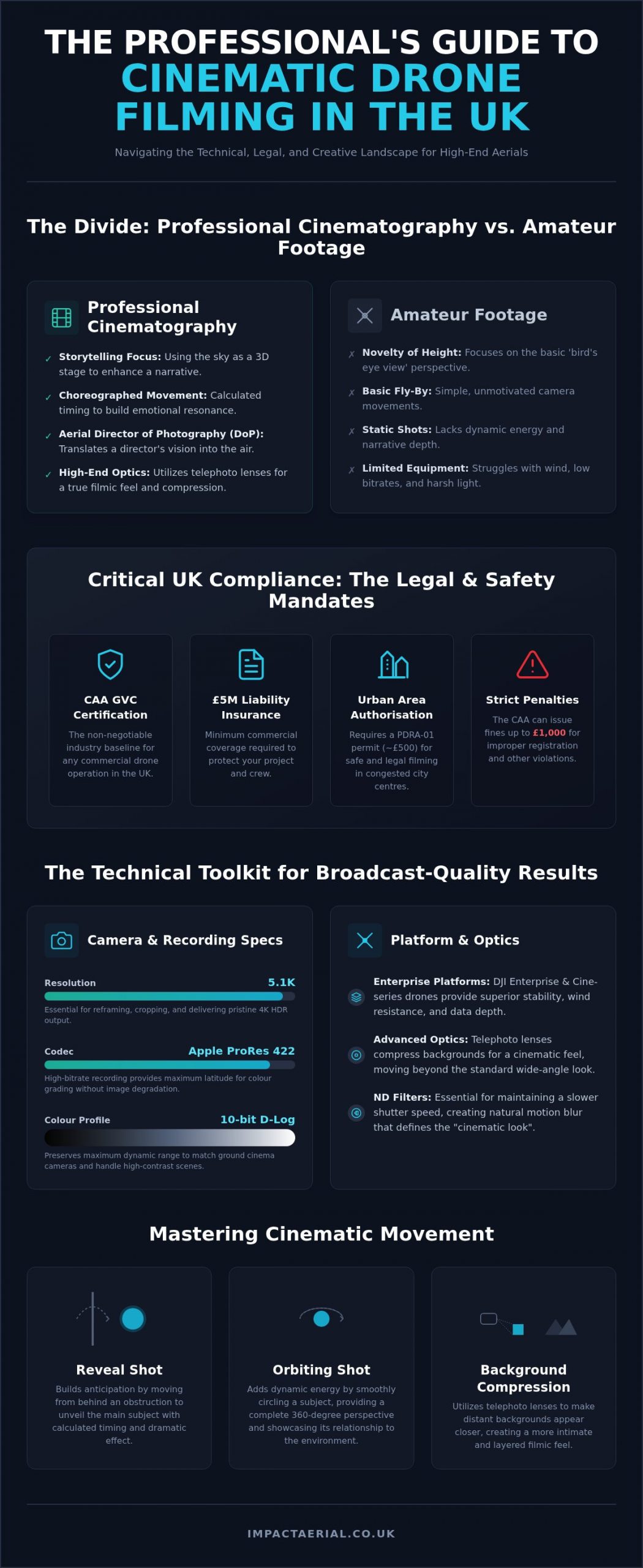
Navigating UK Regulations and Congested Area Permissions
The Civil Aviation Authority (CAA) serves as the primary regulator for all airspace activity in the United Kingdom. For professional cinematic drone filming UK, a standard Flyer ID is merely the entry point; the industry benchmark is the GVC (General Visual Line of Sight Certificate). This qualification demonstrates that a pilot has the theoretical knowledge and practical skills to operate in the “Specific” category, which is where most high-end production work takes place. Without this certification, a pilot cannot legally undertake the complex manoeuvres required for cinematic storytelling in public spaces.
Filming in congested areas requires an Operational Authorisation, typically based on a PDRA-01 (Pre-Defined Risk Assessment). As of April 2025, the fee for this authorisation is £500 per year, reflecting the increased scrutiny placed on commercial operators. This permit is vital for any shoot that takes place within towns or cities. Alongside this, Impact Aerial maintains £5m commercial liability insurance. This level of cover is often a mandatory requirement for high-value production sets and local authority permissions, providing peace of mind that all risks are professionally mitigated.
Filming in UK Cities: Birmingham, London, and Beyond
Operating in urban centres like Birmingham or London involves a layered permissions process. It isn’t just about the flight itself; it’s about managing the take-off and landing points, which often require consent from local councils or private landowners. We handle the logistical headache of these applications, including notifying the police and NATS when flying in restricted airspace. Our strategic base in Birmingham allows us to deploy rapidly across the UK, bringing our experience in urban flight planning to every project. We ensure that every flight is preceded by a site-specific risk assessment that satisfies both the regulator and the client’s safety team.
Safety Protocols and Risk Mitigation
Rigorous safety protocols are what separate a professional cinematography unit from a hobbyist. A valid UK drone license is non-negotiable for commercial work, especially as regulations now require registration for any drone over 100g. During complex cinematic shoots, we often deploy a dedicated camera operator alongside the pilot. This allows the pilot to focus entirely on flight safety and spatial awareness while the operator manages the framing and focus. This dual-operator setup is essential for achieving the dynamic, precise movements required for high-end film. CAA compliance is the foundation of any safe UK drone operation.
Creative Techniques for Cinematic Drone Movement
Movement is the primary language of aerial cinema. While technical specifications provide the raw data, it’s the flight path that creates an emotional connection with the viewer. The ‘Reveal’ shot is a fundamental technique for property and tourism films across Britain. By starting the drone behind a natural or architectural obstacle and slowly rising or panning, we build anticipation before unveiling the primary subject. This creates a narrative ‘payoff’ that transforms a simple view into a memorable discovery.
Tracking and orbiting shots inject visceral energy into moving subjects like cars or boats. By maintaining a fixed radius around a subject in motion, we create a dynamic perspective that keeps the viewer engaged. This is often paired with the ‘parallax effect’, where foreground elements like trees or lamp posts move across the frame faster than the distant background. It creates a profound sense of scale and depth, grounding the drone’s position in the physical world. For cinematic drone filming UK, we also leverage ‘top-down’ graphic shots. This perspective utilizes the geometric symmetry found in UK urban architecture and historical sites to create striking, abstract visuals that offer a fresh look at familiar locations.
FPV vs. Traditional Cinematic Drones
The choice of flight platform depends on the desired emotional impact of the scene. High-speed FPV (First Person View) drones provide immersive, high-octane ‘fly-throughs’ that can navigate tight gaps or follow fast-moving subjects with extreme precision. Conversely, traditional GPS-stabilised drones offer a majestic, steady look ideal for vast landscapes or establishing shots. Most professional productions benefit from a comprehensive aerial filming drone package that combines both styles, ensuring a diverse and engaging shot list for the final edit.
Planning the Perfect Golden Hour Shoot
Lighting is the most critical variable in UK outdoor filming. The ‘Golden Hour’, that short window after sunrise or before sunset, provides the soft, directional light that makes textures pop and colours feel rich. We use sun-tracking apps to plan flight paths weeks in advance, ensuring the drone is positioned to capture the best possible light for every angle. However, planning must also account for the UK’s unpredictable weather. Managing wind speeds and sudden cloud cover requires a pilot who can adapt the creative plan on the fly without compromising safety. If you’re ready to capture these high-end visuals for your next production, speak with our specialist team to discuss your project requirements.
Choosing Your UK Drone Partner: The Impact Aerial Advantage
Selecting the right partner for cinematic drone filming UK involves more than just checking gear lists; it requires a commitment to safety and a deep understanding of the national regulatory landscape. Impact Aerial is strategically based in Birmingham, serving as a primary hub for rapid deployment across the West Midlands, London, and the wider UK. This central location ensures we can reach diverse filming sites quickly while maintaining the high standards of a national operator. Our fleet of DJI Enterprise drones is specifically chosen for its reliability and superior 4K HDR optics, ensuring that every frame we capture meets the rigorous demands of high-tier production.
Operational safety is the cornerstone of our service. We carry £5m commercial liability insurance and operate under strict CAA safety standards to ensure every project is fully compliant and insured. This meticulousness extends to our planning phase, where we manage the complex permissions required for urban environments and sensitive sites. We don’t just fly; we provide a vetted, professional service that mitigates risk for every stakeholder involved. Safety remains our priority. By providing a ‘headache-free’ experience, we allow our clients to focus on the creative direction while we handle the technical and legal intricacies of the flight.
From Consultation to Final Edit
We’ve built a collaborative workflow designed to support your project from the initial brief through to the delivery of the final assets. Whether you require high-resolution drone photography or complex aerial cinematography, we tailor our approach to your narrative goals. We manage all UK flight permissions and site-specific risk assessments as part of our standard service. Clients have the flexibility to receive ‘footage ready’ files in professional codecs like Apple ProRes or can utilize our full post-production suite for edited cinematic sequences. This ensures that the high dynamic range and colour depth captured in the air are perfectly translated to the screen.
Specialised Services Across UK Sectors
Our team provides tailored cinematic solutions across a range of industries, including luxury property, large-scale construction site monitoring, and high-end advertising. For brands seeking to amplify their campaign reach through specialized mobile outdoor displays, you can visit Gorilla Media Limited for expert support. The use of CAA GVC certified pilots is a non-negotiable standard for our team, ensuring that even the most challenging commercial environments are handled with professional precision. We manage it all. Our experience allows us to adapt our filming style to suit the specific tone of your brand, from majestic landscape reveals to high-energy tracking shots. To discover how our expertise can benefit your next production, contact us to request a bespoke quote for your UK-wide cinematic drone project.
Elevate Your Production with Professional Aerial Cinematography
Mastering cinematic drone filming UK requires balancing creative vision with technical precision and strict regulatory adherence. You’ve seen how 5.1K ProRes optics and advanced movement techniques like the ‘parallax effect’ can transform a standard project into a high-end narrative. By prioritizing CAA GVC certified pilots and commercial-grade hardware, you ensure that your production remains both visually stunning and fully compliant with current UK aviation laws. It’s about moving beyond the bird’s eye view to tell a compelling story through the sky.
We handle the logistical complexity of take-off permissions and risk assessments so you can focus on the creative direction. With our strategic base in Birmingham, we provide comprehensive UK-wide coverage backed by £5m commercial liability insurance. Our team is ready to integrate seamlessly with your ground-based film crew to deliver consistent, broadcast-quality results. If you’re ready to secure high-tier aerial visuals for your next project, contact Impact Aerial for a cinematic drone filming brief today. We look forward to bringing your vision to life with precision and safety.
Frequently Asked Questions
Do I need special permission for cinematic drone filming in London?
Yes, London is one of the most restricted environments in the country due to various Flight Restriction Zones. Professional filming in the capital requires a CAA Operational Authorisation and specific coordination with NATS for zones near major airports. We also secure take-off and landing consent from local councils or private landowners. This meticulous preparation ensures that your shoot remains fully compliant with metropolitan aviation safety protocols.
What is the difference between a standard drone and a ‘cinematic’ drone?
Cinematic drones are distinguished by their optics and data output rather than flight speed or portability. While standard drones use compressed formats, cinematic platforms record in 5.1K resolution and 10-bit D-Log. These systems feature interchangeable lenses and professional gimbals that eliminate micro-vibrations. This hardware allows us to match the visual texture and dynamic range of high-end ground cameras, which is essential for professional storytelling.
Why is CAA GVC certification important for hiring a UK drone pilot?
The GVC is the mandatory benchmark for any pilot operating in the CAA’s Specific category. It proves that the operator has passed rigorous theoretical and flight assessments tailored to commercial risks. For cinematic drone filming UK, hiring a GVC certified pilot is the only way to legally fly in congested town centres. It also validates the pilot’s £5m liability insurance, protecting your production from legal and financial risks.
Can drones film cinematically in bad UK weather like rain or high wind?
While professional DJI Enterprise drones have robust wind resistance, we avoid filming in heavy rain to protect image clarity and sensitive electronics. Moderate winds are manageable, but cinematic shots require absolute stability. We monitor Met Office data closely and use sun-tracking apps to find the best windows. If the weather compromises safety or visual quality, we reschedule to ensure your production meets professional standards.
How much does professional cinematic drone filming cost in the UK?
Pricing for professional aerial cinematography depends on your specific brief, location, and technical requirements. Fees account for pre-flight planning, crew size, and the specialized hardware utilized. We don’t use generic price lists because every project has unique permission requirements and post-production needs. We encourage clients to contact us for a bespoke quote, ensuring a transparent and accurate cost structure for their UK-wide cinematic projects.
What is ProRes 422 and why do I need it for my drone video?
ProRes 422 is a professional-grade codec that maintains significantly more visual information than consumer-grade H.264. It’s a technical necessity for cinematic drone filming UK because it allows colourists to manipulate the image in post-production without causing artifacts. By capturing more data in the highlights and shadows, ProRes ensures that your aerial sequences integrate seamlessly with high-end ground footage during the final colour grade.
How long does it take to get permissions for a UK drone shoot?
Permission timelines vary based on the complexity of the airspace. Rural flights often require minimal notice, but city centre shoots typically need 14 to 21 days for full coordination. This period allows us to secure council permits, notify the police, and obtain NATS clearance for restricted zones. We manage this entire process from start to finish, removing the administrative burden from your production team’s schedule.
Does Impact Aerial provide unedited raw footage or a final edited film?
We provide a flexible service tailored to your internal workflow. Many clients prefer unedited raw footage in 10-bit ProRes 422 for their own post-production teams to grade. Alternatively, we offer full post-production services, delivering a final edited film complete with colour grading and sound design. Whether you need raw data or a finished narrative sequence, we ensure the output meets your project’s high-end technical specifications.
Drone Videography Birmingham: Professional 4K Aerial Filming Services
What if the biggest risk to your Birmingham construction project isn’t the budget, but the legal fallout of an unauthorized drone flight? Capturing the scale of the city’s 2026 skyline requires more than just a camera in the air; it demands a meticulous approach to urban compliance. You likely recognize that high-quality aerial footage is now essential for both site monitoring and high-end marketing. However, the logistical challenge of filming in congested areas like the Bullring, or navigating the specific restrictions of West Midlands airspace, often creates a barrier of uncertainty for project managers and creative directors alike.
Our professional drone videography Birmingham services bridge the gap between technical precision and cinematic storytelling. We understand the pressure to deliver stunning 4K HDR visuals while maintaining absolute safety standards. In this article, you will discover how GVC-certified pilots use enterprise-grade hardware to manage complex flight paths and how expert post-production transforms raw data into a powerful business asset. We will also break down the importance of £5m liability insurance and strict CAA adherence to ensure your project remains entirely stress-free from takeoff to delivery.
Key Takeaways
- Understand why CAA GVC certification and £5m commercial liability insurance are mandatory for legal, safe drone operations within Birmingham’s congested city centre.
- Discover how professional drone videography birmingham captures high-end 4K HDR cinematic footage to showcase developments aligned with the Big City Plan.
- Learn the logistical requirements for navigating restricted Birmingham airspace, including securing permissions for sites near BHX and New Street Station.
- Explore how drone technology provides accurate construction site monitoring by documenting every project phase from initial groundworks to final completion.
- Identify how the combination of technical surveying expertise and professional post-production transforms raw aerial data into compelling marketing assets.
The Rise of Aerial Videography in Birmingham’s 2026 Skyline
Birmingham’s skyline is undergoing its most significant transformation in decades. Driven by the ambitious Big City Plan, the city is evolving into a global hub, creating a massive demand for precise visual records. Professional drone videography birmingham services have moved from being a luxury to a critical requirement for developers, architects, and city planners. While national franchise portals offer a generic approach, they often lack the granular knowledge of Birmingham’s unique geography and the specific flight constraints of the West Midlands. Expert drone videography birmingham providers bridge the gap between technical surveying and high-end cinematic production.
Local expertise is vital. Navigating the wind tunnels created by new high-rises or managing the complex logistics of filming near the city’s transport hubs requires a pilot who understands the terrain. This isn’t just about getting a high shot; it’s about delivering 4K HDR footage that serves as a legal and historical record of the city’s growth. For stakeholders, these aerial perspectives provide strategic value that ground-based teams simply can’t replicate:
- Real-time progress tracking for remote investors and international partners.
- High-fidelity visual assets for public planning consultations and community engagement.
- Risk-managed documentation for insurance, safety compliance, and site handovers.
Supporting Urban Regeneration with Drone Data
The regeneration of Digbeth and the Jewellery Quarter represents a major shift in Birmingham’s industrial identity. We use drones to document these infrastructure milestones in real-time, capturing the transition from derelict sites to modern residential and commercial hubs. High-resolution video acts as a transparent tool for investor relations. It allows project teams to inspect progress on major developments without the logistical overhead of frequent site visits, providing a data-rich perspective that supports faster decision-making and clearer communication.
Cinematic Storytelling for Birmingham Businesses
Many businesses are evolving their visual strategy, moving beyond static drone photography to embrace dynamic video narratives. While a single image captures a moment, cinematic video captures the energy of the city. We’re seeing a sharp rise in the use of FPV (First Person View) drones for corporate video within the city centre. These agile aircraft can fly through internal spaces or navigate tight urban corridors, providing a visceral sense of scale. Integrating these aerial perspectives into existing brand marketing strategies ensures that Birmingham-based companies stand out in a crowded digital marketplace.
Safety, Compliance, and the CAA: Choosing a Professional Pilot
Operating a drone in a major metropolitan area like Birmingham isn’t just about technical skill; it’s about strict legal adherence. For commercial projects, hiring an uncertified operator is a significant liability that can result in heavy fines or halted projects. Professional drone videography birmingham requires a pilot who holds a General Visual Line of Sight Certificate (GVC) from the Civil Aviation Authority (CAA). This certification ensures the operator has undergone rigorous training in air law, meteorology, and flight safety protocols, which are essential for navigating the complex urban canyons of the city centre.
Under current drone license regulations, the ‘Open’ category covers low-risk recreational flights with minimal restrictions, while the ‘Specific’ category requires operational authorization for complex commercial missions in congested areas. Most professional work in Birmingham falls under the ‘Specific’ category, necessitating a higher level of oversight and planning.
Why GVC Certification is the Gold Standard
The GVC represents a higher tier of professional competency than a basic Flyer ID. It requires a formal theory exam and a practical flight assessment, proving the pilot can manage an aircraft safely even during hardware failures or signal interference. In high-density areas, certified pilots use these skills to maintain safe distances from uninvolved persons and property. To verify a pilot’s credentials, you should always ask to see their CAA Operator ID and their GVC certificate before any work begins. This transparency is a hallmark of a professional service provider.
Mitigating Risk in Public Spaces
Filming in iconic locations like the Bullring or around New Street Station presents unique challenges. Professional operators use a detailed Risk Assessment and Method Statement (RAMS) to identify hazards, from pedestrian footfall to electromagnetic interference from railway infrastructure. A critical component of this risk management is £5m commercial liability insurance. While standard hobbyist policies might cover rural flights, urban drone videography birmingham demands high-limit coverage to protect against property damage or injury in populated environments. This insurance provides psychological comfort and tangible security for corporate and construction clients.
Pre-flight planning often takes longer than the flight itself, involving site surveys and local authority notifications. If you’re planning a complex shoot, consulting with a compliant specialist ensures your project meets every legal requirement without compromising on visual quality.
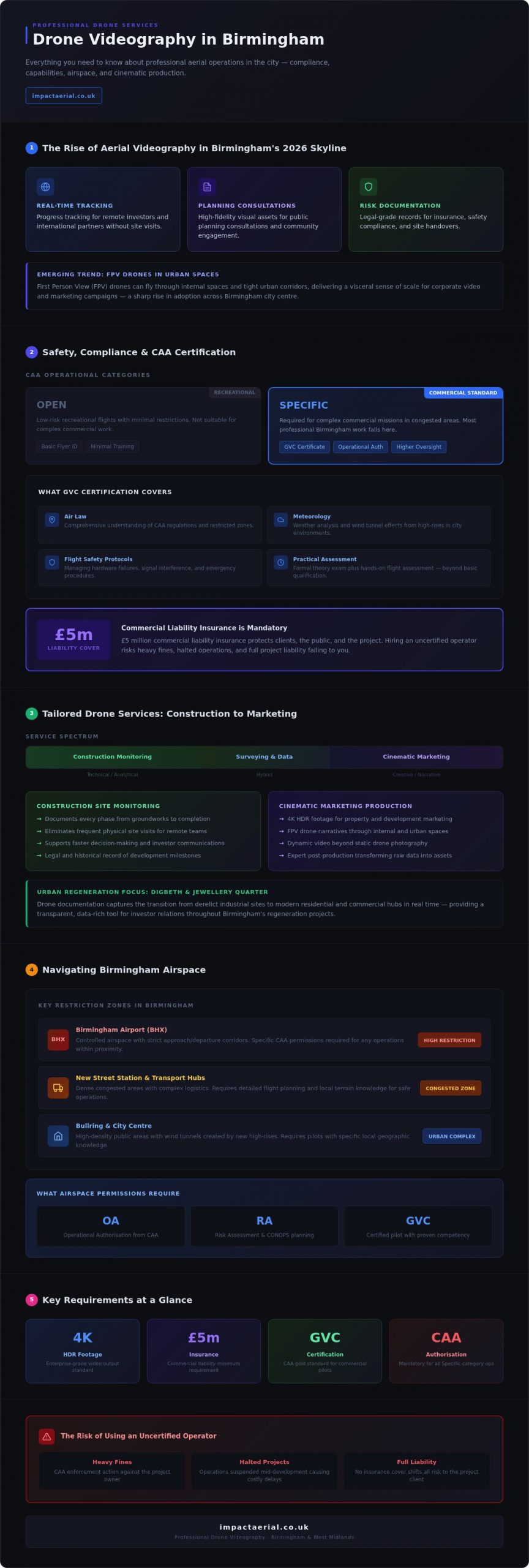
From Construction Monitoring to Marketing: Tailored Drone Services
While the visual impact of a drone videography birmingham project is immediate, its true value lies in the specialized application of the data captured. We provide a range of services that cater to the distinct needs of the West Midlands business community, from high-stakes construction monitoring to polished marketing campaigns. For construction firms, drones offer a consistent, high-resolution record of progress. Documenting a site from initial groundworks through to final completion provides a transparent audit trail for stakeholders and project managers without the need for intrusive ground-level inspections.
In the competitive world of property development, an aerial filming drone creates cinematic content that static imagery can’t match. These dynamic sequences are essential for marketing and advertising, offering prospective buyers or tenants a comprehensive view of a property’s context within the Birmingham urban environment. Beyond traditional video, we integrate virtual tours that combine 360-degree aerial perspectives with internal walk-throughs, creating a seamless experience for the viewer that builds confidence in the development.
The Post-Production Workflow
The transition from raw data to a finished asset is where professional expertise becomes most evident. Our post-production suite focuses on colour grading 4K HDR footage to achieve a consistent, cinematic look that aligns with your brand identity. For construction clients, we add motion graphics and site boundary annotations to highlight specific milestones or infrastructure points. Sound design and licensed music are also integrated to elevate corporate video productions, ensuring the final output is ready for high-level presentations or social media distribution.
Drone Surveys for Property Professionals
For property managers and RICS-qualified surveyors, drones significantly reduce both the cost and safety risks associated with traditional scaffolding or cherry pickers. Using high-resolution sensors, we identify roof defects, structural issues, or thermal leaks that are invisible from the ground. In the West Midlands, this technology is increasingly applied to PV solar farm assessments. Thermal imaging identifies failing cells or hotspots across vast arrays in a fraction of the time required for manual inspections. This data-centric approach ensures that drone videography birmingham serves as a functional tool for maintenance and asset management.
Navigating Birmingham Airspace: Logistics and Permissions
Birmingham’s airspace is among the most regulated in the UK. Successful drone videography birmingham relies on a deep understanding of these invisible boundaries. A primary consideration is the Flight Restriction Zone (FRZ) around Birmingham Airport (BHX), which extends several kilometres and covers major development sites. Operating within this zone requires specific coordination with Air Traffic Control (ATC) and often involves strict time windows to avoid interfering with commercial aviation. We manage these technical dialogues as part of our pre-flight process, ensuring your project remains legal and safe.
Sensitive urban sites like New Street Station or the BT Tower present additional layers of complexity. These locations are subject to heightened security protocols, often requiring direct liaison with the West Midlands Police and local council authorities. Weather also plays a decisive role. High winds or heavy rain in the West Midlands can compromise both safety and image stability. Due to the unpredictable nature of British weather and sudden changes in local airspace security, short-notice rescheduling is a standard precautionary measure to ensure flight safety and data quality.
City Centre Flight Challenges
High-rise environments like the city centre introduce technical hurdles such as electromagnetic interference and signal multipathing. These phenomena can disrupt the connection between the controller and the drone, requiring advanced pilot skills and enterprise-grade hardware to mitigate. We strategically select launch points, such as secure rooftops or private land near the Library of Birmingham, to maintain a clear line of sight. Coordinating with the West Midlands Police is a non-negotiable step for urban missions. It prevents unnecessary security alerts and ensures that the public remains safe and informed during the operation.
Planning for Success
Securing the necessary permissions for complex urban flights typically requires a lead time of 7 to 14 days. This window allows for a structured approach to safety:
- Thorough site surveys and technical risk assessments (RAMS).
- Processing of applications through the CAA or local Air Traffic Control.
- Coordination with private landowners for secure launch and recovery sites.
We use DJI Enterprise software to plan precise flight paths, which allows us to simulate the mission before the drone leaves the ground. This technology ensures we capture the exact angles required while maintaining safe distances from buildings and people. Our goal is always to deliver high-end results with minimal disruption to your business or the public. If you have a project within a restricted zone, you can contact our team to discuss the specific permissions required for your location.
Why Impact Aerial is Birmingham’s Leading Drone Partner
Choosing a partner for drone videography birmingham projects requires a balance of local knowledge and technical sophistication. We operate as a specialized consultancy based in the West Midlands. This means our team understands the logistical nuances of the region better than a nationwide agency. We don’t just provide height; we deliver a hybrid service that blends the precision of technical surveying with the narrative power of creative videography. This dual expertise ensures that whether you need to identify a structural fault or produce a high-end marketing film, the output meets the highest professional standards.
Our commitment to safety is foundational. As we move through 2026, we continue to lead the market by adhering to evolving CAA regulations and maintaining £5m in commercial liability insurance. We also prioritize environmental responsibility by using electric-powered UAVs that minimize noise pollution and carbon footprints on-site. Every project we undertake is managed with meticulous attention to detail. This provides the psychological comfort that your brand and site are in expert hands. We live and work here. That local presence allows us to respond quickly to changing weather windows or urgent project requirements.
Our Hardware: DJI Enterprise Technology
We invest heavily in DJI Enterprise technology to ensure reliability and superior image quality. These aircraft are equipped with 4K HDR cameras that provide exceptional dynamic range, capturing detail in both high-contrast shadows and bright highlights. For urban Birmingham environments, safety is enhanced by triple-redundancy systems, including multiple IMUs and compasses, which prevent flight failures in complex signal areas. This high-tier hardware allows us to operate with a level of precision that consumer-grade drones cannot achieve. It’s about reliability in high-stakes environments.
Start Your Project Today
Our consultation process is structured and methodical. It begins with a detailed project brief where we establish your specific goals, followed by a thorough site assessment and permission phase. We offer flexible booking options, particularly for construction progress monitoring, allowing you to schedule flights around key project milestones. Once the data is captured, our post-production team delivers edited assets tailored to your requirements. We guide you from the initial brief to the final delivery with absolute transparency.
Ready to elevate your visual data? Request a professional drone videography quote for your Birmingham project today.
Elevate Your Birmingham Project with Precision Aerial Data
The transformation of the West Midlands skyline requires a sophisticated approach to visual documentation. Successful drone videography birmingham relies on more than just high-end hardware; it demands a meticulous understanding of CAA GVC compliance and the logistical complexities of restricted airspace. By integrating technical surveying with cinematic post-production, you turn raw aerial data into a strategic business asset that supports both site management and high-impact marketing.
Ensuring your project remains safe and legal is our priority. We provide the security of £5m commercial liability insurance and the expertise of pilots who are deeply familiar with the unique geography of the city. Whether you’re monitoring a major construction milestone or launching a new corporate campaign, our expert post-production suite is included to ensure every frame meets your professional standards. This comprehensive approach mitigates risk while delivering the visual clarity needed for 2026’s competitive landscape.
Book your Birmingham drone videography consultation with Impact Aerial to secure your flight window. We look forward to helping you capture the energy and scale of your next development.
Frequently Asked Questions
Do you need permission to fly a drone in Birmingham city centre?
Yes, you require specific permissions to fly a drone in Birmingham city centre for commercial purposes. Pilots must hold CAA operational authorization and often need to coordinate with the West Midlands Police or Birmingham City Council. This ensures that flights over congested areas like the Bullring remain compliant with safety regulations. We manage these permissions as part of our standard pre-flight planning process.
How much does professional drone videography cost in the UK?
Professional drone videography costs in the UK vary significantly based on the project’s complexity, location, and the level of post-production required. Factors such as the need for specific airspace permissions or the use of enterprise-grade hardware also influence the final quote. We provide bespoke pricing for each Birmingham project to ensure you only pay for the specific technical and creative resources your mission demands.
Can drones fly in Birmingham Airport’s restricted airspace?
Drones can fly within the Birmingham Airport (BHX) Flight Restriction Zone, but only with prior permission from Air Traffic Control. This process involves submitting a flight plan and obtaining a non-standard flight clearance. Our pilots are experienced in managing these technical dialogues, ensuring that your drone videography birmingham project proceeds legally without disrupting commercial aviation schedules.
What is the difference between 4K and HDR drone video?
4K refers to the resolution of the video, providing a high level of detail with roughly 8 million pixels per frame. HDR, or High Dynamic Range, relates to the camera’s ability to capture detail in both the brightest highlights and the darkest shadows. Combining 4K with HDR results in cinematic footage that looks lifelike and professional, which is essential for high-end property marketing and corporate films.
Are your Birmingham drone pilots CAA GVC certified?
Yes, all our Birmingham drone pilots are fully CAA GVC certified. This General Visual Line of Sight Certificate is the professional standard for operating in complex urban environments. It proves that the pilot has passed rigorous theory and practical assessments. This certification is mandatory for the ‘Specific’ category operations we typically conduct within the city centre to ensure absolute safety and compliance.
What happens if the weather is bad on the day of the shoot?
If the weather is unsuitable for flight, we typically reschedule the shoot to the next available clear window. Safety is our primary concern; high winds, rain, or low visibility can compromise the aircraft and the quality of the footage. We monitor specialized aviation forecasts 48 hours before takeoff. This proactive approach ensures we only fly when conditions allow for the high-quality 4K HDR results our clients expect.
Do you provide edited videos or just raw drone footage?
We provide both raw footage and fully edited cinematic videos depending on your project requirements. Our in-house post-production suite allows us to offer colour grading, motion graphics, and sound design. This service transforms raw aerial data into a polished marketing asset or a detailed construction progress report. We’ll discuss your preferred delivery format during the initial consultation to match your specific brand guidelines.
How much public liability insurance does a drone pilot need?
For commercial drone videography birmingham, a pilot should carry at least £5m in public liability insurance. While the legal minimum for some flights is lower, most corporate and construction clients require £5m to cover the risks associated with urban environments. We maintain this level of coverage as standard. It provides essential protection for people, property, and your business reputation during every mission we undertake.
Professional Drone Services in Birmingham: The 2026 Commercial Guide
In the high-stakes environment of Birmingham’s urban redevelopment, a single uncertified drone flight over the Jewellery Quarter or the city centre can result in heavy fines and catastrophic project delays. You likely recognize that while aerial data is now essential for modern construction and marketing, the risks of hiring unvetted pilots often outweigh the benefits. Managing complex Birmingham Airport (BHX) flight restriction zones and ensuring high-precision data accuracy requires a level of technical expertise that goes far beyond basic flight skills. Professional drone services birmingham bridge this gap by combining cutting-edge drone technology with rigorous safety protocols.
This comprehensive 2026 guide shows you how to secure high-resolution 4K HDR marketing content and actionable survey reports without compromising on compliance. You’ll learn how a meticulous approach to CAA GVC certification and £5m commercial liability insurance protects your reputation and your bottom line. We will break down the transition from raw aerial data to professional post-production insights, ensuring your next West Midlands project benefits from a zero-incident safety record and industry-leading visual standards.
Key Takeaways
- Professional drone operations in Birmingham require CAA GVC certified pilots and a minimum of £5m commercial liability insurance to mitigate site risks effectively.
- Local expertise is essential for navigating the stringent Birmingham Airport (BHX) flight restriction zones and securing the permissions needed for urban flight.
- Utilising specialist drone services birmingham provides a safer, high-precision alternative to traditional scaffolding for commercial property and roof inspections.
- Success depends on a full-service approach that transitions raw 4K HDR data into cinematic marketing assets or actionable technical survey reports through professional post-production.
- A meticulous pre-flight site assessment identifies environmental hazards early, ensuring a zero-incident record on complex metropolitan projects.
What Are Professional Drone Services in Birmingham?
Professional drone services birmingham are defined by the integration of advanced Unmanned Aerial Vehicle (UAV) hardware, CAA GVC certified pilots, and sophisticated data processing. It’s a technical discipline that moves beyond simple aerial photography to provide high-precision insights for commercial stakeholders. In a city defined by its industrial heritage and rapid modern regeneration, these services offer the authoritative data required to manage complex urban projects safely and efficiently.
The industry has seen a significant shift from hobbyist-level footage to commercial-grade 4K HDR deliverables. For major Birmingham regeneration projects, such as the Curzon Street HS2 terminal or the creative redevelopment of Digbeth, the standard bird’s-eye view is no longer sufficient. Developers and marketers now demand the technical accuracy of DJI Enterprise hardware to ensure every pixel serves a purpose, whether that’s for architectural visualisation or identifying structural defects in historical masonry.
The Evolution of Aerial Data in the West Midlands
In Birmingham city centre, drones have increasingly replaced traditional, high-risk methods like scaffolding and cherry pickers. This transition reduces on-site hazards and lowers operational costs for property managers. By 2026, technology enables real-time site monitoring, allowing project leads to oversee large-scale construction from a remote office with live-streamed feeds. We’ve moved from basic imagery to complex outputs like 3D site modelling and thermal mapping. These tools allow for PV solar farm thermal surveys that identify energy inefficiencies invisible to the naked eye, providing a level of detail that was previously cost-prohibitive.
Key Deliverables You Should Expect
When you engage professional drone services birmingham, the output is tailored to specific commercial objectives. A professional partner manages the entire workflow, transitioning raw data into actionable reports through a dedicated post-production suite. You should expect a structured set of deliverables that meet industry standards:
- Cinematic Marketing Content: Professionally edited 4K HDR sequences that showcase Birmingham’s skyline and architectural assets for corporate promotion.
- High-Resolution Mapping: Detailed orthomosaic maps and topographical data that facilitate accurate site planning and land surveys.
- Technical Inspection Reports: Comprehensive assessments of roofs, façades, and chimneys that provide the evidence required for insurance claims or maintenance planning.
This systematic approach ensures that every flight delivers tangible business value. It’s about providing the reassurance that your project data is accurate, compliant, and ready for immediate use in your decision-making process.
The Regulatory Standard: Safety and Compliance in 2026
Maintaining a zero-incident safety record in 2026 requires strict adherence to the General Visual Line of Sight Certificate (GVC) framework. Unlike older certifications, the GVC is the current gold standard for commercial drone services birmingham, ensuring pilots have the specific training to operate in congested urban environments. This certification isn’t just a legal checkbox; it represents a commitment to meticulous risk mitigation and operational excellence. It allows for more flexible flight patterns in built-up areas while maintaining the highest safety margins for the public and your property.
For any commercial project, £5m public liability insurance is the non-negotiable baseline. This level of coverage is the industry standard for working near Birmingham’s high-value infrastructure and residential zones. It provides the necessary reassurance that your business is protected against unforeseen liabilities. Our pre-flight process involves a rigorous site assessment that accounts for local footfall and building density, particularly in sensitive areas like Edgbaston or Solihull. Every mission includes:
- Detailed ground hazard identification and established clearance zones.
- Verification of local signal interference from telecommunications infrastructure.
- Privacy impact assessments to ensure GDPR compliance in residential sectors.
Navigating Birmingham’s Restricted Airspace
A significant portion of the city falls within the Birmingham Airport (BHX) Flight Restriction Zone (FRZ). Operating here requires formal coordination with Air Traffic Control and the submission of detailed flight plans through official channels. We monitor Notice to Airmen (NOTAMs) daily to stay informed about temporary restricted areas, local helicopter activity from the Queen Elizabeth Hospital, or emergency service operations. Securing these permissions is a complex process that we manage entirely, coordinating directly with West Midlands Police and local councils when city centre access is required.
Hardware Matters: DJI Enterprise and 4K HDR
Consumer-grade drones often lack the redundancy systems and sensor quality required for professional drone services birmingham. We utilise DJI Enterprise hardware, which features dual-battery systems and advanced obstacle avoidance to ensure mission stability. For complex shoots in the city centre, a dual-operator setup allows one pilot to focus on flight safety while the other manages the camera for precision data capture. High-resolution 4K HDR sensors provide the dynamic range needed to identify minute structural cracks or thermal leaks in challenging lighting conditions, ensuring no detail is lost in the shadows. If you require a partner who prioritises these safety standards, you can learn more about our certified operations.
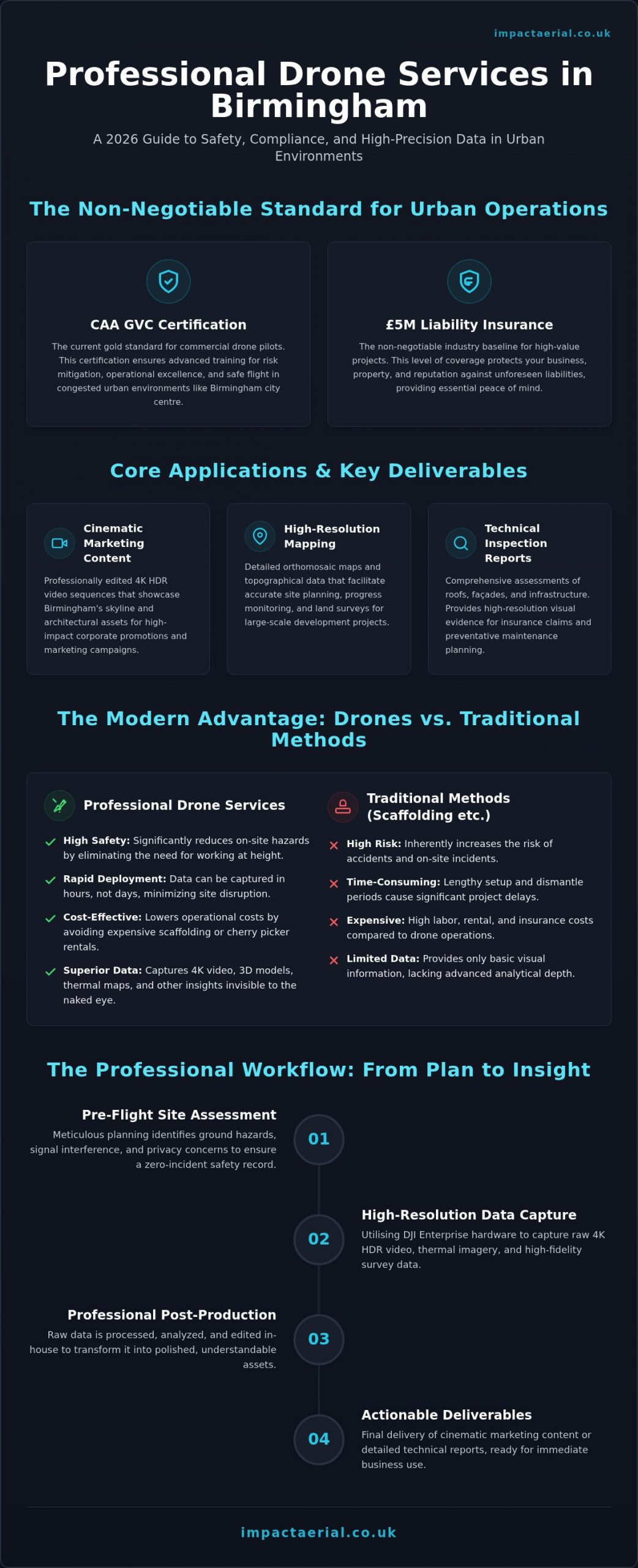
Core Applications: From Cinematic Filming to Precision Surveys
Professional drone services birmingham offer a dual-purpose solution that bridges the gap between high-end marketing and technical precision. Many commercial clients require cinematic visuals to attract investors while simultaneously needing accurate data for site management. By deploying DJI Enterprise hardware, we provide a unified workflow that serves both the creative and operational arms of a business, ensuring that every flight delivers maximum value. This versatility is essential for the West Midlands’ diverse economy, where industrial heritage meets cutting-edge urban redevelopment.
Construction site monitoring has become a staple for local developers. Instead of relying on ground-level snapshots, project managers use weekly aerial progress reports to track milestones from ground-breaking to completion. This visual record is invaluable for stakeholder updates and dispute resolution. Beyond construction, specialized applications like PV solar farm thermal surveys allow for the rapid identification of cell anomalies, ensuring maximum energy yield across large-scale arrays. We also provide several technical inspection outputs:
- Detailed façade and chimney inspections for high-rise commercial buildings.
- Volumetric measurements for stockpile management in industrial yards.
- Comprehensive roof assessments to identify drainage issues or structural debris.
Drone Photography for Birmingham Real Estate
In a competitive market, static ground photography often fails to capture the true scale of a commercial asset. We use high-resolution drone photography to highlight property boundaries and proximity to key infrastructure like New Street Station or the M6 motorway. These aerial perspectives provide a comprehensive view that grounds a property within its local context. Additionally, virtual tour creation allows prospective buyers to explore interiors and exteriors from anywhere in the world, revolutionising how commercial listings are presented. It’s about creating a narrative that combines aesthetic appeal with logistical clarity.
Technical Surveying and Data Collection
Precision is the cornerstone of our surveying operations. Conducting a drone survey offers a safer and more efficient alternative to traditional ground methods, particularly when inspecting Birmingham’s industrial heritage sites. These structures often feature complex façades and fragile roofing that make manual access dangerous. Using 4K HDR sensors and thermal imaging, we can identify heat loss and structural defects without the need for scaffolding. This data-centric approach provides actionable insights for maintenance planning and insurance valuations, ensuring that historical assets are preserved with modern accuracy. The result is a detailed, high-resolution dataset that supports informed decision-making across the entire project lifecycle.
How to Plan Your Birmingham Drone Project
Executing a successful aerial mission in a complex metropolitan area requires more than just a skilled pilot; it demands a structured planning phase that aligns technical capabilities with your commercial goals. When you commission drone services birmingham, the first step is determining whether your priority is marketing flair or technical precision. While cinematic 4K HDR visuals sell a vision, high-accuracy survey data drives operational decisions. Identifying these objectives early ensures the correct hardware and sensor payloads are deployed for your specific West Midlands site.
Site assessments are particularly critical in Birmingham due to the density of power lines, high-rise obstructions, and public access areas. We examine the physical environment to identify potential signal interference or flight path hazards that could compromise safety. Scheduling also plays a vital role. We monitor local weather patterns to find optimal windows where wind speeds are low and lighting conditions allow our sensors to capture the highest level of detail. This preparation ensures that when we arrive on-site, the mission is ready for a safe, efficient execution.
Step 1: The Initial Consultation
During the consultation, we define the project scope and identify the specific drone license requirements for your location. This is the time to set clear Key Performance Indicators (KPIs), such as the required ground sampling distance for surveys or the specific “look and feel” for creative edits. Depending on your needs, we determine if the project requires specialized sensors like Thermal for energy audits or LiDAR for terrain mapping. If you’re ready to discuss your requirements, you can contact our Birmingham team for a technical briefing.
Step 2: Pre-Flight and On-Site Execution
Before any flight, we produce a comprehensive Method Statement and Risk Assessment (RAMS) tailored to the specific Birmingham site. These documents are essential for compliance and provide the necessary reassurance to site managers and stakeholders. On the day of the mission, we conduct safety briefings and establish cordoned take-off and landing zones to manage public risk effectively. The pilot in command maintains absolute responsibility for the safe operation of the aircraft and must prioritize the safety of uninvolved persons and property at all times during the urban mission.
Post-Production: From Data to Insights
The project doesn’t end when the aircraft lands. A professional service includes a dedicated post-production phase where raw data is processed into usable formats. For construction clients, this might mean integrating aerial photogrammetry into existing Building Information Modelling (BIM) workflows. For creative agencies, it involves professional colour grading and editing to produce cinematic sequences. This transition from raw data to actionable insights is what separates a professional operation from a basic flight service, ensuring your project receives the meticulous attention it deserves.
Why Impact Aerial Is Birmingham’s Trusted Drone Partner
Impact Aerial operates as a specialist technical consultant, providing the meticulous oversight required for complex drone services birmingham. While national franchises often prioritize volume, we focus on the high-tier quality and regulatory precision that West Midlands commercial projects demand. Our deep understanding of Birmingham’s geography, from the industrial corridors of the Black Country to the dense redevelopment zones of the city centre, allows us to deploy rapidly and safely. We don’t just provide a pilot; we provide a fully managed aerial solution that prioritizes your project’s security and data integrity.
Our commitment to uncompromising safety is the foundation of every mission. We maintain a zero-incident record by adhering to strict operational protocols, supported by CAA GVC certified pilots and £5m commercial liability insurance as standard. This provides the psychological comfort and tangible protection your business needs when operating near high-value infrastructure or public spaces. Our proven track record across the property, construction, and advertising sectors demonstrates our ability to deliver consistent, high-precision results that meet the most demanding industry standards.
The Impact Aerial Difference: Beyond the Flight
The value we provide extends far beyond the time our aircraft spends in the air. We operate a dedicated in-house post-production suite, ensuring that raw data is transformed into polished, brand-ready assets or technical reports. This full-service approach is particularly vital for drone services within the commercial property sector, where the transition from raw 4K HDR footage to a cinematic marketing sequence requires professional editing expertise. We focus on building long-term partnerships, providing consistent data delivery that allows you to track project evolution over months or years with absolute confidence.
Get Started with Your Birmingham Drone Project
Initiating your project with us is a structured and transparent process. We begin with a technical consultation to understand your specific KPIs and site constraints. To provide a bespoke quote for your West Midlands site, we typically require the project location, the desired deliverables, and any specific access requirements. This information allows us to conduct a preliminary airspace check and identify any necessary permissions from Birmingham Airport or local authorities.
Don’t leave your aerial data to chance or uncertified operators. Contact Impact Aerial today to discuss your requirements and secure a professional, compliant aerial solution for your next Birmingham project. We’re ready to provide the high-resolution visuals and accurate data your business deserves.
Elevating Your Birmingham Project with Precision Aerial Data
Birmingham’s skyline and industrial infrastructure are evolving at an unprecedented pace. To keep up, commercial stakeholders need more than just a view from above; they need actionable, high-precision data that integrates seamlessly into their professional workflows. We’ve explored how professional drone services birmingham provide this through a meticulous blend of technical skill and regulatory compliance. By prioritizing safety, you ensure your project avoids the legal and operational risks associated with uncertified flight.
Our team provides the reassurance of CAA GVC Certified Pilots and £5m Commercial Liability Insurance as standard. Safety remains our core priority. By utilizing DJI Enterprise 4K HDR Technology, we capture the minute details that matter for structural inspections and high-end marketing alike. It’s about delivering a full-service experience from the initial site assessment to the final post-production edit. If you’re ready to secure high-quality aerial insights for your site, Request a Professional Drone Service Quote for Your Birmingham Project. We look forward to helping you transform your West Midlands project with the clarity and accuracy that only professional aerial insights can provide.
Frequently Asked Questions
Do I need a permit to fly a drone in Birmingham city centre?
Commercial operations in Birmingham city centre require specific permissions due to the dense urban environment and proximity to restricted airspace. We manage the entire administrative process, including coordination with local councils and Air Traffic Control where necessary. Our GVC certification and detailed risk assessments allow us to operate within these complex environments safely while adhering to all current CAA regulations.
How much do professional drone services cost in the UK?
The investment for professional aerial work depends on project complexity, site location, and the specific deliverables required. Factors such as the need for thermal sensors, professional post-production editing, or complex airspace coordination influence the final cost. We provide bespoke quotes tailored to your West Midlands site, ensuring a transparent breakdown of the technical expertise and hardware involved in your mission.
Are your drone pilots CAA certified and insured?
Every pilot we deploy is CAA GVC certified and carries £5m commercial liability insurance as a standard safety baseline. This certification is the current industry requirement for operating professionally in urban environments like Birmingham. Our insurance coverage provides the necessary reassurance for stakeholders, protecting against unforeseen liabilities while working near high-value commercial infrastructure or public residential zones.
What happens if the weather is bad on the day of the shoot?
We monitor weather patterns meticulously and will reschedule your flight if conditions, such as high winds or heavy rain, compromise safety or data quality. Our team coordinates with you to find the next available window with optimal lighting and flight stability. This proactive approach ensures that every mission delivers the high-resolution 4K HDR results you expect without taking unnecessary operational risks.
Can drones be used for roof inspections in residential areas of Birmingham?
Drones provide a safer and more efficient alternative to scaffolding for residential roof and chimney inspections across the city. We conduct pre-flight privacy impact assessments to ensure GDPR compliance and minimize disturbance to the local community. Our high-resolution sensors allow us to identify structural defects or drainage issues from a safe distance, providing actionable data for maintenance or insurance planning.
How long does it take to receive the final edited drone footage?
Delivery times depend on the scope of the project and the level of post-production required for your data. While raw footage can often be provided shortly after the flight, professionally edited cinematic sequences or detailed survey reports typically take three to five working days. Our in-house editing suite ensures that all drone services birmingham outputs meet high-tier commercial and marketing standards.
What is the difference between a standard drone and a DJI Enterprise model?
DJI Enterprise models feature redundant systems, advanced obstacle avoidance, and superior sensor payloads compared to consumer-grade hardware. These technical advantages ensure mission stability and data accuracy in challenging urban environments. For building inspections and precision surveys, the high dynamic range of Enterprise sensors allows us to capture critical structural details that standard drones might miss in complex lighting conditions.
Can you operate drones near Birmingham Airport (BHX)?
Operating near Birmingham Airport (BHX) is possible but requires formal coordination within the established Flight Restriction Zone (FRZ). We handle all necessary applications to Air Traffic Control and ensure every flight plan is strictly followed. This professional management allows us to provide drone services birmingham even in sensitive areas, maintaining absolute compliance with national aviation safety protocols and local airport requirements.
As-Built Drone Surveys: Professional UK Guide 2026
What if the most significant threat to your project’s handover isn’t a supply chain delay, but the invisible discrepancies hiding within your completed structure? For UK Tier 1 contractors and project managers, the traditional reliance on manual tape measures and visual inspections often leads to inaccurate documentation that haunts the building’s lifecycle. Deploying as-built surveys with drones has shifted from a high-tech luxury to a commercial necessity. These surveys provide a meticulous, high-precision record of the site as it actually exists, rather than how it was originally envisioned on a CAD screen.
You likely recognise that traditional site verification is too slow, often dangerous, and prone to human error. This professional guide explains how drone-based site audits bridge the gap between design intent and physical reality, ensuring your digital twin is a true reflection of the asset. You’ll discover how to integrate high-precision data into your BIM workflow, reduce long-term liability through robust documentation, and accelerate the handover process. We’ll explore the technical standards, CAA compliance requirements, and hardware capabilities defining the industry in 2026.
Key Takeaways
- Understand the technical distinction between raw data capture and final CAD/BIM drawings to ensure your project documentation is legally robust.
- Learn how to select the optimal sensor technology by comparing the high-resolution visual outputs of Photogrammetry with the structural precision of LiDAR.
- Discover how as-built surveys with drones can reduce on-site data collection time by up to 75% while removing personnel from hazardous environments.
- Identify the specific deliverables, such as 3D point clouds and orthomosaic maps, required to create a verified digital twin of your completed asset.
- Recognise the essential UK compliance standards, including CAA GVC certification and commercial insurance, necessary for professional site verification.
What is an As-Built Survey with Drones?
An as-built survey with drones is a high-precision aerial measurement process designed to document the actual physical state of a construction project at a specific point in time. While design plans represent the architect’s original intent, the as-built survey captures the reality of what has been constructed. It’s essential to understand the technical distinction between the survey and the final as-built drawings. The survey is the methodical process of data capture and point cloud generation. The drawings are the resulting CAD or BIM files that provide a visual and data-rich representation of that captured reality.
Timing plays a vital role in the success of these surveys. Professional drone teams typically capture data during critical windows, such as immediately before utilities are buried or structural elements are covered by cladding. This creates a permanent digital record of sub-surface assets that would otherwise be lost to visual inspection. This data forms the backbone of a Digital Twin. Facility managers rely on these virtual replicas for long-term operations, ensuring they have an accurate map for maintenance or future structural modifications without relying on potentially outdated blueprints.
Why Design Plans Rarely Match Reality
Site deviations are an inherent part of the construction process. Whether it’s a rerouted drainage line to avoid an unforeseen obstruction or a minor shift in grade levels due to soil conditions, the physical build often drifts from the initial design. Carrying this undocumented risk into subsequent construction phases or the final handover is a significant liability. Aerial data provides project stakeholders with an indisputable, georeferenced record of the site. It replaces subjective site notes with millimetre-accurate visual evidence, ensuring that every deviation is documented and accounted for before the project concludes.
The Evolution from Ground Crews to UAVs
Traditional ground surveys rely on total stations and manual measurements. While these tools are precise, the process is slow and often struggles with complex topographies or large-scale industrial environments. Ground crews are also exposed to site hazards for extended periods. Modern UAV technology has transformed this workflow. A professional survey drone can capture comprehensive site-wide data in a fraction of the time, generating millions of data points in a single flight. This speed doesn’t just save money; it provides a level of detail that manual spot-checks cannot replicate, delivering a complete picture of the asset’s integrity.
Photogrammetry vs. LiDAR: Choosing the Right Sensor for Site Verification
Selecting the appropriate sensor is a technical decision that directly impacts the precision and utility of your as-built surveys with drones. It’s not merely a choice of hardware; it’s about matching the physics of the sensor to the specific requirements of the construction site. For UK project managers, this choice usually sits between Photogrammetry and LiDAR (Light Detection and Ranging). Both technologies offer distinct advantages depending on whether you prioritise visual fidelity, structural detail, or the ability to penetrate environmental obstacles.
Photogrammetry involves capturing hundreds of high-resolution 4K HDR images from multiple angles. These images are then processed using complex algorithms to create 3D models through triangulation. This method relies heavily on visual contrast and consistent lighting to identify identical features across different frames. LiDAR, by contrast, is an active sensor that emits thousands of laser pulses per second. It measures the time taken for these pulses to return, allowing it to “see” through vegetation or capture highly accurate data in low-light conditions where traditional cameras would struggle.
Accuracy standards in engineering-grade workflows often demand sub-centimetre precision. Achieving this level of reliability requires more than just a high-end sensor; it necessitates the use of Ground Control Points (GCPs) and RTK-enabled hardware. Environmental factors like wind, rain, and extreme shadows play a decisive role in sensor selection. Photogrammetry often fails in areas with flat, textureless surfaces or deep shadows, whereas LiDAR remains consistent regardless of surface colour or ambient light levels. If you’re unsure which technology fits your project requirements, our technical consultants can advise on the most effective drone survey strategy for your specific site.
When to Use Photogrammetry
Photogrammetry remains the industry standard for generating high-detail visual orthomosaics and general site progress monitoring. It’s particularly cost-effective for large-scale earthworks and grading projects where visual context is as important as the topographic data itself. Photogrammetry’s accuracy depends on the software’s ability to identify identical features across multiple images with significant overlap for precise 3D reconstruction.
When LiDAR is Essential
LiDAR is indispensable when mapping sites with significant tree canopies or complex scaffolding that requires high-accuracy vertical measurements. Its active pulses can penetrate gaps in vegetation to map the underlying ground surface, making it the superior choice for complex industrial environments. It’s also the only viable option for mapping thin, linear features like power lines or complex structural steelwork that photogrammetry might fail to resolve accurately.
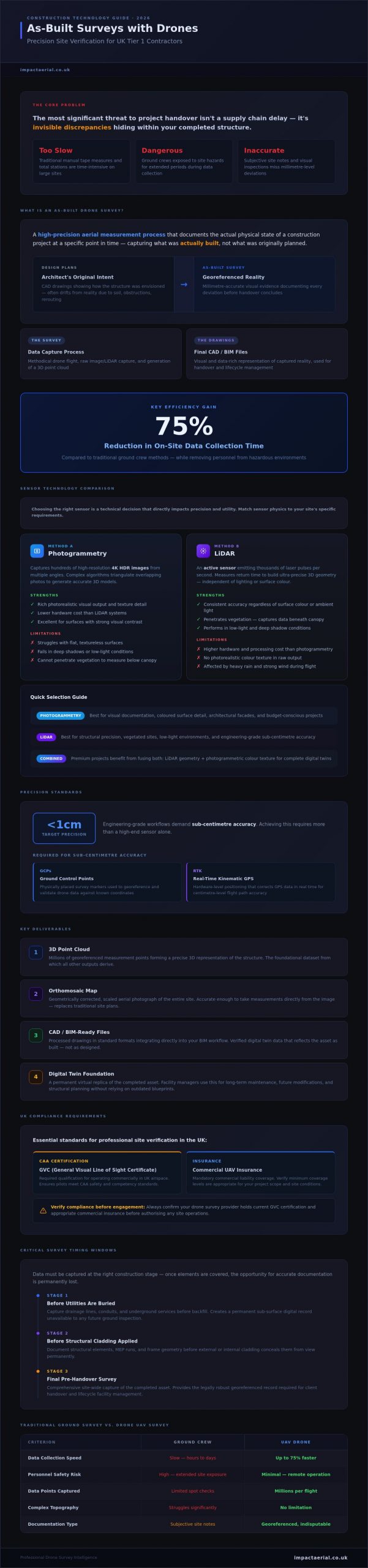
The Business Case: Comparing Drone-Based Surveys to Traditional Methods
The transition to as-built surveys with drones represents a fundamental shift in construction economics. Traditional surveying often requires days of manual data collection, involving multiple technicians and expensive equipment hire. By contrast, aerial surveys can reduce on-site data collection time by up to 75%, allowing projects to maintain momentum without the need for site closures or heavy plant downtime. This efficiency doesn’t just save time; it translates directly into cost savings by minimising the labour hours required to produce a comprehensive site record.
Data density is where the technical advantage becomes most apparent. A traditional total station survey typically captures hundreds of discrete points, leaving the surveyor to “connect the dots” and interpolate the areas in between. An as-built survey with drones generates millions of georeferenced data points, creating a dense point cloud that captures every structural nuance. This granular detail ensures that no element is overlooked, providing a level of site verification that manual methods simply cannot match. It’s a move from sparse sampling to total site documentation.
Eliminating Human Error in Data Collection
Manual measurements are inherently prone to human error, particularly on complex or high-elevation sites. Automated flight paths remove this subjectivity by ensuring repeatable, objective data capture across every survey mission. This consistency is vital for multi-phase projects where longitudinal data comparison is required. By capturing the site accurately the first time, contractors can significantly reduce the “re-work” costs associated with inaccurate manual measurements. You can explore our full range of drone services to see how these automated workflows integrate into your existing project management structure.
Enhanced Site Safety and Compliance
From Point Clouds to BIM: Understanding As-Built Deliverables
The raw data captured during as-built surveys with drones is processed into several high-value deliverables that serve different project stakeholders. Orthomosaic maps provide georeferenced, top-down views with millimetre precision, allowing site managers to overlay current progress onto original design plans. These maps offer a comprehensive visual record that traditional photography cannot match. 3D point clouds act as the geometric foundation for Building Information Modelling (BIM). These clouds consist of millions of individual data points that represent the physical structure, enabling architects to create accurate BIM objects that reflect the actual build rather than the original design intent.
For civil engineering and groundworks, Digital Terrain Models (DTM) are essential for verifying drainage grades and earthwork completion. These models strip away surface features to provide a clear view of the bare ground topography. Deviation maps provide the most direct value for quality assurance and risk mitigation. Deviation maps highlight construction errors in real-time by visually identifying where the physical build differs from the CAD design model. This immediate feedback allows for corrective action before errors are compounded in later construction stages, protecting the project timeline and budget.
BIM Integration and File Formats
Modern construction workflows require seamless data transfer between the field and the office. We export drone data into industry-standard formats including .LAS for dense point clouds, .OBJ for textured 3D models, and .DXF or .IFC for CAD and BIM software compatibility. This technical interoperability accelerates the creation of “As-Built” Revit models, providing a verified digital twin of the structure. Integrating aerial data directly into your BIM environment ensures that handover documentation is robust, accurate, and ready for the facility management phase of the building’s lifecycle. To further support your project’s data needs, you can explore Transactional fees for digital geospatial data downloads and environmental reports from CentremapsLive to ensure you have access to authoritative site-wide information.
Volume Calculations and Stockpile Audits
Accurate material management is critical for project profitability and environmental compliance. Drone-based volume calculations provide instant, precise audits of stockpiles and excavation pits without the need for manual measurements or site stoppages. This streamlines financial reporting and enables better material management on-site by providing objective metrics. You can see how drone survey data transforms site management by providing verifiable data for every cubic metre of material moved. If you require professional assistance in converting aerial data into BIM-ready files, contact our team to discuss our Post-Production Services for your next project.
Implementing As-Built Drone Surveys with Impact Aerial
Impact Aerial operates as a specialized technical consultant, moving beyond simple aerial photography to provide engineering-grade as-built surveys with drones. Based in our Birmingham hub, we provide comprehensive UK-wide coverage, ensuring that Tier 1 contractors and project managers have access to high-precision data regardless of their site’s location. Our methodical approach is designed for the complexities of the modern build environment. It begins with a rigorous pre-flight risk assessment and extends through a meticulous post-production phase where raw data is transformed into the BIM-ready deliverables discussed earlier. We don’t just capture images; we provide a verified record of your project’s physical reality.
Hardware choice is a fundamental component of our service quality. We exclusively utilize industry-leading 4K HDR drone hardware to ensure the highest possible data fidelity for every mission. These platforms are specifically engineered for the rigours of industrial environments, providing the stability and sensor precision required for millimetre-accurate site verification. By combining this high-end hardware with a structured, data-centric workflow, we deliver a level of reliability that supports the most demanding construction schedules and regulatory standards. This technical meticulousness ensures that every point cloud and orthomosaic we produce meets the aspirational standards expected by industry leaders.
UK Regulatory Compliance and Safety
The UK regulatory environment for UAV operations is rigorous and constantly evolving. Certification is non-negotiable for commercial projects, particularly on high-risk construction sites where safety is the primary concern. Our pilots are CAA GVC certified, demonstrating a high level of competency and strict adherence to national aviation protocols. You can read our guide on the drone license requirements to understand why these standards are essential for project compliance. Our £5m commercial liability insurance provides a layer of reassurance for your project and stakeholders, ensuring that all aerial operations are fully indemnified and risk-managed.
Get Started with Your As-Built Project
Integrating as-built surveys with drones into your 2026 project schedule begins with a detailed technical consultation. During this process, we define your specific accuracy requirements and identify the exact file formats needed for your BIM or CAD workflow. This proactive planning ensures that data capture is timed perfectly with your construction milestones, such as capturing sub-surface utilities before they are permanently covered. Contact Impact Aerial today for a professional as-built survey quote to ensure your project’s handover is supported by precise, compliant documentation.
Securing Your Project Lifecycle with High-Precision Data
The transition toward as-built surveys with drones marks a definitive move away from fragmented, manual data collection toward a unified digital reality. By capturing high-precision point clouds and georeferenced orthomosaics, you don’t just document a build; you create a robust, BIM-ready asset that protects your firm from long-term liability. This process bridges the gap between design intent and physical completion, ensuring every deviation is accounted for before the final handover.
Working with a DJI Enterprise partner ensures your data meets the highest engineering standards. Impact Aerial provides UK-wide coverage from our Birmingham hub, utilizing CAA GVC certified pilots and carrying £5m commercial liability insurance for your absolute peace of mind. We act as your technical consultant to translate complex aerial data into actionable site insights that drive project efficiency. Request a Professional Drone Survey Quote from Impact Aerial to secure your site documentation for 2026. Let’s bring absolute clarity to your next project handover.
Frequently Asked Questions
How accurate are drone as-built surveys compared to traditional methods?
Modern drones achieve sub-centimetre relative accuracy and 1cm to 3cm absolute accuracy when utilizing RTK-enabled hardware and Ground Control Points. This precision matches or exceeds traditional total station results for large-scale topographic mapping. While traditional tools capture discrete points, as-built surveys with drones generate millions of data points, providing a more comprehensive and dense representation of the physical structure.
Do I need to close my construction site during a drone survey?
Site closures are rarely required during professional aerial data capture. Drones operate at height, allowing ground-based construction activities to continue without interruption. Our pilots perform detailed risk assessments to ensure flight paths don’t cross directly over personnel. This non-intrusive approach maintains project momentum while capturing high-precision data, a significant advantage over manual surveys that often require clearing specific work areas.
What file formats will I receive for my BIM software?
We deliver data in industry-standard formats designed for seamless integration into your existing workflows. Common deliverables include .LAS or .LAZ point clouds, .OBJ 3D models, and .DXF or .DWG CAD files. We also provide .IFC files for direct Building Information Modelling (BIM) compatibility. These formats ensure your design team can immediately use the aerial data in software such as Revit, AutoCAD, or Civil 3D.
Is a drone survey legal on a UK construction site?
Drone operations are fully legal provided the operator complies with Civil Aviation Authority (CAA) regulations. Professional surveyors must hold a valid GVC or A2 CofC certification depending on the aircraft and environment. Impact Aerial pilots are CAA GVC certified, ensuring full compliance with UK aviation law. We also carry £5m commercial liability insurance, meeting the stringent safety and risk management requirements of UK Tier 1 contractors.
How much does a drone as-built survey cost?
The total investment depends on site size, environmental complexity, and the specific accuracy requirements of your project. While we don’t offer fixed pricing without a consultation, drone surveys are typically more cost-effective than manual methods for large or complex sites. The 75% reduction in data collection time significantly lowers labour costs and removes the need for expensive access equipment like scaffolding or cherry pickers.
Can drones capture as-built data inside buildings?
Drones can capture internal as-built data using specialized sensors and indoor flight technology. While outdoor missions rely on GPS, indoor surveys use collision-avoidance systems and SLAM (Simultaneous Localization and Mapping) to navigate confined spaces. This allows us to document structural elements, MEP services, and internal finishes in complex environments where traditional line-of-sight measurement tools might struggle to provide a complete 3D record.
What is the difference between an as-built survey and an inspection?
A survey focuses on spatial measurement and georeferenced positioning, while an inspection prioritises visual condition and defect identification. As-built surveys with drones create precise 3D models and maps used for engineering verification and BIM integration. Inspections typically produce high-resolution imagery or thermal data to assess the integrity of assets like roofs or solar panels without necessarily requiring millimetre-accurate coordinate data for every point.
How long does it take to process the drone data into a 3D model?
Data processing typically takes between 24 and 72 hours depending on the project’s scale. The timeline is dictated by the number of high-resolution images captured and the complexity of the required 3D model. We use high-performance post-production software to clean, georeference, and convert raw data into your specified file formats. This ensures you receive a verified digital twin shortly after the flight mission is complete.
Professional Drone Building Survey in Birmingham: The 2026 Expert Guide
Why are you still budgeting thousands of pounds for scaffolding and plant hire just to identify a few slipped tiles or a blocked gutter? In Birmingham’s complex urban landscape, traditional access methods often create more logistical headaches than they solve, leaving property managers facing high costs and significant health and safety liabilities. You likely already know that working at height remains a primary safety concern, yet the necessity of maintaining structural integrity makes these risks feel unavoidable.
This expert guide demonstrates how a professional drone building survey in Birmingham transforms these high-risk inspections into streamlined, data-driven missions. By utilizing commercial-grade DJI Enterprise hardware and 4K HDR imaging, we provide a safer and significantly faster alternative to manual surveys. You’ll discover how to achieve full compliance with the latest CAA regulations while securing the detailed structural data required for long-term maintenance planning. We will examine the specific advantages of aerial data collection across the West Midlands, from mitigating site disruption to the precision of post-production reporting that informs your critical asset management decisions.
Key Takeaways
- Learn how DJI Enterprise sensors capture high-resolution 4K HDR data; this identifies micro-cracks and structural fatigue that manual inspections often miss.
- Understand why CAA GVC certification and £5m liability insurance are essential benchmarks for ensuring safety and regulatory compliance in the West Midlands.
- Discover how a professional drone building survey birmingham delivers significant ROI by eliminating the logistical costs and safety risks of traditional scaffolding.
- Explore how aerial data collection supports Birmingham’s commercial sectors by providing precise defect identification for retail hubs and industrial sites.
- Gain a clear framework for commissioning your next survey, including the essential details your brief must contain for accurate maintenance planning.
Drone Building Surveys: Why Essential in Birmingham?
A professional drone building survey in Birmingham is far more than a simple aerial photograph. It is a high-precision data-collection mission that utilizes Unmanned Aerial Vehicles (UAVs) equipped with 4K HDR sensors to capture granular structural details. This methodology has transformed how asset managers in the West Midlands approach maintenance, shifting the focus from basic visual inspections to comprehensive, data-driven structural analysis.
Birmingham’s unique architectural tapestry demands this level of technical sophistication. Whether you are managing sprawling industrial sites in Digbeth or sensitive heritage assets in the Jewellery Quarter, specialized aerial approaches are required to identify defects without physical contact. This non-invasive technique ensures 100% safety by removing the need for personnel to work at height while maintaining zero disruption to daily business operations.
To better understand how this technology integrates with construction and site monitoring workflows, watch this helpful video:
The Evolution of Aerial Inspections in the West Midlands
Over the last decade, drones have effectively replaced the traditional ‘man-on-a-roof’ method across the region. This transition is particularly evident in Birmingham’s 2026 urban regeneration projects, where speed and precision are paramount. Moving beyond simple photography, modern commercial drone surveys provide a digital twin of the asset, allowing for repeated, accurate measurements over time. This evolution enables property owners to track structural fatigue and water ingress with a level of detail that was previously impossible without significant manual labour.
Key Advantages Over Traditional Scaffolding
The primary driver for adopting drone technology is the total elimination of the ‘Working at Height’ risk profile. By keeping surveyors on the ground, businesses significantly reduce their liability and safety insurance concerns. The efficiency gains are equally compelling. A drone building survey in Birmingham can often complete the inspection of a complex city centre office block in just a few hours, a task that would take days to rig with scaffolding. From a financial perspective, removing the five-figure price tag associated with scaffolding hire for a simple inspection ensures that maintenance budgets are spent on actual repairs rather than access equipment.
Advanced Technical Capabilities: DJI Enterprise and 4K HDR Data
A professional drone building survey in Birmingham requires hardware that far exceeds consumer-grade capabilities. We utilize specialized professional drone systems that are recognized as the industry standard for high-stakes urban data collection. These aircraft aren’t just flying cameras; they’re sophisticated aerial platforms designed to carry advanced sensors that capture granular structural data with absolute precision.
The use of 4K HDR (High Dynamic Range) sensors is critical when inspecting Birmingham’s diverse property portfolio. HDR technology allows us to capture detail in both the brightest highlights of a glass facade and the deepest shadows of a brickwork cavity in a single frame. This clarity is essential for identifying micro-cracks, early-stage water ingress, and structural fatigue that lower-resolution equipment simply cannot detect. Beyond visual imagery, these platforms allow us to capture precise measurements and thermal data, providing a multi-layered view of a building’s performance.
Hardware Focus: Why Professional-Grade Drones Matter
Operating in the West Midlands requires equipment that can handle unpredictable weather and complex signal environments. Our professional drone systems provide the flight stability necessary to operate safely near high-rise structures, even in gusty conditions. Their advanced zoom capabilities are a significant safety feature; they allow our pilots to capture high-resolution detail from a safe stand-off distance, eliminating the risk of close-proximity flight. Furthermore, these systems feature multi-directional obstacle sensing and redundancy in their propulsion and battery systems, ensuring total reliability when flying over busy city centre streets.
From Raw Imagery to Professional Survey Reports
The value of a drone building survey in Birmingham is truly realized during the post-production phase. Raw footage is meticulously edited to enhance clarity, making it easier for structural engineers to sign off on maintenance plans. We don’t just provide a folder of images; we deliver actionable data that integrates directly into your existing property management software. This creates a permanent digital record of your building’s condition, which is invaluable for insurance renewals and long-term compliance auditing. By leveraging these advanced systems, you can secure a comprehensive drone building survey in Birmingham that provides a definitive record of your asset’s health.
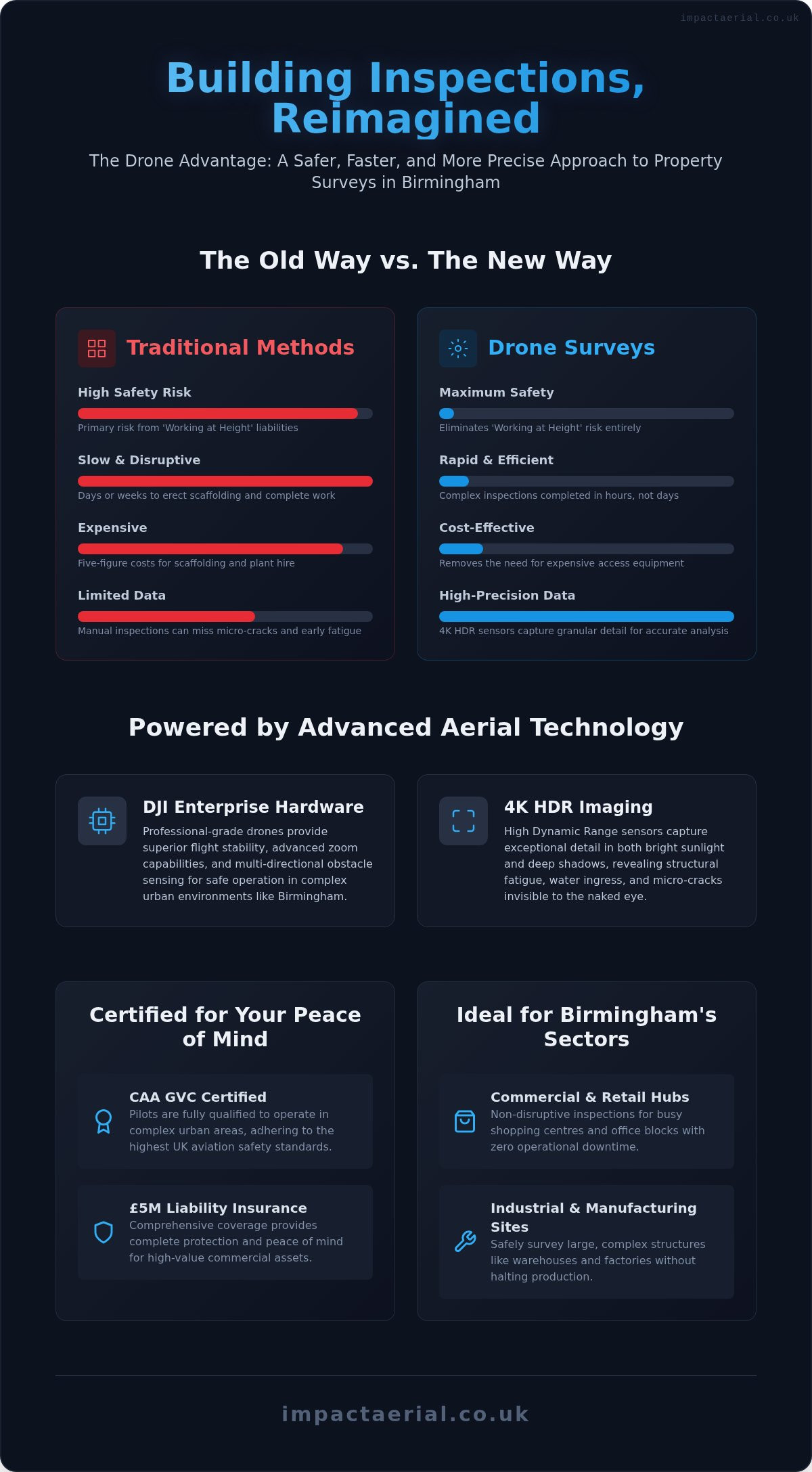
Safety and Compliance: CAA GVC Certification in Birmingham
Executing a drone building survey in Birmingham requires more than technical skill; it demands a rigorous adherence to UK aviation law. The Civil Aviation Authority (CAA) mandates that commercial operators hold a General Visual Line of Sight (GVC) certification. This qualification ensures that pilots possess the theoretical knowledge and practical flight competence to operate safely in complex environments. At Impact Aerial, our commitment to this standard provides the foundational reassurance that every mission is conducted within the strictest legal frameworks.
Operating within a dense city centre involves unique liabilities that hobbyist-grade insurance cannot cover. We maintain £5m in commercial liability insurance as a baseline standard for all Birmingham projects. This level of coverage is essential for protecting your business interests when surveying high-value assets near public highways or adjacent properties. Our safety methodology begins long before the drone leaves the ground, involving a meticulous pre-flight planning process that accounts for local obstacles, weather patterns, and specific urban risks.
Navigating UK Drone Laws in 2026
The regulatory landscape for UAVs continues to evolve, making it vital to partner with an operator who understands the current UK drone license requirements. We maintain comprehensive flight logs and maintenance records for every aircraft in our fleet, providing a transparent audit trail for our clients. This documentation is particularly crucial when managing flights within restricted zones, such as the airspace surrounding Birmingham Airport (BHX). We handle all necessary coordination with Air Traffic Control and local authorities to ensure your survey proceeds without legal interruption.
Urban Risk Management and Public Safety
Conducting a drone building survey in Birmingham often means operating in high-footfall areas like the Bullring or Grand Central. Managing ‘uninvolved persons’ is a critical component of our safety protocol. We often deploy a dedicated observer to support the pilot, providing an extra pair of eyes to monitor the surrounding environment and ensure public safety is never compromised.
Privacy compliance is another pillar of our professional service. When capturing data in mixed-use zones where residential and commercial properties sit side-by-side, we apply strict data protection measures. Our sensors are focused exclusively on the target asset, and any incidental data is managed in accordance with UK GDPR. This meticulous approach to both physical safety and digital privacy ensures that your building survey is a low-risk, high-reward investment for your property management strategy.
Specific Applications for Birmingham’s Commercial Sectors
Birmingham’s property market requires a multifaceted approach to inspection. Whether you’re managing a high-rise office in the city centre or a sprawling warehouse in the Black Country, a professional drone building survey in Birmingham provides the specific data points needed for effective asset management. In the retail sector, we identify roofing defects and drainage issues across large-scale hubs, ensuring that structural maintenance doesn’t interfere with the customer experience. This sector-specific data allows for targeted repairs rather than costly, blanket maintenance programs.
For those looking to expand their footprint in the UK market, you can learn more about identifying and securing high-yield property deals through professional sourcing.
The Jewellery Quarter’s heritage assets present unique challenges for property owners. For these listed buildings, non-contact surveys are essential to preserve delicate masonry and intricate facades. Drones allow us to document every architectural detail without the vibration or physical risk associated with traditional access equipment. Similarly, for businesses investing in sustainable energy, our PV solar farm surveys use thermal imaging to identify cell failures and underperforming panels. This data-centric approach directly impacts ROI by ensuring maximum energy output for Birmingham’s commercial solar installations.
Construction Site Monitoring and Progress Reporting
Progress monitoring on West Midlands construction projects has moved beyond simple snapshots. We provide weekly site updates and stakeholder reports that offer a comprehensive view of development milestones. Our UAVs perform volumetric analysis for earthworks and material stockpiles, providing accurate data for site managers to track logistics. This improves on-site safety by reducing the need for manual inspections in hazardous zones or areas with active plant machinery. These digital updates ensure all stakeholders remain informed without needing to be physically present on-site.
Specialist Surveys: Thermal and 3D Virtual Tours
Our technical capabilities extend to detecting heat loss and insulation failures through specialized thermal sensors. This is a vital tool for Birmingham businesses looking to reduce energy costs and carbon footprints by identifying specific points of thermal bridging. We also combine high-resolution drone photography with interior data to create immersive 3D virtual tours. These tours are essential for property marketing and providing a complete building overview for remote stakeholders. By integrating aerial and ground-level data, we deliver a holistic view of the asset’s condition. If you need precise data for your commercial assets, you can book a drone building survey in Birmingham to secure a comprehensive structural report.
ROI and Next Steps: How to Commission a Drone Survey
Calculating the return on investment (ROI) for a drone building survey in Birmingham requires looking beyond the initial quote. Traditional access methods, such as scaffolding or cherry pickers, often incur five-figure costs before an inspection even begins. By contrast, aerial data collection eliminates these massive mobilization fees and the associated logistical delays. When you factor in the speed of delivery and the reduction in health and safety liability, the financial case for drone-based inspections becomes definitive. You aren’t just paying for a flight; you’re investing in a high-resolution data set that informs years of maintenance budgeting.
To secure an accurate proposal, your brief should be as detailed as possible. We require the specific location, building height, and the type of data output you need, such as thermal analysis or 3D modeling. Local Birmingham expertise is a significant logistical advantage here. Our deep understanding of the West Midlands airspace and local council policies allows us to reduce lead times and travel costs, ensuring your mission is executed with maximum efficiency and minimum site disruption.
Evaluating Your Drone Service Provider
Not all operators provide the same level of professional rigor. When vetting a provider for a drone building survey in Birmingham, you should use a strict checklist to ensure compliance and quality. Verify that they hold current CAA GVC certification and maintain at least £5m in commercial liability insurance. It’s also vital to ask for case studies that demonstrate their ability to operate in complex urban environments. A key differentiator is the quality of the final output. While many hobbyists offer ‘raw footage’, a professional specialist utilizes platforms like PHOTO iD to provide a structured survey report that highlights specific defects and structural concerns in a format ready for your engineering team.
Getting Started with Impact Aerial
Our process is designed to provide complete psychological comfort and technical precision. It begins with a detailed initial consultation to understand your specific data requirements. This is followed by a comprehensive site assessment where we evaluate local risks and airspace restrictions. Once the mission is complete, our post-production team meticulously reviews the 4K HDR imagery to ensure every micro-crack or insulation failure is documented. If you are ready to modernize your property management strategy, you can Request a professional drone survey quote today to receive a bespoke proposal for your Birmingham project.
Securing the Future of Your Birmingham Property Assets
Transitioning your maintenance strategy from reactive to data-driven is no longer a luxury; it’s a commercial necessity. By leveraging 4K HDR imagery and DJI Enterprise hardware, you gain a level of structural insight that traditional methods simply can’t match. We have explored how a professional drone building survey birmingham eliminates the logistical burden of scaffolding while providing the precise data required for long-term asset management.
Safety remains the foundation of every mission. With our CAA GVC certified pilots and £5m commercial liability insurance, you can be confident that your property inspections are handled with meticulous care. Our deep expertise in Birmingham urban airspace ensures that even the most complex city centre projects are executed without legal or operational friction. It’s time to replace high-risk manual inspections with a faster, safer, and more cost-effective digital solution.
Book Your Birmingham Drone Building Survey with Impact Aerial and take the first step towards smarter property maintenance. We look forward to helping you protect your structural investments with precision and reliability.
Frequently Asked Questions
Is a drone building survey legal in Birmingham city centre?
Yes, conducting a drone building survey in Birmingham city centre is entirely legal when performed by a CAA GVC certified operator. We coordinate with local authorities and Birmingham City Council to ensure every flight adheres to specific urban airspace regulations. Our pilots manage all necessary permissions, including coordination with Air Traffic Control if the site falls within restricted zones like the Birmingham Airport (BHX) catchment area.
How much does a drone building survey cost compared to scaffolding?
A drone survey typically costs a fraction of traditional scaffolding because it eliminates the high expense of plant hire and manual labor. While we don’t quote fixed industry rates, businesses save significantly by removing the need for 5-figure scaffolding setups. You pay for a specialized data-collection mission rather than weeks of site disruption and heavy equipment rental, making it a far more efficient allocation of your maintenance budget.
What happens if the weather is bad on the day of the survey?
If weather conditions exceed safe operating limits, we simply reschedule the mission to the next available window at no additional cost. High winds or heavy rain can compromise the stability of the DJI Enterprise hardware and the quality of the 4K HDR data. We monitor localized West Midlands weather patterns meticulously in the 48 hours leading up to a flight to ensure the safest and most accurate results possible.
Do I need to notify my neighbours or Birmingham City Council before a flight?
Professional operators handle most notifications as part of their pre-flight planning process. While you don’t usually need formal permission from neighbours, we recommend informing adjacent occupants as a matter of courtesy. Regarding the local council, we manage any specific requirements for flying over public highways or council-owned land. Our privacy protocols ensure that data collection remains strictly focused on your specific commercial asset.
How long does it take to receive the final survey report and images?
You will typically receive your processed imagery and detailed report within three to five working days. This timeframe allows our post-production team to meticulously review the raw footage and enhance the clarity of structural data for your engineers. This is significantly faster than traditional manual surveys, which often require weeks to compile comprehensive reports and coordinate site access for multiple personnel.
Can drones detect internal building issues like leaks or heat loss?
Drones detect external indicators of internal structural problems, such as thermal bridging, heat loss, or moisture ingress. By using advanced thermal sensors, we can pinpoint exactly where insulation has failed or where water is trapped behind a facade. This non-invasive method identifies the source of internal leaks and energy inefficiencies without needing to perform destructive testing on the building’s interior.
What insurance coverage should a professional drone pilot have?
A professional pilot must hold specialist commercial UAV insurance, with £5m liability coverage being the industry standard for urban projects. This specific coverage protects your business against unforeseen incidents in high-density environments like Birmingham city centre. It’s essential to verify that your provider’s insurance is current and explicitly covers commercial operations rather than simple hobbyist flight, providing you with total psychological comfort during the survey.
Is the drone survey data accurate enough for a structural engineer’s report?
The data captured during a drone building survey in Birmingham is highly accurate and specifically tailored for structural engineering requirements. Our 4K HDR cameras identify micro-cracks and material fatigue with a level of detail that often surpasses what a surveyor can see from a ladder. This high-resolution digital record provides a definitive baseline for engineers to sign off on maintenance plans and structural safety certificates.
Professional Construction Photographer in Birmingham: The Complete Guide
A construction site is a high-stakes environment where a single missed detail can lead to costly delays or compliance failures. Finding a qualified construction photographer birmingham developers can rely on involves more than just checking a portfolio; it requires verifying site-readiness and technical precision. You likely understand the frustration of working with photographers who lack CSCS cards, ignore PPE protocols, or fail to grasp the nuances of CAA drone regulations. It’s a risk your project shouldn’t have to take.
This guide will show you how expert aerial and ground photography transforms site monitoring, ensures total safety compliance, and creates the high-end marketing assets needed to win future West Midlands contracts. You’ll discover how 4K HDR imagery and £5m liability insured drone surveys provide the technical data stakeholders demand. We’ll examine the shift from simple progress shots to critical data assets that serve both your site managers and your marketing team with zero operational disruption. From meeting Building Regulations Part L requirements to securing your next major tender, professional imagery is now a fundamental pillar of project success.
Key Takeaways
- Learn why CSCS cards and full PPE are non-negotiable for site visits to ensure zero disruption and total health and safety compliance.
- Understand the transition from PfCO to CAA GVC certification and why it’s a critical requirement for legal aerial site monitoring.
- Discover how a professional construction photographer birmingham provides the 4K HDR data needed to meet Building Regulations Part L requirements.
- Identify key project milestones, from groundbreaking to topping out, that offer the highest return on investment for your marketing and tender documents.
- Compare the benefits of ground-level craftsmanship shots with professional aerial drone perspectives to build a complete visual record of your project.
The Role of a Construction Photographer in Birmingham’s Evolving Skyline
Birmingham is currently navigating its most ambitious growth period in a generation. With the “Big City Plan” setting a twenty year trajectory for urban regeneration, the demand for a professional construction photographer birmingham developers can rely on has never been higher. This role has evolved far beyond simple site visits. It’s now a technical necessity for documenting the massive structural shifts occurring across the West Midlands. High-tier site documentation provides a verifiable record of progress that satisfies investors, planning committees, and regulatory bodies alike.
While site managers often use smartphones for internal memos, these devices cannot produce the high-resolution, wide-angle imagery required for professional Architectural Photography. Professional equipment and technical expertise are essential when building a tender-winning portfolio. Visual storytelling allows Birmingham contractors to demonstrate their precision and safety standards, which is vital for securing public trust and future investment. A well-documented project proves a firm’s capability to handle complex engineering challenges in a dense urban environment.
Documenting Birmingham’s Major Infrastructure Projects
The sheer scale of current works in the city centre requires a specialized approach to documentation. Capturing the vast footprint of HS2 and the Curzon Street Station development demands both ground-level detail and aerial perspectives to show the project’s relationship with the existing city grid. These long-term urban regeneration projects rely on consistent progress photography to keep stakeholders informed over several years of construction. In areas like the Jewellery Quarter and the Smithfield redevelopment, the focus often shifts toward showcasing craftsmanship and the integration of new structures with historic heritage. A specialist photographer ensures that the preservation of historic facades is documented with the same technical precision as the installation of modern steel frameworks.
Why ‘Local’ Matters for Construction Photography
Proximity is a significant logistical advantage on a busy Birmingham site. A local construction photographer birmingham based can respond rapidly to critical milestone events, such as concrete pours or complex crane lifts, which often depend on precise timing and weather windows. This local presence ensures that no major project phase goes undocumented due to travel delays.
Working with a local specialist offers several distinct benefits:
- Airspace Expertise: Deep knowledge of Birmingham’s specific flight restrictions, particularly near the city centre and Birmingham Airport.
- Regulatory Knowledge: Familiarity with Birmingham City Council’s documentation requirements for major planning permissions and discharge of conditions.
- Operational Efficiency: Established relationships with regional site managers, ensuring faster site inductions and minimal disruption to active trades.
Building long-term partnerships with West Midlands firms allows for a consistent visual style across a company’s entire regional portfolio. This consistency is a powerful tool for brand authority, showing a track record of successful delivery across the city’s most challenging sites.
While professional photography captures the quality of your work on-site, your vehicles represent your brand on the move; many UK construction firms use 3Sixty Sign Kits to ensure their vans look as professional as their project documentation.
Safety and Compliance: The Non-Negotiables for Site Photography
Safety is the primary consideration on any West Midlands project. A professional construction photographer birmingham specialist treats compliance as a core deliverable, ensuring that documentation never comes at the cost of site security. Every visit requires a valid CSCS card and a full set of Personal Protective Equipment (PPE), including a hard hat, high-visibility vest, and safety boots. These requirements align with HSE construction safety guidelines, which dictate that all site visitors must be properly equipped and inducted to mitigate risks in high-hazard environments. It’s not just about getting the shot; it’s about doing so without creating new liabilities for the principal contractor.
The regulatory landscape for aerial work has shifted significantly. While many providers still reference the old PfCO (Permission for Commercial Operation), the industry has transitioned to the CAA GVC (General Visual Line of Sight Certificate). This newer certification is a critical distinction for 2026, as it proves a pilot has the advanced technical knowledge required to operate safely in congested urban areas. Meticulous planning is essential, and the provision of site-specific Risk Assessments and Method Statements (RAMS) remains the photographer’s responsibility to ensure every operation is vetted before the first shutter click.
CAA Regulations and Urban Drone Flight
Flying drones in Birmingham’s congested city centre requires more than just a pilot’s license. The GVC certification is vital for ensuring legal and safe aerial photography when operating near busy thoroughfares or high-rise structures. Impact Aerial manages all flight permissions and coordination with local authorities, which is especially important when working near sensitive infrastructure like the West Midlands rail network or major utility hubs. This proactive management prevents legal complications and ensures that 4K HDR site data is captured within the strict confines of national aviation law.
Insurance and Risk Mitigation
Standard public liability insurance often excludes aviation-related incidents, making specialised UAV insurance a mandatory requirement for any credible provider. Major sites in Birmingham typically set £5m commercial liability insurance as the baseline for all contractors. This £5m commercial liability insurance protects the main contractor’s interests by ensuring that any unforeseen incidents involving high-value urban assets or public safety are fully indemnified. High-tier insurance provides the reassurance that the project remains protected against the unique risks associated with commercial drone operations. Project leads can ensure their documentation meets these rigorous standards by partnering with a provider focused on construction site monitoring and safety.
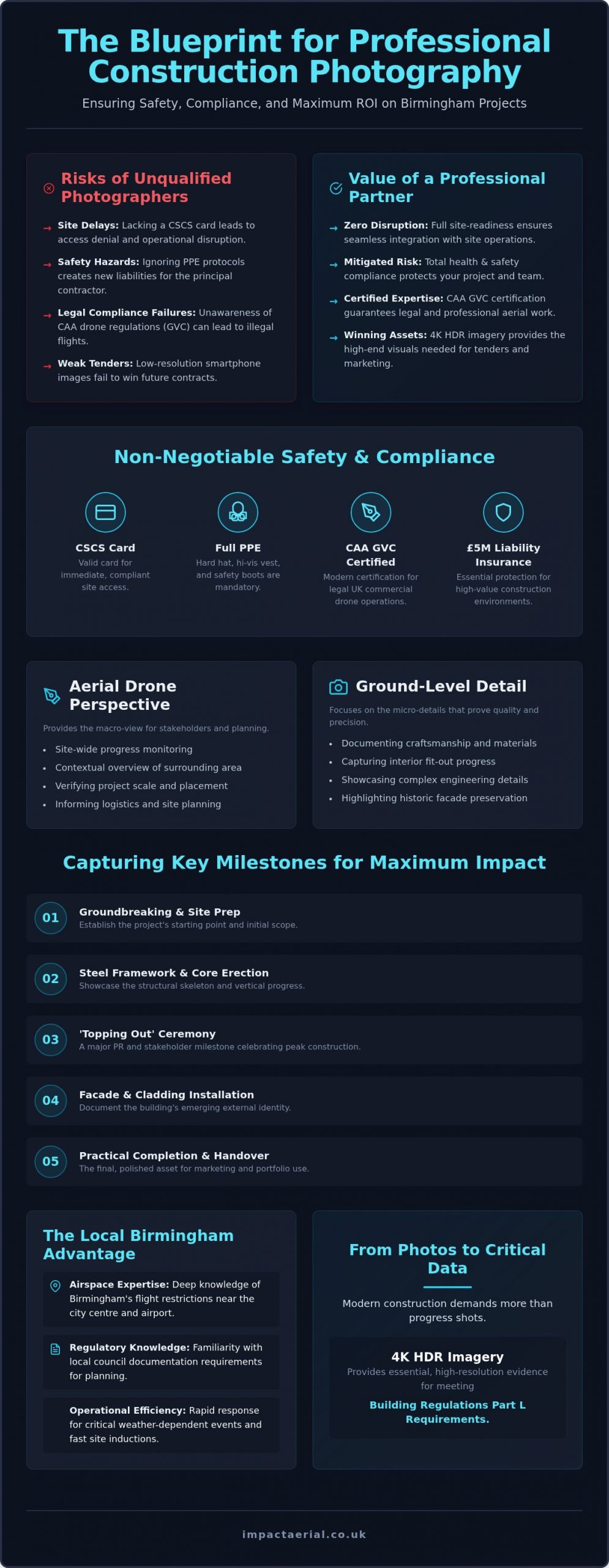
Drone vs. Ground Photography: Choosing the Right Approach
Effective site documentation requires a dual-perspective strategy. While ground-level work captures the intricate craftsmanship of a build, aerial views provide the context of scale and site planning. A specialist construction photographer birmingham developers engage should offer a hybrid service that blends these viewpoints. This approach ensures that 4K HDR imagery serves two distinct purposes: high-detail technical site assessments for engineers and compelling visual assets for marketing brochures and investor reports. Relying on a single perspective often leaves gaps in the project record, whereas a combined method provides a comprehensive narrative of the build’s evolution.
The Advantages of Aerial Site Monitoring
Aerial perspectives are transformative for tracking progress across large-scale West Midlands developments. Utilizing DJI Enterprise grade drones allows for precise site mapping and repeatable flight paths, providing consistent data for stakeholder reporting. These tools are invaluable for roof inspections and structural assessments of hard-to-reach areas, significantly reducing the need for scaffolding or manual climbing. All operations are conducted in strict accordance with UK drone regulations, ensuring that data collection is both legal and safe. By integrating aerial data into project management workflows, teams can identify potential logistical bottlenecks before they impact the construction schedule. This data-centric approach provides a level of site oversight that was previously impossible without significant expense.
Capturing the Human Element on Site
Ground-level photography complements aerial data by focusing on the technical engineering feats and the workforce behind them. These shots highlight specialized machinery in action and demonstrate a firm’s commitment to rigorous health and safety practices. Capturing the human element provides an authentic narrative for tender documents, showing the faces and skills driving the project forward. It’s these detailed images of craftsmanship that often resonate most with potential clients during the bidding process; for specialized surfacing contractors like Wolverhampton Driveways Ltd, this visual proof is essential for showcasing quality to regional developers.
As a project moves toward the final stages, the focus shifts to internal photography. Documenting completed residential and commercial spaces requires a different technical skill set, focusing on lighting and composition to showcase the internal fit-out. A construction photographer birmingham firms trust will manage this transition seamlessly, moving from the raw data of a structural build to the polished imagery required for a building’s handover. This comprehensive visual record is essential for long-term site monitoring and provides a powerful asset for future business development.
Planning Your Construction Shoot for Maximum ROI
Planning is the difference between a collection of random images and a strategic data asset. A professional construction photographer birmingham firms rely on will work closely with your project team to identify high-value moments that offer the best return on investment. This process begins by defining the primary purpose of the imagery. If the goal is a tender bid, the focus remains on technical precision and safety compliance. For social media or investor reports, the emphasis shifts toward the architectural aesthetic and the project’s impact on the West Midlands skyline.
Effective coordination with site managers ensures that photography occurs during peak activity without causing disruption to active trades. Scheduling visits around major milestones like groundbreaking, topping out, and final completion creates a cohesive narrative of the build. Post-production is the final stage of this value chain. Professional editing involves more than basic adjustments; it includes perspective correction and the removal of temporary site clutter to ensure the final imagery reflects a high-tier professional standard. A dedicated construction photographer birmingham specialist ensures these edits maintain the integrity of the structural data while enhancing the visual appeal.
The Construction Milestone Checklist
A structured approach to site visits provides a verifiable timeline for all stakeholders. Initial site surveys capture “before” shots that provide essential context for planning and insurance purposes. Regular monthly progress visits maintain transparency, allowing investors to see tangible development throughout the project lifecycle. The final phase focuses on architectural “hero” shots, which are critical for your company’s long-term marketing portfolio and future business development. These images are often the deciding factor when stakeholders review your past performance for upcoming tenders.
Maximising Value from a Single Site Visit
Efficiency is key on an active construction site. Capturing high-resolution stills and 4K video content simultaneously allows a single visit to serve multiple departments, from engineering to marketing. Prioritising high-impact areas, such as complex structural installations or unique architectural features, ensures you have engaging content for social media and press releases. Integrating virtual tour creation for internal showcases provides an immersive way for stakeholders to explore the site remotely, adding a layer of depth that standard photography cannot match.
By aligning your visual documentation with project milestones, you ensure every shutter click contributes to your firm’s growth. To begin planning your next project’s visual strategy, consider our professional construction site monitoring services to ensure total site transparency and high-end marketing output.
Impact Aerial: Birmingham’s Trusted Construction Photography Partner
Impact Aerial operates at the intersection of technical precision and visual excellence. As a leading construction photographer birmingham specialist, we understand that site documentation is far more than a collection of images; it’s a critical safety and data asset. Our operations are built on a foundation of CAA GVC certified pilots and £5m commercial liability insurance, providing the reassurance that your project is in expert hands. We utilize DJI Enterprise technology to capture 4K HDR data that serves both rigorous technical site assessments and high-end marketing requirements. This commitment to precision ensures that every West Midlands project we document meets the highest standards of professional accountability.
Being based in Birmingham allows us to act as a technical consultant for our clients rather than just a service provider. We understand the logistical nuances of the city, from the specific flight restrictions near the airport to the high-density requirements of the city centre. Our goal is to provide a seamless service that integrates with your existing site workflows, delivering high-quality visual data with zero operational disruption. This local expertise is why major contractors across the region choose us to manage their visual documentation strategies.
Expertise in the West Midlands Construction Sector
Our team has extensive experience navigating the unique challenges of the West Midlands construction sector. From documenting the structural evolution of HS2 and the Curzon Street development to supporting the large-scale regeneration projects defined by the “Big City Plan,” we provide a consistent visual record for local developers and project managers. We’ve worked on some of the city’s most iconic recent builds, ensuring that every phase of craftsmanship is recorded with absolute clarity. This track record of delivery across complex urban environments makes us the ideal partner for firms looking to showcase their capabilities in a competitive market. To understand how our regional expertise fits into a wider national context, you can learn more about our professional drone services in the UK.
Get a Quote for Your Birmingham Project
We provide transparent pricing models designed to scale with your project’s specific needs, whether you require a one-off milestone shoot or long-term monthly construction photographer birmingham monitoring. Every bespoke proposal we provide is comprehensive and includes the following as standard:
- Safety Documentation: Detailed site-specific RAMS and proof of £5m liability insurance.
- Operational Coordination: Direct liaison with site managers to ensure minimal trade disruption.
- Post-Production: High-resolution editing and perspective correction for an architectural aesthetic.
- Secure Delivery: Rapid turnaround of all 4K HDR assets via secure digital transfer.
Our Birmingham team is ready to assist with your next project. Contact us today for a bespoke site photography proposal and discover how high-tier visual documentation can support your site safety, monitoring, and business development goals.
Securing Your Project Legacy Through Precision Documentation
Birmingham’s skyline is changing rapidly, and the need for meticulous site documentation has never been more critical. By integrating professional imagery into your workflow, you ensure total compliance with modern safety standards while building a powerful visual asset for future tenders. Whether you’re navigating the complexities of city centre drone flight or documenting internal craftsmanship, the right technical partner provides the reassurance that every milestone is recorded with absolute clarity. It’s about turning visual data into a strategic advantage for your firm.
Selecting a specialist construction photographer birmingham firms can rely on means prioritising safety, precision, and regional expertise. Impact Aerial offers exactly that through our CAA GVC Certified Pilots and £5m Commercial Liability Insurance. Our Birmingham-Based Rapid Response Team is ready to capture your site’s evolution with zero operational disruption, ensuring that high-tier 4K HDR data is always available when stakeholders need it most.
Request a Bespoke Construction Photography Quote for Your Birmingham Site today to enhance your project monitoring and marketing output. We look forward to helping you showcase the high-tier quality of your West Midlands developments through expert visual storytelling.
Frequently Asked Questions
Do your construction photographers have CSCS cards?
Yes, all our pilots and photographers hold valid CSCS cards to ensure seamless access to your site. This certification demonstrates our commitment to health and safety awareness on active developments. We arrive fully equipped with the necessary PPE, including hard hats, safety boots, and high-visibility vests. By maintaining these standards, we ensure that our presence on your project never compromises your site’s safety protocols or operational efficiency.
Are you insured to fly drones on active construction sites in Birmingham?
We carry £5m commercial liability insurance specifically tailored for professional drone operations on complex urban sites. This level of coverage is a mandatory standard for major Birmingham projects and protects your interests against unforeseen incidents. Our insurance covers both ground-level work and aerial surveys. This provides the reassurance that your project remains fully indemnified while a construction photographer birmingham specialist documents your site’s progress from every angle.
What is the difference between a standard drone and a DJI Enterprise drone for construction?
DJI Enterprise drones are designed for technical data collection rather than simple creative filming. These models offer superior stability, high-resolution 4K HDR sensors, and RTK precision for accurate site mapping. Unlike consumer models, enterprise hardware can integrate with BIM workflows and provide the technical detail required for professional site monitoring. This ensures that the imagery we deliver serves as a reliable data asset for your engineering and management teams.
Can you provide both aerial and ground-level photography in one visit?
We offer a hybrid service that captures both ground-level craftsmanship and aerial perspectives in a single visit. This approach provides a comprehensive record of your project, from internal fit-outs to the overall site scale. Capturing these different viewpoints simultaneously is highly efficient and minimises trade disruption. It ensures your marketing team has a diverse bank of assets while your project managers receive the technical progress shots they require.
How quickly can I expect the edited photos after the site visit?
High-resolution edited imagery is typically delivered via a secure digital transfer within 48 hours of the site visit. We understand that stakeholder reporting and marketing deadlines are often time-sensitive. Our post-production process includes professional perspective correction and colour grading to ensure an architectural aesthetic. If your project requires a faster turnaround for a specific milestone or press release, we can often accommodate urgent requests through our Birmingham-based editing team.
Do you handle the risk assessments and CAA flight permissions?
We manage all site-specific Risk Assessments and Method Statements (RAMS) along with necessary CAA flight permissions. Our pilots are CAA GVC certified, meaning they have the advanced training required to coordinate legally in congested urban environments. We handle the complex logistics of flying near sensitive Birmingham infrastructure, such as rail lines or high-rise structures. This comprehensive management ensures that your aerial documentation is fully compliant with national aviation laws.
What happens if the weather is too poor for drone photography on the scheduled day?
If the weather conditions are unsafe for flight, we simply reschedule the session for the next available clear window at no additional cost. Safety is our non-negotiable priority, and we monitor local Birmingham forecasts closely leading up to every shoot. While ground-level photography can often proceed in minor rain, aerial work requires stable conditions. We maintain clear communication with site managers to ensure the new schedule aligns with your project’s milestones.
Can construction photography help my firm win more tenders?
Professional imagery is a powerful tool for proving your firm’s capability and safety standards during the tender process. High-quality 4K HDR shots demonstrate a track record of successful delivery and attention to detail that smartphone photos cannot match. Including professional site documentation in your bid shows potential clients that you take project monitoring and transparency seriously. A construction photographer birmingham specialist helps you build a compelling visual portfolio that secures investor trust.
Drone Progress Monitoring: Construction Tracking Guide
Did you know that 64% of UK construction firms with more than 50 employees now use aerial technology for project oversight? It’s a shift that reflects the industry’s need for faster, more reliable data. If you’ve spent hours on manual site walks only to find your reporting is still inconsistent or prone to human error, you’re not alone. Managing a complex build requires precision that traditional methods often struggle to provide. Integrating a professional drone for progress monitoring allows you to replace those tedious inspections with high-resolution, actionable data that keeps every stakeholder informed.
This guide explores how professional drone services provide the accurate, real-time insights needed to keep your projects on schedule and within budget. We’ll examine the transition from simple visual imagery to advanced survey data, including how digital twins and BIM integration can reduce site visit requirements for off-site stakeholders. By adopting a meticulous, safety-conscious approach to aerial data, you can detect deviations from the master plan early and mitigate risks before they become costly delays. From CAA regulations to the latest advancements in professional drone technology, we’ll cover everything you need to know about modern construction tracking.
Key Takeaways
- Move beyond simple photography to capture repeatable site intelligence that provides a consistent record of every project phase.
- Understand the technical transition from raw imagery to actionable survey data that integrates directly with your existing BIM workflows.
- Utilise a drone for progress monitoring to perform precise volumetric analysis and topographical surveys, reducing the need for manual site walks.
- Ensure project safety and legal compliance by verifying that pilots hold the correct CAA GVC certification and appropriate commercial liability insurance.
- Discover how commercial-grade DJI Enterprise hardware delivers the 4K HDR clarity required for high-tier visual documentation and stakeholder reporting.
What is Drone Progress Monitoring for Construction?
Drone progress monitoring is far more than just taking photographs from the sky. It’s the systematic use of an Unmanned Aerial Vehicle (UAV) to capture consistent, repeatable data across a construction site. In 2026, the UK industry has moved beyond simple imagery toward true site intelligence. This technical approach uses high-frequency aerial data to establish a Golden Thread of information. This digital record is now a critical standard for maintaining safety and accountability throughout a project’s lifecycle, ensuring that every structural decision is documented and traceable.
Professional drones provide a bird’s-eye view that manual surveys cannot match. They offer a comprehensive perspective of the entire site in a single flight, allowing project managers to spot logistical bottlenecks or safety risks that remain invisible from ground level. Adopting a drone for progress monitoring ensures every phase of the build is documented with commercial-grade precision. This isn’t just about seeing the site; it’s about having a reliable, high-resolution data stream that bridges the gap between the field and the office.
To better understand how these digital models are generated, watch this practical demonstration:
The Core Advantages Over Traditional Site Walks
Manual inspections are notoriously slow and prone to human error. Efficiency is a major driver for the switch to aerial tech; a qualified pilot can survey a 10-acre site in minutes, whereas a ground team might spend hours navigating the same terrain. Safety is another non-negotiable benefit. By deploying drones, you keep personnel out of active plant zones and away from hazardous heights or unstable excavations. Consistency is the final technical advantage. Adopting a professional drone for progress monitoring allows us to use automated flight paths to ensure identical viewpoints for every visit, creating perfect time-lapse comparisons that accurately track the master plan’s execution.
Stakeholder Transparency and Communication
Effective communication is often the biggest hurdle on large-scale UK developments. Providing off-site investors and owners with 4K HDR visual updates builds immediate trust and keeps stakeholders aligned without the need for constant travel. This reduction in site visits directly supports corporate sustainability goals and reduces project overheads. Additionally, these records are vital for dispute resolution. Having visual as-built evidence allows you to verify work completed and settle sub-contractor queries with objective, timestamped data rather than hearsay.
Technical Deliverables: Transforming Imagery into Actionable Data
Raw footage provides a visual record, but it lacks the spatial accuracy required for engineering decisions. A professional drone survey bridges this gap by converting pixels into precise coordinates. Using a high-specification drone for progress monitoring equipped with 4K HDR cameras allows project teams to identify minor snags or safety issues, such as missing edge protection or incorrect rebar placement, from a desktop. This transformation of imagery into actionable data is what enables modern construction sites to operate with such high levels of oversight. It moves the conversation from ‘what does it look like’ to ‘is it built correctly’.
Photogrammetry and Orthomosaic Maps
Photogrammetry is the science of making measurements from photographs. By stitching together hundreds of overlapping aerial images, we create an orthomosaic map. This is a distortion-free, top-down view of the entire site that is geometrically corrected to be as accurate as a traditional map. These 2D deliverables are invaluable for planning site logistics, managing material storage, and tracking plant movement. They provide a clear, measurable canvas for project managers to overlay design plans and verify ‘as-built’ progress against the master schedule. Because these maps are scaled and georeferenced, you can measure distances and areas directly on the digital file with confidence.
LiDAR and 3D Point Clouds
While photogrammetry is excellent for visual site documentation, LiDAR (Light Detection and Ranging) provides a deeper level of technical insight. LiDAR sensors emit laser pulses that penetrate vegetation and scaffolding, providing hyper-accurate terrain models even in complex environments. This data is processed into 3D point clouds, which act as high-fidelity digital twins of the structure. These models allow for the early detection of deviations that would be impossible to spot on a standard site walk.
Integrating these point clouds into Building Information Modelling (BIM) workflows, often via .rvt or .ifc formats, allows for the direct overlay of 3D structural models onto real-world foundations. This level of precision is why many firms now choose professional Construction Site Monitoring to ensure their digital and physical worlds remain perfectly aligned. By using these high-accuracy data formats, you can maintain a meticulous record of every structural phase, ensuring the Golden Thread of information remains unbroken throughout the build.
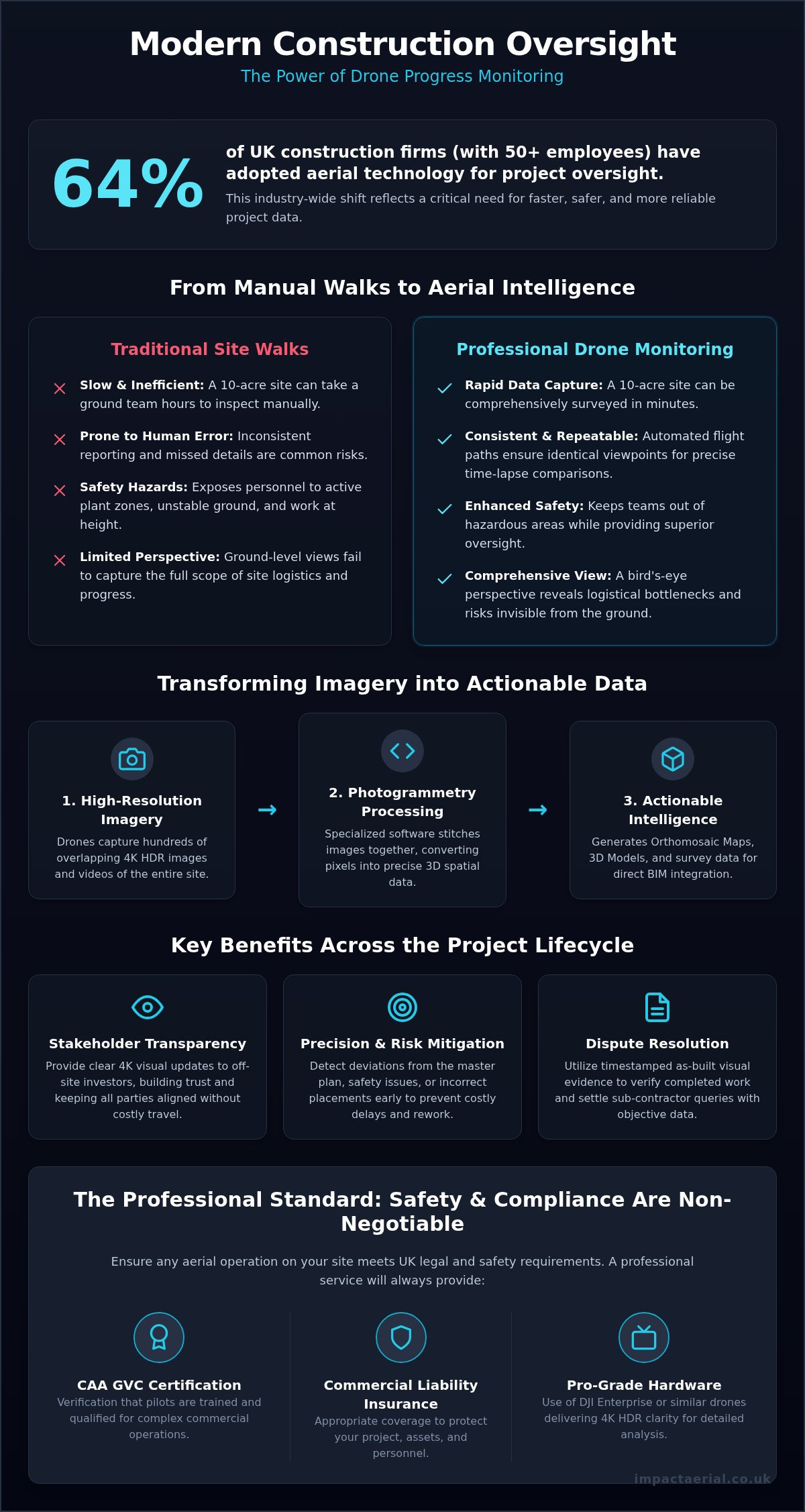
Strategic Applications Throughout the Project Lifecycle
Integrating a drone for progress monitoring offers a chronological record that matures alongside the project. This isn’t a one-off service but a strategic tool used from initial site appraisal to final handover. By capturing data at every major milestone, project managers maintain a continuous digital history that supports the Golden Thread of information required for modern UK developments. This ensures that every stakeholder has access to the same high-tier visual evidence at any point in the build.
In the pre-construction phase, a survey drone establishes a precise topographical baseline. This allows for accurate site planning and helps identify potential drainage or access issues before heavy machinery arrives. It ensures that the design team works with real-world elevations rather than outdated maps, reducing the risk of costly design revisions later in the schedule. Establishing this baseline is the first step in a data-centric approach to risk mitigation.
Volumetric Measurements and Earthworks
During groundworks, aerial data becomes essential for managing complex earthworks. We use photogrammetry to calculate stockpile volumes in seconds with high precision, removing the need for manual measurements on active sites. This data allows site managers to track excavation progress against design levels, which is critical for preventing over-digging and reducing expensive material waste. Improved material management ensures that cut-and-fill operations remain balanced, keeping the project on budget and ensuring plant equipment is used efficiently.
As the build moves into the structural phase, the focus shifts to monitoring steel frames, concrete pours, and facade installation. High-resolution imagery allows for the verification of structural alignment and the timing of key trades. It provides a clear record of sub-surface works before they’re covered, offering peace of mind for both contractors and clients. This transparency helps settle sub-contractor queries and ensures that work meets the specified quality standards before the next phase begins.
High-Resolution Snagging and Roof Inspections
During the final stages and handover, drones are the most efficient tool for creating comprehensive snagging lists. We use 4K zoom cameras to conduct detailed drone inspections of hard-to-reach areas like high-level cladding and roof membranes without the cost of scaffolding. This process documents the integrity of solar installations and waterproofing, creating a digital record for the O&M manual. Regular aerial audits after handover also support long-term maintenance, identifying issues like gutter blockages or thermal anomalies before they lead to structural damage.
UK Compliance: Why Professional Certification is Non-Negotiable
Operating a drone commercially in the UK is strictly regulated by the Civil Aviation Authority (CAA). For any construction firm, ensuring their provider holds a valid drone license is the first step in responsible site management. Using an unlicensed operator doesn’t just risk heavy fines; it invalidates insurance and creates significant liability for the main contractor. A professional drone for progress monitoring service must operate under a specific Operational Authorisation, which requires rigorous training and documented safety protocols.
The General Visual Line of Sight Certificate (GVC) is the industry standard for construction sites. It demonstrates that the pilot has the technical competency to handle hardware in complex, high-risk environments. Beyond the pilot’s skills, professional firms provide detailed Risk Assessments and Method Statements (RAMS) tailored to the specific hazards of an active site. This documentation ensures that aerial operations don’t interfere with cranes, plant machinery, or ground crews, maintaining a safe working environment for everyone involved.
High-value construction projects demand robust protection that consumer-grade policies cannot provide. We carry £5m commercial liability insurance as standard, providing the psychological comfort and financial security that Tier 1 contractors require. This level of coverage is a hallmark of a meticulous operator who understands the scale of modern development risks. It ensures that in the unlikely event of an incident, the project’s financial interests remain fully protected.
This comprehensive approach to risk management often extends to ground assets, where insurance approved vehicle tracker installation UK provides an additional layer of security for the high-value plant machinery used across the site.
Managing CAA Regulations in Urban Environments
Flying in congested areas like Birmingham or London requires advanced planning and strict adherence to ground safety zones. Pilots must navigate complex airspace restrictions and coordinate with local authorities when necessary. A CAA GVC certified pilot is legally required for most commercial site monitoring to ensure flights remain compliant with UK law. The pilot’s role extends beyond the controls; they manage the safety of the public and site personnel by establishing clear take-off and landing areas and maintaining a sterile flight zone.
Data Security and Privacy (GDPR)
Capturing high-resolution imagery for a drone for progress monitoring schedule near public highways or residential areas triggers strict GDPR requirements. Professional firms implement clear protocols to manage privacy concerns, such as blurring faces or car registrations when they appear in the background of site data. Secure data storage and encrypted sharing platforms are non-negotiable for sensitive project information. We ensure all data handling aligns with UK data protection laws, protecting the project’s reputation and legal standing from initial capture to final archiving.
To ensure your next project meets these rigorous safety and legal standards, partner with a CAA-certified drone specialist today.
Implementing Drone Progress Monitoring with Impact Aerial
Impact Aerial provides a managed service that removes the operational and regulatory burden from your project team. We offer bespoke schedules tailored to the specific complexity of your build, whether you require weekly, fortnightly, or monthly data captures to meet your reporting deadlines. By deploying a professional drone for progress monitoring, we ensure that your site intelligence is consistent, repeatable, and high-quality. Our use of commercial-grade DJI Enterprise hardware ensures that every aerial filming drone mission delivers superior 4K HDR output. This provides the technical clarity needed for identifying minor snags and safety issues while also creating high-end visual assets for stakeholder presentations.
Our Professional Workflow
Our professional workflow begins with a comprehensive site audit and the establishment of fixed Ground Control Points (GCPs). These physical markers are essential for achieving centimetre-level accuracy and ensuring that data captured across months or years can be perfectly overlaid for precise time-lapse comparisons. We use advanced automated flight planning to maintain identical camera angles, heights, and speeds throughout the project’s duration. This meticulous approach allows us to deliver rapid data turnarounds, providing you with ready-to-use reports and videos that integrate seamlessly with your existing project management or BIM platforms. We don’t just provide raw data; we handle the post-production and analysis to ensure you receive actionable intelligence.
Why Choose a UK-Based Specialist?
Choosing a UK-based specialist offers strategic advantages that self-service software platforms often lack. Based in the West Midlands, we provide nationwide UK coverage and possess deep local knowledge of regional airspace regulations and safety standards. You gain direct access to our senior pilots and data analysts who provide expert oversight on every flight. This human-in-the-loop approach means that your data is interpreted by specialists who understand the nuances of UK construction, rather than relying solely on automated AI algorithms. Getting started is straightforward. We begin with an initial consultation and a detailed site feasibility study to ensure the most effective data capture strategy for your specific location and project goals. You can contact our team to request a tailored aerial filming price UK for your specific project.
Advancing Site Intelligence with Professional Aerial Data
Adopting a professional drone for progress monitoring is no longer just a visual luxury; it’s a critical component of the modern construction workflow. By transitioning from simple snapshots to actionable, survey-grade data, you establish a reliable Golden Thread of information that spans the entire project lifecycle. This technical oversight improves stakeholder transparency, reduces manual site walk requirements, and ensures that deviations from the master plan are detected before they become costly delays.
Impact Aerial provides the meticulous, safety-conscious support required for high-value UK developments. Our team of CAA GVC certified pilots utilizes high-tier DJI Enterprise technology and carries £5m commercial liability insurance to ensure your project remains compliant and protected. We handle everything from automated flight planning to post-production, delivering the precise site intelligence you need to stay on schedule.
Request a Professional Site Monitoring Quote from Impact Aerial today to secure high-resolution documentation for your next build. We’re ready to help you optimize your site oversight with precision and reliability.
Frequently Asked Questions
How often should drones fly for construction progress monitoring?
Weekly, fortnightly, or monthly intervals are the industry standard. Fast-paced phases like groundworks often require weekly flights to track rapid volumetric changes and earthworks. For long-term structural builds, monthly visits are usually sufficient to provide a reliable record. Consistent scheduling is vital for creating accurate time-lapse comparisons using a drone for progress monitoring.
Are drones for progress monitoring legal in UK cities?
Yes, they’re legal provided the operator holds a valid CAA GVC and follows strict safety protocols. Urban environments like Birmingham or London require meticulous planning and detailed RAMS. We manage all airspace permissions and ground safety zones to ensure every flight remains fully compliant with UK law and doesn’t disrupt the surrounding public.
Can drone data be integrated with BIM software like Revit?
Yes, professional drone data integrates directly with BIM platforms like Revit. We provide exports in industry-standard formats such as .rvt or .ifc. This allows project teams to overlay 3D structural models onto real-world point clouds. It’s a powerful way to ensure the physical build matches the original design and identifies deviations early.
What is the accuracy of drone-based volumetric measurements?
Drone-based volumetrics provide centimetre-level accuracy when using professional-grade hardware. By establishing fixed Ground Control Points (GCPs) and using RTK-enabled drones, we achieve results that far exceed traditional manual estimates. This precision is essential for managing cut-and-fill operations and tracking material stockpiles with confidence throughout the project lifecycle.
Do I need to clear the site before a drone survey takes place?
You don’t need to clear the site or stop work during the flight. Drones are designed to document active construction environments without causing disruption to ground crews. We only require a small, sterile take-off and landing zone. Pre-flight briefings ensure that plant operators and site personnel are aware of the aerial activity.
How much does a professional drone progress monitoring service cost?
Pricing depends on site complexity, flight frequency, and the specific technical deliverables you require. Factors like the total site acreage and the choice between LiDAR or photogrammetry also influence the final investment. We recommend an initial consultation to establish a bespoke monitoring schedule that fits your project’s specific budget and reporting needs.
What happens if the weather is too poor for a scheduled flight?
Safety is our primary concern, so we don’t fly in heavy rain or high winds. If the weather exceeds the operational limits of our DJI Enterprise hardware, we simply reschedule the flight for the next available clear window. There’s typically no additional charge for weather-related delays, ensuring your project documentation remains consistent.
Is the data captured by drones secure and GDPR compliant?
Data security is managed through encrypted storage and strict handling protocols. We ensure all captures are GDPR compliant by anonymising any public faces or car registrations that appear outside the site boundary. This meticulous approach protects your sensitive project information and ensures full compliance with UK data protection laws from capture to archiving.
Drone Filming for Ads: Cinematic Marketing Guide 2026
In 2026, a high-end marketing campaign without aerial perspectives isn’t just missing a shot; it’s missing the scale and prestige that modern audiences demand. You likely already recognize that capturing attention in a crowded digital space requires more than standard ground-level footage. Yet, the logistical hurdles of CAA compliance and the genuine risk of legal fines often make the leap into drone filming for advertising feel like a complex operational minefield. It’s natural to feel uncertain about whether the ROI justifies the perceived risks of aerial work, especially when looking for reliable, insured specialists in the West Midlands.
This guide provides the clarity you need to elevate your brand with professional aerial content while ensuring absolute peace of mind. We’ll show you how to move from creative strategy to award-winning cinematic footage through a meticulous, safety-first approach. You’ll discover the essentials of UK flight regulations, the benefits of working with CAA GVC certified pilots, and how to choose a reliable partner who manages every detail from the initial risk assessment to the final edit. By the end of this article, you’ll have a clear roadmap for achieving seamless project management and high-tier visual quality without compromising on safety or insurance standards.
Key Takeaways
- Understand how aerial perspectives create high-scale, emotive brand stories that increase viewer engagement and “scroll-stop” potential in the 2026 digital market.
- Master the technical requirements for high-end output, including the use of 4K HDR for professional colour grading and FPV drones for immersive, high-speed sequences.
- Learn why CAA GVC certification and comprehensive liability insurance are non-negotiable for legal safety when commissioning drone filming for advertising.
- Follow a structured workflow that integrates creative consultation and meticulous pre-flight planning with professional post-production services.
- Identify how to select a production partner that balances rigorous safety protocols with high-tier cinematic output for projects across the UK.
The Evolution of Drone Filming for Advertising in 2026
Professional drone filming for advertising in 2026 is defined by the use of Unmanned Aerial Vehicles (UAVs) to capture high-scale, emotive brand stories that were previously cost-prohibitive. While the history of aerial videography began with fixed-wing aircraft and restrictive crane setups, modern technology allows for fluid, cinematic motion that anchors a viewer’s attention instantly. This “scroll-stop” potential is critical for digital marketing. Audiences aren’t just looking for height; they demand technical precision and narrative depth.
The Impact Aerial approach moves beyond the simple capture of raw footage. We focus on cinematic storytelling that integrates technical surveying precision with creative vision. This strategic shift ensures that drone filming for advertising isn’t just a visual flourish but a core component of the brand’s identity. By moving from a novelty “gimmick” to an essential marketing tool, aerial content now drives measurable results across property, construction, and tourism sectors.
Breaking the 2D Barrier: Why Aerial Visuals Win
The “God’s eye view” provides a psychological sense of scale and authority that ground-level shots cannot replicate. It changes how consumers perceive a brand’s stature. Traditional crane shots are limited by physical tracks and height constraints, whereas drones offer 360-degree flexibility. In property advertising, using 4K HDR aerials provides a significant advantage. High dynamic range preserves detail in both bright skies and shadowed architecture, creating a polished, high-tier aesthetic. This visual quality directly correlates with higher engagement rates on listing platforms, as it presents a more comprehensive and professional view of the asset.
Key Industries Leading the Drone Ad Revolution
Several sectors have transitioned to using drones as an operational necessity for their marketing and documentation needs. The precision of modern hardware allows for data-rich visuals that serve multiple purposes.
- Commercial Real Estate: Aerial views showcase a property’s scale and its proximity to vital infrastructure, providing vital context for investors and tenants.
- Construction: Beyond site monitoring, high-resolution footage documents progress for stakeholder marketing, turning a technical site into a compelling story of growth.
- Tourism and Leisure: Luxury destinations use drones to create immersive virtual tours, allowing potential guests to experience the layout and surroundings of a resort before booking.
These applications demonstrate that aerial perspectives are no longer optional for businesses looking to project a sense of leadership and quality. The ability to capture expansive environments in a single shot provides a level of clarity that traditional photography simply lacks.
Technical Mastery: 4K HDR, FPV, and Beyond
High-end drone filming for advertising requires more than just a 4K sensor. In 2026, the industry standard for professional colour grading is 4K HDR captured at high bitrates. This technical specification ensures that every frame contains enough data for post-production teams to manipulate lighting and shadows without degrading the image quality. Consumer-grade drones often produce “baked-in” looks that restrict creative freedom during the edit. By using professional hardware, we capture a wide dynamic range that makes your brand content look cinematic on any screen, from mobile devices to large-scale digital billboards.
DJI Enterprise Hardware: The Professional Choice
Consumer drones are impressive, but they lack the redundancy and sensor size needed for high-stakes commercial shoots. We utilize DJI Enterprise hardware because it offers superior flight stability and interchangeable lenses. These specialized sensors capture intricate architectural details that smaller drones simply miss. This reliability is a cornerstone of our service. While international benchmarks like FAA Part 107 regulations set a high bar for commercial pilots in the US, our UK operations follow strict CAA GVC protocols to protect your reputation and your production budget.
Stabilisation is equally vital, especially given the unpredictable UK weather. Professional gimbals and high wind-resistance ratings on enterprise-grade equipment ensure buttery-smooth footage even in challenging West Midlands conditions. This hardware allows us to maintain a steady frame where smaller drones would struggle with vibration or drift, ensuring your final ad looks polished and professional.
FPV vs. Standard Cinematic Drones
The choice between First Person View (FPV) and standard cinematic drones depends on your narrative goals. FPV drones are a major trend for 2026, offering high-speed, immersive “one-take” shots that can fly through tight spaces or follow fast-moving subjects with precision. They’re the ideal choice for high-energy automotive or sports brands aiming for viral success on platforms like TikTok, where services from Greedier Social Media can help amplify their reach. In contrast, standard cinematic drones remain the best tool for smooth, sweeping vistas and property showcases where stability and composure are the priority.
Combining these styles creates a multi-layered marketing production that keeps viewers engaged. We also integrate data collection into visual assets; for instance, construction site monitoring data can be transformed into compelling visual marketing for stakeholders. If you’re planning a complex shoot, exploring our post-production services can help you understand how we refine this raw aerial data into a finished cinematic masterpiece.
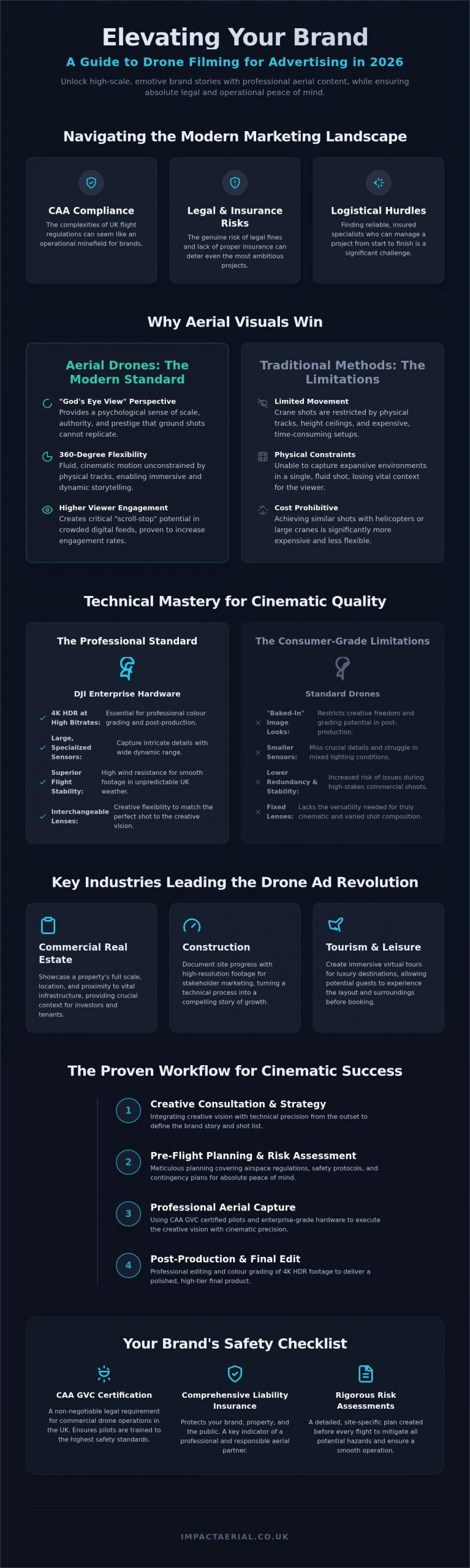
Why Professional Services Trump DIY: Compliance and Safety
While the technical capabilities of modern hardware are impressive, the operational side of drone filming for advertising carries significant legal and financial weight. Attempting an “in-house” shoot with a consumer drone might seem cost-effective, but it exposes your brand to hidden risks. These include substantial Civil Aviation Authority (CAA) fines, the voiding of standard business insurance, and irreparable reputational damage if an incident occurs. In 2026, the distinction between a hobbyist and a professional is defined by rigorous adherence to safety protocols and official certification.
Navigating UK Drone Laws in 2026
The regulatory environment has evolved to prioritise safety in increasingly crowded skies. To operate legally for commercial gain, pilots must hold a valid UK drone license, specifically the General Visual Line of Sight Certificate (GVC). This isn’t just a formality; it’s a demonstration of competency in flight safety, meteorology, and navigation. Unlike hobbyist flyers, GVC-certified pilots are trained to manage complex flight paths and secure the necessary permissions for congested areas.
Filming in urban centres like Birmingham or London requires specific notifications and, in many cases, coordination with local authorities or air traffic control. Professionals manage these logistics as part of the pre-flight workflow, ensuring that your production doesn’t face mid-shoot shutdowns or legal repercussions. We handle the entire notification process, providing you with a documented audit trail of compliance.
Insurance and Liability: Protecting Your Brand
Standard public liability insurance rarely covers commercial drone operations. For high-stakes drone filming for advertising, £5m commercial liability insurance is the industry minimum. This level of coverage is essential for protecting your brand and the public during shoots in public spaces or near high-value assets. If an uncertified or uninsured pilot causes property damage or injury, the financial and legal liability often falls back on the commissioning brand.
At Impact Aerial, we mitigate these risks through a structured safety-first approach:
- Site-Specific Risk Assessments: Every location undergoes a detailed evaluation to identify potential hazards and flight obstacles.
- CAA-Compliant Operations: Our pilots maintain strict adherence to the latest flight safety standards and operational limits.
- Verified Insurance: We provide proof of our £5m commercial liability coverage before any hardware leaves the ground.
This meticulousness provides the psychological comfort and tangible security required for modern corporate campaigns. You can focus on the creative vision while we handle the operational complexities that keep your project legal and safe.
The Advertising Workflow: From Concept to Post-Production
Successful drone filming for advertising relies on a structured, five-stage workflow that prioritises creative intent and operational safety. Unlike hobbyist flights, a professional commercial shoot is a coordinated effort between the creative director and the flight team. We ensure that every flight path serves the brand’s narrative while adhering to strict UK aviation standards. This methodical approach minimises on-site delays and ensures that the final assets meet high-tier broadcast requirements.
- Step 1: Consultation and Storyboarding. We align the aerial sequences with your creative vision, identifying key “hero shots” that will define the campaign’s scale.
- Step 2: Pre-flight Planning. This involves site surveys and mandatory CAA notification. We handle the logistics of flight permissions, particularly in restricted or urban environments.
- Step 3: The Shoot. Managing light, wind, and multiple flight paths requires precision. Our pilots monitor environmental variables in real-time to ensure the smoothest possible footage.
- Step 4: Post-production. Raw 4K HDR data undergoes colour grading, sound design, and, where necessary, 3D integration to create a polished final product.
- Step 5: Asset Delivery. We provide multi-format files optimised for social media, web platforms, and television advertising.
Cinematic Editing and Colour Grading
Raw aerial footage is simply the foundation. To transform it into a compelling brand story, our post-production team uses professional grading suites to refine the 4K HDR data. It’s vital to ensure a seamless visual transition when matching aerial sequences with ground-based video production services. You don’t want a jarring shift in colour or texture between shots. Sound design also plays a critical role; adding immersive audio layers can transform a standard flyover into a high-impact cinematic experience that resonates with your audience.
Beyond Video: Virtual Tours and 3D Models
Aerial data offers versatility beyond traditional video ads. By integrating high-resolution stills into interactive virtual tour creation, we help marketing teams increase time-on-page for luxury properties and leisure destinations. For construction and development projects, we use drone-captured data to create 3D renders of unbuilt structures. These immersive formats provide stakeholders with a realistic view of future developments, making them powerful tools for pre-sales and investor relations. If you’re ready to plan your next campaign, book a consultation with our Birmingham-based specialists to discuss your production timeline.
Choosing Your Partner: Why Impact Aerial for Advertising?
Impact Aerial stands at the intersection of technical surveying precision and cinematic artistry. While many operators focus solely on the visual, our background in technical data capture ensures a level of flight accuracy and operational discipline that others lack. This meticulousness is vital for drone filming for advertising, where every second of footage must align perfectly with a pre-defined storyboard and brand aesthetic. Based in Birmingham, we leverage our deep roots in the West Midlands to provide nationwide operational reach, ensuring your production receives the same high-tier quality regardless of the UK location.
Our “Peace of Mind” guarantee is built on three pillars: full certification, comprehensive insurance, and total compliance. We don’t just fly drones; we manage the entire operational risk for your project. With £5m in commercial liability insurance and CAA GVC certified pilots, we provide the reassurance that your brand is protected against the legal and financial pitfalls inherent in aerial work. Our end-to-end project management respects the strict deadlines and budgets of the marketing industry, delivering polished 4K HDR assets without the friction of logistical failures.
Bespoke Solutions for Agencies and Brands
We understand that every agency has a unique creative brief. We tailor our flight plans to meet your specific visual requirements, whether you need high-energy FPV sequences for an automotive ad or slow, sweeping vistas for a luxury property showcase. We collaborate directly with your internal marketing teams to ensure our output integrates seamlessly into your wider campaign workflow. For those looking to refine their digital platform to match this high-end aesthetic, you can learn more about professional branding and web design services in the Birmingham area. Impact Aerial remains dedicated to delivering industry-leading visual perspectives through a framework of absolute safety and technical excellence in 2026.
Get Started: Planning Your 2026 Campaign
Planning a successful campaign requires early coordination to secure flight windows and necessary permissions, especially in congested urban areas. During an initial consultation, we’ll discuss your project location, the desired visual style, and any specific site constraints. This allows us to provide a detailed, tailored quote that covers every aspect of the production, from the initial risk assessment to final post-production editing. Our team handles the technical complexity so you can focus on the creative impact of your advertisement.
Ready to elevate your brand’s perspective? Request a professional drone filming quote from Impact Aerial today and discover how our certified expertise can transform your next marketing project into a cinematic success.
Securing Your Brand’s Visual Future in 2026
Effective drone filming for advertising in 2026 requires more than just high-resolution hardware; it demands a meticulous integration of creative vision and regulatory rigour. You’ve seen how 4K HDR cinematography and FPV technology can transform a standard ad into an immersive brand experience. Yet, the true value of a professional partnership lies in the operational security provided by CAA GVC Certified Pilots and £5m Commercial Liability Insurance. These standards aren’t just checkboxes; they’re the foundation of a successful, risk-free production.
By choosing a specialist with an Expert Post-Production Suite, you ensure that every frame of your aerial footage is polished to a broadcast standard. Whether you’re documenting a construction milestone or showcasing a luxury destination, the right partner manages the complexities of UK flight laws so you don’t have to. You’re now equipped with the roadmap to execute a compliant, high-impact campaign that resonates with modern audiences. Elevate your brand with professional drone filming – Contact Impact Aerial to begin planning your next cinematic project. It’s time to give your brand the perspective it deserves.
Frequently Asked Questions
Do I need a special permit for drone filming for advertising in the UK?
Yes, any drone filming for advertising in the UK requires a pilot with a valid CAA GVC certification. This legal requirement distinguishes professional commercial flights from hobbyist activities. Our pilots hold all necessary credentials to operate legally within the UK’s regulatory framework. This certification ensures that your production remains compliant with the latest aviation standards, protecting your brand from potential legal fines or reputational damage.
How much does professional drone filming cost for a marketing campaign?
Professional drone filming for advertising costs are determined by the specific requirements of your campaign, such as location complexity and post-production needs. We don’t offer generic pricing because every marketing project has unique operational variables. Instead, we provide a tailored quote following a consultation. This approach ensures you only pay for the specific expertise and hardware required to achieve your desired cinematic outcome while maintaining our strict safety standards.
Can drones film in 4K HDR for high-end television commercials?
Yes, our DJI Enterprise hardware captures native 4K HDR footage specifically designed for high-end television commercials and digital billboards. This high dynamic range is essential for professional colour grading, allowing editors to pull detail from shadows and highlights. It ensures your aerial content matches the visual quality of ground-based cameras, providing a seamless and polished aesthetic for your brand’s most important marketing assets.
What happens if the weather is bad on the day of the drone shoot?
We monitor local meteorological data leading up to your shoot and’ll reschedule if wind or rain exceeds safe operational limits. While our enterprise-grade drones have high wind resistance, we prioritise safety and visual clarity above all else. Rescheduling ensures that we capture the best possible light and stable footage. We coordinate closely with your team to find the earliest possible alternative date to keep your project on track.
Is it legal to film with a drone over people or busy city centres?
Filming in congested areas or over people is legal only when managed by a certified professional with the correct risk assessments and CAA notifications. We handle all the necessary permissions for urban environments like Birmingham or London. Our pilots implement strict safety cordons and flight path protocols to mitigate risks. This meticulous planning allows us to capture stunning urban perspectives while ensuring total compliance with UK flight regulations.
What is the difference between a hobbyist drone and a professional enterprise drone?
Professional enterprise drones feature larger sensors, redundant flight systems, and superior stability compared to hobbyist models. These machines are built for the rigours of commercial work, offering interchangeable lenses and high bitrates for superior image data. While consumer drones are capable of basic video, they lack the reliability and technical depth required for high-stakes advertising productions where equipment failure isn’t an option.
How long does the post-production process take for drone video?
The post-production timeline varies based on the complexity of the edit, colour grading requirements, and any 3D data integration. Simple sequences may be ready within a few days, while complex commercials involving sound design and multi-format delivery take longer. We provide a clear delivery schedule during the planning phase. This ensures your marketing team can manage launch deadlines with confidence while we refine the raw aerial data into a finished asset.
Why is CAA GVC certification important for my business?
CAA GVC certification is essential because it proves the pilot has met the national competency standards for safe commercial flight. For your business, hiring a certified pilot is the only way to ensure your commercial liability insurance remains valid. It provides psychological comfort that your project’s being handled by a technical specialist who understands the legalities of the UK’s airspace, protecting your brand from significant liability.
The Hotelier’s Guide to Aerial Photography: Elevating Your Property’s Visual Identity in 2026
Did you know that hotel listings featuring professional drone photography see a 312% higher click-through rate on Google Hotels in 2026? As a hotelier, you’ve likely realized that standard ground-level photography often fails to communicate the true scale of your property or its stunning surroundings. You might feel hesitant about the logistics, worrying that a drone flight could disrupt guest privacy or that hiring an unlicensed pilot might lead to legal repercussions. These are valid concerns in an industry where reputation is everything.
This guide demonstrates how partnering with a professional aerial photographer can solve these challenges, transforming your visual identity and driving direct bookings. We’ll cover how to ensure a safe, compliant shoot that respects the guest experience while delivering high-impact content for your digital channels. From understanding current CAA GVC certification to leveraging the 2026 trend of “ambient realism,” you’ll learn how to elevate your property’s marketing through technical precision and expert storytelling.
Key Takeaways
- Learn why shifting from static amenity lists to experiential aerial storytelling is essential for capturing a property’s true sense of place and surrounding landscape.
- Explore the impact of 4K HDR cinematic video and FPV fly-throughs in creating immersive transitions that showcase your hotel’s scale and luxury suites.
- Understand the critical safety protocols and legal requirements, such as CAA GVC certification and £5m liability insurance, when a hotelier hires an aerial photographer.
- Discover a practical pre-flight checklist to optimize lighting and property presentation while ensuring minimal disruption to the guest experience.
- Gain insights into the professional post-production process that transforms raw aerial footage into high-conversion visual assets for your digital marketing channels.
Why Every Modern Hotelier Needs a Professional Aerial Photographer
The hospitality industry has moved past the era of simple amenity lists. Today, a successful hotelier understands that guests are looking for “experiential storytelling.” They want to see how a property fits into the wider landscape. Ground-level photography, while necessary for room details, is physically limited. It cannot show the sweeping coastline just beyond the dunes or the proximity of a city-center hotel to iconic landmarks. High-altitude perspectives bridge this gap, providing a comprehensive “sense of place” that static photos miss.
While the technical history of what is aerial photography involves specialized equipment and fixed-wing aircraft, modern drone technology allows for precise, low-altitude maneuvers that were previously impossible. This precision is vital for creating a narrative. When a potential guest sees a cinematic fly-over of your estate, they aren’t just looking at a building; they’re visualizing their arrival. This emotional connection is a proven driver of revenue. According to June 2026 data, hotel listings with professional image galleries, including drone photography, see 312% higher click-through rates on Google Hotels.
Capturing the Scale of Luxury Estates
For properties with extensive grounds, a professional aerial photographer is indispensable. If your hotel features a championship golf course, multiple outdoor spa facilities, or sprawling gardens, a ground-level shot only captures a fraction of the value. Aerial filming allows you to visualize the entire guest journey. We use 4K HDR DJI Enterprise drones to create “hero shots” that define your brand identity. These shots act as a visual anchor for your website, immediately communicating the prestige and scale of the estate to high-value clientele.
Differentiating Your Property in a Saturated Market
Strategic Visual Content: Beyond Standard Drone Stills
A modern hotelier shouldn’t settle for raw aerial footage. While travelers often post shaky drone clips on social media, these lack the commercial polish needed to drive direct bookings. We focus on 4K HDR cinematic video specifically designed for high-impact promotional films. In 2026, short-form vertical video delivers engagement rates up to 4.7 times higher than traditional photo ads. This content isn’t just filler; it’s a strategic tool for TikTok and Instagram Reels that showcases your property’s atmosphere with technical precision and professional grading.
For large-format marketing, such as exhibition stands or high-end print brochures, high-resolution stills are a requirement. We capture imagery using DJI Enterprise hardware that retains clarity even when scaled for billboard-sized displays. This level of detail requires professional-grade sensors and a deep understanding of commercial drone regulations to ensure every flight is executed safely and legally. Quality stills provide the “ambient realism” that 2026 consumers crave, moving away from overly polished AI images toward authentic, high-fidelity captures of your property.
FPV Drones: The New Standard for Hospitality Interior Tours
FPV (First Person View) drones represent a significant leap in hospitality marketing. Unlike traditional drones that are often restricted to wide outdoor shots, FPV systems allow a skilled aerial photographer to fly through the heart of your hotel. This technology creates a natural, bird’s-eye perspective that feels more organic than handheld gimbal shots. We can navigate narrow corridors, glide through high-ceilinged ballrooms, and execute immersive indoor-to-outdoor transitions with centimeter-level accuracy. Imagine a single, continuous shot that starts at the concierge desk, sweeps through the lobby, and exits through a balcony to reveal a coastal sunset. This one-shot narrative connects the guest journey in a way that traditional editing cannot.
Immersive Virtual Tours for Event Planners
Corporate and wedding planners require more than just pretty pictures; they need spatial data. By integrating aerial perspectives into Virtual Tours Creation, we help clients visualize outdoor event setups from their desks. Luxury resorts have reported booking inquiry increases of over 290% after adding these AI-enhanced previews. These interactive 360-degree views allow planners to measure distances between outdoor marquees or map out guest flow across your grounds. It transforms your website from a gallery into a functional sales tool. Considering how these assets can fit into your 2026 strategy? Our team provides comprehensive Virtual Tours Creation that integrates seamlessly with your existing booking engine.
For hoteliers looking to capture the romance of their wedding facilities, partnering with specialists like The Photography Co ensures that the high-altitude scale is matched by expert ground-level detail.
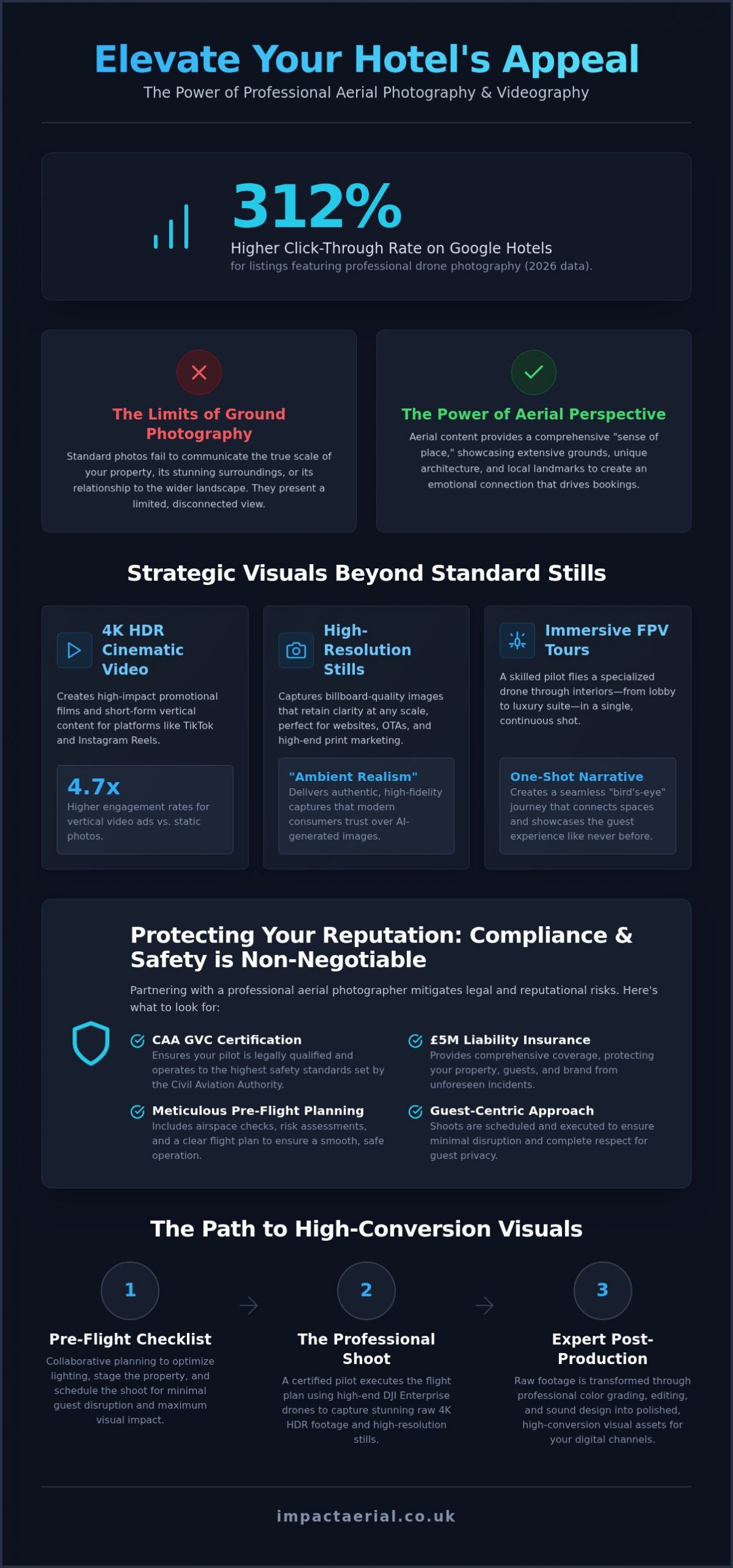
Compliance and Safety: Protecting the Hotelier and the Guest
A responsible hotelier knows that a high-impact visual marketing campaign shouldn’t come at the cost of legal exposure. When you hire a professional aerial photographer, you aren’t just paying for a camera in the sky; you’re investing in a compliant operation that prioritizes the safety of your guests, staff, and physical assets. In the UK, commercial drone work is strictly regulated by the Civil Aviation Authority (CAA). Operating without the correct authorizations can lead to heavy fines and, more importantly, could invalidate your property’s existing insurance policies if an incident occurs.
Privacy is a paramount concern in the hospitality sector, particularly for luxury estates where guest anonymity is part of the service. Professional operators adhere to strict UK GDPR and Information Commissioner’s Office (ICO) guidelines. We use technical measures, such as flight path planning that avoids guest balconies and pool decks, to ensure that our presence is unobtrusive. Any incidental capture of people or sensitive data is managed during our post-production process, where faces and license plates are obscured to maintain total privacy.
Understanding CAA Regulations for Built-Up Areas
Flying a drone near a hotel often involves navigating complex environments with public roads and neighboring properties. Professional pilots are trained to manage these risks through meticulous site surveys and the use of ground-based observers. Maintaining UK Drone License compliance is a legal necessity for any commercial activity in 2026. Choosing an unlicensed “hobbyist” pilot puts your hotel’s reputation at risk, as the CAA actively monitors unauthorized commercial flights. A certified professional understands the nuances of the “Open” and “Specific” categories, ensuring your shoot stays within the law.
Insurance and Risk Mitigation
Standard hobbyist insurance is insufficient for the complexities of a hotel property. Professional drone operators carry £5m Public Liability Insurance as a baseline industry standard. This commercial-grade coverage is designed specifically for aviation risks and protects the hotel against third-party property damage or injury. Before the first propeller turns, we develop a site-specific flight plan that identifies safe take-off zones and emergency landing procedures. The GVC certification serves as the gold standard for UK commercial drone pilots in 2026, confirming their ability to operate safely in challenging environments. This methodical approach ensures the shoot is a seamless addition to your property’s daily operations rather than a disruption to the guest experience.
The Pre-Flight Checklist: Preparing Your Hotel for a Shoot
A successful aerial shoot requires more than just clear skies. It demands meticulous coordination between the hotelier and the drone team to ensure the property looks its best without compromising operational efficiency. Timing is the first logistical hurdle. We typically schedule flights during “Golden Hour,” the period shortly after sunrise or before sunset, to capture the soft, cinematic lighting that highlights architectural textures. This timing often coincides with lower guest activity on grounds and balconies, which simplifies privacy management and ensures a cleaner visual frame.
Beyond aesthetics, we manage the technical logistics of airspace. If your property is located near an airport or restricted site, we handle the necessary permissions and flight notifications with the relevant aviation authorities. This pre-flight diligence ensures the shoot is legally compliant and won’t be interrupted by local law enforcement or air traffic control. By acting as a technical consultant, we remove the regulatory burden from your management team, allowing you to focus on property presentation.
Site Preparation and Aesthetics
To achieve high-end visual output, every detail of the property must be pristine. We recommend a final walkthrough with your groundskeeping and housekeeping teams on the morning of the shoot. Ensure that all outdoor furniture is perfectly aligned, pool covers are removed, and the water is crystal clear. For dusk shots, coordinate with maintenance to ensure all exterior lighting is functional and turned on. Removing staff vehicles, delivery vans, or maintenance equipment from the main driveway is also essential to maintain the “hero shot” look. These small adjustments transform a standard photo into a powerful marketing asset that reflects your brand’s standards.
Guest Relations and Privacy Management
Managing guest expectations is vital for a smooth experience. We provide guidance on using signage and in-room notifications to inform residents of the scheduled flight. This transparency reduces curiosity and prevents privacy concerns before they arise. When you work with a professional Aerial Photographer, they will use specific flight paths to ensure zero intrusion into private suite windows. Scheduling the most intensive flights during check-out and check-in windows, typically 11:00 AM to 3:00 PM, further minimizes the drone’s footprint. We treat your guests with the same respect as your own staff, ensuring the technology remains a silent observer rather than a nuisance.
Ready to plan your property’s visual transformation? Contact Impact Aerial today to discuss your site-specific requirements and secure your 2026 shoot date.
Impact Aerial: Your Professional Hospitality Partner
Impact Aerial operates as a technical consultant for the hospitality sector, offering more than simple video capture. We manage the entire lifecycle of a project, from the initial site-specific risk assessment to final 4K HDR post-production and editing. Our team utilizes DJI Enterprise hardware, which provides the stability and sensor quality required for high-tier marketing assets. This hardware is particularly effective for capturing the “ambient realism” guests expect in 2026, ensuring that every frame is a true, high-fidelity representation of your property’s luxury status.
Choosing the right aerial photographer means finding a partner who understands the operational rhythms of a busy hotel. We don’t just deliver raw files. We provide vetted, compliant, and professionally edited content ready for immediate deployment across your digital channels. Whether you need a hero shot for a homepage or short-form vertical video for social media, our post-production team ensures the final output aligns perfectly with your brand’s visual standards.
The Impact Aerial Advantage
While some providers operate as solo creative artists, we function as a professional partner capable of seamless integration with your existing marketing and PR teams. Based in Birmingham, we provide full national coverage across the United Kingdom, ensuring that a professional aerial photographer is available for multi-site hotel groups regardless of location. Our portfolio demonstrates a deep understanding of luxury brand guidelines, where precision and consistency are non-negotiable. We treat every shoot as a technical operation, prioritizing safety and compliance while delivering aspirational Drone Photography that sets your property apart.
Beyond Marketing: Aerial Surveys for Facilities Management
For the forward-thinking hotelier, drone technology offers utility that extends far beyond the marketing department. Large hotel estates and historic buildings require constant maintenance, which is often costly and logistically challenging when using traditional scaffolding or cherry pickers. Our specialized Drone Survey services provide a safer, more efficient alternative for facilities management:
- High-resolution roof inspections to identify slipped tiles or blocked guttering before they cause internal damage.
- Thermal imaging for heat loss analysis, helping estates improve energy efficiency and reduce operational costs.
- Proactive monitoring of historic stonework and chimneys to prioritize repair budgets effectively.
- Detailed 3D mapping of grounds for future construction, landscaping, or wedding venue planning.
By utilizing our expertise for both promotion and preservation, you maximize the return on investment for every flight. We provide the data-centric insights needed to maintain your property’s physical integrity while our creative team ensures its visual identity remains market-leading. This dual-purpose approach is why we’re the trusted specialist for UK hotel estates.
Future-Proof Your Hotel’s Visual Narrative
Capturing the scale and atmosphere of a luxury estate requires a technical eye and a commitment to safety. We’ve explored how high-impact 4K HDR cinematic quality and immersive FPV tours transform guest perception and drive direct bookings. Beyond the creative output, the operational side of a shoot is where the real value lies. As a hotelier, choosing a qualified aerial photographer ensures your marketing assets are produced with full legal compliance and minimal disruption to the guest experience.
Impact Aerial provides the expertise needed to navigate the complexities of 2026 aviation standards. Our team of CAA GVC Certified Pilots carries £5m Public Liability Insurance, giving you the reassurance that your property and reputation are in safe hands. Whether you’re looking to showcase a historic estate or streamline facilities management through aerial surveys, we offer a structured, professional solution tailored to the hospitality industry. We treat every shoot as a precise technical operation.
Request a Professional Aerial Photography Quote for Your Hotel and start visualizing your property from a new perspective. The digital landscape is evolving, and your property deserves a visual identity that reflects its true prestige.
Frequently Asked Questions
Is it legal to fly a drone over a hotel in the UK?
Yes, it’s legal to fly a drone over a hotel provided the operator holds the appropriate CAA authorizations. For commercial operations, the pilot must possess a GVC (General Visual Line of Sight Certificate) or an Operational Authorisation. The flight must also adhere to specific distance requirements from uninvolved persons, which vary depending on the weight and category of the drone being used.
How do professional aerial photographers protect guest privacy?
Professional operators protect privacy through meticulous flight path planning and advanced post-production editing. We design routes that avoid direct lines of sight into bedroom windows or private balconies. If any guests or sensitive details are incidentally captured, we use professional software to blur faces or license plates, ensuring the final output remains fully compliant with UK GDPR and ICO guidelines.
What insurance should a drone pilot have for a hotel shoot?
A drone pilot must hold specialist commercial insurance that is compliant with EC 785/2004. For a hotelier, the industry standard is £5 million in public liability coverage. This specific type of insurance is designed for aviation risks and protects your property against third-party damage or injury, whereas standard hobbyist policies are generally invalid for commercial hospitality work.
Can drones fly inside a hotel for interior tours?
Yes, drones can fly indoors when operated by a skilled aerial photographer using specialized FPV (First Person View) equipment. These drones are smaller and equipped with propeller guards to ensure safety in confined spaces. This technology allows for cinematic fly-throughs of lobbies, restaurants, and suites, providing a perspective that traditional handheld cameras cannot replicate.
How much does a professional hotel aerial photography session cost?
The cost of a professional session depends on the project’s scope, the number of flight hours, and the complexity of the post-production required. Factors like airspace restrictions and the need for specialized FPV equipment also play a role. We provide bespoke quotes following a technical consultation to ensure the pricing reflects the specific needs and scale of your property.
Do I need to notify the local council before a drone shoot at my hotel?
Council notification isn’t usually required for flights taking place on private property with the landowner’s permission. However, if the operation requires the pilot to take off or land from public land, such as a local park or pavement, specific permits may be necessary. Our team handles all local authority checks and permissions as part of our standard pre-flight site survey.
What happens if the weather is bad on the day of the scheduled shoot?
We monitor meteorological data closely and will reschedule the shoot if conditions are unsafe or if the visual quality would be compromised. Safe drone operations are limited by wind speeds and precipitation levels. If the forecast indicates poor conditions, we coordinate with your management team to secure the next available window with optimal lighting and clear skies.
How long does it take to receive the final edited aerial photos and videos?
Final delivery of edited assets typically takes between five and ten working days after the shoot is completed. This timeframe allows our post-production team to perform high-end color grading, stabilize footage, and integrate your specific brand guidelines. We provide a confirmed delivery schedule during the project planning phase to ensure your marketing timelines are met.
Drone Solar Panel Inspection: The Professional Guide to PV Thermal Surveys
Did you know a manual inspection of a 20-megawatt solar farm can take up to 500 hours, whereas a professional drone solar panel inspection completes the same task in less than four hours? For asset managers across the UK, the struggle with slow, hazardous manual surveys and the resulting lost revenue from undetected string failures is a constant pressure. You likely understand that even a 5% undetected yield loss on a 10 MW site can lead to an annual revenue drain of approximately £32,000. It’s frustrating to know your PV assets aren’t performing at peak capacity because traditional methods are simply too costly or inefficient to deploy regularly.
This guide demonstrates how professional thermographic surveys identify faults 10x faster than manual methods while significantly improving the ROI of your PV assets. We’ll examine the technical precision of specialized drone hardware, the necessity of CAA GVC certified pilots, and how actionable reports with precise GPS coordinates can streamline your maintenance roadmap. From meeting the 2026 UK Remote ID regulations to providing comprehensive documentation for insurance claims, you’ll learn why drone technology is now the industry standard for solar site health and long-term reliability.
Key Takeaways
- Understand why a professional drone solar panel inspection is the only viable method for 5MW+ farms, using thermal and RGB sensors to detect anomalies at a scale manual methods cannot reach.
- Learn the science of radiometric thermal imaging and how it provides absolute temperature data for every pixel to pinpoint electrical resistance accurately.
- Discover how to detect critical faults like hotspots and string failures before they escalate into fire risks or significant output losses.
- Verify the essential UK compliance standards, including the necessity of CAA GVC certification and £5m commercial liability insurance for high-value energy assets.
- Explore how technical consultancy and nationwide response times from a central UK hub ensure meticulous risk mitigation for your PV portfolio.
Why Drone Solar Panel Inspections are Replacing Manual O&M
The transition from ground-based maintenance to aerial intelligence is a fundamental shift in how UK solar assets are managed. A professional drone solar panel inspection uses a combination of high-resolution RGB sensors and radiometric thermal cameras to detect anomalies within PV modules that are invisible to the naked eye. For utility-scale sites exceeding 5MW, manual inspections have become a logistical impossibility. Attempting to walk a 20-megawatt farm with a handheld sensor typically requires 500 man-hours, whereas an enterprise-grade drone completes the task in less than four hours. Drone thermography serves as a non-invasive diagnostic method that maintains full compliance with IEC 62446-3 standards for infrared imaging of photovoltaic systems.
Risk mitigation is a primary driver for this technological adoption. By removing the need for personnel to navigate uneven, hazardous terrain or work at height on commercial rooftops, asset managers significantly reduce their site liability. Our pilots operate with £5m commercial liability insurance, ensuring that every survey is conducted under the highest safety protocols. This methodical approach provides a level of reassurance that manual teams simply cannot match, especially when operating in the unpredictable UK climate.
To better understand the technical advantages of this process, watch this helpful video:
The Limitations of Traditional Handheld Inspections
Relying on technicians with handheld thermal cameras introduces substantial human error. For accurate data, the sensor must maintain a consistent viewing angle relative to the panel surface to avoid “glint” or false positives from reflections. This is nearly impossible to achieve consistently while walking through rows of panels. The Science of Thermal Drone Surveys demonstrates that a stable, top-down perspective is essential for identifying subtle heat signatures that indicate electrical resistance. Furthermore, manual IV curve tracing across thousands of individual panels is a massive time-sink. Most manual O&M providers resort to “spot-checking” just 5-10% of a site, which inevitably leaves critical string failures and hotspots undetected, leading to significant long-term revenue loss.
The Efficiency Force Multiplier: Speed vs Accuracy
By deploying high-end DJI Enterprise hardware, a single flight can capture data across 50MW of solar capacity in a single day. This isn’t just about speed; it’s about achieving 100% site coverage. Every single module is documented with precise GPS coordinates, allowing for a prioritised maintenance roadmap rather than a guessing game. This level of comprehensive data is explored further in The Complete Guide to Aerial Data Collection. When you consider that a 5% undetected yield loss on a 10MW site can drain £32,000 annually, the precision of a drone solar panel inspection pays for itself almost immediately by ensuring every fault is identified and rectified during a single site visit.
The Science of Thermal Drone Surveys: How it Works
A professional drone solar panel inspection relies on the physics of infrared (IR) thermography to visualise what the human eye cannot. When a solar cell or string develops a fault, it creates electrical resistance, which manifests as localised heat. We utilise radiometric thermal sensors, typically with a resolution of 640×512, to capture absolute temperature data for every single pixel in an image. This allows our technical consultants to calculate the “Delta-T” (the temperature difference) between a suspected fault and a healthy neighbouring cell, ensuring that only genuine defects are flagged for repair.
The accuracy of these surveys depends heavily on specific environmental conditions. To comply with international IEC standards, we perform inspections only when solar irradiance levels reach at least 600W/m². Without this level of sunlight, the thermal contrast is insufficient to reliably identify internal module failures. We simultaneously capture high-resolution RGB (visual) data to cross-reference every thermal anomaly. This is a critical step; it helps us determine if a hotspot is caused by an internal electrical failure or simply by external factors like bird droppings, dust, or “shading” from nearby vegetation.
DJI Enterprise Hardware: The Industry Standard
Impact Aerial operates using the DJI Matrice 300 and 350 RTK platforms, which are the benchmarks for stability and sensor precision in the energy sector. These aircraft utilise Real-Time Kinematic (RTK) positioning to achieve centimetre-level geolocation for every image captured. When our pilots follow the UK compliance and safety standards, they aren’t just flying safely; they’re ensuring that every fault identified is tagged with precise GPS coordinates. This meticulous data collection allows us to produce actionable PDF reports and GIS-ready files that your maintenance teams can use to walk directly to a faulty module without wasting time searching.
Photogrammetry vs Spot Inspections
Modern asset management has moved beyond simple spot checks. We use photogrammetry to build a “digital twin” of your entire solar farm. By stitching thousands of individual images together, we create an orthomosaic map, which is a high-resolution, measurable top-down view of the entire asset. This map serves as a baseline for year-on-year degradation tracking, allowing you to monitor how specific strings or sections of the farm are performing over time. For site managers looking to implement these technical standards, our PV Solar Farm Thermal Surveys provide the granular data needed to integrate drone findings directly into existing Asset Management software.
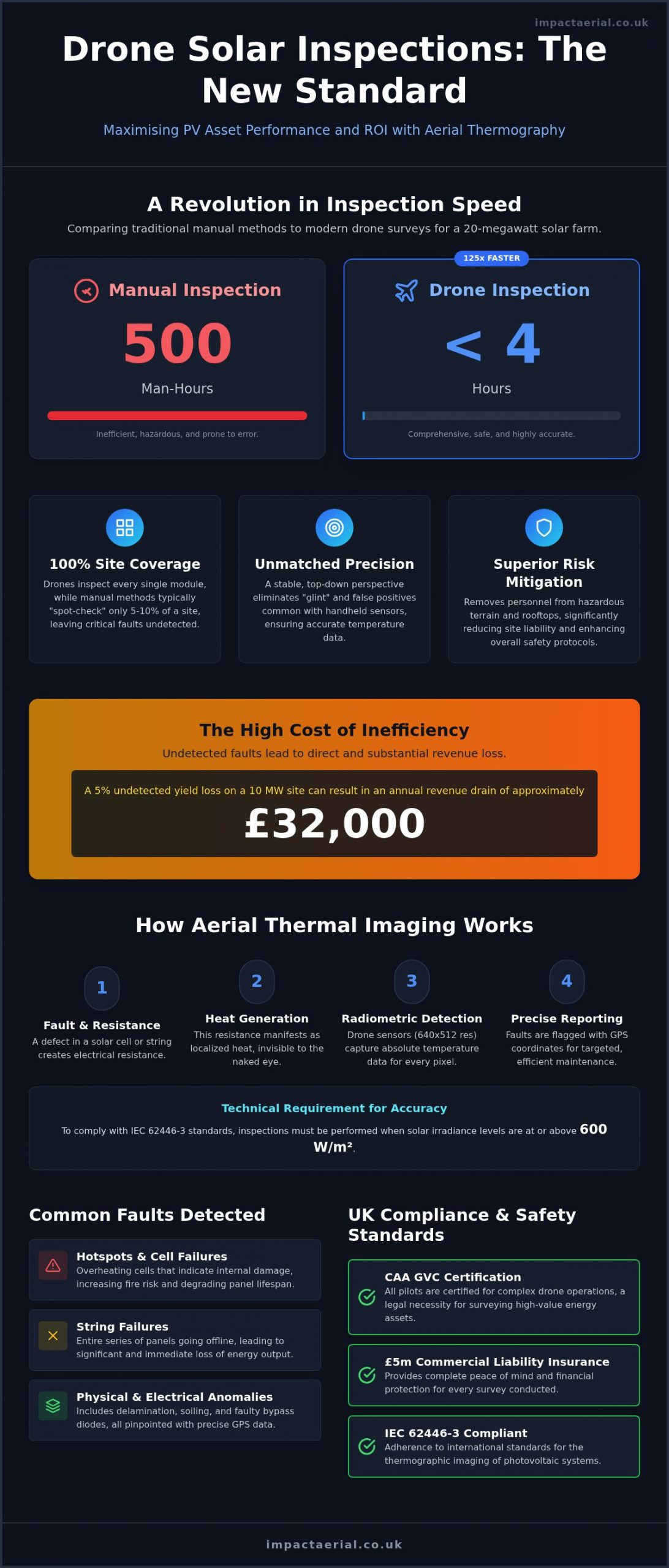
Common Faults Detected by Drone Solar Inspections
A technical drone solar panel inspection provides a level of diagnostic detail that ground-based teams cannot replicate. By identifying specific thermal signatures, we can pinpoint failures before they lead to catastrophic equipment damage or prolonged downtime. For instance, Hotspots are localised areas of high resistance within a cell. If left unaddressed, these can escalate into fire risks or cause the protective glass to shatter. We also frequently detect String Failures, where entire rows of modules are disconnected. These are often caused by inverter issues or cabling faults, and they represent the most immediate threat to your site’s energy output.
Beyond simple heat spots, our specialised thermal post-production expertise allows us to identify complex electrical issues that traditional surveys often overlook:
- Bypass Diode Issues: These appear as distinct rectangular heat signatures across a module, indicating that a section of the panel has been bypassed to protect it from further damage.
- Potential Induced Degradation (PID): This is identified by characteristic heat patterns usually found at the end of strings near the negative pole, often caused by a voltage potential between the cells and the frame.
- Physical Damage and Soiling: High-resolution RGB data allows us to distinguish between internal faults and external issues like micro-cracks, delamination, or heavy soiling from bird droppings and dust.
Categorising Anomalies by Severity
Data is only valuable if it’s actionable. We don’t just provide a list of faults; we categorise every anomaly to streamline your maintenance roadmap. Critical Faults are those presenting immediate safety risks or total string outages that require urgent intervention. Major Faults indicate significant yield loss where the cost of repair is justified by the immediate boost in revenue. Finally, Minor Faults are documented for monitoring, allowing your O&M teams to address them during the next scheduled site visit, ensuring your labour costs are managed efficiently.
The ROI of Early Detection
The “Cost of Inaction” is a tangible metric for asset managers. As previously noted, a 10MW site can lose over £32,000 annually from minor undetected failures. A drone solar panel inspection provides the indisputable evidence required for Warranty Claims against manufacturers, often paying for the survey itself through successful module replacements. Proactive risk management also serves as a powerful tool when negotiating with underwriters. By demonstrating meticulous site monitoring and fault rectification, you can often mitigate rising insurance premiums and protect the long-term valuation of your PV portfolio.
UK Compliance and Safety Standards for Drone Surveys
Operating a drone solar panel inspection on a utility-scale site requires more than just technical skill; it demands strict adherence to the UK’s evolving aviation legal framework. For any commercial operation, especially those involving high-value energy infrastructure, the pilot must hold a General Visual Line of Sight Certificate (GVC) issued by the Civil Aviation Authority (CAA). This certification isn’t merely a formality. It’s a legal requirement that proves the operator has the competency to manage complex flight paths and emergency procedures in a commercial environment. We also maintain £5m commercial liability insurance as a baseline standard. This level of coverage provides essential reassurance to asset managers that their property and professional indemnity are protected against unforeseen incidents.
Safety management on-site begins long before the drone takes off. We develop site-specific Risk Assessments and Method Statements (RAMS) for every project, accounting for local hazards such as public footpaths, nearby roads, or livestock. Privacy and data protection are equally critical. When surveying near residential areas or public rights of way, we ensure our flight plans and data capture protocols comply with UK GDPR and surveillance laws. This meticulous approach to compliance ensures that your survey data is not only technically accurate but also legally sound for use in official documentation or insurance claims.
Navigating CAA Regulations in 2026
The regulatory landscape for drones in the UK changed significantly as of January 1, 2026. It’s now mandatory for commercial operators to ensure their aircraft have the Remote ID function active, particularly when flying UK1, UK2, or UK3 class drones. Our pilots handle all aspects of operational authorisation and pre-flight planning, which includes checking for temporary flight restrictions and issuing NOTAMs (Notice to Airmen) where necessary. Understanding these nuances is vital for site managers who need to ensure their contractors aren’t operating illegally. For a deeper dive into these requirements, see our UK Drone License: A Simple Guide to CAA Rules in 2026.
Meticulous Planning for Solar Farm Safety
Solar farms present unique technical challenges, specifically regarding electromagnetic interference (EMI) from high-voltage inverters and substations. An uncertified hobbyist pilot might not understand how EMI can disrupt a drone’s internal compass or GPS link, leading to a “flyaway” risk. A GVC certified pilot is trained to maintain safe separation distances from infrastructure while still capturing the high-resolution data required for an effective drone solar panel inspection. Hiring a vetted specialist ensures that you’re not just getting a thermal map, but a safe, compliant operation that protects your professional reputation. If you’re ready to secure your site’s performance with a compliant survey, contact our technical consultants today to discuss your PV portfolio requirements.
Why Partner with Impact Aerial for Your Solar Inspections?
Choosing a partner for your PV asset maintenance requires a balance of technical proficiency and operational reliability. Impact Aerial operates as a technical consultant rather than just a drone operator, bringing years of commercial experience to every drone solar panel inspection we conduct. Our central hub in Birmingham, West Midlands, allows us to provide nationwide UK coverage with rapid response times. This strategic location ensures that we can deploy our teams to any solar farm across the country, providing the reassurance that your assets are being monitored by vetted specialists who understand the high-stakes nature of the energy sector.
We provide a comprehensive end-to-end service that manages the entire lifecycle of a survey. This begins with meticulous pre-flight planning and CAA compliance, moves through precision data capture using enterprise-grade hardware, and culminates in expert post-production analysis. Our commitment to reliability means we don’t just hand over raw data; we provide a prioritised maintenance roadmap that simplifies your decision-making process. By centralising these services, we eliminate the friction often found when working with multiple contractors, ensuring a seamless flow from the initial site visit to the final fault report.
Our Technical Expertise and High-End Output
Precision is the cornerstone of our operations. We utilise commercial-grade DJI Enterprise drones, such as the M300 and M350 RTK, equipped with high-resolution thermal sensors. These platforms offer superior thermal resolution, allowing us to identify micro-anomalies that lower-tier equipment would miss. Every fault we detect is tagged with centimetre-level GPS precision, ensuring your ground crews can navigate directly to the affected module without delay. This meticulous approach to data quality is a hallmark of our broader commitment to excellence, which you can explore in A Complete Guide to Professional Drone Services in the UK.
Get a Professional PV Thermal Survey Quote
Our consultation process is designed to be straightforward and informative. We start by understanding your specific site capacity and reporting requirements, whether you’re managing a single 5MW site or a nationwide PV portfolio. You can expect minimal site disruption during our surveys; we often operate while the farm remains fully operational, reducing downtime and protecting your generation revenue. Our final reports are designed for maximum data density, providing the comprehensive documentation needed for insurance or warranty claims. To receive a tailored proposal for your next drone solar panel inspection, contact our Birmingham office today. We’ll provide a clear, technical breakdown of how our aerial surveys can maximise the ROI of your solar assets.
Securing the Future of Your PV Portfolio
Professional aerial thermography has transformed from a luxury into a technical necessity for UK asset managers. By shifting from manual spot-checks to 100% site coverage, you gain a prioritised maintenance roadmap that addresses critical faults before they impact your bottom line. We’ve seen how high-end DJI Enterprise hardware and specialised thermal post-production expertise provide the indisputable data needed for successful warranty and insurance claims. This methodical approach ensures your assets remain compliant, safe, and high-performing.
A professional drone solar panel inspection is a strategic investment in your site’s longevity. Impact Aerial provides nationwide UK coverage from our central Birmingham hub, supported by CAA GVC certified pilots and £5m commercial liability insurance. We handle the technical complexity and regulatory compliance so you can focus on maximising generation revenue. It’s time to take the guesswork out of your O&M strategy.
Request a Professional Drone Solar Inspection Quote from Impact Aerial
We look forward to helping you protect the performance and reliability of your solar energy assets.
Frequently Asked Questions
How accurate is a drone solar panel inspection?
Professional aerial surveys are exceptionally accurate when using enterprise-grade radiometric sensors with 640×512 resolution. This hardware allows technical consultants to measure the precise temperature of every pixel, identifying “Delta-T” variations that indicate internal module failures. When combined with RTK (Real-Time Kinematic) positioning, every identified fault is geolocated to within a few centimetres, ensuring ground crews can find the exact panel without delay.
What is the best time of year for a PV thermal survey in the UK?
The ideal window for UK solar surveys is between April and September. To meet international IEC standards, the sun must provide at least 600W/m² of irradiance to create enough thermal contrast for the sensors to work effectively. We monitor weather data closely to ensure flights take place during peak solar windows, typically between 10:00 and 14:00, when the sun is at its highest angle.
Do drones need special permission to fly over solar farms?
Yes, all commercial drone operations require specific qualifications and permissions. Pilots must hold a General Visual Line of Sight Certificate (GVC) from the Civil Aviation Authority (CAA) to operate in the “Specific Category.” Beyond legal certifications, we coordinate directly with site managers to establish safety protocols and check for any local airspace restrictions or temporary flight hazards before deployment.
Can drones detect micro-cracks in solar panels?
Drones detect the thermal symptoms of micro-cracks rather than the physical cracks themselves. When a cell is compromised by a micro-crack, it creates electrical resistance that shows up as a hotspot on a thermal map. While drones don’t replace EL (Electroluminescence) testing for factory-level crack analysis, they are the most efficient way to find the resulting performance issues across thousands of modules.
How long does it take to get the final inspection report?
You can typically expect your comprehensive fault report within 5 to 10 business days. This timeframe is necessary for our specialised thermal post-production team to analyse thousands of images and cross-reference them with visual data. We produce high-resolution PDF reports and GIS-ready files that integrate directly into your existing asset management software for immediate action.
Is drone solar inspection more expensive than manual methods?
While the daily rate for a professional drone team is higher than a manual ground crew, the total project cost is significantly lower. A drone solar panel inspection is 10x faster than manual methods, meaning you pay for far fewer man-hours on site. The increased data accuracy also ensures a higher ROI by catching faults that manual “spot-checking” would likely miss.
What happens if the weather is cloudy on the survey day?
We reschedule the survey if the cloud cover prevents irradiance from reaching the mandatory 600W/m² threshold. Valid thermal data requires consistent solar loading to “heat up” the panels enough for internal faults to become visible. Our team manages the scheduling and weather monitoring as part of our end-to-end service, ensuring we only fly when the data quality will be 100% reliable.
Are Impact Aerial pilots fully insured for commercial work?
Yes, all our pilots are covered by £5m commercial liability insurance as a standard requirement. This level of coverage is essential for working on high-value energy infrastructure and provides the necessary reassurance for site owners and asset managers. We don’t just follow the law; we maintain the highest industry standards for risk mitigation and professional indemnity across all UK projects.
Aerial Video Production Services: The 2026 Guide to Professional Drone Filming
What if a single cinematic shot for your commercial project resulted in a heavy fine and an immediate production shutdown? It’s a valid concern for any developer or site manager. You want the visual impact of high-resolution 4K HDR footage, but the complexity of CAA regulations and the fear of hiring uncertified operators often make aerial video production services feel like a risky investment. We understand that you need more than just a drone in the air; you need a partner who prioritizes risk mitigation and technical precision.
This 2026 guide explains how professional drone filming bridges the gap between creative vision and legal compliance. You’ll discover how GVC-certified pilots and £5m liability insurance ensure a seamless workflow from the initial flight plan to the final edit. We’ll preview the latest DJI Enterprise hardware standards and the essential safety protocols that will transform your property, commercial, or construction projects this year.
Key Takeaways
- Understand the shift from basic drone flight to professional aerial video production services that utilize commercial-grade DJI Enterprise hardware for 4K HDR results.
- Learn why CAA GVC certification and £5m commercial liability insurance are the non-negotiable standards for operational safety and risk mitigation in 2026.
- Explore how cinematic aerial footage and technical surveying accelerate high-value property sales and improve safety monitoring on complex construction sites.
- Discover a streamlined production workflow that removes the burden of flight permissions and local authority approvals from your project management team.
- Identify the strategic advantages of partnering with a Birmingham-based specialist to navigate regional airspace regulations and site-specific permissions efficiently.
What Are Professional Aerial Video Production Services?
Professional aerial video production services represent a sophisticated fusion of aviation expertise and cinematic storytelling. In 2026, the industry has moved far beyond the novelty of “getting a shot from above.” A truly professional service provides a comprehensive end-to-end solution. This includes meticulous flight planning, high-resolution cinematic capture, and technical post-production designed to meet exacting commercial standards. Unlike hobbyist operations, these services prioritize legal compliance and technical precision to ensure every frame adds measurable value to a project.
The distinction between consumer-grade equipment and commercial-grade DJI Enterprise hardware is significant. While many operators claim to offer drone filming, professional aerial video production services utilize systems capable of recording in 4K HDR with high-bitrate codecs. These technical specifications are essential for modern broadcast and digital platforms, providing the dynamic range and color depth required for professional grading. The history of Aerial photography shows a clear trajectory from fixed-wing aircraft to the agile, stabilized gimbal systems we use today, allowing for precise creative control that was once impossible.
The Core Components of Aerial Videography
A professional workflow is divided into three distinct phases to ensure safety and quality:
- Pre-production: This phase involves detailed site surveys, risk assessments, and securing necessary flight permissions from the CAA or local authorities. It’s where the technical feasibility of a creative vision is confirmed.
- Production: This is the execution of precision flying. Pilots focus on smooth gimbal control and creative framing to capture the scale and detail of a site while maintaining strict safety buffers.
- Post-production: Raw footage is transformed through professional editing, color grading, and sound design. This ensures the final delivery aligns with your brand’s visual identity and technical requirements.
Why Businesses Invest in Professional Drone Filming
Investing in aerial video production services provides a competitive edge by offering perspectives that ground-based cameras simply cannot replicate. For commercial property and construction sectors, this translates into tangible benefits:
- Visual Scale: Capturing the entire footprint of a development or infrastructure project in a single, sweeping shot.
- Enhanced ROI: High-impact visuals increase engagement in marketing materials, often leading to faster property sales or project approvals.
- Risk Reduction: Utilizing GVC-certified pilots ensures that all operations are fully insured and compliant, protecting your business from the legal and financial liabilities associated with uncertified “cowboy” operators.
Choosing a full production package instead of a basic flight service means you receive a polished, ready-to-use asset. It moves the burden of technical management and regulatory “headaches” away from your team, allowing you to focus on the results. This standard of professional reliability is essential for all corporate visual assets, whether you are commissioning aerial video or high-end event photography from providers like Walking Visions Photography, Inc..
The Technical Framework: Safety, Licensing, and Compliance
The legal landscape of 2026 demands more than just a basic drone license. For any business commissioning aerial video production services, the safety framework is the most critical component of the project. Professionalism starts with the General Visual Line of Sight Certificate (GVC), which serves as the UK gold standard for commercial pilots. This certification isn’t just a badge; it demonstrates a pilot’s ability to operate safely in complex environments, particularly when navigating the stringent requirements of urban filming.
Risk mitigation is a non-negotiable part of our process. We maintain £5m in commercial liability insurance, providing our clients with the psychological comfort that their assets and the public are fully protected. While international standards like the FAA commercial drone regulations in the US focus on Part 107 certification, the UK’s GVC and Operational Authorisation system provides a specific technical framework for high-risk flights. This includes operating in “congested areas” where separation distances must be strictly managed. We handle all the necessary permissions, from local council approvals to police notifications, so you don’t have to worry about the legal details. Our safety protocols include:
- Comprehensive pre-flight site surveys and risk assessments.
- Coordination with National Air Traffic Services (NATS) where required.
- Strict adherence to separation distances from uninvolved persons and property.
- Continuous monitoring of local weather conditions and airspace activity.
Understanding CAA Operational Authorisation
Navigating UK drone laws requires a deep understanding of flight categories and specific permissions. Impact Aerial operates under a current CAA Operational Authorisation, which allows us to fly in environments that are typically restricted for hobbyists. This is essential for commercial work in city centers or near sensitive infrastructure. By maintaining this status, we ensure that every flight is legally compliant, preventing the risk of site shutdowns or legal repercussions for our clients. Our meticulous approach to planning includes detailed airspace research, ensuring that we mitigate risks before the drone even leaves the ground. You can view our full range of certified drone filming and surveying services to see how we apply these standards in practice.
Hardware Matters: DJI Enterprise and 4K HDR
The hardware used in aerial video production services directly impacts both safety and image quality. We utilize DJI Enterprise drones, which are designed for reliability and precision. Unlike consumer models, these platforms feature multi-directional obstacle sensing and dual-battery redundancy systems. For our clients, this means a more stable flight and a lower risk profile. From a creative perspective, these drones capture 4K HDR footage with high-bitrate recording. This ensures that the final output meets broadcast standards and allows for professional-grade colour grading in post-production, providing the visual depth your project deserves.
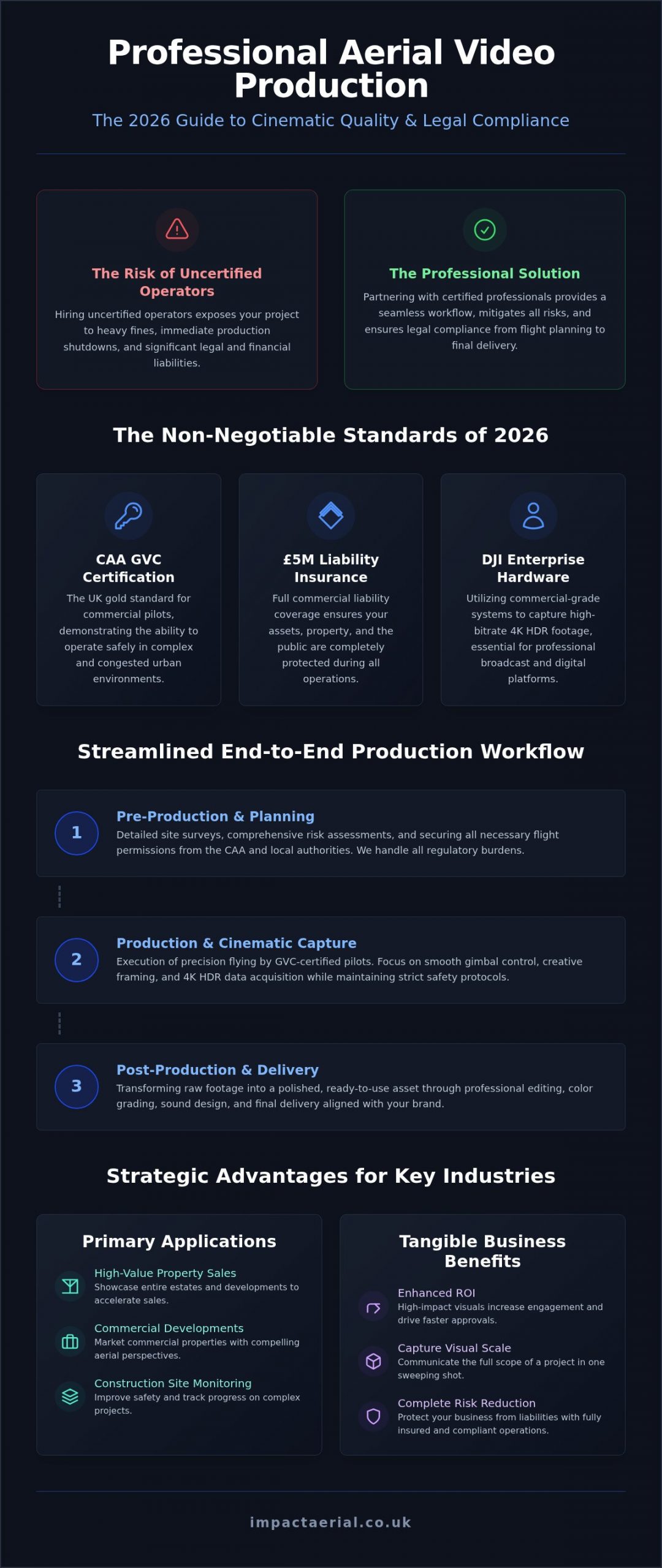
Strategic Applications Across Key Industries
Professional aerial video production services are no longer a luxury; they’re a strategic necessity for high-stakes industries. While the technical safety standards discussed previously provide the foundation, the real value lies in how these tools solve specific business challenges. From showcasing multi-million pound property developments to monitoring complex infrastructure, the ability to capture high-resolution 4K data transforms decision-making and marketing efficiency. The adoption of these technologies mirrors the rise of drone-powered journalism, where professional-grade capture is essential for accuracy and impact.
We see four primary areas where professional filming delivers the highest return on investment:
- Commercial Property: Creating immersive films that highlight the scale and strategic location of high-value assets.
- Construction & Infrastructure: Monitoring progress through time-lapse and high-resolution overviews to enhance site safety.
- Advertising & Marketing: Capturing cinematic “hero shots” that define a brand’s visual identity in a crowded market.
- Virtual Tours: Combining stabilized aerial footage with 360-degree immersive experiences to provide a complete site perspective.
Aerial Video for Property and Real Estate
Selling high-value assets requires more than a ground-level view. Cinematic drone filming allows developers to showcase the scale of a development, its proximity to transport links, and its place within the local landscape. For luxury residential sales, we create emotive narratives that ground-based cameras can’t achieve. This goes beyond simple aesthetics; it’s about providing potential buyers with a comprehensive understanding of the property’s context. You can explore more about our specialized work in this sector by visiting our guide on drone photography for property.
Construction Site Monitoring and Surveying
Construction managers use aerial video production services to maintain an “eye in the sky” for progress tracking and safety audits. High-resolution site overviews allow for remote monitoring, reducing the need for physical site visits by stakeholders and improving communication across the project team. This visual data is most powerful when integrated with technical drone survey data. This combination provides a comprehensive reporting package that includes both cinematic progress films and precise aerial data. It’s a dual-purpose approach that ensures project milestones are documented for both marketing and operational purposes.
By bridging the gap between creative filming and technical data collection, we provide a unified solution that serves multiple departments within a single organization. Whether it’s a project update for investors or a safety briefing for site staff, professional aerial footage provides the clarity required for 2026 industry standards.
The Professional Workflow: From Brief to Final Delivery
Professional aerial video production services are defined by the quality of their project management. A successful shoot doesn’t begin on the day of flight; it starts with a deep dive into your strategic objectives. We align your creative vision with technical feasibility to ensure every shot captured serves a specific purpose. This initial consultation is vital for establishing a shot list that prioritizes the most impactful visual assets while respecting the technical limits of the environment.
Pre-Production and Permission Handling
The pre-production phase is where we handle the logistical “headaches” that often deter businesses from using drones. Our team conducts thorough site assessments to identify potential hazards like power lines, nesting birds, or nearby sensitive infrastructure. Securing permissions for restricted or sensitive UK airspaces is a standard part of our service. Whether it’s coordinating with local councils or notifying the police for urban flights, we ensure full legal compliance. This meticulous planning guarantees a stress-free production process and mitigates the risk of operational delays. We manage the paperwork so you can focus on the results.
On-site execution is characterized by professional conduct and technical precision. We begin every session with a safety briefing for all stakeholders, ensuring everyone understands the flight parameters. Our pilots use commercial-grade DJI Enterprise hardware to execute precision filming, maintaining perfect gimbal control and creative framing even in challenging conditions. We don’t just fly; we operate as a technical extension of your production team.
Post-Production: Colour Grading and Editing
Post-production is the “secret sauce” that distinguishes professional output from raw drone clips. Our specialists use advanced colour grading techniques to transform raw 4K HDR footage into cinematic art. This process ensures that the aerial shots integrate seamlessly with your ground-based video production, maintaining a consistent visual identity across the entire project. We focus on the details that matter, from smooth transitions to precise exposure adjustments.
We deliver final assets in formats optimized for your specific needs, whether that’s high-bitrate broadcast files or compressed versions for social media and web use. This end-to-end approach ensures you receive a polished product ready for immediate deployment. If you’re ready to start your next project with a partner who manages every detail, explore our professional aerial video and post-production services today. We provide the technical expertise required to turn complex aerial data into compelling visual stories.
Choosing an Aerial Video Partner: The Birmingham Advantage
Selecting the right provider for aerial video production services requires a balance of creative talent and technical compliance. While many agencies offer nationwide coverage, there’s a distinct operational advantage to partnering with a specialist that possesses deep regional expertise. In 2026, the ability to navigate local airspace regulations quickly is often the difference between meeting a project deadline and facing costly delays. We combine our Birmingham roots with a nationwide reach to ensure your production remains both ambitious and legally sound.
Why Regional Expertise Matters
Operating in a major urban hub like Birmingham presents unique challenges for drone pilots. Navigating the congested West Midlands airspace requires more than just technical skill; it demands established relationships with local authorities and a thorough understanding of regional flight restrictions. Our familiarity with the local landscape allows us to secure permissions for sensitive sites in the city centre or near transport hubs more efficiently than out-of-area operators. This local knowledge speeds up the project turnaround, providing a streamlined experience from the initial site survey to the final flight. You can learn more about how we apply these standards in our guide to drone services across the UK.
Evaluating Your Drone Service Provider
Before commissioning aerial video production services, you must vet your provider against a strict set of professional criteria. A “safety-first” culture isn’t just a tagline; it’s a fundamental requirement for protecting your brand’s reputation and ensuring the legal validity of your footage. Use this checklist to evaluate any potential partner:
- CAA GVC Certification: Ensure pilots hold the General Visual Line of Sight Certificate for commercial operations.
- Insurance Credentials: Verify a minimum of £5m commercial liability insurance specifically for drone operations.
- Hardware Specifications: Confirm the use of DJI Enterprise drones capable of 4K HDR recording for broadcast-quality results.
- Safety Records: Ask for evidence of recent risk assessments and flight logs for similar urban or industrial environments.
When you request a quote, providing specific details will help us deliver an accurate estimate. We need to know the site location, any known flight hazards, your desired final output format, and the project timeline. This information allows us to align our technical surveying capabilities with your creative vision, ensuring a comprehensive solution that serves your marketing, construction, or property management needs. By choosing a partner that values external validation and industry standards, you can proceed with the psychological comfort that your project is in expert hands.
Elevate Your Project with Professional Aerial Standards
Professional aerial video production services in 2026 are defined by more than just a camera in the sky. Success depends on a meticulous fusion of cinematic creativity, rigorous technical compliance, and a “safety-first” operational culture. By prioritizing GVC-certified expertise and commercial-grade DJI Enterprise hardware, you ensure that every frame adds tangible value while mitigating legal and financial risks. Whether you’re showcasing a high-value property development or monitoring a complex infrastructure project, the integration of 4K HDR footage and professional post-production provides a level of clarity that ground-based methods simply can’t match.
Navigating the complexities of CAA regulations doesn’t have to be a barrier to your creative vision. Request a Professional Aerial Filming Quote from Impact Aerial to secure a partner who handles every detail from flight permissions to final delivery. Our Birmingham-based team provides nationwide UK coverage, backed by £5m commercial liability insurance and a team of CAA GVC certified pilots. We’re ready to bring your next project to life with the precision and reliability your brand deserves. Let’s start the conversation today.
Frequently Asked Questions
Do I need a permit for aerial video production in the UK?
Commercial drone operations in the UK require specific authorizations depending on the weight of the aircraft and the proximity to uninvolved people. For most professional aerial video production services, pilots must operate under an Operational Authorisation granted by the Civil Aviation Authority (CAA). We handle all necessary flight permissions and local council notifications as part of our comprehensive project management service.
How much do professional aerial video production services cost?
Project costs are determined by several technical factors, including the complexity of the airspace, the duration of the shoot, and the level of post-production required. Every site is unique; a congested city centre location involves more extensive risk mitigation and planning than a rural site survey. We provide bespoke quotes that reflect the specific hardware and safety protocols needed to deliver broadcast-quality results for your brand.
Can drones film in rainy or windy conditions?
Professional DJI Enterprise drones are designed with high wind resistance, typically allowing for stable flight in gusts up to 27mph. However, we generally avoid filming in active rain to protect the camera’s optical clarity and the drone’s internal electronics. Our team meticulously monitors local meteorological data to identify the safest and most visually effective flight windows for your production.
What is the difference between a standard drone pilot and a GVC certified pilot?
A GVC (General Visual Line of Sight Certificate) pilot has completed advanced training and a practical flight assessment vetted by the CAA. This certification is the professional standard for commercial work in 2026, allowing pilots to apply for Operational Authorisation. Standard or recreational pilots lack the legal framework and technical training required to operate safely and legally in complex commercial or urban environments.
How long does a typical drone filming session take?
A standard filming session usually lasts between half a day and a full day, depending on the complexity of your shot list. While the actual flight time for a single battery is approximately 30 to 40 minutes, the process includes site set-up, safety briefings, and multiple flights to capture different angles. We ensure every technical requirement is met on-site to provide a diverse range of 4K HDR assets for the final edit.
Are aerial video services safe for use in busy city centres like Birmingham?
Yes, aerial filming is entirely safe in urban environments when conducted by certified professionals who adhere to strict separation distances. We utilize meticulous risk assessments and coordinate with local authorities to manage public safety in busy areas like Birmingham. Our £5m commercial liability insurance and GVC certification provide the necessary legal and safety framework for operating in these challenging congested zones.
What video resolution can I expect from a professional drone shoot?
You should expect a minimum of 4K HDR resolution from any professional-grade drone production in 2026. We use high-bitrate recording formats that provide the color depth and dynamic range necessary for cinematic color grading. This technical standard ensures your aerial footage remains sharp and vibrant, whether it’s being used for a high-end commercial, a website hero video, or a large-scale broadcast production.
Does Impact Aerial provide post-production and editing services?
Impact Aerial provides a full end-to-end service, including professional post-production, color grading, and sound design. We don’t just deliver raw files; we transform the captured data into a polished visual narrative that aligns with your brand’s objectives. Our editors ensure that your aerial shots integrate seamlessly with your existing marketing assets to provide a consistent and high-impact final delivery.
Commercial Drone Services UK: The 2026 Guide to Professional Aerial Solutions
Hiring an uncertified drone pilot in 2026 isn’t just a gamble on image quality; it’s a direct risk to your business’s legal standing and safety record. With the CAA now requiring Operator IDs for any aircraft over 100g and mandatory UK class marks on new hardware, the gap between hobbyists and professional commercial drone services uk has never been wider. You need high-precision data for construction monitoring or cinematic visuals for marketing, but you shouldn’t have to master complex aviation law to get them.
We understand that you want the competitive edge of aerial intelligence without the burden of navigating flight permissions or the fear of “cowboy” operators. This guide clarifies how professional solutions provide the technical accuracy and safety assurances your stakeholders demand. You’ll discover how the combination of GVC-certified pilots, £5m public liability insurance, and DJI Enterprise 4K HDR technology transforms aerial perspectives into reliable business assets. We will break down the essential compliance standards for 2026 and show you how to secure high-tier results for everything from solar farm thermal surveys to property inspections.
Key Takeaways
- Understand why CAA GVC certification and £5m public liability insurance are the non-negotiable safety standards for professional commercial drone services uk.
- Learn how DJI Enterprise hardware and 4K HDR technology deliver high-precision data for construction monitoring and cinematic visuals for marketing.
- Discover the specific ROI benefits of technical applications, including PV solar farm thermal surveys and detailed commercial property inspections.
- Gain a practical checklist for vetting drone partners, focusing on their regulatory knowledge and the transition to mandatory 2026 UK class marks.
- Explore the comprehensive workflow from consultation to professional post-production that ensures consistent, high-tier results for complex aerial projects.
What Defines Professional Commercial Drone Services in the UK?
Professional commercial drone services uk are defined by a strict adherence to Civil Aviation Authority (CAA) regulations and the pursuit of technical excellence. In 2026, a professional operation means the pilot is licensed for commercial gain, ensuring that every flight meets the legal requirements for safety and insurance. An Unmanned aerial vehicle (UAV) in a commercial context is no longer just a flying camera. It’s a sophisticated data collection tool integrated into a broader business workflow. The industry has moved away from simply capturing “pretty pictures” toward delivering high-precision data and cinematic media solutions that solve specific business problems.
To see how these professional standards translate into daily operations on a job site, watch this overview:
The shift toward professional-grade DJI Enterprise hardware marks a significant departure from consumer-level equipment. These systems offer superior wind resistance and sensor accuracy, allowing for operations in conditions that would ground a standard hobbyist drone. Beyond the aircraft, true professional commercial drone services uk include comprehensive project management. This begins with a detailed consultation to establish objectives and ends with meticulous post-production services to transform raw data into actionable insights. It’s about reliability and the peace of mind that comes from knowing a project is in expert hands.
The Evolution of Aerial Technology in 2026
By 2026, 4K HDR and high-resolution thermal sensors have become the baseline for the industry. AI-driven flight paths now allow for perfectly repeatable site monitoring, which is essential for tracking progress on long-term construction projects. Many UK businesses find that outsourcing these tasks to specialists is more cost-effective than building in-house teams. Hiring a specialist removes the burden of maintaining expensive hardware, managing pilot training, and staying current with the latest CAA compliance updates. It allows firms to focus on their core business while receiving high-tier aerial intelligence.
Key Sectors Benefiting from Drone Integration
Several industries have seen transformative results from aerial solutions. Commercial property developers use 4K HDR filming to create high-end marketing assets that stand out in a competitive market. In construction and engineering, drones provide safe, rapid inspections of infrastructure that would otherwise require scaffolding or rope access. Perhaps most notably, the renewable energy sector relies on PV solar farm thermal surveys. These assessments identify failing cells with pinpoint accuracy, protecting the ROI of large-scale energy investments and ensuring maximum efficiency for solar assets.
Compliance and Safety: The Non-Negotiables for UK Operations
Safety is the primary metric by which professional commercial drone services uk are measured. In 2026, the distinction between a hobbyist and a professional operator is defined by their approach to risk mitigation and regulatory adherence. Every commercial flight must begin with a rigorous pre-flight planning phase. This includes checking UK drone registration requirements, conducting site-specific risk assessments, and reviewing METAR weather reports. A professional pilot doesn’t just “show up and fly”; they manage a complex set of variables to ensure the safety of uninvolved persons and high-value assets.
For operations in built-up areas or near industrial infrastructure, pilots often operate within the “Specific Category.” This classification requires a General Visual Line of Sight Certificate (GVC). The GVC is a formal qualification that proves a pilot’s competency in handling complex maneuvers and emergency procedures. Without this, a provider cannot legally offer the full range of services required for urban construction monitoring or commercial property surveys. A meticulous provider will always provide their operational authorization and pilot credentials before any work commences on your site.
Navigating UK Drone Laws in 2026
The regulatory landscape has evolved significantly. As of 2026, anyone responsible for a drone weighing 100g or more must register as an operator and display their ID on the aircraft. The annual fee for this is £12.34. While the A2 Certificate of Competency (A2 CofC) allows for some flexibility with smaller drones, the GVC remains the industry standard for robust commercial work. You can find a deeper breakdown of these requirements in our guide to the UK Drone License: A Simple Guide to CAA Rules in 2026. Staying current with these rules isn’t just about legality; it’s about protecting your business from the £1,000 fines associated with non-registration.
Insurance and Liability: Protecting Your Business
Insurance is where many budget providers cut corners. While hobbyist policies might cover basic damage, they rarely provide the level of protection required for commercial sites. In the UK, £5m public liability insurance has become the gold standard for professional commercial drone services uk. This level of coverage is essential when flying near expensive plant machinery, solar arrays, or historical buildings. Impact Aerial maintains this £5m benchmark to provide clients with total peace of mind. We recommend that “proof of insurance” is the very first document you request during the procurement process. If you’re planning a project that requires this level of professional oversight, you can view our full range of certified solutions to see how we prioritize your site’s safety.

Industry Applications: From Construction Surveys to Cinematic Filming
The versatility of modern commercial drone services uk has transformed how businesses approach both marketing and asset management. While early adoption often focused on simple photography, the 2026 standard demands a sophisticated blend of high-end cinematic production and forensic-level technical data. Every operation we conduct is underpinned by UK commercial drone regulations, ensuring that whether we’re filming a luxury development or inspecting an industrial roof, the process remains fully compliant and insured. This dual-purpose capability allows firms to streamline their procurement by partnering with a single specialist for diverse project needs.
The Power of Cinematic Aerial Media
Capturing 4K HDR cinematic footage is a critical tool for corporate branding and luxury property sales. We don’t just fly; we use advanced DJI Enterprise hardware to tell a visual story that static ground-based images can’t replicate. The flight itself is only half the process. Our professional post-production services ensure the final output is broadcast-ready, featuring precision color grading and editing that meets high-tier industry standards. For a deeper look at how this technology elevates your brand, explore our guide to the Aerial Filming Drone: The Ultimate Guide to Professional Cinematic Video.
Precision Surveying and Data Collection
Beyond the creative lens, the deployment of survey drones has revolutionized commercial property and infrastructure maintenance. Instead of deploying expensive scaffolding or high-risk manual teams, drones provide detailed assessments for roof inspections and site surveys in a fraction of the time. We also create immersive virtual tours, allowing stakeholders to experience a property remotely through high-fidelity 3D data. This immersive approach is particularly valuable for commercial real estate marketing and remote site monitoring.
In the industrial sector, the ROI of thermal imaging is most evident during PV solar farm thermal surveys. By identifying heat loss and failing cells through scheduled aerial monitoring, asset managers can prevent significant energy loss and equipment failure. This data-centric approach ensures that maintenance is proactive rather than reactive, directly protecting the long-term profitability of renewable energy investments. Whether you’re tracking construction progress or assessing building efficiency, these technical solutions provide the clarity needed for informed, data-driven decision-making.
Choosing a Drone Partner: A Checklist for Procurement Teams
Selecting a provider for commercial drone services uk requires a shift from simple price-comparison to a detailed technical audit. In an industry where the entry barrier for consumer hardware is low, procurement teams must look deeper into the operational standards of their potential partners. A professional partner should act as a technical consultant, guiding you through the complexities of airspace and data capture rather than just providing a pilot for a day. You aren’t just buying a flight; you’re investing in data integrity and legal compliance.
- Verify Qualifications: Ensure the pilot holds a valid CAA GVC or A2 CofC. These certifications are the baseline for legal commercial operations in the UK.
- Check Hardware: Ask if they use DJI Enterprise or similar commercial-grade equipment. Consumer drones often lack the sensor precision and wind resistance required for high-stakes commercial drone services uk.
- Review Portfolio: Look for specific experience in your sector. A pilot who specializes in wedding photography won’t have the technical expertise required for a PV solar farm thermal survey or complex construction monitoring.
- Assess Post-Production: Confirm the final deliverable. Do they provide raw data that requires further processing, or a finished, edited product ready for stakeholder review?
Red Flags When Hiring Drone Operators
A lack of a formal flight planning or risk assessment process is an immediate warning sign. Every professional operation begins with a site-specific Risk Assessment Method Statement (RAMS). If an operator can’t produce this, they’re likely cutting corners on safety. Insurance limits are another primary indicator of professionalism. While some operators carry the bare minimum, anything below £2m is a significant red flag for commercial projects. As established, the industry gold standard remains £5m, which is essential for protecting your business against unforeseen liabilities on high-value sites.
The Importance of Regional Knowledge
Local expertise is vital for rapid deployment and regulatory efficiency. A pilot based in a central hub like Birmingham will have an intimate understanding of regional airspace restrictions, such as the Birmingham airport Flight Restriction Zones (FRZ). This regional knowledge speeds up the permissions process and ensures that construction monitoring remains on schedule. It also allows for more flexible scheduling during the unpredictable UK weather. For a broader look at the national landscape, you can read our A Complete Guide to Professional Drone Services in the UK.
If you’re ready to secure a partner that meets every item on this checklist, you can contact us to discuss your project requirements and receive a professional assessment.
Impact Aerial: Expert Drone Solutions in Birmingham and Beyond
Impact Aerial operates from a central Birmingham hub, providing a strategic base for commercial drone services uk with national reach. This location allows for rapid deployment to construction sites, solar farms, and commercial properties across the country. Unlike agencies that focus solely on visuals or raw data, we provide full-cycle project management that bridges the gap between the two. Our process begins with a technical consultation to define your objectives and ends with professional post-production, ensuring that the final 4K edit or survey report is ready for immediate stakeholder review.
Our reputation as a trusted specialist is built on a foundation of meticulous compliance and reliability. We maintain £5m in commercial liability insurance and utilize CAA GVC certified pilots to manage every operation, providing the psychological comfort and tangible security that high-value projects demand. This commitment to official standards is paired with a technical adeptness that allows us to handle the most complex aerial challenges. Whether you require cinematic filming for a luxury development or high-precision data for infrastructure monitoring, we provide the expert oversight necessary for a successful mission.
This level of professional oversight is also gaining traction in the residential sector; for instance, you can learn more about Eyes On Mangawhai to see how external surveillance is used to protect and monitor holiday homes and rental properties.
Our Technology and Equipment
We deploy a sophisticated fleet of DJI Enterprise aircraft equipped with 4K HDR camera systems and high-resolution thermal sensors. These tools are essential for handling complex data processing tasks, including the creation of immersive virtual tours and forensic-level property inspections. Our hardware is selected for its superior sensor accuracy and stability in challenging UK weather conditions, allowing us to maintain a steady schedule for time-sensitive projects. We are committed to maintaining the highest standards of hardware excellence and operational safety to deliver reliable, high-tier results for every industrial and creative application.
Ready to Take Flight?
Securing professional aerial solutions for your next project is a straightforward process. We offer bespoke consultation sessions to understand the unique requirements of your site, followed by custom quote generation tailored to your specific industry needs. From scheduled construction monitoring to one-off cinematic marketing campaigns, we provide a transparent and methodical approach to aerial data collection. Our team handles all flight permissions and risk assessments, allowing you to focus on your core business while we capture the perspectives you need.
Contact Impact Aerial for a Professional Drone Services Quote
Elevating Your Operational Standards in 2026
The landscape of commercial drone services uk has transitioned from a niche novelty into a critical business utility. By prioritizing CAA GVC certified pilots and £5m public liability insurance, you protect your assets while gaining access to high-fidelity data that was previously out of reach. Whether you’re tracking a large-scale construction project or conducting specialized solar farm thermal surveys, the quality of your aerial partner directly impacts your project’s bottom line. Choosing a specialist ensures that you receive actionable insights rather than just raw footage.
Professional solutions combine the precision of DJI Enterprise hardware with the creative excellence of 4K HDR filming and meticulous post-production. This integrated approach ensures that your deliverables are both broadcast-ready and technically sound for surveyors. Don’t settle for unvetted operators who lack the necessary credentials or regional knowledge to navigate complex UK airspace. Our specialists in 4K HDR and thermal data are equipped to handle your most demanding site requirements with absolute precision and legal certainty.
Book Your Professional UK Drone Service with Impact Aerial
We look forward to providing the aerial intelligence you need to drive your next project forward with confidence.
Frequently Asked Questions
Are drone services legal in UK cities like Birmingham?
Yes, professional drone operations are entirely legal in urban environments like Birmingham provided they adhere to Civil Aviation Authority (CAA) regulations. Flying in congested areas typically requires the pilot to operate within the Specific Category, which demands a high level of training and risk mitigation. Our pilots manage all necessary permissions, including coordination with Air Traffic Control if the site falls within the Birmingham Airport Flight Restriction Zone.
What is the difference between a hobbyist and a commercial drone pilot?
The primary distinction lies in licensing, insurance, and operational intent. A commercial pilot is legally authorized by the CAA to fly for financial gain and must hold professional certifications like the GVC. Unlike hobbyists, commercial operators carry specialist liability insurance and follow a rigorous Risk Assessment Method Statement (RAMS) for every flight. This ensures a level of safety and data quality that consumer-grade flying cannot match.
How much does a commercial drone survey cost in the UK?
Pricing for commercial drone services uk depends on the project’s complexity, the sensors required, and the depth of post-production. A simple aerial photograph of a property is naturally more cost-effective than a multi-day thermal survey of a solar farm or a detailed construction monitoring contract. We provide custom quotes that reflect the specific technical requirements and data outputs of your industry to ensure you receive maximum value.
What insurance should a professional drone company have?
A professional operator must hold commercial-grade public liability insurance that is compliant with EC 785/2004 regulations. While some smaller providers carry minimal coverage, the industry benchmark for commercial sites is £5m. This protects your business against potential claims involving property damage or injury to uninvolved persons. You should always request a copy of the insurance certificate before any aircraft launches on your site.
Can drones fly in the rain or high winds during a survey?
Operational limits depend on the specific hardware’s IP rating and its maximum wind resistance. Professional DJI Enterprise drones can often maintain stability in moderate winds, but safety remains the priority. We typically reschedule flights during heavy rain or gale-force winds to protect the equipment and ensure the data captured is accurate. High-quality 4K HDR visuals and thermal data require stable conditions to be effective.
Do I need to notify the police before a drone flight?
Notification of the police isn’t a standard requirement for most commercial flights. Instead, pilots use flight planning software to check for temporary restricted areas and notify the CAA or local Air Traffic Control when flying near airports. We handle all these digital notifications and permissions as part of our pre-flight process. Only specific high-security locations or major public events require direct coordination with local law enforcement.
How long does it take to get the final footage or survey data?
Final deliverables are typically ready within 3 to 5 working days following the flight. This timeframe allows our team to perform essential post-production tasks, such as color grading 4K HDR footage or processing complex thermal data into a readable report. For urgent construction monitoring or property inspections, we can often provide raw files sooner, but the professional edit ensures you receive high-tier, broadcast-ready results.
What is a CAA GVC certification and why does it matter?
The General Visual Line of Sight Certificate (GVC) is the standard qualification for professional pilots operating in the Specific Category. It matters because it allows for more flexible flight patterns in built-up areas and closer proximity to uninvolved people than the basic Open category. This certification is a hallmark of professional commercial drone services uk, proving the pilot has undergone rigorous theoretical and practical testing to manage complex missions safely.
Drone Virtual Tour Services UK: The Ultimate Guide to Immersive Aerial Experiences
A single high-resolution photograph can show you a building, but it cannot explain how that building sits within its environment or how a complex site functions as a whole. Digital first impressions are now the industry standard, yet relying on static imagery often leaves a critical gap in spatial understanding for stakeholders and potential buyers. You likely recognize that traditional ground-level tours, while useful, often fail to provide the comprehensive context required for large-scale property marketing or technical site inspections.
By utilizing professional drone virtual tour services uk, you can bridge this gap with an immersive 360-degree digital twin that offers both granular detail and aerial perspective. This guide explores how these high-definition experiences transform property data into a powerful marketing and diagnostic asset. We’ll examine the technical advantages of aerial capture, the importance of maintaining full compliance with the latest 2026 CAA regulations, and how a Birmingham-based specialist with UK-wide coverage ensures your project is delivered with the precision and safety your business demands.
Key Takeaways
- Understand how interactive 360° environments surpass traditional photography by providing a complete, navigable digital representation of complex architecture and landscapes.
- Learn how FPV drone technology and 4K HDR sensors facilitate seamless transitions between internal and external spaces, even in challenging UK weather conditions.
- Compare the strategic advantages of aerial perspectives over ground-based tours for high-level asset management, such as roof inspections and estate mapping.
- Identify the mandatory safety standards and professional credentials, including CAA GVC certification and £5m liability insurance, required to secure compliant drone virtual tour services uk.
- Gain insight into the technical workflow of a professional provider, from initial site consultation to high-end post-production using enterprise-grade hardware.
What Are Drone Virtual Tour Services in the UK?
Drone virtual tour services in the UK represent a significant technological leap in how we visualize and interact with physical spaces. Unlike traditional photography, these services use Unmanned Aerial Vehicles (UAVs) equipped with specialized 360-degree cameras to capture entire environments from unique elevations. This creates an immersive, interactive experience where the viewer isn’t just looking at a picture, but is virtually standing within the scene. In 2026, UK businesses are increasingly moving away from static media toward these “fly-through” experiences to provide a higher level of transparency and engagement for stakeholders.
The evolution from simple aerial snapshots to fully interactive walkthroughs has been driven by rapid improvements in sensor technology and processing power. Today, luxury real estate developers, construction managers, and industrial site operators use these tours to provide a comprehensive view that ground-based cameras simply cannot reach. By combining high-altitude perspectives with the ability to “teleport” between different points of interest, these services offer a unique marketing and operational tool that bridges the gap between a simple map and a physical site visit.
To better understand how this technology creates a seamless flow through a property, watch this example of an aerial walkthrough:
The Difference Between Aerial 360s and Standard Drone Video
While standard drone video offers a cinematic perspective, it remains a passive experience. The viewer follows a predetermined path set by the pilot. In contrast, drone virtual tour services uk provide total user agency. Viewers can rotate their view 360 degrees, zoom in on specific architectural details, and navigate the site at their own pace. This interactivity is often enhanced by first-person view (FPV) technology, which allows for precise, fluid movement through tight spaces and interior corridors.
Data density is another key differentiator. Within a virtual tour, we can embed interactive “hotspots” that contain technical specifications, links to floor plans, or even secondary videos. This turns a visual asset into a Digital Twin, which is an accurate digital representation of a physical commercial asset used for long-term management and inspection. This level of detail is essential for complex industrial facilities where every component needs to be documented within its spatial context for maintenance or safety planning.
Why Aerial Perspective Matters for Large-Scale Sites
Traditional ground-based virtual tours are excellent for interior spaces but struggle with vast outdoor areas or tall structures. They lack the ability to show a building’s relationship to its wider environment, such as proximity to transport links or neighboring infrastructure. An aerial perspective solves this by providing a “god’s eye view” that ground tours cannot replicate. This is particularly valuable for estate mapping and large construction projects where site-wide context is as important as the building itself.
For those looking to integrate these assets into a broader operational strategy, it helps to understand the full scope of available technology. You can find more details in our complete guide to professional drone services. This comprehensive approach ensures that every angle of a site is captured with technical precision, providing a reliable foundation for both high-end marketing and detailed site inspections.
The Tech: FPV Drones and 360° Aerial Imaging
The technical foundation of professional drone virtual tour services uk relies on a sophisticated blend of specialized hardware and advanced post-production. To achieve a truly immersive experience, we utilize DJI Enterprise grade hardware capable of capturing 4K HDR data. This high-dynamic-range capability is essential for the UK’s varied weather conditions; it ensures that details aren’t lost in the shadows of a bright afternoon or washed out by the grey overcast skies common in the West Midlands. By capturing multiple exposures, we create a visual asset that maintains clarity across both the bright exterior landscape and the controlled lighting of an interior space.
Mastery of these tours extends beyond the flight itself into the technical stitching process. Creating a “no-seam” user experience requires precise alignment of multiple high-resolution images to form a spherical panorama. Once processed, these tours are optimized for cross-platform accessibility. Whether a stakeholder is viewing the site on a mobile device, a desktop browser, or through a VR headset for a fully immersive “on-site” feel, the technical integrity of the data remains consistent. If you are looking to integrate these technical assets into your next project, our team can provide a bespoke consultation to determine the best hardware configuration for your site.
FPV Drones: The ‘One-Shot’ Tour Revolution
Operating FPV equipment in confined commercial spaces requires rigorous safety protocols. Our pilots are CAA GVC certified and follow strict risk mitigation procedures to ensure safe operation indoors. We use specialized prop-guards and low-latency transmission systems to maintain total control, providing the reassurance that even the most complex flight paths are executed with professional precision and full insurance backing.
High-Resolution 360° Panoramas
While FPV drones provide movement, high-resolution 360° panoramas provide the “God’s eye view” necessary for site-wide navigation. By hovering a drone at strategic altitudes, we capture gigapixel-level detail that allows users to zoom into specific site features without losing image quality. These panoramas often serve as the main navigation menu for a virtual tour, allowing users to click on different areas of a site to “jump” to a detailed ground-level or interior view. This structural approach is a key component of cinematic aerial filming, where technical data and visual storytelling meet to provide a complete digital representation of a commercial asset.
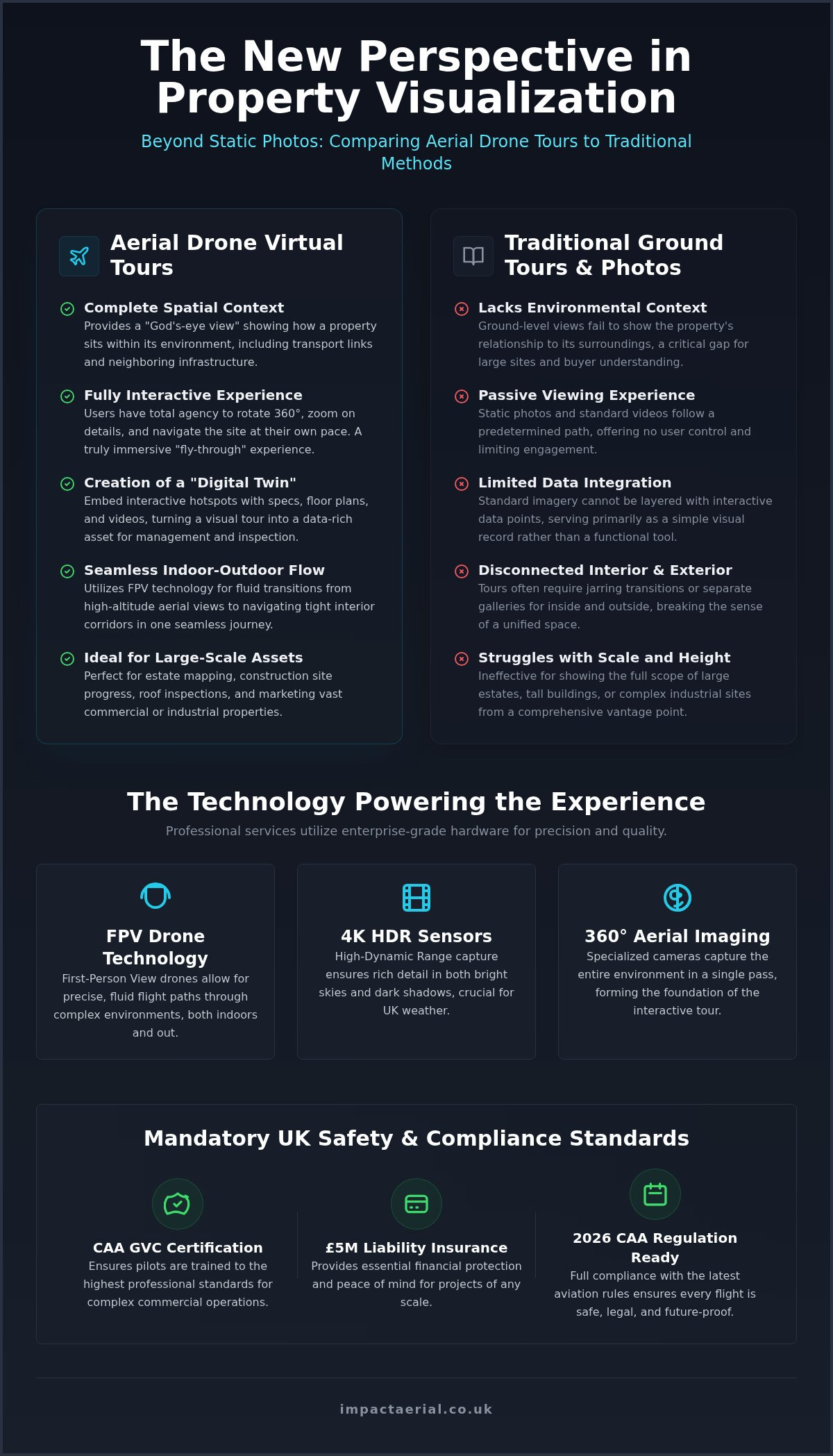
Drone Tours vs. Traditional Ground-Based Virtual Tours
Ground-based virtual tours, often powered by systems like Matterport, have become the standard for internal property marketing. These systems offer high precision for room dimensions and interior aesthetics. However, they are fundamentally limited by their tripod-bound nature. For vast industrial sites, complex construction projects, or multi-acre estates, ground-based capture is inefficient and lacks the necessary elevation to demonstrate asset connectivity. Relying solely on ground-level data leaves a significant gap in the viewer’s understanding of how a building relates to its wider environment.
Professional drone virtual tour services uk provide the height and scale that ground-based tripods cannot replicate. While a ground tour of a 100,000 sq ft warehouse might require over 200 individual tripod setups, a drone can capture the entire external envelope and site layout from a few strategic aerial vantage points. This drastically reduces the time required on-site and provides a more cohesive navigation experience. The most effective digital assets now utilize a “Hybrid Tour” approach; they combine the granular interior detail of ground-level systems with the expansive aerial context provided by UAVs.
This hybrid methodology creates a seamless spatial bridge for the user. A stakeholder can inspect a roof’s condition from 20 meters up and then instantly “drop” into the internal office space at ground level. From a cost-benefit perspective, the efficiency of aerial capture for large-scale sites is unmatched. It replaces hundreds of manual tripod placements with a structured flight plan, delivering a complete digital twin in a fraction of the time.
When to Choose a Drone Virtual Tour
Aerial tours are the superior choice for construction site monitoring and managing large commercial property portfolios. They are particularly essential for drone surveys where height is a primary factor, such as inspecting high-level cladding or roof-mounted plant machinery. Beyond technical inspections, these tours are highly effective for tourism and luxury real estate, as they allow you to showcase local landmarks and geographic advantages that are invisible from the street.
Integrating Virtual Tours with Site Data
Modern virtual environments are no longer just visual marketing tools; they are functional data interfaces. We can overlay CAD drawings or site maps directly onto the aerial view, allowing project managers to compare “as-built” progress against original designs. These tours act as a visual front-end for survey drone data, providing a platform where users can measure distances, areas, and volumes directly within the 3D aerial environment. This integration of technical data with immersive visuals provides a level of site intelligence that traditional photography simply cannot match.
UK Safety, Compliance, and Insurance for Drone Tours
Hiring a provider for drone virtual tour services uk involves more than evaluating a visual portfolio. It requires a deep understanding of the legal framework governing UK airspace. For commercial operations, especially in congested urban areas or near sensitive infrastructure, the Pilot in Command must possess the appropriate qualifications. In 2026, the CAA GVC (General Visual Line of Sight Certificate) remains the professional benchmark for commercial work. This certification demonstrates that the operator has undergone rigorous theoretical and practical assessments; it ensures they can manage the risks associated with high-resolution aerial capture in complex environments.
Operating a drone for commercial gain without these credentials isn’t just a safety risk; it’s a legal liability for the hiring business. Beyond the pilot’s flying skill, professional drone virtual tour services uk must account for data protection. Privacy and GDPR compliance are vital when filming in residential or public areas. A compliant operator will have clear policies to ensure that any identifiable information captured during a 360-degree shoot is handled according to UK law. This meticulousness is what separates a technical specialist from a hobbyist with a camera.
Understanding CAA Regulations in 2026
The regulatory landscape for UAVs is precise and strictly enforced. Every flight must adhere to the specific requirements outlined in the UK drone license framework. This is not a mere administrative hurdle; it’s a critical safety protocol. Before any hardware leaves the ground, a professional operator will produce a comprehensive RAMS (Risk Assessment and Method Statement). This document identifies potential hazards, from physical obstacles to electromagnetic interference, and outlines the mitigation strategies used to keep the site and the public safe.
Operating in urban centers like Birmingham or near Flight Restriction Zones (FRZs) such as airports requires advanced planning. We frequently coordinate with local authorities and Air Traffic Control (ATC) to secure the necessary permissions for low-altitude filming. This structured approach ensures that your virtual tour is captured legally, preventing any potential fines or stop-work orders that could impact your project timeline.
Insurance and Liability: Protecting Your Business
Reliability in this industry is underpinned by comprehensive insurance. Standard hobbyist cover is fundamentally insufficient for commercial virtual tour services. Professional operators carry specialized commercial liability insurance that meets EC 785/2004 standards. At Impact Aerial, we maintain £5m in public liability coverage as a standard for all UK sites. This provides psychological comfort and tangible protection for our clients, ensuring that all parties are protected against unforeseen incidents during the capture process.
Verifying a pilot’s credentials before they arrive on-site is a vital step in your procurement process. You should always request proof of insurance and their CAA Operator ID. Our commitment to safety-first operations and technical compliance means we handle all the regulatory heavy lifting on your behalf. If you require a fully vetted and insured partner for your next project, you can book a compliant site assessment with our Birmingham-based team today.
Impact Aerial: Professional Virtual Tour Creation in the UK
Impact Aerial operates as a specialized technical consultancy for drone virtual tour services uk. We provide more than just aerial imagery; we manage the entire lifecycle of a digital twin project from inception to final delivery. Based in Birmingham, our central location serves as a strategic hub for efficient nationwide deployment. This allows us to provide consistent, high-tier service to construction sites, industrial facilities, and commercial property portfolios across the United Kingdom. Our team utilizes DJI Enterprise grade hardware exclusively, ensuring that every frame is captured in 4K HDR for superior visual clarity and data density.
Our end-to-end process is designed to provide professional reassurance at every stage. We begin with a detailed technical consultation to align our flight plans with your specific marketing or operational goals. Following this, our CAA GVC certified pilots handle all pre-flight logistics, including rigorous risk assessments and coordination with local authorities. Once the data is captured, our post-production specialists take over, meticulously stitching the aerial panoramas to create a fluid, high-definition user experience. This structured methodology ensures that your project is delivered on time, within budget, and in full compliance with all UK aviation regulations.
Custom Post-Production and Hosting
The value of a virtual tour lies in its ability to communicate information effectively. We provide bespoke post-production services that allow you to tailor the user interface to match your specific corporate branding. This isn’t a “one size fits all” solution; we integrate interactive hotspots that can trigger technical documents, secondary videos, or high-resolution floor plans. For commercial marketing tours, we can embed direct call-to-action buttons, such as “Book a Viewing” or “Contact Agent,” to streamline the user journey. To ensure these assets are easily accessible, we provide secure, high-speed hosting solutions that facilitate seamless embedding into your corporate website or internal stakeholder portals.
Start Your Aerial Project Today
Requesting a tailored quote for your property or site is a straightforward, transparent process. We take a consultation-led approach, taking the time to understand the unique challenges of your location—whether it’s an urban construction project in London or a vast industrial estate in the North. Our team will provide a comprehensive proposal that outlines the capture strategy, post-production requirements, and delivery timeline. This ensures total alignment before any hardware leaves the ground. Impact Aerial remains the trusted partner for UK businesses seeking a meticulous, compliant, and technologically adept specialist for their virtual tour requirements.
Elevate Your Property Marketing with Immersive Aerial Data
Adopting immersive aerial perspectives is now a strategic requirement for modern property stakeholders. By bridging the gap between ground-level detail and aerial context, these interactive experiences provide a comprehensive digital twin that enhances both marketing reach and site inspection accuracy. The integration of enterprise-grade DJI 4K HDR technology ensures that every architectural detail is preserved, providing a high-definition asset that serves your business long after the initial flight.
When selecting professional drone virtual tour services uk, technical competence and regulatory adherence are vital. Impact Aerial provides the reassurance of CAA GVC certified pilots and £5m commercial liability insurance, ensuring that every project is executed with meticulous precision and full legal compliance. We invite you to Request a Professional Drone Virtual Tour Quote from Impact Aerial today to begin transforming your site into a fully interactive digital experience. We look forward to helping you showcase your assets from a new perspective.
Frequently Asked Questions
What is a drone virtual tour and how does it differ from a normal video?
A drone virtual tour is an interactive 360-degree environment that gives the user total control over their perspective. Unlike a standard video, which is a passive experience with a fixed narrative, a virtual tour allows viewers to rotate their view, zoom in on specific details, and navigate through a site at their own pace. This interactivity makes it a superior tool for detailed site inspections and immersive property marketing.
Do I need special permission to have a drone fly around my commercial property?
You must grant permission as the landowner or manager for any drone operations on your site. Additionally, professional pilots must check for Flight Restriction Zones (FRZs) and coordinate with Air Traffic Control if the property is near an airport or sensitive infrastructure. Our CAA GVC certified pilots manage all these legal permissions and notifications as part of our comprehensive flight planning process to ensure full compliance.
Can drone virtual tours be integrated into my existing website or Matterport account?
Yes, these tours are designed for seamless cross-platform integration. We provide embed codes that work with most modern website builders and CMS platforms. While drone tours are distinct from ground-based Matterport scans, we can often link the two experiences. This creates a “hybrid tour” where users can transition from an aerial 360 view directly into a ground-level interior walkthrough for a complete digital twin experience.
Are drone virtual tours safe for indoor use in offices or warehouses?
Indoor flights are entirely safe when conducted by professionals using specialized hardware. We utilize compact FPV drones equipped with 360-degree prop guards to prevent damage to the aircraft or the building’s interior. Before any indoor flight, we conduct a rigorous site-specific risk assessment to identify obstacles and ensure the safety of any personnel on-site. This makes drone virtual tour services uk a viable option for large-scale internal facility tours.
How much does a professional drone virtual tour service cost in the UK?
The investment required for a professional tour depends on several technical factors, including the total acreage of the site, the number of required 360-capture points, and the complexity of the post-production. Each project is unique, so we provide bespoke quotes following a technical consultation. This ensures that the hardware configuration and data delivery are perfectly aligned with your specific operational goals and budget requirements.
What kind of insurance should a drone operator have for a virtual tour project?
A professional operator must hold specialist commercial drone insurance that complies with EC 785/2004. Standard hobbyist insurance is invalid for commercial virtual tour projects and leaves the client liable. Impact Aerial maintains £5m in public liability insurance as a standard for all UK operations. This provides essential protection and psychological comfort for our clients, ensuring that every project is backed by comprehensive corporate cover.
How long does it take to capture and produce a full aerial virtual tour?
A typical on-site capture session for a medium-sized commercial property is completed within one working day. The post-production phase, which involves stitching high-resolution images, embedding interactive hotspots, and configuring the hosting environment, generally takes between three to seven business days. We provide a clear timeline during the initial consultation so you can plan your marketing or project milestones with confidence and precision.
What weather conditions are required for a successful aerial 360 shoot?
Optimal results require dry conditions and wind speeds below 20mph to maintain aircraft stability and image sharpness. Good visibility is essential for capturing the high-dynamic-range detail expected from professional drone virtual tour services uk. While our enterprise-grade hardware can handle varied UK light conditions, we monitor meteorological data closely and will reschedule a shoot if the weather threatens the technical quality or safety of the operation.
Drone Surveying: 2026 Guide to Construction Data & ROI
What if the biggest threat to your construction project’s budget isn’t labour costs or material prices, but the data you’re working from? For site managers and project directors across the UK, inaccurate topographic surveys, slow manual inspections, and mounting health and safety risks are creating a compounding problem that traditional methods simply can’t solve fast enough. Drone surveying for construction has moved well beyond a novelty; it’s now a precision data service that directly bridges the gap between physical site reality and digital project management.
If you’ve felt the frustration of costly rework caused by outdated ground surveys, or you’re uncertain about CAA regulations and what qualifications a compliant drone operator actually needs, you’re not alone. These are the practical barriers that prevent construction businesses from realising the genuine efficiency gains this technology delivers.
This guide cuts through the confusion. You’ll find a clear breakdown of how professional drone surveying improves topographic accuracy, supports BIM workflows, strengthens health and safety reporting, and delivers measurable ROI, along with what to look for in a compliant, qualified operator for your next UK project.
Key Takeaways
- Drone surveying for construction delivers georeferenced topographic data, orthomosaic maps, and 3D point clouds that directly feed into BIM workflows, replacing outdated manual methods with quantifiable digital outputs.
- Professional drone surveys can reduce data collection timelines significantly, with processed deliverables typically available within 24 hours of a site flight, directly cutting project delays caused by slow traditional survey teams.
- The ROI case extends beyond speed: accurate volumetric and spatial data reduces costly rework, supports progress reporting, and strengthens health and safety documentation across active construction sites.
- UK compliance is non-negotiable — understanding CAA GVC certification requirements and what constitutes a legally compliant operator is essential before commissioning any aerial survey on a congested or built-up site.
- This guide explains what to look for in a qualified, insured drone surveying partner, and how Birmingham-based operators with UK-wide reach can deliver turnkey construction data solutions without adding management burden to your team.
What is Drone Surveying for Construction?
At its core, drone surveying for construction is the deployment of Unmanned Aerial Vehicles (UAVs) fitted with specialist sensors to capture georeferenced spatial data across a site. The critical word here is georeferenced. Every data point captured is tied to a precise coordinate in the real world, making the output a quantitative engineering asset rather than a visual record. This is the fundamental distinction that separates a professional survey from an aerial photograph.
A standard drone photo tells you what a site looks like. A survey-grade map tells you exactly where everything is, how high it sits, how much material is present, and how those measurements compare to your design model. One is documentation; the other is data you can act on.
By 2026, the construction sector is reaching a genuine tipping point in aerial data adoption. Advances in onboard processing, RTK positioning, and photogrammetric software have reduced the barrier to survey-grade accuracy considerably, while increasing pressure on project margins and programme certainty is making the business case for faster, more reliable site data impossible to ignore.
This global shift is evidenced by the rise of specialized European providers like Aeroshot, who offer comprehensive Drone-gebaseerde inspectie- en visualisatiediensten to help contractors visualize progress and inspect critical infrastructure with high-precision 3D models.
The Evolution from Manual to Aerial Surveying
Traditional total station surveys require a ground crew to physically occupy multiple positions across a site, a process that’s time-consuming, weather-dependent, and introduces accumulating positional error over large areas. Aerial photogrammetry captures the same spatial relationships from above in a fraction of the time. Industry professionals consistently report reductions in field data collection time when comparing UAV-based methods to conventional survey crews, particularly across complex or multi-level sites where ground access is restricted. The downstream effect on project timelines is direct: faster data collection means design teams and site managers are working from current information, not figures that were accurate three weeks ago.
Key Technologies Powering Construction Drones
Three core technologies define what a professional construction drone system can deliver:
- High-resolution RGB cameras: Used to generate orthomosaic maps and 3D point clouds through photogrammetric processing. On hardware such as DJI Enterprise platforms, 4K HDR capture supports both visual reporting and precise geometric reconstruction.
- RTK (Real-Time Kinematic) positioning: Corrects GPS signals against a fixed ground reference in real time, achieving centimetre-level positional accuracy without relying solely on ground control points. This is what separates a survey-grade output from a consumer-grade flight.
- Thermal sensors: Detect heat signatures and moisture ingress within structures, making them particularly valuable for roofing assessments, insulation verification, and identifying subsurface anomalies that RGB imagery simply can’t reveal.
Together, these technologies shift drone surveying from a visual inspection tool into a precision data service that feeds directly into BIM environments, volumetric calculations, and progress reporting workflows.
Advanced Data Outputs: Orthomosaics, LiDAR, and BIM
Understanding what a drone captures during a flight is one thing. Understanding what gets delivered to your project team afterwards is what actually drives decisions. The raw imagery collected during a construction survey is processed into a set of structured, quantifiable outputs, each serving a specific function within the project data chain.
An orthomosaic map is a geometrically corrected, top-down composite image stitched from hundreds of individual frames. Unlike a standard aerial photograph, which distorts geometry at its edges, an orthomosaic maintains consistent scale across the entire image. This means you can take accurate linear and area measurements directly from the map, making it a practical tool for progress tracking, boundary verification, and site layout confirmation without returning to the field.
3D point clouds take this further. Photogrammetric processing converts overlapping images into millions of georeferenced coordinate points, constructing a precise digital twin of the site as it currently stands. This is the foundation for Digital Surface Models (DSM), which represent everything visible from above including structures, stockpiles, and vegetation, and Digital Elevation Models (DEM), which represent the bare earth terrain beneath. The distinction matters: a DSM tells you where your spoil heap sits; a DEM tells you what the ground beneath it looks like. Both are essential for accurate earthworks planning and drainage design.
Volumetric analysis is where the commercial case becomes immediately tangible. Calculating stockpile volumes using traditional survey methods typically requires a ground crew, significant time on site, and manual calculation workflows. Processed drone data can generate accurate volumetric figures from a single flight, cross-referenced against previous surveys to track material movement over time. For contracts where material quantities are tied to payment milestones, this level of auditability has direct financial value.
Photogrammetry vs. LiDAR: Choosing the Right Tool
Photogrammetry is the cost-effective default for most construction applications. It produces high-resolution 3D models from RGB imagery and performs well across open sites, earthworks, and structural surveys where clear sightlines exist. LiDAR uses pulsed laser measurements rather than image processing, which gives it one critical advantage: it can penetrate vegetation canopy to capture ground-level terrain data beneath. For UK infrastructure projects involving railway corridors, woodland clearance, or sites with dense ground cover, LiDAR produces terrain data that photogrammetry simply cannot match. Some complex projects benefit from a hybrid approach, using photogrammetry for surface-level structural detail and LiDAR for accurate ground modelling in obscured areas.
Integrating Aerial Data into BIM Workflows
The output formats from professional drone surveying for construction are designed to slot directly into the software environments your design and engineering teams already use. Point clouds export as LAS or LAZ files compatible with Autodesk Revit, AutoCAD Civil 3D, and Bentley MicroStation. Orthomosaics export as georeferenced GeoTIFFs. This means a survey drone flight translates directly into updated BIM reference data without requiring manual re-entry or format conversion by your team.
The practical application is ‘As-Built’ documentation. Design models reflect intent; site reality frequently diverges from it. Regular aerial surveys create a timestamped spatial record of what was actually built and when, giving project managers an objective basis for resolving disputes, validating contractor claims, and maintaining programme accountability. If you’re looking to close the gap between your design model and what’s happening on the ground, professional construction site monitoring provides the data layer that makes that comparison possible.
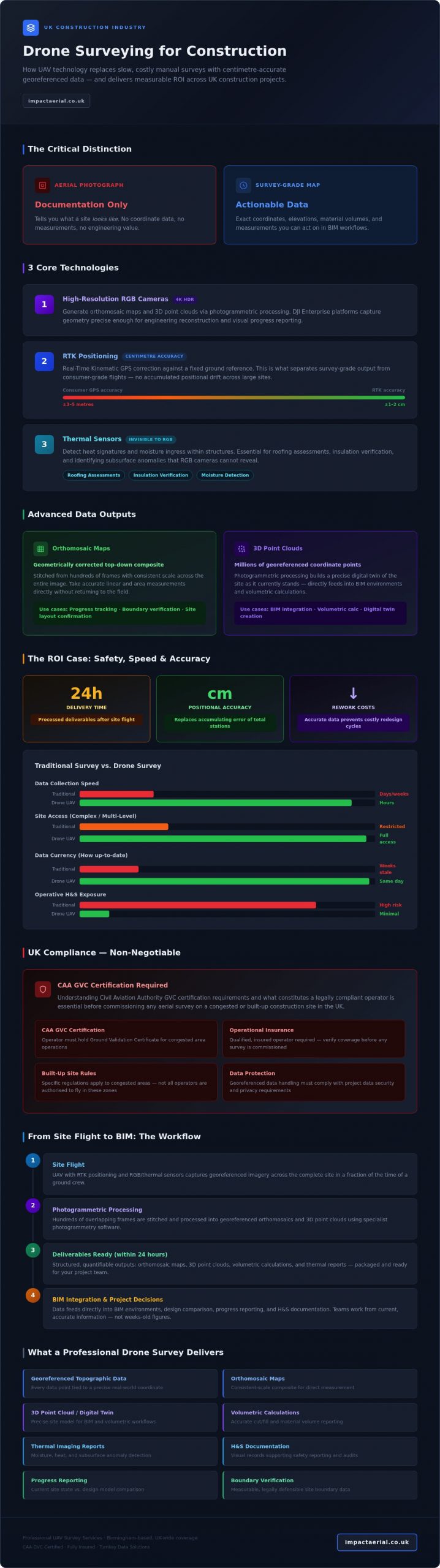
The ROI of Drone Surveys: Safety, Speed, and Accuracy
The business case for drone surveying for construction doesn’t rest on a single advantage. It compounds across three dimensions simultaneously: the cost of data collection falls, the speed at which decisions can be made increases, and the accuracy of the information underpinning those decisions improves. Each of these factors independently justifies the investment. Together, they represent a structural shift in how project data is managed.
Traditional survey teams working across a large active site can take several days to complete a full topographic capture, then additional time to process and deliver usable outputs. A professional drone survey compresses that timeline considerably. From flight completion to processed, georeferenced deliverables, a well-equipped operator can turn data around in under 24 hours. For a project manager waiting on updated ground levels before a concrete pour, that difference isn’t marginal; it’s the difference between programme certainty and a costly delay.
On accuracy, RTK-enabled drone systems routinely achieve sub-5cm positional accuracy across open construction sites when properly calibrated against ground control. That tolerance sits comfortably within the requirements for most earthworks, drainage, and structural setting-out applications. It also means the data is defensible: if a contractor dispute arises over quantities or levels, a timestamped, georeferenced dataset carries evidential weight that a manual field note simply doesn’t.
Stakeholder communication is a less-discussed but genuinely valuable application. Three-dimensional site models generated from drone data give clients, planners, and non-technical stakeholders a clear visual reference for progress that flat drawings can’t match. Presenting a photorealistic 3D model of the site as it stands today, overlaid against the design intent, removes ambiguity from progress meetings and accelerates sign-off decisions.
Improving On-Site Health and Safety
One of the most direct risk reduction benefits is removing the need for surveyors to physically access hazardous areas. Inspecting a partially constructed roof structure, traversing unstable embankments, or assessing a deep excavation perimeter all carry measurable risk under CDM regulations. Aerial survey eliminates that exposure entirely. High-resolution site overviews also support traffic management planning by providing an accurate, current picture of vehicle routing, pedestrian zones, and proximity conflicts that ground-level observation can miss. Hazard identification from above, including identifying unsecured materials, deteriorating temporary works, or encroachment into exclusion zones, adds a proactive layer to site safety reporting that’s difficult to replicate with conventional inspection methods.
Quantifying Time and Material Savings
Precise volumetric data reduces material waste by giving quantity surveyors accurate cut-and-fill figures before earthworks begin, rather than approximations that lead to over-ordering or unexpected shortfalls. Identifying deviations from the design model early, before subsequent trades build on top of an error, avoids the rework costs that consistently erode construction margins. The drone survey process, when managed by an experienced operator, is designed to integrate with existing project workflows rather than add a parallel management burden, meaning faster data, faster sign-offs, and fewer surprises at practical completion.
Navigating UK Regulations and Compliance for Construction
Commissioning drone surveying for construction without verifying your operator’s regulatory standing isn’t just a procurement oversight; it’s a liability that sits squarely with you as the client. The Civil Aviation Authority’s framework for commercial drone operations is specific, and construction sites, particularly those in urban or congested environments, sit in some of the most demanding operational categories the regulations cover. Understanding what compliance actually looks like is the first step to protecting your project.
Under the UK’s current CAA framework, commercial drone operations that go beyond the basic ‘Open’ category, which covers low-risk, recreational, and limited commercial flights, require operators to hold authorisation under the ‘Specific’ category. This is where the General Visual Line of Sight Certificate, or GVC, becomes the relevant qualification. Any professional pilot conducting surveys on active construction sites, particularly in built-up areas or near infrastructure, should hold GVC certification as a baseline credential. It’s not optional; it’s the regulatory threshold that separates a compliant commercial operator from one who’s operating outside their permitted boundaries.
Why Your Pilot Needs CAA GVC Certification
The GVC isn’t simply a licence to fly; it demonstrates that a pilot has completed structured training in operational risk assessment, airspace management, and emergency procedures specific to complex environments. A hobbyist ‘Open’ category registration covers a narrow set of low-risk scenarios and does not authorise operations over congested areas, near crowds, or in controlled airspace, all of which are common features of active UK construction sites. Before any operator steps onto your site, ask to see their drone licence documentation and their Operational Authorisation issued by the CAA. Both should be current and verifiable.
Compliant operators also produce a site-specific Operations Manual and conduct a formal risk assessment prior to each flight. These documents define the flight boundaries, emergency procedures, and contingency protocols for your specific site conditions. If a prospective operator can’t produce these on request, that’s a clear disqualifying signal.
The role of the Accountable Manager within a drone operating company is also worth understanding. This is the individual who holds formal responsibility for the organisation’s compliance with its CAA Operational Authorisation. A legitimate commercial operator will have a named Accountable Manager, and their existence within the company structure is a reliable indicator that the organisation takes its regulatory obligations seriously rather than treating compliance as an afterthought.
Operating in congested areas introduces additional requirements around flight planning, NOTAMs, and coordination with local air traffic where applicable. A qualified operator handles all of this before arriving on site, meaning your team doesn’t inherit the administrative burden of managing airspace compliance.
Insurance: Why £5m Liability is the Industry Standard
Beyond certification, insurance coverage is the second non-negotiable. The construction industry standard for commercial drone operators is £5m public liability insurance as a minimum. This figure isn’t arbitrary; it reflects the scale of potential third-party claims on a busy construction site where equipment, personnel, and neighbouring properties are all within range of a UAV operation.
Using an under-insured operator exposes your project to direct financial risk. If an incident occurs and the operator’s policy limit falls short of the resulting claim, liability can transfer to the principal contractor or site owner. Commercial drone insurance should cover third-party bodily injury, property damage, and, depending on the policy, payload equipment failure. What it typically won’t cover is data loss from processing errors or consequential project delays, which is why operator competence remains as important as the policy itself.
Verifying insurance is straightforward: request a copy of the certificate of insurance before works commence and confirm the coverage limit, the named insured, and the policy expiry date. A reputable operator will provide this without hesitation.
If you want to commission drone surveying for construction with the confidence that certification, insurance, and site-specific compliance are already in place, speak to a qualified operator who can provide documentation upfront.
Data protection is a further compliance consideration that’s frequently overlooked. Aerial imagery captured over active sites may incidentally record identifiable individuals or neighbouring properties, bringing GDPR obligations into scope. A compliant operator will have a documented data handling policy covering image retention, storage security, and third-party data sharing restrictions. This is particularly relevant on sites adjacent to public spaces or residential areas, where the boundary between operational data capture and personal data collection can become blurred without proper protocols in place.
Professional Drone Surveying Services in Birmingham and the UK
Most of the market for aerial data services is currently occupied by hardware retailers and generalist photographers who’ve added a drone to their kit list. Impact Aerial operates differently: as a specialist data services provider with CAA GVC certified pilots, £5m commercial liability insurance, and DJI Enterprise hardware as standard, the focus is entirely on delivering structured, actionable outputs that construction teams can put to work immediately.
Based in Birmingham, Impact Aerial serves the West Midlands construction sector as a local partner while maintaining UK-wide deployment capability for larger programmes and multi-site contracts. That regional grounding matters: local operators understand planning constraints, airspace considerations, and site access logistics specific to the area, without the lead times and coordination overhead that come with engaging a distant national provider.
Impact Aerial’s Construction-Specific Solutions
The service offering is built around the distinct data requirements that arise at different stages of a construction programme:
- Pre-construction topographic surveys and site feasibility studies: Georeferenced terrain data captured before groundworks begin, giving design teams accurate existing ground levels and site extents to work from rather than relying on outdated OS data or desktop assumptions.
- Weekly site progress monitoring: Regular scheduled flights that give project managers and remote stakeholders a current, objective record of site status. This is particularly valuable for clients who aren’t on site daily and need reliable progress data without depending on contractor self-reporting.
- Final ‘As-Built’ surveys and drone photography: Completion-stage surveys that document the finished asset for handover records, dispute resolution, and marketing purposes. High-resolution 4K HDR imagery from DJI Enterprise platforms produces outputs that serve both technical documentation and client-facing communications.
Drone surveying for construction works best when it’s embedded into the project workflow from the outset rather than commissioned as a one-off response to a problem. Impact Aerial’s approach is structured to support that integration, with data delivered in formats compatible with the software environments your team already uses, including georeferenced GeoTIFFs, LAS point clouds, and processed DEMs.
Getting Started with Your Site Survey
The process is designed to remove friction, not add it. Three steps cover the full engagement:
- Quote: Provide site details and your specific data requirements. A site-specific proposal is produced covering flight scope, deliverable formats, and compliance documentation.
- Fly: Pilots manage all airspace coordination, risk assessment, and on-site operations. Your team doesn’t carry any of that administrative burden.
- Deliver: Processed, georeferenced data is delivered in your required format, ready to import directly into your project environment.
If your project has specific software dependencies or unusual site conditions, those are addressed at the consultation stage so deliverables are usable from the moment they arrive. To discuss your site requirements with the Birmingham team, contact Impact Aerial directly for a project-specific consultation.
Turn Site Data Into a Competitive Advantage
Drone surveying for construction has moved from an emerging option to a practical necessity for projects where programme certainty, cost control, and safety compliance all matter. Accurate georeferenced data reduces rework, volumetric analysis supports defensible quantity reporting, and removing personnel from hazardous inspection zones directly strengthens your CDM obligations. The technology delivers on each of these fronts simultaneously.
What separates a genuinely useful aerial survey from a compliance risk is the operator behind it. CAA GVC certified pilots, £5m commercial liability insurance, and a specialist DJI Enterprise fleet aren’t optional extras; they’re the baseline that protects your project and ensures the data you receive is legally obtained, accurately processed, and immediately usable.
If your next project needs reliable site data without the management overhead, Impact Aerial is ready to deliver. Request a professional drone survey quote from Impact Aerial and get a site-specific proposal that covers scope, deliverables, and compliance documentation upfront. Your project deserves data you can act on with confidence.
Frequently Asked Questions About Drone Surveying for Construction
How accurate is drone surveying for construction compared to traditional methods?
RTK-enabled drone systems routinely achieve sub-5cm positional accuracy across open construction sites when properly calibrated with ground control points. That tolerance is sufficient for most earthworks, drainage design, and structural setting-out applications. Traditional total station surveys can match or exceed this in isolated point measurements, but they accumulate positional error over large areas and take considerably longer to complete, meaning drone data is often both faster and more consistent across complex or expansive sites.
Do I need a special permit to have a drone fly over my construction site?
You don’t personally need a permit, but your drone operator does. Any commercial survey conducted on an active construction site, particularly in a built-up or congested area, requires the operator to hold CAA Specific Category authorisation and a current Operational Authorisation. Your responsibility as the client is to verify those documents before works begin. A compliant operator will also produce a site-specific risk assessment and operations manual for each flight; if they can’t provide these on request, don’t commission the work.
What file formats can drone survey data be delivered in for BIM?
Professional drone survey outputs are delivered in formats that import directly into standard BIM and design environments without manual conversion. Point clouds are typically provided as LAS or LAZ files, compatible with Autodesk Revit, AutoCAD Civil 3D, and Bentley MicroStation. Orthomosaic maps are delivered as georeferenced GeoTIFFs. Digital Elevation Models export as GeoTIFF or ASCII grid formats. If your project has a specific software dependency, confirm the required formats at the briefing stage so deliverables are usable from the moment they arrive.
How much does a professional drone survey cost in the UK?
Pricing for drone surveying for construction varies based on site size, required data outputs, flight complexity, and turnaround time, so quoting a figure here would be misleading without knowing your specific project parameters. The most reliable approach is to request a site-specific proposal from a qualified operator, detailing exactly what deliverables are included and what compliance documentation comes with the service. This gives you a like-for-like basis for comparing quotes rather than comparing headline day rates that may not include processing or data delivery.
Can drones perform surveys in bad weather like rain or high winds?
Most professional survey drones are not rated for operation in rain, and moisture ingress can damage sensors and onboard electronics. High winds are the more common operational constraint; many commercial platforms have a maximum wind tolerance of around 10 to 12 metres per second, beyond which stable flight and accurate data capture become unreliable. A qualified operator will monitor site-specific weather forecasts and reschedule flights when conditions fall outside safe operating parameters rather than compromising data quality or safety to meet a deadline.
What is the difference between photogrammetry and LiDAR for site mapping?
Photogrammetry builds 3D models by processing overlapping RGB images, making it cost-effective and well-suited to open sites, earthworks, and structural surveys where clear sightlines exist. LiDAR uses pulsed laser measurements that can penetrate vegetation canopy to capture ground-level terrain data beneath, which photogrammetry can’t replicate. For most standard construction applications, photogrammetry delivers sufficient accuracy at lower cost. LiDAR becomes the appropriate choice on sites with dense ground cover, woodland clearance requirements, or infrastructure corridors where bare-earth terrain data is critical.
How often should a construction site be surveyed by a drone?
Survey frequency depends on the programme stage and the decisions being driven by the data. Pre-construction, a single topographic capture establishes baseline ground conditions. During active earthworks or groundworks phases, weekly surveys allow project managers to track material movement, verify cut-and-fill progress, and identify deviations from the design model before subsequent trades build on top of an error. At completion, a final as-built survey documents the finished asset. For long-running programmes, monthly surveys are a practical minimum for maintaining an objective progress record.
What insurance should a drone pilot have for working on a building site?
The construction industry standard is a minimum of £5m public liability insurance covering third-party bodily injury and property damage. This figure reflects the realistic scale of potential claims on a busy site where equipment, personnel, and neighbouring properties are all within range of a UAV operation. Before any operator begins work, request a copy of their certificate of insurance and confirm the coverage limit, the named insured, and the policy expiry date. A reputable commercial operator will provide this documentation without hesitation as a standard part of their pre-works compliance pack.
Construction Site Monitoring in Birmingham: The 2026 Guide to Drone Technology
If you are managing a multi-million pound development in Digbeth or the Jewellery Quarter, can you truly say you know exactly what happened on-site at 2:00 PM yesterday? Relying on ground-level snapshots often leaves critical gaps in construction site monitoring birmingham developers can no longer afford to ignore. Traditional reporting is frequently plagued by inaccuracies that lead to project delays, while the high costs of manual surveying and traditional manned guarding continue to squeeze margins in an increasingly competitive market.
It is understandable that you want total oversight without the logistical headache of constant physical inspections. This guide explores how drone-based monitoring provides the data-rich, 360-degree perspective you need to track progress, ensure safety, and manage complex sites with absolute precision. We’ll look at the latest 2026 DJI Enterprise hardware, the necessity of CAA GVC certified pilots, and how high-resolution aerial evidence is now the industry standard for maintaining project timelines and safety compliance across the West Midlands.
Key Takeaways
- Learn how high-resolution UAV imagery and 3D data capture are transforming site management from reactive security to proactive project oversight.
- Understand the safety and cost advantages of replacing manual surveying with aerial inspections that identify hazards without risking personnel.
- Discover the specific regulatory requirements for construction site monitoring birmingham projects, including CAA GVC certifications and navigating local Flight Restriction Zones.
- Compare the limitations of static 2D security cameras against the mobility and depth of 3D photogrammetry models produced by DJI Enterprise hardware.
- Identify why local expertise and professional-grade equipment are essential for maintaining a single source of truth across complex West Midlands developments.
What is Modern Construction Site Monitoring?
Modern construction site monitoring birmingham is no longer defined by a guard at a gate or a static camera on a pole. In 2026, it represents a sophisticated integration of an Unmanned aerial vehicle (UAV) to capture high-resolution imagery and 3D data. This shift allows developers to move from reactive security measures toward proactive project management. Instead of just preventing theft, you’re now using aerial data to track every phase of the build with surgical precision.
Birmingham’s skyline is evolving rapidly with high-rise developments in areas like Great Charles Street and Broad Street. This vertical growth makes traditional ground-level inspections nearly impossible to conduct accurately. Drones provide the necessary perspective to maintain a ‘digital twin’ of the site. This is a living 3D model that reflects the exact state of construction at any given moment, allowing for immediate comparison against original BIM designs and schedules.
To better understand how these flights operate in practice, watch this helpful video:
The Difference Between Security and Progress Monitoring
Fixed CCTV cameras are excellent for boundary protection, but they inevitably leave blind spots as a building grows taller and more complex. Progress monitoring focuses on what’s happening inside the structure and across the upper floors. It provides measurable data points rather than just a grainy video feed. This level of detail supports stakeholder reporting by giving investors a clear, high-definition view of where their money is going. It turns visual evidence into a tool for transparency and accountability that ground-level security simply cannot match.
Key Technologies Used in 2026
The standard for professional monitoring has moved far beyond hobbyist equipment. At Impact Aerial, we utilise DJI Enterprise drones with 4K HDR cameras to ensure every bolt and weld is visible in the final output. Beyond simple photos, we use orthomosaic mapping to stitch thousands of images together into a single, geometrically corrected map with site-wide accuracy. Additionally, thermal imaging is now a vital part of the 2026 workflow. By detecting heat signatures, we can identify structural damp or electrical faults long before they become expensive repair jobs, ensuring the site remains both safe and on budget.
The Benefits of Drone-Based Monitoring for Birmingham Projects
Integrating drone technology into your workflow offers advantages that traditional methods cannot match. While competitors often focus solely on perimeter security, professional construction site monitoring birmingham provides a comprehensive toolkit for risk management and operational efficiency. By deploying enterprise-grade UAVs, developers gain a level of oversight that is both safer and more cost-effective than manual site walks.
Improving Site Safety and Risk Mitigation
Traditional roof inspections often involve scaffolding or cherry pickers, which present inherent risks to personnel. Drones eliminate these hazards by capturing high-resolution data from a safe distance. Beyond elevations, aerial views are essential for identifying plant machinery bottlenecks and optimizing traffic flow within tight urban sites. By adhering to UK Civil Aviation Authority drone regulations, we ensure that every flight is conducted with the highest safety standards. Aerial perspectives provide a comprehensive view of the site that allows project managers to identify and rectify potential hazards before they result in accidents.
Data Accuracy and Project Timelines
One of the most significant advantages of drone-based monitoring is the ability to compare “as-built” data directly against original CAD designs. This ensures that any deviations are caught early, preventing costly rework later in the project. We use time-lapse drone footage to document every phase of the build, creating a verifiable historical record. This high-resolution evidence significantly speeds up sign-offs from valuers and surveyors, as they can review the site’s progress remotely with total confidence in the data’s accuracy. If you’re looking to streamline your reporting, our construction site monitoring services provide the precision you need.
Cost-efficiency is a primary driver for adopting this technology. A single flight can replace hours of manual surveying, reducing labor costs and freeing up staff for high-value tasks. Additionally, the environmental impact is reduced through fewer site visits and more efficient resource allocation. By capturing the “big picture” alongside specific technical close-ups, drones offer a dual-purpose solution that serves both the boardroom and the site office.
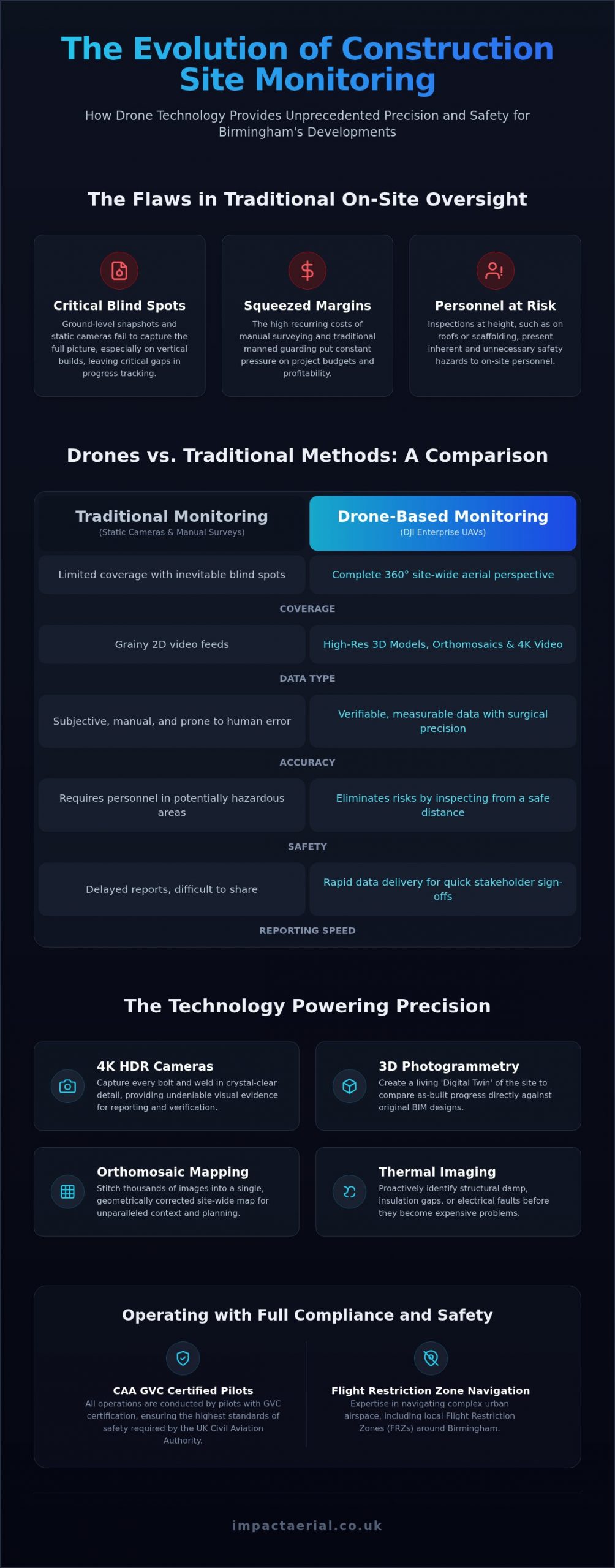
Drones vs. Traditional Site Monitoring: A Comparison
Static surveillance has long been the backbone of site security, yet it often fails to provide the dynamic data required for modern construction site monitoring birmingham projects. While a fixed camera can monitor a primary entrance, it cannot verify the structural integrity of a fifth-floor slab or identify a leak in a remote corner of a sprawling development. A DJI Enterprise drone moves with the project. It covers significantly more ground than a traditional guard in a fraction of the time, providing a level of mobility that static infrastructure simply cannot match. This shift from 2D security footage to 3D photogrammetry models allows for a depth of analysis that was previously impossible.
The setup process also highlights a stark contrast between old and new methods. Traditional monitoring requires a heavy investment in cabling, permanent poles, and consistent power supplies. Drones are operational in minutes. This agility allows for rapid incident response; if a project manager needs to inspect a high-elevation hazard, a drone reaches that location in seconds. It provides real-time 4K visual data without the need for scaffolding or risky manual climbs, ensuring that “eyes on the ground” are supported by a superior “eye in the sky.”
Cost-Benefit Analysis
Comparing the Total Cost of Ownership reveals that drone-based monitoring is often more economical than 24/7 manned guarding. While physical security is vital for perimeter control, it lacks the sophisticated data-gathering capabilities of a UAV. A single aerial survey can replace several specialized teams, consolidating progress reporting, safety audits, and topographical updates into one efficient flight. This professional approach is underpinned by the UK drone safety and registration rules, which ensure that commercial operations are conducted within a strict legal framework. The high-resolution evidence captured also serves as indisputable proof in contract disputes or insurance claims, protecting your margins from unforeseen costs.
Integration with Existing Security
Drones shouldn’t replace every ground-based measure. Instead, they should form the top layer of a multi-tiered security and monitoring strategy for Birmingham sites. When integrated with biometric access control and ground-level CCTV, drones provide the context that validates ground-level alerts. For complex urban sites with high-value plant machinery, this layered approach ensures there are no blind spots. If a ground sensor is triggered, a drone can be deployed immediately to provide a wide-angle view of the situation. This allows for a faster and more informed response than a guard on foot could ever manage, creating a more resilient and secure site environment. For developers seeking to enhance their project’s physical protection, asel.co.uk offers integrated solutions to safeguard high-value assets and organisations.
Compliance and Safety: Flying in Birmingham Airspace
Birmingham’s urban environment presents unique challenges that demand a meticulous approach to compliance. Unlike rural projects, construction site monitoring birmingham requires navigating a complex web of aviation laws and local restrictions. Operating a drone commercially in the UK in 2026 necessitates a General Visual Line of Sight Certificate (GVC) issued by the Civil Aviation Authority (CAA). This qualification ensures that pilots possess the technical knowledge to manage risks in congested areas. Hiring an uncertified hobbyist isn’t just a safety risk; it exposes your business to significant legal liabilities and potential fines from the CAA.
Regulatory Standards for 2026
Impact Aerial stays current with all legislative transitions, ensuring our operations remain fully compliant with the latest UK drone safety and registration rules. Our pilots hold current Flyer IDs and Operator IDs, which are mandatory for all professional flights. We implement specific safety protocols when flying over active construction personnel, including defined take-off zones and emergency fail-safe procedures. This level of meticulousness provides the psychological comfort that your project is being monitored within the strictest legal boundaries.
Local Birmingham Airspace Challenges
The city’s geography includes several sensitive zones that require expert navigation. Managing flights near the Birmingham Airport Flight Restriction Zone (FRZ) or the Queen Elizabeth Hospital helipad demands direct coordination with Air Traffic Control (ATC). We also account for specific infrastructure projects like HS2 Curzon Street, which may have temporary airspace restrictions. Our team conducts a detailed pre-flight risk assessment for every deployment, identifying potential hazards before the drone even leaves the ground. This includes working with local authorities to secure permissions for city centre operations.
Privacy, Insurance, and GDPR
In densely populated areas like Digbeth or the Jewellery Quarter, privacy is a paramount concern. We adhere to strict GDPR best practices, ensuring that data capture is focused solely on the site and that any incidental footage of the public is handled according to legal standards. Safety is reinforced by our £5m commercial liability insurance, a necessary safeguard for high-stakes urban infrastructure. This level of coverage is essential for protecting your assets and maintaining professional standards across the West Midlands.
If you need a partner who understands the complexities of urban aviation law, you can book a compliant site survey with our expert team today.
Why Choose Impact Aerial for Birmingham Site Monitoring?
Impact Aerial is more than just a drone operator; we’re a technical consultant for the West Midlands’ most ambitious developments. Our approach to construction site monitoring birmingham is built on a foundation of local knowledge and high-tier hardware. Being based in the heart of the region allows us to provide a level of responsiveness that national agencies simply can’t match. We understand the specific logistical challenges of the city, from navigating complex urban canyons to coordinating with local authorities for city-centre permissions.
We utilize DJI Enterprise-grade hardware equipped with 4K HDR cameras. This provides a level of visual clarity that reveals technical details often missed by consumer-grade equipment. However, the flight is only the first step. Our post-production excellence ensures that raw data is processed into actionable insights for your engineering and management teams. We don’t just deliver a folder of images. We provide structured, high-resolution evidence that supports every stage of the build, from initial groundworks to final completion. This commitment to quality has established our proven track record across the property, construction, and advertising sectors.
Our Birmingham-Centric Approach
Our team is deeply involved in supporting major regeneration projects, including high-profile developments in the Jewellery Quarter and surrounding districts. We align our safety protocols with the rigorous requirements of Tier 1 contractors, ensuring that our presence on-site never compromises operational standards. Because we’re local, we offer fast response times for site managers who need urgent inspections or rapid progress updates; this efficiency is vital when coordinating with heavy machinery specialists like Bewlake Lift & Haul Ltd to ensure lifting operations are safe and well-documented. This proximity allows us to be an integrated part of your project team, providing the local expertise needed to manage complex West Midlands developments.
Request a Consultation for Your Next Project
Every project has unique milestones, and we tailor our monitoring packages to meet those specific needs. Whether you require weekly progress reports for internal tracking or monthly high-resolution surveys for stakeholder meetings, our process is designed for reliability. We start with an initial consultation to understand your data requirements and site constraints. From there, we handle all flight planning, risk assessments, and post-production, delivering the final data through a streamlined digital workflow. Professional construction site monitoring birmingham is about more than just pictures; it is about providing the psychological comfort and tangible data that keeps projects on track.
If you’re ready to enhance your project oversight with precision data, contact Impact Aerial today for a professional site monitoring quote.
Future-Proofing Your Birmingham Development
The landscape of West Midlands infrastructure is shifting toward a data-first approach. By moving beyond traditional ground-level security, developers are now using 3D photogrammetry and 4K HDR imagery to maintain a single source of truth for their projects. Professional construction site monitoring birmingham ensures that every phase of your build is documented with surgical precision. This reduces the risk of costly delays and provides high-resolution evidence for all stakeholders, from investors to site managers.
The transition from reactive security to proactive management allows for better safety compliance and significant cost reductions across the project lifecycle. Our team of West Midlands local experts is ready to support your next development with the meticulousness your project deserves. We bring the reassurance of CAA GVC certified pilots and £5m commercial liability insurance to every flight, ensuring your site remains compliant and secure in even the most congested urban environments.
Take the next step in optimizing your site’s efficiency and safety. Book Your Birmingham Construction Site Monitoring Consultation today and gain the 360-degree perspective your project needs to succeed.
Frequently Asked Questions
Is drone monitoring legal on construction sites in Birmingham city centre?
Drone monitoring is entirely legal in Birmingham city centre when conducted by a CAA GVC certified pilot. While the city has complex airspace, including Flight Restriction Zones near the airport and helipads, professional operators coordinate directly with Air Traffic Control. We ensure every flight adheres to strict safety protocols and is backed by £5m commercial liability insurance to protect your assets in congested urban areas.
How often should we fly the drone for effective site monitoring?
The frequency of flights usually aligns with your specific project milestones or valuation cycles. Many developers opt for weekly construction site monitoring birmingham visits to track rapid progress, while others prefer monthly high-resolution surveys for stakeholder reporting. We tailor these schedules to provide a consistent “single source of truth” that matches your project’s pace and reporting requirements.
Can drone monitoring help with insurance claims on construction sites?
High-resolution aerial data serves as undisputable evidence in the event of an insurance claim or contract dispute. Because drone captures are time-stamped and geometrically accurate, they provide a clear record of site conditions at specific dates. This documentation is invaluable for verifying “as-built” progress against CAD designs or proving that safety protocols were in place before an incident occurred.
What kind of data will I receive from a drone monitoring session?
You’ll receive a suite of data-rich deliverables tailored to your team’s needs. This typically includes 4K HDR progress photography, orthomosaic maps for site-wide accuracy, and 3D photogrammetry models. We also provide post-production services to ensure the raw data is edited and processed into professional reports that are ready for immediate use by stakeholders and project managers.
Do I need to inform my neighbours about drone flights for site monitoring?
Notifying neighbours is considered a best practice for maintaining transparency and ensuring GDPR compliance. While your site is private property, professional drone operators conduct thorough pre-flight risk assessments that include stakeholder management. We handle the logistical side of privacy, ensuring that any incidental data capture of the surrounding Birmingham community is managed according to current data protection laws.
Can drones fly in the typical Birmingham wind and rain?
Enterprise-grade drones are designed to operate in challenging weather conditions, including light rain and moderate winds. Our hardware features high IP ratings for moisture resistance and can maintain stability in wind speeds of approximately 12 metres per second. While we prioritize safety and will ground flights in extreme storms, the reliability of modern technology ensures minimal disruption to your monitoring schedule.
How does drone monitoring integrate with my existing BIM software?
Drone data integrates seamlessly with most Building Information Modelling (BIM) and project management software. We export files in standard formats such as .OBJ, .LAS, or .TIFF, which allow you to overlay 3D aerial models onto your original CAD designs. This creates a “digital twin” that helps identify structural deviations early, ensuring the project stays aligned with the intended architectural plans.
What is the difference between a survey drone and a standard filming drone?
The primary difference lies in data precision and specialized sensor technology. While standard filming drones capture high-quality visuals, survey drones utilize RTK (Real-Time Kinematic) positioning for centimetre-level accuracy. They also feature mechanical shutters to eliminate image distortion and can carry thermal sensors. These technical capabilities are essential for generating the measurable data points required for professional site monitoring.
How to Hire a CAA Approved Drone Pilot in the UK: The 2026 Professional Guide
Did you know that hiring an uncertified drone operator could potentially invalidate your entire corporate insurance policy if an accident occurs? It’s a legitimate concern for any project manager or site lead who needs high-end aerial data without the shadow of legal liability. You want the precision of 4K filming or thermal mapping, but the complexity of UK aviation laws can make the process feel overwhelming. When you choose to hire caa approved drone pilot experts, you’re securing more than just a service; you’re ensuring that every flight is backed by rigorous risk assessments and official oversight.
We understand that you need reliability and technical excellence above all else. This professional guide will show you exactly how to vet operators, verify GVC certifications, and confirm that your pilot carries the essential £5m commercial liability insurance required for modern industry standards. We’ll walk you through the vetting process for 2026, covering everything from regulatory compliance to choosing the right hardware for specialized tasks like solar farm surveys or construction monitoring. You’ll learn how to secure a local expert who handles the technicalities so you can focus on the results.
Key Takeaways
- Understand the critical legal distinction between hobbyist and commercial flight to protect your business from liability and insurance invalidation.
- Learn how to verify GVC vs. A2 CofC certifications so you can confidently hire caa approved drone pilot specialists for complex or built-up environments.
- Discover why enterprise-grade hardware and high-accuracy thermal data are necessary for professional property surveys and construction site monitoring.
- Recognize the essential pre-flight steps, including mandatory risk assessments (RAMS), that ensure a seamless and compliant project execution.
- Gain peace of mind by understanding the importance of professional affiliations and substantial commercial liability insurance in the 2026 regulatory landscape.
Why Hiring a CAA Approved Drone Pilot is a Legal Necessity
In the United Kingdom, a CAA approved pilot is an operator holding specific permissions and certifications to fly drones for commercial gain. While many people own drones for recreation, the legal distinction between a hobbyist and a commercial operator is strictly defined. If you’re commissioning aerial work for a business, whether it’s a simple site photograph or a complex thermal survey, the flight is classified as commercial. This requires the pilot to hold valid credentials issued by the Civil Aviation Authority (CAA). When you look to hire caa approved drone pilot experts, you’re ensuring that the individual has been vetted for both technical competency and safety knowledge under the current UK drone regulations.
The concept of “Duty of Care” is a significant factor for any project manager or business owner. As the hiring party, you hold a legal responsibility to ensure that any contractor working on your behalf is operating within the law. Hiring an unapproved pilot isn’t just a minor oversight; it’s a breach of safety protocols that can lead to shared liability if an incident occurs. If an unvetted operator causes property damage or personal injury on your site, the legal and financial repercussions often fall back on your organization. Choosing a certified professional mitigates these risks from the outset.
To better understand the professional requirements for operators, watch this helpful video:
The Risks of Using Unlicensed Operators
The Civil Aviation Authority has the power to issue substantial fines and legal penalties to both the pilot and the company that hired them for unauthorized commercial flights. Beyond the immediate financial impact, a drone accident involving an unlicensed operator can severely damage your brand reputation and corporate safety record. Most Tier 1 contractors and large-scale property firms will not permit an unvetted pilot on-site because the risk to their safety standing is too great. CAA approval is the mandatory legal framework for all UK commercial drone flights.
The Critical Link Between Approval and Insurance
The most dangerous trap for businesses is the assumption that a pilot’s insurance is always active. In reality, specialist commercial drone insurance, which must comply with EC 785/2004 standards, is typically contingent on the pilot holding a valid CAA certification. If the pilot lacks the correct license for the task, their insurance is immediately voided, leaving your business fully exposed to any claims. For sectors such as construction and commercial property surveys, £5m liability insurance is the recognized industry standard. Before any work begins, you should meticulously verify the pilot’s insurance certificate and their GVC or A2 CofC credentials to ensure your project remains fully protected and legally compliant.
Navigating UK Drone Certifications: GVC vs. A2 CofC in 2026
Understanding the regulatory framework is the first step toward a compliant mission. The Civil Aviation Authority (CAA) categorises drone operations based on risk, splitting them into ‘Open’ and ‘Specific’ categories. For most commercial projects, the General Visual Line of Sight Certificate (GVC) remains the gold standard. It allows pilots to operate under a specific Operational Authorisation, which is necessary for flying larger enterprise aircraft in urban or congested environments. When you prepare to hire caa approved drone pilot teams, understanding these certification tiers is essential for project safety.
The A2 Certificate of Competency (A2 CofC) is often sufficient for lightweight drones in less congested areas. However, it lacks the operational flexibility required for high-stakes industrial tasks or heavier hardware. You can find a detailed breakdown of these requirements in our guide on the UK Drone License: A Simple Guide to CAA Rules in 2026. To ensure complete compliance, you should always check the CAA’s list of registered operators to verify a pilot’s credentials before they arrive on your site.
When You Need a GVC Certified Pilot
A GVC is mandatory when your project involves flying heavier enterprise drones, such as those used for drone services like complex industrial inspections or large-scale construction site monitoring. These aircraft provide the stability and sensor quality needed for high-accuracy data, but their weight puts them into the ‘Specific’ category. If your site is located in a congested area or requires flight near people, a GVC certified pilot is the only legal choice. It’s the most reliable way to hire caa approved drone pilot experts who can legally manage the complexities of 2026 airspace.
Verifying Operational Authorisation and IDs
Every professional operator should be able to produce an ‘Operational Authorisation’ document. This PDF, issued by the CAA, outlines exactly what the pilot is permitted to do, including flight heights and distances from uninvolved people. You must also verify two specific identification numbers: the Flyer ID, which proves the pilot’s personal competency, and the Operator ID, which identifies the person or business responsible for the drone. These should be clearly displayed on the aircraft itself. During your initial consultation, ask the pilot to explain how their specific authorisation applies to your site’s geography. A meticulous professional will welcome these questions as a chance to demonstrate their compliance. If you need assistance determining the right certification for your project, our team at Impact Aerial can provide a comprehensive regulatory review.
- Flyer ID: Proves the individual has passed the basic theory and competency tests.
- Operator ID: The registration number for the business entity, linked to their insurance and legal accountability.
- Operational Authorisation: The specific permission document that allows for commercial work in the ‘Specific’ category.
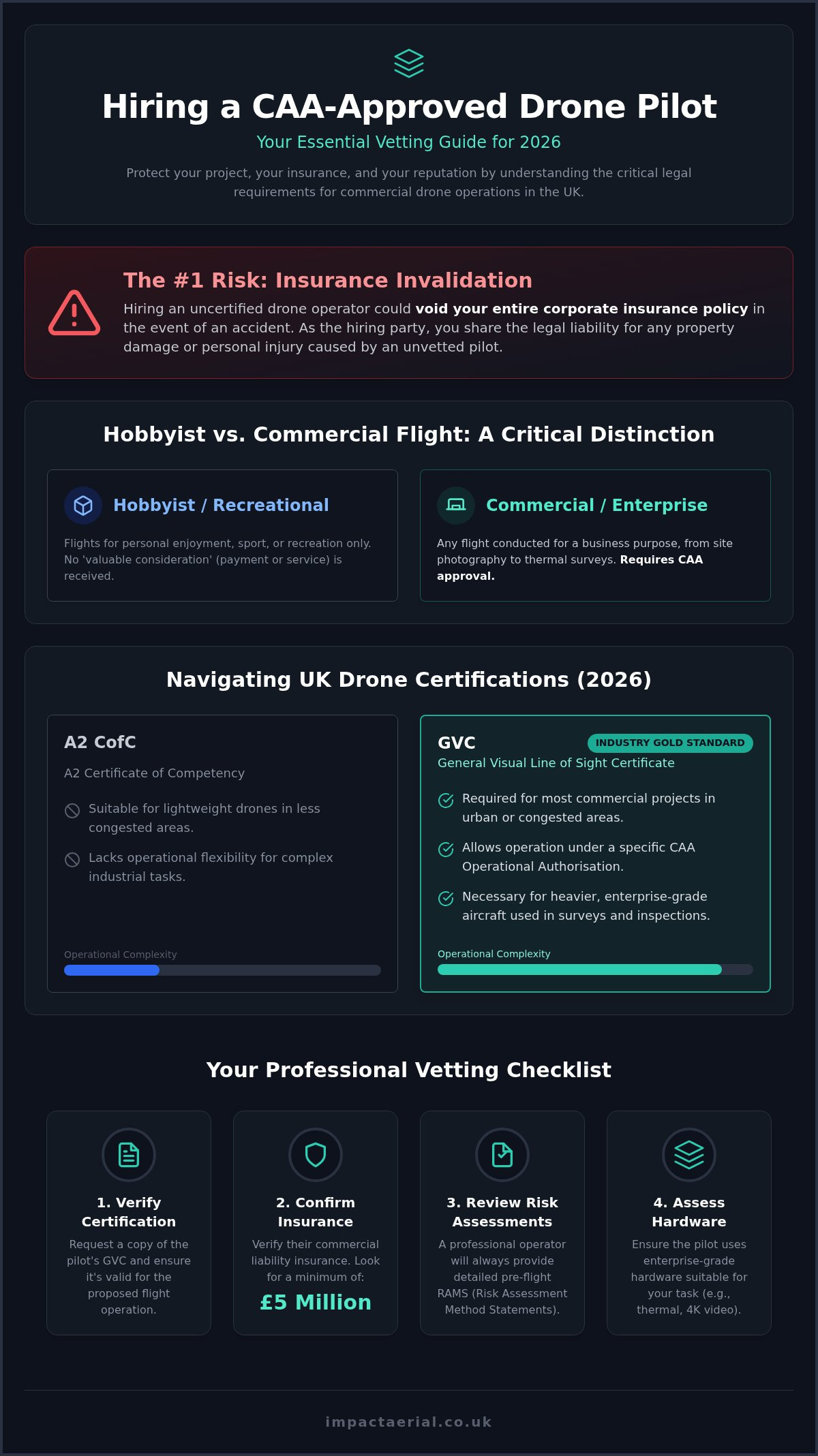
Beyond the License: Technical Hardware and Industry Standards
Professionalism in the drone industry isn’t just about the pilot’s license; it’s about the precision of the hardware they deploy. A professional drone platform is a sophisticated data acquisition tool, far removed from the consumer models found in retail stores. When you hire caa approved drone pilot teams, you expect results that meet strict corporate standards, which often requires the use of DJI Enterprise aircraft. These systems offer enhanced flight stability, redundant safety controllers, and specialized sensors designed for the rigorous demands of the property and building sectors.
Matching the equipment to the specific project task is crucial for achieving high-end results. While a standard 4K HDR camera is perfect for creative aerial filming, it may lack the geometric precision required for a detailed structural survey. Enterprise-grade sensors differ from consumer drone cameras because they offer significantly higher data precision, larger sensor sizes for better low-light performance, and mechanical shutters to eliminate distortion during high-speed mapping. This technical distinction ensures that the data you receive is accurate and fit for purpose.
Before any mission begins, a professional operator must ensure all hardware is correctly registered and maintained. You can review the current CAA drone registration requirements to understand the identification standards every commercial aircraft must meet. This technical compliance ensures that the data collected is not only high-quality but also legally defensible in a corporate environment.
Industry-Specific Drone Requirements
Construction site monitoring requires more than just occasional photography. It demands consistent GPS-tagged imagery and 3D mapping capabilities to track project progress against architectural models. Similarly, commercial property surveys focus on capturing high-detail roof and façade data safely, often using high-magnification zoom lenses to inspect defects from a safe standoff distance. For a deeper look at these technical methodologies, read our Drone Survey: The Complete Guide to Aerial Data Collection.
Specialist Capabilities: Thermal Surveys and Virtual Tours
Specialized tasks like PV Solar Farm Thermal Surveys require radiometric thermal sensors. These sensors don’t just show heat signatures; they record temperature data for every individual pixel, allowing for the precise identification of faulty cells or failing strings. For property marketing, we use 360-degree aerial capture to create immersive virtual tours, providing a comprehensive perspective of a property’s location and surroundings. To achieve these results, you must hire caa approved drone pilot specialists who possess the post-production expertise to turn raw sensor data into actionable reports. Actionable insights are the true value of professional drone work, moving beyond simple imagery to provide tangible business intelligence for your stakeholders.
The Professional Workflow: What to Expect On-Site
A professional drone operation is a structured sequence of technical events designed to maximize safety and data quality. When you hire caa approved drone pilot teams, you aren’t just paying for the flight time; you’re investing in a comprehensive safety and data management workflow. This meticulous process begins long before the aircraft leaves the ground, ensuring that every mission is compliant with UK aviation law and your specific project requirements.
- Step 1: Initial Consultation and Feasibility: We analyze the flight location to ensure the mission goals are legally and technically achievable within the current airspace.
- Step 2: Pre-flight Site Assessment: A detailed desk-based survey of the area identifies permanent hazards and land ownership requirements.
- Step 3: Airspace Coordination: We check for temporary restrictions and, if necessary, obtain NOTAMs (Notice to Airmen) to alert other aircraft in the vicinity.
- Step 4: On-site Execution: The pilot follows strict safety protocols, including real-time weather monitoring and site cordoning.
- Step 5: Data Processing: Raw sensor data is transformed through post-production into final 4K video, 3D models, or thermal reports.
This structured approach ensures that the high-end results you require are delivered without exposing your business to liability. If you’re ready to begin your mission, contact us for a professional drone project consultation today.
Pre-Flight Risk Assessment (RAMS) Explained
The Risk Assessment and Method Statement (RAMS) is the cornerstone of a safe commercial flight. This document identifies specific hazards such as overhead power lines, uninvolved people, and sensitive buildings. For every identified hazard, we implement clear mitigation strategies, which may include the use of visual observers (spotters), physical cordons, and established emergency procedures. A pilot who cannot or will not provide a detailed, site-specific risk assessment is a major red flag. It suggests a lack of professional oversight that could invalidate their insurance and put your site at risk.
Managing Airspace Restrictions and Weather
Safe flight is heavily dependent on environmental conditions and airspace permissions. Professional pilots monitor wind limits and precipitation constraints constantly; enterprise drones have specific tolerances that must never be exceeded. We also manage the complexities of Flight Restriction Zones (FRZs) near airports and military sites, which require specific coordination with Air Traffic Control. This level of technical planning is essential for high-stakes work. For projects focusing on visual storytelling, you can learn more about these technical requirements in our guide to Aerial Filming Drone: The Ultimate Guide to Professional Cinematic Video. By managing these variables, we ensure a seamless project execution from start to finish.
Partnering with Impact Aerial for Your UK Drone Project
Impact Aerial provides a streamlined solution for businesses looking to hire caa approved drone pilot specialists who prioritize regulatory compliance and technical precision. Based in Birmingham, our team operates nationwide, bringing local West Midlands expertise to high-stakes projects across the UK. We maintain a meticulous focus on safety, backed by £5m in commercial liability insurance and a roster of CAA GVC certified pilots. This level of professional coverage provides total psychological comfort for our clients, ensuring that every aerial mission is fully insured and legally compliant with the standards we’ve outlined in this guide.
Our capabilities span a diverse range of sectors, including commercial property, large-scale construction, and specialized energy infrastructure. Unlike a standard directory or hobbyist operator, we provide end-to-end project management. We don’t just capture data; we translate it into actionable business intelligence through our high-end post-production services. Whether you require precise thermal data for a solar farm or cinematic 4K footage for a national advertising campaign, our workflow is designed to deliver excellence without compromise.
Expertise in Visual and Technical Data Collection
Our operational experience ranges from creative cinematic filming projects to technical PV solar farm thermal surveys. We handle the entire project lifecycle, managing every detail from the initial feasibility consultation to the delivery of the final assets. By utilizing the latest DJI Enterprise technology, we ensure that every flight captures the highest possible level of detail, whether that’s radiometric thermal data or high-resolution structural imagery. Our commitment to using industry-leading hardware means your data is consistently accurate and suitable for professional analysis. You won’t have to worry about the technicalities of sensor calibration or flight permissions; our team manages the entire process.
The Impact Aerial Difference: Safety, Scale, and Quality
At the heart of our business is a safety-first culture that places your project’s compliance above all else. We understand that your corporate safety record is paramount, so we integrate the rigorous risk mitigation strategies discussed earlier into every stage of our process. Impact Aerial is a trusted specialist in the West Midlands and beyond, known for maintaining transparent pricing and clear communication throughout the hiring process. We avoid the ambiguity often found in the drone industry, providing you with a reliable partner that understands the nuances of 2026 aviation standards. When you choose to hire caa approved drone pilot experts from our team, you’re securing a partner dedicated to delivering high-tier quality and absolute operational reliability for your business.
Securing Your Project’s Future with Professional Drone Data
Navigating the complexities of UK aviation law ensures your project remains protected and productive. By prioritizing legal compliance and technical precision, you eliminate the risks associated with unauthorized flights and voided insurance policies. You now understand that verifying GVC certifications and ensuring comprehensive liability coverage are the most critical steps when you look to hire caa approved drone pilot specialists. Whether you require high-accuracy thermal data for solar farms or detailed structural surveys, the right partner manages the regulatory burden so you can focus on actionable insights.
Impact Aerial stands ready to support your mission with CAA GVC Certified Pilots and £5m Commercial Liability Insurance. Based in Birmingham, we provide expert aerial services across the entire UK, utilizing advanced DJI Enterprise hardware to deliver superior results for the property and construction sectors.
Request a Professional Drone Consultation from Impact Aerial today to ensure your next project is safe, compliant, and technically flawless. We look forward to helping you reach new perspectives with confidence.
Frequently Asked Questions
Is it illegal to hire a drone pilot without a CAA licence in the UK?
It is a breach of UK aviation law to hire an unlicensed operator for commercial gain. Both the pilot and the hiring organization can face significant legal penalties and fines from the Civil Aviation Authority if an unauthorized flight is conducted. Beyond the legal risk, using an uncertified operator typically voids any insurance coverage, leaving your business fully liable for any damages or injuries that occur during the flight.
How much does it cost to hire a professional drone pilot for a day?
Professional day rates vary significantly based on the technical complexity of the task and the specialized hardware required for the mission. A high-end thermal survey using radiometric sensors for a solar farm will command a different rate than a standard architectural photography session. Clients should request a project-specific quote that includes pre-flight planning, site assessments, and post-production data processing to ensure a transparent breakdown of costs.
Can a drone pilot fly in a restricted area or near an airport?
Qualified pilots can operate in Flight Restriction Zones (FRZs) and other restricted airspaces, provided they have the correct Operational Authorisation and coordinate directly with Air Traffic Control. This process involves filing a flight plan and obtaining a specific permit for the mission. When you hire caa approved drone pilot experts, they manage these complex permissions and NOTAM filings as part of their professional service.
What insurance should a professional drone pilot have for commercial work?
A professional operator must carry specialist commercial drone insurance that is compliant with EU Regulation (EC) 785/2004. For industrial sectors like construction and commercial property, a minimum of £5m public liability insurance is the recognized industry standard. You should always request to see a valid insurance certificate before any work commences to ensure your organization is fully protected against third-party claims.
What is the difference between an A2 CofC and a GVC qualification?
The A2 Certificate of Competency (A2 CofC) allows for lower-risk flights with smaller drones, while the General Visual Line of Sight Certificate (GVC) is the professional standard for complex commercial operations. A GVC is required for pilots using heavier enterprise aircraft in congested areas or near people. It serves as the prerequisite for obtaining a specific Operational Authorisation from the CAA, which is essential for high-level industrial tasks.
What happens if a drone pilot crashes on my property during a shoot?
If a crash occurs, a professional pilot’s commercial liability insurance should cover the resulting property damage or personal injury. The pilot must have followed the pre-flight risk assessment and mitigation strategies outlined in their RAMS document for the insurance to remain valid. This is why verifying a pilot’s CAA credentials and insurance status is the most critical step when you hire caa approved drone pilot teams for your site.
Do I need to notify my neighbours before hiring a drone pilot?
There is no strict legal requirement to notify neighbors in every scenario, but it is considered best practice to inform adjacent property owners to manage privacy concerns. Professional pilots adhere to strict GDPR and privacy guidelines, ensuring that data is only collected for the intended project scope. A thorough pre-flight assessment will identify any sensitive areas, and the pilot will implement cordons or flight path adjustments to respect surrounding boundaries.
How do I verify if a drone pilot is actually CAA approved?
You can verify an operator’s status by requesting their CAA Operational Authorisation document and checking their unique Operator ID. This document lists the pilot’s permissions, the aircraft they are authorized to fly, and the validity dates of their certification. A legitimate professional will always be able to provide these documents alongside their GVC certificate and proof of insurance during the initial consultation phase.
Drone Thermal Imaging Survey UK: The Professional Guide to Aerial Thermography
Did you know that professional drone surveys can be up to 70% cheaper than traditional inspection methods like scaffolding or rope access? For many commercial property managers and solar farm operators, the primary concern isn’t just the cost of access; it’s the invisible energy leaks and structural defects that remain hidden until they cause expensive downtime. You need a reliable way to inspect high-level assets without compromising on safety or risking the use of uncertified, under-insured pilots.
This guide explains how a drone thermal imaging survey UK identifies hidden moisture, energy loss, and solar faults with surgical precision. We’ll explore how CAA GVC certified pilots utilize commercial-grade DJI Enterprise hardware to deliver actionable thermographic data that satisfies both BREEAM and insurance requirements. You will learn how to secure a detailed, compliant report that provides the technical reassurance and long-term cost savings your business demands.
Key Takeaways
- Learn how non-destructive infrared sensors detect heat signatures and hidden defects invisible to the human eye from a safe distance.
- Understand why high-resolution sensors and commercial-grade DJI Enterprise hardware are essential for capturing accurate, actionable thermal data.
- Discover how a drone thermal imaging survey UK identifies specific issues like water ingress in commercial roofs and ‘hot spots’ on utility-scale solar farms.
- Identify the critical legal requirements, including CAA GVC certification and £5m liability insurance, necessary for compliant professional aerial inspections.
- Find out how detailed thermographic reporting provides the precise insights required for BREEAM compliance and significant long-term maintenance cost reductions.
What is a Drone Thermal Imaging Survey?
A drone thermal imaging survey UK is a specialized, non-destructive inspection method that utilizes Unmanned Aerial Vehicles (UAVs) equipped with high-resolution infrared sensors. Unlike standard photography, which captures the light reflected off a surface, thermal imaging detects the infrared radiation emitted by an object. This technology allows surveyors to visualize temperature variations across a structure, identifying anomalies that indicate underlying issues such as trapped moisture, insulation gaps, or electrical faults. It’s an essential tool for commercial property managers who require a comprehensive overview of their assets without the downtime associated with physical inspections.
The core benefit of this technology is its ability to detect heat signatures that are entirely invisible to the human eye. In a commercial context, this might reveal a “hot spot” on a solar panel or a “cold bridge” in a building’s envelope where heat is escaping. By capturing this data from a safe distance, drones eliminate the need for costly scaffolding or risky manual inspections at height. It isn’t just about taking pictures; it’s about gathering precise, technical data that informs long-term maintenance strategies and reduces operational risk.
There’s a significant difference between visual and thermal data. While a high-resolution visual camera can show you a crack in a roof tile, a thermal sensor reveals the damp insulation beneath it that has been festering for months. This layered approach to data collection provides a level of insight that traditional surveys simply cannot replicate, allowing for targeted repairs rather than expensive, site-wide replacements.
How Aerial Thermography Works
Thermal sensors convert infrared energy into a visual map known as a thermogram. Professional surveys rely on “Radiometric” data, which means the sensor records a specific temperature value for every single pixel in the image. This allows for detailed post-flight analysis where surveyors can interrogate the data to find exact temperature differentials. Accuracy depends heavily on technical calibration. Emissivity refers to the effectiveness of a material’s surface in emitting energy as thermal radiation, a variable that professional surveyors must calibrate to ensure data integrity. Without accounting for emissivity and atmospheric conditions, thermal data can be misleading or entirely inaccurate.
UAV vs. Traditional Thermal Surveys
Speed is one of the most immediate advantages of a drone thermal imaging survey UK. A warehouse roof that would take a surveyor days to inspect with a handheld camera can be covered in minutes from the air. Safety is equally paramount; by using drones, we remove the necessity for rope access or working at height, significantly lowering the risk profile of the project. Furthermore, drones provide the “nadir” or straight-down perspective. This 90-degree angle is crucial for flat roof surveys to minimize reflections and ensure the sensor captures the most accurate thermal signature possible across the entire surface area.
Advanced Technology: The DJI Enterprise Advantage
The success of a drone thermal imaging survey UK depends entirely on the caliber of the equipment used. While consumer drones might offer basic thermal capabilities, we utilize commercial-grade DJI Enterprise hardware to ensure the highest data integrity. These platforms are specifically designed for industrial applications, featuring high-resolution thermal sensors with a minimum of 640×512 resolution. This level of detail is critical; lower resolutions often fail to distinguish between minor surface temperature variations and genuine structural defects. By using professional sensors, we can identify anomalies as small as a single failing solar cell or a minor moisture leak behind a parapet wall.
Precision is further enhanced through dual-sensor capabilities and RTK (Real-Time Kinematic) positioning. Our drones capture high-resolution 4K visual imagery and thermal data simultaneously. This allows us to overlay the heat map onto a clear visual photograph, providing essential context for maintenance teams. RTK technology provides centimetre-level positioning accuracy, which is vital for repeatable surveys. If we identify a fault today, we can return to the exact coordinates months later to monitor the effectiveness of repairs. Ensuring that these advanced platforms are operated within the strict guidelines for UK Compliance, Safety, and Choosing a Provider is a core part of our operational philosophy.
The Importance of Delta T in UK Surveys
For a thermal survey to be accurate, there must be a sufficient temperature difference, known as Delta T, between the internal and external environments. In the UK, we typically require a Delta T of at least 10°C to 15°C for building envelope inspections. This makes the UK winter months and night-time operations the optimal window for survey work. Conducted after sunset, these surveys eliminate “solar loading,” where the sun warms the building surface and masks underlying defects. We carefully monitor wind speeds and surface moisture, as excessive wind can “wash away” heat signatures and rain can provide false readings due to evaporative cooling.
Radiometric Data and Reporting
Data captured during our flights is recorded in a radiometric JPEG format. This means every pixel in the image contains a specific temperature measurement that can be interrogated during post-production. Our technical team uses specialized software to analyze these heat maps, adjusting parameters like emissivity to produce a professional, actionable report. These insights are often integrated into broader drone property surveys to provide a complete digital twin of a commercial asset. If you are managing a large-scale facility, our team can help you assess your specific thermal requirements to ensure your next inspection delivers maximum value.
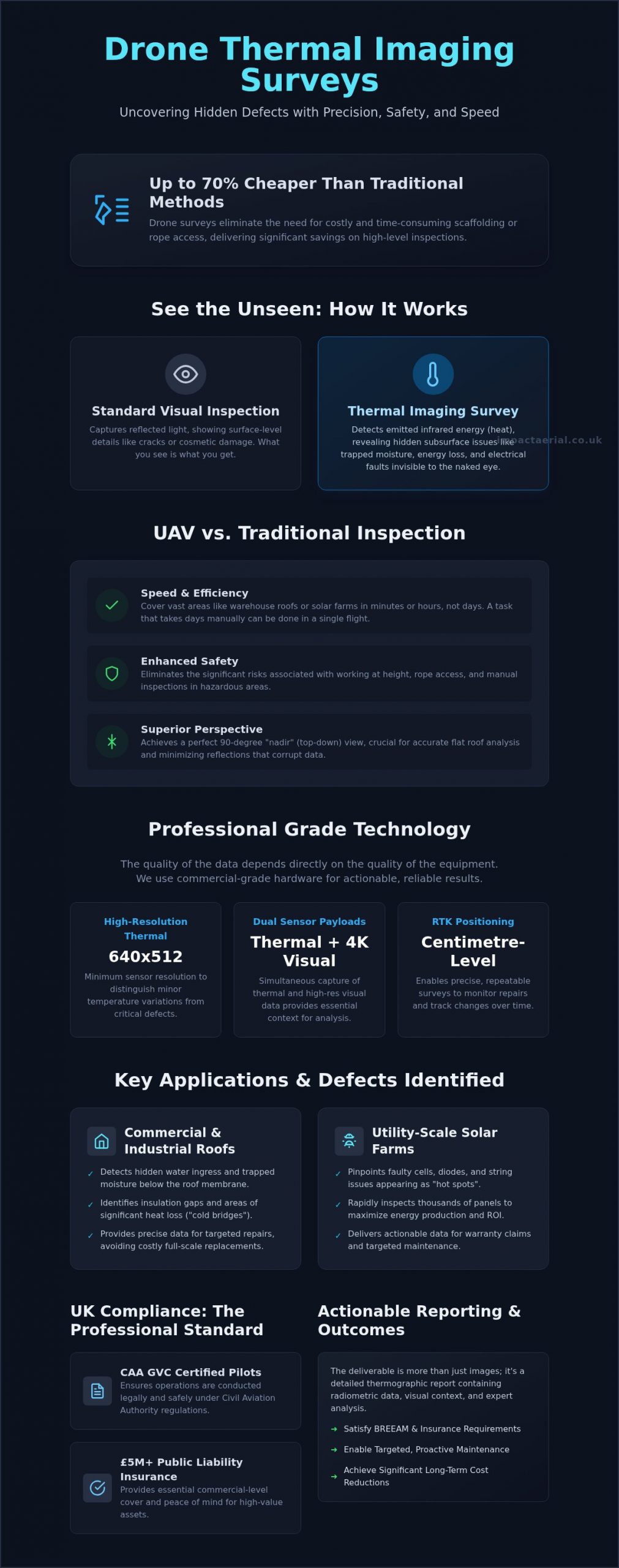
Key Applications for Drone Thermal Surveys in the UK
The versatility of a drone thermal imaging survey UK makes it an indispensable asset for diverse industrial sectors. From identifying energy inefficiencies in large-scale warehouses to monitoring critical infrastructure, the applications are as varied as they are vital. Operating these surveys requires strict adherence to UK Civil Aviation Authority drone regulations, particularly when navigating the complex airspaces surrounding industrial hubs or densely populated commercial zones. By integrating thermal data into standard maintenance workflows, organizations can transition from reactive repairs to a proactive, data-driven strategy.
In industrial facilities, thermal drones monitor steam pipe networks, electrical substations, and mechanical components for signs of overheating or wear. These hotspots often precede catastrophic failure, meaning a single flight could prevent thousands of pounds in lost production time. For building envelopes, thermography is a primary tool for verifying air leakage and insulation continuity, which is often required for BREEAM assessments or energy efficiency certifications. This technical oversight ensures that commercial assets remain compliant with evolving environmental standards while reducing operational overheads.
Solar Farm Efficiency and ROI
Maximizing the output of renewable assets is the primary goal of PV solar farm thermal surveys. Traditional manual testing of a utility-scale array can take weeks and involves significant labor costs. In contrast, a drone can inspect hundreds of acres in a single day, identifying bypass diode failures and string issues with absolute precision. It’s important to understand that a single faulty cell can degrade an entire string’s performance, leading to a disproportionate drop in total energy production. By pinpointing these defects early, operators can ensure their maintenance teams only replace what’s necessary, protecting the long-term ROI of the site.
Commercial Property and Flat Roofs
Flat roofs are notorious for hidden moisture entrapment, which often goes unnoticed until structural damage occurs. A drone thermal imaging survey UK identifies these wet areas by detecting the thermal mass of trapped water, which retains heat longer than dry insulation after sunset. This allows property managers to perform targeted patch repairs rather than commissioning a full roof replacement. For those looking to understand the broader context of aerial data, our drone survey guide explains how thermal data fits into a holistic asset management plan. Visualizing heat loss in this way provides the tangible evidence needed to justify energy-saving capital expenditures in large industrial warehouses.
UK Compliance, Safety, and Choosing a Provider
Compliance is the cornerstone of any professional drone thermal imaging survey UK. It isn’t merely a matter of following rules; it’s about rigorous risk mitigation and ensuring the safety of personnel and property. Every commercial flight must be preceded by a site-specific Risk Assessment and Method Statement (RAMS). These documents outline exactly how the pilot will manage hazards, from public footpaths to overhead power lines. Additionally, because thermal data can reveal sensitive information about a facility’s operations and security, professional providers must handle all data in strict accordance with UK GDPR standards.
Choosing a provider based solely on price often leads to significant legal and financial risks. A professional firm brings technical reassurance through meticulous operational standards. This includes maintaining detailed flight logs, equipment maintenance records, and up-to-date insurance certificates. When you hire an expert, you aren’t just paying for a thermal map; you’re investing in a compliant process that protects your business from liability.
Why CAA GVC Certification Matters
In the UK, the General Visual Line of Sight Certificate (GVC) is the standard legal requirement for pilots operating under an Operational Authorisation from the Civil Aviation Authority. Understanding the nuances of a drone license is vital for anyone commissioning commercial work. There’s a vast difference between a hobbyist flyer and a professional operator. Certified pilots have undergone rigorous theory and practical examinations to prove they can navigate complex UK airspace and urban environments safely. They understand how to coordinate with Air Traffic Control and other stakeholders, ensuring that your survey doesn’t interfere with local aviation activity.
Insurance and Liability
While many drone users carry basic insurance, £5m commercial liability insurance is the recognized gold standard for UK site access. Many industrial facilities, construction sites, and solar farms won’t grant gate access without proof of this specific level of indemnity. This coverage is essential because it protects the client, the public, and the property in the unlikely event of an incident. Using an under-insured or uncertified pilot exposes your organization to immense financial risk and potential breach of contract with your own insurers. Before commissioning a survey, always verify a pilot’s credentials and insurance validity. If you need a vetted partner for your next project, contact our certified team to discuss your requirements and receive a detailed safety brief.
Impact Aerial: Professional Thermal Solutions Across the UK
Based in Birmingham, Impact Aerial is strategically positioned in the West Midlands to facilitate rapid deployment for any drone thermal imaging survey UK. Our central location allows us to provide a consistent, high-tier service to commercial clients from Scotland to the South Coast. We combine the creative eye developed through years of professional aerial filming with the meticulous technical precision required for thermographic data collection. This unique blend of skills ensures that every survey we conduct isn’t just technically accurate, but also provides the visual clarity needed for stakeholders to understand complex findings quickly.
Our brand promise of reassurance and reliability is reflected in our choice to use only CAA GVC certified pilots and £5m commercial liability insurance. We don’t just provide raw data; we offer a technical partnership designed to reduce your operational risks. By handling every stage of the process in-house, we maintain total control over data quality and safety standards, giving you the peace of mind that your assets are in expert hands.
Our Survey and Reporting Process
Precision begins long before the drone leaves the ground. Our pre-flight phase involves rigorous weather monitoring and Delta T planning to ensure atmospheric conditions are optimal for thermal contrast. Once on-site, our pilots use DJI Enterprise hardware to capture radiometric data efficiently, minimizing disruption to your site operations. The most critical phase, however, is our post-production reporting. We translate complex heat maps into actionable PDF reports that feature side-by-side thermal and visual comparisons. This clear documentation allows your maintenance teams to see exactly where a defect is located in the real world, removing the guesswork from repairs and providing a verifiable audit trail for insurance or BREEAM compliance.
Book Your UK Thermal Drone Survey
Every commercial property or solar farm has unique requirements, which is why we start every project with a detailed consultation. We work with you to identify the specific questions you need the thermal data to answer, whether you’re chasing an elusive roof leak or auditing the efficiency of a utility-scale PV array. This targeted approach ensures that the final report delivers maximum value and tangible insights for your business. Our team is ready to provide a tailored quote based on your site’s scale and complexity. To secure technical reassurance for your assets, Contact Impact Aerial for a professional thermal imaging quote.
Maximise Operational Efficiency with Precision Thermography
A drone thermal imaging survey UK provides the technical clarity needed to protect commercial property and utility-scale solar farms from invisible defects. By leveraging high-resolution radiometric data, you can identify moisture ingress and electrical faults before they escalate into costly structural failures. The combination of DJI Enterprise hardware and meticulous Delta T planning ensures that every report delivers actionable insights rather than just raw imagery.
Choosing a certified partner is about more than just compliance; it’s about operational security. With our CAA GVC Certified Pilots and £5m Commercial Liability Insurance, we provide the reassurance and reliability required for complex industrial site access. Our Birmingham-based team is ready to deliver high-tier Actionable Radiometric Data Reports that support your long-term maintenance and BREEAM requirements across the UK.
Request a Professional Drone Thermal Survey Quote to start your next project with a trusted specialist. We’re here to help you turn invisible heat signatures into a clear strategy for asset protection.
Frequently Asked Questions
What is the best time of year for a drone thermal survey in the UK?
The winter months, typically between November and March, provide the optimal conditions for a drone thermal imaging survey UK. This period ensures a significant temperature differential between a building’s heated interior and the cold external environment. We often conduct these surveys at night or in the early morning to avoid solar loading, where the sun warms the building surface and masks underlying thermal anomalies.
How much does a drone thermal imaging survey cost?
The cost of a professional thermal survey is determined by factors like the total acreage of a solar farm or the complexity of a commercial roof structure. Larger industrial sites require more flight time and extensive data processing during the post-production phase. We provide bespoke quotes for every project to ensure the scope of work aligns with your specific technical requirements and the depth of reporting needed.
Can drones detect water leaks in flat roofs?
Drones are highly effective at detecting moisture entrapment within flat roof systems. Trapped water has a higher thermal mass than dry insulation, meaning it retains heat longer and creates a distinct thermal signature after sunset. This non-destructive method allows us to pinpoint the exact location of water ingress without invasive core sampling, helping property managers target repairs and avoid full roof replacements.
Is a drone thermal survey better than a handheld inspection?
Aerial surveys offer significant advantages over handheld inspections regarding perspective, safety, and speed. A drone captures the nadir, or straight-down angle, which is essential for accurate thermal mapping of flat roofs and large solar arrays. While a handheld camera is limited by ground-level obstacles, a UAV can survey an entire industrial facility in a fraction of the time while maintaining a consistent data-capture height.
Do I need to be on-site during the drone survey?
Client presence isn’t strictly required during the flight, provided our pilots have the necessary site access and safety clearances. We handle the pre-flight risk assessments and coordinate with your site manager to ensure minimal disruption to your operations. Once the flight is complete, we provide a full briefing and deliver the technical report digitally, allowing you to review the findings from any location.
What temperature difference (Delta T) is needed for a valid report?
A valid thermographic report typically requires a temperature difference of at least 10°C to 15°C between the internal and external environments. For building envelope surveys, this contrast is vital to ensure that heat loss or insulation gaps are clearly visible to the infrared sensor. We meticulously plan our flight windows around weather forecasts to ensure these technical conditions are met, providing the most accurate data possible.
Are your pilots CAA GVC certified?
Every pilot at Impact Aerial is CAA GVC certified, ensuring they meet the legal requirements for commercial drone operations in the UK. This certification, combined with our £5m commercial liability insurance, provides the professional reassurance needed for work on high-risk industrial sites. We maintain strict adherence to all aviation safety protocols, including the submission of site-specific risk assessments before every drone thermal imaging survey UK.
How long does it take to receive the thermal survey report?
We typically deliver our detailed thermographic reports within three to five business days following the site visit. This timeframe allows our technical team to process the radiometric data and overlay thermal findings onto high-resolution visual imagery. Each report is manually reviewed to ensure accuracy, providing you with a professional document that includes actionable insights and clear comparisons for your maintenance or insurance teams.
Professional Birmingham Aerial Videography Guide 2026
In the densely packed urban corridors of the West Midlands, the difference between a stunning marketing asset and a significant legal liability often comes down to a single pilot’s certification. You’ve likely seen the potential of aerial perspectives to elevate your brand, but the complexity of 2026 UK drone regulations can make the process feel like a technical minefield. Whether you require high-end marketing footage or a precise drone building inspection birmingham wide, the stakes for safety and compliance have never been higher.
We understand that hiring a pilot shouldn’t feel like a gamble. This guide will demonstrate how professional Birmingham aerial videography integrates cinematic 4K HDR quality with rigorous CAA safety standards to provide total peace of mind. We’ll examine the latest UK0 to UK6 classification systems, the new Remote ID requirements, and how advanced DJI Enterprise technology delivers the accurate data and visual excellence your commercial projects demand.
Key Takeaways
- Learn why 4K HDR resolution and DJI Enterprise technology are essential for achieving broadcast-quality stability and data precision in commercial filming.
- Understand the 2026 CAA GVC requirements and why expert navigation of Birmingham’s complex urban airspace is vital for legal compliance and risk mitigation.
- Discover how a professional drone building inspection birmingham provides accurate construction monitoring and high-resolution data for site stakeholders.
- Explore the strategic advantages of using cinematic aerial perspectives to showcase Birmingham’s unique architectural landscape for high-impact commercial property marketing.
- Gain insights into the meticulous professional workflow required for West Midlands projects, from initial airspace consultation to final post-production delivery.
The Evolution of Aerial Videography in Birmingham
The skyline of the West Midlands has undergone a radical transformation, and the technology used to document it has followed suit. The Evolution of Aerial Videography has moved rapidly from the era of shaky, hobbyist-grade gadgets to the deployment of sophisticated DJI Enterprise tools. In a city like Birmingham, where ultra-modern developments sit alongside historic landmarks, the demand for precision has never been higher. Professional drone building inspection birmingham services now provide a level of detail that was previously impossible without significant logistical overhead.
Operating in Birmingham presents unique challenges that only an expert pilot can manage. Navigating the tight urban corridors of the Jewellery Quarter or the open, wind-swept spaces of Victoria Square requires more than just basic flight skills. It demands an understanding of local micro-climates and complex airspace restrictions. We’ve moved far beyond the days of hiring expensive chartered planes or helicopters to get a single wide shot. Modern 4K HDR drones offer a versatile, stable platform that captures every architectural nuance while remaining compliant with strict CAA safety standards. This shift doesn’t just save money; it provides a fresh perspective that transforms how developers and stakeholders analyse their sites.
Why Birmingham Businesses are Choosing Aerial Content
Commercial entities in the West Midlands are increasingly using aerial perspectives to gain a competitive edge. It’s no longer enough to show a static ground-level photo of a new development. High-altitude visuals provide a sense of scale and brand authority that traditional photography can’t match. From a practical standpoint, a drone building inspection birmingham project is a fraction of the cost of erecting scaffolding or hiring a cherry picker. This efficiency allows for more frequent monitoring, ensuring that site managers have up-to-date data without the typical downtime associated with traditional survey methods.
Aerial Videography vs. Ground-Based Filming
While ground-based cameras are excellent for capturing human-scale interactions, they fail to convey the true footprint of major infrastructure projects. Drones bridge this gap by capturing the entirety of a construction site in a single, high-resolution frame. We can create immersive fly-through experiences that guide potential tenants through a commercial development before the first brick is even laid. By integrating these cinematic shots into existing corporate video programmes, businesses can achieve a high-end, broadcast-quality feel. This approach ensures that every stakeholder, from investors to local authorities, sees the project through a lens of technical excellence and professional reliability.
Technical Standards: 4K HDR and DJI Enterprise Technology
Achieving broadcast-quality results in a city as architecturally diverse as Birmingham requires more than just a standard consumer drone. For a professional drone building inspection birmingham, the technical specifications of the hardware are the foundations of every successful project. Impact Aerial employs industry-leading professional drone systems because they offer the stability and data precision required for high-stakes urban environments. Our advanced hardware represents the industry benchmark for reliability, reflecting the dominant market share held by top manufacturers in enterprise applications as of 2026. When you’re filming near the Bullring or the new HS2 developments, the ability to maintain a 4K HDR feed while navigating complex magnetic interference is a non-negotiable requirement for safety and quality.
The UK Civil Aviation Authority (CAA) has strict guidelines for Navigating Birmingham Airspace, especially given the proximity of Birmingham International Airport. Our Impact Aerial professional fleet is equipped with advanced obstacle avoidance and Remote ID technology, ensuring every flight is as compliant as it is visually stunning. This hardware isn’t just about the camera; it’s about the redundant systems that keep the aircraft stable in the gusty conditions often found around Birmingham’s high-rise structures. Balancing a large camera sensor with the agility needed for tight city centre flights is a technical challenge that only professional-grade equipment can solve.
The Professional Fleet Advantage
Our advanced professional fleet provides three critical advantages for West Midlands commercial projects. First, omnidirectional obstacle sensing is essential for safe navigation in congested city centres and near delicate heritage buildings. Second, High Dynamic Range (HDR) is crucial for maintaining detail during the flat, grey light conditions common in the UK. Finally, advanced battery management allow for comprehensive site coverage in a single flight, which is particularly useful for a drone building inspection birmingham where time on-site must be minimised.
From Raw Footage to Polished Edit
Capturing the footage is only the first stage of our workflow. Raw aerial data is often flat to allow for maximum flexibility in the edit. Our post-production services transform these files into cinematic marketing assets through expert colour grading and sound design. For construction site monitoring, we integrate professional graphics and data overlays that clearly show project milestones to stakeholders. Whether you need a punchy 15-second clip for social media or a detailed 10-minute progress report, we optimise every delivery format for its intended audience. If you’re ready to see how high-end tech can elevate your next project, you can explore our drone survey and data collection services.
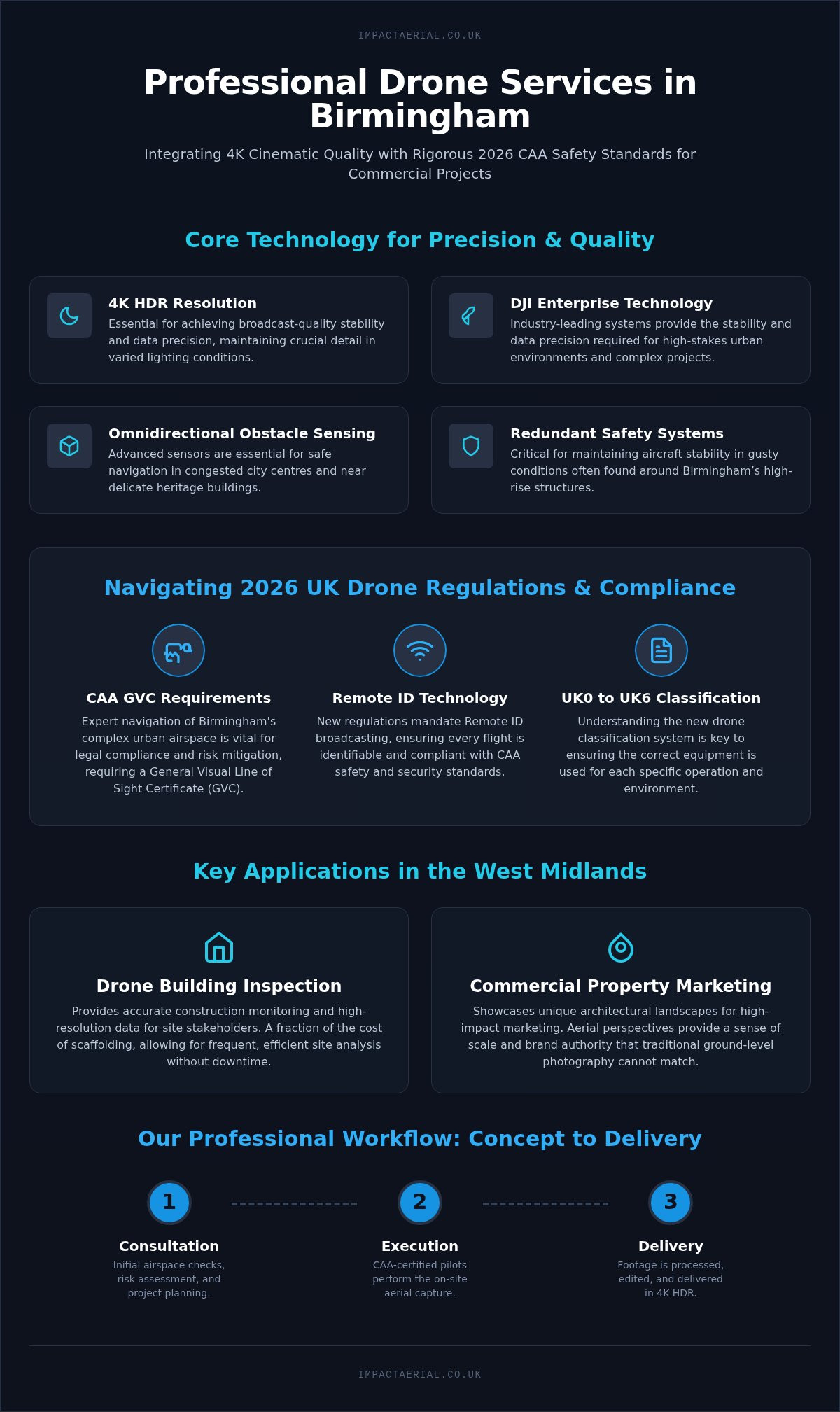
Safety and Compliance: Navigating Birmingham Airspace
Birmingham’s urban landscape presents a sophisticated challenge for aerial operations, primarily due to its complex airspace and dense population centres. Much of the city, particularly the eastern corridors, sits within the Flight Restriction Zone (FRZ) of Birmingham International Airport (BHX). Conducting a professional drone building inspection birmingham in these areas isn’t just about pilot skill; it’s about meticulous legal coordination with Air Traffic Control. The UK Civil Aviation Authority (CAA) updated the regulatory framework on 1 January 2026, introducing the UK0 to UK6 classification system. We ensure every flight remains fully compliant with these latest standards, including the mandatory use of Remote ID for all new enterprise aircraft.
Risk mitigation is the cornerstone of our operational philosophy. Before any rotors turn, we conduct comprehensive site surveys and desk-based assessments to identify potential hazards, from high-tension power lines to local micro-climates. To protect our clients from unforeseen liabilities, we carry £5m commercial liability insurance as a standard requirement. This level of coverage is essential for West Midlands businesses that value security and professionalism over the risks associated with uncertified operators.
Why GVC Certification Matters
The legal distinction between a hobbyist and a professional provider of drone services has never been clearer. For commercial work in congested urban areas, a pilot must hold a General Visual Line of Sight Certificate (GVC). This qualification demonstrates a high level of airmanship and a deep understanding of the 2026 drone license regulations. Our commitment to these safety protocols ensures that every drone building inspection birmingham project is executed within the strict confines of the law, protecting your brand’s reputation and ensuring the safety of the public.
Urban Risk Management
Managing flight paths over public spaces like Centenary Square or the Bullring requires a disciplined approach to urban risk. We don’t just focus on the flight itself; we manage the entire operational environment. This includes:
- Implementing strict cordons and using spotters to manage ground-level safety.
- Adhering to GDPR and privacy regulations to ensure that bystanders and neighbouring properties are protected.
- Securing specific permissions for filming near sensitive heritage sites or government buildings.
By handling these logistical hurdles, we allow our clients to focus on the results. Whether we’re navigating the historic Jewellery Quarter or modern infrastructure projects, our goal is to provide total psychological comfort through technical and regulatory excellence.
Industry Applications for Aerial Video in the West Midlands
The versatility of UAV technology has made it an indispensable tool across diverse sectors in the West Midlands. In commercial property, we move beyond simple snapshots to create high-impact real estate photography and cinematic video that captures the full context of a development. This isn’t just about aesthetics; it’s about providing a comprehensive view of transport links and local amenities that ground-level cameras cannot reach. For the construction sector, construction site monitoring has become the standard for stakeholder reporting, allowing project managers to track progress with high precision. Beyond marketing and construction, our PV solar farm thermal surveys and critical infrastructure inspections support the region’s energy sector. Even the tourism and advertising industries benefit, as we showcase Birmingham’s vibrant culture and large-scale events from perspectives that reveal the city’s true scale.
Property and Development Marketing
Selling a location requires more than just showing the building. It’s about highlighting the proximity to New Street Station or the accessibility of the M6. We create immersive virtual tours that provide a seamless experience for potential tenants, driving enquiries by allowing them to explore a space before a physical visit. Capturing luxury residential developments in Digbeth or the Jewellery Quarter during the golden hour provides that aspirational quality that high-end brands demand. These visuals don’t just show a property; they sell a lifestyle and a strategic location to global investors.
Technical Surveys and Inspections
The use of specialized survey drones has revolutionized how we approach maintenance. Executing a drone building inspection birmingham wide allows for detailed roof and facade analysis without the cost or risk of scaffolding. We provide thermal imaging that identifies heat loss or moisture ingress, facilitating preventative maintenance for commercial landlords and facility managers. This data-centric approach is equally valuable for topographical mapping and large-scale land development projects. If you need to secure accurate data or cinematic marketing assets for your next West Midlands project, you can contact our professional aerial filming team today.
The Impact Aerial Workflow: From Concept to Delivery
Professional aerial operations require more than just technical skill; they necessitate a structured, methodical workflow that prioritises client goals and aviation safety. We approach every project as a technical consultancy, ensuring the transition from initial concept to high-end delivery is seamless and compliant. Whether we’re conducting a high-resolution drone building inspection birmingham wide or capturing cinematic marketing assets, our process is designed to provide total psychological comfort through every phase of the mission.
Step 1: Consultation and Planning
The process begins with a deep dive into your specific project requirements. We define the brief and identify the exact deliverables you need, whether that’s raw thermal data for a solar farm or a polished promotional film for a new commercial development. During this stage, we handle the complex logistics of securing permissions for restricted urban areas and private land. We monitor weather patterns and sun positions to schedule flights for optimal lighting conditions. This meticulous planning phase is where we conduct our site-specific risk assessments, ensuring every operational detail is locked down before we arrive on-site.
Step 2: Professional Execution and Editing
On-site, our GVC certified pilots execute the flight plan with surgical precision. We understand that commercial sites are busy environments, so we conduct our operations with minimal disruption to your daily business activities. If we’re performing a drone building inspection birmingham for a construction firm, we ensure all data points are captured systematically and safely. We often review raw footage with clients while on-site to allow for immediate feedback and any necessary adjustments.
Once the flight is complete, the project moves to our post-production suite. Here, we transform raw data into an aerial filming drone masterpiece. This includes professional colour grading, sound design, and the integration of graphics or data overlays. The result is a high-tier visual asset delivered via secure file transfer, ready for broadcast, social media, or stakeholder reporting. Our workflow ensures that the final output isn’t just a video, but a strategic tool that meets your specific business objectives.
Securing the Future of Your West Midlands Projects
Professional aerial videography has evolved into a critical technical service that balances cinematic artistry with rigorous aviation compliance. By choosing a specialist who understands the nuances of Birmingham’s urban airspace, you’re investing in more than just footage; you’re securing a compliant, high-resolution data asset. Whether your project requires a technical drone building inspection birmingham or a high-impact marketing campaign, the combination of 4K HDR technology and meticulous planning ensures a superior outcome.
As Birmingham and West Midlands specialists, we provide the technical expertise and legal assurance your business demands. Our GVC certified pilots operate with £5m public liability insurance, using industry-leading DJI Enterprise hardware to deliver precision in every frame. We manage the entire process, from complex airspace permissions to final post-production, so you can focus on your project’s success with total peace of mind.
We’re ready to help you transform your next commercial development with stunning visuals and accurate data. Request a Professional Aerial Videography Quote for Your Birmingham Project and take the first step towards a safer, more cinematic perspective.
Frequently Asked Questions
Do you need a permit to fly a drone in Birmingham city centre?
Yes, operating a drone in Birmingham city centre requires specific permissions due to the dense urban environment and proximity to Birmingham International Airport. As the city falls within complex airspace, professional pilots must coordinate with Air Traffic Control and potentially local authorities. Our GVC certified pilots manage these logistics as part of our standard workflow to ensure every flight is fully legal and safe.
How much does aerial videography in Birmingham typically cost?
The cost of professional aerial services depends on the project’s complexity, the required hardware, and the level of post-production needed. Factors such as the location’s risk profile and the duration of the shoot also influence the final investment. We provide bespoke quotes that reflect the specific technical requirements and deliverables of your West Midlands commercial project.
Can drones fly in the rain or high winds common in the West Midlands?
Our DJI Enterprise drones are designed with high wind resistance, allowing for stable flight in conditions that would ground hobbyist equipment. However, we generally avoid operating in heavy rain to protect the sophisticated optical sensors and ensure the highest data quality. Safety remains our primary concern; we won’t fly if the conditions compromise the aircraft or the integrity of the footage.
What insurance cover does Impact Aerial carry for commercial projects?
We carry £5m commercial liability insurance as a standard requirement for all our operations. This significant level of cover is essential for high-stakes environments, such as a drone building inspection birmingham, providing our clients with total peace of mind. It ensures that your business is protected against unforeseen events during any phase of the aerial operation.
How long does it take to get the final edited drone video?
Turnaround times vary based on the project’s scope, but we typically deliver raw data for a drone building inspection birmingham within 48 hours. For fully edited cinematic films, the post-production process usually takes between five and ten working days. We provide a clear timeline during the initial consultation to ensure our delivery aligns with your project milestones.
Are your pilots CAA GVC certified for urban environments?
Yes, all our pilots hold the General Visual Line of Sight Certificate (GVC), which is the legal standard for commercial work in congested urban areas. This certification demonstrates a high level of technical competence and a thorough understanding of the latest 2026 UK drone regulations. It’s a non-negotiable requirement for safely navigating Birmingham’s complex city centre architecture.
Can you provide thermal imaging for solar farms in the Birmingham area?
We provide specialized PV Solar Farm Thermal Surveys using advanced DJI Enterprise hardware equipped with radiometric sensors. This technology allows us to identify cell defects, bypass diode failures, and string issues with high precision. Our thermal imaging services help solar farm operators in the West Midlands maintain peak energy efficiency through preventative maintenance.
What happens if the weather is too poor on the scheduled filming day?
We monitor weather forecasts meticulously in the days leading up to a shoot and will notify you if conditions look unfavourable. If the weather is too poor for safe operation, we simply reschedule the flight to the next available window at no additional cost to the client. This policy ensures we only fly when we can guarantee both safety and the highest visual quality.
Drone Stockpile Measurement: The 2026 Professional Guide to Volumetric Surveys
How much is a 5% margin of error on your aggregate stockpile actually costing your balance sheet when reconciled at year-end? For many UK site managers, the traditional method of “walking the pile” with a GPS rover is a slow, dangerous, and increasingly outdated practice that leaves too much to chance. You’re likely already aware that inaccurate inventory leads to significant financial discrepancies and project delays that your margins simply can’t afford.
This guide will show you how to master drone stockpile measurement to achieve 99% accuracy in your inventory management. By leveraging cutting-edge RTK drone technology and advanced photogrammetry, you can produce high-precision volumetric data within a 1-3cm range without pausing site operations. We’ll examine the 2026 CAA regulatory requirements, including the latest UK class markings, and demonstrate how to convert aerial data into professional 3D models for stakeholder reporting. From safety-first flight protocols to achieving a measurable ROI, here’s how to modernize your volumetric surveys for the current year.
Key Takeaways
- Learn how DJI Enterprise RTK technology achieves centimetre-level positioning, ensuring your inventory data remains accurate to within 1-3cm.
- Discover why professional drone stockpile measurement can survey a 50-acre site in a fraction of the time required by traditional ground teams.
- Understand the critical 2026 UK regulatory standards, including the mandatory CAA GVC certification and the importance of £5m commercial liability insurance.
- Explore how to transform raw aerial photogrammetry into high-density 3D models that offer stakeholders superior visual and technical reporting.
- Evaluate the safety benefits of replacing manual “pile walking” with remote data collection to mitigate risk on active construction and industrial sites.
Precision Inventory: The Importance of Drone Stockpile Measurement
In the high-stakes environment of UK industrial site management, relying on estimated inventory is no longer a viable business strategy. As we move through 2026, drone stockpile measurement has transitioned from an innovative luxury to a core requirement for financial accountability. A volumetric drone survey involves capturing millions of individual data points through high-resolution sensors to calculate the exact mass and volume of material on-site. This process relies on The Science of Photogrammetry, where overlapping aerial images are processed into a precise 3D reconstruction of the terrain.
The financial impact of “stockpile shrinkage”, the discrepancy between recorded inventory and physical stock, can be devastating for annual audits. Traditional methods often carry a 5-10% margin of error, which translates to thousands of pounds in lost value on a typical aggregate or mineral site. By utilizing DJI Enterprise RTK hardware, we eliminate the guesswork and human error inherent in manual calculations. This data doesn’t just sit in a spreadsheet; it integrates directly into your wider Building Information Modelling (BIM) workflows. In 2026, these measurements serve as the foundation for digital twins, allowing stakeholders to track material movement across the entire project lifecycle in real-time.
Why Manual Measurements Are Outdated
The primary driver for moving away from ground-based surveying is safety. Asking staff to climb unstable, shifting material piles with GPS poles is a significant health and safety risk that many UK firms are no longer willing to accept. Beyond the physical danger, manual “walking the perimeter” methods are fundamentally flawed when compared to the precision of drone stockpile measurement for irregular shapes or conical piles that don’t follow geometric norms. While a ground team might spend 8 hours calibrating stations and traversing a site, a professional drone operator can capture the same area in just 15 minutes. This drastic reduction in site downtime ensures that your operations continue without interruption while providing a data density that ground methods cannot match.
Industries Benefiting from Volumetric Data
- Construction: Managers use these surveys to track earthworks progress against design plans, ensuring cut-and-fill balances are maintained to avoid costly soil disposal fees.
- Quarrying and Mining: Operators require monthly, audit-ready inventory reports to satisfy financial stakeholders and manage extraction rates effectively.
- Recycling and Waste Management: Facilities monitoring bulk throughput use aerial data to ensure they stay within environmental permit capacity limits while optimizing storage space.
The Science of Accuracy: Photogrammetry and LiDAR for Volumes
Achieving 99% accuracy in inventory management isn’t a result of chance; it’s a product of rigorous geospatial science. Drone photogrammetry in 2026 is defined as the high-precision fusion of overlapping aerial imagery and RTK positioning to generate volumetric data with sub-centimetre relative accuracy. This process involves taking hundreds of 2D images from different angles and using sophisticated algorithms to triangulate the exact 3D coordinates of every point on a stockpile’s surface.
The standard for drone stockpile measurement in the UK now relies heavily on DJI Enterprise RTK (Real-Time Kinematic) systems, such as the M350. These aircraft communicate with a base station or a network of satellites in real-time to correct positioning errors, allowing for centimetre-level metadata to be embedded into every image. While RTK reduces the need for dozens of physical markers, we still utilize Ground Control Points (GCPs) as an essential verification layer. This dual-layered approach is critical for legal or financial audits, as it provides a redundant check on absolute accuracy. Independent research on drone survey accuracy confirms that this combination of RTK and strategic GCP placement delivers the most reliable results for industrial volume calculations.
How Photogrammetry Creates 3D Models
The reliability of a volume report starts with the flight plan. We maintain a strict 80% front and side overlap between images to ensure the software can “see” every contour of the material. Once processed, these images form a dense point cloud, which we then convert into a Digital Surface Model (DSM). By applying advanced filters to remove “noise” such as conveyor belts, site vehicles, or encroaching vegetation, we create a clean Digital Terrain Model (DTM). This allows for a precise calculation of the material volume relative to the base of the pile.
LiDAR vs Photogrammetry for Stockpiles
While photogrammetry is the industry standard for clear, open-air sites, LiDAR (Light Detection and Ranging) serves a specific niche. LiDAR is superior when surveying materials that generate heavy dust or steam, as the laser pulses can penetrate these atmospheric obstructions to reach the actual surface. It’s also the preferred choice for piles with significant overhanging vegetation. However, for most gravel, topsoil, or aggregate sites, photogrammetry remains the most cost-effective solution without compromising on detail. If you’re unsure which sensor fits your specific site conditions, our team at Impact Aerial can advise on the most efficient technical approach for your next audit.
Drones vs. Traditional Surveying: A Performance Comparison
Comparing traditional ground-based surveying to modern drone stockpile measurement reveals a significant performance gap in both data quality and operational safety. While a surveyor using a GPS rover might capture a few dozen points across a large pile, an aerial survey generates a dense point cloud containing millions of coordinates. This massive increase in data density ensures that every indentation and irregular contour of the material is accounted for, eliminating the volume “smoothing” that often occurs with sparse manual measurements. By capturing the true surface of the pile rather than an approximation, site managers can trust that their reported figures reflect the physical reality on the ground.
Repeatability is another critical advantage for long-term project management. Once an automated flight path is established, the drone follows the exact same coordinates and altitudes for every subsequent visit. This consistency allows for precise “layer-over-layer” comparisons, making it easy to visualize exactly how a stockpile has changed over a specific month or quarter. Traditional surveying is inherently more variable, as a human operator is unlikely to stand in the exact same spots during every visit. This variability introduces noise into the data, whereas drone-led surveys provide a stable, scientific baseline for inventory tracking.
Speed and Efficiency Gains on Site
Efficiency is where aerial technology truly excels. A drone can map a 50-acre industrial site in the time it takes a ground-based team to calibrate a single total station. This rapid data collection is facilitated by autonomous flight planning, which removes human error and ensures total site coverage. For a deeper look at the technical process, see our Drone Survey: The Complete Guide to Aerial Data Collection. In 2026, professional processing workflows allow us to move from raw data capture to a finished volumetric report in under 24 hours, a turnaround time that ground surveys simply cannot match.
Cost Reduction and ROI
The financial benefits of drone stockpile measurement extend beyond just time savings. By reducing the number of personnel required on-site, companies can significantly lower their survey day-rates. More importantly, precise “cut and fill” analysis prevents the costly over-ordering of materials, which is a common issue when relying on inaccurate ground estimates. There is also a substantial ROI in risk mitigation. Removing staff from hazardous “active zones” where heavy machinery operates, or preventing them from climbing high-risk slopes, improves a firm’s safety record and leads to more favourable insurance risk profiles. This approach provides an indisputable record of material depletion for financial audits while keeping your workforce safe.
Navigating UK Regulations and Safety for Aerial Surveys
Ensuring total compliance with the Civil Aviation Authority (CAA) is not merely a legal checkbox; it’s a fundamental component of data integrity. For high-value industrial projects, drone stockpile measurement must be conducted within a framework of strict regulatory adherence to protect both the client and the public. Operating on complex sites often requires specific Operational Authorisations, particularly when flying in congested urban areas or near restricted airspace. To mitigate the significant financial risks associated with site accidents, we maintain £5m in commercial liability insurance, providing a level of reassurance that standard hobbyist policies cannot match.
CAA GVC Certification and Compliance in 2026
The distinction between a casual flyer and a professional operator has never been clearer than in 2026. A GVC-certified pilot has undergone rigorous theoretical and practical assessments to manage the risks associated with commercial operations. Professionalism extends beyond the flight itself; it involves maintaining meticulous flight logs and hardware maintenance records that provide a transparent audit trail for site auditors. GVC certification is mandatory for professional volumetric surveys on UK sites because it ensures the pilot is qualified to operate heavier, enterprise-grade aircraft in complex environments while adhering to the latest CAA safety protocols. For a comprehensive breakdown of current requirements, read our UK Drone License: A Simple Guide to CAA Rules in 2026.
Risk Assessments for Active Construction Sites
Safety on an active site requires more than just piloting skills; it demands a comprehensive understanding of the industrial environment. Before any drone stockpile measurement mission begins, we conduct a detailed pre-flight site survey to identify potential hazards like tower cranes, high-voltage power lines, and the movement of heavy plant machinery. Communication is vital. We establish clear protocols with site managers and plant operators to ensure the airspace is clear and personnel are aware of the flight window.
Modern DJI Enterprise hardware includes multiple layers of redundancy, such as omni-directional obstacle avoidance sensors and dual-battery systems. These fail-safes are essential when operating near high-value assets. If you require a safety-first approach to your inventory data, you can book a CAA-compliant survey with Impact Aerial to ensure your site remains both productive and protected.
Professional Stockpile Management with Impact Aerial
Impact Aerial provides a specialized consultancy approach to drone stockpile measurement, bridging the gap between raw technical data and actionable business intelligence. We don’t just capture images; we manage a rigorous end-to-end workflow that ensures every cubic metre of material is accounted for with scientific precision. Our methodology utilizes the DJI Enterprise M350 RTK system, which represents the 2026 pinnacle of data reliability for industrial surveys. By combining high-resolution sensors with real-time kinematic positioning, we deliver a level of detail that satisfies both site engineers and financial auditors. For a broader look at our capabilities, explore our A Complete Guide to Professional Drone Services in the UK.
We believe that technical data should be easy to interpret. Our process begins with detailed flight planning and the securing of all necessary CAA permissions, allowing us to operate safely on complex sites. Once the data is captured, we move into a post-production phase where raw photogrammetry is transformed into high-fidelity 3D models and orthomosaic maps. This transition from aerial data to professional reporting is what sets our service apart from standard aerial photography.
End-to-End Data Collection and Reporting
Clients receive a comprehensive suite of deliverables designed for diverse stakeholder needs. This includes high-density 3D meshes for engineering analysis, orthomosaic maps for site planning, and detailed PDF volume reports for accounting purposes. We customize these reports to align with your specific internal requirements, whether you’re a site manager tracking daily throughput or a developer verifying earthworks progress. This level of detail is a core component of modern Construction Site Monitoring: A Complete Guide, providing a transparent audit trail for every material movement on-site.
Local Expertise in Birmingham and the West Midlands
Based in Birmingham, Impact Aerial offers rapid mobilization for projects across the West Midlands and nationwide. Our deep experience in drone stockpile measurement allows us to navigate local flight restrictions and council requirements within the region, which is essential for projects near Birmingham Airport or congested urban centres. Choosing a Birmingham-based partner doesn’t just reduce travel costs; it significantly cuts project lead times. We understand the regional industrial landscape and the specific operational challenges faced by UK site managers. This local insight, combined with our £5m commercial liability insurance and CAA GVC certification, ensures your survey is conducted with the highest standards of safety and professional integrity.
Modernising Your Inventory Strategy for 2026
Transitioning from manual estimates to aerial volumetric data is a critical step for any UK industrial site looking to eliminate financial discrepancies. We’ve explored how DJI Enterprise hardware and the science of photogrammetry deliver sub-centimetre precision while keeping your staff safely on the ground. By adhering to the latest CAA GVC standards and maintaining comprehensive insurance, you ensure that your site remains compliant and your data remains audit-ready. Implementing a professional drone stockpile measurement protocol doesn’t just save time; it provides a transparent record of material movement that satisfies site managers and financial stakeholders alike.
Our Birmingham-based team acts as a safety-first technical partner, combining specialised DJI Enterprise hardware with the reassurance of £5m commercial liability insurance. Every survey is conducted by CAA GVC certified pilots who understand the rigorous demands of active industrial environments. If you’re ready to achieve 99% accuracy in your inventory management, you can Request a Professional Drone Stockpile Measurement Quote to begin your transition to high-precision reporting. We look forward to helping you transform your raw site data into actionable business intelligence.
Frequently Asked Questions
How accurate are drone stockpile measurements compared to GPS?
Drone surveys achieve a relative accuracy of 1-3cm, which is comparable to or better than traditional GPS rover methods. While a manual surveyor captures sparse points, a drone captures millions of coordinates to provide a more detailed surface model. This high data density ensures that irregular contours on the pile are represented accurately in the final volume calculation.
What materials can be measured using drones?
We can measure almost any bulk material including aggregates, sand, coal, topsoil, and recycled waste. drone stockpile measurement is particularly effective for materials stored in large, open-air heaps where traditional surveying is difficult. For materials that produce heavy dust or steam, we utilize LiDAR sensors to penetrate the atmosphere and reach the actual surface of the pile.
Do I need to clear the site before a drone survey takes place?
You don’t need to halt all site operations, but moving heavy machinery away from the stockpiles is recommended for the highest precision. Our processing software can filter out “noise” like vehicles or conveyor belts during the data cleaning phase. However, a clear line of sight to the material ensures the most accurate Digital Terrain Model without the need for extensive manual corrections.
Is a CAA license required for drone stockpile measurements in the UK?
Yes, a CAA-issued Operational Authorisation and GVC certification are mandatory for professional commercial drone work in the UK. This ensures the pilot is trained in risk mitigation, air law, and safety protocols. Hiring an unlicensed operator for drone stockpile measurement can invalidate your site insurance and lead to significant fines from the Civil Aviation Authority.
How long does it take to get the volume report after the flight?
Most volumetric reports are delivered within 24 hours of the flight being completed. This rapid turnaround is a result of streamlined 2026 processing workflows that handle large datasets efficiently. For urgent project deadlines, we can often provide preliminary volume figures even faster, allowing site managers to make immediate inventory decisions without waiting days for ground data.
Can drones measure stockpiles inside warehouses or factories?
Drones can measure indoor stockpiles using specialized hardware equipped with collision-avoidance sensors or LiDAR. Indoor environments lack GPS, so we use drones that rely on visual positioning or SLAM technology to navigate safely. This is ideal for bulk storage in warehouses or factories where traditional aerial drones cannot operate reliably due to signal shielding.
What happens if the weather is bad on the day of the survey?
We monitor the forecast closely and will reschedule the survey if heavy rain or high winds exceed the safe operating limits of our DJI Enterprise hardware. While our drones have high IP ratings for moisture resistance, adverse weather can degrade the quality of photogrammetry data. Rescheduling ensures we maintain our commitment to 99% accuracy for your inventory reports.
Is £5m insurance enough for a large construction site survey?
£5m in commercial liability insurance is the standard requirement for most large-scale UK construction and industrial sites. This level of coverage provides the necessary protection for working around high-value assets and personnel. If your specific project or site owner requires a higher limit, we can often arrange a temporary uplift in coverage to meet those contractual obligations.
Aerial Marketing Video: The Ultimate Guide to Elevated Brand Storytelling in 2026
By 2026, a standard ground-level shot isn’t just safe; it’s effectively invisible to an audience conditioned for cinematic scale. To truly capture attention and convey authority, your brand needs the unique perspective that only a professional aerial marketing video can provide. Using high-altitude visuals isn’t about novelty anymore; it’s about demonstrating the full scope of your operations in a way that traditional filming simply cannot match.
You’ve likely felt the frustration of seeing a major project look flat on screen because the camera couldn’t capture its true magnitude. Many marketing managers also face the stress of navigating strict UK drone laws or the fear of hiring an uncertified operator who lacks the proper insurance. It’s a common hurdle that often prevents brands from reaching their visual potential and can lead to significant regulatory risks.
This guide will show you how to overcome these obstacles and deliver high-impact visuals that stop the scroll. You’ll learn the technical difference between hobbyist footage and commercial 4K HDR quality, while discovering how a fully managed production process ensures your project is both stunning and CAA compliant. We will walk through the essential certifications and workflows that turn elevated filming into a strategic, reliable brand asset.
Key Takeaways
- Understand how a strategic aerial marketing video leverages a birds-eye perspective to build consumer trust and establish immediate brand authority.
- Learn why commercial-grade DJI Enterprise hardware and 4K HDR are essential for capturing the vibrant, high-tier detail required for professional marketing.
- Identify high-value applications for aerial filming in property and construction to effectively communicate scale and project capability to stakeholders.
- Explore the end-to-end production process, from initial storyboard development to navigating complex UK flight regulations and safety protocols.
- Discover the importance of professional certification and how CAA GVC certified pilots mitigate risk while delivering meticulous, high-impact results.
What is Aerial Marketing Video and Why Does Your Brand Need It?
An aerial marketing video is a strategic asset that combines cinematic drone filming with targeted commercial messaging. It moves beyond simple observation to tell a story about scale, location, and capability. While traditional Aerial photography has provided a static viewpoint for decades, modern UAV technology allows us to weave complex narratives through controlled, dynamic movement. By 2026, this technology has become the baseline standard for industries that rely on physical presence, such as large-scale industrial sectors, tourism, and high-end property development.
The psychological impact of the “birds-eye” perspective is profound. It provides a sense of transparency and authority that ground-level filming cannot replicate. When a customer sees the full extent of a facility or the surrounding context of a development, their perceived trust in the brand increases. This perspective removes the “hidden” elements often associated with tight, ground-based shots, offering a literal and metaphorical “big picture” view of your operations. When planning an aerial marketing video, the focus is often on the visual impact, but the real value lies in this immediate establishment of brand dominance.
The ROI of Aerial Visuals in 2026
High-impact aerial footage is a proven driver of engagement. Data suggests that websites featuring video content see a significant increase in “time on page,” as viewers are naturally drawn to the sweeping movement of drone shots. In social media feeds, these visuals are essential for breaking through the noise of static content. For high-value assets like commercial real estate, drone video shortens the sales cycle by providing stakeholders with all the contextual information they need in a single, immersive experience. Using drone video for commercial listings delivers a measurable conversion lift by providing a more comprehensive understanding of the property’s total value and surrounding infrastructure.
From Social Media to TV: Versatility of Aerial Content
One of the greatest advantages of modern aerial content is its technical flexibility. By filming in high-bitrate 4K HDR, we ensure the footage is future-proof and versatile across all marketing channels. This high-resolution output allows editors to crop horizontal footage for vertical platforms like TikTok or Instagram Reels without sacrificing the professional quality your brand demands. The detail captured by DJI Enterprise sensors remains crisp, even when reformatted for mobile-first consumption.
Beyond social media, this content serves as the backbone for corporate presentations, high-definition website headers, and broadcast-standard advertising. Whether it’s a 15-second “scroll-stopper” or a 5-minute investor overview, the quality remains consistent. For a deeper look at the technology behind these shots, explore our guide on the Aerial Filming Drone: The Ultimate Guide to Professional Cinematic Video. This versatility ensures that a single production schedule provides a library of assets for your entire annual marketing strategy.
The Technical Edge: 4K HDR and Commercial-Grade Drone Hardware
The visual quality of a professional aerial marketing video is determined by the hardware’s ability to manage light and movement with surgical precision. Unlike consumer models, DJI Enterprise hardware utilizes larger CMOS sensors that significantly improve the signal-to-noise ratio. This technical advantage allows our pilots to capture intricate details in deep shadows and bright highlights simultaneously. When filming a construction site or a sprawling commercial estate, this expanded dynamic range ensures that every architectural detail remains visible, regardless of the sun’s position.
4K HDR (High Dynamic Range) is a critical standard for any brand aiming for a premium market position in 2026. HDR technology ensures that colors are vibrant and “pop” on high-definition displays, from mobile screens to boardroom projectors. Without this, footage often looks washed out or overly dark in high-contrast environments. Furthermore, commercial drones provide the stability required for cinematic fluidity. High-torque motors and advanced GPS-stabilisation allow for steady flight paths even in challenging UK weather conditions, ensuring that “camera shake” never distracts from your brand message.
We also utilize specialized sensors and high-resolution zoom lenses to capture specific site features from a safe distance. This capability is essential for maintaining site privacy and adhering to strict safety protocols. While our operations are governed by UK CAA GVC standards, the industry’s commitment to safety is mirrored globally in frameworks like the FAA Part 107 regulations, which emphasize the importance of pilot certification and hardware reliability. If you’re unsure which technical specifications your project requires, you can view our technical filming capabilities to see how professional hardware transforms a shoot.
Hardware Spotlight: DJI Enterprise Capabilities
- DJI Mavic 3 Series: This platform offers the perfect balance of agility and optical power for rapid marketing deployments across the UK.
- 10-bit D-Log Profiles: Filming in a flat color profile allows our post-production team to apply Hollywood-standard color grading, ensuring your brand colors are perfectly represented.
- Redundant Systems: Professional drones feature dual IMUs and compasses to ensure flight safety and data integrity throughout the production.
Why ‘Hobbyist’ Drones Fail Commercial Marketing Standards
The primary failure of consumer-grade drones lies in bitrate and compression. Low-bitrate footage often suffers from “blocky” artifacts during fast movement, which destroys the professional feel of the final edit. Non-professional setups are also prone to the “jello effect,” a visual distortion caused by camera vibration that makes the footage look amateurish and unstable. Professional-grade hardware is the non-negotiable foundation of high-end output, providing the reliability and image depth that your brand’s reputation depends on.
Industry Applications: Where Aerial Marketing Delivers the Most Value
While the technical specifications of sensors and bitrates establish the quality, the true value of an aerial marketing video is found in its specific industry applications. By 2026, several sectors have identified aerial content as a strategic necessity rather than an optional extra. These applications include:
- Property and Real Estate: Capturing total site acreage, proximity to transport links, and surrounding landmarks in a single cinematic sequence.
- Construction and Building: Utilizing progress filming to demonstrate operational capability and safety standards to future investors.
- Hospitality and Tourism: Creating immersive fly-throughs of resorts, golf courses, and outdoor attractions to drive direct bookings.
- Advertising and Media: Producing high-octane “hero” shots that establish immediate brand authority in commercials and social campaigns.
In the real estate sector, aerial filming provides the contextual data that ground-level cameras cannot replicate. It allows potential buyers to understand the location’s infrastructure and environmental setting, which is vital for high-value commercial and residential transactions. This visual evidence of scale builds immediate trust and shortens the decision-making process for stakeholders.
Commercial Property and Site Monitoring
Marketing massive industrial units and logistics hubs requires a perspective that effectively communicates volume and accessibility. An aerial view simplifies the explanation of complex sites, showing docking bays, access roads, and expansion potential with total clarity. There is a strategic crossover between marketing footage and technical data collection; for instance, our construction site monitoring services often provide the raw, high-resolution footage needed for high-impact social media updates. You can learn more about the technical side of this in our guide to Drone Survey: The Complete Guide to Aerial Data Collection.
Virtual Tours and Immersive Experiences
The hospitality sector increasingly relies on combined 360-degree aerial views and ground-level virtual tours to create a total marketing package. This allows potential guests to explore a venue before they book, providing a level of transparency that traditional photography lacks. Interactive aerial maps can also help buyers “walk” through a development before construction is even finished. The future of this immersion lies in FPV (First Person View) fly-throughs, where agile drones transition from wide outdoor sweeps to narrow interior spaces. Integrating this level of movement into an aerial marketing video stops the scroll on social feeds and drives measurable engagement with your brand.
The Production Journey: From Initial Consultation to Final Edit
A successful aerial marketing video isn’t born in the air; it’s built on the ground through a structured, four-stage production journey. We begin with a meticulous pre-production phase where we define the storyboard and identify your brand’s core messages. This planning ensures that every flight path and camera angle serves a specific purpose, whether you’re highlighting the scale of a logistics hub or the architectural detail of a new development. By aligning our creative vision with your commercial goals before the propellers even spin, we guarantee a more efficient shoot and a more effective final product.
Regulatory planning is the next critical step. Our team handles the complexities of risk assessments and secures the necessary flight permissions for challenging UK environments, such as congested urban centers or restricted airspace. During the shoot, our CAA GVC certified pilots work collaboratively with your team on-site. This professional partnership allows us to adjust to real-time conditions while maintaining the highest safety standards. The journey concludes with post-production, a phase where raw data is transformed into a polished, high-impact marketing asset that’s ready for distribution across all your digital channels.
Safety as a Brand Asset
Safety is more than a legal requirement; it’s a shield for your brand’s reputation. Hiring uncertified or uninsured operators exposes your business to significant legal liability and the risk of negative PR if an incident occurs. We mitigate these risks by maintaining £5m commercial liability insurance and strictly adhering to the latest aviation protocols. This commitment to compliance provides the psychological comfort you need when filming on high-value marketing sites. To better understand the current regulatory landscape, you can read our guide on the UK Drone License: A Simple Guide to CAA Rules in 2026.
The Power of Post-Production Editing
The edit suite is where your aerial marketing video truly takes shape. We use professional color grading to ensure the visual aesthetic perfectly matches your brand’s existing palette and style. This consistency is vital for maintaining a premium feel across your marketing ecosystem. We also integrate motion graphics, call-to-actions, and brand logos to turn cinematic footage into a functional sales tool. Sound design is equally important; audio accounts for 50% of the marketing experience. We use carefully selected, licensed music and immersive soundscapes to reinforce the emotional impact of the visuals. If you’re ready to elevate your brand’s perspective, you can book a professional drone production consultation with our expert team today.
Choosing Impact Aerial: Professionalism, Compliance, and Precision
Impact Aerial is headquartered in Birmingham, serving as a strategic central hub for nationwide UK operations. Our West Midlands roots provide us with unique regional expertise, yet our reach extends to every corner of the country, ensuring rapid deployment for large-scale national projects. We don’t just operate as a creative agency; we are technical consultants who bridge the gap between complex UAV operations and the high-end demands of modern advertising. This dual perspective ensures that every aerial marketing video we produce is both visually arresting and technically flawless.
Our commitment to the highest industry standards is absolute. Every pilot in our team is CAA GVC certified, maintaining an up-to-the-minute understanding of the evolving UK regulatory landscape. We understand that for our clients, compliance is a non-negotiable component of brand reputation. By handling all the complex paperwork, risk assessments, and flight permissions on your behalf, we remove the administrative burden from your team. This full-service project management approach allows you to dedicate your energy to your marketing strategy while we ensure the legal and operational integrity of the shoot.
Bespoke Solutions for Every Sector
We recognize that a “one size fits all” approach doesn’t work in professional filming. We offer customized filming packages tailored to the specific needs of your industry, whether you’re marketing a luxury residential development or documenting the massive scale of a PV solar farm. Our DJI Enterprise fleet is equipped with a range of specialized sensors, ensuring we always deploy the right tool for your specific marketing challenge. For a broader perspective on how our technology integrates with various business operations, explore our A Complete Guide to Professional Drone Services in the UK.
Get Started with Your Aerial Campaign
The path to a successful campaign begins with a detailed initial consultation and site assessment. During this stage, we work with you to identify the key visual assets required to meet your commercial objectives. To ensure the highest quality results on the day of the shoot, we recommend preparing your site by removing any distracting vehicles or temporary equipment from the primary filming zones. This attention to detail in the planning phase ensures that the final footage is clean, professional, and ready for high-impact use. Contact Impact Aerial today for a bespoke aerial marketing proposal and take the first step toward elevated brand storytelling.
Transforming Your Brand Perspective for 2026
The integration of a professional aerial marketing video is no longer a luxury for high-tier brands; it’s a fundamental tool for capturing scale and building authority. We’ve explored how 4K HDR cinematic output and specialized DJI Enterprise hardware elevate your visual storytelling far beyond the capabilities of consumer-grade drones. By prioritizing CAA GVC certified pilots and maintaining £5m commercial liability insurance, you ensure your project is compliant and your brand reputation remains secure throughout the production process.
Impact Aerial provides a meticulous, full-service approach from our Birmingham base, offering UK-wide coverage for projects that demand technical precision and operational reliability. We handle every regulatory requirement and post-production detail, allowing you to focus on your broader marketing objectives. The right perspective doesn’t just show your operations; it demonstrates your leadership and commitment to quality in an increasingly competitive market.
Elevate your brand with a professional aerial marketing video; request a quote from Impact Aerial.
We look forward to helping you capture the unique scale of your next project with the expert precision it deserves.
Frequently Asked Questions
Do I need a permit for an aerial marketing video shoot in the UK?
You must have the correct operational authorization from the Civil Aviation Authority (CAA) to conduct a commercial shoot. Our team manages the entire regulatory process, including site-specific risk assessments and securing any necessary flight permissions from local authorities or air traffic control. This ensures your project remains fully compliant with current UK aviation laws and safety standards.
How much does a professional aerial marketing video cost?
The investment for a professional production depends on several factors such as the location’s complexity, the required flight time, and the depth of post-production editing. We provide bespoke proposals for every aerial marketing video to ensure the scope of work aligns with your specific commercial goals. This approach allows us to provide the most efficient hardware and personnel for your project’s unique requirements.
Can you fly drones for marketing in city centres like Birmingham or London?
Yes, we can operate in urban environments provided the mission is planned meticulously. Flying in congested areas requires a pilot with a General Visual Line of Sight Certificate (GVC) and specific safety protocols to manage ground risk effectively. We coordinate with local councils and the police where necessary to ensure a safe and legal operation within busy city centres.
What happens if the weather is bad on the day of the drone shoot?
Safety is our primary concern; we don’t fly in conditions that exceed the technical limits of our DJI Enterprise hardware. We monitor weather systems 48 hours before the shoot and maintain a flexible scheduling policy. If high winds or precipitation make filming unsafe, we will reschedule the session to the next available window with optimal lighting and flight conditions.
How long does the post-production and editing process take?
A standard marketing edit typically takes between seven and fourteen working days from the date of the shoot. This timeframe allows our team to perform high-tier color grading, sound design, and the integration of any required motion graphics. We provide a structured delivery schedule during the pre-production phase so your marketing team can plan their campaign launch with confidence.
Is your drone pilot CAA GVC certified and insured for commercial work?
Every pilot at Impact Aerial is fully CAA GVC certified and operates under our comprehensive commercial authorization. We carry £5m in commercial liability insurance as standard, which provides essential protection for our clients when filming on high-value industrial or commercial sites. We are happy to provide copies of our certifications and insurance documents during the initial consultation.
Can you provide raw footage or only the finished edited marketing video?
We can provide both the final polished edit and the raw 4K HDR data depending on your project requirements. Most clients prefer a finished aerial marketing video that’s ready for social media or broadcast, but we understand that some internal teams require raw footage for future archives. We discuss these delivery formats during the storyboard phase to ensure you receive the exact assets you need.
How do you ensure privacy when filming in residential or busy commercial areas?
We ensure privacy by adhering to strict data protection regulations and CAA flight safety codes. Our pilots use high-resolution zoom lenses to capture detailed site features from a significant distance, which avoids the accidental collection of identifiable personal data. If any sensitive information is captured, we use advanced post-production techniques to mask identifiable features before the final delivery.
Professional Drone Filming Services in Birmingham: The 2026 Guide
In the high-stakes environment of West Midlands’ airspace, the line between a cinematic masterpiece and a significant legal risk is thinner than most project managers realize. If you’re seeking professional drone filming services birmingham, you’ve likely encountered the anxiety of navigating Birmingham Airport’s (BHX) strict flight zones or the fear of hiring an uncertified operator. It’s a valid concern; as of January 2026, the regulatory landscape has shifted with mandatory UK class marks and Remote ID requirements for all professional hardware.
You understand that your project deserves more than just a bird’s-eye view; it requires precision, safety, and 4K HDR clarity that only commercial-grade DJI Enterprise equipment can provide. This guide explains how to achieve full regulatory peace of mind by partnering with CAA GVC certified pilots who carry £5m in commercial liability insurance. We’ll explore the seamless transition from complex flight planning to high-end post-production, ensuring your Birmingham-based project captures attention while remaining fully compliant with the latest aviation standards.
Key Takeaways
- Learn about the 2026 CAA regulatory framework and why hiring GVC certified pilots is essential for legal compliance in complex urban environments.
- Understand how professional drone filming services birmingham navigate restricted airspace like Birmingham Airport (BHX) to deliver high-resolution cinematic visuals safely.
- Discover the technical advantages of using DJI Enterprise hardware to capture 4K HDR footage suitable for professional broadcast and corporate marketing.
- See how aerial media bridges the gap between raw data and impactful visual storytelling for sectors including construction monitoring and property surveys.
- Gain peace of mind by identifying the specific insurance and safety credentials required to mitigate risk during complex city-centre flight operations.
Elevating Your Vision: The Rise of Drone Filming Services in Birmingham
Birmingham is currently experiencing a historic physical transformation. The city’s skyline, once characterized by its industrial heritage, is now defined by a dense cluster of glass towers and massive infrastructure projects such as HS2. For developers and businesses across the West Midlands, documenting this evolution requires more than standard ground-level photography. High-quality drone filming services birmingham offer the necessary scale and perspective to showcase these 2026 growth milestones with cinematic precision.
Impact Aerial provides this essential visual documentation while maintaining a strict focus on safety and adherence to UK drone regulations. Operating in a complex urban environment requires a meticulous approach to flight planning and risk mitigation. As the city expands, the shift from aerial views being a “nice-to-have” feature to an essential marketing asset for property and construction sectors has become undeniable. We ensure that every flight captures the technical detail required for professional progress reports while delivering the high-end output needed for corporate promotion.
To better understand how these aerial perspectives look in practice near key Birmingham infrastructure, watch this helpful video:
The Visual Advantage for West Midlands Brands
Brands in the West Midlands are increasingly adopting 4K HDR aerial video to secure a competitive advantage. This technology provides a level of clarity and dynamic range that standard ground cameras simply cannot match. By capturing cinematic “hero shots” of iconic Birmingham landmarks, businesses can create a powerful emotional connection with their audience. These visuals are most effective when integrated into comprehensive aerial filming drone strategies, ensuring that high-end marketing campaigns remain consistent across all digital platforms. Our use of DJI Enterprise hardware allows for superior color grading, making every shot suitable for professional broadcast standards.
Capturing Birmingham’s Transformation: From Curzon Street to the Jewellery Quarter
Documenting Birmingham’s progress requires a deep understanding of its diverse landscape. The massive scale of the Curzon Street redevelopment demands wide, sweeping shots to illustrate construction milestones effectively. Conversely, the intricate architectural details of the Jewellery Quarter require precise, low-altitude flights to highlight the unique character of the district from above. Choosing a partner with local knowledge is vital. We understand how to navigate the specific lighting conditions of the city centre and the operational requirements of flying near the BHX flight restriction zone. This expertise ensures that every project is delivered with technical excellence and full regulatory compliance, providing you with a seamless process from flight planning to the final edit.
Navigating the Skies: Safety, Compliance, and CAA Regulations in Birmingham
The 2026 landscape for drone filming services birmingham is defined by increased oversight and technical mandates. Since January 1, 2026, the Civil Aviation Authority (CAA) has enforced stricter requirements for Remote ID and UK class marks on all commercial drones. These aren’t just bureaucratic hurdles. They’re essential safety measures designed to protect the public and property in densely populated areas like the West Midlands. Operating without these credentials or ignoring the CAA Drone Code exposes a client to significant legal and financial liabilities.
Impact Aerial manages the “reassurance and reliability” factor by treating every flight as a high-stakes aeronautical operation. We don’t just fly; we execute a meticulous plan. Our team uses professional flight planning software to conduct site surveys and risk assessments before the drone ever leaves the ground. This methodical approach ensures that we identify potential hazards, such as power lines or high-traffic pedestrian areas, well in advance. It’s about providing psychological comfort to our clients, knowing that every detail is handled by experts.
Why CAA GVC Certification is Essential for Urban Filming
The General Visual Line of Sight Certificate (GVC) is the professional standard for commercial operations in 2026. While many hobbyists hold an A2 Certificate of Competency (A2 CofC), this basic qualification is often insufficient for the complexities of Birmingham’s urban core. The GVC requires rigorous practical training and a formal Operational Authorisation from the CAA. This allows our pilots to operate heavier DJI Enterprise drones in scenarios where basic certificates would be legally restricted. For a deeper look at these requirements, our UK drone license guide provides a clear breakdown of the rules for 2026.
Managing Airspace: Birmingham Airport (BHX) and No-Fly Zones
Birmingham’s geography presents unique challenges, specifically the Flight Restriction Zone (FRZ) surrounding Birmingham Airport (BHX). Many of the city’s most desirable filming locations fall within or near this restricted airspace. Securing permission to fly here is a multi-step process. We coordinate directly with NATS and local air traffic control to obtain the necessary clearances. This level of professional liaison is what separates a certified specialist from a hobbyist. It’s why we also carry £5m in commercial liability insurance, the industry gold standard for corporate projects. If you’re planning a shoot in a sensitive area, you can discuss your site requirements with our certified pilots to ensure a seamless, legal operation.
Beyond the Camera: Technical Capabilities and 4K HDR Output
Professional drone filming services birmingham rely on more than just pilot skill; the hardware must meet the demands of high-end corporate and broadcast standards. Impact Aerial utilizes DJI Enterprise drones equipped with specialized sensors that far exceed the capabilities of consumer-grade models. These systems are designed to capture 4K HDR footage, which provides the necessary dynamic range for intensive color grading in post-production. For West Midlands businesses, this means visuals remain crisp and professional, even when displayed on large-scale screens or TV broadcasts. Commercial sensors feature larger pixels and improved low-light performance, allowing us to film during the “golden hour” or in overcast Birmingham conditions without introducing digital noise.
Birmingham’s unpredictable weather requires hardware with superior stabilization. Our DJI fleet features advanced 3-axis gimbals that maintain a level horizon and smooth motion, even during the gusty conditions common in the UK. This technical robustness is a key part of the expanding scope of Commercial drone applications in the UK, where reliability is as important as image quality. By using commercial-grade equipment, we ensure that every frame is stable, regardless of the wind speeds encountered at higher altitudes over the city centre.
Cinematic Storytelling with Professional Hardware
By utilizing various focal lengths, we create a sense of depth and scale that ground-based crews cannot replicate. In an urban environment like Birmingham city centre, we can compress the background to make skyscrapers feel imposing or use wide-angle lenses to capture the full breadth of a construction site. Our DJI fleet supports 4K resolution at high frame rates, which is essential for creating smooth slow-motion sequences that add a premium feel to any production. This technical versatility allows us to deliver the “hero shots” that define high-tier marketing. We provide the technical specs required for the most demanding projects, including high bitrates and professional-grade codecs that preserve every detail of the city’s architecture.
Post-Production: Turning Raw Footage into Marketing Assets
Raw footage is only the beginning of the creative process. Our in-house post-production services transform unedited files into polished marketing assets. This process includes meticulous color correction to match your brand’s aesthetic and sound design that enhances the visual rhythm of the edit. We provide ready-to-use files optimized for social media, TV, or corporate presentations. By managing the project from the initial consultation to final delivery, we eliminate the uncertainty often associated with hiring multiple contractors. Our goal is to provide a seamless workflow that results in high-resolution HDR content that meets your specific KPIs and elevates your brand’s visual identity.
Industry Applications: How Birmingham Sectors Use Aerial Media
Birmingham’s industrial and commercial sectors require specific Key Performance Indicators (KPIs) to be met through visual media. For many local firms, drone filming services birmingham have replaced the prohibitive costs and logistical delays associated with traditional scaffolding or helicopter hire. Aerial platforms provide an immediate, high-resolution overview of assets that ground-level crews simply cannot replicate. This efficiency is a primary driver for the rapid adoption of drone technology across the West Midlands, where speed and precision are paramount.
Impact Aerial bridges the gap between technical data collection and high-end marketing. Our comprehensive drone services provide stakeholders with a dual-purpose asset. A single flight can capture the precise detail needed for structural oversight while simultaneously producing cinematic 4K content for investor presentations. This dual-utility approach maximizes the return on investment for large-scale projects, ensuring that every flight delivers both operational intelligence and promotional value. It’s a strategic shift that allows businesses to use their visual assets for both internal auditing and external growth.
Commercial Property and Real Estate Marketing
In the competitive Birmingham commercial property market, immersive aerial tours have become a standard requirement for high-value transactions. Drones allow agents to showcase not just the building itself, but its proximity to critical transport links like the M6 or Birmingham New Street. Highlighting surrounding amenities and the local business ecosystem provides prospective buyers with a complete spatial context. This visual evidence is often the deciding factor in securing interest for major office developments or retail parks, where the “big picture” is essential for accurate valuation and tenant acquisition.
Construction Site Monitoring and Progress Reporting
Construction remains a core economic driver for Birmingham, and aerial media is now integral to modern project management. We conduct regular “fly-throughs” to document project milestones, providing stakeholders with a clear, chronological record of development. Beyond documentation, aerial data is used for site safety inspections and logistics planning, allowing managers to identify potential bottlenecks from a safe distance. These filming operations are frequently integrated with technical drone surveys, combining visual progress reports with accurate topographical or structural data to ensure projects remain on schedule and within budget.
To see how our aerial expertise can support your next industrial or commercial project, book a professional drone consultation today.
Why Choose Impact Aerial for Your Birmingham Drone Project?
Selecting the right provider for drone filming services birmingham requires a balance of technical capability and regional expertise. Impact Aerial operates as a specialized technical consultant rather than a generic creative agency. Our approach is meticulously structured to ensure that every flight is compliant with the latest 2026 CAA mandates while delivering the high-tier visual output your brand demands. By choosing a Birmingham-based specialist, you gain a partner who understands the logistical nuances of the West Midlands, from the specific wind patterns around city centre high-rises to the operational requirements of the BHX Flight Restriction Zone.
We take pride in our meticulous, compliant, and technologically adept methodology. This isn’t just a mission statement; it’s our operational standard. Every project begins with a detailed risk assessment and a comprehensive flight plan designed to mitigate any potential disruption to the public or local business operations. We provide psychological comfort to our clients by handling every legal and technical hurdle, allowing you to focus on your project’s core objectives. Our commitment to reliability is backed by a flawless safety record and a deep understanding of the professional standards expected in commercial aviation.
Local Knowledge of Birmingham’s Airspace and Landmarks
Being on the ground in Birmingham provides a significant logistical advantage. We can deploy rapidly for construction monitoring or property surveys because we already understand the local terrain. Our team has established professional relationships with local authorities and property managers, which streamlines the process of securing land-access permissions. We also understand the city’s unique environmental factors. We know the best times for lighting in the Jewellery Quarter and when traffic patterns in the city centre are most conducive to safe, high-quality filming. This local insight ensures we capture the best possible visuals without unnecessary delays or technical compromises.
Bespoke Project Management and Consultation
We don’t believe in one-size-fits-all solutions. Our process starts with a thorough consultation to translate your specific business goals into a viable flight plan. Whether you need cinematic 4K HDR marketing assets or technical data for a site inspection, we tailor our DJI Enterprise hardware and sensor selection to meet your KPIs. Our pricing structure and delivery timelines are transparent, ensuring you have a clear understanding of the project’s scope from the outset. We guide you through every stage, from initial airspace clearance to final post-production delivery.
Our professional affiliations and certifications act as a non-verbal signature of our quality. We’re proud to be a trusted specialist in the West Midlands drone industry, offering the reassurance of £5m commercial liability insurance and full GVC accreditation. To discuss your specific requirements and receive a detailed proposal for your next project, you can contact our Birmingham team to book your initial project consultation.
Future-Proofing Your Birmingham Project with Aerial Vision
The evolution of Birmingham’s urban landscape requires a sophisticated approach to visual documentation. As 2026 brings stricter aeronautical mandates, your choice of drone filming services birmingham becomes a critical decision for both risk management and brand quality. By prioritizing CAA GVC certified pilots and commercial-grade DJI Enterprise hardware, you ensure that your project captures the scale of the West Midlands’ growth without compromising on safety or legal compliance.
Impact Aerial provides a seamless transition from complex flight planning to high-end cinematic delivery. Our operations are underpinned by £5m commercial liability insurance and a full post-production suite, ensuring your raw 4K HDR footage is transformed into a polished, market-ready asset. We manage the technical and regulatory hurdles so you don’t have to, providing the psychological comfort that comes from working with a meticulous industry specialist.
Take the next step in elevating your project’s perspective and securing a competitive edge in the Birmingham market. Request a Professional Drone Filming Quote for Your Birmingham Project and partner with a team dedicated to operational excellence. We look forward to helping you document the future of our city with precision and clarity.
Frequently Asked Questions
Do I need a permit for drone filming in Birmingham city centre?
You generally require specific permissions for commercial drone filming in Birmingham city centre. This includes a valid Operational Authorisation from the CAA for urban flights and permission from the landowner for takeoff and landing. Our team manages these complex logistics as part of our flight planning process, ensuring every operation adheres to the latest 2026 safety protocols and local bylaws.
How much do drone filming services cost in Birmingham?
The investment for professional drone filming services birmingham varies based on the project’s complexity, flight duration, and post-production requirements. Factors such as the need for airspace clearance near BHX or the use of specialized DJI Enterprise sensors also influence the final cost. We provide bespoke quotes after an initial consultation to ensure the pricing reflects your specific business goals and delivery timelines.
What happens if the weather is bad on the day of the shoot?
We monitor the forecast meticulously and will reschedule the shoot if conditions are unsafe. Professional drones shouldn’t operate in heavy rain or wind speeds exceeding their technical limits, which is typically around 22mph for commercial models. If we can’t fly due to weather, we’ll coordinate with you to find the next available safe window to ensure the highest visual quality.
Can drones fly near Birmingham Airport (BHX)?
Yes, we can fly near Birmingham Airport (BHX), but it requires strict coordination with Air Traffic Control. The airport is surrounded by a Flight Restriction Zone (FRZ) where unauthorized flying is a criminal offence. We handle the multi-step application process with NATS and local ATC to secure the necessary clearances, ensuring your project proceeds legally within these restricted zones.
How high can a professional drone fly in the UK?
In the UK, the standard maximum legal height for drone flight is 400 feet (120 metres) above ground level. This limit is set by the CAA to maintain safe separation from manned aircraft. While our hardware is technically capable of higher altitudes, we strictly adhere to this regulation unless a specific, higher-altitude authorization has been granted for a specialized commercial application.
What insurance coverage does Impact Aerial have for Birmingham projects?
Impact Aerial carries £5m in commercial liability insurance for all Birmingham projects. This level of coverage is the industry gold standard and provides our clients with full psychological comfort and financial protection during complex urban operations. Our policy is specifically designed for commercial drone use and meets the rigorous requirements of major construction firms and property developers.
Do you provide raw footage or just edited videos?
We can provide both high-bitrate raw files and fully edited marketing assets depending on your project’s needs. Many clients utilize our full post-production suite for color grading and sound design to create a polished final product. However, we’re happy to deliver the raw 4K HDR footage directly from our sensors if your internal team handles the final edit.
How long does it take to get the final edited drone video?
You’ll typically receive the final edited video within 3 to 5 business days after the flight operation is completed. This timeline allows our post-production team to meticulously grade the footage and ensure it meets professional broadcast standards. For more complex projects involving extensive motion graphics, we’ll confirm a specific delivery schedule during your initial project consultation.
Commercial Drone Photography: The 2026 Guide to Professional Aerial Imagery
In 2026, the distinction between a hobbyist and a legal commercial operator is no longer just a matter of creative skill; it’s defined by a strict new 100g weight threshold and mandatory Remote ID broadcasting. You likely recognize that high-end commercial drone photography can transform your project’s visual impact and ROI. However, the mounting complexity of CAA compliance and the fear of receiving low-quality, shaky results can make the investment feel like a significant risk. It’s understandable to feel overwhelmed by the transition to UK class markings and the requirement for green flashing lights during night operations.
This guide will clarify the path to professional-grade aerial imagery while ensuring your operations remain fully legal under the latest UK aviation standards. You’ll gain a technical understanding of what constitutes a “pro” shot and how to navigate the 2026 regulatory landscape with confidence. We’ll also provide a structured framework to help you choose between the costs of a DIY setup and the security of hiring a GVC-certified expert with the necessary £5m commercial liability insurance. By the end of this article, you’ll have a clear roadmap for capturing precision data and stunning visuals without the legal or technical headaches.
Key Takeaways
- Learn why professional sensor specifications and 4K HDR capabilities are now the minimum technical standards for high-end industrial and property imagery.
- Understand the 2026 UK drone regulations, including the necessity of CAA GVC certification and new Remote ID requirements for full legal compliance.
- Evaluate the true ROI of commercial drone photography by comparing the hidden costs of DIY equipment and licensing against hiring a vetted specialist.
- Discover how to mitigate operational risk through detailed Risk Assessments (RAMS) and the reassurance of £5m commercial liability insurance.
- Identify the importance of professional post-production in transforming raw aerial data into high-value, polished commercial assets for your business.
What is Professional Commercial Drone Photography in 2026?
Professional commercial drone photography is the strategic use of Unmanned Aerial Vehicles (UAVs) to acquire high-resolution visual data for industrial, commercial, and marketing purposes. While early adoption often focused on the novelty of the “flying camera,” the industry has matured into a sophisticated technical discipline. In 2026, aerial imagery is a functional necessity across the UK’s built environment. High-tier output now requires 4K HDR (High Dynamic Range) as a baseline. This technology ensures that details in both deep shadows and bright highlights are preserved, which is essential for technical inspections and high-end marketing. Without this dynamic range, images often lose critical data in high-contrast environments, such as construction sites or glass-fronted commercial properties.
The role of the professional pilot has also evolved beyond simple flight control. It’s no longer sufficient to simply maintain a stable hover. Modern commercial drone photography requires an operator who functions as both a technical flight technician and a creative director. They must understand light, composition, and the specific data requirements of the client while maintaining strict adherence to CAA safety protocols. This dual expertise allows the pilot to capture imagery that isn’t just visually striking but also serves a specific business objective, whether that’s a marketing hero shot or a technical survey.
The Evolution of Aerial Perspectives
The history of aerial photography reveals a transition from expensive, logistically heavy helicopter charters to the agile, battery-powered systems we use today. Drones provide a unique spatial context that ground-based cameras cannot replicate. Bird’s-eye views are perfect for mapping large-scale infrastructure, yet the real value often lies in low-altitude aerials. These shots provide an intimate, human-scale perspective that is particularly effective for commercial property marketing, where showing the relationship between a building and its immediate surroundings is vital.
Key Industries Benefiting from Drone Imagery
Several sectors have integrated UAV technology into their standard operating procedures to improve efficiency and visual impact.
- Commercial Real Estate: Aerial views are essential for showcasing the scale of logistics hubs and their proximity to transport infrastructure. They provide potential investors with a comprehensive view of the asset.
- Construction: Site managers use imagery for progress reporting and precision monitoring through a drone survey, which provides a verifiable audit trail of works and helps identify potential issues before they become costly.
- Advertising: Brands rely on cinematic hero shots to create compelling narratives. The ability to move a camera through three-dimensional space allows for storytelling that was previously cost-prohibitive for most UK businesses.
The Technical Blueprint: Professional Hardware vs. Consumer Gadgets
Achieving high-end results in commercial drone photography depends heavily on the physical capabilities of the hardware. While consumer-grade drones often boast high megapixel counts, they typically lack the sensor size necessary for professional-tier output. Professional systems utilize 1-inch sensors or larger, which provide superior light-gathering capabilities and a higher signal-to-noise ratio. This hardware advantage is essential for print-ready imagery and detailed web assets. In 2026, 4K HDR is the technical baseline for the industry. It allows for the preservation of intricate details in deep shadows and bright highlights, ensuring that no data is lost during high-contrast shoots, such as those involving reflective glass facades or industrial steel structures.
Precision is another area where professional systems diverge from consumer gadgets. In regions like the West Midlands, where wind conditions can be unpredictable, advanced gimbal stabilization is mandatory. These mechanical systems ensure tack-sharp images by counteracting micro-vibrations and gusts, maintaining a perfectly level horizon. Our commitment to utilizing top-tier professional hardware ensures that every flight delivers consistent and repeatable results. If you require high-resolution data for your next project, our team provides professional aerial filming and photography tailored to your specific technical requirements.
Camera Sensors and Optics
Professional optics offer a level of clarity that digital zoom simply cannot replicate. To manage light effectively, professional pilots use Neutral Density (ND) filters. These act as “sunglasses” for the sensor, allowing us to maintain specific shutter speeds and apertures for optimal exposure. Every shot is captured in RAW format, providing the maximum amount of data for the post-production stage. This flexibility is vital for color grading and detail recovery, ensuring the final asset aligns with your brand’s visual standards. All operations are conducted while strictly adhering to the legal guidelines for Navigating UK Drone Laws and Safety.
Flight Technology and Reliability
Safety is integrated into the core of professional flight technology. Omnidirectional obstacle avoidance systems provide a critical layer of protection for both the site infrastructure and the UAV itself. For long-term projects like construction monitoring, GPS positioning allows for precise, repeatable survey shots. This ensures that a photo taken in January can be perfectly overlaid with one taken in June, providing an accurate visual audit. Managing the logistics of a full-day commercial drone photography shoot also requires robust battery management systems and rapid-charging stations to ensure continuous operation without site delays.
Professional Services vs. DIY: A Commercial Comparison
While consumer drone manufacturers often market their products as “beginner-friendly,” the reality of executing high-stakes commercial drone photography is far more complex. The initial purchase price of a drone is merely the first of many hidden costs. To operate legally and safely in a commercial capacity, you must account for specialized insurance, CAA GVC certification fees, and the significant time investment required to master flight maneuvers. DIY attempts often result in a steep learning curve that risks both the equipment and the site’s safety. Without a professional background, it’s difficult to manage the technical variables that ensure a successful shoot on the first attempt.
Professional drone services provide essential risk mitigation through comprehensive £5m commercial liability insurance and strict adherence to safety protocols. This level of coverage is rarely available to hobbyists or uncertified operators, leaving businesses vulnerable to significant financial and legal liability. Expert pilots deliver consistency, capturing the exact data or imagery required even when facing challenging environmental factors like high winds or complex urban environments. They possess the experience to adapt to changing site conditions without compromising the final output.
The Value of Post-Production
The difference between raw footage and a finished asset is significant. In the UK, weather conditions are rarely perfect, often resulting in flat, grey skies that can dull a marketing campaign. Professional colour grading transforms these shots into vibrant, high-impact visuals that grab attention. Beyond colour, digital clean-up and object removal allow for the deletion of temporary site clutter or unsightly vehicles from property shots. Integrating these stills with an aerial filming drone video ensures a cohesive visual identity across your entire digital presence.
Efficiency and Project Management
Hiring a specialist streamlines the entire project lifecycle. Professional pilots manage all pre-flight planning, including site permissions and airspace notifications, which can be a bureaucratic hurdle for the uninitiated. On a busy construction or industrial site, an expert pilot identifies the “money shot” quickly, minimizing disruption to your operations. While a DIY editor might spend days struggling with software, a professional team provides rapid turnaround times. We deliver polished, ready-to-use assets that meet your immediate commercial deadlines, allowing you to focus on your core business objectives.
Navigating UK Drone Laws and Safety in 2026
Operating a UAV for business purposes in the UK requires more than just technical skill; it demands total regulatory compliance. As of January 1, 2026, the legal landscape has become significantly more stringent. A Flyer ID is now mandatory for anyone operating a drone weighing 100g or more, a sharp decrease from the previous 250g limit. Additionally, all new hardware must carry a UK class mark (UK0 to UK6), and most commercial drones are now legally required to broadcast a Remote ID. These changes ensure that commercial drone photography remains a safe and accountable industry, but they also place a higher burden of proof on the operator. To protect your business from liability, you must follow a strict verification process before any rotors spin on your site.
Your first priority is to verify that the pilot holds a valid UK drone license and current CAA GVC certification. Once credentials are confirmed, you should request a project-specific Risk Assessment and Method Statement (RAMS). This document outlines how the pilot will manage site-specific hazards. You must also confirm the operator carries at least £5m in commercial drone liability insurance, as standard business policies typically exclude aviation risks. Finally, ensure the pilot has a clear protocol for GDPR compliance, particularly regarding the accidental capture of bystanders or private property. If you require a fully compliant partner for your next project, contact us to discuss our CAA GVC certified drone services.
Why CAA GVC Certification is Non-Negotiable
The General Visual Line of Sight Certificate (GVC) is the gold standard for professional operators. It allows pilots to fly in the “Specific” category, which is essential for complex commercial drone photography in congested urban environments like Birmingham or London. While hobbyists in the “Open” category face severe distance restrictions from people and buildings, a GVC-certified pilot can operate much closer to structures with the correct authorizations. This certification provides the peace of mind that your operator has undergone rigorous theoretical and practical testing by a CAA-approved entity.
Safety Protocols on Site
Professional safety begins long before the drone leaves the ground. A meticulous operator performs a pre-flight site survey and monitors weather data from sources like the Met Office to ensure wind speeds and precipitation levels are within safe operating limits. If the site is near an airfield, the pilot must coordinate with local Air Traffic Control (ATC) to secure the necessary flight windows. During the shoot, maintaining a sterile area and a safe distance from uninvolved persons is paramount. In 2026, any drone flown at night must also be equipped with a green flashing light to ensure high visibility for other aircraft and ground personnel.
Elevating Your Vision with Impact Aerial’s Expert Solutions
Choosing a partner for commercial drone photography requires a balance of creative vision and technical rigour. Impact Aerial provides a bespoke project management service that bridges this gap, moving beyond the simple delivery of raw files to provide a comprehensive visual solution. Based in Birmingham, we provide national coverage across the UK, ensuring that high-tier aerial imagery is accessible regardless of your project’s location. Our operations are built on a foundation of meticulous compliance, supported by CAA GVC certified pilots and £5m commercial liability insurance. This level of professional indemnity provides the psychological comfort and financial security necessary for large-scale industrial and commercial contracts.
We utilize a sophisticated fleet of DJI Enterprise drones, which are specifically selected for their reliability and sensor capabilities. These systems allow us to meet the diverse requirements of our clients, from high-resolution marketing stills to precision data collection for construction monitoring. By integrating the technical specifications discussed in earlier sections with a client-focused approach, we ensure that every flight delivers tangible business benefits. Our team doesn’t just capture images; we provide a structured, professional service that mitigates risk while maximizing the aesthetic and functional value of your aerial assets.
Our Creative and Technical Process
Our workflow is designed to be methodical and transparent, ensuring consistency from the initial contact to the final asset delivery. It begins with a detailed consultation to understand your specific industry requirements and project goals. We don’t believe in a one-size-fits-all approach. Instead, we tailor our flight plans and equipment selection to the unique challenges of your site.
- Consultation: We define the technical parameters, such as required resolution, specific angles, and data formats.
- Execution: Our pilots execute the mission using 4K HDR technology, adhering to the strict safety protocols and RAMS outlined during the planning phase.
- Delivery: The process concludes with high-end post-production. We transform raw data into polished assets, providing secure digital delivery that fits your internal timelines.
Why Choose a West Midlands Specialist?
Operating from the West Midlands provides significant logistical advantages for our clients. Our local knowledge of Birmingham and the surrounding regions allows for faster deployment and more efficient site surveys. We’ve established strong relationships with local authorities, which is essential for managing the permissions required for complex urban shoots. While we operate nationwide, our roots in this industrial hub have shaped our meticulous, data-centric approach to commercial drone photography. If you’re ready to secure professional-grade imagery that meets the highest regulatory standards, request a professional drone photography quote from Impact Aerial today.
Secure Your Aerial Competitive Advantage in 2026
Professional commercial drone photography has moved beyond simple novelty to become a core requirement for UK property, construction, and marketing sectors. Success in this field now depends on navigating the 2026 CAA GVC requirements while maintaining the highest technical standards. By prioritizing 4K HDR Enterprise grade equipment and expert post-production, you ensure your visual assets provide the clarity and detail necessary for high-stakes decision-making. The technical blueprint we’ve discussed highlights that while hardware is the foundation, the pilot’s expertise is what ultimately secures the “money shot” safely and legally.
The risks of uncertified DIY operations are simply too high for modern businesses to ignore. Choosing a partner with £5m commercial liability insurance and a proven track record of safety provides the reassurance you need to focus on your primary goals. It’s about more than just a camera in the sky; it’s about reliable data, legal compliance, and cinematic quality that sets your brand apart. We’re committed to helping you navigate these complexities with precision and professional rigour.
Ready to transform your project’s visual impact? Book Your Professional Drone Photography Consultation with our expert team today. We look forward to helping you reach new heights with confidence and technical excellence.
Frequently Asked Questions
Do I need a license to use drone photography for my business in the UK?
Yes, any individual or business using a drone for commercial purposes must comply with strict CAA regulations. As of 2026, you must hold a valid Flyer ID and Operator ID for any camera-equipped drone weighing 100g or more. For professional commercial drone photography in urban or congested areas, a GVC (General Visual Line of Sight Certificate) is essential to operate legally within the Specific category.
How much does professional drone photography cost in 2026?
Professional rates vary based on the project’s complexity and the specialized hardware required for the mission. Industry data for 2026 indicates that basic property packages typically range from £200 to £400; while half-day or full-day rates for complex industrial sites can range from £450 to over £1,200. These figures usually encompass pre-flight planning, site-specific risk assessments, and professional post-production services.
Can drones fly and take photos in the rain or high winds?
Professional DJI Enterprise drones can operate in moderate winds, but rain remains a significant operational restriction. While some industrial UAVs possess high IP ratings for moisture resistance, we prioritize image clarity and flight safety. High winds can compromise stability or reduce battery efficiency, so we monitor Met Office data to ensure conditions allow for tack-sharp 4K HDR results.
What is the difference between a roof survey and drone photography?
A roof survey is a technical data collection exercise focused on identifying structural defects, while drone photography is a creative service intended for marketing or progress reporting. Surveys often utilize high-overlap mapping and thermal sensors to detect moisture or heat loss. Photography focuses on composition, lighting, and cinematic appeal to showcase a property’s scale and aesthetic value.
How long does a typical drone photography session take?
A typical on-site session usually lasts between one and four hours. This duration allows for essential safety briefings, equipment calibration, and capturing a comprehensive range of angles. Large-scale construction projects or complex industrial sites may require a full day to ensure all technical requirements are met while maintaining strict adherence to on-site safety protocols.
Is £5m insurance enough for a commercial drone shoot?
£5m commercial liability insurance is the standard requirement for the vast majority of UK commercial projects. This level of coverage provides the necessary reassurance for operating near high-value infrastructure or in public environments. Certain high-risk sites, such as major transport hubs or power stations, may occasionally require higher limits, which we can arrange on a project-specific basis.
What file formats do you provide for the final aerial images?
We deliver final assets in multiple formats tailored to your specific end-use. Creative marketing imagery is typically provided as high-resolution JPEGs or TIFFs, while technical data can be delivered in RAW format for maximum editing flexibility. All video content is supplied in 4K HDR to ensure the highest possible quality for professional presentations and digital marketing platforms.
Can you fly drones in restricted areas like central London or near airports?
Flying in restricted zones like central London or Flight Restriction Zones (FRZ) near airports is possible with the correct authorizations. We manage the complex process of obtaining Non-Standard Flight (NSF) permissions and coordinating directly with local Air Traffic Control. These operations require the advanced safety systems of Enterprise-grade hardware and the proven expertise of GVC-certified pilots.
Solar Panel Drone Inspection UK: The Complete Guide for 2026
A single technician performing a manual inspection can take up to 25 hours to cover just one megawatt of solar capacity, yet a professional drone can survey 20 megawatts in as little as two hours. For UK solar farm operators, this isn’t just about speed; it’s about the financial risk of undetected string failures and the high cost of traditional “walk-and-zap” methods. You understand that maintaining peak efficiency is essential, but manual checks often leave your investment vulnerable to hidden defects and insurance non-compliance.
Choosing a professional solar panel drone inspection uk service provides the technical precision needed to protect your assets and maximise energy yield. By leveraging DJI Enterprise hardware and CAA GVC certified expertise, you can identify cell-level faults that are invisible to the naked eye. This guide details how drone thermography identifies defects with surgical accuracy, protects your revenue, and ensures a safe, non-disruptive inspection process. We’ll examine the 2026 regulatory requirements, the importance of the IEC 62446-3 standard, and how high-resolution data translates into a clear, actionable report for your maintenance team.
Key Takeaways
- Learn how radiometric thermal sensors pinpoint “invisible failures” and electrical resistance that manual checks often miss.
- Discover why a professional solar panel drone inspection uk can map a 5MW farm in hours, significantly reducing technician risk and operational downtime.
- Understand the essential pre-flight documentation and CAA airspace compliance needed to ensure a safe, legal, and non-disruptive aerial survey.
- See how high-resolution data capture and post-production reporting provide the precise evidence required for manufacturer warranty claims and insurance audits.
- Explore how central UK deployment and specialist DJI Enterprise hardware guarantee rapid, high-tier technical surveying for national solar assets.
Why Solar Panel Drone Inspections are Essential for UK Asset Managers
Asset management in the UK solar sector has moved beyond simple visual checks. A professional solar panel drone inspection uk utilizes Unmanned Aerial Vehicles (UAVs) equipped with high-resolution radiometric thermal sensors to map the health of photovoltaic (PV) assets. Unlike standard photography, these sensors capture temperature data for every single pixel. This allows technicians to see electrical resistance and thermal anomalies that are invisible to the naked eye. This transition to data-centric monitoring is no longer optional; it’s a financial necessity for protecting large-scale investments.
The “Invisible Failure” problem is a significant threat to UK solar farms. It’s estimated that 25% of UK solar owners currently face undetected performance issues that skip past traditional manual inspections. When a string fails or a bypass diode malfunctions, the loss in kilowatt-hours translates directly to lost revenue. Relying on “walk-and-zap” methods is often too slow and misses the subtle heat signatures that indicate a failing component. By the time a manual crew finds a fault, months of peak generation may have already been lost.
The UK’s unique climate also plays a critical role in asset degradation. Coastal installations are constantly battered by corrosive salt spray, while rural sites deal with aggressive lichen growth and bird fouling. British dampness can lead to potential induced degradation (PID) and insulation faults that are difficult to pinpoint from the ground. The Science of Aerial Thermography allows asset managers to detect these environmental impacts early, ensuring that small issues don’t escalate into site-wide failures.
Common Defects Found in UK Solar Arrays
- Hot Spots and Micro-cracks: These are often caused by thermal cycling, where the UK’s fluctuating temperatures cause cells to expand and contract, leading to internal fractures.
- String and Diode Failures: Drones can identify entire strings that have dropped offline or faulty bypass diodes that are causing modules to overheat.
- Specific Soiling Patterns: Aerial views reveal how industrial soot or agricultural dust settles across an array, allowing for more targeted cleaning schedules.
The ROI of Proactive Aerial Thermography
Proactive inspections offer a clear path to increased energy output. Early detection doesn’t just prevent total module failure; it significantly reduces fire risks associated with electrical arcing. Having high-resolution thermal data provides the “burden of proof” required to support manufacturer warranty claims before they expire. Booking a regular solar panel drone inspection uk ensures your portfolio remains compliant and profitable. Some industry professionals report that thermal-led maintenance can lead to a performance boost of up to 30% by identifying and rectifying systemic inefficiencies that were previously hidden.
The Science of Aerial Thermography: How Thermal Drones Detect Defects
Thermal drones identify defects by detecting infrared radiation emitted by solar modules. When a cell or component develops high electrical resistance, it generates excess heat. This heat signature is captured by the drone’s sensor, allowing us to visualize faults that aren’t apparent in the visible spectrum. The Science of Aerial Thermography demonstrates that these temperature variations are direct indicators of electrical health. High-tier hardware, such as the DJI Enterprise series, provides the resolution needed to move beyond simply seeing a hot spot. With a 640×512 thermal sensor, we can identify specific faulty cells within a single module from a safe flight altitude, providing the granular detail necessary for precise maintenance.
Radiometric Data vs. Standard Thermal Imaging
Standard thermal imaging produces a visual map of heat, but it lacks the underlying data required for technical analysis. Radiometric thermography is the gold standard for PV inspections because it captures absolute temperature values for every single pixel in the image. This data allows asset managers to quantify the severity of a defect. If a cell is 20°C hotter than its neighbors, it indicates a far more critical failure than a 5°C variance. Our PV solar farm thermal surveys provide this level of quantitative detail, ensuring your maintenance reports are based on hard data rather than visual estimation.
Environmental Conditions for a Successful UK Survey
Precision in a solar panel drone inspection uk depends heavily on environmental variables. To achieve valid thermal contrast, the IEC 62446-3 standard requires a minimum irradiance of 600 W/m². We typically aim for “solar noon” to ensure the sun is at its highest point, minimizing shadows and maximizing thermal signatures.
- Irradiance Levels: High solar radiation is essential to create the thermal “stress” required to reveal defects.
- Wind Speeds: We monitor wind carefully, as high speeds can cause convective cooling that masks heat signatures.
- Cloud Cover: Consistent sky conditions are vital. Intermittent clouds cause fluctuating irradiance, which can lead to false positives.
- Emissivity and Angles: We adjust for how different glass materials reflect heat to ensure the sensor captures true temperature values.
Managing the British weather window is a meticulous process. We don’t just fly when it’s sunny; we fly when the atmospheric conditions meet the strict technical criteria for data integrity. This ensures that every report we deliver is both accurate and legally compliant for insurance or warranty purposes.
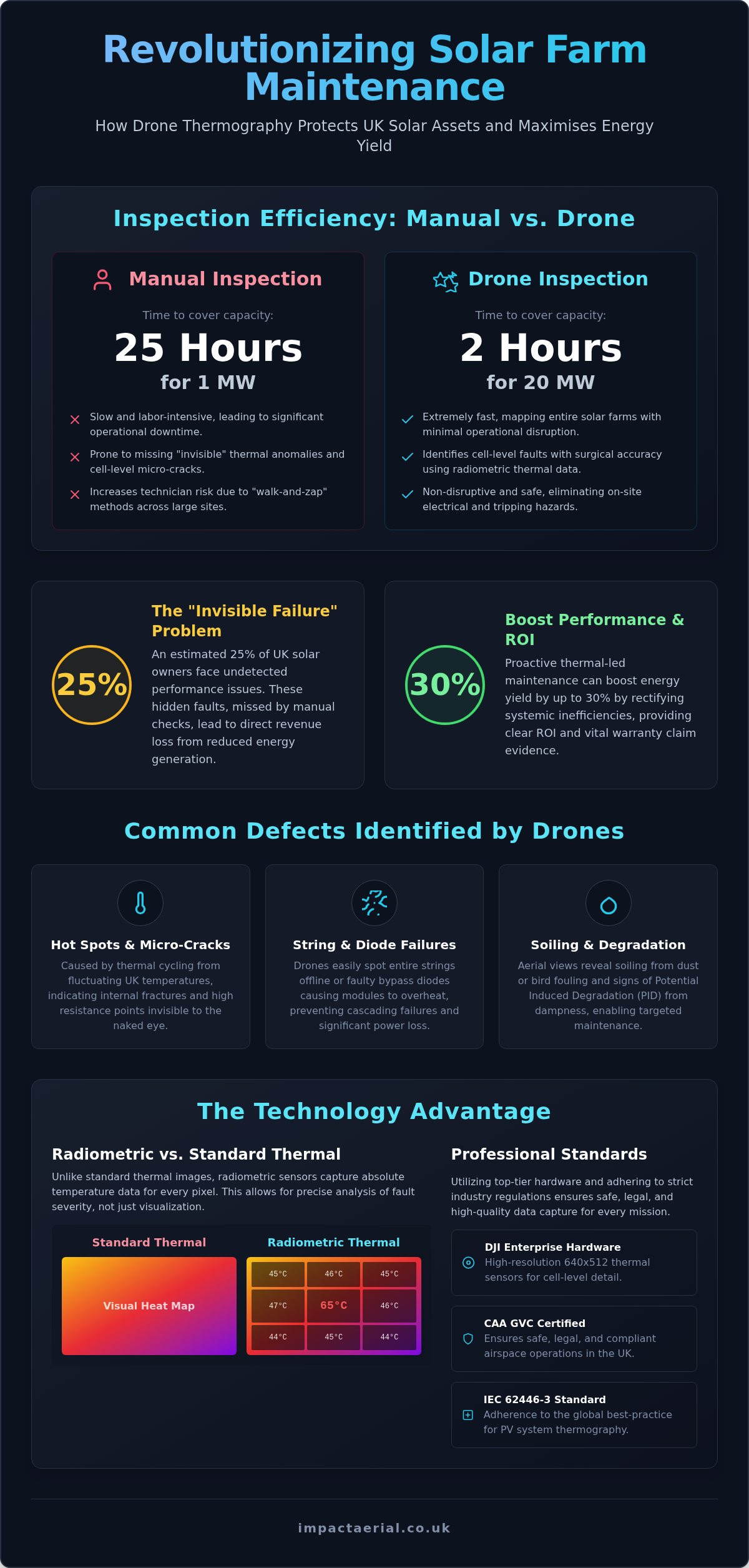
Drone Surveys vs. Manual Inspections: A Cost and Safety Comparison
Traditional manual inspections are increasingly viewed as a legacy approach that introduces unnecessary risk and expense. When you commission a solar panel drone inspection uk, you’re replacing a slow, subjective process with a high-speed, data-driven methodology. Research indicates that a manual technician can take up to 25 hours to inspect a single megawatt of capacity. In contrast, a professional drone crew can cover 20 megawatts in just two to four hours. This isn’t just a marginal gain; it’s a fundamental shift in how UK asset managers maintain portfolio health.
Speed and Efficiency on Large-Scale PV Farms
Automated flight paths ensure that every asset is captured with 100% coverage, leaving no gaps in the data. Unlike manual crews who may miss modules due to fatigue or difficult terrain, a drone follows a precise GPS-guided grid. This efficiency allows for inspections that don’t require system shutdowns, ensuring your farm continues to generate revenue while the survey is underway. For a 10-hectare site, the timeline moves from several days of ground-based labor to a single afternoon of aerial data collection. This rapid turnaround is essential for catching faults during the specific “weather windows” required for valid thermal contrast.
Safety Standards and Insurance Compliance
Safety is the most compelling reason to transition away from manual “walk-and-zap” inspections. For commercial rooftop solar, drones completely eliminate “working at height” risks. There’s no longer a need for technicians to navigate fragile roof structures or carry heavy equipment across steep pitches. Utilizing a professional drone survey also provides a robust digital trail for commercial insurance audits. Our CAA GVC certified pilots operate under strict safety protocols, backed by £5m commercial liability insurance, which offers the level of reassurance that major UK insurers now demand.
Handheld thermography is often hindered by the “human error” factor. A technician on the ground may struggle to maintain the correct viewing angle or distance, leading to inconsistent data. Drones maintain a consistent altitude and angle of incidence, producing objective, repeatable results. This consistency is vital when comparing year-on-year degradation. By choosing a solar panel drone inspection uk, you’re investing in a safer, more reliable, and significantly more cost-effective asset health check that satisfies both internal safety boards and external stakeholders.
Planning Your Solar Inspection: Best Practices for UK Site Managers
Successful execution of a solar panel drone inspection uk begins long before the aircraft arrives on site. For asset managers, the preparation phase is critical to ensure data integrity and operational safety. A professional drone team requires a comprehensive pre-flight information pack, including high-resolution site maps, total MWp capacity, and precise inverter locations. This allows the pilot to program autonomous flight paths that guarantee 100% asset coverage. In the UK’s complex airspace, we also conduct thorough checks for NOTAMs (Notice to Airmen) and Flight Restriction Zones (FRZs), particularly for assets located near airports or military installations.
Industry standards for 2026 have solidified around the annual “health check” model. Conducting a full thermal survey once a year ensures that your asset remains compliant with insurance requirements and manufacturer warranty terms. This regular cadence allows for trend analysis, where year-on-year degradation can be measured with scientific precision. If you’re managing a portfolio across England or Wales, our Birmingham hub provides a central base for rapid deployment to ensure these annual windows aren’t missed due to the unpredictable British weather.
Understanding the Deliverables and Data Integration
The output of a modern survey is far more than just a collection of images. We provide a hierarchy of deliverables designed for different stakeholders. This includes high-resolution orthomosaic maps, which act as a “digital twin” of the entire array. Every detected anomaly is tagged and categorized by severity, from minor cell-level hotspots to critical string failures. By utilizing a high-specification survey drone, we produce data that integrates seamlessly into your existing GIS platforms or asset management software, allowing your maintenance teams to navigate directly to faulty modules using GPS coordinates.
Regulatory Compliance in the UK
Compliance is the cornerstone of professional aerial surveying. It’s a legal requirement that any pilot conducting commercial work in the UK holds a valid drone license, specifically the CAA GVC (General Visual Line of Sight Certificate). Beyond flight permissions, site managers must ensure that the drone operator provides site-specific Risk Assessments and Method Statements (RAMS) that account for the unique hazards of an industrial environment. We also prioritize GDPR and privacy compliance, ensuring that data capture is strictly limited to the site boundaries, which is especially vital for rooftop solar in residential or public-facing areas.
Ensuring your site meets these rigorous standards protects your business from liability and ensures the resulting data is legally defensible. If you’re ready to schedule your annual health check, contact us for a professional PV solar farm thermal survey tailored to your specific site requirements.
Maximising PV ROI with Impact Aerial’s Specialist Drone Surveys
Securing a high return on investment for solar assets requires more than just identifying faults; it requires a partner who understands the operational nuances of the UK energy sector. At Impact Aerial, we bridge the gap between technical data collection and actionable maintenance reporting. While our sensors capture cinematic-grade detail, our primary focus remains the technical accuracy required for a solar panel drone inspection uk. Our Birmingham headquarters serves as a strategic central hub, allowing our teams to deploy rapidly to solar assets across England and Wales as soon as an optimal weather window opens.
Safety and compliance aren’t just checkboxes for our operation; they’re the foundation of our service. Operating with £5m commercial liability insurance and full CAA GVC certification provides the reassurance and tangible legal protection that asset managers require. We understand that large-scale PV farms are high-value industrial environments where a “zero-incident” approach is non-negotiable. This meticulousness extends to our post-production phase, where raw thermal data is transformed into prioritized maintenance reports.
Expertise You Can Trust
We utilize DJI Enterprise hardware specifically for its mission-critical reliability and high-resolution thermal capabilities. This technology, combined with our extensive experience across the construction and property sectors, allows us to navigate complex industrial sites with precision. Our professional drone services are designed to move from data collection to decision-making as efficiently as possible. We don’t just deliver a folder of images; we deliver a prioritized list of defects that empowers O&M teams to act immediately, restoring lost yield and protecting long-term revenue.
- Strategic Deployment: Rapid response from our Birmingham base to sites across the UK.
- Technical Precision: Utilizing radiometric sensors for cell-level fault identification.
- Full Compliance: CAA GVC certified pilots and £5m commercial liability insurance.
- Actionable Reporting: Data formatted for immediate integration into asset management platforms.
Request Your 2026 Solar Health Audit
Every solar portfolio has unique technical requirements, whether you’re managing a single commercial rooftop or a multi-site ground-mount array. Our consultation process begins by matching our sensor payloads to your specific data needs, ensuring the resulting report meets the exact standards of your insurance provider or manufacturer warranty terms. By choosing a specialist solar panel drone inspection uk, you’re investing in the long-term health and efficiency of your renewable energy assets.
Don’t let undetected string failures or micro-cracks erode your generation revenue. Secure your asset’s future by partnering with a technologically adept surveying team. Contact us today to receive a tailored quote for your solar health audit and discover how professional drone thermography can transform your maintenance strategy.
Securing Peak Performance for Your Solar Portfolio
As the UK solar market matures, the transition to aerial thermography has become a fundamental requirement for efficient asset management. A professional solar panel drone inspection uk offers the speed and technical depth necessary to pinpoint cell-level defects that manual teams simply cannot detect. This data-centric approach doesn’t just improve safety; it directly protects your bottom line by identifying revenue-draining failures before they escalate into critical system shutdowns.
Impact Aerial brings together CAA GVC Certified Pilots and specialist DJI Enterprise thermal hardware to ensure every survey meets the highest industry standards. Backed by £5m commercial liability insurance, we offer the reassurance that your high-value assets are in expert hands. We’re ready to help you move from reactive maintenance to a proactive, data-driven strategy that guarantees peak performance across your entire portfolio.
Book your professional UK solar panel drone inspection with Impact Aerial today and secure the future of your energy investment.
Frequently Asked Questions
How often should solar panels be inspected by a drone in the UK?
Annual health checks are the recommended industry standard for 2026. Regular 12-month intervals allow asset managers to track degradation trends and provide the necessary documentation for manufacturer warranty claims. This cadence ensures that minor cell defects don’t escalate into site-wide string failures, maintaining consistent energy output throughout the lifecycle of the array.
Can a drone detect a single faulty cell in a large solar farm?
Yes, high-resolution radiometric sensors can identify a single faulty cell within a large-scale array. By utilizing hardware with a minimum thermal resolution of 640×512 pixels, pilots can pinpoint individual hotspots and micro-cracks from a safe flight altitude. This granular level of detail is essential for precise maintenance, allowing O&M teams to navigate directly to the specific module requiring repair.
What weather conditions are required for a thermal solar survey?
Valid thermal data requires a minimum irradiance of 600 W/m² to create sufficient thermal contrast. Surveys should be conducted during “solar noon” with clear skies or consistent cloud cover to avoid false positives caused by fluctuating light. Wind speeds must remain low to prevent convective cooling from masking heat signatures, while rain or high humidity will invalidate the radiometric readings.
Is a drone solar inspection cheaper than a manual inspection?
Drone inspections are significantly more cost-effective than manual methods, primarily due to the massive reduction in labor hours. While a manual crew might take 25 hours to inspect a single megawatt, a drone can cover 20 megawatts in under four hours. This speed reduces site downtime and eliminates the expensive safety equipment and insurance premiums associated with technicians working at height.
Do I need to shut down my solar farm during the drone flight?
No, the solar farm must remain fully operational during the flight. For a solar panel drone inspection uk to be effective, the panels need to be under electrical load to generate the heat signatures that indicate resistance or failure. Shutting down the system would cool the components, making it impossible for the thermal sensors to detect anomalies or faulty cells within the strings.
What qualifications should a drone pilot have for solar inspections?
For commercial solar surveys in the UK, the pilot must hold a General Visual Line of Sight Certificate (GVC) issued by the Civil Aviation Authority. This qualification demonstrates the pilot’s competency in managing complex flights in the “Specific Category.” Additionally, operators should carry specialist commercial drone insurance, with a minimum of £5m public liability coverage being the standard for industrial site access.
How long does it take to receive the final thermal inspection report?
The turnaround time for a final thermal inspection report typically ranges from three to five working days, depending on the site’s total capacity. This period allows for the rigorous post-production phase, where raw radiometric data is processed into high-resolution orthomosaic maps and annotated PDF reports. Large-scale portfolios may require additional time for AI-assisted anomaly tagging and severity categorization.
Can drones inspect both rooftop and ground-mounted solar panels?
Drones are highly versatile and can inspect both large-scale ground-mounted solar farms and complex commercial rooftop arrays. Aerial surveys are particularly beneficial for rooftops as they eliminate the need for scaffolding or fragile roof access, reducing safety risks for personnel. Whether the asset is a sprawling rural site or an industrial warehouse roof, the solar panel drone inspection uk process provides total coverage without the logistical challenges of ground-based surveying.
Drone Virtual Tours for Real Estate: The Ultimate Property Marketing Edge in 2026
Did you know that listings featuring aerial photography receive 68% more views and sell 31% faster than those without? In the competitive 2026 market, standard image galleries often fail to convey the true scale and flow of a property. You’ve likely noticed that static photos just can’t capture the relationship between a luxury home and its surroundings, which frequently leads to high bounce rates from frustrated buyers who can’t get a feel for the layout.
We understand that professional drone virtual tours for real estate are no longer just a luxury; they’re a narrative tool that connects a property to its lifestyle in a single, cinematic flow. This article explores how these immersive experiences transform your listings into high-performance marketing assets that attract international interest and sell homes faster. We’ll examine the technical precision of 4K HDR filming, the rising demand for FPV fly-throughs, and the critical importance of CAA GVC certification to ensure every flight is conducted with meticulous safety and full regulatory compliance.
Key Takeaways
- Understand why standard 360 tours are no longer sufficient for 2026 buyers and how aerial perspectives bridge the gap between interior detail and neighbourhood context.
- Discover how drone virtual tours for real estate utilize 4K HDR filming and DJI Enterprise hardware to create immersive, high-definition experiences that capture every property detail.
- Learn to distinguish between standard GPS drone shots for site boundaries and FPV fly-throughs that provide a seamless cinematic journey from the garden to the living room.
- Identify the critical compliance requirements, such as CAA GVC certification and £5m commercial liability insurance, necessary to mitigate risk for high-value residential listings.
- Explore how professional post-production services transform raw aerial data into “pixel-perfect” marketing assets that build your reputation as a tech-forward agency.
The Evolution of Property Marketing: Why Standard 360 Tours Aren’t Enough
Property marketing has undergone a significant shift. By 2026, the expectations of high-end buyers have moved beyond simple photo galleries and basic walkthroughs. While Virtual tour technology has been a staple of the industry for years, traditional ground-based solutions often suffer from a “context gap.” They provide an excellent view of the kitchen or the master suite, but they fail to show how the property sits within its environment. This lack of perspective creates a disconnected experience, leaving potential buyers wondering about the proximity of neighbors, the true scale of the grounds, or the quality of the surrounding neighborhood.
Professional drone virtual tours for real estate bridge this gap by providing a holistic view that ground-based cameras simply cannot replicate. Data indicates that listings featuring aerial perspectives receive 68% more views and sell 31% faster on average. This isn’t just about a pretty picture; it’s about providing the technical data and visual reassurance that modern buyers require before they commit to a physical viewing. To better understand how this technology creates a seamless narrative, watch this example of an immersive aerial walkthrough:
The Problem with Static Listing Content
Static photos and standard 360 tours often feel clinical and disconnected. When a buyer clicks through a gallery, they struggle to visualize the “flow” of a home, especially in properties with complex layouts or expansive estates. This confusion leads to high bounce rates on listing pages. Ground-based wide-angle lenses can also distort rooms, creating an unrealistic expectation that leads to disappointment during in-person visits. Without an aerial perspective, the relationship between the front door, the garden, and local green spaces remains a mystery, forcing the buyer to do their own research on satellite maps rather than staying engaged with your listing.
Drones as the Ultimate Narrative Tool
Utilizing drone virtual tours for real estate transforms a listing from a simple viewing into a compelling story. By starting with a “hero shot” from an elevated perspective, you immediately establish the property’s scale and prestige. Drones allow us to connect the interior luxury of a home to its external environment in one fluid motion. We can show the transition from a sun-drenched patio to the local parkland or nearby amenities, providing the lifestyle context that 2026 buyers prioritize. This technical approach ensures that every pixel serves a purpose, building a brand reputation for your agency as a technologically adept leader that values precision and quality.
How Drone Technology Creates Immersive Real Estate Experiences
A drone virtual tour for real estate is a high-definition, interactive video or 360-degree experience captured via an Unmanned Aerial Vehicle (UAV). Unlike traditional video walkthroughs, these tours provide a continuous, interactive path that allows potential buyers to explore a property from perspectives that were previously impossible to achieve. The goal is to move beyond simple observation and create a sense of presence, where the viewer feels they are physically navigating the space and its surroundings.
The technical foundation of these experiences relies on 3-axis gimbal stabilization and high-bitrate recording. This hardware ensures that even in moderate winds, the footage remains smooth and cinematic, devoid of the jitters or “jello effect” common in consumer-grade equipment. Once the flight is complete, the raw data enters a rigorous post-production phase. This is where professional editors stitch together panoramas, color-grade the footage for a “pixel-perfect” finish, and transform raw files into an interactive marketing asset that functions seamlessly across mobile and desktop platforms.
The Hardware: DJI Enterprise and 4K HDR
We utilize DJI Enterprise grade drones because they offer superior sensor sizes and reliability compared to standard retail models. These systems are equipped with 4K HDR cameras that excel at capturing dynamic range, which is critical during “golden hour” shoots where the sky is bright but the property remains in shadow. The use of 4K HDR technology allows for the precise rendering of property textures, ensuring that the natural grain of timber cladding or the intricate patterns of stonework are captured with absolute clarity. This technical precision provides the high-tier quality that luxury listings demand to maintain their market positioning.
Interactive Elements and Hotspots
Modern tours are no longer passive viewing experiences. By embedding clickable info-points or “hotspots,” agents can highlight specific selling points, such as premium appliance brands or smart home integrations, directly within the aerial view. We also integrate 360-degree panoramas at varying altitudes, giving buyers the ability to “look around” from 50 feet in the air. This interactive layer is often linked to broader virtual tour creation workflows, allowing a user to click on the roof to see a detailed survey or click the front door to enter an internal walkthrough. Utilizing professional aerial filming and photography ensures these transitions are seamless and technically sound, providing a reliable experience for out-of-area investors.
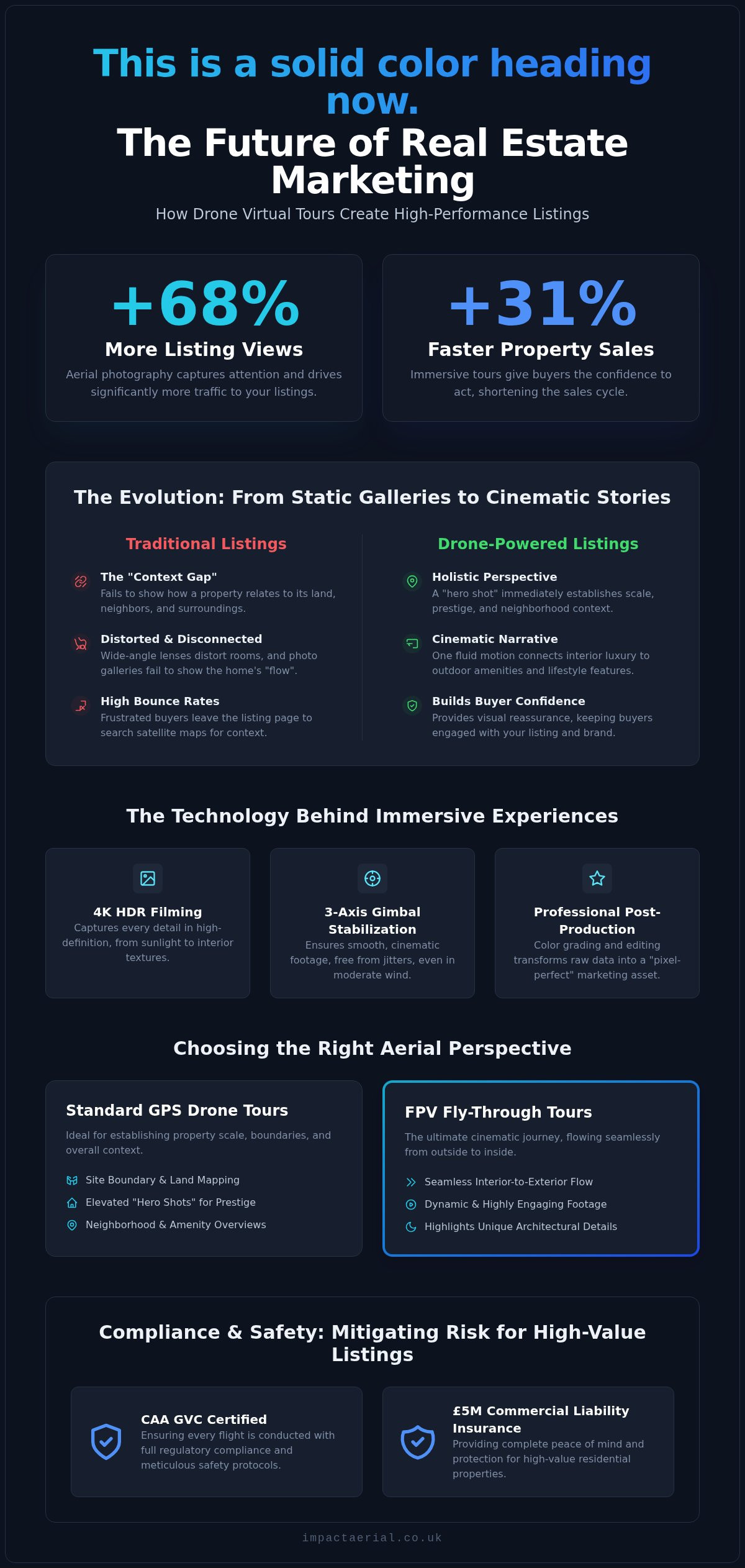
FPV vs. Standard Drone Tours: Choosing the Right Perspective
Selecting the appropriate flight methodology is a critical decision in the pre-flight planning phase. Not all properties require the same visual approach, and the choice between standard GPS-stabilised drones and First-Person View (FPV) systems depends entirely on the marketing objective. While one provides a steady, authoritative overview of the land, the other offers a high-speed, immersive journey that captures the “feeling” of living in the space. Integrating both perspectives into drone virtual tours for real estate ensures that you provide the technical data a buyer needs alongside the emotional narrative they want.
The “One-Shot” technique has emerged as the gold standard for luxury listings in 2026. This involves a single, continuous flight path that starts high above the property, descends toward the front door, and flies through the interior before exiting into the rear garden. It’s a seamless journey that eliminates the disjointed feeling of clicking through separate room photos. This method requires a pilot with exceptional spatial awareness and technical skill, as there’s no room for error when navigating through a multi-million-pound residence.
When to Use Standard Aerial Photography
Standard GPS drones are the industry workhorse for establishing geographical context. They are the superior choice when your primary goal is to showcase large land parcels, precise site boundaries, or the structural condition of a roof. This approach is particularly effective for commercial real estate and industrial sites across the West Midlands, where proving proximity to transport hubs like the M6 or Birmingham’s logistics corridors is a key selling point. Standard drones provide a rock-steady platform for high-resolution imagery. For a detailed look at how we capture these high-resolution stills, refer to our comprehensive guide on drone photography.
The Rise of the FPV “Indoor-Outdoor” Tour
FPV drones, specifically “cinewhoop” models, have revolutionised the way we market luxury urban apartments and modern estates. These micro-drones are equipped with shrouded propellers, allowing them to safely navigate through tight doorways and around high-end furniture without risk. They create a high-octane, modern feel that resonates with a younger, tech-forward demographic. Capturing a fluid transition from a sun-drenched balcony into a sleek kitchen requires professional FPV piloting skills that go far beyond standard flight certifications. In the UK, this level of precision is essential for maintaining safety standards while delivering a cinematic experience that keeps viewers on the page for longer. This technical mastery is what separates a basic recording from a professional marketing asset.
Compliance and Planning: What Real Estate Professionals Need to Know
Operational safety and legal compliance are the foundations of any professional aerial project. While the visual output of drone virtual tours for real estate is what sells the property, the regulatory framework behind the flight is what protects your agency’s reputation. Real estate professionals must treat drone operations as technical missions rather than casual photography sessions. This starts with ensuring that every pilot holds a current CAA GVC certification, which is the standard for professional competency in the UK.
This qualification is non-negotiable for commercial work. It signifies that the pilot has undergone rigorous training in flight safety, meteorology, and air law. Without this, any footage captured for a commercial listing is technically illegal, which can lead to significant fines for both the operator and the hiring agency. We treat every flight with the same meticulous attention to detail that we apply to our aerial filming and photography services, ensuring that risk is mitigated before the drone even leaves the ground.
Navigating UK Drone Laws in 2026
Flight restrictions vary significantly depending on the property’s location. Capturing a luxury apartment in Birmingham city centre requires a different level of planning than a rural estate in the West Midlands. Congested areas demand specific permissions and a higher degree of risk mitigation. We manage the entire process, from securing CAA permissions to drafting detailed Risk Assessment Method Statements (RAMS). A professional drone license acts as a badge of accountability, ensuring that all operations adhere to the latest safety standards.
Risk Mitigation and Reassurance
Privacy and data protection are paramount when flying in residential areas. We adhere to strict GDPR guidelines, ensuring that identifiable data like car registrations or neighboring windows are managed appropriately during post-production. Our pre-flight site assessments include several critical steps:
- Verifying airspace restrictions and local bylaws via official aviation charts.
- Notifying local authorities or neighbors when operating in sensitive areas.
- Establishing secure takeoff and landing zones to ensure public safety.
Relying on unlicensed hobbyists or “discount” operators puts your business at massive legal risk. If an accident occurs during a flight, an unlicensed pilot’s insurance is often void, leaving the estate agency liable for damages. Our £5m commercial liability insurance provides absolute reassurance and financial security for high-value properties and their owners. If you want to ensure your next marketing campaign is fully compliant and professionally executed, you can partner with Impact Aerial for your next property tour.
Partnering with Impact Aerial for Professional Virtual Property Tours
Selecting a provider for drone virtual tours for real estate requires more than just finding a pilot with a camera. It demands a technical partnership where the provider assumes all operational risk and regulatory responsibility. We position ourselves as technical consultants for your agency. This approach allows you to focus on the core business of selling properties while we deliver the high-tier visual assets required to attract serious, high-value buyers. Our commitment to precision ensures that every tour is not just a video, but a reliable data set that accurately represents the property.
We provide customized packages designed to meet the specific needs of both residential estate agents and commercial developers. Whether you’re marketing a single luxury residence or a multi-unit industrial complex, our team scales its operations to match the project’s scope. We handle the complexities of flight planning, safety protocols, and post-production, providing a seamless end-to-end service that integrates directly into your existing marketing workflows.
Our Process: From Brief to Broadcast
Every project begins with a creative planning session and a preliminary site survey. We don’t just show up and fly; we analyze the property’s orientation, lighting conditions, and potential flight hazards to ensure a safe and successful mission. During the execution phase, we utilize DJI Enterprise grade hardware to capture 4K HDR footage, ensuring the highest possible dynamic range and “pixel-perfect” detail. Our post-production team then takes over, meticulously editing the raw data to create a fluid, interactive experience. We understand that property launches are often time-sensitive, so we’ve optimized our internal processes to provide rapid turnaround times without sacrificing the quality of the final output.
Why Choose a Specialized UK Operator?
Our deep regional expertise in Birmingham and the West Midlands provides a distinct advantage for local property professionals. We understand the specific logistical challenges and airspace restrictions of the region, ensuring that every flight is conducted with total compliance. While our primary focus is the Midlands, we provide nationwide UK coverage, maintaining the same rigorous standards for every client. We’re committed to the highest drone services standards, ensuring that every project is backed by our CAA GVC certification and £5m commercial liability insurance. This level of professional accountability is essential for protecting your brand and your clients’ assets.
Ready to transform your property marketing with cinematic aerial experiences? You can request a consultation for your next real estate project to discuss your specific requirements and learn how our technical expertise can help you sell homes faster in 2026.
Securing a Competitive Advantage in 2026
The transition from static galleries to immersive, narrative-driven marketing is no longer optional for high-tier listings. By integrating drone virtual tours for real estate, agencies can bridge the context gap that traditional photography leaves behind, offering buyers a holistic view of both the property and its surrounding lifestyle. Whether you require the steady precision of standard GPS aerials or the high-octane flow of an FPV indoor fly-through, the technical execution must be flawless to maintain your brand’s reputation for quality.
Safety and compliance remain the most critical components of any aerial operation. Our team of CAA GVC Certified Pilots handles every aspect of flight planning and risk mitigation, backed by £5m commercial liability insurance. As a Birmingham-based specialist with UK-wide coverage, we provide the technical consultancy you need to launch properties with confidence and precision. We handle the technology so you can focus on closing the sale.
Don’t let your listings get lost in a sea of static photos. Book a Professional Drone Virtual Tour for Your Property Listing and give your clients the immersive cinematic experience they expect. We look forward to helping you transform your next property marketing campaign into a high-performance visual asset.
Frequently Asked Questions
Are drone virtual tours legal for residential properties in the UK?
Yes, drone virtual tours for real estate are entirely legal provided they are conducted by a pilot holding the correct Civil Aviation Authority (CAA) certifications. For commercial work in residential areas, a GVC (General Visual Line of Sight Certificate) is the professional standard. Pilots must also adhere to strict privacy laws and GDPR requirements to ensure that neighboring properties and uninvolved persons are not captured without appropriate justification or data management protocols.
How much do drone virtual tours for real estate typically cost?
The cost of a drone virtual tour depends on several technical factors rather than a single flat rate. Key variables include the size of the property, the complexity of the flight path, and the level of post-production required for a pixel-perfect finish. Urban locations in city centres like Birmingham may also require additional planning for airspace permissions, which influences the total project investment. We provide bespoke quotes based on your specific marketing objectives.
Can drones fly inside a house for a virtual tour?
Drones can safely fly indoors when using specialized FPV (First Person View) equipment. These “cinewhoop” drones feature shrouded propellers that prevent damage to interiors or high-end furniture. This technology allows for a seamless transition from the garden through the front door and into the living spaces. It creates an immersive, cinematic walkthrough that standard ground-based cameras cannot match, providing a continuous narrative of the home’s layout and flow.
How long does it take to shoot and edit a drone property tour?
A typical on-site shoot lasts between one and three hours depending on the property’s scale and the complexity of the flight plan. The post-production phase is more intensive, as raw 4K HDR data must be color-graded and edited into a fluid marketing asset. Most professional tours are delivered within three to five business days. This timeline ensures that every transition is smooth and the final output meets industry leadership standards for quality.
Do I need to notify the neighbours before a drone shoot?
While not a strict legal requirement for all flight categories, notifying neighbours is a highly recommended best practice for risk mitigation. Transparency helps manage privacy concerns and ensures the operation proceeds without interruption. As part of our pre-flight site assessment, we advise on the best way to communicate with local residents. This professional approach maintains the reputation of your agency and provides reassurance to the property owner that the shoot is compliant.
What happens if the weather is bad on the day of the drone flight?
Safety is our absolute priority, so flights are rescheduled if weather conditions fall outside of safe operational limits. High winds, heavy rain, or low visibility can compromise the aircraft’s stability and the quality of the 4K HDR footage. We monitor meteorological data meticulously in the days leading up to a shoot. If conditions are unsuitable, we coordinate with the agent to find the next available window with clear skies and optimal lighting.
What qualifications should a drone pilot have for real estate work?
A professional drone pilot must hold a CAA GVC certification to operate legally for commercial real estate projects in the UK. This qualification ensures the pilot understands air law, safety protocols, and technical flight requirements. Additionally, they should carry a minimum of £5m commercial liability insurance. These credentials provide the necessary legal protection and technical reassurance that your high-value property listings are in expert, compliant hands.
Are drone tours compatible with Rightmove and Zoopla?
Drone virtual tours for real estate are fully compatible with major UK portals like Rightmove and Zoopla. These platforms allow you to embed video content or link directly to interactive virtual tour experiences within the listing. Including an aerial tour can significantly increase time-on-page and engagement levels. This compatibility ensures that your tech-forward marketing reaches the widest possible audience, including international investors and out-of-area buyers who rely on immersive digital content.
Commercial Property Video in Birmingham: The 2026 Definitive Guide
In the 2026 Birmingham market, a high-quality property video isn’t just a marketing asset; it’s a critical technical tool for risk mitigation and rapid data delivery. You likely already understand that filling large-scale industrial sites or high-rise office spaces in competitive districts requires more than just static photography. The demand for professional commercial property video birmingham has shifted because investors now expect immersive, data-driven visual evidence before they ever step foot on-site. It’s no longer enough to show a space; you have to prove its value through precision and detail.
This guide will show you how to leverage drone technology and cinematic production to accelerate lease-up times and attract high-value international investors. We agree that navigating complex city-centre drone regulations and managing high vacancy rates can be daunting for any developer. You’ll discover how a professional, CAA GVC certified production process removes the regulatory burden while showcasing your assets with cinematic precision. We’ll preview the latest trends in 4K HDR filming, the importance of robust liability insurance, and how a meticulous approach to technical videography turns a simple viewing into a closed deal.
Key Takeaways
- Understand why professional commercial property video birmingham is essential for differentiating assets in a high-vacancy market and attracting international investors.
- Learn how to select the right production style, from cinematic aerial showcases for retail flagships to immersive FPV fly-throughs for industrial warehouses.
- Identify critical safety and regulatory requirements, including the necessity of CAA GVC certification and £5m commercial liability insurance for Birmingham city centre operations.
- Discover effective distribution strategies to maximise ROI by optimising your video content for portals like CoStar and targeted LinkedIn advertising.
- Explore how technical specifications, such as 4K HDR filming and DJI Enterprise hardware, ensure your property is presented with industry-leading precision.
The Evolution of Commercial Property Video in Birmingham
Commercial property video is no longer a simple camera pan through a vacant office. In 2026, it’s a multi-layered digital asset that integrates technical data with cinematic visual storytelling. For developers and agents, commercial property video birmingham has become the primary method for demonstrating the viability of an asset before a physical viewing is even scheduled. It bridges the gap between raw architectural plans and the finished product, providing a sense of scale and context that static images cannot match.
The city’s skyline is undergoing a rapid transformation. To understand the backdrop of these developments, one can look at the diverse Architecture of Birmingham, which ranges from Victorian industrial heritage to contemporary glass towers. As competition for high-tier tenants intensifies, the visual standards required for asset differentiation have risen. High-end 4K drone content isn’t just about aesthetics; it’s about providing international investors with a level of detail that shortens the consideration phase and builds immediate trust in the project’s quality.
To see how cinematic perspectives enhance property marketing, watch this professional showcase:
Birmingham Business Districts and Visual Differentiation
Capturing the essence of a location requires a tailored technical approach. In the Colmore Business District, drone filming must navigate complex urban canyons to showcase high-rise office elevations and rooftop amenities. Conversely, showcasing the industrial scale of the Black Country or the West Midlands logistics hubs requires wide-angle aerial perspectives to illustrate transport links and site boundaries. For the creative clusters in Digbeth and the Jewellery Quarter, the focus shifts to heritage details and the unique character of refurbished spaces, often using FPV drones to navigate tight internal layouts where traditional equipment cannot reach.
The Shift to Data-Driven Marketing
Modern tenants and stakeholders expect more than just a pretty picture. They want data-centric visuals. This involves combining cinematic aerial shots with site boundary overlays, proximity markers to key infrastructure, and even 3D models. Video has also found a new role in ESG (Environmental, Social, and Governance) reporting. By using high-resolution surveys, firms can visually document sustainable features like PV solar installations or green roofs. This transparency is vital for modern commercial portfolios, ensuring that every commercial property video birmingham meets the rigorous transparency standards of 2026. It’s a shift from simple promotion to comprehensive asset verification.
High-Impact Video Types for Commercial Real Estate
Effective marketing in 2026 requires a tiered approach to content where different assets demand specific technical perspectives. Whether you’re leasing a retail flagship near the Bullring or a vast logistics hub along the M6 corridor, the type of commercial property video birmingham firms select must align with the target audience’s technical requirements. We’ve moved beyond simple walkthroughs; the market now expects a sophisticated blend of cinematic beauty and functional data.
We see a significant increase in the use of hybrid survey-marketing films. These productions serve a dual purpose by combining high-end promotional shots with survey-grade visual data. They don’t just show a building’s facade; they verify structural integrity and rooftop condition for potential buyers. This fusion of utility and aesthetics is what sets professional productions apart from basic videography. These films often act as both a promotional tool and a verifiable record of the building’s state for insurance or lease handover purposes.
Cinematic Aerial Filming for Investors
Investors prioritising Birmingham assets often look for connectivity and local infrastructure. Using 4K HDR drones allows us to highlight proximity to New Street Station or the developing HS2 hubs with crystal clarity. Filming during the “Golden Hour” provides the high-contrast, warm lighting that naturally elevates a property’s perceived value. By integrating 3D virtual tours into these narratives, we create a seamless experience that allows remote stakeholders to explore the site’s context and interior layout simultaneously. This level of immersion is critical for shortening the decision-making cycle for international funds.
Internal FPV Tours: Navigating Complex Spaces
FPV (First Person View) drones have revolutionised how we showcase large-scale industrial units and refurbished office floors. Unlike traditional handheld walkthroughs, an FPV drone can fly through a 100,000 sq ft warehouse in a single, continuous shot. This creates a powerful sense of flow and scale. We can start the shot at the site entrance, fly through the loading bays, and finish directly in the boardroom. It’s an efficient way to communicate volume and operational potential to a prospective tenant who cannot visit the site in person.
Safety remains our primary concern during these complex internal flights. Every operation adheres strictly to UK drone regulations to ensure the protection of the property and any personnel on-site. We utilise DJI Enterprise grade hardware with sophisticated obstacle avoidance to maintain the highest safety standards in confined spaces. For active developments, we also deploy time-lapse monitoring to provide a chronological record of construction progress. If you’re planning a project, you can explore our full range of aerial filming and photography services to see which format fits your asset best.
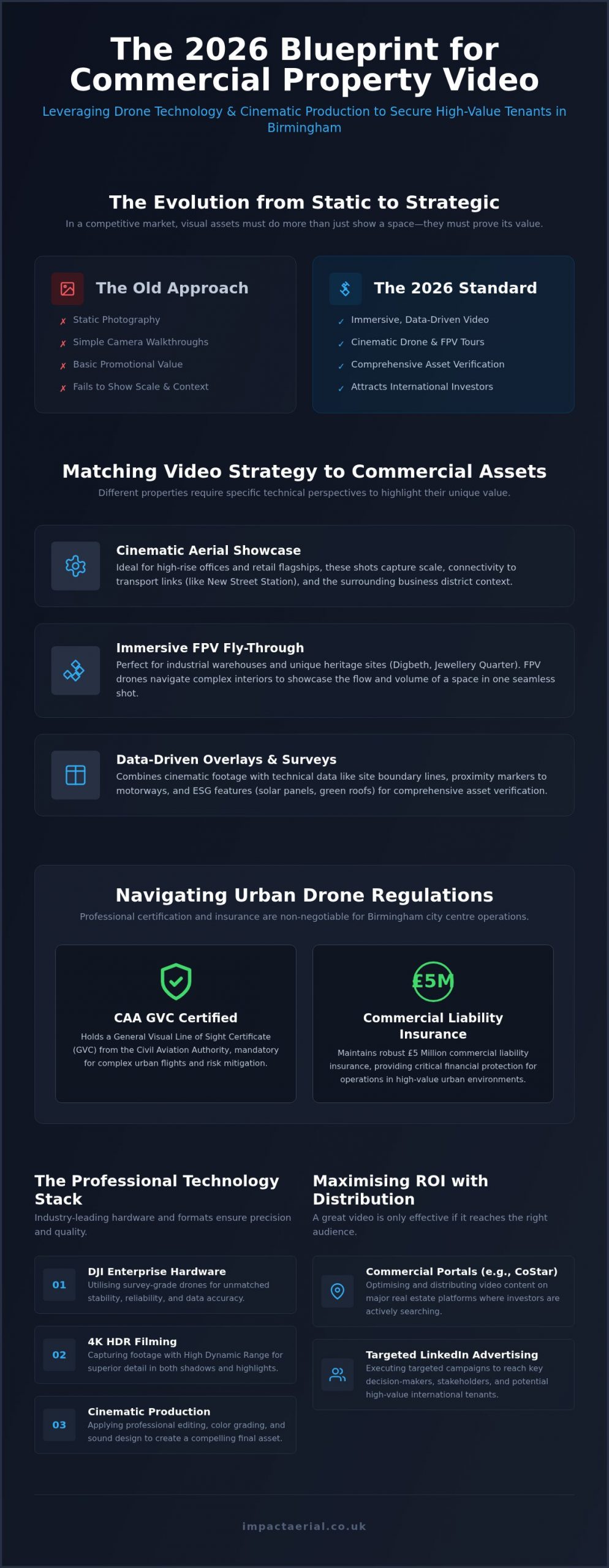
Navigating Urban Drone Regulations in Birmingham
Flying a drone for a commercial property video birmingham project in high-density urban areas like Colmore Row or Digbeth requires more than just technical skill. It demands a comprehensive understanding of the legal framework governing UK airspace. For any operation within the city centre, CAA GVC (General Visual Line of Sight Certificate) certification is non-negotiable. This qualification allows pilots to operate in the “Specific Category,” which is essential when flying closer to people and properties than the standard “Open Category” allows. Without this, filming in Birmingham’s business districts is simply not legal.
Our approach involves a rigorous pre-flight process. Every deployment begins with a detailed site survey and risk assessment. We cross-reference our plans with the Civil Aviation Authority’s Drone and Model Aircraft Code to ensure every maneuver remains within legal boundaries. This meticulous planning is what allows us to capture stunning visuals in congested areas without compromising safety or violating privacy laws. For projects involving public spaces, we coordinate directly with Birmingham City Council to obtain the necessary flight permissions and launch authorisations.
Understanding CAA GVC and Compliance
GVC certification is the gold standard for professional operators in 2026. It proves that a pilot has undergone formal training and practical examination in flight safety, navigation, and emergency procedures. When we film in Birmingham’s business districts, this certification provides the legal basis for our operations near buildings and uninvolved persons. If you want to understand the technicalities of these requirements, you can read our guide on UK drone licenses for more detail. We manage risk by establishing clear cordons and using hardware equipped with redundant systems to ensure total control at all times.
Insurance and Liability: Protecting Your Asset
Standard hobbyist insurance is insufficient for the scale of commercial property shoots. We carry £5m commercial liability insurance to protect our clients, their assets, and the public. This level of coverage is a prerequisite for working on major infrastructure projects or high-value private developments. It provides the financial and legal security that risk-averse developers require when commissioning a commercial property video birmingham.
Beyond insurance, our safety protocol includes a comprehensive 20-point pre-flight checklist that covers hardware telemetry, signal interference, and local weather patterns before the drone ever leaves the ground. Privacy is another critical factor we manage through technical precision. We adhere to strict GDPR protocols, ensuring that any incidental footage of the public is mitigated through appropriate post-production blurring or by scheduling flights during low-footfall periods. This meticulous attention to compliance ensures your marketing campaign remains professional and legally sound.
Maximising ROI: Distribution and Marketing Strategy
Producing a high-end commercial property video birmingham is the first step; strategic deployment is what secures the return on investment. In 2026, market saturation means that simply hosting a file on your website isn’t enough. You need a multi-channel distribution strategy that places your asset directly in front of regional decision-makers and global funds. A meticulous approach to distribution ensures that the technical precision of your filming translates into tangible leasing leads and investor interest.
Optimising for platforms like Rightmove Commercial and CoStar is essential. These portals prioritise listings with high-quality video content, often resulting in higher search rankings and significantly increased dwell time. For high-stakes investor pitch decks, integrating cinematic aerial footage provides a tangible sense of scale that numbers on a spreadsheet cannot convey. It demonstrates a level of professional rigour that reassures risk-averse stakeholders and builds immediate confidence in the asset’s value.
To measure performance, we recommend tracking specific engagement metrics:
- View Completion Rates: Identify which property features, such as loading bays or mezzanine levels, keep viewers engaged.
- Click-Through Rates: Monitor how effectively your video drives traffic from property portals to your lead capture forms.
- Heatmap Data: See where international investors are pausing or re-watching to understand which site benefits are most compelling.
Leveraging Social Media for Property Lead Gen
Short-form teasers are highly effective for LinkedIn and Instagram professional networks. A 15-second aerial sweep of a refurbished Digbeth warehouse or a Colmore Row office can stop the scroll and drive traffic to your full listing. Using local SEO tags such as #BirminghamBusiness or #WestMidlandsLogistics ensures your content reaches the right regional professional networks. These punchy edits work well in local Birmingham community groups where business leaders often monitor new developments.
Post-Production: Adding Value Through Editing
Motion graphics add a layer of technical data that enhances the marketing narrative. We use these overlays to highlight specific floor areas, loading bay dimensions, or proximity to key transport links like the M6 or Birmingham New Street. Professional voiceovers can deliver critical market data points, turning a visual tour into a comprehensive briefing for a remote investor. For a deeper look at these technical techniques, consult our aerial filming drone guide for professional production tips. If you’re ready to start your project, you can book our professional aerial filming services to ensure your property stands out with cinematic precision.
Impact Aerial: Birmingham’s Professional Drone Partner
Choosing a local specialist for your commercial property video birmingham project provides more than just convenience. Our Birmingham base ensures that our team possesses an intimate understanding of the city’s complex flight corridors, from the restricted zones near Birmingham Airport to the high-density urban canyons of the city centre. This local expertise allows for rapid deployment when optimal weather windows appear, ensuring we capture your asset in the best possible light. We don’t just fly drones; we provide a technical partnership rooted in safety and precision.
Our technical arsenal is built around DJI Enterprise grade hardware, capable of delivering 4K HDR filming that captures every architectural detail with professional clarity. This high dynamic range is essential for Birmingham’s modern glass-fronted developments, where managing reflections and high-contrast lighting is a technical challenge. We manage every stage of the project, from initial regulatory pre-checks to meticulous post-production, ensuring the final output meets the rigorous standards of 2026 commercial marketing.
The Specialist Advantage over Generalists
Generalist video agencies often prioritise emotional storytelling at the expense of technical accuracy. As a drone-first specialist, Impact Aerial brings a different level of rigour to every shoot. Our extensive background in drone property surveys informs how we approach marketing films. We understand the structural elements that matter to surveyors and investors, allowing us to highlight the functional value of a property alongside its aesthetic appeal. This technical perspective ensures that your commercial property video birmingham serves as a reliable data asset for serious stakeholders.
Our commitment to professional service standards is backed by CAA GVC certified pilots and £5m commercial liability insurance. This provides the reassurance that every flight is conducted within the strictest legal frameworks. We maintain a meticulous focus on risk mitigation, which is a prerequisite for working with the West Midlands’ leading developers and asset managers. You aren’t just hiring a camera operator; you’re engaging a compliant, technologically adept partner.
Getting Started with Your Birmingham Shoot
The process begins with a detailed consultation to define your property goals and identify your target audience. We don’t believe in a one-size-fits-all approach. Whether you need a cinematic showcase for a flagship office or a technical fly-through for an industrial unit, we tailor the production to your specific requirements. Following the consultation, we conduct comprehensive site visits and regulatory pre-checks to ensure the safety of the urban environment and the integrity of the footage.
Transparency is central to our operation. We provide clear, project-specific quotes that reflect the technical complexity and scale of your development. Our end-to-end project management means you can remain hands-off while we handle the logistics, flight permissions, and post-production editing. If you are ready to elevate your asset’s market presence, you can Contact Impact Aerial for a professional quote and discover how our meticulous approach delivers tangible results for your portfolio.
Future-Proofing Your Birmingham Property Marketing
The 2026 market demands a technical shift from simple walkthroughs to data-centric 4K HDR productions. Successfully deploying a commercial property video birmingham requires more than just a camera; it necessitates a deep understanding of urban flight regulations and a strategic approach to investor distribution. By integrating cinematic aerial footage with survey-grade precision, you provide the transparency that modern stakeholders expect during the decision-making process.
Compliance remains the cornerstone of every successful urban shoot. Working with a dedicated specialist ensures that your project benefits from meticulous risk assessments and strict adherence to the latest aviation standards. Our team of CAA GVC Certified Pilots brings expert Birmingham local knowledge to every deployment, backed by £5m commercial liability insurance for your total peace of mind. This professional rigour protects your reputation while ensuring your assets are presented with industry-leading quality.
Ready to accelerate your leasing timeline and attract high-value investors? Book your Birmingham commercial property video consultation today to discuss your specific asset goals. We look forward to helping you showcase your property with the technical precision and cinematic impact it deserves.
Frequently Asked Questions
Do I need special permission to film a commercial property in Birmingham city centre?
Yes, filming in Birmingham city centre requires strict adherence to the Civil Aviation Authority’s Drone and Model Aircraft Code and often involves specific launch authorisations. Our team manages the entire regulatory process, including notifying local authorities and property managers in districts like Colmore Row. This ensures your commercial property video birmingham project is conducted legally and without operational interruptions.
How much does a commercial property video cost in the UK?
Production costs for commercial property films are determined by the project’s technical scope, the number of locations, and the complexity of the post-production requirements. Elements such as internal FPV tours or the integration of data-driven motion graphics will influence the final investment. We provide transparent, project-specific quotes following a detailed consultation to ensure the production aligns with your marketing budget and asset goals.
Are your drone pilots CAA GVC certified for urban flights?
All our pilots are CAA GVC certified, which is the mandatory qualification for conducting professional drone operations in the “Specific Category” within urban areas. This certification proves our operators have passed rigorous examinations in flight safety, navigation, and emergency protocols. It allows us to legally operate DJI Enterprise hardware in congested Birmingham environments where standard hobbyist flights are prohibited.
What insurance coverage does Impact Aerial maintain for property shoots?
Impact Aerial maintains £5m commercial liability insurance specifically tailored for professional drone services and aerial filming. This high level of coverage is a prerequisite for working on major commercial developments and infrastructure projects across the West Midlands. It provides developers and asset managers with the necessary reassurance that all operational risks are fully mitigated through a robust, professional policy.
Can you film inside a commercial warehouse or office using drones?
We specialise in internal filming using First Person View (FPV) drones and Enterprise hardware equipped with sophisticated obstacle avoidance systems. These technical tools allow us to navigate through tight office layouts or vast warehouse spaces in a single, continuous shot. This approach is highly effective for a commercial property video birmingham, as it provides a realistic sense of scale and operational flow for prospective tenants.
How long does the production process take from filming to final edit?
The end-to-end production process typically takes between ten to fourteen working days depending on the project’s complexity. This timeline includes the initial site survey, the filming day, and the post-production phase where we apply colour grading and technical overlays. We provide a clear project schedule during the consultation phase to ensure your marketing materials are delivered in time for your property launch.
What weather conditions prevent a drone property shoot from going ahead?
Drone deployments are typically postponed if wind speeds exceed 20mph or if there is heavy rain, snow, or dense fog that limits visual line of sight. We monitor local weather telemetry in the 48 hours leading up to a shoot to ensure optimal conditions for 4K HDR filming. If the forecast is unfavourable, we reschedule to the next available clear window to maintain our high safety and quality standards.
Do you provide the raw footage or just the edited final video?
Our standard delivery includes a professionally edited, high-definition final video optimised for platforms like CoStar, LinkedIn, and Rightmove Commercial. However, we can provide the raw 4K HDR footage if your internal creative team requires it for future marketing assets. We discuss your specific data requirements during the pre-production phase to ensure the final delivery format meets your technical needs.
Professional Aerial Filming Company in the UK: 2026 Guide
In 2026, a single non-compliant flight can cost your business significantly more in CAA fines than the entire production budget of your media campaign. You want that breathtaking 4K cinematic perspective to elevate your brand, but the technical jargon and evolving drone regulations often feel like a legal minefield. It’s stressful trying to choose a professional aerial filming company that balances creative flair with strict operational safety when your reputation is on the line.
We understand that you need both stunning visual assets and total regulatory peace of mind. This guide will show you exactly how to identify a partner that meets these high standards. We’ll help you evaluate the vital differences between A2 CofC and GVC licenses, the necessity of £5m commercial liability insurance, and the new Remote ID broadcast requirements. You’ll learn how to secure high-tier output and efficient project management while ensuring your production remains fully compliant from takeoff to post-production.
Key Takeaways
- Learn why the CAA GVC is the essential qualification for 2026 and how to verify a provider’s £5m commercial liability insurance for total risk mitigation.
- Understand how a professional aerial filming company manages the entire workflow, from 4K HDR capture to expert post-production, to ensure your project stays on budget and on brand.
- Discover the technical requirements for 2026, including mandatory Remote ID broadcasts and how they impact flight operations in controlled UK airspace.
- Identify the specific hardware capabilities needed for high-tier output, such as DJI Enterprise drones capable of cinematic marketing and technical property surveys.
- Master the selection criteria for choosing a partner that balances creative artistry with rigorous aviation safety standards across the West Midlands and the wider UK.
What Does a Professional Aerial Filming Company Actually Do?
A professional aerial filming company operates as a technical consultancy rather than a simple equipment hire service. While the history of aerial photography began with balloons and later transitioned to expensive, fuel-heavy helicopters, the modern industry relies on agile, high-specification drones. This shift has democratized the perspective but significantly increased the need for rigorous operational standards. Every flight is a managed project that integrates cinematic artistry with complex aviation law.
Output is driven by an Aerial Director of Photography (DOP) who understands how to translate a creative brief into precise flight paths. It’s not just about getting the drone in the air. It’s about managing light, framing, and movement to produce high-tier 4K HDR footage. This expertise ensures that the final media aligns perfectly with your marketing KPIs or technical requirements. For a professional aerial filming company, the drone is merely a tool used to achieve a specific, high-quality result under strict safety protocols.
To better understand the scale and precision involved in professional operations, watch this helpful video:
The Difference Between Amateur and Professional Drone Services
Owning a consumer drone doesn’t make someone a professional service provider. Professional companies use enterprise-grade hardware, such as the DJI Enterprise series, which offers superior stability in challenging UK weather. We focus on technical specifications like Log profiles and 10-bit colour depth. These allow for advanced colour grading in post-production, providing a cinematic look that basic 4K consumer footage simply cannot match. Reliability is key; professional systems have redundant batteries and advanced obstacle avoidance to protect both the project budget and the site.
Beyond the Camera: Project Management and Planning
A significant portion of the work happens before the drone even leaves the ground. Meticulous pre-flight planning involves conducting site-specific risk assessments and securing necessary airspace permissions from the Civil Aviation Authority (CAA) or local air traffic control. We start with an initial consultation to define your project’s goals, whether it’s construction monitoring or high-end real estate marketing. This structured workflow ensures that every flight is legal, insured, and targeted toward delivering specific, actionable data or stunning visual content.
Core Services: From Cinematic Marketing to Technical Surveys
A professional aerial filming company provides more than just a camera in the sky; it delivers a suite of data-driven and creative solutions tailored to specific commercial outcomes. While many operators focus solely on the visual aesthetic, a comprehensive service provider bridges the gap between cinematic marketing and technical precision. This dual capability allows businesses to leverage aerial assets for everything from high-stakes advertising campaigns to granular construction site monitoring. By using DJI Enterprise hardware, we ensure that every frame captured is stable, high-resolution, and fit for purpose.
Aerial Filming for Property and Construction
In the commercial sector, the application of drone technology has revolutionized how assets are managed and marketed. Using drone property surveys allows for incredibly detailed and safe roof inspections, removing the need for expensive scaffolding or high-risk manual climbing. For construction projects, drones provide stakeholders with regular, time-stamped visual updates that are essential for tracking progress against milestones. These operations must always adhere to the latest UK drone filming regulations to ensure that data collection doesn’t compromise site safety or legal standing. High-end real estate also benefits from this technical approach, as cinematic tours of commercial portfolios can significantly accelerate the sales cycle by providing a comprehensive sense of scale and location.
Post-Production: Turning Raw Footage into Impactful Content
The capture of 4K HDR footage is only the first step in the creative process. Post-production is the critical phase where raw 4K data and complex flight sequences are transformed into a persuasive narrative that drives audience engagement. This involves meticulous colour grading to ensure brand consistency and professional sound design that adds emotional depth to the visuals. Whether the final output is destined for a quick-hit social media campaign or a high-definition broadcast TV slot, the editing process ensures the pacing is perfect. A specialist aerial filming company will offer these services in-house to maintain quality control from the initial flight plan to the final export.
Modern businesses also utilize immersive virtual tours that seamlessly blend aerial perspectives with ground-based 360-degree views. This creates a cohesive journey for the viewer, whether they’re exploring a new tourism destination or a corporate campus. If you’re looking to elevate your next project with these capabilities, exploring the professional drone services available can help you determine the best approach for your specific needs. By integrating creative videography with technical surveys, you gain a versatile asset library that serves multiple departments within your organisation, from marketing to facilities management.
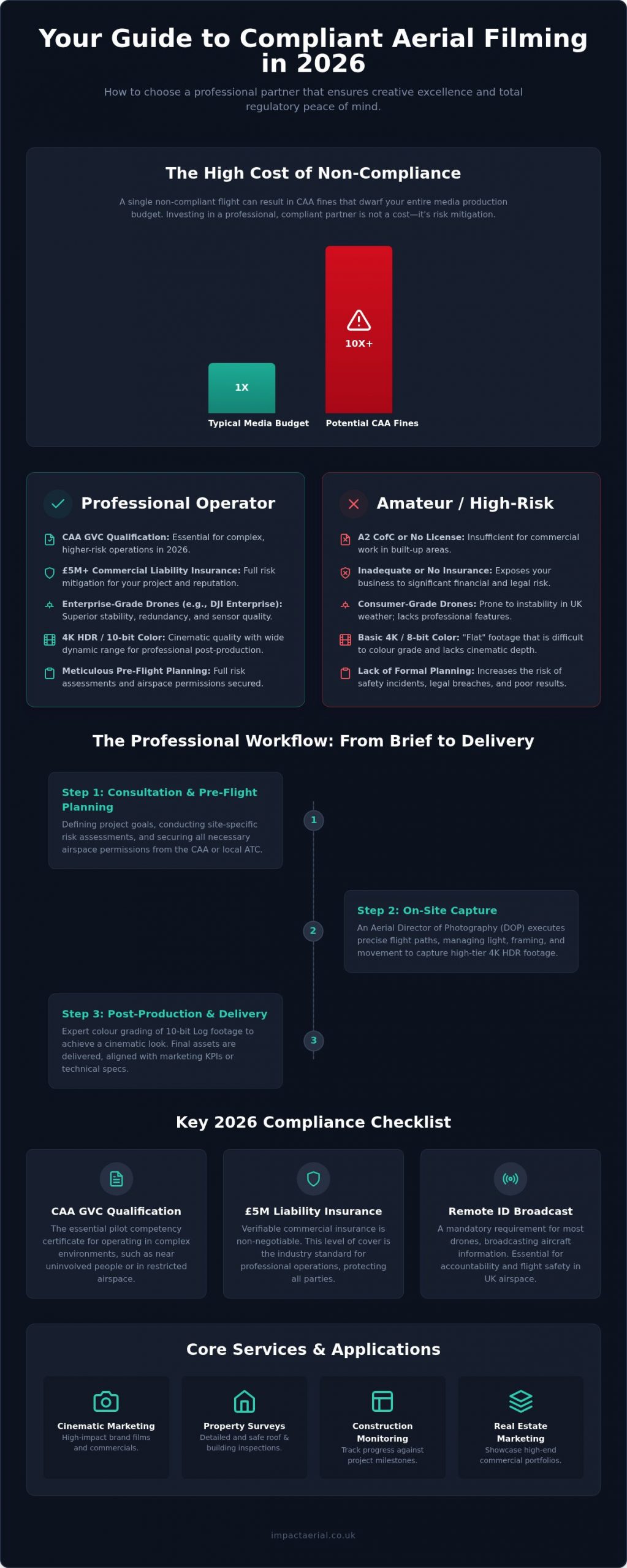
Safety and Compliance: The Legal Requirements for UK Drone Filming
Operating as a professional aerial filming company in 2026 requires more than just technical skill; it demands a deep understanding of the Civil Aviation Authority (CAA) regulatory framework. As of January 1, 2026, all UK1, UK2, and UK3 class drones must broadcast their CAA-issued Remote ID. This transparency is a cornerstone of modern airspace management, ensuring that every commercial flight is traceable and accountable. For businesses, hiring an operator who bypasses these requirements isn’t just a safety risk; it’s a significant legal liability that can result in heavy fines and reputational damage.
Understanding Drone Licenses: GVC vs. A2 CofC
The distinction between drone certifications is critical for project safety. While the A2 CofC (Certificate of Competence) allows for basic operations, corporate clients should always insist on a CAA GVC certified pilot for complex commercial work. The General Visual Line of Sight Certificate (GVC) is the prerequisite for an “Operational Authorisation.” This permit allows a professional aerial filming company to fly in busier, more restricted environments that are often off-limits to basic flyers. If your project involves filming in built-up areas or near uninvolved people, the GVC provides the legal basis for the specific mitigations required to keep the shoot within the law.
Risk Mitigation and Insurance
A professional operation is defined by its approach to risk. Before any flight, we produce a comprehensive Risk Assessment & Method Statement (RAMS). This document outlines every potential hazard, from local obstacles to weather variables, and details the specific steps taken to neutralize them. Standard public liability insurance often excludes specialized drone activities, which is why we maintain £5m commercial liability insurance specifically tailored for aerial work. This level of coverage provides the financial reassurance that corporate legal departments require when authorizing high-profile shoots on site.
Safety also extends to data protection and ethical capture. We strictly adhere to privacy considerations for drone filming to ensure that our operations remain GDPR compliant. This includes managing how we capture, store, and process footage that may contain identifiable individuals or private property. By integrating these legal safeguards into our workflow, we provide a seamless service that protects your interests while delivering high-tier cinematic results. You don’t just get a pilot; you get a fully vetted aviation partner who prioritizes compliance as much as the final visual output.
How to Choose the Right Aerial Filming Partner for Your Project
Selecting a partner for your production isn’t just about finding someone with a drone; it’s about securing a technical consultant who understands your specific industry requirements. A methodical evaluation process ensures that your chosen aerial filming company can deliver high-tier cinematic results while maintaining full legal compliance. You should start by requesting a copy of their CAA Operational Authorisation and proof of £5m commercial liability insurance. If a provider cannot produce these documents immediately, they shouldn’t be operating on your site. Beyond the paperwork, you need to assess their project management style to ensure they can handle the complexities of a professional shoot from initial brief to final delivery.
Your evaluation should follow these five critical steps:
- Verify Credentials: Confirm their pilots hold a GVC and that their insurance is current and commercial-grade.
- Review the Portfolio: Look for industry-specific experience that matches your project’s goals.
- Assess the Technology: Ensure they utilize enterprise-grade hardware, such as DJI Enterprise drones, for maximum stability and image quality.
- Evaluate Communication: A professional partner will provide a clear workflow, including pre-flight planning and risk assessments.
- Compare Pricing: Look for transparent structures that clearly outline costs for permissions, flight time, and post-production.
Evaluating the Portfolio and Showreel
When reviewing a showreel, look beyond the initial visual impact. You should assess the variety of technical maneuvers, such as smooth orbits, dramatic reveals, and precise tracking shots. Pay close attention to the consistency of lighting and colour grading across different clips; this indicates a high level of control during both the capture and post-production phases. You should prioritize portfolios that feature projects similar in scale and industry to your own to ensure the team understands your specific visual language and operational constraints.
The Importance of Regional Expertise
Local knowledge is a significant asset when managing complex flight operations. A company with specific expertise in Birmingham and the West Midlands will already be familiar with local council requirements and police notification protocols for built-up areas. This regional insight helps streamline the permission process and reduces the risk of project delays. Additionally, hiring a UK-wide company with regional hubs offers the cost benefits of reduced travel expenses while providing pilots who understand local weather patterns and geographic challenges. If you’re ready to start your project with a vetted team, you can contact our professional drone pilots to discuss your specific requirements and receive a transparent quote.
Impact Aerial: Professional Drone Filming and Surveys Across the UK
Impact Aerial operates as a specialized aerial filming company that bridges the gap between high-end cinematic production and rigorous technical data collection. Based in Birmingham and the West Midlands, our team provides comprehensive UK-wide coverage for clients who require absolute precision. We don’t just capture images; we provide a managed aviation service that prioritizes safety and regulatory compliance above all else. By utilizing DJI Enterprise hardware, we deliver 4K HDR cinematic results that meet the exacting standards of modern marketing and industrial surveying.
Our pilots are all CAA GVC certified, ensuring they possess the highest level of qualification for commercial operations in complex environments. This expertise is backed by £5m commercial liability insurance as standard, providing the psychological comfort and financial security required by large corporate entities. Whether you’re looking for creative drone photography to elevate a brand or a technical survey to monitor site progress, our methodology remains consistent: meticulous planning followed by flawless execution. We understand the specific needs of the West Midlands region while maintaining the capacity to deploy our expertise across any UK location.
Our Approach to Your Project
Our workflow is designed to be methodical and transparent. It begins with an initial consultation where we define your specific KPIs, whether you’re in the property, construction, or advertising sector. We handle all pre-flight planning, including site-specific risk assessments and airspace permissions, so you don’t have to manage the regulatory burden. Once the flight is complete, our bespoke post-production services take over. We transform raw data into a polished, persuasive narrative through professional colour grading and sound design, ensuring the final output is ready for immediate deployment across your chosen platforms. This commitment to high-end visual output ensures that every project we undertake adds tangible value to your business.
Get a Professional Perspective Today
Choosing the right partner for your aerial filming drone operations is a decision that impacts both your project’s quality and its legal standing. Impact Aerial provides a reliable, expert-led solution that removes the guesswork from drone services. We invite you to reach out for a tailored consultation to discuss how our cinematic and technical capabilities can benefit your next project. Our team is ready to provide the professional perspective your business deserves. Contact Impact Aerial for a quote on your next project.
Elevate Your Production with Professional Aerial Standards
The landscape of aerial media in 2026 demands a sophisticated blend of creative vision and strict technical compliance. Selecting a professional aerial filming company is no longer just about the visual aesthetic; it’s about prioritizing safety through CAA GVC certification and ensuring your assets are protected by robust £5m commercial liability insurance. You now understand how the right partner manages the entire workflow, from navigating complex Remote ID requirements to delivering polished 4K HDR post-production that aligns with your brand’s KPIs.
Based in Birmingham and serving the entire UK, Impact Aerial provides the meticulous project management and high-tier output your business requires to stand out in a competitive market. We bridge the gap between stunning cinematic marketing and precision technical surveys, ensuring every flight is legal, insured, and productive. We invite you to request a bespoke quote for your aerial filming project and discover the difference that expert aviation standards can make. We look forward to helping you achieve a unique perspective on your next project with confidence and clarity.
Frequently Asked Questions
Is it legal to hire a drone filming company in the UK?
Yes, it’s entirely legal to hire a professional aerial filming company provided they hold a valid Operational Authorisation from the Civil Aviation Authority (CAA). You must verify that the pilots are GVC certified and that the business has the correct commercial insurance in place. Hiring an unlicensed operator can result in significant legal liabilities and heavy fines for your organization.
How much does a professional aerial filming company cost?
The cost of hiring an aerial filming company depends on several factors including the project duration, the technical complexity of the flight, and the level of post-production required. While basic sessions are available for smaller projects, high-end commercial productions involving specialized enterprise hardware and complex airspace permissions require a bespoke quote. We provide transparent pricing structures that account for all safety planning and regulatory filings.
What kind of insurance should a drone filming company have?
A professional provider must carry specialized commercial drone liability insurance rather than standard public liability cover. Most corporate sites and local authorities require a minimum of £5m in coverage to account for potential risks in built-up areas. This insurance provides essential protection for both the operator and the client, ensuring that all activities are financially secured against unforeseen incidents.
Can drones fly in rain or high winds in the UK?
Modern enterprise drones can operate in varied conditions, but safety remains the primary factor. Most professional systems have an IP rating that allows for flight in light rain, though heavy downpours can affect image quality and safety. Wind limits are typically around 22mph for stable cinematic capture. We always monitor live weather data to ensure every flight remains within safe operational parameters.
Do I need a special permit for drone filming in London or Birmingham?
Yes, filming in major cities often requires specific permissions due to Flight Restriction Zones (FRZs) and congested area regulations. We manage the entire application process, coordinating with local air traffic control and city councils to secure the necessary flight permits. Our regional expertise in Birmingham and the West Midlands allows us to navigate these local requirements efficiently for our clients.
What is the difference between a standard drone and an enterprise drone?
Enterprise drones are built for reliability and high-tier output, featuring redundant batteries and advanced obstacle avoidance sensors. Unlike consumer models, these systems offer superior 4K HDR capture and Log profiles that are essential for professional colour grading. They also include the mandatory Remote ID broadcast technology required for legal commercial operations in the UK throughout 2026.
How long does a typical aerial filming shoot take?
A typical shoot can range from a half-day session for simple site monitoring to multiple days for complex cinematic productions. We factor in time for initial site safety briefings, equipment setup, and multiple battery swaps to ensure we capture all required angles. The total duration is always defined during the initial consultation to ensure your project stays on schedule.
What video formats can you provide for post-production?
We deliver high-resolution 4K HDR footage in professional formats such as ProRes or h.265, depending on your editing requirements. By capturing in Log profiles, we provide maximum dynamic range for your post-production team to achieve a cinematic look. We can also provide fully edited, brand-ready content optimized for social media, corporate presentations, or broadcast television.
Professional Aerial Video Production in London: The 2026 Guide to Drone Filming
Did you know that 67% of drone shoots in central London require at least one additional airspace clearance beyond standard permissions? For many brands, securing professional aerial video production london feels like an operational minefield of “No Fly Zones” and strict NATS requirements. It’s natural to worry about legal complexities, especially with the 2026 Remote ID mandates and the threat of heavy CAA fines for non-compliance.
You’re right to be cautious. London is the UK’s most complex airspace; a single oversight can derail an entire project. This guide will help you master these intricacies, from navigating local borough permits to achieving stunning 4K HDR footage that elevates your brand assets. We’ll cover the latest UK class markings, the importance of £5m commercial liability insurance, and how meticulous project management ensures your project stays both legal and spectacular.
Key Takeaways
- Understand the critical regulatory distinctions between A2 CofC and GVC certification required for legal drone operations in high-risk urban environments.
- Learn how to navigate complex airspace restrictions to secure high-quality aerial video production london that meets strict NATS and local borough standards.
- Discover the technical advantages of using DJI Enterprise hardware to capture cinema-grade 4K HDR footage of London’s architecture and assets.
- Master the end-to-end project workflow, from initial desktop surveys and risk assessments to final post-production editing and delivery.
- Identify the essential safety benchmarks, including £5m commercial liability insurance, necessary for protecting high-value assets during urban flight missions.
The Strategic Value of Aerial Video Production in London
Professional drone filming provides a unique bird’s-eye perspective that ground-based cameras simply cannot replicate. In a city as dense and vertical as London, capturing the true scale of the capital’s skyline requires the height and precision of a professional unmanned aerial vehicle (UAV). From the historic architecture of the City to the modern glass towers of the Docklands, aerial video production london offers a vantage point that defines the context of a project within the wider urban landscape.
To better understand the visual impact of this technology in an urban setting, watch this helpful video:
The return on investment for aerial content is significant across multiple sectors. High-end brands use 4K HDR footage to elevate their storytelling, capturing the sharp contrast between London’s stone heritage and its contemporary skylines. This level of visual fidelity isn’t just about aesthetics; it’s a technical requirement for modern marketing. By providing cinema-grade output, businesses can differentiate their assets in a highly competitive metropolitan market where standard photography no longer suffices—a goal often achieved by combining aerial perspectives with high-quality content created at professional production spaces like Smashy Owl Studios.
Aerial Cinematography for High-End Property
In the luxury real estate market, location is everything. Aerial cinematography allows developers to showcase a property’s proximity to iconic landmarks like the Thames or the Shard. It sells more than just a building; it sells the lifestyle and connectivity of a London development. We often integrate these high-altitude views into virtual tour creation, offering potential buyers an immersive experience that combines interior detail with the grandeur of the surrounding city. This comprehensive approach ensures that every angle of a development’s value is communicated clearly.
Construction Monitoring and Site Documentation
For large-scale infrastructure and building projects, drones are indispensable tools for transparency and planning. Providing stakeholders with a comprehensive view of site progress in congested urban zones helps maintain timelines and manage expectations. Aerial video is frequently used for safety audits and logistical planning, identifying potential issues before they become costly delays. Our expertise in construction site monitoring ensures that project managers receive high-resolution, compliant documentation that supports both operational safety and high-level reporting requirements.
Navigating London’s Complex Drone Regulations and Airspace
London is one of the most strictly regulated pieces of airspace in the world. For successful aerial video production london, operators must move beyond the basic “Open Category” and understand the “Specific Category” of drone operations. This category is designed for high-risk urban environments where flying near people and property is unavoidable. It’s not just about the skill of the pilot; it’s about the legal framework that protects the public and your brand’s reputation.
The distinction between an A2 Certificate of Competence (CofC) and a General Visual Line of Sight Certificate (GVC) is critical. While an A2 CofC allows for some commercial work with lighter drones, the GVC is the professional standard for complex London missions. It provides the legal basis for flying larger enterprise-grade aircraft in congested areas. Safety is reinforced by a minimum of £5 million in public liability insurance, which is the baseline requirement for any project involving London’s high-value real estate.
Managing National Air Traffic Services (NATS) clearances is a major part of the pre-flight workflow. Research indicates that 67% of central London shoots require at least one additional airspace clearance beyond standard permissions. These aren’t just boxes to tick. They involve direct coordination with air traffic control to ensure the drone doesn’t conflict with manned aviation. Lead times for these permits are substantial, often ranging from 14 to 42 days. Planning ahead is the only way to ensure your project stays on schedule.
The Role of the CAA GVC Certified Pilot
A GVC certified pilot is mandatory for missions that require flying closer to people and buildings than standard rules allow. These professionals are trained to conduct meticulous site-specific risk assessments (OSC) that satisfy the requirements of individual London boroughs. By adhering to drone videography best practices, pilots can mitigate risks like signal interference or sudden wind gusts, which contribute to an 11% flight cancellation rate in the capital. To operate legally, every commercial pilot must hold a valid UK drone license that proves they meet current CAA safety and operational standards.
Securing Permits: From Royal Parks to The City
Securing permits in areas like the City of London or Westminster requires navigating multiple authorities. Beyond NATS, you might need clearances from the following:
- The Metropolitan Police: For filming in sensitive public areas.
- The Diplomatic Protection Group (DPG): If your flight path is near government buildings.
- Local Borough Film Offices: For take-off and landing permissions on council-managed land.
Flight Restriction Zones (FRZs) around Heathrow and London City Airport further complicate the map, making professional oversight essential. If you need a partner to manage these complexities, we provide fully managed drone filming to ensure your project stays compliant and safe.
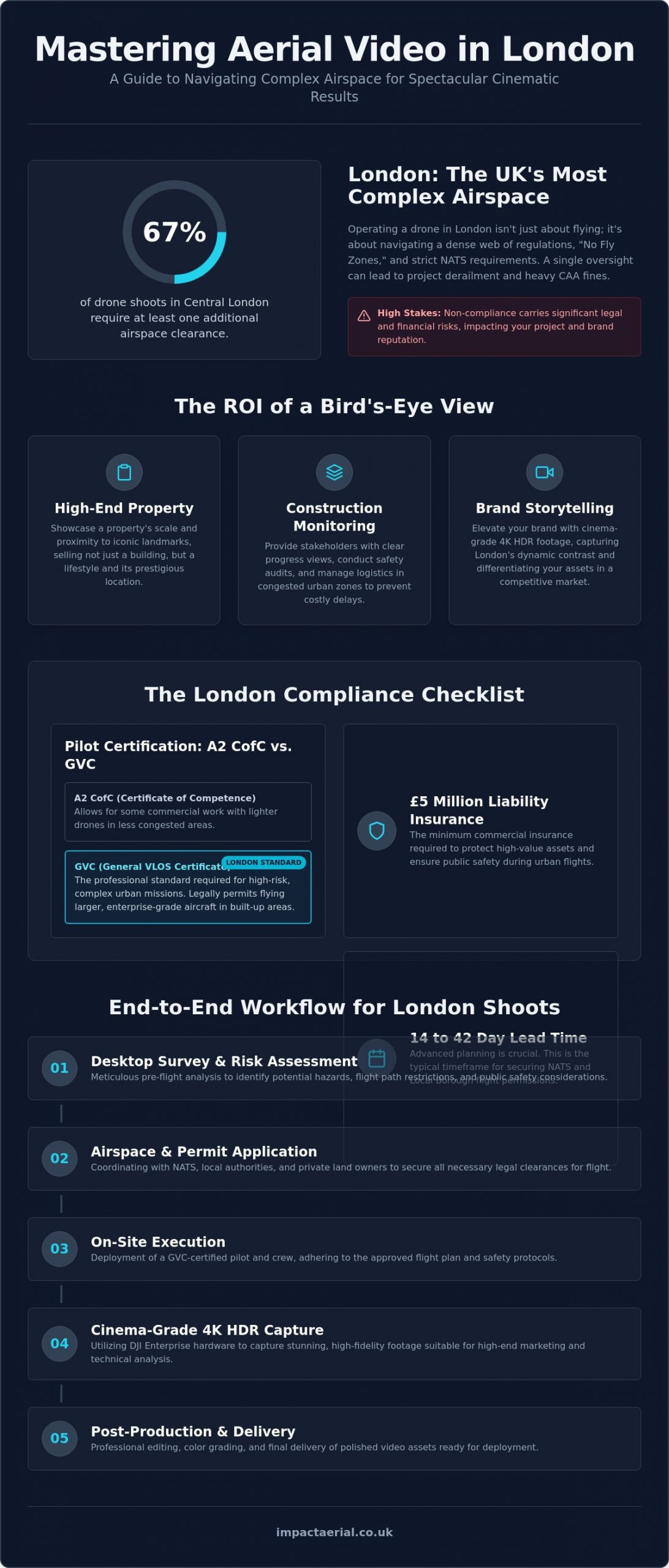
Technical Excellence: Enterprise Hardware and 4K HDR Output
Professional aerial video production london requires more than just high resolution; it demands the reliability of enterprise-grade hardware. We use DJI Enterprise drones because they are engineered specifically for the challenges of dense urban environments. These aircraft provide the stability needed to capture cinematic motion even when flying through the “wind tunnels” created by the City’s high-rise architecture. While consumer drones might struggle with signal interference or gusty conditions, enterprise systems offer the power and precision required for consistent, high-tier output.
Wind speeds at altitude often differ significantly from ground level. In London, gusts exceeding 20mph are common, which is why we monitor weather data meticulously. Enterprise hardware features advanced stabilization and higher wind resistance than consumer models, ensuring your footage remains smooth and professional. These systems also support dual-payload configurations. This means we can switch between high-resolution 4K video and thermal imaging sensors during a single mission. It’s a versatile approach that allows us to provide both marketing content and technical data without requiring multiple site visits.
The Advantage of 4K HDR Cinematography
London’s architecture presents a unique challenge for cameras: the high contrast between reflective glass skyscrapers and deep street-level shadows. 4K HDR (High Dynamic Range) is essential here. It captures detail in both the brightest highlights and the darkest corners of the frame, preventing the “blown out” skies or “crushed” blacks common in lower-quality footage. Our full post-production editing services then take this raw data to create a polished brand film. High-bitrate recording ensures the final output meets the rigorous standards required for television broadcast and high-end digital media.
Precision Hardware for Urban Safety
Safety in a metropolitan environment is non-negotiable. Our enterprise drones feature omnidirectional obstacle sensing, which provides a 360-degree safety net when flying near complex infrastructure. We also prioritize client privacy through encrypted data transmission, a vital feature for sensitive site surveys or construction monitoring. Redundant battery systems and propulsion units further minimize risk, providing the reassurance needed for critical flights over high-traffic areas or the River Thames. This meticulous approach to hardware ensures that technical excellence never comes at the expense of operational safety. By utilizing the latest UK class-marked equipment, we ensure your project is future-proofed against evolving 2026 regulations.
The London Shoot Workflow: From Planning to Post-Production
Professional aerial video production london relies on a methodical workflow that balances creative vision with strict operational safety. The process begins with an initial consultation to define the creative brief and technical requirements of the site. This stage is crucial for understanding whether the project is primarily for marketing, such as a cinematic property trailer, or for technical data collection. Once the objectives are set, we move into the pre-flight planning phase. This involves a comprehensive desktop survey to identify potential obstacles, flight restrictions, and the specific permissions required for the target area.
On-site execution is where the planning meets reality. In a congested urban environment, we typically deploy a two-person crew consisting of a GVC-certified pilot and a dedicated camera operator or spotter. This setup is essential for maintaining a constant Visual Line of Sight (VLOS) while managing ground safety teams. After the flight, the focus shifts to post-production. Here, raw 4K HDR files are transformed through professional editing, colour correction, and the addition of motion graphics to create high-impact aerial filming drone content.
The Importance of Pre-Flight Risk Assessment
A meticulous risk assessment is the foundation of every London mission. We identify “non-involved persons” within the flight path and establish cordoned take-off and landing zones, even in the busiest districts. Weather monitoring is equally complex. London’s high-rise buildings create unique micro-climates and wind tunnels that can affect flight stability. We coordinate directly with local authorities and building managers to secure roof-top access or ground-level clearances, ensuring every aspect of the operation is vetted and authorised before the drone leaves the ground. This level of preparation is why we maintain a high success rate even in the capital’s most challenging locations.
Post-Production and Final Delivery
The value of aerial footage is often realised when it’s integrated with ground-based video production services. We provide a full-service transition from raw data to a finished product, editing content for multiple platforms. Whether you need a 16:9 cinematic trailer for a boardroom presentation or a 9:16 reel for social media, our post-production team ensures the visual quality remains consistent. All high-resolution master files are delivered via secure servers and archived for future use, providing long-term value for your assets. If you’re ready to start your project, book a professional drone filming consultation with our expert team today.
Impact Aerial: Your Partner for Compliant London Drone Filming
Choosing a partner for aerial video production london requires a balance of creative vision and technical rigour. While many agencies focus solely on the aesthetic, Impact Aerial operates as a technical consultancy first. Our Birmingham roots provide a strategic advantage, allowing us to maintain nationwide consistency for clients with assets across the UK while deploying specialised teams for the unique challenges of the capital. We don’t just provide a pilot; we provide a fully managed aviation solution that prioritises active risk mitigation over simple compliance.
Our team understands that drone data serves multiple purposes. A single mission can provide high-end marketing assets while simultaneously delivering technical insights for property surveys. This dual expertise ensures that we capture the cinema-grade 4K HDR footage your brand requires without compromising the precision needed for site documentation. We streamline the entire process, from the first desktop survey to the final delivery of edited files, allowing your team to focus on the creative direction while we handle the operational complexities.
Professional Reassurance and Liability
In the high-value environments of the City and Canary Wharf, financial and operational security are paramount. Just as high-profile clients rely on hyperexecutivetravel.com for secure and professional ground transport, we provide peace of mind through our £5 million commercial liability insurance, which meets the stringent requirements of London’s leading property and construction firms. Our track record includes the successful delivery of complex projects in some of the UK’s most congested urban zones, proving our ability to operate safely where others cannot. Impact Aerial manages all NATS and CAA paperwork on behalf of the client, ensuring a seamless path from initial concept to legal flight.
Tailored Solutions for London Businesses
We recognise that every project has distinct requirements, which is why we offer bespoke packages tailored to your specific goals. Whether you need a one-off cinematic film to launch a new development or an ongoing programme of construction site monitoring, our services are scalable and precise. By accessing our network of drone services across the South East, you benefit from local knowledge backed by enterprise-level standards. You’ll have direct contact with our CAA-certified pilots for expert technical advice throughout the project lifecycle. This direct communication ensures that technical limitations are addressed early and creative expectations are always met. To begin planning your next mission, contact our team to discuss your site requirements and permit lead times.
Elevating Your Vision in the Capital
Navigating London’s complex airspace requires a partner who treats safety as a technical standard rather than a checkbox. We’ve explored how CAA GVC certified pilots and meticulous permit management are essential for legal operations in the capital. By leveraging 4K HDR DJI Enterprise hardware, your brand can capture the scale and detail of the skyline with total operational reassurance. It’s about moving beyond raw footage to deliver a polished, compliant narrative that stands out in a vertical city.
Successful aerial video production london isn’t just about the flight; it’s about the comprehensive workflow that ensures every frame is both spectacular and strictly legal. With £5m public liability insurance and a deep understanding of NATS lead times, we manage the complexities so you can focus on the creative impact of your project. We’re ready to help you master the intricacies of the 2026 regulations and achieve results that elevate your brand to new heights.
Secure your London aerial shoot with Impact Aerial today. We look forward to capturing your next project from its most impressive perspective.
Frequently Asked Questions
Do I need a permit for drone filming in central London?
Yes, you need multiple permissions to operate legally in central London. Beyond your pilot’s CAA certification, you must secure clearances from NATS (National Air Traffic Services) and the specific local borough film office where the take-off and landing occur. In sensitive areas, you may also require approval from the Metropolitan Police or the Diplomatic Protection Group (DPG).
How much does professional aerial video production cost in London?
The cost of aerial video production london varies significantly based on the project’s location and technical demands. Factors that influence the final quote include the complexity of the permit applications, the size of the required ground safety team, and the specific hardware used. Central London projects often involve additional surcharges to cover the administrative time required for NATS and borough-specific clearances.
Can drones fly in London’s No Fly Zones?
Drones can fly in most Flight Restriction Zones (FRZs) provided the operator obtains an Enhanced Non-Standard Flight (ENSF) permission. These “No Fly Zones” around airports or government buildings aren’t absolute prohibitions for professionals. We handle the technical and administrative negotiations with air traffic control to secure the necessary legal windows for your mission.
What insurance is required for commercial drone filming in the UK?
A minimum of £5 million in public liability insurance is the professional standard for commercial operations in the UK. While basic commercial work requires EC 785/2004 compliant insurance, London’s high-value environments often demand higher coverage. We maintain £5 million as our baseline to ensure total reassurance for clients in the property and construction sectors.
How long does it take to organise a drone shoot in London?
You should allow between 14 and 42 days to organise a professional aerial video production london project. While we can occasionally fast-track certain permissions, the lead times for NATS and local authority permits are set by the governing bodies. Early engagement is the best way to ensure your desired dates are secured and all risk assessments are fully vetted.
What is the difference between a standard drone and an Enterprise drone?
Enterprise drones are built with redundancy and safety systems that standard consumer drones lack. These aircraft feature dual-battery systems, omnidirectional obstacle sensing, and encrypted data transmission to protect client privacy. They also support 4K HDR sensors and dual-payloads, which are essential for capturing professional-grade footage in the complex signal environments of a major city.
Can you film aerial video in London during the night?
Yes, night filming is possible and offers a spectacular perspective of London’s illuminated skyline. To do this legally, the pilot must hold a GVC and follow the Specific Category rules for night operations. We use high-performance 4K HDR sensors specifically designed to handle low-light conditions, ensuring the footage remains sharp and noise-free even after dark.
What happens if the weather is bad on the day of the shoot?
We monitor the forecast meticulously and will reschedule if conditions aren’t safe for flight. High wind gusts exceeding 20mph at altitude or persistent rain are the primary reasons for postponement. With a typical 11% cancellation rate in London due to weather, we always build flexibility into our schedules to ensure we capture your content during the next safe weather window.
Chartered Surveyor Drone Survey: The Professional Guide to Aerial Inspections
Why are you still budgeting thousands for scaffolding and cherry pickers when the most critical structural data is often just a flight away? You’ve likely felt the frustration of marking a roof area as “inaccessible” or worrying about the liability risks of sending personnel to height. It’s a logistical burden that often leads to incomplete building surveys and inconsistent reporting.
This guide demonstrates how a professional chartered surveyor drone survey bridges the gap between traditional expertise and high-precision aerial technology. By integrating RICS-compliant data collection into your workflow, you can secure high-resolution imagery for defect identification while significantly reducing inspection timelines.
We’ll examine the technical requirements for 2026, including the transition to RPC-L1 Part A qualifications and the necessity of robust commercial insurance. From navigating CAA regulations to identifying guttering and chimney stack issues, you’ll learn how a meticulous, data-centric approach to aerial inspections provides the reassurance and reliability your clients expect.
Key Takeaways
- Understand why traditional access methods like scaffolding are being replaced by non-invasive drone technology for faster, safer initial building inspections.
- Discover the technical power of 4K HDR imagery and orthomosaic mapping in identifying hairline defects that manual ground-based inspections often miss.
- Learn how a professional chartered surveyor drone survey ensures RICS compliance and protects your professional indemnity insurance through CAA-certified operations.
- Explore advanced applications such as thermal imaging for moisture detection and specialized, non-contact surveys for heritage and listed building conservation.
- Gain insights into the DJI Enterprise workflow used by West Midlands specialists to deliver high-precision aerial data for both local and national property portfolios.
The Evolution of Building Inspections: Why Chartered Surveyors Use Drones
The methodology behind property assessment is undergoing a fundamental shift. The Evolution of Building Inspections has moved from physical climbing to digital capture, utilizing Unmanned Aerial Vehicles (UAVs) to gather high-resolution structural data. A professional chartered surveyor drone survey offers a non-invasive alternative to traditional visual inspections. It allows for a detailed examination of a building’s envelope without disturbing the fabric of the property or requiring direct physical contact with fragile surfaces.
To see how these aerial techniques are applied in a real-world setting, watch this demonstration of a professional roof inspection:
Traditional Access vs. UAV Efficiency
Traditional access methods like scaffolding or Mobile Elevating Work Platforms (MEWPs) often involve significant logistical hurdles. Erecting scaffolding can take days of labor and requires extensive pavement licenses and health and safety permits. In contrast, a professional drone team can deploy within 15 minutes of arriving on site. Choosing a chartered surveyor drone survey over traditional methods doesn’t just save time; it provides a level of perspective that ground-based tools simply cannot match. For multi-storey commercial properties, the cost-benefit analysis is clear. Drones eliminate the high daily hire rates of heavy machinery and the associated site disruption. Most importantly, it keeps the surveyor safely on the ground. By removing the need for personnel to work at height, firms drastically reduce their liability and operational risk while maintaining a meticulous standard of inspection.
Enhancing RICS Survey Standards
Aerial data is now a vital component for RICS Level 2 and Level 3 Home Surveys. Standard ground-based inspections frequently encounter “limitations” when dealing with high-level chimney stacks, hidden valley gutters, or parapet walls. These areas are often where the most severe structural defects reside, such as failing leadwork or slipped tiles. By using DJI Enterprise hardware, we capture 4K HDR imagery that supports RICS professional guidance notes on building surveys. This high-tier output allows for the identification of hairline cracks and moisture ingress points that are invisible from the street level. By providing verifiable visual evidence of high-level building components, drone data removes the need for professional assumptions in survey reports, ensuring a higher standard of factual accuracy.
Technical Data Outputs: High-Resolution Imagery to 3D Modelling
The value of a chartered surveyor drone survey is found in the density and precision of the data captured. Modern DJI Enterprise hardware utilizes 4K HDR sensors to produce imagery with exceptional dynamic range. This technical capability is essential for identifying hairline structural cracks or subtle tile slippage that a standard camera might miss. While cinematic drones focus on aesthetics, professional surveying equipment prioritizes visual evidence and geometric accuracy. Every flight is a methodical data collection exercise designed to provide a comprehensive digital record of the asset.
Beyond individual photographs, we utilize orthomosaic mapping to create high-detail, top-down “maps” of large estates or complex roof structures. These maps are generated by stitching hundreds of overlapping images together, corrected for perspective and scale. This provides a panoramic overview that remains perfectly sharp even when zoomed in to a specific chimney stack or valley gutter. When conducting these operations, we ensure full compliance by Navigating UK Drone Regulations in 2026, ensuring your data is collected legally and under the correct operational authorizations. We deliver this data in several professional formats to suit your workflow:
- High-density point clouds for BIM and Revit integration
- Georeferenced orthomosaic maps for site planning
- Interactive 360-degree virtual tours for remote site visits
- 4K HDR video and high-resolution still imagery for defect reporting
Visual Inspection for Roofs and Gutters
Hidden roof valleys and internal gutters are notorious for harboring blockages and vegetation growth. A professional drone survey allows for the documentation of these areas without the risk of ladder access or the cost of scaffolding. We provide crystal-clear imagery that serves as a definitive visual record, making it easier for surveyors to justify recommended repair works to stakeholders. For those managing multiple assets, our drone commercial property surveys offer a streamlined way to assess portfolio health with technical precision.
Digital Twins and Photogrammetry for Surveyors
Photogrammetry transforms aerial imagery into measurable 3D digital twins. By processing overlapping photos into a point cloud, surveyors can take precise measurements of roof pitches, surface areas, and structural dimensions remotely. This data integrates into CAD environments, supporting Scan-to-BIM workflows for architectural conservation and complex refurbishments. These time-stamped digital models provide a baseline for long-term property management. They allow you to compare structural conditions over several years to monitor movement or degradation with absolute confidence.
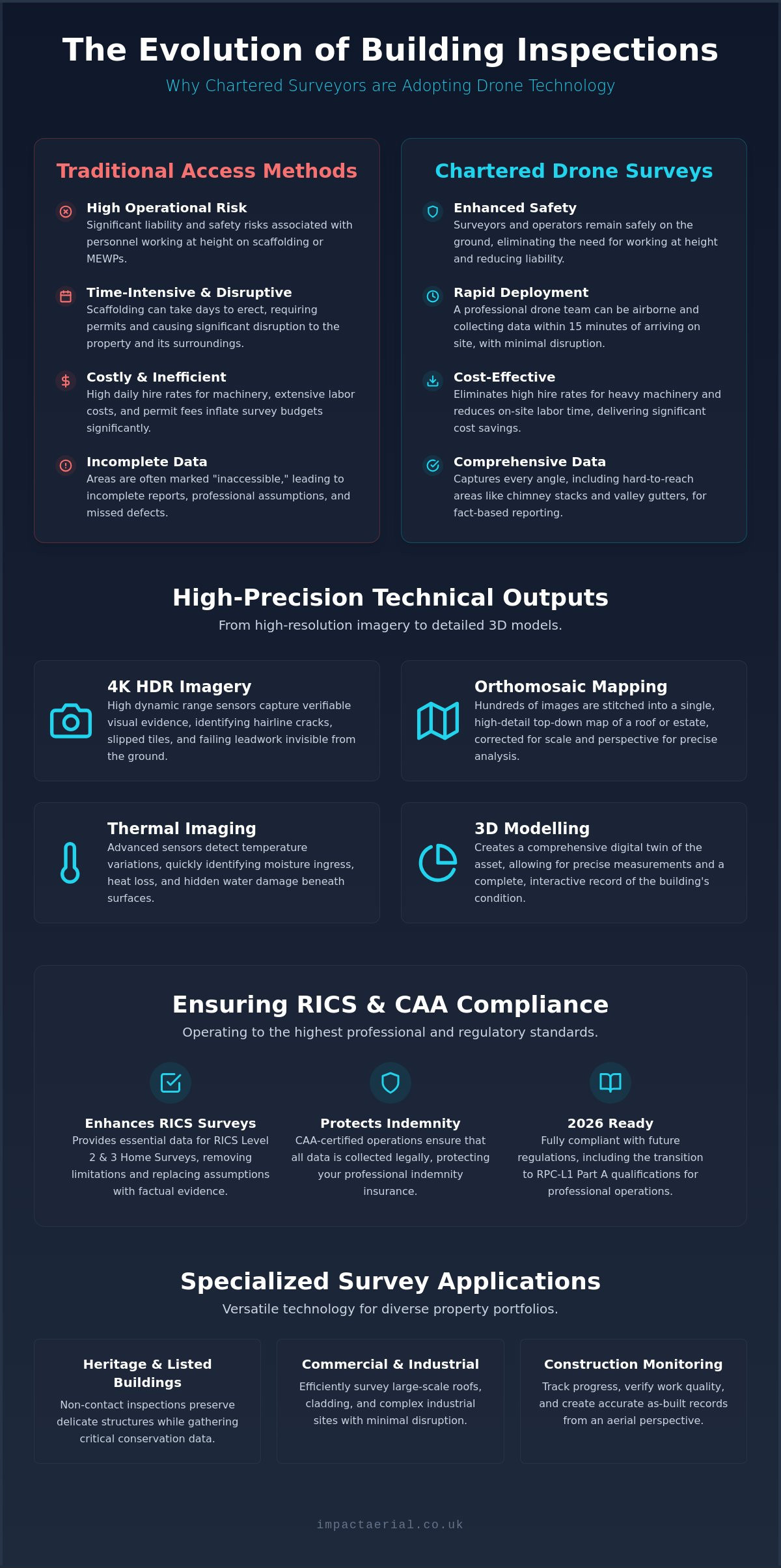
Safety and Compliance: Navigating UK Drone Regulations in 2026
Compliance in the UK drone industry is a matter of strict legality rather than mere preference. When a firm commissions a chartered surveyor drone survey, they aren’t just hiring a camera; they’re entering a highly regulated aviation environment. Hiring an amateur or unlicensed pilot doesn’t just risk a fine from the Civil Aviation Authority; it fundamentally compromises the surveyor’s professional standing. Most professional indemnity insurance policies specifically require that any sub-contracted aerial work is performed by an operator holding valid CAA Operational Authorization. If an incident occurs during an unauthorized flight, the surveyor’s insurance may be voided, leaving the firm exposed to significant financial and legal liability.
Professional operators mitigate these risks through a structured approach to flight safety. This begins long before the drone leaves the ground. A meticulous pre-flight site assessment is conducted for every project, identifying potential hazards such as overhead power lines, nearby airports, or public thoroughfares. This process ensures that the data collection is not only high-quality but also conducted within the strict safety parameters set by national aviation standards. By adhering to these protocols, we provide a level of reliability that protects both the integrity of the survey and the reputation of the surveying firm.
Hiring a CAA GVC Certified Pilot
The General Visual Line of Sight Certificate (GVC) remains a critical qualification for commercial drone operations in complex or urban environments. While regulatory standards evolved in 2026, the GVC continues to be a benchmark for pilots managing risks in congested areas. For a deeper look at these requirements, you can read our UK Drone License guide for the latest regulatory context. Certified pilots are trained to manage flight permissions in restricted zones and coordinate with Air Traffic Control when necessary. They don’t just operate the hardware; they produce detailed Risk Assessments and Method Statements (RAMS) that are essential for site health and safety files.
Insurance and Liability for Property Surveys
Commercial drone insurance is a legal mandate under UK regulation. Standard public liability policies often exclude aviation-related incidents, which is why specialized UAV cover is non-negotiable for professional work. We maintain £5m in commercial liability insurance, providing a robust layer of protection for the surveyor, the client, and the public. This high level of coverage is essential when operating near high-value commercial developments or sensitive heritage sites. Working with a fully vetted and insured UAV operator provides the essential reassurance that all site risks are professionally managed and mitigated.
Specialized Survey Applications: From Heritage to Construction
A professional chartered surveyor drone survey extends far beyond simple roof photography. It serves as a sophisticated data collection tool for specialized sectors where traditional access is either impossible or prohibitively expensive. By deploying DJI Enterprise hardware equipped with various sensors, we provide surveyors with the technical evidence needed for complex valuations and structural assessments. Whether you are managing a high-tier commercial asset or a sensitive historic site, aerial data delivers a level of detail that ground-based methods can’t replicate. It’s a partnership that combines the surveyor’s expertise with our meticulous approach to flight operations and data precision.
Conservation and Heritage Drone Surveys
Heritage assets demand a sensitive approach. Traditional scaffolding can cause more damage than the inspection itself; this makes UAV technology the preferred choice for architectural conservation. We capture high-level masonry detail on churches, stately homes, and listed sites without any physical contact with the structure. This non-invasive method is essential for documenting the condition of delicate stonework or lead flashings on buildings where preservation is the priority. For firms across the West Midlands managing historic portfolios, our drone commercial property surveys offer a non-invasive way to secure high-resolution conservation data and digital archives.
Thermal Surveys for Building Performance
Thermal imaging adds a layer of diagnostic power to a building inspection. By using radiometric sensors, we identify “cold bridges”, insulation gaps, and hidden moisture ingress that are invisible to the naked eye. This is particularly valuable for commercial flat roofs where temperature differentials can pinpoint the exact location of a leak before it causes structural failure. Our specialized PV solar farm thermal surveys also help estates monitor energy efficiency and asset health at scale. These insights support “Green” surveys and help landlords make data-driven decisions regarding energy efficiency improvements and long-term maintenance strategies.
Construction and Insurance Valuations
In the construction sector, drones provide a steady stream of progress data. We assist with construction site monitoring by tracking build phases and providing volumetric analysis of stockpiles with high accuracy. This visual record is equally vital for Insurance Reinstatement Cost Assessments. Having a detailed, time-stamped record of a building’s current condition ensures that insurance valuations are based on factual data rather than estimates. This meticulous documentation provides the reassurance and reliability that both the insurer and the property owner require during the valuation process.
Partnering with Impact Aerial: Professional Drone Surveys in Birmingham and Beyond
Choosing a partner for a chartered surveyor drone survey requires a balance of technical expertise and regional knowledge. At Impact Aerial, we position ourselves as technical consultants rather than just hardware operators. Our team understands that the data we capture must be robust enough to stand up to professional scrutiny and RICS reporting standards. We combine the high-tier visual quality of professional aerial filming with the meticulous precision required for structural defect identification. It’s this commitment to quality that provides our clients with the reassurance and reliability they need when managing high-value assets.
Being based in Birmingham gives us a distinct advantage for firms operating within the West Midlands. We understand the local landscape, from the industrial heritage sites of the Black Country to the modern commercial developments in Birmingham city centre. This regional proximity allows us to respond quickly to survey requests while maintaining a deep understanding of local airspace restrictions and logistical challenges. While we provide national coverage, our roots in the West Midlands ensure that local firms receive a personalized, expert service that a distant agency can’t match.
Our Drone Surveying Process
Our DJI Enterprise workflow is designed to be methodical and transparent. We follow a structured three-phase process to ensure every flight is safe, legal, and data-rich:
- Phase 1: Desktop Feasibility and Compliance: Before arriving on site, we conduct a comprehensive feasibility study. This includes checking CAA airspace for restricted zones, identifying local hazards, and ensuring all operational authorizations are in place for the specific location.
- Phase 2: Technical On-Site Capture: Using commercial-grade DJI hardware, our GVC certified pilots execute a precision flight plan. We prioritize the capture of 4K HDR imagery and technical data points that allow for the identification of hairline cracks and moisture ingress.
- Phase 3: Secure Data Delivery: Once the flight is complete, we process the data for secure delivery. We use cloud-based platforms that allow surveyors to access high-resolution files and 3D models easily, facilitating seamless integration into professional RICS reports.
Booking Your Survey in the West Midlands
We provide comprehensive regional coverage across Birmingham, Coventry, and the wider UK. Whether you require a one-off inspection for a residential roof or a recurring monitoring program for a large-scale construction site, we offer bespoke quotes tailored to your specific requirements. For a deeper understanding of how these technologies fit into the broader industry, you can read A Complete Guide to Professional Drone Services. To ensure a successful flight, we simply need a clear brief regarding the target areas and any specific defects you wish to investigate. Our team handles the rest, from risk assessments to final data delivery, ensuring your chartered surveyor drone survey is conducted to the highest professional standards.
Elevating Your Professional Building Surveys
Integrating high-precision aerial data is no longer a luxury for modern firms; it’s a technical necessity for comprehensive reporting. We’ve explored how a chartered surveyor drone survey removes the limitations of traditional access, providing RICS-compliant imagery and measurable 3D models. By prioritizing safety and regulatory adherence, you ensure that every inspection is backed by factual evidence rather than professional assumptions. The transition to advanced sensors like thermal imaging and 4K HDR hardware allows for a deeper understanding of building performance, from heritage conservation to large-scale construction monitoring.
Impact Aerial provides the technical expertise and operational reassurance required for high-tier property assessments. Our CAA GVC Certified Pilots utilize expert DJI Enterprise hardware and maintain £5m commercial liability insurance to protect your firm and your clients. We’re ready to help you capture the critical data that ground-based methods miss. Contact Impact Aerial for a Professional Drone Survey Quote and secure the high-resolution insights your next project demands. We look forward to supporting your professional surveying standards with precision and reliability.
Frequently Asked Questions
Do I need to be present during the drone survey?
You don’t need to be physically present during the flight operations. As long as we have confirmed access and completed the necessary site safety checks, our pilots can operate independently. Some surveyors prefer to attend to view the live 4K feed on our ground station, which allows them to direct the camera toward specific defects or areas of concern in real-time.
Can drones fly in rain or high winds during a building inspection?
Professional drone operations are weather-dependent to maintain both safety and data integrity. We don’t operate in active precipitation or winds that exceed the safety thresholds of our DJI Enterprise hardware, which is typically around 22 mph. If the weather is unfavorable, we’ll reschedule the flight to ensure your imagery is clear and free from motion blur or lens distortion.
Is a drone survey legal in a busy city centre like Birmingham?
Yes, conducting a chartered surveyor drone survey in urban environments like Birmingham is perfectly legal when performed by a CAA GVC certified operator. We handle the complex task of securing flight permissions and coordinating with Air Traffic Control or local authorities. Our meticulous pre-flight planning ensures that all flights in congested areas adhere to strict national safety standards.
How accurate is drone data for measured building surveys?
Drone data is exceptionally accurate, often providing centimetre-level precision when used for photogrammetry. By capturing overlapping high-resolution images, we can generate 3D point clouds and digital twins that allow for remote measurements of roof pitches and surface areas. This technical output provides a reliable baseline for structural monitoring and architectural planning without the need for manual measurement at height.
What is the typical turnaround time for drone survey data?
Most standard aerial imagery and video data are delivered within 24 to 48 hours after the on-site capture is complete. For more complex deliverables, such as 3D models or thermal mapping, the processing time may extend to 72 hours. We use secure cloud-based platforms for data delivery, ensuring you can integrate the high-resolution files into your professional reports immediately.
Does a drone survey replace a traditional RICS building survey?
A drone survey is designed to enhance, not replace, the expertise of a Chartered Surveyor. It serves as a non-invasive data collection tool that captures visual evidence in areas that are otherwise inaccessible. The surveyor remains the lead professional who interprets this high-resolution data to identify structural defects and provide an authoritative assessment of the property’s condition.
What insurance does a drone pilot need for a property survey?
A professional drone pilot must hold specialist commercial UAV insurance that is compliant with EC 785/2004 regulations. Standard public liability insurance typically excludes aviation risks, making it insufficient for commercial work. We maintain £5m in commercial liability cover, which provides the essential reassurance and protection required when operating near high-value commercial or residential assets.
How much does a chartered surveyor drone survey cost?
The cost of a chartered surveyor drone survey is determined by the specific requirements of the project, including site complexity and the type of data sensors required. Factors such as the location’s airspace restrictions and the need for advanced 3D modelling will influence the final pricing. We provide bespoke, project-specific quotes to ensure the service is scaled to the technical needs of your building inspection.
Professional Drone Survey Manchester: Safe, Certified Aerial Inspections
Traditional scaffolding and manual roof inspections aren’t just expensive; they’re often an unnecessary safety liability for your Manchester project. You’re likely familiar with the frustration of long lead times and the mounting costs of manual access, all while worrying about the inherent risks of sending personnel into high-risk areas. Choosing a professional drone survey manchester allows you to bypass these logistical hurdles entirely. By utilizing enterprise-grade technology, we provide a faster, safer, and more cost-effective alternative to traditional inspection methods.
This article explains how our CAA GVC certified pilots deliver high-precision 4K HDR data while maintaining strict adherence to the latest 2026 aviation standards. You’ll learn how we manage the technicalities of Manchester’s airspace, including the new 100g Flyer ID requirements and specific Flight Restriction Zones like the one surrounding HMP Manchester. We’ll preview the tangible benefits of enterprise-grade hardware, showing you how to achieve superior inspection results and significant cost savings without the risks of traditional manual methods.
Key Takeaways
- Discover how a professional drone survey manchester eliminates the high costs and long lead times associated with traditional scaffolding and manual roof inspections.
- Understand the technical difference between standard aerial photos and high-precision 4K HDR data captured using DJI Enterprise hardware for commercial-grade results.
- Learn about the specialized applications for aerial data, ranging from detailed chimney inspections on heritage buildings to construction site progress monitoring.
- Gain insight into navigating Manchester’s complex airspace, including mandatory compliance with Flight Restriction Zones around Manchester Airport and HMP Manchester.
- See why working with CAA GVC certified pilots and maintaining £5m commercial liability insurance is essential for mitigating risk in dense urban environments.
The Growing Demand for Drone Surveys in Manchester
Drone surveying is a high-precision data collection method that utilizes an Unmanned Aerial Vehicle (UAV) to capture structural information from perspectives that were previously inaccessible. In a city like Manchester, where urban regeneration is transforming the skyline with complex high-rise developments, the need for rapid and accurate property assessments has never been higher. A professional drone survey manchester provides a technical solution that bypasses the logistical bottlenecks of traditional surveying, offering a digital-first approach to property management across the North West.
Commercial landlords and developers are increasingly moving away from manual inspections. The density of Manchester’s city center means that deploying heavy machinery or extensive scaffolding often requires complex permits and road closures. By contrast, a drone can be deployed in a fraction of the time, capturing granular detail without disrupting the surrounding environment. This shift toward technological integration ensures that property maintenance keeps pace with the city’s rapid growth.
To better understand this concept, watch this helpful video:
Why Manchester Businesses are Switching to UAV Inspections
The primary driver for this shift is the speed of deployment. Traditional surveyor access often involves weeks of planning and lead times for equipment hire. A drone survey manchester can often be scheduled and completed in a single day, providing immediate results. This efficiency doesn’t come at the cost of quality. Our use of DJI Enterprise hardware ensures that clients receive high-resolution 4K HDR data, allowing for a level of structural analysis that manual eyes simply can’t match from the ground. It’s a method that significantly reduces health and safety risks, as it eliminates the need for personnel to work at height on fragile roofs or chimneys.
Traditional vs. Drone Surveying: A Cost Comparison
When evaluating the financial impact, the comparison between traditional methods and UAV inspections is stark. Traditional scaffolding can take days to erect and dismantle, involving significant labor costs and insurance premiums. Drones remove these variables from the equation. By utilizing DJI Enterprise sensors, we capture survey-grade data with extreme precision. For commercial landlords, the ROI of drone surveys is found in the ability to identify minor structural defects before they escalate into expensive, long-term repairs. This proactive maintenance strategy ensures that assets remain compliant and structurally sound without the exorbitant overheads of legacy inspection techniques.
Advanced Data Collection: Beyond Standard Aerial Photography
Drones are often misunderstood as mere flying cameras. For a professional drone survey, the focus shifts from aesthetic shots to technical data acquisition. We utilize DJI Enterprise hardware specifically designed for commercial-grade output, ensuring every pixel carries actionable information for stakeholders. This data-centric approach is vital for Manchester’s construction sector, where precision isn’t optional. It’s about capturing a digital twin of a structure that architects and engineers can use for reliable analysis.
When conducting a drone survey manchester, the quality of the raw data determines the utility of the final report. Unlike consumer drones, enterprise-grade sensors provide the dynamic range and resolution required to identify hairline cracks or moisture ingress that would be invisible to the naked eye. This level of detail is a prerequisite for professional property management and long-term asset protection.
The Role of 4K HDR and Enterprise Sensors
High Dynamic Range (HDR) technology is essential when inspecting Manchester’s dense urban architecture. It allows our sensors to resolve details in deep shadows, such as under eaves or within complex roof structures, which standard cameras would lose to black-crushing. Alongside this, our hardware features advanced optical zoom. This allows pilots to maintain a safe stand-off distance while capturing granular detail of masonry or joints. Operating within UK drone flight restrictions requires this technical balance of safety and sensor power. Architects and building engineers rely on this clarity to make informed structural decisions without the need for physical samples.
From Raw Data to Post-Production Excellence
Raw footage is only the beginning of our methodical workflow. Our technical consultants process this data into various formats, ensuring it integrates seamlessly into client reports or Building Information Modelling (BIM) software. For developers looking to showcase progress or engage investors, we offer professional virtual tour creation. These immersive experiences allow remote stakeholders to walk through a site as if they were there in person. Whether you need a drone survey manchester for technical analysis or marketing-grade visuals, the quality of the post-production determines the final value. We ensure the transition from flight to data delivery is structured and efficient. If you’re planning a complex project, you can view our full range of commercial services to see how we handle technical data delivery.
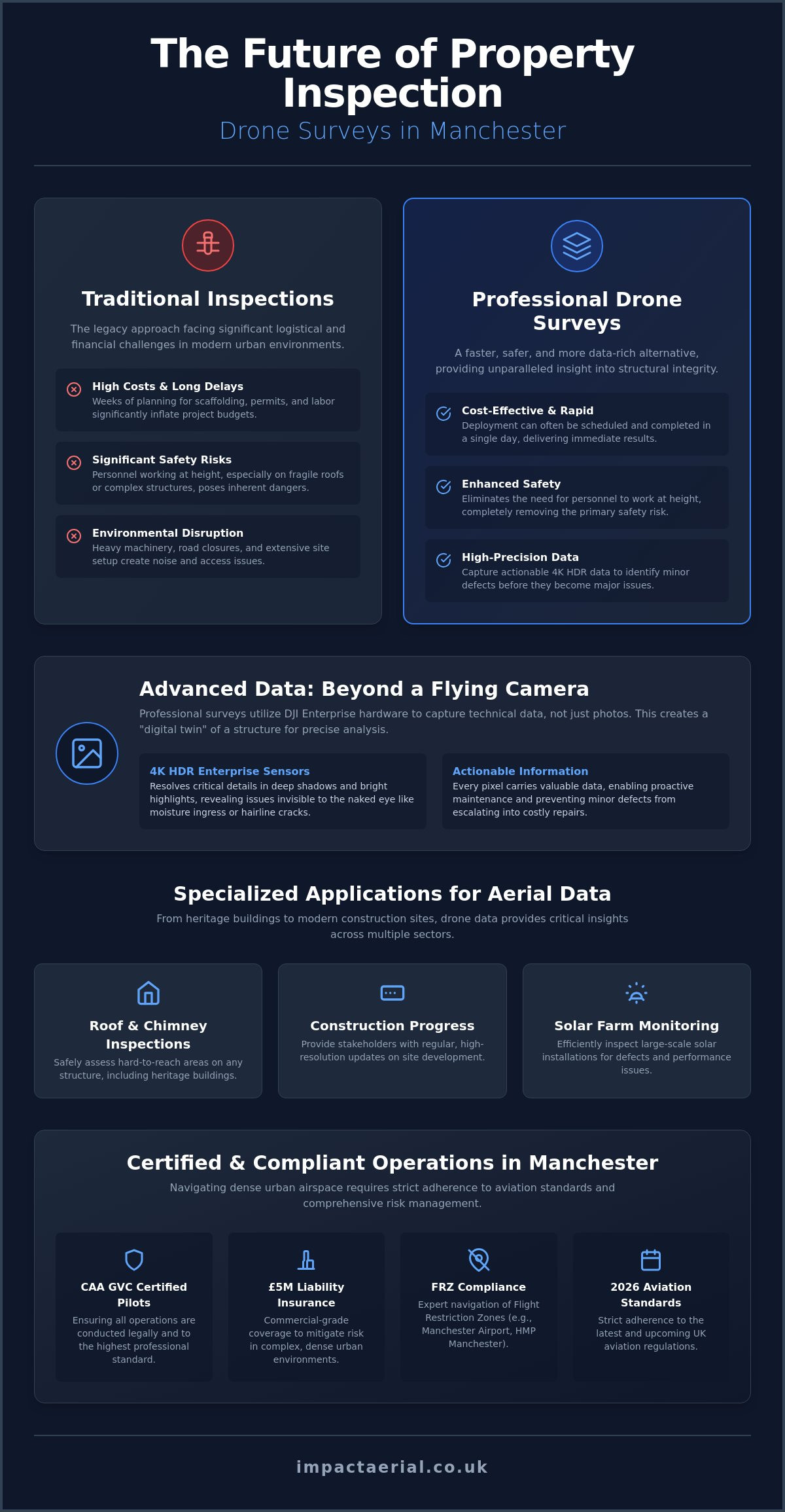
Key Applications: From Roof Inspections to Solar Farm Monitoring
The versatility of aerial technology allows us to address diverse structural challenges across the Greater Manchester region. While many providers offer basic photography, a professional drone survey manchester involves specialized flight paths and sensor configurations tailored to specific assets. This includes everything from the intricate masonry of Victorian heritage sites to the sprawling infrastructure of modern industrial estates. By deploying UAVs, we capture data that would otherwise require weeks of manual labor and high-risk access equipment.
Infrastructure management also benefits from these technical advancements. Assessing the integrity of bridges, communication towers, and industrial chimneys requires a level of precision that traditional methods often lack. Recent developments in Advanced data collection for inspections have highlighted how drone-captured data can be analyzed to detect subtle structural shifts, ensuring public safety and extending the lifespan of critical Manchester assets.
Commercial Property and Roof Inspections
One of the most critical applications in the current market is the identification of structural defects in commercial roofing. We help landlords and facility managers identify issues such as RAAC (Reinforced Autoclaved Aerated Concrete) panels, which require meticulous monitoring to prevent failure. A drone roof survey provides a non-invasive way to inspect these materials alongside more common problems like moisture ingress and gutter blockages. This is particularly valuable for Manchester’s historic and listed buildings, where traditional access methods could potentially damage fragile facades or decorative stonework.
Specialized PV Solar Farm Thermal Surveys
As the North West transitions toward renewable energy, the maintenance of large-scale solar installations has become a priority. Our PV solar farm thermal surveys utilize high-resolution radiometric sensors to identify cell defects, bypass diode failures, and string issues that are invisible to the naked eye. These hotspots don’t just reduce efficiency; they can lead to fire risks if left unaddressed. By automating data collection over several acres, we provide developers with a comprehensive health map of their assets. This proactive approach ensures that drone survey manchester services directly contribute to maximizing the ROI of renewable energy investments through precise, actionable maintenance reports.
Navigating Manchester’s Complex Airspace and Flight Restrictions
Operating a drone in a major metropolitan area requires an advanced understanding of aviation law. Manchester’s airspace is a patchwork of controlled zones and restricted areas that demand constant monitoring. While much of the city center is technically outside the primary Manchester Airport Flight Restriction Zone (FRZ), the environment remains highly sensitive. Proximity to HMP Manchester (Strangeways) and the active corridors for Barton Aerodrome means that any professional drone survey manchester must be preceded by rigorous airspace checking and notification.
Meticulous Planning for Urban Drone Flights
City center projects involve more than just launching a UAV. Tall buildings like the Deansgate Square towers create complex signal interference and localized turbulence that can catch inexperienced pilots off guard. Our pre-flight workflow includes detailed risk assessments and site surveys to identify these physical and electronic hazards. We also maintain open lines of communication with Greater Manchester Police and Manchester City Council. This coordination ensures that all stakeholders are aware of our operations, preventing unnecessary interruptions and maintaining the highest standards of urban flight safety.
Legal Requirements for Commercial Drone Operators
The regulatory framework for drones has evolved significantly, moving from the old PfCO system to the current CAA GVC standards. This transition ensures that pilots operating in congested areas possess the technical knowledge required for complex maneuvers. It’s now a legal necessity for operators to hold a valid Operator ID, and as of January 1, 2026, a Flyer ID is mandatory for any drone weighing 100 grams or more. These regulations are in place to ensure accountability across the industry.
Hiring a pilot who is CAA GVC certified is the only way to guarantee that your survey is conducted legally within the “Specific Category.” This certification allows us to operate at the reduced separation distances often required in dense Manchester streets. To ensure your project remains fully compliant with the latest aviation laws, you should consult with our certified aerial specialists before commencing any site work.
Why Impact Aerial is Manchester’s Trusted Drone Partner
Selecting a provider for a professional drone survey manchester requires more than just technical skill; it requires a partner that understands the high-stakes nature of commercial operations. We operate as technical consultants, managing every phase of the project from the initial airspace feasibility study through to the final post-production delivery. While our operations have a national reach, our specific expertise in the North West allows us to navigate local planning nuances and urban environmental challenges with surgical precision. This end-to-end project management ensures that complex data collection remains seamless for our clients.
Our reputation is built on a foundation of reliability and authoritative knowledge. We don’t just capture imagery; we provide a comprehensive data service that supports informed decision-making for developers, architects, and facility managers. By choosing a specialist with a proven track record in Manchester’s rapidly evolving skyline, you ensure your project is handled by professionals who prioritize technical accuracy and regulatory adherence above all else.
Safety, Compliance, and Risk Mitigation
Our operations are built on a foundation of meticulous risk management. For every Manchester flight, we implement strict safety protocols that exceed standard regulatory requirements. This commitment to security is backed by our commercial drone insurance, which provides £5m in liability coverage. This level of protection is essential for commercial clients who need absolute peace of mind when working in dense urban corridors or near high-value assets. We provide transparent reporting and maintain rigorous data security standards, ensuring that your structural information is handled with the highest level of professional discretion.
Expert Consultation for Your Manchester Project
We provide tailored solutions for property management, construction site monitoring, and the renewable energy sector. Whether you need a detailed structural analysis of a city-centre heritage building or a comprehensive thermal map of a PV solar farm, our team delivers data that’s ready for immediate integration into your workflow. If you’re planning an upcoming project and need to understand the specific logistics and aerial filming prices uk, our consultants can provide a detailed breakdown of costs and operational requirements. Impact Aerial remains Manchester’s premier choice for those who value technical excellence, regulatory compliance, and a safety-first approach to aerial data collection.
Elevate Your Structural Inspections with Precision Data
Digital-first property management is no longer a luxury for Manchester’s developers and landlords; it’s a technical necessity. By replacing slow, hazardous manual access with a professional drone survey manchester, you gain immediate access to survey-grade 4K HDR data that traditional methods simply can’t provide. Navigating complex Flight Restriction Zones and adhering to current CAA regulations requires a specialist approach to ensure both legal compliance and operational safety across the city’s evolving skyline.
Our team brings the reassurance of CAA GVC Certified Pilots and £5m Commercial Liability Insurance to every project. Utilizing industry-leading DJI Enterprise 4K HDR equipment, we deliver granular structural insights while mitigating the risks inherent in dense urban environments. This combination of high-end hardware and meticulous planning ensures your data is accurate, actionable, and fully compliant with the latest aviation standards.
Book your Manchester drone survey with Impact Aerial today to streamline your next inspection and reduce your operational overheads. We look forward to providing the expert aerial perspective your project requires.
Frequently Asked Questions
Do I need special permission for a drone survey in Manchester city centre?
Yes, conducting a drone survey manchester city centre requires meticulous planning and coordination with local authorities. While the city centre is largely outside airport Flight Restriction Zones, its density and proximity to sensitive sites like HMP Manchester demand formal notification. We manage all necessary communications with Manchester City Council and Greater Manchester Police to ensure every flight is fully authorised and safe for the public.
How much does a professional drone survey cost in Manchester?
The cost of a professional drone survey is determined by the specific requirements of your project, including site size and the complexity of the data needed. Factors such as the duration of flight operations, the use of specialised thermal sensors, and the depth of post-production reporting all influence the final quote. We provide tailored estimates after a technical consultation to ensure the service meets your exact structural or monitoring needs.
What is the difference between a standard drone photo and a drone survey?
A standard drone photo is a simple visual record, whereas a drone survey is a methodical data collection process designed for structural analysis. Surveys utilise enterprise-grade sensors to capture high-precision, actionable information that architects and engineers can rely on. This technical approach often involves 4K HDR videography and radiometric data, providing a much higher level of granular detail than a basic aerial photograph.
Can drones fly near Manchester Airport for inspections?
Drones can operate within the Manchester Airport Flight Restriction Zone (FRZ), but only with explicit permission from National Air Traffic Services (NATS) and Air Traffic Control. Our GVC certified pilots are experienced in securing these legal clearances. The process involves a formal application and strict adherence to specific flight windows, ensuring that our technical inspections never interfere with manned aviation or airport safety protocols.
What data formats will I receive after a drone survey?
Clients receive their data in industry-standard formats that are ready for immediate integration into professional workflows. This typically includes high-resolution JPEGs and 4K HDR MP4 files for visual property inspections. For more technical applications, we provide data compatible with Building Information Modelling (BIM) software, including 3D mesh models and radiometric thermal files specifically processed for PV solar farm analysis and structural reports.
How long does it take to complete an aerial roof inspection?
A typical drone survey manchester for a commercial roof is often completed within one to four hours on-site. This speed is a significant advantage over traditional scaffolding, which can take days to install. The UAV can quickly navigate hard-to-reach areas such as high-level gutters and internal valleys, capturing a comprehensive data set in a single visit without disrupting the building’s daily operations.
What happens if the weather is bad on the day of the flight?
Safety is our absolute priority, so we don’t operate in high winds or heavy precipitation that exceeds our hardware’s technical limits. If the meteorological conditions are unsuitable, we simply reschedule the flight for the next available safe window. Our pilots monitor local weather data in real-time and maintain constant communication with clients to ensure that all data is captured under optimal conditions for clarity.
Is Impact Aerial insured for flights over public areas in Manchester?
Yes, we maintain £5m in commercial liability insurance specifically tailored for professional drone operations in congested urban environments. This high level of coverage is a prerequisite for working over public areas and near high-value commercial assets in Manchester. It provides our clients with essential peace of mind and ensures our operations meet the rigorous procurement standards required by corporate and local government stakeholders.
Drone Survey Birmingham: The Complete Guide to Aerial Inspections in 2026
Did you know that a professional drone survey can cover up to 500 acres in a single day, while traditional ground teams often struggle to reach 50? In a dense urban environment, the logistical nightmare of erecting scaffolding often feels like an unavoidable tax on property maintenance. If you’re managing commercial assets, a drone survey birmingham offers a way to bypass these escalating costs and the inherent safety risks of manual inspections at height.
We understand that reliability and meticulous compliance are your top priorities when commissioning aerial work. This guide explains how to secure high-resolution 4K and thermal data for your decision-making while significantly reducing operational downtime. We’ll also break down the critical 2026 CAA regulatory updates, from Remote ID mandates to the new UK class marks, and explain how our advanced drone technology delivers the centimetre-level accuracy your Birmingham project demands.
Key Takeaways
- Learn how high-precision UAV sensors transform asset management by providing actionable digital data for structural integrity and external cladding inspections.
- Compare the operational efficiency of drones versus traditional access methods, focusing on how to remove human risk while reducing survey times from days to hours.
- Explore the specific benefits of thermal and 3D mapping for detecting moisture ingress in commercial roofing and maximising ROI on PV solar farm arrays.
- Understand the 2026 regulatory landscape to ensure your drone survey birmingham is conducted by CAA GVC certified pilots with professional £5m liability insurance.
What is a Drone Survey and How is it Transforming Birmingham’s Asset Management?
A professional drone survey birmingham represents a significant technical evolution in how we monitor the built environment. Rather than relying on static images, modern Unmanned Aerial Vehicles (UAVs) act as airborne data collection platforms. They use 4K HDR sensors and thermal imaging to capture high-precision datasets that were previously inaccessible. This shift from simple visual observation to actionable digital data is critical in 2026. For property managers in the West Midlands, this means moving away from traditional “naked eye” inspections that often miss sub-millimetre defects or hidden thermal leaks.
To understand the broader context, it’s helpful to look at What is an Aerial Survey and how it has historically served as a foundation for mapping and structural analysis. Today, this technology facilitates proactive asset lifecycle management. By identifying issues before they require emergency repairs, Birmingham’s commercial property owners can maintain structural integrity while controlling long-term costs. It’s no longer just about taking a photo; it’s about creating a digital record of an asset’s health.
To better understand the practical application of this technology in the local area, watch this video regarding professional drone services:
The Core Technology: More Than Just a Flying Camera
Precision is the hallmark of professional operations. We utilize DJI Enterprise hardware because it offers the stability and signal reliability required for complex urban environments like Birmingham city centre. These platforms carry 4K HDR cameras capable of capturing sub-millimetre detail on structural defects, from hairline cracks in masonry to loose cladding fixings. The process doesn’t end when the drone lands. Raw data is meticulously processed into a comprehensive survey drone inspection report. These reports provide stakeholders with a clear, data-backed roadmap for maintenance, prioritising urgent repairs to prevent further degradation.
Why 2026 is the Year of the Autonomous Inspection
The landscape of aerial data collection has changed rapidly. In 2026, advanced obstacle avoidance systems allow for safe flight in congested city centres where traditional methods would be too risky or disruptive. AI now plays a vital role, automatically scanning thousands of images to identify rust, cracks, and thermal anomalies with a level of consistency humans can’t match. This data isn’t just for standalone reports; it integrates directly into Building Information Modelling (BIM) workflows. This allows architects and engineers to overlay current aerial data onto digital twins of Birmingham’s most iconic commercial assets. As the demand for a drone survey birmingham grows, the focus remains on delivering high-fidelity data that supports smarter, faster business decisions.
Types of Aerial Data: Visual, Thermal, and 3D Mapping Explained
Selecting the correct data capture method is the most critical decision in any drone survey birmingham. A standard visual inspection is excellent for identifying surface cracks, but it won’t reveal the hidden moisture trapped beneath a warehouse roof. To provide a truly comprehensive asset report, we deploy a range of specialised sensors tailored to the specific structural or environmental challenge. This technical approach ensures that the data we provide is not just a collection of images, but a functional tool for asset management.
High-resolution visual data remains the primary tool for structural integrity assessments on tall buildings and telecommunications masts. Using 4K HDR cameras, we identify corrosion, loose fixings, or masonry decay that ground-based teams simply cannot see. When we need to understand the “invisible” health of a building, we switch to thermal (infrared) sensors. These detect minute temperature variances, highlighting moisture ingress or insulation gaps in commercial roofing systems before they become costly structural failures. Adhering to UK drone safety and compliance laws ensures these complex data sets are collected legally and safely in urban environments.
For construction and land development, photogrammetry and 3D mapping allow us to create accurate digital twins of Birmingham’s evolving skyline. While photogrammetry is perfect for visual site monitoring, LiDAR (Light Detection and Ranging) is the superior choice for topographic surveys on complex terrain. LiDAR uses laser pulses to penetrate vegetation and provide centimetre-level accuracy, even on overgrown sites. This distinction is vital for developers who need precise ground-level data without the time-consuming process of manual clearing.
Thermal Imaging for Energy Efficiency
Thermal drones are essential for maintaining PV solar farms. By identifying “hot spots” in real-time, we help operators prevent cell failure and maximise energy output. This technology is equally valuable for industrial warehouses across the West Midlands, where detecting insulation gaps is a key step in meeting UK Net Zero building standards. If you need to evaluate your property’s thermal performance, you can book a professional property survey to get started.
Visual Surveys for Preventative Maintenance
Preventative maintenance is about catching small issues before they escalate. We conduct close-quarter inspections of chimney stacks, bridges, and listed Birmingham heritage sites without the need for expensive scaffolding or cherry pickers. A drone survey birmingham provides the high-detail imagery required for insurance claims and long-term structural preservation. To ensure your assets are protected by the most suitable policy, you can check out Compare Property Insurance to find the best rates for your portfolio. This approach allows for continuous construction site monitoring without interrupting ground operations, keeping your project on schedule and within budget.
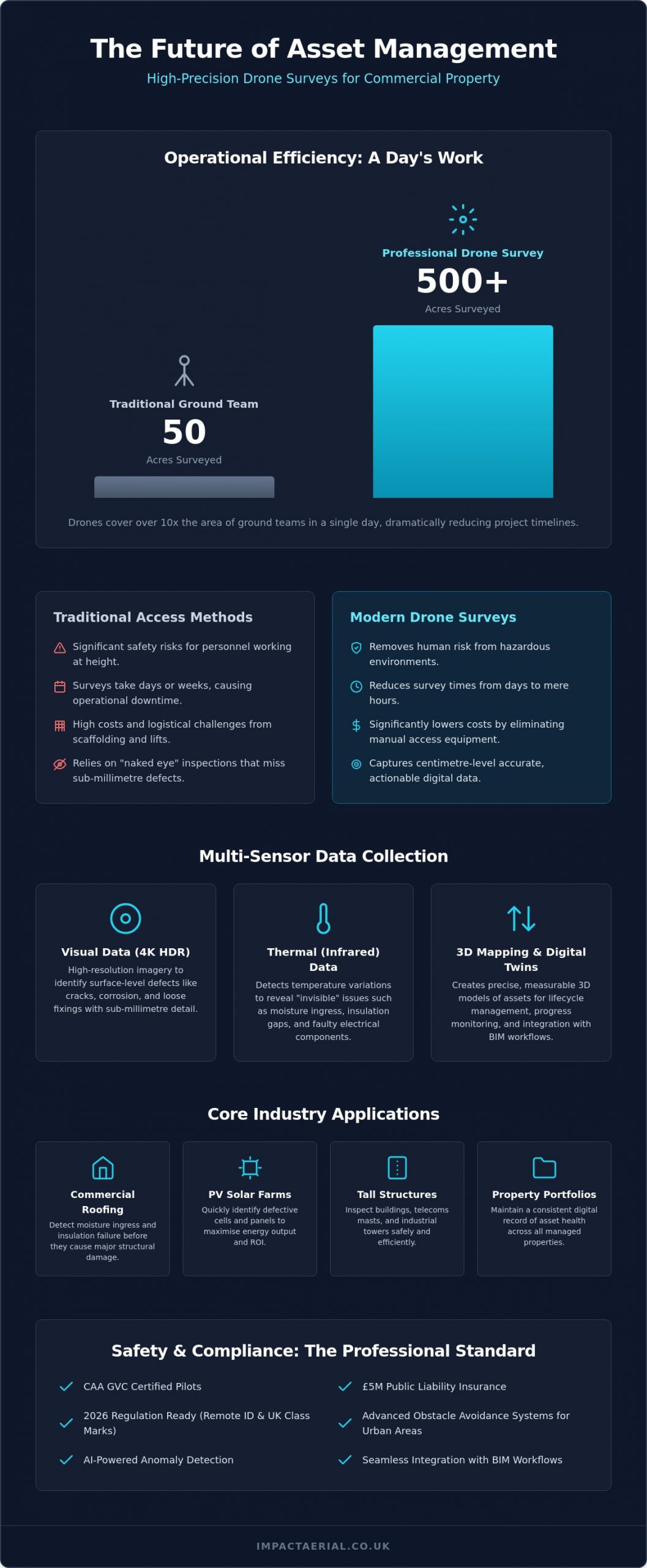
Drones vs. Traditional Access: A Commercial Comparison for 2026
For decades, commercial property managers in the West Midlands accepted the logistical burden of scaffolding as a necessary evil. In 2026, a drone survey birmingham has replaced these cumbersome methods by offering a faster, safer, and more data-rich alternative. Traditional access methods, such as rope access or cherry pickers, require extensive setup times and introduce significant health and safety liabilities. By removing the human element from high-risk environments, we eliminate the primary cause of workplace accidents at height while providing a more detailed perspective of the asset.
The difference in speed is stark. A manual inspection of a complex multi-storey structure that typically requires three days of scaffolding erection and surveying can now be completed in a four-hour drone flight. This efficiency doesn’t come at the cost of precision. We use pre-programmed, repeatable flight paths to ensure that asset comparisons are consistent year-on-year. This creates a reliable audit trail for structural health, allowing you to track the degradation of specific components with centimetre-level accuracy over several years.
Reducing Operational Downtime in Birmingham
Conducting a drone survey birmingham allows your commercial assets to remain fully operational throughout the inspection. In busy commercial hubs like Brindleyplace, traditional scaffolding causes significant disruption to tenants and pedestrians, often requiring pavement closures and complex permits. Drone operations minimise this footprint entirely. We also provide rapid deployment services, responding to emergency structural concerns or storm damage within hours. This agility ensures that critical safety decisions are made based on real-time data rather than waiting for a manual team to arrive on-site.
The ROI of Aerial Data Collection
The return on investment is clear when evaluating the commercial benefits of modern technology. By choosing a professional drone survey over traditional scaffolding hire, businesses avoid the high costs of equipment rental and the labour-intensive assembly process. Early detection of rust, loose cladding, or minor leaks prevents these issues from developing into catastrophic failures that require six-figure repair budgets. Most property managers achieve a 70% reduction in total inspection costs by replacing traditional access methods with high-precision aerial data collection. This financial saving, combined with superior data, makes the transition to drone-led inspections a strategic business decision for any asset owner.
Core Industry Applications: From Solar Farms to Property Portfolios
A drone survey birmingham provides the high-precision data necessary for diverse commercial sectors, ranging from heritage preservation to heavy industrial site management. While visual inspections are now a baseline requirement, the true value lies in the sector-specific application of sensor technology across the West Midlands. For Birmingham landlords, rapid external cladding and roof surveys are vital for maintaining compliance with fire safety and building regulations. These surveys provide a meticulous record of an asset’s condition without the logistical delays or high costs associated with traditional access methods.
In the infrastructure sector, high-zoom enterprise drones allow for the safe inspection of rail networks and bridges. Engineers can identify fatigue, corrosion, or structural decay from a distance, completely removing personnel from track-side hazards. This methodology is becoming the standard for asset managers who prioritise safety and data accuracy. For the West Midlands’ extensive bridge networks, this approach avoids the need for complex road closures, significantly reducing the cost of routine maintenance while ensuring every bolt and weld is documented for historical comparison.
Specialised PV Solar Farm Thermal Surveys
PV solar farm thermal surveys are essential for maintaining peak efficiency on large-scale arrays. Using radiometric thermal sensors, we detect faulty bypass diodes and string failures that are invisible to the naked eye. This georeferenced data allows maintenance teams to navigate directly to the affected panel, reducing labour time and ensuring the site meets 2026 UK renewable energy performance standards. By identifying cell degradation early, operators can maximise their return on investment and prevent small faults from escalating into significant power losses. Our approach provides a level of technical detail that ground-based teams simply cannot match within the same timeframe.
Drones in the Construction Lifecycle
The construction sector relies on drones for more than just progress photos. During the earthworks phase, drones equipped with RTK technology generate centimetre-accurate point clouds. This allows for precise volume calculations of stockpiles and excavations, ensuring that contractors are billed accurately for material moved. Weekly progress captures provide stakeholders with a clear, visual record of development, which is essential for transparent reporting and project management. Read our guide to professional drone services to see how drones improve site safety throughout the build.
If your business requires high-precision data for asset management or site monitoring, you can book a professional drone survey to secure an accurate, compliant assessment of your commercial property.
Safety, Compliance, and Hiring: Choosing a Professional UK Drone Service
Commissioning a drone survey birmingham requires more than just finding a skilled pilot; it demands a partner who operates within the strict legal framework established for 2026. As the technology has matured, so have the regulations. Modern aerial inspections are no longer viewed as experimental but as a regulated professional service. Hiring an uncertified operator doesn’t just risk poor data quality; it exposes your business to significant legal and financial liabilities. We prioritize meticulous compliance to ensure every flight is conducted safely and according to the latest national standards.
Risk mitigation is the cornerstone of urban operations. Before any drone takes flight in a congested area like Birmingham city centre, a comprehensive pre-flight site assessment is mandatory. This includes identifying local hazards, establishing emergency procedure protocols, and ensuring Remote ID is active as per 2026 mandates. Data privacy is equally critical. Professional operators must adhere to strict GDPR protocols when handling aerial imagery that may capture public spaces or private property, ensuring that your data collection remains compliant with UK privacy laws.
Insurance is another non-negotiable factor. While some hobbyist-level operators may offer basic cover, £5m commercial liability insurance is the industry standard for enterprise work. This level of protection provides the reassurance that all stakeholders are covered in the unlikely event of an incident. It reflects a commitment to professional standards that matches the high-precision data we deliver for your commercial assets.
Understanding CAA Regulations in 2026
The distinction between hobbyist flying and commercial ‘Specific Category’ operations is sharper than ever. The CAA GVC (General Visual Line of Sight Certificate) is the legal necessity for pilots conducting complex commercial work in 2026. This certification proves the pilot has the technical knowledge and flight competence to operate in challenging environments. If you hire an uncertified or uninsured operator, your business could be held liable for any regulatory breaches. Consult our UK drone license guide for full compliance details and to understand the current requirements for Flyer and Operator IDs.
What to Look for in a Birmingham Drone Partner
When selecting a partner for a drone survey birmingham, look for proven experience in your specific industry. A team that understands thermal solar arrays or construction monitoring will provide far more value than a generalist. The quality of deliverables is the ultimate metric of success. You should receive actionable, data-rich reports and 3D models, not just raw footage that requires further processing. Local expertise is also a significant advantage. A Birmingham-based team understands the local airspace constraints and can offer rapid West Midlands deployment for emergency inspections. Contact Impact Aerial for a professional consultation on your next Birmingham survey project to ensure your data is captured with precision and total compliance.
Future-Proofing Your Assets with Precision Aerial Data
Adopting a drone survey birmingham is no longer just a trend for forward-thinking property managers; it’s a fundamental risk mitigation strategy for 2026. By transitioning from manual, high-risk inspections to data-driven aerial surveys, you secure a more accurate record of structural health while significantly reducing operational costs. Whether you’re managing a vast PV solar farm or a heritage property in the city centre, the ability to detect defects early prevents minor maintenance issues from escalating into expensive structural failures.
Choosing a partner who prioritises meticulous compliance is essential for protecting your commercial interests. As a local specialist, we provide the technical expertise required to navigate the 2026 regulatory landscape safely and legally. Our team utilizes a Birmingham-based specialist fleet operated by CAA GVC certified pilots, backed by £5m commercial liability insurance for your total peace of mind. High-precision data is the key to smarter, more efficient asset lifecycle management.
Request a Professional Drone Survey Quote from Impact Aerial today and discover how we can streamline your next inspection project. We’re ready to help you elevate your asset management standards with industry-leading aerial intelligence.
Frequently Asked Questions
Are drone inspections as accurate as manual inspections?
Drone inspections frequently exceed the accuracy of traditional manual methods. By using DJI Enterprise hardware equipped with 4K HDR sensors, we capture sub-millimetre detail on structural defects that might be missed by the naked eye. When combined with RTK technology, these systems provide centimetre-level positioning data, which is essential for high-precision 3D mapping and repeatable year-on-year asset comparisons.
What are the legal requirements for drone inspections in the UK for 2026?
In 2026, the Civil Aviation Authority (CAA) requires all commercial pilots to hold a GVC (General Visual Line of Sight Certificate) for complex operations. All drones must have Remote ID enabled to broadcast their identity and location during flight. Additionally, operators must display a valid Operator ID, and drones placed on the market must carry a specific UK class mark, ranging from UK0 to UK6.
How much does a drone roof survey cost in Birmingham compared to scaffolding?
While we don’t provide fixed costs without a site assessment, industry data indicates that drone surveys are significantly more cost-effective than traditional access. You eliminate the high daily hire rates and the labour costs associated with scaffolding assembly and strike. For large-scale commercial assets, a drone survey birmingham can reduce total inspection expenditure by 50% to 75% compared to manual methods.
Can drones perform inspections in confined spaces or indoors?
Specialised UAVs are designed specifically for internal and confined space inspections. These units feature protective cages and sophisticated collision-avoidance sensors, allowing them to navigate industrial tanks or large Birmingham warehouses safely. This capability removes the requirement for personnel to enter hazardous, high-risk, or oxygen-depleted environments, significantly improving site safety protocols.
What happens if the weather is bad on the day of the drone survey?
High winds and heavy rain are the primary reasons for rescheduling a flight. While our enterprise hardware can handle moderate conditions, safety and data clarity remain our priorities. We monitor local weather forecasts meticulously in the days leading up to a project and coordinate with clients to find the next available window with optimal flying conditions.
Do I need to notify my neighbours or Birmingham City Council before a drone flight?
Professional operators handle all necessary pre-flight planning and risk assessments. For most private commercial sites, you don’t require formal council permission, though we check for local airspace restrictions near airports or sensitive sites. We always recommend informing immediate neighbours as a matter of professional courtesy to maintain transparency and address any privacy concerns early.
How long does it take to receive the inspection report after the flight?
Most comprehensive inspection reports are delivered within 48 to 72 hours of the flight completion. This timeframe allows our technical team to process raw 4K imagery or thermal data into actionable, professional reports. This rapid turnaround is a major advantage for a drone survey birmingham, as it enables property managers to make faster, data-backed decisions on urgent structural repairs.
Can drones detect thermal leaks or moisture in a building’s structure?
Radiometric thermal sensors are highly effective at detecting moisture ingress and heat loss that is invisible to the naked eye. By identifying minute temperature variances on a building’s surface, drones highlight exactly where insulation has failed or where water is trapped beneath a roof membrane. This data is vital for Birmingham businesses aiming to meet UK Net Zero building standards and reduce energy costs.
Professional Aerial Photography in Birmingham: The 2026 Commercial Guide
With the UK drone market now valued at over $1.1 billion, it’s clear that unmanned aircraft have moved far beyond the realm of hobbyist gadgets. You likely recognize that capturing the true scale of a West Midlands construction site or a city-centre development requires the unique perspective of professional aerial photography in Birmingham. Yet, operating in a dense urban environment brings valid concerns regarding the latest 2026 CAA regulations, from Remote ID mandates to the strict requirements for green flashing lights during night operations.
We understand that you need more than just a striking visual; you require actionable 4K HDR data and the peace of mind that comes with £5m commercial liability insurance. This guide will show you how expert drone filming can transform your project’s marketing and technical oversight while maintaining a safety-first approach. We’ll break down the critical differences between GVC-certified commercial pilots and casual flyers, explain the impact of the 2026 UK class marks, and demonstrate how high-resolution surveys provide the precision your stakeholders demand.
Key Takeaways
- Understand why CAA GVC certification is now the industry standard for ensuring legal compliance and safety in Birmingham’s complex urban airspace.
- Discover why professional aerial photography birmingham has become the preferred choice over helicopters for capturing high-resolution architectural details and reducing project costs.
- Learn how construction and property sectors utilize DJI Enterprise hardware to generate actionable data for site monitoring and premium marketing.
- Explore the technical benefits of an end-to-end service that includes regulatory feasibility checks and expert post-production editing.
- Identify the critical insurance and safety benchmarks, including £5m liability coverage, required to mitigate operational risks during commercial drone missions.
What is Professional Aerial Photography in Birmingham?
Professional aerial photography in Birmingham represents the intersection of advanced aviation technology and high-end imaging. While the historical definition of What is Aerial Photography? encompasses any image taken from an airborne platform, modern commercial standards rely almost exclusively on Unmanned Aerial Vehicles (UAVs). These systems have replaced traditional helicopter shoots because they offer superior agility and precision at a fraction of the operational footprint. For Birmingham’s rapidly changing skyline, this technology provides the only viable way to document vertical growth without the logistical complexity of manned aircraft.
To better understand how these perspectives translate to real-world visuals of the city’s skyline, watch this helpful video:
The city is currently undergoing a massive transformation under the ‘Big City Plan’, which aims to create over 1.5 million square metres of new floorspace. Capturing these developments requires more than just a camera in the sky; it demands a technical understanding of urban flight paths and high-dynamic-range (HDR) imaging. Professional aerial photography birmingham services ensure that every detail of a new development, from the Bullring to the Jewellery Quarter, is documented with clarity that serves both promotional and engineering purposes. It’s about providing a meticulous record of change that ground-based photography simply cannot match.
The Core Benefits for West Midlands Businesses
Local firms benefit from the rapid deployment of DJI Enterprise hardware, which can be airborne within minutes of site arrival. This efficiency is critical for time-sensitive construction milestones where project managers need immediate visual confirmation of progress. Unlike traditional scaffolding or fixed-wing aircraft, drones navigate tight urban corridors with ease, providing perspectives that were previously impossible to achieve. This capability offers a cost-effective alternative for routine inspections and marketing campaigns, allowing businesses to allocate resources more effectively while maintaining high standards of visual output and operational safety.
Marketing vs. Technical Aerial Data
There is a distinct difference between cinematic storytelling and technical data collection. In the property and tourism sectors, the focus is on visual impact, using 4K HDR cameras to capture vibrant, high-contrast scenes that drive engagement. Conversely, a technical drone survey prioritizes “hair-splitting” detail and measurable data. These surveys use high-resolution imagery to identify structural anomalies or track site topography with centimetre-level accuracy. Whether you’re producing a promotional film for a new commercial listing or conducting a complex roof inspection, the choice of sensor and flight profile is tailored to the specific technical requirement of the mission.
Navigating UK Drone Laws and Safety in Birmingham
Birmingham’s airspace is among the most strictly monitored in the UK. Because of the proximity to Birmingham International Airport and the density of the city centre, flying a drone for commercial purposes requires meticulous planning. It’s not just about getting the shot. It’s about adhering to the latest UK drone laws and safety protocols. Every mission involves a comprehensive pre-flight survey to identify Flight Restriction Zones (FRZs) and potential hazards like high-rise buildings or public gatherings. Failure to account for these variables can lead to significant legal penalties and operational shutdowns.
You must ensure you hire a drone license holder for any commercial project. As of 2026, the Civil Aviation Authority (CAA) has tightened enforcement on unauthorized commercial flights. Working with a registered operator isn’t just a legal requirement. It’s a risk management strategy. Professional aerial photography birmingham providers conduct site-specific risk assessments to ensure that every flight is conducted within the legal framework of the Specific category. This involves checking for temporary flight restrictions, which are common during events like Birmingham Pride or major construction milestones.
Why CAA GVC Certification is Non-Negotiable
The General Visual Line of Sight Certificate (GVC) is the industry standard for commercial drone operations in urban environments. It proves a pilot’s competency in handling complex maneuvers and understanding aviation law. In the West Midlands, where multi-million pound developments are the norm, the GVC allows pilots to operate closer to buildings and people than a standard hobbyist could ever legally manage. This certification is essential for remaining compliant with the 2026 standards. These rules now include mandatory Remote ID broadcasting for enterprise-grade hardware and green flashing lights for any night-time operations.
The Role of £5m Commercial Liability Insurance
Standard insurance policies are rarely sufficient for the complexities of city-centre flight. We maintain £5m in commercial liability insurance to provide absolute reassurance for project managers and stakeholders. This level of coverage is a hallmark of a professional service. It protects against the unforeseen operational risks inherent in high-value sectors like construction and infrastructure. It ensures that if an incident occurs, the financial and legal interests of the client remain fully protected. Risk mitigation starts long before the drone leaves the ground. If you’re planning a project and need to verify flight feasibility, you can consult with our technical team to review the specific airspace requirements for your site.
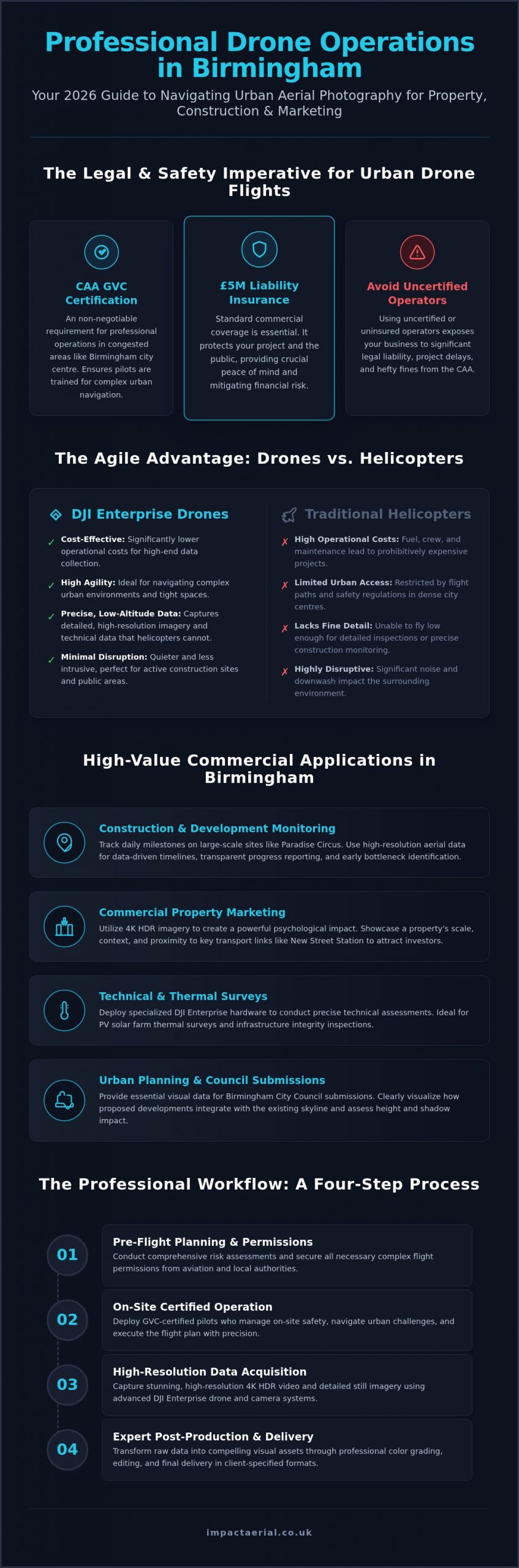
Drones vs. Helicopters: The Best Choice for Birmingham Projects
For decades, the only way to achieve a bird’s-eye view of the city was via manned aircraft. Today, the choice between drones and helicopters for aerial photography birmingham projects is largely determined by precision and budget. While helicopters offer speed across vast distances, they lack the surgical accuracy required for modern urban development. Manned aircraft must maintain a minimum altitude of 1,000 feet over congested areas like Birmingham city centre. This restriction prevents them from capturing the close-quarter architectural details that define a building’s character. Drones operate in the space between ground level and 400 feet, providing a perspective that is both intimate and expansive.
Operational costs represent another significant divide. A helicopter mission involves substantial fuel expenses, pilot fees, and airport landing charges. In contrast, electric UAVs are highly efficient and have a negligible carbon footprint. This makes them the preferred choice for firms committed to ESG (Environmental, Social, and Governance) targets. By removing the need for aviation fuel and large flight crews, drone technology allows for more frequent site visits and data capture sessions without inflating the project budget. This level of detail is vital for Sector-Specific Applications such as heritage management and land surveys, where every centimetre of a structure must be documented. For more information on how local heritage and community initiatives benefit from these detailed visual records, click here.
Operational Flexibility and Urban Access
Drones provide a level of agility that manned aircraft cannot match. We can launch a mission from a small car park or a construction compound, avoiding the need for heliports. This small operational footprint is essential in residential areas of Birmingham where noise pollution and disruption must be kept to a minimum. Because drones can fly at low altitudes, they capture angles that were previously only accessible via expensive scaffolding or cranes. They navigate tight urban corridors with ease, ensuring that even the most tucked-away architectural features are visible in high resolution.
Post-Production and Deliverable Quality
The workflow for an aerial filming drone mission is significantly more streamlined than helicopter-based shoots. Digital stabilization systems on modern drones ensure that 4K HDR footage remains perfectly still, even in the gusty conditions often found around the West Midlands. On-site, we can review data immediately on high-brightness monitors, allowing for instant feedback and adjustments. This real-time review ensures that every technical requirement is met before the team leaves the site. Once the flight is complete, the digital files integrate seamlessly into post-production suites for 3D virtual tour creation or cinematic editing, providing a faster turnaround for time-sensitive marketing campaigns.
Sector-Specific Applications in the West Midlands
Professional aerial photography birmingham is no longer restricted to simple marketing shots. It has become a vital component of industrial and commercial operations across the West Midlands. By utilizing DJI Enterprise grade hardware, we provide specialized data that supports complex decision-making processes in several key sectors. This technical approach ensures that every flight delivers maximum value, whether it’s for an energy firm or a property developer. The precision offered by modern UAVs allows us to capture data that was previously too expensive or dangerous to obtain.
Construction and Building Site Progress
Construction projects in Birmingham require constant oversight to remain on schedule and within budget. We provide regular site monitoring that offers stakeholders a clear bird’s eye view of development milestones. This data is essential for progress tracking and accurate reporting to investors. Beyond simple visuals, aerial data supports precision site planning and mapping. It allows teams to overlay architectural plans with real-world progress to ensure every phase of the build aligns with the original design specs.
Safety is another primary driver for adoption. Drones allow for the inspection of hard-to-reach areas, such as high-level roofing or structural joints, without the need for expensive scaffolding or risky manual climbs. This proactive approach to safety audits helps identify potential issues before they become costly delays. It provides a meticulous record of site conditions that can be used for insurance purposes or health and safety compliance reviews.
Commercial Real Estate and Advertising
We produce cinematic video content that captures the architectural elegance of a property while demonstrating its functional advantages. Utilizing professional drone photography has been shown to significantly increase enquiry rates by providing potential tenants with a comprehensive understanding of the site. It’s about creating an emotional connection through visual storytelling while providing the technical detail that commercial buyers demand.
Our expertise also extends to specialized technical fields. We offer PV solar farm thermal surveys that identify defective cells and energy inefficiencies invisible to the naked eye. For large-scale Birmingham venues, we create immersive virtual tours that allow event planners to explore spaces remotely with 360-degree clarity. If you’re ready to integrate these specialized services into your next project, you can book a consultation with our Birmingham team today to discuss your technical requirements.
The Impact Aerial Approach: From Consultation to Post-Production
Our operational framework is designed to provide a seamless transition from initial concept to the delivery of high-resolution technical data. Every project for aerial photography birmingham begins with a rigorous consultation phase. We don’t just launch a drone; we conduct a comprehensive feasibility study that accounts for Birmingham’s specific urban density and the latest 2026 CAA regulations. This ensures that your project is legally compliant and operationally sound from day one. By integrating project management with technical execution, we remove the uncertainty that often accompanies complex aerial missions.
Hardware choice is a critical pillar of our reliability. We utilize DJI Enterprise grade drones, which are engineered for the demanding environments of the West Midlands. These systems offer redundant flight controllers and advanced obstacle avoidance, ensuring that we can capture 4K HDR imagery with absolute precision. This level of technology is vital for maintaining the safety standards our commercial clients expect, particularly when operating near sensitive infrastructure or high-value assets. It’s this commitment to using industry-leading tools that allows us to deliver the “hair-splitting” detail required for technical surveys and high-end marketing alike.
Project Management and Post-Flight Editing
The value of our service extends well beyond the flight itself. Once the raw data is captured, our post-production team begins the meticulous process of transforming it into marketing-ready assets. This includes professional colour grading to ensure visual consistency and the integration of graphics or music for cinematic video projects. We fill the “post-production gap” by providing a complete workflow that handles everything from the initial risk assessment to the final edit. We deliver these high-resolution files via secure cloud platforms, providing you with immediate access to actionable data for construction monitoring or property advertising.
Why Choose a Local Birmingham Expert?
Choosing a local specialist means working with a team that has deep knowledge of West Midlands flight paths and restricted zones. We understand the nuances of local airspace, from the flight restriction zones near the airport to the specific requirements for city centre developments. This local expertise translates to quicker response times and a more efficient regulatory approval process. We’re committed to providing professional, authoritative drone services that prioritize the safety and success of your Birmingham-based projects. Our meticulous approach ensures that every mission is conducted with the highest level of compliance and precision.
Booking your aerial photography birmingham project is a straightforward process. It starts with a technical review of your site and a discussion regarding your specific deliverables. Whether you need a one-off survey or recurring site monitoring, our team is ready to provide the expert insight your project deserves. You can contact us today to begin your project feasibility check and secure a professional perspective for your West Midlands development.
Elevating Your Birmingham Project with Professional Precision
The landscape of the West Midlands is evolving rapidly. Adopting professional aerial photography birmingham is no longer a luxury; it’s a strategic necessity for construction monitoring and commercial marketing. You’ve seen how the 2026 CAA regulations and Remote ID mandates have redefined safety in the city centre. By choosing a partner that prioritizes technical data over basic imagery, you ensure your project stakeholders receive the high-resolution 4K HDR insights they require.
Our team utilizes DJI Enterprise Grade Hardware to deliver unparalleled reliability and visual quality. We operate as CAA GVC Certified Pilots, providing the legal framework needed for complex urban missions. With £5m Commercial Liability Insurance, we offer the psychological comfort and risk mitigation essential for high-value developments.
Ready to transform your site oversight? Request a professional aerial photography quote from Impact Aerial today. We look forward to documenting your vision with technical excellence and local expertise.
Frequently Asked Questions
Do I need a permit for aerial photography in Birmingham city centre?
Yes, specific permissions are required for most flights within the city centre due to its dense urban environment and proximity to Birmingham International Airport. Professional operators manage the necessary coordination with Air Traffic Control and the West Midlands Police to secure flight authorization. This process ensures all operations remain compliant with local bylaws and temporary flight restrictions that frequently affect the city’s central business district.
What is the difference between a hobbyist and a professional drone pilot?
The distinction lies in legal certification, the level of insurance, and the technical capability of the hardware used. Professional pilots hold a CAA GVC (General Visual Line of Sight Certificate), allowing them to operate in congested areas where hobbyists are legally restricted. Professionals also carry specialist commercial liability insurance and utilize enterprise-grade equipment designed for high-resolution data capture and superior reliability in complex environments.
How much does professional aerial photography in Birmingham cost?
Project costs are determined by the specific technical requirements, the duration of the flight, and the complexity of the post-production workflow. Factors such as the need for specialized thermal sensors or coordination within restricted airspace will influence the final investment. Because every mission is unique, we provide bespoke quotes that reflect the precise deliverables and regulatory checks required for your specific West Midlands site.
Can drones fly in bad weather or high winds in the West Midlands?
Enterprise drones are engineered to withstand moderate winds and light precipitation, but safety and image quality are the deciding factors for any flight. Most professional systems have a maximum wind resistance rating of approximately 12 to 15 metres per second. If conditions exceed these safety limits or visibility is significantly reduced, we reschedule the mission to protect the equipment and ensure the data meets our high-quality standards.
What insurance coverage does a professional drone service need?
Commercial drone operators must have specialist public liability insurance that complies with EC Regulation 785/2004. Standard business or hobbyist insurance is insufficient for commercial missions. We maintain £5 million in commercial liability coverage to protect our clients and the public during operations on high-value sites. This level of protection is a standard requirement for most construction, infrastructure, and industrial projects in the UK.
How long does it take to receive the final edited aerial photos?
The turnaround time for aerial photography birmingham typically ranges from 24 hours for raw data to five working days for fully edited assets. While initial imagery can often be reviewed on-site, professional post-production requires time for meticulous colour grading and technical verification. For complex cinematic videos or detailed structural surveys, we ensure every deliverable undergoes a rigorous quality check before being shared via our secure cloud platform.
Are there weight limits for drones flying over people in the UK?
Yes, UK aviation law dictates strict weight categories and proximity rules based on the drone’s class mark and the pilot’s certification. Under the 2026 regulations, drones are classified from C0 to C4, each with specific limitations regarding flight over uninvolved persons. GVC certified pilots operating in the Specific category can fly heavier aircraft with a detailed risk management plan, whereas lighter drones in the Open category follow different distance requirements.
Can you provide thermal imaging for industrial roof surveys?
We provide specialized thermal imaging using DJI Enterprise sensors to identify structural anomalies and heat loss. This technology is essential for detecting water ingress in industrial roofing or identifying defective cells in solar farm installations. The thermal data is processed alongside high-resolution visual imagery to create a comprehensive report that highlights technical issues invisible to the naked eye, supporting proactive maintenance and energy efficiency audits.
Commercial Drone Videography in Birmingham: Elevate Your Business Perspective
With 67% of construction companies now utilizing drones for site surveying and progress monitoring, the sky above the West Midlands is busier than ever. For businesses operating in the city centre, the challenge isn’t just capturing the shot; it’s navigating the complex logistics and safety protocols of commercial drone videography birmingham without risking regulatory fines or settling for amateur-grade footage. You likely recognize that high-tier visual assets are essential for modern commercial projects, yet the fear of CAA non-compliance in dense urban areas often creates a barrier to entry.
This article demonstrates how professional, CAA-certified drone services can transform your perspective while ensuring total operational safety. We’ll explore how cinematic 4K HDR footage integrates into your marketing or survey data through a meticulous, technical approach. From managing Birmingham’s specific flight restriction zones to meeting the 2026 Remote ID requirements, you’ll learn how a specialist partner provides the reassurance and precision needed to elevate your commercial assets with absolute confidence.
Key Takeaways
- Understand why aerial perspectives are a strategic necessity for Birmingham’s evolving skyline and large-scale regeneration projects.
- Learn the essential legal requirements for operating in urban airspace, including the importance of CAA GVC certification and the 2026 Remote ID standards.
- Discover how to integrate high-quality commercial drone videography birmingham into your existing marketing strategies or technical survey data for maximum ROI.
- Explore the end-to-end production workflow, from initial airspace consultation through to cinematic post-production editing.
- Identify the key criteria for selecting a trusted drone specialist who offers comprehensive insurance and enterprise-grade hardware.
The Impact of Commercial Drone Videography in Birmingham’s Market
Birmingham is currently undergoing a period of intense urban transformation. As the city evolves under the Big City Plan, the demand for commercial drone videography birmingham has transitioned from a creative luxury to a technical necessity for property developers and infrastructure leads. High-altitude perspectives offer a comprehensive view of regeneration that ground-based photography simply cannot replicate. While the history of drone technology highlights its origins in specialized military hardware, modern enterprise systems now deliver a safer, more cost-efficient alternative to traditional manned aircraft for West Midlands projects.
To visualize how these aerial perspectives capture the city’s current scale, watch this high-definition overview:
Birmingham’s Changing Landscape: A Visual Opportunity
The scale of projects like the Digbeth creative quarter or the ongoing HS2 infrastructure requires a specialized visual approach. Drones allow project managers to document progress across vast sites with precision. In areas like the Jewellery Quarter, aerial footage provides a unique sense of place for new residential developments, situating them within the wider city context. This perspective is vital for attracting investment and keeping stakeholders informed. Drones eliminate the massive overheads associated with helicopter charters, providing a rapid-deployment solution that fits into tight project timelines.
Why Commercial Quality Matters Over Hobbyist Footage
There’s a significant technical gap between basic flight and professional cinematography. Achieving consistent lighting and stable movement in Birmingham’s complex urban environment requires more than just a consumer-grade drone. Professional 4K HDR video ensures that every frame contains the dynamic range necessary for high-end post-production. Psychologically, cinematic aerial shots suggest a level of professionalism and scale that builds immediate trust with potential clients or investors.
While 67% of construction companies already use drones for surveying, according to industry reports, the differentiator for your brand is the cinematic quality of the final output. High-bitrate footage provides the clarity needed to stand out in a saturated digital market. It ensures your project is perceived as authoritative and premium, rather than amateur. Professional services focus on precise composition and technical stability, which are essential when filming near high-rise structures or busy city thoroughfares.
Safety and Compliance: Navigating Birmingham Airspace
Operating a drone in a city as dense as Birmingham isn’t just about the camera; it’s about strict adherence to the law. The airspace above the West Midlands is heavily regulated, particularly with the proximity of Birmingham International Airport and the ongoing HS2 construction corridors. Engaging in commercial drone videography birmingham requires a meticulous understanding of UK Civil Aviation Authority (CAA) regulations to ensure every flight is both legal and safe. For businesses, non-compliance isn’t an option, as it carries the risk of significant fines and professional liability.
What is a CAA GVC Certified Pilot?
The General Visual Line of Sight Certificate (GVC) is a formal qualification designed for pilots operating in the “Specific” category. This certification is essential for urban environments where maintaining a safe distance from uninvolved people and properties is technically challenging. It demonstrates that the pilot has passed a rigorous theory exam and a practical flight assessment, proving their ability to manage complex flight paths in congested areas. The GVC is the definitive legal credential required for professional commercial drone operations in urban centres throughout 2026. This qualification allows us to fly closer to buildings and people than an uncertified hobbyist ever could, unlocking visual angles that would otherwise be legally inaccessible.
Insurance and Risk Mitigation for Your Business
Safety protocols go beyond just pilot skill. Every project must be supported by a comprehensive Risk Assessment and Method Statement (RAMS) that details how hazards will be mitigated. For any shoot in Birmingham city centre, standard public liability insurance is insufficient. Aerial work carries unique risks that require specialist aviation insurance compliant with EC 785/2004 standards. We maintain £5m in commercial liability insurance to provide absolute financial security for our clients, covering every eventuality from hardware failure to unforeseen environmental factors.
Managing risk also involves active coordination with local authorities. We handle the complex logistics of securing flight permissions from Birmingham Air Traffic Control (ATC) and navigating the specific restricted zones created by HS2 infrastructure. This level of preparation ensures that your project proceeds without legal interruption or safety incidents. Our team conducts pre-flight site surveys and monitors live weather data to ensure every operation meets our rigorous internal safety benchmarks. If you require a partner who prioritizes these meticulous standards, you can find more about our safety-first drone services online. By choosing a specialist who understands the local Birmingham landscape, you eliminate the uncertainty and legal risk associated with amateur aerial filming.
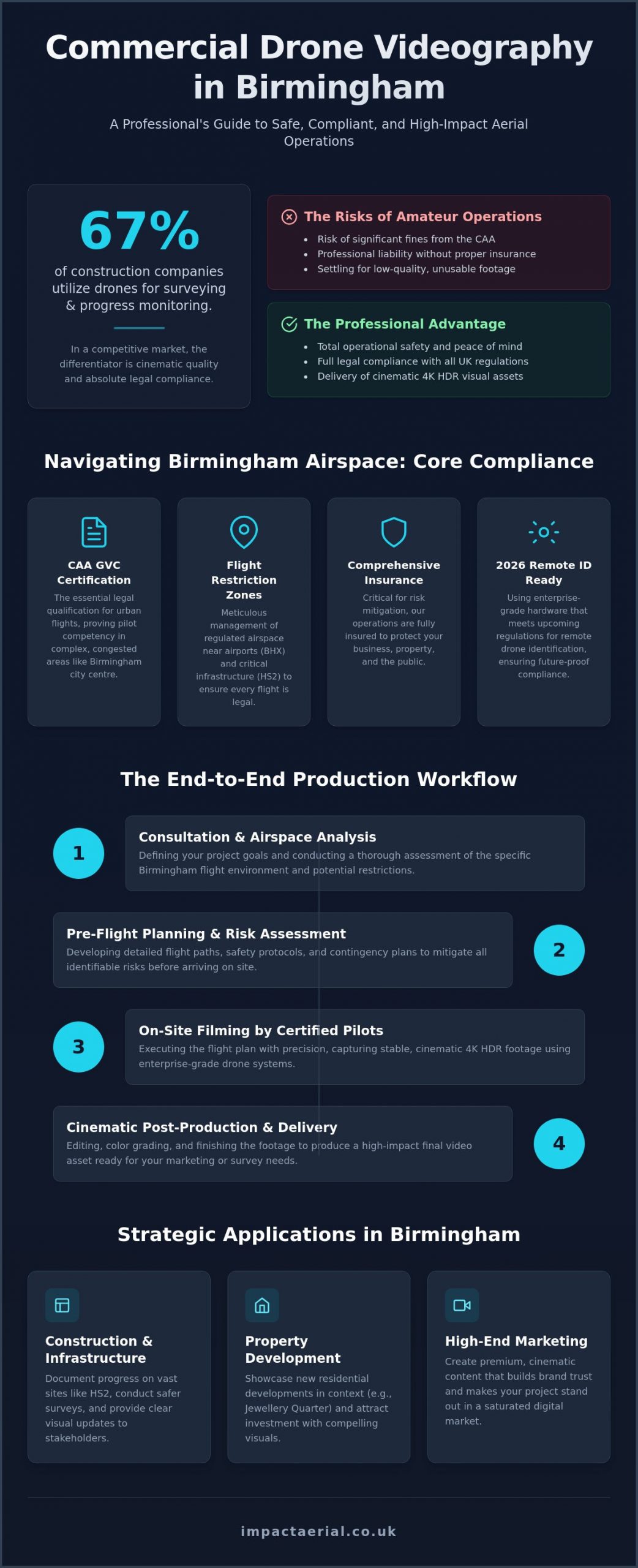
Industry Applications: Beyond Simple Filming
Professional commercial drone videography birmingham has evolved into a sophisticated tool that bridges the gap between marketing and technical data analysis. While the visual impact is immediate, the underlying utility for Birmingham’s industrial sectors lies in the ability to capture precise, repeatable data. We don’t just provide footage; we deliver visual solutions tailored to the unique economic landscape of the West Midlands. By merging high-end cinematic aesthetics with technical precision, we meet the specific needs of modern business stakeholders who require more than just a simple aerial view.
Construction and Infrastructure Monitoring
For large-scale civil engineering projects, drones offer an unparalleled method for construction site monitoring. Regular aerial sweeps provide stakeholders with objective progress updates through time-lapse sequences and detailed site maps. This technical application enhances safety by reducing the need for personnel to enter hazardous zones for routine inspections. Beyond simple progress tracking, we utilize high-resolution sensors to capture data for building surveys and structural analysis, ensuring that project leads have the information they need for accurate reporting. This capability extends to environmental monitoring and specialized PV solar farm thermal surveys, where precision is paramount for maintaining operational efficiency across the UK.
Commercial Property and Advertising
In the competitive commercial real estate market, static images are no longer enough to secure high-value tenancies. We utilize aerial filming drones to create immersive marketing narratives for office developments and retail spaces. By showcasing a property’s position relative to local infrastructure, such as the Jewellery Quarter’s creative hubs or major transport links, we help developers build a compelling case for investment. These wide-angle perspectives provide a sense of scale and connectivity that ground-level photography simply lacks.
High-tier advertising campaigns also benefit from our cinematic approach. We integrate 4K HDR aerial sweeps into broader marketing strategies, providing the “hero shots” that define a brand’s visual authority. This isn’t just about the flight; it’s about deliberate composition and lighting that aligns with your corporate identity. Our production workflow ensures that the final edit is ready for seamless integration into your existing marketing channels or technical data repositories, providing a consistent and professional brand image across all digital platforms.
This commitment to a premium brand identity often extends beyond marketing; for businesses looking to curate high-end corporate experiences, aura-events.info specializes in designing luxury leadership retreats and incentive travel that reflect the same level of professional excellence.
The Production Workflow: From Concept to Final Edit
Successful commercial drone videography birmingham relies on a methodical workflow that begins long before the aircraft takes flight. High-end results are the product of rigorous planning and technical precision rather than chance. We collaborate closely with our clients during the initial phase to define both the visual narrative and the technical parameters required for the project. Whether the goal is a cinematic marketing film or a data-heavy site survey, this structured approach ensures we meet every project objective while maintaining our strict safety standards.
Pre-Production and Flight Planning
The logistics of filming in an urban hub like Birmingham require a meticulous eye for detail. Our process starts with a comprehensive consultation to understand your specific site constraints and creative goals. We conduct detailed site surveys and verify all UK drone license requirements to ensure total compliance with current CAA regulations. This phase is critical for managing the complex airspace of the West Midlands. We handle all necessary coordination with local stakeholders and Birmingham Air Traffic Control, securing the clearances needed to operate safely near high-density regeneration sites or sensitive infrastructure corridors.
Our planning process includes:
- Detailed airspace analysis and NOTAM (Notice to Airmen) checks.
- Risk mitigation strategies tailored to the specific urban environment.
- Scheduling flights to capture the best possible lighting and weather conditions.
- Coordination with site managers to minimize operational disruption.
On-Site Execution and Post-Production
During the execution phase, our pilots utilize DJI Enterprise drones to capture stable, high-bitrate 4K HDR footage. This hardware is chosen for its reliability and superior sensor quality, which is essential for professional-grade output. Once the raw data is captured, the project moves into our post-production suite. Here, we perform precise colour grading, sound design, and the integration of motion graphics to enhance the viewer’s experience. Professional post-production turns raw aerial data into a compelling brand story by refining visual clarity and ensuring the narrative aligns with your corporate objectives.
This end-to-end service model ensures that the final product is polished and ready for immediate use in your marketing or technical reports. We don’t just deliver files; we provide a finished asset that reflects the authority and scale of your business. If you’re ready to begin your next project, contact our Birmingham drone specialists to discuss your specific requirements and secure a consultation.
Choosing Impact Aerial for Your Birmingham Project
Selecting a partner for your aerial project requires a balance of creative vision and technical compliance. While generalist video agencies often treat drones as an add-on service, Impact Aerial operates as a specialized technical consultant. We provide commercial drone videography birmingham that is built on a foundation of aviation expertise rather than just creative flair. Our commitment to the highest standards of professional drone services ensures that every flight is conducted with the precision and safety your business demands.
We utilize a fleet of DJI Enterprise-grade hardware specifically designed for the rigours of urban flight. This technology allows us to deliver high-bitrate 4K HDR content that meets the exacting requirements of construction monitoring and high-end advertising. By focusing exclusively on the aerial sector, we maintain a level of proficiency with hardware and regulatory changes that generalist agencies cannot match. Our pilots are not just camera operators; they’re qualified aviation professionals who understand the nuances of Birmingham’s complex airspace.
A Trusted Partner for Birmingham Businesses
Our deep roots in the Birmingham and West Midlands community provide us with a unique understanding of the local landscape. We’ve built a proven track record across the property and infrastructure sectors, documenting the city’s regeneration with meticulous care. One of the primary benefits of partnering with us is that we handle the entire regulatory burden. From securing permissions for flight restriction zones near the airport to drafting comprehensive RAMS for city centre sites, we manage the technical paperwork so you can focus on the strategic results. Our £5m commercial liability insurance and GVC certifications provide the reassurance that your project is in safe, expert hands.
Start Your Aerial Project Today
Getting your project off the ground is a straightforward, structured process. We begin with a consultation to assess your specific location and technical goals, allowing us to provide a customized quote tailored to your Birmingham project. We understand that every site has unique constraints. Our local expertise allows us to navigate these challenges efficiently, ensuring we capture the necessary data or footage without delay. Whether you require a one-off cinematic shoot or ongoing monitoring for a multi-year construction project, we provide the authoritative perspective needed to elevate your brand. Contact Impact Aerial today to discuss how our professional aerial solutions can transform your next commercial campaign.
Future-Proof Your Visual Strategy in the West Midlands
The rapid regeneration of Birmingham demands a visual strategy that matches its ambition. We’ve explored how professional commercial drone videography birmingham provides more than just a cinematic view; it offers a technical and marketing edge that ground-level photography cannot replicate. By choosing a partner who prioritizes meticulous planning and data-centric processes, you ensure your project is documented with absolute precision and clarity.
Success in the urban environment relies on a foundation of trust and compliance. As Birmingham & West Midlands specialists, we understand the logistical challenges of city centre operations. Our team of CAA GVC certified pilots and our £5m commercial liability insurance guarantee that your project remains safe and legally compliant throughout its lifecycle. It’s time to transform your commercial perspective with a specialist who values quality as much as you do.
Contact Impact Aerial for a Professional Drone Videography Quote
Frequently Asked Questions
Do I need special permission to film with a drone in Birmingham city centre?
Yes, filming in Birmingham city centre requires meticulous planning and often specific permissions. Much of the city falls within controlled airspace due to Birmingham International Airport and various restricted zones related to HS2 construction. As specialists in commercial drone videography birmingham, we handle all coordination with Air Traffic Control and local authorities to ensure every flight is fully authorized and legal.
What is the difference between a hobbyist drone pilot and a professional with a GVC?
The primary difference lies in legal authorization and technical competence. A hobbyist is restricted by standard distance regulations that often make urban filming impossible. A professional with a General Visual Line of Sight Certificate (GVC) has passed rigorous CAA theory and practical assessments. This qualification allows us to operate in congested areas and closer to uninvolved people, which is essential for commercial projects in dense urban environments.
Can drones film indoors for Birmingham commercial properties?
Drones are highly effective for internal filming in large commercial spaces such as warehouses, offices, or retail hubs. We utilize specialized aircraft with 360 degree propeller guards to capture smooth, stable footage indoors without risking damage to the property. This approach is particularly useful for creating immersive virtual tours that give stakeholders a unique perspective of a building’s interior layout.
How much does commercial drone videography cost in the West Midlands?
Project costs are determined by several variables, including the complexity of the airspace, the duration of the shoot, and the level of post-production required. Because every Birmingham site has unique logistical challenges, we don’t offer flat rates. Instead, we provide customized quotes after an initial consultation to ensure the budget accurately reflects your specific technical and creative requirements.
What happens if the weather is bad on the scheduled day of filming?
Safety is our absolute priority, and we monitor live weather data leading up to every shoot. If wind speeds or precipitation exceed the safe operating limits of our DJI Enterprise hardware, we’ll reschedule the operation. We don’t charge additional fees for weather-related delays, as our goal is to ensure the highest quality 4K HDR footage is captured under optimal conditions.
How long does the post-production process take for a drone video?
The post-production phase typically takes between 5 to 10 working days depending on the project’s scale. This structured process includes meticulous colour grading, sound design, and the integration of any requested motion graphics. We ensure that the final edit is polished and ready for immediate deployment across your marketing channels or for inclusion in technical survey reports.
Is your drone equipment capable of filming in 4K or higher?
Our entire enterprise fleet is capable of capturing high-bitrate 4K HDR video as a standard requirement. This high-tier resolution is essential for professional commercial drone videography birmingham, providing the clarity needed for both cinematic marketing and detailed technical inspections. The superior sensor quality of our hardware ensures that the footage remains sharp and professional even in challenging urban lighting conditions.
Does Impact Aerial provide the necessary risk assessments for construction sites?
We provide comprehensive Risk Assessments and Method Statements (RAMS) for every project we undertake. This documentation is a mandatory part of our safety-first approach, especially when conducting construction site monitoring. Our meticulous planning ensures that all potential hazards are identified and mitigated before the aircraft leaves the ground, providing total reassurance for site managers and stakeholders.
How to Hire a Professional Drone Pilot in the UK: The 2026 Guide
Hiring the wrong person to fly a drone over your commercial site isn’t just a creative gamble; it’s a significant legal liability that can expose your business to heavy fines and uninsured risks. With the 2026 introduction of UK-specific class marks and mandatory Remote ID broadcasting, the gap between a hobbyist and a certified expert has never been wider. If you intend to hire professional drone pilot uk specialists, you need more than just a nice portfolio. You need a partner who understands the intricacies of the Civil Aviation Authority (CAA) framework and holds the correct Operational Authorisation.
It’s understandable if the recent shifts in aviation law feel confusing. You want the stunning 4K HDR perspectives that only aerial technology provides, but you don’t want the headache of managing flight permissions or worrying about safety protocols. This guide provides a clear roadmap to verify pilot credentials and insurance coverage. We will examine the specific 2026 requirements for GVC certification and the essential hardware standards that guarantee a safe, high-quality result for your project.
Key Takeaways
- Grasp the 2026 legal landscape, including the mandatory UK-specific class marks and Remote ID requirements that now define compliant commercial flight.
- Learn how to verify a pilot’s Operational Authorisation and ensure their insurance meets the rigorous standards required for high-risk industrial environments.
- Discover the essential steps to hire professional drone pilot uk specialists who utilize DJI Enterprise hardware for precision thermal surveys and construction monitoring.
- Understand the professional end-to-end workflow, from initial risk assessments to high-resolution 4K HDR post-production deliverables.
- Identify the critical red flags that distinguish certified professionals from uncertified hobbyists to mitigate your company’s legal and financial liability.
Understanding UK Drone Regulations for Commercial Projects
The legal framework for unmanned aircraft has evolved rapidly to keep pace with technological advancements. As of 2026, any drone equipped with a camera or exceeding a weight of 250g requires both a Flyer ID and an Operator ID. The Operator ID currently costs £12.34 per year and must be clearly displayed on the aircraft. While hobbyists might manage basic flights in isolated areas, commercial projects introduce a layer of legal complexity that requires professional oversight. Understanding drone regulations in the UK is the first step in protecting your business from liability.
The distinction between recreational and commercial use is critical. If your project has any “commercial intent,” the pilot must operate under a specific set of rules defined by the Civil Aviation Authority (CAA). This isn’t just about whether money changes hands; it includes any flight that advances a business interest, such as marketing a property or inspecting a construction site. To ensure your project is legally compliant, you should always hire professional drone pilot uk specialists who hold a valid Operational Authorisation.
To better understand the requirements for entering this professional field, watch this helpful video:
The Role of the Civil Aviation Authority (CAA)
The CAA maintains total oversight of UK airspace safety. They classify drone operations into Open, Specific, and Certified categories based on the level of risk involved. Most professional work, especially in congested urban environments or near uninvolved people, falls into the Specific category. This requires the pilot to have a robust operational manual and a proven safety record. Verifying a pilot’s credentials on the CAA register is a mandatory step for any responsible project manager. It confirms the operator has the legal right to fly for commercial gain and adheres to the Drone and Model Aircraft Code.
Why CAA GVC Certification is the Gold Standard
The General Visual Line of Sight Certificate (GVC) is the benchmark for professional competence in the UK drone industry. It proves that a pilot has undergone rigorous training in risk assessment, technical knowledge, and emergency procedures. GVC-certified pilots are uniquely qualified to handle complex tasks like PV solar farm thermal surveys or high-resolution property inspections while maintaining strict safety margins. For a deeper look at these industry standards, read our guide to professional drone services. Choosing an operator with GVC credentials and £5m liability insurance provides the peace of mind that your project is in expert hands. When you hire professional drone pilot uk experts, you’re investing in technical precision and regulatory security.
The Essential Checklist for Hiring a Professional Drone Pilot
When you decide to hire professional drone pilot uk services, the technical skill of the pilot is only one part of the equation. You must also evaluate their operational maturity and risk management procedures. Start by requesting their CAA Operational Authorisation document. This isn’t just a certificate; it’s a legal permission that details exactly how and where they are allowed to fly. A professional operator will also have a detailed operational manual that outlines their safety protocols and emergency procedures.
Checking these documents against the official register of the UK Civil Aviation Authority (CAA) ensures the pilot’s credentials are current. This verification process protects your organization from the legal fallout of an unauthorized flight. It’s a critical step that distinguishes a legitimate business from a hobbyist with a high-end camera. Without these documents, a pilot cannot legally operate for commercial gain in the UK.
Insurance: Why £5m Public Liability is the Benchmark
Standard public liability insurance often fails to cover aviation-specific risks. A professional drone pilot must hold a policy that complies with EC 785/2004, which is the legal standard for commercial flight in the UK. While the legal minimum might be lower for some operations, many corporate and industrial sites require at least £5 million in coverage. Impact Aerial maintains a £5m policy to provide absolute peace of mind. This ensures that even complex projects on sensitive sites, such as PV solar farm thermal surveys, are fully protected against unforeseen incidents.
Technical Proficiency and Hardware Standards
The quality of your deliverables depends heavily on the hardware used. Consumer-grade drones often lack the sensor size and stability required for professional 4K HDR filming or precise thermal inspections. Look for operators using DJI Enterprise equipment. These systems offer redundant batteries and GPS modules, which are vital for mission-critical work. If you’re conducting construction site monitoring or property surveys, the difference in data quality between a hobbyist drone and an enterprise-grade thermal sensor is vast. Redundant systems are not a luxury; they are a safety requirement for professional data collection.
Before signing a contract, review the pilot’s portfolio for industry-specific experience. A pilot who excels at wedding photography might not understand the safety complexities of a live construction site. Ask about their pre-flight site assessment process. A true professional will conduct a thorough risk assessment long before the drone leaves the ground. If you’re ready to secure a compliant flight for your next project, you can view our professional aerial services to see how we maintain these high standards on every mission.
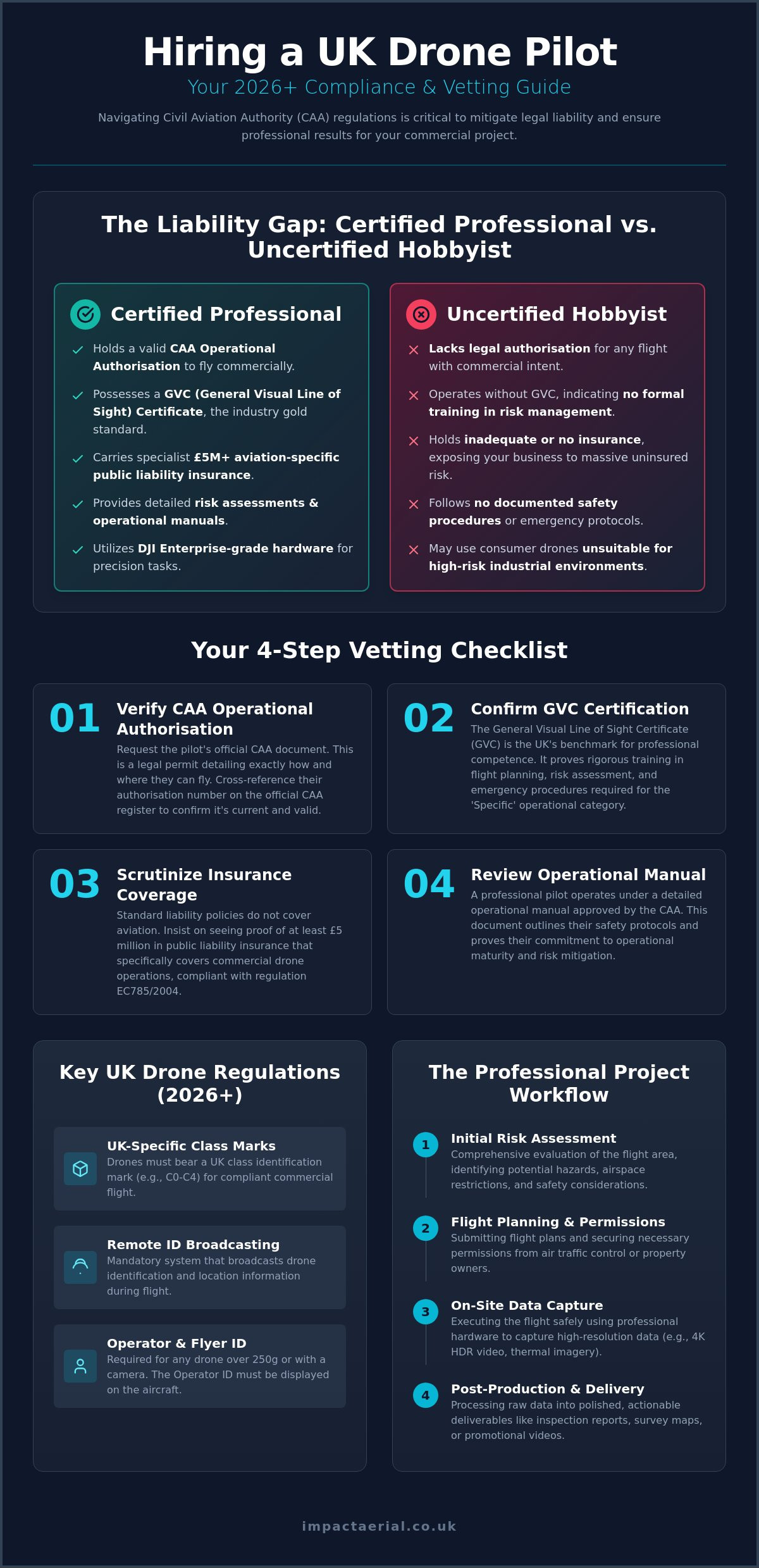
Tailoring Drone Services to Your Specific Industry
Selecting the right operator depends entirely on the technical demands of your sector. A pilot specialized in cinematic brand storytelling might not possess the technical expertise required for high precision asset inspection. When you look to hire professional drone pilot uk services, you must ensure their equipment and certification match your project’s specific risk profile. Operating over a live construction site requires a different level of operational authorization than filming a corporate event in a private field. The UK Civil Aviation Authority (CAA) sets the baseline for safety, but industry specific experience is what delivers tangible ROI.
Drone Surveys and Data Collection
Professional drone operations have revolutionized how we approach asset management and site oversight. By using DJI Enterprise hardware, certified pilots capture high resolution data for 3D modeling and orthomosaic mapping with exceptional precision. This is particularly valuable for commercial property surveys, where aerial data often replaces the need for expensive scaffolding or risky manual roof inspections. These surveys provide a non-invasive way to assess structural integrity without disrupting daily operations.
Specialized services like PV solar farm thermal surveys allow for the detection of individual cell defects that are invisible to the naked eye. This data-centric approach provides several key benefits:
- Precise heat loss identification in industrial and commercial buildings.
- Accurate volume calculations and progress tracking for construction site monitoring.
- Rapid infrastructure inspections for towers, chimneys, and other high-reach assets.
- Detailed thermal reporting to optimize energy output on solar farms.
Aerial Filming for Visual Marketing
High end marketing requires a level of visual sophistication that standard consumer drones cannot achieve. Achieving true cinematic quality through professional aerial filming involves more than just flight skill; it requires an expert understanding of light, composition, and post-production. A professional workflow includes 4K HDR capture and meticulous color grading to ensure the final deliverables align with your brand’s aesthetic standards.
For corporate marketing and real estate, FPV (First Person View) drones offer an immersive “fly-through” perspective. These specialized aircraft navigate through doorways and tight spaces to create seamless, high-speed tours of commercial interiors. This type of storytelling builds brand awareness by providing a perspective that was previously impossible to capture. When you hire professional drone pilot uk experts, you’re securing a team that manages the entire process from pre-flight risk assessment to the final edited deliverable, ensuring the output is as safe as it is visually stunning.
The Professional Workflow: What to Expect When You Hire
Step 1: Consultation and Planning
The first phase involves defining the project brief. We need to determine if the objective is high-resolution 4K HDR marketing footage or technical data for a PV solar farm thermal survey. Once the goals are clear, the pilot conducts a site-specific risk assessment. This includes checking airspace restrictions, identifying nearby hazards, and securing necessary landowner permissions.
Professional operators provide a Risk Assessment and Method Statement (RAMS) to the client. This document is vital for corporate compliance and site safety. We also monitor UK weather patterns closely. High winds or heavy rain can compromise data quality, so we schedule “weather windows” to ensure the best possible results. This meticulous planning phase ensures that once we’re on-site, the operation runs smoothly and without unexpected delays.
Step 2: Execution and Data Delivery
On the day of the shoot, the pilot manages the site with professional conduct. This often involves setting up public cordons or coordinating with site managers to ensure the flight path is clear of uninvolved persons. Safety is the primary concern, especially on active construction sites or sensitive commercial properties. The pilot will follow the pre-defined flight plan to capture the exact data or visuals required by the brief.
The work doesn’t end when the drone lands. The data processing phase is where the raw footage or survey data becomes a usable asset. For marketing projects, this involves post-production editing and color grading to achieve cinematic quality. For surveys, it means generating detailed reports or 3D models. We utilize cloud-based delivery methods to share large 4K datasets and high-resolution maps efficiently. Typical turnaround times for edited video or survey reports range from 48 hours to a week, depending on the project’s scale. This structured delivery ensures you receive high-quality results without project management stress.
To ensure your next project is handled with technical precision and full regulatory compliance, you can hire professional drone pilot uk specialists from our expert team today.
Why Impact Aerial is the Trusted Choice for UK Drone Services
Selecting a partner for aerial operations requires more than just finding someone with a drone. It demands a specialist who integrates technical proficiency with a deep understanding of the UK’s regulatory environment. When businesses decide to hire professional drone pilot uk experts, they are often looking for a combination of creative excellence and industrial reliability. Impact Aerial provides this through a meticulous approach to flight safety, data integrity, and high-tier visual output.
Birmingham Excellence, National Reach
Our expertise is deeply rooted in the West Midlands, providing us with a granular understanding of the regional airspace and the specific challenges of operating in Birmingham’s industrial and urban landscapes. However, our capabilities are not limited by geography. We provide full UK-wide coverage, delivering consistent results for clients across the property, construction, and advertising sectors. Working with a boutique agency like ours offers a level of accountability that faceless national directories simply cannot match. You aren’t just another booking; you’re a partner receiving bespoke technical consulting.
Our track record spans a diverse range of applications. We’ve managed complex construction site monitoring projects and high-impact marketing campaigns for corporate brands. This breadth of experience allows us to anticipate site-specific risks and technical requirements before the aircraft even leaves the ground. We don’t just capture images; we provide a professional service journey that prioritizes your project’s legal and operational security.
Ready to Elevate Your Project?
The transition to the 2026 UK drone standards means that compliance is no longer optional. It’s a critical component of your business’s risk management strategy. We maintain a £5m commercial liability insurance policy and utilize DJI Enterprise hardware to ensure every mission is performed with maximum precision. Our commitment to the GVC standard and strict adherence to CAA protocols provides the psychological comfort you need when operating in sensitive or congested environments.
We pride ourselves on transparent communication and an end-to-end service model. This includes everything from the initial site-specific risk assessment to the final stages of professional post-production. Our goal is to deliver high-resolution 4K HDR assets that are ready for immediate use in your marketing or technical reports. If you want to hire professional drone pilot uk specialists who value safety as much as visual quality, our team is ready to assist.
Contact Impact Aerial to discuss your drone project today and let us help you navigate the complexities of aerial data collection with technical excellence and full regulatory compliance.
Secure Your Commercial Flight Strategy for 2026
The decision to hire professional drone pilot uk experts is a commitment to both creative excellence and operational safety. As regulations tighten, the difference between a simple flight and a compliant, high-tier mission lies in the pilot’s ability to navigate complex CAA frameworks. You now understand that verifying GVC certification and ensuring a robust £5m commercial liability insurance policy are non-negotiable steps for protecting your organization. Whether you’re conducting a technical thermal survey or capturing cinematic marketing visuals, the right hardware and professional workflow ensure your project remains safe and legal.
Impact Aerial provides the technical proficiency and specialized West Midlands expertise required for mission-critical work. Our CAA GVC certified pilots manage the entire process, from initial risk assessments to high-resolution post-production. We take the complexity out of aerial operations so you can focus on delivering results for your clients. We look forward to helping you reach new heights with precision and peace of mind.
Get a Professional Drone Service Quote from Impact Aerial
Frequently Asked Questions
Do I need to inform the police if I hire a drone pilot?
Standard commercial drone operations in the UK do not usually require police notification. However, if the flight involves specific local bylaws, road closures, or operations in sensitive urban areas, your pilot will coordinate with the relevant authorities as part of their pre-flight planning. A professional operator manages all necessary permissions to ensure the flight is entirely legal and minimizes any potential disruption to the public or local law enforcement.
How much does it cost to hire a professional drone pilot in the UK?
The total investment varies based on the technical complexity of the mission and the specific hardware required for the job. Factors such as the need for 4K HDR filming, specialized thermal sensors for solar surveys, or the duration of construction monitoring all influence the final quote. When you hire professional drone pilot uk specialists, you’re paying for their regulatory expertise, high-end equipment, and comprehensive insurance coverage rather than just basic flight time.
What happens if the weather is bad on the day of the drone shoot?
Safety is the absolute priority, so operations are typically rescheduled if conditions like high winds or heavy rain exceed the aircraft’s technical limits. Professional pilots monitor weather windows closely in the days leading up to the shoot to identify the best possible conditions for data quality. Most operators include a weather clause in their contracts, allowing for a flexible rescheduling process that ensures the final deliverables meet the required professional standards.
Can a drone pilot fly in a restricted area (NFZ) like near an airport?
Yes, a qualified pilot can operate within a No Fly Zone (NFZ) provided they secure the correct permissions from Air Traffic Control or the relevant authority. Pilots holding a GVC certification are trained to manage these complex applications through the Civil Aviation Authority’s digital systems. This process requires advanced planning and often involves specific radio communication with local control towers to ensure the safety of manned aviation throughout the mission. If you are traveling for work and encounter disruptions with your commercial flights, you can visit Airflix to understand your passenger rights and seek legal assistance with compensation claims.
What insurance should a professional drone pilot have?
A professional operator must hold commercial liability insurance that is strictly compliant with EC 785/2004 regulations. Standard public liability policies usually exclude aviation risks, which could leave your business exposed in the event of an incident. It’s recommended to hire professional drone pilot uk experts who maintain at least £5 million in specialist coverage to provide complete peace of mind for industrial or high-risk commercial sites where standard limits are insufficient.
Is a drone roof survey better than using scaffolding or a cherry picker?
Drone surveys are significantly safer and more cost-effective than traditional methods like scaffolding or cherry pickers. Aerial inspections allow for high-resolution data collection without the physical risks associated with working at height or the logistical delays of erecting platforms. This non-invasive approach captures detailed visuals of structural defects or thermal heat loss in a fraction of the time, providing a comprehensive data set that traditional methods often miss.
What is the difference between a Flyer ID and a GVC certification?
A Flyer ID is a basic legal requirement for anyone operating a drone over 250g, proving they have passed a foundational safety test. In contrast, the General Visual Line of Sight Certificate (GVC) is a professional qualification required for complex commercial work in the Specific category. GVC pilots have undergone rigorous practical and theoretical training, qualifying them to conduct detailed risk assessments and operate in more challenging environments than a standard recreational flyer.
Aerial Site Inspections: The 2026 Guide to Drone Surveys & Compliance
In 2026, relying on traditional scaffolding for a routine visual check isn’t just an operational delay; it’s a financial liability that modern project managers can no longer justify. Professional aerial site inspections have evolved into a critical digital foundation for UK construction compliance, replacing manual errors with high-fidelity data. You’ve likely felt the frustration of mounting health and safety ‘red tape’ just to give stakeholders a glimpse of progress, or the sting of inconsistent monitoring that leads to costly rework.
We understand that maintaining total transparency while managing on-site risk is a delicate balance. This guide will show you how to enhance safety and reduce costs by integrating drone technology into your workflow. We’ll preview the latest 2026 regulatory requirements, from mandatory UK class markings to Remote ID compliance, ensuring your projects remain both efficient and fully insured. By the end, you’ll know how to turn raw aerial footage into a remote management tool that provides psychological comfort and tangible business results.
Key Takeaways
- Professional aerial site inspections provide a cost-effective alternative to traditional scaffolding, offering high-fidelity data while significantly reducing on-site safety risks.
- Understand the technical transition from simple photography to advanced photogrammetry, enabling the creation of measurable 3D digital twins for remote project management.
- Navigate the 2026 UK regulatory landscape, including mandatory UK class markings, Remote ID requirements, and the necessity of CAA GVC certification for commercial operations.
- Learn how to achieve total transparency for stakeholders through consistent, error-free site monitoring that eliminates manual data collection inaccuracies.
- Discover how specialist drone solutions can decrease onboarding incidents by up to 80% through meticulous site documentation and a safety-conscious approach to data.
Understanding Aerial Site Inspections: The Modern Standard for Site Intelligence
Aerial site inspections represent the systematic collection of visual and geospatial data using Unmanned Aerial Vehicles (UAVs). This process has transitioned from a niche service to a fundamental requirement for UK construction and property management. Unlike traditional methods that rely on manual observation, an Aerial survey provides a high-fidelity record that serves as the primary intelligence source for a project’s lifecycle. It’s no longer just about taking photos; it’s about capturing a comprehensive dataset that informs every stage of development.
Core stakeholders now view these inspections as indispensable. Project Managers use the data to verify progress against schedules, while HSE Officers rely on the footage to conduct risk assessments without exposing staff to height-related hazards. Investors and remote stakeholders gain total transparency, allowing them to monitor their assets from any location without the costs associated with frequent site travel.
To see the level of detail and efficiency achievable with modern drone hardware, watch this demonstration of a professional roof inspection:
The Core Components of an Industrial-Grade Inspection
An industrial-grade inspection isn’t just about resolution; it’s about the synthesis of different data types. 4K HDR visual data provides the meticulous structural detail required for identifying wear or defects in high-value assets. Geospatial accuracy adds another layer, providing the topographical context necessary for site planning and earthworks calculations. For more specialized needs, such as PV solar farm surveys, thermal sensors identify electrical faults or heat loss that the naked eye simply cannot detect. This multi-layered approach ensures that aerial site inspections deliver more than just a view; they deliver actionable intelligence.
Why Remote Site Management is Essential in 2026
Remote site management has moved from a luxury to a necessity. It overcomes the logistical hurdles of site access and reduces the carbon footprint of project oversight. The rise of the ‘Digital Twin’ has created a single source of truth for all parties involved. By providing a high-fidelity 3D replica of the site, teams can manage everything from logistics to safety training remotely. Impact Aerial’s internal data indicates that this approach can lead to an 80% decrease in onboarding incidents, as personnel can be fully briefed on site hazards before they ever step foot on the ground. This reduction in on-site presence directly lowers the overall project risk profile.
The Technical Ecosystem: 4K HDR, Photogrammetry, and Digital Twins
Professional aerial site inspections rely on industrial-grade hardware that maintains stability in unpredictable UK environments. We utilize DJI Enterprise drones because they provide the mechanical reliability and precision optics necessary for high-stakes surveys. A critical component of this setup is 4K HDR capability. High Dynamic Range (HDR) allows the sensor to capture structural detail in both the harsh glare of a metal roof and the deep shadows of a facade, ensuring that no defect is hidden by poor exposure. This technical precision is what separates a professional survey from a standard photography flight.
The transformation of these images into actionable data occurs through photogrammetry. This process involves stitching thousands of overlapping 2D photographs to create accurate, measurable 3D models. To ensure total site intelligence, we often integrate this aerial data with ground-based 360 photography. This creates a seamless transition from the exterior envelope to the interior spaces, providing a level of continuity that traditional photography can’t match. It’s a comprehensive approach that ensures stakeholders have a complete view of their assets without blind spots.
From Raw Data to Actionable Insights
The workflow is divided into three meticulous phases. First, the Capture phase uses pre-planned, automated flight paths to guarantee 100% site coverage without gaps. Second, the Processing phase utilizes photogrammetry software to generate high-density 3D point clouds and orthomosaic maps. Finally, the Interpretation phase allows your technical team to analyze the site for structural anomalies or schedule deviations from the safety of the office. If you’re looking to combine technical precision with high-end output, our aerial filming drone services deliver the visual fidelity required for both engineering analysis and stakeholder updates.
Building the Digital Twin
Digital twin technology transforms aerial site inspections from a one-off event into a persistent digital asset. This virtual replica acts as a single source of truth throughout a project’s lifecycle. Beyond simple monitoring, digital twins are increasingly used for immersive HSE inductions, where site workers can familiarize themselves with hazards in a safe, virtual environment before arriving on-site. These outputs are designed for direct integration with industry-standard BIM and CAD software, allowing architects and site managers to overlay current conditions against original design models to detect clashes early and prevent costly rework.
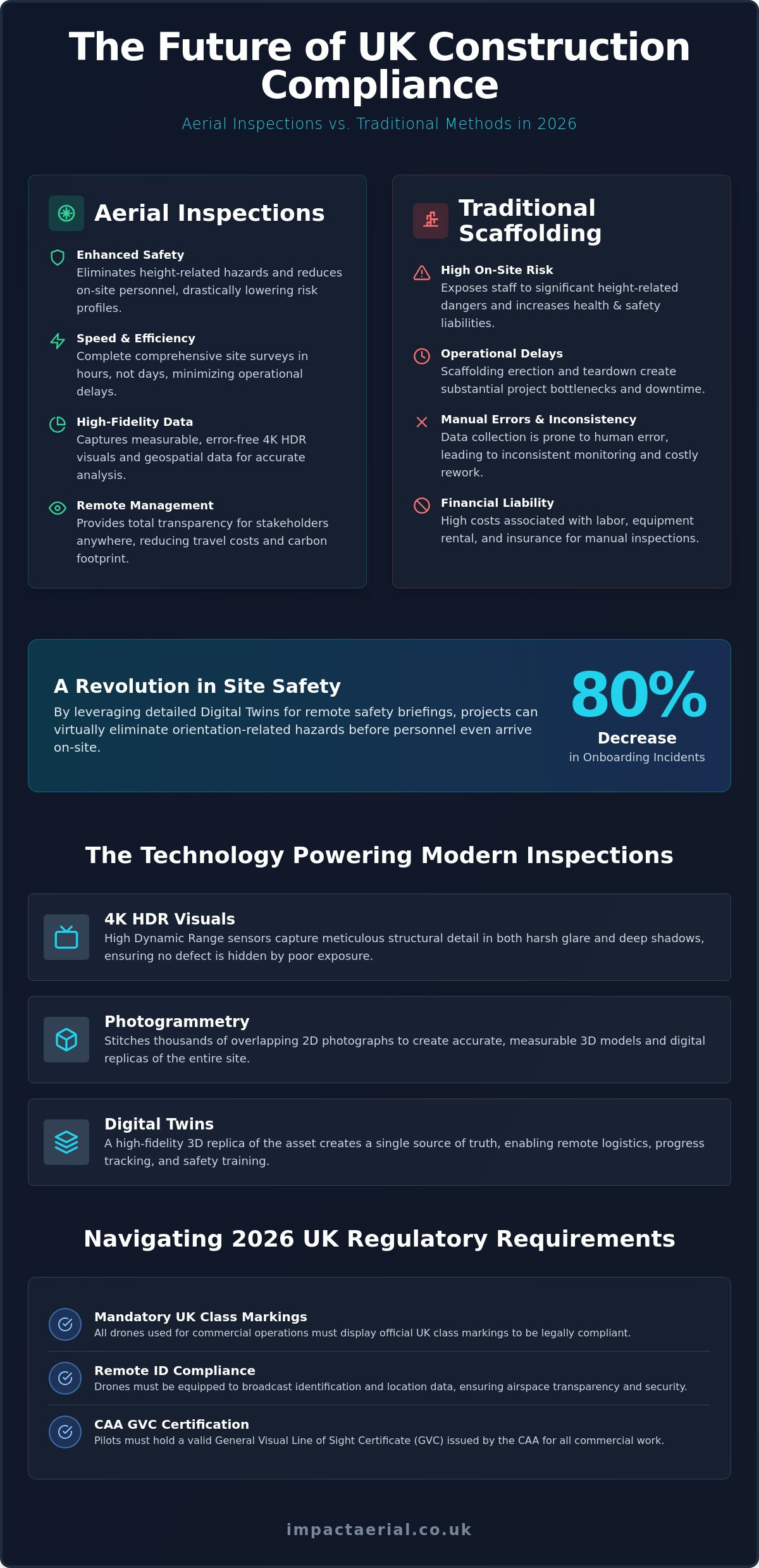
Aerial vs. Manual Inspections: A Comparison of Safety, Speed, and Data Accuracy
Traditional methods of site review often involve significant logistical hurdles and inherent risks. When comparing manual processes to aerial site inspections, the primary differentiator is the immediate removal of personnel from high-risk environments. Instead of sending engineers onto fragile roofs or up telecommunication towers, a UAV captures the necessary data from a safe distance. This shift doesn’t just protect staff; it simplifies the entire health and safety planning process, reducing the volume of risk assessments and method statements required for basic site access.
The speed advantage is equally compelling. A manual team might take several days to survey a multi-hectare site on foot, navigating obstacles and recording measurements by hand. In contrast, a professional drone can cover the same area in a matter of hours. This efficiency ensures minimal disruption to active construction sites. There’s no need to pause heavy machinery or clear specific zones for personnel access, allowing the project to maintain its momentum while data is collected in the background.
The ROI of Drone-Led Data Collection
The financial benefits extend beyond the initial cost of equipment or service fees. By identifying structural discrepancies or site errors early in a 3D model, project managers can avoid the rework that often plagues large-scale developments. Improved risk mitigation also has the potential to lower insurance premiums, as underwriters increasingly recognize the safety benefits of drone technology. The return on investment for a professional drone survey is primarily realized through the massive reduction in man-hours required for site mapping, often condensing a week-long manual survey into a single afternoon of flight.
Addressing Common Misconceptions
A frequent question regarding aerial site inspections is whether the data matches the accuracy of a physical tape measure. With modern RTK (Real-Time Kinematic) positioning, drones achieve sub-centimetre precision, providing a level of geospatial accuracy that manual methods struggle to replicate consistently. Another common myth is that drones are only viable for massive infrastructure projects. In reality, the cost-efficiency of a drone survey makes it highly effective for smaller commercial roof inspections where the alternative is expensive scaffolding or cherry pickers.
While weather limitations like high winds or heavy rain can impact flight schedules, professional pilots use advanced meteorological monitoring to manage these environmental risks. They don’t just fly; they strategically plan operations around weather windows to ensure data quality and operational safety. This meticulous planning ensures that even in the unpredictable UK climate, drone-led inspections remain a reliable and consistent tool for modern site management.
Navigating UK Compliance: Safety Standards and Regulatory Requirements
Operating professional aerial site inspections in the UK requires more than just a capable drone; it demands a robust framework of legal compliance and meticulous risk management. As of January 2026, the regulatory environment has become more stringent to ensure public safety and airspace integrity. Every commercial operation must be led by a pilot holding a CAA General Visual Line of Sight Certificate (GVC). This qualification is the industry standard for complex site work, ensuring the operator understands the technicalities of the specific UK class markings (UK0 to UK6) and the mandatory Remote ID broadcasts now required for most enterprise-grade aircraft. For organisations seeking to validate these compliance frameworks, International Associates Limited provides the independent assessment and assurance services necessary to maintain high operational standards.
Safety-conscious project managers must also verify that their service provider carries EC 785/2004 compliant insurance. While this is the legal baseline, high-value construction sites and infrastructure projects often necessitate significantly higher coverage to mitigate potential financial exposure. We maintain £5m commercial liability insurance to provide stakeholders with absolute reassurance when operating near expensive assets or in congested urban environments. Every project begins with a comprehensive pre-flight risk assessment, a mandatory step for professional drone services to identify potential hazards such as overhead power lines, restricted airspace, or nearby public gatherings.
Why Certification is Non-Negotiable
Hiring a ‘hobbyist’ pilot for commercial site inspections is a significant legal liability for any business. Certification through the CAA ensures that a pilot is professionally trained in emergency procedures, airspace management, and meteorological analysis. Without a valid drone license and the appropriate Operational Authorisation, any data collected might be inadmissible for official insurance or planning reports. This professional vetting is what guarantees the reliability of the high-fidelity data and the physical safety of everyone on site.
Site Preparation and Red Tape Management
Managing the administrative side of an inspection involves careful planning around GDPR and privacy concerns. Professional operators use specific protocols to ensure that any peripheral data, such as images of the public or neighbouring properties, is handled according to UK data protection laws. Before the drone team arrives, site managers should ensure that all relevant stakeholders are informed and that any necessary permissions for restricted or urban areas have been secured. A standard checklist includes verifying that take-off and landing zones are clear and ensuring the flight path doesn’t interfere with other active site operations. For a compliant and expertly managed survey, book a consultation with our specialist drone team.
Optimising Your Project with Impact Aerial’s Specialist Drone Solutions
Impact Aerial operates as a technical consultant rather than a standard service provider, delivering a structured “Consultation to Post-Production” model. Centrally based in Birmingham and serving the entire UK, we provide the meticulous data collection required for high-stakes aerial site inspections. Our approach ensures that every flight is underpinned by CAA GVC certified pilots and DJI Enterprise hardware, providing the precision necessary for modern construction and property management. We don’t just capture footage; we provide a comprehensive digital foundation that empowers your team to make informed, data-driven decisions.
A key differentiator in our service is the implementation of digital twin technology. Internal data shows that our clients experience an 80% decrease in onboarding incidents when using these high-fidelity virtual replicas for site inductions. By allowing personnel to familiarise themselves with site hazards in a controlled, digital environment, we significantly lower the risk profile of active projects. Whether you require an aerial filming drone for stakeholder presentations or complex geospatial data for engineering, our full-service model covers every stage of the process.
Specialised Inspections: From Roofs to Solar Farms
Our expertise spans multiple sectors, with tailored solutions for specific industrial challenges. For PV Solar Farms, we conduct thermal surveys to identify defective cells and maximize return on investment. In the construction sector, our site monitoring services provide real-time progress tracking and volume calculations that keep projects on schedule. For commercial property managers, we deliver comprehensive structural assessments that identify defects in hard-to-reach areas, eliminating the need for costly and disruptive scaffolding. These specialised aerial site inspections are designed to provide total transparency and psychological comfort to investors and HSE officers alike.
Getting Started with Your Aerial Inspection
The process begins with a tailored consultation to understand the unique complexity of your site. We evaluate airspace restrictions, structural challenges, and data requirements to provide a precise quote. During the initial project brief, we define the specific outputs you need, whether that involves raw 4K footage, 3D point clouds, or orthomosaic maps. Once the data is captured and processed, we deliver it in formats ready for immediate use. You can access your site data through cloud-based platforms for remote management or integrate it directly into existing BIM and CAD software workflows. This methodical delivery ensures that the insights we provide are immediately actionable for your technical team.
Future-Proofing Your Site Intelligence for 2026 and Beyond
In 2026, the transition from manual data collection to automated, high-fidelity site documentation is no longer optional for competitive construction and property projects. By integrating aerial site inspections into your workflow, you replace high-risk manual processes with sub-centimetre precision and persistent digital twins. This approach doesn’t just satisfy the latest CAA GVC certification standards; it provides a comprehensive source of truth for every stakeholder involved, from project managers to investors.
Impact Aerial is centrally based in Birmingham, providing UK-wide coverage with a safety-first culture. Our pilots are fully CAA GVC certified, and our operations are backed by £5m commercial liability insurance, ensuring your project remains compliant and protected. Whether you’re managing a complex construction build or a large-scale PV solar farm, we provide the technical expertise to turn raw aerial data into actionable business intelligence that reduces rework and enhances site safety.
Request a Professional Site Inspection Quote from Impact Aerial today and take the first step toward a safer, more transparent site management strategy. We look forward to helping you optimize your next project with precision and reliability.
Frequently Asked Questions
Are aerial site inspections legal for commercial projects in the UK?
Yes, aerial site inspections are fully legal for commercial use provided the operator holds a valid General Visual Line of Sight Certificate (GVC) from the Civil Aviation Authority (CAA). In 2026, compliance also requires adherence to specific UK class markings and Remote ID broadcast regulations. Hiring a certified specialist ensures that your project data is legally admissible for insurance and planning purposes while meeting all national safety standards.
How much does a professional drone site inspection cost?
The cost of a professional inspection varies based on the site’s scale, its location, and the specific data outputs you require. Factors such as the need for thermal sensors, high-density 3D mapping, or multi-day monitoring for construction progress will influence the final investment. Because every project has unique technical challenges, it’s best to request a tailored quote to ensure your structural or geospatial requirements are accurately priced.
What level of accuracy can I expect from a drone survey?
You can expect sub-centimetre precision when using enterprise-grade drones equipped with Real-Time Kinematic (RTK) positioning technology. This high level of accuracy is consistent across the entire site, making the data ideal for earthworks calculations and structural facade measurements. Such precision allows your technical team to overlay current site conditions against original CAD or BIM design models to identify discrepancies early in the build process.
How long does it take to complete an aerial inspection of a standard construction site?
A standard construction site survey typically takes between two and four hours of flight time to complete. This is a massive reduction in time compared to manual methods, which often require several days of on-site work. Larger infrastructure projects or multi-hectare sites might require a full day of operations, but the speed of data acquisition remains one of the primary advantages of using drone technology for site intelligence.
Do I need to clear the site or stop work during the drone flight?
No, you don’t need to stop work or clear the site in most cases. Professional pilots plan automated flight paths that minimize disruption to active machinery and personnel. Because the drone operates from a safe altitude, construction activities can continue as normal. This allows for consistent progress monitoring without the logistical downtime or “red tape” associated with traditional manual inspections or scaffolding installations.
What happens if the weather is poor on the day of the inspection?
If weather conditions such as high winds or heavy rain exceed safe operational limits, the inspection will be rescheduled for the next available window. Professional pilots use advanced meteorological tools to monitor local conditions in real-time before and during the flight. We prioritize the safety of your assets and our equipment, ensuring that data is only captured when environmental conditions allow for high-fidelity visual and thermal output.
What kind of files and data will I receive after the inspection is complete?
You’ll receive a comprehensive suite of digital assets tailored to your project’s specific needs. Common deliverables include high-resolution 4K HDR video, orthomosaic maps, and 3D point clouds. These files are typically provided in industry-standard formats compatible with BIM, CAD, and GIS software. This ensures that your technical team can integrate the aerial data directly into existing management workflows for immediate analysis and reporting.
Can drone inspections help with my HSE and safety compliance?
Yes, aerial site inspections are a powerful tool for enhancing HSE and safety compliance on any project. By removing personnel from high-risk environments like fragile rooftops or tall structures, you directly reduce the likelihood of on-site accidents. Additionally, using digital twins for site inductions has been shown to decrease onboarding incidents by 80%, providing a safer and more transparent environment for all workers and subcontractors.
Drone Dilapidation Survey: The Professional’s Guide to Aerial Building Inspections
Did you know that a professional drone dilapidation survey is typically 50% to 75% less expensive than traditional ground-based inspection methods? For commercial property managers and surveyors, the old way of working often involves exorbitant costs for scaffolding or MEWPs and the constant, heavy burden of health and safety liability. It’s a slow, cumbersome process that frequently results in incomplete data, leaving critical defects hidden from ground-level views. We understand that when it’s time for a commercial property claim or a scheduled maintenance review, precision and speed are your top priorities.
In this guide, you’ll discover how aerial building inspections provide a faster, safer, and significantly more accurate alternative to traditional access. By utilizing CAA GVC certified pilots and high-end DJI Enterprise 4K HDR hardware, we ensure every inch of the building envelope is documented with meticulous detail. We’ll walk you through the technical advantages of high-resolution photographic evidence, the latest UK regulatory requirements for 2026, and how this data-centric approach drastically reduces your operational risk while delivering comprehensive reports in a fraction of the time.
Key Takeaways
- Learn how a professional drone dilapidation survey provides a definitive visual record for a ‘Schedule of Dilapidations’, protecting both landlords and tenants during property claims.
- Understand why transitioning from scaffolding and MEWPs to aerial inspections significantly lowers health and safety liability while accelerating project turnaround.
- Discover the technical advantages of DJI Enterprise hardware, which allows for the identification of critical defects like hairline cracks and water ingress that consumer drones often miss.
- Explore the methodical survey process, including the importance of pre-flight risk assessments (RAMS) and airspace authorisation to ensure a compliant operation.
- Identify the non-negotiable industry standards for commercial surveys, including the requirement for CAA GVC certified pilots and £5m commercial liability insurance.
Understanding Drone Dilapidation Surveys for Commercial Property
A drone dilapidation survey is a high-resolution aerial inspection used to document a building’s condition with forensic precision. In the context of commercial real estate, these surveys play a critical role in the ‘Schedule of Dilapidations’ process. This document outlines the repairs required to return a property to its original state as defined in a lease agreement. By providing a clear, indisputable visual record, drones protect the interests of both landlords and tenants, ensuring that claims are based on factual, high-definition data rather than subjective ground-level observations.
The building envelope, particularly high-level elevations and complex roofing systems, often hides significant defects from the naked eye. Traditional surveyors might miss hairline cracks or failing seals when restricted to the ground or limited by the reach of a ladder. Integrating aerial data into Structural Health Monitoring (SHM) ensures a proactive approach to building maintenance, identifying issues before they escalate into structural failures or costly legal battles.
To better understand this concept, watch this helpful video:
Ground-based surveyors are often hindered by “blind spots” created by the building’s geometry. Parapet walls, internal valley gutters, and central roof sections are frequently invisible from the street. A drone dilapidation survey eliminates these gaps by providing a top-down view and 45-degree oblique angles, ensuring every square meter is accounted for. This level of detail is essential for accurate cost estimation in commercial property claims, as it allows for a precise measurement of the affected areas without the initial need for scaffolding.
The Legal and Technical Context of Dilapidations
Aerial imagery provides robust support for RICS-standard dilapidation reports by offering a perspective that’s otherwise impossible to obtain without expensive access equipment. Every frame captured is date-stamped and high-resolution, creating a verifiable timeline of a building’s state. This evidence is vital in legal disputes where the timing of damage is contested. By documenting ‘before and after’ states for long-term lease agreements, stakeholders maintain a reliable audit trail that minimizes friction during the terminal dilapidations phase.
Targeted Assets: What Drones Inspect Best
Drones excel at inspecting assets that are traditionally difficult or dangerous to reach. Our DJI Enterprise 4K HDR hardware captures minute details across various building components:
- Roofing systems: We inspect guttering for blockages, flashing for lifting, and the integrity of individual tiles or sheets.
- External cladding: Identifying loose panels or failing masonry at height prevents safety hazards and water ingress.
- Hard-to-reach areas: Drones provide clear views of chimneys, parapets, and rooftop plant machinery—including commercial HVAC systems maintained by Engico Air Conditioning—that ground-based inspections simply can’t see.
This comprehensive coverage ensures that no part of the building envelope remains unmonitored, providing peace of mind for property managers and owners alike.
When this detailed data is combined with the professional insight of a firm like South Surveyors, property owners can make fully informed decisions regarding structural repairs and long-term maintenance.
The Advantages: Why Aerial Surveys Outperform Traditional Methods
Traditional building inspections often rely on invasive and costly logistics. For decades, the industry standard involved erecting scaffolding, hiring Mobile Elevated Work Platforms (MEWPs), or employing specialist steeplejack services. These methods are inherently slow and require significant lead times for planning and assembly. A drone dilapidation survey bypasses these logistical hurdles entirely. While a climbing crew might take hours to inspect a single high-level section, a professional drone operator can capture the same data in minutes. This speed of deployment is a game-changer for commercial property managers who need immediate results without the weeks of preparation required for traditional plant hire.
Cost-efficiency is another primary driver for the shift toward aerial inspections. Traditional methods often involve hidden expenses, such as local authority permits for road closures or the high rental costs of heavy machinery. Industry data indicates that drone surveys are typically 50% to 75% less expensive than traditional ground-based methods for the same area. By removing the need for physical access equipment, you’re not just saving money on the survey itself; you’re also eliminating the potential for accidental damage to the building facade caused by heavy machinery or scaffold ties. If you are looking to streamline your next inspection, opting for professional drone surveying provides a high-tier output without these unnecessary overheads.
Safety and Risk Mitigation
Safety is the cornerstone of our operations. By utilizing drones, we effectively eliminate the ‘Work at Height’ (WAH) liabilities that typically plague property inspections. Keeping personnel on the ground is the most effective way to manage risk. Drones operate with a minimal footprint, meaning they don’t disturb building occupants or the public during flight. This is particularly valuable for retail or office environments where business continuity is essential. Additionally, the rapid response capabilities of drones allow for immediate post-storm damage assessments, providing clear evidence of structural integrity before it’s safe to send a human team onto a roof.
Data Depth and Accuracy
The quality of data captured from the air far exceeds what a surveyor can see through binoculars from the ground. We utilize DJI Enterprise 4K HDR hardware to provide a ‘surveyor’s eye’ view of every architectural detail. This technology allows us to capture 100% of the building surface area, including internal valleys and parapets that are otherwise invisible. Because our flight paths are consistent and repeatable, we can perform multi-year condition monitoring with extreme accuracy. This ensures that even the smallest changes in the building envelope are documented, providing a level of precision that traditional methods simply cannot match.
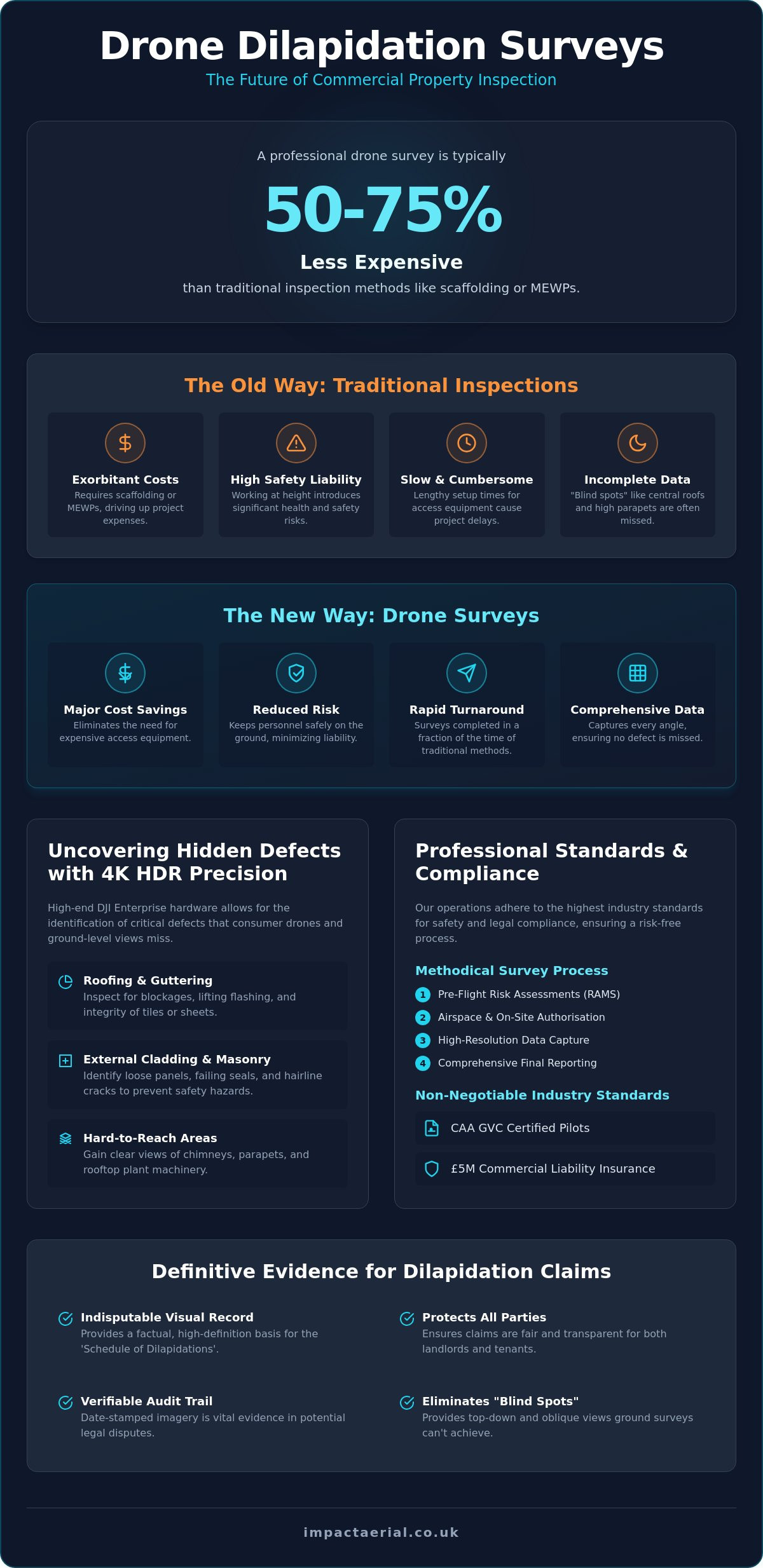
Technical Capabilities: Imagery, Thermal, and Data Quality
A professional drone dilapidation survey relies on hardware that far exceeds the capabilities of standard consumer models. While hobbyist drones might capture decent video, they lack the sensor size, stability, and optical zoom necessary for forensic building analysis. We utilize DJI Enterprise hardware, such as the Matrice 350 RTK paired with Zenmuse H30T sensor payloads, to achieve sub-millimetre detail. These systems provide the precision required to identify hairline cracks in masonry or minor water ingress around window seals that would remain invisible to lesser equipment.
Zoom capabilities are a cornerstone of our safety and data strategy. High-powered optical zoom allows our pilots to maintain a safe standoff distance from the building facade while still capturing ultra-close-up imagery. This eliminates the risk of flying dangerously close to complex structures or plant machinery. Complementing this, 4K HDR video provides a fluid, technical overview of the building’s condition. This cinematic yet technical footage allows surveyors to review the entire building envelope in context, ensuring that no defect is overlooked during the analysis phase.
Thermal Imaging for Dilapidation Surveys
Thermal imaging is a vital component of a comprehensive survey, allowing us to see what the human eye cannot. By detecting temperature differentials, we identify hidden moisture trapped within roofing insulation. Wet insulation retains heat longer than dry materials, appearing as distinct ‘hot spots’ on a thermal map during evening inspections. We also detect thermal bridging and significant heat loss in commercial units. By combining RGB (visual) and thermal data, we provide a ‘complete’ building health check that identifies both structural and efficiency-related defects.
Post-Production and Deliverables
The raw data captured during a flight is only the beginning of the process. We meticulously organize hundreds of high-resolution images into a structured, navigable report that aligns with your specific survey requirements. For large-scale industrial sites, we generate 3D models and orthomosaic maps. These deliverables allow stakeholders to zoom into any part of the building with high-tier clarity, providing a digital twin of the asset. This data integrates seamlessly into existing asset management software, such as CMMS or EAM platforms, to automate work order creation and streamline long-term maintenance workflows.
The Survey Process: From Pre-Flight Planning to Final Reporting
A successful drone dilapidation survey is a structured, methodical operation that begins long before the aircraft arrives on site. We start with an initial consultation to define the specific scope of the dilapidation claim or maintenance review. This stage is vital for aligning our flight plan with the requirements of RICS-qualified surveyors, ensuring that the resulting data is admissible and useful for legal or financial settlements. We don’t just capture images; we build a data acquisition strategy tailored to the building’s unique architecture and the specific needs of the property manager.
Planning and Airspace Compliance
Urban property inspections require rigorous planning and adherence to strict safety protocols. Our team conducts detailed pre-flight risk assessments and prepares comprehensive Method Statements (RAMS) for every project. This involves checking for Temporary Restricted Areas (TRAs) or proximity to controlled airspace, such as airports or heliports. We manage the logistics of securing land-owner permissions and notifying relevant stakeholders to ensure the operation is both legal and non-disruptive. Weather monitoring is equally critical; we track wind speeds and precipitation levels to ensure optimal conditions for capturing high-tier, distortion-free imagery that meets our professional standards.
On-Site Execution and Reporting
Execution on the day involves a coordinated effort between the pilot and a secondary observer. This team structure maximizes safety and allows for real-time image review. By checking the feed as we fly, we guarantee that all critical defects identified during the planning phase are captured with absolute clarity. We follow a systematic flight pattern, often using a grid or orbital path, to achieve total coverage of the building envelope without missing a single tile, seal, or masonry joint. This methodical approach ensures that the data is consistent and repeatable for future inspections.
The process concludes with data processing and quality assurance. We organize the vast amount of 4K HDR data into a navigable, professional report. These deliverables are typically provided in digital formats or hosted on cloud-based platforms, allowing property managers to share the findings instantly with legal teams or contractors. This level of transparency and speed is what sets our services apart. If you require a reliable partner for your building inspections, our drone commercial property surveys provide the high-resolution evidence you need to move forward with confidence.
Ensuring Compliance: Why Certification and Insurance are Non-Negotiable
Professionalism in aerial surveying is defined by strict adherence to the Civil Aviation Authority (CAA) framework. When commissioning a drone dilapidation survey, technical skill is only half of the requirement. Legal and financial security form the other half. Hiring an unlicensed ‘hobbyist’ pilot for professional building inspections introduces significant liabilities. These operators often lack the specific training required to manage complex flight paths near structures and, crucially, they do not possess the commercial insurance necessary to protect your assets in the event of an incident. At Impact Aerial, we maintain a meticulous approach to every operation, ensuring that our clients are protected by high-tier professional standards and comprehensive risk mitigation strategies.
The industry standard for commercial property surveys is £5m commercial liability insurance. This level of coverage is essential for working on high-value commercial units and industrial sites. It provides the reassurance and reliability that property managers require when allowing contractors onto their premises. Without this, any accidental damage to the building or third-party property could lead to protracted legal battles and unrecoverable costs. Our commitment to safety is backed by this substantial indemnity, ensuring that every project is grounded in expert-led security.
UK Drone Laws in 2026
As of January 1, 2026, the regulatory environment for drones in the UK has become significantly more structured. All new drones sold must now carry a UK class mark (UK0 to UK6), and those in the UK1, UK2, UK3, UK5, and UK6 categories are required to broadcast Remote ID. We have successfully managed the transition from older certifications to the current GVC (General Visual Line of Sight Certificate) standard. For complex urban flights, we operate under a specific Operational Authorisation (OA) from the CAA. This allows us to fly in areas where legacy drones or uncertified pilots are now legally restricted. Additionally, our pilots are trained to manage privacy and GDPR concerns with precision, ensuring that all data collection is compliant with national data protection laws.
Choosing the Right Partner
Before hiring a provider, you must verify their credentials. Ask for their CAA Operator ID and a copy of their current Operational Authorisation. You can check a pilot’s status directly through the CAA’s official registers to ensure their qualifications are current. A professional partner should also provide a detailed Method Statement and Risk Assessment (RAMS) before starting work. If you are ready to secure high-resolution, compliant data for your building maintenance, you can request a professional drone dilapidation survey quote from Impact Aerial. We provide the technical expertise and regulatory peace of mind required for high-stakes commercial property claims.
Advancing Your Property Asset Management
Transitioning to aerial inspections represents a significant shift in how commercial property is managed. By replacing expensive plant hire and high-risk manual work with a professional drone dilapidation survey, you gain immediate access to high-tier data without the logistical burdens of the past. This methodical approach provides a forensic visual record that is both RICS-admissible and technically superior to ground-based observations, ensuring your building maintenance decisions are based on absolute precision.
Reliability in this specialized sector is built on compliance and technical excellence. Choosing a partner with CAA GVC Certified Pilots and £5m Commercial Liability Insurance ensures your operations remain safe and legally sound. Our use of DJI Enterprise Grade 4K Data guarantees that every hairline crack, failing seal, and thermal anomaly is documented with meticulous clarity. This data-centric process not only reduces your health and safety liability but also provides a repeatable audit trail for long-term asset protection.
It’s time to elevate your building maintenance strategy with faster, safer, and more accurate insights. Book your professional drone dilapidation survey with Impact Aerial today to secure the comprehensive evidence your property deserves. We look forward to supporting your next project with our expert-led aerial services.
Frequently Asked Questions
Are drone dilapidation surveys legally admissible in court or disputes?
Yes, high-resolution imagery and data from a professional drone dilapidation survey are legally admissible when conducted by certified operators. Courts and RICS-qualified surveyors accept this evidence because it provide a date-stamped, objective record of a building’s condition. This technical data is essential for settling ‘Schedule of Dilapidations’ claims between landlords and tenants, as it offers indisputable proof of structural health at a specific point in time.
How much does a drone dilapidation survey cost compared to traditional methods?
Aerial surveys are significantly more cost-effective than traditional ground-based methods. By eliminating the need for scaffolding, cherry pickers, or steeplejack services, the total expense is often reduced by 50% to 75%. You save on plant hire, labor, and the logistical costs associated with road closures or site downtime. This makes drones the most efficient choice for large commercial properties where traditional access would be prohibitively expensive.
Do I need to notify my neighbours or local authorities before a drone survey?
Yes, stakeholder notification is a standard part of our professional flight planning process. While we handle the complex airspace authorizations and notifications for local authorities or airports, we recommend that property owners inform neighboring tenants of the scheduled flight. This transparency helps manage privacy expectations and ensures the operation proceeds without disruption. We manage all formal regulatory compliance and risk assessments (RAMS) to ensure a smooth, professional deployment.
Can drones perform surveys in rain or high winds?
Professional drone operations are restricted by adverse weather to ensure both safety and data quality. We don’t fly in active precipitation or winds that exceed the safety limits of our DJI Enterprise hardware, which is typically around 12 to 15 meters per second. Capturing high-tier 4K HDR imagery requires stable flight conditions. If the weather is unsuitable, we reschedule the survey to ensure the final data is sharp, forensic, and useful for your report.
What is the turnaround time for receiving the final survey report?
Final digital reports are typically delivered within 3 to 5 working days after the on-site data collection is complete. This is a vast improvement over traditional manual surveys, which can take weeks to compile. Our post-production team organizes the high-resolution imagery into a structured, navigable format. You’ll receive a cloud-based link or digital file that can be instantly shared with legal teams, contractors, or property managers for immediate action.
What happens if the drone captures footage of people or private property nearby?
We use strict data management protocols and precise flight planning to protect the privacy of those near the site. Our pilots focus the sensors specifically on the target asset to minimize incidental capture. If people or private vehicles are captured, we apply post-production blurring to ensure full GDPR compliance. Professional drone dilapidation survey operators prioritize data protection as a core part of their service, ensuring all evidence is ethically and legally gathered.
Do drones require scaffolding to be removed before they can inspect a roof?
No, drones can perform inspections while scaffolding is in place, although it’s often more efficient to fly before it’s erected. Drones are frequently chosen specifically to avoid the cost and time of scaffolding. If the structure is already present, we can still capture high-level data, but a clear building envelope allows for 100% unobstructed views. This flexibility makes drones an ideal tool for both initial assessments and final sign-offs after repairs are finished.
Can drones detect internal building defects or only external ones?
Standard aerial drones are primarily designed for external building envelope inspections, though they can identify some internal issues. By using thermal imaging sensors, we can detect moisture trapped within insulation or significant heat loss that points to internal structural failures. While we don’t typically fly standard aircraft inside occupied offices, the data we capture from the outside provides a comprehensive overview of the building’s overall structural health and water integrity.
Drone Videography for Luxury Properties: The 2026 Cinematic Standard
Did you know that properties marketed with professional aerial footage sell up to 68% faster than those relying on traditional photography alone? In the high-stakes world of elite real estate, a generic listing isn’t just a missed opportunity; it’s a liability that fails to capture the true scale and soul of an estate. You likely understand that high-end buyers now demand an immersive, emotional connection before they ever set foot on a property. However, achieving that cinematic impact requires more than just a hobbyist with a camera. It demands sophisticated drone videography for luxury properties that balances creative artistry with the meticulous safety standards required to protect high-value assets.
We’ll show you how professional storytelling transforms property marketing through technical precision and uncompromising regulatory compliance. You’ll discover the impact of 4K HDR DJI Enterprise technology and why working with CAA GVC certified pilots is non-negotiable for managing privacy and legal risks. From seamless FPV fly-throughs to the reassurance of £5m commercial liability insurance, this guide outlines the 2026 standard for showcasing luxury homes with total peace of mind and maximum market impact.
Key Takeaways
- Understand why cinematic storytelling is essential for capturing the full geographical context and narrative scale of high-value estates.
- Identify the technical benchmarks for 2026, focusing on 4K HDR resolution and the stability provided by commercial-grade DJI Enterprise hardware.
- Learn to mitigate operational risks by ensuring your drone videography for luxury properties is managed by CAA GVC certified pilots with £5m in commercial liability insurance.
- Explore how FPV fly-through technology creates an immersive, “one-take” viewing experience that seamlessly connects indoor and outdoor spaces.
- Discover the importance of a structured production process, covering everything from regulatory flight planning to high-end post-production editing.
The Evolution of Luxury Real Estate Marketing: Why Drones are Essential
Luxury real estate marketing has moved beyond simple property descriptions and static imagery. In 2026, drone videography for luxury properties is recognized as a sophisticated cinematic tool used to craft a narrative rather than just record a space. High-net-worth individuals increasingly rely on digital-first, immersive viewings to shortlist properties globally. While the history of aerial photography began with basic topographical recording, modern standards demand high-production-value films that evoke an emotional response. This shift reflects a market where buyers don’t just want to see a house; they want to experience an estate’s soul.
Static photography captures a moment, but motion video captures a lifestyle. Traditional listings often fail to communicate the flow of an estate or the relationship between the main residence and its auxiliary structures. Cinematic drone flights bridge this gap, providing a comprehensive visual journey that justifies a premium price tag. Statistics show that listings with video receive 403% more inquiries than those without, making professional aerial filming a standard requirement for high-end listings.
To better understand how these cinematic movements enhance a listing, watch this helpful video showing professional techniques:
Capturing the Grandeur: Scale and Context
Ground-level photography is inherently limited by perspective. It cannot effectively showcase a property in relation to exclusive local landmarks or the wider geography of a prestigious neighbourhood. Professional drone filming reveals the architectural symmetry of a manor house and the intricate design of landscaped gardens from angles that were previously inaccessible. Using altitude strategically allows us to ground the property in its environment, highlighting the privacy and exclusivity that luxury buyers prioritize.
- Defined Boundaries: Clearly illustrate land borders, private driveways, and sprawling acreage in a single frame.
- Geographic Context: Show proximity to coastlines, private golf courses, or city skylines to establish value.
- Architectural Precision: Highlight rooftop features, solar installations, and complex structural layouts from a bird’s-eye view.
Emotional Engagement and First Impressions
First impressions are made within the first three seconds of a buyer viewing a listing. The “hero shot”, which is a sweeping, cinematic reveal of the estate, is designed to grab immediate attention and sustain engagement. This movement creates an aspirational narrative, allowing the viewer to imagine the experience of living within the estate. It’s about moving the camera with purpose to highlight the property’s finest assets, from infinity pools to private helipads.
Effective marketing requires a holistic approach. By linking cinematic footage to professional drone photography, agents provide a cohesive visual package that satisfies both the emotional and logical requirements of a buyer. This integrated strategy ensures that drone videography for luxury properties does more than just look impressive; it functions as a high-performance sales tool that accelerates the transaction process.
The Technical Standard: 4K HDR and Cinematic Drone Flight
Standard real estate videos often struggle with overexposed skies or dark, muddy shadows that obscure a property’s finest details. This is why 4K HDR (High Dynamic Range) has become the baseline for drone videography for luxury properties in 2026. HDR technology allows the camera sensor to capture a broader spectrum of light; this ensures that a gleaming white marble terrace and a shaded woodland garden both retain crisp detail in the same frame. Achieving this level of visual fidelity requires commercial-grade hardware that far exceeds the capabilities of standard consumer drones.
The shift toward high-production-value video isn’t just about aesthetics; it’s a proven business strategy for high-end listings. Reports on cinematic drone marketing highlight how these visuals capture both eyeballs and profits in an increasingly competitive global market. When buyers are viewing properties from thousands of miles away, the technical quality of the footage acts as a direct proxy for the quality of the estate itself.
Hardware Matters: DJI Enterprise and 4K Sensors
Enterprise-grade DJI drones utilize larger sensors and more sophisticated gimbals to deliver buttery-smooth footage even in challenging wind conditions. These systems provide the stability needed for the long, slow pans that define high-end production. While consumer models prioritize portability, enterprise-grade hardware utilizes dedicated processing power to ensure consistent frame rates and 10-bit colour depth across all lighting conditions. Using commercial-grade gimbals eliminates the “micro-jitters” that often plague cheaper equipment, resulting in the fluid, high-end output that luxury brands demand.
Cinematic Storytelling Techniques
Cinematic storytelling relies on choreographed camera movements that mirror professional cinema. The “Reveal Shot” is a classic example; the drone starts low behind a natural barrier like a stone wall or a treeline, rising slowly to unveil the estate. This creates a powerful sense of discovery for the viewer. The “Parallax Orbit” adds another layer of depth; by rotating the drone around a central feature while moving the camera in the opposite direction, the background appears to move at a different speed than the foreground. These deliberate, slow movements mirror the pacing of luxury brand commercials, building a sense of prestige and calm. This represents a significant transition from simple “fly-overs” to a true cinematic production where every movement has a purpose.
If you’re looking to elevate your listing with these advanced technical standards, our team specializes in professional aerial filming that combines enterprise hardware with creative expertise.
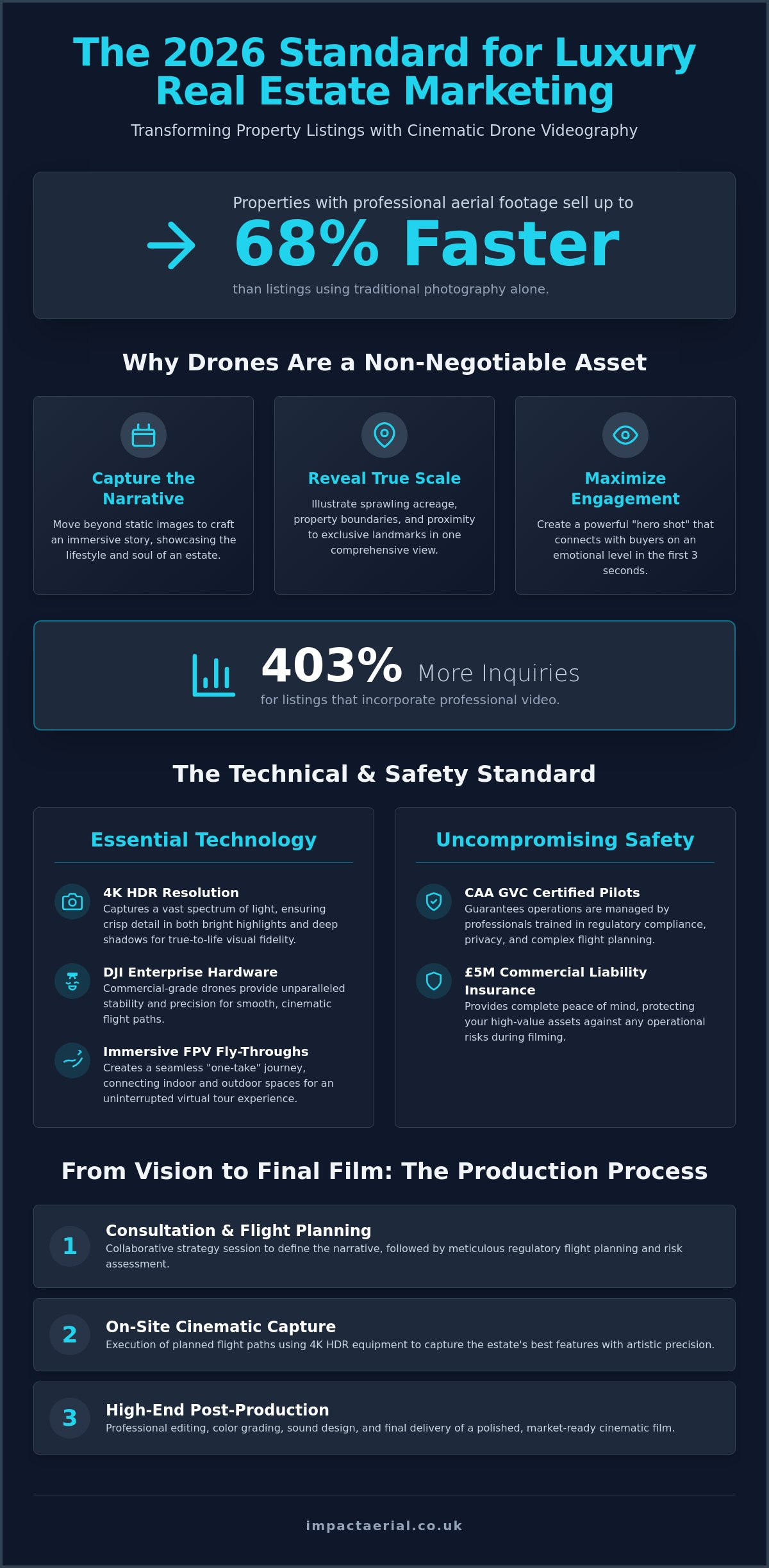
Safety, Compliance, and Insurance: Protecting Your Estate
Operating a drone over a high-value estate requires more than just technical skill; it necessitates a rigorous approach to risk mitigation and legal compliance. While the visual impact of drone videography for luxury properties is undeniable, the underlying safety protocols are what protect the property owner from liability and privacy breaches. Professional operators must treat every flight as a commercial aviation operation, adhering to strict standards that mirror international best practices, such as the FAA commercial drone regulations found in the United States. In the UK, this begins with a comprehensive understanding of airspace and local restrictions.
The Importance of CAA GVC Certification
A General Visual Line of Sight Certificate (GVC) is the non-negotiable standard for any pilot filming luxury assets in the UK. This certification ensures the pilot has undergone formal training and passed practical assessments required by the Civil Aviation Authority. Navigating the complexities of a UK drone license is essential for operating in restricted or urban zones where many exclusive properties are located. Certified pilots conduct detailed pre-flight surveys and site-specific safety assessments to identify hazards like power lines or neighbouring structures before the drone ever leaves the ground. Engaging a vetted, professional drone service guarantees that these regulatory hurdles are managed correctly, preventing legal complications for the estate owner.
Insurance and Risk Management
Standard liability insurance often fails to provide adequate coverage for the unique risks associated with luxury real estate. While many hobbyist or entry-level operators carry £1m in coverage, this is frequently insufficient when operating near multi-million pound structures or sensitive landscaping. We maintain £5m commercial liability insurance as a standard-setter for the industry. This level of coverage provides the necessary reassurance that all parties are protected in the unlikely event of an equipment failure or accidental damage.
Privacy and data security are equally critical. Luxury homeowners often have heightened concerns regarding security and the visibility of private areas. Professional drone videography for luxury properties includes specific measures to respect these boundaries:
- Discreet Flight Paths: Planning routes that avoid overflying neighbouring private land or sensitive outdoor living areas.
- Data Privacy: Adhering to GDPR requirements by ensuring that non-target individuals or properties are not captured without consent.
- Post-Production Blurring: Utilizing advanced editing techniques to blur security features, car registrations, or neighbouring windows in the final cut.
By integrating these safety and privacy measures into the production workflow, operators ensure that the marketing process remains as secure as it is visually impressive.
Beyond the Exterior: FPV Fly-Throughs and Virtual Tours
High-altitude exterior shots establish the grand context of an estate, but FPV (First Person View) technology provides the intimate, immersive connection required to truly showcase a home’s interior flow. In 2026, drone videography for luxury properties has evolved to include these seamless indoor-to-outdoor transitions. Unlike traditional walkthroughs that rely on handheld stabilizers, an FPV drone can move through a property with a level of agility and perspective that mirrors a bird in flight. This creates a “one-take” experience that guides a potential buyer from the front gates, through the grand entrance, and into the heart of the home without a single visible edit.
The FPV Revolution in Luxury Interiors
The use of micro-drones, often weighing less than 250 grams and equipped with protected propellers, allows for safe operation within high-end environments. These specialized aircraft can navigate narrow hallways, fly under ornate chandeliers, and glide through open windows to reveal the property’s layout in a way that feels organic and effortless. The technical challenge of interior flight is significant; thick stone walls or reinforced concrete common in luxury builds can disrupt control signals. Professional pilots utilize advanced transmission systems to maintain signal integrity, ensuring the footage remains stable and high-definition throughout the flight. For social media marketing on platforms like Instagram and TikTok, these high-production-value clips provide the “wow factor” necessary to capture attention in seconds.
Integrating Virtual Tours
Modern marketing strategies often combine the cinematic impact of an aerial filming drone with interactive 3D virtual tours. This integration creates a “digital twin” of the property where buyers can view the estate from the air and then “land” the drone at specific interactive hotspots to explore individual rooms. This comprehensive approach provides a level of detail that satisfies both emotional and logical buyer requirements. The return on investment for this immersive content is measurable; properties marketed with these advanced visuals sell up to 68% faster than those using traditional methods. By providing a realistic sense of scale and space online, agents can effectively qualify buyers and reduce the number of wasted physical viewings.
This immersive technology represents the pinnacle of drone videography for luxury properties, offering a perspective that traditional cameras simply cannot replicate. If you are ready to transform your property presentation with these advanced cinematic techniques, contact Impact Aerial to discuss our virtual tour and FPV services.
The Impact Aerial Approach: From Consultation to Post-Production
A high-end visual production requires more than just technical flight skills; it demands a structured, consultative strategy. Every project begins with an initial consultation to identify the property’s unique selling points, whether that involves showcasing a newly commissioned infinity pool or the historical symmetry of a Grade II listed manor—often marketed as a luxury wedding venue. For clients preparing such estates for events, surefiretrio.com provides expert insights into selecting the right music to complement a high-end setting. This stage ensures that the drone videography for luxury properties we produce aligns perfectly with the specific marketing goals of the estate agent or homeowner. By understanding the narrative before the drone ever leaves the ground, we can plan specific cinematic movements that highlight value and prestige.
Handling the operational complexities is a core part of our project management service. We manage all CAA permissions and flight planning, including site-specific safety assessments and risk mitigation strategies. This meticulous approach to officialdom is what separates a professional service from a hobbyist. Our clients receive the psychological comfort of knowing that every flight is fully compliant with national aviation standards, allowing them to focus on the sale while we manage the technical and legal requirements of the shoot.
Professional Post-Production and Branding
The raw 4K HDR footage captured by our DJI Enterprise drones is only the foundation of the final product. Our post-production team uses advanced colour grading techniques to ensure the visual aesthetic matches the high standards of a luxury brand. This involves balancing highlights and shadows to maintain the crisp detail that high-net-worth buyers expect. To enhance the narrative, we integrate licensed soundscapes and professional voiceovers that guide the viewer through the estate. We deliver the final assets in multiple optimised formats, ensuring the production looks exceptional on high-resolution presentations, property portals, and social media platforms.
Why Impact Aerial is the Luxury Partner of Choice
Based in Birmingham, we provide deep local expertise within the West Midlands while maintaining the capability to serve clients across the entire UK. Our personality is that of a trusted specialist; we are meticulous, compliant, and technologically adept. We don’t just offer creative filming; we provide a safety-first ethos backed by £5m commercial liability insurance. This standard-setting insurance coverage ensures that high-value assets are protected at every stage of the filming process. When you partner with us, you aren’t just hiring a pilot; you’re engaging a technical consultant dedicated to professional excellence.
If you’re ready to elevate your property marketing with the 2026 cinematic standard, we’re here to help. Enquire about luxury drone videography for your property today to discover how our professional aerial filming and post-production services can transform your listing.
Set the New Standard for Your Luxury Listing
The integration of advanced aerial technology has fundamentally changed how high-net-worth buyers interact with property listings. By moving beyond simple photography to embrace 4K HDR cinematic movements and immersive FPV walkthroughs, you provide the narrative depth that elite real estate demands. This level of technical precision must be balanced with meticulous operational safety. Choosing a partner who prioritizes CAA GVC certification and carries £5m in commercial liability insurance ensures that your marketing efforts remain secure, professional, and legally compliant. It’s no longer just about the “wow factor”; it’s about providing a reliable, high-production-value experience that justifies a premium price tag.
Impact Aerial combines this technical expertise with a consultant-led approach from our Birmingham base. Whether you require a sweeping reveal of a country estate or a complex indoor-to-outdoor fly-through, our team delivers results across the UK. We handle every aspect of drone videography for luxury properties, from initial flight planning to high-end post-production. This comprehensive service ensures your property stands out in an increasingly competitive global market.
Elevate your property listing with professional drone videography – Contact Impact Aerial
We look forward to helping you capture the true scale and soul of your next luxury listing with the precision it deserves.
Frequently Asked Questions
Do I need special permission to use a drone for my luxury property listing?
When commissioning drone videography for luxury properties, it’s vital to ensure the operator is legally compliant. Commercial drone operations require specific authorizations from the Civil Aviation Authority (CAA). Our pilots hold GVC certification, which allows us to manage airspace permissions and fly in restricted or urban zones. We handle all legal requirements and flight planning as part of our comprehensive service.
How much does professional drone videography for real estate cost in the UK?
Pricing for drone videography for luxury properties is determined by the specific requirements of the estate and the desired production value. Factors such as the property’s scale, the need for interior FPV tours, and the depth of post-production sound design all play a role. We suggest an initial consultation to provide an accurate, bespoke quote tailored to your specific marketing goals.
Is drone filming safe for high-value homes and sensitive neighbourhoods?
Professional drone filming is extremely safe when conducted by vetted specialists using enterprise-grade hardware. We perform meticulous pre-flight surveys and site-specific safety assessments to identify hazards before takeoff. Our £5m commercial liability insurance provides an additional layer of reassurance for homeowners in sensitive or exclusive neighbourhoods, ensuring all parties are protected throughout the operation.
Can drones fly inside a luxury home for interior walkthroughs?
Drones can certainly fly inside luxury homes using specialized FPV (First Person View) technology. These micro-drones are designed with propeller guards and lightweight frames to navigate hallways and grand rooms safely. This technique creates a seamless “one-take” walkthrough that connects the interior and exterior of the property, providing a perspective that traditional handheld cameras cannot replicate.
How long does a typical luxury property drone shoot take?
A typical drone shoot for a high-end estate usually takes between two and four hours on-site. This timeframe allows our pilots to capture a variety of “hero shots”, conduct multiple cinematic orbits, and perform any necessary interior FPV flights. Larger estates or complex multi-structure properties may require additional time to ensure every unique selling point is captured with precision.
What happens if the weather is bad on the day of the drone shoot?
Safety is our primary concern; therefore, we don’t fly in heavy rain or high winds that exceed our equipment’s operational limits. We monitor weather data closely in the days leading up to a shoot. If conditions are unsuitable for high-quality filming, we work with you to reschedule for the next available window with optimal lighting and safety conditions.
Do you provide the final edited video or just the raw drone footage?
We provide a complete cinematic production, not just raw files. Our service includes full post-production editing, which encompasses professional colour grading, sound design, and brand integration. This ensures the final output meets the high-production-value standards expected in luxury real estate marketing. We deliver the final assets in formats optimized for web, social media, and high-resolution presentations.
Are you insured to fly over residential areas in the West Midlands?
Yes, we hold £5m in commercial liability insurance, which is a standard-setter for operating near high-value assets. Our Birmingham-based team is well-versed in the specific regulatory requirements for residential flights within the West Midlands and across the UK. This coverage provides total peace of mind for both the agent and the homeowner during the filming process.
Drone Thermal Survey for Solar Farms: The Ultimate Guide to PV Asset Optimisation
With the UK surpassing 2 million solar installations in early 2026, the challenge of maintaining peak efficiency across 22.1 GW of capacity has reached a critical tipping point. You likely recognize the frustration of watching energy yields decline due to unidentified hotspots, while the high cost and safety risks of manual IV curve testing make traditional inspections feel like a liability. Relying on inconsistent reporting from previous providers only adds to the uncertainty of your asset’s long-term health. A professional drone thermal survey for solar farms changes this dynamic by converting raw aerial data into a prioritized maintenance roadmap.
This guide explores how advanced thermography identifies critical faults with precision, ensuring you meet the internationally recognized IEC 62446-3:2017 standards for safety and performance. You’ll discover how to leverage AI-powered analysis to increase energy output and extend the longevity of your PV assets. We will cover everything from the latest 2026 CAA regulatory requirements to the specific hardware and software that turn complex thermal imagery into actionable ROI. By the end of this article, you’ll understand how to transition from reactive repairs to a meticulous, data-driven strategy that guarantees your solar farm remains a high-performing, compliant asset.
Key Takeaways
- Distinguish between visible light and long-wave infrared data to pinpoint thermal anomalies that are invisible to the naked eye.
- Identify specific cell-level defects, such as hotspots and bypass diode failures, alongside broader string and inverter outages.
- Understand why commissioning a professional drone thermal survey for solar farms requires CAA GVC certified pilots and industry-standard liability insurance.
- Learn how to translate raw aerial mapping data into actionable maintenance reports that prioritize repairs based on energy loss impact.
- Discover the precise workflow and specialist hardware needed to maximize the long-term ROI and operational safety of your PV assets.
What is a Drone Thermal Survey for Solar Farms?
A drone thermal survey for solar farms is a specialized diagnostic process that uses aerial platforms to capture high-resolution temperature data across photovoltaic installations. By integrating thermal sensors with advanced flight systems, operators can visualize heat signatures that remain invisible to the naked eye. This process relies on What is Thermography? to convert infrared radiation into a visual map of an asset’s thermal profile. Unlike standard photography, which uses visible light (RGB) to document physical surface conditions like cracks or bird droppings, long-wave infrared (LWIR) data capture identifies the underlying electrical health of individual cells and components.
For industrial compliance in 2026, professional surveys now mandate sensors with a minimum resolution of 640×512 pixels. This level of detail is necessary to distinguish between minor surface debris and genuine internal cell defects from a safe flight altitude. The drone acts as a stabilized, GPS-locked platform, ensuring that sensors are deployed at precise angles to maintain data consistency across thousands of panels. This meticulous approach ensures that every anomaly is geo-tagged for exact location identification during subsequent maintenance.
To better understand how these advanced systems operate in a real-world environment, watch this demonstration of high-speed aerial inspection:
The Shift from Manual to Aerial Inspections
Manual inspections, including handheld thermography and IV curve tracing, are increasingly seen as obsolete for utility-scale sites. These traditional methods are labor-intensive and often take weeks to complete for a single farm. In contrast, aerial surveys can cover hundreds of acres in a matter of hours. Beyond speed, the safety benefits are undeniable. Technicians no longer need to navigate uneven terrain or work in close proximity to high-voltage equipment, significantly reducing the risk of on-site accidents during routine maintenance audits.
How Thermal Sensors Detect Solar Inefficiency
The core physics of a thermal survey involve identifying where electrical energy is being converted into heat rather than current. When a solar cell or internal bypass diode fails, it creates resistance. This resistance generates a heat signature known as a hotspot. By measuring the “Delta T,” or the temperature difference between a fault and the surrounding healthy panels, specialists can categorize the severity of the issue. A drone thermal survey for solar farms serves as a non-destructive testing (NDT) method for verifying asset health without interrupting energy production.
Identifying Critical Faults: What Aerial Thermography Reveals
Thermal anomalies within a solar array are categorized by their temperature delta (Delta T) compared to the surrounding panel baseline. A temperature difference of 10°C might indicate a minor efficiency drop, while a Delta T exceeding 30°C often signals a critical failure requiring immediate intervention. This classification is vital for prioritizing maintenance. Without understanding the severity of these temperature variances, asset managers risk wasting resources on non-critical issues while ignoring potential fire hazards. A meticulous drone thermal survey for solar farms provides the granular data needed to make these distinctions with technical certainty.
Faults at the cell level, such as micro-cracks or manufacturing flaws, create localized resistance that manifests as heat. According to academic research on UAV thermal imaging, the precision of modern aerial sensors allows for the detection of these anomalies across massive arrays with high repeatability. Systemic issues like Potential Induced Degradation (PID) show up as a characteristic checkerboard pattern of heat across multiple modules, usually located near the negative pole of the string. Identifying these signatures early prevents the gradual degradation of the entire array’s energy yield.
Hotspots and Cell Failures
A single failing cell isn’t just a localized drop in production. It acts as a resistor, dissipating power from healthy cells as heat. If you leave these hotspots unaddressed, they can lead to backsheet browning or catastrophic fire risks. Distinguishing between temporary shading and permanent cell damage is a core part of professional diagnostic reporting. Precise thermal data identifies which modules are nearing the end of their functional life before they compromise the safety of the entire rack.
String Errors and Large-Scale Outages
When an entire string or row goes dark, the financial impact is immediate and significant. Aerial views are the only efficient way to visualize these large-scale patterns across thousands of panels simultaneously. A dead string often points to a blown fuse, a disconnected cable, or a faulty inverter. Detecting these outages early in a financial quarter can save thousands in lost energy production. Owners looking to secure their infrastructure should consider a professional PV solar farm thermal survey to ensure no string goes unmonitored and every fault is documented for rapid repair.
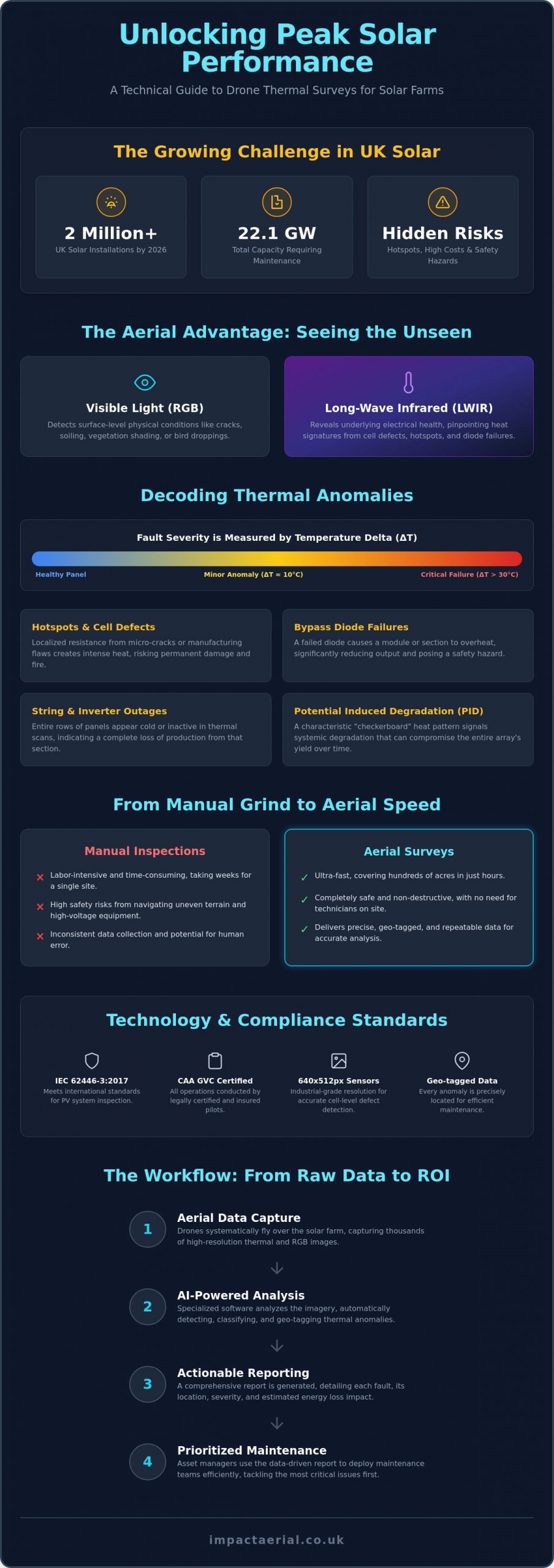
The UK Regulatory Landscape: Safety, Compliance, and Insurance
A professional drone thermal survey for solar farms requires more than high-end sensors; it demands a rigorous adherence to UK aviation law and electrical inspection standards. Operating on industrial sites involves managing risks associated with high-voltage equipment, public footpaths, and sensitive local infrastructure. To ensure data integrity and site safety, surveys must align with BS EN ISO 62446. This international standard governs the documentation and inspection of grid-connected photovoltaic systems, providing a legally defensible framework for warranty claims and safety audits. Meticulous compliance isn’t an optional extra; it’s the foundation of a reliable asset management strategy.
Risk mitigation begins long before the drone takes flight. Every project starts with a detailed pre-flight site assessment (PFSA) to identify local hazards, restricted airspaces, and ground-level obstacles. Emergency procedure protocols are established to manage potential equipment failures or unexpected site intrusions. This structured approach ensures that the survey process remains non-intrusive and safe, allowing the solar farm to continue generating power without interruption while the inspection is underway.
Why CAA GVC Certification is Non-Negotiable
The General Visual Line of Sight Certificate (GVC) is the mandatory qualification for pilots operating drones in the “Specific” category under Civil Aviation Authority (CAA) regulations. This certification proves that the pilot has undergone rigorous theoretical and practical testing to manage complex flight operations. Certified pilots are trained to handle airspace coordination and ground risk management, which is critical when flying near substations or residential boundaries. For a detailed breakdown of the latest requirements, you can read our UK Drone License: A Simple Guide to CAA Rules in 2026. Choosing an uncertified operator doesn’t just risk a fine; it potentially invalidates your site’s operational insurance.
Insurance and Liability for Solar Asset Managers
Hobbyist drone insurance is entirely insufficient for commercial solar environments. Professional surveys require specialist commercial-grade liability insurance that specifically covers aerial work and professional indemnity. While some providers offer lower tiers of coverage, £5m commercial liability insurance is the recognized industry standard for accessing utility-scale solar farms. Impact Aerial maintains a minimum of £5m liability for every project to provide total reassurance to asset managers. This coverage protects the client against third-party claims, accidental equipment damage, and business interruption, ensuring that your investment is fully protected from the moment our team arrives on site.
The Workflow: From Raw Data to Actionable Maintenance Reports
Executing a successful drone thermal survey for solar farms depends on a structured, multi-stage workflow. It isn’t just about flying; it’s about capturing data that is technically valid and legally defensible. The process begins with meticulous planning to align flight schedules with precise meteorological windows. Without the correct environmental variables, the resulting thermal imagery can produce false negatives, leading to missed faults and continued energy loss. This systematic approach ensures that every flight delivers a high-tier data set suitable for long-term asset optimization.
Optimal Conditions for Thermal Accuracy
For a survey to meet international standards like IEC TS 62446-3:2017, solar irradiance must be at least 600W/m². This level of sunlight ensures that the panels are operating at a sufficient capacity to generate detectable heat signatures from internal resistance. In the UK, managing this “window of opportunity” requires constant monitoring of cloud-free intervals. Cloud shadows create thermal noise that obscures genuine defects. Additionally, wind speeds must remain below certain thresholds. High winds cause convective cooling on the panel surface; this can mask subtle hotspots and skew the Delta T measurements required for fault classification.
Data Processing and Post-Production
Once the on-site data capture is complete, the raw thermal video and thousands of individual orthomosaic images move into post-production. This stage uses high-end analytic software to stitch the data into a single, geo-referenced map of the entire site. While AI-powered tools are excellent for the initial detection of anomalies, they aren’t infallible. Meticulous manual verification by a qualified thermographer is essential to filter out false positives caused by reflections or surface debris. This human oversight ensures that the maintenance team only receives accurate, verified data rather than raw, unrefined algorithmic guesses.
This level of technical precision is a hallmark of high-tier operations. You can learn more about how these processes integrate into broader industrial needs in our A Complete Guide to Professional Drone Services in the UK.
The final output is a comprehensive report featuring a “Red, Amber, Green” (RAG) severity rating system. Every identified fault is geotagged with sub-meter accuracy, allowing ground teams to navigate directly to the specific module requiring repair. This prioritized roadmap converts complex aerial data into a clear plan for asset optimization. If you are ready to secure your site’s energy output, book a professional drone thermal survey for solar farms today.
Maximising Solar Farm ROI with Impact Aerial
Maximising the return on investment for a utility-scale solar asset requires a shift from viewing maintenance as a cost to seeing it as a performance driver. A professional drone thermal survey for solar farms provides the empirical evidence needed to eliminate energy leakage. By identifying underperforming strings and faulty modules, asset managers can recover lost generation capacity that would otherwise remain hidden for years. Impact Aerial facilitates this transition by providing high-fidelity data that bridges the gap between aerial observation and electrical rectification. Our Birmingham-based team serves the entire UK renewable sector, ensuring that distance is never a barrier to high-tier technical surveying.
Our commitment to precision is supported by the use of DJI Enterprise drones, which are the industry standard for industrial-grade data capture. These platforms allow us to deploy high-resolution thermal and RGB sensors simultaneously, providing a dual-layered view of asset health. This hardware ensures that every pixel of data is geo-referenced and technically accurate, meeting the stringent requirements of O&M teams who need to execute immediate, targeted repairs. We don’t just provide images; we deliver a bespoke reporting suite tailored to the specific operational needs of your site technicians.
The Financial Case for Annual Thermal Audits
Annual audits are essential for maintaining the long-term viability of a solar portfolio. These surveys allow asset managers to support warranty claims against panel manufacturers by providing undeniable proof of manufacturing defects or premature cell degradation. It’s much easier to secure a replacement module when you have a geo-tagged thermal report showing a clear bypass diode failure. Impact Aerial provides the technical data needed for insurance and warranty validation. By moving to a proactive maintenance model, you can significantly reduce long-term O&M budgets and prevent minor faults from escalating into costly, large-scale outages.
Why Partner with Impact Aerial?
Choosing a survey partner is a matter of trust, compliance, and technical capability. Impact Aerial is defined by a meticulous approach to every project, from the initial pre-flight assessment to the final data delivery. Our credentials provide total reassurance for site owners and managers. We operate with full CAA GVC certification and maintain £5m in commercial liability insurance as standard. This professional foundation, combined with our high-spec hardware and data-centric processes, makes us a trusted specialist for the UK’s leading renewable energy firms.
If you’re looking to secure the longevity and output of your PV assets, the next step is a technical consultation. We can review your solar portfolio and design a survey schedule that aligns with your maintenance windows and regulatory obligations. To discuss your requirements and request a detailed proposal, contact the Impact Aerial team today.
Secure the Future of Your Solar Portfolio
Ensuring site safety and regulatory compliance is central to our process. Our team of CAA GVC Certified Pilots works within a framework of £5m Commercial Liability Insurance, providing total reassurance for every project. Combined with our expert post-production data analysis, we deliver the technical precision required for both warranty validation and operational excellence. It’s time to take control of your asset health with a partner dedicated to technical surveying standards.
If you’re ready to optimize your energy yield and extend the longevity of your installation, request a professional solar farm thermal survey quote from Impact Aerial today. We look forward to helping you maintain a high-performing and compliant solar portfolio.
Frequently Asked Questions
How often should a solar farm undergo a drone thermal survey?
Annual surveys are recommended to maintain a proactive maintenance schedule. This frequency allows asset managers to track degradation over time and catch bypass diode failures before they cause significant energy loss. Regular inspections also ensure that your site remains compliant with insurance requirements and safety standards.
What is the best time of year to conduct a thermal solar inspection in the UK?
The optimal window for a drone thermal survey for solar farms in the UK is between April and September. During these months, the sun is high enough in the sky to provide the necessary irradiance levels for accurate data. Clear, blue-sky days with low wind speeds are ideal to avoid thermal cooling or cloud reflections that can obscure faults.
Can a drone survey detect micro-cracks in solar panels?
Aerial thermography detects micro-cracks by identifying the localized heat they generate. While the crack itself might be microscopic, the resulting electrical resistance creates a distinct thermal signature. Using industrial-grade 640×512 sensors ensures these anomalies are captured clearly even from a standard flight altitude.
How long does it take to receive the final thermal report after the flight?
You can typically expect to receive a comprehensive, actionable report within five to ten working days after the data capture is complete. This timeline accounts for the meticulous post-production process. Our experts manually verify AI detections to ensure every identified fault in the RAG-rated report is accurate and ready for your O&M team.
Do I need to shut down the solar farm during the drone survey?
There is no need to shut down your site during the inspection process. In fact, the solar farm must be fully operational and under load for the thermal sensors to detect anomalies. This non-intrusive method allows you to maintain peak energy production while we conduct our safety and performance audit.
What is the minimum irradiance required for an accurate thermal reading?
An irradiance level of at least 600W/m² is required to ensure valid thermal data. This threshold is set by international standards to guarantee that panels are under enough electrical stress to reveal internal defects. We monitor local weather and irradiance levels constantly to ensure every flight occurs within these specific technical parameters.
Are drone thermal surveys accepted for manufacturer warranty claims?
Major panel manufacturers increasingly accept high-quality drone thermal data as evidence for warranty claims. To be valid, the survey must follow recognized standards like IEC 62446-3 and provide geo-tagged, high-resolution imagery. Our meticulous reporting provides the technical proof needed to hold manufacturers accountable for component failures.
How does the cost of a drone survey compare to manual panel testing?
A professional drone thermal survey for solar farms offers a significant cost advantage over manual IV curve tracing on utility-scale sites. While manual testing is labor-intensive and covers only a fraction of the panels, a drone captures data for 100% of the asset in a fraction of the time. This efficiency reduces total O&M expenditure while providing a more complete picture of site health.
Drone Inspection for Historical Building Preservation: The Expert Guide
The very scaffolding intended to save a historical building often poses the greatest threat to its structural integrity. For estate managers and conservationists, the traditional approach to maintenance is a high-stakes gamble involving heavy machinery and invasive access methods that can inadvertently damage the delicate fabric of a heritage site. You understand the frustration of paying for extensive access equipment only to receive incomplete data from limited ground-level perspectives.
We agree that protecting the UK’s architectural legacy requires a more sophisticated, lower-risk strategy. This expert guide reveals how drone inspection for historical building preservation delivers high-resolution 4K imagery and comprehensive structural data without a single boot touching the roofline. You’ll discover how to leverage advanced aerial surveys to identify hidden defects early, reducing long-term restoration costs and eliminating many of the health and safety risks associated with working at height. We’ll examine the technical capabilities of modern hardware, the importance of 2026 CAA regulatory compliance, and how precision data serves as the foundation for modern heritage conservation.
Key Takeaways
- Learn how drone inspection for historical building preservation uses UAV technology to capture sub-millimetre structural details without touching sensitive building fabric.
- Understand the technical advantages of using 4K HDR imagery to identify hairline cracks in lime mortar that are invisible from the ground.
- Compare the operational ROI of rapid drone deployments against the high costs and logistical delays of traditional scaffolding.
- Navigate the essential CAA regulatory requirements and safety protocols necessary for operating within heritage-rich Flight Restriction Zones.
- Discover how to convert raw aerial data into actionable insights for architectural conservation reports and contractor briefings.
The Evolution of Heritage Conservation: Why Drones are Essential
Heritage conservation has entered a new era where data replaces guesswork. Traditionally, inspecting the upper reaches of a cathedral or a Grade I listed manor required significant physical intervention and high costs. Today, drone inspection for historical building preservation provides a non-invasive solution that prioritises the safety of the structure. We define this process as the strategic use of UAVs to capture sub-millimetre structural detail from angles that were previously inaccessible. It’s no longer just about taking a photo; it’s about creating a comprehensive digital record of a building’s health.
This technological shift has moved the industry from reactive repairs to a proactive, preventative maintenance model. Instead of waiting for a structural failure to occur, estate managers use regular aerial surveys to spot the earliest signs of decay. This same forward-thinking approach is often applied to the protection of estate grounds; to learn how to manage wildlife humanely, visit Revira. Traditional access methods, such as cherry pickers or reach-and-wash systems, often struggle in the tight, irregular environments typical of UK heritage sites. These machines are bulky, have limited reach, and can’t navigate the complex geometry of gothic or baroque architecture without risking a collision.
To better understand how this technology integrates into a site assessment, watch this video:
The role of high-resolution 4K HDR imagery is central to this evolution. These sensors capture the subtle textures of historic masonry, allowing conservationists to identify hairline cracks in lime mortar or the early stages of stone delamination. By documenting these features with such clarity, we create a baseline for future comparisons. This ensures that every architectural detail is preserved for the next generation with meticulous accuracy.
Overcoming Accessibility Challenges in Historic Architecture
Historic buildings are often surrounded by physical constraints that make ground-based surveys incomplete. Drones easily reach high-level chimney stacks, parapets, and hidden roof valleys without the need for expensive platform hire. They can fly into internal courtyards or hover near delicate spires where ground-based equipment simply cannot go. When combined with 3D laser scanning technology, these aerial platforms provide a 360-degree view of decorative masonry that would otherwise remain hidden from view.
Non-Invasive Surveying: Protecting Fragile Surfaces
The primary concern for any conservation officer is the risk of accidental damage. Traditional ladders and machinery carry the risk of “ladder rash” or stone chipping when equipment makes contact with friable surfaces. Even the process of erecting large-scale scaffolding can introduce harmful vibrations to a fragile structure. Choosing drone inspection for historical building preservation ensures that the building remains undisturbed while the surveyor gathers the high-fidelity data needed for a restoration plan. Because drones are entirely “no-contact,” they are increasingly preferred by national conservation bodies like Historic England.
Technical Capabilities: From 4K HDR to Thermal Masonry Analysis
Modern heritage conservation relies on the precision of high-tier hardware. We utilise DJI Enterprise drones specifically for their stability and redundant safety systems, which allow for controlled, close-proximity flight near sensitive architectural features. These platforms carry sophisticated payloads that go far beyond standard photography. When conducting a drone inspection for historical building preservation, the quality of the sensor is the primary factor in determining the success of the survey. High-resolution 4K HDR video is essential because it captures the necessary dynamic range to reveal hairline cracks in lime mortar or stone that would otherwise be lost in deep shadows or bright highlights.
One of the most significant advantages of professional UAVs is their advanced zoom capability. High-magnification lenses allow specialists to inspect fine details on high-level cornices or chimney stacks from a safe distance, ensuring the aircraft never risks physical contact with the structure. Organizations such as the National Trust and Historic England have increasingly adopted drones for detailed surveys to replace more invasive and costly traditional methods. This data-first approach provides a level of scrutiny that ground-based binoculars simply cannot match.
Thermal Imaging for Hidden Decay Detection
Thermal sensors provide a unique look beneath the surface of ancient buildings. By detecting minute temperature variances, we can identify damp patches and water saturation hidden behind external render or within thick masonry walls. This technology is equally effective for detecting thermal bridging in historic window frames and roofing systems. Thermal sensors identify moisture patterns in ancient stone by detecting the evaporative cooling effect where water is present, allowing for targeted repairs before structural decay sets in. If you’re managing a complex site, our professional property surveys can help identify these invisible risks early.
Photogrammetry and 3D Digital Twins
Beyond static imagery, photogrammetry allows us to create accurate 3D digital twins of historical sites. These models serve as definitive ‘as-built’ documentation, providing a centimetre-perfect record of the building’s current state. Conservationists use these digital twins to track structural movement or erosion over multiple years, comparing different datasets to measure the rate of deterioration. Integrating these outputs with standard drone survey workflows ensures that every architectural detail is mapped into a comprehensive site report, facilitating highly accurate restoration planning.
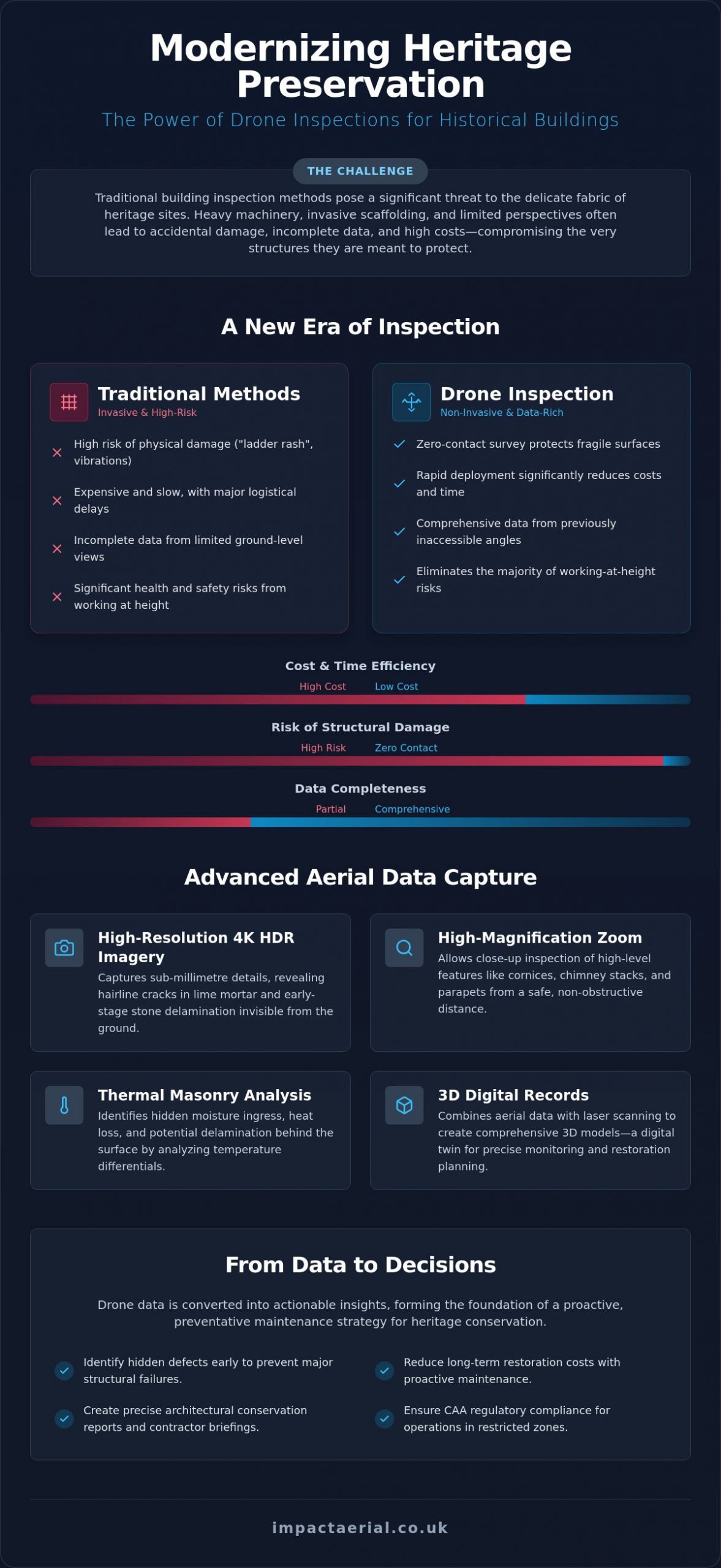
Drones vs. Scaffolding: A Practical Comparison of ROI and Safety
Traditional scaffolding is often the single most expensive line item in a restoration budget. When evaluating the logistics of a drone inspection for historical building preservation against traditional methods, the differences in efficiency are stark. Erecting a scaffold tower for a simple roof survey can take days or even weeks of planning, permitting, and manual labour. In contrast, a professional UAV deployment takes minutes. This rapid response allows estate managers to conduct “health checks” more frequently, ensuring that minor issues are identified before they escalate into major structural failures.
Health and safety remains the primary driver for this shift in methodology. By using aerial technology, we remove the human element from high-risk, at-height environments. There’s no longer a need for surveyors to navigate slippery lead-work or crumbling parapets on a ladder. This reduction in physical risk is matched by a significant reduction in site disruption. For public-facing heritage attractions and museums, the sight of heavy scaffolding can deter visitors and obscure the very architecture they came to see. Drones operate discreetly, allowing the site to remain open and revenue-generating throughout the inspection process.
Cost-Benefit Analysis for Heritage Managers
The financial argument for aerial surveys is compelling. High-resolution data often eliminates the need for “exploratory” scaffolding, which is frequently erected just to find out if a repair is actually necessary. For organisations dependent on external funding, the speed of data turnaround is a critical advantage. We provide the detailed imagery required for urgent grant applications in a fraction of the time it takes to commission a manual survey. This proactive approach leads to substantial long-term savings. Early detection of a slipped slate or a blocked gutter prevents the catastrophic water ingress that often costs tens of thousands of pounds to remediate.
Mitigating Risk in Public Spaces
Operating in busy city centres or popular tourist landmarks requires a meticulous approach to risk management. We conduct our surveys without the need to close sites to pedestrians or visitors, maintaining a safe cordon while the aircraft is in flight. There is a deep psychological reassurance in using professional drone services that carry comprehensive liability insurance and adhere to strict safety protocols. This professional standard reduces the liability footprint on any construction site within heritage grounds. It ensures that the preservation of the building never comes at the expense of public safety or operational continuity. Many estate managers now view the adoption of drone inspection for historical building preservation as a standard first-phase protocol for all maintenance cycles.
Regulatory Compliance: Navigating CAA Rules for Heritage Sites
Flying a drone over a Grade I listed structure or a scheduled monument involves more than just technical skill. It requires a deep understanding of the legal landscape. For any commercial drone inspection for historical building preservation, the operator must hold a valid General Visual Line of Sight Certificate (GVC). This is not optional. It’s a legal requirement that ensures the pilot has undergone rigorous training in air law, meteorology, and operational safety. Compliance is the foundation of every survey we conduct, providing a framework that protects both the heritage asset and the public.
Many of the UK’s most significant heritage assets are located in historic city centres, which often fall within Flight Restriction Zones (FRZs). Operating in these areas requires specific coordination with Air Traffic Control and local authorities. To mitigate the unique risks associated with high-value architectural projects, we maintain £5m in commercial liability insurance. This level of coverage provides the necessary reassurance for estate managers and trustees that their assets are protected. We also implement strict privacy protocols, ensuring that data collection is focused solely on the structural elements of the building while respecting the privacy of the surrounding community.
The Role of the CAA GVC Certified Pilot
A GVC certified pilot is a risk management specialist. They don’t just fly; they conduct detailed pre-flight assessments to identify every potential hazard in complex, high-stakes environments. Staying current with the latest drone license regulations in 2026 is vital. This includes understanding the transition to UK-specific class marks (UK0 to UK6) and the mandatory use of Remote ID for new hardware. Every flight is meticulously logged, ensuring full compliance with national aviation standards and providing a transparent audit trail for conservation stakeholders.
Site-Specific Permissions and Planning
Planning starts weeks before the aircraft leaves the ground. We coordinate with local councils and heritage bodies to secure the necessary permissions for takeoff and landing. A pre-flight site survey is conducted to map out local obstacles such as power lines or nearby nesting birds, which are protected by law. Our operational safety cases are built to be robust enough for the most sensitive Grade I listed environments. This meticulous preparation ensures that our preservation efforts never compromise public safety or operational continuity. If you need a compliant partner for your next project, contact our certified drone team today to discuss your specific site requirements.
Implementing Drone Data into Your Preservation Strategy
The true value of a drone inspection for historical building preservation lies in how the raw data is processed and integrated into a long-term conservation strategy. Capturing high-resolution aerial imagery is only the first step. The utility of this data is maximised when it is translated into actionable architectural reports that guide restoration efforts. We focus on delivering data that doesn’t just show a problem; it provides the specific detail needed for structural engineers and conservation officers to make informed decisions. Our specialised post-production services refine raw footage, enhancing clarity and contrast to ensure that every hairline fracture or failed flashing is unmistakable for the end-user.
Using 4K video and high-fidelity stills allows estate managers to brief restoration contractors with absolute precision. Instead of relying on verbal descriptions or distant ground-level photos, you can provide a clear, high-definition visual of the masonry requirements. This reduces the likelihood of miscommunication and ensures that quotes for repair work are accurate. By incorporating this data into a digital twin or a long-term maintenance log, you create a historical record that allows for the monitoring of structural changes over decades. This data-centric approach is the hallmark of modern heritage management.
For owners of historic residential estates, securing the exterior is often just the first phase of a broader restoration project. Once structural stability is confirmed, the focus often turns to interior aesthetics; bespoke design consultancy from appreciationproject.co.uk can help integrate modern functionality with the timeless character of a heritage property.
From Aerial Imagery to Restoration Plans
Annotating high-resolution photographs allows us to pinpoint specific areas requiring urgent stone masonry work or lead replacement. These annotated datasets are shared across multidisciplinary teams via secure cloud-based platforms, ensuring that architects, contractors, and site managers all work from the same high-fidelity source. This collaborative access speeds up the decision-making process significantly. Beyond technical assessment, this 4K footage serves a dual purpose. It is often incorporated into marketing or educational content, allowing heritage sites to showcase their preservation efforts to the public and potential donors with stunning cinematic perspectives.
Why Impact Aerial is the Trusted Partner for Heritage
Impact Aerial is built on a foundation of technical excellence and strict regulatory compliance. We exclusively use DJI Enterprise hardware to ensure maximum stability and data precision during the most demanding surveys. Operating from our Birmingham base, we provide rapid deployment across the West Midlands and the wider UK, offering the local knowledge and technical expertise required for sensitive Grade I and Grade II* environments. Our team also specialises in high-end visuals. You can learn more about our aerial filming drone capabilities for cinematic heritage documentation. Ready to secure the future of your site? Contact Impact Aerial for a professional heritage drone survey quote today to discuss your specific site assessment needs.
Securing the Future of the UK’s Architectural Heritage
The transition from reactive repairs to data-driven preservation is a vital step for modern estate managers. By adopting drone inspection for historical building preservation, you gain a non-invasive tool that protects fragile masonry while delivering sub-millimetre structural detail. This methodology eliminates the high costs and physical risks associated with traditional scaffolding, replacing guesswork with high-resolution 4K and thermal data. We provide the technical expertise and regulatory security needed to navigate complex heritage environments safely. Our operations are underpinned by CAA GVC Certified Pilots, £5m Commercial Liability Insurance, and the latest commercial-grade DJI Enterprise Hardware. This combination of professional standards and precision technology ensures that your site assessment is thorough, compliant, and cost-effective. Don’t let your building’s health remain a matter of guesswork or high-risk manual surveys. Request a Professional Heritage Drone Survey Quote to begin your site assessment today. It’s time to leverage professional aerial data to ensure your heritage assets stand strong for generations to come.
Frequently Asked Questions
Can drones safely inspect fragile Grade I listed buildings?
Yes, drones are the safest and least invasive method for inspecting fragile Grade I listed buildings. They eliminate the need for any physical contact with the structure, which prevents accidental damage like “ladder rash” or stone chipping. Professional pilots use high-resolution zoom lenses to capture minute details from a safe distance, ensuring the aircraft never risks a collision with sensitive architectural features.
What is the accuracy of a drone-based measured building survey?
Drone surveys provide sub-millimetre precision when using high-resolution sensors and photogrammetry techniques. This level of detail is often superior to ground-based surveys because the aircraft can capture data from roof valleys, parapets, and high-level masonry that are inaccessible from the ground. The resulting 3D models and digital twins provide a perfect “as-built” record for conservation planning.
Do I need to close my heritage site to the public during a drone inspection?
It’s rarely necessary to close a heritage site to the public during an aerial survey. We manage public safety by establishing a small, mobile ground cordon directly beneath the flight path. This allows visitors to continue exploring the site undisturbed. It’s a significant advantage over traditional scaffolding, which often requires closing entire sections of a building for weeks at a time.
How much does a drone survey for a historical building cost compared to scaffolding?
A drone survey is significantly more cost-effective because it removes the massive labour and equipment expenses associated with traditional access towers. While the exact investment depends on the site’s complexity, the ROI is found in the rapid data turnaround and the elimination of “exploratory” scaffolding. You’re paying for high-quality data rather than weeks of bulky equipment hire and logistical planning.
Can drones detect moisture and damp in old stone walls?
Yes, drones equipped with thermal sensors are highly effective at identifying moisture and damp in ancient masonry. This is a vital component of drone inspection for historical building preservation. Thermal imaging identifies temperature variances caused by water saturation or evaporative cooling, revealing hidden damp patches behind external render or stone that would be completely invisible to the naked eye.
What qualifications should a drone pilot have for heritage work in the UK?
A pilot must hold a General Visual Line of Sight Certificate (GVC) from the Civil Aviation Authority to conduct drone inspection for historical building preservation commercially. For heritage work, it’s also essential they carry at least £5m in commercial liability insurance. You should also ensure they use enterprise-grade hardware, such as DJI Enterprise models, which offer the stability and sensor quality required for high-stakes environments.
What happens if a drone crashes into a historic building?
We mitigate this risk through omnidirectional obstacle sensing technology and rigorous pre-flight safety protocols. Modern enterprise drones have redundant systems designed to prevent collisions even in complex environments. In the highly unlikely event of an incident, our £5m commercial liability insurance provides complete financial security for the client, ensuring that your heritage asset is fully protected and surveyed with absolute accountability.
How long does it take to get the results of a drone building inspection?
You can typically expect to receive your processed data and reports within 3 to 5 working days. While the actual flight might take only a few hours, we spend additional time in post-production to ensure the imagery is clear and the data is actionable. This is much faster than traditional manual surveys, which can take weeks to compile into a finished architectural report.
How to Vet a Commercial Drone Company: A Professional Buyer’s Guide for 2026
Hiring the wrong drone operator in 2026 is no longer just a matter of receiving poor-quality footage; it’s a significant legal and financial liability for your business. With the UK’s transitional period for legacy drones now officially over, the regulatory landscape has become a complex minefield for the uninitiated. You likely feel the pressure to secure high-accuracy survey data or cinematic 4K visuals while fearing that a single compliance oversight could void your corporate insurance. Learning exactly how to vet a commercial drone company is the only way to protect your budget and your reputation in an industry that now demands absolute technical precision.
We’ve designed this professional buyer’s guide to strip away the confusion surrounding CAA terminology and the latest UK class mark requirements. You’ll learn the exact technical, safety, and regulatory criteria needed to hire a compliant operator who delivers reliable results rather than excuses. We’ll walk through the essential documentation you must request, from valid Operator IDs to specific liability coverage, ensuring your next project is backed by expert-level risk mitigation and high-end data quality.
Key Takeaways
- Understand the critical legal distinction between an Operator ID and a Flyer ID to ensure your provider is correctly registered on the CAA national database.
- Identify the specific technical qualifications, such as the General Visual Line of Sight Certificate (GVC), required for complex or high-risk commercial operations.
- Discover how to vet a commercial drone company by evaluating their industry-specific hardware and their ability to deliver technical data like Ground Sample Distance (GSD).
- Learn why mandatory safety documentation, including a site-specific Risk Assessment and Method Statement (RAMS), is non-negotiable for maintaining corporate insurance compliance.
- Utilize a professional 10-point checklist to streamline your procurement process and guarantee high-accuracy survey data or cinematic 4K footage.
The Regulatory Baseline: Verifying CAA Compliance and Insurance
Compliance is the bedrock of professional aerial work. When you set out to learn how to vet a commercial drone company, your first step must be confirming that the provider exists legally within the Civil Aviation Authority (CAA) framework. There’s a critical distinction between an Operator ID and a Flyer ID. The Operator ID is the registration for the business entity responsible for the aircraft, while the Flyer ID confirms the individual pilot has passed the necessary competency tests. Understanding these global drone regulations ensures you aren’t accidentally hiring a hobbyist masquerading as a professional.
Vetting also requires checking for a valid Operational Authorisation on the CAA register. This document is essential for any flight that falls outside the basic “Open” category, such as work in congested urban areas or near industrial infrastructure. While older PfCO (Permission for Commercial Operations) qualifications have largely been replaced by the General Visual Line of Sight Certificate (GVC), you must verify that your pilot’s credentials are current. As of January 1, 2026, the UK has fully transitioned away from legacy drone categories; all new aircraft must carry a UK class mark from UK0 to UK6. Hiring an operator who doesn’t understand these transitions exposes your business to significant legal risk.
To better understand the level of professionalism required in this industry, watch this helpful video:
Validating the CAA Operator ID
A legitimate company will provide their Operator ID upon request. You can verify this number directly through the CAA’s official portal to ensure it remains active and linked to the correct business entity. By law, this Operator ID must be physically displayed on the aircraft in a clear, readable format. If a pilot claims they don’t need an ID because their drone weighs less than 250g, treat this as a major red flag. In a commercial context, any drone equipped with a sensor capable of capturing personal data requires a valid Operator ID, regardless of its weight.
Commercial Liability Insurance: The £5m Standard
Standard public liability insurance is rarely sufficient for the unique risks of aerial work. Professional operators must carry insurance that is specifically compliant with EC 785/2004, which is the legal standard for aviation insurance in the UK. Impact Aerial maintains a £5m commercial liability baseline to provide maximum peace of mind for our clients. Always verify that a provider’s policy covers the specific environment of your project, whether that involves a high-risk construction site or a city centre property survey. This level of coverage is a primary indicator of how to vet a commercial drone company for corporate-level reliability.
Technical Competency: Evaluating Pilot Skills and Hardware
Compliance ensures an operator is legal, but technical competency ensures they are capable. A pilot’s ability to capture high-accuracy survey data or cinematic 4K footage depends on a combination of advanced flight qualifications and specialized hardware. When you look at how to vet a commercial drone company, you must look beyond the basic flyer ID. True technical proficiency is demonstrated through sector-specific experience and the use of enterprise-grade equipment designed for precision rather than recreation.
Industry experts suggest that evaluating pilot skills requires a deep dive into flight logs and previous mission profiles. A pilot who primarily shoots rural landscapes may lack the spatial awareness required for complex structural inspections in dense urban environments like Birmingham. You should request proof of flight hours in similar settings to ensure the team can safely manage the unique risks of your specific site.
The GVC Certification Advantage
The General Visual Line of Sight Certificate (GVC) is the professional standard for drone operations in the UK. This qualification is more rigorous than basic online tests; it requires a formal practical flight assessment and a detailed operations manual. Holding a GVC allows a pilot to operate in the “Specific” category, which provides the legal flexibility to fly closer to people and property than hobbyist rules allow. For a detailed breakdown of these requirements, consult our UK Drone License guide.
Commercial-Grade Hardware Requirements
Professional results require professional tools. There is a vast difference between consumer drones and the DJI Enterprise hardware used by specialists. Impact Aerial utilizes advanced platforms like the DJI Matrice 350 RTK for technical surveys and the DJI Inspire 3 for high-end cinematic work. These systems offer features that consumer models lack:
- Redundancy: Dual-battery systems and multiple inertial measurement units (IMUs) ensure the drone stays airborne even if a component fails.
- Sensor Quality: 4K HDR cameras provide the dynamic range needed for professional post-production, while thermal sensors are essential for PV solar farm surveys.
- Safety Systems: 360-degree obstacle avoidance and built-in ADS-B receivers allow pilots to detect and avoid manned aircraft in real-time.
Redundancy isn’t optional for corporate projects. If you need reliable data for construction site monitoring, ensure your provider isn’t relying on consumer-grade “prosumer” drones that lack these critical safety and precision features.
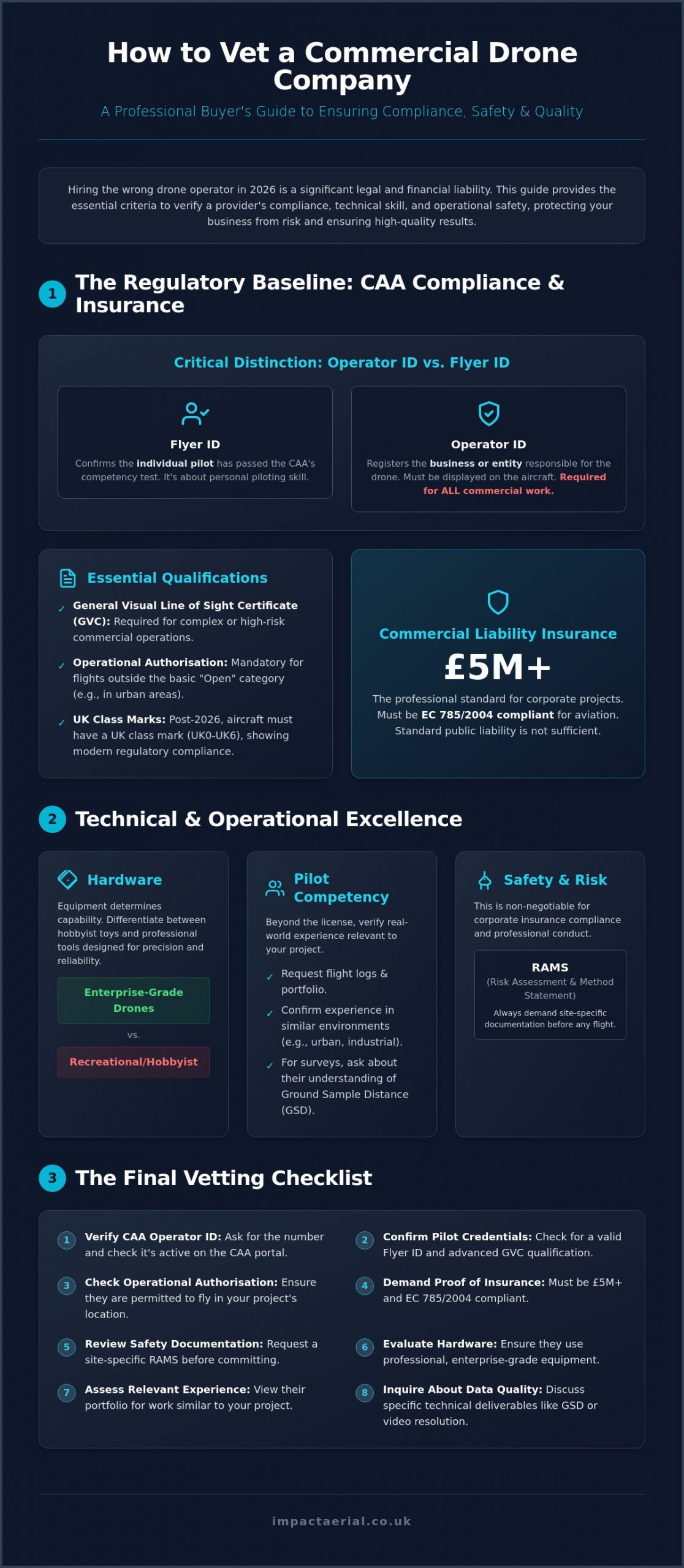
Industry-Specific Expertise: Surveys vs. Creative Filming
A common mistake during procurement is assuming a drone is simply a flying camera. While the underlying technology is similar, the skillset required for a technical roof inspection is fundamentally different from that of a high-end marketing film. When you look at how to vet a commercial drone company, you must evaluate their specific experience in your required sector. A pilot who excels at sweeping cinematic shots may not understand the rigorous overlap and metadata requirements needed for accurate photogrammetry or topographical mapping.
For technical applications, vetting for data accuracy is paramount. You should ask potential providers about their Ground Sample Distance (GSD) capabilities. GSD represents the distance between the centres of two consecutive pixels measured on the ground; the lower the GSD, the higher the spatial resolution of the data. Professional standards, such as the FAA requirements for commercial drone pilots in the United States, mirror the UK’s own rigorous CAA certification process, emphasizing that commercial flight is a global professional standard requiring specific technical knowledge. High-accuracy survey data relies on this technical understanding of sensor resolution and flight altitude.
Vetting for Commercial Property Surveys
When reviewing a drone survey portfolio, look for consistency in image clarity and comprehensive coverage. A professional survey should include detailed metadata and sufficient image overlap to create high-resolution orthomosaics or 3D models. If you require specialized work, such as PV solar farm thermal surveys, ensure the company holds specific thermography certifications. They should also demonstrate how they integrate aerial data with other technologies, such as 3D virtual tours, to provide a complete view of the asset.
Vetting for Aerial Filming and Marketing
Creative vetting requires a different approach. Evaluate the company’s showreel not just for “cool shots,” but for smooth gimbal movement, professional colour science, and cinematic composition. Stability is key; any micro-jitters in the footage indicate poor hardware or lack of pilot skill. You should also consult our aerial filming drone guide to understand the cinematic standards expected in 2026. Ask whether the company provides end-to-end service, including post-production editing and colour grading, or if they only deliver raw files.
The vetting process shouldn’t end when the drone lands. You need to know how the data will be processed and delivered. A professional firm provides a complete solution, from initial risk assessment and flight planning to the delivery of actionable data or a polished final film. Ensure your chosen partner has the internal infrastructure to handle large 4K or 8K data sets and the technical expertise to translate that data into the specific formats your business requires.
Operational Safety and Risk Management (RAMS)
Safety is not just about avoiding accidents; it’s about systematic risk mitigation that protects your business from legal exposure. When considering how to vet a commercial drone company, you must evaluate their operational workflow before the drone even leaves its case. A professional operator treats every flight as a high-stakes aviation mission, requiring meticulous planning and clear communication protocols. This stage of the vetting process reveals the difference between a casual flyer and a technical specialist who understands the gravity of corporate liability.
Pre-flight planning starts days before the site visit. An expert team will assess the local airspace for permanent or temporary restrictions, identify ground hazards like overhead power lines, and monitor weather trends that could impact flight stability. On the day of the operation, the pilot in command must manage the site environment effectively. This includes establishing a “sterile area” for takeoff and landing and ensuring all site staff are briefed on the flight plan. They must also have a clear strategy for managing onlookers or members of the public who may enter the flight zone unexpectedly.
Emergency procedures are a vital component of professional vetting. You should ask your provider about their “Plan B” for various scenarios. What happens if there is a sudden equipment failure or an unauthorized aircraft enters the airspace? A compliant company has documented procedures for these events, ensuring the pilot can react instantly to maintain safety. This level of preparation is what guarantees a risk-free hiring process and ensures your corporate insurance remains valid throughout the project.
What a Professional RAMS Document Looks Like
A site-specific Risk Assessment and Method Statement (RAMS) is the most important document you will receive during the procurement phase. Unlike generic templates that some low-cost operators use, a professional RAMS is tailored specifically to your project location. It should include a detailed site map, specific identified hazards, clear mitigation steps, and emergency contact details for local authorities. You must review and sign off on the RAMS before any work begins to ensure all parties are aligned on the safety protocols and operational boundaries.
Airspace Management and Permissions
Managing the sky is as complex as managing the ground. Professional operators have the expertise to secure a Notice to Airmen (NOTAM) if the mission requires it, alerting other pilots in the vicinity to their presence. If your project is located near an airport or within a Restricted Area, the company must demonstrate their ability to coordinate directly with Air Traffic Control (ATC). They may also utilize trained ground observers to maintain a 360-degree view of the airspace, providing an extra layer of protection against mid-air incursions.
This level of meticulous planning ensures that your project remains compliant, safe, and efficient. If you require a partner that prioritizes safety and regulatory adherence above all else, contact Impact Aerial for a professional consultation on your next aerial project.
The Final Vetting Checklist: Impact Aerial’s Professional Standard
Vetting a drone provider shouldn’t be a guessing game that leaves your business exposed to legal or financial risk. By this stage, you understand that regulatory compliance is merely the entry requirement and that true value lies in technical precision and operational safety. When you finalize your decision on how to vet a commercial drone company, you need a structured framework to ensure no detail is overlooked. A transparent quote should always be comprehensive, accounting for insurance, complex airspace planning, and the final post-production phase to avoid hidden costs later in the project.
Impact Aerial provides this framework through our own meticulous operational standards. We believe that professional buyers deserve absolute clarity before a single propeller turns. Testing a company’s expertise through an initial consultation is the most effective way to gauge their problem-solving abilities and technical depth. A provider that cannot explain their specific ATC coordination strategy or the Ground Sample Distance of their sensors is unlikely to deliver the high-accuracy results your corporate standards demand.
The 10-Point Commercial Drone Vetting Checklist
Use this scannable list during your procurement process to guarantee your chosen partner meets the 2026 industry standards for safety and quality:
- Valid CAA Operator ID: Is the business registered and is the ID displayed on the aircraft?
- GVC Certified Pilots: Do the pilots hold the General Visual Line of Sight Certificate for complex work?
- £5m+ Insurance: Does the policy meet EC 785/2004 standards with adequate liability limits?
- Site-Specific RAMS: Have you received a Risk Assessment and Method Statement tailored to your location?
- Industry-Specific Portfolio: Can they show previous success in your specific sector, such as construction or thermal surveys?
- Enterprise-Grade Hardware: Are they using stabilized, redundant systems like DJI Enterprise models with 2026-compliant UK class marks?
- Clear Data Delivery Timeline: Is there a documented schedule for when you will receive your files?
- ATC/Airspace Planning: Is the coordination with Air Traffic Control and local authorities included in the service?
- Post-Production Capabilities: Does the company offer in-house editing, colour grading, or data analysis?
- Professional Body Memberships: Are they affiliated with recognized industry registers or trade associations?
Choosing Impact Aerial for Your Next Project
Our Birmingham-based team of experts handles the entire vetting process for you, ensuring every flight is conducted with surgical precision. We manage the complex administrative burden of airspace permissions and safety documentation, allowing you to focus on your core business objectives. Whether you require high-accuracy survey data or cinematic 4K HDR marketing visuals, our commitment to safety and quality is absolute. Contact us today for a tailored drone services consultation and discover why we are the preferred partner for UK-wide commercial projects.
Elevate Your Operational Standards for 2026
Mastering how to vet a commercial drone company is the difference between a successful project and a significant legal liability. You now have the framework to distinguish between hobbyist operators and technical specialists who prioritize safety, precision, and regulatory adherence. By insisting on CAA GVC Certified Pilots and verifying £5m Commercial Liability Insurance, you protect your corporate interests and ensure the highest quality results. Technical excellence isn’t just about the pilot’s skill; it’s about the reliability of DJI Enterprise Hardware and the meticulous execution of site-specific risk assessments.
Don’t leave your next project to chance. A risk-free hiring process starts with choosing a partner that treats every flight as a critical aviation mission. Whether you require high-accuracy survey data or cinematic marketing footage, we’re here to provide the expert-level compliance your business demands. Take the final step in your procurement process and Request a Professional Drone Service Quote from Impact Aerial to secure your next project with industry-leading standards. We look forward to helping you achieve your goals with technical excellence and absolute reliability.
Frequently Asked Questions
Do I need a drone license to hire a commercial drone company?
You don’t need a personal license to hire a provider. However, the company you hire must hold a valid CAA Operator ID and the individual pilot must possess a Flyer ID. Part of learning how to vet a commercial drone company is ensuring they have the correct Operational Authorisation for the specific mission. The legal responsibility for flight safety and compliance rests entirely with the drone operator, not the client.
What insurance should a professional drone company have?
A professional provider must hold aviation-specific liability insurance that is compliant with EC 785/2004. Standard business public liability policies often exclude aviation activities, leaving you exposed to significant risk. Most corporate clients require a minimum of £1 million in coverage, though higher-risk sites like construction or industrial plants often demand £5 million or more. Always request a Certificate of Insurance that names your company as an additional insured for the project.
How much does it cost to hire a commercial drone pilot in the UK?
Pricing for professional drone services is typically based on the complexity of the operation, the specialized hardware required, and the volume of post-production data processing. A cinematic marketing film has different resource requirements than a technical PV solar farm thermal survey. When you evaluate how to vet a commercial drone company, look for transparent quotes that include all pre-flight planning, insurance, and data delivery fees rather than just a basic hourly rate.
What is a CAA GVC certification and why does it matter?
The GVC, or General Visual Line of Sight Certificate, is the professional standard for drone pilots operating in the UK’s “Specific” category. It replaced the older PfCO and requires a formal theory exam and a practical flight assessment. This certification is vital because it grants the pilot the legal authority to fly closer to people and property in urban environments. It demonstrates that the pilot has reached a verified level of competency and safety management.
Can drones fly in rain or high winds for commercial surveys?
Professional enterprise drones like the DJI Matrice 350 RTK have high IP ratings for moisture resistance and can handle wind speeds up to 12 metres per second. However, heavy rain or extreme gusts usually require the flight to be rescheduled to protect data quality and operational safety. High-accuracy surveys require stable conditions to ensure the sensors capture clear, usable imagery without motion blur or sensor interference that could compromise the final data set.
What happens if a drone crashes during a shoot on my site?
If an incident occurs, the pilot follows the emergency protocols outlined in the site-specific RAMS document. A professional company’s EC 785/2004 compliant insurance will cover third-party property damage or injury. The operator is also required to report certain incidents to the CAA and the Air Accidents Investigation Branch. This structured response is why vetting for robust insurance and safety procedures is non-negotiable for corporate risk management and protecting your business reputation.
How long does it take to get the data back from a drone survey?
Delivery timelines depend on the level of post-production required. Raw 4K footage or basic inspection photos are often available within 24 hours of the flight. More complex outputs, such as processed 3D models or topographical surveys, typically require 48 to 72 hours for data stitching and quality checks. A professional firm will provide a clear delivery schedule as part of their initial quote so you can plan your project milestones with absolute confidence.
Do I need to notify the police if I hire a drone company?
You generally don’t need to notify the police for standard commercial flights on private property. The drone operator is responsible for all necessary permissions, including coordinating with Air Traffic Control if the site is within a Flight Restriction Zone. In some sensitive urban areas, the pilot may inform the local police as a courtesy to prevent public concern, but this is managed entirely as part of their standard pre-flight planning and risk mitigation process.
Drone Filming Prices UK 2026: The Complete Budgeting & Hiring Guide
Hiring the cheapest drone operator isn’t just a budget risk; it’s a legal liability that could cost your business far more than the actual filming fee. You’ve likely encountered a confusing range of drone filming prices uk while planning your project, making it difficult to distinguish between a technical expert and an unvetted hobbyist. It’s natural to feel concerned about hidden costs or the validity of a pilot’s insurance, especially with the strict CAA regulations now in effect for 2026.
We understand that you need more than just high-end visuals; you require technical precision and full regulatory compliance to protect your brand. This guide will help you master the complexities of professional drone pricing, ensuring you know exactly what a fair market rate looks like for specialist aerial work. We’ll preview the essential safety standards, such as mandatory UK class marks and Remote ID requirements, while providing a clear framework to verify pilot credentials and secure a fully insured, compliant service with total confidence.
Key Takeaways
- Understand the core components of a professional quote, from pre-flight risk assessments to the final delivery of technical data and visuals.
- Learn how the 2026 UK drone regulations, including mandatory class marks and Remote ID, impact the selection and cost of a legal operator.
- Master the different billing structures for drone filming prices uk, including hourly rates for quick shoots and project-based fees for complex surveys.
- Use our 5-point verification checklist to spot red flags and ensure your chosen pilot is fully CAA compliant and insured.
- Discover how to balance budget with quality by hiring specialists who offer transparent value through meticulous operational standards.
What Influences Drone Filming Prices in the UK?
Understanding drone filming prices uk starts with looking beyond the flight time itself. A professional quote integrates three distinct phases: pre-flight planning, on-site operation, and post-production delivery. While a hobbyist might simply turn up and fly, a commercial operator spends significant hours conducting site surveys, checking weather windows, and preparing equipment to ensure every second of footage is usable and safe. The “time on site” you see is often just the tip of the iceberg in a professional workflow.
The hardware used also dictates the cost. There is a vast difference between consumer-grade video and the commercial-grade 4K HDR outputs required for high-end broadcast or construction monitoring. Professional Unmanned Aerial Vehicle (UAV) platforms offer better sensors, redundant safety systems, and the ability to capture data-rich files that stand up to professional colour grading. These high-tier outputs ensure that the final product meets the rigorous standards of modern commercial media.
To better understand the regulatory environment that influences these costs, watch this helpful video:
Operational challenges like Flight Restricted Zones (FRZ) add layers of administrative work. If your project sits near an airport or a sensitive government site, the pilot must secure specific CAA clearances before the drone even leaves the ground. This expertise in airspace management is a core component of the value provided by professional services, ensuring your project remains legal and uninterrupted.
Project Complexity and Risk Assessment
Filming in a dense urban environment like Birmingham city centre presents vastly different risks than a rural field in the Cotswolds. Urban shoots require meticulous Risk Assessment and Method Statements (RAMS) to manage pedestrian traffic and nearby structures. We don’t just fly; we manage the environment. Complex airspace permissions or CAA waivers for flying closer to people often require weeks of lead time and technical documentation, which naturally influences the final drone filming prices uk for that specific project.
Regional Logistics and Travel Factors
Geography plays a significant role in your budgeting. Many operators apply a “London Premium” due to the high costs of logistics and congestion within the capital. Conversely, basing operations in the West Midlands allows for more competitive structures while maintaining nationwide reach. Travel expenses are a standard addition, typically charged between 45p and 60p per mile. For long-term projects like construction site monitoring, multi-site contracts can often be negotiated at a more efficient rate than one-off shoots, providing better value over the duration of a build.
The Value of Compliance: Why Professional Pilots Cost More
Choosing an operator based solely on the lowest drone filming prices uk often ignores the hidden costs of non-compliance. As of January 1, 2026, the regulatory landscape has shifted significantly. Every new drone on the market must now carry a UK class mark, and Remote ID must be enabled during flight. These technical requirements aren’t just checkboxes; they’re legal mandates. When you hire a professional, you’re paying for an operator who has invested in compliant hardware and maintains a valid Operator ID, which currently costs £12.34 per year and requires annual renewal.
Hiring an uncertified “cowboy” operator introduces a massive financial risk to your business. The Civil Aviation Authority (CAA) takes illegal commercial work seriously. If a pilot operates without the necessary permissions or insurance, the client can be held liable for enabling the activity. This “Cowboy Risk” can lead to fines reaching £50,000 for the hiring company. Adhering to Civil Aviation Authority (CAA) regulations is the only way to insulate your brand from these legal repercussions. For a deep dive into these requirements, read our guide on the UK Drone License: A Simple Guide to CAA Rules in 2026.
Professional delivery also relies on enterprise-grade equipment. Operators using DJI Enterprise platforms or similar high-end systems provide better reliability and data security than those using consumer drones. These systems are designed for intensive commercial use, featuring redundant batteries and advanced obstacle avoidance. This hardware investment ensures that your project is delivered on time, without technical failures. If you need a partner who prioritises these standards, you can explore our professional aerial filming and photography options.
CAA GVC Certification and Operational Authorisation
The General Visual Line of Sight Certificate (GVC) is the gold standard for modern drone pilots. It proves the operator has undergone rigorous theoretical and practical testing. This certification is a prerequisite for obtaining an Operational Authorisation from the CAA, which allows for flights in more complex environments. Professional training costs and the administrative burden of maintaining these certifications are reflected in the day rate. However, this expertise ensures that emergency procedures are handled with precision, protecting both the public and your site.
Commercial Liability Insurance: The £5m Standard
Standard hobbyist insurance is fundamentally insufficient for commercial projects. Professional pilots carry insurance that is specifically EC 785/2004 compliant, which is the legal minimum for commercial flight in the UK. While some operators offer a basic £1m policy, many high-value commercial sites now require a £5m or even £10m public liability standard. This level of coverage protects the client from third-party claims and property damage, providing a layer of financial security that a budget operator simply cannot offer. This meticulous approach to risk mitigation is what separates a professional service from a risky alternative.
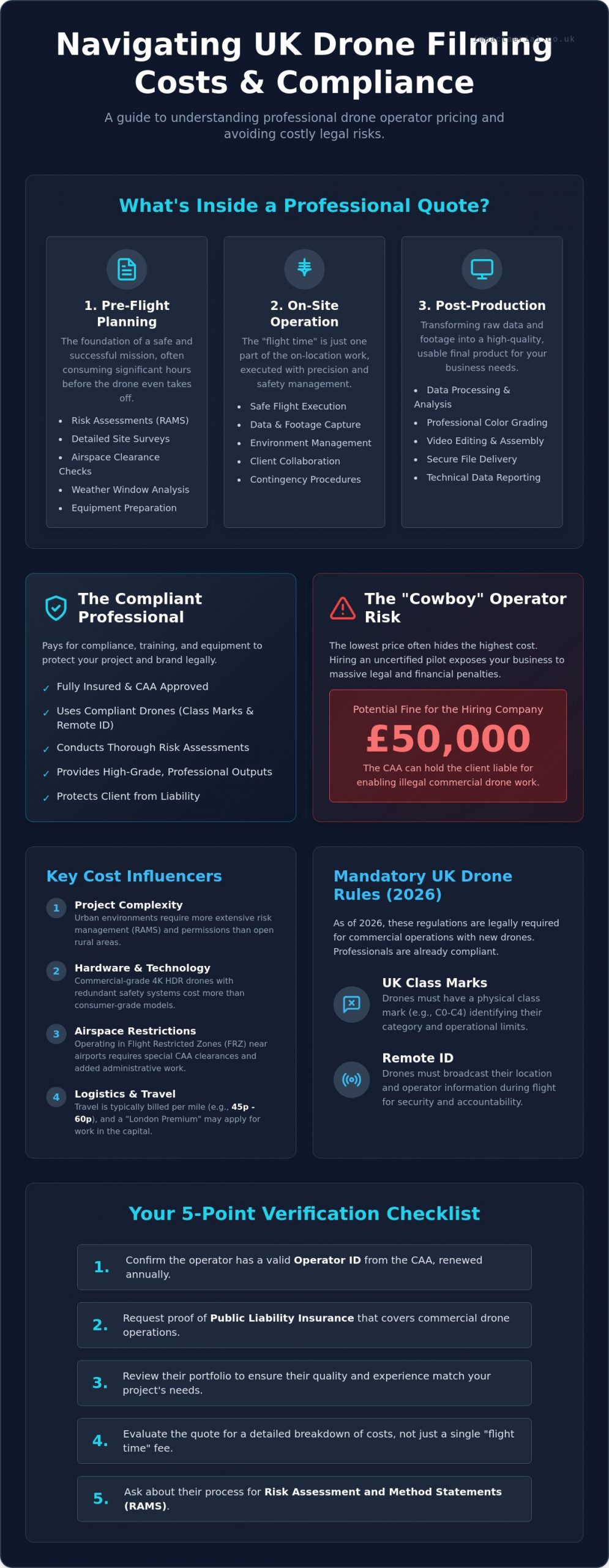
Standard Drone Filming Rate Structures in the UK
Beyond standard time-based billing, many specialists provide “Project-Based” pricing for complex deliverables. This is particularly common for advanced services like 3D virtual tours or PV solar farm thermal surveys, where the value lies in the technical data produced rather than just the time spent on site. These fixed-fee arrangements give businesses budget certainty for intricate workflows that involve multiple stages of data capture and sophisticated processing.
Hourly vs. Day Rates: Which is Better?
Hourly rates are often the most efficient choice for straightforward tasks that require minimal set-up time. Quick property shots or routine construction site progress updates fall into this category. However, for more intensive projects, a half-day or full-day rate usually offers better value. A full-day booking allows the pilot to capture footage during optimal lighting windows and perform multiple battery cycles without the pressure of a ticking clock. Most professional day rates include the pilot’s expertise, the deployment of a primary and backup drone, basic commercial insurance, and the secure transfer of raw data. This comprehensive package ensures that the operation is resilient against minor technical hitches or changing site conditions.
Post-Production and Data Processing Costs
It’s a common misconception that the project ends when the drone lands. In reality, the post-production phase can sometimes double the base flight cost due to the intensive studio time required. Raw 4K or 5K footage is often flat and requires professional colour grading to meet commercial standards. For technical applications like construction site monitoring or thermal surveys, the data must be processed through specialised software to generate accurate orthomosaics or heat maps. Virtual tour creation is another area where the workload shifts heavily to the studio; stitching 360-degree aerial views into a seamless, interactive experience requires meticulous attention to detail. This studio work is what transforms raw aerial data into a polished, high-end asset that provides tangible business value.
How to Evaluate a Drone Filming Quote
Receiving a technical quote requires a meticulous eye for detail that goes beyond the bottom line. A proposal that seems significantly lower than the standard drone filming prices uk usually signals a compromise in safety, equipment quality, or legal compliance. When you compare operators, you aren’t just buying footage; you’re hiring a risk management specialist. Technical precision is non-negotiable. To ensure you’re making an informed decision, use this 5-point verification checklist before signing any contract:
- CAA Operational Authorisation: Confirm the pilot holds a current OA for the specific category of flight required.
- Specific Insurance: Verify the policy is EC 785/2004 compliant and covers the exact site activity, such as construction site monitoring or thermal surveys.
- Industry-Specific Portfolio: Ensure the operator has experience in your sector; a pilot who excels at property photography may lack the technical rigour needed for commercial property surveys.
- Equipment Redundancy: Ask if the pilot carries backup aircraft to prevent project delays in the event of a technical fault.
- Transparent Deliverables: The quote must clearly define what you receive, including resolution, file formats, and usage rights.
Red flags often hide in what is missing from the paperwork. If an operator is reluctant to provide their Flyer ID or Operator ID, it’s a clear sign of professional negligence. For a more detailed framework on selecting the right partner, consult our A Complete Guide to Professional Drone Services in the UK.
Verifying Pilot Credentials and Insurance
Legitimate operators will proactively offer their credentials. You should request a copy of the pilot’s Flyer ID and the company’s Operator ID to verify their status on the national register. It’s equally vital to see the CAA Operational Authorisation (OA) document. This paperwork outlines the specific conditions under which the pilot can fly, including distance from uninvolved persons. Finally, check that their insurance isn’t just a generic public liability policy but one tailored for commercial drone operations that protects you from third-party claims on your specific site.
Reviewing Deliverables and Turnaround Times
Clarity on the final output prevents budget creep later in the project. Ensure the quote specifies commercial-grade 4K HDR resolution and the exact file formats your editors require. You should also agree on a concrete timeline for data delivery and any included revision cycles. Ownership is another critical factor. A professional quote should explicitly state that you hold the usage rights for the footage, ensuring your marketing or engineering teams can use the assets across all platforms without additional fees. Contact us today to receive a professional drone filming consultation tailored to your specific site requirements.
Impact Aerial: Professional Drone Services with Transparent Value
Impact Aerial bridges the gap between high-end technical precision and accessible drone filming prices uk. By maintaining a strategic operational base in Birmingham, we provide efficient nationwide coverage, reducing travel overheads for clients across the West Midlands and the rest of the UK. Our operations are built on a foundation of strict compliance, featuring a consistent commitment to £5m commercial liability insurance and full CAA GVC certification. This meticulous approach ensures that every project, regardless of scale, is executed within the highest safety and legal frameworks available in 2026.
We exclusively utilise DJI Enterprise drone systems to deliver superior data and visual quality. These platforms offer the technical redundancy and advanced sensor capabilities required for commercial-grade output, ensuring that our clients receive stable, high-resolution assets for every mission. We don’t just provide raw footage; we offer a reliable partnership that prioritises risk mitigation and technical excellence. Our team handles the complex administrative burden of flight planning and airspace permissions, allowing you to focus on your core business objectives while we capture the data you need.
Bespoke Quotes for Diverse Industries
Our pricing models are tailored to the specific demands of the property, construction, and advertising sectors. We understand that a construction site monitoring project requires a different technical approach and risk assessment than a high-end cinematic marketing campaign. Impact Aerial provides an end-to-end service, managing everything from the initial site consultation and RAMS preparation to the final post-production editing. This holistic approach ensures consistency and quality across the entire project lifecycle. For a detailed look at our visual standards and technical capabilities, explore our Aerial Filming Drone: The Ultimate Guide to Professional Cinematic Video.
Get a Professional Drone Filming Quote Today
Securing a transparent and accurate estimate for drone filming prices uk is a straightforward process with our technical team. To provide the most precise quote, we typically require the project location, the intended flight dates, and a brief overview of your required deliverables, such as raw data or fully edited films. Whether you need a one-off aerial survey or recurring construction monitoring, we offer detailed, no-obligation quotes that reflect the true value of professional expertise. Take the first step toward secure, high-end aerial data by choosing a partner that values compliance as much as you do. Request a Quote from Impact Aerial today to discuss your specific project requirements and receive a tailored proposal.
Securing Your Visual Assets with Technical Precision
Mastering drone filming prices uk requires a shift in perspective from viewing aerial work as a commodity to seeing it as a specialized technical service. By prioritizing CAA GVC certified pilots and verifying £5m commercial liability insurance, you protect your business from the significant legal and financial risks of non-compliance. Professional pricing isn’t just a fee for flight time; it’s an investment in meticulous risk management and the high-tier 4K HDR DJI Enterprise technology required for commercial-grade results.
Choosing an operator with transparent rate structures and a proven record in your specific industry ensures that your project is delivered on time and within budget. We provide the technical expertise and regulatory compliance necessary to transform complex aerial data into actionable business assets. You can Get a Professional Drone Filming Quote from Impact Aerial Today to start planning your next project with total confidence. We look forward to helping you achieve your commercial goals through precise, high-end aerial imaging.
Frequently Asked Questions
How much does a drone pilot cost per day in the UK?
Day rates for professional drone pilots depend on the complexity of the mission, the required hardware, and the pilot’s level of certification. A GVC-certified pilot using enterprise-grade equipment provides a comprehensive service that includes pre-flight site surveys, risk assessments, and technical data capture. This rate ensures you’re hiring a specialist who manages all legal and safety requirements, protecting your business from the liabilities associated with unvetted operators.
Do drone filming prices include travel expenses?
Travel expenses are typically calculated as a separate line item based on the distance from the pilot’s operational base. Most UK operators apply a standard mileage rate, often between 45p and 60p per mile, to cover fuel and vehicle maintenance costs. For long-distance projects or multi-day shoots requiring overnight stays, additional subsistence and accommodation fees may be detailed in your bespoke quote to ensure all logistics are covered.
Why is professional drone filming more expensive than a hobbyist?
Professional drone filming prices uk reflect the significant operational overheads required to maintain a legal and safe commercial service. Unlike hobbyists, professional pilots must hold valid CAA certifications, pay for annual Operator IDs, and carry specialist commercial liability insurance. They also invest in high-tier enterprise hardware with redundant safety systems, ensuring technical precision and data security that a recreational flyer cannot provide.
Are there extra costs for filming in London or major city centres?
Filming in dense urban environments like London or Birmingham city centres often incurs higher costs due to increased administrative and safety requirements. These locations frequently sit within Flight Restricted Zones (FRZ) or require specific CAA waivers to operate near people and buildings. The time spent coordinating with Air Traffic Control and local authorities, combined with the need for extra ground crew for pedestrian management, justifies a more complex pricing structure.
Does the price change based on the type of drone used?
The choice of aircraft is a primary factor in determining the final project cost. Operating high-end DJI Enterprise drones with thermal sensors or cinematic 4K HDR cameras requires a higher investment in equipment maintenance and technical training than using standard consumer models. These professional platforms offer the stability, data accuracy, and safety features essential for specialized tasks like construction site monitoring or commercial property surveys.
What is included in a standard drone photography package?
A standard professional package usually includes the pilot’s time, the deployment of a primary and backup aircraft, and the delivery of high-resolution images. Reputable quotes also encompass the pre-flight planning phase, site-specific risk assessments, and a minimum level of commercial insurance. You should receive a clear agreement on the number of final assets provided and the specific usage rights granted for your commercial or technical reports.
How much does it cost to add video editing to a drone shoot?
Post-production fees are generally calculated based on the total studio time required to process the raw data and create a finished film. Adding professional editing involves color grading, sound design, and the integration of your corporate branding or technical graphics. For complex projects, this phase might also include the creation of interactive virtual tours or the processing of thermal data, which requires specialized software and technical expertise.
Is insurance included in the drone filming quote?
Yes, any professional drone filming quote should include EC 785/2004 compliant commercial liability insurance as standard. While a basic £1m policy is common, many high-value commercial sites now require a £5m or £10m standard to mitigate third-party risks. You should always verify that the insurance covers your specific site activities and ask for a copy of the policy to ensure your project is fully protected from third-party claims.
Drone Survey for Landfill Sites: Precision Waste Management & Compliance
How much is a single centimetre of error worth when the Environment Agency is auditing your remaining airspace? For many UK landfill operators, traditional ground surveying isn’t just a slow process. It’s a significant safety liability that frequently results in “best guess” volumetric estimations. Walking on unstable waste piles to gather data puts staff at risk and often leads to the inaccurate reporting that triggers heavy EA fines. Integrating a professional drone survey for landfill sites changes this dynamic by shifting from interpolated estimation to absolute data certainty.
You’ll discover how millimetre-accurate volumetric data and high-resolution 3D site models provide a legally robust audit trail for your operations. We’ll outline how professional aerial surveys ensure compliance with the October 2026 mandatory Digital Waste Tracking Service while maintaining a zero-harm safety profile. From precise airspace calculations to reduced surveying costs, this guide explains how meticulous aerial data helps you navigate the increasingly strict regulatory environment with confidence and technical precision.
Key Takeaways
- Eliminate the significant safety risks of manual ground surveying by transitioning to high-altitude aerial data capture for 100% site coverage.
- Achieve millimetre-accurate volumetric reports that allow for precise remaining airspace calculations and compaction monitoring against original design files.
- Ensure full regulatory compliance by utilizing a professional drone survey for landfill sites to provide the traceable topographical evidence required by the Environment Agency.
- Gain superior data density with thousands of points per square metre, enabling the creation of high-resolution 3D models that far exceed traditional GPS capabilities.
- Understand the operational necessity of hiring CAA GVC certified pilots who utilize enterprise-grade hardware to maintain the highest safety and data standards.
Why Drone Surveys are Essential for Modern Landfill Management
Modern landfill management requires a level of precision that manual methods simply cannot provide. UAV landfill surveying involves high-altitude data capture using specialized aircraft to perform topographical mapping and volumetric analysis. This shift from “walking the lines” with handheld GPS units to 100% aerial coverage allows for millimetre-level precision across the entire subject site. Beyond simple mapping, these surveys support critical environmental licensing requirements and are vital for the eventual surrender of licenses for closed sites. Precise data ensures that landfill gas monitoring and leachate management systems are accurately positioned and monitored according to strict environmental standards. The result is a zero-harm safety profile and a rapid data turnaround that provides site managers with actionable insights in a fraction of the time required by traditional methods. Operators no longer need to rely on “interpolated estimations” that can lead to regulatory friction; instead, they gain absolute data certainty.
To better understand how this technology is applied in real-world scenarios, watch this helpful video:
The Safety Advantage: Eliminating On-Site Hazards
Safety is the cornerstone of any industrial operation. Traditional surveying requires staff to traverse active tipping faces and unstable terrain, exposing them to significant physical risks. By using a drone survey for landfill sites, you remove personnel from these hazardous zones entirely. This transition eliminates the risk of vehicle-pedestrian interfaces during peak operational hours. Data is captured from a safe altitude, allowing site work to continue without the need to pause heavy machinery or interrupt complex workflows. This non-intrusive approach ensures that your site remains productive while maintaining the highest possible safety standards for all on-site personnel. It provides psychological comfort to management, knowing that accurate data doesn’t come at the cost of staff welfare.
From Raw Imagery to Actionable 3D Models
The technical process begins with photogrammetry. Here, 4K HDR images are captured with high overlap and processed into georeferenced point clouds. These point clouds form the basis of a Digital Elevation Model (DEM), which provides a clear visualization of the site’s topography. This technical output allows operators to see every contour and slope with absolute clarity, identifying potential drainage issues or slope instabilities before they become critical. In this context, a Digital Twin is a high-fidelity, georeferenced 3D digital replica of the landfill site that allows for real-time analysis and historical comparison of waste levels and site evolution. By comparing these models over time, you create a meticulous record of site changes that is invaluable for long-term planning and compliance auditing.
Critical Applications: Volumetrics, Airspace, and Compaction
Calculating remaining airspace is no longer a matter of interpolation or guesswork. A professional drone survey for landfill sites provides absolute data certainty by generating high-resolution 3D overlays that compare current site conditions against the original Top of Waste (TOW) design files. This process allows operators to identify overfill hotspots long before they lead to regulatory friction or the need for expensive remediation. By capturing millions of data points across the entire site surface, aerial surveys ensure that every cubic metre of licensed void space is accounted for with millimetre-level precision.
Maximizing Airspace Efficiency
Efficiency in waste management depends on knowing exactly how materials are settling. By using advanced cross-section analysis, site managers can track how waste compresses under the final cap. This Z-axis data is critical for refining cell placement strategies and optimizing the use of available space. As highlighted in the technical review on Applying Drone Technology to Landfills, integrating CAD design files with drone-captured 3D meshes allows for a level of precision planning that traditional ground surveys cannot match. You can visualize the current state of a cell versus its final design profile in a digital environment, allowing for proactive adjustments to daily tipping operations.
Compaction and Settlement Monitoring
Monitoring compaction rates is essential for ensuring the maximum utilization of your licensed void space. By comparing sequential surveys over time, drones generate detailed heat maps that visualize elevation changes across the site. These maps are invaluable for identifying “soft spots” or uneven settlement in closed cells that might otherwise go unnoticed. Unlike standard software-only solutions, a meticulous approach to data collection enables “Z-axis” cross-section analysis. This provides a clear view of how materials are compressing over weeks or months, ensuring the density of the waste meets engineering requirements. Identifying these trends early helps maintain site integrity and prevents the structural issues often associated with uneven settlement.
Effective management also extends to the logistics of cover soil and daily cell materials. Drones provide accurate volumes for these stockpiles in minutes, ensuring that you never run short of essential materials for site maintenance. This technical approach to aerial data collection ensures that every operational decision is backed by a precise, georeferenced audit trail. It’s a methodical process that turns raw imagery into a powerful management tool for modern waste facilities.
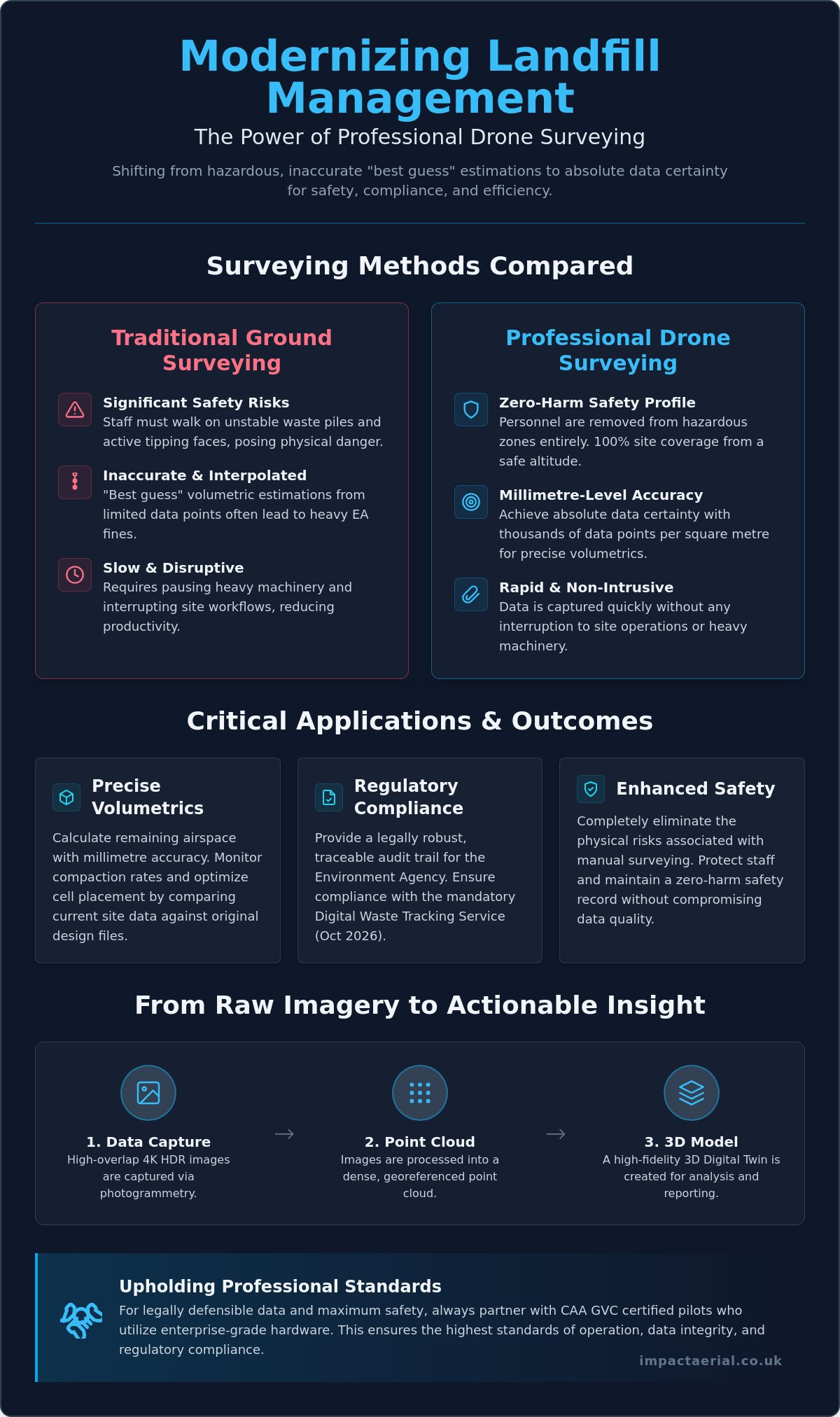
Environmental Monitoring and UK Regulatory Compliance
Meeting Environment Agency (EA) requirements for topographical evidence is a fundamental part of modern waste management. The EA demands precise, verifiable data to monitor site status and ensure that operations remain within their permitted boundaries. A professional drone survey for landfill sites provides this evidence with a level of detail that ground-based teams cannot match. It creates a definitive georeferenced record that satisfies regulatory audits and provides a transparent history of site activity. For local authorities managing un-licensed closed landfill sites, aerial surveys are invaluable for delineating waste boundaries where historical records may be incomplete or inaccurate.
When commissioning a drone survey for landfill sites, the technical credentials of the flight team are paramount. It is essential to hire CAA GVC certified pilots who understand the complexities of industrial airspace. This certification isn’t just a badge; it’s a legal requirement for complex commercial operations that ensures the pilot has the competency to manage risks on high-hazard sites. Operating without these credentials or the appropriate insurance can lead to significant legal liabilities for the site operator.
Advanced sensor technology has expanded the scope of environmental monitoring beyond simple photography. Thermal and multispectral sensors can now detect early signs of leachate leaks or sub-surface gas migration by identifying thermal anomalies or vegetation stress. This proactive approach is backed by global standards, such as the guidance from the EPA on detecting landfill emissions with drones, which highlights how aerial platforms provide a safer and more comprehensive view of methane plumes than traditional ground-level “sniffing” methods.
LiDAR vs. Photogrammetry for Closed Sites
Choosing the right sensor depends on the lifecycle stage of the landfill cell. While photogrammetry is excellent for active tipping faces, LiDAR (Light Detection and Ranging) is essential for older, closed sites. LiDAR pulses can penetrate heavy vegetation and scrub, allowing us to create accurate terrain models of the ground surface beneath the canopy. This is critical for monitoring settlement or identifying drainage issues on sites that have been reclaimed by nature and are no longer easily accessible on foot.
Audit-Ready Data for License Surrender
Surrendering an environmental license is a meticulous process that requires proof of site stability. We provide 100% coverage surveys that serve as definitive topographical evidence for the EA during the surrender application. Maintaining a digital archive of these surveys offers long-term liability protection, proving the state of the site at the point of handover. To ensure total client security, professional operators maintain £5m commercial liability insurance, providing the necessary reassurance when working in high-risk waste environments.
Comparing Drone Surveys to Traditional Ground-Based Methods
The technical superiority of aerial data collection becomes most apparent when comparing data density. Traditional ground surveys rely on a surveyor manually capturing a few hundred GPS points across a site. This method results in an “interpolated” model, where software must estimate the terrain between those sparse data points. In contrast, a professional drone survey for landfill sites captures thousands of points per square metre. This creates an “absolute” model that reflects the true topography of the waste mass without the guesswork associated with manual sampling. This level of detail is essential for high-stakes decisions regarding remaining capacity and regulatory reporting.
Operational speed is another critical differentiator. Surveying a 50-acre landfill site on foot can take between two and three days of intensive field work. A specialized UAV can capture the same area in approximately 30 minutes. This massive reduction in man-hours doesn’t just lower costs; it makes frequent monitoring financially viable. Instead of annual or quarterly snapshots, operators can perform monthly or even weekly capacity checks to maintain a tighter grip on their compaction rates and tipping schedules. This efficiency allows for a more responsive management style that adapts to the daily realities of waste intake.
Accuracy and Precision Standards
Achieving survey-grade accuracy requires more than just a high-resolution camera. We utilize RTK (Real-Time Kinematic) drones and strategically placed Ground Control Points (GCPs) to ensure that every pixel is georeferenced with absolute precision. While ground teams struggle with the “interpolated” gaps in their data, our aerial approach provides a continuous 3D mesh. A continuous data blanket ensures that 100% coverage eliminates the risk of missing topographic anomalies that often fall between the gaps of sparse manual survey points. This precision is vital when calculating the financial value of remaining void space or preparing for an Environment Agency audit.
Operational Continuity
One of the most significant advantages of aerial surveying is the lack of site downtime. Ground teams often require heavy machinery to stop or move to different cells to ensure their safety, which disrupts the tipping workflow. Drones operate in the airspace above the site, allowing for zero-harm data collection while your plant remains fully operational. Furthermore, the ability to utilize thermal or LiDAR sensors means surveys can often proceed in varied weather conditions or lighting that would hinder traditional optical methods. This reliability ensures that your data collection schedule remains on track, regardless of the operational challenges on the ground.
If you’re ready to transition from manual estimations to absolute data certainty, our team provides comprehensive drone commercial property surveys and industrial mapping across the UK. We handle the technical complexity so you can focus on efficient site management. For operators who also need to manage transport compliance, you can explore Remote Tachograph Download with Fleetalyse to streamline your fleet’s data collection.
Partnering with Impact Aerial for Professional Landfill Surveys
Partnering with Impact Aerial provides a methodical transition from raw data to actionable site intelligence. We specialize in commercial drone surveys tailored specifically for the rigours of industrial waste environments. Our approach centers on utilizing high-specification DJI Enterprise hardware, which ensures the highest possible data integrity for your volumetric and compliance reporting. Beyond the flight itself, our comprehensive post-production services transform millions of georeferenced points into usable CAD and BIM formats. This allows your engineering teams to integrate aerial models directly into existing site management workflows without technical friction.
Safety is our primary operational pillar. Every mission begins with exhaustive risk assessments and CAA-approved flight planning to ensure total compliance with national aviation standards. We understand that landfill sites are high-risk environments with complex machinery and shifting terrains. Our protocols are designed to maintain a zero-harm safety profile while delivering the technical precision required by modern environmental regulations. It’s about providing the reassurance that your surveying needs are met by a compliant, professional operator.
Our Technical Capabilities
We deploy specialized 4K HDR and thermal-equipped enterprise drones to capture multi-layered data sets in a single flight. While we have deep experience working within the West Midlands, our team operates nationwide to support major waste operators across the UK. This geographical reach is balanced with a meticulous focus on data compatibility; we ensure our outputs integrate seamlessly with your site management software and long-term design platforms. Whether you’re monitoring an active cell or managing a closed site, our multi-sensor payloads provide the clarity needed for effective oversight.
Get a Professional Landfill Assessment
Starting a drone survey for landfill sites begins with a structured consultation to scope your specific data requirements. We perform a site feasibility study to identify the optimal flight paths and sensor choices for your terrain. Our pricing remains transparent, and we prioritize rapid report delivery to help you meet time-sensitive compliance deadlines or EA audit windows. This structured approach provides the psychological comfort of knowing your data is handled by vetted specialists who value industry standards as much as you do. We don’t just deliver images; we deliver the technical certainty required to manage your site’s future.
Contact Impact Aerial today for a bespoke drone survey quote.
Future-Proofing Your Waste Management Strategy
Transitioning to aerial data collection is no longer a luxury for UK landfill operators; it’s a regulatory and operational necessity. By replacing manual surveys with a professional drone survey for landfill sites, you eliminate the safety risks associated with unstable terrain while gaining millimetre-accurate volumetric data. This precision ensures that your remaining airspace calculations and compaction monitoring are based on absolute data certainty rather than interpolated guesswork. As the Environment Agency increases its focus on digital waste tracking, having a georeferenced audit trail becomes your strongest asset for long-term compliance and successful license surrender.
We provide the technical expertise and regulatory reassurance your facility requires. Our team of CAA GVC Certified Pilots operates with £5m Commercial Liability Insurance and utilizes expert DJI Enterprise Hardware to deliver high-tier results. Request a Professional Landfill Survey Quote today to secure a bespoke assessment for your site. Take control of your site’s data and safety profile with a solution built for the demands of modern waste management.
Frequently Asked Questions
How accurate are drone surveys for calculating landfill volume?
Drone surveys achieve millimetre-level precision, typically within 2-5cm vertical accuracy when using RTK or PPK-corrected datasets. This level of detail is essential for calculating remaining void space and monitoring compaction rates against original TOW design files. By capturing thousands of points per square metre, drones provide a far more reliable volumetric report than traditional ground-based sampling.
Does the drone interfere with active landfill machinery or GPS systems?
Drones don’t interfere with active landfill machinery or on-site GPS systems because they operate on distinct, regulated frequency bands. Modern enterprise drones use encrypted transmission protocols to ensure signal integrity in industrial environments. Since the survey takes place in the airspace above the site, operations can continue without interruption, maintaining total operational continuity and safety for ground personnel.
What UK regulations apply to flying drones on a landfill site?
Commercial drone operations on landfill sites must comply with CAA regulations, specifically requiring pilots to hold a General Visual Line of Sight Certificate (GVC). Operators must also adhere to Remote ID mandates starting January 1, 2026, for class-marked drones. These strict standards ensure that every flight is conducted within a legal framework that prioritizes site safety and data accountability.
Can drones detect landfill gas or leachate leaks?
Drones equipped with specialized thermal and multispectral sensors can identify the thermal signatures of leachate leaks and gas migration. While standard RGB cameras capture topographical data, these advanced sensors detect vegetation stress or temperature anomalies that indicate sub-surface issues. This proactive monitoring allows site managers to address environmental risks before they escalate into regulatory breaches or Environment Agency fines.
How often should a landfill site be surveyed by a drone?
The ideal frequency for a drone survey for landfill sites depends on waste intake volumes, but many operators opt for monthly or quarterly assessments. Frequent surveys allow for tighter control over compaction rates and more accurate monthly reporting to the Environment Agency. Regular data capture ensures that any overfill hotspots are identified early, preventing expensive remediation work at the end of the cell’s life.
What file formats are provided after a drone landfill survey?
Data’s typically delivered in industry-standard formats including .DXF and .DWG for CAD integration, and .OBJ or .PLY for 3D meshes. We also provide GeoTIFFs for orthomosaic mapping and .LAS or .LAZ files for detailed point clouds. These formats ensure that the aerial data integrates seamlessly with your existing Building Information Modelling (BIM) and site management software.
How long does it take to get the volumetric report after the flight?
Most volumetric reports are processed and delivered within 48 to 72 hours following the flight mission. While the data capture itself takes less than an hour for a typical 50-acre site, the post-production phase involves rigorous photogrammetric processing to ensure survey-grade accuracy. This rapid turnaround allows site managers to make data-driven decisions while the site conditions are still current and relevant to operations.
Is a drone survey cheaper than a traditional land survey?
Drone surveys are significantly more cost-effective than traditional land surveys due to the drastic reduction in field hours and personnel risk. A 50-acre site that would take days to survey on foot is completed in minutes from the air. This efficiency reduces the total man-hours required for data collection and processing, making high-frequency monitoring a financially viable option for modern waste facilities.
Virtual Tour for Gyms and Fitness Centres: The 2026 Marketing Guide
Did you know that visitor engagement with a 360 virtual tour is 300% higher than with traditional photos or videos? In a market projected to reach $142 billion by the end of 2026, standing out requires more than just a gallery of static equipment shots. Many potential members hesitate to join because they feel intimidated by unfamiliar environments or crowded spaces. Implementing a high-quality virtual tour for gyms and fitness centres solves this by providing a transparent, floor-level view of your facility before a prospect even packs their gym bag.
It’s frustrating to watch high bounce rates on your membership pages when you know your facility is top-tier. You likely want a way to capture the energy of your group classes and the precision of your layout without relying on flat imagery. This 2026 marketing guide will show you how professional FPV drone fly-throughs and immersive tours remove the “gym intimidation” barrier and drive membership sales. We’ll cover everything from safety-conscious indoor filming techniques to the latest data on maximizing your digital return on investment through “wow-factor” social content and transparent facility previews.
Key Takeaways
- Lower the psychological barrier for prospective members by providing a transparent, 24/7 digital open house that builds trust before they even step foot in your facility.
- Contrast the interactive detail of 360-degree tours with the cinematic energy of FPV drone fly-throughs to determine which technology best showcases your specific gym environment.
- Ensure operational safety and regulatory compliance by understanding the importance of using CAA-certified pilots for complex indoor filming projects within commercial spaces.
- Drive measurable business growth by integrating a virtual tour for gyms and fitness centres to improve SEO dwell time and significantly increase membership sign-up rates.
- Leverage commercial-grade DJI Enterprise hardware and expert post-production to deliver 4K HDR visual quality that reflects the premium standards of your fitness brand.
Overcoming “Gym Intimidation” with Immersive Virtual Tours
A virtual tour for gyms and fitness centres serves as a 24/7 digital open house, offering a transparent view of the facility that static image galleries cannot replicate. By 2026, the fitness industry has shifted away from curated, staged photography toward high-fidelity, interactive experiences. This shift is driven by a consumer demand for authenticity and a need to address the psychological barriers that prevent many individuals from ever stepping through the front door. To understand the technical foundation of these tools, it is helpful to look at the broader context of What is a Virtual Tour? and how it functions as a foundational marketing asset.
To see a practical example of how these digital environments operate for a fitness facility, watch this helpful video:
Transparency is the primary currency of trust in the modern fitness market. Prospective members often feel a sense of “gym intimidation,” a psychological barrier caused by the fear of the unknown. They worry about the layout, the condition of the equipment, and the privacy of the changing areas. A professional virtual tour for gyms and fitness centres removes these anxieties by allowing a self-paced, private exploration of the entire space. It provides a visual guarantee that the facility meets their standards for cleanliness, equipment variety, and social atmosphere.
The Psychology of the Digital Walkthrough
First-time gym-goers often experience anxiety regarding where to go and how to use the space. A digital walkthrough allows them to familiarise themselves with the reception area, the locker rooms, and the specific location of various machines. This familiarity reduces the fear of the unknown significantly. For individuals who wish to address deeper anxieties or emotional barriers as part of their wellness journey, read more about professional counseling services. By showcasing the vibe and community atmosphere through cinematic movement, you provide psychological comfort. Users can explore recovery zones or high-end equipment areas at their own speed, building a mental map of their future workout routine before they arrive.
Why 2026 Members Expect Transparency
The “try before you buy” expectation has expanded from digital products into physical services. Modern consumers use virtual tours as a tool for inclusivity and accessibility planning. They need to see if the aisles are wide enough for a wheelchair or if the lighting in the yoga studio matches their preferences. Hiding nothing from prospective members builds immediate brand authority. When a facility is willing to show every corner, from the weight room to the showers, it signals a commitment to quality and professional standards that competitors using static photos simply cannot match.
FPV Drone Fly-Throughs vs. 360 Virtual Tours: A Comparison
Choosing the right visual medium depends on your specific marketing objectives and the physical layout of your facility. A professional virtual tour for gyms and fitness centres typically falls into two distinct categories: high-energy cinematic flow or high-detail interactive exploration. While both formats provide an immersive experience, they serve different psychological purposes for the prospective member. Understanding the technical distinction between the point-and-click nature of 360 tours and the one-shot flow of FPV drones is essential for a high-performing 2026 marketing strategy.
The hardware requirements for these services are equally specialized. Professional pilots utilize commercial-grade DJI Enterprise hardware to ensure 4K HDR clarity and stable flight paths during indoor operations. In contrast, interactive tours rely on high-resolution 360-degree cameras that stitch together multiple photospheres to create a navigable 3D model. These tools are proven to boost engagement and conversion rates by providing the transparency that modern consumers demand before committing to a membership.
Cinematic FPV Drone Fly-Throughs
FPV, or First Person View, drones create a sense of momentum that static imagery cannot replicate. The pilot operates the craft using immersive goggles, allowing for precise movement through narrow spaces like squat racks or between cardio machines. This creates a “thrill” factor that is highly effective for capturing the scale of large leisure centres and multi-floor gyms in a single, continuous shot. Beyond the website experience, these flights provide high-impact content for social media, as short, energetic clips can be extracted from the main footage to drive engagement on visual platforms.
Interactive 360-Degree Matterport Tours
While drones capture energy, 360-degree tours provide utility and detail. This technology allows a user to virtually “step inside” specific areas such as saunas, treatment rooms, or spin studios to inspect the facilities at their own pace. By using a virtual tour for gyms and fitness centres built on platforms like Matterport, you can integrate “Mattertags.” These are interactive hotspots that highlight premium equipment brands, class schedules, or specific membership benefits. These tours also integrate seamlessly with Google Street View, which significantly improves local search visibility and builds immediate trust through technical transparency.
For the most comprehensive results, many leading brands are now adopting “Hybrid Tours.” This approach combines the cinematic “wow-factor” of an FPV fly-through for social engagement with the practical, self-guided navigation of a 360 tour for final membership conversions. Implementing these advanced drone services ensures your facility is represented with the technical precision and safety standards expected in a professional commercial environment.
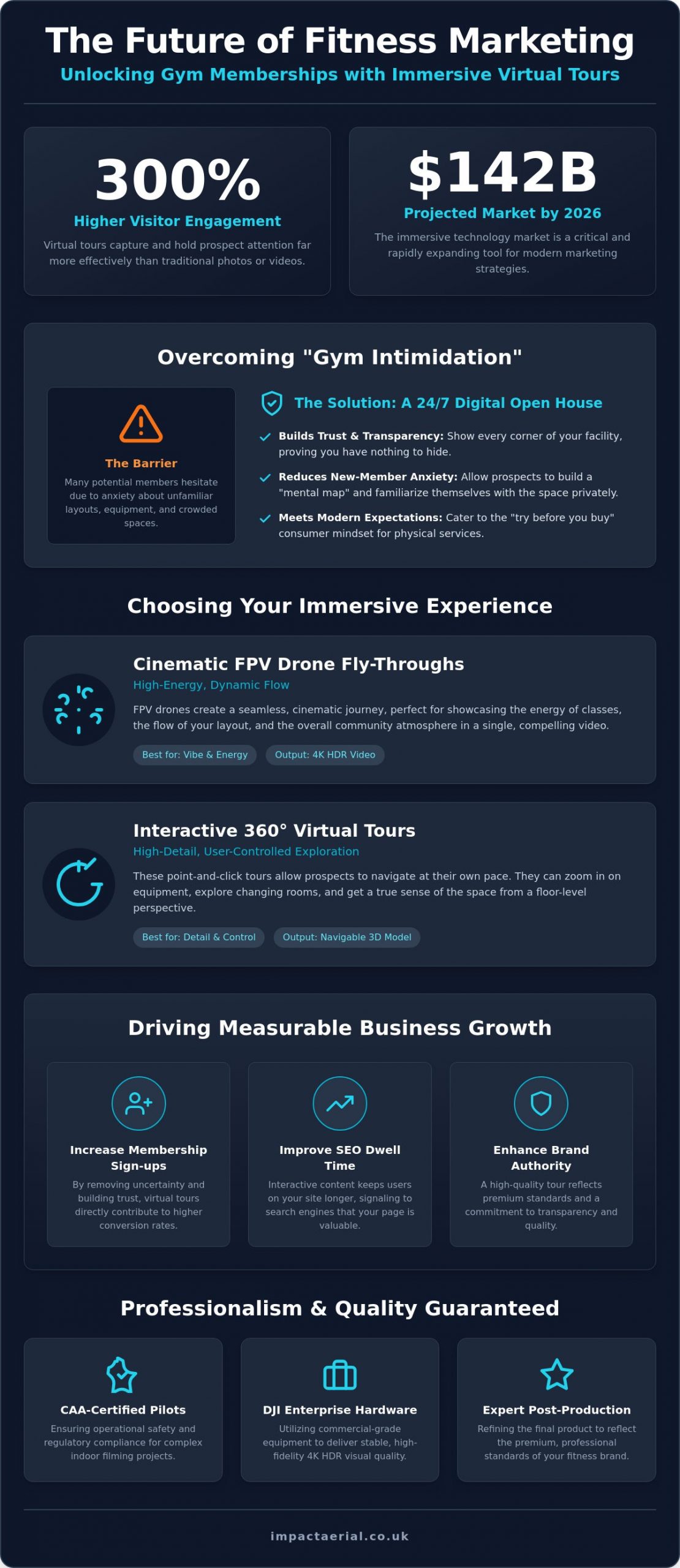
Ensuring Safety and Compliance for Indoor Drone Filming
Safety is the primary concern for any operator managing a high-traffic environment. When commissioning a virtual tour for gyms and fitness centres, the most common question involves the physical risk of indoor flight. Flying a drone in a confined space requires a level of precision that standard consumer equipment cannot provide. Professional operations rely on meticulous risk assessments and hardware equipped with 360-degree prop guards to ensure the safety of both the facility and its assets. Every flight path is pre-mapped to avoid equipment, lighting fixtures, and architectural obstacles.
Financial protection is another pillar of professional compliance. A reputable aerial filming company should hold at least £5m in commercial liability insurance specifically tailored for drone operations in fitness venues. This coverage provides psychological comfort and tangible security for gym owners. It ensures that in the unlikely event of a technical failure, the business is fully protected against property damage or operational downtime. Without this specific insurance, the gym owner could be held personally liable for any incidents occurring during the shoot.
The Role of CAA GVC Certification
Hiring a pilot without the proper credentials is a significant liability risk for your business. A CAA GVC certified pilot has undergone rigorous training and assessment to operate in complex environments. While survey drones are typically associated with outdoor technical inspections, the same principles of flight safety and data-centric precision apply to indoor gym tours. Verifying these credentials before signing a contract is a non-negotiable step for any compliant business. It guarantees that the pilot understands the latest regulatory transitions and safety protocols required for commercial work.
Disruption-Free Filming Strategies
Operational continuity is vital for a busy fitness facility. Most professional shoots are scheduled during off-peak hours or dedicated member-free windows to avoid any interaction with the public. We implement a “clean site” protocol to ensure the facility looks its best under 4K HDR lenses; this involves hiding loose cables, resetting equipment, and ensuring consistent lighting. Managing member privacy and GDPR compliance is also a priority. We ensure no identifiable personal data or faces are captured during the flight, maintaining the integrity of your brand and the privacy of your community. This structured, methodical approach guarantees a high-end output with zero impact on your members’ workout experience.
Maximising ROI: SEO and Conversion Benefits
Implementing a virtual tour for gyms and fitness centres is a strategic investment that generates measurable returns across multiple digital channels. From a technical SEO perspective, interactive 3D environments significantly increase “dwell time,” which is the duration a visitor spends engaging with your website. Google’s algorithms interpret high dwell time as a strong signal of content relevance and quality, which can lead to improved organic search rankings. Achieving this level of visibility often involves partnering with an agency like Cornerstone Marketing Solutions to optimize your overall online presence. When users stay on your site to explore the weight room or the yoga studio, they are providing the data-centric proof of engagement that search engines reward.
The impact on membership sales is equally quantifiable. Data from oVRworldwide indicates that online inquiries for memberships and services can increase by 200% when a virtual tour is present. This conversion lift occurs because the tour provides the psychological comfort discussed in earlier sections, moving a prospect from curiosity to a confirmed sign-up. Additionally, modern virtual tour platforms provide backend analytics that allow gym owners to see which areas of their facility are most popular. If the majority of users are zooming into the recovery zone or the functional fitness area, you can adjust your marketing focus to highlight those specific assets.
Local SEO and Google Business Profile
High-quality 360 imagery is a primary driver for appearing in the “Local Map Pack,” the group of three business listings that appear at the top of Google search results. There is a clear synergy between professional drone photography and local search authority. By uploading immersive tours directly to your Google Business Profile, you encourage users to click the “See Inside” button. This interaction not only improves your local ranking but also builds immediate trust by showing the live reality of your facility directly on the search engine results page.
Content Repurposing for Social Media
A single professional filming session provides a deep library of marketing assets. A two-minute FPV drone fly-through can be edited into ten or more 15-second TikTok and Instagram Reels, each focusing on a different aspect of the gym. These energetic, short-form clips provide the “wow factor” that drives social shares and viral engagement. Beyond video, high-resolution stills extracted from the 4K HDR footage are perfect for print marketing, internal signage, and member onboarding emails. This methodical approach to content ensures that every frame of the original flight is used to maximise your brand’s digital presence.
To begin planning your facility’s digital transformation, contact our specialist team to discuss a tailored virtual tour solution that aligns with your 2026 growth targets.
Partnering with Impact Aerial for Professional Gym Tours
Impact Aerial operates as a technical specialist in high-end drone services, delivering precision-engineered visual content specifically for the fitness sector. We utilize commercial-grade DJI Enterprise hardware to ensure every virtual tour for gyms and fitness centres meets the highest standards of 4K HDR clarity. This hardware selection is a deliberate choice; these systems provide the stability and low-light performance necessary to capture professional-tier footage in complex indoor environments. Our methodical approach ensures that the final output reflects the premium nature of your facility and brand, providing the reassurance that modern consumers require.
Our end-to-end process is built on a foundation of safety and technical excellence. We guide clients through a structured journey that begins with a comprehensive safety consultation and site survey, moving through to precision filming and expert post-production editing. While our roots are firmly in the West Midlands, our operational capacity extends UK-wide. This makes us a reliable partner for both boutique independent studios and national fitness chains that require consistent, high-quality visual assets across multiple locations. We handle the logistical complexities of multi-site shoots, ensuring a unified brand voice across your entire digital portfolio.
Our Technical Edge in Fitness Marketing
We employ proprietary indoor flight techniques to deliver smooth, cinematic fly-throughs that navigate narrow equipment aisles and multi-floor layouts with ease. Our post-production services are equally specialized, ensuring that the final edit matches your gym’s specific branding, color palette, and community energy. We maintain a rigorous commitment to operational safety, backed by £5m commercial liability coverage for every project we undertake. This meticulous attention to detail ensures that your marketing assets are produced without compromising the security of your facility or its members, giving you total peace of mind during the filming process.
Next Steps: Booking Your Gym Survey
The first step in the process is a structured initial consultation where we define your specific marketing goals and identify the unique facility highlights you wish to showcase. Whether your focus is on a new recovery suite, a high-tech spin studio, or a spacious functional training zone, we tailor the flight plan to meet those objectives. We offer bespoke quotes for single-site projects as well as enterprise-level packages for multi-location fitness brands seeking a unified digital presence. This collaborative approach ensures that the technical output aligns with your business’s data-centric goals for membership growth.
Contact Impact Aerial today for a professional virtual tour consultation to discover how our technical expertise can transform your gym’s online conversion rates and digital authority.
Future-Proofing Your Fitness Marketing Strategy
The integration of immersive technology is no longer a luxury; it’s a standard for high-performing fitness brands. By providing a transparent view of your facilities, you effectively dismantle the psychological barriers of gym intimidation while simultaneously boosting your local search authority. Whether you choose the cinematic energy of an FPV fly-through or the interactive utility of a 360-degree walkthrough, a professional virtual tour for gyms and fitness centres acts as a powerful conversion tool that works 24/7. Success in 2026 requires this blend of visual excellence and technical transparency to meet the rising expectations of modern members.
Impact Aerial provides the technical expertise and regulatory compliance necessary to execute these projects safely within commercial environments. Our team of CAA GVC Certified Pilots utilizes specialized hardware to deliver 4K HDR Cinematic Output, all while maintaining £5m Commercial Liability Insurance for your protection. We ensure a meticulous, disruption-free process that prioritizes your facility’s operational continuity and brand integrity. It’s time to provide your prospects with the psychological comfort they need to commit to their fitness journey.
Book Your Professional Gym Virtual Tour Consultation
Frequently Asked Questions
Do I need to close my gym during the virtual tour filming?
You don’t necessarily need to close your facility, but we strongly recommend filming during off-peak hours or dedicated member-free windows. This ensures a “clean site” protocol where equipment is perfectly staged and member privacy is maintained. For a high-quality virtual tour for gyms and fitness centres, capturing the space without crowds allows for better 4K HDR clarity and a more professional finish that highlights your facility’s premium assets.
How long does it take to create a full 3D tour and drone fly-through?
The onsite capture of a standard facility usually takes between four and eight hours, depending on the square footage and complexity. Following the shoot, our post-production team requires approximately five to ten working days to stitch 360-degree imagery and edit cinematic FPV footage. This structured timeline ensures that every frame is polished, branded, and optimized for high-speed web delivery and mobile compatibility.
Will the drone be loud enough to disturb members in other rooms?
Modern FPV drones used for indoor filming, often called “cinewhoops,” are significantly quieter than larger outdoor models. While there is a distinct hum during flight, it’s rarely loud enough to disturb members in separate studios or changing areas. We meticulously plan flight paths to minimize any auditory impact, ensuring that your gym’s daily operations continue smoothly while we capture high-energy, cinematic perspectives of your workout zones.
What is the difference between a standard 360 tour and an FPV drone tour?
A standard 360 tour offers a user-controlled, point-and-click experience where prospects can explore specific rooms at their own pace. In contrast, an FPV drone tour provides a continuous, cinematic “one-shot” fly-through that captures the energy and layout of the entire facility in motion. Combining both technologies creates a comprehensive marketing asset that offers both the utility of detailed inspection and the “wow factor” of high-speed aerial movement.
Can I use the virtual tour on my social media pages like Instagram and TikTok?
Yes, the content is highly repurposable for platforms like Instagram and TikTok. Short, high-impact clips from an FPV fly-through are particularly effective as Reels or TikTok videos, driving significantly higher engagement than static photos. We provide the edited files in formats optimized for vertical viewing, allowing you to integrate these visual assets into your social media strategy and member onboarding emails immediately after production.
Is indoor drone filming legal in the UK in 2026?
Indoor drone filming remains legal in the UK in 2026 because aviation regulations typically apply only to flights conducted in open airspace. However, commercial operations must still adhere to strict safety protocols and health and safety legislation. We maintain £5m commercial liability insurance and utilize CAA GVC certified pilots to ensure every indoor flight is conducted with the highest level of professional compliance and risk mitigation.
How much does a professional virtual tour for a gym typically cost?
The cost of a professional virtual tour for gyms and fitness centres varies based on several technical factors. These include the total square footage of the facility, the number of locations requiring surveys, and whether you opt for a hybrid package combining 360-degree tours with FPV drone fly-throughs. We provide bespoke quotes after an initial consultation to ensure the service matches your specific marketing goals and facility requirements accurately.
Do virtual tours work on mobile devices and VR headsets?
Every tour we create is fully responsive and optimized for mobile devices, tablets, and desktop computers. Our 360-degree tours are also compatible with modern VR headsets, providing an even more immersive “try before you buy” experience for prospective members. This cross-platform accessibility ensures that your digital open house reaches potential clients regardless of the hardware they use to research your fitness facility online.
What Equipment is Used for Drone Surveys? A Professional UK Guide
Can a standard consumer drone deliver the centimetre-level accuracy required for a major UK infrastructure project, or is it merely an expensive toy risking a significant construction error? You aren’t alone if you feel confused about the technical divide between retail gadgets and enterprise-grade systems. Understanding exactly what equipment is used for drone surveys is the first step toward mitigating risk and ensuring your data meets professional industry standards.
We understand that navigating the 2026 UK drone regulations, including new UK class marks and Remote ID requirements, adds another layer of complexity to your decision-making process. This guide provides a definitive checklist of the hardware, sensors, and software required to produce high-tier aerial data. You’ll learn the critical differences between standard GPS and RTK technology, the role of specialized sensors like LiDAR, and the processing software that turns raw imagery into BIM-ready assets. By the end, you will have the technical insight needed to select a certified drone service provider that prioritizes precision, compliance, and operational safety.
Key Takeaways
- Learn how to select the optimal UAV platform, comparing the agility of multirotors with the endurance of fixed-wing drones for large-scale site coverage.
- Understand why specialized sensors with global shutters and high resolution are essential for technical surveys, far exceeding the capabilities of standard 4K cameras.
- Discover what equipment is used for drone surveys to achieve centimetre-level accuracy, including the critical role of RTK and GNSS hardware in correcting satellite data.
- Gain insights into the high-performance computing hardware and photogrammetry software required to process thousands of aerial images into actionable, BIM-ready data.
- Identify the mandatory safety and regulatory equipment required by the CAA to ensure your operations remain compliant and risk-mitigated on professional work sites.
Selecting the Right UAV Platform: Multirotor vs. Fixed-Wing
The term “platform” in the context of professional aerial work refers to the aircraft itself. It acts as the primary carrier for the sophisticated sensors required to generate accurate maps and models. When evaluating what equipment is used for drone surveys, the platform choice is the most fundamental decision an operator makes. A survey drone is defined as a high-precision UAV designed specifically for repeatable data collection. This ensures that every flight produces consistent results, allowing for precise temporal comparisons across different stages of a construction or environmental project.
Professional operators across the UK typically rely on DJI Enterprise drones because of their proven reliability and modular payload options. The choice of airframe depends heavily on the specific geography of the site, the required flight duration, and the total weight of the sensors being deployed. Payload weight isn’t just about the camera; it includes batteries, transmission systems, and mandatory safety hardware. This selection process is a core component of a professional unmanned aerial photogrammetric survey, where the stability of the platform directly influences the quality of the final data set.
To better understand how these platforms integrate into a professional workflow, watch this helpful video:
Multi-rotor Drones for Precision and Vertical Inspection
Multi-rotor aircraft are the workhorses of the UK drone industry. Their ability to hover with absolute stability makes them ideal for drone roof surveys and detailed inspections of confined spaces. Because they utilize Vertical Take-Off and Landing (VTOL) technology, they’re perfect for cramped UK construction sites where space is at a premium. The high-detail imagery captured during a hover allows engineers to identify specific structural defects that a moving aircraft might miss. Most UK firms utilize quadcopters like the Mavic 3 Enterprise for its portability or the Matrice 350 RTK for its ability to carry multiple heavy sensors simultaneously.
Fixed-Wing Drones for Large-Scale Land Mapping
While multi-rotors excel at detail, fixed-wing drones are built for endurance. These platforms can cover hundreds of hectares in a single flight, making them the preferred choice for large-scale uav land surveying and topographic mapping. Unlike their multi-rotor counterparts, they require more significant space for take-off and landing. Some models use a belly-land approach, while others have evolved to include VTOL rotors for vertical lift-off followed by horizontal flight. For massive infrastructure projects or expansive agricultural mapping, their efficiency and high cruise speeds are unmatched by traditional quadcopters.
Specialised Sensors: The “Eyes” of the Drone Survey
While the aircraft provides the means of transport, the sensors are the true workhorses of any aerial operation. They determine the resolution, accuracy, and technical utility of the collected data. Professional operators don’t rely on consumer-grade hardware; they use enterprise systems where payloads are often interchangeable to meet specific project requirements. When considering what equipment is used for drone surveys, the payload is often more important than the aircraft itself because it defines the quality of the final deliverable.
Sensor choice is dictated entirely by the specific output required, whether that’s a high-density 3D model, a topographic map, or a detailed heat map. These specialised tools allow us to capture data that exceeds the limitations of human vision and standard photography. If you’re unsure which technology fits your requirements, our experts can help you select the right aerial technology for your specific site needs.
High-Resolution RGB and Photogrammetry Sensors
Technical surveys require more than just a 4K video feed. High-resolution RGB sensors, typically featuring 1-inch CMOS sensors or larger, are the standard for professional photogrammetry. A critical distinction in identifying what equipment is used for drone surveys is the presence of a mechanical or global shutter. In consumer drones, “rolling shutters” capture images line-by-line, which causes significant geometric distortion when the drone moves at high speeds. Mechanical shutters eliminate this “jello effect,” ensuring every pixel is captured simultaneously. This precision is vital for creating high-density point clouds and accurate orthomosaics that engineers can trust for measurements.
Thermal Imaging and Multispectral Cameras
Beyond the visible spectrum, specialised sensors provide insights invisible to the naked eye. Radiometric thermal sensors are the primary tool for PV solar farm thermal surveys, where they detect minute temperature variances that indicate failing cells or electrical faults. These sensors don’t just “see” heat; they assign a specific temperature value to every pixel in the image. Similarly, multispectral sensors measure light reflection across several bands to assess plant health or environmental changes. Whether you’re identifying heat loss in a building envelope or monitoring crop stress, the choice of sensor ensures the data is both scientific and actionable.
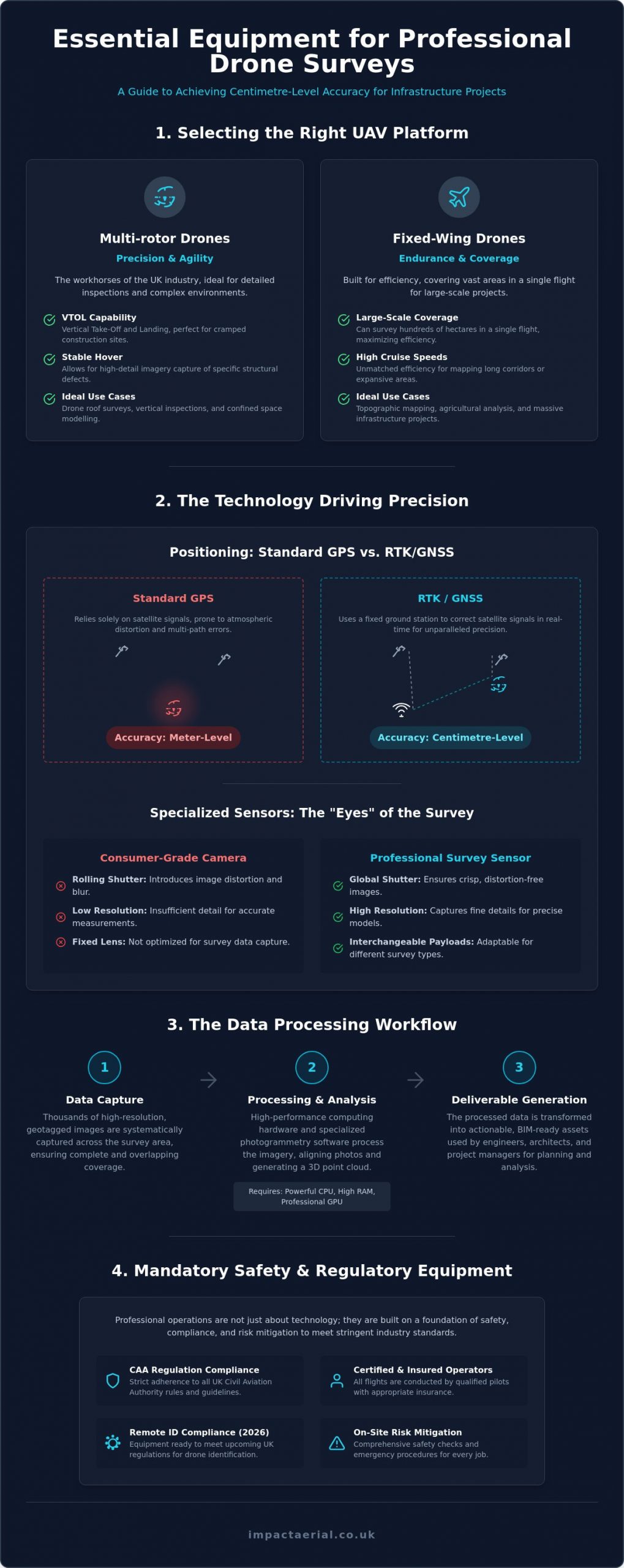
Ensuring Survey Accuracy: GNSS and Ground Control Equipment
Accuracy isn’t an optional extra in the professional survey industry; it’s the core requirement that separates a visual inspection from a technical-grade deliverable. Standard Global Positioning System (GPS) technology, the kind found in consumer smartphones and entry-level drones, typically has a horizontal margin of error between 3 and 5 metres. For a construction site or a topographic map, this level of discrepancy is unacceptable and could lead to catastrophic errors in volume calculations or boundary placements. When clients ask what equipment is used for drone surveys to ensure reliability, the answer lies in the Global Navigation Satellite System (GNSS) correction hardware.
Professional surveys rely on a meticulous combination of high-frequency onboard receivers and external ground-based reference points. This ecosystem allows operators to achieve centimetre-level precision, ensuring the data is verifiable and meets RICS or specific construction industry standards. You aren’t just capturing pictures; you’re recording precise spatial data points that must align perfectly with existing site plans and legal boundaries. This level of precision is what provides the psychological comfort and tangible business benefits our clients expect.
RTK and PPK Systems for Real-Time Precision
Real-Time Kinematic (RTK) systems represent a significant leap in aerial surveying efficiency. An RTK-enabled drone maintains a constant data link with a local base station or a network of reference stations to correct satellite signal errors in real-time. This is particularly effective for projects requiring immediate data validation on-site. Alternatively, Post-Processed Kinematic (PPK) technology records raw satellite data during the flight, which is then corrected against base station data after the drone lands. PPK is often the preferred choice in environments with challenging terrain or poor signal connectivity where a constant radio link is difficult to maintain. Both technologies are essential components when considering what equipment is used for drone surveys because they drastically reduce the need for extensive manual site marking.
Ground Control Points (GCPs) and AeroPoints
Despite the advancements in onboard correction, physical Ground Control Points (GCPs) remain a staple for absolute accuracy. These are high-contrast markers placed at surveyed coordinates across the project area, serving as “anchors” that tie the digital model to a specific coordinate system like the Ordnance Survey National Grid. Modern “Smart” GCPs, such as AeroPoints, have simplified this workflow. These devices integrate their own GNSS receivers to record their precise location autonomously. Using smart markers provides a redundant, verifiable check against the drone’s data, ensuring the final output is legally and technically robust for high-stakes engineering projects.
Data Processing Hardware and Software Solutions
The survey mission doesn’t end when the aircraft returns to its landing pad; in many ways, the most critical work is just beginning. Raw data is merely a collection of thousands of individual files that require structured transformation to become useful. When project managers ask what equipment is used for drone surveys, they must look beyond the flying hardware to the sophisticated computing environment on the ground. High-performance workstations equipped with enterprise-grade Graphics Processing Units (GPUs) are essential for stitching these vast 4K HDR datasets into a single, cohesive output. This local processing power ensures data security while handling the massive throughput required for high-tier quality; for firms looking to build custom platforms to handle this data, you can learn more about API Pilot and their expertise in developing scalable web applications.
Modern surveying requires that all aerial data is Building Information Modeling (BIM)-ready and compatible with existing Enterprise Resource Planning (ERP) systems. This integration allows stakeholders to move from a visual perspective to a data-centric decision-making process. If you need professional-grade data that integrates seamlessly with your existing workflow, book a consultation with our technical team to discuss your project requirements.
Photogrammetry and LiDAR Processing Software
Industry-standard software like Pix4D, DJI Terra, or DroneDeploy transforms 2D images into immersive 3D models and topographical maps. These platforms are the backbone of drone data collection surveys, enabling the generation of high-density point clouds that facilitate precise measurements. For sites with significant overgrowth, LiDAR processing software is used to filter active laser pulse data, allowing us to see through canopy layers to the true ground surface. This level of technical processing ensures that the final digital twin is a meticulous and faithful representation of reality.
Post-Production and Virtual Tour Creation Gear
Beyond technical mapping, professional virtual tour creation requires specialized editing gear and 360-degree stitching software. Impact Aerial utilizes professional post-production suites to refine imagery and add interactive data layers that provide clarity to stakeholders. This process involves high-end workstations capable of rendering complex interactive environments without losing resolution. This meticulous approach to data handling ensures that your project data is not just accurate, but also actionable and easy to navigate for all team members.
The Critical Role of Safety and Regulatory Equipment
Professional drone surveys in the UK operate under the strict oversight of the Civil Aviation Authority (CAA). While high-resolution sensors and RTK systems provide the data, a comprehensive suite of safety and site management tools ensures that every mission is conducted legally and without risk to persons or property. When assessing what equipment is used for drone surveys, the conversation must include the hardware that keeps the operation within its defined safety envelope. This meticulous approach to risk mitigation is what allows us to operate on active construction sites and near critical infrastructure with absolute confidence.
The specific hardware deployed on a site is often dictated by the pilot’s operational authorizations. For instance, a CAA GVC certification enables pilots to fly in more complex environments, provided they use aircraft with the appropriate safety redundancies and site control gear. These regulations ensure that the technology is matched by professional competency and rigorous operational standards, providing clients with the reassurance that their project is in expert hands.
Essential Safety Gear for CAA-Compliant Operations
Securing a flight area requires more than just a skilled pilot; it requires a suite of specialized ground equipment. Professional operators use digital anemometers to measure real-time wind speeds, ensuring conditions remain within the aircraft’s manufacturer-specified limits before and during flight. On the ground, fire-resistant LiPo battery bags and specialized transport cases are mandatory for the safe storage and handling of high-capacity power cells. To manage the site effectively, we utilize high-visibility clothing, clear site signage, and dedicated landing pads. These tools create a visible and secure operational zone, preventing unauthorized access and ensuring a controlled environment for every take-off and landing.
Enterprise vs. Consumer Hardware: Why It Matters
The technical gap between retail drones and enterprise survey systems is most apparent in their safety architecture. Professional-grade aircraft feature omnidirectional obstacle avoidance sensors that detect hazards in all directions, providing a critical layer of protection in complex urban or industrial environments. Many enterprise models also incorporate dual-battery systems. If one cell fails mid-flight, the secondary battery provides enough power for a safe, controlled descent rather than a catastrophic failure. Additionally, these systems use encrypted data transmission to ensure that sensitive site information remains secure and private. Understanding what equipment is used for drone surveys at this level helps clients recognize the value of choosing a specialist provider that prioritizes operational integrity and data security.
Elevate Your Project Precision with Professional Aerial Data
Professional drone surveying is a sophisticated ecosystem where aircraft, sensors, and ground control hardware must work in perfect unison. By moving beyond consumer-grade tools, you ensure that every data point is accurate, compliant, and ready for immediate integration into your BIM or CAD workflows. Understanding what equipment is used for drone surveys is a critical first step for any project manager who values precision and strict adherence to UK aviation standards.
At Impact Aerial, we provide the technical expertise and high-end hardware required to deliver centimetre-level accuracy. Our operations are led by CAA GVC Certified Pilots using DJI Enterprise Grade Equipment to ensure the highest tier of data quality. We further prioritize your site security with £5m Commercial Liability Insurance, offering the reassurance that your project is in safe, expert hands.
Get a Professional Drone Survey Quote from Impact Aerial
We look forward to helping you transform your site perspective with industry-leading aerial technology and meticulous data processing.
Frequently Asked Questions
Do I need different equipment for a roof survey versus a land survey?
Yes, the choice of aircraft typically shifts between multi-rotor drones for roof inspections and fixed-wing platforms for land surveys. Roof surveys require the hovering stability of a quadcopter to capture high-detail imagery of structural defects in confined spaces. Conversely, large-scale land surveys often utilize fixed-wing drones because they can cover hundreds of hectares in a single flight with greater efficiency.
What is the difference between a standard 4K drone and a survey drone?
A survey drone is a high-precision UAV designed for repeatable data collection, whereas a standard 4K drone is primarily built for visual aesthetics. Survey-grade hardware includes mechanical shutters to prevent image distortion and integrated RTK receivers for centimetre-level positioning. These technical features ensure that the resulting data is geometrically accurate and robust enough for engineering and construction applications.
How does RTK equipment improve the accuracy of a drone survey?
RTK equipment provides live corrections to satellite signals by communicating with a local base station or a network of reference stations. This process reduces the horizontal margin of error from several metres down to just 1 to 3 centimetres. It’s a fundamental part of what equipment is used for drone surveys to ensure digital models align perfectly with real-world site coordinates and legal boundaries.
Is specialised software required to view the results of a drone survey?
You don’t necessarily need specialized software to view final PDF reports or orthomosaic images, but professional GIS or CAD software is required to manipulate 3D models and point clouds. Most providers deliver data in industry-standard formats like .LAS, .OBJ, or GeoTIFF. These files are designed for seamless integration into BIM (Building Information Modeling) environments and common architectural or engineering design tools.
What safety equipment should a professional drone pilot have on-site?
A professional pilot must deploy site management tools including high-visibility clothing, landing pads, and “Drone Operations” signage to secure the take-off area. Technical safety gear includes anemometers for real-time wind speed monitoring and fire-resistant bags for LiPo battery storage. These items are mandatory for maintaining a CAA-compliant operational environment and mitigating risks to site personnel during every mission.
Can any drone be used for thermal surveys on solar farms?
No, thermal surveys require radiometric sensors that assign a specific temperature value to every pixel in the image. Standard thermal cameras might provide a visual heat map, but they lack the scientific precision needed to identify specific failing cells or electrical faults. Professional solar farm surveys utilize enterprise platforms capable of carrying high-resolution radiometric payloads to ensure the data is scientifically actionable.
Why is a mechanical shutter important for drone surveying equipment?
A mechanical shutter is vital because it captures the entire image simultaneously, eliminating the geometric distortion caused by moving aircraft. When evaluating what equipment is used for drone surveys, a global or mechanical shutter is a non-negotiable requirement for high-speed mapping. Without it, the resulting 3D models will contain significant measurement errors that compromise the integrity of the entire survey.
What equipment is used to process drone data into a 3D model?
Processing requires high-performance computing workstations equipped with powerful GPUs and specialized photogrammetry software like Pix4D or DJI Terra. This hardware-software combination stitches thousands of individual 2D images together into a cohesive 3D point cloud or digital twin. The process is computationally intensive, requiring significant RAM and processing speed to handle large 4K HDR datasets effectively after the flight is completed.
Professional Drone Photography for Car Dealerships: The 2026 UK Guide
Is your digital forecourt working as hard as your physical one, or are static images letting your most valuable inventory blend into the background? In a market where buyers expect immersive experiences, professional drone photography for car dealerships has evolved from a visual extra into a precision sales tool. You likely understand the frustration of high-value vehicles sitting idle simply because a standard photo gallery fails to capture the scale and prestige of your brand. It’s a common challenge to balance the need for high-impact content with the strict safety and regulatory demands of a busy commercial environment.
This 2026 guide reveals how professional aerial imagery and FPV fly-throughs can drive vehicle inquiries while ensuring your operations remain fully compliant and secure. We’ll examine the technical realities of modern drone use, including the mandatory £12.34 CAA Operator ID and the latest UK class mark requirements that took effect this January. You’ll discover how to increase your VDP views and streamline lot management through expert aerial perspectives, all while maintaining the rigorous safety standards and risk mitigation your business demands.
Key Takeaways
- Understand how high-precision drone photography for car dealerships elevates vehicle listings from static galleries to immersive digital narratives that drive inquiry rates.
- Explore the creative potential of FPV fly-throughs to provide buyers with a seamless journey from the forecourt directly into the driver’s seat.
- Learn how aerial data streamlines operational tasks like inventory capacity planning and rapid showroom roof inspections to mitigate facility risks.
- Identify the critical UK regulatory requirements for 2026, including the necessity of CAA GVC certification and industry-standard £5m liability insurance.
- Discover the structured implementation process that ensures professional aerial filming is conducted with zero disruption to your daily dealership operations.
The Digital Forecourt: Why Drone Photography for Car Dealerships is Essential in 2026
Automotive retail has reached a point where the digital forecourt is no longer a secondary concern; it’s the primary gateway for every potential buyer. In 2026, drone photography for car dealerships has matured into a sophisticated, multi-layered marketing and operational asset. It provides a level of immersive storytelling that standard 2D imagery simply cannot replicate. While the history of aerial photography began with rudimentary perspectives, today’s professional drone services offer high-precision, AI-stabilized visuals that define a brand’s authority in a crowded market.
The shift toward immersive content is driven by buyer expectations. A modern consumer doesn’t just want to see a car; they want to experience the scale of your inventory and the professionalism of your facility. High-quality aerial footage significantly impacts Vehicle Detail Page (VDP) dwell time, keeping users engaged for longer periods. This increased engagement is a direct precursor to conversion, as it builds a “Virtual Showroom” experience that establishes trust before the customer even sets foot on your lot.
To better understand how these techniques are applied in a real-world setting, watch this helpful video:
Engaging the Modern Car Buyer
Aerial perspectives offer a unique sense of scale that’s particularly effective for large UK dealership groups. Capturing the full breadth of a 200-vehicle inventory in a single, sweeping shot provides a psychological reassurance of choice and stability. Professional drone imagery for car dealerships clearly outranks amateur mobile phone photography. While a salesperson’s handheld video might feel authentic, it often lacks the technical polish required to represent a premium brand. Meticulously planned flight paths demonstrate that your dealership values precision and quality in every aspect of its operation.
The ROI of Aerial Marketing for Automotive
Investing in professional aerial content yields tangible returns through increased lead generation and test drive bookings. A single, well-executed drone shoot provides a wealth of 4K HDR footage that can be repurposed across social media platforms, PPC campaigns, and website headers. This versatility makes it far more cost-effective than scheduling multiple ground-based video sessions. By utilizing high-end output for flagship launches or the latest plate releases, dealers can create a cinematic “event” feel that resonates with buyers and justifies the investment through higher engagement metrics and shorter stock turnaround times.
Driving Conversions: Creative Aerial Applications for Vehicle Listings
Static vehicle listings often struggle to convey the physical presence and prestige of a high-spec model. Professional drone photography for car dealerships solves this by providing a dynamic sense of motion and perspective that ground-level cameras cannot match. By using cinematic stock reveals, dealers can build significant anticipation for major events like the new “75” and “26” plate releases. These high-impact sequences don’t just show the car; they present it as a premium lifestyle choice, highlighting specific vehicle features using close-proximity drone maneuvers that emphasize design lines and interior craftsmanship.
Interactive 360-degree lot tours provide another layer of engagement, allowing customers to navigate your inventory from their own devices. This virtual walkthrough mirrors the physical experience of browsing a forecourt, effectively pre-qualifying leads before they arrive on-site. When buyers can “walk” the dealership virtually, the friction of the initial visit is reduced, leading to more purposeful showroom appointments.
FPV Drone Fly-Throughs for Showrooms
First Person View (FPV) drones are the most significant advancement in dealership marketing for 2026. Unlike standard GPS-stabilized drones, FPV aircraft can navigate tight spaces with surgical precision. This allows for a continuous “one-take” shot that starts on the forecourt, glides through the showroom doors, and finishes directly in the driver’s seat. Utilizing FPV in the UK creates a visceral connection with the viewer, providing a bird-eye-to-eye-level perspective that is perfect for viral social media content. These flights aren’t just about the cars; they showcase your entire facility, including service bays, luxury lounges, and cafes, to build customer comfort. Every flight is meticulously planned to remain compliant with UK drone safety regulations, ensuring total protection for your staff and high-value inventory.
Post-Production: Turning Raw Footage into Sales Assets
The transition from raw footage to a high-converting sales asset occurs in the post-production suite. Professional color grading is essential to match the premium feel of high-end automotive brands, ensuring that paint finishes look vibrant and accurate across all screens. Adding digital overlays, such as monthly finance rates, performance specs, or clear calls-to-action, transforms a cinematic video into a functional tool for your sales team. These master files can then be edited into short-form “Reels” and “TikToks,” allowing you to maintain a consistent, high-quality brand presence across all digital channels. To further enhance the customer experience within your facility, these assets can be displayed on digital menu boards Ireland to provide a modern, interactive touchpoint in the showroom.
If you’re ready to enhance your dealership’s visual strategy, exploring professional Aerial Filming and Photography can provide the competitive edge needed to dominate the digital forecourt.
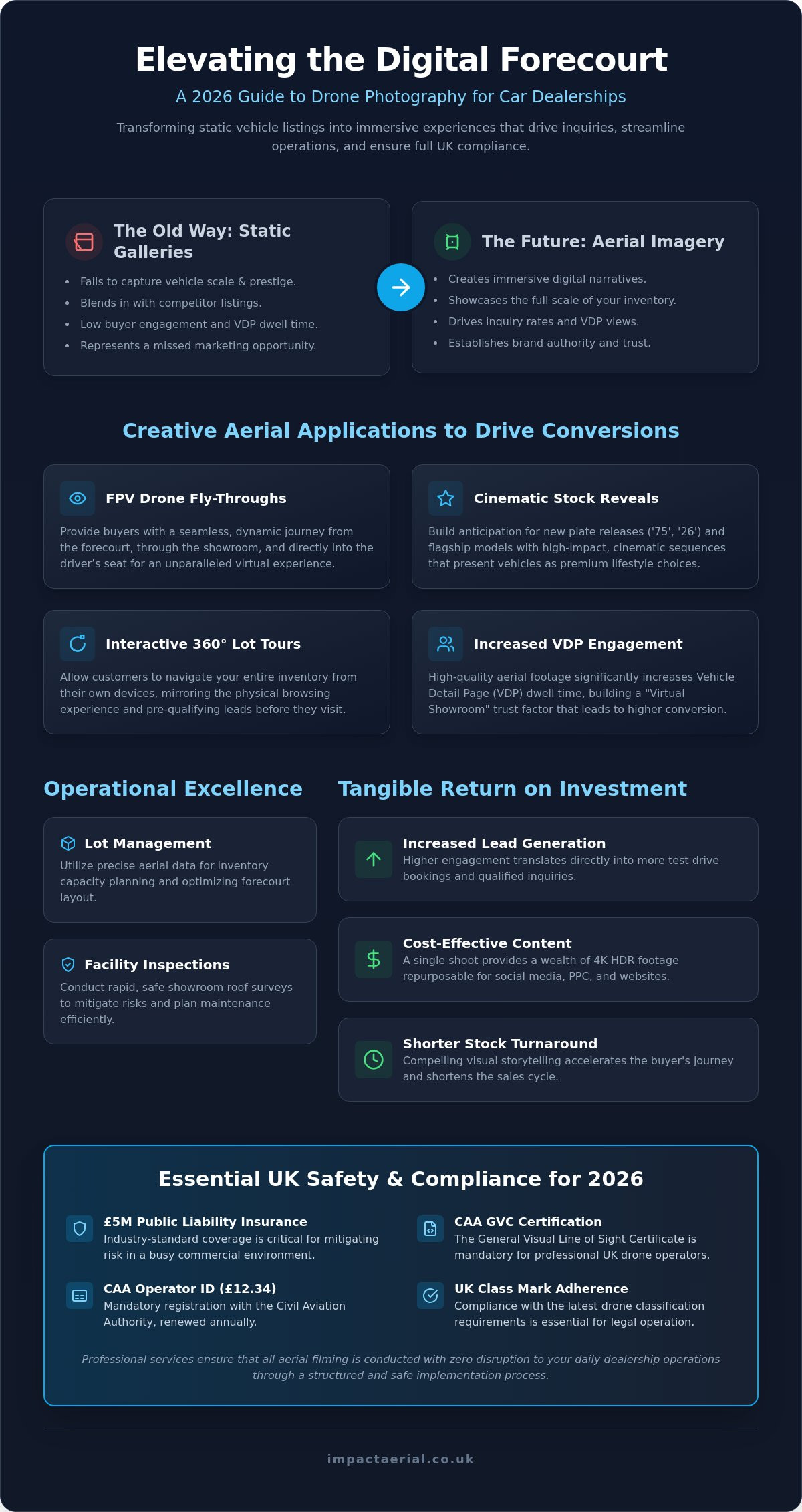
Operational Excellence: Using Drones for Lot Management and Surveys
While many view drone photography for car dealerships purely as a marketing asset, its utility extends deep into operational management. Precision aerial data allows dealer principals and facility managers to oversee large sites with a level of detail that ground-level inspections cannot match. Transitioning from visual marketing to data-driven logistics turns a drone from a camera into a vital facility management tool. This shift is essential for dealerships in 2026 that aim to maximize every square meter of their forecourt while minimizing maintenance overheads.
Showroom Maintenance and Roof Surveys
High-value showrooms and workshops require meticulous upkeep to protect both the building fabric and the inventory within. Traditional inspections often involve the significant cost and disruption of erecting scaffolding or hiring cherry pickers. A professional drone survey provides a non-invasive alternative, capturing high-resolution imagery of roof structures in a fraction of the time. This rapid data collection is essential for identifying gutter blockages, loose flashing, or solar panel defects before they lead to internal leaks.
The speed of drone-led inspections is a major advantage. A manual survey that might take a full day can be completed in under an hour with a drone. Additionally, technical sensors can identify heat loss in showroom glazing or detect malfunctioning cells in rooftop solar installations. These insights allow for proactive repairs, ensuring your facility remains energy-efficient and operational without the need for staff to work at height.
Inventory Mapping and Site Planning
Logistics on a busy forecourt are notoriously complex. Professional drones can generate 2D orthomosaic maps, which are essentially high-definition, top-down blueprints of the entire site. These maps are invaluable for lot capacity planning and inventory management. If you’re planning a tent sale or a seasonal lot reconfiguration, visualizing the space from above ensures that vehicle spacing is optimized and traffic flow is maintained. It removes the guesswork from site planning, allowing for precise placement of flagship models and promotional displays.
Security is another critical application for aerial data. By mapping the site from above, you can identify blind spots in existing forecourt CCTV coverage. This ensures that your most valuable stock is protected around the clock. All these operations are conducted in strict adherence to UK Civil Aviation Authority drone regulations. This meticulous approach to compliance ensures that while we gather critical facility data, the safety of your staff, customers, and expensive vehicle inventory remains the absolute priority.
Safety and Compliance: Essential Rules for UK Dealership Drone Flights
Executing professional drone photography for car dealerships requires more than just technical skill behind the lens; it demands a rigorous commitment to aviation safety and legal compliance. When you’re operating a drone in close proximity to millions of pounds of vehicle inventory and high-traffic customer areas, the margin for error is zero. Meticulous planning and adherence to national regulations ensure that your marketing assets are captured without exposing your business to significant liability or physical risk.
Safety begins with a comprehensive pre-flight site survey. This process identifies potential hazards such as overhead power lines, high-intensity forecourt lighting, and nearby flight restriction zones. For dealerships located near regional hubs, such as Birmingham Airport, professional operators must coordinate directly with Air Traffic Control (ATC) to secure the necessary flight permissions. This level of officialdom is what separates a professional service from an amateur hobbyist and is essential for maintaining the integrity of your dealership’s brand.
The Importance of CAA Certification
In the UK, any pilot operating a drone for commercial purposes must hold the correct credentials. For dealership environments, which are often classified as congested areas, the CAA General Visual Line of Sight Certificate (GVC) is the industry benchmark. This UK drone license allows pilots to operate in the “Specific” category, granting the legal authority to fly closer to buildings and people than is permitted under standard recreational rules. Hiring an uncertified pilot doesn’t just risk a £1,000 fine for improper registration; it potentially invalidates your business insurance and places your dealership at severe legal risk if an incident occurs.
Managing “involved persons” is a critical part of this compliance. A professional pilot ensures that all staff on-site are briefed on the flight plan, effectively turning them into “involved persons” who understand the safety protocols. This allows the dealership to remain open and operational during the shoot, provided that members of the public are kept at a safe, regulated distance from the flight path.
Insurance and Liability on the Forecourt
Standard public liability insurance is rarely sufficient for the specialized risks of an active car lot. The industry standard for automotive sites is a minimum of £5m commercial liability insurance, specifically tailored for drone operations. This coverage provides the psychological comfort and financial security required when flying over high-value stock. At Impact Aerial, we prioritize risk mitigation through documented emergency protocols and strict adherence to the latest 2026 Remote ID requirements. Our approach ensures that every flight is transparent, accountable, and fully insured. If you require a partner who values safety as much as visual impact, you can book a professional drone consultation to discuss your site requirements.
Implementing Your Drone Strategy: The Impact Aerial Process
Transitioning from traditional photography to a comprehensive aerial strategy requires a methodical approach that prioritizes both visual quality and operational safety. Implementing professional drone photography for car dealerships isn’t a one-size-fits-all task; it’s a structured process designed to align with your specific commercial goals. Our workflow begins with an initial consultation to identify whether your primary objective is driving VDP views for flagship models, conducting facility surveys, or a combination of both. This goal-oriented start ensures that every flight minute is optimized for maximum return on investment.
The second phase involves a detailed site survey and flight planning session. We understand that a dealership is a live environment where customer experience is paramount. Our pilots plan missions to ensure zero disruption to your daily operations, often scheduling flights during golden hour or specific windows that minimize impact on foot traffic. On the shoot day, we utilize commercial-grade DJI Enterprise hardware. These systems offer superior stability and high-end sensors that capture 4K HDR footage, even in the challenging lighting conditions often found on modern forecourts. The process concludes with the delivery of ready-to-use assets, meticulously edited and formatted for immediate integration into your website, social media channels, and digital showroom displays.
Tailored Solutions for UK Dealer Groups
Managing a multi-site automotive franchise requires a partner capable of scaling professional drone services across various regional locations. We provide custom packages that allow dealer groups to maintain a consistent brand image across all sites. These packages often combine high-impact marketing photography with essential survey data, providing a holistic view of your estate. Whether you need monthly inventory updates to coincide with new plate releases or seasonal facility monitoring to check for winter roof damage, our team provides the ongoing technical support needed to keep your digital and physical forecourts in peak condition.
Getting Started with Professional Aerial Content
Before booking a provider, it’s vital to ask specific questions regarding their CAA credentials, insurance limits, and emergency protocols. A professional operator should be able to provide documented risk assessments and proof of their GVC certification immediately. To prepare your lot for a shoot, we recommend ensuring vehicle alignment is perfect and that all high-value stock is clean; the drone’s high-resolution sensors will pick up every detail. If you’re ready to transform your marketing and lot management with precision aerial data, you can Contact Impact Aerial for a bespoke dealership quote today. Our meticulous approach ensures your brand is presented with the authority and quality your inventory deserves.
Future-Proofing Your Dealership’s Visual Identity
The automotive landscape in 2026 demands a sophisticated blend of immersive marketing and data-driven operations. By integrating professional drone photography for car dealerships, you don’t just showcase your inventory; you provide a transparent, high-precision view of your entire facility. This dual-purpose technology bridges the gap between creative storytelling and meticulous lot management, ensuring your brand remains authoritative and your assets stay secure. From cinematic FPV showroom tours to rapid, non-invasive roof surveys, the advantages of aerial data are clear and measurable.
Impact Aerial provides the technical expertise and regulatory reassurance required to operate safely on busy commercial forecourts. Our Birmingham-based team offers UK-wide coverage, utilizing 4K HDR cinema-grade DJI Enterprise drones to deliver industry-leading output. With CAA GVC Certified Pilots and £5m Commercial Liability Insurance, we manage every operational risk so you can focus on driving conversions. Elevate your dealership with professional drone photography—Request a quote from Impact Aerial today. We look forward to helping you define a new standard of excellence for your digital forecourt.
Frequently Asked Questions
Do I need to close my dealership during a drone shoot?
No, you don’t need to close your dealership during a professional drone shoot. Our pilots conduct thorough risk assessments to manage the safety of staff and customers, categorizing them as involved persons through brief safety inductions. This meticulous approach allows your sales operations to continue without interruption while we capture high-impact visuals for your digital forecourt.
Is it safe to fly drones near high-value vehicles?
Flying drones near high-value vehicles is entirely safe when conducted by a CAA GVC certified pilot using enterprise-grade hardware. We utilize precision DJI Enterprise aircraft equipped with advanced obstacle avoidance and stabilized high-definition sensors. This ensures that every maneuver is executed with surgical accuracy, maintaining a safe distance while delivering cinematic drone photography for car dealerships.
What UK drone laws apply to car dealerships?
Several specific regulations apply, including the mandatory £12.34 annual CAA Operator ID and the requirement for Remote ID broadcasting which became effective for most class-marked drones in January 2026. For commercial sites in congested areas, a GVC is essential. These rules ensure legal accountability and airspace safety, protecting your dealership from the significant fines associated with non-compliance.
Can drone footage be used for both marketing and roof surveys?
Yes, a single mission can be structured to capture both marketing content and technical survey data. We can provide 4K HDR footage for your vehicle listings and high-resolution imagery for commercial property surveys during the same site visit. This multi-layered approach maximizes your investment by addressing both sales engagement and facility maintenance needs in one session.
How much does professional drone photography for car dealers cost?
The cost of drone photography for car dealerships depends on the project’s complexity, the number of sites, and the required post-production depth. Professional rates reflect the pilot’s technical qualifications, the use of high-tier hardware, and the comprehensive £5m liability insurance necessary for automotive environments. We provide bespoke quotes tailored to the specific marketing or operational goals of your dealer group.
What happens if the dealership is near an airport or restricted zone?
If your site is located within a Flight Restriction Zone, we handle the entire coordination process with local Air Traffic Control. This involves securing official flight permissions and maintaining radio contact with the airport during the shoot. Our experience with regional hubs ensures that even restricted sites can legally benefit from professional aerial filming and photography.
How long does it take to get the final edited drone videos?
Final edited assets are typically delivered within a few business days following the shoot. This timeframe allows our post-production team to perform professional color grading and add digital overlays like pricing or specifications. We prioritize a structured workflow to ensure the output matches the premium standards of your automotive brand and is ready for immediate deployment.
Do you provide FPV drone tours for showroom interiors?
We provide specialized Virtual Tour Creation using FPV drones to navigate tight showroom interiors with precision. These flights offer a unique perspective that takes viewers from the forecourt directly through the showroom doors and into the driver’s seat. It’s a highly effective way to showcase your facilities, including service bays and luxury lounges, to build customer comfort.
Creating a Digital Twin with Drone Data: The Professional UK Guide
Over 40% of large enterprises are expected to use digital twins by 2027, according to MindInventory research. This represents a significant shift for UK project managers who are moving away from the limitations of inaccurate 2D drawings and the inherent risks of manual site inspections. Creating a digital twin with drone data isn’t just about capturing a 3D model; it’s about building a living, data-rich ecosystem that bridges the gap between field operations and the office. When executed with professional precision, these assets provide a level of site oversight that was previously impossible.
You likely recognize that traditional inspection methods are increasingly inefficient for complex modern structures. This guide will show you how to transform raw drone data into high-precision digital twins that drive predictive maintenance and construction efficiency. We’ll examine the technical workflows required for professional-grade output, the latest 2026 CAA compliance standards like Remote ID, and the specific hardware needed to move from basic site monitoring to a truly functional digital asset. By the end of this article, you’ll understand how to reduce site visit frequency and improve safety through remote, high-resolution monitoring.
Key Takeaways
- Master the technical workflow for creating a digital twin with drone data, transforming static sites into dynamic, living assets for real-time remote monitoring.
- Discover how to achieve centimetre-level accuracy using RTK (Real-Time Kinematic) positioning and commercial-grade enterprise hardware.
- Learn to optimize data capture using specific overlap percentages and automated flight missions to ensure comprehensive 360-degree coverage of complex structures.
- Understand how to leverage ‘as-built’ comparisons to identify construction errors early, significantly reducing the need for costly manual site inspections.
- Gain insights into maintaining strict UK regulatory compliance through CAA GVC certification and robust risk mitigation protocols.
What is a Digital Twin and How Does it Differ from 3D Modelling?
Understanding the distinction between a standard 3D model and a functional digital twin is the first step toward modernizing asset management. While a 3D model provides a visual representation of a structure at a specific point in time, a digital twin acts as a synchronized virtual replica that mirrors the state of its physical counterpart. To understand the foundational concept of What is a Digital Twin, one must view it as a ‘living asset’ that evolves alongside the real-world project.
This evolution is achieved through the continuous integration of new information. In the context of creating a digital twin with drone data, this involves performing repeat flights and integrating sensor data to ensure the digital version remains accurate. Unlike static photogrammetry, which offers a frozen snapshot, a dynamic digital twin supports ongoing lifecycle management and Building Information Modelling (BIM) integration. This is now a standard requirement for major UK construction frameworks, providing a data-rich environment for stakeholders to collaborate.
To better understand this workflow and how it applies to complex infrastructure, watch this technical overview:
The Three Pillars of a Functional Digital Twin
- Physical Asset: The tangible structure, such as a Birmingham commercial development or a regional solar farm, that requires monitoring.
- Digital Connection: The data bridge established by high-resolution imagery and LiDAR, ensuring the virtual model reflects current reality through creating a digital twin with drone data.
- Operational Insight: The ability to use the twin for predicting maintenance schedules or verifying that construction progress matches the original design specifications.
Why Drone Data is the Gold Standard for Digital Twins
Aerial platforms provide a level of detail that ground-based methods can’t match. Drones capture vertical facades and complex geometries that traditional surveying often misses, ensuring no blind spots in the digital replica. Speed is another critical factor; professional teams can reduce data collection timelines from several weeks to just a few hours. Most importantly, aerial data collection enhances safety. It eliminates the need for risky manual inspections involving scaffolding or rope access, keeping surveyors safely on the ground while the aircraft handles the high-altitude work.
Capturing High-Precision Drone Data: Hardware and Compliance
High-fidelity data acquisition starts with the right hardware. When creating a digital twin with drone data, consumer-grade equipment often lacks the sensor quality and positioning accuracy required for professional engineering standards. Commercial-grade platforms, such as the DJI Matrice 350 RTK or the Mavic 3 Enterprise, are essential. These drones provide the mechanical stability and high-resolution payloads needed to capture the sharp, undistorted imagery that forms the basis of a reliable digital asset.
Precision is governed by Real-Time Kinematic (RTK) positioning. This technology provides centimetre-level accuracy by correcting GPS data in real-time against a base station. While some surveyors still debate the use of traditional Ground Control Points (GCPs) versus RTK, professional UK workflows typically use a hybrid approach. This technical rigour ensures that the virtual model maintains a high-fidelity spatial relationship with the real world, aligning with the formal mathematical representation of a digital twin where data integrity is paramount.
Sensor Selection: Photogrammetry vs. LiDAR
- Photogrammetry: This is the most cost-effective method for visual detail. It’s excellent for high-resolution textures and general site monitoring.
- LiDAR: Essential for projects requiring penetration through dense vegetation or the capture of fine structural details like power lines and lattice towers.
- Thermal Payloads: Integrating thermal data is vital for “living” twins of energy infrastructure. This allows for specialized PV solar farm thermal surveys that identify failing cells within a wider 3D ecosystem.
UK Regulatory Framework for Drone Data Collection
Compliance is a critical component of any professional survey. In the UK, the Civil Aviation Authority (CAA) categorizes flights into Open and Specific categories. Most commercial work in urban or congested environments requires a pilot with a General Visual Line of Sight Certificate (GVC). This certification proves the operator has the competency to manage risks in complex settings.
Asset owners should also verify that their drone partner carries at least £5m in commercial liability insurance. This level of coverage, combined with meticulous flight planning, provides the necessary reassurance when creating a digital twin with drone data on active construction sites or high-value commercial properties. Professional risk mitigation ensures that data collection is not only accurate but also fully legal and safe.
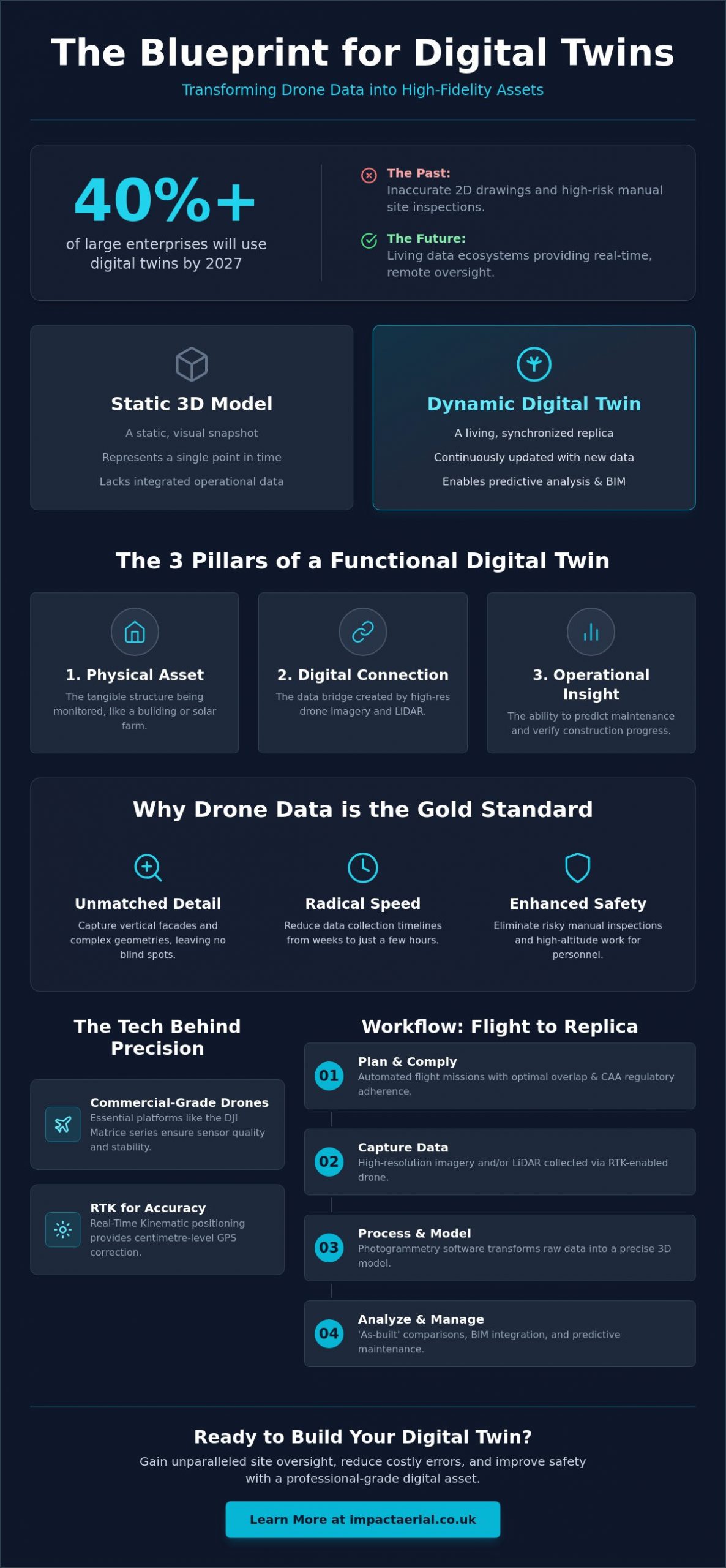
The Step-by-Step Workflow: From Flight to 3D Replica
The transition from a physical structure to a high-fidelity digital replica is a structured process that demands technical precision at every stage. It begins with meticulous flight planning. To ensure the software can accurately calculate depth and geometry, we typically set a front overlap of 80% and a side overlap of 70%. For creating a digital twin with drone data of vertical structures, such as commercial facades or bridges, camera angles must be adjusted from standard nadir (top-down) views to oblique perspectives. This ensures that every vertical surface is captured with the same detail as the roofline.
Data capture is rarely a manual affair. Professional pilots execute automated grid missions for site-wide mapping and ‘orbit’ missions for individual assets. These pre-programmed flight paths ensure 360-degree coverage and eliminate the risk of missing critical data points. Once the flight is complete, the imagery is moved into a high-performance processing environment. Here, photogrammetry software stitches thousands of images together to form a dense point cloud. This point cloud is later converted into a 3D mesh and textured with high-resolution imagery to create a model ready for stakeholder review.
Beyond digital visualization, these 3D meshes can also be used for rapid prototyping. Specialist studios like Protomolecule can utilize the exported data to create high-precision 3D printed models, providing a tangible way to inspect complex structural geometries or present project site plans to stakeholders.
Optimising Data for Accuracy
Capturing images is only half the battle. Professional standards require consistent exposure and sharp focus across the entire dataset. Inconsistent lighting can lead to ‘ghosting’ or alignment errors during processing. We also focus heavily on filtering ‘noise’ from the point clouds. This involves removing temporary objects like moving vehicles or swaying vegetation that can distort structural lines. Finally, georeferencing ensures the model aligns perfectly with real-world coordinates, which is essential for any project requiring centimetre-level spatial integrity.
Software Platforms and Integration
A digital twin’s value lies in its utility. At Impact Aerial, we use industry-standard processing suites that allow for seamless integration into existing workflows. The data isn’t just a visual aid; it’s a functional tool that can be exported directly into CAD or Revit for engineering analysis. When creating a digital twin with drone data, we prioritize cross-device accessibility. This allows site teams in the field and remote stakeholders in the office to interact with the same ‘living’ asset in real-time, ensuring everyone is working from a single, accurate version of the truth. If you need a custom web platform to host and visualize these assets, you can check out Larasoft for bespoke software development.
Industry Applications: Where Digital Twins Drive ROI in 2026
The financial case for creating a digital twin with drone data is built on the mitigation of risk and the acceleration of project timelines. In the UK construction sector, “as-built” models are now routinely compared against “as-designed” BIM plans. This allows project managers to identify structural deviations or installation errors in real-time, preventing expensive remedial work later in the build cycle. By catching these discrepancies early, developers can avoid the compounding costs associated with delayed schedules and material waste.
In the West Midlands, regional infrastructure projects like motorway expansions and rail improvements benefit from regular drone data updates. These updates provide a chronological record of progress that ground teams can’t capture as efficiently. For the UK’s heritage sector, high-fidelity replicas of Grade I and II listed buildings are becoming essential for conservation. These twins allow architects to study delicate facades or inaccessible roof sections without the need for intrusive scaffolding, ensuring that restoration plans are based on precise, non-destructive data.
Predictive Maintenance and Asset Longevity
Digital twins move maintenance from a reactive model to a predictive one. By using historical data captured over several months or years, asset owners can track structural decay, masonry erosion, or corrosion over time. Integrating thermal payloads into the twin allows for the detection of moisture ingress or electrical hot spots that are invisible to the naked eye. This data-driven approach significantly reduces the “Total Cost of Ownership” by enabling targeted repairs rather than full-scale replacements, extending the life of the asset while ensuring occupant safety.
Stakeholder Collaboration and Communication
Complex projects involve multiple stakeholders who often need to review site conditions from remote locations. A digital twin provides an immersive 3D environment that’s perfect for board-level presentations or planning meetings with local authorities. These models also serve as powerful communication tools; virtual tours allow international investors to explore property assets with incredible detail without leaving their offices. For those looking to integrate these assets into a broader engagement strategy, our 3D Virtual Tours for Property guide explores these immersive techniques further.
If you’re ready to improve your project oversight and data accuracy, our specialists offer professional construction site monitoring services tailored to your specific site requirements.
Why Impact Aerial is Your Partner for Digital Twin Excellence
Impact Aerial provides a specialized approach to creating a digital twin with drone data, combining technical expertise with operational rigour. Based in Birmingham, our team is strategically positioned to deploy rapidly to sites across the UK, ensuring that your project data is captured during optimal weather windows. We don’t just provide imagery; we deliver a complete end-to-end service that begins with an in-depth technical consultation and concludes with advanced post-production. This methodical flow ensures that the final digital asset is fully optimized for your specific engineering or construction requirements.
Our operations are built on a foundation of safety and compliance. We hold full CAA GVC certification, which is the professional standard for operating in complex UK environments. To provide our clients with total peace of mind, we carry £5m in commercial liability insurance. This level of protection is essential for high-value assets and active construction zones. By utilizing the latest DJI Enterprise hardware, we set a benchmark for data precision that ensures every virtual model is a high-fidelity reflection of the physical asset, providing the reliability that technical consultants demand.
The Impact Aerial Difference: Precision and Safety
Our meticulous data collection protocols often exceed the standard drone survey requirements. We stay current with the evolving UK regulatory landscape, including the January 2026 mandates for Remote ID and UK class marks. This commitment to officialdom means your data is collected legally and ethically, protecting you from the regulatory risks associated with uncertified operators. Our expert post-production team then processes this raw information, turning it into actionable business intelligence that supports your specific lifecycle management goals and long-term asset monitoring.
Get Started with Your Digital Transformation
Every project has unique Key Performance Indicators (KPIs). We tailor our approach to creating a digital twin with drone data based on whether you require centimetre-level topographical accuracy or high-resolution thermal analysis for energy efficiency. Our onboarding process is structured to be seamless and informative. It starts with a comprehensive site risk assessment and flight planning phase, moving through to precision execution and final data delivery through your preferred software environment, such as Revit or CAD.
Request a professional drone data consultation from Impact Aerial today to learn how our technical consultants can help you reduce site visit frequency, improve safety, and enhance your overall operational efficiency through high-precision aerial data.
Advancing Your Digital Asset Strategy
Transitioning from static 3D models to dynamic, living replicas is a critical step for modern asset management. By creating a digital twin with drone data, you gain a high-fidelity environment that supports predictive maintenance and improves stakeholder communication across the project lifecycle. This shift doesn’t just enhance oversight; it fundamentally changes how you interact with your physical assets, moving from reactive repairs to data-driven operational decisions.
Professional execution is the only way to ensure these digital assets meet the rigorous standards required for UK construction and infrastructure. At Impact Aerial, we combine advanced DJI Enterprise hardware with meticulous data protocols to deliver centimetre-level accuracy. Our team provides the security you need through CAA GVC certified pilots and £5m in commercial liability insurance, ensuring every flight is compliant and every dataset is precise.
Your digital transformation starts with a specialized partner who understands both the technology and the regulatory landscape. Book Your Professional Drone Survey Consultation today to explore how we can integrate high-precision aerial data into your existing workflows. We look forward to helping you build a safer, more efficient future for your property portfolio.
Frequently Asked Questions
What is the difference between photogrammetry and a digital twin?
Photogrammetry is the specific technology used to extract 3D information from 2D photographs, while a digital twin is the comprehensive virtual replica itself. While photogrammetry provides a static visual model at a single point in time, a digital twin integrates ongoing data to reflect the current state of a physical asset. This distinction is vital for lifecycle management, as the digital twin serves as a functional tool for long-term monitoring rather than just a one-off visual record.
How accurate is drone data for creating 3D digital twins?
Professional-grade hardware equipped with Real-Time Kinematic (RTK) positioning achieves centimetre-level accuracy in the virtual model. This precision ensures that the twin aligns perfectly with real-world coordinates, which is essential for engineering and construction applications. Creating a digital twin with drone data at this level of fidelity allows for reliable comparisons between as-built structures and original design plans, providing the technical rigour required for high-stakes infrastructure projects.
Do I need a special UK drone license to create digital twins for my business?
Commercial operators typically require a General Visual Line of Sight Certificate (GVC) from the Civil Aviation Authority (CAA) for work in urban environments. While low-risk flights might fall under the Open category, most professional business applications involving digital twins require Specific category authorization. This ensures the pilot has undergone formal training in risk mitigation and flight safety, which is a legal prerequisite for operating drones commercially in congested UK areas.
What is the typical ROI for implementing drone digital twins in construction?
The primary return on investment comes from identifying construction errors early and reducing the need for manual site visits. By catching structural deviations before they become compounded issues, developers avoid expensive remedial work and project delays. Additionally, the ability to perform remote inspections significantly lowers the risk of on-site accidents and reduces the overhead costs associated with traditional surveying methods like scaffolding or high-access platforms.
Can drone digital twins be integrated with existing BIM software?
Professional drone data is fully compatible with industry-standard Building Information Modelling (BIM) software such as Revit and AutoCAD. The processed point clouds and 3D meshes can be exported in various formats, allowing for seamless integration into existing digital workflows. This allows project managers to overlay aerial data directly onto design plans, facilitating a more collaborative and accurate environment for architects, engineers, and site stakeholders to review progress in real-time.
How often should drone data be updated for a ‘living’ digital twin?
Update frequency depends entirely on the project’s pace and the specific goals of the asset owner. For active construction sites, weekly or bi-weekly flights are often necessary to track rapid progress and verify milestones. For long-term asset management of established buildings, quarterly or bi-annual updates might be sufficient. The “living” nature of the twin is maintained by ensuring that new data is captured whenever a significant physical change occurs to the asset.
What hardware is required for high-resolution digital twin capture?
High-resolution capture requires enterprise-grade drones such as the DJI Matrice 350 RTK or the Mavic 3 Enterprise. These platforms support high-megapixel sensors and specialized payloads, such as the Zenmuse P1 for photogrammetry or LiDAR sensors. Creating a digital twin with drone data at professional standards also necessitates robust processing hardware or cloud-based platforms capable of handling the massive datasets generated by thousands of high-resolution images across a single site.
Is it safer to use drones for digital twin creation than traditional methods?
Drones are significantly safer than traditional surveying methods because they eliminate the need for personnel to work at height. Manual inspections often involve scaffolding, rope access, or fragile roof walks, all of which carry inherent risks to life and limb. Aerial data collection allows surveyors to remain safely on the ground while the aircraft captures data from hazardous or inaccessible locations. This reduction in physical risk is a primary driver for drone adoption in the UK industrial sector.
Drone Inspection for Hazardous Areas: The 2026 Professional Guide
Did you know that integrating specialized UAV technology into infrastructure surveys can reduce operational costs by as much as 55% while completely removing personnel from high-risk environments? For asset managers and safety officers, the liability of sending a team into a confined space or onto high-altitude scaffolding is a constant pressure on both the budget and the conscience. You’re likely familiar with the logistical delays of traditional access and the frustration of receiving incomplete data from ground-based inspections.
This professional guide explores how a drone inspection for hazardous areas acts as a superior visual intelligence layer, not just a safety alternative. You’ll learn how to leverage advanced sensors like LiDAR and thermal imaging to gain precision insights that were previously unreachable. We’ll also break down the critical 2026 regulatory landscape, including mandatory GVC certifications and the new UK-specific drone classifications. By the end of this article, you’ll have a clear framework for choosing a qualified inspection partner who prioritizes meticulous compliance and high-tier data delivery.
Key Takeaways
- Understand how “Human-Out-Of-The-Loop” operations eliminate personnel risk in ATEX zones and high-voltage environments.
- Learn how 4K HDR and thermal sensors identify microscopic structural defects and electrical hotspots that ground-based teams might miss.
- Verify the latest 2026 CAA compliance requirements, including the necessity of GVC certification and £5 million commercial liability insurance.
- Discover why a professional drone inspection for hazardous areas is now the industry standard for safe construction monitoring and high-rise property surveys.
- Gain a framework for integrating UAV data into your existing HSE protocols through a structured consultation and safety-first flight planning process.
Why Drone Inspection for Hazardous Areas is the New Industry Standard
A professional drone inspection for hazardous areas is the deployment of specialized Unmanned Aerial Vehicles (UAVs) to survey, map, and analyze high-risk industrial zones. This technology has shifted from a niche alternative to a primary requirement for asset managers who prioritize safety and data precision. By implementing a “Human-Out-Of-The-Loop” strategy, organizations can conduct detailed visual assessments in ATEX-rated zones and high-voltage environments without ever placing a technician in harm’s way.
Global Drone Regulations have matured alongside these hardware advancements, providing a legal framework that supports complex aerial operations in sensitive locations. This regulatory clarity allows businesses to replace traditional, high-risk access methods with a process that is both faster and more reliable.
To better understand how these specialized units operate in challenging environments, watch this helpful video:
The speed of deployment is perhaps the most immediate advantage. Traditional inspections often require weeks of logistical planning, scaffolding erection, or the hire of heavy plant equipment like cherry pickers. A professional UAV team can often be site-ready and airborne within hours. This agility directly impacts site downtime. Because aerial methods are non-intrusive, many industrial facilities can continue their standard operations while the inspection is underway, avoiding the massive financial losses associated with full-site shutdowns.
Defining Hazardous Environments for UAV Operations
Modern drone inspection for hazardous areas covers a broad spectrum of risks that would otherwise require intensive safety protocols for human entry. These include:
- Structural hazards: Surveying deteriorating roofs, internal chimney flues, and unstable bridge supports.
- Chemical and biological risks: Monitoring active gas leaks, potential radiation zones, and toxic exhaust vents.
- Electrical and thermal hazards: Inspecting high-voltage pylons, live substations, and industrial furnaces while they remain at operating temperatures.
The Economic Case: ROI Beyond Safety
Utilizing UAVs provides a significant return on investment by eliminating the recurring costs of heavy plant hire and the extensive labor hours required for manual access. Beyond the immediate savings, proactive hazard identification can lead to reduced insurance premiums, as it proves a commitment to rigorous maintenance and risk management. Additionally, the data collected can be used to generate “digital twins.” These 3D models serve as a permanent baseline for long-term asset management, allowing your team to track structural changes with millimetre precision over several years.
Advanced Sensor Technology: Capturing High-Resolution Data in Extreme Conditions
Successful drone inspection for hazardous areas relies on more than just flight stability. It requires a sophisticated sensor suite capable of capturing granular detail from a safe distance. High-resolution 4K HDR cameras are now the essential standard for identifying microscopic structural flaws. These sensors allow engineers to spot hairline fractures in concrete or the earliest stages of pitting corrosion on steel surfaces that are otherwise inaccessible. When combined with high-powered zoom lenses, pilots can maintain significant standoff distances. This capability reduces the risk of electromagnetic interference or physical collision while still delivering the visual clarity required for technical sign-offs.
The transition from raw imagery to actionable intelligence is where professional UAV operations provide the most value. A National Safety Council report on drone safety highlights that the ability to conduct these assessments remotely is a primary driver in reducing workplace fatalities. Raw data isn’t enough; it’s the readability that counts. Professional post-production processes ensure that technical metadata is overlaid correctly, making complex data sets accessible for stakeholders who weren’t on-site during the flight.
Visual Precision with DJI Enterprise Hardware
Commercial-grade hardware is a non-negotiable requirement for industrial environments. Platforms like the DJI Mavic 3 Enterprise are specifically engineered for these heavy-duty tasks. Unlike consumer models, these units feature mechanical shutters. This is a critical technical detail; it eliminates rolling shutter distortion, ensuring every frame is blur-free even when the aircraft is moving at speed. For a deeper look at the technical specifications of these aircraft, you can explore our survey drone guide, which details how specific hardware choices impact data quality.
Thermal and Multi-Spectral Analysis
Visual light is only one part of the spectrum used during a drone inspection for hazardous areas. Radiometric thermal sensors are essential for detecting sub-surface defects, such as insulation breaches or electrical hotspots in live substations. This technology is particularly transformative for renewable energy assets. Our specialized PV solar farm thermal surveys use these sensors to identify individual cell failures across thousands of panels in minutes. By converting raw thermal data into detailed engineering reports, asset managers can prioritize maintenance based on actual heat signatures. If you’re ready to enhance your safety protocols, our team offers the expert aerial surveying needed to secure your high-risk sites.
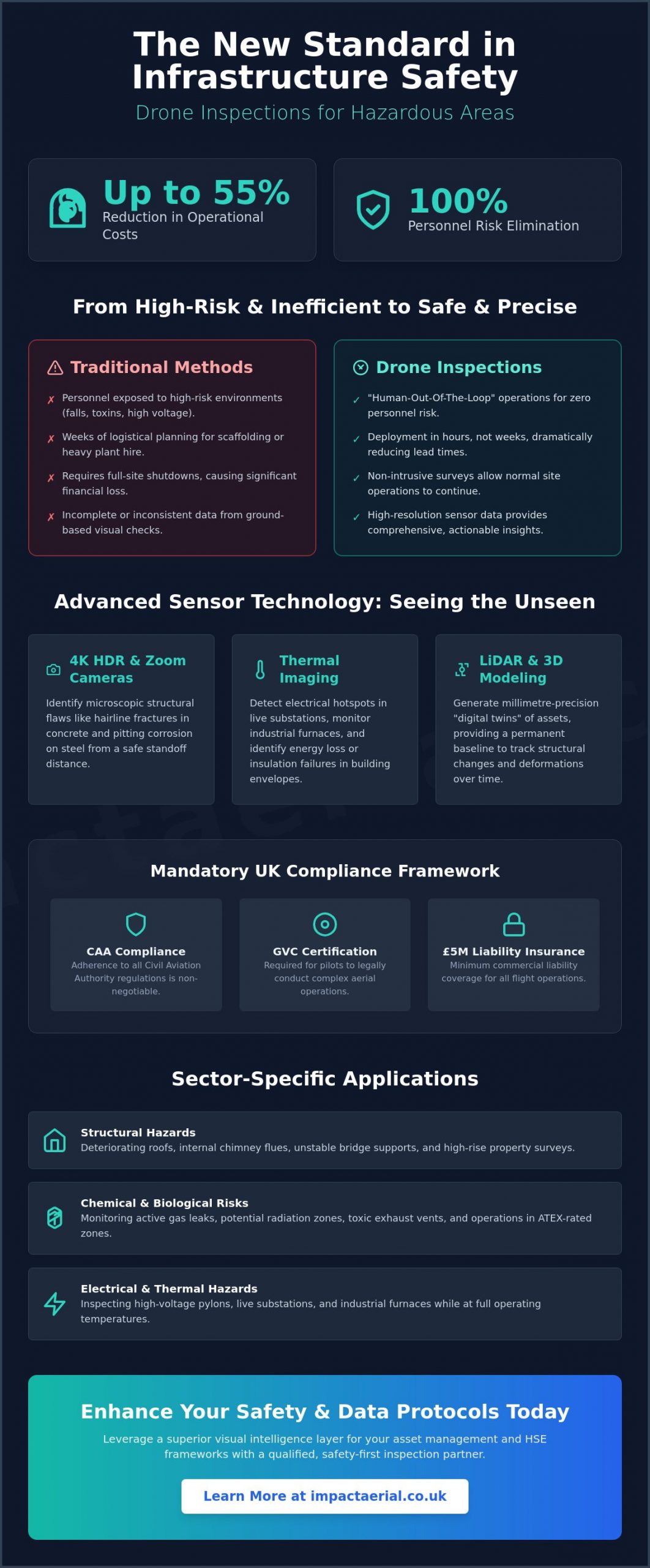
Navigating UK Regulations: CAA Compliance and Risk Mitigation
Operating a drone inspection for hazardous areas in the UK isn’t just about technical skill; it’s a strictly regulated legal activity. The Civil Aviation Authority (CAA) oversees all commercial UAV operations, requiring pilots to adhere to rigorous safety standards that protect both the public and critical infrastructure. For high-risk industrial sites, the previous ‘Permission for Commercial Operation’ (PfCO) has transitioned into specific categories that demand higher levels of training and operational oversight. Every flight must be backed by a comprehensive Operations Manual. This document is a legal requirement that details how the pilot manages high-risk flight profiles, equipment failure protocols, and emergency procedures specific to the aircraft being used.
The complexity of these missions is supported by a Systematic Review of Drone Sensors, which underscores the technical demands placed on hardware and operators in extreme conditions. This level of technical oversight ensures that data collection doesn’t compromise site safety, directly meeting the stringent requirements of UK aviation law. When you hire a professional team, you aren’t just paying for a flight; you’re investing in a legally compliant framework that mitigates liability.
The Importance of GVC Certified Pilots
Commercial industrial work requires a pilot who holds a CAA GVC certified status. This certification involves rigorous theoretical exams and practical flight assessments specifically designed for complex visual line of sight operations. These pilots don’t just fly; they conduct site-specific risk assessments and may operate under an Operating Safety Case (OSC) for missions that fall outside standard permissions. Certification is the primary differentiator between a hobbyist and a professional. It guarantees that the operator understands the legal and safety nuances of working around high-value assets, ensuring that every drone inspection for hazardous areas is conducted with meticulous precision.
Risk Management and Insurance
Standard business insurance policies rarely cover the complexities of industrial hazardous areas. In this sector, £5 million in commercial liability insurance is the industry minimum for professional UAV work. This coverage provides the necessary financial security for clients operating in high-value environments like refineries, chemical plants, or power stations. At Impact Aerial, we combine this high-level insurance with site-specific Risk Assessment Method Statements (RAMS) for every project. This meticulous approach ensures that our safety protocols integrate seamlessly with your own HSE requirements, providing psychological comfort and tangible protection. For more details on the current legislative environment, you can consult our UK drone license guide.
Sector-Specific Applications: Where UAVs Excel
While the technical specifications of modern aircraft are impressive, their true value is realized through sector-specific deployment. A drone inspection for hazardous areas provides a unique vantage point that ground-based teams simply cannot replicate safely. In 2026, research indicates that 67% of UK construction companies have adopted drone technology for site surveying and monitoring, moving away from expensive and slow manual methods. This adoption is driven by the need for real-time data in high-risk zones where heavy machinery and unstable ground make human entry a significant liability. The versatility of these systems allows them to excel in several key areas:
- Construction Site Monitoring: Tracking progress in areas with heavy machinery or unstable ground.
- Property and Roof Surveys: Inspecting high-rise structures without the need for rope access.
- Energy Infrastructure: Conducting preventative maintenance on pylons and solar farms.
- Industrial Chimneys and Flare Stacks: Visualizing internal and external integrity while the site remains live.
Construction and Civil Engineering
In the construction sector, UAVs serve as a continuous monitoring tool. They allow project managers to track progress across vast sites without halting work or risking personnel in active plant areas. Beyond simple monitoring, specialized drone property surveys are now standard for pre-acquisition reports on commercial real estate. These surveys provide an exhaustive visual record of an asset’s condition, from foundation stability to roof integrity. In hazardous environments like quarries, drones perform volumetric measurements of stockpiles with precision, keeping staff away from unstable slopes and heavy transport routes.
Renewable Energy and Utilities
The utility sector benefits from the speed of aerial surveys, particularly when managing sprawling assets like solar farms or national grid pylons. Inspecting hundreds of solar assets in a single flight is now a routine procedure, identifying faulty cells that would take days to find manually. For wind energy, UAVs detect bird strikes or lightning damage on turbine blades without requiring technicians to perform dangerous rope access maneuvers. Similarly, high-resolution photography is used for telecommunications mast inspections, allowing for the identification of loose fixings or weather damage from a safe standoff distance.
Industrial chimneys and flare stacks represent some of the most challenging environments for any surveyor. UAVs allow for the visualization of both internal and external integrity while these structures are live. This capability eliminates the need for costly shutdowns and the inherent risks of internal scaffolding. If your project requires high-resolution data in a high-risk environment, you can book a professional drone inspection today to secure your assets and ensure site safety compliance.
Implementing Drone Inspections with Impact Aerial
Integrating a drone inspection for hazardous areas into your operational workflow requires more than technical flight skills; it demands a seamless alignment with your existing site safety protocols. Precision doesn’t happen by accident. It’s the result of a structured, methodical approach that prioritizes regulatory compliance and technical excellence. A critical component of industrial safety is the integration with existing site management systems. We don’t just show up and fly; we ensure our operations are fully embedded within your “Permit to Work” (PTW) framework. This coordination ensures that aerial activity is synchronized with ground-based maintenance, preventing conflicting tasks and maintaining the integrity of the exclusion zone.
Our consultation process begins with a deep dive into your specific site hazards and data goals. Whether you’re managing a chemical plant or a high-rise construction site, we work alongside your HSE team to ensure every flight path is vetted and every risk is mitigated. Once the mission is complete, you receive high-tier data output, including 4K HDR video and ultra-high-resolution stills. For stakeholders who cannot be on-site, our post-production team can transform this data into immersive virtual tours, allowing for remote site visits and collaborative analysis from any location. For those managing mission-critical infrastructure from a central hub, you can discover Activu Corporation and their specialized visualization platforms for control rooms.
Our Professional Workflow
We follow a meticulous three-stage process to ensure 100% asset coverage and safety:
- Pre-flight planning: This involves detailed airspace checks, weather monitoring, and the preparation of site-specific Risk Assessment Method Statements (RAMS).
- On-site execution: Our pilots execute precise, repeatable flight patterns designed to capture every angle of the asset while maintaining safe standoff distances.
- Post-flight: Data is processed and delivered via secure cloud platforms, ensuring your engineering teams can access the information they need without delay.
Why Choose Impact Aerial?
Choosing the right partner for a drone inspection for hazardous areas is a decision rooted in trust and proven competence. Based in Birmingham, we provide a unique combination of local expertise and a comprehensive UK-wide reach. We don’t just claim to be professional; we back our operations with £5 million in commercial liability insurance and full CAA GVC certification. These aren’t just badges; they’re our commitment to your site’s security and the quality of the data we deliver. If you’re ready to eliminate human risk and gain superior visual intelligence for your high-risk assets, contact us today for a professional consultation and let our team help you secure your industrial future.
Securing Future-Proof Visual Intelligence for High-Risk Assets
The shift toward aerial surveying in industrial environments is a necessary evolution in workplace safety and operational efficiency. By removing personnel from dangerous zones and utilizing 4K HDR cinema-grade hardware, businesses can capture structural data with unprecedented clarity. Navigating the complex 2026 UK regulatory landscape requires a partner who understands the nuances of CAA compliance and rigorous risk mitigation. You’ve seen how these specialized UAVs transform data collection from a liability into a strategic advantage.
A professional drone inspection for hazardous areas ensures that your site remains operational while identifying critical defects that ground-based methods often miss. Impact Aerial provides the meticulous oversight needed for these high-stakes missions, backed by CAA GVC certified pilots and £5 million in commercial liability insurance. This combination of technical expertise and legal protection gives you the reassurance that your assets are in expert hands. It’s time to replace outdated access methods with precision aerial intelligence.
Ready to enhance your maintenance protocols? Request a Professional Drone Inspection Quote from Impact Aerial to secure the superior data your project deserves. We look forward to helping you achieve your safety and data goals.
Frequently Asked Questions
Is drone inspection safe for chemical plants or explosive atmospheres?
Yes, specialized UAVs are designed to operate safely in volatile environments without the risk of ignition. By utilizing a “Human-Out-Of-The-Loop” strategy, you eliminate the danger of sending personnel into potentially explosive or toxic zones. Our pilots use collision-tolerant hardware and follow strict safety protocols to ensure that every drone inspection for hazardous areas meets the highest industrial safety standards.
What kind of data do I receive after a hazardous area drone survey?
You receive a comprehensive package of high-resolution digital assets tailored to your engineering needs. This typically includes 4K HDR video and ultra-high-resolution still imagery for identifying structural defects. Depending on the mission, we also provide radiometric thermal maps to locate heat anomalies and 3D digital twins. These digital records allow your stakeholders to perform detailed analysis from a safe, remote office environment.
How long does a typical drone inspection take compared to traditional methods?
A drone survey is significantly faster, often completing in a single afternoon what would take days or weeks using scaffolding. Because there’s no need for complex assembly or heavy plant hire, the setup time is minimal. This speed doesn’t just save labor costs; it provides your team with rapid, actionable intelligence that allows for faster decision-making and maintenance scheduling.
Do I need to shut down my site during a drone inspection?
In most cases, site shutdowns are unnecessary because drone operations are non-intrusive. Unlike traditional methods that require large exclusion zones for scaffolding or cranes, a UAV can operate from a safe distance or overhead without interrupting your standard workflow. This ability to maintain production while conducting a drone inspection for hazardous areas is a major factor in reducing overall project costs.
What are the UK legal requirements for drone pilots in hazardous zones?
Commercial pilots must hold a valid General Visual Line of Sight Certificate (GVC) issued by the CAA. Additionally, the operator must possess a valid Operator ID and Flyer ID, alongside a minimum of £5 million in commercial liability insurance. These legal requirements ensure that the pilot is trained to handle complex flight profiles and manage site-specific risks according to the latest UK aviation standards.
Can drones operate in high-wind or poor weather conditions for inspections?
Professional enterprise drones are built with high IP ratings and wind resistance, allowing them to fly in light rain and winds up to 12 meters per second. While the hardware is robust, we prioritize data quality and safety. If weather conditions threaten to compromise the precision of the visual or thermal data, our pilots will reschedule the flight to ensure you receive the most accurate results possible.
How much does a professional drone inspection for hazardous areas cost?
Pricing is determined by the complexity of the site, the specific sensors required, and the level of risk involved. While basic surveys are more affordable, complex missions involving thermal imaging or confined spaces require specialized planning and hardware. We provide bespoke quotes based on your specific asset requirements, ensuring you receive a professional service that prioritizes both safety and high-end data delivery.
What is the maximum height a drone can reach for an industrial survey?
The standard legal height limit for drone operations in the UK is 400 feet (120 meters) above ground level. This is sufficient for the vast majority of industrial chimneys, flare stacks, and high-rise structures. For assets that exceed this height, we can apply for specific CAA permissions or an Operating Safety Case (OSC) to ensure the mission is conducted legally and safely within UK airspace.
Drone Survey for Property Portfolio Management: A Strategic Guide for UK Asset Managers
Did you know that traditional survey methods requiring scaffolding or mobile elevating work platforms can be up to 70% more expensive than modern aerial alternatives? For UK asset managers overseeing dozens of diverse sites, these manual inefficiencies don’t just drain maintenance budgets; they create fragmented data silos and significant safety liabilities. You’ve likely experienced the logistical headache of coordinating regional contractors and the frustration of receiving inconsistent reports that make long-term planning nearly impossible. Managing a complex estate requires a level of precision and oversight that manual inspections simply cannot deliver at scale.
Implementing a professional drone survey for property portfolio management allows you to transition from expensive reactive repairs to a streamlined, predictive maintenance model. You’ll discover how to transform multi-site oversight with data-driven surveys that reduce operational risk and provide a centralised, high-definition record of every asset. This guide explores the strategic integration of aerial data into your workflow, ensuring your portfolio remains compliant with evolving CAA regulations while significantly lowering your survey-related health and safety risks. We’ll examine how meticulous data capture and technical expertise provide the psychological comfort and tangible financial benefits your business requires.
Key Takeaways
- Learn why traditional regional inspections create data silos and how a centralised aerial approach provides a consistent visual record across your entire estate.
- Understand how enterprise-grade hardware and specialised sensors enable high-precision defect detection that manual site visits often miss.
- Compare the significant time and cost advantages of rapid drone deployment versus the logistical complexity of scaffolding for multi-site inspections.
- Discover a step-by-step framework for integrating a drone survey for property portfolio management into your existing asset risk profiles and lease cycles.
- Explore how professional certification and centralised UK operations ensure consistent, compliant reporting that meets the highest safety and regulatory standards.
The Evolution of Property Portfolio Management: Why Drones are Essential
Property management has moved beyond simple facility maintenance into a complex era of asset lifecycle optimisation. A drone survey for property portfolio management represents a fundamental shift in how UK asset managers oversee large-scale estates, moving away from subjective manual checks toward objective, high-resolution digital data. By utilising advanced aerial survey technologies, managers can now obtain a comprehensive view of every asset, regardless of its location or height. This approach ensures that decision-making is rooted in technical precision rather than anecdotal evidence.
Many organisations suffer from what we call the “Portfolio Blind Spot.” This occurs when high-level financial data is disconnected from the actual physical condition of the buildings. Without a centralised visual record, asset managers often rely on disparate reports from various regional contractors, leading to inconsistent data and reactive, costly “break-fix” cycles. This lack of visibility often results in minor defects escalating into major capital expenditures because they weren’t identified during the early stages of deterioration.
To better understand how this technology is applied on-site, watch this helpful video demonstrating aerial data capture:
Modern compliance requirements, such as the Building Safety Act 2022, demand a “golden thread” of information that is transparent and easily accessible. Drones facilitate this by providing repeatable, time-stamped evidence of building integrity, which is essential for both ESG reporting and long-term safety audits. This transition to proactive maintenance helps preserve capital and ensures that high-value assets remain compliant with national standards. It’s about building a reliable database that supports both daily operations and long-term strategic goals.
The Limitations of Traditional Multi-Site Inspections
Traditional inspections often fail at scale due to the prohibitive costs of hiring scaffolding or mobile elevating work platforms for every site visit. When managing multiple properties across the UK, the logistical headache of coordinating these inspections is immense. Manual surveys are also inherently subjective; different surveyors may interpret the same defect in varied ways, creating a fragmented picture of the portfolio’s health. Working at height remains one of the primary safety liabilities for property owners, making traditional roof and facade inspections a significant risk factor that requires rigorous mitigation.
The Data-Centric Approach to Asset Oversight
Transitioning to a digital model allows stakeholders to access a “single source of truth” across the entire estate. High-resolution aerial data provides a meticulous visual history of every asset, allowing for side-by-side comparisons over several years to track deterioration rates accurately. This level of detail enables predictive maintenance schedules based on real-world evidence rather than guesswork or generic timelines. Drone surveys provide a non-intrusive method for gathering building data without tenant disruption, ensuring that business operations continue smoothly while critical inspections take place.
Key Drone Survey Technologies for Diverse Property Portfolios
Professional asset management requires more than just a standard camera in the sky. The effectiveness of a drone survey for property portfolio management depends heavily on the deployment of enterprise-grade hardware, such as the DJI Matrice or Mavic 3 Enterprise series. These platforms are designed for the rigours of commercial environments, offering the stability and flight endurance necessary to cover multi-acre industrial sites or complex retail parks in a single mobilisation. High-resolution 4K HDR imagery is the baseline requirement for dilapidation reports; it provides the clarity needed to identify hairline fractures in masonry or failing gutter seals that lower-tier equipment would simply overlook.
Precision is maintained through the use of RTK (Real-Time Kinematic) positioning and GPS-tagged data. This technology ensures that every captured image is georeferenced with centimetre-level accuracy, allowing managers to overlay aerial data onto existing site plans or GIS systems. All flight operations must be conducted by pilots who strictly follow UK drone safety regulations to ensure the legality and insurance validity of the data collected. Integrating these advanced sensors into your annual maintenance plan ensures a high-tier level of quality, which is why many asset managers opt for specialised drone commercial property surveys to secure their long-term data strategy.
Thermal Imaging for Energy Efficiency and Leak Detection
Radiometric thermal sensors are essential for identifying energy loss and sub-surface moisture across a portfolio. These cameras detect minute temperature variances, making them highly effective at spotting insulation gaps or water ingress on flat industrial roofs before leaks penetrate the building envelope. For portfolios with extensive solar PV arrays, thermal drones can rapidly identify malfunctioning cells that reduce energy yield. This data is invaluable for asset managers aiming to improve BREEAM ratings or EPC scores, as it provides documented evidence of thermal performance and targeted areas for remediation.
3D Modelling and Digital Twins for Asset Lifecycle Planning
Photogrammetry allows for the creation of high-fidelity 3D models and digital twins of every asset in a portfolio. By processing hundreds of overlapping aerial images, we generate accurate digital replicas that allow stakeholders to take precise measurements of facade areas or roof pitches from their desks. These models are particularly useful during tender processes for maintenance contracts; providing contractors with an accurate 3D model reduces the need for multiple site visits and ensures more competitive, accurate quotes. This digital record serves as a foundation for long-term lifecycle planning, ensuring that every repair is based on verified spatial data.
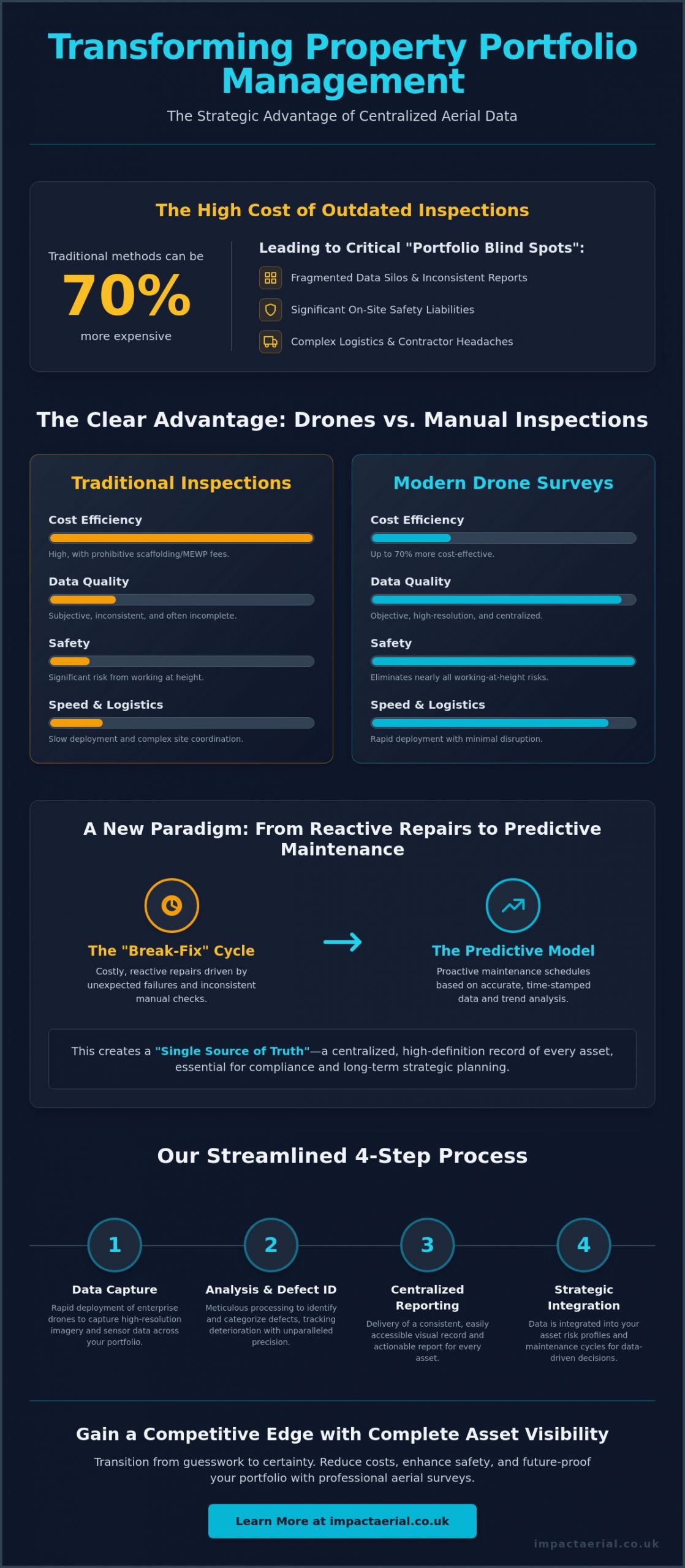
ROI Analysis: Drone Surveys vs. Traditional Portfolio Inspections
The financial case for integrating a drone survey for property portfolio management becomes clear when you examine the logistical mobilisation required for traditional inspections. Compare the timeline for ten regional sites. Conventional methods often require multiple weeks of coordination, scaffolding permits, and physical site access that disrupts tenants. In contrast, a professional drone team can mobilise and complete the same ten surveys in a fraction of the time, often within a single week of favourable weather. Industry data suggests that drone mapping can be up to 400 times faster than traditional ground surveys, allowing asset managers to move from data collection to decision-making at an accelerated pace.
Cost savings are equally compelling. Professional drone surveys are typically 30% to 70% cheaper than traditional methods that require scaffolding or mobile elevating work platforms. These savings aren’t just limited to equipment hire. By identifying minor defects early, such as a slipped tile or a blocked parapet gutter, you prevent the type of large-scale water ingress that results in expensive capital expenditure and tenant compensation claims. A documented history of proactive maintenance can also lead to “hidden” savings, such as more favourable insurance premiums, as underwriters recognise the reduced risk profile of a well-monitored estate.
Manual surveying hours are often inflated by the sheer difficulty of accessing high-value commercial assets. Drones reduce these professional fees by providing surveyors with all the necessary visual data upfront. Instead of spending hours on a roof, a surveyor can review high-definition imagery from their office, focusing their expertise on analysis rather than the logistics of access. This efficiency ensures that your professional budget is spent on expert insight rather than site mobilisation.
Standardising Data Across a National Portfolio
Consistency is often the greatest challenge for managers overseeing assets from London to Birmingham. Using a single, specialised drone service provider ensures that every report follows the exact same technical standard and visual format. This comprehensive drone survey methodology serves as the baseline for all data collection across your estate. All reports are hosted in a centralised digital portal, providing stakeholders with instant access to the physical condition of any building in the portfolio without searching through disparate regional files.
Risk Mitigation and Health & Safety Compliance
The “Work at Height” regulations remain a primary concern for any property professional. Traditional manual surveys carry inherent safety liabilities that drones almost entirely eliminate. By keeping personnel on the ground, you remove the logistical and safety headaches associated with roof access. Drones eliminate the need for physical roof access, thereby removing the #1 cause of major workplace injuries in the sector. To ensure total portfolio-wide protection, we operate with £5m commercial liability insurance, providing you with the psychological comfort that all operations are fully covered and strictly compliant with national safety standards.
Implementing Drones into Your Property Management Strategy
Successful implementation of a drone survey for property portfolio management requires a shift in perspective. You shouldn’t view aerial inspections as isolated, one-off events. Instead, they must be integrated as a recurring data stream within your broader asset management framework. This starts with a clear operational plan that addresses scheduling, tenant liaison, and data integration. By establishing a standardised workflow, you ensure that the high-resolution data captured on-site translates directly into actionable maintenance tasks within your existing CAFM (Computer-Aided Facility Management) systems.
Scheduling should be driven by asset risk profiles rather than arbitrary dates. A warehouse roof in a coastal environment, for instance, may require a more frequent inspection cadence than a modern retail unit in a sheltered urban area. You should also align these surveys with lease cycles. Conducting an aerial audit six months before a lease expiry provides the documented evidence needed for accurate dilapidation claims. Privacy is paramount in urban environments. Asset managers must develop a clear communication plan for tenants, ensuring they are notified of flight times and the strict privacy protocols followed by the flight crew. Modern software allows for the automatic blurring of faces and sensitive information, maintaining compliance with UK data protection standards.
Step 1: Portfolio Audit and Priority Mapping
The first phase involves categorising your estate to identify high-priority assets. Focus on buildings with aging facades, complex roof structures, or known historical issues. By mapping these risks, you can set a logical inspection cadence, such as annual surveys for high-value industrial units and bi-annual checks for newer office blocks. This proactive mapping ensures that your budget is allocated where the risk of failure is highest. Aligning these surveys with your planned maintenance cycles allows you to verify that previous repairs were completed to the required standard, creating a continuous loop of quality control across the portfolio.
Step 2: Choosing a Qualified UK Drone Partner
Selecting the right operator is a matter of regulatory compliance and operational reliability. A valid General Visual Line of Sight Certificate (GVC) from the Civil Aviation Authority is non-negotiable for commercial work. Beyond licensing, you must evaluate a provider’s capacity for national multi-site mobilisations. A partner with a centralised base can offer consistent reporting standards across the UK, ensuring that a survey in Manchester is identical in quality to one in Southampton. It’s often beneficial to partner with drone services that provide end-to-end project management, from initial risk assessments to final data delivery. This meticulous approach provides the psychological comfort that your assets are being monitored by experts who value safety as much as you do.
To begin standardising your asset oversight with a data-driven approach, contact the specialists at Impact Aerial to discuss your portfolio requirements.
Impact Aerial: The Professional Standard for UK Portfolio Surveys
Impact Aerial provides a sophisticated solution for asset managers seeking a reliable drone survey for property portfolio management. From our central hub in Birmingham, we offer nationwide coverage, ensuring a rapid response to multi-site requirements across the UK. Our operations are built on a foundation of technical excellence and regulatory strictness. We don’t just capture images; we provide a high-tier visual record that serves as a strategic asset for your business. This centralised approach eliminates the inconsistency of regional contractors, providing you with a uniform data standard from one site to the next.
Our hardware fleet is equipped for the most demanding commercial environments. We deliver qualitative outputs including 4K HDR video for detailed dilapidation assessments, radiometric thermal reports for energy efficiency audits, and high-fidelity 3D digital twins for precise spatial planning. Every mission is preceded by a meticulous risk assessment and executed by CAA GVC certified pilots who understand the operational complexities of live commercial sites. This technical expertise ensures that the data we provide is not only visually impressive but also legally and technically robust for your long-term records.
Expertise in Commercial and Industrial Sectors
Our team possesses deep experience in high-stakes environments, ranging from expansive PV solar farms to active construction sites. We serve the West Midlands and the wider UK with professional drone photography that captures the necessary detail for complex insurance and maintenance reports. We recognise that asset managers require more than just raw data. We provide custom reporting formats designed specifically for your stakeholders, ensuring the information is actionable and integrates seamlessly into your existing management systems. This focus on the industrial sector allows us to provide insights that generalist operators often overlook.
Compliance, Insurance, and Peace of Mind
In a market that is rapidly evolving, our commitment to officialdom and safety remains constant. We strictly adhere to the latest drone license regulations, including the 2026 Remote ID mandates and updated night flying protocols. This meticulousness extends to our financial protections; we maintain £5m commercial liability insurance. This coverage provides you with the psychological comfort that every flight is fully insured and conducted under the highest professional standards. Our focus on risk mitigation ensures that your drone survey for property portfolio management is not only effective but also fully compliant with national aviation authority standards.
Contact Impact Aerial to discuss your property portfolio survey requirements and discover how our data-centric approach can optimise your maintenance budget and reduce your operational risk.
Future-Proofing Your Estate with Precision Aerial Data
Adopting a digital, aerial-first strategy is a fundamental requirement for maintaining a competitive and compliant estate. By integrating a drone survey for property portfolio management into your recurring maintenance schedule, you replace fragmented regional reports with a high-definition, centralised visual record. This data-centric approach doesn’t just reduce immediate survey costs compared to traditional scaffolding; it provides the predictive insights needed to extend the lifecycle of every asset in your care.
Impact Aerial is ready to support your national mobilisation with technical precision and meticulous safety standards. Our Birmingham-based team provides UK-wide coverage, operating with CAA GVC Certified Pilots and £5m Commercial Liability Insurance to ensure total reliability. Whether you oversee industrial parks or complex retail portfolios, our 4K HDR and thermal reporting will help you eliminate data silos and secure your maintenance budgets for the long term.
Request a tailored drone survey quote for your property portfolio today and take the first step toward proactive asset optimisation. We look forward to helping you transform your property oversight with industry-leading aerial intelligence.
Frequently Asked Questions
How much does a drone survey for a property portfolio cost?
Costs for aerial inspections are bespoke and depend on the portfolio size, location complexity, and the specific sensors required for the mission. Factors such as the number of assets and the need for specialised thermal data or 3D modelling will influence the final investment. While commercial pricing is tailored to each project, asset managers often find that mobilisation efficiencies across multiple sites provide a significant cost advantage over traditional access methods.
Are drone surveys legal in congested UK urban areas?
Drone surveys are entirely legal in congested urban areas when conducted by a professional operator holding the necessary Civil Aviation Authority (CAA) certifications. Our pilots are GVC certified, which allows for commercial flight in complex environments following a rigorous pre-flight risk assessment. We manage all necessary airspace notifications and ensure that operations strictly adhere to national safety standards to protect the public and your assets.
How long does it take to survey a typical commercial property?
A standard commercial property survey is typically completed within two to four hours on-site. This timeline can vary based on the building’s total footprint and the complexity of the architectural features being inspected. Larger industrial estates or retail parks may require a full day of flight operations, but this remains significantly faster than the days or weeks needed to deploy traditional scaffolding or high-access platforms.
What kind of reports will I receive for my portfolio management software?
You’ll receive a suite of high-resolution deliverables including 4K HDR imagery, orthomosaic maps, and comprehensive thermal reports. These data sets are provided in industry-standard formats that integrate seamlessly with CAFM and other property management software. For advanced planning, we also provide 3D digital twins that allow stakeholders to take precise measurements of facades and roof areas from any digital device.
Do I need to notify tenants before a drone survey takes place?
It’s standard practice to notify tenants at least 48 to 72 hours before any flight operations begin on-site. Clear communication ensures that tenants are aware of the non-intrusive nature of the survey and understand the strict privacy protocols we follow, such as blurring sensitive information. Providing a scheduled window for the survey helps maintain positive tenant relations while ensuring our flight crew has unrestricted access to the site.
Can drones identify specific roof defects like solar panel micro-cracks or water ingress?
Specialised radiometric sensors can accurately identify sub-surface water ingress and malfunctioning solar cells that are invisible to the naked eye. By detecting minute temperature variances, a drone survey for property portfolio management can pinpoint insulation failures and moisture traps before they cause structural damage. This technical precision allows for targeted repairs, ensuring that your maintenance budget is spent where it’s most effective.
What insurance coverage should a professional drone operator have for portfolio work?
A professional operator must carry a minimum of £5 million in commercial liability insurance that is fully compliant with EC 785/2004 regulations. This level of coverage is essential for protecting asset managers and property owners against potential third-party risks during multi-site mobilisations. Always verify that your provider’s insurance specifically covers commercial UAV operations to ensure your portfolio remains protected under all circumstances.
How do drone surveys help with dilapidation claims and lease negotiations?
Aerial surveys provide an objective, high-definition visual record of an asset’s condition at a specific point in time. This time-stamped evidence is invaluable during lease negotiations and dilapidation claims, as it removes the subjectivity often found in manual surveyor reports. Using a drone survey for property portfolio management ensures that all parties have access to a “single source of truth,” which can significantly accelerate the settlement process and reduce legal disputes.
Optimising Marketing with Aerial Content: The 2026 Strategic Guide
What if the breathtaking drone shot you just posted is actually doing more harm than good to your brand’s bottom line? In 2026, simply capturing a bird’s-eye view isn’t enough to stand out in a rapidly expanding UK content marketing market. True success comes from optimising marketing with aerial content by shifting from spectacle to strategy. While many businesses worry about the new 100g registration threshold or the mandatory Remote ID requirements that took effect this January, the real risk lies in failing to turn high-end production into measurable ROI.
It’s understandable to feel hesitant about the high costs of professional videography or the intricacies of CAA compliance. You want a competitive edge in visual storytelling without the legal headaches or the uncertainty of how these visuals fit into your existing sales funnels. You’ll learn how to transform breathtaking drone visuals into a high-converting marketing engine that builds trust and delivers measurable ROI. We’ll explore how to integrate 4K HDR visuals into your digital platforms, navigate the latest 2026 regulations with confidence, and build brand authority through meticulous production standards.
Key Takeaways
- Understand why high-authority aerial perspectives trigger psychological trust signals and how they’ve evolved into essential storytelling tools for 2026.
- Discover the strategic framework for optimising marketing with aerial content by mapping visual assets to specific stages of the customer journey, from initial awareness to final conversion.
- Learn how professional aerial filming and photography can reduce bounce rates on landing pages and significantly increase engagement metrics compared to traditional ground-level media.
- Recognise why CAA GVC certification and rigorous safety protocols are more than just legal requirements; they’re critical markers of professional quality that protect your brand’s reputation.
- Master the pre-shoot consultation and site survey process to ensure every flight is meticulously aligned with your specific business objectives and technical requirements.
The Evolution of Aerial Content in Modern Marketing
The concept of The Evolution of Aerial Content has moved far beyond the novelty of simply having a drone in the sky. In 2026, savvy UK brands are focused on optimising marketing with aerial content by treating every flight as a strategic asset rather than a one-off visual. This shift involves moving away from isolated clips and toward integrated storytelling that reinforces brand authority. When a viewer sees a high-altitude perspective, their brain subconsciously registers a sense of scale and legitimacy that ground-level filming struggles to replicate. It’s a powerful psychological trigger that signals a company’s oversight and professional reach.
To better understand the power of this visual medium, watch this helpful video:
Achieving this level of influence requires professional-grade equipment and a clear understanding of the marketing funnel. There’s a vast gap between basic consumer footage and the 4K HDR output produced by DJI Enterprise hardware. High-end sensors capture the intricate details of a construction site or the sprawling layout of a commercial property with a clarity that builds immediate trust. This technical precision serves every stage of the journey. At the Top of the Funnel, cinematic sweeps grab attention on crowded digital platforms. At the Bottom of the Funnel, detailed aerial surveys provide the transparent, data-backed evidence that converts a lead into a client.
Why Static Images No Longer Suffice
The decline of stock photography in professional UK marketing is a reality brands can’t ignore. Audiences have developed a blindness to staged office scenes and repetitive ground-level imagery. Unique aerial perspectives offer a necessary pattern-interrupt in busy social feeds, demanding engagement through a viewpoint that feels both exclusive and grand. This psychological impact elevates a brand’s perceived value. It demonstrates a commitment to high-end production and meticulous detail that standard photography simply can’t match.
The Shift to Data-Driven Visuals
Modern marketing demands more than just beauty; it requires proof. Using aerial content for construction site monitoring or PV solar farm thermal surveys turns a marketing asset into a technical record of competence. This transparency is a powerful tool for building trust with stakeholders who value precision over promises. It’s a sophisticated method of optimising marketing with aerial content by showing, not just telling, the scale and health of your operations. Aerial marketing is the fusion of cinematic art and technical precision.
Strategic Integration: Beyond the “Breathtaking Shot”
Effective marketing in 2026 requires more than just a visually pleasing clip. It demands a structured approach to optimising marketing with aerial content by mapping every frame to the customer journey. At the awareness stage, wide-angle cinematic sweeps establish the scale and prestige of a project. As the lead moves toward consideration, the focus shifts to technical precision, using detailed close-ups to provide proof of quality. Every flight must adhere to the UK Civil Aviation Authority Drone Code, ensuring that these high-value assets are captured legally and safely, protecting your brand’s reputation from the outset.
The transition from raw footage to a high-converting asset happens in the edit suite. Post-production is where marketing optimisation truly takes shape, as professional editors refine 4K HDR data into a cohesive narrative. This process includes the development of interactive virtual tour creation, which allows potential clients to explore a site from their own devices. This level of transparency is a powerful trust-builder. It’s often the deciding factor for stakeholders who require data-backed evidence before committing to a contract. If you’re ready to elevate your visual strategy, consider how professional aerial filming can bridge the gap between interest and investment.
Hero Content for Websites and Landing Pages
The first three seconds of a homepage video are critical for SEO and user retention. High-impact aerial footage serves as the ultimate “Hero” content, providing immediate location context that reduces bounce rates. When optimising marketing with aerial content for the web, technical balance is key. We use 4K HDR output to maintain visual authority while meticulously optimising file sizes. This ensures your site remains fast and responsive, which is a core requirement for both search engine rankings and a smooth user experience.
Social Media Mini-Series and Teasers
Social media platforms demand a diversified content strategy. We deliver aerial assets in both horizontal formats for LinkedIn and vertical orientations for Instagram Reels. Loopable drone shots are particularly effective as high-engagement backgrounds for text-heavy announcements. Don’t overlook the power of “behind the scenes” footage. Showing the meticulous pre-flight checks and the sophisticated hardware involved in a shoot humanises your brand. It demonstrates a commitment to professional standards and technical excellence that resonates with a modern, discerning audience.
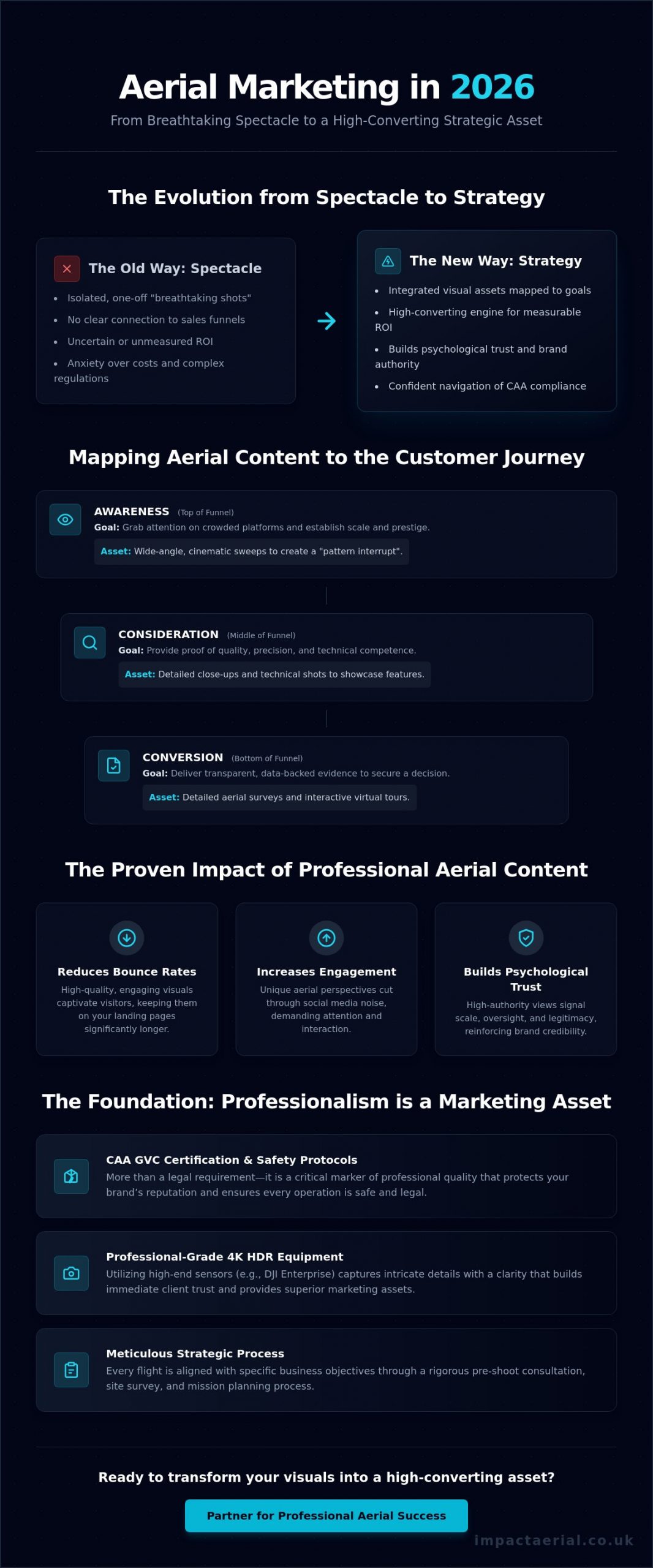
Maximising ROI Across UK Digital Channels
Measuring the success of a visual campaign requires more than just counting likes or views. In 2026, the real value lies in how these assets influence conversion rates and shorten sales cycles. While 87% of marketers report that video marketing has helped them increase website traffic, integrating professional drone photography provides a distinct engagement boost that standard ground-level videography lacks. This “Trust Dividend” is a direct result of high production value. It suggests a level of investment and professionalism that reassures potential clients they’re dealing with a meticulous industry leader.
Optimising marketing with aerial content involves tracking specific Key Performance Indicators (KPIs) across different digital platforms. For instance, click-through rates (CTR) on property listings see a significant uplift when aerial perspectives are included. The ability to see a property’s exact position relative to local amenities or transport links removes a layer of uncertainty for the buyer. This transparency isn’t just a visual perk; it’s a critical data point that accelerates the decision-making process. By providing a comprehensive view, you’re effectively answering a lead’s most pressing questions before they’ve even asked them.
Sector-Specific ROI: Property and Real Estate
The “Location Context” factor remains a primary driver for ROI in the UK property market. Buyers often pay a premium when they can clearly visualise the boundaries and surroundings of a site. By integrating high-resolution aerial shots into real estate photography packages, agents can create a more immersive experience. Immersive FPV drone fly-throughs are particularly effective here. They allow a viewer to travel from the street level, through the front door, and out over the garden in one seamless motion. This drastically reduces time-on-market by pre-qualifying leads who have already “experienced” the layout virtually.
B2B Marketing for Construction and Industry
In technical sectors, aerial assets serve a dual purpose as both operational tools and high-end marketing collateral. Regular construction site monitoring provides a transparent record of project progress that can be shared with stakeholders to build confidence. This data-centric approach is vital for optimising marketing with aerial content in B2B environments. Showcasing technical competence through thermal imaging or precision survey data proves your brand operates with meticulous accuracy. Long-term brand storytelling also benefits from time-lapse aerial footage. It captures the entire lifecycle of a project in a way that ground-based cameras cannot match, demonstrating your capacity and reliability to future clients.
The Compliance Advantage: Why Safety is a Marketing Asset
Choosing a drone operator based solely on the lowest price is a strategic error that can result in significant brand damage. In 2026, the traceability of aerial operations is absolute due to the mandatory Remote ID requirements for all UK-class drones. If a business uses footage captured by a non-compliant pilot, they aren’t just saving money; they’re inheriting a legal liability. Optimising marketing with aerial content requires a foundation of total legality. When a brand presents professional visuals, the audience assumes the operation was conducted safely. If that trust is broken by a regulatory investigation or a safety incident, the marketing value of the content evaporates instantly, replaced by a public relations crisis.
Professionalism in this industry is defined by more than just a sharp eye for a cinematic sweep. It’s built on a framework of risk mitigation and official certification. High-tier B2B pitches, particularly in the construction and public sectors, now demand proof of £5 million commercial liability insurance as a standard entry requirement. This coverage isn’t just a safety net; it’s a powerful trust signal. It tells your clients that you’ve partnered with a meticulous specialist who understands the gravity of industrial operations. By prioritising compliance, you transform a technical necessity into a hallmark of your brand’s commitment to excellence.
Understanding UK Drone Regulations in 2026
The regulatory landscape has become more complex with the introduction of UK-specific drone classifications from UK0 to UK6. Any commercial project now requires a pilot who understands these nuances, including the lowered registration threshold of 100g for Flyer IDs. Securing a professional UK drone license is no longer optional for serious marketing endeavours. A GVC certification guarantees operational safety by proving the pilot has undergone rigorous theoretical and practical assessments audited by the CAA. This ensures that every flight, regardless of the environment, is backed by a comprehensive risk assessment and a legal flight plan.
Transparency as a Trust Signal
Integrating your safety credentials directly into your marketing collateral is a sophisticated way of optimising marketing with aerial content. It addresses the “Peace of Mind” factor that corporate and public sector clients prioritise. When you’re transparent about how you manage public privacy concerns and adhere to strict flight restriction zones, you build a layer of brand authority that competitors often overlook. This meticulousness reassures stakeholders that their project is in expert hands. To ensure your next project meets these rigorous standards and protects your brand’s reputation, explore our fully compliant aerial filming services.
Implementation: Partnering for Professional Aerial Success
Successful implementation begins long before the aircraft enters the sky. To achieve the best results when optimising marketing with aerial content, you must align your technical requirements with your specific business goals. A meticulous pre-shoot consultation is the foundation of this process. It allows for a detailed site survey where we evaluate environmental factors and lighting conditions to ensure the highest quality 4K HDR output. This stage isn’t just about aesthetics; it’s a critical safety step where we finalise CAA-compliant flight plans and risk assessments tailored to your specific location. Identifying potential hazards early ensures the shoot proceeds without technical or legal interruptions.
The technical journey continues into post-production. Raw footage, while impressive, requires professional refinement to become a high-converting branded asset. Our process involves precise colour grading and format optimisation, ensuring that the final media is perfectly suited for its intended platform. Whether you’re creating a cinematic hero video for a website or a technical time-lapse for a construction report, this stage is vital for optimising marketing with aerial content. The transition from raw data to a polished marketing tool is what defines professional success. This structured approach ensures that every frame serves a purpose in your wider marketing funnel and delivers the authority your brand deserves.
The Impact Aerial Workflow
Our methodical workflow is designed to provide total reassurance and high-tier results. We follow a clear, three-stage process for every project to maintain our meticulous standards:
- Pre-Flight Strategy: Initial consultation to define objectives, followed by rigorous site surveys and comprehensive airspace checks.
- Precision Execution: On-site filming using advanced DJI Enterprise hardware, managed by GVC-certified pilots with a focus on safety and precision.
- Post-Production Excellence: Professional editing and colour correction to ensure branded assets are ready for immediate deployment.
Selecting the Right Aerial Partner
Choosing a partner requires more than just looking at a portfolio. You need a specialist who understands the logistical nuances of your specific region. For businesses in Birmingham and the West Midlands, local knowledge of regional Flight Restriction Zones (FRZs) and urban flight challenges is essential for maintaining strict compliance. When evaluating a provider, ensure they meet the professional standards of industry leaders. Check for valid GVC certifications, comprehensive insurance coverage, and a proven track record of drone services in your sector. If you’re ready to start your next project, enquire about our professional aerial filming and photography services to ensure your brand’s vision is captured with technical precision and total legal compliance.
Elevating Your Brand Strategy for 2026 and Beyond
The shift toward optimising marketing with aerial content represents a fundamental change in how UK businesses communicate scale and authority. By moving beyond the simple spectacle of a drone shot and integrating data-driven visuals into your full marketing funnel, you create a transparent and high-converting experience for your audience. We’ve explored how professional standards and CAA compliance act as powerful trust signals, protecting your brand while delivering measurable results across digital platforms. This strategic approach ensures that every flight contributes directly to your bottom line.
Success in this specialized field requires a partner who combines cinematic vision with technical precision. Our team of CAA GVC Certified Pilots utilizes DJI Enterprise 4K HDR Technology to capture every detail with meticulous accuracy. Backed by £5m Commercial Liability Insurance, we provide the psychological comfort and professional reliability your corporate or industrial projects demand. It’s time to move past generic imagery and embrace a sophisticated visual narrative that sets your brand apart.
Ready to transform your visual storytelling into a strategic engine for growth? Request a bespoke quote for your aerial marketing project today. We look forward to helping you reach new heights with absolute precision and safety.
Frequently Asked Questions
How does aerial content improve my website’s SEO?
Aerial content improves SEO by increasing dwell time and reducing bounce rates. Search engines prioritize high-quality video content that provides a comprehensive user experience. By including unique perspectives, you’re optimising marketing with aerial content through improved engagement signals. This rich media demonstrates authority and keeps visitors on your page longer, which is a key ranking factor for modern algorithms.
Is drone footage legal for commercial marketing in the UK?
Drone footage is legal for commercial marketing in the UK provided the operator adheres to Civil Aviation Authority (CAA) regulations. As of January 2026, this includes having a valid Flyer ID for drones over 100g and an Operator ID. Professional pilots must also ensure their aircraft is equipped with Remote ID and comply with the specific UK class markings required for legal operation in various environments.
What is the difference between 4K and 4K HDR drone video for marketing?
The primary difference lies in the dynamic range and colour accuracy. Standard 4K provides high resolution, but 4K HDR (High Dynamic Range) captures significantly more detail in the brightest highlights and deepest shadows. This results in a more lifelike, professional image that doesn’t suffer from “blown out” skies or murky foregrounds. For high-end marketing, HDR is the standard for maintaining visual authority and quality.
Can aerial content be used for social media marketing like Instagram Reels?
Yes, aerial content is highly effective for short-form vertical platforms like Instagram Reels and TikTok. We capture footage specifically for these formats or crop high-resolution 4K horizontal shots in post-production. These unique, high-altitude perspectives create an immediate pattern-interrupt in social feeds, which is essential for optimising marketing with aerial content on mobile-first platforms where engagement is won in the first second.
How much does professional drone filming cost for a marketing campaign?
The cost of professional drone filming varies based on project complexity, location, and the required technical output. Factors such as the need for specialized sensors like thermal cameras or the intensity of post-production editing will influence the final investment. We provide bespoke quotes that reflect the specific operational risks and hardware requirements of your campaign to ensure a high-quality, compliant result that protects your brand.
Do I need special insurance if I hire a drone pilot for my business?
You don’t need to provide insurance yourself, but you must verify that your chosen pilot holds valid commercial liability insurance. Under UK law, commercial drone operators must have insurance that is compliant with EC 785/2004. We maintain £5 million in commercial liability coverage to provide total peace of mind and satisfy the rigorous risk management requirements of corporate and public sector clients across the UK.
What industries benefit most from aerial marketing content?
While many sectors benefit, the construction, commercial property, and renewable energy industries see the highest impact. These sectors rely on showing scale, progress, and technical health. For example, PV solar farm thermal surveys and construction site monitoring provide both marketing value and critical operational data. Any business that manages large physical assets or sprawling locations will find significant value in these specialized perspectives.
How long does it take to produce a professional drone marketing video?
A standard drone marketing project typically takes between three to seven working days from the initial flight to final delivery. This timeline includes a day for site surveys and flight planning, the filming day itself, and several days for meticulous post-production. Complex projects involving virtual tour creation or extensive colour grading may require additional time to ensure the final assets meet our high-tier quality and technical standards.
What Happens After a Drone Inspection? The Complete Data Lifecycle
What if the most significant risk to your project isn’t the flight itself, but the thousands of raw images left sitting idle on a server? You’ve likely felt the overwhelm of navigating a massive data dump without a structured way to extract value. It’s a common frustration; the transition from aerial capture to actionable intelligence often feels like a “black box” that delays critical maintenance decisions and leaves you questioning the return on your investment.
We’re going to demystify the complete data lifecycle, showing you how professional drone survey deliverables move through a meticulous pipeline of processing and expert analysis. You’ll gain a clear understanding of the reporting timeline, the accuracy of modern AI-assisted defect detection, and the technical standards required for seamless BIM integration. By the end of this guide, you’ll have the confidence to turn raw aerial data into precise business intelligence that helps you plan your maintenance budget with total certainty.
Key Takeaways
- Learn how immediate on-site data integrity checks eliminate “blind spots” and ensure every critical asset is captured before the flight team leaves the site.
- Understand the technical process of photogrammetry and AI-assisted analysis that converts thousands of raw images into high-resolution, measurable intelligence.
- Discover the specific drone survey deliverables you will receive, from detailed PDF defect reports to orthomosaic maps, and how they help prioritise urgent repairs.
- Find out how to seamlessly integrate aerial CAD files and 2D maps into your existing asset management software to justify maintenance budgets with visual evidence.
- Explore why professional post-production and regulatory compliance are essential for creating legally defensible reports that satisfy UK safety and insurance standards.
From Flight to File: The Immediate Post-Inspection Data Workflow
The moment a drone returns to its landing pad marks the end of the aerial mission, but it’s only the beginning of the data lifecycle. A single professional inspection can easily generate upwards of 20GB of raw data, consisting of high-resolution imagery, thermal frames, and complex telemetry logs. Managing this volume requires more than just a large memory card; it demands a structured workflow to ensure the resulting drone survey deliverables are accurate and complete. Professional teams initiate immediate redundancy backups on-site, mirroring data across multiple encrypted drives to eliminate the risk of hardware failure or data loss during transit.
Organisation starts in the field. Pilots categorise imagery into distinct streams: Visual (RGB) for structural detail, Thermal for heat signatures, and Metadata files that record the drone’s exact position in three-dimensional space. This metadata is the “digital glue” that allows photogrammetry software to later stitch thousands of individual photos into a cohesive, measurable model. Without this meticulous onsite organisation, the processing phase becomes a bottleneck that delays your final report.
To better understand the complexity of these outputs, watch this helpful overview of drone job deliverables:
Data Integrity and Verification
Ensuring there are no “blind spots” is a critical safety and quality protocol. Before leaving the site, the flight team performs a data integrity check to verify that every waypoint and asset angle was captured according to the pre-flight plan. We rely on RTK (Real-Time Kinematic) data to confirm GPS accuracy, often achieving centimetre-level precision. This rigorous verification prevents the need for costly re-flights, ensuring that the drone survey deliverables you receive are based on a complete and flawless dataset.
Secure Data Transfer Protocols
Handling sensitive infrastructure data requires a commitment to security and confidentiality. Once the integrity check is complete, data is transferred via encrypted drives or secure cloud uploads. In the UK, this process must strictly adhere to GDPR standards, especially if the drone has incidentally captured identifiable third-party information or private property. Once the field team confirms the secure transfer, the dataset moves to our post-production and analysis specialists, who begin the work of turning raw pixels into business intelligence.
Analysis and Interpretation: Turning Raw Imagery into Actionable Intelligence
Processing raw imagery is where a massive dataset transforms into high-value drone survey deliverables. We utilise photogrammetry to align hundreds or even thousands of overlapping images, typically captured with a 70 to 80 percent overlap, to create a single, geometrically corrected map. This isn’t a simple photo-stitch; it’s a rigorous mathematical reconstruction where every pixel is assigned a spatial coordinate. This foundation allows stakeholders to take accurate measurements of distance, area, and volume directly from their desktop, providing a level of site-wide oversight that traditional ground inspections cannot match.
Once the digital foundation is set, AI-assisted algorithms scan the dataset for structural anomalies. Machine learning models are trained to recognise specific patterns of corrosion, hairline cracks in concrete, or missing components in complex steel structures. This automated layer significantly reduces the time required to process large-scale assets, ensuring that critical issues are surfaced within hours rather than weeks. However, the true value lies in the marriage of this speed with expert oversight.
AI vs. Human Expertise in Asset Review
While machine learning provides incredible speed, it cannot replace the nuanced judgement of a qualified professional. Every anomaly flagged by the software undergoes a rigorous verification process by a CAA GVC certified pilot or surveyor to eliminate false positives and assess the real-world risk. Defect tagging is the process of geolocating specific issues on a digital twin to provide exact coordinates for repair teams. This human-led validation ensures that your maintenance budget is allocated based on verified, high-risk findings rather than automated guesses. For those managing complex portfolios, our drone commercial property surveys provide the expert oversight needed to turn these insights into a long-term maintenance strategy.
Thermal Data Interpretation
For specialised assets like PV solar farms or industrial roofing, thermal interpretation adds a critical layer of intelligence. We analyse thermographic imagery to detect subtle heat signatures that indicate energy loss, water ingress, or electrical faults. On solar farms, this allows us to identify individual cell failures that are invisible to the naked eye. The severity of these faults is determined by the “temperature delta”, which is the difference in temperature between the fault and the surrounding healthy area. A high delta indicates a critical failure that requires immediate intervention to prevent fire risks or significant yield loss.
By comparing this current data against historical baselines, we can track asset degradation over time. This longitudinal analysis allows you to see if a small crack identified six months ago has widened, providing the visual evidence needed to move from expensive reactive repairs to cost-effective predictive maintenance. This methodical approach ensures that every flight delivers a clear, evidence-based roadmap for your facility management team.
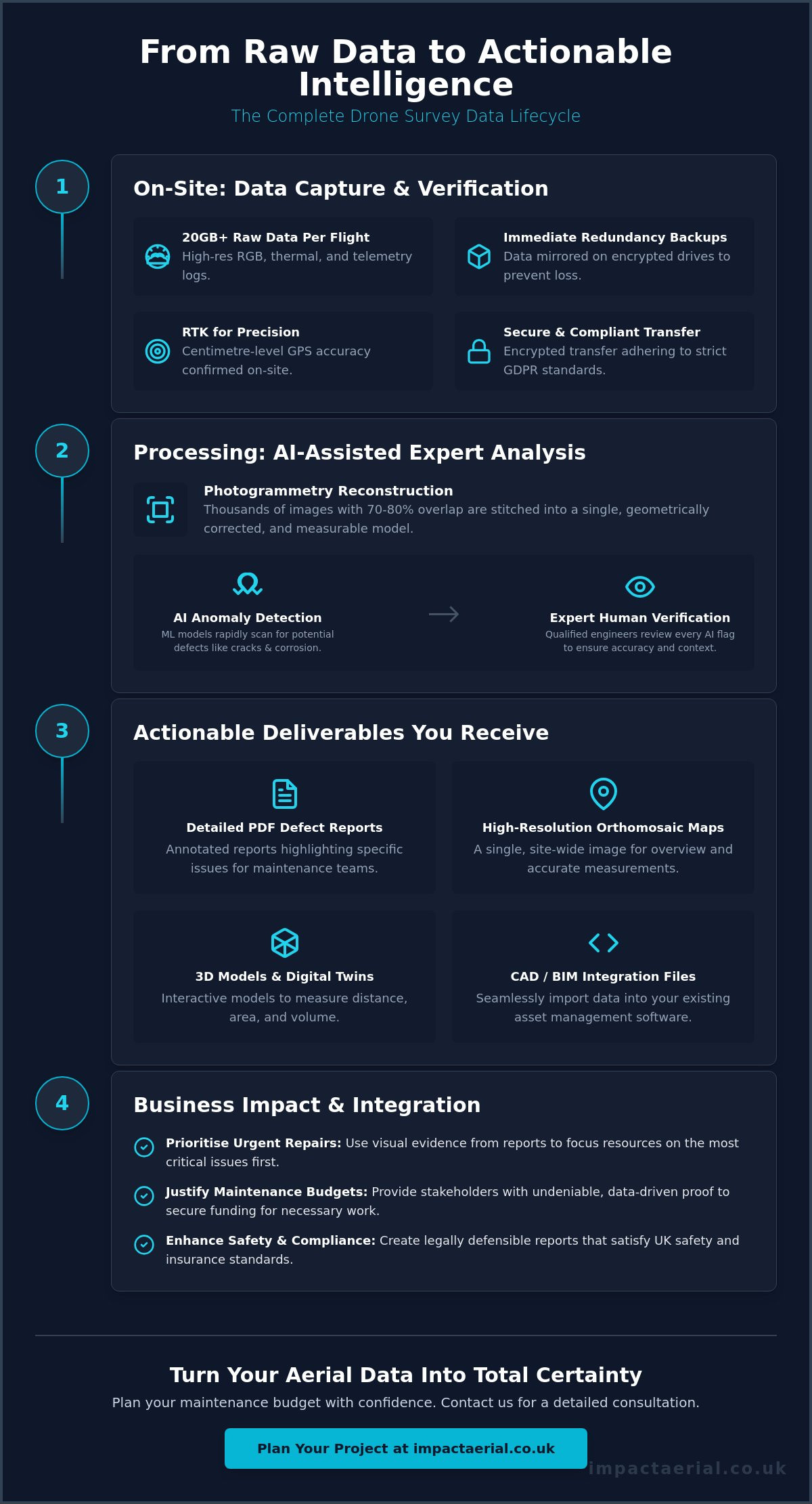
Understanding Your Deliverables: What Clients Receive After the Survey
Once the analysis is complete, the raw data is distilled into a comprehensive suite of professional outputs. These drone survey deliverables are designed to provide both high-level executive summaries for stakeholders and granular technical data for engineering teams. The cornerstone of this package is the Detailed PDF Inspection Report. This document categorises identified defects by severity, allowing asset managers to prioritise maintenance budgets based on visual evidence rather than guesswork. Each defect is accompanied by annotated high-resolution imagery; these are the direct “close-up” shots that provide contractors with the visual context they need to quote for repairs accurately.
For site-wide documentation, we provide Orthomosaic Maps. Unlike a standard aerial photograph, an orthomosaic is a geometrically corrected 2D map where every pixel is measurable. These high-resolution files allow you to calculate distances and surface areas across your entire site with professional-grade accuracy. It’s a vital tool for site documentation that remains relevant long after the flight team has left the area.
3D Models and Digital Twins
The most immersive of the drone survey deliverables is the 3D digital twin. These navigable models allow stakeholders to “walk through” an asset from their desktop, which is particularly valuable for remote site management or presenting findings to international boards. In UK construction projects, we deliver point clouds that integrate directly into BIM (Building Information Modelling) workflows. These point clouds consist of millions of geolocated data points, providing the architectural and engineering measurements required for precise structural analysis. They ensure your digital twin adheres to the strict data standards expected in high-tier UK engineering environments. You can learn more about the technical foundations of these outputs in our guide to drone survey methodologies.
Interactive Client Portals
Modern asset management has moved beyond static files. We provide access to interactive cloud-based portals where clients can zoom, annotate, and measure data in real-time. This dynamic environment allows you to share specific defect “tags” directly with repair contractors, significantly streamlining the procurement process. One of the most powerful features is the timeline tool. By overlaying data from multiple surveys, you can view “before and after” comparisons of construction progress or monitor how a specific structural issue is developing over several months. This level of transparency ensures that all stakeholders are working from a single, verified source of truth.
Integrating Drone Data into Your Asset Management Strategy
Data only becomes intelligence when it’s integrated into your existing business processes. For asset managers and project leads, the true value of drone survey deliverables lies in their ability to feed directly into Enterprise Resource Planning (ERP) and project management systems. To see how digital tools can optimize these workflows, visit GoBuid and discover their platform for construction site documentation and reporting. Instead of treating aerial data as a standalone report, professional organisations use these outputs to justify maintenance budgets and prioritise urgent repairs based on undeniable visual evidence. This integration reduces “Time to Action” by providing procurement teams with the exact technical specifications and visual context they need to secure competitive repair quotes quickly.
In the UK, maintaining a rigorous visual record is increasingly vital for insurance and regulatory compliance. Whether you’re managing a commercial portfolio or a complex infrastructure project, having a geolocated, time-stamped record of asset condition provides a “Visual Audit Trail”. This documentation is indispensable during safety inspections, insurance renewals, or future asset sales, as it proves a proactive approach to risk mitigation and structural integrity.
BIM and CAD Integration
Modern engineering workflows require data that fits seamlessly into existing software environments. We provide drone survey deliverables in industry-standard formats such as .OBJ, .LAS, and .DXF, ensuring they are ready for immediate import into CAD and BIM platforms. This allows your team to compare the “As-Built” reality on-site against the original design models, identifying discrepancies before they lead to costly construction delays. For a deeper look at the hardware that makes this centimetre-level precision possible, see our survey drone guide for professionals.
Predictive Maintenance Planning
The most sophisticated use of drone data involves moving from reactive fixes to predictive maintenance. By analysing year-on-year aerial data, you can track the degradation rate of high-value assets, such as roofing systems or industrial chimneys. Seeing a hairline crack or a patch of corrosion develop over twelve months allows you to predict when a structure is likely to fail. The cost-benefit of detecting these issues early is significant; it’s often the difference between a minor £5,000 localised repair and a £50,000 emergency structural intervention. If you’re ready to transition to a more efficient, data-driven maintenance model, contact Impact Aerial to discuss your specific site requirements.
This strategic approach ensures your data isn’t just stored in a folder, but is actively working to protect your assets and your bottom line. By embedding these insights into your long-term strategy, you create a more resilient and transparent management process that satisfies both internal stakeholders and external regulators.
The Impact Aerial Standard: Professional Post-Production and Compliance
The final stage of the data lifecycle is where technical accuracy meets professional presentation. While the previous sections focused on the extraction and analysis of information, the concluding phase ensures that your drone survey deliverables are accessible to every stakeholder, from site engineers to board-level directors. Raw data can be overwhelming; professional post-production editing distils these massive datasets into clear, digestible formats that highlight critical findings without sacrificing technical depth. This process bridges the gap between complex engineering files and the high-level executive summaries required for commercial decision-making.
Every project concludes with a formal close-out meeting and a structured data handover. We don’t just send a download link; we walk you through the findings to ensure your team understands how to navigate the digital twins and interpret the defect logs. This ensures that the investment in aerial intelligence translates directly into a more efficient maintenance workflow and a clearer understanding of your asset’s health.
Beyond Raw Data: Cinematic and Virtual Tours
For many clients, the value of a drone mission extends beyond structural analysis into property marketing and stakeholder engagement. We use 4K HDR imagery to create immersive virtual tours that allow viewers to explore a site remotely with incredible clarity. By combining technical survey data with our high-end aerial filming drone capabilities, we provide a dual-purpose product. This approach is particularly effective for presenting survey findings to directors who require a visually engaging overview of a project’s progress or an asset’s condition without needing to sift through thousands of individual inspection frames.
Compliance and Liability Assurance
In the professional drone industry, data is only as valuable as its legal defensibility. Hiring certified pilots isn’t just about skill; it’s about ensuring your data is gathered under strict regulatory oversight. We maintain £5m commercial liability insurance to protect our clients’ interests throughout the project lifecycle. This level of coverage, combined with meticulously archived flight logs and risk assessments, provides a robust safety record for your corporate archives. Choosing a provider with professional drone services certification acts as a critical safety net, ensuring that your drone survey deliverables meet the highest UK industry standards for safety and data integrity. This commitment to compliance ensures that your data remains a reliable asset in the event of insurance claims or regulatory audits.
Moving from Raw Data to Strategic Intelligence
The lifecycle of aerial data doesn’t end when the drone lands; it’s the sophisticated processing and expert interpretation that turns pixels into profit. You’ve seen how professional drone survey deliverables provide a visual audit trail that justifies maintenance budgets and satisfies UK regulatory standards. By integrating high-resolution 3D models and orthomosaic maps into your existing asset management strategy, you move from reactive repairs to a cost-effective predictive model.
Ensuring this data is accurate and legally defensible requires a partner who prioritises compliance as much as technology. We combine 4K HDR enterprise-grade drone hardware with the expertise of CAA GVC certified pilots to deliver industry-leading results. With £5m commercial liability insurance as standard, you can be certain your assets and data are in safe, expert hands. Ready to transform your site oversight with precision intelligence? Request a professional drone inspection consultation from Impact Aerial today. Let’s build a clearer, safer future for your asset portfolio.
Frequently Asked Questions
How long does it take to receive the drone inspection report?
Standard delivery for a professional inspection report is typically between three and five working days. This duration allows for the meticulous processing of raw data, AI-assisted defect detection, and a final manual review by a certified specialist. For larger industrial sites or complex 3D reconstructions, we provide a specific delivery schedule during the initial project planning phase to ensure your maintenance timelines are met.
What file formats will I receive after a drone survey?
You will receive a comprehensive suite of drone survey deliverables in industry-standard formats. These typically include high-resolution PDF inspection reports for executive review, georeferenced TIF or JPG orthomosaic maps, and 3D point clouds in .LAS or .OBJ formats. For engineering teams, we also provide .DXF files that are ready for immediate import into CAD software, ensuring the data is useful across your entire organisation.
Do I need special software to view the 3D models or orthomosaics?
You don’t need any specialised software to view the primary findings, defect tags, or high-resolution imagery. We provide access to interactive, cloud-based portals that allow you to view, zoom, and take basic measurements of your data directly within a standard web browser. While technical teams will use CAD or BIM software for deeper analysis, the core intelligence is accessible to any stakeholder with an internet connection.
Can drone data be integrated into my existing BIM or CAD software?
Yes, all professional aerial data is designed for seamless integration into existing BIM and CAD software environments. By providing technical files in formats like .DXF, .OBJ, and .LAS, we ensure that the digital twin of your asset can be overlaid directly onto your original design models. This capability is essential for identifying discrepancies between the “as-built” reality and the design intent on complex construction sites.
How accurate is the measurement data from a drone inspection?
Professional drone surveys typically achieve a vertical and horizontal accuracy of 1cm to 3cm. We reach this level of precision by using RTK (Real-Time Kinematic) technology and strategically placed ground control points during the flight. This ensures that the volumetric calculations, surface area measurements, and distance data provided in your deliverables are accurate enough for professional engineering and maintenance budgeting.
Is the data captured by drones legally admissible for insurance claims in the UK?
Aerial data is legally admissible for insurance and legal purposes in the UK provided the mission is conducted by CAA GVC certified pilots. Because our survey data is geolocated and time-stamped, it provides a verified visual audit trail of an asset’s condition at a specific point in time. This transparency, supported by our £5m commercial liability insurance, offers the robust evidence required by insurers and loss adjusters.
What happens if the drone finds a critical defect during the flight?
If a critical defect is identified during the flight, our team will notify you immediately. While the comprehensive data processing takes several days, our pilots monitor the live feed in real-time and can flag urgent structural failures or safety risks while still on site. This immediate notification allows you to initiate emergency repairs or safety protocols without waiting for the final processed report to be delivered.
How is my data stored and kept secure after the inspection?
Your data is stored using high-level encryption on secure, UK-based cloud servers. We adhere strictly to UK GDPR standards to ensure the privacy and confidentiality of all captured information. Following the project close-out, we maintain secure archives of your flight logs and survey results, providing a long-term safety record that your team can reference for future maintenance planning or historical asset comparisons.
Drone Photography for Outdoor Festivals: The Ultimate Guide to Aerial Event Coverage
Can you truly capture the electric atmosphere of a 50,000-person crowd without breaching CAA safety protocols or risking a catastrophic incident? You likely know that traditional ground photography often fails to convey the sheer scale of a major outdoor event. It’s frustrating to invest months into production only to end up with marketing assets that don’t reflect the true magnitude of your success. Capturing that perfect aerial shot requires more than just a camera in the sky; it demands a meticulous approach to risk mitigation and technical precision.
This guide demonstrates how professional drone photography for outdoor festivals provides high-impact visual assets while maintaining strict adherence to the January 2026 UK drone regulations. We’ll explore how to navigate the complexities of the Specific Category authorization, manage the logistics of multi-day schedules, and ensure your event coverage is both legally compliant and visually stunning. From understanding the latest UK class marks to implementing mandatory night-flying lighting, you’ll discover how to transform your festival marketing through safe, expert aerial operations.
Key Takeaways
- Learn how to capture the true density and pulse of your event, effectively conveying the scale that ground-level photography often fails to represent.
- Understand the technical advantages of utilizing enterprise-grade hardware to maintain signal stability amidst the heavy radio frequency interference typical of major festivals.
- Identify the essential requirements for CAA GVC certification and site-specific risk assessments to ensure your brand’s operations remain fully compliant.
- Discover how to maximize ROI by integrating high-resolution aerial footage into live stage broadcasts and using orthomosaic mapping for future site planning.
- Explore the methodology for seamlessly integrating professional drone photography for outdoor festivals into your broader event production and post-production workflows.
Why Drone Photography for Outdoor Festivals is Essential in 2026
Professional drone photography for outdoor festivals is the strategic deployment of a specialized unmanned aerial vehicle (UAV) to document large-scale events from perspectives that ground-based teams cannot reach. In 2026, this technology is no longer a luxury for event organizers; it’s a fundamental requirement for comprehensive event documentation. While a photographer on the ground captures the individual emotion of a front-row fan, they lack the vantage point to showcase the true density and kinetic energy of a sold-out crowd. High-altitude perspectives provide a sense of scale that validates the success of an event to stakeholders and future ticket buyers alike.
Capturing the pulse of a festival requires a technical understanding of how a crowd moves and reacts to the performance. Aerial assets transform a standard music event into a legendary visual narrative by revealing the sheer volume of attendees and the symmetry of the production design. These images serve as the ultimate “proof of success,” showing a vibrant, packed venue that ground-level shots simply cannot replicate.
To better understand the technical foundations of capturing high-quality aerial footage in dynamic environments, watch this helpful tutorial:
The marketing landscape in 2026 demands immediate, high-fidelity content. Real-time delivery of aerial stills and video allows social media teams to generate “FOMO” while the event is still live, driving digital engagement when interest is at its peak. These assets aren’t just for current buzz; they’re the primary drivers for early-bird ticket sales for the following year. Seeing a vast, illuminated landscape of thousands of people creates a psychological impact that a stage-side shot doesn’t achieve. By integrating drone photography for outdoor festivals into your media plan, you create a library of high-impact assets that sustain your brand’s relevance long after the final set ends.
Showcasing Scale and Atmosphere
Documenting the entire festival footprint requires precision flight paths and high-end hardware. We use wide-angle lenses to capture the relationship between the main stage, the surrounding infrastructure, and the natural landscape. As the sun sets, the technical challenge increases. Our teams utilize advanced HDR sensors to manage the transition from natural daylight to the high-contrast environment of stage pyrotechnics and LED screens. This ensures the atmosphere remains vivid and professionally polished regardless of the lighting conditions.
Sponsor ROI and Brand Activation
Sponsors require tangible evidence that their investment reached the target audience. Aerial photography provides “proof of life” shots that document sponsor activations within high-traffic zones from a bird’s-eye view. We use drones to map attendee density around commercial areas, giving partners data-backed visual evidence of their brand’s reach. These bespoke assets are essential for post-event wrap-ups, helping sponsors justify their spend and secure their involvement for future seasons. Providing high-resolution imagery of a branded lounge or a massive sponsor banner in the context of the whole crowd is a powerful retention tool.
Technical Excellence: Navigating the Challenges of Festival Environments
Executing high-quality drone photography for outdoor festivals requires more than just piloting skill; it demands hardware that can withstand the unique pressures of a live event. We utilize DJI Enterprise drones specifically for their superior signal stability and robust transmission systems. In an environment where thousands of attendees are using mobile devices and stage crews are operating complex wireless audio systems, a consumer-grade drone often suffers from catastrophic signal loss. Enterprise-level equipment provides the reliability needed to maintain a secure connection between the pilot and the aircraft at all times.
Operational endurance is another critical factor for successful event coverage. Festival days often exceed 12 hours, with headline acts performing late into the evening. Our logistical planning includes high-capacity battery stations and rapid-charge cycles to ensure constant coverage throughout the weekend. We don’t want to miss a key performance because of a low battery. To capture the energy of the main stage safely, we prioritize the use of high-resolution telephoto lenses. This allows our pilots to achieve tight, cinematic shots of the action without the need to fly dangerously low over the crowd, maintaining a safe distance while delivering professional quality.
The Impact of Signal Interference
Radio frequency (RF) interference is the most significant invisible threat during a major event. The saturation of 5G signals and local Wi-Fi networks can create “noisy” airspace that disrupts drone telemetry. We mitigate this risk by conducting pre-flight frequency scanning to identify potential dead zones across the site. Our professional operators rely on redundant systems and fail-safe protocols that automatically trigger secure procedures if a signal threshold is breached, ensuring the safety of everyone on the ground. If you are planning a large-scale event, you can consult our technical team to discuss bespoke flight planning for your venue.
Low-Light and Night-Time Performance
The visual climax of most festivals occurs after dark, necessitating hardware with large, 1-inch sensors or larger to produce noise-free footage. Capturing intense light shows and pyrotechnics requires precise exposure management to avoid blowing out highlights while retaining detail in the shadows. Night operations also demand strict adherence to Visual Line of Sight (VLOS) requirements. In accordance with the January 2026 regulations, all our drones are equipped with mandatory flashing green lights for night visibility. This ensures our aircraft remain visible to other airspace users and our ground-based observers, maintaining a meticulous safety standard during the most visually stunning moments of your event.
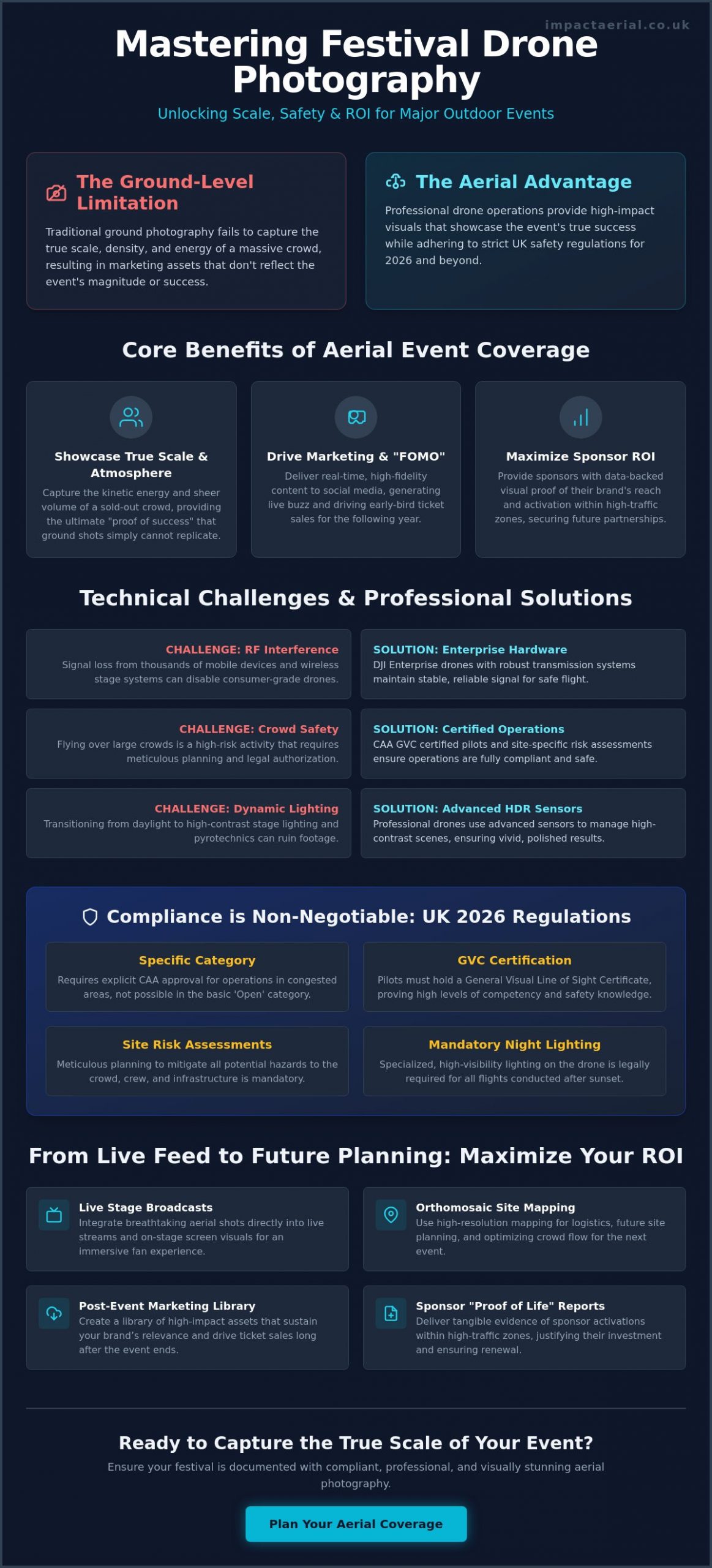
Safety and UK Regulations: Protecting Your Audience and Brand
Safety is the primary concern for any event director when integrating drone photography for outdoor festivals. The regulatory environment in the UK is stringent, and for good reason. Operating a drone over or near a crowd of thousands carries inherent risks that must be managed through formal qualifications and rigorous planning. We ensure that every flight is conducted under the strictest safety protocols, protecting your attendees, your infrastructure, and your brand’s reputation from the legal repercussions of an unauthorized incident.
The core of our legal compliance is ensuring that every pilot is CAA GVC certified. This qualification is essential for commercial festival work, as it demonstrates a professional level of competence and an understanding of the complex laws governing UK airspace. Beyond individual certification, we maintain a comprehensive insurance policy with a minimum of £5 million in commercial liability coverage. This is the industry standard for major UK festivals and provides the necessary financial protection and peace of mind for event organizers.
CAA GVC and Operational Authorisation
There is a significant legal distinction between hobbyist drone use and professional aerial filming. While hobbyist rules are restrictive regarding distances from uninvolved persons, our “Operational Authorisation” from the Civil Aviation Authority (CAA) allows for more flexible flight paths within the “Specific Category.” This permission is vital for capturing the scale of a festival safely. To maintain this high standard, we often deploy a dedicated “Spotter” or visual observer. Their sole responsibility is to monitor the surrounding airspace for other aircraft and ground-based hazards, allowing the pilot to focus entirely on the flight path and the shot.
The Risk Management Process
Our methodical approach to safety begins weeks before the first attendee arrives. We follow a three-step risk management process to identify and neutralize potential hazards:
- Step 1: Airspace Analysis. We conduct a detailed site survey and check for NOTAMs (Notices to Airmen) to identify restricted zones or temporary flight restrictions that might affect the festival grounds.
- Step 2: On-Site Coordination. Our team works directly with festival security and stage managers to establish designated flight corridors and emergency landing zones away from the public.
- Step 3: Environmental Monitoring. We utilize real-time weather tracking to monitor wind speeds and precipitation. We adhere to strict “No-Go” thresholds; if weather conditions exceed our safety limits, the aircraft remains grounded.
Crowd management is non-negotiable. Even with advanced permissions, we never fly directly over crowds in the Open Category. Instead, we utilize the “Specific Category” framework and specialized telephoto lenses to maintain safe horizontal distances while still achieving the high-impact visual results your marketing team requires. This layered approach to safety ensures that your drone photography for outdoor festivals is conducted with the highest level of professionalism and care.
Maximising ROI: From Live Streaming to Post-Event Marketing
Professional drone photography for outdoor festivals delivers value that extends far beyond a single social media post. In 2026, the return on investment for aerial assets is found in their multi-purpose utility, from enhancing the immediate audience experience to providing critical data for future site planning. By integrating a 4K aerial feed directly into your stage LED screens and digital live streams, you provide every attendee with a premium view of the performance. This real-time integration creates a shared sense of scale that connects the furthest reaches of the campsite to the front of the main stage.
The marketing cycle for a festival never truly stops. Our teams specialize in delivering same-day “social sizzle” edits that keep the online buzz alive while the event is still in progress. These high-impact clips are essential for driving digital engagement and capturing the attention of those who couldn’t attend this year. To maintain momentum during the off-season, we create immersive 360-degree experiences that allow potential ticket buyers to virtually explore the festival site. This interactive content serves as a powerful sales tool, offering a realistic sense of the venue’s atmosphere and scale.
Aerial Data for Site Logistics
One of the most overlooked benefits of drone photography for outdoor festivals is the generation of high-resolution orthomosaic maps. These top-down, geographically accurate images help organizers identify bottlenecks in crowd movement during peak hours. By analyzing this data, you can optimize the placement of bars, food stalls, and entry points for following years to improve the attendee experience. We also document the build and breakdown phases of the event. This provides a meticulous visual record for contractor management and insurance purposes, ensuring every stage of the production is documented with technical precision.
The Power of the After-Movie
Aerial footage acts as the cinematic glue that holds a festival after-movie together. While ground-based crews capture the energy of the front row, our pilots use telephoto lenses to record candid moments from a distance, preserving the natural atmosphere without intruding on the fans’ experience. For high-intensity segments, we utilize FPV drones to perform dynamic, high-speed fly-throughs of the main arena. This provides a perspective of the light shows and crowd density that traditional cameras simply cannot replicate. These assets are the primary drivers for early-bird ticket sales, proving the event’s success through undeniable visual evidence.
To ensure your event is captured with this level of technical and creative expertise, contact us today for professional aerial filming and photography services tailored to large-scale festivals.
Partnering with Impact Aerial: Professionalism at Scale
Choosing a partner for drone photography for outdoor festivals requires a transition from creative enthusiasm to operational certainty. At Impact Aerial, we provide a comprehensive project management framework that handles every technical and regulatory detail. Our process begins with a meticulous initial site survey and extends through to high-end post-production services. We don’t just provide a pilot; we provide a fully integrated technical team that understands the high-stakes environment of live event production.
Reliability at scale is achieved through our investment in a specialist DJI Enterprise fleet. These aircraft are designed for the rigorous demands of multi-day events, offering the redundancy and hardware stability necessary for consistent performance. Based in Birmingham, our team provides expert coverage for festivals across the UK, bringing a wealth of experience in navigating diverse regional airspaces and local authority requirements. We provide transparent safety protocols and comprehensive drone service documentation, ensuring your event remains fully compliant with the latest 2026 CAA standards.
Bespoke Festival Packages
The Impact Aerial Guarantee
Our safety-first culture is the foundation of our operation. Every member of our team undergoes rigorous, CAA-approved training that exceeds standard requirements. We deliver state-of-the-art 4K HDR output as standard, ensuring your festival is documented with the highest possible visual fidelity. We work in direct collaboration with your existing production and marketing teams, acting as a seamless extension of your crew. To maintain a professional appearance and ensure clear identification on-site, many event teams opt for custom name badges UK as part of their standard operational gear. This collaborative approach ensures that our drone photography for outdoor festivals aligns perfectly with your broader creative vision and technical requirements.
If you are looking for a trusted specialist to capture the scale and energy of your next event, contact our Birmingham-based team to discuss our professional aerial filming and photography services.
Elevating Your Festival’s Visual Narrative and Operational Safety
Professional drone photography for outdoor festivals has evolved into a precision-engineered operational requirement. You now understand that capturing the true scale of a major event requires more than just a camera; it demands a meticulous approach to UK aviation law and advanced technical mitigation. By integrating high-resolution aerial data, you don’t just create stunning marketing assets; you gain critical insights for site logistics and sponsor validation that ground-level photography cannot provide.
At Impact Aerial, we combine creative excellence with a rigorous safety-first culture. Our teams utilize DJI Enterprise-grade hardware to ensure signal stability in the most challenging RF environments. Every operation is conducted by CAA GVC certified pilots and backed by £5 million in commercial liability insurance, providing the professional reassurance your stakeholders demand. Whether you need live 4K stage feeds or cinematic after-movies, we deliver the technical precision your production requires.
Are you ready to transform your event’s perspective? Request a bespoke festival drone coverage quote from Impact Aerial today. We look forward to helping you showcase the full magnitude of your next outdoor event.
Frequently Asked Questions
Can drones fly directly over crowds at a festival?
Flying directly over crowds is strictly prohibited under standard UK drone regulations for the Open Category. Even with Specific Category authorization, professional operators prioritize public safety by maintaining safe horizontal separation distances. We utilize high-resolution telephoto lenses to capture the energy of the crowd and stage performances from a safe, legal vantage point that adheres to all 2026 safety protocols.
What weather conditions prevent drone photography at festivals?
High wind speeds and active precipitation are the primary factors that ground an aerial operation. We adhere to strict “No-Go” thresholds, typically grounding aircraft if sustained winds exceed 20mph or during periods of rain to protect the hardware and the public. Our pilots monitor real-time meteorological data throughout the event to identify safe flight windows, ensuring every mission is conducted under optimal conditions.
Do I need special permission from the CAA for my festival?
Commercial drone photography for outdoor festivals requires the operator to hold valid Operational Authorisation from the Civil Aviation Authority (CAA). This permission is distinct from hobbyist rules and allows for professional flight paths in complex environments. We handle all necessary regulatory filings, site-specific risk assessments, and coordination with local airspace authorities, ensuring your festival documentation remains fully compliant with current UK law.
How much does drone photography for a three-day festival cost?
The investment for festival coverage is determined by the complexity of the flight schedule, the number of multi-pilot teams required, and the specific post-production deliverables. Factors such as live broadcast integration or the creation of high-resolution orthomosaic maps for site planning will influence the total. We provide bespoke project quotes that reflect the technical requirements and scale of your specific multi-day event.
Are drones noisy enough to interfere with the music or performances?
Modern enterprise-grade drones are equipped with specialized low-noise propellers that make them virtually inaudible from the ground when operating at standard altitudes. When the aircraft is positioned at the required safe distance from the stage, its sound profile is completely masked by the festival’s ambient noise and audio systems. This allows for cinematic capture without distracting the performers or the audience experience.
What insurance coverage is required for festival drone operators?
We maintain a minimum of £5 million in commercial liability insurance, which is the non-negotiable standard for professional operators at major UK festivals. This specialized policy provides comprehensive protection for the event organizer, the public, and the venue infrastructure. We provide full insurance certification as part of our initial safety documentation, offering the necessary peace of mind for high-capacity outdoor gatherings.
Can you provide a live feed for the big screens on stage?
Yes, our technical team provides 4K low-latency live feeds that integrate seamlessly with your on-site AV production suite. This allows your broadcast directors to feed cinematic aerial perspectives directly to the stage LED screens or digital live streams in real-time. We coordinate directly with your production crew before the event to ensure all signal handovers and technical requirements are meticulously planned.
How long does it take to receive the edited photos and videos?
We prioritize rapid delivery to keep your social media buzz alive during the event. Same-day “social sizzle” edits are often delivered within hours of the flight to maximize digital engagement. Full post-production services, including cinematic after-movies and high-resolution site maps, are typically completed within a pre-agreed timeframe following the event. This ensures your marketing team has high-impact assets ready for immediate use.
Drone Thermal Survey for Solar Farms: The 2026 Guide to PV Inspection
A manual inspection of a utility-scale solar site is no longer just inefficient; it’s a financial liability that leaves your most valuable assets at risk. You likely understand that even a minor string failure or a single bypass diode fault can quietly erode profit margins while remaining invisible to the naked eye. Relying on ground-based IV curve testing is slow, dangerous, and often misses the granular degradation that leads to long-term revenue loss. This is why a professional drone thermal survey for solar farms has become the industry benchmark for asset protection in 2026.
By reading this guide, you’ll learn how centimetre-level geolocating and high-resolution radiometric data identify PV faults with surgical precision to maximise your energy yield and ROI. We’ll explore the latest UK CAA requirements, including the mandatory UK class marks and Remote ID standards that define compliant operations this year. You’ll also discover how IEC-compliant reporting transforms raw aerial imagery into a bankable roadmap for maintenance, ensuring your site meets the rigorous standards required by insurers and investors alike.
Key Takeaways
- Learn how to transition from manual spot-checking to 100% asset coverage using radiometric sensors to detect bypass diode failures and PID.
- Discover how a professional drone thermal survey for solar farms can inspect over 10MW of capacity per day, drastically improving efficiency compared to manual testing.
- Understand how aerial thermography eliminates safety risks in high-voltage environments while providing the precise data needed to successfully claim on panel warranties.
- Identify the non-negotiable UK regulatory requirements for 2026, from mandatory CAA GVC certification to the essential £5m commercial liability insurance standard.
- Explore how centimetre-level fault geolocating with advanced RTK hardware allows your O&M teams to navigate directly to defective modules without delay.
What is a Drone Thermal Survey for Solar Farms?
A drone thermal survey for solar farms is a systematic aerial inspection using radiometric thermal sensors to detect temperature anomalies in PV modules. Historically, asset managers relied on manual ‘spot-checking’ with handheld cameras or IV curve testing, which often covered less than 5% of a site’s total modules. This fragmented approach left massive gaps in data and allowed faults to worsen over time. Today, UAV technology enables 100% asset coverage, capturing data on every single panel in a fraction of the time. A drone thermal survey is a non-destructive testing method that geolocates PV faults using high-resolution infrared sensors.
To better understand how this technology transforms site management, watch this helpful video:
It is vital to distinguish between simple thermal imaging and radiometric data. While basic thermal cameras show temperature variations, radiometric sensors capture the specific temperature value of every pixel in the image. This level of detail is essential for sophisticated photovoltaic module analysis techniques. Without radiometric data, it’s impossible to quantify the severity of a delta-T (temperature difference), which is the primary metric used to categorise faults as minor, major, or critical.
The Role of IEC 62446-3 Standards
The IEC 62446-3:2022 standard provides the international framework for outdoor infrared thermography of PV modules. It dictates everything from the minimum solar irradiance required, typically 600 W/m², to the specific viewing angles needed for accurate data. Compliance with this standard isn’t optional for serious operators. It’s a fundamental requirement for insurance providers, manufacturer warranty claims, and investor reporting. Professional operators like Impact Aerial adhere to these strict data quality protocols to ensure every report is bankable and technically sound.
Thermal vs. RGB: The Dual-Sensor Advantage
Modern drone services utilise dual-sensor payloads that capture high-resolution visual (RGB) and thermal data simultaneously. This is critical for ‘ground-truth’ verification. A hotspot on a thermal map might indicate a failing cell, but the RGB image could reveal it’s actually caused by bird droppings, surface dirt, or a stray leaf. By overlaying these data sets, we rule out false positives and ensure maintenance teams only deploy to genuine electrical faults, saving significant O&M costs.
Technical Mechanics: How Aerial Thermography Detects PV Faults
Aerial thermography operates on the fundamental principle that electrical defects generate heat. When a solar cell or internal component fails, it often creates electrical resistance, which is dissipated as thermal energy. A professional drone thermal survey for solar farms captures this energy using radiometric sensors, allowing asset managers to see what remains invisible to the human eye. By visualising these heat patterns, we can diagnose the health of an entire site without ever touching a panel.
One of the most recognisable signatures is the ‘block’ heat pattern caused by bypass diode failures. When a diode fails, it can no longer bypass a shaded or defective part of the module, causing an entire sub-string to heat up uniformly. This creates a distinct rectangular thermal footprint that is easy to identify from the air. In contrast, ‘hotspots’ are usually localised and intense. These are often caused by micro-cracks in the silicon, delamination, or Potential Induced Degradation (PID). Even simple shadowing from overgrown vegetation or bird droppings can trigger these hotspots, which is why dual-sensor verification is vital to prevent unnecessary maintenance calls.
At a larger scale, thermal patterns reveal string-level outages or inverter failures. If an entire row of panels appears significantly cooler or warmer than its neighbours, it typically suggests an open circuit, a blown fuse, or a disconnected string. We categorise these anomalies using ‘Delta-T’, which is the temperature difference between the fault and a healthy reference point. A Delta-T of 10°C might indicate a minor performance issue, while a difference exceeding 30°C often signals a critical failure that poses a fire risk or significant revenue loss.
Common Fault Signatures in Solar Arrays
Defects typically fall into three categories: cell-level, string-level, and module-level. Cell-level defects like cracks or manufacturing flaws appear as small, intense points of heat. String-level issues are often systemic, appearing as entire lines of underperforming modules due to wiring faults or connector failures. Identifying whether a panel is completely ‘dead’ or merely underperforming is crucial for successful warranty claims. If you’re managing a large portfolio, our PV solar farm thermal surveys provide the granular data needed to justify these claims with manufacturers.
AI-Powered Data Analysis
The sheer volume of data from a utility-scale site is immense. We use AI-powered software to scan thousands of high-resolution images automatically. Machine learning algorithms are trained to recognise the specific signatures of bypass diodes, hotspots, and string outages with incredible accuracy. This automation reduces human error and significantly speeds up the reporting process. The final output is a digital ‘fault map’ with centimetre-level GPS coordinates, allowing your ground teams to walk directly to a problematic module rather than searching manually across acres of land.
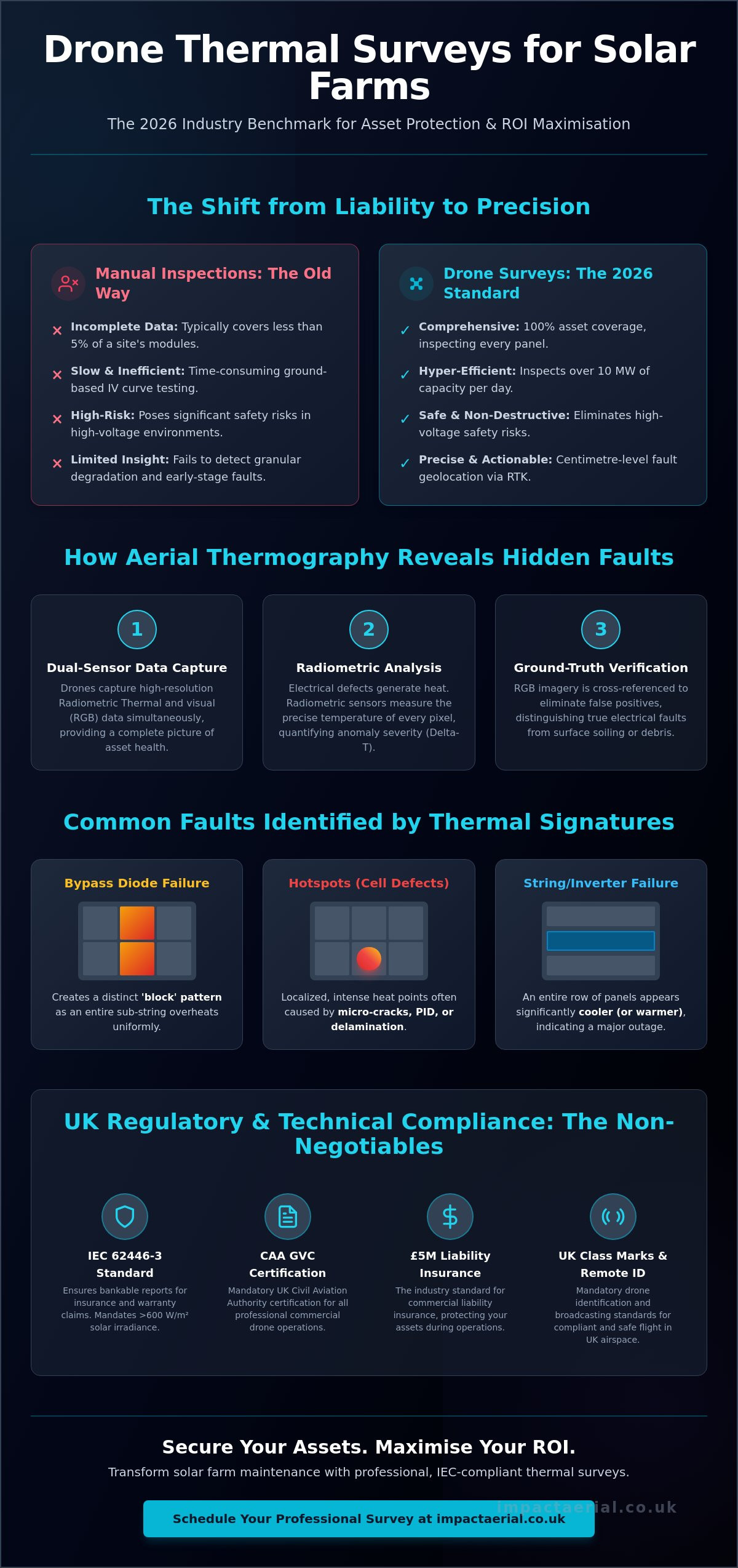
Operational Benefits: ROI and Safety for Asset Managers
Transitioning to a drone thermal survey for solar farms moves your O&M strategy from reactive repair to proactive asset protection. The most immediate impact is the sheer speed of data collection. A professional drone team can survey over 10MW of capacity in a single day; a task that would take ground-based technicians weeks to complete using traditional IV-curve testing. This efficiency doesn’t just save on labour costs. It ensures that your site remains fully operational with minimal downtime during the inspection process.
Safety remains a non-negotiable priority for UK asset managers. Manual inspections require technicians to navigate uneven terrain while carrying handheld cameras in high-voltage environments. By moving the primary inspection tool into the air, you eliminate these ground-based risks. Drones capture high-resolution data from a safe distance, allowing your engineers to review findings from the safety of an office before any physical intervention is required. This methodical approach to risk mitigation is a hallmark of a mature, safety-conscious operation.
The financial justification for aerial thermography is found in revenue recovery. Research indicates that an undetected 5% yield loss on a 10MW solar farm can cost approximately £32,000 in lost revenue annually. A drone thermal survey for solar farms identifies these invisible losses by quantifying the kWh impact of every detected fault. Beyond immediate revenue, preventative maintenance catches minor hotspots before they escalate into catastrophic fire risks or total string failures, protecting the long-term integrity of your infrastructure. For firms looking to further optimize their fiscal position through R&D tax credits or corporate finance, recoupcapital.co.uk provides specialist guidance for the UK energy sector.
Manual vs. Drone Inspections: A Comparison
Traditional manual audits are often limited to a 5% or 10% sample size due to time and budget constraints. This leaves 90% of your asset unmonitored. Drone deployment provides 100% asset inspection, ensuring no defective module is overlooked. This comprehensive data set improves site-wide health scores, which is vital for maintaining high portfolio valuations during acquisitions or refinancing. It’s the difference between guessing your site’s performance and having a verified digital record of every panel.
Warranty and Insurance Support
Securing successful warranty claims against manufacturers requires indisputable evidence. We provide timestamped, geolocated radiometric data that proves the exact nature and location of a defect. This level of ‘due diligence’ is also highly valued by insurance providers, often leading to more favourable premiums. For new sites, using a drone survey during the handover from EPC to O&M creates a ‘digital twin’ that establishes a performance baseline, ensuring you don’t inherit existing faults from the construction phase.
Regulatory Compliance: UK Drone Laws in 2026
Operating a drone thermal survey for solar farms within the United Kingdom requires more than just high-end hardware; it demands strict adherence to Civil Aviation Authority (CAA) regulations. As of 2026, the legal framework has become more stringent regarding Remote ID and operator accountability. For any commercial activity on energy infrastructure, the use of CAA GVC certified pilots is the only way to ensure your site remains compliant and fully insured. Using uncertified or hobbyist operators doesn’t just risk a fine; it can invalidate your site’s broader public liability insurance.
Professional solar surveys often take place near public rights of way or sensitive national infrastructure. This necessitates £5 million in commercial liability insurance as an absolute minimum industry standard. This level of coverage protects asset managers against the unlikely event of equipment failure or accidental damage to high-value PV strings. Data protection and GDPR compliance are also vital. Every piece of aerial imagery must be handled according to strict privacy regulations, ensuring that any incidental capture of persons or private property is managed through robust data redaction and secure storage protocols.
The Importance of GVC Certification
A standard hobbyist drone license is insufficient for the complexities of a utility-scale solar farm. The General Visual Line of Sight Certificate (GVC) is the professional benchmark, allowing for an Operational Authorisation from the CAA. This authorisation is essential when flying in congested environments or where specific distance separations from uninvolved persons must be maintained. It ensures every drone survey meets the latest 2026 safety protocols, including the mandatory use of UK class-marked aircraft and active Remote ID broadcasting.
Risk Mitigation on Solar Farms
Solar farms present unique operational challenges, specifically Electromagnetic Interference (EMI) from high-voltage inverters and substations. Our pre-flight planning involves detailed EMI assessments and weather monitoring to prevent fly-aways or data corruption. We work closely with site managers to ensure our flight paths cause zero disruption to ongoing ground maintenance. This meticulous approach includes maintaining a clear audit trail of flight logs and safety briefings, providing you with total transparency. If you need to ensure your next inspection is fully compliant, contact our team at Impact Aerial to discuss your specific site requirements.
Impact Aerial: Professional Solar Thermal Intelligence
At Impact Aerial, we don’t just provide imagery; we deliver actionable asset intelligence that protects your bottom line. Our drone thermal survey for solar farms utilises the industry-leading DJI Matrice 350 RTK equipped with the Zenmuse H20T sensor. This hardware configuration provides centimetre-level geolocating accuracy, which is essential for large-scale utility sites where traditional GPS might lead technicians to the wrong row. Based in Birmingham, we provide UK-wide coverage with a specific focus on the West Midlands, ensuring that regional asset managers have access to local, high-tier technical expertise. Our bespoke drone services are designed to integrate directly into your existing O&M software, providing a seamless transition from aerial data to ground-based repair.
The true value of our service lies in the post-production phase. We transform thousands of raw thermal images into GIS-ready orthomosaics and digital twins of your entire site. This allows you to view your solar farm as a single, high-resolution map where every fault is clearly marked and categorised. By processing data with such precision, we ensure that your maintenance teams spend less time searching for problems and more time fixing them. This methodical approach is why we are trusted by some of the UK’s leading renewable energy investors to monitor their most critical infrastructure.
Our Technical Capability
We specialise in the capture and analysis of full radiometric thermal data. Unlike standard thermal video, radiometric files allow us to re-analyse every pixel post-flight to extract specific temperature values. This is vital for calculating Delta-T accurately and determining the urgency of a repair. Our expertise in aerial filming drone technology also allows us to produce cinematic-quality site visualisations that are perfect for stakeholder presentations and investor updates. We deliver data in multiple formats to suit your needs, including GeoTIFF for GIS software, RJPEG for detailed fault inspection, and interactive cloud-based maps for mobile access in the field.
The Impact Aerial Difference
Our operation is built on a foundation of meticulous safety and regulatory compliance. We don’t just fly drones; we manage high-stakes data operations in complex environments. This dedication to quality ensures that every report we produce is ‘bankable’. Whether you are preparing for a site acquisition, filing a warranty claim, or conducting an annual health check, our data provides the technical weight required by insurers and financial institutions. We act as your technical consultants, providing the reassurance and reliability you need to manage a high-performing solar portfolio. Please contact Impact Aerial for a detailed quote on your next solar farm survey.
Securing the Future of Your Solar Infrastructure
The transition from manual audits to automated aerial intelligence is no longer optional for utility-scale sites aiming for peak efficiency. By adopting a professional drone thermal survey for solar farms, you move beyond sample-based guessing to 100% asset transparency. You’ve seen how radiometric data identifies bypass diode failures and string outages with surgical precision; this allows your O&M teams to act before minor faults become critical liabilities.
Adhering to the latest 2026 UK regulations is vital for protecting your investment. Impact Aerial provides the technical expertise needed to navigate these high-stakes operations safely. Our team utilizes DJI Enterprise grade radiometric sensors and operates with CAA GVC certified pilots, backed by £5m commercial liability insurance for your peace of mind. We transform raw thermal signatures into bankable asset intelligence that secures your ROI for years to come.
Don’t leave your site’s performance to chance. Request a quote for your solar farm thermal survey from Impact Aerial today and take the first step toward total site optimisation. We’re ready to help you maximise your energy yield with precision and reliability.
Frequently Asked Questions
What is the best time of day for a solar thermal drone survey?
The best time for a survey is between 10:00 and 14:00 when the sun is at its highest point. This ensures that solar irradiance exceeds the 600 W/m² threshold required by international IEC 62446-3 standards. Panels must be fully active and under load to reveal the thermal anomalies that indicate underlying electrical faults.
Can drones detect micro-cracks in solar panels?
Drones detect the thermal signatures created by micro-cracks rather than the physical cracks themselves. These cracks create localized electrical resistance, which shows up as distinct hotspots on a radiometric thermal map. Identifying these issues early prevents them from developing into more serious problems like delamination or total module failure.
How much does a drone thermal survey for a solar farm cost?
The investment for a drone thermal survey for solar farms depends on the total megawatt (MW) capacity and the specific reporting requirements of the asset manager. Factors such as site location, terrain complexity, and the need for centimetre-level RTK accuracy will influence the final project cost. We recommend requesting a bespoke quote to ensure all technical and safety requirements are covered.
Do I need to turn off the solar farm during the drone survey?
You must keep the solar farm fully operational and connected to the grid during the inspection. Thermal sensors rely on the heat generated by the flow of electricity to identify defective components. If the system is powered down, the faulty cells won’t exhibit the temperature differences (Delta-T) necessary for a successful diagnosis.
What is the accuracy of a drone thermal sensor for PV modules?
Professional radiometric sensors provide incredible precision, often detecting temperature variations as small as 0.05°C. When these sensors are integrated with RTK positioning hardware, we can geolocate faults with centimetre-level accuracy. This level of detail allows your O&M teams to navigate directly to a defective module without wasting time searching across the site.
How long does it take to receive the final thermal inspection report?
Final reports are typically delivered within 5 to 10 working days after the flight operation is completed. This window allows for the processing of thousands of high-resolution images through AI-powered analysis platforms followed by a manual review by certified thermographers. For multi-site portfolios, we provide a structured delivery schedule to manage data flow efficiently.
What weather conditions are required for an IEC-compliant thermal survey?
Compliance requires clear skies, no precipitation, and wind speeds typically below 15mph to maintain aircraft stability. The most critical requirement is a stable solar irradiance of at least 600 W/m². Intermittent cloud cover can cause fluctuating panel temperatures, which leads to unreliable data and potential false positives in the final report.
Is a drone survey suitable for rooftop solar or only large-scale farms?
Drone technology is equally effective for commercial rooftop installations and utility-scale ground-mount sites. For rooftops, a drone thermal survey for solar farms or commercial buildings is often safer and more cost-effective as it removes the need for scaffolding or risky roof walks. The high-resolution radiometric data remains the same regardless of the installation’s height or mounting structure.
Construction Site Monitoring with Drones: The 2026 Professional Guide
64% of UK construction firms with over 50 employees now rely on aerial technology to oversee their projects. It’s a massive shift from just a few years ago, driven by the need to replace slow, manual reporting with something more reliable. You’ve likely felt the frustration of inaccurate progress updates or the inherent risks of sending staff into high-altitude zones for basic inspections. Professional construction site monitoring with drones eliminates these bottlenecks by providing a high-resolution, bird’s-eye view that manual site walks simply can’t match.
In this 2026 professional guide, you’ll discover how high-tier drone data transforms site safety, streamlines progress tracking, and secures a better ROI for your UK projects. We’ll walk you through the latest CAA compliance standards, including mandatory UK class markings and Remote ID requirements that took full effect this year. You’ll also learn how integrating data from enterprise-grade hardware like the DJI Matrice 350 RTK leads to faster project closeouts and provides the time-stamped documentation you need for dispute resolution. From reducing site-walk frequency to building accurate digital twins, we’re covering the technical standards that define modern site management.
Key Takeaways
- Learn how the transition from manual site walks to repeatable digital twin creation provides a more accurate, high-resolution record of project development.
- Understand how professional construction site monitoring with drones reduces high-risk man-hours by replacing manual inspections of cranes and roofs with precise aerial data.
- Explore the technical deliverables that drive project value, ranging from high-resolution 4K HDR marketing cinematography to measurable orthomosaic site maps.
- Identify the critical legal requirements for 2026, including the necessity of CAA GVC certification and specific insurance to ensure your operations remain fully compliant.
- Discover the structured approach to implementing aerial monitoring, beginning with site-specific risk assessments and strategic flight planning by certified experts.
What is Construction Site Monitoring with Drones?
Modern project management has moved beyond the limitations of the handheld camera. Construction site monitoring with drones is the professional practice of using sophisticated aerial platforms to capture repeatable, high-resolution data across the entire lifecycle of a build. By 2026, the UK industry has transitioned away from subjective manual site walks toward the creation of high-fidelity digital twins. These digital models provide a single source of truth for every stakeholder involved. To understand the technology behind these platforms, it’s helpful to look at the broader definition of What is an Unmanned Aerial Vehicle (UAV)? as these aircraft are the engines of this data revolution.
To better understand this concept, watch this helpful video:
The Evolution of Site Visibility
Traditional ground-level photography often fails to capture the full scale of a development, leaving blind spots in progress reports. High-resolution 4K HDR aerial imagery provides a comprehensive perspective that replaces qualitative “looks good” updates with quantitative data points. Every flight generates time-stamped documentation, allowing project managers to verify timelines with absolute precision. This level of visibility isn’t a luxury; it’s a baseline requirement for modern UK contract management. We’ve moved from simple snapshots to data-centric processes where every pixel serves as a record of progress.
Types of Monitoring Workflows
Effective monitoring follows a structured cadence tailored to the project’s complexity. Periodic updates, typically conducted on a weekly or monthly basis, keep off-site stakeholders informed without requiring frequent, time-consuming site visits. Using construction site monitoring with drones for these updates ensures that every stakeholder has access to the same high-resolution visual record. On-demand inspections address specific structural or safety concerns as they arise, such as verifying crane clearances or inspecting high-altitude facade elements. Many firms also integrate strategic drone property surveys during the pre-construction phase to establish accurate site baselines.
From initial site clearance to final punch-list verification, the use of drones ensures that every phase of construction is documented with forensic detail. This meticulous approach reduces the frequency of site walks and provides the high-tier evidence needed for dispute resolution. It’s about providing psychological comfort to clients while delivering tangible, data-driven benefits to the bottom line.
Key Benefits: Efficiency, Safety, and Project ROI
Professional construction site monitoring with drones delivers measurable improvements to operational safety and financial performance. By replacing manual roof and crane inspections, firms significantly reduce high-risk man-hours. This shift doesn’t just save time; it protects lives by keeping personnel on the ground while high-resolution sensors capture every detail from above. Stakeholder communication also accelerates through cloud-based platforms, allowing site managers to share time-stamped visual data with off-site teams instantly. This transparency helps identify logistical bottlenecks, such as equipment positioning or material delivery delays, before they impact the project’s critical path.
Health and Safety Improvements
Adopting aerial technology is a cornerstone of a modern zero-harm culture. Traditional visual checks often require expensive scaffolding or risky ladder use, both of which are eliminated through precise, repeatable flight paths. Drones identify potential hazards like unsecured materials or perimeter breaches that are easily missed from ground level. This proactive approach is supported by university research on drone safety, which highlights how UAVs perform dangerous tasks more efficiently than human inspectors. Integrating drones and surveying into your safety protocols ensures that high-altitude inspections are conducted without exposing staff to unnecessary danger.
Calculating the Return on Investment
The financial benefits of construction site monitoring with drones are concrete and immediate. UK construction firms report time savings of up to 20-30% on surveying and progress tracking tasks. One housing development project recently saved £20,000 by opting for drone surveying over traditional methods. These savings stem from more accurate stockpile measurements for material management and the reduction of expensive rework through early error detection. High-resolution documentation also provides an indisputable record for dispute resolution, protecting your firm from unfounded claims. Drone data prevents costly project delays by identifying deviations from the site plan in real-time. For developers looking to secure these efficiencies, partnering with an expert for professional construction monitoring is the most direct route to maximizing site ROI.
Beyond simple progress tracking, drones enhance site security and asset tracking across large-scale developments. Automated flight paths can monitor the movement of high-value machinery and materials, ensuring that site assets are exactly where they should be. This level of oversight provides reassurance to both investors and project managers that the site is being managed with meticulous precision.
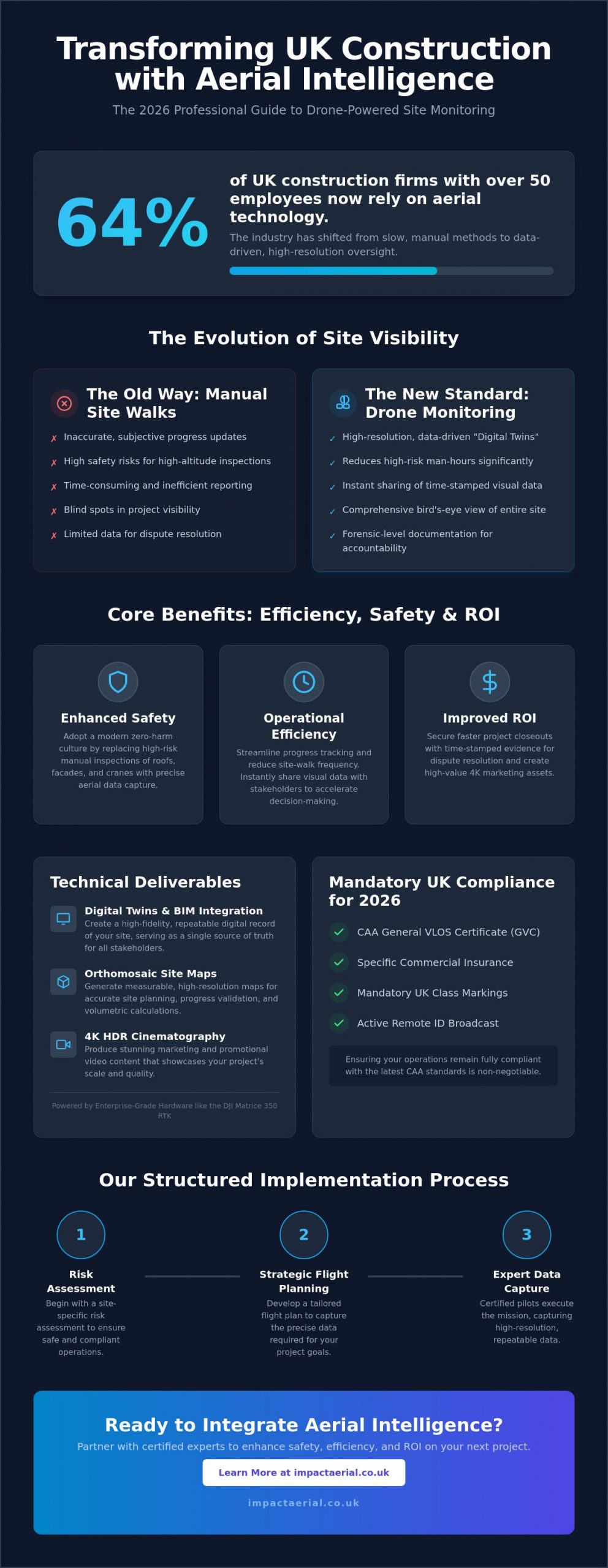
Technical Deliverables: From 4K Video to BIM Integration
Professional construction site monitoring with drones produces a suite of high-tier technical deliverables that extend far beyond simple photography. For project managers, the primary value lies in the precision and repeatability of the data captured. High-resolution 4K HDR cinematography provides crystal-clear visual records for both internal progress tracking and external stakeholder updates. While these visuals are vital for documentation, they also serve a secondary purpose in high-end marketing, showcasing the scale and quality of the build to potential investors or clients in a way that ground-level shots cannot match.
Orthomosaic mapping is another critical output, involving the stitching together of hundreds of aerial images to create a single, measurable, top-down map of the entire site. These maps are georeferenced, allowing teams to take accurate measurements of distances and areas directly from the digital file. For projects utilizing Building Information Modelling (BIM), 3D point clouds and mesh models allow for a direct comparison between the “as-built” progress and the original architectural designs. This integration ensures that any deviations are caught early, maintaining the integrity of the project design and preventing expensive remedial work later in the schedule.
Progress Reporting Formats
Effective communication depends on how data is presented to decision-makers. We provide side-by-side “Then vs. Now” visual comparisons that clearly illustrate development milestones during board meetings or client briefings. Annotated imagery allows site managers to highlight specific issues, such as structural concerns or material misplacements, and share them directly with contractors for immediate action. Many clients also leverage our construction site monitoring with drones alongside specialized aerial filming drone techniques. This combination delivers cinematic marketing assets that capture the project’s evolution with an aspirational quality that enhances the brand’s professional image.
Advanced Data Collection
Beyond visual updates, drones equipped with thermal sensors identify heat loss or moisture ingress in new builds before the final handover. This technical oversight is essential for meeting modern UK building standards and ensuring long-term structural health. For earthworks and excavation, volumetric analysis provides precise data on stockpile volumes and soil movement, which is vital for accurate material management.
The accuracy of these deliverables relies heavily on the use of DJI Enterprise grade hardware. Utilizing platforms like the Matrice 350 RTK ensures that topographic data is captured with centimetre-level precision, which is necessary for drainage assessments and initial site planning. By moving from qualitative assessments to quantitative data points, firms gain a level of site control that provides both psychological comfort and tangible financial benefits—a concept also applied in the equestrian world where you can learn more about BovEquine and their specialized health and foaling monitoring systems.
UK Compliance: Why CAA GVC and Insurance Matter
Legal compliance is the foundation of any professional aerial operation. For construction site monitoring with drones, using an uncertified pilot isn’t just a safety risk; it’s a significant legal liability for the site manager. As of January 1, 2026, the transitional arrangements for UK drone operations have officially ended, making it mandatory for operators to adhere to a stricter framework involving UK class markings and Remote ID. Operating without the correct CAA permissions or valid commercial insurance can lead to heavy fines and the immediate halt of site activities. Ensuring your drone partner is fully vetted provides the psychological comfort that your project remains on the right side of the law.
Navigating CAA Regulations
Understanding the distinction between different certifications is vital for project planning. While the A2 Certificate of Competence (A2 CofC) allows for basic operations, the General Visual Line of Sight Certificate (GVC) is the industry standard for complex construction environments. The GVC is required for pilots seeking Operational Authorisation from the CAA, which is essential when flying enterprise-grade hardware in congested areas. A professional pilot handles all flight permissions, including navigating restricted UK airspace and managing the £524 CAA application fee for specific authorisations. For a more detailed breakdown of these requirements, consult our comprehensive drone license guide.
Complex urban projects, such as those in Birmingham city centre, often require an Operational Safety Case (OSC). This advanced permission allows pilots to operate closer to people and structures than standard rules permit, which is often necessary for high-resolution facade inspections or tight site perimeters. Managing these permissions requires a meticulous approach to risk assessment that only a qualified specialist can provide.
Insurance and Liability
Standard recreational drone insurance is entirely invalid for construction site monitoring with drones. Commercial operations require specialist policies that comply with EC 785/2004 regulations. We recommend a minimum of £5m public liability insurance for sub-20kg drones, though larger developments often require up to £10m to meet corporate risk requirements. This coverage protects the site manager from vicarious liability in the event of an incident, ensuring that the financial burden doesn’t fall on the construction firm. Professional indemnity insurance is essential to cover the accuracy and reliability of the digital data and topographic surveys provided to the project team. To ensure your next project is managed by a compliant and fully insured team, book a professional site consultation with our GVC-certified pilots today.
By prioritizing vetted contractors who understand the 2026 regulatory landscape, you eliminate the guesswork from aerial data collection. It’s about more than just capturing images; it’s about maintaining a compliant, safe, and professional site environment that stands up to regulatory scrutiny.
Implementing Drone Monitoring with Impact Aerial
Integrating professional construction site monitoring with drones into your workflow is a structured process designed to minimize disruption while maximizing data quality. We follow a methodical four-step implementation plan to ensure every flight delivers tangible value to your project team. This systematic approach allows site managers to focus on the build while we handle the complexities of aerial data collection and regulatory compliance.
- Step 1: Initial Consultation. We begin by defining your monitoring frequency and specific data needs. Whether you require weekly progress updates for stakeholders or high-fidelity 3D models for BIM comparison, we tailor the mission to your project’s critical path.
- Step 2: Risk Assessment and Flight Planning. Our GVC-certified pilots conduct a comprehensive site risk assessment. We manage all necessary flight permissions and coordinate with local authorities to ensure safe operations in complex UK airspace.
- Step 3: Precision Data Capture. Using commercial-grade DJI Enterprise drones, we capture high-resolution imagery and topographic data. Our hardware ensures centimetre-level accuracy, which is essential for measurable site maps and volumetric analysis.
- Step 4: Post-Production and Delivery. Raw data is processed into actionable site insights. We deliver high-tier visual reports and data files that are ready for immediate use in board meetings or project management software.
Why Outsource Your Site Monitoring?
While some firms consider building an internal team, 77% of UK construction companies prefer to outsource their aerial operations to specialists. This decision avoids the significant capital expenditure required to purchase and maintain DJI Matrice or Mavic Enterprise fleets. Outsourcing also removes the ongoing burden of pilot training and the administrative weight of managing CAA Operational Authorisations. By partnering with a specialist, you ensure that your construction site monitoring with drones is performed to the highest technical standards. You gain access to professional post-production services that turn raw footage into sophisticated, client-ready reports without the internal overhead or equipment depreciation risks. This preference for outsourcing is common across many sectors; for instance, many growing online brands learn more about Pik Pak Logistics to handle their eCommerce fulfillment and warehousing rather than managing complex logistics in-house.
Our Professional Standards
Based in Birmingham, we serve the West Midlands and projects across the UK with a meticulous focus on safety and precision. Our operations are built on a foundation of strict adherence to safety protocols and the latest 2026 regulatory standards. We understand that site managers need reliable data for dispute resolution and accurate progress tracking. If you’re ready to enhance your project oversight with expert aerial data, contact Impact Aerial for a tailored construction monitoring quote and discover how our professional oversight can protect your site’s ROI.
Securing the Future of Your Site Oversight
The transition toward data-centric project management is no longer a future prospect; it’s the current standard for competitive UK developers. By integrating professional construction site monitoring with drones, you replace subjective reporting with a high-resolution, time-stamped record of every build phase. This approach doesn’t just streamline stakeholder communication; it provides the forensic detail required for dispute resolution and high-altitude safety inspections that were previously impossible to conduct without significant risk.
Success in this specialized field requires more than just hardware. It demands meticulous adherence to the latest CAA regulations and a commitment to operational excellence. Our team provides the psychological comfort of knowing your project is in expert hands, utilizing a DJI Enterprise fleet capable of high-end 4K HDR output. With CAA GVC certified pilots and £5m commercial liability insurance as our baseline, we ensure your site remains compliant and secure while delivering actionable insights that drive project ROI. Request a Professional Construction Site Monitoring Quote to see how we can transform your site visibility. We look forward to helping you achieve faster project closeouts through unparalleled site oversight.
Frequently Asked Questions
Do I need a special permit for drone monitoring on my construction site?
Commercial construction site monitoring with drones requires Operational Authorisation from the Civil Aviation Authority (CAA). This isn’t a simple permit but a legal requirement based on a pilot’s General Visual Line of Sight Certificate (GVC). For complex urban sites, a specialist may also need an Operational Safety Case (OSC) to fly closer to people or buildings than standard regulations allow.
How much does construction site monitoring with drones cost in the UK?
Pricing for aerial monitoring is determined by the project’s complexity, the frequency of flights, and the specific technical deliverables required. A one-off site survey has a different cost structure than a year-long weekly progress tracking contract. We provide tailored quotes that reflect the specific hardware needs and data processing requirements of your development to ensure maximum value.
Can drones fly in rain or high winds on a construction site?
Modern enterprise drones like the DJI Matrice 350 RTK are designed with IP55 weather resistance and can operate in moderate rain. However, high winds exceeding 12 metres per second typically require a grounded flight for safety. Our pilots monitor local METAR data to ensure every mission is conducted within the safe operational limits of the aircraft and the sensors.
What is the difference between an orthomosaic map and a standard aerial photo?
A standard aerial photo is a single perspective snapshot that contains geometric distortion. An orthomosaic map is created by stitching hundreds of images together and correcting them for perspective and scale. This results in a georeferenced, top-down map where every pixel is accurate. It allows your team to take precise measurements of distances and areas directly from the digital file.
How often should a drone monitor a construction site for progress tracking?
Monitoring frequency depends on the pace of the build and your reporting requirements. Most UK projects opt for weekly or bi-weekly flights to maintain a consistent record for stakeholder updates. During high-activity phases, such as earthworks or structural steel erection, more frequent flights might be necessary to capture the rapid changes on the project’s critical path.
Is drone monitoring compliant with GDPR when flying near residential areas?
Professional drone operations are fully compliant with GDPR and UK data protection laws. We conduct Privacy Impact Assessments before flights and use post-production techniques to blur faces, house windows, and vehicle registration plates. This ensures that while we capture essential site data, the privacy of the surrounding community is meticulously protected throughout the monitoring process.
What insurance coverage should a professional drone pilot have for construction?
A professional pilot must hold commercial public liability insurance that is compliant with EC 785/2004. For most UK construction sites, a minimum of £5m coverage is expected, though larger infrastructure projects often require £10m. This insurance protects the site manager and the developer against third-party property damage or injury claims, providing essential financial security.
Can drone data be integrated directly into BIM software like Revit or AutoCAD?
Aerial data is easily integrated into Building Information Modelling (BIM) workflows. We provide georeferenced 3D point clouds and orthomosaics in industry-standard formats like .LAS, .OBJ, and .GeoTIFF. These files can be imported directly into Revit or AutoCAD. This allows for a precise side-by-side comparison between the as-built site and the original architectural designs to catch deviations early.
Drone Inspection for Building Regulations: A Guide to Compliance in 2026
Can a high-resolution digital file provide more regulatory certainty than a manual site visit? For many developers and site managers, the traditional method of erecting scaffolding just to document hard-to-reach areas for Building Control is an expensive and disruptive hurdle they can no longer afford. You likely agree that the health and safety risks of working at height, combined with the slow pace of manual inspections, often create unnecessary bottlenecks in the final stages of a build.
This guide demonstrates how professional drone inspection for building regulations provides the precise visual and thermal data needed to satisfy UK compliance in 2026 safely and efficiently. By leveraging the latest UK class-marked hardware and GVC-certified expertise, you can secure faster sign-offs and build a comprehensive digital audit trail. We will explore the impact of the 2026 Remote ID requirements, the mandatory £12.34 annual operator fee, and how these technological advancements turn aerial data into official evidence for regulatory approval. You will learn how to reduce inspection costs while maintaining a meticulous standard of safety that aligns with current Civil Aviation Authority standards.
Key Takeaways
- Learn how drone technology supports the “Golden Thread” of information to maintain a meticulous digital record for 2026 UK compliance.
- Discover how drone inspection for building regulations delivers high-resolution thermal and visual data to satisfy Part L and Part B requirements.
- Compare the safety and speed of aerial surveys against traditional access methods to significantly reduce site disruption and inspection lead times.
- Understand the specific GVC certifications and insurance standards required to ensure your aerial data is accepted as official evidence by Building Control.
- Prepare your construction site for faster regulatory sign-off by integrating technical drone surveying into your standard inspection workflow.
The Role of Drone Inspections in Meeting UK Building Regulations (2026)
In 2026, drone-assisted building control has transitioned from a technical novelty to a standard industry practice. It involves the deployment of unmanned aerial systems to capture high-definition visual and thermal data that verifies a building’s adherence to specific safety and performance standards. Unlike traditional manual surveys, which often rely on limited “spot checks” from ground level or ladders, drone inspection for building regulations provides total visual coverage of the building envelope. This comprehensive approach ensures that every junction, seal, and structural element is documented before it’s hidden by subsequent construction phases.
To better understand how these tools are applied in practical scenarios, watch this helpful overview of aerial surveying:
Building Control Officers (BCOs) are increasingly prioritizing drone data because it offers objective, high-resolution evidence that human eyes alone might miss. This shift is driven by the need for greater accountability in the construction sector. By providing a clear, bird’s-eye view of roof details, chimney stacks, and high-level facades, professional operators deliver the level of detail required for official sign-off without the logistical burden of scaffolding. It’s a faster, safer, and more accurate way to prove that a build meets the required standards.
Digital Evidence and the Golden Thread
The “Golden Thread” of information is a core requirement of the Building Safety Act, demanding a continuous digital record of a building’s life cycle. Aerial data sets act as timestamped, unalterable milestones during the construction process. These records are easily integrated into Building Information Modelling (BIM) workflows, allowing project managers to overlay live “as-built” imagery against original design specifications. This ensures that any deviations are caught and corrected in real-time, maintaining the integrity of the regulatory audit trail for years to come.
The 2026 Regulatory Landscape for UK Drones
Operating drones in complex urban environments requires strict adherence to UK drone regulations as defined by the Civil Aviation Authority (CAA). Since January 1, 2026, new class-marking systems and Remote ID requirements have added layers of accountability for every flight. For inspections near buildings or in congested areas, operators often utilize Atypical Air Environment (AAE) policies to manage risk effectively. Because of these stringent safety protocols, holding a valid professional drone license and GVC credentials is not just a preference; it’s a mandatory requirement for site access and insurance validity.
Mapping Drone Data to Specific Building Regulation Requirements
Precision is the hallmark of modern construction compliance. Utilizing drone inspection for building regulations allows surveyors to map digital data directly to the legislative “Parts” that govern UK safety and performance. While traditional methods might overlook subtle defects, aerial platforms equipped with 4K zoom and radiometric thermal sensors provide the granular detail needed for official certification. This technical approach ensures that every aspect of the build, from the foundation drainage to the roof’s thermal envelope, is documented with surgical accuracy.
Adhering to government rules for drones ensures that every flight is conducted within the legal framework required for professional evidence gathering. This regulatory alignment is vital when presenting data to Building Control Officers who require verifiable proof of compliance. By using high-resolution imagery, we can now assess structural integrity and masonry for Part A (Structure) through 4K zoom capabilities that reveal hairline fractures or mortar inconsistencies. Similarly, verifying drainage and ventilation placement for Parts F and H becomes a streamlined process, capturing the exact positioning of stacks and outlets before they are obscured by final finishes.
Part L: Thermal Efficiency and Insulation Continuity
Part L focuses on the conservation of fuel and power, a critical area where drones excel. Thermal sensors identify bridging and insulation gaps that are completely invisible to the naked eye. Thermal drones quantify U-value deviations in 2026 by mapping surface temperature gradients against calibrated environmental data. This provides undeniable evidence of “as-built” performance versus the original design intent. It’s a reliable way to ensure that the building’s thermal envelope is continuous and functioning as specified, preventing future energy waste and costly remedial works.
Part B: High-Rise Fire Safety Inspections
High-rise safety is paramount under Part B (Fire Safety) regulations. Drones are now the primary tool for inspecting external cladding and cavity barriers on tall buildings where manual access is dangerous or impossible. Using 4K HDR video, operators provide close-up evidence of correct installation, documenting fire-resistant materials in hard-to-reach roof junctions and facade interfaces. This level of detail is essential for satisfying fire safety audits and ensuring the protection of occupants. If you are looking to enhance your site’s safety record, integrating drone inspection for building regulations into your inspection schedule provides the technical reassurance your stakeholders need.
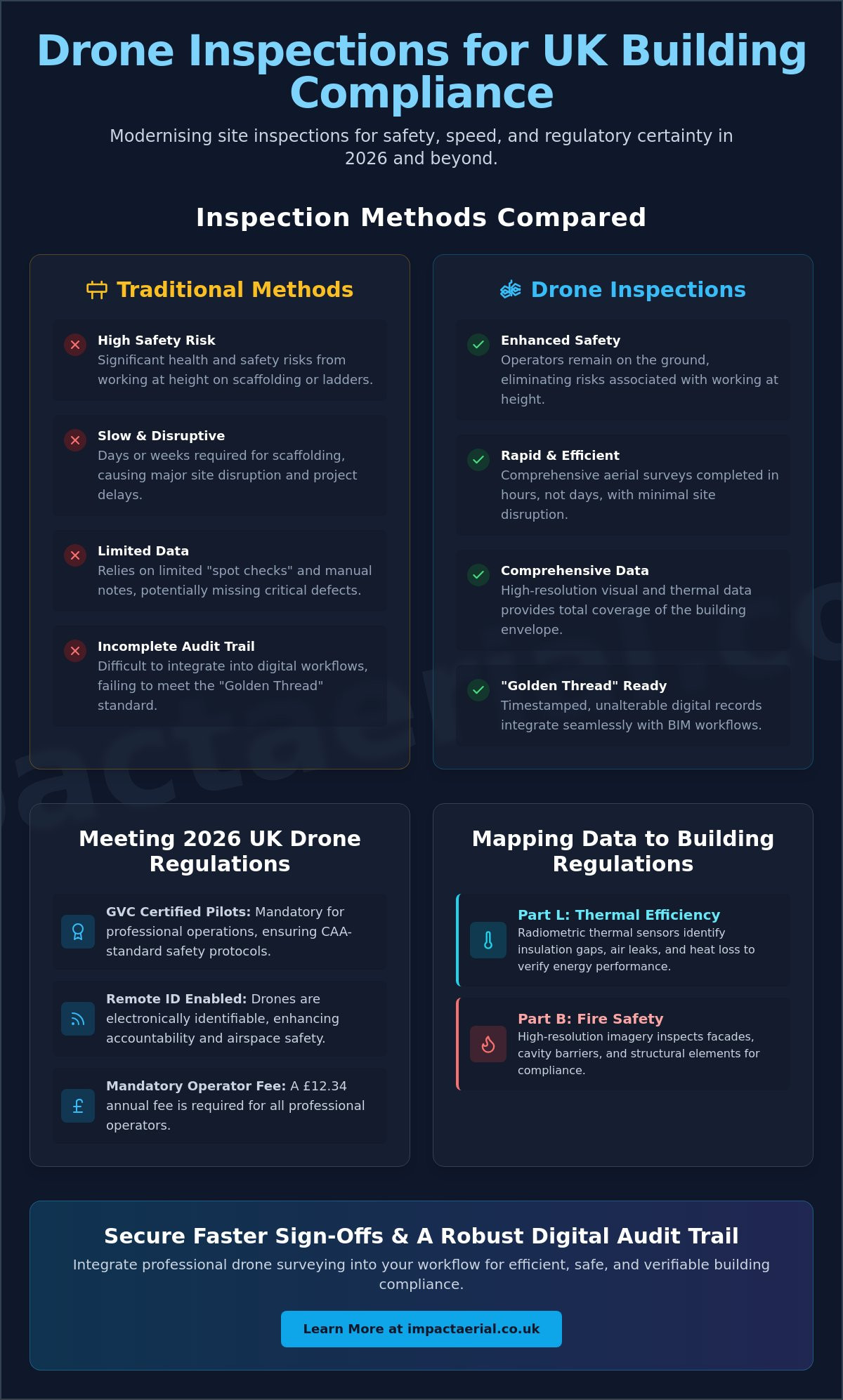
Drone Surveys vs. Traditional Access: A Compliance Comparison
Choosing between traditional access and aerial technology is no longer just a matter of budget; it’s a matter of evidence quality. Traditional inspections often rely on a surveyor holding a handheld camera while standing on a platform, which inherently limits the angles and resolution of the captured data. In contrast, a drone inspection for building regulations utilizes stabilized 45MP sensors that provide far greater detail than any handheld device could achieve from a distance. This superior granularity allows Building Control Officers to zoom into specific joints, seals, or masonry details without losing clarity, providing the technical reassurance required for rapid sign-off.
Speed is a critical factor in maintaining construction timelines in 2026. Traditional scaffolding lead times often stretch into several weeks, involving complex permits and significant site disruption. Conversely, professional drone teams can offer rapid deployment, often within 24 hours of a request. This agility ensures that regulatory documentation doesn’t become a bottleneck for the project. By reducing the overhead of compliance documentation, developers can allocate resources more effectively while maintaining a higher standard of safety and precision.
Reducing Work at Height Risks
Safety remains the primary driver for adopting aerial methods. By utilizing a professional drone survey, site managers directly align their operations with the Work at Height Regulations 2005. These regulations mandate that work at height should be avoided where it’s reasonably practicable to do so. Drones eliminate the need for personnel to physically access dangerous roof areas or high-level facades for initial surveys. This approach removes the logistical burden and high cost of MEWP (Mobile Elevated Work Platform) hire while ensuring zero disruption to active commercial properties. It’s a meticulous way to manage risk without compromising on the depth of the inspection.
Accuracy and Data Deliverables
The deliverables from an aerial inspection far exceed a simple gallery of photos. We provide measurement-accurate orthomosaic maps and 3D photogrammetry models that act as “digital twins” of the asset. These models allow for a virtual walkthrough of the build, enabling regulators to review fire-stopping or insulation continuity from their own offices. Annotated reports highlight specific areas of interest, ensuring that Building Control submissions are clear, professional, and data-backed. This level of meticulous documentation is difficult to replicate with traditional methods, making the drone a superior tool for modern compliance and long-term asset management.
How to Prepare for a Regulatory Drone Inspection
Preparation is the foundation of a successful drone inspection for building regulations. Before the aircraft even leaves the ground, site managers must define exactly which aspects of the build require documentation. Are you verifying the continuity of cavity barriers for Part B compliance, or are you seeking radiometric data to satisfy Part L requirements? Clear communication ensures the flight plan captures the specific high-resolution evidence the Building Control Officer (BCO) expects to see. This targeted approach prevents the need for costly re-flights and keeps your project on its regulatory timeline.
Verifying the technical credentials of your drone partner is the next critical step. In 2026, every professional operator must hold a valid GVC (General Visual Line of Sight Certificate) and provide proof of a current CAA Operator ID. Site safety protocols also demand a minimum of £5 million in public liability insurance specifically tailored for commercial drone operations. These credentials aren’t just paperwork; they’re the legal basis for your site’s risk mitigation strategy and ensure that the gathered data is admissible as official evidence.
A comprehensive site risk assessment is equally vital. Your drone operator will identify local hazards such as overhead power lines, active cranes, or restricted airspace that might impact the flight. They’ll also coordinate with you on the required data formats to ensure the final deliverables are compatible with your BCO’s software. This meticulous planning phase guarantees that the drone inspection for building regulations is conducted safely, legally, and with maximum technical efficiency.
The Pre-Flight Checklist for Site Managers
A methodical approach to site readiness prevents delays and ensures data quality. Site managers should follow these core steps:
- Notify all neighbouring properties and site stakeholders of the scheduled flight time to maintain privacy and transparency.
- Clear the target inspection areas of temporary obstructions, such as plant machinery or loose materials, for optimal data capture.
- Review the pilot’s site-specific risk assessment to confirm that all operational risks are mitigated.
- Confirm the pilot has a valid CAA Operator ID and that their insurance coverage is active for the date of the survey.
Reviewing and Submitting Drone Data
Once the survey is complete, the focus shifts to data interpretation. Thermal reports require professional analysis to distinguish between expected heat signatures and actual insulation gaps. 3D models should be reviewed for geometric accuracy before being integrated into the building’s digital record. For long-term compliance, digital evidence must be stored in a secure, accessible environment for the life of the building to support the “Golden Thread” requirements. In 2026, digital building manuals require all aerial reports to be submitted in standardized PDF/A-3 formats while 3D photogrammetry must use IFC-compatible files for seamless BIM integration.
To ensure your next project meets these rigorous standards, you can book a professional drone survey with our expert team today.
Why Impact Aerial is the Trusted Partner for UK Building Compliance
Impact Aerial stands as a specialist leader in the technical application of aerial data for the UK construction sector. Our team combines high-end drone photography with advanced surveying techniques to deliver the precision required for modern compliance. Based in Birmingham, we provide nationwide reach for construction site monitoring, ensuring that developers across the country have access to the same level of meticulous detail. We don’t just capture images; we provide the technical evidence required for a successful drone inspection for building regulations.
Our operations rely on commercial-grade DJI Enterprise hardware. These platforms are specifically chosen for their ability to carry high-resolution radiometric thermal sensors and 4K zoom cameras, providing maximum data precision in challenging site conditions. By utilizing industry-leading technology, we ensure that every pixel of data serves a purpose in your regulatory submission. This hardware capability allows us to document structural details and thermal performance with a level of clarity that consumer-grade drones simply cannot match.
Expertise in Construction and Property
Safety and Insurance as a Priority
Safety is not a secondary consideration for our team; it’s the foundation of every flight we conduct. Our pilots are CAA GVC certified, meaning they have undergone rigorous training and assessment to operate in complex urban environments. This expertise is backed by £5 million in commercial liability insurance, providing essential peace of mind for developers and stakeholders alike. We adhere to strict risk mitigation protocols and perform meticulous flight planning for every project, regardless of size. This commitment to officialdom and safety ensures that your site remains compliant and your data remains beyond reproach. To see how our technical approach can streamline your compliance workflow, request a consultation with Impact Aerial to discuss your specific regulatory needs.
Securing Future-Proof Compliance with Aerial Data
Integrating aerial technology into your construction workflow is no longer an optional luxury; it’s a strategic necessity for meeting the rigorous standards of the 2026 UK building landscape. We’ve explored how high-resolution thermal and visual data directly support the “Golden Thread” of information, providing Building Control Officers with the unalterable evidence they require for Parts L and B compliance. By replacing slow, high-risk manual inspections with rapid drone deployments, you significantly reduce site disruption and overhead costs while maintaining a meticulous record of every build phase. Just as you protect your professional investments, Aiker Wills and Trusts provides the expertise needed to secure your personal legacy through comprehensive estate planning.
A professional drone inspection for building regulations ensures your project remains on track and fully compliant with current CAA safety protocols. Our team utilizes DJI Enterprise grade equipment and is led by CAA GVC certified pilots to guarantee the highest level of data precision. With £5m commercial liability insurance, we provide the technical reassurance needed to protect your assets and your reputation. Contact Impact Aerial for a Professional Drone Survey Quote and take the first step toward a safer, more efficient inspection process. We look forward to helping you achieve faster regulatory sign-offs with total confidence.
Frequently Asked Questions
Can drone imagery be used as official evidence for Building Control sign-off?
Drone imagery is widely accepted as official evidence for Building Control sign-off provided it is captured by a certified professional using calibrated equipment. High-resolution visuals and thermal data provide timestamped proof of installation for cavity barriers or insulation continuity. This digital record integrates seamlessly into building manuals, offering inspectors a level of detail that traditional handheld photography cannot match from ground level.
What qualifications should a drone pilot have for building inspections in the UK?
A professional drone pilot must hold a valid GVC (General Visual Line of Sight Certificate) and a CAA-issued Operator ID to conduct commercial building inspections. These credentials ensure the pilot is trained in risk mitigation and current aviation law. Additionally, they should possess specific insurance, typically a minimum of £5 million in public liability, to operate legally on active construction sites.
How much does a drone inspection for building regulations cost?
The cost of a drone inspection for building regulations varies based on the size of the asset and the complexity of the data required. Factors such as the need for radiometric thermal sensors, 3D modeling, or specific site risk assessments influence the final quote. While professional aerial surveys require an initial investment, they typically offer significant savings by removing the need for scaffolding or heavy access machinery.
Do I need to notify the CAA before a drone inspection on my site?
You do not usually need to notify the Civil Aviation Authority (CAA) for a standard site inspection. Professional pilots manage all necessary flight planning and airspace checks through the NATS system. However, if your site is located within a Flight Restriction Zone, the pilot will coordinate directly with local Air Traffic Control to secure the required permissions before takeoff to ensure total compliance.
What is the difference between a standard drone photo and a survey-grade orthomosaic?
A standard drone photo is a single perspective image, whereas a survey-grade orthomosaic is a geometrically corrected map created from hundreds of overlapping photos. Orthomosaics are measurement-accurate, allowing surveyors to calculate distances and areas directly from the digital file. This makes them far more valuable for regulatory submissions that require precise spatial data of a building’s envelope rather than just a visual snapshot.
Can drones detect heat loss for Part L compliance during the day?
Drones cannot effectively detect heat loss for Part L compliance during peak daylight hours because solar loading masks the building’s thermal signature. Reliable radiometric surveys are typically conducted at dawn or dusk when there is a significant temperature difference between the interior and exterior. This ensures the thermal sensor captures actual energy leaks through the insulation rather than reflected heat from the sun.
How do drones improve safety on construction sites compared to manual inspections?
Drones improve safety by eliminating the need for personnel to work at height during the initial survey phase. By capturing high-resolution data from the air, site managers avoid the risks associated with ladders, roof walking, or erecting temporary platforms. This approach directly aligns with the Work at Height Regulations 2005 by prioritizing remote data collection over physical human access to dangerous areas.
What happens if the building is in a restricted flight zone or near an airport?
If a building is located within a restricted zone or near an airport, a GVC-certified pilot must obtain permission from the relevant Air Traffic Control unit. This process involves submitting a formal flight plan and maintaining radio contact during the operation. Professional operators are experienced in navigating these complex requirements, ensuring that compliance data is captured legally and safely even in highly controlled urban environments.
Virtual Tour for Retail Spaces: The Ultimate Guide to Immersive Commercial Experiences in 2026
Did you know that consumers aged 18 to 34 are 130% more likely to book or visit a business if they can first engage with an immersive online experience? In a market where digital presence dictates physical success, a professional virtual tour for retail spaces has become the benchmark for commercial credibility. You probably recognize the difficulty of showcasing the true scale of a premium showroom through flat photography, especially when low footfall threatens your bottom line. It’s frustrating to invest in a high-end physical space that your online audience cannot fully appreciate or navigate with ease.
This guide provides a clear roadmap to transforming your retail environment into a high-converting 4K digital twin. We will examine how technical precision, aerial integration, and professional post-production create a seamless journey that increases website dwell time. By following these industry-leading standards, you can secure a significant competitive advantage and ensure your commercial space thrives in the 2026 retail landscape.
Key Takeaways
- Transition from static online galleries to immersive 4K digital twins to significantly increase user dwell time and customer trust.
- Learn how a virtual tour for retail spaces leverages advanced hardware like the Matterport Pro3 to provide high-resolution product clarity and spatial accuracy.
- Understand the critical importance of professional certifications, such as CAA GVC, to ensure your digital scan is conducted with full regulatory compliance and safety.
- Follow a practical planning checklist that prioritizes “Hero Product” placement and optimized lighting to create a high-converting customer path.
- Discover how integrating aerial perspectives with 3D walkthroughs creates a comprehensive digital ecosystem for your commercial property.
What is a Virtual Tour for Retail Spaces and Why Does it Matter?
A virtual tour for retail spaces is no longer just a series of stitched-together photos. It’s a high-resolution, 360-degree digital replica of your physical environment. By 2026, the technology has evolved from grainier “street view” clones into immersive 4K HDR digital twins. These sophisticated models allow customers to navigate a store with the same fluidity they’d experience in person. If you’re wondering What is a Virtual Tour? in a commercial context, it’s a data-rich environment where every product shelf and architectural detail is rendered with mathematical precision.
To better understand how these experiences come to life, watch this helpful video:
The Evolution of Retail Visuals in 2026
Traditional photography often fails to capture the scale of modern commercial properties. Static images don’t tell the full story. In 2026, leading brands use an aerial filming drone to establish the geographic context and impressive scale of a flagship site before transitioning into an indoor 3D walkthrough. This provides a macro to micro perspective that photography simply cannot match. Beyond marketing, 3D mapping serves as a vital tool for internal staff training; it allows new employees to learn store layouts and merchandising standards in a risk-free digital environment.
Key Benefits for Retailers and Showrooms
The commercial impact is measurable and immediate. Data suggests that websites featuring virtual tours are viewed 5 to 10 times longer than those without. This increased dwell time directly correlates with lower bounce rates and higher enquiry volumes. The meticulous nature of a 4K scan ensures your brand is perceived as a leader in your sector.
- Global Accessibility: Your London or Birmingham showroom is open 24/7 to international clients who can’t visit in person.
- Sustainability: By offering a qualified virtual visit, you reduce unnecessary travel for clients who only need to confirm specific details before purchasing.
- Conversion: Prospects aged 18 to 34 are 130% more likely to book or buy based on a virtual experience.
- Precision: High-end digital twins provide accurate spatial data, which is useful for future renovations or store planning.
The Technology Behind High-Conversion Virtual Experiences
High-conversion digital twins aren’t created with consumer-grade cameras. To achieve professional results, we utilize LiDAR-based systems like the Matterport Pro3. This hardware doesn’t just take pictures; it maps the physical geometry of a room to within millimeters. While custom 360 photography has its uses, it often lacks the spatial depth required for a truly navigable virtual tour for retail spaces. Research into The Technology Behind Virtual Experiences confirms that high-fidelity rendering and interactive elements are critical for maintaining customer engagement in a digital retail environment.
Visual clarity is non-negotiable for premium brands. We use 4K HDR imagery to ensure that product textures and colors are represented with absolute accuracy. This precision is vital for showrooms where material quality is a primary selling point. To drive actual sales, we integrate interactive “Mattertags”. These digital hotspots allow you to embed product videos, direct purchasing links, or booking forms directly into the 3D environment. If you want to see how these elements function in a live environment, you can explore our professional virtual tour creation services.
Indoor Immersive Walkthroughs
A successful tour must be intuitive for the end-user. We generate a “Dollhouse View”, which provides a 3D cutaway of the entire building. This is particularly effective for multi-floor department stores, as it allows customers to understand the layout instantly. Our technicians prioritize the strategic placement of information points near high-margin product lines. We also focus on smooth navigation. By carefully calculating the distance between scan points, we prevent the “digital motion sickness” that poorly executed tours often cause. This technical attention to detail ensures the user remains focused on your products rather than the interface.
Aerial Context and External Mapping
Indoor scans only tell half the story of a physical location. To provide a complete commercial perspective, we integrate high-resolution drone photography to capture building exteriors and car parks. This establishes the physical accessibility and prominence of your site. Using professional-grade commercial drones, we can create cinematic “fly-through” sequences. These start high above the retail park and transition smoothly into the indoor 3D display. For large-scale developments, the addition of drone survey data provides prospective tenants or buyers with precise site measurements and structural context that standard marketing materials lack.
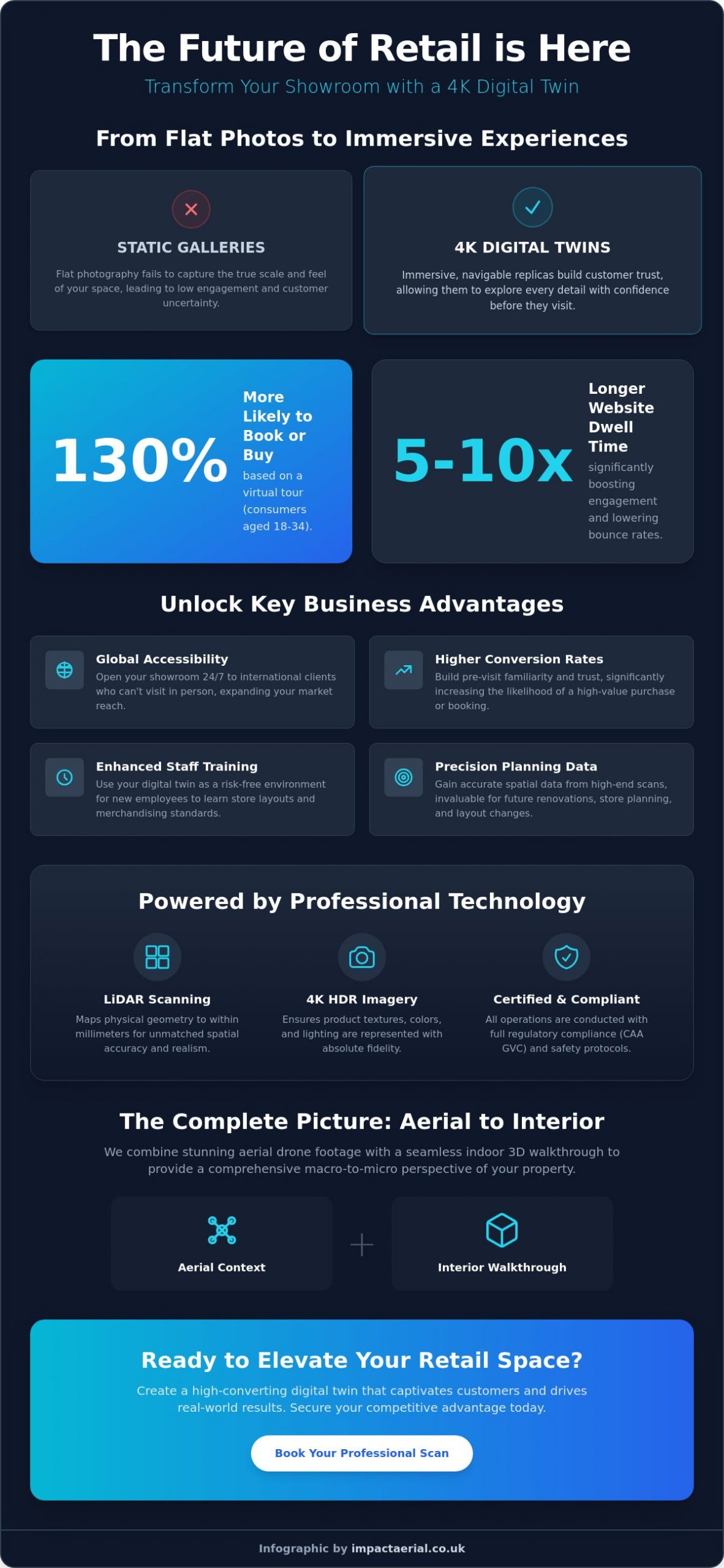
Professional Standards: Safety, Insurance, and Compliance
Engaging a hobbyist for a virtual tour for retail spaces represents a significant operational risk that high-street brands simply cannot afford. The legal and reputational fallout of an uninsured accident or a regulatory breach far outweighs any perceived cost savings. Professional operators prioritize compliance with the same rigor they apply to image quality. For instance, operating drones in congested retail environments requires a specific level of competence. We hold the CAA GVC (General Visual Line of Sight Certificate), which is the industry standard for pilots working in complex urban settings. This certification ensures every flight is conducted within a strict safety framework, protecting both the public and your property.
Insurance is another non-negotiable factor in the commercial sector. A standard drone policy is rarely sufficient for high-traffic retail environments. We maintain £5m in commercial liability insurance, providing the necessary financial protection and peace of mind for our clients. During the filming process, our team implements rigorous risk mitigation strategies. We manage foot traffic and coordinate closely with store managers to ensure the scanning process doesn’t compromise public safety or the customer experience. This methodical approach is what separates a professional digital twin from a low-quality amateur attempt.
Navigating UK Drone Regulations in 2026
Understanding the current drone license requirements is essential for any business commissioning aerial content. In 2026, flight planning for busy urban retail centers involves more than just launching a craft. It requires detailed site surveys, weather monitoring, and often specific permissions from local authorities. Privacy is equally critical. To remain compliant with GDPR, we utilize advanced post-production techniques to blur faces and vehicle number plates. This ensures your virtual tour for retail spaces respects the privacy of the public while showcasing your brand in the best possible light.
Professional Accreditations and Reliability
Professional body memberships, such as ARPAS-UK, serve as a hallmark of quality and technical competence. These affiliations demonstrate a commitment to industry best practices and continuous professional development. At Impact Aerial, our approach is defined by meticulous planning and technical precision. By choosing accredited drone services, you protect your brand reputation from the pitfalls of amateur execution. We provide a structured, methodical workflow that ensures your project is delivered on time and in full compliance with all national safety standards.
Planning Your Retail Virtual Tour: A Practical Checklist
Successful execution of a virtual tour for retail spaces depends on meticulous preparation. You shouldn’t treat the scan as a casual photography session. Instead, view it as a high-stakes digital grand opening. Every detail captured by a 4K LiDAR sensor remains accessible to your customers indefinitely. Proper planning ensures that your digital twin reflects your brand’s highest standards while maximizing the technical capabilities of the hardware. To achieve a seamless result, follow this structured approach to site readiness.
- Step 1: Identify Hero Products. Determine which high-margin items or exclusive collections should act as the focal points of the tour. These areas will receive the highest density of interactive tags and links.
- Step 2: Master the Lighting. Contrary to traditional photography, natural light is often a hindrance in 3D scanning. Moving shadows and changing sun positions can cause “stitching errors” in the final model. We recommend consistent, high-quality artificial lighting for uniform results.
- Step 3: The Grand Opening Standard. Declutter every aisle. Remove temporary signage, cleaning equipment, or personal items. If it shouldn’t be there on your busiest Saturday, it shouldn’t be there for the camera.
- Step 4: Strategic Scheduling. We typically conduct shoots during “off-peak” hours. This minimizes disruption to your operations and ensures a clean, people-free environment for the most professional output.
- Step 5: Post-Production Audit. Once the scan is complete, we review the digital twin to ensure all embedded links, booking forms, and product tags are accurate and functional.
Staging Your Store for the 3D Camera
LiDAR sensors use light pulses to measure distance. Highly reflective surfaces, such as floor-to-ceiling mirrors or large glass partitions, can confuse these sensors and create “ghost rooms” or spatial distortions. We advise cleaning these surfaces thoroughly but also identifying potential problem areas during our pre-shoot site survey. Brand consistency is also vital. Ensure all visible signage is current and aligned with your 2026 marketing strategy. If you plan to include staff for “lifestyle” shots, they must be briefed on their positioning to avoid motion blur during the rotation of the 360-degree lens.
Technical Integration Post-Shoot
The value of your tour increases when it’s integrated into your wider digital ecosystem. Embedding the experience directly onto your website’s homepage or key product landing pages provides a significant SEO advantage by increasing user dwell time. You should also share the tour link across social media and your Google Business Profile to capture local search traffic. Success is measured through data. By tracking “walkthrough” paths and tag click-through rates, you gain valuable insights into customer behavior and showroom navigation. If you’re ready to begin the planning process, you can book your virtual tour consultation with our technical team today.
Why Choose Impact Aerial for Your Retail Space?
Impact Aerial provides a specialized service that integrates sophisticated indoor 3D mapping with cinematic aerial context. While many agencies offer basic scans, our Birmingham-based team delivers a comprehensive virtual tour for retail spaces that meets the exacting standards of luxury commercial brands. We operate across the UK, bringing nationwide delivery capabilities to retailers who require a consistent, high-tier digital presence for their entire portfolio. Our approach focuses on 4K HDR output, ensuring that the visual quality of your digital twin matches the prestige of your physical showroom.
Our technical advantage lies in our dual-certification. We aren’t just Matterport specialists; we’re also CAA-certified drone pilots. This means we manage the entire project from 100 feet in the air down to the finest product detail on your shelves. By handling end-to-end project management, from the initial consultation to final post-production editing, we ensure a cohesive narrative that guides your customers seamlessly from the street into your store. This level of professional integration is rarely found in the standard “walkthrough-only” market.
Our Meticulous Approach to Retail Projects
Safety is the cornerstone of our operational workflow. We conduct detailed pre-flight and pre-shoot surveys for every project to ensure a zero-incident delivery, even in busy urban environments. We utilize advanced, professional-tier drone platforms to achieve unparalleled visual clarity for building exteriors, which provides the necessary context for your virtual tour for retail spaces. Beyond the raw imagery, we offer customized multimedia overlays. These are tailored to your specific retail goals, whether that involves highlighting seasonal promotions or embedding direct links to your e-commerce platform.
Driving ROI for UK Retailers
Investing in a digital twin is a strategic move to turn digital views into physical visits. Our case studies demonstrate how high-fidelity tours increase customer confidence, leading to more “qualified” footfall from visitors who’ve already explored your layout online. We value long-term partnerships, offering efficient store refreshes and seasonal updates to keep your virtual presence current as your inventory evolves. This commitment to technical excellence and brand protection makes us the trusted choice for commercial property marketing in 2026.
Our goal is to provide a seamless, data-centric experience that drives tangible results for your business. If you’re ready to elevate your showroom’s digital profile, Enquire about a virtual tour for your retail space today and speak with our technical consultants.
Future-Proofing Your Commercial Presence
The shift toward immersive digital twins is no longer a luxury for flagship stores; it’s a commercial necessity. By combining high-resolution indoor scans with cinematic aerial context, you provide a level of transparency that builds immediate consumer trust. We have established that a professional virtual tour for retail spaces relies on three fundamental pillars: technical precision, strategic planning, and rigorous safety standards. Implementing these elements ensures your digital presence works as hard as your physical showroom to drive conversions and increase dwell time.
Impact Aerial provides the technical expertise and regulatory compliance required for high-stakes commercial projects. Our team of CAA GVC Certified Pilots uses 4K HDR commercial-grade equipment to deliver unparalleled visual clarity. With £5m in commercial liability insurance, we offer the reassurance that your brand and property are in expert hands. It’s time to bridge the gap between your online audience and your physical retail environment. You can Request a bespoke quote for your retail virtual tour to begin your transformation. We look forward to helping you lead the market in 2026.
Frequently Asked Questions
How long does it take to film a virtual tour for a retail store?
Most professional scans take between 2 and 6 hours depending on the total square footage and the complexity of the layout. A standard retail unit under 2,000 square feet can typically be completed in a single morning session. Larger showrooms or multi-floor department stores require a full day to ensure every LiDAR scan point is captured with the precision needed for a high-quality 4K output.
Do I need to close my shop during the virtual tour shoot?
We recommend scheduling the shoot during off-peak hours or while the store is closed to ensure a clean, unobstructed digital twin. While it’s technically possible to scan with people present, moving figures often cause “ghosting” artifacts in the 3D model. Most clients choose to book sessions before opening or after closing to maintain professional visual standards without disrupting their daily trade.
Can I update the products or tags in the virtual tour later?
You can update interactive Mattertags, product descriptions, and embedded links at any time without needing a new site visit. This flexibility allows you to refresh pricing, promotional videos, or direct booking links as your inventory changes. However, if you physically move walls or rearrange the entire store layout, a re-scan of those specific areas is necessary to maintain spatial accuracy.
Are virtual tours for retail spaces compatible with mobile devices?
Every virtual tour for retail spaces we produce is fully responsive and optimized for mobile, tablet, and desktop viewing. Modern 3D walkthroughs use WebGL technology to ensure smooth, lag-free navigation within all standard mobile browsers. This is essential because a significant portion of modern consumers use smartphones to research local showrooms and flagship stores before committing to a physical visit.
What is the difference between a 360 photo and a Matterport 3D tour?
A 360 photo is a static image from a single fixed point, whereas a Matterport 3D tour uses LiDAR data to create a navigable spatial model. This “digital twin” allows users to walk through the space and view it from any angle, including the specialized “Dollhouse” perspective. Matterport provides a much more immersive experience that accurately represents the true depth and scale of a commercial environment.
How much does a virtual tour for a commercial space cost in the UK?
Professional costs vary based on the square footage of the property and the complexity of the interactive elements required for the project. Industry rates typically reflect the level of technical expertise, the quality of 4K hardware used, and the inclusion of necessary commercial liability insurance. We provide bespoke quotes tailored to the specific dimensions and marketing goals of your unique retail environment.
Can you integrate drone footage into an indoor virtual tour?
We specialize in integrating high-resolution aerial perspectives with indoor walkthroughs to create a comprehensive digital ecosystem. Using DJI Enterprise drones, we capture the exterior context and site accessibility, which we then link directly to the 3D indoor scan. This macro-to-micro journey helps customers understand the location and scale of your site before they transition into the immersive indoor experience.
Is a virtual tour good for my website’s SEO?
Implementing a virtual tour for retail spaces significantly improves SEO by increasing user dwell time, which is a critical ranking signal for search engines. When visitors spend more time exploring your 3D showroom, it signals to Google that your content is highly relevant and engaging. Additionally, embedding these tours on your Google Business Profile can increase visibility in local search results and improve overall click-through rates.
Drone Photography for Solar Panel Installers: The Competitive Edge in 2026
Is your solar business still relying on ground-level smartphone photos to justify five-figure commercial contracts? While your team works at height to install the future of energy, poor visual documentation often fails to capture the true scale and technical precision of your work. Adopting professional drone photography for solar panel installers has transitioned from a high-tech luxury to a fundamental operational standard in 2026. You recognize that manual roof inspections are inherently slow and introduce unnecessary safety risks that can complicate your compliance profile. It’s difficult to demonstrate the meticulous quality of a commercial-scale array to a stakeholder when your perspective is limited to the ladder’s edge.
This article explains how to transform aerial imagery into a dual-purpose engine for your business: a precision survey tool that mitigates risk and a high-performance marketing asset that justifies premium pricing. You’ll discover how to leverage the latest CAA regulatory frameworks and IEC 62446-3 compliant thermal data to streamline your workflow. We’ll also preview how AI-powered fault detection and high-resolution mapping are helping installers secure long-term maintenance contracts and deliver superior site assessments with absolute technical confidence.
Key Takeaways
- Learn why aerial perspectives are the only way to document large-scale commercial rooftop installs effectively, overcoming the visibility limitations of ground-level photography.
- Discover how thermographic surveys identify hidden “hot spots” and bypass diode failures that stay invisible to the naked eye.
- Understand the legal risks of DIY flights and why professional drone photography for solar panel installers is necessary to comply with strict CAA regulations.
- See how to transform technical survey footage into high-converting marketing assets, including time-lapse videos that showcase your team’s installation speed.
- Identify specific ways that precision-engineered aerial data helps you secure long-term maintenance contracts and increase your project ROI.
Why Drone Photography is Essential for Modern Solar Installers
The renewable energy sector is moving away from the limitations of ground-level documentation. For years, installers relied on ladders and handheld cameras, but these methods fail to capture the complexity of modern arrays. Adopting professional drone photography for solar panel installers allows you to document the entirety of a project from a perspective that ground-based photography simply cannot reach. This shift isn’t just about aesthetics; it’s about providing a comprehensive technical overview that builds trust with commercial stakeholders and provides a clear record of work quality.
To better understand this concept, watch this helpful video:
Large-scale commercial rooftops often present a ‘visibility problem’ where the pitch and scale of the building make ground-level shots nearly useless. Drones solve this by providing a top-down view that reveals the full scope of the installation. Using these tools can reduce site survey times by up to 70% compared to manual, ladder-based inspections. This efficiency lets your team complete more assessments per week while lowering the risk of falls from height. These advanced drone applications in infrastructure inspections ensure that every panel is accounted for and every structural obstacle is identified before your crew ever sets foot on the roof.
The Evolution of Solar Site Surveys
Relying on tape measures and physical climbing is becoming an obsolete practice. Modern installers use high-resolution photogrammetry to create digital twins of a site. These maps identify shading issues from nearby chimneys or trees with millimetre precision. By using detailed aerial maps, you can optimize panel placement during the design phase. This improves the accuracy of your generation quotes and minimizes costly on-site adjustments during the installation phase.
Building a Premium Brand through Aerial Assets
High-end residential and commercial clients expect professional documentation of their investment. They aren’t just buying hardware; they’re buying into a sustainable future. Cinematic 4K HDR visuals capture this ‘green energy’ narrative effectively. When you integrate drone photography for solar panel installers into your workflow, you’re not just improving surveys; you’re building a library of premium content. Using ‘hero’ shots of a completed project differentiates your business in a crowded market. It showcases the meticulous quality of your electrical work and the scale of your operations, turning a standard technical project into a high-converting marketing asset.
Technical Applications: Visual and Thermal Solar Inspections
While cinematic footage helps close the deal, the real operational value of drone photography for solar panel installers lies in the capture of technical, actionable data. It’s vital to distinguish between standard aerial photography and technical inspections. High-resolution visual sensors identify physical defects like micro-cracks in cells, bird nesting, or debris accumulation that are impossible to spot from the ground. These visual records serve as “as-built” documentation, providing a definitive baseline for Operations and Maintenance (O&M) contracts and insurance purposes.
The integration of DJI Enterprise hardware, such as the Mavic 3 Thermal or the Matrice 350 RTK, allows installers to capture radiometric data. Unlike standard thermal images, radiometric data stores temperature values for every individual pixel. This precision is required for technical reporting that meets international standards. If you are managing large-scale assets, a professional thermographic survey ensures your systems are operating at peak efficiency from day one.
Maximising Efficiency with Thermal Imaging
Thermal drones identify faults that are invisible to the naked eye. By detecting “hot spots” or bypass diode failures, these surveys prevent minor component issues from escalating into system-wide failures. According to industry data, an undetected 5% yield loss on a 10 MW solar site can cost approximately $40,000 annually in lost revenue. Following the IEC 62446-3 standard for thermographic inspections ensures that data is collected under correct irradiance levels, typically 600 W/m² or higher. This technical rigor allows you to identify string failures or faulty inverters in minutes, making thermal audits a high-value addition to your maintenance packages.
Visual Documentation and Quality Control
Quality control is about more than just checking panels. Professional drone photography for solar panel installers provides 4K HDR evidence of installation compliance with UK building standards. You can document the integrity of mounting hardware and the precision of cable management across the entire array. These high-resolution comparisons of “before and after” site conditions protect your business against future liability claims. They also provide your clients with absolute confidence in the mounting hardware’s integrity and the overall safety of the electrical work. Using these assets for warranty records ensures that any future claims are backed by indisputable visual evidence.
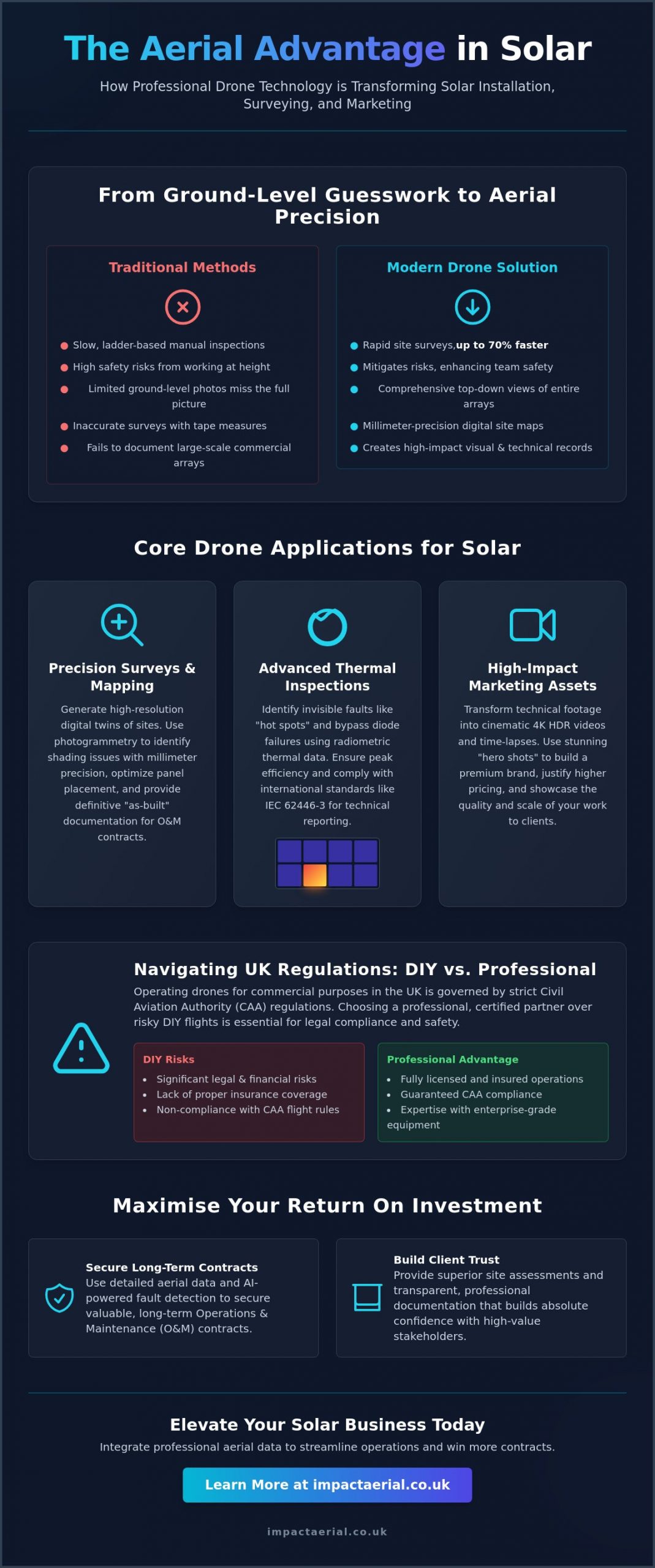
Professional Drone Services vs. DIY: Navigating UK Regulations
It’s tempting to assume that purchasing a consumer-grade drone and assigning a staff member to capture a few photos is a cost-effective solution. However, the hidden costs of a DIY approach often outweigh the perceived savings. Hardware like the DJI Mavic 3 Thermal or Matrice 30T represents a significant capital investment and suffers from rapid technical depreciation. Beyond the initial purchase, your business must account for ongoing software subscriptions for thermal analysis, the time lost to pilot training, and the logistical burden of maintaining a compliant flight log. Professional drone photography for solar panel installers delivers a level of consistency and technical accuracy that raw, unedited footage from an amateur pilot simply cannot match.
The legal reality in 2026 is uncompromising. The Civil Aviation Authority (CAA) distinguishes clearly between recreational flights and commercial operations. Any flight conducted to support a business, whether for marketing or a technical survey, is classified as a commercial operation. Using a hobbyist Flyer ID for these purposes violates CAA regulations and can lead to severe penalties. Furthermore, as of January 1, 2026, mandatory Remote ID requirements and new UK class marks (UK0 to UK6) mean that legacy equipment may no longer be compliant for certain mission profiles. Professional operators ensure that every flight is fully legal, protecting your brand from the reputational and financial risks of non-compliance.
CAA Compliance and the GVC Certification
For operations in complex environments, such as urban rooftops or near restricted airspace, a standard Flyer ID is insufficient. The General Visual Line of Sight Certificate (GVC) is the professional standard required for higher-risk missions. Obtaining a UK drone license through GVC training typically costs between £500 and £1,200, representing a significant investment in time and money for an installer. Professional pilots are trained to manage complex flight permissions and coordinate with National Air Traffic Services (NATS), ensuring that your solar project proceeds without legal delays or safety incidents.
Liability and Risk Management on Site
Safety is the primary concern for any solar installation team. Most commercial site managers and principal contractors require at least £5m in specialist commercial liability insurance before a drone is permitted to launch. Standard business insurance rarely covers aviation accidents, leaving your company exposed if a DIY pilot suffers a hardware failure over a client’s property. Professional drone services provide comprehensive risk assessments and Method Statements (RAMS) for every flight. This meticulous approach to risk mitigation provides total peace of mind, allowing your team to focus on the installation while experts handle the aerial data capture and safety protocols.
Maximising ROI: Using Aerial Content for Marketing and Lead Gen
The technical audits we’ve discussed in previous sections are vital for operations, but the visual output from these flights serves a second, equally important purpose: business growth. Converting raw technical data into high-converting marketing assets is where solar firms find their greatest return on investment. Professional drone photography for solar panel installers provides the “hero” content needed to move a prospect from curiosity to a signed contract. High-resolution time-lapse videos are particularly effective here. They demonstrate the speed, safety, and efficiency of your installation team in a way that ground-level progress photos never could.
Social Media and Digital Presence
Digital platforms like LinkedIn and Instagram require visually arresting content to capture the attention of commercial B2B leads. You can repurpose technical survey footage into Instagram Reels that showcase the technical precision of your mounting systems. The “reveal” shot creates an immediate emotional impact; it starts with a close-up on a single panel and pulls back to show the massive scale of a commercial rooftop array. These assets aren’t limited to digital use. High-resolution drone stills are perfect for premium print brochures, providing a level of detail that conveys industry leadership to potential clients during face-to-face meetings.
Winning Commercial Tenders with Data
Winning large-scale commercial tenders in 2026 requires you to prove technical superiority and meticulous planning. Including 3D site models and immersive virtual tours in your tender documents shows corporate sustainability officers that you have total command over the project environment. By leveraging drone survey data, you can provide more accurate energy yield estimates based on millimetre-precise shading analysis. This data-centric approach builds trust with corporate stakeholders who are responsible for multi-million pound renewable energy investments.
Aerial case studies also provide a significant boost to your website’s search engine performance. Embedding drone video on your project pages increases dwell time, which is a key metric for ranking on Google. It allows potential clients to explore the scale of your installations from their own offices, providing a sense of transparency and reliability. When you invest in professional drone photography for solar panel installers, every project you complete becomes a permanent, high-performing lead generation asset.
To transform your next installation into a high-converting marketing portfolio, explore our professional aerial filming and photography services.
Impact Aerial: Your Strategic Partner for Solar Drone Solutions
Impact Aerial provides specialized drone photography for solar panel installers, delivering more than just visual content. We act as a technical extension of your installation team, providing the high-tier imagery and data required to thrive in the 2026 renewable energy market. Our bespoke aerial filming and photography services are designed specifically for the unique demands of the UK solar industry. We don’t just capture photos; we produce precision-engineered assets that support both your marketing goals and your technical compliance requirements.
Our pilots are CAA GVC certified and operate the latest DJI Enterprise hardware, including the Mavic 3 Thermal and Matrice 350 RTK. This technology allows us to conduct highly accurate PV solar farm thermal surveys for large-scale assets, identifying faults that ground-level inspections would inevitably miss. Beyond the flight itself, our full post-production suite ensures that the raw data is transformed into ready-to-use assets. Whether you need a technical report for a maintenance contract or a cinematic reel for a commercial tender, we deliver polished, professional results every time.
Professionalism from Consultation to Delivery
Safety and compliance underpin every mission we fly. We take a methodical approach to project management, developing site-specific risk assessments and safety protocols that align with your existing workflow. This meticulous planning ensures that our aerial support is seamless and non-disruptive to your installation schedule. We are dedicated to delivering 4K HDR visual excellence alongside precision-engineered radiometric data for every installation. By outsourcing your aerial needs to a trusted specialist, you eliminate the overhead of in-house equipment maintenance and pilot training while gaining access to industry-leading expertise.
Get a Competitive Quote Today
We offer custom packages tailored to your specific business needs, whether you manage a portfolio of residential installs or oversee utility-scale commercial solar farms. While we provide national coverage across the UK, we maintain a strong local focus on Birmingham and the West Midlands, allowing for rapid deployment and regional site expertise. Our team understands the competitive pressures of the current solar market and provides the technical edge you need to justify premium pricing to your clients. Contact Impact Aerial today to elevate your solar installation brand and secure your competitive advantage in 2026.
Elevate Your Solar Operations with Precision Aerial Intelligence
Professional drone photography for solar panel installers is no longer a peripheral service; it’s a core operational requirement for firms aiming to lead the UK’s renewable transition in 2026. By integrating technical surveys with cinematic marketing, you transform routine installations into precision-engineered assets that justify premium pricing and win complex commercial tenders. You’ve seen how thermographic data prevents significant yield loss and how professional content builds a high-end brand profile that resonates with corporate stakeholders. This dual-purpose approach ensures your business remains compliant, safe, and highly visible in an increasingly crowded market.
Our team of CAA GVC certified pilots provides the safety and compliance you need, backed by £5m in commercial liability insurance and the latest DJI Enterprise 4K HDR hardware. We handle the technical complexities of flight permissions and data capture so your team can focus on delivering world-class solar energy solutions. It’s time to replace ground-level limitations with a comprehensive aerial strategy that protects your liability and drives your lead generation.
Request a Professional Drone Survey Quote for Your Next Solar Project
We’re ready to help you streamline your site assessments and amplify your marketing reach. Let’s build a more efficient, visually stunning future for your solar brand together.
Frequently Asked Questions
Do I need a special license to fly a drone for my solar business?
Yes, you must have a Flyer ID and an Operator ID from the Civil Aviation Authority (CAA) for any business-related flight. Most commercial solar projects also require the pilot to hold a General Visual Line of Sight Certificate (GVC). This qualification allows for legal operation in urban or congested areas where many rooftop installations occur. Operating without these certifications can lead to significant legal penalties and will invalidate your business insurance.
How much does professional drone photography for solar installers cost?
Project costs vary based on the scale of the installation and the specific data deliverables required. Factors that influence the final quote include the number of panels, the geographical location, and whether you need radiometric thermal data or cinematic marketing assets. Investing in professional drone photography for solar panel installers eliminates the hidden expenses of in-house hardware maintenance, specialist software subscriptions, and the significant time required for staff pilot training.
Can drones really detect faulty solar panels using thermal imaging?
Thermal sensors identify “hot spots” caused by cell failures or bypass diode issues that are invisible to the naked eye. By detecting these heat signatures, drones allow for a targeted maintenance approach that ensures the array operates at its peak generation capacity. This technical data is vital for large-scale assets where undetected faults can lead to substantial yield loss and reduced return on investment over the system’s lifespan.
What are the benefits of hiring a drone pilot vs doing it in-house?
Outsourcing your aerial needs removes the liability and regulatory burden from your internal team. Professional pilots bring industry-leading DJI Enterprise hardware and the expertise to manage complex UK airspace permissions and site-specific risk assessments. This meticulous approach ensures that your data is captured safely and accurately while your staff stays focused on the core electrical and structural aspects of the solar installation itself.
How long does a typical drone survey of a solar farm take?
Drones are incredibly efficient and can cover ten times more panels per hour than manual ground methods. A standard commercial rooftop survey typically takes between one and two hours to complete. For utility-scale solar farms, professional pilots can often document the entire site in a single day, providing a much faster turnaround for technical reports and marketing content compared to traditional inspection techniques.
Is drone photography safe to use around high-voltage solar equipment?
Yes, drones are inherently safer because they operate at a standoff distance from live electrical components. Pilots use high-magnification zoom lenses and thermal sensors to capture detailed data without the need for personnel to climb near high-voltage equipment. This reduces the risk of falls from height and electrical accidents, adhering to strict safety protocols and RAMS (Risk Assessment and Method Statements) for every flight.
What kind of insurance should a professional drone company have?
Commercial drone operators are legally required to have specialist third-party liability insurance that complies with EC Regulation 785/2004. Most commercial site managers require a minimum of £5 million in coverage before permitting a drone to launch. This specialist insurance is distinct from standard business liability and is essential for protecting your client’s property and your business in the event of an aviation-related incident.
Can drone footage be used for official UK building inspections?
High-resolution drone photography for solar panel installers is increasingly accepted as a valid tool for installation compliance and official inspections. It provides an indisputable, high-definition record of mounting hardware integrity and cable management precision. This documentation is often used to support building standard sign-offs, insurance audits, and warranty records, giving both the installer and the client total confidence in the quality of the work.
Onboarding a Drone Services Company: The Professional Buyer’s Guide
Did you know that 67% of construction firms now use drones for site monitoring, yet many procurement teams still treat these high-tech aerial assets like standard sub-contractors? When you’re onboarding a drone services company, the difference between a successful deployment and a legal nightmare often comes down to the quality of your vetting process. It’s common to feel uncertain about whether aerial data truly outperforms traditional methods, or to worry about the operational risks of having a drone over a live site.
We agree that the stakes are high. One oversight regarding CAA regulations or insurance can lead to significant liability. This guide is designed to help you master the corporate procurement process for drone services, ensuring full compliance and robust risk management. You’ll learn how to verify certifications, confirm specific insurance coverage, and ensure seamless data integration. We’ll provide a comprehensive checklist for vendor vetting, giving you the assurance that your provider is a meticulous, safety-conscious specialist capable of delivering high-tier results without disrupting your daily workflow.
Key Takeaways
- Understand the critical shift from PfCO to the GVC framework to ensure your drone provider meets current CAA regulatory standards for commercial operations.
- Master the strategic steps for onboarding a drone services company, focusing on rigorous legal vetting and operational alignment for complex corporate projects.
- Learn to define high-value deliverables through a clear Statement of Work that supports seamless data integration with existing CAD, BIM, and GIS workflows.
- Identify the essential insurance requirements, such as EC 785/2004 compliance, that protect your organization from liability and unforeseen site disruptions.
- Discover how to proactively manage stakeholder concerns regarding GDPR and privacy through robust site control procedures and professional data handling.
What is Professional Onboarding for Drone Services?
The formal process of onboarding a drone services company is a rigorous procurement procedure that moves beyond simply hiring a pilot. It represents a structured alignment of vetting, legal verification, and operational integration. For Tier 1 contractors and ISO-compliant organisations, this process is essential for maintaining safety standards and mitigating corporate liability. It marks the definitive shift from hiring amateur photography enthusiasts to partnering with technical consultants focused on high-precision commercial data collection. This professional approach ensures that aerial technology serves as a reliable tool for business intelligence rather than a source of operational risk.
To better understand this concept, watch this helpful video:
The industry has undergone significant regulatory changes, specifically the transition from the old Permission for Commercial Operation (PfCO) to the current CAA GVC framework. This evolution reflects a more structured approach to Global drone regulations, prioritising competency and risk assessment over simple flight hours. In a market where 67% of construction firms now use drones for site monitoring, professional onboarding ensures that your data is accurate, legally obtained, and ready for integration into business workflows. This meticulous vetting process provides the psychological comfort and tangible benefits required by modern project managers.
The Legal Framework: CAA GVC and A2 CofC
A CAA GVC certified pilot is the gold standard for complex commercial work. While the A2 Certificate of Competency (A2 CofC) allows for flights in less restrictive environments, it often lacks the robust safety frameworks required for industrial or construction site monitoring. The GVC provides the necessary foundation for obtaining an Operational Authorisation, which is the specific legal “permission to fly” granted by the CAA to commercial entities for complex missions. This certification ensures the operator has undergone rigorous theoretical and practical assessments tailored to professional environments where precision is non-negotiable.
Why “Just Buying a Drone” is a Procurement Risk
It’s tempting for businesses to purchase hardware internally, but this often creates significant procurement risks. While the cost of professional drones has decreased, the expense of training, maintaining compliance, and securing commercial-grade insurance remains high. Internal staff flying without specific commercial liability insurance (EC 785/2004 compliant) exposes the company to massive legal liability if an incident occurs. Onboarding a drone services company acts as a strategic risk-transfer mechanism. By partnering with a specialist, you shift the burden of regulatory compliance, equipment maintenance, and flight safety to an expert who is fully insured and certified to operate in high-risk zones, ultimately protecting your organization’s reputation and bottom line.
Essential Compliance Vetting: The 4 Pillars of Safety
When you are onboarding a drone services company, your first priority is a rigorous vetting of their legal credentials. This isn’t just about ticking boxes; it’s about verifying that the operator has the technical competency and legal authority to fly in complex environments. Start by requesting the pilot’s Flyer ID and the company’s Operator ID. You can verify these details directly through the Civil Aviation Authority (CAA) portal. As of 2026, an Operator ID is mandatory for any drone with a camera weighing 100g or more. This verification ensures that the provider is registered and accountable under current UK law, providing the first layer of protection for your project.
The second pillar involves reviewing the provider’s Operations Manual and safety record. A professional operator will have a detailed manual that outlines their specific safety protocols, risk assessment procedures, and emergency contingency plans. This document is a requirement for obtaining an Operational Authorisation from the CAA. Don’t hesitate to ask for evidence of past safety performance or site-specific risk assessments. A company that is transparent about its safety culture is far more likely to integrate into your on-site operations without causing disruption. This level of meticulousness is what separates a technical consultant from a casual operator.
Commercial Drone Insurance: Why £5m Liability Matters
While the minimum insurance requirement for commercial drone operations in the UK is governed by Regulation (EC) 785/2004, most Tier 1 contractors and property managers require a higher standard. A £5m public liability policy has become the industry benchmark for construction and commercial property sites. This coverage is vital because it protects your organization against claims related to property damage, personal injury, and accidental privacy breaches. If you’re commissioning technical data, ensure the provider also carries professional indemnity insurance. This protects you if a decision made based on their survey data leads to financial loss. Verifying these professional insurance standards is a non-negotiable step in the procurement process for any high-value asset manager.
Hardware Standards: 4K HDR and Thermal Capabilities
The choice of equipment is a key indicator of a provider’s professionalism. Consumer-grade drones often lack the sensor quality and stability required for high-stakes commercial drone surveys. Professional operators typically utilize DJI Enterprise models or equivalent commercial hardware. These systems offer 4K HDR video for marketing purposes and high-resolution sensors that capture the level of detail needed for technical inspections. For specialized projects like PV solar farm surveys or roof inspections, thermal imaging capabilities are essential. High-end thermal sensors can detect heat signatures and anomalies that are invisible to the naked eye, providing actionable intelligence that traditional methods simply cannot match. Confirming that your partner uses hardware with UK class marks (UK0 to UK6) also ensures they are compliant with the latest 2026 hardware regulations.
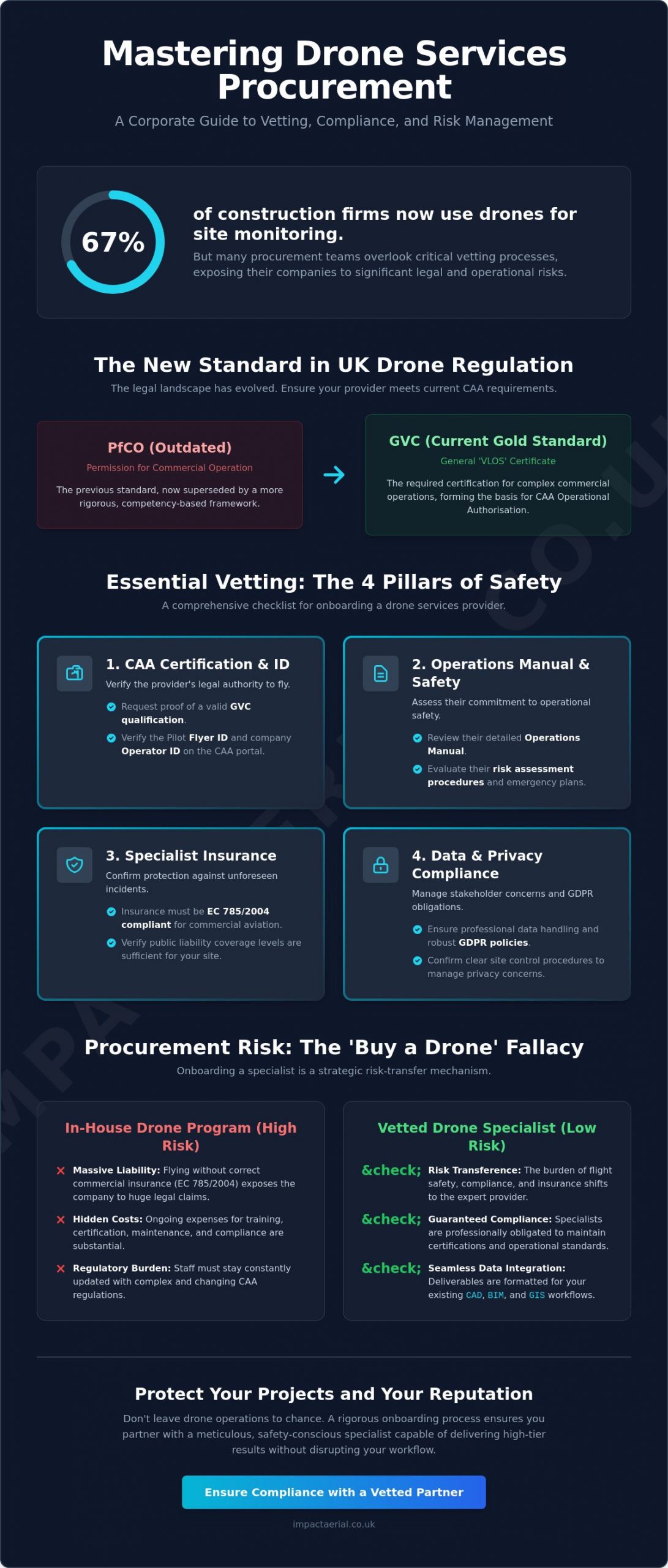
Operational Integration: Aligning Drone Data with Project Goals
Successful onboarding a drone services company requires a clear transition from compliance verification to operational execution. This stage is defined by the creation of a robust Statement of Work (SoW), which acts as the technical blueprint for the entire engagement. A well-structured SoW must explicitly define the nature of the deliverables, distinguishing between RAW data for technical analysis and polished, edited assets for stakeholder presentations. Establishing these parameters early prevents scope creep and ensures that the aerial intelligence gathered aligns perfectly with your specific business objectives, whether you’re monitoring a multi-year construction project or conducting a one-off structural survey.
Effective integration also depends on setting clear communication protocols for site-specific flight windows. Professional operators work around your schedule to minimize site disruption, often coordinating with site managers to identify periods of low activity. For long-term projects, such as weekly construction site monitoring, a consistent data collection frequency is established to create a reliable chronological record of progress. This methodical approach allows project managers to overlay aerial data directly into existing CAD, BIM, or GIS software, transforming visual assets into measurable technical insights that drive informed decision-making.
From Raw Footage to Actionable Intelligence
The value of professional drone services lies in the post-production process. While a standard pilot might provide basic files, a technical specialist transforms raw data into actionable intelligence. For marketing and corporate communications, aerial filming and photography involves sophisticated color grading and editing to produce cinematic-quality video. In more technical sectors, 3D photogrammetry and point clouds are generated to create high-precision digital twins of land or structures. These models are essential for land surveying and volume calculations. Additionally, virtual tour creation provides property professionals and advertising agencies with immersive, 360-degree perspectives that traditional photography cannot replicate.
Site Access and Pre-Flight Planning
A meticulous operator handles all the logistical complexities of site access long before the drone leaves the ground. This includes conducting a Site-Specific Risk Assessment (SSRA) to identify hazards like overhead power lines or public footpaths. Gaining landowner permission and notifying local authorities are standard procedures for a compliant provider. In restricted airspace, the operator will manage the “Notice to Airmen” (NOTAM) process, ensuring that other airspace users are aware of the drone activity. This level of pre-flight planning ensures that operations are conducted safely and legally, providing you with the reassurance that your project is in expert hands.
Risk Management and Privacy: Addressing Stakeholder Concerns
Effective risk management is the cornerstone of professional aerial operations. When you are onboarding a drone services company, you must look beyond the flight itself and evaluate how the provider manages the psychological and physical concerns of your stakeholders. Addressing the fear of “drone crashes” is a primary step in this process. Professional operators utilize hardware with significant technical redundancy, including dual batteries, multiple IMUs, and sophisticated obstacle avoidance sensors. These systems, combined with the pilot’s advanced flight skills, ensure that the risk of equipment failure is minimized. This technical approach provides the reliability that corporate clients expect when operating in high-value or sensitive environments.
Weather-related delays are an inherent part of aviation, but they shouldn’t compromise your project timelines. A specialist operator monitors meteorological data days in advance and maintains flexible scheduling to capitalize on safe flight windows. By establishing clear communication protocols during the onboarding phase, you can ensure that any weather-related adjustments are handled without impacting ground-level operations. This proactive management allows for a seamless integration of drone technology into your existing project schedule, maintaining momentum while prioritizing safety above all else.
GDPR and Data Privacy in Aerial Photography
Privacy is a significant concern for urban projects where drones may inadvertently capture images of the public. A professional pilot understands their legal responsibility to protect individual privacy by blurring faces and vehicle number plates in any non-consensual footage. For large-scale urban developments, conducting a Data Protection Impact Assessment (DPIA) is a critical step in the onboarding process. This assessment identifies potential privacy risks and outlines the mitigation strategies used to protect data subjects. Our team ensures that all captured data is stored on encrypted, secure servers with strict access controls to maintain the highest standards of digital security.
Mitigating Operational Disruption
One of the most significant benefits of aerial technology is its “non-contact” nature. Unlike traditional methods that require scaffolding, cranes, or cherry pickers, drones can inspect assets from a safe distance without touching the structure. This eliminates the need for expensive and disruptive physical access equipment. The efficiency of rapid deployment is clear when completing a drone roof survey, which can often be finished in hours rather than days. This speed significantly reduces the time spent on-site, allowing your team to continue their work without interruption.
To ensure zero impact on your daily operations, professional operators coordinate closely with site managers to establish robust “cordon and control” procedures. These involve securing take-off and landing zones and ensuring that flight paths avoid active work areas where possible. This meticulous planning ensures that the drone remains an unobtrusive tool for data collection. If you are ready to enhance your site safety and data accuracy, contact Impact Aerial today to discuss your specific project requirements.
Partnering with Impact Aerial: Your UK Onboarding Solution
Impact Aerial provides a comprehensive solution for corporate clients looking to integrate aerial intelligence into their operations. Our Birmingham based team delivers nationwide coverage, ensuring that high tier filming and surveying services are accessible across the UK. When you are onboarding a drone services company, the complexity of managing multiple vendors can be overwhelming. We simplify this by providing full project management, guiding you from the initial technical consultation through to the final post production delivery. Our commitment to CAA GVC certified excellence ensures that every flight is conducted with the highest regard for safety and regulatory compliance.
For Tier 1 contractors and large scale property developers, our £5m commercial liability insurance provides the necessary psychological comfort and legal protection required for high stakes projects. This level of coverage, combined with our meticulous adherence to safety protocols, makes us a trusted specialist for organisations that value external validation and industry standards. We don’t just fly drones; we provide a risk mitigated service that delivers tangible business benefits. By choosing a partner with established credentials, you ensure that your aerial data collection is both legally sound and technically superior.
Our Technology Stack: DJI Enterprise and 4K HDR
We utilise a commercial grade technology stack centred around DJI Enterprise hardware. These systems provide the superior stability and image quality needed for 4K HDR cinematic filming and high resolution technical inspections. Our specialised thermal surveying capabilities are particularly valuable for PV solar farm assessments and commercial property surveys, where detecting heat anomalies is critical for asset maintenance. Beyond data collection, our in house post production suite allows us to create immersive virtual tours and high end marketing films that showcase your projects from unique and aspirational perspectives. This end to end capability ensures that the data we capture is transformed into actionable intelligence for your stakeholders.
Streamlined Procurement for Corporate Clients
We understand that procurement departments need efficiency and clarity. To speed up your vendor onboarding process, we provide all essential compliance documentation, including our Operations Manual, insurance certificates, and pilot credentials, upfront. This transparency reduces the administrative burden on your team and ensures a faster path to project commencement. Our extensive experience working across the property, construction, and advertising sectors allows us to align our services with your specific industry requirements and safety standards. Contact Impact Aerial today to discuss your project requirements and discover how our professional drone services can transform your data collection workflow.
Securing Your Project’s Aerial Future
Mastering the process of onboarding a drone services company transforms a complex regulatory challenge into a streamlined operational advantage. By prioritizing CAA GVC certification and verifying robust insurance standards, you protect your organization from liability while gaining access to high-precision data. We’ve explored how aligning technical deliverables with your existing CAD or BIM workflows ensures that aerial intelligence becomes a functional part of your project management strategy. This structured approach moves your procurement beyond simple photography and into the realm of professional technical consultancy.
Impact Aerial is ready to support your next mission with our team of CAA GVC Certified Pilots and £5m commercial liability insurance. Based in Birmingham, we provide comprehensive UK-wide coverage for filming and surveying projects of any scale. We handle the entire project lifecycle, from initial risk assessments to final post-production, so you can focus on your core business goals. Request a professional drone services quote from Impact Aerial to begin your next project with confidence. We look forward to helping you achieve a new perspective on your operations.
Frequently Asked Questions
What certifications should I look for when onboarding a drone company?
You should prioritize the General Visual Line of Sight Certificate (GVC) and a valid Operational Authorisation from the CAA. These credentials confirm the pilot has undergone rigorous training and has the legal permission to conduct complex commercial flights. Additionally, verify their Operator ID and Flyer ID through the CAA portal to ensure they are registered under the latest 2026 UK drone regulations.
How much public liability insurance does a professional drone pilot need?
While the legal minimum is set by Regulation (EC) 785/2004, most corporate clients and Tier 1 contractors require a minimum of £5 million in public liability insurance. This level of coverage protects against property damage, personal injury, and privacy breaches on industrial or construction sites. Always confirm that the policy is specifically tailored for commercial drone operations rather than general business activities.
Can a drone company fly in restricted airspace like London or near airports?
Yes, professional operators can fly in restricted zones by obtaining specific permissions from National Air Traffic Services (NATS) or local Air Traffic Control (ATC). This process involves submitting a flight plan and coordinating closely with authorities to ensure safety. When onboarding a drone services company for projects in cities like London, ensure they have experience managing these complex coordination procedures.
Do I need to notify the police before a drone flight on my property?
You typically don’t need to notify the police for standard commercial drone operations on private property. The primary requirement is obtaining permission from the landowner and ensuring the flight complies with CAA safety distances. However, for high profile locations or large public events, a professional operator might inform local authorities as a courtesy to prevent unnecessary security concerns.
What is the difference between a PfCO and a GVC for commercial drones?
The PfCO (Permission for Commercial Operation) is a legacy qualification that has been phased out in favor of the GVC (General Visual Line of Sight Certificate). The GVC is the current professional standard required to apply for an Operational Authorisation from the CAA. It reflects updated safety protocols and hardware classifications that came into effect to align with modern aviation standards.
How long does the onboarding process typically take for a new drone vendor?
The process of onboarding a drone services company usually takes between three to ten working days depending on the depth of your internal compliance checks. This timeframe allows for the verification of insurance, CAA certifications, and the review of the operator’s safety manual. Providing clear procurement requirements early can significantly speed up this transition and move your project into the operational phase faster.
What data formats will I receive after a drone survey or filming session?
You will receive industry standard formats tailored to your specific software requirements. For aerial filming, this typically includes 4K MOV or MP4 files and high resolution JPG or RAW images. For technical surveys, data is delivered in formats like GeoTIFF for maps, LAS or OBJ for 3D point clouds, and PDF for detailed inspection reports that integrate into CAD or BIM software.
Is a drone survey really cheaper than traditional scaffolding?
Yes, drone surveys are significantly more cost effective, often reducing inspection expenses by over 50% compared to traditional scaffolding or cherry pickers. Aerial inspections eliminate the high costs of equipment rental, labor for assembly, and site downtime. A drone can complete a comprehensive roof survey in hours rather than days, providing high resolution data without the physical risks of working at height.
How to Use Drone Survey Data Effectively: A Professional Guide
While drone mapping can achieve a vertical accuracy of 3 to 5 cm with proper RTK technology, that precision is often lost during a fragmented post-production process. You’ve likely experienced the frustration of handling massive point clouds or orthomosaics that stall your existing CAD or BIM software. It’s a common challenge to feel overwhelmed by file sizes or uncertain about whether your digital twins meet the strict legal standards required for high-stakes construction and energy projects.
This professional guide explains how to use drone survey data effectively to transform raw aerial captures into precise, actionable insights. You’ll learn how to integrate these digital assets seamlessly into AutoCAD or Revit to reduce site visit frequency and improve safety reporting with objective visual evidence. We’ll also cover the technical requirements for maintaining compliance with 2026 FAA Part 107 rules and NDAA security standards, ensuring your data is as reliable as it is detailed. By the end of this guide, you’ll have a clear roadmap for turning complex aerial data into a dependable asset for your firm’s decision-making framework.
Key Takeaways
- Master the distinction between RGB, thermal, and LiDAR outputs to ensure your aerial data aligns with your specific engineering or inspection requirements.
- Discover how to use drone survey data effectively by mastering the export of .DXF and .LAS files for seamless integration into professional CAD and BIM Level 2 workflows.
- Maximise ROI by implementing digital twins for construction site monitoring and rapid, objective visual evidence in commercial property surveys.
- Ensure data integrity and regulatory compliance by understanding why professional-grade hardware and RTK positioning are essential for survey-grade accuracy.
- Streamline your decision-making process with a clear implementation roadmap that bridges the gap between raw aerial files and actionable project insights.
What is Drone Survey Data? Understanding the Core Outputs
Drone survey data isn’t simply a collection of aerial photographs. It’s a precise, georeferenced digital representation of a physical asset or landscape. To understand how to use drone survey data effectively, you must first distinguish between the three primary sensor outputs: visual (RGB), thermal, and LiDAR. RGB sensors provide the high-resolution imagery needed for general site analysis, whereas thermal sensors identify heat signatures during PV solar farm thermal surveys. LiDAR is distinct because it uses active laser pulses to map terrain even through dense foliage, providing a level of topographical detail that traditional cameras can’t match.
Raw data captured during a flight is essentially a massive collection of unstructured files. It’s through professional unmanned aerial photogrammetric survey techniques and dedicated post-production services that these files become useful. A critical metric in this process is Ground Sampling Distance (GSD). GSD represents the actual distance on the ground between the centers of two consecutive pixels. If your GSD is 2 cm, each pixel in your map represents 2 cm of real-world space. Achieving a low GSD is essential for the high-tier quality required in professional engineering and property surveys.
To visualize how these technical components come together during a professional mission, watch this deep dive:
Orthomosaic Mapping: The Foundation of Site Analysis
Orthomosaics are the foundation of modern site analysis. This process involves stitching together hundreds of overlapping aerial images into a single, distortion-free map. Unlike a standard photograph, an orthomosaic is geometrically corrected for camera tilt and topographic relief. This allows project managers to perform centimetre-accurate distance and area measurements directly from their screens. These maps are invaluable for construction site monitoring, as they provide a clear historical record of site progress. They allow for rapid, objective comparisons against original design plans to catch errors before they become costly.
3D Point Clouds and Digital Twins
When aerial data is processed, it creates a 3D point cloud. This is a collection of millions of individual data points, each assigned an X, Y, and Z coordinate. These point clouds can be converted into textured 3D meshes to create immersive digital twins. Using digital twins allows stakeholders to conduct virtual site walk-throughs and remote inspections without the safety risks or travel costs associated with physical visits. It’s a meticulous way to document a property’s condition, providing a reliable record for insurance and compliance purposes.
Integrating Data into Professional Workflows (CAD, BIM, and GIS)
Capturing high-resolution aerial imagery is only the first step in a professional survey. The true value of these digital assets is realized when they are integrated into your existing technical workflows. To understand how to use drone survey data effectively, you must prioritize interoperability. Professional surveyors deliver georeferenced data in industry-standard formats such as .DXF for vector files, .LAS for point clouds, and GeoTIFFs for orthomosaics. These formats ensure that your aerial captures are immediately compatible with the software your team uses every day.
In the UK, drone data is a vital component of BIM Level 2 compliance. By providing a precise “as-built” record, aerial surveys allow project managers to overlay current site conditions directly against original design CAD files. This objective comparison identifies structural deviations or utility clashes early, preventing the expensive rework that often delays large-scale construction and energy projects. This digital bridge also streamlines collaboration, allowing remote stakeholders to review site progress within a Common Data Environment (CDE) without needing to be physically present. If your team requires assistance with these complex deliverables, our post-production services ensure your raw data is refined into CAD-ready assets.
Using Drone Data in AutoCAD and Revit
For Scan-to-BIM projects, importing 3D point clouds into Revit allows architects to build models based on reality rather than outdated paper plans. This workflow eliminates the manual measurement errors that often occur with traditional ground-based methods. Engineers can also generate precise topographic contours from aerial data to inform site planning or use high-resolution overlays to verify the placement of structural steel and foundations. It’s a meticulous approach that ensures every element of the build aligns with the digital blueprint.
GIS Integration for Large-Scale Land Management
For environmental analysis and estate management, importing orthomosaics into ArcGIS or QGIS provides a level of detail that satellite imagery cannot match. You can combine drone-captured layers with existing Ordnance Survey maps to gain a comprehensive perspective of land assets. By managing multi-temporal data sets, organizations can track land changes over months or years. This is particularly effective for monitoring coastal erosion, managing large-scale vegetation, or documenting the impact of infrastructure developments on the surrounding environment.
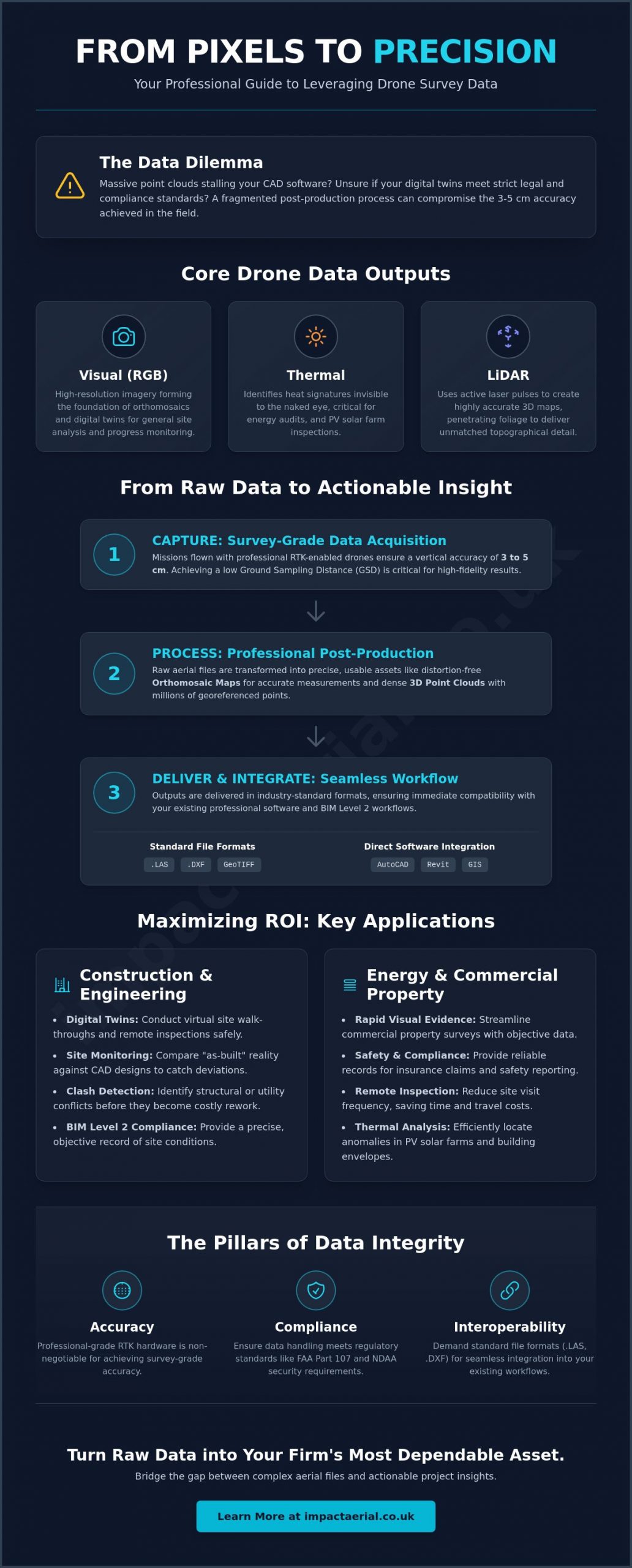
Industry-Specific Applications: Maximising ROI in Construction and Energy
Understanding how to use drone survey data effectively involves moving beyond the digital map and into the balance sheet. For high-stakes industries, the return on investment isn’t just found in the speed of data collection, it’s found in the mitigation of risk and the prevention of project delays. By applying aerial insights to specific operational challenges, firms can transform a technical output into a significant cost-saving tool. Whether you are managing a multi-million pound infrastructure project or a sprawling energy estate, the goal is to replace manual, high-risk inspections with objective, repeatable data.
In the commercial property sector, rapid roof assessments have become a primary application. Traditional scaffolding or cherry picker access can take days to coordinate and execute, often with significant health and safety implications. A professional drone survey captures high-resolution imagery of entire roofing systems in a fraction of the time, allowing surveyors to identify defects, standing water, or structural compromises from the safety of the ground. This speed allows for more frequent inspections, ensuring that minor issues don’t escalate into major structural failures.
Construction Site Monitoring and Safety
Weekly drone flights provide a comprehensive visual record that ground-based photography simply cannot match. Project managers use these captures to identify potential health and safety hazards remotely, such as improper material storage or unsecured perimeters. Beyond safety, aerial data provides a reliable way to calculate stockpile volumes. By using 3D point clouds, software can determine the volume of earth or materials in seconds, a task that would take a manual survey team hours to complete. For a deeper look at these processes, see our guide on construction site monitoring to see how these workflows improve site transparency.
PV Solar Farm Thermal Surveys
For energy providers, the effectiveness of drone data is most apparent in thermal inspections. Solar farms often suffer from “hot spots” or defective cells that are completely invisible to the naked eye but significantly reduce power yield. By using radiometric thermal sensors, we identify these anomalies with precision. The real value comes from integrating this thermal data directly into your maintenance schedules. Instead of checking every panel, your team can go directly to the defective units identified in the survey. This targeted maintenance prevents power loss and quantifies the ROI through improved energy output and reduced technician hours.
Ensuring Data Integrity: Accuracy, Compliance, and Insurance
Data is only as valuable as its reliability. To understand how to use drone survey data effectively, you must first ensure that the foundation of your digital twin is technically sound and legally defensible. Many firms ask if they can simply use internal consumer drones for site mapping. While a hobbyist drone might capture a clear image, it lacks the Real-Time Kinematic (RTK) positioning required for survey-grade results. Standard consumer GPS has a margin of error that can reach several metres, whereas professional DJI Enterprise hardware achieves horizontal accuracy of 2 to 3 cm. This precision is the difference between a visual reference and a tool that can be used for high-stakes engineering decisions.
The legal weight of your data is equally important. In 2026, mandatory Remote ID systems and stricter data security protocols mean that commercial operations must be meticulously documented. Data captured by a non-certified pilot often lacks the necessary metadata and safety logs to stand up in a legal or insurance dispute. By using a CAA-certified pilot, you ensure that every flight follows a structured risk assessment process, providing you with objective visual evidence that carries professional authority. If you are ready to implement these standards on your next project, you can request a compliance-led survey from our expert team.
Why CAA GVC Certification Matters for Your Data
The General Visual Line of Sight Certificate (GVC) is more than just a permit to fly; it’s a guarantee of operational safety. This certification ensures that pilots have undergone rigorous training in airspace management and emergency protocols, which is vital when operating in congested areas or near critical infrastructure. Certified operations significantly mitigate risk for the client, ensuring that data collection doesn’t compromise site safety. For a detailed breakdown of these regulations, refer to our UK drone license guide to understand how these rules protect your project’s integrity.
Professional Liability and Data Security
High-value sites require more than just technical skill; they require financial protection. We maintain £5m commercial liability insurance, which is a fundamental prerequisite for any professional drone survey in 2026. This coverage provides peace of mind for stakeholders, ensuring that any unforeseen incidents are fully covered under a commercial policy. Beyond physical safety, we implement strict data handling protocols. Your survey data is stored on secure servers and delivered via protected links to prevent unauthorized access. Professional insurance and robust cybersecurity are no longer optional extras; they are the baseline for trustworthy commercial drone operations.
From Raw Files to Decisions: Your Implementation Roadmap
Transitioning from a successful flight to a data-driven decision requires a structured approach. Learning how to use drone survey data effectively is not just about the technology; it’s about the workflow that follows the capture. To ensure your project benefits from the high-tier precision of aerial data, follow this five-step implementation roadmap.
- Step 1: Define clear project objectives. Before the drone even leaves the ground, you must determine if you require survey-grade accuracy (RTK-driven) for engineering or high-resolution visual detail for property inspections. Defining these goals early prevents the collection of redundant data.
- Step 2: Choose the right output format. Ensure your internal software, whether it’s Revit, AutoCAD, or ArcGIS, is compatible with the deliverables. Requesting .DXF for vectors or .LAS for point clouds ensures a seamless transition into your existing technical environment.
- Step 3: Establish a collection cadence. Data is most valuable when it’s used for comparison. Establish a routine, such as weekly flights for construction site monitoring or biannual checks for solar farm health, to track changes over time.
- Step 4: Distribute insights via cloud platforms. Massive file sizes can hinder collaboration. Use cloud-based viewers to share digital twins and orthomosaics with remote stakeholders, allowing them to measure and annotate data without specialized hardware.
- Step 5: Partner with a specialist for analysis. Raw data is a liability if it isn’t processed correctly. Partnering with a professional for post-production services ensures that your outputs are accurate, compliant, and ready for immediate use.
Consultation and Project Planning
At Impact Aerial, we work closely with our clients to define the most efficient data capture strategy for their specific needs. Our meticulous pre-flight planning involves identifying site constraints, managing airspace permissions, and ensuring every mission adheres to the strictest safety protocols. We don’t just deliver files; we provide a customized deliverable that aligns with your industry requirements. This structured consultation phase ensures that the final data is a reliable asset rather than a technical burden for your team.
Ready to Elevate Your Project Data?
Professional drone services provide UK businesses with an objective, high-resolution perspective that traditional methods simply cannot match. From reducing site visit frequency to improving the accuracy of safety reporting, the benefits of digital twins are clear. Based in Birmingham, we provide nationwide coverage, bringing technical expertise and CAA-certified reliability to projects across the country. If you are ready to transform your site operations with high-tier aerial insights, contact us today to request a bespoke survey quote and discover how our professional standards can support your project goals.
Advancing Your Digital Site Strategy
The transition from raw aerial files to high-tier project intelligence requires a meticulous approach to software integration and regulatory compliance. You’ve seen that the true value of these digital assets lies in their ability to merge with existing CAD and BIM workflows, providing a reliable as-built record that reduces site visits and costly rework. Understanding how to use drone survey data effectively is ultimately about bridging the gap between sophisticated hardware and your firm’s decision-making framework. For teams looking to scale these digital insights through automation, you can learn more about Business With AI Strategist to discover strategic implementation services.
By prioritizing survey-grade accuracy and professional-grade outputs, you ensure that every digital twin is a defensible asset for your business. We provide the technical expertise needed to secure these results, supported by CAA GVC Certified Pilots and the latest DJI Enterprise Grade Hardware. Our operations are backed by £5m Commercial Liability Insurance, offering the reassurance and reliability required for complex infrastructure and energy projects.
If you’re ready to modernize your data collection process, request a professional drone survey quote from Impact Aerial today. We look forward to helping you transform your aerial perspectives into tangible project success.
Frequently Asked Questions
How accurate is drone survey data compared to traditional methods?
Drone surveys achieve horizontal accuracy of 2 to 3 cm and vertical accuracy of 3 to 5 cm when using RTK or PPK technology. This level of precision is comparable to traditional ground-based surveying for most construction and property applications. While traditional methods are meticulous for individual points, drones provide a much higher data density by capturing millions of points across the entire site in a fraction of the time.
What software do I need to view drone survey point clouds?
To view and manipulate 3D point clouds, you typically need professional CAD or BIM software such as Autodesk Revit, AutoCAD, or Civil 3D. For large-scale land management and environmental analysis, GIS platforms like ArcGIS or QGIS are the industry standard. These tools allow you to integrate aerial data into your existing technical workflows for precise measurements and structural analysis.
Can drone survey data be used for legal property boundary disputes?
Drone data provides objective visual evidence of physical encroachments and site conditions that can support legal cases. However, it must be captured by a CAA-certified pilot to ensure the metadata and safety logs are defensible. While it doesn’t replace official title deeds, it serves as a powerful supplement to a licensed surveyor’s report by providing an undeniable visual record of the land at a specific date.
How long does it take to process drone survey data after the flight?
A typical 50-acre drone survey can be completed, from flight to final deliverable, in approximately 4 to 8 hours. This rapid turnaround is a key reason why project managers prioritize how to use drone survey data effectively for tight construction schedules. More complex datasets, such as high-density LiDAR or multi-temporal thermal analysis, may require additional processing time in post-production to ensure high-tier quality.
What is the difference between LiDAR and Photogrammetry in drone surveys?
LiDAR uses active laser pulses to map the terrain and can penetrate dense vegetation to reach the ground surface. Photogrammetry relies on overlapping high-resolution images to reconstruct a 3D model through triangulation. While photogrammetry is excellent for visual site mapping and progress monitoring, LiDAR is the professional choice for topographical surveys in wooded areas or for mapping thin infrastructure like power lines.
Is a drone survey cheaper than a traditional land survey?
Drone surveys are frequently 50% to 75% less expensive than traditional ground-based surveys for large sites. This cost efficiency is driven by the significant reduction in field hours and the ability to cover vast areas without a large team of surveyors. By choosing aerial methods, firms can allocate their budgets more effectively while receiving a more comprehensive digital representation of their physical assets.
What weather conditions prevent a drone survey from being accurate?
High winds, heavy rain, and low-light conditions are the primary factors that compromise data integrity. Excessive wind can cause motion blur in photogrammetry, while rain interferes with laser sensors and camera lenses. Meticulous pilots monitor weather windows to ensure that every flight is conducted within the safe operational limits of their DJI Enterprise hardware, ensuring the final output meets professional standards.
Do I need to be on-site during the drone survey?
You don’t need to be physically present during the drone operation as long as the pilot has site access and a clear project brief. The captured data is processed and delivered via secure digital links, allowing you to review site conditions from any location. This remote capability is a major benefit for stakeholders managing multiple projects across the country, as it eliminates the need for frequent travel.
Drone Survey for Railway Inspections: The Professional Guide to Aerial Rail Asset Management
A manual bridge inspection can take weeks and cost upwards of $50,000, yet a professional drone survey for railway inspections can often complete the same high-resolution data capture in a single afternoon. Traditional rail asset management frequently demands complex track possessions and puts staff at significant risk on live lines, creating a logistical bottleneck for maintenance schedules. You’re likely all too familiar with the cost of track downtime and the inherent danger of putting personnel in high-risk environments just to gather basic structural data.
It’s clear that the industry is shifting toward a more data-centric, safety-first approach. By leveraging professional aerial technology, operators can now secure millimetre-accurate engineering data without putting a single person on the ballast. This transition is no longer experimental; it’s a mandatory shift for those who prioritize precision and regulatory compliance. This guide provides an authoritative overview of how drones are revolutionising rail asset management. You’ll discover the impact of the June 2026 Beyond Visual Line of Sight (BVLOS) policy changes, the deployment of automated docking systems like the DJI Dock 3, and the technical standards required to maintain a flawless safety record while significantly reducing operational costs.
Key Takeaways
- Understand how a professional drone survey for railway inspections enables proactive asset management through the creation of high-fidelity digital twins and 3D corridor models.
- Learn about the transition from manual, qualitative reports to data-dense 10GB datasets using 4K HDR sensors and advanced photogrammetry.
- Discover why aerial surveys reduce track downtime and eliminate the safety risks associated with putting staff on live rails.
- Identify the critical regulatory and insurance requirements, including CAA GVC certification and minimum £5m liability coverage, necessary for rail environments.
- Explore the logistical advantages of rapid-response drone teams capable of mobilising faster than traditional rope access or heavy plant equipment.
The Evolution of Railway Inspections: Why Drones are Essential in 2026
In 2026, the definition of asset management has fundamentally changed. Aerial rail inspection involves the deployment of an Unmanned aerial vehicle (UAV) to capture high-resolution imagery and granular sensor data of tracks, embankments, and critical infrastructure. This technology has facilitated a critical shift from reactive maintenance, where repairs happen after a fault is found, to proactive asset management using digital twins. By creating a millimetre-accurate digital replica of the rail corridor, engineers can simulate wear and tear before it impacts service.
The deployment of a drone survey for railway inspections is now the primary data source for many operators. Traditional manual walkouts haven’t disappeared, but they’ve evolved into a secondary verification method. Instead of staff spending hours on live tracks for routine checks, they only enter the “red zone” to address specific issues identified by the drone. This significantly reduces staff exposure to live tracks and improves the overall safety record of the inspection team.
To better understand how this technology is applied in the field, watch this video of a railway survey project:
Challenges of Traditional Manual Rail Inspections
Traditional methods present a constant logistical nightmare. Securing track possessions often requires months of planning and narrow night-time working windows that limit the scope of what can be inspected. Beyond logistics, manual reporting is prone to human error and subjectivity. An engineer’s handwritten notes or handheld photos don’t provide the objective, repeatable digital data that modern systems require. Inspecting steep embankments or high-bridge structures manually carries immense physical risk and often requires expensive rope access teams or heavy plant machinery that’s slow to mobilise.
The ROI of Aerial Rail Monitoring
The financial argument for aerial monitoring is undeniable. By reducing possession times and the frequency of site visits, operators see an immediate reduction in operational expenditure. A drone survey for railway inspections can identify ballast issues or track fatigue months before they lead to a catastrophic failure or an unplanned line closure. The real value lies in long-term data trending. By comparing 2026 survey data with previous datasets, asset managers can perform predictive maintenance with a level of accuracy that was previously impossible. This methodical approach ensures that every pound spent on maintenance is targeted where it’s needed most.
Technical Capabilities: Sensors and Data for Modern Rail Assets
A professional drone survey for railway inspections produces more than just aerial photographs. It generates a comprehensive, multi-layered data suite that serves as the foundation for modern maintenance. By deploying a variety of sensors, from 4K HDR visual cameras to LiDAR and thermal arrays, operators capture high-density datasets that manual walkouts simply cannot replicate. This shift moves the industry away from qualitative “best guesses” toward quantitative, repeatable engineering facts. It’s about turning raw pixels into actionable insights for the permanent way.
High-Resolution Visual Inspection & Photogrammetry
High-fidelity visual data is the cornerstone of structural assessment. Modern sensors capture the minute detail of rail clips, sleepers, and fasteners with millimetre-level precision. This isn’t just about identifying a missing bolt; it’s about using photogrammetry to stitch thousands of images into a single, navigable high-resolution orthomosaic. According to the International Union of Railways, these digital advancements are vital for maximizing line capacity while ensuring absolute safety. These datasets allow for the creation of digital twins. Remote engineering teams can then perform crack propagation analysis or head wear measurements from the safety of the office. This creates a permanent, time-stamped record of the asset’s condition that can be audited at any time.
Thermal and Multi-Spectral Analysis
Thermal imaging adds a critical layer of preventative insight. By identifying thermal anomalies in overhead lines and electrical substations, teams can detect overheating components before they reach critical failure. This level of detail is now a standard component of a professional drone survey workflow. Beyond the tracks, multi-spectral sensors monitor slope stability. They detect subtle changes in soil moisture levels that might indicate drainage issues or potential landslips long before they are visible to the naked eye. This allows for targeted intervention before a minor drainage problem becomes a major operational disruption.
LiDAR and Clearance Monitoring
LiDAR technology completes the technical picture by providing accurate clearance monitoring. It maps vegetation growth against the track with laser precision, ensuring that clearance zones remain compliant with strict safety standards. Unlike manual measurements, LiDAR creates a full 3D point cloud of the rail corridor. This allows engineers to measure distances between the track and surrounding structures with absolute confidence. This data-centric approach ensures that every maintenance action is backed by objective evidence rather than subjective opinion. If you’re looking to transition your asset management to a digital-first model, the specialists at Impact Aerial can help you architect a bespoke data collection strategy.
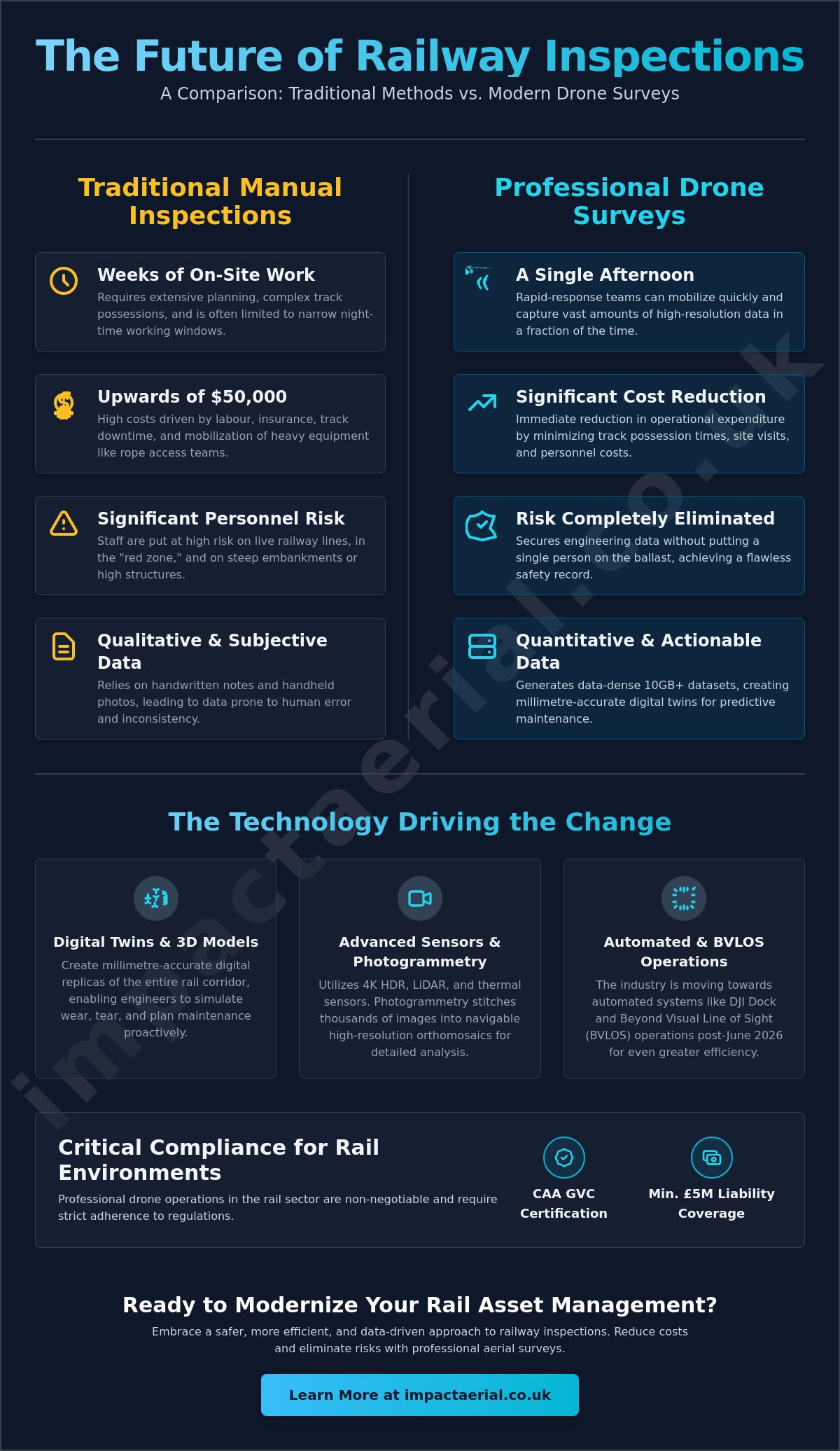
Comparing Drone Surveys to Traditional Rail Inspection Methods
Comparing a drone survey for railway inspections to traditional manual methods reveals a stark contrast in both efficiency and output quality. Traditional inspections often require heavy plant machinery or specialised rope access teams; both involve significant lead times for mobilisation and complex logistics. In contrast, a drone team can be on-site and operational within minutes of arrival. This speed of deployment is a game-changer for emergency structural assessments following extreme weather events or reported track faults, where time is of the essence.
The difference in data volume is equally significant. A traditional manual walkout typically results in a 10-page PDF report containing subjective observations and a handful of static photographs. Conversely, a single aerial mission generates a 10GB digital dataset. This data is objective, granular, and capable of being re-interrogated by various engineering disciplines long after the flight is complete. Because professional drones follow GPS-guided, repeatable flight paths, the data captured is consistent every time. This allows for precise temporal analysis, where the exact same centimetre of track can be compared month-over-month to monitor degradation.
Reducing Track Access Requirements
One of the most valuable aspects of modern aerial surveys is the ability to operate from outside the rail boundary. Professional teams can often capture all necessary data without ever stepping onto the ballast, which eliminates the need for track access entirely. In specific safety-approved cases, drones can even monitor assets while traffic remains active, providing a unique perspective on how infrastructure behaves under load. This approach removes the reliance on narrow “short possession windows” at night, which often restrict the depth and quality of manual inspections due to time pressure and poor lighting conditions.
Safety Enhancements and Risk Mitigation
Safety remains the primary driver for adopting aerial technology across the UK rail network. By removing personnel from hazardous environments like tunnels, high-span bridges, and steep cuttings, operators significantly lower their risk profile. We often refer to this as the “eyes on the track, feet in the van” approach. It provides a massive psychological benefit for inspection teams, who can focus on data quality from a safe, controlled environment rather than worrying about working at height or near live electrical lines. These professional drone services align directly with Network Rail’s safety-first initiatives, ensuring that every inspection contributes to a better safety record for the entire industry.
Implementing Drone Surveys: Compliance, Safety, and Planning
A professional drone survey for railway inspections is a highly regulated operation that demands more than just technical piloting skills. Success in this sector depends on a meticulous approach to risk mitigation and a deep understanding of the UK’s rigid aviation laws. It isn’t a task for hobbyists or uncertified operators. Every mission must be underpinned by a robust safety management system that accounts for the unique hazards of the rail environment, from high-voltage overhead lines to the complex electromagnetic interference found near traction power stations.
Data security is equally paramount. Railway infrastructure is sensitive national data, and the way this information is stored and processed must meet stringent cybersecurity standards. Professional operators ensure that high-resolution imagery and 3D models are handled through secure, encrypted pipelines. This prevents unauthorised access to critical asset details while ensuring that engineering teams can access the data they need without delay.
Navigating UK CAA Regulations
The regulatory landscape for drone operations has evolved significantly. Securing a drone license through the CAA GVC (General Visual Line of Sight Certificate) pathway is the absolute minimum requirement for commercial rail work. As of 2026, compliance standards require new drones to carry specific UK class markings and Remote ID capabilities. Most rail surveys fall into the ‘Specific’ category, especially when operating near congested areas or sensitive rail hubs. This requires a detailed Operational Authorisation from the Civil Aviation Authority, proving the operator has the necessary safety protocols to manage the increased risk levels of high-consequence environments.
Insurance requirements are also non-negotiable. Standard commercial policies are often insufficient for the rail sector. Professional surveyors carry a minimum of £5 million in public liability insurance specifically tailored for aviation activities in industrial settings. This provides the necessary reassurance to stakeholders that all potential risks are financially indemnified.
The Professional Survey Workflow
A structured workflow is what separates a successful survey from a failed mission. The process is typically divided into three distinct phases:
- Phase 1: Desktop Study and Authorisation. This involves identifying flight paths, checking airspace restrictions, and notifying local stakeholders or landowners. We conduct a thorough site survey to identify physical hazards before any hardware arrives on-site.
- Phase 2: On-Site Capture. We utilise DJI Enterprise hardware equipped with high-precision RTK GPS for centimetre-level accuracy. This phase focuses on capturing the exact data points defined during the planning stage, ensuring full coverage of the asset.
- Phase 3: Post-Production and Reporting. Raw data is processed into actionable engineering reports, 3D point clouds, or orthomosaic maps. This ensures the final delivery provides tangible value to maintenance teams.
If you require a compliant, safety-first partner for your next project, explore how Impact Aerial manages complex rail survey deployments across the UK network.
Partnering with Impact Aerial for National Railway Drone Surveys
Impact Aerial provides a methodical, safety-conscious approach to every drone survey for railway inspections we undertake. Based in Birmingham, our team is strategically positioned to provide rapid response services across the West Midlands and the wider United Kingdom. We understand that rail asset management requires more than just high-quality imagery; it demands a partner who respects the operational complexities and safety protocols of the permanent way. Our commitment to professional excellence ensures that every flight is conducted with the precision required by civil engineering standards.
We exclusively utilise commercial-grade DJI Enterprise hardware to ensure maximum reliability and data accuracy. These systems are designed for industrial environments, featuring redundant systems and high-precision GPS that consumer drones simply cannot match. Once the data is captured, our post-production services transform raw aerial footage into detailed technical surveys. This expert processing allows your engineering teams to identify minute structural anomalies or vegetation encroachments with absolute confidence, providing a clear path for proactive maintenance planning.
Expert Pilots and Meticulous Safety Standards
Our reputation is built on a foundation of compliance and risk mitigation. All Impact Aerial pilots are CAA GVC certified and possess extensive experience in complex commercial surveying. We don’t just follow regulations; we integrate them into every stage of our workflow. To provide total peace of mind for our rail clients, we maintain £5 million in commercial liability insurance specifically tailored for high-consequence environments. Our goal is to act as a trusted technical consultant, offering the reassurance that your project is in safe, expert hands from initial desktop study to final data delivery.
Scalable Solutions for UK Rail Infrastructure
The requirements of the rail network are diverse, and our services are designed to be fully scalable. We handle everything from the detailed inspection of a single bridge structure to multi-mile track corridor mapping projects. By integrating our high-end aerial filming capabilities with technical survey drone technology, we provide a comprehensive documentation package that serves both engineering and stakeholder communication needs. This dual approach ensures that you have both the technical data for maintenance and the visual assets for project reporting. Contact Impact Aerial today to discuss your specific railway inspection requirements and discover how our meticulous approach can improve your asset management strategy.
Advancing Rail Safety Through Digital Innovation
The adoption of aerial technology is no longer a luxury for rail operators; it’s a fundamental requirement for maintaining a modern, safe, and efficient network. By transitioning from manual walkouts to a data-driven approach, you secure millimetre-accurate insights while eliminating the need for hazardous track possessions. This shift enables your engineering teams to move from reactive repairs to predictive asset management using high-fidelity digital twins that capture every detail of the permanent way.
Commissioning a professional drone survey for railway inspections ensures your project meets the highest UK safety and regulatory standards. Impact Aerial provides the technical expertise and operational reassurance needed for high-consequence environments. Our services are underpinned by CAA GVC certified pilots, £5m commercial liability insurance, and the latest DJI Enterprise commercial hardware. This meticulous approach guarantees that your data is both legally compliant and technically superior.
Take the next step in modernising your asset management strategy. Request a Professional Rail Survey Quote from Impact Aerial today and discover how aerial precision can transform your maintenance outcomes. We look forward to supporting your infrastructure goals with unparalleled technical reliability.
Frequently Asked Questions
Are drones allowed to fly over live railway lines in the UK?
Yes, drones are permitted to fly over live railway lines provided the operator holds a valid Operational Authorisation from the Civil Aviation Authority (CAA). For a drone survey for railway inspections, pilots must operate within the ‘Specific’ category and adhere to strict safety cases. Recent June 2026 policy changes have further streamlined Beyond Visual Line of Sight (BVLOS) flights for infrastructure, allowing for more efficient remote monitoring without disrupting active train services.
How accurate is drone data for railway track inspections?
Modern aerial data collection provides millimetre-level accuracy, often surpassing the precision of manual measurements. By using DJI Enterprise hardware equipped with Real-Time Kinematic (RTK) GPS, we ensure that every pixel and 3D point cloud coordinate is correctly georeferenced. This level of detail allows engineers to detect minute structural shifts, track fatigue, or ballast degradation that might be missed during a traditional manual walkout.
Do drone surveys require track possessions or closures?
Most aerial inspections don’t require track possessions or line closures, which is a significant operational advantage for network managers. We typically operate from outside the rail boundary, capturing high-resolution data while trains continue to run. This eliminates the logistical complexity of scheduling night-time working windows and ensures that asset management doesn’t interfere with passenger or freight timetables.
What are the safety benefits of using drones for rail inspections?
The primary benefit is the total elimination of “red zone” working for inspection personnel. By using drones, staff remain in a safe, controlled environment away from live tracks, high-voltage overhead lines, and steep embankments. This approach significantly reduces the risk of on-site accidents and helps maintain a flawless safety record for maintenance teams while providing superior data quality for structural analysis.
What kind of sensors are used for railway drone surveys?
We utilise a sophisticated array of sensors tailored to the specific asset being inspected. High-resolution 4K HDR cameras capture visual detail of sleepers and fasteners, while LiDAR sensors generate precise 3D point clouds for clearance monitoring. Additionally, thermal sensors detect overheating electrical components, and multi-spectral sensors can identify soil moisture issues that might compromise embankment stability before a failure occurs.
How much does a drone railway survey cost compared to traditional methods?
While specific project costs vary, the overall expenditure for a drone survey for railway inspections is significantly lower than traditional methods. Traditional bridge inspections often involve massive costs for scaffolding, rope access teams, and plant machinery. Aerial surveys remove these requirements, offering a substantial return on investment through reduced site hours, fewer personnel, and the prevention of expensive emergency repairs through earlier fault detection.
What qualifications do drone pilots need for rail work?
For commercial rail work, pilots must hold a CAA GVC (General Visual Line of Sight Certificate) and be registered with both Flyer and Operator IDs. As of 2026, they must also ensure their hardware meets current class markings and Remote ID standards. Beyond these legal requirements, professional rail pilots should have specific training in risk mitigation and be covered by high-level commercial liability insurance.
How long does it take to process the data from a rail survey?
Processing times depend on the complexity of the dataset, but initial actionable reports are typically delivered within 48 to 72 hours. Large-scale corridor mapping involving 10GB or more of raw data requires intensive post-production to stitch orthomosaics or generate 3D digital twins. This timeline is still considerably faster than the weeks often required to compile, verify, and distribute complex manual engineering reports.
Choosing a Drone Videography Style: The Ultimate Guide for UK Businesses in 2026
The most expensive 8K aerial footage on the market will fail to deliver a return on investment if the visual language doesn’t align with your sector’s specific goals. In 2026, simply putting a camera in the air is no longer a competitive advantage. Success now depends on choosing a drone videography style that speaks directly to your audience; whether that is the high-octane energy of an FPV fly-through for a leisure facility or the steady, technical precision required for construction site monitoring.
You likely recognize that generic, drifting shots often feel disconnected from your brand’s core message, yet the technical jargon of the industry can make briefing a pilot feel like a gamble. This guide bridges that gap. You’ll discover how to select the perfect aerial aesthetic to elevate your brand, ranging from cinematic sweeps to high-speed FPV immersive tours. We provide a structured breakdown of the latest 2026 UK flight standards and aesthetic categories, ensuring you have the confidence to secure high-quality, compliant results that drive tangible business growth.
Key Takeaways
- Understand how the intersection of movement and narrative intent drives project ROI by aligning visual style with your specific commercial objectives.
- Learn the critical differences between cinematic sweeps and immersive FPV tours to assist in choosing a drone videography style that suits your brand identity.
- Identify the specific aesthetics used for construction site monitoring and commercial property surveys to maximize engagement and data accuracy in your sector.
- Master the technical essentials of professional aerial filming, including the impact of “Golden Hour” lighting and selecting the correct frame rates for your desired look.
- Discover why technical qualifications and CAA GVC certifications are vital for executing high-stakes aerial projects safely and to a professional standard.
Why Choosing the Right Drone Videography Style Defines Your Project’s ROI
A professional drone videography style is far more than a simple flight path; it is the deliberate intersection of camera movement, lighting conditions, and narrative intent. In the current 2026 market, stakeholders demand more than generic bird’s-eye views. Achieving a high return on investment requires a foundational understanding aerial videography and how specific visual languages influence viewer psychology. For instance, a slow, high-altitude orbit provides an analytical, “God-view” perspective that suggests stability and scale, whereas a low-level, high-speed tracking shot generates adrenaline and urgency.
Choosing a drone videography style that clashes with your brand identity can be a costly error. An aggressive, high-speed FPV fly-through might work for a modern manufacturing plant, but using that same kinetic energy for a Grade I listed heritage site often feels jarring and disrespectful to the subject matter. As drone technology has matured, the 2026 trend has shifted decisively away from “generic b-roll” toward purpose-built visuals. Every frame must justify its existence by supporting a specific commercial goal, whether that is proving construction progress or selling the prestige of a luxury development.
To better understand this concept, watch this helpful video:
The Shift from “Aerial Footage” to “Aerial Storytelling”
The “wow” factor of seeing the world from above has largely evaporated as drones have become ubiquitous. Today, professional aerial filming drone services focus on functional visual communication. We use specific flight maneuvers to solve business problems; such as using a “reveal” shot to highlight a property’s proximity to transport links. Post-production also plays a critical role here. The color grading and pacing applied after the flight solidify the chosen aesthetic, ensuring the final output feels like a cohesive part of your broader marketing or technical strategy rather than a disconnected clip.
Setting Objectives Before Selecting a Visual Look
Before choosing a drone videography style, you must define the primary objective of your project. Information-heavy tasks, like construction site monitoring, require a steady, high-resolution style that prioritizes clarity and data over emotional impact. Conversely, brand-led campaigns for luxury properties rely on “hero” shots that emphasize atmosphere and prestige. Your primary KPI might be technical accuracy, speed of delivery, or perhaps pure brand elevation. Visual ROI is the measurable impact of a specific aesthetic choice on conversion rates, stakeholder engagement, or project clarity. By aligning the flight style with these KPIs, you ensure the footage serves as a tool for growth rather than a mere digital asset.
Exploring the Core Drone Videography Styles: From Cinematic to FPV
Selecting the right visual language is the most critical decision in the pre-production phase. Each aesthetic serves a distinct commercial purpose, utilizing different flight dynamics and sensor settings to communicate your message. In 2026, the industry has moved beyond simple “fly-overs” to specialized disciplines. Whether you are documenting a multi-million pound infrastructure project or launching a luxury brand, choosing a drone videography style that aligns with your technical requirements is essential for a professional result.
The Cinematic Aesthetic: Elegance and Grandeur
The cinematic style remains the benchmark for high-tier brand building and prestige marketing. This “Hollywood” look is defined by slow, sweeping movements and a high dynamic range that preserves detail in both shadows and highlights. Professional pilots utilize specific maneuvers like the “Reveal,” where the camera starts on a detail before rising to show the landscape, and the “Orbit,” a perfectly circular path around a central subject. To achieve this, we prioritize 4K HDR or 8K resolution with 10-bit color depth, providing the necessary data for high-end post-production grading. This style is most effective for tourism, corporate brand films, and luxury property marketing where the goal is to evoke an emotional response through scale and beauty.
FPV Drone Filming: Immersive Innovation
The Narrative Style: Context and Scale
The narrative style focuses on establishing a “Sense of Place” by integrating aerial perspectives into a larger storytelling framework. It isn’t about the drone shot itself, but how that shot connects ground-level human experiences to their wider environment. This often involves combining low-altitude tracking shots with high-altitude wide views to show the relationship between a project and its surrounding infrastructure. Executing these complex, multi-layered flights legally and safely requires a valid drone license and a deep understanding of UK airspace restrictions. By bridging the gap between technical data and emotive visuals, the narrative style provides the context necessary for stakeholders to grasp the full scope of a project. If you’re unsure which aesthetic best serves your goals, consulting with a specialist in professional aerial filming can help clarify the most effective path forward for your specific sector.
For technical applications like construction site monitoring or commercial property surveys, the focus shifts toward architectural precision. These styles prioritize symmetry, structural lines, and top-down “nadir” views that provide accurate spatial data. By choosing a drone videography style that emphasizes these technical elements, businesses can track progress with millimeter precision while maintaining a professional visual standard that is suitable for investor reporting.
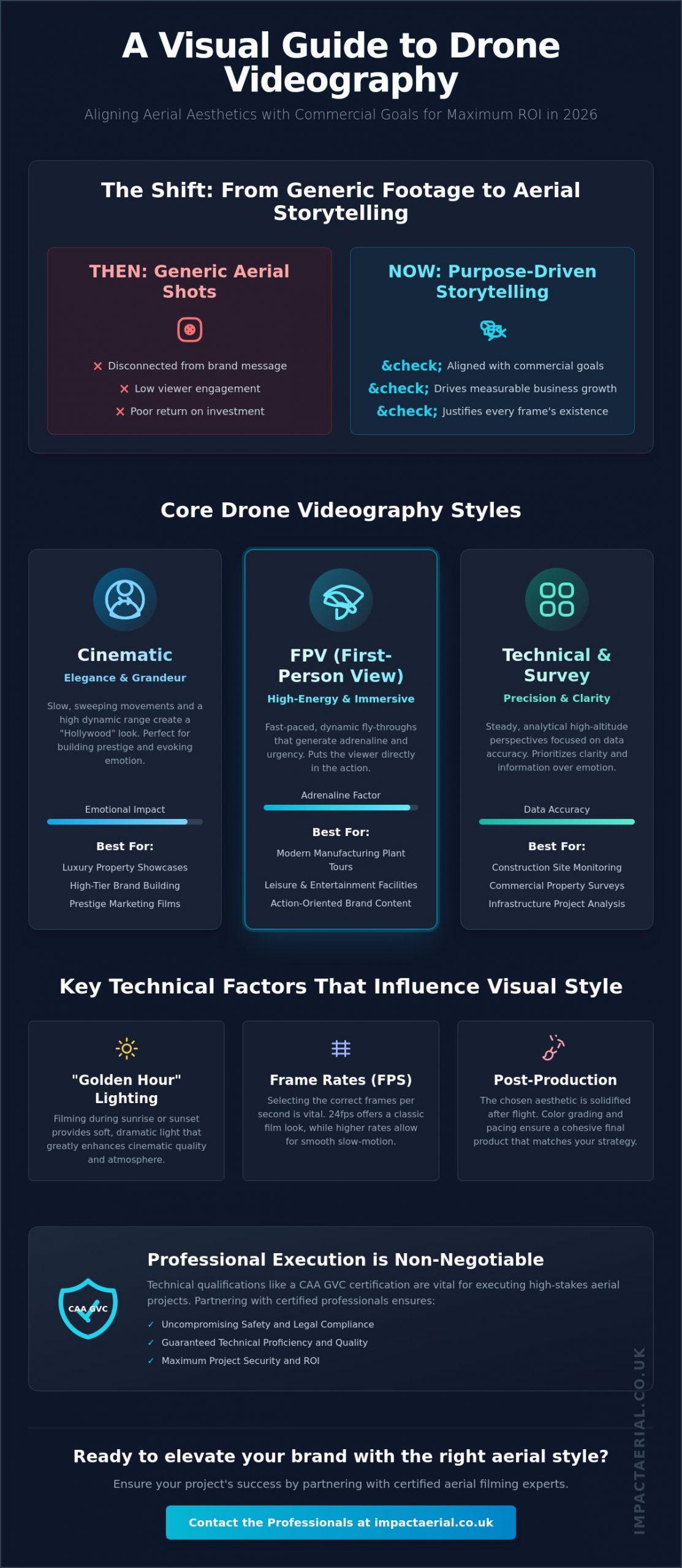
Industry Match: Which Style Fits Your Specific Sector?
The effectiveness of an aerial campaign is measured by its ability to meet sector-specific KPIs. A visual approach that excels in the creative arts will likely fail in a heavy industrial context. When choosing a drone videography style, you must evaluate whether your primary goal is the acquisition of technical data, the emotional engagement of a buyer, or the documentation of project milestones. In 2026, UK businesses are increasingly moving away from multi-purpose footage in favor of “style-to-sector” alignment that ensures every flight minute contributes to the bottom line.
Construction: Progress vs. Promotion
In the construction and infrastructure sectors, drone footage serves two distinct masters: the site engineer and the marketing director. For technical oversight, a professional drone survey is the standard for capturing high-resolution orthomosaic data and site logistics. These flights utilize a top-down, “nadir” perspective, providing a flat, measurable map of the site that is essential for identifying bottlenecks. Conversely, for stakeholder reporting and promotion, a cinematic time-lapse style is preferred. This involves capturing the same flight path over several months to show the evolution of the build. By maintaining consistent GPS coordinates for each flight, we create a seamless visual record that demonstrates progress with authoritative clarity.
Real Estate: The Luxury Reveal
Commercial property and luxury residential listings require an aesthetic that emphasizes prestige and spatial flow. The “Dolly Zoom” and the “Orbit” have become the industry standards for high-end listings, as they provide a sense of three-dimensional depth that static photography lacks. To create a truly immersive experience, we often utilize FPV drones to execute a “one-take” sequence. This involves flying from the exterior grounds, through the front entrance, and into the primary living or office spaces without a single cut. This style doesn’t just show a property; it provides a virtual tour that establishes a “Sense of Place.” Highlighting local landmarks within the same frame as the property further increases perceived value by grounding the asset in its wider geographical context.
Renewable Energy and Marketing
The renewable energy sector, particularly solar farm management, relies on a technical “Grid” style. This involves automated flight paths that ensure 100% coverage for thermal imaging and visual inspections. These surveys are data-centric, focusing on identifying anomalies in PV panels with surgical precision. In contrast, the marketing and advertising sectors demand high-energy FPV and cinematic storytelling. These styles are designed to capture attention within the first three seconds of a social media scroll. Whether it’s a high-speed chase for a dynamic product launch or a sweeping 8K panoramic for a tourism board, choosing a drone videography style that matches the energy of your target demographic is the most reliable way to ensure a high return on investment.
Key Technical Factors That Influence Your Visual Style
Achieving a high-end visual result is impossible without mastering the technical variables that underpin every flight. When choosing a drone videography style, you aren’t just selecting a movement; you are selecting a specific configuration of light, frame rates, and hardware capabilities. These settings dictate whether the final output feels like a high-budget feature film or a sharp, clinical data set. In the professional sector, we use these technical levers to ensure the aesthetic aligns with your commercial objectives while maintaining the highest standards of precision.
Lighting remains the most influential factor in cinematic drone filming. The “Golden Hour,” occurring during the first hour of sunrise and the last hour of sunset, provides the soft, directional light and long shadows that define the cinematic aesthetic. For technical surveys or construction monitoring, we often prefer “Blue Hour” or high-noon lighting to minimize shadows and maximize the clarity of structural details. To control this light, we utilize Neutral Density (ND) filters. These act as “sunglasses” for the drone’s sensor, allowing us to maintain a slower shutter speed. This is essential for creating the natural motion blur that viewers associate with professional-grade production.
Frame rates also play a vital role in defining the look of your project. We typically use 24fps (frames per second) for a traditional “filmic” look, as it mimics the way the human eye perceives motion. Conversely, 60fps or higher is selected for high-speed action or FPV tours, allowing for smooth playback or the ability to slow down footage in post-production without losing detail. The final style is then solidified through professional post-production services, where color grading and sound design act as the final “brushstrokes” that align the footage with your brand’s visual identity.
Weather and Environmental Constraints in the UK
The unpredictable UK climate directly influences which styles are feasible on any given day. High winds and variable light conditions in regions like the West Midlands require robust hardware. We often deploy DJI Enterprise drones for these environments, as their superior stabilization systems ensure smooth footage even in gusty conditions. Planning for the “Birmingham Look” often involves working with specific urban textures and flat lighting, where technical expertise in exposure management is required to prevent footage from looking washed out or overly industrial.
Compliance as a Creative Constraint
Safety and regulation are the primary filters through which all creative decisions must pass. While an aggressive FPV fly-through might look impressive, CAA regulations regarding “flight over people” or congested areas may limit where these maneuvers can be performed. Our commitment to meticulous risk mitigation includes maintaining £5m in commercial liability insurance, ensuring that your chosen style never compromises safety protocols. Before choosing a drone videography style for a complex urban shoot, it’s vital to consult with a qualified operator who understands how to balance creative ambition with legal compliance.
For a detailed assessment of how these technical factors will impact your next project, contact Impact Aerial today for a professional consultation.
Partnering with Impact Aerial: Professional Execution of Any Drone Style
Choosing a drone videography style is only the first step in creating a high-impact visual asset. The successful execution of that vision requires a partner who understands the intricate balance between creative ambition and stringent safety standards. At Impact Aerial, we don’t just provide footage; we offer a technical consultancy that ensures your chosen aesthetic is delivered with surgical precision. By bridging the gap between technical surveying and creative videography, we provide UK businesses with the reassurance that their projects are in expert hands.
Our operational excellence is built on a foundation of high-end hardware and elite certification. We utilize commercial-grade DJI Enterprise drones, capable of capturing 4K HDR data with the stability required for professional post-production. These platforms are essential for maintaining the visual integrity of cinematic sweeps or technical site monitoring in variable UK weather. Every flight is conducted by CAA GVC certified pilots, ensuring that even the most complex urban maneuvers are executed within the full framework of national aviation law. This meticulousness provides our clients with psychological comfort and tangible business benefits.
The Impact Aerial Project Management Process
We approach every project with a structured, methodical workflow designed to eliminate risk and maximize visual ROI. Our process is divided into three distinct phases:
- Consultation: We begin by defining your visual goals and industry requirements. Whether you are choosing a drone videography style for a promotional campaign or a technical survey, we align our flight plan with your specific KPIs.
- Planning: Our team handles all necessary risk assessments and flight permissions. We tailor these permissions to your chosen style, ensuring that even high-stakes FPV tours or architectural reveals are fully compliant with local bylaws and CAA regulations.
- Delivery: We provide high-end output that is ready for immediate use across social media, web, or broadcast platforms. Our post-production services ensure that the final edit reflects the precise aesthetic established during the consultation phase.
Request Your Custom Aerial Style Consultation
In the current market, a drone services provider should be a strategic partner rather than just a pilot. We have a proven track record of successful style implementations in Birmingham and across the UK, ranging from large-scale construction monitoring to immersive virtual tours for commercial property. We understand the specialized nature of the UK drone industry and remain at the forefront of regulatory changes to ensure your brand remains both innovative and compliant.
If you are ready to elevate your project with a specialized visual language, we invite you to discuss your project with Impact Aerial today. Our team is available to provide a detailed assessment of your requirements and help you navigate the complexities of choosing a drone videography style that delivers a measurable return on investment.
Elevate Your Brand with Strategic Aerial Perspective
Impact Aerial is committed to delivering these results through a blend of creative excellence and operational rigor. We provide the security of £5m Commercial Liability Insurance and the expertise of CAA GVC Certified Pilots, ensuring every mission is compliant and professional. By utilizing 4K HDR DJI Enterprise Equipment, we guarantee that your final output meets the highest industry standards for clarity and detail. It’s this focus on technical precision that ensures your brand stands out in a competitive market.
Book a consultation with our CAA-certified pilots today to discuss your project requirements. We look forward to helping you define an aerial strategy that provides lasting value to your business.
Frequently Asked Questions
What is the difference between FPV and traditional drone videography?
Traditional drone videography utilizes GPS-stabilized platforms and motorized gimbals to produce smooth, steady, and predictable footage. It’s the standard for cinematic sweeps and technical surveying. In contrast, First Person View (FPV) involves the pilot wearing goggles to fly smaller, highly agile drones manually. This allows for immersive, high-speed maneuvers and the ability to fly through tight internal spaces that traditional drones cannot access.
How do I know which drone filming style is right for my business?
The decision should be driven by your primary commercial objective. If your goal is to showcase the scale and prestige of a luxury development, a cinematic style with slow orbits is most effective. For high-energy marketing or event highlights, the kinetic feel of FPV is superior. Choosing a drone videography style requires aligning the visual energy of the flight with the expectations of your specific target audience.
Can I use FPV drone filming for indoor warehouse tours?
Yes, FPV is the industry standard for immersive indoor tours because these drones are compact and highly maneuverable. They can navigate through doorways, around machinery, and between staff safely when equipped with propeller guards. These flights require meticulous risk assessments and adherence to UK safety protocols, especially when operating in congested or confined commercial environments.
Does the time of day affect the style of my drone video?
Lighting conditions dictate the narrative tone of your footage. The “Golden Hour” at sunrise or sunset provides the soft, warm light required for high-end cinematic aesthetics. Midday light is better suited for technical applications like construction site monitoring, as it provides maximum clarity and minimal shadows. As of 2026, all night flights in the UK must utilize a mandatory green flashing anti-collision light for safety and compliance.
Are there legal restrictions on certain drone filming styles in the UK?
Yes, all commercial drone operations must comply with Civil Aviation Authority (CAA) regulations. Restrictions often apply to flying over uninvolved people or within congested urban areas, which can limit certain aggressive FPV styles. Professional operators must hold valid Flyer and Operator IDs; for drones over 100g in 2026; and maintain minimum third-party liability insurance to ensure all creative maneuvers are executed legally.
What technical specs should I look for when hiring a drone videographer?
For professional-grade results, prioritize 4K or 8K resolution and a bitrate of at least 200Mbps to allow for high-quality color grading. Ensure the equipment supports 10-bit color depth for cinematic projects. When choosing a drone videography style for technical work, ask about GPS precision and the availability of mechanical shutters to eliminate rolling shutter distortion in high-speed shots.
How much does a professional drone videography session cost in 2026?
Pricing for professional drone services is typically project-based, reflecting the complexity of the flight and the required post-production. Costs are influenced by factors such as the need for specialized FPV equipment, the duration of the shoot, and the level of risk mitigation required. While basic photography packages exist, high-end videography is generally quoted as half-day or full-day rates to account for technical planning and data processing.
Can drone filming styles be combined in a single project?
Combining multiple aesthetics often produces the most compelling results for corporate and promotional films. A single production might integrate cinematic wide shots for geographical context, technical top-down views to show project scale, and FPV fly-throughs to provide an immersive internal perspective. This multi-layered approach ensures that the footage serves both marketing and technical stakeholders effectively.
Drone Survey for Coastal Erosion Monitoring: A Professional Guide for 2026
With 28% of the coastline across England and Wales eroding at rates exceeding 0.1 metres per year, can your current monitoring strategy provide the precision required for 2026? You’re likely familiar with the logistical strain of traditional ground-based surveys, including high operational costs and the genuine health and safety risks of surveying unstable cliff edges. Relying on inconsistent visual inspections instead of a professional drone survey for coastal erosion monitoring often leaves you without the quantifiable data needed for critical coastal management.
Discover how high-precision drone data is revolutionising the industry, offering faster, safer, and more accurate erosion monitoring than traditional methods. By leveraging advanced sensors, you can now generate high-resolution 3D models and quantifiable volume calculations of sediment loss with absolute confidence. This guide details the essential technical standards, from LiDAR capabilities to the latest UK drone classifications, ensuring your operations remain both compliant and authoritative in a shifting landscape.
Key Takeaways
- Learn how to select between LiDAR and Photogrammetry sensors to capture the most accurate geospatial data across diverse shoreline terrains.
- Understand the operational advantages of a professional drone survey for coastal erosion monitoring, specifically how it mitigates safety risks on unstable cliff edges.
- Discover the essential planning phases for a successful monitoring programme, including the critical synchronisation of flights with local tide times and weather windows.
- Navigate the complexities of UK regulatory compliance by understanding the requirements for CAA GVC certification and operating within restricted environmental zones.
- Identify how to translate high-precision aerial data into quantifiable 3D models and sediment volume calculations to support long-term coastal management strategies.
Understanding Drone Surveys for Coastal Erosion Monitoring
Coastal monitoring via Unmanned Aerial Vehicles (UAVs) involves the systematic acquisition of high-resolution geospatial data to track changes in shoreline morphology. This methodology replaces traditional, subjective visual assessments with measurable, repeatable evidence. With approximately 28% of the coast in England and Wales experiencing coastal erosion at rates higher than 0.1 metres per year, the demand for high-frequency data has never been more urgent. Modern environmental management requires a level of precision that only aerial technology can provide at scale.
Stakeholders ranging from local councils in Norfolk and East Riding to private developers are facing unprecedented challenges. Climate change and increased storm frequency have accelerated the rate of UK coastal decay, putting an estimated 20,000 properties in England at risk by 2105. A professional drone survey for coastal erosion monitoring provides the technical depth required to manage these risks. It moves the conversation from reactive crisis management to proactive, data-led strategy, allowing for more efficient allocation of resources and public safety measures.
To better understand the practical application of these systems in the field, watch this demonstration of high-precision hardware in a coastal environment:
The Role of Aerial Data in Risk Mitigation
Meticulous data capture allows specialists to identify structural anomalies, such as tension cracks, long before they lead to cliff failure. By detecting these shifts early, authorities can implement exclusion zones or reinforcement measures with higher confidence. This aerial intelligence serves as critical evidence when local authorities apply for coastal defence funding or when developers submit planning applications for vulnerable sites. Establishing a robust baseline is the first step. Without historical data to compare against, it’s impossible to calculate the true rate of decay or the effectiveness of existing defences.
Visual Imagery vs. Geospatial Data
There is a significant distinction between simple aerial photography and geospatial intelligence. While 4K video is excellent for reporting, it doesn’t offer the centimetre-accurate 3D mapping required for engineering-grade analysis. A professional drone survey for coastal erosion monitoring utilises orthomosaics, which are geometrically corrected aerial images. These provide a “God’s eye view” where every pixel contains geographic information. To ensure this data remains reliable in complex maritime environments, we utilise Ground Control Points (GCPs). These physical markers on the ground tie the aerial data to real-world coordinates, ensuring that year-on-year comparisons are mathematically sound and legally defensible.
Sensor Technology: LiDAR, Photogrammetry, and Multispectral
Precision in coastal monitoring depends entirely on the chosen sensor payload. While visual inspections provide a surface-level narrative, a professional drone survey for coastal erosion monitoring utilises a suite of advanced sensors to capture specific environmental variables that the human eye cannot detect. These technologies allow us to move beyond simple photography into the realm of quantifiable geospatial intelligence. By selecting the correct sensor, we can identify the underlying causes of instability, such as hidden groundwater seepage or shifting vegetation patterns, with absolute technical certainty.
Photogrammetry remains the cornerstone of modern surveying, using high-resolution 2D images to reconstruct 3D environments. However, for more complex terrains, LiDAR (Light Detection and Ranging) offers an active sensing solution that measures distances using laser pulses. We also deploy multispectral sensors to monitor the health of coastal ecosystems, as changes in marram grass density often precede physical sand loss. Thermal imaging adds another layer of risk mitigation; it detects temperature differentials that indicate groundwater seepage, a primary contributor to cliff lubrication and subsequent failure.
When to Choose LiDAR for Coastal Surveys
LiDAR is the gold standard for surveying “soft” cliffs where heavy vegetation or marram grass obscures the soil. Unlike traditional cameras, LiDAR’s unique ability to ‘see through’ foliage allows for the creation of accurate Digital Terrain Models (DTMs) by filtering out vegetation to reach the true ground surface. This capability is essential for coastal mapping with drones in areas where obscured slopes might hide significant structural risks. It’s particularly effective in low-light conditions or high-contrast environments where shadows might confuse standard photogrammetry software.
The Power of Photogrammetry for 3D Modelling
Photogrammetry excels in generating high-detail “Digital Twins” of coastal infrastructure, such as sea walls, groynes, and piers. It’s an exceptionally cost-effective method for conducting regular beach volume checks, providing the high-resolution texture maps needed to identify fine-line cracks in masonry or concrete defences. The resulting data integrates seamlessly into Geographic Information Systems (GIS), allowing local authorities to perform long-term sediment tracking and volumetric analysis. If you’re managing a complex site and need to determine which sensor will yield the most actionable data, our specialists can guide you through our professional drone commercial property surveys and environmental monitoring options.
By combining these sensor outputs, we create a comprehensive data set that serves as a legal and technical baseline for all future coastal management decisions. Whether you’re tracking millimetre-scale shifts in a cliff face or calculating the loss of thousands of cubic metres of sand after a winter storm, the right sensor technology ensures your data is both accurate and defensible.
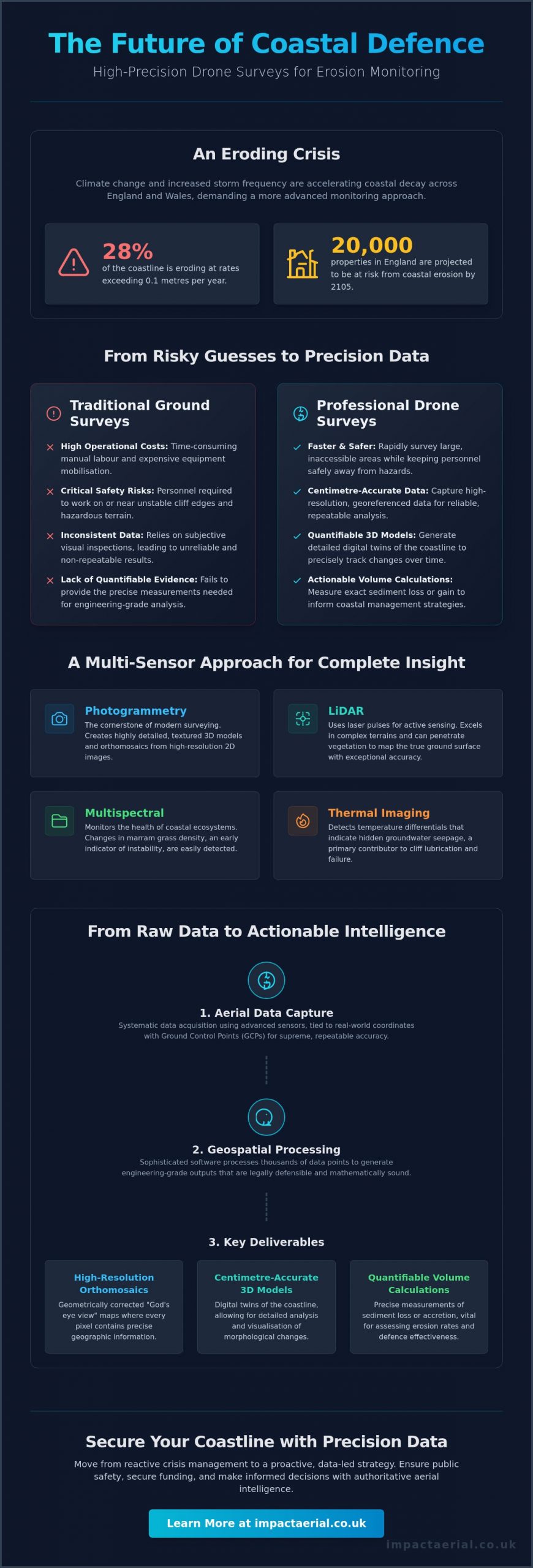
Drone vs. Traditional Coastal Surveying Methods
Traditional coastal surveying often requires personnel to manually traverse intertidal zones and cliff tops with GNSS poles. This legacy approach is inherently slow; it often takes several days to cover a stretch of coastline that a professional drone can map in a few hours. By transitioning to a drone survey for coastal erosion monitoring, you’re not just increasing speed but fundamentally changing the depth of your data. While manual methods rely on sparse transects every 50 to 200 metres, aerial platforms capture millions of data points across the entire surface, leaving no gaps in your environmental record.
Safety remains a primary driver for adopting UAV technology. Traditional methods frequently put surveyors at risk, requiring them to access unstable cliff edges or navigate dangerous tidal flats. Aerial surveys remove the need for physical access to these hazardous areas entirely. Additionally, drones offer a zero-footprint solution. This is particularly vital for Sites of Special Scientific Interest (SSSIs) where foot traffic or heavy equipment might disturb sensitive habitats. Research into USGS remote sensing technologies confirms that these non-invasive methods provide superior data without the ecological cost of ground-based operations.
Cost-Benefit Analysis for Local Authorities
Local authorities often find that drones significantly reduce the logistical overhead associated with sea vessels or crewed aircraft. While RICS notes that traditional surveys are typically conducted every six months to two years, the cost-efficiency of drones allows for “event-based” monitoring. This means you can deploy a team immediately after a major storm to assess damage in real time. This proactive approach offers a far higher long-term ROI; early detection of structural weaknesses in sea defences can prevent catastrophic infrastructure loss and the multi-million pound repair bills that follow.
Accuracy and Precision Standards
A common misconception is that aerial data is less precise than ground-based measurements. Modern RTK (Real-Time Kinematic) drones achieve sub-5cm absolute accuracy, providing engineering-grade data that rivals any traditional method. We provide 1cm-per-pixel resolution, allowing for the detection of hairline fractures in sea walls that would be invisible on a standard 200-metre transect. For a more comprehensive look at how we maintain these standards, read our Drone Survey: The Complete Guide to Aerial Data Collection. This precision ensures that your coastal management decisions are based on the most rigorous data available in 2026.
Implementing a Coastal Erosion Monitoring Programme
Executing a structured drone survey for coastal erosion monitoring requires meticulous planning across five distinct phases. Phase 1 begins with defining the Area of Interest (AOI) and determining the required Ground Sample Distance (GSD); higher resolution is typically needed for cliff face crack detection than for general beach volume checks. Phase 2 involves rigorous pre-flight planning. In the UK, this means synchronising flight windows with low tide times to ensure maximum beach exposure and monitoring weather patterns to stay within safe wind speed tolerances.
Phase 3 is the operational stage, where we deploy high-tier DJI Enterprise hardware, such as the Matrice 350 RTK, to capture data with centimetre-level positioning accuracy. Once the flight is complete, Phase 4 moves into post-processing. Here, we use photogrammetry software to transform thousands of raw images into georeferenced point clouds and orthomosaics. Finally, Phase 5 delivers reporting and actionable insights, providing local authorities with the evidence needed for immediate safety interventions or long-term defence planning.
Analysing Volume and Elevation Changes
We use specialized ‘swipe’ tools to overlay orthomosaics from different years, allowing for a direct visual comparison of shoreline retreat. This process quantifies sediment movement with high precision, answering exactly how many cubic metres of sand were lost during the last winter season. Digital Elevation Models (DEMs) provide a colour-coded representation of height data that makes even millimetre-scale terrain shifts visually apparent for analysis.
AI and Automated Change Detection
Modern monitoring programmes now integrate machine learning to automatically flag areas where erosion exceeds pre-defined thresholds. These algorithms track the retreat of the ‘cliff toe’ over multiple survey cycles, providing an objective metric of decay. Standardising this data ensures it’s compatible with multi-agency databases, such as those maintained by the Environment Agency and RICS. If you require a robust, compliant framework for your site, our team provides expert construction site monitoring and environmental data services to ensure long-term stability.
UK Compliance: Why Professional Certification Matters
Operating a professional drone survey for coastal erosion monitoring in the UK requires more than just technical skill; it demands strict adherence to Civil Aviation Authority (CAA) regulations. In 2026, the legal framework has become more defined, with all new drones requiring UK-specific class marks from UK0 to UK6. For complex commercial missions near sensitive shorelines, holding a General Visual Line of Sight (GVC) certificate is the standard requirement. This certification demonstrates a pilot’s competence in managing risk and navigating the specific operational challenges of maritime environments.
Navigating the geography of the coast often involves flying within Flight Restriction Zones (FRZs) near regional airports or military installations. Furthermore, many eroding cliffs are designated as Sites of Special Scientific Interest (SSSIs). Conducting surveys in these areas requires specific permissions from Natural England to ensure that aerial operations don’t disturb protected wildlife. To mitigate these risks, £5m commercial liability insurance has become the industry standard. This level of coverage provides the necessary reassurance to local councils and private developers that they’re partnering with a compliant and safety-conscious operator.
Safety Protocols in Maritime Environments
Coastal environments present unique technical hurdles that differ significantly from inland surveys. High winds and corrosive salt spray can impact hardware performance, requiring pilots to use aircraft with high IP ratings and robust wind resistance. Public safety is another critical pillar of our protocol. Because coastal paths and beaches are often public spaces, we implement strict ground-control measures to manage access during flight windows. Understanding these rules is vital for any stakeholder; you can learn more about the current regulatory landscape in our guide to the UK Drone License: A Simple Guide to CAA Rules in 2026.
The Impact Aerial Standard
Impact Aerial maintains a meticulous approach to data-centric processes and regulatory officialdom. We don’t just fly; we provide a technical consultancy service that prioritises precision and legal compliance. While our operations are often based out of Birmingham, we provide nationwide coverage, bringing specialist expertise to every corner of the UK coastline. We’re proud of our professional affiliations and our ability to deliver high-tier geospatial output that stands up to the most rigorous engineering scrutiny. If you’re ready to transition from inconsistent visual inspections to a georeferenced monitoring programme, contact Impact Aerial for a professional coastal survey consultation to discuss your project’s specific requirements.
Securing the Future of Coastal Management with Geospatial Intelligence
The transition from manual inspections to high-precision aerial data is a fundamental shift in how we protect vulnerable shorelines. By integrating advanced LiDAR and photogrammetry, you gain access to quantifiable volume calculations and centimetre-accurate 3D models that traditional methods cannot match. This data-centric approach ensures that every management decision is backed by rigorous technical evidence rather than visual estimation. A professional drone survey for coastal erosion monitoring provides the necessary baseline for tracking long-term shifts in shoreline morphology with absolute technical certainty.
Impact Aerial stands as a trusted specialist in this expanding market. Our operations are led by CAA GVC Certified Pilots who utilise high-tier DJI Enterprise hardware to deliver industry-leading results. With £5m commercial liability insurance and a meticulous focus on UK regulatory compliance, we provide the reassurance and tangible data your project requires. Request a Professional Drone Survey Quote from Impact Aerial to begin your monitoring programme. We’re ready to help you navigate the complexities of environmental management with precision and confidence.
Frequently Asked Questions
How accurate are drone surveys for monitoring coastal erosion?
Drone surveys provide engineering-grade accuracy, typically achieving sub-5cm absolute accuracy when using RTK-enabled hardware. This level of precision allows for the detection of minute structural shifts and hairline fractures in sea defences. By integrating Ground Control Points (GCPs), we ensure that every dataset is georeferenced to national grid standards, providing a reliable baseline for year-on-year comparisons.
Can drones fly in high winds common on the UK coast?
Professional Enterprise drones are designed to operate in challenging coastal conditions, with many models offering wind resistance up to 12 or 15 metres per second. However, safety remains our primary concern. We monitor real-time anemometer data during every mission to ensure the aircraft remains within its technical tolerances. If wind speeds exceed safe limits or gust unpredictably, we suspend operations to protect the equipment and the public.
Do I need special permission to survey a SSSI coastal area?
Yes, conducting a drone survey for coastal erosion monitoring within a Site of Special Scientific Interest (SSSI) requires formal consent from Natural England. These areas are ecologically sensitive, and drone flight can potentially disturb nesting birds or rare habitats. As part of our meticulous planning process, we handle these regulatory applications to ensure all operations are fully compliant with environmental protection laws.
What is the difference between LiDAR and Photogrammetry for beach surveys?
The primary difference lies in how data is captured. Photogrammetry reconstructs 3D models from high-resolution 2D images, making it ideal for open beaches and masonry structures. LiDAR uses active laser pulses that can penetrate dense vegetation or marram grass to map the true ground surface. While photogrammetry is often more cost-effective for clear terrain, LiDAR is essential for “soft” cliffs with heavy foliage.
How often should coastal erosion surveys be conducted?
We recommend conducting surveys at least twice a year to capture seasonal sediment shifts. Ideally, these should occur in spring and autumn to track the impact of winter storms. However, “event-based” monitoring is also critical. Deploying a drone immediately after a major storm surge provides invaluable data on immediate volume loss, allowing local authorities to assess the integrity of coastal defences before further damage occurs.
What data formats are provided after a drone coastal survey?
Our post-production services deliver data in industry-standard formats compatible with most GIS and CAD software. Common outputs include georeferenced orthomosaics (.GeoTIFF), high-density point clouds (.LAS or .LAZ), and 3D mesh models (.OBJ). We also provide Digital Elevation Models (DEMs) and Digital Terrain Models (DTMs), which are essential for conducting volumetric analysis and sediment tracking across multiple survey cycles.
Is a drone survey cheaper than a traditional land survey?
A professional drone survey for coastal erosion monitoring is significantly more cost-effective for large-scale projects, often reducing expenses by 50% to 75% compared to traditional ground-based methods. The primary savings come from reduced logistical overhead and faster data collection speeds. While a ground team might take days to traverse a kilometre of unstable cliff, a drone can map the same area in under an hour.
How do drones help in calculating volume loss on cliffs?
Drones enable precise volumetric calculations by comparing 3D point clouds or Digital Elevation Models from different time periods. By “subtracting” a newer survey from an older baseline, software can calculate the exact volume of material lost in cubic metres. This allows engineers to quantify the rate of cliff retreat and identify specific areas where the “cliff toe” is becoming undercut, which is a primary indicator of imminent failure.
Benefits of Thermal Imaging for Roofs: A Guide to Aerial Infrared Surveys
Why would you spend thousands on scaffolding and manual inspections when the most critical structural threats remain invisible to the naked eye? It’s a common frustration for site managers and property owners who face recurring leaks that traditional surveys simply cannot locate. You shouldn’t have to risk a roofer’s safety or blow through your maintenance budget on guesswork and invasive testing.
We understand that maintaining a large-scale facility requires technical precision and a commitment to safety. This guide explores the significant benefits of thermal imaging for roofs, showing you how aerial infrared surveys pinpoint hidden moisture, insulation failures, and structural risks with surgical accuracy. By utilizing high-resolution radiometric sensors and adhering to ASTM C1153 standards, you can justify repair budgets with hard visual data while keeping your team safely on the ground. We’ll preview how CAA-certified drone operations are transforming asset management, from identifying hot spots after sunset to meeting the latest 2026 UK Remote ID regulations. Discover how to turn an invisible problem into a clear, actionable maintenance plan.
Key Takeaways
- Understand how infrared sensors detect subsurface moisture by identifying the unique heat signatures retained by wet insulation.
- Explore the primary benefits of thermal imaging for roofs, including the elimination of costly scaffolding and the ability to survey vast commercial areas rapidly.
- Learn why the timing of a survey is critical, specifically how solar loading and twilight conditions ensure the most accurate data capture.
- Identify hidden structural risks such as moisture entrapment and insulation gaps before they develop into expensive internal damage.
- Recognize the necessity of CAA GVC certified pilots and comprehensive commercial liability insurance to ensure a compliant and safe site survey.
What is Thermal Imaging for Roofs and How Does it Work?
Thermal imaging for roofs is a non-destructive testing method that utilizes specialized infrared cameras to capture the heat signatures emitted by a building’s structure. Unlike standard photography, which relies on visible light, thermography detects radiation in the long-wave infrared spectrum. One of the standout benefits of thermal imaging for roofs is its ability to identify anomalies that are completely invisible to the human eye. By measuring these temperature variations, surveyors can create a detailed map of a roof’s thermal performance.
To understand the fundamentals of What is Thermography, one must recognize that every material absorbs and emits heat at different rates. When a roof is exposed to sunlight, it stores energy. As the environment cools at night, the roof begins to release that energy. Areas containing trapped moisture will appear warmer on a thermal scan because water has a higher thermal mass than dry insulation. This allows our sensors to “see” the thermal footprint of a leak through the surface-level membrane without ever cutting into the material.
To see a practical application of this technology on a commercial site, watch this thermal inspection in action:
The Science of Thermography
Thermodynamics is the core of this process. Thermal cameras don’t actually see through membranes; instead, they detect the heat energy being conducted from the materials underneath. In the context of moisture entrapment, thermal mass is the ability of wet insulation to store and retain heat energy significantly longer than the surrounding dry components. This temperature differential allows the camera to produce a thermogram, which is a visual representation where different colors correspond to specific temperature values. This data-centric approach removes the guesswork from traditional roof inspections.
Handheld vs. Drone-Mounted Thermal Sensors
Ground-based inspections using handheld cameras often struggle with perspective. On a large commercial flat roof, a surveyor on foot can only capture data from an oblique angle, which leads to image distortion and missed patches. DJI Enterprise drone sensors provide a significant upgrade in data quality. By flying at height, drones achieve a 90-degree nadir view. This top-down perspective is essential for creating an accurate, distortion-free moisture map of the entire site. This level of precision is one of the major benefits of thermal imaging for roofs, as it provides a comprehensive composite map that ground-based surveys simply cannot match.
The Primary Benefits of Aerial Thermal Roof Surveys
Transitioning from the science of thermography to practical application reveals why this technology is now a cornerstone of modern facility management. One of the most immediate benefits of thermal imaging for roofs is the sheer speed of data acquisition. A drone can survey a 50,000-square-foot industrial roof in a fraction of the time it takes a manual team to walk the site with handheld sensors. This rapid turnaround isn’t just about efficiency; it’s about capturing a snapshot of the entire roof under consistent environmental conditions, ensuring that temperature differentials aren’t skewed by changing weather during the survey.
Cost reduction is equally significant. Traditional inspections often require expensive scaffolding or cherry pickers just to gain access to high-level structures. Research indicates that scaffolding costs in the UK typically range from £200 to £1,000 per week, an expense that aerial surveys completely bypass. By choosing an aerial approach, you’re investing in data rather than temporary hardware. This method constitutes a high-tier form of non-destructive testing, allowing us to detect thermal defects such as air leakage or wet insulation without compromising the integrity of the roof’s protective membrane.
Enhanced Safety and Risk Mitigation
Safety remains the primary driver for many commercial operators. By keeping surveyors on the ground, we eliminate the inherent “work at height” risks that complicate standard inspections. Our operations align strictly with modern HSE guidelines, significantly reducing the liability for property managers. When you remove the need for personnel to navigate fragile roof surfaces or steep pitches, you create a safer work environment and simplify the logistics of your routine maintenance schedule. It’s a proactive way to manage risk while maintaining full compliance with safety protocols.
Precision and Visual Documentation
The output of an aerial survey provides more than just a list of problems; it delivers undeniable visual proof. This radiometric data is invaluable when filing insurance claims or preparing repair tenders, as it offers a clear “heat map” of the damage. Establishing this baseline of roof health allows you to track deterioration over time with meticulous detail. For those managing multiple assets, integrating these findings into broader drone property surveys ensures that every structural component is accounted for. If you’re ready to secure your building’s future, our drone commercial property surveys provide the expert oversight needed to justify your maintenance budget and protect your investment.
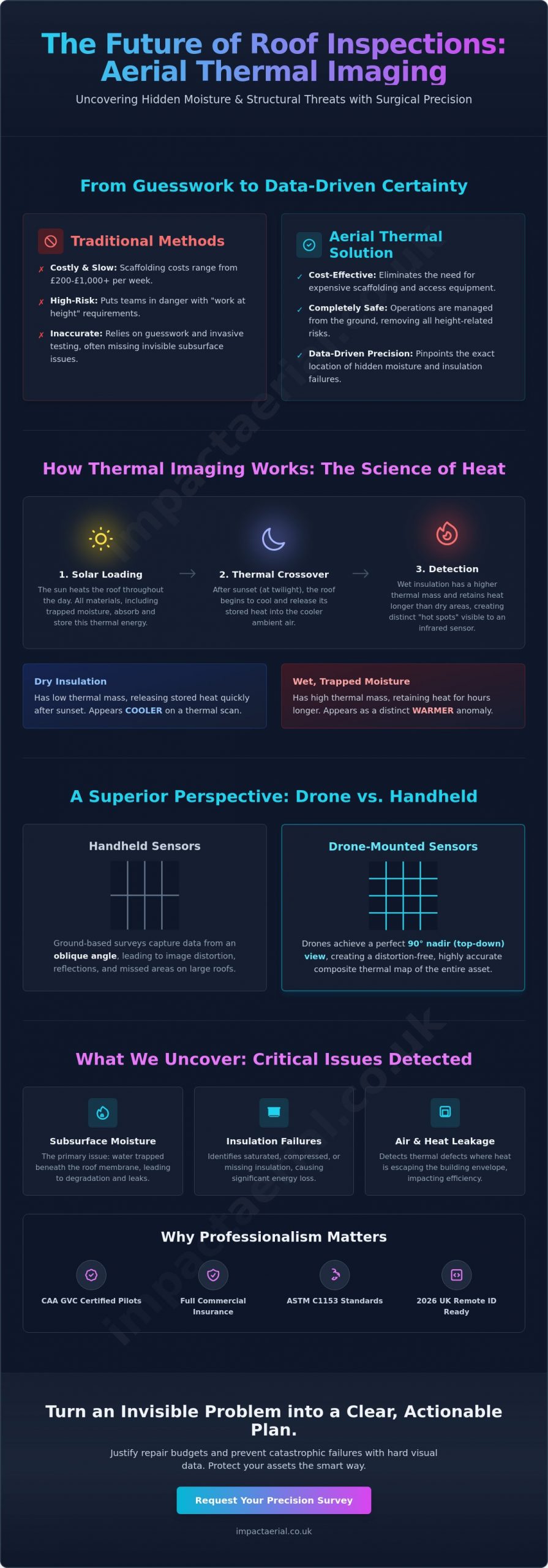
Specific Issues Detected by Thermal Imaging
While the overarching benefits of thermal imaging for roofs include safety and cost-efficiency, the true value lies in the granular data it provides regarding structural failures. We don’t just look for water dripping through a ceiling. Instead, we identify the precise moment a roof’s integrity begins to fail, often years before a visible leak appears. This proactive approach allows for targeted repairs that extend the life of the entire asset. By utilizing high-resolution radiometric sensors, we can detect anomalies that traditional visual surveys consistently overlook.
Moisture Mapping and Leak Detection
In the UK, the best results occur after sunset when the roof surface cools. Wet insulation appears as distinct “hot spots” because it retains solar energy longer than dry material. This phenomenon allows us to map moisture entrapment with surgical precision. By adhering to professional standards for roof thermography, we can pinpoint the exact entry point of a leak rather than just observing where the water eventually pools inside the building. Flat roofing systems are the ideal candidates for thermal moisture scans because their uniform surface allows for a clear, unobstructed view of the thermal patterns created by subsurface anomalies. This detailed mapping prevents the common mistake of replacing an entire roof when only a specific section is compromised.
Energy Efficiency and Heat Loss
Thermal imaging is a powerful tool for businesses striving to meet ambitious ESG (Environmental, Social, and Governance) goals. By identifying “cold spots” on the roof surface during winter months, we can locate failed insulation boards that allow internal heat to escape. These insulation gaps represent a massive waste of HVAC energy and increase the building’s carbon footprint. We also look for thermal bypasses at roof-to-wall junctions, where air leakage often goes undetected. Addressing these thermal bridges ensures the building envelope remains airtight and energy-efficient. This data is essential for justifying energy-saving upgrades and proving the return on investment for insulation repairs.
Structural Anomalies and Drainage Monitoring
Beyond moisture and heat, infrared sensors reveal structural anomalies that might otherwise remain hidden. Thermal bridges, where highly conductive materials like steel beams penetrate the insulation layer, show up clearly on our scans. These areas are prone to condensation and eventual rot if left unmanaged. Additionally, we use thermal data to monitor the health of flat roof drainage systems. Pooling water has a different thermal signature than the rest of the roof, allowing us to identify blocked drains or subtle depressions in the roof deck that threaten structural stability. Integrating this data into your long-term asset management strategy ensures that minor maintenance issues don’t escalate into catastrophic failures.
Optimising Results: Timing and Conditions in the UK
Achieving high-quality radiometric data requires more than just high-end hardware. It demands a meticulous understanding of the UK’s environmental variables. The primary benefits of thermal imaging for roofs are only fully realized when the survey is conducted during the optimal “thermal window.” This window is dictated by the diurnal cycle, a 24-hour temperature swing that allows us to differentiate between dry and saturated materials. Without the correct environmental timing, even the most advanced sensors will fail to produce actionable data.
The process begins with “solar loading,” where the sun’s energy heats the roof structure throughout the day. To ensure accuracy, we strictly follow ASTM C1153 standards, which require specific conditions such as a dry roof surface for at least 24 hours and wind speeds typically below 15 mph. High winds can strip heat from the roof surface through convective cooling, which masks the subtle temperature differences we need to detect. We prioritize clear, cold nights following a day of significant solar loading to maximize the contrast between wet and dry insulation.
The Diurnal Cycle Explained
The most effective thermal scans happen at twilight or during early nightfall. After the sun sets, dry roofing materials cool down rapidly because they have low thermal mass. In contrast, wet insulation or trapped moisture retains that heat for much longer. If we launch a drone too early, the residual heat from the surface membrane can mask the underlying defects, a phenomenon known as the wash-out effect. By waiting for the peak temperature differential, usually two to four hours after sunset, we can pinpoint moisture entrapment with surgical precision. Managing the UK’s unpredictable rain patterns is the greatest challenge, as a wet surface will evaporate and cool the roof, creating false “cold spots” that invalidate the survey results.
Material Compatibility
Not all roofing materials react to infrared radiation in the same way. EPDM (rubber) and bituminous membranes are ideal for thermography because they have high emissivity, meaning they are very efficient at emitting thermal energy. Highly reflective “cool roofs” or new metal standing seams present a greater challenge because they act like mirrors, reflecting the cold temperature of the sky rather than emitting their own heat. Our pilots meticulously adjust emissivity settings and camera angles to compensate for these reflective surfaces. To ensure your asset is surveyed under these precise conditions, you can book our drone commercial property surveys to secure a data-rich report that accurately reflects your roof’s health.
Why Professional Drone Surveys are the Industry Standard
Professionalism in aerial thermography isn’t just about owning a drone; it’s about the technical rigour and regulatory compliance behind every flight. While the benefits of thermal imaging for roofs are clear, the quality of the data depends entirely on the operator’s expertise and the hardware used. We leverage DJI Enterprise systems, such as the Matrice 350 or 400 series equipped with high-resolution radiometric sensors, to capture precise temperature data. This technology allows us to measure the exact heat signature of any point on the roof surface, providing a level of detail that standard visual inspections can’t match. This data-centric approach ensures that stakeholders receive a definitive, evidence-based assessment of their property’s condition.
Compliance and Safety Standards
Operating a drone for commercial purposes in the UK requires strict adherence to aviation law. As of January 2026, regulations have become more stringent, requiring Remote ID for drones with cameras and lowering registration thresholds. We operate with full CAA General Visual Line of Sight Certificate (GVC) qualifications, which are essential for conducting surveys in complex urban or industrial environments. Understanding the specific requirements for a drone license is vital for site managers who must ensure their contractors are fully legal and current with 2026 standards. Beyond licensing, we provide detailed Risk Assessments and Method Statements (RAMS) and maintain £5m in commercial liability insurance. This meticulousness guarantees that your site survey is conducted with the highest safety standards in mind, providing the psychological comfort that your asset is in expert hands.
From Data to Decision Making
The true value of a survey lies in the transition from raw data to actionable intelligence. It’s easy to capture a thermal image, but it’s much harder to produce a report that a structural engineer or insurance provider can rely on. Our drone survey reports are designed to direct repair teams exactly where they are needed, eliminating the need for broad-spectrum “exploratory” repairs. We use advanced post-production software to analyze thermal anomalies, filtering out false positives like HVAC exhaust or solar reflections. This ensures that the benefits of thermal imaging for roofs translate into tangible cost savings and efficient maintenance schedules. By providing a clear visual baseline of roof health, we help property managers justify their repair budgets with hard evidence. If you’re ready to move away from guesswork and embrace data-driven asset management, contact Impact Aerial for a professional thermal roof survey quote and let our experts secure your building’s future.
Securing Your Building’s Future with Thermal Data
Aerial thermography has redefined how we protect large-scale commercial assets. By identifying subsurface moisture and insulation gaps long before they manifest as internal damage, you’re not just fixing leaks; you’re preserving the structural integrity of your property. The benefits of thermal imaging for roofs extend far beyond simple detection. They provide the hard evidence needed to justify maintenance budgets and ensure your site remains compliant with modern safety standards. This data-driven approach removes the high costs of scaffolding and the risks of manual inspections.
We combine high-end DJI Enterprise radiometric sensors with the expertise of CAA GVC certified pilots to deliver reports that are both technically precise and legally compliant. With £5m in commercial liability insurance, we provide the security and reliability that complex industrial sites demand. Don’t leave your roof’s health to guesswork or invasive testing that risks damaging your facility membrane. It’s time to gain total visibility over your assets with professional aerial oversight.
Request a Professional Thermal Roof Survey from Impact Aerial today to secure a comprehensive assessment of your building’s health. We’re ready to help you turn invisible risks into a clear, actionable plan for long-term success.
Frequently Asked Questions
Is thermal imaging for roofs accurate in finding all leaks?
Thermal imaging is exceptionally accurate at identifying moisture entrapment and thermal anomalies that standard visual inspections miss. However, it is a diagnostic tool that identifies temperature differentials rather than a definitive leak seeker in every scenario. To ensure 100% certainty, we recommend verifying thermal findings through non-destructive moisture meter testing or core sampling as per industry standards. This combined approach maximizes the benefits of thermal imaging for roofs by providing a verified roadmap for repairs.
Can you perform a thermal roof survey during the day?
Daytime surveys are generally ineffective because direct solar radiation creates thermal noise that masks subsurface temperature differences. For accurate results, we conduct surveys at twilight or during the night when the roof surface has cooled sufficiently. This specific timing allows the heat retained by wet insulation to become visible against the rapidly cooling dry sections. Scheduling during these hours is critical for capturing the high-contrast radiometric data required for a professional structural assessment.
What roof materials work best with infrared cameras?
Low-reflectivity materials with high emissivity, such as EPDM rubber, bituminous membranes, and modified bitumen, provide the most reliable results. These surfaces efficiently emit thermal energy, allowing our sensors to capture clear heat signatures. In contrast, highly reflective surfaces like new metal or cool roofs can act as mirrors, reflecting sky temperatures instead of emitting their own heat. Our pilots adjust camera settings and flight paths to mitigate these reflections, ensuring data accuracy across diverse commercial roofing systems.
How much does a drone thermal roof survey cost in the UK?
The cost of a drone thermal roof survey varies based on the total surface area, the complexity of the roof structure, and the specific reporting requirements. Factors such as the building’s location and the need for specialized flight permissions in restricted airspace also influence the final investment. We provide bespoke quotes that reflect the meticulous planning and high-end hardware required for a compliant, data-rich survey. Contacting us directly ensures you receive a quote tailored to your facility’s specific maintenance needs.
Do I need to shut down my building during the drone survey?
There is no need to shut down your building or interrupt daily operations during an aerial survey. Our drones operate at a safe altitude and remain entirely non-intrusive, allowing your staff and tenants to continue their work without distraction. Because we typically conduct thermal scans after sunset to optimize data quality, the impact on site activity is virtually non-existent. This operational flexibility is a key advantage for busy commercial and industrial facilities that cannot afford downtime.
What is the difference between a visual drone survey and a thermal one?
A visual drone survey uses high-resolution RGB cameras to identify surface-level defects like cracked tiles, blocked gutters, or loose flashings. A thermal survey utilizes radiometric infrared sensors to detect subsurface issues like moisture entrapment and insulation failure. While visual surveys show you what is broken on the exterior, thermal imaging reveals the hidden structural risks beneath the membrane. Combining both methods provides a comprehensive overview of your roof’s total health and energy performance.
Can thermal imaging see through standing water on a roof?
Thermal imaging cannot see through standing water or heavy ponding on a roof surface. Water on the surface acts as a thermal barrier, equalizing the temperature and masking the heat signatures of the materials underneath. For a successful survey, the roof must be completely dry for at least 24 hours prior to the flight. This ensures that the temperature differentials we detect are caused by internal moisture entrapment rather than surface-level evaporation or pooling water.
How long does it take to receive the thermal survey report?
You can typically expect to receive your comprehensive survey report within three to five working days following the flight. While the data capture itself is rapid, the post-production phase requires meticulous analysis by our technical team to identify and verify thermal anomalies. We convert raw radiometric data into actionable insights, providing you with a detailed map of leak locations and insulation gaps. This thorough process ensures the benefits of thermal imaging for roofs are translated into a clear maintenance strategy.
Drone Survey for Pipeline Monitoring: The Professional UK Guide 2026
Did you know that drone-based inspections can reduce costs by up to 70% compared to traditional helicopter patrols while delivering faster, more accurate defect detection? For UK asset managers, the challenge of monitoring thousands of miles of infrastructure across hazardous or remote terrain has always been a high-stakes balance of safety and expenditure. You’re likely all too familiar with the slow reporting cycles and the inherent risks of sending ground teams into difficult environments.
Utilizing a professional drone survey for pipeline monitoring is no longer a futuristic concept; it’s a regulatory and operational necessity for maintaining asset integrity in 2026. This guide reveals how commercial drone technology transforms pipeline oversight, providing CAA-compliant monitoring that drastically reduces your risk profile. We’ll explore the latest UK drone classifications, the shift toward Beyond Visual Line of Sight (BVLOS) operations, and how high-resolution digital twins are replacing outdated data silos with actionable, high-tier intelligence.
Key Takeaways
- Learn how transitioning from manual ground patrols to aerial data collection can reduce operational expenditure by up to 70% while significantly improving site safety.
- Understand the technical role of 4K HDR cameras and specialized sensors in identifying structural anomalies and third-party encroachments with high-tier precision.
- Identify the mandatory UK regulatory standards for a drone survey for pipeline monitoring, including CAA GVC certifications and the necessity of £5m commercial liability insurance.
- Discover how high-resolution digital twins and accelerated reporting cycles enable faster leak detection and more proactive asset management across your entire network.
- Explore how commercial-grade DJI Enterprise hardware overcomes the logistical challenges of monitoring critical infrastructure in remote or hazardous UK terrain.
The Evolution of Pipeline Monitoring: Why UAVs are the New Standard
The shift toward unmanned aerial vehicles (UAVs) in the UK utility sector isn’t just about following a trend; it’s a response to the inherent failures of legacy inspection models. For decades, pipeline integrity relied on manual ground patrols, where teams navigated miles of difficult terrain to spot leaks or encroachments. This approach is notoriously slow. It exposes workers to significant safety risks. By integrating a drone survey for pipeline monitoring, operators can now oversee vast networks with a level of precision that was previously impossible.
To better understand this concept, watch this helpful video demonstrating utility inspection workflows:
Modern UAVs utilize advanced remote sensing technology to capture data that the human eye might miss. This transition from reactive “break-fix” cycles to proactive asset integrity management is essential for environmental protection. Research from 2026 indicates that drone-based inspections can reduce costs by 50-70% compared to helicopter patrols. This allows for more frequent checks and earlier leak prevention without inflating operational budgets. The result is a safer, more reliable infrastructure that meets the increasing demands of UK regulators.
Challenges of Traditional Pipeline Inspections
Manual inspections in the UK often involve trekking through remote marshes or across steep, hazardous slopes. These environments pose constant slip and trip hazards for ground crews, especially in volatile weather. Beyond the physical danger, walking a 50-mile pipeline stretch is incredibly time-intensive. It often takes several days to complete a single circuit. Human error also plays a major role in these legacy methods. Manual data recording is frequently inconsistent, and subtle anomalies like slight ground subsidence or early-stage corrosion are easily overlooked during long, fatiguing shifts.
The Strategic Advantage of Aerial Oversight
Aerial platforms offer rapid deployment capabilities that traditional methods can’t match. In the event of a suspected pressure drop or environmental incident, a drone can be on-site and airborne in minutes to provide real-time situational intelligence. This high-frequency monitoring doesn’t require an increase in headcount, making it a scalable solution for growing networks. Perhaps most importantly, every drone survey for pipeline monitoring creates a comprehensive, high-resolution digital record. This permanent data trail is invaluable for regulatory auditing, ensuring that your compliance with UK safety standards is documented with absolute clarity and precision.
Technical Capabilities: Sensor Technology and Data Precision
A professional drone survey for pipeline monitoring relies on a sophisticated payload of specialized sensors designed to identify structural and environmental anomalies with surgical precision. While standard photography has its place, professional utility inspections require high-tier hardware that sees beyond the visible spectrum. We utilize 4K HDR cameras to provide crystal-clear visual evidence of third-party encroachment or surface damage. These high-resolution outputs allow engineers to zoom in on specific assets without losing the granular detail required for informed decision-making. Using such advanced technology ensures that every flight delivers actionable intelligence rather than just raw imagery.
Effective monitoring also requires understanding the ground conditions surrounding the asset. Multispectral sensors analyze soil moisture levels and vegetation health, which often indicate slow-seeping leaks that haven’t yet reached the surface. Because all operations must strictly adhere to UK drone regulations, using calibrated, enterprise-grade equipment ensures that the data collected is both legally compliant and technically sound. This meticulous approach to hardware selection is what separates a basic aerial view from a comprehensive industrial inspection.
Thermal Imaging for Leak Detection
Thermal sensors are indispensable for identifying fluid leaks by detecting subtle temperature variations in the surrounding soil. When a pressurized pipe fails, the escaping substance often changes the thermal signature of the ground above it. In the UK’s temperate climate, these surveys are most effective during periods of high thermal contrast, such as early morning. By integrating thermal data with visual overlays, we create a composite view that makes it easy for maintenance teams to pinpoint the exact location of a subsurface issue. This level of detail is a core component of our professional drone survey services, helping clients mitigate environmental risks before they escalate.
LiDAR and 3D Mapping for Structural Integrity
LiDAR (Light Detection and Ranging) technology is a game-changer for monitoring pipelines in heavily wooded or overgrown areas. Unlike standard photogrammetry, LiDAR pulses can penetrate dense vegetation to map the actual ground surface. This allows us to generate engineering-grade 3D digital twins of pipeline corridors. These models are essential for monitoring long-term subsidence or ground movement that could compromise structural integrity. Achieving the accuracy levels required for these surveys demands meticulous flight planning and high-end processing, resulting in a comprehensive digital asset that serves as a baseline for all future inspections.
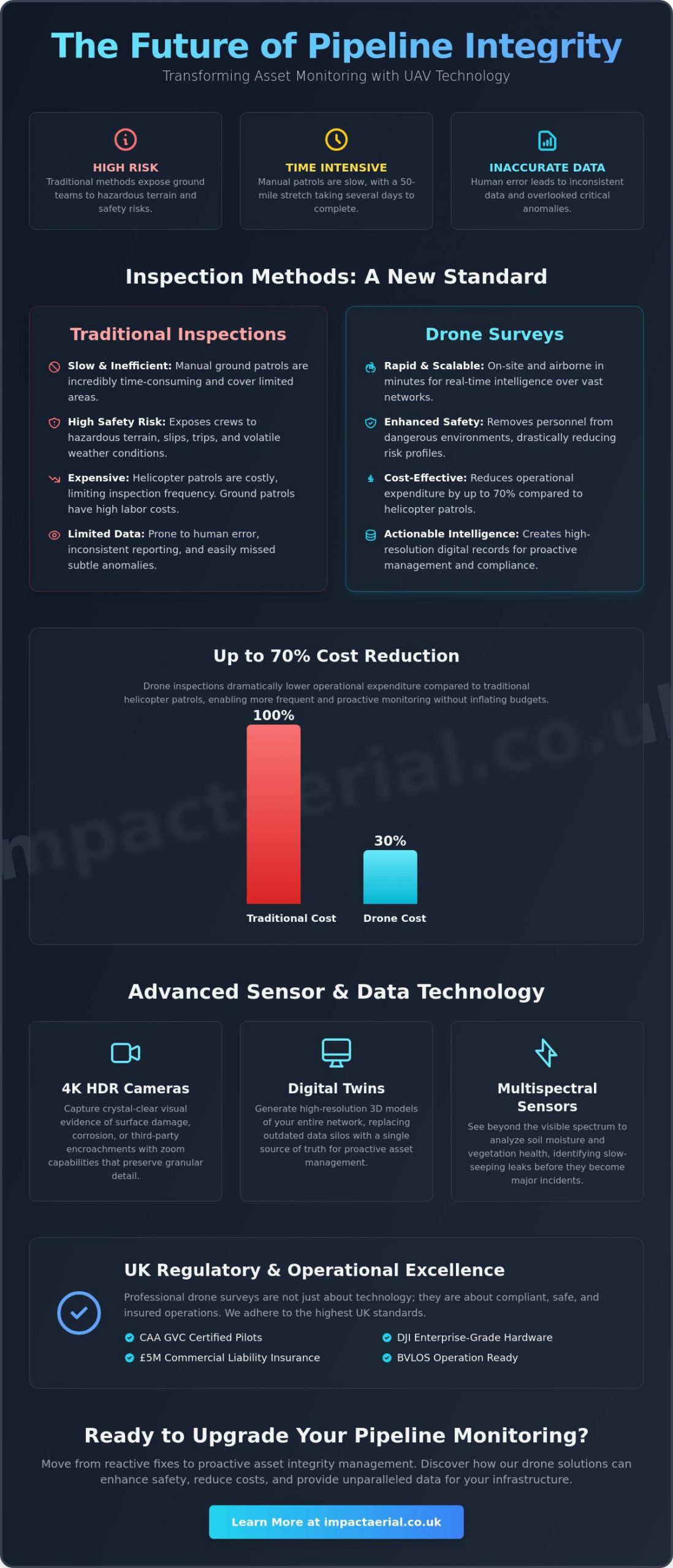
The Business Case: Comparing Drone Surveys to Traditional Methods
The financial justification for upgrading legacy inspection protocols is clear. While manual ground patrols and manned helicopter flights were once the industry standard, they carry significant overheads and logistical burdens. Research indicates that a drone survey for pipeline monitoring can be 30-70% cheaper than traditional methods involving rope access, scaffolding, or aircraft. These savings aren’t just found in the direct cost of the survey itself but also in the reduction of support staff and heavy equipment required to facilitate inspections in remote areas.
Asset managers must also consider the broader implications of pipeline infrastructure economics when planning their maintenance budgets. Traditional methods often result in data silos and slow reporting cycles, where anomalies might not be flagged until weeks after the initial site visit. In contrast, aerial surveys accelerate the reporting cycle by providing near-instant access to high-resolution data. This rapid time-to-data allows for quicker decision-making, potentially preventing minor issues from escalating into costly environmental disasters or operational shutdowns.
The environmental impact of these operations is another critical factor. Moving away from fuel-heavy helicopters toward electric-powered UAVs significantly lowers the carbon footprint of your inspection program. This shift supports corporate sustainability goals while maintaining a rigorous oversight schedule that meets the mandated inspection frequencies required by UK authorities.
Operational Efficiency and Speed
Efficiency is built into the workflow of modern aerial surveys. A single flight team can cover dozens of kilometres of pipeline in a single day, a task that would take a ground crew several weeks to complete. We utilize automated flight paths to ensure that data collection is repeatable and consistent across every inspection cycle. This consistency is vital for change detection, allowing engineers to overlay historical data with current imagery to spot subtle shifts in the landscape. Once the flight is complete, our rapid post-production services deliver processed data through secure cloud platforms, ensuring that your team has the information they need without delay.
Risk Mitigation and Safety Standards
Safety remains the primary driver for drone adoption in the industrial sector. By deploying UAVs, you remove personnel from high-risk environments, such as steep embankments, marshlands, or areas with restricted access. Drones also provide an early warning system for third-party encroachments, such as unauthorized construction or vegetation overgrowth that could threaten the asset. In the context of UAV pipeline surveys, risk mitigation is the systematic reduction of physical danger to personnel and the proactive identification of external threats to asset integrity. Implementing a professional drone survey for pipeline monitoring ensures that your safety ROI is maximized by reducing “man-hours at risk” while simultaneously improving the quality of your oversight.
Operational Excellence: Compliance, Safety, and UK Regulations
Operating a drone survey for pipeline monitoring in the UK requires more than just high-end hardware; it demands a rigorous commitment to national aviation laws and industrial safety standards. Compliance is the foundation of every flight we undertake. It ensures that data collection is not only accurate but also legally defensible and safe for all stakeholders involved. For asset managers, partnering with a provider that understands the nuances of the 2026 regulatory landscape is essential for mitigating long-term liability. We approach every mission with a meticulous mindset, prioritizing risk management and official certification above all else.
CAA Regulations and Pilot Certification
The Civil Aviation Authority (CAA) maintains strict oversight of commercial drone operations, particularly those involving critical national infrastructure. It is vital that your chosen provider is CAA GVC certified to operate in the ‘Specific’ category. This qualification allows for more complex maneuvers that fall outside standard recreational limits. As of January 1, 2026, all new drones used for industrial work must also feature UK-specific class marks and mandatory Remote ID technology. For long-distance pipeline oversight, we often operate under specific authorizations for Beyond Visual Line of Sight (BVLOS) flights. This capability is essential for covering vast distances efficiently while maintaining a robust Safety Management System (SMS) and detailed flight logs for every mission.
Insurance is another non-negotiable factor in professional utility work. While basic commercial policies exist, industrial sites typically require a minimum of £5m commercial liability insurance. This coverage provides the necessary reassurance for stakeholders when operating near high-value assets. We also ensure that all data collection adheres to strict GDPR and data protection protocols, safeguarding the privacy of landowners and the security of sensitive infrastructure imagery.
Site Safety and Risk Assessment
Every drone survey for pipeline monitoring begins with exhaustive pre-flight planning. This includes checking for NOTAMs (Notices to Airmen) to identify temporary airspace restrictions and securing all necessary landowner permissions along the route. On-site, we establish clear launch zones and utilize trained spotters to maintain situational awareness. Our hardware choice reflects this focus on reliability. We utilize commercial-grade DJI Enterprise drones equipped with dual-battery systems and redundant flight controllers. These systems ensure that even in the unlikely event of a component failure, the aircraft can return to home safely. If you require an inspection partner that prioritizes these high-tier safety standards, view our professional drone survey services to see how we can support your next project.
Risk assessments for critical infrastructure are particularly detailed. We analyze potential electromagnetic interference and local terrain challenges before the rotors even turn. This methodical approach ensures that we identify and mitigate hazards such as third-party encroachments or hazardous weather patterns early in the planning phase. By combining technical expertise with a safety-first culture, we deliver high-resolution data without compromising the integrity of your site or the safety of the public.
Implementing Drone Monitoring with Impact Aerial
Impact Aerial provides specialized drone survey for pipeline monitoring services designed to address the unique geographical and regulatory challenges of the UK. From our strategic operations base in Birmingham and the West Midlands, we provide nationwide coverage to support critical infrastructure networks. Our approach is built on a foundation of technical precision and meticulous safety protocols, ensuring that every mission delivers high-tier data while remaining fully compliant with national aviation laws. We don’t just capture imagery; we provide a comprehensive oversight solution that integrates seamlessly into your existing asset management workflows.
Our team understands that pipeline integrity is a high-stakes environment where data accuracy is non-negotiable. We utilize commercial-grade DJI Enterprise drones, which offer the redundancy and sensor stability required for industrial surveying. By combining this high-end hardware with a methodical operational style, we ensure that your drone survey for pipeline monitoring delivers a level of detail that manual ground patrols simply cannot match. This commitment to quality and precision is why we are a trusted partner for utility operators across the country.
Our Professional Survey Workflow
Every project begins with an in-depth consultation to define your specific asset monitoring requirements. Whether you need to detect third-party encroachments or perform detailed structural analysis, we tailor our flight parameters to meet those engineering goals. During the precision data capture phase, we utilize 4K HDR visual cameras and thermal sensors to identify anomalies with surgical accuracy. Once the flight is complete, our full-service model extends into expert post-production. We process the raw data to generate detailed reports and 3D mapping for your engineering teams, providing a clear digital record of asset health. This end-to-end drone survey workflow ensures you receive actionable intelligence without the burden of internal data processing.
Why Choose Impact Aerial for Pipeline Oversight?
We distinguish ourselves through a deep commitment to regulatory excellence and technical expertise. Our pilots possess extensive backgrounds in technical surveying, ensuring they understand the industrial context of the data they collect. We maintain a strict adherence to all CAA safety standards and drone services regulations, providing the reassurance and reliability that critical infrastructure projects demand. By choosing a partner that values external validation and high-tier quality, you ensure that your monitoring program is legally compliant and operationally sound. We focus on providing the psychological comfort of knowing your assets are in expert hands, backed by comprehensive insurance and professional certifications.
Contact Impact Aerial today for a professional pipeline survey quote and discover how our aerial data solutions can transform your asset integrity management.
Advancing Your Pipeline Integrity Strategy
Adopting a proactive approach to infrastructure oversight is essential for navigating the complex operational and environmental demands of 2026. A professional drone survey for pipeline monitoring delivers more than just high-resolution imagery; it provides a scalable, data-driven framework for identifying leaks and third-party encroachments before they escalate. By replacing slow, hazardous ground patrols with precision aerial surveys, you can achieve a significant reduction in operational expenditure while improving the quality of your asset integrity records.
Our team at Impact Aerial is committed to delivering these high-tier results through a combination of technical expertise and strict regulatory compliance. We operate a specialized DJI Enterprise Hardware Fleet and employ only CAA GVC Certified Pilots to ensure every mission meets the highest safety benchmarks. With £5m Commercial Liability Insurance as a standard, we offer the reliability and reassurance required for critical national infrastructure projects across the UK. We’re ready to help you elevate your monitoring standards and protect your long-term asset value.
Request a Professional Pipeline Survey Quote from Impact Aerial and take the first step toward a more resilient and efficient network today.
Frequently Asked Questions
Is a drone survey for pipeline monitoring legal in the UK?
Yes, conducting a drone survey for pipeline monitoring is entirely legal in the UK when performed by a CAA-certified operator. Professional pilots must adhere to the 2026 UK drone classifications and hold either an A2 CofC or a GVC certification depending on the weight of the aircraft and the complexity of the flight path. For industrial surveys near critical infrastructure, we operate under specific authorizations that ensure every mission meets the highest safety and legal standards.
Can drones detect gas leaks in underground pipelines?
Drones detect gas leaks by utilizing specialized optical gas imaging (OGI) sensors or laser-based methane detectors. These payloads identify gas plumes that are completely invisible to the human eye or standard cameras. Additionally, thermal sensors can identify subsurface leaks by spotting subtle temperature changes in the soil caused by escaping pressurized fluids. This multi-sensor approach allows for the early detection of leaks before they cause significant environmental damage.
How much does a commercial drone pipeline survey cost?
The cost of a commercial drone survey depends on several variables, including the total distance of the pipeline, the type of sensors required, and the complexity of the terrain. While we don’t provide fixed pricing due to the bespoke nature of utility work, drone-based methods are consistently more cost-effective than traditional alternatives. Utilizing UAVs typically reduces the need for expensive manned helicopter flights or large ground teams, lowering your overall operational expenditure.
What happens if the weather is bad on the day of the survey?
We reschedule flight operations if the weather conditions exceed the safe operating limits of our DJI Enterprise hardware or if the data quality would be compromised. High winds, heavy rain, or thick fog can interfere with both flight stability and sensor accuracy. Our team monitors specialized aviation forecasts closely in the days leading up to a mission. We coordinate with your project managers to ensure the survey takes place during an optimal weather window.
How accurate is the data collected by a pipeline drone?
Data collected by professional drones is exceptionally accurate, often achieving centimetre-level precision when using RTK (Real-Time Kinematic) positioning. When combined with LiDAR sensors, we can generate engineering-grade 3D digital twins that allow for meticulous subsidence monitoring and structural analysis. This level of granularity is significantly higher than what is typically achievable through satellite imagery or manned aircraft inspections, providing a more reliable baseline for asset integrity management.
Do you need permission from landowners to fly over pipelines?
Yes, we require permission from landowners for the take-off and landing of the aircraft on private property. While the CAA regulates the airspace, the practicalities of a drone survey for pipeline monitoring often involve accessing specific land parcels to maintain a safe launch zone. As part of our comprehensive pre-flight planning, we handle the coordination of these permissions to ensure that all operations are conducted with the full consent of local stakeholders.
What is the difference between a visual and a thermal pipeline inspection?
Visual inspections use 4K HDR cameras to identify surface-level issues like third-party encroachment, vegetation overgrowth, or visible structural damage. In contrast, thermal inspections utilize infrared sensors to detect heat signatures and temperature variations. While visual data is excellent for general oversight, thermal imaging is essential for identifying subsurface leaks or insulation failures that aren’t visible to the naked eye. Combining both provides a complete picture of asset health.
Can drones monitor pipelines in urban areas like Birmingham?
Drones can monitor pipelines in urban environments like Birmingham, but these missions require more stringent risk assessments and specific CAA authorizations. Operating in congested areas involves managing complex safety factors and potential signal interference. We utilize redundant flight systems and meticulous site-specific safety protocols to ensure these urban surveys are completed without risk to the public. This allows for efficient oversight of critical infrastructure even in densely populated regions.
Drone Photography for Annual Reports: Elevating Corporate Transparency in 2026
A spreadsheet can explain your revenue, but it can’t capture the sheer scale of a newly commissioned offshore wind farm or the precision of a massive infrastructure project. In 2026, investors expect more than just dry data; they want visual proof of operational excellence and ESG commitment. You’ve likely felt the frustration of trying to convey complex growth through static, ground-level photography that fails to show the big picture. Utilizing professional drone photography for annual reports transforms these statutory documents from boring compliance exercises into compelling narratives that justify investment.
It’s about more than just a pretty picture; it’s about meticulous safety and technical precision. We understand the concerns surrounding the legality of drone operations on sensitive corporate sites, especially with the 2026 UK mandate for Remote ID and specific class markings. This article outlines how to elevate your corporate transparency by capturing stunning aerial evidence of your progress. We’ll show you how a fully insured, compliant approach to aerial filming provides the visual clarity your stakeholders demand while mitigating every operational risk.
Key Takeaways
- Discover how to use “Hero Shots” and progress visualizations to turn abstract financial milestones into tangible evidence of infrastructure growth.
- Learn why professional drone photography for annual reports requires specific CAA GVC certification and robust liability insurance to ensure total site safety.
- Explore strategic placement techniques that use cinematic aerial loops and high-resolution stills to enhance both digital and printed stakeholder communications.
- Understand the 2026 shift in corporate reporting, where aerial perspectives bridge the gap between complex ESG data and authentic brand transparency.
- Gain insights into working with a technical specialist to achieve seamless, nationwide deployment for multi-site corporate asset portfolios.
What is Drone Photography for Annual Reports?
Drone photography for annual reports is the specialized application of professional Unmanned Aerial Vehicles (UAVs) to capture high-resolution imagery and cinematic video of corporate assets, large-scale projects, and personnel. While the history of aerial photography spans over a century, its role in 2026 has transitioned from a simple “obligatory record” into a sophisticated tool for brand storytelling. In a market where corporate transparency is a primary driver of investment, these aerial perspectives provide the verifiable evidence that stakeholders demand. It’s no longer enough to state that a project is progressing; you must show it from a perspective that captures its entire footprint.
With the 2026 UK drone regulations now in full effect, including mandatory Remote ID and specific UK class markings for all commercial hardware, the distinction between hobbyist snapshots and professional aerial filming has never been clearer. For UK infrastructure and property sectors, the ability to demonstrate scale is paramount. Whether you’re showcasing a sprawling solar farm or a multi-phase urban development, the view from above offers a psychological “big picture” that ground-level shots can’t replicate. This perspective builds immediate investor confidence by making complex, multi-million-pound investments feel tangible and real.
To better understand how these elevated perspectives can transform your corporate visual strategy, watch this helpful technical overview:
Beyond the Ground: The Aerial Advantage
Traditional photography often fails to encompass the true magnitude of expansive sites, leaving shareholders with a fragmented view of operations. Drones bridge this gap by providing essential context, showing exactly how a facility sits within its local environment or connects to vital transport networks. This isn’t just about documentation. It’s about positioning. By utilizing advanced UAV technology, a brand signals its commitment to modernism and technological adoption. It shows that the company isn’t just growing, but is doing so with the precision and oversight that only professional drone photography for annual reports can provide.
The Role of Visuals in 2026 Investor Relations
High-quality aerial imagery serves a critical function in reducing the “cognitive load” associated with dense financial statements. When a reader can see a clear, high-resolution visual of a remote asset or a complex construction milestone, the data on the page becomes significantly more accessible. In 2026, the expectation for consistent visual quality across both digital and print report versions is non-negotiable. Using drones to create a tangible feel for assets that investors may never visit in person bridges the gap between abstract figures and physical reality, ensuring your corporate narrative remains grounded in visible success.
Strategic Shots: Key Aerial Perspectives for Stakeholders
Selecting the right visual perspectives is a technical and strategic decision that directly impacts how shareholders perceive your company’s health. The “Hero Shot” remains the most critical asset for any report. It’s an iconic, high-altitude image designed for the front cover that signals corporate strength and operational scale. By positioning your primary headquarters or flagship project against an expansive landscape, you provide a sense of stability that ground-level photography simply cannot replicate. This high-end output creates an immediate connection, assuring investors that the business is both grounded and forward-looking.
Beyond the cover, drone photography for annual reports serves as a verifiable record of year-on-year progress. Side-by-side aerial comparisons or time-lapse sequences from fixed GPS coordinates allow stakeholders to witness the evolution of a site over the fiscal year. This level of transparency is essential for infrastructure projects where milestones are often buried in complex technical jargon. Seeing a foundation transition into a completed logistics hub provides a tangible success metric. Many modern businesses now recognize the strategic advantages of drone technology as a primary tool to validate their project timelines and capital expenditure.
Visualising ESG and CSR Initiatives
In 2026, Environmental, Social, and Governance (ESG) reporting is a central pillar of investor relations. Drones provide unique ways to visualize these commitments with total clarity. For instance, PV solar farm thermal surveys can be used within a report to demonstrate the active maintenance and energy efficiency of renewable assets. Aerial views of habitat restoration zones or community project sites offer undeniable proof of a company’s social impact. These shots move beyond vague claims by providing high-resolution evidence of environmental preservation efforts and sustainable infrastructure investments.
Infrastructure and Project Milestones
For industrial and construction sectors, technical precision is just as important as aesthetics. Top-down “plan view” shots provide accurate site documentation that mirrors architectural drawings, making them perfect for internal audits and stakeholder reviews. Meanwhile, low-altitude cinematic orbits can highlight specific design features or technological innovations. By integrating drone survey data, companies can even generate 3D models for digital annual reports, allowing investors to virtually interact with a project site. If you’re looking to capture these complex perspectives safely, our team at Impact Aerial specializes in delivering compliant, high-tier imagery that meets the most rigorous corporate standards.
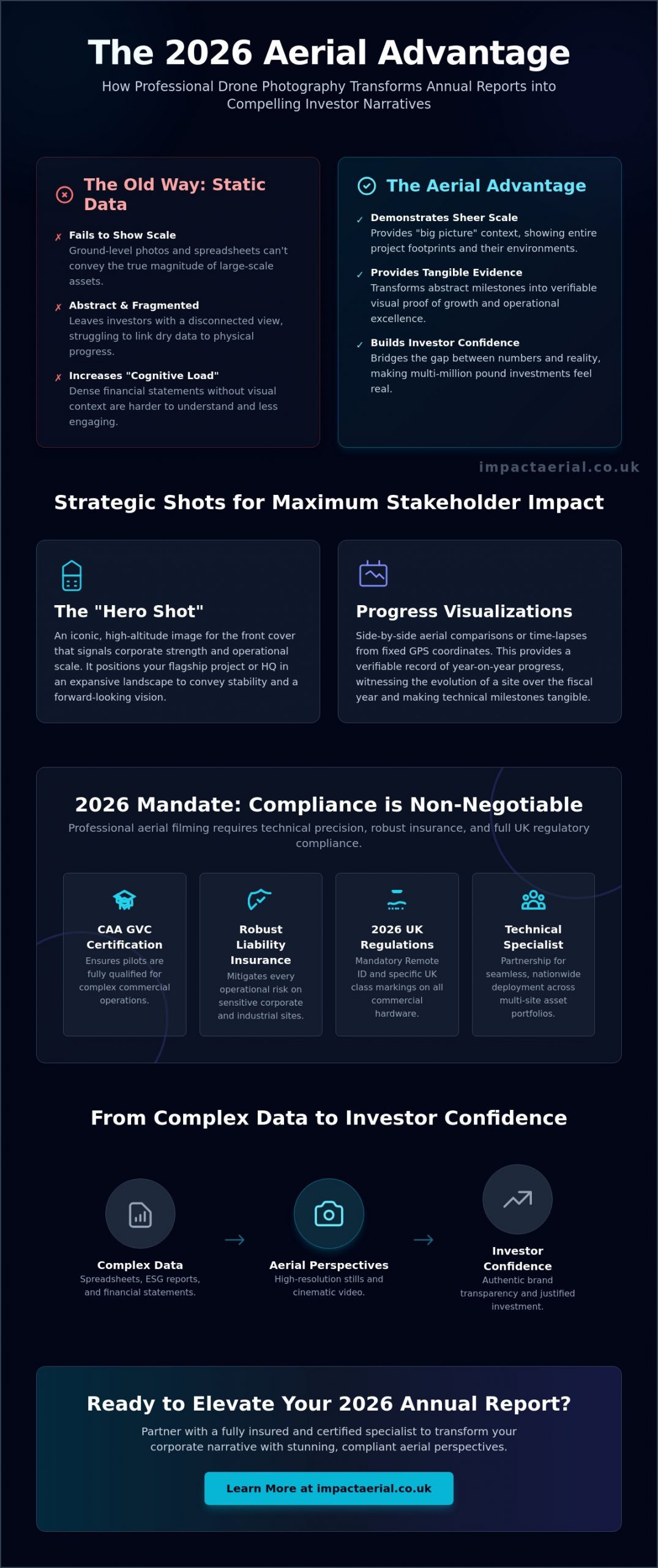
Navigating UK Compliance: Safety and Insurance Standards
Executing professional drone photography for annual reports isn’t just a creative endeavor; it’s a regulated aviation activity that carries significant legal weight. In the corporate sector, where reputational risk is as critical as physical safety, adhering to the latest Civil Aviation Authority (CAA) standards is non-negotiable. As of January 1, 2026, the UK regulatory framework has fully diverged from previous standards, mandating specific UK class markings (UK1 to UK6) and Remote ID broadcast capabilities for commercial operations. Ensuring your photography provider holds a valid UK drone license and a GVC (General Visual Line of Sight Certificate) is the first step in protecting your organization from significant legal liability.
Insurance remains a cornerstone of corporate risk mitigation. While the legal minimum for commercial third-party liability is £0.75 million, this is often insufficient for high-value industrial sites or congested urban projects. We consider £5 million in commercial liability insurance to be the professional standard for UK corporate photography. This level of coverage provides the psychological comfort and financial security required when operating near expensive infrastructure or public spaces. It ensures that should an incident occur, the financial and legal fallout doesn’t land on your balance sheet. Our commitment to these standards reflects the meticulous approach required for high-tier corporate reporting.
Safety is built on methodical preparation, not luck. A professional operator provides a comprehensive suite of Risk Assessment Method Statements (RAMS) and pre-flight surveys before any hardware leaves the ground. These documents aren’t just paperwork; they’re a technical roadmap for safe operation. They detail how the pilot will manage site-specific hazards, from overhead power lines to personnel movements, ensuring the shoot proceeds without disrupting your daily operations. This level of oversight is what separates a professional service from a casual operator.
Vetting Your Drone Service Provider
When procurement teams vet a drone partner, they must look beyond the portfolio. A robust checklist includes verifying current CAA certifications, checking the validity of EC785/2004 compliant insurance, and confirming the use of enterprise-grade hardware. We utilize DJI Enterprise systems, which offer 4K HDR clarity and enhanced signal reliability compared to consumer models. Hiring “hobbyist” pilots might seem cost-effective, but they lack the necessary legal certifications and industrial-grade safety features, posing a massive reputational risk to your brand if regulations are breached.
Operational Safety in Urban and Industrial Zones
Capturing assets in congested areas like Birmingham or the West Midlands requires advanced coordination. This often involves liaising with local authorities and Air Traffic Control (ATC) to secure permissions for restricted airspace. Professional pilots manage these complexities by using green flashing anti-collision lights for night operations and broadcasting Remote ID as required by 2026 laws. This methodical approach allows us to capture stunning visuals in the heart of industrial hubs while maintaining the highest possible safety standards for your staff and the public.
Maximising Visual ROI: Integrating Drone Imagery into Your Report
Securing high-tier aerial imagery is only the first stage of the process. To truly maximise your return on investment, you must integrate these assets strategically within your report’s layout. Wide-angle aerial shots are exceptionally effective when used as section breaks or double-page spreads, providing a visual “breather” between data-heavy pages. By applying professional colour grading that aligns with your corporate brand guidelines, we ensure that every aerial asset feels like a native part of the document rather than a generic stock image. This meticulous attention to post-production detail maintains a cohesive brand identity throughout the statutory filing.
One of the most effective ways to use drone photography for annual reports in 2026 is through the use of data overlays. By annotating high-resolution aerial shots with key performance indicators (KPIs) or project metrics, you transform a beautiful image into a functional data tool. For example, an aerial view of a logistics hub can be overlaid with throughput statistics or expansion percentages. This approach allows stakeholders to digest complex information quickly, as the visual context provides an immediate anchor for the numerical data. It’s a sophisticated method of storytelling that bridges the gap between the boardroom and the field.
Designing for Digital and Print
Professional output requires a dual-track approach to resolution and formatting. High-end lithographic printing demands a minimum of 300 DPI at the final output size to maintain crispness. Conversely, digital annual reports benefit from cinematic drone loops and 4K video backgrounds that bring the document to life on a screen. We also recommend creating short social media teasers from drone B-roll to build anticipation for the report’s official launch. This multi-channel utility ensures that your investment in aerial filming works harder across all corporate communications.
The Narrative Flow: From Sky to Boardroom
A well-structured report uses a wide-to-tight sequence to guide the reader’s eye from the broad corporate vision down to specific operational successes. While our drone photography guide covers the technicalities of capture, the implementation phase is where the brand narrative truly takes shape. Integrating these expansive views with executive headshots and ground-level team photos creates a balanced, human-centric story of growth. If you are ready to transform your 2026 reporting with precision-engineered visuals, contact Impact Aerial to discuss our specialist post-production and filming services.
Partnering with Impact Aerial for Your 2026 Annual Report
Choosing a technical partner for your corporate reporting is a decision that balances creative vision with rigorous risk management. Impact Aerial doesn’t operate as a simple photography agency; we act as a specialized technical consultancy. We understand that utilizing professional drone photography for annual reports requires a deep appreciation for the high stakes of corporate compliance and investor relations. Our team brings a wealth of experience in delivering high-tier drone services across the UK, ensuring that your most critical statutory documents are supported by imagery that projects authority and scale.
Based in Birmingham, our central location allows us to deploy rapidly to corporate sites and infrastructure projects nationwide. This geographical advantage is paired with a methodical, consultative workflow. We guide your team from the initial concept and airspace feasibility checks through to the final post-production stages. By handling the complex logistics of CAA authorizations and site-specific safety protocols, we allow your marketing and IR teams to focus on the narrative while we secure the visual evidence. Our commitment to the highest safety and quality standards in the industry ensures that your shoot is seamless, safe, and fully compliant with 2026 regulations.
Our Technical Expertise
We utilize commercial-grade DJI Enterprise hardware to ensure unmatched image stability and 4K HDR quality, even in challenging industrial environments. This professional-grade equipment is essential for capturing the fine details required for high-resolution print and interactive digital reports. Our post-production capabilities are equally rigorous. We provide meticulous colour grading and retouching to ensure your assets are “boardroom ready” and perfectly aligned with your corporate brand guidelines. Whether your assets are in the property, construction, or energy sectors, we have the sectoral experience to highlight your operational strengths from the most impactful perspectives.
Start Your Project Consultation
Success in the annual reporting season depends on early preparation and clear communication. Our specialized approach to drone photography for annual reports involves working closely with your team to identify the key visual assets that will resonate most with your stakeholders. Because the reporting window is often tight and weather-dependent, we strongly recommend early booking to secure your required flight dates. Contact Impact Aerial today for a bespoke quote and a comprehensive safety consultation. Let’s discuss how our technical precision and aerial expertise can elevate your corporate transparency and build lasting investor trust for 2026.
Elevate Your Stakeholder Communications with Precision
Statutory reporting in 2026 demands more than just transparency; it requires a compelling visual narrative that justifies your corporate scale. By moving beyond static ground-level shots, you provide investors with a verifiable perspective of your infrastructure and ESG progress. We’ve explored how the strategic application of drone photography for annual reports bridges the gap between complex financial data and tangible operational success. This approach ensures your brand narrative remains grounded in physical reality while projecting a forward-thinking, technologically adept image to the market.
Success depends on more than just high-resolution imagery. It requires a partner who prioritizes safety and rigorous regulatory compliance. Our Birmingham-based team provides UK-wide coverage, utilizing CAA GVC certified pilots and maintaining £5m in commercial liability insurance to protect your reputation and assets. Don’t leave your corporate image to chance with non-compliant operators who lack the necessary technical credentials. Request a bespoke quote for your annual report photography from Impact Aerial today and ensure your 2026 filings set a new standard for corporate excellence. We’re ready to help you showcase the true reach and impact of your organization.
Frequently Asked Questions
Do I need special permission to fly a drone over my company’s site for an annual report?
Yes, you generally need permission from the land owner to take off and land on private property. If your corporate site is located within a Flight Restriction Zone (FRZ) or a congested urban area, the pilot must also coordinate with Air Traffic Control or local authorities. A professional operator handles these complex logistics and permissions as part of the standard pre-flight planning process.
How much does professional drone photography for a corporate report cost?
The investment for professional aerial services depends on several technical variables, including the site’s location, the duration of the flight, and the complexity of the required shots. Projects involving multiple regional sites or advanced post-production will require a different scope than a single-site “hero shot.” We provide bespoke quotes tailored to the specific technical requirements of your project.
What happens if the weather is bad on the day of the scheduled drone shoot?
Safety is our primary concern, and we don’t operate in high winds or precipitation that exceeds the hardware’s safety limits. We monitor meteorological forecasts closely in the days leading up to your shoot. If conditions are unsafe for flight, we’ll coordinate with your team to reschedule for the next available clear-weather window to ensure the highest image quality.
Can drone photography be used to show internal factory or warehouse operations?
Yes, we can capture internal operations using specialized indoor flight protocols and smaller, guarded UAVs. This is an effective way to demonstrate the scale of automated logistics or manufacturing lines. Indoor flight requires meticulous planning to manage lighting challenges and ensure the total safety of your personnel and sensitive equipment throughout the process.
What is the difference between a standard drone photo and a survey-grade aerial image?
A standard drone photo is an aesthetic asset designed for visual storytelling and brand narrative. In contrast, a survey-grade image is a data-centric asset captured with high-precision GPS for 2D mapping or 3D modeling. While standard shots are ideal for report covers, survey-grade imagery provides the technical accuracy needed for detailed infrastructure progress and site documentation.
Is drone photography compliant with GDPR if people are visible in the shots?
Professional drone photography for annual reports must comply with GDPR if individuals are identifiable in the captured imagery. We employ “privacy by design” by flying at altitudes where faces aren’t recognizable or by blurring identifiable features during post-production. It’s also standard practice for companies to inform employees of the shoot date so they can avoid the flight area.
How long does the post-production process take for aerial images?
The post-production phase typically takes between three to five business days depending on the volume of assets and the complexity of the editing. This process includes professional colour grading, retouching to match your corporate brand guidelines, and any required data overlays. We understand the tight deadlines of the reporting season and ensure your visuals are boardroom-ready on schedule.
Why is £5m liability insurance necessary for a simple drone photo shoot?
While the legal minimum is lower, £5 million in commercial liability insurance is the professional standard for corporate environments. This level of coverage protects your organization against the significant financial risks associated with operating near high-value industrial assets or public spaces. It provides the necessary reassurance that all operational risks are fully mitigated by your service provider.
Why Hire a GVC Certified Drone Pilot? The 2026 Business Risk & ROI Guide
What if the drone data you collected for a construction site survey was legally inadmissible because of a certification technicality that didn’t exist last year? With the Civil Aviation Authority recording 312 height violations by novice pilots in a single year and the cost of operational authorizations doubling to £500, the margin for error in UK airspace has disappeared. Understanding why hire a gvc certified drone pilot is no longer just a matter of image quality; it’s a critical step in shielding your business from the 2026 regulatory shift and the substantial liability of non-compliant flights.
You likely recognize that aerial intelligence is vital for modern project management, yet the transition from the GVC to the new Remote Pilot Certificate (RPC) framework has left many corporate leaders uncertain about their insurance coverage. This guide explains how a certified professional mitigates these risks and unlocks complex operations in congested urban environments. We’ll preview the latest CAA requirements, the financial impact of the 2026 mandates, and how to ensure your project benefits from high-quality 4K or thermal data without exposing your firm to legal or physical hazards.
Key Takeaways
- Understand why the GVC standard is the mandatory benchmark for the CAA’s Specific Category, ensuring your commercial projects remain legal under the 2026 framework.
- Learn how GVC certification allows pilots to operate in congested urban environments that are legally off-limits to hobbyists or basic drone operators.
- Discover the “Insurance Void” risk and understand why hire a gvc certified drone pilot to ensure your corporate public liability remains valid during aerial operations.
- Use our professional procurement checklist to verify essential credentials, including the Operational Authorisation (OA) document and current certification expiry dates.
- Identify how elite DJI Enterprise hardware provides the high-precision 4K and thermal data required for accurate construction monitoring and solar farm surveys.
Defining the GVC Standard: The Specific Category in 2026
The General Visual Line of Sight Certificate (GVC) stands as the definitive professional benchmark for commercial drone operations in the UK. While basic flyer IDs satisfy casual users, businesses requiring aerial intelligence must understand why hire a gvc certified drone pilot to ensure their projects meet the rigorous demands of the “Specific Category.” This category is where the professional work happens. It covers flights that fall outside the basic limitations of the Open Category, such as operating heavier aircraft or flying in complex environments. Under UK drone regulations, the GVC is the mandatory prerequisite for any operator seeking to obtain a formal CAA Operational Authorisation (OA).
The arrival of 2026 has brought a new level of scrutiny to the industry. Mandatory Remote ID broadcasting for new drones sold from January 1, 2026, has created a transparent digital footprint for every flight. This technology makes it easier for authorities to distinguish between compliant professionals and uncertified hobbyists. For corporate clients, this means that hiring an unvetted pilot is no longer a hidden risk; it’s a visible liability. Professional pilots with a GVC have undergone formal flight assessments and theoretical examinations to manage these risks effectively. This industry-wide focus on transparency and professional standards is also reflected in detailed service guides from instituteofphotographers.co.uk, which help clients navigate professional photography costs for the coming year.
GVC vs. A2 CofC: Which Does Your Project Require?
Many project managers mistakenly believe an A2 Certificate of Competency (A2 CofC) is enough for industrial work. It’s often insufficient. The A2 CofC is designed for low-risk flights with smaller drones. If your project involves a drone over 2kg or requires operations in a busy town centre, a GVC is usually the legal requirement. GVC pilots operate under an approved Operations Manual, which allows them to fly closer to uninvolved people than the standard 30m or 50m rules typically allow in the Open Category. Without this certification, your project could be legally grounded before the drone even takes off.
The Role of the Civil Aviation Authority (CAA) in 2026
The Civil Aviation Authority (CAA) has significantly tightened its oversight this year. They now monitor compliance through detailed flight logs and real-time Remote ID data. Hiring an uncertified operator for commercial gain isn’t just a safety risk; it’s a legal one that can lead to heavy fines for the hiring company. Impact Aerial prioritises total compliance, maintaining the highest drone license standards to protect our clients’ interests. We ensure every flight is logged, authorised, and fully transparent to the regulator, providing the reassurance that your data is collected legally and safely.
Unlocking Congested Areas: Where GVC Pilots Outperform Hobbyists
Operating a drone in a town centre or on a busy industrial estate isn’t just a technical challenge; it’s a legal one. While hobbyists and basic operators are often grounded by the strict distance requirements of the Open Category, GVC holders possess the qualifications to operate within the “Specific Category.” This distinction is a primary reason why hire a gvc certified drone pilot for urban projects. These professionals operate under a Civil Aviation Authority (CAA) approved Operations Manual, which provides the legal framework to fly closer to uninvolved persons than would otherwise be permitted. This capability is essential for executing high-precision town centre roof surveys or monitoring active construction sites where space is at a premium.
The technical advantage of a GVC holder extends to the hardware they can legally deploy in these sensitive zones. While lighter drones are common for simple photography, complex industrial tasks often require heavier, enterprise-grade aircraft like the DJI Mavic 3 Enterprise. These platforms offer superior stability and sensor quality but fall into weight classes that require specific permissions for urban use. By adhering to the Civil Aviation Authority (CAA) pilot competency requirements, GVC pilots ensure that these powerful tools are used safely and legally in environments where a less qualified operator would be committing a regulatory breach.
Operating Under PDRA-01 Framework
The PDRA-01 (Pre-Defined Risk Assessment) framework is the “gold standard” for professional drone operators in the UK. It simplifies the permissions process for GVC holders, allowing them to fly within 150m of residential, commercial, or industrial areas. For a project manager, this means more efficient drone survey workflows. Instead of spending weeks seeking bespoke permissions for every flight, a GVC pilot uses their standing Operational Authorisation to deploy rapidly. This agility is vital for construction site monitoring, where weekly or even daily progress updates are required in built-up locations.
Complex Missions: Beyond Simple Photography
Professional aerial work in 2026 involves far more than just taking pictures. Industrial applications like thermal solar farm surveys and 3D photogrammetry require a level of technical precision that hobbyist training simply doesn’t cover. Collecting data with a specialized survey drone involves complex flight paths and rigorous risk assessments that account for electromagnetic interference and local obstacles. If you’re planning a mission in a high-stakes industrial zone, consulting with an experienced GVC partner ensures that your data is accurate and your operational risk is managed to the highest professional standards.
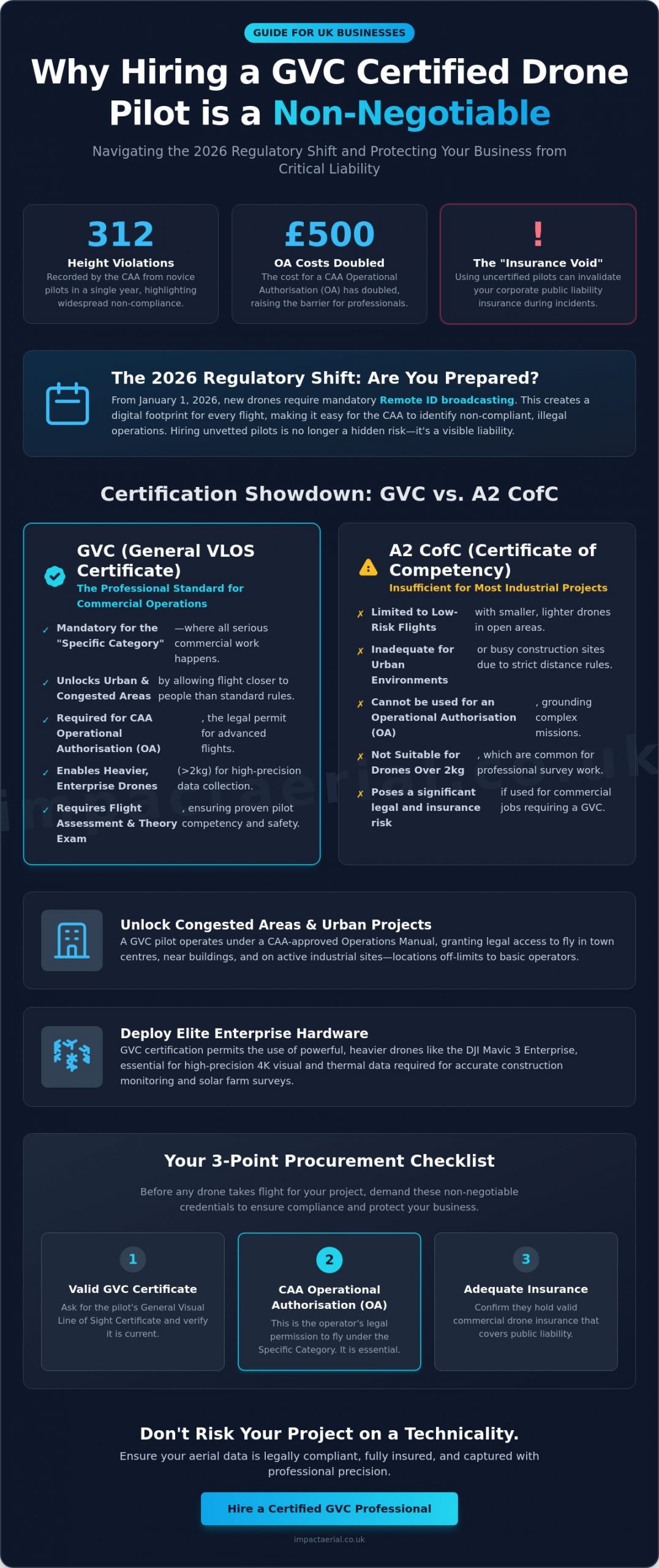
Risk Mitigation: Why GVC Certification Protects Your Business
Hiring a drone operator isn’t just about the visual output; it’s about the legal and financial shield that professional certification provides. A primary reason why hire a gvc certified drone pilot is the assurance that your project is backed by a professional who can conduct rigorous, site-specific risk assessments. Without this qualification, a pilot lacks the formal training required to manage the complex variables of a commercial environment. This oversight often leads to the “Insurance Void,” a dangerous scenario where your corporate liability insurance is rendered useless because the flight was technically illegal.
Commercial drone insurance (EC 785/2004) is only valid if the pilot is operating within their legal permissions.
If an incident occurs during a flight that exceeds the pilot’s certification limits, the insurer has grounds to refuse the claim. For a business, this means you are personally liable for any damages or injuries. Beyond the financial impact, a CAA investigation can cause irreparable reputational damage to your brand. Following the Official GVC requirements ensures that the pilot has the competency to stay within the law, protecting your firm from both legal and public relations disasters.
The £5m Commercial Liability Standard
Safety Protocols and the Operations Manual
A GVC pilot doesn’t just fly; they follow a legally binding Operations Manual approved by the CAA. This document outlines every safety protocol, from pre-flight site surveys to emergency procedure drills. These mandated standards are what make complex aerial filming drone missions safe and predictable. By adhering to these protocols, pilots identify hazards like overhead power lines or magnetic interference before the aircraft leaves the ground. This meticulous approach to safety is what separates a professional GVC pilot from a casual operator, ensuring that every flight is a controlled, low-risk event.
Vetting Your Drone Provider: A Procurement Checklist
Procuring aerial services requires more than a simple price comparison. To protect your business interests, you need a structured vetting process. Understanding why hire a gvc certified drone pilot is the foundation, but you must verify the pilot’s specific operational credentials before they arrive on site. Use this five-step checklist to ensure your provider is fully compliant with 2026 standards.
- Step 1: Request the Operational Authorisation (OA) document. A basic Flyer ID is only for recreational use or very low-risk flights; professional commercial work in the Specific Category requires a valid OA.
- Step 2: Verify the GVC certificate and its expiry date. This confirms the pilot has passed the necessary flight assessments and theoretical exams.
- Step 3: Check for commercial-grade insurance compliant with EC 785/2004. Standard public liability is often insufficient for drone-related incidents.
- Step 4: Review the provider’s experience in your specific sector. A pilot skilled in cinematic filming might not have the technical discipline required for a high-precision construction site survey.
- Step 5: Confirm the use of 2026-compliant hardware. Ensure the aircraft has active Remote ID broadcasting, as this is now a mandatory requirement for most commercial operations in urban areas.
Reading the Operational Authorisation (OA)
The OA is the most critical document in a professional pilot’s folder. When reviewing it, look closely at the “Permissions” section to see exactly what the CAA has authorised them to do. Always check that the company name on the OA matches the name of your contractor. If the names don’t match, the pilot may not be legally covered under that specific authorisation. Pay attention to the expiry date as well; multi-month projects require an OA that remains valid for the duration of the work to avoid operational pauses.
Technical Capability and Hardware
Hardware choice directly impacts your project’s ROI. Enterprise drones deliver significantly better data quality than consumer models because they’re built for precision rather than recreation. Professional drone services rely on 4K HDR and thermal sensors to provide actionable insights for solar farm surveys or property inspections. Beyond the aircraft, ensure your pilot has the data processing capabilities to handle post-production. High-resolution data is only useful if it’s processed into a format your team can use for decision-making. If you’re ready to secure a fully vetted operator, contact Impact Aerial today for a compliant, professional consultation.
Why Impact Aerial is the UK’s Trusted GVC Partner
Choosing a drone partner in 2026 requires a shift from seeking simple photography to finding a technical consultancy that understands the intersection of aviation law and commercial data. Impact Aerial occupies this space as a specialist provider. Centrally based in Birmingham, our location allows for rapid deployment across the West Midlands and the wider UK, ensuring we’re on-site when your project timeline demands it. We don’t just fly; we operate an elite DJI Enterprise fleet equipped with the latest 4K and thermal sensors, providing the high-tier quality required for the high-stakes construction and property sectors.
Our team manages the entire operational lifecycle. This full-service approach starts with CAA-compliant flight planning and risk mitigation, extending through to professional post-production services. This end-to-end oversight is a significant reason why hire a gvc certified drone pilot from a dedicated firm rather than a freelance operator. We provide the administrative and technical infrastructure that ensures your aerial data is collected legally, safely, and to an exacting professional standard.
Expertise in Regulated Environments
We’ve built our reputation on navigating the most complex UK airspace. Whether your project is situated near a major airport or in the heart of a congested city centre, we possess the experience to secure the necessary permissions. Our team has a deep understanding of construction site monitoring safety requirements, where the environment is constantly changing and the margin for error is zero. We don’t just show up and fly. We take a collaborative approach, working closely with site managers and safety officers to ensure our operations cause zero disruption to your active workforce or machinery.
Data Precision and Commercial ROI
Our GVC-certified workflows are designed to deliver actionable data that drives decision-making. Pretty pictures have their place, but in a commercial context, you need precision. We provide custom reporting for drone commercial property surveys and PV solar farm thermal inspections, identifying defects or progress milestones with surgical accuracy. This level of detail ensures that your investment in drone technology translates directly into saved time and reduced operational costs. When you’re ready to future-proof your next project with a compliant and technologically adept partner, request a quote from Impact Aerial to secure your 2026 project schedule.
Future-Proof Your Aerial Strategy
As the UK’s aviation framework evolves, the distinction between a casual operator and a professional partner has never been more critical for corporate liability. We have outlined how GVC certification serves as a mandatory gatekeeper for the Specific Category, allowing for complex operations in congested urban environments that are legally restricted for others. Understanding why hire a gvc certified drone pilot is essential for any project manager who values regulatory compliance, insurance validity, and the technical precision of high-end data collection.
Impact Aerial provides the expertise needed to navigate these 2026 mandates with confidence. By combining our CAA GVC Certified Pilots with £5m in commercial liability insurance and the latest DJI Enterprise 4K and thermal technology, we ensure your project is delivered without operational or legal risk. Don’t leave your corporate reputation to chance in a shifting regulatory landscape.
Book a GVC-certified pilot for your next UK project and gain the aerial intelligence your business needs to lead its sector.
Frequently Asked Questions
What is the difference between a GVC and an A2 CofC?
The GVC allows pilots to operate in the Specific Category, whereas the A2 CofC is restricted to the Open Category. While an A2 CofC is suitable for low-risk flights with smaller aircraft, the GVC is the professional standard for complex missions in congested areas. It requires a more rigorous assessment and is the prerequisite for obtaining a CAA Operational Authorisation.
Do I legally need a GVC pilot for a drone roof survey in the UK?
You legally require a GVC-certified pilot if the roof survey is located in a congested area or town centre. Standard Open Category rules usually forbid flying close to uninvolved persons or buildings. A pilot with a GVC operates under an Operational Authorisation, which provides the necessary legal permissions to fly in these restricted urban environments safely and legally.
Will my company be liable if an uncertified drone pilot has an accident?
Yes, your company can face significant legal and financial liability if you hire an uncertified operator. This is a major reason why hire a gvc certified drone pilot; their certification ensures they are operating within the law. If an accident occurs during an illegal flight, your corporate insurance will likely be void, leaving your firm responsible for all damages.
How much insurance should a professional drone pilot have in 2026?
A professional drone pilot must have insurance that is compliant with EC 785/2004. While the legal minimum depends on the drone’s weight, the industry standard for commercial projects in 2026 is at least £5 million in public liability cover. This ensures that even high-stakes incidents on industrial or construction sites are fully covered without financial risk to your business.
What is a CAA Operational Authorisation (OA) and why is it important?
An Operational Authorisation is a formal document issued by the CAA that allows a pilot to fly outside standard Open Category limits. It’s important because it proves the pilot’s Operations Manual and safety protocols have been vetted by the regulator. Without a valid OA, a pilot cannot legally perform complex commercial tasks in congested areas or near uninvolved people.
Can a GVC pilot fly in restricted airspace or near airports?
A GVC pilot can fly in restricted airspace or Flight Restriction Zones near airports, provided they secure the correct ATC permissions. Their advanced training includes the communication protocols required to coordinate with Air Traffic Control. This expertise is another reason why hire a gvc certified drone pilot, as they can manage the complex logistics of flying in sensitive airspace.
How do I verify a drone pilot’s GVC credentials before hiring?
You should ask to see both the pilot’s GVC certificate and their company’s current Operational Authorisation document. Verify that the company name on the OA matches the contractor’s name and check the expiry dates. A legitimate professional will always be able to provide these documents along with proof of insurance that meets the EC 785/2004 commercial standard.
Are there specific drone rules for construction sites in 2026?
Yes, construction sites in 2026 are subject to strict Remote ID mandates and Specific Category regulations. Most sites are classified as congested or industrial areas, meaning a GVC is practically mandatory for legal flight. Pilots must also ensure their aircraft broadcast real-time identification data to remain compliant with the latest CAA safety and security standards during the project.
How to Prepare a Site for a Drone Survey: A Professional UK Guide
A professional drone survey is won or lost on the ground before the rotors even spin. You likely recognize that high-precision aerial data is a game-changer for your project, yet the fear of receiving inaccurate results or falling foul of strict CAA regulations remains a significant hurdle. It’s frustrating to schedule a survey only to find that site access issues or ongoing work disruptions compromise the entire operation and lead to costly delays.
This guide provides a definitive framework on how to prepare a site for a drone survey, ensuring you master the physical and administrative requirements for a seamless, high-precision operation. By following these steps, you’ll gain the confidence that your site is ready for a safe, compliant mission. We will walk through essential ground control point placement, UK legal compliance under the 2026 standards, and strategies to maintain site productivity while GVC-certified pilots capture the technical data your business requires. Our goal is to provide a meticulously structured approach that ensures your data is accurate and your site remains fully operational throughout the process.
Key Takeaways
- Understand the “clean data in, clean data out” principle to ensure your survey results meet professional precision standards.
- Master the technical steps of how to prepare a site for a drone survey, including vegetation management and Ground Control Point (GCP) placement.
- Ensure full regulatory compliance by verifying pilot qualifications and reviewing site-specific risk assessments before operations begin.
- Coordinate site personnel effectively to maintain safety and productivity during the data collection process.
- Learn how commercial-grade hardware and GVC-certified expertise mitigate risks and deliver superior data density.
Why Site Preparation is Critical for Accurate Drone Data
Site preparation isn’t just a preliminary chore; it’s the technical foundation of every successful drone survey. If you want high-precision outputs, you have to adopt the “Clean Data In, Clean Data Out” mindset. This process involves clearing physical obstacles and establishing precise data markers before the aircraft ever leaves the ground. Without this meticulous groundwork, the raw images captured will contain “noise” that compromises the integrity of your 3D models and orthomosaic maps.
Professional surveyors use the science of photogrammetry to turn these images into measurable data. If the site is cluttered or markers are obscured, the software struggles to align pixels accurately, leading to distorted results. Proper preparation ensures the digital twin of your site is a faithful, centimetre-accurate representation of reality.
To better understand this concept, watch this helpful video:
Meticulous preparation significantly reduces flight time. It ensures the pilot can focus on the flight path rather than dodging unexpected machinery or searching for hidden markers. More importantly, it avoids the high costs associated with site re-visits, which occur when data is found to be insufficient during post-production. It’s far more efficient to clear the site once than to pay for multiple mobilisations.
The Consequences of Inadequate Preparation
When ground features are obscured by overgrown vegetation or debris, it creates significant gaps in topographic data. The drone cannot see through solid objects; if it can’t see the ground, it can’t measure it accurately. Beyond data quality, unmanaged hazards pose serious safety risks. If a pilot identifies uncoordinated site activity or physical dangers during their risk assessment, they may deem the site unsafe. This leads to immediate project delays and potential financial penalties for lost operational windows.
Defining Your Survey Objectives
You must clearly communicate the exact survey boundaries to the pilot to ensure the flight plan covers every necessary square metre without missing critical edge data. Understanding how to prepare a site for a drone survey also depends on whether you need a basic visual inspection or high-accuracy mapping. A marketing video requires different prep than a survey intended for CAD integration. Your “End Use” dictates the intensity of the preparation; high-accuracy engineering projects require a far more rigorous setup of ground markers than a simple progress photo.
Physical Site Readiness: Ground Control and Surface Conditions
Achieving sub-centimetre precision requires more than just launching a drone; it demands a “static” and controlled environment. Understanding how to prepare a site for a drone survey starts with meticulous vegetation management. If you are commissioning a topographic survey, overgrown grass, thick shrubs, or piles of green waste will obscure the true ground level. This leads to significant inaccuracies in your digital terrain model. You should ensure that the ground surface is as visible as possible, particularly in areas where elevation changes are critical for your engineering data.
Lighting and timing are equally vital considerations for data quality. Deep shadows cast by buildings or large trees can hide essential details and confuse the photogrammetry software. While our pilots manage the specific flight windows to align with UK Civil Aviation Authority (CAA) regulations, your assistance in clearing transient vehicles and machinery creates a consistent dataset. A site that remains stationary during the flight ensures that the “stitching” process in post-production is seamless and error-free.
Ground Control Points (GCPs) vs. Checkpoints
GCPs are the physical anchors of your survey. These are markers placed on the ground with coordinates measured by a high-precision GNSS rover. For most commercial drone mapping projects, five to ten ground control points provide sufficient control to ensure global accuracy. You should use high-contrast markers, such as black and white “checkerboard” targets, which are easily identifiable from a flight altitude of 120 metres. While GCPs are used to “pin” the map to the earth, separate “checkpoints” are used by our team to independently verify the final accuracy of the model.
Managing Site Obstructions and Hazards
A successful mission requires a clear and secure Take-off and Landing Area (TOLA). This zone must be cordoned off from personnel and moving equipment to ensure a safe environment. You should also identify and communicate the presence of temporary hazards like cranes, scaffolding, or high-reach platforms that may not be present on satellite imagery. Clearing scattered debris is also helpful; loose materials can often be mistaken for permanent site features in complex 3D models. If you are unsure about specific site risks, our specialists can help you coordinate a drone survey plan that accounts for every physical variable on your premises.
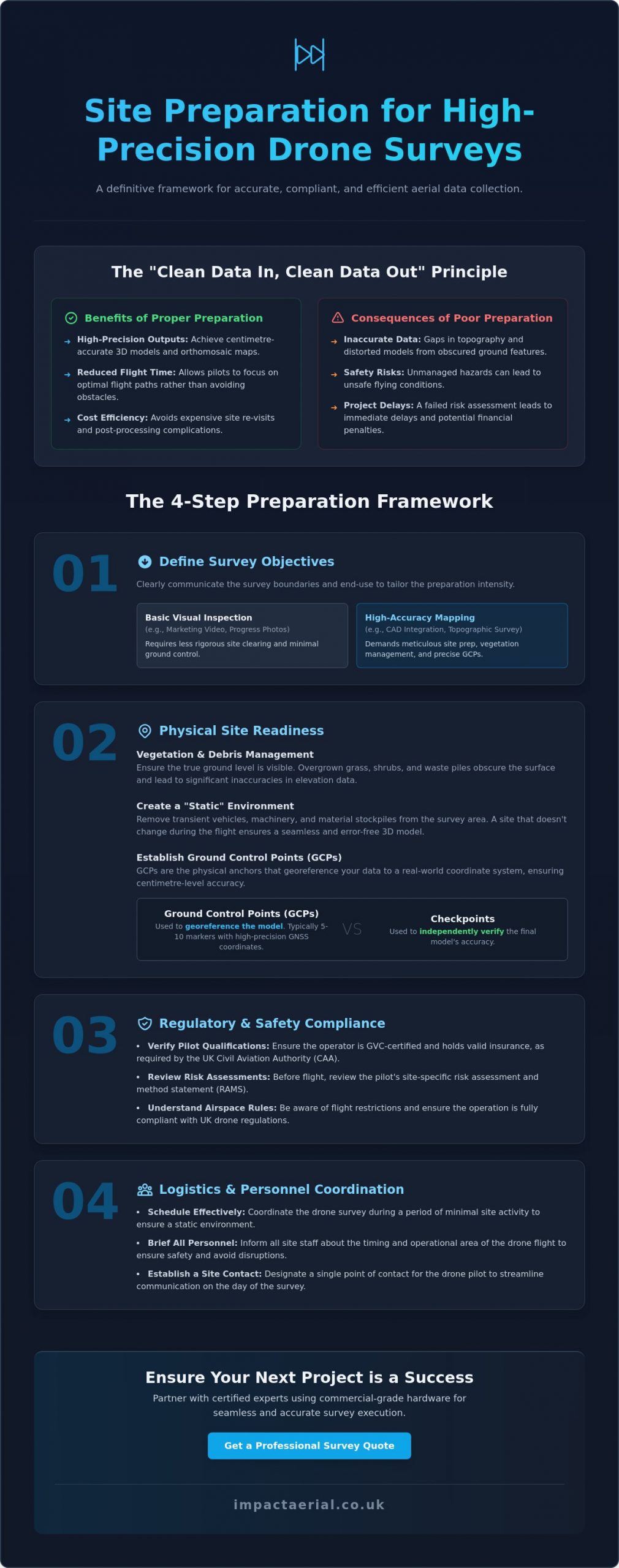
Regulatory and Safety Compliance in the UK
A professional operation is built on a foundation of rigorous compliance. When considering how to prepare a site for a drone survey, your first administrative priority is verifying the credentials of your chosen operator. In the UK, professional pilots must hold a UK drone license, specifically the General Visual Line of Sight Certificate (GVC). This qualification demonstrates that the pilot has undergone formal theory and flight assessments and is authorized by the Civil Aviation Authority (CAA) to conduct complex commercial operations. You should always request a copy of their GVC and their current Operational Authorisation before work begins.
The technical preparation involves more than just checking a badge; it requires a comprehensive Pre-flight Information Bulletin (PFIB) and a site-specific risk assessment. These documents aren’t mere formalities. They outline the operational parameters, emergency procedures, and safety mitigations tailored to your specific environment. Our pilots consult the latest Civil Aviation Authority drone guidance (CAP 722) to ensure every flight path respects national airspace standards and safety protocols. Furthermore, high-risk commercial sites require substantial protection; we maintain £5m in commercial liability insurance to provide absolute peace of mind for our clients.
CAA Regulations and Site Access
The UK regulatory framework distinguishes between the “Open” and “Specific” categories of flight. Most commercial surveys on busy construction sites or industrial areas fall under the “Specific” category, which allows for flight closer to people and buildings than the basic regulations permit. You’ll need to assist the pilot by managing public rights of way and notifying neighbouring properties if the flight path overlaps their boundaries. It is a legal requirement that the CAA-certified pilot retains final authority on all safety matters; they have the right to pause or cancel a flight if the environment becomes unsafe.
Conducting a Pre-Flight Walkthrough
A joint walkthrough between the site manager and the UAV pilot is an essential step in your preparation. This physical inspection allows you to identify “No-Fly Zones” or sensitive infrastructure, such as nearby railway lines, high-voltage substations, or telecommunications towers, which may cause electromagnetic interference. During this time, the pilot will perform a final check of the Remote ID broadcast and local NOTAMs (Notices to Airmen) to ensure no temporary flight restrictions have been issued for the area. This collaborative approach ensures that the flight is both legally compliant and operationally efficient.
Logistics and Personnel: Coordinating Your Site Team
While physical ground prep and regulatory checks are essential, the success of an aerial mission often hinges on the human element. Mastering how to prepare a site for a drone survey requires a structured approach to internal communication. You must brief all site staff, subcontractors, and visiting stakeholders on the specific flight schedule well in advance. This avoids the “spectator effect” and ensures that ground-level work continues safely without personnel inadvertently wandering into active flight zones or take-off areas.
Establishing a secure “Staging Area” is a non-negotiable requirement for professional operations. This zone serves as the pilot’s command centre, where equipment is calibrated and batteries are managed. It must be cordoned off from heavy machinery and foot traffic to prevent accidental damage or interference. By providing a dedicated, quiet space for the survey team, you allow the pilot to focus entirely on the technical execution of the flight and the integrity of the data being captured.
Internal Communication and Staff Safety
Issuing a “Site-Wide Alert” via email or during the morning toolbox talk is the most effective way to manage expectations. This alert should clearly define the duration of the survey and the specific areas where the drone will be operating. It’s vital to remind personnel to stay clear of the Take-off and Landing Area (TOLA) during active rotors-turning periods. Additionally, site managers should be prepared to manage curious visitors or delivery drivers; a drone can be a significant distraction, and maintaining site focus is paramount for overall safety compliance.
Site Access and Logistics
Logistical delays are easily avoided with a bit of foresight. You should ensure the pilot has all necessary gate access codes and security clearances before they arrive at the perimeter. Providing high-resolution site maps or CAD overlays in advance allows our team to integrate your site’s specific geometry into the flight software. On-site, the survey vehicle needs safe parking as close to the take-off point as possible to facilitate equipment swaps. If the survey is extensive, confirming access to a 240v power source for battery charging or mobile base stations will ensure the team maintains a high operational tempo throughout the day.
Appointing a dedicated site liaison to work alongside the pilot is highly recommended. This individual can provide real-time updates on moving hazards, such as crane movements or concrete pours, which might not be visible from the pilot’s perspective. This level of coordination is what separates a basic flight from a professional, high-precision survey operation. To ensure your next project is managed with this level of meticulous care, contact us to discuss our construction site monitoring services.
Partnering with Impact Aerial for Seamless Survey Execution
While understanding how to prepare a site for a drone survey is a critical responsibility for any site manager, the ultimate success of the data collection rests on the technical proficiency of your aerial partner. Impact Aerial bridges the gap between raw physical preparation and high-tier engineering outputs. We utilise commercial-grade DJI Enterprise drones, which are specifically engineered for superior data density and stability in challenging UK environments. These aircraft allow us to capture high-resolution imagery that forms the basis of centimetre-accurate digital twins.
Our operational framework is built on a foundation of safety and compliance. Every pilot at Impact Aerial is CAA GVC certified; this qualification is essential for navigating the complex regulatory requirements of active construction sites and industrial facilities. We manage every aspect of the project lifecycle, from the initial pre-flight risk assessment to the final delivery of processed data. This end-to-end management ensures that you don’t have to worry about the intricacies of aviation law or hardware maintenance. We offer an unparalleled level of security for our clients by maintaining £5m in commercial liability insurance, ensuring that every stakeholder on your site is fully protected.
Our Technology and Expertise
We leverage the latest advancements in aerial technology to deliver actionable insights. By using a specialised survey drone equipped with 4K HDR cameras and high-precision sensors, we capture the fine details required for professional-grade analysis. Our expertise extends beyond the flight; our post-production team processes raw aerial data into sophisticated 3D models, topographic maps, and orthomosaics. This multi-sector experience includes:
- Construction Site Monitoring: Tracking progress and identifying logistical bottlenecks in real-time.
- PV Solar Farm Thermal Surveys: Detecting cell defects and equipment inefficiencies with thermal imaging.
- Commercial Property Surveys: Providing high-resolution roof and facade inspections without the need for scaffolding.
Get Started with Your Professional Drone Survey
Choosing a professional drone service ensures that your site preparation efforts result in high-precision, usable data rather than just simple imagery. We understand the nuances of how to prepare a site for a drone survey and are ready to guide you through the administrative and physical requirements to ensure a successful mission. Our team is available to provide pre-survey consultations, helping you define your objectives and verify that your site is fully compliant before we mobilise.
Precision and safety are the core of our business. If you are ready to elevate your site data with professional aerial surveys, book your site assessment with Impact Aerial today.
Elevating Your Site Data with Professional Precision
A successful aerial mission is built on the rigorous groundwork established before the rotors even spin. By focusing on physical site readiness, ensuring strict CAA regulatory compliance, and maintaining clear internal communication, you eliminate the risks of data noise and operational delays. Mastering how to prepare a site for a drone survey transforms what could be a complex technical hurdle into a high-precision data asset for your project. This structured approach ensures that every flight is safe, efficient, and capable of producing the sub-centimetre accuracy your engineering or construction goals require.
Impact Aerial provides the technical expertise and operational security required for the most demanding UK sites. Based in the West Midlands and offering full UK coverage, our team utilizes a DJI Enterprise fleet and CAA GVC certified pilots to deliver superior data density. We provide total peace of mind through our £5m commercial liability insurance and end-to-end project management. Whether you require construction monitoring or a detailed topographic map, we ensure your data is accurate, compliant, and delivered on schedule.
Ready to capture high-precision insights for your next project? Request a Quote for Your Professional Drone Survey today and let our specialists manage the complexities of the airspace while you focus on your site’s success.
Frequently Asked Questions
Do I need to clear the entire site for a drone survey?
You don’t need to clear the entire premises, but you must ensure that the specific areas required for data collection are free from obstructions. For topographic mapping, the ground surface must be visible, so clearing overgrown vegetation and parked machinery in those zones is essential. If the survey is for a visual inspection of a roof or facade, clearing the ground level directly beneath the flight path is the priority to maintain safety cordons.
How long does a typical site preparation take?
Physical preparation usually takes a few hours to a full day, depending on the site’s complexity and size. Administrative tasks, such as securing permissions and notifying neighbours, should begin at least five working days before the flight. When planning how to prepare a site for a drone survey, it is best to complete debris removal and vegetation management forty-eight hours in advance to ensure the pilot has a clear environment upon arrival.
What happens if the weather is poor on the day of the survey?
The pilot makes a final “go or no-go” decision based on real-time weather data and safety parameters. High winds, typically exceeding 20mph, or any form of precipitation will usually result in a rescheduled flight to protect the equipment and ensure data integrity. We monitor forecasts closely in the forty-eight hours leading up to the mission to provide as much notice as possible if a delay is necessary due to adverse conditions.
Do I need to notify the police or CAA before the survey?
No, the responsibility for aviation notifications rests entirely with the drone operator. Professional pilots use specialized software to check for local flight restrictions and NOTAMs (Notices to Airmen) before every mission. If your site is located within an airport’s Flight Restriction Zone (FRZ), our team will coordinate directly with Air Traffic Control to secure the necessary flight permits and maintain legal compliance throughout the operation.
Can a drone survey be done while my staff are still working?
Yes, drone surveys are designed to minimize disruption, and work can usually continue as long as staff remain clear of the cordoned take-off and landing area. It is vital that all personnel are briefed on the flight schedule and understand the importance of staying outside the designated safety zones. Our pilots perform site-specific risk assessments to ensure that the flight path avoids active work areas where personnel density is highest.
What is the difference between a GCP and a checkpoint?
A Ground Control Point (GCP) is a marker used during the initial processing to “pin” the drone’s data to precise geographic coordinates. In contrast, a checkpoint is an independent marker used after the model is created to verify its accuracy. While GCPs build the map, checkpoints provide the mathematical proof that the survey meets the required precision standards. Using both ensures the highest level of data reliability for your project.
How much space does the pilot need for a take-off and landing area?
A clear, flat area of approximately 5m x 5m is generally sufficient for most DJI Enterprise drones used in commercial surveys. This Take-off and Landing Area (TOLA) must be free from overhead obstructions like power lines or tree branches and situated away from magnetic interference sources like large metal structures. The zone must be easily securable to prevent unauthorized personnel or vehicles from entering during the critical launch and recovery phases.
Is it necessary to have a site representative present during the flight?
It is highly recommended to have a dedicated site liaison available to assist the pilot with ground-level logistics. This representative manages personnel movements and provides the pilot with immediate updates on changing site hazards, such as crane activity or vehicle arrivals. Having a knowledgeable person on hand ensures the flight remains efficient and allows the pilot to focus entirely on the technical execution of the data capture.
Using Drone Footage to Sell Property Faster: The Professional Guide for 2026
Did you know that property listings featuring professional aerial cinematography sell approximately 68% faster than those relying solely on traditional ground-level photography? In the 2026 real estate market, using drone footage to sell property faster has transitioned from a high-end luxury to a technical necessity for any serious listing. You likely understand the frustration when a premium property sits on the market because static images fail to convey its true scale or its relationship with the surrounding landscape. It is a common challenge for agents who know a home’s value but struggle to demonstrate its context to remote or discerning buyers.
We believe that high-quality visual data is the key to building immediate trust with potential leads. This guide will show you how professional aerial cinematography and technical precision can eliminate buyer uncertainty and drive deep emotional engagement. You’ll learn the specific visual techniques that increase lead quality and how to maintain strict safety and privacy standards while standing out on portals like Rightmove and Zoopla. From FAA compliance to post-production excellence, we provide the expert roadmap you need to accelerate your transaction times and ensure your properties receive the attention they deserve.
Key Takeaways
- Learn how to leverage the ‘Thumb-Stop’ effect on major portals like Rightmove and Zoopla to capture buyer attention immediately.
- Understand how a ‘Spatial Narrative’ provides the geographical context and structural transparency required to build immediate buyer trust.
- Discover a proven five-step strategy for using drone footage to sell property faster by optimising your visual assets for maximum online exposure.
- Identify the specific scenarios where a listing requires technical drone survey data instead of standard cinematic marketing footage.
- Verify the critical legal requirements, including CAA GVC certification and professional liability insurance, to ensure your property marketing remains fully compliant.
The Impact of Aerial Visuals on Real Estate Sales Velocity
Sales velocity represents the specific duration between a property listing going live and the acceptance of a formal offer. In the competitive UK market, particularly on platforms like Rightmove and Zoopla, listings that fail to capture interest within the first 14 days often face the risk of stagnation. Using drone footage to sell property faster addresses this by creating an immediate ‘Thumb-Stop’ effect. When a potential buyer scrolls through hundreds of similar street-level photos, a high-altitude thumbnail provides instant visual variety. This perspective signals a premium listing and encourages a significantly higher click-through rate compared to traditional photography.
This visual engagement is backed by professional market data. Statistics from early 2026 indicate that listings featuring aerial components sell 68% faster than those relying solely on ground-based imagery. This isn’t just because the visuals are aesthetically pleasing; it’s because they deliver a higher volume of geographic information in a shorter timeframe. Buyers can immediately assess the property’s relationship with its environment, which is a critical factor in the digital-first viewing process. If you are interested in how these standards apply to the rental sector, you can discover KASA Tech for high-quality residential properties across the UK.
To better understand how these visuals transform the selling process, watch this short analysis of drone impact on sales speed:
The 2026 Buyer: Why Digital Transparency Wins
Modern buyers are research-driven and demand a high level of digital transparency before committing to a physical visit. They use aerial perspectives to perform their own due diligence on the surrounding area, checking for property boundaries, garden scale, and proximity to local infrastructure. While the history of aerial photography shows a transition from niche surveillance to accessible cinematography, the core value remains grounded in providing context. 4K HDR footage provides a truthful representation of the land, which builds early rapport and trust. By providing this information upfront, agents effectively reduce ‘wasted’ physical viewings from buyers who might have otherwise been deterred by the local geography only after arriving on-site.
Quantifying the ROI of Professional Drone Filming
The financial benefits of professional filming extend beyond just a quick transaction. Properties marketed with comprehensive aerial data often attract higher initial offers because the perceived value of the listing is elevated through high-end production. For property developers, using drone footage to sell property faster also creates a permanent marketing asset that can be repurposed for future phases or brand-building exercises. It’s a meticulous approach to data-centric marketing that prioritises buyer psychological comfort. For estate agencies, the return on investment is defined as the total cost of professional aerial services weighed against the cumulative value of reduced marketing duration and the higher conversion rate of digital leads into successful completions.
Beyond the Bird’s-Eye View: How Drone Footage Builds Buyer Trust
While the initial appeal of aerial imagery is often aesthetic, its true commercial value lies in providing the objective context required to build buyer trust. In 2026, sophisticated buyers look past the “wow factor” and seek out a “Spatial Narrative” that connects a property to its broader environment. This narrative bridges the gap between a floor plan and a physical visit, allowing potential leads to visualise how a home functions within its specific geography. By using drone footage to sell property faster, you’re not just providing a view; you’re providing structural and environmental transparency that traditional photography cannot replicate.
This approach moves the conversation from “pretty shots” to “informative data.” A well-executed flight path demonstrates the property’s relationship with its neighbours, the ease of access to the driveway, and the true scale of the surrounding land. It’s about providing a comprehensive visual record that answers a buyer’s unspoken questions before they even step onto the premises.
Neighbourhood Context: The Invisible Selling Point
Aerial cinematography excels at showcasing the intangible benefits of a location. A standard map indicates proximity to local infrastructure, but a drone flight demonstrates the reality of a quiet cul-de-sac or the true accessibility of nearby transport links. It effectively captures the scenic vistas and green spaces that define a property’s character. Even international industry benchmarks, such as the National Association of REALTORS® drone guidance, highlight how this level of environmental detail is a significant factor in converting passive browsers into active leads. It creates a sense of place that static photos miss, ensuring that by the time a buyer requests a viewing, they’re already convinced by the neighbourhood’s suitability.
Structural Integrity and Scale Appreciation
From a technical perspective, drones allow for the inspection of features that are usually invisible from the ground. High-resolution sensors can capture the condition of chimney stacks, leadwork, and complex roof valleys, providing a level of reassurance that’s particularly valuable for older UK estates. For modern homes, it’s the most efficient way to showcase high-value additions like solar arrays or extensive outbuildings.
Aerial perspectives also resolve common buyer objections regarding external space. Professional cinematography allows viewers to appreciate the flow of a garden and its orientation relative to the sun throughout the day. By providing a clear, top-down perspective of property boundaries, drones eliminate the “is the garden big enough?” objection before it can even be raised. Adopting a methodical approach to using drone footage to sell property faster ensures that every technical aspect of the land is visible to the buyer from the outset. If you’re looking to enhance your listing’s transparency, our aerial filming and photography services provide the technical precision required to secure buyer confidence.
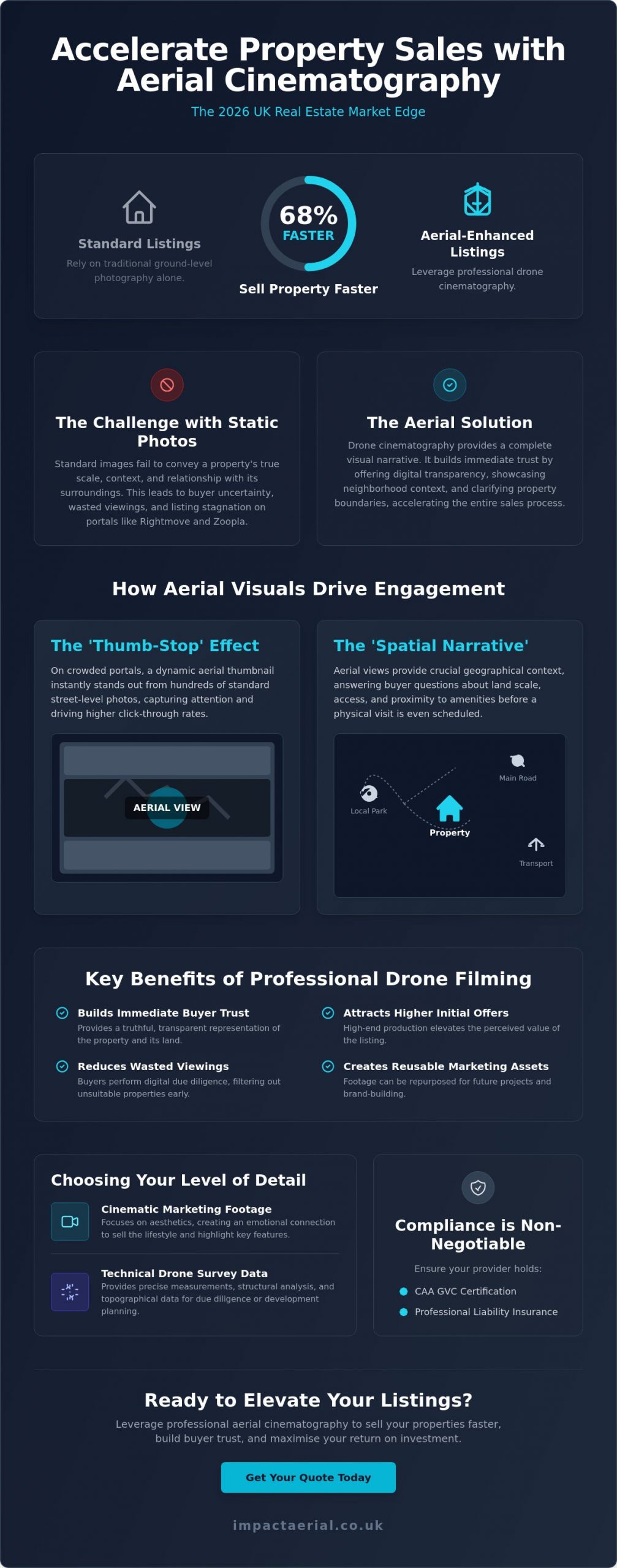
Professional Drone Surveys vs. Marketing Footage: Choosing Your Level of Detail
Identifying the specific type of aerial data required for a listing is essential for an efficient marketing strategy. While previous sections highlighted the emotional impact of a spatial narrative, this stage focuses on the technical distinction between cinematic “marketing” footage and empirical “survey” data. Both are vital tools for using drone footage to sell property faster, but they serve different phases of the buyer’s journey. Marketing footage captures the lifestyle and aesthetic appeal of a home; technical surveys provide the structural evidence required to close high-value transactions without delay.
Professional standards remain the baseline for any aerial operation. While international regulatory frameworks like the FAA rules for commercial drone operators set a global benchmark for safety and pilot certification, UK-based agencies must ensure their operators hold the specific CAA GVC credentials required for domestic commercial work. Using DJI Enterprise hardware ensures that the raw data captured, whether for a survey or a film, possesses the 4K HDR depth necessary for high-end post-production. This meticulous editing process ensures every property is market-ready, presenting a polished and trustworthy image to potential investors.
Cinematic Storytelling for Luxury Listings
For premium residential properties, the objective is to create a seamless visual flow that ground-based cameras cannot achieve. This involves the use of smooth gimbal movements and slow-motion pans to highlight architectural elegance. A professional aerial filming drone allows for the integration of high-altitude perspectives with intimate, low-level tracking shots. Post-production colour grading further enhances this visual appeal, ensuring that the property’s exterior and grounds are represented with vibrant, aspirational clarity that captures the buyer’s imagination immediately.
Technical Surveys for High-Value Transactions
When a property involves complex structures or extensive commercial acreage, a technical drone survey provides a layer of due diligence that cinematic footage lacks. These surveys produce detailed roof reports and high-resolution orthomosaic maps, offering pre-purchase peace of mind regarding the building’s condition. For eco-conscious developments, thermal imaging sensors can even verify insulation quality or the efficiency of solar installations. Using drone footage to sell property faster in these scenarios involves providing “Aerial Evidence” that justifies a premium asking price and removes structural uncertainty during the final stages of a sale.
Strategic Implementation: Maximising Exposure Across Property Portals
Generating high-quality aerial cinematography is only the first stage of a successful marketing campaign. To see a genuine return on investment, you must deploy these assets strategically across multiple digital channels. Using drone footage to sell property faster requires a methodical approach to distribution, ensuring that each platform receives content tailored to its specific audience and technical requirements. A fragmented or unplanned upload strategy often results in diminished engagement and missed opportunities with high-value leads.
We recommend a structured 5-step deployment plan to ensure maximum impact:
- Technical Acquisition: Capture high-resolution 4K footage using professional-grade sensors.
- Meticulous Post-Production: Apply colour grading and professional editing to create a polished, market-ready narrative.
- Portal Optimisation: Upload tailored video files to Rightmove, Zoopla, and OnTheMarket to capture ‘Thumb-Stop’ interest.
- Social Syndication: Distribute high-impact ‘Teaser’ clips across Instagram, TikTok, and Facebook.
- Immersive Integration: Combine aerial views with virtual tour creation to provide a comprehensive digital viewing experience.
Optimising for the Big Three: Rightmove, Zoopla, and Socials
Property portals have specific technical preferences that dictate how your content performs. For the “Big Three” platforms, a 16:9 aspect ratio remains the standard for gallery videos. It’s essential to keep these edits concise, typically under 90 seconds, to maintain viewer retention. Using a high-altitude drone still as your primary ‘hook’ thumbnail can significantly increase click-through rates from search results. This strategy leverages the visual variety of an aerial perspective to increase ‘time on page’, a metric that signals high engagement to portal algorithms and keeps your listing at the forefront of buyer searches.
The Power of the ‘First Look’ Social Campaign
Social media platforms require a different creative approach. Vertical 9:16 video clips, often referred to as ‘Teasers’, are highly effective for Instagram Reels and TikTok. These 15-second high-impact segments focus on the property’s most aspirational features, such as a sprawling garden or a unique architectural profile. This method is particularly successful at driving traffic from Facebook advertising directly to the full listing. It’s a vital tool for engaging out-of-area buyers who rely heavily on digital content to shortlist properties before committing to a long-distance journey. By using drone footage to sell property faster through social syndication, you reach a broader demographic of active searchers.
Implementing these technical strategies ensures your property stands out in a crowded digital marketplace. If you’re ready to elevate your marketing with precision-engineered visuals, our aerial filming and photography services provide the high-end output your listings require.
Why Compliance and Quality are Non-Negotiable for Property Marketing
While the visual and strategic advantages of aerial cinematography are significant, the operational foundation of these services must rest on strict regulatory compliance. In the United Kingdom, any drone operation conducted for commercial gain requires a pilot with a valid General Visual Line of Sight Certificate (GVC) issued by the Civil Aviation Authority (CAA). This is not a voluntary standard; it is a legal mandate that ensures the safety of the public and the integrity of the property industry. Using drone footage to sell property faster is an effective strategy, but it must be executed within this professional framework to protect all parties involved in the transaction.
Professional drone operators function as risk-managed consultancies rather than simple creative agencies. This distinction is most evident in the requirement for comprehensive commercial liability insurance, which should ideally be set at a minimum of £5 million for estate agency work. This level of coverage provides essential reassurance to both the agency and the homeowner, ensuring that any unforeseen incidents are fully covered. Relying on uncertified or uninsured operators introduces a level of risk that can lead to catastrophic reputational damage and severe financial penalties, particularly when operating in densely populated residential areas.
The Dangers of DIY and Unlicensed Pilots
The rise of consumer drone technology has led to an increase in unauthorized aerial filming, which poses significant privacy and GDPR risks for property professionals. Unlicensed pilots often lack the technical training to navigate complex UK privacy laws, which can result in the accidental filming of neighbouring properties and subsequent legal complaints. The CAA has the authority to issue heavy fines for non-compliant flights, and the resulting legal action can permanently tarnish an agency’s professional standing. It’s critical to verify a pilot’s drone license and insurance status before every shoot to ensure the operation is fully compliant with 2026 aviation standards. This meticulous vetting process is a vital component of using drone footage to sell property faster while maintaining ethical boundaries.
Impact Aerial: Your Partner in Professional Property Marketing
At Impact Aerial, we maintain a commitment to safety-first operations and technical precision that goes beyond basic compliance. We treat every property shoot as a professional consultancy, providing a seamless service from the initial risk assessment to the final cinematic edit. Our investment in a DJI Enterprise fleet ensures that we deliver consistent, high-tier output that meets the demanding standards of the 2026 luxury market. By positioning our drone services as a trusted extension of your marketing team, we provide the psychological comfort and tangible results required to accelerate your sales velocity. We’re proud of our professional affiliations and technical credentials, which serve as a guarantee that your property marketing is managed by experts who take the operational side of the business as seriously as the visual output.
Elevating Your Property Strategy for 2026
We’ve explored how high-resolution aerial cinematography transforms property listings from static images into immersive spatial narratives. By providing clear geographic context and structural transparency, you eliminate buyer hesitation and significantly increase sales velocity. A professional approach ensures that every flight is backed by meticulous technical standards and strict regulatory adherence. Integrating these advanced visual tools is the most effective method for using drone footage to sell property faster in a competitive digital market. It’s about more than just a view; it’s about providing the verified data and emotional engagement that modern buyers demand.
Ready to transform your listings with industry-leading quality? Book a professional drone shoot to accelerate your property sales and benefit from our CAA GVC Certified Pilots, £5m commercial liability insurance, and 4K HDR cinematic production. Your properties deserve a perspective that captures their full potential and secures the confidence of high-value buyers. We look forward to helping you stand out on the UK’s leading property portals with precision and excellence.
Frequently Asked Questions
Does drone footage actually increase the final sale price of a property?
High-quality aerial visuals elevate the perceived value of a listing, which often leads to more competitive bidding. While it doesn’t change the bricks-and-mortar valuation, it highlights premium features like land scale and location that ground-level photos miss. This increased engagement can result in a higher final sale price as buyers perceive the property as a premium offering compared to standard listings in the same area.
Is it legal to fly a drone over a residential neighborhood for property photos?
It’s perfectly legal if the operator holds a valid CAA GVC certification and adheres to the Open or Specific category flight rules. Professional pilots conduct thorough risk assessments to ensure flights don’t endanger the public or breach privacy laws. Using drone footage to sell property faster is a regulated activity that requires strict adherence to national aviation standards to remain compliant, insured, and safe for all residents.
How much does professional drone photography cost for a single property?
Professional service fees depend on several factors, including the property’s size, its location, and the specific deliverables required, such as 4K video or high-resolution stills. While basic packages are available for smaller residential homes, complex estates or commercial sites requiring technical surveys involve different operational requirements. We recommend requesting a bespoke quote to ensure the service matches your specific marketing objectives and technical needs for the listing.
Do I need to notify the neighbors before a drone shoot takes place?
Notifying neighbors is a professional courtesy that prevents privacy concerns and ensures a smooth operation on the day. We suggest informing adjacent residents about the scheduled time and the specific purpose of the flight. This transparency helps mitigate anxiety and demonstrates that the estate agency and the drone operator are committed to ethical and respectful filming practices within the local community.
How long does a typical drone property filming session take?
A standard residential shoot typically takes between 60 and 90 minutes on-site, depending on the number of flight paths required. This timeframe allows the pilot to capture a variety of angles, heights, and cinematic movements. Larger estates or commercial properties may require a half-day or full-day session to ensure every technical detail, including property boundaries and outbuildings, is documented with the necessary precision and clarity.
Can drone footage be used for commercial property and land sales too?
Aerial data is invaluable for commercial listings where ground-level photos can’t capture the true scale of a warehouse or the layout of an industrial park. It allows investors to assess vehicle access, parking capacity, and proximity to transport hubs. Using drone footage to sell property faster is particularly effective for land sales, as it provides a clear, top-down perspective of boundaries and topography that investors require for due diligence.
What happens if the weather is bad on the day of the scheduled drone shoot?
Safety is our primary concern, so we don’t operate in high winds or heavy rain. If the forecast suggests conditions that would compromise the drone’s stability or the visual quality of the 4K HDR footage, we’ll coordinate a new date. This ensures the final output meets our professional standards and that the property is presented in the best possible light under clear skies for maximum buyer appeal.
How do I add drone video to my Rightmove or Zoopla listing?
You can easily add aerial video by uploading the file to a hosting platform like YouTube or Vimeo and then adding the link to the property’s media gallery on the portal. Most UK platforms have a dedicated ‘Video’ tab that displays the content prominently to potential buyers. This integration ensures that the ‘Thumb-Stop’ effect is maximized, encouraging potential buyers to engage with the listing for longer periods during their search.
 2 Norton Drive, Wythall, Birmingham, B47 6HH Company registration number: 11138586. VAT Number: 366 9068 55