Every time a surveyor climbs a loose aggregate pile to take manual measurements, your business is one slip away from a major health and safety incident. Traditional surveying methods aren’t just hazardous; they’re also notoriously slow and prone to human error, often resulting in inventory discrepancies that lead to significant financial losses. You likely already know that relying on ground-based estimates is a bottleneck for your site’s efficiency and a risk to your staff.
Using a professional drone for stockpile measurement transforms this high-risk task into a streamlined, data-centric process. By deploying commercial-grade DJI Enterprise technology, operators can capture highly accurate 3D models of your site inventory in hours rather than days. This guide explores how CAA GVC certified pilots deliver centimetre-accurate volumetric data while ensuring your operations remain fully compliant with safety regulations. We will examine the transition from manual data capture to autonomous aerial intelligence, providing you with the technical insights needed to eliminate guesswork and secure your bottom line through precise digital twins. You’ll discover how to achieve full H&S compliance while maintaining 1 to 3cm accuracy across your entire site inventory.
Key Takeaways
- Transition from manual “walking the pile” methods to autonomous aerial capture to eliminate fall risks and improve data consistency across your site.
- Discover how deploying a professional drone for stockpile measurement delivers centimetre-accurate 3D models using advanced photogrammetry and Ground Sampling Distance (GSD) calculations.
- Learn why aerial surveys reduce site time from days to hours, allowing for more frequent inventory audits without disrupting active workflows.
- Understand the critical importance of CAA GVC certification and £5m liability insurance when selecting a technical partner for high-risk industrial environments.
- Explore industry-specific applications, from tracking cut-and-fill balances in construction to managing high-value aggregate inventory in mining and quarrying.
What is Drone Stockpile Measurement and Volumetric Analysis?
Volumetric drone surveys represent a technical leap in how industrial sites quantify their assets. Instead of traditional ground-based methods, this process uses high-resolution aerial data to calculate the precise volume of material stockpiles. Using a drone for stockpile measurement allows site managers to move away from the hazardous practice of “walking the pile” with GPS rovers. It replaces manual estimation with autonomous, high-precision data capture.
This technology creates a high-fidelity “digital twin” of your entire site. This isn’t just a static image; it’s a geometrically accurate 3D model that serves as a single source of truth for inventory management. In sectors like aggregates and mining, centimetre-level accuracy has become the expected standard. It ensures that what’s recorded in the ledger matches what’s physically on the ground, providing psychological comfort to stakeholders through verified data.
The Evolution of Volumetric Surveying
Historically, site surveys relied on laser scanning or manual GPS points. These methods are often limited by the surveyor’s ability to safely access every part of a pile. Because ground-based surveyors can’t see the top or the far side of large mounds, traditional methods frequently lead to volume errors between 10% and 20%. These discrepancies quickly compound into significant financial losses over a fiscal year.
Modern surveys use The Science of Precision: How Photogrammetry Calculates Volume to overcome these limitations. By capturing hundreds of overlapping images from an aerial perspective, a drone for stockpile measurement can map complex, irregular shapes that ground teams simply cannot reach. This top-down view ensures every contour is accounted for, providing a level of detail that was previously impossible or too expensive to obtain regularly.
Key Metrics: Volume, Mass, and Density
Once the aerial data is captured, specialised software converts the 3D point cloud into cubic metre measurements. However, volume is only half of the equation. To provide actionable data, these cubic measurements are paired with known material density factors to calculate total tonnage. This allows for a granular understanding of site resources that manual methods can’t match.
Having access to this data in near real-time is vital for accurate financial reporting and rigorous auditing. Site managers don’t have to wait days for a report to be processed by an external agency. Precise inventory audits can be completed in hours, ensuring that month-end figures are based on verified, survey-grade data. This level of meticulousness is what separates professional aerial surveys from basic photography.
The Science of Precision: How Photogrammetry Calculates Volume
Capturing data with a drone for stockpile measurement relies on photogrammetry, the technical process of extracting 3D measurements from 2D imagery. By capturing hundreds of high-resolution photos with significant overlap, specialized software identifies common points across multiple frames. These points are then projected into a 3D coordinate system to create a dense point cloud. This cloud forms the basis of a Digital Surface Model (DSM), which provides a centimetre-accurate representation of every contour in your inventory. Academic research into Drones vs. Traditional Surveying confirms that this aerial approach is a viable, safe, and cost-effective alternative to manual methods, often achieving vertical accuracy within 20mm to 50mm.
Ground Sampling Distance (GSD) Explained
The precision of your volumetric report depends heavily on Ground Sampling Distance (GSD). GSD is the actual distance on the ground represented by a single pixel in a digital image. For example, a GSD of 1cm means each pixel in the 3D model represents exactly 1cm² of the physical stockpile. Lower GSD values lead to higher volumetric precision because the software has more detail to work with when defining the pile’s boundaries.
Several factors dictate the GSD of a survey:
- Flight Altitude: Flying lower increases detail but requires more images to cover the site.
- Camera Sensor: High-performance sensors, like the 4/3 CMOS found on the DJI Mavic 3E, allow for superior data capture even at higher altitudes.
- Lens Quality: Professional-grade optics reduce distortion, ensuring that the spatial data remains consistent across the entire site.
RTK vs. Non-RTK Drone Surveys
When deploying a drone for stockpile measurement, the choice between RTK (Real-Time Kinematic) and non-RTK hardware is critical for your data’s integrity. RTK drones communicate with a base station or a satellite network to provide centimetre-accurate positioning data in real-time. This technology is vital for establishing absolute accuracy, ensuring your site’s data aligns perfectly with global coordinates and previous surveys.
Using RTK significantly reduces the need for Ground Control Points (GCPs). In a non-RTK survey, staff must manually place and measure multiple physical markers across the site to “pin” the drone data to the ground. RTK hardware streamlines this process, reducing site time and improving safety by keeping personnel away from active machinery. If you’re looking to integrate this level of precision into your workflow, our team at Impact Aerial can provide the technical consultancy needed to get started.
Drones vs. Traditional Surveying: Speed, Safety, and ROI
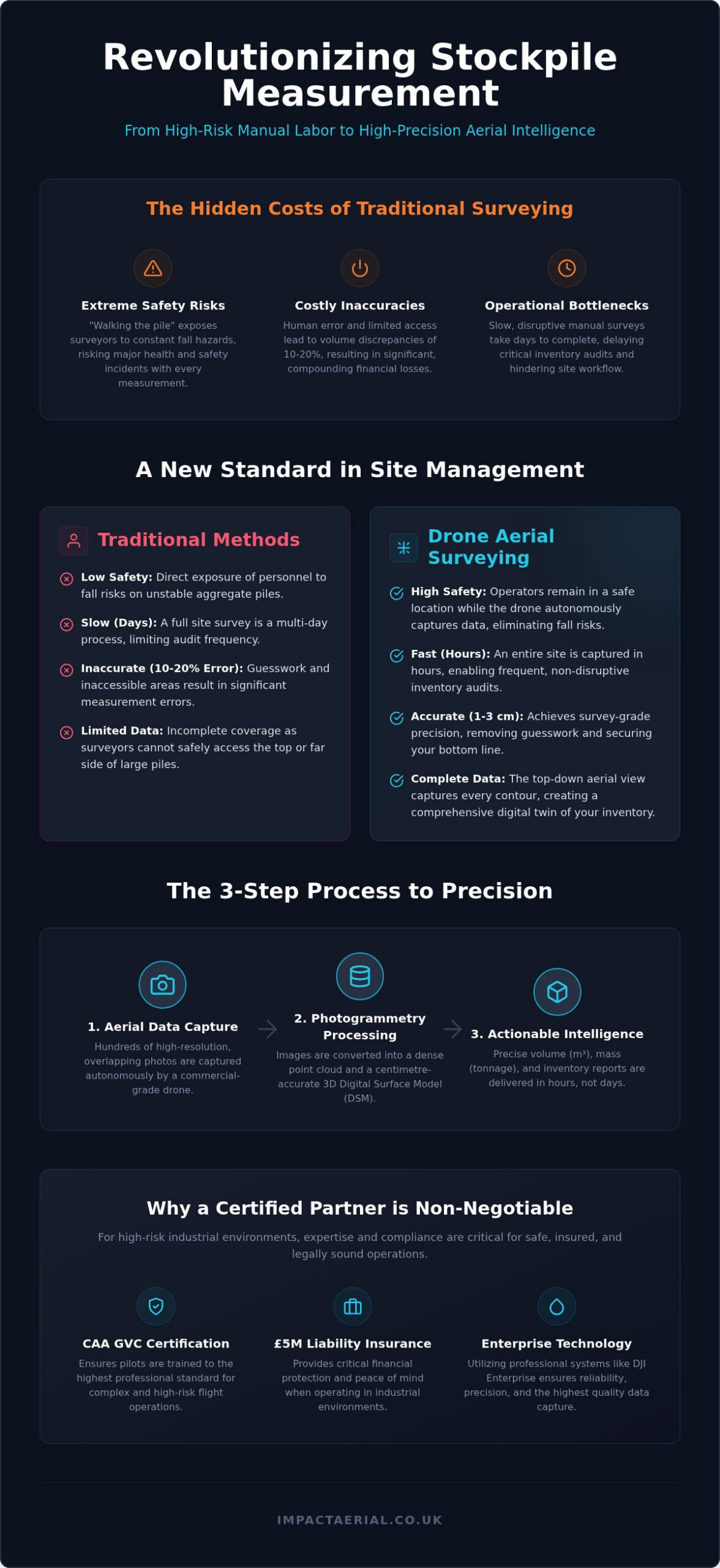
Traditional topographic surveys are often a significant drain on site resources. For a large-scale industrial operation, a ground team might spend several days traversing hazardous terrain to capture enough data points for a volume estimate. In contrast, using a drone for stockpile measurement allows the same area to be mapped in just a few hours. This drastic reduction in site time translates directly into lower labour costs and, more importantly, minimal disruption to your daily operations. You don’t have to halt plant movements or clear the area for days on end; the drone operates above the workflow, capturing data while your site remains productive.
The return on investment extends beyond immediate time savings. Because aerial surveys are so efficient, site managers can move from infrequent quarterly audits to weekly or even daily inventory updates. This high-frequency data prevents over-ordering and ensures that financial reporting is always based on current site conditions rather than outdated estimates. When you consider the cost of inventory discrepancies, the ability to maintain a precise, real-time ledger provides a clear financial advantage that traditional methods simply cannot match.
The Safety Advantage: Mitigating Site Risks
The most compelling argument for aerial surveys is the immediate improvement in health and safety compliance. Traditional methods require surveyors to physically climb unstable stockpiles of sand, gravel, or coal. This presents a high risk of slips and falls, especially in the unpredictable UK weather. By deploying a drone for stockpile measurement, you remove personnel from these dangerous locations entirely. This approach supports a “Zero Harm” site culture by keeping staff away from active heavy machinery zones and precarious heights. Our CAA GVC certified pilots operate from safe stand-off distances, backed by £5m commercial liability insurance, ensuring that data collection never compromises your site safety protocols.
Data Consistency and Transparency
Manual measurements often suffer from subjective “eye-balling” or inconsistent point density, which leads to human error in volume calculations. Drones eliminate this variability by capturing millions of data points across the entire surface of the pile. This creates a permanent, high-resolution visual record that serves as a robust audit trail. If a dispute arises with a supplier or contractor, you have a time-stamped 3D model to verify the exact inventory levels at that moment. These models can be easily shared across departments via cloud-based platforms, ensuring that procurement, finance, and site operations are all working from the same verified dataset.
Industry Applications for Aerial Volumetric Surveys
The utility of a drone for stockpile measurement extends across diverse industrial sectors where material volume directly impacts the balance sheet. While the core technology remains consistent, the specific applications vary to meet the unique operational requirements of different environments. From managing high-value mineral assets to monitoring site progress, aerial data provides a level of granular detail that traditional ground-based methods cannot replicate. This transition to digital inventory management ensures that managers have access to a single, verified source of truth for their site resources.
Construction and Infrastructure Management
In the construction sector, maintaining an accurate record of earthworks is essential for financial transparency and project timelines. Site managers use comprehensive drone survey data to verify subcontractor invoices by calculating the exact volume of material moved or imported. This objective data eliminates disputes and ensures that payments are based on physical reality rather than estimates.
Sequential 3D mapping allows teams to monitor site progress over time, comparing the current state of the terrain against the original design. This volumetric data can be directly linked to Building Information Modelling (BIM) workflows, providing a seamless integration between the physical site and the digital project plan. It allows for precise tracking of cut-and-fill balances, ensuring that material is moved efficiently across the site to minimize haulage costs.
Quarrying and Bulk Material Handling
For quarrying and mining operations, material is the primary asset. Using a drone for stockpile measurement is now a standard requirement for year-end inventory audits. These surveys provide the meticulous accuracy needed for financial compliance, ensuring that “dead” stock at the bottom of a pile is distinguished from active inventory turnover. This level of detail is critical for accurate asset valuation and tax reporting.
The data also serves a vital logistical purpose. By understanding the exact volume of available aggregate, site managers can optimize their haulage and logistics schedules. This prevents bottlenecks in production and ensures that customer orders are fulfilled from the most accessible stockpiles. Real-time volume data allows for better planning of extraction rates and storage capacity, maximizing the overall efficiency of the quarry.
Other sectors also benefit from this aerial intelligence:
- Waste Management: Monitoring landfill capacity and quantifying processed recycling material to ensure regulatory compliance.
- Agriculture: Measuring bulk fertilizer storage and grain silos to manage seasonal supply chains more effectively.
If you need to improve the accuracy of your inventory audits or site monitoring, contact Impact Aerial to discuss our professional drone data services.
Why Hire a CAA GVC Certified Partner for Your Site?
While many businesses consider purchasing hardware for in-house use, the true value of a drone for stockpile measurement lies in the expertise of the operator and the rigour of their safety protocols. For commercial operations in the UK, holding a valid drone license is a strict legal requirement. This isn’t just a bureaucratic hurdle; it’s a verification of technical competence. Hiring a certified partner ensures your site remains compliant with Civil Aviation Authority (CAA) regulations, shielding your business from the legal and financial repercussions of unauthorised flights.
Professional operators provide a level of risk mitigation that DIY solutions cannot match. Impact Aerial carries £5m in commercial liability insurance, specifically tailored for high-risk industrial environments. This provides psychological comfort and tangible security for site managers. It ensures your company’s interests are fully protected. Every flight is conducted under strict CAA safety protocols, including detailed pre-flight risk assessments and site-specific safety briefings.
The Importance of GVC Certification
The General Visual Line of Sight Certificate (GVC) represents the industry standard for professional drone operations. It ensures safety and precision. Pilots are trained to manage complex airspace and navigate site-specific restrictions, such as proximity to power lines or active machinery. This meticulousness extends to data privacy. Professional partners are well-versed in GDPR compliance, ensuring any aerial data collection respects the privacy of site staff and neighbouring properties. By choosing a GVC-certified specialist, you’re prioritising reliability over the unpredictable results of amateur flight.
Beyond the Flight: Expert Data Processing
The value of using a drone for stockpile measurement is only realised through high-end data processing. Professional teams use specialised photogrammetry software to turn raw imagery into actionable business intelligence. Instead of just a folder of photos, you receive comprehensive PDF reports and CSV exports. These files can be directly integrated into your existing CAD or GIS software. This ensures the volumetric data is immediately useful for your finance or engineering departments.
If you’re ready to secure your site inventory with survey-grade accuracy, Contact Impact Aerial for a professional stockpile survey quote today.
Securing Your Site Inventory with Aerial Intelligence
Adopting professional drone technology is a strategic necessity for modern industrial sites. By transitioning from manual estimations to high-precision digital twins, you eliminate the safety risks associated with “walking the pile” while gaining centimetre-accurate data for your financial reporting. Using a professional drone for stockpile measurement ensures that your inventory audits are based on verified, survey-grade results rather than subjective guesswork. This methodical approach protects your staff and secures your bottom line through precise asset valuation.
Impact Aerial provides the technical expertise and regulatory compliance required for high-risk environments. Our CAA GVC Certified Pilots deliver centimetre-accurate RTK data, backed by £5m commercial liability insurance for your reassurance. Whether you’re managing construction earthworks or aggregate inventory, we provide the actionable intelligence you need to optimise your operations. Request a Professional Drone Survey Quote from Impact Aerial today and take the first step toward a safer, more efficient site. We’re ready to help you transform your data collection processes.
Frequently Asked Questions
How accurate are drone stockpile measurements compared to traditional methods?
A professional drone for stockpile measurement typically achieves accuracy within 1cm to 3cm. Traditional GPS rover methods often result in 10% to 20% volume discrepancies due to limited access and human estimation. In contrast, aerial surveys capture millions of data points across the entire surface. This results in a vertical accuracy range of 20mm to 50mm, providing a far more reliable digital twin for your financial reporting and inventory audits.
What types of materials can be measured using a drone?
Drones can measure almost any bulk material with a defined surface. Common applications include aggregates like sand, gravel, and crushed stone in quarries, as well as coal, minerals, and ores in mining. In the recycling sector, they quantify processed waste and woodchip piles. Agricultural sites use them for grain and bulk fertilizer storage. Provided the material is visible from the air, photogrammetry can accurately calculate its volume and mass.
Do I need to clear the site or stop work during a drone survey?
One of the primary benefits of aerial surveying is that it doesn’t require site downtime. Unlike ground-based teams that need clear access and machinery exclusion zones, a professional drone operates at a safe altitude above active workflows. While we conduct pre-flight safety briefings and maintain a stand-off distance from heavy plant machinery, your site can typically remain fully operational throughout the entire data collection process without any major disruptions.
How long does it take to get the volumetric report after the flight?
Turnaround times are significantly faster than traditional methods. While a manual survey might take days to process, drone data can often be delivered within 24 to 48 hours. The initial flight typically takes less than a day, even for large sites. Once the raw imagery is processed through specialised photogrammetry software, you receive actionable PDF reports and CSV exports that integrate directly into your existing CAD or GIS workflows.
Is it cheaper to buy a drone or hire a professional service for stockpile measurements?
For most businesses, hiring a professional service like Impact Aerial is more cost-effective than managing an in-house program. DIY operations face significant overheads, including the £524 annual CAA Operational Authorisation fee and the cost of GVC training. Professional partners provide high-end DJI Enterprise hardware, £5m liability insurance, and expert data processing. Choosing a drone for stockpile measurement through a specialist eliminates the need for you to manage complex regulatory compliance and software licensing.
What weather conditions are required for an accurate drone survey?
Optimal results are achieved in dry conditions with moderate wind speeds, typically below 20mph. While commercial-grade drones have some weather resistance, heavy rain or thick fog can obscure the material surface and degrade the accuracy of the photogrammetry. High-quality data depends on clear visibility and consistent lighting. Our pilots monitor local forecasts meticulously to ensure that every flight is conducted in conditions that support centimetre-accurate data capture for your inventory.
Can drones measure stockpiles inside warehouses or covered areas?
Standard GPS-based drones are primarily designed for outdoor use. Measuring stockpiles inside warehouses or covered sheds is more complex because of signal interference and poor lighting. While specialised indoor drones or LiDAR technology can be used in these environments, they require different flight protocols. If your material is stored under cover, we recommend a technical consultation to determine if aerial capture or alternative scanning methods are the most suitable for your specific facility.
What insurance and certifications should a drone pilot have for industrial sites?
Any pilot operating on a commercial site must hold a CAA GVC (General Visual Line of Sight) certificate. This ensures they are trained in strict safety protocols and airspace management. Additionally, they should carry at least £5m in commercial liability insurance to protect against site-specific risks. At Impact Aerial, our pilots are fully certified and insured, providing the professional reassurance needed for high-risk industrial environments and ensuring full health and safety compliance.
 2 Norton Drive, Wythall, Birmingham, B47 6HH Company registration number: 11138586. VAT Number: 366 9068 55