Drone Mapping for Urban Planning: A Professional Guide to City Development in 2026

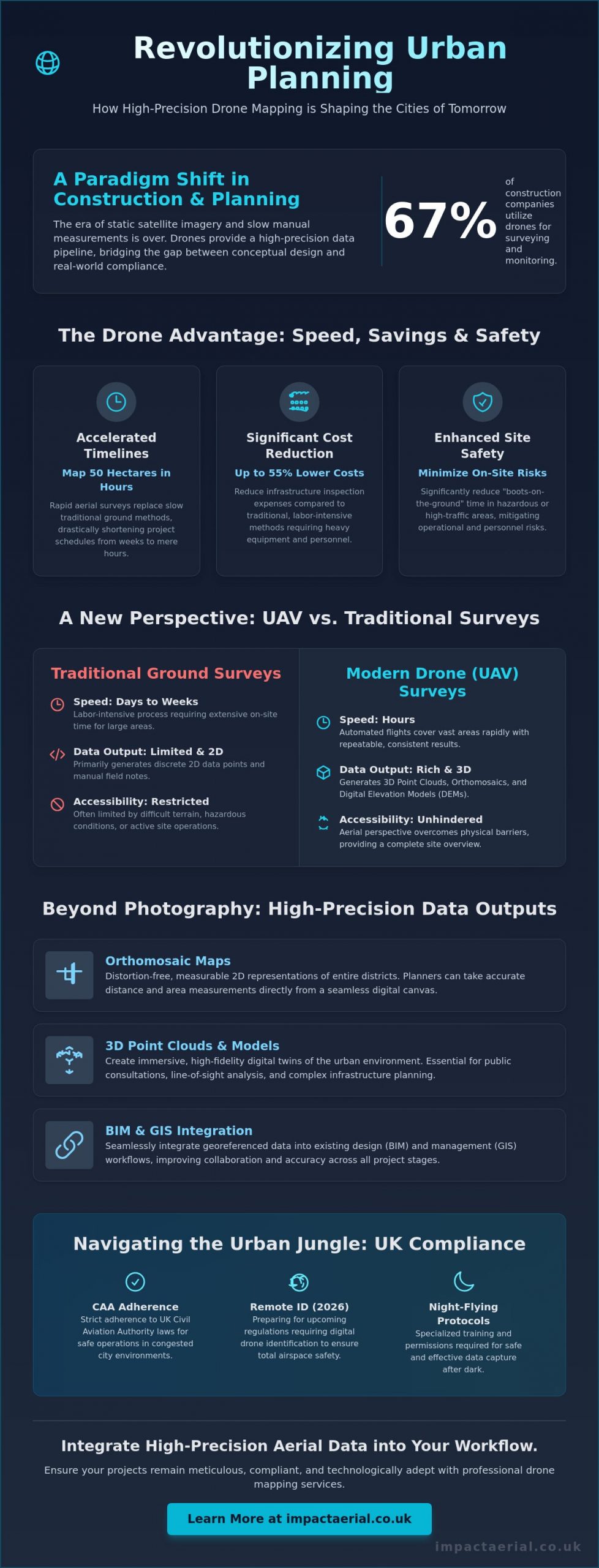
With 67% of construction companies now utilizing drones for site surveying and progress monitoring, the era of relying on static satellite imagery or slow manual measurements has officially ended. You likely feel the pressure of rapid urbanization and the need for faster project approvals while staying strictly compliant with the latest CAA regulations. Utilizing drone mapping for urban planning is no longer just about capturing aerial views; it’s a high-precision data pipeline that bridges the gap between conceptual design and real-world compliance.

Discover how high-precision aerial data accelerates urban development, ensures regulatory adherence, and provides the actionable insights needed for smarter city planning. This guide examines the technical requirements for survey-grade accuracy, including RTK and PPK capabilities, alongside the essential 2026 UK drone regulations like Remote ID and night-flying protocols. You’ll learn how to leverage highly accurate 3D models for public consultations and implement cost-effective site monitoring that can reduce infrastructure inspection expenses by up to 55%. We’ll provide the authoritative framework for integrating advanced aerial technology into your professional workflow, ensuring your projects remain meticulous, compliant, and technologically adept.

Key Takeaways

  • Accelerate project timelines by replacing traditional ground methods with rapid aerial surveys capable of mapping 50 hectares in just hours.
  • Utilize high-precision 3D point clouds and distortion-free orthomosaic maps to provide measurable data for complex urban infrastructure projects.
  • Ensure strict adherence to UK aviation law by understanding the specific certifications and safety protocols required for operations in congested city environments.
  • Improve collaboration across design teams by integrating georeferenced drone mapping for urban planning data into BIM and GIS workflows.
  • Optimize site monitoring and public consultations with actionable data that bridges the gap between conceptual design and regulatory approval.

Transforming Cityscapes: Why Drone Mapping is Essential for Modern Urban Planning

Drone mapping for urban planning is the sophisticated process of capturing georeferenced sensor data to produce high-resolution 2D and 3D outputs. Unlike traditional aerial survey methods, modern UAV technology provides a granular level of detail that satellite imagery simply cannot match. This shift is fundamental as cities move from reactive management to proactive, data-driven planning. By utilizing real-time data, developers and local authorities can make informed decisions based on current site conditions rather than outdated records.

To better understand how this technology integrates into the construction and planning phase, watch this helpful video:

In 2026, the pressures of rapid urbanization and stringent sustainability targets have made precision essential. Infrastructure is under constant strain. High-density city projects require a level of accuracy that ground-based teams struggle to provide within tight deadlines. While satellite imagery serves broad purposes, its resolution is often insufficient for the meticulous demands of modern city development. Drones bypass these limitations. They offer a reliable and cost-effective alternative for capturing site-specific information without the delays associated with orbital passes or cloud cover.

The Evolution of Urban Data Collection

The industry has transitioned from labor-intensive manual land surveys to automated UAV flight paths. These pre-programmed routes ensure consistent data coverage and repeatable results, which are vital for long-term monitoring. Modern hardware captures high-resolution 4K HDR imagery, revealing structural details and environmental factors that were previously invisible. This unique perspective provides a comprehensive overview of a site’s topography and existing assets. It allows ground teams to focus on specialized tasks rather than routine measurements.

Key Benefits for Stakeholders and Developers

One of the primary advantages of drone mapping for urban planning is the acceleration of the planning permission process. Providing local authorities with accurate, up-to-date site visualizations reduces ambiguity and speeds up approval cycles. Safety remains a paramount concern in any urban environment. By utilizing drones, developers can significantly reduce “boots-on-the-ground” time in hazardous or high-traffic areas, mitigating operational risks. Research indicates that using drones for infrastructure inspections can lead to a 55% cost reduction compared to traditional methods.

Public engagement has also seen a significant transformation. Stakeholders can now interact with immersive 3D city models that clearly illustrate the impact of proposed developments. These models provide a transparent and accessible way for the public to understand changes to their environment. This fosters trust and leads to smoother consultation phases. Through meticulous data processing, these surveys become a cornerstone of successful city development projects.

Beyond Photography: High-Precision Outputs for Urban Infrastructure

While high-resolution imagery is a staple of modern city development, the true value of drone mapping for urban planning lies in the technical datasets generated during the post-production phase. Professional UAV operations produce orthomosaic maps, which are distortion-free, measurable 2D representations of entire districts. These maps allow planners to take accurate distance and area measurements directly from their screens. By stitching together thousands of georeferenced images, we create a seamless digital canvas that serves as a reliable foundation for site analysis.

Precision goes deeper than 2D imagery. 3D point clouds generate millions of individual data points, creating a high-density digital replica of urban structures. These models allow for precise volumetric analysis and the creation of digital twins. A digital twin acts as a virtual testing ground where planners can stress-test designs against environmental factors before any ground is broken. This level of drone data for urban planning ensures that every decision is backed by empirical evidence rather than estimates.

Topographical and Volumetric Analysis

Accurate elevation data is critical for assessing drainage and flood risks in built-up areas. Using advanced drone survey techniques, teams can calculate earthworks and stockpiles with high precision. The Ground Sample Distance (GSD) determines the level of detail; a lower GSD means higher resolution and better accuracy for urban mapping. Even underground utility corridors can be identified through surface-level indicators captured in high-definition, providing a clearer picture of existing site constraints.

3D Visualisation and Public Consultation

Raw data becomes a powerful communication tool when transformed into interactive models. During community planning meetings, these 3D visualisations help stakeholders grasp the scale and impact of a project. Planners can simulate “rights to light” scenarios and identify potential view-path obstructions with surgical accuracy. For a more immersive approach, developers often use virtual tour experiences to showcase proposed developments to investors and the public. If you need to document every stage of your project’s lifecycle, our commercial drone services provide the ongoing data required for meticulous oversight.

Drone Mapping for Urban Planning: A Professional Guide to City Development in 2026

Data Accuracy and Efficiency: Comparing UAV Surveys to Traditional Methods

Traditional land surveying has long been the standard for city development, yet it often struggles to keep pace with the rapid requirements of 2026. Implementing drone mapping for urban planning allows for rapid data acquisition without the logistical bottlenecks of traditional ground-based surveying. While a manual ground crew might spend weeks traversing a complex site, a professional UAV can map 50 hectares in just a few hours. This speed doesn’t sacrifice quality; it provides a comprehensive dataset that is immediately ready for analysis.

Operational costs are significantly reduced by removing the need for heavy equipment. Traditional methods often require extensive scaffolding or disruptive road closures to gain necessary vantage points in high-density areas. Drones eliminate these overheads by operating from the air, maintaining safety while keeping surveyors out of active construction zones or high-traffic corridors. This approach ensures that your project remains on schedule without compromising the safety of your personnel or the public.

A deeper understanding of the reveals how these digital outputs integrate seamlessly into modern project management. By achieving centimetre-level precision through Real-Time Kinematic (RTK) technology, planners can trust that their digital models reflect the absolute reality of the site. This meticulous level of detail is vital for ensuring that new infrastructure aligns perfectly with existing urban assets.

The ROI of Drone Integration

The financial benefits of drone data extend far beyond the initial survey. Identifying site discrepancies early in the design phase prevents costly “re-work” during the construction stage. Drones provide a more economical solution for urban mapping than manned aircraft because they eliminate high fuel costs and complex flight logistics for localized projects. Furthermore, digital data archival creates a historical record of the site, which assists in long-term asset management and future maintenance planning.

Technical Precision: RTK vs. PPK

Achieving survey-grade accuracy requires a choice between two primary satellite positioning methods. Real-Time Kinematic (RTK) provides instant geospatial accuracy by connecting to a base station or network during flight. In “urban canyons” where satellite signals may be obstructed by tall buildings, Post-Processed Kinematic (PPK) is often the preferred choice. PPK allows for the correction of positioning data after the flight is completed, ensuring high-tier quality even in challenging environments. Professional operators often use Ground Control Points (GCPs) as an additional layer of verification, reinforcing the reliability of the final survey data.

Operating drone mapping for urban planning within a city environment requires a level of oversight far beyond standard aerial photography. The Civil Aviation Authority (CAA) maintains strict frameworks for flights in “Congested Areas,” which are defined as any area used substantially for residential, commercial, industrial, or recreational purposes. For a project to be legal and safe, pilots must possess the correct certifications to operate in proximity to buildings and people. This regulatory landscape ensures that the high-precision data collection required for city development is conducted without compromising public safety.

Risk mitigation is a cornerstone of professional urban operations. While basic insurance might suffice for open fields, the industry standard for commercial city development projects is £5 million in public liability insurance. This provides the necessary reassurance for stakeholders, developers, and local authorities. Additionally, data protection is paramount. Adhering to GDPR when mapping residential areas involves meticulous planning to ensure that identifiable personal data, such as faces or vehicle registrations, is managed or redacted during the post-production phase.

The Importance of a UK Drone License

There’s a critical distinction between a basic Flyer ID and a professional qualification like the General Visual Line of Sight Certificate (GVC). Commercial urban operations often necessitate a GVC-certified pilot to handle complex airspace requirements. These professionals are trained to manage transitions in industry standards, such as the 2026 requirements for Remote ID broadcasting and UK class markings. In high-risk environments, we often secure specific “Operating Authorisations” from the CAA, allowing for flights that fall outside standard category limits. This expertise is vital when working near restricted zones like hospitals, helipads, or major transport hubs.

Safety Protocols in Densely Populated Areas

Safety is never an afterthought; it’s the foundation of every mission. Every deployment begins with a meticulous pre-flight site assessment to identify hazards and establish emergency landing zones. We utilize DJI Enterprise hardware equipped with redundant systems, such as dual batteries and obstacle avoidance sensors, to ensure fail-safe operations even in signal-heavy urban canyons. Effective communication is also essential. We coordinate with local authorities and the police before every mission to ensure transparency and compliance. If you require a partner who prioritizes regulatory compliance and technical precision, explore our commercial property survey services to see how we manage complex urban sites.

Implementing Drone Data: From Aerial Surveys to BIM Integration

The final stage of drone mapping for urban planning involves converting raw sensor data into actionable assets for design and architecture teams. This process is often referred to as the “Scan-to-BIM” workflow. It bridges the gap between the physical site and the digital building information model. By capturing the existing environment with survey-grade accuracy, planners can populate Revit or AutoCAD with precise site conditions. This eliminates the guesswork often associated with traditional site drawings and ensures that the conceptual design is grounded in reality.

Aerial data is exported in various industry-standard formats to ensure compatibility across different software ecosystems. High-density point clouds are typically delivered as .las or .laz files, while orthomosaic maps are provided as georeferenced .tiff files compatible with ArcGIS and other GIS platforms. These datasets allow global teams to collaborate via cloud-based platforms, ensuring every stakeholder has access to the same high-resolution site replica. This centralized data approach reduces communication errors and streamlines the entire development lifecycle from the initial survey to final construction.

Seamless Workflow Integration

Converting 3D point clouds into workable CAD architectural drawings is a meticulous process. It involves extracting geometric data from millions of points to create clean, structured vectors that designers can manipulate. Orthomosaics serve as highly accurate basemaps for new urban zoning projects, providing a visual context that standard maps lack. We also utilize advanced processing techniques where AI classifies land use and vegetation from drone datasets. This automation allows for faster environmental impact assessments and more efficient site categorization, which is vital for meeting modern sustainability targets.

Choosing a Professional Drone Service

The quality of your urban data depends heavily on the hardware and expertise of the operator. Professional equipment like the DJI Mavic 3 Enterprise is essential for capturing the fine urban detail required for architectural planning. It’s not just about the flight; the value of post-production editing cannot be overstated. Clear, professional planning presentations require data that has been cleaned of noise and correctly georeferenced to national grid standards. This level of precision provides the psychological comfort and tangible benefits that professional stakeholders demand.

Impact Aerial is the partner of choice for UK-wide urban data collection. We combine technical expertise with a strict adherence to CAA safety protocols, providing the reassurance that your project is in expert hands. Our specialized services, including construction site monitoring and commercial property surveys, ensure your data is both accurate and compliant. Contact Impact Aerial for a consultation on your urban mapping project to discover how our high-end outputs can accelerate your development cycle.

Future-Proofing City Development with Precision Data

Adopting drone mapping for urban planning is no longer a luxury; it’s a technical necessity for developers who require survey-grade accuracy and seamless BIM integration. We’ve explored how high-resolution orthomosaics and 3D point clouds provide the foundational data needed for modern infrastructure, all while significantly reducing the logistical risks associated with traditional ground surveys. By moving towards automated, data-centric processes, your planning department can ensure faster approval cycles and more transparent public consultations.

Success in the urban landscape requires more than just high-end hardware. It demands a meticulous approach to regulation and safety. Our team utilizes a commercial-grade DJI Enterprise Fleet and operates under the expertise of CAA GVC Certified Pilots. We provide the psychological comfort of £5m Commercial Liability Insurance, ensuring your project remains compliant with the most stringent UK aviation standards. Transitioning your workflow to include professional aerial data will position your projects at the forefront of 2026 city development standards.

Request a Professional Urban Mapping Quote to secure the high-tier quality and authoritative data your next project deserves. We look forward to helping you build the cities of the future with precision and reliability.

Frequently Asked Questions

Is drone mapping legal in busy city centres like London or Birmingham?

Yes, drone mapping is legal in busy city centres when conducted by a CAA-certified operator holding the correct qualifications. Professional pilots must hold a General Visual Line of Sight Certificate (GVC) and often require specific Operating Authorisations for congested areas. We ensure all flights comply with current 2026 regulations, including Remote ID broadcasting and night-flying light requirements, to maintain the highest safety standards.

How accurate is drone mapping compared to traditional land surveying?

Drone mapping is highly accurate, providing centimetre-level precision that is comparable to traditional land surveying for most urban applications. By using RTK-enabled hardware and established Ground Control Points (GCPs), we verify the geospatial integrity of every pixel. This meticulous approach ensures that the digital outputs are reliable for architectural design and infrastructure engineering.

What kind of data files will I receive from an urban drone survey?

You’ll receive a variety of industry-standard files tailored to your specific software requirements. Typical outputs include georeferenced orthomosaic maps in .tiff format, 3D point clouds as .las or .laz files, and textured 3D meshes in .obj or .fbx formats. These files are ready for immediate import into GIS or CAD platforms, providing a seamless transition from the aerial survey to your internal planning workflow.

Can drones map areas with high-rise buildings and “urban canyons”?

Mapping high-rise environments and urban canyons is achievable through advanced positioning techniques. We utilize Post-Processed Kinematic (PPK) workflows to overcome the signal multipath issues common in densely built areas where tall structures might block satellite signals. This ensures that the final 3D model maintains the high-tier quality and geospatial accuracy required for professional planning applications.

How long does it take to process drone data into a 3D model?

Data processing for drone mapping for urban planning has advanced significantly, with standard projects typically completed within 24 to 48 hours. While simple maps are ready in hours, complex 3D models involving 10,000 to 20,000 images are now processed overnight. This rapid turnaround allows developers to move from site survey to design review in a fraction of the time required by traditional methods.

Do I need to notify the police or local council before a drone mapping flight?

Formal notification is not always a legal requirement under CAA rules, but we coordinate with local authorities as part of our standard safety protocol. This proactive communication helps manage public awareness and ensures that local emergency services are informed of our flight window. Our meticulous pre-flight planning includes identifying all relevant stakeholders to ensure a smooth, compliant operation.

What happens if the weather is poor on the day of the mapping flight?

Operations are rescheduled if weather conditions, such as high winds or heavy rain, compromise the safety of the flight or the quality of the data. We use professional meteorological tools to monitor local forecasts and provide regular updates to our clients. A safety-first approach ensures that we only fly when we can guarantee the high-tier precision and reliability our clients expect.

How does drone mapping help with environmental impact assessments (EIA)?

Drone mapping for urban planning assists with EIAs by providing precise elevation models for flood risk analysis and high-resolution imagery for habitat mapping. These digital datasets allow planners to visualize the environmental impact of proposed structures with surgical precision. This data-centric approach ensures that sustainability targets are met while identifying potential ecological constraints early in the development lifecycle.

Drone Survey for Subsidence Monitoring: A Professional Guide

Subsidence monitoring is no longer a “wait and see” game; drone-derived 3D data provides a proactive, millimetre-accurate baseline for structural health. You’re likely familiar with the high cost and logistical headache of erecting scaffolding just to inspect a suspected shift. It’s difficult to track minute changes across large facades or rooflines with the naked eye, and the resulting lack of precise data often leads to significant anxiety regarding insurance claim validity and long-term structural integrity.

This guide explains how a professional drone survey for subsidence monitoring provides a non-invasive, highly accurate solution for tracking structural movement over time. You’ll learn how millimetre-accurate 3D models enable the rigorous comparative analysis needed to mitigate risk before it becomes a catastrophe. We’ll also discuss the importance of adhering to CAA safety standards and how survey-grade hardware ensures your data is compliant, reliable, and ready for professional validation. By moving from reactive repairs to data-driven monitoring, you can protect your assets with total confidence in your structural reporting.

Key Takeaways

  • Understand the transition from qualitative visual inspections to quantitative data collection for precise structural health monitoring.
  • Learn to distinguish between photogrammetry for high-resolution 3D models and UAV-LiDAR for penetrating vegetation to map ground levels.
  • Identify early indicators of movement, such as roofline distortions and drainage issues, that often precede major structural failure.
  • Discover why a baseline drone survey for subsidence monitoring is the critical first step for long-term change detection using Digital Elevation Models.
  • Ensure operational compliance and data integrity by partnering with CAA GVC certified professionals using enterprise-grade hardware.

What is a Drone Survey for Subsidence Monitoring?

A drone survey for subsidence monitoring is a highly specialised aerial data collection process designed to detect minute structural shifts that indicate soil instability or foundation failure. While traditional photography provides a visual snapshot, this modern approach focuses on quantitative data. By utilizing survey-grade sensors, we can capture high-precision measurements that reveal how a building interacts with its environment. This is a fundamental component of an Aerial survey, allowing for a level of scrutiny that ground-based methods simply cannot match. It’s about moving beyond what we see to what we can prove with data.

Professional asset management requires more than just a quick glance; it demands a repeatable methodology. Implementing a comprehensive drone survey ensures that every facet of a property, from the facade to the highest roofline, is documented with millimetre accuracy. This transition from qualitative “look and see” methods to quantitative data analysis provides the objective evidence needed to track structural movement over months or years. Drones reach the areas humans can’t, providing a top-down perspective that is essential for identifying the earliest signs of subsidence.

To better understand the practical application of this technology on a project site, watch this helpful video:

The Limitations of Traditional Ground-Level Inspections

Ground-based observers often suffer from the “shadow effect.” This occurs when the angle of observation from street level hides critical defects, such as subtle roofline sagging or leaning parapets. Relying on scaffolding or cherry pickers to reach these areas introduces significant safety risks and high operational costs. Unlike static ground photos, which offer a limited perspective, drone data creates a dynamic, navigable 3D environment. This allows engineers to inspect the asset from any angle without leaving the ground. It’s a safer, faster, and more cost-effective way to gain total visibility over complex facades.

Who Requires Aerial Subsidence Monitoring?

Several key stakeholders rely on this high-precision data to make informed decisions. Commercial real estate owners managing large-scale portfolios need a scalable way to monitor asset health across multiple locations without constant on-site disruption. Structural engineers require reliable baseline data to issue structural adequacy certificates and monitor ongoing movement with surgical precision. Additionally, insurance companies find high-resolution chronological evidence vital for validating claims. This data helps distinguish between historic wear and active subsidence, ensuring that claims are handled based on objective facts rather than estimates.

Technical Methods: Photogrammetry vs. UAV-LiDAR

Executing a high-precision drone survey for subsidence monitoring involves a strategic choice between two primary data collection methods: photogrammetry and LiDAR. While both provide 3D outputs, they function differently and serve distinct purposes in structural analysis. High-end DJI Enterprise hardware is essential for this level of work because it supports RTK (Real-Time Kinematic) positioning, which reduces GPS errors to a few centimetres. To achieve absolute accuracy, we also utilize Ground Control Points (GCPs). These are physical markers with known coordinates placed across the site that anchor the digital model to the real world, ensuring that any detected movement is actual structural shift rather than a digital artifact.

The choice of method often depends on the site’s environment. Photogrammetry is exceptional for visual detail on building envelopes, while LiDAR is the gold standard for understanding the ground beneath. If you aren’t sure which technology fits your specific project, a professional drone commercial property survey can help determine the most effective path forward.

3D Photogrammetry for Facade and Roof Alignment

Photogrammetry is the process of stitching hundreds or thousands of high-resolution 4K images into a dense point cloud and a textured 3D model. This method is incredibly effective for identifying hair-line stepped cracks in brickwork or mortar joints that are often invisible from the ground. By creating an orthomosaic map, defined as a scale-accurate bird’s-eye view, we can detect horizontal wall misalignment and roofline sagging with extreme clarity. These visual data sets provide a historical record that surveyors can use to compare structural states year-over-year.

UAV-LiDAR for Topographic and Ground Movement

UAV-LiDAR (Light Detection and Ranging) uses active laser pulses to measure the distance between the sensor and the ground. Its primary advantage is the ability to penetrate heavy vegetation or tree canopies, which usually obscure the ground in standard photos. This allows us to create a “digital twin” of the terrain to monitor ground depressions or soil shrinkage around foundations. With professional-grade sensors, we can achieve vertical accuracy of ±2-5 cm and horizontal accuracy of ±2-3 cm. In controlled environments, specialized processing can even reach a 15mm accuracy level for ground DEM (Digital Elevation Model) generation, making it the superior choice for complex, overgrown, or large-scale sites.

By combining these technical methods, we move from simple observation to rigorous data validation. This ensures that every millimetre of movement is accounted for, providing the psychological comfort and tangible data required for high-stakes insurance or engineering decisions.

Key Indicators of Subsidence Captured by Drones

Identifying the symptoms of structural failure requires a meticulous eye and a vantage point that ground-level inspections simply cannot provide. A professional drone survey for subsidence monitoring excels here by capturing wide-angle context alongside microscopic detail that ground teams often overlook. We look for specific structural indicators such as roofline distortions, where a once-straight ridge begins to dip, or gable ends that show a measurable lean. These shifts are often the first signs that the foundations are no longer supported by stable soil. It’s a data-centric process that provides the psychological comfort of knowing every inch of the asset is under expert scrutiny.

Beyond the building itself, drones are essential for spotting ground settlement in adjacent structures. Cracks in garden walls or the separation of paving slabs from the main building facade are clear warning signs of shifting earth. Utilizing an aerial filming drone allows us to capture cinematic yet technically rigorous evidence. This high-definition footage provides a chronological record that structural engineers can review to see how these indicators evolve over months or years. It’s about building a case for structural health based on visible, verifiable evidence.

Visual Indicators: Cracks and Distortions

Drones identify “telltale” stepped cracks around window and door frames with ease. These cracks typically follow mortar joints in a diagonal pattern, indicating that one section of the building is sinking faster than another. Using 4K zoom capabilities, our pilots can inspect these mortar joints without physical contact, avoiding the need for expensive scaffolding. High-angle vertical perspectives also allow us to detect frame misalignment. If a window frame is no longer square, the drone’s precision sensors will flag the distortion long before it causes the glass to bind or crack.

Environmental and Ground Signs

The environment surrounding a property often holds the key to why subsidence is occurring. Drones provide a clear view of vegetation proximity, specifically large trees whose roots may be extracting excessive moisture from clay-heavy soils. This soil shrinkage is a leading cause of foundation movement. From the air, we can also spot pooling water or leaking gutters that saturate foundation soils, leading to localized softening. Identifying these external factors early allows property managers to mitigate risks by improving drainage or managing vegetation before the structural damage becomes catastrophic.

The Strategic Advantage of Long-Term Monitoring

A single drone survey for subsidence monitoring provides a high-resolution snapshot of a building’s current state, but its true strategic power lies in temporal comparison. Establishing a “baseline survey” is the critical first step in any structural monitoring programme. This initial data set acts as the “Day Zero” control variable against which all future movement is measured. Without a precise baseline, it’s impossible to quantify whether a structural crack is historic and stable or active and accelerating. By creating this digital foundation, we provide property owners with the objective evidence required to make high-stakes maintenance decisions.

We utilize Digital Elevation Model (DEM) differential processing to track these changes over time. This technical process involves subtracting the baseline elevation data from a subsequent survey to isolate exactly where the ground or structure has shifted. In active subsidence cases, we typically recommend a quarterly survey frequency. This schedule allows us to capture seasonal soil changes, particularly the “shrink-swell” effect common in clay-heavy regions during dry summers and wet winters. This methodical approach ensures that no subtle shift goes unnoticed, providing a level of safety and reassurance that annual visual inspections cannot offer.

Comparative Data Analysis (Temporal Monitoring)

Our processing software overlays 3D models from different dates using high-precision coordinate systems anchored by Ground Control Points. This alignment allows us to detect millimetre shifts that are invisible to the naked eye. We generate heat maps to visualise these areas of active ground movement, where colour gradients represent the specific magnitude and direction of the shift. This data-driven monitoring removes human bias from inspections, replacing subjective “best guesses” with verifiable geometric facts that can be reviewed by any stakeholder.

Risk Mitigation and Cost Savings

Early detection is the most effective way to avoid catastrophic structural failure and the massive costs associated with underpinning or total foundation replacement. By proving structural stability through consistent, high-fidelity data, asset owners can often negotiate more favourable insurance terms, as they provide clear evidence of proactive risk management. This process also minimises onsite disruption; there’s no need for heavy machinery or invasive ground works to get an initial assessment. For developers and project managers, incorporating Construction Site Monitoring ensures that any ground movement is tracked from the moment the project begins, protecting the long-term value of the asset.

In legal or insurance disputes, this chronological data is invaluable. It provides a “black box” record of the building’s health, making it much harder for claims to be dismissed due to a lack of evidence. When an insurance adjuster or structural engineer can see a time-stamped heat map showing exactly when and where movement occurred, the path to resolution becomes much clearer and faster.

Professional Drone Surveys with Impact Aerial

Impact Aerial provides a specialized drone survey for subsidence monitoring that prioritizes operational safety and data integrity above all else. Our team consists of highly experienced, CAA GVC certified pilots who understand the complexities of structural inspections. By utilizing DJI Enterprise hardware, we capture high-end HDR output that reveals the finest details of a building’s facade. This professional approach is backed by £5m commercial liability insurance, which is a critical standard for anyone seeking drone services in the UK. We invite you to consult with our experts to develop a tailored monitoring plan that meets your specific engineering or insurance requirements.

Trusting your data collection to a certified operator ensures that the results are legally defensible and technically sound. We don’t just provide images; we deliver a comprehensive data set that serves as a reliable record of structural health. Whether you’re managing a single heritage building or a vast commercial portfolio, our meticulous approach to every flight guarantees the psychological comfort and tangible benefits your business needs to mitigate risk effectively.

Safety and Compliance in the UK

Operating in built-up or restricted areas requires more than just technical skill; it demands strict adherence to national aviation laws. Every pilot at Impact Aerial holds a valid UK drone license and GVC certification. This allows us to legally and safely conduct flights in urban environments where subsidence is often most prevalent. Before any drone survey for subsidence monitoring begins, we perform a meticulous risk assessment. This process identifies potential hazards and outlines the safety protocols necessary to protect the public and the asset. We also handle all necessary flight permissions in restricted zones, ensuring your survey is fully compliant with current CAA regulations.

From Data Collection to Post-Production

Our end-to-end service begins with an initial consultation to understand the specific structural concerns of your property. Once the aerial data is captured, our work continues in the lab. The value of professional post-production services cannot be overstated; it’s here that raw images and laser points are transformed into clear, actionable reports. We deliver high-resolution 3D models and orthomosaics that structural engineers can use immediately for validation. This seamless transition from flight to final report ensures you have the precise evidence needed for your structural health records.

Don’t leave your asset’s health to chance. Contact Impact Aerial for a professional drone survey quote and secure the high-precision data your project requires.

Secure Your Structural Future with Data-Driven Monitoring

Transitioning from reactive repairs to proactive structural health management is essential for protecting high-value assets. By utilizing high-precision 3D models and temporal comparison, you can identify minute shifts before they escalate into catastrophic foundation failure. A professional drone survey for subsidence monitoring provides the objective, millimetre-accurate evidence needed for structural engineers, insurers, and property managers to make informed decisions with total confidence.

Impact Aerial delivers this technical expertise through our team of CAA GVC Certified Pilots, ensuring every flight is compliant and safe. We utilize DJI Enterprise Grade 4K HDR technology to capture the granular data required for rigorous analysis, all backed by £5m commercial liability insurance for your peace of mind. Our methodical approach removes the guesswork from structural inspections, replacing visual estimates with verifiable geometric facts. You can rely on our meticulous standards to provide the clarity you need for long-term property stability.

Request a Professional Drone Subsidence Survey Quote today to establish your structural baseline. We’re ready to help you safeguard your assets with the industry’s most advanced aerial data solutions.

Frequently Asked Questions

How accurate is a drone survey for detecting subsidence?

Survey-grade drone systems achieve horizontal accuracy of ±2-3 cm and vertical accuracy of ±2-5 cm. When anchored by Ground Control Points and RTK technology, these systems detect millimetre-level shifts between surveys. This precision is essential for distinguishing between minor thermal expansion and active foundation failure. It’s a data-centric approach that replaces visual estimates with verifiable geometric facts, providing the certainty required for structural adequacy certificates.

Can drones see through trees to monitor ground movement?

UAV-LiDAR is the only aerial method that effectively monitors ground movement through dense vegetation. While standard cameras only see the leaves, LiDAR laser pulses penetrate the canopy to map the bare earth beneath. This allows structural engineers to see soil depressions or root-related shrinkage that would otherwise be hidden from view. It’s a superior solution for properties with overhanging trees or complex, overgrown terrain.

Do I need to notify neighbours before a drone subsidence survey?

Professional pilots conduct a thorough risk assessment and privacy review before every flight. While you aren’t always legally required to get consent for flying in certain airspaces, it’s a professional standard to notify adjacent residents. We manage these communications to ensure compliance with privacy regulations and maintain good community relations during the data collection process. This meticulous approach ensures the legality and safety of the operation.

How much does a drone survey for subsidence monitoring cost in the UK?

The cost of a drone survey for subsidence monitoring depends on the project scope and the specific technology required. Photogrammetry is generally more cost-effective for open sites with clear visibility. Conversely, LiDAR surveys involve more sophisticated hardware and processing, making them a higher investment for complex or overgrown terrain. You should request a tailored quote based on your site’s specific topography and the level of data precision required.

What is the difference between a visual drone inspection and a LiDAR survey?

A visual drone inspection focuses on high-resolution photography to identify surface defects like cracks or roof sagging. In contrast, a LiDAR survey generates a topographic point cloud to measure the actual elevation of the ground and structure. Using both methods provides a complete picture of how the building’s surface is reacting to the ground’s movement. This dual-layered data is vital for a comprehensive structural health assessment.

How often should a property be monitored for subsidence using drones?

We recommend a quarterly monitoring schedule for active subsidence cases to account for seasonal shrink-swell soil cycles. An initial baseline drone survey for subsidence monitoring is the most important step. Following this, periodic data collection allows for differential processing, which highlights exactly how much a structure has moved over a six or twelve-month period. This frequency ensures that any acceleration in structural movement is identified before it leads to catastrophic failure.

Is a drone survey accepted by insurance companies for subsidence claims?

Insurance companies increasingly accept drone data as objective evidence for subsidence claims. Professional, timestamped 3D models provide a verifiable chronological record that is far more reliable than subjective ground-level observations. This high-fidelity data helps adjusters validate the severity of a claim and speeds up the resolution process for the policyholder. It’s a powerful tool for proving the validity of a claim through undeniable technical evidence.

What qualifications should a drone pilot have for structural monitoring?

A professional pilot must hold a CAA GVC (General Visual Line of Sight Certificate) to operate commercially in the UK. This certification ensures the operator is trained in flight safety, risk mitigation, and aviation law. For structural monitoring, you should also ensure the pilot has experience with survey-grade hardware and holds significant commercial liability insurance. These credentials assure you that the operation is in safe, expert hands.

Aerial Survey of Land for Sale: The Ultimate Guide to Enhancing Land Value

How much does a three-month delay in due diligence actually cost your project when UK interest rates remain a primary concern for investors? You already know that grainy, five-year-old satellite imagery is no longer enough to satisfy high-value buyers or local planning committees. It’s frustrating to watch potential purchasers hesitate because they can’t visualize the exact topography or boundary lines of a 20-hectare site from a remote office. These informational gaps often lead to stalled negotiations and missed opportunities.

A professional aerial survey of land for sale changes this dynamic by transforming raw terrain data into precision 3D models and high-quality marketing assets. By providing this level of technical clarity, you can reduce due diligence timelines by up to 35% and build immediate buyer confidence. This guide explores how CAA GVC certified drone operations provide the essential data-gathering and photogrammetry needed to accelerate your sale and secure a premium valuation for your property.

Key Takeaways

  • Learn how advanced photogrammetry transforms 2D drone data into high-precision 3D models for accurate terrain and boundary mapping.
  • Discover how an aerial survey of land for sale accelerates transactions by providing the transparent visual data needed to justify premium asking prices.
  • Understand the importance of CAA GVC certification and why £5m commercial liability insurance is the industry standard for professional UK land surveys.
  • Identify how high-resolution 4K HDR imagery from professional aerial survey drones creates compelling marketing assets that highlight site features and utility access.
  • Gain peace of mind by learning the benchmarks for selecting a compliant, professional drone partner to handle complex geospatial data collection.

Table of Contents

What is an Aerial Survey of Land for Sale?

An aerial survey of land for sale is a high-precision data collection process that uses Unmanned Aerial Vehicles (UAVs) to capture comprehensive information about a specific plot. It’s a significant leap forward from traditional methods where surveyors spent days on foot with theodolites. Instead, we use professional-grade drones equipped with 4K High Dynamic Range (HDR) cameras and sophisticated sensors to map terrain, boundaries, and physical features with sub-centimetre accuracy. This process relies on photogrammetry, where hundreds of overlapping images are processed to create a precise digital twin of the landscape.

Many sellers mistakenly rely on satellite imagery from platforms like Google Earth. While these tools are useful for a general overview, they aren’t suitable for professional land sales in the UK. Satellite data is frequently 24 to 36 months out of date; it won’t show the new access road completed last year or the recent drainage works. Furthermore, satellite resolution is typically limited to 15cm or 30cm per pixel. A professional aerial survey of land for sale provides resolution as fine as 1cm per pixel, offering the clarity required for legal boundary verification and detailed site planning.

The process serves a dual purpose for the vendor. It creates “eye-candy” for marketing brochures that captures a buyer’s imagination, but it also provides the “hard data” essential for technical feasibility. By providing both cinematic visuals and georeferenced data, you remove the guesswork for potential investors. They don’t just see a field; they see a quantified asset with measurable contours and clear logistical advantages.

Key Deliverables in a Modern Land Survey

Our fleet uses DJI Enterprise commercial drones to produce high-resolution 4K HDR stills and cinematic video. These assets are vital for high-end marketing, allowing you to showcase the land from perspectives that were previously only possible with expensive helicopter charters. Beyond the visuals, we produce orthomosaic maps. These are created by stitching together hundreds of individual photos into one massive, georeferenced master image. This allows stakeholders to measure distances and areas directly on the map. We also provide topographical data, which is crucial for identifying elevation changes and potential drainage issues that could impact construction costs.

Who Benefits Most from Aerial Land Data?

  • Commercial agents: They can clearly demonstrate site access, proximity to UK transport links, and the layout of surrounding infrastructure to international investors.
  • Private sellers: An aerial survey helps define clear boundaries for residential buyers, reducing the risk of legal disputes and speeding up the conveyancing process.
  • Developers: They can perform initial feasibility studies and volumetric calculations without the immediate need for expensive ground crews. This can save a project upwards of £2,000 in early-stage surveying costs.

For added peace of mind, all our operations are conducted by CAA GVC Certified pilots. We maintain £5 million in commercial liability insurance, ensuring that every aerial survey of land for sale we conduct meets the highest safety and regulatory standards in the UK. This meticulous approach ensures that the data you present to buyers is not only beautiful but legally and technically robust.

The Technical Edge: How 4K Drones Capture Land Data

Impact Aerial utilizes the latest DJI Enterprise fleet, specifically the Matrice and Mavic 3 Enterprise series, to deliver professional-grade geospatial data. These aren’t consumer toys; they’re precision instruments designed for rigorous industrial use. For a professional aerial survey of land for sale, these drones capture thousands of high-resolution data points that traditional photography simply misses. We rely on 4K HDR (High Dynamic Range) sensors because UK weather is notoriously unpredictable. HDR technology allows our pilots to capture crisp detail in the deep shadows of a dense treeline while simultaneously maintaining clarity in the bright highlights of a water feature or reflective surface. In a 2023 technical assessment, HDR sensors captured 35% more usable visual data in high-contrast environments compared to standard 4K cameras.

Photogrammetry is the engine behind our most detailed reports. It’s the science of extracting 3D measurements from 2D data. By flying a pre-programmed grid, the drone takes hundreds of overlapping photos. Specialized software then triangulates these images to create a dense point cloud. While a traditional ground surveyor might take several days to manually plot points across a 50-acre site, our drone can cover the same area in approximately 22 minutes. The result is a Ground Sampling Distance (GSD) often as fine as 1.5cm per pixel. As a CAA GVC Certified operator, we ensure every mission is conducted within the legal framework of the UK’s Drone and Model Aircraft Code, providing you with data that is both accurate and fully compliant.

Orthomosaic Mapping vs. Standard Photography

A standard “top-down” photo suffers from perspective distortion where objects at the edges of the frame appear to lean outwards. An orthomosaic map corrects this. It’s a geometrically rectified image where the scale is uniform across the entire document. This means you can use the map to measure distances and areas with 99% accuracy. These high-resolution files are essential for an aerial survey of land for sale because they can be overlaid directly onto HM Land Registry title plans. This allows developers to verify boundaries and identify potential encroachments before committing to a purchase, often saving thousands in legal disputes or redesign costs.

3D Modelling and Virtual Tours

Remote investors often find it difficult to visualize the topography of a site from 2D images alone. We bridge this gap by creating immersive 3D meshes and digital twins of the terrain. Using these models, a buyer in London or Dubai can “walk” a site in the West Midlands from their office chair. They can rotate the landscape to check elevation changes or sightlines that might affect future planning applications. Recent property marketing data suggests that listings featuring these interactive elements see a 40% increase in engagement compared to those with static imagery. If you want to provide this level of insight to your clients, our team specializes in Virtual Tours Creation to help you secure serious offers faster.

Accuracy remains our primary focus. While consumer drones might drift by several metres, our enterprise equipment uses RTK (Real-Time Kinematic) positioning to achieve horizontal accuracy within 2-3cm. This level of precision provides the “peace of mind” that professional land agents and developers require. It transforms a simple photo into a powerful tool for site analysis and valuation.

Why Aerial Surveys Accelerate Land Sales and Increase Value

An aerial survey of land for sale acts as a catalyst for faster transactions by removing the ambiguity that often stalls property deals. When a prospective buyer views a listing, they’re looking for reasons to say “no” to mitigate their risk. By providing a comprehensive visual data package upfront, you address these concerns before they become deal-breakers. High-resolution imagery and 3D mapping provide an undeniable record of the site’s current state, which helps justify a premium asking price. If you’re seeking to validate a £1,000,000 valuation, grainy satellite images from three years ago won’t suffice; you need current, high-definition evidence of the land’s utility and condition.

Data-driven clarity reduces the “Time to Sale” by filtering out unsuitable leads and engaging serious investors immediately. Industry leaders have highlighted How Drones Play a Role in Commercial Real Estate, noting that the transparency provided by UAV technology builds trust between parties. This transparency is vital for minimising transaction fall-throughs. Most sales collapse during the legal or technical assessment phase because of unexpected site constraints. An aerial survey identifies these issues in week one, rather than week twelve, allowing for honest negotiations and fewer “surprises” during the final stages of the sale.

Marketing reach is significantly amplified through drone technology. Statistics from digital marketing studies indicate that property listings featuring drone footage are 4x more likely to be shared on social media platforms compared to those with static photography. This increased engagement isn’t just about “likes”; it’s about reaching a wider pool of national and international developers who may not be able to visit the site in person during the initial tender process.

Streamlining the Due Diligence Process

Developers often lose weeks waiting for traditional topographical data or site visits to be scheduled. Our Drone Property Surveys allow architects and planners to begin site layout visualisations immediately. Aerial data reveals “hidden” features that ground-level inspections often miss, such as ancient watercourses, subtle boundary encroachments, or the exact proximity of high-voltage pylons. This level of detail provides solicitors and planning consultants with the “peace of mind” required to move forward with confidence. When a buyer knows exactly what’s under the canopy or behind the treeline, the perceived risk of the investment drops, and the speed of the transaction increases.

Visual Storytelling for Premium Listings

High-end land listings require more than just a map; they need a narrative. 4K video footage creates an emotional connection by showcasing the “context” of the land within the wider UK landscape. Buyers can see the proximity to major transport links like the M6 or M40, the distance to local schools, and the surrounding greenbelt in one continuous shot. This perspective is impossible to capture from the ground. By using HDR imagery and smooth, cinematic flyovers, you present the land as a finished vision rather than just a plot of dirt. This professional presentation signals to the market that the asset is high-value, attracting serious offers from more sophisticated investors who value precision and technological adoption.

Choosing a Drone Pilot: Compliance and Safety in the UK

Hiring a drone pilot for a professional aerial survey of land for sale isn’t just about capturing a few high-resolution photos. It’s a matter of legal compliance and risk management. In the UK, the Civil Aviation Authority (CAA) maintains strict oversight of the skies. Any pilot charging a fee for their services must hold the correct certifications. Since the regulatory shift in December 2020, the old PfCO has transitioned into the General Visual Line of Sight Certificate (GVC) and the A2 Certificate of Competency (A2 CofC). A GVC is the industry standard for complex land surveys, as it allows pilots to operate heavier enterprise drones and apply for specific operational authorisations.

Professional insurance is another non-negotiable factor. While a hobbyist might have basic cover, professional surveyors carry at least £5 million in commercial liability insurance. This level of protection is essential for stakeholders, including land agents and solicitors, because it covers potential damages to property or persons during the flight. Standard hobbyist policies are void the moment money changes hands for a flight. If an incident occurs during an uninsured commercial operation, the landowner could face significant legal complications and financial exposure.

Safety isn’t just a buzzword; it’s a technical requirement. Professional pilots perform detailed pre-flight site assessments using tools like aeronautical charts and ground hazard maps. They must manage risks associated with public footpaths, busy roads, or nearby residential areas. For example, if a site is adjacent to a railway line or a power station, specific permissions and safety buffers are required. A qualified pilot ensures the aerial survey of land for sale is conducted without breaching Article 241 of the Air Navigation Order, which prohibits endangering any person or property with an aircraft.

Cutting corners by using an unlicensed “friend with a drone” puts the entire land transaction at risk. The data produced by consumer-grade drones often lacks the precision needed for legal boundary disputes or architectural planning. Professional operators use enterprise-grade equipment with RTK (Real-Time Kinematic) positioning to ensure every pixel is geographically accurate. This level of detail provides the peace of mind required for high-value property deals.

What to Ask Your Aerial Surveyor

Start by asking, “Are you CAA GVC certified?” This confirms they’ve undergone rigorous training and understand current UK flight laws. Follow up by requesting a copy of their insurance certificate to verify they hold the £5 million commercial minimum. Finally, ask if they can provide georeferenced data. This is vital for architects who need to overlay drone imagery onto existing CAD drawings or BIM models, ensuring the survey data is functionally useful beyond just being a pretty picture.

Weather and Timing Considerations

UK weather is notoriously unpredictable, often impacting flight schedules. High winds above 20mph or heavy rain can degrade data quality and compromise safety. Timing also depends on your goals. For topographical accuracy, a “leaf-off” survey in late autumn or winter is best because the lack of foliage allows the drone to see the actual terrain. For marketing purposes, “leaf-on” summer flights are preferred. We often recommend filming during the “Golden Hour”-the hour after sunrise or before sunset-to create long shadows and warm tones that make the land look its absolute best.

For professional results and total regulatory compliance, book your CAA-certified aerial survey with our expert team today.

Impact Aerial: Professional Land Surveying Across the UK

Based in Birmingham and the West Midlands, Impact Aerial provides professional drone services to clients across the entire UK. We recognize that a high-quality aerial survey of land for sale is a critical tool for modern property transactions. Our team handles the entire lifecycle of a project. This starts with CAA-compliant flight planning and site risk assessments, moving through to precision data capture and final post-production editing. We don’t just fly drones; we provide a technical consultancy that helps you maximize the value of your land assets.

Our fleet consists of the latest DJI Enterprise commercial drones, specifically chosen for their reliability and 4K HDR imaging capabilities. These aircraft allow us to capture data with extreme precision, even in challenging environments. By using high-end sensors, we produce imagery that maintains clarity at high zoom levels, which is essential for identifying site boundaries, access points, and topographical features. This technical edge ensures that your aerial survey of land for sale provides a true representation of the site’s potential.

Safety is the cornerstone of our operations. Impact Aerial is a CAA GVC Certified operator, meaning we’ve undergone rigorous training and assessment to meet the latest UK flight regulations. For added peace of mind, we carry £5m in commercial liability insurance. This level of coverage is standard for our operations, ensuring that whether we’re surveying a small residential plot or a massive 500-acre commercial development, our clients are fully protected. We operate within a niche but increasingly diverse market, and our commitment to industry-leading safety standards sets us apart from hobbyist operators.

Our Bespoke Land Survey Packages

We understand that a residential developer has different needs than a commercial land agent. That’s why we offer tailored packages designed for specific outcomes. Our marketing-only packs focus on aesthetic brilliance for residential plots, providing the “hero shots” needed for brochures. For larger projects, we provide full technical surveys for commercial development sites. We deliver data in various formats, including TIFF, JPG, and OBJ, ensuring easy integration into CAD or GIS software. This allows architects and engineers to begin their work immediately using our accurate aerial data.

Ready to Showcase Your Land?

Securing a professional survey is a straightforward process with our team. To provide an accurate quote, we simply need the site postcode and the approximate size of the land in acres or hectares. We’re committed to delivering breath-taking end results that showcase never-before-seen angles and perspectives of your property. Our technical precision ensures that every deliverable is both beautiful and functional. If you’re ready to elevate your property marketing or require detailed site data, you can Contact Impact Aerial for a Land Survey Quote today. We provide the clarity and detail you need to close the deal faster.

Elevate Your Property Strategy with High-Resolution Data

Investing in an aerial survey of land for sale transforms how prospective buyers perceive a site’s value. You’re not just providing a photo; you’re delivering a comprehensive data package captured by 4K HDR enterprise-grade equipment. Our team at Impact Aerial operates as CAA GVC Certified pilots, ensuring every mission meets the highest UK safety standards. For added peace of mind, we back every project with £5m commercial liability insurance. This meticulous approach to data gathering provides the technical edge required to secure higher valuations and faster completions. By presenting a clear, authoritative view of your boundaries and topography, you eliminate guesswork for investors. It’s time to move beyond traditional boundaries and showcase your property’s true potential through professional aerial insights.

Book Your Professional Aerial Land Survey Today

Your next successful land transaction starts with the right perspective.

Frequently Asked Questions

How much does an aerial survey of land cost in the UK?

An aerial survey of land for sale typically costs between £450 and £1,200 depending on the site’s total acreage and complexity. For a standard 5-acre plot in the West Midlands, you can expect a quote around £550. This fee covers our CAA GVC Certified pilot’s time, professional insurance, and the technical processing of high-quality data. Larger commercial developments over 50 acres often require bespoke pricing starting from £1,500.

Is a drone survey as accurate as a traditional land survey?

Modern drone surveys achieve horizontal accuracy within 20mm to 30mm when we use Ground Control Points (GCPs). This precision rivals traditional total station methods but delivers results 5 times faster. We use RTK-enabled DJI Enterprise drones to ensure every pixel is georeferenced correctly. This technology provides a comprehensive 3D map that traditional methods simply can’t match for visual detail and data density.

Do I need permission from neighbours to fly a drone over land for sale?

You don’t legally require permission from neighbours to fly over their property, provided the pilot adheres to CAA regulations and the UK Drone Code. Our pilots maintain a 30-metre horizontal distance from uninvolved persons during take-off and landing to ensure safety. We provide commercial liability insurance up to £5 million for added peace of mind. While not a legal requirement, informing neighbours 24 hours in advance helps maintain positive relations.

Can drones perform land surveys in built-up areas like London or Birmingham?

Drones can perform surveys in London and Birmingham, provided the operator holds the correct CAA GVC certification and specific operational authorisations. We regularly navigate complex airspace in the West Midlands by coordinating with local Air Traffic Control. For flights in restricted zones, we submit flight plans via the Drone Assist app 48 hours before deployment. This ensures 100% compliance with safety standards in densely populated urban environments.

What file formats will I receive after an aerial land survey?

You’ll receive a suite of professional data files including high-resolution 2D orthomosaic maps in .TIFF or .JPG formats. For architectural use, we provide 3D point clouds in .LAS or .LAZ and digital surface models in .DXF format. These files integrate directly into CAD software or BIM workflows. We also deliver 4K marketing videos that showcase the aerial survey of land for sale to prospective global buyers.

How long does it take to receive the survey data after the flight?

Most clients receive their processed survey data within 48 to 72 hours of the flight completion. While the initial data-gathering on-site takes approximately 2 to 4 hours, the photogrammetry processing requires significant computing power. We deliver the final report via a secure cloud link as soon as the quality checks are finished. This rapid turnaround allows you to list your property on portals like Rightmove 5 days faster than traditional methods.

Do I need to be present on-site during the drone survey?

You don’t need to be present on-site during the flight as long as our team has legal access to the land. We conduct a pre-flight site assessment 24 hours before arrival to identify hazards like power lines or public footpaths. Our pilots operate independently, following a pre-programmed flight path to ensure total coverage. We’ll send a confirmation text once the mission is complete and the site is secured.

Can aerial surveys identify underground utilities or soil quality?

Standard aerial surveys cannot identify underground utilities or chemical soil composition as drones capture surface data using optical sensors. However, we can use thermal imaging to detect 15% of surface moisture variations that might indicate drainage issues. For sub-surface mapping, you’ll need ground-penetrating radar (GPR). An aerial survey of land for sale focuses on boundaries, elevation, and existing structures rather than subterranean analysis.