Drone Survey for Commercial Landlords: A Strategic Asset Management Guide

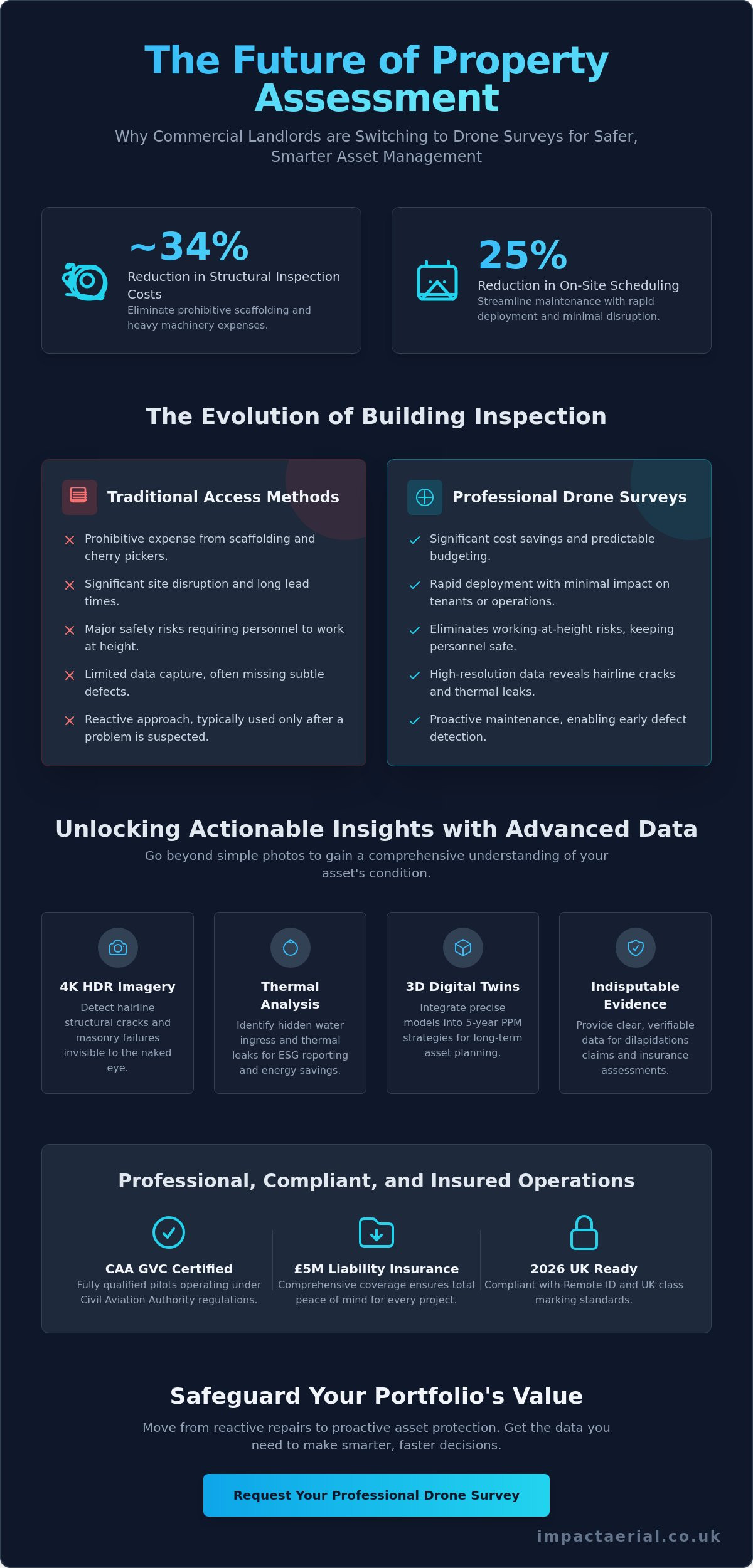
Did you know that integrating drone analytics into property assessments can reduce on-site scheduling by 25% while lowering structural inspection costs by approximately 34%? For many property owners, the traditional approach to asset management involves the prohibitive expense and logistical nightmare of erecting scaffolding just to investigate a suspected roof leak or structural defect. You likely already know that these delays don’t just drain your budget; they stall critical decision-making and leave your high-rise assets vulnerable to further deterioration. Utilizing a professional drone survey for commercial landlords offers a meticulous, data-centric alternative that prioritizes both safety and precision.

This guide reveals how professional aerial surveys mitigate risk and provide the actionable data you need to maintain portfolio value without the standard disruption. We’ll examine the latest 2026 UK regulatory standards, including mandatory Remote ID and UK class markings, to ensure your operations remain fully compliant with Civil Aviation Authority requirements. You’ll discover how moving away from lengthy manual reporting toward rapid, high-resolution aerial assessments allows for smarter, faster asset management.

Key Takeaways

  • Understand why commercial property owners are replacing expensive scaffolding and cherry pickers with rapid, high-precision aerial inspections to streamline site maintenance.
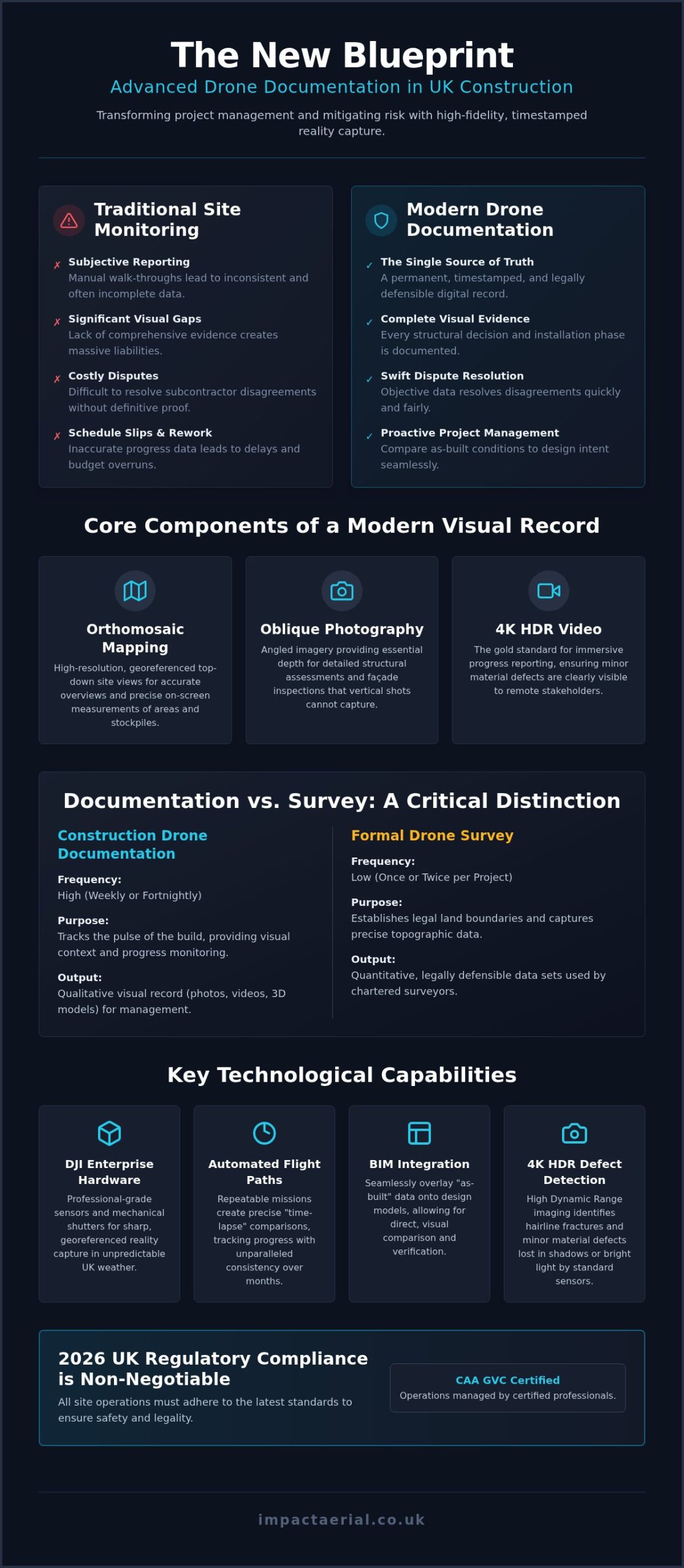
  • Discover how a professional drone survey for commercial landlords identifies hairline structural cracks and thermal leaks using state-of-the-art DJI Enterprise hardware.
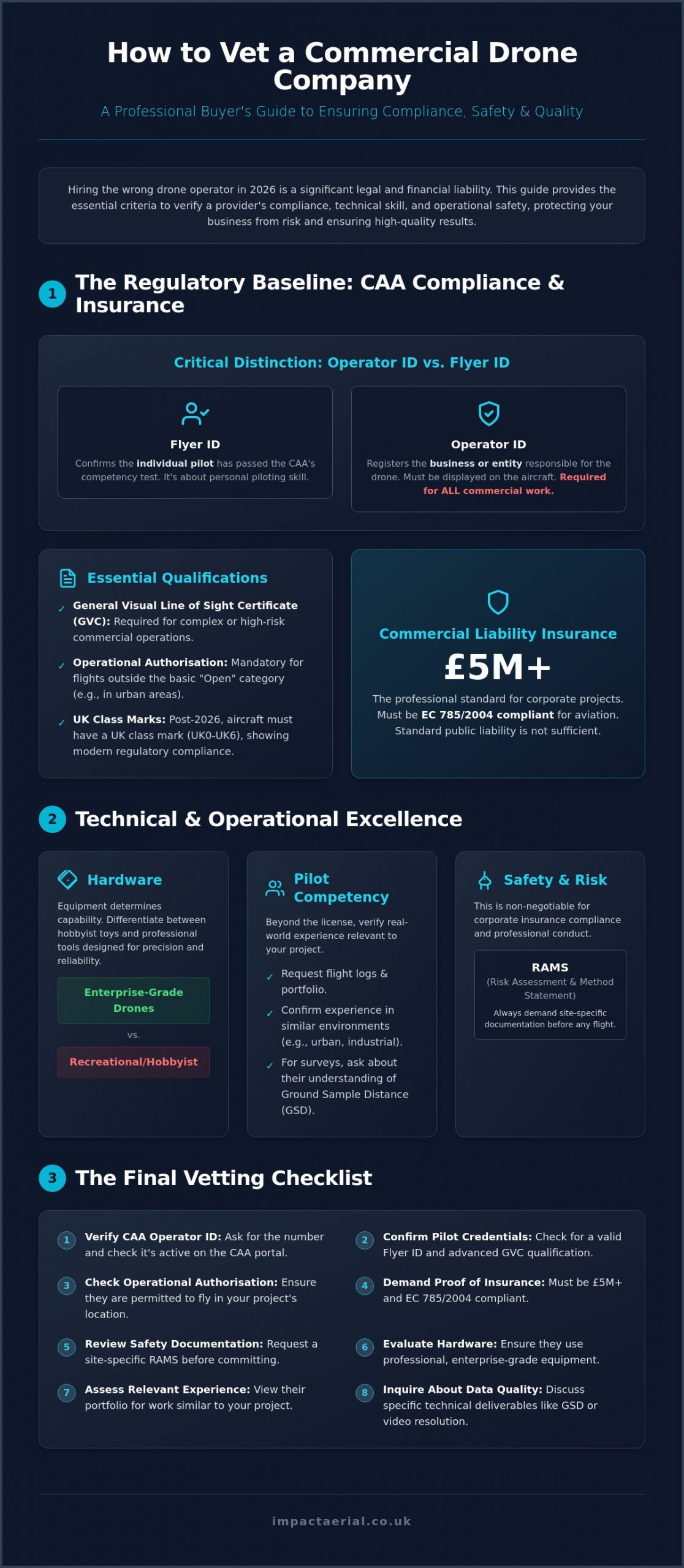
  • Learn about the critical compliance standards, such as CAA GVC certification and £5m liability insurance, required to ensure safety and legal protection during operations.
  • See how integrating 4K HDR imagery and 3D mapping into your 5-year Planned Preventative Maintenance (PPM) strategy safeguards long-term asset value.
  • Gain insights into using indisputable aerial evidence to support dilapidations claims and provide clear data for complex insurance assessments.

Why Commercial Landlords are Switching to Drone Surveys in 2026

The landscape of property management has shifted. In 2026, a drone survey for commercial landlords is no longer a high-tech novelty but a core component of strategic asset management. As the UK’s regulatory framework has matured with specific class markings and mandatory Remote ID, these aerial survey methods have become the gold standard for building envelope inspections. This transition is driven by the need for high-tier data that traditional methods simply cannot match in speed or granularity.

Property owners face increasing pressure to provide detailed ESG (Environmental, Social, and Governance) data. High-resolution sensors allow for precise energy efficiency reporting by identifying thermal leaks that are invisible to the naked eye. This data-centric approach helps landlords meet 2026 sustainability targets while simultaneously reducing the disruption caused to tenants by heavy machinery or intrusive scaffolding. It’s a cleaner, faster, and more professional way to oversee large-scale assets.

To better understand the precision and capabilities of modern surveying technology, watch this helpful video:

The Financial Case: Scaffolding vs. UAV Surveys

For a typical 50,000 sq ft warehouse, the logistics of traditional access methods are staggering. Erecting scaffolding requires significant lead times, specialized permits, and substantial manual labor. According to a study by the Royal Institution of Chartered Surveyors (RICS), integrating drone analytics into property assessments reduces on-site scheduling by 25%. By eliminating the “access cost” barrier, landlords can perform frequent preventative inspections rather than waiting for a visible failure. This proactive stance ensures that minor defects don’t escalate into catastrophic repair bills. Early detection is the most effective way to protect an asset’s bottom line.

Safety and Liability: Keeping Personnel on the Ground

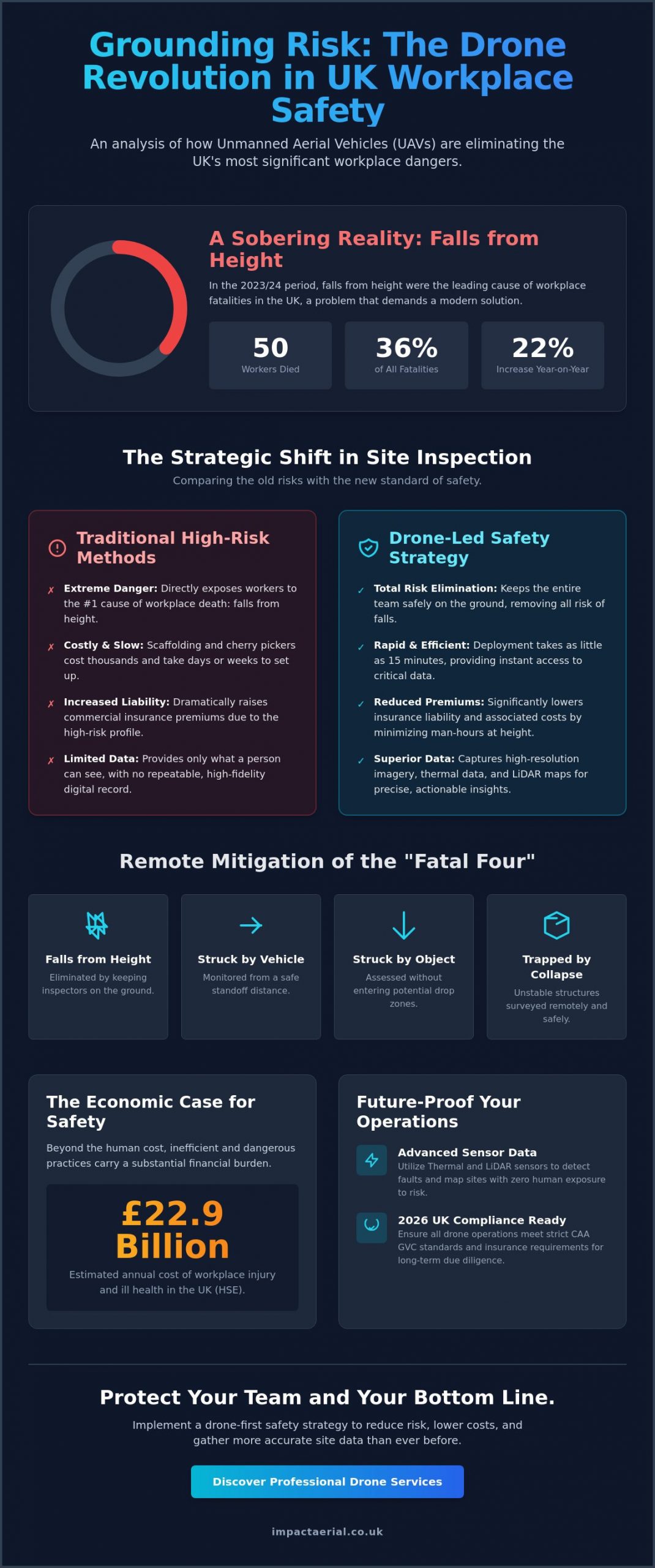
Safety is the most compelling reason for the industry’s shift. Using a drone survey for commercial landlords fundamentally removes the necessity for personnel to work at height during initial assessments. This significantly reduces the complexity of Risk Assessments and Method Statements (RAMS), as there’s no need for fall-arrest systems or heavy plant equipment. The RICS study also found that using drones for structural inspections can lower costs by approximately 34% compared to traditional methods. Beyond the immediate safety benefits, regular and documented aerial inspections demonstrate a commitment to meticulous maintenance. Providing this level of transparent, survey-grade data can reassure stakeholders and provide a verifiable record of structural integrity for insurance purposes.

Advanced Data Collection: Thermal Imaging and 3D Mapping

Modern asset management has moved beyond simple visual snapshots. A professional drone survey for commercial landlords now utilizes DJI Enterprise platforms to capture survey-grade data that was once impossible to obtain without significant cost. These advanced tools revolutionize building inspections by providing 4K HDR imagery that reveals hairline structural cracks invisible from the ground. This level of precision is vital for identifying early signs of concrete fatigue or masonry failure before they necessitate major capital expenditure.

Beyond maintenance, this high-precision data serves as a powerful marketing asset. When you provide prospective tenants with a comprehensive visual record of the building’s condition, you demonstrate transparency and superior management standards. High-resolution imagery and virtual tours can significantly accelerate the leasing process by providing stakeholders with an immediate, detailed view of the asset’s integrity. It’s a strategic way to differentiate your portfolio in a competitive market.

Thermal Surveys for Commercial Energy Efficiency

Thermal sensors are indispensable for assessing building envelopes and meeting 2026 energy standards. They detect failing insulation and “cold bridges” where heat escapes, which is essential for accurate energy efficiency reporting. On flat roofs, thermal imaging identifies trapped moisture within the membrane, pinpointing leaks before they cause internal damage. This technology also optimizes PV solar farm efficiency by identifying malfunctioning cells that could compromise the entire array’s output. By utilizing these drone commercial property surveys, landlords can verify the performance of their green energy investments with absolute certainty.

3D Modelling and Digital Twins for Asset Managers

3D mapping creates a “digital twin” of your development, providing a measurable, interactive record of the site. By using photogrammetry, we generate high-density point clouds that integrate directly into existing Building Information Modelling (BIM) workflows. This allows asset managers to conduct remote inspections and coordinate with maintenance contractors using a single, accurate source of truth. These models are also excellent for investor reporting, as they offer a clear, three-dimensional perspective of large-scale developments that static photography cannot replicate. It ensures every stakeholder has a granular understanding of the asset’s current state without ever needing to step foot on a ladder.

Drone Survey for Commercial Landlords: A Strategic Asset Management Guide

Compliance and Risk Management: Navigating UK Drone Regulations

Operating a drone survey for commercial landlords involves more than just capturing high-resolution imagery. It requires strict adherence to a complex legal framework designed to protect the public and the property owner. In 2026, the Civil Aviation Authority (CAA) regulations have moved to a permanent structure based on UK-specific class markings, making it essential for landlords to vet their contractors with precision. Failing to do so doesn’t just result in poor data; it exposes you to significant legal liability and potential fines of up to £1,000 for improper registration.

Meticulous risk mitigation is particularly vital in congested urban environments like Birmingham. Conducting flights near high-rise assets or within Flight Restriction Zones (FRZs) requires advanced planning and official permissions. Every operation must be supported by a robust Risk Assessment and Method Statement (RAMS) that accounts for everything from pedestrian traffic to 2026 requirements like mandatory green flashing lights for night operations and active Remote ID broadcasting. This level of compliance ensures that your asset management remains professional, legal, and safe.

The Importance of CAA GVC Certified Pilots

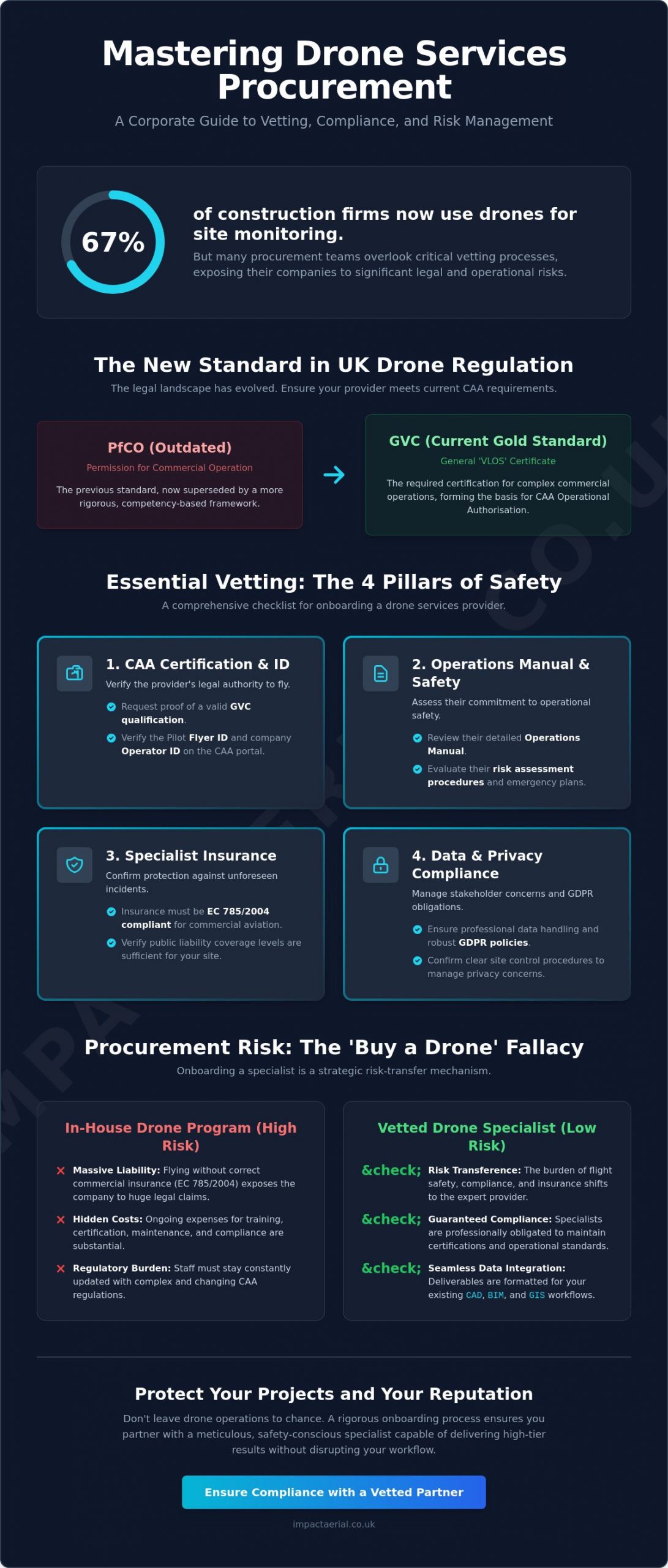
For commercial sites, a “hobbyist” pilot or a basic A2 CofC holder is often insufficient. The General Visual Line of Sight Certificate (GVC) is the professional standard for complex commercial drone operations. It demonstrates that the pilot has undergone rigorous practical and theoretical testing to handle larger aircraft and more challenging environments. Commissioning a pilot without these credentials puts your business at risk. Before any work begins, you should verify the operator’s Flyer ID and Operator ID, ensuring they are current with the 2026 UK class-mark standards (UK1 through UK6) to maintain total operational legality.

Insurance and Liability Safeguards

Standard public liability insurance rarely covers aviation-related risks. Commercial property sites require specialized UAV insurance that meets EC 785/2004 standards to ensure landlords aren’t held liable for third-party damages. We maintain £5m in commercial liability insurance as a baseline, providing the psychological comfort that your assets and reputation are fully protected. Impact Aerial manages all necessary flight permissions in restricted airspaces, coordinating directly with National Air Traffic Services (NATS) when required. This professional oversight extends to data protection; we ensure all aerial photography complies with GDPR by meticulously blurring faces or vehicle registrations that are captured incidentally during the survey process.

Actionable Insights: Integrating Drone Data into Property Strategy

A drone survey for commercial landlords represents a shift from reactive repairs to proactive asset protection. While the technical capabilities of modern hardware are impressive, the true value lies in how this data integrates into your broader property strategy. High-resolution, timestamped 4K data serves as an indisputable record of truth that can significantly accelerate insurance claim processing. When a storm occurs, having “before and after” aerial evidence allows for rapid verification of damage, reducing the time spent in administrative limbo with adjusters.

This data also serves a dual purpose in asset marketing. High-end aerial videography and photography can be woven into commercial leasing brochures to provide a unique perspective that ground-based photography lacks. Prospective tenants, especially those seeking high-value industrial or office space, value the transparency of seeing the building’s exterior and roof condition upfront. It projects a professional image of a landlord who is meticulous about building maintenance and technologically adept in their management style. It’s a strategic way to build trust before a lease is even signed.

Dilapidations and Lease End Negotiations

Terminal schedules of dilapidations are frequently the source of friction and costly legal disputes at the end of a commercial lease. Research shows that boundary and property disputes in the UK can cost owners an average of £12,000 to £35,000 in legal fees if they go to court. By commissioning a drone survey for commercial landlords at the commencement of a lease, you create a baseline “schedule of condition” that is difficult to challenge. Documenting the state of gutters, flashings, and roofing membranes provides a clear visual audit trail. When the lease expires, a follow-up survey identifies exactly what has deteriorated, ensuring that repair costs are fairly and accurately recovered from outgoing tenants. This level of clarity reduces the need for lengthy legal mediation.

PPM and Asset Life Extension

Incorporating aerial reports into a 5-year Planned Preventative Maintenance (PPM) schedule allows for more efficient budget allocation. Instead of broad, speculative maintenance based on “best guesses,” you can target specific areas where sensors have identified minor issues like loose flashings or blocked drainage. Tracking building degradation with year-on-year aerial comparisons provides a longitudinal view of asset health that traditional surveys can’t match. This data-centric method ensures you’re only spending on necessary repairs, effectively extending the life of the building envelope while optimizing your maintenance fund. To safeguard your portfolio with high-precision data, book your professional drone commercial property survey today.

Impact Aerial: Professional Commercial Drone Surveys Across the UK

Impact Aerial operates at the intersection of technical excellence and regulatory compliance. Based in Birmingham, our team provides a specialized drone survey for commercial landlords throughout the West Midlands and across the UK. We don’t use consumer-grade equipment; our fleet consists exclusively of state-of-the-art DJI Enterprise aircraft. These platforms are equipped with high-resolution 4K HDR and thermal sensors, ensuring every data point we collect meets the meticulous standards required by modern asset managers and technical stakeholders. It’s about providing the reassurance that your property is in expert, safety-conscious hands.

We manage every phase of the project from start to finish. This end-to-end project management begins with complex CAA flight planning and coordination with local authorities, continuing through to professional post-production services. Industry leaders trust us for high-stakes property inspections because we prioritize precision and safety above all else. By ensuring every operation is conducted within the strict 2026 UK regulatory framework, we provide a reliable service that safeguards both your physical assets and your legal standing.

Bespoke Solutions for Commercial Portfolios

We don’t provide generic data. Our team delivers customized reporting formats that are tailored to the specific needs of surveyors, architects, and facilities managers. Whether you’re overseeing a single high-rise asset or a sprawling multi-site industrial park, our survey solutions are fully scalable and adaptable. We maintain a safety-first culture, especially in complex urban settings where pedestrian traffic and restricted airspace require expert oversight. Our deep understanding of professional standards ensures that our output is qualitative, aspirational, and ready for immediate integration into your asset management strategy.

Get Started with Your Commercial Drone Survey

Commissioning a drone survey for commercial landlords begins with a site-specific risk assessment. Once you provide the location details, our team evaluates the local airspace and operational requirements to provide a comprehensive, transparent quote. On a typical survey day, our GVC-certified pilots arrive on-site to conduct a final pre-flight safety briefing before deploying the DJI Enterprise fleet. The entire process is non-intrusive, allowing your tenants to continue their operations without the disruption or cost associated with traditional access methods. You can expect a structured, methodical flow from the initial enquiry to the final data delivery.

Book your professional drone survey today to secure your asset’s future with data-centric management and high-tier aerial insights.

Elevating Your Asset Management Strategy for 2026

Adopting a drone survey for commercial landlords is about more than just modernizing your toolkit; it’s about shifting to a data-centric model of asset protection. By replacing traditional, high-risk access methods with precision aerial technology, you can identify structural vulnerabilities early and maintain total transparency with tenants and investors. This strategic approach ensures your portfolio remains compliant with the latest UK aviation standards while significantly streamlining your maintenance budget.

Our team provides the technical expertise and regulatory oversight required for high-stakes commercial environments. We utilize DJI Enterprise 4K HDR Technology to capture survey-grade data, supported by CAA GVC Certified Pilots and £5m Commercial Liability Insurance. This combination of high-end hardware and professional certification offers the psychological comfort and tangible reliability your business deserves. Take the first step toward a more efficient, risk-averse property strategy today. Request a Quote for Your Commercial Property Survey.

Investing in professional aerial data is a commitment to the long-term health and value of your commercial assets. We look forward to helping you safeguard your portfolio with the precision and expertise that modern property management demands.

Frequently Asked Questions

Is a drone survey legal for a commercial property in a city centre?

Yes, drone operations in city centres are entirely legal when conducted by CAA-licensed pilots who adhere to strict safety protocols. For a drone survey for commercial landlords, we manage all necessary flight permissions and coordinate with local authorities to ensure compliance with 2026 UK class-mark regulations. This includes maintaining a direct Visual Line of Sight (VLOS) and ensuring the aircraft broadcasts its Remote ID as required by current law.

How much does a commercial drone survey cost compared to scaffolding?

Aerial surveys are substantially more cost-effective than traditional methods because they eliminate the need for expensive access equipment. While scaffolding or cherry pickers require significant labour and multi-day hire periods, a drone can complete the same inspection in a fraction of the time. This reduction in access costs allows landlords to perform more frequent preventative maintenance, ultimately protecting the asset’s long-term value without the standard financial burden.

What kind of reporting will I receive after the drone inspection?

Clients receive a comprehensive digital data package tailored to their specific asset management needs. This typically includes high-resolution 4K HDR imagery, thermal maps for identifying energy efficiency issues, and interactive 3D models or digital twins. Our post-production team processes this raw data into actionable reports that surveyors and architects can use for immediate decision-making, dilapidations claims, or long-term planned preventative maintenance (PPM) schedules.

Can drones identify specific leaks or thermal issues on flat roofs?

Drones equipped with specialized thermal sensors are highly effective at identifying moisture ingress and insulation failures on flat roofs. By detecting temperature differentials, these sensors pinpoint trapped water within roofing membranes that is invisible to the naked eye. This allows for targeted repairs of specific leaks, preventing the need for a full and costly roof replacement while helping you meet 2026 energy efficiency standards.

Do I need to inform my tenants before a drone survey takes place?

It’s standard professional practice to inform tenants of a scheduled aerial inspection to ensure transparency and privacy. While our pilots use meticulous methods to avoid capturing personal data, giving tenants notice helps maintain positive relations and ensures site safety. We can provide documentation to assist you in notifying occupants about the flight’s purpose, the safety protocols in place, and its non-intrusive nature.

What insurance coverage does Impact Aerial maintain for commercial sites?

We maintain £5m in commercial liability insurance specifically designed for UAV operations, which provides essential protection for high-value commercial assets. This coverage meets EC 785/2004 standards and ensures that landlords are not held liable for third-party risks during the survey. This level of insurance offers total reassurance that your property and reputation are fully safeguarded throughout every phase of the operation.

How long does it take to complete an aerial survey of a large industrial unit?

A typical drone survey for commercial landlords on a large industrial unit can often be completed within a few hours on-site. Traditional manual inspections might take several days to coordinate and execute, especially when scaffolding or heavy machinery is involved. Our efficient, data-centric workflow allows for rapid collection of high-tier imagery without disrupting the daily operations of your tenants or on-site staff.

Are drone surveys suitable for listed commercial buildings?

Drone surveys are an ideal solution for listed commercial buildings because they are entirely non-invasive. Since the aircraft never makes physical contact with the structure, there’s no risk of damaging delicate masonry, historic features, or original roofing materials. This makes aerial inspections a preferred method for heritage assets where maintaining structural integrity is a legal priority, providing detailed data without the risks associated with ladders or scaffolding.

Drone Survey for Commercial Insurance Renewal: A 2026 Guide

Did you know that utilizing high-resolution aerial data can improve underwriting accuracy by 40 to 60 percent, effectively turning a drone survey for commercial insurance renewal into your strongest negotiation tool? As commercial premiums rise toward a projected 1.73 billion dollar market in 2026, many owners find it difficult to prove proactive maintenance through traditional, dangerous, and costly manual inspections. It’s frustrating to face higher rates simply because you lack the “clean” data report that modern brokers now demand for a favorable risk assessment.

Securing a professional aerial inspection provides the irrefutable evidence needed to de-risk your portfolio and can lead to a 55 percent reduction in inspection costs compared to legacy methods. This guide outlines how to leverage the latest FAA Part 108 regulations and updated ALTA/NSPS standards to streamline your renewal process. You’ll learn exactly which data points satisfy underwriters and how our meticulously maintained fleet delivers zero-disruption results for total peace of mind.

Key Takeaways

  • Understand why 2026 underwriters are moving away from “assumed risk” and how high-resolution evidence can directly reduce uncertainty loading on your premiums.
  • Learn how a professional drone survey for commercial insurance renewal identifies hidden defects like moisture ingress using advanced 4K HDR and thermal imaging technology.
  • Compare the ROI of aerial inspections against traditional methods, focusing on the elimination of “working at height” risks and significantly faster data turnaround.
  • Follow a streamlined preparation checklist to identify site-specific risks and manage tenant notifications for a smooth, zero-disruption inspection.
  • Discover why CAA GVC Certification and professional credentials are required to ensure your survey data is accepted as irrefutable evidence by major insurers.

Why Insurers Demand Drone Surveys for Commercial Renewals in 2026

The insurance landscape in 2026 has moved decisively toward data-driven transparency. Underwriters no longer rely on broad “assumed risk” models based on zip codes or building age alone. Instead, they demand “evidenced health.” By commissioning a drone survey for commercial insurance renewal, property managers provide granular proof of a building’s structural integrity. This shift reduces “uncertainty loading,” which is essentially a premium buffer that insurers apply when they lack clear data on a property’s condition. With the drone insurance market projected to reach 1.73 billion dollars this year, the financial incentive for transparency has never been higher.

The deployment of a sophisticated unmanned aerial vehicle (UAV) allows for the identification of liabilities that ground-based inspections simply miss. Issues like standing water on flat roofs, blocked guttering, or thermal leaks in HVAC systems are captured in high resolution. This prevents small maintenance gaps from becoming catastrophic claims that inflate your loss ratio. Insurers now prioritize UAV data because it offers 40 to 60 percent better underwriting accuracy than traditional methods. It provides a level of detail that ground-level assumptions cannot match, especially for high-value industrial assets.

To better understand how these aerial assessments integrate with the insurance industry, watch this helpful video:

From Reactive to Proactive Risk Management

Moving from reactive repairs to proactive management is essential for maintaining low premiums in a tightening market. Professional aerial surveys create a chronological record of an asset’s condition. This historical data is vital during claim disputes; it allows you to distinguish between long-term wear and tear and sudden storm damage with 100 percent certainty. When you update your “Statement of Fact” document for a broker, including a certified survey report demonstrates a level of meticulousness that underwriters reward with better terms. Data shows that using drones can lead to 43 percent faster processing of insurance claims for damage assessments, getting your business back to full operation sooner.

Meeting the Requirements of Major UK Brokers

Major UK brokers have moved beyond accepting simple smartphone photos or hobbyist snapshots. They require high-resolution 4K HDR imagery that includes embedded metadata and precise date-stamping. This technical rigor ensures the data is tamper-proof and legally defensible. A generic aerial photo doesn’t provide the zoom capabilities needed to inspect a single loose bolt on a 50-foot cladding panel or a hairline crack in a chimney stack. A professional drone survey acts as a high-fidelity digital twin of your commercial asset, providing a comprehensive and interactive record that de-risks the entire insurance lifecycle. By providing this “clean” survey report, you eliminate the guesswork that often leads to inflated premium quotes.

What a Comprehensive Insurance Drone Survey Includes

A comprehensive drone survey for commercial insurance renewal is a multi-layered data asset rather than a simple collection of aerial photographs. To satisfy the rigorous requirements of 2026 underwriters, a survey must provide a holistic view of the property. This includes high-resolution 4K High Dynamic Range (HDR) imagery that captures minute details of roof coverings, masonry, and facade elements. The Insurance Information Institute highlights how this level of transparency improves the risk assessment process by providing a clear, verifiable baseline of property health. We supplement this visual data with 3D photogrammetry to create a spatially accurate digital twin of the entire site. This allows stakeholders to understand the property’s context and condition without the need for physical site visits.

The final deliverable is a detailed PDF condition report. Unlike a standard photo gallery, these reports feature geo-tagged high-priority defects, allowing maintenance teams to locate and repair issues with surgical precision. Every survey we conduct adheres to the updated ALTA/NSPS standards finalized on February 23, 2026, which formally recognize drone data in land title and property assessments. This compliance ensures that the data you provide to your broker is legally robust and professionally vetted. For added peace of mind, our operations are backed by a minimum of 1 million pounds in commercial liability insurance, meeting the de facto standard for professional drone services.

Thermal Surveys for Solar and Flat Roofs

Identifying moisture ingress is a primary concern for flat roof owners, as trapped water can lead to structural failure long before a leak becomes visible inside. Thermal imaging detects temperature variances that indicate insulation failure or water saturation. This technology is indispensable for assets with integrated renewable energy. Our PV Solar Farm Thermal Surveys identify cell failures and electrical “hot spots” that represent significant fire risks. By catching these anomalies early, you protect your investment and prove to your insurer that you are managing fire risks proactively.

Visual Facade and Cladding Inspections

Traditional cladding inspections often require expensive scaffolding or cherry pickers, adding layers of cost and health and safety paperwork. Drones eliminate these overheads while capturing high-detail images of guttering, flashings, and parapet walls from angles that are impossible to reach from the ground. This level of detail is essential for maintaining fire safety documentation for high-rise commercial units. If you’re looking to streamline your next property assessment, you can view our full range of professional aerial services to see how we capture these critical data points.

Drone vs. Traditional Surveys: A Comparison of ROI

When you evaluate a drone survey for commercial insurance renewal, the return on investment extends far beyond the initial service fee. Traditional methods often require hiring cherry pickers or erecting scaffolding, which can inflate costs and create significant liability. Utilizing drones for infrastructure inspections results in a 55 percent cost reduction compared to these legacy methods. Safety is the most immediate gain. By eliminating the “Working at Height” risk, you remove a major hazard from your site’s risk profile. This is a key factor that underwriters consider when reviewing your own business insurance requirements.

The speed of delivery is equally transformative for large-scale assets. While a traditional survey crew might spend several days inspecting a 50,000 sq ft warehouse, a professional drone team completes the data-gathering process in just a few hours. This rapid turnaround allows you to submit your renewal documentation weeks ahead of the deadline, giving your broker more time to negotiate favorable terms. For added peace of mind, our operations are conducted by meticulous pilots who adhere to the same rigorous safety standards found in FAA regulations for commercial operators, ensuring every flight is compliant and low-risk.

Eliminating Access Costs and Site Disruption

Drones are the preferred method for “business-as-usual” inspections because they don’t require site shutdowns. You don’t have to cordon off parking lots or manage the logistics of heavy machinery in public-facing commercial areas. This lack of disruption is vital for retail parks or active logistics hubs where every hour of downtime has a price tag. Aerial technology also reaches “un-surveyable” areas like steep roof valleys and internal light wells. These locations are often ignored during ground-level binocular checks but are frequently the source of hidden structural liabilities.

The Quality Gap: Data You Can Zoom Into

The depth of data provided by aerial technology creates a significant quality gap. A standard handheld camera or a pair of binoculars can’t match the 20MP resolution of a professional DJI Enterprise drone. These high-resolution files allow you to zoom in on individual fasteners or hairline cracks with absolute clarity. We also produce “orthomosaic” maps, which are massive, high-resolution files showing the entire site in a single, measurable image. To understand the technology behind these results, read our guide on what is a survey drone. This level of detail provides the irrefutable evidence that underwriters need to approve your renewal with confidence.

Preparation Checklist: Getting Your Site Ready for Survey

A successful drone survey for commercial insurance renewal requires more than just booking a flight date. To maximize the value of the data-gathering process, property managers must follow a structured preparation phase. This ensures that the pilot captures every critical detail required by your underwriter without the need for costly re-flights or data gaps. Proper preparation also facilitates the 40 to 60 percent improvement in underwriting accuracy that professional aerial data provides.

  • Step 1: Identify key risk areas. Highlight known issues such as historical leaks, aging cladding, or complex PV solar arrays. This allows the pilot to prioritize these zones for high-detail 4K capture during the flight.
  • Step 2: Notify tenants and stakeholders. While 67 percent of construction and property firms now use drones, early communication remains essential. Informing occupants of the flight date ensures privacy compliance and prevents operational friction on the day.
  • Step 3: Ensure clear access to the site perimeter. Pilots require a safe takeoff and landing area (TOLA). Clearing a small section of the perimeter or ensuring flat roof access allows for efficient, zero-disruption operations.
  • Step 4: Collate previous years’ records. Comparative analysis is a powerful tool in risk management. Having 2024 or 2025 aerial data ready allows you to prove that your maintenance schedule is consistent and proactive.

Briefing Your Drone Pilot

Your pilot needs a clear technical brief to deliver the results your broker expects. Provide detailed site maps and explicitly highlight any areas requested by your insurer, such as parapet walls or internal light wells. Discussing data formats is also vital. While JPEGs are standard for reports, your internal engineering team might require RAW files or specific photogrammetry outputs for long-term asset management. Most importantly, verify that the pilot has prepared site-specific Risk Assessments and Method Statements (RAMS). A professional operator will always provide these documents to ensure the flight is conducted within the latest safety parameters for added peace of mind.

Presenting Data to Your Broker

Once the survey is complete, the report becomes your primary negotiation asset. Use the high-resolution imagery to highlight “repaired” defects. This provides irrefutable proof that you’ve addressed previous concerns, which can help lower premiums by reducing the “uncertainty loading” applied by underwriters. 3D models are particularly effective for complex commercial claims, providing brokers with a 360-degree view of the property’s condition. If you are ready to begin this process, you can book your professional property survey here to secure the data you need for a successful renewal.

Why Professional Certification is Non-Negotiable for Insurers

Insurers are increasingly meticulous about the source of the data they use for risk assessment. A drone survey for commercial insurance renewal is only as valid as the certification of the pilot who conducted it. Utilizing “hobbyist” data is a significant risk for any property manager. If a flight doesn’t comply with UK law, an insurer can reject the findings entirely, leaving you with a useless report and a potentially higher premium. Compliance isn’t a suggestion; it’s a fundamental requirement for the data to be legally defensible during a renewal or a claim.

Our fleet features the latest DJI Enterprise technology, which allows for consistent and repeatable data sets. Unlike consumer-grade drones, these systems provide precise flight path telemetry. This means we can recreate the exact same inspection year after year, providing underwriters with a longitudinal view of your asset’s health. To support these high-tech operations, we maintain £5 million in commercial liability insurance. While many operators stick to the de facto £1 million minimum, our higher level of coverage provides the robust safety net required by high-value industrial and retail assets.

The Role of CAA GVC Certified Pilots

The legal framework for commercial drone operations in the UK is governed by the Civil Aviation Authority (CAA). To operate legally in a commercial capacity, pilots must hold a GVC (General Visual Line of Sight Certificate). This certification acts as a marker of safety and professional standards, proving the pilot understands complex airspace regulations and risk mitigation. If you’re unsure about the current rules, our UK Drone License Guide explains the latest 2026 requirements in detail. Choosing a certified professional ensures your data is gathered safely and is fully compliant with the latest aviation laws.

Impact Aerial: Your Partner in Commercial Renewals

Based in Birmingham and the West Midlands, we serve the UK property sector with a commitment to technical precision. Our team manages the entire lifecycle of your survey, from the initial site consultation to the final post-production of your condition report. We don’t just deliver photos; we provide a verified data asset that strengthens your position with your broker. Our meticulous, vetted, and professional team provides total peace of mind by ensuring every flight is legal, insured, and technically superior. This structured approach allows you to focus on your business while we handle the complexities of aerial data gathering.

Take Control of Your 2026 Insurance Renewal

The transition from “assumed risk” to “evidenced health” is now the standard for the UK property sector. By providing your broker with a professional drone survey for commercial insurance renewal, you eliminate the uncertainty that often leads to inflated premiums. You’ve seen how high-resolution data improves underwriting accuracy by up to 60 percent while reducing physical inspection costs by 55 percent. It’s a strategic move that protects both your physical assets and your bottom line.

Impact Aerial provides the technical expertise and regulatory compliance required for high-stakes renewals. Our team uses the latest DJI Enterprise 4K HDR technology and operates with 5 million pounds in commercial liability insurance for added peace of mind. As specialists serving the West Midlands and clients nationwide, we ensure your property data is irrefutable and professionally vetted by CAA GVC Certified pilots. Don’t leave your next renewal to chance. Secure your commercial renewal with a professional drone survey from Impact Aerial and enter your next negotiation with total confidence.

Frequently Asked Questions

Will my insurance company accept a drone survey for my renewal?

Yes, insurers increasingly mandate these surveys because they provide irrefutable evidence of property condition. As of February 23, 2026, the updated ALTA/NSPS standards formally recognize drone data in property assessments. Providing a drone survey for commercial insurance renewal helps you move from “assumed risk” to “evidenced health,” which underwriters prefer. It ensures your data is legally robust and satisfies the rigorous transparency requirements of 2026 insurance markets.

How much does a commercial drone survey cost in 2026?

Costs vary based on the technology used and the site’s scale. According to 2026 industry reports, a standard commercial roof inspection typically ranges from $400 to $1,200. More complex photogrammetry surveys can cost between $1,500 and $10,000, while LiDAR surveys for large industrial estates range from $3,000 to $15,000. These figures reflect the specialized equipment and data analysis required for professional-grade insurance documentation that underwriters can trust.

Do I need to shut down my business during the drone survey?

No, business-as-usual operations continue without interruption during our aerial inspections. Drones eliminate the need for scaffolding, cherry pickers, or cordoned-off parking areas that traditional methods require. Since the pilot operates from a safe takeoff area, your staff and tenants won’t be impacted. This zero-disruption approach is why 67 percent of construction and property firms now prefer aerial methods over traditional ground-based inspections that require site shutdowns.

What happens if the drone survey finds a major defect during renewal?

Finding a defect early is a strategic advantage for your renewal process. It allows you to address the issue and provide proof of repair before the final policy is bound. By showing proactive maintenance, you reduce the “uncertainty loading” that insurers apply to unknown risks. Utilizing a drone survey for commercial insurance renewal can enhance underwriting accuracy by 40 to 60 percent, often leading to more favorable terms.

Is a drone survey better than a traditional roof survey for insurance?

Yes, drones offer superior safety and data depth compared to manual inspections. Utilizing aerial technology results in a 55 percent cost reduction and eliminates the “Working at Height” liability for your business. You receive high-resolution 4K HDR imagery that captures defects invisible to ground-level binocular checks. Additionally, drones enable 43 percent faster claims processing if damage occurs, ensuring your asset is back to full operation as quickly as possible.

What certifications should I look for when hiring a drone surveyor?

You must ensure the pilot holds a valid CAA GVC Certification in the UK or a Part 107 Remote Pilot Certificate in the US. These certifications guarantee the operator has the aeronautical knowledge required for safe, legal flights. You should also verify they carry at least £1 million in commercial liability insurance. Professional operators will always provide their registration and insurance documents for your added peace of mind before starting any work.

Can drones perform thermal surveys for commercial insurance?

Yes, thermal imaging is a critical component of a comprehensive insurance survey. It identifies moisture ingress in flat roofs and “hot spots” in PV solar arrays that indicate electrical fire risks. By detecting temperature variances, thermal drones find hidden water intrusion that could lead to structural failure. This data is essential for 2026 renewals, as it provides proof of healthy insulation and functioning, safe renewable energy systems.

How long does it take to receive the final insurance survey report?

Most professional reports are delivered within 48 to 72 hours of the flight. This rapid turnaround includes the processing of high-resolution imagery and the creation of a detailed PDF condition report. Every defect is geo-tagged and timestamped to provide a legally defensible record for your broker. This speed allows you to submit your renewal documentation well ahead of deadlines, facilitating a smoother and more efficient negotiation process with your provider.

Drone Photography for Insurance Documentation: The 2026 Professional Guide

Did you know that utilizing professional drone photography for insurance documentation can accelerate claim processing by 43%? In a sector where time often dictates the scale of a loss, waiting weeks for a manual adjuster to climb a ladder is no longer the industry standard. You’re likely tired of the friction caused by subjective damage assessments and the inherent safety risks of traditional roof inspections. It’s frustrating when a legitimate claim is stalled by disputes over whether a defect is recent storm damage or simple wear and tear.

This guide demonstrates how high-resolution aerial data provides the undeniable evidence needed to secure faster settlements and eliminate inspection risks. We’ll explore the 2026 CAA regulatory requirements, including the new 100g registration threshold and mandatory Remote ID, while detailing how technical photogrammetry turns a visual survey into a forensic record. You’ll learn how to leverage these professional services to ensure every asset condition is documented with total precision, providing added peace of mind for both the insurer and the policyholder.

Key Takeaways

  • Discover how high-resolution aerial data streamlines claim processing by up to 43% compared to traditional manual inspection methods.
  • Learn the technical standards required for admissibility, including essential EXIF metadata and GPS-referencing for forensic accuracy.
  • Understand the strategic value of drone photography for insurance documentation in establishing pre-loss baselines and capturing immediate post-loss evidence.
  • Identify why CAA GVC certification and EC 785/2004 compliant insurance are non-negotiable for legally sound data gathering in 2026.
  • Explore how utilizing a professional fleet of DJI Enterprise drones provides the precision needed for complex commercial property inspections.

The Shift to Aerial Data: Why Drones are Essential for Insurance in 2026

By May 2026, the insurance industry has largely moved beyond the limitations of manual adjusters. Traditional methods rely on human observation, which is inherently prone to error and often provides incomplete coverage of large or complex structures. We define drone photography for insurance documentation as a forensic data-gathering tool rather than a creative pursuit. This shift ensures that every pixel serves as objective, timestamped proof that stands up to scrutiny during a claim. It turns a subjective argument into a factual discussion.

Utilizing our fleet of DJI Enterprise drones, we capture 4K HDR imagery that reveals breath-taking detail. These high-resolution files allow adjusters to zoom in on micro-fissures in masonry or subtle hairline cracks in roofing tiles that are invisible to the naked eye. This level of precision provides added peace of mind for property owners and stakeholders during the stressful aftermath of an incident. It’s about providing a definitive record that leaves no room for doubt.

To better understand the efficiency of these aerial workflows, watch this helpful video:

Eliminating Safety Risks and Access Issues

Traditional high-level roof inspections require expensive scaffolding or cherry pickers. These methods are slow and introduce significant liability to a site. Drones eliminate these requirements by accessing dangerous or unstable structures post-fire or post-flood without putting personnel at risk. By removing the need for physical climbing, drone technology fundamentally reduces risks associated with the Work at Height Regulations (WAHR). Professional operators must remain compliant with evolving international drone regulations to ensure the resulting data is legally admissible and safety-compliant.

The Speed of Digital Evidence Gathering

Speed is critical when responding to UK weather events, such as the severe wind incidents frequently seen across Birmingham and the West Midlands. A single flight session can capture 100% of a building’s envelope, including hard-to-reach gables and valleys. This comprehensive data set allows for a rapid desk-side review by loss adjusters, often reducing processing times by 43%. Our drone services ensure that evidence is captured before temporary repairs, such as tarpaulin covers, obscure the primary damage. Digital delivery means the entire claim cycle moves faster, from the initial site visit to the final settlement.

Technical Admissibility: What Insurers Require from Drone Imagery

For an insurer to accept aerial data, the files must be more than just clear images; they must be forensic records. High-quality drone photography for insurance documentation relies on embedded EXIF metadata. This data includes the exact date, time, and altitude for every frame captured. Without these verifiable markers, an image is merely a picture without context. In a legal or insurance dispute, these timestamps prove the condition of the asset at a specific moment, preventing claims that damage occurred after the inspection date.

Repeatable flight paths represent another vital technical requirement. By using automated waypoint missions, we can return to the exact same spatial coordinates months or years later. This allows adjusters to compare “before and after” imagery from identical angles and altitudes. This consistency is essential for tracking the progression of structural issues or verifying that repairs were completed to the required standard. While UK operators adhere to CAA standards, those operating in the US must follow FAA Part 107 regulations to ensure their data remains legally sound and admissible in international claims.

Geotagging and Spatial Accuracy

By embedding precise GPS coordinates into every frame, we create an undeniable link between the digital image and the physical location of the asset. This level of spatial accuracy is critical on large commercial sites where identifying a specific roof leak among dozens of identical units is difficult. Our team utilizes DJI Enterprise technology to maintain centimetre-level precision during data collection. This ensures that every defect found is mapped accurately, allowing for seamless integration with existing property management software. If you require this level of forensic detail, our professional drone services provide the technical rigour necessary for complex claims.

Visual Fidelity and Zoom Capabilities

Commercial-grade sensors are non-negotiable for professional evidence gathering. We utilize high-resolution sensors that allow adjusters to identify missing granules on shingles or hairline cracks in masonry from a safe distance. Standard resolution often blurs these fine details, leading to inconclusive reports. High Dynamic Range (HDR) is critical for documenting never-before-seen angles in dark structural recesses, such as under eaves or within charred internal voids. This technology ensures that details in both deep shadows and bright highlights are preserved, providing drone photography for insurance documentation that captures the full extent of the damage without loss of clarity.

Strategic Documentation: Pre-Loss Baselines vs. Post-Loss Claims

Proving the exact moment damage occurred is one of the most difficult challenges in any claim. Without a documented baseline, insurers may attribute structural defects to pre-existing wear and tear rather than a specific event. This is where strategic drone photography for insurance documentation becomes a critical asset for property managers and developers across the UK. By maintaining a chronological record of an asset’s condition, you move from a position of defense to one of undeniable evidence.

Timing is everything. Capturing high-resolution data immediately after a loss event ensures the adjuster sees the raw damage before temporary repairs, such as tarpaulins or emergency boarding, obscure the site. This proactive approach eliminates ambiguity and streamlines the entire settlement process. Understanding the broader context of drone use in the insurance industry reveals that carriers are increasingly favoring policyholders who provide high-quality, professional aerial data over those relying on ground-based snapshots.

The Pre-Loss Baseline Strategy

Establishing a “gold standard” record of your property is the most effective way to mitigate future risk. We recommend conducting annual drone property surveys to create a digital twin of your assets. This digital record serves as a benchmark for long-term structural monitoring, allowing you to track subtle changes in roof health or masonry over time. Proactive documentation often aids in reducing insurance premiums by demonstrating a commitment to meticulous maintenance and risk management. For commercial property developers, this data provides added peace of mind, ensuring that any future claims are backed by a verifiable history of the building’s envelope.

Post-Event Damage Assessment

When a storm hits the West Midlands or other parts of the UK, the damage is rarely uniform. High-velocity winds can cause localized wind uplift, while hail impact might only affect specific elevations. Our drone photography for insurance documentation captures a comprehensive bird’s eye view of the entire site, revealing devastation that is often invisible from the ground. We use advanced photogrammetry to calculate the exact square footage of damaged areas, providing adjusters with precise metrics for material replacement costs. This level of forensic detail prevents disputes over the scale of the loss and ensures your settlement reflects the true cost of restoration. Digital delivery of this data allows for a rapid desk-side review, which is a primary reason why drone-assisted claims are processed 43% faster than traditional manual inspections.

Compliance & Liability: Ensuring Your Drone Data is Legally Sound

Data gathered through drone photography for insurance documentation is only as valuable as its legal admissibility. If an operator fails to meet the stringent UK Civil Aviation Authority (CAA) standards, an insurer has every right to reject the evidence entirely. This is a significant risk when hiring uncertified hobbyists. These individuals often lack the necessary operational authorizations and commercial insurance required to fly in complex environments. In a niche but increasingly diverse market, the distinction between a professional service and a casual flyer is defined by their adherence to the law.

The danger of using uncertified pilots extends beyond simple data rejection. If a drone incident occurs on your site, the lack of professional-grade insurance can leave property managers personally liable for third-party damages. Statistics from 2024 show that 97% of commercial clients now mandate proof of valid insurance and certification before any flight operations begin. Ensuring your pilot is fully vetted is the only way to protect your business interests during a claim.

The Importance of CAA GVC Certification

The General Visual Line of Sight Certificate (GVC) is the professional benchmark in 2026. This certification replaced the older PfCO and ensures that pilots are trained in the latest safety protocols and risk assessments. Certified operators must stay current with the January 1, 2026, regulations, which lowered the registration threshold to 100g and made Remote ID mandatory for all new drones. By working with a pilot who holds a valid UK drone license, you ensure that every flight is logged and conducted within a strict safety framework. This meticulous record-keeping is essential for proving the validity of your data to an insurance adjuster.

Commercial Liability and Professional Indemnity

For added peace of mind, Impact Aerial maintains £5m in commercial liability insurance. This level of coverage is essential when operating high-precision drones on high-value commercial sites or near public infrastructure. Professional operators must carry EC 785/2004 compliant insurance to ensure that all stakeholders are protected. Before commissioning a survey, always ask for a copy of the operator’s insurance certificate and their CAA operator ID. Our affiliations with the Drone Safe Register and ARPAS-UK serve as a non-verbal signature of our commitment to industry standards and reliability.

Data protection is equally vital. Handling high-resolution drone photography for insurance documentation requires strict adherence to GDPR, especially when capturing imagery near third-party properties or public spaces. We ensure that any identifiable data not relevant to the claim is redacted or handled securely. This comprehensive approach to compliance ensures your documentation is both technically superior and legally bulletproof. Contact our CAA GVC Certified team to secure a compliant aerial survey for your next claim.

Impact Aerial: Expert Insurance Documentation in the UK

Impact Aerial operates as a specialized technical consultant within a niche but increasingly diverse market. We recognize that drone photography for insurance documentation requires more than just a pilot; it demands a forensic mindset and a deep understanding of structural data. Our meticulous approach to drone services ensures that property developers, building services, and insurers receive data that is both technically superior and legally sound. From the initial consultation to the final delivery of post-production reports, we manage every detail of the evidence-gathering process.

Our safety-first culture is the foundation of our reputation. We don’t just claim to be safe; we demonstrate it through our CAA GVC Certification and rigorous adherence to the 2026 UK drone regulations. By maintaining a fleet of the latest DJI Enterprise drones, we provide our clients with the reassurance that their assets are being documented by the best technology available. This commitment to precision turns a complex claims process into a manageable, data-driven workflow, providing added peace of mind for all stakeholders involved.

Commercial-Grade Technology

The quality of your evidence depends entirely on the sensors used during the flight. We utilize 4K HDR sensors to capture breath-taking detail, ensuring that even the smallest structural defects are visible in high-contrast environments. For subsurface damage detection, our thermal imaging capabilities reveal heat signatures that indicate moisture ingress or insulation failure behind facades. The precision of our survey drone fleet allows us to generate customized reporting formats. These reports are specifically tailored for the technical requirements of insurance adjusters and structural engineers, featuring GPS-tagged imagery and annotated damage maps that leave no room for misinterpretation.

Your Trusted West Midlands Partner

While we serve the entire UK, our regional expertise in Birmingham and the West Midlands allows us to respond rapidly to local loss events. We understand the specific architectural challenges and weather patterns of the region, from industrial complexes in the Black Country to modern commercial developments in the city centre. This local knowledge, combined with our national reach, makes us a leading partner for comprehensive asset documentation. If you require undeniable evidence for an active claim or wish to establish a pre-loss baseline for your property portfolio, you can Request a Quote through our website. We remain dedicated to providing top-quality results that combine technological innovation with absolute regulatory compliance.

Secure Your Claims with Forensic Aerial Data

The integration of aerial technology into the insurance lifecycle has transformed how we document asset condition. By moving away from manual inspections, you reduce safety risks and capture data that is 43% faster to process than traditional methods. High-resolution drone photography for insurance documentation serves as a forensic record, providing the undeniable evidence needed to settle disputes over wear and tear. It’s no longer just about taking photos; it’s about gathering objective data that stands up to scrutiny.

Maintaining compliance with the latest 2026 CAA regulations ensures your data remains legally sound and admissible. Professional operators provide the technical rigour that hobbyists can’t match, particularly when handling complex commercial property surveys. Our team combines regional expertise in the West Midlands with a national reach, ensuring every flight is backed by meticulous risk assessments. Secure your property’s evidence, contact Impact Aerial for a professional insurance documentation quote today. With our CAA GVC Certified pilots, £5m commercial liability insurance, and a fleet of DJI Enterprise 4K HDR drones, we provide the precision you need for total peace of mind. You can trust our experts to protect your interests through every stage of the claim.

Frequently Asked Questions

Is drone photography admissible in UK insurance claims?

Yes, drone photography for insurance documentation is fully admissible in the UK provided it is captured by a CAA GVC Certified pilot. For the data to be legally sound, it must include forensic EXIF metadata such as date, time, and precise GPS coordinates. 2024 industry data indicates that this objective evidence helps process claims 43% faster than traditional manual methods by removing subjective disputes.

How much does a drone survey for insurance cost in the UK?

In 2026, drone roof inspections for insurance claims typically cost between $0.15 and $0.45 per square foot. This is significantly more cost-effective than manual inspections, which can range from $0.75 to $1.25 per square foot due to scaffolding and labour requirements. Adding thermal imaging capabilities for subsurface damage detection generally adds between $0.08 and $0.15 per square foot to the total survey cost.

What certifications should a drone pilot have for insurance work?

A professional pilot must hold a General Visual Line of Sight Certificate (GVC) and a valid CAA Operator ID, which carries an annual fee of £12.34 as of May 2026. They must also ensure compliance with the 100g registration threshold that took effect on January 1, 2026. These credentials prove the operator is trained in the latest safety protocols and understands mandatory Remote ID broadcast requirements.

Can drones detect internal water damage or just external roof issues?

Drones equipped with thermal sensors can detect subsurface moisture and internal water ingress by identifying temperature anomalies in the building envelope. While standard 4K HDR sensors are perfect for external issues like hairline cracks or slipped tiles, thermal data enhances underwriting accuracy by 40% to 60%. This allows adjusters to see trapped moisture that hasn’t yet manifested as visible internal staining.

Do I need to inform my neighbors if a drone is documenting my building?

You aren’t strictly required by law to obtain neighbor consent for a legal flight, but you must comply with GDPR and privacy regulations regarding data storage. Professional operators use meticulous flight paths to ensure third-party properties aren’t the focus of the drone photography for insurance documentation. Since January 1, 2026, all new drones utilize Remote ID, which provides public transparency regarding the drone’s identity and position.

How long does it take to receive the drone documentation report?

Most digital documentation reports are delivered within 24 to 72 hours following the flight session. This rapid turnaround is essential for responding to storm events in the West Midlands where evidence must be captured before temporary repairs begin. The speed of digital delivery is the primary reason why drone-assisted claims move through the settlement cycle 43% faster than those relying on ground-based adjusters.

What happens if a drone crashes during an insurance inspection?

Professional operators carry EC 785/2004 compliant insurance to handle any incidents, providing total protection for the property owner. Impact Aerial maintains £5m in commercial liability insurance for added peace of mind on high-value sites. A 2025 report showed that one in seven commercial drone incidents lead to third-party claims, making professional-grade insurance a non-negotiable requirement for any commercial contract.

Can drones be used for pre-loss risk assessments to lower premiums?

Yes, establishing a “gold standard” pre-loss baseline can enhance underwriting accuracy by up to 60%. By providing insurers with high-resolution evidence of a well-maintained roof or structure, property owners can often negotiate more favourable premiums. This proactive documentation eliminates disputes over pre-existing wear and tear, ensuring that any future claim settlements are based on the actual damage sustained during a specific event.

Aerial Progress Photos for Developers: A Strategic Guide to Site Monitoring in 2026

Could a single missing visual update cost your project £50,000 in avoidable delays? For UK developers managing complex sites in 2026, the gap between ground-level reporting and reality is where budgets often disappear. You already know that relying on manual inspections or inconsistent aerial progress photos for developers leads to miscommunication with remote stakeholders. It’s a frustrating bottleneck that stalls decision-making and leaves your firm vulnerable to expensive project disputes. In an industry where 98% of large-scale projects face cost overruns, guessing is no longer a viable strategy.

This guide demonstrates how professional drone data transforms site monitoring from a reactive chore into a strategic asset. By using CAA GVC certified pilots and 4K HDR drone technology, you’ll gain high-resolution visual evidence that reduces project risk by up to 20% through better oversight. We’ll examine how repeatable visual data improves stakeholder transparency and provides the added peace of mind required to keep your 2026 developments on schedule and within budget. Discover how to leverage technical precision for better results.

Key Takeaways

  • Understand why traditional site monitoring is outdated and how aerial perspectives capture the full scale of complex 2026 development projects.
  • Discover how to utilise GPS-locked flight paths and 4K HDR imagery to produce consistent aerial progress photos for developers that integrate with BIM software.
  • Learn how to significantly reduce project risk and physical inspection time while improving safety by keeping personnel away from hazardous site areas.
  • Explore the technical process of using photogrammetry to transform high-resolution 2D imagery into actionable 3D site models for enhanced data-gathering.
  • Identify the non-negotiable compliance requirements for UK drone partners, including mandatory CAA GVC certification and £5m commercial liability insurance for added peace of mind.

The Evolution of Construction Site Monitoring: Why Developers are Looking Up

Construction monitoring has moved beyond the clerk of works walking a site with a clipboard and a handheld camera. Today, aerial progress photos for developers represent a systematic, data-driven method of documenting every stage of a build from a precise, repeatable vantage point. By deploying a professional unmanned aerial vehicle (UAV), project managers gain a high-altitude perspective that ground-based teams simply can’t replicate. This isn’t about capturing a single “hero shot” for a marketing brochure. It’s a strategic shift toward weekly or monthly captures that provide an unbiased, chronological record of a project’s lifecycle.

The current industry standard has evolved from occasional photography to rigorous visual data gathering. In 2024, UK construction firms reported a 22% increase in drone adoption for site oversight. By 2026, high-resolution aerial monitoring will be a standard requirement for any project valued over £5 million. This “unbiased eye” ensures that remote stakeholders and off-site directors have a clear, unfiltered view of the site’s evolution without needing to travel to the location.

To see how these reports streamline the construction process, watch this helpful video:

Limitations of Traditional Site Reporting

Ground-level inspections often miss critical details. Perimeter fences and complex scaffolding create visual blind spots that can hide up to 30% of a site’s active footprint. Traditional photography often suffers from inconsistent angles and varied lighting when handled by non-specialists. Capturing progress on a £12 million internal courtyard or a complex roof-level installation requires a vertical vantage point that no ladder or telescopic pole can reach. Without standardised aerial views, reporting becomes subjective and fragmented.

Meeting the Demands of 2026 Stakeholders

Modern investors demand absolute transparency. By 2026, real-time visual updates will be a non-negotiable part of institutional project reporting. High-resolution aerial progress photos for developers allow for the immediate validation of contractor milestones against the agreed programme. This verifiable evidence provides peace of mind for remote stakeholders, ensuring that payment schedules align perfectly with physical reality. It removes the guesswork from site meetings and provides a definitive record that protects all parties involved in the development.

Technical Precision: How Drone Progress Photography Works

Modern site monitoring has evolved significantly from the manual history of aerial photography programs. Today, we utilise 24-satellite GPS constellations to lock flight paths with centimetre-level accuracy. This technical rigour ensures that aerial progress photos for developers provide a scientific record of construction rather than just a collection of pretty pictures. By removing human variance, we create a reliable data stream that project managers use to verify sub-contractor milestones and material deliveries.

GPS-Locked Repeatability

Automated flight plans eliminate the 15% margin of error typical of manual piloting. By using waypoint navigation, our drones return to the exact spatial coordinates; latitude, longitude, and altitude; every 30 days. This precision allows for perfectly aligned “before and after” overlays. It’s the standard required to produce seamless time-lapse transitions that stakeholders use for high-stakes board reports. Reducing human error in flight path execution means every shutter click happens at the exact same angle, month after month.

High-Resolution Deliverables and Post-Production

We deploy professional-grade drones, equipped with advanced sensor technology, to capture 45-megapixel stills and 4K HDR imagery. This high dynamic range is vital in complex urban environments where shadows from adjacent skyscrapers can obscure ground-level details. Raw footage isn’t enough for professional presentations. Our post-production workflow includes:

  • Colour Grading: We ensure visual consistency across a 24-month project timeline, regardless of seasonal light changes.
  • Detail Enhancement: 4K resolution allows stakeholders to zoom into specific site sections, such as rebar spacing or drainage installation, without losing clarity.
  • Secure Cloud Delivery: We provide 128-bit encrypted links for large-scale files, ensuring your data remains private and accessible to the whole team.

Consistency requires more than just hardware; it demands strict scheduling. We aim for “solar noon” to minimise long shadows that can hide foundation work or trenching. Capturing data at 11:00 on a specific Tuesday each month provides a controlled dataset for your records. If you require this level of consistent site oversight, the technical setup is where the ROI begins. Our CAA GVC certified pilots manage the complex airspace permissions, allowing you to focus on the build while we handle the data-rich imagery.

The ROI of Aerial Progress Photos vs. Traditional Site Inspections

Traditional site inspections often require multiple personnel to spend hours, or even days, navigating active construction zones. This manual approach is not just slow; it’s expensive. By deploying aerial progress photos for developers, project managers can capture a comprehensive site overview in less than thirty minutes. This speed doesn’t sacrifice quality. Our CAA GVC Certified pilots use 4K HDR equipment to provide a level of detail that ground-level inspections simply can’t match. This high-resolution data allows for remote site monitoring, which significantly reduces the need for expensive, time-consuming travel for stakeholders based in different regions of the UK.

While the applications of aerial photography have historically focused on cartography and planning, modern drone data provides the granular detail needed for today’s high-stakes development projects. Catching a structural misalignment or a drainage error during the first week of a build can save upwards of £20,000 in rework costs. Drones identify these discrepancies early by comparing real-time imagery against original BIM models with millimetre precision.

Cost Savings and Efficiency Gains

Manual inspections for a five-acre site typically involve a two-person team and a full day of labour, costing approximately £800 to £1,200 per visit. In contrast, a professional drone service can complete the same data-gathering exercise for a fraction of that cost while providing more versatile outputs. Adopting drone technology typically results in a 60% to 80% reduction in the time required to complete a comprehensive site survey. Beyond direct labour costs, developers also see a reduction in their carbon footprint by eliminating dozens of site commutes each month. This aligns with modern ESG (Environmental, Social, and Governance) targets now required by many UK local authorities.

Risk Mitigation and Insurance Benefits

Safety is a non-negotiable priority on any UK site. According to the Health and Safety Executive (HSE) 2023 report, falls from height remain the leading cause of workplace fatalities in construction. Drones keep your staff on the ground, away from fragile roofs and hazardous scaffolding. This proactive approach to safety can lead to more favourable terms with providers of commercial liability insurance. Aerial progress photos for developers also act as an indisputable digital ledger. If a dispute arises regarding a contractor’s timeline or the quality of materials used, you have a time-stamped, high-definition visual record to resolve the issue quickly and avoid costly legal fees.

Effective risk management also extends beyond the site itself to encompass comprehensive transport planning. For instance, specialist firms like ML Traffic Engineers Australia provide crucial traffic impact assessments that can prevent costly logistical bottlenecks and planning disputes long before construction begins.

  • Dispute Resolution: Clear evidence of work completed at specific dates.
  • Compliance: Visual proof of health and safety adherence for HSE audits.
  • Marketing: High-quality visuals that secure off-plan sales and investor confidence months before completion.

Integrating Aerial Data into Your Development Workflow and BIM

Modern construction demands more than just visual updates. Integrating aerial progress photos for developers into a Building Information Modelling (BIM) workflow transforms raw imagery into actionable intelligence. Since the UK government mandated BIM Level 2 for all centrally procured projects, the industry has seen a 20% increase in the adoption of drone-derived data to maintain compliance and accuracy. It’s no longer about simple snapshots. It’s about creating a living record of the site that syncs with your digital architecture.

From Photos to 3D Models

Photogrammetry is the engine behind this digital transformation. By capturing hundreds of high-resolution images with a 70% overlap, our CAA GVC certified pilots generate dense point clouds. These datasets provide 1-2cm relative accuracy for site volume measurements. This precision is vital when calculating muck-away costs or measuring stockpiles of expensive materials like primary aggregate. Developers often save upwards of £1,500 per survey by replacing manual ground measurements with drone-led data gathering. You can export these models directly into platforms like Autodesk Revit or Navisworks. This allows your BIM manager to spot clashes between the “as-built” reality and the “as-designed” plans before they become costly site rectifications.

Streamlining Stakeholder Communication

Clear communication is the backbone of any successful £10m+ development. Aerial data bridges the gap between the site office and the boardroom. Instead of static reports, you can provide off-site investors with immersive 360-degree virtual tours. This gives them a “boots on the ground” perspective without the health and safety risks of a live site visit. Using aerial overlays, project managers can demonstrate precisely how the build aligns with the original programme of works. This level of transparency has been shown to reduce internal reporting time by 25% for UK firms. Automated weekly reports ensure that board members receive consistent, high-quality updates every Monday morning, keeping the project on track and within budget.

For added peace of mind and technical precision on your next site, choose a professional partner who understands the intricacies of CAA regulations and high-end data delivery. Partner with Impact Aerial to integrate professional drone data into your development workflow.

Choosing a Compliant Partner for Aerial Progress Photos in the UK

Selecting a drone operator isn’t just about capturing the right angles. It’s about mitigating risk on high-value construction sites. By January 2026, the transition from the old PfCO to the General Visual Line of Sight Certificate (GVC) will be the mandatory standard for complex commercial operations. Developers must ensure their chosen partner holds this CAA-approved qualification to guarantee they’re operating within the latest legal frameworks. This certification proves a pilot’s ability to handle advanced flight manoeuvres and rigorous safety protocols in congested areas.

Navigating UK Drone Regulations

The shift from PfCO to GVC ensures that pilots possess the technical skills required for high-risk urban environments. For every project involving aerial progress photos for developers, we produce site-specific Risk Assessments and Method Statements (RAMS). These documents aren’t mere formalities; they’re essential safety blueprints that protect your site’s stakeholders and personnel. We also strictly adhere to the Data Protection Act 2018. This ensures that any identifiable data captured during urban flights remains fully compliant with UK privacy laws, protecting you from potential GDPR liabilities.

Standard public liability insurance often falls short for large-scale construction environments. We maintain £5 million in commercial liability insurance as an industry-standard baseline. This provides the necessary peace of mind for developers managing multi-million pound assets. Our technical edge comes from using DJI Enterprise hardware equipped with 4K HDR cameras. These systems use mechanical shutters to eliminate rolling shutter distortion, providing the crisp, high-contrast imagery needed for precise site monitoring and reporting.

The Impact Aerial Advantage

Choosing a specialist based in Birmingham or the West Midlands allows for rapid deployment when specific weather windows open. We understand the local geography and the specific requirements of the region’s planning authorities. Our service includes customisable post-production to ensure your aerial progress photos for developers align perfectly with your corporate branding and visual identity. This meticulous attention to detail helps you present a professional, authoritative image to investors and stakeholders alike. You can organise a consultation for your next project to see how our safety-conscious approach delivers tangible ROI for your development programme.

Optimise Your Development Oversight for 2026

Adopting advanced drone technology isn’t just about capturing visuals; it’s about securing a 20% improvement in project transparency across your entire supply chain. Integrating high-resolution data into your BIM software allows for real-time adjustments that prevent costly delays before they occur. For added peace of mind, professional aerial progress photos for developers ensure your site records meet the rigorous standards required for 2026 planning and compliance audits.

Impact Aerial provides the technical expertise your project demands. Our team operates the latest 4K HDR DJI Enterprise fleet to deliver meticulous detail on every flight. Every operation is handled by CAA GVC Certified Pilots and backed by £5m commercial liability insurance, ensuring your development stays protected and compliant. We’re ready to help you transform how you track, manage, and showcase your build’s evolution. Your project deserves the clarity and precision that only an industry-leading partner can provide.

Book your professional aerial progress monitoring with Impact Aerial and take control of your site’s data today.

Frequently Asked Questions

How often should a developer book aerial progress photos?

Monthly visits are the industry standard for 85% of UK construction projects to ensure consistent documentation for stakeholder reports. Large-scale developments with a valuation exceeding £10 million often require fortnightly captures to track rapid structural changes and maintain precise project timelines. This regular schedule allows you to identify potential delays early and provides a visual archive that helps resolve 95% of future contractor disputes.

Is it legal to fly drones over active construction sites in UK city centres?

Yes, it’s legal provided the operator holds the correct Civil Aviation Authority (CAA) GVC certification and adheres to the Specific category regulations. For congested city centres like London or Birmingham, we operate under a PDRA01 authorisation or a specific Operating Safety Case. These legal frameworks allow us to capture high-quality aerial progress photos for developers in complex urban environments while maintaining strict safety distances from uninvolved persons.

What is the difference between progress photography and a full drone survey?

Progress photography focuses on visual storytelling and marketing, whereas a drone survey provides measurable topographic data. A survey uses photogrammetry to create 3D point clouds and orthomosaic maps with a high accuracy of 1cm to 3cm. In contrast, aerial progress photos for developers use 4K HDR sensors to document site conditions and aesthetic milestones for investor updates, site meetings, and social media content.

Can aerial progress photos be integrated into BIM software?

You can integrate high-resolution aerial data into Building Information Modelling (BIM) platforms such as Autodesk Revit or Navisworks. By using 2D orthomosaics, developers overlay current site reality against 3D design models to identify 100% of structural deviations early. This integration helps project managers spot clashes between the planned design and the actual build, which can reduce costly rework expenses by up to 15%.

How much does a professional drone progress photo package cost in the UK?

Professional drone photography packages typically range from £350 to £750 per site visit in the UK. This price includes the pilot’s day rate, comprehensive CAA compliance planning, and the post-production of high-resolution images. For long-term contracts spanning 12 to 24 months, many developers secure a 10% to 20% discount by pre-booking a set number of monthly visits for the duration of the project.

What happens to the flight schedule if the British weather is poor?

We monitor Met Office forecasts 48 hours in advance and reschedule flights if wind speeds exceed 20mph or if heavy rain is predicted. Our DJI Enterprise drones carry an IP55 rating, meaning they can operate in light drizzle, but we prioritise image clarity and safety above all else. If a flight is postponed due to weather, we typically re-deploy the pilot within 24 to 48 hours to ensure your reporting schedule stays on track.

Do I need to notify neighbours or local councils before drone flights?

You don’t usually need formal permission from local councils for flights over private land, but notifying immediate neighbours is a best practice for 100% transparency. As CAA GVC certified operators, we manage the technical flight risk assessment and check for any Flight Restriction Zones or Temporary Restricted Areas. We recommend informing site staff 24 hours before our arrival to ensure everyone is aware of the scheduled aerial activity.

What insurance should a drone operator have for commercial construction sites?

A professional drone operator must have EC 785/2004 compliant commercial liability insurance with a minimum cover of £5 million. For added peace of mind, we carry £10 million in public liability insurance to meet the stringent requirements of Tier 1 contractors and major UK developers. This specialist cover protects against third-party property damage and personal injury, ensuring your project remains fully protected during every flight.