Drone Survey for Subsidence Monitoring: A Professional Guide

Subsidence monitoring is no longer a “wait and see” game; drone-derived 3D data provides a proactive, millimetre-accurate baseline for structural health. You’re likely familiar with the high cost and logistical headache of erecting scaffolding just to inspect a suspected shift. It’s difficult to track minute changes across large facades or rooflines with the naked eye, and the resulting lack of precise data often leads to significant anxiety regarding insurance claim validity and long-term structural integrity.

This guide explains how a professional drone survey for subsidence monitoring provides a non-invasive, highly accurate solution for tracking structural movement over time. You’ll learn how millimetre-accurate 3D models enable the rigorous comparative analysis needed to mitigate risk before it becomes a catastrophe. We’ll also discuss the importance of adhering to CAA safety standards and how survey-grade hardware ensures your data is compliant, reliable, and ready for professional validation. By moving from reactive repairs to data-driven monitoring, you can protect your assets with total confidence in your structural reporting.

Key Takeaways

  • Understand the transition from qualitative visual inspections to quantitative data collection for precise structural health monitoring.
  • Learn to distinguish between photogrammetry for high-resolution 3D models and UAV-LiDAR for penetrating vegetation to map ground levels.
  • Identify early indicators of movement, such as roofline distortions and drainage issues, that often precede major structural failure.
  • Discover why a baseline drone survey for subsidence monitoring is the critical first step for long-term change detection using Digital Elevation Models.
  • Ensure operational compliance and data integrity by partnering with CAA GVC certified professionals using enterprise-grade hardware.

What is a Drone Survey for Subsidence Monitoring?

A drone survey for subsidence monitoring is a highly specialised aerial data collection process designed to detect minute structural shifts that indicate soil instability or foundation failure. While traditional photography provides a visual snapshot, this modern approach focuses on quantitative data. By utilizing survey-grade sensors, we can capture high-precision measurements that reveal how a building interacts with its environment. This is a fundamental component of an Aerial survey, allowing for a level of scrutiny that ground-based methods simply cannot match. It’s about moving beyond what we see to what we can prove with data.

Professional asset management requires more than just a quick glance; it demands a repeatable methodology. Implementing a comprehensive drone survey ensures that every facet of a property, from the facade to the highest roofline, is documented with millimetre accuracy. This transition from qualitative “look and see” methods to quantitative data analysis provides the objective evidence needed to track structural movement over months or years. Drones reach the areas humans can’t, providing a top-down perspective that is essential for identifying the earliest signs of subsidence.

To better understand the practical application of this technology on a project site, watch this helpful video:

The Limitations of Traditional Ground-Level Inspections

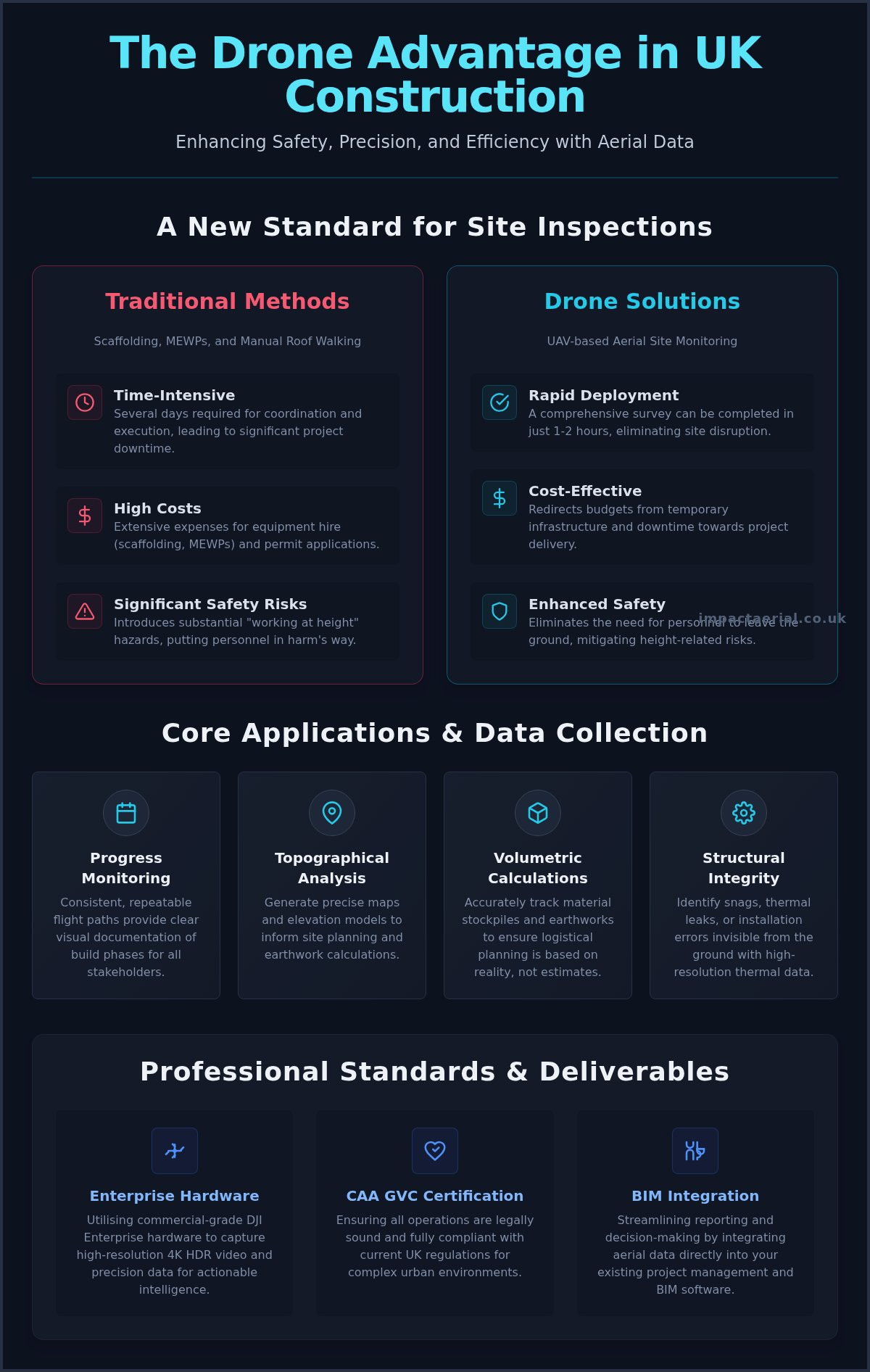
Ground-based observers often suffer from the “shadow effect.” This occurs when the angle of observation from street level hides critical defects, such as subtle roofline sagging or leaning parapets. Relying on scaffolding or cherry pickers to reach these areas introduces significant safety risks and high operational costs. Unlike static ground photos, which offer a limited perspective, drone data creates a dynamic, navigable 3D environment. This allows engineers to inspect the asset from any angle without leaving the ground. It’s a safer, faster, and more cost-effective way to gain total visibility over complex facades.

Who Requires Aerial Subsidence Monitoring?

Several key stakeholders rely on this high-precision data to make informed decisions. Commercial real estate owners managing large-scale portfolios need a scalable way to monitor asset health across multiple locations without constant on-site disruption. Structural engineers require reliable baseline data to issue structural adequacy certificates and monitor ongoing movement with surgical precision. Additionally, insurance companies find high-resolution chronological evidence vital for validating claims. This data helps distinguish between historic wear and active subsidence, ensuring that claims are handled based on objective facts rather than estimates.

Technical Methods: Photogrammetry vs. UAV-LiDAR

Executing a high-precision drone survey for subsidence monitoring involves a strategic choice between two primary data collection methods: photogrammetry and LiDAR. While both provide 3D outputs, they function differently and serve distinct purposes in structural analysis. High-end DJI Enterprise hardware is essential for this level of work because it supports RTK (Real-Time Kinematic) positioning, which reduces GPS errors to a few centimetres. To achieve absolute accuracy, we also utilize Ground Control Points (GCPs). These are physical markers with known coordinates placed across the site that anchor the digital model to the real world, ensuring that any detected movement is actual structural shift rather than a digital artifact.

The choice of method often depends on the site’s environment. Photogrammetry is exceptional for visual detail on building envelopes, while LiDAR is the gold standard for understanding the ground beneath. If you aren’t sure which technology fits your specific project, a professional drone commercial property survey can help determine the most effective path forward.

3D Photogrammetry for Facade and Roof Alignment

Photogrammetry is the process of stitching hundreds or thousands of high-resolution 4K images into a dense point cloud and a textured 3D model. This method is incredibly effective for identifying hair-line stepped cracks in brickwork or mortar joints that are often invisible from the ground. By creating an orthomosaic map, defined as a scale-accurate bird’s-eye view, we can detect horizontal wall misalignment and roofline sagging with extreme clarity. These visual data sets provide a historical record that surveyors can use to compare structural states year-over-year.

UAV-LiDAR for Topographic and Ground Movement

UAV-LiDAR (Light Detection and Ranging) uses active laser pulses to measure the distance between the sensor and the ground. Its primary advantage is the ability to penetrate heavy vegetation or tree canopies, which usually obscure the ground in standard photos. This allows us to create a “digital twin” of the terrain to monitor ground depressions or soil shrinkage around foundations. With professional-grade sensors, we can achieve vertical accuracy of ±2-5 cm and horizontal accuracy of ±2-3 cm. In controlled environments, specialized processing can even reach a 15mm accuracy level for ground DEM (Digital Elevation Model) generation, making it the superior choice for complex, overgrown, or large-scale sites.

By combining these technical methods, we move from simple observation to rigorous data validation. This ensures that every millimetre of movement is accounted for, providing the psychological comfort and tangible data required for high-stakes insurance or engineering decisions.

Key Indicators of Subsidence Captured by Drones

Identifying the symptoms of structural failure requires a meticulous eye and a vantage point that ground-level inspections simply cannot provide. A professional drone survey for subsidence monitoring excels here by capturing wide-angle context alongside microscopic detail that ground teams often overlook. We look for specific structural indicators such as roofline distortions, where a once-straight ridge begins to dip, or gable ends that show a measurable lean. These shifts are often the first signs that the foundations are no longer supported by stable soil. It’s a data-centric process that provides the psychological comfort of knowing every inch of the asset is under expert scrutiny.

Beyond the building itself, drones are essential for spotting ground settlement in adjacent structures. Cracks in garden walls or the separation of paving slabs from the main building facade are clear warning signs of shifting earth. Utilizing an aerial filming drone allows us to capture cinematic yet technically rigorous evidence. This high-definition footage provides a chronological record that structural engineers can review to see how these indicators evolve over months or years. It’s about building a case for structural health based on visible, verifiable evidence.

Visual Indicators: Cracks and Distortions

Drones identify “telltale” stepped cracks around window and door frames with ease. These cracks typically follow mortar joints in a diagonal pattern, indicating that one section of the building is sinking faster than another. Using 4K zoom capabilities, our pilots can inspect these mortar joints without physical contact, avoiding the need for expensive scaffolding. High-angle vertical perspectives also allow us to detect frame misalignment. If a window frame is no longer square, the drone’s precision sensors will flag the distortion long before it causes the glass to bind or crack.

Environmental and Ground Signs

The environment surrounding a property often holds the key to why subsidence is occurring. Drones provide a clear view of vegetation proximity, specifically large trees whose roots may be extracting excessive moisture from clay-heavy soils. This soil shrinkage is a leading cause of foundation movement. From the air, we can also spot pooling water or leaking gutters that saturate foundation soils, leading to localized softening. Identifying these external factors early allows property managers to mitigate risks by improving drainage or managing vegetation before the structural damage becomes catastrophic.

The Strategic Advantage of Long-Term Monitoring

A single drone survey for subsidence monitoring provides a high-resolution snapshot of a building’s current state, but its true strategic power lies in temporal comparison. Establishing a “baseline survey” is the critical first step in any structural monitoring programme. This initial data set acts as the “Day Zero” control variable against which all future movement is measured. Without a precise baseline, it’s impossible to quantify whether a structural crack is historic and stable or active and accelerating. By creating this digital foundation, we provide property owners with the objective evidence required to make high-stakes maintenance decisions.

We utilize Digital Elevation Model (DEM) differential processing to track these changes over time. This technical process involves subtracting the baseline elevation data from a subsequent survey to isolate exactly where the ground or structure has shifted. In active subsidence cases, we typically recommend a quarterly survey frequency. This schedule allows us to capture seasonal soil changes, particularly the “shrink-swell” effect common in clay-heavy regions during dry summers and wet winters. This methodical approach ensures that no subtle shift goes unnoticed, providing a level of safety and reassurance that annual visual inspections cannot offer.

Comparative Data Analysis (Temporal Monitoring)

Our processing software overlays 3D models from different dates using high-precision coordinate systems anchored by Ground Control Points. This alignment allows us to detect millimetre shifts that are invisible to the naked eye. We generate heat maps to visualise these areas of active ground movement, where colour gradients represent the specific magnitude and direction of the shift. This data-driven monitoring removes human bias from inspections, replacing subjective “best guesses” with verifiable geometric facts that can be reviewed by any stakeholder.

Risk Mitigation and Cost Savings

Early detection is the most effective way to avoid catastrophic structural failure and the massive costs associated with underpinning or total foundation replacement. By proving structural stability through consistent, high-fidelity data, asset owners can often negotiate more favourable insurance terms, as they provide clear evidence of proactive risk management. This process also minimises onsite disruption; there’s no need for heavy machinery or invasive ground works to get an initial assessment. For developers and project managers, incorporating Construction Site Monitoring ensures that any ground movement is tracked from the moment the project begins, protecting the long-term value of the asset.

In legal or insurance disputes, this chronological data is invaluable. It provides a “black box” record of the building’s health, making it much harder for claims to be dismissed due to a lack of evidence. When an insurance adjuster or structural engineer can see a time-stamped heat map showing exactly when and where movement occurred, the path to resolution becomes much clearer and faster.

Professional Drone Surveys with Impact Aerial

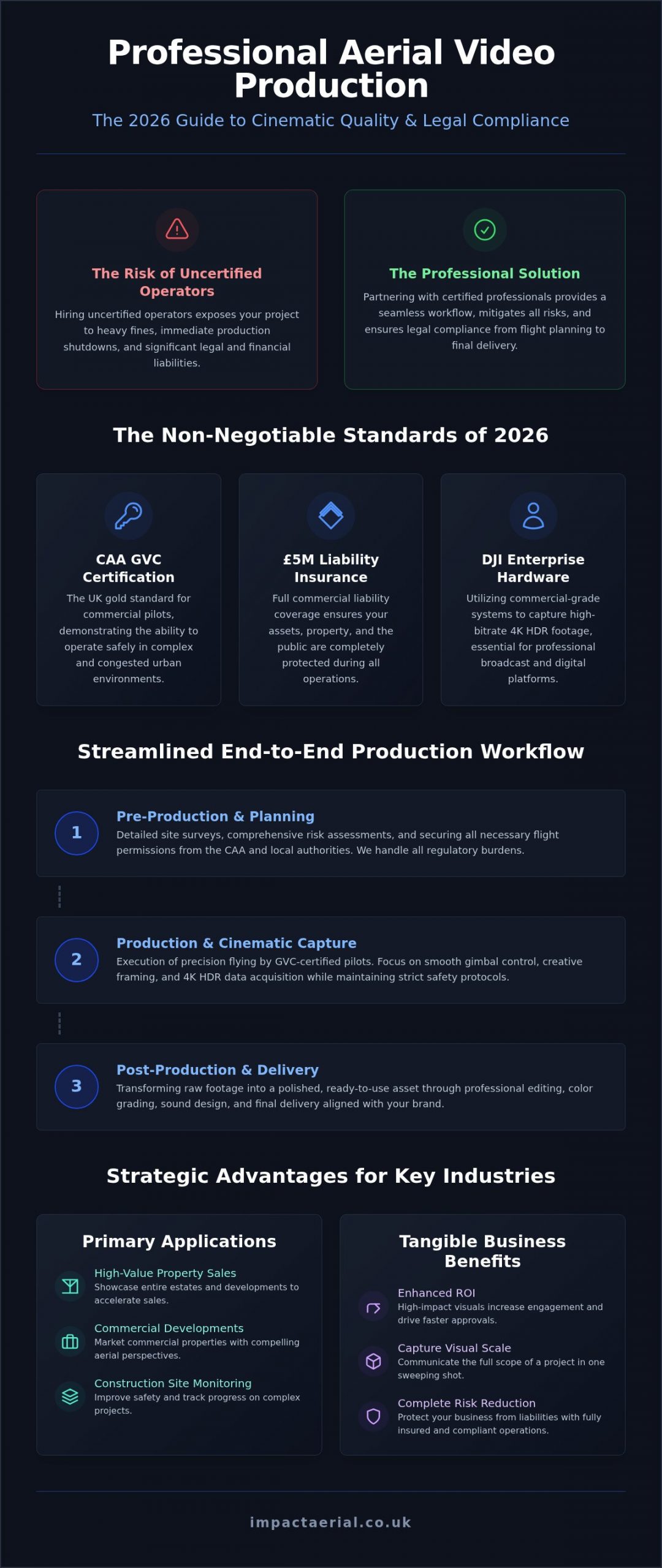
Impact Aerial provides a specialized drone survey for subsidence monitoring that prioritizes operational safety and data integrity above all else. Our team consists of highly experienced, CAA GVC certified pilots who understand the complexities of structural inspections. By utilizing DJI Enterprise hardware, we capture high-end HDR output that reveals the finest details of a building’s facade. This professional approach is backed by £5m commercial liability insurance, which is a critical standard for anyone seeking drone services in the UK. We invite you to consult with our experts to develop a tailored monitoring plan that meets your specific engineering or insurance requirements.

Trusting your data collection to a certified operator ensures that the results are legally defensible and technically sound. We don’t just provide images; we deliver a comprehensive data set that serves as a reliable record of structural health. Whether you’re managing a single heritage building or a vast commercial portfolio, our meticulous approach to every flight guarantees the psychological comfort and tangible benefits your business needs to mitigate risk effectively.

Safety and Compliance in the UK

Operating in built-up or restricted areas requires more than just technical skill; it demands strict adherence to national aviation laws. Every pilot at Impact Aerial holds a valid UK drone license and GVC certification. This allows us to legally and safely conduct flights in urban environments where subsidence is often most prevalent. Before any drone survey for subsidence monitoring begins, we perform a meticulous risk assessment. This process identifies potential hazards and outlines the safety protocols necessary to protect the public and the asset. We also handle all necessary flight permissions in restricted zones, ensuring your survey is fully compliant with current CAA regulations.

From Data Collection to Post-Production

Our end-to-end service begins with an initial consultation to understand the specific structural concerns of your property. Once the aerial data is captured, our work continues in the lab. The value of professional post-production services cannot be overstated; it’s here that raw images and laser points are transformed into clear, actionable reports. We deliver high-resolution 3D models and orthomosaics that structural engineers can use immediately for validation. This seamless transition from flight to final report ensures you have the precise evidence needed for your structural health records.

Don’t leave your asset’s health to chance. Contact Impact Aerial for a professional drone survey quote and secure the high-precision data your project requires.

Secure Your Structural Future with Data-Driven Monitoring

Transitioning from reactive repairs to proactive structural health management is essential for protecting high-value assets. By utilizing high-precision 3D models and temporal comparison, you can identify minute shifts before they escalate into catastrophic foundation failure. A professional drone survey for subsidence monitoring provides the objective, millimetre-accurate evidence needed for structural engineers, insurers, and property managers to make informed decisions with total confidence.

Impact Aerial delivers this technical expertise through our team of CAA GVC Certified Pilots, ensuring every flight is compliant and safe. We utilize DJI Enterprise Grade 4K HDR technology to capture the granular data required for rigorous analysis, all backed by £5m commercial liability insurance for your peace of mind. Our methodical approach removes the guesswork from structural inspections, replacing visual estimates with verifiable geometric facts. You can rely on our meticulous standards to provide the clarity you need for long-term property stability.

Request a Professional Drone Subsidence Survey Quote today to establish your structural baseline. We’re ready to help you safeguard your assets with the industry’s most advanced aerial data solutions.

Frequently Asked Questions

How accurate is a drone survey for detecting subsidence?

Survey-grade drone systems achieve horizontal accuracy of ±2-3 cm and vertical accuracy of ±2-5 cm. When anchored by Ground Control Points and RTK technology, these systems detect millimetre-level shifts between surveys. This precision is essential for distinguishing between minor thermal expansion and active foundation failure. It’s a data-centric approach that replaces visual estimates with verifiable geometric facts, providing the certainty required for structural adequacy certificates.

Can drones see through trees to monitor ground movement?

UAV-LiDAR is the only aerial method that effectively monitors ground movement through dense vegetation. While standard cameras only see the leaves, LiDAR laser pulses penetrate the canopy to map the bare earth beneath. This allows structural engineers to see soil depressions or root-related shrinkage that would otherwise be hidden from view. It’s a superior solution for properties with overhanging trees or complex, overgrown terrain.

Do I need to notify neighbours before a drone subsidence survey?

Professional pilots conduct a thorough risk assessment and privacy review before every flight. While you aren’t always legally required to get consent for flying in certain airspaces, it’s a professional standard to notify adjacent residents. We manage these communications to ensure compliance with privacy regulations and maintain good community relations during the data collection process. This meticulous approach ensures the legality and safety of the operation.

How much does a drone survey for subsidence monitoring cost in the UK?

The cost of a drone survey for subsidence monitoring depends on the project scope and the specific technology required. Photogrammetry is generally more cost-effective for open sites with clear visibility. Conversely, LiDAR surveys involve more sophisticated hardware and processing, making them a higher investment for complex or overgrown terrain. You should request a tailored quote based on your site’s specific topography and the level of data precision required.

What is the difference between a visual drone inspection and a LiDAR survey?

A visual drone inspection focuses on high-resolution photography to identify surface defects like cracks or roof sagging. In contrast, a LiDAR survey generates a topographic point cloud to measure the actual elevation of the ground and structure. Using both methods provides a complete picture of how the building’s surface is reacting to the ground’s movement. This dual-layered data is vital for a comprehensive structural health assessment.

How often should a property be monitored for subsidence using drones?

We recommend a quarterly monitoring schedule for active subsidence cases to account for seasonal shrink-swell soil cycles. An initial baseline drone survey for subsidence monitoring is the most important step. Following this, periodic data collection allows for differential processing, which highlights exactly how much a structure has moved over a six or twelve-month period. This frequency ensures that any acceleration in structural movement is identified before it leads to catastrophic failure.

Is a drone survey accepted by insurance companies for subsidence claims?

Insurance companies increasingly accept drone data as objective evidence for subsidence claims. Professional, timestamped 3D models provide a verifiable chronological record that is far more reliable than subjective ground-level observations. This high-fidelity data helps adjusters validate the severity of a claim and speeds up the resolution process for the policyholder. It’s a powerful tool for proving the validity of a claim through undeniable technical evidence.

What qualifications should a drone pilot have for structural monitoring?

A professional pilot must hold a CAA GVC (General Visual Line of Sight Certificate) to operate commercially in the UK. This certification ensures the operator is trained in flight safety, risk mitigation, and aviation law. For structural monitoring, you should also ensure the pilot has experience with survey-grade hardware and holds significant commercial liability insurance. These credentials assure you that the operation is in safe, expert hands.

Beyond the Price Tag: Justifying the Cost of Professional Drone Services in 2026

What if the £300 “bargain” aerial survey you booked actually costs your firm £50,000 in HSE fines and three weeks of project delays? It’s a scenario we see too often when procurement teams prioritise the lowest quote over technical competence. You likely feel the pressure of justifying the cost of drone services to stakeholders who still view UAVs as expensive toys rather than essential industrial tools. It’s difficult to explain to senior management why a CAA GVC certified pilot with £10 million in commercial liability insurance is worth five times the price of a local hobbyist.

We understand that you need more than just “nice photos”; you need actionable data that stands up to scrutiny. This article provides a clear framework for calculating ROI through high-accuracy photogrammetry and risk mitigation. You’ll discover how professional aerial data reduces site inspection times by 70% and provides the legal “peace of mind” required for major UK infrastructure projects in 2026. We’ll break down exactly how to move from a price-based decision to a value-driven investment that protects your bottom line.

Key Takeaways

  • Understand how 2026 advancements in AI-driven analysis and HDR sensors have transitioned aerial deliverables from aesthetic shots into mission-critical technical data.
  • Decode the “Iceberg Effect” of professional pricing, justifying the cost of drone services through the deployment of elite enterprise fleets and robust safety frameworks.
  • Learn how to secure a measurable ROI by using preventative £500 surveys to identify faults that could lead to £50,000 in structural repair costs.
  • Mitigate legal liability and ensure data integrity by prioritising CAA GVC certified operators who provide the necessary peace of mind for complex commercial projects.
  • Discover the strategic advantage of a full-service partnership that manages the entire workflow from regulatory consultation to high-quality post-production.

The Strategic Shift: Why Drones Are Now an Operational Necessity

The commercial landscape for unmanned aerial vehicles (UAVs) has moved far beyond the era of simple “eye in the sky” photography. Since 2022, we’ve seen a decisive transition where aerial data has become a foundational operational necessity for tasks across the UK’s construction, infrastructure, and property sectors. By 2026, the arrival of sophisticated AI-driven analysis and High Dynamic Range (HDR) sensors has redefined what clients expect from a flight. It’s no longer about capturing a pleasing image; it’s about harvesting actionable intelligence that informs multi-million pound decisions.

Asset managers and site engineers now rely on these technical outputs to replace slower, riskier manual processes. Justifying the cost of drone services is a simple matter of comparing the precision of a UAV with the inherent fallibility of ground-based surveys. In the UK construction industry, where 30% of work is often attributed to rework, the ability to identify a misalignment early can save a project upwards of £45,000 in remedial costs. Our fleet of DJI Enterprise drones provides the high-fidelity data required to spot these discrepancies long before they become structural liabilities.

The value of drone deployment lies in the mitigation of human risk and the elimination of expensive temporary works. When you remove the need for a surveyor to work at height, you don’t just save time; you eliminate the primary cause of workplace accidents. This safety-first approach, backed by our CAA GVC certification and comprehensive commercial liability insurance, provides the peace of mind that modern corporate compliance demands.

From Visuals to Verifiable Data

The distinction between a standard aerial photo and a georeferenced data point is the difference between a snapshot and a scientific record. We use photogrammetry and LiDAR to transform thousands of individual images into centimetre-accurate 3D digital twins. These models integrate seamlessly into Building Information Modelling (BIM) workflows, allowing for a 100% accurate comparison between “as-built” progress and the original architectural design. Thermal mapping sensors now detect moisture ingress or heat loss invisible to the naked eye, identifying failing insulation or flat roof leaks that would otherwise remain hidden until significant damage occurs. This level of data-gathering is what makes drones indispensable for modern asset management.

The Time-Saving Factor in 2026

Time is the most expensive variable on any project site. A traditional manual inspection of a 50,000 square foot commercial warehouse roof typically requires a week of planning, two days of scaffolding or cherry picker hire, and a team of three specialists. This process can easily cost £4,000 or more. A professional drone pilot can complete a more comprehensive, higher-resolution survey in a single 20-minute flight. By 2026, automated flight paths allow us to repeat these missions with absolute consistency. This rapid deployment enables proactive maintenance cycles, which have been shown to reduce long-term repair budgets by an average of 22% by catching minor defects before they escalate. Justifying the cost of drone services becomes a logical choice when a single morning of aerial work replaces a week of site disruption.

  • Manual Inspection: 48+ hours, high risk, £3,500 – £5,000 average cost.
  • UAV Inspection: 20-60 minutes, zero risk to personnel, significantly lower cost.
  • Data Output: 4K HDR video, 45MP stills, and centimetre-accurate 3D point clouds.

Decoding the Quote: What You Are Actually Paying For

When you review a professional quote, you’re seeing the tip of a very large iceberg. The 20 minutes an aircraft spends in the air represents less than 15% of the total resource allocation for a project. Justifying the cost of drone services requires looking beneath the surface at the capital investment and technical infrastructure that ensures a successful delivery. You aren’t just paying for a flight; you’re paying for a data-gathering operation that requires high-end hardware, specialist software, and years of operational experience.

The gap between consumer-grade equipment and a professional DJI Enterprise fleet is vast. While a high-street drone might cost £1,200, a commercial M350 RTK setup with high-resolution sensors often exceeds £15,000 per unit. These enterprise systems provide the stability, wind resistance, and sub-centimetre GPS accuracy required for industrial surveys. Professional firms also maintain redundancy. If a component fails, a second £10,000 aircraft must be ready to deploy immediately so your project timeline remains unaffected. This level of reliability is a primary factor in justifying the cost of drone services for high-stakes commercial property developers and civil engineers.

The work doesn’t end when the drone lands. Post-production and data processing are often the most intensive phases. Converting raw aerial imagery into a 3D point cloud or a centimetre-accurate orthomosaic map involves hours of rendering on high-specification workstations. Drones offer strategic and competitive advantages by reducing site survey times by up to 60% compared to traditional ground-based methods. This efficiency is powered by annual software subscriptions that can cost upwards of £2,500 per seat, ensuring the data you receive is compatible with BIM and CAD workflows.

The Price of Compliance and Safety

Safety isn’t a bolt-on; it’s the foundation of every flight. Professional operators hold the CAA GVC (General Visual Line of Sight Certificate), which requires rigorous initial training and annual renewals to stay current with 2024 UK regulations. We carry £5m commercial liability insurance as a standard minimum. This provides essential peace of mind when operating in complex urban environments like Birmingham city centre, where the risk profile is significantly higher than in open countryside. You’re paying for a pilot who understands the legalities of the West Midlands’ congested airspace.

Technical Specialisation and Equipment

Modern drone applications require more than just a standard camera. High-end thermal sensors, 4K HDR optics, and LiDAR scanners allow us to see what the human eye cannot. These sensors require specific calibrations and expert interpretation to be useful. For instance, identifying a heat leak in a 50,000 sq ft warehouse requires a different technical approach than capturing marketing shots for a new housing estate. Our commitment to using the latest 4K High Dynamic Range technology ensures that the top-quality results we deliver meet the exacting standards of the UK’s leading construction firms.

  • Hardware Redundancy: Maintaining backup aircraft to prevent project delays.
  • Data Integrity: Using RTK (Real-Time Kinematic) positioning for sub-centimetre accuracy.
  • Regulatory Management: Handling all CAA permissions and RAMS (Risk Assessment and Method Statements).
  • Expert Interpretation: Turning raw pixels into actionable business intelligence through photogrammetry.

Ultimately, the pilot’s flight time is the smallest part of the equation. You’re investing in a consultant who manages the risk, the technology, and the data processing to provide a seamless end-to-end service. This meticulous approach ensures that every project is delivered safely, legally, and to a professional standard that hobbyist operators simply cannot replicate.

Measuring ROI: How Drone Services Pay for Themselves

Calculating the return on investment for aerial operations requires a shift in perspective from upfront expense to long-term asset protection. For many facility managers in the West Midlands, justifying the cost of drone services becomes simple when comparing a £500 aerial roof survey against the £50,000 price tag of a full structural timber replacement caused by an undetected leak. This preventative approach identifies defects like slipped tiles or blocked valley gutters months before they manifest as internal damage. It’s about data-driven foresight.

The “Cost of Inaction” (COI) is often the most significant hidden drain on a corporate budget. Sticking to traditional methods, such as erecting scaffolding for a simple visual inspection, involves thousands of pounds in hire fees and weeks of logistical planning. A CAA GVC certified pilot can complete that same task in under an hour without disturbing the building’s occupants. In the commercial property sector, high-end aerial videography provides a measurable boost to marketing. Data indicates that listings featuring professional drone footage see a 40% increase in online engagement, which directly correlates to faster lead generation and reduced “days on market” for premium assets.

ROI in Construction and Surveying

Safety is the primary metric for ROI on a modern construction site. By keeping “boots off ladders” and reducing the need for high-altitude manual work, firms significantly lower their commercial liability risks and insurance premiums. Our use of the latest DJI Enterprise drones allows for rapid photogrammetry, which identifies material waste or site deviations in real-time. ROI in 2026 construction surveying is defined by the seamless integration of aerial data into BIM software to eliminate the 12% margin of error typically found in manual site measurements. This precision ensures that project programmes stay on track, preventing the costly penalties associated with scheduling conflicts.

  • Reduced Labour Costs: A single drone flight replaces a three-man surveying team for initial site topography.
  • Risk Mitigation: Eliminating work-at-height hours reduces the likelihood of RIDDOR-reportable incidents.
  • Material Accuracy: Volumetric analysis of stockpiles ensures you only pay for the materials actually delivered to the site.

Maximising Yield in the Energy Sector

In the energy sector, efficiency is everything. Thermal surveys for solar farms are a prime example of how professional services pay for themselves almost instantly. Using high-resolution radiometric sensors, we can identify “dead cells” or string failures that are invisible to the naked eye. These faulty components can reduce a farm’s total energy output by up to 10% if left unaddressed. A drone can inspect 4,000 panels in a single day, a task that would take a ground crew nearly a week to complete with handheld sensors.

This speed allows for more frequent inspections, ensuring the site operates at peak capacity year-round. For solar farm operators, justifying the cost of drone services is tied directly to reclaimed revenue. Identifying a single faulty inverter through a thermal flight can often cover the entire cost of the survey within a few weeks of increased generation. We provide the technical data needed for warranty claims, giving asset owners added peace of mind that their investment is protected by rigorous, repeatable evidence. Our methodical approach ensures that every flight delivers actionable intelligence rather than just pretty pictures.

The True Cost of “Cheap” Drone Services

Opting for the lowest quote is a tempting strategy when budgets are tight. However, in the UK drone industry, a cut-price fee usually signals a lack of insurance, outdated equipment, or a total absence of CAA authorisation. Hiring an amateur isn’t just a quality risk; it’s a financial gamble that often results in the “buy cheap, buy twice” trap. If a cut-price operator delivers blurred imagery or inaccurate coordinates, the initial £200 spent is entirely wasted. You’ll then face the full cost of hiring a professional to redo the work correctly. When justifying the cost of drone services to stakeholders, the focus must stay on the high price of failure.

Legal Liability and the CAA

The Civil Aviation Authority (CAA) is clear about commercial drone operations. Any pilot flying for “valuable consideration” must hold a valid flyer ID and, for most complex commercial work, a GVC (General Visual Line of Sight Certificate) or an Operational Authorisation. If you hire an illegal operator and an incident occurs on your site, the legal blowback doesn’t stop with the pilot. Under UK health and safety legislation, the client shares the liability for failing to conduct proper due diligence on their contractors. Fines for non-compliance can reach £5,000 in magistrates’ courts or remain unlimited in higher courts. You can mitigate this risk instantly by using the Drone Safe Register to verify a pilot’s credentials and insurance status before they arrive on-site. This simple check provides the peace of mind that your project won’t be shut down by the authorities.

The Technical Gap

There’s a massive distinction between a “cinematic” video and “accurate” technical data. Amateur pilots often use consumer-grade drones that rely on basic GPS with a horizontal error margin of 2 to 5 metres. For a professional roof inspection or a volumetric survey, this level of drift is unacceptable. Professional operators utilise RTK (Real-Time Kinematic) enabled drones, such as the DJI Matrice 300, which provide centimetre-level accuracy. Justifying the cost of drone services becomes easy when you compare a professional 3D map against a hobbyist’s distorted photo. The real value is created during post-production. Professionals use advanced photogrammetry software to stitch thousands of data points into a precise digital twin. An amateur lacks the processing power and the technical expertise to turn raw images into actionable business intelligence, often leaving you with “pretty” pictures that hold zero analytical value.

  • Reputation Risk: An uncoordinated drone flight over a busy construction site looks reckless to the public and your clients.
  • Data Integrity: Flawed data leads to incorrect material orders and expensive project delays.
  • Insurance Gaps: Most standard public liability policies won’t cover drone accidents unless the pilot is specifically insured for commercial flight.

Professionalism is about more than just flying. It involves meticulous pre-flight planning, risk assessments, and airspace checks. A professional operator manages the entire workflow, ensuring that the final delivery meets the specific technical requirements of your industry. Don’t risk your project’s timeline or your company’s reputation on an unvetted hobbyist. For guaranteed results and legal compliance, always book a professional drone survey with a certified operator.

Partnering for Value: The Impact Aerial Approach

Choosing a drone partner shouldn’t be about finding the lowest headline price. It’s about securing a tangible return on investment through technical precision and operational safety. At Impact Aerial, we focus on justifying the cost of drone services by delivering actionable data that directly reduces your overheads. We don’t simply operate as a “pilot for hire” service. Instead, we act as a technical consultancy, managing every phase from the initial CAA-compliant risk assessment through to high-end post-production and data analysis.

Our fleet features the latest DJI Enterprise commercial drones, equipped with 4K High Dynamic Range (HDR) sensors. This technology allows us to capture minute details, such as 1mm surface defects on industrial chimneys or high-fidelity photogrammetry for 3D site modelling. While our roots are firmly in Birmingham and the West Midlands, our national coverage ensures we can deploy to any UK site within 48 hours. This combination offers the accountability of a local specialist with the resources of a leading national provider.

Customised Solutions, Not Fixed Packages

We’ve found that fixed packages rarely meet the complex needs of commercial clients. Every site has unique variables, from airspace complexity to specific data requirements. We tailor our flight plans to your Key Performance Indicators (KPIs). For instance, a 2023 project for a national developer required specific volumetric data for soil heaps, which saved the client approximately £12,000 in traditional surveying costs. We align our deliverables to these specific financial outcomes.

The initial consultation is where we add the most value. By conducting thorough pre-flight planning, we identify potential logistical hurdles before they become expensive delays. Our pricing model is built on transparency. You’ll receive a comprehensive quote with no hidden processing fees or surprise “add-ons” for equipment hire. This clarity helps you manage your project budget with total confidence.

Your Next Steps to Professional Aerial Data

Obtaining a bespoke quote is a straightforward process. To help us provide an accurate figure, it’s helpful to have your project location (Postcode or What3Words) and a clear list of required deliverables. Whether you need 3D point clouds for a BIM workflow or high-resolution stills for a planning application, knowing the end-use allows us to select the most efficient drone and sensor combination for the job.

When you’re ready to proceed, our CAA GVC certified pilots will handle all the regulatory legwork. We maintain £10 million in commercial liability insurance, ensuring total peace of mind for site managers and stakeholders alike. This professional rigour is why we’re trusted by leading firms in the construction and property sectors. You’re not just paying for a flight; you’re investing in a compliant, data-driven solution that protects your bottom line.

Contact Impact Aerial today for a professional drone service quote and discover how our expertise can transform your project data.

Secure Your Competitive Edge With Precision Aerial Intelligence

Investing in aerial intelligence isn’t just a 2026 trend; it’s a strategic move to protect your bottom line. By replacing manual inspections with our specialised DJI Enterprise fleet, firms often see a 400% return on investment through reduced downtime and improved safety protocols. When you’re justifying the cost of drone services, remember that you’re paying for more than just a flight. You’re securing £5m commercial liability insurance and the expertise of CAA GVC certified pilots who ensure every mission remains fully compliant with UK law.

Impact Aerial delivers national coverage from our West Midlands hub, providing the technical data-gathering capabilities required for complex industrial projects. Don’t settle for the risks associated with uncertified operators. High-quality photogrammetry and 4K HDR thermal imaging provide the clarity needed for informed decision-making. We’re ready to help you streamline your operations and deliver results that speak for themselves.

Request a bespoke quote from our CAA GVC certified pilots

Frequently Asked Questions

Why is professional drone hire more expensive than buying a drone myself?

Professional hire covers the pilot’s CAA GVC certification, high-end DJI Enterprise equipment, and specialist commercial liability insurance. While a consumer drone costs £800, a professional system like the Matrice 350 RTK exceeds £12,000. You aren’t just paying for the flight; you’re paying for technical expertise in data-gathering and risk management. This expertise is vital for justifying the cost of drone services through accurate, actionable results.

Does the price include post-production and data processing?

Most professional quotes include standard data processing, though complex photogrammetry or 3D modelling often incurs additional fees. We typically allocate 3 hours of office-based processing for every 1 hour of flight time. This ensures you receive high-quality, orthomosaic maps or 4K HDR video files that are ready for immediate use. Always confirm if the quote covers the final render or just the raw data capture.

How much does a typical drone survey cost in the UK in 2026?

In 2026, a standard commercial drone survey in the UK typically ranges from £650 to £1,200 per day. Factors like airspace complexity and the required level of detail influence the final price. For a 5-hectare site, expect to pay around £850 for a basic topographic survey. These figures reflect the rising costs of advanced sensor technology and the stringent safety protocols required by the CAA.

What insurance coverage should a professional drone pilot have?

A professional pilot must hold EC 785/2004 compliant commercial insurance with a minimum of £2 million in public liability coverage. For added peace of mind, we maintain £5 million or £10 million in coverage for high-risk industrial environments. This protects your business against unforeseen incidents and property damage. Never hire an operator who only holds hobbyist insurance, as it’s invalid for commercial work.

Can I justify the cost of drone services for a small-scale property project?

You can justify the cost of drone services for small projects by comparing the £400 drone fee against the £1,500 cost of traditional scaffolding. A drone inspection identifies roof defects or gutter blockages in 30 minutes without any work-at-height risks. This 73% cost reduction makes aerial surveys a logical choice for residential developers and private landlords. It’s a precise way to document asset condition quickly.

How does drone weather-dependency affect the cost and scheduling?

Weather conditions like wind speeds exceeding 20mph or heavy rain will pause operations to ensure safety and data quality. We monitor forecasts 48 hours in advance and provide a weather window in our scheduling. Most professional operators don’t charge a full day rate for weather cancellations if notified early. This meticulous planning ensures we capture top-quality imagery without risking the aircraft or the site.

What specific deliverables will I receive for my investment?

You’ll receive high-resolution 4K HDR video, 20-megapixel stills, or detailed 3D point cloud data depending on your project scope. For inspections, we provide a comprehensive PDF report featuring annotated images of every defect found. These deliverables serve as a digital record for insurance claims or maintenance planning. We use DJI Enterprise drones to ensure every file meets the highest industry standards for clarity and precision.

Is there a discount for recurring site monitoring or multiple surveys?

We offer discounted rates of 15% to 25% for clients who book recurring monthly site progress monitoring. This is common in the niche but increasingly diverse market of construction and civil engineering. Multi-site contracts also benefit from reduced day rates because we can streamline the risk assessment process. Long-term partnerships allow us to provide consistent data-gathering that helps track project timelines more effectively.