UAV Survey Birmingham: The Complete Guide to Professional Aerial Data

Is it really worth the liability risk of sending a surveyor onto a fragile roof when a drone can capture more accurate data in half the time? Most site managers and developers in the West Midlands know that traditional height inspections are a logistical headache; they often involve significant health and safety risks and costly operational downtime. A professional uav survey birmingham offers a sophisticated, technical alternative to these outdated methods. By utilising advanced aerial technology, we eliminate the need for ladders or platforms. This keeps your site running smoothly and your team safely on the floor.

We understand that your primary concerns are accuracy, safety, and full regulatory compliance. This guide demonstrates how professional UAV surveys provide high-resolution 4K imagery and precise photogrammetry for construction, property, and solar assets with minimal site disruption. You’ll discover how our CAA GVC Certified pilots and DJI Enterprise fleet deliver the technical data you need for added peace of mind. We’ll walk you through the essential steps to secure high-quality aerial data that meets the strictest UK aviation standards while avoiding the high costs and risks of traditional surveying.

Key Takeaways

  • Learn how high-resolution data collection provides a safer, faster alternative for surveying Birmingham’s unique mix of historic and modern architecture.
  • Understand the technical precision of DJI Enterprise drones and photogrammetry in creating accurate 3D models for complex construction and property projects.
  • Discover how a professional uav survey birmingham ensures “Zero Disruption,” allowing your business to remain fully operational during site inspections.
  • Explore specialised applications for the property and energy sectors, from comprehensive roof condition reports to thermal surveys for PV solar farms.
  • Ensure project compliance by identifying the critical standards required for aerial work, including CAA GVC certification and £5m commercial liability insurance.

What is a UAV Survey and How Does it Serve Birmingham Businesses?

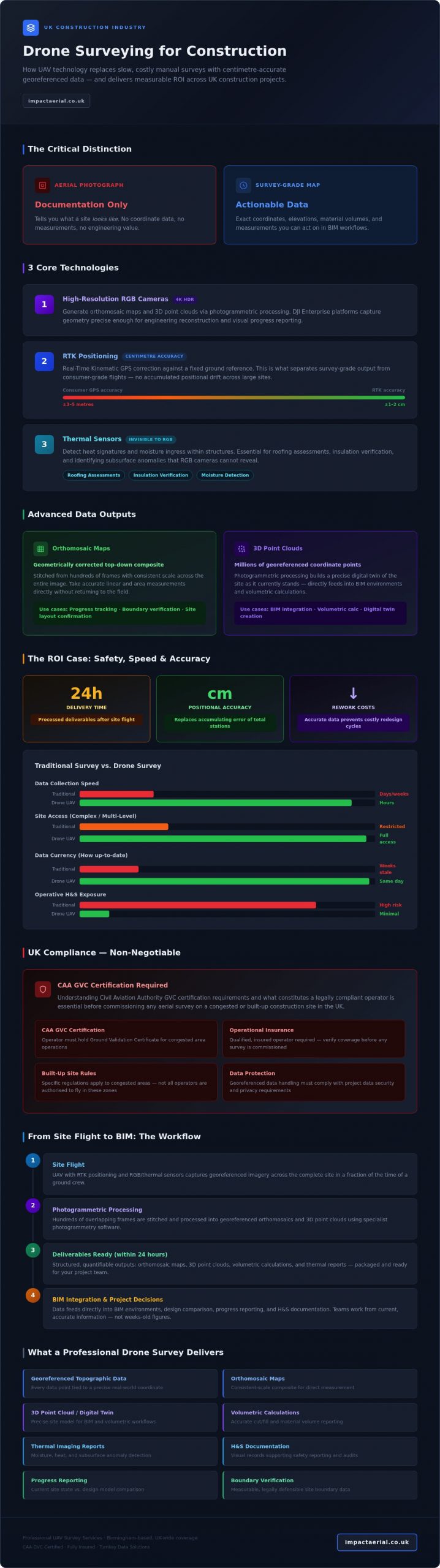
A Unmanned Aerial Vehicle (UAV) survey is a sophisticated method of data collection that uses advanced flight technology to capture high-resolution spatial information. Unlike traditional ground-based methods, a uav survey birmingham project allows for the rapid acquisition of millions of data points across complex environments. This digital-first approach marks a significant shift from manual measurements to automated, centimetre-accurate datasets. For local businesses, this means moving beyond simple aerial photography to “actionable data” that can be directly integrated into architectural software and project management workflows.

To better understand the technical precision and accuracy required for these professional operations, watch this helpful video from ARPAS-UK:

The Role of Drones in the West Midlands Economy

Birmingham is currently witnessing a massive transformation, driven by the Big City Plan, a 20-year strategy aimed at creating 50,000 new jobs and contributing £2.1 billion to the economy annually. This scale of regeneration requires constant, high-speed site monitoring that traditional surveying cannot match. Drones are now essential for commercial property developers in the city centre and industrial warehousing firms across the Black Country.

The city’s unique mix of Victorian heritage assets, such as those in the Jewellery Quarter, and modern structures like the Curzon Street HS2 site, presents a complex aerial environment. Our local expertise is vital for navigating these challenges. Operating a uav survey birmingham requires meticulous planning and strict adherence to CAA GVC certifications. This ensures that data collection is not only high-quality but also fully compliant with UK aviation safety regulations, providing clients with essential peace of mind during high-stakes builds.

Key Deliverables: What You Get from a Professional Survey

A professional aerial survey produces a suite of technical assets designed for precision and analysis. These deliverables provide a comprehensive view of any site, whether it’s a sprawling industrial estate or a single historic rooftop. Key outputs include:

  • Orthomosaic Maps: High-resolution, geometric images corrected for topographic relief, used for precise site planning and mapping.
  • 3D Point Clouds: Dense sets of data points that allow for volumetric measurements and detailed digital twinning of structures.
  • 4K HDR Video and Stills: Crystal-clear visual records used for detailed condition reports and structural integrity assessments.
  • Thermal Data: Specialist thermographic imaging to identify heat loss in commercial buildings or detect electrical faults in solar arrays.

By utilising our fleet of DJI Enterprise drones, we provide data that is structured, methodical, and ready for immediate professional use. This level of detail allows project managers to identify potential issues long before they become costly delays.

Technical Capabilities: The Science Behind Accurate Drone Data

Achieving high-fidelity results during a uav survey birmingham relies on more than just flight skills; it requires a sophisticated integration of aerospace engineering and advanced geomatics. Our fleet consists of DJI Enterprise drones, which provide the flight stability needed to capture clear data in the complex wind currents often found around Birmingham’s high-rise developments. These aircraft are designed for precision, allowing us to maintain a steady hover and consistent flight path even in challenging urban environments.

Enterprise-Grade Hardware vs. Consumer Drones

Professional work demands a survey drone with built-in system redundancies. While consumer models lack the necessary fail-safes for dense city centres, DJI Enterprise models feature dual IMUs and compasses to ensure flight reliability. Sensor quality is the critical differentiator here. We utilise 1-inch 20MP CMOS sensors that capture significantly more light and detail than standard hobbyist cameras. This hardware allows for 4K HDR imaging that reveals minute cracks, thermal leaks, or structural defects that are often invisible to the naked eye. Adhering to RICS drone surveying guidance ensures these technical outputs meet the rigorous standards expected by chartered surveyors and asset managers across the West Midlands.

Photogrammetry and 3D Modelling

Photogrammetry is the engine behind our centimetre-accurate digital twins. By capturing hundreds of overlapping images from multiple angles, we use specialised software to triangulate points in 3D space. “Photogrammetry transforms thousands of 2D images into a single, centimetre-accurate 3D representation of a physical asset.” This data is vital for Birmingham architects and urban planners who need to visualise how new structures interact with existing city infrastructure. It provides a level of spatial context that traditional photography simply cannot offer.

The journey from raw flight data to a final report involves intensive processing. After the flight, we convert gigabytes of 4K visual data into orthomosaic maps and dense point clouds. This workflow provides a level of detail that traditional ground-based methods can’t match within the same timeframe. Whether it’s a heritage building near New Street or a new build in Digbeth, conducting a uav survey birmingham provides stakeholders with a comprehensive digital record. If you’re looking to upgrade your site documentation, Impact Aerial provides the technical expertise to turn aerial footage into actionable insights for your next project.

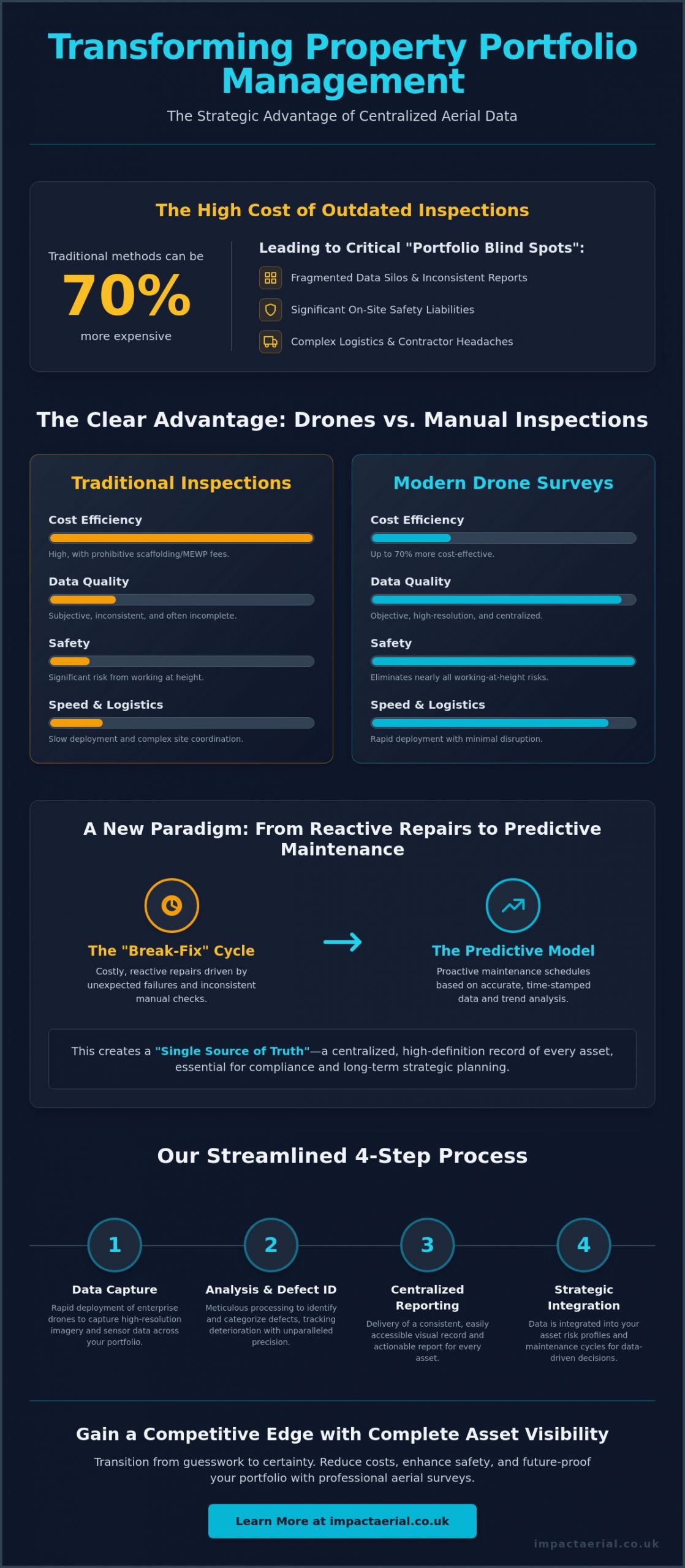
The Business Case: UAV Surveys vs. Traditional Methods

Traditional access methods like scaffolding, cherry pickers (MEWPs), and steeplejacks have long been the industry standard for high-level inspections. However, these methods carry significant logistical burdens. A uav survey birmingham offers a streamlined alternative that prioritises operational continuity. While scaffolding can take several days to erect and requires local council pavement licences that often cost upwards of £100 per week, a drone can be deployed and recording data within 30 minutes of arriving on site.

The “Zero Disruption” advantage is vital for Birmingham’s busy commercial districts like Colmore Row or the Jewellery Quarter. Businesses can remain fully operational while we collect high-resolution data; there’s no need to close car parks or restrict pedestrian access. This efficiency translates to direct savings. By keeping personnel safely on the ground, we eliminate the primary risks associated with working at height. It’s a method that replaces weeks of planning with a few hours of precision flight.

Cost-Efficiency and ROI

The financial argument for aerial data goes beyond the initial quote. Traditional methods involve hidden costs such as specialised labour for assembly, security for on-site equipment, and extended project timelines. Rapid data collection allows property owners to identify defects and commission repairs 80% faster than manual methods. For developers, the value lies in repeatable data for long-term construction site monitoring. Having a consistent, digital record of progress ensures that projects stay on schedule and within budget, providing a clear return on investment through improved oversight.

Safety and Risk Mitigation

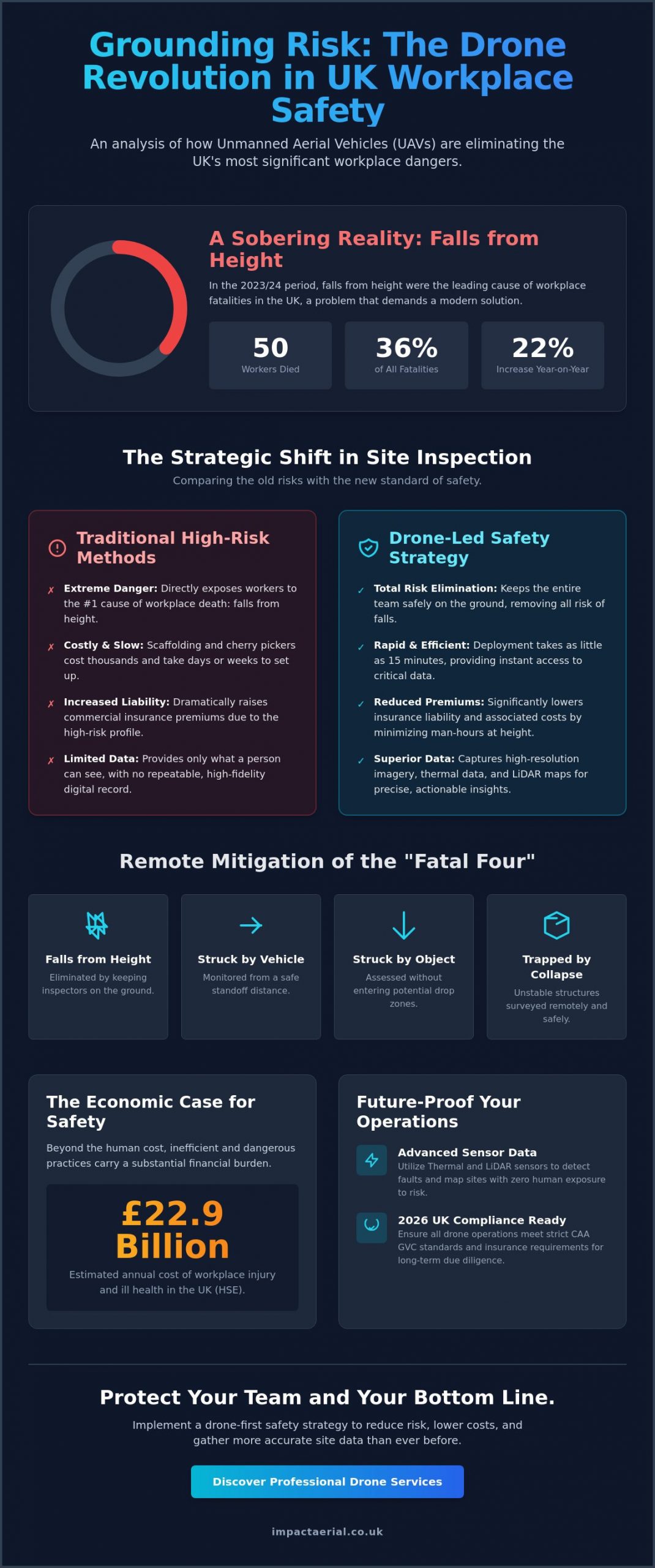
Safety is the cornerstone of our professional services. By utilising aerial remote sensing, we significantly reduce “Work at Height” incidents. Drones can easily access structurally unsound roofs or hazardous industrial chimneys where sending a human would be too dangerous. Every flight we conduct adheres strictly to The Drone and Model Aircraft Code, ensuring full legal compliance. We produce comprehensive Risk Assessment and Method Statements (RAMS) for every project. This gives our clients peace of mind that all operations are managed by CAA GVC Certified experts who prioritise the safety of the public and the property.

Specialised Applications for Birmingham Industries

Birmingham’s industrial landscape requires data precision that traditional ground-based methods can’t provide. A professional uav survey birmingham delivers a technical advantage across sectors ranging from logistics to heritage conservation. By deploying CAA GVC Certified pilots, businesses ensure compliance while gathering high-resolution intelligence that informs critical decision-making.

Commercial Property and Roof Inspections

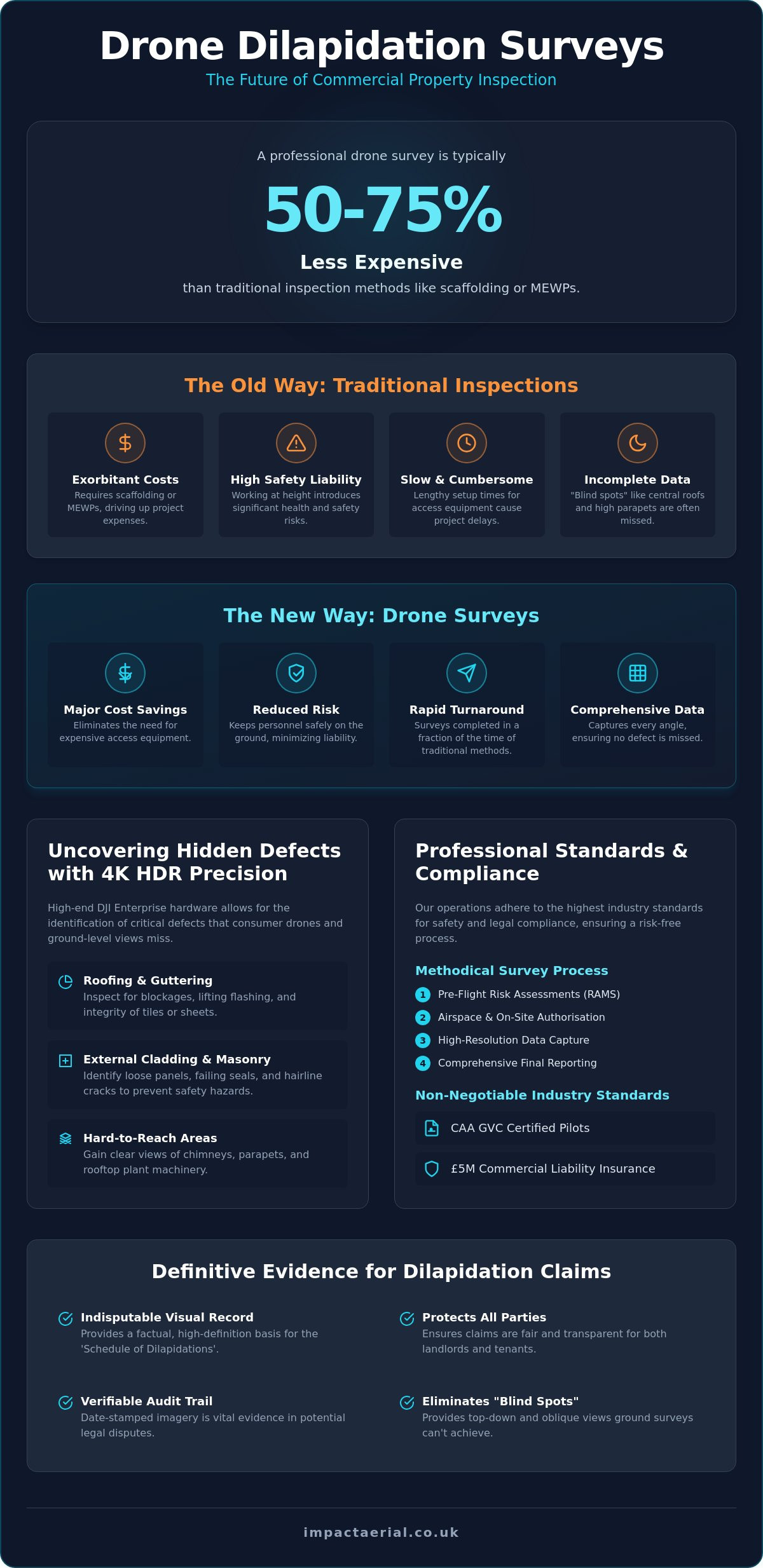
For commercial real estate assets, aerial inspections have become the standard for proactive maintenance and insurance compliance. Our enterprise-grade drones identify Reinforced Autoclaved Aerated Concrete (RAAC) issues, water ingress points, and hairline structural cracks that are often invisible from the ground. On new-build projects, we use drones for “snagging” to verify that contractors have met exact specifications before final handover. High-angle perspectives are particularly beneficial for large industrial units in areas like Erdington or Solihull, where traditional scaffolding costs for a basic roof check can often exceed £2,000. Drones eliminate this overhead while providing a digital audit trail of the building’s condition.

Thermal Surveys for Solar and Energy

As energy providers expand their footprint across the West Midlands, maintaining efficiency is critical for ROI. Our PV Solar Farm Thermal Surveys use radiometric sensors to detect “hot spots” within individual cells. These anomalies indicate faulty bypass diodes or internal short circuits that significantly reduce energy output. Beyond solar, we provide heat loss surveys for Birmingham’s older building stock to assist with modern decarbonisation targets. Thermal drones can identify faults invisible to the naked eye, allowing for targeted repairs rather than costly, full-scale renovations.

Construction and Heritage Documentation

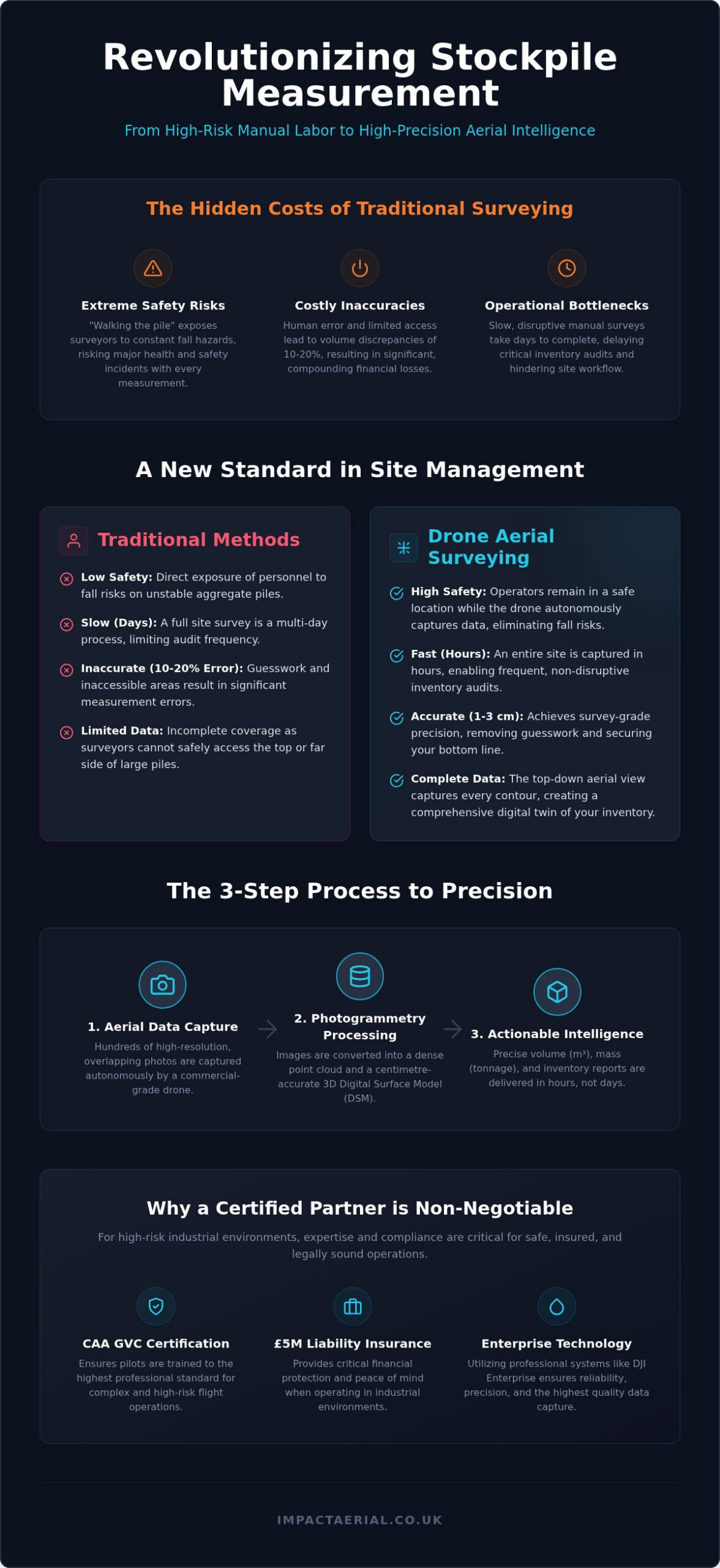
In the construction sector, we facilitate progress monitoring through precise volumetric analysis for earthworks. Instead of manual surveying, which can take days, a drone captures data for stockpile volumes in minutes with high accuracy. This data allows site managers to track material movement against project timelines. For the city’s historical landmarks, such as those in the Jewellery Quarter, drones provide non-invasive archaeology and heritage site documentation. We create detailed 3D models using photogrammetry to preserve the structural integrity of Grade II listed buildings without disturbing the site or requiring heavy machinery access.

For added peace of mind, all our specialised data-gathering operations are backed by comprehensive commercial liability insurance and strict adherence to CAA regulations.

Contact our experts for a professional UAV survey

Ensuring Compliance: Choosing a UAV Partner in Birmingham

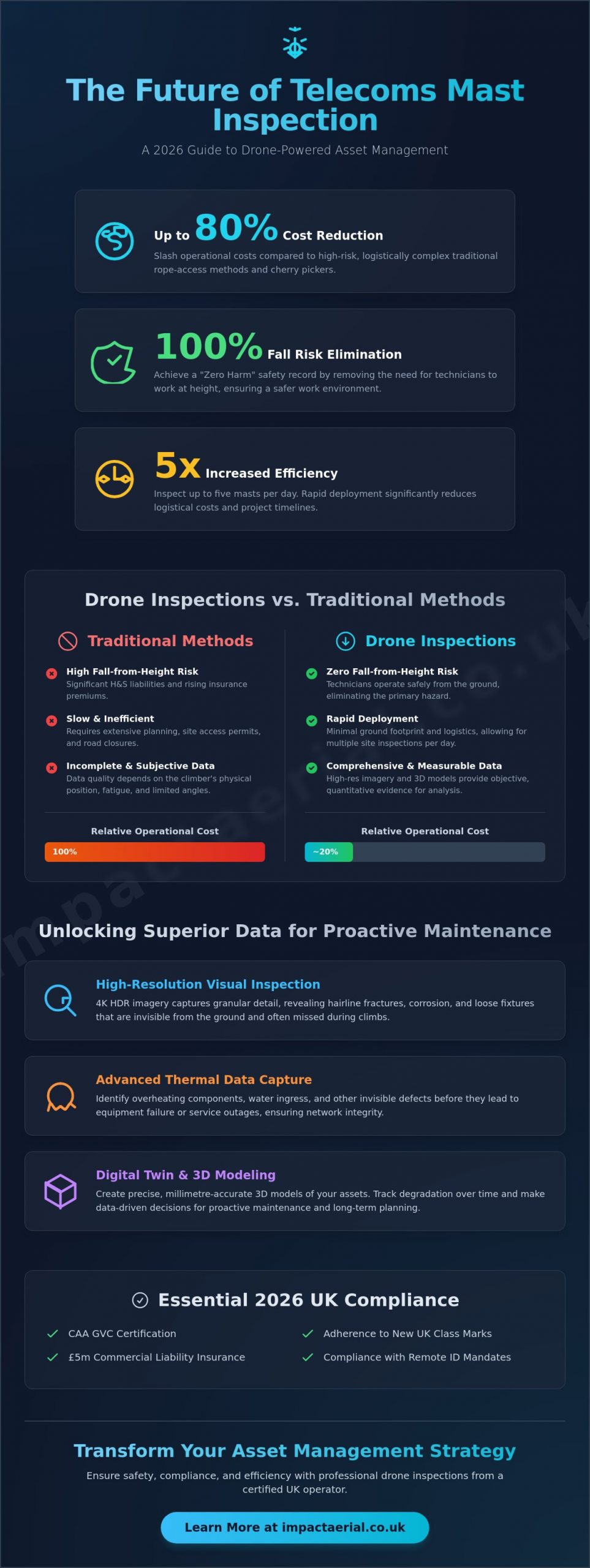
Selecting a provider for a uav survey birmingham requires more than just looking at a portfolio of aerial photographs. It’s about risk management and legal certainty. Professional operators must hold a valid General Visual Line of Sight Certificate (GVC) issued by the Civil Aviation Authority (CAA). This isn’t just a badge; it’s a legal requirement for complex commercial operations in urban environments. For added peace of mind, we maintain £5m commercial liability insurance. This figure is the industry gold standard, ensuring that clients are fully protected against unforeseen incidents during data collection in busy metropolitan areas.

The Legal Framework: CAA Regulations in 2026

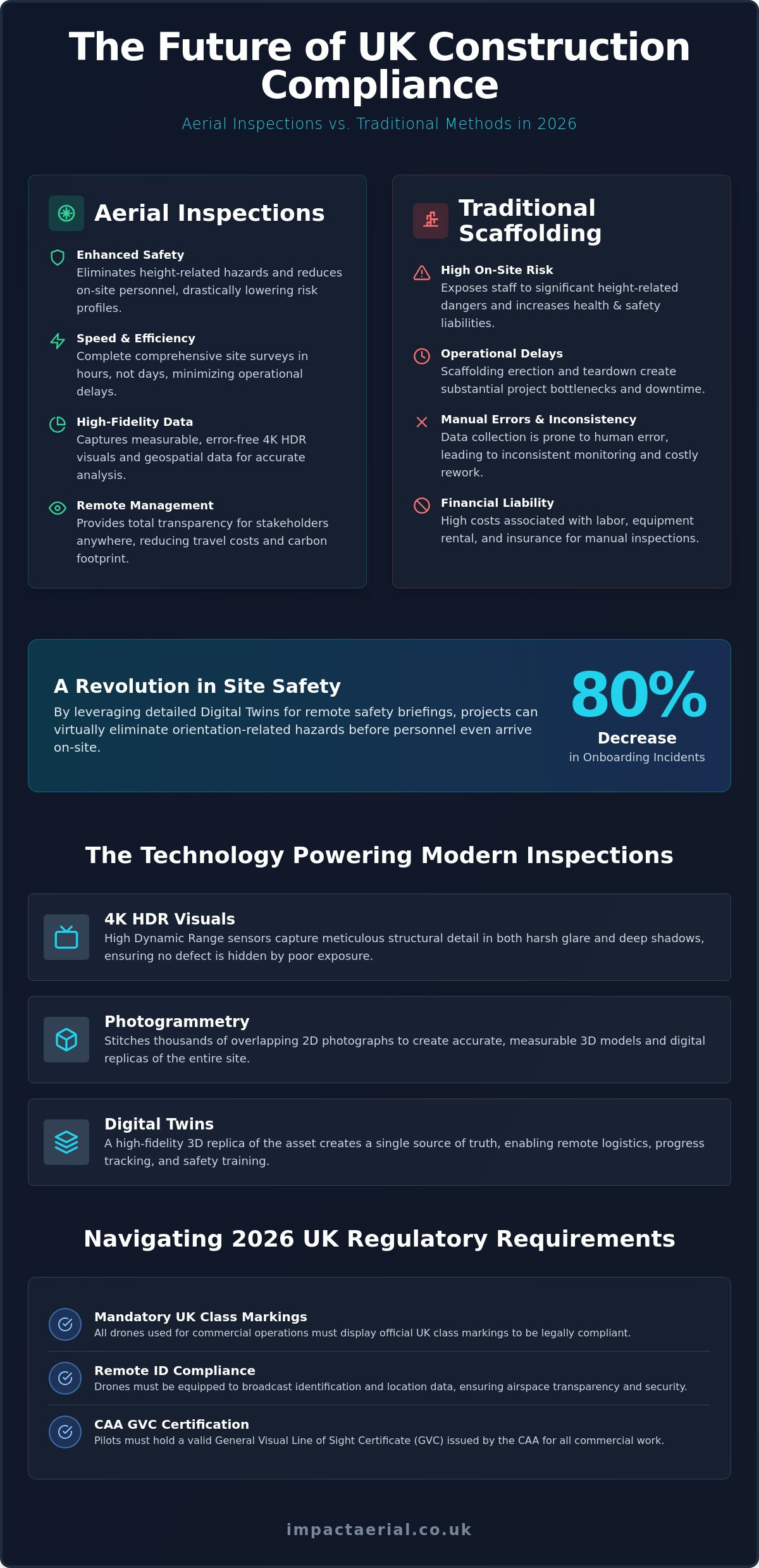
The distinction between hobbyist flight and professional drone services has never been clearer. Under 2026 CAA rules, the GVC allows pilots to operate in the “Specific Category.” This is vital for flying in congested areas like Birmingham city centre where separation distances are strictly monitored. Every flight we conduct follows a comprehensive Flight Operation Manual. This document acts as our internal law, detailing safety protocols, emergency procedures, and equipment maintenance schedules. It ensures that every project meets the same high standard of safety and technical excellence.

Why Local Expertise Matters

Birmingham’s airspace is notably complex. Much of the city falls within Flight Restricted Zones (FRZs) due to the proximity of Birmingham International Airport (BHX). Navigating these restrictions requires precise coordination with Air Traffic Control and the timely filing of NOTAMs (Notice to Airmen) to inform other airspace users of our presence. As a local specialist for drone services in the West Midlands, Impact Aerial manages this entire administrative process. We handle the logistical heavy lifting so you don’t have to.

Our pre-flight planning process is meticulous and includes:

  • Detailed site risk assessments (RAMS) tailored to the specific Birmingham location.
  • Securing formal landowner permissions and informing local authorities where necessary.
  • Analysing hyper-local weather patterns that can affect flight stability between tall buildings.
  • Real-time airspace monitoring using advanced digital tools to ensure zero interference.

Our approach ensures your uav survey birmingham is completed efficiently, legally, and to the highest technical specification. We manage the end-to-end process from the initial consultation through to the final data delivery. By choosing a partner that understands the local geography and the 2026 regulatory environment, you’re investing in data that is both high-quality and fully compliant.

Secure High-Precision Data for Your Next Birmingham Project

Transitioning from traditional manual inspections to a professional uav survey birmingham provides immediate efficiency gains and significantly reduces onsite health and safety risks. By deploying the latest DJI Enterprise 4K HDR fleet, businesses across the West Midlands can access centimetre-accurate photogrammetry and high-resolution thermal data that traditional methods simply can’t match. This technical precision allows for faster decision-making in sectors ranging from commercial property development to infrastructure maintenance.

Impact Aerial prioritises safety and compliance above all else. For added peace of mind, every operation is conducted by CAA GVC Certified pilots and backed by £5m commercial liability insurance. This meticulous approach ensures that your data-gathering is both legally compliant and of the highest professional standard. Whether you’re managing a complex construction site or a sensitive heritage building, our team delivers the expert technical consultancy required to showcase your project from every perspective.

Contact Impact Aerial for a Professional UAV Survey Quote to start capturing the high-quality aerial insights your business deserves today.

Frequently Asked Questions

Is it legal to conduct a UAV survey in Birmingham city centre?

It’s legal to conduct a uav survey birmingham city centre as long as the operator holds the correct Civil Aviation Authority (CAA) GVC or PfCO certification. Operations in built-up areas like the Jewellery Quarter or Colmore Row must adhere to specific category regulations. Our pilots perform detailed risk assessments and secure necessary flight permissions to ensure every operation remains fully compliant with UK aviation law.

How much does a drone survey cost compared to traditional scaffolding?

Drone surveys typically offer a 60% to 70% cost reduction compared to traditional scaffolding or cherry pickers. Scaffolding for a commercial building often requires significant investment in hire fees and labour hours for installation. A UAV inspection eliminates these overheads, allowing for a rapid deployment that captures comprehensive data in a fraction of the time required for manual access methods.

What weather conditions can a survey drone operate in?

Our DJI Enterprise commercial drones can operate in wind speeds up to 22mph and light precipitation. We monitor Met Office forecasts 24 hours in advance to ensure safe flying conditions. If visibility drops below 5km or wind gusts exceed manufacturer limits, we reschedule the flight to maintain our strict safety standards and ensure the highest possible data quality.

How long does it take to receive the data after a UAV survey?

You’ll typically receive the processed data within 24 to 48 hours of the flight completion. For a uav survey birmingham project involving complex photogrammetry or 3D modelling, processing may take up to 72 hours. We deliver high-resolution 4K imagery and technical reports via secure cloud-based links, allowing your team to access critical building data almost immediately for project planning.

Do I need to be present on-site during the drone flight?

You don’t need to be present on-site while our pilots conduct the flight. We handle all aspects of the operation, from the initial pre-flight survey to the final landing. If you prefer to watch the live feed, we can provide a ground station monitor. This allows you to view the high-quality 4K footage in real-time as the drone inspects specific assets or structural points.

Can drones perform indoor surveys for large Birmingham warehouses?

Drones are highly effective for indoor surveys in large Birmingham warehouses or industrial units. We use specialised aircraft equipped with 360-degree obstacle avoidance and protective cages to navigate tight internal spaces safely. This method allows us to inspect high-level racking, roof trusses, and HVAC systems without the need for ladders or mobile elevating work platforms, significantly reducing health and safety risks.

What insurance cover should a professional drone operator have?

A professional operator must hold commercial liability insurance that complies with EC 785/2004 regulations. We carry £5 million in public liability insurance as standard for every project. This provides added peace of mind for our clients, ensuring that all third-party risks are fully covered during aerial data gathering or structural inspections in busy urban environments or construction sites.

How accurate is the data gathered during a UAV land survey?

UAV land surveys achieve high levels of precision, often delivering Ground Sample Distance accuracy within 1cm to 3cm. By using RTK enabled drones and established ground control points, we produce survey-grade maps and 3D models. This level of detail is sufficient for topographical mapping, volumetric measurements, and detailed construction site monitoring across the West Midlands, providing a reliable alternative to traditional ground-based methods.

Creating a Business Case for Drone Inspections: A Guide for UK Asset Managers

For a UK asset manager, spending £20,000 on scaffolding just to identify a £500 roof leak isn’t just inefficient; it’s a clear drain on your annual maintenance budget. You likely already recognise that working at height remains the leading cause of workplace fatalities in Great Britain, accounting for 33% of all fatal injuries in 2023/24 according to the Health and Safety Executive (HSE). While traditional access methods like cherry pickers are slow and costly, shifting to a more agile approach requires more than just enthusiasm for new technology.

This guide focuses on creating a business case for drone inspections that provides the technical assurance and financial clarity your board requires. You’ll learn how to quantify an average 70% reduction in inspection costs, mitigate critical safety risks, and ensure every flight adheres to strict CAA GVC certification and commercial liability standards. We’ll provide a structured proposal format and a data-driven ROI model to help you integrate professional aerial data-gathering into your operations with total confidence.

Key Takeaways

  • Quantify the direct financial benefits of UAV technology, including significant savings on equipment hire, labour hours, and insurance premiums.
  • Master the strategic process of creating a business case for drone inspections to present a persuasive, data-driven proposal to your board.
  • Compare drones against traditional scaffolding and rope access using critical UK market metrics such as setup time, safety risks, and data accuracy.
  • Mitigate legal and operational liabilities by understanding why CAA GVC certification and professional DJI Enterprise equipment are essential for commercial compliance.
  • Learn how to structure a winning proposal that leads with a ‘Safety and Savings’ hook to address current inefficiencies and HSE risks.

What is a Business Case for Drone Inspections and Why Do You Need One?

Creating a business case for drone inspections is a formal requirement for UK asset managers seeking to modernise their maintenance cycles. It’s a strategic document that aligns Unmanned Aerial Vehicle (UAV) technology with specific commercial goals, such as reducing operational expenditure or meeting stricter safety mandates. In the current UK market, relying on “good enough” manual methods has become a financial liability. A 2023 industry analysis shows that reactive maintenance is up to three times more expensive than proactive, data-led strategies. This document provides the evidence needed to move away from legacy processes and adopt professional aerial services.

The primary triggers for this shift usually involve tightening budgets, the need for higher-resolution data, or urgent safety requirements. Modern drone applications allow for a transition from simple visual checks to high-precision surveys. This isn’t just about taking photos; it’s about systematic data collection that integrates with your existing Asset Management Systems (AMS). By formalising this approach, you provide stakeholders with the assurance that the investment is grounded in technical necessity and financial logic.

To better understand the financial and operational logic behind this technology, watch this helpful video:

The Cost of Inaction: Risks of Traditional Methods

Traditional inspection methods carry escalating financial and physical risks. In the West Midlands, scaffolding hire for a standard commercial roof inspection can cost between £1,500 and £5,000 before work even begins. Beyond the cost, the safety implications are stark. According to the 2022/23 HSE report, falls from height accounted for 33% of all workplace fatalities in Great Britain. Manual inspections also suffer from “blind spots” where inspectors cannot safely reach certain areas, leading to undetected asset degradation. These hidden defects often result in emergency repairs that cost significantly more than the initial preventative survey would have.

Defining the Value Proposition for Stakeholders

When creating a business case for drone inspections, you must frame the UAV as a sophisticated data-gathering tool rather than a simple camera. The real value lies in high-quality photogrammetry, which allows for the creation of centimetre-accurate 3D models. These “digital twins” enable property managers to monitor construction progress or structural health over time with absolute precision. Providing stakeholders with a measurable, repeatable data set offers “peace of mind” and a level of oversight that manual walk-arounds cannot match. This meticulous approach ensures that every pound spent on inspection delivers actionable intelligence for long-term asset management.

Quantifying the ROI: The Financial Core of Your Drone Proposal

When creating a business case for drone inspections, the financial argument often centres on the immediate displacement of traditional access costs. Traditional methods like scaffolding or MEWPs (Mobile Elevated Work Platforms) involve high day rates, transport fees, and lengthy setup times. For a standard commercial roof inspection in the West Midlands, scaffolding costs frequently exceed £2,500 before a single surveyor sets foot on the platform. In contrast, a CAA GVC certified pilot can complete the same task for a fraction of that cost, often under £1,000, while providing superior data depth.

Asset managers must also consider “Data Longevity.” A single flight generates a digital twin of the asset that serves multiple stakeholders. The facilities team uses it for maintenance, the marketing department for site visualisations, and the legal team for boundary disputes. This departmental reuse effectively splits the procurement cost, making the drone service a multi-purpose asset rather than a single-use expense.

Direct Cost Reduction: Drones vs. Heavy Machinery

The daily rate for a scaffolding crew on a mid-sized industrial unit can range from £1,500 to £3,000, often requiring a week of site presence. A professional drone team typically completes the same data capture in four hours. ROI in the context of aerial surveys is defined as the net financial gain from avoided traditional costs divided by the drone service expenditure, with most UK firms targeting a 250% return on investment within the first year of adoption. Rapid deployment is another critical factor. For emergency chimney or roof inspections following a storm, drones can be on-site and airborne within 24 hours, preventing minor leaks from becoming £10,000 internal repair bills.

Value-Added Benefits: Beyond the Bottom Line

The quality of data collected provides a significant advantage for risk management. High-resolution 4K HDR imagery provides an indisputable audit trail for insurance claims and warranty audits. This level of detail is a core component of a professional drone survey, allowing departments to zoom into specific defects without losing clarity. Thermal surveys add another layer of value by identifying heat loss in building envelopes or detecting faulty cells in PV solar farms, where a 5% efficiency drop across a large array can result in thousands of pounds of lost revenue annually.

Compliance is a non-negotiable factor in your proposal. Adhering to UK drone regulations ensures that your business avoids the heavy fines associated with illegal commercial flights, which can reach up to £2,500. To calculate the viability of your project, use this formula: Payback Period (Months) = Total Drone Service Investment / (Monthly Cost of Traditional Access – Monthly Drone Service Cost). In most UK property portfolios, the payback period is achieved within 4 to 6 months. For a tailored breakdown of potential savings, you can request a site-specific consultation with our technical team.

Drones vs. Traditional Access: A Direct Comparison for the Board

When creating a business case for drone inspections, the most persuasive argument lies in the raw data comparing UAVs to legacy methods. Board members prioritise risk mitigation and fiscal efficiency. Traditional methods often fail on both counts. Transitioning to aerial data-gathering isn’t just about adopting new tech; it’s about replacing outdated, high-risk workflows with precision engineering.

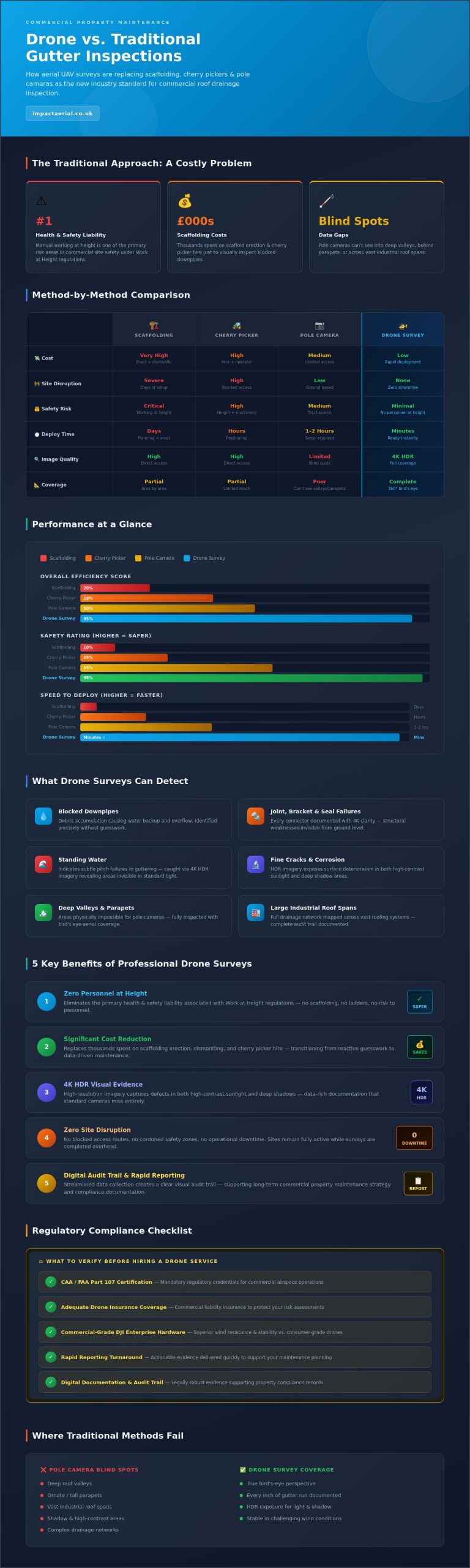
Consider the four primary metrics for any UK asset management project. Setup time for a drone is typically under 20 minutes. Scaffolding can take three to five days to erect for a standard commercial facade. Safety risk is virtually eliminated for personnel because the pilot remains safely on the ground. This drastically reduces “Working at Height” hours, often by as much as 95% across a portfolio. Data accuracy sees a significant boost; while a surveyor on a ladder relies on subjective notes and handheld photos, a survey drone captures 4K High Dynamic Range (HDR) imagery. This provides an immutable digital record for the board. Total costs are frequently 60% to 75% lower than traditional access when factoring in labour and equipment hire.

Many stakeholders still believe the “Human Eye” is superior. This is a myth that ignores the physics of inspection. A person on a ladder or cradle is restricted by proximity and physical stability. Modern DJI Enterprise drones utilize 4K zoom and thermal sensors that identify defects invisible to the naked eye. An academic case study on drone bridge inspections confirmed that UAVs provide higher levels of detail in hard-to-reach structural joints than manual inspections. For added peace of mind, these digital assets can be reviewed by multiple engineers simultaneously from any location.

Scaffolding and Cherry Pickers: The Hidden Costs

Traditional access involves more than just equipment hire. In urban centres like Birmingham or London, you’ll face Section 171 pavement licences and local council permit delays that can stall a project for up to 6 weeks. Heavy machinery like cherry pickers poses a high risk of property damage to pavements and underground services. Drones bypass these logistical hurdles entirely. They require no street closures, meaning zero disruption to public footfall or tenant operations. This makes them the ideal choice for high-traffic commercial environments.

Rope Access and Manual Inspections

Rope access remains a valid tool for physical repairs, but using it for initial inspections is an inefficient use of specialized labour. Inspecting a 10-storey office block via manual descent typically takes a two-person team a full working day. A CAA GVC certified pilot can complete the same visual data-gathering in approximately 25 minutes. This speed allows asset managers to identify issues faster. When creating a business case for drone inspections, highlight that UAVs narrow the scope for rope teams. They ensure climbers only go over the side when there is a confirmed defect to fix, which reduces their overall exposure to risk.

How to Structure Your Proposal: 5 Essential Elements of a Winning Case

Success when creating a business case for drone inspections depends on your ability to translate technical capability into board-level value. Your proposal shouldn’t just list drone specifications; it must demonstrate a rigorous understanding of asset management and risk mitigation. Begin with an Executive Summary that leads with the ‘Safety and Savings’ hook. Highlight how UAV technology can reduce traditional access costs by up to 70% while removing personnel from high-risk environments. This immediate focus on the bottom line and personnel safety captures the attention of stakeholders who prioritise operational efficiency.

Step 1 & 2: Identifying the Problem and Proposing the UAV Solution

Effective proposals start with ‘pain point’ data. Consult your site managers and safety officers to document current inefficiencies, such as the four-day setup time for scaffolding or the £2,000 daily cost of specialised cherry pickers. Use these figures to define a tight ‘Scope of Work’ to prevent project creep. By referencing established drone services case studies, you provide a proven concept that shifts the conversation from experimental to essential. This data-driven approach proves that you aren’t just buying a service; you’re solving a documented operational bottleneck.

Step 4 & 5: Navigating Risks and Finalising the Ask

Safety is the primary concern for any UK board. You must specify that any external partner holds a valid drone license and GVC certification as mandated by the Civil Aviation Authority (CAA). For added peace of mind, explicitly state the requirement for £5m commercial liability insurance. This protects the Finance Director from the legal and financial fallout of non-compliance. Conclude your case with a clear ‘Call to Action’ for a pilot project on a single high-value asset. This allows you to demonstrate a 100% safety record and clear ROI before a full-scale rollout across the estate.

Your financial analysis should present a clear implementation timeline. Most UK asset managers see a return on investment within the first two inspection cycles. When creating a business case for drone inspections, focus on these five pillars to ensure a comprehensive argument:

  • Executive Summary: The high-level safety and cost-benefit hook.
  • Problem Statement: Documented HSE risks and manual inspection costs.
  • Solution Overview: Targeted data collection using 4K HDR sensors.
  • Risk Mitigation: CAA compliance and £5m insurance coverage.
  • Financial Analysis: Comparison of UAV versus traditional access costs.

Ready to secure board approval? Consult with our CAA-certified team to build your pilot project framework today.

Mitigating Operational Risk: Why Professional Certification is Non-Negotiable

When creating a business case for drone inspections, asset managers must treat regulatory compliance as a foundational pillar rather than a box-ticking exercise. The legal landscape for Unmanned Aircraft Systems (UAS) in the UK is stringent. Operating without the correct Civil Aviation Authority (CAA) credentials doesn’t just invite heavy fines; it invalidates commercial insurance and exposes your organisation to immense liability. Professional drone operators provide the safety framework required to protect your physical assets and your corporate reputation.

Understanding CAA Regulations and Safety Standards

The UK drone regulatory framework underwent a major transition on 31 December 2020. The old Permission for Commercial Operation (PfCO) was replaced by the General Visual Line of Sight Certificate (GVC) and the A2 Certificate of Competency (A2 CofC). For complex industrial environments or heavy-lift operations, the GVC is the gold standard. It proves the remote pilot has passed rigorous theoretical exams and a practical flight test. Impact Aerial manages intricate airspace permissions across the West Midlands, including restricted zones near Birmingham Airport and congested urban centres. We produce a bespoke Risk Assessment and Method Statement (RAMS) for every single flight to ensure all hazards are identified and mitigated before take-off.

Selecting the Right Partner for Your Business Case

Choosing a drone partner based solely on the lowest quote is a high-risk strategy for any asset manager. Hobbyist pilots using consumer-grade equipment lack the system redundancy and data security found in DJI Enterprise platforms. When creating a business case for drone inspections, the true ROI lies in the quality of the data gathered. Our fleet utilises 4K High Dynamic Range (HDR) sensors and advanced thermal imaging to detect micro-cracks in solar farms or structural heat loss that standard cameras simply cannot see.

This commitment to high standards often extends beyond the technology itself and into the operational frameworks of the business. For asset managers looking to formalize their own quality management processes, which can provide significant assurance to stakeholders, working with a firm like Align Quality to achieve ISO 9001 certification can be a logical next step.

Professional post-production is the bridge where raw footage becomes actionable business intelligence. We don’t just deliver gigabytes of video; we provide high-resolution, georeferenced imagery and photogrammetry that allow your engineering teams to make informed maintenance decisions from their desks. This level of precision provides the peace of mind that comes from working with a vetted, insured, and highly technical specialist. Contact Impact Aerial to help build your bespoke business case today.

Secure Your Asset Management Future

Transitioning from traditional access methods to aerial technology is a strategic move that delivers measurable results. By creating a business case for drone inspections, you demonstrate how replacing 30 metre scaffolding setups with rapid drone deployment can reduce survey costs by up to 70%. It isn’t just about the financial ROI. It’s about eliminating the high-altitude risks that account for 24% of fatal workplace accidents in the UK.

Your proposal succeeds when it prioritises safety and data precision. Impact Aerial provides the technical expertise required to back your case. Our team consists of CAA GVC Certified Pilots operating a DJI Enterprise 4K HDR Fleet, ensuring every survey captures high-resolution detail for accurate maintenance planning. For added peace of mind, we carry £5m Commercial Liability Insurance, meeting the rigorous standards expected by UK commercial property developers and asset managers.

Contact Impact Aerial for a Professional Consultation to secure the high-quality data your board requires. Your transition to safer, more efficient asset management starts with a single flight.

Frequently Asked Questions

Is a drone inspection really cheaper than scaffolding?

Yes, drone surveys are significantly more cost-effective than traditional methods, often saving asset managers between 70% and 80% on access costs. Scaffolding for a typical three-storey commercial property can cost upwards of £2,500 for installation alone. In contrast, a professional drone inspection usually ranges from £500 to £900, depending on the site complexity. This massive reduction in overheads is a central factor when creating a business case for drone inspections.

What are the legal requirements for drone inspections in the UK?

Professional operators must hold a valid GVC (General Visual Line of Sight Certificate) or A2 Certificate of Competence issued by the Civil Aviation Authority (CAA). Since 31 December 2020, all commercial drone pilots must have a registered Operator ID and comply with CAP 722 safety guidelines. We ensure every flight is conducted by a CAA GVC Certified pilot. This guarantees that your survey meets all legal frameworks and safety standards required for commercial operations.

How long does it take to get the results from a drone survey?

You can expect to receive high-definition 4K imagery and raw video footage within 24 hours of the flight completion. More complex data-gathering tasks, such as 3D photogrammetry models or detailed thermal analysis, typically require 48 to 72 hours for processing. This is a vast improvement over manual inspections, which often take 10 to 14 days to produce a formal written report after the scaffolding is finally dismantled.

Can drones perform inspections in poor British weather?

Our DJI Enterprise fleet is designed for the UK climate and can operate safely in wind speeds up to 27mph. These drones carry an IP55 rating, meaning they can fly in light rain without compromising the internal electronics or data quality. While we avoid flying in heavy downpours or gale-force winds, we can operate in 85% of typical British weather conditions. We monitor Met Office aviation forecasts 24 hours in advance to ensure mission success.

Do I need to inform the CAA every time we want to use a drone?

No, you don’t need to notify the CAA for individual flights if they occur in uncontrolled airspace and follow standard GVC permissions. Notification is only necessary if the flight takes place within a Flight Restriction Zone (FRZ) near an airport or in restricted government airspace. In these instances, we handle all coordination with NATS and local Air Traffic Control. We typically require 7 days’ notice to secure these specific clearances for your site.

How accurate is the data gathered by a survey drone compared to manual checks?

Drone sensors provide sub-centimetre resolution, capturing defects as small as 0.1mm that are often invisible to a surveyor on a ladder. By using RTK (Real-Time Kinematic) positioning, our drones achieve horizontal accuracy of 1cm and vertical accuracy of 1.5cm. This level of precision is essential when creating a business case for drone inspections, as it allows for repeatable, centimetre-perfect monitoring of structural cracks or erosion over several years.

What insurance cover should a professional drone operator have?

A professional operator must carry specialist commercial liability insurance that is compliant with EC 785/2004 regulations. We maintain £5 million in public liability insurance as standard to protect our clients and the public. For added peace of mind, our policy specifically covers aviation-related risks that standard business insurance excludes. We provide full digital copies of our insurance certificates and site-specific risk assessments before any equipment leaves our office.

Can drones be used for internal building inspections as well as external?

Yes, we use specialised collision-proof drones equipped with protective cages for internal inspections of warehouses, plant rooms, and storage tanks. These units use LiDAR sensors to navigate safely in confined spaces where GPS signals don’t reach. This technology eliminates the need for staff to enter hazardous environments or work at height indoors. It reduces the health and safety risk profile of an internal survey by 100% for your onsite personnel.

Drone Asset Integrity Management: The 2026 Guide to UK Infrastructure Inspection

According to the UK’s Health and Safety Executive (HSE), falls from height were responsible for 40 workplace fatalities in 2022/23, making it one of the leading causes of death on the job. What if your team never had to leave the ground to conduct a comprehensive structural assessment again? It’s a challenge every infrastructure manager faces: balancing asset integrity with team safety, all while trying to control the spiralling costs of scaffolding and manual inspections.

You know that traditional methods aren’t just high-risk; they often produce photos and notes that sit in a folder, disconnected from actual maintenance planning. This guide provides a clear, professional framework for implementing drone asset integrity management. We promise to show you precisely how this CAA-regulated approach delivers audit-ready reports, transitions your strategy from reactive to proactive, and can reduce inspection costs by up to 70%. We’ll explore the essential technology, the UK regulatory landscape for 2026, and a step-by-step process for integrating high-quality aerial data into your workflows for tangible, long-term returns.

Key Takeaways

  • Discover how to enhance site safety by eliminating ‘Working at Height’ risks while reducing asset inspection downtime by up to 70%.
  • Uncover the true cost of traditional access methods by comparing the extensive lead times and hidden expenses of scaffolding against rapid drone deployment.
  • Navigate complex UK regulations by understanding why the CAA’s GVC certification is essential for a compliant and legally robust drone asset integrity management programme.
  • Learn a step-by-step framework for implementing your drone inspection strategy, including how to identify critical assets and select the optimal sensor payload.

What is Drone Asset Integrity Management?

Asset Integrity Management (AIM) is the systematic process of ensuring an asset performs its required function effectively, safely, and sustainably throughout its lifecycle. While you can find a foundational overview by asking What is Asset Integrity Management?, by 2026, this discipline is being fundamentally redefined by aerial data. The era of relying solely on costly scaffolding, rope access teams, and subjective manual visual inspections is giving way to a digital-first, data-driven methodology. This shift is central to modern drone asset integrity management.

This transformation is particularly critical for the UK’s extensive portfolio of aging infrastructure. For asset managers responsible for everything from Victorian-era railway bridges to 1980s commercial office blocks, “Life Extension” is no longer a theoretical goal; it’s an economic necessity. Drones provide the high-fidelity data needed to make precise, predictive maintenance decisions, deferring multi-million-pound replacement costs and maximising operational lifespan. It’s about capturing objective truth from a safe distance.

This capability is powered by professional-grade equipment. At Impact Aerial, our CAA GVC Certified operations utilise the latest advanced commercial drones, which are sophisticated data-gathering platforms. Capturing detail with 4K High Dynamic Range (HDR) visual sensors and identifying anomalies with radiometric thermal cameras, these systems provide a level of insight that is physically impossible to achieve from the ground, ensuring nothing is missed.

The Core Components of an Aerial AIM Strategy

An effective aerial AIM programme integrates three distinct data streams to create a holistic view of an asset’s health. Each component provides a critical piece of the puzzle for a comprehensive condition assessment.

  • Structural Integrity: Using high-resolution zoom cameras, our drones can identify millimeter-scale defects like hairline cracks in concrete, corrosion on steelwork, and signs of material fatigue from a safe standoff distance. This proactive defect identification is the first line of defence against structural failure.
  • Thermal Performance: Radiometric thermal sensors detect minute temperature variations invisible to the naked eye. This is crucial for locating water ingress behind a building’s facade, identifying inefficient heat loss from insulation, or pinpointing electrical connections overheating in a substation, often a precursor to critical failure.
  • Geospatial Accuracy: Through a process known as photogrammetry, thousands of overlapping images are processed to create a metrically-accurate 3D model, or “digital twin,” of the asset. This model serves as a definitive baseline, allowing for precise change detection and monitoring over time.

Industries Leading the Drone Adoption in the UK

While the applications for drone asset integrity management are diverse, several key sectors in the United Kingdom have become early adopters, driven by clear safety and efficiency benefits.

  • Commercial Property and High-Rise Building Management: In the wake of updated building safety regulations post-Grenfell, drones have become the standard for conducting efficient and thorough facade, cladding, and rooftop inspections on tall buildings across London, Birmingham, and Manchester.
  • Renewable Energy Infrastructure: With the UK aiming for 70GW of solar capacity by 2035, drones are the only scalable method for inspecting the health of millions of PV panels on solar farms, quickly identifying defective cells and maximising energy output.
  • Construction and Heavy Civil Engineering: For large-scale projects like those managed by National Highways, drones provide essential project oversight, from initial topographical surveys and earthworks calculations to ongoing progress monitoring against design plans.

The 4 Pillars of Drone-Led Integrity Inspections

Traditional asset inspections are built on a foundation of compromise, balancing safety risks, operational downtime, and data quality. Modern drone asset integrity management flips this model on its head. Instead of compromise, it delivers enhancement across four critical pillars, creating a safer, faster, and more intelligent approach to maintaining high-value infrastructure.

The operational advantages are built on these core principles:

  • Unmatched Safety: Drones completely remove the primary hazard associated with asset inspection: working at height. By eliminating the need for personnel to climb structures or operate from Mobile Elevating Work Platforms (MEWPs), you directly mitigate the leading cause of workplace fatalities in the UK construction and maintenance sectors.
  • Radical Efficiency: An entire factory roof, cooling tower, or bridge that once took a week to inspect can now be captured in a single day. Our data shows that drone inspections can reduce on-site time and asset downtime by up to 70% compared to traditional methods, accelerating maintenance cycles and returning assets to service faster.
  • Superior Data Depth: We move beyond simple photography. Using advanced photogrammetry techniques, we capture thousands of high-resolution images to create centimetre-accurate, measurable 3D models and point clouds. This “digital twin” provides an objective, data-rich record of an asset’s condition that can be analysed and compared over time.
  • Proven Cost-Effectiveness: The direct costs of inspection are slashed. Consider the expense of hiring scaffolding, which can easily exceed £1,200 per week for a commercial structure, or a cherry picker at over £300 per day. A drone operation circumvents these costs entirely, requiring only a certified pilot and a clear flight path.

Transforming Safety Protocols on UK Sites

In the UK, safety isn’t just a priority; it’s a legal requirement governed by stringent HSE regulations. Our CAA GVC Certified pilots are not just expert operators; they are trained risk-management professionals. They conduct detailed pre-flight surveys and create robust operational plans that comply with complex urban and industrial airspace rules. Navigating UK Compliance and CAA Regulations is central to our process, ensuring every operation is meticulously planned for maximum safety. This approach drastically reduces the number of personnel required on-site during an inspection and simplifies the entire Risk Assessment (RA) process, giving you complete peace of mind.

From Visual Data to Actionable Intelligence

The real value of drone asset integrity management is realised when raw data is converted into actionable intelligence. Our process includes meticulous post-production editing to enhance technical clarity, ensuring that engineers and surveyors can easily identify faults. The 4K HDR imagery captured by our DJI Enterprise drones reveals subtle defects like hairline fractures, spalling concrete, or early-stage corrosion that are often invisible to the naked eye from the ground. This high-fidelity data is then formatted to integrate seamlessly into your existing Asset Management Software, BIM models, or GIS platforms. Discover how our data packages are tailored for your platform, turning visual information into predictive maintenance triggers.

Traditional vs. Drone Inspections: A Strategic Comparison

Adopting new technology requires a clear-eyed assessment of its advantages over established methods. When comparing traditional access techniques like scaffolding or rope access with aerial inspections, the strategic benefits of drone asset integrity management become immediately apparent. It’s not simply a like-for-like replacement; it’s a fundamental upgrade in efficiency, safety, and data quality.

The operational differences in speed and cost are stark. Consider the inspection of a 30-metre industrial storage tank:

  • Traditional Scaffolding: Involves a multi-stage process of design, permitting, erection, and eventual dismantling. This can introduce a lead time of 2-4 weeks and incur costs often exceeding £20,000, factoring in labour, equipment hire, and operational downtime.
  • Drone Inspection: A qualified team can complete planning, risk assessments, and on-site data capture within 2-3 days. The cost is typically between £2,000 and £5,000, representing a saving of over 75% while completely eliminating the need for personnel to work at height.

Beyond the immediate financial savings, drones provide superior data for long-term analysis. An inspector on a scaffold or rope will capture images from slightly different positions on every visit. In contrast, a drone can execute a pre-programmed, automated flight path. This means we can capture high-resolution imagery and sensor data from the exact same GPS coordinates, angles, and distances, year after year. This level of data repeatability is the cornerstone of effective trend analysis, allowing engineers to accurately track the propagation of a crack or the spread of corrosion over time.

A common objection centres on the loss of the “human touch”. This perspective misunderstands the role of the drone. The drone is a data-gathering tool, not the analyst. It empowers a chartered engineer by providing them with comprehensive, high-definition visual and thermal data from inaccessible or hazardous locations. Instead of making subjective assessments in a high-risk environment, the expert can conduct a far more detailed analysis from the safety of an office, reviewing terabytes of objective data to make informed decisions. The drone enhances expert oversight; it doesn’t replace it.

The ROI of Proactive Aerial Monitoring

Calculating the return on investment for regular drone surveys is straightforward. Unplanned downtime for a UK production facility can cost over £200,000 per day in lost output. A proactive drone survey costing less than 2% of that figure can identify potential failures before they become critical. Detecting corrosion at an early stage might result in a £10,000 remediation project, whereas waiting until it compromises structural integrity could lead to a six-figure repair bill. For added peace of mind, our professional services are backed by £5m in commercial liability insurance, safeguarding your assets throughout our operations.

Overcoming Technical Limitations

A professional drone inspection service is equipped to handle the technical complexities of data acquisition. We deploy the right sensor for the job, using high-resolution 48MP cameras for identifying fine structural defects and thermal sensors for detecting moisture ingress or insulation failures. Our GVC certified pilots are not just operators; they are data acquisition specialists, fully versed in the evolving UK Civil Aviation Authority drone regulations that govern complex industrial inspections. We manage the entire data workflow, from capturing terabytes of footage on-site to processing it into actionable 3D models and inspection reports on secure cloud platforms.

Deploying drones for drone asset integrity management offers unparalleled efficiency, but it operates within a stringent regulatory framework governed by the UK’s Civil Aviation Authority (CAA). Understanding these regulations isn’t just the pilot’s responsibility; it’s crucial for any organisation commissioning drone services to ensure legal compliance and mitigate risk. As we look towards 2026, the operational standards for commercial drone use are more rigorous than ever, demanding a professional, documented approach to every flight.

The cornerstone of modern UK commercial drone operation is the General Visual Line of Sight Certificate (GVC). This qualification, which officially replaced the legacy Permission for Commercial Operation (PfCO) on 31st December 2020, requires pilots to pass both a theoretical exam and a practical flight assessment. Hiring an operator who still quotes a PfCO is a significant red flag; it indicates they are not current with the latest regulations. This distinction is critical for your liability, as a pilot holding a valid GVC has proven their competency in air law, flight planning, and risk mitigation. This is precisely why your drone pilot needs CAA GVC certification to operate legally and safely on your site.

Every commercial flight legally requires a detailed operational plan and a site-specific Risk Assessment Method Statement (RAMS). This isn’t a generic document. It’s a meticulous process that identifies potential hazards unique to your location, from high-voltage power lines and public rights of way to signal interference and emergency landing procedures. This documentation forms the legal basis for the flight and is the first thing authorities will ask for in the event of an incident.

Finally, data protection is a non-negotiable aspect of professional drone operations. When operating near residential areas or on sites with personnel, inadvertently capturing identifiable individuals or sensitive information is a real possibility. A compliant operator will have a clear GDPR policy, outlining how data is captured, stored securely, and processed. They will also implement practical steps to minimise intrusion, such as notifying residents in advance or using privacy-masking technology where feasible.

The Safety Standards of a Professional Drone Service

When vetting a provider, look for verifiable proof of their commitment to safety. This includes a well-maintained technical log for each drone, detailing flight hours and all maintenance schedules. Crucially, ensure they hold a minimum of £5 million in commercial liability insurance, which is the established standard for operating on most UK industrial and construction sites. For added peace of mind, check for affiliations with industry bodies like Drone Safe Register or ARPAS-UK, which indicates the operator has been independently vetted for safety and compliance.

Operational Planning in the West Midlands and Beyond

Complex urban environments present unique challenges. Operating in the West Midlands, for example, requires careful management of congested airspace around hubs like Birmingham Airport (BHX) and other sensitive sites. A professional pilot will use advanced software to map Flight Restriction Zones (FRZs) and will have established procedures for requesting digital or telephone clearance from Air Traffic Control. They must also be adept at weather window management; the UK’s unpredictable climate means that integrity inspection schedules require flexibility and proactive client communication to safely capture high-quality data.

Navigating these regulations is complex, but it’s what separates a professional service from a potential liability. To ensure your asset management project is fully compliant from day one, partner with our CAA-certified and insured drone experts.

Implementing Your Drone Asset Integrity Program

Transitioning to a drone-based inspection model requires a structured, methodical approach. A successful program isn’t about occasional flights; it’s about integrating high-quality aerial data into your existing maintenance and safety workflows. By following a clear, four-step process, you can build a robust drone asset integrity management framework that delivers quantifiable returns on investment through enhanced safety and predictive maintenance.

  • Step 1: Identifying Critical Assets and High-Risk Points
    The initial phase involves a comprehensive risk assessment to prioritise inspection targets. Not all assets carry the same operational risk. We collaborate with your engineering teams to identify critical infrastructure, such as high-pressure vessels, load-bearing structural elements, or difficult-to-access rooftops on production facilities. This ensures that our data-gathering efforts are focused where they can prevent the most significant potential failures and operational downtime.
  • Step 2: Selecting the Right Sensor Payload
    The value of drone data is determined by the quality of the sensor used. A one-size-fits-all approach doesn’t work. For detecting subtle water ingress or thermal bridging in a building’s envelope, a 640×512 radiometric thermal camera is essential. For identifying hairline fractures in concrete or corrosion on steel, a high-resolution 48MP 4K visual sensor is required. For inspecting telecom masts or wind turbines from a safe distance, a payload with at least 30x optical zoom is non-negotiable.
  • Step 3: Establishing a Baseline with an Initial Comprehensive Survey
    Your first drone inspection is the most important. It establishes the “as-is” condition of your asset, creating a detailed digital benchmark. Using techniques like photogrammetry, we generate high-resolution orthomosaic maps and 3D models that document the precise state of your infrastructure at a specific point in time. This initial dataset becomes the definitive reference against which all future inspections are compared, making change detection accurate and reliable.
  • Step 4: Scheduling Recurring Inspections for Trend Analysis
    With a baseline established, a schedule for recurring inspections can be set based on asset criticality and environmental factors. A coastal asset exposed to saltwater may require biannual inspections, while an inland warehouse might only need an annual survey. This regular data capture allows for powerful trend analysis. It enables your team to move from reactive repairs to a predictive maintenance model, identifying slow degradation, crack propagation, or corrosion growth long before they become critical failures.

Why Impact Aerial is the UK Partner for Asset Integrity

Our operations are built for high-stakes commercial environments. We exclusively operate a fleet of leading DJI Enterprise drones, ensuring reliability and data accuracy. While our roots are in Birmingham, our CAA GVC Certified pilots provide nationwide UK coverage, bringing expertise to your site. We offer a comprehensive service, from initial consultation and risk assessment through to data processing and post-production, delivering actionable insights, not just raw footage.

Next Steps: Requesting an Asset Integrity Consultation

Our process begins with a detailed initial site assessment and a feasibility study to ensure safe and compliant flight operations. We work with you to understand your exact engineering and reporting needs, customising our data deliverables to integrate seamlessly with your asset management systems. For added peace of mind, all our operations are covered by extensive commercial liability insurance.

To begin enhancing your maintenance strategy, Contact Impact Aerial for a Professional Drone Survey Quote today.

Future-Proof Your Infrastructure with Drone-Led Inspections

As we look towards 2026, it’s clear that integrating drones into your maintenance strategy isn’t just an option; it’s a competitive necessity for UK infrastructure leaders. The shift from high-risk manual inspections to rapid, data-rich aerial surveys delivers quantifiable gains in both site safety and operational efficiency. A robust drone asset integrity management program, executed by certified professionals, is the definitive way to leverage these benefits while ensuring full compliance with CAA regulations.

Don’t leave your critical asset data to chance. Partner with a team that provides complete peace of mind. Impact Aerial’s CAA GVC Certified pilots are backed by £5m in commercial liability insurance and provide nationwide UK coverage from our Birmingham headquarters. Take the next step towards a safer, smarter, and more cost-effective future for your assets.

Book Your Expert Drone Asset Integrity Consultation

Frequently Asked Questions

Is drone asset integrity management as accurate as manual inspection?

Yes, and in many cases, it’s significantly more accurate and comprehensive. Drones equipped with high-resolution sensors, RTK positioning, and LiDAR technology can capture data with sub-centimetre accuracy. This level of detail allows for the creation of precise 3D models and digital twins, revealing subtle defects, corrosion, or structural deviations that the human eye might miss from a distance. The data is also objective and repeatable, providing a superior baseline for future integrity assessments.

What qualifications should a drone pilot have for industrial inspections in the UK?

For professional industrial inspections, a pilot must hold a General VLOS Certificate (GVC) issued by the UK’s Civil Aviation Authority (CAA). This qualification, combined with a CAA-approved Operational Authorisation, is essential for conducting complex flights, particularly in and around industrial sites. It demonstrates a high level of theoretical knowledge, practical flight competency, and a thorough understanding of operational safety procedures, which are non-negotiable in high-risk environments.

How much can drones reduce the cost of asset inspections?

Drones can reduce inspection costs by 40-70% compared to traditional methods. These savings come from eliminating the need for expensive scaffolding, rope access teams, or mobile elevating work platforms (MEWPs). You also save on the associated costs of downtime and manpower. For example, a multi-day inspection requiring a team of four can often be completed by a two-person drone crew in a single day, drastically reducing both direct costs and operational disruption.

Can drones perform inspections in confined spaces or internal structures?

Absolutely. We use specialised collision-tolerant drones, often housed within a protective cage, designed specifically for navigating complex and confined spaces like boilers, storage tanks, or pressure vessels. These unmanned aircraft can safely operate in GPS-denied environments to collect high-quality visual data. This capability removes the significant health and safety risks associated with sending personnel into these hazardous areas, making internal inspections safer and more efficient.

What kind of insurance is required for commercial drone surveys?

All professional commercial drone operations in the UK must be covered by specialist aviation insurance compliant with regulation EC 785/2004. This includes comprehensive Public Liability insurance, with coverage levels typically starting at £5 million and often extending to £10 million or more for work on large industrial or construction sites. For added peace of mind, we ensure our policy covers all aspects of our flight operations and data-gathering activities.

How long does a typical drone asset inspection take to complete?

The on-site flight time for a drone inspection is remarkably fast, often taking just 2-4 hours to survey an asset that would traditionally require several days. For instance, a complete external inspection of a 10,000 square metre industrial roof can be finished in half a day. The overall project timeline, including pre-flight risk assessments and post-flight data processing, is still significantly shorter than manual alternatives, delivering actionable insights to your engineering team much faster.

What format is the data delivered in for engineering review?

We deliver data in a range of industry-standard formats compatible with your existing engineering and asset management software. This includes high-resolution JPEG or RAW images for visual analysis, 4K video for dynamic assessments, and thermal radiometric JPEGs. For advanced analysis, we provide detailed orthomosaic maps, dense point clouds (.LAS, .LAZ), and accurate 3D models (.OBJ) that can be integrated directly into CAD or BIM platforms.

Do drones require a site shutdown for integrity inspections?

No, a full site shutdown is rarely necessary for a drone asset integrity management inspection. Unlike traditional methods that require large exclusion zones for scaffolding or cranes, a drone operation typically requires only a small, localised safety cordon directly beneath the active flight area. This minimal footprint means your facility can remain operational, avoiding costly downtime and maintaining productivity while the critical inspection work is safely completed.

How to Conduct a Safe Roof Inspection Without Scaffolding

The spiralling costs, significant operational disruption, and inherent dangers of working at height make traditional roof inspections a major challenge for property managers and surveyors across the UK. Erecting scaffolding is not only a slow and expensive process, but it also introduces considerable Health and Safety Executive (HSE) compliance burdens. For many, finding a way to conduct a safe roof inspection without scaffolding has become a critical priority for both budget management and operational safety, moving beyond logistical headaches to a fundamental requirement for modern asset management.

Fortunately, a transformative, fully-compliant solution exists. In this article, we provide a comprehensive guide to how modern, CAA-certified drone technology delivers a superior alternative. You will discover how professional aerial survey services can eliminate the need for costly scaffolding, drastically reduce project timelines, and provide you with high-resolution, actionable data for precise maintenance planning. We will demonstrate how you can achieve a more thorough inspection with minimal disruption to your tenants or business operations, all while ensuring full compliance and providing complete peace of mind.

Key Takeaways

  • Understand why traditional methods like scaffolding introduce unnecessary project risks, delays, and significant costs compared to modern drone technology.
  • A safe roof inspection without scaffolding delivers high-resolution, actionable data to inform critical maintenance decisions, often in a fraction of the time.
  • Learn the structured, professional process behind a drone-based roof survey, from initial planning and risk assessment to on-site data capture and analysis.
  • Discover the essential CAA regulations and criteria for selecting a qualified and insured drone operator in the UK to ensure your project is both legally compliant and safe.

The Problem with Scaffolding: Why Traditional Roof Inspections Are Risky and Inefficient

Proactive roof maintenance is a non-negotiable aspect of protecting any commercial or residential property’s value. For decades, the standard approach involved manual surveys conducted from ladders or extensive scaffolding structures. While necessary, these traditional methods are fraught with risks, high costs, and logistical complexities. Today, modern technology offers a far superior alternative, establishing a safe roof inspection without scaffolding as the new industry benchmark for efficiency and data quality.

To see how this modern approach works in practice, consider this simple example of a drone-based check:

Unpacking the Safety Risks of Working at Height

Working at height remains one of the leading causes of workplace fatalities and major injuries. In the UK, the Health and Safety Executive (HSE) enforces the Work at Height Regulations 2005 to mitigate these dangers, but the inherent risks of slips, trips, and falls from scaffolding or ladders can never be eliminated. Furthermore, there is a constant danger of dropped tools or materials posing a significant threat to people and property below. An accident not only has devastating human consequences but also leads to severe liability issues and drastically increased insurance premiums.

The True Cost of Scaffolding: More Than Just Metal Poles

The financial outlay for scaffolding goes far beyond the daily hire rate. The true cost is an accumulation of direct and indirect expenses that can quickly escalate. These include:

  • Direct Costs: The fees for scaffold design, erection, dismantling, and weekly hire, plus the cost of any required council permits.
  • Indirect Costs: Significant operational disruption for businesses, project delays waiting for assembly, and potential lost revenue.
  • Damage and Complexity: Scaffolding can cause cosmetic damage to a building’s facade, pathways, or landscaping. For properties with complex roof shapes or listed status, these costs increase exponentially.

Logistical Headaches and Incomplete Data

Arranging scaffolding is a time-consuming process that creates numerous logistical challenges, including site security vulnerabilities from the new, unauthorised access points it creates. Critically, the data gathered from a manual inspection can be incomplete. Human error, combined with restricted access to hard-to-reach areas, often results in missed defects. This contrasts sharply with the comprehensive data-gathering seen in modern drone inspection applications. Manual reports are also subjective and difficult to replicate, making accurate year-on-year condition comparisons almost impossible.

Drone Technology: The Modern Solution for Scaffold-Free Roof Inspections

In the pursuit of a truly safe roof inspection without scaffolding, Unmanned Aerial Vehicles (UAVs), or drones, have emerged as the definitive modern solution. These are not consumer toys; commercial-grade drones are sophisticated data-gathering tools equipped with high-specification sensors and built-in safety features. Their deployment by a certified pilot revolutionises the inspection process, delivering unparalleled benefits across three key areas: safety, efficiency, and data quality. However, it is crucial to remember that the technology is only as effective as the CAA GVC Certified professional operating it.

Eliminating Working at Height for Unmatched Safety

The foremost advantage of using drones is the complete removal of personnel from dangerous heights. The pilot operates the UAV from the safety of the ground, mitigating the primary risk associated with traditional inspections. This method aligns perfectly with the HSE’s core principle of avoiding work at height wherever possible. Drones can access structurally-sensitive areas, such as fragile skylights or steep, unstable pitches, without any physical contact, providing comprehensive data without endangering a surveyor. This ground-based approach is a significant step towards eliminating workplace fatalities associated with falls, while also reducing liability and insurance premiums for building owners.

Drastic Reductions in Time and Cost

The efficiency gains offered by drone inspections are substantial. Where erecting scaffolding can take several days and cause significant disruption, a comprehensive drone survey is often completed in just a few hours. For example, a large commercial warehouse roof that would traditionally require a week of costly preparation can be thoroughly documented in a single morning. This minimal disruption is invaluable for active businesses and tenanted properties. Consequently, the financial savings are significant, with clients often seeing a cost reduction of 50-70% compared to the combined expense of scaffolding hire, labour, and permits.

Superior Data Quality with High-Resolution and Thermal Imaging

Drone technology provides a level of detail that is often impossible to achieve from scaffolding. The data captured is not only safer to acquire but is also demonstrably superior. Key data-gathering capabilities include:

  • High-Resolution Visuals: 4K cameras capture crystal-clear imagery, allowing for the identification of even minor defects like cracked tiles, degraded sealant, or blocked gutters.
  • Thermal Imaging: An infrared camera payload can detect anomalies invisible to the naked eye, such as trapped moisture beneath a flat roof membrane or areas of significant heat loss, pinpointing insulation failures.
  • Measurable Models: Using a technique called photogrammetry, the collected images can be processed to create dimensionally accurate 2D maps and 3D models of the entire roof structure for precise analysis and record-keeping.

Furthermore, pre-planned flight paths can be repeated with centimetre-level accuracy, enabling reliable condition monitoring and tracking of deterioration over time.

The Drone Roof Inspection Process: What to Expect from Start to Finish

Understanding the process behind a professional drone survey demystifies the service and highlights its value as a structured, data-driven project. Far from simply flying a drone over a building, a commercial aerial survey is a meticulous operation designed to deliver a safe roof inspection without scaffolding, providing actionable insights for facility managers and property owners. This structured approach is part of how modern aerial technologies revolutionize building inspections, transforming a complex task into a manageable, data-driven project. The process is typically broken down into three distinct phases.

Phase 1: Pre-Flight Planning and Risk Assessment

This foundational stage ensures all operations are safe, compliant, and tailored to your specific objectives. It is the most critical part of delivering a successful and safe roof inspection without scaffolding.

  • Initial Consultation: We begin by discussing your project goals, the specifics of the site, and the key data you need, whether it’s identifying water ingress, checking for damaged tiles, or assessing HVAC unit conditions.
  • Desktop Survey: Our team conducts a detailed off-site review, checking UK airspace regulations (using tools like Drone Assist), identifying potential ground hazards, and assessing the surrounding environment.
  • Flight Plan & RAMS: A comprehensive flight plan is created, alongside a detailed Risk Assessment and Method Statement (RAMS). This document outlines all procedures and safety protocols for client approval.
  • Scheduling: A suitable date is scheduled, taking into account weather forecasts, site access, and any operational requirements of your facility to minimise disruption.

Phase 2: On-Site Operations and Data Capture

With planning complete, the on-site phase is executed with precision and a primary focus on safety. A CAA-certified pilot arrives and conducts a series of pre-flight checks on the equipment and the immediate environment. A secure take-off and landing zone is established, and all relevant on-site personnel are briefed. The pilot then executes the pre-programmed automated flight paths to ensure comprehensive, overlapping coverage, supplemented by manual flights to capture specific areas of interest in high detail. Depending on the brief, this will include capturing both high-resolution visual (RGB) imagery and thermal data to identify hidden issues like moisture retention or heat loss.

Phase 3: Data Processing and Reporting

Once the flight is complete, the captured raw data is securely transferred and backed up. This data is then processed using specialised photogrammetry software to create detailed, measurable outputs such as high-resolution orthomosaic maps and 3D models of your roof. Our experts analyse these outputs to pinpoint defects, anomalies, and potential maintenance issues. The final deliverable is a comprehensive inspection report, complete with annotated images, clear descriptions of findings, and actionable recommendations, presented in an easy-to-understand format for your maintenance teams and stakeholders.

Beyond a Simple PDF: Actionable Data Deliverables from a Drone Survey

The true value of a professional drone survey lies not in a simple folder of photographs, but in the quality and usability of the data captured. A modern, safe roof inspection without scaffolding delivers a suite of actionable intelligence that transforms reactive repairs into proactive asset management. This detailed data provides a complete, verifiable record of your roof’s condition, empowering you to make informed, budget-conscious maintenance decisions with confidence.

High-Resolution Orthomosaic Maps

An orthomosaic map is a single, geometrically-corrected, high-resolution image stitched together from hundreds or thousands of individual photographs. It provides a complete, top-down, map-like view of your entire roof structure. This powerful tool allows for precise measurements of lengths and areas, and enables us to pinpoint the exact location of every defect, from cracked tiles to pooling water, forming the foundation of a comprehensive, annotated report.

Interactive 3D Models

Using a process called photogrammetry, we create a detailed and accurate 3D model of your entire building. This isn’t just a visual gimmick; it’s a powerful diagnostic tool. Clients can digitally navigate, zoom, and rotate the model on their own computer, inspecting complex geometry like chimneys, parapet walls, and skylights from any conceivable angle. This level of detail is invaluable for planning complex repairs or new installations, such as solar panels or HVAC units.

Annotated Reports and Thermal Maps

The culmination of our data-gathering is a clear, concise, and actionable report. We deliver more than just raw data; we provide analysis. Key findings are presented in a comprehensive PDF document where:

  • Defects are clearly annotated on high-resolution images, with descriptions and precise locations noted.
  • Thermal maps (where applicable) highlight temperature anomalies, clearly indicating potential water ingress, saturated insulation, or heat loss invisible to the naked eye.
  • Recommendations are provided, giving your maintenance teams or contractors a clear brief to work from.

This final document transforms a complex survey into a straightforward plan of action. To understand the level of detail we provide, you can see examples of our detailed reports. Contact Impact Aerial for a demonstration.

How to Choose a Compliant and Professional Drone Operator in the UK

Choosing a drone service provider is more than just finding someone with a drone; it’s about entrusting the safety and security of your property to a qualified professional. The UK’s commercial drone industry is highly regulated by the Civil Aviation Authority (CAA) to ensure public safety. Hiring a non-compliant operator not only exposes you to significant legal and financial risk but also compromises the quality and reliability of the inspection data. To ensure you commission a truly safe roof inspection without scaffolding, every potential operator must meet the following non-negotiable criteria.

Verify CAA Certification and Permissions

The Civil Aviation Authority (CAA) is the UK’s aviation regulator, and all commercial drone operations fall under its jurisdiction. A professional operator must hold a General Visual Line of Sight Certificate (GVC) and be able to present their official CAA Operational Authorisation document. This is not just a piece of paper; it is proof that the pilot is trained, competent, and legally permitted to fly commercially. Engaging an uncertified operator is a serious liability.

Confirm Adequate Commercial Insurance

Standard public liability insurance does not cover commercial drone flights. Your chosen operator must hold specialist aviation insurance that is compliant with regulation EC785/2004. For added peace of mind, we recommend a minimum public liability coverage of £5 million. This protects you, your property, and the public in the unlikely event of an incident. Always ask to see a current insurance certificate before any work commences.

Review Their Experience and Equipment

A proven track record is essential. Ask to see a portfolio of previous roof inspection projects, particularly in commercial or industrial settings similar to your own. A professional operator will use enterprise-grade equipment, including advanced drones specifically designed for commercial applications, which offer superior reliability and high-resolution imaging capabilities. Furthermore, they will have robust pre-flight safety procedures, risk assessments, and backup equipment to ensure the mission is completed safely and efficiently.

At Impact Aerial, we consider these standards the baseline for professional service. By prioritising compliance, insurance, and experience, you ensure your project is not only effective but also conducted with the highest degree of safety and professionalism.

The Future of Roof Inspections: Safe, Swift, and Scaffold-Free

The era of relying on costly, disruptive, and high-risk scaffolding for roof assessments is drawing to a close. As we’ve explored, drone technology provides a vastly superior alternative, delivering comprehensive, high-resolution data quickly and without putting personnel at risk. The key to unlocking these benefits lies in partnering with a qualified professional who understands the technical and regulatory landscape. Ultimately, a safe roof inspection without scaffolding is not just possible-it’s the new professional standard for proactive property management.

When you’re ready to embrace this modern approach, ensure you choose a partner with proven expertise. At Impact Aerial, we provide professional services backed by decades of commercial surveying experience. For your complete peace of mind, our operators are fully CAA GVC Certified and insured, utilising professional DJI Enterprise drones for top-quality data gathering. Don’t leave your asset’s integrity to chance.

Discover how our meticulous, compliant, and technologically advanced services can benefit your project. Request a professional quote for your scaffold-free roof inspection today and take the first step towards a more efficient and secure approach to your building maintenance.

Frequently Asked Questions

Is a drone roof inspection legally compliant in the UK?

Absolutely. A professional drone roof inspection is fully compliant with UK law, provided it is conducted by a commercially licensed operator holding a valid CAA GVC (General Visual Line of Sight Certificate). This certification ensures the pilot operates to the highest safety standards and possesses the required knowledge of UK airspace regulations. For added peace of mind, always verify your provider’s credentials and commercial liability insurance before commencing any work, ensuring a legally sound and secure operation.

What happens if the weather is bad on the scheduled inspection day?

Safety is our paramount concern. Commercial drones cannot be operated safely in adverse weather conditions such as high winds or heavy rain. If the weather is unsuitable on the scheduled day, we will proactively contact you to reschedule the inspection for the next available date with a suitable forecast. This is a standard professional practice, and there is no additional charge for weather-related postponements. Our priority is to gather high-quality data without compromising safety or asset integrity.

How accurate are the measurements taken from a drone survey?

Drone survey measurements are exceptionally accurate, often achieving precision to within 2-5 centimetres. By utilising advanced data-gathering techniques like photogrammetry, we create detailed 3D models and orthomosaic maps of your roof. These digital assets allow for precise measurements of lengths, areas, and volumes, providing engineers and surveyors with reliable data for assessments and planning. This level of accuracy is critical for detailed condition reports and accurate cost estimations for repairs.

Can a drone inspect every part of a complex roof?

Drones offer unparalleled access to complex roof structures, including intricate gables, steep pitches, and difficult-to-reach valleys that are hazardous for manual inspection. Our high-resolution cameras and manoeuvrable aircraft can capture detailed imagery of almost every external surface. While extremely confined spaces or internal voids may require alternative methods, a drone provides a far more comprehensive overview than can be achieved from the ground, making it an ideal solution for a safe roof inspection without scaffolding.

How much does a professional drone roof inspection cost compared to scaffolding?

A professional drone inspection offers substantial cost savings. While erecting scaffolding for a typical commercial building can cost several thousand pounds (£2,000 – £10,000+) and take days to assemble, a comprehensive drone survey is often completed in hours for a fraction of that price, typically starting from a few hundred pounds. This makes a drone-based inspection not only faster and less disruptive but also a significantly more cost-effective solution for routine maintenance and initial damage assessment.

Are drone inspections noisy or disruptive for building occupants?

Drone inspections are designed to be minimally disruptive. The commercial drones we operate produce a low level of noise, comparable to a household appliance, and are typically flying at a height where they are barely noticeable from inside the building. The entire data-gathering process is usually completed within a few hours, a stark contrast to the prolonged noise, visual intrusion, and access restrictions associated with erecting and dismantling scaffolding, ensuring business operations can continue as normal.