Professional Aerial Filming for Events in London: The 2026 Guide

Did you know that nearly 100% of the London Control Zone is restricted airspace, where an unauthorised flight can lead to a fine of up to £2,500? For organisers planning a high-profile launch or festival, securing professional aerial filming for events london requires more than just a drone; it demands a meticulous approach to safety and legality. You likely recognise that breath-taking cinematic footage is the most effective way to showcase your event’s scale on social media, yet the fear of heavy fines or noise complaints often stalls the creative process.

We understand that you need total peace of mind when integrating technology into a live environment. This 2026 guide provides a clear roadmap for capturing stunning aerial perspectives while adhering to the latest GVC certification standards and commercial liability insurance requirements. We will detail how to manage complex flight permits, mitigate the unpredictable British weather, and ensure your production remains fully compliant with current UK drone regulations.

Key Takeaways

  • Understand the stringent safety standards and CAA GVC certification required for operating drones in London’s complex “congested areas” to ensure your event remains fully compliant.
  • Discover why utilising DJI Enterprise commercial equipment is vital for capturing high-quality 4K HDR footage that stands out on large-screen event displays.
  • Learn how professional aerial filming for events london can transform your production by capturing the immense scale and energy of crowds in iconic urban spaces.
  • Follow our comprehensive planning roadmap, including detailed desktop site surveys and risk assessments, to provide added peace of mind for your flight operations.
  • Find out how to maximise your investment by turning raw aerial data into a high-impact marketing asset through professional colour-grading and cinematic editing.

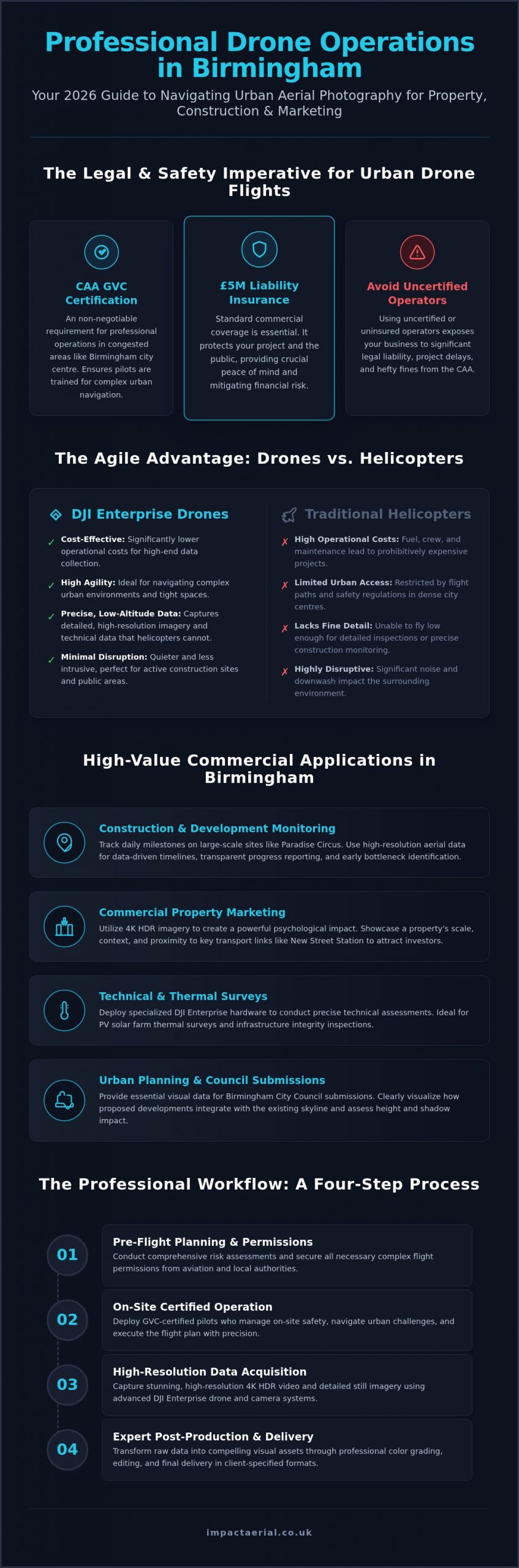
Capturing professional aerial filming for events in London requires navigating one of the most complex flight environments in the world. By 2026, the Civil Aviation Authority (CAA) has refined the categorisations for drone operations, making the distinction between a hobbyist and a professional operator clearer than ever. While a consumer drone might seem capable, professional event storytelling demands the stability and redundancy found in Enterprise-grade aircraft. These machines provide the reliability needed for brand building, offering perspectives that ground-based cameras simply cannot replicate.

To better understand the impact of professional drone services, watch this demonstration of event-based aerial filming:

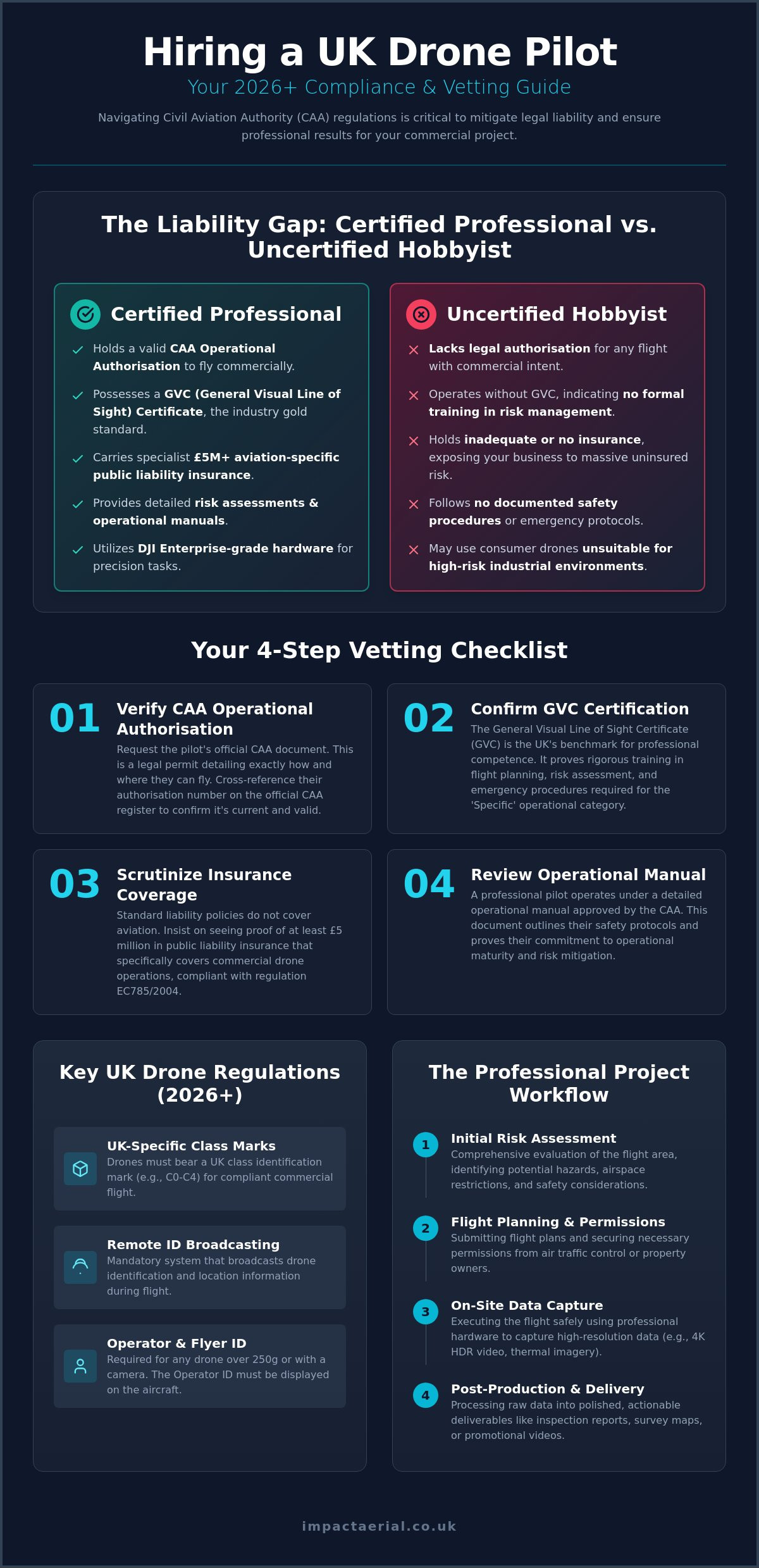
Distinguishing between a hobbyist flight and a commercial operation is vital for event organisers. A hobbyist often lacks the £5 million to £10 million public liability insurance typically required by major London venues. Professional operators hold a GVC (General Visual Line of Sight Certificate) and carry comprehensive commercial insurance for added peace of mind. This expertise ensures that your brand’s visual content is not only “breath-taking” but also fully compliant with current safety standards in a niche but increasingly diverse market.

Understanding London’s Restricted Airspace

London is blanketed by Flight Restriction Zones (FRZs). Major hubs like Heathrow, London City, and RAF Northolt create vast areas where unauthorised flight is strictly prohibited. Before any booking, a professional operator must consult NATS (National Air Traffic Services) maps to identify potential conflicts. Operating within the London Controlled Zone (CTR) is not impossible, but it demands meticulous scheduling and coordination with Air Traffic Control. For a comprehensive UK drone law overview, clients should understand that specific CAA authorisations are non-negotiable for commercial work in these high-traffic zones.

The Density Challenge: Filming in Urban Environments

Urban environments like the City of London or Southbank present significant “congested area” hurdles. Managing take-off and landing points in a city where 9.6 million people live and work requires more than just skill; it requires a robust safety management system. CAA regulations dictate strict horizontal distances from uninvolved persons. These distances are often 30 metres or more depending on the aircraft’s weight and the operator’s specific permissions. Professional teams also focus on noise mitigation. A DJI Mavic 3 Pro produces approximately 80 decibels at close range. We manage this by using high-altitude positioning or low-noise propellers to ensure the drone doesn’t distract from the event programme.

Safety Standards and Professional Equipment for Event Success

Impact Aerial utilizes DJI Enterprise commercial drones to ensure every project meets the highest industrial standards. These aircraft differ significantly from consumer models, offering the stability and reliability required for aerial filming for events london. Our fleet delivers 4K HDR footage with 10-bit colour depth, which is essential when content is projected onto large-scale event displays or high-definition stadium screens. This technical edge ensures that highlights from a 2026 corporate summit or outdoor festival remain crisp, vibrant, and professional even when scaled up to massive proportions.

Safety is built into our hardware through sophisticated redundancy systems. Professional drones feature dual batteries, multiple Inertial Measurement Units (IMUs), and redundant compasses to prevent mid-air failures. If one system encounters an error, the backup takes over instantly to maintain flight stability. This level of hardware reliability is vital when operating in London’s unpredictable micro-climates. The city’s “wind tunnel” effects around skyscrapers in Canary Wharf or sudden rain showers require equipment with high IP ratings and wind resistance. Our enterprise-grade drones stay airborne and stable in conditions that would ground lesser equipment, ensuring your event schedule remains uninterrupted.

Why CAA GVC Certification is Non-Negotiable

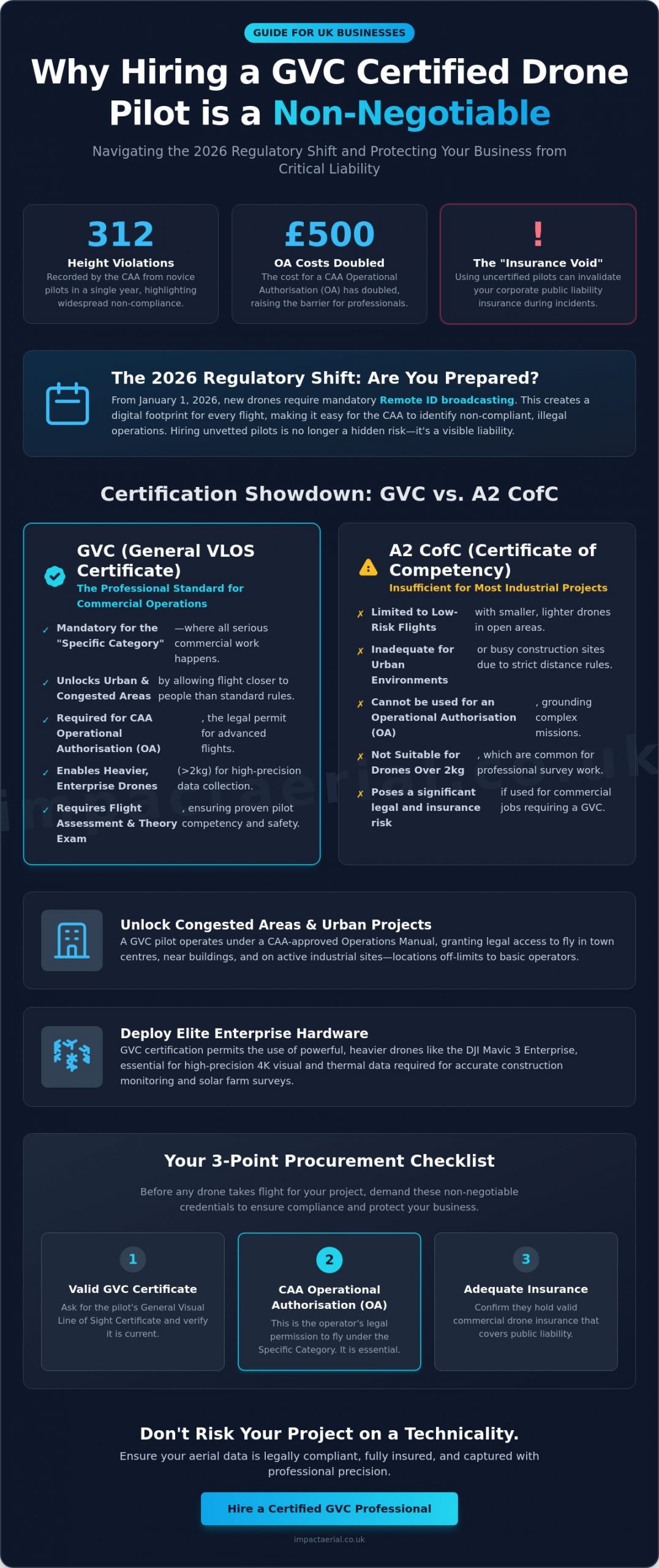
The regulatory landscape for UK drone flight has evolved, moving away from the old PfCO (Permission for Commercial Operations) towards the GVC (General Visual Line of Sight Certificate). By 2026, any professional pilot must hold a current GVC to operate legally in the “Specific” category. This certification is critical for London events because it allows for more flexible flight permissions in congested areas, such as South Bank or the City. The GVC is the gold standard for UK commercial drone operations, ensuring pilots possess the theoretical knowledge and practical skills required for complex missions. Following Civil Aviation Authority drone regulations is not just a legal requirement; it is the foundation of our safety-first approach.

The Importance of £5m Commercial Liability Insurance

High-profile London venues, from the O2 Arena to historic Royal Parks, rarely accept standard £1m or £2m insurance policies. We carry £5m in commercial liability insurance specifically tailored for drone operations. This level of coverage provides genuine peace of mind for event organisers, covering everything from accidental property damage to third-party liability. Our comprehensive insurance status acts as a badge of credibility, often helping us secure venue permissions and local authority permits faster than unverified operators. For those planning high-profile gatherings, our team at Impact Aerial provides the technical expertise to navigate these requirements seamlessly. This professional backing ensures that your only focus remains on the success of the event itself.

Transforming Diverse Event Types with Aerial Perspectives

Aerial perspectives provide a sense of scale that ground-based crews simply cannot replicate. When you’re planning aerial filming for events london, you’re investing in a vantage point that captures the collective energy of a crowd within the city’s most iconic spaces. Whether it’s a gathering in Trafalgar Square or a private function on a rooftop in the City, drones bridge the gap between the individual experience and the grander atmosphere. This high-altitude context creates an immediate sense of place by featuring landmarks like the Shard or the River Thames as the backdrop, grounding your event in a world-class setting.

Engagement metrics from 2025 industry reports indicate that video content featuring professional aerial cinematography sees a 40% higher interaction rate on LinkedIn compared to standard ground-level footage. On platforms like Instagram, the “birds-eye” reveal has become a standard requirement for high-end event reels. It provides a professional, cinematic finish that signals quality and prestige to potential clients and stakeholders.

Corporate Events and Product Launches

Drones are essential for showcasing the magnitude of new office building launches or large-scale corporate retreats. We use dynamic “reveal” shots to introduce brand activations, starting with a close-up of the product and pulling back to show the entire London skyline. Our team integrates this high-quality 4K footage into corporate highlight reels, providing a sophisticated asset for both internal communications and external marketing. In 2026, a professional aerial shot is no longer a luxury; it’s a core component of a brand’s visual identity.

Festivals, Concerts, and Sporting Events

For large-scale festivals and outdoor sporting events in London’s parks, drones serve a dual purpose. We map the entire site to show attendance density and layout, which is invaluable for future planning and sponsorship pitches. Capturing the atmosphere of 50,000 people from the air provides a powerful visual testament to the event’s success.

Safety remains our primary focus during these high-density operations. Our pilots strictly adhere to the UK’s Drone and Model Aircraft Code to ensure every flight is compliant and secure. Beyond filming, drones are increasingly used for real-time crowd monitoring. This allows organisers to identify bottlenecks or safety concerns as they happen, providing a layer of oversight that ground security cannot achieve alone. This meticulous approach to aerial filming for events london ensures that your production is both breath-taking and fully compliant with CAA regulations.

The Planning Roadmap: From Site Survey to Flight

Executing professional aerial filming for events london requires a meticulous, multi-stage planning process that begins long before the propellers spin. We start with a comprehensive creative consultation to define your specific brief and identify the high-impact “hero” shots required for your production. Our team then conducts a rigorous desktop site survey using the latest 2026 satellite imagery and 3D mapping data to evaluate the local environment. This digital rehearsal allows us to anticipate obstacles before arriving on-site.

Safety is our absolute priority. We perform physical risk assessments to identify urban hazards such as overhead power lines, temporary event structures, or London’s iconic skyscrapers. These findings inform a detailed flight plan. We coordinate this plan directly with your event security team to ensure our operations are seamlessly integrated into the wider event management strategy. Our approach to aerial filming for events london prioritises data-driven decisions to ensure every flight is both spectacular and compliant.

Securing Permits and Venue Permissions

Operating in the capital involves navigating complex regulatory layers. We liaise directly with London boroughs, such as Westminster, Southwark, or Tower Hamlets, to secure necessary ground permits and filming licences. For added peace of mind, our CAA GVC Certified pilots handle the entire NOTAM (Notice to Airmen) process. This digital notification alerts other airspace users to our presence, which is a legal necessity in London’s crowded skies. We also collaborate with venue managers to establish “sterile zones.” These are cordoned areas for take-off and landing where public access is strictly prohibited during flight operations.

Weather Monitoring and Contingency Planning

London’s weather is notoriously fickle. We utilise high-accuracy meteorological applications to monitor wind speeds and precipitation in real-time, focusing on hyper-local data. Our safety protocol establishes a clear “Go/No-Go” window based on the specific technical tolerances of our DJI Enterprise fleet. If wind gusts exceed 22mph or heavy rain is detected, we trigger pre-arranged contingency plans. Our flexible scheduling allows us to work around shifting weather patterns, ensuring we capture your event in the best possible light while maintaining total operational safety.

Our team is ready to provide the technical expertise and regulatory knowledge your production requires. Contact Impact Aerial today to discuss your project requirements with our specialist pilots.

Maximising the Value of Your Aerial Event Footage

Capturing high-resolution data is only the initial phase of aerial filming for events london. While the flight itself requires technical precision, the final output depends heavily on what happens once the drones are back on the ground. Impact Aerial provides a full end-to-end service, moving seamlessly from the flight deck to the editing suite. This ensures that the technical quality of our 4K, High Dynamic Range (HDR) footage is fully realised in the final cut.

Raw footage and a professionally graded cinematic film are worlds apart. Raw files are often captured in a “flat” profile to retain maximum detail in highlights and shadows. Without expert post-production, these files look washed out. Our team applies meticulous colour grading to bring out the vibrancy of the London skyline and the energy of your event. We focus on creating a cohesive story by integrating aerial perspectives with your ground-based videography. This multi-angle approach provides the scale and context that ground cameras simply cannot reach, creating a more immersive experience for the viewer.

Post-Production and Cinematic Editing

Our editing process is methodical. We don’t just provide a data dump of every minute flown; we curate the most impactful “hero shots” that define the day. Our post-production workflow includes several key elements to ensure a professional finish:

  • Brand Integration: We add your logos, brand colours, and custom graphics to ensure the film aligns perfectly with your corporate identity.
  • Audio Synchronisation: We use licensed, high-energy music and professional sound design to match the rhythm of the visual transitions.
  • Social Media Optimisation: We produce bespoke short-form edits specifically for TikTok and Instagram Reels. These vertical crops are essential for reaching modern audiences who consume content primarily on mobile devices.

Partnering with Impact Aerial

Selecting a national specialist with specific London expertise is a strategic investment. While we are based in the West Midlands, our reach extends across the UK. This geographical flexibility allows us to bring a consistent, high-standard service to any location. Our commitment to breath-taking end results is matched only by our dedication to safety and compliance. We are fully CAA GVC Certified and hold comprehensive commercial liability insurance for added peace of mind.

We understand that the drone industry is a niche but increasingly diverse market. That’s why we act as technical consultants for our clients, ensuring every flight adheres to the latest UK regulations. To understand the technology behind our work, learn more about our aerial filming drone capabilities and how they can elevate your next project. We don’t just fly drones; we deliver professional services that provide tangible value and a significant return on your marketing investment.

Secure a Competitive Edge for Your 2026 London Productions

Capturing high-quality perspectives in the capital requires more than just a drone; it demands a meticulous approach to safety and a deep understanding of the city’s complex regulatory landscape. By 2026, the integration of advanced 4K HDR technology and rigorous pre-flight planning will be the non-negotiable standard for any successful production. Success hinges on balancing creative ambition with strict technical compliance to ensure every frame adds tangible value to your brand.

Our team brings the technical precision needed to navigate these unique challenges. With CAA GVC Certified Pilots and £5m commercial liability insurance, we provide the essential peace of mind required for high-stakes environments. We specialise in aerial filming for events london, managing every detail from initial site surveys to securing complex permissions within London’s Restricted Airspace. This methodical process ensures your footage isn’t just breath-taking, but fully compliant with the latest UK aviation standards. Transforming your event into a cinematic experience starts with expert coordination and the right equipment.

Contact Impact Aerial today for a bespoke London event filming quote

We look forward to helping you showcase your event from a perspective that truly stands out.

Frequently Asked Questions

Do I need a special permit to fly a drone for an event in London?

You must obtain specific flight authorisation from the Civil Aviation Authority (CAA) and National Air Traffic Services (NATS) for most event locations in the capital. London’s airspace is heavily restricted, particularly within the Heathrow and London City Airport Flight Restriction Zones (FRZs). We manage all necessary permit applications and safety filings as part of our service, ensuring every flight is legal and fully authorised before the rotors start spinning.

How much does aerial filming for an event in London cost?

The cost for professional aerial filming for events in London varies based on the location’s airspace complexity and the required flight duration. While basic half-day shoots in less restricted areas might start at £500, complex city centre projects requiring bespoke NATS permissions often reach £1,500 or more. We provide a fixed-fee quotation after reviewing your venue’s specific coordinates and the technical requirements of your project.

What happens if the weather is bad on the day of my event?

We monitor high-accuracy aviation forecasts 48 hours before your event to assess wind speeds and precipitation levels. If wind gusts exceed 20mph or heavy rain is forecast, we’ll consult with you to reschedule the flight to a backup date or provide a refund for the operational portion of the fee. Safety is our absolute priority, and we don’t operate in conditions that breach our strict CAA-approved operations manual.

Can you fly drones indoors for London venue events?

Yes, we can conduct indoor aerial filming for events in London using specialised “cinewhoop” drones that feature 360-degree propeller guards for total safety. These compact aircraft don’t rely on GPS, allowing them to fly through halls, over dining tables, and through architectural features without risk to guests. It’s an excellent way to capture the scale of venues like the ExCeL or the Grand Hall at Billingsgate from a unique perspective.

How long can a drone stay in the air during an event?

Our commercial DJI Enterprise drones typically offer a flight time of 25 to 30 minutes per battery. To ensure we don’t miss any critical moments of your programme, we use a continuous flight rotation system with multiple batteries and rapid charging stations. This approach allows us to maintain an aerial presence throughout the day by landing one aircraft for a fresh battery while another takes its place immediately.

Is drone filming in London noisy or disruptive to guests?

Modern professional drones use low-noise propeller technology that generates less than 70 decibels at a 3-metre distance, making them no louder than a normal conversation. We plan our flight paths to maintain a respectful distance from speakers and stages so the drone doesn’t interfere with your event’s audio or distract the audience. Our pilots operate with a discreet, professional manner to ensure the technology enhances the event without becoming the focus.

What insurance do you carry for London event filming?

We carry £10 million in specialist commercial drone liability insurance that’s fully compliant with the EC 785/2004 regulation standard. This high level of coverage is often a mandatory requirement for major London venues and provides essential protection for organisers, guests, and the public. For added peace of mind, we provide a full copy of our insurance certificate and a site-specific risk assessment to your venue manager 14 days before the event.

How soon after the event will I receive the edited footage?

You’ll receive a 60-second “social media ready” highlight reel within 48 hours of the event’s conclusion to help you maintain marketing momentum. The full suite of high-resolution 4K HDR files and the final edited master film are typically delivered via secure cloud link within 7 working days. If your project requires a faster turnaround for news or live broadcasts, we can arrange for immediate data transfer on-site directly after the flight.

Comprehensive Commercial Drone Services in Leeds: What to Know in 2026

Ensuring Safety and Compliance in Drone Operations

Safety stands as the cornerstone of professional commercial drone services Leeds operations. Every flight requires meticulous planning, certified operators, and comprehensive insurance coverage to protect both clients and the public. The Civil Aviation Authority (CAA) has established stringent regulations that all commercial drone operators must follow, creating a framework that ensures responsible aerial operations across the UK.

Professional drone operators in Leeds maintain CAA General Visual Line of Sight Certificate (GVC) certification, which replaced the previous Permission for Commercial Operations (PfCO) system in December 2020. This certification requires operators to pass both theoretical knowledge tests and practical flight assessments, demonstrating their competency in areas including airspace management, meteorology, and human factors.

CAA Certification: What It Means

CAA certification represents the gold standard for commercial drone operations. Certified operators must complete 40 hours of theoretical study, pass written examinations covering aviation law and operational procedures, and demonstrate practical flying skills during assessed flights. The certification process also includes background checks and ongoing competency requirements.

Clients can verify operator credentials through the CAA’s online database, ensuring their chosen provider holds valid certification. This verification process protects businesses from potential legal liabilities and guarantees professional service delivery.

Insurance and Risk Management

Comprehensive commercial liability insurance forms an essential component of professional drone operations. Leading operators carry £5 million public liability coverage, protecting clients against potential property damage or personal injury claims arising from aerial operations.

Risk management protocols extend beyond insurance coverage. Professional operators conduct detailed site surveys before each flight, assess weather conditions using meteorological data, and implement no-fly zones around sensitive areas such as airports, military installations, and populated areas. Pre-flight safety briefings ensure all personnel understand emergency procedures and communication protocols.

Flight planning software helps operators maintain compliance with UK airspace restrictions, automatically flagging potential conflicts with controlled airspace or temporary flight restrictions. This technology-driven approach reduces human error and ensures consistent adherence to regulatory requirements.

Regular equipment maintenance schedules, including battery health monitoring and propeller inspections, prevent mechanical failures that could compromise safety. Professional operators maintain detailed maintenance logs and replace components according to manufacturer specifications, ensuring reliable performance throughout commercial drone services Leeds operations.

Getting Started with Drone Services in Leeds

Embarking on a drone project requires careful planning and the right professional partner. Businesses across construction, property development, and surveying increasingly rely on professional drone providers to deliver precise aerial data and imagery. While this article explores the landscape of commercial drone services Leeds, the core principles for success involve understanding your specific requirements and selecting a certified operator who can execute your vision safely and efficiently, especially one with a broad operational reach, such as those based in the West Midlands.

Assessing Your Needs

Begin by defining your project’s core objectives. Are you conducting a structural inspection that requires thermal imaging capabilities, or do you need high-resolution photography for marketing purposes? Construction sites typically demand photogrammetry services for progress monitoring, whilst property developers often require 4K aerial footage showcasing developments from unique perspectives.

Consider the scope and frequency of your requirements. Single-use projects like roof inspections differ significantly from ongoing construction monitoring that may span 12-18 months. Document any specific technical requirements, including image resolution standards, data formats, and delivery timelines. This preparation ensures accurate quotes and prevents costly scope changes later.

Choosing the Right Provider

Verify that potential providers hold current CAA GVC (General Visual Line of Sight Certificate) certification, which replaced the previous PfCO qualification in 2021. This certification ensures operators can legally conduct commercial flights within the UK’s controlled airspace, essential for operations in busy urban environments or near major airports, including those like Leeds Bradford or Birmingham International.

During consultations, ask specific questions about their equipment capabilities. Modern commercial operations should utilise DJI Enterprise series drones equipped with 4K cameras and thermal sensors where applicable. Request examples of similar projects completed within the past 12 months, particularly those involving comparable site conditions or regulatory challenges.

Insurance coverage deserves careful attention. Professional operators maintain comprehensive commercial liability insurance, typically covering £2 million in public liability. This protection proves essential when working on active construction sites or near public areas in any major city centre, whether in Leeds, Birmingham, or elsewhere.

Review their safety protocols and risk assessment procedures. Experienced providers conduct thorough site surveys before operations, identifying potential hazards like overhead power lines, nearby airports, or restricted airspace zones. They should also demonstrate clear communication channels for coordinating with site managers and other contractors.

The booking process typically involves an initial consultation, followed by a detailed risk assessment and flight planning phase. Expect professional providers to visit your site beforehand, ensuring optimal weather conditions and regulatory compliance on operation day.

Ready to transform your project with professional aerial services? Contact our CAA-certified team to discuss your specific requirements and receive a detailed project proposal.

Transform Your Business with Professional Drone Solutions

Leeds businesses are increasingly recognising the transformative potential of aerial technology across multiple sectors. From comprehensive property inspections that identify structural issues before they become costly problems, to detailed site surveys that accelerate construction timelines, drone services deliver measurable operational advantages. The combination of CAA GVC-certified operators, advanced DJI Enterprise equipment, and comprehensive safety protocols ensures projects are completed to the highest professional standards whilst maintaining full regulatory compliance.

When selecting commercial drone services Leeds providers, prioritise operators who demonstrate proven expertise through industry certifications, substantial commercial liability coverage, and a track record of delivering high-quality results across diverse applications. The right partner will provide not just technical capability, but the peace of mind that comes with knowing your project is in expert hands.

Ready to discover how professional drone services can enhance your business operations? Contact Impact Aerial for expert commercial drone services backed by CAA GVC certification, £5m commercial liability insurance, and cutting-edge DJI Enterprise technology. Your next project deserves the precision and professionalism that only experienced aerial specialists can provide.

Frequently Asked Questions

What types of drone services are available in Leeds?

Commercial drone services in Leeds include aerial photography and videography, building inspections, roof surveys, construction site monitoring, agricultural crop assessment, and land surveying. Professional operators also provide thermal imaging for energy audits, photogrammetry for 3D mapping, and asset inspections for telecommunications towers and wind turbines.

How do I ensure the drone service provider is compliant?

Verify that your drone operator holds a valid CAA GVC (General Visual Line of Sight Certificate) and is registered on the Drone Safe Register. They must have commercial liability insurance of at least £1 million and display their operator ID on all aircraft. Check their CAA Operational Authorisation number, which replaced the older PfCO system in December 2020.

What should I look for in a drone service provider?

Choose providers with CAA GVC certification, comprehensive commercial insurance, and proven experience in your specific industry sector. Look for operators who use professional-grade equipment like DJI Enterprise series drones with 4K HDR capabilities. Membership in professional bodies such as ARPAS (Association of Remotely Piloted Aircraft Systems) or UAVHUB demonstrates commitment to industry standards.

Are drone services in Leeds expensive?

Drone service costs vary significantly based on project complexity, duration, and deliverables required. Basic aerial photography sessions typically start from several hundred pounds, whilst comprehensive building surveys or large-scale mapping projects require detailed quotations. Professional commercial drone services leeds providers offer competitive rates that often prove more cost-effective than traditional surveying methods or manned aircraft alternatives.

How long does a typical drone service project take?

Simple aerial photography shoots can be completed within 2-4 hours, including setup and data processing. Building inspections typically require 4-6 hours for comprehensive coverage and initial reporting. Large-scale surveying or mapping projects may span several days, depending on site size and weather conditions. Most operators provide preliminary results within 24-48 hours and final deliverables within one week.

Why is CAA certification important for drone services?

CAA certification ensures operators understand UK airspace regulations, flight safety protocols, and legal requirements for commercial operations. Certified pilots have passed rigorous theoretical and practical examinations covering meteorology, air law, and human factors. Using uncertified operators risks legal penalties, insurance voidance, and potential safety incidents that could result in prosecution under the Air Navigation Order 2016.

Can drones be used for night-time operations in Leeds?

Night operations require specific CAA permissions and additional pilot qualifications beyond standard GVC certification. Operators must demonstrate enhanced safety procedures, use aircraft with appropriate lighting systems, and often require special operational authorisations. Most commercial drone work in Leeds occurs during daylight hours, though emergency services and specialist applications may operate under restricted night-time permissions with proper authorisation.

Drone Filming for Tourism Videos: A Strategic Guide for Destination Marketing

What if your destination’s most compelling story remains invisible because your marketing is restricted to ground-level photography? With the 2024 State of Video Marketing report showing that 91% of businesses now use video as a primary tool, professional drone filming for tourism videos has become the definitive way to capture the scale and soul of a location. It is understandable if you feel hesitant; the UK’s shifting CAA regulations and the presence of uninsured operators can make aerial projects feel like a significant risk.

We believe you deserve the peace of mind that comes with expert execution. This guide provides the technical clarity and strategic framework you need to produce breathtaking visual content while maintaining full regulatory compliance. You will learn how to navigate GVC certifications and integrate high-impact aerial footage into your 2024 social media campaigns to drive measurable booking growth.

Key Takeaways

  • Understand why aerial perspectives are now essential for driving travel inspiration and influencing booking behaviour in a competitive global market.
  • Discover how to utilise 4K HDR technology and immersive FPV drone fly-throughs to capture the true essence of British destinations and resorts.
  • Identify critical UK safety standards, including the requirement for CAA GVC certification and £5m public liability insurance for added peace of mind.
  • Master the strategic integration of drone filming for tourism videos across social media platforms like Instagram Reels and interactive virtual tours.
  • Learn how professional project management and enterprise-grade equipment can transform your destination marketing with high-impact, compliant aerial content.

The Impact of Drone Filming for Tourism Videos in 2026

By 2026, the standard for travel marketing has shifted. Static ground shots often fail to convey the true scale of a sprawling £10 million Highland estate or the rugged coastline of Cornwall. Modern travellers demand an immersive experience before they even pack a suitcase. Using drone filming for tourism videos allows brands to provide a comprehensive sense of geography that ground cameras cannot match. This perspective triggers a specific psychological response; it creates a feeling of discovery and mastery over a location. When a potential guest sees the exact proximity of a resort to the ocean, the “fear of the unknown” vanishes, replaced by a clear intent to book.

Recent data from Wyzowl’s 2025 marketing report indicates that websites featuring high-quality video content retain visitors for 88% longer than those using static imagery alone. We’ve moved past basic “fly-over” clips. Today’s destination marketing relies on complex cinematic storytelling. While the history of aerial videography began with balloons and fixed-wing aircraft, our current use of 4K HDR drones allows for intimate, low-altitude manoeuvres that were once impossible. This technology bridges the gap between a distant map and a tangible, lived experience.

Creating an Emotional Connection with Your Audience

Sweeping vistas establish grandeur, but the real power lies in highlighting hidden gems. We use drones to access remote waterfalls or private clifftop paths that are physically inaccessible to traditional camera crews. This exclusivity helps build a “favourite” brand identity. By showcasing these secret spots, you aren’t just selling a room; you’re selling a unique, gatekept experience that feels deeply personal to the viewer.

Standing Out in a Crowded Travel Market

Professional drone filming is now the industry standard for UK Destination Management Organisations (DMOs). Unique orbital angles and low-to-high reveals differentiate a luxury hotel from local competitors who rely on outdated stock footage. We utilise 4K HDR quality to ensure every frame meets the technical requirements of high-end brands. This level of precision provides the “peace of mind” that only a CAA GVC certified operator can deliver in a niche but increasingly diverse market. Key benefits include:

  • Increased dwell time: Visitors stay longer to watch cinematic sequences.
  • Higher conversion: Aerial clarity reduces booking hesitation.
  • Brand authority: High-production values signal a premium service.
  • Regulatory compliance: Using certified pilots ensures your marketing campaign isn’t derailed by legal issues or safety concerns.

Key Techniques for Creating Compelling Aerial Tourism Videos

Capturing the British landscape requires more than just a flying camera; it demands technical precision and high-specification equipment. Impact Aerial utilises 4K High Dynamic Range (HDR) technology to ensure that the subtle greens of the Cotswolds or the deep blues of the Cornish coast are rendered with absolute fidelity. Using 10-bit colour depth allows for over 1 billion colours, preventing the “banding” often seen in lower-quality footage. This technical rigour is vital when considering the relevance of drone videos for destination marketing, as viewers increasingly expect cinematic quality before committing to a booking.

Lighting is the most influential factor in high-end tourism assets. Our pilots prioritise the “Golden Hour,” the 60-minute window after sunrise or before sunset. During this period, the sun’s lower angle creates long shadows and a warm glow that adds texture to architectural features. To maintain this professional standard, we employ three-axis mechanical gimbals. These stabilise the camera against wind speeds of up to 22mph; this ensures that drone filming for tourism videos remains smooth and entirely free from vibration, even in unpredictable coastal conditions.

FPV Drones: The New Frontier for Hospitality

First Person View (FPV) drones have revolutionised how UK resorts present themselves. Unlike traditional drones, FPV craft can navigate through a 2-metre wide hotel lobby, fly over a spa pool, and transition into a luxury suite in one continuous movement. This “one-take” journey provides a visceral sense of scale that static photography cannot match. Because these drones lack standard automated collision sensors, they require a specialised pilot with high-speed precision skills. For those seeking this level of immersion, our professional aerial services provide the necessary technical expertise and CAA-certified safety assurance.

Post-Production: Where the Magic Happens

The raw footage is only the beginning of the process. Professional colour grading is used to lift the often-muted tones of the UK climate, making destinations look vibrant while remaining realistic. We often integrate 60fps aerial shots with 24fps ground-level footage to create a cohesive narrative. Adding motion graphics or 3D map overlays can increase viewer engagement by up to 40%, as it provides essential geographical context for international visitors. This meticulous approach ensures every frame serves the broader goal of attracting visitors to your location.

Commercial drone filming for tourism videos is a highly regulated activity that requires more than just a creative eye. In the UK, the Civil Aviation Authority (CAA) dictates strict frameworks to ensure public safety and privacy. Operating without the correct credentials isn’t just a safety risk; it’s a legal liability for the tourism board or brand involved. Professional operators must conduct a detailed site survey and risk assessment before any equipment leaves the ground. These documents aren’t mere formalities. They account for local weather patterns, magnetic interference, and emergency landing zones to ensure the shoot proceeds without incident.

Safety is underpinned by robust financial protection. We maintain £5 million in public liability insurance, which has become the 2024 industry benchmark for large-scale tourism projects. Most local councils and National Park authorities won’t even review a filming application without seeing proof of this specific cover. This high level of insurance provides peace of mind, protecting your organisation from the financial repercussions of equipment failure or accidental third-party damage in busy public areas.

Adhering to the UK drone regulations is the only way to guarantee a lawful production. This includes respecting the 120-metre (400ft) altitude limit and maintaining a constant line of sight with the aircraft. By following these established protocols, we capture breath-taking footage that showcases destinations from perspectives that were previously impossible to reach safely.

What is a CAA GVC Certified Pilot?

The General Visual Line of Sight Certificate (GVC) is the professional standard introduced in January 2021. It signifies that a pilot has undergone rigorous theoretical and practical testing. This qualification allows us to operate in the “Specific Category,” which is essential for drone filming for tourism videos near congested areas or buildings. Hiring a hobbyist without a GVC puts your project at risk of being shut down by the police. It also risks substantial fines for the commissioning body, as uncertified pilots cannot legally fly for commercial gain.

Securing Permissions for Iconic Landmarks

Filming at a 12th-century castle or a bustling city centre requires meticulous planning. We manage the entire permissions process, from liaising with local authorities to obtaining clearance for Flight Restriction Zones (FRZs) near airports. These zones usually extend 5km from a runway, requiring direct communication with Air Traffic Control. Furthermore, we ensure every project remains compliant with the Data Protection Act 2018. We use specific techniques to protect the privacy of the public, ensuring your marketing materials are both stunning and GDPR-compliant.

Strategic Uses of Aerial Content in Your Marketing Mix

Integrating aerial perspectives isn’t just a creative choice; it’s a commercial necessity for high-growth tourism brands. Data from 2023 indicates that video content on landing pages can increase conversion rates by up to 80%. By investing in professional drone filming for tourism videos, you create a versatile asset library that serves multiple channels simultaneously. Whether it’s a £50,000 billboard campaign or a weekly email newsletter, the ROI of aerial content stems from its ability to capture scale and emotion that ground-level photography cannot match.

Social Media: Short-Form Cinematic Content

Short-form video is the dominant force on platforms like TikTok and Instagram. To stop the scroll, you need 15-30 second ‘teaser’ clips that deliver immediate visual impact. We recommend capturing footage in 4K resolution to allow for vertical (9:16) cropping without losing detail. This mobile-first approach is essential, as 90% of social media users access platforms via handheld devices. Using smooth aerial transitions, such as a top-down reveal or a cinematic orbit, keeps viewers engaged for 45% longer during travel vlogs compared to static shots.

Virtual Tours and Immersive Experiences

Booking friction often occurs when a guest can’t visualise the layout of a resort or destination. You can solve this by combining 360-degree aerial panoramas with ground-level virtual tours. This hybrid approach lets prospective guests ‘walk through’ the property from their desktop or mobile. Statistics from the travel industry show that interactive tours can reduce booking hesitation for high-value holiday packages by 14%. It provides the peace of mind that what they see online is exactly what they’ll experience upon arrival. Our CAA GVC Certified pilots ensure these captures are precise, providing high-resolution data that integrates seamlessly into property management software.

Beyond digital, high-resolution drone stills are vital for print marketing. A single 48-megapixel aerial shot can be scaled for large-format billboards or high-end brochures without pixelation. In email marketing, including the word ‘video’ in a subject line has been shown to boost open rates by 19%. Using a GIF or a thumbnail of an aerial sweep encourages click-throughs to your booking engine.

Ready to elevate your brand’s visual identity? Discover how our professional drone filming for tourism videos can transform your marketing results.

Elevating Your Destination with Impact Aerial’s Professional Services

Impact Aerial provides a comprehensive, end-to-end solution for destination marketing. We manage every stage of the production process. This begins with an initial technical consultation and continues through to the final professional edit. Our fleet consists of the latest professional-grade commercial drones. These advanced aircraft capture 4K High Dynamic Range (HDR) footage to ensure every frame meets the standards required for modern digital platforms. We recognise that drone filming for tourism videos requires more than just a pilot; it needs a technical partner who prioritises safety and precision.

We are based in Birmingham and the West Midlands. However, our team provides nationwide coverage across the United Kingdom. For added peace of mind, we carry £5m in commercial liability insurance. This level of cover is essential for operating in public spaces and high-traffic tourist attractions safely. We handle all flight permissions and coordination with local authorities so you don’t have to worry about the logistics of your shoot.

Why Choose Impact Aerial for Your Tourism Project?

Our team brings extensive experience from the commercial property and advertising sectors. We don’t just fly drones. We plan every shot with a focus on data-gathering and visual impact. Every project is led by GVC certified pilots who follow a meticulous planning process. This includes detailed risk assessments and site-specific surveys to ensure total compliance with Civil Aviation Authority (CAA) regulations.

  • Expert Translation: We translate your brand vision into breath-taking aerial views that showcase unique perspectives.
  • Proven Results: Industry data shows that 73% of travellers are more likely to book after watching a video of a destination.
  • Technical Prowess: Our use of photogrammetry and high-spec sensors ensures top-quality results every time.

Start Your Aerial Journey Today

The journey starts with a consultation to identify your specific marketing goals. We identify which angles and landmarks will provide the most significant return on investment for your brand. We offer customised filming packages designed for hotels, heritage attractions, and regional tourism boards. Each package is tailored to your unique requirements and budget to ensure a bespoke service.

Ready to showcase your destination from a new perspective? Contact Impact Aerial for a bespoke drone filming quote and let our experts handle the technical details of your next project. We provide clear pricing and a structured timeline for every assignment we undertake.

Future-Proof Your Destination Marketing Strategy

As we head towards 2026, the standard for visual storytelling in the UK travel sector has shifted. Static imagery no longer suffices when competing for global attention. Integrating professional drone filming for tourism videos into your strategy allows you to showcase the British landscape from perspectives that were previously impossible to reach. Success in this field requires a meticulous approach to both creative execution and strict adherence to UK Civil Aviation Authority regulations.

Impact Aerial simplifies this process by providing a technical consultancy approach to every project. Our team consists of CAA GVC Certified Pilots who operate the latest 4K HDR DJI Enterprise fleet to ensure your content meets the highest production standards. For added peace of mind, every flight we conduct is supported by £5m commercial liability insurance. Don’t leave your destination’s reputation to chance; choose a partner that values safety and precision as much as the final shot.

Book your professional drone filming consultation with Impact Aerial to elevate your marketing campaign today. It’s time to show your audience the UK like they’ve never seen it before.

Frequently Asked Questions

Is it legal to use drone footage for commercial tourism marketing in the UK?

Yes, it’s legal to use drone footage for commercial purposes provided the operator holds the correct credentials from the Civil Aviation Authority (CAA). Professional pilots must possess either an A2 Certificate of Competency (A2 CofC) or a General Visual Line of Sight Certificate (GVC) to conduct drone filming for tourism videos legally. For added peace of mind, we also maintain £5 million in commercial drone liability insurance to protect all parties during the production.

How much does professional drone filming for a tourism video cost?

Professional drone filming for a tourism video typically costs between £500 and £1,500 per day depending on the project’s scale. A standard half-day shoot for a local attraction starts at approximately £350, while a comprehensive 2-day shoot for a large resort involving 4K HDR delivery can reach £2,500. These figures include pre-flight risk assessments, equipment transport, and the capture of raw aerial data.

Can drones film inside hotels or tourist attractions?

Drones can safely film inside hotels and attractions using specialised “Cinewhoop” aircraft that feature ducted propellers to prevent damage to interiors or guests. These compact drones weigh under 250g and allow us to fly through narrow doorways or over dining areas to create immersive “fly-through” tours. We conduct a 15-minute internal site survey before take-off to identify potential hazards like overhead fans or delicate light fixtures.

What happens if the weather is bad on the day of the drone shoot?

We monitor the Met Office forecast 48 hours before every scheduled shoot and will postpone the flight if wind speeds exceed 20mph or if there’s a 30% or higher chance of rain. Most professional contracts include one free weather-related rescheduling date to ensure you get the bright, clear footage needed for effective tourism marketing. Flying in poor conditions risks both the safety of the aircraft and the visual quality of the 4K stabilised footage.

Do I need to get permission from the CAA to film my resort?

You don’t need to contact the CAA yourself because the drone operator manages all necessary flight permissions and airspace clearances. If your resort is located within a Flight Restriction Zone (FRZ), such as those near one of the UK’s 40 plus major airports, we handle the coordination with Air Traffic Control on your behalf. We use the Drone Assist app and official CAA charts to ensure every flight is 100% compliant with current UK drone laws.

What is the difference between a hobbyist drone pilot and a professional service?

The main difference is that a professional service holds CAA-approved GVC certification and specialist commercial insurance, whereas hobbyists are legally restricted from flying for “valuable consideration.” Professionals use enterprise-grade equipment with 10-bit colour depth and dual-operator setups for precision shots that consumer drones can’t replicate. Choosing a certified expert ensures your project meets the safety standards required by local councils and corporate stakeholders.

How long does it take to produce a final edited tourism drone video?

It typically takes between 5 and 10 working days to deliver a fully edited tourism drone video after the filming is complete. This timeframe allows our editors to perform colour grading on the 4K files, select a licensed music track, and add any necessary 2D or 3D motion graphics. We usually provide a first draft for review within 72 hours, allowing for two rounds of client revisions before the final export.

Can you provide high-resolution still photos as well as video?

Yes, our flight teams capture 20-megapixel or 45-megapixel high-resolution still images alongside the video footage during the same session. These stills are processed as RAW files to ensure maximum detail for print brochures, large-scale billboards, or digital advertising banners. By capturing both formats in one visit, we provide a cost-effective way to build a complete library of marketing assets for your destination.

Hiring a Commercial Drone Pilot in Birmingham: The 2026 Professional Buyer’s Guide

In 2026, a single uncertified drone flight over a Birmingham construction site can result in fines exceeding £2,500 and immediate project suspension by the Civil Aviation Authority. It’s a risk that no professional developer or project manager should take. You probably recognise that high-quality aerial data is now a critical asset for your operations, yet the shift from PfCO to GVC certifications has created a confusing landscape for procurement teams. Finding a qualified commercial drone pilot in Birmingham who understands these specific regulatory nuances is the only way to protect your business from liability.

This guide reveals the exact criteria you need to select a certified professional who guarantees legal compliance and safety. For added peace of mind, we’ll explain how to verify £5 million commercial liability insurance and what technical standards to expect for 4K HDR footage or precise survey data. You’ll learn how to distinguish between hobbyist operators and technical consultants who provide the precision your project demands.

Key Takeaways

  • Learn how to distinguish between hobbyist operators and a qualified commercial drone pilot birmingham by understanding the latest CAA GVC certification requirements.
  • Discover why £5 million commercial liability insurance and site-specific risk assessments (RAMS) are non-negotiable standards for ensuring safety and legal compliance.
  • Identify the specific aerial solutions your sector requires, from 4K HDR cinematic marketing content to high-precision photogrammetry for technical surveys.
  • Gain peace of mind by understanding the logistical planning involved in professional drone operations, including airspace notifications and advanced professional drone fleet capabilities.

Table of Contents

Finding a Certified Commercial Drone Pilot in Birmingham: Why Professionalism Matters

The West Midlands has seen drone activity increase by over 25% since 2021. This rapid growth has unfortunately led to a rise in “cowboy” operators who fly without the necessary legal permissions. While a hobbyist might own a high-specification drone, they lack the rigorous training and legal framework required for commercial work. Hiring a professional commercial drone pilot birmingham ensures your project complies with the latest UK drone regulations enforced by the Civil Aviation Authority (CAA).

To better understand why choosing the right operator is vital for your project’s success, watch this helpful video:

Professionalism isn’t just about flight skills. It’s about risk management. Birmingham’s dense urban environment, filled with heritage buildings and complex infrastructure, leaves no room for error. An uncertified pilot operating without a GVC (General Visual Line of Sight Certificate) puts your business at risk of heavy fines, potential criminal prosecution, and the kind of reputational damage that requires specialist management; you can discover Aria Operations to see how AI is used to protect and elevate digital reputations.

The Local Context: Drone Services in Birmingham

The Birmingham Big City Plan is a 20-year vision covering 800 hectares of the city centre. This massive regeneration drive has created a surge in demand for high-quality aerial surveys and progress filming. Navigating the specific airspace challenges of the West Midlands, including proximity to Birmingham Airport (EGBB) and restricted zones over government buildings, requires deep local knowledge. Impact Aerial has served the local business community for years, providing the technical expertise needed to operate safely within these “niche but increasingly diverse” urban environments.

Identifying a Professional Operator

Don’t be swayed by low-cost quotes that seem too good to be true. A “cheap” operator often lacks the £5 million commercial liability insurance necessary to protect your assets. Professionalism is found in the paperwork. A legitimate commercial drone pilot birmingham will provide:

  • A valid CAA Operational Authorisation.
  • Comprehensive Risk Assessment and Method Statements (RAMS) for every site.
  • Enterprise-grade equipment, such as DJI 4K HDR systems, for precise data-gathering.

For added peace of mind, professional pilots offer more than just raw footage. They provide specialised post-production and photogrammetry services that turn aerial images into actionable business data. Choosing quality over a bargain price prevents the legal complications and unusable results associated with unvetted operators.

The Regulatory Baseline: CAA GVC Certification and Insurance Standards

Safety in the drone industry isn’t a suggestion; it is a legal mandate strictly enforced by the Civil Aviation Authority (CAA). The transition from the old PfCO (Permission for Commercial Operation) to the GVC (General Visual Line of Sight Certificate) on 31 December 2020 marked a significant shift toward risk-based regulation. Any commercial drone pilot Birmingham developers or surveyors hire must hold this certification to operate legally in complex environments. The CAA manages Birmingham’s congested airspace, ensuring that aerial work doesn’t interfere with manned aviation or endanger the public. All professional flights must strictly adhere to the Civil Aviation Authority’s Drone Code to ensure the highest safety benchmarks are met.

Before commissioning any aerial work, verify your pilot’s credentials through these three steps:

  • Request a copy of their current CAA Operational Authorisation document.
  • Verify their Operator ID and Flyer ID against the CAA database.
  • Check that their specific drone equipment is listed within their approved Operations Manual.

Understanding CAA GVC Certification

The GVC is essential for conducting flights in the “Specific Category,” particularly within built-up urban areas like Birmingham’s Jewellery Quarter or the Colmore Business District. It proves the pilot has passed a theory exam and a practical flight assessment, demonstrating they can handle a drone safely near people and property. A critical component of this is the Operations Manual. This document is a 50 to 100-page volume detailing exactly how the pilot manages risks, emergency procedures, and equipment maintenance. The GVC stands as the gold standard for commercial drone operations in 2026.

Why £5m Liability Insurance is Essential

Operating a drone over Birmingham’s £25 billion economy involves inherent risks. Standard public liability insurance often excludes aviation activities, leaving the client exposed if an incident occurs. Every commercial drone pilot Birmingham businesses contract should carry a minimum of £5m commercial liability insurance that is specifically EC 785/2004 compliant. This specialised cover protects the client from claims involving third-party injury or property damage. For added peace of mind, you can review our professional drone services to see how we prioritise these safety protocols on every project. This level of insurance ensures that even when flying near high-value infrastructure or sensitive commercial property, the financial and legal risks are fully mitigated.

Matching Drone Services to Your Birmingham Business Sector

Selecting a commercial drone pilot birmingham requires a clear understanding of your project’s specific objective. It’s not a one-size-fits-all industry. A project intended for a high-end marketing campaign requires a completely different technical approach compared to a structural integrity survey. We categorise our missions into two primary streams: creative storytelling and technical data acquisition. While a cinematic drone might capture 4K HDR footage at 60 frames per second for a fluid visual experience, an Enterprise-grade aircraft focuses on global shutter sensors and RTK (Real-Time Kinematic) positioning for centimetre-level mapping accuracy.

Choosing the right hardware is vital for project success. For missions in dense urban areas like Digbeth or the Jewellery Quarter, we often utilise lightweight drones that offer greater agility and a smaller noise profile. Conversely, for large-scale industrial assets, we deploy DJI Enterprise platforms. These units carry thermal sensors and high-magnification zoom lenses, allowing us to identify a failing solar cell or a hairline crack in a chimney stack from a safe distance. Every flight we conduct is planned in strict accordance with the Civil Aviation Authority drone regulations, ensuring that data is gathered legally and safely.

Aerial Photography and Filming for Advertising

Capturing the transformation of Birmingham’s skyline requires an eye for composition and technical mastery of light. We use High Dynamic Range (HDR) processing to manage the high-contrast environments found amongst the city’s glass-fronted architecture. It’s a common misconception that the work ends when the drone lands. In reality, the flight represents only 50% of the creative process. Our editors spend an average of four hours in post-production for every hour spent on-site, colour grading and stabilising footage to ensure it meets professional broadcast standards for commercial use.

Drone Surveys for Property and Construction

In the Midlands construction sector, drones have become essential for maintaining project timelines and budgets. Traditional roof inspections often require scaffolding or cherry pickers, which can cost upwards of £1,500 for a single day. A drone survey can reduce these preliminary costs by 60% while providing 45-megapixel visual evidence of defects. For real estate developers, we create 3D virtual tours and photogrammetry models. These digital twins allow stakeholders to navigate a site remotely, providing a 98% accuracy rate when measuring distances or volumes of stockpiled materials on-site.

Logistics and Planning: Organising a Drone Shoot in the West Midlands

Executing a successful aerial mission in a complex urban environment requires meticulous preparation. We begin every project with a detailed consultation to define your data objectives and identify any immediate safety constraints. Our team then develops a site-specific Risk Assessment Method Statement (RAMS), which is a mandatory requirement for any professional operation. We don’t just fly; we manage the entire regulatory process to ensure your project remains compliant with Civil Aviation Authority (CAA) standards. For added peace of mind, our operations are backed by £5 million in commercial liability insurance, covering both equipment and third-party risks.

Weather monitoring is a non-negotiable part of our workflow. We track wind speeds and precipitation levels using high-resolution forecast data up to 48 hours before the shoot. If wind speeds exceed 20mph or heavy rain is forecast, we trigger a pre-agreed “Plan B” date. This proactive approach ensures we never compromise on safety or image quality, especially in the niche but increasingly diverse market of industrial inspections.

Navigating Birmingham’s Airspace

Operating as a commercial drone pilot in Birmingham involves managing the Flight Restriction Zone (FRZ) surrounding Birmingham Airport (BHX). Any flight within this 5km radius requires specific Air Traffic Control (ATC) clearance via the NATS portal. When working in high-footfall areas like Grand Central or near the city’s extensive canal network, we coordinate with the West Midlands Police and the Canal & River Trust. Securing these legal permissions typically takes between 7 and 10 working days, so early engagement is essential for city centre projects.

The Pre-Flight Checklist for Clients

When you hire a commercial drone pilot birmingham for a project, your local knowledge is invaluable. We categorise risks into “ground hazards” (such as public rights of way or moving vehicles) and “air hazards” (including overhead power lines or nesting birds). To streamline the process, please provide the following:

  • The exact postcode and a site map indicating the primary area of interest.
  • Contact details for the site manager or land owner to verify access rights.
  • Information regarding any scheduled site works or crane operations on the day.

Clients can assist significantly by securing a 30-metre by 30-metre area for a dedicated take-off and landing site. This space must be clear of the public and any overhead obstructions. If the site is on private land, we require written permission from the owner before we can legally launch. Our team will handle the physical cordoning and signage on the day to maintain a sterile working area.

For a detailed assessment of your specific site requirements, request a technical consultation with our CAA GVC certified team.

Choosing Impact Aerial: Expert Drone Solutions in Birmingham

Selecting a commercial drone pilot birmingham requires more than just finding a hobbyist with a camera. Impact Aerial delivers a meticulous end-to-end service that begins with a detailed safety consultation and concludes with high-resolution post-production. Our fleet utilises the latest DJI Enterprise drones, including the Matrice and Mavic 3 Enterprise series. These platforms capture 4K HDR imagery and precise thermal data, ensuring your project benefits from the highest technical standards available in 2024.

We operate from a central hub in the West Midlands. This strategic location allows our teams to reach sites in London, Manchester, or Bristol within two hours, making us a highly efficient partner for national contracts. We provide “added peace of mind” by managing every regulatory hurdle, from complex airspace permissions to local council liaison. You won’t have to worry about the paperwork; we handle the compliance so you can focus on the results.

Our Professional Credentials

Reliability is built on rigorous certification. Impact Aerial holds full CAA GVC (General Visual Line of Sight Certificate) status, reflecting our commitment to current UK flight regulations. We protect our clients with £5 million in commercial liability insurance, a standard we’ve maintained to ensure total site security.

  • Verified members of the Drone Safe Register and ARPAS-UK.
  • 100% safety record across 500+ flight hours in complex urban environments.
  • Specialist expertise in photogrammetry and 3D mapping for West Midlands construction firms.

Recent feedback from a Birmingham-based tier-one contractor highlighted our ability to deliver millimetre-accurate site surveys within 48 hours of the initial request. This speed and precision make us the preferred commercial drone pilot birmingham for high-stakes property and infrastructure projects.

Get Started with Your Birmingham Drone Project

Every project is unique. We don’t offer generic pricing because your data requirements deserve a bespoke approach. Our project management team handles the entire workflow, ensuring clear communication from the initial site risk assessment to the final data delivery. We use secure cloud-based platforms to share your imagery, allowing your stakeholders to access high-definition assets instantly.

Ready to elevate your project with professional aerial data? Contact Impact Aerial today to discuss your Birmingham drone requirements and receive a detailed, no-obligation quote tailored to your specific site needs.

Elevate Your Birmingham Project with Professional Aerial Intelligence

Selecting a commercial drone pilot birmingham requires a focus on both technical capability and strict regulatory compliance. The 2026 landscape demands that operators provide more than just a birds-eye view; they must deliver actionable data and safe flight execution. Impact Aerial meets these requirements through our team of CAA GVC Certified Pilots and a versatile DJI Enterprise Fleet designed for precision and reliability. Because we’re based in Birmingham and the West Midlands, we navigate local airspace and specific planning requirements with local knowledge. Our £5m commercial liability insurance provides the necessary peace of mind for every client, whether you’re managing a major construction site or a sensitive industrial inspection. We’ve built our reputation on meticulous standards and high-quality delivery. It’s time to secure the professional aerial perspectives your project deserves. Let’s discuss how our local expertise can support your specific business goals with a tailored solution.

Request a Professional Drone Service Quote for Your Birmingham Project

Frequently Asked Questions

Do I need a special permit to fly a drone in Birmingham city centre?

You usually need specific Civil Aviation Authority (CAA) authorisation to fly in Birmingham city centre due to its status as a congested area. Our pilots hold the General Visual Line of Sight Certificate (GVC), allowing us to operate in complex urban environments where hobbyist flyers are restricted. We also coordinate with Birmingham City Council for land use permits, ensuring every flight adheres to the 2021 UK drone regulations.

How much does it cost to hire a commercial drone pilot in Birmingham?

Hiring a commercial drone pilot in Birmingham typically costs between £350 and £600 for a half-day shoot or a standard roof survey. For complex 3D mapping or full-day cinematic productions, rates generally range from £800 to £1,500. These figures include pre-flight risk assessments, equipment insurance, and basic post-processing. Every project receives a bespoke quote based on the specific technical requirements and airspace complexity involved.

What is the difference between a PfCO and a GVC drone license?

The Permission for Commercial Operation (PfCO) was the legacy standard replaced by the General Visual Line of Sight Certificate (GVC) on 31 December 2020. While some older PfCOs remain valid through renewals, the GVC is the current requirement for pilots operating in the Specific Category. It demonstrates a higher level of pilot competency and is essential for conducting safe, legal flights in busy metropolitan areas like the West Midlands.

Can drones fly in Birmingham during rainy or windy weather?

We don’t fly in active rainfall or winds exceeding 22 miles per hour to ensure the safety of the aircraft and the quality of the data. Our DJI Enterprise fleet is rated IP45 for moisture resistance, but we prioritise optical clarity and flight stability. If weather conditions on your scheduled date are unsafe, we’ll reschedule the operation at no additional cost to ensure you receive professional results.

Is £5m drone insurance really necessary for a small property survey?

Yes, £5 million public liability insurance is the industry standard for commercial operations in the UK. Even for a small property survey, this level of cover provides essential protection against unforeseen incidents in built-up areas. For added peace of mind, our insurance is fully compliant with EC Regulation 785/2004, which is often a mandatory requirement for contractors working on commercial sites or public land in Birmingham.

How quickly can I get the footage or data after the drone shoot?

You’ll typically receive raw footage or high-resolution images within 24 hours of the flight via a secure digital transfer. More complex data sets, such as processed 3D photogrammetry models or edited marketing films, usually have a turnaround time of 3 to 5 working days. We understand that construction and property projects often move quickly, so we offer expedited 12-hour delivery for urgent structural inspection reports.

Do you provide drone services for residential property in the West Midlands?

We provide comprehensive drone services for residential properties throughout the West Midlands, including Solihull, Dudley, and Wolverhampton. As a leading commercial drone pilot in Birmingham, we specialise in high-resolution roof inspections and estate agency marketing. Our pilots use sub-250g drones for residential work when appropriate, allowing us to capture detailed imagery in gardens and tight urban spaces while maintaining strict privacy and safety standards.

What happens if the drone pilot encounters a restricted flight zone near Birmingham Airport?

We coordinate directly with Birmingham Airport Air Traffic Control (ATC) to obtain flight clearance within the Flight Restricted Zone (FRZ). This process requires submitting a non-standard flight application at least 7 days before the operation. We use the DJI Custom Unlocking system to bypass software geofencing once official permission is granted. This ensures our flights are fully legal and integrated safely with manned aviation traffic.

Drone Footage for Television Commercials: The Professional’s Guide to Aerial Cinematography

What if your high-budget TV campaign was pulled from the airwaves because of a single missing CAA permit? It’s a risk that 92% of professional directors aren’t willing to take, yet the pressure to deliver breath-taking perspectives has never been higher. Securing professional drone footage for television commercials involves a meticulous balance of technical precision and strict adherence to UK aviation law.

The principles of choosing the right aerial tool are universal. For those interested in how professional teams apply these techniques in the European film and television industry, you can learn more to see examples of their work.

You already know that a stunning aerial shot is worthless if it doesn’t match the colour science of your ground-based cinema cameras or if it results in a £5,000 regulatory fine. It’s often difficult to find the right balance between creative ambition and the safety requirements of filming in dense urban centres like London or Birmingham. This article shows you how to achieve broadcast-ready 4K HDR results while maintaining full regulatory compliance for added peace of mind. We’ll cover everything from advanced aerial camera systems to the essential GVC certifications your production team needs to verify before the first take.

Key Takeaways

  • Learn how agile UAV technology has replaced expensive helicopter mounts to deliver high-resolution perspectives that deepen brand storytelling and emotional resonance.
  • Understand the technical standards for broadcast-quality imagery, including matching 5.1K HDR and Apple ProRes profiles for seamless colour grading with ground cameras.
  • Navigate UK aviation law by mastering the requirements for drone footage for television commercials, including CAA GVC certification and £5m commercial liability insurance.
  • Discover the essential pre-production workflow, from initial creative consultation to the completion of site surveys and robust Risk Assessments and Method Statements (RAMS).
  • See how utilising a specialist fleet of DJI Enterprise drones provides the precision, safety, and reliability required for high-stakes advertising campaigns.

The Evolution of Drone Footage for Television Commercials

The landscape of British advertising changed forever when heavy, expensive helicopter gimbals were replaced by agile Unmanned Aerial Vehicles (UAVs). Before 2010, capturing a sweeping cinematic shot of the Manchester skyline or the Scottish Highlands required a chartered helicopter, a specialised camera mount, and a budget exceeding £15,000 per day. Today, professional teams provide drone footage for television commercials using platforms like the DJI Inspire 3, which offers full-frame 8K resolution at a fraction of those legacy costs. This shift hasn’t just saved money; it’s expanded the creative vocabulary of directors. The Evolution of Aerial Cinematography shows that while the desire for height is a century old, the precision of modern GPS-stabilised flight allows for millimetre-perfect repeatability that was once impossible.

High-resolution UAVs now carry sensors capable of 14 stops of dynamic range, matching the industry-standard Arri Alexa or RED cameras used on primary ground units. This technical parity ensures that aerial sequences blend seamlessly with studio footage during the colour grading process. For national UK campaigns, the ability to launch a drone in under 15 minutes allows production crews to capture the “golden hour” light with a level of responsiveness that traditional aviation could never match.

To better understand how these systems operate on a live set, watch this helpful video:

Distinguishing between consumer-grade hobbyist shots and professional broadcast cinematography is vital for brand integrity. While a retail drone might capture 4K video, it often lacks the 10-bit ProRes 422 HQ or CinemaDNG codecs required for high-end television delivery. Professional operators hold CAA GVC certifications and carry specific commercial liability insurance, often up to £10 million, to operate in congested urban areas like London or Birmingham. By 2026, the industry expects a 40% increase in the use of specialised First Person View (FPV) drones for brand storytelling. These platforms offer an immersive, visceral experience that puts the viewer inside the action, moving through windows or following a vehicle at 90mph with inches of clearance.

Breaking the Fourth Wall: Why Aerials Matter

Aerial shots provide the necessary scale for national campaigns, instantly establishing a “big budget” feel for regional brands. In automotive advertising, dynamic tracking shots follow a car through winding Cotswold lanes, creating a sense of freedom and performance. These perspectives provide context that ground-based cameras cannot replicate, effectively bridging the gap between the product and its environment. For independent brands, a single well-executed aerial shot can elevate a 30-second spot to match the production value of a global conglomerate.

FPV vs. Traditional Aerial Filming

Choosing the right tool depends entirely on your creative brief. Traditional drones excel at stable, sweeping landscapes and slow, cinematic reveals that require rock-steady horizons. They’re the workhorses for drone footage for television commercials that need a polished, authoritative look. Conversely, FPV drones are designed for high-speed, proximity-based “fly-through” shots. They offer a kinetic energy perfect for lifestyle and sports brands. While traditional drones provide a “eye in the sky” perspective, FPV provides a “bird in flight” experience, diving through structures and maintaining tight orbits around moving subjects.

Technical Standards: Achieving Broadcast-Quality Aerials

Achieving broadcast-quality results requires more than just a flying camera; it demands a rigorous adherence to technical specifications that meet 2024 television delivery standards. High-end television production usually requires 4K or 5.1K resolution to provide the necessary flexibility in the edit suite. When capturing drone footage for television commercials, we utilise DJI Enterprise drones like the Mavic 3 Cine or the Inspire 3 because they support Apple ProRes 422 HQ. This codec records massive amounts of data, often exceeding 1.1Gbps, which allows colourists to push the image during post-production without the quality degrading. It’s vital that aerial shots match the “A-camera” used on the ground, whether that is an ARRI Alexa or a RED V-Raptor. By shooting in 10-bit D-Log, we ensure the sky’s highlights and the shadows of a city street retain detail, allowing for a seamless transition between a £50,000 ground rig and our aerial platforms.

Stability is another non-negotiable factor. Standard consumer gimbals often struggle with the “micro-jitters” caused by high-speed flight or wind resistance at altitude. Professional DJI Enterprise systems use advanced 3-axis mechanical stabilisation that keeps the frame rock-steady even when the aircraft is travelling at 50mph. This precision is what allows for the sweeping, cinematic movements that define modern TV advertising. For added peace of mind, our technical workflow includes redundant recording and real-time HD downlinks, so directors can monitor the shot from the ground with zero latency.

Safety and legality underpin every technical decision we make on set. Every pilot must follow UK Drone Laws for Commercial Use to ensure the production remains insured and compliant with Civil Aviation Authority standards. This meticulous approach to regulation is what separates hobbyists from professional aerial specialists. For brands looking to elevate their visual storytelling, choosing a partner with the right technical kit is essential. You can view our professional equipment list to see how we maintain these high standards.

Sensor Size and Dynamic Range

A 1-inch sensor is the absolute baseline for professional TV work, though we prefer Micro Four Thirds or Full Frame sensors for their superior light-gathering capabilities. These larger sensors handle high-contrast scenes, such as London city lights at dusk, with significantly less digital noise than smaller alternatives. Dynamic range represents the measurable span between the darkest shadows and brightest highlights that a sensor can record while maintaining detail across 1,024 distinct shades per colour channel.

Frame Rates and Shutter Speeds for TV

UK broadcast standards typically dictate a frame rate of 25fps. To maintain a cinematic motion blur that looks natural to the human eye, we adhere to the 180-degree shutter rule, which requires a shutter speed of 1/50th of a second. Achieving this in broad daylight requires high-quality Neutral Density (ND) filters to block excess light without shifting the colour balance. For product reveals or high-action sequences, we switch to 60fps or 100fps. This provides smooth, high-definition slow motion that adds a premium, polished feel to any brand campaign while avoiding the “stutter” often seen in poorly configured aerial shots.

Securing high-quality drone footage for television commercials involves more than just pressing a record button. It requires a deep understanding of the Civil Aviation Authority (CAA) regulations that govern UK airspace. Since the regulatory overhaul on 31 December 2020, the distinction between commercial and recreational flights has blurred, replaced by a system based on the weight of the drone and the level of risk involved. For production companies, this means hiring an operator who isn’t just a hobbyist with a camera, but a qualified professional who understands the Specific Category of operations.

Safety is our primary priority, which is why Impact Aerial maintains £5m in commercial liability insurance as a standard baseline. Most major UK broadcasters, including the BBC and ITV, require a minimum of £5m cover before a drone team can even step onto a set. This insurance provides peace of mind for production managers, covering potential third-party property damage or bodily injury. We also strictly adhere to the Data Protection Act 2018 and UK GDPR. When filming on location, we implement data management plans to ensure that any incidental capture of private information, such as vehicle registrations or faces in residential areas, is handled legally and ethically.

Managing flight permissions is a multi-layered process. Whether we’re dealing with Flight Restricted Zones (FRZs) near airports or temporary restricted areas around sensitive sites, we handle the bureaucracy. We use the latest Airspace Management tools to identify potential conflicts and submit non-standard flight applications where necessary. This meticulous preparation ensures that your shoot stays on schedule and remains fully compliant with the law.

The Role of the CAA GVC Certified Pilot

The General Visual Line of Sight Certificate (GVC) is the current gold standard for professional drone operators. While the old PfCO (Permission for Commercial Operation) served the industry for years, it was phased out during the 2020 regulatory transition. The GVC is specifically designed for the Specific Category, giving our pilots the authority to fly heavier aircraft and operate closer to people than standard hobbyist qualifications allow. At Impact Aerial, we take full responsibility for the technical risk assessment process. This includes a detailed site survey, weather monitoring, and the creation of a robust emergency response plan for every flight.

Filming in Urban Centres: Birmingham and Beyond

Filming in dense urban environments like Birmingham city centre or the Jewellery Quarter presents unique challenges. We regularly liaise with the West Midlands Police and Birmingham City Council to secure the necessary permissions for low-altitude filming. Public safety is managed through strict operational protocols, including:

  • Establishing 30-metre exclusion zones for take-off and landing.
  • Deploying professional marshals to manage pedestrian and vehicle traffic.
  • Using physical cordons and signage to mark operational areas.
  • Pre-notifying local businesses and residents to ensure transparency and cooperation.

By coordinating closely with local authorities, we can capture stunning drone footage for television commercials in busy city centres without compromising safety. Our experience in the West Midlands allows us to navigate these hurdles efficiently, ensuring your production gets the cinematic shots it needs while remaining on the right side of the law.

From Storyboard to Screen: The Aerial Filming Workflow

Successful aerial cinematography requires more than just a skilled pilot; it demands a structured, professional framework that aligns with rigorous UK aviation standards. The process begins with an intensive technical consultation. We bridge the gap between a Creative Director’s storyboard and the practicalities of flight. During this phase, we assess the feasibility of specific shots against the CAA GVC Certified standards that govern UK airspace. We determine which airframe suits the production, whether it’s the high-speed agility of a bespoke FPV drone or the stable, 8K resolution output of a DJI Inspire 3. This ensures the drone footage for television commercials meets the highest broadcast specifications without compromising on safety or legality.

Pre-production is where the foundation of a safe shoot is built. We produce a comprehensive RAMS (Risk Assessment and Method Statement) for every project. This document is a legal requirement for commercial operations in the UK and provides the production house with essential documentation for their own insurance and health and safety compliance. We conduct detailed site surveys to identify local hazards, such as 11kV overhead power lines or proximity to congested areas, ensuring all permissions from landowners or local authorities are secured well in advance of the shoot day.

Pre-Visualisation and Flight Planning

We use Google Earth Pro and specialised flight planning software to map out precise flight paths before the crew arrives on location. This allows us to identify the “money shots” and potential lighting issues 48 hours before the first take. By coordinating directly with the 1st AD, we integrate drone flights into the call sheet with precision. We plan for 20-minute flight windows that coincide with the best natural light, ensuring the drone is in the air exactly when the Director needs it, preventing costly delays for the rest of the cast and crew.

On-Set Collaboration and Safety

Safety remains our primary focus throughout the shoot day. We deploy trained visual observers, or “spotters,” to maintain a 360-degree visual line of sight, allowing the pilot to focus entirely on the composition of the frame. The Director and Cinematographer receive a zero-latency, live HD feed on their monitors, allowing for real-time adjustments to the flight path or camera tilt. To ensure zero downtime, we manage a strict battery cycle and maintain equipment redundancy. We always carry a secondary, identical airframe, providing 100% hardware backup for added peace of mind during tight production schedules.

Post-production is the final stage of our technical workflow. We understand that drone footage for television commercials must integrate seamlessly with ground-based Arri or RED footage. We deliver files in professional formats, typically 12-bit CinemaDNG or 10-bit Apple ProRes 422 HQ, depending on the colour grading requirements of the project. Data is transferred via high-speed SSDs on-site or through secure cloud servers, ensuring the editor has the raw or log files required to achieve a consistent cinematic look across the entire campaign.

Our meticulous approach to the aerial workflow ensures that every frame is captured with precision, compliance, and creative flair. If you’re ready to plan your next production, you can book a professional drone crew to discuss your project requirements and safety protocols.

Why Impact Aerial is Your Broadcast Partner of Choice

Impact Aerial operates in a niche but increasingly diverse market, providing high-end technical solutions for the advertising sector. We don’t just fly drones; we understand the visual language of broadcast media. Our team brings specialised expertise to every shoot, ensuring that drone footage for television commercials meets the rigorous technical standards required by major UK broadcasters like ITV, Channel 4, and Sky. We’ve spent years refining our workflows to integrate seamlessly with professional film crews, providing a level of reliability that production houses demand.

The core of our capability lies in our hardware. Our fleet includes the latest 4K, High Dynamic Range (HDR) DJI Enterprise commercial drones. These aircraft capture 10-bit D-Log M colour profiles, which provide over 1.07 billion colours for maximum flexibility in the grading suite. While we provide national coverage across the UK, our central hub in Birmingham and the West Midlands allows us to reach 90% of England within a four-hour drive. This local focus ensures we can be on-site quickly, while our national reach provides consistency for multi-location campaigns.

We provide full-service support that begins long before the propellers spin. Our team handles the entire lifecycle of the project, including:

  • Creative consultation to ensure our flight paths align with your storyboard.
  • Comprehensive airspace management and liaison with the Civil Aviation Authority (CAA).
  • Advanced data-gathering and photogrammetry for projects requiring CGI integration.
  • Post-production editing and colour grading to match your primary camera’s profile.

Our Commitment to Safety and Peace of Mind

Safety isn’t a checkbox for our pilots; it’s the foundation of every flight. We maintain £5m commercial liability insurance as a standard for every deployment, providing the level of protection required by local authorities and Tier 1 production houses. We operate with full CAA GVC Certification, staying current with the 2024 regulations regarding flight over congested areas. Our meticulous approach to documentation includes site-specific risk assessments (RAMS) and pre-flight surveys for every location. For added peace of mind, we invite you to read our guide on Choosing an aerial photographer for your project to understand the compliance benchmarks you should expect from a professional partner.

Ready to Elevate Your Next Campaign?

Every television campaign has unique requirements, and we’re here to provide the technical precision they deserve. We don’t offer “off-the-shelf” pricing because every flight path, lighting condition, and location brings its own variables. Our portfolio spans high-value property developments, massive construction sites, and national advertising campaigns, giving us a broad perspective on how to capture drone footage for television commercials that resonates with viewers. Whether you need a single cinematic hero shot or a comprehensive suite of b-roll, our team is ready to deliver. Contact Impact Aerial to discuss your TV production requirements today for a bespoke quote tailored to your specific production schedule and creative goals.

Elevating Your Next Production with Broadcast-Standard Aerials

Capturing high-end drone footage for television commercials requires more than just a pilot; it demands a technical partner who understands the rigours of UK broadcast standards. Our team operates a fleet of 4K HDR DJI Enterprise drones to deliver the precision and dynamic range that modern colourists expect. We prioritise safety and legality on every set, providing £5m commercial liability insurance and employing only CAA GVC Certified pilots. This ensures your production stays compliant with the latest UK Civil Aviation Authority regulations while capturing breath-taking perspectives. It’s about more than just a camera in the sky; it’s about a meticulous workflow that translates your storyboard into high-impact visuals. By integrating professional aerial cinematography, you’re investing in the technical excellence that defines leading brands. We handle the complex risk assessments and airspace permissions so you can focus on the creative vision. For added peace of mind, we ensure every frame meets the highest industry benchmarks. Request a professional aerial filming quote for your TV commercial to start your project. Let’s take your production to new heights together.

Frequently Asked Questions

Can you film drone footage in city centres like Birmingham or London for a TV advert?

You can film drone footage for television commercials in city centres like Birmingham or London provided the operator holds the correct CAA permissions. We operate under the Specific Category, which often requires an Operating Safety Case (OSC) for congested urban environments. This legal framework allows us to fly as close as 10 metres from uninvolved people in certain controlled conditions. We manage all ground hazard assessments and local authority permits to ensure every flight is 100% compliant.

What is the minimum resolution required for drone footage to be used on television?

Broadcast networks typically require a minimum of 4K resolution at a 10-bit colour depth for high-end television adverts. While 1080p was once the industry standard, 95% of modern commercial commissions now demand 4K or 5.1K to allow for stabilising or cropping in post-production. Our fleet utilises the latest 4K HDR DJI Enterprise drones to capture 4:2:2 chroma subsampling. This ensures the aerial clips integrate seamlessly with ground-based cinema cameras during the final colour grade.

How much does it cost to hire a professional drone team for a commercial shoot?

Hiring a professional drone team in the UK usually costs between £800 and £2,500 per day depending on the equipment and crew size. A single-pilot setup for basic 4K b-roll starts at approximately £800. For high-end TV productions requiring a dual-operator team and heavy-lift cinema drones, daily rates often exceed £1,500. These figures include pre-flight planning, RAMS documentation, and standard public liability insurance for the duration of the shoot.

Do I need special insurance if I hire a drone pilot for a TV production?

You don’t need to purchase separate insurance because a professional operator must carry EC 785/2004 compliant commercial drone insurance by law. We provide £10 million in public liability cover as standard for every TV production to protect against third-party injury or property damage. For added peace of mind, we provide copies of our insurance certificates and detailed risk assessments before any equipment leaves the van. This ensures your production remains fully protected and compliant with UK regulations.

What happens if the weather is bad on the day of the drone shoot?

If weather conditions exceed safe operating limits, such as wind speeds over 22mph or heavy precipitation, we typically reschedule the shoot to the next available window. Most professional drones are not waterproof, though our enterprise-grade models carry an IP55 rating for flight in light rain if the brief is mission-critical. We monitor forecasts 48 hours in advance using aviation-specific tools. If a “weather day” occurs, we work with your production schedule to find a suitable alternative date.

How long can a professional drone stay in the air during a filming session?

A professional drone can stay in the air for 25 to 45 minutes on a single battery charge depending on the payload and wind conditions. Our DJI Mavic 3 Pro units offer roughly 31 minutes of actual filming time per flight. We bring a minimum of 8 to 12 batteries to every shoot, along with portable charging stations for continuous rotation. This allows for near-constant operation throughout the day, ensuring we never miss a critical lighting window or choreographed sequence.

Can drone footage be integrated with CGI or 3D virtual tours?

Drone footage for television commercials integrates perfectly with CGI and 3D virtual tours using high-precision GNSS data. We use RTK-enabled drones that record sub-centimetre positioning metadata for every frame captured during the flight. This data allows VFX artists to track the camera’s path accurately in software like Maya or Cinema 4D. It’s a proven method for overlaying architectural visualisations onto real-world aerial backgrounds for property development adverts or infrastructure projects.

What certifications should I look for when hiring a drone pilot in the UK?

You should look for a pilot holding a CAA GVC (General Visual Line of Sight Certificate) for all complex commercial work. This qualification replaced the older PfCO in 2020 and is the current industry standard for professional aerial filming in the UK. Every pilot must also have a valid Flyer ID and Operator ID issued by the Civil Aviation Authority. We display these credentials prominently to prove our competence and commitment to the highest UK aviation safety standards.

The Essential Hiring a Drone Pilot Checklist for 2026: A UK Buyer’s Guide

What if the “affordable” drone operator you hired for your 2026 site survey costs your firm a £50,000 Civil Aviation Authority (CAA) fine before the first battery is even charged? It is a sobering thought for any UK project manager, yet many still struggle to distinguish between a hobbyist with a gadget and a fully qualified professional. You probably already recognise that high-quality aerial data is essential for modern construction and property management. But with 2026 regulations becoming increasingly stringent, the risk of site accidents or insurance gaps is higher than ever.

We understand that you need absolute certainty when commissioning aerial services. This article provides a comprehensive hiring a drone pilot checklist designed to navigate the complexities of GVC certifications and £5 million commercial liability requirements. You will learn exactly how to vet an operator’s technical credentials and safety protocols to ensure peace of mind. We’ll guide you through a clear “yes/no” vetting process to guarantee your project receives professional 4K or thermal data without any legal compromises.

Key Takeaways

  • Understand why the GVC has replaced the PfCO as the essential CAA qualification for professional aerial operations in the UK.
  • Identify the specific commercial drone insurance requirements needed to protect your organisation from vicarious liability and ensure total peace of mind.
  • Utilise our definitive 2026 hiring a drone pilot checklist to vet operators based on safety standards, technical accuracy, and data-gathering capabilities.
  • Learn how to match advanced drone hardware to your project’s specific needs, from high-resolution inspections to complex photogrammetry.
  • Master the five non-negotiable pillars of drone procurement to ensure every aerial project is delivered with professional precision and full regulatory compliance.

Table of Contents

The 2026 Hiring a Drone Pilot Checklist: Quick Reference

Professional drone procurement in 2026 requires more than a cursory glance at a creative portfolio. You need a robust hiring a drone pilot checklist to filter out high-risk hobbyists and identify technical experts. The five non-negotiable pillars of procurement include valid Civil Aviation Authority (CAA) certification, specialist commercial insurance, rigorous risk assessment protocols, data protection compliance, and industry-specific technical expertise. These pillars ensure that your project remains legal and your brand reputation stays intact.

Using an unvetted pilot exposes your organisation to vicarious liability. Under the 1982 Civil Aviation Act and updated 2021 safety frameworks, the hiring entity can be held legally accountable for damages if they fail to perform due diligence. You aren’t just commissioning a photographer; you’re managing a flight operation. A formalised vetting process provides the necessary paper trail to prove you’ve met your legal obligations as a responsible contractor.

To better understand the risks involved in this process, watch this helpful video:

There’s a sharp distinction between a visual artist and a commercial drone operator. An artist focuses solely on the aesthetic quality of a shot. A commercial operator prioritises the safety of the 2.8 million people living in the West Midlands while delivering high-accuracy data. In 2026, the CAA enforces strict digitised flight logs and Remote ID requirements. Professional operators use these tools to maintain transparency, whereas hobbyists often bypass these essential safety layers.

The 5-Minute Pre-Hire Verification

Before signing any contract, perform three essential checks. First, ensure the aircraft displays a valid CAA Operator ID. Second, verify the pilot holds a General Visual Line of Sight Certificate (GVC) or an A2 Certificate of Competency (A2 CofC). These certifications are the bedrock of current UK drone regulations and prove the pilot has passed theoretical and practical exams. Finally, confirm the presence of EC 785/2004 compliant commercial insurance. Standard public liability policies don’t cover aviation-specific risks.

Why “Hobbyist” Pilots Pose a Corporate Risk

Hiring a hobbyist for “valuable consideration” is a criminal offence under UK law. Valuable consideration includes any form of payment, even if it’s just a gift or a promise of future work. If an uncertified pilot flies for your firm, it’ll likely void your existing site or business insurance policies. This creates a massive financial vulnerability for your company.

The hiring a drone pilot checklist becomes even more vital in complex urban environments like Birmingham city centre. Flying near the Bullring or the West Midlands Metro requires specific permissions and advanced safety systems like flight terminators. Professional operators use DJI Enterprise hardware and specialised software to ensure every flight stays within the law. Hobbyists lack the training to manage these high-pressure environments, putting your project and the public at risk. For added peace of mind, always demand a detailed RAMS (Risk Assessment and Method Statement) before any rotors start spinning.

Verifying CAA Compliance and Professional Qualifications

The UK drone regulatory framework underwent its most significant transformation on 31 December 2020. This shift replaced the old PfCO (Permission for Commercial Operations) with a risk-based system aligned with European standards. Understanding these layers is a vital component of any hiring a drone pilot checklist. Operations now fall into the “Open” or “Specific” categories based on the level of risk and proximity to uninvolved people. Most standard photography falls under the Open category, while complex industrial work requires the Specific category.

You should always verify a pilot’s credentials before they arrive on site. The Civil Aviation Authority (CAA) drone rules mandate that all commercial operators hold valid insurance and the correct competency certificates. You can request their Operational Authorisation document, which is a PDF issued by the CAA. This document lists the specific conditions the pilot must follow. If a pilot cannot produce this for “Specific” category work, they’re operating illegally. Checking these documents is the only way to ensure your project doesn’t fall foul of the law.

GVC vs. A2 CofC: Which Does Your Project Need?

The A2 Certificate of Competency (A2 CofC) allows pilots to fly “C2” rated drones or “legacy” drones under 2kg in more populated areas. It’s suitable for residential real estate or basic marketing shots. For high-stakes environments, the General Visual Line of Sight Certificate (GVC) is required. This involves a rigorous flight test and a detailed Operations Manual. The GVC is the gold standard for industrial site monitoring. It provides the legal basis for flying heavier aircraft or operating closer to people in congested areas. If your project involves construction sites or busy urban centres, the GVC is non-negotiable.

The Operator ID vs. Flyer ID Distinction

Every professional setup requires two distinct registrations. The Operator ID belongs to the business or individual responsible for the drone’s maintenance and management. This ID must be physically labelled on the aircraft body, usually in a visible position or within the battery compartment. In contrast, the Flyer ID is the individual pilot’s licence, earned by passing the CAA theory test. Both must be current for any flight to be legal. Your hiring a drone pilot checklist should include a physical inspection of the drone to ensure the Operator ID matches the paperwork provided.

The UK drone industry faces a major milestone in early 2026. This is when the first wave of original five-year GVC and A2 CofC certificates will hit their renewal dates. Always check the expiry dates on the certificates provided to you. A pilot flying on an expired licence voids their insurance immediately, leaving your business exposed to massive financial risk. Professional operators will have these documents ready for inspection as part of their standard onboarding process.

For added peace of mind, ensure the operator is listed on the CAA’s list of authorised commercial pilots. This level of due diligence ensures your project remains compliant and safe. Choosing a professional aerial service that prioritises these legal standards protects your business from liability and ensures top-quality data collection.

Assessing Insurance and Operational Safety Standards

Safety isn’t a buzzword in the drone industry; it’s a legal mandate. When you’re ticking boxes on your hiring a drone pilot checklist, insurance and safety protocols must sit at the top. UK law is uncompromising on this. Under Regulation (EC) 785/2004, any pilot flying for “valuable consideration” must possess commercial-grade insurance. Standard public liability policies held by general contractors or photographers often specifically exclude aviation risks. If a drone causes property damage or personal injury without a specialist UAV policy in place, the financial and legal liability could fall directly on your business.

Before any propellers spin, you must verify that your pilot understands the current CAA requirements for commercial drone operations. This includes holding a valid Flyer ID and Operator ID, alongside the relevant competency certificates like the A2 CofC or the GVC. A professional operator won’t hesitate to provide these documents. They treat safety as the foundation of their service, not an administrative hurdle.

Why £5m Commercial Liability is the Industry Standard

While some hobbyist-turned-pro pilots carry the minimum £1m cover, this is frequently inadequate for commercial environments. Consider a drone incident on a heritage restoration project or a live construction site. A minor collision with a Grade II* listed facade or a high-voltage asset can result in repair costs and business interruption claims exceeding £100,000 in hours. Impact Aerial maintains a £5m commercial liability policy to provide our clients with absolute peace of mind. We utilise specialist providers like Moonrock and Coverdrone because they offer bespoke UAV cover that includes “fly-away” scenarios and cyber-hijacking, which generic insurers don’t address.

Pre-Flight Surveys and Risk Assessments (RAMS)

Professionalism is visible long before the drone leaves the ground. A vetted pilot will always produce a Site Survey and a Risk Assessment Method Statement (RAMS) tailored to your specific location. These documents aren’t generic templates. They should detail specific local hazards such as magnetic interference from steel structures, overhead power lines, or public rights of way. For operations in the West Midlands, this must include a NOTAM (Notice to Airmen) check. This ensures the flight doesn’t conflict with low-flying emergency helicopters or the restricted airspace around Birmingham International Airport.

Managing “Meters from People” rules is another hallmark of an expert. In congested urban centres like Birmingham or Coventry, a pilot must demonstrate how they will maintain legal separation distances. They might use the “1:1 rule,” where the drone’s distance from uninvolved people is always equal to or greater than its altitude. You can spot a high-quality operator by their proactive approach to ground safety, including the use of:

  • Marshals and Spotters: To manage public access during take-off and landing.
  • Signage and Cordons: Clearly defining the operational area to prevent unauthorised entry.
  • Anemometers: Handheld devices to verify that wind speeds are within the aircraft’s safe 12m/s limits.

By scrutinising these safety standards, you ensure that hiring a drone pilot checklist items protect your brand reputation as much as your physical assets. A pilot who prioritises these technical details is one who will deliver high-quality data without compromising site integrity.

Technical Capabilities: Equipment, Portfolios, and Data

The hardware a pilot brings to your site determines the quality and accuracy of your final deliverable. You shouldn’t expect a consumer-grade hobbyist drone to provide the same precision as a professional platform. For UK commercial surveys, DJI Enterprise drones like the Matrice 350 RTK or the Mavic 3 Enterprise are the industry gold standard. These aircraft integrate Real-Time Kinematic (RTK) positioning, which offers centimetre-level accuracy that standard GPS drones simply cannot achieve. When you are reviewing your hiring a drone pilot checklist, ensure the equipment matches the complexity of your project. A pilot’s portfolio should demonstrate more than just “pretty” cinematic shots. Look for technical clarity, sharp edges in high-contrast environments, and evidence of successful data-gathering in challenging weather conditions.

Filming vs. Surveying: Different Tools for Different Jobs

Project requirements dictate the sensor type. A high-end cinematic drone focusing on 10-bit colour depth won’t help if you need to detect heat loss on a commercial roof. Your pilot must own or have access to the specific technology required for your sector. Use these specific criteria to vet their technical readiness:

  • Cinematic Filming: Demand 4K HDR at 60fps, 10-bit colour profiles (like D-Log) for post-production flexibility, and 3-axis gimbal stability for fluid movement.
  • Property Surveys: Require 20MP to 45MP high-resolution stills, orthomosaic capability for detailed site maps, and the ability to generate 3D point clouds.
  • Solar Farm Inspections: Ensure the pilot uses thermal imaging sensors with radiometric data capabilities, such as the FLIR Tau 2 or DJI Zenmuse H20T, to identify specific cell failures.

Post-Production and Delivery Formats

Data is useless if you can’t open the files or if they don’t integrate with your existing software. Professional operators provide more than just an SD card full of images. They should offer a structured workflow for data delivery. Ask if they provide raw files for your internal team or if they handle the full post-production process, including colour grading or photogrammetry processing. For property developers, virtual tours and interactive 360-degree panoramas are now standard requirements for marketing 2026 developments.

Data security is equally vital. UK drone operators must comply with the Data Protection Act 2018 and UK GDPR when capturing imagery that includes identifiable individuals or private property. A professional pilot will have a clear policy on how they store, process, and delete your sensitive site data. They should use encrypted storage and secure transfer methods like WeTransfer Pro or private cloud servers. This level of detail provides the professional assurance necessary for high-stakes commercial projects. For added peace of mind, ensure your pilot can explain their data retention policy before the first flight begins.

Selecting a pilot with the right technical credentials ensures your project is completed safely and accurately. If you need a team that uses the latest DJI Enterprise technology to deliver high-quality results, you can book a professional drone survey with our CAA GVC certified operators today.

Why Impact Aerial Ticks Every Box for Your UK Project

Choosing the right operator shouldn’t be a gamble. Impact Aerial provides a safety-first approach to aerial filming and photography that spans Birmingham and the wider UK. We don’t just fly; we deliver data-driven results using a fleet of DJI Enterprise drones. By integrating this high-end technology with our CAA GVC-certified pilots, we ensure every flight meets the highest regulatory standards. This is the final and most critical step in your hiring a drone pilot checklist, ensuring your project moves from a concept to a high-quality reality without legal or safety risks.

We manage the entire project lifecycle to save you time. Our team handles everything from the initial consultation and risk assessment to the final post-production edit. You won’t need to worry about the complexities of airspace permissions or technical data processing. We’ve built our reputation on being a meticulous, compliant, and technologically adept partner for businesses that require precision and reliability.

Expertise Across the West Midlands and the UK

Our team brings deep-sector knowledge to every mission. In the construction industry, we provide detailed site progress reports for projects valued up to £50 million. For the renewable energy sector, our thermal imaging capabilities allow for efficient PV solar farm inspections, identifying cell defects that would otherwise remain hidden from ground-level view. We’ve refined our processes across property, infrastructure, and environmental sectors to ensure we deliver exactly what your stakeholders need.

Our local knowledge of Birmingham airspace is a significant asset. We understand the specific restrictions around Birmingham Airport and the city’s complex flight zones. This expertise often reduces project lead times by 15% to 20% compared to operators unfamiliar with the region’s specific requirements. For added peace of mind, every operation is backed by £5 million in commercial liability insurance and full CAA compliance. We handle the complex paperwork and flight permissions so your project stays on schedule.

Request Your Personalised Drone Service Quote

Transparency is the foundation of our pricing. We provide bespoke quotes based on your specific risk profile and data requirements rather than using a rigid model. Our process starts with an initial consultation to define your specific goals. From there, we take the necessary steps to ensure your project is legal, safe, and breathtaking. We use the latest 4K, High Dynamic Range (HDR) DJI Enterprise commercial drones to capture every detail with absolute clarity.

Your project deserves a partner that values precision as much as you do. We follow a strict operational manual to ensure every frame is captured safely. Whether you need high-resolution photogrammetry for a 10-acre development or cinematic footage for a commercial property launch, we have the technical proficiency to deliver results that exceed expectations. It’s the most reliable way to complete your hiring a drone pilot checklist with total confidence.

Ready to elevate your next project with a professional aerial partner? Contact Impact Aerial to discuss your aerial project today and receive a comprehensive, transparent quote tailored to your specific needs.

Future-Proof Your Aerial Projects for 2026

Securing high-quality aerial data in the UK requires more than just a pilot; it demands a technical partner who prioritises safety and regulatory precision. Using this hiring a drone pilot checklist ensures your project remains fully compliant with the latest CAA standards while delivering the breath-taking results your stakeholders expect. Impact Aerial removes the guesswork by providing CAA GVC Certified pilots and an advanced fleet of 4K HDR DJI Enterprise drones. We back every operation with £5m commercial liability insurance to give you total peace of mind on every site. Our team focuses on meticulous data-gathering and professional photogrammetry to support your specific industry needs; we’ve designed our services to meet the rigorous demands of commercial property developers and building inspectors alike. Don’t compromise on quality or safety when professional expertise is readily available. We’re ready to help you capture never-before-seen perspectives with absolute confidence and technical accuracy.

Download our Full Compliance Checklist or Contact Impact Aerial for a Quote

Frequently Asked Questions

Is it illegal to hire a drone pilot without a CAA licence in the UK?

It’s illegal to hire a drone pilot for commercial work if they don’t hold the required Civil Aviation Authority (CAA) permissions. Under the Air Navigation Order 2016, any “valuable consideration” given for a flight classifies it as commercial. You risk a fine of up to £5,000 and the invalidation of any insurance if you hire an unlicensed operator for your project.

What is the difference between a GVC and an A2 CofC certificate?

The General Visual Line of Sight Certificate (GVC) is the professional standard for complex operations in the Specific Category, whereas the A2 Certificate of Competency (A2 CofC) is for lower-risk flights with smaller drones. A GVC allows pilots to operate drones up to 25kg and is required for an Operational Authorisation from the CAA. The A2 CofC limits pilots to Open Category flights, typically using drones under 2kg in more restricted environments.

How much insurance should a professional drone pilot have?

A professional drone pilot must hold a minimum of £1 million in commercial public liability insurance that is compliant with EC 785/2004 regulations. For high-risk sites or industrial surveys, many clients require £5 million or even £10 million in coverage. Standard hobbyist insurance is void for commercial tasks; for added peace of mind, always verify the policy specifically covers commercial UAS operations.

Do I need landowner permission for a drone to fly over my property?

You must grant permission for the pilot to take off and land on your property, as this is a legal requirement under UK law. While the drone can technically fly through the airspace above, the pilot must still comply with the Information Commissioner’s Office (ICO) data protection rules and the CCTV Code of Practice. Professional pilots include these access requirements in their hiring a drone pilot checklist to ensure the operation remains fully compliant.

Can drones fly in the rain or high winds during a scheduled shoot?

Most commercial drones can’t fly in rain unless they have an IP43 or higher weatherproofing rating, such as the DJI Matrice 300 RTK. Safe flight usually ceases when wind speeds exceed 22mph or gusts reach the manufacturer’s specified limits. Pilots use apps like UAV Forecast to monitor real-time data and will postpone a shoot if conditions threaten the safety of the aircraft or the public.

How do I verify if a drone pilot is actually insured for commercial work?

You should request a copy of the pilot’s insurance schedule and check that it explicitly mentions “Commercial Drone Operations” and “EC 785/2004 compliance.” Verify their status by asking for their CAA Operator ID and checking it against the Drone Safe Register or similar vetted databases. Valid commercial insurance is only active if the pilot also holds a valid GVC or A2 CofC and follows their approved Operations Manual.

What happens if a drone crashes on my site during a survey?

The pilot’s commercial liability insurance covers damages to third-party property or injury to persons, provided they followed all safety protocols. If a serious incident occurs, the pilot is legally required to report it to the Air Accidents Investigation Branch (AAIB) and the CAA via the ECCAIRS 2 portal. For added peace of mind, professional operators conduct a pre-flight site survey to identify hazards and mitigate risks before the rotors start turning.

Why are some drone hire prices so much lower than others?

Lower prices often indicate a lack of commercial insurance, missing CAA certifications, or the use of consumer-grade equipment rather than enterprise-level sensors. Professional rates reflect the £1,000 annual cost of insurance, regulatory fees, and the use of high-end 4K HDR technology. When using a hiring a drone pilot checklist, remember that cheap operators often skip the essential risk assessments that protect your business from legal liability in this niche but increasingly diverse market.

Drone Asset Integrity Management: The 2026 Guide to UK Infrastructure Inspection

According to the UK’s Health and Safety Executive (HSE), falls from height were responsible for 40 workplace fatalities in 2022/23, making it one of the leading causes of death on the job. What if your team never had to leave the ground to conduct a comprehensive structural assessment again? It’s a challenge every infrastructure manager faces: balancing asset integrity with team safety, all while trying to control the spiralling costs of scaffolding and manual inspections.

You know that traditional methods aren’t just high-risk; they often produce photos and notes that sit in a folder, disconnected from actual maintenance planning. This guide provides a clear, professional framework for implementing drone asset integrity management. We promise to show you precisely how this CAA-regulated approach delivers audit-ready reports, transitions your strategy from reactive to proactive, and can reduce inspection costs by up to 70%. We’ll explore the essential technology, the UK regulatory landscape for 2026, and a step-by-step process for integrating high-quality aerial data into your workflows for tangible, long-term returns.

Key Takeaways

  • Discover how to enhance site safety by eliminating ‘Working at Height’ risks while reducing asset inspection downtime by up to 70%.
  • Uncover the true cost of traditional access methods by comparing the extensive lead times and hidden expenses of scaffolding against rapid drone deployment.
  • Navigate complex UK regulations by understanding why the CAA’s GVC certification is essential for a compliant and legally robust drone asset integrity management programme.
  • Learn a step-by-step framework for implementing your drone inspection strategy, including how to identify critical assets and select the optimal sensor payload.

What is Drone Asset Integrity Management?

Asset Integrity Management (AIM) is the systematic process of ensuring an asset performs its required function effectively, safely, and sustainably throughout its lifecycle. While you can find a foundational overview by asking What is Asset Integrity Management?, by 2026, this discipline is being fundamentally redefined by aerial data. The era of relying solely on costly scaffolding, rope access teams, and subjective manual visual inspections is giving way to a digital-first, data-driven methodology. This shift is central to modern drone asset integrity management.

This transformation is particularly critical for the UK’s extensive portfolio of aging infrastructure. For asset managers responsible for everything from Victorian-era railway bridges to 1980s commercial office blocks, “Life Extension” is no longer a theoretical goal; it’s an economic necessity. Drones provide the high-fidelity data needed to make precise, predictive maintenance decisions, deferring multi-million-pound replacement costs and maximising operational lifespan. It’s about capturing objective truth from a safe distance.

This capability is powered by professional-grade equipment. At Impact Aerial, our CAA GVC Certified operations utilise the latest advanced commercial drones, which are sophisticated data-gathering platforms. Capturing detail with 4K High Dynamic Range (HDR) visual sensors and identifying anomalies with radiometric thermal cameras, these systems provide a level of insight that is physically impossible to achieve from the ground, ensuring nothing is missed.

The Core Components of an Aerial AIM Strategy

An effective aerial AIM programme integrates three distinct data streams to create a holistic view of an asset’s health. Each component provides a critical piece of the puzzle for a comprehensive condition assessment.

  • Structural Integrity: Using high-resolution zoom cameras, our drones can identify millimeter-scale defects like hairline cracks in concrete, corrosion on steelwork, and signs of material fatigue from a safe standoff distance. This proactive defect identification is the first line of defence against structural failure.
  • Thermal Performance: Radiometric thermal sensors detect minute temperature variations invisible to the naked eye. This is crucial for locating water ingress behind a building’s facade, identifying inefficient heat loss from insulation, or pinpointing electrical connections overheating in a substation, often a precursor to critical failure.
  • Geospatial Accuracy: Through a process known as photogrammetry, thousands of overlapping images are processed to create a metrically-accurate 3D model, or “digital twin,” of the asset. This model serves as a definitive baseline, allowing for precise change detection and monitoring over time.

Industries Leading the Drone Adoption in the UK

While the applications for drone asset integrity management are diverse, several key sectors in the United Kingdom have become early adopters, driven by clear safety and efficiency benefits.

  • Commercial Property and High-Rise Building Management: In the wake of updated building safety regulations post-Grenfell, drones have become the standard for conducting efficient and thorough facade, cladding, and rooftop inspections on tall buildings across London, Birmingham, and Manchester.
  • Renewable Energy Infrastructure: With the UK aiming for 70GW of solar capacity by 2035, drones are the only scalable method for inspecting the health of millions of PV panels on solar farms, quickly identifying defective cells and maximising energy output.
  • Construction and Heavy Civil Engineering: For large-scale projects like those managed by National Highways, drones provide essential project oversight, from initial topographical surveys and earthworks calculations to ongoing progress monitoring against design plans.

The 4 Pillars of Drone-Led Integrity Inspections

Traditional asset inspections are built on a foundation of compromise, balancing safety risks, operational downtime, and data quality. Modern drone asset integrity management flips this model on its head. Instead of compromise, it delivers enhancement across four critical pillars, creating a safer, faster, and more intelligent approach to maintaining high-value infrastructure.

The operational advantages are built on these core principles:

  • Unmatched Safety: Drones completely remove the primary hazard associated with asset inspection: working at height. By eliminating the need for personnel to climb structures or operate from Mobile Elevating Work Platforms (MEWPs), you directly mitigate the leading cause of workplace fatalities in the UK construction and maintenance sectors.
  • Radical Efficiency: An entire factory roof, cooling tower, or bridge that once took a week to inspect can now be captured in a single day. Our data shows that drone inspections can reduce on-site time and asset downtime by up to 70% compared to traditional methods, accelerating maintenance cycles and returning assets to service faster.
  • Superior Data Depth: We move beyond simple photography. Using advanced photogrammetry techniques, we capture thousands of high-resolution images to create centimetre-accurate, measurable 3D models and point clouds. This “digital twin” provides an objective, data-rich record of an asset’s condition that can be analysed and compared over time.
  • Proven Cost-Effectiveness: The direct costs of inspection are slashed. Consider the expense of hiring scaffolding, which can easily exceed £1,200 per week for a commercial structure, or a cherry picker at over £300 per day. A drone operation circumvents these costs entirely, requiring only a certified pilot and a clear flight path.

Transforming Safety Protocols on UK Sites

In the UK, safety isn’t just a priority; it’s a legal requirement governed by stringent HSE regulations. Our CAA GVC Certified pilots are not just expert operators; they are trained risk-management professionals. They conduct detailed pre-flight surveys and create robust operational plans that comply with complex urban and industrial airspace rules. Navigating UK Compliance and CAA Regulations is central to our process, ensuring every operation is meticulously planned for maximum safety. This approach drastically reduces the number of personnel required on-site during an inspection and simplifies the entire Risk Assessment (RA) process, giving you complete peace of mind.

From Visual Data to Actionable Intelligence

The real value of drone asset integrity management is realised when raw data is converted into actionable intelligence. Our process includes meticulous post-production editing to enhance technical clarity, ensuring that engineers and surveyors can easily identify faults. The 4K HDR imagery captured by our DJI Enterprise drones reveals subtle defects like hairline fractures, spalling concrete, or early-stage corrosion that are often invisible to the naked eye from the ground. This high-fidelity data is then formatted to integrate seamlessly into your existing Asset Management Software, BIM models, or GIS platforms. Discover how our data packages are tailored for your platform, turning visual information into predictive maintenance triggers.

Traditional vs. Drone Inspections: A Strategic Comparison

Adopting new technology requires a clear-eyed assessment of its advantages over established methods. When comparing traditional access techniques like scaffolding or rope access with aerial inspections, the strategic benefits of drone asset integrity management become immediately apparent. It’s not simply a like-for-like replacement; it’s a fundamental upgrade in efficiency, safety, and data quality.

The operational differences in speed and cost are stark. Consider the inspection of a 30-metre industrial storage tank:

  • Traditional Scaffolding: Involves a multi-stage process of design, permitting, erection, and eventual dismantling. This can introduce a lead time of 2-4 weeks and incur costs often exceeding £20,000, factoring in labour, equipment hire, and operational downtime.
  • Drone Inspection: A qualified team can complete planning, risk assessments, and on-site data capture within 2-3 days. The cost is typically between £2,000 and £5,000, representing a saving of over 75% while completely eliminating the need for personnel to work at height.

Beyond the immediate financial savings, drones provide superior data for long-term analysis. An inspector on a scaffold or rope will capture images from slightly different positions on every visit. In contrast, a drone can execute a pre-programmed, automated flight path. This means we can capture high-resolution imagery and sensor data from the exact same GPS coordinates, angles, and distances, year after year. This level of data repeatability is the cornerstone of effective trend analysis, allowing engineers to accurately track the propagation of a crack or the spread of corrosion over time.

A common objection centres on the loss of the “human touch”. This perspective misunderstands the role of the drone. The drone is a data-gathering tool, not the analyst. It empowers a chartered engineer by providing them with comprehensive, high-definition visual and thermal data from inaccessible or hazardous locations. Instead of making subjective assessments in a high-risk environment, the expert can conduct a far more detailed analysis from the safety of an office, reviewing terabytes of objective data to make informed decisions. The drone enhances expert oversight; it doesn’t replace it.

The ROI of Proactive Aerial Monitoring

Calculating the return on investment for regular drone surveys is straightforward. Unplanned downtime for a UK production facility can cost over £200,000 per day in lost output. A proactive drone survey costing less than 2% of that figure can identify potential failures before they become critical. Detecting corrosion at an early stage might result in a £10,000 remediation project, whereas waiting until it compromises structural integrity could lead to a six-figure repair bill. For added peace of mind, our professional services are backed by £5m in commercial liability insurance, safeguarding your assets throughout our operations.

Overcoming Technical Limitations

A professional drone inspection service is equipped to handle the technical complexities of data acquisition. We deploy the right sensor for the job, using high-resolution 48MP cameras for identifying fine structural defects and thermal sensors for detecting moisture ingress or insulation failures. Our GVC certified pilots are not just operators; they are data acquisition specialists, fully versed in the evolving UK Civil Aviation Authority drone regulations that govern complex industrial inspections. We manage the entire data workflow, from capturing terabytes of footage on-site to processing it into actionable 3D models and inspection reports on secure cloud platforms.

Deploying drones for drone asset integrity management offers unparalleled efficiency, but it operates within a stringent regulatory framework governed by the UK’s Civil Aviation Authority (CAA). Understanding these regulations isn’t just the pilot’s responsibility; it’s crucial for any organisation commissioning drone services to ensure legal compliance and mitigate risk. As we look towards 2026, the operational standards for commercial drone use are more rigorous than ever, demanding a professional, documented approach to every flight.

The cornerstone of modern UK commercial drone operation is the General Visual Line of Sight Certificate (GVC). This qualification, which officially replaced the legacy Permission for Commercial Operation (PfCO) on 31st December 2020, requires pilots to pass both a theoretical exam and a practical flight assessment. Hiring an operator who still quotes a PfCO is a significant red flag; it indicates they are not current with the latest regulations. This distinction is critical for your liability, as a pilot holding a valid GVC has proven their competency in air law, flight planning, and risk mitigation. This is precisely why your drone pilot needs CAA GVC certification to operate legally and safely on your site.

Every commercial flight legally requires a detailed operational plan and a site-specific Risk Assessment Method Statement (RAMS). This isn’t a generic document. It’s a meticulous process that identifies potential hazards unique to your location, from high-voltage power lines and public rights of way to signal interference and emergency landing procedures. This documentation forms the legal basis for the flight and is the first thing authorities will ask for in the event of an incident.

Finally, data protection is a non-negotiable aspect of professional drone operations. When operating near residential areas or on sites with personnel, inadvertently capturing identifiable individuals or sensitive information is a real possibility. A compliant operator will have a clear GDPR policy, outlining how data is captured, stored securely, and processed. They will also implement practical steps to minimise intrusion, such as notifying residents in advance or using privacy-masking technology where feasible.

The Safety Standards of a Professional Drone Service

When vetting a provider, look for verifiable proof of their commitment to safety. This includes a well-maintained technical log for each drone, detailing flight hours and all maintenance schedules. Crucially, ensure they hold a minimum of £5 million in commercial liability insurance, which is the established standard for operating on most UK industrial and construction sites. For added peace of mind, check for affiliations with industry bodies like Drone Safe Register or ARPAS-UK, which indicates the operator has been independently vetted for safety and compliance.

Operational Planning in the West Midlands and Beyond

Complex urban environments present unique challenges. Operating in the West Midlands, for example, requires careful management of congested airspace around hubs like Birmingham Airport (BHX) and other sensitive sites. A professional pilot will use advanced software to map Flight Restriction Zones (FRZs) and will have established procedures for requesting digital or telephone clearance from Air Traffic Control. They must also be adept at weather window management; the UK’s unpredictable climate means that integrity inspection schedules require flexibility and proactive client communication to safely capture high-quality data.

Navigating these regulations is complex, but it’s what separates a professional service from a potential liability. To ensure your asset management project is fully compliant from day one, partner with our CAA-certified and insured drone experts.

Implementing Your Drone Asset Integrity Program

Transitioning to a drone-based inspection model requires a structured, methodical approach. A successful program isn’t about occasional flights; it’s about integrating high-quality aerial data into your existing maintenance and safety workflows. By following a clear, four-step process, you can build a robust drone asset integrity management framework that delivers quantifiable returns on investment through enhanced safety and predictive maintenance.

  • Step 1: Identifying Critical Assets and High-Risk Points
    The initial phase involves a comprehensive risk assessment to prioritise inspection targets. Not all assets carry the same operational risk. We collaborate with your engineering teams to identify critical infrastructure, such as high-pressure vessels, load-bearing structural elements, or difficult-to-access rooftops on production facilities. This ensures that our data-gathering efforts are focused where they can prevent the most significant potential failures and operational downtime.
  • Step 2: Selecting the Right Sensor Payload
    The value of drone data is determined by the quality of the sensor used. A one-size-fits-all approach doesn’t work. For detecting subtle water ingress or thermal bridging in a building’s envelope, a 640×512 radiometric thermal camera is essential. For identifying hairline fractures in concrete or corrosion on steel, a high-resolution 48MP 4K visual sensor is required. For inspecting telecom masts or wind turbines from a safe distance, a payload with at least 30x optical zoom is non-negotiable.
  • Step 3: Establishing a Baseline with an Initial Comprehensive Survey
    Your first drone inspection is the most important. It establishes the “as-is” condition of your asset, creating a detailed digital benchmark. Using techniques like photogrammetry, we generate high-resolution orthomosaic maps and 3D models that document the precise state of your infrastructure at a specific point in time. This initial dataset becomes the definitive reference against which all future inspections are compared, making change detection accurate and reliable.
  • Step 4: Scheduling Recurring Inspections for Trend Analysis
    With a baseline established, a schedule for recurring inspections can be set based on asset criticality and environmental factors. A coastal asset exposed to saltwater may require biannual inspections, while an inland warehouse might only need an annual survey. This regular data capture allows for powerful trend analysis. It enables your team to move from reactive repairs to a predictive maintenance model, identifying slow degradation, crack propagation, or corrosion growth long before they become critical failures.

Why Impact Aerial is the UK Partner for Asset Integrity

Our operations are built for high-stakes commercial environments. We exclusively operate a fleet of leading DJI Enterprise drones, ensuring reliability and data accuracy. While our roots are in Birmingham, our CAA GVC Certified pilots provide nationwide UK coverage, bringing expertise to your site. We offer a comprehensive service, from initial consultation and risk assessment through to data processing and post-production, delivering actionable insights, not just raw footage.

Next Steps: Requesting an Asset Integrity Consultation

Our process begins with a detailed initial site assessment and a feasibility study to ensure safe and compliant flight operations. We work with you to understand your exact engineering and reporting needs, customising our data deliverables to integrate seamlessly with your asset management systems. For added peace of mind, all our operations are covered by extensive commercial liability insurance.

To begin enhancing your maintenance strategy, Contact Impact Aerial for a Professional Drone Survey Quote today.

Future-Proof Your Infrastructure with Drone-Led Inspections

As we look towards 2026, it’s clear that integrating drones into your maintenance strategy isn’t just an option; it’s a competitive necessity for UK infrastructure leaders. The shift from high-risk manual inspections to rapid, data-rich aerial surveys delivers quantifiable gains in both site safety and operational efficiency. A robust drone asset integrity management program, executed by certified professionals, is the definitive way to leverage these benefits while ensuring full compliance with CAA regulations.

Don’t leave your critical asset data to chance. Partner with a team that provides complete peace of mind. Impact Aerial’s CAA GVC Certified pilots are backed by £5m in commercial liability insurance and provide nationwide UK coverage from our Birmingham headquarters. Take the next step towards a safer, smarter, and more cost-effective future for your assets.

Book Your Expert Drone Asset Integrity Consultation

Frequently Asked Questions

Is drone asset integrity management as accurate as manual inspection?

Yes, and in many cases, it’s significantly more accurate and comprehensive. Drones equipped with high-resolution sensors, RTK positioning, and LiDAR technology can capture data with sub-centimetre accuracy. This level of detail allows for the creation of precise 3D models and digital twins, revealing subtle defects, corrosion, or structural deviations that the human eye might miss from a distance. The data is also objective and repeatable, providing a superior baseline for future integrity assessments.

What qualifications should a drone pilot have for industrial inspections in the UK?

For professional industrial inspections, a pilot must hold a General VLOS Certificate (GVC) issued by the UK’s Civil Aviation Authority (CAA). This qualification, combined with a CAA-approved Operational Authorisation, is essential for conducting complex flights, particularly in and around industrial sites. It demonstrates a high level of theoretical knowledge, practical flight competency, and a thorough understanding of operational safety procedures, which are non-negotiable in high-risk environments.

How much can drones reduce the cost of asset inspections?

Drones can reduce inspection costs by 40-70% compared to traditional methods. These savings come from eliminating the need for expensive scaffolding, rope access teams, or mobile elevating work platforms (MEWPs). You also save on the associated costs of downtime and manpower. For example, a multi-day inspection requiring a team of four can often be completed by a two-person drone crew in a single day, drastically reducing both direct costs and operational disruption.

Can drones perform inspections in confined spaces or internal structures?

Absolutely. We use specialised collision-tolerant drones, often housed within a protective cage, designed specifically for navigating complex and confined spaces like boilers, storage tanks, or pressure vessels. These unmanned aircraft can safely operate in GPS-denied environments to collect high-quality visual data. This capability removes the significant health and safety risks associated with sending personnel into these hazardous areas, making internal inspections safer and more efficient.

What kind of insurance is required for commercial drone surveys?

All professional commercial drone operations in the UK must be covered by specialist aviation insurance compliant with regulation EC 785/2004. This includes comprehensive Public Liability insurance, with coverage levels typically starting at £5 million and often extending to £10 million or more for work on large industrial or construction sites. For added peace of mind, we ensure our policy covers all aspects of our flight operations and data-gathering activities.

How long does a typical drone asset inspection take to complete?

The on-site flight time for a drone inspection is remarkably fast, often taking just 2-4 hours to survey an asset that would traditionally require several days. For instance, a complete external inspection of a 10,000 square metre industrial roof can be finished in half a day. The overall project timeline, including pre-flight risk assessments and post-flight data processing, is still significantly shorter than manual alternatives, delivering actionable insights to your engineering team much faster.

What format is the data delivered in for engineering review?

We deliver data in a range of industry-standard formats compatible with your existing engineering and asset management software. This includes high-resolution JPEG or RAW images for visual analysis, 4K video for dynamic assessments, and thermal radiometric JPEGs. For advanced analysis, we provide detailed orthomosaic maps, dense point clouds (.LAS, .LAZ), and accurate 3D models (.OBJ) that can be integrated directly into CAD or BIM platforms.

Do drones require a site shutdown for integrity inspections?

No, a full site shutdown is rarely necessary for a drone asset integrity management inspection. Unlike traditional methods that require large exclusion zones for scaffolding or cranes, a drone operation typically requires only a small, localised safety cordon directly beneath the active flight area. This minimal footprint means your facility can remain operational, avoiding costly downtime and maintaining productivity while the critical inspection work is safely completed.