Professional Drone Services for Local Councils: A 2026 Guide to Efficiency and Compliance

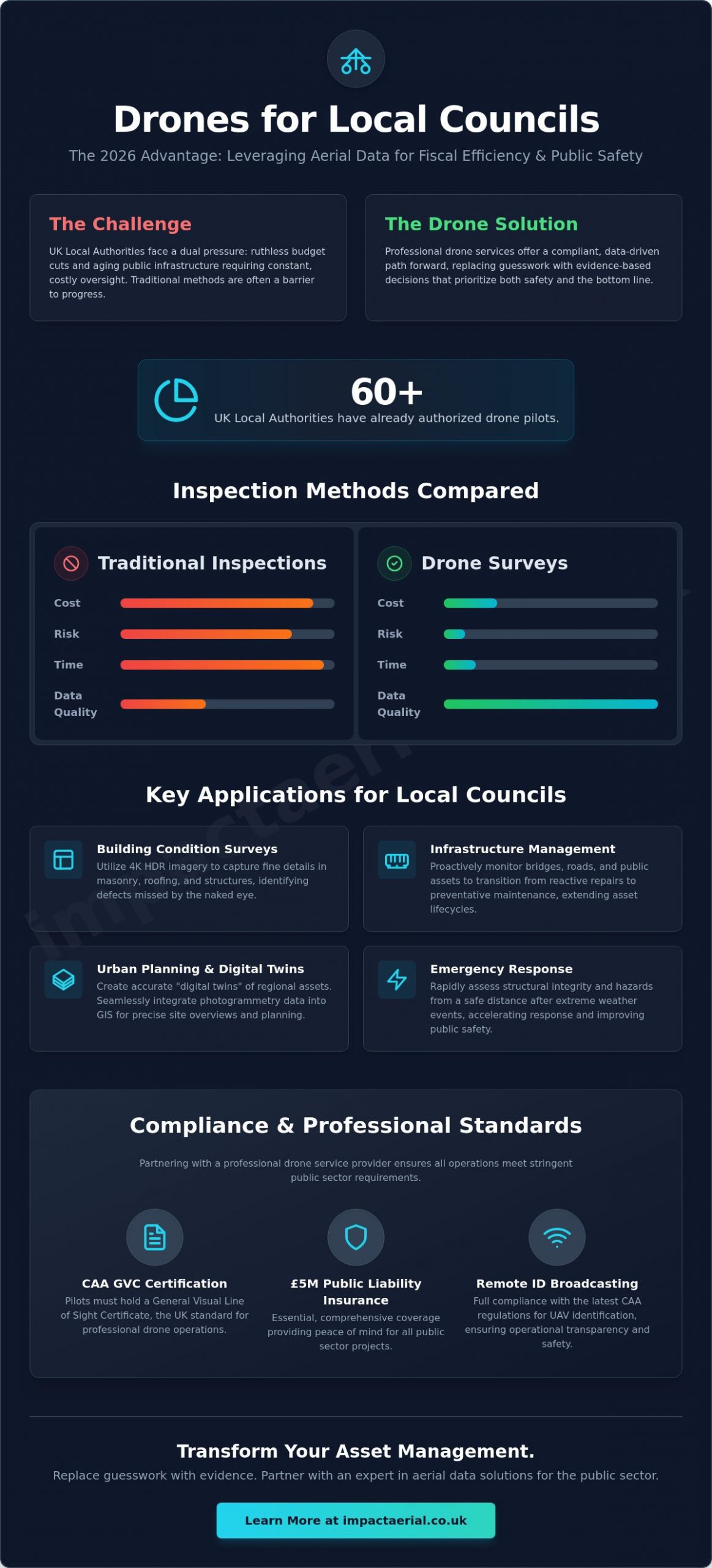
Did you know that over 60 UK local authorities have already authorized drone pilots to manage their regional assets? This shift marks the end of drones being viewed as a novelty. By 2026, they’ve become indispensable fiscal tools for managing the public realm. You’re likely feeling the pressure of ruthless budget cuts while managing aging infrastructure that requires constant oversight. The high cost and physical risk of traditional scaffolding or manual inspections often feel like a barrier to progress. Utilizing professional drone services for local councils offers a compliant, data-driven path forward that prioritizes both safety and the bottom line.

We’ve designed this guide to show you exactly how UK authorities are reducing maintenance lead times and improving public safety through expert aerial surveys. You’ll learn how to navigate the latest CAA hurdles, including mandatory Remote ID broadcasting, while securing the defensible evidence needed for audits. From thermal surveys of solar farms to detailed property inspections, we’ll preview the technical standards and operational workflows that turn complex aerial data into actionable asset management strategies. It’s time to replace guesswork with evidence-based decision making.

Key Takeaways

  • Understand how to leverage professional UAV operations to manage regional assets more efficiently within the challenging 2026 fiscal landscape.
  • Explore the diverse applications of drone services for local councils, from conducting 4K HDR building condition surveys to enhancing urban planning accuracy.
  • Evaluate the safety and speed advantages of aerial data collection over traditional scaffolding and manual inspection methods.
  • Identify the essential compliance standards for public sector partnerships, including the requirement for CAA GVC certification and comprehensive £5m liability insurance.

Why UK Local Authorities are Integrating Drone Technology in 2026

Professional drone services for local councils represent the deployment of a sophisticated Unmanned aerial vehicle (UAV) for the meticulous management of public assets. By 2026, the fiscal landscape for UK local authorities has become increasingly constrained. Councils are tasked with maintaining extensive infrastructure while facing significant budget shortfalls. This environment has accelerated the adoption of drone technology. It’s no longer an experimental hobbyist tool; it’s a critical component of professional service delivery.

Local authorities must meet strict statutory liabilities regarding community safety and structural integrity. Professional drone operations provide a high-tier, compliant method for meeting these obligations without the prohibitive costs of traditional methods. It allows departments to transition from reactive repairs to proactive asset management, ensuring that public funds are used with maximum efficiency.

To better understand the legal context of council interactions with drone technology, watch this helpful video:

The Economic Case for Council Drones

Aerial surveys provide a precise alternative to traditional inspection methods. Setting up scaffolding or implementing road closures for a simple roof or bridge inspection is often a logistical and financial burden. Using drone data streamlines these processes, allowing for rapid deployment and data-centric decision making. This efficiency extends the lifecycle of public buildings by identifying minor defects before they become catastrophic failures. Additionally, the high-resolution evidence captured during drone services for local councils often strengthens government funding and grant applications by providing undeniable, visual proof of asset condition and the necessity of investment.

Improving Community Safety and Response

Public safety is a primary concern for any district or borough council. When extreme weather events occur, traditional inspection teams are often delayed by safety risks or accessibility issues. Professional drone pilots can provide a rapid assessment of civic structures from a safe distance, identifying hazards immediately. This proactive monitoring is essential for preventing emergency infrastructure failures. High-resolution aerial perspectives allow for the detection of subtle changes in masonry or drainage that manual inspections might miss. It’s about providing psychological comfort to the community through reliable, technology-driven oversight and meticulous data collection.

Key Applications: From Asset Management to Urban Planning

The versatility of drone services for local councils allows departments to move beyond simple photography into high-precision data acquisition. A recent report on drone use by Local Government in England highlights how these tools are transitioning from novelty to necessity. Central to this utility is the deployment of 4K HDR imagery. This high dynamic range is vital for building condition surveys, as it captures detail in both deep shadows and bright highlights, ensuring that cracks in masonry or defects in dark roofing materials aren’t missed during the analysis phase.

Council officers don’t just need pictures; they need actionable data. Modern aerial platforms allow for the seamless integration of captured imagery and photogrammetry into existing Geographic Information Systems (GIS) and asset management software. This creates a “digital twin” of regional assets, allowing for precise temporal monitoring of deterioration. In regions like the West Midlands, this technology is actively supporting large-scale urban regeneration projects by providing accurate site overviews that traditional ground-level photography cannot match.

Infrastructure and Building Inspections

Maintaining the structural health of schools, libraries, and leisure centres is a constant challenge. Utilizing advanced drone survey techniques allows for rapid assessments of roofs and façades without the need for expensive access equipment. This is particularly beneficial for:

  • Multi-storey car parks: Identifying concrete spalling and drainage issues in high-risk environments.
  • Historic bridges: Monitoring structural integrity over water or active rail lines without service interruptions.
  • Heritage sites: Providing a meticulous non-contact record of listed buildings without risking fragile masonry.

If your department is looking to enhance its oversight of civic assets, you can explore our professional drone survey services to see how we provide these detailed perspectives.

Environmental and Planning Support

Planning departments use drones to monitor flood plains and track coastal erosion with centimetre-level precision. This mapping data is essential for developing robust environmental protection strategies and supporting planning applications. Additionally, drones are effective tools for tracking fly-tipping and illegal land use in sprawling rural council areas, providing the defensible evidence required for enforcement. For new housing developments, aerial site data offers a comprehensive view of progress, ensuring that regeneration projects remain on schedule and within their regulatory bounds. This level of oversight ensures that every development phase is documented with technical precision and total compliance.

Professional Drone Services for Local Councils: A 2026 Guide to Efficiency and Compliance

Comparing Drone Surveys to Traditional Inspection Methods

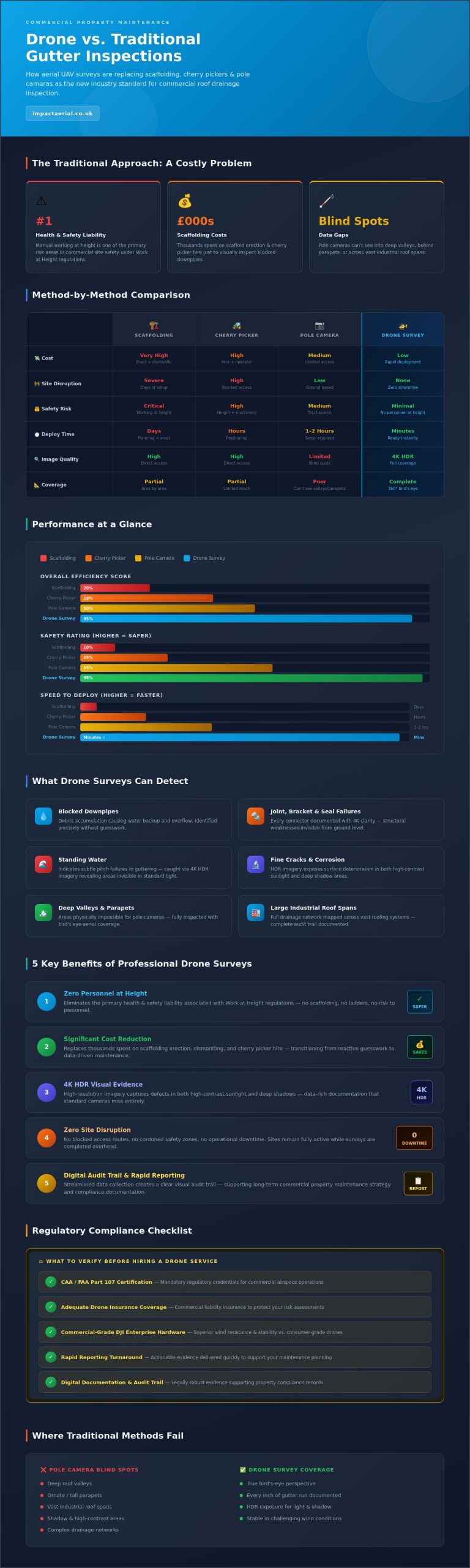
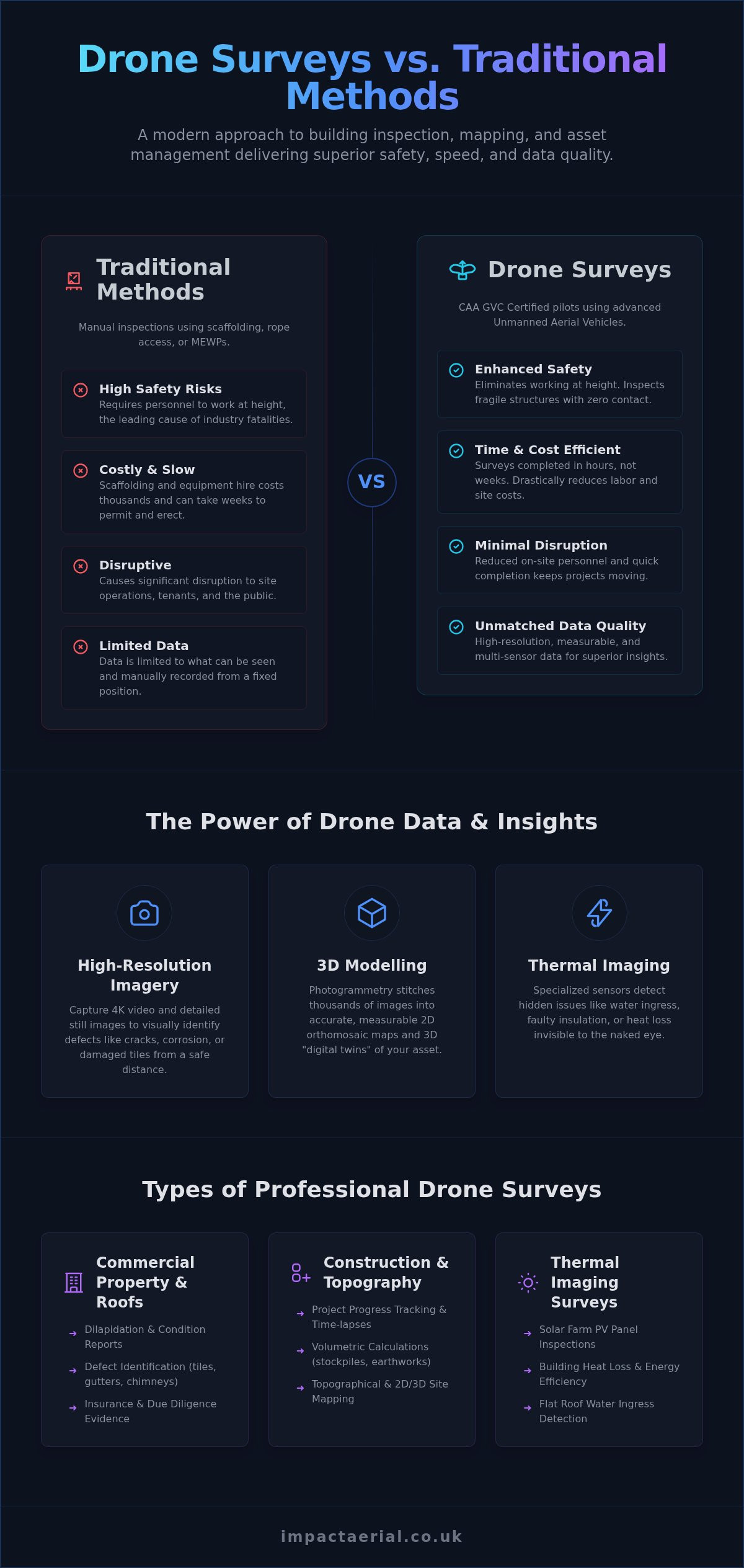
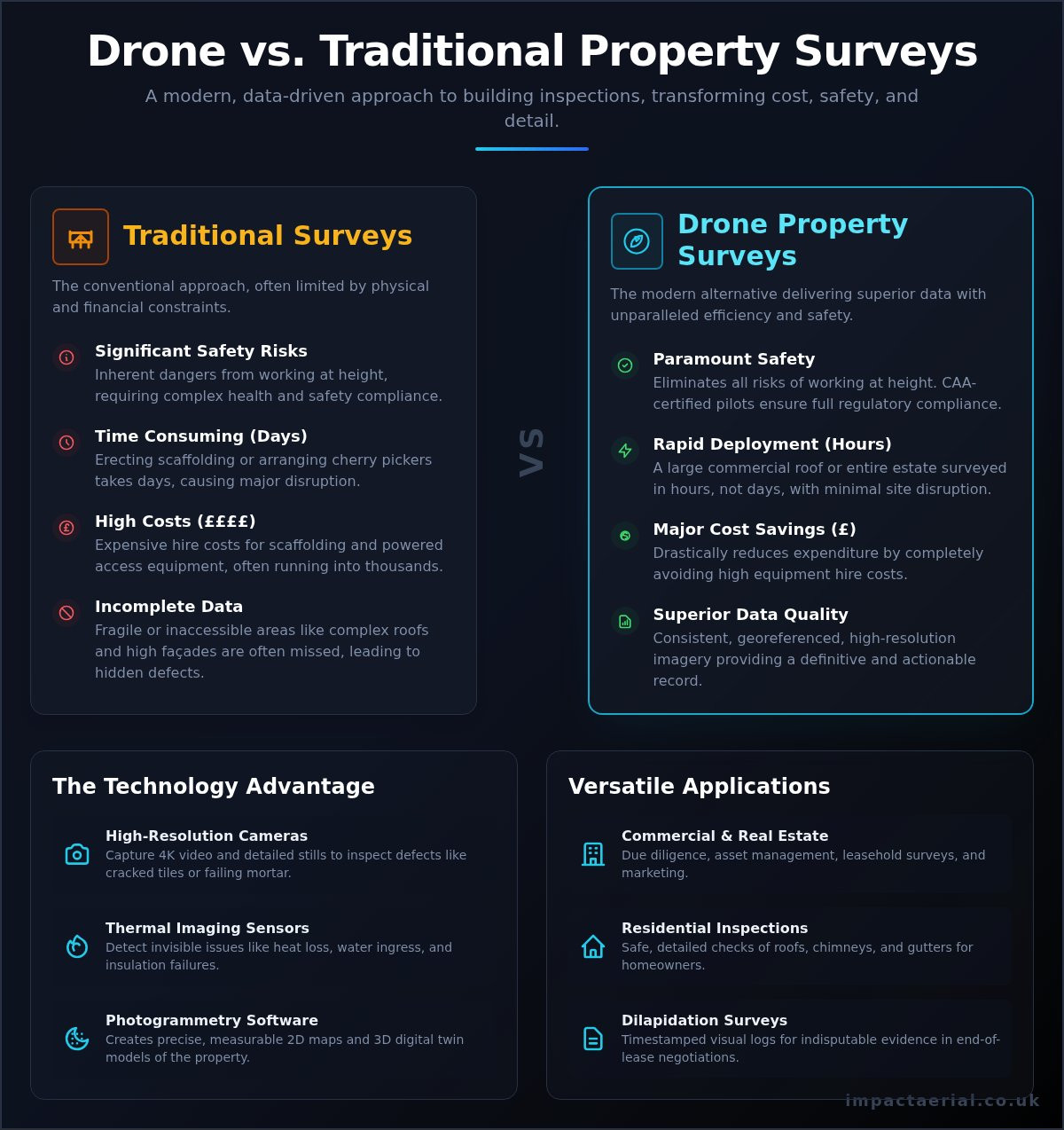
Traditional methods of inspecting council infrastructure are inherently resource-heavy and fraught with logistical challenges. For decades, local authorities have relied on scaffolding, cherry pickers, and rope access teams to assess the condition of civic buildings and bridges. Integrating drone services for local councils provides a safer, more sustainable alternative that addresses these historic pain points. By removing personnel from “Work at Height” environments, councils significantly reduce their liability and the potential for workplace accidents. This transition doesn’t just protect staff; it also aligns with modern sustainability goals. While traditional access platforms often require petrol-powered heavy machinery and transport vehicles, electric UAVs operate with a negligible carbon footprint and minimal noise pollution.

The speed of data acquisition is another critical differentiator. A manual inspection of a large leisure centre or housing estate can take weeks of planning and execution. In contrast, a professional drone flight can capture the same area in hours. This rapid time-to-data ensures that maintenance teams receive high-density information, such as 4K video and 3D virtual tours, almost immediately. This superior data density allows for a more nuanced understanding of asset health than a manual inspector with a clipboard could ever provide.

Cost and Time Efficiency Analysis

The return on investment when deploying a professional survey drone is evident in the reduction of project overheads. For large-scale council estates, the cost of erecting scaffolding alone can exceed the entire budget of an aerial survey. By avoiding these physical installations, councils can reduce topographic survey timelines from weeks to just a few days. Furthermore, aerial inspections minimise public disruption. There’s no need for extensive road closures or the deployment of heavy plant machinery that blocks pavements and disturbs residents. It’s a methodical approach that prioritises both the council’s budget and the community’s daily life.

Data Accuracy and Audit Trails

Meticulous record-keeping is a cornerstone of public sector accountability. Every image captured during an aerial mission is geo-tagged, providing precise location referencing that is vital for internal audits and statutory reporting. This allows councils to create a “digital twin” of their assets, enabling a direct year-on-year comparison to track structural deterioration with mathematical precision. When disputes arise, professional drone photography provides indisputable evidence for insurance claims or contractor assessments. This level of transparency ensures that every decision made by the council is supported by high-tier, defensible data, providing psychological comfort to stakeholders and ensuring total regulatory compliance.

Compliance within the public sector is non-negotiable. As of January 1, 2026, the regulatory landscape has tightened significantly with the mandatory implementation of Remote ID broadcasting for the majority of professional-grade aircraft. When procuring drone services for local councils, the first point of verification must be the pilot’s certification. Councils should only engage pilots who hold a CAA General Visual Line of Sight Certificate (GVC). This qualification demonstrates a level of competence and safety awareness that far exceeds consumer-grade operations, ensuring that missions in complex environments are conducted with technical precision.

Risk mitigation is the cornerstone of every successful aerial operation. Public sector contracts typically mandate a minimum of £5 million in commercial liability insurance. This provides a necessary layer of financial security for the council, covering operations in high-traffic public areas. Impact Aerial, based in Birmingham, specialises in managing these complex flight permissions within congested urban environments. This involves meticulous coordination with local stakeholders and strict adherence to safety protocols that protect both the public and the council’s reputation. This ensures that drone services for local councils are delivered with the highest level of accountability.

If your authority requires a fully compliant aerial partner for upcoming urban projects, you can contact our Birmingham-based specialist team for a detailed consultation.

Understanding 2026 UK Drone Laws

The 2026 regulatory framework introduces strict requirements for UK class marks (UK0 to UK6) on all new hardware. Verifying a professional drone license is the only way to ensure your provider understands these technical nuances. There’s a vast difference between consumer hardware and DJI Enterprise commercial standards, which offer enhanced redundancy and data security. Every council project requires a site-specific risk assessment and a comprehensive flight plan. This meticulous planning is what separates a compliant professional service from a high-risk liability.

Privacy and Public Relations

Managing public perception is just as important as managing the flight itself. Local authorities must adhere to strict GDPR and data protection standards when surveying residential areas. Best practices include notifying residents well in advance of any aerial filming or surveying activities. All sensitive council data should be handled via encrypted storage and secure transfer protocols to prevent unauthorised access. Maintaining this level of transparency is essential for building community trust. When residents understand that the technology is being used for their safety and the improvement of local infrastructure, the transition to drone-led management becomes much smoother.

Partnering with Impact Aerial: Expert Drone Solutions for the Public Sector

Impact Aerial operates as a specialized technical consultant for the public sector, offering much more than a simple “pilot for hire” service. Based in Birmingham but providing comprehensive national UK coverage, we provide a structured, professional approach to drone services for local councils. Our operations utilize high-tier DJI Enterprise technology equipped with 4K HDR cameras. This hardware ensures that every frame of data meets the qualitative and technical standards required for official audits, structural assessments, and public records. We manage the entire lifecycle of an aerial project, from the initial regulatory consultation through to meticulous post-production services, ensuring a seamless flow of information from the site to the council office.

Our role as a technical partner means we don’t simply capture imagery; we provide the defensible evidence required for high-stakes decision making. By leveraging enterprise-grade hardware, we offer superior data security and operational redundancy, which is critical when working near sensitive public infrastructure. This meticulousness extends to our post-production workflow, where raw aerial data is transformed into structured reports or immersive virtual tours. These outputs allow council officers and stakeholders to visualize complex asset conditions without ever having to leave their desks, providing psychological comfort and tangible efficiency gains.

Why West Midlands Councils Choose Impact Aerial

Authorities across the West Midlands often require a partner who understands regional topography and the specific challenges of dense urban environments. Our team combines this deep local knowledge with strict CAA-certified professional standards, ensuring every flight is compliant and safe. We have a proven track record in complex aerial filming drone projects where safety-conscious execution is the priority. Whether it’s monitoring a multi-million pound regeneration site or conducting a sensitive heritage survey, our reliability ensures that council requirements are not just met, but exceeded. We invite council officers to discuss bespoke requirements for asset management or urban planning to see how our data-centric approach can support their specific goals.

Next Steps for Procurement and Asset Managers

For procurement officers and asset managers, the path to integrating professional drone services for local councils is clear and methodical. We offer technical consultations to determine the feasibility of specific sites and provide detailed, site-specific risk assessments before any flight takes place. Our pricing models are designed for flexibility, catering to both one-off emergency surveys and long-term asset management contracts. This allows councils to scale their drone usage according to their current fiscal needs and maintenance backlogs. To begin the process, you can contact the Impact Aerial team to request a professional quote and a comprehensive project plan tailored to your authority’s unique infrastructure challenges.

Future-Proofing Council Asset Management for 2026 and Beyond

Professional drone services for local councils have transitioned from an emerging technology to a fundamental requirement for efficient infrastructure oversight. By replacing costly manual inspections with high-precision aerial surveys, authorities can drastically reduce maintenance lead times and secure the defensible data needed for statutory audits. This methodical approach ensures that limited budgets are allocated where they’re most needed, based on indisputable visual evidence captured through technical precision.

Selecting a partner that values meticulous compliance is essential for public safety and risk mitigation. Impact Aerial provides this reassurance through the deployment of CAA GVC Certified Pilots and the use of high-tier DJI Enterprise 4K HDR technology. With £5m commercial liability insurance as standard, we offer the technical reliability required for complex regional projects across the UK. It’s time to move beyond traditional inspection hurdles and embrace a more agile, data-centric strategy for your district or borough.

Ready to enhance your department’s operational efficiency? Request a professional drone service quote for your council project to begin your transition to safer, more compliant asset management. Investing in expert aerial data today ensures a more resilient and well-maintained community for tomorrow.

Frequently Asked Questions

Can local councils use drones for roof inspections on schools?

Yes, local authorities frequently deploy drones for school roof inspections to avoid the high costs and safety risks of scaffolding. This method allows for a rapid assessment of tiles, gutters, and chimney stacks while the school remains operational. It’s a non-intrusive way to identify maintenance needs before they escalate into emergency repairs. By using 4K HDR cameras, maintenance teams can zoom in on specific defects with absolute clarity.

What insurance coverage is required for council drone operations?

Public sector contracts typically require a minimum of £5 million in commercial liability insurance. This coverage must specifically cater to professional UAV operations and comply with CAA standards. It provides the council with financial protection against third-party property damage or injury during complex aerial surveys in public spaces. This high level of insurance is a standard requirement for ensuring the council’s financial security and regulatory compliance.

Do drone pilots need specific certifications to work for local authorities?

Professional pilots must hold a CAA General Visual Line of Sight Certificate (GVC) to conduct drone services for local councils. This certification ensures the pilot has undergone rigorous training in flight safety, risk assessment, and regulatory compliance. It’s the industry benchmark for commercial competence in the UK, especially for missions in congested areas. Councils should always verify this qualification before awarding any survey contracts.

How do drones help councils manage fly-tipping and environmental issues?

Drones provide high-resolution aerial evidence that helps councils identify illegal dumping sites in remote or inaccessible areas. By capturing geo-tagged imagery, environmental officers can document the scale of fly-tipping for potential legal prosecutions. This proactive monitoring acts as a powerful deterrent and streamlines regional cleanup operations. It’s a data-centric approach that allows councils to manage vast rural areas more efficiently without the need for constant ground patrols.

Are drone surveys more cost-effective than traditional scaffolding?

Drone surveys are considerably more cost-effective than traditional scaffolding because they eliminate the need for heavy equipment and lengthy setup times. A project that might take days to scaffold can be completed by a drone in just a few hours. This efficiency directly reduces labor costs and minimizes disruption to local traffic or pedestrians. It’s a streamlined workflow that delivers high-tier data at a fraction of the traditional price.

How does a council ensure public privacy during a drone survey?

Councils ensure privacy by adhering to strict GDPR protocols and anonymizing sensitive data, such as faces or license plates, during post-production editing. Residents are typically notified through official channels before any aerial filming takes place in residential areas. We use encrypted storage systems to maintain the integrity and security of all captured information, ensuring that community trust remains high throughout the survey process.

What data formats do councils receive from professional drone surveys?

Professional drone services for local councils deliver a variety of high-tier formats, including 4K HDR video and high-resolution geo-tagged JPEGs for visual inspections. For engineering and planning departments, we also provide 3D point clouds and digital surface models compatible with standard GIS and asset management software. This allows for the creation of digital twins, facilitating precise year-on-year comparisons of critical council assets and infrastructure.

Can drones operate in high-density urban areas like Birmingham city centre?

Drones can operate in high-density areas like Birmingham city centre, provided the pilot has the necessary CAA permissions and a site-specific risk assessment. These missions require meticulous planning to manage public safety and navigate complex airspace restrictions in congested urban environments. Using professional DJI Enterprise hardware ensures the necessary redundancy and signal stability for safe operations in areas with significant architectural and electronic interference.

What Does a Drone Survey Report Include? A 2026 Professional Guide

If you received 500 high-resolution aerial photos but couldn’t use a single one to prove a structural defect to your insurer, was it really a survey? Many property managers and construction leads have felt the frustration of being handed a folder of raw images without the technical context needed to make a commercial decision. It’s common to feel uncertain about whether your data meets professional standards or if it’s just a collection of nice pictures. Understanding what does a drone survey report include is the first step toward moving from simple photography to actionable geospatial data.

You deserve a report that provides clarity rather than adding to the technical jargon. We’ve designed this 2026 guide to reveal the specific maps, data sets, and insights that transform aerial footage into a professional survey. We’ll explore the essential components of a CAA-compliant report, including orthomosaic maps, digital elevation models, and the rigorous technical documentation required for insurance validity. By the end, you’ll have the confidence to commission a survey that delivers tangible results and precise data for your next commercial property or construction project.

Key Takeaways

  • Understand why a professional deliverable is a structured geospatial asset rather than a collection of photos, and learn exactly what does a drone survey report include to meet 2026 industry standards.
  • Gain insight into the technical applications of 3D Point Clouds and Digital Twins for conducting precise structural measurements and long-term asset management.
  • Learn to use standardised defect scoring to categorise maintenance issues by urgency, streamlining your decision-making process and resource allocation.
  • Discover the critical role of CAA regulatory compliance in ensuring your aerial data serves as legally valid proof of condition for insurance purposes.
  • Explore how bespoke reporting tailored to specific sectors, such as PV solar farms and construction sites, provides the precise data required for sector-specific compliance.

Understanding the Modern Drone Survey Report in 2026

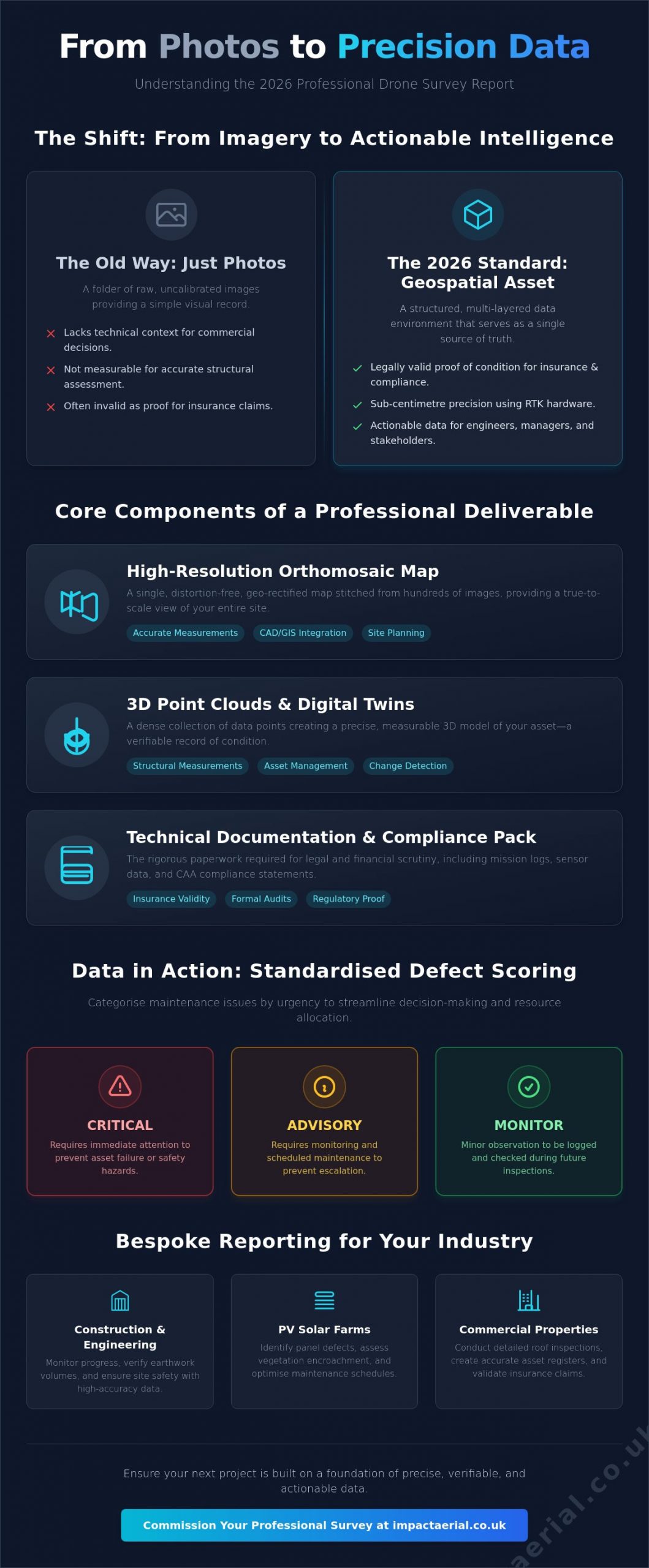
A professional drone survey report is far more than a digital gallery of high-altitude pictures. In 2026, it represents a comprehensive geospatial asset that serves as a single source of truth for property managers and engineers alike. If you are questioning what does a drone survey report include, the answer lies in the transition from simple aerial photography to high-accuracy photogrammetry. This process converts hundreds of individual images into a unified, measurable data set that can be used for legal, financial, and structural assessments.

Technological advancements in 2026 have pushed accuracy levels to sub-centimetre precision. By utilizing RTK (Real-Time Kinematic) hardware and unified processing software like PIX4Dmatic, surveyors now deliver outputs that align perfectly with national grid coordinates. This level of detail ensures that every pixel carries geographical weight, making the report a valid document for insurance claims and regulatory compliance.

To see how these measurements translate into professional reporting, watch this demonstration:

From Visual Imagery to Geospatial Data

Modern drones capture images with high overlap, allowing sophisticated algorithms to reconstruct the environment in three dimensions. This is the core of Aerial Survey Methods. There is a fundamental difference between looking at a roof and actually measuring a structure. A visual inspection might show a crack, but a geospatial report identifies its exact length, width, and depth within a global coordinate system. Every data point is timestamped. This creates a rigorous audit trail that is indispensable for construction site monitoring or solar farm maintenance. It ensures that the information you receive isn’t just a snapshot, but a verifiable record of condition.

Why a Standard PDF Isn’t Enough

A standard PDF summary is useful for a quick executive overview, but it shouldn’t be the only deliverable. High-tier reports include interactive digital layers that allow technical engineers to manipulate the data. While a manager might only need to see the risk categorisation of a defect, an engineer requires the raw, high-resolution point clouds to plan repairs. Professional reporting caters to both audiences by providing a clear summary backed by terabytes of verifiable data. This ensures that the insights you receive are actionable and can withstand the scrutiny of a formal audit or an insurance loss adjuster. When you understand what does a drone survey report include at this level, you can better appreciate the value of data-centric workflows over simple photography.

The Core Components of a Professional Survey Deliverable

A professional deliverable is a multi-layered data environment. While basic services might offer a few high-definition photos, a commercial-grade output integrates several distinct data formats. When considering what does a drone survey report include, you should look for a combination of visual, spatial, and thermal data that provides a holistic view of the asset. This structured approach mirrors the standards seen in the EPA drone usage and compliance report, where rigorous sensor documentation and mission logging are paramount for official record-keeping.

High-Resolution Orthomosaic Mapping

An orthomosaic is a distortion-free, geo-rectified map created by stitching together hundreds of individual aerial images. Unlike a standard photograph, every point on an orthomosaic is a true representation of the ground surface. This allows for accurate site-wide measurements. These maps are essential for planning and can be imported directly into CAD or GIS software. This seamless integration ensures that your survey data flows directly into your existing project management workflows without manual translation.

3D Point Clouds and Digital Twin Models

For construction and large-scale property management, 3D point clouds are invaluable. These models consist of millions of individual data points, each with its own X, Y, and Z coordinate. This allows engineers to perform volumetric calculations for stockpiles or conduct elevation checks across a site without setting foot on the ground. Digital twins provide a virtual site visit capability, letting stakeholders inspect a structure from any location. If you require this level of precision for your project, you might consider our drone commercial property surveys to get started.

Thermal Imaging and Anomaly Detection

Thermal layers add an invisible dimension to the report. By capturing radiometric data, we can identify heat loss, moisture ingress under flat roofs, or failing cells in PV solar farms. These anomalies are presented as detailed defect logs, featuring high-resolution crops and precise GPS coordinates. This ensures that maintenance teams can locate and repair issues with surgical accuracy. They won’t need to search across a vast site. A professional report ensures these thermal insights are overlaid on visual maps to provide the necessary context for immediate action. By combining these layers, the report becomes a tool for proactive asset management rather than just a historical record.

What Does a Drone Survey Report Include? A 2026 Professional Guide

Defect Analysis and Risk Categorisation Frameworks

Raw data provides the foundation, but professional interpretation provides the value. A report that merely lists observations without assessing their impact is incomplete. When facility managers ask what does a drone survey report include, the most critical component for their workflow is a standardised risk categorisation framework. This analytical layer ensures that every stakeholder, from the site foreman to the financial director, understands the urgency of every identified issue. Without this hierarchy, a survey is simply a collection of observations rather than a strategic maintenance tool.

A meticulous approach to defect analysis removes subjectivity from the process. Instead of vague descriptions, professional reports use precise technical language to describe structural anomalies. This level of detail is essential for maintaining a rigorous audit trail and ensuring that repair budgets are allocated where they are most needed. By categorising findings, we provide a clear roadmap for asset management that balances immediate safety concerns with long-term preventative care.

The Traffic Light System for Building Maintenance

We utilise a clear, three-tier traffic light system to communicate risk levels instantly. This methodology allows for rapid decision-making without requiring the reader to parse through technical data for every minor finding. The categories are defined as follows:

  • Red (Critical): These findings require immediate action. They represent active leaks, significant structural compromises, or immediate safety hazards that could lead to further damage or legal liability.
  • Amber (Monitor): These defects show signs of deterioration that don’t yet pose a critical risk. They are scheduled for upcoming maintenance cycles or monitored closely to prevent them from escalating into Red-tier issues.
  • Green (Maintenance): These areas are in good condition. They are documented to provide a baseline for future surveys, ensuring that routine maintenance can be tracked over time.

Geotagged Annotations and High-Resolution Crops

Precision is the hallmark of a professional survey. Every defect identified in the report is linked to its exact GPS coordinate through geotagged annotations. This eliminates the guesswork often associated with traditional roof inspections. When a contractor receives the report, they know the exact tile, bolt, or solar cell that requires attention. This spatial accuracy is supported by high-resolution “crops.” These are zoomed-in views of specific defects that provide granular detail, such as the hairline width of a crack or the specific type of corrosion on a bracket, without losing the broader context of the surrounding structure. This combination of “where” and “what” ensures that maintenance teams arrive on-site fully prepared for the specific task at hand.

Leveraging Your Report for Insurance and Compliance

A professional survey report isn’t just a technical document; it’s a legal safeguard. When evaluating what does a drone survey report include, the inclusion of regulatory documentation is often the difference between a valid claim and a rejected one. Insurers and regulatory bodies require more than just visual evidence. They demand proof that the data was collected safely, legally, and to a specific professional standard. By providing a comprehensive data package, you ensure that your asset management is backed by an unshakeable audit trail.

A drone survey report provides the objective evidence required to satisfy Health and Safety Executive (HSE) requirements by removing the need for high-altitude manual inspections. This reduces your operational risk profile. Integrating these reports into Planned Preventative Maintenance (PPM) schedules ensures that your asset management is data-driven rather than reactive. If you need to secure your asset’s future with a data-rich audit trail, you can book a compliant drone commercial property survey today.

CAA GVC Compliance and Operational Safety

The validity of your survey data starts before the drone even leaves the ground. Only CAA GVC certified pilots possess the legal authority to provide commercial data that holds weight in a professional or legal setting. A professional report package must include detailed flight logs, site-specific risk assessments, and proof of valid commercial insurance. These documents demonstrate that the mission adhered to current UK aviation and data privacy laws. In 2026, this includes verification of UK class marks and Remote ID compliance, ensuring the operation was conducted within the strictest safety parameters. Without this administrative backing, your survey data may be legally inadmissible for insurance or planning purposes.

Winning the Insurance Argument with Data

Insurance claims often hinge on the ability to distinguish between sudden storm damage and gradual wear-and-tear. A professional report provides timestamped, high-resolution “proof of condition” that serves as an objective baseline. This level of detail supports the RICS standards for building surveys, giving loss adjusters the precise data they need to process claims quickly. Regular, documented inspections can even help in negotiating lower insurance premiums. You aren’t just presenting a few photos; you’re presenting a multi-year history of the asset’s health. This proactive approach shows insurers that the property is being managed with professional meticulousness, significantly reducing the likelihood of disputed claims or unforeseen liabilities.

Commissioning Your Report with Impact Aerial

Choosing a partner for aerial data collection requires a focus on technical precision and operational safety. Understanding what does a drone survey report include is vital, but ensuring that data is captured using commercial-grade hardware is what guarantees a professional result. At Impact Aerial, we bridge the gap between raw aerial footage and high-tier geospatial assets. Our operations are backed by £5m in commercial liability insurance, providing the psychological comfort and financial security that large-scale property and construction projects demand. We don’t just provide images; we deliver a vetted, compliant, and meticulous data package designed for professional scrutiny.

Our workflow is structured and methodical. It begins with rigorous pre-flight planning and site-specific risk assessments, ensuring every mission adheres to the latest CAA regulations. Whether we are conducting PV solar farm thermal surveys or construction site monitoring, the focus remains on data integrity and safety. This meticulousness extends through the entire flight operation to the final delivery of your report, ensuring you receive a document that is both legally valid and technically superior.

Our Commercial-Grade DJI Enterprise Workflow

We utilise the latest DJI Enterprise technology, including the Matrice 350 RTK and Mavic 3 Enterprise, to ensure maximum data clarity. These platforms allow us to capture 4K HDR visual imagery alongside high-resolution radiometric thermal data. Our post-production team then refines this raw information into actionable insights. We don’t simply hand over a folder of files. We process the data into various formats to suit your specific needs, including cloud-based interactive portals, CAD-ready files for engineering teams, and concise PDF executive summaries for stakeholders. This multi-format approach ensures that the survey data is accessible to everyone from the site office to the boardroom.

Tailored Deliverables for UK Professionals

Every sector has unique requirements. We customise our reporting frameworks to meet the specific needs of West Midlands property managers while maintaining the capacity to handle nationwide projects. For a comprehensive look at the collection process, you can explore our drone survey guide. We provide bespoke reporting for property, construction, and solar sectors, ensuring that the final deliverable aligns with your internal compliance standards. If you are ready to move beyond simple photography and require a report that provides genuine commercial value, contact us to request a sample report or to discuss your upcoming project requirements. Our team is ready to provide the technical consultancy needed to transform your asset management strategy.

Securing Your Asset’s Future with Professional Aerial Intelligence

A professional survey deliverable is a high-accuracy geospatial asset that provides the technical foundation for long-term property management. By moving beyond simple imagery, you gain access to 3D point clouds, digital twins, and centimetre-accurate orthomosaic maps. These components ensure your decision-making is based on verifiable data rather than visual estimation. Understanding what does a drone survey report include allows you to demand higher standards, ensuring every defect is geotagged and every risk is categorised for immediate action.

Choosing a partner with CAA GVC Certified Pilots and £5m commercial liability insurance ensures your data meets the strictest regulatory and insurance requirements. We utilize DJI Enterprise grade hardware to deliver the precision your commercial property or construction project deserves. You don’t have to settle for vague photos when you can have a structured, data-rich audit trail. Request a sample drone survey report and a custom quote from Impact Aerial to see the difference professional data makes. We look forward to helping you streamline your maintenance workflows with meticulous aerial intelligence.

Frequently Asked Questions

Is a drone survey report legally valid for building insurance claims?

Yes, a drone survey report is considered legally valid evidence for insurance claims when produced by a CAA-certified pilot. It provides an objective, timestamped record of a property’s condition, which is essential for distinguishing between sudden storm damage and long-term wear. Insurers value this high-resolution data because it removes the subjectivity often found in manual inspections, ensuring that claims are processed based on verifiable structural facts.

What file formats are usually included in a drone survey deliverable?

Professional deliverables typically include a combination of accessible PDF summaries and technical data files for engineering use. You will usually receive high-resolution JPEG crops of specific defects, GeoTIFF files for orthomosaic maps, and .OBJ or .LAS files for 3D point clouds. These formats ensure that the data is ready for immediate review in a web browser or for direct integration into professional CAD and GIS software suites.

How long does it take to receive the final report after the flight?

Most professional reports are delivered within three to five working days following the completion of the flight operation. This duration is necessary for the meticulous processing of raw photogrammetry data and the subsequent analysis by technical experts. While visual previews can sometimes be provided sooner, the full analytical report requires this time to ensure sub-centimetre accuracy and the correct categorisation of all identified structural risks.

Can a drone survey report replace a traditional RICS building survey?

A drone survey report acts as a powerful data-gathering supplement rather than a total replacement for a traditional RICS survey. It provides superior external detail and access to hazardous areas that a ground-based surveyor cannot reach safely. Most property professionals use our aerial data to inform their RICS reports, combining our high-resolution external evidence with their own internal structural assessments for a complete building overview.

Do I need a special software to view the 3D models or orthomosaic maps?

You don’t need specialised software to view the primary results, as we typically deliver data through secure, cloud-based interactive portals. These platforms allow you to rotate 3D models and zoom into high-detail maps using a standard web browser. However, if your technical team needs to perform advanced volumetric calculations or CAD design, they will require industry-standard software like AutoCAD, Revit, or ArcGIS to process the raw data files.

What is the difference between a roof inspection and a full drone survey report?

A roof inspection is generally a visual-only exercise, while a full survey provides a measurable, multi-layered geospatial record. When considering what does a drone survey report include, the distinction lies in the data-centric outputs like 3D models and digital twins. A full report allows you to take precise measurements and track structural changes over time, offering a much deeper level of intelligence than a standard set of inspection photos.

Are drone survey reports compliant with UK CAA regulations?

Reports are only compliant when the mission is conducted by a pilot holding the correct CAA certifications, such as the GVC. A professional report includes the necessary flight logs, risk assessments, and insurance details to prove the operation met all UK aviation and data privacy laws. In 2026, this also includes verification that the hardware used meets the latest Remote ID and UK-specific class mark requirements for commercial operations.

Drone Photography for Construction Disputes: A Guide to Forensic Evidence

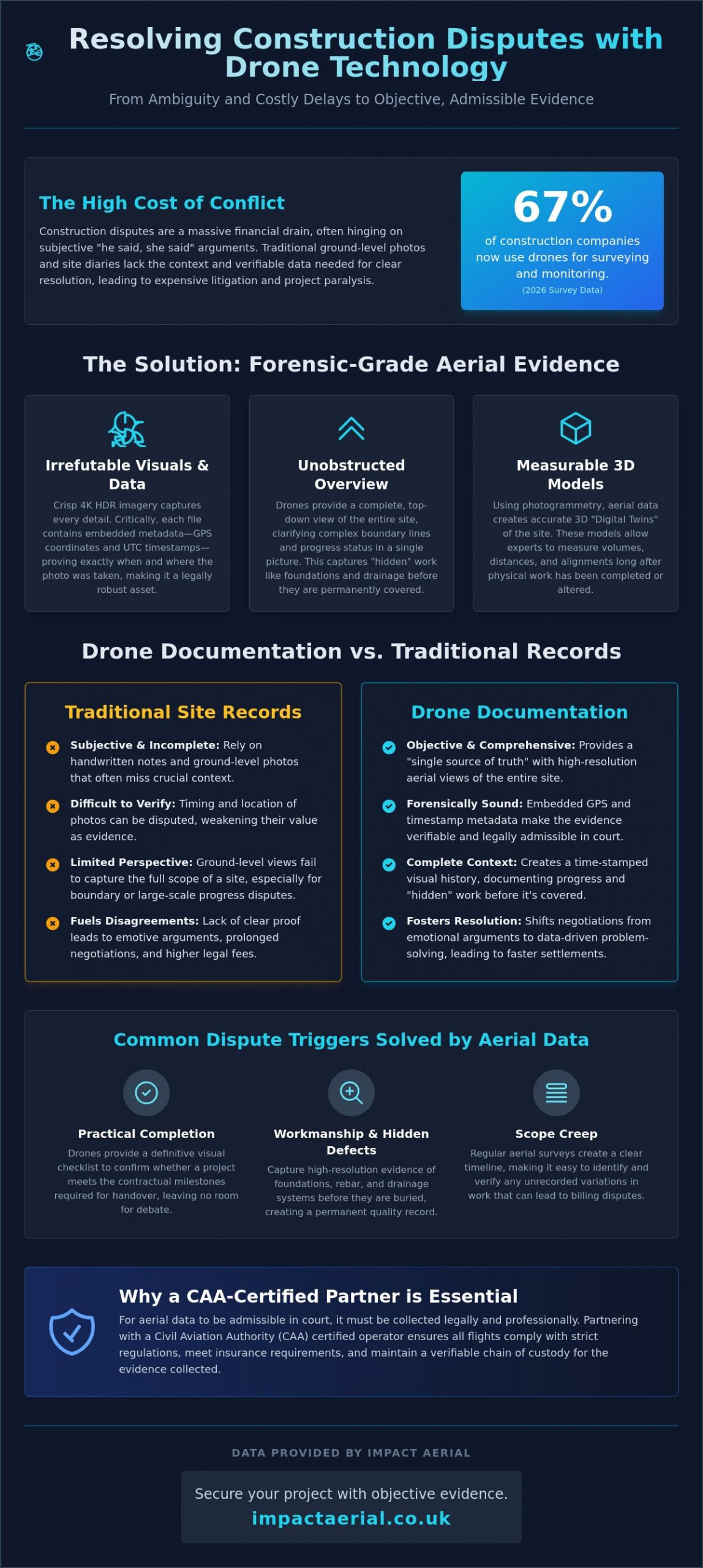
A 2026 survey revealed that 67% of construction companies now use drones for site surveying and progress monitoring, signaling a major shift toward data-driven project management. When a project grinds to a halt due to a disagreement over work quality or a boundary line, the resulting litigation costs often dwarf the original dispute. Utilizing professional drone photography for construction disputes provides a definitive, high-fidelity visual record that removes ambiguity from the conversation.

Our meticulous approach extends to our geographic reach. Based in the West Midlands, we leverage our central location to provide comprehensive nationwide coverage across the UK. This allows us to maintain a consistent standard of forensic data collection for clients with multiple sites, ensuring that the methodology used to resolve a dispute in Birmingham is identical to one in London or Manchester. For developers managing properties in the United States, professional teams like Palm Beach Drone Pros provide similarly high standards of aerial data collection throughout South Florida.

It’s incredibly difficult to prove the status of a site once concrete has been poured or scaffolding is removed, and we understand how stressful these emotive arguments can become for all parties involved. This guide demonstrates how to secure objective proof of work to resolve conflicts efficiently through mediation. You’ll learn how high-accuracy aerial data aligns with Land Registry records and why professional forensic imagery is now the gold standard for protecting your business from costly legal delays.

Key Takeaways

  • Understand how professional drone photography for construction disputes provides forensic-grade evidence that is superior to traditional, ground-level site notes.
  • Learn the importance of 4K HDR imagery and embedded metadata in proving the exact “when” and “where” of site activities for legal admissibility.
  • Discover how consistent construction site monitoring captures critical “hidden” work, such as foundations and drainage, before they are permanently covered.
  • Identify why partnering with a CAA-certified operator is essential for ensuring aerial data meets the strict regulatory and insurance standards required in court.
  • Compare the efficiency of aerial surveys against traditional methods to gain an unobstructed, comprehensive view of complex site boundaries and progress.

The Cost of Conflict: Why Construction Disputes Need Objective Visual Evidence

Construction disputes represent a massive financial drain on the UK industry. When disagreements arise, they often hinge on subjective interpretations of site progress or quality. Traditional site diaries and ground-level photos often lack the necessary context to satisfy a court or mediator. This is where professional drone photography for construction disputes becomes a critical asset. By utilizing advanced aerial photography techniques, stakeholders can secure a comprehensive, time-stamped visual record that serves as a single source of truth.

These high-fidelity records transition from basic progress monitoring into forensic documentation. This shift is essential for Construction Dispute Resolution (CDR) because it provides the granular detail needed to verify structural integrity or site boundaries without relying on memory or incomplete paperwork. Our approach emphasizes precision and technical compliance, ensuring that every frame captured is a reliable asset for your legal or management team.

To better understand how aerial tools provide precise site data, watch this helpful video:

A 2026 survey indicated that 67% of construction companies now use drones for site surveying and progress monitoring. This widespread adoption is driven by the need to avoid the “He said, She said” trap. For example, a contractor might claim a foundation was poured to specification, while the client disagrees. Once that work is buried, resolving the issue becomes a matter of expensive legal debate. High-accuracy drone photography for construction disputes eliminates this ambiguity. It reduces legal billable hours by providing experts with clear evidence, often leading to faster settlements before a case reaches litigation.

Common Triggers for Construction Disputes in the UK

Disputes in the UK often stem from three specific areas where visual clarity is paramount:

  • Practical Completion: Disagreements over whether a project has reached the contractual milestone required for handover.
  • Workmanship and Hidden Defects: Issues with structural elements that are no longer visible to the naked eye after the build progresses.
  • Scope Creep: Unrecorded variations in work that lead to unexpected billing or timeline delays.

The Psychology of Objective Evidence

High-resolution imagery does more than just provide data; it changes the tone of the negotiation. When all parties look at the same high-fidelity map or 4K photo, emotive arguments tend to fade. It establishes a “common operating picture” for stakeholders and mediators alike. This shift from an adversarial stance to a data-driven resolution allows projects to move forward with minimal friction. It ensures site boundaries and work quality are documented with clinical precision, providing the psychological comfort that comes from having an indisputable record.

Forensic Aerial Photography: How Drones Capture Admissible Evidence

Capturing a high-resolution image is only the first step in creating a legally robust record. For drone photography for construction disputes to hold weight in a courtroom or mediation room, it must meet strict forensic standards. This involves preserving a meticulous chain of custody from the moment the sensor captures data to the point it’s presented as evidence. Every digital file contains embedded metadata, including precise GPS coordinates and UTC time stamps, which eliminates any doubt regarding the authenticity or timing of the visual record.

Advanced techniques like Lidar and photogrammetry allow for the creation of 3D “Digital Twins” of a site. These models are far more than visual aids; they’re measurable environments where experts can verify volumes, distances, and structural alignments long after the site has changed. As highlighted in a systematic review on UAVs in claim management, this level of data-centric documentation is vital for resolving complex claims related to delays and site conditions. When data is handled with this degree of technical care, it becomes a powerful tool for de-escalating conflict and proving “hidden” flaws before they’re buried under new layers of construction.

High-Resolution Imagery vs. Consumer Drones

Forensic clarity requires DJI Enterprise-grade hardware rather than standard consumer models. A larger sensor and 4K HDR capability are essential for identifying micro-cracks or subtle material defects that a lower-quality camera would miss. Thermal imaging also plays a role in identifying “invisible” disputes. It can pinpoint water ingress behind facades or heat loss in structural elements, providing objective proof of workmanship issues that ground-level inspections often overlook.

Geospatial Accuracy and Boundary Mapping

Boundary disputes often become emotive and divisive because they lack a common, objective reference point. We solve this by using GPS-tagged data to overlay site images directly onto official Land Registry maps. RTK (Real-Time Kinematic) positioning provides the centimetre-level accuracy required to ensure that aerial maps align perfectly with official Land Registry records. This technical precision is what makes drone photography for construction disputes an indispensable asset for surveyors and legal professionals. If you need this level of forensic detail for your project, our drone commercial property surveys deliver the accuracy required to protect your interests.

Drone Photography for Construction Disputes: A Guide to Forensic Evidence

Drone Documentation vs. Traditional Site Records: A Comparative Analysis

Traditional site records often rely on ground-level photography and manual site diaries, which are frequently prone to obstruction and human error. When deploying drone photography for construction disputes, the contrast in data quality and efficiency is stark. Surveying a 10-hectare site manually can take days of exhaustive site walks; an enterprise drone completes the same task in minutes. This speed doesn’t just save time. It ensures that the visual record is a precise snapshot of a specific moment, preventing the “data drift” that occurs when manual surveys are spread across several days.

The perspective provided by a “God’s eye view” offers a comprehensive understanding that ground cameras simply cannot replicate. While a ground-level photo might show a specific defect, it often lacks the surrounding context necessary to prove how that defect impacts the wider project. Consistent, time-stamped progress intervals allow legal teams to rewind the clock. They can see exactly how a site evolved, providing a level of transparency that traditional records lack. This chronological clarity is often the deciding factor in resolving claims related to project delays or sequencing errors.

Data Depth and Context

Ground-level photos frequently miss the “big picture” of site logistics, such as the placement of heavy machinery or the flow of materials. Aerial data allows experts to zoom into specific snagging list items while maintaining a wide geographic context. This dual-layer approach provides a much higher cost-per-data-point value than traditional surveyors. Research indicates that drone usage can lead to a 55% cost reduction for infrastructure inspections compared to traditional methods. This makes it a financially sound choice for firms looking to tighten their dispute resolution processes.

Safety and Risk Mitigation

Safety is a cornerstone of professional site management, especially during an active dispute where tensions may be high. Using drones reduces the need for personnel to conduct “at height” inspections or enter hazardous, unreachable areas of a site. Capturing data remotely minimizes the requirement for expensive scaffolding or specialized access equipment just to verify a claim. The impact of professional drone surveys on site-wide safety protocols is significant. By removing human inspectors from high-risk environments, contractors often benefit from lower insurance premiums and a reduced likelihood of secondary health and safety disputes. This meticulous approach to data collection provides psychological comfort to all stakeholders, knowing that the evidence is gathered without compromising site safety.

Implementing Drone Data in Mediation, Boundary Disputes, and Litigation

Deploying professional drone photography for construction disputes follows a structured lifecycle, moving from preventative site records to forensic presentation in legal settings. This methodical approach ensures that data is not just captured, but is technically robust enough to withstand scrutiny by RICS surveyors, mediators, or high-court judges. By integrating aerial data early, project managers can resolve disagreements before they escalate into full-scale litigation.

The implementation process typically follows four critical steps:

  • Step 1: Pre-construction Baselines. We establish a definitive “before” state of the site and its boundaries. This aerial benchmark prevents future arguments regarding pre-existing damage to neighboring properties or site conditions.
  • Step 2: Periodic Progress Monitoring. Regular flights document “hidden” work, such as the placement of steel reinforcement or drainage systems. Capturing these elements before they’re buried under concrete is essential for proving compliance with building standards.
  • Step 3: Evidence Pack Preparation. We compile high-fidelity imagery and metadata into structured evidence packs. These are designed for immediate use by legal teams and expert witnesses during mediation.
  • Step 4: Courtroom Presentation. In complex cases, we present 3D models and orthomosaics that allow a judge to virtually “walk” the site. This provides a level of clarity that static, ground-level photos can’t match.

Resolving Boundary Disputes with Land Registry Overlays

Boundary arguments are often the most emotive and divisive issues in property law. We resolve these by matching current high-resolution aerial imagery with historical Land Registry title plans. This process identifies “boundary drift” caused by the gradual movement of hedges, fences, or unauthorized new builds. Using drone data as a neutral third-party record provides mediators with an indisputable foundation for settlement, often saving parties thousands in protracted legal fees. If your project requires this level of oversight, our construction site monitoring services provide the continuous data stream needed to protect your boundaries.

Proving Delays and Liquidated Damages

Proving why a project fell behind schedule is notoriously difficult without objective records. We use time-stamped aerial data to verify subcontractor presence and actual site progress against the master schedule. This documentation is vital for supporting Extension of Time (EOT) claims or defending against liquidated damages. When a contractor claims weather-related delays, our records provide the visual proof of site conditions on those specific dates. This shift toward data-driven resolution ensures that financial settlements are based on forensic facts rather than anecdotal site diaries.

Securing Your Project: Why CAA-Certified Drone Partners are Essential

The admissibility of drone photography for construction disputes depends entirely on the legality of the operation. Hiring an uncertified pilot creates a significant risk that your evidence will be dismissed in court or mediation. If a pilot fails to adhere to UK Civil Aviation Authority (CAA) regulations, the data they capture is often viewed as illegally obtained, rendering it useless for forensic purposes. Professional operators ensure that every flight is conducted within the law, providing the psychological comfort that your evidence is beyond reproach.

As of 2026, UK regulations require anyone operating a drone over 100g to hold a valid Flyer ID and Operator ID, with the latter requiring an annual fee of £12.34. For complex construction environments, a General Visual Line of Sight Certificate (GVC) is the industry standard. This certification proves the pilot has the technical training to manage high-risk sites safely and legally. Furthermore, professional partners maintain £5m commercial liability insurance as a baseline. This level of coverage is essential for construction projects, protecting all stakeholders from the financial fallout of unforeseen operational incidents.

Our meticulous approach extends to our geographic reach. Based in the West Midlands, we leverage our central location to provide comprehensive nationwide coverage across the UK. This allows us to maintain a consistent standard of forensic data collection for clients with multiple sites, ensuring that the methodology used to resolve a dispute in Birmingham is identical to one in London or Manchester.

Compliance and Legal Robustness

A valid UK drone license is more than a regulatory hurdle; it’s your guarantee that data is gathered ethically and legally. Every professional operation is underpinned by detailed Risk Assessment and Method Statements (RAMS), which are critical for site safety and insurance compliance. We also handle the complexities of GDPR and privacy laws. By ensuring that aerial data collection doesn’t infringe on the rights of neighboring properties, we prevent the creation of new legal liabilities that could complicate an existing dispute.

Why Impact Aerial for Construction Disputes?

We combine technical expertise in drone photography with a deep understanding of the property and commercial sectors. Our team manages the entire project lifecycle, from the initial consultation and flight planning to high-end post-production services. This end-to-end management ensures that the “digital truth” we provide is accurate, high-fidelity, and ready for use in any legal framework. Don’t leave your project’s resolution to chance with amateur data. Protect your project and resolve disputes with Impact Aerial today.

Resolving Site Disagreements with Forensic Precision

The shift toward data-centric resolution is no longer a luxury; it’s a necessity for modern construction management. High-fidelity visual evidence provides the “digital truth” needed to move past subjective site arguments and costly delays. Professional drone photography for construction disputes transforms complex site data into admissible forensic assets, ensuring that project timelines and workmanship are documented with clinical accuracy. By establishing a clear visual record, you don’t just win arguments; you prevent them from escalating in the first place.

Impact Aerial provides the technical expertise and regulatory compliance required for these sensitive cases. Our team of CAA GVC Certified Pilots utilizes advanced 4K HDR and Lidar capabilities to capture every detail with centimetre-level precision. We’re Birmingham-based with full UK-wide coverage and carry £5m commercial liability insurance to provide complete operational security. Whether you’re facing a boundary disagreement or a complex structural claim, we deliver the objective data you need to reach a resolution.

Request a Forensic Drone Survey Quote from Impact Aerial and secure the objective proof required to protect your project’s future. We’re here to help you move forward with confidence.

Frequently Asked Questions

Is drone photography admissible as evidence in a UK court?

Yes, aerial imagery is admissible provided it meets strict legal and technical standards. The data must be captured by a CAA-certified pilot who maintains a clear chain of custody and adheres to all safety regulations. Metadata such as embedded GPS coordinates and UTC time stamps are vital for verifying the authenticity and timing of the records in a legal setting.

How much does drone photography for a construction dispute cost?

Costs for these services vary significantly based on the site’s geographic size and the complexity of the data required. Factors such as the number of flight hours, the need for specialized sensors like Lidar, and the depth of post-production analysis all influence the final investment. We recommend requesting a bespoke quote to ensure the survey meets the specific forensic requirements of your case.

What is the difference between a standard photo and a forensic drone survey?

A standard photo is a simple visual snapshot, but a forensic drone survey provides measurable geospatial data. Forensic surveys use photogrammetry or Lidar to create 3D models with centimetre-level accuracy. This allows experts to verify precise volumes, distances, and structural alignments that a ground-level or non-specialized photo simply cannot provide.

Can drones help with boundary disputes involving the Land Registry?

Yes, drones are highly effective for resolving boundary issues by overlaying current high-resolution imagery onto official Land Registry title plans. This process identifies “boundary drift” caused by the movement of fences or hedges over time. It provides a neutral, objective record that helps mediators and legal teams settle disagreements based on technical facts rather than anecdotal claims.

Do I need my neighbour’s permission to use a drone for a boundary dispute?

You don’t always need explicit permission for the flight itself, but you must comply with privacy and trespass laws. Professional pilots follow strict CAA flight path regulations and data protection protocols to ensure the survey is legal. Ensuring that the drone photography for construction disputes is conducted ethically prevents the risk of the evidence being dismissed due to privacy violations.

What certifications should a drone pilot have for construction site work?

A professional pilot must hold a valid Flyer ID and Operator ID, along with a General Visual Line of Sight Certificate (GVC) for complex site operations. These qualifications prove the pilot is trained in meticulous risk assessment and safety management. It is also essential to verify they carry professional commercial liability insurance to protect all stakeholders during the operation.

Can drones identify structural defects that are invisible from the ground?

Yes, drones equipped with thermal sensors or high-zoom 4K cameras can pinpoint issues that ground inspections miss. Thermal imaging is particularly useful for identifying water ingress or heat loss behind building facades. Using drone photography for construction disputes allows you to document micro-cracks and material defects in hard-to-reach areas, providing proof of workmanship flaws before they lead to structural failure.

How quickly can I get drone evidence for an ongoing construction dispute?

Data collection is often completed in a single day once site permissions and safety assessments are finalized. The delivery of the final evidence pack depends on the complexity of the 3D modelling or post-production required. Most professional firms provide a structured timeline, ensuring that high-fidelity visual records are ready for use in mediation or litigation as quickly as possible.

Hire Professional Drone Photographer: The 2026 Guide to UK Aerial Services

What if the “affordable” drone pilot you just booked doesn’t actually have the legal right to fly near your commercial premises? You’re likely aware that high-resolution aerial data is no longer a luxury; it’s a competitive necessity for everything from construction site monitoring to PV solar farm thermal surveys. However, with the 2026 UK drone regulations now in full effect, the gap between a hobbyist and a certified expert has never been wider. It’s why more businesses now choose to hire professional drone photographer services that prioritize technical precision and risk mitigation over basic flight.

You shouldn’t have to worry about legal liability for non-compliant flights or hidden post-production costs that blow your budget. This guide will show you exactly how to secure 4K HDR imagery while ensuring total CAA compliance, including the latest Remote ID and UK class marking requirements. We’ll explore the critical steps to seamless project management, from initial flight planning and mandatory night-flying green lights to the final post-production edit. Discover how to leverage professional aerial filming and photography to gain a clear, compliant, and technically superior perspective on your next commercial project.

Key Takeaways

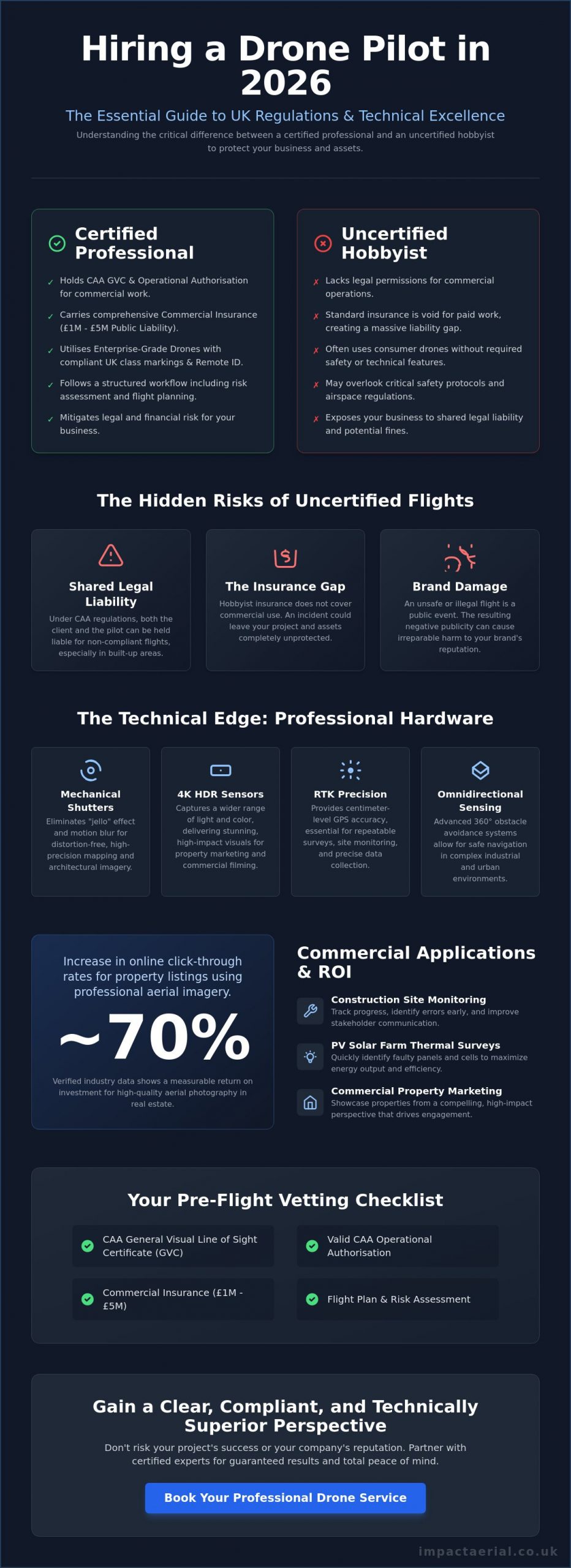
  • Understand the critical legal distinction between hobbyist flights and commercial operations to protect your business from shared liability under 2026 UK regulations.
  • Learn why enterprise-grade hardware featuring mechanical shutters and 4K HDR sensors is mandatory for high-precision technical surveys and commercial property marketing.
  • Use our professional checklist to verify a pilot’s CAA GVC status and Operational Authorisation before you hire professional drone photographer experts for complex urban projects.
  • Explore how specialized aerial data, from PV solar farm thermal surveys to construction site monitoring, provides measurable ROI and technical clarity for stakeholders.
  • Discover the importance of a structured workflow that integrates meticulous flight planning with high-tier post-production services for a seamless project delivery.

Why Hiring a Professional Drone Photographer is Essential in 2026

The decision to hire professional drone photographer services is no longer just about capturing a unique angle; it’s a fundamental requirement for corporate risk management. In 2026, the distinction between a hobbyist and a commercial operator is defined by strict regulatory compliance and technical capability. While the history of aerial photography began with tethered balloons and rudimentary cameras, modern operations involve sophisticated systems like Remote ID and UK class markings. These technical layers ensure that every flight is accountable to the Civil Aviation Authority (CAA), providing a level of transparency and safety that hobbyist flights simply can’t match.

To better understand the visual impact of professional aerial work, watch this helpful video:

Commercial projects carry inherent risks that a casual pilot isn’t equipped to handle. Since January 1, 2026, all new drones must carry specific UK class markings, from UK0 to UK6, which dictate where they can fly and their proximity to the public. If you hire professional drone photographer experts who use “legacy drones” without the proper Operational Authorisation for urban areas, you aren’t just risking poor results. You’re assuming legal risk. The CAA can hold both the pilot and the client liable for non-compliant flights, particularly in built-up areas where safety protocols are paramount.

The Hidden Risks of Using Uncertified Operators

Uncertified operators often lack the specific insurance required for commercial work. Standard hobbyist policies fail when a drone is used for financial gain, leaving a massive “insurance gap” if an incident occurs. Professional operators carry public liability coverage, often ranging from £1 million to £5 million, to protect your assets and your reputation. Beyond the legal threat, an unsafe flight can cause irreparable damage to your brand’s public image. Meticulous planning is the only way to mitigate these operational dangers.

The Commercial Advantage of Professional Perspectives

Professional aerial filming and photography provide a measurable return on investment. High-resolution 4K HDR imagery can increase online click-through rates for property listings by nearly 70% based on verified industry data. In the industrial sector, construction site monitoring allows project managers to track progress with high precision, potentially shortening project timelines by identifying errors early. The psychological impact of high-end visuals is undeniable. They signal to your clients that you value quality, safety, and technical excellence.

The Technical Edge: What Separates Pro Drone Services from Hobbyists

Technical superiority isn’t just a marketing claim; it’s the foundation of every successful aerial project. When you hire professional drone photographer specialists, you’re paying for enterprise-grade hardware that far exceeds the capabilities of standard consumer models. For example, the DJI Mavic 3 Enterprise series features mechanical shutters. These are essential for eliminating rolling shutter distortion when capturing high-speed architectural data or mapping large sites. Consumer drones often rely on electronic shutters, which can lead to warped imagery that doesn’t meet rigorous technical standards.

Professional equipment provides several critical advantages for commercial clients:

  • Mechanical Shutters: Prevents image “jello” effect during high-speed motion, ensuring crisp architectural lines.
  • RTK Precision: Real-Time Kinematic positioning provides centimeter-level accuracy for repeatable site monitoring.
  • Omnidirectional Sensing: Advanced obstacle avoidance allows for safe navigation in complex industrial environments.
  • Dual-Sensor Payloads: The ability to switch between high-resolution visual and radiometric thermal data on a single flight.

Reliability in the field is equally dependent on flight stability. Professional systems utilize RTK positioning to achieve a level of precision that consumer GPS simply cannot match. This accuracy is critical for repeatable construction site monitoring where images must be captured from the exact same coordinates over several months. Furthermore, these systems operate within the strict safety parameters defined by Civil Aviation Authority (CAA) regulations, ensuring that every flight is both stable and legally compliant.

Commercial-Grade DJI Enterprise Technology

High-resolution 4K HDR sensors are standard for capturing the fine architectural details required in high-end property marketing. However, the true value of enterprise technology lies in specialized applications. For instance, PV solar farm thermal surveys require radiometric thermal cameras to detect micro-cracks and cell failures that are invisible to the naked eye. These enterprise drones also boast superior wind resistance and signal stability, allowing for successful operations in weather conditions that would ground a hobbyist aircraft.

The Professional Project Lifecycle

Managing the lifecycle of a commercial project requires more than basic flight skills. When businesses hire professional drone photographer teams, they’re investing in a structured workflow that prioritizes safety and data integrity. This begins with rigorous pre-flight site assessments and airspace coordination. Once the data is captured, the work transitions to our post-production services. Editing accounts for approximately 50% of the final product quality, transforming raw data into cinematic video or 3D models. If you require a technical partner rather than just a pilot, explore our drone commercial property surveys for comprehensive data delivery.

Hire Professional Drone Photographer: The 2026 Guide to UK Aerial Services

Commercial Applications: From Property Marketing to Technical Surveys

The decision to hire professional drone photographer teams often moves beyond aesthetic appeal into the realm of actionable business intelligence. While the hardware discussed previously provides the foundation, the true value lies in how this technology integrates into specific industry workflows. From high-end residential marketing to complex industrial inspections, professional aerial services offer a level of detail and safety that ground-based methods cannot replicate. Adhering to UK Civil Aviation Authority drone regulations is mandatory for these commercial applications, ensuring that data collection doesn’t compromise public safety or legal standing.

Real Estate and Property Development

In the competitive UK property market, high-resolution imagery is essential for contextualising a building within its wider landscape. Professional pilots capture cinematic “hero shots” that highlight proximity to local infrastructure, green spaces, and transport links. This goes beyond simple photography; it includes creating immersive virtual tours that allow luxury listings to stand out to international investors. For commercial developers, these perspectives are vital for site planning and showcasing the scale of a project to stakeholders before the first brick is laid.

Technical Data and Construction Surveys

Construction site monitoring has been transformed by the ability to track progress from the air over time. Regular aerial flyovers provide project managers with a chronological record of development, helping to identify potential delays or logistical bottlenecks. Using drones for commercial property surveys allows for the identification of structural issues in high-access areas, such as church spires, chimneys, or expansive warehouse roofs, without the need for expensive scaffolding or risky manual inspections.

Industrial inspections also benefit from specialized sensors. Thermal analysis is increasingly used to assess energy efficiency by identifying heat loss in commercial buildings or detecting faults in PV solar arrays. This data-centric approach ensures that maintenance teams can target specific problem areas, reducing operational costs and downtime. In creative advertising, these same technical skills are used to capture sweeping, high-tier visuals for brand campaigns, proving that a meticulous, compliant approach to flight is the key to unlocking both creative and technical success.

The Professional Checklist: How to Vet Your Drone Pilot

Choosing to hire professional drone photographer services requires a shift in mindset from creative procurement to technical vetting. In 2026, the regulatory environment is too complex for casual hires based on a flashy Instagram feed alone. You need a verifiable paper trail that proves competence, legal standing, and operational safety. Vetting is your primary tool for risk management, ensuring that your commercial project remains compliant with national aviation standards while delivering high-tier data.

Understanding CAA Certifications in 2026

The foundational requirement for any commercial operator is their specific certification. While an A2 Certificate of Competence (A2 CofC) allows for basic flights in lower-risk environments, a General Visual Line of Sight Certificate (GVC) is the hallmark of a true professional. A GVC pilot has undergone rigorous practical assessments and is qualified to handle more complex operations. This certification is a prerequisite for obtaining an Operational Authorisation from the CAA, which is mandatory for flights in built-up urban areas or near uninvolved people. A valid UK drone license is non-negotiable; always verify a pilot’s credentials against the official CAA register before signing a contract.

Insurance and Risk Mitigation

Insurance is where uncertified operators frequently fail. Standard public liability policies often specifically exclude aviation activities or contain restrictive clauses that void coverage during commercial work. Professional operators maintain insurance that is strictly compliant with EC 785/2004 regulations. While some entry-level pilots carry £1 million in coverage, the industry gold standard for high-stakes commercial projects is £5 million. This level of protection ensures your business is shielded from significant financial loss in the event of hardware failure or accidental property damage.

Beyond the insurance certificate, a meticulous pilot will provide a comprehensive Risk Assessment and Method Statement (RAMS). This document should detail:

  • Site-specific hazard identification and mitigation strategies.
  • Emergency procedures and “lost link” protocols.
  • Airspace coordination and local authority permissions.
  • Specific hardware and software versions used for the mission.

Finally, examine a recent portfolio for technical consistency rather than just a few “lucky” shots. Look for crisp imagery across the entire frame and balanced exposure in challenging lighting conditions. Professional work should show no signs of rolling shutter distortion or pixelation in 4K HDR outputs. If you are ready to secure a fully vetted and insured partner for your next project, contact us for high-precision aerial filming and photography services across the UK.

Impact Aerial: Your Partner for Precision Drone Photography in the UK

Impact Aerial operates as a specialized technical consultancy rather than a standard creative agency. Based in Birmingham and serving the entire United Kingdom, we provide national coverage for organizations that require absolute regulatory compliance and high-tier visual data. When you decide to hire professional drone photographer specialists, you’re choosing a partner that understands the nuances of the 2026 UK aviation landscape. We don’t just fly; we manage complex aerial operations that prioritize data integrity and site safety.

Our commitment to excellence is reflected in our hardware choices and insurance standards. We utilize the latest DJI Enterprise drone technology, ensuring every mission benefits from RTK precision and high-resolution 4K HDR sensors. This technical foundation is backed by £5 million in commercial liability insurance, which is the industry gold standard for professional operators. This level of coverage provides the reassurance needed when operating near sensitive infrastructure or high-value commercial property. It’s a level of protection that consumer-level pilots simply cannot offer.

The Impact Aerial Difference

Our methodology is built on meticulous planning and adherence to safety-first protocols. Every project begins with a detailed site assessment and airspace coordination, ensuring that all flights are fully compliant with current CAA standards. We offer bespoke solutions tailored to the property, construction, and advertising sectors, providing a seamless transition from raw data capture to final delivery. Our in-house post-production services ensure that the final imagery or 3D models are polished, precise, and ready for stakeholder review. This includes technical color grading for cinematic video and the careful stitching of high-resolution stills for expansive drone commercial property surveys.

Get Started with Your Aerial Project

We provide a structured project lifecycle that values your time and project deadlines. From the initial consultation, we work to understand your specific data requirements, whether you need construction site monitoring or sophisticated virtual tour creation. Our team handles all necessary local permissions and risk assessments, removing the administrative burden from your internal staff. This allows your team to focus on the insights our data provides rather than the logistics of the flight itself.

Our typical project timeline is designed for efficiency, moving from the site flight to the final edit with transparent communication at every stage. We provide tailored quotes that reflect the technical complexity and scale of your mission. Hire Impact Aerial for your professional drone photography today to secure a compliant, expert partner for your next UK aerial project. We’re ready to deliver the high-precision imagery your commercial project demands.

Future-Proof Your Operations with Professional Aerial Intelligence

The landscape of UK aerial services has shifted toward a more structured and accountable model. Choosing to hire professional drone photographer experts ensures your projects benefit from 2026-compliant technology and meticulous risk management. You gain more than just a visual perspective; you secure data accuracy and legal protection that hobbyist operations cannot provide. Whether it’s for PV solar farm thermal surveys or construction site monitoring, the technical requirements of modern industry demand a specialist approach.

Impact Aerial provides the technical edge your business requires. Our CAA GVC Certified Pilots use the latest DJI Enterprise Hardware to deliver high-resolution results across the UK. With £5m Commercial Liability Insurance and specialized Birmingham-based national coverage, we offer the reliability needed for complex commercial missions. We’re proud of our track record in delivering high-precision data that supports informed decision-making.

Book Your Professional Drone Photography Consultation Today to discuss your specific requirements for technical surveys or high-end property marketing. We look forward to helping you achieve a superior perspective on your next project.

Frequently Asked Questions

How much does it cost to hire a professional drone photographer in the UK?

Pricing for aerial services depends on project complexity, location, and the specific technical requirements of the mission. Factors such as the use of specialized thermal sensors for PV solar farm surveys or the need for high-resolution 4K HDR imagery for property marketing will influence the final investment. Most professional operators provide bespoke quotes after an initial consultation to account for airspace coordination and post-production editing needs.

Do I need to get permission from my neighbours for drone photography?

You don’t strictly require permission from neighbours to fly over their property, but you must adhere to privacy laws and Civil Aviation Authority (CAA) regulations. Professional pilots ensure they don’t capture identifiable images of people or private data without consent, following the Data Protection Act 2018. When you hire professional drone photographer services, the pilot conducts a thorough risk assessment to ensure all flights remain respectful and legally compliant.

What happens if the weather is bad on the day of the drone shoot?

Professional pilots monitor weather conditions meticulously and will reschedule if wind speeds or precipitation exceed the safe operating limits of the hardware. Enterprise-grade drones generally have higher wind resistance than consumer models, but operational safety remains the absolute priority. Most professional operators include a weather clause in their agreements to allow for a flexible rescheduling window without financial penalty to the client.

Is it legal to fly drones in London or other major UK cities?

It is legal to fly in major cities, but it requires specific certifications and often an Operational Authorisation from the CAA. Flying in congested urban areas like London involves navigating restricted airspace and maintaining safe distances from uninvolved persons. Professional operators manage all necessary permissions and coordination with local authorities to ensure every urban flight is fully authorized and insured for your peace of mind.

How long does a typical professional drone photography session take?

A standard on-site session usually lasts between one and three hours, depending on the scope of the project. Simple property shots might be completed quickly, while comprehensive construction site monitoring or large-scale commercial property surveys require more time for systematic data capture. This timeframe excludes the essential pre-flight planning and the extensive post-production editing required to deliver high-tier professional assets.

What file formats will I receive for my aerial photos and videos?

Clients typically receive high-resolution JPEG or TIFF files for photography and MP4 or MOV files for video production. For technical projects, we can provide specialized data formats such as RAW files for advanced editing or radiometric thermal data for solar inspections. We ensure all deliverables are compatible with your existing marketing or project management software during the final post-production phase.

Can drones be used for indoor photography or filming?

Drones are highly effective for indoor use provided the space is sufficiently large and the pilot uses aircraft equipped with omnidirectional obstacle avoidance. Indoor filming is ideal for showcasing expansive warehouse interiors or large commercial developments. These flights require exceptional pilot skill and specific safety protocols because GPS signals are often unavailable or unreliable inside large structures.

What is the maximum height a professional drone can fly in the UK?

The legal height limit for drone operations in the UK is 120 meters, which is approximately 400 feet above the earth’s surface. This limit is strictly enforced by the Civil Aviation Authority to prevent conflicts with manned aircraft. If a specific commercial project requires a higher altitude, the operator must apply for a specific exemption or an enhanced Operational Authorisation involving additional safety coordination.

Professional Gutter Inspection Drone Service: Safer, Faster Data Collection

Why are you still authorizing thousands in scaffolding costs or cherry picker hire just to identify a few blocked downpipes? For many facility managers, the traditional approach to roof maintenance is a logistical headache that carries significant health and safety liabilities. You likely already know that manual working at height is a primary concern for site safety; it’s a risk that’s increasingly difficult to justify when a professional gutter inspection drone service offers a safer, more efficient alternative.

By utilizing these advanced aerial systems, you can transition from reactive guesswork to precise, data-driven maintenance. We understand that you need clear, actionable evidence of asset health without the operational downtime associated with traditional access methods. This article explores how commercial-grade drone surveys provide high-resolution visual evidence of gutter health without the site disruption of heavy machinery. We’ll examine the technical advantages of rapid aerial data collection, the importance of FAA Part 107 compliance for your risk assessments, and how rapid reporting turnaround helps you protect your property assets more efficiently.

Key Takeaways

  • Understand how aerial surveys eliminate the significant health and safety liabilities associated with manual working at height and traditional access methods.
  • Learn how a professional gutter inspection drone service captures high-resolution 4K data to identify critical defects that ground-based pole cameras frequently overlook.
  • Discover the financial benefits of replacing expensive scaffolding and cherry picker hire with rapid, zero-disruption aerial assessments.
  • Identify the mandatory regulatory credentials and insurance standards required to ensure your property surveys are fully compliant and legally robust.
  • Gain insights into how digital data collection streamlines reporting and provides a clear visual audit trail for long-term commercial property maintenance.

The Evolution of Gutter Inspections: Moving Beyond Scaffolding

Traditional gutter maintenance has long been synonymous with high-risk manual labor. For decades, property managers relied on ladders and scaffolding; they accepted the inherent liabilities as an unavoidable cost of doing business. However, the modern property sector is undergoing a significant transition toward non-disruptive data collection. This shift is driven by a need for higher precision and a desire to mitigate the safety risks outlined in current ‘Work at Height’ regulations, which significantly impact commercial maintenance budgets.

Central to this evolution is the Unmanned Aerial Vehicle (UAV), which has moved from a niche technology to a cornerstone of commercial asset management. A professional gutter inspection drone service now provides a level of detail that manual inspections simply can’t match, allowing for a comprehensive overview of complex drainage networks without putting personnel at risk.

To better understand how this technology is changing the landscape of property maintenance, watch this helpful video showing aerial capabilities in action:

Limitations of Traditional Access Methods

Manual inspections often involve significant logistical hurdles. Erecting scaffolding for a simple visual check is rarely cost-effective, yet skipping the check leads to expensive water damage. Mobile Elevated Work Platforms (MEWPs), or cherry pickers, offer more mobility but frequently cause disruption on active commercial sites. They block access and require cordoned-off safety zones that interfere with daily operations. Additionally, ground-based pole cameras are often physically limited. They struggle to see into deep valleys, behind ornate parapets, or across vast industrial roof spans. This leaves critical blind spots in your maintenance data, potentially hiding debris or structural failures until they become catastrophic.

The Rise of the Drone Survey

The adoption of a drone survey approach addresses these failings by providing a true ‘bird’s eye’ perspective of the entire drainage system. Unlike mechanical equipment that takes hours to position, a drone can be deployed in minutes to capture 4K visual data. This speed doesn’t come at the expense of quality. Modern aerial platforms are designed to remain stable in challenging conditions, ensuring that every inch of a gutter run is documented with crystal-clear resolution. This meticulous methodology has established aerial data collection as the new industry standard for high-level building inspections, providing property owners with psychological comfort and tangible financial benefits.

How Drone Technology Transforms Gutter Data Collection

A professional gutter inspection drone service is a specialized application of UAV technology designed to capture high-definition 4K visual data of roof drainage systems. This isn’t merely about taking aerial photographs; it’s a meticulous process of asset documentation. By utilizing commercial-grade hardware, operators can identify structural weaknesses that are invisible from the ground. Precision is the primary objective. Modern aerial platforms allow us to document every joint, bracket, and seal with a level of clarity that was previously impossible without significant manual effort.

The stability of these systems is a critical factor in professional environments. We utilize DJI Enterprise drones because they offer superior wind resistance and flight stability compared to consumer-grade models. This ensures that even on exposed industrial sites or during blustery conditions, the camera remains perfectly still. We capture 4K HDR imagery to expose details in both high-contrast sunlight and deep shadows. This dynamic range is essential for spotting fine-line cracks, subtle corrosion, or the presence of standing water that indicates a subtle pitch issue in the guttering.

Precision Hardware for Property Professionals

Success in aerial surveying relies on the specific capabilities of the flight platform. We employ the DJI Mavic 3 Enterprise or similar platforms because they are equipped with omnidirectional obstacle avoidance sensors. These sensors act as a safety net, protecting the building’s facade and the drone during close-proximity maneuvers. Additionally, GPS-stabilized flight is a standard requirement for our operations. It allows for repeatable inspections; we can return to the exact coordinates months or years later to monitor the progression of a known defect, providing a consistent audit trail for maintenance records.

High-Resolution Deliverables

The output of a professional survey must be actionable. We provide 20MP+ still images that allow property managers to zoom in on granular details like perished gaskets or loose fixings. For a broader understanding of site health, 4K video flyovers are indispensable. These videos help teams visualize water flow patterns and identify potential blockages across vast roof areas. The integration of aerial filming drone techniques ensures that the footage is cinematic yet technically precise, making it easy for stakeholders to review findings. If you require a comprehensive assessment of your building’s exterior, our drone commercial property surveys provide the high-tier data needed for informed decision-making.

Advanced zoom capabilities further enhance site safety. By utilizing high-powered optical zoom, we can inspect delicate areas without flying dangerously close to the structure. This reduces the risk of prop-wash disturbing loose debris and ensures the aircraft maintains a safe standoff distance at all times. The result is a comprehensive data set that serves as a professional foundation for your maintenance strategy.

Professional Gutter Inspection Drone Service: Safer, Faster Data Collection

Comparing Gutter Inspection Methods: ROI and Efficiency

The financial justification for adopting a professional gutter inspection drone service rests on the transition from subjective observation to objective data. Traditional methods often rely on a contractor’s verbal report after they’ve spent hours on a ladder or a cherry picker. This approach is inherently limited by what the individual can see at that moment. In contrast, aerial surveys provide a permanent, high-resolution digital record that can be reviewed by multiple stakeholders, including insurance adjusters and structural engineers, without anyone needing to leave the ground.

Efficiency is measurable in time and labor. A standard drone roof and gutter inspection typically takes between 30 and 60 minutes to complete. This is a significant improvement over manual inspections, which frequently require 2 to 4 hours of on-site labor plus the time needed to transport and set up heavy access equipment. For property managers overseeing multiple assets, these time savings translate directly into reduced operational costs and faster maintenance cycles.

Speed and Versatility on Site

A primary advantage of aerial technology is its ability to navigate complex site layouts with ease. We can complete a full perimeter inspection of a large industrial unit in a single morning, a task that would take days if scaffolding were required. Drones access confined areas and high-reach points that are physically impossible for mechanical platforms to reach safely. Because the aircraft is battery-powered and launched from a small designated area, there’s no heavy machinery to damage lawns, block car parks, or disrupt pedestrian flow. This minimal footprint makes it the ideal choice for active commercial environments where business continuity is a priority.

Actionable Maintenance Reports

The value of a survey extends far beyond the day of flight. Digital data serves as robust evidence for insurance documentation and claim support. Insurance companies are increasingly accepting and often preferring drone inspection reports because they provide unambiguous visual proof of an asset’s condition. By using this high-resolution imagery, multi-site managers can prioritize their maintenance spend based on actual urgency rather than a fixed schedule. This strategic approach prevents minor blockages from becoming major structural issues.

  • Historical Auditing: We create a visual record that allows you to track gutter degradation over several years.
  • Budget Optimization: Identify exactly which sections of a property portfolio require immediate attention.
  • Risk Mitigation: Eliminate the primary cause of workplace falls by keeping personnel on the ground.

Beyond the financial and safety benefits, the environmental impact is a factor that modern businesses can’t ignore. Battery-powered UAVs have a negligible carbon footprint compared to the diesel-powered engines of MEWPs and transport trucks. This allows your facility management team to maintain high standards of building health while aligning with corporate sustainability goals. It’s a cleaner, faster, and more precise way to manage property assets.

Compliance and Safety: Hiring a Professional Drone Service

Selecting a gutter inspection drone service involves more than just evaluating camera specifications. In the UK, the legal framework governing Unmanned Aircraft Systems (UAS) is rigorous, and failing to verify a pilot’s credentials can leave a property manager liable for significant fines or uninsured damages. Hiring a hobbyist or an uncertified pilot for commercial work isn’t just a shortcut; it’s a professional risk that compromises site safety and legal standing. Professional operators treat every flight as a controlled aviation exercise, ensuring that data collection never comes at the expense of safety.

The distinction between a casual flyer and a professional lies in their adherence to officialdom and risk mitigation. For any commercial property survey, a minimum of £5 million commercial liability insurance is the industry standard. This coverage protects the client, the public, and the property itself in the unlikely event of an incident. Without this specific commercial-grade protection, any damage caused during a survey could become a direct financial burden on the property owner.

Navigating UK Drone Regulations

Understanding the current drone license requirements is essential for anyone procuring aerial services. In 2026, the General Visual Line of Sight Certificate (GVC) is the critical qualification for pilots operating in congested commercial environments. This certification demonstrates that the pilot has undergone formal theoretical and practical assessments approved by the Civil Aviation Authority (CAA). It grants the operator the legal right to fly in urban areas or near high-traffic zones where airspace restrictions are complex.

Privacy is another pillar of professional compliance. Meticulous operators ensure full GDPR adherence when filming near residential windows or sensitive commercial boundaries. This involves pre-flight notifications and post-production techniques to redact any unintended personal data, ensuring your maintenance audit doesn’t infringe on privacy laws.

Risk Mitigation and Insurance

Every professional mission begins long before the drone leaves the ground. We conduct thorough pre-flight site surveys to identify local hazards, such as overhead power lines, nesting birds, or nearby restricted airspace. This preparation is documented in a formal risk assessment that serves as a foundation for a safe mission. You should always request to see a pilot’s policy documents and CAA Operational Authorisation before work commences. Commercial drone insurance policies typically remain valid only when the operator is in full compliance with CAA regulations and holds the appropriate flight authorizations.

By prioritizing these standards, you protect your business from the operational and legal failures associated with unregulated flight. If you need a fully compliant, high-resolution assessment of your facility’s drainage system, you can trust our drone commercial property surveys to deliver professional results within a safe, regulated framework.

Impact Aerial: Expert Gutter Surveys and Data Analysis

Impact Aerial operates with a meticulous focus on quality and regulatory compliance. Based in the West Midlands, we provide specialized property data collection that goes beyond basic photography. Our drone services are designed to integrate seamlessly into your existing maintenance workflows, providing a technical foundation for long-term asset protection. We understand that property managers require more than just a bird’s eye view; they need a reliable partner who understands the operational complexities of commercial site management.

Our approach is rooted in technical precision. We don’t just fly; we conduct a systematic audit of your building’s drainage health. This involves capturing high-resolution data that identifies immediate risks while documenting the overall condition of the asset. By integrating gutter inspections with our broader drone commercial property surveys, we offer a holistic view of building envelopes that helps facility managers stay ahead of costly repairs. This proactive methodology ensures that your maintenance budget is allocated where it’s needed most, based on empirical evidence rather than guesswork.

Beyond the Flight: Data Management

We address a common industry weakness by prioritizing professional post-production and data management. Raw footage is often difficult for maintenance teams to interpret without context. To solve this, our team processes every survey into a structured, high-resolution digital file set. We provide annotated imagery that highlights specific defects, such as perished seals or localized debris buildup, directly on the photographs. This consultative approach helps you interpret aerial data for accurate budget planning and ensures that your on-site teams have clear, visual instructions for any necessary repairs. Our secure delivery system ensures that all stakeholders can access this critical data quickly and efficiently.

Specialised Survey Solutions

The versatility of our fleet allows us to offer specialized solutions tailored to your specific infrastructure. We can combine visual gutter inspections with thermal data collection to identify hidden moisture ingress or assess the efficiency of rooftop energy assets. This is particularly beneficial for sites requiring PV solar farm thermal surveys alongside standard roof maintenance. We also support construction site monitoring during project handovers, providing definitive, high-resolution proof that gutters are clean and clear before a building is officially transferred to the client. If you require a professional, data-centric gutter inspection drone service, request a consultation with our expert team to discuss your site’s specific requirements and ensure your assets are protected by industry-leading aerial technology.

Future-Proofing Your Property Maintenance Strategy

Transitioning to a professional gutter inspection drone service is no longer just a technological upgrade; it’s a strategic necessity for modern facility management. By eliminating the high costs and safety liabilities of manual access, you can secure high-resolution data that drives more accurate maintenance decisions. You’ve seen how aerial technology provides a clear audit trail and superior ROI for complex commercial portfolios. This shift toward data-centric surveying ensures that minor blockages don’t evolve into structural failures.

Ready to upgrade your site assessments? Request a Professional Drone Gutter Survey Quote from our expert team. We operate with CAA GVC Certified Pilots and carry £5m Commercial Liability Insurance, utilizing DJI Enterprise Grade Hardware to ensure your data is as precise as it is compliant. We look forward to helping you protect your property assets with the precision and reliability your business requires.

Frequently Asked Questions

How long does a drone gutter inspection take?

A standard inspection for a commercial unit usually takes between 30 and 60 minutes on site. This is significantly faster than manual methods which can require several hours of labor and equipment setup. The speed is due to the rapid deployment of the UAV and its ability to traverse roof perimeters without the need to reposition heavy access machinery.

Can drones see blockages inside downpipes?

Drones cannot see through solid materials or navigate the interior of narrow downpipes. However, they are highly effective at identifying blockages at the hopper or entry point where most debris accumulates. By observing standing water or overflow patterns at these specific junctions, a pilot can accurately infer a blockage exists further down the drainage system.

Is a drone inspection as accurate as a manual check?

Aerial inspections often provide greater accuracy than manual checks because they capture high-resolution 4K data from angles a person on a ladder cannot safely reach. While a manual check allows for the physical testing of joints, the visual evidence provided by a professional gutter inspection drone service identifies cracks, corrosion, and perished gaskets with extreme precision.

Do I need to be present during the drone survey?

You don’t need to be present on site during the survey as long as our team has clear access to the exterior of the building. We conduct our pre-flight risk assessments and manage the entire flight operation independently. Once the data collection is complete, we process the 20MP+ imagery and deliver a comprehensive maintenance report directly to your digital inbox.

What happens if the drone crashes into my building?

We mitigate the risk of collisions through the use of omnidirectional obstacle avoidance sensors and strict flight safety protocols. In the highly unlikely event of an incident, our £5 million commercial liability insurance provides full protection for your property and assets. This level of coverage is a mandatory standard for all our professional property survey operations.

Can you fly a drone for gutter inspections in the rain?

We typically avoid flying in active rain to ensure the highest image quality and protect the aircraft’s sensitive electronics. Water droplets on the camera lens can distort the 4K imagery, making it difficult to spot fine-line defects or subtle corrosion. We monitor weather forecasts closely and will reschedule to the nearest clear window to maintain the integrity of your data.

Are there any buildings where a drone cannot be used for inspection?

Drones can be restricted in certain high-security zones or near major airports where flight permissions are denied by the CAA. Additionally, extremely confined spaces or areas with high electromagnetic interference may pose operational challenges. We verify every site’s airspace status during our pre-flight planning phase to confirm if a professional gutter inspection drone service is viable for your specific location.

How much does a professional drone gutter survey cost?

The cost of a professional survey depends on the scale of the property and the complexity of the roof structure. Factors such as site location, the number of separate buildings, and specific reporting requirements will influence the final project fee. We provide bespoke quotes for each project to ensure you only pay for the specific data and analysis your facility management team requires.

Why Hire a GVC Certified Drone Pilot in the UK? (2026 Professional Guide)

Does a basic drone license actually protect your business from a heavy CAA fine if an incident occurs on a congested construction site? You likely recognize that aerial technology provides invaluable data for PV solar farm surveys or commercial property inspections, but the regulatory landscape in 2026 can feel like a legal minefield. With the drone registration threshold now lowered to just 100g and new Remote ID mandates in full effect, the gap between a hobbyist and a professional has never been wider.

It’s natural to worry about insurance validity or the complexities of flying near people, but hiring the right expert removes that burden. This guide explains exactly why hire a gvc certified drone pilot uk to mitigate your operational risks and ensure you receive high-tier 4K or thermal data. We’ll explore how a GVC holder navigates the Specific Category requirements, manages rigorous risk assessments, and utilizes UK class-marked hardware to keep your project fully compliant and professionally executed.

Key Takeaways

  • Understand why hire a gvc certified drone pilot uk to unlock the Specific Category, which is required for complex missions that basic licenses cannot support.
  • Learn how GVC certification permits the legal operation of enterprise drones in congested areas like town centers and active construction sites.
  • Discover how to verify a pilot’s Operational Authorisation and insurance to protect your business from legal liability and ensure policy validity.
  • Identify critical professional documentation, including the PDRA-01 and the Operations Manual, to guarantee your contractor meets 2026 CAA standards.
  • Explore how specialized hardware delivers the precision 4K HDR and thermal data necessary for commercial property and PV solar farm surveys.

Understanding the GVC: Beyond the Basic UK Drone License

The General Visual Line of Sight Certificate (GVC) represents the technical benchmark for professional drone operations in the British Isles. It isn’t a mere “license” in the traditional sense; it’s a comprehensive competency qualification. Since the regulatory shift on January 1, 2026, understanding the nuances of UK drone operational categories has become a prerequisite for any business commissioning aerial work. While anyone can obtain a basic Flyer ID for free, the GVC is the mandatory foundation for pilots seeking an Operational Authorisation from the Civil Aviation Authority (CAA).

This distinction is vital because most high-value commercial projects, such as PV solar farm thermal surveys or construction site monitoring, operate within the “Specific Category.” This category covers flights that present a higher risk than standard recreational “Open Category” operations. When you consider why hire a gvc certified drone pilot uk, the primary reason is the ability to legally fly in areas where hobbyists are strictly prohibited. A GVC holder has undergone rigorous theory and practical assessments to prove they can safely manage aircraft up to 25kg in complex environments.

To better understand how these qualifications differ and what the training involves, watch this helpful guide:

GVC vs. A2 CofC: Which Does Your Project Need?

The A2 Certificate of Competency (A2 CofC) is often sufficient for lightweight drones in low-risk environments. It’s suitable for small-scale aerial filming where the drone stays far from uninvolved people. However, the GVC is the necessary standard for heavier commercial-grade drones and complex flights near buildings or active infrastructure. Most construction and commercial property surveys require GVC-level oversight because the operational risks demand the advanced mitigation strategies only taught at this level. If your project involves a town center or a congested industrial site, an A2 CofC pilot likely won’t have the legal permissions to get the job done safely.

The Role of the Civil Aviation Authority (CAA)

The CAA regulates the UK’s airspace to ensure that every drone flight is conducted without endangering the public or manned aviation. Every professional pilot must maintain a valid Flyer ID and an Operator ID, which currently costs £12.34 per year. The GVC acts as the CAA’s verification that a pilot is qualified to operate under a specific Operational Authorisation. Hiring an uncertified pilot isn’t just a safety risk; it’s a significant legal liability. If an incident occurs, the CAA can issue unlimited fines to businesses that fail to demonstrate proper “duty of care” when selecting their contractors. It’s your responsibility to ensure the pilot you hire has the credentials to match the complexity of the task.

The Commercial ‘Unlocks’: What GVC Pilots Can Do That Others Can’t

The General Visual Line of Sight Certificate (GVC) isn’t just a badge of expertise; it’s a legal key that unlocks restricted airspace and complex operational environments. While pilots in the Open Category are often restricted by drone weight or large distance buffers from uninvolved people, GVC holders operate under a different set of rules. This qualification allows for the safe operation of commercial-grade aircraft weighing up to 25kg. This weight capacity is essential for carrying the high-end thermal sensors and cinema-grade cameras required for professional-grade output. You can review the official GVC qualification details to see how this certificate serves as the backbone for advanced UK drone operations.

The most significant advantage for your business is the pairing of a GVC with a PDRA-01 (Pre-Defined Risk Assessment). This is the standard permission that allows a pilot to fly in congested areas. If your project requires capturing data in a city center or on a busy industrial estate, this is exactly why hire a gvc certified drone pilot uk. Under the current 2026 regulations, GVC pilots can fly closer to uninvolved persons than standard hobbyist rules allow, provided they follow the strict safety protocols outlined in their CAA-approved documentation. They don’t just fly; they manage the legal and physical risks of the flight path.

Urban Operations and Congested Areas

Major infrastructure projects in cities like London or Birmingham present unique challenges that an uncertified pilot simply cannot handle. You can’t launch a drone in a busy metropolitan area without a robust, site-specific flight plan. GVC pilots use their Operations Manual to define precise safety buffers, ensuring they maintain the required “duty of care” without sacrificing shot quality. They handle the complex liaison with local authorities and manage the ground-level safety teams necessary for urban flight success. If you’re planning a project in a high-traffic area, our team can help you assess your site-specific requirements.

Industrial Applications: Surveys and Inspections

Precision is the primary requirement for industrial clients. Executing high-detail drone surveys on active construction sites requires a pilot who understands how to manage complex airspace alongside heavy machinery. Whether it’s a PV solar farm thermal inspection or LiDAR data collection for 3D mapping, GVC pilots provide the professional-grade data needed for critical engineering decisions. Their advanced training ensures they can operate safely near sensitive infrastructure where any operational failure would have significant financial or safety repercussions. They provide the reliability that a hobbyist-level operator cannot guarantee.

Risk Mitigation: Why CAA Compliance Protects Your Business

When a business commissions a drone operation, they aren’t just buying data; they’re assuming a degree of legal responsibility. Under UK law, the person or company hiring a contractor has a “Duty of Care” to ensure that the contractor is competent and legally compliant. This is the fundamental reason why hire a gvc certified drone pilot uk. If an incident occurs on your site and the pilot lacks the correct Operational Authorisation, the legal repercussions can extend directly to your organization. A GVC-certified pilot acts as a safeguard, ensuring that every flight is conducted within the strict parameters of the law.

Professional-grade data collection, such as PV solar farm thermal surveys or construction monitoring, requires more than just a skilled hand; it requires valid commercial insurance. Most businesses don’t realize that standard drone insurance policies are often voided if the pilot operates outside the scope of their legal certification. The CAA provides Official CAA GVC Information which details the rigorous competency standards pilots must meet. This certification proves to both the regulator and your insurance provider that the pilot is a “competent person” capable of managing high-risk flights in the Specific Category.

The £5m Commercial Liability Standard

Commercial sites typically require a minimum of £5 million in public liability insurance. To meet the legal requirements for commercial drone work in the UK, insurance must comply with Regulation (EC) 785/2004. Hobbyist policies simply don’t offer this level of protection. By hiring a GVC-certified professional, you ensure that the aircraft is covered for third-party damage and bodily injury. This protects your project’s financial stability and provides the psychological comfort that comes from knowing you’re working with a vetted specialist.

Safety Protocols and Risk Assessments

A GVC pilot acts as the dedicated Safety Officer for the duration of the flight. Their process begins long before the drone leaves the ground. They conduct detailed pre-flight planning, which involves reviewing aeronautical charts, NOTAMs (Notices to Airmen), and site-specific hazards. On the day of the operation, they perform dynamic risk assessments to account for shifting weather conditions or the presence of uninvolved persons. This meticulous approach mitigates the PR risk of intrusive or illegal flights that could damage your brand’s reputation. A professional pilot has the technical expertise to say “no” to a flight if it’s unsafe, prioritizing the security of your site over a risky shot.

Evaluating Drone Providers: Operations Manuals and PDRA-01

Identifying a qualified pilot requires looking beyond their portfolio of cinematic shots. In the professional drone industry, the quality of a provider’s documentation is just as critical as their flight skill. A primary reason why hire a gvc certified drone pilot uk is the assurance that they operate under a robust, CAA-approved framework. This framework is anchored by two essential components: the Operations Manual and the PDRA-01 (Pre-Defined Risk Assessment). These documents prove that the pilot has moved beyond hobbyist flying and is operating as a legitimate aviation entity.

The PDRA-01 is the standard operational authorisation for professional pilots in the UK. It grants the legal permission to conduct Visual Line of Sight (VLOS) flights in congested areas, provided the pilot maintains a safe distance from uninvolved persons. Before you sign a contract, you should verify the pilot’s credentials on the official CAA register. A professional will always be happy to provide their Flyer ID and Operator ID, which currently requires an annual renewal fee of £12.34 to remain active. If a provider cannot produce these details or explain their current authorisation status, they aren’t equipped for commercial work.

The Operations Manual: The Pilot’s ‘Bible’

The Operations Manual is a comprehensive document, often exceeding 50 pages, that details every safety protocol and emergency procedure the pilot follows. The CAA requires this manual for any operator seeking an Operational Authorisation in the Specific Category. It ensures absolute consistency across different flight teams and projects. When evaluating a provider, ask if their manual has been updated to reflect the 2026 regulations, including the new requirements for Remote ID and UK class-marked hardware. A current manual demonstrates that the pilot is meticulous and stays ahead of shifting industry standards.

Vetting Your Drone Partner

Technical proficiency in one sector doesn’t always translate to another. You should ensure your chosen pilot has specific experience with professional drone services relevant to your industry. For example, the skills required for a cinema-grade aerial film are different from those needed for a high-precision 3D mapping project. Confirm that the team uses commercial-grade hardware, such as DJI Enterprise models, which offer the redundancy and sensor quality necessary for high-stakes surveys. If you’re unsure about the technical requirements for your project, you can consult with our certified flight team to review your site-specific needs.

During your initial consultation, ask the following key questions:

  • Can you provide a copy of your current CAA Operational Authorisation?
  • Does your insurance explicitly cover the specific location and flight type?
  • How do you handle dynamic risk assessments if site conditions change suddenly?
  • What is your protocol for managing data security and client confidentiality?

Why Impact Aerial is the UK’s Trusted GVC Partner

Impact Aerial operates with a clear mandate: to provide the highest standard of aerial data while maintaining absolute regulatory compliance. While previous sections of this guide detailed the legal necessity of certification, our focus is on the practical application of these standards. Our flight teams are entirely GVC-certified, ensuring that every mission, from a complex PV solar farm thermal survey to construction site monitoring, adheres to current 2026 CAA protocols. This is fundamentally why hire a gvc certified drone pilot uk through Impact Aerial; you aren’t just hiring a camera operator, but a technical consultant who understands the intersection of aviation law and data precision.

Based in the West Midlands, we provide nationwide coverage across the UK, bringing professional-grade aerial solutions to diverse industrial and creative sectors. We manage the entire lifecycle of your project. This includes securing site-specific CAA permissions, conducting detailed risk assessments, and delivering final post-production services. By centralizing these responsibilities, we remove the administrative burden from your team, allowing you to focus on the insights our data provides. Our meticulous approach ensures that your project is not only visually impressive but also fully compliant with the retained UK Regulations (EU) 2019/945 and 2019/947.

Enterprise Technology for Better Results

Superior results require more than just a certificate; they require the right tools for the environment. We utilize DJI Enterprise hardware equipped with RTK (Real-Time Kinematic) positioning to deliver centimeter-level accuracy for survey work. This level of precision is unattainable with consumer-grade drones. When it comes to visual storytelling, our cinematic drone video stands out because we use high-end sensors capable of capturing 4K HDR detail even in challenging lighting. These enterprise sensors allow us to identify thermal anomalies in solar arrays or structural defects in commercial properties that standard equipment would simply miss.

Start Your Compliant Project Today

Every project begins with a detailed consultation to understand your specific data requirements and site constraints. We don’t believe in a one-size-fits-all approach. Instead, we provide bespoke quotes that reflect the complexity and scale of your operation. Whether you need high-resolution mapping or immersive virtual tours, our process is designed to give you peace of mind. We handle the risk and the paperwork so that you receive professional-grade, actionable data. Our commitment to safety and precision makes us the preferred partner for businesses that value technical excellence.

Don’t leave your project’s legality or data quality to chance. Contact Impact Aerial for a GVC-certified drone pilot today to discuss your next commercial project and secure the aerial perspectives your business requires.

Securing Your Project’s Future with Certified Aerial Expertise

The regulatory landscape of 2026 makes it clear that professional drone operations require more than just technical skill; they demand a rigorous commitment to aviation law and safety. You now understand why hire a gvc certified drone pilot uk to navigate the complexities of the Specific Category and protect your organization from significant legal liability. Choosing a qualified partner ensures that your data collection is legally sound, your insurance remains valid, and your project site stays secure throughout the flight operation.

Impact Aerial provides the technical consultancy and operational excellence your project deserves. Our CAA GVC Certified Pilots utilize a DJI Enterprise Hardware Fleet to deliver precision data while maintaining £5m Commercial Liability Insurance for your total peace of mind. We handle the permissions and the risk so you can focus on the results. It’s time to elevate your project standards with a team that values compliance as much as visual quality. We look forward to helping you capture the perspectives your business needs to succeed.

Book a GVC Certified Pilot for Your UK Project

Frequently Asked Questions

Is a GVC drone license a legal requirement for commercial work in the UK?

A GVC is not a blanket legal requirement for every drone flight, but it’s mandatory for any operation within the Specific Category. If your project involves flying heavier drones or operating near people in congested areas, the pilot must hold this qualification. Commercial work in the Open Category is possible with an A2 CofC, but it lacks the operational flexibility required for most industrial or urban projects.

Can a pilot with only an A2 CofC fly on a construction site?

A pilot with an A2 CofC can fly on a construction site, but they’re limited by strict distance requirements from uninvolved persons. For example, they can’t fly drones over 250g within 30 meters of people. On a busy site, these buffers are often impossible to maintain without halting work. This is why hire a gvc certified drone pilot uk for construction monitoring, as they can operate under more flexible safety buffers.

What happens if I hire a drone pilot who isn’t GVC certified?

Hiring an uncertified pilot exposes your business to significant legal and financial risks. If an incident occurs, the CAA can issue unlimited fines for a failure in your duty of care during the procurement process. Additionally, the pilot’s insurance will likely be voided if they’re operating outside their legal competency. This leaves your organization fully liable for any third-party damages or injuries sustained during the flight.

How much does it cost to hire a GVC certified drone pilot?

The cost of hiring a GVC certified pilot varies based on the project’s complexity, location, and the specific data required. Professional fees reflect the pilot’s advanced training, high-end enterprise hardware, and the comprehensive risk assessments they conduct. While their day rates might be higher than hobbyist-level operators, they provide the legal compliance and professional-grade output that protects your project’s budget from unforeseen fines or data failures.

Does a GVC pilot need separate insurance for every flight?

No, professional pilots typically hold annual public liability insurance that covers all their operations, provided they remain within the scope of their GVC and Operational Authorisation. However, they must ensure every flight complies with Regulation (EC) 785/2004. For high-value or high-risk projects, a pilot may take out additional site-specific cover to meet your organization’s internal requirements, such as a £10 million indemnity limit.

What is the difference between a GVC and an Operational Authorisation?

A GVC is the qualification held by the individual remote pilot to prove their technical competency. An Operational Authorisation (OA) is the document issued by the CAA to the drone operator, allowing them to fly in the Specific Category. Think of the GVC as the pilot’s license and the OA as the permit for the specific business mission. You should ask to see both documents before any commercial work begins.

How long is a GVC certification valid for in the UK?

A GVC certification is valid for five years from the date of issue in the UK. After this period, the pilot must undergo a renewal process to maintain their competency status. It’s also important to note that while the GVC lasts five years, the Operator ID must be renewed annually at a cost of £12.34. Always check that your pilot’s certifications and IDs are current before they arrive on-site.

Can GVC pilots fly in restricted airspace near airports?

Yes, GVC pilots can fly in Flight Restriction Zones (FRZs) near airports, but they must obtain specific permission from Air Traffic Control (ATC). Their advanced training and GVC status make it easier to coordinate these complex permissions with the relevant authorities. While an A2 CofC pilot might struggle with the liaison process, a GVC professional handles all the necessary coordination to ensure the flight is both legal and safe.

Drone Inspection for Heritage Buildings: The Complete Guide to Conservation Surveys

For centuries, the only way to truly understand the condition of a cathedral spire or a Tudor chimney was to spend thousands on scaffolding and hope the installation didn’t crack the very stone it was meant to protect. You’re likely aware that traditional high-level surveys are a logistical nightmare. The lead times are long, the costs are prohibitive, and ground-level visual inspections simply cannot capture the granularity required for precise conservation. A professional drone inspection for heritage buildings offers a superior, non-invasive alternative that secures high-resolution data without risking the historic fabric of the structure.

In this guide, you’ll discover how specialized aerial technology provides a cost-effective maintenance roadmap while ensuring full compliance with the latest CAA regulations and English Heritage protocols. We’ll explore the transition to UK-specific drone classifications effective as of January 2026 and examine how multi-sensor payloads, including thermal and LiDAR, are creating accurate digital twins. From identifying moisture ingress to automating defect detection with AI, this article covers everything you need to know about modernizing your heritage conservation strategy through meticulous, data-driven aerial surveys.

Key Takeaways

  • Learn how switching from traditional scaffolding to aerial surveys can reduce lead times from weeks to hours while eliminating the risk of physical damage to historic stonework.
  • Understand how 4K HDR imagery and DJI Enterprise technology identify critical defects, such as hairline cracks in lime mortar, that ground-level inspections often miss.
  • Gain clarity on essential UK compliance standards, including the requirement for CAA GVC certified pilots and the necessity of specialized commercial liability insurance for sensitive sites.
  • Discover how a professional drone inspection for heritage buildings provides a high-resolution maintenance roadmap, enabling proactive conservation and significant long-term cost savings.
  • Explore the importance of end-to-end post-production services that transform raw aerial data into detailed, actionable reports for architects and heritage bodies.

The Evolution of Heritage Building Inspections: Why Drones are Essential

For decades, heritage conservation was defined by the presence of steel tubes and wooden planks. The “scaffolding-first” approach often consumes the largest portion of a project budget before a single repair begins. A drone inspection for heritage buildings changes this dynamic by providing a non-invasive, aerial survey method that requires zero physical contact with the structure. Instead of waiting weeks for scaffold erection and license approvals, specialists can deploy advanced hardware in a matter of hours. This efficiency isn’t just about saving time; it’s about reallocating resources toward actual preservation work rather than temporary access solutions.

This technological shift is underpinned by a strict legal framework designed to protect sensitive sites. Professional operators must adhere to UK Drone Flight Regulations to ensure the safety of the public and the historic environment. By utilizing high-resolution sensors and stabilized flight controllers, conservationists can now obtain granular data that was previously inaccessible without significant financial and physical risk. It’s a transition from guesswork to precision, allowing for a more forensic understanding of a building’s health.

To better understand how these vertical inspections are executed in a professional environment, watch this helpful video:

Protecting the Fabric of History

Historic masonry and roofing materials are notoriously fragile. Traditional methods like using ladders or cherry pickers carry the inherent risk of “ladder damage” to lead gutters, clay tiles, and delicate lime-washed facades. Drones offer a completely vibration-free alternative, which is critical for unstable ruins or structures where the mortar has significantly degraded. We can inspect intricate lead-work, pargeting, and high-level chimneys without a single footfall on the roof surface. This meticulous approach preserves the integrity of the historic fabric while providing a clear, high-definition view of its current condition.

The Limitations of Ground-Based Assessment

Relying on binoculars or telephoto lenses from ground level is often a reactive strategy. These methods frequently miss “hidden valleys” and internal roof pitches where water typically pools. A drone inspection for heritage buildings provides a “bird’s eye” perspective, allowing surveyors to identify drainage blockages or slipped slates before they lead to catastrophic damp or timber rot. Moving from reactive repairs to a proactive maintenance model is the most effective way to manage long-term conservation costs. High-resolution aerial data ensures that minor issues are documented and addressed before they escalate into major structural interventions.

Advanced Aerial Technology for Historic Site Documentation

Precision in heritage documentation starts with the right hardware. We utilize DJI Enterprise platforms, such as the Matrice 350 RTK, which offer unmatched flight stability and GPS-locked positioning. A professional drone inspection for heritage buildings relies on more than just a standard camera. It requires a suite of specialized sensors and repeatable flight paths to ensure every angle of a spire or buttress is captured with mathematical accuracy. These industrial-grade systems are designed to operate in complex environments where wind resistance and signal reliability are non-negotiable.

The use of 4K HDR imagery is critical for this level of work. High Dynamic Range sensors capture detail in both the deepest shadows and the brightest highlights of a building’s facade. This clarity is essential for identifying hairline cracks in lime mortar or early-stage spalling in sandstone that ground-level surveys often miss. High-power zoom lenses, like those found on the DJI Matrice 30T, allow our pilots to maintain a significant safety buffer. We can capture forensic close-ups of chimney stacks and lead flashings from a distance of 15 meters, completely removing the risk of accidental contact with the historic fabric.

From 2D Photos to 3D Digital Twins

Transforming high-resolution images into measurable 3D digital twins is where the technology truly matures. Through photogrammetry, we process hundreds of overlapping aerial photos to create a 3D model with millimeter-level accuracy. This process aligns with Historic England’s Drone Guidance, which emphasizes the value of airborne remote sensing for mapping and documentation. Architects use these models for stone-by-stone restoration planning, providing a permanent digital record that can be compared against future surveys to track structural movement over decades.

Thermal Surveys for Heritage Energy Efficiency

Thermal imaging adds a layer of data invisible to the naked eye. Moisture ingress is the primary catalyst for structural decay in historic buildings. Radiometric thermal sensors detect the temperature differences caused by water-saturated roofing materials or failed insulation. Performing a drone inspection for heritage buildings allows us to spot these issues without invasive drilling. As historic estates move toward “Net Zero” targets, this data becomes invaluable for improving energy efficiency. If you’re managing a listed property, our drone commercial property surveys offer the technical depth required for detailed conservation reports.

Comparing Drone Surveys with Scaffolding: Cost and Safety

Traditional conservation projects often stall during the mobilization phase. Erecting scaffolding on a Grade I listed building isn’t just a physical task; it involves weeks of planning, pavement licenses, and structural load assessments. In contrast, a professional drone inspection for heritage buildings can be executed in a single morning. This drastic reduction in lead time allows estate managers to move from identifying a leak to implementing a repair strategy in days rather than months. By removing the “scaffolding-first” trap, conservation teams preserve their budgets for actual restoration work rather than temporary access solutions.

Safety remains the primary driver for adopting aerial technology. Working at height is a high-risk activity that carries significant insurance premiums and stringent health and safety requirements. Using drones for the initial survey phase removes personnel from these hazardous environments. Our pilots capture forensic-level data from the ground, ensuring that when technicians eventually do climb a scaffold, they’re doing so with a precise map of the defects they need to fix. This “targeted repair” approach ensures that scaffolding is only deployed where it’s strictly necessary, significantly lowering the overall risk profile of the project.

The ROI of Aerial Inspections

  • Eliminating exploratory costs: You can avoid the expense of full-perimeter scaffolding for simple visual assessments or annual check-ups.
  • Enhanced site security: Scaffolding often acts as an unintended ladder for trespassers; drone operations leave the site secure at the end of every day.
  • Insurance documentation: High-resolution imagery provides a timestamped record of the building’s condition, which is vital for processing insurance claims after storm damage or heritage loss.

Minimising Disruption to Public Access

Heritage sites are frequently active tourist attractions or places of worship. The visual blight and physical obstruction of hoarding can lead to lost revenue and restricted access for the local community. Professional drone operations are characterized by their “fast-in, fast-out” nature. We can complete a comprehensive drone inspection for heritage buildings with minimal noise and no physical barriers. This allows congregations and visitors to continue using the site undisturbed. We also manage all neighbor notifications and privacy concerns as part of our standard operational protocol, ensuring the survey remains a low-impact event for the surrounding area.

Operating within the UK’s legal framework requires more than just a standard registration. For a professional drone inspection for heritage buildings, the Civil Aviation Authority (CAA) mandates that pilots hold a General Visual Line of Sight Certificate (GVC). This qualification is essential for obtaining an Operational Authorisation, which allows for flights in “congested areas” or near sensitive historic structures. Beyond licensing, heritage sites typically require a minimum of £5 million in commercial liability insurance. This level of coverage provides psychological comfort to trustees and estate managers, ensuring that both the public and the historic fabric are protected during every mission.

Specialized permissions are often necessary for Scheduled Monuments or properties situated on Crown land. We manage the detailed liaison with bodies like Historic England or the Crown Estate to secure the required consents before any hardware leaves the ground. Our operations strictly follow the March 2026 version of the CAA Drone and Model Aircraft Code, ensuring total compliance with the latest safety standards. Every project begins with a Pre-flight Site Assessment (PFSA). This meticulous process identifies local hazards, such as overhead power lines or nesting birds, and establishes clear emergency procedures. It’s this level of operational rigor that separates professional aerial consultants from amateur hobbyists.

Supporting Quinquennial Inspections (QI)

The Church of England mandates a Quinquennial Inspection every five years to assess the structural integrity of its ecclesiastical buildings. Drones have become an essential tool for diocesan architects, providing the indisputable photographic evidence needed for these comprehensive surveys. By capturing high-resolution data of high-level masonry and lead-work, we offer a detailed “proof of condition” that ground-level observations cannot match. You can learn more about the technical process in our guide to the drone survey process.

Safety Protocols and Risk Mitigation

Safety isn’t just a regulatory checkbox; it’s the foundation of a reliable conservation survey. During flights, we utilize dedicated “Spotters” to maintain constant situational awareness and establish secure cordon zones to protect the public. Managing flight plans in complex urban environments, such as Birmingham or London, requires a deep understanding of the drone license requirements and local bylaws. If you need a compliant, professional partner for your next drone inspection for heritage buildings, contact our technical team to discuss your specific site requirements and risk assessment needs.

Choosing Impact Aerial for Your Heritage Conservation Project

Selecting a specialist for a drone inspection for heritage buildings involves more than just hiring a pilot with a camera. It requires a partner who understands the structural nuances of historic masonry and the strict regulatory environment of the UK. We operate a fleet of commercial-grade DJI Enterprise equipment, specifically chosen for its flight stability and sensor precision. Our team consists of CAA GVC certified pilots who maintain a safety-first culture, ensuring that every flight is conducted with the utmost respect for the building’s age and fragility. We don’t just provide “pretty pictures.” We deliver the forensic data required for high-level conservation planning.

Our authoritative approach is built on a foundation of reliability and technical expertise. We recognize that heritage professionals need actionable data to justify restoration budgets and satisfy regulatory bodies. Whether we’re identifying microscopic mortar failure or mapping moisture levels across a complex roofscape, our focus remains on quality and precision. We provide the psychological comfort that your asset is in expert hands, backed by comprehensive insurance and a meticulous operational framework that aligns with the latest March 2026 safety standards.

Our Meticulous Process

Our engagement begins long before the hardware leaves the ground. We follow a structured, three-step process to ensure every survey meets our industry-leading standards:

  • Initial Feasibility Study: We conduct a desktop survey of your heritage site to identify airspace restrictions, ground hazards, and specific historical sensitivities.
  • Precision Data Capture: Our pilots use 4K HDR sensors to gather high-resolution content, ensuring clarity in both deep shadows and bright highlights of the facade.
  • Technical Post-Production: We transform raw aerial data into immersive virtual tours or detailed survey reports that highlight specific areas of concern for your conservation team.

Ready to Protect Your Heritage Asset?

Impact Aerial is the trusted partner for UK heritage professionals because we combine technological adeptness with a deep respect for the operational side of the business. We understand that protecting a historic structure is a significant responsibility. Our end-to-end service ensures that you receive a finished product ready for immediate use in Quinquennial Inspections or grant applications.

If you’re looking for a wider range of aerial solutions for your estate, explore our comprehensive drone services to see how we support construction and property management sectors. Don’t leave your building’s health to chance or ground-level guesswork. Contact our technical team today for a bespoke quote tailored to your historic building’s specific drone inspection for heritage buildings needs.

Securing the Future of Our Historic Environment

Embracing aerial technology is a fundamental shift toward more responsible and data-driven conservation. By replacing exploratory scaffolding with high-resolution sensors, you eliminate the physical risks associated with traditional access while significantly reducing site disruption. A professional drone inspection for heritage buildings provides the precise, repeatable data necessary for long-term structural monitoring and proactive maintenance planning. It’s about moving from reactive repairs to a strategic, forensic understanding of your building’s health.

Impact Aerial provides the technical expertise and regulatory compliance required for these sensitive environments. Our team of CAA GVC Certified Pilots utilizes 4K HDR and Thermal Imaging Capabilities to deliver forensic-level insights without touching a single historic stone. With £5m Commercial Liability Insurance, we offer the security and reliability that heritage trustees and architects demand. Every flight is conducted with a meticulous focus on safety and data accuracy.

Request a Professional Heritage Drone Inspection Quote

Let’s work together to preserve the integrity of your historic assets for generations to come through advanced, non-invasive technology.

Frequently Asked Questions

Do I need permission from Historic England for a drone survey?

You definitely need prior approval if the building is a Scheduled Monument or managed directly by a national body. Commercial operators must submit a valid CAA Operational Authorisation, a detailed flight plan, and a risk assessment before work begins. We manage this liaison process to ensure all legal requirements are met before the hardware arrives on site.

Can drones fly in high winds or rain to inspect a leaking roof?

Standard operations are restricted by weather to ensure data quality and flight safety. While our enterprise drones have IP55 weather resistance, heavy rain obscures the camera lens and high winds exceeding 22mph can compromise stability. We monitor localized forecasts meticulously to select the optimal window for a drone inspection for heritage buildings, ensuring the imagery is clear and the site remains safe.

How much does a drone inspection for a heritage building cost?

Pricing for a drone inspection for heritage buildings is determined by the size of the structure and the specific sensors required. Factors such as urban location, the need for thermal imaging, or 3D modeling will influence the final quote. We provide bespoke estimates after an initial desktop study to ensure the scope of work reflects the technical requirements of your conservation project.

Is a drone roof survey as accurate as a manual inspection?

Aerial surveys are frequently more accurate than manual visual checks because they use 4K HDR sensors and high-power zoom lenses. A drone can hover centimeters away from a chimney stack or internal roof pitch that a surveyor couldn’t safely reach. This provides a forensic level of detail, capturing hairline cracks and mortar decay that are invisible from the ground or even from a distant ladder.

How long does a typical heritage drone survey take to complete?

A comprehensive survey typically takes between two hours and a full day on site. This is significantly faster than traditional methods that require weeks of scaffold installation. The speed of deployment allows us to capture the necessary data quickly, minimizing the time our team is on site and reducing the overall disruption to the property’s daily operations or visitor access.

What kind of insurance should a professional drone pilot have?

Professional pilots must carry specialist commercial drone insurance that is compliant with EC 785/2004 regulations. For heritage sites, we maintain a minimum of £5 million in public liability insurance. This coverage is a mandatory requirement for working on most listed buildings and provides the necessary protection for the public, the crew, and the historic fabric of the property itself.

Can drones provide 3D models for architectural software like BIM or CAD?

Yes, we can generate highly accurate 3D models and point clouds using photogrammetry. This data is compatible with industry-standard BIM and CAD software, allowing architects to plan restorations with millimeter precision. These digital twins act as a permanent record, making it easy to track structural changes or material degradation over several years by comparing sequential survey datasets.

Will the drone flight disturb nesting birds or bats on the building?

We perform a thorough ecological assessment during our pre-flight planning to protect local wildlife. If nesting birds or bat roosts are identified, we adjust flight paths or reschedule the survey to avoid disturbance during sensitive periods. Our operations comply with the Wildlife and Countryside Act, ensuring that our presence doesn’t negatively impact the natural inhabitants of the historic structure.

Pre-Construction Aerial Survey: The Definitive Guide for UK Developers (2026)

Did you know that avoidable errors and rework cost the UK construction sector an estimated £25 billion annually, according to data from the Get It Right Initiative? It’s a staggering figure that most developers experience first-hand when unexpected terrain variances or utility conflicts appear only after the machines are on site. You’re likely familiar with the design friction caused by outdated as-built records and the prohibitive costs of waiting weeks for traditional ground-based topographic surveys.

Commissioning a professional pre-construction aerial survey provides the technical precision you need to eliminate this uncertainty. This definitive 2026 guide shows you how to secure accurate, BIM-ready data and high-resolution 3D models that protect your margins before the first spade hits the dirt. For added peace of mind, we’ll explain how meticulous CAA GVC certified drone operations and advanced photogrammetry accelerate planning permissions and mitigate the risk of costly earthwork surprises.

Key Takeaways

  • Identify why relying on legacy site data is a high-risk strategy in 2026 and how establishing a high-precision digital baseline prevents costly rework.
  • Evaluate the engineering-grade differences between Photogrammetry and LiDAR to select the most effective pre-construction aerial survey technology for your specific terrain.
  • Discover how to compress data collection timelines from days to hours while significantly improving site safety by removing personnel from hazardous ground conditions.
  • Learn the workflow for converting raw drone data into CAD-ready files and digital twins that support BIM Level 2/3 requirements for modern engineering teams.
  • Ensure project peace of mind by understanding the critical importance of CAA GVC certification and £5m liability insurance for compliant UK site operations.

The Hidden Risks of Outdated Site Data in 2026

In the 2026 UK construction landscape, relying on legacy site data is a gamble that professional developers can no longer afford to take. A modern pre-construction aerial survey acts as a high-precision digital baseline, capturing the current state of a site with sub-50mm accuracy. This data forms the foundation of a project’s “Golden Thread” of information, ensuring that every stakeholder works from a single, verified reality rather than outdated 2D plans. An Aerial survey using photogrammetry or Lidar provides the granular detail necessary for complex civil works and urban regeneration projects where margins for error are non-existent.

To better understand how this technology integrates into the early stages of a build, watch this helpful video:

The “Truth of the Site” vs. Paper Records

Traditional “as-built” records are often dangerously inaccurate, especially on brownfield sites where previous developments have left undocumented infrastructure. In 2025, industry reports indicated that 18% of UK infrastructure projects suffered delays due to “unforeseen” ground conditions. A drone-led survey identifies subtle drainage patterns and elevation shifts that paper maps miss. It spots utility conflicts and access constraints before a single excavator arrives on site. By creating a visual time-capsule, developers gain a layer of legal protection against future boundary disputes or damage claims from neighbouring properties. This meticulous approach ensures that what you see in the digital twin is exactly what crews will find on the ground.

The Cost of Rework: A Data-Driven Perspective

The financial impact of “discovery” issues during the mobilization phase can be devastating to a project’s bottom line. Early-stage aerial intelligence offers a proven return on investment; for every £1 spent on high-accuracy site mapping, developers typically save £4 to £6 in avoided rework. Defensible data is a tool for cost-control that provides an indisputable record of site conditions at the point of handover. This intelligence prevents the “change order chain reaction” where one miscalculation leads to a cascade of expensive delays. As UK planning requirements trend toward mandatory digital site twins, having this pre-construction aerial survey data ensures compliance with the latest safety and environmental regulations. Impact Aerial provides this added peace of mind through CAA GVC certified pilots, ensuring all data-gathering meets the highest professional standards and provides the reliability your investors demand.

  • Eliminate reliance on 10-year-old council maps.
  • Identify 100% of surface-visible utility markers and access hurdles.
  • Provide contractors with millimetre-accurate volumetric data for earthworks.

How Pre-Construction Drone Surveys Transform Site Intelligence

Modern site intelligence relies on the deployment of DJI Enterprise drones, such as the Matrice 350 RTK, to capture engineering-grade data that ground-based teams simply cannot match for speed or perspective. These platforms don’t just take pictures; they act as flying data-gathering hubs. By utilizing 4K HDR imagery, developers can identify subtle site features like drainage patterns, minor structural cracks in neighbouring buildings, or hidden utility markers before ground is even broken. This level of visual clarity is vital for risk mitigation during the early stages of a pre-construction aerial survey.

LiDAR and Photogrammetry: The Technical Edge

Choosing between LiDAR and photogrammetry depends on your specific terrain. LiDAR is indispensable when you’re dealing with dense vegetation or steep slopes. Its laser pulses penetrate the canopy to map the true ground surface, providing a Digital Terrain Model (DTM) that photogrammetry can’t achieve in overgrown areas. Conversely, high-resolution photogrammetry is the preferred choice for creating 3D digital twins and textured mesh models for visual inspections. Both technologies achieve centimetre-level precision when paired with RTK (Real-Time Kinematic) technology, ensuring your data maintains an accuracy of 1-3cm across the entire site.

Beyond Photos: The Deliverables That Matter

The output of a professional survey goes far beyond simple photography. Developers receive orthomosaic maps, which are geometrically corrected to provide a perfectly scaled, high-resolution foundation for site overviews. These maps allow for precise measurements of distances and areas directly from a desktop. For those managing earthworks, volumetric calculations provide data on stockpiles and excavations with up to 99% accuracy. Point clouds and textured mesh models allow architects to visualize new structures within the existing environment, significantly reducing design errors. This data-driven approach can reduce site survey time by up to 75% compared to traditional land surveying techniques.

Safety and compliance aren’t optional in the UK. Operating in complex airspace, especially in urban centres or near restricted zones, requires GVC certified pilots who understand the latest UK Civil Aviation Authority regulations. This certification ensures that every flight is conducted legally and safely, providing the necessary documentation for site insurance and local planning authorities. For added peace of mind, partnering with an experienced professional aerial survey team ensures your pre-construction aerial survey is executed with meticulous attention to detail, meeting all UK safety standards while delivering the high-quality data your project demands.

Aerial vs. Traditional Ground Surveys: A Strategic Comparison

Traditional topographic surveys often tie up site resources for days or even weeks. In contrast, a pre-construction aerial survey allows developers to capture high-resolution data in a fraction of that time. For a standard 20-hectare site, a manual ground team might spend four days on-site. A professional drone pilot completes the data-gathering phase in under two hours. This efficiency isn’t just about speed; it’s about the volume of information. While a ground surveyor might capture 500 individual points, a single drone flight generates millions of data points, creating a high-density point cloud that offers a far more granular view of the terrain.

Linear corridors, such as new road links or utility pipelines, present unique challenges for ground teams. Surveying a 5km corridor traditionally involves significant logistical planning and manual labour. Using drones reduces these costs by approximately 40% to 60% while providing a continuous orthomosaic map that ground-based points simply cannot replicate. To ensure sub-centimetre precision, we utilise a hybrid approach. This involves integrating high-density aerial data with strategically placed Ground Control Points (GCPs). It combines the speed of flight with the undeniable accuracy of traditional surveying benchmarks, providing the best of both worlds for technical teams.

Speed and Efficiency in Planning Cycles

Drones accelerate the feasibility stage of property development by providing instant, shareable digital assets. Instead of waiting weeks for a manual report, stakeholders can access 3D models and orthomosaic maps shortly after the flight. This rapid turnaround reduces the need for multiple site visits by architects, engineers, and environmental consultants. Capturing data for a drone survey happens without site disruption, meaning existing operations or preliminary groundworks don’t have to stop for the survey to take place.

Safety and Risk Mitigation

Safety remains our primary directive. By removing surveyors from steep embankments, marshland, or areas with heavy plant machinery, we eliminate thousands of potential ‘at-risk’ hours annually. The use of drones in construction significantly improves overall site health and safety by keeping personnel away from hazardous or unstable terrain. Our operations are conducted by CAA GVC Certified pilots who adhere to strict flight safety protocols. For added peace of mind, we maintain £5m commercial liability insurance, ensuring that every pre-construction aerial survey is backed by professional risk management and industry-leading standards.

  • Reduced Man-Hours: Surveying tasks that took days are now finalised in hours.
  • Environmental Protection: No heavy equipment or foot traffic is required in sensitive ecological zones.
  • Comprehensive Documentation: Full visual records of site conditions before any ground is broken.
  • Regulatory Compliance: Fully insured and CAA-authorised operations for every UK project.

Integrating Drone Data into Your BIM and Planning Workflow

A pre-construction aerial survey delivers far more than just high-resolution imagery. It provides the geospatial foundation for the entire project lifecycle. We move beyond raw data by processing photogrammetry into CAD-ready files that engineering teams can use immediately. This seamless transition from flight to software ensures that site constraints are identified before a single spade hits the ground. It’s about turning visual information into actionable intelligence.

BIM-Ready Deliverables and Standards

Our data-gathering process is designed for precision. We export high-density point clouds and textured meshes in formats like .LAS, .OBJ, and .RCP for direct integration into Revit and AutoCAD. This supports BIM Level 2 and 3 workflows, providing a digital twin of the existing site conditions. For renewable energy projects, these 3D models are essential for solar farm shading analysis. We simulate the sun’s path across the digital terrain to determine optimal panel placement and layout. Maintaining data compatibility across the survey drone ecosystem is vital; it prevents information silos and ensures every stakeholder works from a single version of the truth.

Visualisation for Stakeholder Buy-In

Securing planning permission in the UK often requires more than just technical drawings. Immersive visualisations bridge the gap between complex engineering and public understanding. We provide 4K, High Dynamic Range (HDR) aerial video that brings project proposals to life for public consultations and investor updates. This transparency is reinforced through before and after site monitoring, which tracks progress and keeps stakeholders informed throughout the construction phase.

  • Interactive Virtual Tours: We create web-based 3D environments for pre-build property marketing, allowing potential buyers or tenants to explore the site virtually before construction finishes.
  • Remote Collaboration: Site data is shared via cloud-based platforms, allowing project managers in Birmingham and architects in London to inspect the site simultaneously without travel costs.
  • Compliance and Safety: Every flight is conducted by CAA GVC Certified pilots, ensuring all data is captured legally and safely for added peace of mind.

By integrating these digital assets early, developers reduce the risk of costly design changes. The precision of a pre-construction aerial survey provides the technical certainty required for complex UK developments. It’s a meticulous approach that replaces guesswork with measurable, high-quality data. This level of detail is becoming the standard for professional site management in a niche but increasingly diverse market.

Ready to upgrade your project data? Contact Impact Aerial to discuss your BIM integration requirements.

Why Impact Aerial is the Trusted Partner for UK Construction

Impact Aerial positions itself as a technical consultant for developers who require precision, reliability, and absolute legality. A professional pre-construction aerial survey is not just about capturing imagery; it involves delivering actionable data that meets rigorous UK safety standards. We operate in a niche but increasingly diverse market, providing the technical expertise needed to de-risk complex sites before any groundworks begin. Our approach ensures that every stakeholder, from site managers to investors, has access to high-quality, ground-truth data.

Safety, Compliance, and the CAA

The regulatory landscape for drone operations in the UK has moved through several iterations. We’ve managed the transition from the legacy PfCO system to the current drone license standards required by the Civil Aviation Authority (CAA). Impact Aerial holds full GVC (General Visual Line of Sight Certificate) accreditation. This is the gold standard for legal site operations in 2026, allowing us to fly in complex environments that uncertified operators cannot access.

For added peace of mind, we back every mission with £5 million in commercial liability insurance. This level of indemnity is a standard requirement for major UK construction firms and provides essential protection for high-value development sites. We handle the entire compliance burden, including:

  • Detailed site-specific risk assessments and RAMS.
  • Airspace checks and local authority notifications.
  • Meticulous flight planning in congested urban areas.
  • Coordination with nearby airports or restricted zones.

Our commitment to professional 4K HDR DJI Enterprise technology ensures that the data we gather is as sharp as it is accurate. These commercial-grade drones are built for data-gathering and photogrammetry, providing the clarity needed for 3D site modelling and structural analysis. We manage the entire lifecycle of the data, from the initial consultation through to the final post-production of high-resolution maps and models.

Your Next Steps: Securing Your Site Data

Requesting a tailored quote for your pre-construction aerial survey is a simple, structured process. We start by defining your specific data requirements. Some projects need simple high-angle progress shots, while others require survey-grade orthomosaic maps for BIM integration. Our team evaluates your site’s location and topography to provide an accurate estimate that reflects the project’s complexity.

The consultation process allows us to align our flight plan with your construction milestones. We don’t believe in a one-size-fits-all approach. Instead, we offer a bespoke service that delivers the exact perspectives and data points your engineering team requires. This ensures your project starts with the most accurate site intelligence possible.

Call to Action: Contact Impact Aerial today for a professional site assessment. Let our experts handle the technical and regulatory complexities while you focus on building the future. Reach out via our contact page to secure a quote and schedule your survey.

Securing Your Site’s Future with Precision Intelligence

Modern UK development requires more than just guesswork. Relying on site data from even twelve months ago introduces unnecessary risk into your 2026 planning cycle. A professional pre-construction aerial survey eliminates these blind spots by delivering high-resolution, BIM-compatible datasets that ground-based methods simply can’t match. You’ll gain a comprehensive digital twin of your site, ensuring every stakeholder works from a single, accurate source of truth. This level of detail is no longer a luxury; it’s a requirement for staying competitive in a fast-moving industry.

Impact Aerial provides the technical expertise and regulatory compliance necessary for complex construction environments. Our team operates a fleet of the latest DJI Enterprise 4K HDR drones. We capture every detail with professional precision. For added peace of mind, we carry £5m commercial liability insurance and all our pilots are CAA GVC certified. This commitment to safety and quality ensures your project starts on a firm foundation. We’re ready to help you transform your site intelligence into a strategic advantage.

Contact Impact Aerial today for a professional pre-construction survey quote and let’s get your project moving forward with confidence.

Frequently Asked Questions

What is included in a standard pre-construction aerial survey?

A standard pre-construction aerial survey includes high-resolution orthomosaic maps, 3D point clouds, and Digital Surface Models (DSM). We provide 4K topographic data and high-quality site photography that establishes a visual baseline for the entire project. These deliverables integrate directly into BIM software like Autodesk Revit or Civil 3D. Our GVC certified pilots also provide a detailed safety risk assessment and flight logs to ensure full CAA compliance.

How accurate is drone-captured data for engineering purposes?

Drone-captured data achieves sub-centimetre accuracy when using Real-Time Kinematic (RTK) positioning and Ground Control Points (GCPs). For engineering purposes, we typically deliver a Ground Sampling Distance (GSD) of 1.5cm per pixel or better. This level of precision meets the RICS Band E specification for topographic surveys. It allows developers to calculate earthwork volumes within a 3% margin of error compared to traditional ground-based methods.

Do I need to notify neighbours before a drone survey takes place?

You don’t have a legal requirement to notify neighbours if the flight stays within the UK’s Open Category or Specific Category regulations. However, we recommend informing adjacent landowners 48 hours in advance to provide peace of mind and maintain positive community relations. Our team provides professional notification templates that outline our CAA credentials and insurance details. This transparency reduces privacy concerns and prevents unnecessary interruptions during the data-gathering phase.

Can drones fly in high-density urban areas like Birmingham or London?

Drones can fly in high-density urban areas like Birmingham or London provided the operator holds a CAA GVC (General Visual Line of Sight Certificate). We manage the complex airspace permissions required for London’s restricted zones, such as EGR160 (The City). For added safety, we use DJI Enterprise drones with 360-degree obstacle avoidance. Our £10 million commercial liability insurance ensures every urban pre-construction aerial survey is fully protected against unforeseen risks.

How long does it take to process the data after the flight?

Data processing typically takes between 48 and 72 hours after the flight is completed. Large-scale sites exceeding 50 hectares may require up to 5 business days for full photogrammetry rendering and 3D mesh generation. We deliver the final files via a secure cloud portal for immediate download. This rapid turnaround allows project managers to begin site planning 70% faster than they would with traditional manual surveying techniques.

What happens if the weather is poor on the scheduled survey day?

We reschedule the survey to the next available clear-weather window if wind speeds exceed 20mph or if there’s active precipitation. Most DJI Enterprise drones are IP54 rated; however, high-quality data-gathering requires dry conditions and stable light for the best results. Our team monitors Met Office aviation forecasts 24 hours before deployment to minimize site disruptions. There’s typically no additional mobilisation fee for weather-related delays if we’re notified within our agreed contract terms.

Is a drone survey cheaper than a traditional land survey?

Drone surveys are often 30% to 50% cheaper than traditional land surveys because they significantly reduce the time spent on-site. A manual surveyor might take 3 days to cover a 20-acre plot, whereas a drone completes the flight in under 45 minutes. This efficiency lowers labour costs and eliminates the need for expensive plant hire or scaffolding during the initial inspection. You save money while receiving a more comprehensive data set including millions of individual data points.

Chimney Inspection with Drone Cost: 2026 UK Pricing & Buying Guide

Spending £1,250 on scaffolding just to identify a single loose chimney pot is an unnecessary expense that savvy UK property owners no longer accept. You probably recognize that traditional inspections are not only slow but also introduce avoidable safety risks to your site and personnel. It’s frustrating to pay more for the access equipment than for the actual repair work itself. Understanding the current chimney inspection with drone cost is the first step toward a more efficient, data-driven maintenance strategy for 2026.

For added peace of mind, our CAA GVC certified pilots provide a safe, non-intrusive alternative that delivers high-resolution 4K results without the need for ladders. You’ll discover the true costs of professional drone surveys in the UK and how to ensure your contractor is fully compliant to protect your insurance liability. We’ll examine the latest pricing structures, the technical benefits of HDR imaging, and the specific safety protocols that keep your project on schedule and significantly under budget.

Key Takeaways

  • Learn how to significantly reduce property maintenance expenses by opting for aerial surveys, which typically cost between £150 and £350 compared to traditional scaffolding.
  • Understand the specific variables that influence a chimney inspection with drone cost, including regional airspace complexity and the number of stacks requiring assessment.
  • Discover why CAA GVC certification and commercial liability insurance are non-negotiable requirements for ensuring your survey is legally compliant and provides added peace of mind.
  • Identify the critical technical standards, such as 4K high-resolution imagery, needed to produce insurance-grade reports that accurately document structural integrity.
  • Gain insight into the professional workflow of a drone survey, from the initial meticulous desktop airspace study to the final on-site risk assessment and data capture.

Chimney Inspection with Drone Cost: Scaffolding vs Aerial Surveys

By 2026, the UK property maintenance industry has fully embraced digital transformation. For most homeowners and commercial managers, the chimney inspection with drone cost is the primary factor driving this shift. While traditional methods involve significant logistical hurdles, drone surveys offer a streamlined, data-driven alternative. You can expect to pay between £150 and £350 for a professional drone survey. In contrast, scaffolding costs frequently start at £500 and can escalate to £2,000 for complex residential properties.

Safety remains the most critical benefit for both the surveyor and the resident. By utilising an unmanned aerial vehicle (UAV), technical teams stay firmly on the ground. This removes the "work at height" risk entirely, which is a major concern for Health and Safety Executive (HSE) compliance. A drone survey is usually completed within 60 to 120 minutes. Scaffolding requires days of assembly and dismantling; it often blocks access to your property for an entire week.

To better understand this concept, watch this helpful video:

Traditional Scaffolding Costs in the UK

Scaffolding is often a disproportionate response for a simple visual check. Beyond the base hire fee, you must account for labour costs and pavement licenses. These licenses often add £100 to £150 to the bill in urban areas. There’s also a 12% to 15% risk of accidental damage to roof tiles from heavy poles and boards. For a preliminary chimney inspection with drone cost analysis, these traditional expenses are often considered overkill.

The Drone Advantage: Speed and Accessibility

Modern UAVs provide a level of detail that a person on a ladder cannot match. High-resolution 4K sensors capture 360-degree views of the chimney pot, flaunching, and masonry without any physical contact. This is vital for heritage buildings where preserving structural integrity is paramount. Electric drones also reduce the carbon footprint of your maintenance project. They require no heavy transport vehicles for equipment delivery, making them a much cleaner choice for the environment.

  • Drone Survey Cost: £150 – £350
  • Scaffolding Cost: £500 – £2,000+
  • Time to Site: 1-2 hours for drones; 2-3 days for scaffolding
  • Risk Factor: Zero “work at height” risk with UAVs

Key Factors Influencing Drone Chimney Survey Prices

Professional operators don’t pluck prices from thin air. The total chimney inspection with drone cost depends on several technical and operational variables. A single-stack domestic property in a rural village requires significantly less preparation than a multi-flue industrial site in central London. Most leading UK operators adopt a “per stack” pricing model because it’s the most transparent way to account for the time spent on-site and the volume of data captured.

Safety is the primary driver of cost. Every commercial flight requires a bespoke Risk Assessment and Method Statement (RAMS). In complex environments, this planning phase can take 2 to 4 hours before the drone even leaves the van. This meticulous approach ensures that all UK drone regulations are met, providing the client with peace of mind that the survey is fully legal and insured.

  • Reporting Depth: A basic transfer of raw JPG files is cheaper than a comprehensive technical PDF report that highlights specific defects with annotated imagery.
  • Volume Discounts: While the first stack carries the highest cost due to travel and set-up, subsequent stacks on the same roof often see a 40% reduction in price.
  • Insurance Requirements: Standard £5 million public liability is common, but some industrial sites require £10 million, which can slightly nudge the premium of the service.

Urban vs Rural Survey Considerations

Location dictates the complexity of the flight. Conducting a survey in congested urban centres like Birmingham or London often triggers the need for additional ground spotters to manage public footfall. If the chimney is adjacent to a busy pavement, the operator might need to deploy physical cordons or signage. Flight restrictions and No Fly Zones (NFZs) also play a role. Obtaining a flight waiver for restricted airspace can take up to 21 days and adds an administrative layer to the chimney inspection with drone cost. For projects in these challenging environments, professional drone services provide the necessary expertise to manage legal compliance effectively.

Equipment Grades and Tech Specs

The hardware used directly impacts the quality of the findings. While consumer drones are capable, they often lack the sensor size needed for granular detail. Impact Aerial utilizes DJI Enterprise platforms equipped with 4K HDR sensors and high-powered zoom capabilities. These sensors allow the pilot to stay 5 to 10 metres away from the stack while still spotting hairline cracks that a standard camera would miss. If you’re investigating heat loss or damp, a thermal imaging add-on with a 640×512 resolution is essential. This specialized tech usually adds a 25% premium to the standard visual survey price but provides data that visual cameras simply can’t see.

Professional Survey vs Budget Drone: Assessing Value and Quality

Choosing a provider based solely on the lowest chimney inspection with drone cost often leads to substandard results that insurers or mortgage lenders will reject. A hobbyist with a consumer-grade drone lacks the technical training to spot structural defects like sulphate attack or failing pargeting. Professional pilots deliver survey-grade data, which differs significantly from a simple collection of aerial photos. They use DJI Enterprise hardware to capture 4K HDR imagery, ensuring every mortar joint and lead flashing detail is visible for structural analysis.

Data integrity remains a primary differentiator between amateur and professional services. Leading operators implement 30-day encrypted storage protocols and provide structured reports where every image is GPS-tagged and timestamped. This level of organisation is vital for historical building maintenance. While a budget “photo-only” service might cost 30% less, it leaves you with a disorganised folder of images that lack the context required for a formal RICS building survey.

  • Resolution: Professionals use 20MP+ sensors for sub-centimetre detail.
  • Organisation: Data is delivered in annotated PDF reports, not just raw files.
  • Safety: Professional kits include redundant battery systems and obstacle avoidance.

The Role of CAA GVC Certification

The General Visual Line of Sight Certificate (GVC) is the professional benchmark for operating drones in congested areas. It demonstrates that the pilot has passed rigorous flight assessments and understands the UK Civil Aviation Authority regulations regarding safety and privacy. You should never hire an operator who cannot produce a valid Flyer ID and Operator ID. Verifying these credentials on the Drone Safe Register ensures your chimney inspection with drone cost covers a legally compliant flight that won’t result in local authority fines.

Liability Insurance: Protecting Your Asset

Professional drone operators carry a minimum of £5m commercial liability insurance as an industry standard. This coverage is specific to aerial work; standard home or business insurance almost never covers drone-related accidents. If a technical failure causes a drone to strike a neighbouring property or a vehicle, the insurance provides total financial protection for the client. For added peace of mind, always request a copy of the provider’s insurance certificate before they arrive on-site. Commercial insurance is a mandatory legal requirement that protects property owners from the financial repercussions of unforeseen aerial accidents.

Understanding the Drone Chimney Inspection Process

Every professional survey begins long before the drone leaves the ground. Our team conducts a detailed desktop airspace study to verify flight legality under Civil Aviation Authority (CAA) regulations. We use specialized software to check for Flight Restriction Zones (FRZs) and temporary notices to airmen (NOTAMs). This step ensures that your property isn’t located in restricted airspace near airports or military installations, providing the necessary legal clearance for a safe operation.

Once on-site, the pilot performs a dynamic risk assessment. They identify local hazards like overhead power lines, high-frequency interference, or overhanging trees. Calibration follows; the pilot syncs the drone’s internal compass and IMU sensors to ensure 100% flight stability. During the flight, the aircraft captures high-detail imagery of the chimney pot, the flaunching, and the surrounding masonry. We focus heavily on the flaunching, as mortar degradation in this area causes 65% of chimney-related damp issues in UK homes.

The final stage involves post-production. We don’t just hand over a memory card. Our experts review every frame of the 4K footage to identify hairline cracks or loose bricks that aren’t visible to the naked eye. While the chimney inspection with drone cost includes the flight time, the real value is found in this technical analysis and the resulting data package.

Deliverables: What Do You Get?

Clients receive a comprehensive digital data pack. This includes 20-megapixel JPEG images captured from every cardinal direction, ensuring no side of the stack is hidden. We provide 4K video fly-arounds that offer a cinematic perspective of the entire roofline, which is vital for spotting slipped tiles near the chimney base. You’ll also receive an annotated PDF report. This document uses clear markers to highlight specific defects, making it easy to hand over to a builder for an accurate repair quote.

Weather and Scheduling Realities

Safety dictates our schedule. UK weather presents challenges, and pilots must ground aircraft if wind speeds exceed 22mph or if active precipitation occurs. Rain interferes with optical sensors and can damage sensitive internal electronics. For the most reliable results, we recommend scheduling surveys between April and September when light conditions are optimal and wind speeds are generally lower.

To prepare your property, please ensure the driveway is clear of vehicles to provide a safe take-off and landing zone. It’s also helpful to notify neighbours of the scheduled flight time. Because weather delays can impact the chimney inspection with drone cost by requiring a return visit, we monitor meteorological data 48 hours in advance to confirm your slot. This meticulous planning ensures we deliver the top-quality results Impact Aerial is known for.

For professional peace of mind and technical excellence, book your drone chimney survey with our CAA GVC certified team today.

Choosing Impact Aerial for Your Professional Chimney Survey

Impact Aerial provides specialized drone services across Birmingham, the West Midlands, and the entire UK. We don’t just fly drones; we deliver high-accuracy technical data for property owners who require precision. Our fleet utilizes the latest DJI Enterprise hardware, including high-resolution 4K HDR systems that capture 45-megapixel stills. This ensures every mortar joint, chimney pot, and lead flashing is visible in crystal-clear detail without the need for expensive scaffolding or ladders.

Safety is our absolute priority. Every pilot on our team holds a CAA GVC (General Visual Line of Sight Certificate) and adheres to strict operational manuals. For added peace of mind, we carry £5 million in commercial drone liability insurance. When you are evaluating your chimney inspection with drone cost, transparency is vital. We offer a fixed-fee structure with no hidden charges for travel within our standard service areas or for the generation of your initial data report. This professional approach ensures you know exactly what you’re paying for before the mission begins.

Our Experience with Heritage and Commercial Sites

We’ve successfully completed over 200 inspections on Grade I and Grade II Listed buildings where traditional access methods would be too invasive or physically impossible. Our team frequently collaborates with property developers and Tier 1 contractors to integrate aerial data into comprehensive maintenance plans. Our post-production service adds significant value by providing high-definition annotated imagery. This allows site managers to identify defects like masonry spalling or vegetation growth with 100% accuracy before any repair work starts, saving thousands in potential misdiagnoses.

Get Your Personalised Quote Today

Securing an accurate price for your project is a straightforward process. To receive a tailored breakdown of your chimney inspection with drone cost, please provide the following details in your enquiry:

  • The full postcode of the property to check airspace restrictions.
  • The total number of chimney stacks requiring a detailed survey.
  • Any known site hazards such as overhead power lines or nearby public highways.

Our team typically responds to new enquiries within 4 business hours with a comprehensive proposal. Contact Impact Aerial for a professional drone chimney survey quote to ensure your property remains safe and compliant throughout 2026 and beyond.

Secure Your Property with Data-Driven Aerial Insights

Choosing a modern aerial survey over traditional methods eliminates the need for expensive scaffolding, which frequently adds £600 to £1,500 to a project’s baseline. Our data shows that chimney inspection with drone cost variables depend largely on property height and location, yet they remain the most cost-effective way to obtain 4K visual proof of structural integrity. You aren’t just paying for a flight; you’re investing in high-resolution data that prevents minor leaks from becoming £5,000 roof replacements. Precision matters when it comes to identifying hairline cracks in masonry or failing lead flashing.

Impact Aerial provides the technical precision required for insurance-grade reporting. Our CAA GVC Certified Pilots operate a fleet of DJI Enterprise 4K HDR drones to capture every minute detail. For added peace of mind, we carry £5m Commercial Liability Insurance, ensuring your 2026 maintenance strategy is fully compliant with current UK safety regulations. Don’t settle for budget operators who lack the necessary credentials to protect your assets and provide professional-grade results.

Ready to assess your chimney with professional-grade technology? Request a Professional Drone Chimney Inspection Quote today. It’s the smartest way to protect your home and your budget.

Frequently Asked Questions

How much does a drone chimney inspection cost in the UK?

A standard residential chimney inspection with drone cost typically ranges between £200 and £450 in 2026. This price includes the flight, high-resolution 4K data-gathering, and a professional condition report. Costs vary based on your location; for example, a survey in London may cost 20% more than a similar project in Birmingham or the West Midlands.

Do I need to be at home during the drone chimney survey?

You don’t need to be present during the survey as long as our CAA GVC Certified pilots have clear access to the property exterior. Roughly 85% of our residential clients choose to receive their data via a secure digital link while they’re at work. We only require written permission to take off from your land to ensure 100% legal compliance.

Can a drone see inside the chimney flue?

Drones are designed to inspect the exterior masonry, pots, and cowls, but they can’t fly down the internal flue. For a full internal assessment, you’ll need a traditional CCTV flue camera. However, our DJI Enterprise drones use high-quality zoom lenses to capture detailed images of the chimney crown, identifying 90% of top-down entry issues like bird nests or cracked liners.

Is a drone chimney survey legal in a residential area?

Yes, drone surveys are entirely legal when conducted by a professional holding a CAA GVC Certification and valid commercial liability insurance. We adhere to all UK Civil Aviation Authority regulations regarding flight in congested areas. For added peace of mind, we carry £5 million in public liability insurance and perform a pre-flight risk assessment for every single residential project.

What happens if the weather is too bad for the drone to fly?

We’ll reschedule your inspection at no additional charge if wind speeds exceed 20mph or if precipitation levels are too high for safe operation. Our team monitors Met Office forecasts 24 hours before every flight to ensure conditions meet safety standards. Safety is our priority; we won’t risk your property or our equipment if the environment doesn’t allow for high-quality results.

How long does it take to receive the drone inspection report?

You’ll receive your comprehensive digital report and 4K media within 48 hours of the flight completion. This rapid turnaround allows you to address urgent maintenance issues or provide evidence to contractors quickly. Every report includes time-stamped, high-resolution images that pinpoint specific defects like mortar failure or lead flashing damage with 100% accuracy.

Can drone footage be used for insurance claims on roof damage?

Yes, 95% of UK insurance providers now accept high-definition drone imagery as primary evidence for storm damage claims. Providing clear, 20-megapixel photos of your chimney stack gives you a significant advantage when filing a claim. It’s a professional way to document the structure’s condition, giving you peace of mind that your evidence is indisputable and technically sound.

Is a drone inspection as good as a physical inspection by a surveyor?

A drone inspection is often more effective than a physical survey because it captures angles that are impossible to reach without £600 worth of scaffolding. While a drone can’t physically tap the bricks, its 4K zoom capabilities detect hairline fractures that the human eye might miss. It’s the most cost-effective way to manage your chimney inspection with drone cost while maintaining professional safety standards.

The Essential Hiring a Drone Pilot Checklist for 2026: A UK Buyer’s Guide

What if the “affordable” drone operator you hired for your 2026 site survey costs your firm a £50,000 Civil Aviation Authority (CAA) fine before the first battery is even charged? It is a sobering thought for any UK project manager, yet many still struggle to distinguish between a hobbyist with a gadget and a fully qualified professional. You probably already recognise that high-quality aerial data is essential for modern construction and property management. But with 2026 regulations becoming increasingly stringent, the risk of site accidents or insurance gaps is higher than ever.

We understand that you need absolute certainty when commissioning aerial services. This article provides a comprehensive hiring a drone pilot checklist designed to navigate the complexities of GVC certifications and £5 million commercial liability requirements. You will learn exactly how to vet an operator’s technical credentials and safety protocols to ensure peace of mind. We’ll guide you through a clear “yes/no” vetting process to guarantee your project receives professional 4K or thermal data without any legal compromises.

Key Takeaways

  • Understand why the GVC has replaced the PfCO as the essential CAA qualification for professional aerial operations in the UK.
  • Identify the specific commercial drone insurance requirements needed to protect your organisation from vicarious liability and ensure total peace of mind.
  • Utilise our definitive 2026 hiring a drone pilot checklist to vet operators based on safety standards, technical accuracy, and data-gathering capabilities.
  • Learn how to match advanced drone hardware to your project’s specific needs, from high-resolution inspections to complex photogrammetry.
  • Master the five non-negotiable pillars of drone procurement to ensure every aerial project is delivered with professional precision and full regulatory compliance.

Table of Contents

The 2026 Hiring a Drone Pilot Checklist: Quick Reference

Professional drone procurement in 2026 requires more than a cursory glance at a creative portfolio. You need a robust hiring a drone pilot checklist to filter out high-risk hobbyists and identify technical experts. The five non-negotiable pillars of procurement include valid Civil Aviation Authority (CAA) certification, specialist commercial insurance, rigorous risk assessment protocols, data protection compliance, and industry-specific technical expertise. These pillars ensure that your project remains legal and your brand reputation stays intact.

Using an unvetted pilot exposes your organisation to vicarious liability. Under the 1982 Civil Aviation Act and updated 2021 safety frameworks, the hiring entity can be held legally accountable for damages if they fail to perform due diligence. You aren’t just commissioning a photographer; you’re managing a flight operation. A formalised vetting process provides the necessary paper trail to prove you’ve met your legal obligations as a responsible contractor.

To better understand the risks involved in this process, watch this helpful video:

There’s a sharp distinction between a visual artist and a commercial drone operator. An artist focuses solely on the aesthetic quality of a shot. A commercial operator prioritises the safety of the 2.8 million people living in the West Midlands while delivering high-accuracy data. In 2026, the CAA enforces strict digitised flight logs and Remote ID requirements. Professional operators use these tools to maintain transparency, whereas hobbyists often bypass these essential safety layers.

The 5-Minute Pre-Hire Verification

Before signing any contract, perform three essential checks. First, ensure the aircraft displays a valid CAA Operator ID. Second, verify the pilot holds a General Visual Line of Sight Certificate (GVC) or an A2 Certificate of Competency (A2 CofC). These certifications are the bedrock of current UK drone regulations and prove the pilot has passed theoretical and practical exams. Finally, confirm the presence of EC 785/2004 compliant commercial insurance. Standard public liability policies don’t cover aviation-specific risks.

Why “Hobbyist” Pilots Pose a Corporate Risk

Hiring a hobbyist for “valuable consideration” is a criminal offence under UK law. Valuable consideration includes any form of payment, even if it’s just a gift or a promise of future work. If an uncertified pilot flies for your firm, it’ll likely void your existing site or business insurance policies. This creates a massive financial vulnerability for your company.

The hiring a drone pilot checklist becomes even more vital in complex urban environments like Birmingham city centre. Flying near the Bullring or the West Midlands Metro requires specific permissions and advanced safety systems like flight terminators. Professional operators use DJI Enterprise hardware and specialised software to ensure every flight stays within the law. Hobbyists lack the training to manage these high-pressure environments, putting your project and the public at risk. For added peace of mind, always demand a detailed RAMS (Risk Assessment and Method Statement) before any rotors start spinning.

Verifying CAA Compliance and Professional Qualifications

The UK drone regulatory framework underwent its most significant transformation on 31 December 2020. This shift replaced the old PfCO (Permission for Commercial Operations) with a risk-based system aligned with European standards. Understanding these layers is a vital component of any hiring a drone pilot checklist. Operations now fall into the “Open” or “Specific” categories based on the level of risk and proximity to uninvolved people. Most standard photography falls under the Open category, while complex industrial work requires the Specific category.

You should always verify a pilot’s credentials before they arrive on site. The Civil Aviation Authority (CAA) drone rules mandate that all commercial operators hold valid insurance and the correct competency certificates. You can request their Operational Authorisation document, which is a PDF issued by the CAA. This document lists the specific conditions the pilot must follow. If a pilot cannot produce this for “Specific” category work, they’re operating illegally. Checking these documents is the only way to ensure your project doesn’t fall foul of the law.

GVC vs. A2 CofC: Which Does Your Project Need?

The A2 Certificate of Competency (A2 CofC) allows pilots to fly “C2” rated drones or “legacy” drones under 2kg in more populated areas. It’s suitable for residential real estate or basic marketing shots. For high-stakes environments, the General Visual Line of Sight Certificate (GVC) is required. This involves a rigorous flight test and a detailed Operations Manual. The GVC is the gold standard for industrial site monitoring. It provides the legal basis for flying heavier aircraft or operating closer to people in congested areas. If your project involves construction sites or busy urban centres, the GVC is non-negotiable.

The Operator ID vs. Flyer ID Distinction

Every professional setup requires two distinct registrations. The Operator ID belongs to the business or individual responsible for the drone’s maintenance and management. This ID must be physically labelled on the aircraft body, usually in a visible position or within the battery compartment. In contrast, the Flyer ID is the individual pilot’s licence, earned by passing the CAA theory test. Both must be current for any flight to be legal. Your hiring a drone pilot checklist should include a physical inspection of the drone to ensure the Operator ID matches the paperwork provided.

The UK drone industry faces a major milestone in early 2026. This is when the first wave of original five-year GVC and A2 CofC certificates will hit their renewal dates. Always check the expiry dates on the certificates provided to you. A pilot flying on an expired licence voids their insurance immediately, leaving your business exposed to massive financial risk. Professional operators will have these documents ready for inspection as part of their standard onboarding process.

For added peace of mind, ensure the operator is listed on the CAA’s list of authorised commercial pilots. This level of due diligence ensures your project remains compliant and safe. Choosing a professional aerial service that prioritises these legal standards protects your business from liability and ensures top-quality data collection.

Assessing Insurance and Operational Safety Standards

Safety isn’t a buzzword in the drone industry; it’s a legal mandate. When you’re ticking boxes on your hiring a drone pilot checklist, insurance and safety protocols must sit at the top. UK law is uncompromising on this. Under Regulation (EC) 785/2004, any pilot flying for “valuable consideration” must possess commercial-grade insurance. Standard public liability policies held by general contractors or photographers often specifically exclude aviation risks. If a drone causes property damage or personal injury without a specialist UAV policy in place, the financial and legal liability could fall directly on your business.

Before any propellers spin, you must verify that your pilot understands the current CAA requirements for commercial drone operations. This includes holding a valid Flyer ID and Operator ID, alongside the relevant competency certificates like the A2 CofC or the GVC. A professional operator won’t hesitate to provide these documents. They treat safety as the foundation of their service, not an administrative hurdle.

Why £5m Commercial Liability is the Industry Standard

While some hobbyist-turned-pro pilots carry the minimum £1m cover, this is frequently inadequate for commercial environments. Consider a drone incident on a heritage restoration project or a live construction site. A minor collision with a Grade II* listed facade or a high-voltage asset can result in repair costs and business interruption claims exceeding £100,000 in hours. Impact Aerial maintains a £5m commercial liability policy to provide our clients with absolute peace of mind. We utilise specialist providers like Moonrock and Coverdrone because they offer bespoke UAV cover that includes “fly-away” scenarios and cyber-hijacking, which generic insurers don’t address.

Pre-Flight Surveys and Risk Assessments (RAMS)

Professionalism is visible long before the drone leaves the ground. A vetted pilot will always produce a Site Survey and a Risk Assessment Method Statement (RAMS) tailored to your specific location. These documents aren’t generic templates. They should detail specific local hazards such as magnetic interference from steel structures, overhead power lines, or public rights of way. For operations in the West Midlands, this must include a NOTAM (Notice to Airmen) check. This ensures the flight doesn’t conflict with low-flying emergency helicopters or the restricted airspace around Birmingham International Airport.

Managing “Meters from People” rules is another hallmark of an expert. In congested urban centres like Birmingham or Coventry, a pilot must demonstrate how they will maintain legal separation distances. They might use the “1:1 rule,” where the drone’s distance from uninvolved people is always equal to or greater than its altitude. You can spot a high-quality operator by their proactive approach to ground safety, including the use of:

  • Marshals and Spotters: To manage public access during take-off and landing.
  • Signage and Cordons: Clearly defining the operational area to prevent unauthorised entry.
  • Anemometers: Handheld devices to verify that wind speeds are within the aircraft’s safe 12m/s limits.

By scrutinising these safety standards, you ensure that hiring a drone pilot checklist items protect your brand reputation as much as your physical assets. A pilot who prioritises these technical details is one who will deliver high-quality data without compromising site integrity.

Technical Capabilities: Equipment, Portfolios, and Data

The hardware a pilot brings to your site determines the quality and accuracy of your final deliverable. You shouldn’t expect a consumer-grade hobbyist drone to provide the same precision as a professional platform. For UK commercial surveys, DJI Enterprise drones like the Matrice 350 RTK or the Mavic 3 Enterprise are the industry gold standard. These aircraft integrate Real-Time Kinematic (RTK) positioning, which offers centimetre-level accuracy that standard GPS drones simply cannot achieve. When you are reviewing your hiring a drone pilot checklist, ensure the equipment matches the complexity of your project. A pilot’s portfolio should demonstrate more than just “pretty” cinematic shots. Look for technical clarity, sharp edges in high-contrast environments, and evidence of successful data-gathering in challenging weather conditions.

Filming vs. Surveying: Different Tools for Different Jobs

Project requirements dictate the sensor type. A high-end cinematic drone focusing on 10-bit colour depth won’t help if you need to detect heat loss on a commercial roof. Your pilot must own or have access to the specific technology required for your sector. Use these specific criteria to vet their technical readiness:

  • Cinematic Filming: Demand 4K HDR at 60fps, 10-bit colour profiles (like D-Log) for post-production flexibility, and 3-axis gimbal stability for fluid movement.
  • Property Surveys: Require 20MP to 45MP high-resolution stills, orthomosaic capability for detailed site maps, and the ability to generate 3D point clouds.
  • Solar Farm Inspections: Ensure the pilot uses thermal imaging sensors with radiometric data capabilities, such as the FLIR Tau 2 or DJI Zenmuse H20T, to identify specific cell failures.

Post-Production and Delivery Formats

Data is useless if you can’t open the files or if they don’t integrate with your existing software. Professional operators provide more than just an SD card full of images. They should offer a structured workflow for data delivery. Ask if they provide raw files for your internal team or if they handle the full post-production process, including colour grading or photogrammetry processing. For property developers, virtual tours and interactive 360-degree panoramas are now standard requirements for marketing 2026 developments.

Data security is equally vital. UK drone operators must comply with the Data Protection Act 2018 and UK GDPR when capturing imagery that includes identifiable individuals or private property. A professional pilot will have a clear policy on how they store, process, and delete your sensitive site data. They should use encrypted storage and secure transfer methods like WeTransfer Pro or private cloud servers. This level of detail provides the professional assurance necessary for high-stakes commercial projects. For added peace of mind, ensure your pilot can explain their data retention policy before the first flight begins.

Selecting a pilot with the right technical credentials ensures your project is completed safely and accurately. If you need a team that uses the latest DJI Enterprise technology to deliver high-quality results, you can book a professional drone survey with our CAA GVC certified operators today.

Why Impact Aerial Ticks Every Box for Your UK Project

Choosing the right operator shouldn’t be a gamble. Impact Aerial provides a safety-first approach to aerial filming and photography that spans Birmingham and the wider UK. We don’t just fly; we deliver data-driven results using a fleet of DJI Enterprise drones. By integrating this high-end technology with our CAA GVC-certified pilots, we ensure every flight meets the highest regulatory standards. This is the final and most critical step in your hiring a drone pilot checklist, ensuring your project moves from a concept to a high-quality reality without legal or safety risks.

We manage the entire project lifecycle to save you time. Our team handles everything from the initial consultation and risk assessment to the final post-production edit. You won’t need to worry about the complexities of airspace permissions or technical data processing. We’ve built our reputation on being a meticulous, compliant, and technologically adept partner for businesses that require precision and reliability.

Expertise Across the West Midlands and the UK

Our team brings deep-sector knowledge to every mission. In the construction industry, we provide detailed site progress reports for projects valued up to £50 million. For the renewable energy sector, our thermal imaging capabilities allow for efficient PV solar farm inspections, identifying cell defects that would otherwise remain hidden from ground-level view. We’ve refined our processes across property, infrastructure, and environmental sectors to ensure we deliver exactly what your stakeholders need.

Our local knowledge of Birmingham airspace is a significant asset. We understand the specific restrictions around Birmingham Airport and the city’s complex flight zones. This expertise often reduces project lead times by 15% to 20% compared to operators unfamiliar with the region’s specific requirements. For added peace of mind, every operation is backed by £5 million in commercial liability insurance and full CAA compliance. We handle the complex paperwork and flight permissions so your project stays on schedule.

Request Your Personalised Drone Service Quote

Transparency is the foundation of our pricing. We provide bespoke quotes based on your specific risk profile and data requirements rather than using a rigid model. Our process starts with an initial consultation to define your specific goals. From there, we take the necessary steps to ensure your project is legal, safe, and breathtaking. We use the latest 4K, High Dynamic Range (HDR) DJI Enterprise commercial drones to capture every detail with absolute clarity.

Your project deserves a partner that values precision as much as you do. We follow a strict operational manual to ensure every frame is captured safely. Whether you need high-resolution photogrammetry for a 10-acre development or cinematic footage for a commercial property launch, we have the technical proficiency to deliver results that exceed expectations. It’s the most reliable way to complete your hiring a drone pilot checklist with total confidence.

Ready to elevate your next project with a professional aerial partner? Contact Impact Aerial to discuss your aerial project today and receive a comprehensive, transparent quote tailored to your specific needs.

Future-Proof Your Aerial Projects for 2026

Securing high-quality aerial data in the UK requires more than just a pilot; it demands a technical partner who prioritises safety and regulatory precision. Using this hiring a drone pilot checklist ensures your project remains fully compliant with the latest CAA standards while delivering the breath-taking results your stakeholders expect. Impact Aerial removes the guesswork by providing CAA GVC Certified pilots and an advanced fleet of 4K HDR DJI Enterprise drones. We back every operation with £5m commercial liability insurance to give you total peace of mind on every site. Our team focuses on meticulous data-gathering and professional photogrammetry to support your specific industry needs; we’ve designed our services to meet the rigorous demands of commercial property developers and building inspectors alike. Don’t compromise on quality or safety when professional expertise is readily available. We’re ready to help you capture never-before-seen perspectives with absolute confidence and technical accuracy.

Download our Full Compliance Checklist or Contact Impact Aerial for a Quote

Frequently Asked Questions

Is it illegal to hire a drone pilot without a CAA licence in the UK?

It’s illegal to hire a drone pilot for commercial work if they don’t hold the required Civil Aviation Authority (CAA) permissions. Under the Air Navigation Order 2016, any “valuable consideration” given for a flight classifies it as commercial. You risk a fine of up to £5,000 and the invalidation of any insurance if you hire an unlicensed operator for your project.

What is the difference between a GVC and an A2 CofC certificate?

The General Visual Line of Sight Certificate (GVC) is the professional standard for complex operations in the Specific Category, whereas the A2 Certificate of Competency (A2 CofC) is for lower-risk flights with smaller drones. A GVC allows pilots to operate drones up to 25kg and is required for an Operational Authorisation from the CAA. The A2 CofC limits pilots to Open Category flights, typically using drones under 2kg in more restricted environments.

How much insurance should a professional drone pilot have?

A professional drone pilot must hold a minimum of £1 million in commercial public liability insurance that is compliant with EC 785/2004 regulations. For high-risk sites or industrial surveys, many clients require £5 million or even £10 million in coverage. Standard hobbyist insurance is void for commercial tasks; for added peace of mind, always verify the policy specifically covers commercial UAS operations.

Do I need landowner permission for a drone to fly over my property?

You must grant permission for the pilot to take off and land on your property, as this is a legal requirement under UK law. While the drone can technically fly through the airspace above, the pilot must still comply with the Information Commissioner’s Office (ICO) data protection rules and the CCTV Code of Practice. Professional pilots include these access requirements in their hiring a drone pilot checklist to ensure the operation remains fully compliant.

Can drones fly in the rain or high winds during a scheduled shoot?

Most commercial drones can’t fly in rain unless they have an IP43 or higher weatherproofing rating, such as the DJI Matrice 300 RTK. Safe flight usually ceases when wind speeds exceed 22mph or gusts reach the manufacturer’s specified limits. Pilots use apps like UAV Forecast to monitor real-time data and will postpone a shoot if conditions threaten the safety of the aircraft or the public.

How do I verify if a drone pilot is actually insured for commercial work?

You should request a copy of the pilot’s insurance schedule and check that it explicitly mentions “Commercial Drone Operations” and “EC 785/2004 compliance.” Verify their status by asking for their CAA Operator ID and checking it against the Drone Safe Register or similar vetted databases. Valid commercial insurance is only active if the pilot also holds a valid GVC or A2 CofC and follows their approved Operations Manual.

What happens if a drone crashes on my site during a survey?

The pilot’s commercial liability insurance covers damages to third-party property or injury to persons, provided they followed all safety protocols. If a serious incident occurs, the pilot is legally required to report it to the Air Accidents Investigation Branch (AAIB) and the CAA via the ECCAIRS 2 portal. For added peace of mind, professional operators conduct a pre-flight site survey to identify hazards and mitigate risks before the rotors start turning.

Why are some drone hire prices so much lower than others?

Lower prices often indicate a lack of commercial insurance, missing CAA certifications, or the use of consumer-grade equipment rather than enterprise-level sensors. Professional rates reflect the £1,000 annual cost of insurance, regulatory fees, and the use of high-end 4K HDR technology. When using a hiring a drone pilot checklist, remember that cheap operators often skip the essential risk assessments that protect your business from legal liability in this niche but increasingly diverse market.

Beyond the Price Tag: Justifying the Cost of Professional Drone Services in 2026

What if the £300 “bargain” aerial survey you booked actually costs your firm £50,000 in HSE fines and three weeks of project delays? It’s a scenario we see too often when procurement teams prioritise the lowest quote over technical competence. You likely feel the pressure of justifying the cost of drone services to stakeholders who still view UAVs as expensive toys rather than essential industrial tools. It’s difficult to explain to senior management why a CAA GVC certified pilot with £10 million in commercial liability insurance is worth five times the price of a local hobbyist.

We understand that you need more than just “nice photos”; you need actionable data that stands up to scrutiny. This article provides a clear framework for calculating ROI through high-accuracy photogrammetry and risk mitigation. You’ll discover how professional aerial data reduces site inspection times by 70% and provides the legal “peace of mind” required for major UK infrastructure projects in 2026. We’ll break down exactly how to move from a price-based decision to a value-driven investment that protects your bottom line.

Key Takeaways

  • Understand how 2026 advancements in AI-driven analysis and HDR sensors have transitioned aerial deliverables from aesthetic shots into mission-critical technical data.
  • Decode the “Iceberg Effect” of professional pricing, justifying the cost of drone services through the deployment of elite enterprise fleets and robust safety frameworks.
  • Learn how to secure a measurable ROI by using preventative £500 surveys to identify faults that could lead to £50,000 in structural repair costs.
  • Mitigate legal liability and ensure data integrity by prioritising CAA GVC certified operators who provide the necessary peace of mind for complex commercial projects.
  • Discover the strategic advantage of a full-service partnership that manages the entire workflow from regulatory consultation to high-quality post-production.

The Strategic Shift: Why Drones Are Now an Operational Necessity

The commercial landscape for unmanned aerial vehicles (UAVs) has moved far beyond the era of simple “eye in the sky” photography. Since 2022, we’ve seen a decisive transition where aerial data has become a foundational operational necessity for tasks across the UK’s construction, infrastructure, and property sectors. By 2026, the arrival of sophisticated AI-driven analysis and High Dynamic Range (HDR) sensors has redefined what clients expect from a flight. It’s no longer about capturing a pleasing image; it’s about harvesting actionable intelligence that informs multi-million pound decisions.

Asset managers and site engineers now rely on these technical outputs to replace slower, riskier manual processes. Justifying the cost of drone services is a simple matter of comparing the precision of a UAV with the inherent fallibility of ground-based surveys. In the UK construction industry, where 30% of work is often attributed to rework, the ability to identify a misalignment early can save a project upwards of £45,000 in remedial costs. Our fleet of DJI Enterprise drones provides the high-fidelity data required to spot these discrepancies long before they become structural liabilities.

The value of drone deployment lies in the mitigation of human risk and the elimination of expensive temporary works. When you remove the need for a surveyor to work at height, you don’t just save time; you eliminate the primary cause of workplace accidents. This safety-first approach, backed by our CAA GVC certification and comprehensive commercial liability insurance, provides the peace of mind that modern corporate compliance demands.

From Visuals to Verifiable Data

The distinction between a standard aerial photo and a georeferenced data point is the difference between a snapshot and a scientific record. We use photogrammetry and LiDAR to transform thousands of individual images into centimetre-accurate 3D digital twins. These models integrate seamlessly into Building Information Modelling (BIM) workflows, allowing for a 100% accurate comparison between “as-built” progress and the original architectural design. Thermal mapping sensors now detect moisture ingress or heat loss invisible to the naked eye, identifying failing insulation or flat roof leaks that would otherwise remain hidden until significant damage occurs. This level of data-gathering is what makes drones indispensable for modern asset management.

The Time-Saving Factor in 2026

Time is the most expensive variable on any project site. A traditional manual inspection of a 50,000 square foot commercial warehouse roof typically requires a week of planning, two days of scaffolding or cherry picker hire, and a team of three specialists. This process can easily cost £4,000 or more. A professional drone pilot can complete a more comprehensive, higher-resolution survey in a single 20-minute flight. By 2026, automated flight paths allow us to repeat these missions with absolute consistency. This rapid deployment enables proactive maintenance cycles, which have been shown to reduce long-term repair budgets by an average of 22% by catching minor defects before they escalate. Justifying the cost of drone services becomes a logical choice when a single morning of aerial work replaces a week of site disruption.

  • Manual Inspection: 48+ hours, high risk, £3,500 – £5,000 average cost.
  • UAV Inspection: 20-60 minutes, zero risk to personnel, significantly lower cost.
  • Data Output: 4K HDR video, 45MP stills, and centimetre-accurate 3D point clouds.

Decoding the Quote: What You Are Actually Paying For

When you review a professional quote, you’re seeing the tip of a very large iceberg. The 20 minutes an aircraft spends in the air represents less than 15% of the total resource allocation for a project. Justifying the cost of drone services requires looking beneath the surface at the capital investment and technical infrastructure that ensures a successful delivery. You aren’t just paying for a flight; you’re paying for a data-gathering operation that requires high-end hardware, specialist software, and years of operational experience.

The gap between consumer-grade equipment and a professional DJI Enterprise fleet is vast. While a high-street drone might cost £1,200, a commercial M350 RTK setup with high-resolution sensors often exceeds £15,000 per unit. These enterprise systems provide the stability, wind resistance, and sub-centimetre GPS accuracy required for industrial surveys. Professional firms also maintain redundancy. If a component fails, a second £10,000 aircraft must be ready to deploy immediately so your project timeline remains unaffected. This level of reliability is a primary factor in justifying the cost of drone services for high-stakes commercial property developers and civil engineers.

The work doesn’t end when the drone lands. Post-production and data processing are often the most intensive phases. Converting raw aerial imagery into a 3D point cloud or a centimetre-accurate orthomosaic map involves hours of rendering on high-specification workstations. Drones offer strategic and competitive advantages by reducing site survey times by up to 60% compared to traditional ground-based methods. This efficiency is powered by annual software subscriptions that can cost upwards of £2,500 per seat, ensuring the data you receive is compatible with BIM and CAD workflows.

The Price of Compliance and Safety

Safety isn’t a bolt-on; it’s the foundation of every flight. Professional operators hold the CAA GVC (General Visual Line of Sight Certificate), which requires rigorous initial training and annual renewals to stay current with 2024 UK regulations. We carry £5m commercial liability insurance as a standard minimum. This provides essential peace of mind when operating in complex urban environments like Birmingham city centre, where the risk profile is significantly higher than in open countryside. You’re paying for a pilot who understands the legalities of the West Midlands’ congested airspace.

Technical Specialisation and Equipment

Modern drone applications require more than just a standard camera. High-end thermal sensors, 4K HDR optics, and LiDAR scanners allow us to see what the human eye cannot. These sensors require specific calibrations and expert interpretation to be useful. For instance, identifying a heat leak in a 50,000 sq ft warehouse requires a different technical approach than capturing marketing shots for a new housing estate. Our commitment to using the latest 4K High Dynamic Range technology ensures that the top-quality results we deliver meet the exacting standards of the UK’s leading construction firms.

  • Hardware Redundancy: Maintaining backup aircraft to prevent project delays.
  • Data Integrity: Using RTK (Real-Time Kinematic) positioning for sub-centimetre accuracy.
  • Regulatory Management: Handling all CAA permissions and RAMS (Risk Assessment and Method Statements).
  • Expert Interpretation: Turning raw pixels into actionable business intelligence through photogrammetry.

Ultimately, the pilot’s flight time is the smallest part of the equation. You’re investing in a consultant who manages the risk, the technology, and the data processing to provide a seamless end-to-end service. This meticulous approach ensures that every project is delivered safely, legally, and to a professional standard that hobbyist operators simply cannot replicate.

Measuring ROI: How Drone Services Pay for Themselves

Calculating the return on investment for aerial operations requires a shift in perspective from upfront expense to long-term asset protection. For many facility managers in the West Midlands, justifying the cost of drone services becomes simple when comparing a £500 aerial roof survey against the £50,000 price tag of a full structural timber replacement caused by an undetected leak. This preventative approach identifies defects like slipped tiles or blocked valley gutters months before they manifest as internal damage. It’s about data-driven foresight.

The “Cost of Inaction” (COI) is often the most significant hidden drain on a corporate budget. Sticking to traditional methods, such as erecting scaffolding for a simple visual inspection, involves thousands of pounds in hire fees and weeks of logistical planning. A CAA GVC certified pilot can complete that same task in under an hour without disturbing the building’s occupants. In the commercial property sector, high-end aerial videography provides a measurable boost to marketing. Data indicates that listings featuring professional drone footage see a 40% increase in online engagement, which directly correlates to faster lead generation and reduced “days on market” for premium assets.

ROI in Construction and Surveying

Safety is the primary metric for ROI on a modern construction site. By keeping “boots off ladders” and reducing the need for high-altitude manual work, firms significantly lower their commercial liability risks and insurance premiums. Our use of the latest DJI Enterprise drones allows for rapid photogrammetry, which identifies material waste or site deviations in real-time. ROI in 2026 construction surveying is defined by the seamless integration of aerial data into BIM software to eliminate the 12% margin of error typically found in manual site measurements. This precision ensures that project programmes stay on track, preventing the costly penalties associated with scheduling conflicts.

  • Reduced Labour Costs: A single drone flight replaces a three-man surveying team for initial site topography.
  • Risk Mitigation: Eliminating work-at-height hours reduces the likelihood of RIDDOR-reportable incidents.
  • Material Accuracy: Volumetric analysis of stockpiles ensures you only pay for the materials actually delivered to the site.

Maximising Yield in the Energy Sector

In the energy sector, efficiency is everything. Thermal surveys for solar farms are a prime example of how professional services pay for themselves almost instantly. Using high-resolution radiometric sensors, we can identify “dead cells” or string failures that are invisible to the naked eye. These faulty components can reduce a farm’s total energy output by up to 10% if left unaddressed. A drone can inspect 4,000 panels in a single day, a task that would take a ground crew nearly a week to complete with handheld sensors.

This speed allows for more frequent inspections, ensuring the site operates at peak capacity year-round. For solar farm operators, justifying the cost of drone services is tied directly to reclaimed revenue. Identifying a single faulty inverter through a thermal flight can often cover the entire cost of the survey within a few weeks of increased generation. We provide the technical data needed for warranty claims, giving asset owners added peace of mind that their investment is protected by rigorous, repeatable evidence. Our methodical approach ensures that every flight delivers actionable intelligence rather than just pretty pictures.

The True Cost of “Cheap” Drone Services

Opting for the lowest quote is a tempting strategy when budgets are tight. However, in the UK drone industry, a cut-price fee usually signals a lack of insurance, outdated equipment, or a total absence of CAA authorisation. Hiring an amateur isn’t just a quality risk; it’s a financial gamble that often results in the “buy cheap, buy twice” trap. If a cut-price operator delivers blurred imagery or inaccurate coordinates, the initial £200 spent is entirely wasted. You’ll then face the full cost of hiring a professional to redo the work correctly. When justifying the cost of drone services to stakeholders, the focus must stay on the high price of failure.

Legal Liability and the CAA

The Civil Aviation Authority (CAA) is clear about commercial drone operations. Any pilot flying for “valuable consideration” must hold a valid flyer ID and, for most complex commercial work, a GVC (General Visual Line of Sight Certificate) or an Operational Authorisation. If you hire an illegal operator and an incident occurs on your site, the legal blowback doesn’t stop with the pilot. Under UK health and safety legislation, the client shares the liability for failing to conduct proper due diligence on their contractors. Fines for non-compliance can reach £5,000 in magistrates’ courts or remain unlimited in higher courts. You can mitigate this risk instantly by using the Drone Safe Register to verify a pilot’s credentials and insurance status before they arrive on-site. This simple check provides the peace of mind that your project won’t be shut down by the authorities.

The Technical Gap

There’s a massive distinction between a “cinematic” video and “accurate” technical data. Amateur pilots often use consumer-grade drones that rely on basic GPS with a horizontal error margin of 2 to 5 metres. For a professional roof inspection or a volumetric survey, this level of drift is unacceptable. Professional operators utilise RTK (Real-Time Kinematic) enabled drones, such as the DJI Matrice 300, which provide centimetre-level accuracy. Justifying the cost of drone services becomes easy when you compare a professional 3D map against a hobbyist’s distorted photo. The real value is created during post-production. Professionals use advanced photogrammetry software to stitch thousands of data points into a precise digital twin. An amateur lacks the processing power and the technical expertise to turn raw images into actionable business intelligence, often leaving you with “pretty” pictures that hold zero analytical value.

  • Reputation Risk: An uncoordinated drone flight over a busy construction site looks reckless to the public and your clients.
  • Data Integrity: Flawed data leads to incorrect material orders and expensive project delays.
  • Insurance Gaps: Most standard public liability policies won’t cover drone accidents unless the pilot is specifically insured for commercial flight.

Professionalism is about more than just flying. It involves meticulous pre-flight planning, risk assessments, and airspace checks. A professional operator manages the entire workflow, ensuring that the final delivery meets the specific technical requirements of your industry. Don’t risk your project’s timeline or your company’s reputation on an unvetted hobbyist. For guaranteed results and legal compliance, always book a professional drone survey with a certified operator.

Partnering for Value: The Impact Aerial Approach

Choosing a drone partner shouldn’t be about finding the lowest headline price. It’s about securing a tangible return on investment through technical precision and operational safety. At Impact Aerial, we focus on justifying the cost of drone services by delivering actionable data that directly reduces your overheads. We don’t simply operate as a “pilot for hire” service. Instead, we act as a technical consultancy, managing every phase from the initial CAA-compliant risk assessment through to high-end post-production and data analysis.

Our fleet features the latest DJI Enterprise commercial drones, equipped with 4K High Dynamic Range (HDR) sensors. This technology allows us to capture minute details, such as 1mm surface defects on industrial chimneys or high-fidelity photogrammetry for 3D site modelling. While our roots are firmly in Birmingham and the West Midlands, our national coverage ensures we can deploy to any UK site within 48 hours. This combination offers the accountability of a local specialist with the resources of a leading national provider.

Customised Solutions, Not Fixed Packages

We’ve found that fixed packages rarely meet the complex needs of commercial clients. Every site has unique variables, from airspace complexity to specific data requirements. We tailor our flight plans to your Key Performance Indicators (KPIs). For instance, a 2023 project for a national developer required specific volumetric data for soil heaps, which saved the client approximately £12,000 in traditional surveying costs. We align our deliverables to these specific financial outcomes.

The initial consultation is where we add the most value. By conducting thorough pre-flight planning, we identify potential logistical hurdles before they become expensive delays. Our pricing model is built on transparency. You’ll receive a comprehensive quote with no hidden processing fees or surprise “add-ons” for equipment hire. This clarity helps you manage your project budget with total confidence.

Your Next Steps to Professional Aerial Data

Obtaining a bespoke quote is a straightforward process. To help us provide an accurate figure, it’s helpful to have your project location (Postcode or What3Words) and a clear list of required deliverables. Whether you need 3D point clouds for a BIM workflow or high-resolution stills for a planning application, knowing the end-use allows us to select the most efficient drone and sensor combination for the job.

When you’re ready to proceed, our CAA GVC certified pilots will handle all the regulatory legwork. We maintain £10 million in commercial liability insurance, ensuring total peace of mind for site managers and stakeholders alike. This professional rigour is why we’re trusted by leading firms in the construction and property sectors. You’re not just paying for a flight; you’re investing in a compliant, data-driven solution that protects your bottom line.

Contact Impact Aerial today for a professional drone service quote and discover how our expertise can transform your project data.

Secure Your Competitive Edge With Precision Aerial Intelligence

Investing in aerial intelligence isn’t just a 2026 trend; it’s a strategic move to protect your bottom line. By replacing manual inspections with our specialised DJI Enterprise fleet, firms often see a 400% return on investment through reduced downtime and improved safety protocols. When you’re justifying the cost of drone services, remember that you’re paying for more than just a flight. You’re securing £5m commercial liability insurance and the expertise of CAA GVC certified pilots who ensure every mission remains fully compliant with UK law.

Impact Aerial delivers national coverage from our West Midlands hub, providing the technical data-gathering capabilities required for complex industrial projects. Don’t settle for the risks associated with uncertified operators. High-quality photogrammetry and 4K HDR thermal imaging provide the clarity needed for informed decision-making. We’re ready to help you streamline your operations and deliver results that speak for themselves.

Request a bespoke quote from our CAA GVC certified pilots

Frequently Asked Questions

Why is professional drone hire more expensive than buying a drone myself?

Professional hire covers the pilot’s CAA GVC certification, high-end DJI Enterprise equipment, and specialist commercial liability insurance. While a consumer drone costs £800, a professional system like the Matrice 350 RTK exceeds £12,000. You aren’t just paying for the flight; you’re paying for technical expertise in data-gathering and risk management. This expertise is vital for justifying the cost of drone services through accurate, actionable results.

Does the price include post-production and data processing?

Most professional quotes include standard data processing, though complex photogrammetry or 3D modelling often incurs additional fees. We typically allocate 3 hours of office-based processing for every 1 hour of flight time. This ensures you receive high-quality, orthomosaic maps or 4K HDR video files that are ready for immediate use. Always confirm if the quote covers the final render or just the raw data capture.

How much does a typical drone survey cost in the UK in 2026?

In 2026, a standard commercial drone survey in the UK typically ranges from £650 to £1,200 per day. Factors like airspace complexity and the required level of detail influence the final price. For a 5-hectare site, expect to pay around £850 for a basic topographic survey. These figures reflect the rising costs of advanced sensor technology and the stringent safety protocols required by the CAA.

What insurance coverage should a professional drone pilot have?

A professional pilot must hold EC 785/2004 compliant commercial insurance with a minimum of £2 million in public liability coverage. For added peace of mind, we maintain £5 million or £10 million in coverage for high-risk industrial environments. This protects your business against unforeseen incidents and property damage. Never hire an operator who only holds hobbyist insurance, as it’s invalid for commercial work.

Can I justify the cost of drone services for a small-scale property project?

You can justify the cost of drone services for small projects by comparing the £400 drone fee against the £1,500 cost of traditional scaffolding. A drone inspection identifies roof defects or gutter blockages in 30 minutes without any work-at-height risks. This 73% cost reduction makes aerial surveys a logical choice for residential developers and private landlords. It’s a precise way to document asset condition quickly.

How does drone weather-dependency affect the cost and scheduling?

Weather conditions like wind speeds exceeding 20mph or heavy rain will pause operations to ensure safety and data quality. We monitor forecasts 48 hours in advance and provide a weather window in our scheduling. Most professional operators don’t charge a full day rate for weather cancellations if notified early. This meticulous planning ensures we capture top-quality imagery without risking the aircraft or the site.

What specific deliverables will I receive for my investment?

You’ll receive high-resolution 4K HDR video, 20-megapixel stills, or detailed 3D point cloud data depending on your project scope. For inspections, we provide a comprehensive PDF report featuring annotated images of every defect found. These deliverables serve as a digital record for insurance claims or maintenance planning. We use DJI Enterprise drones to ensure every file meets the highest industry standards for clarity and precision.

Is there a discount for recurring site monitoring or multiple surveys?

We offer discounted rates of 15% to 25% for clients who book recurring monthly site progress monitoring. This is common in the niche but increasingly diverse market of construction and civil engineering. Multi-site contracts also benefit from reduced day rates because we can streamline the risk assessment process. Long-term partnerships allow us to provide consistent data-gathering that helps track project timelines more effectively.

Emergency Drone Roof Inspection: Rapid Assessments for Storm Damage and Leaks

On a wet Tuesday morning after a severe Atlantic storm, you spot missing tiles and a spreading damp patch on your ceiling. You know that waiting for a traditional surveyor to erect scaffolding, which often costs upwards of £600 before the inspection even begins, risks turning a minor leak into a structural catastrophe. It’s stressful to feel like your property is deteriorating while you wait for a safe window to get a ladder up. You shouldn’t have to risk a fall or pay thousands in access fees just to see what’s happening on your own roof.

This is where a professional emergency drone roof inspection provides immediate peace of mind. Our CAA GVC Certified pilots at Impact Aerial utilize advanced 4K drone technology to deliver high-resolution clarity on your roof’s condition within minutes. You’ll get the precise visual evidence required for insurance claims without the safety risks of manual climbing. In the following guide, we’ll explain how aerial data gathering identifies hidden leaks, provides clear repair costings, and keeps your site fully operational during the assessment.

Key Takeaways

  • Learn how rapid-response 4K aerial surveys provide immediate clarity on storm damage and structural failures without the need for manual climbing or ladders.
  • Discover how DJI Enterprise optical zoom technology captures intricate details on chimney stacks and flashing that remain hidden from ground-level inspections.
  • Understand the significant commercial advantages of an emergency drone roof inspection, which offers a deployment time of minutes compared to days for scaffolding.
  • Identify the critical importance of CAA GVC certification and £5m commercial liability insurance to ensure your property assessment is fully compliant and safe.
  • Explore how a professional end-to-end workflow from West Midlands-based experts provides peace of mind and high-resolution data delivery across the UK.

What is an Emergency Drone Roof Inspection?

An emergency drone roof inspection is a specialised, rapid-response aerial survey designed to assess property damage immediately after a disruptive event. Unlike scheduled maintenance, this service prioritises speed and safety, deploying CAA GVC Certified pilots to capture high-resolution data within hours of a request. We utilise the latest 4K High Dynamic Range (HDR) DJI Enterprise commercial drones to identify defects that are often invisible from ground level. This technology allows for a comprehensive visual record of a roof’s condition without the need for expensive scaffolding or risky ladder work.

The primary distinction between a standard survey and an emergency inspection lies in the time-sensitivity and the “snapshot” nature of the data. During the peak of the UK storm season in January 2024, response times became the deciding factor in preventing total roof failure for many commercial clients. By using drones, we provide “feet on the ground” safety for surveyors. This means professional assessors can review crystal-clear footage from a safe distance, avoiding weakened structures or unstable masonry. The integration of drone applications in infrastructure inspections has revolutionised how we handle these high-pressure scenarios; it turns a three-day manual setup into a 30-minute flight.

Our fleet is equipped to handle the most demanding environments. Whether it’s identifying a single displaced slate or mapping 500 square metres of storm-damaged factory roofing, the precision of 4K imagery ensures no detail is missed. For added peace of mind, every emergency drone roof inspection we conduct is backed by comprehensive commercial liability insurance, ensuring that the data-gathering process is as secure as it is efficient.

When to Call for an Emergency Aerial Survey

Timing is everything when the structural integrity of a building is compromised. You should request an emergency survey immediately following high-wind events, such as the 80mph gusts recorded during Storm Isha. Heavy snowfall also presents a unique risk in the UK; the weight can cause older industrial roofs to bow or crack. If you notice sudden water ingress, a drone can pinpoint the entry source 90% faster than manual inspection. Post-fire assessments are another critical area where manual access is strictly prohibited by health and safety regulations. In these cases, our drones provide the only safe method to view internal collapses from above.

The Critical Risks of Delayed Roof Inspections

Delaying an inspection by even 48 hours can lead to catastrophic financial consequences. A minor leak can saturate glass wool insulation within a day, leading to rapid mould growth and structural timber rot that might cost upwards of £15,000 to remediate. There’s also the pressing issue of public liability. Loose masonry or tiles weighing just 2kg can be fatal if they fall from a height of ten metres onto a public pavement. Finally, insurance companies often require immediate “snapshot” evidence. If secondary weather events alter the damage site before it’s documented, your claim could be contested or undervalued. Capturing high-quality, dated evidence ensures your baseline for repairs is indisputable.

The Technology: How Drones See What Binoculars Miss

Traditional roof surveys often rely on a surveyor standing at ground level with a pair of binoculars or a telephoto lens. This method is fundamentally limited by perspective and distance. Our professional fleet utilizes DJI Enterprise drones equipped with 4K High Dynamic Range (HDR) imaging sensors that provide a level of detail invisible to the naked eye. These 2026-standard sensors outperform traditional manual photography by capturing 48 million pixels of data per frame. This ensures that every centimetre of the roof is documented with surgical precision. When a building manager requires an emergency drone roof inspection, they aren’t just looking for a photo; they need actionable data that identifies the exact point of failure.

The transition from manual inspections to drone-led surveys has reduced inspection times by 75% for typical commercial properties. We don’t just fly over a building. We use advanced flight paths to create a comprehensive visual map of the entire structure. This process captures angles that are physically impossible to reach with ladders or even expensive cherry pickers. By positioning the drone at an 85-degree pitch directly above a valley gutter or behind a parapet wall, we reveal hidden debris and structural weaknesses that ground-based tools simply cannot see. Our pilots are CAA GVC Certified, ensuring every flight is conducted with the meticulousness required for high-stakes environments.

High-Resolution 4K and Thermal Imaging Capabilities

High-resolution 4K HDR video is the backbone of a modern survey. It allows our technical team to spot hairline cracks in lead work or microscopic fissures in concrete tiles that would otherwise lead to internal water damage. We look for the subtle signs of “ponding” on flat roofs, where water collects and adds weight to the structure. Beyond visible light, our thermal sensors identify moisture trapped beneath flat roof membranes. Because water retains heat longer than dry insulation, a thermal scan conducted at dusk reveals exactly where a leak has permeated the sub-structure. This data-gathering capability allows for targeted repairs, often saving clients over £3,000 in unnecessary full-roof replacements. For those managing multiple sites, you can view our full range of aerial survey options to see how this technology scales.

Zoom Technology and Safety Distances

Safety is the primary driver of our operational protocols. We maintain strict safety buffers while achieving macro-level detail through powerful 30x optical zoom technology. This allows us to inspect dangerous areas, such as unstable gables or storm-damaged chimney stacks, from a safe distance of 15 to 20 metres. We don’t need to touch the building or cause vibrations that might worsen a structural failure. While our operations are governed by the UK Civil Aviation Authority, we frequently cross-reference our safety management systems with international benchmarks, such as the FAA Part 107 regulations, to ensure our protocols meet global best practices for unmanned aircraft.

For large commercial warehouses exceeding 50,000 square feet, high-altitude overviews provide a perspective that helps identify systemic drainage issues across the entire roof plane. The drone can hover at a consistent altitude to produce a perfectly orthomosaic map, where hundreds of images are stitched together into one massive, zoomable file. This level of detail is essential during an emergency drone roof inspection following a storm, as it provides insurers with undeniable evidence of the damage. We provide a professional, authoritative record that serves as a single source of truth for contractors, insurers, and property owners alike.

Drone vs. Traditional Access: The Competitive Advantage

Speed is the most critical factor when a building’s envelope is compromised. Traditional roof surveys often require a 48-hour lead time just for the delivery of plant machinery or scaffolding components. In contrast, a CAA GVC Certified pilot can complete a pre-flight site assessment and have a drone airborne in under 15 minutes. This rapid deployment makes an emergency drone roof inspection the only viable choice for immediate damage assessment following a storm or structural failure.

Traditional access methods also bring significant logistical headaches for commercial property managers. Hiring a cherry picker or erecting scaffolding often necessitates closing car parks, blocking pedestrian pavements, or cordoning off large sections of a site. Drones operate from a small, controlled take-off zone, typically no larger than two square metres. This “zero-disruption” approach ensures that business operations continue as normal while high-resolution data-gathering takes place overhead. Recent industry shifts, as noted in a 2020 report by Forbes, show how these technologies revolutionize building inspections by providing safer, faster alternatives to manual labour at height.

Eliminating Scaffolding and Cherry Picker Lead Times

Insurance companies often include “mitigation of loss” clauses in commercial policies. If a leak occurs, the policyholder is legally required to take reasonable steps to prevent further damage. Waiting five days for a scaffolding permit from the local council can lead to internal water ingress that an insurer might refuse to cover. A single pilot replaces a three-person scaffolding crew, eliminating the wait for heavy vehicle transport and complex assembly. Beyond speed, the environmental impact is stark; battery-powered flight produces zero site emissions, whereas a 20-tonne diesel cherry picker consumes significant fuel just to reach the roofline.

Cost-Efficiency and ROI During a Crisis

Financial savings are often the most persuasive argument for switching to aerial surveys. In UK urban centres like Birmingham or London, pavement licences and hoarding permits can cost between £500 and £1,500 before any work begins. Using a drone can reduce the “access cost” portion of a survey bill by up to 70%. These savings allow property managers to allocate more budget toward the actual repairs rather than the equipment needed to see the damage. High-quality 4K imagery provides contractors with the exact measurements and visual evidence they need to provide fixed-price quotes, preventing the “hidden extras” that often appear once a builder climbs a ladder. Providing this level of precision offers clients peace of mind during high-pressure recovery phases.

The transition from manual inspections to aerial data collection represents a shift toward more meticulous, safety-conscious property management. By choosing an emergency drone roof inspection, stakeholders bypass the traditional bottlenecks of the construction industry. The combination of reduced liability, lower overheads, and immediate data delivery creates a competitive advantage that traditional methods simply cannot match. Every minute saved in the assessment phase is a minute gained in securing the building and protecting the assets within.

Compliance and Safety: Why Professional Certification Matters

Compliance isn’t a box-ticking exercise; it’s the foundation of every emergency drone roof inspection we conduct. When a storm hits or a leak appears, the urge to get eyes on the roof quickly shouldn’t bypass legal requirements. Operating a commercial drone in the UK involves strict adherence to Civil Aviation Authority (CAA) regulations. These rules exist to protect the public, your property, and the integrity of the data we collect. Without the correct permissions, any imagery captured may be inadmissible for insurance claims or legal disputes, potentially costing you thousands in rejected payouts.

Every commercial flight we undertake is backed by £5 million in specialist commercial liability insurance. This isn’t the standard cover found in hobbyist policies. It specifically complies with Regulation (EC) 785/2004, which mandates minimum insurance requirements for air carriers and aircraft operators. If an incident occurs during a survey, this level of cover ensures the client is fully protected against third-party property damage or injury. Professionalism means carrying the weight of that responsibility so you don’t have to.

The Importance of CAA GVC Certified Pilots

The distinction between a hobbyist and a professional is defined by the General Visual Line of Sight (GVC) certification. Since the CAA regulatory overhaul in January 2021, the GVC has become the gold standard for commercial remote pilots. This qualification allows us to operate more complex aircraft in residential and industrial environments. While a standard flyer must stay 150 metres away from residential areas, our GVC-certified pilots can operate much closer, providing the high-resolution detail required for a thorough emergency drone roof inspection in dense urban centres.

Managing Weather Constraints and Safety Protocols

Safety is a binary choice: it’s either safe to fly, or it isn’t. Our fleet of DJI Enterprise drones is engineered to withstand challenging conditions, but they have hard limits. For example, the DJI Mavic 3 Enterprise is rated for wind speeds up to 12 metres per second (approx 27mph). We monitor real-time MET Office aviation data and use ground-based anemometers to check local gusting before every take-off. If the conditions exceed these safety margins, we won’t fly. This disciplined approach is why we maintain a 100% safety record across all our survey projects.

Risk assessments are a non-negotiable part of our workflow. Before the drone even leaves its case, we evaluate the site for overhead wires, nesting birds, or high-intensity radio interference. In congested urban areas like Birmingham or Manchester, we often coordinate with local authorities or air traffic control if the site sits within a Flight Restriction Zone (FRZ). We handle all the paperwork and permissions, ensuring your survey is 100% legal. This meticulous planning provides the added peace of mind that your building survey is being handled by technical specialists who value precision over shortcuts.

For professional surveys that meet every legal and safety standard, book your certified drone roof inspection with our expert team today.

Impact Aerial: Your Rapid Response Partner in the UK

Based in the heart of Birmingham and the West Midlands, Impact Aerial provides nationwide coverage for urgent aerial surveys. We understand that a leaking roof or structural failure doesn’t wait for a convenient appointment. Our team maintains constant readiness to deploy our fleet of DJI Enterprise drones across the UK. We hold full CAA GVC Certification and carry £5 million in commercial liability insurance. This ensures every emergency drone roof inspection we conduct meets the highest safety and legal standards. Property managers and site foremen rely on our technical expertise to mitigate risks immediately after a storm or fire.

Our Emergency Response and Data Delivery Workflow

We prioritise emergency enquiries to ensure a rapid turnaround. If you contact our team before 10:00 AM, we aim for same-day deployment; otherwise, we guarantee a next-day flight. Our end-to-end workflow is designed for speed without compromising on precision. Once the drone lands, the data-gathering phase transitions into our industry-leading post-production suite. We don’t just provide raw footage. We turn high-resolution imagery into actionable intelligence that property owners can use to make immediate decisions.

Clients receive their data through a secure, cloud-based platform. We often deliver these files within 4 hours of completing the flight. We don’t leave you with a mountain of unsorted files. We organise data into logical folders, such as “Lead Flashing,” “Valley Gutters,” and “Ridge Tiles.” This structure allows roofing contractors to identify defects in seconds rather than scrolling through hundreds of unsorted images, saving hours of administrative work.

Comprehensive Documentation for Insurance Claims

Accurate evidence is the foundation of any successful insurance claim. We provide date-stamped, 4K HDR footage that captures the minute details of storm damage or substrate failure. This clarity removes the ambiguity that often leads to claim disputes. Our high-resolution sensors capture 20-megapixel stills that show hairline cracks, shifted tiles, and loose fixings that a ground-based survey would miss. Professional drone data accelerates the claim approval process by providing irrefutable, high-definition evidence that eliminates the need for speculative manual assessments.

Loss adjusters require a clear audit trail to approve repairs. By providing a comprehensive digital record of the roof’s condition immediately following an incident, we help our clients secure the necessary funds for restoration. We support a wide range of property professionals, including:

  • Commercial property developers managing large-scale industrial units.
  • Construction firms requiring immediate site safety assessments.
  • Insurers and loss adjusters seeking precise damage valuations.
  • Facilities management teams overseeing schools and hospitals.

Our commitment to quality and compliance provides the peace of mind you need during a property crisis. We’ve built our reputation on being a meticulous and technologically adept partner. Whether you’re dealing with a single residential unit or a sprawling industrial complex, our emergency drone roof inspection service provides the breath-taking clarity and technical detail required for modern property maintenance. We are a trusted specialist in a niche but increasingly diverse market, dedicated to delivering top-quality results every time.

Secure Your Property with Rapid Aerial Intelligence

Waiting for scaffolding or manual surveys after a storm puts your building at risk of structural rot and costly interior damage. An emergency drone roof inspection bypasses these delays by deploying our DJI Enterprise 4K HDR fleet to capture high-resolution evidence of defects within minutes. You’ll receive clear data without the health and safety risks associated with working at height. Our operations are backed by £5m commercial liability insurance and conducted by CAA GVC certified pilots to ensure every flight meets strict UK aviation standards.

Precision matters when time is against you. We provide the technical expertise needed to document insurance claims and plan immediate repairs with total confidence. Don’t let a minor leak become a major structural failure. Our team is ready to provide the professional oversight and peace of mind your property deserves.

Contact Impact Aerial for an emergency roof inspection quote

Take the first step toward a safer, drier building today.

Frequently Asked Questions

How quickly can you attend an emergency drone roof inspection?

We aim to deploy a GVC certified pilot for an emergency drone roof inspection within 24 hours of your initial enquiry. Our team understands that structural failures or severe leaks require immediate visual data to prevent further internal damage. This rapid response is roughly 75% faster than traditional scaffolding companies, who typically require a 7-day lead time for installation and permits.

Can drones fly in rain or high winds for an inspection?

Our DJI Enterprise drones operate safely in wind speeds up to 22mph and light precipitation, but we ground flights during heavy rain or storm-force gusts. Safety is our primary concern to protect your property and our specialised equipment. If conditions exceed these limits, we reschedule for the next available weather window, which occurs in 90% of cases within a 24-hour period.

Is a drone roof survey as accurate as a physical inspection?

An emergency drone roof inspection is often more accurate than a manual survey because our 45-megapixel cameras capture details invisible to the naked eye. We identify hairline cracks as small as 1mm from a safe distance without stepping on fragile tiles. While a surveyor on a ladder has a limited field of vision, our drones provide a 360-degree perspective of every chimney stack and gutter.

Do I need to inform my neighbours before a drone inspection?

You should inform your neighbours as a matter of courtesy, although it isn’t a legal requirement if we remain within your property boundaries. We follow the Information Commissioner’s Office guidelines regarding privacy and data protection at all times. Our pilots ensure cameras are only active when pointed at the target structure. We provide a standard notification template for you to share with adjacent residents 24 hours before arrival.

What kind of report or data will I receive after the flight?

You’ll receive a comprehensive digital data pack including 4K video footage and high-resolution JPEG images within 24 hours of the flight. We also provide a detailed PDF inspection report that highlights specific defects with timestamped annotations. For complex projects, we can produce 3D orthomosaic maps consisting of over 500 individual images stitched together, allowing your contractor to zoom in with centimetre-level precision.

Are there any areas in the UK where drones cannot fly for inspections?

Drones cannot fly in Flight Restriction Zones near airports like Birmingham International or over sensitive sites like prisons without specific CAA authorisation. These zones cover approximately 2% of UK airspace. As professional operators, we handle all necessary permissions and airspace coordination. We check the NATS Drone Assist app for every location to ensure 100% legal compliance before taking off.

How much does an emergency drone roof inspection cost compared to scaffolding?

A drone inspection typically costs between £350 and £600, whereas scaffolding for a standard semi-detached house starts at £800 and often exceeds £1,500. You save roughly 60% on upfront costs by choosing an aerial survey. Beyond the financial saving, drones eliminate the risk of further roof damage caused by heavy equipment or foot traffic. We provide a fixed-price quote after reviewing your postcode.

Does insurance cover the cost of a drone roof survey?

Many UK commercial and residential insurers now accept or mandate drone surveys for claim processing. Since 2022, several leading providers have recognised aerial data as primary evidence for storm damage claims. You should check your specific policy, but providing high-resolution 4K imagery often speeds up the claims process by 50%. Our £5 million commercial liability insurance provides added peace of mind during the process.

Aerial Survey of Land for Sale: The Ultimate Guide to Enhancing Land Value

How much does a three-month delay in due diligence actually cost your project when UK interest rates remain a primary concern for investors? You already know that grainy, five-year-old satellite imagery is no longer enough to satisfy high-value buyers or local planning committees. It’s frustrating to watch potential purchasers hesitate because they can’t visualize the exact topography or boundary lines of a 20-hectare site from a remote office. These informational gaps often lead to stalled negotiations and missed opportunities.

A professional aerial survey of land for sale changes this dynamic by transforming raw terrain data into precision 3D models and high-quality marketing assets. By providing this level of technical clarity, you can reduce due diligence timelines by up to 35% and build immediate buyer confidence. This guide explores how CAA GVC certified drone operations provide the essential data-gathering and photogrammetry needed to accelerate your sale and secure a premium valuation for your property.

Key Takeaways

  • Learn how advanced photogrammetry transforms 2D drone data into high-precision 3D models for accurate terrain and boundary mapping.
  • Discover how an aerial survey of land for sale accelerates transactions by providing the transparent visual data needed to justify premium asking prices.
  • Understand the importance of CAA GVC certification and why £5m commercial liability insurance is the industry standard for professional UK land surveys.
  • Identify how high-resolution 4K HDR imagery from professional aerial survey drones creates compelling marketing assets that highlight site features and utility access.
  • Gain peace of mind by learning the benchmarks for selecting a compliant, professional drone partner to handle complex geospatial data collection.

Table of Contents

What is an Aerial Survey of Land for Sale?

An aerial survey of land for sale is a high-precision data collection process that uses Unmanned Aerial Vehicles (UAVs) to capture comprehensive information about a specific plot. It’s a significant leap forward from traditional methods where surveyors spent days on foot with theodolites. Instead, we use professional-grade drones equipped with 4K High Dynamic Range (HDR) cameras and sophisticated sensors to map terrain, boundaries, and physical features with sub-centimetre accuracy. This process relies on photogrammetry, where hundreds of overlapping images are processed to create a precise digital twin of the landscape.

Many sellers mistakenly rely on satellite imagery from platforms like Google Earth. While these tools are useful for a general overview, they aren’t suitable for professional land sales in the UK. Satellite data is frequently 24 to 36 months out of date; it won’t show the new access road completed last year or the recent drainage works. Furthermore, satellite resolution is typically limited to 15cm or 30cm per pixel. A professional aerial survey of land for sale provides resolution as fine as 1cm per pixel, offering the clarity required for legal boundary verification and detailed site planning.

The process serves a dual purpose for the vendor. It creates “eye-candy” for marketing brochures that captures a buyer’s imagination, but it also provides the “hard data” essential for technical feasibility. By providing both cinematic visuals and georeferenced data, you remove the guesswork for potential investors. They don’t just see a field; they see a quantified asset with measurable contours and clear logistical advantages.

Key Deliverables in a Modern Land Survey

Our fleet uses DJI Enterprise commercial drones to produce high-resolution 4K HDR stills and cinematic video. These assets are vital for high-end marketing, allowing you to showcase the land from perspectives that were previously only possible with expensive helicopter charters. Beyond the visuals, we produce orthomosaic maps. These are created by stitching together hundreds of individual photos into one massive, georeferenced master image. This allows stakeholders to measure distances and areas directly on the map. We also provide topographical data, which is crucial for identifying elevation changes and potential drainage issues that could impact construction costs.

Who Benefits Most from Aerial Land Data?

  • Commercial agents: They can clearly demonstrate site access, proximity to UK transport links, and the layout of surrounding infrastructure to international investors.
  • Private sellers: An aerial survey helps define clear boundaries for residential buyers, reducing the risk of legal disputes and speeding up the conveyancing process.
  • Developers: They can perform initial feasibility studies and volumetric calculations without the immediate need for expensive ground crews. This can save a project upwards of £2,000 in early-stage surveying costs.

For added peace of mind, all our operations are conducted by CAA GVC Certified pilots. We maintain £5 million in commercial liability insurance, ensuring that every aerial survey of land for sale we conduct meets the highest safety and regulatory standards in the UK. This meticulous approach ensures that the data you present to buyers is not only beautiful but legally and technically robust.

The Technical Edge: How 4K Drones Capture Land Data

Impact Aerial utilizes the latest DJI Enterprise fleet, specifically the Matrice and Mavic 3 Enterprise series, to deliver professional-grade geospatial data. These aren’t consumer toys; they’re precision instruments designed for rigorous industrial use. For a professional aerial survey of land for sale, these drones capture thousands of high-resolution data points that traditional photography simply misses. We rely on 4K HDR (High Dynamic Range) sensors because UK weather is notoriously unpredictable. HDR technology allows our pilots to capture crisp detail in the deep shadows of a dense treeline while simultaneously maintaining clarity in the bright highlights of a water feature or reflective surface. In a 2023 technical assessment, HDR sensors captured 35% more usable visual data in high-contrast environments compared to standard 4K cameras.

Photogrammetry is the engine behind our most detailed reports. It’s the science of extracting 3D measurements from 2D data. By flying a pre-programmed grid, the drone takes hundreds of overlapping photos. Specialized software then triangulates these images to create a dense point cloud. While a traditional ground surveyor might take several days to manually plot points across a 50-acre site, our drone can cover the same area in approximately 22 minutes. The result is a Ground Sampling Distance (GSD) often as fine as 1.5cm per pixel. As a CAA GVC Certified operator, we ensure every mission is conducted within the legal framework of the UK’s Drone and Model Aircraft Code, providing you with data that is both accurate and fully compliant.

Orthomosaic Mapping vs. Standard Photography

A standard “top-down” photo suffers from perspective distortion where objects at the edges of the frame appear to lean outwards. An orthomosaic map corrects this. It’s a geometrically rectified image where the scale is uniform across the entire document. This means you can use the map to measure distances and areas with 99% accuracy. These high-resolution files are essential for an aerial survey of land for sale because they can be overlaid directly onto HM Land Registry title plans. This allows developers to verify boundaries and identify potential encroachments before committing to a purchase, often saving thousands in legal disputes or redesign costs.

3D Modelling and Virtual Tours

Remote investors often find it difficult to visualize the topography of a site from 2D images alone. We bridge this gap by creating immersive 3D meshes and digital twins of the terrain. Using these models, a buyer in London or Dubai can “walk” a site in the West Midlands from their office chair. They can rotate the landscape to check elevation changes or sightlines that might affect future planning applications. Recent property marketing data suggests that listings featuring these interactive elements see a 40% increase in engagement compared to those with static imagery. If you want to provide this level of insight to your clients, our team specializes in Virtual Tours Creation to help you secure serious offers faster.

Accuracy remains our primary focus. While consumer drones might drift by several metres, our enterprise equipment uses RTK (Real-Time Kinematic) positioning to achieve horizontal accuracy within 2-3cm. This level of precision provides the “peace of mind” that professional land agents and developers require. It transforms a simple photo into a powerful tool for site analysis and valuation.

Why Aerial Surveys Accelerate Land Sales and Increase Value

An aerial survey of land for sale acts as a catalyst for faster transactions by removing the ambiguity that often stalls property deals. When a prospective buyer views a listing, they’re looking for reasons to say “no” to mitigate their risk. By providing a comprehensive visual data package upfront, you address these concerns before they become deal-breakers. High-resolution imagery and 3D mapping provide an undeniable record of the site’s current state, which helps justify a premium asking price. If you’re seeking to validate a £1,000,000 valuation, grainy satellite images from three years ago won’t suffice; you need current, high-definition evidence of the land’s utility and condition.

Data-driven clarity reduces the “Time to Sale” by filtering out unsuitable leads and engaging serious investors immediately. Industry leaders have highlighted How Drones Play a Role in Commercial Real Estate, noting that the transparency provided by UAV technology builds trust between parties. This transparency is vital for minimising transaction fall-throughs. Most sales collapse during the legal or technical assessment phase because of unexpected site constraints. An aerial survey identifies these issues in week one, rather than week twelve, allowing for honest negotiations and fewer “surprises” during the final stages of the sale.

Marketing reach is significantly amplified through drone technology. Statistics from digital marketing studies indicate that property listings featuring drone footage are 4x more likely to be shared on social media platforms compared to those with static photography. This increased engagement isn’t just about “likes”; it’s about reaching a wider pool of national and international developers who may not be able to visit the site in person during the initial tender process.

Streamlining the Due Diligence Process

Developers often lose weeks waiting for traditional topographical data or site visits to be scheduled. Our Drone Property Surveys allow architects and planners to begin site layout visualisations immediately. Aerial data reveals “hidden” features that ground-level inspections often miss, such as ancient watercourses, subtle boundary encroachments, or the exact proximity of high-voltage pylons. This level of detail provides solicitors and planning consultants with the “peace of mind” required to move forward with confidence. When a buyer knows exactly what’s under the canopy or behind the treeline, the perceived risk of the investment drops, and the speed of the transaction increases.

Visual Storytelling for Premium Listings

High-end land listings require more than just a map; they need a narrative. 4K video footage creates an emotional connection by showcasing the “context” of the land within the wider UK landscape. Buyers can see the proximity to major transport links like the M6 or M40, the distance to local schools, and the surrounding greenbelt in one continuous shot. This perspective is impossible to capture from the ground. By using HDR imagery and smooth, cinematic flyovers, you present the land as a finished vision rather than just a plot of dirt. This professional presentation signals to the market that the asset is high-value, attracting serious offers from more sophisticated investors who value precision and technological adoption.

Choosing a Drone Pilot: Compliance and Safety in the UK

Hiring a drone pilot for a professional aerial survey of land for sale isn’t just about capturing a few high-resolution photos. It’s a matter of legal compliance and risk management. In the UK, the Civil Aviation Authority (CAA) maintains strict oversight of the skies. Any pilot charging a fee for their services must hold the correct certifications. Since the regulatory shift in December 2020, the old PfCO has transitioned into the General Visual Line of Sight Certificate (GVC) and the A2 Certificate of Competency (A2 CofC). A GVC is the industry standard for complex land surveys, as it allows pilots to operate heavier enterprise drones and apply for specific operational authorisations.

Professional insurance is another non-negotiable factor. While a hobbyist might have basic cover, professional surveyors carry at least £5 million in commercial liability insurance. This level of protection is essential for stakeholders, including land agents and solicitors, because it covers potential damages to property or persons during the flight. Standard hobbyist policies are void the moment money changes hands for a flight. If an incident occurs during an uninsured commercial operation, the landowner could face significant legal complications and financial exposure.

Safety isn’t just a buzzword; it’s a technical requirement. Professional pilots perform detailed pre-flight site assessments using tools like aeronautical charts and ground hazard maps. They must manage risks associated with public footpaths, busy roads, or nearby residential areas. For example, if a site is adjacent to a railway line or a power station, specific permissions and safety buffers are required. A qualified pilot ensures the aerial survey of land for sale is conducted without breaching Article 241 of the Air Navigation Order, which prohibits endangering any person or property with an aircraft.

Cutting corners by using an unlicensed “friend with a drone” puts the entire land transaction at risk. The data produced by consumer-grade drones often lacks the precision needed for legal boundary disputes or architectural planning. Professional operators use enterprise-grade equipment with RTK (Real-Time Kinematic) positioning to ensure every pixel is geographically accurate. This level of detail provides the peace of mind required for high-value property deals.

What to Ask Your Aerial Surveyor

Start by asking, “Are you CAA GVC certified?” This confirms they’ve undergone rigorous training and understand current UK flight laws. Follow up by requesting a copy of their insurance certificate to verify they hold the £5 million commercial minimum. Finally, ask if they can provide georeferenced data. This is vital for architects who need to overlay drone imagery onto existing CAD drawings or BIM models, ensuring the survey data is functionally useful beyond just being a pretty picture.

Weather and Timing Considerations

UK weather is notoriously unpredictable, often impacting flight schedules. High winds above 20mph or heavy rain can degrade data quality and compromise safety. Timing also depends on your goals. For topographical accuracy, a “leaf-off” survey in late autumn or winter is best because the lack of foliage allows the drone to see the actual terrain. For marketing purposes, “leaf-on” summer flights are preferred. We often recommend filming during the “Golden Hour”-the hour after sunrise or before sunset-to create long shadows and warm tones that make the land look its absolute best.

For professional results and total regulatory compliance, book your CAA-certified aerial survey with our expert team today.

Impact Aerial: Professional Land Surveying Across the UK

Based in Birmingham and the West Midlands, Impact Aerial provides professional drone services to clients across the entire UK. We recognize that a high-quality aerial survey of land for sale is a critical tool for modern property transactions. Our team handles the entire lifecycle of a project. This starts with CAA-compliant flight planning and site risk assessments, moving through to precision data capture and final post-production editing. We don’t just fly drones; we provide a technical consultancy that helps you maximize the value of your land assets.

Our fleet consists of the latest DJI Enterprise commercial drones, specifically chosen for their reliability and 4K HDR imaging capabilities. These aircraft allow us to capture data with extreme precision, even in challenging environments. By using high-end sensors, we produce imagery that maintains clarity at high zoom levels, which is essential for identifying site boundaries, access points, and topographical features. This technical edge ensures that your aerial survey of land for sale provides a true representation of the site’s potential.

Safety is the cornerstone of our operations. Impact Aerial is a CAA GVC Certified operator, meaning we’ve undergone rigorous training and assessment to meet the latest UK flight regulations. For added peace of mind, we carry £5m in commercial liability insurance. This level of coverage is standard for our operations, ensuring that whether we’re surveying a small residential plot or a massive 500-acre commercial development, our clients are fully protected. We operate within a niche but increasingly diverse market, and our commitment to industry-leading safety standards sets us apart from hobbyist operators.

Our Bespoke Land Survey Packages

We understand that a residential developer has different needs than a commercial land agent. That’s why we offer tailored packages designed for specific outcomes. Our marketing-only packs focus on aesthetic brilliance for residential plots, providing the “hero shots” needed for brochures. For larger projects, we provide full technical surveys for commercial development sites. We deliver data in various formats, including TIFF, JPG, and OBJ, ensuring easy integration into CAD or GIS software. This allows architects and engineers to begin their work immediately using our accurate aerial data.

Ready to Showcase Your Land?

Securing a professional survey is a straightforward process with our team. To provide an accurate quote, we simply need the site postcode and the approximate size of the land in acres or hectares. We’re committed to delivering breath-taking end results that showcase never-before-seen angles and perspectives of your property. Our technical precision ensures that every deliverable is both beautiful and functional. If you’re ready to elevate your property marketing or require detailed site data, you can Contact Impact Aerial for a Land Survey Quote today. We provide the clarity and detail you need to close the deal faster.

Elevate Your Property Strategy with High-Resolution Data

Investing in an aerial survey of land for sale transforms how prospective buyers perceive a site’s value. You’re not just providing a photo; you’re delivering a comprehensive data package captured by 4K HDR enterprise-grade equipment. Our team at Impact Aerial operates as CAA GVC Certified pilots, ensuring every mission meets the highest UK safety standards. For added peace of mind, we back every project with £5m commercial liability insurance. This meticulous approach to data gathering provides the technical edge required to secure higher valuations and faster completions. By presenting a clear, authoritative view of your boundaries and topography, you eliminate guesswork for investors. It’s time to move beyond traditional boundaries and showcase your property’s true potential through professional aerial insights.

Book Your Professional Aerial Land Survey Today

Your next successful land transaction starts with the right perspective.

Frequently Asked Questions

How much does an aerial survey of land cost in the UK?

An aerial survey of land for sale typically costs between £450 and £1,200 depending on the site’s total acreage and complexity. For a standard 5-acre plot in the West Midlands, you can expect a quote around £550. This fee covers our CAA GVC Certified pilot’s time, professional insurance, and the technical processing of high-quality data. Larger commercial developments over 50 acres often require bespoke pricing starting from £1,500.

Is a drone survey as accurate as a traditional land survey?

Modern drone surveys achieve horizontal accuracy within 20mm to 30mm when we use Ground Control Points (GCPs). This precision rivals traditional total station methods but delivers results 5 times faster. We use RTK-enabled DJI Enterprise drones to ensure every pixel is georeferenced correctly. This technology provides a comprehensive 3D map that traditional methods simply can’t match for visual detail and data density.

Do I need permission from neighbours to fly a drone over land for sale?

You don’t legally require permission from neighbours to fly over their property, provided the pilot adheres to CAA regulations and the UK Drone Code. Our pilots maintain a 30-metre horizontal distance from uninvolved persons during take-off and landing to ensure safety. We provide commercial liability insurance up to £5 million for added peace of mind. While not a legal requirement, informing neighbours 24 hours in advance helps maintain positive relations.

Can drones perform land surveys in built-up areas like London or Birmingham?

Drones can perform surveys in London and Birmingham, provided the operator holds the correct CAA GVC certification and specific operational authorisations. We regularly navigate complex airspace in the West Midlands by coordinating with local Air Traffic Control. For flights in restricted zones, we submit flight plans via the Drone Assist app 48 hours before deployment. This ensures 100% compliance with safety standards in densely populated urban environments.

What file formats will I receive after an aerial land survey?

You’ll receive a suite of professional data files including high-resolution 2D orthomosaic maps in .TIFF or .JPG formats. For architectural use, we provide 3D point clouds in .LAS or .LAZ and digital surface models in .DXF format. These files integrate directly into CAD software or BIM workflows. We also deliver 4K marketing videos that showcase the aerial survey of land for sale to prospective global buyers.

How long does it take to receive the survey data after the flight?

Most clients receive their processed survey data within 48 to 72 hours of the flight completion. While the initial data-gathering on-site takes approximately 2 to 4 hours, the photogrammetry processing requires significant computing power. We deliver the final report via a secure cloud link as soon as the quality checks are finished. This rapid turnaround allows you to list your property on portals like Rightmove 5 days faster than traditional methods.

Do I need to be present on-site during the drone survey?

You don’t need to be present on-site during the flight as long as our team has legal access to the land. We conduct a pre-flight site assessment 24 hours before arrival to identify hazards like power lines or public footpaths. Our pilots operate independently, following a pre-programmed flight path to ensure total coverage. We’ll send a confirmation text once the mission is complete and the site is secured.

Can aerial surveys identify underground utilities or soil quality?

Standard aerial surveys cannot identify underground utilities or chemical soil composition as drones capture surface data using optical sensors. However, we can use thermal imaging to detect 15% of surface moisture variations that might indicate drainage issues. For sub-surface mapping, you’ll need ground-penetrating radar (GPR). An aerial survey of land for sale focuses on boundaries, elevation, and existing structures rather than subterranean analysis.

Drone Inspection for Insurance Claims UK: A Complete Guide

Lengthy delays, prohibitive costs, and the inherent risks of working at height have long defined traditional property damage assessments. For insurers and loss adjusters, these challenges often lead to protracted negotiations and dissatisfied policyholders. However, a technological evolution is providing a definitive solution. The strategic use of drone inspection for insurance claims uk is rapidly setting a new professional standard, offering a safer, faster, and more comprehensive method for accurate data-gathering.

In this complete guide, we detail how CAA-certified drone operations provide the undeniable evidence needed to accelerate UK insurance claims. You will discover how this leading technology improves safety, delivers unparalleled accuracy for faster settlements, and provides the peace of mind that comes from a meticulous and compliant assessment. We explore how high-resolution aerial data captures a complete view of even the most inaccessible structures, empowering you to validate claims with confidence and improve overall efficiency.

Key Takeaways

  • Understand how drones reduce the risks, costs, and timescales associated with traditional inspection methods like scaffolding and cherry pickers.
  • Discover the range of property damage drones can assess, from storm-damaged roofs to hidden water ingress identified with thermal imaging.
  • Learn what high-resolution data to expect from a professional drone inspection for insurance claims uk, providing undeniable evidence to accelerate settlements.
  • Recognise the critical importance of selecting a CAA-certified and insured drone operator to ensure your evidence is compliant and admissible.

Why Drones are Revolutionising the UK Insurance Claims Process

The traditional approach to property damage assessment for insurance claims has long been fraught with challenges. Methods involving scaffolding, cherry pickers, and manual inspections are not only slow and expensive but also expose personnel to significant risks, particularly when working at height. This conventional process often leads to delays, inflated costs, and incomplete data, creating friction for both insurers and policyholders.

The advent of the commercial Unmanned Aerial Vehicle (UAV), or drone, has provided a transformative solution. By leveraging this technology, the landscape of drone inspection for insurance claims in the UK is rapidly evolving, introducing unprecedented levels of safety, speed, and accuracy to the entire claims lifecycle. Drones provide a complete, objective, and high-resolution record of a property’s condition, leading to more accurate assessments and fewer disputes.

To see this technology in action, the video below provides a clear overview of how drones are utilised in claims inspections:

Safety: Eliminating the Risk of Working at Height

Safety is the most significant advantage. With a drone, an inspector remains safely on the ground while the UAV captures detailed imagery from every angle. This methodology completely removes the dangers associated with ladders, scaffolding, and navigating unstable surfaces like damaged roofs. It allows for the safe assessment of structurally compromised buildings without endangering personnel, ensuring full compliance with the UK’s Health and Safety Executive (HSE) work-at-height regulations.

Speed and Efficiency: From Days to Hours

Time is critical in the claims process. A professional drone team can often be deployed within 24-48 hours, surveying a large or complex site in a matter of hours instead of days. This rapid data-gathering eliminates the logistical delays and costs of arranging expensive access equipment. Crucially, the high-resolution images and video can be reviewed by loss adjusters almost instantly, accelerating the entire claim cycle and improving policyholder satisfaction.

Cost-Effectiveness: Reducing Inspection Overheads

The financial benefits are substantial. By avoiding the need for scaffolding or cherry picker hire, which can cost thousands of pounds (£), drones drastically cut inspection overheads. The comprehensive initial data capture minimises the need for multiple site visits and prevents costly supplementary claims arising from missed details. For commercial policyholders, this speed and efficiency also translate to a significant reduction in business interruption costs, allowing operations to resume much faster.

The Drone Inspection Process: A Step-by-Step Guide for Adjusters

To deliver consistent, compliant, and actionable results, a meticulously planned workflow is essential. Our process for drone inspection for insurance claims uk is designed for seamless integration into your existing claims handling procedures. It is built on a foundation of close collaboration between our certified pilots and your claims handlers, ensuring the objectives of the inspection are met with precision. Every step is methodically documented, creating a clear and defensible audit trail for every claim.

Step 1: Initial Consultation & Pre-Flight Planning

The success of any mission begins with thorough preparation. This initial phase involves a detailed consultation to understand the specific claim, property location, and data objectives. Our pre-flight diligence includes:

  • Conducting desktop surveys of the site to identify potential hazards and access points.
  • Performing comprehensive airspace checks and creating a detailed risk assessment.
  • Confirming full compliance with all CAA regulations, including Civil Aviation Authority insurance requirements, and securing any necessary permissions.
  • Establishing a clear operational brief that outlines the exact imagery and data required to assess the claim.

Step 2: On-Site Deployment & Data Capture

Once on-site, our CAA GVC Certified pilot establishes a secure flight zone to ensure public and property safety. The drone is then deployed using systematic, pre-planned flight paths to guarantee 100% coverage of the roof, building envelope, or wider area of interest. We capture a comprehensive range of evidence, including high-resolution photographs, detailed 4K video, and, where required, thermal imaging data to detect moisture or heat loss. For added convenience, a secure live feed can be provided, allowing adjusters to view the inspection in real-time from their office.

Step 3: Data Processing & Evidence Delivery

Following the flight, the raw data is securely transferred to our processing team. Here, the imagery is organised, analysed, and collated into a professional, easy-to-understand format. We create detailed inspection reports complete with annotated images highlighting specific areas of damage or concern, providing clear evidence to support your assessment. All finalised reports, images, and video files are delivered securely via a dedicated cloud-based portal, giving you and your team instant access to the complete evidence package.

See how our professional process can streamline your claims assessment and reduce operational risk. Contact Us Today.

Key Applications: What Types of Insurance Damage Can Drones Assess?

The versatility of Unmanned Aerial Vehicles (UAVs) makes them an indispensable data-gathering tool for a wide range of property claims. Equipped with high-resolution cameras and specialised sensors, such as thermal imaging, drones can reveal damage that is invisible to the naked eye. This capability is particularly crucial for assessing large-scale incidents like widespread storm damage or flooding, providing clear, impartial evidence for both residential and commercial property claims. The comprehensive data captured during a professional drone inspection for insurance claims in the UK ensures that loss adjusters and policyholders have a complete and accurate picture of the situation.

Storm, Hail, and Roof Damage

Following severe weather, gaining a rapid and safe overview of roof damage is paramount. Drones eliminate the need for costly scaffolding or dangerous manual inspections, especially on large, complex, or fragile roof structures. They provide a complete, high-resolution record of the damage from every necessary angle.

  • Rapid Identification: Quickly pinpoint missing or damaged tiles, compromised flashing, and potential water ingress points.
  • Comprehensive Documentation: Capture the full extent of damage across all roof elevations and hard-to-reach areas.
  • Precise Measurements: Generate accurate data using photogrammetry, enabling precise repair estimates and material orders.
  • Safety Compliance: Assess damage without physical contact, mitigating risks to personnel and preventing further damage to the property.

Fire Damage Assessment

The aftermath of a fire presents significant safety risks. Drones offer a safe and efficient method for assessing the structural integrity of a building from a secure distance. The deployment of thermal cameras is a critical component, allowing operators to identify lingering hotspots that could pose a reignition risk.

  • Structural Overview: Safely evaluate the stability of walls, roofs, and support beams without sending personnel into a hazardous environment.
  • Hotspot Detection: Utilise thermal imaging to locate residual heat sources within the structure, ensuring the site is completely safe.
  • Impact Mapping: Provide a clear, top-down view of the fire’s path and overall impact on the property.
  • Liability Evidence: Document any damage to adjacent properties, providing crucial evidence for liability claims.

Flood and Water Damage

For large-scale flooding events, drones provide an unmatched ability to quickly map the full extent of the affected area. Beyond the visible water levels, thermal imaging technology is essential for non-destructive moisture detection, tracing the path of water ingress and identifying hidden dampness within the building’s envelope that could lead to long-term issues.

  • Widespread Area Mapping: Efficiently survey entire estates or commercial parks to document the scope of flooding.
  • Hidden Moisture Detection: Use thermal cameras to identify water trapped in walls and flat roofs without intrusive methods.
  • Water Ingress Tracing: Follow the path of water from its source, providing a clear understanding of how the damage occurred.
  • Progress Monitoring: Monitor the drying-out process with subsequent flights, ensuring the property is fully remediated.

The Deliverables: What Actionable Evidence Will You Receive?

The primary objective of a drone inspection is to replace ambiguity with certainty. We provide a comprehensive suite of data-driven deliverables designed to give all stakeholders—from loss adjusters and surveyors to the policyholder—a clear, irrefutable, and actionable view of the property’s condition. All data is presented in a professional, easy-to-understand format, with every image geolocated and time-stamped to ensure its integrity as evidence.

When you commission a drone inspection for insurance claims UK, you are investing in a definitive record that accelerates decision-making and supports a fair, transparent assessment process.

High-Resolution Photography and 4K Video

Our core deliverable is a complete visual record captured with cutting-edge equipment. You will receive crystal-clear, high-resolution photographs that allow you to zoom in and scrutinise specific defects like cracked tiles, damaged flashing, or structural weaknesses. Key areas of concern are highlighted with clear annotations. This is complemented by smooth, stable 4K video footage, which provides essential context and a virtual walk-through of the entire affected area, establishing a baseline of the property’s post-incident state.

Detailed Inspection Reports

All visual data is synthesised into a comprehensive PDF report, structured for clarity and efficiency. This document serves as the central piece of evidence for the claim, containing an executive summary for quick review by claims managers and a detailed breakdown of all findings. Key features include:

  • A catalogue of all identified damage points, each with corresponding annotated images.
  • Clear, objective language suitable for submission as official claim evidence.
  • A logical flow that tells the story of the damage from a bird’s-eye view down to specific details.

Thermal Imaging and 3D Models (Optional)

For more complex claims, our advanced data-gathering capabilities provide unparalleled insight. Thermal imaging can reveal issues invisible to the naked eye, such as hidden water leaks beneath a flat roof, insulation gaps causing energy loss, or potential electrical faults. Furthermore, we can generate orthomosaic maps and interactive 3D models, allowing for precise measurements and virtual site navigation long after the inspection is complete. These advanced deliverables ensure no detail is overlooked. To learn more about how our data packages can support your claim, contact our team of experts.

How to Choose a Drone Service Provider for Insurance Claims in the UK

Selecting a partner for a drone inspection for insurance claims in the UK is a critical decision. Not all drone operators possess the necessary qualifications, experience, or understanding of the insurance sector’s stringent requirements. Choosing an unqualified provider can lead to significant problems, including the collection of inadmissible evidence, breaches of aviation law, and serious liability issues for all parties involved. Professionalism, regulatory compliance, and comprehensive insurance are therefore non-negotiable criteria.

When vetting a potential partner, it is essential to look beyond impressive showreels and focus on the foundational pillars of a professional service. You need a specialist who understands the data-gathering and reporting needs specific to loss adjusters, surveyors, and insurance assessors.

Essential Compliance: CAA GVC Certification

The UK standard for commercial drone operations is the General Visual Line of Sight Certificate (GVC), issued under the authority of the Civil Aviation Authority (CAA). This certification proves the operator and their company have been rigorously assessed on safety protocols, flight planning, and operational competence. Engaging a GVC-certified pilot ensures all flights are conducted legally and professionally, safeguarding your claim’s integrity. Always ask to see a copy of the company’s CAA Operational Authorisation before work commences.

Adequate Insurance Coverage

For added peace of mind, verify that the drone operator holds specialist commercial drone liability insurance. Standard business insurance policies do not cover aviation activities. The industry standard for comprehensive protection is a minimum of £5 million in public liability coverage. This ensures that you, your client, and any third parties are fully protected in the unlikely event of an incident. Do not hesitate to ask for a copy of their insurance certificate.

Experience and Equipment

A provider’s experience and technology directly impact the quality of the data you receive. Ask for case studies or examples of previous insurance inspection work they have completed. An experienced operator will understand the nuances of capturing evidence of storm damage, fire, or structural failure. Furthermore, ensure they use professional-grade drones, such as the DJI Enterprise series, and possess the correct sensors for the job, including high-resolution RGB cameras and thermal imaging payloads for detecting water ingress or heat-related damage.

At Impact Aerial, we are fully certified and insured to provide leading drone inspection for insurance claims UK services. Our team is equipped with the latest technology and has a proven track record of delivering precise, actionable data to the insurance industry. Learn about our credentials and discover how we can support your claims process.

Streamline Your Claims Process with Expert Drone Inspections

As we have explored, the adoption of drone technology is no longer a future concept but a present-day necessity for efficient and accurate claims assessment. By providing rapid, safe access to difficult-to-reach areas and generating high-resolution, objective data, drones significantly reduce assessment times and mitigate risks for adjusters. For any insurance professional looking to gain a competitive edge, leveraging a professional drone inspection for insurance claims uk is the definitive next step towards faster, more accurate settlements.

At Impact Aerial, we provide a fully managed, professional service designed to meet the rigorous demands of the insurance industry. Our pilots are CAA GVC Certified and fully insured, offering you complete peace of mind. With rapid UK-wide deployment, we deliver the high-resolution evidence you need to validate claims and achieve faster, fairer settlements for your clients. Request a professional drone inspection for your next claim. Embrace the future of claims assessment and enhance your operational efficiency today.

Frequently Asked Questions

How much does a drone inspection for an insurance claim cost in the UK?

The cost of a drone inspection is determined by the complexity and location of the site. A standard residential roof inspection typically starts from £350 – £500. For more complex commercial properties or extensive damage assessment, we provide a bespoke quotation based on the required data outputs, risk assessment, and operational time. We ensure transparent pricing that reflects the high-quality, actionable data you receive, providing exceptional value for loss adjusters and insurance professionals across the UK.

Can drones fly in rain or high winds?

For safety and data quality reasons, commercial drones cannot operate in rain. Water ingress can cause critical system failure. Operations are also restricted by wind speed, with most of our enterprise drones having a maximum tolerance of around 22 mph. As professional CAA GVC certified operators, we conduct rigorous pre-flight weather checks to ensure every mission is conducted safely and within the manufacturer’s operational limits, guaranteeing the integrity of both the equipment and the collected data.

What are the privacy implications of using drones for property inspections?

We take privacy extremely seriously and operate in full compliance with UK GDPR and CAA regulations. Our flight planning is meticulous, designed to capture only the subject property and minimise any inadvertent data collection from neighbouring areas. Where necessary, we will inform adjacent properties of the planned flight. Our focus is solely on the data-gathering objective for the claim, ensuring all operations are conducted ethically and with the utmost respect for personal privacy, providing complete peace of mind.

How quickly can you deploy a drone pilot to a site?

We pride ourselves on a rapid response capability. For urgent claims, a certified pilot can often be deployed within 24-48 hours. This is subject to the completion of essential pre-deployment checks, including a desktop site survey, risk assessment, and verification of airspace restrictions. This methodical approach ensures that every deployment is not only fast but also fully compliant with CAA safety standards, allowing for efficient and safe data collection when it matters most.

Is the data collected by drones secure?

Absolutely. Data security is a cornerstone of our professional services. All imagery and data are captured on encrypted SD cards. The data is then transferred via secure, encrypted channels to our servers for processing and delivery to you. Access to the final report and raw data is restricted to authorised personnel via a secure client portal. We adhere to strict data protection protocols to ensure the confidentiality and integrity of all claim-related information from capture to delivery.

Do you need the policyholder’s permission to conduct a drone survey?

Yes, permission from the policyholder or the legal landowner/occupier is essential before we can conduct a survey. Our standard procedure involves coordinating with all relevant parties to schedule a suitable time for the inspection. This ensures our pilot has legal permission to be on the property for take-off and landing. This transparent and collaborative approach is a key part of our professional commitment and ensures all operations are conducted legally and with full cooperation.

What areas of the UK do you cover for insurance claim inspections?

We provide a comprehensive national service. Through our network of highly skilled, CAA GVC certified pilots, we can facilitate a professional drone inspection for insurance claims UK-wide, from Cornwall to the Scottish Highlands. This extensive coverage ensures that no matter where the property is located, we can deploy a qualified local expert quickly and efficiently. Our centralised management system guarantees a consistent, high-quality service and data output for all our insurance industry clients across the country.

Drone Survey London: The Complete 2026 Guide

Commissioning a professional drone survey in Birmingham for your projects can be a complex task. From deciphering which type of aerial data you need to navigating the challenge of finding a legally compliant and insured operator in the region’s diverse airspace, the path to actionable insights is often unclear. Many project managers worry about safety, privacy, and the crucial difference between a hobbyist and a truly professional, CAA GVC Certified pilot, which can make or break a project’s success and legality.

This comprehensive 2026 guide is designed to provide complete clarity and peace of mind. We will break down the various types of professional drone surveys, from thermal imaging to topographic mapping, ensuring you can select the right service for your specific requirements. You will learn exactly how to vet a provider, what to look for in terms of certification and insurance, and what to expect from the data-gathering process. By the end, you’ll have the confidence to save time and money by hiring the right team for a safe, efficient, and high-quality aerial survey.

Why Use a Drone Survey in London? Key Advantages Over Traditional Methods

In a dense and complex urban environment like London, traditional building inspection methods such as scaffolding, rope access, or mobile elevated work platforms (MEWPs) are often slow, disruptive, and expensive. A professional drone survey provides a superior alternative, leveraging advanced technology to deliver faster, safer, and more cost-effective results. By using a sophisticated Unmanned Aerial Vehicle (UAV), our certified pilots can capture comprehensive data without the significant logistical challenges and safety risks associated with manual inspections.

To see how this technology is applied on a large scale, the video below demonstrates a major UK asset inspection project:

Enhanced Safety for London Projects

Safety is the most critical advantage. A drone survey fundamentally eliminates the need for personnel to work at height, mitigating one of the biggest risks in the construction and maintenance industries. For a busy drone survey London construction sites require minimal on-site personnel, reducing foot traffic and potential hazards. Furthermore, drones can inspect delicate or fragile structures, such as the roofs of heritage buildings or listed properties, without any physical contact, ensuring their preservation while gathering essential condition data.

Cost and Time Efficiency

The financial and operational benefits are substantial. Hiring, erecting, and dismantling scaffolding in London can cost thousands of pounds and take weeks, including the time required for permits. A drone survey is completed in a matter of hours, drastically reducing labour costs and site disruption. This speed translates directly into project efficiency, as the rapid data turnaround allows project managers, architects, and surveyors to make informed decisions without delay, keeping the project on schedule and on budget.

Unmatched Data Quality and Insights

Drones are equipped with high-specification cameras and sensors that capture data of exceptional quality. This includes:

  • High-Resolution Imagery: 4K video and high-resolution still images allow for detailed visual analysis, enabling experts to identify defects like cracks, corrosion, or damaged tiles from a safe distance.
  • 3D Modelling: Using a process called photogrammetry, thousands of images are stitched together to create highly accurate and measurable 2D maps and 3D digital twins of your asset.
  • Thermal Imaging: Specialised thermal sensors can detect hidden issues invisible to the naked eye, such as water ingress beneath a flat roof, faulty insulation, or heat loss from a building envelope.

Types of Drone Surveys Available in London (Beyond Just Roofs)

While roof inspections are a common application, the scope of a professional drone survey in London extends far beyond simple visual checks. Our advanced data-gathering services provide actionable intelligence for a diverse range of commercial sectors, from construction to asset management. Operating safely and effectively in the capital’s complex airspace requires meticulous planning and full compliance with regulations set by the UK Civil Aviation Authority (CAA), ensuring every mission is conducted to the highest professional standard for your peace of mind.

Commercial Property and Roof Surveys

For property managers, asset owners, and RICS surveyors, our drones provide rapid, safe access to high-level and difficult-to-reach areas of a building’s fabric. We deliver high-resolution imagery and detailed reports that form a critical part of building management, due diligence, and maintenance planning.

  • Dilapidation and Condition Reports: Capture detailed evidence for end-of-tenancy assessments and planned preventative maintenance (PPM) schedules.
  • Defect Identification: Clearly identify issues such as damaged tiles, blocked gutters, chimney stack deterioration, and compromised flashing.
  • Insurance and Surveying Evidence: Provide verifiable photographic and video evidence to support insurance claims and supplement traditional building surveys.

Construction Site Monitoring and Topographical Surveys

On a dynamic construction site, our services offer a comprehensive overview that ground-level perspectives cannot match. We provide construction firms with accurate, repeatable data to enhance project management, improve site safety, and control costs throughout the project lifecycle.

  • Progress Tracking: Monitor project milestones with regular aerial progress reports and compelling time-lapse videos for stakeholders.
  • Volumetric Calculations: Perform precise calculations for stockpiles and earthworks, essential for inventory management and progress billing.
  • Topographical Mapping: Generate detailed 2D orthomosaic maps and 3D digital elevation models for accurate site planning and design verification.

Thermal Imaging Surveys

Equipped with radiometric thermal cameras, our drones can detect temperature variations invisible to the naked eye. This non-invasive technology is invaluable for preventative maintenance and energy efficiency assessments across various commercial assets.

  • Solar Farm Inspections: Quickly scan large-scale solar installations to identify defective PV panels, cell faults, and connection issues that reduce overall efficiency.
  • Building Energy Efficiency: Analyse building envelopes to pinpoint thermal bridges and areas of significant heat loss, informing energy-saving retrofits.
  • Water Ingress Detection: Identify moisture trapped within flat roofing systems by detecting temperature differentials, allowing for targeted repairs before major structural damage occurs.

Choosing a Drone Survey Company in London: A 5-Point Checklist

Selecting the right partner for your drone survey London project is critical for ensuring safety, compliance, and high-quality data. The capital’s congested airspace and complex regulations mean that only the most professional and meticulous operators should be considered. Use this checklist to vet potential providers and ensure you are working with a competent, fully-certified company.

1. Verify CAA GVC Certification and Permissions

This is a non-negotiable starting point. The General Visual Line of Sight Certificate (GVC) is the standard commercial qualification issued by the Civil Aviation Authority (CAA) for professional drone operations in the UK. It proves the pilot has demonstrated the required competency and safety knowledge. Always ask to see a copy of the company’s Operational Authorisation and ensure their Operations Manual is up-to-date, as this document outlines the specific procedures they must follow to comply with UK drone flying regulations.

2. Confirm Adequate Commercial Insurance

For added peace of mind, a professional drone survey company must hold comprehensive commercial liability insurance. The industry standard is a policy with at least £5 million in coverage. This protects your project, property, and the public from any potential damage or injury during flight operations. Be wary of operators with only recreational-level insurance, as it is entirely inadequate for commercial work and leaves you exposed to significant risk.

3. Assess Their Equipment and Technology

The quality of your survey data is directly linked to the quality of the equipment used. Ask about their drone fleet. A professional provider will use enterprise-grade platforms, such as the DJI Enterprise series, not off-the-shelf consumer models. These systems are equipped with high-resolution cameras, specialised sensors (like thermal or LiDAR), and crucial redundancy features for enhanced safety. Enquire about their maintenance logs to ensure the equipment is impeccably maintained.

4. Review Their Experience and Portfolio

Theory is one thing; practical experience is another. A reputable provider will have a strong portfolio of completed projects, ideally including work in London or other complex urban environments. Look for case studies and client testimonials from relevant industries like construction, asset management, or architecture. Their experience navigating the capital’s unique flight restriction zones and obtaining necessary permissions is invaluable. View our portfolio of successful UK-wide aerial projects.

5. Scrutinise Their Safety and Planning Process

A true professional’s commitment to safety goes far beyond their certificate. Ask about their pre-flight planning process. This should include detailed site surveys, airspace analysis, and the creation of a robust Risk Assessment and Method Statement (RAMS). This meticulous planning demonstrates a proactive approach to safety and is a clear indicator of a company that prioritises safe, compliant, and successful operations above all else.

Conducting a drone survey in London presents a unique set of regulatory and logistical challenges unmatched elsewhere in the UK. The capital’s dense urban environment and complex airspace demand a level of expertise that goes far beyond standard CAA certification. A professional operator not only possesses the technical skill to capture high-quality data but also the procedural diligence to navigate this demanding landscape safely and legally, providing complete peace of mind.

Understanding Controlled Airspace

Central London is situated beneath some of the world’s busiest controlled airspace, with flight paths for major airports like Heathrow, Gatwick, and London City creating a complex, layered system. Operating a drone here requires meticulous planning and direct coordination with Air Traffic Control (NATS). Professional operators are adept at submitting detailed flight plans and obtaining the necessary non-standard flight approvals. Attempting to fly without this authorisation is not only illegal, carrying severe penalties, but also poses a significant risk to manned aviation.

Local Borough and Council Permissions

Beyond national aviation law, many of London’s 32 boroughs have specific by-laws governing the use of drones, particularly regarding take-off and landing on council-owned land. This includes most parks, public squares, and green spaces. A crucial part of pre-flight planning for any drone survey London project involves:

  • Identifying the specific borough and its drone policy.
  • Applying for any required permits or permissions, which can take several weeks.
  • Liaising with property managers and local authorities to ensure full compliance.

This granular, localised knowledge is a hallmark of an experienced London-based drone survey provider.

Privacy and Data Protection (GDPR)

Operating drones in a densely populated city raises valid concerns about public privacy. As a professional, CAA GVC certified operator, we mitigate these risks through rigorous planning and transparent operations. Flight paths are designed to minimise overflight of private residential properties, and we adhere strictly to GDPR when handling any captured data that may contain identifiable information. Our commitment to ethical data-gathering ensures your project respects legal frameworks and maintains public trust. This meticulous approach is central to the professional services offered by Impact Aerial.

The Drone Survey Process: What to Expect Step-by-Step

Understanding the workflow behind a professional drone survey provides confidence and clarity. At Impact Aerial, we follow a meticulous, four-step process designed for safety, efficiency, and delivering high-quality, actionable data. This structured approach ensures every project, from a complex roof inspection to a large-scale topographical survey, is executed to the highest industry standards.

Step 1: Initial Consultation and Scoping

Every successful project begins with a clear understanding of your objectives. This initial phase is a collaborative discussion where we establish the precise requirements for your project. We focus on:

  • Discussing Your Goals: We listen to your needs to understand the desired outcomes and the specific challenges you face.
  • Defining the Scope: We determine the exact area to be surveyed and the specific data sets required, whether it’s thermal imagery, high-resolution photographs, or photogrammetry data.
  • Providing a Quotation: Based on the defined scope, we provide a detailed, transparent, and no-obligation quotation for the work.

Step 2: Pre-Flight Planning and Risk Assessment

Safety and compliance are paramount. Before our pilot arrives on site, we conduct comprehensive planning. This critical stage involves detailed desktop surveys of the location to identify potential hazards, flight restrictions, and ground conditions. If you need a drone survey in London or another congested area, this includes submitting applications for any necessary airspace permissions from the CAA. We then create a detailed flight plan and method statement to ensure a safe and efficient operation.

Step 3: On-Site Survey and Data Capture

On the scheduled day, our fully qualified and CAA GVC Certified pilot will arrive on-site to conduct the survey. The on-site process is methodical and professional, starting with a safety briefing for all relevant personnel. The flight area is secured, and pre-flight checks are completed before the mission is executed. Using advanced commercial drones, our pilot follows the pre-approved flight plan to capture precise, high-quality data with minimal disruption to your operations.

Step 4: Data Processing and Delivery

Once the flight is complete, the raw data is transferred to our processing suite. Here, our specialists transform the captured imagery and measurements into the final, usable deliverables. This could be a detailed PDF inspection report with annotated images, an accurate 2D orthomosaic map, or a fully interactive 3D model. The final data package is delivered to you via a secure cloud platform, and we remain available to discuss the findings and ensure you can fully leverage the insights provided.

Ready to see how our professional process can benefit your project? Start your London drone survey project with a free consultation.

Elevate Your London Project with a Professional Drone Survey

As we have explored, the landscape of property and asset management in London is being transformed by drone technology. By offering superior safety, significant cost savings, and rapid data acquisition compared to traditional methods, the benefits are clear. The key is partnering with a provider who can navigate the capital’s unique regulatory environment to deliver high-quality, actionable insights for projects of any scale.

When you require a professional drone survey london, choosing a certified and experienced operator is critical. At Impact Aerial, our team provides more than just data; we deliver confidence. Our CAA GVC Certified and fully insured pilots possess proven experience in London’s complex airspace, ensuring every operation is conducted safely and to the highest professional standards, giving you complete peace of mind.

Ready to see your project from a new perspective? Request Your No-Obligation London Drone Survey Quote today. Take the first step towards a safer, faster, and more detailed understanding of your assets.

Frequently Asked Questions About Drone Surveys

How much does a drone survey in London typically cost?

The cost of a drone survey in London is determined by project complexity, site accessibility, and the specific data required. A basic roof inspection may start from £350-£500, while complex topographical or photogrammetry surveys can be significantly more. We provide a detailed, itemised quotation after a thorough pre-site assessment to ensure transparent pricing, guaranteeing you only pay for the precise services your project needs.

How long does it take to get the results from a drone survey?

The turnaround for survey results depends on the complexity of the data processing. For straightforward visual inspections, you can often receive high-resolution images and video within 24-48 hours. More detailed outputs, such as 2D orthomosaic maps or 3D models from photogrammetry data, typically require 3-7 working days for processing and analysis. We always provide a clear project timeline, ensuring you know exactly when to expect your deliverables.

Is it safe and legal to fly drones in central London for a survey?

Yes, it is both safe and legal when conducted by a fully qualified and certified operator. Flying in congested areas requires special permissions from the Civil Aviation Authority (CAA) and meticulous planning, including comprehensive risk assessments. As CAA GVC Certified operators with extensive public liability insurance, we manage all necessary authorisations to ensure every drone survey in London is conducted in full compliance with UK regulations, providing complete peace of mind.

What kind of report or data will I receive after the survey?

The deliverables are tailored to your project’s specific requirements. This can range from a set of high-resolution 4K video clips and annotated still photographs for a visual inspection to highly detailed technical data. For more advanced surveys, we provide outputs such as 2D orthomosaic maps, 3D point cloud models, and digital elevation models (DEMs). Each report is professionally compiled to deliver clear, actionable insights for your business.

Do I need to get permission from neighbours for a drone survey?

While there is no legal requirement to obtain permission, we consider it best practice to inform neighbours as a courtesy, especially in residential areas. This helps manage expectations and ensures a smooth operation. As part of our professional pre-flight planning, we identify any potential privacy concerns and operate strictly within CAA guidelines, ensuring our data-gathering is focused solely on the target site and respects the privacy of adjacent properties.

Can you fly drones in bad weather like rain or high winds?

For safety and data quality reasons, we do not operate our commercial drones in rain or high winds. Most enterprise-level drones have a maximum wind resistance limit, and rain can damage sensitive electronics and compromise image quality. If adverse weather is forecast, we will proactively communicate with you to reschedule the survey for the next suitable day at no additional cost, ensuring optimal and safe operating conditions for a top-quality result.

A Complete Guide to Drone Property Surveys for UK Professionals

For property professionals across the UK, the traditional approach to building inspections has long been a compromise between cost, safety, and detail. The reliance on expensive scaffolding, the significant time investment, and the inherent risks of working at height often mean that a complete overview is sacrificed, leaving hidden defects on roofs and high-level structures unnoticed. This can lead to inaccurate condition reports and unforeseen liabilities. Fortunately, professional drone property surveys are fundamentally transforming the industry by offering a modern, data-driven, and highly efficient alternative.

This complete guide is designed for UK professionals looking to leverage this powerful technology. We will demonstrate how CAA-certified drone operations deliver faster, safer, and more detailed data for your commercial and residential assessments. You will discover how to significantly reduce survey costs and timelines, obtain comprehensive high-resolution imagery for better decision-making, and produce meticulously detailed reports for clients and stakeholders. It’s time to enhance your professional services with the accuracy and efficiency of aerial technology.

What is a Drone Property Survey? The Modern Alternative

A drone property survey is a professional service that utilises advanced Unmanned Aerial Vehicles (UAVs) for comprehensive data-gathering and visual inspection of land and buildings. This modern approach to what is an aerial survey? replaces outdated methods by capturing incredibly detailed, high-resolution imagery and measurable data from a safe distance. This allows for a thorough assessment of a property’s condition, from complex roof structures and chimney stacks to large tracts of land, without ever leaving the ground.

To see the process and its key benefits in action, the following video provides a clear overview:

For decades, property inspections meant relying on costly and time-consuming methods like erecting scaffolding, hiring cherry pickers, or sending surveyors to work at dangerous heights. These traditional approaches not only introduce significant safety risks but also often provide an incomplete picture, as many areas like fragile roofs, complex gables, and high-level façades remain physically inaccessible. The use of drone property surveys fundamentally changes this dynamic for the better.

Key Advantages Over Traditional Surveying

  • Safety: The paramount advantage is the elimination of risks associated with working at height, ensuring full compliance with health and safety regulations and providing peace of mind.
  • Speed: A comprehensive survey of a large commercial roof or entire estate can be completed in a matter of hours, not days, minimising disruption to your operations.
  • Cost Savings: Drastically reduce expenditure by avoiding the high hire costs of scaffolding and powered access equipment, often saving thousands of pounds (£) on a single project.
  • Data Quality: Drones capture consistent, high-resolution visual data that is both georeferenced and measurable, providing a definitive and actionable record of the property’s condition.

The Technology Behind the Survey

  • High-Resolution Cameras: Our commercial drones are equipped with cameras capable of capturing 4K video and detailed still images, allowing for close-up inspection of potential defects like cracked tiles or failing mortar.
  • Thermal Imaging Sensors: Specialist thermal payloads can be used to detect otherwise invisible issues, such as heat loss, water ingress under flat roofs, and failing insulation.
  • Photogrammetry Software: The captured images are processed using sophisticated software to create precise, measurable 2D maps and 3D models (digital twins) of your property, forming the foundation of our detailed survey reports.

Applications: Types of Surveys for the UK Property Sector

In the UK property market, drone surveys are not a one-size-fits-all service. They are highly specialised data-gathering operations tailored to the specific requirements of a property’s lifecycle. From initial acquisition due diligence to ongoing asset management and end-of-lease assessments, the high-resolution imagery and data captured by our commercial drones provide a clear, objective, and actionable perspective. This versatility makes drone property surveys an invaluable tool for asset managers, surveyors, and property owners across the country.

Commercial Property and Real Estate

For commercial assets, drones provide critical intelligence that informs strategic decisions. Our professional services are deployed for a range of applications, ensuring clients have a complete visual record and understanding of their property’s condition. Key commercial uses include:

  • Pre-acquisition Due Diligence: A detailed assessment of the entire building envelope, including roofs, facades, and high-level structures, to identify potential liabilities before a transaction completes.
  • Leasehold Surveys: Accurately documenting Schedules of Condition at the start of a lease, providing a clear benchmark to mitigate future disputes.
  • Asset Management: Conducting regular, efficient monitoring of large or inaccessible property portfolios to proactively manage maintenance and repairs.
  • Marketing and Sales: Creating compelling aerial imagery, 3D models, and virtual tours that showcase a property’s scale, location, and key features.

Residential Property Inspections

For residential properties, safety and detail are paramount. Drones eliminate the risks and costs associated with scaffolding or ladders for high-level inspections. We can safely capture high-definition imagery of roofs, chimneys, and gutters to identify issues like slipped tiles, damaged flashing, or blockages. This service is invaluable for homebuyers seeking peace of mind, homeowners planning maintenance, and building surveyors requiring detailed evidence. All flights are conducted by CAA GVC certified pilots, strictly adhering to the UK Drone Code regulations to ensure maximum safety on site.

Building and Dilapidation Surveys

When a precise record of a property’s condition is required, particularly for legal or contractual purposes, drone data is unparalleled. Dilapidation surveys conducted via drone create a comprehensive and timestamped visual log of a building’s state at a specific moment. This is essential for end-of-lease negotiations, where the high-resolution data provides indisputable visual evidence for reports, strengthening a landlord’s or tenant’s position and helping to resolve potential disputes fairly and efficiently.

The Deliverables: What Data and Reports Will You Receive?

A professional drone property survey delivers far more than a collection of aerial photographs. The true value lies in the conversion of high-quality raw imagery into actionable data intelligence. Our data-gathering process is designed to produce clear, measurable, and verifiable outputs that integrate seamlessly into the workflows of surveyors, architects, property managers, and construction professionals. You will receive a comprehensive data package tailored to your project’s specific requirements, providing the clarity and precision needed for informed decision-making.

High-Resolution Imagery and 4K Video

We provide crystal-clear visual data that offers an unparalleled perspective on your property. This detailed visual evidence is fundamental for condition reports, marketing materials, and initial site assessments. Key visual assets include:

  • Orthomosaic Maps: A geometrically corrected, high-resolution aerial map of your entire site, stitched together from hundreds of individual photographs. This single, top-down image is fully scalable and provides accurate context for planning and measurement.
  • Annotated Photographs: High-resolution still images with specific points of interest, defects, or areas of concern clearly marked and described for unambiguous reporting.
  • Close-Up Inspection Footage: Detailed 4K video of hard-to-reach areas such as rooftops, chimneys, facades, and high structures, allowing for safe and efficient close-up inspections without the need for scaffolding.

3D Models and Digital Twins

Using advanced photogrammetry techniques, we transform our aerial data into precise, interactive 3D models of your property or site. These “digital twins” are powerful tools for analysis, measurement, and planning, allowing you to:

  • Conduct Virtual Inspections: Explore a complete virtual replica of your asset from any angle, allowing for a comprehensive understanding of its structure and condition from the safety of your office.
  • Take Accurate Measurements: Calculate distances, surface areas, and stockpile volumes directly from the model with a high degree of accuracy, removing the need for costly and time-consuming manual on-site measurements.
  • Streamline Project Planning: Utilise the model for planning maintenance schedules, visualising proposed developments, or collaborating with stakeholders on repair strategies with complete spatial awareness.

Thermal Imaging Reports

Our commercial drones can be equipped with radiometric thermal cameras to detect temperature variations invisible to the naked eye. This data is crucial for identifying hidden building performance issues and is presented in a detailed report. Thermal drone property surveys are essential for:

  • Detecting Hidden Defects: Pinpoint hidden moisture, water ingress, damp spots, and significant gaps in insulation that can lead to structural problems and energy loss.
  • Performing Energy Audits: Clearly identify areas of thermal bridging and heat loss across the building envelope, providing essential data for improving energy performance and reducing operational costs.
  • Assessing Building Health: A thermal report provides a non-invasive and highly effective method for assessing the overall health and performance of a building’s fabric.

These detailed outputs provide the clarity and precision required for confident asset management. See examples of our detailed survey reports.

The Process: Commissioning a Drone Survey Step-by-Step

Commissioning a drone survey is a straightforward and highly structured process when you partner with a professional, certified operator. We believe in complete transparency, ensuring you understand every stage from the initial conversation to the delivery of your final data. Our methodical approach is designed to guarantee safety, compliance with all UK regulations, and the highest quality results for your land or real estate project.

Step 1: Consultation and Project Scoping

Every successful project begins with a detailed consultation. We take the time to understand your specific objectives, whether you require a topographical land survey, a building condition report, or a boundary verification. Following this, we conduct a preliminary desktop survey using mapping software to assess the site’s location, identify potential ground hazards, and check for nearby obstacles. This allows us to provide a clear, detailed quotation with a full breakdown of costs, ensuring there are no hidden fees.

Step 2: Pre-Flight Planning and Risk Assessment

Safety and regulatory compliance are paramount in all our operations. Before any drone takes flight, we conduct comprehensive pre-flight planning. This critical stage includes:

  • Airspace Checks: Verifying the survey location against UK airspace regulations to identify any restrictions, such as proximity to airports, sensitive sites, or temporary flight restrictions.
  • Risk Assessment (RAMS): Developing a detailed Risk Assessment and Method Statement (RAMS) to outline the operational plan and mitigate any potential on-site hazards for our team and yours.
  • Permissions and Authorisations: Arranging any necessary permissions from Air Traffic Control (ATC) or other relevant bodies for flights in congested or restricted areas.

This meticulous preparation ensures the entire operation is conducted safely and legally, providing complete peace of mind.

Step 3: On-Site Data Capture and Post-Processing

On the scheduled day, our CAA GVC certified and commercially insured pilots arrive on-site to conduct the flight. The data capture is performed efficiently, following the pre-agreed flight plan to ensure comprehensive coverage while minimising any disruption to site activities. Once the raw data is collected, our work continues back at the office. We use specialist software to process the high-resolution imagery and sensor data, transforming it into the precise, actionable deliverables you need. The final output from our professional drone property surveys can include detailed orthomosaic maps, 3D point clouds, digital surface models, or a comprehensive inspection report. To discuss your specific requirements, please contact our team today.

How to Choose a Professional Drone Survey Provider in the UK

The UK’s commercial drone market is expanding, but not every operator possesses the qualifications, equipment, or specialist knowledge required for professional survey work. For property developers, surveyors, and estate managers, conducting thorough due diligence is essential for ensuring legal compliance, on-site safety, and the delivery of accurate, actionable data. Choosing an unqualified operator exposes your project to significant legal and financial risk.

To ensure you partner with a credible expert, use the following checklist to vet any potential provider before commissioning work.

Essential: CAA Certification and Permissions

This is the most critical legal requirement. Any professional drone operator conducting commercial work in the UK must hold the necessary permissions from the Civil Aviation Authority (CAA). Verify that the provider holds a valid General Visual Line of Sight Certificate (GVC) and can present their official CAA Operator ID and documentation upon request. An inability to provide this is an immediate red flag.

Crucial: Commercial Insurance Coverage

Standard hobbyist insurance is entirely inadequate for commercial operations. Your chosen provider must hold specialist commercial drone liability insurance to protect you, your property, and the public. For your peace of mind, a minimum coverage of £5 million is the industry standard for professional projects. Always ask for a copy of their insurance certificate.

Key: Equipment and Industry Experience

The quality of data from drone property surveys is directly linked to the technology used. A professional will use commercial-grade drones, such as those from the DJI Enterprise series, not consumer models. Furthermore, you should review their portfolio for demonstrable experience in the property and construction sectors. Ask for case studies or examples of similar projects to ensure they understand your specific requirements and deliverables.

At Impact Aerial, we pride ourselves on exceeding these benchmarks, providing fully certified and insured services with a proven track record in the property sector. We believe in transparency and providing our clients with complete confidence in our capabilities. Verify our credentials and book a consultation today.

Elevate Your Property Assessments with Professional Drone Surveys

As we have explored, the adoption of drone technology is revolutionising the UK property sector. By offering a safer, more efficient, and incredibly detailed alternative to traditional methods, drone property surveys provide actionable data that was previously difficult or costly to obtain. From comprehensive condition reports using thermal imaging to detailed 3D models for development planning and accurate roof inspections, the applications are transforming how professionals assess, manage, and market their assets.

When commissioning a survey, choosing a qualified partner is paramount for your peace of mind and the integrity of your data. At Impact Aerial, we are established experts in commercial property and building surveys, utilising the latest DJI Enterprise drones and thermal cameras to deliver top-quality, actionable intelligence. As a fully CAA GVC Certified and insured operator, we provide the professionalism, safety, and reliability your project demands. Ready to leverage this technology for your portfolio? Request a professional drone survey quote for your property.

Frequently Asked Questions

How much does a drone property survey cost in the UK?

The cost for professional drone property surveys in the UK typically starts from £350 and can exceed £1,500. Pricing is dependent on several factors, including the size and complexity of the site, the type of data required (e.g., 2D maps, 3D models, topographical data), and the level of post-processing and reporting involved. For an accurate and detailed quotation tailored to your specific project requirements, we recommend contacting our team directly to discuss the scope of your survey.

How long does it take to complete a drone survey and get the report?

The on-site data capture for a standard property is remarkably efficient, often completed within a few hours. The more time-intensive phase is the post-processing, where the captured data is converted into detailed models and reports. Depending on the complexity and scale of the project, you can typically expect to receive the final deliverables within 2-5 business days. We always provide a clear project timeline as part of our initial consultation and quotation for your complete peace of mind.

Are drone surveys possible in bad weather like wind or rain?

For safety and data quality reasons, we cannot operate our drones in rain, snow, or fog. Our commercial-grade drones are robust and can operate safely in wind speeds up to approximately 22 mph. However, for survey missions requiring the highest level of precision, calmer conditions are preferable. As part of our professional services, we meticulously monitor weather forecasts and will reschedule operations if conditions are not suitable, ensuring both safety and the integrity of your data.

What happens if the property is located in a restricted flight zone, like near an airport?

Operating in restricted airspace is often possible but requires detailed planning and official authorisation. As fully CAA GVC Certified operators, we are qualified to manage the entire process of applying for the necessary permissions from Air Traffic Control (ATC) and other relevant authorities. This process requires additional lead time and planning, so it is crucial to inform us of the location as early as possible. We handle all regulatory compliance to ensure a legal and safe operation.

Is the data from a drone survey accurate enough for a chartered surveyor?

Yes, the data is exceptionally accurate. By utilising Ground Control Points (GCPs) and advanced photogrammetry techniques, our drone property surveys can achieve survey-grade accuracy, often down to 20-50mm. The resulting outputs, such as high-resolution orthomosaic maps, point clouds, and Digital Surface Models (DSMs), are fully compatible with CAD and GIS software used by chartered surveyors, architects, and engineers for planning, design, and analysis. This provides a reliable and precise data set for professional use.

What information do I need to provide to get a quote for a drone survey?

To provide you with an accurate and comprehensive quote, we require some key information. Please provide the full site address, postcode, or what3words location, along with the approximate size of the area to be surveyed. It is also essential to specify the required data outputs (e.g., high-resolution photos, 3D model, topographical data) and the intended purpose of the survey. Detailing any known access issues or on-site hazards will also help us prepare a precise quotation.