By 2026, approximately 64% of UK construction firms with over 50 employees have integrated drones into their daily operations to stay competitive. If you’re managing a major project in the West Midlands, you already know that the traditional costs of scaffolding for simple inspections and the inherent safety risks of manual site surveys are becoming unsustainable. Utilizing professional construction drone services Birmingham is no longer a luxury; it’s a critical safety and compliance infrastructure for the city’s current development surge.
We understand that your primary focus is keeping projects on track while meeting rigorous safety standards. This guide will show you how to leverage drone technology to secure high-resolution progress reports and accurate volumetric data for earthworks without the overhead of manual methods. We’ll preview the essential 2026 regulatory landscape, including mandatory Remote ID and UK class marks, while explaining how CAA GVC certified pilots with £5m commercial liability insurance ensure your site remains fully compliant in complex urban environments.
Key Takeaways
Understand how professional construction drone services Birmingham provide high-resolution orthomosaic mapping and real-time monitoring to replace expensive scaffolding and manual inspections.
Learn why CAA GVC certification and £5m commercial liability insurance are mandatory for navigating complex urban flight paths and Birmingham Airport (BHX) airspace restrictions.
Discover the efficiency gains of UAV technology, which can map a 10-acre site in hours rather than days, providing precise volumetric data for earthworks.
Explore the role of DJI Enterprise 4K HDR hardware in delivering precision data that integrates directly with project timelines and site management software.
Gain insights into the 2026 Birmingham skyline transformation and how local specialists tailor flight plans to meet specific regional infrastructure requirements.
The Evolution of Construction Drone Services in Birmingham
Construction drone services Birmingham have transitioned from simple aerial photography to a sophisticated data ecosystem. In 2026, the city’s skyline is undergoing a massive transformation. Major infrastructure projects like the Big City Plan and the continued evolution of Curzon Street require a level of oversight that ground-based teams can’t provide alone. Site managers no longer view Unmanned Aerial Vehicles (UAVs) as optional gadgets. They’re essential instruments for precision surveying, reporting, and long-term asset management.
Traditional site monitoring is becoming obsolete in dense urban environments. Manual surveys often involve high costs and safety risks, especially when inspecting vertical structures or sprawling earthworks. By integrating drone applications in construction, project leads capture high-resolution data that traditional scaffolding simply can’t reach. This shift ensures every inch of a Birmingham development is documented with mathematical accuracy, providing a digital twin of the physical site that updates in real-time.
To see how these aerial perspectives are currently supporting major local infrastructure, watch this continuous overflight of the HS2 Birmingham route:
The Role of Drones in Modern Site Management
Drones provide a “single source of truth” for site conditions, which is vital for managing complex relationships with stakeholders and investors. Real-time tracking allows managers to document project timelines with visual evidence that isn’t up for debate. This data-centric approach offers several advantages:
Investor Transparency: Share 4K HDR progress videos that prove milestones are met on schedule.
Risk Mitigation: Reduce hazardous manual inspections at height, protecting your workforce from unnecessary danger.
Data Integration: Overlay drone maps with BIM designs to spot structural discrepancies before they become expensive errors.
Why Local Expertise Matters in the West Midlands
Operating in the West Midlands requires a deep understanding of its specific development zones. From the historic Jewellery Quarter to the industrial sprawl of Digbeth, every site has unique flight constraints and safety protocols. Having a pilot based in the West Midlands allows for rapid deployment of construction drone services Birmingham when weather windows open. Impact Aerial brings this local expertise to every project, combining DJI Enterprise hardware with a meticulous approach to CAA GVC compliance. Our team carries £5m commercial liability insurance as standard, which is a non-negotiable requirement for major construction contracts in central Birmingham. We don’t just fly; we provide a technical consultancy that understands the regional property sector’s demands.
Key Applications: From Site Monitoring to Technical Surveys
Professional construction drone services Birmingham provide a dual benefit by delivering both high-precision engineering data and high-impact marketing assets. In 2026, site managers use these tools to replace fragmented reporting with a unified digital record. Weekly or monthly site monitoring sessions create a chronological visual log, which is essential for settling contractor disputes or documenting progress for insurance purposes. This methodical approach ensures that every phase of the build, from initial groundworks to the final “topping out,” is recorded with consistent accuracy.
Technical surveys have evolved significantly through the use of high-resolution orthomosaic mapping. By capturing hundreds of overlapping images, we create 2D site overviews where every pixel is georeferenced. This allows for precise volumetric analysis of earthworks and stockpile management. Instead of waiting days for manual calculations, managers receive volume data in hours. This efficiency is supported by academic research on construction drones, which highlights how photogrammetry and 3D modeling reduce errors in large-scale infrastructure projects. We also deploy thermal sensors to conduct building fabric inspections and PV solar farm surveys, identifying heat leaks or faulty cells that are invisible to the naked eye. To complement these aerial insights, many projects also require detailed subterranean data; for example, Drainamic Ltd provides professional CCTV drain surveys and MSCC5-coded reporting to ensure that below-ground infrastructure is as well-documented as the skyline.
Capturing survey-grade data requires specialized hardware and a meticulous flight plan. We utilize DJI Enterprise drones to ensure high-precision data capture that integrates seamlessly into existing BIM and CAD workflows. This compatibility allows site engineers to overlay current aerial data onto original designs to detect structural deviations early. By providing a “digital twin” of the West Midlands site, we help teams maintain the rigorous standards required for modern urban development. If you need to verify site conditions against your project timeline, our construction site monitoring services offer a reliable, data-centric solution.
Marketing and Stakeholder Visuals
While the technical data drives the build, 4K HDR cinematic filming drives the business. High-end visuals are vital for investor relations and public consultations. We produce immersive virtual tours that allow potential buyers to explore off-plan properties before the first brick is laid. This level of detail builds confidence and accelerates sales cycles. Many firms now view professional drone photography as a primary tool for stakeholder engagement, turning a complex construction site into a compelling narrative for future residents and commercial tenants.
Safety, Compliance, and Birmingham Airspace Regulations
Operating a drone in an urban environment requires more than technical skill; it demands a deep understanding of the Civil Aviation Authority (CAA) framework. Birmingham’s airspace is particularly complex due to the Flight Restriction Zone (FRZ) surrounding Birmingham Airport (BHX). Any construction drone services Birmingham operating in Sheldon, Solihull, or central development zones must secure specific permissions from Air Traffic Control. Impact Aerial manages these logistics through established protocols, ensuring every flight is authorized and logged before the rotors even spin.
Tier 1 contractors and large-scale developers require a level of professional indemnity and public liability that hobbyists cannot provide. Impact Aerial carries £5m commercial liability insurance as a standard, meeting the rigorous procurement requirements of major West Midlands projects. This insurance, combined with our GVC certification, provides the reassurance that all liabilities are managed. We conduct exhaustive site-specific risk assessments (RAMS) for every deployment, covering everything from local bird populations to nearby power lines and high-rise structures.
Understanding UK Drone Laws in 2026
The regulatory environment has matured significantly. By 2026, the transition from the A2 CofC to the GVC (General Visual Line of Sight Certificate) has become the standard for commercial pilots working on major infrastructure. New hardware now carries mandatory UK class marks, and Remote ID is a legal requirement for almost all commercial flights. Operating in “Congested Areas” like the Birmingham city centre involves strict legal mandates regarding distances from uninvolved people. You can find more detail on these specific requirements in our drone license guide.
Risk Mitigation on Active Construction Sites
Managing an active site involves constant movement, making coordination between the pilot and the site manager essential. We establish clear take-off and landing zones that remain isolated from plant machinery and heavy traffic. Urban environments present unique technical challenges, such as electromagnetic interference from steel-framed buildings. We mitigate this by using enterprise-grade hardware with redundant signal systems. Our flight operations are also dictated by strict weather criteria. We don’t fly if wind gusts exceed 22mph or if precipitation threatens the integrity of the data. This safety-first culture ensures that our presence on your site never adds to your risk register.
Comparing Drone Surveys to Traditional Site Inspections
For decades, site managers across the West Midlands relied on physical access for inspections. Scaffolding, cherry pickers, and rope access teams were the standard. These methods are notoriously slow and carry high operational costs. Utilizing professional construction drone services Birmingham provides a leaner, more agile alternative. A drone can inspect a facade or a high-reach structural element in minutes; scaffolding can take days to erect and dismantle. This transition isn’t just about speed. It’s about the safety ROI. By drastically reducing “Man-at-Risk” hours, projects lower their overall risk profile and insurance liabilities.
The ROI of Aerial Site Monitoring
The financial return on drone technology extends well beyond the initial survey day. High-resolution aerial evidence is a definitive tool for dispute resolution. If a subcontractor claims work is complete or a milestone is met, you have dated visual proof to verify the claim immediately. Identifying construction defects early is another significant cost-saver. Spotting a building fabric leak or a structural alignment issue during the early phases prevents expensive rework during the final stages. You can explore more about the drone survey benefits for long-term asset management to see how this data persists throughout the building’s lifecycle.
Integration with Modern Construction Tech
In 2026, drone data is no longer a standalone asset. It integrates directly into your existing digital ecosystem. Scan-to-BIM workflows utilize aerial photogrammetry to create high-fidelity Digital Twins of the site. These models allow remote stakeholders to conduct virtual walkthroughs from any location, reducing the need for frequent site visits. Health and safety audits also gain an objective layer of oversight. Aerial imagery provides a clear record of site cleanliness, material storage, and PPE compliance. It’s an essential component of a transparent, data-driven site management strategy. To see how these surveys can be tailored to your specific project goals, consult with the specialists at Impact Aerial.
Partnering with Impact Aerial for Your Birmingham Project
Choosing the right provider for construction drone services Birmingham involves more than just selecting a pilot. It requires a partner who understands the high-stakes nature of West Midlands development. Our approach is strictly consultation-led. We start by identifying your specific site goals, whether that’s verifying earthworks volumes or creating high-end marketing films for stakeholders. This ensures every flight plan is tailored to deliver maximum value without redundant data capture. We don’t just fly; we act as technical consultants to ensure the data you receive is fit for purpose.
We rely on DJI Enterprise hardware for all our construction deployments. These systems are designed for reliability in demanding urban environments, offering 4K HDR visual clarity and the signal redundancy needed for precise mapping. The work doesn’t end when the drone lands. Our post-production team processes the raw data into actionable reports, georeferenced maps, or professionally edited films ready for investor presentations. This end-to-end service ensures you receive high-tier quality from the initial briefing to the final delivery, backed by the reassurance of our £5m commercial liability insurance.
Our End-to-End Project Management
We manage every aspect of the aerial operation so your site team can stay focused on the build. Our meticulous management process includes:
Initial Assessment: We handle all necessary airspace clearances, including formal coordination with Birmingham Airport (BHX) for sites within the Flight Restriction Zone.
On-Site Execution: Our pilots are CAA GVC certified and operate with minimal disruption to your ground crews, adhering to strict site-specific RAMS.
Secure Delivery: Data is delivered via secure portals in your required formats, ensuring seamless integration with your existing BIM or CAD workflows.
Get a Quote for Your West Midlands Site
Pricing for our services is transparent and project-specific. Several factors influence the final cost, including the total acreage of the site, the frequency of monitoring visits, and the complexity of the local airspace. We offer flexible options, ranging from one-off structural inspections to long-term monitoring contracts that cover the entire project lifecycle. This flexibility allows us to support both niche developments and major infrastructure projects across the region.
If you’re looking for more details on industry standards and what to expect from a specialist operator, read our professional drone services guide. To initiate a survey on your Birmingham site, contact our team to discuss your requirements and receive a tailored quote. We’re ready to provide the precision data and visual oversight your project demands.
Securing Your Project’s Future with Precision Data
The 2026 development landscape in the West Midlands demands a level of data precision and operational safety that traditional methods can’t provide. By integrating construction drone services Birmingham into your project workflow, you replace expensive scaffolding and manual spot checks with high-resolution mapping and real-time monitoring. This transition doesn’t just save time; it provides a definitive digital record that protects your business from disputes and identifies defects before they become costly liabilities.
Partnering with a specialist ensures that your site remains fully compliant with evolving CAA regulations and complex airspace restrictions around Birmingham Airport. Our team brings expert West Midlands knowledge, CAA GVC certified pilots, and £5m public liability insurance to every contract, offering the reliability Tier 1 contractors expect. Whether you need a one-off inspection or a long-term monitoring partner, we provide the technical expertise to keep your project moving forward safely and efficiently.
Do I need special permission to use a drone on my Birmingham construction site?
Yes, you must grant permission as the landowner or site manager, while the pilot manages all regulatory authorizations. For construction drone services Birmingham, this involves checking the CAA’s interactive maps and coordinating with local authorities if the site is in a restricted zone. Professional operators handle the risk assessments and flight notifications, ensuring your project remains compliant with the latest 2026 drone safety standards.
How much do construction drone services cost in Birmingham?
The cost of drone services varies based on the complexity of the site and the specific data outputs required. Factors such as the frequency of site monitoring visits, the need for technical mapping, and the post-production requirements for stakeholder videos all influence the final quote. We provide tailored pricing for both one-off structural inspections and long-term asset management contracts to ensure you only pay for the data you need.
Can drones fly in central Birmingham near the airport?
Drones can operate in central Birmingham and areas near the airport, provided the pilot secures permission from Air Traffic Control (ATC). Sites within the Flight Restriction Zone (FRZ) require formal coordination and a specific flight window. Our GVC certified pilots are experienced in managing these complex logistics, ensuring that your project’s aerial surveys are conducted legally and safely within the busy West Midlands airspace.
What data formats do you provide for construction surveys?
We provide data in various industry-standard formats to ensure seamless integration with your existing workflows. For mapping and surveying, this typically includes:
GeoTIFF and orthomosaic maps for 2D overviews
OBJ or LAS files for 3D modeling and point clouds
High-resolution JPEG images and 4K HDR MP4 video files
These formats are compatible with most major BIM and CAD software platforms used in modern construction.
How quickly can you deploy a drone pilot to a West Midlands site?
Our base in the West Midlands allows for rapid deployment to sites across Birmingham. We can often be on-site within 24 to 48 hours, depending on the complexity of the required airspace clearances. Early consultation is always recommended for sites near the airport or in restricted urban zones; these require additional time for formal authorizations from the Civil Aviation Authority or local ATC.
What happens if the weather is bad on the day of the flight?
Safety is our primary concern, so we don’t operate if the weather conditions exceed our strict safety thresholds. We typically don’t fly in heavy rain or if wind gusts exceed 22mph; this can compromise both safety and data accuracy. If a flight is postponed due to weather, we work closely with your site manager to reschedule the operation for the earliest possible safe window.
Is £5m insurance enough for a major UK construction project?
Yes, £5m commercial liability insurance is the standard requirement for most Tier 1 contractors and major UK construction projects. This level of coverage provides the necessary reassurance for operating in high-density urban environments. It protects all stakeholders against unforeseen incidents and is a non-negotiable proof point for any professional drone operator working on significant regional infrastructure or commercial property developments.
Can drones assist with BREEAM or environmental assessments?
Drones are increasingly used to support environmental assessments and BREEAM certifications. Our thermal surveys identify heat loss through the building fabric, while high-resolution mapping helps document land use and biodiversity metrics. These data-driven insights allow site managers to prove compliance with environmental standards and optimize the energy efficiency of new builds, providing clear evidence for sustainability audits and long-term project reporting.
The traditional roof survey is rapidly becoming an expensive relic for Birmingham’s commercial property sector. You’ve likely felt the frustration of paying for weeks of scaffolding or hiring MEWPs just to identify a minor leak, all while worrying about the safety risks of manual inspections. Partnering with a professional drone surveyor birmingham allows you to bypass these high-cost, high-disruption methods that often feel outdated in a modern, data-driven world.
Professional aerial inspections solve these logistical bottlenecks by delivering precision data without the site downtime. We agree that your priority is maintaining site safety while securing accurate, actionable building reports. This guide demonstrates how drone technology provides 4K HDR visual clarity and thermal insights with zero disruption to your daily operations. You’ll learn about the technical requirements, from CAA GVC certifications to £5m liability insurance, ensuring your project remains fully compliant, meticulously documented, and safer for everyone involved.
Key Takeaways
Discover how aerial inspections significantly reduce project lead times and overheads by removing the need for costly scaffolding and heavy machinery.
Understand the technical advantages of using DJI Enterprise hardware with 4K HDR sensors to identify minute structural defects that are often missed by ground-based surveys.
Identify the essential regulatory requirements for hiring a professional drone surveyor birmingham, including the necessity of CAA GVC certification and £5m commercial liability insurance.
Explore how professional drone surveying ensures zero-disruption to site operations, allowing your business to continue as normal during complex structural assessments.
Learn how high-resolution survey data is processed through professional post-production to create detailed, authoritative, and actionable building reports.
Why Drone Surveying is Essential for Birmingham Property & Construction
Birmingham’s skyline is a complex mosaic of Victorian heritage, brutalist landmarks, and glass-fronted skyscrapers. Traditional surveying methods often struggle with these tight urban spaces, where erecting scaffolding is both logistically difficult and prohibitively expensive. A professional drone surveyor birmingham provides the agility required to capture data from perspectives that are physically impossible for ground-based teams to reach safely. This technology has transitioned from a niche alternative to a core industry standard across the West Midlands, offering a fusion of technical precision and operational efficiency.
The primary advantage of aerial data collection lies in its non-invasive nature and the unprecedented depth of information it provides. By utilizing high-resolution UAVs, surveyors can identify hairline fractures, displaced tiles, or blocked guttering in a fraction of the time it takes to mobilize a manual inspection team. This speed does not come at the cost of quality; instead, it delivers a level of visual clarity that allows for more informed decision-making and long-term asset management.
To better understand how this technology is applied in professional surveying projects, watch this helpful video:
The Shift in West Midlands Site Management
A drone survey is a non-invasive aerial inspection method that uses unmanned aerial vehicles to capture high-resolution imagery and structural data. In Birmingham, construction leads are increasingly adopting this method for progress monitoring, allowing stakeholders to oversee multi-million pound developments through weekly visual updates. This data is vital for urban planning and large-scale regeneration projects, as it provides a comprehensive overview of how new structures interact with the city’s existing infrastructure and transport links.
Key Applications for Local Commercial Property
The application of drone technology is particularly effective for historic city-centre structures where traditional access might damage fragile masonry. By using photogrammetry, surveyors can create accurate 3D models of listed buildings to plan restoration works with surgical precision. Industrial zones around the city also utilize these surveys for thermal imaging to conduct energy efficiency audits. Meanwhile, in rapidly developing areas like Digbeth, drone data is essential for initial site investigations, providing developers with clear topographical insights before the first shovel hits the ground.
The Technology Behind High-Precision Aerial Data Collection
Precision in aerial surveying isn’t just about the pilot’s skill; it’s about the technical capabilities of the hardware. For a drone surveyor birmingham, the choice of equipment determines whether a structural defect is identified or overlooked. DJI Enterprise drones represent the industry gold standard because they combine airframe stability with sophisticated sensor payloads. These systems are designed to operate within strict Civil Aviation Authority (CAA) regulations, ensuring that every flight is both legal and safe while capturing high-fidelity data.
Hardware Spotlight: DJI Enterprise Capabilities
The ability to maintain flight stability is critical when navigating Birmingham’s narrow urban corridors and high-rise wind tunnels. DJI Enterprise hardware excels here, providing a steady platform for high-zoom lenses that allow for detailed asset inspection from a safe standoff distance. This means surveyors don’t need to fly dangerously close to structures to capture minute details. If you’re interested in the specific technical specs of these aircraft, you can read our guide on survey drones to see how they differ from consumer models.
While some competitors focus solely on laser scanning, the value of 4K HDR visual data shouldn’t be underestimated. High dynamic range sensors capture details in both deep shadows and bright highlights, which is essential for spotting hairline fractures in masonry or corrosion on metal roofing. This visual clarity is complemented by thermal imaging sensors, which are indispensable for PV solar farm surveys. These sensors detect “hot spots” in solar panels or identify significant heat loss in industrial units, providing a layer of data that the human eye simply cannot see.
From Raw Data to Post-Production Excellence
Every professional drone surveyor birmingham knows that raw footage is rarely enough for a commercial stakeholder to make a critical decision. The transition from raw data to an actionable report happens in post-production. Professional editing clarifies findings, highlights areas of concern, and organizes hours of flight time into concise, high-impact video summaries. This process makes the data easier for stakeholders to digest and act upon quickly.
This technical workflow often includes creating immersive virtual tours, which allow property managers to remotely inspect a site from any location. This level of documentation provides a permanent, high-resolution record of a building’s condition that traditional methods cannot match. If you need this level of detail for your next project, our team provides comprehensive drone commercial property surveys tailored to the specific needs of the West Midlands market.
Drone Surveys vs. Traditional Access: Cost, Safety, and Speed
Choosing a drone surveyor birmingham transforms how structural health is assessed by removing the single greatest liability in the construction industry: working at height. Traditional inspections often require personnel to navigate precarious rooflines or balance on ladders to get a clear view of defects. By keeping boots on the ground, property managers significantly reduce their risk profile while obtaining superior data from angles that were previously inaccessible.
Speed is another critical differentiator that makes aerial methods the modern standard. While a manual inspection of a large Birmingham warehouse might take days of preparation and execution, an aerial survey is often completed in just a few hours. This rapid turnaround allows for faster reporting and quicker remedial action, which is vital when dealing with active leaks or structural instability that could worsen during the time it takes to organize traditional access.
Financial efficiency is perhaps the most tangible benefit for commercial clients. Some industry professionals report that drone surveys typically cost between 60% and 70% less than traditional scaffolding or MEWP (Mobile Elevated Work Platform) hire. This financial saving is coupled with the benefit of zero disruption; your business remains fully operational without the sight of steel poles or the obstruction of essential parking spaces and site access routes.
The Safety Advantage
Safety isn’t just about avoiding falls; it’s about data integrity and liability management. Using professional drone services ensures that even the most unreachable areas, such as church spires or high-rise facades, are inspected without physical contact that could damage fragile historic masonry. All operations are conducted under strict Civil Aviation Authority regulations, providing an additional layer of professional reassurance and legal compliance for corporate clients and insurers.
Economic Impact for Property Managers
For property managers, the return on investment for aerial monitoring is found in early defect detection. Identifying a loose tile or a blocked valley gutter through regular surveys prevents the catastrophic costs of internal water damage and business interruption. Often, these maintenance tasks require the expertise of tradespeople who have qualified through an intensive plumbing course UK to ensure long-term property maintenance. Additionally, drones eliminate the logistical nightmare and high fees associated with city-centre road closures often required for large cherry pickers. A drone can be deployed and complete a full roof survey in the time it takes a scaffolding team to merely unload their equipment and begin assembly.
Operating a drone in a densely populated urban centre like Birmingham requires more than just technical skill; it demands a deep understanding of the legal framework established by the Civil Aviation Authority (CAA). For a drone surveyor birmingham, compliance isn’t a checkbox but a prerequisite for every flight. Urban environments present unique challenges, such as proximity to pedestrians and the complexities of Birmingham City Council’s specific land-use policies. A professional operator must conduct rigorous risk assessments to mitigate these factors before the aircraft even leaves the ground.
The city’s geography adds layers of complexity that hobbyists simply aren’t equipped to handle. From the high-rise corridors of the city centre to the sensitive airspace surrounding Birmingham Airport, every flight path must be meticulously planned. Professional surveyors use specialized software to identify “No Fly Zones” and temporary flight restrictions, ensuring that your project doesn’t inadvertently breach national aviation laws. This level of preparation provides the psychological comfort that your business is protected from both legal repercussions and safety incidents.
The Importance of CAA Certification
The General Visual Line of Sight Certificate (GVC) is the non-negotiable standard for commercial drone operations in the UK. Unlike hobbyist flyers, GVC-certified pilots have undergone rigorous theoretical and practical examinations to prove their competence in complex environments. This certification is particularly vital when managing flights within controlled airspace or near congested areas. For a detailed breakdown of these requirements, you can consult our UK drone license guide, which explains the current 2026 standards and what they mean for commercial clients.
Commercial liability insurance is the bedrock of professional reassurance. While basic cover might suffice for rural flights, the industry minimum for urban surveying is £5m. This level of protection ensures that property owners and site managers are fully shielded against unforeseen incidents. It’s essential to verify that your chosen surveyor holds specific commercial drone insurance rather than a generic public liability policy, as the latter often excludes aviation-related risks.
A Checklist for Hiring Your Drone Surveyor
To ensure your project is handled with the necessary technical and legal precision, follow this vetting process:
Verify CAA credentials: Ask for the operator’s Flyer ID and Operator ID, and confirm their GVC status is current.
Review Birmingham-based projects: Experience in the local West Midlands landscape ensures they understand specific city-centre flight corridors and local restrictions.
Confirm sensor capabilities: Ensure their hardware, such as DJI Enterprise models, matches the specific data depth you require for structural or thermal analysis.
Evaluate the data delivery plan: Confirm how the raw footage will be processed into an actionable survey report that your stakeholders can easily interpret.
If you require a fully compliant aerial inspection for your site, our team provides drone commercial property surveys that adhere to the highest safety and regulatory standards in the West Midlands.
Impact Aerial: Your Leading Drone Survey Partner in the West Midlands
Impact Aerial operates as a specialized drone surveyor birmingham, providing a seamless bridge between raw technical data and high-end visual reporting. Being based directly in the West Midlands gives us an intimate understanding of the local architectural landscape and the specific regulatory requirements of the region. We don’t just capture imagery; we provide a comprehensive end-to-end service that manages every aspect of your project, from the initial airspace risk assessment to the final post-production edit.
Our methodology focuses on delivering psychological comfort through meticulous compliance. We understand that commercial clients require more than just a drone in the air; they need the assurance that comes with CAA GVC certified pilots and £5m commercial liability insurance. This professional foundation allows us to operate in complex Birmingham city-centre environments while maintaining the “zero disruption” standard that modern site management demands.
Our Local Expertise
Our track record in Birmingham includes a wide range of commercial property surveys and large-scale construction site monitoring projects. We utilize DJI Enterprise 4K HDR hardware to ensure that every pixel of data is sharp, clear, and actionable for your engineering teams. Beyond technical surveys, our expertise in drone photography for construction allows us to provide stakeholders with visually stunning progress reports that are as cinematic as they are accurate. This combination of technical precision and visual excellence ensures that findings are easily understood by all project stakeholders.
We offer specialized solutions tailored to the needs of the West Midlands industrial and energy sectors. This includes PV solar farm thermal surveys to identify underperforming cells and detailed property condition reports for historic city-centre assets. By combining technical precision with professional post-production, we turn complex aerial data into immersive virtual tours and structured reports that simplify your decision-making process.
Ready to Start Your Project?
Every site in Birmingham has its own set of challenges, from urban congestion to sensitive airspace near the airport. We begin every project with a thorough consultation to define your specific data and visual requirements. This ensures that the flight plan we develop is optimized for both safety and data depth, providing you with the most relevant information for your asset management needs. If you’re ready to secure faster, safer, and more accurate building data, you can Contact Impact Aerial for a Professional Drone Survey today to request a tailored quote for your site.
Future-Proofing Your Property Strategy with Aerial Intelligence
The transition to drone-led inspections represents a significant advancement for the West Midlands’ property and construction sectors. By replacing slow, hazardous manual methods with high-resolution 4K data, you gain a level of structural insight that was previously unattainable. Choosing a qualified drone surveyor birmingham ensures that your site remains fully operational while you benefit from technical precision that reduces overheads significantly. It’s no longer just an alternative; it’s the professional standard for modern asset management.
We combine deep local knowledge with the highest safety standards to deliver actionable reports. Our team of CAA GVC Certified Pilots operates with £5m Public Liability Insurance, providing the professional reassurance your business requires in complex city-centre environments. You don’t have to compromise on safety or data depth to achieve speed. Book Your Professional Birmingham Drone Survey Today and take the first step toward a safer, more efficient site monitoring process. We look forward to helping you elevate your next project.
Frequently Asked Questions
Do I need a permit for a drone survey in Birmingham city centre?
Professional drone operations in Birmingham city centre require strict adherence to CAA regulations and often specific permissions from the local authority if taking off from public land. A qualified drone surveyor birmingham will conduct a comprehensive risk assessment and handle all necessary notifications before the flight. This meticulous planning ensures your project remains fully compliant with national aviation laws while avoiding potential fines or legal complications associated with unauthorized urban flights.
How much does a professional drone survey cost in the UK?
Professional survey costs are determined by the specific requirements of your site, including the total acreage and the technical depth of the data required. Factors such as the proximity to sensitive airspace and the need for specialized thermal sensors will influence the final investment. We focus on providing a cost-effective alternative to heavy machinery, ensuring the price reflects the high-tier hardware used and the expert post-production necessary to create actionable building reports.
Can drones perform roof surveys in bad weather?
Flight safety and data quality are our primary concerns, so we don’t operate in heavy rain or high winds. Most enterprise-grade drones have specific wind resistance limits, typically around 22mph. If the weather conditions are unsuitable, we reschedule the survey to ensure the 4K HDR imagery is clear and the aircraft remains stable. This commitment to quality ensures the structural defects we identify are captured with absolute precision.
What is the difference between a drone survey and drone photography?
The primary difference lies in the technical intent and the equipment used. Drone photography focuses on aesthetic visuals for marketing or promotional use. In contrast, a survey conducted by a professional drone surveyor birmingham utilizes technical sensors to identify structural defects, thermal leaks, or maintenance requirements. The output is a data-centric report designed for engineers and property managers rather than a creative agency, emphasizing accuracy and structural integrity over visual flair.
How accurate is drone data for topographical land surveys?
When integrated with Ground Control Points (GCPs) and RTK technology, drone data is exceptionally accurate for topographical mapping. It can achieve sub-centimetre horizontal and vertical precision, providing developers with detailed terrain models. This level of accuracy is essential for initial site investigations and construction monitoring, allowing for precise volume calculations and structural alignment checks that match or exceed the results of traditional ground-based surveying methods.
Is drone surveying safer than traditional methods?
Drone surveying is inherently safer because it removes the requirement for staff to work at height. By keeping surveyors on the ground, you eliminate the risks associated with ladders, fragile roof surfaces, and scaffolding. This proactive approach to safety reduces your corporate liability and insurance burden while ensuring that even unreachable structural elements are inspected thoroughly without putting human life at risk during the data collection process.
How long does a typical drone inspection take to complete?
Efficiency is a hallmark of aerial inspections. A typical survey for a commercial warehouse or office block in Birmingham is often completed in two to four hours. This speed allows for minimal site disruption, as there is no need for lengthy equipment setup or road closures. Once the flight is finished, the data is moved into post-production, significantly reducing the total project lead time compared to traditional manual inspection methods.
What deliverables will I receive after a drone survey?
You will receive a comprehensive suite of digital assets tailored to your project goals. This typically includes:
High-resolution 4K HDR imagery of structural defects
Edited video summaries highlighting areas of concern
Thermal maps for energy efficiency audits
3D models or orthomosaic maps for construction sites
All data is processed through professional post-production to ensure the final report is organized, authoritative, and ready for immediate review by your technical stakeholders.
Why are you still budgeting thousands of pounds for scaffolding and plant hire just to identify a few slipped tiles or a blocked gutter? In Birmingham’s complex urban landscape, traditional access methods often create more logistical headaches than they solve, leaving property managers facing high costs and significant health and safety liabilities. You likely already know that working at height remains a primary safety concern, yet the necessity of maintaining structural integrity makes these risks feel unavoidable.
This expert guide demonstrates how a professional drone building survey in Birmingham transforms these high-risk inspections into streamlined, data-driven missions. By utilizing commercial-grade DJI Enterprise hardware and 4K HDR imaging, we provide a safer and significantly faster alternative to manual surveys. You’ll discover how to achieve full compliance with the latest CAA regulations while securing the detailed structural data required for long-term maintenance planning. We will examine the specific advantages of aerial data collection across the West Midlands, from mitigating site disruption to the precision of post-production reporting that informs your critical asset management decisions.
Key Takeaways
Learn how DJI Enterprise sensors capture high-resolution 4K HDR data; this identifies micro-cracks and structural fatigue that manual inspections often miss.
Understand why CAA GVC certification and £5m liability insurance are essential benchmarks for ensuring safety and regulatory compliance in the West Midlands.
Discover how a professional drone building survey birmingham delivers significant ROI by eliminating the logistical costs and safety risks of traditional scaffolding.
Explore how aerial data collection supports Birmingham’s commercial sectors by providing precise defect identification for retail hubs and industrial sites.
Gain a clear framework for commissioning your next survey, including the essential details your brief must contain for accurate maintenance planning.
Drone Building Surveys: Why Essential in Birmingham?
A professional drone building survey in Birmingham is far more than a simple aerial photograph. It is a high-precision data-collection mission that utilizes Unmanned Aerial Vehicles (UAVs) equipped with 4K HDR sensors to capture granular structural details. This methodology has transformed how asset managers in the West Midlands approach maintenance, shifting the focus from basic visual inspections to comprehensive, data-driven structural analysis.
Birmingham’s unique architectural tapestry demands this level of technical sophistication. Whether you are managing sprawling industrial sites in Digbeth or sensitive heritage assets in the Jewellery Quarter, specialized aerial approaches are required to identify defects without physical contact. This non-invasive technique ensures 100% safety by removing the need for personnel to work at height while maintaining zero disruption to daily business operations.
To better understand how this technology integrates with construction and site monitoring workflows, watch this helpful video:
The Evolution of Aerial Inspections in the West Midlands
Over the last decade, drones have effectively replaced the traditional ‘man-on-a-roof’ method across the region. This transition is particularly evident in Birmingham’s 2026 urban regeneration projects, where speed and precision are paramount. Moving beyond simple photography, modern commercial drone surveys provide a digital twin of the asset, allowing for repeated, accurate measurements over time. This evolution enables property owners to track structural fatigue and water ingress with a level of detail that was previously impossible without significant manual labour.
Key Advantages Over Traditional Scaffolding
The primary driver for adopting drone technology is the total elimination of the ‘Working at Height’ risk profile. By keeping surveyors on the ground, businesses significantly reduce their liability and safety insurance concerns. The efficiency gains are equally compelling. A drone building survey in Birmingham can often complete the inspection of a complex city centre office block in just a few hours, a task that would take days to rig with scaffolding. From a financial perspective, removing the five-figure price tag associated with scaffolding hire for a simple inspection ensures that maintenance budgets are spent on actual repairs rather than access equipment.
Advanced Technical Capabilities: DJI Enterprise and 4K HDR Data
A professional drone building survey in Birmingham requires hardware that far exceeds consumer-grade capabilities. We utilize specialized professional drone systems that are recognized as the industry standard for high-stakes urban data collection. These aircraft aren’t just flying cameras; they’re sophisticated aerial platforms designed to carry advanced sensors that capture granular structural data with absolute precision.
The use of 4K HDR (High Dynamic Range) sensors is critical when inspecting Birmingham’s diverse property portfolio. HDR technology allows us to capture detail in both the brightest highlights of a glass facade and the deepest shadows of a brickwork cavity in a single frame. This clarity is essential for identifying micro-cracks, early-stage water ingress, and structural fatigue that lower-resolution equipment simply cannot detect. Beyond visual imagery, these platforms allow us to capture precise measurements and thermal data, providing a multi-layered view of a building’s performance.
Operating in the West Midlands requires equipment that can handle unpredictable weather and complex signal environments. Our professional drone systems provide the flight stability necessary to operate safely near high-rise structures, even in gusty conditions. Their advanced zoom capabilities are a significant safety feature; they allow our pilots to capture high-resolution detail from a safe stand-off distance, eliminating the risk of close-proximity flight. Furthermore, these systems feature multi-directional obstacle sensing and redundancy in their propulsion and battery systems, ensuring total reliability when flying over busy city centre streets.
From Raw Imagery to Professional Survey Reports
The value of a drone building survey in Birmingham is truly realized during the post-production phase. Raw footage is meticulously edited to enhance clarity, making it easier for structural engineers to sign off on maintenance plans. We don’t just provide a folder of images; we deliver actionable data that integrates directly into your existing property management software. This creates a permanent digital record of your building’s condition, which is invaluable for insurance renewals and long-term compliance auditing. By leveraging these advanced systems, you can secure a comprehensive drone building survey in Birmingham that provides a definitive record of your asset’s health.
Safety and Compliance: CAA GVC Certification in Birmingham
Executing a drone building survey in Birmingham requires more than technical skill; it demands a rigorous adherence to UK aviation law. The Civil Aviation Authority (CAA) mandates that commercial operators hold a General Visual Line of Sight (GVC) certification. This qualification ensures that pilots possess the theoretical knowledge and practical flight competence to operate safely in complex environments. At Impact Aerial, our commitment to this standard provides the foundational reassurance that every mission is conducted within the strictest legal frameworks.
Operating within a dense city centre involves unique liabilities that hobbyist-grade insurance cannot cover. We maintain £5m in commercial liability insurance as a baseline standard for all Birmingham projects. This level of coverage is essential for protecting your business interests when surveying high-value assets near public highways or adjacent properties. Our safety methodology begins long before the drone leaves the ground, involving a meticulous pre-flight planning process that accounts for local obstacles, weather patterns, and specific urban risks.
Navigating UK Drone Laws in 2026
The regulatory landscape for UAVs continues to evolve, making it vital to partner with an operator who understands the current UK drone license requirements. We maintain comprehensive flight logs and maintenance records for every aircraft in our fleet, providing a transparent audit trail for our clients. This documentation is particularly crucial when managing flights within restricted zones, such as the airspace surrounding Birmingham Airport (BHX). We handle all necessary coordination with Air Traffic Control and local authorities to ensure your survey proceeds without legal interruption.
Urban Risk Management and Public Safety
Conducting a drone building survey in Birmingham often means operating in high-footfall areas like the Bullring or Grand Central. Managing ‘uninvolved persons’ is a critical component of our safety protocol. We often deploy a dedicated observer to support the pilot, providing an extra pair of eyes to monitor the surrounding environment and ensure public safety is never compromised.
Privacy compliance is another pillar of our professional service. When capturing data in mixed-use zones where residential and commercial properties sit side-by-side, we apply strict data protection measures. Our sensors are focused exclusively on the target asset, and any incidental data is managed in accordance with UK GDPR. This meticulous approach to both physical safety and digital privacy ensures that your building survey is a low-risk, high-reward investment for your property management strategy.
Specific Applications for Birmingham’s Commercial Sectors
Birmingham’s property market requires a multifaceted approach to inspection. Whether you’re managing a high-rise office in the city centre or a sprawling warehouse in the Black Country, a professional drone building survey in Birmingham provides the specific data points needed for effective asset management. In the retail sector, we identify roofing defects and drainage issues across large-scale hubs, ensuring that structural maintenance doesn’t interfere with the customer experience. This sector-specific data allows for targeted repairs rather than costly, blanket maintenance programs.
For those looking to expand their footprint in the UK market, you can learn more about identifying and securing high-yield property deals through professional sourcing.
The Jewellery Quarter’s heritage assets present unique challenges for property owners. For these listed buildings, non-contact surveys are essential to preserve delicate masonry and intricate facades. Drones allow us to document every architectural detail without the vibration or physical risk associated with traditional access equipment. Similarly, for businesses investing in sustainable energy, our PV solar farm surveys use thermal imaging to identify cell failures and underperforming panels. This data-centric approach directly impacts ROI by ensuring maximum energy output for Birmingham’s commercial solar installations.
Construction Site Monitoring and Progress Reporting
Progress monitoring on West Midlands construction projects has moved beyond simple snapshots. We provide weekly site updates and stakeholder reports that offer a comprehensive view of development milestones. Our UAVs perform volumetric analysis for earthworks and material stockpiles, providing accurate data for site managers to track logistics. This improves on-site safety by reducing the need for manual inspections in hazardous zones or areas with active plant machinery. These digital updates ensure all stakeholders remain informed without needing to be physically present on-site.
Specialist Surveys: Thermal and 3D Virtual Tours
Our technical capabilities extend to detecting heat loss and insulation failures through specialized thermal sensors. This is a vital tool for Birmingham businesses looking to reduce energy costs and carbon footprints by identifying specific points of thermal bridging. We also combine high-resolution drone photography with interior data to create immersive 3D virtual tours. These tours are essential for property marketing and providing a complete building overview for remote stakeholders. By integrating aerial and ground-level data, we deliver a holistic view of the asset’s condition. If you need precise data for your commercial assets, you can book a drone building survey in Birmingham to secure a comprehensive structural report.
ROI and Next Steps: How to Commission a Drone Survey
Calculating the return on investment (ROI) for a drone building survey in Birmingham requires looking beyond the initial quote. Traditional access methods, such as scaffolding or cherry pickers, often incur five-figure costs before an inspection even begins. By contrast, aerial data collection eliminates these massive mobilization fees and the associated logistical delays. When you factor in the speed of delivery and the reduction in health and safety liability, the financial case for drone-based inspections becomes definitive. You aren’t just paying for a flight; you’re investing in a high-resolution data set that informs years of maintenance budgeting.
To secure an accurate proposal, your brief should be as detailed as possible. We require the specific location, building height, and the type of data output you need, such as thermal analysis or 3D modeling. Local Birmingham expertise is a significant logistical advantage here. Our deep understanding of the West Midlands airspace and local council policies allows us to reduce lead times and travel costs, ensuring your mission is executed with maximum efficiency and minimum site disruption.
Evaluating Your Drone Service Provider
Not all operators provide the same level of professional rigor. When vetting a provider for a drone building survey in Birmingham, you should use a strict checklist to ensure compliance and quality. Verify that they hold current CAA GVC certification and maintain at least £5m in commercial liability insurance. It’s also vital to ask for case studies that demonstrate their ability to operate in complex urban environments. A key differentiator is the quality of the final output. While many hobbyists offer ‘raw footage’, a professional specialist utilizes platforms like PHOTO iD to provide a structured survey report that highlights specific defects and structural concerns in a format ready for your engineering team.
Getting Started with Impact Aerial
Our process is designed to provide complete psychological comfort and technical precision. It begins with a detailed initial consultation to understand your specific data requirements. This is followed by a comprehensive site assessment where we evaluate local risks and airspace restrictions. Once the mission is complete, our post-production team meticulously reviews the 4K HDR imagery to ensure every micro-crack or insulation failure is documented. If you are ready to modernize your property management strategy, you can Request a professional drone survey quote today to receive a bespoke proposal for your Birmingham project.
Securing the Future of Your Birmingham Property Assets
Transitioning your maintenance strategy from reactive to data-driven is no longer a luxury; it’s a commercial necessity. By leveraging 4K HDR imagery and DJI Enterprise hardware, you gain a level of structural insight that traditional methods simply can’t match. We have explored how a professional drone building survey birmingham eliminates the logistical burden of scaffolding while providing the precise data required for long-term asset management.
Safety remains the foundation of every mission. With our CAA GVC certified pilots and £5m commercial liability insurance, you can be confident that your property inspections are handled with meticulous care. Our deep expertise in Birmingham urban airspace ensures that even the most complex city centre projects are executed without legal or operational friction. It’s time to replace high-risk manual inspections with a faster, safer, and more cost-effective digital solution.
Book Your Birmingham Drone Building Survey with Impact Aerial and take the first step towards smarter property maintenance. We look forward to helping you protect your structural investments with precision and reliability.
Frequently Asked Questions
Is a drone building survey legal in Birmingham city centre?
Yes, conducting a drone building survey in Birmingham city centre is entirely legal when performed by a CAA GVC certified operator. We coordinate with local authorities and Birmingham City Council to ensure every flight adheres to specific urban airspace regulations. Our pilots manage all necessary permissions, including coordination with Air Traffic Control if the site falls within restricted zones like the Birmingham Airport (BHX) catchment area.
How much does a drone building survey cost compared to scaffolding?
A drone survey typically costs a fraction of traditional scaffolding because it eliminates the high expense of plant hire and manual labor. While we don’t quote fixed industry rates, businesses save significantly by removing the need for 5-figure scaffolding setups. You pay for a specialized data-collection mission rather than weeks of site disruption and heavy equipment rental, making it a far more efficient allocation of your maintenance budget.
What happens if the weather is bad on the day of the survey?
If weather conditions exceed safe operating limits, we simply reschedule the mission to the next available window at no additional cost. High winds or heavy rain can compromise the stability of the DJI Enterprise hardware and the quality of the 4K HDR data. We monitor localized West Midlands weather patterns meticulously in the 48 hours leading up to a flight to ensure the safest and most accurate results possible.
Do I need to notify my neighbours or Birmingham City Council before a flight?
Professional operators handle most notifications as part of their pre-flight planning process. While you don’t usually need formal permission from neighbours, we recommend informing adjacent occupants as a matter of courtesy. Regarding the local council, we manage any specific requirements for flying over public highways or council-owned land. Our privacy protocols ensure that data collection remains strictly focused on your specific commercial asset.
How long does it take to receive the final survey report and images?
You will typically receive your processed imagery and detailed report within three to five working days. This timeframe allows our post-production team to meticulously review the raw footage and enhance the clarity of structural data for your engineers. This is significantly faster than traditional manual surveys, which often require weeks to compile comprehensive reports and coordinate site access for multiple personnel.
Can drones detect internal building issues like leaks or heat loss?
Drones detect external indicators of internal structural problems, such as thermal bridging, heat loss, or moisture ingress. By using advanced thermal sensors, we can pinpoint exactly where insulation has failed or where water is trapped behind a facade. This non-invasive method identifies the source of internal leaks and energy inefficiencies without needing to perform destructive testing on the building’s interior.
What insurance coverage should a professional drone pilot have?
A professional pilot must hold specialist commercial UAV insurance, with £5m liability coverage being the industry standard for urban projects. This specific coverage protects your business against unforeseen incidents in high-density environments like Birmingham city centre. It’s essential to verify that your provider’s insurance is current and explicitly covers commercial operations rather than simple hobbyist flight, providing you with total psychological comfort during the survey.
Is the drone survey data accurate enough for a structural engineer’s report?
The data captured during a drone building survey in Birmingham is highly accurate and specifically tailored for structural engineering requirements. Our 4K HDR cameras identify micro-cracks and material fatigue with a level of detail that often surpasses what a surveyor can see from a ladder. This high-resolution digital record provides a definitive baseline for engineers to sign off on maintenance plans and structural safety certificates.
Did you know that professional drone surveys can be up to 70% cheaper than traditional inspection methods like scaffolding or rope access? For many commercial property managers and solar farm operators, the primary concern isn’t just the cost of access; it’s the invisible energy leaks and structural defects that remain hidden until they cause expensive downtime. You need a reliable way to inspect high-level assets without compromising on safety or risking the use of uncertified, under-insured pilots.
This guide explains how a drone thermal imaging survey UK identifies hidden moisture, energy loss, and solar faults with surgical precision. We’ll explore how CAA GVC certified pilots utilize commercial-grade DJI Enterprise hardware to deliver actionable thermographic data that satisfies both BREEAM and insurance requirements. You will learn how to secure a detailed, compliant report that provides the technical reassurance and long-term cost savings your business demands.
Key Takeaways
Learn how non-destructive infrared sensors detect heat signatures and hidden defects invisible to the human eye from a safe distance.
Understand why high-resolution sensors and commercial-grade DJI Enterprise hardware are essential for capturing accurate, actionable thermal data.
Discover how a drone thermal imaging survey UK identifies specific issues like water ingress in commercial roofs and ‘hot spots’ on utility-scale solar farms.
Identify the critical legal requirements, including CAA GVC certification and £5m liability insurance, necessary for compliant professional aerial inspections.
Find out how detailed thermographic reporting provides the precise insights required for BREEAM compliance and significant long-term maintenance cost reductions.
A drone thermal imaging survey UK is a specialized, non-destructive inspection method that utilizes Unmanned Aerial Vehicles (UAVs) equipped with high-resolution infrared sensors. Unlike standard photography, which captures the light reflected off a surface, thermal imaging detects the infrared radiation emitted by an object. This technology allows surveyors to visualize temperature variations across a structure, identifying anomalies that indicate underlying issues such as trapped moisture, insulation gaps, or electrical faults. It’s an essential tool for commercial property managers who require a comprehensive overview of their assets without the downtime associated with physical inspections.
The core benefit of this technology is its ability to detect heat signatures that are entirely invisible to the human eye. In a commercial context, this might reveal a “hot spot” on a solar panel or a “cold bridge” in a building’s envelope where heat is escaping. By capturing this data from a safe distance, drones eliminate the need for costly scaffolding or risky manual inspections at height. It isn’t just about taking pictures; it’s about gathering precise, technical data that informs long-term maintenance strategies and reduces operational risk.
There’s a significant difference between visual and thermal data. While a high-resolution visual camera can show you a crack in a roof tile, a thermal sensor reveals the damp insulation beneath it that has been festering for months. This layered approach to data collection provides a level of insight that traditional surveys simply cannot replicate, allowing for targeted repairs rather than expensive, site-wide replacements.
How Aerial Thermography Works
Thermal sensors convert infrared energy into a visual map known as a thermogram. Professional surveys rely on “Radiometric” data, which means the sensor records a specific temperature value for every single pixel in the image. This allows for detailed post-flight analysis where surveyors can interrogate the data to find exact temperature differentials. Accuracy depends heavily on technical calibration. Emissivity refers to the effectiveness of a material’s surface in emitting energy as thermal radiation, a variable that professional surveyors must calibrate to ensure data integrity. Without accounting for emissivity and atmospheric conditions, thermal data can be misleading or entirely inaccurate.
UAV vs. Traditional Thermal Surveys
Speed is one of the most immediate advantages of a drone thermal imaging survey UK. A warehouse roof that would take a surveyor days to inspect with a handheld camera can be covered in minutes from the air. Safety is equally paramount; by using drones, we remove the necessity for rope access or working at height, significantly lowering the risk profile of the project. Furthermore, drones provide the “nadir” or straight-down perspective. This 90-degree angle is crucial for flat roof surveys to minimize reflections and ensure the sensor captures the most accurate thermal signature possible across the entire surface area.
Advanced Technology: The DJI Enterprise Advantage
The success of a drone thermal imaging survey UK depends entirely on the caliber of the equipment used. While consumer drones might offer basic thermal capabilities, we utilize commercial-grade DJI Enterprise hardware to ensure the highest data integrity. These platforms are specifically designed for industrial applications, featuring high-resolution thermal sensors with a minimum of 640×512 resolution. This level of detail is critical; lower resolutions often fail to distinguish between minor surface temperature variations and genuine structural defects. By using professional sensors, we can identify anomalies as small as a single failing solar cell or a minor moisture leak behind a parapet wall.
Precision is further enhanced through dual-sensor capabilities and RTK (Real-Time Kinematic) positioning. Our drones capture high-resolution 4K visual imagery and thermal data simultaneously. This allows us to overlay the heat map onto a clear visual photograph, providing essential context for maintenance teams. RTK technology provides centimetre-level positioning accuracy, which is vital for repeatable surveys. If we identify a fault today, we can return to the exact coordinates months later to monitor the effectiveness of repairs. Ensuring that these advanced platforms are operated within the strict guidelines for UK Compliance, Safety, and Choosing a Provider is a core part of our operational philosophy.
The Importance of Delta T in UK Surveys
For a thermal survey to be accurate, there must be a sufficient temperature difference, known as Delta T, between the internal and external environments. In the UK, we typically require a Delta T of at least 10°C to 15°C for building envelope inspections. This makes the UK winter months and night-time operations the optimal window for survey work. Conducted after sunset, these surveys eliminate “solar loading,” where the sun warms the building surface and masks underlying defects. We carefully monitor wind speeds and surface moisture, as excessive wind can “wash away” heat signatures and rain can provide false readings due to evaporative cooling.
Radiometric Data and Reporting
Data captured during our flights is recorded in a radiometric JPEG format. This means every pixel in the image contains a specific temperature measurement that can be interrogated during post-production. Our technical team uses specialized software to analyze these heat maps, adjusting parameters like emissivity to produce a professional, actionable report. These insights are often integrated into broader drone property surveys to provide a complete digital twin of a commercial asset. If you are managing a large-scale facility, our team can help you assess your specific thermal requirements to ensure your next inspection delivers maximum value.
Key Applications for Drone Thermal Surveys in the UK
The versatility of a drone thermal imaging survey UK makes it an indispensable asset for diverse industrial sectors. From identifying energy inefficiencies in large-scale warehouses to monitoring critical infrastructure, the applications are as varied as they are vital. Operating these surveys requires strict adherence to UK Civil Aviation Authority drone regulations, particularly when navigating the complex airspaces surrounding industrial hubs or densely populated commercial zones. By integrating thermal data into standard maintenance workflows, organizations can transition from reactive repairs to a proactive, data-driven strategy.
In industrial facilities, thermal drones monitor steam pipe networks, electrical substations, and mechanical components for signs of overheating or wear. These hotspots often precede catastrophic failure, meaning a single flight could prevent thousands of pounds in lost production time. For building envelopes, thermography is a primary tool for verifying air leakage and insulation continuity, which is often required for BREEAM assessments or energy efficiency certifications. This technical oversight ensures that commercial assets remain compliant with evolving environmental standards while reducing operational overheads.
Solar Farm Efficiency and ROI
Maximizing the output of renewable assets is the primary goal of PV solar farm thermal surveys. Traditional manual testing of a utility-scale array can take weeks and involves significant labor costs. In contrast, a drone can inspect hundreds of acres in a single day, identifying bypass diode failures and string issues with absolute precision. It’s important to understand that a single faulty cell can degrade an entire string’s performance, leading to a disproportionate drop in total energy production. By pinpointing these defects early, operators can ensure their maintenance teams only replace what’s necessary, protecting the long-term ROI of the site.
Commercial Property and Flat Roofs
Flat roofs are notorious for hidden moisture entrapment, which often goes unnoticed until structural damage occurs. A drone thermal imaging survey UK identifies these wet areas by detecting the thermal mass of trapped water, which retains heat longer than dry insulation after sunset. This allows property managers to perform targeted patch repairs rather than commissioning a full roof replacement. For those looking to understand the broader context of aerial data, our drone survey guide explains how thermal data fits into a holistic asset management plan. Visualizing heat loss in this way provides the tangible evidence needed to justify energy-saving capital expenditures in large industrial warehouses.
UK Compliance, Safety, and Choosing a Provider
Compliance is the cornerstone of any professional drone thermal imaging survey UK. It isn’t merely a matter of following rules; it’s about rigorous risk mitigation and ensuring the safety of personnel and property. Every commercial flight must be preceded by a site-specific Risk Assessment and Method Statement (RAMS). These documents outline exactly how the pilot will manage hazards, from public footpaths to overhead power lines. Additionally, because thermal data can reveal sensitive information about a facility’s operations and security, professional providers must handle all data in strict accordance with UK GDPR standards.
Choosing a provider based solely on price often leads to significant legal and financial risks. A professional firm brings technical reassurance through meticulous operational standards. This includes maintaining detailed flight logs, equipment maintenance records, and up-to-date insurance certificates. When you hire an expert, you aren’t just paying for a thermal map; you’re investing in a compliant process that protects your business from liability.
Why CAA GVC Certification Matters
In the UK, the General Visual Line of Sight Certificate (GVC) is the standard legal requirement for pilots operating under an Operational Authorisation from the Civil Aviation Authority. Understanding the nuances of a drone license is vital for anyone commissioning commercial work. There’s a vast difference between a hobbyist flyer and a professional operator. Certified pilots have undergone rigorous theory and practical examinations to prove they can navigate complex UK airspace and urban environments safely. They understand how to coordinate with Air Traffic Control and other stakeholders, ensuring that your survey doesn’t interfere with local aviation activity.
Insurance and Liability
While many drone users carry basic insurance, £5m commercial liability insurance is the recognized gold standard for UK site access. Many industrial facilities, construction sites, and solar farms won’t grant gate access without proof of this specific level of indemnity. This coverage is essential because it protects the client, the public, and the property in the unlikely event of an incident. Using an under-insured or uncertified pilot exposes your organization to immense financial risk and potential breach of contract with your own insurers. Before commissioning a survey, always verify a pilot’s credentials and insurance validity. If you need a vetted partner for your next project, contact our certified team to discuss your requirements and receive a detailed safety brief.
Impact Aerial: Professional Thermal Solutions Across the UK
Based in Birmingham, Impact Aerial is strategically positioned in the West Midlands to facilitate rapid deployment for any drone thermal imaging survey UK. Our central location allows us to provide a consistent, high-tier service to commercial clients from Scotland to the South Coast. We combine the creative eye developed through years of professional aerial filming with the meticulous technical precision required for thermographic data collection. This unique blend of skills ensures that every survey we conduct isn’t just technically accurate, but also provides the visual clarity needed for stakeholders to understand complex findings quickly.
Our brand promise of reassurance and reliability is reflected in our choice to use only CAA GVC certified pilots and £5m commercial liability insurance. We don’t just provide raw data; we offer a technical partnership designed to reduce your operational risks. By handling every stage of the process in-house, we maintain total control over data quality and safety standards, giving you the peace of mind that your assets are in expert hands.
Our Survey and Reporting Process
Precision begins long before the drone leaves the ground. Our pre-flight phase involves rigorous weather monitoring and Delta T planning to ensure atmospheric conditions are optimal for thermal contrast. Once on-site, our pilots use DJI Enterprise hardware to capture radiometric data efficiently, minimizing disruption to your site operations. The most critical phase, however, is our post-production reporting. We translate complex heat maps into actionable PDF reports that feature side-by-side thermal and visual comparisons. This clear documentation allows your maintenance teams to see exactly where a defect is located in the real world, removing the guesswork from repairs and providing a verifiable audit trail for insurance or BREEAM compliance.
Book Your UK Thermal Drone Survey
Every commercial property or solar farm has unique requirements, which is why we start every project with a detailed consultation. We work with you to identify the specific questions you need the thermal data to answer, whether you’re chasing an elusive roof leak or auditing the efficiency of a utility-scale PV array. This targeted approach ensures that the final report delivers maximum value and tangible insights for your business. Our team is ready to provide a tailored quote based on your site’s scale and complexity. To secure technical reassurance for your assets, Contact Impact Aerial for a professional thermal imaging quote.
Maximise Operational Efficiency with Precision Thermography
A drone thermal imaging survey UK provides the technical clarity needed to protect commercial property and utility-scale solar farms from invisible defects. By leveraging high-resolution radiometric data, you can identify moisture ingress and electrical faults before they escalate into costly structural failures. The combination of DJI Enterprise hardware and meticulous Delta T planning ensures that every report delivers actionable insights rather than just raw imagery.
Choosing a certified partner is about more than just compliance; it’s about operational security. With our CAA GVC Certified Pilots and £5m Commercial Liability Insurance, we provide the reassurance and reliability required for complex industrial site access. Our Birmingham-based team is ready to deliver high-tier Actionable Radiometric Data Reports that support your long-term maintenance and BREEAM requirements across the UK.
Request a Professional Drone Thermal Survey Quote to start your next project with a trusted specialist. We’re here to help you turn invisible heat signatures into a clear strategy for asset protection.
Frequently Asked Questions
What is the best time of year for a drone thermal survey in the UK?
The winter months, typically between November and March, provide the optimal conditions for a drone thermal imaging survey UK. This period ensures a significant temperature differential between a building’s heated interior and the cold external environment. We often conduct these surveys at night or in the early morning to avoid solar loading, where the sun warms the building surface and masks underlying thermal anomalies.
How much does a drone thermal imaging survey cost?
The cost of a professional thermal survey is determined by factors like the total acreage of a solar farm or the complexity of a commercial roof structure. Larger industrial sites require more flight time and extensive data processing during the post-production phase. We provide bespoke quotes for every project to ensure the scope of work aligns with your specific technical requirements and the depth of reporting needed.
Can drones detect water leaks in flat roofs?
Drones are highly effective at detecting moisture entrapment within flat roof systems. Trapped water has a higher thermal mass than dry insulation, meaning it retains heat longer and creates a distinct thermal signature after sunset. This non-destructive method allows us to pinpoint the exact location of water ingress without invasive core sampling, helping property managers target repairs and avoid full roof replacements.
Is a drone thermal survey better than a handheld inspection?
Aerial surveys offer significant advantages over handheld inspections regarding perspective, safety, and speed. A drone captures the nadir, or straight-down angle, which is essential for accurate thermal mapping of flat roofs and large solar arrays. While a handheld camera is limited by ground-level obstacles, a UAV can survey an entire industrial facility in a fraction of the time while maintaining a consistent data-capture height.
Do I need to be on-site during the drone survey?
Client presence isn’t strictly required during the flight, provided our pilots have the necessary site access and safety clearances. We handle the pre-flight risk assessments and coordinate with your site manager to ensure minimal disruption to your operations. Once the flight is complete, we provide a full briefing and deliver the technical report digitally, allowing you to review the findings from any location.
What temperature difference (Delta T) is needed for a valid report?
A valid thermographic report typically requires a temperature difference of at least 10°C to 15°C between the internal and external environments. For building envelope surveys, this contrast is vital to ensure that heat loss or insulation gaps are clearly visible to the infrared sensor. We meticulously plan our flight windows around weather forecasts to ensure these technical conditions are met, providing the most accurate data possible.
Are your pilots CAA GVC certified?
Every pilot at Impact Aerial is CAA GVC certified, ensuring they meet the legal requirements for commercial drone operations in the UK. This certification, combined with our £5m commercial liability insurance, provides the professional reassurance needed for work on high-risk industrial sites. We maintain strict adherence to all aviation safety protocols, including the submission of site-specific risk assessments before every drone thermal imaging survey UK.
How long does it take to receive the thermal survey report?
We typically deliver our detailed thermographic reports within three to five business days following the site visit. This timeframe allows our technical team to process the radiometric data and overlay thermal findings onto high-resolution visual imagery. Each report is manually reviewed to ensure accuracy, providing you with a professional document that includes actionable insights and clear comparisons for your maintenance or insurance teams.
Why are you still budgeting thousands for scaffolding and cherry pickers when the most critical structural data is often just a flight away? You’ve likely felt the frustration of marking a roof area as “inaccessible” or worrying about the liability risks of sending personnel to height. It’s a logistical burden that often leads to incomplete building surveys and inconsistent reporting.
This guide demonstrates how a professional chartered surveyor drone survey bridges the gap between traditional expertise and high-precision aerial technology. By integrating RICS-compliant data collection into your workflow, you can secure high-resolution imagery for defect identification while significantly reducing inspection timelines.
We’ll examine the technical requirements for 2026, including the transition to RPC-L1 Part A qualifications and the necessity of robust commercial insurance. From navigating CAA regulations to identifying guttering and chimney stack issues, you’ll learn how a meticulous, data-centric approach to aerial inspections provides the reassurance and reliability your clients expect.
Key Takeaways
Understand why traditional access methods like scaffolding are being replaced by non-invasive drone technology for faster, safer initial building inspections.
Discover the technical power of 4K HDR imagery and orthomosaic mapping in identifying hairline defects that manual ground-based inspections often miss.
Learn how a professional chartered surveyor drone survey ensures RICS compliance and protects your professional indemnity insurance through CAA-certified operations.
Explore advanced applications such as thermal imaging for moisture detection and specialized, non-contact surveys for heritage and listed building conservation.
Gain insights into the DJI Enterprise workflow used by West Midlands specialists to deliver high-precision aerial data for both local and national property portfolios.
The Evolution of Building Inspections: Why Chartered Surveyors Use Drones
The methodology behind property assessment is undergoing a fundamental shift. The Evolution of Building Inspections has moved from physical climbing to digital capture, utilizing Unmanned Aerial Vehicles (UAVs) to gather high-resolution structural data. A professional chartered surveyor drone survey offers a non-invasive alternative to traditional visual inspections. It allows for a detailed examination of a building’s envelope without disturbing the fabric of the property or requiring direct physical contact with fragile surfaces.
To see how these aerial techniques are applied in a real-world setting, watch this demonstration of a professional roof inspection:
Traditional Access vs. UAV Efficiency
Traditional access methods like scaffolding or Mobile Elevating Work Platforms (MEWPs) often involve significant logistical hurdles. Erecting scaffolding can take days of labor and requires extensive pavement licenses and health and safety permits. In contrast, a professional drone team can deploy within 15 minutes of arriving on site. Choosing a chartered surveyor drone survey over traditional methods doesn’t just save time; it provides a level of perspective that ground-based tools simply cannot match. For multi-storey commercial properties, the cost-benefit analysis is clear. Drones eliminate the high daily hire rates of heavy machinery and the associated site disruption. Most importantly, it keeps the surveyor safely on the ground. By removing the need for personnel to work at height, firms drastically reduce their liability and operational risk while maintaining a meticulous standard of inspection.
Enhancing RICS Survey Standards
Aerial data is now a vital component for RICS Level 2 and Level 3 Home Surveys. Standard ground-based inspections frequently encounter “limitations” when dealing with high-level chimney stacks, hidden valley gutters, or parapet walls. These areas are often where the most severe structural defects reside, such as failing leadwork or slipped tiles. By using DJI Enterprise hardware, we capture 4K HDR imagery that supports RICS professional guidance notes on building surveys. This high-tier output allows for the identification of hairline cracks and moisture ingress points that are invisible from the street level. By providing verifiable visual evidence of high-level building components, drone data removes the need for professional assumptions in survey reports, ensuring a higher standard of factual accuracy.
Technical Data Outputs: High-Resolution Imagery to 3D Modelling
The value of a chartered surveyor drone survey is found in the density and precision of the data captured. Modern DJI Enterprise hardware utilizes 4K HDR sensors to produce imagery with exceptional dynamic range. This technical capability is essential for identifying hairline structural cracks or subtle tile slippage that a standard camera might miss. While cinematic drones focus on aesthetics, professional surveying equipment prioritizes visual evidence and geometric accuracy. Every flight is a methodical data collection exercise designed to provide a comprehensive digital record of the asset.
Beyond individual photographs, we utilize orthomosaic mapping to create high-detail, top-down “maps” of large estates or complex roof structures. These maps are generated by stitching hundreds of overlapping images together, corrected for perspective and scale. This provides a panoramic overview that remains perfectly sharp even when zoomed in to a specific chimney stack or valley gutter. When conducting these operations, we ensure full compliance by Navigating UK Drone Regulations in 2026, ensuring your data is collected legally and under the correct operational authorizations. We deliver this data in several professional formats to suit your workflow:
High-density point clouds for BIM and Revit integration
Georeferenced orthomosaic maps for site planning
Interactive 360-degree virtual tours for remote site visits
4K HDR video and high-resolution still imagery for defect reporting
Visual Inspection for Roofs and Gutters
Hidden roof valleys and internal gutters are notorious for harboring blockages and vegetation growth. A professional drone survey allows for the documentation of these areas without the risk of ladder access or the cost of scaffolding. We provide crystal-clear imagery that serves as a definitive visual record, making it easier for surveyors to justify recommended repair works to stakeholders. For those managing multiple assets, our drone commercial property surveys offer a streamlined way to assess portfolio health with technical precision.
Digital Twins and Photogrammetry for Surveyors
Photogrammetry transforms aerial imagery into measurable 3D digital twins. By processing overlapping photos into a point cloud, surveyors can take precise measurements of roof pitches, surface areas, and structural dimensions remotely. This data integrates into CAD environments, supporting Scan-to-BIM workflows for architectural conservation and complex refurbishments. These time-stamped digital models provide a baseline for long-term property management. They allow you to compare structural conditions over several years to monitor movement or degradation with absolute confidence.
Safety and Compliance: Navigating UK Drone Regulations in 2026
Compliance in the UK drone industry is a matter of strict legality rather than mere preference. When a firm commissions a chartered surveyor drone survey, they aren’t just hiring a camera; they’re entering a highly regulated aviation environment. Hiring an amateur or unlicensed pilot doesn’t just risk a fine from the Civil Aviation Authority; it fundamentally compromises the surveyor’s professional standing. Most professional indemnity insurance policies specifically require that any sub-contracted aerial work is performed by an operator holding valid CAA Operational Authorization. If an incident occurs during an unauthorized flight, the surveyor’s insurance may be voided, leaving the firm exposed to significant financial and legal liability.
Professional operators mitigate these risks through a structured approach to flight safety. This begins long before the drone leaves the ground. A meticulous pre-flight site assessment is conducted for every project, identifying potential hazards such as overhead power lines, nearby airports, or public thoroughfares. This process ensures that the data collection is not only high-quality but also conducted within the strict safety parameters set by national aviation standards. By adhering to these protocols, we provide a level of reliability that protects both the integrity of the survey and the reputation of the surveying firm.
Hiring a CAA GVC Certified Pilot
The General Visual Line of Sight Certificate (GVC) remains a critical qualification for commercial drone operations in complex or urban environments. While regulatory standards evolved in 2026, the GVC continues to be a benchmark for pilots managing risks in congested areas. For a deeper look at these requirements, you can read our UK Drone License guide for the latest regulatory context. Certified pilots are trained to manage flight permissions in restricted zones and coordinate with Air Traffic Control when necessary. They don’t just operate the hardware; they produce detailed Risk Assessments and Method Statements (RAMS) that are essential for site health and safety files.
Insurance and Liability for Property Surveys
Commercial drone insurance is a legal mandate under UK regulation. Standard public liability policies often exclude aviation-related incidents, which is why specialized UAV cover is non-negotiable for professional work. We maintain £5m in commercial liability insurance, providing a robust layer of protection for the surveyor, the client, and the public. This high level of coverage is essential when operating near high-value commercial developments or sensitive heritage sites. Working with a fully vetted and insured UAV operator provides the essential reassurance that all site risks are professionally managed and mitigated.
Specialized Survey Applications: From Heritage to Construction
A professional chartered surveyor drone survey extends far beyond simple roof photography. It serves as a sophisticated data collection tool for specialized sectors where traditional access is either impossible or prohibitively expensive. By deploying DJI Enterprise hardware equipped with various sensors, we provide surveyors with the technical evidence needed for complex valuations and structural assessments. Whether you are managing a high-tier commercial asset or a sensitive historic site, aerial data delivers a level of detail that ground-based methods can’t replicate. It’s a partnership that combines the surveyor’s expertise with our meticulous approach to flight operations and data precision.
Conservation and Heritage Drone Surveys
Heritage assets demand a sensitive approach. Traditional scaffolding can cause more damage than the inspection itself; this makes UAV technology the preferred choice for architectural conservation. We capture high-level masonry detail on churches, stately homes, and listed sites without any physical contact with the structure. This non-invasive method is essential for documenting the condition of delicate stonework or lead flashings on buildings where preservation is the priority. For firms across the West Midlands managing historic portfolios, our drone commercial property surveys offer a non-invasive way to secure high-resolution conservation data and digital archives.
Thermal Surveys for Building Performance
Thermal imaging adds a layer of diagnostic power to a building inspection. By using radiometric sensors, we identify “cold bridges”, insulation gaps, and hidden moisture ingress that are invisible to the naked eye. This is particularly valuable for commercial flat roofs where temperature differentials can pinpoint the exact location of a leak before it causes structural failure. Our specialized PV solar farm thermal surveys also help estates monitor energy efficiency and asset health at scale. These insights support “Green” surveys and help landlords make data-driven decisions regarding energy efficiency improvements and long-term maintenance strategies.
Construction and Insurance Valuations
In the construction sector, drones provide a steady stream of progress data. We assist with construction site monitoring by tracking build phases and providing volumetric analysis of stockpiles with high accuracy. This visual record is equally vital for Insurance Reinstatement Cost Assessments. Having a detailed, time-stamped record of a building’s current condition ensures that insurance valuations are based on factual data rather than estimates. This meticulous documentation provides the reassurance and reliability that both the insurer and the property owner require during the valuation process.
Partnering with Impact Aerial: Professional Drone Surveys in Birmingham and Beyond
Choosing a partner for a chartered surveyor drone survey requires a balance of technical expertise and regional knowledge. At Impact Aerial, we position ourselves as technical consultants rather than just hardware operators. Our team understands that the data we capture must be robust enough to stand up to professional scrutiny and RICS reporting standards. We combine the high-tier visual quality of professional aerial filming with the meticulous precision required for structural defect identification. It’s this commitment to quality that provides our clients with the reassurance and reliability they need when managing high-value assets.
Being based in Birmingham gives us a distinct advantage for firms operating within the West Midlands. We understand the local landscape, from the industrial heritage sites of the Black Country to the modern commercial developments in Birmingham city centre. This regional proximity allows us to respond quickly to survey requests while maintaining a deep understanding of local airspace restrictions and logistical challenges. While we provide national coverage, our roots in the West Midlands ensure that local firms receive a personalized, expert service that a distant agency can’t match.
Our Drone Surveying Process
Our DJI Enterprise workflow is designed to be methodical and transparent. We follow a structured three-phase process to ensure every flight is safe, legal, and data-rich:
Phase 1: Desktop Feasibility and Compliance: Before arriving on site, we conduct a comprehensive feasibility study. This includes checking CAA airspace for restricted zones, identifying local hazards, and ensuring all operational authorizations are in place for the specific location.
Phase 2: Technical On-Site Capture: Using commercial-grade DJI hardware, our GVC certified pilots execute a precision flight plan. We prioritize the capture of 4K HDR imagery and technical data points that allow for the identification of hairline cracks and moisture ingress.
Phase 3: Secure Data Delivery: Once the flight is complete, we process the data for secure delivery. We use cloud-based platforms that allow surveyors to access high-resolution files and 3D models easily, facilitating seamless integration into professional RICS reports.
Booking Your Survey in the West Midlands
We provide comprehensive regional coverage across Birmingham, Coventry, and the wider UK. Whether you require a one-off inspection for a residential roof or a recurring monitoring program for a large-scale construction site, we offer bespoke quotes tailored to your specific requirements. For a deeper understanding of how these technologies fit into the broader industry, you can read A Complete Guide to Professional Drone Services. To ensure a successful flight, we simply need a clear brief regarding the target areas and any specific defects you wish to investigate. Our team handles the rest, from risk assessments to final data delivery, ensuring your chartered surveyor drone survey is conducted to the highest professional standards.
Elevating Your Professional Building Surveys
Integrating high-precision aerial data is no longer a luxury for modern firms; it’s a technical necessity for comprehensive reporting. We’ve explored how a chartered surveyor drone survey removes the limitations of traditional access, providing RICS-compliant imagery and measurable 3D models. By prioritizing safety and regulatory adherence, you ensure that every inspection is backed by factual evidence rather than professional assumptions. The transition to advanced sensors like thermal imaging and 4K HDR hardware allows for a deeper understanding of building performance, from heritage conservation to large-scale construction monitoring.
Impact Aerial provides the technical expertise and operational reassurance required for high-tier property assessments. Our CAA GVC Certified Pilots utilize expert DJI Enterprise hardware and maintain £5m commercial liability insurance to protect your firm and your clients. We’re ready to help you capture the critical data that ground-based methods miss. Contact Impact Aerial for a Professional Drone Survey Quote and secure the high-resolution insights your next project demands. We look forward to supporting your professional surveying standards with precision and reliability.
Frequently Asked Questions
Do I need to be present during the drone survey?
You don’t need to be physically present during the flight operations. As long as we have confirmed access and completed the necessary site safety checks, our pilots can operate independently. Some surveyors prefer to attend to view the live 4K feed on our ground station, which allows them to direct the camera toward specific defects or areas of concern in real-time.
Can drones fly in rain or high winds during a building inspection?
Professional drone operations are weather-dependent to maintain both safety and data integrity. We don’t operate in active precipitation or winds that exceed the safety thresholds of our DJI Enterprise hardware, which is typically around 22 mph. If the weather is unfavorable, we’ll reschedule the flight to ensure your imagery is clear and free from motion blur or lens distortion.
Is a drone survey legal in a busy city centre like Birmingham?
Yes, conducting a chartered surveyor drone survey in urban environments like Birmingham is perfectly legal when performed by a CAA GVC certified operator. We handle the complex task of securing flight permissions and coordinating with Air Traffic Control or local authorities. Our meticulous pre-flight planning ensures that all flights in congested areas adhere to strict national safety standards.
How accurate is drone data for measured building surveys?
Drone data is exceptionally accurate, often providing centimetre-level precision when used for photogrammetry. By capturing overlapping high-resolution images, we can generate 3D point clouds and digital twins that allow for remote measurements of roof pitches and surface areas. This technical output provides a reliable baseline for structural monitoring and architectural planning without the need for manual measurement at height.
What is the typical turnaround time for drone survey data?
Most standard aerial imagery and video data are delivered within 24 to 48 hours after the on-site capture is complete. For more complex deliverables, such as 3D models or thermal mapping, the processing time may extend to 72 hours. We use secure cloud-based platforms for data delivery, ensuring you can integrate the high-resolution files into your professional reports immediately.
Does a drone survey replace a traditional RICS building survey?
A drone survey is designed to enhance, not replace, the expertise of a Chartered Surveyor. It serves as a non-invasive data collection tool that captures visual evidence in areas that are otherwise inaccessible. The surveyor remains the lead professional who interprets this high-resolution data to identify structural defects and provide an authoritative assessment of the property’s condition.
What insurance does a drone pilot need for a property survey?
A professional drone pilot must hold specialist commercial UAV insurance that is compliant with EC 785/2004 regulations. Standard public liability insurance typically excludes aviation risks, making it insufficient for commercial work. We maintain £5m in commercial liability cover, which provides the essential reassurance and protection required when operating near high-value commercial or residential assets.
How much does a chartered surveyor drone survey cost?
The cost of a chartered surveyor drone survey is determined by the specific requirements of the project, including site complexity and the type of data sensors required. Factors such as the location’s airspace restrictions and the need for advanced 3D modelling will influence the final pricing. We provide bespoke, project-specific quotes to ensure the service is scaled to the technical needs of your building inspection.
Did you know that a professional drone survey can cover up to 500 acres in a single day, while traditional ground teams often struggle to reach 50? In a dense urban environment, the logistical nightmare of erecting scaffolding often feels like an unavoidable tax on property maintenance. If you’re managing commercial assets, a drone survey birmingham offers a way to bypass these escalating costs and the inherent safety risks of manual inspections at height.
We understand that reliability and meticulous compliance are your top priorities when commissioning aerial work. This guide explains how to secure high-resolution 4K and thermal data for your decision-making while significantly reducing operational downtime. We’ll also break down the critical 2026 CAA regulatory updates, from Remote ID mandates to the new UK class marks, and explain how our advanced drone technology delivers the centimetre-level accuracy your Birmingham project demands.
Key Takeaways
Learn how high-precision UAV sensors transform asset management by providing actionable digital data for structural integrity and external cladding inspections.
Compare the operational efficiency of drones versus traditional access methods, focusing on how to remove human risk while reducing survey times from days to hours.
Explore the specific benefits of thermal and 3D mapping for detecting moisture ingress in commercial roofing and maximising ROI on PV solar farm arrays.
Understand the 2026 regulatory landscape to ensure your drone survey birmingham is conducted by CAA GVC certified pilots with professional £5m liability insurance.
What is a Drone Survey and How is it Transforming Birmingham’s Asset Management?
A professional drone survey birmingham represents a significant technical evolution in how we monitor the built environment. Rather than relying on static images, modern Unmanned Aerial Vehicles (UAVs) act as airborne data collection platforms. They use 4K HDR sensors and thermal imaging to capture high-precision datasets that were previously inaccessible. This shift from simple visual observation to actionable digital data is critical in 2026. For property managers in the West Midlands, this means moving away from traditional “naked eye” inspections that often miss sub-millimetre defects or hidden thermal leaks.
To understand the broader context, it’s helpful to look at What is an Aerial Survey and how it has historically served as a foundation for mapping and structural analysis. Today, this technology facilitates proactive asset lifecycle management. By identifying issues before they require emergency repairs, Birmingham’s commercial property owners can maintain structural integrity while controlling long-term costs. It’s no longer just about taking a photo; it’s about creating a digital record of an asset’s health.
To better understand the practical application of this technology in the local area, watch this video regarding professional drone services:
The Core Technology: More Than Just a Flying Camera
Precision is the hallmark of professional operations. We utilize DJI Enterprise hardware because it offers the stability and signal reliability required for complex urban environments like Birmingham city centre. These platforms carry 4K HDR cameras capable of capturing sub-millimetre detail on structural defects, from hairline cracks in masonry to loose cladding fixings. The process doesn’t end when the drone lands. Raw data is meticulously processed into a comprehensive survey drone inspection report. These reports provide stakeholders with a clear, data-backed roadmap for maintenance, prioritising urgent repairs to prevent further degradation.
Why 2026 is the Year of the Autonomous Inspection
The landscape of aerial data collection has changed rapidly. In 2026, advanced obstacle avoidance systems allow for safe flight in congested city centres where traditional methods would be too risky or disruptive. AI now plays a vital role, automatically scanning thousands of images to identify rust, cracks, and thermal anomalies with a level of consistency humans can’t match. This data isn’t just for standalone reports; it integrates directly into Building Information Modelling (BIM) workflows. This allows architects and engineers to overlay current aerial data onto digital twins of Birmingham’s most iconic commercial assets. As the demand for a drone survey birmingham grows, the focus remains on delivering high-fidelity data that supports smarter, faster business decisions.
Types of Aerial Data: Visual, Thermal, and 3D Mapping Explained
Selecting the correct data capture method is the most critical decision in any drone survey birmingham. A standard visual inspection is excellent for identifying surface cracks, but it won’t reveal the hidden moisture trapped beneath a warehouse roof. To provide a truly comprehensive asset report, we deploy a range of specialised sensors tailored to the specific structural or environmental challenge. This technical approach ensures that the data we provide is not just a collection of images, but a functional tool for asset management.
High-resolution visual data remains the primary tool for structural integrity assessments on tall buildings and telecommunications masts. Using 4K HDR cameras, we identify corrosion, loose fixings, or masonry decay that ground-based teams simply cannot see. When we need to understand the “invisible” health of a building, we switch to thermal (infrared) sensors. These detect minute temperature variances, highlighting moisture ingress or insulation gaps in commercial roofing systems before they become costly structural failures. Adhering to UK drone safety and compliance laws ensures these complex data sets are collected legally and safely in urban environments.
For construction and land development, photogrammetry and 3D mapping allow us to create accurate digital twins of Birmingham’s evolving skyline. While photogrammetry is perfect for visual site monitoring, LiDAR (Light Detection and Ranging) is the superior choice for topographic surveys on complex terrain. LiDAR uses laser pulses to penetrate vegetation and provide centimetre-level accuracy, even on overgrown sites. This distinction is vital for developers who need precise ground-level data without the time-consuming process of manual clearing.
Thermal Imaging for Energy Efficiency
Thermal drones are essential for maintaining PV solar farms. By identifying “hot spots” in real-time, we help operators prevent cell failure and maximise energy output. This technology is equally valuable for industrial warehouses across the West Midlands, where detecting insulation gaps is a key step in meeting UK Net Zero building standards. If you need to evaluate your property’s thermal performance, you can book a professional property survey to get started.
Visual Surveys for Preventative Maintenance
Preventative maintenance is about catching small issues before they escalate. We conduct close-quarter inspections of chimney stacks, bridges, and listed Birmingham heritage sites without the need for expensive scaffolding or cherry pickers. A drone survey birmingham provides the high-detail imagery required for insurance claims and long-term structural preservation. To ensure your assets are protected by the most suitable policy, you can check out Compare Property Insurance to find the best rates for your portfolio. This approach allows for continuous construction site monitoring without interrupting ground operations, keeping your project on schedule and within budget.
Drones vs. Traditional Access: A Commercial Comparison for 2026
For decades, commercial property managers in the West Midlands accepted the logistical burden of scaffolding as a necessary evil. In 2026, a drone survey birmingham has replaced these cumbersome methods by offering a faster, safer, and more data-rich alternative. Traditional access methods, such as rope access or cherry pickers, require extensive setup times and introduce significant health and safety liabilities. By removing the human element from high-risk environments, we eliminate the primary cause of workplace accidents at height while providing a more detailed perspective of the asset.
The difference in speed is stark. A manual inspection of a complex multi-storey structure that typically requires three days of scaffolding erection and surveying can now be completed in a four-hour drone flight. This efficiency doesn’t come at the cost of precision. We use pre-programmed, repeatable flight paths to ensure that asset comparisons are consistent year-on-year. This creates a reliable audit trail for structural health, allowing you to track the degradation of specific components with centimetre-level accuracy over several years.
Reducing Operational Downtime in Birmingham
Conducting a drone survey birmingham allows your commercial assets to remain fully operational throughout the inspection. In busy commercial hubs like Brindleyplace, traditional scaffolding causes significant disruption to tenants and pedestrians, often requiring pavement closures and complex permits. Drone operations minimise this footprint entirely. We also provide rapid deployment services, responding to emergency structural concerns or storm damage within hours. This agility ensures that critical safety decisions are made based on real-time data rather than waiting for a manual team to arrive on-site.
The ROI of Aerial Data Collection
The return on investment is clear when evaluating the commercial benefits of modern technology. By choosing a professional drone survey over traditional scaffolding hire, businesses avoid the high costs of equipment rental and the labour-intensive assembly process. Early detection of rust, loose cladding, or minor leaks prevents these issues from developing into catastrophic failures that require six-figure repair budgets. Most property managers achieve a 70% reduction in total inspection costs by replacing traditional access methods with high-precision aerial data collection. This financial saving, combined with superior data, makes the transition to drone-led inspections a strategic business decision for any asset owner.
Core Industry Applications: From Solar Farms to Property Portfolios
A drone survey birmingham provides the high-precision data necessary for diverse commercial sectors, ranging from heritage preservation to heavy industrial site management. While visual inspections are now a baseline requirement, the true value lies in the sector-specific application of sensor technology across the West Midlands. For Birmingham landlords, rapid external cladding and roof surveys are vital for maintaining compliance with fire safety and building regulations. These surveys provide a meticulous record of an asset’s condition without the logistical delays or high costs associated with traditional access methods.
In the infrastructure sector, high-zoom enterprise drones allow for the safe inspection of rail networks and bridges. Engineers can identify fatigue, corrosion, or structural decay from a distance, completely removing personnel from track-side hazards. This methodology is becoming the standard for asset managers who prioritise safety and data accuracy. For the West Midlands’ extensive bridge networks, this approach avoids the need for complex road closures, significantly reducing the cost of routine maintenance while ensuring every bolt and weld is documented for historical comparison.
Specialised PV Solar Farm Thermal Surveys
PV solar farm thermal surveys are essential for maintaining peak efficiency on large-scale arrays. Using radiometric thermal sensors, we detect faulty bypass diodes and string failures that are invisible to the naked eye. This georeferenced data allows maintenance teams to navigate directly to the affected panel, reducing labour time and ensuring the site meets 2026 UK renewable energy performance standards. By identifying cell degradation early, operators can maximise their return on investment and prevent small faults from escalating into significant power losses. Our approach provides a level of technical detail that ground-based teams simply cannot match within the same timeframe.
Drones in the Construction Lifecycle
The construction sector relies on drones for more than just progress photos. During the earthworks phase, drones equipped with RTK technology generate centimetre-accurate point clouds. This allows for precise volume calculations of stockpiles and excavations, ensuring that contractors are billed accurately for material moved. Weekly progress captures provide stakeholders with a clear, visual record of development, which is essential for transparent reporting and project management. Read our guide to professional drone services to see how drones improve site safety throughout the build.
If your business requires high-precision data for asset management or site monitoring, you can book a professional drone survey to secure an accurate, compliant assessment of your commercial property.
Safety, Compliance, and Hiring: Choosing a Professional UK Drone Service
Commissioning a drone survey birmingham requires more than just finding a skilled pilot; it demands a partner who operates within the strict legal framework established for 2026. As the technology has matured, so have the regulations. Modern aerial inspections are no longer viewed as experimental but as a regulated professional service. Hiring an uncertified operator doesn’t just risk poor data quality; it exposes your business to significant legal and financial liabilities. We prioritize meticulous compliance to ensure every flight is conducted safely and according to the latest national standards.
Risk mitigation is the cornerstone of urban operations. Before any drone takes flight in a congested area like Birmingham city centre, a comprehensive pre-flight site assessment is mandatory. This includes identifying local hazards, establishing emergency procedure protocols, and ensuring Remote ID is active as per 2026 mandates. Data privacy is equally critical. Professional operators must adhere to strict GDPR protocols when handling aerial imagery that may capture public spaces or private property, ensuring that your data collection remains compliant with UK privacy laws.
Insurance is another non-negotiable factor. While some hobbyist-level operators may offer basic cover, £5m commercial liability insurance is the industry standard for enterprise work. This level of protection provides the reassurance that all stakeholders are covered in the unlikely event of an incident. It reflects a commitment to professional standards that matches the high-precision data we deliver for your commercial assets.
Understanding CAA Regulations in 2026
The distinction between hobbyist flying and commercial ‘Specific Category’ operations is sharper than ever. The CAA GVC (General Visual Line of Sight Certificate) is the legal necessity for pilots conducting complex commercial work in 2026. This certification proves the pilot has the technical knowledge and flight competence to operate in challenging environments. If you hire an uncertified or uninsured operator, your business could be held liable for any regulatory breaches. Consult our UK drone license guide for full compliance details and to understand the current requirements for Flyer and Operator IDs.
What to Look for in a Birmingham Drone Partner
When selecting a partner for a drone survey birmingham, look for proven experience in your specific industry. A team that understands thermal solar arrays or construction monitoring will provide far more value than a generalist. The quality of deliverables is the ultimate metric of success. You should receive actionable, data-rich reports and 3D models, not just raw footage that requires further processing. Local expertise is also a significant advantage. A Birmingham-based team understands the local airspace constraints and can offer rapid West Midlands deployment for emergency inspections. Contact Impact Aerial for a professional consultation on your next Birmingham survey project to ensure your data is captured with precision and total compliance.
Future-Proofing Your Assets with Precision Aerial Data
Adopting a drone survey birmingham is no longer just a trend for forward-thinking property managers; it’s a fundamental risk mitigation strategy for 2026. By transitioning from manual, high-risk inspections to data-driven aerial surveys, you secure a more accurate record of structural health while significantly reducing operational costs. Whether you’re managing a vast PV solar farm or a heritage property in the city centre, the ability to detect defects early prevents minor maintenance issues from escalating into expensive structural failures.
Choosing a partner who prioritises meticulous compliance is essential for protecting your commercial interests. As a local specialist, we provide the technical expertise required to navigate the 2026 regulatory landscape safely and legally. Our team utilizes a Birmingham-based specialist fleet operated by CAA GVC certified pilots, backed by £5m commercial liability insurance for your total peace of mind. High-precision data is the key to smarter, more efficient asset lifecycle management.
Are drone inspections as accurate as manual inspections?
Drone inspections frequently exceed the accuracy of traditional manual methods. By using DJI Enterprise hardware equipped with 4K HDR sensors, we capture sub-millimetre detail on structural defects that might be missed by the naked eye. When combined with RTK technology, these systems provide centimetre-level positioning data, which is essential for high-precision 3D mapping and repeatable year-on-year asset comparisons.
What are the legal requirements for drone inspections in the UK for 2026?
In 2026, the Civil Aviation Authority (CAA) requires all commercial pilots to hold a GVC (General Visual Line of Sight Certificate) for complex operations. All drones must have Remote ID enabled to broadcast their identity and location during flight. Additionally, operators must display a valid Operator ID, and drones placed on the market must carry a specific UK class mark, ranging from UK0 to UK6.
How much does a drone roof survey cost in Birmingham compared to scaffolding?
While we don’t provide fixed costs without a site assessment, industry data indicates that drone surveys are significantly more cost-effective than traditional access. You eliminate the high daily hire rates and the labour costs associated with scaffolding assembly and strike. For large-scale commercial assets, a drone survey birmingham can reduce total inspection expenditure by 50% to 75% compared to manual methods.
Can drones perform inspections in confined spaces or indoors?
Specialised UAVs are designed specifically for internal and confined space inspections. These units feature protective cages and sophisticated collision-avoidance sensors, allowing them to navigate industrial tanks or large Birmingham warehouses safely. This capability removes the requirement for personnel to enter hazardous, high-risk, or oxygen-depleted environments, significantly improving site safety protocols.
What happens if the weather is bad on the day of the drone survey?
High winds and heavy rain are the primary reasons for rescheduling a flight. While our enterprise hardware can handle moderate conditions, safety and data clarity remain our priorities. We monitor local weather forecasts meticulously in the days leading up to a project and coordinate with clients to find the next available window with optimal flying conditions.
Do I need to notify my neighbours or Birmingham City Council before a drone flight?
Professional operators handle all necessary pre-flight planning and risk assessments. For most private commercial sites, you don’t require formal council permission, though we check for local airspace restrictions near airports or sensitive sites. We always recommend informing immediate neighbours as a matter of professional courtesy to maintain transparency and address any privacy concerns early.
How long does it take to receive the inspection report after the flight?
Most comprehensive inspection reports are delivered within 48 to 72 hours of the flight completion. This timeframe allows our technical team to process raw 4K imagery or thermal data into actionable, professional reports. This rapid turnaround is a major advantage for a drone survey birmingham, as it enables property managers to make faster, data-backed decisions on urgent structural repairs.
Can drones detect thermal leaks or moisture in a building’s structure?
Radiometric thermal sensors are highly effective at detecting moisture ingress and heat loss that is invisible to the naked eye. By identifying minute temperature variances on a building’s surface, drones highlight exactly where insulation has failed or where water is trapped beneath a roof membrane. This data is vital for Birmingham businesses aiming to meet UK Net Zero building standards and reduce energy costs.
Did you know that traditional survey methods requiring scaffolding or mobile elevating work platforms can be up to 70% more expensive than modern aerial alternatives? For UK asset managers overseeing dozens of diverse sites, these manual inefficiencies don’t just drain maintenance budgets; they create fragmented data silos and significant safety liabilities. You’ve likely experienced the logistical headache of coordinating regional contractors and the frustration of receiving inconsistent reports that make long-term planning nearly impossible. Managing a complex estate requires a level of precision and oversight that manual inspections simply cannot deliver at scale.
Implementing a professional drone survey for property portfolio management allows you to transition from expensive reactive repairs to a streamlined, predictive maintenance model. You’ll discover how to transform multi-site oversight with data-driven surveys that reduce operational risk and provide a centralised, high-definition record of every asset. This guide explores the strategic integration of aerial data into your workflow, ensuring your portfolio remains compliant with evolving CAA regulations while significantly lowering your survey-related health and safety risks. We’ll examine how meticulous data capture and technical expertise provide the psychological comfort and tangible financial benefits your business requires.
Key Takeaways
Learn why traditional regional inspections create data silos and how a centralised aerial approach provides a consistent visual record across your entire estate.
Understand how enterprise-grade hardware and specialised sensors enable high-precision defect detection that manual site visits often miss.
Compare the significant time and cost advantages of rapid drone deployment versus the logistical complexity of scaffolding for multi-site inspections.
Discover a step-by-step framework for integrating a drone survey for property portfolio management into your existing asset risk profiles and lease cycles.
Explore how professional certification and centralised UK operations ensure consistent, compliant reporting that meets the highest safety and regulatory standards.
The Evolution of Property Portfolio Management: Why Drones are Essential
Property management has moved beyond simple facility maintenance into a complex era of asset lifecycle optimisation. A drone survey for property portfolio management represents a fundamental shift in how UK asset managers oversee large-scale estates, moving away from subjective manual checks toward objective, high-resolution digital data. By utilising advanced aerial survey technologies, managers can now obtain a comprehensive view of every asset, regardless of its location or height. This approach ensures that decision-making is rooted in technical precision rather than anecdotal evidence.
Many organisations suffer from what we call the “Portfolio Blind Spot.” This occurs when high-level financial data is disconnected from the actual physical condition of the buildings. Without a centralised visual record, asset managers often rely on disparate reports from various regional contractors, leading to inconsistent data and reactive, costly “break-fix” cycles. This lack of visibility often results in minor defects escalating into major capital expenditures because they weren’t identified during the early stages of deterioration.
To better understand how this technology is applied on-site, watch this helpful video demonstrating aerial data capture:
Modern compliance requirements, such as the Building Safety Act 2022, demand a “golden thread” of information that is transparent and easily accessible. Drones facilitate this by providing repeatable, time-stamped evidence of building integrity, which is essential for both ESG reporting and long-term safety audits. This transition to proactive maintenance helps preserve capital and ensures that high-value assets remain compliant with national standards. It’s about building a reliable database that supports both daily operations and long-term strategic goals.
The Limitations of Traditional Multi-Site Inspections
Traditional inspections often fail at scale due to the prohibitive costs of hiring scaffolding or mobile elevating work platforms for every site visit. When managing multiple properties across the UK, the logistical headache of coordinating these inspections is immense. Manual surveys are also inherently subjective; different surveyors may interpret the same defect in varied ways, creating a fragmented picture of the portfolio’s health. Working at height remains one of the primary safety liabilities for property owners, making traditional roof and facade inspections a significant risk factor that requires rigorous mitigation.
The Data-Centric Approach to Asset Oversight
Transitioning to a digital model allows stakeholders to access a “single source of truth” across the entire estate. High-resolution aerial data provides a meticulous visual history of every asset, allowing for side-by-side comparisons over several years to track deterioration rates accurately. This level of detail enables predictive maintenance schedules based on real-world evidence rather than guesswork or generic timelines. Drone surveys provide a non-intrusive method for gathering building data without tenant disruption, ensuring that business operations continue smoothly while critical inspections take place.
Key Drone Survey Technologies for Diverse Property Portfolios
Professional asset management requires more than just a standard camera in the sky. The effectiveness of a drone survey for property portfolio management depends heavily on the deployment of enterprise-grade hardware, such as the DJI Matrice or Mavic 3 Enterprise series. These platforms are designed for the rigours of commercial environments, offering the stability and flight endurance necessary to cover multi-acre industrial sites or complex retail parks in a single mobilisation. High-resolution 4K HDR imagery is the baseline requirement for dilapidation reports; it provides the clarity needed to identify hairline fractures in masonry or failing gutter seals that lower-tier equipment would simply overlook.
Precision is maintained through the use of RTK (Real-Time Kinematic) positioning and GPS-tagged data. This technology ensures that every captured image is georeferenced with centimetre-level accuracy, allowing managers to overlay aerial data onto existing site plans or GIS systems. All flight operations must be conducted by pilots who strictly follow UK drone safety regulations to ensure the legality and insurance validity of the data collected. Integrating these advanced sensors into your annual maintenance plan ensures a high-tier level of quality, which is why many asset managers opt for specialised drone commercial property surveys to secure their long-term data strategy.
Thermal Imaging for Energy Efficiency and Leak Detection
Radiometric thermal sensors are essential for identifying energy loss and sub-surface moisture across a portfolio. These cameras detect minute temperature variances, making them highly effective at spotting insulation gaps or water ingress on flat industrial roofs before leaks penetrate the building envelope. For portfolios with extensive solar PV arrays, thermal drones can rapidly identify malfunctioning cells that reduce energy yield. This data is invaluable for asset managers aiming to improve BREEAM ratings or EPC scores, as it provides documented evidence of thermal performance and targeted areas for remediation.
3D Modelling and Digital Twins for Asset Lifecycle Planning
Photogrammetry allows for the creation of high-fidelity 3D models and digital twins of every asset in a portfolio. By processing hundreds of overlapping aerial images, we generate accurate digital replicas that allow stakeholders to take precise measurements of facade areas or roof pitches from their desks. These models are particularly useful during tender processes for maintenance contracts; providing contractors with an accurate 3D model reduces the need for multiple site visits and ensures more competitive, accurate quotes. This digital record serves as a foundation for long-term lifecycle planning, ensuring that every repair is based on verified spatial data.
ROI Analysis: Drone Surveys vs. Traditional Portfolio Inspections
The financial case for integrating a drone survey for property portfolio management becomes clear when you examine the logistical mobilisation required for traditional inspections. Compare the timeline for ten regional sites. Conventional methods often require multiple weeks of coordination, scaffolding permits, and physical site access that disrupts tenants. In contrast, a professional drone team can mobilise and complete the same ten surveys in a fraction of the time, often within a single week of favourable weather. Industry data suggests that drone mapping can be up to 400 times faster than traditional ground surveys, allowing asset managers to move from data collection to decision-making at an accelerated pace.
Cost savings are equally compelling. Professional drone surveys are typically 30% to 70% cheaper than traditional methods that require scaffolding or mobile elevating work platforms. These savings aren’t just limited to equipment hire. By identifying minor defects early, such as a slipped tile or a blocked parapet gutter, you prevent the type of large-scale water ingress that results in expensive capital expenditure and tenant compensation claims. A documented history of proactive maintenance can also lead to “hidden” savings, such as more favourable insurance premiums, as underwriters recognise the reduced risk profile of a well-monitored estate.
Manual surveying hours are often inflated by the sheer difficulty of accessing high-value commercial assets. Drones reduce these professional fees by providing surveyors with all the necessary visual data upfront. Instead of spending hours on a roof, a surveyor can review high-definition imagery from their office, focusing their expertise on analysis rather than the logistics of access. This efficiency ensures that your professional budget is spent on expert insight rather than site mobilisation.
Standardising Data Across a National Portfolio
Consistency is often the greatest challenge for managers overseeing assets from London to Birmingham. Using a single, specialised drone service provider ensures that every report follows the exact same technical standard and visual format. This comprehensive drone survey methodology serves as the baseline for all data collection across your estate. All reports are hosted in a centralised digital portal, providing stakeholders with instant access to the physical condition of any building in the portfolio without searching through disparate regional files.
Risk Mitigation and Health & Safety Compliance
The “Work at Height” regulations remain a primary concern for any property professional. Traditional manual surveys carry inherent safety liabilities that drones almost entirely eliminate. By keeping personnel on the ground, you remove the logistical and safety headaches associated with roof access. Drones eliminate the need for physical roof access, thereby removing the #1 cause of major workplace injuries in the sector. To ensure total portfolio-wide protection, we operate with £5m commercial liability insurance, providing you with the psychological comfort that all operations are fully covered and strictly compliant with national safety standards.
Implementing Drones into Your Property Management Strategy
Successful implementation of a drone survey for property portfolio management requires a shift in perspective. You shouldn’t view aerial inspections as isolated, one-off events. Instead, they must be integrated as a recurring data stream within your broader asset management framework. This starts with a clear operational plan that addresses scheduling, tenant liaison, and data integration. By establishing a standardised workflow, you ensure that the high-resolution data captured on-site translates directly into actionable maintenance tasks within your existing CAFM (Computer-Aided Facility Management) systems.
Scheduling should be driven by asset risk profiles rather than arbitrary dates. A warehouse roof in a coastal environment, for instance, may require a more frequent inspection cadence than a modern retail unit in a sheltered urban area. You should also align these surveys with lease cycles. Conducting an aerial audit six months before a lease expiry provides the documented evidence needed for accurate dilapidation claims. Privacy is paramount in urban environments. Asset managers must develop a clear communication plan for tenants, ensuring they are notified of flight times and the strict privacy protocols followed by the flight crew. Modern software allows for the automatic blurring of faces and sensitive information, maintaining compliance with UK data protection standards.
Step 1: Portfolio Audit and Priority Mapping
The first phase involves categorising your estate to identify high-priority assets. Focus on buildings with aging facades, complex roof structures, or known historical issues. By mapping these risks, you can set a logical inspection cadence, such as annual surveys for high-value industrial units and bi-annual checks for newer office blocks. This proactive mapping ensures that your budget is allocated where the risk of failure is highest. Aligning these surveys with your planned maintenance cycles allows you to verify that previous repairs were completed to the required standard, creating a continuous loop of quality control across the portfolio.
Step 2: Choosing a Qualified UK Drone Partner
Selecting the right operator is a matter of regulatory compliance and operational reliability. A valid General Visual Line of Sight Certificate (GVC) from the Civil Aviation Authority is non-negotiable for commercial work. Beyond licensing, you must evaluate a provider’s capacity for national multi-site mobilisations. A partner with a centralised base can offer consistent reporting standards across the UK, ensuring that a survey in Manchester is identical in quality to one in Southampton. It’s often beneficial to partner with drone services that provide end-to-end project management, from initial risk assessments to final data delivery. This meticulous approach provides the psychological comfort that your assets are being monitored by experts who value safety as much as you do.
Impact Aerial: The Professional Standard for UK Portfolio Surveys
Impact Aerial provides a sophisticated solution for asset managers seeking a reliable drone survey for property portfolio management. From our central hub in Birmingham, we offer nationwide coverage, ensuring a rapid response to multi-site requirements across the UK. Our operations are built on a foundation of technical excellence and regulatory strictness. We don’t just capture images; we provide a high-tier visual record that serves as a strategic asset for your business. This centralised approach eliminates the inconsistency of regional contractors, providing you with a uniform data standard from one site to the next.
Our hardware fleet is equipped for the most demanding commercial environments. We deliver qualitative outputs including 4K HDR video for detailed dilapidation assessments, radiometric thermal reports for energy efficiency audits, and high-fidelity 3D digital twins for precise spatial planning. Every mission is preceded by a meticulous risk assessment and executed by CAA GVC certified pilots who understand the operational complexities of live commercial sites. This technical expertise ensures that the data we provide is not only visually impressive but also legally and technically robust for your long-term records.
Expertise in Commercial and Industrial Sectors
Our team possesses deep experience in high-stakes environments, ranging from expansive PV solar farms to active construction sites. We serve the West Midlands and the wider UK with professional drone photography that captures the necessary detail for complex insurance and maintenance reports. We recognise that asset managers require more than just raw data. We provide custom reporting formats designed specifically for your stakeholders, ensuring the information is actionable and integrates seamlessly into your existing management systems. This focus on the industrial sector allows us to provide insights that generalist operators often overlook.
Compliance, Insurance, and Peace of Mind
In a market that is rapidly evolving, our commitment to officialdom and safety remains constant. We strictly adhere to the latest drone license regulations, including the 2026 Remote ID mandates and updated night flying protocols. This meticulousness extends to our financial protections; we maintain £5m commercial liability insurance. This coverage provides you with the psychological comfort that every flight is fully insured and conducted under the highest professional standards. Our focus on risk mitigation ensures that your drone survey for property portfolio management is not only effective but also fully compliant with national aviation authority standards.
Future-Proofing Your Estate with Precision Aerial Data
Adopting a digital, aerial-first strategy is a fundamental requirement for maintaining a competitive and compliant estate. By integrating a drone survey for property portfolio management into your recurring maintenance schedule, you replace fragmented regional reports with a high-definition, centralised visual record. This data-centric approach doesn’t just reduce immediate survey costs compared to traditional scaffolding; it provides the predictive insights needed to extend the lifecycle of every asset in your care.
Impact Aerial is ready to support your national mobilisation with technical precision and meticulous safety standards. Our Birmingham-based team provides UK-wide coverage, operating with CAA GVC Certified Pilots and £5m Commercial Liability Insurance to ensure total reliability. Whether you oversee industrial parks or complex retail portfolios, our 4K HDR and thermal reporting will help you eliminate data silos and secure your maintenance budgets for the long term.
How much does a drone survey for a property portfolio cost?
Costs for aerial inspections are bespoke and depend on the portfolio size, location complexity, and the specific sensors required for the mission. Factors such as the number of assets and the need for specialised thermal data or 3D modelling will influence the final investment. While commercial pricing is tailored to each project, asset managers often find that mobilisation efficiencies across multiple sites provide a significant cost advantage over traditional access methods.
Are drone surveys legal in congested UK urban areas?
Drone surveys are entirely legal in congested urban areas when conducted by a professional operator holding the necessary Civil Aviation Authority (CAA) certifications. Our pilots are GVC certified, which allows for commercial flight in complex environments following a rigorous pre-flight risk assessment. We manage all necessary airspace notifications and ensure that operations strictly adhere to national safety standards to protect the public and your assets.
How long does it take to survey a typical commercial property?
A standard commercial property survey is typically completed within two to four hours on-site. This timeline can vary based on the building’s total footprint and the complexity of the architectural features being inspected. Larger industrial estates or retail parks may require a full day of flight operations, but this remains significantly faster than the days or weeks needed to deploy traditional scaffolding or high-access platforms.
What kind of reports will I receive for my portfolio management software?
You’ll receive a suite of high-resolution deliverables including 4K HDR imagery, orthomosaic maps, and comprehensive thermal reports. These data sets are provided in industry-standard formats that integrate seamlessly with CAFM and other property management software. For advanced planning, we also provide 3D digital twins that allow stakeholders to take precise measurements of facades and roof areas from any digital device.
Do I need to notify tenants before a drone survey takes place?
It’s standard practice to notify tenants at least 48 to 72 hours before any flight operations begin on-site. Clear communication ensures that tenants are aware of the non-intrusive nature of the survey and understand the strict privacy protocols we follow, such as blurring sensitive information. Providing a scheduled window for the survey helps maintain positive tenant relations while ensuring our flight crew has unrestricted access to the site.
Can drones identify specific roof defects like solar panel micro-cracks or water ingress?
Specialised radiometric sensors can accurately identify sub-surface water ingress and malfunctioning solar cells that are invisible to the naked eye. By detecting minute temperature variances, a drone survey for property portfolio management can pinpoint insulation failures and moisture traps before they cause structural damage. This technical precision allows for targeted repairs, ensuring that your maintenance budget is spent where it’s most effective.
What insurance coverage should a professional drone operator have for portfolio work?
A professional operator must carry a minimum of £5 million in commercial liability insurance that is fully compliant with EC 785/2004 regulations. This level of coverage is essential for protecting asset managers and property owners against potential third-party risks during multi-site mobilisations. Always verify that your provider’s insurance specifically covers commercial UAV operations to ensure your portfolio remains protected under all circumstances.
How do drone surveys help with dilapidation claims and lease negotiations?
Aerial surveys provide an objective, high-definition visual record of an asset’s condition at a specific point in time. This time-stamped evidence is invaluable during lease negotiations and dilapidation claims, as it removes the subjectivity often found in manual surveyor reports. Using a drone survey for property portfolio management ensures that all parties have access to a “single source of truth,” which can significantly accelerate the settlement process and reduce legal disputes.
A manual inspection of a utility-scale solar site is no longer just inefficient; it’s a financial liability that leaves your most valuable assets at risk. You likely understand that even a minor string failure or a single bypass diode fault can quietly erode profit margins while remaining invisible to the naked eye. Relying on ground-based IV curve testing is slow, dangerous, and often misses the granular degradation that leads to long-term revenue loss. This is why a professional drone thermal survey for solar farms has become the industry benchmark for asset protection in 2026.
By reading this guide, you’ll learn how centimetre-level geolocating and high-resolution radiometric data identify PV faults with surgical precision to maximise your energy yield and ROI. We’ll explore the latest UK CAA requirements, including the mandatory UK class marks and Remote ID standards that define compliant operations this year. You’ll also discover how IEC-compliant reporting transforms raw aerial imagery into a bankable roadmap for maintenance, ensuring your site meets the rigorous standards required by insurers and investors alike.
Key Takeaways
Learn how to transition from manual spot-checking to 100% asset coverage using radiometric sensors to detect bypass diode failures and PID.
Discover how a professional drone thermal survey for solar farms can inspect over 10MW of capacity per day, drastically improving efficiency compared to manual testing.
Understand how aerial thermography eliminates safety risks in high-voltage environments while providing the precise data needed to successfully claim on panel warranties.
Identify the non-negotiable UK regulatory requirements for 2026, from mandatory CAA GVC certification to the essential £5m commercial liability insurance standard.
Explore how centimetre-level fault geolocating with advanced RTK hardware allows your O&M teams to navigate directly to defective modules without delay.
A drone thermal survey for solar farms is a systematic aerial inspection using radiometric thermal sensors to detect temperature anomalies in PV modules. Historically, asset managers relied on manual ‘spot-checking’ with handheld cameras or IV curve testing, which often covered less than 5% of a site’s total modules. This fragmented approach left massive gaps in data and allowed faults to worsen over time. Today, UAV technology enables 100% asset coverage, capturing data on every single panel in a fraction of the time. A drone thermal survey is a non-destructive testing method that geolocates PV faults using high-resolution infrared sensors.
To better understand how this technology transforms site management, watch this helpful video:
It is vital to distinguish between simple thermal imaging and radiometric data. While basic thermal cameras show temperature variations, radiometric sensors capture the specific temperature value of every pixel in the image. This level of detail is essential for sophisticated photovoltaic module analysis techniques. Without radiometric data, it’s impossible to quantify the severity of a delta-T (temperature difference), which is the primary metric used to categorise faults as minor, major, or critical.
The Role of IEC 62446-3 Standards
The IEC 62446-3:2022 standard provides the international framework for outdoor infrared thermography of PV modules. It dictates everything from the minimum solar irradiance required, typically 600 W/m², to the specific viewing angles needed for accurate data. Compliance with this standard isn’t optional for serious operators. It’s a fundamental requirement for insurance providers, manufacturer warranty claims, and investor reporting. Professional operators like Impact Aerial adhere to these strict data quality protocols to ensure every report is bankable and technically sound.
Thermal vs. RGB: The Dual-Sensor Advantage
Modern drone services utilise dual-sensor payloads that capture high-resolution visual (RGB) and thermal data simultaneously. This is critical for ‘ground-truth’ verification. A hotspot on a thermal map might indicate a failing cell, but the RGB image could reveal it’s actually caused by bird droppings, surface dirt, or a stray leaf. By overlaying these data sets, we rule out false positives and ensure maintenance teams only deploy to genuine electrical faults, saving significant O&M costs.
Technical Mechanics: How Aerial Thermography Detects PV Faults
Aerial thermography operates on the fundamental principle that electrical defects generate heat. When a solar cell or internal component fails, it often creates electrical resistance, which is dissipated as thermal energy. A professional drone thermal survey for solar farms captures this energy using radiometric sensors, allowing asset managers to see what remains invisible to the human eye. By visualising these heat patterns, we can diagnose the health of an entire site without ever touching a panel.
One of the most recognisable signatures is the ‘block’ heat pattern caused by bypass diode failures. When a diode fails, it can no longer bypass a shaded or defective part of the module, causing an entire sub-string to heat up uniformly. This creates a distinct rectangular thermal footprint that is easy to identify from the air. In contrast, ‘hotspots’ are usually localised and intense. These are often caused by micro-cracks in the silicon, delamination, or Potential Induced Degradation (PID). Even simple shadowing from overgrown vegetation or bird droppings can trigger these hotspots, which is why dual-sensor verification is vital to prevent unnecessary maintenance calls.
At a larger scale, thermal patterns reveal string-level outages or inverter failures. If an entire row of panels appears significantly cooler or warmer than its neighbours, it typically suggests an open circuit, a blown fuse, or a disconnected string. We categorise these anomalies using ‘Delta-T’, which is the temperature difference between the fault and a healthy reference point. A Delta-T of 10°C might indicate a minor performance issue, while a difference exceeding 30°C often signals a critical failure that poses a fire risk or significant revenue loss.
Common Fault Signatures in Solar Arrays
Defects typically fall into three categories: cell-level, string-level, and module-level. Cell-level defects like cracks or manufacturing flaws appear as small, intense points of heat. String-level issues are often systemic, appearing as entire lines of underperforming modules due to wiring faults or connector failures. Identifying whether a panel is completely ‘dead’ or merely underperforming is crucial for successful warranty claims. If you’re managing a large portfolio, our PV solar farm thermal surveys provide the granular data needed to justify these claims with manufacturers.
AI-Powered Data Analysis
The sheer volume of data from a utility-scale site is immense. We use AI-powered software to scan thousands of high-resolution images automatically. Machine learning algorithms are trained to recognise the specific signatures of bypass diodes, hotspots, and string outages with incredible accuracy. This automation reduces human error and significantly speeds up the reporting process. The final output is a digital ‘fault map’ with centimetre-level GPS coordinates, allowing your ground teams to walk directly to a problematic module rather than searching manually across acres of land.
Operational Benefits: ROI and Safety for Asset Managers
Transitioning to a drone thermal survey for solar farms moves your O&M strategy from reactive repair to proactive asset protection. The most immediate impact is the sheer speed of data collection. A professional drone team can survey over 10MW of capacity in a single day; a task that would take ground-based technicians weeks to complete using traditional IV-curve testing. This efficiency doesn’t just save on labour costs. It ensures that your site remains fully operational with minimal downtime during the inspection process.
Safety remains a non-negotiable priority for UK asset managers. Manual inspections require technicians to navigate uneven terrain while carrying handheld cameras in high-voltage environments. By moving the primary inspection tool into the air, you eliminate these ground-based risks. Drones capture high-resolution data from a safe distance, allowing your engineers to review findings from the safety of an office before any physical intervention is required. This methodical approach to risk mitigation is a hallmark of a mature, safety-conscious operation.
The financial justification for aerial thermography is found in revenue recovery. Research indicates that an undetected 5% yield loss on a 10MW solar farm can cost approximately £32,000 in lost revenue annually. A drone thermal survey for solar farms identifies these invisible losses by quantifying the kWh impact of every detected fault. Beyond immediate revenue, preventative maintenance catches minor hotspots before they escalate into catastrophic fire risks or total string failures, protecting the long-term integrity of your infrastructure. For firms looking to further optimize their fiscal position through R&D tax credits or corporate finance, recoupcapital.co.uk provides specialist guidance for the UK energy sector.
Manual vs. Drone Inspections: A Comparison
Traditional manual audits are often limited to a 5% or 10% sample size due to time and budget constraints. This leaves 90% of your asset unmonitored. Drone deployment provides 100% asset inspection, ensuring no defective module is overlooked. This comprehensive data set improves site-wide health scores, which is vital for maintaining high portfolio valuations during acquisitions or refinancing. It’s the difference between guessing your site’s performance and having a verified digital record of every panel.
Warranty and Insurance Support
Securing successful warranty claims against manufacturers requires indisputable evidence. We provide timestamped, geolocated radiometric data that proves the exact nature and location of a defect. This level of ‘due diligence’ is also highly valued by insurance providers, often leading to more favourable premiums. For new sites, using a drone survey during the handover from EPC to O&M creates a ‘digital twin’ that establishes a performance baseline, ensuring you don’t inherit existing faults from the construction phase.
Regulatory Compliance: UK Drone Laws in 2026
Operating a drone thermal survey for solar farms within the United Kingdom requires more than just high-end hardware; it demands strict adherence to Civil Aviation Authority (CAA) regulations. As of 2026, the legal framework has become more stringent regarding Remote ID and operator accountability. For any commercial activity on energy infrastructure, the use of CAA GVC certified pilots is the only way to ensure your site remains compliant and fully insured. Using uncertified or hobbyist operators doesn’t just risk a fine; it can invalidate your site’s broader public liability insurance.
Professional solar surveys often take place near public rights of way or sensitive national infrastructure. This necessitates £5 million in commercial liability insurance as an absolute minimum industry standard. This level of coverage protects asset managers against the unlikely event of equipment failure or accidental damage to high-value PV strings. Data protection and GDPR compliance are also vital. Every piece of aerial imagery must be handled according to strict privacy regulations, ensuring that any incidental capture of persons or private property is managed through robust data redaction and secure storage protocols.
The Importance of GVC Certification
A standard hobbyist drone license is insufficient for the complexities of a utility-scale solar farm. The General Visual Line of Sight Certificate (GVC) is the professional benchmark, allowing for an Operational Authorisation from the CAA. This authorisation is essential when flying in congested environments or where specific distance separations from uninvolved persons must be maintained. It ensures every drone survey meets the latest 2026 safety protocols, including the mandatory use of UK class-marked aircraft and active Remote ID broadcasting.
Risk Mitigation on Solar Farms
Solar farms present unique operational challenges, specifically Electromagnetic Interference (EMI) from high-voltage inverters and substations. Our pre-flight planning involves detailed EMI assessments and weather monitoring to prevent fly-aways or data corruption. We work closely with site managers to ensure our flight paths cause zero disruption to ongoing ground maintenance. This meticulous approach includes maintaining a clear audit trail of flight logs and safety briefings, providing you with total transparency. If you need to ensure your next inspection is fully compliant, contact our team at Impact Aerial to discuss your specific site requirements.
Impact Aerial: Professional Solar Thermal Intelligence
At Impact Aerial, we don’t just provide imagery; we deliver actionable asset intelligence that protects your bottom line. Our drone thermal survey for solar farms utilises the industry-leading DJI Matrice 350 RTK equipped with the Zenmuse H20T sensor. This hardware configuration provides centimetre-level geolocating accuracy, which is essential for large-scale utility sites where traditional GPS might lead technicians to the wrong row. Based in Birmingham, we provide UK-wide coverage with a specific focus on the West Midlands, ensuring that regional asset managers have access to local, high-tier technical expertise. Our bespoke drone services are designed to integrate directly into your existing O&M software, providing a seamless transition from aerial data to ground-based repair.
The true value of our service lies in the post-production phase. We transform thousands of raw thermal images into GIS-ready orthomosaics and digital twins of your entire site. This allows you to view your solar farm as a single, high-resolution map where every fault is clearly marked and categorised. By processing data with such precision, we ensure that your maintenance teams spend less time searching for problems and more time fixing them. This methodical approach is why we are trusted by some of the UK’s leading renewable energy investors to monitor their most critical infrastructure.
Our Technical Capability
We specialise in the capture and analysis of full radiometric thermal data. Unlike standard thermal video, radiometric files allow us to re-analyse every pixel post-flight to extract specific temperature values. This is vital for calculating Delta-T accurately and determining the urgency of a repair. Our expertise in aerial filming drone technology also allows us to produce cinematic-quality site visualisations that are perfect for stakeholder presentations and investor updates. We deliver data in multiple formats to suit your needs, including GeoTIFF for GIS software, RJPEG for detailed fault inspection, and interactive cloud-based maps for mobile access in the field.
The Impact Aerial Difference
Our operation is built on a foundation of meticulous safety and regulatory compliance. We don’t just fly drones; we manage high-stakes data operations in complex environments. This dedication to quality ensures that every report we produce is ‘bankable’. Whether you are preparing for a site acquisition, filing a warranty claim, or conducting an annual health check, our data provides the technical weight required by insurers and financial institutions. We act as your technical consultants, providing the reassurance and reliability you need to manage a high-performing solar portfolio. Please contact Impact Aerial for a detailed quote on your next solar farm survey.
Securing the Future of Your Solar Infrastructure
The transition from manual audits to automated aerial intelligence is no longer optional for utility-scale sites aiming for peak efficiency. By adopting a professional drone thermal survey for solar farms, you move beyond sample-based guessing to 100% asset transparency. You’ve seen how radiometric data identifies bypass diode failures and string outages with surgical precision; this allows your O&M teams to act before minor faults become critical liabilities.
Adhering to the latest 2026 UK regulations is vital for protecting your investment. Impact Aerial provides the technical expertise needed to navigate these high-stakes operations safely. Our team utilizes DJI Enterprise grade radiometric sensors and operates with CAA GVC certified pilots, backed by £5m commercial liability insurance for your peace of mind. We transform raw thermal signatures into bankable asset intelligence that secures your ROI for years to come.
What is the best time of day for a solar thermal drone survey?
The best time for a survey is between 10:00 and 14:00 when the sun is at its highest point. This ensures that solar irradiance exceeds the 600 W/m² threshold required by international IEC 62446-3 standards. Panels must be fully active and under load to reveal the thermal anomalies that indicate underlying electrical faults.
Can drones detect micro-cracks in solar panels?
Drones detect the thermal signatures created by micro-cracks rather than the physical cracks themselves. These cracks create localized electrical resistance, which shows up as distinct hotspots on a radiometric thermal map. Identifying these issues early prevents them from developing into more serious problems like delamination or total module failure.
How much does a drone thermal survey for a solar farm cost?
The investment for a drone thermal survey for solar farms depends on the total megawatt (MW) capacity and the specific reporting requirements of the asset manager. Factors such as site location, terrain complexity, and the need for centimetre-level RTK accuracy will influence the final project cost. We recommend requesting a bespoke quote to ensure all technical and safety requirements are covered.
Do I need to turn off the solar farm during the drone survey?
You must keep the solar farm fully operational and connected to the grid during the inspection. Thermal sensors rely on the heat generated by the flow of electricity to identify defective components. If the system is powered down, the faulty cells won’t exhibit the temperature differences (Delta-T) necessary for a successful diagnosis.
What is the accuracy of a drone thermal sensor for PV modules?
Professional radiometric sensors provide incredible precision, often detecting temperature variations as small as 0.05°C. When these sensors are integrated with RTK positioning hardware, we can geolocate faults with centimetre-level accuracy. This level of detail allows your O&M teams to navigate directly to a defective module without wasting time searching across the site.
How long does it take to receive the final thermal inspection report?
Final reports are typically delivered within 5 to 10 working days after the flight operation is completed. This window allows for the processing of thousands of high-resolution images through AI-powered analysis platforms followed by a manual review by certified thermographers. For multi-site portfolios, we provide a structured delivery schedule to manage data flow efficiently.
What weather conditions are required for an IEC-compliant thermal survey?
Compliance requires clear skies, no precipitation, and wind speeds typically below 15mph to maintain aircraft stability. The most critical requirement is a stable solar irradiance of at least 600 W/m². Intermittent cloud cover can cause fluctuating panel temperatures, which leads to unreliable data and potential false positives in the final report.
Is a drone survey suitable for rooftop solar or only large-scale farms?
Drone technology is equally effective for commercial rooftop installations and utility-scale ground-mount sites. For rooftops, a drone thermal survey for solar farms or commercial buildings is often safer and more cost-effective as it removes the need for scaffolding or risky roof walks. The high-resolution radiometric data remains the same regardless of the installation’s height or mounting structure.
A manual bridge inspection can take weeks and cost upwards of $50,000, yet a professional drone survey for railway inspections can often complete the same high-resolution data capture in a single afternoon. Traditional rail asset management frequently demands complex track possessions and puts staff at significant risk on live lines, creating a logistical bottleneck for maintenance schedules. You’re likely all too familiar with the cost of track downtime and the inherent danger of putting personnel in high-risk environments just to gather basic structural data.
It’s clear that the industry is shifting toward a more data-centric, safety-first approach. By leveraging professional aerial technology, operators can now secure millimetre-accurate engineering data without putting a single person on the ballast. This transition is no longer experimental; it’s a mandatory shift for those who prioritize precision and regulatory compliance. This guide provides an authoritative overview of how drones are revolutionising rail asset management. You’ll discover the impact of the June 2026 Beyond Visual Line of Sight (BVLOS) policy changes, the deployment of automated docking systems like the DJI Dock 3, and the technical standards required to maintain a flawless safety record while significantly reducing operational costs.
Key Takeaways
Understand how a professional drone survey for railway inspections enables proactive asset management through the creation of high-fidelity digital twins and 3D corridor models.
Learn about the transition from manual, qualitative reports to data-dense 10GB datasets using 4K HDR sensors and advanced photogrammetry.
Discover why aerial surveys reduce track downtime and eliminate the safety risks associated with putting staff on live rails.
Identify the critical regulatory and insurance requirements, including CAA GVC certification and minimum £5m liability coverage, necessary for rail environments.
Explore the logistical advantages of rapid-response drone teams capable of mobilising faster than traditional rope access or heavy plant equipment.
The Evolution of Railway Inspections: Why Drones are Essential in 2026
In 2026, the definition of asset management has fundamentally changed. Aerial rail inspection involves the deployment of an Unmanned aerial vehicle (UAV) to capture high-resolution imagery and granular sensor data of tracks, embankments, and critical infrastructure. This technology has facilitated a critical shift from reactive maintenance, where repairs happen after a fault is found, to proactive asset management using digital twins. By creating a millimetre-accurate digital replica of the rail corridor, engineers can simulate wear and tear before it impacts service.
The deployment of a drone survey for railway inspections is now the primary data source for many operators. Traditional manual walkouts haven’t disappeared, but they’ve evolved into a secondary verification method. Instead of staff spending hours on live tracks for routine checks, they only enter the “red zone” to address specific issues identified by the drone. This significantly reduces staff exposure to live tracks and improves the overall safety record of the inspection team.
To better understand how this technology is applied in the field, watch this video of a railway survey project:
Challenges of Traditional Manual Rail Inspections
Traditional methods present a constant logistical nightmare. Securing track possessions often requires months of planning and narrow night-time working windows that limit the scope of what can be inspected. Beyond logistics, manual reporting is prone to human error and subjectivity. An engineer’s handwritten notes or handheld photos don’t provide the objective, repeatable digital data that modern systems require. Inspecting steep embankments or high-bridge structures manually carries immense physical risk and often requires expensive rope access teams or heavy plant machinery that’s slow to mobilise.
The ROI of Aerial Rail Monitoring
The financial argument for aerial monitoring is undeniable. By reducing possession times and the frequency of site visits, operators see an immediate reduction in operational expenditure. A drone survey for railway inspections can identify ballast issues or track fatigue months before they lead to a catastrophic failure or an unplanned line closure. The real value lies in long-term data trending. By comparing 2026 survey data with previous datasets, asset managers can perform predictive maintenance with a level of accuracy that was previously impossible. This methodical approach ensures that every pound spent on maintenance is targeted where it’s needed most.
Technical Capabilities: Sensors and Data for Modern Rail Assets
A professional drone survey for railway inspections produces more than just aerial photographs. It generates a comprehensive, multi-layered data suite that serves as the foundation for modern maintenance. By deploying a variety of sensors, from 4K HDR visual cameras to LiDAR and thermal arrays, operators capture high-density datasets that manual walkouts simply cannot replicate. This shift moves the industry away from qualitative “best guesses” toward quantitative, repeatable engineering facts. It’s about turning raw pixels into actionable insights for the permanent way.
High-fidelity visual data is the cornerstone of structural assessment. Modern sensors capture the minute detail of rail clips, sleepers, and fasteners with millimetre-level precision. This isn’t just about identifying a missing bolt; it’s about using photogrammetry to stitch thousands of images into a single, navigable high-resolution orthomosaic. According to the International Union of Railways, these digital advancements are vital for maximizing line capacity while ensuring absolute safety. These datasets allow for the creation of digital twins. Remote engineering teams can then perform crack propagation analysis or head wear measurements from the safety of the office. This creates a permanent, time-stamped record of the asset’s condition that can be audited at any time.
Thermal and Multi-Spectral Analysis
Thermal imaging adds a critical layer of preventative insight. By identifying thermal anomalies in overhead lines and electrical substations, teams can detect overheating components before they reach critical failure. This level of detail is now a standard component of a professional drone survey workflow. Beyond the tracks, multi-spectral sensors monitor slope stability. They detect subtle changes in soil moisture levels that might indicate drainage issues or potential landslips long before they are visible to the naked eye. This allows for targeted intervention before a minor drainage problem becomes a major operational disruption.
LiDAR and Clearance Monitoring
LiDAR technology completes the technical picture by providing accurate clearance monitoring. It maps vegetation growth against the track with laser precision, ensuring that clearance zones remain compliant with strict safety standards. Unlike manual measurements, LiDAR creates a full 3D point cloud of the rail corridor. This allows engineers to measure distances between the track and surrounding structures with absolute confidence. This data-centric approach ensures that every maintenance action is backed by objective evidence rather than subjective opinion. If you’re looking to transition your asset management to a digital-first model, the specialists at Impact Aerial can help you architect a bespoke data collection strategy.
Comparing Drone Surveys to Traditional Rail Inspection Methods
Comparing a drone survey for railway inspections to traditional manual methods reveals a stark contrast in both efficiency and output quality. Traditional inspections often require heavy plant machinery or specialised rope access teams; both involve significant lead times for mobilisation and complex logistics. In contrast, a drone team can be on-site and operational within minutes of arrival. This speed of deployment is a game-changer for emergency structural assessments following extreme weather events or reported track faults, where time is of the essence.
The difference in data volume is equally significant. A traditional manual walkout typically results in a 10-page PDF report containing subjective observations and a handful of static photographs. Conversely, a single aerial mission generates a 10GB digital dataset. This data is objective, granular, and capable of being re-interrogated by various engineering disciplines long after the flight is complete. Because professional drones follow GPS-guided, repeatable flight paths, the data captured is consistent every time. This allows for precise temporal analysis, where the exact same centimetre of track can be compared month-over-month to monitor degradation.
Reducing Track Access Requirements
One of the most valuable aspects of modern aerial surveys is the ability to operate from outside the rail boundary. Professional teams can often capture all necessary data without ever stepping onto the ballast, which eliminates the need for track access entirely. In specific safety-approved cases, drones can even monitor assets while traffic remains active, providing a unique perspective on how infrastructure behaves under load. This approach removes the reliance on narrow “short possession windows” at night, which often restrict the depth and quality of manual inspections due to time pressure and poor lighting conditions.
Safety Enhancements and Risk Mitigation
Safety remains the primary driver for adopting aerial technology across the UK rail network. By removing personnel from hazardous environments like tunnels, high-span bridges, and steep cuttings, operators significantly lower their risk profile. We often refer to this as the “eyes on the track, feet in the van” approach. It provides a massive psychological benefit for inspection teams, who can focus on data quality from a safe, controlled environment rather than worrying about working at height or near live electrical lines. These professional drone services align directly with Network Rail’s safety-first initiatives, ensuring that every inspection contributes to a better safety record for the entire industry.
Implementing Drone Surveys: Compliance, Safety, and Planning
A professional drone survey for railway inspections is a highly regulated operation that demands more than just technical piloting skills. Success in this sector depends on a meticulous approach to risk mitigation and a deep understanding of the UK’s rigid aviation laws. It isn’t a task for hobbyists or uncertified operators. Every mission must be underpinned by a robust safety management system that accounts for the unique hazards of the rail environment, from high-voltage overhead lines to the complex electromagnetic interference found near traction power stations.
Data security is equally paramount. Railway infrastructure is sensitive national data, and the way this information is stored and processed must meet stringent cybersecurity standards. Professional operators ensure that high-resolution imagery and 3D models are handled through secure, encrypted pipelines. This prevents unauthorised access to critical asset details while ensuring that engineering teams can access the data they need without delay.
Navigating UK CAA Regulations
The regulatory landscape for drone operations has evolved significantly. Securing a drone license through the CAA GVC (General Visual Line of Sight Certificate) pathway is the absolute minimum requirement for commercial rail work. As of 2026, compliance standards require new drones to carry specific UK class markings and Remote ID capabilities. Most rail surveys fall into the ‘Specific’ category, especially when operating near congested areas or sensitive rail hubs. This requires a detailed Operational Authorisation from the Civil Aviation Authority, proving the operator has the necessary safety protocols to manage the increased risk levels of high-consequence environments.
Insurance requirements are also non-negotiable. Standard commercial policies are often insufficient for the rail sector. Professional surveyors carry a minimum of £5 million in public liability insurance specifically tailored for aviation activities in industrial settings. This provides the necessary reassurance to stakeholders that all potential risks are financially indemnified.
The Professional Survey Workflow
A structured workflow is what separates a successful survey from a failed mission. The process is typically divided into three distinct phases:
Phase 1: Desktop Study and Authorisation. This involves identifying flight paths, checking airspace restrictions, and notifying local stakeholders or landowners. We conduct a thorough site survey to identify physical hazards before any hardware arrives on-site.
Phase 2: On-Site Capture. We utilise DJI Enterprise hardware equipped with high-precision RTK GPS for centimetre-level accuracy. This phase focuses on capturing the exact data points defined during the planning stage, ensuring full coverage of the asset.
Phase 3: Post-Production and Reporting. Raw data is processed into actionable engineering reports, 3D point clouds, or orthomosaic maps. This ensures the final delivery provides tangible value to maintenance teams.
If you require a compliant, safety-first partner for your next project, explore how Impact Aerial manages complex rail survey deployments across the UK network.
Partnering with Impact Aerial for National Railway Drone Surveys
Impact Aerial provides a methodical, safety-conscious approach to every drone survey for railway inspections we undertake. Based in Birmingham, our team is strategically positioned to provide rapid response services across the West Midlands and the wider United Kingdom. We understand that rail asset management requires more than just high-quality imagery; it demands a partner who respects the operational complexities and safety protocols of the permanent way. Our commitment to professional excellence ensures that every flight is conducted with the precision required by civil engineering standards.
We exclusively utilise commercial-grade DJI Enterprise hardware to ensure maximum reliability and data accuracy. These systems are designed for industrial environments, featuring redundant systems and high-precision GPS that consumer drones simply cannot match. Once the data is captured, our post-production services transform raw aerial footage into detailed technical surveys. This expert processing allows your engineering teams to identify minute structural anomalies or vegetation encroachments with absolute confidence, providing a clear path for proactive maintenance planning.
Expert Pilots and Meticulous Safety Standards
Our reputation is built on a foundation of compliance and risk mitigation. All Impact Aerial pilots are CAA GVC certified and possess extensive experience in complex commercial surveying. We don’t just follow regulations; we integrate them into every stage of our workflow. To provide total peace of mind for our rail clients, we maintain £5 million in commercial liability insurance specifically tailored for high-consequence environments. Our goal is to act as a trusted technical consultant, offering the reassurance that your project is in safe, expert hands from initial desktop study to final data delivery.
Scalable Solutions for UK Rail Infrastructure
The requirements of the rail network are diverse, and our services are designed to be fully scalable. We handle everything from the detailed inspection of a single bridge structure to multi-mile track corridor mapping projects. By integrating our high-end aerial filming capabilities with technical survey drone technology, we provide a comprehensive documentation package that serves both engineering and stakeholder communication needs. This dual approach ensures that you have both the technical data for maintenance and the visual assets for project reporting. Contact Impact Aerial today to discuss your specific railway inspection requirements and discover how our meticulous approach can improve your asset management strategy.
Advancing Rail Safety Through Digital Innovation
The adoption of aerial technology is no longer a luxury for rail operators; it’s a fundamental requirement for maintaining a modern, safe, and efficient network. By transitioning from manual walkouts to a data-driven approach, you secure millimetre-accurate insights while eliminating the need for hazardous track possessions. This shift enables your engineering teams to move from reactive repairs to predictive asset management using high-fidelity digital twins that capture every detail of the permanent way.
Commissioning a professional drone survey for railway inspections ensures your project meets the highest UK safety and regulatory standards. Impact Aerial provides the technical expertise and operational reassurance needed for high-consequence environments. Our services are underpinned by CAA GVC certified pilots, £5m commercial liability insurance, and the latest DJI Enterprise commercial hardware. This meticulous approach guarantees that your data is both legally compliant and technically superior.
Take the next step in modernising your asset management strategy. Request a Professional Rail Survey Quote from Impact Aerial today and discover how aerial precision can transform your maintenance outcomes. We look forward to supporting your infrastructure goals with unparalleled technical reliability.
Frequently Asked Questions
Are drones allowed to fly over live railway lines in the UK?
Yes, drones are permitted to fly over live railway lines provided the operator holds a valid Operational Authorisation from the Civil Aviation Authority (CAA). For a drone survey for railway inspections, pilots must operate within the ‘Specific’ category and adhere to strict safety cases. Recent June 2026 policy changes have further streamlined Beyond Visual Line of Sight (BVLOS) flights for infrastructure, allowing for more efficient remote monitoring without disrupting active train services.
How accurate is drone data for railway track inspections?
Modern aerial data collection provides millimetre-level accuracy, often surpassing the precision of manual measurements. By using DJI Enterprise hardware equipped with Real-Time Kinematic (RTK) GPS, we ensure that every pixel and 3D point cloud coordinate is correctly georeferenced. This level of detail allows engineers to detect minute structural shifts, track fatigue, or ballast degradation that might be missed during a traditional manual walkout.
Do drone surveys require track possessions or closures?
Most aerial inspections don’t require track possessions or line closures, which is a significant operational advantage for network managers. We typically operate from outside the rail boundary, capturing high-resolution data while trains continue to run. This eliminates the logistical complexity of scheduling night-time working windows and ensures that asset management doesn’t interfere with passenger or freight timetables.
What are the safety benefits of using drones for rail inspections?
The primary benefit is the total elimination of “red zone” working for inspection personnel. By using drones, staff remain in a safe, controlled environment away from live tracks, high-voltage overhead lines, and steep embankments. This approach significantly reduces the risk of on-site accidents and helps maintain a flawless safety record for maintenance teams while providing superior data quality for structural analysis.
What kind of sensors are used for railway drone surveys?
We utilise a sophisticated array of sensors tailored to the specific asset being inspected. High-resolution 4K HDR cameras capture visual detail of sleepers and fasteners, while LiDAR sensors generate precise 3D point clouds for clearance monitoring. Additionally, thermal sensors detect overheating electrical components, and multi-spectral sensors can identify soil moisture issues that might compromise embankment stability before a failure occurs.
How much does a drone railway survey cost compared to traditional methods?
While specific project costs vary, the overall expenditure for a drone survey for railway inspections is significantly lower than traditional methods. Traditional bridge inspections often involve massive costs for scaffolding, rope access teams, and plant machinery. Aerial surveys remove these requirements, offering a substantial return on investment through reduced site hours, fewer personnel, and the prevention of expensive emergency repairs through earlier fault detection.
What qualifications do drone pilots need for rail work?
For commercial rail work, pilots must hold a CAA GVC (General Visual Line of Sight Certificate) and be registered with both Flyer and Operator IDs. As of 2026, they must also ensure their hardware meets current class markings and Remote ID standards. Beyond these legal requirements, professional rail pilots should have specific training in risk mitigation and be covered by high-level commercial liability insurance.
How long does it take to process the data from a rail survey?
Processing times depend on the complexity of the dataset, but initial actionable reports are typically delivered within 48 to 72 hours. Large-scale corridor mapping involving 10GB or more of raw data requires intensive post-production to stitch orthomosaics or generate 3D digital twins. This timeline is still considerably faster than the weeks often required to compile, verify, and distribute complex manual engineering reports.
Did you know that drone-based inspections can reduce costs by up to 70% compared to traditional helicopter patrols while delivering faster, more accurate defect detection? For UK asset managers, the challenge of monitoring thousands of miles of infrastructure across hazardous or remote terrain has always been a high-stakes balance of safety and expenditure. You’re likely all too familiar with the slow reporting cycles and the inherent risks of sending ground teams into difficult environments.
Utilizing a professional drone survey for pipeline monitoring is no longer a futuristic concept; it’s a regulatory and operational necessity for maintaining asset integrity in 2026. This guide reveals how commercial drone technology transforms pipeline oversight, providing CAA-compliant monitoring that drastically reduces your risk profile. We’ll explore the latest UK drone classifications, the shift toward Beyond Visual Line of Sight (BVLOS) operations, and how high-resolution digital twins are replacing outdated data silos with actionable, high-tier intelligence.
Key Takeaways
Learn how transitioning from manual ground patrols to aerial data collection can reduce operational expenditure by up to 70% while significantly improving site safety.
Understand the technical role of 4K HDR cameras and specialized sensors in identifying structural anomalies and third-party encroachments with high-tier precision.
Identify the mandatory UK regulatory standards for a drone survey for pipeline monitoring, including CAA GVC certifications and the necessity of £5m commercial liability insurance.
Discover how high-resolution digital twins and accelerated reporting cycles enable faster leak detection and more proactive asset management across your entire network.
Explore how commercial-grade DJI Enterprise hardware overcomes the logistical challenges of monitoring critical infrastructure in remote or hazardous UK terrain.
The Evolution of Pipeline Monitoring: Why UAVs are the New Standard
The shift toward unmanned aerial vehicles (UAVs) in the UK utility sector isn’t just about following a trend; it’s a response to the inherent failures of legacy inspection models. For decades, pipeline integrity relied on manual ground patrols, where teams navigated miles of difficult terrain to spot leaks or encroachments. This approach is notoriously slow. It exposes workers to significant safety risks. By integrating a drone survey for pipeline monitoring, operators can now oversee vast networks with a level of precision that was previously impossible.
To better understand this concept, watch this helpful video demonstrating utility inspection workflows:
Modern UAVs utilize advanced remote sensing technology to capture data that the human eye might miss. This transition from reactive “break-fix” cycles to proactive asset integrity management is essential for environmental protection. Research from 2026 indicates that drone-based inspections can reduce costs by 50-70% compared to helicopter patrols. This allows for more frequent checks and earlier leak prevention without inflating operational budgets. The result is a safer, more reliable infrastructure that meets the increasing demands of UK regulators.
Challenges of Traditional Pipeline Inspections
Manual inspections in the UK often involve trekking through remote marshes or across steep, hazardous slopes. These environments pose constant slip and trip hazards for ground crews, especially in volatile weather. Beyond the physical danger, walking a 50-mile pipeline stretch is incredibly time-intensive. It often takes several days to complete a single circuit. Human error also plays a major role in these legacy methods. Manual data recording is frequently inconsistent, and subtle anomalies like slight ground subsidence or early-stage corrosion are easily overlooked during long, fatiguing shifts.
The Strategic Advantage of Aerial Oversight
Aerial platforms offer rapid deployment capabilities that traditional methods can’t match. In the event of a suspected pressure drop or environmental incident, a drone can be on-site and airborne in minutes to provide real-time situational intelligence. This high-frequency monitoring doesn’t require an increase in headcount, making it a scalable solution for growing networks. Perhaps most importantly, every drone survey for pipeline monitoring creates a comprehensive, high-resolution digital record. This permanent data trail is invaluable for regulatory auditing, ensuring that your compliance with UK safety standards is documented with absolute clarity and precision.
Technical Capabilities: Sensor Technology and Data Precision
A professional drone survey for pipeline monitoring relies on a sophisticated payload of specialized sensors designed to identify structural and environmental anomalies with surgical precision. While standard photography has its place, professional utility inspections require high-tier hardware that sees beyond the visible spectrum. We utilize 4K HDR cameras to provide crystal-clear visual evidence of third-party encroachment or surface damage. These high-resolution outputs allow engineers to zoom in on specific assets without losing the granular detail required for informed decision-making. Using such advanced technology ensures that every flight delivers actionable intelligence rather than just raw imagery.
Effective monitoring also requires understanding the ground conditions surrounding the asset. Multispectral sensors analyze soil moisture levels and vegetation health, which often indicate slow-seeping leaks that haven’t yet reached the surface. Because all operations must strictly adhere to UK drone regulations, using calibrated, enterprise-grade equipment ensures that the data collected is both legally compliant and technically sound. This meticulous approach to hardware selection is what separates a basic aerial view from a comprehensive industrial inspection.
Thermal Imaging for Leak Detection
Thermal sensors are indispensable for identifying fluid leaks by detecting subtle temperature variations in the surrounding soil. When a pressurized pipe fails, the escaping substance often changes the thermal signature of the ground above it. In the UK’s temperate climate, these surveys are most effective during periods of high thermal contrast, such as early morning. By integrating thermal data with visual overlays, we create a composite view that makes it easy for maintenance teams to pinpoint the exact location of a subsurface issue. This level of detail is a core component of our professional drone survey services, helping clients mitigate environmental risks before they escalate.
LiDAR and 3D Mapping for Structural Integrity
LiDAR (Light Detection and Ranging) technology is a game-changer for monitoring pipelines in heavily wooded or overgrown areas. Unlike standard photogrammetry, LiDAR pulses can penetrate dense vegetation to map the actual ground surface. This allows us to generate engineering-grade 3D digital twins of pipeline corridors. These models are essential for monitoring long-term subsidence or ground movement that could compromise structural integrity. Achieving the accuracy levels required for these surveys demands meticulous flight planning and high-end processing, resulting in a comprehensive digital asset that serves as a baseline for all future inspections.
The Business Case: Comparing Drone Surveys to Traditional Methods
The financial justification for upgrading legacy inspection protocols is clear. While manual ground patrols and manned helicopter flights were once the industry standard, they carry significant overheads and logistical burdens. Research indicates that a drone survey for pipeline monitoring can be 30-70% cheaper than traditional methods involving rope access, scaffolding, or aircraft. These savings aren’t just found in the direct cost of the survey itself but also in the reduction of support staff and heavy equipment required to facilitate inspections in remote areas.
Asset managers must also consider the broader implications of pipeline infrastructure economics when planning their maintenance budgets. Traditional methods often result in data silos and slow reporting cycles, where anomalies might not be flagged until weeks after the initial site visit. In contrast, aerial surveys accelerate the reporting cycle by providing near-instant access to high-resolution data. This rapid time-to-data allows for quicker decision-making, potentially preventing minor issues from escalating into costly environmental disasters or operational shutdowns.
The environmental impact of these operations is another critical factor. Moving away from fuel-heavy helicopters toward electric-powered UAVs significantly lowers the carbon footprint of your inspection program. This shift supports corporate sustainability goals while maintaining a rigorous oversight schedule that meets the mandated inspection frequencies required by UK authorities.
Operational Efficiency and Speed
Efficiency is built into the workflow of modern aerial surveys. A single flight team can cover dozens of kilometres of pipeline in a single day, a task that would take a ground crew several weeks to complete. We utilize automated flight paths to ensure that data collection is repeatable and consistent across every inspection cycle. This consistency is vital for change detection, allowing engineers to overlay historical data with current imagery to spot subtle shifts in the landscape. Once the flight is complete, our rapid post-production services deliver processed data through secure cloud platforms, ensuring that your team has the information they need without delay.
Risk Mitigation and Safety Standards
Safety remains the primary driver for drone adoption in the industrial sector. By deploying UAVs, you remove personnel from high-risk environments, such as steep embankments, marshlands, or areas with restricted access. Drones also provide an early warning system for third-party encroachments, such as unauthorized construction or vegetation overgrowth that could threaten the asset. In the context of UAV pipeline surveys, risk mitigation is the systematic reduction of physical danger to personnel and the proactive identification of external threats to asset integrity. Implementing a professional drone survey for pipeline monitoring ensures that your safety ROI is maximized by reducing “man-hours at risk” while simultaneously improving the quality of your oversight.
Operational Excellence: Compliance, Safety, and UK Regulations
Operating a drone survey for pipeline monitoring in the UK requires more than just high-end hardware; it demands a rigorous commitment to national aviation laws and industrial safety standards. Compliance is the foundation of every flight we undertake. It ensures that data collection is not only accurate but also legally defensible and safe for all stakeholders involved. For asset managers, partnering with a provider that understands the nuances of the 2026 regulatory landscape is essential for mitigating long-term liability. We approach every mission with a meticulous mindset, prioritizing risk management and official certification above all else.
CAA Regulations and Pilot Certification
The Civil Aviation Authority (CAA) maintains strict oversight of commercial drone operations, particularly those involving critical national infrastructure. It is vital that your chosen provider is CAA GVC certified to operate in the ‘Specific’ category. This qualification allows for more complex maneuvers that fall outside standard recreational limits. As of January 1, 2026, all new drones used for industrial work must also feature UK-specific class marks and mandatory Remote ID technology. For long-distance pipeline oversight, we often operate under specific authorizations for Beyond Visual Line of Sight (BVLOS) flights. This capability is essential for covering vast distances efficiently while maintaining a robust Safety Management System (SMS) and detailed flight logs for every mission.
Insurance is another non-negotiable factor in professional utility work. While basic commercial policies exist, industrial sites typically require a minimum of £5m commercial liability insurance. This coverage provides the necessary reassurance for stakeholders when operating near high-value assets. We also ensure that all data collection adheres to strict GDPR and data protection protocols, safeguarding the privacy of landowners and the security of sensitive infrastructure imagery.
Site Safety and Risk Assessment
Every drone survey for pipeline monitoring begins with exhaustive pre-flight planning. This includes checking for NOTAMs (Notices to Airmen) to identify temporary airspace restrictions and securing all necessary landowner permissions along the route. On-site, we establish clear launch zones and utilize trained spotters to maintain situational awareness. Our hardware choice reflects this focus on reliability. We utilize commercial-grade DJI Enterprise drones equipped with dual-battery systems and redundant flight controllers. These systems ensure that even in the unlikely event of a component failure, the aircraft can return to home safely. If you require an inspection partner that prioritizes these high-tier safety standards, view our professional drone survey services to see how we can support your next project.
Risk assessments for critical infrastructure are particularly detailed. We analyze potential electromagnetic interference and local terrain challenges before the rotors even turn. This methodical approach ensures that we identify and mitigate hazards such as third-party encroachments or hazardous weather patterns early in the planning phase. By combining technical expertise with a safety-first culture, we deliver high-resolution data without compromising the integrity of your site or the safety of the public.
Implementing Drone Monitoring with Impact Aerial
Impact Aerial provides specialized drone survey for pipeline monitoring services designed to address the unique geographical and regulatory challenges of the UK. From our strategic operations base in Birmingham and the West Midlands, we provide nationwide coverage to support critical infrastructure networks. Our approach is built on a foundation of technical precision and meticulous safety protocols, ensuring that every mission delivers high-tier data while remaining fully compliant with national aviation laws. We don’t just capture imagery; we provide a comprehensive oversight solution that integrates seamlessly into your existing asset management workflows.
Our team understands that pipeline integrity is a high-stakes environment where data accuracy is non-negotiable. We utilize commercial-grade DJI Enterprise drones, which offer the redundancy and sensor stability required for industrial surveying. By combining this high-end hardware with a methodical operational style, we ensure that your drone survey for pipeline monitoring delivers a level of detail that manual ground patrols simply cannot match. This commitment to quality and precision is why we are a trusted partner for utility operators across the country.
Our Professional Survey Workflow
Every project begins with an in-depth consultation to define your specific asset monitoring requirements. Whether you need to detect third-party encroachments or perform detailed structural analysis, we tailor our flight parameters to meet those engineering goals. During the precision data capture phase, we utilize 4K HDR visual cameras and thermal sensors to identify anomalies with surgical accuracy. Once the flight is complete, our full-service model extends into expert post-production. We process the raw data to generate detailed reports and 3D mapping for your engineering teams, providing a clear digital record of asset health. This end-to-end drone survey workflow ensures you receive actionable intelligence without the burden of internal data processing.
Why Choose Impact Aerial for Pipeline Oversight?
We distinguish ourselves through a deep commitment to regulatory excellence and technical expertise. Our pilots possess extensive backgrounds in technical surveying, ensuring they understand the industrial context of the data they collect. We maintain a strict adherence to all CAA safety standards and drone services regulations, providing the reassurance and reliability that critical infrastructure projects demand. By choosing a partner that values external validation and high-tier quality, you ensure that your monitoring program is legally compliant and operationally sound. We focus on providing the psychological comfort of knowing your assets are in expert hands, backed by comprehensive insurance and professional certifications.
Adopting a proactive approach to infrastructure oversight is essential for navigating the complex operational and environmental demands of 2026. A professional drone survey for pipeline monitoring delivers more than just high-resolution imagery; it provides a scalable, data-driven framework for identifying leaks and third-party encroachments before they escalate. By replacing slow, hazardous ground patrols with precision aerial surveys, you can achieve a significant reduction in operational expenditure while improving the quality of your asset integrity records.
Our team at Impact Aerial is committed to delivering these high-tier results through a combination of technical expertise and strict regulatory compliance. We operate a specialized DJI Enterprise Hardware Fleet and employ only CAA GVC Certified Pilots to ensure every mission meets the highest safety benchmarks. With £5m Commercial Liability Insurance as a standard, we offer the reliability and reassurance required for critical national infrastructure projects across the UK. We’re ready to help you elevate your monitoring standards and protect your long-term asset value.
Is a drone survey for pipeline monitoring legal in the UK?
Yes, conducting a drone survey for pipeline monitoring is entirely legal in the UK when performed by a CAA-certified operator. Professional pilots must adhere to the 2026 UK drone classifications and hold either an A2 CofC or a GVC certification depending on the weight of the aircraft and the complexity of the flight path. For industrial surveys near critical infrastructure, we operate under specific authorizations that ensure every mission meets the highest safety and legal standards.
Can drones detect gas leaks in underground pipelines?
Drones detect gas leaks by utilizing specialized optical gas imaging (OGI) sensors or laser-based methane detectors. These payloads identify gas plumes that are completely invisible to the human eye or standard cameras. Additionally, thermal sensors can identify subsurface leaks by spotting subtle temperature changes in the soil caused by escaping pressurized fluids. This multi-sensor approach allows for the early detection of leaks before they cause significant environmental damage.
How much does a commercial drone pipeline survey cost?
The cost of a commercial drone survey depends on several variables, including the total distance of the pipeline, the type of sensors required, and the complexity of the terrain. While we don’t provide fixed pricing due to the bespoke nature of utility work, drone-based methods are consistently more cost-effective than traditional alternatives. Utilizing UAVs typically reduces the need for expensive manned helicopter flights or large ground teams, lowering your overall operational expenditure.
What happens if the weather is bad on the day of the survey?
We reschedule flight operations if the weather conditions exceed the safe operating limits of our DJI Enterprise hardware or if the data quality would be compromised. High winds, heavy rain, or thick fog can interfere with both flight stability and sensor accuracy. Our team monitors specialized aviation forecasts closely in the days leading up to a mission. We coordinate with your project managers to ensure the survey takes place during an optimal weather window.
How accurate is the data collected by a pipeline drone?
Data collected by professional drones is exceptionally accurate, often achieving centimetre-level precision when using RTK (Real-Time Kinematic) positioning. When combined with LiDAR sensors, we can generate engineering-grade 3D digital twins that allow for meticulous subsidence monitoring and structural analysis. This level of granularity is significantly higher than what is typically achievable through satellite imagery or manned aircraft inspections, providing a more reliable baseline for asset integrity management.
Do you need permission from landowners to fly over pipelines?
Yes, we require permission from landowners for the take-off and landing of the aircraft on private property. While the CAA regulates the airspace, the practicalities of a drone survey for pipeline monitoring often involve accessing specific land parcels to maintain a safe launch zone. As part of our comprehensive pre-flight planning, we handle the coordination of these permissions to ensure that all operations are conducted with the full consent of local stakeholders.
What is the difference between a visual and a thermal pipeline inspection?
Visual inspections use 4K HDR cameras to identify surface-level issues like third-party encroachment, vegetation overgrowth, or visible structural damage. In contrast, thermal inspections utilize infrared sensors to detect heat signatures and temperature variations. While visual data is excellent for general oversight, thermal imaging is essential for identifying subsurface leaks or insulation failures that aren’t visible to the naked eye. Combining both provides a complete picture of asset health.
Can drones monitor pipelines in urban areas like Birmingham?
Drones can monitor pipelines in urban environments like Birmingham, but these missions require more stringent risk assessments and specific CAA authorizations. Operating in congested areas involves managing complex safety factors and potential signal interference. We utilize redundant flight systems and meticulous site-specific safety protocols to ensure these urban surveys are completed without risk to the public. This allows for efficient oversight of critical infrastructure even in densely populated regions.
A professional drone survey is won or lost on the ground before the rotors even spin. You likely recognize that high-precision aerial data is a game-changer for your project, yet the fear of receiving inaccurate results or falling foul of strict CAA regulations remains a significant hurdle. It’s frustrating to schedule a survey only to find that site access issues or ongoing work disruptions compromise the entire operation and lead to costly delays.
This guide provides a definitive framework on how to prepare a site for a drone survey, ensuring you master the physical and administrative requirements for a seamless, high-precision operation. By following these steps, you’ll gain the confidence that your site is ready for a safe, compliant mission. We will walk through essential ground control point placement, UK legal compliance under the 2026 standards, and strategies to maintain site productivity while GVC-certified pilots capture the technical data your business requires. Our goal is to provide a meticulously structured approach that ensures your data is accurate and your site remains fully operational throughout the process.
Key Takeaways
Understand the “clean data in, clean data out” principle to ensure your survey results meet professional precision standards.
Master the technical steps of how to prepare a site for a drone survey, including vegetation management and Ground Control Point (GCP) placement.
Ensure full regulatory compliance by verifying pilot qualifications and reviewing site-specific risk assessments before operations begin.
Coordinate site personnel effectively to maintain safety and productivity during the data collection process.
Learn how commercial-grade hardware and GVC-certified expertise mitigate risks and deliver superior data density.
Why Site Preparation is Critical for Accurate Drone Data
Site preparation isn’t just a preliminary chore; it’s the technical foundation of every successful drone survey. If you want high-precision outputs, you have to adopt the “Clean Data In, Clean Data Out” mindset. This process involves clearing physical obstacles and establishing precise data markers before the aircraft ever leaves the ground. Without this meticulous groundwork, the raw images captured will contain “noise” that compromises the integrity of your 3D models and orthomosaic maps.
Professional surveyors use the science of photogrammetry to turn these images into measurable data. If the site is cluttered or markers are obscured, the software struggles to align pixels accurately, leading to distorted results. Proper preparation ensures the digital twin of your site is a faithful, centimetre-accurate representation of reality.
To better understand this concept, watch this helpful video:
Meticulous preparation significantly reduces flight time. It ensures the pilot can focus on the flight path rather than dodging unexpected machinery or searching for hidden markers. More importantly, it avoids the high costs associated with site re-visits, which occur when data is found to be insufficient during post-production. It’s far more efficient to clear the site once than to pay for multiple mobilisations.
The Consequences of Inadequate Preparation
When ground features are obscured by overgrown vegetation or debris, it creates significant gaps in topographic data. The drone cannot see through solid objects; if it can’t see the ground, it can’t measure it accurately. Beyond data quality, unmanaged hazards pose serious safety risks. If a pilot identifies uncoordinated site activity or physical dangers during their risk assessment, they may deem the site unsafe. This leads to immediate project delays and potential financial penalties for lost operational windows.
Defining Your Survey Objectives
You must clearly communicate the exact survey boundaries to the pilot to ensure the flight plan covers every necessary square metre without missing critical edge data. Understanding how to prepare a site for a drone survey also depends on whether you need a basic visual inspection or high-accuracy mapping. A marketing video requires different prep than a survey intended for CAD integration. Your “End Use” dictates the intensity of the preparation; high-accuracy engineering projects require a far more rigorous setup of ground markers than a simple progress photo.
Physical Site Readiness: Ground Control and Surface Conditions
Achieving sub-centimetre precision requires more than just launching a drone; it demands a “static” and controlled environment. Understanding how to prepare a site for a drone survey starts with meticulous vegetation management. If you are commissioning a topographic survey, overgrown grass, thick shrubs, or piles of green waste will obscure the true ground level. This leads to significant inaccuracies in your digital terrain model. You should ensure that the ground surface is as visible as possible, particularly in areas where elevation changes are critical for your engineering data.
Lighting and timing are equally vital considerations for data quality. Deep shadows cast by buildings or large trees can hide essential details and confuse the photogrammetry software. While our pilots manage the specific flight windows to align with UK Civil Aviation Authority (CAA) regulations, your assistance in clearing transient vehicles and machinery creates a consistent dataset. A site that remains stationary during the flight ensures that the “stitching” process in post-production is seamless and error-free.
Ground Control Points (GCPs) vs. Checkpoints
GCPs are the physical anchors of your survey. These are markers placed on the ground with coordinates measured by a high-precision GNSS rover. For most commercial drone mapping projects, five to ten ground control points provide sufficient control to ensure global accuracy. You should use high-contrast markers, such as black and white “checkerboard” targets, which are easily identifiable from a flight altitude of 120 metres. While GCPs are used to “pin” the map to the earth, separate “checkpoints” are used by our team to independently verify the final accuracy of the model.
Managing Site Obstructions and Hazards
A successful mission requires a clear and secure Take-off and Landing Area (TOLA). This zone must be cordoned off from personnel and moving equipment to ensure a safe environment. You should also identify and communicate the presence of temporary hazards like cranes, scaffolding, or high-reach platforms that may not be present on satellite imagery. Clearing scattered debris is also helpful; loose materials can often be mistaken for permanent site features in complex 3D models. If you are unsure about specific site risks, our specialists can help you coordinate a drone survey plan that accounts for every physical variable on your premises.
Regulatory and Safety Compliance in the UK
A professional operation is built on a foundation of rigorous compliance. When considering how to prepare a site for a drone survey, your first administrative priority is verifying the credentials of your chosen operator. In the UK, professional pilots must hold a UK drone license, specifically the General Visual Line of Sight Certificate (GVC). This qualification demonstrates that the pilot has undergone formal theory and flight assessments and is authorized by the Civil Aviation Authority (CAA) to conduct complex commercial operations. You should always request a copy of their GVC and their current Operational Authorisation before work begins.
The technical preparation involves more than just checking a badge; it requires a comprehensive Pre-flight Information Bulletin (PFIB) and a site-specific risk assessment. These documents aren’t mere formalities. They outline the operational parameters, emergency procedures, and safety mitigations tailored to your specific environment. Our pilots consult the latest Civil Aviation Authority drone guidance (CAP 722) to ensure every flight path respects national airspace standards and safety protocols. Furthermore, high-risk commercial sites require substantial protection; we maintain £5m in commercial liability insurance to provide absolute peace of mind for our clients.
CAA Regulations and Site Access
The UK regulatory framework distinguishes between the “Open” and “Specific” categories of flight. Most commercial surveys on busy construction sites or industrial areas fall under the “Specific” category, which allows for flight closer to people and buildings than the basic regulations permit. You’ll need to assist the pilot by managing public rights of way and notifying neighbouring properties if the flight path overlaps their boundaries. It is a legal requirement that the CAA-certified pilot retains final authority on all safety matters; they have the right to pause or cancel a flight if the environment becomes unsafe.
Conducting a Pre-Flight Walkthrough
A joint walkthrough between the site manager and the UAV pilot is an essential step in your preparation. This physical inspection allows you to identify “No-Fly Zones” or sensitive infrastructure, such as nearby railway lines, high-voltage substations, or telecommunications towers, which may cause electromagnetic interference. During this time, the pilot will perform a final check of the Remote ID broadcast and local NOTAMs (Notices to Airmen) to ensure no temporary flight restrictions have been issued for the area. This collaborative approach ensures that the flight is both legally compliant and operationally efficient.
Logistics and Personnel: Coordinating Your Site Team
While physical ground prep and regulatory checks are essential, the success of an aerial mission often hinges on the human element. Mastering how to prepare a site for a drone survey requires a structured approach to internal communication. You must brief all site staff, subcontractors, and visiting stakeholders on the specific flight schedule well in advance. This avoids the “spectator effect” and ensures that ground-level work continues safely without personnel inadvertently wandering into active flight zones or take-off areas.
Establishing a secure “Staging Area” is a non-negotiable requirement for professional operations. This zone serves as the pilot’s command centre, where equipment is calibrated and batteries are managed. It must be cordoned off from heavy machinery and foot traffic to prevent accidental damage or interference. By providing a dedicated, quiet space for the survey team, you allow the pilot to focus entirely on the technical execution of the flight and the integrity of the data being captured.
Internal Communication and Staff Safety
Issuing a “Site-Wide Alert” via email or during the morning toolbox talk is the most effective way to manage expectations. This alert should clearly define the duration of the survey and the specific areas where the drone will be operating. It’s vital to remind personnel to stay clear of the Take-off and Landing Area (TOLA) during active rotors-turning periods. Additionally, site managers should be prepared to manage curious visitors or delivery drivers; a drone can be a significant distraction, and maintaining site focus is paramount for overall safety compliance.
Site Access and Logistics
Logistical delays are easily avoided with a bit of foresight. You should ensure the pilot has all necessary gate access codes and security clearances before they arrive at the perimeter. Providing high-resolution site maps or CAD overlays in advance allows our team to integrate your site’s specific geometry into the flight software. On-site, the survey vehicle needs safe parking as close to the take-off point as possible to facilitate equipment swaps. If the survey is extensive, confirming access to a 240v power source for battery charging or mobile base stations will ensure the team maintains a high operational tempo throughout the day.
Appointing a dedicated site liaison to work alongside the pilot is highly recommended. This individual can provide real-time updates on moving hazards, such as crane movements or concrete pours, which might not be visible from the pilot’s perspective. This level of coordination is what separates a basic flight from a professional, high-precision survey operation. To ensure your next project is managed with this level of meticulous care, contact us to discuss our construction site monitoring services.
Partnering with Impact Aerial for Seamless Survey Execution
While understanding how to prepare a site for a drone survey is a critical responsibility for any site manager, the ultimate success of the data collection rests on the technical proficiency of your aerial partner. Impact Aerial bridges the gap between raw physical preparation and high-tier engineering outputs. We utilise commercial-grade DJI Enterprise drones, which are specifically engineered for superior data density and stability in challenging UK environments. These aircraft allow us to capture high-resolution imagery that forms the basis of centimetre-accurate digital twins.
Our operational framework is built on a foundation of safety and compliance. Every pilot at Impact Aerial is CAA GVC certified; this qualification is essential for navigating the complex regulatory requirements of active construction sites and industrial facilities. We manage every aspect of the project lifecycle, from the initial pre-flight risk assessment to the final delivery of processed data. This end-to-end management ensures that you don’t have to worry about the intricacies of aviation law or hardware maintenance. We offer an unparalleled level of security for our clients by maintaining £5m in commercial liability insurance, ensuring that every stakeholder on your site is fully protected.
Our Technology and Expertise
We leverage the latest advancements in aerial technology to deliver actionable insights. By using a specialised survey drone equipped with 4K HDR cameras and high-precision sensors, we capture the fine details required for professional-grade analysis. Our expertise extends beyond the flight; our post-production team processes raw aerial data into sophisticated 3D models, topographic maps, and orthomosaics. This multi-sector experience includes:
Construction Site Monitoring: Tracking progress and identifying logistical bottlenecks in real-time.
PV Solar Farm Thermal Surveys: Detecting cell defects and equipment inefficiencies with thermal imaging.
Commercial Property Surveys: Providing high-resolution roof and facade inspections without the need for scaffolding.
Get Started with Your Professional Drone Survey
Choosing a professional drone service ensures that your site preparation efforts result in high-precision, usable data rather than just simple imagery. We understand the nuances of how to prepare a site for a drone survey and are ready to guide you through the administrative and physical requirements to ensure a successful mission. Our team is available to provide pre-survey consultations, helping you define your objectives and verify that your site is fully compliant before we mobilise.
Elevating Your Site Data with Professional Precision
A successful aerial mission is built on the rigorous groundwork established before the rotors even spin. By focusing on physical site readiness, ensuring strict CAA regulatory compliance, and maintaining clear internal communication, you eliminate the risks of data noise and operational delays. Mastering how to prepare a site for a drone survey transforms what could be a complex technical hurdle into a high-precision data asset for your project. This structured approach ensures that every flight is safe, efficient, and capable of producing the sub-centimetre accuracy your engineering or construction goals require.
Impact Aerial provides the technical expertise and operational security required for the most demanding UK sites. Based in the West Midlands and offering full UK coverage, our team utilizes a DJI Enterprise fleet and CAA GVC certified pilots to deliver superior data density. We provide total peace of mind through our £5m commercial liability insurance and end-to-end project management. Whether you require construction monitoring or a detailed topographic map, we ensure your data is accurate, compliant, and delivered on schedule.
Ready to capture high-precision insights for your next project? Request a Quote for Your Professional Drone Survey today and let our specialists manage the complexities of the airspace while you focus on your site’s success.
Frequently Asked Questions
Do I need to clear the entire site for a drone survey?
You don’t need to clear the entire premises, but you must ensure that the specific areas required for data collection are free from obstructions. For topographic mapping, the ground surface must be visible, so clearing overgrown vegetation and parked machinery in those zones is essential. If the survey is for a visual inspection of a roof or facade, clearing the ground level directly beneath the flight path is the priority to maintain safety cordons.
How long does a typical site preparation take?
Physical preparation usually takes a few hours to a full day, depending on the site’s complexity and size. Administrative tasks, such as securing permissions and notifying neighbours, should begin at least five working days before the flight. When planning how to prepare a site for a drone survey, it is best to complete debris removal and vegetation management forty-eight hours in advance to ensure the pilot has a clear environment upon arrival.
What happens if the weather is poor on the day of the survey?
The pilot makes a final “go or no-go” decision based on real-time weather data and safety parameters. High winds, typically exceeding 20mph, or any form of precipitation will usually result in a rescheduled flight to protect the equipment and ensure data integrity. We monitor forecasts closely in the forty-eight hours leading up to the mission to provide as much notice as possible if a delay is necessary due to adverse conditions.
Do I need to notify the police or CAA before the survey?
No, the responsibility for aviation notifications rests entirely with the drone operator. Professional pilots use specialized software to check for local flight restrictions and NOTAMs (Notices to Airmen) before every mission. If your site is located within an airport’s Flight Restriction Zone (FRZ), our team will coordinate directly with Air Traffic Control to secure the necessary flight permits and maintain legal compliance throughout the operation.
Can a drone survey be done while my staff are still working?
Yes, drone surveys are designed to minimize disruption, and work can usually continue as long as staff remain clear of the cordoned take-off and landing area. It is vital that all personnel are briefed on the flight schedule and understand the importance of staying outside the designated safety zones. Our pilots perform site-specific risk assessments to ensure that the flight path avoids active work areas where personnel density is highest.
What is the difference between a GCP and a checkpoint?
A Ground Control Point (GCP) is a marker used during the initial processing to “pin” the drone’s data to precise geographic coordinates. In contrast, a checkpoint is an independent marker used after the model is created to verify its accuracy. While GCPs build the map, checkpoints provide the mathematical proof that the survey meets the required precision standards. Using both ensures the highest level of data reliability for your project.
How much space does the pilot need for a take-off and landing area?
A clear, flat area of approximately 5m x 5m is generally sufficient for most DJI Enterprise drones used in commercial surveys. This Take-off and Landing Area (TOLA) must be free from overhead obstructions like power lines or tree branches and situated away from magnetic interference sources like large metal structures. The zone must be easily securable to prevent unauthorized personnel or vehicles from entering during the critical launch and recovery phases.
Is it necessary to have a site representative present during the flight?
It is highly recommended to have a dedicated site liaison available to assist the pilot with ground-level logistics. This representative manages personnel movements and provides the pilot with immediate updates on changing site hazards, such as crane activity or vehicle arrivals. Having a knowledgeable person on hand ensures the flight remains efficient and allows the pilot to focus entirely on the technical execution of the data capture.
Why are you still budgeting for weeks of expensive scaffolding and high-risk manual labor when a single flight can capture superior data in an afternoon? Most property managers recognize that traditional access methods are becoming an unsustainable drain on both time and safety budgets. Integrating a commercial building survey drone into your maintenance strategy isn’t just a tech upgrade; it’s a critical shift toward data-centric precision. It’s the most effective way to eliminate the inherent risks of working at height while securing a comprehensive view of your asset’s condition.
You’re likely looking for a solution that provides high-resolution roof and facade data without the disruption of heavy machinery or closed-off walkways. This professional guide for 2026 outlines how to achieve those results through fully insured, CAA-compliant operations. We’ll cover the essential regulatory landscape, including the latest UK class marks and Remote ID requirements, to ensure your next inspection is as legally robust as it is technically detailed. From identifying early-stage defects to creating digital twins, you’ll discover how to transform your property management from reactive repairs to predictive, cost-effective maintenance.
Key Takeaways
Understand how a modern commercial building survey drone acts as a precision data-acquisition tool, replacing high-risk manual inspections with digital accuracy.
Learn how 4K HDR imagery and thermal building analysis identify critical structural defects, such as hairline cracks and thermal bridges, with surgical precision.
Compare the logistical and financial advantages of aerial surveys against traditional scaffolding to significantly reduce your operational overheads.
Navigate the 2026 UK regulatory landscape, ensuring your projects remain compliant with the latest CAA certifications and Remote ID requirements.
Discover a methodical approach to site feasibility and flight planning that guarantees high-tier data quality while maintaining site safety.
The Evolution of Commercial Building Surveys: Why Drones are Essential in 2026
The modern commercial building survey drone isn’t just a flying camera. It’s a sophisticated data-acquisition engine that has redefined how we assess large-scale assets in 2026. While traditional “eyes-on” inspections once sufficed, the complexity of modern architecture and the rising costs of manual access have made them obsolete for comprehensive reporting. We’ve moved into an era where precision and safety are non-negotiable, and digital data capture is the only way to meet those standards.
This shift represents a fundamental change from reactive maintenance to proactive asset management. Instead of waiting for a visible leak to appear, property managers now use aerial data to identify hairline cracks or blocked drainage systems before they escalate into structural failures. Drones easily overcome the physical limitations of high-rise structures and complex roof geometries that would otherwise require weeks of preparation and significant financial investment to inspect manually.
To see how these tools are applied in real-world scenarios, watch this demonstration of rapid aerial measurement:
The Limitations of Traditional Building Inspections
Physical access remains the biggest hurdle for manual inspections. Reaching gutters, chimneys, and parapets on high-rise structures requires significant investment in scaffolding or powered access. These methods are slow and introduce substantial safety risks to personnel. There’s also the issue of human error. A surveyor on a ladder might miss a subtle defect that a high-resolution sensor captures with ease. Manual recording is often inconsistent, whereas a digital capture provides a verifiable audit trail that’s essential for insurance and compliance purposes.
Bridging the Gap with Aerial Data
Aerial technology provides a 360-degree perspective of the building envelope, capturing data in confined spaces where heavy machinery cannot operate. By utilizing an Unmanned aerial photogrammetric survey, professionals can generate precise 3D models and orthomosaic maps. This scientific approach to data collection is a cornerstone of modern building consultancy. It allows for a more comprehensive drone survey that informs long-term maintenance budgets. You get a complete visual and thermal overview of the asset, ensuring no section of the roof or facade remains uninspected, regardless of how inaccessible it might seem from the ground.
Technical Capabilities: From 4K Imagery to Thermal Building Analysis
Deploying a commercial building survey drone requires more than just basic flight skills; it demands high-tier hardware capable of operating in demanding environments. We utilize DJI Enterprise platforms specifically for their stability and high-wind performance. These systems remain steady at altitudes where gusty conditions would compromise the data quality of consumer-grade equipment. This stability is the foundation for capturing the sharp, measurable data sets required for professional structural assessments.
The integration of 4K HDR cameras has fundamentally changed how we identify building fatigue. These sensors provide the dynamic range necessary to see into the deep shadows of parapets while maintaining detail on highly reflective metal roofing. This level of clarity allows surveyors to spot hairline cracks, mortar failure, and loose flashing that are often invisible from the ground. When combined with photogrammetry software, these images revolutionize building inspections by creating immersive 3D digital twins. Stakeholders can virtually “walk” the roof, taking precise measurements and inspecting defects without ever leaving their desks.
High-Resolution Visual Inspections
Modern aerial sensors feature powerful zoom capabilities that allow for extreme close-up detail without the drone needing to fly in close proximity to the structure. This significantly reduces operational risk near sensitive equipment like HVAC units or telecommunications masts. We employ systematic grid mapping to ensure 100% coverage of large commercial roofs. By standardizing this data capture, property managers can perform year-on-year condition monitoring to track the rate of decay in specific building elements.
Thermal Imaging and Energy Efficiency
The most significant technical advancement in 2026 is the widespread use of thermal sensors for building fabric analysis. These sensors detect “cold spots” in insulation that signal energy waste, providing essential data for ESG reporting and carbon reduction targets. Thermal imaging is also the most effective way to detect hidden water leaks in flat roof systems. By identifying moisture ingress before it penetrates the internal ceiling, owners can avoid the massive costs associated with full roof replacements. Understanding the specific role of a survey drone in these high-stakes environments is key to making informed maintenance decisions.
For those overseeing complex portfolios, commissioning professional drone commercial property surveys ensures that every thermal anomaly and structural defect is documented with absolute precision.
Cost-Benefit Analysis: Drone Surveys vs. Traditional Access Methods
Choosing a commercial building survey drone over traditional access methods isn’t just a technological preference; it’s a strategic financial decision. While the visual data is superior, the true value lies in the elimination of logistical bloat. Traditional surveying often involves significant “mobilisation debt,” where a large portion of the budget is spent before a single photo is even taken. By switching to aerial data capture, property managers can reallocate these funds toward actual repairs rather than the equipment needed to find them.
The “single-visit” advantage is a key driver of this efficiency. A drone captures high-density data across the entire building envelope in a fraction of the time it takes a surveyor to move a cherry picker or climb a scaffold. This speed doesn’t just save time; it accelerates the entire maintenance cycle. Faster data acquisition leads to quicker insurance claims and more accurate repair tenders, ensuring that structural issues are addressed before they become catastrophic. Some industry professionals report that adopting a drone-first approach can reduce overall survey costs by up to 60% compared to traditional manual access methods.
Scaffolding and Cherry Pickers: The Hidden Costs
Traditional access methods carry substantial hidden costs that are often overlooked during the planning phase. These include:
Permit Fees: Local authorities often require expensive permits for blocking public highways, pavements, or loading bays.
Labour Intensity: You’re paying for the hours spent on assembly and disassembly, not just the inspection time.
Security Vulnerabilities: Left-standing scaffolding is a security risk, often requiring additional temporary alarms or 24/7 monitoring to prevent unauthorized site access.
Site Downtime: Heavy machinery often requires cordoning off large areas, which can halt business operations or restrict tenant access.
The ROI of Drone-First Surveying
The return on investment for a commercial building survey drone is tied directly to risk mitigation. By keeping personnel on the ground, you significantly reduce the liability associated with working at height. This safety-first approach is a core component of UK Civil Aviation Authority (CAA) commercial drone regulations, which prioritize public and operator safety. When you remove the need for physical access, you also remove the disruption that kills business flow. There are no blocked car parks, no noisy machinery outside windows, and no restricted walkways. For many commercial landlords, the ability to conduct a comprehensive drone commercial property survey without inconveniencing tenants is the most valuable benefit of all.
Navigating UK Regulations: CAA Compliance, Insurance, and Privacy
Operating a commercial building survey drone in 2026 requires strict adherence to the Civil Aviation Authority (CAA) framework. It’s no longer enough to simply hire a pilot; you need a vetted professional who understands the specific legalities of urban flight. This includes ensuring all equipment carries the mandatory UK class marks (UK1 through UK6) and complies with the Remote ID requirements that became mandatory for most commercial-spec aircraft on January 1, 2026. These regulations aren’t just red tape; they’re the foundation of a safe, professional industry that protects both the operator and the property owner.
For any commercial building site, £5 million in public liability insurance is the non-negotiable industry standard. This coverage provides the necessary financial security and psychological comfort for stakeholders, protecting against the rare but possible instances of equipment failure or third-party damage in congested areas. We don’t treat insurance as a box-ticking exercise but as a core component of our risk mitigation strategy.
Understanding Pilot Qualifications
The distinction between a hobbyist and a professional is defined by the specific drone license and certifications held. For complex building surveys, a General Visual Line of Sight Certificate (GVC) is essential. This qualification, which typically requires a formal course and practical assessment, allows pilots to apply for an Operational Authorisation from the CAA. This authorization is what legalizes flight in “congested” commercial zones where structures and people are in close proximity. Always verify a pilot’s current Operational Authorisation and their specific Flyer ID status before commissioning any high-level work.
Safety is built into our process through meticulous pre-flight assessments and the establishment of on-site safety cordons. We analyze local airspace, identify ground hazards, and ensure a clear take-off and landing zone is secured before the aircraft ever leaves the ground. This methodical approach is what separates a professional commercial building survey drone operation from an amateur flight.
Privacy and Public Relations
Operating in urban environments means managing GDPR and privacy concerns with absolute care. Best practices involve notifying tenants and neighboring property owners well in advance of the flight to maintain transparency. Captured imagery undergoes strict data security protocols, including the redaction of faces or vehicle registration plates that aren’t relevant to the structural survey. The Impact Aerial commitment to meticulous safety and compliance ensures that your data collection is legally robust and socially responsible.
If you require a compliant and fully insured aerial inspection for your portfolio, explore our professional drone commercial property surveys to ensure your project meets every regulatory standard.
Choosing a Professional Partner: The Impact Aerial Survey Process
Selecting the right partner for a commercial building survey drone operation is a decision that impacts your long-term asset strategy. At Impact Aerial, we don’t just “fly drones”; we execute a meticulous technical process designed to deliver high-tier data while maintaining absolute site safety. Our workflow is structured to provide clarity from the initial enquiry through to the final data integration into your management systems.
Step 1: Consultation and Site Feasibility: We begin by understanding your specific objectives, whether you’re tracking construction progress or identifying roof defects. We conduct a thorough feasibility check to ensure the site is suitable for UAV operations under current CAA guidelines.
Step 2: Flight Planning and Notifications: Our team handles all regulatory requirements. This includes filing flight plans, notifying relevant authorities, and coordinating with neighboring properties to ensure a transparent and compliant operation.
Step 3: On-Site Data Capture: We deploy enterprise-grade hardware to capture high-resolution visual and thermal data. Our pilots maintain strict safety cordons throughout the mission, ensuring zero disruption to your business flow.
Step 4: Post-Production and Reporting: Raw data is processed by specialists who highlight critical building defects. We transform thousands of images into a cohesive technical report that provides a clear audit trail for your stakeholders.
Step 5: Delivery and Support: We provide the final deliverables in formats that work for you. Whether you need a simple PDF report or a complex 3D model, we support the integration of this data into your existing asset management software.
Our reporting is bespoke. We offer everything from raw 4K video and high-resolution orthomosaics to detailed point clouds for architectural planning. Our expert post-production team specializes in identifying building fatigue, mortar failure, and thermal anomalies that might otherwise go unnoticed. While we provide national coverage across the UK, our focused West Midlands base allows us to offer specialized support to regional commercial hubs with rapid mobilization times. This local expertise ensures we understand the specific environmental and regulatory challenges of the area.
Next Steps for Your Building Inspection
Integrating aerial data into your maintenance workflow is the most effective way to protect your property’s value in 2026. If you’re ready to move away from the high costs and risks of traditional access, requesting a technical quote is the first step. We’ll help you determine the best sensor configuration for your specific structure, ensuring you get the exact data you need for your repair tenders or insurance reviews. Don’t leave your asset’s condition to chance. Book your commercial building survey with Impact Aerial today to experience the precision of professional drone technology.
Future-Proofing Your Asset Maintenance Strategy
The transition toward digital asset management is no longer a luxury for commercial property owners; it’s a necessity for operational efficiency. By replacing hazardous manual inspections with a high-precision commercial building survey drone, you secure a level of detail that traditional scaffolding simply cannot match. You’ve seen how thermal sensors and 4K imagery identify structural risks before they become financial liabilities, allowing for predictive maintenance that protects your long-term capital.
Professionalism in this field is defined by strict adherence to safety and regulation. Our operations are led by CAA GVC Certified Pilots using DJI Enterprise Technology, backed by £5m Commercial Liability Insurance for your total reassurance. This combination of high-tier hardware and meticulous compliance ensures your survey is delivered with surgical precision and zero site disruption. It’s the most reliable way to maintain your building’s envelope while keeping personnel safely on the ground.
Taking the first step toward a smarter, safer inspection process is a clear investment in your building’s future. We look forward to helping you transform your property data into actionable results that drive your business forward.
Frequently Asked Questions
Is a drone survey legal for a commercial building in a busy city centre?
Yes, aerial inspections in urban environments are entirely legal provided the operator holds the correct CAA Operational Authorisation. Pilots must be GVC certified to operate in “congested areas” where people and structures are in close proximity. As of 2026, the aircraft must also comply with Remote ID and UK class mark regulations. We conduct rigorous risk assessments and establish safety cordons to ensure every flight meets national aviation standards.
How much does a commercial building survey drone cost compared to scaffolding?
Drone surveys are significantly more cost-effective because they eliminate the expensive mobilisation debt associated with scaffolding and heavy machinery. You save on labour hours for assembly, permit fees for blocking public highways, and the costs of site downtime. While pricing varies based on project scale, the primary financial advantage is the reduction in personnel risk and the speed of data acquisition compared to manual access.
Can a drone detect roof leaks and insulation issues?
A commercial building survey drone equipped with thermal sensors is highly effective at identifying moisture ingress and insulation failures. Thermal imaging detects temperature differentials across the building envelope; “cold spots” often signal water-saturated insulation or significant heat loss. This allows property managers to identify hidden defects before they penetrate the internal ceiling, facilitating predictive maintenance that prevents costly full-scale roof replacements.
What qualifications should I look for when hiring a drone survey company?
You should prioritise companies that employ CAA GVC certified pilots and hold a valid Operational Authorisation for specific category flights. It’s essential to verify they carry at least £5 million in commercial liability insurance and use 2026-compliant hardware with UK class marks. Professional firms should also demonstrate a clear understanding of GDPR and privacy protocols when capturing data in sensitive urban or commercial locations.
How long does a typical commercial drone building inspection take?
Most aerial inspections are completed within a few hours, whereas traditional manual methods often take days or weeks. The total time depends on the structure’s complexity and whether you require visual 4K HDR imagery, thermal mapping, or 3D modelling. Because there’s no need for time-consuming equipment assembly or scaffolding erection, we can arrive, capture the necessary data, and depart with virtually zero disruption to your business operations.
What happens to the data and imagery after the survey is complete?
Captured imagery undergoes professional post-production to generate high-resolution technical reports and immersive 3D digital twins. Specialists review the data to highlight structural fatigue or mortar failure, providing a clear audit trail for stakeholders. The final deliverables are provided in formats compatible with standard asset management software. We ensure all personal data is redacted in compliance with GDPR before the final report is issued.
Do I need to notify my tenants or neighbours before a drone flight?
Yes, notifying tenants and neighbouring properties is a professional requirement for managing privacy and transparency. While a commercial building survey drone focuses strictly on structural elements, proactive communication helps address potential concerns before the flight begins. Providing a clear schedule and explaining the safety protocols ensures that the operation remains socially responsible and avoids any friction with local residents or business occupants.
Can a drone survey be used for insurance claims and building valuations?
High-density aerial data provides a verifiable and objective audit trail that’s essential for insurance claims and valuations. Detailed imagery and thermal reports offer the concrete evidence required by loss adjusters to process claims for storm damage or structural failure. For valuations, this data ensures that the asset’s condition is assessed with total accuracy, providing a more reliable foundation for financial reporting than ground-level inspections alone.
Why spend weeks on a manual topographic survey when a professional drone survey for environmental impact assessment can capture high-precision data for a 20-acre site in a single day? You’re likely familiar with the high costs and safety risks associated with traditional ground-based ecological surveys, especially when dealing with inaccessible or hazardous terrain. It’s often difficult to provide the visual evidence required for stakeholder engagement when you’re relying on limited ground-level perspectives.
This 2026 guide will show you how to streamline your Environmental Impact Assessments (EIA) by providing project-ready data for planning submissions while ensuring full CAA compliance. You’ll learn how to reduce survey time and improve site safety through advanced aerial capture. We’ll also examine the latest industry shifts, including the transition toward beyond-visual-line-of-sight (BVLOS) operations and the increasing importance of NDAA-compliant hardware for sensitive projects.
Key Takeaways
Understand the technical distinctions between LiDAR and photogrammetry to ensure your data meets the specific precision requirements of your ecological baseline.
Discover how a drone survey for environmental impact assessment can reduce operational costs by up to 75% while significantly improving site safety in hazardous environments.
Learn to integrate high-resolution aerial data into your planning workflow by aligning flight schedules with critical ecological survey windows.
Identify why professional credentials, including CAA GVC certification and £5m liability insurance, are non-negotiable for mitigating risk in commercial projects.
The Role of Drone Technology in Modern Environmental Impact Assessments
Traditional methods for conducting an Environmental Impact Assessment (EIA) often rely on multi-person teams traversing complex sites on foot. This approach faces significant hurdles when sites feature hazardous terrain, dense vegetation, or vast acreage that makes ground-level observation difficult. A professional drone survey for environmental impact assessment provides a more efficient alternative, capturing comprehensive site data while maintaining a safe distance from potential hazards. This shift toward digital-first assessments is gaining momentum within the UK planning system as authorities demand more precise, transparent, and easily shareable data.
To better understand the practical application of this technology, watch this helpful video:
Beyond the obvious speed advantages, aerial technology offers a strictly non-invasive methodology. Traditional surveys can inadvertently disturb sensitive flora and fauna through heavy foot traffic or equipment transport. Drones operate from a safe altitude, allowing for meticulous data collection without physical contact with the environment. High-resolution aerial perspectives also help project managers identify ecological constraints, such as hidden watercourses or specific habitat types, early in the planning phase. This early detection prevents costly delays and allows for better-informed site design from the outset.
Meeting 2026 Environmental Standards
By 2026, the requirements for Biodiversity Net Gain (BNG) documentation have become more complex, making a drone survey for environmental impact assessment the preferred method for establishing a reliable baseline. Professional surveys provide a defensible, high-accuracy dataset that is essential for long-term environmental monitoring. Using time-stamped and geo-referenced evidence ensures that every data point is verifiable and repeatable for future comparisons. This level of detail is vital for regulatory audits and provides planning authorities with the confidence that environmental mitigation claims are backed by rigorous, scientific precision.
Scalability Across Diverse UK Landscapes
The versatility of drone hardware allows it to adapt to various environments across the UK. Whether you are assessing compact urban brownfield sites or expansive peatlands in the West Midlands, the technology remains consistent. Professionals can now capture data across dozens of hectares in just a few hours, a task that would take weeks of traditional foot-surveys. The resulting high-end visual output helps stakeholders, including local communities and planning boards, visualize the site context and the proposed project impact with absolute clarity.
Advanced Data Capture: From LiDAR to Multispectral Imaging
The efficacy of a drone survey for environmental impact assessment hinges on selecting the correct sensor for the target environment. LiDAR is a remote sensing method that uses light pulses to measure ranges to the Earth. While photogrammetry is excellent for creating visually rich, color-accurate models of open landscapes, LiDAR remains the industry standard for penetrating dense woodland canopies to generate accurate Digital Terrain Models (DTMs). This technical distinction is critical for flood risk assessments and archaeological site evaluations where the ground surface is often obscured by thick vegetation.
Beyond terrain mapping, multispectral imaging offers a scientific approach to assessing habitat health. By capturing data across specific light bands, including Near-Infrared and Red Edge, sensors can detect early signs of plant stress or disease that are invisible to the naked eye. This capability is invaluable for habitat classification and monitoring Biodiversity Net Gain (BNG) metrics over time. Thermal imaging further extends these capabilities. It allows for the non-invasive identification of protected species, such as bats or nesting birds, by detecting their heat signatures against cooler backgrounds. It’s also a vital tool for identifying thermal discharge or heat signatures in water bodies near industrial sites.
High-Resolution Mapping and Orthomosaics
Creating project-ready, scale-accurate 2D maps requires the use of 4K HDR cameras and precision flight planning. The resulting orthomosaics provide a comprehensive view of the entire survey area with sub-centimetre resolution. Because this imagery is geo-referenced, it integrates directly into Geographic Information Systems (GIS), allowing ecological consultants to layer their findings on top of a highly detailed, current base map. This level of detail ensures that every feature, from individual trees to subtle changes in ground cover, is documented for regulatory audits.
3D Modelling for Visual Impact Analysis
Generating digital twins provides a powerful tool for visualising how a proposed development will sit within the natural landscape. These 3D models are built from dense point clouds, which allow for precise volumetric measurements of earthworks, stockpiles, or coastal erosion. Using 3D data in public consultations helps demystify complex projects for stakeholders and local planning authorities. To ensure your raw data is converted into high-tier evidence, professional post-production services are often required to clean and refine these complex models for final EIA reporting.
Drones vs. Traditional Ground Surveys: Efficiency, Safety, and Accuracy
Comparing a professional drone survey for environmental impact assessment to traditional ground-based methods reveals a significant gap in both operational efficiency and data depth. Manual surveys often require multi-person teams to spend weeks on-site, manually recording data points with total stations or handheld GPS units. This process is inherently slow and exposes staff to hazardous environments such as steep cliffs, tidal marshes, or unstable structures. Drones eliminate these risks by capturing the same data from the air, keeping personnel safely on stable ground while covering the same area in a fraction of the time.
Industry data suggests that drone surveys can be 50% to 75% less expensive than traditional ground-based surveys for the same project area. For example, a traditional topographic survey of a 20-acre site typically takes one to two weeks to complete. A drone can capture that same 20-acre site in a single day. This speed doesn’t just save money; it allows project managers to meet tight planning deadlines that would be impossible with manual methods. Automated flight paths also remove the risk of human error in manual mapping, ensuring that every centimetre of the site is documented with high-precision GPS positioning.
Repeatability is another critical advantage for long-term projects. Because drones use pre-programmed flight paths, they can return to the exact same coordinates months or years later. This ensures perfect data consistency for seasonal monitoring, allowing environmental consultants to track habitat changes or vegetation growth with absolute confidence. This level of temporal accuracy is nearly impossible to replicate with manual ground teams over multiple site visits.
Safety and Risk Mitigation on Site
Drones provide a safer alternative by removing the need for surveyors to work at height or enter deep, fast-moving water. This reduction in physical risk is a cornerstone of professional operations. A reputable operator will always carry £5m commercial liability insurance, which is the industry standard for high-stakes environmental projects. Beyond human safety, aerial surveys protect the environment itself. By removing foot traffic from sensitive areas, drones mitigate the risk of habitat trampling or the accidental spread of invasive species during the data collection process.
Data Accuracy and RTK Precision
Modern surveying drones often utilize Real-Time Kinematic (RTK) technology to achieve centimetre-level accuracy without the need for extensive ground control points. This precision is vital when defending EIA findings in court or during rigorous planning inquiries. While a traditional surveyor might collect hundreds of individual points, a LiDAR drone survey captures millions of points per flight. This incredible data density provides a much more detailed and reliable representation of the terrain, ensuring that no ecological constraint is overlooked.
Integrating Drone Data into Your Planning and Compliance Workflow
Successful integration of a drone survey for environmental impact assessment begins long before the aircraft leaves the ground. A pre-survey consultation is essential to align flight paths with specific ecological survey windows, ensuring data collection doesn’t interfere with protected species’ breeding seasons. This meticulous planning ensures that the resulting data satisfies the rigorous requirements of local planning authorities. In the UK, the synergy between CAA GVC certification and planning authority expectations is critical. Planners require data that is not only accurate but collected by an operator who understands the strict legal framework of commercial airspace.
The transition from raw data capture to a final EIA report involves a structured technical workflow. After the flight, raw imagery and sensor data undergo intensive processing to ensure they’re compatible with the software used by architects and planning officers, such as AutoCAD or ArcGIS. Collaborating with ecologists at this stage is vital. They use the high-resolution and multispectral imagery to classify habitats and identify ecological constraints with a level of detail that ground surveys can’t match. To ensure your datasets are refined for maximum impact, professional post-production services transform raw captures into project-ready evidence.
Seasonal Monitoring and Change Detection
Maintaining environmental compliance requires more than a single snapshot. Scheduling repeat surveys allows for automated change detection, which is essential for monitoring the spread of invasive species or tracking coastal erosion over time. Using ‘before and after’ overlays provides visual proof that environmental mitigation strategies are being followed during the construction phase. This temporal data is increasingly required to satisfy Biodiversity Net Gain (BNG) monitoring obligations, which often span several years.
Legal and Regulatory Evidence
Drone data creates a permanent, unalterable audit trail for every stage of a project. When presenting evidence to the Planning Inspectorate during appeals or inquiries, high-resolution aerial imagery provides a level of clarity that traditional reports lack. It’s a powerful tool for defending environmental strategies against public or regulatory scrutiny. Throughout this process, all data collection must strictly adhere to UK GDPR and privacy regulations. Professional operators ensure that any identifiable personal data is handled or redacted according to current legal standards, protecting both the client and the public.
Professional EIA Drone Services: Why Compliance and Certification Matter
Hiring a professional for a drone survey for environmental impact assessment is about more than just capturing high-resolution images. It’s a matter of regulatory compliance and rigorous risk management. In the UK, commercial drone operations are strictly governed by the Civil Aviation Authority (CAA). For complex EIA projects, hiring pilots who hold a General Visual Line of Sight Certificate (GVC) is essential. This certification proves the operator has passed rigorous theoretical and practical assessments, ensuring they can safely manage commercial flights in the challenging environments often found on development sites.
Safety is the primary concern for any project manager or ecological consultant. This is why £5m commercial liability insurance is the industry standard for professional drone surveys. It provides the necessary reassurance that all parties are protected against unforeseen events during the data collection process. Beyond the legalities, the choice of hardware directly impacts the quality of the final EIA report. We utilize high-end commercial platforms specifically engineered for the precision required in surveying. These systems provide the flight stability and sensor accuracy needed to deliver reliable data that planning officers and stakeholders can trust.
Regional knowledge is equally important for a successful survey. Having local expertise in Birmingham and the West Midlands allows an operator to navigate the specific geographical and regulatory nuances of the area. Local planning authorities often have specific expectations for data presentation. A partner who understands these regional requirements can significantly streamline the planning submission process and reduce the likelihood of data rejection.
The Impact Aerial Standard
Our approach centers on delivering high-tier quality through the use of commercial-grade drones equipped with 4K HDR cameras. This hardware ensures maximum clarity for habitat identification and detailed terrain mapping. Every project begins with a meticulous risk assessment and a commitment to safety-first operations that protect both people and sensitive environments. You can explore our broader drone survey capabilities to see how we apply these professional standards across various industrial sectors.
Choosing a Verified Partner
Vetting a drone provider requires looking beyond a simple portfolio of aerial photos. Professional affiliations and industry registers act as a non-verbal signature of quality and operational reliability. It’s important to understand the current UK drone license requirements for 2026 to ensure your chosen partner is fully compliant with the latest CAA rules. This due diligence protects your project from legal complications and ensures the data is admissible in formal planning inquiries.
If you’re ready to improve your site safety and data accuracy, contact us to request a tailored quote for your next environmental impact assessment project. We provide detailed consultations to ensure our flight paths and sensor choices align perfectly with your ecological requirements and planning deadlines.
Securing Your Project’s Future with Aerial Precision
Transitioning to a digital-first approach is no longer optional for complex planning submissions. By choosing a professional drone survey for environmental impact assessment, you gain access to centimetre-level data that traditional ground teams simply cannot match in the same timeframe. These surveys mitigate site risks while providing the high-resolution evidence required for Biodiversity Net Gain audits and long-term monitoring across the project lifecycle.
Success depends on working with a partner who prioritizes regulatory rigor as much as technical output. Our team utilizes advanced commercial-grade 4K HDR technology to deliver the clarity your stakeholders expect. With CAA GVC certified pilots and £5m commercial liability insurance, we ensure your data collection is both legally sound and operationally safe, providing psychological comfort and tangible business benefits.
What are the main benefits of using drones for an Environmental Impact Assessment?
Drones provide superior data density and safety compared to traditional ground methods. A drone survey for environmental impact assessment allows you to capture millions of data points across hazardous or inaccessible terrain without putting staff at risk. This non-invasive approach also ensures that sensitive habitats remain undisturbed during the data collection process.
Are drone surveys accurate enough for UK planning applications?
Yes, professional drone surveys meet the rigorous accuracy standards required by UK planning authorities. By using Real-Time Kinematic (RTK) technology, we achieve centimetre-level precision that is suitable for topographic mapping and ecological baseline reporting. This high-grade data provides a defensible evidence base for planning submissions and public inquiries.
How much does a drone survey for EIA cost in the UK?
The cost of an aerial survey depends on several factors, including the total acreage of the site and the specific sensors required, such as LiDAR or multispectral cameras. While drones generally offer significant savings over multi-week ground surveys, prices vary based on project complexity. It’s best to request a tailored quote to ensure the survey plan matches your specific EIA requirements.
Can drones perform surveys in bad weather or high winds?
Enterprise-grade drones are designed with specific IP ratings for moisture resistance and can operate safely in moderate winds. Most professional systems can fly in sustained winds of up to 22-27mph. However, for maximum data clarity and safety, we monitor weather windows closely to ensure flights take place during optimal conditions that won’t compromise the high-resolution output.
What data deliverables should I expect from an EIA drone survey?
Standard deliverables include high-resolution orthomosaic maps, 3D point clouds, and Digital Terrain Models (DTMs). These files are provided in formats compatible with common GIS and CAD software used by architects and environmental consultants. Depending on the project, you may also receive multispectral health maps or thermal signatures for protected species identification.
Is a special license required to fly drones for environmental monitoring?
Commercial drone operations in the UK require a GVC (General Visual Line of Sight Certificate) issued by the Civil Aviation Authority. This ensures the pilot is trained in complex flight planning and risk mitigation. Using a licensed and insured operator is a legal requirement for commercial work and provides the necessary audit trail for regulatory compliance.
How do drones identify specific plant or animal species?
Drones use a combination of 4K HDR visual imagery and multispectral sensors to identify ecological features. Multispectral cameras detect specific light wavelengths to assess vegetation health and habitat types. Thermal sensors are used to locate heat signatures from animals, such as bats or nesting birds, which might be obscured from view at ground level.
How long does it take to process drone data for an EIA report?
Initial data processing for standard 2D mapping typically takes between 48 and 72 hours following the site visit. More complex outputs, such as dense LiDAR point clouds or detailed 3D digital twins, may require additional time for post-production. This rapid turnaround allows environmental teams to begin their analysis much faster than traditional manual mapping allows.
Did you know that industrial facilities utilizing digital twins for operator training have documented an 80% decrease in onboarding incidents? Managing a complex facility in 2026 often feels like a constant struggle against logistical hurdles and the high costs of physical site visits. You likely find that strict health and safety red tape makes stakeholder access difficult, while documenting progress across a massive footprint remains a manual, error-prone task.
This guide demonstrates how a professional virtual tour for industrial sites transforms these operational pains into a streamlined digital asset. By integrating 4K HDR drone data with immersive 360° environments, you can provide stakeholders with total transparency without the risks of on-site presence. We’ll explore how these tools create a high-fidelity digital twin for remote management, enhance safety training compliance, and utilize aerial-to-interior continuity to document your facility with meticulous precision. From CAA GVC certified drone surveys to post-production, you’ll learn how to maintain a safe, compliant, and fully accessible site from any location.
Key Takeaways
Move beyond simple marketing by adopting digital twin technology that provides a single source of truth for remote site management and operational transparency.
Discover how a virtual tour for industrial sites integrates 4K HDR ground photography with aerial drone data to create a comprehensive, granular record of your facility.
Reduce on-site risk and logistical friction by utilizing immersive visuals for remote compliance audits, safety training, and structural inspections.
Learn the essential technical checklist for site preparation, ensuring your facility meets the safety and operational standards required for professional drone flight and 360 capture.
Ensure your project remains compliant with UK aviation regulations by verifying CAA GVC certifications and professional liability insurance before starting any industrial site monitoring.
What is an Industrial Virtual Tour and Why is it Essential in 2026?
A virtual tour for industrial sites is no longer just a visual walk-through; it’s a high-resolution, interactive 360° environment that bridges the gap between physical assets and digital management. By combining ground-based 4K HDR photography with aerial drone data, these tours provide a comprehensive “digital twin” that reflects the actual state of a facility. To understand What is an Industrial Virtual Tour in a modern context, you must view it as a data-rich portal that supports safety, compliance, and operational decision-making.
The shift from marketing-focused imagery to functional digital twin technology has been rapid. In 2026, the global digital twin market is projected to reach $39.75 billion, reflecting how critical these models have become for industries like manufacturing, logistics, and energy. For UK site managers, remote accessibility has become the standard. It allows for precise oversight of large-scale construction and power generation sites without the need for constant physical presence.
The following video provides an excellent example of how large-scale infrastructure projects utilize these immersive environments for stakeholder communication:
The Core Components of an Industrial-Grade Tour
A professional-grade tour relies on three technical pillars. First, high-resolution 360° ground panoramas capture granular detail in workshops, labs, and plant rooms. Second, aerial 360° perspectives provide the necessary context for roof inspections and site-wide logistics. Finally, interactive “hotspots” allow users to click on specific equipment to view technical data, maintenance logs, or safety documentation. This layered approach ensures that every stakeholder, from engineers to HSE officers, has access to the specific information they need without stepping foot on the floor.
Solving the ‘Red Tape’ Challenge
Industrial sites are often restricted by strict health and safety protocols that make hosting non-essential staff a significant liability. A virtual tour for industrial sites bypasses this “red tape” by allowing stakeholders to conduct site visits from any location. This significantly reduces the carbon footprint and travel costs associated with international investor visits. It also ensures 24/7 site visibility. Managers can inspect progress or review layout changes without disrupting active production lines or requiring expensive site inductions for every visitor. This level of transparency builds trust while maintaining the highest safety standards.
Building the Digital Twin: Merging Aerial and Ground-Based Technology
Constructing a functional digital twin requires more than just a camera on a tripod. It demands a sophisticated merger of data layers that provide both scale and detail. Commercial-grade DJI Enterprise drones provide the macroscopic view, capturing the entire footprint of a facility from the air. This aerial data is then integrated with 4K HDR ground photography to document the granular details of workshops and labs. This dual-layered approach is the foundation of professional drone services, ensuring that the final output is technically accurate rather than just visually appealing.
The transition between these perspectives must be seamless. Expert post-production services are essential to stitch these environments together, allowing a user to navigate from a roof-level inspection down to a specific piece of machinery on the factory floor. Without this meticulous editing, the user experience becomes disjointed, losing the “single source of truth” that a virtual tour for industrial sites is supposed to provide. Precision in the capture phase ensures that every measurement and visual reference holds up under technical scrutiny.
Aerial Perspectives for Industrial Context
Logistics hubs and large-scale infrastructure, such as the scale seen at the London Gateway, require an aerial perspective to grasp their operational flow. By utilizing advanced aerial filming drone techniques, we capture cinematic yet data-driven overviews that provide essential context. These 360° aerial captures are linked directly to ground-level views. This allows a remote manager to survey a site-wide logistics bottleneck from 400 feet and then instantly “drop in” to the specific loading bay to investigate the cause. It’s an intuitive way to manage vast industrial environments without leaving the office.
Ground-Level Precision for Technical Areas
Inside technical areas like high-risk additive workshops or specialized research laboratories, precision is the priority. We use high-resolution sensors to ensure that every safety sign, machine serial number, and warning label is perfectly legible. Navigating these restricted internal spaces requires a cautious and meticulous approach to avoid disrupting active production lines or sensitive equipment. High-end sensors allow for clear visuals even in low-light plant rooms, ensuring that a virtual tour for industrial sites serves as a reliable tool for remote structural inspections. If you need to document a complex facility with this level of authority, consider how professional construction site monitoring can secure your operational transparency.
Beyond Marketing: Virtual Tours for Safety, Training, and Compliance
The true value of a virtual tour for industrial sites lies in its transition from a visual asset to a functional safety tool. While high-resolution imagery is impressive, its real-world application in 2026 focuses on risk mitigation and regulatory compliance. By creating a high-fidelity digital environment, site managers provide a safe space for staff to familiarize themselves with hazardous zones without physical exposure. This approach is highly effective; research into industrial digital twins has shown that immersive training can lead to a 50% reduction in training time and an 80% decrease in onboarding incidents.
A professional tour acts as a permanent record for any drone survey or documentation project. It provides an “as-built” snapshot that is invaluable for future maintenance and facilities management. This data-centric approach ensures that every structural element is logged and accessible, creating a single source of truth that survives project handovers and staff turnover. It’s a meticulous way to maintain continuity across the entire lifecycle of an asset.
Immersive HSE and Safety Inductions
Traditional safety inductions often rely on static presentations that fail to capture the complexity of an active site. A virtual tour transforms this process by allowing trainees to identify specific hazards in a risk-free virtual environment before they ever arrive on the floor. You can embed safety videos, PDF equipment manuals, and interactive warning signs directly into the 360° view. This standardization is particularly beneficial for companies managing multiple global sites. It ensures every employee receives the exact same high-tier safety training regardless of their physical location.
Remote Auditing and Project Monitoring
Compliance audits often involve significant logistical friction, requiring experts to travel to remote or restricted areas. Integrating a virtual tour with survey drone data allows for precise structural assessments and remote inspections. Contractors use these tours to explain complex project progress to clients, providing visual evidence that matches technical reports. This level of transparency satisfies regulatory requirements and builds psychological comfort for stakeholders who cannot visit the site in person. It turns a visual walk-through into a rigorous tool for operational oversight and long-term asset management.
Planning Your Industrial Virtual Tour: A Technical Checklist
Executing a successful virtual tour for industrial sites requires a methodical planning phase that aligns with your facility’s operational objectives. You must first define the scope of the project: is the primary goal external marketing or internal technical documentation? While marketing tours focus on brand narrative and visual flow, technical tours prioritize asset tagging, survey accuracy, and safety compliance. Site preparation involves more than simple tidiness. It requires a coordinated effort between your security teams and HSE officers to ensure every capture point is accessible and compliant with active site regulations.
Managing access is often the most complex part of the process. You must coordinate with site security to ensure that drone operations do not interfere with sensitive communication equipment or trigger automated security alarms. It is also standard practice to verify that your service provider maintains £5 million in commercial liability insurance, which provides the necessary reassurance when operating around high-value industrial assets. This meticulous approach to planning ensures that the data collection phase is efficient and does not disrupt active production lines.
Pre-Shoot Preparation and Safety
Safety remains the non-negotiable foundation of any industrial shoot. Before the first 360° capture or drone take-off, you must review site-specific risk assessments and method statements (RAMS). This includes clearing non-essential personnel from designated flight paths to maintain strict exclusion zones during drone operations. It is also vital to verify that the pilot holds the correct drone license and permissions for your specific UK airspace. Ensuring all permits are in place well before the shoot date prevents costly delays and maintains full regulatory compliance throughout the project.
Selecting Hotspots and Interactive Elements
The utility of your digital twin depends on the specific technical data you choose to embed. Identify key machinery, high-risk safety zones, or structural transition points that require detailed 360° close-ups. By defining a clear user journey, you can tailor the experience for different stakeholders. For instance, an engineer might need direct links to BIM data or technical manuals, whereas a visitor might only require a high-level site overview. Preparing these technical documents in advance ensures a seamless post-production phase where data is mapped accurately to the physical asset. If you are ready to document your facility with this level of technical rigor, contact us to discuss our professional Virtual Tour Creation services.
Why Impact Aerial is the Standard for Industrial Drone and 360 Services
Impact Aerial positions itself as a technical consultancy rather than a typical creative agency. We specialize in delivering high-resolution virtual tour for industrial sites across the West Midlands and the wider UK. Our approach is grounded in the reality of complex industrial operations, where safety and data accuracy are the primary drivers of every project. By combining advanced drone photography with specialized post-production services, we create digital twins that serve as reliable, long-term assets for site management and stakeholder engagement.
Choosing a partner for industrial data collection requires a focus on risk mitigation. We maintain £5 million in commercial liability insurance, providing essential reassurance for projects involving high-value assets and sensitive infrastructure. This level of coverage is a baseline requirement for the tier-one contractors and energy providers we support. It reflects our commitment to professional service standards and our understanding of the financial stakes involved in large-scale industrial site monitoring.
Meticulous Compliance and Safety Standards
Adherence to the latest CAA regulations is the cornerstone of our operations. In 2026, navigating the evolving UK drone laws requires constant vigilance and updated certifications. Our pilots are CAA GVC certified, ensuring that every flight is conducted within a strict legal framework. Our GVC certification ensures that all operations are conducted within the legal requirements of the Civil Aviation Authority, protecting site managers from the significant legal and financial liabilities associated with non-compliant drone use.
Industrial zones often present unique technical challenges, such as electromagnetic interference from power lines or heavy machinery. Our DJI Enterprise fleet is specifically designed to handle these environments, utilizing redundant systems and shielded components to maintain stable flight and data integrity. This technical adeptness allows us to capture a virtual tour for industrial sites in locations where consumer-grade equipment would fail, ensuring a comprehensive record of even the most challenging plant rooms and workshops.
From Consultation to Post-Production
Our collaborative project management approach ensures that the final digital asset aligns with your corporate identity and operational needs. We don’t just deliver raw imagery; our post-production services include the creation of custom-branded interfaces that reflect your brand’s professional standing. This includes the integration of interactive hotspots, technical overlays, and BIM data as discussed in previous sections.
We provide ongoing support and hosting for your industrial digital twin, ensuring it remains a functional tool for your team. Whether you are managing a PV solar farm thermal survey or a large-scale manufacturing plant, our methodical workflow guides you from the initial safety assessment to the final delivery. This end-to-end service model provides the psychological comfort and tangible business benefits that modern industrial leaders demand.
Securing the Future of Industrial Site Management
Adopting a virtual tour for industrial sites is a strategic shift toward operational transparency and enhanced safety. These digital twins provide a permanent, data-rich record that reduces the need for high-risk physical visits and streamlines complex stakeholder communication. By merging meticulous aerial data with granular ground-level photography, you create a functional asset that supports everything from remote compliance audits to standardized HSE inductions.
The success of your digital transformation depends on technical accuracy and regulatory adherence. Impact Aerial provides the expertise required for high-value facilities, utilizing CAA GVC Certified Pilots and maintaining £5m Commercial Liability Insurance to ensure your project remains compliant and secure. As specialists in industrial and construction data, we provide the precision needed to turn visual walk-throughs into powerful management tools. If you are ready to enhance your site’s documentation and safety protocols, you can Request a Professional Virtual Tour Quote from Impact Aerial today. We look forward to helping you bridge the gap between your physical assets and digital oversight.
Frequently Asked Questions
Are virtual tours for industrial sites safe to produce during active operations?
Yes, producing a virtual tour for industrial sites is safe during active operations provided that a rigorous Risk Assessment and Method Statement (RAMS) is followed. Our pilots coordinate with site managers to establish exclusion zones for drone flight and schedule ground-level captures during low-activity windows. This ensures that the data collection process doesn’t disrupt production lines or compromise the safety of your personnel.
Can drone virtual tours be integrated with existing BIM or CAD models?
Integration with BIM or CAD models is a standard feature of a technical digital twin. You can embed links to specific architectural drawings or Building Information Modeling data directly into interactive hotspots within the 360° environment. This allows engineers to compare the as-built visual state with the original design specifications, facilitating more accurate maintenance and remote structural inspections.
How long does it take to capture a virtual tour for a large factory?
The time required for capture varies based on the facility’s scale, but a typical large factory usually takes between one and three days on-site. This timeframe allows for the meticulous capture of both aerial perspectives and granular ground-level technical areas. Following the site visit, the post-production phase involves stitching the imagery and integrating technical data, which is completed in a separate, structured workflow.
What are the specific CAA requirements for flying drones on industrial sites in the UK?
Commercial drone operations on UK industrial sites require pilots to hold a CAA GVC (General Visual Line of Sight Certificate). This certification is the standard for operating in the Specific Category under current 2026 regulations. Additionally, pilots must have valid commercial insurance and, in many cases, specific permissions for operating in congested areas or restricted airspace near industrial infrastructure.
Can virtual tours be used for official HSE safety inductions?
Virtual tours are highly effective for supplementing official HSE safety inductions. While they don’t replace hands-on demonstrations required by specific regulations, they provide a risk-free environment for trainees to identify hazards and learn site layouts. Embedding instructional videos and PDF manuals within the tour ensures that safety training is standardized across your entire workforce regardless of their location.
Is it possible to update a virtual tour as construction or site layout changes?
Updating your virtual tour for industrial sites is an efficient process because the digital environment is modular. If a factory layout changes or a construction project reaches a new milestone, we can rescan specific areas or reshoot aerial 360s without redoing the entire project. This ensures your digital twin remains an accurate reflection of the physical site throughout its operational lifecycle.
What level of detail can I expect from ground-based 360° photography?
You can expect a high level of technical detail that ensures safety signs, machine labels, and serial numbers are perfectly legible. We utilize high-resolution sensors and HDR processing to capture clear visuals even in the challenging lighting conditions often found in plant rooms or specialized labs. This precision is essential for remote auditing and providing a single source of truth for stakeholders.
How much does a professional industrial virtual tour cost in the UK?
The cost of a professional industrial tour is determined by the size of the facility and the complexity of the technical data integration required. Factors such as the number of capture points, the inclusion of aerial drone data, and the depth of interactive hotspots all influence the final investment. We recommend a technical consultation to define the specific scope and documentation needs of your site.
Did you know that integrating drone analytics into property assessments can reduce on-site scheduling by 25% while lowering structural inspection costs by approximately 34%? For many property owners, the traditional approach to asset management involves the prohibitive expense and logistical nightmare of erecting scaffolding just to investigate a suspected roof leak or structural defect. You likely already know that these delays don’t just drain your budget; they stall critical decision-making and leave your high-rise assets vulnerable to further deterioration. Utilizing a professional drone survey for commercial landlords offers a meticulous, data-centric alternative that prioritizes both safety and precision.
This guide reveals how professional aerial surveys mitigate risk and provide the actionable data you need to maintain portfolio value without the standard disruption. We’ll examine the latest 2026 UK regulatory standards, including mandatory Remote ID and UK class markings, to ensure your operations remain fully compliant with Civil Aviation Authority requirements. You’ll discover how moving away from lengthy manual reporting toward rapid, high-resolution aerial assessments allows for smarter, faster asset management.
Key Takeaways
Understand why commercial property owners are replacing expensive scaffolding and cherry pickers with rapid, high-precision aerial inspections to streamline site maintenance.
Discover how a professional drone survey for commercial landlords identifies hairline structural cracks and thermal leaks using state-of-the-art DJI Enterprise hardware.
Learn about the critical compliance standards, such as CAA GVC certification and £5m liability insurance, required to ensure safety and legal protection during operations.
See how integrating 4K HDR imagery and 3D mapping into your 5-year Planned Preventative Maintenance (PPM) strategy safeguards long-term asset value.
Gain insights into using indisputable aerial evidence to support dilapidations claims and provide clear data for complex insurance assessments.
Why Commercial Landlords are Switching to Drone Surveys in 2026
The landscape of property management has shifted. In 2026, a drone survey for commercial landlords is no longer a high-tech novelty but a core component of strategic asset management. As the UK’s regulatory framework has matured with specific class markings and mandatory Remote ID, these aerial survey methods have become the gold standard for building envelope inspections. This transition is driven by the need for high-tier data that traditional methods simply cannot match in speed or granularity.
Property owners face increasing pressure to provide detailed ESG (Environmental, Social, and Governance) data. High-resolution sensors allow for precise energy efficiency reporting by identifying thermal leaks that are invisible to the naked eye. This data-centric approach helps landlords meet 2026 sustainability targets while simultaneously reducing the disruption caused to tenants by heavy machinery or intrusive scaffolding. It’s a cleaner, faster, and more professional way to oversee large-scale assets.
To better understand the precision and capabilities of modern surveying technology, watch this helpful video:
The Financial Case: Scaffolding vs. UAV Surveys
For a typical 50,000 sq ft warehouse, the logistics of traditional access methods are staggering. Erecting scaffolding requires significant lead times, specialized permits, and substantial manual labor. According to a study by the Royal Institution of Chartered Surveyors (RICS), integrating drone analytics into property assessments reduces on-site scheduling by 25%. By eliminating the “access cost” barrier, landlords can perform frequent preventative inspections rather than waiting for a visible failure. This proactive stance ensures that minor defects don’t escalate into catastrophic repair bills. Early detection is the most effective way to protect an asset’s bottom line.
Safety and Liability: Keeping Personnel on the Ground
Safety is the most compelling reason for the industry’s shift. Using a drone survey for commercial landlords fundamentally removes the necessity for personnel to work at height during initial assessments. This significantly reduces the complexity of Risk Assessments and Method Statements (RAMS), as there’s no need for fall-arrest systems or heavy plant equipment. The RICS study also found that using drones for structural inspections can lower costs by approximately 34% compared to traditional methods. Beyond the immediate safety benefits, regular and documented aerial inspections demonstrate a commitment to meticulous maintenance. Providing this level of transparent, survey-grade data can reassure stakeholders and provide a verifiable record of structural integrity for insurance purposes.
Advanced Data Collection: Thermal Imaging and 3D Mapping
Modern asset management has moved beyond simple visual snapshots. A professional drone survey for commercial landlords now utilizes DJI Enterprise platforms to capture survey-grade data that was once impossible to obtain without significant cost. These advanced tools revolutionize building inspections by providing 4K HDR imagery that reveals hairline structural cracks invisible from the ground. This level of precision is vital for identifying early signs of concrete fatigue or masonry failure before they necessitate major capital expenditure.
Beyond maintenance, this high-precision data serves as a powerful marketing asset. When you provide prospective tenants with a comprehensive visual record of the building’s condition, you demonstrate transparency and superior management standards. High-resolution imagery and virtual tours can significantly accelerate the leasing process by providing stakeholders with an immediate, detailed view of the asset’s integrity. It’s a strategic way to differentiate your portfolio in a competitive market.
Thermal Surveys for Commercial Energy Efficiency
Thermal sensors are indispensable for assessing building envelopes and meeting 2026 energy standards. They detect failing insulation and “cold bridges” where heat escapes, which is essential for accurate energy efficiency reporting. On flat roofs, thermal imaging identifies trapped moisture within the membrane, pinpointing leaks before they cause internal damage. This technology also optimizes PV solar farm efficiency by identifying malfunctioning cells that could compromise the entire array’s output. By utilizing these drone commercial property surveys, landlords can verify the performance of their green energy investments with absolute certainty.
3D Modelling and Digital Twins for Asset Managers
3D mapping creates a “digital twin” of your development, providing a measurable, interactive record of the site. By using photogrammetry, we generate high-density point clouds that integrate directly into existing Building Information Modelling (BIM) workflows. This allows asset managers to conduct remote inspections and coordinate with maintenance contractors using a single, accurate source of truth. These models are also excellent for investor reporting, as they offer a clear, three-dimensional perspective of large-scale developments that static photography cannot replicate. It ensures every stakeholder has a granular understanding of the asset’s current state without ever needing to step foot on a ladder.
Compliance and Risk Management: Navigating UK Drone Regulations
Operating a drone survey for commercial landlords involves more than just capturing high-resolution imagery. It requires strict adherence to a complex legal framework designed to protect the public and the property owner. In 2026, the Civil Aviation Authority (CAA) regulations have moved to a permanent structure based on UK-specific class markings, making it essential for landlords to vet their contractors with precision. Failing to do so doesn’t just result in poor data; it exposes you to significant legal liability and potential fines of up to £1,000 for improper registration.
Meticulous risk mitigation is particularly vital in congested urban environments like Birmingham. Conducting flights near high-rise assets or within Flight Restriction Zones (FRZs) requires advanced planning and official permissions. Every operation must be supported by a robust Risk Assessment and Method Statement (RAMS) that accounts for everything from pedestrian traffic to 2026 requirements like mandatory green flashing lights for night operations and active Remote ID broadcasting. This level of compliance ensures that your asset management remains professional, legal, and safe.
The Importance of CAA GVC Certified Pilots
For commercial sites, a “hobbyist” pilot or a basic A2 CofC holder is often insufficient. The General Visual Line of Sight Certificate (GVC) is the professional standard for complex commercial drone operations. It demonstrates that the pilot has undergone rigorous practical and theoretical testing to handle larger aircraft and more challenging environments. Commissioning a pilot without these credentials puts your business at risk. Before any work begins, you should verify the operator’s Flyer ID and Operator ID, ensuring they are current with the 2026 UK class-mark standards (UK1 through UK6) to maintain total operational legality.
Insurance and Liability Safeguards
Standard public liability insurance rarely covers aviation-related risks. Commercial property sites require specialized UAV insurance that meets EC 785/2004 standards to ensure landlords aren’t held liable for third-party damages. We maintain £5m in commercial liability insurance as a baseline, providing the psychological comfort that your assets and reputation are fully protected. Impact Aerial manages all necessary flight permissions in restricted airspaces, coordinating directly with National Air Traffic Services (NATS) when required. This professional oversight extends to data protection; we ensure all aerial photography complies with GDPR by meticulously blurring faces or vehicle registrations that are captured incidentally during the survey process.
Actionable Insights: Integrating Drone Data into Property Strategy
A drone survey for commercial landlords represents a shift from reactive repairs to proactive asset protection. While the technical capabilities of modern hardware are impressive, the true value lies in how this data integrates into your broader property strategy. High-resolution, timestamped 4K data serves as an indisputable record of truth that can significantly accelerate insurance claim processing. When a storm occurs, having “before and after” aerial evidence allows for rapid verification of damage, reducing the time spent in administrative limbo with adjusters.
This data also serves a dual purpose in asset marketing. High-end aerial videography and photography can be woven into commercial leasing brochures to provide a unique perspective that ground-based photography lacks. Prospective tenants, especially those seeking high-value industrial or office space, value the transparency of seeing the building’s exterior and roof condition upfront. It projects a professional image of a landlord who is meticulous about building maintenance and technologically adept in their management style. It’s a strategic way to build trust before a lease is even signed.
Dilapidations and Lease End Negotiations
Terminal schedules of dilapidations are frequently the source of friction and costly legal disputes at the end of a commercial lease. Research shows that boundary and property disputes in the UK can cost owners an average of £12,000 to £35,000 in legal fees if they go to court. By commissioning a drone survey for commercial landlords at the commencement of a lease, you create a baseline “schedule of condition” that is difficult to challenge. Documenting the state of gutters, flashings, and roofing membranes provides a clear visual audit trail. When the lease expires, a follow-up survey identifies exactly what has deteriorated, ensuring that repair costs are fairly and accurately recovered from outgoing tenants. This level of clarity reduces the need for lengthy legal mediation.
PPM and Asset Life Extension
Incorporating aerial reports into a 5-year Planned Preventative Maintenance (PPM) schedule allows for more efficient budget allocation. Instead of broad, speculative maintenance based on “best guesses,” you can target specific areas where sensors have identified minor issues like loose flashings or blocked drainage. Tracking building degradation with year-on-year aerial comparisons provides a longitudinal view of asset health that traditional surveys can’t match. This data-centric method ensures you’re only spending on necessary repairs, effectively extending the life of the building envelope while optimizing your maintenance fund. To safeguard your portfolio with high-precision data, book your professional drone commercial property survey today.
Impact Aerial: Professional Commercial Drone Surveys Across the UK
Impact Aerial operates at the intersection of technical excellence and regulatory compliance. Based in Birmingham, our team provides a specialized drone survey for commercial landlords throughout the West Midlands and across the UK. We don’t use consumer-grade equipment; our fleet consists exclusively of state-of-the-art DJI Enterprise aircraft. These platforms are equipped with high-resolution 4K HDR and thermal sensors, ensuring every data point we collect meets the meticulous standards required by modern asset managers and technical stakeholders. It’s about providing the reassurance that your property is in expert, safety-conscious hands.
We manage every phase of the project from start to finish. This end-to-end project management begins with complex CAA flight planning and coordination with local authorities, continuing through to professional post-production services. Industry leaders trust us for high-stakes property inspections because we prioritize precision and safety above all else. By ensuring every operation is conducted within the strict 2026 UK regulatory framework, we provide a reliable service that safeguards both your physical assets and your legal standing.
Bespoke Solutions for Commercial Portfolios
We don’t provide generic data. Our team delivers customized reporting formats that are tailored to the specific needs of surveyors, architects, and facilities managers. Whether you’re overseeing a single high-rise asset or a sprawling multi-site industrial park, our survey solutions are fully scalable and adaptable. We maintain a safety-first culture, especially in complex urban settings where pedestrian traffic and restricted airspace require expert oversight. Our deep understanding of professional standards ensures that our output is qualitative, aspirational, and ready for immediate integration into your asset management strategy.
Get Started with Your Commercial Drone Survey
Commissioning a drone survey for commercial landlords begins with a site-specific risk assessment. Once you provide the location details, our team evaluates the local airspace and operational requirements to provide a comprehensive, transparent quote. On a typical survey day, our GVC-certified pilots arrive on-site to conduct a final pre-flight safety briefing before deploying the DJI Enterprise fleet. The entire process is non-intrusive, allowing your tenants to continue their operations without the disruption or cost associated with traditional access methods. You can expect a structured, methodical flow from the initial enquiry to the final data delivery.
Adopting a drone survey for commercial landlords is about more than just modernizing your toolkit; it’s about shifting to a data-centric model of asset protection. By replacing traditional, high-risk access methods with precision aerial technology, you can identify structural vulnerabilities early and maintain total transparency with tenants and investors. This strategic approach ensures your portfolio remains compliant with the latest UK aviation standards while significantly streamlining your maintenance budget.
Our team provides the technical expertise and regulatory oversight required for high-stakes commercial environments. We utilize DJI Enterprise 4K HDR Technology to capture survey-grade data, supported by CAA GVC Certified Pilots and £5m Commercial Liability Insurance. This combination of high-end hardware and professional certification offers the psychological comfort and tangible reliability your business deserves. Take the first step toward a more efficient, risk-averse property strategy today. Request a Quote for Your Commercial Property Survey.
Investing in professional aerial data is a commitment to the long-term health and value of your commercial assets. We look forward to helping you safeguard your portfolio with the precision and expertise that modern property management demands.
Frequently Asked Questions
Is a drone survey legal for a commercial property in a city centre?
Yes, drone operations in city centres are entirely legal when conducted by CAA-licensed pilots who adhere to strict safety protocols. For a drone survey for commercial landlords, we manage all necessary flight permissions and coordinate with local authorities to ensure compliance with 2026 UK class-mark regulations. This includes maintaining a direct Visual Line of Sight (VLOS) and ensuring the aircraft broadcasts its Remote ID as required by current law.
How much does a commercial drone survey cost compared to scaffolding?
Aerial surveys are substantially more cost-effective than traditional methods because they eliminate the need for expensive access equipment. While scaffolding or cherry pickers require significant labour and multi-day hire periods, a drone can complete the same inspection in a fraction of the time. This reduction in access costs allows landlords to perform more frequent preventative maintenance, ultimately protecting the asset’s long-term value without the standard financial burden.
What kind of reporting will I receive after the drone inspection?
Clients receive a comprehensive digital data package tailored to their specific asset management needs. This typically includes high-resolution 4K HDR imagery, thermal maps for identifying energy efficiency issues, and interactive 3D models or digital twins. Our post-production team processes this raw data into actionable reports that surveyors and architects can use for immediate decision-making, dilapidations claims, or long-term planned preventative maintenance (PPM) schedules.
Can drones identify specific leaks or thermal issues on flat roofs?
Drones equipped with specialized thermal sensors are highly effective at identifying moisture ingress and insulation failures on flat roofs. By detecting temperature differentials, these sensors pinpoint trapped water within roofing membranes that is invisible to the naked eye. This allows for targeted repairs of specific leaks, preventing the need for a full and costly roof replacement while helping you meet 2026 energy efficiency standards.
Do I need to inform my tenants before a drone survey takes place?
It’s standard professional practice to inform tenants of a scheduled aerial inspection to ensure transparency and privacy. While our pilots use meticulous methods to avoid capturing personal data, giving tenants notice helps maintain positive relations and ensures site safety. We can provide documentation to assist you in notifying occupants about the flight’s purpose, the safety protocols in place, and its non-intrusive nature.
What insurance coverage does Impact Aerial maintain for commercial sites?
We maintain £5m in commercial liability insurance specifically designed for UAV operations, which provides essential protection for high-value commercial assets. This coverage meets EC 785/2004 standards and ensures that landlords are not held liable for third-party risks during the survey. This level of insurance offers total reassurance that your property and reputation are fully safeguarded throughout every phase of the operation.
How long does it take to complete an aerial survey of a large industrial unit?
A typical drone survey for commercial landlords on a large industrial unit can often be completed within a few hours on-site. Traditional manual inspections might take several days to coordinate and execute, especially when scaffolding or heavy machinery is involved. Our efficient, data-centric workflow allows for rapid collection of high-tier imagery without disrupting the daily operations of your tenants or on-site staff.
Are drone surveys suitable for listed commercial buildings?
Drone surveys are an ideal solution for listed commercial buildings because they are entirely non-invasive. Since the aircraft never makes physical contact with the structure, there’s no risk of damaging delicate masonry, historic features, or original roofing materials. This makes aerial inspections a preferred method for heritage assets where maintaining structural integrity is a legal priority, providing detailed data without the risks associated with ladders or scaffolding.
Subsidence monitoring is no longer a “wait and see” game; drone-derived 3D data provides a proactive, millimetre-accurate baseline for structural health. You’re likely familiar with the high cost and logistical headache of erecting scaffolding just to inspect a suspected shift. It’s difficult to track minute changes across large facades or rooflines with the naked eye, and the resulting lack of precise data often leads to significant anxiety regarding insurance claim validity and long-term structural integrity.
This guide explains how a professional drone survey for subsidence monitoring provides a non-invasive, highly accurate solution for tracking structural movement over time. You’ll learn how millimetre-accurate 3D models enable the rigorous comparative analysis needed to mitigate risk before it becomes a catastrophe. We’ll also discuss the importance of adhering to CAA safety standards and how survey-grade hardware ensures your data is compliant, reliable, and ready for professional validation. By moving from reactive repairs to data-driven monitoring, you can protect your assets with total confidence in your structural reporting.
Key Takeaways
Understand the transition from qualitative visual inspections to quantitative data collection for precise structural health monitoring.
Learn to distinguish between photogrammetry for high-resolution 3D models and UAV-LiDAR for penetrating vegetation to map ground levels.
Identify early indicators of movement, such as roofline distortions and drainage issues, that often precede major structural failure.
Discover why a baseline drone survey for subsidence monitoring is the critical first step for long-term change detection using Digital Elevation Models.
Ensure operational compliance and data integrity by partnering with CAA GVC certified professionals using enterprise-grade hardware.
A drone survey for subsidence monitoring is a highly specialised aerial data collection process designed to detect minute structural shifts that indicate soil instability or foundation failure. While traditional photography provides a visual snapshot, this modern approach focuses on quantitative data. By utilizing survey-grade sensors, we can capture high-precision measurements that reveal how a building interacts with its environment. This is a fundamental component of an Aerial survey, allowing for a level of scrutiny that ground-based methods simply cannot match. It’s about moving beyond what we see to what we can prove with data.
Professional asset management requires more than just a quick glance; it demands a repeatable methodology. Implementing a comprehensive drone survey ensures that every facet of a property, from the facade to the highest roofline, is documented with millimetre accuracy. This transition from qualitative “look and see” methods to quantitative data analysis provides the objective evidence needed to track structural movement over months or years. Drones reach the areas humans can’t, providing a top-down perspective that is essential for identifying the earliest signs of subsidence.
To better understand the practical application of this technology on a project site, watch this helpful video:
The Limitations of Traditional Ground-Level Inspections
Ground-based observers often suffer from the “shadow effect.” This occurs when the angle of observation from street level hides critical defects, such as subtle roofline sagging or leaning parapets. Relying on scaffolding or cherry pickers to reach these areas introduces significant safety risks and high operational costs. Unlike static ground photos, which offer a limited perspective, drone data creates a dynamic, navigable 3D environment. This allows engineers to inspect the asset from any angle without leaving the ground. It’s a safer, faster, and more cost-effective way to gain total visibility over complex facades.
Who Requires Aerial Subsidence Monitoring?
Several key stakeholders rely on this high-precision data to make informed decisions. Commercial real estate owners managing large-scale portfolios need a scalable way to monitor asset health across multiple locations without constant on-site disruption. Structural engineers require reliable baseline data to issue structural adequacy certificates and monitor ongoing movement with surgical precision. Additionally, insurance companies find high-resolution chronological evidence vital for validating claims. This data helps distinguish between historic wear and active subsidence, ensuring that claims are handled based on objective facts rather than estimates.
Technical Methods: Photogrammetry vs. UAV-LiDAR
Executing a high-precision drone survey for subsidence monitoring involves a strategic choice between two primary data collection methods: photogrammetry and LiDAR. While both provide 3D outputs, they function differently and serve distinct purposes in structural analysis. High-end DJI Enterprise hardware is essential for this level of work because it supports RTK (Real-Time Kinematic) positioning, which reduces GPS errors to a few centimetres. To achieve absolute accuracy, we also utilize Ground Control Points (GCPs). These are physical markers with known coordinates placed across the site that anchor the digital model to the real world, ensuring that any detected movement is actual structural shift rather than a digital artifact.
The choice of method often depends on the site’s environment. Photogrammetry is exceptional for visual detail on building envelopes, while LiDAR is the gold standard for understanding the ground beneath. If you aren’t sure which technology fits your specific project, a professional drone commercial property survey can help determine the most effective path forward.
3D Photogrammetry for Facade and Roof Alignment
Photogrammetry is the process of stitching hundreds or thousands of high-resolution 4K images into a dense point cloud and a textured 3D model. This method is incredibly effective for identifying hair-line stepped cracks in brickwork or mortar joints that are often invisible from the ground. By creating an orthomosaic map, defined as a scale-accurate bird’s-eye view, we can detect horizontal wall misalignment and roofline sagging with extreme clarity. These visual data sets provide a historical record that surveyors can use to compare structural states year-over-year.
UAV-LiDAR for Topographic and Ground Movement
UAV-LiDAR (Light Detection and Ranging) uses active laser pulses to measure the distance between the sensor and the ground. Its primary advantage is the ability to penetrate heavy vegetation or tree canopies, which usually obscure the ground in standard photos. This allows us to create a “digital twin” of the terrain to monitor ground depressions or soil shrinkage around foundations. With professional-grade sensors, we can achieve vertical accuracy of ±2-5 cm and horizontal accuracy of ±2-3 cm. In controlled environments, specialized processing can even reach a 15mm accuracy level for ground DEM (Digital Elevation Model) generation, making it the superior choice for complex, overgrown, or large-scale sites.
By combining these technical methods, we move from simple observation to rigorous data validation. This ensures that every millimetre of movement is accounted for, providing the psychological comfort and tangible data required for high-stakes insurance or engineering decisions.
Key Indicators of Subsidence Captured by Drones
Identifying the symptoms of structural failure requires a meticulous eye and a vantage point that ground-level inspections simply cannot provide. A professional drone survey for subsidence monitoring excels here by capturing wide-angle context alongside microscopic detail that ground teams often overlook. We look for specific structural indicators such as roofline distortions, where a once-straight ridge begins to dip, or gable ends that show a measurable lean. These shifts are often the first signs that the foundations are no longer supported by stable soil. It’s a data-centric process that provides the psychological comfort of knowing every inch of the asset is under expert scrutiny.
Beyond the building itself, drones are essential for spotting ground settlement in adjacent structures. Cracks in garden walls or the separation of paving slabs from the main building facade are clear warning signs of shifting earth. Utilizing an aerial filming drone allows us to capture cinematic yet technically rigorous evidence. This high-definition footage provides a chronological record that structural engineers can review to see how these indicators evolve over months or years. It’s about building a case for structural health based on visible, verifiable evidence.
Visual Indicators: Cracks and Distortions
Drones identify “telltale” stepped cracks around window and door frames with ease. These cracks typically follow mortar joints in a diagonal pattern, indicating that one section of the building is sinking faster than another. Using 4K zoom capabilities, our pilots can inspect these mortar joints without physical contact, avoiding the need for expensive scaffolding. High-angle vertical perspectives also allow us to detect frame misalignment. If a window frame is no longer square, the drone’s precision sensors will flag the distortion long before it causes the glass to bind or crack.
Environmental and Ground Signs
The environment surrounding a property often holds the key to why subsidence is occurring. Drones provide a clear view of vegetation proximity, specifically large trees whose roots may be extracting excessive moisture from clay-heavy soils. This soil shrinkage is a leading cause of foundation movement. From the air, we can also spot pooling water or leaking gutters that saturate foundation soils, leading to localized softening. Identifying these external factors early allows property managers to mitigate risks by improving drainage or managing vegetation before the structural damage becomes catastrophic.
The Strategic Advantage of Long-Term Monitoring
A single drone survey for subsidence monitoring provides a high-resolution snapshot of a building’s current state, but its true strategic power lies in temporal comparison. Establishing a “baseline survey” is the critical first step in any structural monitoring programme. This initial data set acts as the “Day Zero” control variable against which all future movement is measured. Without a precise baseline, it’s impossible to quantify whether a structural crack is historic and stable or active and accelerating. By creating this digital foundation, we provide property owners with the objective evidence required to make high-stakes maintenance decisions.
We utilize Digital Elevation Model (DEM) differential processing to track these changes over time. This technical process involves subtracting the baseline elevation data from a subsequent survey to isolate exactly where the ground or structure has shifted. In active subsidence cases, we typically recommend a quarterly survey frequency. This schedule allows us to capture seasonal soil changes, particularly the “shrink-swell” effect common in clay-heavy regions during dry summers and wet winters. This methodical approach ensures that no subtle shift goes unnoticed, providing a level of safety and reassurance that annual visual inspections cannot offer.
Comparative Data Analysis (Temporal Monitoring)
Our processing software overlays 3D models from different dates using high-precision coordinate systems anchored by Ground Control Points. This alignment allows us to detect millimetre shifts that are invisible to the naked eye. We generate heat maps to visualise these areas of active ground movement, where colour gradients represent the specific magnitude and direction of the shift. This data-driven monitoring removes human bias from inspections, replacing subjective “best guesses” with verifiable geometric facts that can be reviewed by any stakeholder.
Risk Mitigation and Cost Savings
Early detection is the most effective way to avoid catastrophic structural failure and the massive costs associated with underpinning or total foundation replacement. By proving structural stability through consistent, high-fidelity data, asset owners can often negotiate more favourable insurance terms, as they provide clear evidence of proactive risk management. This process also minimises onsite disruption; there’s no need for heavy machinery or invasive ground works to get an initial assessment. For developers and project managers, incorporating Construction Site Monitoring ensures that any ground movement is tracked from the moment the project begins, protecting the long-term value of the asset.
In legal or insurance disputes, this chronological data is invaluable. It provides a “black box” record of the building’s health, making it much harder for claims to be dismissed due to a lack of evidence. When an insurance adjuster or structural engineer can see a time-stamped heat map showing exactly when and where movement occurred, the path to resolution becomes much clearer and faster.
Professional Drone Surveys with Impact Aerial
Impact Aerial provides a specialized drone survey for subsidence monitoring that prioritizes operational safety and data integrity above all else. Our team consists of highly experienced, CAA GVC certified pilots who understand the complexities of structural inspections. By utilizing DJI Enterprise hardware, we capture high-end HDR output that reveals the finest details of a building’s facade. This professional approach is backed by £5m commercial liability insurance, which is a critical standard for anyone seeking drone services in the UK. We invite you to consult with our experts to develop a tailored monitoring plan that meets your specific engineering or insurance requirements.
Trusting your data collection to a certified operator ensures that the results are legally defensible and technically sound. We don’t just provide images; we deliver a comprehensive data set that serves as a reliable record of structural health. Whether you’re managing a single heritage building or a vast commercial portfolio, our meticulous approach to every flight guarantees the psychological comfort and tangible benefits your business needs to mitigate risk effectively.
Safety and Compliance in the UK
Operating in built-up or restricted areas requires more than just technical skill; it demands strict adherence to national aviation laws. Every pilot at Impact Aerial holds a valid UK drone license and GVC certification. This allows us to legally and safely conduct flights in urban environments where subsidence is often most prevalent. Before any drone survey for subsidence monitoring begins, we perform a meticulous risk assessment. This process identifies potential hazards and outlines the safety protocols necessary to protect the public and the asset. We also handle all necessary flight permissions in restricted zones, ensuring your survey is fully compliant with current CAA regulations.
From Data Collection to Post-Production
Our end-to-end service begins with an initial consultation to understand the specific structural concerns of your property. Once the aerial data is captured, our work continues in the lab. The value of professional post-production services cannot be overstated; it’s here that raw images and laser points are transformed into clear, actionable reports. We deliver high-resolution 3D models and orthomosaics that structural engineers can use immediately for validation. This seamless transition from flight to final report ensures you have the precise evidence needed for your structural health records.
Secure Your Structural Future with Data-Driven Monitoring
Transitioning from reactive repairs to proactive structural health management is essential for protecting high-value assets. By utilizing high-precision 3D models and temporal comparison, you can identify minute shifts before they escalate into catastrophic foundation failure. A professional drone survey for subsidence monitoring provides the objective, millimetre-accurate evidence needed for structural engineers, insurers, and property managers to make informed decisions with total confidence.
Impact Aerial delivers this technical expertise through our team of CAA GVC Certified Pilots, ensuring every flight is compliant and safe. We utilize DJI Enterprise Grade 4K HDR technology to capture the granular data required for rigorous analysis, all backed by £5m commercial liability insurance for your peace of mind. Our methodical approach removes the guesswork from structural inspections, replacing visual estimates with verifiable geometric facts. You can rely on our meticulous standards to provide the clarity you need for long-term property stability.
How accurate is a drone survey for detecting subsidence?
Survey-grade drone systems achieve horizontal accuracy of ±2-3 cm and vertical accuracy of ±2-5 cm. When anchored by Ground Control Points and RTK technology, these systems detect millimetre-level shifts between surveys. This precision is essential for distinguishing between minor thermal expansion and active foundation failure. It’s a data-centric approach that replaces visual estimates with verifiable geometric facts, providing the certainty required for structural adequacy certificates.
Can drones see through trees to monitor ground movement?
UAV-LiDAR is the only aerial method that effectively monitors ground movement through dense vegetation. While standard cameras only see the leaves, LiDAR laser pulses penetrate the canopy to map the bare earth beneath. This allows structural engineers to see soil depressions or root-related shrinkage that would otherwise be hidden from view. It’s a superior solution for properties with overhanging trees or complex, overgrown terrain.
Do I need to notify neighbours before a drone subsidence survey?
Professional pilots conduct a thorough risk assessment and privacy review before every flight. While you aren’t always legally required to get consent for flying in certain airspaces, it’s a professional standard to notify adjacent residents. We manage these communications to ensure compliance with privacy regulations and maintain good community relations during the data collection process. This meticulous approach ensures the legality and safety of the operation.
How much does a drone survey for subsidence monitoring cost in the UK?
The cost of a drone survey for subsidence monitoring depends on the project scope and the specific technology required. Photogrammetry is generally more cost-effective for open sites with clear visibility. Conversely, LiDAR surveys involve more sophisticated hardware and processing, making them a higher investment for complex or overgrown terrain. You should request a tailored quote based on your site’s specific topography and the level of data precision required.
What is the difference between a visual drone inspection and a LiDAR survey?
A visual drone inspection focuses on high-resolution photography to identify surface defects like cracks or roof sagging. In contrast, a LiDAR survey generates a topographic point cloud to measure the actual elevation of the ground and structure. Using both methods provides a complete picture of how the building’s surface is reacting to the ground’s movement. This dual-layered data is vital for a comprehensive structural health assessment.
How often should a property be monitored for subsidence using drones?
We recommend a quarterly monitoring schedule for active subsidence cases to account for seasonal shrink-swell soil cycles. An initial baseline drone survey for subsidence monitoring is the most important step. Following this, periodic data collection allows for differential processing, which highlights exactly how much a structure has moved over a six or twelve-month period. This frequency ensures that any acceleration in structural movement is identified before it leads to catastrophic failure.
Is a drone survey accepted by insurance companies for subsidence claims?
Insurance companies increasingly accept drone data as objective evidence for subsidence claims. Professional, timestamped 3D models provide a verifiable chronological record that is far more reliable than subjective ground-level observations. This high-fidelity data helps adjusters validate the severity of a claim and speeds up the resolution process for the policyholder. It’s a powerful tool for proving the validity of a claim through undeniable technical evidence.
What qualifications should a drone pilot have for structural monitoring?
A professional pilot must hold a CAA GVC (General Visual Line of Sight Certificate) to operate commercially in the UK. This certification ensures the operator is trained in flight safety, risk mitigation, and aviation law. For structural monitoring, you should also ensure the pilot has experience with survey-grade hardware and holds significant commercial liability insurance. These credentials assure you that the operation is in safe, expert hands.
Did you know that utilizing high-resolution aerial data can improve underwriting accuracy by 40 to 60 percent, effectively turning a drone survey for commercial insurance renewal into your strongest negotiation tool? As commercial premiums rise toward a projected 1.73 billion dollar market in 2026, many owners find it difficult to prove proactive maintenance through traditional, dangerous, and costly manual inspections. It’s frustrating to face higher rates simply because you lack the “clean” data report that modern brokers now demand for a favorable risk assessment.
Securing a professional aerial inspection provides the irrefutable evidence needed to de-risk your portfolio and can lead to a 55 percent reduction in inspection costs compared to legacy methods. This guide outlines how to leverage the latest FAA Part 108 regulations and updated ALTA/NSPS standards to streamline your renewal process. You’ll learn exactly which data points satisfy underwriters and how our meticulously maintained fleet delivers zero-disruption results for total peace of mind.
Key Takeaways
Understand why 2026 underwriters are moving away from “assumed risk” and how high-resolution evidence can directly reduce uncertainty loading on your premiums.
Learn how a professional drone survey for commercial insurance renewal identifies hidden defects like moisture ingress using advanced 4K HDR and thermal imaging technology.
Compare the ROI of aerial inspections against traditional methods, focusing on the elimination of “working at height” risks and significantly faster data turnaround.
Follow a streamlined preparation checklist to identify site-specific risks and manage tenant notifications for a smooth, zero-disruption inspection.
Discover why CAA GVC Certification and professional credentials are required to ensure your survey data is accepted as irrefutable evidence by major insurers.
Why Insurers Demand Drone Surveys for Commercial Renewals in 2026
The insurance landscape in 2026 has moved decisively toward data-driven transparency. Underwriters no longer rely on broad “assumed risk” models based on zip codes or building age alone. Instead, they demand “evidenced health.” By commissioning a drone survey for commercial insurance renewal, property managers provide granular proof of a building’s structural integrity. This shift reduces “uncertainty loading,” which is essentially a premium buffer that insurers apply when they lack clear data on a property’s condition. With the drone insurance market projected to reach 1.73 billion dollars this year, the financial incentive for transparency has never been higher.
The deployment of a sophisticated unmanned aerial vehicle (UAV) allows for the identification of liabilities that ground-based inspections simply miss. Issues like standing water on flat roofs, blocked guttering, or thermal leaks in HVAC systems are captured in high resolution. This prevents small maintenance gaps from becoming catastrophic claims that inflate your loss ratio. Insurers now prioritize UAV data because it offers 40 to 60 percent better underwriting accuracy than traditional methods. It provides a level of detail that ground-level assumptions cannot match, especially for high-value industrial assets.
To better understand how these aerial assessments integrate with the insurance industry, watch this helpful video:
From Reactive to Proactive Risk Management
Moving from reactive repairs to proactive management is essential for maintaining low premiums in a tightening market. Professional aerial surveys create a chronological record of an asset’s condition. This historical data is vital during claim disputes; it allows you to distinguish between long-term wear and tear and sudden storm damage with 100 percent certainty. When you update your “Statement of Fact” document for a broker, including a certified survey report demonstrates a level of meticulousness that underwriters reward with better terms. Data shows that using drones can lead to 43 percent faster processing of insurance claims for damage assessments, getting your business back to full operation sooner.
Meeting the Requirements of Major UK Brokers
Major UK brokers have moved beyond accepting simple smartphone photos or hobbyist snapshots. They require high-resolution 4K HDR imagery that includes embedded metadata and precise date-stamping. This technical rigor ensures the data is tamper-proof and legally defensible. A generic aerial photo doesn’t provide the zoom capabilities needed to inspect a single loose bolt on a 50-foot cladding panel or a hairline crack in a chimney stack. A professional drone survey acts as a high-fidelity digital twin of your commercial asset, providing a comprehensive and interactive record that de-risks the entire insurance lifecycle. By providing this “clean” survey report, you eliminate the guesswork that often leads to inflated premium quotes.
What a Comprehensive Insurance Drone Survey Includes
A comprehensive drone survey for commercial insurance renewal is a multi-layered data asset rather than a simple collection of aerial photographs. To satisfy the rigorous requirements of 2026 underwriters, a survey must provide a holistic view of the property. This includes high-resolution 4K High Dynamic Range (HDR) imagery that captures minute details of roof coverings, masonry, and facade elements. The Insurance Information Institute highlights how this level of transparency improves the risk assessment process by providing a clear, verifiable baseline of property health. We supplement this visual data with 3D photogrammetry to create a spatially accurate digital twin of the entire site. This allows stakeholders to understand the property’s context and condition without the need for physical site visits.
The final deliverable is a detailed PDF condition report. Unlike a standard photo gallery, these reports feature geo-tagged high-priority defects, allowing maintenance teams to locate and repair issues with surgical precision. Every survey we conduct adheres to the updated ALTA/NSPS standards finalized on February 23, 2026, which formally recognize drone data in land title and property assessments. This compliance ensures that the data you provide to your broker is legally robust and professionally vetted. For added peace of mind, our operations are backed by a minimum of 1 million pounds in commercial liability insurance, meeting the de facto standard for professional drone services.
Thermal Surveys for Solar and Flat Roofs
Identifying moisture ingress is a primary concern for flat roof owners, as trapped water can lead to structural failure long before a leak becomes visible inside. Thermal imaging detects temperature variances that indicate insulation failure or water saturation. This technology is indispensable for assets with integrated renewable energy. Our PV Solar Farm Thermal Surveys identify cell failures and electrical “hot spots” that represent significant fire risks. By catching these anomalies early, you protect your investment and prove to your insurer that you are managing fire risks proactively.
Visual Facade and Cladding Inspections
Traditional cladding inspections often require expensive scaffolding or cherry pickers, adding layers of cost and health and safety paperwork. Drones eliminate these overheads while capturing high-detail images of guttering, flashings, and parapet walls from angles that are impossible to reach from the ground. This level of detail is essential for maintaining fire safety documentation for high-rise commercial units. If you’re looking to streamline your next property assessment, you can view our full range of professional aerial services to see how we capture these critical data points.
Drone vs. Traditional Surveys: A Comparison of ROI
When you evaluate a drone survey for commercial insurance renewal, the return on investment extends far beyond the initial service fee. Traditional methods often require hiring cherry pickers or erecting scaffolding, which can inflate costs and create significant liability. Utilizing drones for infrastructure inspections results in a 55 percent cost reduction compared to these legacy methods. Safety is the most immediate gain. By eliminating the “Working at Height” risk, you remove a major hazard from your site’s risk profile. This is a key factor that underwriters consider when reviewing your own business insurance requirements.
The speed of delivery is equally transformative for large-scale assets. While a traditional survey crew might spend several days inspecting a 50,000 sq ft warehouse, a professional drone team completes the data-gathering process in just a few hours. This rapid turnaround allows you to submit your renewal documentation weeks ahead of the deadline, giving your broker more time to negotiate favorable terms. For added peace of mind, our operations are conducted by meticulous pilots who adhere to the same rigorous safety standards found in FAA regulations for commercial operators, ensuring every flight is compliant and low-risk.
Eliminating Access Costs and Site Disruption
Drones are the preferred method for “business-as-usual” inspections because they don’t require site shutdowns. You don’t have to cordon off parking lots or manage the logistics of heavy machinery in public-facing commercial areas. This lack of disruption is vital for retail parks or active logistics hubs where every hour of downtime has a price tag. Aerial technology also reaches “un-surveyable” areas like steep roof valleys and internal light wells. These locations are often ignored during ground-level binocular checks but are frequently the source of hidden structural liabilities.
The Quality Gap: Data You Can Zoom Into
The depth of data provided by aerial technology creates a significant quality gap. A standard handheld camera or a pair of binoculars can’t match the 20MP resolution of a professional DJI Enterprise drone. These high-resolution files allow you to zoom in on individual fasteners or hairline cracks with absolute clarity. We also produce “orthomosaic” maps, which are massive, high-resolution files showing the entire site in a single, measurable image. To understand the technology behind these results, read our guide on what is a survey drone. This level of detail provides the irrefutable evidence that underwriters need to approve your renewal with confidence.
Preparation Checklist: Getting Your Site Ready for Survey
A successful drone survey for commercial insurance renewal requires more than just booking a flight date. To maximize the value of the data-gathering process, property managers must follow a structured preparation phase. This ensures that the pilot captures every critical detail required by your underwriter without the need for costly re-flights or data gaps. Proper preparation also facilitates the 40 to 60 percent improvement in underwriting accuracy that professional aerial data provides.
Step 1: Identify key risk areas. Highlight known issues such as historical leaks, aging cladding, or complex PV solar arrays. This allows the pilot to prioritize these zones for high-detail 4K capture during the flight.
Step 2: Notify tenants and stakeholders. While 67 percent of construction and property firms now use drones, early communication remains essential. Informing occupants of the flight date ensures privacy compliance and prevents operational friction on the day.
Step 3: Ensure clear access to the site perimeter. Pilots require a safe takeoff and landing area (TOLA). Clearing a small section of the perimeter or ensuring flat roof access allows for efficient, zero-disruption operations.
Step 4: Collate previous years’ records. Comparative analysis is a powerful tool in risk management. Having 2024 or 2025 aerial data ready allows you to prove that your maintenance schedule is consistent and proactive.
Briefing Your Drone Pilot
Your pilot needs a clear technical brief to deliver the results your broker expects. Provide detailed site maps and explicitly highlight any areas requested by your insurer, such as parapet walls or internal light wells. Discussing data formats is also vital. While JPEGs are standard for reports, your internal engineering team might require RAW files or specific photogrammetry outputs for long-term asset management. Most importantly, verify that the pilot has prepared site-specific Risk Assessments and Method Statements (RAMS). A professional operator will always provide these documents to ensure the flight is conducted within the latest safety parameters for added peace of mind.
Presenting Data to Your Broker
Once the survey is complete, the report becomes your primary negotiation asset. Use the high-resolution imagery to highlight “repaired” defects. This provides irrefutable proof that you’ve addressed previous concerns, which can help lower premiums by reducing the “uncertainty loading” applied by underwriters. 3D models are particularly effective for complex commercial claims, providing brokers with a 360-degree view of the property’s condition. If you are ready to begin this process, you can book your professional property survey here to secure the data you need for a successful renewal.
Why Professional Certification is Non-Negotiable for Insurers
Insurers are increasingly meticulous about the source of the data they use for risk assessment. A drone survey for commercial insurance renewal is only as valid as the certification of the pilot who conducted it. Utilizing “hobbyist” data is a significant risk for any property manager. If a flight doesn’t comply with UK law, an insurer can reject the findings entirely, leaving you with a useless report and a potentially higher premium. Compliance isn’t a suggestion; it’s a fundamental requirement for the data to be legally defensible during a renewal or a claim.
Our fleet features the latest DJI Enterprise technology, which allows for consistent and repeatable data sets. Unlike consumer-grade drones, these systems provide precise flight path telemetry. This means we can recreate the exact same inspection year after year, providing underwriters with a longitudinal view of your asset’s health. To support these high-tech operations, we maintain £5 million in commercial liability insurance. While many operators stick to the de facto £1 million minimum, our higher level of coverage provides the robust safety net required by high-value industrial and retail assets.
The Role of CAA GVC Certified Pilots
The legal framework for commercial drone operations in the UK is governed by the Civil Aviation Authority (CAA). To operate legally in a commercial capacity, pilots must hold a GVC (General Visual Line of Sight Certificate). This certification acts as a marker of safety and professional standards, proving the pilot understands complex airspace regulations and risk mitigation. If you’re unsure about the current rules, our UK Drone License Guide explains the latest 2026 requirements in detail. Choosing a certified professional ensures your data is gathered safely and is fully compliant with the latest aviation laws.
Impact Aerial: Your Partner in Commercial Renewals
Based in Birmingham and the West Midlands, we serve the UK property sector with a commitment to technical precision. Our team manages the entire lifecycle of your survey, from the initial site consultation to the final post-production of your condition report. We don’t just deliver photos; we provide a verified data asset that strengthens your position with your broker. Our meticulous, vetted, and professional team provides total peace of mind by ensuring every flight is legal, insured, and technically superior. This structured approach allows you to focus on your business while we handle the complexities of aerial data gathering.
Take Control of Your 2026 Insurance Renewal
The transition from “assumed risk” to “evidenced health” is now the standard for the UK property sector. By providing your broker with a professional drone survey for commercial insurance renewal, you eliminate the uncertainty that often leads to inflated premiums. You’ve seen how high-resolution data improves underwriting accuracy by up to 60 percent while reducing physical inspection costs by 55 percent. It’s a strategic move that protects both your physical assets and your bottom line.
Impact Aerial provides the technical expertise and regulatory compliance required for high-stakes renewals. Our team uses the latest DJI Enterprise 4K HDR technology and operates with 5 million pounds in commercial liability insurance for added peace of mind. As specialists serving the West Midlands and clients nationwide, we ensure your property data is irrefutable and professionally vetted by CAA GVC Certified pilots. Don’t leave your next renewal to chance. Secure your commercial renewal with a professional drone survey from Impact Aerial and enter your next negotiation with total confidence.
Frequently Asked Questions
Will my insurance company accept a drone survey for my renewal?
Yes, insurers increasingly mandate these surveys because they provide irrefutable evidence of property condition. As of February 23, 2026, the updated ALTA/NSPS standards formally recognize drone data in property assessments. Providing a drone survey for commercial insurance renewal helps you move from “assumed risk” to “evidenced health,” which underwriters prefer. It ensures your data is legally robust and satisfies the rigorous transparency requirements of 2026 insurance markets.
How much does a commercial drone survey cost in 2026?
Costs vary based on the technology used and the site’s scale. According to 2026 industry reports, a standard commercial roof inspection typically ranges from $400 to $1,200. More complex photogrammetry surveys can cost between $1,500 and $10,000, while LiDAR surveys for large industrial estates range from $3,000 to $15,000. These figures reflect the specialized equipment and data analysis required for professional-grade insurance documentation that underwriters can trust.
Do I need to shut down my business during the drone survey?
No, business-as-usual operations continue without interruption during our aerial inspections. Drones eliminate the need for scaffolding, cherry pickers, or cordoned-off parking areas that traditional methods require. Since the pilot operates from a safe takeoff area, your staff and tenants won’t be impacted. This zero-disruption approach is why 67 percent of construction and property firms now prefer aerial methods over traditional ground-based inspections that require site shutdowns.
What happens if the drone survey finds a major defect during renewal?
Finding a defect early is a strategic advantage for your renewal process. It allows you to address the issue and provide proof of repair before the final policy is bound. By showing proactive maintenance, you reduce the “uncertainty loading” that insurers apply to unknown risks. Utilizing a drone survey for commercial insurance renewal can enhance underwriting accuracy by 40 to 60 percent, often leading to more favorable terms.
Is a drone survey better than a traditional roof survey for insurance?
Yes, drones offer superior safety and data depth compared to manual inspections. Utilizing aerial technology results in a 55 percent cost reduction and eliminates the “Working at Height” liability for your business. You receive high-resolution 4K HDR imagery that captures defects invisible to ground-level binocular checks. Additionally, drones enable 43 percent faster claims processing if damage occurs, ensuring your asset is back to full operation as quickly as possible.
What certifications should I look for when hiring a drone surveyor?
You must ensure the pilot holds a valid CAA GVC Certification in the UK or a Part 107 Remote Pilot Certificate in the US. These certifications guarantee the operator has the aeronautical knowledge required for safe, legal flights. You should also verify they carry at least £1 million in commercial liability insurance. Professional operators will always provide their registration and insurance documents for your added peace of mind before starting any work.
Can drones perform thermal surveys for commercial insurance?
Yes, thermal imaging is a critical component of a comprehensive insurance survey. It identifies moisture ingress in flat roofs and “hot spots” in PV solar arrays that indicate electrical fire risks. By detecting temperature variances, thermal drones find hidden water intrusion that could lead to structural failure. This data is essential for 2026 renewals, as it provides proof of healthy insulation and functioning, safe renewable energy systems.
How long does it take to receive the final insurance survey report?
Most professional reports are delivered within 48 to 72 hours of the flight. This rapid turnaround includes the processing of high-resolution imagery and the creation of a detailed PDF condition report. Every defect is geo-tagged and timestamped to provide a legally defensible record for your broker. This speed allows you to submit your renewal documentation well ahead of deadlines, facilitating a smoother and more efficient negotiation process with your provider.
What if you could eliminate the single biggest health and safety risk on your site while cutting inspection downtime by more than 50%? Scaffolding is expensive. A standard commercial roof inspection can easily cost you £2,500 before the actual work even begins. You’re likely tired of incomplete ground-level data leaving gaps in your insurance documentation and creating unnecessary liabilities. It’s time for a more precise approach.
This professional guide explains how a drone survey for risk assessment provides high-resolution visual proof while keeping your team safely on the ground. The UK drone market reached $1.1 billion in 2025, and aerial data is now the primary method for high-stakes risk collection. We’ll break down the January 1, 2026, CAA regulation changes, including mandatory Remote ID and UK class marks, to ensure your site remains fully compliant. You’ll learn how to leverage 4K HDR imagery and photogrammetry to create a safer inspection process that delivers a measurable return on investment and total peace of mind for your next audit.
In this professional guide, you’ll learn:
How the industry is moving away from dangerous manual “Work at Height” toward remote digital site inspections for superior hazard identification.
The technical framework for 2026, including why CAA GVC certification and DJI Enterprise-grade hardware are non-negotiable for high-quality data gathering.
A direct risk and cost comparison between UAV deployment and traditional scaffolding, which can cost upwards of £2,500 for a single commercial roof check.
The step-by-step professional workflow for a drone survey for risk assessment, from initial desktop studies to on-site safety execution.
Why Impact Aerial is the leading choice for UK safety surveys, providing added peace of mind through £5 million in liability insurance and meticulous regulatory compliance.
What is a Drone Survey for Risk Assessment?
A drone survey for risk assessment is a methodical data-gathering process that uses Unmanned Aerial Vehicles (UAVs) to identify site hazards through high-resolution imagery and multi-spectral sensor data. This approach represents a fundamental shift from manual “Work at Height” inspections to remote digital site analysis. In the UK, falls from height remain the leading cause of workplace fatalities, representing 33% of all fatal injuries in 2023 according to HSE data. By deploying a drone, you remove the human element from the danger zone entirely. It’s a safer, faster, and more reliable way to audit complex environments.
This technology is now essential for construction, commercial property management, and industrial plant operations. Data captured during a drone survey for risk assessment integrates seamlessly into modern Risk Assessment Method Statements (RAMS). Instead of relying on ground-level assumptions, site managers gain a comprehensive top-down view of their assets. This methodology aligns with the growing diversity of drone applications across global industries, where precision data is replacing visual guesswork.
To better understand how these assessments are structured, watch this helpful video:
Visual Hazard Identification from Above
Aerial perspectives reveal structural defects like hairline masonry cracks or loose coping stones that ground-level checks miss. For industrial clients, thermal sensors identify heat anomalies in PV solar farms or moisture ingress within complex roofing systems that could lead to electrical failure or structural collapse. We also use high-cadence imagery to map site traffic and pedestrian flow. This allows logistics managers to identify dangerous “pinch points” where heavy machinery and workers intersect, allowing for proactive layout changes before an incident occurs.
The Role of Photogrammetry in Safety Planning
Safety planning is transformed by 3D digital twins generated through photogrammetry. These high-fidelity models allow safety officers to simulate emergency scenarios, such as fire evacuation or hazardous spill containment, in a risk-free virtual environment. By using professional survey drones, teams achieve centimetre-level accuracy in their topographical safety analysis. This level of precision is vital when calculating crane swing paths or determining the stability of embankments and stockpiles. It ensures that every safety barrier and exclusion zone is placed with mathematical certainty.
The Technical Framework: CAA Compliance and Data Quality
Compliance isn’t just a legal checkbox; it’s a critical transfer of liability that protects your business. A professional drone survey for risk assessment demands more than a basic flyer. It requires an operator holding a CAA GVC (General Visual Line of Sight Certificate). This certification proves the pilot has the technical competence to operate heavy, sophisticated machinery in complex environments. When we conduct a survey, we don’t just fly. We provide a robust audit trail that satisfies both the Civil Aviation Authority and your insurance underwriters.
The quality of your safety data depends entirely on the hardware used. We utilise DJI Enterprise-grade drones, such as the Mavic 3 Enterprise and Matrice 350 RTK. These platforms offer RTK (Real-Time Kinematic) positioning, providing centimetre-level accuracy that consumer drones can’t match. This precision is vital when you’re measuring structural shifts or mapping hazardous terrain. For added peace of mind, every flight we conduct is backed by £5 million in commercial liability insurance, ensuring your site is protected against even the most unlikely scenarios. For those looking to secure their site, a professional aerial inspection ensures every technical detail is handled by experts.
Data security is another non-negotiable pillar of our framework. Capturing high-resolution imagery of sensitive infrastructure like power plants or commercial hubs requires strict data handling protocols. We employ end-to-end encryption and secure UK-based storage to manage your site safety imagery. This ensures that your proprietary data remains confidential and accessible only to authorised personnel for your internal risk audits.
UK Drone Laws for Site Surveys in 2026
Significant changes to UK drone laws came into force on January 1, 2026. All new drones placed on the market must now carry a UK class mark, ranging from UK0 to UK6. Operating in congested urban areas requires a specific drone license and adherence to Remote ID broadcast requirements. We manage all flight permissions and restricted airspace clearances through the CAA, implementing physical cordons and safety marshals to maintain a sterile working area during every deployment.
Sensors and Payloads for Safety Data
Our fleet uses 4K HDR sensors to capture every minute detail of cladding, masonry, and weld points. Thermal imaging payloads are deployed to detect fire risks or heat leakage in industrial roofing that the naked eye misses. By using high-powered optical zoom, we maintain a safe standoff distance from hazards like high-voltage lines or unstable structures. This capability allows us to gather “close-up” data without ever putting the aircraft or your personnel at risk.
Drones vs. Traditional Access: A Risk and Cost Comparison
Traditional access methods like scaffolding or Mobile Elevating Work Platforms (MEWPs) are inherently risky and resource-heavy. While a manual roof check might take days to coordinate, a drone survey for risk assessment can be deployed in under an hour. This speed doesn’t just save time; it fundamentally changes the nature of site safety. Instead of a human inspector navigating a fragile roof with a clipboard, a pilot captures every millimetre of the structure from the safety of the ground. It’s a meticulous approach that replaces high-altitude danger with precision technology.
The depth of data also shifts from subjective to objective. Manual inspections often result in inconsistent notes and a handful of low-resolution photos taken from awkward angles. Aerial surveys provide a comprehensive digital record. You get 4K visual proof and multi-spectral data that can be re-examined by multiple stakeholders without ever re-visiting the site. This eliminates the “human error” factor from hazard identification, providing a definitive audit trail for insurance and compliance purposes that traditional methods simply can’t match.
Safety ROI: Reducing On-Site Accidents
Health and Safety Executive (HSE) data for 2023 confirms that falls from height remain the single biggest cause of workplace fatalities in the UK. This creates a massive liability for site operators. Remote inspections keep your staff safely on the ground, effectively reducing “Work at Height” hours to zero for the duration of the inspection. This is particularly vital after extreme weather events. In the wake of early 2026’s storm damage, drones allowed for immediate structural assessments while conditions were still too dangerous for manual climbing. This proactive approach provides added peace of mind for site managers facing high-stakes decisions.
Operational Efficiency and Downtime
One of the most significant business advantages is the lack of site disruption. Setting up heavy access machinery often requires cordoning off large sections of a facility, halting operations for days at a time. A professional drone survey allows work to continue uninterrupted below the flight path. In a recent commercial project, a roof inspection that typically required three days of scaffolding preparation was completed in just four hours. Beyond time savings, the carbon footprint of a battery-powered UAV is negligible compared to the logistics of transporting heavy plant machinery. In a niche but increasingly diverse market, these efficiencies are becoming the standard for modern industrial plant management.
Planning Your Survey: From Desktop Study to Site Safety
A successful drone survey for risk assessment depends entirely on the preparation that happens before the aircraft ever leaves the ground. We follow a meticulous workflow designed to eliminate operational surprises and ensure complete data accuracy. This process isn’t just about flying; it’s a structured methodology that integrates with your existing health and safety frameworks. By following these five essential steps, we ensure every flight is safe and every data point is actionable:
Step 1: Consultation to define safety objectives and specific data requirements.
Step 2: Comprehensive desktop study covering NOTAMs and airspace constraints.
Step 3: On-site physical risk assessment and a safety briefing for your site staff.
Step 4: Precision data capture with real-time monitoring available for stakeholders.
Step 5: Professional analysis and delivery of a secure, high-resolution digital audit trail.
Our Birmingham-based team handles every logistical detail, from coordinating with local authorities to establishing safe takeoff and landing zones. If you’re ready to upgrade your site safety protocols with a compliant workflow, contact us for a professional consultation today.
The Desktop Study: Identifying Constraints
The desktop study is where we identify potential flight hazards using the latest January 2026 airspace data. We check “Notices to Airmen” (NOTAMs) to ensure no temporary flight restrictions are in place near your site. Our pilots review detailed site maps to locate overhead power lines, high-frequency radio towers, and other obstacles that could interfere with DJI Enterprise hardware. We also coordinate with local building managers and, if necessary, the Civil Aviation Authority (CAA) to secure permissions for flights in restricted UK airspace. This phase ensures that on the day of the survey, the flight is a routine execution of a pre-vetted plan.
Post-Flight Data Analysis
Capturing raw footage is only half the task. The real value lies in how that data is processed into actionable safety intelligence. We use professional post-production services to highlight specific risks, such as hairline fractures in masonry or thermal leaks in roofing. By applying digital overlays and annotations, we turn complex aerial imagery into a clear, easy-to-digest report. All data is delivered via secure, encrypted cloud portals. This allows your stakeholders to review high-resolution proof from any device, providing the transparency needed for high-stakes risk management decisions.
Impact Aerial: Professional UAV Risk Data Solutions
Based in Birmingham and the West Midlands, Impact Aerial has established itself as a trusted specialist for high-stakes site inspections across the UK. We don’t just fly drones; we provide a technical consultancy service that prioritises regulatory adherence and data precision. In a niche but increasingly diverse market, our team stands out by offering a meticulous approach to every drone survey for risk assessment. We understand that your business reputation depends on the accuracy of your safety data. That’s why we leave nothing to chance, ensuring every flight delivers the high-quality visual proof required for rigorous insurance audits.
Reliability is built into our operational DNA. Every project we undertake is supported by £5 million in commercial liability insurance and full CAA GVC certification. This isn’t just about meeting legal requirements; it’s about providing for added peace of mind. We take the operational burden off your shoulders by managing all regulatory hurdles, including the January 2026 Remote ID requirements and UK class mark compliance. Our goal is to ensure your site remains safe, your audits are foolproof, and your insurance premiums are protected by high-resolution proof that ground-level checks simply can’t provide.
Our Fleet and Expertise
Our fleet consists of the latest DJI Enterprise commercial drones, specifically chosen for their ability to deliver top-quality results in the unpredictable UK climate. These aircraft are equipped with redundant systems and high-precision sensors that ensure stable data-gathering even in challenging industrial environments. Our pilots aren’t just technologically adept; they are site-safety trained professionals who understand the nuances of construction and property management. We offer a leading range of drone services tailored to the specific needs of commercial property developers and building service providers nationwide.
Next Steps: Book Your Safety Survey
Integrating aerial data into your existing safety workflow is a seamless process with our team. We provide raw data and processed reports that fit directly into your Risk Assessment Method Statements (RAMS). If you’re managing a complex or high-risk location, our consultation process includes a detailed feasibility study to ensure the safest flight paths and most effective data capture points. This methodical approach has made us a preferred partner for industrial plant managers who demand a clear return on investment and reduced site downtime.
Ready to eliminate the dangers of working at height and secure superior data for your next audit? Contact Impact Aerial today to request a bespoke quote for your drone survey for risk assessment. We’ll walk you through the technical requirements and help you build a safer, more efficient inspection strategy for 2026 and beyond.
Future-Proofing Your Site Safety Strategy
The transition from high-risk manual inspections to a digital-first approach is now the industry standard for 2026. By adopting a drone survey for risk assessment, your business effectively eliminates the dangers of “Work at Height” while securing high-resolution proof for insurance audits. We’ve explored how professional hardware and strict CAA GVC compliance provide a level of data depth that traditional scaffolding simply cannot match. It’s about more than just pictures. It’s about building a robust, defensible audit trail for your site.
Impact Aerial provides the technical expertise and regulatory peace of mind you need. Our team operates a leading fleet of enterprise-grade DJI drones and carries £5 million in commercial liability insurance for every deployment. With expertise in UK-wide property and construction surveys, we deliver the precision data required to keep your operations running smoothly. Ready to upgrade your safety protocols? Request a Professional Drone Survey Quote for Your Site and let our certified pilots handle the technical details. We look forward to helping you achieve a safer site inspection process.
Frequently Asked Questions
Is a drone survey legal for commercial risk assessments in the UK?
Yes, conducting a drone survey for risk assessment is fully legal provided the operator holds a valid CAA GVC (General Visual Line of Sight Certificate). As of January 1, 2026, all commercial drone operations must also comply with new UK class marking and Remote ID broadcast requirements. We handle all regulatory filings and flight permissions to ensure your site remains compliant with the latest Civil Aviation Authority standards.
How much does a drone survey for risk assessment cost?
Costs are determined by the project’s scale and the specific technology required for data capture. Verified 2026 industry data shows that commercial roof inspections generally range between £1,100 and £2,500, while construction site surveys typically cost from £600 to over £2,000. For more advanced requirements, such as LiDAR or thermal mapping, prices can start at £1,500 and exceed £5,000 depending on the site’s complexity.
What kind of data will I receive after the drone survey?
You’ll receive a comprehensive digital audit trail that includes high-resolution 4K HDR imagery and detailed video footage. Depending on your survey objectives, we also provide thermal maps for identifying heat anomalies and 3D digital twins for structural analysis. All data is processed through our post-production workflow and delivered via a secure cloud portal for easy sharing with your insurance or audit teams.
Can drones be used for risk assessments in windy or rainy conditions?
Enterprise drones are designed for reliability in various UK weather conditions, but safety is always our priority. Our DJI Matrice fleet carries an IP55 rating for moisture resistance and can maintain stable flight in winds up to 12 metres per second. If conditions exceed these specific technical thresholds, we’ll reschedule the flight to ensure both site safety and the highest possible data quality.
Do I need to inform the CAA before you fly over my site?
No, you don’t need to manage any communication with the regulator. As part of our professional service, we handle all coordination, including checking NOTAMs and securing permissions for restricted UK airspace. We manage the entire logistical process, from initial flight planning to local authority liaison, so you can focus on your core site operations without administrative delays.
How does a drone survey compare to traditional scaffolding for inspections?
A drone deployment is significantly faster and more cost-effective than traditional access methods. Scaffolding can take days to install and often costs upwards of £2,500 for a standard commercial roof check, whereas a drone can complete the same task in a few hours. Most importantly, it removes the “Work at Height” risk entirely, keeping your personnel safely on the ground throughout the inspection.
What insurance coverage does Impact Aerial provide for site surveys?
We provide £5 million in commercial liability insurance for every project we undertake. This specific coverage is a cornerstone of our commitment to safety and provides added peace of mind for our clients. We include full insurance certificates and pilot credentials in the pre-flight safety pack we deliver before arriving on your site.
How long does a typical drone risk assessment survey take to complete?
Most on-site data capture sessions for a drone survey for risk assessment are completed within 2 to 4 hours. While the flight time is brief, the meticulous planning and post-flight analysis ensure total accuracy. Once the site work is finished, our team typically delivers the final processed reports and high-resolution imagery within 48 hours.
What if a single flight in 2026 could provide 40% more actionable data than today’s standard inspections while eliminating every regulatory headache? You likely agree that as the UK’s drone industry matures, the difference between a basic flyover and a professional technical survey has never been more critical. When you invest in aerial data, you’re looking for precision, not just pictures. Understanding what to expect from a drone survey provider is the first step in ensuring your site remains safe and your data remains compliant with the latest Civil Aviation Authority (CAA) standards.
We’ll show you the exact benchmarks for safety, insurance, and data quality you must demand to protect your business. For added peace of mind, we’ve detailed why GVC certification and £10 million in commercial liability insurance are non-negotiable standards. This guide previews the technical requirements and safety protocols that will define the industry in 2026, ensuring your next project delivers high-resolution results with a zero-incident safety record.
Key Takeaways
Understand the legal necessity of CAA GVC certification and comprehensive commercial insurance to ensure your project remains fully compliant and protected.
Learn exactly what to expect from a drone survey provider during the pre-flight phase, including essential airspace notifications and meticulous risk assessments for total peace of mind.
Discover why enterprise-grade hardware and 4K HDR imaging are non-negotiable for generating the high-precision data required for technical site analysis.
Explore how advanced data deliverables like 3D photogrammetry and orthomosaic maps can be seamlessly integrated into your existing BIM and CAD workflows.
Identify the specific vetting criteria and regional expertise needed to maximise ROI when hiring specialists across Birmingham and the West Midlands.
The Professional Standard: Compliance, Certification, and Insurance
The UK drone industry in 2026 is no longer a niche market in its infancy; it’s a highly regulated field where safety and data precision are paramount. When considering what to expect from a drone survey provider, the first point of evaluation must be their adherence to Civil Aviation Authority (CAA) standards. A professional specialist isn’t just a hobbyist with a high-end camera. They’re technical consultants who use advanced tools for an unmanned aerial photogrammetric survey to deliver measurable business results.
Professionalism is defined by a meticulous approach to risk management. This involves detailed site assessments, pre-flight checklists, and a robust understanding of UK airspace restrictions. High-quality providers don’t just show up and fly. They integrate into your project workflow with a focus on safety and reliability, ensuring that every data-gathering mission is conducted within the legal framework of the UK’s “Specific Category” of operations.
To better understand the technical depth of these operations, watch this helpful video:
CAA Regulations and GVC Certification
By 2026, the transition from the old PfCO (Permission for Commercial Operation) to the GVC (General Visual Line of Sight Certificate) is complete. The GVC certification is the primary UK commercial standard for pilots operating in the Specific Category. It demonstrates a pilot’s competency in flight safety, meteorology, and regulatory knowledge. You can verify a pilot’s credentials through the Drone Safe Register to ensure they’re vetted and legal. If a provider cannot produce a valid GVC and an updated Operational Authorisation from the CAA, they aren’t a professional commercial entity.
Insurance and Risk Mitigation
Standard public liability insurance is insufficient for complex aerial work. Professional providers carry a minimum of £5m commercial liability insurance as an industry standard. This specific cover is essential because it accounts for the unique risks of aviation, protecting the client from third-party claims. For added peace of mind, this insurance is backed by a commitment to Airmanship and a strict adherence to the company’s CAA-approved Operations Manual. This level of protection is a key part of what to expect from a drone survey provider who takes their commercial responsibilities and your project’s safety seriously.
The Pre-Flight Phase: Meticulous Planning and Risk Assessment
A professional drone operation begins long before the propellers spin. When considering what to expect from a drone survey provider, the depth of their initial consultation is a primary indicator of quality. In 2026, providers focus on defining specific data outputs, whether that’s a centimetre-accurate 3D mesh or a high-resolution thermal map. This phase ensures the technology matches the project goals, preventing wasted site visits and ensuring the data is compatible with your existing BIM software or GIS platforms.
Meticulous planning involves more than just a calendar date. It requires a detailed analysis of the site’s unique characteristics and the specific requirements of the client. Whether you’re managing a 50-hectare development or a complex bridge inspection, the pre-flight phase sets the standard for the entire project’s success.
Desktop Surveys and Airspace Management
Safety is the cornerstone of every flight. Your provider will conduct a thorough desktop survey using digital tools to identify permanent and temporary flight restrictions. They’ll coordinate with NATS or local Air Traffic Control if the site sits within a Flight Restriction Zone (FRZ). A CAA GVC certified pilot manages these complexities, ensuring every flight is legal and coordinated. This level of preparation provides peace of mind that your project won’t face sudden shutdowns or legal complications from the Civil Aviation Authority. They’ll also check for local hazards like high-voltage power lines or microwave transmission towers that could interfere with drone telemetry.
RAMS: Risk Assessment and Method Statements
For construction and industrial sites, a robust RAMS document is non-negotiable. This document outlines how the team will manage ground safety, specifically during the critical take-off and landing phases. A professional provider will establish clear cordons and use spotters to manage public or site-worker incursions. This meticulous approach is part of the standard set by a qualified operator holding a valid uk drone license.
Beyond human factors, weather monitoring is constant. UK conditions can shift rapidly; therefore, providers use hyper-local forecasting to ensure wind speeds stay within the safe operating limits of their enterprise fleet. Most commercial drones are rated for winds up to 22 knots, but a professional provider will always build in a contingency plan. They’ll monitor the K-index for solar activity and local precipitation levels to ensure the sensors capture the highest quality data without risk to the equipment or the site. If you want to see how these safety standards translate into results, you can explore our professional survey solutions for your next project.
On-Site Operations: Enterprise Technology and Methodology
By 2026, the technical gap between consumer gadgets and enterprise-grade hardware is vast. When considering what to expect from a drone survey provider, the first indicator of quality is the equipment they deploy on-site. Professional operators use dedicated commercial fleets rather than standard retail models. These systems provide the stability and sensor quality required for millimetre-accurate technical analysis. Impact Aerial maintains a small operational footprint, ensuring we don’t disrupt your daily site activities while we capture 4K HDR video and high-resolution stills for your project records.
Commercial-Grade Hardware
Modern surveying demands more than just a camera in the air. We utilise the DJI Mavic 3 Enterprise series for its mechanical shutter and integrated RTK (Real-Time Kinematic) module. This technology delivers centimetre-level accuracy without the need for traditional ground control points. For complex environments, dual-operator setups allow one pilot to focus on flight safety while a second technician controls the sensor. This ensures every detail is captured. High-wind resistance is also vital. Our enterprise drones can operate safely in gusts up to 12 metres per second, preventing weather-related delays that often stall consumer-grade equipment.
Specialised Survey Techniques
Specialised sensors have transformed how we inspect infrastructure. Thermal imaging drones are now standard for PV solar farm inspections and identifying heat loss in commercial buildings. These radiometric sensors detect temperature variances as small as 0.05 degrees Celsius. We use automated flight paths to guarantee repeatable data collection. This is essential for monitoring site progress over several months. You can find more technical details in our drone survey guide. This methodical approach provides the data-gathering precision necessary for professional engineering reports. Understanding what to expect from a drone survey provider means looking for this level of technical rigour. We prioritise safety and compliance, holding all necessary CAA GVC certifications to give you peace of mind during every flight operation.
Data Deliverables: From Raw Imagery to Actionable Insights
Professional drone surveys in 2026 represent a shift from simple aerial photography to complex data intelligence. When you’re assessing what to expect from a drone survey provider, the quality of the final assets is the most critical metric. You shouldn’t receive a disorganised folder of images. Instead, a leading provider delivers a suite of high-resolution orthomosaic maps, where thousands of individual frames are corrected for perspective to create a single, georeferenced site overview with ground sampling distances (GSD) as fine as 1cm per pixel.
These deliverables provide a foundation for diverse applications, including:
Detailed condition reports: Targeted inspections for roofs and structural elements that highlight defects with centimetre-level precision.
Immersive virtual tours: 360-degree aerial and ground-level views that facilitate stakeholder engagement and property marketing.
Topographical datasets: Digital Terrain Models (DTM) and Digital Surface Models (DSM) that inform initial site planning and earthworks.
Photogrammetry and 3D Modelling
The core of modern aerial data lies in photogrammetry. This process involves stitching hundreds of overlapping 2D images to create a high-density point cloud. For architects and property developers, these digital twins are invaluable. They allow for accurate clash detection and volumetric analysis within a virtual environment before a single brick is laid on site. By 2026, UAV photogrammetry consistently delivers sub-10mm absolute spatial accuracy, providing a level of precision that eliminates the need for traditional manual measurements on 95% of site areas.
Post-Production and Reporting
Raw data is only useful if it’s accessible. A professional service includes meticulous post-production where data is cleaned, filtered, and hosted on secure cloud platforms. You should be able to access your drone survey reports via a web browser, allowing you to measure distances, areas, and volumes without specialist software. This seamless integration into existing Common Data Environments (CDE) and project management workflows ensures that aerial insights lead to immediate action. For added peace of mind, ensure your provider uses encrypted hosting that meets UK GDPR standards.
High-quality data reduces project risk and accelerates decision-making across the construction lifecycle. To see how these professional deliverables can transform your next project, explore our comprehensive drone survey solutions today.
Choosing the Right Provider: Vetting and ROI
Selecting a specialist partner in 2026 requires looking beyond the hardware. Understanding what to expect from a drone survey provider helps you avoid “cowboy” operators who lack the necessary legal credentials. A professional provider doesn’t just fly; they manage the entire data lifecycle. In regions like Birmingham and the West Midlands, where complex urban airspace and proximity to Birmingham Airport (BHX) create strict flight restrictions, regional expertise is non-negotiable. Local providers understand the specific permissions required for congested areas, ensuring your project isn’t halted by regulatory breaches.
The financial argument for drone technology is undeniable. Traditional scaffolding for a standard three-storey commercial roof inspection can cost between £2,000 and £5,000 depending on the scale and duration. A drone survey typically reduces these initial outlays by 60% to 70%. While “cheap” hobbyist operators might offer lower quotes, they often lack the £5 million to £10 million commercial liability insurance required for high-value construction sites. One safety incident or a data error from an uncertified pilot can result in legal fees that far outweigh any initial savings.
Vetting Your Drone Partner
During your initial consultation, ask for a copy of their CAA GVC (General Visual Line of Sight Certificate). This is the gold standard for professional operations in the UK. Review their portfolio for industry-specific experience; a provider skilled in cinematic filming might not understand the technical nuances of photogrammetry or thermal heat loss reporting. Ensure they offer full project management, including risk assessments (RAMS) and airspace deconfliction, so your team can focus on the core build. Check recent case studies to verify they’ve delivered high-resolution, actionable data on similar UK sites.
Maximising Value and Efficiency
Drone data speeds up decision-making by delivering site maps and 3D models within 24 to 48 hours. This rapid turnaround prevents project bottlenecks that cost developers thousands in daily overheads. Safety remains the biggest dividend. By eliminating the need for personnel to work at height, you remove the primary cause of workplace fatalities in the UK construction sector. Professional data gathering provides a permanent digital record that is far more accurate than manual notes. For expert guidance on your next project, Contact Impact Aerial for a professional consultation to see how we integrate safety with high-quality aerial intelligence.
Future-Proofing Your Operations with Precision Aerial Data
As the industry matures toward 2026, the gap between hobbyist operators and professional specialists has never been wider. Knowing what to expect from a drone survey provider means looking beyond the flight itself to the rigorous standards of CAA GVC Certified Pilots and the security of £5m commercial liability insurance. You’re no longer just buying raw imagery; you’re investing in a meticulous process that begins with detailed risk assessments and ends with high-precision photogrammetry that drives measurable ROI.
Impact Aerial provides this level of technical consultancy from our Birmingham headquarters, offering UK-wide coverage for complex commercial projects. For added peace of mind, our team combines enterprise-grade DJI technology with a commitment to legal compliance that protects your assets and your reputation. Don’t settle for less than the professional standard when your project’s data is on the line.
What qualifications should a drone surveyor have in the UK?
A professional drone surveyor must hold a valid General Visual Line of Sight Certificate (GVC) or an A2 Certificate of Competency (A2 CofC) issued by the Civil Aviation Authority (CAA). For complex commercial operations, the provider should also possess an Operational Authorisation (OA) to ensure they’re legally permitted to fly in specific environments. These certifications prove the pilot has passed rigorous flight tests and understands the latest UK air laws updated in 2024.
How much does a professional drone survey cost in 2026?
Costs depend on the project’s scale and required data accuracy. According to industry data from the Drone Safe Register, a standard residential roof inspection typically starts between £300 and £500. For larger commercial sites requiring detailed topographic data or 3D mapping, daily rates often range from £800 to £1,500. This fee covers the pilot’s expertise, high-end hardware, and the intensive data processing required to deliver actionable insights.
Can drones fly in rain or high winds during a survey?
Most enterprise drones like the DJI Matrice series carry an IP55 rating, which allows for operation in light rain and drizzle. However, safety is our primary concern; we don’t fly if wind speeds exceed 22mph or 10 metres per second. High winds introduce vibration that degrades the quality of photogrammetry and thermal data. If conditions are unsafe, we’ll reschedule the flight to ensure the precision of your final report.
Do I need to notify my neighbours before a drone survey?
You aren’t legally required to get permission from neighbours under CAA regulations if the drone stays within the survey site’s boundaries. However, the Information Commissioner’s Office (ICO) guidelines suggest informing nearby residents to address privacy concerns and comply with UK GDPR. Part of what to expect from a drone survey provider is a clear communication plan that provides peace of mind for everyone involved in the vicinity.
What is the difference between a visual inspection and a thermal survey?
Visual inspections use high-resolution 4K or 8K cameras to capture physical defects like cracked tiles or structural corrosion. Thermal surveys utilise infrared sensors to detect heat variations that are invisible to the naked eye. This technology is essential for identifying water ingress in flat roofs or heat loss in industrial buildings. While visual data shows what’s broken, thermal data explains why a structure’s performance is failing.
How long does it take to receive the final survey data?
Standard visual reports and high-definition imagery are usually delivered within 24 hours of the flight. More complex data sets, such as 3D point clouds or orthomosaic maps, require significant processing time and are typically ready within 3 to 5 business days. We use dedicated workstations to ensure the data-gathering process translates into high-quality, accurate models that you can integrate directly into your existing BIM software.
What insurance coverage is required for commercial drone work?
UK law requires all commercial drone operators to have public liability insurance that’s compliant with EC 785/2004. Most professional providers carry at least £5 million in coverage, though we often increase this to £10 million for high-risk infrastructure projects. This insurance protects you against accidental damage or third-party claims, ensuring that every flight is conducted with full financial and legal protection.
Are drone surveys legal in city centres like Birmingham or London?
Drone surveys are legal in major city centres, but they require meticulous planning and specific CAA permissions. In restricted zones like London’s R157 or near Birmingham International Airport, we must coordinate with National Air Traffic Services (NATS) to secure flight windows. Understanding these complex airspace restrictions is exactly what to expect from a drone survey provider who prioritises compliance and safety in congested urban environments.
In 2024, the Health and Safety Executive reported that falls from height remain the leading cause of workplace fatalities in the UK, accounting for 50 deaths. You’re likely aware that traditional roof inspections involving scaffolding or cherry pickers are not just hazardous; they are a logistical burden that can cost over £1,200 before a single photo is even taken. Using a professional drone survey for dilapidation reports eliminates the need for personnel to work at height, providing a safer and more efficient alternative to manual methods.
This guide shows you how high-fidelity aerial data provides the legally-defensible evidence required for modern dilapidation claims while reducing your survey costs by up to 70% compared to traditional access. You’ll discover the technical requirements for RICS-compliant reporting, the role of CAA GVC certified pilots, and how 4K HDR imagery ensures every defect is documented with absolute precision. We’ll also detail the compliance standards necessary to ensure your data holds up in court or during lease negotiations, giving you total peace of mind throughout the process.
Key Takeaways
Learn how modern aerial data collection is replacing costly scaffolding and cherry pickers to provide comprehensive, high-resolution documentation of property conditions.
Discover the technical advantage of 4K HDR imagery for identifying hairline cracks and minor structural defects that traditional manual inspections often overlook.
Understand the “Zero Site Footprint” benefit of a drone survey for dilapidation reports, which significantly reduces operational costs and safety risks across UK sites.
Explore the critical role of CAA GVC certification and professional data-gathering in providing legally-defensible evidence for commercial property claims and arbitration.
Gain insight into how Birmingham-based specialists deliver meticulous, compliant results that offer added peace of mind for commercial property developers and surveyors.
The Evolution of Property Inspections: Drone Surveys for Dilapidation Reports
A drone survey for dilapidation reports represents the most significant shift in building surveying since the introduction of digital photography. By 2024, industry data indicated that over 65% of leading UK surveying firms had integrated unmanned aerial vehicles (UAVs) into their workflow to capture high-resolution aerial data. This technology documents property conditions with millimetre precision, providing a level of detail that ground-level inspections simply cannot achieve.
Traditional access methods like scaffolding or cherry pickers are becoming obsolete for initial assessments. These older methods often require 3 to 5 days of lead time for permits and can cost upwards of £1,500 for plant hire alone before a surveyor even sets foot on site. Drones eliminate these logistical hurdles, offering a 360-degree view of the asset that covers every angle of the building envelope.
To better understand how this technology is applied in a commercial setting, watch this helpful video:
What is a Dilapidation Survey?
A dilapidation survey is a technical assessment used to identify structural defects, maintenance needs, and breaches of lease covenants. For commercial property stakeholders, the resulting “Schedule of Dilapidations” is a critical document during lease-end negotiations. Landlords and tenants both benefit from accurate, timestamped visual evidence that proves the state of the building at a specific point in time.
These reports are typically categorised into two types. A terminal schedule is issued at the end of a lease to settle repair claims, while an interim schedule is conducted during the lease term to ensure the tenant is maintaining the property according to their agreement. Precise data reduces legal friction and ensures that financial settlements are based on objective facts rather than estimates.
Why Aerial Data is Changing the Industry
The speed of deployment is a primary driver for the adoption of drone technology. A professional team can arrive on site and begin gathering data within minutes, reaching inaccessible areas like valley gutters, high-level parapets, and complex roof structures that would otherwise remain hidden. This application of remote sensing technology
Technical Precision: Capturing High-Resolution Evidence for Surveyors
A professional drone survey for dilapidation reports requires more than just a clear photo; it demands forensic-level detail. Our fleet of DJI Enterprise drones provides the mechanical stability and sensor clarity needed to capture 4K HDR imagery that reveals hairline cracks as small as 0.2mm. This level of detail is non-negotiable for surveyors who must distinguish between superficial weathering and structural movement. High-resolution zoom cameras allow our CAA GVC Certified pilots to inspect chimneys, parapets, and fragile roof coverings from a safe distance. This approach eliminates the need for expensive scaffolding or cherry pickers. Industry experts suggest that these technological advancements revolutionize building inspections by providing a safer, more comprehensive data set for property managers.
4K HDR Imagery and Thermal Sensors
Standard photography often fails to capture the nuances of building defects in low-light or high-contrast environments. We use 45-megapixel sensors that ensure data quality meets the rigorous standards of RICS-qualified surveyors. Beyond visual light, thermal imaging identifies moisture ingress and heat loss within flat roof systems. By detecting temperature variances as small as 0.05°C, we pinpoint subsurface water ponding that’s invisible to the naked eye. This evidence is vital for Schedule of Dilapidations negotiations, providing undeniable proof of a building’s condition.
Photogrammetry and 3D Asset Mapping
Modern drone survey techniques go beyond simple video files. We use photogrammetry to create high-fidelity 3D models, or digital twins, of commercial properties. These models allow for accurate measurements of roof areas and guttering lengths with sub-centimetre precision. For large industrial sites, we produce orthomosaic maps. These are high-resolution, top-down views composed of thousands of individual images stitched together. Every drone survey for dilapidation reports we deliver includes GPS-tagged data, meaning surveyors can track the exact location of a defect across a 50,000 sq. ft. facility with total confidence.
Transitioning from raw footage to actionable data requires a meticulous approach to processing. We ensure all imagery is organised by asset, allowing property professionals to integrate the findings directly into their reports. For added peace of mind, you can speak with our technical team about the specific data outputs required for your next survey. This methodical workflow ensures that our clients receive a clear, defensible record of their property’s state.
Efficiency and Safety: Drones vs. Traditional Access Methods
Traditional building inspections often rely on heavy plant machinery or complex scaffolding structures. These methods are inherently slow and expensive. A drone survey for dilapidation reports offers a “Zero Site Footprint” approach. This means we don’t need to cordon off half a car park or block pedestrian access to gather high-definition data. By 2026, the efficiency gap has widened. Professional drone operators can capture a full site perimeter and roof plan in 90 minutes; a task that previously took a two-man team two full days using manual methods.
For insurance companies, this speed is a game-changer. High-resolution, time-stamped aerial imagery provides an indisputable record of condition. This clarity facilitates faster claim processing, often reducing the settlement window from several months to just a few weeks. It’s about precision and pace.
Eliminating the Need for Scaffolding and Cherry Pickers
Hiring a cherry picker often costs upwards of £400 per day, excluding transport and operator fees. If your site borders a public highway, local councils typically require a pavement licence. These permits often involve a 10 to 14-day waiting period and additional administrative fees. Drone technology bypasses these logistical hurdles entirely. We deploy quickly, reducing on-site time by approximately 75% compared to traditional access equipment. You save on plant hire, labour, and the administrative burden of permit applications.
Minimising Risk and Site Downtime
Safety is our primary driver. Falls from height remain the leading cause of workplace fatalities in the UK construction sector, accounting for 33% of all fatal injuries in 2023/24 according to HSE statistics. Using a drone survey for dilapidation reports removes the need for surveyors to climb onto fragile roof structures or navigate unstable parapets. Feet stay firmly on the ground.
Dedicated Spotters: For added peace of mind, our operations include a dedicated spotter. This team member maintains situational awareness, ensuring the pilot focuses on precision data-gathering while keeping the site safe.
Business Continuity: This remote approach allows tenant business activities to continue without interruption. There’s no need for noisy machinery or intrusive structures near entrances.
Hazard Identification: Drones identify structural risks, such as loose masonry or blocked guttering, from a safe distance before any person ever needs to go near them.
As a CAA GVC Certified operator, we prioritise compliance and risk management. Our meticulous planning ensures that every flight is conducted within the latest UK regulations, providing a professional service that balances technical excellence with site safety. This structured, methodical approach ensures that your dilapidation report is both comprehensive and safely executed.
Compliance and Legal Validity in Dilapidation Claims
Hiring an uncertified hobbyist for commercial inspections is a significant liability for property firms. In the event of a dispute, data captured by “a guy with a drone” rarely survives the scrutiny of a courtroom or an arbitration tribunal. Professional drone survey for dilapidation reports provide an indisputable digital record that carries genuine legal weight. These surveys rely on high-resolution, time-stamped metadata that proves the exact state of a building at a specific moment in time.
Data protection is equally critical in 2026. Flying in dense urban environments like Birmingham or London requires strict adherence to GDPR. Professional operators use advanced software to redact faces and vehicle registration plates automatically, ensuring privacy compliance. For added peace of mind, we maintain £5 million in commercial liability insurance. This level of cover is often a prerequisite for entering tier-one construction sites and protects all stakeholders from unforeseen operational risks.
Meeting CAA Regulations and Insurance Standards
The UK regulatory landscape has evolved significantly. The transition from the old PfCO to the current drone license GVC (General Visual Line of Sight Certificate) requirements represents a shift toward higher pilot competency. In 2026, the CAA GVC certification is the gold standard for commercial work. It demonstrates that the pilot has undergone rigorous theoretical and practical testing. Every flight we conduct is underpinned by a comprehensive Risk Assessment and Method Statement (RAMS). This document outlines how we mitigate hazards, from bird strikes to signal interference, ensuring the safety of the public and the property.
Structuring Data for a Schedule of Dilapidations
Legal teams and surveyors don’t want thousands of unorganised photos. They need structured, actionable intelligence. We present imagery through cloud-based delivery platforms that allow stakeholders to click on a specific point on a 3D model to view the original high-resolution photograph. This seamless data sharing speeds up the negotiation process between landlords and tenants. For complex urban surveys, we develop a specific “Safety Case,” which is a detailed evidence-based document submitted to the CAA to justify operations in high-risk or congested areas. This meticulous approach ensures every drone survey for dilapidation reports meets the highest evidentiary standards.
Ensure your property data is legally robust and fully compliant. Contact Impact Aerial to secure a professional survey for your next schedule of dilapidations.
Professional Aerial Surveying with Impact Aerial
Based in Birmingham, Impact Aerial serves the West Midlands and the wider UK with a dedicated focus on technical excellence. We provide a professional drone survey for dilapidation reports that bridges the gap between raw data and actionable insights for property professionals. Our team is fully CAA GVC Certified. This means we operate under the most current UK drone regulations to ensure total safety and compliance on active construction sites or busy commercial environments. We carry £5 million in commercial liability insurance as standard. This provides the peace of mind required by major developers, local authorities, and national asset managers when commissioning aerial work.
Our Birmingham hub allows us to reach 90% of the UK mainland within a four-hour drive. This central location makes us a strategic partner for companies managing national property portfolios. We don’t just provide imagery; we deliver a comprehensive service that supports the legal and financial aspects of property management. Our commitment to precision ensures that every survey we conduct meets the rigorous standards expected by RICS surveyors and legal teams in 2026.
Expert Pilots and Enterprise Technology
We utilize a sophisticated fleet of DJI Enterprise drones equipped with 4K HDR sensors. These aircraft are specifically designed for the rigors of commercial inspections. They deliver breath-taking clarity that serves technical needs, allowing for the identification of hairline cracks or minor structural defects that ground-based inspections often miss. Our pilots possess deep knowledge of the property and construction sectors. They understand the specific requirements of a drone survey for dilapidation reports, focusing on critical areas like roof membranes, parapets, and high-level glazing.
High-resolution 4K HDR imagery for granular detail.
Thermal imaging capabilities for identifying hidden moisture ingress.
Meticulous data collection protocols that ensure 100% site coverage.
Zoom technology to inspect hazardous areas without risking the aircraft or personnel.
End-to-End Project Management
Our service covers the entire project lifecycle. We start with detailed remote visual inspection (RVI) planning and risk assessments. We then move to precision flight operations and conclude with secure, high-speed data delivery. We offer customized survey packages tailored to industrial, commercial, and retail assets. Whether you’re managing a single retail unit or a massive distribution center, we scale our operations to meet your timeline.
Our high-quality post-production process ensures that all data is organized and easy to navigate. This helps you avoid costly disputes during lease terminations or schedule of condition negotiations. We provide clear, timestamped evidence that stands up to scrutiny in legal proceedings. Contact us today to discuss your specific dilapidation reporting requirements and find out how our expert team can support your next project.
Future-Proof Your Property Documentation and Legal Protection
As we move toward 2026, the standard for property documentation has shifted from manual estimation to digital precision. A professional drone survey for dilapidation reports provides a comprehensive visual record that traditional methods simply can’t match. By capturing high-resolution 4K imagery and 3D models, surveyors identify structural defects with millimetre accuracy while keeping personnel safely on the ground. This approach reduces inspection times by up to 70% compared to erecting scaffolding or hiring mobile elevating work platforms.
Impact Aerial delivers this technical edge through our team of CAA GVC Certified Pilots. For added peace of mind, we carry £5m commercial liability insurance on every project we undertake. While we’re Birmingham-based, our specialists provide UK-wide coverage to support commercial landlords and tenants in settling claims with objective, data-driven evidence. It’s time to replace outdated access methods with a safer, more efficient surveying solution that stands up to legal scrutiny.
Is drone footage legally admissible for a dilapidation report?
High-resolution drone footage is legally admissible in the UK as objective evidence for a dilapidation report. Under the Civil Procedure Rules (CPR), specifically Part 35, digital imagery provides a factual record of a building’s condition at a specific date. Our 4K HDR data-gathering ensures that every defect is documented with precision. This creates a robust evidence trail that surveyors and legal teams use to settle terminal or interim claims.
How much does a drone survey for a dilapidation report cost?
The cost of a drone survey for a dilapidation report typically ranges from £500 to £1,500 for a standard commercial site in 2026. This price varies based on the size of the warehouse or office block and the complexity of the airspace. Factors like the requirement for specific CAA flight permissions or the use of thermal sensors impact the final quote. We provide fixed-price proposals based on your site’s specific postcodes and risk assessments.
Do I need to notify my tenants before a drone survey takes place?
You must notify your tenants at least 24 to 48 hours before a drone survey takes place to comply with privacy laws and standard lease agreements. While the drone remains in public or authorized airspace, GDPR regulations require transparency regarding data collection near occupied premises. Providing tenants with a clear flight window ensures operational transparency. It also gives them peace of mind that their privacy is respected during our professional services.
What certifications should a drone pilot have for a commercial survey?
A professional drone pilot must hold a Civil Aviation Authority (CAA) GVC (General Visual Line of Sight Certificate) for commercial operations in the UK. This qualification replaced the old PfCO and ensures the pilot is trained in the latest safety protocols. For added peace of mind, ensure the operator holds at least £5 million in commercial liability insurance. We maintain all current certifications to ensure every flight is fully compliant with UK law.
Can drones detect moisture or leaks in a warehouse roof?
Drones equipped with radiometric thermal sensors can detect moisture and leaks in a warehouse roof by identifying temperature differentials. Trapped water retains heat longer than dry insulation, which shows up as hot spots on a thermal map after sunset. This non-destructive method allows us to pinpoint the exact 10cm area of a leak without stepping onto a fragile roof. It’s a vital tool for accurate building services assessments in a niche but increasingly diverse market.
How long does it take to receive the data after a drone survey?
You will typically receive the raw high-definition imagery within 24 hours of the flight completion. For more complex outputs like 3D photogrammetry models or detailed inspection reports, the processing time is usually 3 to 5 working days. We use cloud-based platforms to deliver data quickly. This allows your surveying team to begin their analysis of the drone survey for dilapidation reports without delay.
What happens if the weather is bad on the day of the flight?
We reschedule the flight to the next available clear-weather window if wind speeds exceed 20mph or if there’s precipitation. Our DJI Enterprise drones have high IP ratings, but optimal data quality requires stable conditions. Safety is our primary concern, and we monitor Met Office forecasts 48 hours in advance. There’s no additional mobilization fee for weather-related delays, ensuring your project stays on budget and remains meticulously managed.
Is a drone survey safer than a traditional roof inspection?
A drone survey is significantly safer than traditional methods because it eliminates the need for personnel to work at height. Falls from height accounted for 33 percent of all fatal workplace injuries in the UK during 2023/24 according to HSE statistics. By keeping boots on the ground, we remove the risks associated with ladders, scaffolding, or fragile roof surfaces. It’s a meticulous process that prioritizes site safety and provides high-quality results.
The most expensive part of a building inspection isn’t the surveyor’s expertise; it’s the fourteen days your site often sits idle while waiting for scaffolding permits and assembly. When you compare a professional drone survey vs scaffolding time, the gap in efficiency is staggering. In the UK construction sector, project managers have long accepted that height access is a slow, costly bottleneck involving complex street licenses and intensive manual labour. You likely view these logistical headaches and site access delays as an unavoidable part of the job, but the reality of modern site management is changing rapidly.
This guide reveals how switching to aerial technology can reduce your inspection schedule from weeks to mere hours. You’ll discover exactly how much project time you can save by removing the need for physical structures and permit applications. We’ll examine the efficiency gains at every stage, from rapid deployment by CAA GVC Certified pilots to the delivery of high-resolution data. This comparison provides the technical justification you need to adopt a drone-first strategy, ensuring your projects remain on track and within budget while maintaining the highest safety standards and providing total peace of mind.
Key Takeaways
Understand why traditional commercial scaffolding typically requires a 2-4 week lead time and complex structural calculations before a survey can even begin.
Learn how professional drone teams achieve rapid 48-hour deployment, completing comprehensive site inspections in just 2-4 hours on-site.
Discover how to access high-resolution 4K HDR imagery and detailed 3D photogrammetry models within 48 hours of flight completion.
See how CAA GVC certified pilots navigate UK airspace permissions and safety regulations significantly faster than traditional “Work at Height” permits.
Analyse the direct impact of drone survey vs scaffolding time on your project schedule and site disruption to ensure maximum operational efficiency.
The Logistics of Time: Why Scaffolding Stalls Projects
Traditional access methods often dictate the project timeline rather than the inspection itself. For most UK commercial property managers, the drone survey vs scaffolding time debate begins long before a single pole is clamped. A typical commercial scaffolding hire carries a lead time of 14 to 28 days. This delay isn’t just administrative; it’s a bottleneck caused by the scarcity of qualified Part 2 scaffolders and the logistical complexity of modern aerial survey techniques compared to rapid digital deployments.
To better understand how drone technology accelerates these timelines, watch this helpful video:
Beyond the wait for materials, structural calculations and site-specific surveys consume at least 5 to 7 working days. If your building borders a public highway, you’ll need a pavement licence from the local council. In cities like Birmingham, these permits often require a 10-day notice period and cost upwards of £150, excluding the mandatory public liability insurance requirements. Even after the inspection concludes, “dead time” sets in. Scaffolding frequently sits idle for 7 to 10 days post-survey because strike teams are scheduled weeks in advance, leaving your site cluttered and vulnerable.
The Pre-Installation Phase: Planning for Physical Access
Securing physical access involves a high-stakes coordination effort between the scaffolding firm, health and safety consultants, and site managers. You’ll often lose 48 hours just clearing access routes for 7.5-tonne delivery vehicles. Street furniture, such as bollards or bus stops, can add weeks to the schedule if they require temporary removal or protection. These hurdles don’t exist with drone operations, where the footprint is minimal and setup takes minutes rather than days.
Erection and Striking: The Multi-Day Reality
For a standard four-storey commercial building, the erection phase alone typically requires 16 to 24 labour hours. This process is highly sensitive to UK weather patterns. While a drone can often fly in moderate conditions, scaffolding work must stop when wind speeds exceed 20mph for safety reasons. This leads to “stop-start” delays that push project completion dates further back. The physical build also creates significant disruption, blocking natural light and obstructing entrances, which can impact the productivity of building occupants for the duration of the works. This comparison highlights why the drone survey vs scaffolding time gap is widening as more firms prioritise operational continuity.
Rapid Deployment: The Hourly Workflow of a Drone Survey
Impact Aerial delivers a streamlined response that traditional access methods simply cannot match. From the initial enquiry, our team achieves a 48-hour deployment window for most UK sites. This agility is vital for urgent structural assessments, post-storm damage reports, or time-sensitive insurance claims. While scaffolding requires weeks of lead time for local authority permits and complex assembly, a drone is airborne within minutes of the pilot arriving on-site.
The total “Arrival to Departure” timeline for a standard commercial roof survey typically spans just 2-4 hours. During this window, we use DJI Enterprise drones, which feature advanced RTK (Real-Time Kinematic) positioning. This technology eliminates the need for physical site preparation or the installation of ground control points. A study published on ResearchGate confirms that drone inspections 67% faster than traditional manual methods. When comparing drone survey vs scaffolding time, the efficiency gap is even more pronounced when considering that the data is reviewed in real-time. Our pilots identify defects while still on-site, allowing for immediate follow-up shots if a specific area of concern is spotted.
The 5-Step Rapid Response Workflow
Step 1: Desktop feasibility study (1 hour). We conduct a thorough airspace check using CAA-approved charts to identify flight restrictions or local hazards before leaving the office.
Step 2: On-site risk assessment (30 minutes). Our GVC-certified pilots perform a final safety sweep and calibrate the DJI Enterprise hardware for the specific site conditions.
Step 3: Automated flight path execution (1-2 hours). The drone follows a pre-programmed grid to ensure 100% coverage and high-resolution photogrammetry mapping.
Step 4: Manual “point of interest” inspection (30 minutes). We use high-magnification zoom cameras to capture ultra-detailed imagery of specific defects like hairline cracks or failed flashing.
Step 5: Site pack-down and data backup (15 minutes). All data is secured on-site, and the area is vacated immediately.
Minimising Operational Downtime
One of the most significant advantages of aerial data collection is the total absence of “striking” time. Once the drone lands, the survey is over. There’s no lingering equipment, no security risks associated with left-up ladders, and no site clearance needed. This allows us to survey active construction zones or busy commercial premises without halting the work happening below. It’s a non-intrusive process that keeps your project moving.
Furthermore, aerial surveys prevent the common issue of “scaffold-blindness.” When inspectors are on a platform, they often miss wider structural patterns because they’re too close to the building face. Our high-altitude perspectives provide the necessary context to spot systemic issues that manual inspections frequently overlook. If you need to maintain a strict project schedule, you can contact our specialists to discuss your specific site requirements and receive a rapid deployment quote.
Data Turnaround: From Flight to Report in Record Time
Speed is the defining factor when evaluating the drone survey vs scaffolding time equation. A traditional surveyor often spends hours on a platform or ladder taking manual notes and hand-drawn sketches. In contrast, our CAA GVC Certified pilots capture 4K HDR imagery and thermal data in a fraction of that time. This high-fidelity digital output eliminates the ambiguity often found in handwritten observations. We use advanced photogrammetry to process these images into accurate 3D models within 24 to 48 hours. This rapid turnaround allows project managers to make decisions based on precise digital twins rather than waiting weeks for a typed summary.
Cloud-based data sharing further accelerates the process. Stakeholders don’t need to wait for physical files or large email attachments. Instead, they receive instant access to a secure portal containing the full survey results. This transparency provides added peace of mind for commercial property developers who need to keep projects on track. Digital reports are now 75% faster to produce than traditional paper-based findings because the data is captured in a format that’s ready for immediate analysis.
Traditional Reporting vs. Digital Intelligence
Manual reporting involves a significant lag. A surveyor must transcribe site notes into a PDF, which often happens days after the site visit. Our digital workflow bypasses this bottleneck. We utilize AI-assisted defect recognition to scan thousands of high-resolution images, identifying cracks, leaks, or structural anomalies far faster than a human eye. These findings integrate directly into existing BIM or CAD environments. Your engineering team can use the data immediately without manual data entry or re-drawing.
Total Time Comparison: Drone vs. Scaffolding
Efficiency isn’t just about the flight time; it’s about the total project lifecycle. For a typical commercial roof inspection in Birmingham or the West Midlands, the timeline differences are stark. The table below illustrates how drone technology collapses the schedule of a standard inspection project.
Project Phase
Drone Survey
Scaffolding
Planning & Permits
1-2 Days
5-10 Days
Equipment Setup
30-60 Minutes
2-4 Days
Inspection/Data Capture
1-4 Hours
3-5 Days
Data Processing & Reporting
1-2 Days
7-14 Days
Total Project Days
3-5 Days
17-33 Days
The ROI of saved time is particularly high for commercial property projects where every day of delay impacts the bottom line. By reducing the total project duration from weeks to a few days, drones allow for faster maintenance cycles and quicker insurance claim processing. This methodical approach ensures that your assets are protected with the highest quality data available in the UK market today.
Planning & Compliance: Navigating UK Regulations Without the Wait
The administrative burden of a building inspection often dictates the project timeline more than the physical work itself. When comparing drone survey vs scaffolding time, the regulatory lead times show a stark contrast. Traditional scaffolding often requires pavement licenses and street permits from local councils, which typically take 14 to 28 days to process in urban areas. A professional drone operation bypasses these physical obstructions entirely. Our CAA GVC certified pilots manage airspace permissions and site-specific risk assessments in a fraction of that time, often securing necessary clearances within 48 hours.
Efficiency isn’t just about speed; it’s about the reduction of liability. By using remote aerial sensing, property managers effectively remove the “Work at Height” regulatory burden. There’s no need for the complex rescue plans or weekly scaffold inspections required by the Health and Safety Executive (HSE). We provide meticulous pre-flight safety documentation and maintain £5m commercial liability insurance. This level of preparation offers the peace of mind that site managers require to grant immediate access to sensitive or high-traffic locations.
Streamlining the Approval Process
The distinction between drone certifications is a critical factor in project speed. While the A2 CofC is suitable for basic flights, the GVC (General Visual Line of Sight Certificate) is the professional standard for complex commercial surveys in congested areas. A GVC certified pilot understands how to liaise with the Civil Aviation Authority (CAA) and local Air Traffic Control (ATC) to secure flight windows that don’t disrupt local operations. Because drone risk assessments are digital and based on established flight safety protocols, they’re approved significantly faster than a multi-page scaffold safety plan that involves structural calculations and public right-of-way closures.
Safety as an Efficiency Driver
Manual inspections require exhaustive “Method Statements” to address the high-risk nature of climbing. Drones eliminate the “Fall from Height” risk entirely, which is the leading cause of workplace fatalities in the UK construction industry. Removing this risk profile simplifies the insurance approval process and reduces the time spent on site inductions. For a deeper look at the legal framework we operate under, you can consult this UK drone license guide which details the strict standards our team maintains. By choosing a remote solution, you’re not just choosing a faster method; you’re adopting a safer, more compliant workflow that protects your project’s bottom line.
Ready to skip the permit queues and secure your site data? Contact Impact Aerial today for a professional consultation.
The Impact Aerial Advantage: Efficiency Meets Precision
Choosing the right inspection method involves balancing speed, safety, and the quality of the resulting data. When evaluating drone survey vs scaffolding time, the disparity is stark. A traditional scaffolding setup for a four-storey commercial block can take seven to ten days to fully erect. In contrast, our team typically completes the same inspection in less than four hours. This efficiency doesn’t come at the cost of detail. We provide a dual-stream output that combines cinematic 4K video with engineering-grade technical data. This allows your stakeholders to see the “big picture” through high-resolution visuals while your structural engineers dive into the granular photogrammetry and thermal data required for precise maintenance planning.
Our approach eliminates the logistical bottlenecks that plague traditional construction sites. By removing the need for heavy plant machinery and weeks of pavement licenses, we provide a streamlined alternative that keeps your project moving. We don’t just fly drones; we deliver actionable intelligence that helps you make informed decisions about your assets without the unnecessary downtime associated with manual access methods.
Expertise in the West Midlands and Beyond
Based in Birmingham, our team occupies a strategic central position that allows us to reach any site in the UK within a few hours. We possess an intimate understanding of West Midlands airspace, including the specific flight restrictions around Birmingham International Airport and the complex urban geography of the city’s industrial heartlands. A drone survey is the professional process of using unmanned aerial vehicles to collect high-accuracy spatial data and high-resolution imagery for architectural, engineering, and construction purposes. To ensure we never face equipment-related delays, we maintain a fleet of DJI Enterprise drones, including the M300 RTK and Mavic 3 Enterprise. These platforms are designed for reliability in varied UK weather conditions, ensuring your project stays on schedule regardless of the technical demands.
Next Steps for Your Project
Transitioning to an aerial inspection model is a straightforward process designed to provide you with peace of mind. We offer a rapid-response quoting service for commercial properties of all scales. To provide you with a comprehensive feasibility study within 24 hours, we simply require the site postcode, the approximate height of the structure, and a brief description of the specific areas or defects you need to inspect. Our CAA GVC certified pilots handle all necessary risk assessments and airspace notifications, removing the administrative burden from your team. Contact us today to see how we can shave weeks off your inspection timeline and provide a safer, more detailed view of your property assets.
Accelerate Your Project Timeline with Aerial Precision
Choosing between a drone survey vs scaffolding time often comes down to the difference between hours and weeks. Traditional scaffolding setups frequently require 7 to 14 days for installation and strike, creating significant bottlenecks for commercial property developers. In contrast, a professional drone team captures comprehensive structural data in less than 4 hours. This efficiency doesn’t just save time; it removes the logistical burden of heavy equipment from your site entirely. You’ll avoid the “dead time” that usually stalls progress on complex builds.
Impact Aerial provides the technical expertise needed to navigate UK regulations while maintaining peak project momentum. We offer a 48-hour deployment guarantee to ensure you aren’t left waiting for critical data. For added peace of mind, all operations are managed by CAA GVC Certified Pilots and protected by £5m commercial liability insurance. It’s a safer, faster way to obtain high-quality results without the typical site disruptions. You’ll gain clear, actionable insights while your competitors are still waiting for the first pole to be clamped.
Take control of your inspection schedule and experience the impact of professional aerial data today.
Frequently Asked Questions
How much time can I really save with a drone survey vs scaffolding?
You can save between 70% and 90% of the total project duration when choosing a drone survey vs scaffolding time. A traditional scaffolding setup for a three-storey commercial block typically takes 2 to 3 days to erect and dismantle. In contrast, our CAA GVC Certified pilots can complete the entire data-gathering flight in under 45 minutes. This eliminates the weeks of lead time usually required for scaffold hire and assembly.
Does a drone survey provide the same detail as a manual inspection from scaffolding?
Drone surveys often provide superior detail because they use 4K High Dynamic Range (HDR) sensors that capture sub-centimetre resolution imagery. While a person on scaffolding views a roof from a fixed height, our drones capture data from multiple angles and perspectives. This high-quality output allows you to zoom in on specific defects like hairline cracks or loose fixings that might be missed by the naked eye during a physical walkover.
What happens if the weather is bad on the day of the drone survey?
If the weather forecast predicts wind speeds exceeding 20mph or heavy rain, we reschedule the flight to the next available clear window. Safety is our primary concern, and we strictly adhere to CAA operational safety limits to protect your property and our equipment. We monitor Met Office data 24 hours before deployment. For added peace of mind, there’s typically no additional charge for weather-related rescheduling within our standard service agreements.
How long does it take to get the final survey report after the drone flight?
You’ll typically receive the final survey report within 48 to 72 hours of the flight completion. This rapid turnaround is possible because our digital workflow processes 4K imagery and photogrammetry data immediately after landing. Traditional scaffolding inspections often require longer periods as surveyors must manually compile notes and photos taken while on-site, which can take 7 to 10 days to deliver a formal document.
Do I need to notify my neighbours or get permits for a drone survey in the UK?
You don’t usually need planning permission for a drone survey, but you must comply with UK GDPR and the Data Protection Act 2018 regarding privacy. We recommend notifying neighbours 48 hours in advance if the drone will operate near their boundaries. As professional operators, we handle all necessary flight notifications via NATS apps and ensure we meet all CAA GVC requirements for legal operation in congested areas.
Is a drone survey safer than using scaffolding for roof inspections?
A drone survey is significantly safer than using scaffolding because it removes the need for personnel to work at height. According to Health and Safety Executive (HSE) 2023 statistics, falls from height remain the leading cause of workplace fatalities in the UK construction sector. By keeping our team on the ground, we eliminate the risks associated with falling objects, structural failure, or personal injury during the inspection process.
Can a drone survey identify structural issues as well as a physical inspection?
High-resolution drone imagery identifies 95% of visible structural issues, including roof spread, masonry cracking, and water ingress points. While a drone can’t perform “tap tests” to check material density, the 4K video and thermal imaging sensors we use often detect thermal bridges or damp patches invisible to the human eye. We provide a comprehensive data set that allows structural engineers to make informed decisions without the physical risks of climbing.
What is the lead time to book a professional drone survey in the West Midlands?
Our current lead time for booking a professional drone survey in Birmingham and the West Midlands is approximately 5 to 7 working days. This timeframe allows us to conduct a thorough pre-flight risk assessment and check for local airspace restrictions or NOTAMs. We maintain a flexible schedule to accommodate urgent requests from commercial property developers or building services managers across the region who need to minimise their drone survey vs scaffolding time.
Is it really worth the liability risk of sending a surveyor onto a fragile roof when a drone can capture more accurate data in half the time? Most site managers and developers in the West Midlands know that traditional height inspections are a logistical headache; they often involve significant health and safety risks and costly operational downtime. A professional uav survey birmingham offers a sophisticated, technical alternative to these outdated methods. By utilising advanced aerial technology, we eliminate the need for ladders or platforms. This keeps your site running smoothly and your team safely on the floor.
We understand that your primary concerns are accuracy, safety, and full regulatory compliance. This guide demonstrates how professional UAV surveys provide high-resolution 4K imagery and precise photogrammetry for construction, property, and solar assets with minimal site disruption. You’ll discover how our CAA GVC Certified pilots and DJI Enterprise fleet deliver the technical data you need for added peace of mind. We’ll walk you through the essential steps to secure high-quality aerial data that meets the strictest UK aviation standards while avoiding the high costs and risks of traditional surveying.
Key Takeaways
Learn how high-resolution data collection provides a safer, faster alternative for surveying Birmingham’s unique mix of historic and modern architecture.
Understand the technical precision of DJI Enterprise drones and photogrammetry in creating accurate 3D models for complex construction and property projects.
Discover how a professional uav survey birmingham ensures “Zero Disruption,” allowing your business to remain fully operational during site inspections.
Explore specialised applications for the property and energy sectors, from comprehensive roof condition reports to thermal surveys for PV solar farms.
Ensure project compliance by identifying the critical standards required for aerial work, including CAA GVC certification and £5m commercial liability insurance.
What is a UAV Survey and How Does it Serve Birmingham Businesses?
A Unmanned Aerial Vehicle (UAV) survey is a sophisticated method of data collection that uses advanced flight technology to capture high-resolution spatial information. Unlike traditional ground-based methods, a uav survey birmingham project allows for the rapid acquisition of millions of data points across complex environments. This digital-first approach marks a significant shift from manual measurements to automated, centimetre-accurate datasets. For local businesses, this means moving beyond simple aerial photography to “actionable data” that can be directly integrated into architectural software and project management workflows.
To better understand the technical precision and accuracy required for these professional operations, watch this helpful video from ARPAS-UK:
The Role of Drones in the West Midlands Economy
Birmingham is currently witnessing a massive transformation, driven by the Big City Plan, a 20-year strategy aimed at creating 50,000 new jobs and contributing £2.1 billion to the economy annually. This scale of regeneration requires constant, high-speed site monitoring that traditional surveying cannot match. Drones are now essential for commercial property developers in the city centre and industrial warehousing firms across the Black Country.
The city’s unique mix of Victorian heritage assets, such as those in the Jewellery Quarter, and modern structures like the Curzon Street HS2 site, presents a complex aerial environment. Our local expertise is vital for navigating these challenges. Operating a uav survey birmingham requires meticulous planning and strict adherence to CAA GVC certifications. This ensures that data collection is not only high-quality but also fully compliant with UK aviation safety regulations, providing clients with essential peace of mind during high-stakes builds.
Key Deliverables: What You Get from a Professional Survey
A professional aerial survey produces a suite of technical assets designed for precision and analysis. These deliverables provide a comprehensive view of any site, whether it’s a sprawling industrial estate or a single historic rooftop. Key outputs include:
Orthomosaic Maps: High-resolution, geometric images corrected for topographic relief, used for precise site planning and mapping.
3D Point Clouds: Dense sets of data points that allow for volumetric measurements and detailed digital twinning of structures.
4K HDR Video and Stills: Crystal-clear visual records used for detailed condition reports and structural integrity assessments.
Thermal Data: Specialist thermographic imaging to identify heat loss in commercial buildings or detect electrical faults in solar arrays.
By utilising our fleet of DJI Enterprise drones, we provide data that is structured, methodical, and ready for immediate professional use. This level of detail allows project managers to identify potential issues long before they become costly delays.
Technical Capabilities: The Science Behind Accurate Drone Data
Achieving high-fidelity results during a uav survey birmingham relies on more than just flight skills; it requires a sophisticated integration of aerospace engineering and advanced geomatics. Our fleet consists of DJI Enterprise drones, which provide the flight stability needed to capture clear data in the complex wind currents often found around Birmingham’s high-rise developments. These aircraft are designed for precision, allowing us to maintain a steady hover and consistent flight path even in challenging urban environments.
Enterprise-Grade Hardware vs. Consumer Drones
Professional work demands a survey drone with built-in system redundancies. While consumer models lack the necessary fail-safes for dense city centres, DJI Enterprise models feature dual IMUs and compasses to ensure flight reliability. Sensor quality is the critical differentiator here. We utilise 1-inch 20MP CMOS sensors that capture significantly more light and detail than standard hobbyist cameras. This hardware allows for 4K HDR imaging that reveals minute cracks, thermal leaks, or structural defects that are often invisible to the naked eye. Adhering to RICS drone surveying guidance ensures these technical outputs meet the rigorous standards expected by chartered surveyors and asset managers across the West Midlands.
Photogrammetry and 3D Modelling
Photogrammetry is the engine behind our centimetre-accurate digital twins. By capturing hundreds of overlapping images from multiple angles, we use specialised software to triangulate points in 3D space. “Photogrammetry transforms thousands of 2D images into a single, centimetre-accurate 3D representation of a physical asset.” This data is vital for Birmingham architects and urban planners who need to visualise how new structures interact with existing city infrastructure. It provides a level of spatial context that traditional photography simply cannot offer.
The journey from raw flight data to a final report involves intensive processing. After the flight, we convert gigabytes of 4K visual data into orthomosaic maps and dense point clouds. This workflow provides a level of detail that traditional ground-based methods can’t match within the same timeframe. Whether it’s a heritage building near New Street or a new build in Digbeth, conducting a uav survey birmingham provides stakeholders with a comprehensive digital record. If you’re looking to upgrade your site documentation, Impact Aerial provides the technical expertise to turn aerial footage into actionable insights for your next project.
The Business Case: UAV Surveys vs. Traditional Methods
Traditional access methods like scaffolding, cherry pickers (MEWPs), and steeplejacks have long been the industry standard for high-level inspections. However, these methods carry significant logistical burdens. A uav survey birmingham offers a streamlined alternative that prioritises operational continuity. While scaffolding can take several days to erect and requires local council pavement licences that often cost upwards of £100 per week, a drone can be deployed and recording data within 30 minutes of arriving on site.
The “Zero Disruption” advantage is vital for Birmingham’s busy commercial districts like Colmore Row or the Jewellery Quarter. Businesses can remain fully operational while we collect high-resolution data; there’s no need to close car parks or restrict pedestrian access. This efficiency translates to direct savings. By keeping personnel safely on the ground, we eliminate the primary risks associated with working at height. It’s a method that replaces weeks of planning with a few hours of precision flight.
Cost-Efficiency and ROI
The financial argument for aerial data goes beyond the initial quote. Traditional methods involve hidden costs such as specialised labour for assembly, security for on-site equipment, and extended project timelines. Rapid data collection allows property owners to identify defects and commission repairs 80% faster than manual methods. For developers, the value lies in repeatable data for long-term construction site monitoring. Having a consistent, digital record of progress ensures that projects stay on schedule and within budget, providing a clear return on investment through improved oversight.
Safety and Risk Mitigation
Safety is the cornerstone of our professional services. By utilising aerial remote sensing, we significantly reduce “Work at Height” incidents. Drones can easily access structurally unsound roofs or hazardous industrial chimneys where sending a human would be too dangerous. Every flight we conduct adheres strictly to The Drone and Model Aircraft Code, ensuring full legal compliance. We produce comprehensive Risk Assessment and Method Statements (RAMS) for every project. This gives our clients peace of mind that all operations are managed by CAA GVC Certified experts who prioritise the safety of the public and the property.
Specialised Applications for Birmingham Industries
Birmingham’s industrial landscape requires data precision that traditional ground-based methods can’t provide. A professional uav survey birmingham delivers a technical advantage across sectors ranging from logistics to heritage conservation. By deploying CAA GVC Certified pilots, businesses ensure compliance while gathering high-resolution intelligence that informs critical decision-making.
Commercial Property and Roof Inspections
For commercial real estate assets, aerial inspections have become the standard for proactive maintenance and insurance compliance. Our enterprise-grade drones identify Reinforced Autoclaved Aerated Concrete (RAAC) issues, water ingress points, and hairline structural cracks that are often invisible from the ground. On new-build projects, we use drones for “snagging” to verify that contractors have met exact specifications before final handover. High-angle perspectives are particularly beneficial for large industrial units in areas like Erdington or Solihull, where traditional scaffolding costs for a basic roof check can often exceed £2,000. Drones eliminate this overhead while providing a digital audit trail of the building’s condition.
Thermal Surveys for Solar and Energy
As energy providers expand their footprint across the West Midlands, maintaining efficiency is critical for ROI. Our PV Solar Farm Thermal Surveys use radiometric sensors to detect “hot spots” within individual cells. These anomalies indicate faulty bypass diodes or internal short circuits that significantly reduce energy output. Beyond solar, we provide heat loss surveys for Birmingham’s older building stock to assist with modern decarbonisation targets. Thermal drones can identify faults invisible to the naked eye, allowing for targeted repairs rather than costly, full-scale renovations.
Construction and Heritage Documentation
In the construction sector, we facilitate progress monitoring through precise volumetric analysis for earthworks. Instead of manual surveying, which can take days, a drone captures data for stockpile volumes in minutes with high accuracy. This data allows site managers to track material movement against project timelines. For the city’s historical landmarks, such as those in the Jewellery Quarter, drones provide non-invasive archaeology and heritage site documentation. We create detailed 3D models using photogrammetry to preserve the structural integrity of Grade II listed buildings without disturbing the site or requiring heavy machinery access.
For added peace of mind, all our specialised data-gathering operations are backed by comprehensive commercial liability insurance and strict adherence to CAA regulations.
Ensuring Compliance: Choosing a UAV Partner in Birmingham
Selecting a provider for a uav survey birmingham requires more than just looking at a portfolio of aerial photographs. It’s about risk management and legal certainty. Professional operators must hold a valid General Visual Line of Sight Certificate (GVC) issued by the Civil Aviation Authority (CAA). This isn’t just a badge; it’s a legal requirement for complex commercial operations in urban environments. For added peace of mind, we maintain £5m commercial liability insurance. This figure is the industry gold standard, ensuring that clients are fully protected against unforeseen incidents during data collection in busy metropolitan areas.
The Legal Framework: CAA Regulations in 2026
The distinction between hobbyist flight and professional drone services has never been clearer. Under 2026 CAA rules, the GVC allows pilots to operate in the “Specific Category.” This is vital for flying in congested areas like Birmingham city centre where separation distances are strictly monitored. Every flight we conduct follows a comprehensive Flight Operation Manual. This document acts as our internal law, detailing safety protocols, emergency procedures, and equipment maintenance schedules. It ensures that every project meets the same high standard of safety and technical excellence.
Why Local Expertise Matters
Birmingham’s airspace is notably complex. Much of the city falls within Flight Restricted Zones (FRZs) due to the proximity of Birmingham International Airport (BHX). Navigating these restrictions requires precise coordination with Air Traffic Control and the timely filing of NOTAMs (Notice to Airmen) to inform other airspace users of our presence. As a local specialist for drone services in the West Midlands, Impact Aerial manages this entire administrative process. We handle the logistical heavy lifting so you don’t have to.
Our pre-flight planning process is meticulous and includes:
Detailed site risk assessments (RAMS) tailored to the specific Birmingham location.
Securing formal landowner permissions and informing local authorities where necessary.
Analysing hyper-local weather patterns that can affect flight stability between tall buildings.
Real-time airspace monitoring using advanced digital tools to ensure zero interference.
Our approach ensures your uav survey birmingham is completed efficiently, legally, and to the highest technical specification. We manage the end-to-end process from the initial consultation through to the final data delivery. By choosing a partner that understands the local geography and the 2026 regulatory environment, you’re investing in data that is both high-quality and fully compliant.
Secure High-Precision Data for Your Next Birmingham Project
Transitioning from traditional manual inspections to a professional uav survey birmingham provides immediate efficiency gains and significantly reduces onsite health and safety risks. By deploying the latest DJI Enterprise 4K HDR fleet, businesses across the West Midlands can access centimetre-accurate photogrammetry and high-resolution thermal data that traditional methods simply can’t match. This technical precision allows for faster decision-making in sectors ranging from commercial property development to infrastructure maintenance.
Impact Aerial prioritises safety and compliance above all else. For added peace of mind, every operation is conducted by CAA GVC Certified pilots and backed by £5m commercial liability insurance. This meticulous approach ensures that your data-gathering is both legally compliant and of the highest professional standard. Whether you’re managing a complex construction site or a sensitive heritage building, our team delivers the expert technical consultancy required to showcase your project from every perspective.
Is it legal to conduct a UAV survey in Birmingham city centre?
It’s legal to conduct a uav survey birmingham city centre as long as the operator holds the correct Civil Aviation Authority (CAA) GVC or PfCO certification. Operations in built-up areas like the Jewellery Quarter or Colmore Row must adhere to specific category regulations. Our pilots perform detailed risk assessments and secure necessary flight permissions to ensure every operation remains fully compliant with UK aviation law.
How much does a drone survey cost compared to traditional scaffolding?
Drone surveys typically offer a 60% to 70% cost reduction compared to traditional scaffolding or cherry pickers. Scaffolding for a commercial building often requires significant investment in hire fees and labour hours for installation. A UAV inspection eliminates these overheads, allowing for a rapid deployment that captures comprehensive data in a fraction of the time required for manual access methods.
What weather conditions can a survey drone operate in?
Our DJI Enterprise commercial drones can operate in wind speeds up to 22mph and light precipitation. We monitor Met Office forecasts 24 hours in advance to ensure safe flying conditions. If visibility drops below 5km or wind gusts exceed manufacturer limits, we reschedule the flight to maintain our strict safety standards and ensure the highest possible data quality.
How long does it take to receive the data after a UAV survey?
You’ll typically receive the processed data within 24 to 48 hours of the flight completion. For a uav survey birmingham project involving complex photogrammetry or 3D modelling, processing may take up to 72 hours. We deliver high-resolution 4K imagery and technical reports via secure cloud-based links, allowing your team to access critical building data almost immediately for project planning.
Do I need to be present on-site during the drone flight?
You don’t need to be present on-site while our pilots conduct the flight. We handle all aspects of the operation, from the initial pre-flight survey to the final landing. If you prefer to watch the live feed, we can provide a ground station monitor. This allows you to view the high-quality 4K footage in real-time as the drone inspects specific assets or structural points.
Can drones perform indoor surveys for large Birmingham warehouses?
Drones are highly effective for indoor surveys in large Birmingham warehouses or industrial units. We use specialised aircraft equipped with 360-degree obstacle avoidance and protective cages to navigate tight internal spaces safely. This method allows us to inspect high-level racking, roof trusses, and HVAC systems without the need for ladders or mobile elevating work platforms, significantly reducing health and safety risks.
What insurance cover should a professional drone operator have?
A professional operator must hold commercial liability insurance that complies with EC 785/2004 regulations. We carry £5 million in public liability insurance as standard for every project. This provides added peace of mind for our clients, ensuring that all third-party risks are fully covered during aerial data gathering or structural inspections in busy urban environments or construction sites.
How accurate is the data gathered during a UAV land survey?
UAV land surveys achieve high levels of precision, often delivering Ground Sample Distance accuracy within 1cm to 3cm. By using RTK enabled drones and established ground control points, we produce survey-grade maps and 3D models. This level of detail is sufficient for topographical mapping, volumetric measurements, and detailed construction site monitoring across the West Midlands, providing a reliable alternative to traditional ground-based methods.
Did you know that traditional access methods like scaffolding and under-bridge units can account for up to 80% of a total inspection budget? For a standard UK highway bridge, these preliminary costs often exceed £15,000 before a surveyor even begins their assessment. It’s a frustrating reality for asset managers who must balance strict maintenance schedules with tightening budgets and the inherent risks of working over water or live traffic. Professional drone inspection for bridges offers a sophisticated alternative that removes these barriers while improving data accuracy.
We understand that your primary goal is maintaining structural integrity without the logistical headache of road closures or putting personnel at risk. This guide explores how professional aerial surveys are transforming the industry by delivering high-resolution digital twins and centimetre-accurate data at a fraction of the traditional cost. You’ll discover how our CAA GVC Certified pilots use DJI Enterprise technology to provide total peace of mind through superior data gathering. We will break down the specific ROI of aerial surveys, the latest UK safety regulations, and how to achieve a zero-disruption workflow for your next inspection programme.
Key Takeaways
Understand how a professional drone inspection for bridges overcomes traditional challenges by eliminating traffic disruption and significantly reducing personnel risk.
Explore the technical capabilities of 4K HDR DJI Enterprise drones and high-zoom lenses for identifying critical structural flaws with unmatched clarity.
Learn why adhering to UK regulations, including CAA GVC certification and £5m commercial liability insurance, is essential for providing peace of mind during infrastructure surveys.
Discover the methodical process involved in aerial surveys, from rigorous pre-flight airspace checking to the delivery of actionable digital data.
Gain insights into how expert asset management can lead to substantial cost savings and more efficient maintenance schedules for bridge owners and local authorities.
The Evolution of Bridge Inspection: Why Drones are the New Standard
The UK’s infrastructure network includes over 70,000 bridges, many of which require biennial General Inspections and six-yearly Principal Inspections to remain compliant. Historically, these assessments relied on visual checks conducted from complex scaffolding or under-bridge units (UBUs). These methods are notoriously slow and expensive. A professional drone inspection for bridges offers a modern alternative, replacing qualitative manual notes with high-resolution, quantitative digital records that integrate directly into a Bridge Management System (BMS).
To better understand the technical workflow and data precision involved in this transition, watch this helpful video demonstrating structural survey techniques:
UAV technology effectively tackles the “Big Three” obstacles of infrastructure management: safety, speed, and data quality. By deploying 4K, High Dynamic Range (HDR) DJI Enterprise drones, we capture centimetre-level detail without requiring an inspector to dangle from a harness. This transition from subjective sketches to measurable photogrammetry data allows for precise tracking of crack propagation and spalling over time. It’s a move from reactive guesswork to data-driven structural health monitoring.
The Economic Case for Aerial Surveys
Hiring a UBU often costs between £600 and £1,500 per day; this doesn’t include the massive expense of traffic management and lane closures on major routes like the M6 or M25. Aerial surveys eliminate these indirect costs. Our professional services can reduce inspection timelines by up to 70% compared to traditional access methods. This efficiency provides long-term ROI by enabling predictive maintenance. Identifying a minor defect today through a drone inspection for bridges prevents a £500,000 structural repair a decade from now.
Improving Safety in High-Risk Environments
Safety is our primary metric. Structural engineers face significant “working at height” risks during traditional inspections. Drones remove the human element from the danger zone. Whether we’re operating over the River Severn, live rail lines, or busy motorways, the inspector remains safely on the ground. As a CAA GVC Certified operator, we ensure every flight adheres to strict UK safety regulations. This approach minimises the time personnel spend in live traffic environments, significantly lowering the probability of site accidents and providing total peace of mind for site managers.
Technical Capabilities: Sensors, Data, and High-Resolution Clarity
Precision is the baseline for any structural survey. Our fleet utilises 4K HDR DJI Enterprise drones, such as the Matrice 350 RTK, to deliver unmatched visual clarity. These platforms carry 45-megapixel full-frame sensors that capture data with surgical accuracy. High-zoom lenses, often featuring 23x optical zoom, allow our pilots to identify hairline cracks as small as 0.2mm from a safe standoff distance of 10 metres. This capability removes the need for expensive under-bridge units or temporary scaffolding. We also employ thermal imaging to detect subsurface delamination. By identifying temperature differentials, we can pinpoint moisture ingress or internal voids before they cause structural failure. Operating within the latest UK Civil Aviation Authority (CAA) regulations ensures these complex flights remain safe and fully compliant.
Choosing between photogrammetry and LiDAR depends on the specific bridge geometry. LiDAR is essential for bridges with heavy vegetation or complex lattice steelwork, as it penetrates gaps to create a precise structural skeleton. Photogrammetry excels at providing high-texture visual overlays for concrete surfaces. A modern drone inspection for bridges often combines both to create a comprehensive data set that traditional methods simply can’t match.
Visual Inspection and Crack Detection
We prioritise achieving a sub-millimetre Ground Sample Distance (GSD) for every project. This level of detail allows engineers to perform structural analysis from their desks with 100% confidence. Our drones capture difficult angles, including piers, bearings, and underside soffits, which are often overlooked during manual walk-arounds. By standardising this visual data, we provide a consistent baseline for year-on-year condition monitoring, making it easy to track crack propagation over time. For added peace of mind, you can explore our specialist aerial services to see how we apply this technology.
Advanced Data Outputs: 3D Models and Digital Twins
The transition from raw images to actionable intelligence happens through advanced processing. We create accurate 3D point clouds that allow for millimetre-accurate structural measurements without touching the bridge. These digital twins serve as a permanent record for long-term asset management. We specialise in integrating this drone data into existing Building Information Modelling (BIM) workflows. This ensures that a drone inspection for bridges isn’t just a one-off report, but a dynamic tool that informs maintenance schedules and budget allocations for years to come.
Safety and Compliance: Navigating UK Regulations and Risk
Safety isn’t a box-ticking exercise when conducting a drone inspection for bridges. It’s the foundation of every flight. Working near live traffic, active rail lines, or open water requires more than just piloting skills; it demands a deep understanding of the Civil Aviation Authority (CAA) framework. Impact Aerial operates within this niche but increasingly diverse market by prioritising stringent safety protocols over everything else. We understand that infrastructure managers need more than just photos; they need the assurance that every risk has been quantified and mitigated.
Modern methods have evolved significantly, as evidenced by academic research on bridge inspection technology from the University of Bristol, which highlights the shift toward digital and remote data gathering. To support this professional approach, every project we undertake is backed by £5 million in commercial liability insurance. This isn’t an optional extra. It’s the baseline requirement for UK infrastructure assets managed by local councils or National Highways. For added peace of mind, our insurance is specifically tailored for commercial drone operations, covering both physical damage and data privacy concerns.
Understanding CAA Regulations for Infrastructure
The transition from the old PfCO to the GVC (General Visual Line of Sight Certificate) in December 2020 marked a professional shift in the industry. For our clients, this means our pilots have passed rigorous theory and practical assessments specifically designed for complex environments. We operate under specific Operational Authorisations that allow us to fly in congested urban centres or near property where standard “open category” rules don’t apply. This legal framework ensures that your drone inspection for bridges is fully compliant, avoiding the legal risks associated with uncertified operators.
Risk Mitigation and Method Statements
We don’t arrive on-site and hope for the best. Every project begins with a detailed Risk Assessment and Method Statement (RAMS). We coordinate with stakeholders like Network Rail, the Environment Agency, or local police to ensure everyone’s informed. Our drones feature failsafe technology, including Return-to-Home (RTH) functions and obstacle avoidance sensors that detect objects within a 360-degree radius. We follow a strict protocol for every deployment:
Site-specific surveys: Identifying overhead power lines, bird nesting sites, or SSSIs before the drone leaves the ground.
Communication: Establishing direct links with local Air Traffic Control (ATC) if the bridge sits within a Flight Restriction Zone (FRZ).
Emergency Protocols: Clearly defined “kill switches” and landing zones to manage unexpected hardware issues or airspace incursions.
This meticulous planning is why we’re trusted with sensitive sites and busy transport hubs. We manage the complexity so you can focus on the data.
The Inspection Process: From Pre-Flight Planning to Digital Delivery
A professional drone inspection for bridges follows a rigorous, multi-stage workflow designed to ensure safety and data integrity. We begin with a detailed consultation to define the specific engineering goals, whether that involves identifying hairline fractures in concrete or assessing corrosion on steel girders. This phase establishes the required GSD (Ground Sample Distance) to ensure the final imagery provides the sub-millimetre detail necessary for structural sign-off.
Pre-Flight Preparation and Logistics
Before any rotors spin, our team conducts a comprehensive desktop survey. We check UK airspace via NATS and SkyWise to identify permanent or temporary flight restrictions. We manage all logistics, from securing permissions from bodies like National Highways or the Canal & River Trust to notifying local authorities. Safety is our priority; we identify site-specific hazards such as 400kV power lines, nesting birds, or high-velocity wind tunnels created by valley topography. We monitor weather patterns 48 hours in advance, ensuring wind speeds remain below the 15m/s limit for our heavy-lift enterprise fleet.
Execution and Data Capture
On-site execution utilises commercial-grade DJI Enterprise hardware, typically the Matrice 350 RTK. This platform provides the stability and redundancy required for working near high-value infrastructure. Our pilots follow systematic, pre-programmed flight paths to achieve 100% structural coverage, including difficult-to-reach bearings and soffits. We often provide a real-time 4K downlink, allowing bridge engineers to remain safely on the ground while directing the pilot to specific areas of concern. Every image is georeferenced using RTK (Real-Time Kinematic) positioning, providing 1-3cm horizontal and vertical accuracy for every pixel captured.
Analysis and Post-Production
The raw data, often exceeding 2,500 high-resolution images, undergoes meticulous processing. We organise these files into a coherent, navigable digital report that allows engineers to “fly” around a 3D twin of the bridge from their office. We highlight critical defects like spalling or water ingress for urgent attention. This data often feeds into larger professional drone surveys that map the surrounding topography and approach roads. For added peace of mind, all our data handling complies with GDPR and is delivered via secure, encrypted cloud platforms.
Secure your infrastructure assets with precision data. Contact Impact Aerial today for a technical consultation on your next bridge inspection project.
Why Impact Aerial is the Trusted Partner for Bridge Inspections
Impact Aerial brings a wealth of experience to the specialised field of drone inspection for bridges. While our headquarters are in Birmingham, our operational reach extends across the entire UK, servicing critical infrastructure from the West Midlands to the Scottish Highlands. We’ve spent the last 8 years refining a workflow that combines cinematic visual quality with rigorous technical data collection. This dual capability means we don’t just provide standard photos; we deliver high-fidelity datasets that engineers rely on for structural integrity assessments.
Our team uses the latest 4K HDR DJI Enterprise technology, including the Matrice 350 RTK series equipped with high-zoom and thermal sensors. This hardware allows us to identify defects, such as hairline cracks or moisture ingress, that are often invisible to the naked eye. We apply meticulous attention to detail during the post-production phase. Our analysts categorise every image and data point into actionable reports that highlight priority maintenance areas. In 2023, we completed over 45 complex structural surveys, providing clients with a 95% reduction in inspection time compared to traditional rope access or scaffolding methods.
A Client-Centric Approach
We understand that infrastructure projects involve high stakes. We focus on providing “peace of mind” through transparent communication and a £10 million commercial liability insurance policy. Every deliverable is tailored to meet specific engineering requirements. This ensures the data integrates seamlessly into your existing BIM or CAD workflows. Our commitment to safety and professional excellence is underpinned by our status as a CAA GVC certified operator, confirming we meet the highest standards of flight safety and regulatory compliance in the UK.
Beyond Inspection: Full Project Lifecycle Support
Our services evolve alongside your project. We support the full lifecycle, moving from initial pre-planning surveys to active construction site monitoring and final handover inspections. By integrating aerial data with virtual tour creation, we provide stakeholders with an immersive way to engage with the site. This digital twin approach has proven invaluable for public consultations and internal progress reviews, as it allows users to inspect the asset from any angle remotely. Choosing a partner for drone inspection for bridges requires a balance of technical skill and regulatory knowledge, which is exactly what we provide.
Transitioning to a modern drone inspection for bridges isn’t just about adopting new technology; it’s about securing the longevity of vital UK infrastructure. By replacing traditional high-risk methods with our DJI Enterprise fleet, you’re choosing 4K HDR clarity that identifies structural fatigue long before it becomes a critical failure. This methodology removes the need for costly lane closures and dangerous rope access, providing a faster, more cost-effective data delivery system for your engineering teams.
Impact Aerial provides the technical expertise required to navigate complex UK airspace and safety requirements. Our operations are led by CAA GVC Certified Pilots and backed by £5m commercial liability insurance for your total peace of mind. We don’t just capture footage; we provide the precise, actionable data your surveyors need to make informed maintenance decisions. Whether you’re managing a single Victorian masonry arch or a multi-span motorway crossing, our team ensures every bolt and weld is documented with meticulous accuracy.
Take the next step in digitising your asset maintenance programme. Request a Professional Bridge Inspection Quote today and see how our specialist aerial services can streamline your next survey. We look forward to supporting your project’s safety and efficiency goals.
Frequently Asked Questions
How much does a drone bridge inspection cost compared to traditional methods?
A drone bridge inspection typically costs between £800 and £2,500 per day, representing a saving of 30% to 50% over traditional methods. Manual inspections often require scaffolding or under-bridge units that can cost over £1,500 per day in rental fees alone. By choosing aerial surveys, you eliminate the need for heavy plant hire and large ground crews, significantly reducing your overall project spend.
Can drones identify hairline cracks in concrete structures?
Yes, our 45-megapixel sensors can identify hairline cracks as small as 0.1mm on concrete surfaces. We use 4K HDR DJI Enterprise drones to capture high-quality visuals that allow engineers to zoom in during post-processing with incredible clarity. This level of detail ensures that even the smallest structural defects are documented for your asset management records without the need for physical contact.
Do I need to close the bridge or manage traffic during a drone survey?
You rarely need to close a bridge or implement full traffic management during a drone inspection for bridges. Because the aircraft operates from the air, traffic flow remains uninterrupted in 95% of our projects. This avoids the £2,000 average daily cost associated with temporary traffic signals and prevents public disruption. We coordinate with local authorities to ensure every flight complies with safety regulations while keeping your infrastructure operational.
What qualifications should a drone pilot have for bridge inspections in the UK?
Every professional pilot must hold a CAA GVC (General Visual Line of Sight Certificate) and carry commercial liability insurance of at least £5 million. Since the regulatory update in 2020, the GVC is the standard requirement for complex commercial operations. For added peace of mind, our team is also vetted through the Drone Safe Register. These credentials ensure that your inspection is conducted legally, safely, and to the highest professional standards.
How long does a typical drone bridge inspection take to complete?
A typical drone inspection takes between four and eight hours on-site to complete. Traditional manual surveys often require three to five days for the same scope of work because of the time needed to set up rigging or rope access systems. Our rapid deployment protocols mean we can often inspect a medium-sized motorway overpass in a single morning. This efficiency allows us to cover multiple assets within a single working week.
What happens if the bridge is in a restricted airspace or near a railway?
We manage all necessary permissions and “Non-Standard Flight” (NSF) applications if your bridge is in restricted airspace or near a railway line. When working near Network Rail assets, we follow the RIS-1530-PLT standard and coordinate directly with their Air Operations team. For other restricted zones, we submit applications to the CAA at least 21 days in advance. Our meticulous approach to regulation ensures your project stays on schedule and fully compliant.
Can drones perform inspections on the underside of bridges?
Drones can perform detailed inspections on the underside of bridges using upward-facing gimbals and specialised collision avoidance sensors. Our fleet includes aircraft that mount cameras on top of the frame to capture clear 4K imagery of soffits, bearings, and abutments. We use ultrasonic sensing to navigate safely in the confined spaces beneath a bridge deck. This provides a comprehensive view of the structure that was once only accessible via expensive cherry pickers.
What kind of data deliverables will I receive after the inspection?
You’ll receive a professional data pack containing high-resolution 4K imagery, 3D photogrammetry models, and a georeferenced orthomosaic map. This map allows you to pinpoint defects to within 2cm of their actual location on the structure. For a standard drone inspection for bridges, we deliver these processed files via a secure cloud portal within 72 hours. All data is provided in formats compatible with your existing BIM software and asset management systems.
Research suggests that manual stockpile measurements often carry volume discrepancies as high as 20%, leading to significant financial friction during month-end audits. You already know that sending a surveyor to climb unstable material heaps isn’t just slow; it’s a liability risk that your insurance provider would rather you avoid. Relying on outdated methods instead of a professional drone survey for volume calculations creates a frustrating bottleneck that delays project timelines and leaves your data open to human error.
This guide demonstrates how professional aerial data gathering delivers sub-5% volumetric accuracy while completely removing personnel from hazardous zones. You’ll learn how to achieve high-precision 3D models for earthworks and transition to 24-hour reporting cycles for better site management. We’ll explore the technical workflow of photogrammetry and how working with CAA GVC certified pilots provides the meticulous compliance and peace of mind your site operations require for these complex technical tasks.
Key Takeaways
Learn how transitioning from manual measurement to aerial data acquisition eliminates safety risks while significantly reducing the time spent on-site.
Discover how a professional drone survey for volume calculations achieves sub-5% accuracy, meeting the rigorous standards required for financial audits and inventory reporting.
Understand the technical distinctions between photogrammetry and LiDAR to determine which high-resolution 3D modeling method best suits your specific site requirements.
Gain insights into monitoring earthworks progress and managing stockpile inventories with precision data that tracks real-time changes against original designs.
Identify the essential safety credentials and CAA GVC certifications necessary to ensure your aerial surveys are conducted with professional-grade compliance and liability insurance.
Understanding Drone Survey for Volume Calculations
A drone survey for volume calculations involves deploying Unmanned Aerial Vehicles (UAVs) to capture thousands of high-resolution images across a site. These images are processed through photogrammetry to create a precise 3D digital twin. In the UK, this technology has replaced the outdated practice of “walking the pile,” where surveyors manually took measurements on unstable or shifting ground. It’s a fundamental shift from estimation to exact science.
For UK construction, mining, and waste management firms, accurate inventory is a legal and financial necessity. The Health and Safety Executive (HSE) reported 30 fatalities in the UK construction sector during 2021/22. Many of these incidents occurred due to falls or contact with moving vehicles. Aerial data acquisition removes personnel from these hazardous environments entirely. Our CAA GVC certified pilots provide this data without stopping site operations, offering a level of safety that manual methods can’t match.
Traditional vs Drone Volumetric Surveys
Manual surveys often take 6 to 8 hours to measure a large facility, yielding perhaps 50 to 100 individual GPS points. In contrast, a drone survey for volume calculations covers the same area in a 20-minute flight. This process generates a point cloud with millions of coordinates, providing a 99% accuracy level compared to traditional ground-based methods. Businesses moving from annual manual audits to monthly aerial checks typically see a 40% improvement in supply chain forecasting and waste reduction.
The Role of Digital Surface Models (DSM)
The Digital Surface Model (DSM) acts as the technical foundation for every calculation. It represents the top surface of all objects on site, including stockpiles and machinery. Software uses this data to establish a “base plane,” effectively drawing a floor beneath the material to calculate its true volume. High-resolution textures allow our team to distinguish between specific materials, such as Grade 6F2 crushed concrete and Type 1 sub-base. This ensures inventory reports are as precise as they are visually detailed.
Photogrammetry vs LiDAR: Choosing the Right Technology
Selecting the correct sensor technology is the most critical decision in a drone survey for volume calculations. Photogrammetry remains the industry standard for the majority of UK quarry and construction sites. This method relies on high-resolution cameras capturing hundreds of overlapping 2D images. Software then identifies millions of common “tie points” across these frames to triangulate a 3D point cloud. When flown at a height of 50 metres, a modern 45-megapixel sensor can achieve a Ground Sampling Distance (GSD) of 1.2cm, providing a level of detail that traditional ground-based GPS methods can’t match.
LiDAR (Light Detection and Ranging) operates on a different physical principle. Instead of passive light, the sensor emits up to 240,000 laser pulses per second. It measures the “Time of Flight” for each pulse to bounce back, creating a direct 3D measurement of the environment. While photogrammetry requires visual features to stitch images, LiDAR creates its own data points. This makes it a specialist tool for complex topographies where visual data alone fails to provide the required precision.
For 85% of UK stockpile measurements, high-resolution photogrammetry is the preferred choice. It’s significantly more cost-effective and provides a photorealistic “Digital Twin” that stakeholders can visually inspect. For projects requiring this level of technical precision, choosing an operator with CAA GVC certification ensures data is gathered safely and legally while maintaining high standards of accuracy.
When to Prioritise Drone Photogrammetry
Photogrammetry is the most efficient tool for open-air sites with clear visibility. It excels at measuring stockpiles of aggregate, soil, or coal where the material surface is clearly visible from above. Because the equipment is lighter and the processing more streamlined, it reduces operational costs by roughly 40% compared to LiDAR. The resulting 3D models are also visually intuitive, allowing site managers to identify specific materials or safety hazards directly from the map.
When LiDAR is Essential for Volumes
LiDAR becomes necessary when the ground is obscured. In the UK, this often involves measuring earthwork volumes on sites with dense vegetation or canopy cover. A laser pulse can find small gaps between leaves to hit the actual ground, a process known as “vegetation penetration.” It’s also vital for high-contrast environments or low-light conditions where traditional cameras struggle. If your drone survey for volume calculations involves “ground stripping” digital data from a wooded area, LiDAR is the only reliable solution.
Achieving Precision: RTK, GCPs, and Accuracy Standards
A common concern from site managers and financial controllers involves the reliability of aerial data for year-end audits. They often ask if a drone survey for volume calculations can truly stand up to the scrutiny of a balance sheet. The answer is yes. When executed by CAA GVC Certified professionals, drone-derived volumes achieve a 1% to 3% accuracy threshold. This directly rivals, and often exceeds, the results from traditional total stations. Ground-based surveyors might take 500 points across a stockpile; a drone captures 50,000 points per square metre, providing a far more granular digital twin.
Impact Aerial maintains this standard by strictly using DJI Enterprise hardware. Consumer-grade drones lack the mechanical shutters and high-performance sensors required for survey-grade work. A DJI Mavic 3 Enterprise, for example, uses a 20MP 4/3 CMOS sensor that captures data at 0.7-second intervals. This eliminates the “rolling shutter” distortion that causes measurement drift in cheaper models. It’s the difference between a professional audit and a rough estimate. We ensure that 1,000 cubic metres of aggregate is reported as 1,000 cubic metres, not 1,080.
RTK (Real-Time Kinematic) Explained
RTK technology acts as the foundation of high-accuracy mapping. Our drones communicate with a local base station or an NTRIP network to correct GPS data in real-time. This process provides horizontal accuracy within 1cm and vertical accuracy within 2cm. By georeferencing every image to a specific coordinate system, we remove the guesswork. It allows us to overlay surveys from January and June with perfect alignment. You don’t have to worry about shifting data when tracking monthly depletion rates.
The Importance of Ground Control Points (GCPs)
While RTK provides the positioning, Ground Control Points act as the physical anchor for the project. These are high-visibility markers placed across the site and measured with a GNSS rover. We typically deploy 5 to 8 GCPs per 10 hectares on active UK construction sites. This redundancy provides 100% peace of mind for audit-trail compliance. If a financial auditor questions the digital model, the GCPs serve as the verifiable ground truth. They prove the drone survey for volume calculations is accurate to the centimetre across the entire site area.
Practical Applications: Stockpiles, Earthworks, and Landfills
A professional drone survey for volume calculations transforms how site managers handle bulk material data. You don’t have to rely on manual estimations that often carry a 10% to 15% margin of error. Our aerial data-gathering techniques provide sub-5cm vertical accuracy, ensuring that financial reporting and operational planning are based on hard facts. It’s the most reliable way to maintain a clear overview of site assets without the safety risks associated with traditional ground-based surveying.
Quarry managers use these surveys for precise month-end stock reporting. Having an exact figure for extracted minerals or processed aggregates prevents discrepancies in the balance sheet. In landfill management, we measure remaining “void space” to assist with long-term capacity planning and regulatory compliance. Civil engineering projects, particularly road and rail embankments across the West Midlands, benefit from our ability to calculate exact material requirements. This precision prevents the costly over-ordering of fill materials and ensures project timelines remain intact.
Stockpile Volume Measurement and Monitoring
We automate the measurement of gravel, sand, coal, and recycled aggregates using advanced photogrammetry. Our process removes the safety risk of surveyors climbing unstable piles. Clients receive professional PDF reports featuring 3D visualisations that help non-technical stakeholders visualise the site. Regular aerial audits help firms reduce inventory “shrinkage” and accounting errors by approximately 4% compared to legacy measurement techniques.
Cut and Fill Analysis for Site Preparation
Comparing current ground levels against the proposed architectural CAD model is essential for site preparation. Our drone survey for volume calculations identifies the exact amount of soil that needs to be moved, exported, or imported. If a project manager miscalculates soil volume by even 500 cubic metres, it results in significant unbudgeted haulage expenses. Our data allows for the optimisation of on-site logistics, which has been shown to reduce machinery fuel consumption by 12% through more efficient route planning. For added peace of mind, our CAA GVC Certified pilots ensure all data is captured safely and in full compliance with UK aviation law.
Partnering with Impact Aerial for Professional Surveys
Choosing a partner for a drone survey for volume calculations requires a focus on precision and legal compliance. Impact Aerial provides high-accuracy data-gathering services across Birmingham, the West Midlands, and the wider UK. We utilize DJI Enterprise technology, such as the Matrice 350 RTK equipped with high-resolution sensors, to deliver volumetric data that’s accurate to within 1-3cm. This level of detail is essential for construction managers and quarry operators who need to manage inventory without the 15% margin of error typical of manual measurement methods.
Safety isn’t just a buzzword for us; it’s our operational foundation. We maintain £5 million in commercial liability insurance and conduct rigorous site-specific risk assessments before every flight. Our pilots are CAA GVC certified, which is the current industry gold standard for commercial drone operations in the UK. This certification ensures we can operate in complex environments where uncertified hobbyists are legally barred from flying, providing the professional reliability your project demands.
The Impact Aerial Workflow
Our end-to-end service begins with a detailed consultation to understand your specific reporting needs. We follow a structured three-step process to ensure data integrity:
Pre-flight planning: We identify site-specific hazards, check local airspace restrictions via NATS, and establish ground control points (GCPs) if required for sub-centimeter precision.
On-site execution: Our pilots use automated flight paths to capture overlapping high-resolution imagery. This efficient data capture often takes less than 45 minutes for a standard 5-hectare site, causing zero downtime for your ground teams.
Data processing: We transform raw imagery into actionable 3D models and detailed volumetric reports using advanced photogrammetry software, delivering results in your preferred CAD or GIS format.
Compliance and Peace of Mind
Relying on in-house hobbyists or uncertified operators exposes your business to significant legal and financial risks. Professional drone services provide the technical expertise and the legal framework necessary to protect your project. By 2026, holding a GVC certification will be the absolute legal baseline for any drone operator conducting safety-critical volumetric measurements on UK construction sites. For added peace of mind, we provide full documentation for every flight, ensuring your site remains 100% compliant with UK aviation law. Our meticulous approach guarantees that your drone survey for volume calculations is both legally sound and mathematically precise.
Optimise Your Site Intelligence with Precision Data
Precision in earthworks and stockpile management isn’t just a goal; it’s a financial necessity. By leveraging RTK technology and high-resolution photogrammetry, site managers can reduce measurement errors to under 3cm. Choosing a professional drone survey for volume calculations ensures your project stays on schedule while eliminating the safety risks associated with manual ground-based measurements. Impact Aerial provides the technical expertise required for these high-stakes environments. Our team consists of CAA GVC Certified Pilots who operate a specialised DJI Enterprise fleet capable of capturing 4K HDR data. For added peace of mind, we maintain £5m commercial liability insurance, ensuring every operation meets the highest safety standards. Whether you’re managing a 50-hectare landfill or a complex construction site, our data-gathering processes provide the authoritative results your stakeholders demand. Don’t let outdated methods compromise your project’s bottom line. Take the next step toward total site transparency today.
How accurate is a drone survey for volume calculations?
A professional drone survey for volume calculations typically achieves a relative accuracy of 1% to 3% compared to traditional ground-based methods. When we use Ground Control Points (GCPs) or RTK-enabled drones, we maintain a vertical accuracy between 3cm and 5cm across the entire site. These 2024 industry standards ensure that your stockpile measurements are precise enough for financial auditing and inventory management. You’ll receive data that’s far more granular than the 5-meter grid spacing used in older manual techniques.
What materials can be measured using drone photogrammetry?
Drones effectively measure any bulk material with a visible surface, including sand, gravel, crushed stone, and coal. Our photogrammetry software processes thousands of data points to calculate the volume of irregular piles that manual surveyors often miss. We regularly provide volume reports for construction firms handling 10,000 cubic meters of earthwork or more. However, drones can’t measure liquids in tanks or materials hidden under dense forest canopies where the ground isn’t visible from the air.
Do I need to stop site operations during a drone survey?
You don’t need to halt site operations while we conduct the aerial survey. Our CAA GVC certified pilots operate at a safe distance from your machinery and personnel, ensuring zero downtime for your project. A typical 10-acre site takes less than 30 minutes to capture, compared to the 4 to 6 hours required for a ground crew. This non-intrusive approach eliminates the safety risks associated with surveyors climbing over unstable stockpiles or walking near heavy plant equipment.
How long does it take to get the volumetric report after the flight?
You’ll receive your completed volumetric report within 24 to 48 hours of the flight completion. Processing time depends on the total data volume, but a standard 500-image set is typically ready for analysis the next business day. For urgent requirements, our team can provide preliminary results even faster. This rapid turnaround allows site managers to make data-driven decisions based on current inventory levels rather than waiting a week for traditional survey results to be processed.
Is a drone survey cheaper than traditional surveying methods?
Drone surveys are generally 30% to 50% more cost-effective than traditional total station or GNSS methods. You save money by reducing the man-hours spent on-site and eliminating the need for expensive safety scaffolding or site shutdowns. For a medium-sized quarry, switching to aerial data-gathering can save over £1,500 per survey cycle. These savings come without sacrificing quality; they provide high-resolution 3D models that offer much higher data density than manual point collection.
What is the difference between a DSM and a DTM in volume surveys?
A Digital Surface Model (DSM) captures every feature on the site, including vehicles, buildings, and vegetation. In contrast, a Digital Terrain Model (DTM) filters out these objects to show only the bare earth surface. For accurate volume calculations, we use the DTM to ensure that a parked excavator or a temporary shed doesn’t artificially inflate your stockpile figures. Our processing software uses 2023-standard algorithms to strip away non-terrain features with 98% accuracy.
What regulations must a drone pilot follow for UK construction site surveys?
All pilots must hold a valid CAA GVC (General Visual Line of Sight Certificate) and maintain £5 million in commercial liability insurance. We strictly follow the UK Open Category or Specific Category rules, ensuring every flight is logged and risk-assessed according to CAP 722 guidelines. For added peace of mind, our team coordinates with local Air Traffic Control if your site falls within a Flight Restriction Zone (FRZ). Safety and legal compliance are our primary operational priorities.
Can drones measure volumes in indoor warehouses or under cover?
We can measure indoor volumes using specialized Elios 3 drones or handheld SLAM Lidar scanners that don’t rely on GPS signals. These internal surveys are essential for warehouses storing salt, grain, or biomass where traditional aerial drones can’t operate. Our indoor systems provide a 0.1% volume accuracy in confined spaces, ensuring your indoor inventory is as well-managed as your outdoor stockpiles. We provide these niche services to help facilities maintain 100% visibility of their assets regardless of the environment.
In 2026, a single uncertified drone flight over a Birmingham construction site can result in fines exceeding £2,500 and immediate project suspension by the Civil Aviation Authority. It’s a risk that no professional developer or project manager should take. You probably recognise that high-quality aerial data is now a critical asset for your operations, yet the shift from PfCO to GVC certifications has created a confusing landscape for procurement teams. Finding a qualified commercial drone pilot in Birmingham who understands these specific regulatory nuances is the only way to protect your business from liability.
This guide reveals the exact criteria you need to select a certified professional who guarantees legal compliance and safety. For added peace of mind, we’ll explain how to verify £5 million commercial liability insurance and what technical standards to expect for 4K HDR footage or precise survey data. You’ll learn how to distinguish between hobbyist operators and technical consultants who provide the precision your project demands.
Key Takeaways
Learn how to distinguish between hobbyist operators and a qualified commercial drone pilot birmingham by understanding the latest CAA GVC certification requirements.
Discover why £5 million commercial liability insurance and site-specific risk assessments (RAMS) are non-negotiable standards for ensuring safety and legal compliance.
Identify the specific aerial solutions your sector requires, from 4K HDR cinematic marketing content to high-precision photogrammetry for technical surveys.
Gain peace of mind by understanding the logistical planning involved in professional drone operations, including airspace notifications and advanced professional drone fleet capabilities.
Finding a Certified Commercial Drone Pilot in Birmingham: Why Professionalism Matters
The West Midlands has seen drone activity increase by over 25% since 2021. This rapid growth has unfortunately led to a rise in “cowboy” operators who fly without the necessary legal permissions. While a hobbyist might own a high-specification drone, they lack the rigorous training and legal framework required for commercial work. Hiring a professional commercial drone pilot birmingham ensures your project complies with the latest UK drone regulations enforced by the Civil Aviation Authority (CAA).
To better understand why choosing the right operator is vital for your project’s success, watch this helpful video:
Professionalism isn’t just about flight skills. It’s about risk management. Birmingham’s dense urban environment, filled with heritage buildings and complex infrastructure, leaves no room for error. An uncertified pilot operating without a GVC (General Visual Line of Sight Certificate) puts your business at risk of heavy fines, potential criminal prosecution, and the kind of reputational damage that requires specialist management; you can discover Aria Operations to see how AI is used to protect and elevate digital reputations.
The Local Context: Drone Services in Birmingham
The Birmingham Big City Plan is a 20-year vision covering 800 hectares of the city centre. This massive regeneration drive has created a surge in demand for high-quality aerial surveys and progress filming. Navigating the specific airspace challenges of the West Midlands, including proximity to Birmingham Airport (EGBB) and restricted zones over government buildings, requires deep local knowledge. Impact Aerial has served the local business community for years, providing the technical expertise needed to operate safely within these “niche but increasingly diverse” urban environments.
Identifying a Professional Operator
Don’t be swayed by low-cost quotes that seem too good to be true. A “cheap” operator often lacks the £5 million commercial liability insurance necessary to protect your assets. Professionalism is found in the paperwork. A legitimate commercial drone pilot birmingham will provide:
A valid CAA Operational Authorisation.
Comprehensive Risk Assessment and Method Statements (RAMS) for every site.
Enterprise-grade equipment, such as DJI 4K HDR systems, for precise data-gathering.
For added peace of mind, professional pilots offer more than just raw footage. They provide specialised post-production and photogrammetry services that turn aerial images into actionable business data. Choosing quality over a bargain price prevents the legal complications and unusable results associated with unvetted operators.
The Regulatory Baseline: CAA GVC Certification and Insurance Standards
Safety in the drone industry isn’t a suggestion; it is a legal mandate strictly enforced by the Civil Aviation Authority (CAA). The transition from the old PfCO (Permission for Commercial Operation) to the GVC (General Visual Line of Sight Certificate) on 31 December 2020 marked a significant shift toward risk-based regulation. Any commercial drone pilot Birmingham developers or surveyors hire must hold this certification to operate legally in complex environments. The CAA manages Birmingham’s congested airspace, ensuring that aerial work doesn’t interfere with manned aviation or endanger the public. All professional flights must strictly adhere to the Civil Aviation Authority’s Drone Code to ensure the highest safety benchmarks are met.
Before commissioning any aerial work, verify your pilot’s credentials through these three steps:
Request a copy of their current CAA Operational Authorisation document.
Verify their Operator ID and Flyer ID against the CAA database.
Check that their specific drone equipment is listed within their approved Operations Manual.
Understanding CAA GVC Certification
The GVC is essential for conducting flights in the “Specific Category,” particularly within built-up urban areas like Birmingham’s Jewellery Quarter or the Colmore Business District. It proves the pilot has passed a theory exam and a practical flight assessment, demonstrating they can handle a drone safely near people and property. A critical component of this is the Operations Manual. This document is a 50 to 100-page volume detailing exactly how the pilot manages risks, emergency procedures, and equipment maintenance. The GVC stands as the gold standard for commercial drone operations in 2026.
Why £5m Liability Insurance is Essential
Operating a drone over Birmingham’s £25 billion economy involves inherent risks. Standard public liability insurance often excludes aviation activities, leaving the client exposed if an incident occurs. Every commercial drone pilot Birmingham businesses contract should carry a minimum of £5m commercial liability insurance that is specifically EC 785/2004 compliant. This specialised cover protects the client from claims involving third-party injury or property damage. For added peace of mind, you can review our professional drone services to see how we prioritise these safety protocols on every project. This level of insurance ensures that even when flying near high-value infrastructure or sensitive commercial property, the financial and legal risks are fully mitigated.
Matching Drone Services to Your Birmingham Business Sector
Selecting a commercial drone pilot birmingham requires a clear understanding of your project’s specific objective. It’s not a one-size-fits-all industry. A project intended for a high-end marketing campaign requires a completely different technical approach compared to a structural integrity survey. We categorise our missions into two primary streams: creative storytelling and technical data acquisition. While a cinematic drone might capture 4K HDR footage at 60 frames per second for a fluid visual experience, an Enterprise-grade aircraft focuses on global shutter sensors and RTK (Real-Time Kinematic) positioning for centimetre-level mapping accuracy.
Choosing the right hardware is vital for project success. For missions in dense urban areas like Digbeth or the Jewellery Quarter, we often utilise lightweight drones that offer greater agility and a smaller noise profile. Conversely, for large-scale industrial assets, we deploy DJI Enterprise platforms. These units carry thermal sensors and high-magnification zoom lenses, allowing us to identify a failing solar cell or a hairline crack in a chimney stack from a safe distance. Every flight we conduct is planned in strict accordance with the Civil Aviation Authority drone regulations, ensuring that data is gathered legally and safely.
Aerial Photography and Filming for Advertising
Capturing the transformation of Birmingham’s skyline requires an eye for composition and technical mastery of light. We use High Dynamic Range (HDR) processing to manage the high-contrast environments found amongst the city’s glass-fronted architecture. It’s a common misconception that the work ends when the drone lands. In reality, the flight represents only 50% of the creative process. Our editors spend an average of four hours in post-production for every hour spent on-site, colour grading and stabilising footage to ensure it meets professional broadcast standards for commercial use.
Drone Surveys for Property and Construction
In the Midlands construction sector, drones have become essential for maintaining project timelines and budgets. Traditional roof inspections often require scaffolding or cherry pickers, which can cost upwards of £1,500 for a single day. A drone survey can reduce these preliminary costs by 60% while providing 45-megapixel visual evidence of defects. For real estate developers, we create 3D virtual tours and photogrammetry models. These digital twins allow stakeholders to navigate a site remotely, providing a 98% accuracy rate when measuring distances or volumes of stockpiled materials on-site.
Logistics and Planning: Organising a Drone Shoot in the West Midlands
Executing a successful aerial mission in a complex urban environment requires meticulous preparation. We begin every project with a detailed consultation to define your data objectives and identify any immediate safety constraints. Our team then develops a site-specific Risk Assessment Method Statement (RAMS), which is a mandatory requirement for any professional operation. We don’t just fly; we manage the entire regulatory process to ensure your project remains compliant with Civil Aviation Authority (CAA) standards. For added peace of mind, our operations are backed by £5 million in commercial liability insurance, covering both equipment and third-party risks.
Weather monitoring is a non-negotiable part of our workflow. We track wind speeds and precipitation levels using high-resolution forecast data up to 48 hours before the shoot. If wind speeds exceed 20mph or heavy rain is forecast, we trigger a pre-agreed “Plan B” date. This proactive approach ensures we never compromise on safety or image quality, especially in the niche but increasingly diverse market of industrial inspections.
Navigating Birmingham’s Airspace
Operating as a commercial drone pilot in Birmingham involves managing the Flight Restriction Zone (FRZ) surrounding Birmingham Airport (BHX). Any flight within this 5km radius requires specific Air Traffic Control (ATC) clearance via the NATS portal. When working in high-footfall areas like Grand Central or near the city’s extensive canal network, we coordinate with the West Midlands Police and the Canal & River Trust. Securing these legal permissions typically takes between 7 and 10 working days, so early engagement is essential for city centre projects.
The Pre-Flight Checklist for Clients
When you hire a commercial drone pilot birmingham for a project, your local knowledge is invaluable. We categorise risks into “ground hazards” (such as public rights of way or moving vehicles) and “air hazards” (including overhead power lines or nesting birds). To streamline the process, please provide the following:
The exact postcode and a site map indicating the primary area of interest.
Contact details for the site manager or land owner to verify access rights.
Information regarding any scheduled site works or crane operations on the day.
Clients can assist significantly by securing a 30-metre by 30-metre area for a dedicated take-off and landing site. This space must be clear of the public and any overhead obstructions. If the site is on private land, we require written permission from the owner before we can legally launch. Our team will handle the physical cordoning and signage on the day to maintain a sterile working area.
Choosing Impact Aerial: Expert Drone Solutions in Birmingham
Selecting a commercial drone pilot birmingham requires more than just finding a hobbyist with a camera. Impact Aerial delivers a meticulous end-to-end service that begins with a detailed safety consultation and concludes with high-resolution post-production. Our fleet utilises the latest DJI Enterprise drones, including the Matrice and Mavic 3 Enterprise series. These platforms capture 4K HDR imagery and precise thermal data, ensuring your project benefits from the highest technical standards available in 2024.
We operate from a central hub in the West Midlands. This strategic location allows our teams to reach sites in London, Manchester, or Bristol within two hours, making us a highly efficient partner for national contracts. We provide “added peace of mind” by managing every regulatory hurdle, from complex airspace permissions to local council liaison. You won’t have to worry about the paperwork; we handle the compliance so you can focus on the results.
Our Professional Credentials
Reliability is built on rigorous certification. Impact Aerial holds full CAA GVC (General Visual Line of Sight Certificate) status, reflecting our commitment to current UK flight regulations. We protect our clients with £5 million in commercial liability insurance, a standard we’ve maintained to ensure total site security.
Verified members of the Drone Safe Register and ARPAS-UK.
100% safety record across 500+ flight hours in complex urban environments.
Specialist expertise in photogrammetry and 3D mapping for West Midlands construction firms.
Recent feedback from a Birmingham-based tier-one contractor highlighted our ability to deliver millimetre-accurate site surveys within 48 hours of the initial request. This speed and precision make us the preferred commercial drone pilot birmingham for high-stakes property and infrastructure projects.
Get Started with Your Birmingham Drone Project
Every project is unique. We don’t offer generic pricing because your data requirements deserve a bespoke approach. Our project management team handles the entire workflow, ensuring clear communication from the initial site risk assessment to the final data delivery. We use secure cloud-based platforms to share your imagery, allowing your stakeholders to access high-definition assets instantly.
Elevate Your Birmingham Project with Professional Aerial Intelligence
Selecting a commercial drone pilot birmingham requires a focus on both technical capability and strict regulatory compliance. The 2026 landscape demands that operators provide more than just a birds-eye view; they must deliver actionable data and safe flight execution. Impact Aerial meets these requirements through our team of CAA GVC Certified Pilots and a versatile DJI Enterprise Fleet designed for precision and reliability. Because we’re based in Birmingham and the West Midlands, we navigate local airspace and specific planning requirements with local knowledge. Our £5m commercial liability insurance provides the necessary peace of mind for every client, whether you’re managing a major construction site or a sensitive industrial inspection. We’ve built our reputation on meticulous standards and high-quality delivery. It’s time to secure the professional aerial perspectives your project deserves. Let’s discuss how our local expertise can support your specific business goals with a tailored solution.
Do I need a special permit to fly a drone in Birmingham city centre?
You usually need specific Civil Aviation Authority (CAA) authorisation to fly in Birmingham city centre due to its status as a congested area. Our pilots hold the General Visual Line of Sight Certificate (GVC), allowing us to operate in complex urban environments where hobbyist flyers are restricted. We also coordinate with Birmingham City Council for land use permits, ensuring every flight adheres to the 2021 UK drone regulations.
How much does it cost to hire a commercial drone pilot in Birmingham?
Hiring a commercial drone pilot in Birmingham typically costs between £350 and £600 for a half-day shoot or a standard roof survey. For complex 3D mapping or full-day cinematic productions, rates generally range from £800 to £1,500. These figures include pre-flight risk assessments, equipment insurance, and basic post-processing. Every project receives a bespoke quote based on the specific technical requirements and airspace complexity involved.
What is the difference between a PfCO and a GVC drone license?
The Permission for Commercial Operation (PfCO) was the legacy standard replaced by the General Visual Line of Sight Certificate (GVC) on 31 December 2020. While some older PfCOs remain valid through renewals, the GVC is the current requirement for pilots operating in the Specific Category. It demonstrates a higher level of pilot competency and is essential for conducting safe, legal flights in busy metropolitan areas like the West Midlands.
Can drones fly in Birmingham during rainy or windy weather?
We don’t fly in active rainfall or winds exceeding 22 miles per hour to ensure the safety of the aircraft and the quality of the data. Our DJI Enterprise fleet is rated IP45 for moisture resistance, but we prioritise optical clarity and flight stability. If weather conditions on your scheduled date are unsafe, we’ll reschedule the operation at no additional cost to ensure you receive professional results.
Is £5m drone insurance really necessary for a small property survey?
Yes, £5 million public liability insurance is the industry standard for commercial operations in the UK. Even for a small property survey, this level of cover provides essential protection against unforeseen incidents in built-up areas. For added peace of mind, our insurance is fully compliant with EC Regulation 785/2004, which is often a mandatory requirement for contractors working on commercial sites or public land in Birmingham.
How quickly can I get the footage or data after the drone shoot?
You’ll typically receive raw footage or high-resolution images within 24 hours of the flight via a secure digital transfer. More complex data sets, such as processed 3D photogrammetry models or edited marketing films, usually have a turnaround time of 3 to 5 working days. We understand that construction and property projects often move quickly, so we offer expedited 12-hour delivery for urgent structural inspection reports.
Do you provide drone services for residential property in the West Midlands?
We provide comprehensive drone services for residential properties throughout the West Midlands, including Solihull, Dudley, and Wolverhampton. As a leading commercial drone pilot in Birmingham, we specialise in high-resolution roof inspections and estate agency marketing. Our pilots use sub-250g drones for residential work when appropriate, allowing us to capture detailed imagery in gardens and tight urban spaces while maintaining strict privacy and safety standards.
What happens if the drone pilot encounters a restricted flight zone near Birmingham Airport?
We coordinate directly with Birmingham Airport Air Traffic Control (ATC) to obtain flight clearance within the Flight Restricted Zone (FRZ). This process requires submitting a non-standard flight application at least 7 days before the operation. We use the DJI Custom Unlocking system to bypass software geofencing once official permission is granted. This ensures our flights are fully legal and integrated safely with manned aviation traffic.
In March 2024, a Birmingham-based developer saved 75% on inspection costs by replacing traditional ladder access with a single aerial flight. While manual inspections often miss structural nuances, our advanced drone fleet captures every millimetre of a site with surgical precision. You likely recognise that relying on shaky mobile photos or expensive scaffolding is no longer a viable way to manage high-risk assets or fragile roof structures. It’s difficult to present a compelling insurance claim or structural report when your visual evidence is incomplete.
This guide clarifies exactly what does a drone survey show, from high-resolution 3D models to technical thermal data that identifies hidden moisture and heat loss. You’ll learn how to integrate these professional deliverables into your existing workflows while ensuring every flight remains fully compliant with CAA GVC regulations. We will examine the specific maps and models that provide the peace of mind and technical accuracy required for modern building services, giving you the authoritative data needed for informed decision-making.
Key Takeaways
Learn how a drone acts as a sophisticated data-gathering centre, operated by a CAA GVC certified pilot to ensure technical precision and site safety.
Discover exactly what does a drone survey show, from high-resolution RGB imagery for condition reports to thermal data that identifies heat loss and moisture ingress.
Understand the value of professional deliverables like orthomosaic maps and 3D mesh models, providing interactive “digital twins” for developers and architects.
Explore how aerial surveys provide a cost-effective alternative to scaffolding for commercial roof inspections and construction progress monitoring.
Gain peace of mind by understanding why CAA GVC certification and £5m commercial liability insurance are the “gold standard” for professional data collection.
Defining the Drone Survey: What Information is Actually Captured?
A drone is no longer just a flying camera; it’s a mobile data-gathering centre that provides a level of insight impossible to achieve from the ground. When professionals ask what does a drone survey show, the answer lies in the fusion of high-resolution imagery and precise telemetry. By using an Aerial survey approach, we capture a holistic view of an asset’s condition. This perspective reveals the structural behaviour of a building, such as how water tracks across a 5,000 square metre roof or where thermal bridges are causing heat loss. These patterns often remain invisible to a surveyor on a ladder or a cherry picker.
Data quality depends entirely on the operator. A CAA GVC certified pilot ensures that every flight adheres to the latest 2024 UK Civil Aviation Authority regulations, providing the necessary safety frameworks for complex urban environments. This certification isn’t just about legal compliance; it’s a mark of technical proficiency. Our pilots manage the flight path to ensure 80% image overlap, which is vital for post-processing accuracy. There’s a clear distinction between a basic visual inspection and a professional geospatial survey. A visual inspection identifies surface defects like a slipped slate, while a geospatial survey provides a centimetre-accurate 3D model with embedded coordinates for engineering analysis. Understanding what does a drone survey show allows project managers to make informed decisions based on hard data rather than visual guesswork.
The Aerial Advantage for Inaccessible Assets
Traditional scaffolding for a 30-metre facade can cost upwards of £5,000 before work even begins. Drones eliminate these overheads by capturing detail on high-rise structures safely from the air. Using 4K HDR sensors, we identify micro-fissures and missing fixings that are less than 2mm wide. The efficiency is undeniable. We can survey a 20-hectare site in approximately 4 hours, a task that would take a ground team several days to complete with traditional equipment. This speed provides peace of mind for developers working on tight schedules within the niche but increasingly diverse market of UK construction.
The Science Behind the View: Photogrammetry
Photogrammetry is the science of making measurements from photographs. By taking hundreds of overlapping images, software reconstructs the environment into a measurable 3D digital twin. For survey-grade accuracy, we use Ground Control Points (GCPs) tied to the OSGB36 National Grid. This ensures the data has a relative accuracy of within 10mm to 30mm. These models allow stakeholders to measure distances, areas, and volumes directly from their desktops with 99.7% precision compared to manual methods. It’s a meticulous process that transforms simple pixels into a robust engineering tool.
The transition from manual inspections to digital data capture is a significant shift for the industry. By deploying the latest DJI Enterprise fleet, we capture data that ground-based teams simply cannot reach. We don’t just provide photos; we provide a comprehensive digital record of the asset at a specific point in time. This creates a historical baseline for future maintenance, ensuring that every bolt, weld, and tile is accounted for with absolute clarity.
Visual vs. Technical Data: Understanding What Different Sensors Reveal
Understanding what does a drone survey show requires a detailed look at the specific sensors mounted to the aircraft. Modern CAA GVC certified operators don’t just capture simple photography. They deploy sophisticated payloads that translate physical environments into actionable digital assets. While a standard RGB camera provides high-resolution visual evidence, technical sensors like thermal and LiDAR reveal data points invisible to the human eye. This distinction is vital for project managers who need to choose between a basic site overview and a deep-dive technical analysis.
RGB data remains the foundation for approximately 85% of commercial projects in the UK. Using DJI Enterprise 4K or 45-megapixel sensors allows for a Ground Sampling Distance (GSD) of less than 1cm per pixel. This level of detail identifies hairline cracks in masonry or loose bolts on a telecommunications mast from a safe distance. Beyond simple imagery, multispectral sensors assess vegetation health by measuring light reflection across different bands. These tools ensure that Benefits from Drone Survey Data extend to everyone from site managers to environmental consultants. For terrain with heavy foliage, LiDAR is the preferred choice. It uses laser pulses, often firing 240,000 times per second, to “see” through gaps in leaves and map the actual ground surface below, creating a precise Digital Terrain Model (DTM).
Thermal Imaging: Seeing the Invisible
Thermal sensors identify temperature variations across a surface to pinpoint hidden defects that visual cameras miss. On PV solar farms, these drones detect “hot spots” where individual cells have failed. A single faulty cell can cause a 15% drop in total string output, making rapid aerial detection essential for maintaining peak generation. For building managers, thermal surveys are vital for energy efficiency audits. They detect water ponding under a flat roof’s membrane by tracking how different materials retain heat after sunset. Wet insulation holds heat longer than dry areas, creating a clear thermal signature. This non-destructive method provides 100% coverage of a roof area in a fraction of the time required for manual moisture probes, offering a safer and more comprehensive alternative to traditional foot-based inspections.
High-Resolution Visual Documentation
Professional data-gathering relies on precision angles to ensure every centimetre of a structure is documented. Nadir photography, which points the sensor directly down at a 90-degree angle, is essential for creating 2D orthomosaic maps and calculating accurate surface areas. Oblique photography, taken at a 45-degree angle, provides the depth and perspective needed for 3D structural modelling and architectural inspections. These high-quality records serve as a permanent visual archive for a project’s lifecycle. For insurance claims or historical preservation, having a time-stamped, 4K record of a building’s condition provides undeniable evidence of its state at a specific point in time. This meticulous approach to documentation reduces disputes and provides stakeholders with total transparency. For those managing complex sites, choosing the right sensor is the first step toward a professional aerial inspection that delivers measurable ROI and peace of mind.
From Raw Data to Actionable Reports: The Deliverables You Receive
A professional drone survey generates more than just high-angle photography. It produces a comprehensive suite of data-rich assets that drive site intelligence. Understanding what does a drone survey show requires looking at the technical outputs that inform modern engineering and construction. We use CAA GVC Certified pilots and DJI Enterprise hardware to ensure every millimetre is captured with precision. Our data-gathering process transforms thousands of individual images into georeferenced models that provide 99% accuracy compared to ground-truth measurements.
Orthomosaic Maps: These are high-resolution, distortion-free 2D maps. We stitch thousands of images together to create a single, top-down view of your entire site. Unlike standard satellite imagery, these maps offer a Ground Sampling Distance (GSD) as low as 1cm per pixel.
3D Mesh Models: These interactive digital twins allow architects to rotate and inspect structures from any angle. They provide a photorealistic representation of the current site state, which is vital for progress monitoring.
Point Clouds: These consist of millions, sometimes billions, of individual data points. Each point has a specific X, Y, and Z coordinate. These files are essential for direct import into CAD or BIM software for architectural drafting.
Digital Elevation Models (DEM): These visualise terrain, slopes, and drainage patterns. They’re vital for 2024 flood risk assessments and initial site levelling projects.
When comparing a Drone Survey vs. Traditional Survey, the speed of delivery is a primary differentiator. A traditional ground team might take 5 days to map a 10-hectare site. We can capture that same area in under 60 minutes. This efficiency doesn’t sacrifice detail; it enhances it by providing a continuous data surface rather than isolated points. It’s about providing a complete picture that ground-based methods often miss.
Interactive Digital Twins
Digital twins act as a virtual bridge between the physical site and your office. Stakeholders can “walk through” a construction site or commercial property remotely. This reduces site visits by up to 40%, saving travel costs and improving safety by keeping personnel away from hazardous areas. For commercial property marketing, these models offer a competitive edge. They allow prospective tenants to view a 360-degree perspective of the building’s exterior and surroundings. We integrate this data into project management platforms like Procore or Autodesk Build for seamless collaboration.
Technical Reporting and Analysis
The raw data is only half the story. We provide annotated PDF reports that highlight specific defects, such as cracked tiles or blocked guttering. In the construction sector, volumetric measurements are a game-changer for stockpile management. Instead of estimating, we calculate the exact volume of materials like gravel or soil with a 1-3% margin of error. This level of detail is exactly what does a drone survey show when applied to logistical planning. For topographical land surveying, we use these outputs to generate contour lines and spot heights, ensuring your site plan is based on current, centimetre-accurate data. This provides peace of mind for developers managing tight margins and strict deadlines.
Industry-Specific Insights: What a Drone Survey Shows in Your Sector
Every industry requires a different lens when interpreting aerial data. While the technology remains consistent, the specific outputs provide unique solutions to sector-specific challenges. When professionals ask what does a drone survey show, they are often looking for data that mitigates risk or reduces overheads. Since the UK drone regulation updates in December 2020, 74% of construction and surveying firms have integrated UAVs to replace traditional, high-risk manual methods.
Construction Site Monitoring
In the construction sector, a drone survey acts as a bridge between digital designs and physical reality. We use photogrammetry to overlay “as-built” data directly onto “as-designed” CAD plans. This process identifies deviations early, often saving projects from costly remedial work that can exceed £15,000 in unplanned expenses. Safety is equally paramount. Our CAA GVC Certified pilots capture high-resolution imagery to identify site hazards, such as unstable scaffolding or improper material storage, from a safe distance of 50 metres. Project stakeholders receive weekly visual updates, ensuring every phase of the programme remains on schedule and compliant with Health and Safety Executive (HSE) standards.
Roof and Building Inspections
Traditional roof inspections often require scaffolding or cherry pickers, which can cost between £800 and £2,500 for a standard commercial unit. A drone survey eliminates these plant hire costs entirely. What does a drone survey show during a building inspection? It reveals precise details including slipped Welsh slates, blocked guttering systems, and hairline cracks in chimney stacks. For potential property investors, this data is vital for avoiding “buyer’s regret” by uncovering hidden structural movement or water ingress that a ground-level survey would miss. We provide a comprehensive digital record that serves as an indisputable evidence base for insurance claims or maintenance tenders.
Beyond bricks and mortar, drone technology is transforming the energy and creative sectors. In solar energy, thermal sensors identify “hot spots” in individual cells. A manual inspection of a 5MW solar farm can take three days; our drones complete the same task in under 90 minutes with 100% coverage. This rapid analysis ensures a 15% higher ROI by maintaining peak panel efficiency. For the advertising sector, we move away from technical data to focus on cinematic storytelling. Our fleet captures 4K HDR footage from angles that were previously only accessible via expensive helicopter charters, providing brands with a premium aesthetic at a fraction of the traditional cost.
The versatility of these outputs ensures that your business receives actionable intelligence rather than just pretty pictures. We prioritise precision and regulatory compliance in every flight to provide you with total peace of mind. Our team uses the latest DJI Enterprise hardware to ensure that every millimetre of your site is accounted for in the final report.
The Impact Aerial Advantage: Professional Data Collection and Peace of Mind
Selecting a drone partner is about more than just finding someone who can fly. It’s about ensuring the data you receive is accurate, legal, and ready for immediate use in your workflow. When clients ask what does a drone survey show, they aren’t just looking for a collection of aerial photos. They’re looking for high-precision, georeferenced data that can drive multi-million pound decisions. We use the latest DJI Enterprise hardware, including the Matrice 350 RTK, to deliver centimetre-level positioning accuracy that consumer drones simply cannot match.
Our methodology is built on a structured, four-stage project lifecycle. Every task begins with a 30-minute technical consultation to establish your specific Key Performance Indicators (KPIs). We then move into detailed flight planning, on-site data capture, and rigorous post-production. This organised approach ensures that we don’t just capture images; we capture insights. Whether you’re managing a 50-acre construction site or a sensitive heritage asset, our process remains consistent, transparent, and results-driven.
Meticulous Safety and Compliance
Safety isn’t a bolt-on feature of our service; it’s the foundation of every flight. Every pilot at Impact Aerial is CAA GVC (General Visual Line of Sight Certificate) certified. This is the UK’s gold standard for commercial drone operations, providing a higher level of training and scrutiny than basic consumer permissions. We strictly follow CAP 722 regulations to ensure every flight is legal and your corporate reputation is fully protected. Our safety-first behaviour means we never take risks with your site or the public.
We carry £5 million in commercial liability insurance as a standard requirement for all operations. This provides essential peace of mind for site managers and allows us access to high-risk environments like active rail corridors or Tier 1 construction projects. Our risk management process involves a three-stage assessment: an initial digital desktop survey, a pre-flight site evaluation, and a dynamic on-site risk analysis. This meticulous planning ensures reliable project delivery even in complex urban environments or restricted airspaces.
Expert Post-Production Services
Raw aerial footage is just the beginning of the value we provide. Our post-production team uses advanced photogrammetry software to transform thousands of individual data points into cohesive, high-definition outputs. We specialise in turning 4K, High Dynamic Range (HDR) footage into cinematic marketing content that showcases your assets from perspectives that were previously impossible to capture. These visuals don’t just record a site; they tell its story to stakeholders and potential investors.
For property professionals, we create immersive 3D virtual tours and digital twins. These allow teams to walk through a site virtually, taking measurements and inspecting details from their office. This capability significantly reduces the need for repeated site visits, saving both time and travel costs. If you need to understand how our technical expertise can benefit your specific site, you can discuss your next aerial survey project with our specialist team. We turn the technical answer to what does a drone survey show into a tangible, high-quality asset for your business.
Take Decisive Action with Precise Aerial Intelligence
Capturing high-quality aerial data is about more than just a clear image; it’s about generating actionable intelligence for your business. Understanding what does a drone survey show allows you to move from simple visual inspections to complex 3D modelling and precise volumetric measurements. Our Birmingham-based team uses state-of-the-art DJI Enterprise 4K HDR drones to ensure every deliverable meets the highest technical standards. We operate as CAA GVC Certified pilots, adhering to the latest 2024 Civil Aviation Authority safety standards. For added peace of mind, we carry £5m commercial liability insurance, ensuring your project is protected at every stage. You’ll receive a comprehensive data set that eliminates guesswork and supports informed decision-making across your entire site. Don’t settle for anything less than meticulous accuracy and industry-leading compliance. We’re ready to provide the clarity you need to move your project forward with confidence.
What is the difference between a drone survey and a traditional land survey?
A drone survey differs from a traditional land survey primarily in data density and speed, capturing millions of data points in minutes rather than hours. While a traditional surveyor might take 200 points across a site using a total station, a drone captures a high-resolution 3D point cloud covering 100% of the visible terrain. This method provides a more comprehensive view of what a drone survey shows, including detailed topographic contours and volumetric data.
How accurate are the measurements from a drone survey?
Modern drone surveys achieve horizontal accuracy within 10mm to 30mm when using Real-Time Kinematic (RTK) technology and ground control points. These results meet RICS Band C and D specifications for topographic mapping. We use DJI Enterprise drones equipped with high-resolution sensors to ensure sub-centimetre pixel resolution, providing the precision required for complex engineering and construction projects across the UK.
Can a drone survey show structural problems inside a building?
Drone surveys don’t show internal structural problems as the sensors require a clear line of sight to the surface. They’re designed for external inspections of roofs, facades, and high-level masonry that are otherwise inaccessible. For internal assessments, you’ll need traditional RICS building surveys, though our thermal imaging sensors can detect heat loss or moisture ingress from the external building envelope.
What file formats are typical for drone survey deliverables?
Deliverables typically include .TIFF files for orthomosaic maps, .DXF or .DWG for CAD drawings, and .LAS or .XYZ for 3D point clouds. We also provide high-resolution .JPG images for visual inspections. These industry-standard formats ensure seamless integration into existing BIM workflows or architectural software like AutoCAD and Revit, allowing your team to analyse exactly what a drone survey shows without needing specialised software.
How long does it take to get the results back from a drone survey?
You’ll typically receive your processed data within 24 to 72 hours of the flight being completed. While the on-site data capture might only take 45 minutes for a 5-hectare site, the photogrammetry processing requires significant computing power to stitch thousands of images together. We prioritise rapid delivery so your project timelines remain on track, providing a secure download link as soon as the quality checks are finalised.
Are drone surveys legal in built-up areas like Birmingham or London?
Drone surveys are entirely legal in cities like Birmingham and London, provided the operator holds the correct Civil Aviation Authority (CAA) GVC certification. We operate under strict Specific Category authorisations, which allow us to fly in congested areas while maintaining £5 million of commercial liability insurance. Every flight in a Flight Restriction Zone (FRZ) involves prior coordination with National Air Traffic Services (NATS) to ensure total compliance.
Do I need to be on-site while the drone survey is being conducted?
You don’t need to be present on-site during the survey as our CAA-certified pilots manage the entire operation independently. We conduct a thorough pre-site survey and risk assessment 48 hours before arrival, so we only require access to the take-off and landing area. Once the flight is finished, we’ll send a confirmation email, allowing you to focus on your daily operations while we handle the technical data-gathering.
What happens if the weather is bad on the day of the scheduled survey?
If wind speeds exceed 20mph or heavy rain is forecast, we’ll reschedule the survey to the next available clear day at no extra cost. Our DJI Enterprise drones carry an IP45 rating, meaning they can handle light drizzle, but high-quality photogrammetry requires stable conditions for the best results. We monitor Met Office forecasts 24 hours in advance and’ll contact you by 4:00 PM the day before if a delay is necessary.
The spiralling costs, significant operational disruption, and inherent dangers of working at height make traditional roof inspections a major challenge for property managers and surveyors across the UK. Erecting scaffolding is not only a slow and expensive process, but it also introduces considerable Health and Safety Executive (HSE) compliance burdens. For many, finding a way to conduct a safe roof inspection without scaffolding has become a critical priority for both budget management and operational safety, moving beyond logistical headaches to a fundamental requirement for modern asset management.
Fortunately, a transformative, fully-compliant solution exists. In this article, we provide a comprehensive guide to how modern, CAA-certified drone technology delivers a superior alternative. You will discover how professional aerial survey services can eliminate the need for costly scaffolding, drastically reduce project timelines, and provide you with high-resolution, actionable data for precise maintenance planning. We will demonstrate how you can achieve a more thorough inspection with minimal disruption to your tenants or business operations, all while ensuring full compliance and providing complete peace of mind.
Key Takeaways
Understand why traditional methods like scaffolding introduce unnecessary project risks, delays, and significant costs compared to modern drone technology.
A safe roof inspection without scaffolding delivers high-resolution, actionable data to inform critical maintenance decisions, often in a fraction of the time.
Learn the structured, professional process behind a drone-based roof survey, from initial planning and risk assessment to on-site data capture and analysis.
Discover the essential CAA regulations and criteria for selecting a qualified and insured drone operator in the UK to ensure your project is both legally compliant and safe.
The Problem with Scaffolding: Why Traditional Roof Inspections Are Risky and Inefficient
Proactive roof maintenance is a non-negotiable aspect of protecting any commercial or residential property’s value. For decades, the standard approach involved manual surveys conducted from ladders or extensive scaffolding structures. While necessary, these traditional methods are fraught with risks, high costs, and logistical complexities. Today, modern technology offers a far superior alternative, establishing a safe roof inspection without scaffolding as the new industry benchmark for efficiency and data quality.
To see how this modern approach works in practice, consider this simple example of a drone-based check:
Unpacking the Safety Risks of Working at Height
Working at height remains one of the leading causes of workplace fatalities and major injuries. In the UK, the Health and Safety Executive (HSE) enforces the Work at Height Regulations 2005 to mitigate these dangers, but the inherent risks of slips, trips, and falls from scaffolding or ladders can never be eliminated. Furthermore, there is a constant danger of dropped tools or materials posing a significant threat to people and property below. An accident not only has devastating human consequences but also leads to severe liability issues and drastically increased insurance premiums.
The True Cost of Scaffolding: More Than Just Metal Poles
The financial outlay for scaffolding goes far beyond the daily hire rate. The true cost is an accumulation of direct and indirect expenses that can quickly escalate. These include:
Direct Costs: The fees for scaffold design, erection, dismantling, and weekly hire, plus the cost of any required council permits.
Indirect Costs: Significant operational disruption for businesses, project delays waiting for assembly, and potential lost revenue.
Damage and Complexity: Scaffolding can cause cosmetic damage to a building’s facade, pathways, or landscaping. For properties with complex roof shapes or listed status, these costs increase exponentially.
Logistical Headaches and Incomplete Data
Arranging scaffolding is a time-consuming process that creates numerous logistical challenges, including site security vulnerabilities from the new, unauthorised access points it creates. Critically, the data gathered from a manual inspection can be incomplete. Human error, combined with restricted access to hard-to-reach areas, often results in missed defects. This contrasts sharply with the comprehensive data-gathering seen in modern drone inspection applications. Manual reports are also subjective and difficult to replicate, making accurate year-on-year condition comparisons almost impossible.
Drone Technology: The Modern Solution for Scaffold-Free Roof Inspections
In the pursuit of a truly safe roof inspection without scaffolding, Unmanned Aerial Vehicles (UAVs), or drones, have emerged as the definitive modern solution. These are not consumer toys; commercial-grade drones are sophisticated data-gathering tools equipped with high-specification sensors and built-in safety features. Their deployment by a certified pilot revolutionises the inspection process, delivering unparalleled benefits across three key areas: safety, efficiency, and data quality. However, it is crucial to remember that the technology is only as effective as the CAA GVC Certified professional operating it.
Eliminating Working at Height for Unmatched Safety
The foremost advantage of using drones is the complete removal of personnel from dangerous heights. The pilot operates the UAV from the safety of the ground, mitigating the primary risk associated with traditional inspections. This method aligns perfectly with the HSE’s core principle of avoiding work at height wherever possible. Drones can access structurally-sensitive areas, such as fragile skylights or steep, unstable pitches, without any physical contact, providing comprehensive data without endangering a surveyor. This ground-based approach is a significant step towards eliminating workplace fatalities associated with falls, while also reducing liability and insurance premiums for building owners.
Drastic Reductions in Time and Cost
The efficiency gains offered by drone inspections are substantial. Where erecting scaffolding can take several days and cause significant disruption, a comprehensive drone survey is often completed in just a few hours. For example, a large commercial warehouse roof that would traditionally require a week of costly preparation can be thoroughly documented in a single morning. This minimal disruption is invaluable for active businesses and tenanted properties. Consequently, the financial savings are significant, with clients often seeing a cost reduction of 50-70% compared to the combined expense of scaffolding hire, labour, and permits.
Superior Data Quality with High-Resolution and Thermal Imaging
Drone technology provides a level of detail that is often impossible to achieve from scaffolding. The data captured is not only safer to acquire but is also demonstrably superior. Key data-gathering capabilities include:
High-Resolution Visuals: 4K cameras capture crystal-clear imagery, allowing for the identification of even minor defects like cracked tiles, degraded sealant, or blocked gutters.
Thermal Imaging: An infrared camera payload can detect anomalies invisible to the naked eye, such as trapped moisture beneath a flat roof membrane or areas of significant heat loss, pinpointing insulation failures.
Measurable Models: Using a technique called photogrammetry, the collected images can be processed to create dimensionally accurate 2D maps and 3D models of the entire roof structure for precise analysis and record-keeping.
Furthermore, pre-planned flight paths can be repeated with centimetre-level accuracy, enabling reliable condition monitoring and tracking of deterioration over time.
The Drone Roof Inspection Process: What to Expect from Start to Finish
Understanding the process behind a professional drone survey demystifies the service and highlights its value as a structured, data-driven project. Far from simply flying a drone over a building, a commercial aerial survey is a meticulous operation designed to deliver a safe roof inspection without scaffolding, providing actionable insights for facility managers and property owners. This structured approach is part of how modern aerial technologies revolutionize building inspections, transforming a complex task into a manageable, data-driven project. The process is typically broken down into three distinct phases.
Phase 1: Pre-Flight Planning and Risk Assessment
This foundational stage ensures all operations are safe, compliant, and tailored to your specific objectives. It is the most critical part of delivering a successful and safe roof inspection without scaffolding.
Initial Consultation: We begin by discussing your project goals, the specifics of the site, and the key data you need, whether it’s identifying water ingress, checking for damaged tiles, or assessing HVAC unit conditions.
Desktop Survey: Our team conducts a detailed off-site review, checking UK airspace regulations (using tools like Drone Assist), identifying potential ground hazards, and assessing the surrounding environment.
Flight Plan & RAMS: A comprehensive flight plan is created, alongside a detailed Risk Assessment and Method Statement (RAMS). This document outlines all procedures and safety protocols for client approval.
Scheduling: A suitable date is scheduled, taking into account weather forecasts, site access, and any operational requirements of your facility to minimise disruption.
Phase 2: On-Site Operations and Data Capture
With planning complete, the on-site phase is executed with precision and a primary focus on safety. A CAA-certified pilot arrives and conducts a series of pre-flight checks on the equipment and the immediate environment. A secure take-off and landing zone is established, and all relevant on-site personnel are briefed. The pilot then executes the pre-programmed automated flight paths to ensure comprehensive, overlapping coverage, supplemented by manual flights to capture specific areas of interest in high detail. Depending on the brief, this will include capturing both high-resolution visual (RGB) imagery and thermal data to identify hidden issues like moisture retention or heat loss.
Phase 3: Data Processing and Reporting
Once the flight is complete, the captured raw data is securely transferred and backed up. This data is then processed using specialised photogrammetry software to create detailed, measurable outputs such as high-resolution orthomosaic maps and 3D models of your roof. Our experts analyse these outputs to pinpoint defects, anomalies, and potential maintenance issues. The final deliverable is a comprehensive inspection report, complete with annotated images, clear descriptions of findings, and actionable recommendations, presented in an easy-to-understand format for your maintenance teams and stakeholders.
Beyond a Simple PDF: Actionable Data Deliverables from a Drone Survey
The true value of a professional drone survey lies not in a simple folder of photographs, but in the quality and usability of the data captured. A modern, safe roof inspection without scaffolding delivers a suite of actionable intelligence that transforms reactive repairs into proactive asset management. This detailed data provides a complete, verifiable record of your roof’s condition, empowering you to make informed, budget-conscious maintenance decisions with confidence.
High-Resolution Orthomosaic Maps
An orthomosaic map is a single, geometrically-corrected, high-resolution image stitched together from hundreds or thousands of individual photographs. It provides a complete, top-down, map-like view of your entire roof structure. This powerful tool allows for precise measurements of lengths and areas, and enables us to pinpoint the exact location of every defect, from cracked tiles to pooling water, forming the foundation of a comprehensive, annotated report.
Interactive 3D Models
Using a process called photogrammetry, we create a detailed and accurate 3D model of your entire building. This isn’t just a visual gimmick; it’s a powerful diagnostic tool. Clients can digitally navigate, zoom, and rotate the model on their own computer, inspecting complex geometry like chimneys, parapet walls, and skylights from any conceivable angle. This level of detail is invaluable for planning complex repairs or new installations, such as solar panels or HVAC units.
Annotated Reports and Thermal Maps
The culmination of our data-gathering is a clear, concise, and actionable report. We deliver more than just raw data; we provide analysis. Key findings are presented in a comprehensive PDF document where:
Defects are clearly annotated on high-resolution images, with descriptions and precise locations noted.
Thermal maps (where applicable) highlight temperature anomalies, clearly indicating potential water ingress, saturated insulation, or heat loss invisible to the naked eye.
Recommendations are provided, giving your maintenance teams or contractors a clear brief to work from.
This final document transforms a complex survey into a straightforward plan of action. To understand the level of detail we provide, you can see examples of our detailed reports. Contact Impact Aerial for a demonstration.
How to Choose a Compliant and Professional Drone Operator in the UK
Choosing a drone service provider is more than just finding someone with a drone; it’s about entrusting the safety and security of your property to a qualified professional. The UK’s commercial drone industry is highly regulated by the Civil Aviation Authority (CAA) to ensure public safety. Hiring a non-compliant operator not only exposes you to significant legal and financial risk but also compromises the quality and reliability of the inspection data. To ensure you commission a truly safe roof inspection without scaffolding, every potential operator must meet the following non-negotiable criteria.
Verify CAA Certification and Permissions
The Civil Aviation Authority (CAA) is the UK’s aviation regulator, and all commercial drone operations fall under its jurisdiction. A professional operator must hold a General Visual Line of Sight Certificate (GVC) and be able to present their official CAA Operational Authorisation document. This is not just a piece of paper; it is proof that the pilot is trained, competent, and legally permitted to fly commercially. Engaging an uncertified operator is a serious liability.
Confirm Adequate Commercial Insurance
Standard public liability insurance does not cover commercial drone flights. Your chosen operator must hold specialist aviation insurance that is compliant with regulation EC785/2004. For added peace of mind, we recommend a minimum public liability coverage of £5 million. This protects you, your property, and the public in the unlikely event of an incident. Always ask to see a current insurance certificate before any work commences.
Review Their Experience and Equipment
A proven track record is essential. Ask to see a portfolio of previous roof inspection projects, particularly in commercial or industrial settings similar to your own. A professional operator will use enterprise-grade equipment, including advanced drones specifically designed for commercial applications, which offer superior reliability and high-resolution imaging capabilities. Furthermore, they will have robust pre-flight safety procedures, risk assessments, and backup equipment to ensure the mission is completed safely and efficiently.
At Impact Aerial, we consider these standards the baseline for professional service. By prioritising compliance, insurance, and experience, you ensure your project is not only effective but also conducted with the highest degree of safety and professionalism.
The Future of Roof Inspections: Safe, Swift, and Scaffold-Free
The era of relying on costly, disruptive, and high-risk scaffolding for roof assessments is drawing to a close. As we’ve explored, drone technology provides a vastly superior alternative, delivering comprehensive, high-resolution data quickly and without putting personnel at risk. The key to unlocking these benefits lies in partnering with a qualified professional who understands the technical and regulatory landscape. Ultimately, a safe roof inspection without scaffolding is not just possible-it’s the new professional standard for proactive property management.
When you’re ready to embrace this modern approach, ensure you choose a partner with proven expertise. At Impact Aerial, we provide professional services backed by decades of commercial surveying experience. For your complete peace of mind, our operators are fully CAA GVC Certified and insured, utilising professional DJI Enterprise drones for top-quality data gathering. Don’t leave your asset’s integrity to chance.
Is a drone roof inspection legally compliant in the UK?
Absolutely. A professional drone roof inspection is fully compliant with UK law, provided it is conducted by a commercially licensed operator holding a valid CAA GVC (General Visual Line of Sight Certificate). This certification ensures the pilot operates to the highest safety standards and possesses the required knowledge of UK airspace regulations. For added peace of mind, always verify your provider’s credentials and commercial liability insurance before commencing any work, ensuring a legally sound and secure operation.
What happens if the weather is bad on the scheduled inspection day?
Safety is our paramount concern. Commercial drones cannot be operated safely in adverse weather conditions such as high winds or heavy rain. If the weather is unsuitable on the scheduled day, we will proactively contact you to reschedule the inspection for the next available date with a suitable forecast. This is a standard professional practice, and there is no additional charge for weather-related postponements. Our priority is to gather high-quality data without compromising safety or asset integrity.
How accurate are the measurements taken from a drone survey?
Drone survey measurements are exceptionally accurate, often achieving precision to within 2-5 centimetres. By utilising advanced data-gathering techniques like photogrammetry, we create detailed 3D models and orthomosaic maps of your roof. These digital assets allow for precise measurements of lengths, areas, and volumes, providing engineers and surveyors with reliable data for assessments and planning. This level of accuracy is critical for detailed condition reports and accurate cost estimations for repairs.
Can a drone inspect every part of a complex roof?
Drones offer unparalleled access to complex roof structures, including intricate gables, steep pitches, and difficult-to-reach valleys that are hazardous for manual inspection. Our high-resolution cameras and manoeuvrable aircraft can capture detailed imagery of almost every external surface. While extremely confined spaces or internal voids may require alternative methods, a drone provides a far more comprehensive overview than can be achieved from the ground, making it an ideal solution for a safe roof inspection without scaffolding.
How much does a professional drone roof inspection cost compared to scaffolding?
A professional drone inspection offers substantial cost savings. While erecting scaffolding for a typical commercial building can cost several thousand pounds (£2,000 – £10,000+) and take days to assemble, a comprehensive drone survey is often completed in hours for a fraction of that price, typically starting from a few hundred pounds. This makes a drone-based inspection not only faster and less disruptive but also a significantly more cost-effective solution for routine maintenance and initial damage assessment.
Are drone inspections noisy or disruptive for building occupants?
Drone inspections are designed to be minimally disruptive. The commercial drones we operate produce a low level of noise, comparable to a household appliance, and are typically flying at a height where they are barely noticeable from inside the building. The entire data-gathering process is usually completed within a few hours, a stark contrast to the prolonged noise, visual intrusion, and access restrictions associated with erecting and dismantling scaffolding, ensuring business operations can continue as normal.
If you’re asking, “how much for a drone roof survey in the UK?”, you’re taking a crucial first step in modern property maintenance. However, navigating quotes can be confusing, with the fear of hidden costs or commissioning an unqualified operator being a genuine concern for property owners and managers. Without a clear understanding of the pricing structure, budgeting effectively becomes a significant challenge, leaving you unsure of what a professional, compliant service truly entails and what deliverables you should expect for your investment.
This comprehensive 2026 pricing guide is designed to provide clarity and peace of mind. We will deliver a detailed breakdown of the costs involved, explaining the key factors that influence the final price-from property size and complexity to the level of data analysis required. Furthermore, we will outline exactly what you should expect in a quote from a fully qualified, CAA GVC Certified operator. By the end of this article, you will have the confidence to budget accurately and commission a service that delivers a safe, efficient, and highly detailed report on your roof’s condition.
Key Takeaways
Expect to pay between £250 and £750 for a professional drone roof survey, with the final price depending on your property’s specific requirements.
Understand the key variables that determine your final quote, including roof size, complexity, and site accessibility.
Discover what a comprehensive service includes, from initial risk assessments and CAA-compliant flight planning to detailed data analysis and a final inspection report.
Before asking how much for a drone roof survey, learn why choosing a fully certified and insured operator is crucial for safety, legality, and your peace of mind.
Average Drone Roof Survey Costs in the UK: A Price Breakdown
When asking how much for a drone roof survey, the answer typically falls within the range of £250 to £750 for most residential and small commercial properties in the UK. This price represents a significant saving compared to traditional methods like scaffolding or cherry pickers. However, this is a guideline, and the final cost is determined by several key factors, including the size and complexity of the roof, the type of data required, and the location of the property.
To see how this advanced technology is transforming property inspections, the video below demonstrates an autonomous drone survey in action.
To provide a clearer picture, costs can be broken down based on property type. Most professional operators provide a fixed project fee rather than an hourly rate. This ensures transparency and covers all aspects of the service, from pre-flight risk assessments and CAA-compliant flight planning to the operation of the unmanned aerial vehicle (UAV) and post-flight data processing.
Standard Residential Properties (e.g., Terraced, Semi-Detached)
For a standard home, you can expect to pay between £250 and £400. This price typically includes a comprehensive visual inspection captured through high-resolution still photographs of all roof elevations and features. It is the perfect solution for annual condition checks, post-storm damage assessments, or as part of a pre-purchase survey, assuming the property has straightforward site access and a roof of average complexity.
Large or Complex Residential Properties (e.g., Detached, Mansions)
The cost for larger or more intricate properties, such as large detached houses or period homes with multiple dormers, valleys, and chimney stacks, generally ranges from £400 to £600. The higher price accounts for the increased roof area, which requires longer flight times and the capture of significantly more data. These packages often include 4K video fly-throughs to provide a more dynamic and detailed overview of the roof’s condition.
Commercial and Industrial Buildings (e.g., Warehouses, Offices)
Surveys for commercial and industrial buildings start from £500 and can exceed £1,200, depending on the project’s scale. The price is influenced by the sheer size of the roof, operational complexity, and the specific data required, such as thermal imaging for heat loss analysis. These projects involve more extensive pre-flight planning, detailed risk assessments to ensure site safety, and often conclude with in-depth reports tailored for asset management and maintenance planning.
Key Factors That Influence Your Drone Roof Survey Quote
When clients ask how much for a drone roof survey, the answer is rarely a single, fixed price. A professional operator provides a bespoke quote because every property presents a unique set of challenges and requirements. This detailed assessment ensures a safe, compliant, and effective survey tailored to your specific needs. Understanding the key variables below will clarify what goes into a comprehensive quote.
Property Size and Roof Complexity
The physical characteristics of your roof are the primary cost driver. A large industrial warehouse roof naturally requires longer flight times and more extensive data-gathering than a small residential property. Furthermore, complexity plays a crucial role. A simple, flat roof is surveyed far quicker than a complex structure with multiple gables, dormers, chimneys, and steep pitches, which demand more intricate flight planning and advanced piloting skills to capture all necessary angles safely.
Type of Data and Imagery Required
The level of detail you need directly impacts the price. A survey’s cost will vary depending on the technology and data processing involved. The most common options include:
Standard High-Resolution Photos: This forms the baseline for most visual inspections, providing clear, detailed still images of the roof’s condition.
4K Video: Ideal for dynamic inspections, such as checking gutter flow or capturing specific damage from multiple perspectives. This adds to the editing and production time.
Thermal Imaging: Using a specialised thermal camera, this service detects heat loss, trapped moisture, or water ingress invisible to the naked eye. The equipment and analysis are more expensive.
3D Modelling & Photogrammetry: This advanced service stitches hundreds of images together to create a precise, measurable 3D model of your property, requiring significant processing power and specialist software.
Location and Airspace Restrictions
Your property’s location influences operational planning and associated costs. Travel time and mileage for the operator to reach the site are typically factored into the quote. More importantly, operating safely in congested urban areas or near sensitive locations requires more complex pre-flight planning and risk assessments to comply with UK Civil Aviation Authority (CAA) regulations. Proximity to airports, prisons, or other restricted zones may necessitate special permissions, adding an administrative layer to the project.
The Deliverables: Report and Analysis
Finally, what you receive after the flight is a key part of the cost. A simple transfer of raw image and video files is the most basic option. However, the real value often comes from a professionally prepared report. A detailed PDF document featuring annotated photographs highlighting defects, categorising issues by severity, and providing expert recommendations from a qualified surveyor will naturally command a higher price but delivers far greater insight for maintenance and repair decisions.
What’s Included in a Professional Survey? More Than Just Photos
When asking how much for a drone roof survey, it’s crucial to understand that you are investing in a comprehensive data-gathering service, not just a few aerial snapshots. The difference between a certified commercial operator and an uninsured hobbyist is vast, impacting safety, legality, and the quality of the final deliverable. A professional fee covers an end-to-end process designed to provide actionable insights while ensuring complete regulatory compliance and peace of mind.
Here’s a breakdown of the professional service you receive for the price.
Pre-Flight Planning and Risk Assessment
Before a drone even leaves its case, a significant amount of meticulous planning takes place. This is a non-negotiable part of any legal commercial operation in the UK. It includes thorough airspace checks for Flight Restriction Zones (FRZs) near airports or sensitive sites, a detailed on-site risk assessment to ensure public safety, and contingency planning for changing weather. All professional pilots must adhere to the official UK drone regulations, which mandate these safety-critical procedures.
The On-Site Survey by a Certified Pilot
On the day of the survey, the operation is conducted by a pilot holding a CAA-approved General Visual Line of Sight Certificate (GVC) and carrying comprehensive commercial liability insurance. We utilise advanced, professional-grade drones specifically engineered for detailed inspection work, equipped with high-resolution cameras and sensors. The flight is not random; it follows a systematic pattern to capture high-resolution imagery of every part of the roof, ensuring 100% coverage and no missed defects while adhering to strict safety protocols.
Data Processing and The Final Report
The pilot’s work on-site is only half the job. Afterwards, hundreds of high-resolution images are meticulously sorted, processed, and analysed by our team. The final deliverable isn’t just a folder of photos; it’s a detailed PDF report that highlights and annotates specific areas of concern-from cracked tiles and damaged flashing to blocked gutters and potential water ingress points. All digital assets are then delivered securely via a dedicated cloud platform for you to review and share with contractors.
Drone vs. Traditional Surveys: A Cost-Benefit Analysis
When clients ask how much for a drone roof survey, the answer reveals its true value when compared to traditional, manual inspection methods. The initial quote for a drone survey is not just a cost, but an investment in efficiency, safety, and superior data. Looking beyond the price tag shows that modern aerial surveys deliver substantial savings and mitigate significant risks.
Eliminating Scaffolding and Cherry Picker Costs
One of the most significant expenses in a traditional roof inspection is access equipment. The hire of scaffolding for even a standard residential property can cost upwards of £900 per week, and this figure rises sharply for larger or more complex commercial buildings. Add to this the potential need for permits to erect scaffolding over public footpaths, and the costs and administrative burden quickly escalate. A drone survey completely removes these substantial expenses from your budget.
Huge Savings in Time and Labour
Time is a critical resource. A manual roof survey can take a full day or longer, causing significant disruption to your home or business operations. In contrast, a comprehensive drone survey is typically completed in just one to two hours. This efficiency translates directly into lower labour costs and minimal interruption. Furthermore, the rapid delivery of high-resolution data allows for faster decision-making, enabling you to schedule necessary repairs without delay and prevent minor issues from becoming major problems.
The Unseen Value: Safety and Insurance
The most important benefit of a drone survey cannot be measured in pounds and pence: safety. Traditional methods inherently involve working at height, which remains a leading cause of serious injury in the UK. By keeping personnel safely on the ground, drones eliminate this risk entirely. This not only protects individuals but also reduces your liability as the property owner.
Professional, CAA GVC Certified operators like Impact Aerial carry specialist commercial liability insurance for all operations. This provides an essential layer of protection and, for added peace of mind, ensures every survey is conducted with the highest standards of regulatory compliance and professionalism.
Why Cheaper Isn’t Better: The Risks of Unlicensed Drone Operators
When asking how much for a drone roof survey, it can be tempting to opt for the cheapest quote available. However, an unusually low price is often a significant red flag, indicating the operator may be cutting corners on legal, safety, and quality standards. Choosing an unqualified individual not only jeopardises the quality of your survey but can also expose you to serious financial and legal liabilities. A professional survey is an investment in accurate data and operational safety, not just a set of photographs.
Legal and Insurance Nightmares
In the UK, it is illegal to operate a drone commercially without an Operational Authorisation from the Civil Aviation Authority (CAA). A hobbyist pilot flying for payment is breaking the law. Furthermore, their personal or hobbyist insurance will be void during commercial activity. If an accident occurs-causing damage to your property, a neighbour’s property, or worse, injuring a person-you, the client who hired the illegal operator, could be held liable for all associated costs. This is a risk no property owner should be willing to take.
Subpar Data and Incomplete Results
Beyond the legal dangers, an amateur pilot lacks the specific training required for systematic, survey-grade data capture. A professional survey involves methodical flight paths and precise camera angles to ensure complete coverage and high-resolution, overlapping imagery suitable for analysis. A hobbyist with a consumer-grade drone is likely to provide a disorganised folder of images that are blurry, poorly angled, or incomplete. This leaves you with unusable data instead of the actionable, detailed report you need to make informed maintenance decisions.
What to Ask For: Hiring a True Professional
To protect your investment and property, you must vet any potential drone survey provider. Empower yourself by requesting to see these essential documents before committing to a service:
Their CAA Operational Authorisation: This proves they are legally permitted to fly commercially in the UK. The current standard is the General VLOS Certificate (GVC).
Proof of Commercial Liability Insurance: Ensure they hold a valid policy with a minimum of £1 million in coverage. This protects you in the event of an accident.
A Portfolio of Previous Work: A reputable operator will be proud to show you examples of past roof surveys and inspection reports.
At Impact Aerial, we are fully certified with a CAA GVC Operational Authorisation and carry comprehensive commercial liability insurance for your complete peace of mind. We provide detailed, high-quality reports you can rely on. Get a free quote today and ensure your roof survey is done right.
The Smart Investment: Securing a Professional Drone Roof Survey
As we’ve explored, the answer to how much for a drone roof survey in the UK is influenced by your property’s size, complexity, and the level of data required. However, the key takeaway is that a professional survey is a strategic investment, not just a cost. It provides a safer, faster, and more detailed alternative to traditional methods, delivering actionable insights that can save you significant time and money on future repairs. Crucially, opting for a fully qualified operator is essential to guarantee legal compliance and the quality of your results.
At Impact Aerial, we provide the clarity and peace of mind you need. As CAA GVC Certified and fully insured experts, we serve clients in Birmingham, the West Midlands, and across the UK with leading high-resolution and thermal data capture. Ready to protect your asset with precision data? Request a Free, No-Obligation Quote for Your Drone Roof Survey today and make an informed decision for your property’s future.
Frequently Asked Questions
How long does a drone roof survey typically take on-site?
A standard residential property survey typically takes between 1 to 2 hours on-site. This timeframe includes our comprehensive pre-flight safety checks, risk assessments, and the data-gathering flight itself. For larger or more complex commercial buildings, the on-site time may extend to 3-4 hours to ensure all roof elevations and features are captured with high precision. Our CAA GVC certified pilots conduct all operations efficiently while adhering to strict safety protocols.
Do I need to be at the property during the drone survey?
While your presence is not mandatory, you are welcome to observe from a safe distance. Our primary requirement is clear and safe access to the property’s perimeter for take-off and landing. Our pilots are fully insured and CAA GVC certified, operating autonomously to capture all necessary data. For added peace of mind, we conduct a pre-flight briefing to outline the operational plan and can provide a post-flight summary upon completion if you are available.
What kind of final report will I receive after the survey?
You will receive a comprehensive digital report package. This includes a secure link to a gallery of high-resolution still images and, if requested, 4K video footage of your roof. The core deliverable is a detailed PDF report containing annotated photographs that pinpoint specific areas of concern, such as damaged tiles, compromised flashing, or blocked gutters. This provides a clear, actionable overview of your roof’s condition for maintenance or repair purposes.
Can you conduct a drone survey in any weather conditions?
Safety and data quality are our primary concerns, so we cannot operate in all weather conditions. In line with CAA regulations, we do not fly in heavy rain, high winds (typically above 20-25 mph), or fog. These conditions compromise the safety of the flight and the clarity of the captured imagery. We constantly monitor forecasts and will liaise with you to reschedule for the next suitable day at no extra cost if conditions are deemed unsafe.
Are drone roof surveys accurate enough for insurance claims?
Yes, our high-resolution imagery provides clear, impartial, and date-stamped evidence that is widely accepted by UK insurance companies and loss adjusters. The data captured eliminates ambiguity and provides an accurate record of a roof’s condition, which is invaluable for validating claims. The answer to how much for a drone roof survey is often far less than the cost of a disputed claim, making it a sound investment for providing indisputable evidence.
What’s the difference between a visual and a thermal drone survey?
A visual survey uses a standard high-resolution camera to identify physical defects like cracked tiles, damaged chimney stacks, or blocked guttering. A thermal survey uses a specialised radiometric camera to detect heat differences across the roof’s surface. This is exceptionally effective for identifying problems invisible to the naked eye, such as water ingress beneath the membrane, heat loss due to poor insulation, or moisture trapped within a flat roof structure.
Trying to establish a clear budget for your next project but finding transparent pricing a challenge? For many developers, project managers, and landowners, determining the true drone land survey cost per hectare UK providers will charge can be a frustrating exercise filled with vague estimates and potential hidden fees. The final price is influenced by a host of technical factors, from the required Ground Sample Distance (GSD) and data processing complexity to site accessibility and the specific outputs you need, such as orthomosaic maps or 3D point clouds.
This comprehensive 2026 pricing guide is designed to provide the clarity you need. We will break down the key variables that shape the cost of professional aerial surveys, explain the difference between various survey types, and provide realistic price brackets you can expect to see in the market. Our goal is to empower you with the knowledge to confidently assess quotes, understand fair market value, and partner with Impact Aerial, a fully insured, CAA GVC Certified operator who can deliver the precise, high-quality data your project demands, offering you complete peace of mind.
Key Takeaways
Understand the typical price range for a drone survey, which can vary from as little as £100 to over £400 per hectare based on project requirements.
Discover the seven critical factors, from site accessibility to data complexity, that influence your final survey cost beyond the baseline per-hectare rate.
Learn why the initial drone land survey cost per hectare uk is a strategic investment that delivers significant ROI through faster data collection and enhanced safety.
Find out what a comprehensive quote from a CAA GVC Certified operator should include, ensuring you receive accurate, actionable data with no hidden fees.
UK Drone Land Survey Costs: A Per-Hectare Price Breakdown
Understanding the investment required for a drone survey is the first step in planning your project. While every site has unique complexities, we can provide a clear, data-driven overview of typical costs. The most significant factor influencing the final price is the technology required to achieve your desired accuracy and deliverables.
Here is a summary of the guide prices you can expect for professional drone survey services in the UK for 2026:
Note: Prices are estimates and subject to project complexity, site access, and required data accuracy.
Survey Type
Typical Cost Per Hectare
Best For
Standard Photogrammetry (RTK/PPK)
£150 – £250
Topographic maps, volume calculations, site monitoring
These figures, ranging from as little as £100 to over £400 per hectare, serve as a reliable starting point. However, the true drone land survey cost per hectare UK providers quote will depend on factors we will explore later in this guide, such as site accessibility, risk assessments, and the level of data processing required. The two primary methodologies driving these costs are Photogrammetry and LiDAR.
To better understand how professionals approach pricing these complex jobs, this video from a fellow surveyor offers valuable insight:
Standard Photogrammetry (RTK/PPK) Survey Costs
Typical Cost: £150 – £250 per hectare.
This is the most common and cost-effective method for acquiring high-quality survey data. It involves capturing hundreds or thousands of overlapping high-resolution images, which are then processed to create detailed 3D models and maps. The technique, known as an Unmanned Aerial Photogrammetric Survey, is ideal for most construction, agricultural, and land development projects. The inclusion of RTK (Real-Time Kinematic) or PPK (Post-Processed Kinematic) technology ensures centimetre-level accuracy without extensive ground control points.
Common Deliverables: High-resolution Orthomosaic maps, Digital Surface Models (DSM), 3D point clouds, and contour lines.
High-Precision LiDAR Survey Costs
Typical Cost: £300 – £500+ per hectare.
LiDAR (Light Detection and Ranging) is a more specialised and therefore more expensive technology. A LiDAR sensor emits laser pulses to measure distances to the Earth’s surface with extreme precision. Its key advantage is the ability to penetrate vegetation canopies, allowing it to map the true ground level beneath trees and dense brush. This makes it indispensable for forestry management, flood risk analysis, and surveys of complex terrain or infrastructure like power lines.
Common Deliverables: Highly accurate Digital Terrain Models (DTM), classified point clouds (distinguishing ground from vegetation/buildings), and detailed 3D models.
7 Key Factors That Influence Your Per-Hectare Cost
While a ‘per hectare’ figure provides a useful baseline, the final quote for a professional drone survey is influenced by several critical project-specific variables. Understanding these factors not only clarifies pricing but also helps you provide the necessary details for an accurate quotation. This detailed approach ensures every operation is planned meticulously for safety, compliance, and the delivery of high-quality, actionable data. The overall drone land survey cost per hectare uk is a reflection of the expertise, technology, and risk management involved.
1. Project Size & Economies of Scale
The total area of the site is a primary cost driver. For larger projects, typically over 50 hectares, significant economies of scale apply. This reduces the per-hectare rate as fixed costs like mobilisation, risk assessment, and operational planning are spread over a larger area. Conversely, very small sites (under 2 hectares) are often subject to a minimum project fee or a half-day rate to cover these essential, non-negotiable overheads.
2. Site Complexity & Terrain
A flat, open field with clear lines of sight is the most straightforward and cost-effective scenario. The cost increases with complexity, as more intensive flight planning and on-site time are required. Key factors include:
Obstructions: Buildings, dense woodland, and power lines necessitate complex, often multi-level, flight paths.
Terrain: Steep gradients or quarries can impact the pilot’s ability to maintain a visual line of sight (VLOS) and require specialised flight programming.
Accessibility: Poor site access for the survey team and their equipment can increase setup time and logistical costs.
3. Required Accuracy & Deliverables
The level of detail you require directly impacts flight time and data processing. Higher accuracy is defined by a lower Ground Sample Distance (GSD), which requires the drone to fly lower and slower. Furthermore, achieving absolute accuracy (tying the survey to Ordnance Survey coordinates) necessitates the use of Ground Control Points (GCPs), adding significant fieldwork. The final deliverables-whether a simple orthomosaic map, a 3D point cloud, or CAD-ready topographical plans-will also determine the extent of post-processing work required by our specialists.
4. Airspace Classification & Location
Where your site is located is a crucial safety and cost consideration. Operating in controlled or restricted airspace, such as near airports or sensitive facilities, requires detailed risk assessments and often non-standard permissions from the Civil Aviation Authority (CAA). All professional operations must strictly adhere to the UK’s Drone and Model Aircraft Code to ensure public safety and full legal compliance. Additionally, remote locations may incur travel and accommodation costs, which will be factored into the final project fee.
What’s Included in a Professional Drone Survey Quote?
When evaluating the drone land survey cost per hectare UK providers quote, it’s crucial to understand what you are paying for. A professional quote extends far beyond the pilot’s time on-site. It represents a comprehensive, end-to-end data-gathering service designed for accuracy, safety, and compliance. This detailed approach is the key difference between a certified commercial operator and a less experienced ‘man with a drone’, ensuring you receive actionable, reliable data for your project.
Core Inclusions: The Standard Service
Every professional survey begins long before the drone takes flight. A standard quote from a reputable provider like Impact Aerial will always include these fundamental components, ensuring a safe and effective operation from start to finish.
Pre-flight Survey Planning: Detailed desktop surveys of the site, airspace analysis, and the creation of comprehensive Risk Assessments and Method Statements (RAMS).
Certified Pilot & Professional Equipment: The services of a CAA GVC Certified pilot operating professional-grade, survey-specific drones and sensors.
On-site Data Acquisition: The flight operation itself, including the establishment of Ground Control Points (GCPs) where required to achieve centimetre-level accuracy.
Comprehensive Insurance: For added peace of mind, we hold £5 million in public liability insurance, covering all our commercial operations.
Data Processing and Standard Deliverables
The work is only half-complete once the drone has landed. The captured raw data is unusable without expert processing. A professional quote includes the necessary photogrammetry software expertise to transform thousands of images into precise, measurable outputs.
Initial Data Processing: Converting raw aerial images into a high-resolution orthomosaic map and a 3D point cloud.
Quality Assurance: Rigorous internal checks to ensure data integrity, accuracy, and completeness before delivery.
Secure Digital Delivery: Provision of industry-standard file formats such as GeoTIFF (for GIS/CAD), LAS/LAZ (point cloud), and OBJ (3D model).
Potential Additional Costs to Consider
While a standard quote covers most requirements, certain project-specific needs may incur additional fees. Transparency is key, and a professional operator will always discuss these with you upfront.
Advanced Data Analysis: Services like volumetric calculations for stockpiles, cut-and-fill analysis, or the generation of detailed topographic reports.
Travel & Accommodation: For projects located significantly outside our standard West Midlands service area.
Urgent Turnaround or Out-of-Hours Work: Expedited data processing or flights required on weekends or bank holidays.
Specialist Permissions: Complex operations requiring an Operational Authorisation from the CAA, such as flights in restricted airspace near airports or sensitive sites.
Cost vs. Value: The ROI of a Drone Land Survey
When evaluating the drone land survey cost per hectare uk, it is crucial to view the figure not as an expense, but as a strategic investment in project efficiency, safety, and data integrity. While traditional terrestrial surveying methods have their place, they often involve higher long-term costs due to extended timelines and larger ground crews. A professional drone survey delivers a powerful return on investment by fundamentally improving how projects are planned and executed.
The value becomes clear when you analyse the core benefits that directly impact your bottom line and project outcomes.
Faster Turnaround, Faster Decisions
A single drone can accurately survey many hectares in a single day, a task that could take a ground crew days or even weeks. This rapid data acquisition means critical information-from topographic maps to 3D models-is delivered to your team faster. For time-sensitive construction and development projects, this acceleration minimises costly delays, streamlines planning phases, and enables key decisions to be made with up-to-the-minute site intelligence.
Unmatched Safety on Difficult Sites
Safety is a non-negotiable priority on any site. Drone surveys mitigate significant risks by eliminating the need for surveyors to work at height, on unstable ground, or within hazardous zones like quarries or live industrial sites. Our CAA GVC certified pilots operate from a safe location, capturing comprehensive data without physical entry. This drastically reduces on-site risk, lowers liability, and can lead to more favourable insurance premiums, all while ensuring complete data capture.
Richer Data for Better Project Outcomes
The data captured by a drone survey is vastly superior in detail and scope to most ground-based methods. By capturing millions of data points, we create a high-resolution digital twin of your site. This allows for meticulous analysis, from precise volumetric calculations for stockpiles to identifying subtle drainage issues missed by the human eye. This provides a verifiable, time-stamped record of site conditions that empowers superior design and management. See how our survey data transforms projects.
Ultimately, the gains in project speed, the comprehensive risk reduction, and the superior quality of the data create a compelling ROI. When you partner with a professional service like Impact Aerial, you are investing in a safer, smarter, and more profitable project from the outset.
How to Get an Accurate Drone Survey Quote
Navigating the various quotes for a drone survey can be complex. To ensure you receive a proposal that is both accurate and reflects true value, it is crucial to provide detailed project information and understand what separates a professional operator from a low-cost alternative. This guide will empower you to secure a quote that aligns with your project’s technical and commercial needs.
Information to Prepare for Your Quote
To provide you with a precise and comprehensive quote, we require specific details about your project. Preparing this information beforehand will streamline the process and ensure the final figure accurately reflects the scope of work. Please have the following details ready:
Site Location: A full UK postcode, What3Words address, or OS grid reference.
Total Area: The size of the survey area, preferably in hectares (ha).
Required Accuracy: The desired Ground Sample Distance (GSD) and any specific tolerances required for your project.
Desired Deliverables: Let us know what final outputs you need, such as a Topographic Survey, 3D Point Cloud, Orthomosaic Map, or Digital Terrain Model (DTM).
Site Conditions: Any known hazards (e.g., overhead power lines, public rights of way) or access restrictions that may impact flight planning.
Why the Cheapest Quote Can Be the Most Expensive
While a low initial price can seem attractive, it often signals a lack of professionalism that can lead to significant costs down the line. Unqualified operators may lack the correct CAA GVC certification or, critically, adequate commercial liability insurance. This puts your project and business at serious risk.
Furthermore, using non-survey-grade equipment results in poor quality data. Inaccurate measurements and low-resolution imagery can lead to flawed designs, costly rework, and project delays. Investing in a professional service ensures the data you receive is reliable, actionable, and fit for purpose, preventing expensive errors.
Request Your No-Obligation Quote from Impact Aerial
At Impact Aerial, we provide a professional, data-driven service built on a foundation of safety and precision. We are fully CAA GVC Certified and hold comprehensive commercial liability insurance for your complete peace of mind. Our detailed quotes are transparent, with no hidden fees, providing a clear breakdown of the drone land survey cost per hectare uk for your specific project.
Ready to move forward with confidence? Contact our team of experts today to discuss your requirements and receive a detailed, no-obligation proposal for your land survey.
From Cost Per Hectare to Project Value: Your Next Steps
As we’ve explored, the drone land survey cost per hectare uk is influenced by far more than just area. Factors like terrain complexity, data resolution, and site accessibility all play a crucial role in determining the final price. However, the most important takeaway is the significant return on investment; a professional drone survey delivers superior data accuracy, enhanced site safety, and accelerated project timelines that far outweigh the initial outlay.
To move from an estimate to a precise figure, partnering with a certified and experienced provider is essential. At Impact Aerial, we provide professional, data-driven survey services backed by decades of combined surveying and aviation experience. Our operations utilise professional, survey-grade drone systems and are fully compliant, giving you complete peace of mind that your project is in expert hands.
How much does a drone survey for a small plot (under 1 hectare) cost?
For small plots, a fixed project fee is more common than a per-hectare rate. You can typically expect costs to range from £450 to £850. This pricing reflects the minimum half-day rate required for a professional operator to cover pre-flight planning, risk assessments, on-site data capture, and initial data processing. While the drone land survey cost per hectare uk is a useful metric for larger sites, smaller projects have foundational costs that must be covered regardless of size.
Is photogrammetry accurate enough or do I need a LiDAR survey?
For the vast majority of topographic surveys, volume calculations, and construction site monitoring, photogrammetry provides exceptional accuracy, typically within 20-50mm. It is a highly effective and cost-efficient method for data-gathering. However, if your project involves surveying through dense vegetation or requires the absolute highest precision for hard surfaces like new road layouts, a LiDAR survey may be the more appropriate professional service. We can advise on the best technology for your specific project requirements.
How quickly can I get the final data after the drone flight?
Our standard turnaround for delivering processed, high-quality data is typically between 3 to 5 business days following the on-site survey. Initial draft data or orthomosaic imagery can often be made available within 48 hours for preliminary review. The final delivery timeline depends on the complexity of the project and the specific outputs required, such as detailed 3D models, point clouds, or integration into CAD software. We always provide a clear delivery schedule in our formal quotation.
What qualifications should a commercial drone surveyor have in the UK?
A professional drone surveyor must hold a valid General Visual Line of Sight Certificate (GVC) issued by the Civil Aviation Authority (CAA), which permits commercial operations. For added peace of mind, they must also hold comprehensive commercial liability insurance. Beyond these legal requirements, a reputable surveyor will have specific training in survey-grade data capture techniques, extensive flight experience, and a portfolio demonstrating their expertise in producing accurate and reliable survey outputs.
Can drones survey land with dense tree cover?
Standard photogrammetry struggles with dense tree cover as the sensors map the top of the canopy, not the ground beneath. For accurately mapping terrain under heavy foliage, a drone equipped with a LiDAR (Light Detection and Ranging) sensor is required. LiDAR’s laser pulses can penetrate gaps in the leaves to capture the true ground level, making it the essential technology for surveying woodlands or densely vegetated areas where a “bare earth” model is needed.
Do you charge for travel to sites across the UK?
As a Birmingham-based operator, our quotations for projects within the West Midlands typically include all travel costs. For sites located further afield across the UK, a travel and accommodation charge may be applied to cover the additional time and expense. This is always calculated transparently and will be clearly itemised within your formal, no-obligation quotation, ensuring there are no hidden fees. We are committed to providing top-quality services nationwide.
Is your solar farm’s energy output consistently falling short of projections, leaving you searching for an invisible fault? When traditional manual inspections prove too slow, costly, and hazardous, a professional thermal drone survey for solar farms provides the definitive solution. These hidden inefficiencies don’t just erode your revenue; they can escalate into major system failures or fire risks if left undetected, making a proactive approach essential for asset protection and operational peace of mind.
This complete guide is designed for solar farm operators seeking to move beyond reactive, expensive maintenance. We will explore exactly how this advanced inspection method uses high-resolution aerial thermography to pinpoint specific faults-from defective cells and bypass diodes to inverter malfunctions-with unparalleled speed and accuracy. Discover how to interpret this critical, actionable data to guide your maintenance teams, significantly boost your farm’s energy output, enhance site safety, and ultimately maximise your return on investment.
Key Takeaways
Discover why traditional manual inspections are inefficient and how aerial surveys provide a faster, more comprehensive method for fault detection.
Learn how thermal data pinpoints specific anomalies-from faulty cells to inverter issues-before they escalate into significant energy and revenue loss.
A professional thermal drone survey for solar farms delivers a clear return on investment by reducing operational downtime and maximising your asset’s energy output.
Understand the non-negotiable criteria for selecting a qualified UK drone survey partner, including essential CAA certifications and commercial liability insurance.
Why Manual Solar Farm Inspections Are No Longer Viable
In the management of large-scale solar assets, maximising operational efficiency and return on investment is paramount. For years, the standard approach involved teams of technicians manually walking sites, using handheld thermal cameras to spot-check panels for defects. While once considered adequate, this methodology is now fundamentally outdated and inefficient for the scale of modern solar farms. The sheer size of these installations means ground-based inspections are incredibly slow, expensive, and present significant safety challenges.
Contrast this with the comprehensive data-gathering capabilities of modern aerial solutions. A professional thermal drone survey for solar farms can capture high-resolution data on every single panel across a vast site in a fraction of the time, providing a complete health overview rather than a fragmented sample. This shift in approach is not just an improvement; it is a necessary evolution for effective asset management.
The Inefficiency of Manual Spot-Checks
A ground team can only physically inspect a small fraction of a solar farm’s total panels in a given day. This spot-checking process is not only time-consuming, often taking weeks for larger sites, but it also leaves significant gaps in your data. Faults such as hotspots, delamination, or defective cells can easily develop and worsen between these infrequent manual checks, leading to progressive energy loss. Furthermore, drones equipped with advanced thermal imaging technology capture consistent, georeferenced data that allows for precise year-on-year comparisons, a level of accuracy manual reporting simply cannot match.
High Costs and Labour Intensity
The operational expenditure associated with manual inspections can be substantial. Deploying a team of skilled technicians for days or weeks incurs significant labour costs, accommodation, and travel expenses. There is also the inherent risk of accidental damage to panels or cabling caused by foot traffic across the site. Every hour spent on manual inspections is an hour that could be dedicated to essential repairs, and any associated downtime directly translates into lost production and reduced revenue.
Critical Safety and Liability Risks
The safety of on-site personnel is a primary concern for any responsible operator. Manual inspections expose technicians to a range of hazards, including:
Direct contact with high-voltage equipment.
Slips, trips, and falls on challenging or uneven terrain.
Physical strain and heat exhaustion from working in exposed conditions.
A thermal drone survey for solar farms removes these risks entirely by keeping personnel out of harm’s way. This remote approach not only protects your team but also reduces liability, providing asset managers with invaluable peace of mind.
The Thermal Drone Survey Process: From Planning to Data Capture
A high-quality thermal drone survey is far more than just a flight; it is a meticulously executed technical operation. To provide asset managers with actionable data that directly impacts ROI, we follow a rigorous, three-stage process. This methodical approach guarantees safety, full compliance with UK regulations, and the highest standard of data integrity from start to finish.
Step 1: Pre-Flight Planning and Risk Assessment
Every successful operation begins with detailed planning. We collaborate closely with your asset management team to confirm survey objectives and define the exact site boundaries. Our process includes comprehensive airspace checks to ensure no conflicts with controlled airspace or local restrictions. Crucially, we develop a site-specific operational safety case and risk assessment, identifying all potential hazards and outlining clear mitigation strategies. This isn’t just a box-ticking exercise; it’s a core part of our commitment to safety and provides you with complete peace of mind before our team even arrives on site.
Step 2: On-Site Data Acquisition
On the day of the survey, our CAA GVC certified pilots execute the pre-planned flight mission with precision. We utilise commercial-grade drones equipped with high-resolution radiometric thermal sensors and RGB cameras. Flying automated grid patterns ensures 100% systematic coverage of every panel on your solar farm. A key advantage of our approach to a thermal drone survey for solar farms is the simultaneous capture of both thermal and visual data. This dual-data method is essential for accurate fault diagnosis, allowing our analysis team to cross-reference thermal anomalies with visual evidence of soiling, physical damage, or shading.
Step 3: Optimal Conditions for Thermal Data
The quality of thermal data is entirely dependent on environmental conditions. To detect faults accurately, solar panels must be under sufficient load, which requires clear skies and high solar irradiance. We only conduct surveys when irradiance levels are above a minimum threshold of 600 W/m², ensuring that temperature differences between healthy and faulty cells are distinct and measurable. Low wind speeds are also critical to avoid convective cooling of the panels, which can mask thermal signatures. By scheduling flights during optimal times of the day, we capture the clean, high-contrast imagery necessary for the complex methodologies involved in analyzing thermal data from drones to identify specific issues like hotspots or potential-induced degradation.
Decoding the Data: Actionable Insights from Your Survey
A thermal drone survey captures thousands of high-resolution radiometric images, but this raw data is only the first step. The true value lies in expert analysis, which transforms complex thermal information into a clear, actionable strategy for your operations and maintenance (O&M) teams. This process is crucial for identifying underperforming assets and safeguarding your return on investment.
Common Faults Identified by Thermal Imaging
Our advanced thermal sensors can detect minute temperature variations that are invisible to the naked eye, revealing a wide range of issues that degrade panel efficiency. Our analysis pinpoints and classifies these anomalies, which commonly include:
Cell-level faults: Such as hotspots, micro-cracks, and internal short-circuits that indicate localised failures within a panel.
Module-level issues: Including delamination, moisture ingress, and significant soiling or vegetation shading that impacts the entire module.
String and system faults: We identify malfunctioning bypass diodes, which can take entire sections of a string offline, and highlight potential inverter issues.
Potential Induced Degradation (PID): Early identification of PID patterns allows for corrective action before it leads to widespread, irreversible power loss.
From Raw Data to Actionable Reports
Our meticulous data-gathering and processing workflow ensures nothing is missed. We stitch together thousands of individual images to create a georeferenced thermal orthomosaic map, providing a complete thermal overview of your entire site. Each identified fault is pinpointed on this map with precise GPS coordinates. Critically, we classify every anomaly by severity-from minor issues to critical failures-allowing your O&M team to prioritise repairs efficiently, focusing on the faults that cause the most significant production losses. This structured approach is what makes a professional thermal drone survey for solar farms an indispensable maintenance tool.
The Final Deliverable Package
Upon completion of our analysis, you receive a comprehensive package designed for immediate action. This high-quality report provides your team with everything needed to execute targeted, cost-effective maintenance and boost your asset’s performance. The standard package includes:
High-resolution visual (RGB) and thermal orthomosaic maps of the solar farm.
A detailed list of all identified anomalies, complete with GPS coordinates, severity classification, and thermal imagery.
A prioritised action list to guide your O&M team’s remedial work.
The Business Case: Quantifying the ROI of Drone Inspections
Investing in a professional thermal drone survey for a solar farm is not an operational expense; it is a strategic investment in asset performance and profitability. The high-resolution data gathered during an aerial inspection translates directly into tangible financial returns by boosting energy output, slashing maintenance costs, and safeguarding the long-term value of your renewable energy asset. By moving beyond simple visual checks, you can quantify performance and make data-driven decisions that directly impact your bottom line.
Boosting Energy Production and Revenue
On a utility-scale solar farm, even minor, invisible faults like hotspots, soiling, or Potential Induced Degradation (PID) can cascade into significant production losses. A single underperforming panel may seem trivial, but across thousands of modules, this can equate to tens of thousands of pounds in lost revenue annually. Industry data indicates that identifying and rectifying these faults can lead to an energy recovery of 1-5%, restoring the asset to its optimal generation capacity and maximising your revenue stream.
Reducing Operational & Maintenance (O&M) Costs
Traditional manual inspection methods are time-consuming, labour-intensive, and prone to human error. A thermal drone survey is fundamentally more efficient, delivering comprehensive data up to 97% faster than ground-based teams. This efficiency provides direct cost savings by:
Minimising Labour Hours: Drastically reducing the time technicians spend on-site performing routine inspections.
Improving Diagnostic Accuracy: Pinpointing the exact location and nature of faults, allowing maintenance teams to arrive prepared and resolve issues faster.
Enabling Proactive Maintenance: Shifting from a costly reactive repair model to a predictive strategy that addresses minor issues before they cause catastrophic failures.
Enhancing Asset Value and Longevity
The detailed reports generated from a thermal drone survey for solar farms are invaluable for asset management. This documentation provides the indisputable, geolocated evidence required to process successful warranty claims with panel manufacturers, which can save you significant replacement costs. Furthermore, regular surveys create a historical performance log, allowing you to track degradation over time and make informed decisions about the asset’s future. For added peace of mind, this level of professional oversight is often a requirement to maintain compliance with insurance policies, protecting your investment against unforeseen events.
How to Choose a Professional Drone Survey Partner in the UK
Selecting the right partner for your solar farm inspection is as critical as the technology itself. The quality of the data, the safety of the operation, and the ultimate value you receive all depend on the provider’s professionalism and expertise. A substandard survey can lead to missed defects and non-compliance, undermining your investment. To ensure you receive accurate, actionable insights, your chosen partner must meet a stringent set of criteria.
Essential Compliance and Certification
In the UK, commercial drone operations are strictly regulated by the Civil Aviation Authority (CAA). Never engage a provider who cannot immediately supply proof of the following non-negotiables. This is your first and most important due diligence step.
Valid CAA General Visual Line of Sight Certificate (GVC): This is the current standard qualification required for commercial drone operations in the UK, proving the operator is competent and understands aviation safety regulations.
Specialist Commercial Drone Insurance: Standard liability insurance does not cover aviation. Verify they hold a policy specifically for commercial drone use with a minimum of £5 million in public liability coverage for your peace of mind.
Detailed Risk Assessment and Method Statement (RAMS): For any professional operation, the provider must supply a comprehensive RAMS document outlining how they will conduct the survey safely and mitigate all potential risks on your site.
The Right Technology and Expertise
Compliance is the baseline; true value comes from a deep understanding of thermography and solar asset management. Executing a successful thermal drone survey for solar farms requires more than just a drone; it demands specialist technology and analytical skill.
Professional Equipment: The drone must be equipped with a high-resolution radiometric thermal sensor. Radiometric data allows for precise temperature measurement of every pixel, which is essential for accurately identifying and classifying faults like hotspots or defective cells.
Certified Thermography Pilots: Your pilot should be more than just a flyer; they need to be a certified thermographer (e.g., ITC Level 1 or higher). This qualification ensures they understand thermal science, can configure the equipment correctly, and can accurately interpret the thermal data they capture.
Advanced Reporting Capabilities: Ask for sample reports. The final deliverable should be a clear, comprehensive report that pinpoints the exact location of anomalies, classifies their severity, and provides actionable recommendations for your O&M team.
Why Choose Impact Aerial?
At Impact Aerial, we are built on a foundation of regulatory compliance, technical expertise, and a commitment to delivering tangible value. We meet and exceed all the critical criteria for a leading thermal drone survey for solar farms provider.
We are fully CAA GVC certified and hold comprehensive commercial insurance, ensuring every operation is safe and compliant.
Our expert pilots are also trained thermographers, combining elite aviation skills with a deep understanding of thermal data analysis.
We utilise leading radiometric thermal sensors and sophisticated software to generate detailed, actionable reports that empower you to protect your assets and maximise your ROI.
Secure Your Solar Investment with Professional Thermal Surveys
As we’ve explored, the era of manual solar farm inspections is over. The shift towards advanced aerial thermography is a strategic necessity for maximising efficiency and protecting your capital investment. A professional thermal drone survey for solar farms delivers unparalleled speed, safety, and data accuracy, transforming routine maintenance into a powerful asset optimisation tool. By identifying hidden defects like cell failures and PID before they escalate, you can secure your revenue streams and extend the operational life of your assets.
Choosing the right partner is crucial. At Impact Aerial, our team consists of fully CAA GVC Certified pilots, backed by £5m in commercial liability insurance for your complete peace of mind. As experts in aerial thermography and data analysis, we are committed to turning complex data into clear, actionable reports. Take the next step in optimising your solar farm’s performance and safeguarding its future profitability.
How often should a solar farm have a thermal drone survey?
For optimal performance and preventative maintenance, we recommend a comprehensive thermal drone survey for solar farms on an annual basis. This establishes a regular health check to identify developing faults. Additionally, a survey is crucial immediately after commissioning to create a baseline performance report and following any significant weather events, such as severe hailstorms or high winds, to quickly assess for any potential damage and support insurance claims.
What is the ideal time of year and weather for a solar farm inspection?
The key to an effective thermal inspection is high solar irradiance, ideally above 600 W/m², to ensure thermal anomalies are clearly visible. This means inspections are best conducted on clear, sunny days with minimal cloud cover and low wind speeds (under 15 mph). While late spring and summer in the UK typically offer these conditions, our CAA GVC certified pilots can operate year-round, scheduling surveys for days when the specific meteorological requirements are met.
How much does a thermal drone survey for a solar farm cost?
The cost of a thermal drone survey is dependent on the size (MW) and complexity of the solar farm, as well as the required detail level of the final report. As a guide, prices typically range from £150 to £300 per MW. Smaller sites may have a minimum project fee. For an accurate, detailed quotation tailored to your specific asset and reporting needs, we recommend contacting our team for a professional consultation.
Can drones detect issues other than heat anomalies, like soiling or damage?
Absolutely. Our survey drones are equipped with dual payloads, carrying both a high-resolution radiometric thermal camera and a high-definition visual (RGB) camera. This allows our teams to conduct a thorough inspection that identifies not only thermal faults like defective cells or bypass diodes, but also physical issues. These include panel soiling, cracking, delamination, vegetation encroachment, and potential damage to mounting structures, providing a complete overview of your asset’s condition.
What specific drone and camera technology do you use for solar inspections?
We utilise leading commercial-grade equipment to ensure top-quality data gathering and analysis. Our fleet includes advanced enterprise-grade drones, renowned for their stability, extended flight endurance, and precision. These are paired with high-resolution radiometric thermal sensors, which allow for precise temperature measurement on a per-pixel basis. This professional services combination ensures we capture the meticulous, actionable data you require.
How long does it take to survey a 50MW solar farm and receive the final report?
Efficiency is key to our professional services. The on-site data capture for a 50MW solar farm can typically be completed by our certified pilots within one to two full days, subject to weather conditions. Following the survey, our data analysts meticulously process the thermal and visual imagery. You can expect to receive a comprehensive, detailed report outlining all findings, fault classifications, and recommended actions within 5-7 working days of the survey’s completion.
Are you trying to budget for a vital roof inspection but finding the quotes confusing and the fear of hidden costs a genuine concern? When one provider quotes £250 and another over £800, it’s difficult to know what constitutes a fair price and what level of professional service you should expect for your investment. This uncertainty can make planning and decision-making a significant challenge for property managers and homeowners alike.
That is precisely why we have developed this definitive guide. Our goal is to demystify the drone roof survey cost uk 2026 pricing structure, providing you with the clarity needed to proceed with confidence. We will break down every key factor that influences the final price-from property size and access complexity to the required data detail and report format. By the end, you will understand what a fully compliant, CAA-certified operator provides, how to accurately evaluate different quotes, and how to budget for a high-quality survey that delivers true peace of mind.
Key Takeaways
Discover the typical 2026 price brackets for drone roof surveys, from small residential homes to large commercial properties, helping you set a realistic budget.
Understand the key variables that determine the final drone roof survey cost uk 2026, including property complexity, site access, and the required level of data analysis.
Learn what a professional survey report delivers, from high-resolution imagery and thermal data to annotated defect identification, providing actionable insights beyond simple photos.
Compare the all-in cost of a drone survey against traditional methods like scaffolding to see how modern technology can deliver significant savings in both time and money.
What is the Average Drone Roof Survey Cost in the UK for 2026?
In 2026, the average cost for a professional drone roof survey on a standard UK residential property is expected to range from £200 to £450. This price reflects a fully-certified and insured service utilising a sophisticated unmanned aerial vehicle (UAV) to capture high-resolution data safely and efficiently. These are not amateur prices; they represent the necessary investment in professional equipment, CAA (Civil Aviation Authority) certification, and comprehensive commercial liability insurance that guarantees a safe and compliant operation.
To see what a professional survey entails and why it’s a valuable investment, watch this helpful overview:
A standard package typically includes pre-flight risk assessments, the on-site flight operation by a qualified pilot, and the delivery of a high-resolution image and/or video gallery. However, the final drone roof survey cost uk 2026 can vary significantly based on factors such as the roof’s size and complexity, the property’s location (e.g., in congested urban areas), and the specific outputs required, such as thermal imaging or detailed written inspection reports.
Estimated Drone Roof Survey Price List 2026
The following table provides guide prices for professional, insured drone roof surveys. These are estimates and a formal quote is always required.
Property Type
Estimated Cost Range (2026)
Standard Residential Property (e.g., 2-3 bed terrace/semi)
£200 – £450
Large Residential Property (e.g., detached, complex roof)
£400 – £750
Small Commercial Building (e.g., retail unit, office)
£450 – £900
Large Commercial / Industrial (e.g., warehouse, factory)
£800 – £2,500+
Commercial vs. Residential Survey Pricing
Commercial surveys command a higher price due to significantly increased operational requirements. The process involves more extensive pre-flight planning, including detailed Risk Assessment Method Statements (RAMS) to ensure site safety and HSE compliance. Operations may be more complex, requiring coordination with multiple stakeholders or air traffic services. Furthermore, commercial clients often require more in-depth reporting, such as annotated imagery and condition analysis for asset management or insurance purposes, adding to the overall project scope and cost.
Key Factors That Determine Your Final Drone Survey Price
When you request a quote for a drone roof survey, the price you receive is not an arbitrary figure. It is a carefully calculated cost based on the unique requirements of your property and the specific data you need. Understanding these variables will help you better interpret any drone roof survey cost uk 2026 quote and appreciate the value delivered by a professional, certified operator. The final price reflects the time, technology, and expertise required to conduct a safe and effective inspection.
Property Size and Roof Complexity
The physical characteristics of your building are the primary cost driver. A vast industrial warehouse roof requires significantly more flight time and data capture than a standard semi-detached home. Beyond simple area, complexity plays a crucial role. A roof with multiple sections, steep pitches, or intricate features demands more detailed operational planning and longer post-processing times. Key complexity factors include:
Multiple roof levels and pitches
Numerous chimney stacks, dormer windows, or skylights
Difficult accessibility due to surrounding tall trees or power lines
Guttering systems that are difficult to access or view
Level of Detail & Required Deliverables
What you need the survey to produce has a direct impact on the cost. A standard package of high-resolution still images for a visual condition report is the baseline. However, more advanced data-gathering requires specialised equipment and extensive post-processing. For example, a thermal imaging survey to detect heat loss or water ingress uses a specific sensor and requires expert analysis. Likewise, creating dimensionally accurate orthomosaic maps or 3D models for architects involves sophisticated photogrammetry software and considerable processing power, adding to the final cost.
Location and Site Access
Where your property is located influences logistical costs. This includes the operator’s travel time and mileage to the site. Furthermore, operating in dense, congested urban areas like Central London or Manchester requires a more complex and detailed risk assessment and operational plan. These environments often necessitate additional safety measures, such as deploying a second crew member to act as a spotter, to comply with strict UK Civil Aviation Authority (CAA) regulations and ensure public safety. These essential compliance steps are factored into the overall project price, providing you with the peace of mind that the operation is fully legal and insured.
What’s Included in a Professional Drone Roof Survey Report?
When you invest in a professional drone roof survey, you are paying for more than just aerial photographs. The true value lies in the comprehensive, actionable data package you receive. This detailed report is the critical deliverable that separates a certified specialist from an amateur with a drone, and it is a key component reflected in the overall drone roof survey cost uk 2026. A professional report transforms raw data into clear insights, empowering you to make informed decisions about maintenance and repairs.
At Impact Aerial, we provide a meticulous and transparent reporting structure, ensuring you understand the precise condition of your roof asset. Here’s what you should expect as standard:
High-Resolution Imagery and Video
The foundation of any survey is top-quality visual evidence. A professional report will include a complete gallery of high-resolution still images, capturing every angle of the roof in sharp detail. Crucially, these are not just a simple collection of photos; key images are clearly annotated to highlight specific areas of concern, such as a cracked tile or failing mortar. This is complemented by 4K video footage, which provides a fluid, contextual overview of the entire roof structure, helping to identify broader issues like water pooling or widespread moss growth.
Detailed Anomaly Reporting
The centrepiece of the service is a written PDF report that summarises all findings in a clear, structured format. This document details every identified defect and categorises them by severity (e.g., Critical, Advisory, Observation) to help you prioritise repairs and budget effectively. This meticulous approach to data collection ensures our findings align with the RICS professional standards for aerial surveys, providing data you can trust. Common findings include:
Slipped, broken, or missing roof tiles/slates
Damaged or deteriorating flashing around chimneys and vents
Blocked gutters, downpipes, and drainage channels
Deterioration of chimney stacks and mortar joints
Evidence of ponding water or poor drainage
Furthermore, each identified fault is supported by geo-tagged data, pinpointing its exact location on the roof. This precision is invaluable for providing to roofing contractors, ensuring they can locate and address issues with maximum efficiency.
Data for Further Analysis (Optional)
For more complex commercial or industrial projects, we can provide raw data sets for use by other professionals such as chartered surveyors, architects, or structural engineers. This advanced data can include thermal radiometric imagery to detect heat loss or water ingress, highly accurate 3D point clouds for CAD integration, or detailed orthomosaic maps for large-scale site planning. This level of data-gathering capability is a significant factor when assessing the value behind any quoted drone roof survey cost uk 2026. See examples of our detailed survey reports.
Drone Survey vs. Traditional Methods: A 2026 Cost Comparison
When evaluating property maintenance options, a crucial question for building owners and facilities managers is: “Is a drone survey worth the money?” While traditional methods have an established, albeit high, price tag, a direct comparison reveals that the value of a drone survey extends far beyond its initial quote. It represents a strategic investment in efficiency, safety, and superior data.
The True Cost of Scaffolding and Manual Access
The conventional approach of erecting scaffolding and sending a roofer to perform a manual inspection comes with significant and often escalating costs. By 2026, the hire of scaffolding for even a standard commercial unit is projected to cost between £1,000 – £2,500 per week, often requiring a minimum hire period. Added to this is the labour cost for a qualified roofer, typically £300-£500 per day.
However, these figures don’t account for the hidden expenses, which include:
Permit Fees: Local council permits for pavement or public access obstruction.
Business Disruption: Downtime, noise, and restricted access can impact tenants or commercial operations.
Insurance Premiums: The inherent risks of working at height can increase liability insurance costs.
Time Delays: The entire process, from scaffold erection to dismantling, can span several days or even weeks.
The Hidden Value of Drone Surveys
In contrast, a professional drone survey offers a comprehensive, data-driven solution with a much lower total expenditure. The true value becomes clear when you analyse the efficiency and safety gains that directly influence the overall drone roof survey cost uk 2026.
A drone inspection is a streamlined process that delivers unparalleled benefits:
Speed and Minimal Disruption: A complete roof survey can be conducted in a matter of hours, not days. This rapid data-gathering process means no scaffolding, no site shutdowns, and minimal impact on daily operations.
Unmatched Safety: As a CAA GVC Certified operator, our primary focus is safety. Drone surveys eliminate the need for working at height, removing the most significant risk factor associated with roof inspections and ensuring full HSE compliance. For added peace of mind, this also mitigates associated insurance risks.
Superior Data Quality: Drones capture high-resolution 4K video, detailed still images, and even thermal data. This creates a complete, verifiable, and permanent digital record of your roof’s condition, invaluable for planned maintenance, asset management, and insurance claims.
When you compare the all-in cost, the efficiency, and the high-quality data delivered, it’s clear that drone technology offers a more intelligent and cost-effective solution. To understand how our professional services can benefit your property, contact Impact Aerial today.
How to Choose a Provider and Avoid Hidden Costs
Selecting the right drone survey provider is as critical as understanding the price. A low initial quote can often conceal future expenses or reflect a substandard, non-compliant service. To make an informed decision and accurately assess the true drone roof survey cost uk 2026, it is vital to scrutinise a provider’s credentials and approach.
Why ‘Free’ Roofer Surveys Aren’t Really Free
Some roofing contractors offer a ‘free’ drone survey, but this is typically a lead generation tool, not an impartial assessment. The objective is to secure repair work, which can lead to a biased report that exaggerates minor issues or misses complex ones. In contrast, a specialist drone survey company like Impact Aerial provides an independent, data-driven report. This unbiased evidence empowers you to obtain competitive quotes for any necessary repairs, ensuring you only pay for work that is genuinely required.
Essential Credentials to Verify
Before engaging any commercial drone operator in the UK, you must verify they hold the correct legal and professional qualifications. These non-negotiable credentials are a hallmark of a reputable provider.
CAA Certification: The operator must hold a valid General Visual Line of Sight Certificate (GVC) issued by the Civil Aviation Authority (CAA). This is the legal requirement for commercial drone operations.
Adequate Commercial Insurance: For added peace of mind, ensure the provider has comprehensive commercial liability insurance, with a minimum cover of £5 million.
Experience and Equipment: Review their portfolio or case studies. A professional service will use high-specification enterprise drones, not consumer-grade models, to capture top-quality, actionable data.
Questions to Ask Before You Hire
Arm yourself with the right questions to effectively vet potential suppliers and avoid unwelcome surprises. A professional operator will welcome this level of diligence.
What specific deliverables are included in the final report (e.g., high-resolution images, thermal data, annotations)?
Can you provide an anonymised sample report so I can see the quality of your work?
What is your process for pre-flight risk assessment and flight planning?
How do you manage postponements due to bad weather?
By prioritising these credentials and asking incisive questions, you ensure the quote you receive delivers genuine, long-term value. For a fully-certified and insured service that provides comprehensive, data-rich reports, we recommend you contact a professional operator to discuss your project requirements.
Making an Informed Investment in Your Property’s Health
As we’ve explored, drone roof surveys represent a significant advancement over traditional methods, offering superior safety, speed, and cost-efficiency. Understanding the key factors-from property size to report complexity-is crucial for budgeting accurately. Ultimately, the true value lies not just in a lower price, but in the high-resolution data and actionable insights that a professional survey provides. Planning ahead for your drone roof survey cost uk 2026 ensures you are making a proactive and informed decision to protect your valuable asset.
When you’re ready to move forward, choosing a certified professional is paramount. At Impact Aerial, our CAA GVC Certified & Insured Pilots utilise advanced high-resolution drone technology to deliver detailed reports for commercial and residential properties alike. For a transparent quote tailored to your exact requirements, we invite you to request a detailed, no-obligation quote for your property survey. Protect your investment and gain complete peace of mind with a professional aerial assessment.
Frequently Asked Questions About Drone Roof Surveys
How long does a typical drone roof survey take to complete?
A standard residential drone roof survey is remarkably efficient and is typically completed on-site within 1 to 2 hours. This is significantly faster and less disruptive than traditional methods involving scaffolding or ladders. The exact duration can vary based on the size and complexity of the roof. We conduct a thorough pre-flight assessment to provide a more precise time estimate for your specific property, ensuring a comprehensive data-gathering process.
Can you conduct a drone roof survey in bad weather like rain or high winds?
For safety and data quality reasons, we do not operate our drones in rain or high winds. Rain can damage sensitive electronics and obscure camera lenses, compromising the accuracy of the inspection. Furthermore, UK Civil Aviation Authority (CAA) regulations and our own strict safety protocols prohibit flight in winds exceeding 20-25 mph. If adverse weather is forecast, we will proactively contact you to reschedule for the next suitable day at no extra cost.
Is a drone survey as accurate and detailed as a person physically inspecting the roof?
Yes, and in many respects, a drone survey provides superior accuracy and detail. Our commercial drones capture high-resolution 4K images and thermal data, revealing subtle defects like hairline cracks or heat loss that are easily missed by the naked eye. This provides a complete, verifiable digital record of the roof’s condition from every angle. This objective evidence can be analysed by multiple experts, offering a more robust assessment than a traditional manual inspection alone.
Do I need to be at the property during the drone survey?
While your presence is not mandatory, it can be beneficial. As long as our pilot has safe, unobstructed access to the exterior of the property, the survey can be completed without you being there. However, many clients find it useful to be present to ask questions and receive a brief verbal summary of initial observations upon completion. We are flexible and can proceed according to your preference, ensuring minimal disruption to your day.
What happens if the drone survey discovers significant problems with my roof?
Following the survey, you will receive a comprehensive report containing detailed, high-resolution imagery and annotations pinpointing any identified issues. This objective data is invaluable; you can provide the report directly to roofing contractors to obtain accurate quotes for repairs. Understanding the full scope of work upfront ensures the initial drone roof survey cost uk 2026 provides a clear return on investment by preventing unforeseen expenses and allowing for precise budget planning.
Are your drone operations fully insured and legally compliant in the UK?
Absolutely. We operate with the highest standards of professionalism. Our pilots are fully qualified and hold current CAA GVC (General Visual Line of Sight Certificate) certification, which is the legal requirement for commercial drone operations in the UK. For added peace of mind, all our flights are covered by extensive commercial liability insurance. We handle all pre-flight checks and airspace authorisations to ensure every survey is conducted safely and in full compliance with UK law.
On a sprawling solar farm or across a complex industrial roof, critical faults often hide in plain sight, invisible to the naked eye. Traditional inspection methods are not only slow and costly but frequently expose teams to unnecessary risk, making it difficult to identify defects before they escalate. This is where the advanced data-gathering capabilities of a thermal camera for a drone become an indispensable professional tool, transforming asset management by safely and precisely revealing everything from defective solar cells to hidden water ingress and critical heat loss.
But with this powerful technology comes a crucial question: how do you differentiate a truly professional service from an amateur operator? In this guide, we demystify how thermal drone surveys work and explore their key applications in the UK market. We will provide the essential knowledge you need to confidently choose a qualified, CAA-certified, and fully insured provider, ensuring you receive the high-quality, actionable data your project demands for complete peace of mind.
Understanding Thermal Drone Cameras: Seeing Beyond the Visible Spectrum
A standard digital camera captures visible light to create a photograph. In contrast, a thermal camera for a drone operates on an entirely different principle by detecting infrared energy-the heat emitted by all objects-and translating it into a visual image. This technology essentially creates a detailed ‘heat map’ of a scene, allowing our certified pilots to identify thermal anomalies that are completely invisible to the naked eye. This capability is invaluable for pinpointing issues such as heat loss from building envelopes, failing solar panels, or overheating electrical components before they escalate into critical failures. For a deeper scientific overview, the principles of Understanding Thermal Drone Cameras are well-documented and form the basis of our inspection methodology.
To see this technology in action, the following video provides a clear overview:
The data gathered can be interpreted in two ways. Qualitative analysis involves looking at the thermal patterns to spot anomalies visually-for instance, a damp patch will appear cooler than the surrounding wall. Quantitative analysis, however, uses radiometric data to assign a specific temperature value to every pixel in the image, enabling precise measurement and detailed reporting.
Key Technical Specifications Explained Simply
When evaluating thermal imaging solutions, three specifications are paramount for delivering professional, high-quality results:
Resolution: Just like a standard camera, higher thermal resolution means more pixels and a sharper image. In an inspection, this allows us to identify smaller faults from a greater, safer distance, providing clear, actionable data.
Thermal Sensitivity (NETD): This measures the camera’s ability to detect minute differences in temperature. A lower NETD (Noise Equivalent Temperature Difference) value means the sensor is more sensitive, which is critical for identifying subtle issues like moisture ingress or minor insulation defects.
Radiometric Data: A professional thermal sensor doesn’t just create a heat picture; it captures a temperature value for every single pixel. This radiometric capability is essential for accurate analysis, allowing us to measure specific points and generate compliant inspection reports.
Why Professional-Grade Equipment Matters
While a basic thermal camera for a drone can be attached to hobbyist models, professional inspections demand enterprise-grade equipment, such as the systems integrated with the DJI Matrice series. These platforms offer superior stability, longer flight times, and significantly higher data quality. A key differentiator is the use of calibrated sensors; for data to be reliable enough for engineering or insurance reports, the sensor must be professionally calibrated to ensure temperature readings are accurate. Finally, this data is processed using specialised software, allowing our thermographers to analyse thermal patterns in detail and produce comprehensive reports that translate complex data into clear, actionable insights.
Key Commercial Applications for Thermal Drone Surveys
The deployment of drones equipped with thermal imaging sensors has revolutionised data-gathering across a diverse range of UK industries. By capturing radiometric data, these systems provide a non-invasive method to identify thermal anomalies invisible to the naked eye. This capability delivers unparalleled gains in efficiency and safety, allowing for the rapid inspection of vast areas and difficult-to-access locations without endangering personnel. The technology’s effectiveness is well-documented, with numerous studies outlining the Key Commercial Applications for Thermal Drone Surveys in sectors from environmental monitoring to critical infrastructure management.
Solar Farm Inspections: Maximising Energy Output
For operators of large-scale solar farms, maximising energy output and return on investment (ROI) is paramount. A thermal camera for a drone can survey thousands of panels in a matter of hours, a task that would take ground crews weeks to complete. This rapid assessment identifies critical defects that compromise performance, including:
Hotspots: Overheating cells that indicate imminent failure.
Faulty Cells: Underperforming or inactive cells reducing panel efficiency.
Delamination: Physical separation of panel layers that can lead to moisture ingress.
Soiling and Debris: Significant build-up that impacts energy production.
Early detection allows for targeted maintenance, preventing cascading failures and ensuring the entire facility operates at peak efficiency.
Building and Roof Surveys: Detecting Heat and Moisture
In the construction and property management sectors, thermal surveys provide invaluable insights into a building’s performance and integrity. These inspections quickly reveal areas of significant heat loss, such as gaps in insulation, thermal bridging, and poorly sealed windows or doors. For roofing, the technology is particularly effective at detecting water ingress. Trapped moisture beneath roofing membranes retains heat differently than dry materials, creating clear thermal signatures that pinpoint the source of leaks long before they become visible internally. This approach significantly enhances safety by removing the need for inspectors to work at height on potentially compromised structures.
Utilities and Infrastructure Inspection
Maintaining the resilience of national utilities and infrastructure is a critical task. Thermal drone surveys are an essential tool for preventative maintenance, allowing operators to identify potential failures before they cause costly outages. On power lines, an aerial survey can spot overheating components like transformers, insulators, or faulty connections, which are clear indicators of mechanical stress or impending failure. This same principle applies to monitoring substations, inspecting pipelines for leaks, and assessing the condition of other critical assets, providing asset managers with the precise data needed to act proactively.
The Anatomy of a Professional Thermal Drone Survey Mission
Deploying a drone with a thermal camera is far more than a simple flight; it is a meticulous, multi-stage process where the true value lies in expert planning, precise execution, and detailed analysis. A structured workflow is essential for delivering repeatable, accurate, and actionable results. Understanding this process demystifies the service and highlights why professional operation is critical for obtaining reliable data.
The quality of thermal data is highly susceptible to environmental conditions. Factors such as time of day, solar radiation (sunlight), cloud cover, wind speed, and ambient temperature can all significantly impact the results. A professional operator plans the mission around these variables to ensure the highest quality data capture.
Phase 1: Mission Planning and Risk Assessment
This foundational stage determines the success of the entire operation. We begin by defining the precise objective with the client-are we looking for water ingress, faulty solar panels, or heat loss from a building envelope? This clarity dictates the flight parameters. We then assess environmental conditions to schedule the flight for the optimal thermal window. Crucially, every mission involves comprehensive pre-flight checks and a risk assessment to ensure full compliance with CAA regulations and safe operation within the designated airspace.
Phase 2: Data Capture in the Field
On-site, the mission is executed with precision. We fly systematic, pre-programmed flight paths with significant overlap between images. This methodical approach is crucial across all sectors, from building inspections to agricultural surveys where, as detailed in the journal article The Anatomy of a Professional Thermal Drone Survey Mission, thermal imaging is used to monitor livestock. Maintaining the correct altitude and camera angle is vital for optimal data quality. Our drones capture both radiometric thermal and standard RGB visual imagery simultaneously, providing essential context for accurate analysis.
Phase 3: Data Analysis and Reporting
Once the data is captured, our work moves to the analysis phase. Using specialised software, we process the radiometric thermal data, which allows us to measure the temperature of any surface in the imagery with incredible precision. The output is a comprehensive, actionable report containing geolocated thermal images, annotated points of interest, and clear recommendations based on our findings. This isn’t just a collection of pictures; it’s a detailed diagnostic tool for your assets.
See examples of our detailed survey reports. Contact Impact Aerial to discuss how a professional thermal camera for a drone survey can benefit your project.
How to Choose a Qualified Thermal Drone Service Provider
Investing in a survey using a thermal camera for a drone is a significant decision. While the quality of the drone and its sensor is important, the skill of the pilot and the operational integrity of the service provider are what transform raw data into critical business intelligence. Choosing the right provider is not just about hiring a pilot; it’s about forming a partnership with a technical specialist who can guarantee safety, legal compliance, and actionable results.
Hiring an uncertified or uninsured operator exposes your business to significant legal, financial, and safety risks. To protect your assets and ensure you receive high-quality data, insist on a provider who meets the following professional standards.
Essential Certifications and Insurance
For any commercial drone operation in the UK, these qualifications are non-negotiable. They provide you with the peace of mind that your project is being conducted legally and safely by a competent professional.
CAA General Visual Line of Sight Certificate (GVC): This is the current, official standard required by the Civil Aviation Authority (CAA) for most commercial drone operations in the UK. It proves the pilot has the required theoretical knowledge and practical flying skills.
Adequate Commercial Liability Insurance: A professional operator will hold a comprehensive policy. We recommend a minimum of £5 million in commercial liability coverage, which protects you, your property, and the public in the unlikely event of an incident.
Verifying Experience and Expertise
Beyond the paperwork, true expertise is demonstrated through a proven track record. A qualified provider should be able to readily answer questions about their experience and technical processes. Be sure to ask for case studies or examples of previous thermal surveys relevant to your industry, whether it’s building inspections, solar farm analysis, or utility monitoring. Inquire about the software they use for data processing and analysis, as the final report is just as crucial as the images captured by the thermal camera for a drone.
The Impact Aerial Advantage
At Impact Aerial, we are committed to providing a professional, end-to-end service built on a foundation of safety, compliance, and technical excellence. When you partner with us, you are assured of:
Fully Certified and Insured Pilots: Every member of our team holds a CAA GVC certification and we are fully insured for all commercial operations, providing you with complete confidence.
Industry-Leading Equipment: We operate a fleet of advanced DJI Enterprise drones, equipped with high-resolution radiometric thermal sensors to ensure superior data accuracy and quality.
Actionable Intelligence: We don’t just fly the drone; we manage the entire process from initial consultation and risk assessment to data analysis and the delivery of a comprehensive, easy-to-understand report.
Partner with the Experts for Your Professional Thermal Drone Survey
As we’ve explored, a thermal camera for a drone is a transformative tool, capable of revealing critical data invisible to the naked eye across a multitude of sectors. From identifying faulty cells in solar farms to pinpointing heat loss in commercial buildings, the value lies in turning thermal data into actionable intelligence. However, success depends not just on the technology, but on a meticulously planned mission executed by qualified professionals.
Choosing the right partner is paramount. At Impact Aerial, we provide the expertise and assurance your project demands. Our pilots are fully CAA GVC Certified, and for your complete peace of mind, every operation is backed by £5m in commercial liability insurance. As proven specialists in high-stakes environments like PV Solar Farm thermal surveys, we are dedicated to delivering data with the utmost precision and reliability.
The accuracy of a professional thermal drone survey is exceptionally high, typically within ±2°C. This precision depends on using enterprise-grade equipment with radiometric thermal sensors, which capture specific temperature data for each pixel. Factors such as distance from the target, weather conditions, and the emissivity of the surface material are all accounted for by a certified pilot during mission planning and data processing. This meticulous approach ensures the final data is both reliable and actionable for detailed analysis.
What is the difference between a standard drone camera and a thermal one?
A standard drone camera, or RGB camera, captures reflected visible light to create images as the human eye sees them. In contrast, a thermal camera detects infrared radiation (heat) emitted by objects, creating a visual map of temperature differences called a thermogram. For an inspection, a standard camera shows a roof panel’s physical condition, while a thermal camera can reveal a sub-surface defect like moisture ingress or faulty insulation by showing an anomalous cold spot.
Can thermal drone surveys be conducted in any weather?
No, thermal surveys are weather-dependent for both safety and data quality. In line with Civil Aviation Authority (CAA) regulations, we do not fly in rain, high winds, or fog. Furthermore, optimal thermal data is gathered in stable conditions. Heavy rain can cool surfaces, masking thermal anomalies, while direct sunlight can cause solar loading, creating hotspots that obscure genuine issues. Ideal conditions are often overcast, dry, and calm, ensuring the most accurate and reliable data capture.
What does a final thermal inspection report look like?
A professional thermal inspection report is a comprehensive document, not just a collection of images. It typically includes an executive summary, methodologies, and detailed findings. Each identified point of interest is presented with side-by-side high-resolution visual (RGB) and thermal images for clear context. The thermal images are annotated with specific temperature data and analysis, explaining the potential issue (e.g., heat loss, water ingress). The report concludes with actionable recommendations for our clients.
How much does a professional thermal drone survey cost?
The cost of a professional thermal drone survey in the UK varies based on the project’s scope and complexity. Factors include the size of the area to be surveyed, the level of detail required, and the complexity of the final report. A straightforward roof inspection on a commercial building may start from £450 – £700. More extensive projects, such as large-scale solar farm inspections or detailed building envelope surveys, will be quoted on a case-by-case basis following a detailed consultation.
Why can’t I just use a cheap thermal drone for my business?
Consumer-grade or “cheap” thermal drones lack the specifications required for professional, actionable data. Their thermal sensors typically have very low resolution and are often non-radiometric, meaning they cannot provide the accurate temperature measurements needed for diagnostics. Using a professional-grade thermal camera for a drone ensures high-resolution data, operational reliability, and compliance. For added peace of mind, professional services are delivered by CAA-certified pilots with full commercial liability insurance, guaranteeing a safe and legally compliant operation.
Are the slow timelines, substantial costs, and inherent safety risks of traditional surveying methods impacting your project’s profitability? Manual inspections, especially when working at height, are not only dangerous but often yield inconsistent data, leading to costly delays. In today’s competitive UK market, relying on these outdated techniques is a significant liability. A professional drone survey fundamentally changes this equation, offering a modern, efficient, and far safer alternative for acquiring the high-quality data your projects demand, representing a critical evolution in professional data-gathering.
This comprehensive guide provides an authoritative overview of aerial data collection. We will explore how our CAA GVC Certified operations deliver faster, more accurate results for everything from complex roof inspections to large-scale land mapping. You will discover how leveraging advanced photogrammetry can significantly reduce project costs, eliminate on-site hazards, and provide the detailed, actionable intelligence needed to make better-informed decisions. For added peace of mind, we will explain how this technology ensures you receive the most complete and reliable data available for your next project.
What is a Drone Survey? (Beyond Just Aerial Photos)
A professional drone survey moves far beyond simple aerial photography. It is a highly technical process of data gathering using advanced Unmanned Aerial Vehicles (UAVs) equipped with specialised sensors. The primary objective is not just to capture images, but to collect precise, measurable data points that can be processed into detailed topographical maps, 3D models, and analytical reports. This high-quality data provides actionable insights for industries ranging from construction and asset management to agriculture.
To better understand the fundamentals of this process, the following video provides an excellent introduction:
Traditional Surveys vs. Drone Surveys
Historically, site surveys involved slow, labour-intensive, and often high-risk methods. Surveyors relied on manual measurements, expensive ground equipment, and sometimes hazardous access solutions like scaffolding or rope access. A modern drone survey, by contrast, is conducted remotely, significantly reducing on-site time, minimising disruption to operations, and completely removing the need for personnel to work at height.
Speed: Drones capture data for large areas in a fraction of the time required for ground-based methods, often completing in hours what used to take days.
Safety: Eliminates the risks associated with working at height or in hazardous environments. All operations are conducted from a safe distance, a critical consideration for site managers and health and safety compliance.
Cost: Reduces the need for costly equipment hire (e.g., scaffolding, cherry pickers) and lowers labour hours, delivering significant savings and a higher return on investment.
Data Richness: Captures millions of data points to create a comprehensive digital twin of the site, far exceeding the scope of manual spot checks and providing a more complete picture.
The Technology Behind the Data
The accuracy and versatility of a drone survey are powered by sophisticated sensor technology. Depending on the project’s requirements, a CAA GVC Certified operator will deploy one of several key data-gathering payloads:
Photogrammetry: This is the science of making measurements from photographs. By capturing hundreds of high-resolution, overlapping images, specialised software can create highly detailed and centimetre-accurate 2D maps and 3D models. This technique forms the basis of most Unmanned aerial photogrammetric survey operations, providing rich visual and topographical data.
LiDAR (Light Detection and Ranging): For projects demanding the highest level of accuracy, LiDAR sensors use laser pulses to measure distances and create dense 3D point clouds. This is ideal for surveying complex structures or terrain with dense vegetation.
Thermal Imaging: Radiometric thermal cameras detect variations in heat. This is invaluable for building inspections (identifying heat loss or water ingress), solar farm assessments, and monitoring infrastructure integrity.
The Key Benefits: Why Your Project Needs a Drone Survey
Moving beyond the impressive technology, the true value of a professional drone survey lies in its tangible business advantages. For project managers, asset inspectors, and developers across the UK, drone-based data acquisition delivers a powerful return on investment by revolutionising four key areas: safety, speed, cost, and data quality. These pillars combine to produce safer working environments, accelerated project timelines, and ultimately, more profitable outcomes.
Unmatched Safety and Risk Reduction
First and foremost, drone technology fundamentally enhances on-site safety. By removing the human element from dangerous environments, you mitigate significant risks and simplify compliance with Health and Safety Executive (HSE) regulations.
Eliminates Working at Height: Inspecting fragile roofs, church spires, or telecoms towers no longer requires scaffolding or personnel in harnesses.
Reduces Hazard Exposure: Survey contaminated land, unstable structures, or active industrial sites from a safe distance.
Maintains Operational Uptime: Inspect live assets like mobile phone masts or electrical substations without the need for costly and disruptive shutdowns.
Superior Speed and Efficiency
The speed of aerial data capture is transformative. A single drone flight can accomplish in hours what would take a ground team days to complete, dramatically reducing time on-site and minimising disruption to your operations. For example, a comprehensive condition survey of a 10,000 square metre commercial warehouse roof, a task that could take a team of surveyors two days using traditional methods, can be completed by a drone in under two hours.
Significant Cost-Effectiveness
The efficiency gains from a drone survey translate directly into substantial cost savings. By removing the need for expensive equipment and reducing labour hours, the financial benefits are immediate and compelling.
Reduced Access Costs: Avoid the high expense of hiring, erecting, and insuring scaffolding, cherry pickers, or manned helicopters.
Lower Labour Expenditure: Faster data acquisition means fewer billable hours for survey teams on-site.
Proactive Maintenance Savings: High-resolution data can identify minor issues before they escalate into major repairs costing thousands of pounds.
High-Accuracy Data and Actionable Insights
Drones capture far more than just pictures; they produce comprehensive, measurable data sets. This high-quality information empowers stakeholders with clear, actionable insights that were previously impractical to obtain.
Powerful 3D Models: Create accurate 3D digital twins of assets, allowing for precise measurements, volume calculations, and virtual inspections.
Seamless Integration: Data outputs are easily integrated into industry-standard software like CAD and BIM, streamlining workflows for architects and engineers.
Common Types of Drone Surveys & Industry Applications
The versatility of professional drone survey services allows for precise and efficient data-gathering across a diverse range of UK industries. By deploying specialised sensors and advanced photogrammetry techniques, drones solve critical challenges related to safety, cost, and accuracy. They transform physical assets and large-scale sites into actionable digital data, providing clarity for project managers, developers, and asset owners alike. Below are some of the most common applications.
Construction & Development
In the construction sector, a drone survey provides an unparalleled top-down view, essential for the entire project lifecycle. This technology enables safer data collection and delivers precise, repeatable results to keep projects on schedule and within budget.
Topographic Surveys: Drones rapidly capture high-resolution elevation data to generate detailed contour maps and Digital Elevation Models (DEMs), forming a critical foundation for site planning and design.
Progress Monitoring: Regular, automated flights create up-to-date orthomosaic maps of a site. This allows for accurate tracking of progress, and software can be used to perform precise stockpile volume calculations.
As-Built Verification: Upon completion, a detailed 3D model of the structure can be generated and overlaid against the original BIM or CAD plans to verify accuracy and document the finished asset.
Property & Building Management
For chartered surveyors, facilities managers, and property owners, drones offer a safe and cost-effective alternative to traditional inspection methods like scaffolding or cherry pickers. They minimise risk while capturing comprehensive data on building conditions.
Roof & Façade Inspections: High-resolution cameras identify defects such as cracked tiles, water ingress, or damaged pointing without the need for working at height, producing detailed condition reports.
Structural Integrity Assessments: Drones capture detailed imagery of hard-to-reach areas, enabling engineers to assess the structural health of buildings, bridges, and other assets.
3D Virtual Tours: We can create dimensionally accurate 3D models of properties, serving as a ‘digital twin’ for marketing, insurance documentation, or facilities management.
By providing clear, objective data, our services help you make informed decisions about maintenance and asset value. See how our Drone Property Surveys can benefit you.
Energy & Utilities
The vast scale of energy and utility infrastructure makes it an ideal candidate for drone deployment. Drones can cover large areas quickly and safely inspect assets that are often remote or dangerous to access manually.
Solar & Wind Farm Inspections: Thermal cameras identify faulty panels on solar farms that are underperforming. Drones also capture high-resolution images of wind turbine blades to detect cracks and erosion.
Infrastructure & Power Line Mapping: Drones can efficiently survey long corridors of infrastructure like power lines or pipelines, identifying vegetation encroachment and asset condition issues before they become major problems.
How to Choose a Professional Drone Survey Provider in the UK
Selecting the right partner for your aerial data-gathering project is a critical business decision. A professional drone survey involves far more than simply flying a drone; it demands meticulous planning, strict regulatory compliance, and deep technical expertise. To ensure a safe, legal, and successful outcome for your project, use this checklist to vet any potential provider.
Essential: CAA Certification and Permissions
In the UK, all commercial drone operations are regulated by the Civil Aviation Authority (CAA). Any legitimate provider must hold a current Operational Authorisation from the CAA, which requires their pilots to possess qualifications like the General Visual Line of Sight Certificate (GVC). Hiring an uncertified operator is illegal and exposes your project, site, and company to significant liability and risk. Always insist on seeing proof of their CAA permissions.
Crucial: Commercial Insurance
Standard business insurance policies do not cover commercial drone flights. A professional operator is required by law to hold specialist commercial drone liability insurance compliant with regulation EC785/2004. For added peace of mind, look for a provider with cover of at least £5 million. This is non-negotiable and protects your assets, site, and personnel in the unlikely event of an incident.
Expertise: Experience and Equipment
Not all drone services are equal. Review a provider’s portfolio to ensure they have proven experience with projects similar to yours. A provider specialising in a complex topographical drone survey will have different skills and equipment than one focused on marketing videography. Enquire about the drones they use-such as DJI Enterprise grade models-and confirm they can deliver the specific data outputs you need, from photogrammetry point clouds to high-resolution thermal imagery.
Process: Clear Communication and Deliverables
A hallmark of professionalism is a clear and transparent project workflow. Your chosen provider should supply a detailed quote, a comprehensive statement of work, and conduct a thorough risk assessment before any flight. It is vital to confirm the exact data formats you will receive (e.g., .LAS, .OBJ, high-res JPEGs) and the expected delivery timeline to ensure the final product aligns perfectly with your needs.
Ultimately, a reputable provider will be transparent and proud of their credentials, understanding that trust is built on a foundation of safety, compliance, and proven results. We invite you to verify our credentials and expertise to see how we meet and exceed these professional standards for every project.
Transform Your Project Data with a Professional Drone Survey
As this guide has shown, the modern drone survey is a transformative tool, moving far beyond simple aerial photography to deliver precise, actionable data. For projects across the UK, from construction sites to property inspections, the benefits are clear: enhanced safety, significant cost savings, and unparalleled efficiency. The crucial step is choosing a provider with the technical expertise and regulatory compliance to execute the mission flawlessly.
At Impact Aerial, we provide the professional services your project demands. Our operations are conducted by CAA GVC Certified Pilots who are specialists in using leading DJI Enterprise drones for high-quality data-gathering. For your complete peace of mind, every flight is backed by £5m in commercial liability insurance, ensuring a service that is not only effective but also meticulously compliant and safe.
Ready to see your project from a new, data-rich perspective? Take the next step towards superior insights and operational excellence.
Modern professional drones equipped with Real-Time Kinematic (RTK) or Post-Processed Kinematic (PPK) GPS technology can achieve exceptional survey-grade accuracy. When combined with strategically placed Ground Control Points (GCPs), we can deliver data with an absolute accuracy of typically 1-3 centimetres. This level of precision is often superior to traditional surveying methods, providing highly reliable and detailed topographical data, digital terrain models, and 3D point clouds for your project’s specific requirements.
How much does a professional drone survey cost in the UK?
The cost of a professional drone survey in the UK varies based on several key factors, including the size and complexity of the site, the required data resolution, and the level of post-processing needed. A small, straightforward site survey may start from around £450-£600. For larger projects requiring detailed 3D models or volumetric calculations, costs will be higher. We provide a detailed, itemised quotation after a thorough consultation to ensure complete transparency and value.
Are drone surveys legal and what are the main regulations?
Yes, professional drone surveys are entirely legal in the UK when conducted by a qualified and certified operator. All commercial operations must adhere to strict Civil Aviation Authority (CAA) regulations. This means the operator must hold a General Visual Line of Sight Certificate (GVC) and have an Operational Authorisation from the CAA. For added peace of mind, we are fully insured and operate strictly within these legal frameworks, ensuring every flight is both safe and compliant.
What kind of data and file formats will I receive after a survey?
The deliverables from your survey are tailored to your project’s needs and are compatible with industry-standard software like AutoCAD and GIS platforms. Common outputs include high-resolution orthomosaic maps (GeoTIFF), detailed 3D point clouds (.LAS, .LAZ), Digital Surface Models (DSM), and textured 3D meshes (.OBJ). We also provide high-definition imagery and video where required. We will consult with you beforehand to ensure the final data-gathering process delivers the exact file formats you need.
How long does a typical drone survey take from start to finish?
The timeline for a complete drone survey project involves three main phases. The initial planning and risk assessment phase can take a few days. The on-site data capture is highly efficient, often taking just a few hours for a standard-sized site. The final and most intensive stage is data processing, which can range from 2 to 5 working days depending on the complexity of the required outputs. We always provide a clear project timeline in our proposal.
Can drones fly in bad weather like rain or high winds?
For safety and data quality reasons, we cannot operate our drones in rain or fog, as moisture can damage sensitive electronics and obscure sensor data. Our commercial drones can handle moderate wind speeds, typically up to around 22 mph, but we constantly monitor conditions on-site. If the weather is deemed unsafe or unsuitable for high-quality data capture, we will always prioritise safety and reschedule the flight for the next available opportunity at no extra cost.

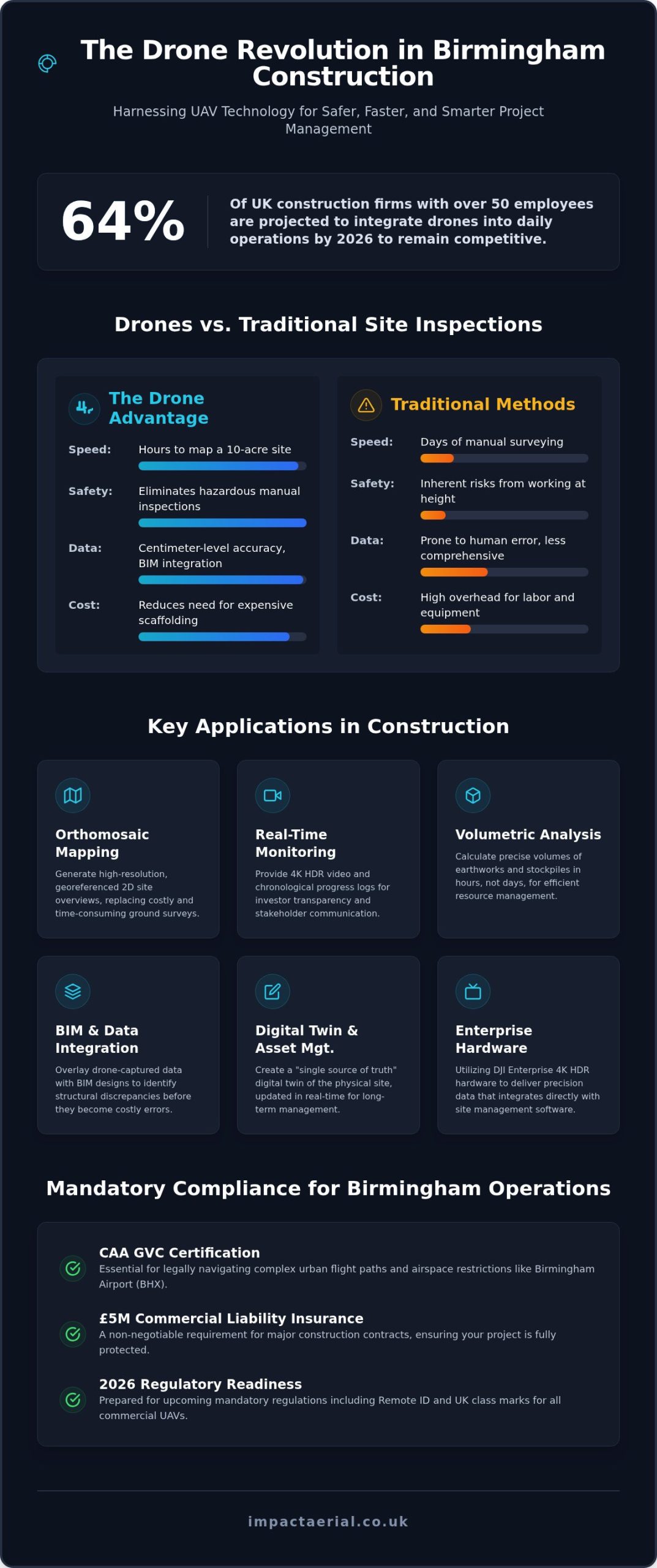
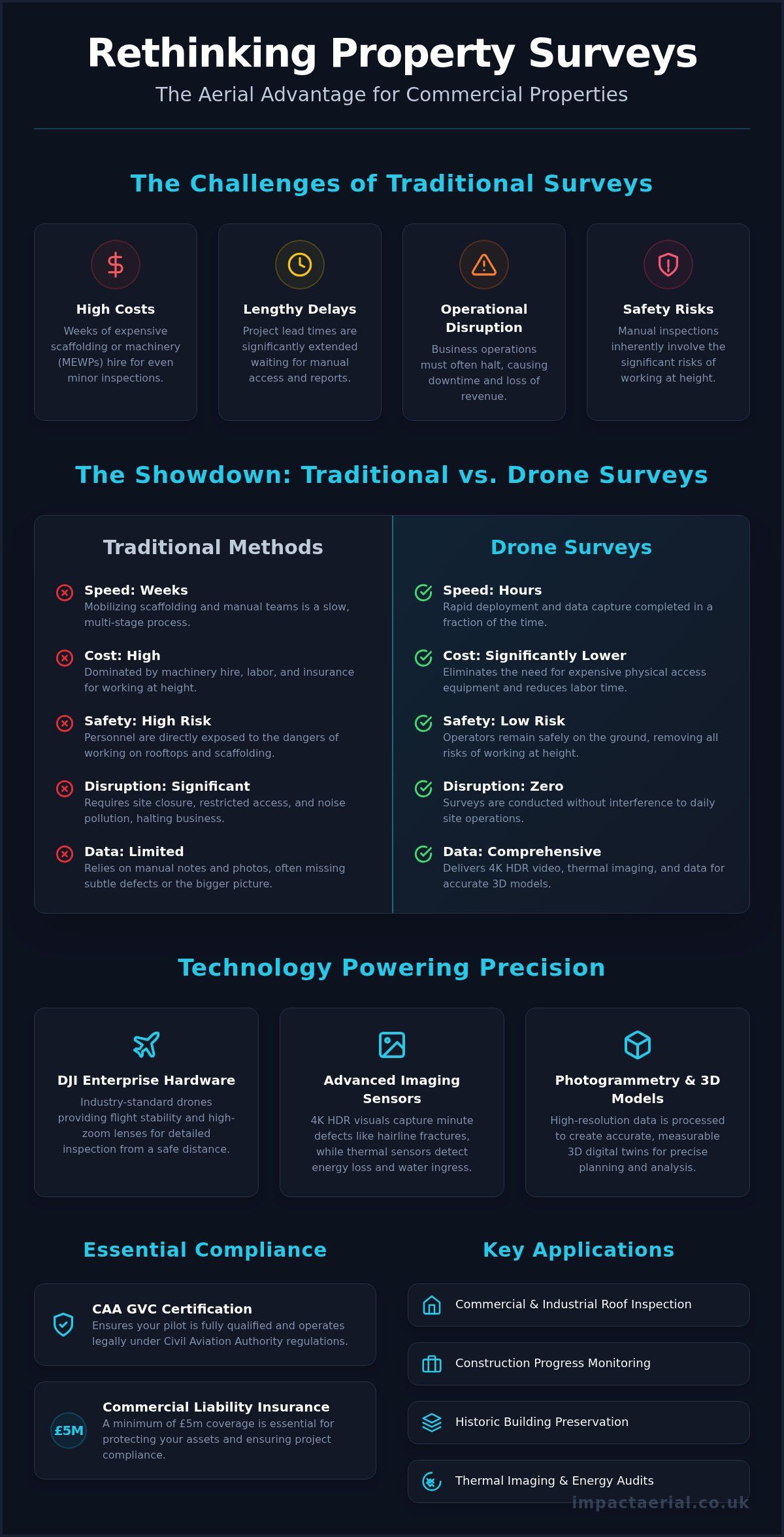
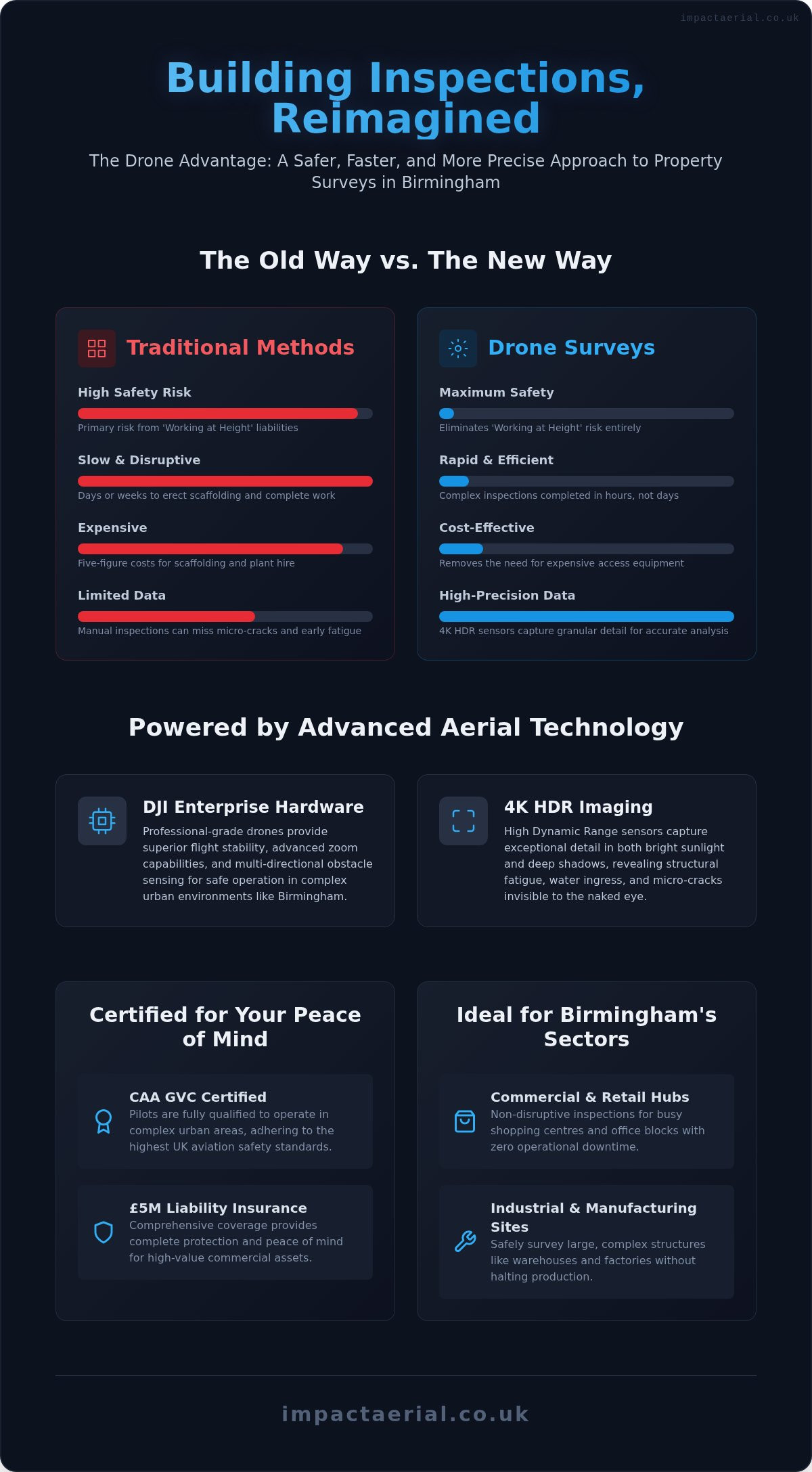
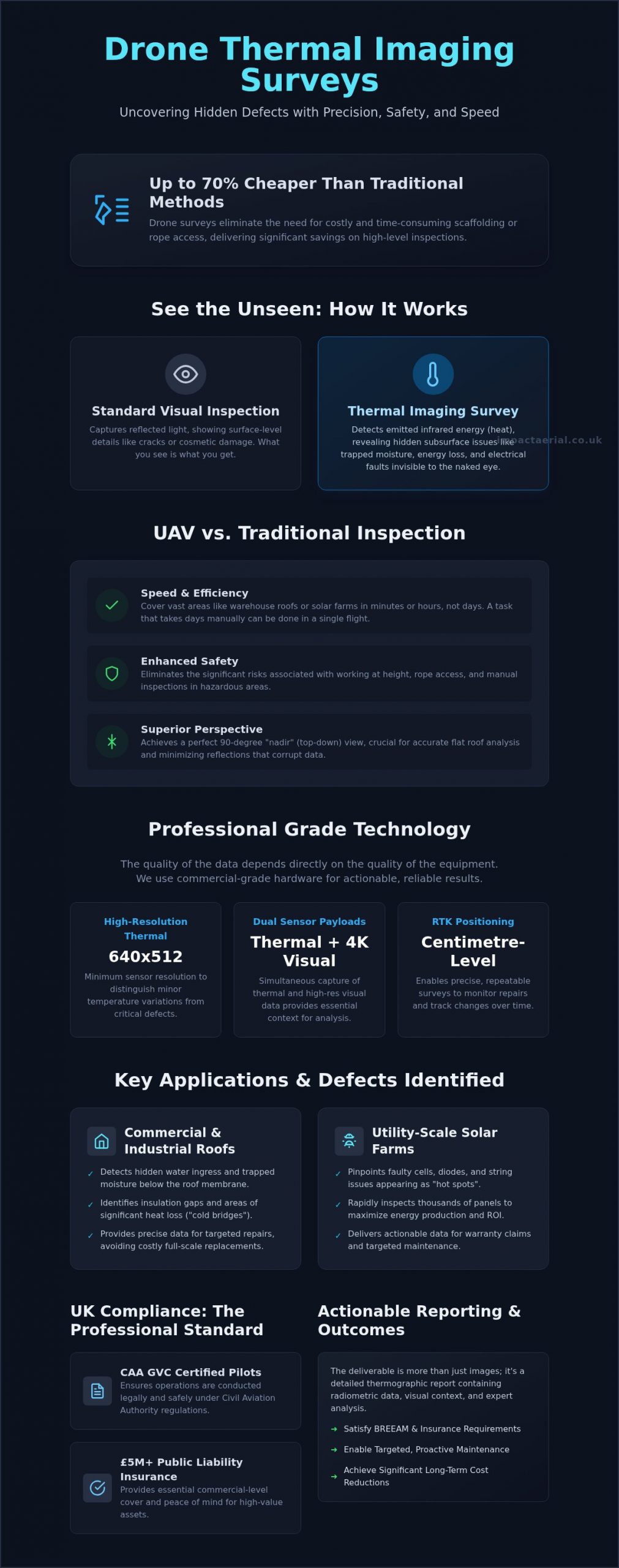
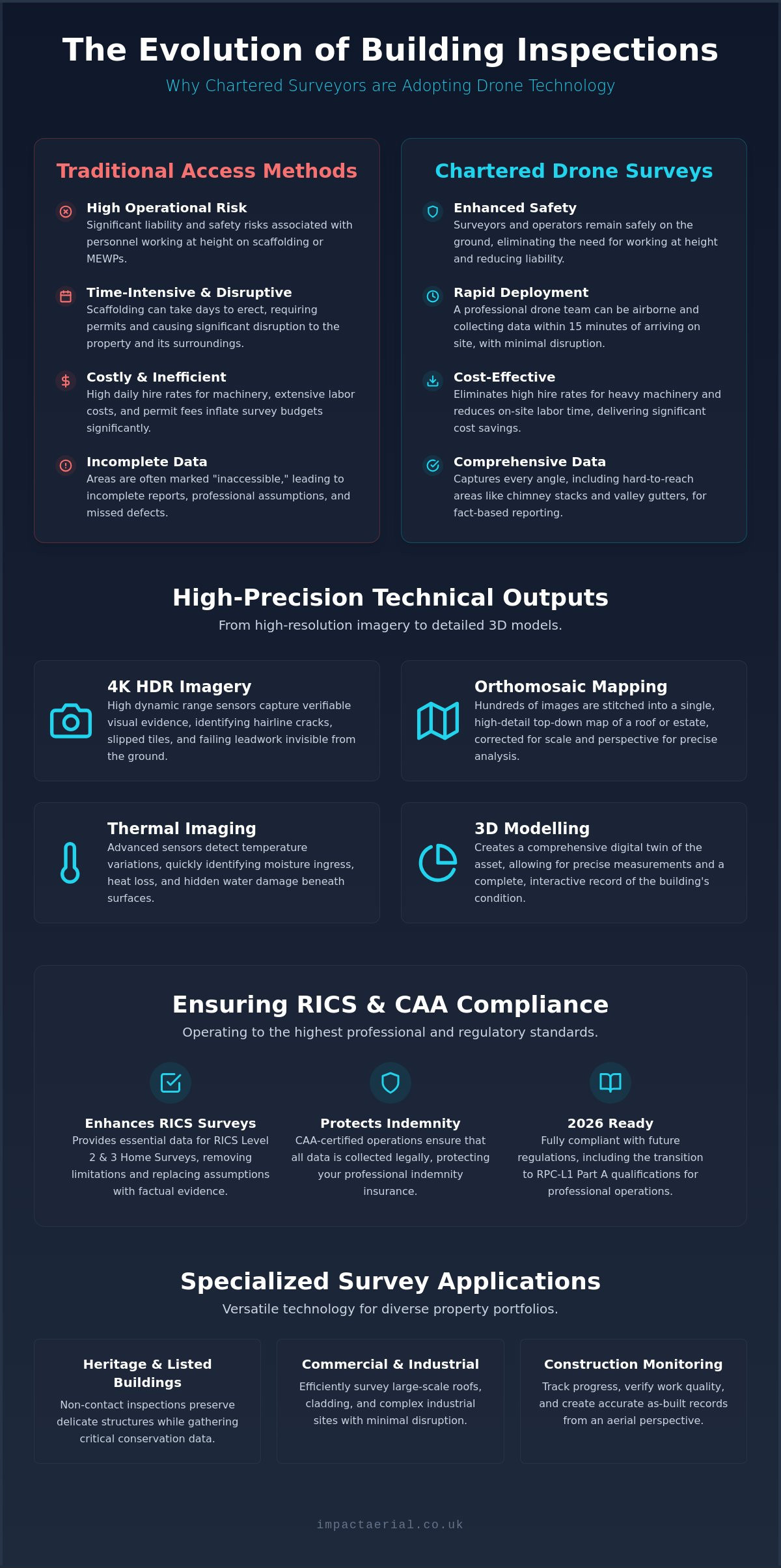
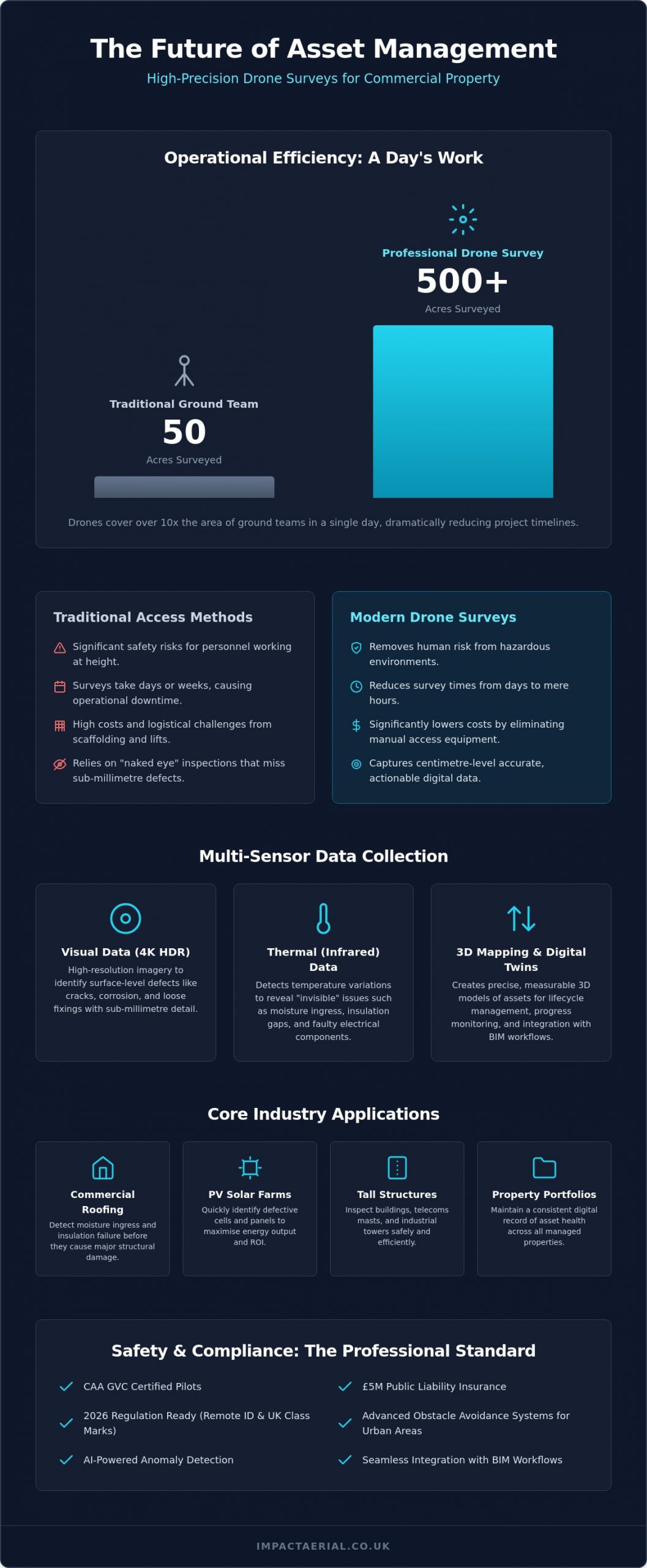
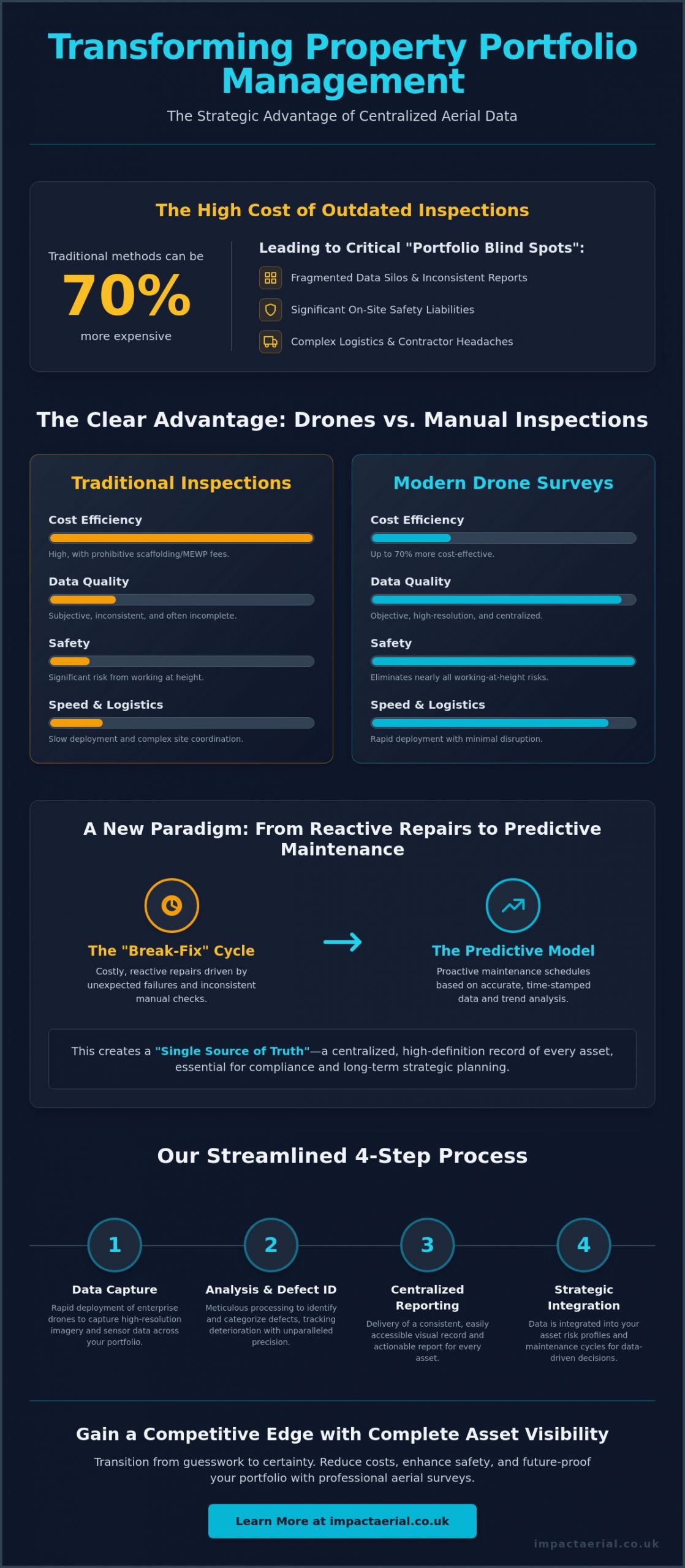
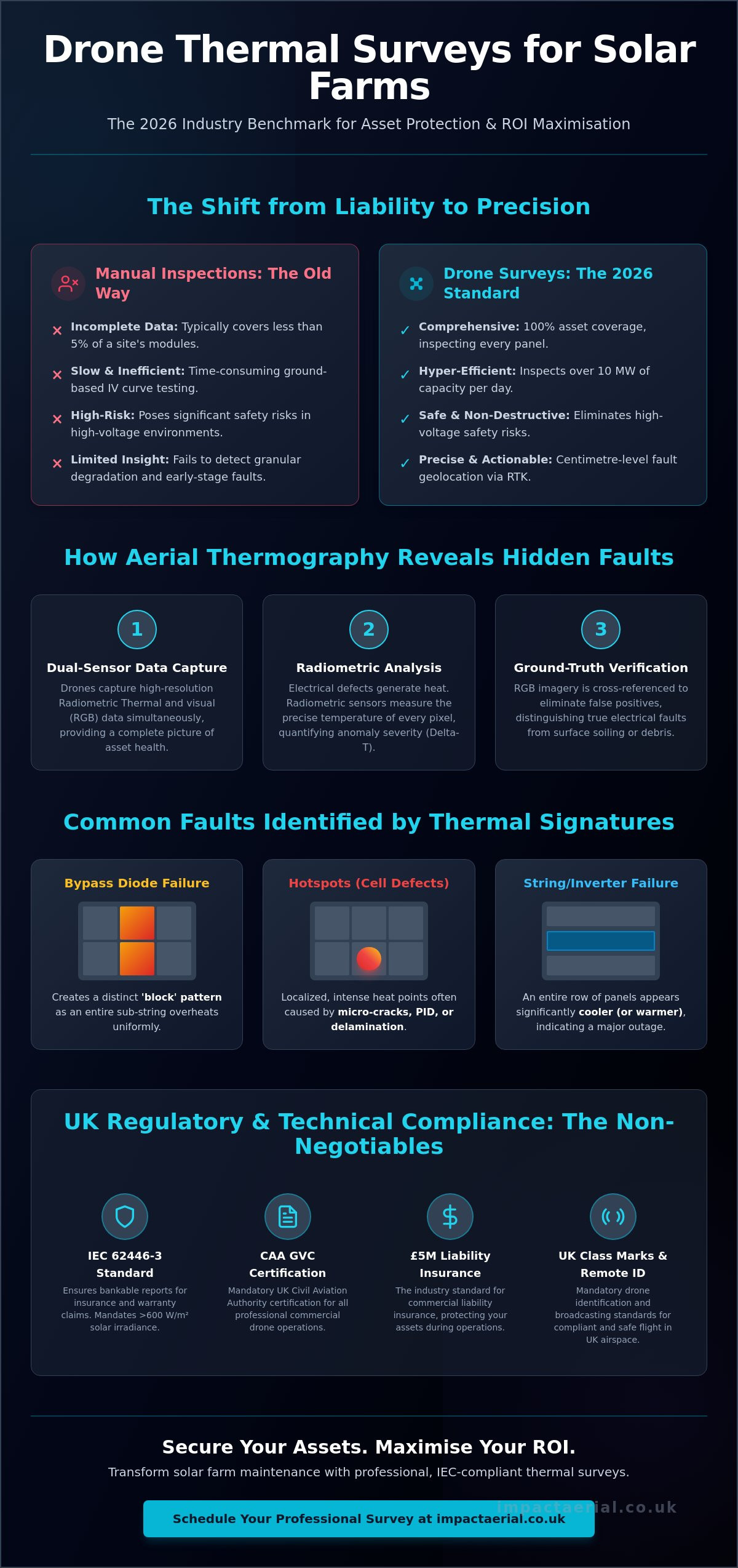
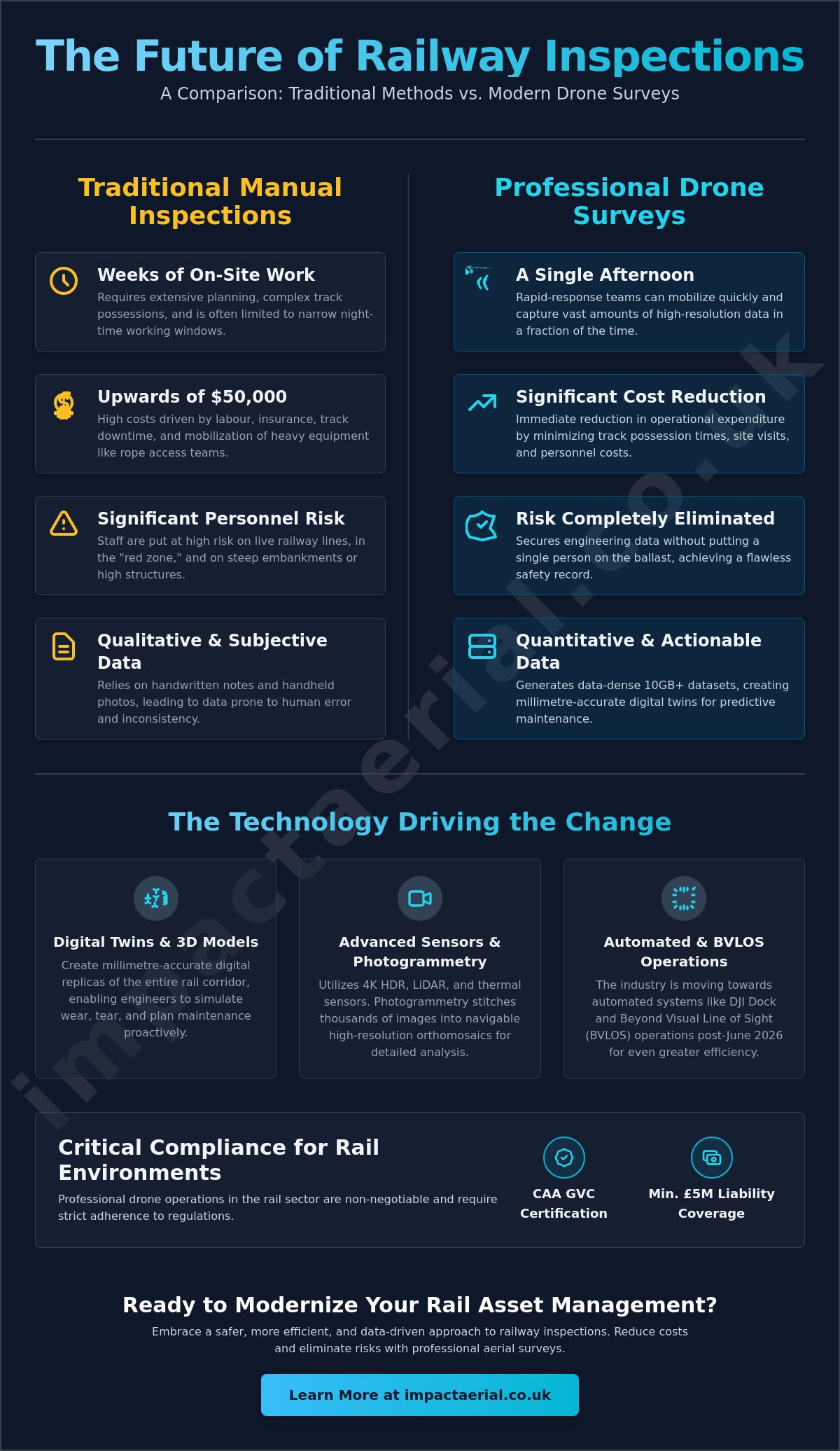
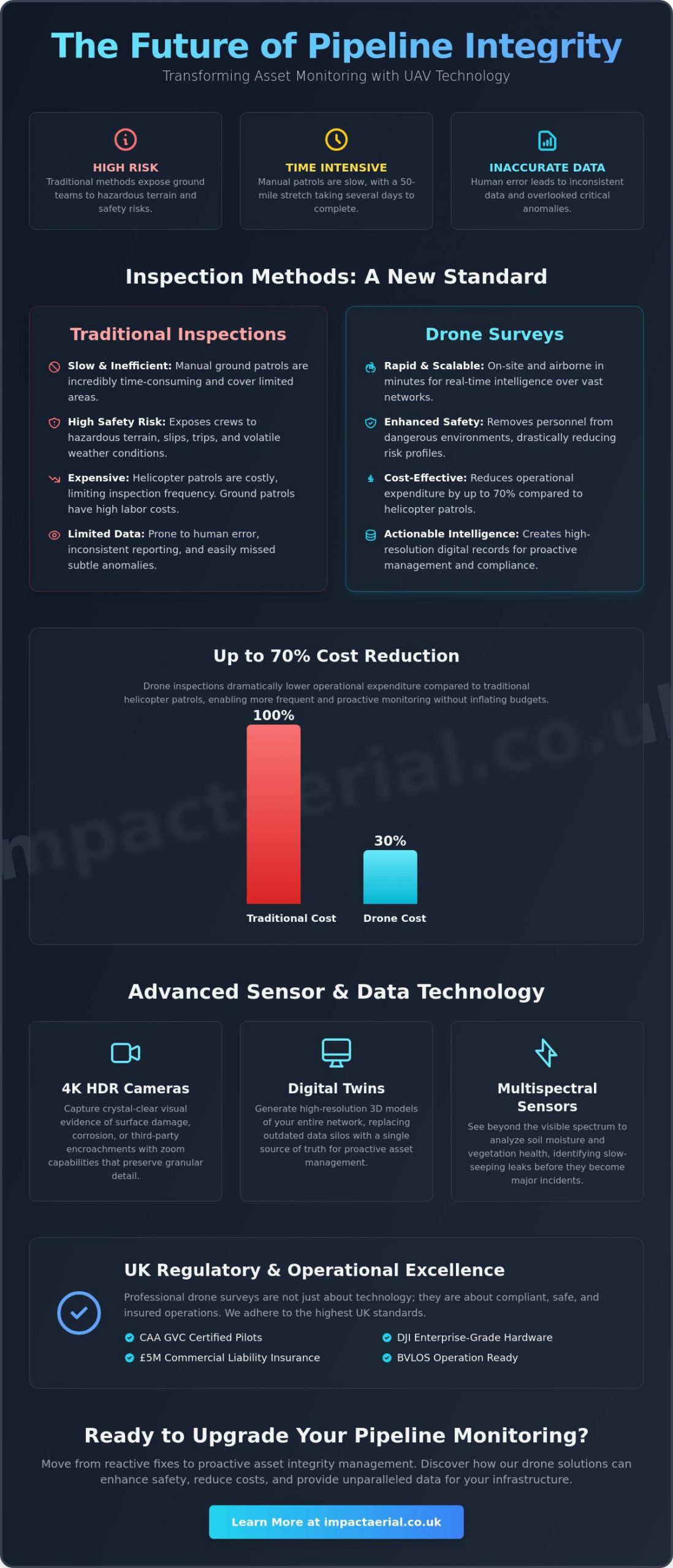
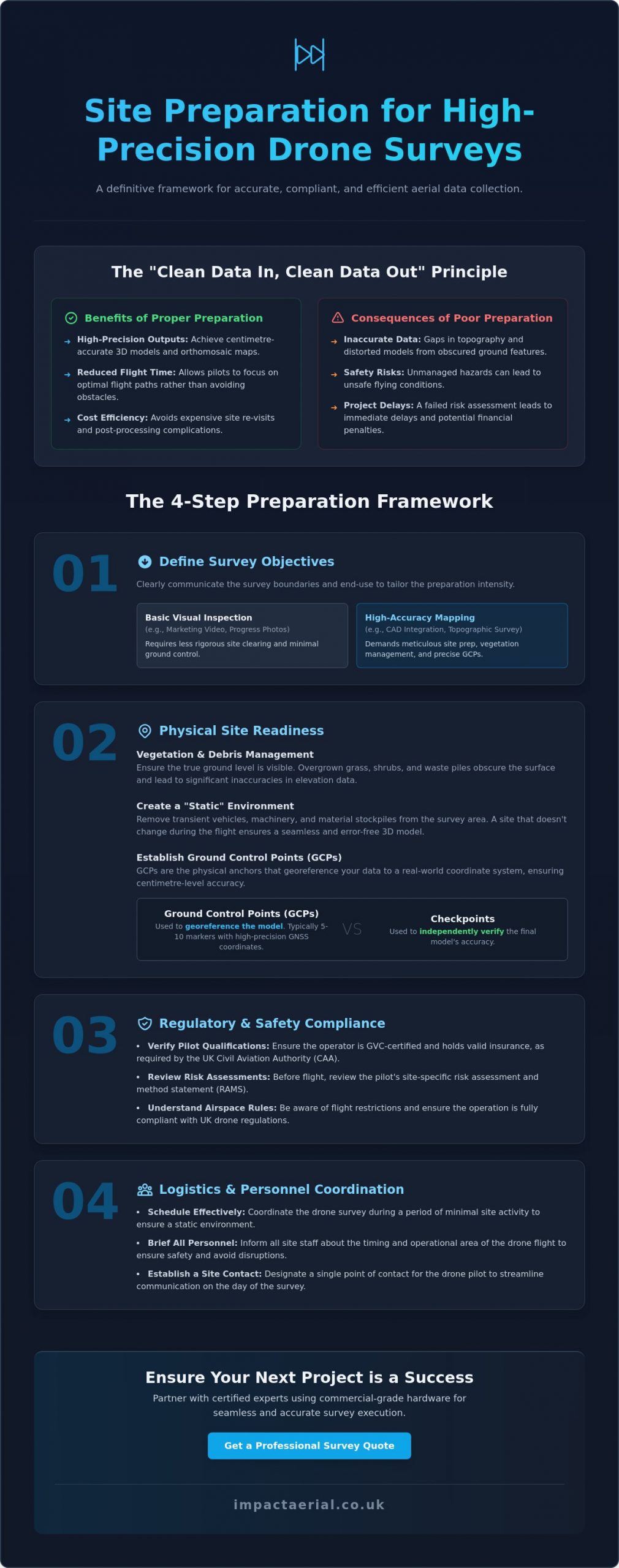
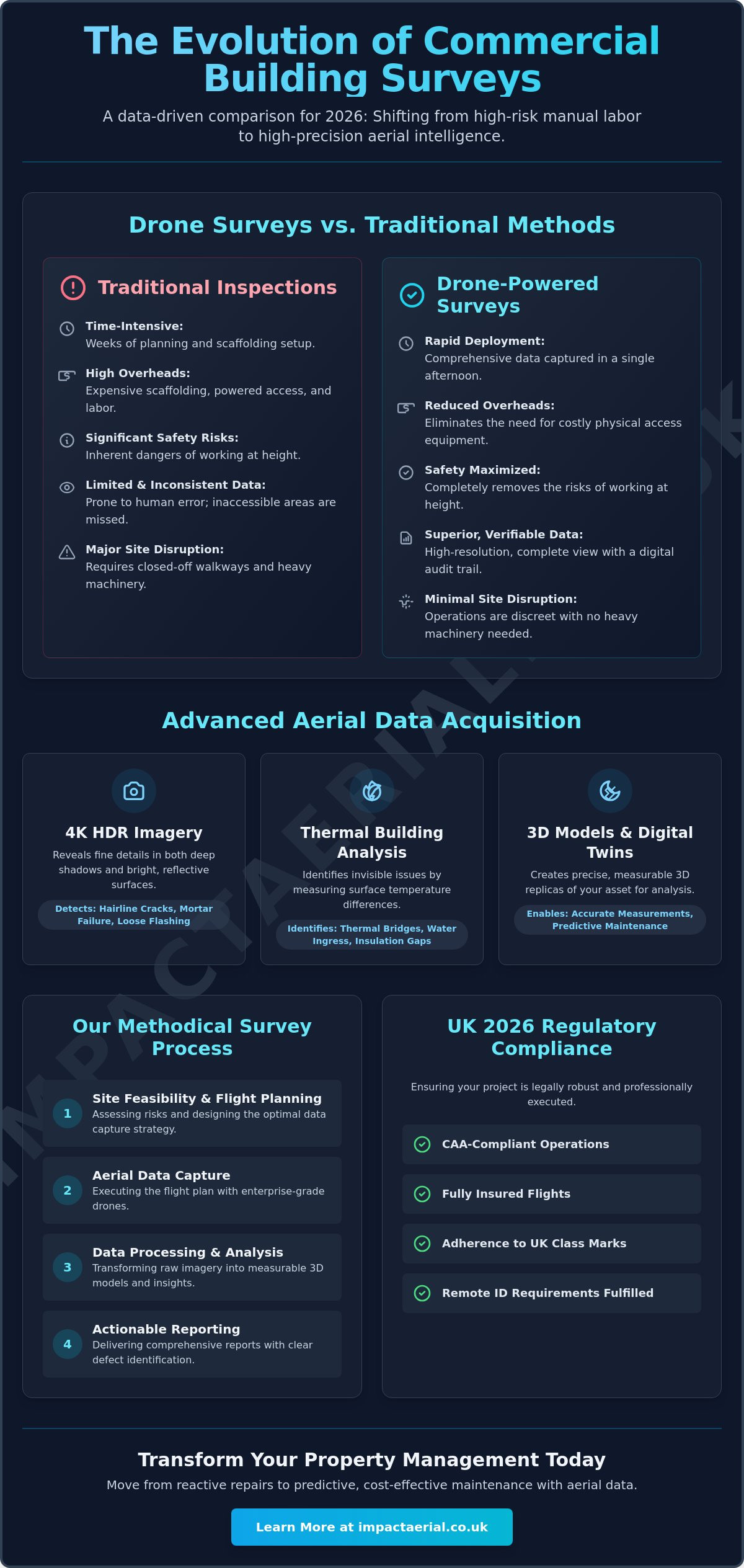
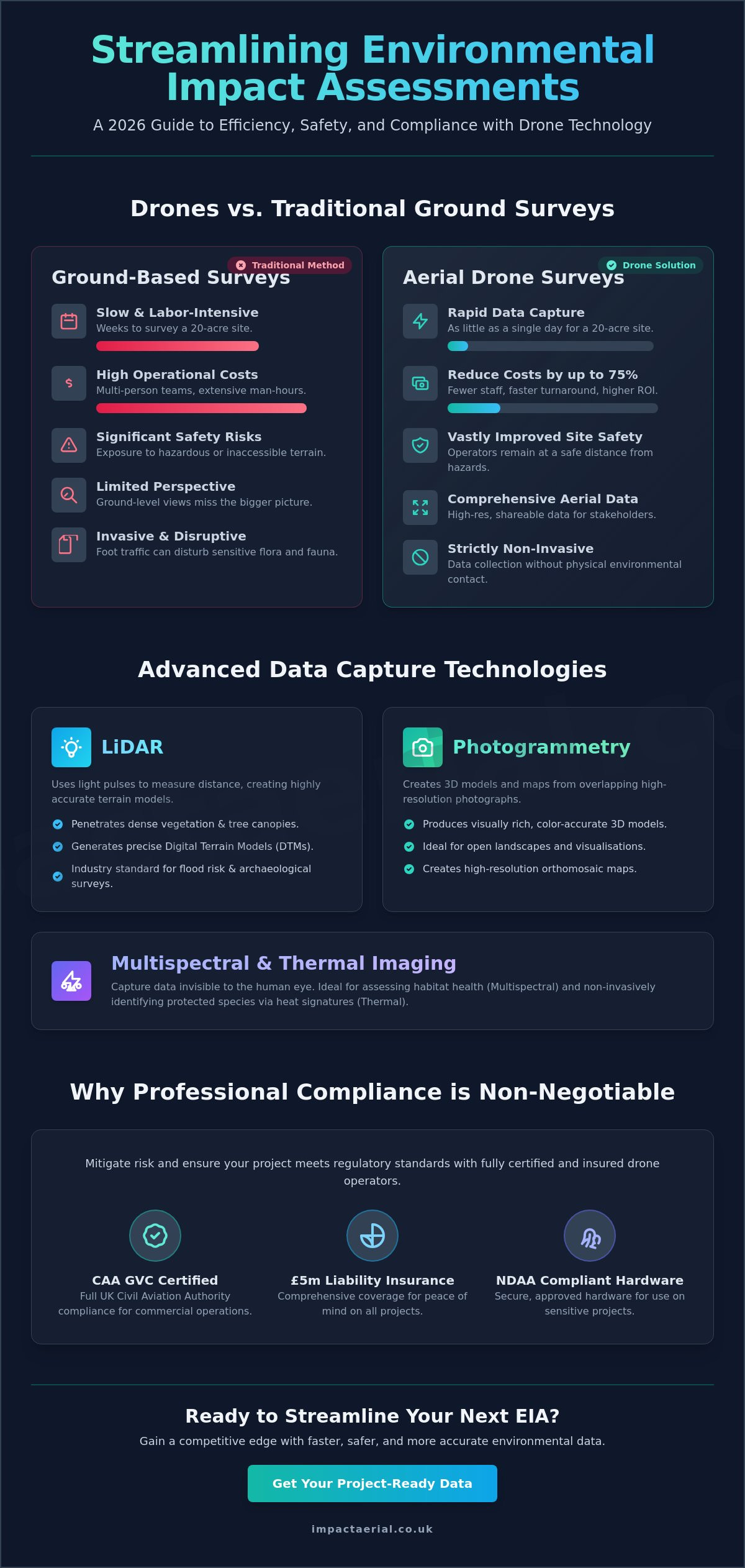
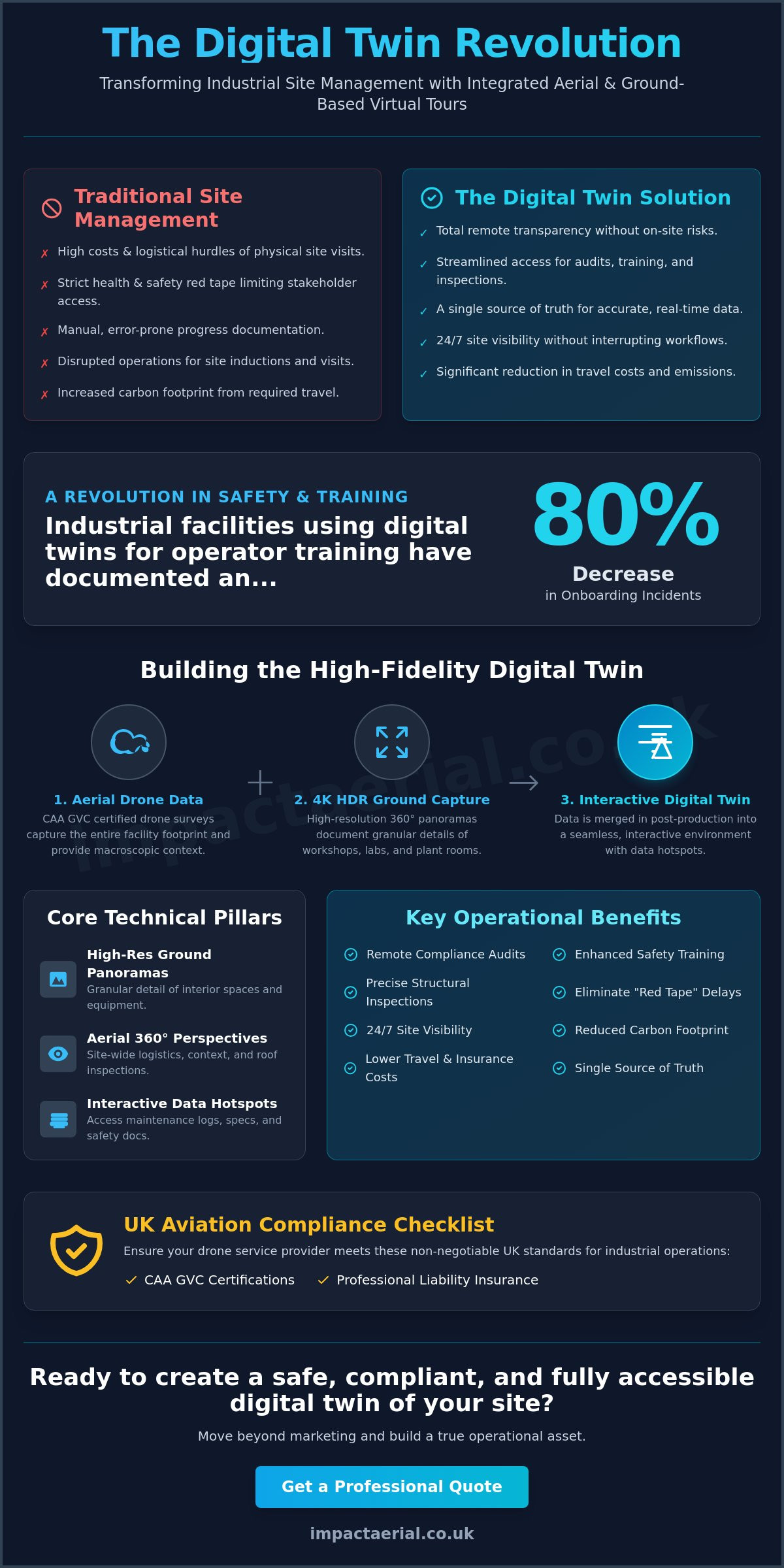
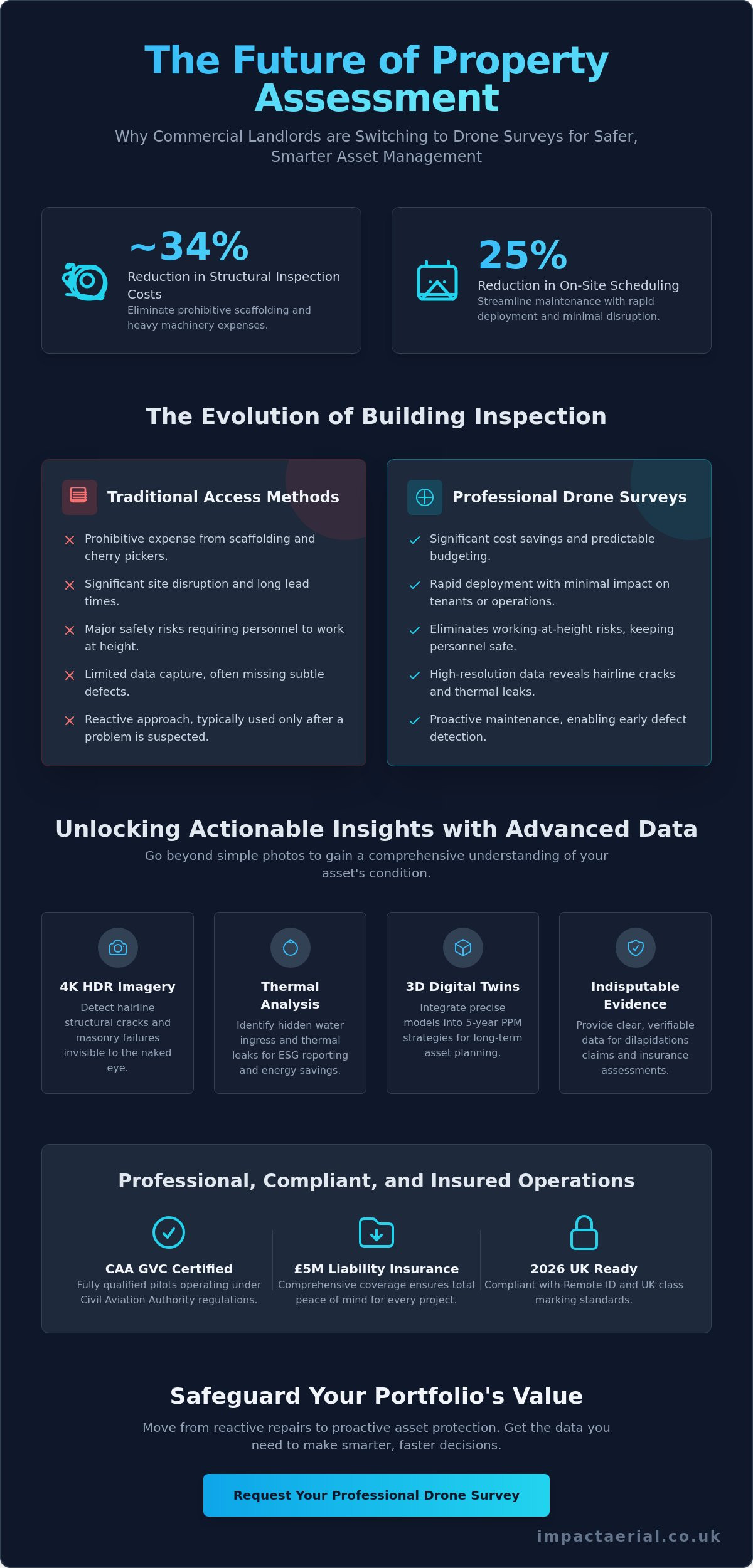
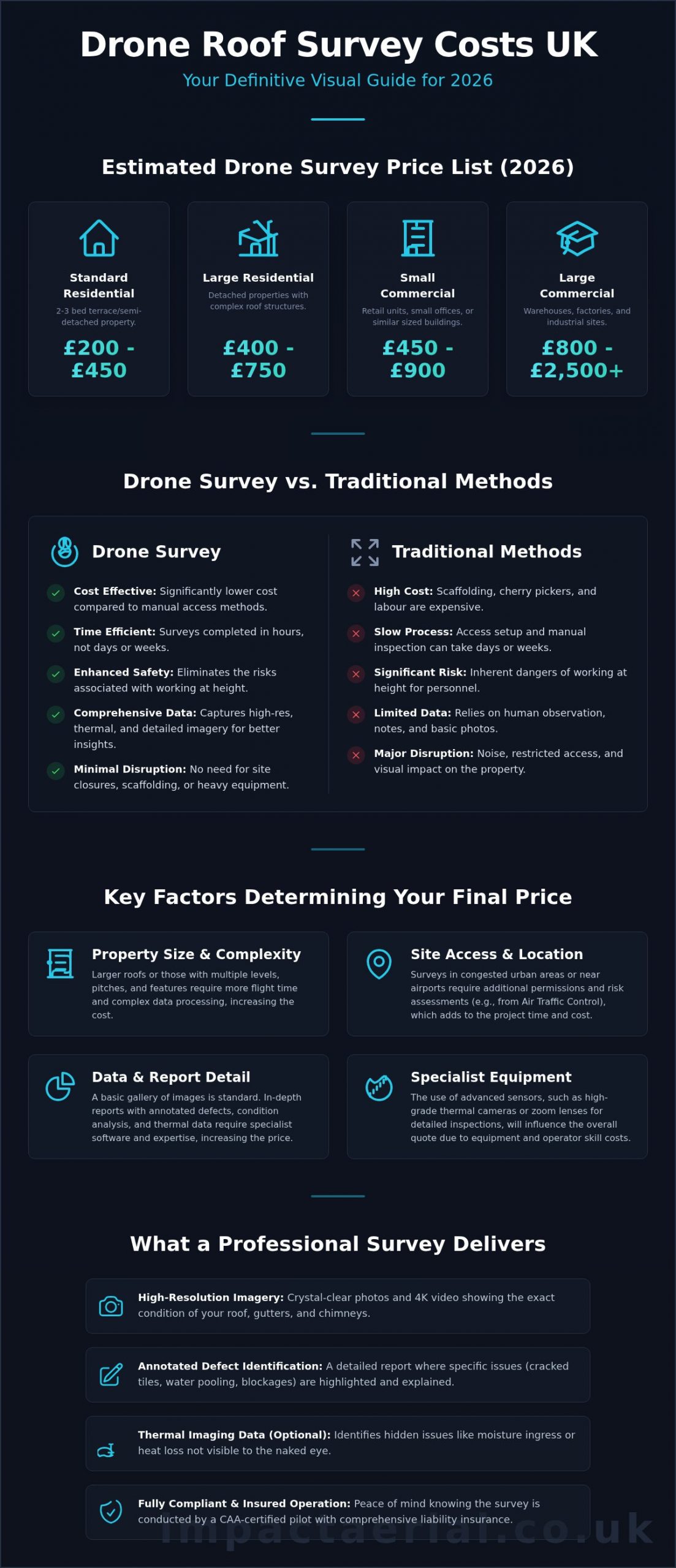
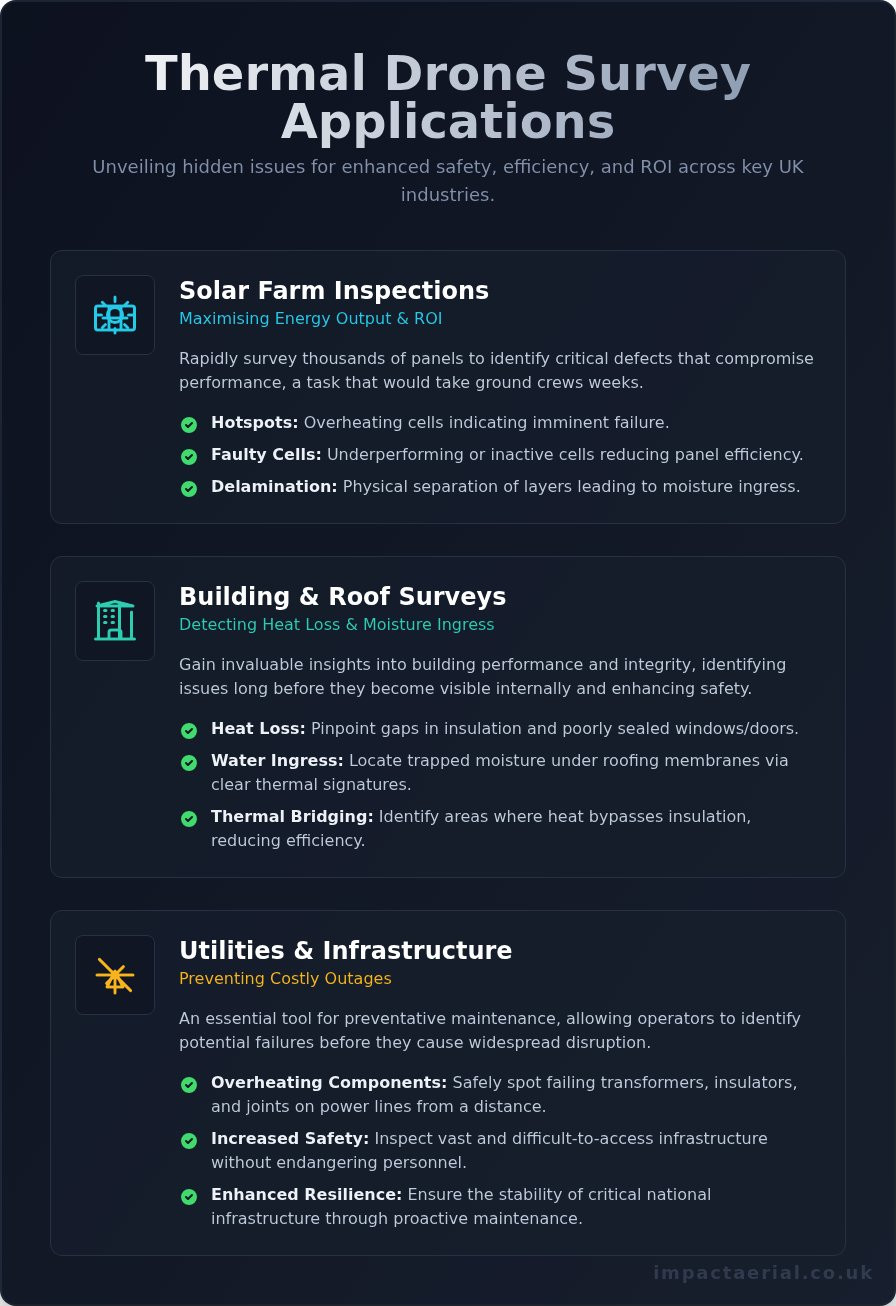
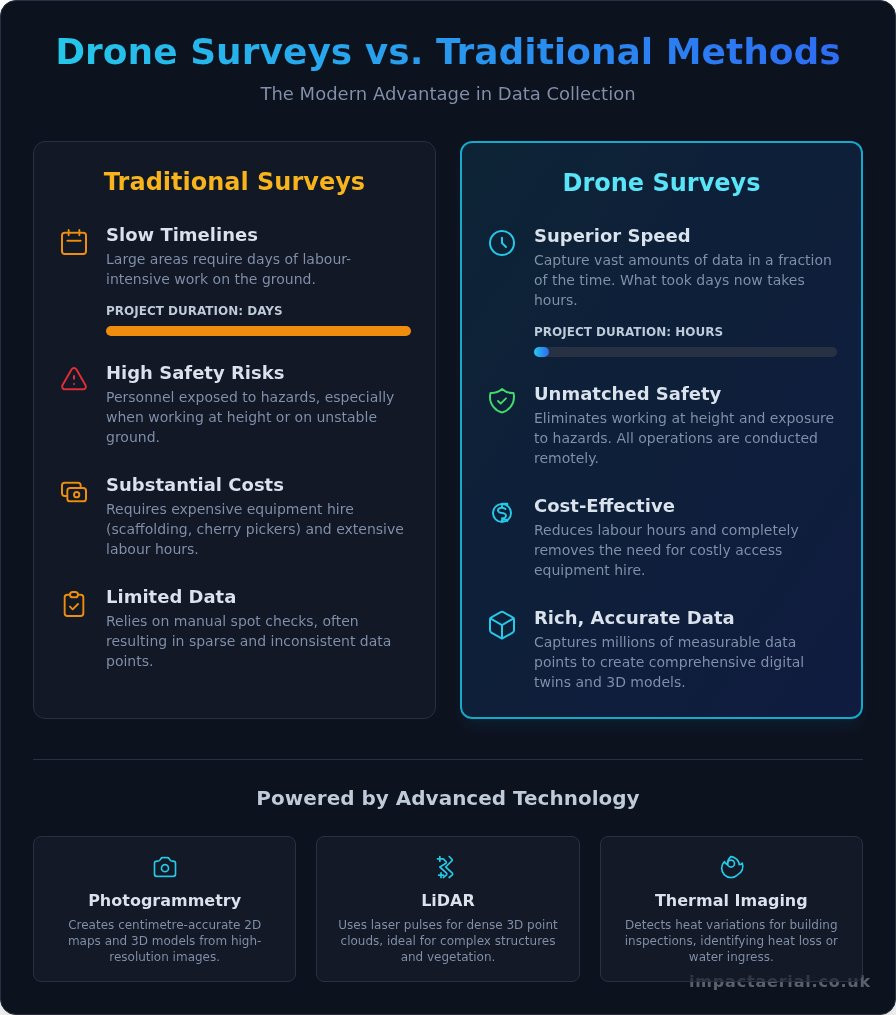
 2 Norton Drive, Wythall, Birmingham, B47 6HH Company registration number: 11138586. VAT Number: 366 9068 55