Construction Drone Services Bristol: Professional Aerial Data & Site Monitoring

How much of your project’s 2024 schedule is currently being consumed by the 40% time lag typically associated with traditional manual site inspections? You likely understand that managing a major build in Bristol presents unique challenges, especially when navigating the complex airspace restrictions near Filton or the City Centre. This is why professional construction drone services bristol have become essential for maintaining momentum while ensuring absolute safety and regulatory compliance.

By leveraging expert aerial data, you gain access to high-resolution progress reports and accurate 3D mapping that ground-based teams can’t replicate. This article shows you how our CAA GVC certified experts provide the technical precision required for survey-grade volumetric analysis. For added peace of mind, we’ll explain how real-time site monitoring mitigates risk and prevents the inaccuracies often found in amateur data. You’ll discover the specific workflows we use to turn complex aerial imagery into actionable insights that keep your Bristol project moving forward without delay.

Key Takeaways

  • Learn how replacing manual scaffolding inspections with rapid UAV assessments provides actionable data while significantly reducing site downtime and safety risks.
  • Discover how survey-grade photogrammetry and volumetric analysis deliver high-resolution 2D maps and precise stockpile measurements for site managers.
  • Navigate the complexities of the Filton and Bristol Airport flight restriction zones by partnering with CAA GVC certified construction drone services bristol.
  • Explore proven strategies for organizing aerial data into professional progress reports and consistent time-lapse sequences to track project milestones effectively.
  • Gain “peace of mind” by understanding the meticulous safety protocols and advanced DJI Enterprise technology required for reliable commercial operations.

The Evolution of Construction Drone Services in Bristol: Why Aerial Data is Essential

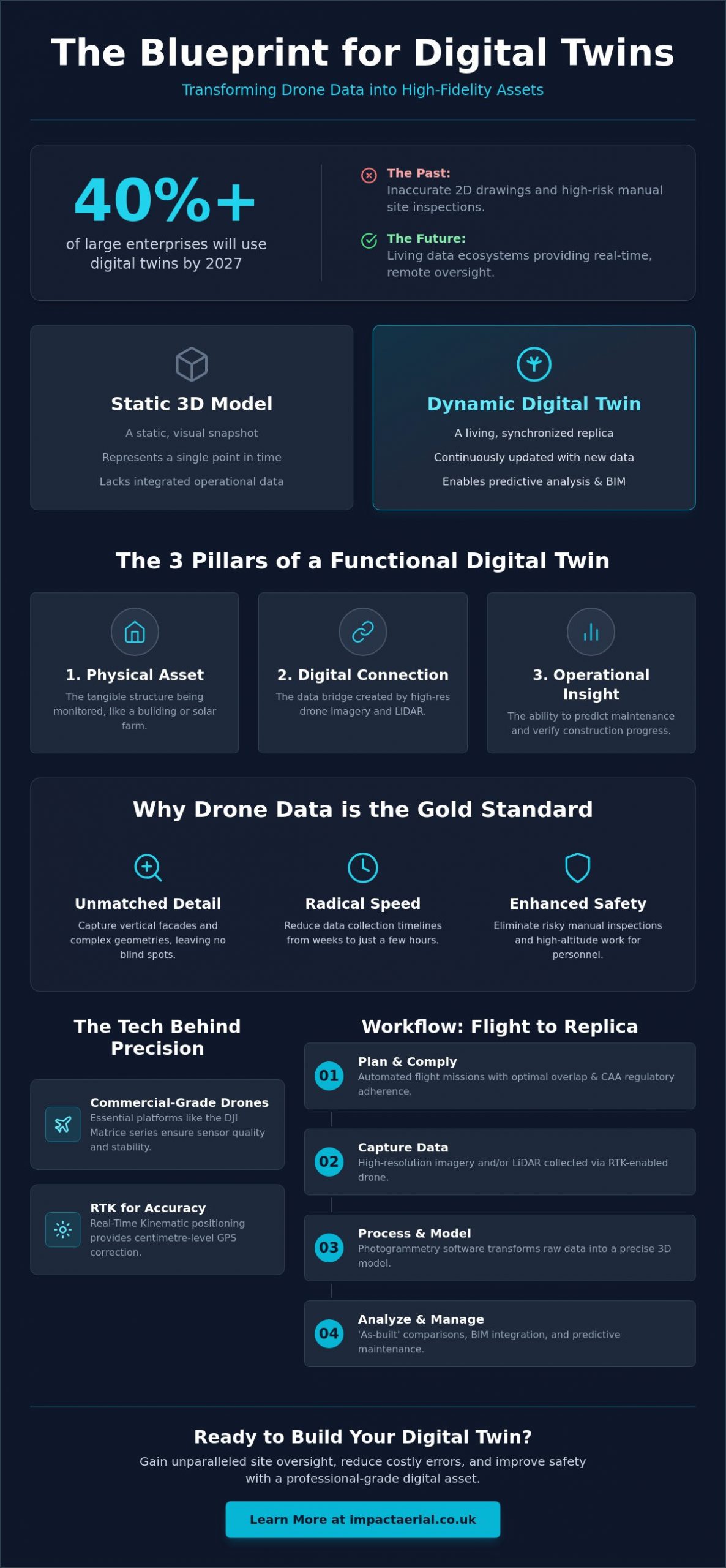
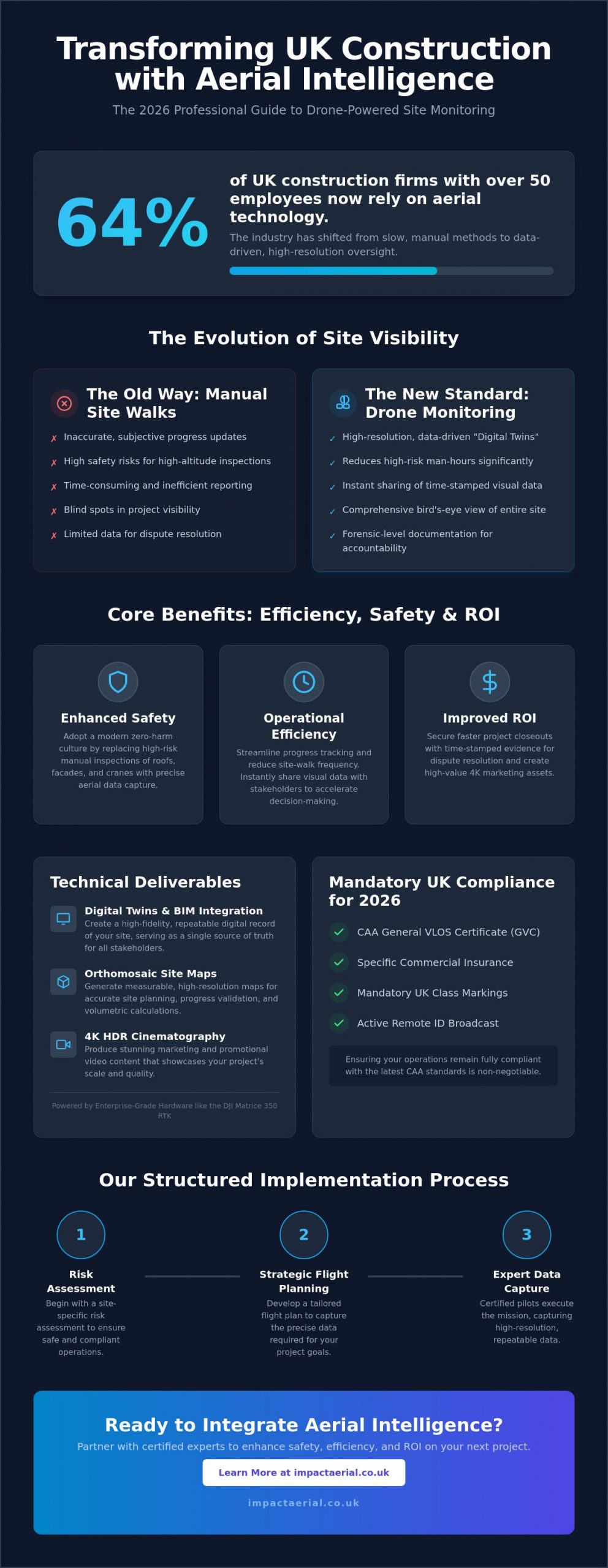
Bristol’s construction landscape is undergoing a significant transformation, where professional unmanned aerial vehicle (UAV) technology has moved past simple aerial photography into high-precision data gathering. Modern construction drone services bristol now provide the technical foundation for “Digital Twins” in massive urban regeneration projects, such as the 70-hectare Temple Quarter development. These virtual replicas allow project managers to simulate complex scenarios and track structural changes with millimetre accuracy, ensuring that Bristol’s skyline evolves with mathematical precision.

To better understand how aerial data transforms a site over time, watch this helpful video:

By 2024, the adoption of drone technology in UK construction has seen a 239% increase as firms move away from anecdotal progress reports toward data-driven insights. This shift ensures that developers aren’t just looking at visual progress; they’re measuring volumetric data and site topography against BIM (Building Information Modelling) standards. This level of detail is essential for managing the niche but increasingly diverse market of Bristol’s brownfield redevelopments.

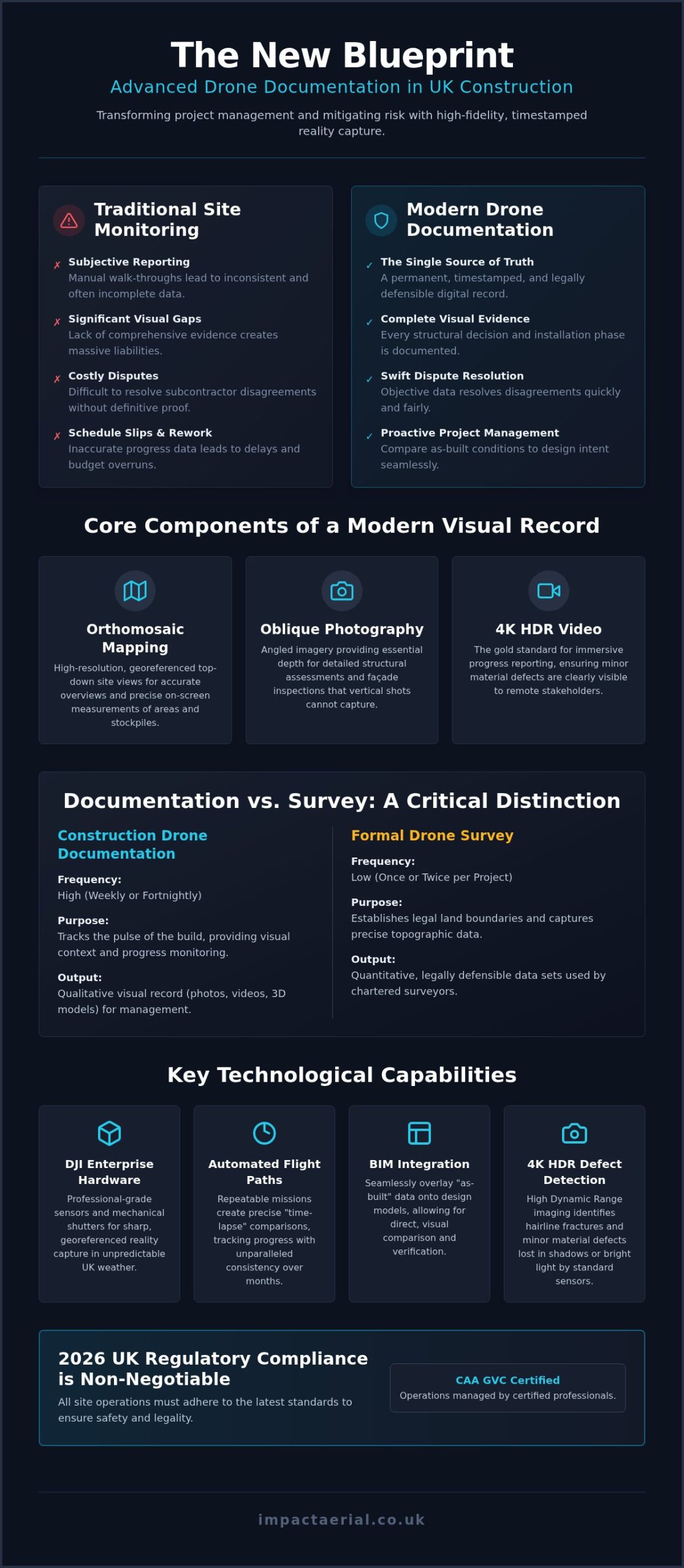
Replacing Traditional Inspection Methods

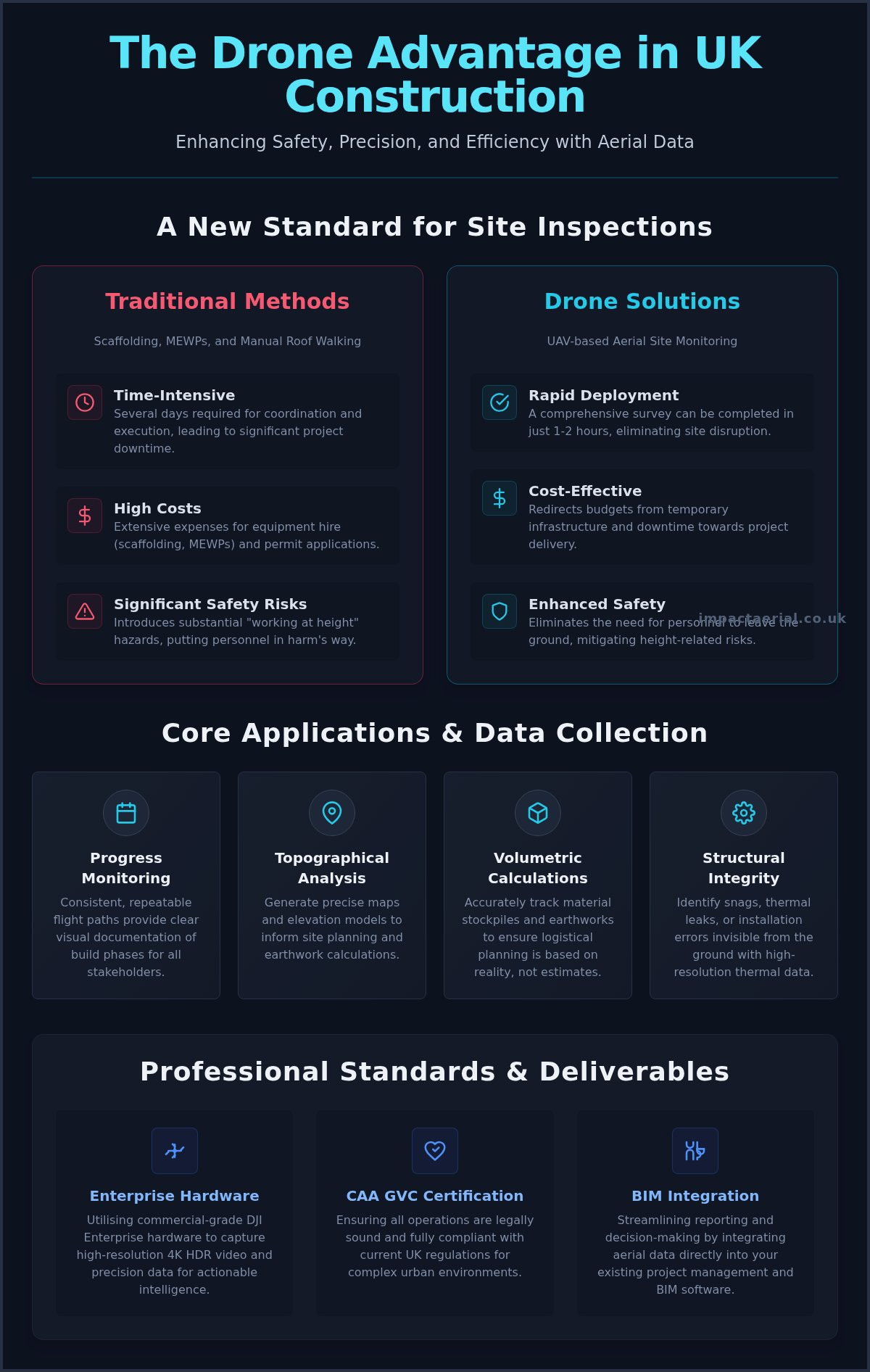
UAV surveys offer a safer, more efficient alternative to manual inspections on 40-metre cranes or fragile roof structures. Utilizing a CAA GVC Certified pilot provides added peace of mind, ensuring all operations comply with strict safety regulations and commercial liability requirements.

  • Safety: Aerial inspections reduce “boots on the ground” in high-risk zones by up to 80%, significantly lowering the site’s overall risk profile.
  • Cost-Efficiency: Traditional scaffolding for a single roof inspection can cost thousands and take days to erect, whereas a drone assessment typically takes less than 60 minutes.
  • Precision: High-resolution sensors capture defects that are often invisible to the naked eye from the ground.

Real-Time Progress Monitoring

Our fleet uses the latest 4K HDR DJI Enterprise drones to document weekly site evolution with absolute clarity. These high-quality visuals facilitate remote site visits for international investors and off-site stakeholders, allowing them to inspect Bristol developments from anywhere in the world without the need for travel. Precise site monitoring ensures that physical construction aligns perfectly with architectural blueprints, preventing costly project drift and mid-build corrections. By providing construction drone services bristol

Specialised Aerial Surveys and Data Collection for Bristol Site Managers

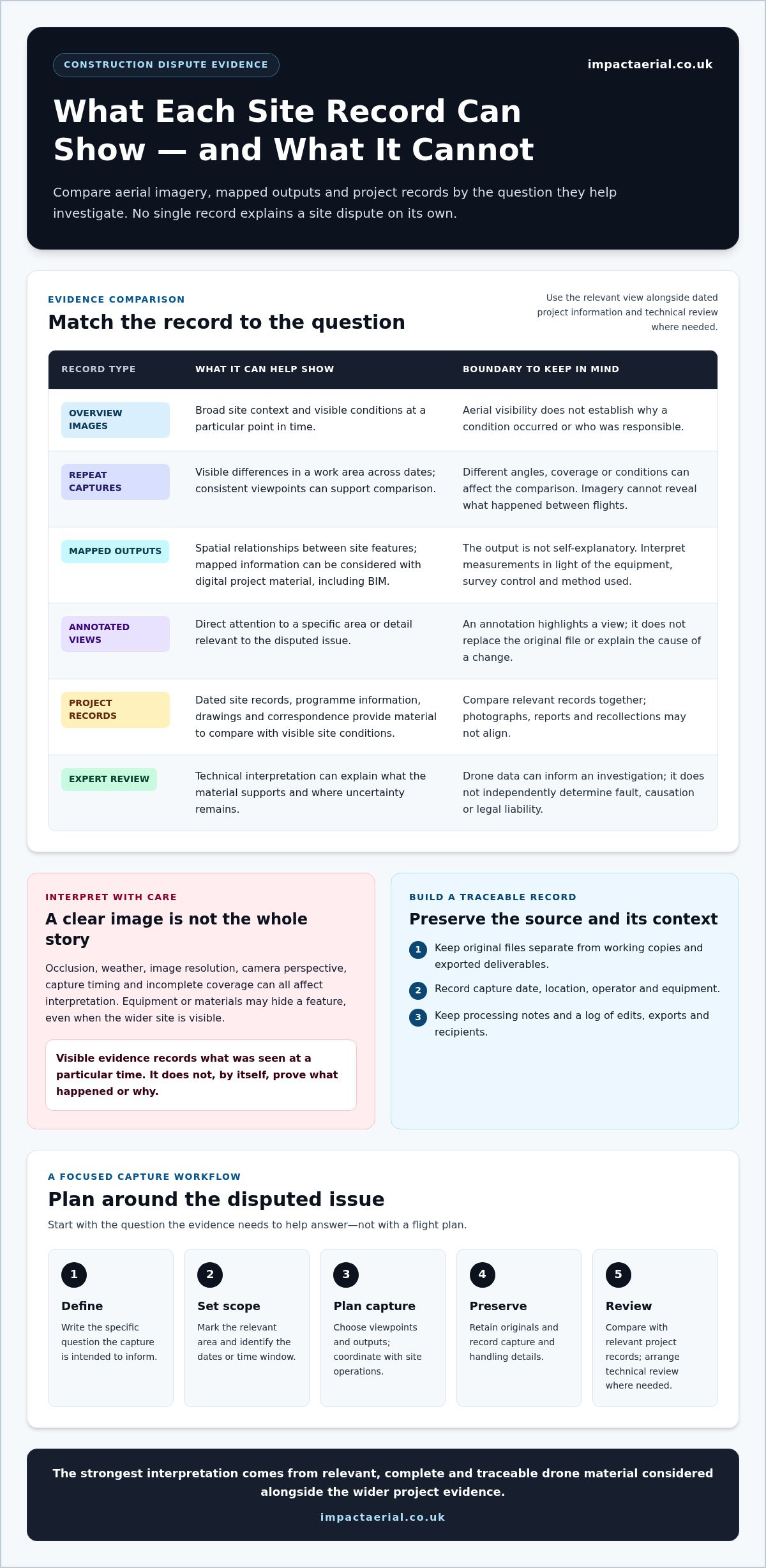
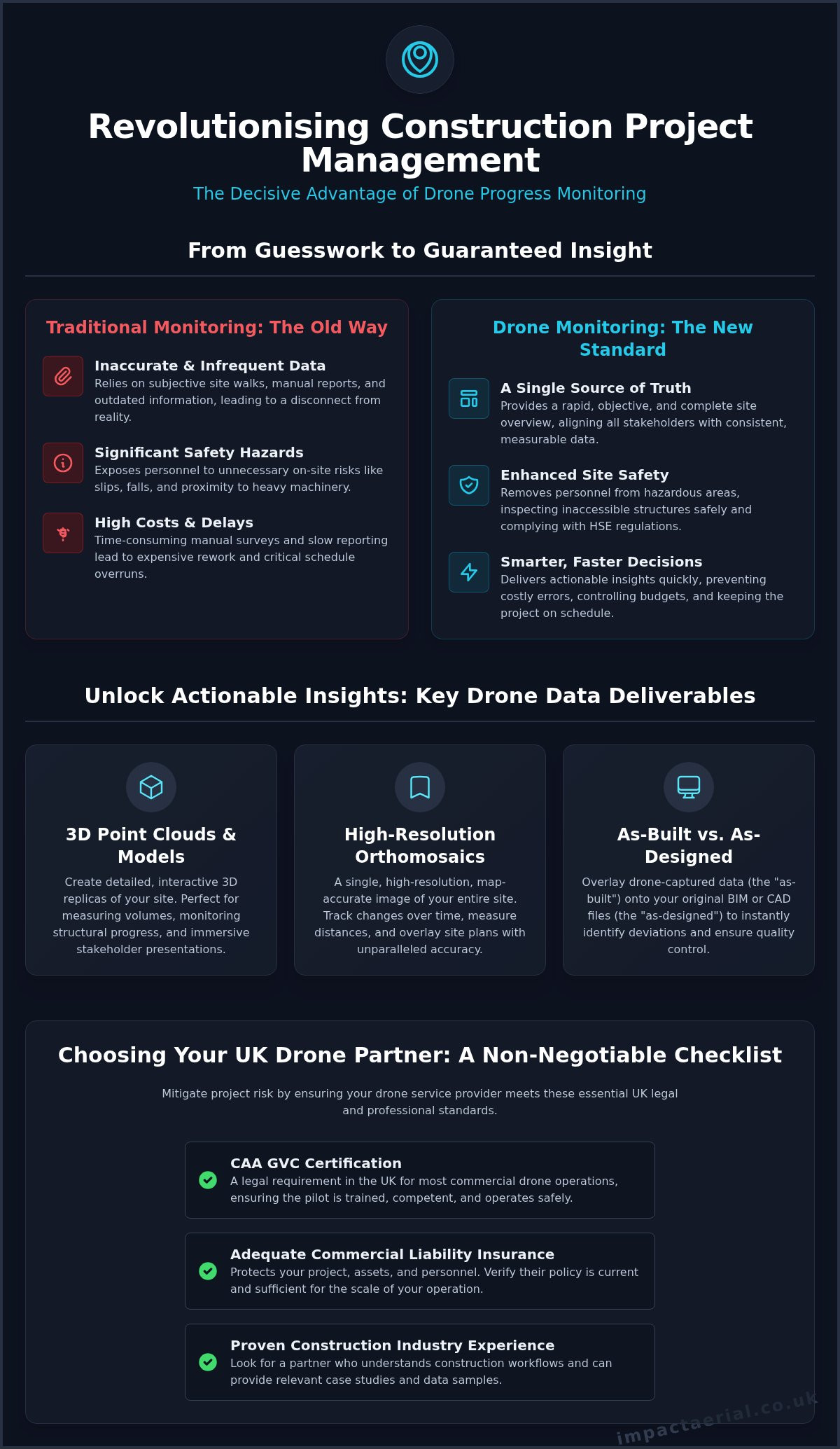
Bristol site managers face unique challenges with urban density and complex terrain. Modern construction drone services bristol provide a streamlined solution for capturing high-resolution photogrammetry. We generate accurate 2D orthomosaic maps that allow for precise site monitoring throughout the project lifecycle. These maps aren’t just pictures; they’re data-rich assets. By using 3D modelling, we facilitate seamless BIM integration, which helps project managers identify structural clashes before they become costly errors on the ground.

Thermal imaging adds another layer of technical oversight to our professional services. Our thermal sensors detect heat loss or moisture ingress in new builds, providing a non-destructive way to verify insulation quality and structural integrity. This data-gathering approach ensures that every element of the building envelope meets the specified standards. We provide the technical clarity needed to make informed decisions without delaying site progress.

Topographical and Volumetric Surveys

Precision is the foundation of any successful earthworks project. We utilise DJI Enterprise drones equipped with RTK (Real-Time Kinematic) technology to achieve centimetre-level accuracy across the entire site. This allows us to calculate the volume of stockpiles and excavations with survey-grade precision. Instead of relying on manual measurements that can take days, our aerial surveys provide results in hours. You can learn more about the technical side in our survey drone guide to see how this technology integrates with your existing workflow.

Building and Roof Inspections

Traditional inspections often require expensive cherry pickers or scaffolding, which increase costs and safety risks. Our professional construction drone services bristol eliminate these hurdles. We capture detailed 4K imagery of hard-to-reach cladding, guttering, and roof structures. Using High Dynamic Range (HDR) ensures we capture every detail, even in shadowed areas or high-contrast environments common on complex build sites.

Safety remains our absolute priority. Every flight we conduct adheres strictly to CAA drone regulations as outlined in CAP 722. This compliance gives our clients peace of mind that their site monitoring is legal, insured, and professional. Our pilots are CAA GVC Certified, ensuring that your project stays compliant while benefiting from top-quality aerial data. If you’re looking to enhance your site’s efficiency, you can contact us for a consultation on your next Bristol project.

Bristol presents a unique set of challenges for aerial operations. The city’s geography includes the 5km Flight Restriction Zones (FRZ) surrounding Bristol Airport to the south and Filton Aerodrome to the north. Successfully delivering construction drone services bristol requires more than just technical skill; it demands a deep understanding of the legal landscape. We treat every site as a bespoke aviation project, ensuring all flights remain within the strict parameters set by the Civil Aviation Authority (CAA).

Operating in Controlled Airspace

Flying in high-density urban environments like the Bristol city centre or the Temple Quarter Enterprise Zone requires rigorous coordination. We manage the entire administrative burden, from submitting Non-Standard Flight (NSF) applications to NATS to maintaining direct radio contact with local Air Traffic Control. Our pre-flight planning includes a detailed review of Ground Hazards and NOTAMs (Notices to Airmen) to prevent any disruption to local aviation. Check our guide to UK drone licenses for more on compliance to understand how these rules affect your project. We don’t just show up and fly; we ensure every takeoff is legally sanctioned and safe.

The “Peace of Mind” Guarantee

The transition from the old Permission for Commercial Operation (PfCO) to the General Visual Line of Sight Certificate (GVC) marks a significant shift in drone regulation. Our pilots hold current GVC certifications, which are essential for operating heavier enterprise-grade drones in “congested” areas. This qualification reflects a higher standard of pilot competency and operational safety. For added peace of mind, we back our expertise with £5 million in commercial drone liability insurance. This is the baseline requirement for major Bristol construction firms and Tier 1 contractors. It protects your project against unforeseen incidents and ensures adherence to site safety protocols.

Hiring an uncertified or uninsured pilot isn’t just a safety lapse; it exposes developers to massive legal liabilities and potential prosecution under the Air Navigation Order. Impact Aerial mitigates this risk through a meticulous approach to every mission:

  • Detailed site-specific risk assessments (RAMS) completed 48 hours before arrival.
  • Use of DJI Geo-fencing and secondary fail-safe systems on all aircraft.
  • Verification of all flight paths against current CAA aeronautical charts.
  • Full membership in the Drone Safe Register to ensure industry-leading standards.

By maintaining these standards, we provide a reliable service that integrates seamlessly with your existing health and safety frameworks. We understand that on a busy construction drone services bristol project, safety is the primary priority. Our methodical planning ensures that data gathering never comes at the expense of site security or public safety.

Maximising ROI: How to Organise Aerial Data for Construction Milestones

To realise the full return on investment from construction drone services bristol, data management must be as precise as the flight itself. Capturing high-resolution imagery is only the first step; the real value lies in how that data is structured, stored, and shared across your project team. Professional drone operations turn raw visual files into actionable intelligence that drives decision-making at every project milestone.

We use GPS-guided waypoints to establish consistent flight paths. This ensures that every subsequent flight follows the exact same coordinates, camera pitch, and altitude. It’s the only way to produce comparable time-lapse data that accurately tracks week-on-week progress. By maintaining this consistency, stakeholders can overlay different build stages to identify deviations from the original design. This level of precision is critical for projects in 2024 where margins are tight and schedules are non-negotiable.

Modern sites rely on collaborative digital environments. We facilitate the integration of aerial data into project management platforms like Procore and Autodesk Build. This allows site managers to view 4K orthomosaics directly alongside their BIM models. Using 360-degree panoramas, teams can conduct immersive site walkthroughs from any location, reducing the need for unnecessary site visits and improving safety by keeping personnel out of high-risk areas.

Data Processing and Post-Production

Impact Aerial transforms raw sensor data into professional, edited progress reports that serve multiple stakeholders. While site managers need raw technical data, investors and planning authorities require a more polished perspective. Our team processes 4K HDR footage into cinematic marketing content that highlights project success. These high-quality visual assets are essential for planning applications and public consultations where visual clarity is paramount. You can Explore our cinematic aerial filming drone services to see how we elevate standard site footage into compelling narratives.

Long-Term Asset Management

The utility of drone data extends far beyond the construction phase. By creating a comprehensive digital archive of the build process, developers secure a “Golden Thread” of information for future maintenance. This archive is invaluable for post-completion warranty and insurance claims, providing dated evidence of structural elements before they were covered by cladding or internal finishes. For those managing Bristol commercial units, virtual tours created during the final stages of the build assist in early leasing and sales, allowing potential tenants to explore the space before the keys are even handed over.

Ready to streamline your site monitoring with professional data? Contact Impact Aerial today to discuss your project requirements.

Impact Aerial: Your Partner for Professional Construction Drone Services in Bristol

Impact Aerial brings over five years of specialized experience to the South West construction sector. We’ve built a reputation for reliability across the West Midlands and Bristol by delivering high-precision data that project managers trust for critical decision-making. Our operations aren’t just about flying; they’re about providing a technical advantage through meticulous data-gathering and photogrammetry. By utilizing the latest DJI Enterprise fleet, including the Mavic 3 Enterprise and Matrice series, we ensure maximum reliability and data accuracy for every site visit. We understand that construction timelines are tight, so we focus on a client-centric approach that moves efficiently from the initial consultation to final data delivery.

Why Bristol Developers Choose Us

We provide a unique blend of technical surveying and high-end cinematic filming. This dual capability allows developers to use a single flight for both topographical data and marketing materials, saving both time and budget. Our pilots are local experts who understand the geographic constraints of the region. We’re familiar with the complex airspace requirements near Bristol Temple Meads and the specific wind conditions often found at coastal sites like Avonmouth. Every pilot we deploy is CAA GVC certified. They carry years of commercial experience and comprehensive public liability insurance. This professional standing provides the necessary peace of mind for high-stakes urban projects where safety and compliance are non-negotiable.

Get Started with Your Bristol Project

Onboarding Impact Aerial for your construction drone services bristol is a streamlined, methodical process. We begin with a detailed consultation to define your specific data requirements. To provide an accurate, bespoke quote, your initial brief should include the site postcode, the total acreage, and your preferred frequency of visits. We also need to know if you require specific outputs like 3D point clouds, 2D orthomosaics, or 4K progress videos. Once we have these details, we conduct a thorough site assessment and handle all necessary flight planning and risk assessments.

Our team prides itself on being a trusted specialist in a niche but increasingly diverse market. We don’t just deliver images; we provide actionable insights through secure cloud portals, ensuring your stakeholders have immediate access to the latest site intelligence. Whether you’re managing a small residential build or a major infrastructure project, our construction drone services bristol are designed to scale with your needs.

Contact us today to discuss your Bristol construction drone requirements and learn how our professional aerial data can streamline your next project.

Elevate Your Project Standards with Professional Site Monitoring

Adopting advanced aerial intelligence is the most effective way to streamline workflows and mitigate risks on modern build sites. Our construction drone services bristol provide the technical precision required for accurate site monitoring and detailed photogrammetry. By deploying our DJI Enterprise 4K HDR Fleet, site managers gain access to high-resolution data that identifies potential issues before they become costly delays. Safety remains our primary focus. Every mission is conducted by CAA GVC Certified Pilots who are experts at navigating the specific constraints of Bristol’s urban airspace. For added peace of mind, we carry £5m Commercial Liability Insurance to ensure your project is fully protected. It’s time to replace manual inspections with data-driven insights that deliver a tangible return on investment. We’re ready to help you capture the perspectives that matter most for your project’s success. Let’s start building a clearer picture of your site’s progress today.

Request a professional drone survey quote for your Bristol site

Frequently Asked Questions

Do I need special permission to use a drone on a Bristol construction site?

You don’t need special council permission for every flight, but you must comply with CAA regulations and have the landowner’s consent. Our pilots hold CAA GVC (General Visual Line of Sight Certificate) qualifications, allowing us to operate legally in congested urban areas. We handle all necessary risk assessments and flight notifications through the CAP 722 framework to ensure every project meets UK aviation law.

What is the typical cost for construction drone services in Bristol?

The cost for construction drone services in Bristol depends on the project’s complexity, site size, and required data outputs. Factors influencing the price include the number of flight hours, the type of sensors used, and the depth of post-processing needed for 3D modelling. We provide bespoke quotes after reviewing your specific site requirements and safety constraints rather than using a flat rate.

How quickly can you mobilise for a site inspection in the South West?

We can typically mobilise for a site inspection in the South West within 24 to 48 hours of instruction. Our proximity to the M4 and M5 corridors allows us to reach sites across Bristol, Bath, and Gloucestershire rapidly. For emergency structural inspections or urgent site monitoring, we prioritise our schedule to provide same-day or next-day deployments whenever weather conditions allow.

Can drones fly in typical Bristol weather conditions?

Our DJI Enterprise drones can operate in wind speeds up to 12 metres per second and have IP45 or IP55 weather resistance ratings. While we can fly in light drizzle, we avoid heavy rain or gale-force winds to protect data quality and maintain safety standards. We monitor local Met Office aviation forecasts hourly to ensure we choose the optimal window for your aerial data collection.

What insurance coverage does Impact Aerial provide for on-site operations?

For added peace of mind, Impact Aerial maintains £5 million in specialist commercial drone liability insurance as standard. Our coverage is fully compliant with EC 785/2004 requirements and can be increased to £10 million for specific high-risk contracts or large-scale infrastructure projects. This ensures all stakeholders are protected against third-party property damage or injury during our professional construction drone services in Bristol.

Can you provide survey-grade accuracy for volumetric measurements?

We achieve survey-grade accuracy for volumetric measurements by using Real-Time Kinematic (RTK) positioning and Ground Control Points (GCPs). This methodology allows us to provide measurements with a relative accuracy of 1 to 3 centimetres. Our photogrammetry software calculates stockpile volumes and site topographies with a high degree of precision, replacing traditional manual surveying methods that often take days to complete.

How is the data delivered and what software do I need to view it?

We deliver processed data through secure cloud-based platforms or direct file transfers in formats like GeoTIFF, OBJ, and PDF. You won’t need specialised hardware to view standard reports, as our web-based viewers work in any modern browser. For more technical applications, our files are fully compatible with industry-standard BIM and CAD software, including Autodesk Revit and ArcGIS.

Is it possible to fly drones in the Filton or Bristol Airport restricted zones?

It’s possible to fly in the Filton or Bristol Airport Flight Restriction Zones (FRZ), but it requires prior coordination with Air Traffic Control (ATC). We manage the entire application process, including submitting flight plans through the NATS drone assist system at least 14 days in advance for non-emergency work. Our pilots maintain radio contact with the relevant airfield throughout the operation to ensure total airspace safety.

Aerial Progress Photos for Developers: A Strategic Guide to Site Monitoring in 2026

Could a single missing visual update cost your project £50,000 in avoidable delays? For UK developers managing complex sites in 2026, the gap between ground-level reporting and reality is where budgets often disappear. You already know that relying on manual inspections or inconsistent aerial progress photos for developers leads to miscommunication with remote stakeholders. It’s a frustrating bottleneck that stalls decision-making and leaves your firm vulnerable to expensive project disputes. In an industry where 98% of large-scale projects face cost overruns, guessing is no longer a viable strategy.

This guide demonstrates how professional drone data transforms site monitoring from a reactive chore into a strategic asset. By using CAA GVC certified pilots and 4K HDR drone technology, you’ll gain high-resolution visual evidence that reduces project risk by up to 20% through better oversight. We’ll examine how repeatable visual data improves stakeholder transparency and provides the added peace of mind required to keep your 2026 developments on schedule and within budget. Discover how to leverage technical precision for better results.

Key Takeaways

  • Understand why traditional site monitoring is outdated and how aerial perspectives capture the full scale of complex 2026 development projects.
  • Discover how to utilise GPS-locked flight paths and 4K HDR imagery to produce consistent aerial progress photos for developers that integrate with BIM software.
  • Learn how to significantly reduce project risk and physical inspection time while improving safety by keeping personnel away from hazardous site areas.
  • Explore the technical process of using photogrammetry to transform high-resolution 2D imagery into actionable 3D site models for enhanced data-gathering.
  • Identify the non-negotiable compliance requirements for UK drone partners, including mandatory CAA GVC certification and £5m commercial liability insurance for added peace of mind.

The Evolution of Construction Site Monitoring: Why Developers are Looking Up

Construction monitoring has moved beyond the clerk of works walking a site with a clipboard and a handheld camera. Today, aerial progress photos for developers represent a systematic, data-driven method of documenting every stage of a build from a precise, repeatable vantage point. By deploying a professional unmanned aerial vehicle (UAV), project managers gain a high-altitude perspective that ground-based teams simply can’t replicate. This isn’t about capturing a single “hero shot” for a marketing brochure. It’s a strategic shift toward weekly or monthly captures that provide an unbiased, chronological record of a project’s lifecycle.

The current industry standard has evolved from occasional photography to rigorous visual data gathering. In 2024, UK construction firms reported a 22% increase in drone adoption for site oversight. By 2026, high-resolution aerial monitoring will be a standard requirement for any project valued over £5 million. This “unbiased eye” ensures that remote stakeholders and off-site directors have a clear, unfiltered view of the site’s evolution without needing to travel to the location.

To see how these reports streamline the construction process, watch this helpful video:

Limitations of Traditional Site Reporting

Ground-level inspections often miss critical details. Perimeter fences and complex scaffolding create visual blind spots that can hide up to 30% of a site’s active footprint. Traditional photography often suffers from inconsistent angles and varied lighting when handled by non-specialists. Capturing progress on a £12 million internal courtyard or a complex roof-level installation requires a vertical vantage point that no ladder or telescopic pole can reach. Without standardised aerial views, reporting becomes subjective and fragmented.

Meeting the Demands of 2026 Stakeholders

Modern investors demand absolute transparency. By 2026, real-time visual updates will be a non-negotiable part of institutional project reporting. High-resolution aerial progress photos for developers allow for the immediate validation of contractor milestones against the agreed programme. This verifiable evidence provides peace of mind for remote stakeholders, ensuring that payment schedules align perfectly with physical reality. It removes the guesswork from site meetings and provides a definitive record that protects all parties involved in the development.

Technical Precision: How Drone Progress Photography Works

Modern site monitoring has evolved significantly from the manual history of aerial photography programs. Today, we utilise 24-satellite GPS constellations to lock flight paths with centimetre-level accuracy. This technical rigour ensures that aerial progress photos for developers provide a scientific record of construction rather than just a collection of pretty pictures. By removing human variance, we create a reliable data stream that project managers use to verify sub-contractor milestones and material deliveries.

GPS-Locked Repeatability

Automated flight plans eliminate the 15% margin of error typical of manual piloting. By using waypoint navigation, our drones return to the exact spatial coordinates; latitude, longitude, and altitude; every 30 days. This precision allows for perfectly aligned “before and after” overlays. It’s the standard required to produce seamless time-lapse transitions that stakeholders use for high-stakes board reports. Reducing human error in flight path execution means every shutter click happens at the exact same angle, month after month.

High-Resolution Deliverables and Post-Production

We deploy professional-grade drones, equipped with advanced sensor technology, to capture 45-megapixel stills and 4K HDR imagery. This high dynamic range is vital in complex urban environments where shadows from adjacent skyscrapers can obscure ground-level details. Raw footage isn’t enough for professional presentations. Our post-production workflow includes:

  • Colour Grading: We ensure visual consistency across a 24-month project timeline, regardless of seasonal light changes.
  • Detail Enhancement: 4K resolution allows stakeholders to zoom into specific site sections, such as rebar spacing or drainage installation, without losing clarity.
  • Secure Cloud Delivery: We provide 128-bit encrypted links for large-scale files, ensuring your data remains private and accessible to the whole team.

Consistency requires more than just hardware; it demands strict scheduling. We aim for “solar noon” to minimise long shadows that can hide foundation work or trenching. Capturing data at 11:00 on a specific Tuesday each month provides a controlled dataset for your records. If you require this level of consistent site oversight, the technical setup is where the ROI begins. Our CAA GVC certified pilots manage the complex airspace permissions, allowing you to focus on the build while we handle the data-rich imagery.

The ROI of Aerial Progress Photos vs. Traditional Site Inspections

Traditional site inspections often require multiple personnel to spend hours, or even days, navigating active construction zones. This manual approach is not just slow; it’s expensive. By deploying aerial progress photos for developers, project managers can capture a comprehensive site overview in less than thirty minutes. This speed doesn’t sacrifice quality. Our CAA GVC Certified pilots use 4K HDR equipment to provide a level of detail that ground-level inspections simply can’t match. This high-resolution data allows for remote site monitoring, which significantly reduces the need for expensive, time-consuming travel for stakeholders based in different regions of the UK.

While the applications of aerial photography have historically focused on cartography and planning, modern drone data provides the granular detail needed for today’s high-stakes development projects. Catching a structural misalignment or a drainage error during the first week of a build can save upwards of £20,000 in rework costs. Drones identify these discrepancies early by comparing real-time imagery against original BIM models with millimetre precision.

Cost Savings and Efficiency Gains

Manual inspections for a five-acre site typically involve a two-person team and a full day of labour, costing approximately £800 to £1,200 per visit. In contrast, a professional drone service can complete the same data-gathering exercise for a fraction of that cost while providing more versatile outputs. Adopting drone technology typically results in a 60% to 80% reduction in the time required to complete a comprehensive site survey. Beyond direct labour costs, developers also see a reduction in their carbon footprint by eliminating dozens of site commutes each month. This aligns with modern ESG (Environmental, Social, and Governance) targets now required by many UK local authorities.

Risk Mitigation and Insurance Benefits

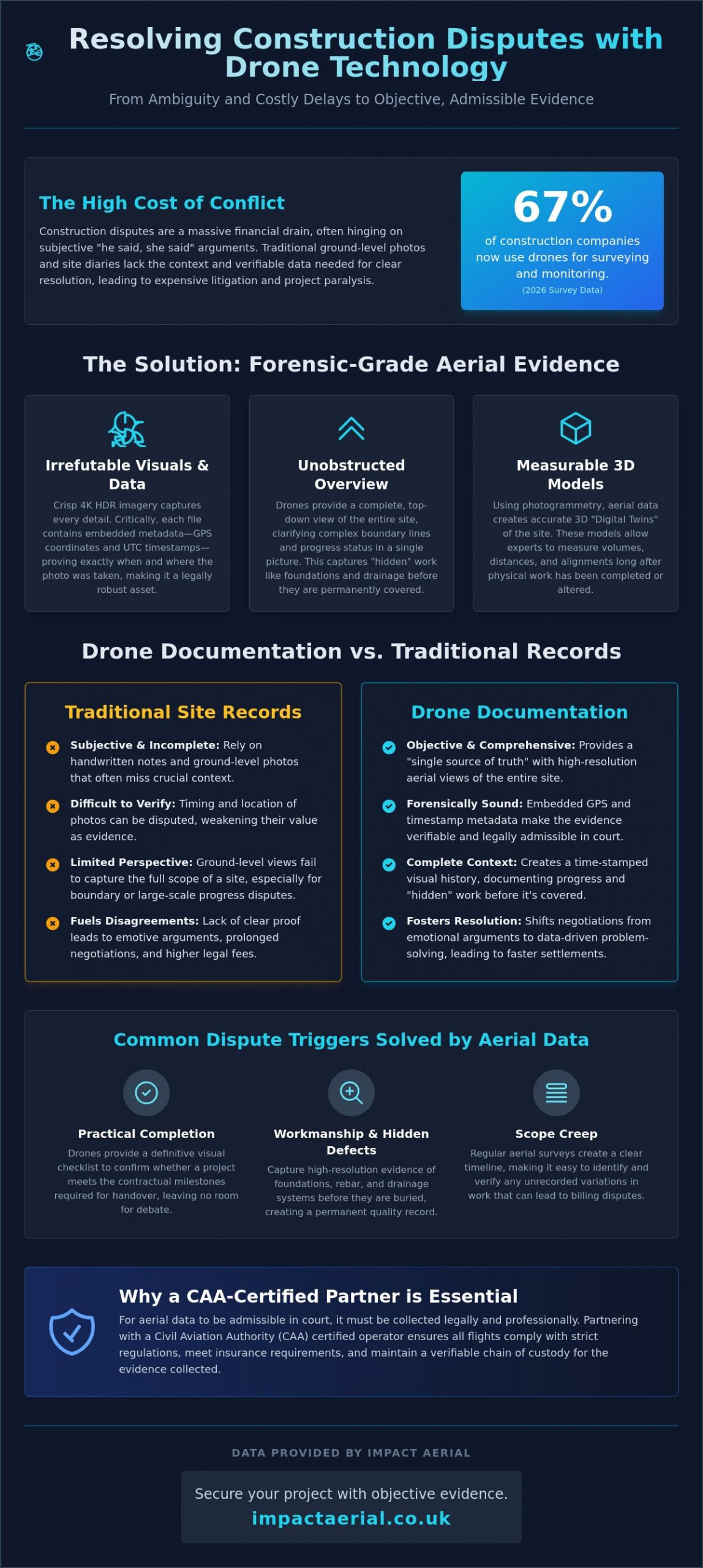
Safety is a non-negotiable priority on any UK site. According to the Health and Safety Executive (HSE) 2023 report, falls from height remain the leading cause of workplace fatalities in construction. Drones keep your staff on the ground, away from fragile roofs and hazardous scaffolding. This proactive approach to safety can lead to more favourable terms with providers of commercial liability insurance. Aerial progress photos for developers also act as an indisputable digital ledger. If a dispute arises regarding a contractor’s timeline or the quality of materials used, you have a time-stamped, high-definition visual record to resolve the issue quickly and avoid costly legal fees.

Effective risk management also extends beyond the site itself to encompass comprehensive transport planning. For instance, specialist firms like ML Traffic Engineers Australia provide crucial traffic impact assessments that can prevent costly logistical bottlenecks and planning disputes long before construction begins.

  • Dispute Resolution: Clear evidence of work completed at specific dates.
  • Compliance: Visual proof of health and safety adherence for HSE audits.
  • Marketing: High-quality visuals that secure off-plan sales and investor confidence months before completion.

Integrating Aerial Data into Your Development Workflow and BIM

Modern construction demands more than just visual updates. Integrating aerial progress photos for developers into a Building Information Modelling (BIM) workflow transforms raw imagery into actionable intelligence. Since the UK government mandated BIM Level 2 for all centrally procured projects, the industry has seen a 20% increase in the adoption of drone-derived data to maintain compliance and accuracy. It’s no longer about simple snapshots. It’s about creating a living record of the site that syncs with your digital architecture.

From Photos to 3D Models

Photogrammetry is the engine behind this digital transformation. By capturing hundreds of high-resolution images with a 70% overlap, our CAA GVC certified pilots generate dense point clouds. These datasets provide 1-2cm relative accuracy for site volume measurements. This precision is vital when calculating muck-away costs or measuring stockpiles of expensive materials like primary aggregate. Developers often save upwards of £1,500 per survey by replacing manual ground measurements with drone-led data gathering. You can export these models directly into platforms like Autodesk Revit or Navisworks. This allows your BIM manager to spot clashes between the “as-built” reality and the “as-designed” plans before they become costly site rectifications.

Streamlining Stakeholder Communication

Clear communication is the backbone of any successful £10m+ development. Aerial data bridges the gap between the site office and the boardroom. Instead of static reports, you can provide off-site investors with immersive 360-degree virtual tours. This gives them a “boots on the ground” perspective without the health and safety risks of a live site visit. Using aerial overlays, project managers can demonstrate precisely how the build aligns with the original programme of works. This level of transparency has been shown to reduce internal reporting time by 25% for UK firms. Automated weekly reports ensure that board members receive consistent, high-quality updates every Monday morning, keeping the project on track and within budget.

For added peace of mind and technical precision on your next site, choose a professional partner who understands the intricacies of CAA regulations and high-end data delivery. Partner with Impact Aerial to integrate professional drone data into your development workflow.

Choosing a Compliant Partner for Aerial Progress Photos in the UK

Selecting a drone operator isn’t just about capturing the right angles. It’s about mitigating risk on high-value construction sites. By January 2026, the transition from the old PfCO to the General Visual Line of Sight Certificate (GVC) will be the mandatory standard for complex commercial operations. Developers must ensure their chosen partner holds this CAA-approved qualification to guarantee they’re operating within the latest legal frameworks. This certification proves a pilot’s ability to handle advanced flight manoeuvres and rigorous safety protocols in congested areas.

Navigating UK Drone Regulations

The shift from PfCO to GVC ensures that pilots possess the technical skills required for high-risk urban environments. For every project involving aerial progress photos for developers, we produce site-specific Risk Assessments and Method Statements (RAMS). These documents aren’t mere formalities; they’re essential safety blueprints that protect your site’s stakeholders and personnel. We also strictly adhere to the Data Protection Act 2018. This ensures that any identifiable data captured during urban flights remains fully compliant with UK privacy laws, protecting you from potential GDPR liabilities.

Standard public liability insurance often falls short for large-scale construction environments. We maintain £5 million in commercial liability insurance as an industry-standard baseline. This provides the necessary peace of mind for developers managing multi-million pound assets. Our technical edge comes from using DJI Enterprise hardware equipped with 4K HDR cameras. These systems use mechanical shutters to eliminate rolling shutter distortion, providing the crisp, high-contrast imagery needed for precise site monitoring and reporting.

The Impact Aerial Advantage

Choosing a specialist based in Birmingham or the West Midlands allows for rapid deployment when specific weather windows open. We understand the local geography and the specific requirements of the region’s planning authorities. Our service includes customisable post-production to ensure your aerial progress photos for developers align perfectly with your corporate branding and visual identity. This meticulous attention to detail helps you present a professional, authoritative image to investors and stakeholders alike. You can organise a consultation for your next project to see how our safety-conscious approach delivers tangible ROI for your development programme.

Optimise Your Development Oversight for 2026

Adopting advanced drone technology isn’t just about capturing visuals; it’s about securing a 20% improvement in project transparency across your entire supply chain. Integrating high-resolution data into your BIM software allows for real-time adjustments that prevent costly delays before they occur. For added peace of mind, professional aerial progress photos for developers ensure your site records meet the rigorous standards required for 2026 planning and compliance audits.

Impact Aerial provides the technical expertise your project demands. Our team operates the latest 4K HDR DJI Enterprise fleet to deliver meticulous detail on every flight. Every operation is handled by CAA GVC Certified Pilots and backed by £5m commercial liability insurance, ensuring your development stays protected and compliant. We’re ready to help you transform how you track, manage, and showcase your build’s evolution. Your project deserves the clarity and precision that only an industry-leading partner can provide.

Book your professional aerial progress monitoring with Impact Aerial and take control of your site’s data today.

Frequently Asked Questions

How often should a developer book aerial progress photos?

Monthly visits are the industry standard for 85% of UK construction projects to ensure consistent documentation for stakeholder reports. Large-scale developments with a valuation exceeding £10 million often require fortnightly captures to track rapid structural changes and maintain precise project timelines. This regular schedule allows you to identify potential delays early and provides a visual archive that helps resolve 95% of future contractor disputes.

Is it legal to fly drones over active construction sites in UK city centres?

Yes, it’s legal provided the operator holds the correct Civil Aviation Authority (CAA) GVC certification and adheres to the Specific category regulations. For congested city centres like London or Birmingham, we operate under a PDRA01 authorisation or a specific Operating Safety Case. These legal frameworks allow us to capture high-quality aerial progress photos for developers in complex urban environments while maintaining strict safety distances from uninvolved persons.

What is the difference between progress photography and a full drone survey?

Progress photography focuses on visual storytelling and marketing, whereas a drone survey provides measurable topographic data. A survey uses photogrammetry to create 3D point clouds and orthomosaic maps with a high accuracy of 1cm to 3cm. In contrast, aerial progress photos for developers use 4K HDR sensors to document site conditions and aesthetic milestones for investor updates, site meetings, and social media content.

Can aerial progress photos be integrated into BIM software?

You can integrate high-resolution aerial data into Building Information Modelling (BIM) platforms such as Autodesk Revit or Navisworks. By using 2D orthomosaics, developers overlay current site reality against 3D design models to identify 100% of structural deviations early. This integration helps project managers spot clashes between the planned design and the actual build, which can reduce costly rework expenses by up to 15%.

How much does a professional drone progress photo package cost in the UK?

Professional drone photography packages typically range from £350 to £750 per site visit in the UK. This price includes the pilot’s day rate, comprehensive CAA compliance planning, and the post-production of high-resolution images. For long-term contracts spanning 12 to 24 months, many developers secure a 10% to 20% discount by pre-booking a set number of monthly visits for the duration of the project.

What happens to the flight schedule if the British weather is poor?

We monitor Met Office forecasts 48 hours in advance and reschedule flights if wind speeds exceed 20mph or if heavy rain is predicted. Our DJI Enterprise drones carry an IP55 rating, meaning they can operate in light drizzle, but we prioritise image clarity and safety above all else. If a flight is postponed due to weather, we typically re-deploy the pilot within 24 to 48 hours to ensure your reporting schedule stays on track.

Do I need to notify neighbours or local councils before drone flights?

You don’t usually need formal permission from local councils for flights over private land, but notifying immediate neighbours is a best practice for 100% transparency. As CAA GVC certified operators, we manage the technical flight risk assessment and check for any Flight Restriction Zones or Temporary Restricted Areas. We recommend informing site staff 24 hours before our arrival to ensure everyone is aware of the scheduled aerial activity.

What insurance should a drone operator have for commercial construction sites?

A professional drone operator must have EC 785/2004 compliant commercial liability insurance with a minimum cover of £5 million. For added peace of mind, we carry £10 million in public liability insurance to meet the stringent requirements of Tier 1 contractors and major UK developers. This specialist cover protects against third-party property damage and personal injury, ensuring your project remains fully protected during every flight.

High-Resolution Aerial Mapping UK: A Complete Guide (2026)

Planning a critical project based on outdated satellite imagery or committing to the significant costs and timelines of traditional land surveying can introduce unacceptable risks and inefficiencies. For professionals across the UK’s construction, infrastructure, and environmental sectors, obtaining accurate, up-to-date topographical data is paramount. Fortunately, advanced drone technology has revolutionised this process. Professional high resolution aerial mapping uk services now deliver superior data with unparalleled speed, safety, and precision, directly addressing the limitations of older methods.

This comprehensive 2026 guide is designed to provide you with the essential knowledge to leverage this technology. We will demystify the process, explaining exactly what high-resolution aerial mapping entails, how photogrammetry works, and the key differences between drone, plane, and satellite data capture. You will discover the powerful outputs available-from detailed orthomosaics to interactive 3D models-and, crucially, learn how to select a fully qualified, CAA GVC Certified professional drone service in the UK that can meet your project’s specific requirements, ensuring top-quality results and complete peace of mind.

Key Takeaways

  • Understand how high-resolution mapping transforms hundreds of individual drone images into a single, highly detailed, and measurable digital asset for your site.
  • Learn the critical differences between drone, airplane, and satellite data capture to determine which method offers the best accuracy for your project’s budget and objectives.
  • Discover the diverse commercial applications for high resolution aerial mapping uk, from construction site monitoring to agricultural analysis, and how it drives tangible ROI.
  • Identify the essential credentials for a UK provider, focusing on CAA GVC certification and commercial liability insurance to ensure a safe, compliant, and successful outcome.

What is High-Resolution Aerial Mapping?

While standard satellite views from platforms like Google Maps offer a basic overview, they often lack the detail and currency required for professional decision-making. High-resolution aerial mapping moves beyond these limitations, using advanced drones to capture hundreds or thousands of overlapping, geo-tagged photographs of a site. For businesses across the country, professional high resolution aerial mapping UK services provide an unparalleled level of detail. This data-gathering technique, a modern application of aerial survey principles, is the foundation for creating powerful digital assets for analysis and planning.

To see this process in action, the following video provides a clear overview of a high-resolution aerial survey:

These individual images are then processed using sophisticated software. The science that powers this transformation is known as photogrammetry, which uses the photographs to create precise, measurable 2D maps and 3D models. The result is not just a picture, but a powerful digital asset that enables UK businesses to make critical, data-driven decisions with complete confidence, based on an accurate and up-to-date representation of their site.

Key Terminology Explained: GSD, Orthomosaics, and DSMs

Understanding a few core terms is essential when commissioning an aerial survey. These concepts define the quality and utility of the final data products:

  • Ground Sample Distance (GSD): This is the real-world size of a single pixel in your map. A lower GSD means higher detail. For example, a 2cm GSD allows you to identify features as small as a minor crack in pavement or individual roof fixings.
  • Orthomosaic Map: This is a single, geometrically corrected image created by stitching all the individual photos together. It has a uniform scale, removing perspective distortion, and can be used as a true-to-scale base map for measurements and planning.
  • Digital Surface Models (DSM): A DSM is a 3D map that captures the elevation of the terrain and all surface features, including buildings, vegetation, machinery, and stockpiles. It is invaluable for volume calculations, line-of-sight analysis, and drainage planning.

High-Resolution Drone Maps vs. Google Maps: A Comparison

The difference between professionally captured drone data and freely available satellite imagery is significant. For commercial applications, these distinctions are critical:

  • Resolution: Drone maps offer a GSD measured in centimetres (typically 1-5cm per pixel). Satellite imagery is usually measured in metres per pixel. This is the difference between seeing a car and being able to read its license plate.
  • Timeliness: Drone surveys are conducted on-demand, providing a snapshot of your site as it exists today. Public satellite imagery can be months or even years out of date, failing to reflect current construction progress or site conditions.
  • Detail: The superior clarity of drone maps allows you to identify specific site assets, monitor safety hazards, assess roof conditions, or measure stockpile volumes with a high degree of precision-details completely lost in standard satellite views.

Aerial Mapping Methods: Drones vs. Airplanes vs. Satellites

When commissioning high resolution aerial mapping UK wide, the first critical decision is selecting the right data capture method. Not all aerial imagery is created equal, and the platform used to acquire it fundamentally dictates the quality, cost, and suitability for your project. The choice between drones, manned aircraft, and satellites depends entirely on your specific requirements for project size, accuracy, and budget. Understanding these differences ensures you invest in the right tool for the job.

Drone (UAV) Mapping: Precision and Flexibility

Unmanned Aerial Vehicles (UAVs), or drones, provide unparalleled detail for site-specific projects. They are the ideal solution for construction sites, quarries, individual property developments, and detailed asset inspections. By flying at lower altitudes, drones can achieve an exceptional Ground Sample Distance (GSD) of 1-5cm. This method is highly flexible, allowing for on-demand deployment that is extremely cost-effective for smaller, targeted areas and for capturing complex vertical details on structures.

Manned Aircraft Mapping: Large-Scale Regional Coverage

For projects requiring coverage of entire cities, transport corridors, or counties, manned aircraft are the most efficient solution. This method is the backbone for national datasets, mapping vast areas in a single operation. It’s the approach used by large data providers to create the detailed imagery layers found in products like the Ordnance Survey MasterMap. The trade-off is typically a lower resolution (5-20cm GSD) and less frequent updates, often on an annual or bi-annual cycle, making it less suitable for monitoring rapid site changes.

Satellite Imagery: Global Scale, Lower Detail

Satellite imagery offers the broadest coverage, capable of capturing data on a national or even global scale. This makes it a valuable tool for large-scale environmental monitoring, agricultural analysis, or tracking weather systems over remote areas where other methods are impractical. However, its primary limitation for most commercial projects is its significantly lower resolution (typically 30cm GSD or more). Furthermore, operations are often hampered by cloud cover, a frequent challenge in the UK climate, which can obscure the area of interest.

The Professional Drone Mapping Process: From Plan to Product

Achieving survey-grade accuracy with high-resolution aerial mapping in the UK demands more than just a drone. It requires a meticulous, multi-stage process managed by certified professionals. This structured approach ensures every mission is safe, compliant with Civil Aviation Authority (CAA) regulations, and delivers the actionable data your business needs. It is this rigorous methodology that separates a professional data-gathering operation from a hobbyist flight, providing you with reliable results and complete peace of mind.

Step 1: Project Scoping and Safety Planning

Every successful mission begins on the ground. The first step is a detailed consultation to define your project’s specific goals, from the required Ground Sample Distance (GSD) to the final data formats you need. Following this, we conduct a comprehensive risk assessment and pre-flight survey. This crucial stage involves creating a strategic flight plan to guarantee 100% site coverage while operating in full compliance with all CAA operational authorisations, ensuring a safe and efficient data capture.

Step 2: On-Site Data Acquisition

With planning complete, our on-site team executes the flight mission with precision. For projects requiring the highest level of accuracy, we establish a network of Ground Control Points (GCPs), which are precisely measured coordinates that anchor the aerial data to the real world. Our CAA GVC Certified pilots then fly automated grid patterns using commercial-grade drones, capturing thousands of overlapping high-resolution images. This on-site precision is fundamental to professional high-resolution aerial mapping with UAVs, with our team constantly monitoring flight conditions and safety parameters throughout the operation.

Step 3: Data Processing and Deliverables

Once the raw data is captured, it is transferred to our powerful processing workstations. Using advanced photogrammetry software, the individual images are stitched together and georeferenced to create a seamless, accurate digital representation of your site. From this single dataset, we generate a suite of valuable outputs tailored to your needs.

  • Orthomosaic Maps: High-resolution, distortion-free aerial maps.
  • Digital Surface/Terrain Models (DSM/DTM): Detailed elevation data for analysis.
  • 3D Models & Point Clouds: Rich, interactive models for visualisation and measurement.

All deliverables are provided in industry-standard formats, ready for direct integration into your existing CAD or GIS software workflows.

Applications of High-Resolution Mapping Across UK Industries

Modern aerial maps are far more than just images; they are powerful data-gathering tools that deliver a significant return on investment across a diverse range of commercial sectors. The value lies in translating detailed, up-to-date imagery into actionable intelligence that enhances efficiency, improves safety, and reduces operational costs. For businesses across the country, professional high resolution aerial mapping uk services provide the critical data needed to make informed, strategic decisions with confidence.

Construction and Civil Engineering

On a dynamic construction site, accurate and timely information is paramount. High-resolution aerial data provides project managers with an unparalleled overview, enabling precise monitoring and management from project inception to completion.

  • Progress Monitoring: Conduct weekly or monthly flights to track site progress against architectural plans and schedules, providing clear evidence for stakeholder reports.
  • Volume Calculations: Accurately measure stockpile volumes of aggregates, soil, or waste, leading to precise inventory management and cost control.
  • Site Safety: Generate detailed terrain models (DTMs) and digital surface models (DSMs) to identify potential hazards, plan safe access routes, and ensure HSE compliance.

Property Development and Surveying

From marketing a new development to maintaining existing assets, aerial mapping offers a safe, fast, and cost-effective solution. It captures comprehensive data of buildings and land, supporting surveyors and developers throughout the property lifecycle.

  • Marketing Materials: Create compelling, high-quality aerial photographs and 3D models of properties and development sites that showcase them in the best possible light.
  • Condition Surveys: Safely inspect roofs, facades, and other hard-to-reach structures without the need for expensive scaffolding or access platforms, identifying defects early.
  • As-Built Surveys: Provide verifiable, accurate as-built data for planning applications, boundary disputes, and legal documentation, ensuring full compliance.

Agriculture and Environmental Management

The versatility of drone-captured data makes it an indispensable tool for managing vast areas of land and monitoring sensitive environments. This technology supports sustainable practices and provides crucial data for environmental impact assessments and conservation efforts.

  • Precision Agriculture: Use multispectral imagery to assess crop health, detect stress, and optimise the application of water and fertilisers, increasing yields and reducing waste.
  • Environmental Monitoring: Track land use changes, monitor habitat regeneration, or map the extent of flooding and soil erosion over time with repeatable, high-precision surveys.
  • Coastal and Habitat Mapping: Conduct detailed coastal erosion surveys or map delicate ecosystems with centimetre-level accuracy, providing essential data for conservation bodies and local authorities.

The applications are extensive, demonstrating how professional high resolution aerial mapping uk services can be tailored to meet the unique data requirements of any industry. To understand how our CAA GVC certified pilots can support your project, contact our team today.

How to Choose a UK Aerial Mapping Provider

Selecting the right partner is the single most critical decision for the success of your project. The quality, accuracy, and legal compliance of your data depend entirely on the operator you choose. When evaluating providers for high resolution aerial mapping UK services, it’s essential to look beyond a polished portfolio and scrutinise their professional credentials and operational standards. Arming yourself with the right questions will help you distinguish a truly professional operator from a hobbyist.

Non-Negotiable Credentials: Certification and Insurance

A professional provider will always be transparent about their qualifications. For your peace of mind and project security, ensure any potential partner holds a valid CAA GVC (General Visual Line of Sight Certificate), the legal requirement for commercial drone operations in the UK. Furthermore, they must have adequate commercial liability insurance; a minimum of £5m is the industry standard and protects you, your assets, and the public. Finally, ask for relevant case studies or client testimonials that demonstrate a proven track record in your sector.

Key Questions to Ask Your Provider

Before committing, a detailed discussion about your project’s technical requirements is vital. Use these questions to vet their expertise and ensure they can meet your specific needs:

  • What Ground Sample Distance (GSD) and absolute accuracy can you achieve for my project? This determines the level of detail and precision in the final data.
  • Do you use Ground Control Points (GCPs) for your surveys? For survey-grade accuracy, the use of GCPs is often essential.
  • What are your standard safety procedures and contingency plans? A professional operator will have robust risk assessments and emergency protocols.
  • In what formats will the final data be delivered? Ensure they can provide outputs compatible with your existing software (e.g., GeoTIFF, LAS, OBJ, DWG).

Why Impact Aerial is Your Trusted Partner

At Impact Aerial, we provide a professional, end-to-end service built on a foundation of safety, expertise, and cutting-edge technology. We are fully CAA GVC certified and hold £5m commercial liability insurance as standard. Our expert pilots utilise the latest DJI Enterprise drones to deliver superior data quality for every project. From initial flight planning and risk assessment to final data processing and delivery, we manage the entire workflow, ensuring you receive actionable, high-accuracy results you can rely on.

Discuss your project with our mapping experts.

Your Next Steps in High-Resolution Aerial Mapping

As we’ve explored, the landscape of project management and data analysis is being fundamentally transformed by aerial data. From the unparalleled detail captured by advanced drones to its diverse applications across UK industries, the benefits are undeniable. This makes choosing a professional partner for your high resolution aerial mapping uk project not just a preference, but a necessity for achieving accurate, reliable, and legally compliant results.

At Impact Aerial, we provide this essential combination of technical expertise and regulatory diligence. Our operations are conducted by fully CAA GVC Certified pilots and are covered by £5m commercial liability insurance for your complete peace of mind. As specialists in DJI Enterprise drone technology, we are equipped to deliver the top-quality data your project demands.

Are you ready to elevate your project with data-driven insights? Request a Professional Quote for Your Aerial Mapping Project today and let’s bring a new perspective to your objectives.

Frequently Asked Questions

How accurate is high-resolution drone mapping?

The accuracy of our high-resolution drone mapping is exceptionally high, often achieving survey-grade precision. Using advanced drones with RTK/PPK technology and strategically placed Ground Control Points (GCPs), we can deliver data with an absolute accuracy of down to 1-3cm. This level of detail is critical for applications in construction, land surveying, and asset management, ensuring you receive reliable and actionable data for your project.

What does a typical aerial mapping project cost in the UK?

The cost for a high resolution aerial mapping uk project typically starts from £500 for a small, straightforward site. The final price is dependent on factors such as the total area, site complexity, access restrictions, and the specific data deliverables required, like 3D models or detailed orthomosaics. We provide a detailed, fixed-price quotation following our initial project consultation to ensure complete transparency and for your added peace of mind.

How long does it take to map a site and receive the data?

The on-site data capture for a standard site of up to 20 hectares can often be completed within a few hours. Following the flight, our team undertakes rigorous data processing and quality assurance. You can typically expect to receive the finalised high-resolution maps, models, and reports within 3-5 business days. We will always provide a clear project timeline from the outset, keeping you informed at every stage of the process.

What is the maximum area you can map with a drone?

While there is no theoretical maximum area, operational logistics determine what can be covered in a single day. A single flight team can typically map between 50 and 100 hectares per day, depending on the site’s shape and terrain. For larger projects spanning hundreds or thousands of hectares, we develop a phased flight plan over multiple days, ensuring consistent data quality and full compliance with all CAA (Civil Aviation Authority) regulations.

Are your drone mapping services available across the entire UK?

Yes, our professional services are available across the entire United Kingdom. Our CAA GVC Certified pilots are equipped to operate nationwide, including in England, Scotland, Wales, and Northern Ireland. While we are based in the Midlands, we regularly undertake projects from Cornwall to the Scottish Highlands. Projects located further from our base may include pre-agreed travel and accommodation costs, which will be clearly itemised in your quotation.

What happens if the weather is bad on the scheduled flight day?

Client and public safety is our highest priority, and we operate in strict accordance with CAA safety regulations. We cannot fly in rain, high winds, or other adverse weather conditions. Our team constantly monitors the forecast in the days leading up to a scheduled flight. If the weather is deemed unsuitable, we will liaise with you to reschedule the operation for the next suitable day at no additional cost to you.