Drone Survey Deliverables Explained: A Complete Guide for UK Professionals (2026)

A high-resolution aerial photograph is not a survey; it is a liability if it lacks the georeferenced precision required for engineering-grade decisions. You likely agree that while drones capture stunning visuals, the real value lies in the technical data behind the pixels. Many UK project managers still face the frustration of receiving imagery that looks impressive but won’t align with their existing AutoCAD or BIM workflows. This gap between expectation and reality usually comes from a lack of clarity regarding the specific outputs a professional operator must provide.

In this guide, we provide drone survey deliverables explained to bridge the gap between raw aerial data and actionable project success. You’ll learn how to distinguish between orthomosaics, point clouds, and digital terrain models, ensuring your next hire delivers files compatible with Revit or Civil 3D. We also outline the essential CAA GVC certifications and commercial insurance requirements that provide peace of mind for site safety. This article offers a clear roadmap for integrating precise 2D and 3D data into your 2026 project planning with absolute confidence.

Key Takeaways

  • Distinguish between qualitative visual inspections and quantitative metric surveys to ensure you are commissioning the correct data set for your specific project needs.
  • Gain full technical clarity with our guide to drone survey deliverables explained, covering everything from 2D orthomosaics to high-density 3D point clouds and digital twins.
  • Unlock actionable business intelligence by learning how to calculate precise earthwork volumes and identify critical infrastructure faults through professional thermal reports.
  • Enhance stakeholder engagement and project planning by utilizing realistic 3D textured models for immersive virtual walkthroughs and site presentations.
  • Ensure operational compliance by understanding why CAA GVC certification and £5m commercial liability insurance are non-negotiable for professional drone surveys in the UK.

Understanding Drone Survey Deliverables: Data vs. Imagery

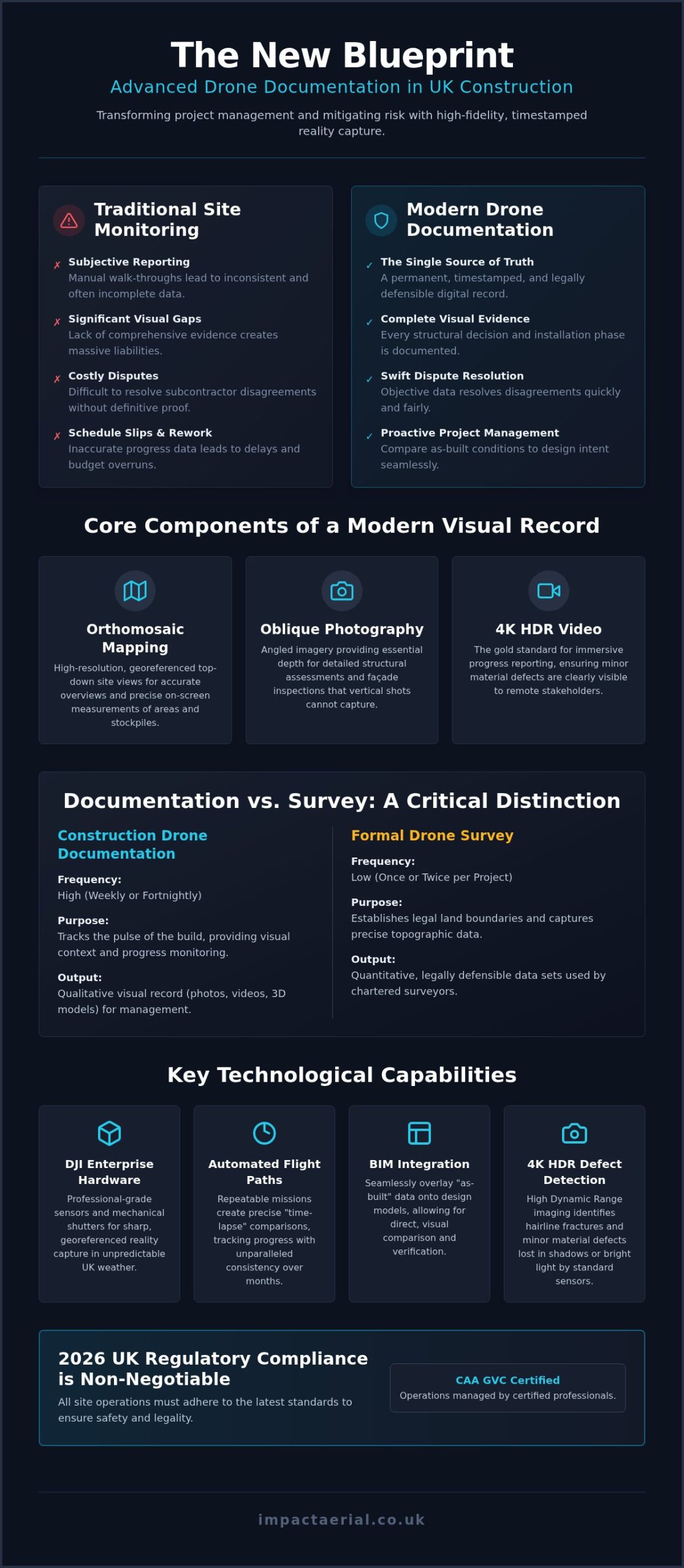
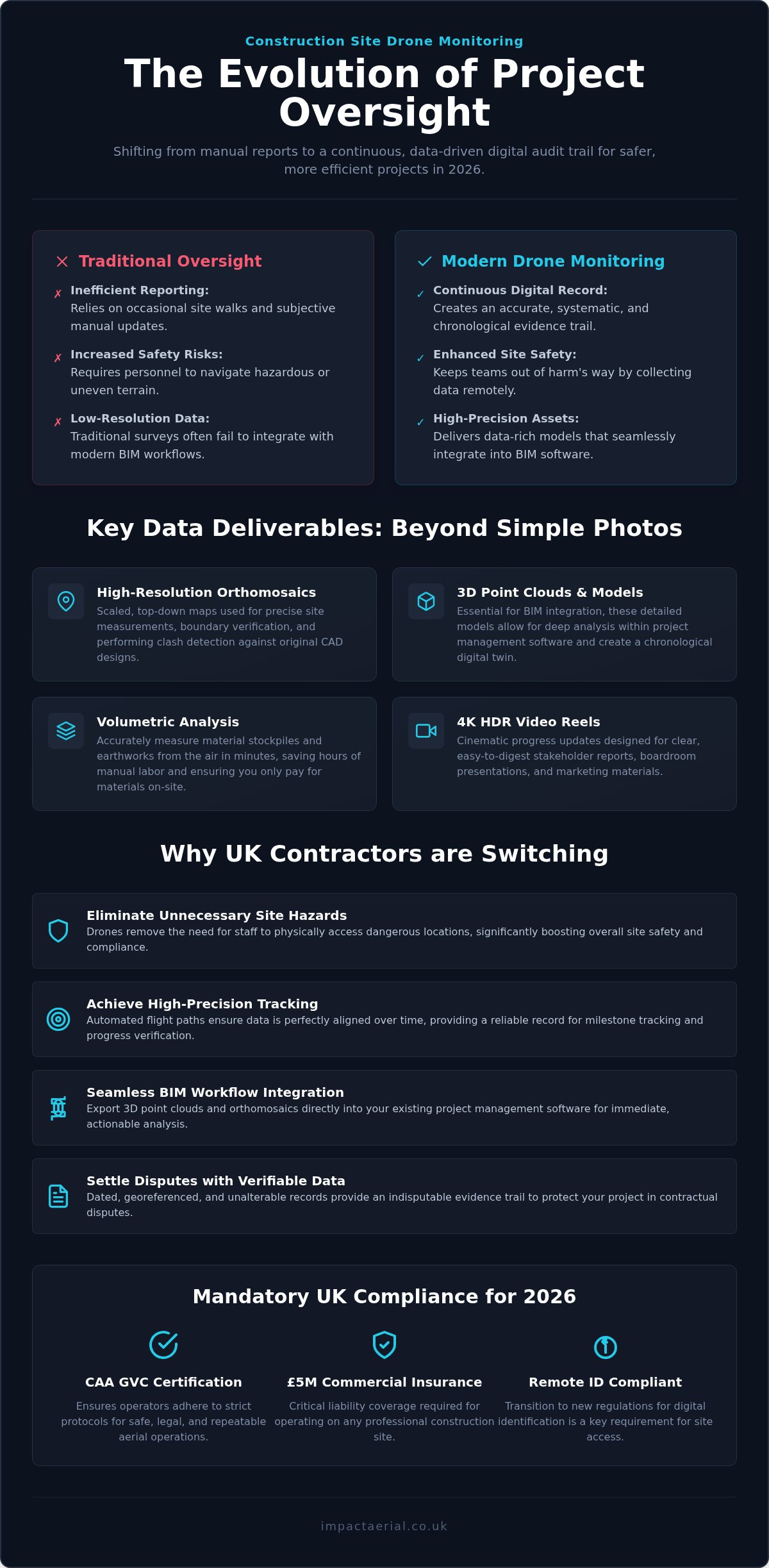
For UK construction and engineering professionals, drone survey deliverables explained effectively must start with a shift in perspective. You aren’t just paying for aerial photography. While a standard visual inspection is qualitative, providing a visual record of an asset’s condition, a professional drone survey is quantitative. It produces measurable, geo-spatial data sets that function as a digital twin of your site. In 2026, the distinction is clear: imagery is for looking, but data is for measuring.

The most critical factor in any deliverable is accuracy, defined by the Ground Sample Distance (GSD). GSD represents the distance between the centres of two consecutive pixels measured on the ground. A GSD of 1cm means one pixel in your image represents 1cm squared in reality. Impact Aerial prioritises this precision by using CAA GVC certified pilots who understand the technical requirements of data integrity. This certification ensures that every flight adheres to UK safety regulations while maintaining the rigorous standards required for survey-grade results.

To better understand this concept, watch this helpful video:

The Anatomy of a Professional Drone Survey

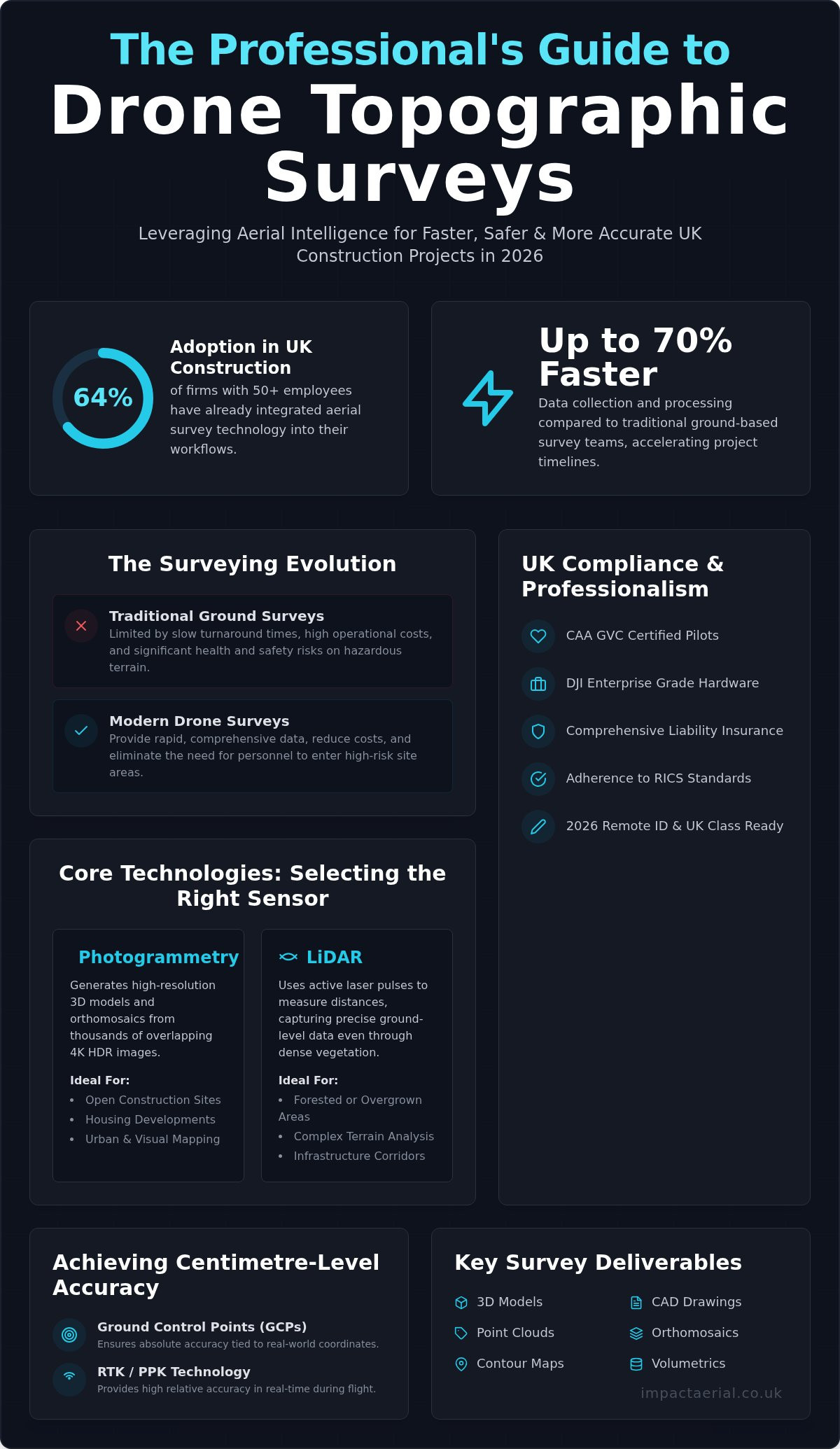
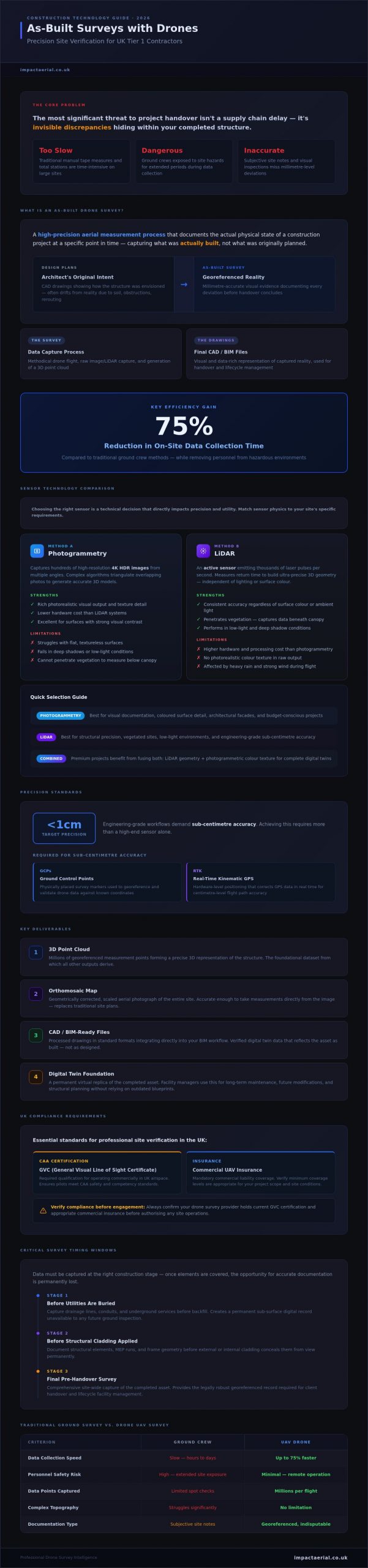
Professional data capture relies on two primary methods: Photogrammetry and LiDAR. Photogrammetry uses high-resolution overlapping images to triangulate points in space, while LiDAR uses laser pulses to measure distances directly. To achieve sub-centimetre accuracy, we use Ground Control Points (GCPs). These are physical markers on the ground with known coordinates that “pin” the digital map to the real world. A drone survey deliverable is a digital representation of physical assets with survey-grade coordinates.

Software Compatibility and File Formats

Data is only useful if your team can use it. We provide deliverables in industry-standard formats to ensure they work with your existing workflows. Common formats include .TIFF for orthomosaics, .LAS or .LAZ for point clouds, and .OBJ or .DXF for 3D meshes and CAD drawings. These files integrate seamlessly with AutoCAD, Revit, and BIM software. Impact Aerial manages the entire data pipeline to provide clients with added peace of mind, ensuring that the “drone survey deliverables explained” in your project brief are the exact files your surveyors need for immediate analysis.

Essential 2D Deliverables: Orthomosaics and Topographic Maps

Traditional satellite imagery often lacks the granular detail required for modern UK construction and engineering standards. When drone survey deliverables explained are discussed, 2D outputs remain the foundational requirement for most site managers. These deliverables provide a high-resolution, measurable base layer that informs everything from initial planning to final handovers.

Orthomosaic Maps: The New Site Standard

An orthomosaic is a geometrically corrected aerial map. It’s created by stitching together thousands of individual high-resolution images using photogrammetry. Unlike a standard aerial photograph, an orthomosaic is distortion-free. This means you can measure distances, areas, and volumes directly on the map with sub-5cm accuracy. It’s a “true” map that reflects the site’s exact state at a specific moment in time.

UK developers now use these maps to replace outdated satellite views for active site monitoring. They’re indispensable for planning applications and resolving boundary disputes where precision is mandatory. For deeper technical context on how we capture this imagery, see our guide to drone surveys. These maps provide a clear, indisputable record of progress that stakeholders can access remotely.

Topographic Data and Contour Mapping

Topographic surveys translate complex elevation data into readable 2D formats. By using contour lines, we help project managers visualise terrain slope and height variations across the entire site. This data is vital for identifying drainage issues and flood risks early in the project lifecycle. It’s much cheaper to adjust a design in the digital phase than to fix a flooding issue after the concrete is poured.

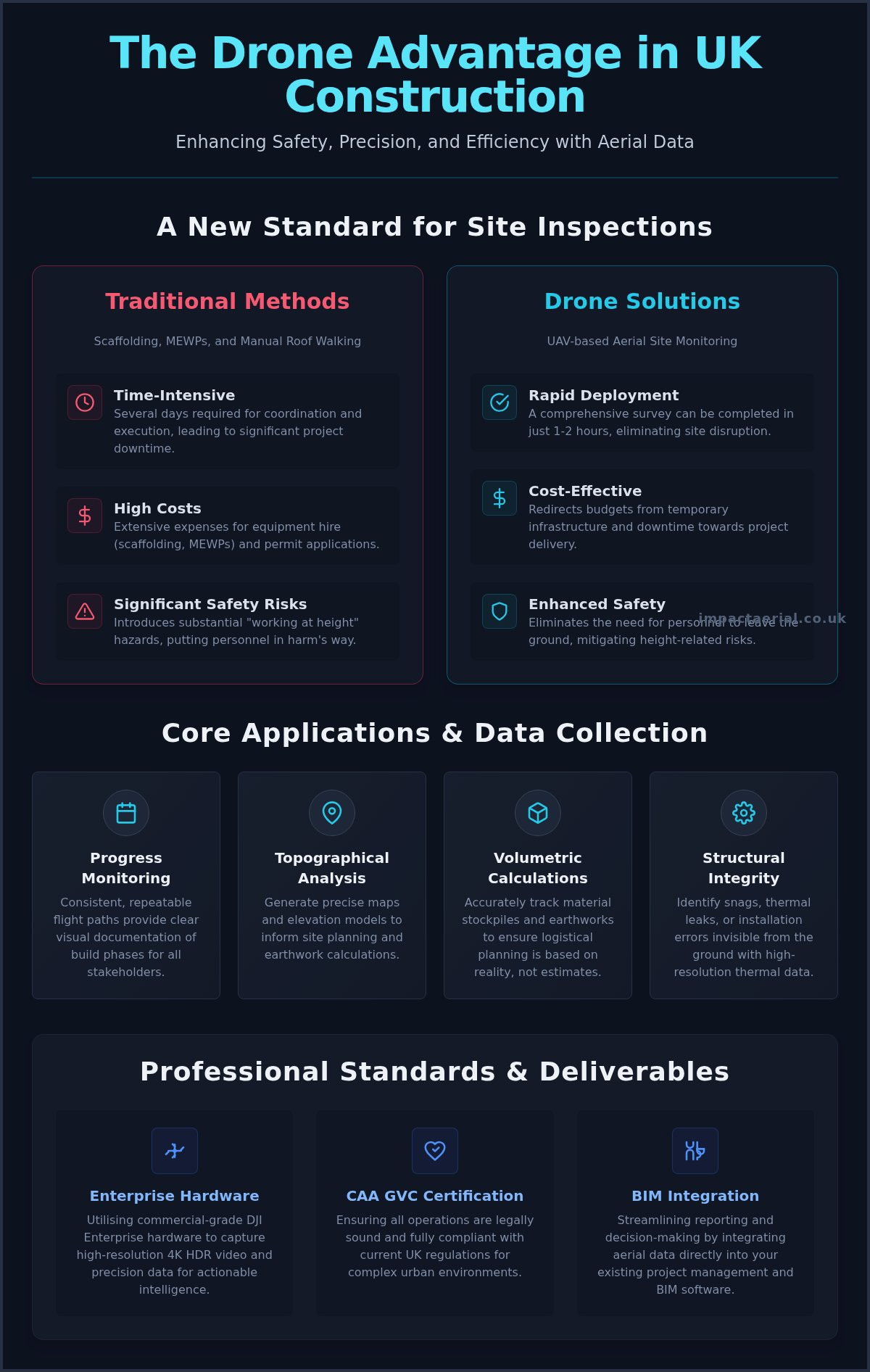
The efficiency of UAV land surveying is significant. Traditional methods using total stations or GPS rovers often take days to cover a 10-hectare site. A drone can capture the same area in under 30 minutes. The resulting data includes millions of elevation points, providing a far more detailed picture of the terrain than traditional spot levels. These outputs integrate directly into CAD software, allowing engineers to produce site plans in .dwg or .dxf formats with ease.

DSM vs. DTM: Knowing the Difference

Precision in drone survey deliverables explained requires an understanding of two distinct elevation models:

  • Digital Surface Model (DSM): This captures the earth’s surface plus all objects on it. It includes buildings, stockpiles, and vegetation. It’s the standard choice for calculating the volume of a gravel mound or checking for crane clearance.
  • Digital Terrain Model (DTM): This filters out man-made and natural objects to show only the “bare earth” ground surface. Engineers use DTMs for hydrological modelling and earthworks planning because they show the true shape of the land.

If you’re unsure which 2D deliverable fits your specific project requirements, contact our technical team to discuss your site’s objectives.

High-Density 3D Data: Point Clouds and Digital Twins

Drone technology in 2026 has transformed how site data is captured and utilised across the UK construction and engineering sectors. High-density 3D data provides a spatial context that traditional 2D orthomosaics simply cannot match. When professionals look for drone survey deliverables explained, they’re often seeking the ability to interact with a site virtually to perform volumetric calculations or structural analysis. This level of detail allows for a comprehensive understanding of a project’s physical state without the high costs of traditional ground-based surveying methods.

Point Clouds: The Foundation of 3D Modelling

Point clouds are the primary output of professional photogrammetry or LiDAR sensors. They consist of millions of individual data points, each assigned a specific X, Y, and Z coordinate to form a precise 3D coordinate system. A point cloud is the digital skeleton of a physical structure, accurate to within millimetres. This precision is vital for structural health monitoring, as high point density allows engineers to detect minute shifts or surface deformations that might be missed during a manual inspection.

In a virtual environment, these points enable precise distance, area, and height measurements. For a typical UK construction project, having this data on hand reduces the reliance on expensive scaffolding or high-access equipment for initial assessments. It provides a reliable baseline for “as-built” surveys, ensuring that the physical construction aligns perfectly with the original architectural intent.

  • Data Density: Capturing thousands of points per square metre for granular detail.
  • Measurement Accuracy: Extracting vertical and horizontal dimensions with survey-grade precision.
  • Interoperability: Exporting data in .LAS or .E57 formats for use in CAD software.

Digital Twins and Virtual Tours

A digital twin is a 3D textured model that serves as a realistic, high-resolution replica of a physical asset. We create these by “wrapping” high-quality aerial imagery over the point cloud skeleton. These models are essential for stakeholder presentations and commercial property marketing, providing an immersive experience that static photos cannot replicate. For visual-first 3D applications, you can refer to our drone photography guide to see how professional imagery enhances these models.

Integrating these models into Building Information Modelling (BIM) software streamlines the project lifecycle. It allows for seamless data-gathering that informs every stage from design to demolition. Virtual tours also improve site safety by reducing the frequency of site visits, keeping personnel out of hazardous areas while still providing full visibility of the worksite. Using these drone survey deliverables explained here gives project managers peace of mind, knowing they’re working with objective, repeatable, and highly detailed data sets.

Actionable Insights: Volumetrics and Thermal Reports

The true value of drone survey deliverables explained lies in their ability to transform raw pixels into precise, actionable business intelligence. While visual maps provide context, technical reports provide the data required for financial forecasting and risk management. In the UK construction and energy sectors, these deliverables have become the standard for maintaining tight project timelines and ensuring safety compliance.

Volumetric Analysis for Construction and Mining

Drones calculate cut-and-fill volumes with up to 99% accuracy, a figure supported by 2024 industry benchmarks comparing photogrammetry to traditional ground based surveys. Instead of sending a surveyor to climb over unstable stockpiles with a GPS rover, a drone captures thousands of data points in a single flight. This significantly reduces the physical risk to personnel while providing a comprehensive digital surface model (DSM).

  • Monthly Commercial Valuations: Quantity surveyors use volumetric data to verify subcontractor claims and manage budgets with precision.
  • Logistics Planning: Accurate excavation data allows site managers to coordinate the exact number of haulage vehicles needed, reducing fuel costs and carbon emissions.
  • Safety Compliance: Removing the need for manual measurements on active sites minimizes the risk of accidents involving heavy machinery or falls from height.

Specialist Thermal and Solar Surveys

For the UK’s renewable energy sector, thermal deliverables are essential for maintaining ROI on large scale PV solar farms. High quality thermal data requires professional grade equipment. Our team utilizes DJI Enterprise drones equipped with radiometric sensors to identify thermal anomalies that are invisible to the naked eye. These reports typically include a thermal orthomosaic and a detailed list of defects, such as “string” failures or individual failing cells.

The precision of these reports allows asset managers to target maintenance exactly where it is needed. Identifying a single faulty inverter or a bypass diode failure can prevent a significant drop in energy yield. In many cases, early detection through drone thermography can improve farm output by 15% compared to sites using manual spot-checking methods. Beyond solar, these thermal deliverables are used for building heat loss surveys, helping property developers meet strict UK energy efficiency standards.

High resolution imagery and annotated defect maps also redefine roof inspections. Rather than spending thousands of pounds on scaffolding or cherry pickers for a preliminary look, a drone provides a 4K view of every tile, gutter, and flashing. For land management, we provide NDVI (Normalized Difference Vegetation Index) data. This allows estate managers to monitor plant health and soil moisture levels across hundreds of acres in a single afternoon.

Secure the data you need for your next project. Contact Impact Aerial for professional drone survey services today.

Choosing a Professional Partner for Drone Data Collection

Selecting a competent provider is the final, most critical step in the process. Having drone survey deliverables explained is useful, but the quality of those outputs depends entirely on the operator’s technical proficiency and legal compliance. In the United Kingdom, the Civil Aviation Authority (CAA) General Visual Line of Sight Certificate (GVC) is a non-negotiable requirement for commercial drone surveys. This certification ensures the pilot has undergone rigorous training in airspace law and flight safety. Choosing an uncertified operator doesn’t just risk poor data quality; it can lead to heavy fines and the invalidation of your project’s insurance policies.

For added peace of mind, Impact Aerial maintains £5m in commercial liability insurance. This high level of indemnity is often a mandatory entry requirement for Tier 1 construction sites, infrastructure projects, and high-value commercial assets. It demonstrates a level of professional maturity that smaller, hobbyist-led operations cannot match. Beyond insurance, you should evaluate a partner based on their post-production capabilities. Capturing raw data is only half the job. A professional partner must have the computing power and software expertise to process thousands of 4K images into accurate 3D models or centimetre-perfect orthomosaics.

Our approach to safety planning is meticulous. We produce site-specific Risk Assessments and Method Statements (RAMS) for every deployment. This technical rigour ensures that data collection occurs without compromising the safety of your personnel or the public. We handle the complexities of UK airspace notifications and local authority permissions, allowing your team to focus on the project at hand.

The Impact Aerial Quality Standard

We use the latest DJI Enterprise commercial drones to ensure your data is captured with 4K High Dynamic Range (HDR) precision. This technology allows us to maintain high contrast and detail even in the flat lighting conditions common across the UK. Being Birmingham-based gives us a strategic advantage for rapid deployment to projects across the West Midlands and the rest of the country. Our commitment to transparency is absolute. You can read our UK drone license guide to see exactly how we maintain compliance with 2026 CAA regulations.

Next Steps: From Consultation to Deliverables

Our workflow is structured to provide clarity from day one. We start with a consultation to define your specific requirements, followed by comprehensive site RAMS. Once the data capture is complete, we process the files for secure, cloud-based delivery. This ensures your team can access high-resolution assets from any location. If you’re ready to integrate professional aerial data into your workflow, contact Impact Aerial for a professional drone survey quote today. We provide the technical expertise and regulatory assurance needed to turn aerial perspectives into valuable business intelligence.

Maximise Project Accuracy with High-Resolution Aerial Insights

Success in the 2026 UK construction and surveying landscape depends on moving beyond simple imagery. Having drone survey deliverables explained allows your team to leverage high-density 3D point clouds and orthomosaics for precise site planning. These tools provide the actionable data needed for complex volumetric reports and topographic analysis. It’s about turning raw aerial footage into a reliable digital twin that supports every stage of your project’s lifecycle.

Impact Aerial provides the technical expertise required to capture this high-grade data. We utilise DJI Enterprise 4K HDR equipment to ensure every pixel carries value. Our team consists of CAA GVC Certified pilots, and we maintain £5m commercial liability insurance to ensure your site stays protected. We don’t just fly drones; we provide the professional data-gathering services that modern UK industries demand.

Take the next step in digitising your workflow today. Book your professional UK drone survey with Impact Aerial and secure the precision your business needs to lead the market.

Frequently Asked Questions

What file formats are typically provided in a drone survey?

Drone survey deliverables are typically provided in industry-standard formats such as GeoTIFF for orthomosaics and .LAS or .LAZ for 3D point clouds. For CAD integration, you’ll receive .DXF or .DWG files, while 3D meshes are often delivered as .OBJ or .FBX files. These formats ensure seamless integration into existing BIM and GIS workflows used by 95% of UK architectural and engineering firms.

How accurate are drone survey deliverables compared to traditional methods?

When reviewing drone survey deliverables explained for precision, these outputs often achieve 1cm to 3cm relative accuracy when using Ground Control Points (GCPs) or RTK-enabled aircraft. This matches or exceeds traditional total station results for large-scale topographic mapping. While traditional methods remain superior for single-point precision, drones capture millions of data points, providing a 400% increase in data density compared to manual surveying.

Do I need special software to view drone survey data?

You don’t always need expensive software to view your data because we provide web-based viewers for many projects. For detailed analysis, professionals use platforms like AutoCAD, Revit, or ArcGIS. If you’re a first-time user, we offer lightweight PDF reports and browser-based 3D models that require zero installation, making the data accessible to all project stakeholders immediately.

What is the difference between an orthomosaic and a standard aerial photo?

An orthomosaic is a geometrically corrected map composed of hundreds of individual photos, whereas a standard aerial photo is just a single perspective shot. Because the orthomosaic is orthorectified, it has a uniform scale across the entire image. This allows you to measure distances and areas with 99.8% precision, something that’s impossible with a standard, distorted aerial photograph.

How long does it take to receive the deliverables after the drone flight?

Most clients receive their processed data within 48 to 72 hours after the flight is completed. Large-scale projects involving complex 3D rendering or BIM integration can take up to 5 business days. This represents a 70% reduction in lead time compared to traditional land surveys, which often take weeks to process and draft manually.

Can drone survey data be used for legal boundary disputes in the UK?

Drone data serves as powerful evidence in UK boundary disputes, but it must be captured by a CAA GVC certified pilot to ensure legal weight. While the imagery provides clear visual proof, the Land Registry typically requires a RICS-qualified surveyor to sign off on any formal boundary amendments. Since 2021, high-resolution drone maps have been increasingly accepted in UK courts to resolve land use disagreements.

Are drone surveys compliant with UK health and safety regulations?

Every operation we conduct is fully compliant with UK health and safety regulations and CAA GVC standards. We provide a comprehensive Risk Assessment and Method Statement (RAMS) for every site before take-off. Using drones reduces at-height risks by 100% during roof and chimney inspections, directly supporting your legal obligations under the Work at Height Regulations 2005.

What is a point cloud and why do I need one?

A point cloud is a collection of millions of individual data points, each with its own X, Y, and Z coordinates. You need this deliverable to create highly accurate 3D models and digital twins of buildings or terrain. It’s the foundational data used in BIM (Building Information Modelling) to detect structural issues or calculate accurate volume measurements for stockpiles with 99% accuracy.

Pre-Construction Aerial Survey: The Definitive Guide for UK Developers (2026)

Did you know that avoidable errors and rework cost the UK construction sector an estimated £25 billion annually, according to data from the Get It Right Initiative? It’s a staggering figure that most developers experience first-hand when unexpected terrain variances or utility conflicts appear only after the machines are on site. You’re likely familiar with the design friction caused by outdated as-built records and the prohibitive costs of waiting weeks for traditional ground-based topographic surveys.

Commissioning a professional pre-construction aerial survey provides the technical precision you need to eliminate this uncertainty. This definitive 2026 guide shows you how to secure accurate, BIM-ready data and high-resolution 3D models that protect your margins before the first spade hits the dirt. For added peace of mind, we’ll explain how meticulous CAA GVC certified drone operations and advanced photogrammetry accelerate planning permissions and mitigate the risk of costly earthwork surprises.

Key Takeaways

  • Identify why relying on legacy site data is a high-risk strategy in 2026 and how establishing a high-precision digital baseline prevents costly rework.
  • Evaluate the engineering-grade differences between Photogrammetry and LiDAR to select the most effective pre-construction aerial survey technology for your specific terrain.
  • Discover how to compress data collection timelines from days to hours while significantly improving site safety by removing personnel from hazardous ground conditions.
  • Learn the workflow for converting raw drone data into CAD-ready files and digital twins that support BIM Level 2/3 requirements for modern engineering teams.
  • Ensure project peace of mind by understanding the critical importance of CAA GVC certification and £5m liability insurance for compliant UK site operations.

The Hidden Risks of Outdated Site Data in 2026

In the 2026 UK construction landscape, relying on legacy site data is a gamble that professional developers can no longer afford to take. A modern pre-construction aerial survey acts as a high-precision digital baseline, capturing the current state of a site with sub-50mm accuracy. This data forms the foundation of a project’s “Golden Thread” of information, ensuring that every stakeholder works from a single, verified reality rather than outdated 2D plans. An Aerial survey using photogrammetry or Lidar provides the granular detail necessary for complex civil works and urban regeneration projects where margins for error are non-existent.

To better understand how this technology integrates into the early stages of a build, watch this helpful video:

The “Truth of the Site” vs. Paper Records

Traditional “as-built” records are often dangerously inaccurate, especially on brownfield sites where previous developments have left undocumented infrastructure. In 2025, industry reports indicated that 18% of UK infrastructure projects suffered delays due to “unforeseen” ground conditions. A drone-led survey identifies subtle drainage patterns and elevation shifts that paper maps miss. It spots utility conflicts and access constraints before a single excavator arrives on site. By creating a visual time-capsule, developers gain a layer of legal protection against future boundary disputes or damage claims from neighbouring properties. This meticulous approach ensures that what you see in the digital twin is exactly what crews will find on the ground.

The Cost of Rework: A Data-Driven Perspective

The financial impact of “discovery” issues during the mobilization phase can be devastating to a project’s bottom line. Early-stage aerial intelligence offers a proven return on investment; for every £1 spent on high-accuracy site mapping, developers typically save £4 to £6 in avoided rework. Defensible data is a tool for cost-control that provides an indisputable record of site conditions at the point of handover. This intelligence prevents the “change order chain reaction” where one miscalculation leads to a cascade of expensive delays. As UK planning requirements trend toward mandatory digital site twins, having this pre-construction aerial survey data ensures compliance with the latest safety and environmental regulations. Impact Aerial provides this added peace of mind through CAA GVC certified pilots, ensuring all data-gathering meets the highest professional standards and provides the reliability your investors demand.

  • Eliminate reliance on 10-year-old council maps.
  • Identify 100% of surface-visible utility markers and access hurdles.
  • Provide contractors with millimetre-accurate volumetric data for earthworks.

How Pre-Construction Drone Surveys Transform Site Intelligence

Modern site intelligence relies on the deployment of DJI Enterprise drones, such as the Matrice 350 RTK, to capture engineering-grade data that ground-based teams simply cannot match for speed or perspective. These platforms don’t just take pictures; they act as flying data-gathering hubs. By utilizing 4K HDR imagery, developers can identify subtle site features like drainage patterns, minor structural cracks in neighbouring buildings, or hidden utility markers before ground is even broken. This level of visual clarity is vital for risk mitigation during the early stages of a pre-construction aerial survey.

LiDAR and Photogrammetry: The Technical Edge

Choosing between LiDAR and photogrammetry depends on your specific terrain. LiDAR is indispensable when you’re dealing with dense vegetation or steep slopes. Its laser pulses penetrate the canopy to map the true ground surface, providing a Digital Terrain Model (DTM) that photogrammetry can’t achieve in overgrown areas. Conversely, high-resolution photogrammetry is the preferred choice for creating 3D digital twins and textured mesh models for visual inspections. Both technologies achieve centimetre-level precision when paired with RTK (Real-Time Kinematic) technology, ensuring your data maintains an accuracy of 1-3cm across the entire site.

Beyond Photos: The Deliverables That Matter

The output of a professional survey goes far beyond simple photography. Developers receive orthomosaic maps, which are geometrically corrected to provide a perfectly scaled, high-resolution foundation for site overviews. These maps allow for precise measurements of distances and areas directly from a desktop. For those managing earthworks, volumetric calculations provide data on stockpiles and excavations with up to 99% accuracy. Point clouds and textured mesh models allow architects to visualize new structures within the existing environment, significantly reducing design errors. This data-driven approach can reduce site survey time by up to 75% compared to traditional land surveying techniques.

Safety and compliance aren’t optional in the UK. Operating in complex airspace, especially in urban centres or near restricted zones, requires GVC certified pilots who understand the latest UK Civil Aviation Authority regulations. This certification ensures that every flight is conducted legally and safely, providing the necessary documentation for site insurance and local planning authorities. For added peace of mind, partnering with an experienced professional aerial survey team ensures your pre-construction aerial survey is executed with meticulous attention to detail, meeting all UK safety standards while delivering the high-quality data your project demands.

Aerial vs. Traditional Ground Surveys: A Strategic Comparison

Traditional topographic surveys often tie up site resources for days or even weeks. In contrast, a pre-construction aerial survey allows developers to capture high-resolution data in a fraction of that time. For a standard 20-hectare site, a manual ground team might spend four days on-site. A professional drone pilot completes the data-gathering phase in under two hours. This efficiency isn’t just about speed; it’s about the volume of information. While a ground surveyor might capture 500 individual points, a single drone flight generates millions of data points, creating a high-density point cloud that offers a far more granular view of the terrain.

Linear corridors, such as new road links or utility pipelines, present unique challenges for ground teams. Surveying a 5km corridor traditionally involves significant logistical planning and manual labour. Using drones reduces these costs by approximately 40% to 60% while providing a continuous orthomosaic map that ground-based points simply cannot replicate. To ensure sub-centimetre precision, we utilise a hybrid approach. This involves integrating high-density aerial data with strategically placed Ground Control Points (GCPs). It combines the speed of flight with the undeniable accuracy of traditional surveying benchmarks, providing the best of both worlds for technical teams.

Speed and Efficiency in Planning Cycles

Drones accelerate the feasibility stage of property development by providing instant, shareable digital assets. Instead of waiting weeks for a manual report, stakeholders can access 3D models and orthomosaic maps shortly after the flight. This rapid turnaround reduces the need for multiple site visits by architects, engineers, and environmental consultants. Capturing data for a drone survey happens without site disruption, meaning existing operations or preliminary groundworks don’t have to stop for the survey to take place.

Safety and Risk Mitigation

Safety remains our primary directive. By removing surveyors from steep embankments, marshland, or areas with heavy plant machinery, we eliminate thousands of potential ‘at-risk’ hours annually. The use of drones in construction significantly improves overall site health and safety by keeping personnel away from hazardous or unstable terrain. Our operations are conducted by CAA GVC Certified pilots who adhere to strict flight safety protocols. For added peace of mind, we maintain £5m commercial liability insurance, ensuring that every pre-construction aerial survey is backed by professional risk management and industry-leading standards.

  • Reduced Man-Hours: Surveying tasks that took days are now finalised in hours.
  • Environmental Protection: No heavy equipment or foot traffic is required in sensitive ecological zones.
  • Comprehensive Documentation: Full visual records of site conditions before any ground is broken.
  • Regulatory Compliance: Fully insured and CAA-authorised operations for every UK project.

Integrating Drone Data into Your BIM and Planning Workflow

A pre-construction aerial survey delivers far more than just high-resolution imagery. It provides the geospatial foundation for the entire project lifecycle. We move beyond raw data by processing photogrammetry into CAD-ready files that engineering teams can use immediately. This seamless transition from flight to software ensures that site constraints are identified before a single spade hits the ground. It’s about turning visual information into actionable intelligence.

BIM-Ready Deliverables and Standards

Our data-gathering process is designed for precision. We export high-density point clouds and textured meshes in formats like .LAS, .OBJ, and .RCP for direct integration into Revit and AutoCAD. This supports BIM Level 2 and 3 workflows, providing a digital twin of the existing site conditions. For renewable energy projects, these 3D models are essential for solar farm shading analysis. We simulate the sun’s path across the digital terrain to determine optimal panel placement and layout. Maintaining data compatibility across the survey drone ecosystem is vital; it prevents information silos and ensures every stakeholder works from a single version of the truth.

Visualisation for Stakeholder Buy-In

Securing planning permission in the UK often requires more than just technical drawings. Immersive visualisations bridge the gap between complex engineering and public understanding. We provide 4K, High Dynamic Range (HDR) aerial video that brings project proposals to life for public consultations and investor updates. This transparency is reinforced through before and after site monitoring, which tracks progress and keeps stakeholders informed throughout the construction phase.

  • Interactive Virtual Tours: We create web-based 3D environments for pre-build property marketing, allowing potential buyers or tenants to explore the site virtually before construction finishes.
  • Remote Collaboration: Site data is shared via cloud-based platforms, allowing project managers in Birmingham and architects in London to inspect the site simultaneously without travel costs.
  • Compliance and Safety: Every flight is conducted by CAA GVC Certified pilots, ensuring all data is captured legally and safely for added peace of mind.

By integrating these digital assets early, developers reduce the risk of costly design changes. The precision of a pre-construction aerial survey provides the technical certainty required for complex UK developments. It’s a meticulous approach that replaces guesswork with measurable, high-quality data. This level of detail is becoming the standard for professional site management in a niche but increasingly diverse market.

Ready to upgrade your project data? Contact Impact Aerial to discuss your BIM integration requirements.

Why Impact Aerial is the Trusted Partner for UK Construction

Impact Aerial positions itself as a technical consultant for developers who require precision, reliability, and absolute legality. A professional pre-construction aerial survey is not just about capturing imagery; it involves delivering actionable data that meets rigorous UK safety standards. We operate in a niche but increasingly diverse market, providing the technical expertise needed to de-risk complex sites before any groundworks begin. Our approach ensures that every stakeholder, from site managers to investors, has access to high-quality, ground-truth data.

Safety, Compliance, and the CAA

The regulatory landscape for drone operations in the UK has moved through several iterations. We’ve managed the transition from the legacy PfCO system to the current drone license standards required by the Civil Aviation Authority (CAA). Impact Aerial holds full GVC (General Visual Line of Sight Certificate) accreditation. This is the gold standard for legal site operations in 2026, allowing us to fly in complex environments that uncertified operators cannot access.

For added peace of mind, we back every mission with £5 million in commercial liability insurance. This level of indemnity is a standard requirement for major UK construction firms and provides essential protection for high-value development sites. We handle the entire compliance burden, including:

  • Detailed site-specific risk assessments and RAMS.
  • Airspace checks and local authority notifications.
  • Meticulous flight planning in congested urban areas.
  • Coordination with nearby airports or restricted zones.

Our commitment to professional 4K HDR DJI Enterprise technology ensures that the data we gather is as sharp as it is accurate. These commercial-grade drones are built for data-gathering and photogrammetry, providing the clarity needed for 3D site modelling and structural analysis. We manage the entire lifecycle of the data, from the initial consultation through to the final post-production of high-resolution maps and models.

Your Next Steps: Securing Your Site Data

Requesting a tailored quote for your pre-construction aerial survey is a simple, structured process. We start by defining your specific data requirements. Some projects need simple high-angle progress shots, while others require survey-grade orthomosaic maps for BIM integration. Our team evaluates your site’s location and topography to provide an accurate estimate that reflects the project’s complexity.

The consultation process allows us to align our flight plan with your construction milestones. We don’t believe in a one-size-fits-all approach. Instead, we offer a bespoke service that delivers the exact perspectives and data points your engineering team requires. This ensures your project starts with the most accurate site intelligence possible.

Call to Action: Contact Impact Aerial today for a professional site assessment. Let our experts handle the technical and regulatory complexities while you focus on building the future. Reach out via our contact page to secure a quote and schedule your survey.

Securing Your Site’s Future with Precision Intelligence

Modern UK development requires more than just guesswork. Relying on site data from even twelve months ago introduces unnecessary risk into your 2026 planning cycle. A professional pre-construction aerial survey eliminates these blind spots by delivering high-resolution, BIM-compatible datasets that ground-based methods simply can’t match. You’ll gain a comprehensive digital twin of your site, ensuring every stakeholder works from a single, accurate source of truth. This level of detail is no longer a luxury; it’s a requirement for staying competitive in a fast-moving industry.

Impact Aerial provides the technical expertise and regulatory compliance necessary for complex construction environments. Our team operates a fleet of the latest DJI Enterprise 4K HDR drones. We capture every detail with professional precision. For added peace of mind, we carry £5m commercial liability insurance and all our pilots are CAA GVC certified. This commitment to safety and quality ensures your project starts on a firm foundation. We’re ready to help you transform your site intelligence into a strategic advantage.

Contact Impact Aerial today for a professional pre-construction survey quote and let’s get your project moving forward with confidence.

Frequently Asked Questions

What is included in a standard pre-construction aerial survey?

A standard pre-construction aerial survey includes high-resolution orthomosaic maps, 3D point clouds, and Digital Surface Models (DSM). We provide 4K topographic data and high-quality site photography that establishes a visual baseline for the entire project. These deliverables integrate directly into BIM software like Autodesk Revit or Civil 3D. Our GVC certified pilots also provide a detailed safety risk assessment and flight logs to ensure full CAA compliance.

How accurate is drone-captured data for engineering purposes?

Drone-captured data achieves sub-centimetre accuracy when using Real-Time Kinematic (RTK) positioning and Ground Control Points (GCPs). For engineering purposes, we typically deliver a Ground Sampling Distance (GSD) of 1.5cm per pixel or better. This level of precision meets the RICS Band E specification for topographic surveys. It allows developers to calculate earthwork volumes within a 3% margin of error compared to traditional ground-based methods.

Do I need to notify neighbours before a drone survey takes place?

You don’t have a legal requirement to notify neighbours if the flight stays within the UK’s Open Category or Specific Category regulations. However, we recommend informing adjacent landowners 48 hours in advance to provide peace of mind and maintain positive community relations. Our team provides professional notification templates that outline our CAA credentials and insurance details. This transparency reduces privacy concerns and prevents unnecessary interruptions during the data-gathering phase.

Can drones fly in high-density urban areas like Birmingham or London?

Drones can fly in high-density urban areas like Birmingham or London provided the operator holds a CAA GVC (General Visual Line of Sight Certificate). We manage the complex airspace permissions required for London’s restricted zones, such as EGR160 (The City). For added safety, we use DJI Enterprise drones with 360-degree obstacle avoidance. Our £10 million commercial liability insurance ensures every urban pre-construction aerial survey is fully protected against unforeseen risks.

How long does it take to process the data after the flight?

Data processing typically takes between 48 and 72 hours after the flight is completed. Large-scale sites exceeding 50 hectares may require up to 5 business days for full photogrammetry rendering and 3D mesh generation. We deliver the final files via a secure cloud portal for immediate download. This rapid turnaround allows project managers to begin site planning 70% faster than they would with traditional manual surveying techniques.

What happens if the weather is poor on the scheduled survey day?

We reschedule the survey to the next available clear-weather window if wind speeds exceed 20mph or if there’s active precipitation. Most DJI Enterprise drones are IP54 rated; however, high-quality data-gathering requires dry conditions and stable light for the best results. Our team monitors Met Office aviation forecasts 24 hours before deployment to minimize site disruptions. There’s typically no additional mobilisation fee for weather-related delays if we’re notified within our agreed contract terms.

Is a drone survey cheaper than a traditional land survey?

Drone surveys are often 30% to 50% cheaper than traditional land surveys because they significantly reduce the time spent on-site. A manual surveyor might take 3 days to cover a 20-acre plot, whereas a drone completes the flight in under 45 minutes. This efficiency lowers labour costs and eliminates the need for expensive plant hire or scaffolding during the initial inspection. You save money while receiving a more comprehensive data set including millions of individual data points.

Avoiding Common Drone Survey Mistakes: A Guide to Professional Data Collection

A Tier 1 contractor in Birmingham recently discovered that a single missed setting in their photogrammetry software rendered a £4,500 site survey completely unusable for planning. It’s a frustrating reality for many firms. While drones are transformative tools, the technical precision required means that even small oversights lead to significant project delays. You likely understand that accuracy is non-negotiable for site planning, yet the complexities of avoiding common drone survey mistakes can feel like a moving target.

This guide ensures your next flight delivers the professional results your clients expect by providing a roadmap to precision data collection. You’ll learn how to navigate UK Civil Aviation Authority (CAA) regulations and account for unpredictable British weather patterns that cause roughly 22% of all mission cancellations. We’ll break down the essential steps for capturing high-resolution, georeferenced data that keeps your projects on schedule and within budget.

Key Takeaways

  • Understand the critical importance of CAA regulations and commercial liability insurance to protect your business from the significant risks of non-compliant flight operations.
  • Master the technical distinction between relative and absolute accuracy, ensuring your data aligns perfectly through the strategic use of Ground Control Points (GCPs).
  • Learn how to mitigate the impact of unpredictable British weather and suboptimal lighting, a vital step in avoiding common drone survey mistakes that degrade sensor performance.
  • Adopt professional post-processing standards and rigorous data organisation techniques to prevent the “garbage in, garbage out” cycle that often stalls complex survey projects.
  • Evaluate the hidden financial risks of DIY drone operations and why partnering with a professional service provides the technical expertise required for high-quality, actionable data.

Regulatory and Planning Mistakes: More Than Just Flying

Successful data collection begins long before the drone leaves the ground. Many project managers assume that a pilot’s ability to manoeuvre a drone is the only metric that matters, but this oversight is a primary cause of project failure. Avoiding common drone survey mistakes requires a deep understanding of the Civil Aviation Authority (CAA) framework. Since the major regulatory overhaul in December 2020, the legal requirements for operating in UK airspace have become more stringent. Treating a survey as “just a quick flight” ignores the massive legal liability that follows a non-compliant operation.

To better understand how simple planning errors can derail a professional project, watch this helpful video:

Professional operators don’t just turn up and fly. They produce site-specific Risk Assessments and Method Statements (RAMS) that account for local hazards, nearby structures, and public safety. Without these documents, your site insurance is likely void. A meticulous pilot will also ensure their flight plan respects the principles of photogrammetry, as even slight deviations in altitude or overlap can render the entire dataset useless. Precision starts with planning, not just piloting.

The CAA GVC vs PfCO Confusion

The UK drone industry is currently transitioning from the old PfCO (Permission for Commercial Operation) to the GVC (General Visual Line of Sight Certificate). Many businesses mistakenly hire pilots with expired or irrelevant qualifications. You should always verify a pilot’s credentials by requesting their CAA Operator ID and flyer ID before they arrive on-site. Hiring an uncertified pilot isn’t just a safety risk; it’s a breach of health and safety protocols that can lead to five-figure fines for the hiring company.

Insurance Gaps and Liability

Standard public liability insurance rarely covers commercial drone operations. For added peace of mind, you must ensure your contractor holds specific commercial drone insurance that complies with EC 785/2004. In the UK construction and surveying sectors, a £5m liability cover is the industry standard. If an incident occurs and the pilot is found to be non-compliant with CAA regulations, the insurer will likely refuse the claim, leaving your business to shoulder the financial and legal fallout.

  • Verify Certification: Ensure the pilot holds a valid GVC or A2 CofC.
  • Check Insurance: Confirm the policy is specifically for commercial UAV operations.
  • Review RAMS: Don’t accept generic risk assessments; they must be site-specific.

Technical Accuracy Errors: Why Your Data Doesn’t Line Up

One of the most effective ways of avoiding common drone survey mistakes is understanding that high-quality visuals don’t always equate to high-quality data. Professional surveys require a clear distinction between relative and absolute accuracy. Relative accuracy ensures that the distance between two points on your map is correct; absolute accuracy ensures those points align perfectly with their real-world coordinates on the Earth’s surface. Relying solely on a drone’s internal GPS often leads to an absolute error margin of 3 to 5 metres, which is unacceptable for construction or boundary disputes.

Neglecting Ground Control Points (GCPs) remains a frequent pitfall for inexperienced operators. Even with advanced sensors, GCPs act as physical anchors that tie your digital model to the ground. Without at least five well-distributed GCPs per flight area, photogrammetry software lacks the necessary reference to correct “bowl effects” or scaling errors. Professionals also recognise the limitations of consumer-grade hardware. While a £1,000 hobbyist drone captures decent video, its rolling shutter creates “jello” distortion during movement. Commercial-grade platforms equipped with global shutters are essential for 99% of professional survey applications to ensure every pixel is captured simultaneously.

Incorrect camera settings frequently ruin datasets before the drone even lands. A shutter speed slower than 1/800th of a second introduces motion blur that prevents software from identifying tie points. Adhering to fundamental practices for drone remote sensing ensures that ISO remains low to prevent digital noise, which otherwise obscures fine details in 3D point clouds.

The Role of RTK and PPK Technology

Real-Time Kinematic (RTK) is a satellite navigation technique used to enhance the precision of position data derived from satellite-based positioning systems, providing centimetre-level accuracy in real-time. RTK is ideal for sites with strong telemetry links, while Post-Processed Kinematic (PPK) is superior for remote UK locations where signal dropouts are common. When setting up a drone survey, the most common base station error is failing to allow the unit to “soak” for at least 20 minutes to establish a stable position, leading to a shift in the entire dataset.

Flight Path and Overlap Issues

For high-quality 3D modelling, a minimum of 75% frontal overlap and 70% side overlap is non-negotiable. Reducing these values to save battery life is a false economy that results in “holes” in the final mesh. Most flight planning software uses a “mowing the lawn” grid pattern, but failing to account for wind resistance can cause the drone to tilt, altering the camera angle and skewing the Ground Sampling Distance (GSD). If your altitude fluctuates by even 5 metres, your GSD changes, meaning your resolution is no longer consistent across the site. For added peace of mind, hiring a CAA GVC certified specialist ensures these technical variables are managed with professional precision.

Environmental and Site Factors: Fighting the Elements

Operating in the United Kingdom presents a unique set of challenges for aerial data collection. Many operators fail because they don’t account for the subtle shifts in atmospheric conditions that compromise sensor accuracy. Successfully avoiding common drone survey mistakes requires a deep understanding of how the environment interacts with high-precision hardware. Professional data gathering isn’t just about the pilot’s skill; it’s about managing the unpredictable variables of the site itself.

Wind, Rain, and Sensor Integrity

Wind is the primary enemy of image sharpness. While a commercial drone might stay airborne in 25mph winds, gusts exceeding 15mph often introduce micro-vibrations. These vibrations result in motion blur that renders photogrammetry software unable to find tie points. We’ve seen projects where 40% of the data was discarded due to “light drizzle” flights. Unless a drone carries an IP45 rating or higher, moisture ingress will eventually lead to catastrophic mid-air failure. Temperature also dictates mission success. Below 5°C, LiPo battery chemical reactions slow down, reducing a standard 30-minute flight window to just 18 or 20 minutes. For added peace of mind, our team monitors local METAR reports before any deployment in Birmingham or the wider West Midlands.

Shadows and Contrast in Photogrammetry

It’s a common misconception that bright sunshine is ideal for surveying. Shooting at high noon creates harsh, vertical shadows that hide critical details in roof valleys or structural crevices. These “black holes” in the data prevent the software from generating a continuous point cloud. Overcast conditions provide diffused, even lighting that’s often superior for 3D modelling. To maintain high standards, we follow principles found in the USGS guidelines for UAS imagery to manage radiometric consistency. This is especially vital when surveying solar farms, where glare from panels can “blind” the sensor, creating 100% white pixels that contain zero usable data.

Magnetic interference is another silent project killer. Surveying near reinforced concrete, large steel structures, or 400kV power lines can confuse the drone’s internal compass. This leads to “toilet bowling” or erratic flight patterns. A professional survey must also account for site-specific obstructions like cranes or temporary scaffolding. Before we launch, we cross-reference the latest CAA NATS maps to ensure we aren’t infringing on restricted airspace or temporary “no-fly” zones. Overlooking these factors is a major hurdle in avoiding common drone survey mistakes and can lead to legal complications or compromised data sets.

Data Integrity and Post-Processing Blunders

Capturing high-resolution imagery is only half the battle. Professional data collection relies on the “garbage in, garbage out” principle; if the initial flight parameters or sensor calibrations are off, no amount of post-processing can fix the resulting inaccuracies. A critical part of avoiding common drone survey mistakes involves meticulous data management from the moment the SD card is removed from the aircraft.

Poor file naming and chaotic folder structures often lead to significant project friction. A 2023 industry report indicated that 14% of survey rework is caused by mislabelled data or lost files during transit. You should establish a consistent naming convention that includes the date, site location, and flight number. Establishing these protocols is a vital step in avoiding common drone survey mistakes that can cost a firm upwards of £1,500 in lost billable hours. Crucially, never leave a site without a verified backup. We recommend using a ruggedised field drive to mirror your data before you pack up your kit to ensure hardware failure doesn’t ruin your day.

  • Ensure output formats match client requirements, such as .LAS for point clouds or .DXF for CAD.
  • Verify coordinate systems, specifically OSGB36 for UK projects, to prevent alignment shifts.
  • Check for image gaps in the dataset before leaving the survey area.
  • Confirm all files are correctly indexed to avoid delays during the photogrammetry phase.

3D Modelling and Point Cloud Errors

Raw point clouds often contain “noise” from moving vehicles or vegetation. Failing to clean this data results in “ghosting” effects that compromise accuracy. Large-scale orthomosaics can suffer from stitching errors where images don’t align, creating visual breaks. To ensure compatibility with BIM software like Revit, you must verify decimation levels. Too much detail can crash a client’s system; too little renders the survey useless for engineering.

The Importance of Human Verification

Automated photogrammetry software isn’t a replacement for a trained eye. Software often struggles with vertical surfaces, causing “warping” on the sides of buildings. Spotting these anomalies requires a manual review of alignment logs. Using a professional survey drone expert in the editing suite ensures every centimetre is validated against Ground Control Points. This human-led approach separates a basic photo from a survey-grade asset.

Don’t let post-processing errors devalue your project data. Contact Impact Aerial today for professional drone survey services that guarantee precision and compliance.

Professional Drone Services vs DIY: Calculating the Real Cost

Many UK construction and surveying firms initially consider purchasing a consumer drone to handle inspections in-house. While a retail drone might only cost £1,200, the true operational cost of a DIY programme often exceeds £12,000 in the first year. This figure includes CAA GVC training, specialist photogrammetry software subscriptions, and high-tier commercial insurance. When you hire experts, you aren’t just paying for a pilot; you’re investing in a managed drone services workflow that covers everything from airspace clearing to complex data processing.

The financial logic of outsourcing rests on the ROI of precision. A single data error caused by an inexperienced internal pilot can lead to site delays costing upwards of £3,000 per day. Avoiding common drone survey mistakes means ensuring the data is actionable the moment it hits your desk. Professional operators provide a level of reliability that internal teams often struggle to match without years of flight experience. For added peace of mind, Impact Aerial carries £5 million in public liability insurance, protecting your project from the financial risks associated with site accidents or regulatory breaches.

Accessing Commercial-Grade Technology

Consumer drones like the DJI Mini series are excellent for photography but lack the hardware for professional surveying. These models use electronic shutters that cause “rolling shutter” distortion, ruining map accuracy at high speeds. Impact Aerial utilises the latest 4K HDR DJI Enterprise drones equipped with mechanical shutters and RTK (Real-Time Kinematic) modules. This technology delivers 2cm horizontal accuracy, something consumer models cannot achieve. Our fleet also supports thermal and multispectral sensors, allowing us to detect structural heat loss or moisture ingress that remains invisible to the naked eye.

Conclusion: Building a Robust Survey Strategy

Successfully avoiding common drone survey mistakes requires a commitment to quality over initial cost savings. Relying on outdated hardware or uncertified pilots puts your data and your reputation at risk. A robust strategy focuses on high-resolution outputs and strict adherence to CAA regulations. Use this final checklist when selecting your drone partner:

  • Verify their CAA GVC or PfCO certification status.
  • Confirm they use Enterprise-grade hardware with RTK capabilities.
  • Request proof of specific commercial drone liability insurance.
  • Check for a portfolio of similar surveying or inspection projects.
  • Ensure they can provide data in the specific formats your CAD or BIM software requires.

Don’t leave your site data to chance. Contact Impact Aerial for a professional consultation and ensure your next survey is delivered with centimetre-level precision and full regulatory compliance.

Secure Precision and Compliance for Your Next Survey

Achieving millimetre-accurate results isn’t just about owning a drone; it’s a matter of technical rigour and strict regulatory adherence. Avoiding common drone survey mistakes requires a deep understanding of how environmental variables and complex post-processing affect your final dataset. While DIY attempts might seem cheaper, they often result in costly data misalignment or legal risks that can stall a project for weeks. Professional services eliminate these variables, ensuring every flight delivers actionable, high-quality intelligence.

Impact Aerial brings expert-level certainty to your site. Our CAA GVC Certified Pilots operate a high-spec DJI Enterprise commercial fleet, capturing 4K HDR imagery that meets the most demanding industrial standards. For added peace of mind, we back our operations with £5m commercial liability insurance, protecting your assets and your reputation. We’re ready to help you navigate the complexities of modern aerial data collection with efficiency and precision. Your project deserves the reliability that only a vetted, professional operator can provide.

Request a Quote for Your Professional Drone Survey

Frequently Asked Questions

What is the most common mistake made during a drone survey?

Inadequate pre-flight planning and insufficient image overlap are the most frequent errors encountered in the field. Professional operators must maintain a minimum of 75% frontal and 60% side overlap to ensure the photogrammetry software can accurately stitch the data. Failing to account for these technical requirements is a primary factor in avoiding common drone survey mistakes during the initial data-gathering phase.

Do I need a special license to conduct a commercial drone survey in the UK?

You require a General Visual Line of Sight Certificate (GVC) issued by the Civil Aviation Authority (CAA) to operate drones commercially within the Specific Category. Since the regulatory transition in December 2020, professional pilots must also hold valid commercial liability insurance that complies with UK Regulation (EC) No 785/2004. This typically involves a minimum cover of £5 million to provide clients with total peace of mind during complex site operations.

How much accuracy can I expect from a professional drone survey?

A professional survey typically delivers a Ground Sampling Distance (GSD) of between 1cm and 3cm per pixel depending on flight altitude. When our team utilises high-specification sensors and Ground Control Points, you can achieve absolute global accuracy of 20mm to 50mm across the entire site. These precise figures are essential for topographical mapping where 95% of data points must fall within the specified project tolerances.

Can I use a standard DJI Mavic for a land survey?

A standard DJI Mavic lacks the mechanical shutter and RTK capabilities required for professional survey-grade precision. Consumer drones use electronic rolling shutters that cause “jello” distortion at high speeds, which can introduce spatial errors of 5 metres or more in 3D models. Professional land surveys demand enterprise-grade hardware like the DJI Matrice 350 RTK to ensure sub-centimetre data reliability and repeatable results.

What happens if a drone survey is conducted in poor lighting?

Poor lighting increases ISO noise and motion blur, which prevents photogrammetry software from identifying distinct tie points between images. Surveys conducted with less than 1,000 lux of ambient light often result in “noisy” point clouds and distorted digital twin reconstructions. Professional teams monitor solar noon and cloud cover to ensure a consistent 1/500th shutter speed for crisp, usable data collection.

Why are Ground Control Points (GCPs) so important?

Ground Control Points anchor your aerial data to real-world coordinates, ensuring the survey is geographically accurate rather than just internally consistent. Without at least 5 to 8 GCPs per flight area, a survey might suffer from a “bowl effect” or be displaced by several metres from its true location. Using these physical markers is a proven method for avoiding common drone survey mistakes related to global positioning and scaling.

How does wind speed affect drone survey data?

Wind speeds exceeding 15 knots significantly degrade battery life and gimbal stability, which often leads to blurred imagery and inconsistent data. High winds cause the aircraft to tilt aggressively to maintain its position, altering the camera angle and reducing the effective overlap of the flight path. Professional operators ground flights when gusts reach 20 knots to protect both the equipment and the integrity of the data.

What is the difference between RTK and standard GPS drones?

Real-Time Kinematic (RTK) drones provide centimetre-level positioning by constantly correcting satellite signals against a fixed base station or network. Standard GPS drones have a horizontal margin of error between 1.5 and 5 metres, which is unsuitable for high-precision engineering or construction projects. RTK technology reduces the number of physical ground markers needed while maintaining a 99.9% reliability rate for spatial coordinates.

Aerial Progress Photos for Developers: A Strategic Guide to Site Monitoring in 2026

Could a single missing visual update cost your project £50,000 in avoidable delays? For UK developers managing complex sites in 2026, the gap between ground-level reporting and reality is where budgets often disappear. You already know that relying on manual inspections or inconsistent aerial progress photos for developers leads to miscommunication with remote stakeholders. It’s a frustrating bottleneck that stalls decision-making and leaves your firm vulnerable to expensive project disputes. In an industry where 98% of large-scale projects face cost overruns, guessing is no longer a viable strategy.

This guide demonstrates how professional drone data transforms site monitoring from a reactive chore into a strategic asset. By using CAA GVC certified pilots and 4K HDR drone technology, you’ll gain high-resolution visual evidence that reduces project risk by up to 20% through better oversight. We’ll examine how repeatable visual data improves stakeholder transparency and provides the added peace of mind required to keep your 2026 developments on schedule and within budget. Discover how to leverage technical precision for better results.

Key Takeaways

  • Understand why traditional site monitoring is outdated and how aerial perspectives capture the full scale of complex 2026 development projects.
  • Discover how to utilise GPS-locked flight paths and 4K HDR imagery to produce consistent aerial progress photos for developers that integrate with BIM software.
  • Learn how to significantly reduce project risk and physical inspection time while improving safety by keeping personnel away from hazardous site areas.
  • Explore the technical process of using photogrammetry to transform high-resolution 2D imagery into actionable 3D site models for enhanced data-gathering.
  • Identify the non-negotiable compliance requirements for UK drone partners, including mandatory CAA GVC certification and £5m commercial liability insurance for added peace of mind.

The Evolution of Construction Site Monitoring: Why Developers are Looking Up

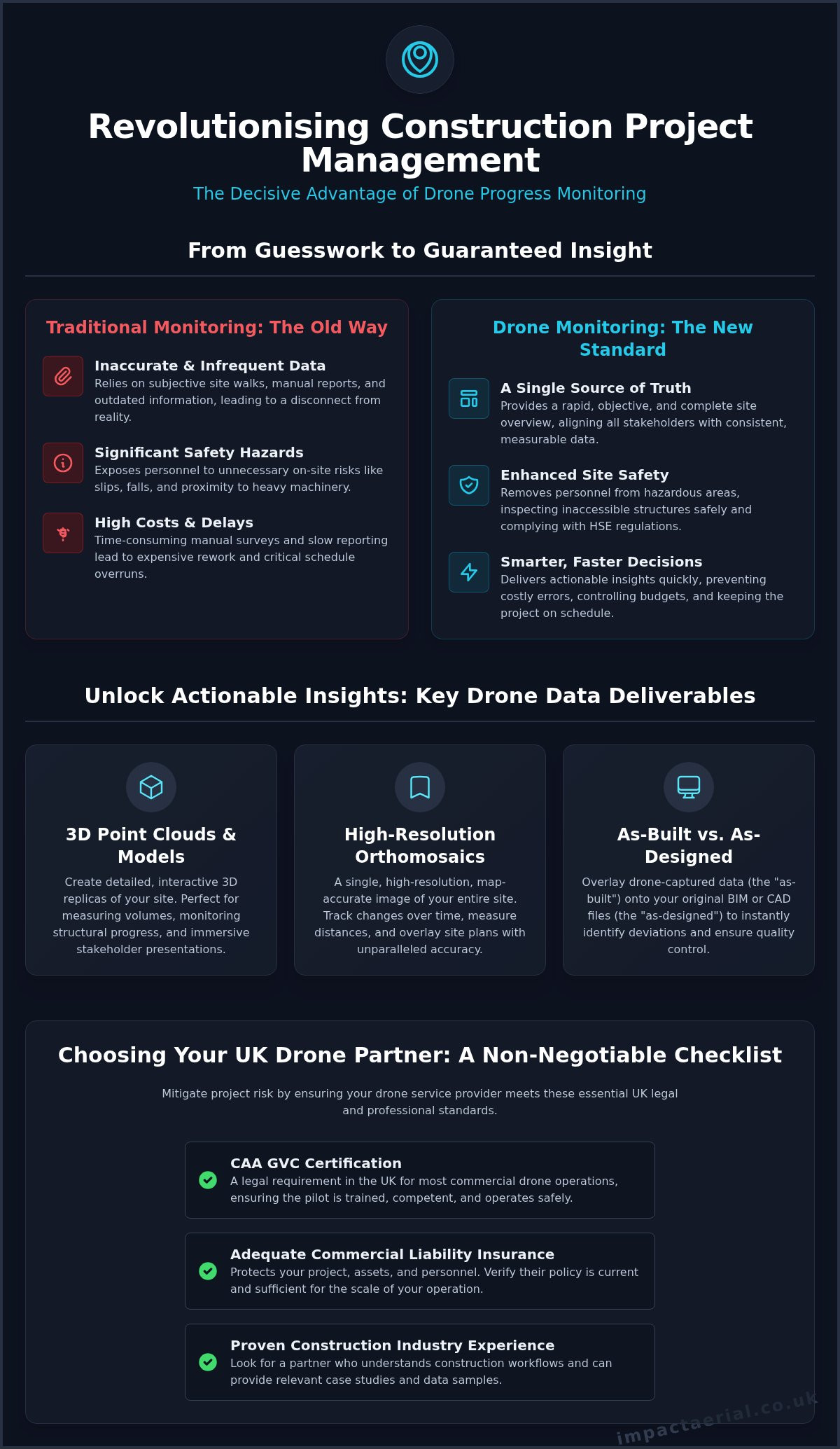
Construction monitoring has moved beyond the clerk of works walking a site with a clipboard and a handheld camera. Today, aerial progress photos for developers represent a systematic, data-driven method of documenting every stage of a build from a precise, repeatable vantage point. By deploying a professional unmanned aerial vehicle (UAV), project managers gain a high-altitude perspective that ground-based teams simply can’t replicate. This isn’t about capturing a single “hero shot” for a marketing brochure. It’s a strategic shift toward weekly or monthly captures that provide an unbiased, chronological record of a project’s lifecycle.

The current industry standard has evolved from occasional photography to rigorous visual data gathering. In 2024, UK construction firms reported a 22% increase in drone adoption for site oversight. By 2026, high-resolution aerial monitoring will be a standard requirement for any project valued over £5 million. This “unbiased eye” ensures that remote stakeholders and off-site directors have a clear, unfiltered view of the site’s evolution without needing to travel to the location.

To see how these reports streamline the construction process, watch this helpful video:

Limitations of Traditional Site Reporting

Ground-level inspections often miss critical details. Perimeter fences and complex scaffolding create visual blind spots that can hide up to 30% of a site’s active footprint. Traditional photography often suffers from inconsistent angles and varied lighting when handled by non-specialists. Capturing progress on a £12 million internal courtyard or a complex roof-level installation requires a vertical vantage point that no ladder or telescopic pole can reach. Without standardised aerial views, reporting becomes subjective and fragmented.

Meeting the Demands of 2026 Stakeholders

Modern investors demand absolute transparency. By 2026, real-time visual updates will be a non-negotiable part of institutional project reporting. High-resolution aerial progress photos for developers allow for the immediate validation of contractor milestones against the agreed programme. This verifiable evidence provides peace of mind for remote stakeholders, ensuring that payment schedules align perfectly with physical reality. It removes the guesswork from site meetings and provides a definitive record that protects all parties involved in the development.

Technical Precision: How Drone Progress Photography Works

Modern site monitoring has evolved significantly from the manual history of aerial photography programs. Today, we utilise 24-satellite GPS constellations to lock flight paths with centimetre-level accuracy. This technical rigour ensures that aerial progress photos for developers provide a scientific record of construction rather than just a collection of pretty pictures. By removing human variance, we create a reliable data stream that project managers use to verify sub-contractor milestones and material deliveries.

GPS-Locked Repeatability

Automated flight plans eliminate the 15% margin of error typical of manual piloting. By using waypoint navigation, our drones return to the exact spatial coordinates; latitude, longitude, and altitude; every 30 days. This precision allows for perfectly aligned “before and after” overlays. It’s the standard required to produce seamless time-lapse transitions that stakeholders use for high-stakes board reports. Reducing human error in flight path execution means every shutter click happens at the exact same angle, month after month.

High-Resolution Deliverables and Post-Production

We deploy professional-grade drones, equipped with advanced sensor technology, to capture 45-megapixel stills and 4K HDR imagery. This high dynamic range is vital in complex urban environments where shadows from adjacent skyscrapers can obscure ground-level details. Raw footage isn’t enough for professional presentations. Our post-production workflow includes:

  • Colour Grading: We ensure visual consistency across a 24-month project timeline, regardless of seasonal light changes.
  • Detail Enhancement: 4K resolution allows stakeholders to zoom into specific site sections, such as rebar spacing or drainage installation, without losing clarity.
  • Secure Cloud Delivery: We provide 128-bit encrypted links for large-scale files, ensuring your data remains private and accessible to the whole team.

Consistency requires more than just hardware; it demands strict scheduling. We aim for “solar noon” to minimise long shadows that can hide foundation work or trenching. Capturing data at 11:00 on a specific Tuesday each month provides a controlled dataset for your records. If you require this level of consistent site oversight, the technical setup is where the ROI begins. Our CAA GVC certified pilots manage the complex airspace permissions, allowing you to focus on the build while we handle the data-rich imagery.

The ROI of Aerial Progress Photos vs. Traditional Site Inspections

Traditional site inspections often require multiple personnel to spend hours, or even days, navigating active construction zones. This manual approach is not just slow; it’s expensive. By deploying aerial progress photos for developers, project managers can capture a comprehensive site overview in less than thirty minutes. This speed doesn’t sacrifice quality. Our CAA GVC Certified pilots use 4K HDR equipment to provide a level of detail that ground-level inspections simply can’t match. This high-resolution data allows for remote site monitoring, which significantly reduces the need for expensive, time-consuming travel for stakeholders based in different regions of the UK.

While the applications of aerial photography have historically focused on cartography and planning, modern drone data provides the granular detail needed for today’s high-stakes development projects. Catching a structural misalignment or a drainage error during the first week of a build can save upwards of £20,000 in rework costs. Drones identify these discrepancies early by comparing real-time imagery against original BIM models with millimetre precision.

Cost Savings and Efficiency Gains

Manual inspections for a five-acre site typically involve a two-person team and a full day of labour, costing approximately £800 to £1,200 per visit. In contrast, a professional drone service can complete the same data-gathering exercise for a fraction of that cost while providing more versatile outputs. Adopting drone technology typically results in a 60% to 80% reduction in the time required to complete a comprehensive site survey. Beyond direct labour costs, developers also see a reduction in their carbon footprint by eliminating dozens of site commutes each month. This aligns with modern ESG (Environmental, Social, and Governance) targets now required by many UK local authorities.

Risk Mitigation and Insurance Benefits

Safety is a non-negotiable priority on any UK site. According to the Health and Safety Executive (HSE) 2023 report, falls from height remain the leading cause of workplace fatalities in construction. Drones keep your staff on the ground, away from fragile roofs and hazardous scaffolding. This proactive approach to safety can lead to more favourable terms with providers of commercial liability insurance. Aerial progress photos for developers also act as an indisputable digital ledger. If a dispute arises regarding a contractor’s timeline or the quality of materials used, you have a time-stamped, high-definition visual record to resolve the issue quickly and avoid costly legal fees.

Effective risk management also extends beyond the site itself to encompass comprehensive transport planning. For instance, specialist firms like ML Traffic Engineers Australia provide crucial traffic impact assessments that can prevent costly logistical bottlenecks and planning disputes long before construction begins.

  • Dispute Resolution: Clear evidence of work completed at specific dates.
  • Compliance: Visual proof of health and safety adherence for HSE audits.
  • Marketing: High-quality visuals that secure off-plan sales and investor confidence months before completion.

Integrating Aerial Data into Your Development Workflow and BIM

Modern construction demands more than just visual updates. Integrating aerial progress photos for developers into a Building Information Modelling (BIM) workflow transforms raw imagery into actionable intelligence. Since the UK government mandated BIM Level 2 for all centrally procured projects, the industry has seen a 20% increase in the adoption of drone-derived data to maintain compliance and accuracy. It’s no longer about simple snapshots. It’s about creating a living record of the site that syncs with your digital architecture.

From Photos to 3D Models

Photogrammetry is the engine behind this digital transformation. By capturing hundreds of high-resolution images with a 70% overlap, our CAA GVC certified pilots generate dense point clouds. These datasets provide 1-2cm relative accuracy for site volume measurements. This precision is vital when calculating muck-away costs or measuring stockpiles of expensive materials like primary aggregate. Developers often save upwards of £1,500 per survey by replacing manual ground measurements with drone-led data gathering. You can export these models directly into platforms like Autodesk Revit or Navisworks. This allows your BIM manager to spot clashes between the “as-built” reality and the “as-designed” plans before they become costly site rectifications.

Streamlining Stakeholder Communication

Clear communication is the backbone of any successful £10m+ development. Aerial data bridges the gap between the site office and the boardroom. Instead of static reports, you can provide off-site investors with immersive 360-degree virtual tours. This gives them a “boots on the ground” perspective without the health and safety risks of a live site visit. Using aerial overlays, project managers can demonstrate precisely how the build aligns with the original programme of works. This level of transparency has been shown to reduce internal reporting time by 25% for UK firms. Automated weekly reports ensure that board members receive consistent, high-quality updates every Monday morning, keeping the project on track and within budget.

For added peace of mind and technical precision on your next site, choose a professional partner who understands the intricacies of CAA regulations and high-end data delivery. Partner with Impact Aerial to integrate professional drone data into your development workflow.

Choosing a Compliant Partner for Aerial Progress Photos in the UK

Selecting a drone operator isn’t just about capturing the right angles. It’s about mitigating risk on high-value construction sites. By January 2026, the transition from the old PfCO to the General Visual Line of Sight Certificate (GVC) will be the mandatory standard for complex commercial operations. Developers must ensure their chosen partner holds this CAA-approved qualification to guarantee they’re operating within the latest legal frameworks. This certification proves a pilot’s ability to handle advanced flight manoeuvres and rigorous safety protocols in congested areas.

Navigating UK Drone Regulations

The shift from PfCO to GVC ensures that pilots possess the technical skills required for high-risk urban environments. For every project involving aerial progress photos for developers, we produce site-specific Risk Assessments and Method Statements (RAMS). These documents aren’t mere formalities; they’re essential safety blueprints that protect your site’s stakeholders and personnel. We also strictly adhere to the Data Protection Act 2018. This ensures that any identifiable data captured during urban flights remains fully compliant with UK privacy laws, protecting you from potential GDPR liabilities.

Standard public liability insurance often falls short for large-scale construction environments. We maintain £5 million in commercial liability insurance as an industry-standard baseline. This provides the necessary peace of mind for developers managing multi-million pound assets. Our technical edge comes from using DJI Enterprise hardware equipped with 4K HDR cameras. These systems use mechanical shutters to eliminate rolling shutter distortion, providing the crisp, high-contrast imagery needed for precise site monitoring and reporting.

The Impact Aerial Advantage

Choosing a specialist based in Birmingham or the West Midlands allows for rapid deployment when specific weather windows open. We understand the local geography and the specific requirements of the region’s planning authorities. Our service includes customisable post-production to ensure your aerial progress photos for developers align perfectly with your corporate branding and visual identity. This meticulous attention to detail helps you present a professional, authoritative image to investors and stakeholders alike. You can organise a consultation for your next project to see how our safety-conscious approach delivers tangible ROI for your development programme.

Optimise Your Development Oversight for 2026

Adopting advanced drone technology isn’t just about capturing visuals; it’s about securing a 20% improvement in project transparency across your entire supply chain. Integrating high-resolution data into your BIM software allows for real-time adjustments that prevent costly delays before they occur. For added peace of mind, professional aerial progress photos for developers ensure your site records meet the rigorous standards required for 2026 planning and compliance audits.

Impact Aerial provides the technical expertise your project demands. Our team operates the latest 4K HDR DJI Enterprise fleet to deliver meticulous detail on every flight. Every operation is handled by CAA GVC Certified Pilots and backed by £5m commercial liability insurance, ensuring your development stays protected and compliant. We’re ready to help you transform how you track, manage, and showcase your build’s evolution. Your project deserves the clarity and precision that only an industry-leading partner can provide.

Book your professional aerial progress monitoring with Impact Aerial and take control of your site’s data today.

Frequently Asked Questions

How often should a developer book aerial progress photos?

Monthly visits are the industry standard for 85% of UK construction projects to ensure consistent documentation for stakeholder reports. Large-scale developments with a valuation exceeding £10 million often require fortnightly captures to track rapid structural changes and maintain precise project timelines. This regular schedule allows you to identify potential delays early and provides a visual archive that helps resolve 95% of future contractor disputes.

Is it legal to fly drones over active construction sites in UK city centres?

Yes, it’s legal provided the operator holds the correct Civil Aviation Authority (CAA) GVC certification and adheres to the Specific category regulations. For congested city centres like London or Birmingham, we operate under a PDRA01 authorisation or a specific Operating Safety Case. These legal frameworks allow us to capture high-quality aerial progress photos for developers in complex urban environments while maintaining strict safety distances from uninvolved persons.

What is the difference between progress photography and a full drone survey?

Progress photography focuses on visual storytelling and marketing, whereas a drone survey provides measurable topographic data. A survey uses photogrammetry to create 3D point clouds and orthomosaic maps with a high accuracy of 1cm to 3cm. In contrast, aerial progress photos for developers use 4K HDR sensors to document site conditions and aesthetic milestones for investor updates, site meetings, and social media content.

Can aerial progress photos be integrated into BIM software?

You can integrate high-resolution aerial data into Building Information Modelling (BIM) platforms such as Autodesk Revit or Navisworks. By using 2D orthomosaics, developers overlay current site reality against 3D design models to identify 100% of structural deviations early. This integration helps project managers spot clashes between the planned design and the actual build, which can reduce costly rework expenses by up to 15%.

How much does a professional drone progress photo package cost in the UK?

Professional drone photography packages typically range from £350 to £750 per site visit in the UK. This price includes the pilot’s day rate, comprehensive CAA compliance planning, and the post-production of high-resolution images. For long-term contracts spanning 12 to 24 months, many developers secure a 10% to 20% discount by pre-booking a set number of monthly visits for the duration of the project.

What happens to the flight schedule if the British weather is poor?

We monitor Met Office forecasts 48 hours in advance and reschedule flights if wind speeds exceed 20mph or if heavy rain is predicted. Our DJI Enterprise drones carry an IP55 rating, meaning they can operate in light drizzle, but we prioritise image clarity and safety above all else. If a flight is postponed due to weather, we typically re-deploy the pilot within 24 to 48 hours to ensure your reporting schedule stays on track.

Do I need to notify neighbours or local councils before drone flights?

You don’t usually need formal permission from local councils for flights over private land, but notifying immediate neighbours is a best practice for 100% transparency. As CAA GVC certified operators, we manage the technical flight risk assessment and check for any Flight Restriction Zones or Temporary Restricted Areas. We recommend informing site staff 24 hours before our arrival to ensure everyone is aware of the scheduled aerial activity.

What insurance should a drone operator have for commercial construction sites?

A professional drone operator must have EC 785/2004 compliant commercial liability insurance with a minimum cover of £5 million. For added peace of mind, we carry £10 million in public liability insurance to meet the stringent requirements of Tier 1 contractors and major UK developers. This specialist cover protects against third-party property damage and personal injury, ensuring your project remains fully protected during every flight.

How to Choose a Drone Survey Company: The Professional UK Guide for 2026

A 2024 survey from the Chartered Institution of Civil Engineering Surveyors revealed a stark reality: nearly 30% of UK project managers reported receiving drone survey data that was unusable for BIM or CAD integration, leading to significant project delays and rework. It’s a common frustration in this rapidly evolving industry. You recognise the immense potential of UAVs to deliver cost-effective data and eliminate the risks of manual inspections, yet the market is saturated with operators who prioritise “pretty pictures” over precision.

This 2026 guide cuts through the noise. We will provide the definitive framework for how to choose a drone survey company in the UK, equipping you to master the technical, legal, and commercial criteria required for a successful partnership. From verifying CAA GVC certifications and public liability insurance to interrogating a provider’s data processing workflow, you’ll gain the confidence to secure a partner who delivers high-precision results and complete regulatory peace of mind.

Key Takeaways

  • Understand the non-negotiable UK legal standards, including CAA Operational Authorisation and GVC certification, to ensure your project is fully compliant and avoids regulatory risk.
  • Discover why the drone’s sensor technology is more critical than the drone model itself for delivering the high-precision data required for professional construction and property surveys.
  • Master how to choose a drone survey company with a clear vetting framework, learning which key documents and case studies you must request to verify their competence.
  • Learn to distinguish between basic aerial photography and professional-grade geospatial data to prevent costly project errors that can lead to million-pound mistakes.

Beyond the “Toy” Perception: Why Choosing the Right Drone Survey Partner Matters in 2026

The perception of drones has shifted dramatically. What were once considered high-end toys are now indispensable industrial tools, crucial for gathering high-accuracy geospatial data. By 2026, the UK market for commercial drone services is projected to be worth over £45 billion, yet a critical gap is widening between qualified, enterprise-level operators and hobbyists offering commercial services. The distinction isn’t just about equipment; it’s about a fundamental understanding of data integrity. Choosing a partner based on the lowest price often exposes a project to million-pound errors, costly rework, and significant legal liability. This is why understanding how to choose a drone survey company is no longer a minor procurement decision, it’s a critical risk management strategy.

For a deeper insight into the professional drone services market, the following video provides a valuable overview:

The commercial stakes are incredibly high. In construction, a topographical survey with just a 5cm vertical error can lead to incorrect earthworks calculations, costing a project upwards of £150,000 in unforeseen spoil removal and material costs. In property management, a roof survey that misses subtle water ingress due to poor thermal data can result in structural damage costing tens of thousands to remediate. A “cheap” survey isn’t a saving; it’s a deferred cost with interest. True professional service providers understand that the deliverable isn’t a collection of images, but verified, actionable data that project managers and engineers can trust implicitly.

Data Precision vs. Visual Quality

A stunning 4K video of a building façade is excellent for marketing but is functionally useless for a structural engineer assessing masonry integrity. A professional survey prioritises data that is spatially accurate. This is achieved using survey-grade techniques like establishing Ground Control Points (GCPs) to ensure the resulting 3D model or orthomosaic map has a verified accuracy of 20-30mm. This is the difference between an “inspection” (a visual check) and a “survey” (a quantifiable measurement).

The Risk of the “Dave with a Drone” Approach

Utilising an uncertified, uninsured internal staff member or a local hobbyist introduces unacceptable risk. A single safety incident, such as a drone failure over a live construction site, can trigger an immediate Health and Safety Executive (HSE) investigation, halting all site operations for weeks. The decision on how to choose a drone survey company must factor in this liability. A professional operator, fully certified by the CAA with a GVC (General VLOS Certificate), treats their Unmanned Aerial Vehicle (UAV) as a piece of industrial machinery. They operate with comprehensive flight plans, risk assessments, and commercial liability insurance, providing you with essential peace of mind.

Beyond high-resolution cameras and advanced flight capabilities, the most critical factor in your selection process is legal compliance. An uncertified or underinsured operator doesn’t just represent a risk; they represent a direct liability to your business, your site, and your reputation. The UK’s drone industry is strictly regulated by the Civil Aviation Authority (CAA) for a reason: safety. Understanding these legal benchmarks is central to how to choose a drone survey company that protects your project from start to finish.

The regulatory landscape for commercial drone operations in the UK transitioned after 31 December 2020, moving from the old PfCO (Permission for Commercial Operation) system to a new framework. Today, the professional standard is the Operational Authorisation, which is granted by the CAA to operators who demonstrate the highest levels of safety and competence. This isn’t just paperwork. It’s the non-negotiable passport for any commercial drone work in the United Kingdom.

Decoding Pilot Certifications

A pilot’s qualifications are the bedrock of a safe and successful survey. The key certification to look for is the General Visual Line of Sight Certificate (GVC). This proves the pilot has passed both a theoretical examination and a practical flight test, demonstrating a thorough understanding of air law, risk mitigation, and emergency procedures. This authorisation is granted only after a pilot proves their competence and understanding of the rules laid out in the official CAA guidance, The Drone and Model Aircraft Code. A professional operator must also maintain a detailed Operations Manual, which is a comprehensive document outlining their specific procedures for every type of flight. Don’t hesitate to ask about it; a compliant company will be proud to discuss its commitment to safety.

Insurance: More Than Just a Policy Number

For commercial drone surveys, standard insurance policies are wholly insufficient. Professional operators must hold a specialist aviation insurance policy that is compliant with regulation EC 785/2004. This is not optional. For most commercial, industrial, and construction sites in the UK, a minimum of £5 million in public liability coverage is a mandatory prerequisite for granting site access. This level of cover provides essential peace of mind, protecting your business, assets, and personnel from third-party claims in the unlikely event of an incident. Before the first prop spins, you must verify the drone company’s insurance. Always request to see a current and valid copy of their insurance certificate; it should clearly state the coverage level and confirm compliance with EC 785/2004.

Finally, consider data protection. A drone survey is an act of data-gathering, and as such, it must comply with UK GDPR. A professional company will have clear policies for handling, processing, and storing the data collected, ensuring privacy is respected and legal obligations are met. This level of due diligence is what separates professional operators from potential liabilities, a key factor when you’re learning how to choose a drone survey company. Our team is always transparent about our credentials, and you can review our CAA certification and insurance details at any time for complete reassurance.

Sensors Over Specs: Matching Drone Technology to Your Project Outcomes

It’s a common mistake to focus on the drone itself. While the aerial platform is important, the real value of a survey lies in the data captured by its payload, the sensor. A top-tier drone carrying the wrong sensor for the job will deliver poor results. The critical question isn’t “What drone do you fly?” but “What sensor will you use to achieve my project’s goals?” Professional operators build their fleet around the data required, which is why leading industrial-grade drone technology has become the de facto standard for industrial-grade work since 2022. This hardware isn’t just about performance; its reliability is essential for operating safely under stringent UK Civil Aviation Authority regulations.

Understanding the technology is a vital part of learning how to choose a drone survey company. Your provider must be a consultant, guiding you to the most effective data-gathering tool for your specific outcome, whether you need centimetre-accurate topographical data or a detailed thermal inspection.

Photogrammetry vs. LiDAR: Which Do You Need?

Photogrammetry creates 3D models by stitching together hundreds or thousands of high-resolution overlapping photographs. It excels at capturing visual detail and colour, making it the ideal choice for creating realistic 3D models of buildings, monitoring construction progress, or producing high-resolution orthomosaic maps of hardscapes and open terrain. It is a highly cost-effective method for many survey applications.

LiDAR (Light Detection and Ranging), however, is the gold standard for projects requiring extreme accuracy and the ability to penetrate vegetation. Instead of photos, a LiDAR sensor fires millions of laser pulses to measure the distance to the ground, creating a dense “point cloud” of elevation data. This is the only reliable aerial method for mapping true ground topography beneath a tree canopy. While a LiDAR survey for a 5-hectare site might cost £1,500-£2,000 more than photogrammetry, it eliminates weeks of hazardous ground-based work, delivering a superior return on investment for forestry, flood-risk, and complex terrain projects.

Thermal Imaging and Specialized Sensors

Beyond mapping, specialised sensors unlock powerful new insights for asset management and environmental analysis. A competent survey company will have access to a range of payloads, including:

  • Radiometric Thermal Cameras: Essential for PV solar farm surveys, these sensors can identify individual cell-level defects, inverter faults, and connection issues invisible to the naked eye. A single day of aerial thermal scanning can assess over 50 MW of solar assets.
  • Multi-spectral Sensors: Used in agriculture and environmental management, these sensors capture light in non-visible spectrums to assess crop health (NDVI), water quality, and land classification with remarkable precision.
  • High-Zoom Inspection Cameras: Advanced multi-sensor payloads combine thermal and visual sensors with powerful zoom lenses, allowing for safe and detailed inspection of wind turbines, chimneys, and roofing from a standoff distance of over 75 metres.

Ultimately, the raw data from any of these sensors is only half the story. The final, crucial step is post-production. A professional survey provider doesn’t just deliver a folder of images or a raw point cloud. They process this complex data into actionable insights: fully-rendered 3D models, classified point clouds compatible with Autodesk, or detailed inspection reports. The quality of their software and analytical skill is just as important as the quality of their drone.

The Vetting Framework: 5 Critical Questions and 3 Red Flags to Watch For

Once you have a shortlist of potential drone survey providers, the real evaluation begins. Moving beyond their website claims requires a structured vetting process. Asking the right questions not only reveals a company’s technical competence but also its commitment to safety and regulatory compliance. This framework is central to understanding how to choose a drone survey company that protects your project, your budget, and your reputation.

Arm yourself with these five critical questions before making a final decision:

  • 1. “May I see a copy of your CAA Operational Authorisation?” This is the single most important question. Any legal commercial drone operator in the UK must be authorised by the Civil Aviation Authority (CAA) and hold valid commercial liability insurance. Their pilots should hold a GVC (General Visual Line of Sight Certificate). A refusal or hesitation to provide this is an immediate disqualification.
  • 2. “Can you share a case study from a recent construction [or property/solar] project?” A portfolio of cinematic aerial shots is not the same as a technical survey. You need to see evidence of their work in your specific sector. Look for detailed outputs like annotated orthomosaic maps, volumetric calculations for stockpiles, or thermal inspections of solar arrays, not just pretty pictures.
  • 3. “How will you deliver the final data?” A professional firm won’t just send you a Dropbox link with 50 GB of raw images. They should provide access to a dedicated data platform where you can view, measure, and analyse the outputs. Ask about file formats like .LAS (for point clouds) or GeoTIFFs and their compatibility with your existing software (e.g., AutoCAD, BIM).
  • 4. “What does your pre-flight risk assessment process involve?” Safety isn’t just a box-ticking exercise. A competent operator will describe a detailed process involving site surveys, airspace checks (for proximity to airports or restricted zones), and the creation of a thorough Risk Assessment and Method Statement (RAMS). This demonstrates a proactive safety culture.
  • 5. “Why is your quote priced this way?” The cheapest quote often carries the highest risk. A low price can signal a lack of adequate insurance (we carry £10 million in public liability for peace of mind), the use of substandard equipment, or rushed post-processing. A professional quote accounts for meticulous planning, top-tier technology, and the expertise needed to produce survey-grade data.

The “Cowboy Operator” Red Flags

Unprofessional operators can jeopardise your project’s timeline and safety. Watch for these clear warning signs. A lack of CAA GVC certification or commercial insurance is a non-starter. Using consumer-grade drones like a DJI Mini for an industrial survey signals a lack of understanding of the required data quality; their small sensors and lack of RTK receivers cannot deliver the centimetre-level accuracy needed. Finally, be wary of vague answers about data accuracy or Ground Control Points (GCPs). Without GCPs, a survey’s accuracy can be off by metres, rendering it useless for any serious engineering or planning.

The Importance of Post-Production

Raw drone footage is simply a collection of images and data points. Its true value is unlocked in post-production. A reputable survey company invests heavily in processing software and analytical expertise. You should expect detailed, actionable reports with clear annotations, not just a photo gallery. For property and construction clients, ask if they can produce immersive 3D virtual tours. These models are invaluable for tracking site progress, conducting remote inspections, and marketing properties with a unique, data-rich perspective.

A professional drone survey company will welcome this level of scrutiny. To see how our processes stand up to these questions, we invite you to request a sample survey report and a copy of our CAA Authorisation.

The Impact Aerial Standard: Precision Data with Absolute Peace of Mind

After evaluating experience, technology, compliance, and insurance, the final step is seeing how a provider brings it all together. At Impact Aerial, we don’t just meet the criteria; we set the standard. Our entire operation is built to provide UK property and construction clients with technically superior data, delivered through a process that guarantees complete professional security.

We combine the industry-leading power of DJI Enterprise drones with the rigorous operational discipline of our CAA GVC certified pilots. This isn’t just about having the best equipment; it’s about having the proven expertise to deploy it safely and effectively, even in complex or restricted airspace. Our meticulous “Consultation-to-Post-Production” workflow ensures every project is managed with precision. From the initial site assessment and risk analysis to data acquisition and the delivery of actionable 2D maps or 3D models, we provide a seamless, end-to-end service tailored to your project’s specific goals.

Our strategic base in Birmingham gives us a unique advantage. We possess intricate knowledge of the West Midlands’ development landscape while maintaining the logistical capability for nationwide UK coverage. This blend of local insight and national reach ensures we are both responsive and scalable. Underpinning every flight is our £5m commercial liability insurance. For our clients, this is the cornerstone of our service. For added peace of mind, it confirms that you are partnering with a serious, professional operator who prioritises risk management above all else. This level of security is a critical factor in how to choose a drone survey company you can trust.

Case Study: Maximising ROI in Solar and Property

Our approach delivers tangible results. For a recent solar farm client, our thermal drone inspection methodology identified faulty panels with 99% accuracy and reduced traditional survey costs by 40%. The benefits extend beyond data; our 4K HDR cinematic output serves a dual purpose, providing detailed survey imagery that can be repurposed for high-impact marketing materials. This capability is essential for navigating and documenting complex urban environments, from construction sites in Birmingham to historic building surveys in London.

Get Started with a Professional Consultation

Initiating a project with us is straightforward. To help us provide an accurate and timely quote, please include the project address or What3Words location, a brief overview of your objectives, and your required deliverables in your initial enquiry. Our typical timeline, from this first contact to the final delivery of your processed data, is between 5 to 10 working days, depending on project complexity and weather conditions. We believe transparency and a proven track record are the ultimate answers when asking how to choose a drone survey company.

Ready to see the difference a professional, compliant, and fully-insured drone survey partner can make? Contact Impact Aerial for a compliant drone survey quote today.

Your Next Step: Securing Precision Data with a Vetted Partner

Choosing a drone survey partner in 2026 is a critical business decision, moving far beyond the perception of drones as mere gadgets. The right choice is foundational to your project’s success. As this guide has shown, your vetting process must prioritise non-negotiable legal standards, like current CAA GVC certification, and ensure the proposed sensor technology is precisely matched to your required outcomes, not just the latest model on the market.

Ultimately, knowing how to choose a drone survey company means investing in data integrity and operational safety. At Impact Aerial, we provide this with absolute peace of mind. Our professional services are guaranteed by our team of fully CAA GVC Certified pilots, underwritten by a £5m Commercial Liability Insurance policy, and executed with our cutting-edge DJI Enterprise 4K HDR fleet.

Ready to build your project on a foundation of accuracy and reliability? Book a Professional Drone Survey Consultation with Impact Aerial today and let’s discuss how our expertise can elevate your results.

Frequently Asked Questions

Do I need a license to hire a drone survey company in the UK?

No, as the client, you don’t need a license. However, the responsibility falls on you to ensure the company you hire is legally certified. A professional drone operator must hold a valid Operational Authorisation issued by the Civil Aviation Authority (CAA). Their pilots should be qualified with a General Visual Line of Sight Certificate (GVC), which is the standard for commercial operations in the UK. Always ask to see their documentation before work begins.

How much does a professional drone survey cost in 2026?

A professional drone survey in 2026 typically costs between £450 for a basic roof inspection and can exceed £2,500 for large-scale topographical land surveys. The final price depends on the project’s complexity, the size of the survey area, and the required data outputs, such as 2D orthomosaics or 3D point clouds. It’s essential to request a detailed quote that outlines all deliverables and post-processing services included in the cost.

What is the difference between a GVC and an A2 CofC for drone pilots?

The GVC (General Visual Line of Sight Certificate) is the UK’s primary commercial drone qualification, allowing pilots to operate in more complex environments and apply for an Operational Authorisation from the CAA. The A2 CofC (A2 Certificate of Competency) is for lower-risk operations with stricter limits on flying near people. For professional survey work, it’s critical to confirm your provider’s pilots hold a GVC, as this demonstrates a higher level of training and operational competence.

Can drones fly in rain or high winds for a survey?

No, conducting a professional drone survey in rain or high winds is not feasible. Most commercial survey drones are not waterproof, and rain on the camera lens will ruin the data. Wind speeds exceeding 25 mph can compromise the drone’s stability, leading to blurred imagery and inaccurate data. A reputable operator will always reschedule a flight if the weather conditions as forecast by the Met Office are unsuitable, ensuring both safety and data quality.

How accurate is drone surveying compared to traditional land surveying?

Drone surveying is highly accurate, achieving absolute accuracy of 20-50mm when using Ground Control Points (GCPs), which is comparable to traditional methods for most applications. While a total station might be more precise for single-point measurements, a drone captures millions of data points, creating a far richer and more comprehensive dataset. For large sites, this makes it a significantly faster and more cost-effective method for producing detailed topographical maps and 3D models.

What insurance should a drone survey company have?

A drone survey company must carry specialist commercial drone insurance compliant with regulation EC785/2004. This policy must include Public Liability Insurance, with a minimum coverage of £1 million, although most professional firms carry £5 million to £10 million. For your added peace of mind, always request to see a valid copy of their insurance certificate before any operations commence on your site. This is a non-negotiable part of your due diligence.

How long does it take to get the data back from a drone survey?

You can typically expect your processed drone survey data within 3 to 5 working days. The exact turnaround time depends on the project’s scale; a simple set of inspection photos might be delivered in 24 hours. In contrast, processing thousands of images into a complex 3D model or a detailed topographical survey requires extensive computer processing and expert analysis. Your provider should give you a clear delivery timeline in their initial proposal.

Do drone survey companies need permission to fly over my neighbour’s property?

Legally, a drone company doesn’t need a neighbour’s permission to operate in the airspace above their property, as the CAA governs UK airspace. However, privacy laws must be respected. A professional operator will plan their flight path to minimise overflight of adjacent properties and will often manage communication with neighbours as part of their pre-flight planning. Knowing how to choose a drone survey company that operates courteously and professionally is key to a successful project.

Drone Construction Site Monitoring: The 2026 Guide to Project Oversight

In the demanding landscape of UK construction, relying on traditional, manual site inspections is becoming increasingly inefficient and hazardous. The inherent safety risks, costly delays, and potential for stakeholder disputes arising from inaccurate progress reports can compromise even the most well-managed project. This is where the transformative capabilities of professional drone construction site monitoring provide a definitive advantage, offering a safer, faster, and remarkably more precise method for project oversight.

However, successfully integrating this technology requires more than simply launching a drone. It demands a thorough understanding of current UK aviation law, data processing for accurate 3D models and BIM integration, and strategic implementation. This comprehensive 2026 guide is engineered to provide you with that mastery. We will navigate the critical technical, regulatory, and strategic aspects, giving you the confidence to achieve real-time visual updates and full regulatory peace of mind on every project.

Key Takeaways

  • Understand how drone data has evolved from simple progress photos to fully integrated data streams for enhanced project transparency.
  • Discover the critical differences between the old PfCO and current CAA GVC standard to avoid the significant liabilities of hiring uncertified pilots.
  • Learn when to use high-resolution aerial photos for visual updates versus when to deploy 3D photogrammetry for precise surveying and data analysis.
  • Implement a strategic flight schedule for your drone construction site monitoring by aligning missions with key project milestones to maximise return on investment.

The Evolution of Drone Construction Site Monitoring in 2026

In 2026, the term drone construction site monitoring has evolved far beyond its origins of capturing simple aerial progress photos. It now represents the integration of high-fidelity data streams into the core of project management. The modern approach involves deploying sophisticated unmanned aerial vehicles (UAVs) to create a dynamic, data-rich overview of a site’s entire lifecycle. This shift from periodic reactive site visits to proactive, data-driven oversight has reached a tipping point in the UK construction sector, driven by demands for greater efficiency, stringent safety compliance, and indisputable project documentation.

To see how this technology is being applied for critical tasks like safety inspections, watch this insightful video:

This “drone-first” methodology is no longer a niche advantage but a competitive necessity. The ability to generate a high-resolution visual audit trail using 4K High Dynamic Range (HDR) imagery provides project managers, stakeholders, and insurers with an unambiguous record of progress and quality. In the event of disputes or litigation, this clear, time-stamped evidence proves invaluable, protecting contractors from unsubstantiated claims and providing clarity for insurance purposes.

From Visual Progress to Digital Assets

The crucial distinction in 2026 lies between “taking photos” and “creating digital assets.” A simple photograph shows a moment in time, but a drone-captured dataset is a geotagged, measurable digital asset. These assets form a permanent record, crucial for documenting sub-surface works like foundations and utility installations before they are covered. This historical data provides an irrefutable timeline, preventing costly disputes and delays during the final “snagging” phase by offering clear evidence of what was completed, when, and to what standard.

The 2026 Technology Stack: DJI Enterprise and Beyond

The hardware enabling this revolution is more robust than ever. Professional services rely on platforms like DJI Enterprise drones, which offer exceptional stability in the often-challenging high-wind conditions of UK construction sites. For documentation, 4K HDR is now the minimum acceptable standard, ensuring every detail is captured with the clarity required for technical analysis and legal review. This data feeds directly into a project’s Digital Twin, which is a virtual, live, 1:1 replica of the physical construction site, updated with real-time drone data for unparalleled project management.

Regulatory Compliance and Safety: The CAA GVC Standard

In the high-stakes environment of a construction site, cutting corners on aerial data acquisition is a risk no firm can afford. Hiring an uncertified or under-insured drone pilot is not just a breach of regulations; it’s a massive liability that can jeopardise project timelines, budgets, and site safety. For any modern drone construction site monitoring programme, understanding the UK’s stringent aviation laws is the first step toward successful and secure implementation. Project managers must be aware that the legal landscape has evolved, with the Civil Aviation Authority (CAA) now mandating a higher standard of pilot competence.

Understanding CAA GVC Certification

The General Visual Line of Sight Certificate (GVC) is the professional standard required for most commercial drone operations in the UK, superseding the older PfCO qualification. This certification is not a simple formality; it confirms a pilot has passed rigorous theoretical exams and a practical flight assessment, proving their competence in managing operations safely. This training is critical on a dynamic construction site, enabling pilots to conduct thorough risk assessments and plan flights that safely navigate airspace near active tower cranes, heavy machinery, and personnel. This adherence to the official CAA operational guidance provides the essential peace of mind that comes from using a fully vetted and compliant operator.

Insurance and Liability on Active Sites

Standard public liability insurance is wholly insufficient for commercial drone operations. A professional drone services provider must hold specialist EC 785/2004 compliant commercial liability insurance. For work on major construction projects, particularly in congested areas like the West Midlands, a policy of at least £5 million is the industry standard. You can verify a pilot’s credentials and insurance status through trusted directories like the Drone Safe Register. At Impact Aerial, we streamline this process by liaising directly with your Site Manager, providing a complete safety pack with our certification, insurance, and site-specific risk assessment before any flight operations begin.

Visual Progress vs. Precision Data: Choosing Your Depth

Effective drone construction site monitoring delivers two distinct, yet complementary, types of output: high-impact visual documentation and survey-grade precision data. Understanding the difference is crucial for unlocking the full potential of aerial intelligence on your project. The choice is not about which is better, but which is right for your immediate objective, whether that’s engaging stakeholders or informing critical engineering decisions.

The Power of High-Resolution Progress Photos

For many project managers, the primary value lies in consistent, high-quality visual updates. Weekly or bi-weekly aerial overflights provide an unparalleled bird’s-eye-view, perfect for investor reports and client meetings. Crisp 4K video footage is invaluable for planning site logistics, tracking plant movement, and enhancing safety briefings. Furthermore, this compelling visual record serves as a powerful marketing asset, showcasing your capabilities for future project bids and tenders.

Technical Data: Photogrammetry and Volumetrics

When precision is paramount, simple photography evolves into sophisticated data gathering. Photogrammetry is the science of turning hundreds of overlapping aerial photos into measurable, geographically accurate 2D maps (orthomosaics) and 3D models. This process, a core component of many Drone applications in construction, allows for a level of insight far beyond the human eye. Key applications include:

  • Volumetric Calculations: Accurately measure stockpile volumes of aggregate or earthworks in minutes, achieving accuracy levels often exceeding 98-99% compared to traditional methods.
  • Topographic Surveys: Generate detailed topographic data during pre-planning and excavation stages to ensure site work aligns perfectly with design specifications.

Beyond standard imaging, specialised sensors provide deeper analysis. Thermal imaging cameras can detect heat loss from a building envelope, identify water ingress on a flat roof, or flag malfunctioning equipment. The ultimate goal is integration; all this data, from 3D point clouds to thermal maps, can be seamlessly imported into your existing BIM (Building Information Modelling) workflows. This allows for direct as-built versus as-designed comparisons, catching costly deviations early and ensuring the project remains on track, on time, and on budget.

Establishing a Site Monitoring Schedule for Maximum ROI

To truly leverage the power of drone technology in construction, a reactive approach is insufficient. A structured, proactive schedule for drone construction site monitoring is essential for maximising your return on investment. The optimal frequency depends entirely on project complexity, timelines, and stakeholder requirements, transforming raw data into actionable intelligence that drives efficiency and mitigates risk.

Setting the Monitoring Frequency

Aligning flight missions with your project’s pace ensures you capture meaningful progress and identify issues before they escalate. At Impact Aerial, our professional services are tailored to your specific needs, but a typical framework includes:

  • Weekly Flights: The gold standard for fast-paced vertical construction, such as commercial high-rises or complex industrial facilities. This high frequency allows for granular progress tracking against the schedule, early detection of deviations from plans, and accurate stockpile management.
  • Monthly Overviews: Ideal for long-term infrastructure projects like new road layouts or large-scale housing developments. These flights provide a comprehensive “big picture” overview, perfect for client updates and validating major phase completions.
  • Ad-Hoc Inspections: Deployed rapidly in response to specific events. This includes post-storm inspections to assess damage, verifying the completion of critical works like foundation pouring before sign-off, or investigating a site incident with indisputable visual evidence.

Data Distribution and Stakeholder Access

The high-quality data gathered is only effective when it reaches the right people in a usable format. We facilitate seamless collaboration by distributing data via secure, cloud-based platforms. This allows remote architects to interact with detailed 3D models and engineers to overlay CAD drawings onto up-to-date orthomosaic maps. For non-technical stakeholders, we produce clear, “investor-ready” PDF reports that visually communicate progress against key milestones. For a deeper dive into the data outputs, see The Ultimate Guide to Commercial Drone Surveys.

Calculating the Cost-Offset vs. Traditional Man-Hours

A professional drone survey programme delivers significant and demonstrable cost savings. A traditional land surveyor may require a full day on-site, costing upwards of £600, to capture a limited number of data points. In contrast, a CAA GVC Certified drone pilot can survey an entire site in a fraction of the time, drastically reducing billable man-hours and minimising safety risks associated with personnel navigating an active site. This efficiency not only cuts direct survey costs but also prevents expensive rework by identifying discrepancies between as-built conditions and design plans weeks earlier than traditional methods, providing you with added peace of mind.

Why Impact Aerial is the UK Partner for Site Monitoring

Choosing the right partner for your project oversight is critical. While many operators can fly a drone, Impact Aerial delivers a comprehensive, end-to-end professional service. Based in Birmingham and the West Midlands, we offer full national UK coverage, combining local expertise with the capacity to manage projects of any scale. We understand that effective drone construction site monitoring is about more than just data; it’s about delivering clear, actionable intelligence and breath-taking end results that serve both engineering precision and marketing impact.

The Impact Aerial difference lies in our commitment to quality at every stage, starting with our equipment. We exclusively operate commercial-grade DJI Enterprise drones. This isn’t just a technical detail—it means superior reliability in challenging site conditions, higher resolution sensors for more accurate data capture, and advanced safety features. For added peace of mind, this investment in leading technology ensures the data we gather is consistently precise, secure, and fit for purpose, whether for photogrammetry or a high-impact promotional film.

Our Process: From Consultation to Delivery

Our methodical process guarantees safety, compliance, and minimal disruption. It begins with a detailed site assessment and managing all regulatory clearances with the CAA. On-site, our GVC certified pilots execute the flight plan with precision. The mission concludes with professional post-production, where raw data is processed into clear, concise reports, 2D maps, or 3D models tailored to your project’s specific requirements.

Tailored Solutions for Property and Infrastructure

Every construction project has unique demands. We create customised data packages to meet the needs of different departments—from weekly progress reports for stakeholders to thermal imaging for building inspectors. For a recent large-scale residential developer in the West Midlands, we provided a dual-purpose solution that tracked build progress for the project managers while supplying the marketing team with compelling visuals. Let us design a package for you. Contact Impact Aerial for a tailored site monitoring quote and discover how our services can benefit your project.

Beyond aerial footage, many developers also leverage their vehicle fleets as mobile marketing assets. For firms looking to enhance their brand visibility on and off the construction site, it’s worthwhile to explore Full Van Wraps as a way to project a professional image across all company vehicles.

Partner with the UK’s Leading Drone Experts for 2026 and Beyond

As we look towards 2026, it’s clear that drone construction site monitoring is no longer an optional extra but a fundamental component of efficient project management. The key to success lies in navigating the evolving regulatory landscape, such as the CAA GVC standard, and strategically choosing between high-resolution visual tracking and precision data to maximise your project’s ROI.

Choosing a fully-certified and insured partner is paramount for compliance and safety. Based in Birmingham with national coverage, Impact Aerial provides that professional assurance. Our pilots are all CAA GVC Certified, and for added peace of mind, every operation is backed by £5m in commercial liability insurance, ensuring your project is in expert hands.

Ready to enhance your project’s safety, efficiency, and data accuracy? Request a Quote for Professional Construction Site Monitoring today and discover how our expert services can elevate your oversight. Let’s build the future of construction, together.

Frequently Asked Questions About Drone Construction Monitoring

Do I need a license to use a drone for construction site monitoring in the UK?

Yes, any drone flight conducted for commercial purposes, including construction monitoring, legally requires the operator to hold current Civil Aviation Authority (CAA) certification. The standard for professional operators is the General VLOS Certificate (GVC). This ensures the pilot is proficient in flight safety, operational procedures, and UK air law. Always verify your provider is CAA-certified and insured before commencing any work on your site.

How much does professional drone construction monitoring cost in 2026?

In 2026, professional drone services for construction sites typically range from £500 to over £1,500 per day. The final cost depends on the project’s complexity, the required data outputs (e.g., 4K video vs. detailed 3D models), and the frequency of the flights. A simple visual progress report will be at the lower end, while a comprehensive topographical survey requiring significant data processing will command a higher fee. Most providers offer bespoke project-based pricing.

Can drones fly in rain or high winds on a construction site?

Most commercial drones are not designed to operate in rain, as moisture can damage sensitive electronics and compromise flight safety. Operations are also typically grounded in high winds, usually above 25 mph, to ensure stable flight and prevent accidents. A professional operator will always prioritise safety and data quality, and will reschedule flights if weather conditions are deemed unsuitable, in line with their operational safety case and risk assessment.

What is the difference between a drone survey and progress monitoring?

A drone survey is a technical, data-gathering exercise focused on high-accuracy measurements. Using photogrammetry, it produces measurable outputs like topographic maps, 3D point clouds, and volumetric calculations for earthworks. In contrast, progress monitoring is primarily a visual tool. It uses high-resolution photos and videos captured from consistent waypoints over time to create a visual record of site development, track milestones, and enhance stakeholder communication.

How long does it take to receive the data after a drone flight?

The turnaround time for data depends entirely on the required deliverables. Standard high-resolution photographs and raw video footage can often be delivered within 24 hours of the flight. However, more complex data sets that require extensive processing, such as orthomosaic maps, detailed 3D models, or topographical surveys, typically require 48 to 72 hours to process, stitch, and quality-check before being delivered to your project team.

Is drone monitoring safe to use around active cranes and personnel?

Yes, when conducted by a qualified and experienced pilot, professional drone construction site monitoring is exceptionally safe. Certified operators are required to complete detailed pre-flight risk assessments and establish clear communication protocols with the site manager. This includes defining flight paths, creating exclusion zones, and scheduling flights during periods of low activity to ensure the complete safety of all personnel, machinery, and active cranes on site.

What insurance coverage should a professional drone pilot have?

A professional drone operator must hold specialist commercial Public Liability Insurance that is compliant with regulation EC 785/2004. For added peace of mind, you should ensure your provider has coverage of at least £5 million, with many leading operators carrying £10 million. This insurance specifically covers aviation-related risks associated with commercial drone operations, protecting your personnel, property, and assets throughout the flight mission.

Can drone data be integrated into BIM software like Revit or AutoCAD?

Absolutely. This is one of the most powerful applications of drone survey data. Outputs such as high-density 3D point clouds (.LAS, .LAZ) and detailed 3D mesh models (.OBJ) are designed for seamless integration into leading BIM and CAD software platforms. This allows architects, engineers, and project managers to overlay as-built data against design plans in programs like Revit or AutoCAD, enabling precise progress verification and clash detection.

Transforming Construction: The Top Benefits of Drone Surveys

In the high-stakes world of UK construction, managing project timelines, controlling budgets, and ensuring site safety are paramount. Traditional surveying methods, often slow, labour-intensive, and prone to inaccuracies, can exacerbate these challenges, leading to costly rework and difficult conversations with stakeholders. Fortunately, a technological evolution is providing a powerful solution. By understanding the significant benefits of drone surveys for construction, project managers can gain an unprecedented level of control and insight over their sites from start to finish.

This article explores how leveraging professional, CAA-certified drone services transforms modern site management. We will detail how this advanced data-gathering technology dramatically improves topographical accuracy, enhances on-site safety protocols by reducing the need for personnel in hazardous areas, and streamlines communication with stakeholders through clear, visual data. Discover how to mitigate risks, reduce project costs, and deliver your projects with greater efficiency and confidence, giving you a decisive competitive edge in a demanding market.

Key Takeaways

  • Understand how high-resolution drone data creates a precise digital foundation for your project, surpassing the accuracy of traditional manual surveys.
  • Discover how reducing on-site survey time with drones can accelerate project timelines and deliver significant cost savings from start to finish.
  • Learn how to dramatically improve site safety and comply with UK HSE regulations by using drones to survey hazardous or difficult-to-access areas.
  • See how compelling aerial imagery and data can streamline project management and provide clear, easily understood updates for all stakeholders.
  • The full benefits of drone surveys for construction are only realised through professional execution, avoiding the significant safety and regulatory risks of a DIY approach.

Enhanced Accuracy & Data Quality: Building on a Foundation of Precision

In modern construction, precision is not a luxury; it is a fundamental requirement. Traditional ground-based surveying methods, while established, are often time-consuming, labour-intensive, and susceptible to human error. One of the primary benefits of drone surveys for construction is the ability to transcend these limitations. By utilising advanced photogrammetry techniques, our drones capture millions of data points in a single flight, creating a comprehensive and meticulously detailed digital twin of your entire site.

This high-resolution data provides an objective, verifiable record with centimetre-level accuracy, far surpassing the detail achievable through manual measurements. This foundation of reliable data eliminates the guesswork and inconsistencies that can plague a project’s early stages, allowing for more confident and informed decisions from the outset.

To better understand how this technology is transforming site analysis, watch this helpful video:

High-Resolution Topographic Surveys

Our drone surveys generate detailed topographic models and digital elevation models (DEMs) significantly faster than traditional ground crews. This rapid data-gathering allows your team to identify potential site challenges, such as complex grading or drainage issues, long before they become costly problems. With this precise terrain data, you can accurately calculate cut and fill volumes for earthworks, optimising material management and reducing the need for expensive, time-consuming pre-construction rework.

3D Models and BIM Integration

Visualisation is key to effective project management. We transform aerial data into photorealistic 3D point clouds and mesh models, offering an unparalleled view of your site. These models serve as a real-world canvas onto which you can overlay Building Information Modelling (BIM) designs. This process is one of the most powerful drone applications in construction, as it allows for early clash detection, ensuring that architectural and engineering plans perfectly align with actual site conditions before a single foundation is poured.

As-Built Verification vs. Design

Throughout the construction lifecycle, our drones provide an ongoing, accurate record of progress. By regularly flying the site, we can continuously compare the as-built reality against the original design files. This verification process catches deviations and errors early, when they are far simpler and cheaper to rectify. This service provides stakeholders with indisputable, time-stamped visual evidence of work completed to specification, creating a perfect final record of the project upon completion.

Significant Time & Cost Savings Across the Project Lifecycle

In the UK construction industry, where margins are tight and timelines are critical, efficiency is paramount. One of the most compelling benefits of drone surveys for construction is the direct and substantial impact on your project’s bottom line. By leveraging advanced aerial data-gathering, you can compress timelines, reduce operational expenditure, and mitigate financial risks from the initial site assessment through to final handover.

Reduced Labour and Equipment Costs

Traditional surveying methods are notoriously time-consuming and labour-intensive. A drone, operated by a single CAA GVC certified pilot, can accomplish in hours what a ground-based team might take days or even weeks to complete. This rapid data acquisition translates into immediate, tangible savings:

  • Vast Site Coverage: Survey hundreds of acres in a single day, drastically cutting down on man-hours.
  • Minimised Equipment Hire: Reduce the need for expensive ground survey equipment, mobile elevated work platforms (MEWPs), or scaffolding for at-height inspections.
  • Optimised Workforce: Re-deploy your skilled surveyors and engineers from manual data collection to higher-value analysis and decision-making tasks.
  • Lower Insurance Premiums: By reducing the need for personnel to work at height or in hazardous areas, you inherently create a safer site, which can contribute to lower liability insurance costs.

Preventing Rework with Proactive Monitoring

Costly rework is a primary cause of budget overruns and project delays. Drone surveys provide a high-resolution visual timeline, allowing project managers to compare as-built progress against design plans (e.g., BIM models) with unparalleled accuracy. Regular flights help identify deviations early, when they are minor and inexpensive to rectify. This proactive approach, supported by extensive research into drone technology in construction, allows you to spot issues with foundations, structural installations, or cladding alignment immediately, preventing small errors from escalating into major financial burdens later in the project.

Optimising Resource and Stockpile Management

Effective management of materials and equipment is crucial for maintaining project momentum. Drones equipped with photogrammetry software can calculate the volume of stockpiles-such as soil, sand, or aggregate-with incredible speed and precision. This accurate, up-to-date inventory data prevents costly over-ordering or disruptive shortages. Furthermore, aerial overviews provide a clear picture of site logistics, helping you track equipment placement and ensure subcontractors are utilising materials efficiently, ensuring your investment is being managed correctly on the ground.

Ultimately, the cumulative effect of these efficiencies provides a powerful return on investment, making professional drone surveys an indispensable tool for modern, cost-conscious construction projects.

Dramatically Improved Site Safety and Risk Management

On any construction site, the safety of personnel is the highest priority. One of the most significant benefits of drone surveys for construction is the profound improvement in site safety and proactive risk management. By deploying Unmanned Aerial Vehicles (UAVs), project managers can gather critical data without exposing team members to unnecessary hazards, ensuring a safer, more compliant, and secure working environment from project inception to completion.

Eliminating Unnecessary Work at Height

Working at height remains a leading cause of serious injury in the construction industry. Our professional drone services directly mitigate this risk, helping you maintain full compliance with the UK’s Health and Safety Executive (HSE) work-at-height regulations. Instead of erecting costly scaffolding or hiring mobile elevated work platforms (MEWPs), our CAA GVC certified pilots conduct meticulous inspections of rooftops, facades, and scaffolding from the safety of the ground. This approach not only avoids the inherent dangers of manual access but also gathers more comprehensive data without disrupting site operations.

Monitoring Hazardous or Inaccessible Areas

Construction sites often contain areas that are inherently dangerous, such as deep excavations, unstable ground, or stockpiles. Drones provide an invaluable remote vantage point to monitor these zones safely and effectively. This is particularly crucial for assessing post-incident damage (e.g., after a storm or fire) before sending in response crews. This capability to perform remote data-gathering is just one example of how drones mitigate risk, as explored in this detailed academic overview of drone applications across all project phases. By using drones, you gain a clear view of the entire site, including hard-to-reach perimeters, without direct human exposure.

Enhancing Site Security and Logistics

Effective risk management extends beyond physical safety to include site security and operational logistics. Drone surveys offer a powerful, modern solution for this. Key applications include:

  • Security Patrols: Conduct regular, automated aerial patrols to monitor for theft or vandalism, document site security measures, and identify vulnerabilities.
  • Logistical Oversight: Monitor traffic flow and material deliveries from above to improve site logistics, reduce the risk of on-site collisions, and enhance overall efficiency.
  • Emergency Response: Provide a critical aerial overview during an emergency situation, helping to coordinate response teams and assess the situation safely.

By integrating drone technology, you create a documented, transparent, and fundamentally safer site for everyone involved.

Streamlined Project Management and Stakeholder Communication

Effective communication is the cornerstone of any successful construction project. However, translating complex site data into clear, understandable updates for diverse stakeholders-from on-site teams to off-site investors-is a persistent challenge. Traditional methods relying on lengthy written reports and static 2D plans often fail to convey the true status of a project. This is where the communication-focused benefits of drone surveys for construction truly shine, transforming abstract data into a universal visual language.

By leveraging high-resolution aerial data, project managers can bridge communication gaps, foster collaboration, and provide a level of transparency that was previously impossible. This creates a single source of truth that aligns all parties, from the ground crew to the boardroom.

Effective Visual Progress Reporting

Replace ambiguous reports with definitive visual evidence. Drone surveys allow you to capture a complete snapshot of your site at regular intervals, creating a powerful narrative of your project’s evolution. Instead of describing progress, you can show it with unparalleled clarity and impact through assets such as:

  • Weekly Orthomosaic Maps: High-resolution, georeferenced aerial maps that can be overlaid to precisely track progress and changes over time.
  • Compelling Time-Lapse Videos: Document the entire construction lifecycle from a consistent aerial perspective, creating a powerful visual story for stakeholders and marketing.
  • Interactive 3D Models: Allow stakeholders to virtually explore the site, take measurements, and understand complex spatial relationships far more intuitively than with 2D drawings.

Furthermore, these images and models can be easily annotated to highlight key achievements, flag areas of concern, or clarify instructions for on-site teams, ensuring everyone is on the same page.

Subcontractor Verification and Accountability

One of the most valuable benefits of drone surveys for construction is the ability to create an objective and irrefutable visual record of all site activities. This time-stamped data provides an impartial tool for managing subcontractors and ensuring accountability. Use drone-captured data to independently verify that work has been completed to the agreed standard and timeline. Precise photogrammetry allows you to measure exact quantities of earth moved or materials installed, ensuring payment applications are accurate and fair. In the event of a dispute, this visual evidence serves as a definitive record, often resolving disagreements quickly and without costly legal intervention.

Engaging Clients and Investors

For clients and investors, seeing is believing. Professional aerial imagery provides a compelling ‘bird’s-eye view’ of their investment, building confidence and keeping them engaged throughout the project lifecycle. These high-quality visuals demonstrate a commitment to technological innovation and efficient project management, reflecting positively on your entire operation. The data is not just for internal review; it doubles as a powerful asset for marketing, public relations, and future project bids. Showcase your project with our professional aerial filming.

How to Realise These Benefits: Choosing a Professional Drone Partner

The significant cost savings, improved safety, and enhanced data accuracy discussed throughout this article are not automatic. To truly unlock the full benefits of drone surveys for construction, professional execution is paramount. Attempting to manage drone operations in-house without specialist training presents considerable risks, from breaching complex CAA airspace regulations to potential on-site accidents. A professional drone partner removes this burden, managing the advanced technology, ensuring full legal compliance, and processing raw data into actionable insights. This allows you to focus on what you do best: managing your construction project, not becoming a drone expert.

CAA Certification and Commercial Insurance

When vetting a provider, non-negotiable credentials are a valid Civil Aviation Authority (CAA) General Visual Line of Sight Certificate (GVC) and comprehensive commercial liability insurance. The industry standard is a minimum of £5 million in coverage. This isn’t just paperwork; it’s your assurance that the operator is legally compliant, fully understands UK airspace rules, and has implemented robust safety procedures. For your added peace of mind, these certifications protect your project, your site, and your reputation from liability.

Understanding the Data and Deliverables

A professional service delivers far more than just aerial photographs. The real value lies in the processed, survey-grade data that integrates directly into your project workflows. Before commissioning a survey, discuss your specific requirements. Do you need:

  • High-resolution orthomosaic maps for site overviews?
  • Detailed point clouds for topographic analysis?
  • Accurate 3D models for BIM integration?

Ensure the provider can supply data in formats compatible with your existing software, such as AutoCAD or Revit. Always ask to see sample reports to verify the quality and clarity of their final deliverables.

Experience in the UK Construction Sector

Choosing a drone partner with a proven track record in the construction industry is critical. A specialist provider understands the unique terminology, timelines, and challenges of a live construction site. They can anticipate needs and provide data that is immediately relevant to site managers, quantity surveyors, and project stakeholders. Review their portfolio for examples of similar construction projects, and consider a provider with local knowledge of areas like Birmingham and the West Midlands. This local expertise is invaluable for maximising the benefits of drone surveys for construction and ensuring a responsive service. To ensure you achieve the highest quality results, contact a certified drone specialist to discuss your project’s specific needs.

Harnessing Aerial Intelligence for Superior Construction Outcomes

The evidence is clear: the integration of drone technology is no longer a future concept but a present-day necessity for competitive construction firms. By providing unparalleled data accuracy, dramatically reducing project timelines and costs, and fundamentally enhancing site safety, the tangible benefits of drone surveys for construction are transforming how projects are planned, managed, and delivered from the ground up.

However, unlocking these advantages requires a partner with proven expertise and a commitment to regulatory compliance. At Impact Aerial, our team of fully CAA GVC Certified and insured pilots brings extensive experience from across the UK construction and property sectors. We deliver the high-resolution 4K data your project demands, giving you complete peace of mind that your survey is both precise and legally compliant.

Take the next step in elevating your project’s potential. Get a professional drone survey quote for your construction project.

Frequently Asked Questions

How much does a drone survey for a construction site cost?

The cost of a professional drone survey is project-dependent, typically ranging from £400 to over £1,500 for a single site visit in the UK. Pricing is influenced by the size and complexity of the construction site, the required data outputs, and the level of accuracy needed. Factors such as the number of Ground Control Points (GCPs) and the processing time for detailed 3D models will be included in a final quote. We provide a bespoke quotation after a detailed consultation to ensure value.

What is the difference between a drone survey and traditional land surveying?

Traditional surveying captures individual data points from the ground, which is a time-consuming and often hazardous process. A drone survey uses photogrammetry to capture thousands of images, creating a comprehensive digital twin of the entire site in a fraction of the time. This enhanced speed, safety, and data richness are key benefits of drone surveys for construction, providing a complete visual record and more detailed topographic data than ground-based methods alone can offer efficiently.

How quickly can I receive the data and reports after a drone flight?

The on-site data capture is completed rapidly, often within a few hours. Following the flight, initial processed data, such as a high-resolution site overview, can typically be delivered within 24 to 48 hours. The final delivery of survey-grade outputs like detailed 3D models, point clouds, and topographic reports will depend on the project’s complexity but is generally completed within 3 to 5 business days. We always provide a clear delivery timeline as part of our project proposal.

Are drone surveys accurate enough for detailed engineering and planning?

Absolutely. When conducted by certified professionals using survey-grade equipment, drone surveys achieve exceptional accuracy. By utilising RTK/PPK-enabled drones and strategically placed Ground Control Points (GCPs), we can deliver data with a relative accuracy of down to 2-5cm. This level of precision is more than sufficient for detailed engineering design, earthworks calculations, site planning, and as-built verification, ensuring your project decisions are based on reliable, high-quality information.

What kind of data and file formats will I receive from a construction survey?

You will receive a comprehensive set of data compatible with industry-standard CAD and GIS software. Common deliverables include high-resolution orthomosaic maps (GeoTIFF), 3D point clouds (.LAS, .LAZ), Digital Surface and Terrain Models (DSM/DTM), and 3D textured mesh models (.OBJ). We also provide detailed PDF reports for stockpile volume calculations or progress monitoring. We consult with you beforehand to ensure the final outputs match your specific project requirements and software workflows.

Do I need to worry about UK drone laws and regulations?

No, you do not. For your complete peace of mind, all operational and legal responsibilities are handled by us. As a CAA GVC Certified operator, Impact Aerial conducts thorough pre-flight risk assessments and ensures full compliance with all UK Civil Aviation Authority regulations for every mission. Our professional services include managing all necessary permissions and flight plans, allowing you to focus on your project while we safely and legally handle the data gathering from the air.

High-Resolution Aerial Mapping UK: A Complete Guide (2026)

Planning a critical project based on outdated satellite imagery or committing to the significant costs and timelines of traditional land surveying can introduce unacceptable risks and inefficiencies. For professionals across the UK’s construction, infrastructure, and environmental sectors, obtaining accurate, up-to-date topographical data is paramount. Fortunately, advanced drone technology has revolutionised this process. Professional high resolution aerial mapping uk services now deliver superior data with unparalleled speed, safety, and precision, directly addressing the limitations of older methods.

This comprehensive 2026 guide is designed to provide you with the essential knowledge to leverage this technology. We will demystify the process, explaining exactly what high-resolution aerial mapping entails, how photogrammetry works, and the key differences between drone, plane, and satellite data capture. You will discover the powerful outputs available-from detailed orthomosaics to interactive 3D models-and, crucially, learn how to select a fully qualified, CAA GVC Certified professional drone service in the UK that can meet your project’s specific requirements, ensuring top-quality results and complete peace of mind.

Key Takeaways

  • Understand how high-resolution mapping transforms hundreds of individual drone images into a single, highly detailed, and measurable digital asset for your site.
  • Learn the critical differences between drone, airplane, and satellite data capture to determine which method offers the best accuracy for your project’s budget and objectives.
  • Discover the diverse commercial applications for high resolution aerial mapping uk, from construction site monitoring to agricultural analysis, and how it drives tangible ROI.
  • Identify the essential credentials for a UK provider, focusing on CAA GVC certification and commercial liability insurance to ensure a safe, compliant, and successful outcome.

What is High-Resolution Aerial Mapping?

While standard satellite views from platforms like Google Maps offer a basic overview, they often lack the detail and currency required for professional decision-making. High-resolution aerial mapping moves beyond these limitations, using advanced drones to capture hundreds or thousands of overlapping, geo-tagged photographs of a site. For businesses across the country, professional high resolution aerial mapping UK services provide an unparalleled level of detail. This data-gathering technique, a modern application of aerial survey principles, is the foundation for creating powerful digital assets for analysis and planning.

To see this process in action, the following video provides a clear overview of a high-resolution aerial survey:

These individual images are then processed using sophisticated software. The science that powers this transformation is known as photogrammetry, which uses the photographs to create precise, measurable 2D maps and 3D models. The result is not just a picture, but a powerful digital asset that enables UK businesses to make critical, data-driven decisions with complete confidence, based on an accurate and up-to-date representation of their site.

Key Terminology Explained: GSD, Orthomosaics, and DSMs

Understanding a few core terms is essential when commissioning an aerial survey. These concepts define the quality and utility of the final data products:

  • Ground Sample Distance (GSD): This is the real-world size of a single pixel in your map. A lower GSD means higher detail. For example, a 2cm GSD allows you to identify features as small as a minor crack in pavement or individual roof fixings.
  • Orthomosaic Map: This is a single, geometrically corrected image created by stitching all the individual photos together. It has a uniform scale, removing perspective distortion, and can be used as a true-to-scale base map for measurements and planning.
  • Digital Surface Models (DSM): A DSM is a 3D map that captures the elevation of the terrain and all surface features, including buildings, vegetation, machinery, and stockpiles. It is invaluable for volume calculations, line-of-sight analysis, and drainage planning.

High-Resolution Drone Maps vs. Google Maps: A Comparison

The difference between professionally captured drone data and freely available satellite imagery is significant. For commercial applications, these distinctions are critical:

  • Resolution: Drone maps offer a GSD measured in centimetres (typically 1-5cm per pixel). Satellite imagery is usually measured in metres per pixel. This is the difference between seeing a car and being able to read its license plate.
  • Timeliness: Drone surveys are conducted on-demand, providing a snapshot of your site as it exists today. Public satellite imagery can be months or even years out of date, failing to reflect current construction progress or site conditions.
  • Detail: The superior clarity of drone maps allows you to identify specific site assets, monitor safety hazards, assess roof conditions, or measure stockpile volumes with a high degree of precision-details completely lost in standard satellite views.

Aerial Mapping Methods: Drones vs. Airplanes vs. Satellites

When commissioning high resolution aerial mapping UK wide, the first critical decision is selecting the right data capture method. Not all aerial imagery is created equal, and the platform used to acquire it fundamentally dictates the quality, cost, and suitability for your project. The choice between drones, manned aircraft, and satellites depends entirely on your specific requirements for project size, accuracy, and budget. Understanding these differences ensures you invest in the right tool for the job.

Drone (UAV) Mapping: Precision and Flexibility

Unmanned Aerial Vehicles (UAVs), or drones, provide unparalleled detail for site-specific projects. They are the ideal solution for construction sites, quarries, individual property developments, and detailed asset inspections. By flying at lower altitudes, drones can achieve an exceptional Ground Sample Distance (GSD) of 1-5cm. This method is highly flexible, allowing for on-demand deployment that is extremely cost-effective for smaller, targeted areas and for capturing complex vertical details on structures.

Manned Aircraft Mapping: Large-Scale Regional Coverage

For projects requiring coverage of entire cities, transport corridors, or counties, manned aircraft are the most efficient solution. This method is the backbone for national datasets, mapping vast areas in a single operation. It’s the approach used by large data providers to create the detailed imagery layers found in products like the Ordnance Survey MasterMap. The trade-off is typically a lower resolution (5-20cm GSD) and less frequent updates, often on an annual or bi-annual cycle, making it less suitable for monitoring rapid site changes.

Satellite Imagery: Global Scale, Lower Detail

Satellite imagery offers the broadest coverage, capable of capturing data on a national or even global scale. This makes it a valuable tool for large-scale environmental monitoring, agricultural analysis, or tracking weather systems over remote areas where other methods are impractical. However, its primary limitation for most commercial projects is its significantly lower resolution (typically 30cm GSD or more). Furthermore, operations are often hampered by cloud cover, a frequent challenge in the UK climate, which can obscure the area of interest.

The Professional Drone Mapping Process: From Plan to Product

Achieving survey-grade accuracy with high-resolution aerial mapping in the UK demands more than just a drone. It requires a meticulous, multi-stage process managed by certified professionals. This structured approach ensures every mission is safe, compliant with Civil Aviation Authority (CAA) regulations, and delivers the actionable data your business needs. It is this rigorous methodology that separates a professional data-gathering operation from a hobbyist flight, providing you with reliable results and complete peace of mind.

Step 1: Project Scoping and Safety Planning

Every successful mission begins on the ground. The first step is a detailed consultation to define your project’s specific goals, from the required Ground Sample Distance (GSD) to the final data formats you need. Following this, we conduct a comprehensive risk assessment and pre-flight survey. This crucial stage involves creating a strategic flight plan to guarantee 100% site coverage while operating in full compliance with all CAA operational authorisations, ensuring a safe and efficient data capture.

Step 2: On-Site Data Acquisition

With planning complete, our on-site team executes the flight mission with precision. For projects requiring the highest level of accuracy, we establish a network of Ground Control Points (GCPs), which are precisely measured coordinates that anchor the aerial data to the real world. Our CAA GVC Certified pilots then fly automated grid patterns using commercial-grade drones, capturing thousands of overlapping high-resolution images. This on-site precision is fundamental to professional high-resolution aerial mapping with UAVs, with our team constantly monitoring flight conditions and safety parameters throughout the operation.

Step 3: Data Processing and Deliverables

Once the raw data is captured, it is transferred to our powerful processing workstations. Using advanced photogrammetry software, the individual images are stitched together and georeferenced to create a seamless, accurate digital representation of your site. From this single dataset, we generate a suite of valuable outputs tailored to your needs.

  • Orthomosaic Maps: High-resolution, distortion-free aerial maps.
  • Digital Surface/Terrain Models (DSM/DTM): Detailed elevation data for analysis.
  • 3D Models & Point Clouds: Rich, interactive models for visualisation and measurement.

All deliverables are provided in industry-standard formats, ready for direct integration into your existing CAD or GIS software workflows.

Applications of High-Resolution Mapping Across UK Industries

Modern aerial maps are far more than just images; they are powerful data-gathering tools that deliver a significant return on investment across a diverse range of commercial sectors. The value lies in translating detailed, up-to-date imagery into actionable intelligence that enhances efficiency, improves safety, and reduces operational costs. For businesses across the country, professional high resolution aerial mapping uk services provide the critical data needed to make informed, strategic decisions with confidence.

Construction and Civil Engineering

On a dynamic construction site, accurate and timely information is paramount. High-resolution aerial data provides project managers with an unparalleled overview, enabling precise monitoring and management from project inception to completion.

  • Progress Monitoring: Conduct weekly or monthly flights to track site progress against architectural plans and schedules, providing clear evidence for stakeholder reports.
  • Volume Calculations: Accurately measure stockpile volumes of aggregates, soil, or waste, leading to precise inventory management and cost control.
  • Site Safety: Generate detailed terrain models (DTMs) and digital surface models (DSMs) to identify potential hazards, plan safe access routes, and ensure HSE compliance.

Property Development and Surveying

From marketing a new development to maintaining existing assets, aerial mapping offers a safe, fast, and cost-effective solution. It captures comprehensive data of buildings and land, supporting surveyors and developers throughout the property lifecycle.

  • Marketing Materials: Create compelling, high-quality aerial photographs and 3D models of properties and development sites that showcase them in the best possible light.
  • Condition Surveys: Safely inspect roofs, facades, and other hard-to-reach structures without the need for expensive scaffolding or access platforms, identifying defects early.
  • As-Built Surveys: Provide verifiable, accurate as-built data for planning applications, boundary disputes, and legal documentation, ensuring full compliance.

Agriculture and Environmental Management

The versatility of drone-captured data makes it an indispensable tool for managing vast areas of land and monitoring sensitive environments. This technology supports sustainable practices and provides crucial data for environmental impact assessments and conservation efforts.

  • Precision Agriculture: Use multispectral imagery to assess crop health, detect stress, and optimise the application of water and fertilisers, increasing yields and reducing waste.
  • Environmental Monitoring: Track land use changes, monitor habitat regeneration, or map the extent of flooding and soil erosion over time with repeatable, high-precision surveys.
  • Coastal and Habitat Mapping: Conduct detailed coastal erosion surveys or map delicate ecosystems with centimetre-level accuracy, providing essential data for conservation bodies and local authorities.

The applications are extensive, demonstrating how professional high resolution aerial mapping uk services can be tailored to meet the unique data requirements of any industry. To understand how our CAA GVC certified pilots can support your project, contact our team today.

How to Choose a UK Aerial Mapping Provider

Selecting the right partner is the single most critical decision for the success of your project. The quality, accuracy, and legal compliance of your data depend entirely on the operator you choose. When evaluating providers for high resolution aerial mapping UK services, it’s essential to look beyond a polished portfolio and scrutinise their professional credentials and operational standards. Arming yourself with the right questions will help you distinguish a truly professional operator from a hobbyist.

Non-Negotiable Credentials: Certification and Insurance

A professional provider will always be transparent about their qualifications. For your peace of mind and project security, ensure any potential partner holds a valid CAA GVC (General Visual Line of Sight Certificate), the legal requirement for commercial drone operations in the UK. Furthermore, they must have adequate commercial liability insurance; a minimum of £5m is the industry standard and protects you, your assets, and the public. Finally, ask for relevant case studies or client testimonials that demonstrate a proven track record in your sector.

Key Questions to Ask Your Provider

Before committing, a detailed discussion about your project’s technical requirements is vital. Use these questions to vet their expertise and ensure they can meet your specific needs:

  • What Ground Sample Distance (GSD) and absolute accuracy can you achieve for my project? This determines the level of detail and precision in the final data.
  • Do you use Ground Control Points (GCPs) for your surveys? For survey-grade accuracy, the use of GCPs is often essential.
  • What are your standard safety procedures and contingency plans? A professional operator will have robust risk assessments and emergency protocols.
  • In what formats will the final data be delivered? Ensure they can provide outputs compatible with your existing software (e.g., GeoTIFF, LAS, OBJ, DWG).

Why Impact Aerial is Your Trusted Partner

At Impact Aerial, we provide a professional, end-to-end service built on a foundation of safety, expertise, and cutting-edge technology. We are fully CAA GVC certified and hold £5m commercial liability insurance as standard. Our expert pilots utilise the latest DJI Enterprise drones to deliver superior data quality for every project. From initial flight planning and risk assessment to final data processing and delivery, we manage the entire workflow, ensuring you receive actionable, high-accuracy results you can rely on.

Discuss your project with our mapping experts.

Your Next Steps in High-Resolution Aerial Mapping

As we’ve explored, the landscape of project management and data analysis is being fundamentally transformed by aerial data. From the unparalleled detail captured by advanced drones to its diverse applications across UK industries, the benefits are undeniable. This makes choosing a professional partner for your high resolution aerial mapping uk project not just a preference, but a necessity for achieving accurate, reliable, and legally compliant results.

At Impact Aerial, we provide this essential combination of technical expertise and regulatory diligence. Our operations are conducted by fully CAA GVC Certified pilots and are covered by £5m commercial liability insurance for your complete peace of mind. As specialists in DJI Enterprise drone technology, we are equipped to deliver the top-quality data your project demands.

Are you ready to elevate your project with data-driven insights? Request a Professional Quote for Your Aerial Mapping Project today and let’s bring a new perspective to your objectives.

Frequently Asked Questions

How accurate is high-resolution drone mapping?

The accuracy of our high-resolution drone mapping is exceptionally high, often achieving survey-grade precision. Using advanced drones with RTK/PPK technology and strategically placed Ground Control Points (GCPs), we can deliver data with an absolute accuracy of down to 1-3cm. This level of detail is critical for applications in construction, land surveying, and asset management, ensuring you receive reliable and actionable data for your project.

What does a typical aerial mapping project cost in the UK?

The cost for a high resolution aerial mapping uk project typically starts from £500 for a small, straightforward site. The final price is dependent on factors such as the total area, site complexity, access restrictions, and the specific data deliverables required, like 3D models or detailed orthomosaics. We provide a detailed, fixed-price quotation following our initial project consultation to ensure complete transparency and for your added peace of mind.

How long does it take to map a site and receive the data?

The on-site data capture for a standard site of up to 20 hectares can often be completed within a few hours. Following the flight, our team undertakes rigorous data processing and quality assurance. You can typically expect to receive the finalised high-resolution maps, models, and reports within 3-5 business days. We will always provide a clear project timeline from the outset, keeping you informed at every stage of the process.

What is the maximum area you can map with a drone?

While there is no theoretical maximum area, operational logistics determine what can be covered in a single day. A single flight team can typically map between 50 and 100 hectares per day, depending on the site’s shape and terrain. For larger projects spanning hundreds or thousands of hectares, we develop a phased flight plan over multiple days, ensuring consistent data quality and full compliance with all CAA (Civil Aviation Authority) regulations.

Are your drone mapping services available across the entire UK?

Yes, our professional services are available across the entire United Kingdom. Our CAA GVC Certified pilots are equipped to operate nationwide, including in England, Scotland, Wales, and Northern Ireland. While we are based in the Midlands, we regularly undertake projects from Cornwall to the Scottish Highlands. Projects located further from our base may include pre-agreed travel and accommodation costs, which will be clearly itemised in your quotation.

What happens if the weather is bad on the scheduled flight day?

Client and public safety is our highest priority, and we operate in strict accordance with CAA safety regulations. We cannot fly in rain, high winds, or other adverse weather conditions. Our team constantly monitors the forecast in the days leading up to a scheduled flight. If the weather is deemed unsuitable, we will liaise with you to reschedule the operation for the next suitable day at no additional cost to you.