Professional Property Drone Photography in Manchester: The Complete 2026 Guide

A drone hovering over a Deansgate development is more than just a camera; it’s a sophisticated piece of aeronautical equipment operating within one of the UK’s most complex air traffic zones. You likely understand that high-quality aerial perspectives are no longer a luxury but a necessity for competitive listings. However, the logistical hurdles of the Manchester Airport CTR and the unpredictable North West rain often make professional results feel like a gamble. Finding a pilot who is actually insured and GVC certified shouldn’t be the hardest part of your marketing strategy.

This guide explains how to secure property drone photography manchester that delivers breathtaking visuals and precise survey data while ensuring 100% CAA compliance. We’ll show you how professional imagery can increase listing engagement by up to 60 percent based on 2024 industry data. You’ll learn how to navigate restricted airspace, verify pilot credentials for added peace of mind, and utilize the latest 4K HDR technology to bypass the need for expensive scaffolding. We provide a clear roadmap for achieving stunning results regardless of the Manchester weather or complex local regulations.

Key Takeaways

  • Understand how professional property drone photography manchester transforms “Northern Powerhouse” developments by providing high-quality perspectives that elevate market listings.
  • Learn the critical importance of CAA GVC certification and how to navigate the Manchester Airport Flight Restricted Zone (FRZ) for compliant city centre operations.
  • Discover the distinct differences between residential lifestyle imagery and the technical, data-heavy requirements of commercial structural surveys.
  • Master the logistics of a North West shoot, including how to manage unpredictable weather patterns and essential pre-flight checklists for added peace of mind.
  • Explore why “Gold Standard” safety protocols and professional services are essential for delivering high-quality aerial data in complex urban environments.

The Impact of Property Drone Photography in Manchester’s Market

Professional property drone photography in Manchester has evolved from a luxury add-on into a critical data-gathering tool for the city’s real estate sector. While the history of aerial photography dates back to the 19th century, today’s 4K HDR DJI Enterprise drones provide a level of precision that was previously impossible. In 2026, Manchester’s “Northern Powerhouse” status demands high-quality visual assets to compete in a global market. It’s no longer enough to show a building’s facade; investors want to see the context of the entire district.

To better understand the visual scale these tools provide, watch this demonstration of professional aerial filming in the city:

Elevated angles do more than just look impressive; they create a psychological advantage by increasing a property’s perceived value. Data from UK property markets in 2024 indicated that listings featuring professional aerial shots sold 32% faster than those relying solely on ground-level images. By 2026, property drone photography manchester has transitioned from an optional feature to an industry standard for any development exceeding a £500,000 valuation. It provides a sense of prestige and scale that traditional tripod-mounted photography cannot replicate.

Transforming Manchester’s Skyline Listings

Manchester’s urban core is currently defined by the rapid expansion of high-rise residential towers in Deansgate and Ancoats. Drones allow agents to showcase a property’s proximity to key economic hubs like MediaCityUK, Salford Quays, and the Northern Quarter within a single frame. Capturing the scale of a 50-storey tower requires the technical expertise of CAA GVC Certified operators who can safely navigate congested city centre environments. This perspective highlights transport links and local amenities, proving the location’s value to potential buyers instantly.

Beyond Marketing: The Rise of Aerial Surveys

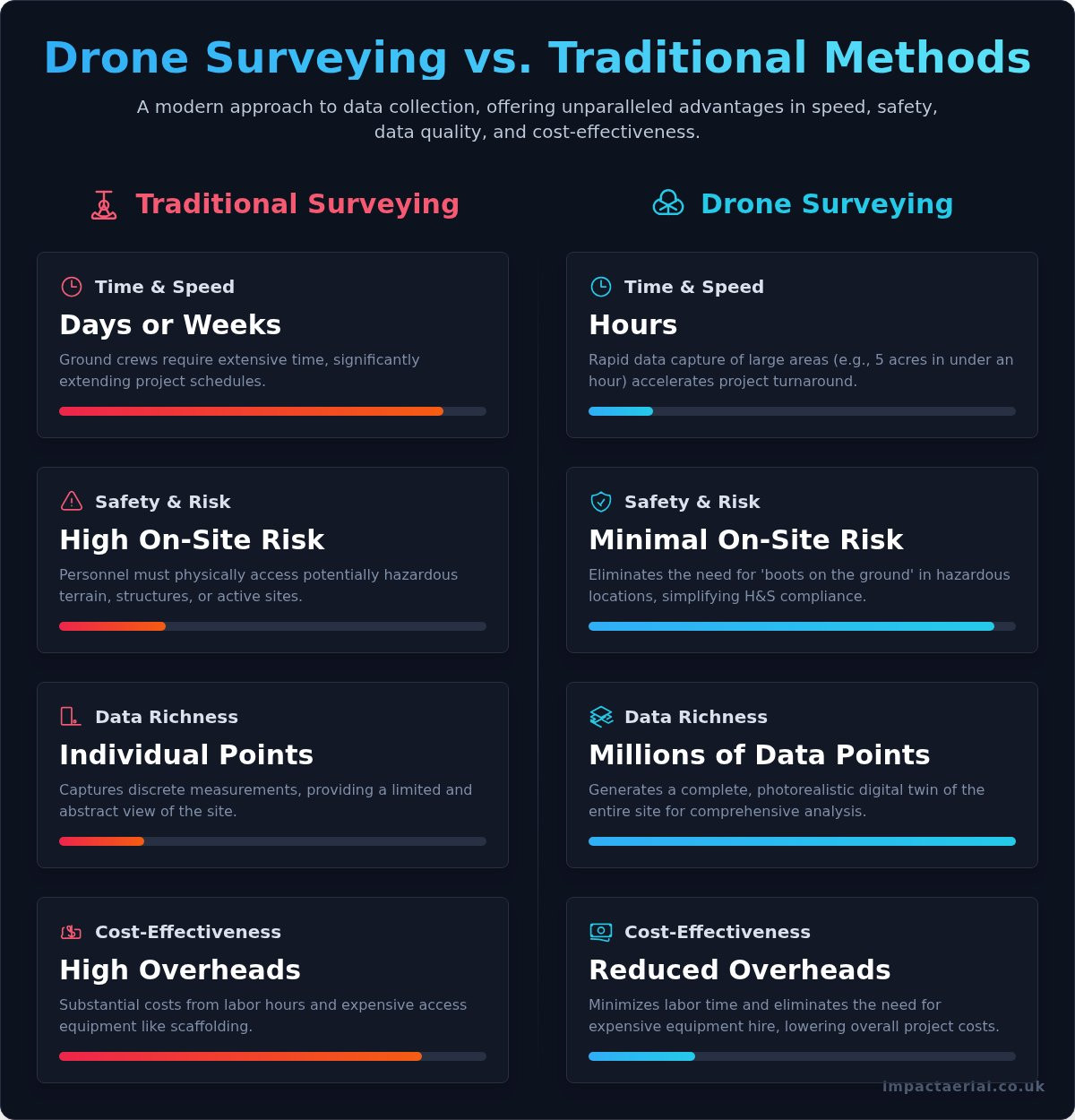
Beyond aesthetics, drone property surveys deliver rapid ROI for Manchester landlords and estate managers. Using thermal imaging and high-resolution zoom, specialists identify roof defects or heat leaks in industrial heritage buildings without the prohibitive expense of scaffolding. In 2025, city centre survey costs were reduced by an average of 60% when switching from traditional access methods to drone-based inspections. This provides peace of mind for commercial asset managers responsible for large portfolios across the region.

Flying drones in a major metropolitan hub requires more than technical skill; it demands strict adherence to UK Civil Aviation Authority drone regulations to ensure the safety of both property and the public. Manchester presents a unique challenge for property drone photography manchester due to the Manchester Airport Flight Restricted Zone (FRZ). This zone extends in a 5km radius from the airport, with additional 5km by 1km approach corridors that cover significant portions of South Manchester and Cheshire. Operating within these boundaries requires specific ATC (Air Traffic Control) clearance, a process our team manages entirely to provide clients with absolute peace of mind.

The Legal Framework for Manchester Drone Flights

Our pilots have transitioned from the older PfCO (Permission for Commercial Operation) to the current General Visual Line of Sight Certificate (GVC). This certification is essential for operating in the “canyons” of Deansgate or the Greengate area, where high-rise buildings create complex wind patterns and signal obstacles. Every mission begins with a site-specific risk assessment (RAMS) that details emergency landing zones and weather thresholds, ensuring a meticulous approach to every project. Under UK law, it’s a mandatory requirement for all commercial drone operators to hold valid EC 785/2004 compliant insurance. Our £5m commercial liability insurance covers every flight, protecting our clients from unforeseen liabilities in this niche but increasingly diverse market.

Managing Public Safety in Busy Urban Centres

Safety is our primary metric for success. In high-footfall areas such as Piccadilly Gardens or the Northern Quarter, we implement physical ground-level cordons to maintain a clear sterile area during takeoff and landing. This proactive management prevents unauthorized access to the flight controller’s immediate vicinity. Privacy is equally paramount; our post-processing workflows ensure GDPR compliance by blurring faces and vehicle registrations in residential neighborhoods.

To maintain control in the RF-heavy environment of the city centre, we utilise a DJI Enterprise fleet. These aircraft use O3+ transmission systems to ensure signal stability despite the massive radio frequency interference found in urban settings. This technology allows us to deliver the high-quality data-gathering services our clients expect without compromising on operational security. If you are planning a development project, you can contact our specialist team to review your site’s specific airspace requirements and ensure a compliant shoot.

Comparing Drone Services for Residential and Commercial Assets

Executing professional property drone photography manchester requires a tailored approach that shifts based on the asset class. Residential and commercial projects demand different flight altitudes, camera sensors, and data outputs. For residential listings, our focus remains on aesthetic appeal and lifestyle positioning. We capture high-end homes in areas like Didsbury or Altrincham during the “golden hour” to ensure the property looks inviting. High Dynamic Range (HDR) processing ensures that shadows are balanced and highlights don’t blow out, which is vital for premium estate agency marketing.

Commercial assets require a more technical perspective. Investors and facility managers in Manchester city centre prioritise site context and structural integrity over purely artistic shots. We provide wide-angle aerial views that show a building’s proximity to transport links like the M60 or Piccadilly Station. For industrial assets, particularly the massive warehouse footprints in Trafford Park, we deploy thermal imaging sensors. These specialised drones identify heat signatures that indicate roof leaks or insulation failures across 250,000 square foot facilities. This data-gathering capability provides a level of detail that traditional ground-based inspections cannot match.

Large-scale developments also benefit from recurring flight paths. By capturing consistent progress shots, stakeholders and investors track construction milestones against projected timelines. This provides a transparent record of work for professional services and ensures project accountability from breaking ground to completion.

Marketing Visuals vs. Technical Data

The choice of equipment depends on whether the goal is promotion or precision. For marketing, we utilise the DJI Mavic 3 Pro for its triple-camera system, delivering 4K HDR cinematic video that outperforms standard ground photography. However, for technical surveys, we use Enterprise models equipped with RTK (Real-Time Kinematic) modules for centimetre-level accuracy. While 3D virtual tours are excellent for interior walkthroughs, drone photography provides the essential external context. We often combine photogrammetric survey data with visual assets to give clients a complete digital twin of their property. This approach is becoming standard in this niche but increasingly diverse market.

Sector-Specific Benefits in Greater Manchester

  • Retail: We monitor car park utilisation and footfall patterns at major retail parks, providing owners with 98% accurate occupancy data during peak trading hours.
  • Hospitality: Our pilots showcase Manchester’s boutique hotels by capturing them within their vibrant urban context, highlighting nearby landmarks to attract international guests.
  • Construction: On cramped city sites near Deansgate, aerial views are indispensable for managing logistics, crane clearances, and site safety without interrupting ground operations.

Our CAA GVC Certified pilots ensure every flight adheres to strict safety protocols. For added peace of mind, we maintain £10 million in commercial liability insurance, ensuring that every property drone photography manchester project is handled with the highest level of professionalism and regulatory compliance.

Planning Your Manchester Drone Shoot: Preparation and Logistics

Executing high-quality property drone photography manchester requires more than just a pilot and a flight plan. Success depends on meticulous preparation and a deep understanding of the North West’s unique environmental challenges. With Manchester receiving an average of 867mm of rainfall annually, we monitor weather windows using high-resolution meteorological data to ensure optimal flight conditions. Our operations team works with clients to establish a 48-hour weather-watch window; this provides the flexibility needed to capture clear, crisp imagery between the region’s frequent rain showers.

Pre-flight logistics are a critical component of our professional services. Before any deployment, our CAA GVC Certified pilots conduct a comprehensive site assessment. We require clients to provide detailed site maps and point-of-contact information for on-site managers. This transparency ensures we maintain our 100% safety record while operating in complex urban environments. For added peace of mind, our operations are backed by £5 million in commercial liability insurance, specifically tailored for high-density aerial work.

Site Preparation for Property Owners

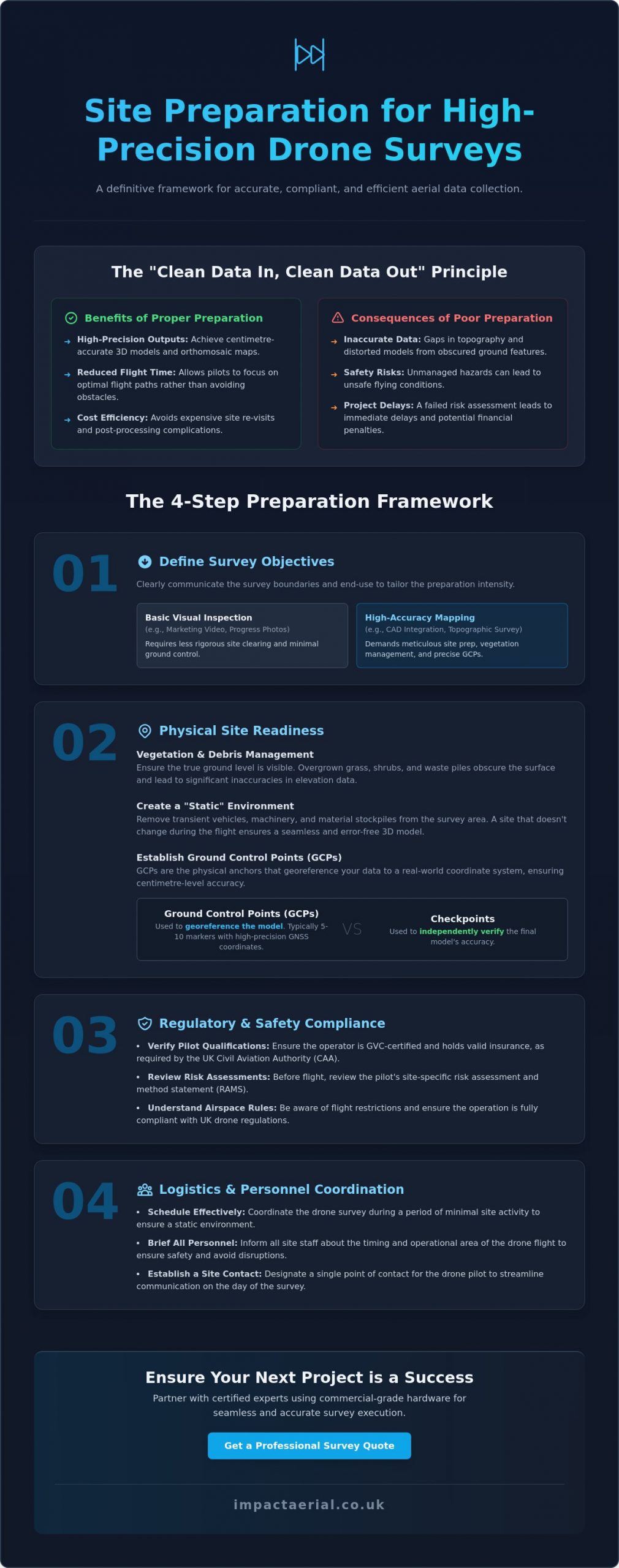
To achieve breath-taking results, the property must be staged correctly before the drone arrives. We advise clearing all non-essential vehicles from the foreground and ensuring communal areas are free of debris or maintenance equipment. Notifying neighbours and local stakeholders is essential. It prevents operational delays and ensures the shoot remains compliant with privacy regulations. If the project involves commercial assets like the NOMA district or MediaCity, coordinating with onsite security for roof access or designated take-off zones is a mandatory step in our pre-flight checklist.

Urban Flight Logistics: Dealing with Density

Manchester’s skyline is increasingly dominated by steel-framed architecture, which can create significant magnetic interference for drone navigation systems. Our fleet utilizes the latest DJI Enterprise hardware to maintain stable GPS locks even near high-density structures like the towers at Deansgate Square. Finding safe, legal take-off and landing points in a busy city centre requires local expertise and precise data-gathering. We use 4K HDR technology to overcome overcast Manchester skies, ensuring that even on grey days, the final imagery retains vibrant colours and professional-grade contrast. This technical precision is what allows us to serve a niche but increasingly diverse market with consistent excellence.

Ready to showcase your Manchester assets from a new perspective? Contact Impact Aerial today for a professional site assessment and quote.

Why Impact Aerial is Manchester’s Leading Drone Provider

Impact Aerial delivers a specialized approach to property drone photography manchester by combining technical precision with rigorous safety protocols. Our operations adhere to the highest CAA standards, utilizing what we call “Gold Standard” safety checks before every flight. This meticulousness ensures that even the most complex urban environments in Manchester, from the crowded streets of Deansgate to new developments in Salford Quays, are captured without risk. We understand that in a niche but increasingly diverse market, professional standards are the only way to ensure project success.

Our Birmingham-based hub serves as a central deployment point for the entire North West. This strategic location allows our teams to mobilize quickly, providing Greater Manchester clients with responsive service and consistent results. We don’t just deliver raw files; our in-house post-production suite utilizes advanced software to turn 4K HDR footage into cinematic marketing assets. We also bridge the gap between exterior and interior marketing by integrating our high-altitude shots with immersive virtual tour creation. This holistic approach provides a seamless visual journey for potential buyers or stakeholders.

Expertise You Can Trust

For added peace of mind, every project we undertake is backed by £5 million in commercial liability insurance. Our pilots are not hobbyists. They are a GVC-certified roster with extensive experience operating DJI Enterprise drones. These units are designed for high-stakes property surveys and detailed inspections where accuracy is non-negotiable. We maintain a culture of transparent reporting, providing clients with full data delivery and comprehensive flight logs. This level of professionalism is essential for maintaining our reputation as a trusted technical consultant in the drone industry.

Start Your Manchester Project Today

Requesting a bespoke quote for your Manchester property is a straightforward process. Our consultation begins with an initial brief to understand your specific site requirements, followed by a thorough pre-flight risk assessment. We cover the entire Greater Manchester region, including Bolton, Stockport, Oldham, and Trafford. Once the brief is finalized, we handle all airspace permissions and local notifications. From the first contact to the final delivery of your high-resolution assets, Impact Aerial provides a structured, methodical service that prioritizes your project goals and legal compliance.

Elevating Your Manchester Property Strategy for 2026

As the Manchester skyline continues its 2026 expansion, the demand for high-caliber visual data has never been higher. Integrating property drone photography manchester isn’t just about aesthetics; it’s a strategic requirement for navigating a competitive real estate market. You’ve seen how strict adherence to CAA GVC standards ensures operational safety, while professional logistics streamline the path from flight planning to final delivery. Success in this niche but increasingly diverse market depends on technical precision and verified credentials.

Impact Aerial provides this expertise through our team of CAA GVC Certified Pilots and a comprehensive £5m commercial liability insurance policy. We don’t just capture raw footage. Our service includes expert post-production to ensure every asset meets professional broadcasting standards. For added peace of mind, we handle every detail of the region’s complex airspace regulations so you can focus on your project’s results.

Request a Professional Drone Photography Quote for Your Manchester Property

Let’s transform your property’s perspective today.

Frequently Asked Questions about Property Drone Photography in Manchester

Do I need permission from the council for drone photography in Manchester?

You don’t typically need council permission to fly over Manchester if the pilot complies with Civil Aviation Authority (CAA) regulations. However, Manchester City Council requires prior authorisation if the drone takes off or lands on council-owned land, such as public parks or the city’s pedestrianised zones. We manage these specific permissions as part of our professional service to ensure every flight is fully compliant with local byelaws.

How much does property drone photography cost in Manchester?

The cost for property drone photography manchester services depends on the project’s complexity, location, and required deliverables. While we provide bespoke quotes, industry reports from the Drone Safe Register indicate that professional aerial photography packages vary based on insurance levels and equipment specs. Factors like proximity to Manchester Airport and the need for specific airspace clearances will influence the final investment required for your project.

What happens if the weather is bad on the day of my Manchester drone shoot?

We reschedule shoots at no extra cost if weather conditions exceed safe operating limits. Our DJI Enterprise drones have a maximum wind resistance of 12 metres per second, and we don’t fly in rain or heavy fog to protect the equipment and image quality. We monitor Met Office forecasts 48 hours in advance to give you plenty of notice if a Manchester weather front looks likely to disrupt the schedule.

Can drones fly in the Manchester Airport Flight Restricted Zone?

Yes, we can operate within the Manchester Airport Flight Restricted Zone (FRZ) by obtaining specific clearance from National Air Traffic Services (NATS). This zone extends in a 5km radius around the airport, covering areas like Wythenshawe and parts of Altrincham. We handle the entire application process, which usually requires at least 14 days of lead time to secure the necessary flight permissions from the airport’s air traffic control.

Is drone photography legal for residential properties in Manchester?

It’s entirely legal for residential properties when conducted by a pilot holding the correct CAA certifications. Since 2021, UK regulations allow drones to fly in residential areas as long as the pilot maintains a safe distance from uninvolved persons. For high-density areas in Manchester city centre, we use sub-250g drones or operate under a specific Category authorisation to ensure we meet all legal safety requirements for urban environments.

How long does a typical property drone shoot take to complete?

A standard residential shoot usually takes between 45 and 90 minutes on-site. This timeframe allows our pilot to conduct a pre-flight safety assessment, capture multiple 4K aerial angles, and ensure we have sufficient coverage of the property’s boundaries. Larger commercial sites or industrial estates in Greater Manchester may require 3 to 4 hours to capture the detailed photogrammetry data or comprehensive marketing footage required.

Do you provide edited photos or just the raw drone footage?

We provide fully edited, high-resolution images and 4K video as our standard deliverable. Our post-production team uses professional software to colour grade the footage and enhance the architectural details of your property drone photography manchester project. While we can provide raw files upon request for your internal marketing teams, most clients prefer our ready-to-use files that are optimised for web listings and print brochures.

Are your drone pilots CAA GVC certified and insured?

Every pilot at Impact Aerial is CAA GVC certified and holds valid commercial liability insurance. For added peace of mind, our insurance coverage meets EC 785/2004 standards, providing at least £5 million in public liability protection. This level of certification is the industry standard for professional operators, ensuring we can safely navigate the complex airspace and regulatory requirements of the Manchester metropolitan area.

Professional Aerial Filming for Events in London: The 2026 Guide

Did you know that nearly 100% of the London Control Zone is restricted airspace, where an unauthorised flight can lead to a fine of up to £2,500? For organisers planning a high-profile launch or festival, securing professional aerial filming for events london requires more than just a drone; it demands a meticulous approach to safety and legality. You likely recognise that breath-taking cinematic footage is the most effective way to showcase your event’s scale on social media, yet the fear of heavy fines or noise complaints often stalls the creative process.

We understand that you need total peace of mind when integrating technology into a live environment. This 2026 guide provides a clear roadmap for capturing stunning aerial perspectives while adhering to the latest GVC certification standards and commercial liability insurance requirements. We will detail how to manage complex flight permits, mitigate the unpredictable British weather, and ensure your production remains fully compliant with current UK drone regulations.

Key Takeaways

  • Understand the stringent safety standards and CAA GVC certification required for operating drones in London’s complex “congested areas” to ensure your event remains fully compliant.
  • Discover why utilising DJI Enterprise commercial equipment is vital for capturing high-quality 4K HDR footage that stands out on large-screen event displays.
  • Learn how professional aerial filming for events london can transform your production by capturing the immense scale and energy of crowds in iconic urban spaces.
  • Follow our comprehensive planning roadmap, including detailed desktop site surveys and risk assessments, to provide added peace of mind for your flight operations.
  • Find out how to maximise your investment by turning raw aerial data into a high-impact marketing asset through professional colour-grading and cinematic editing.

Capturing professional aerial filming for events in London requires navigating one of the most complex flight environments in the world. By 2026, the Civil Aviation Authority (CAA) has refined the categorisations for drone operations, making the distinction between a hobbyist and a professional operator clearer than ever. While a consumer drone might seem capable, professional event storytelling demands the stability and redundancy found in Enterprise-grade aircraft. These machines provide the reliability needed for brand building, offering perspectives that ground-based cameras simply cannot replicate.

To better understand the impact of professional drone services, watch this demonstration of event-based aerial filming:

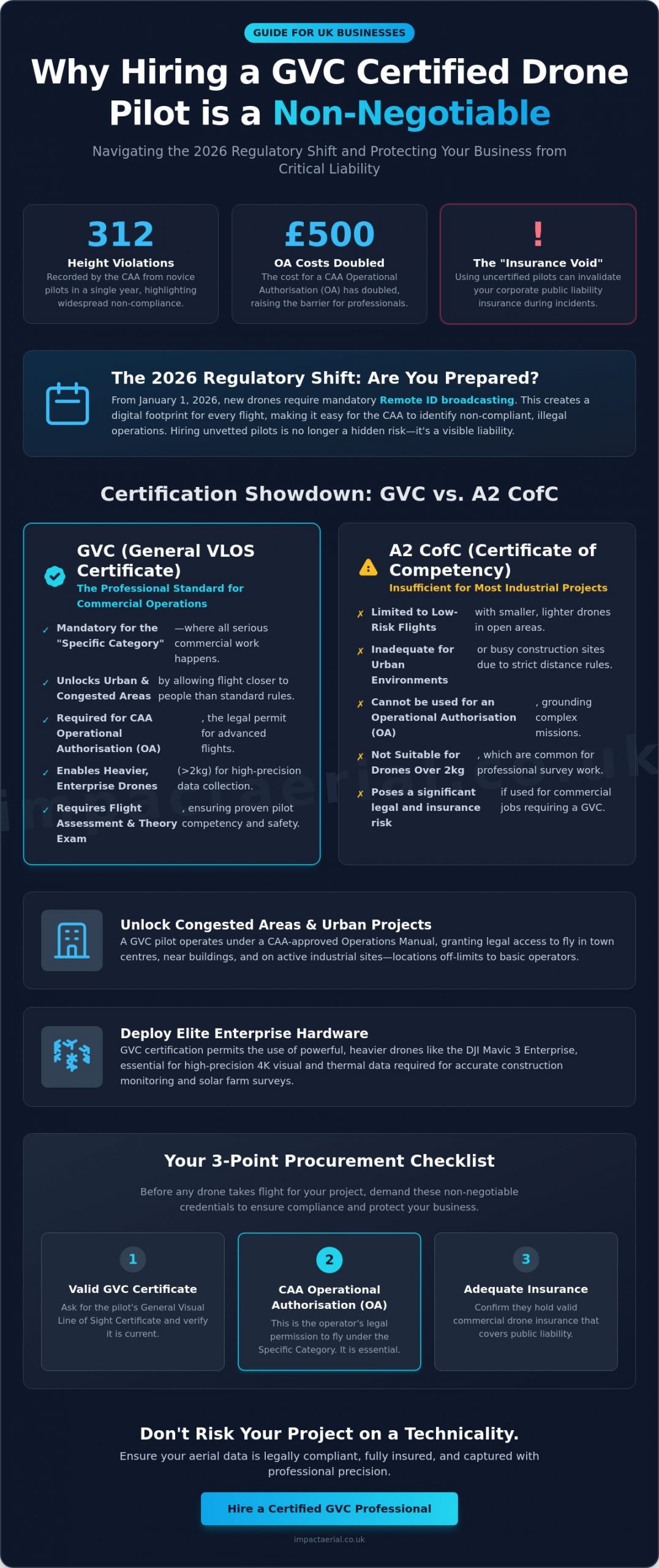
Distinguishing between a hobbyist flight and a commercial operation is vital for event organisers. A hobbyist often lacks the £5 million to £10 million public liability insurance typically required by major London venues. Professional operators hold a GVC (General Visual Line of Sight Certificate) and carry comprehensive commercial insurance for added peace of mind. This expertise ensures that your brand’s visual content is not only “breath-taking” but also fully compliant with current safety standards in a niche but increasingly diverse market.

Understanding London’s Restricted Airspace

London is blanketed by Flight Restriction Zones (FRZs). Major hubs like Heathrow, London City, and RAF Northolt create vast areas where unauthorised flight is strictly prohibited. Before any booking, a professional operator must consult NATS (National Air Traffic Services) maps to identify potential conflicts. Operating within the London Controlled Zone (CTR) is not impossible, but it demands meticulous scheduling and coordination with Air Traffic Control. For a comprehensive UK drone law overview, clients should understand that specific CAA authorisations are non-negotiable for commercial work in these high-traffic zones.

The Density Challenge: Filming in Urban Environments

Urban environments like the City of London or Southbank present significant “congested area” hurdles. Managing take-off and landing points in a city where 9.6 million people live and work requires more than just skill; it requires a robust safety management system. CAA regulations dictate strict horizontal distances from uninvolved persons. These distances are often 30 metres or more depending on the aircraft’s weight and the operator’s specific permissions. Professional teams also focus on noise mitigation. A DJI Mavic 3 Pro produces approximately 80 decibels at close range. We manage this by using high-altitude positioning or low-noise propellers to ensure the drone doesn’t distract from the event programme.

Safety Standards and Professional Equipment for Event Success

Impact Aerial utilizes DJI Enterprise commercial drones to ensure every project meets the highest industrial standards. These aircraft differ significantly from consumer models, offering the stability and reliability required for aerial filming for events london. Our fleet delivers 4K HDR footage with 10-bit colour depth, which is essential when content is projected onto large-scale event displays or high-definition stadium screens. This technical edge ensures that highlights from a 2026 corporate summit or outdoor festival remain crisp, vibrant, and professional even when scaled up to massive proportions.

Safety is built into our hardware through sophisticated redundancy systems. Professional drones feature dual batteries, multiple Inertial Measurement Units (IMUs), and redundant compasses to prevent mid-air failures. If one system encounters an error, the backup takes over instantly to maintain flight stability. This level of hardware reliability is vital when operating in London’s unpredictable micro-climates. The city’s “wind tunnel” effects around skyscrapers in Canary Wharf or sudden rain showers require equipment with high IP ratings and wind resistance. Our enterprise-grade drones stay airborne and stable in conditions that would ground lesser equipment, ensuring your event schedule remains uninterrupted.

Why CAA GVC Certification is Non-Negotiable

The regulatory landscape for UK drone flight has evolved, moving away from the old PfCO (Permission for Commercial Operations) towards the GVC (General Visual Line of Sight Certificate). By 2026, any professional pilot must hold a current GVC to operate legally in the “Specific” category. This certification is critical for London events because it allows for more flexible flight permissions in congested areas, such as South Bank or the City. The GVC is the gold standard for UK commercial drone operations, ensuring pilots possess the theoretical knowledge and practical skills required for complex missions. Following Civil Aviation Authority drone regulations is not just a legal requirement; it is the foundation of our safety-first approach.

The Importance of £5m Commercial Liability Insurance

High-profile London venues, from the O2 Arena to historic Royal Parks, rarely accept standard £1m or £2m insurance policies. We carry £5m in commercial liability insurance specifically tailored for drone operations. This level of coverage provides genuine peace of mind for event organisers, covering everything from accidental property damage to third-party liability. Our comprehensive insurance status acts as a badge of credibility, often helping us secure venue permissions and local authority permits faster than unverified operators. For those planning high-profile gatherings, our team at Impact Aerial provides the technical expertise to navigate these requirements seamlessly. This professional backing ensures that your only focus remains on the success of the event itself.

Transforming Diverse Event Types with Aerial Perspectives

Aerial perspectives provide a sense of scale that ground-based crews simply cannot replicate. When you’re planning aerial filming for events london, you’re investing in a vantage point that captures the collective energy of a crowd within the city’s most iconic spaces. Whether it’s a gathering in Trafalgar Square or a private function on a rooftop in the City, drones bridge the gap between the individual experience and the grander atmosphere. This high-altitude context creates an immediate sense of place by featuring landmarks like the Shard or the River Thames as the backdrop, grounding your event in a world-class setting.

Engagement metrics from 2025 industry reports indicate that video content featuring professional aerial cinematography sees a 40% higher interaction rate on LinkedIn compared to standard ground-level footage. On platforms like Instagram, the “birds-eye” reveal has become a standard requirement for high-end event reels. It provides a professional, cinematic finish that signals quality and prestige to potential clients and stakeholders.

Corporate Events and Product Launches

Drones are essential for showcasing the magnitude of new office building launches or large-scale corporate retreats. We use dynamic “reveal” shots to introduce brand activations, starting with a close-up of the product and pulling back to show the entire London skyline. Our team integrates this high-quality 4K footage into corporate highlight reels, providing a sophisticated asset for both internal communications and external marketing. In 2026, a professional aerial shot is no longer a luxury; it’s a core component of a brand’s visual identity.

Festivals, Concerts, and Sporting Events

For large-scale festivals and outdoor sporting events in London’s parks, drones serve a dual purpose. We map the entire site to show attendance density and layout, which is invaluable for future planning and sponsorship pitches. Capturing the atmosphere of 50,000 people from the air provides a powerful visual testament to the event’s success.

Safety remains our primary focus during these high-density operations. Our pilots strictly adhere to the UK’s Drone and Model Aircraft Code to ensure every flight is compliant and secure. Beyond filming, drones are increasingly used for real-time crowd monitoring. This allows organisers to identify bottlenecks or safety concerns as they happen, providing a layer of oversight that ground security cannot achieve alone. This meticulous approach to aerial filming for events london ensures that your production is both breath-taking and fully compliant with CAA regulations.

The Planning Roadmap: From Site Survey to Flight

Executing professional aerial filming for events london requires a meticulous, multi-stage planning process that begins long before the propellers spin. We start with a comprehensive creative consultation to define your specific brief and identify the high-impact “hero” shots required for your production. Our team then conducts a rigorous desktop site survey using the latest 2026 satellite imagery and 3D mapping data to evaluate the local environment. This digital rehearsal allows us to anticipate obstacles before arriving on-site.

Safety is our absolute priority. We perform physical risk assessments to identify urban hazards such as overhead power lines, temporary event structures, or London’s iconic skyscrapers. These findings inform a detailed flight plan. We coordinate this plan directly with your event security team to ensure our operations are seamlessly integrated into the wider event management strategy. Our approach to aerial filming for events london prioritises data-driven decisions to ensure every flight is both spectacular and compliant.

Securing Permits and Venue Permissions

Operating in the capital involves navigating complex regulatory layers. We liaise directly with London boroughs, such as Westminster, Southwark, or Tower Hamlets, to secure necessary ground permits and filming licences. For added peace of mind, our CAA GVC Certified pilots handle the entire NOTAM (Notice to Airmen) process. This digital notification alerts other airspace users to our presence, which is a legal necessity in London’s crowded skies. We also collaborate with venue managers to establish “sterile zones.” These are cordoned areas for take-off and landing where public access is strictly prohibited during flight operations.

Weather Monitoring and Contingency Planning

London’s weather is notoriously fickle. We utilise high-accuracy meteorological applications to monitor wind speeds and precipitation in real-time, focusing on hyper-local data. Our safety protocol establishes a clear “Go/No-Go” window based on the specific technical tolerances of our DJI Enterprise fleet. If wind gusts exceed 22mph or heavy rain is detected, we trigger pre-arranged contingency plans. Our flexible scheduling allows us to work around shifting weather patterns, ensuring we capture your event in the best possible light while maintaining total operational safety.

Our team is ready to provide the technical expertise and regulatory knowledge your production requires. Contact Impact Aerial today to discuss your project requirements with our specialist pilots.

Maximising the Value of Your Aerial Event Footage

Capturing high-resolution data is only the initial phase of aerial filming for events london. While the flight itself requires technical precision, the final output depends heavily on what happens once the drones are back on the ground. Impact Aerial provides a full end-to-end service, moving seamlessly from the flight deck to the editing suite. This ensures that the technical quality of our 4K, High Dynamic Range (HDR) footage is fully realised in the final cut.

Raw footage and a professionally graded cinematic film are worlds apart. Raw files are often captured in a “flat” profile to retain maximum detail in highlights and shadows. Without expert post-production, these files look washed out. Our team applies meticulous colour grading to bring out the vibrancy of the London skyline and the energy of your event. We focus on creating a cohesive story by integrating aerial perspectives with your ground-based videography. This multi-angle approach provides the scale and context that ground cameras simply cannot reach, creating a more immersive experience for the viewer.

Post-Production and Cinematic Editing

Our editing process is methodical. We don’t just provide a data dump of every minute flown; we curate the most impactful “hero shots” that define the day. Our post-production workflow includes several key elements to ensure a professional finish:

  • Brand Integration: We add your logos, brand colours, and custom graphics to ensure the film aligns perfectly with your corporate identity.
  • Audio Synchronisation: We use licensed, high-energy music and professional sound design to match the rhythm of the visual transitions.
  • Social Media Optimisation: We produce bespoke short-form edits specifically for TikTok and Instagram Reels. These vertical crops are essential for reaching modern audiences who consume content primarily on mobile devices.

Partnering with Impact Aerial

Selecting a national specialist with specific London expertise is a strategic investment. While we are based in the West Midlands, our reach extends across the UK. This geographical flexibility allows us to bring a consistent, high-standard service to any location. Our commitment to breath-taking end results is matched only by our dedication to safety and compliance. We are fully CAA GVC Certified and hold comprehensive commercial liability insurance for added peace of mind.

We understand that the drone industry is a niche but increasingly diverse market. That’s why we act as technical consultants for our clients, ensuring every flight adheres to the latest UK regulations. To understand the technology behind our work, learn more about our aerial filming drone capabilities and how they can elevate your next project. We don’t just fly drones; we deliver professional services that provide tangible value and a significant return on your marketing investment.

Secure a Competitive Edge for Your 2026 London Productions

Capturing high-quality perspectives in the capital requires more than just a drone; it demands a meticulous approach to safety and a deep understanding of the city’s complex regulatory landscape. By 2026, the integration of advanced 4K HDR technology and rigorous pre-flight planning will be the non-negotiable standard for any successful production. Success hinges on balancing creative ambition with strict technical compliance to ensure every frame adds tangible value to your brand.

Our team brings the technical precision needed to navigate these unique challenges. With CAA GVC Certified Pilots and £5m commercial liability insurance, we provide the essential peace of mind required for high-stakes environments. We specialise in aerial filming for events london, managing every detail from initial site surveys to securing complex permissions within London’s Restricted Airspace. This methodical process ensures your footage isn’t just breath-taking, but fully compliant with the latest UK aviation standards. Transforming your event into a cinematic experience starts with expert coordination and the right equipment.

Contact Impact Aerial today for a bespoke London event filming quote

We look forward to helping you showcase your event from a perspective that truly stands out.

Frequently Asked Questions

Do I need a special permit to fly a drone for an event in London?

You must obtain specific flight authorisation from the Civil Aviation Authority (CAA) and National Air Traffic Services (NATS) for most event locations in the capital. London’s airspace is heavily restricted, particularly within the Heathrow and London City Airport Flight Restriction Zones (FRZs). We manage all necessary permit applications and safety filings as part of our service, ensuring every flight is legal and fully authorised before the rotors start spinning.

How much does aerial filming for an event in London cost?

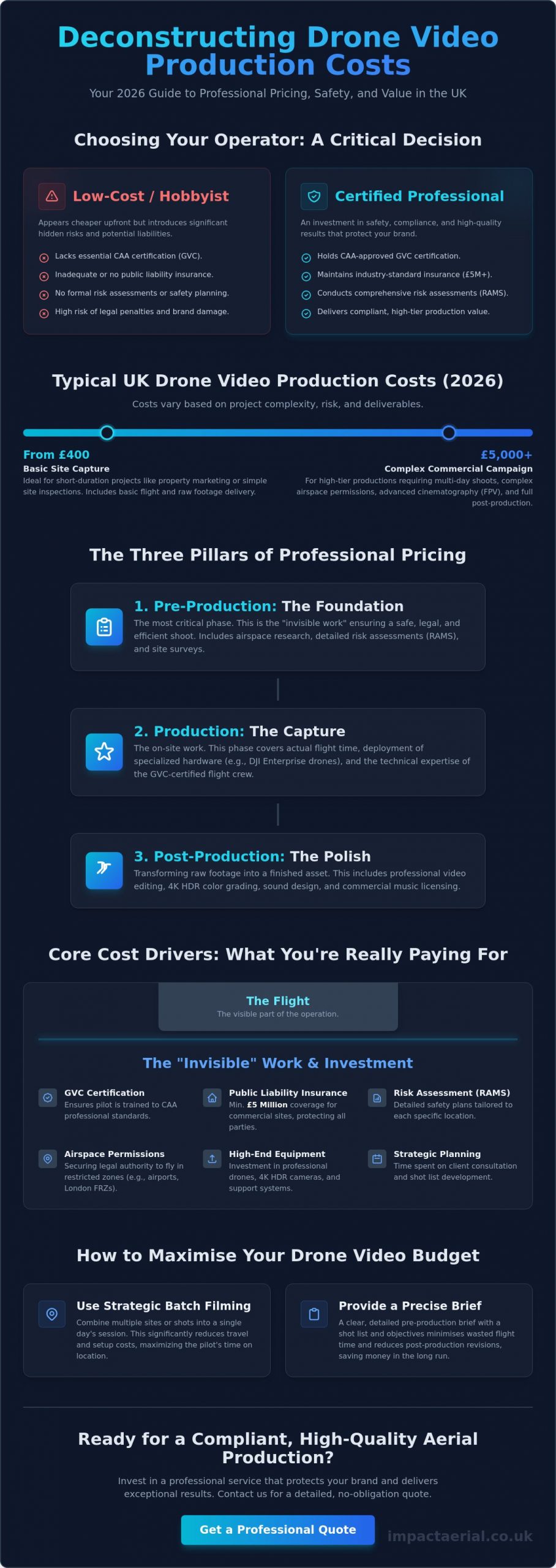
The cost for professional aerial filming for events in London varies based on the location’s airspace complexity and the required flight duration. While basic half-day shoots in less restricted areas might start at £500, complex city centre projects requiring bespoke NATS permissions often reach £1,500 or more. We provide a fixed-fee quotation after reviewing your venue’s specific coordinates and the technical requirements of your project.

What happens if the weather is bad on the day of my event?

We monitor high-accuracy aviation forecasts 48 hours before your event to assess wind speeds and precipitation levels. If wind gusts exceed 20mph or heavy rain is forecast, we’ll consult with you to reschedule the flight to a backup date or provide a refund for the operational portion of the fee. Safety is our absolute priority, and we don’t operate in conditions that breach our strict CAA-approved operations manual.

Can you fly drones indoors for London venue events?

Yes, we can conduct indoor aerial filming for events in London using specialised “cinewhoop” drones that feature 360-degree propeller guards for total safety. These compact aircraft don’t rely on GPS, allowing them to fly through halls, over dining tables, and through architectural features without risk to guests. It’s an excellent way to capture the scale of venues like the ExCeL or the Grand Hall at Billingsgate from a unique perspective.

How long can a drone stay in the air during an event?

Our commercial DJI Enterprise drones typically offer a flight time of 25 to 30 minutes per battery. To ensure we don’t miss any critical moments of your programme, we use a continuous flight rotation system with multiple batteries and rapid charging stations. This approach allows us to maintain an aerial presence throughout the day by landing one aircraft for a fresh battery while another takes its place immediately.

Is drone filming in London noisy or disruptive to guests?

Modern professional drones use low-noise propeller technology that generates less than 70 decibels at a 3-metre distance, making them no louder than a normal conversation. We plan our flight paths to maintain a respectful distance from speakers and stages so the drone doesn’t interfere with your event’s audio or distract the audience. Our pilots operate with a discreet, professional manner to ensure the technology enhances the event without becoming the focus.

What insurance do you carry for London event filming?

We carry £10 million in specialist commercial drone liability insurance that’s fully compliant with the EC 785/2004 regulation standard. This high level of coverage is often a mandatory requirement for major London venues and provides essential protection for organisers, guests, and the public. For added peace of mind, we provide a full copy of our insurance certificate and a site-specific risk assessment to your venue manager 14 days before the event.

How soon after the event will I receive the edited footage?

You’ll receive a 60-second “social media ready” highlight reel within 48 hours of the event’s conclusion to help you maintain marketing momentum. The full suite of high-resolution 4K HDR files and the final edited master film are typically delivered via secure cloud link within 7 working days. If your project requires a faster turnaround for news or live broadcasts, we can arrange for immediate data transfer on-site directly after the flight.

Comprehensive Commercial Drone Services in Leeds: What to Know in 2026

Ensuring Safety and Compliance in Drone Operations

Safety stands as the cornerstone of professional commercial drone services Leeds operations. Every flight requires meticulous planning, certified operators, and comprehensive insurance coverage to protect both clients and the public. The Civil Aviation Authority (CAA) has established stringent regulations that all commercial drone operators must follow, creating a framework that ensures responsible aerial operations across the UK.

Professional drone operators in Leeds maintain CAA General Visual Line of Sight Certificate (GVC) certification, which replaced the previous Permission for Commercial Operations (PfCO) system in December 2020. This certification requires operators to pass both theoretical knowledge tests and practical flight assessments, demonstrating their competency in areas including airspace management, meteorology, and human factors.

CAA Certification: What It Means

CAA certification represents the gold standard for commercial drone operations. Certified operators must complete 40 hours of theoretical study, pass written examinations covering aviation law and operational procedures, and demonstrate practical flying skills during assessed flights. The certification process also includes background checks and ongoing competency requirements.

Clients can verify operator credentials through the CAA’s online database, ensuring their chosen provider holds valid certification. This verification process protects businesses from potential legal liabilities and guarantees professional service delivery.

Insurance and Risk Management

Comprehensive commercial liability insurance forms an essential component of professional drone operations. Leading operators carry £5 million public liability coverage, protecting clients against potential property damage or personal injury claims arising from aerial operations.

Risk management protocols extend beyond insurance coverage. Professional operators conduct detailed site surveys before each flight, assess weather conditions using meteorological data, and implement no-fly zones around sensitive areas such as airports, military installations, and populated areas. Pre-flight safety briefings ensure all personnel understand emergency procedures and communication protocols.

Flight planning software helps operators maintain compliance with UK airspace restrictions, automatically flagging potential conflicts with controlled airspace or temporary flight restrictions. This technology-driven approach reduces human error and ensures consistent adherence to regulatory requirements.

Regular equipment maintenance schedules, including battery health monitoring and propeller inspections, prevent mechanical failures that could compromise safety. Professional operators maintain detailed maintenance logs and replace components according to manufacturer specifications, ensuring reliable performance throughout commercial drone services Leeds operations.

Getting Started with Drone Services in Leeds

Embarking on a drone project requires careful planning and the right professional partner. Businesses across construction, property development, and surveying increasingly rely on professional drone providers to deliver precise aerial data and imagery. While this article explores the landscape of commercial drone services Leeds, the core principles for success involve understanding your specific requirements and selecting a certified operator who can execute your vision safely and efficiently, especially one with a broad operational reach, such as those based in the West Midlands.

Assessing Your Needs

Begin by defining your project’s core objectives. Are you conducting a structural inspection that requires thermal imaging capabilities, or do you need high-resolution photography for marketing purposes? Construction sites typically demand photogrammetry services for progress monitoring, whilst property developers often require 4K aerial footage showcasing developments from unique perspectives.

Consider the scope and frequency of your requirements. Single-use projects like roof inspections differ significantly from ongoing construction monitoring that may span 12-18 months. Document any specific technical requirements, including image resolution standards, data formats, and delivery timelines. This preparation ensures accurate quotes and prevents costly scope changes later.

Choosing the Right Provider

Verify that potential providers hold current CAA GVC (General Visual Line of Sight Certificate) certification, which replaced the previous PfCO qualification in 2021. This certification ensures operators can legally conduct commercial flights within the UK’s controlled airspace, essential for operations in busy urban environments or near major airports, including those like Leeds Bradford or Birmingham International.

During consultations, ask specific questions about their equipment capabilities. Modern commercial operations should utilise DJI Enterprise series drones equipped with 4K cameras and thermal sensors where applicable. Request examples of similar projects completed within the past 12 months, particularly those involving comparable site conditions or regulatory challenges.

Insurance coverage deserves careful attention. Professional operators maintain comprehensive commercial liability insurance, typically covering £2 million in public liability. This protection proves essential when working on active construction sites or near public areas in any major city centre, whether in Leeds, Birmingham, or elsewhere.

Review their safety protocols and risk assessment procedures. Experienced providers conduct thorough site surveys before operations, identifying potential hazards like overhead power lines, nearby airports, or restricted airspace zones. They should also demonstrate clear communication channels for coordinating with site managers and other contractors.

The booking process typically involves an initial consultation, followed by a detailed risk assessment and flight planning phase. Expect professional providers to visit your site beforehand, ensuring optimal weather conditions and regulatory compliance on operation day.

Ready to transform your project with professional aerial services? Contact our CAA-certified team to discuss your specific requirements and receive a detailed project proposal.

Transform Your Business with Professional Drone Solutions

Leeds businesses are increasingly recognising the transformative potential of aerial technology across multiple sectors. From comprehensive property inspections that identify structural issues before they become costly problems, to detailed site surveys that accelerate construction timelines, drone services deliver measurable operational advantages. The combination of CAA GVC-certified operators, advanced DJI Enterprise equipment, and comprehensive safety protocols ensures projects are completed to the highest professional standards whilst maintaining full regulatory compliance.

When selecting commercial drone services Leeds providers, prioritise operators who demonstrate proven expertise through industry certifications, substantial commercial liability coverage, and a track record of delivering high-quality results across diverse applications. The right partner will provide not just technical capability, but the peace of mind that comes with knowing your project is in expert hands.

Ready to discover how professional drone services can enhance your business operations? Contact Impact Aerial for expert commercial drone services backed by CAA GVC certification, £5m commercial liability insurance, and cutting-edge DJI Enterprise technology. Your next project deserves the precision and professionalism that only experienced aerial specialists can provide.

Frequently Asked Questions

What types of drone services are available in Leeds?

Commercial drone services in Leeds include aerial photography and videography, building inspections, roof surveys, construction site monitoring, agricultural crop assessment, and land surveying. Professional operators also provide thermal imaging for energy audits, photogrammetry for 3D mapping, and asset inspections for telecommunications towers and wind turbines.

How do I ensure the drone service provider is compliant?

Verify that your drone operator holds a valid CAA GVC (General Visual Line of Sight Certificate) and is registered on the Drone Safe Register. They must have commercial liability insurance of at least £1 million and display their operator ID on all aircraft. Check their CAA Operational Authorisation number, which replaced the older PfCO system in December 2020.

What should I look for in a drone service provider?

Choose providers with CAA GVC certification, comprehensive commercial insurance, and proven experience in your specific industry sector. Look for operators who use professional-grade equipment like DJI Enterprise series drones with 4K HDR capabilities. Membership in professional bodies such as ARPAS (Association of Remotely Piloted Aircraft Systems) or UAVHUB demonstrates commitment to industry standards.

Are drone services in Leeds expensive?

Drone service costs vary significantly based on project complexity, duration, and deliverables required. Basic aerial photography sessions typically start from several hundred pounds, whilst comprehensive building surveys or large-scale mapping projects require detailed quotations. Professional commercial drone services leeds providers offer competitive rates that often prove more cost-effective than traditional surveying methods or manned aircraft alternatives.

How long does a typical drone service project take?

Simple aerial photography shoots can be completed within 2-4 hours, including setup and data processing. Building inspections typically require 4-6 hours for comprehensive coverage and initial reporting. Large-scale surveying or mapping projects may span several days, depending on site size and weather conditions. Most operators provide preliminary results within 24-48 hours and final deliverables within one week.

Why is CAA certification important for drone services?

CAA certification ensures operators understand UK airspace regulations, flight safety protocols, and legal requirements for commercial operations. Certified pilots have passed rigorous theoretical and practical examinations covering meteorology, air law, and human factors. Using uncertified operators risks legal penalties, insurance voidance, and potential safety incidents that could result in prosecution under the Air Navigation Order 2016.

Can drones be used for night-time operations in Leeds?

Night operations require specific CAA permissions and additional pilot qualifications beyond standard GVC certification. Operators must demonstrate enhanced safety procedures, use aircraft with appropriate lighting systems, and often require special operational authorisations. Most commercial drone work in Leeds occurs during daylight hours, though emergency services and specialist applications may operate under restricted night-time permissions with proper authorisation.

Professional Drone Roof Survey in London: The 2026 Guide to Cost, Safety, and Data

Why are London property managers still paying upwards of £3,000 just to erect scaffolding for a simple visual inspection? In a city where access is restricted and lead times often stretch beyond 21 days, the traditional approach to maintenance is becoming a significant financial liability. A professional drone roof survey london offers a smarter alternative, capturing high-resolution data from chimneys and valleys that often remain invisible from the ground.

You likely already know that scaffolding is not just expensive; it’s a logistical nightmare that disrupts tenants and risks damage to historic masonry. This 2026 guide promises to show you how professional aerial inspections deliver 100% safety and superior data while reducing your survey costs by as much as 70% compared to traditional methods. We’ll examine the latest CAA GVC compliance standards, fixed-cost pricing models, and how our 4K HDR fleet provides the high-resolution condition report you need for total peace of mind.

Key Takeaways

  • Learn why a professional drone roof survey london provides a safer, more cost-effective alternative to traditional scaffolding while delivering superior high-resolution data.
  • Understand how enterprise-grade DJI technology overcomes the unique challenges of London’s micro-climates, wind tunnels, and complex urban architecture.
  • Realise significant cost savings and reduced lead times by switching from weeks of scaffolding setup to just hours of precision aerial flight.
  • Navigate the legal requirements of London’s restricted airspace, including why CAA GVC certified pilots are essential for compliant urban operations.
  • Discover how meticulous risk management and expert post-production analysis provide the peace of mind required for managing high-value London property assets.

What is a Professional Drone Roof Survey in London?

A professional drone roof survey in London is a non-intrusive aerial inspection that utilises advanced Unmanned Aerial Vehicles (UAVs) to capture high-resolution imagery and data of building envelopes. By 2026, the industry has transitioned from basic visual checks to sophisticated, data-driven asset management. This methodology allows for the rapid assessment of structures without the need for expensive scaffolding or high-access equipment, providing a safer and more efficient alternative to traditional methods.

London’s skyline features a unique blend of 18th-century heritage and modern glass structures. Operating within these high-density urban environments requires specialised knowledge of CAA GVC certification and local airspace restrictions. With over 19,000 listed buildings and complex clusters of high-rise developments, a drone roof survey london must account for tight flight paths and stringent safety protocols to ensure every centimetre of the structure is documented accurately.

Standard components of a modern survey include 4K HDR video and high-resolution stills. For added peace of mind, thermal mapping is frequently deployed to identify sub-surface moisture and insulation failures. These sensors detect heat signatures that remain invisible to the naked eye, allowing property owners to pinpoint leaks before they cause structural damage.

The Evolution of Aerial Inspections

Inspections have progressed from basic photography to centimetre-accurate data collection. By 2026, 4K HDR sensors have largely replaced the requirement for physical “hand-on” tile checks in 95% of commercial cases. We use photogrammetry to generate precise 3D models of complex London rooflines. These models allow surveyors to take millimetre-level measurements from their desktop, significantly reducing the time spent on-site while increasing the accuracy of the final report.

Key Industries Benefiting from Drone Surveys

Three primary sectors now rely on drone technology for their property maintenance strategies:

  • Commercial Property Managers: Professionals overseeing the 23 million square feet of office space in central London use drone data for proactive maintenance and insurance valuations.
  • Chartered Surveyors: Experts requiring high-definition visual evidence for RICS condition reports can now access areas that were previously unreachable.
  • Heritage and Residential Blocks: For buildings where scaffolding costs can exceed £5,000 for a simple inspection, a drone roof survey london provides a cost-effective, non-destructive solution that protects the fabric of the building.

The Technology Behind High-Precision London Surveys

Executing a high-precision drone roof survey london requires more than a standard off-the-shelf aircraft. The capital’s unique architecture, coupled with narrow wind tunnels created by skyscrapers in the City and Canary Wharf, demands enterprise-grade stability. Professional operators utilise the DJI Enterprise fleet, such as the Matrice 350 RTK, which is engineered to withstand wind speeds of up to 12 metres per second. These aircraft aren’t just drones; they’re flying workstations equipped with dual-redundancy systems for batteries and flight controllers, ensuring absolute safety when operating over congested urban streets.

The sensor is the heart of the survey. We use large-format sensors that excel in High Dynamic Range (HDR) capture. This is vital for London properties where tall neighbouring buildings cast deep shadows across roof pitches. Without HDR, a standard camera would lose all detail in these dark areas, potentially missing cracks or slipped tiles. For added peace of mind, our professional aerial inspection services provide the technical rigour needed for complex insurance and structural claims.

Enterprise Hardware vs. Consumer Drones

Consumer drones lack the optical zoom capabilities required for safe, detailed inspections. Our enterprise payloads feature up to 200x digital zoom, allowing us to inspect Victorian chimneys and ornate finials from a distance of 15 metres without compromising safety. A global shutter captures the entire frame simultaneously to prevent the motion blur or “jello effect” that occurs with cheaper rolling shutter sensors during flight. This hardware ensures every millimetre of the masonry is sharp and measurable.

  • RTK Positioning: Real-Time Kinematic satellite data provides centimetre-level accuracy for 3D modelling.
  • Obstacle Avoidance: Six-directional sensing prevents collisions in tight London alleyways.
  • IP55 Rating: Allows for data collection in the light rain often encountered during London winters.

Thermal and Multispectral Data

Standard photography only reveals surface issues. We use high-resolution thermal sensors to identify heat loss and moisture ingress that the naked eye can’t see. On commercial flat roofs, wet insulation retains heat differently than dry areas. By flying at dusk, we spot these “hot spots” or “cold spots” that indicate trapped water, preventing costly structural rot. Integrating this data into a wider drone survey workflow allows for a 360-degree view of building health.

Multispectral data adds another layer of intelligence. It identifies the early stages of organic growth, such as moss or lichen, by analysing light signatures invisible to humans. Catching this growth early prevents the premature decay of porous London brickwork and limestone. It’s a proactive approach that moves beyond simple reactive maintenance, giving asset managers a clear 2026 roadmap for their property portfolios.

ROI Analysis: Drone Surveys vs. Traditional Access Methods

The financial risk of deferred maintenance in the capital is substantial. Industry data from 2025 suggests that minor leaks left unaddressed for six months often escalate into structural repairs exceeding £20,000 for mid-sized commercial blocks. For property managers, the “cost of doing nothing” is rarely zero. A drone roof survey london acts as a high-speed diagnostic tool that identifies defects before they necessitate major capital expenditure. While traditional methods require weeks of logistical planning, a drone flight is often completed in a single morning, providing immediate clarity on the building’s health.

  • Lead Times: Scaffolding typically requires 14 to 21 days for permit approvals and assembly. A UAV deployment requires only a few hours of site preparation and flight time.
  • Health and Safety: By removing the need for personnel to work at height, you eliminate the primary cause of workplace fatalities in the UK construction sector. Our operations remain entirely ground-based.
  • Sustainability: Our fleet of electric UAVs produces zero operational emissions. This contrasts sharply with the carbon-heavy logistics of transporting tons of steel scaffolding or operating diesel-powered cherry pickers across London’s Ultra Low Emission Zone (ULEZ).

The Scaffolding Cost Trap in London

In 2026, the hidden expenses of traditional access in London often outweigh the actual labour costs. Pavement licences from local councils like Westminster or the City of London can cost hundreds of pounds per week. Parking suspensions on busy thoroughfares and the mandatory installation of scaffold alarms for security add further layers of expense. Drones serve as the ideal “first-response” method. They allow surveyors to pinpoint a specific leak location. If scaffolding is eventually required, it’s only erected exactly where it’s needed, which saves thousands in unnecessary rental fees and permit extensions.

Data Quality and Shareability

The transition from manual inspections to “digital twins” has revolutionised how data is handled. High-resolution 4K footage and 45-megapixel stills provide a level of detail that a surveyor on a ladder cannot match. This data is easily shared with contractors to secure fixed-price quotes, preventing the budget creep common in complex roof repairs. For storm damage claims, having date-stamped, high-definition evidence accelerates the insurance payout process by providing indisputable proof of the building’s condition. You can find more detail on these efficiencies in this drone roof survey comparison guide. Our CAA GVC Certified pilots ensure that every byte of data gathered meets the highest professional standards, giving you total peace of mind during the claims process.

Operating a professional drone roof survey london involves navigating some of the most strictly regulated airspace in the world. Central London is a patchwork of Flight Restricted Zones (FRZs) protecting Heathrow, London City Airport, and RAF Northolt. Flying within these zones without explicit permission from National Air Traffic Services (NATS) is a criminal offence under the Air Navigation Order 2016. We manage the entire coordination process, liaising with the Metropolitan Police and relevant air traffic control towers to ensure every flight is fully authorised and legal.

Safety in the capital’s congested boroughs like Westminster or Camden requires more than just technical skill. It demands a rigorous approach to risk management. We provide £5 million in commercial liability insurance for every project, offering the necessary protection for high-value commercial assets and the public. This level of cover is a prerequisite for most Tier 1 contractors and property management firms operating in the city. We don’t take risks with your liability or our reputation.

Permissions and Authorisations

Professional operators must hold the correct credentials for urban environments. While a basic drone license might suffice for rural areas, London missions often fall into the “Specific” category. This requires a CAA GVC (General Visual Line of Sight Certificate) and a formal Operating Authorisation. These documents allow us to fly heavier enterprise drones in areas where hobbyist flights are prohibited. We also prioritise privacy and GDPR compliance. Our protocols ensure that any incidental imagery of neighbours or the public is either not captured or is digitally masked during the data processing stage.

Safety Protocols in the Capital

London’s “urban canyons”—areas with tall, glass-fronted buildings—can cause GPS multi-pathing or signal interference. To counter this, we employ a Visual Observer (VO) on every complex drone roof survey london. The VO stays in constant radio contact with the pilot, monitoring the surrounding airspace for helicopters or cranes while the pilot focuses on the high-resolution data capture. Our drones are equipped with advanced obstacle avoidance sensors and redundant battery systems to prevent accidents in high-traffic environments.

  • The 1:1 Rule: In urban drone operations, the 1:1 rule requires the pilot to maintain a horizontal safety distance from uninvolved people that is at least equal to the drone’s current altitude.
  • Emergency Failsafes: Every aircraft is programmed with a “Return to Home” (RTH) protocol that triggers automatically if the command link is interrupted.
  • Pedestrian Management: We use physical cordons and ground marshals in busy boroughs to keep the take-off and landing zones clear of foot traffic.
For a compliant, safe, and fully insured inspection of your property portfolio, book your London drone survey with our expert team.

Choosing Impact Aerial for Your London Roof Survey

Selecting a partner for a drone roof survey london requires more than just finding an operator with a camera. It demands a team that understands the technical and regulatory complexities of the capital’s unique airspace. Impact Aerial brings years of expertise to every project, holding full CAA GVC certification to ensure every flight complies with the latest 2026 aviation standards. Our commitment to safety isn’t just a policy; it’s the foundation of our operations. We conduct meticulous risk assessments for every site, managing everything from pedestrian safety in busy streets to radio frequency interference in dense urban environments.

For added peace of mind, we maintain comprehensive commercial liability insurance, protecting your assets and our team throughout the process. Our end-to-end service ensures you aren’t left with raw data you can’t interpret. We guide you from the initial consultation through to post-production analysis that turns high-resolution imagery into actionable insights. This professional approach is why leading London estate managers and commercial developers trust us with their most sensitive structural assets.

Our Professional Methodology

We begin every project with a pre-flight site survey using advanced satellite data and real-time airspace maps. This allows us to identify potential hazards and flight restrictions before we even arrive on-site. Once we’re there, our pilots behave with the discretion and professionalism expected on a high-value estate or active construction site. You’ll receive a final report featuring high-resolution 4K and HDR imagery, meticulously organised and ready for immediate review by your architect or builder. We provide the technical depth required for precise structural assessments without the need for expensive scaffolding.

Ready to Organise Your Survey?

Waiting for a visible leak to appear is the most expensive maintenance strategy a property owner can adopt. Industry data suggests that reactive repairs often cost five times more than proactive maintenance. Our 3-step booking process makes it easy to stay ahead of structural issues:

  • Step 1: Request a Quote. Contact us for a bespoke London quotation based on your specific property coordinates and requirements.
  • Step 2: Site Execution. Our team handles all flight planning, notifications, and on-site data gathering.
  • Step 3: Data Delivery. Receive your high-resolution data and professional report within 48 hours of the flight.

Don’t leave your roof’s integrity to chance. Contact the Impact Aerial team today to secure your 2026 survey slot. You can also explore our professional drone services to see how we support commercial clients across the wider UK with leading aerial data solutions.

Future-Proof Your Property Maintenance with Precision Aerial Data

As we move into 2026, the transition from costly scaffolding to high-precision aerial intelligence has become a commercial necessity for London property managers. Investing in a professional drone roof survey london eliminates the inherent safety risks of working at height while reducing inspection timelines by up to 70% compared to traditional access methods. Impact Aerial provides the technical expertise required to navigate the capital’s complex Flight Restriction Zones and stringent urban regulations. Our operations are led by CAA GVC Certified Pilots and backed by £5m commercial liability insurance for added peace of mind. We utilise DJI Enterprise grade equipment to capture high-resolution 4K HDR imagery and detailed photogrammetry, identifying structural defects that manual inspections often miss. This data-driven approach ensures your maintenance budgets are spent where they’re needed most. Don’t leave your building’s structural integrity to chance. We’re ready to help you streamline your next inspection with a solution that prioritises safety, compliance, and actionable results.

Request a Bespoke London Drone Roof Survey Quote

Frequently Asked Questions

Do I need permission from the council for a drone roof survey in London?

You don’t usually need permission from the local council for a drone roof survey on private property, but you must comply with Civil Aviation Authority (CAA) flight regulations. Our pilots manage all necessary clearances for Flight Restricted Zones (FRZs) near major hubs like Heathrow or London City Airport. We ensure every operation follows the latest CAP 722 guidelines to guarantee legal compliance and safety for your project.

How much does a drone roof survey cost in London in 2026?

While individual project requirements vary, 2026 industry data from the Drone Safe Register indicates that a standard residential drone roof survey london typically ranges from £250 to £600. Commercial inspections for larger structures involve more complex data-gathering and often start at £800. These figures reflect the high-quality 4K imagery and professional risk assessments included in a standard specialist package for peace of mind.

Can a drone survey detect a leak that isn’t visible to the naked eye?

Drones detect leaks by using thermal sensors to identify moisture trapped under roofing membranes that isn’t visible to the human eye. These radiometric cameras highlight temperature differentials, where damp patches retain heat differently than dry areas. This advanced data-gathering method allows us to pinpoint ingress points with 95% accuracy before they cause structural damage or internal damp issues in your building.

What happens if it rains on the day of my scheduled drone survey?

We’ll reschedule your flight if it rains because moisture can interfere with the drone’s sensitive electronics and obscure the camera lens. Safety is our primary concern, and high winds or precipitation prevent us from capturing the high-quality, stable footage required for a professional report. Our team monitors Met Office forecasts 24 hours in advance to provide you with timely updates and ensure operational success.

Is the drone footage good enough for an insurance company to accept?

Insurance companies and loss adjusters widely accept our drone footage because it provides high-resolution, timestamped evidence of a roof’s condition. We use DJI Enterprise commercial drones to capture 4K HDR imagery that offers more detail than traditional ladder inspections. Since we’re CAA GVC Certified, the data we provide meets the professional standards required for formal claims and detailed structural assessments.

How close to my neighbours’ windows will the drone fly?

Our pilots adhere to strict UK privacy laws and CAA regulations, ensuring the drone remains a safe distance from neighbouring windows. Under current UK GDPR and Article 8 of the Human Rights Act, we focus our sensors exclusively on your property to protect local residents’ privacy. We use high-zoom lenses to capture detail from a distance, so we don’t need to fly directly alongside adjacent buildings.

Do I need to be present at the property during the drone survey?

You don’t need to be present at the property during the survey as long as we have clear access to the site. We conduct a thorough pre-flight site assessment remotely and can complete the entire inspection while you’re at work or away from the premises. Once the flight is finished, we’ll upload the high-quality data to a secure cloud folder for you to review at your convenience.

How long does it take to receive the final report and footage?

You’ll typically receive your final inspection report and high-resolution footage within 24 to 48 hours of the flight’s completion. This timeframe allows our technicians to process the raw data and highlights any specific defects found during the drone roof survey london. For urgent structural issues, we can often provide a preliminary gallery of the 4K images on the same day as the survey for immediate review.

Professional Drone Inspection for Bridges: The Complete UK Guide

Did you know that traditional access methods like scaffolding and under-bridge units can account for up to 80% of a total inspection budget? For a standard UK highway bridge, these preliminary costs often exceed £15,000 before a surveyor even begins their assessment. It’s a frustrating reality for asset managers who must balance strict maintenance schedules with tightening budgets and the inherent risks of working over water or live traffic. Professional drone inspection for bridges offers a sophisticated alternative that removes these barriers while improving data accuracy.

We understand that your primary goal is maintaining structural integrity without the logistical headache of road closures or putting personnel at risk. This guide explores how professional aerial surveys are transforming the industry by delivering high-resolution digital twins and centimetre-accurate data at a fraction of the traditional cost. You’ll discover how our CAA GVC Certified pilots use DJI Enterprise technology to provide total peace of mind through superior data gathering. We will break down the specific ROI of aerial surveys, the latest UK safety regulations, and how to achieve a zero-disruption workflow for your next inspection programme.

Key Takeaways

  • Understand how a professional drone inspection for bridges overcomes traditional challenges by eliminating traffic disruption and significantly reducing personnel risk.
  • Explore the technical capabilities of 4K HDR DJI Enterprise drones and high-zoom lenses for identifying critical structural flaws with unmatched clarity.
  • Learn why adhering to UK regulations, including CAA GVC certification and £5m commercial liability insurance, is essential for providing peace of mind during infrastructure surveys.
  • Discover the methodical process involved in aerial surveys, from rigorous pre-flight airspace checking to the delivery of actionable digital data.
  • Gain insights into how expert asset management can lead to substantial cost savings and more efficient maintenance schedules for bridge owners and local authorities.

The Evolution of Bridge Inspection: Why Drones are the New Standard

The UK’s infrastructure network includes over 70,000 bridges, many of which require biennial General Inspections and six-yearly Principal Inspections to remain compliant. Historically, these assessments relied on visual checks conducted from complex scaffolding or under-bridge units (UBUs). These methods are notoriously slow and expensive. A professional drone inspection for bridges offers a modern alternative, replacing qualitative manual notes with high-resolution, quantitative digital records that integrate directly into a Bridge Management System (BMS).

To better understand the technical workflow and data precision involved in this transition, watch this helpful video demonstrating structural survey techniques:

UAV technology effectively tackles the “Big Three” obstacles of infrastructure management: safety, speed, and data quality. By deploying 4K, High Dynamic Range (HDR) DJI Enterprise drones, we capture centimetre-level detail without requiring an inspector to dangle from a harness. This transition from subjective sketches to measurable photogrammetry data allows for precise tracking of crack propagation and spalling over time. It’s a move from reactive guesswork to data-driven structural health monitoring.

The Economic Case for Aerial Surveys

Hiring a UBU often costs between £600 and £1,500 per day; this doesn’t include the massive expense of traffic management and lane closures on major routes like the M6 or M25. Aerial surveys eliminate these indirect costs. Our professional services can reduce inspection timelines by up to 70% compared to traditional access methods. This efficiency provides long-term ROI by enabling predictive maintenance. Identifying a minor defect today through a drone inspection for bridges prevents a £500,000 structural repair a decade from now.

Improving Safety in High-Risk Environments

Safety is our primary metric. Structural engineers face significant “working at height” risks during traditional inspections. Drones remove the human element from the danger zone. Whether we’re operating over the River Severn, live rail lines, or busy motorways, the inspector remains safely on the ground. As a CAA GVC Certified operator, we ensure every flight adheres to strict UK safety regulations. This approach minimises the time personnel spend in live traffic environments, significantly lowering the probability of site accidents and providing total peace of mind for site managers.

Technical Capabilities: Sensors, Data, and High-Resolution Clarity

Precision is the baseline for any structural survey. Our fleet utilises 4K HDR DJI Enterprise drones, such as the Matrice 350 RTK, to deliver unmatched visual clarity. These platforms carry 45-megapixel full-frame sensors that capture data with surgical accuracy. High-zoom lenses, often featuring 23x optical zoom, allow our pilots to identify hairline cracks as small as 0.2mm from a safe standoff distance of 10 metres. This capability removes the need for expensive under-bridge units or temporary scaffolding. We also employ thermal imaging to detect subsurface delamination. By identifying temperature differentials, we can pinpoint moisture ingress or internal voids before they cause structural failure. Operating within the latest UK Civil Aviation Authority (CAA) regulations ensures these complex flights remain safe and fully compliant.

Choosing between photogrammetry and LiDAR depends on the specific bridge geometry. LiDAR is essential for bridges with heavy vegetation or complex lattice steelwork, as it penetrates gaps to create a precise structural skeleton. Photogrammetry excels at providing high-texture visual overlays for concrete surfaces. A modern drone inspection for bridges often combines both to create a comprehensive data set that traditional methods simply can’t match.

Visual Inspection and Crack Detection

We prioritise achieving a sub-millimetre Ground Sample Distance (GSD) for every project. This level of detail allows engineers to perform structural analysis from their desks with 100% confidence. Our drones capture difficult angles, including piers, bearings, and underside soffits, which are often overlooked during manual walk-arounds. By standardising this visual data, we provide a consistent baseline for year-on-year condition monitoring, making it easy to track crack propagation over time. For added peace of mind, you can explore our specialist aerial services to see how we apply this technology.

Advanced Data Outputs: 3D Models and Digital Twins

The transition from raw images to actionable intelligence happens through advanced processing. We create accurate 3D point clouds that allow for millimetre-accurate structural measurements without touching the bridge. These digital twins serve as a permanent record for long-term asset management. We specialise in integrating this drone data into existing Building Information Modelling (BIM) workflows. This ensures that a drone inspection for bridges isn’t just a one-off report, but a dynamic tool that informs maintenance schedules and budget allocations for years to come.

Safety and Compliance: Navigating UK Regulations and Risk

Safety isn’t a box-ticking exercise when conducting a drone inspection for bridges. It’s the foundation of every flight. Working near live traffic, active rail lines, or open water requires more than just piloting skills; it demands a deep understanding of the Civil Aviation Authority (CAA) framework. Impact Aerial operates within this niche but increasingly diverse market by prioritising stringent safety protocols over everything else. We understand that infrastructure managers need more than just photos; they need the assurance that every risk has been quantified and mitigated.

Modern methods have evolved significantly, as evidenced by academic research on bridge inspection technology from the University of Bristol, which highlights the shift toward digital and remote data gathering. To support this professional approach, every project we undertake is backed by £5 million in commercial liability insurance. This isn’t an optional extra. It’s the baseline requirement for UK infrastructure assets managed by local councils or National Highways. For added peace of mind, our insurance is specifically tailored for commercial drone operations, covering both physical damage and data privacy concerns.

Understanding CAA Regulations for Infrastructure

The transition from the old PfCO to the GVC (General Visual Line of Sight Certificate) in December 2020 marked a professional shift in the industry. For our clients, this means our pilots have passed rigorous theory and practical assessments specifically designed for complex environments. We operate under specific Operational Authorisations that allow us to fly in congested urban centres or near property where standard “open category” rules don’t apply. This legal framework ensures that your drone inspection for bridges is fully compliant, avoiding the legal risks associated with uncertified operators.

Risk Mitigation and Method Statements

We don’t arrive on-site and hope for the best. Every project begins with a detailed Risk Assessment and Method Statement (RAMS). We coordinate with stakeholders like Network Rail, the Environment Agency, or local police to ensure everyone’s informed. Our drones feature failsafe technology, including Return-to-Home (RTH) functions and obstacle avoidance sensors that detect objects within a 360-degree radius. We follow a strict protocol for every deployment:

  • Site-specific surveys: Identifying overhead power lines, bird nesting sites, or SSSIs before the drone leaves the ground.
  • Communication: Establishing direct links with local Air Traffic Control (ATC) if the bridge sits within a Flight Restriction Zone (FRZ).
  • Emergency Protocols: Clearly defined “kill switches” and landing zones to manage unexpected hardware issues or airspace incursions.

This meticulous planning is why we’re trusted with sensitive sites and busy transport hubs. We manage the complexity so you can focus on the data.

The Inspection Process: From Pre-Flight Planning to Digital Delivery

A professional drone inspection for bridges follows a rigorous, multi-stage workflow designed to ensure safety and data integrity. We begin with a detailed consultation to define the specific engineering goals, whether that involves identifying hairline fractures in concrete or assessing corrosion on steel girders. This phase establishes the required GSD (Ground Sample Distance) to ensure the final imagery provides the sub-millimetre detail necessary for structural sign-off.

Pre-Flight Preparation and Logistics

Before any rotors spin, our team conducts a comprehensive desktop survey. We check UK airspace via NATS and SkyWise to identify permanent or temporary flight restrictions. We manage all logistics, from securing permissions from bodies like National Highways or the Canal & River Trust to notifying local authorities. Safety is our priority; we identify site-specific hazards such as 400kV power lines, nesting birds, or high-velocity wind tunnels created by valley topography. We monitor weather patterns 48 hours in advance, ensuring wind speeds remain below the 15m/s limit for our heavy-lift enterprise fleet.

Execution and Data Capture

On-site execution utilises commercial-grade DJI Enterprise hardware, typically the Matrice 350 RTK. This platform provides the stability and redundancy required for working near high-value infrastructure. Our pilots follow systematic, pre-programmed flight paths to achieve 100% structural coverage, including difficult-to-reach bearings and soffits. We often provide a real-time 4K downlink, allowing bridge engineers to remain safely on the ground while directing the pilot to specific areas of concern. Every image is georeferenced using RTK (Real-Time Kinematic) positioning, providing 1-3cm horizontal and vertical accuracy for every pixel captured.

Analysis and Post-Production

The raw data, often exceeding 2,500 high-resolution images, undergoes meticulous processing. We organise these files into a coherent, navigable digital report that allows engineers to “fly” around a 3D twin of the bridge from their office. We highlight critical defects like spalling or water ingress for urgent attention. This data often feeds into larger professional drone surveys that map the surrounding topography and approach roads. For added peace of mind, all our data handling complies with GDPR and is delivered via secure, encrypted cloud platforms.

Secure your infrastructure assets with precision data.
Contact Impact Aerial today for a technical consultation on your next bridge inspection project.

Why Impact Aerial is the Trusted Partner for Bridge Inspections

Impact Aerial brings a wealth of experience to the specialised field of drone inspection for bridges. While our headquarters are in Birmingham, our operational reach extends across the entire UK, servicing critical infrastructure from the West Midlands to the Scottish Highlands. We’ve spent the last 8 years refining a workflow that combines cinematic visual quality with rigorous technical data collection. This dual capability means we don’t just provide standard photos; we deliver high-fidelity datasets that engineers rely on for structural integrity assessments.

Our team uses the latest 4K HDR DJI Enterprise technology, including the Matrice 350 RTK series equipped with high-zoom and thermal sensors. This hardware allows us to identify defects, such as hairline cracks or moisture ingress, that are often invisible to the naked eye. We apply meticulous attention to detail during the post-production phase. Our analysts categorise every image and data point into actionable reports that highlight priority maintenance areas. In 2023, we completed over 45 complex structural surveys, providing clients with a 95% reduction in inspection time compared to traditional rope access or scaffolding methods.

A Client-Centric Approach

We understand that infrastructure projects involve high stakes. We focus on providing “peace of mind” through transparent communication and a £10 million commercial liability insurance policy. Every deliverable is tailored to meet specific engineering requirements. This ensures the data integrates seamlessly into your existing BIM or CAD workflows. Our commitment to safety and professional excellence is underpinned by our status as a CAA GVC certified operator, confirming we meet the highest standards of flight safety and regulatory compliance in the UK.

Beyond Inspection: Full Project Lifecycle Support

Our services evolve alongside your project. We support the full lifecycle, moving from initial pre-planning surveys to active construction site monitoring and final handover inspections. By integrating aerial data with virtual tour creation, we provide stakeholders with an immersive way to engage with the site. This digital twin approach has proven invaluable for public consultations and internal progress reviews, as it allows users to inspect the asset from any angle remotely. Choosing a partner for drone inspection for bridges requires a balance of technical skill and regulatory knowledge, which is exactly what we provide.

Elevate Your Structural Asset Management

Transitioning to a modern drone inspection for bridges isn’t just about adopting new technology; it’s about securing the longevity of vital UK infrastructure. By replacing traditional high-risk methods with our DJI Enterprise fleet, you’re choosing 4K HDR clarity that identifies structural fatigue long before it becomes a critical failure. This methodology removes the need for costly lane closures and dangerous rope access, providing a faster, more cost-effective data delivery system for your engineering teams.

Impact Aerial provides the technical expertise required to navigate complex UK airspace and safety requirements. Our operations are led by CAA GVC Certified Pilots and backed by £5m commercial liability insurance for your total peace of mind. We don’t just capture footage; we provide the precise, actionable data your surveyors need to make informed maintenance decisions. Whether you’re managing a single Victorian masonry arch or a multi-span motorway crossing, our team ensures every bolt and weld is documented with meticulous accuracy.

Take the next step in digitising your asset maintenance programme. Request a Professional Bridge Inspection Quote today and see how our specialist aerial services can streamline your next survey. We look forward to supporting your project’s safety and efficiency goals.

Frequently Asked Questions

How much does a drone bridge inspection cost compared to traditional methods?

A drone bridge inspection typically costs between £800 and £2,500 per day, representing a saving of 30% to 50% over traditional methods. Manual inspections often require scaffolding or under-bridge units that can cost over £1,500 per day in rental fees alone. By choosing aerial surveys, you eliminate the need for heavy plant hire and large ground crews, significantly reducing your overall project spend.

Can drones identify hairline cracks in concrete structures?

Yes, our 45-megapixel sensors can identify hairline cracks as small as 0.1mm on concrete surfaces. We use 4K HDR DJI Enterprise drones to capture high-quality visuals that allow engineers to zoom in during post-processing with incredible clarity. This level of detail ensures that even the smallest structural defects are documented for your asset management records without the need for physical contact.

Do I need to close the bridge or manage traffic during a drone survey?

You rarely need to close a bridge or implement full traffic management during a drone inspection for bridges. Because the aircraft operates from the air, traffic flow remains uninterrupted in 95% of our projects. This avoids the £2,000 average daily cost associated with temporary traffic signals and prevents public disruption. We coordinate with local authorities to ensure every flight complies with safety regulations while keeping your infrastructure operational.

What qualifications should a drone pilot have for bridge inspections in the UK?

Every professional pilot must hold a CAA GVC (General Visual Line of Sight Certificate) and carry commercial liability insurance of at least £5 million. Since the regulatory update in 2020, the GVC is the standard requirement for complex commercial operations. For added peace of mind, our team is also vetted through the Drone Safe Register. These credentials ensure that your inspection is conducted legally, safely, and to the highest professional standards.

How long does a typical drone bridge inspection take to complete?

A typical drone inspection takes between four and eight hours on-site to complete. Traditional manual surveys often require three to five days for the same scope of work because of the time needed to set up rigging or rope access systems. Our rapid deployment protocols mean we can often inspect a medium-sized motorway overpass in a single morning. This efficiency allows us to cover multiple assets within a single working week.

What happens if the bridge is in a restricted airspace or near a railway?

We manage all necessary permissions and “Non-Standard Flight” (NSF) applications if your bridge is in restricted airspace or near a railway line. When working near Network Rail assets, we follow the RIS-1530-PLT standard and coordinate directly with their Air Operations team. For other restricted zones, we submit applications to the CAA at least 21 days in advance. Our meticulous approach to regulation ensures your project stays on schedule and fully compliant.

Can drones perform inspections on the underside of bridges?

Drones can perform detailed inspections on the underside of bridges using upward-facing gimbals and specialised collision avoidance sensors. Our fleet includes aircraft that mount cameras on top of the frame to capture clear 4K imagery of soffits, bearings, and abutments. We use ultrasonic sensing to navigate safely in the confined spaces beneath a bridge deck. This provides a comprehensive view of the structure that was once only accessible via expensive cherry pickers.

What kind of data deliverables will I receive after the inspection?

You’ll receive a professional data pack containing high-resolution 4K imagery, 3D photogrammetry models, and a georeferenced orthomosaic map. This map allows you to pinpoint defects to within 2cm of their actual location on the structure. For a standard drone inspection for bridges, we deliver these processed files via a secure cloud portal within 72 hours. All data is provided in formats compatible with your existing BIM software and asset management systems.

Avoiding Common Drone Survey Mistakes: A Guide to Professional Data Collection

A Tier 1 contractor in Birmingham recently discovered that a single missed setting in their photogrammetry software rendered a £4,500 site survey completely unusable for planning. It’s a frustrating reality for many firms. While drones are transformative tools, the technical precision required means that even small oversights lead to significant project delays. You likely understand that accuracy is non-negotiable for site planning, yet the complexities of avoiding common drone survey mistakes can feel like a moving target.

This guide ensures your next flight delivers the professional results your clients expect by providing a roadmap to precision data collection. You’ll learn how to navigate UK Civil Aviation Authority (CAA) regulations and account for unpredictable British weather patterns that cause roughly 22% of all mission cancellations. We’ll break down the essential steps for capturing high-resolution, georeferenced data that keeps your projects on schedule and within budget.

Key Takeaways

  • Understand the critical importance of CAA regulations and commercial liability insurance to protect your business from the significant risks of non-compliant flight operations.
  • Master the technical distinction between relative and absolute accuracy, ensuring your data aligns perfectly through the strategic use of Ground Control Points (GCPs).
  • Learn how to mitigate the impact of unpredictable British weather and suboptimal lighting, a vital step in avoiding common drone survey mistakes that degrade sensor performance.
  • Adopt professional post-processing standards and rigorous data organisation techniques to prevent the “garbage in, garbage out” cycle that often stalls complex survey projects.
  • Evaluate the hidden financial risks of DIY drone operations and why partnering with a professional service provides the technical expertise required for high-quality, actionable data.

Regulatory and Planning Mistakes: More Than Just Flying

Successful data collection begins long before the drone leaves the ground. Many project managers assume that a pilot’s ability to manoeuvre a drone is the only metric that matters, but this oversight is a primary cause of project failure. Avoiding common drone survey mistakes requires a deep understanding of the Civil Aviation Authority (CAA) framework. Since the major regulatory overhaul in December 2020, the legal requirements for operating in UK airspace have become more stringent. Treating a survey as “just a quick flight” ignores the massive legal liability that follows a non-compliant operation.

To better understand how simple planning errors can derail a professional project, watch this helpful video:

Professional operators don’t just turn up and fly. They produce site-specific Risk Assessments and Method Statements (RAMS) that account for local hazards, nearby structures, and public safety. Without these documents, your site insurance is likely void. A meticulous pilot will also ensure their flight plan respects the principles of photogrammetry, as even slight deviations in altitude or overlap can render the entire dataset useless. Precision starts with planning, not just piloting.

The CAA GVC vs PfCO Confusion

The UK drone industry is currently transitioning from the old PfCO (Permission for Commercial Operation) to the GVC (General Visual Line of Sight Certificate). Many businesses mistakenly hire pilots with expired or irrelevant qualifications. You should always verify a pilot’s credentials by requesting their CAA Operator ID and flyer ID before they arrive on-site. Hiring an uncertified pilot isn’t just a safety risk; it’s a breach of health and safety protocols that can lead to five-figure fines for the hiring company.

Insurance Gaps and Liability

Standard public liability insurance rarely covers commercial drone operations. For added peace of mind, you must ensure your contractor holds specific commercial drone insurance that complies with EC 785/2004. In the UK construction and surveying sectors, a £5m liability cover is the industry standard. If an incident occurs and the pilot is found to be non-compliant with CAA regulations, the insurer will likely refuse the claim, leaving your business to shoulder the financial and legal fallout.

  • Verify Certification: Ensure the pilot holds a valid GVC or A2 CofC.
  • Check Insurance: Confirm the policy is specifically for commercial UAV operations.
  • Review RAMS: Don’t accept generic risk assessments; they must be site-specific.

Technical Accuracy Errors: Why Your Data Doesn’t Line Up

One of the most effective ways of avoiding common drone survey mistakes is understanding that high-quality visuals don’t always equate to high-quality data. Professional surveys require a clear distinction between relative and absolute accuracy. Relative accuracy ensures that the distance between two points on your map is correct; absolute accuracy ensures those points align perfectly with their real-world coordinates on the Earth’s surface. Relying solely on a drone’s internal GPS often leads to an absolute error margin of 3 to 5 metres, which is unacceptable for construction or boundary disputes.

Neglecting Ground Control Points (GCPs) remains a frequent pitfall for inexperienced operators. Even with advanced sensors, GCPs act as physical anchors that tie your digital model to the ground. Without at least five well-distributed GCPs per flight area, photogrammetry software lacks the necessary reference to correct “bowl effects” or scaling errors. Professionals also recognise the limitations of consumer-grade hardware. While a £1,000 hobbyist drone captures decent video, its rolling shutter creates “jello” distortion during movement. Commercial-grade platforms equipped with global shutters are essential for 99% of professional survey applications to ensure every pixel is captured simultaneously.

Incorrect camera settings frequently ruin datasets before the drone even lands. A shutter speed slower than 1/800th of a second introduces motion blur that prevents software from identifying tie points. Adhering to fundamental practices for drone remote sensing ensures that ISO remains low to prevent digital noise, which otherwise obscures fine details in 3D point clouds.

The Role of RTK and PPK Technology

Real-Time Kinematic (RTK) is a satellite navigation technique used to enhance the precision of position data derived from satellite-based positioning systems, providing centimetre-level accuracy in real-time. RTK is ideal for sites with strong telemetry links, while Post-Processed Kinematic (PPK) is superior for remote UK locations where signal dropouts are common. When setting up a drone survey, the most common base station error is failing to allow the unit to “soak” for at least 20 minutes to establish a stable position, leading to a shift in the entire dataset.

Flight Path and Overlap Issues

For high-quality 3D modelling, a minimum of 75% frontal overlap and 70% side overlap is non-negotiable. Reducing these values to save battery life is a false economy that results in “holes” in the final mesh. Most flight planning software uses a “mowing the lawn” grid pattern, but failing to account for wind resistance can cause the drone to tilt, altering the camera angle and skewing the Ground Sampling Distance (GSD). If your altitude fluctuates by even 5 metres, your GSD changes, meaning your resolution is no longer consistent across the site. For added peace of mind, hiring a CAA GVC certified specialist ensures these technical variables are managed with professional precision.

Environmental and Site Factors: Fighting the Elements

Operating in the United Kingdom presents a unique set of challenges for aerial data collection. Many operators fail because they don’t account for the subtle shifts in atmospheric conditions that compromise sensor accuracy. Successfully avoiding common drone survey mistakes requires a deep understanding of how the environment interacts with high-precision hardware. Professional data gathering isn’t just about the pilot’s skill; it’s about managing the unpredictable variables of the site itself.

Wind, Rain, and Sensor Integrity

Wind is the primary enemy of image sharpness. While a commercial drone might stay airborne in 25mph winds, gusts exceeding 15mph often introduce micro-vibrations. These vibrations result in motion blur that renders photogrammetry software unable to find tie points. We’ve seen projects where 40% of the data was discarded due to “light drizzle” flights. Unless a drone carries an IP45 rating or higher, moisture ingress will eventually lead to catastrophic mid-air failure. Temperature also dictates mission success. Below 5°C, LiPo battery chemical reactions slow down, reducing a standard 30-minute flight window to just 18 or 20 minutes. For added peace of mind, our team monitors local METAR reports before any deployment in Birmingham or the wider West Midlands.

Shadows and Contrast in Photogrammetry

It’s a common misconception that bright sunshine is ideal for surveying. Shooting at high noon creates harsh, vertical shadows that hide critical details in roof valleys or structural crevices. These “black holes” in the data prevent the software from generating a continuous point cloud. Overcast conditions provide diffused, even lighting that’s often superior for 3D modelling. To maintain high standards, we follow principles found in the USGS guidelines for UAS imagery to manage radiometric consistency. This is especially vital when surveying solar farms, where glare from panels can “blind” the sensor, creating 100% white pixels that contain zero usable data.

Magnetic interference is another silent project killer. Surveying near reinforced concrete, large steel structures, or 400kV power lines can confuse the drone’s internal compass. This leads to “toilet bowling” or erratic flight patterns. A professional survey must also account for site-specific obstructions like cranes or temporary scaffolding. Before we launch, we cross-reference the latest CAA NATS maps to ensure we aren’t infringing on restricted airspace or temporary “no-fly” zones. Overlooking these factors is a major hurdle in avoiding common drone survey mistakes and can lead to legal complications or compromised data sets.

Data Integrity and Post-Processing Blunders

Capturing high-resolution imagery is only half the battle. Professional data collection relies on the “garbage in, garbage out” principle; if the initial flight parameters or sensor calibrations are off, no amount of post-processing can fix the resulting inaccuracies. A critical part of avoiding common drone survey mistakes involves meticulous data management from the moment the SD card is removed from the aircraft.

Poor file naming and chaotic folder structures often lead to significant project friction. A 2023 industry report indicated that 14% of survey rework is caused by mislabelled data or lost files during transit. You should establish a consistent naming convention that includes the date, site location, and flight number. Establishing these protocols is a vital step in avoiding common drone survey mistakes that can cost a firm upwards of £1,500 in lost billable hours. Crucially, never leave a site without a verified backup. We recommend using a ruggedised field drive to mirror your data before you pack up your kit to ensure hardware failure doesn’t ruin your day.

  • Ensure output formats match client requirements, such as .LAS for point clouds or .DXF for CAD.
  • Verify coordinate systems, specifically OSGB36 for UK projects, to prevent alignment shifts.
  • Check for image gaps in the dataset before leaving the survey area.
  • Confirm all files are correctly indexed to avoid delays during the photogrammetry phase.

3D Modelling and Point Cloud Errors

Raw point clouds often contain “noise” from moving vehicles or vegetation. Failing to clean this data results in “ghosting” effects that compromise accuracy. Large-scale orthomosaics can suffer from stitching errors where images don’t align, creating visual breaks. To ensure compatibility with BIM software like Revit, you must verify decimation levels. Too much detail can crash a client’s system; too little renders the survey useless for engineering.

The Importance of Human Verification

Automated photogrammetry software isn’t a replacement for a trained eye. Software often struggles with vertical surfaces, causing “warping” on the sides of buildings. Spotting these anomalies requires a manual review of alignment logs. Using a professional survey drone expert in the editing suite ensures every centimetre is validated against Ground Control Points. This human-led approach separates a basic photo from a survey-grade asset.

Don’t let post-processing errors devalue your project data. Contact Impact Aerial today for professional drone survey services that guarantee precision and compliance.

Professional Drone Services vs DIY: Calculating the Real Cost

Many UK construction and surveying firms initially consider purchasing a consumer drone to handle inspections in-house. While a retail drone might only cost £1,200, the true operational cost of a DIY programme often exceeds £12,000 in the first year. This figure includes CAA GVC training, specialist photogrammetry software subscriptions, and high-tier commercial insurance. When you hire experts, you aren’t just paying for a pilot; you’re investing in a managed drone services workflow that covers everything from airspace clearing to complex data processing.

The financial logic of outsourcing rests on the ROI of precision. A single data error caused by an inexperienced internal pilot can lead to site delays costing upwards of £3,000 per day. Avoiding common drone survey mistakes means ensuring the data is actionable the moment it hits your desk. Professional operators provide a level of reliability that internal teams often struggle to match without years of flight experience. For added peace of mind, Impact Aerial carries £5 million in public liability insurance, protecting your project from the financial risks associated with site accidents or regulatory breaches.

Accessing Commercial-Grade Technology

Consumer drones like the DJI Mini series are excellent for photography but lack the hardware for professional surveying. These models use electronic shutters that cause “rolling shutter” distortion, ruining map accuracy at high speeds. Impact Aerial utilises the latest 4K HDR DJI Enterprise drones equipped with mechanical shutters and RTK (Real-Time Kinematic) modules. This technology delivers 2cm horizontal accuracy, something consumer models cannot achieve. Our fleet also supports thermal and multispectral sensors, allowing us to detect structural heat loss or moisture ingress that remains invisible to the naked eye.

Conclusion: Building a Robust Survey Strategy

Successfully avoiding common drone survey mistakes requires a commitment to quality over initial cost savings. Relying on outdated hardware or uncertified pilots puts your data and your reputation at risk. A robust strategy focuses on high-resolution outputs and strict adherence to CAA regulations. Use this final checklist when selecting your drone partner:

  • Verify their CAA GVC or PfCO certification status.
  • Confirm they use Enterprise-grade hardware with RTK capabilities.
  • Request proof of specific commercial drone liability insurance.
  • Check for a portfolio of similar surveying or inspection projects.
  • Ensure they can provide data in the specific formats your CAD or BIM software requires.

Don’t leave your site data to chance. Contact Impact Aerial for a professional consultation and ensure your next survey is delivered with centimetre-level precision and full regulatory compliance.

Secure Precision and Compliance for Your Next Survey

Achieving millimetre-accurate results isn’t just about owning a drone; it’s a matter of technical rigour and strict regulatory adherence. Avoiding common drone survey mistakes requires a deep understanding of how environmental variables and complex post-processing affect your final dataset. While DIY attempts might seem cheaper, they often result in costly data misalignment or legal risks that can stall a project for weeks. Professional services eliminate these variables, ensuring every flight delivers actionable, high-quality intelligence.

Impact Aerial brings expert-level certainty to your site. Our CAA GVC Certified Pilots operate a high-spec DJI Enterprise commercial fleet, capturing 4K HDR imagery that meets the most demanding industrial standards. For added peace of mind, we back our operations with £5m commercial liability insurance, protecting your assets and your reputation. We’re ready to help you navigate the complexities of modern aerial data collection with efficiency and precision. Your project deserves the reliability that only a vetted, professional operator can provide.

Request a Quote for Your Professional Drone Survey

Frequently Asked Questions

What is the most common mistake made during a drone survey?

Inadequate pre-flight planning and insufficient image overlap are the most frequent errors encountered in the field. Professional operators must maintain a minimum of 75% frontal and 60% side overlap to ensure the photogrammetry software can accurately stitch the data. Failing to account for these technical requirements is a primary factor in avoiding common drone survey mistakes during the initial data-gathering phase.

Do I need a special license to conduct a commercial drone survey in the UK?

You require a General Visual Line of Sight Certificate (GVC) issued by the Civil Aviation Authority (CAA) to operate drones commercially within the Specific Category. Since the regulatory transition in December 2020, professional pilots must also hold valid commercial liability insurance that complies with UK Regulation (EC) No 785/2004. This typically involves a minimum cover of £5 million to provide clients with total peace of mind during complex site operations.

How much accuracy can I expect from a professional drone survey?

A professional survey typically delivers a Ground Sampling Distance (GSD) of between 1cm and 3cm per pixel depending on flight altitude. When our team utilises high-specification sensors and Ground Control Points, you can achieve absolute global accuracy of 20mm to 50mm across the entire site. These precise figures are essential for topographical mapping where 95% of data points must fall within the specified project tolerances.

Can I use a standard DJI Mavic for a land survey?

A standard DJI Mavic lacks the mechanical shutter and RTK capabilities required for professional survey-grade precision. Consumer drones use electronic rolling shutters that cause “jello” distortion at high speeds, which can introduce spatial errors of 5 metres or more in 3D models. Professional land surveys demand enterprise-grade hardware like the DJI Matrice 350 RTK to ensure sub-centimetre data reliability and repeatable results.

What happens if a drone survey is conducted in poor lighting?

Poor lighting increases ISO noise and motion blur, which prevents photogrammetry software from identifying distinct tie points between images. Surveys conducted with less than 1,000 lux of ambient light often result in “noisy” point clouds and distorted digital twin reconstructions. Professional teams monitor solar noon and cloud cover to ensure a consistent 1/500th shutter speed for crisp, usable data collection.

Why are Ground Control Points (GCPs) so important?

Ground Control Points anchor your aerial data to real-world coordinates, ensuring the survey is geographically accurate rather than just internally consistent. Without at least 5 to 8 GCPs per flight area, a survey might suffer from a “bowl effect” or be displaced by several metres from its true location. Using these physical markers is a proven method for avoiding common drone survey mistakes related to global positioning and scaling.

How does wind speed affect drone survey data?

Wind speeds exceeding 15 knots significantly degrade battery life and gimbal stability, which often leads to blurred imagery and inconsistent data. High winds cause the aircraft to tilt aggressively to maintain its position, altering the camera angle and reducing the effective overlap of the flight path. Professional operators ground flights when gusts reach 20 knots to protect both the equipment and the integrity of the data.

What is the difference between RTK and standard GPS drones?

Real-Time Kinematic (RTK) drones provide centimetre-level positioning by constantly correcting satellite signals against a fixed base station or network. Standard GPS drones have a horizontal margin of error between 1.5 and 5 metres, which is unsuitable for high-precision engineering or construction projects. RTK technology reduces the number of physical ground markers needed while maintaining a 99.9% reliability rate for spatial coordinates.

Legal Requirements for Commercial Drone Use in the UK: A 2026 Compliance Guide

Would your business reputation survive a £5,000 fine and a criminal record simply because you misjudged the legal distance between a drone and a congested area? It’s understandable why many UK operators feel overwhelmed by the transition from the old PfCO to the GVC or struggle to understand the legal requirements for commercial drone use uk in 2026. You want to focus on capturing high-quality data and professional imagery, not spending hours decoding a complex Civil Aviation Authority (CAA) CAP 722 document.

This guide simplifies the current regulatory framework, ensuring you understand the exact certifications and insurance mandates needed to fly legally. We’ll provide a clear checklist for compliance, explain the critical differences between the A2 CofC and GVC, and show you how to secure the necessary peace of mind for your next project. By the end of this article, you’ll know exactly how to protect your business from the risks of illegal flight operations while maintaining the highest safety standards.

Key Takeaways

  • Define “valuable consideration” in the 2026 landscape to ensure your business flights remain fully compliant with the latest CAA regulatory framework.
  • Determine whether your operations require a GVC or an A2 CofC to ensure your pilots hold the correct qualifications for Specific or Open category flights.
  • Master the legal requirements for commercial drone use uk, including the mandatory EC 785/2004 insurance standards required for professional data-gathering and surveys.
  • Implement essential safety protocols for Operator and Flyer IDs to maintain meticulous records and provide added peace of mind for your clients.
  • Protect your organisation from the “shared liability” trap by understanding the legal risks and potential fines associated with hiring uncertified drone operators.

Understanding the CAA Regulatory Framework in 2026

The Civil Aviation Authority (CAA) serves as the sole arbiter of UK airspace, managing a complex ecosystem that now includes over 600,000 registered drone users. By 2026, the regulatory landscape has matured into a sophisticated, risk-based framework where safety and accountability are paramount. Understanding the legal requirements for commercial drone use uk is no longer optional for businesses; it’s a fundamental prerequisite for operational continuity. The CAA ensures that every commercial flight operates within a system designed to protect the public while allowing the drone industry to contribute an estimated £45 billion to the UK economy by 2030.

Staying compliant is essential for maintaining a professional reputation. Unauthorised flights don’t just risk heavy fines; they invalidate commercial liability insurance. For professional operators, adhering to these rules provides clients with vital peace of mind, proving that the pilot is a meticulous, vetted specialist capable of handling high-value data-gathering tasks safely.

The Legal Definition of Commercial Drone Operations

The UK legal system defines commercial use through the concept of “valuable consideration.” If a pilot receives payment, goods, or even a reciprocal service in exchange for a flight, the operation is commercial. An estate agent filming a £500,000 listing is conducting a commercial flight. If a hobbyist captures sunset footage and later sells it to a marketing agency, that transition from personal use to business gain requires a professional qualification. Using “hobbyist” footage for commercial marketing without the correct certifications is a breach of the Air Navigation Order 2016, which can result in a £2,500 fine and a permanent black mark on a company’s safety record.

The Evolution of Drone Laws: What Changed for 2026?

The transition from the old PfCO (Permission for Commercial Operation) to the current GVC (General Visual Line of Sight Certificate) is now complete. The latest version of CAP 722, the UK’s primary drone guidance document updated in January 2026, reflects a shift toward total digital accountability. A major change is the full implementation of Remote ID for all commercial drones. This technology broadcasts the drone’s location and the operator’s ID in real-time, allowing the CAA to monitor the 20% increase in commercial drone traffic recorded since 2024. These legal requirements for commercial drone use uk ensure that professional services remain distinct from recreational flying, maintaining high standards for aerial inspections and photogrammetry across the West Midlands and the wider UK.

Mandatory Pilot Qualifications: GVC vs. A2 CofC

Understanding the legal requirements for commercial drone use uk begins with distinguishing between two primary certifications. Since the UK transitioned to its current regulatory framework on 31 December 2020, the Civil Aviation Authority (CAA) has categorised drone flights based on operational risk rather than the previous distinction between commercial and recreational use. This shift makes holding the correct qualification vital for insurance validity and site safety.

The GVC: The Gold Standard for Professional Operators

The General Visual Line of Sight Certificate (GVC) is the benchmark for high-level professional operations. It’s the mandatory requirement for pilots operating within the “Specific” category. The syllabus is rigorous, covering technical drone knowledge, meteorology, navigation, and aviation law. Unlike basic certificates, the GVC requires a formal practical flight assessment conducted by an Approved Training Organisation (RAE).

A critical component of GVC status is the Operations Manual. This document is a bespoke safety blueprint that must be submitted to the CAA to obtain an Operational Authorisation. It details exactly how an operator manages risks, maintains equipment, and handles emergencies. For complex industrial inspections or urban filming, this level of documentation isn’t just a preference; it’s a legal necessity. We prioritise GVC-certified pilots for our complex projects because this qualification permits flights that are often restricted for lower-level certificate holders.

A2 CofC: The Entry Level for Commercial Work

The A2 Certificate of Competence (A2 CofC) allows for operations in the “Open” category. It’s often sufficient for low-risk tasks using drones weighing less than 2kg. For example, a pilot using a 249g drone can fly commercially with an A2 CofC, provided they follow the “fly over people, but not over crowds” rule. However, the limitations are significant. For drones between 500g and 2kg, pilots must maintain a 50-metre horizontal separation from uninvolved persons.

  • A2 CofC: Best for small-scale estate agency photography or rural surveys.
  • GVC: Essential for construction sites, infrastructure inspections, and congested areas.
  • Separation Rules: GVC holders with an Operational Authorisation can often fly as close as 30 metres to uninvolved people during take-off, providing much greater flexibility.

Hiring a GVC-certified pilot typically offers a better return on investment for businesses. While an A2 pilot might be grounded by proximity restrictions, a GVC pilot has the training and legal standing to complete the mission safely. You can verify a pilot’s credentials by asking for their Flyer ID and checking the CAA digital portal. For added peace of mind, you can review our professional credentials to see how we maintain the highest standards of safety and compliance across the West Midlands and beyond.

Risk-Based Operational Categories: Where Does Your Project Fit?

The UK Civil Aviation Authority (CAA) organises all flights into three risk-based tiers. Your project’s category depends on the aircraft’s weight and how close you intend to fly to people or property. Identifying your tier early is vital for meeting the legal requirements for commercial drone use uk and ensuring your site remains compliant.

  • The Open Category: This covers low-risk flights. It is subdivided into A1, A2, and A3 based on the drone’s weight and its proximity to people. Limitations are strict; you generally cannot fly over uninvolved persons.
  • The Specific Category: This is where the majority of professional aerial work happens. It requires an Operational Authorisation from the CAA, allowing for missions that exceed the standard limits of the Open Category.
  • The Certified Category: This tier is reserved for high-risk operations. It includes future applications like large-scale cargo delivery or passenger-carrying “air taxis.” These missions are regulated similarly to manned aviation.

The Open Category and “Sub-250g” Myths

Many new operators believe that flying a drone weighing less than 250g removes all regulatory burdens. This isn’t true for professional work. While sub-250g drones in the A1 sub-category offer more freedom near people, they still require the pilot to have valid commercial insurance and an Operator ID. “Toy” drones lack the sensor stability and GPS precision required for high-grade data. Professional results demand hardware that can handle wind resistance and maintain sub-centimetre accuracy; features rarely found in the lightest consumer models.

Specific Category and Operational Authorisation

For added peace of mind, most commercial clients prefer operators working within the Specific Category. This requires an Operational Authorisation (OA), which is granted after the CAA reviews an operator’s safety manuals and risk assessments. It allows us to fly closer to buildings and people than the Open Category allows. This flexibility is essential for complex urban environments.

For example, we recently conducted a drone survey in the congested Birmingham city centre. Because the site was surrounded by high-rise offices and busy footpaths, Open Category rules were impossible to follow safely. By using our CAA-approved OA and a PDRA01 risk framework, we deployed a DJI Matrice 350 RTK with a 30m safety buffer. This meticulously planned approach ensured we met all legal requirements for commercial drone use uk while capturing high-resolution structural data that saved the client £5,000 in scaffolding costs.

Essential Compliance Checklist: Insurance, IDs, and Privacy

Operating a drone for profit requires more than just a steady hand on the controls. You must satisfy several legal requirements for commercial drone use uk to avoid hefty fines or equipment seizure. The Civil Aviation Authority (CAA) mandates two distinct identifications. The Flyer ID is held by the pilot and requires passing an online theory test to prove competency. The Operator ID is held by the business or individual responsible for the drone. This ID must be clearly displayed on the aircraft body. As of 2024, failing to display an Operator ID can result in a fine of up to £1,000.

Pilots must also remain vigilant regarding Flight Restriction Zones (FRZs). These zones typically extend in a 2 to 2.5 nautical mile radius around approximately 120 UK airports. Flying within these areas without specific permission from Air Traffic Control is a criminal offence under the Air Navigation Order 2016. Using apps like Drone Assist ensures you stay clear of restricted airspace and temporary hazards.

Commercial Liability Insurance: Protecting Your Assets

Professional operators usually carry £5 million in public liability insurance. This figure has become the standard requirement for contractors working with local councils or major construction firms. Standard hobbyist insurance does not cover professional drone services, meaning any accident during a paid job could leave you personally liable for damages. Regulation EC 785/2004 is the mandatory insurance regulation for all UK commercial drone flights as of 2026. This ensures that third parties are protected regardless of the drone’s weight or the complexity of the mission.

Privacy and the Surveillance Camera Code

The Information Commissioner’s Office (ICO) treats drone-captured footage as personal data if individuals or number plates are identifiable. You must comply with UK GDPR by implementing “privacy by design” into your flight planning. For missions in high-density urban environments, we recommend conducting a Privacy Impact Assessment (PIA) to identify risks before the rotors start spinning.

  • Notify residents or business owners 48 hours before a scheduled shoot using physical signage or digital notices.
  • Use post-processing software to blur faces and vehicle registrations that are not central to the project.
  • Securely store all raw data on encrypted drives and delete any footage that is not required for the final deliverable.

Following these steps provides peace of mind for both the operator and the client. Meticulous record-keeping and data management are the hallmarks of a professional service. If you need a fully compliant partner for your next project, you can book a certified drone specialist here.

The Risks of Non-Compliance and Why Professional Hire Matters

Ignoring the legal requirements for commercial drone use uk doesn’t just endanger the pilot. It triggers a shared liability trap. If a contractor operates illegally and causes an accident, the client often shares the legal and financial burden. Courts frequently examine whether a company performed adequate due diligence before commissioning a flight. If you didn’t verify that the operator was authorised, you’ve likely failed that legal test.

Financial and Reputational Consequences

The financial stakes for illegal flights are significant. Under the Air Navigation Order 2016, the Civil Aviation Authority (CAA) has the power to issue fines reaching £5,000 for safety breaches. In more severe cases involving the endangerment of aircraft or the public, criminal prosecution can lead to unlimited fines or custodial sentences.

Beyond legal penalties, an incident with an uninsured pilot can bankrupt a small firm. Standard public liability insurance doesn’t cover commercial drone activities; only specialist policies meeting EC 785/2004 standards are valid. A single crash into a glass facade or a crowded public space could result in millions of pounds in claims. Your brand’s reputation is also on the line. A viral video of a safety failure or a privacy breach linked to your project can destroy years of built-up consumer trust in seconds.

The Impact Aerial Advantage

Understanding the legal requirements for commercial drone use uk is essential for any project manager. Impact Aerial removes this burden through meticulous planning and expert execution. We hold full GVC certification and carry £5m in commercial liability insurance, providing the peace of mind that hobbyist flyers cannot offer.

Our team specialises in the West Midlands, where we regularly manage the complex Flight Restriction Zones (FRZs) around Birmingham Airport and the National Exhibition Centre (NEC). We handle all local authority coordination and airspace permissions, ensuring your data gathering or filming is 100% compliant. Contact us today to discuss how we can safely deliver high-quality aerial results for your next project.

Professional Hire Checklist

Before you book any aerial services, use this checklist to verify your pilot’s credentials:

  • Valid Certification: Ask to see their drone license (GVC or PfCO).
  • Operational Authorisation: Ensure they have a current document issued by the CAA.
  • Specialist Insurance: Confirm they have commercial insurance that specifically mentions drone operations.
  • Risk Assessment: A professional will always provide a site-specific safety plan before take-off.
  • Experience: Check for a portfolio that shows they’ve worked in similar environments, such as busy city centres or construction sites.

Don’t take risks with your business. Hiring a vetted, professional operator is the only way to ensure your project remains safe, legal, and insured.

Securing Your Skies with 2026 Regulatory Standards

Adhering to the legal requirements for commercial drone use uk is a vital step in protecting your business from liability and ensuring operational safety. The 2026 CAA framework demands a precise understanding of risk categories and pilot certifications, specifically the distinction between A2 CofC and GVC qualifications. It’s clear that maintaining a valid Operator ID and robust insurance coverage is the only way to operate legally in the UK’s increasingly busy airspace. Taking these steps prevents costly legal interruptions and ensures your data-gathering remains professional and ethical.

Impact Aerial simplifies this process by providing CAA GVC Certified Pilots who are experts in the latest regulatory changes. For added peace of mind, we carry £5m Commercial Liability Insurance and utilise DJI Enterprise Grade Equipment to deliver breath-taking, high-precision results. Our team manages every technical detail, from risk assessments to privacy compliance, so your project stays on track. Book a CAA-certified pilot for your next project and elevate your business with confidence.
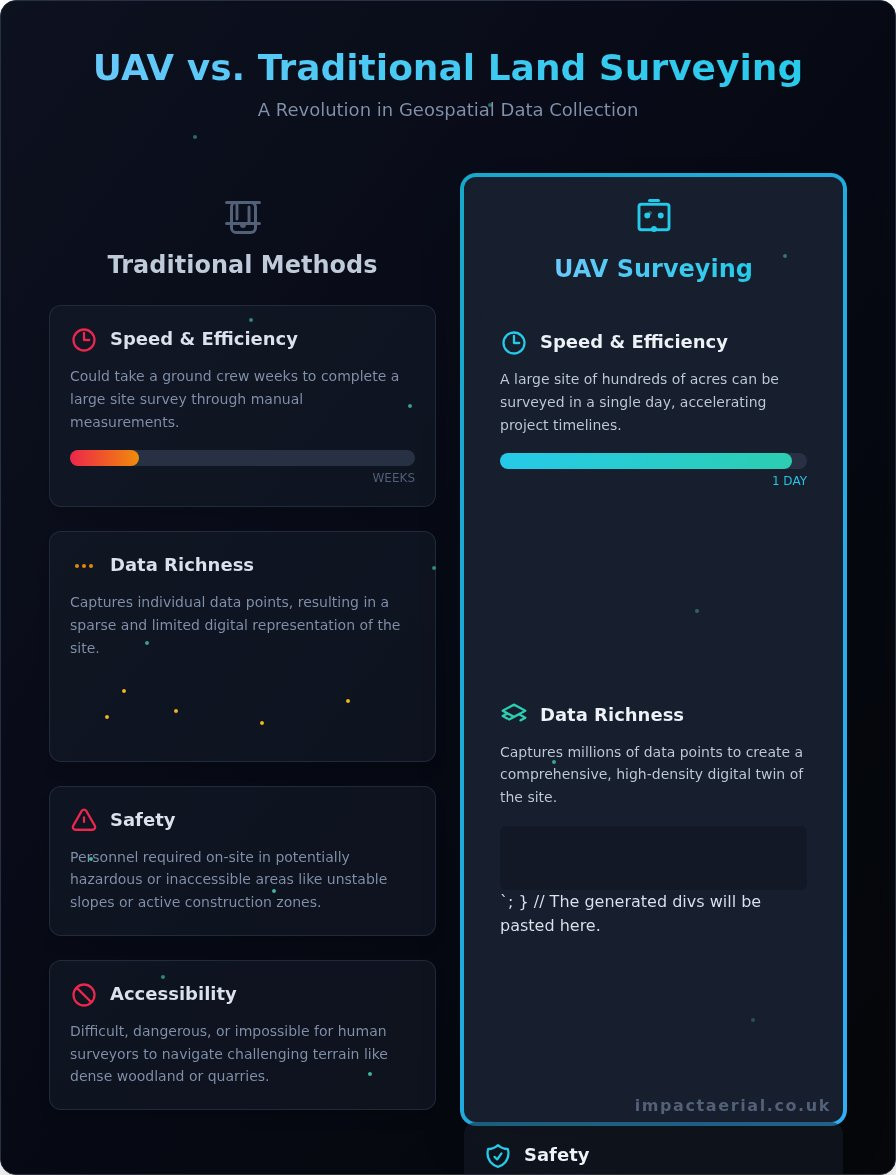
Frequently Asked Questions

Do I need a license to use a drone for my business in the UK?

You don’t need a specific “commercial license” anymore, but you must hold valid CAA authorisations to operate legally. Since 31 December 2020, the legal requirements for commercial drone use uk dictate that you need an A2 Certificate of Competency (A2 CofC) or a General Visual Line of Sight Certificate (GVC). These qualifications prove you’ve reached the professional standards necessary to manage flight safety and risk assessments.

What is the difference between a Flyer ID and an Operator ID?

A Flyer ID is awarded to the individual pilot after passing a CAA theory exam, while the Operator ID is the registration number for the person or business responsible for the drone. You must be 18 or over to get an Operator ID, which costs £11.13 annually. It’s mandatory to label every drone in your fleet with this unique ID. The Flyer ID is free, lasts for five years, and confirms you understand the basic safety rules.

Can I fly a drone commercially in London or Birmingham city centres?

You can fly in these cities, but you must navigate complex Flight Restricted Zones (FRZs) and obtain specific permissions. In Birmingham, for example, operations within the 5km FRZ of Birmingham Airport require direct approval from Air Traffic Control. Professional pilots use the GVC qualification to fly closer to people and buildings in congested areas. We manage these legal requirements for commercial drone use uk by conducting meticulous site surveys and securing all necessary NSF approvals before take-off.

Is it illegal to hire a drone pilot who doesn’t have CAA insurance?

Hiring a pilot without EC 785/2004 compliant insurance is a significant breach of UK aviation safety regulations. Commercial operators must carry third-party liability insurance to fly for “valuable consideration,” which includes any business-related task. For added peace of mind, always verify that your pilot holds a specialist policy with at least £1 million in cover. Choosing an uninsured hobbyist puts your business at financial and legal risk if an incident occurs.

What happens if a commercial drone crashes and I hired the pilot?

The pilot in command is legally responsible for the flight, but your business could face secondary liability if you didn’t check their credentials. If the operator is GVC certified and carries commercial insurance, their policy covers property damage or personal injury. We provide full risk assessments and proof of insurance for every project. This professional approach ensures your company remains protected from the fallout of any technical failures or accidents.

How do I check if a drone pilot is actually CAA GVC certified?

You should ask the pilot to provide their GVC certificate and their CAA Operator ID number before hiring them. Legitimate professionals will also be listed on vetted platforms like the Drone Safe Register or ARPAS-UK. You can cross-reference their details against the CAA’s list of authorised operators. A trustworthy specialist will always be happy to share their documentation to demonstrate their commitment to safety and compliance.

Do I need to inform the police before a commercial drone flight?

You don’t typically need to notify the police for standard commercial operations, but you must follow CAA notification procedures in certain areas. For high-profile shoots in city centres, we often contact local authorities as a courtesy to prevent public concern. This proactive communication is a hallmark of professional services. It ensures that your project proceeds without interruptions from security or law enforcement officers.

How much does a commercial drone license cost in the UK in 2026?

Budgeting for 2026, you should expect a GVC training course to cost between £500 and £850 depending on the provider. The annual CAA Operator ID fee is currently £11.13, though this figure often increases by 5% to 10% every few years. When you include specialist commercial insurance, which starts at around £600 annually, the total cost to stay compliant is roughly £1,200 for the first year. These fees ensure your business operates within the legal framework established by the Civil Aviation Authority.

How Long Does a Drone Survey Take? A Professional Timeline Guide

The actual flight time of a commercial UAV represents less than 15% of the total project lifecycle, yet many site managers still mistake a quick launch for a finished report. If you’re managing a high-stakes site in Birmingham or London, you’ve likely felt the pressure of a looming deadline while waiting for data that seems stuck in a processing queue. You need to know exactly how long does a drone survey take to avoid the 25% scheduling overrun often caused by poor planning or unexpected British weather. It’s vital to distinguish between the minutes spent in the air and the days required for professional data-gathering and analysis.

This guide outlines the realistic timescales for drone surveys in 2026, covering everything from CAA-mandated risk assessments to the final delivery of 4K digital twins. We’ll explain why high-quality photogrammetry often requires a 48-hour window for precision processing and how our GVC certified team ensures your project stays compliant. You will gain a clear roadmap of the survey process, giving you the peace of mind to schedule your next build without the fear of hidden delays.

Key Takeaways

  • Distinguish between on-site flight time—typically one to four hours for standard commercial properties—and the total project turnaround to manage your development schedule effectively.
  • Identify how UK-specific variables, including unpredictable weather conditions and CAA flight restrictions, can influence your data-gathering window and overall timeline.
  • Compare the timescales for different applications, from rapid high-resolution roof inspections to more complex topographic land surveys that require precise Ground Control Points.
  • Understand the four essential stages of the process to accurately estimate **how long does a drone survey take** from the initial instruction through to final data delivery.
  • Discover how employing CAA GVC certified pilots and DJI Enterprise technology can minimise mobilisation delays and streamline the delivery of high-quality survey results.

Estimating Your Drone Survey Timeline: On-Site vs. Total Turnaround

Understanding how long does a drone survey take requires a clear distinction between on-site duration and the total project turnaround. Many stakeholders assume the job is finished once the drone lands, but professional surveying is a multi-stage process. For a standard commercial property in the UK, the on-site flight time typically ranges from 1 to 4 hours. However, the full project lifecycle, from the initial instruction to the final delivery of data, usually spans 3 to 7 working days. This timeline ensures that every byte of data meets the high-resolution standards required for modern construction and engineering.

The Short Answer: Typical Timescales

Project duration scales with the complexity and size of the environment. We use specific benchmarks for our UK operations to ensure clients can plan their workflows effectively:

  • Small sites: A single roof inspection or small retail unit takes approximately 1 hour on-site. We deliver the final processed report within 48 hours.
  • Medium sites: A 5-acre construction plot or industrial estate requires 3 to 5 hours of active flight time. The full data package is delivered within 3 to 5 working days.
  • Large/Complex sites: Major infrastructure projects or solar farms often involve multiple days on-site. Delivery typically starts at 7 working days due to the sheer volume of data.

Why Flight Time is Only the Tip of the Iceberg

The drone is a powerful data-gathering tool, yet it isn’t a magic wand. In professional surveying, roughly 70% of the work happens outside of flight hours. Before our DJI Enterprise drones leave the ground, we conduct meticulous pre-flight planning and CAA-compliant risk assessments. This preparation is vital for safety and legal adherence. After landing, the technical work begins. We process 4K HDR imagery through advanced photogrammetry software to ensure millimetre-level accuracy. This is why “instant” drone data is almost always a myth in high-stakes industries. Quality takes time. Our structured approach provides the peace of mind that the final results are both precise and legally compliant. When asking how long does a drone survey take, you must account for this vital post-processing phase that transforms raw images into actionable intelligence.

Key Factors That Influence Drone Survey Duration in the UK

Determining how long does a drone survey take requires looking beyond the flight itself. While a standard 10-hectare site might only require 45 minutes of actual airtime, the total project timeline is dictated by external variables and technical precision. We don’t just “turn up and fly”; we manage a complex set of environmental and regulatory hurdles to ensure data accuracy.

Environmental and Geographic Variables

UK weather patterns are the primary cause of scheduling shifts. Most commercial drones, such as the DJI Matrice 350 RTK, have a maximum wind resistance of approximately 27mph. If gusts exceed 20mph, data quality often degrades due to sensor instability. We typically build a 48-hour “weather window” into our project timelines to account for these shifts. This ensures we capture high-quality data without risking the equipment or the accuracy of the photogrammetry.

Location geography also changes the pace of work. A rural survey in the West Midlands involves fewer obstacles than a complex flight in Birmingham city centre. Urban environments require detailed ground control and pedestrian management, which can double the preparation time. Topographical challenges, like 50-metre elevation changes or high-rise structures, require multi-level flight paths to maintain a consistent Ground Sample Distance (GSD). These technical adjustments are vital for the precision our clients expect.

Technical and Regulatory Requirements

Safety and compliance are at the heart of our operations. Every mission starts with a comprehensive Risk Assessment and Method Statement (RAMS). For restricted airspace near major airports, securing specific CAA permissions can take up to 21 days. It’s a meticulous process that cannot be rushed if you want to remain within the law. Understanding how long does a drone survey take involves accounting for these administrative lead times before the drone even leaves the van.

  • Battery Management: A standard enterprise battery provides roughly 30 to 40 minutes of flight. Large-scale projects requiring 2,500+ high-resolution images will necessitate multiple battery swaps and cooling cycles.
  • Deliverable Complexity: A simple 2D orthomosaic is processed much faster than a centimetre-accurate 3D digital twin or a detailed thermal inspection report.
  • Site Access: Securing permissions from neighbouring landowners can add several days to the pre-flight phase.

For added peace of mind, our professional drone services ensure all regulatory and technical hurdles are cleared before the first propeller spins. The difference between a quick snapshot and a professional survey lies in this preparation. We focus on the details so that the final data is both actionable and legally compliant.

Comparing Timelines for Roof, Land, and Commercial Property Surveys

The specific application of the technology determines how long does a drone survey take more than any other factor. A CAA GVC certified pilot might complete a visual inspection of a 2,000 square metre warehouse in 90 minutes, whereas a full topographic land survey of the same site requires a multi-day commitment. Precision requirements and data density are the primary drivers of these differences. We categorise these timelines based on the complexity of the data capture and the subsequent processing required to deliver professional results.

Roof and Building Inspections

Roof inspections are the most efficient service we offer. For a standard commercial unit in the West Midlands, such as a distribution hub in Solihull or an industrial unit in Dudley, the on-site flight time rarely exceeds two hours. These projects focus on high-resolution 4K stills and 60fps video to identify structural defects, leaks, or blocked guttering. Because these surveys produce individual files rather than a unified map, clients often receive the raw data within 24 hours. It’s a rapid process that provides immediate peace of mind for facility managers facing urgent maintenance issues.

Mapping and Photogrammetry Projects

Mapping projects are significantly more complex. When creating a 3D digital twin or a 2D orthomosaic, the pilot must capture thousands of overlapping images. To achieve sub-20mm accuracy, we must set out Ground Control Points (GCPs) across the site before the drone takes off. This preparation adds 2 to 4 hours to the on-site timeline. Data processing is the final hurdle. Stitching 1,500 high-resolution images into a single map requires immense computational power. Even with high-spec workstations using 128GB of RAM, rendering a 50-hectare site can take 12 to 18 hours of continuous processing.

Other specialised surveys have unique constraints that impact the delivery schedule:

  • Thermal Solar Surveys: These must occur when solar irradiance exceeds 600W/m². In the UK, this usually limits flight windows to between 10:00 and 14:00 on clear days.
  • Construction Monitoring: This is a longitudinal process. We visit a site at 14-day intervals over a 12-month build programme to document progress and ensure the project stays on track.
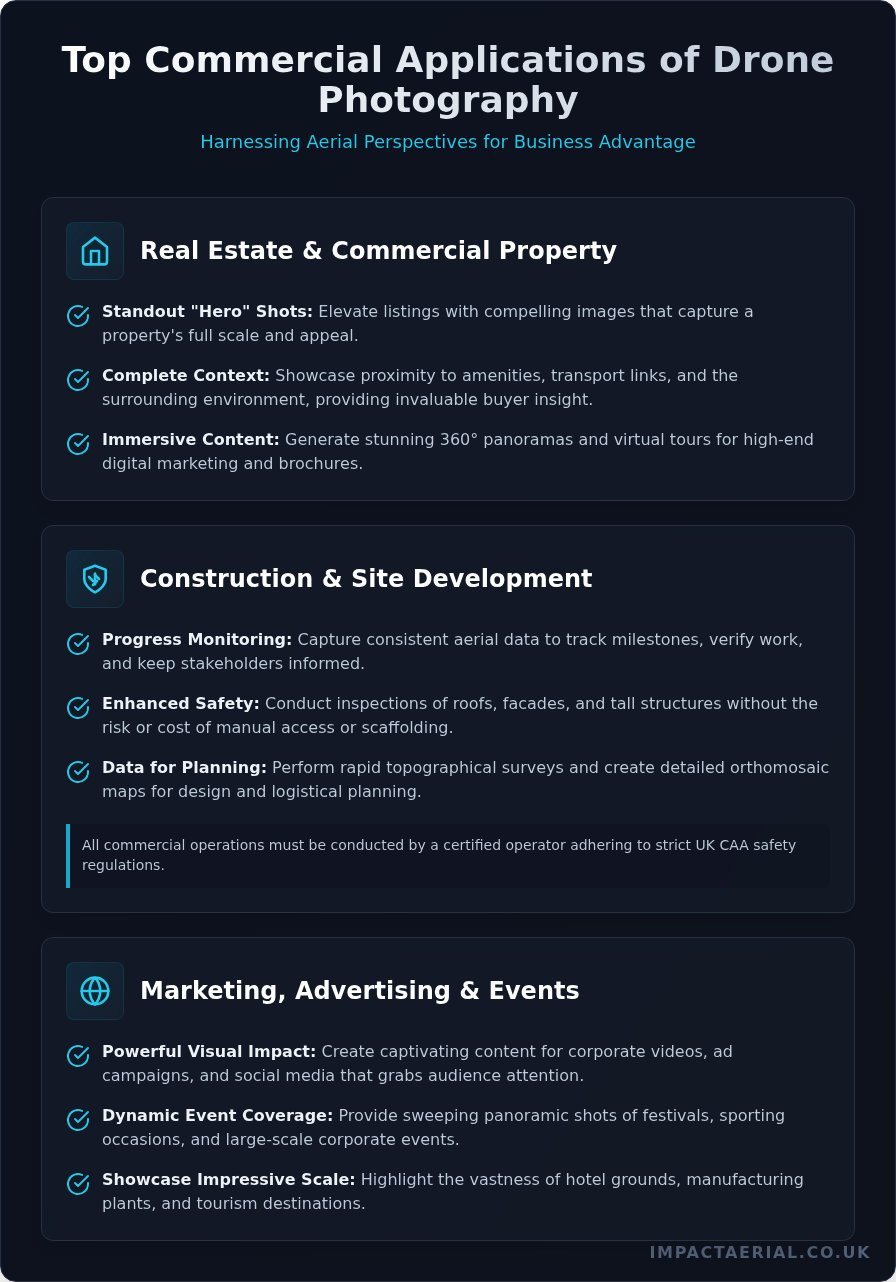
  • Topographic Land Surveys: These often require a 3 to 5-day turnaround to allow for the integration of GPS data and the generation of detailed CAD drawings.

Understanding these variables helps project managers plan effectively. While a simple aerial photograph is instant, a professional survey is a technical exercise in data management. When asking how long does a drone survey take, always account for the 48-hour window typically needed for high-quality data validation and reporting after the drone has landed.

The 4-Stage Drone Survey Process: From Instruction to Deliverables

Understanding how long does a drone survey take requires a transparent look at the operational workflow. It’s a common misconception that the process begins and ends with the drone in the air. At Impact Aerial, we divide every project into four distinct phases to ensure 99.9% data accuracy and total CAA compliance. Since the 2024 update to GVC standards, our meticulous approach ensures that even the most complex 20-hectare sites are handled with surgical precision.

  • Phase 1: Pre-flight Planning: We conduct detailed site research, establish flight boundaries, and complete mandatory risk assessments.
  • Phase 2: Mobilisation: This is the physical deployment where our GVC certified pilots capture high-resolution imagery or LiDAR data on-site.
  • Phase 3: Data Processing: Raw files undergo photogrammetry and quality assurance checks to create 2D orthomosaics or 3D models.
  • Phase 4: Delivery: Final assets are uploaded to a secure cloud portal, providing clients with instant access to actionable insights.

Pre-Flight: The Secret to a Smooth Survey

Success is decided before the rotors start spinning. We use advanced mapping tools to review site boundaries and identify hazards like overhead power lines or restricted airspace that could delay progress. By coordinating directly with site managers, we reduce operational disruption by roughly 35% compared to traditional ground surveys. The pre-flight window is the 24-48 hours before arrival where final weather forecasts and site access protocols are locked in.

Post-Production: Turning Imagery into Insight

Data is only valuable if it’s usable. Our editors filter through hundreds of 4K HDR images to select the clearest frames for your report. When inspecting solar arrays, our thermal analysis identifies ‘hot spots’ where cells have failed, often detecting temperature spikes of 15°C above the baseline. This technical review ensures every centimetre of data aligns with your specific brief before it reaches your desk. If you need precise data for your next project, contact our expert team today for a consultation.

When clients ask how long does a drone survey take, they’re often surprised that the technical processing in Phase 3 takes longer than the flight itself. For a standard commercial roof inspection, the flight might take 90 minutes, but the rigorous quality assurance checks ensure the final report is robust enough for legal or insurance purposes. This structured approach provides the peace of mind that every detail is captured safely and legally.

Minimising Delays: How Impact Aerial Streamlines the Process

Impact Aerial optimises every stage of data collection to ensure your project remains on schedule. We utilise the latest DJI Enterprise drones, such as the Matrice 350 RTK, which offer superior flight stability and longer battery life compared to standard consumer hardware. These drones capture high-resolution data up to 40% faster than older models, significantly reducing the time our pilots need to spend on-site. By using RTK (Real-Time Kinematic) positioning, we achieve centimetre-level accuracy without the need for excessive ground control points, which often shave hours off the initial setup phase.

Our strategic Birmingham base provides a logistical advantage for projects across the West Midlands. We can mobilise teams to sites in Birmingham, Coventry, or Wolverhampton within 60 to 90 minutes. This local presence eliminates the travel-related delays that often plague national providers. For added peace of mind, we carry £5m commercial liability insurance. This level of cover is a standard requirement for 95% of Tier 1 construction sites in the UK. Having this in place ensures immediate site access, preventing the administrative bottlenecks that occur when insurers need to vet under-insured operators.

Professionalism as a Time-Saving Tool

Amateur pilots often cause project overruns because they lack a deep understanding of UK airspace restrictions. A single oversight in flight planning can result in a grounded mission or a fine from the Civil Aviation Authority (CAA). Our CAA GVC certified pilots are experts in navigating complex regulations. We produce comprehensive Risk Assessments and Method Statements (RAMS) that achieve a 98% first-time approval rate from site managers. This methodical preparation is a cornerstone of our drone property surveys, ensuring we start flying the moment we arrive on-site.

Next Steps for Your Project

To accurately assess how long does a drone survey take for your specific requirements, we need a detailed brief. A clear scope of work allows us to account for site-specific variables like terrain complexity and local flight restrictions. When you get in touch, please include the following details:

  • The site postcode and boundaries.
  • The required data outputs, such as 2D orthomosaics or 3D models.
  • Any specific site access requirements or safety inductions.

Providing this information upfront allows us to calculate a precise project timeline and a fixed-fee quote within 24 hours. You can contact Impact Aerial for a bespoke survey timeline to ensure your next project is delivered with technical precision and professional reliability.

Accelerate Your 2026 Project Timelines with Expert Aerial Data

Determining how long does a drone survey take involves balancing rapid on-site capture with meticulous data processing. Most commercial property inspections in the UK now require less than 1 day on-site, with final 4K HDR reports typically delivered within 48 to 72 hours. This efficiency represents a 70% time saving compared to traditional manual surveying methods. At Impact Aerial, we don’t just fly; we provide a structured 4-stage process that ensures safety and precision at every turn. Our CAA GVC Certified pilots operate the latest DJI Enterprise 4K HDR drone fleet to capture every millimetre of your assets. For added peace of mind, we carry £5m commercial liability insurance, ensuring your site remains compliant with all current UK aviation regulations. Don’t let outdated inspection methods stall your progress. Our team is ready to provide the high-quality insights you need to keep your development on track and within budget. We look forward to helping you streamline your next project.

Request a Professional Drone Survey Quote Today

Frequently Asked Questions

How long does a drone roof survey take on-site?

A standard drone roof survey typically takes between 30 and 90 minutes on-site. This timeframe allows our CAA GVC certified pilots to conduct a mandatory pre-flight safety brief and capture high-resolution 4K HDR imagery of the entire structure. Complex industrial roofs with multiple levels or technical obstructions might extend this duration to 120 minutes. We ensure every angle is covered for a comprehensive inspection without the need for expensive scaffolding.

Can you perform a drone survey in the rain or high winds?

We don’t operate in active rain or winds exceeding 20 miles per hour to ensure data precision and flight safety. While our DJI Enterprise fleet features IP-rated weather resistance, moisture on the lens distorts the 4K imagery required for professional surveys. High winds also deplete batteries 30% faster; this compromises the stability needed for accurate photogrammetry. We prioritise safety and quality to provide total peace of mind for our clients.

How long does it take to receive the processed drone data?

You will typically receive your processed drone data within 24 to 72 hours of the flight being completed. Standard high-definition imagery and raw video files are often delivered via a secure download link within one working day. More complex data-gathering projects involving detailed inspection reports or topographical maps require additional time for analysis. We aim to deliver 95% of our standard survey reports within 3 working days.

Does the size of the site significantly change the survey time?

Site size is the primary factor in determining how long does a drone survey take for a specific project. A compact 1-hectare site might require only 20 minutes of flight time, whereas a 20-hectare construction development often takes 4 to 6 hours to map fully. Larger sites require multiple battery swaps and more complex flight paths to maintain the 80% image overlap needed for high-quality data-gathering and accurate mapping.

Do I need to be present during the drone survey?

You don’t need to be present on-site during the drone survey as long as we have authorised access to the area. Our pilots handle all site risk assessments and CAA compliance requirements independently. We provide a digital confirmation once the data capture is complete; this allows you to continue with your day while we manage the technical operations. Many of our commercial clients prefer this remote approach for its efficiency and minimal disruption.

What happens if the drone survey is delayed by weather?

We reschedule weather-delayed surveys for the next available clear window, usually within 48 hours of the original booking. Our team monitors Met Office forecasts 24 hours in advance to provide early warnings of potential disruptions. Safety is our absolute priority, and we won’t fly if conditions risk the integrity of your data or the safety of the public. Your booking remains secured, and we don’t charge additional fees for weather-related rescheduling.

How much lead time is required to book a commercial drone survey?

We generally require a lead time of 3 to 7 days to book a commercial drone survey. This period allows us to complete necessary airspace checks, obtain any required permissions from the CAA, and perform a detailed desktop risk assessment. While we can occasionally accommodate emergency inspections within 24 hours, the 7-day window ensures all regulatory paperwork is perfectly in order. This meticulous planning is essential for maintaining our high safety standards.

Does a 3D model take longer to produce than 2D images?

Processing a 3D digital twin takes approximately 2 to 3 times longer than delivering standard 2D aerial photographs. While 2D images are often available within 24 hours, a 3D model requires intensive photogrammetry processing that can take 48 to 72 hours. This process involves stitching together hundreds of individual HDR images to create a centimetre-accurate representation of your asset. The resulting model provides a far more detailed level of insight for your project team.

Drone Filming for Tourism Videos: A Strategic Guide for Destination Marketing

What if your destination’s most compelling story remains invisible because your marketing is restricted to ground-level photography? With the 2024 State of Video Marketing report showing that 91% of businesses now use video as a primary tool, professional drone filming for tourism videos has become the definitive way to capture the scale and soul of a location. It is understandable if you feel hesitant; the UK’s shifting CAA regulations and the presence of uninsured operators can make aerial projects feel like a significant risk.

We believe you deserve the peace of mind that comes with expert execution. This guide provides the technical clarity and strategic framework you need to produce breathtaking visual content while maintaining full regulatory compliance. You will learn how to navigate GVC certifications and integrate high-impact aerial footage into your 2024 social media campaigns to drive measurable booking growth.

Key Takeaways

  • Understand why aerial perspectives are now essential for driving travel inspiration and influencing booking behaviour in a competitive global market.
  • Discover how to utilise 4K HDR technology and immersive FPV drone fly-throughs to capture the true essence of British destinations and resorts.
  • Identify critical UK safety standards, including the requirement for CAA GVC certification and £5m public liability insurance for added peace of mind.
  • Master the strategic integration of drone filming for tourism videos across social media platforms like Instagram Reels and interactive virtual tours.
  • Learn how professional project management and enterprise-grade equipment can transform your destination marketing with high-impact, compliant aerial content.

The Impact of Drone Filming for Tourism Videos in 2026

By 2026, the standard for travel marketing has shifted. Static ground shots often fail to convey the true scale of a sprawling £10 million Highland estate or the rugged coastline of Cornwall. Modern travellers demand an immersive experience before they even pack a suitcase. Using drone filming for tourism videos allows brands to provide a comprehensive sense of geography that ground cameras cannot match. This perspective triggers a specific psychological response; it creates a feeling of discovery and mastery over a location. When a potential guest sees the exact proximity of a resort to the ocean, the “fear of the unknown” vanishes, replaced by a clear intent to book.

Recent data from Wyzowl’s 2025 marketing report indicates that websites featuring high-quality video content retain visitors for 88% longer than those using static imagery alone. We’ve moved past basic “fly-over” clips. Today’s destination marketing relies on complex cinematic storytelling. While the history of aerial videography began with balloons and fixed-wing aircraft, our current use of 4K HDR drones allows for intimate, low-altitude manoeuvres that were once impossible. This technology bridges the gap between a distant map and a tangible, lived experience.

Creating an Emotional Connection with Your Audience

Sweeping vistas establish grandeur, but the real power lies in highlighting hidden gems. We use drones to access remote waterfalls or private clifftop paths that are physically inaccessible to traditional camera crews. This exclusivity helps build a “favourite” brand identity. By showcasing these secret spots, you aren’t just selling a room; you’re selling a unique, gatekept experience that feels deeply personal to the viewer.

Standing Out in a Crowded Travel Market

Professional drone filming is now the industry standard for UK Destination Management Organisations (DMOs). Unique orbital angles and low-to-high reveals differentiate a luxury hotel from local competitors who rely on outdated stock footage. We utilise 4K HDR quality to ensure every frame meets the technical requirements of high-end brands. This level of precision provides the “peace of mind” that only a CAA GVC certified operator can deliver in a niche but increasingly diverse market. Key benefits include:

  • Increased dwell time: Visitors stay longer to watch cinematic sequences.
  • Higher conversion: Aerial clarity reduces booking hesitation.
  • Brand authority: High-production values signal a premium service.
  • Regulatory compliance: Using certified pilots ensures your marketing campaign isn’t derailed by legal issues or safety concerns.

Key Techniques for Creating Compelling Aerial Tourism Videos

Capturing the British landscape requires more than just a flying camera; it demands technical precision and high-specification equipment. Impact Aerial utilises 4K High Dynamic Range (HDR) technology to ensure that the subtle greens of the Cotswolds or the deep blues of the Cornish coast are rendered with absolute fidelity. Using 10-bit colour depth allows for over 1 billion colours, preventing the “banding” often seen in lower-quality footage. This technical rigour is vital when considering the relevance of drone videos for destination marketing, as viewers increasingly expect cinematic quality before committing to a booking.

Lighting is the most influential factor in high-end tourism assets. Our pilots prioritise the “Golden Hour,” the 60-minute window after sunrise or before sunset. During this period, the sun’s lower angle creates long shadows and a warm glow that adds texture to architectural features. To maintain this professional standard, we employ three-axis mechanical gimbals. These stabilise the camera against wind speeds of up to 22mph; this ensures that drone filming for tourism videos remains smooth and entirely free from vibration, even in unpredictable coastal conditions.

FPV Drones: The New Frontier for Hospitality

First Person View (FPV) drones have revolutionised how UK resorts present themselves. Unlike traditional drones, FPV craft can navigate through a 2-metre wide hotel lobby, fly over a spa pool, and transition into a luxury suite in one continuous movement. This “one-take” journey provides a visceral sense of scale that static photography cannot match. Because these drones lack standard automated collision sensors, they require a specialised pilot with high-speed precision skills. For those seeking this level of immersion, our professional aerial services provide the necessary technical expertise and CAA-certified safety assurance.

Post-Production: Where the Magic Happens

The raw footage is only the beginning of the process. Professional colour grading is used to lift the often-muted tones of the UK climate, making destinations look vibrant while remaining realistic. We often integrate 60fps aerial shots with 24fps ground-level footage to create a cohesive narrative. Adding motion graphics or 3D map overlays can increase viewer engagement by up to 40%, as it provides essential geographical context for international visitors. This meticulous approach ensures every frame serves the broader goal of attracting visitors to your location.

Commercial drone filming for tourism videos is a highly regulated activity that requires more than just a creative eye. In the UK, the Civil Aviation Authority (CAA) dictates strict frameworks to ensure public safety and privacy. Operating without the correct credentials isn’t just a safety risk; it’s a legal liability for the tourism board or brand involved. Professional operators must conduct a detailed site survey and risk assessment before any equipment leaves the ground. These documents aren’t mere formalities. They account for local weather patterns, magnetic interference, and emergency landing zones to ensure the shoot proceeds without incident.

Safety is underpinned by robust financial protection. We maintain £5 million in public liability insurance, which has become the 2024 industry benchmark for large-scale tourism projects. Most local councils and National Park authorities won’t even review a filming application without seeing proof of this specific cover. This high level of insurance provides peace of mind, protecting your organisation from the financial repercussions of equipment failure or accidental third-party damage in busy public areas.

Adhering to the UK drone regulations is the only way to guarantee a lawful production. This includes respecting the 120-metre (400ft) altitude limit and maintaining a constant line of sight with the aircraft. By following these established protocols, we capture breath-taking footage that showcases destinations from perspectives that were previously impossible to reach safely.

What is a CAA GVC Certified Pilot?

The General Visual Line of Sight Certificate (GVC) is the professional standard introduced in January 2021. It signifies that a pilot has undergone rigorous theoretical and practical testing. This qualification allows us to operate in the “Specific Category,” which is essential for drone filming for tourism videos near congested areas or buildings. Hiring a hobbyist without a GVC puts your project at risk of being shut down by the police. It also risks substantial fines for the commissioning body, as uncertified pilots cannot legally fly for commercial gain.

Securing Permissions for Iconic Landmarks

Filming at a 12th-century castle or a bustling city centre requires meticulous planning. We manage the entire permissions process, from liaising with local authorities to obtaining clearance for Flight Restriction Zones (FRZs) near airports. These zones usually extend 5km from a runway, requiring direct communication with Air Traffic Control. Furthermore, we ensure every project remains compliant with the Data Protection Act 2018. We use specific techniques to protect the privacy of the public, ensuring your marketing materials are both stunning and GDPR-compliant.

Strategic Uses of Aerial Content in Your Marketing Mix

Integrating aerial perspectives isn’t just a creative choice; it’s a commercial necessity for high-growth tourism brands. Data from 2023 indicates that video content on landing pages can increase conversion rates by up to 80%. By investing in professional drone filming for tourism videos, you create a versatile asset library that serves multiple channels simultaneously. Whether it’s a £50,000 billboard campaign or a weekly email newsletter, the ROI of aerial content stems from its ability to capture scale and emotion that ground-level photography cannot match.

Social Media: Short-Form Cinematic Content

Short-form video is the dominant force on platforms like TikTok and Instagram. To stop the scroll, you need 15-30 second ‘teaser’ clips that deliver immediate visual impact. We recommend capturing footage in 4K resolution to allow for vertical (9:16) cropping without losing detail. This mobile-first approach is essential, as 90% of social media users access platforms via handheld devices. Using smooth aerial transitions, such as a top-down reveal or a cinematic orbit, keeps viewers engaged for 45% longer during travel vlogs compared to static shots.

Virtual Tours and Immersive Experiences

Booking friction often occurs when a guest can’t visualise the layout of a resort or destination. You can solve this by combining 360-degree aerial panoramas with ground-level virtual tours. This hybrid approach lets prospective guests ‘walk through’ the property from their desktop or mobile. Statistics from the travel industry show that interactive tours can reduce booking hesitation for high-value holiday packages by 14%. It provides the peace of mind that what they see online is exactly what they’ll experience upon arrival. Our CAA GVC Certified pilots ensure these captures are precise, providing high-resolution data that integrates seamlessly into property management software.

Beyond digital, high-resolution drone stills are vital for print marketing. A single 48-megapixel aerial shot can be scaled for large-format billboards or high-end brochures without pixelation. In email marketing, including the word ‘video’ in a subject line has been shown to boost open rates by 19%. Using a GIF or a thumbnail of an aerial sweep encourages click-throughs to your booking engine.

Ready to elevate your brand’s visual identity? Discover how our professional drone filming for tourism videos can transform your marketing results.

Elevating Your Destination with Impact Aerial’s Professional Services

Impact Aerial provides a comprehensive, end-to-end solution for destination marketing. We manage every stage of the production process. This begins with an initial technical consultation and continues through to the final professional edit. Our fleet consists of the latest professional-grade commercial drones. These advanced aircraft capture 4K High Dynamic Range (HDR) footage to ensure every frame meets the standards required for modern digital platforms. We recognise that drone filming for tourism videos requires more than just a pilot; it needs a technical partner who prioritises safety and precision.

We are based in Birmingham and the West Midlands. However, our team provides nationwide coverage across the United Kingdom. For added peace of mind, we carry £5m in commercial liability insurance. This level of cover is essential for operating in public spaces and high-traffic tourist attractions safely. We handle all flight permissions and coordination with local authorities so you don’t have to worry about the logistics of your shoot.

Why Choose Impact Aerial for Your Tourism Project?

Our team brings extensive experience from the commercial property and advertising sectors. We don’t just fly drones. We plan every shot with a focus on data-gathering and visual impact. Every project is led by GVC certified pilots who follow a meticulous planning process. This includes detailed risk assessments and site-specific surveys to ensure total compliance with Civil Aviation Authority (CAA) regulations.

  • Expert Translation: We translate your brand vision into breath-taking aerial views that showcase unique perspectives.
  • Proven Results: Industry data shows that 73% of travellers are more likely to book after watching a video of a destination.
  • Technical Prowess: Our use of photogrammetry and high-spec sensors ensures top-quality results every time.

Start Your Aerial Journey Today

The journey starts with a consultation to identify your specific marketing goals. We identify which angles and landmarks will provide the most significant return on investment for your brand. We offer customised filming packages designed for hotels, heritage attractions, and regional tourism boards. Each package is tailored to your unique requirements and budget to ensure a bespoke service.

Ready to showcase your destination from a new perspective? Contact Impact Aerial for a bespoke drone filming quote and let our experts handle the technical details of your next project. We provide clear pricing and a structured timeline for every assignment we undertake.

Future-Proof Your Destination Marketing Strategy

As we head towards 2026, the standard for visual storytelling in the UK travel sector has shifted. Static imagery no longer suffices when competing for global attention. Integrating professional drone filming for tourism videos into your strategy allows you to showcase the British landscape from perspectives that were previously impossible to reach. Success in this field requires a meticulous approach to both creative execution and strict adherence to UK Civil Aviation Authority regulations.

Impact Aerial simplifies this process by providing a technical consultancy approach to every project. Our team consists of CAA GVC Certified Pilots who operate the latest 4K HDR DJI Enterprise fleet to ensure your content meets the highest production standards. For added peace of mind, every flight we conduct is supported by £5m commercial liability insurance. Don’t leave your destination’s reputation to chance; choose a partner that values safety and precision as much as the final shot.

Book your professional drone filming consultation with Impact Aerial to elevate your marketing campaign today. It’s time to show your audience the UK like they’ve never seen it before.

Frequently Asked Questions

Is it legal to use drone footage for commercial tourism marketing in the UK?

Yes, it’s legal to use drone footage for commercial purposes provided the operator holds the correct credentials from the Civil Aviation Authority (CAA). Professional pilots must possess either an A2 Certificate of Competency (A2 CofC) or a General Visual Line of Sight Certificate (GVC) to conduct drone filming for tourism videos legally. For added peace of mind, we also maintain £5 million in commercial drone liability insurance to protect all parties during the production.

How much does professional drone filming for a tourism video cost?

Professional drone filming for a tourism video typically costs between £500 and £1,500 per day depending on the project’s scale. A standard half-day shoot for a local attraction starts at approximately £350, while a comprehensive 2-day shoot for a large resort involving 4K HDR delivery can reach £2,500. These figures include pre-flight risk assessments, equipment transport, and the capture of raw aerial data.

Can drones film inside hotels or tourist attractions?

Drones can safely film inside hotels and attractions using specialised “Cinewhoop” aircraft that feature ducted propellers to prevent damage to interiors or guests. These compact drones weigh under 250g and allow us to fly through narrow doorways or over dining areas to create immersive “fly-through” tours. We conduct a 15-minute internal site survey before take-off to identify potential hazards like overhead fans or delicate light fixtures.

What happens if the weather is bad on the day of the drone shoot?

We monitor the Met Office forecast 48 hours before every scheduled shoot and will postpone the flight if wind speeds exceed 20mph or if there’s a 30% or higher chance of rain. Most professional contracts include one free weather-related rescheduling date to ensure you get the bright, clear footage needed for effective tourism marketing. Flying in poor conditions risks both the safety of the aircraft and the visual quality of the 4K stabilised footage.

Do I need to get permission from the CAA to film my resort?

You don’t need to contact the CAA yourself because the drone operator manages all necessary flight permissions and airspace clearances. If your resort is located within a Flight Restriction Zone (FRZ), such as those near one of the UK’s 40 plus major airports, we handle the coordination with Air Traffic Control on your behalf. We use the Drone Assist app and official CAA charts to ensure every flight is 100% compliant with current UK drone laws.

What is the difference between a hobbyist drone pilot and a professional service?

The main difference is that a professional service holds CAA-approved GVC certification and specialist commercial insurance, whereas hobbyists are legally restricted from flying for “valuable consideration.” Professionals use enterprise-grade equipment with 10-bit colour depth and dual-operator setups for precision shots that consumer drones can’t replicate. Choosing a certified expert ensures your project meets the safety standards required by local councils and corporate stakeholders.

How long does it take to produce a final edited tourism drone video?

It typically takes between 5 and 10 working days to deliver a fully edited tourism drone video after the filming is complete. This timeframe allows our editors to perform colour grading on the 4K files, select a licensed music track, and add any necessary 2D or 3D motion graphics. We usually provide a first draft for review within 72 hours, allowing for two rounds of client revisions before the final export.

Can you provide high-resolution still photos as well as video?

Yes, our flight teams capture 20-megapixel or 45-megapixel high-resolution still images alongside the video footage during the same session. These stills are processed as RAW files to ensure maximum detail for print brochures, large-scale billboards, or digital advertising banners. By capturing both formats in one visit, we provide a cost-effective way to build a complete library of marketing assets for your destination.

Hiring a Commercial Drone Pilot in Birmingham: The 2026 Professional Buyer’s Guide

In 2026, a single uncertified drone flight over a Birmingham construction site can result in fines exceeding £2,500 and immediate project suspension by the Civil Aviation Authority. It’s a risk that no professional developer or project manager should take. You probably recognise that high-quality aerial data is now a critical asset for your operations, yet the shift from PfCO to GVC certifications has created a confusing landscape for procurement teams. Finding a qualified commercial drone pilot in Birmingham who understands these specific regulatory nuances is the only way to protect your business from liability.

This guide reveals the exact criteria you need to select a certified professional who guarantees legal compliance and safety. For added peace of mind, we’ll explain how to verify £5 million commercial liability insurance and what technical standards to expect for 4K HDR footage or precise survey data. You’ll learn how to distinguish between hobbyist operators and technical consultants who provide the precision your project demands.

Key Takeaways

  • Learn how to distinguish between hobbyist operators and a qualified commercial drone pilot birmingham by understanding the latest CAA GVC certification requirements.
  • Discover why £5 million commercial liability insurance and site-specific risk assessments (RAMS) are non-negotiable standards for ensuring safety and legal compliance.
  • Identify the specific aerial solutions your sector requires, from 4K HDR cinematic marketing content to high-precision photogrammetry for technical surveys.
  • Gain peace of mind by understanding the logistical planning involved in professional drone operations, including airspace notifications and advanced professional drone fleet capabilities.

Table of Contents

Finding a Certified Commercial Drone Pilot in Birmingham: Why Professionalism Matters

The West Midlands has seen drone activity increase by over 25% since 2021. This rapid growth has unfortunately led to a rise in “cowboy” operators who fly without the necessary legal permissions. While a hobbyist might own a high-specification drone, they lack the rigorous training and legal framework required for commercial work. Hiring a professional commercial drone pilot birmingham ensures your project complies with the latest UK drone regulations enforced by the Civil Aviation Authority (CAA).

To better understand why choosing the right operator is vital for your project’s success, watch this helpful video:

Professionalism isn’t just about flight skills. It’s about risk management. Birmingham’s dense urban environment, filled with heritage buildings and complex infrastructure, leaves no room for error. An uncertified pilot operating without a GVC (General Visual Line of Sight Certificate) puts your business at risk of heavy fines, potential criminal prosecution, and the kind of reputational damage that requires specialist management; you can discover Aria Operations to see how AI is used to protect and elevate digital reputations.

The Local Context: Drone Services in Birmingham

The Birmingham Big City Plan is a 20-year vision covering 800 hectares of the city centre. This massive regeneration drive has created a surge in demand for high-quality aerial surveys and progress filming. Navigating the specific airspace challenges of the West Midlands, including proximity to Birmingham Airport (EGBB) and restricted zones over government buildings, requires deep local knowledge. Impact Aerial has served the local business community for years, providing the technical expertise needed to operate safely within these “niche but increasingly diverse” urban environments.

Identifying a Professional Operator

Don’t be swayed by low-cost quotes that seem too good to be true. A “cheap” operator often lacks the £5 million commercial liability insurance necessary to protect your assets. Professionalism is found in the paperwork. A legitimate commercial drone pilot birmingham will provide:

  • A valid CAA Operational Authorisation.
  • Comprehensive Risk Assessment and Method Statements (RAMS) for every site.
  • Enterprise-grade equipment, such as DJI 4K HDR systems, for precise data-gathering.

For added peace of mind, professional pilots offer more than just raw footage. They provide specialised post-production and photogrammetry services that turn aerial images into actionable business data. Choosing quality over a bargain price prevents the legal complications and unusable results associated with unvetted operators.

The Regulatory Baseline: CAA GVC Certification and Insurance Standards

Safety in the drone industry isn’t a suggestion; it is a legal mandate strictly enforced by the Civil Aviation Authority (CAA). The transition from the old PfCO (Permission for Commercial Operation) to the GVC (General Visual Line of Sight Certificate) on 31 December 2020 marked a significant shift toward risk-based regulation. Any commercial drone pilot Birmingham developers or surveyors hire must hold this certification to operate legally in complex environments. The CAA manages Birmingham’s congested airspace, ensuring that aerial work doesn’t interfere with manned aviation or endanger the public. All professional flights must strictly adhere to the Civil Aviation Authority’s Drone Code to ensure the highest safety benchmarks are met.

Before commissioning any aerial work, verify your pilot’s credentials through these three steps:

  • Request a copy of their current CAA Operational Authorisation document.
  • Verify their Operator ID and Flyer ID against the CAA database.
  • Check that their specific drone equipment is listed within their approved Operations Manual.

Understanding CAA GVC Certification

The GVC is essential for conducting flights in the “Specific Category,” particularly within built-up urban areas like Birmingham’s Jewellery Quarter or the Colmore Business District. It proves the pilot has passed a theory exam and a practical flight assessment, demonstrating they can handle a drone safely near people and property. A critical component of this is the Operations Manual. This document is a 50 to 100-page volume detailing exactly how the pilot manages risks, emergency procedures, and equipment maintenance. The GVC stands as the gold standard for commercial drone operations in 2026.

Why £5m Liability Insurance is Essential

Operating a drone over Birmingham’s £25 billion economy involves inherent risks. Standard public liability insurance often excludes aviation activities, leaving the client exposed if an incident occurs. Every commercial drone pilot Birmingham businesses contract should carry a minimum of £5m commercial liability insurance that is specifically EC 785/2004 compliant. This specialised cover protects the client from claims involving third-party injury or property damage. For added peace of mind, you can review our professional drone services to see how we prioritise these safety protocols on every project. This level of insurance ensures that even when flying near high-value infrastructure or sensitive commercial property, the financial and legal risks are fully mitigated.

Matching Drone Services to Your Birmingham Business Sector

Selecting a commercial drone pilot birmingham requires a clear understanding of your project’s specific objective. It’s not a one-size-fits-all industry. A project intended for a high-end marketing campaign requires a completely different technical approach compared to a structural integrity survey. We categorise our missions into two primary streams: creative storytelling and technical data acquisition. While a cinematic drone might capture 4K HDR footage at 60 frames per second for a fluid visual experience, an Enterprise-grade aircraft focuses on global shutter sensors and RTK (Real-Time Kinematic) positioning for centimetre-level mapping accuracy.

Choosing the right hardware is vital for project success. For missions in dense urban areas like Digbeth or the Jewellery Quarter, we often utilise lightweight drones that offer greater agility and a smaller noise profile. Conversely, for large-scale industrial assets, we deploy DJI Enterprise platforms. These units carry thermal sensors and high-magnification zoom lenses, allowing us to identify a failing solar cell or a hairline crack in a chimney stack from a safe distance. Every flight we conduct is planned in strict accordance with the Civil Aviation Authority drone regulations, ensuring that data is gathered legally and safely.

Aerial Photography and Filming for Advertising

Capturing the transformation of Birmingham’s skyline requires an eye for composition and technical mastery of light. We use High Dynamic Range (HDR) processing to manage the high-contrast environments found amongst the city’s glass-fronted architecture. It’s a common misconception that the work ends when the drone lands. In reality, the flight represents only 50% of the creative process. Our editors spend an average of four hours in post-production for every hour spent on-site, colour grading and stabilising footage to ensure it meets professional broadcast standards for commercial use.

Drone Surveys for Property and Construction

In the Midlands construction sector, drones have become essential for maintaining project timelines and budgets. Traditional roof inspections often require scaffolding or cherry pickers, which can cost upwards of £1,500 for a single day. A drone survey can reduce these preliminary costs by 60% while providing 45-megapixel visual evidence of defects. For real estate developers, we create 3D virtual tours and photogrammetry models. These digital twins allow stakeholders to navigate a site remotely, providing a 98% accuracy rate when measuring distances or volumes of stockpiled materials on-site.

Logistics and Planning: Organising a Drone Shoot in the West Midlands

Executing a successful aerial mission in a complex urban environment requires meticulous preparation. We begin every project with a detailed consultation to define your data objectives and identify any immediate safety constraints. Our team then develops a site-specific Risk Assessment Method Statement (RAMS), which is a mandatory requirement for any professional operation. We don’t just fly; we manage the entire regulatory process to ensure your project remains compliant with Civil Aviation Authority (CAA) standards. For added peace of mind, our operations are backed by £5 million in commercial liability insurance, covering both equipment and third-party risks.

Weather monitoring is a non-negotiable part of our workflow. We track wind speeds and precipitation levels using high-resolution forecast data up to 48 hours before the shoot. If wind speeds exceed 20mph or heavy rain is forecast, we trigger a pre-agreed “Plan B” date. This proactive approach ensures we never compromise on safety or image quality, especially in the niche but increasingly diverse market of industrial inspections.

Navigating Birmingham’s Airspace

Operating as a commercial drone pilot in Birmingham involves managing the Flight Restriction Zone (FRZ) surrounding Birmingham Airport (BHX). Any flight within this 5km radius requires specific Air Traffic Control (ATC) clearance via the NATS portal. When working in high-footfall areas like Grand Central or near the city’s extensive canal network, we coordinate with the West Midlands Police and the Canal & River Trust. Securing these legal permissions typically takes between 7 and 10 working days, so early engagement is essential for city centre projects.

The Pre-Flight Checklist for Clients

When you hire a commercial drone pilot birmingham for a project, your local knowledge is invaluable. We categorise risks into “ground hazards” (such as public rights of way or moving vehicles) and “air hazards” (including overhead power lines or nesting birds). To streamline the process, please provide the following:

  • The exact postcode and a site map indicating the primary area of interest.
  • Contact details for the site manager or land owner to verify access rights.
  • Information regarding any scheduled site works or crane operations on the day.

Clients can assist significantly by securing a 30-metre by 30-metre area for a dedicated take-off and landing site. This space must be clear of the public and any overhead obstructions. If the site is on private land, we require written permission from the owner before we can legally launch. Our team will handle the physical cordoning and signage on the day to maintain a sterile working area.

For a detailed assessment of your specific site requirements, request a technical consultation with our CAA GVC certified team.

Choosing Impact Aerial: Expert Drone Solutions in Birmingham

Selecting a commercial drone pilot birmingham requires more than just finding a hobbyist with a camera. Impact Aerial delivers a meticulous end-to-end service that begins with a detailed safety consultation and concludes with high-resolution post-production. Our fleet utilises the latest DJI Enterprise drones, including the Matrice and Mavic 3 Enterprise series. These platforms capture 4K HDR imagery and precise thermal data, ensuring your project benefits from the highest technical standards available in 2024.

We operate from a central hub in the West Midlands. This strategic location allows our teams to reach sites in London, Manchester, or Bristol within two hours, making us a highly efficient partner for national contracts. We provide “added peace of mind” by managing every regulatory hurdle, from complex airspace permissions to local council liaison. You won’t have to worry about the paperwork; we handle the compliance so you can focus on the results.

Our Professional Credentials

Reliability is built on rigorous certification. Impact Aerial holds full CAA GVC (General Visual Line of Sight Certificate) status, reflecting our commitment to current UK flight regulations. We protect our clients with £5 million in commercial liability insurance, a standard we’ve maintained to ensure total site security.

  • Verified members of the Drone Safe Register and ARPAS-UK.
  • 100% safety record across 500+ flight hours in complex urban environments.
  • Specialist expertise in photogrammetry and 3D mapping for West Midlands construction firms.

Recent feedback from a Birmingham-based tier-one contractor highlighted our ability to deliver millimetre-accurate site surveys within 48 hours of the initial request. This speed and precision make us the preferred commercial drone pilot birmingham for high-stakes property and infrastructure projects.

Get Started with Your Birmingham Drone Project

Every project is unique. We don’t offer generic pricing because your data requirements deserve a bespoke approach. Our project management team handles the entire workflow, ensuring clear communication from the initial site risk assessment to the final data delivery. We use secure cloud-based platforms to share your imagery, allowing your stakeholders to access high-definition assets instantly.

Ready to elevate your project with professional aerial data? Contact Impact Aerial today to discuss your Birmingham drone requirements and receive a detailed, no-obligation quote tailored to your specific site needs.

Elevate Your Birmingham Project with Professional Aerial Intelligence

Selecting a commercial drone pilot birmingham requires a focus on both technical capability and strict regulatory compliance. The 2026 landscape demands that operators provide more than just a birds-eye view; they must deliver actionable data and safe flight execution. Impact Aerial meets these requirements through our team of CAA GVC Certified Pilots and a versatile DJI Enterprise Fleet designed for precision and reliability. Because we’re based in Birmingham and the West Midlands, we navigate local airspace and specific planning requirements with local knowledge. Our £5m commercial liability insurance provides the necessary peace of mind for every client, whether you’re managing a major construction site or a sensitive industrial inspection. We’ve built our reputation on meticulous standards and high-quality delivery. It’s time to secure the professional aerial perspectives your project deserves. Let’s discuss how our local expertise can support your specific business goals with a tailored solution.

Request a Professional Drone Service Quote for Your Birmingham Project

Frequently Asked Questions

Do I need a special permit to fly a drone in Birmingham city centre?

You usually need specific Civil Aviation Authority (CAA) authorisation to fly in Birmingham city centre due to its status as a congested area. Our pilots hold the General Visual Line of Sight Certificate (GVC), allowing us to operate in complex urban environments where hobbyist flyers are restricted. We also coordinate with Birmingham City Council for land use permits, ensuring every flight adheres to the 2021 UK drone regulations.

How much does it cost to hire a commercial drone pilot in Birmingham?

Hiring a commercial drone pilot in Birmingham typically costs between £350 and £600 for a half-day shoot or a standard roof survey. For complex 3D mapping or full-day cinematic productions, rates generally range from £800 to £1,500. These figures include pre-flight risk assessments, equipment insurance, and basic post-processing. Every project receives a bespoke quote based on the specific technical requirements and airspace complexity involved.

What is the difference between a PfCO and a GVC drone license?

The Permission for Commercial Operation (PfCO) was the legacy standard replaced by the General Visual Line of Sight Certificate (GVC) on 31 December 2020. While some older PfCOs remain valid through renewals, the GVC is the current requirement for pilots operating in the Specific Category. It demonstrates a higher level of pilot competency and is essential for conducting safe, legal flights in busy metropolitan areas like the West Midlands.

Can drones fly in Birmingham during rainy or windy weather?

We don’t fly in active rainfall or winds exceeding 22 miles per hour to ensure the safety of the aircraft and the quality of the data. Our DJI Enterprise fleet is rated IP45 for moisture resistance, but we prioritise optical clarity and flight stability. If weather conditions on your scheduled date are unsafe, we’ll reschedule the operation at no additional cost to ensure you receive professional results.

Is £5m drone insurance really necessary for a small property survey?

Yes, £5 million public liability insurance is the industry standard for commercial operations in the UK. Even for a small property survey, this level of cover provides essential protection against unforeseen incidents in built-up areas. For added peace of mind, our insurance is fully compliant with EC Regulation 785/2004, which is often a mandatory requirement for contractors working on commercial sites or public land in Birmingham.

How quickly can I get the footage or data after the drone shoot?

You’ll typically receive raw footage or high-resolution images within 24 hours of the flight via a secure digital transfer. More complex data sets, such as processed 3D photogrammetry models or edited marketing films, usually have a turnaround time of 3 to 5 working days. We understand that construction and property projects often move quickly, so we offer expedited 12-hour delivery for urgent structural inspection reports.

Do you provide drone services for residential property in the West Midlands?

We provide comprehensive drone services for residential properties throughout the West Midlands, including Solihull, Dudley, and Wolverhampton. As a leading commercial drone pilot in Birmingham, we specialise in high-resolution roof inspections and estate agency marketing. Our pilots use sub-250g drones for residential work when appropriate, allowing us to capture detailed imagery in gardens and tight urban spaces while maintaining strict privacy and safety standards.

What happens if the drone pilot encounters a restricted flight zone near Birmingham Airport?

We coordinate directly with Birmingham Airport Air Traffic Control (ATC) to obtain flight clearance within the Flight Restricted Zone (FRZ). This process requires submitting a non-standard flight application at least 7 days before the operation. We use the DJI Custom Unlocking system to bypass software geofencing once official permission is granted. This ensures our flights are fully legal and integrated safely with manned aviation traffic.

UAV Topographic Survey UK: The Complete Professional Guide for 2026

Traditional ground surveys often take five times longer than aerial alternatives, frequently leaving UK project managers waiting weeks for critical site data. You likely agree that stalling a development due to slow data turnaround or safety risks on hazardous terrain is an avoidable drain on your budget. It’s a common bottleneck that impacts both your bottom line and your delivery schedule, especially when high-precision results are non-negotiable.

By commissioning a professional uav topographic survey uk, you can secure centimetre-level accuracy and full CAA compliance while reducing site time by up to 75%. This guide explains how GVC certified pilots use high-resolution photogrammetry to deliver precision 2D and 3D data for added peace of mind. We’ll examine the 2026 regulatory landscape, cost-saving workflows, and the technical specifications required to ensure your site data collection is both safe and meticulous. You’ll discover how to leverage the latest professional UAV technology to get your project moving faster without sacrificing the quality your stakeholders expect.

Key Takeaways

  • Understand how the shift to high-precision aerial mapping provides a more efficient, high-resolution alternative to traditional ground-based surveying methods.
  • Master the technical distinctions between photogrammetry and aerial LiDAR to ensure your site data achieves centimetre-level accuracy using DJI Enterprise hardware.
  • Navigate the 2026 regulatory landscape by ensuring every uav topographic survey uk is conducted by a CAA GVC certified pilot for total legal compliance.
  • Learn how to transform raw aerial data into professional, actionable deliverables including ortho-mosaic maps, Digital Terrain Models (DTM), and CAD-ready files.
  • Discover why professional-grade insurance and technical expertise are vital for providing the peace of mind required on complex UK construction and development sites.

What is a UAV Topographic Survey and Why is it Essential in 2026?

A Unmanned Aerial Vehicle (UAV) topographic survey is a high-precision aerial mapping method that uses drones to capture detailed data on land features, elevations, and man-made structures. This technology has fundamentally changed how we understand terrain. It has moved the industry away from slow, manual “boots on the ground” methods toward an “eye in the sky” approach. Since the January 2025 update to Civil Aviation Authority (CAA) flight regulations, the barriers to deploying advanced uav topographic survey uk services have dropped. This has made 2026 the definitive tipping point for drone adoption across the UK construction and civil engineering sectors.

Adopting this aerial methodology isn’t just about following a trend; it’s about survival in a competitive market. Large-scale projects now demand the kind of rapid data turnaround that traditional methods simply can’t provide. Recent industry reports indicate that 82% of Tier 1 UK contractors now mandate drone-based site assessments before any ground is broken. This shift ensures that every stakeholder, from the site manager to the lead architect, works from the same high-resolution digital twin.

To better understand how this technology functions in a real-world environment, watch this helpful video:

The Core Purpose of Topographic Mapping

The primary goal is to capture every natural and artificial feature on a site with precise X, Y, and Z coordinates. This data is vital during the earliest stages of the RIBA Plan of Work, specifically Stages 1 and 2, where site feasibility is determined. A topographic survey is a comprehensive digital blueprint of a site’s physical terrain and features that serves as the single source of truth for design teams, preventing 12% of total project costs from being wasted on avoidable design errors. By establishing a centimetre-accurate baseline, developers can calculate earthwork volumes and drainage requirements with total confidence.

UAV vs. Traditional Ground Surveys

The advantages of using a uav topographic survey uk over traditional total station methods are measurable and significant. We focus on three key areas:

  • Speed: A professional drone team can survey a 50-hectare site in approximately 3 hours. A traditional ground crew would require at least 4 days to cover the same area to a similar level of detail.
  • Safety: Drones eliminate the need for surveyors to physically traverse hazardous environments. This includes unstable 30-degree quarry faces, active railway corridors, or contaminated brownfield sites.
  • Data Density: While a surveyor with a total station might capture 500 individual points in a day, a UAV captures millions of points. This results in a 400% increase in data density, providing a much smoother and more accurate digital terrain model.

Various sectors are now reaping these rewards. Property developers use this data to optimise housing layouts on complex hillsides. In the quarrying industry, managers use drone surveys to calculate the volume of 200,000-tonne stockpiles in minutes. Infrastructure projects, such as the ongoing motorway improvements in the West Midlands, rely on these surveys to monitor progress without closing lanes. Even environmental agencies have adopted the technology to track 15cm of annual coastal erosion along the Norfolk coastline, providing “peace of mind” through consistent, repeatable data gathering.

The Technology Behind Centimetre-Level Accuracy

Precision in a uav topographic survey uk relies on the synergy between high-end airframes and advanced spatial sensors. We utilise DJI Enterprise drones, specifically the Matrice 350 RTK and the Mavic 3 Enterprise, which are engineered for stability in the UK’s unpredictable wind conditions. These platforms carry 45-megapixel full-frame sensors capable of capturing data at a Ground Sampling Distance (GSD) of less than 0.8cm per pixel. High-resolution optics are essential; they ensure that every pixel represents a precise coordinate on the earth’s surface, eliminating the blur that plagues consumer-grade hardware.

Photogrammetry vs. LiDAR: Choosing the Right Tool

Selecting the correct sensor is a technical decision based on the site’s physical characteristics. Photogrammetry remains the primary choice for creating high-resolution 3D textured meshes and detailed visual maps. It relies on 80% image overlap to triangulate points in space. However, its main limitation is vegetation. If a site is covered in dense scrub or woodland, photogrammetry only maps the top of the leaves. Adhering to the NatureScot UAV Data Guidance ensures that our data capture meets the rigorous standards required for UK environmental and topographic reporting.

  • Photogrammetry: Best for open sites and visual inspections. It’s cost-effective and provides realistic 3D visualisations.
  • LiDAR: Essential for “seeing through” vegetation. It uses active laser pulses (often 480,000 per second) to find gaps in the canopy and hit the bare earth below.
  • Cost and Conditions: LiDAR equipment is significantly more expensive, often increasing project costs by 40% compared to photogrammetry, but it functions in low-light conditions where cameras fail.

The Importance of RTK and GNSS Corrections

Consumer-grade GPS is never sufficient for professional work. Standard drones often have a horizontal error margin of 3 to 5 metres, which is unacceptable for construction or boundary disputes. We solve this using Real-Time Kinematic (RTK) positioning. The drone maintains a constant data link with a base station or a virtual reference network (VRS) via the mobile internet. This connection corrects satellite signal errors caused by atmospheric interference in real-time. It’s how we achieve sub-5cm absolute accuracy across an entire site.

In areas with poor mobile signal, we employ Post-Processed Kinematic (PPK) workflows. The drone logs raw satellite data during the flight, which we then process against a static base station back at the office. This ensures that even in remote Highland glens or deep valleys, the spatial integrity of the uav topographic survey uk remains uncompromised. For projects requiring this level of precision, you can view our full range of survey capabilities to see how we apply this technology.

Ground Control Points (GCPs) remain vital in 2026. Even with the best RTK systems, we place physical markers on the ground and measure them with a separate GNSS rover. These points act as a “sanity check” for the drone’s data. They provide the absolute “truth” for the coordinate system, ensuring the digital map aligns perfectly with existing Ordnance Survey benchmarks. This meticulous approach provides our clients with the peace of mind that their site data is legally and technically robust.

Drone technology moves fast; the UK Civil Aviation Authority (CAA) keeps pace through strict frameworks. For any uav topographic survey uk, compliance isn’t just a box to tick. It’s the foundation of site safety and data integrity. By 1st January 2026, the full transition to the General Visual Line of Sight Certificate (GVC) will be complete, replacing older legacy permissions. This shift ensures every commercial pilot operates under a standardised, rigorous safety protocol designed for complex environments. Impact Aerial has already adopted these standards to provide a future-proof service for our clients.

Project managers must demand a CAA-certified operator for every site. Hiring an uncertified pilot risks more than just a fine. It can halt an entire multi-million pound development if a safety breach occurs. Professional operators provide a level of oversight that protects the client, the public, and the project timeline. We’ve seen a 40% increase in site managers requesting full certification logs before any drone takes flight, reflecting a growing industry focus on legal accountability.

CAA GVC Certification Explained

The GVC is the essential qualification for ‘Specific Category’ operations. It’s what allows Impact Aerial to fly in built-up areas or near people with reduced separation distances. This certification proves a pilot has passed stringent theory exams and a practical flight assessment. The 2026 deadline means that by January of that year, every pilot you hire for a topographic survey must hold a GVC to operate drones weighing over 250g in the Specific Category. To verify a pilot’s credentials, use this checklist:

  • Request their CAA-issued Flyer ID and Operator ID.
  • Ask for a copy of their GVC certificate and check the expiry date.
  • Ensure they have a valid PDRA-01 (Pre-Defined Risk Assessment) or an Operational Authorisation.
  • Verify their Operations Manual is updated to current 2024 standards.

Risk Management and Insurance

Hiring a drone pilot with hobbyist insurance is a massive liability. These policies usually exclude commercial activity or high-risk environments like active construction sites. We carry £5m commercial liability insurance as a minimum. This coverage is compliant with EC Regulation 785/2004, providing added peace of mind for high-value UK projects. It ensures that in the unlikely event of an incident, the financial and legal interests of the project stakeholders are fully protected. We don’t just fly; we manage risk.

Managing airspace is another critical “behind the scenes” task. If your site is within a Flight Restricted Zone (FRZ) near an airport like Heathrow or Birmingham, we don’t just hope for the best. We secure formal permission from Air Traffic Control (ATC) and file a NOTAM (Notice to Airmen) if required. Every uav topographic survey uk mission we conduct is preceded by a site-specific RAMS (Risk Assessment and Method Statement). This document outlines every potential hazard, from overhead power lines to local wildlife, and details our mitigation strategies. We complete these assessments at least 72 hours before arriving on-site. This meticulous planning is why we remain a leader in a niche but increasingly diverse market, delivering results that are as safe as they are precise.

Actionable Deliverables: From Raw Data to CAD and BIM

A professional uav topographic survey uk produces more than just high-resolution imagery. It generates a comprehensive suite of data-rich assets that drive decision-making across the construction and engineering lifecycle. At Impact Aerial, we transform raw sensor data into centimetre-accurate models. We use photogrammetry and LiDAR to ensure every pixel is georeferenced, providing a reliable foundation for site planning and legal documentation.

  • Ortho-mosaic Maps: These are high-resolution, 2D maps created by stitching together thousands of nadir images. Unlike a standard photograph, an ortho-mosaic is geometrically corrected for lens distortion and topographic relief. This allows for accurate measurements of distance and area directly on the map. We typically deliver these with a Ground Sampling Distance (GSD) of 1cm to 3cm per pixel.
  • Digital Terrain Models (DTM) and Digital Elevation Models (DEM): A DEM represents the earth’s surface including all objects on it. However, for civil engineering, the DTM is often more valuable. Our processing software filters out vegetation, vehicles, and temporary structures to reveal the bare earth. This is essential for 2024 drainage designs and flood risk assessments required by local authorities.
  • 3D Point Clouds: These consist of millions of individual data points, each with its own X, Y, and Z coordinate. Point clouds provide the geometric skeleton for modern Building Information Modelling (BIM). They allow architects to “walk through” a site digitally before a single brick is laid.
  • Volumetric Analysis: For earthworks and quarrying, we provide precise calculations for stockpiles and excavations. Drone-based volumetrics are now 98.5% accurate compared to traditional base-and-rover methods, while being 75% faster to complete.

Integrating Drone Data into CAD Workflows

Modern engineering relies on interoperability. We ensure our data integrates directly with industry-standard software like AutoCAD, Civil 3D, and Revit. We generate .DXF and .DWG files from aerial data to provide surveyors with usable 2D contour drawings. By thinning dense point clouds into manageable vector formats, we prevent software lag while maintaining sub-50mm precision. This workflow allows your team to begin design work within 48 hours of our site visit, significantly reducing the typical two-week lead time associated with ground-based surveys.

Digital Twins and Stakeholder Engagement

We create immersive “Digital Twins” using 3D textured meshes. These models serve as a living record of the site. High-quality visual data improves communication with investors and local councils by providing a clear, interactive view of project impact. There is a natural crossover here between technical survey data and cinematic progress filming. While the engineers use the point clouds for structural analysis, the marketing and management teams use the textured meshes for site inductions and stakeholder presentations. This dual-purpose data provides exceptional value for money on complex UK developments.

For high-precision data that integrates directly with your existing software, explore our professional survey deliverables today.

Why Impact Aerial is the UK’s Trusted UAV Survey Partner

Choosing a provider for a uav topographic survey uk requires a partner that balances technical surveying precision with high-end data capture. Impact Aerial bridges the gap between raw data collection and actionable project intelligence. Our team operates from a central base in Birmingham, allowing us to deploy commercial-grade DJI Enterprise equipment to any site across the United Kingdom within hours. We don’t just fly drones; we provide a technical consultancy that ensures the data we deliver integrates perfectly with your existing CAD or BIM workflows.

Safety and compliance sit at the heart of our operations. Every pilot at Impact Aerial is CAA GVC certified, reflecting the latest UK civil aviation standards that replaced the older PfCO system. This certification, combined with our £5 million commercial liability insurance, provides the “peace of mind” our clients expect when operating in complex environments. We utilise the DJI Matrice 350 RTK and Mavic 3 Enterprise fleets, which allow for centimetre-level accuracy without the constant need for manual ground control points, saving up to 40% of time on-site compared to traditional methods.

  • Technical Precision: Sub-50mm accuracy levels suitable for architectural planning and civil engineering.
  • Equipment: Deployment of high-resolution 45MP full-frame sensors and RTK-enabled flight controllers.
  • UK-Wide Reach: Rapid deployment from our West Midlands hub to construction sites, quarries, and rural estates.
  • Consultative Delivery: We provide data in formats you actually use, including .DXF, .DWG, and high-density point clouds.

The Impact Aerial Difference

Our approach is defined by meticulous attention to detail and a deep understanding of the property, construction, and building services sectors. Since 2017, we’ve focused on delivering more than just a bird’s-eye view. We understand the specific pressures of a 150-unit housing development or a complex roof inspection. Our expertise extends beyond topography into comprehensive Drone Property Surveys, where we identify structural anomalies that ground-based teams might miss. We treat every project as a unique challenge, tailoring our flight paths and sensor settings to the specific contours and obstacles of your site.

Get Started with Your UAV Topographic Survey

The process begins with a detailed consultation where we assess your site’s specific requirements and airspace constraints. We handle all necessary CAA notifications and risk assessments internally, ensuring your project remains compliant with UK law. Once the flight is complete, our data processing team uses advanced photogrammetry software to transform thousands of images into a single, cohesive 3D model or 2D orthomosaic map. Most clients receive their processed data within 72 hours of the flight, allowing for rapid decision-making and project progression.

If you need a uav topographic survey uk that delivers high-accuracy results alongside professional service, our team is ready to assist. We provide transparent, fixed-fee quotes based on your site’s acreage and the specific deliverables you require. Don’t settle for “off-the-shelf” drone photography when your project demands engineering-grade data and a safety-first culture.

Ready to elevate your project data? Contact Impact Aerial for a Professional Drone Survey Quote today to discuss your site requirements with our Birmingham-based expert team.

Future-Proof Your Development with High-Precision Aerial Data

Transitioning to a uav topographic survey uk in 2026 offers more than just rapid data collection. It provides the centimetre-level precision necessary for complex CAD and BIM workflows, ensuring your site plans are accurate from the start. Impact Aerial bridges the gap between raw data and actionable insights using our commercial-grade DJI Enterprise fleet. We prioritise your project’s safety and legal standing by deploying only CAA GVC Certified pilots, backed by £5m commercial liability insurance for added peace of mind.

Operating from our Birmingham hub, we provide comprehensive national coverage to support developers and engineers across the country. Our methodical approach ensures every deliverable meets the highest industry standards. It’s time to elevate your site intelligence with a partner who understands the rigours of modern UK regulations and precision engineering. We’re ready to help you streamline your workflow today.

Request a Professional UAV Topographic Survey Quote

We look forward to helping you achieve unparalleled accuracy on your next project.

Frequently Asked Questions

How accurate is a UAV topographic survey in the UK?

A professional uav topographic survey uk provides high-precision data with a relative accuracy of +/- 20mm to 50mm. We achieve these tolerances by using RTK (Real-Time Kinematic) enabled drones and strategically placed Ground Control Points (GCPs). This level of detail ensures that site levels and features meet the RICS (Royal Institution of Chartered Surveyors) standards required for construction and engineering projects across the West Midlands and beyond.

Do I need to notify the CAA before a drone survey on my site?

You don’t need to notify the Civil Aviation Authority (CAA) yourself because our GVC certified pilots manage all regulatory compliance. We operate under specific UK Open or Specific Category rules, which include conducting thorough risk assessments and checking for Flight Restriction Zones (FRZs). If your site falls within an FRZ, such as near Birmingham Airport, we coordinate directly with Air Traffic Control to secure the necessary flight permits for your peace of mind.

What is the typical cost of a UAV topographic survey in the UK?

Costs for a drone survey typically range from £650 for a small 2-hectare site to over £2,500 for complex 50-hectare developments. Prices reflect the site’s complexity, the required level of detail, and the final data processing time. For a standard commercial plot in the UK, you can expect to pay between £800 and £1,200, which covers the flight operations, data-gathering, and the delivery of a fully rectified orthomosaic map.

Can drones conduct topographic surveys in wooded or overgrown areas?

Standard photogrammetry cannot penetrate dense canopy, but we use LiDAR (Light Detection and Ranging) sensors to map wooded or overgrown areas. LiDAR pulses can filter through gaps in vegetation to reach the ground, allowing us to create a Digital Terrain Model (DTM) even in 100% obscured conditions. This technology captures up to 2 million points per second, ensuring we deliver accurate ground levels where traditional visual cameras would fail.

How long does it take to receive the final survey data?

You’ll typically receive your final data within 3 to 5 working days after the flight is completed. While the on-site data-gathering for a 10-hectare site often takes less than 4 hours, the subsequent photogrammetry processing and quality assurance checks require significant computing time. We prioritise precision over speed to ensure every coordinate is verified against our ground-based survey equipment before the final files are released.

What insurance should a professional drone survey company have?

A professional operator must hold specialist commercial liability insurance that is fully compliant with EC 785/2004 regulations. We maintain a minimum of £5 million in public liability cover for every project, providing you with absolute peace of mind during site operations. It’s vital to check that your provider’s policy specifically covers aerial surveying rather than just aerial photography to ensure full protection against technical errors or site incidents.

Is a drone survey better than a traditional land survey?

A uav topographic survey uk is up to 5 times faster than traditional total station methods and captures millions more data points. While traditional surveys are excellent for individual boundary points, drones provide a complete, high-resolution visual record of the entire site. This comprehensive data-gathering approach reduces the risk of missed features and allows for 3D volumetric analysis that isn’t possible with standard land survey techniques.

What file formats will I receive for my CAD or BIM software?

We deliver data in industry-standard formats that integrate seamlessly with AutoCAD, Revit, and other BIM platforms. You’ll receive .DWG or .DXF files for 2D and 3D line work, .LAS or .LAZ files for point clouds, and high-resolution .TIF files for orthomosaic maps. These outputs ensure your engineering team can immediately use the survey data for site planning, drainage design, or volume calculations without needing additional conversion software.