4K Drone Footage for Brand Films: The Ultimate Guide to Cinematic Excellence

Is your brand narrative being diluted by the same stock aerials your competitors bought for fifty pounds? While stock footage offers a quick fix, it often lacks the narrative precision and unique perspective required to build true authority. You have likely felt the frustration of trying to match generic overhead shots with your high-end ground footage, only to end up with a disjointed final edit. Utilizing bespoke 4k drone footage for brand films isn’t just about a higher resolution; it’s a strategic investment in exclusivity and visual storytelling that sets your business apart.

We understand that the technical and legal complexities of aerial filming can feel daunting. From the January 2026 CAA regulations requiring registration for drones over 100g to the mandatory use of green flashing lights for night operations, compliance is a non-negotiable priority for professional productions. This guide explores how to achieve cinematic excellence through meticulous pre-production and advanced hardware. You’ll learn how to integrate high-impact 4K aerials into your marketing strategy while remaining fully compliant with UK law, ensuring your brand film is both breathtaking and legally sound.

Key Takeaways

  • Understand why 4K resolution has become the non-negotiable baseline for building consumer trust and establishing professional authority in modern commercial cinematography.
  • Learn how technical specifications like 10-bit color depth and High Dynamic Range (HDR) provide the essential data required for high-end post-production and seamless color grading.
  • Discover the strategic advantages of commissioning bespoke 4k drone footage for brand films to ensure your visual narrative remains exclusive and avoids the pitfalls of generic stock assets.
  • Identify the critical UK regulatory requirements, including CAA GVC certification and comprehensive liability insurance, necessary to mitigate corporate risk during aerial operations.
  • Explore the methodical process of translating brand values into a cinematic flight plan that integrates aerial perspectives perfectly with your existing marketing strategy.

Why 4K Drone Footage is the Standard for Modern Brand Films

In the current commercial market, 4K resolution is the non-negotiable baseline for any visual narrative that aims to command authority. Capturing 4k drone footage for brand films provides four times the pixel density of standard high definition, offering a level of clarity that immediately distinguishes your production from amateur efforts. This technical standard isn’t just about sharp edges; it’s about the depth of color and the professional weight that high-fidelity imagery brings to your corporate story.

High-resolution visuals have a documented psychological impact on consumer trust. When a potential client views a brand film with sharp, detailed aerial perspectives, they subconsciously attribute that same attention to detail to your core business services. This visual fidelity also serves to future-proof your assets. As 8K displays and large-format digital signage become standard, your 4K master files will retain their professional edge without looking dated or pixelated. To see the difference between standard capture and cinematic 4K output, watch this demonstration:

The Evolution of Aerial Perspective in Branding

The shift in how businesses utilize aerial perspectives has been transformative. Historically, capturing high-altitude shots required the immense expense and logistical burden of hiring full-scale helicopters. Today, advanced drone technology allows for agile, low-altitude maneuvers that were previously impossible. This evolution has moved aerial filming from a simple novelty shot to an integrated narrative tool. It allows companies to establish “The Big Picture” by showcasing corporate headquarters, construction progress, or expansive infrastructure projects in a single, cohesive frame that grounds the brand in its physical environment.

Resolution vs. Quality: Why 4K is Just the Beginning

It’s a common misconception that pixel count alone determines cinematic quality. True excellence in 4k drone footage for brand films relies on sensor size and bit-rate. A larger sensor captures more light and provides better dynamic range, ensuring that details in bright clouds and dark shadows are preserved. High bit-rate recording is equally vital because it prevents digital artifacts during fast-moving shots. Beyond clarity, 4K offers a significant advantage in post-production: the ability to crop or “digitally zoom” into a frame. This flexibility allows your editor to create two different shots from a single flight path without any loss in final HD quality.

Technical Excellence: HDR, Bit Depth, and Cinematic Sensors

While 4K resolution provides the canvas, the technical data within those pixels determines the cinematic quality. For high-end productions, 10-bit color depth is a non-negotiable requirement. Unlike standard 8-bit footage which captures 16.7 million colors, 10-bit recording stores over one billion colors. This prevents “banding” in gradients like wide skies and ensures that your specific corporate brand colors are reproduced with absolute precision. High Dynamic Range (HDR) further enhances this by preserving detail in both the brightest highlights and the deepest shadows, preventing the “blown-out” look common in consumer-grade captures.

Sensor size plays a critical role in how cinematic 4K drones handle challenging environments. Professional platforms, such as the DJI Mavic 3 series, utilize larger Four Thirds sensors that excel in low-light conditions. These sensors offer a superior signal-to-noise ratio, meaning your footage remains clean and sharp even during “golden hour” shoots where light levels are rapidly changing. This technical gap is why professional 4k drone footage for brand films consistently outperforms footage from lightweight consumer models, which often struggle with digital noise and limited dynamic range.

Color Grading and Post-Production Flexibility

To achieve a truly cohesive visual narrative, we record using Log profiles like D-Log. This “flat” image profile preserves the maximum amount of sensor data, providing the latitude needed for professional color grading. It allows your editor to match the aerial shots perfectly with ground-based “A-Roll” cameras. Handling these massive 10-bit files requires a robust workflow; we often utilize proxy files to ensure the editing process remains fluid without sacrificing the final output quality. If your team needs assistance with this technical stage, our post-production services can bridge the gap between raw capture and a polished brand film.

Stabilisation and Smooth Cinematography

The “premium” feel of a brand film is often defined by the intentionality of its movement. We rely on mechanical 3-axis gimbals rather than software-based electronic stabilisation. While software can crop and warp an image to hide shakes, a physical gimbal keeps the sensor perfectly level in real-time. This mechanical precision ensures that every sweeping orbit or slow reveal is buttery smooth. This level of stability is essential for maintaining the viewer’s immersion and projecting an image of meticulous professional quality. It’s the difference between a shaky amateur clip and a polished commercial asset.

Bespoke Drone Filming vs. Stock Footage: The Brand Identity Debate

Selecting between stock libraries and commissioned shoots is a critical decision in the production process. While stock footage offers immediate access to generic aerials, the hidden cost is often the dilution of your brand identity. Using pre-recorded clips can lead to visual overlap, where your hero film features the same coastal landscape or city skyline as a competitor’s campaign. Commissioning bespoke 4k drone footage for brand films ensures every frame is exclusive to your business, reinforcing a unique market position that stock simply cannot provide.

Consistency is the hallmark of a professional production. Bespoke filming allows for the precise matching of lighting, weather conditions, and seasonal aesthetics across your entire campaign. When aerial shots are captured specifically for your project, they integrate seamlessly with ground-based footage, avoiding the jarring transitions often seen when stock clips are forced into a narrative. This methodical approach ensures that your brand’s visual language remains coherent and high-tier throughout the film.

When Stock Footage Makes Sense (And When It Fails)

Stock footage is often suitable for placeholder content or low-budget internal mood reels where specific locations are secondary to a general feeling. However, it fails when your narrative requires specific corporate assets, UK landmarks, or live project sites. For technical applications like drone property surveys and construction site monitoring, stock is physically impossible. Bespoke filming is essential whenever the “hero” of the shot is a proprietary asset that requires a tailored flight path to showcase its scale and significance.

The ROI of Custom Aerial Cinematography

Unique visuals are a proven driver of viewer retention and social media engagement. Audiences are increasingly adept at identifying recycled stock; providing original, high-impact content signals a level of corporate investment that builds trust and authority. This investment also carries long-term value. By commissioning a shoot, you build a proprietary library of aerial assets that your brand owns indefinitely, allowing for repurposing across future marketing materials and digital signage.

Every bespoke operation we conduct is built on a foundation of safety and compliance. We ensure that all flight plans are meticulously vetted against UK drone regulations, providing the legal reassurance necessary for corporate risk mitigation. This commitment to official standards ensures that your custom content is not only visually superior but also fully compliant with national aviation laws.

The UK regulatory environment for unmanned aircraft underwent significant updates on January 1, 2026, introducing stricter requirements for commercial operations. For marketing managers and stakeholders, these changes mean that legal compliance is no longer just a checkbox; it’s a vital component of brand protection. Hiring an amateur pilot or an unlicensed operator isn’t just a safety risk. It’s a significant PR liability that can result in heavy fines and reputational damage. Professional CAA GVC certified pilots are trained to operate within these specific legal categories, ensuring your production remains fully authorized and safe.

Commercial liability insurance serves as a non-negotiable pillar of corporate risk mitigation. We maintain £5m in specialized commercial insurance to protect our clients, the public, and the integrity of the project. This level of coverage is standard for high-tier professional operations but is rarely held by hobbyists or entry-level flyers. When we capture 4k drone footage for brand films, we handle every aspect of the legal framework. This includes complex flight planning, detailed risk assessments, and obtaining specific airspace permissions from National Air Traffic Services (NATS) when operating in restricted zones.

Legality and Brand Reputation

GDPR compliance and privacy laws are often overlooked in aerial cinematography. Capturing recognizable faces or private property without proper authorization can lead to significant legal challenges for your brand. We ensure that every flight plan respects privacy regulations and local bylaws. Our team manages the meticulous process of liaising with local authorities and law enforcement to secure the necessary clearances before the propellers even spin. This professional oversight ensures that your brand film is associated with excellence rather than legal controversy.

The Impact Aerial Safety Protocol

Our safety protocol begins weeks before we arrive on site. Every project involves a comprehensive site survey and a multi-point risk assessment tailored to the specific location. Whether we’re filming in the West Midlands or across the wider UK, we follow a methodical pre-flight checklist that accounts for the latest 2026 requirements, such as green flashing lights for night operations and Remote ID compliance. This structured approach provides stakeholders with the psychological comfort that their brand is in expert hands. We believe that meticulous preparation is the only way to deliver cinematic results without compromising on safety standards.

Ready to secure a compliant, high-impact shoot for your next project? Book your professional aerial filming session today and ensure your brand film meets the highest industry standards.

Elevating Your Brand with Impact Aerial: From Concept to 4K Edit

Impact Aerial operates as a technical specialist to ensure your brand narrative is captured with meticulous precision. We don’t just provide raw files; we translate your corporate identity into a structured, cinematic flight plan. By utilizing the latest aerial filming drone platforms, we capture 4K HDR footage that meets the rigorous standards of modern broadcasting. Our end-to-end service covers every phase of production, from the initial regulatory consultation through to the final color-graded edit.

Choosing the right partner is about more than just equipment. It’s about reliability and technical competence. Based in Birmingham, we serve as a central hub for brands requiring national coverage with a local, expert touch. Many West Midlands enterprises choose us for their national campaigns because we combine regional knowledge with the capability to execute complex shoots across the UK. We ensure that your 4k drone footage for brand films is captured safely, legally, and with the narrative impact your business deserves.

Our Collaborative Creative Process

Our process is structured to provide maximum clarity and reassurance for marketing managers. We begin with an initial consultation to define your film’s specific objectives and visual style. This allows us to develop a tailored shot list that complements your ground-based “A-Roll” footage perfectly. Once the flight operations are complete, we don’t just hand over the data. We provide a comprehensive review of the raw 4K rushes and utilize our professional post-production services to finalize a cinematic edit that aligns with your brand’s visual identity.

Ready to Transform Your Visual Identity?

Securing high-tier aerial assets shouldn’t be a logistical burden. We’ve streamlined the process of booking a professional drone service, handling all CAA permissions and risk assessments on your behalf. Whether you’re showcasing a new construction project or filming a hero brand narrative, we provide a tailored quote based on your specific project requirements. Our focus is on delivering tangible value and visual authority through expert 4k drone footage for brand films. Don’t settle for generic stock when you can own an exclusive library of cinematic assets.

Book your 4K drone shoot with Impact Aerial today and discover how our meticulous approach to cinematography can elevate your brand’s visual storytelling.

Securing Your Brand’s Visual Authority

Transitioning from generic stock visuals to bespoke cinematography is a strategic move that defines your brand’s market position. We have explored how technical specifications like 10-bit color depth and High Dynamic Range provide the essential foundation for cinematic excellence. Adhering to the latest UK aviation standards isn’t just a legal necessity; it’s a commitment to operational safety and corporate risk mitigation that protects your brand’s reputation. Impact Aerial provides the expert oversight needed to navigate these technical and regulatory complexities with absolute precision.

Our team utilizes DJI Enterprise 4K HDR equipment to capture 4k drone footage for brand films that drives engagement and establishes lasting authority. As CAA GVC Certified Pilots with £5m commercial liability insurance, we offer the technical expertise and legal reassurance required for high-stakes corporate productions. Based in Birmingham with full national coverage, we’re prepared to translate your brand values into a high-impact visual narrative. Elevate your brand film with bespoke 4K drone footage from Impact Aerial and ensure your next campaign stands out with professional clarity and safety.

Frequently Asked Questions

Is 4K drone footage better than 1080p for brand films?

4K resolution is superior because it offers four times the pixel density of standard 1080p. This extra data allows editors to crop or stabilize shots in post-production without falling below professional high-definition standards. Using 4k drone footage for brand films also ensures your assets remain sharp on modern high-resolution displays and large-format digital signage.

Do I need a special license to use drone footage in my commercial marketing?

Commercial drone operations in the UK require specific authorization from the Civil Aviation Authority (CAA). As of 2026, any drone with a camera weighing 100g or more must be registered with an Operator ID. Professional pilots typically hold a GVC (General Visual Line of Sight Certificate) to operate legally in complex environments, ensuring your marketing remains fully compliant with national aviation laws.

How much does it cost to hire a professional drone pilot for a brand film in the UK?

Pricing for professional aerial filming depends on several variables, including the complexity of the flight plan, the required hardware, and the duration of the shoot. Most professional operators offer tiered rates for half-day or full-day sessions. We recommend requesting a tailored quote that accounts for your specific location and the technical requirements of your brand narrative.

Can drone footage be matched to my existing corporate video style?

We achieve a seamless match with your existing corporate video by shooting in professional Log profiles. This flat color profile preserves the maximum amount of sensor data, allowing our post-production team to grade the aerials to match the lighting and color palette of your ground-based footage. This methodical approach ensures a consistent visual identity across the entire production.

What happens if the weather is bad on the day of the drone shoot?

Safety is our primary operational priority. We monitor weather forecasts meticulously and won’t fly if conditions such as high winds or heavy rain exceed the safe operating limits of the aircraft. If adverse weather occurs, we coordinate with your team to reschedule the shoot for the next safe flight window to ensure equipment safety and visual quality.

Is stock drone footage free to use for commercial purposes?

Not all stock footage is free for commercial use, and licensing terms vary significantly between platforms. While some libraries offer royalty-free clips, these often lack the exclusivity needed for a high-tier brand film. Using free stock carries the risk of visual overlap with competitors. Bespoke 4k drone footage for brand films guarantees that your visual content is unique and proprietary.

What is the difference between consumer 4K and professional 4K drone footage?

The difference lies primarily in the sensor size and bit-depth. Professional drones utilize larger sensors and record in 10-bit color, capturing over one billion colors compared to the 16.7 million found in consumer 8-bit models. This increased data prevents color banding in gradients like skies and provides the flexibility required for professional-grade color grading and high-end output.

How do you ensure safety when filming in busy urban areas like Birmingham?

Operations in urban centers like Birmingham require meticulous planning and strict adherence to the UK Drone and Model Aircraft Code. We conduct detailed site surveys and risk assessments before every flight. This process includes coordinating with local authorities and NATS to ensure we operate safely within restricted airspaces while maintaining the required separation distances from the public.
Aerial Filming Drone: The Ultimate Guide to Professional Cinematic Video

The proliferation of consumer drones has filled our screens with aerial footage, yet a significant quality gap persists between amateur clips and truly professional, cinematic video. It’s easy to feel overwhelmed by the technical specifications, confused about the capabilities of different models, and concerned about the complex legal landscape surrounding drone operations in the UK. What truly elevates a project is not just the hardware, but a deep understanding of flight dynamics, camera settings, and operational safety-the hallmarks of a professional aerial filming drone service.

While dynamic video is a cornerstone of modern marketing, creating truly immersive brand activations can sometimes involve other unique attractions. For instance, for educational events or large-scale promotions, a service like Mobile Planetarium Hire can provide a powerful, in-person experience that complements digital content.

This comprehensive guide is designed to provide clarity and confidence. We will demystify the high-end technology that sets professional drones apart and detail the essential piloting skills required to capture those breath-taking, smooth cinematic shots. Furthermore, we will navigate the critical UK Civil Aviation Authority (CAA) regulations that ensure every flight is both legal and safe. By the end, you will not only recognise the components of a top-quality aerial video production but also feel fully prepared to commission your next project with complete peace of mind.

Beyond the Hardware: What Defines a Professional Aerial Filming Drone?

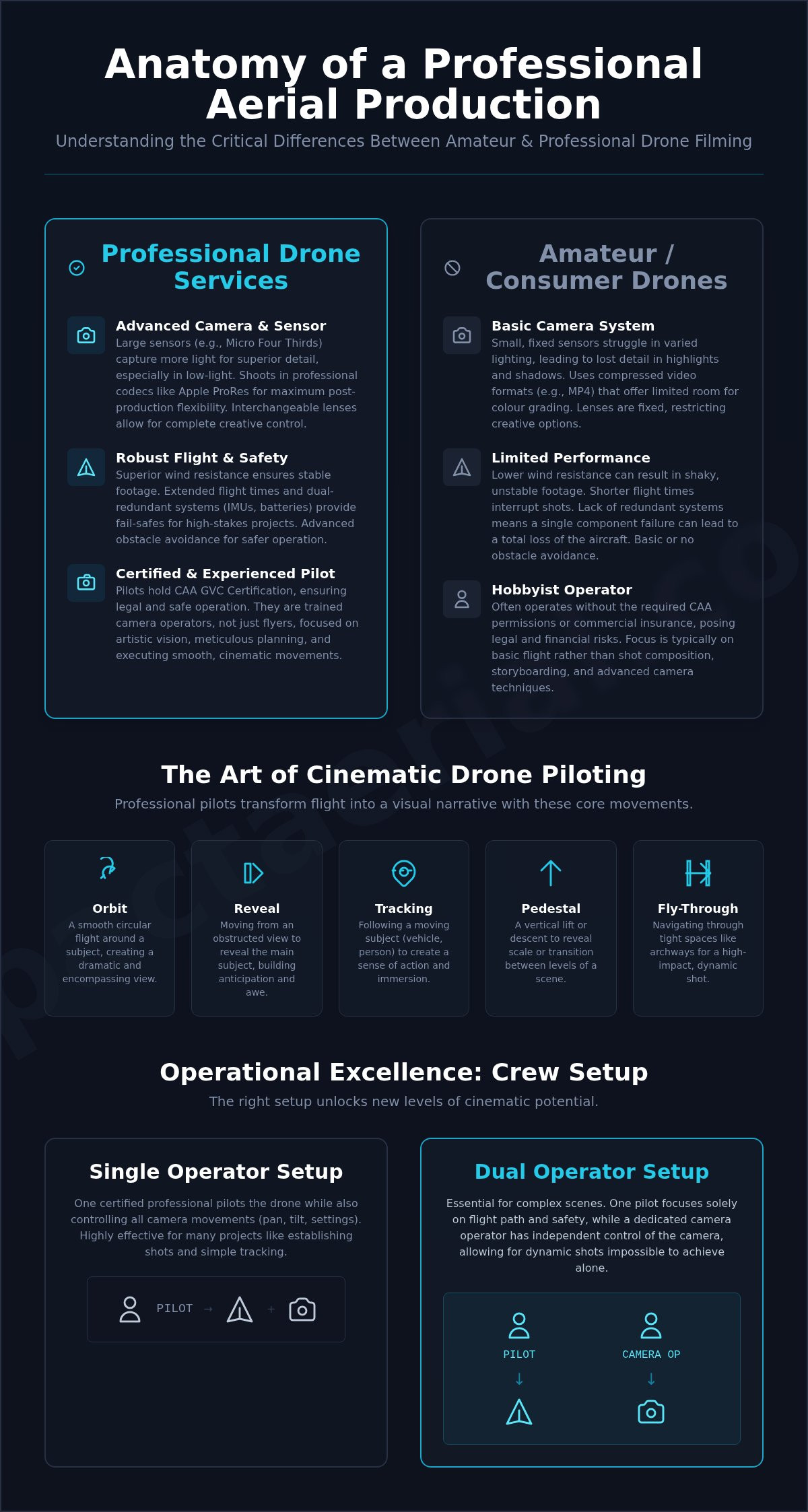
When considering aerial filming, it’s crucial to understand the vast difference between the consumer drones found in high-street shops and the professional equipment used for commercial projects. A professional unmanned aerial vehicle (UAV) is far more than a recreational gadget; it is a sophisticated tool engineered for reliability, precision, and delivering superior image quality. For any serious production, performance and safety are non-negotiable, and this is where commercial-grade systems prove their value.

To appreciate the level of control and creativity possible, it’s helpful to see what these platforms can achieve. This video provides an excellent overview of cinematic drone movements:

Camera and Sensor Capabilities

The heart of any professional aerial filming drone is its camera system. Unlike the fixed, small-sensor cameras on most consumer models, our commercial drones feature advanced imaging technology. This includes:

  • Larger Sensors: Systems like Micro Four Thirds capture more light, delivering cleaner, more detailed footage, especially in challenging low-light conditions.
  • High Dynamic Range (HDR): Crucial for retaining detail in both the bright skies and dark shadows of a single shot.
  • Professional Codecs: We shoot in formats like Apple ProRes, providing maximum flexibility for colour grading and post-production.
  • Interchangeable Lenses: The ability to change lenses allows for creative control over focal length, enabling everything from wide establishing shots to compressed, cinematic perspectives.

Flight Performance and Safety Features

A breath-taking shot is worthless if it cannot be captured safely and reliably. Professional platforms are built with robust flight characteristics and redundant systems for added peace of mind. Key features include superior wind resistance for stable footage even in unpredictable British weather, extended flight times for executing complex shots without interruption, and dual-redundant systems (IMUs, batteries) that provide a fail-safe in the unlikely event of a component failure. Advanced obstacle avoidance sensors ensure safer operation near buildings and other structures.

Examples of Commercial-Grade Drones

At Impact Aerial, we utilise industry-standard equipment such as the DJI Enterprise series. These models are chosen for their powerful flight performance, advanced safety features, and ability to carry high-end camera payloads. While a consumer drone like the DJI Mini is an excellent tool for hobbyists, it lacks the wind resistance, sensor quality, and redundant safety systems required for legally compliant and high-stakes commercial work. Our commitment to using professional-grade hardware ensures we meet both creative and regulatory demands on every project.

The Pilot, Not the Drone: The Art of Cinematic Drone Piloting

In the world of aerial cinematography, the most advanced equipment is only as effective as the professional operating it. While technology provides the potential, it is the skill, precision, and artistic vision of a CAA GVC Certified pilot that transforms raw flight into a compelling visual narrative. The distinction between simply flying a drone and conducting professional aerial cinematography lies in deliberate, smooth, and meticulously planned movements. Our pilots are not just aviators; they are flying camera operators, trained to see the world from a director’s perspective and translate that vision into breath-taking footage.

Mastering Cinematic Drone Movements

A truly professional look is achieved through controlled speed and flawless execution of classic cinematic shots. Each movement is chosen to evoke a specific emotion or reveal information in a dynamic way. Our pilots are experts in a range of techniques, including:

  • Orbit: A smooth, circular flight around a subject, creating a dramatic and encompassing view.
  • Reveal: Starting with an obstructed view before moving to reveal the main subject, building anticipation and awe.
  • Tracking: Following a moving subject (a vehicle, a person) from the side, front, or back to create a sense of action and immersion.
  • Pedestal: A vertical lift or descent, used to reveal scale or transition between different levels of a scene.
  • Fly-Through: Navigating through tight spaces, such as archways or between buildings, for a high-impact, dynamic shot.

Pre-Flight Planning and Storyboarding

Exceptional results are born from meticulous preparation. Before our aerial filming drone ever leaves the ground, we collaborate with you to develop a detailed shot list that aligns with your project’s goals. Using tools like Google Earth for virtual location scouting, we can pre-visualise flight paths and identify potential challenges. This detailed planning ensures that every flight is safe, efficient, and fully compliant with all UK drone regulations. For more complex projects, we storyboard key sequences to ensure the final footage tells a cohesive and powerful story.

Single vs. Dual Operator Setups

For many projects, a single operator setup-where the pilot also controls the camera gimbal-is highly effective. However, for complex scenes requiring intricate camera work while the drone is in motion, a dual operator setup is essential. This involves one pilot focusing exclusively on the flight path and safety, while a dedicated camera operator has independent control over the camera’s pan, tilt, and zoom. This synergy allows for dynamic tracking shots and sophisticated camera movements that are impossible to achieve with a single operator, delivering a truly top-quality cinematic product.

In the United Kingdom, all aviation, including drone flights, is governed by the Civil Aviation Authority (CAA). When you commission an aerial filming drone for commercial purposes, you are entering a domain with strict legal and safety requirements. Ignorance of these extensive UK drone regulations is no defence and can result in severe penalties, including substantial fines. This is a primary reason why partnering with a fully certified and insured professional service is not just beneficial-it’s essential for protecting your project and your business.

CAA GVC Certification: The Professional Standard

The General Visual Line of Sight Certificate (GVC) is the professional qualification required by the CAA for most commercial drone operations in the UK. This certification is more than just a piece of paper; it is proof that a pilot has undergone rigorous theoretical training and a practical flight assessment, demonstrating a high level of competence in flight planning, safety procedures, and emergency protocols. Always ask to see a pilot’s GVC and Operational Authorisation before hiring them.

Operational Safety and Risk Assessments

Professional drone operations are built on a foundation of meticulous planning. Before any flight, a certified operator is legally required to conduct a detailed risk assessment. This process identifies and mitigates potential hazards, ensuring the safety of the public, property, and the flight crew. Key considerations include:

  • Airspace Analysis: Checking for restrictions such as airports, restricted zones, and temporary flight limitations.
  • On-site Survey: Evaluating ground conditions, obstacles, and public access.
  • Flight Parameters: Adhering to strict rules about maintaining safe distances from people, vehicles, and buildings.
  • Equipment Integrity: Performing comprehensive pre-flight checks on the aircraft, control systems, and batteries.

Commercial Drone Insurance Explained

Standard business insurance policies do not cover aviation-related activities. Therefore, specialist commercial drone insurance is a legal requirement. This Public Liability Insurance is designed to cover costs in the unlikely event of an incident causing injury to a person or damage to property. For our clients’ complete peace of mind, Impact Aerial maintains a comprehensive commercial liability policy with £5 million in coverage. Ensure your project is fully compliant and insured.

From Raw Footage to Final Cut: The Post-Production Workflow

At Impact Aerial, piloting the drone is only half the mission. The true value of our professional service is realised in post-production, where raw data is meticulously transformed into a powerful, cinematic asset. The footage captured directly by an aerial filming drone is intentionally flat and desaturated; this is by design, not a flaw. This process ensures we capture the maximum amount of visual information, providing a rich canvas for our editing suite.

Our comprehensive post-production workflow is an integral part of our service, turning spectacular views into a compelling story that meets your commercial objectives.

Colour Correction and Grading

We shoot in professional ‘log’ profiles to maximise dynamic range, capturing the greatest detail in both the brightest highlights and deepest shadows. The first step, colour correction, restores these flat images to a natural, vibrant state. Following this, colour grading is applied to create a specific mood or to align the footage with your brand’s aesthetic, whether it’s a high-contrast cinematic look or a clean, corporate style.

Editing, Sound Design, and Graphics

This is where the narrative takes shape. Our skilled editors assemble the best takes, pacing the shots to create a dynamic and engaging sequence. We then elevate the final product with a range of enhancements:

  • Licensed Music & Sound Effects: We add professional, royalty-free music and sound design to enhance the emotional impact and viewing experience.
  • Branding & Graphics: Your logo, key messages, and other motion graphics can be seamlessly integrated to reinforce your brand identity.
  • Footage Integration: We can expertly blend our aerial shots with any ground-based video you provide, creating a cohesive and comprehensive final film.

Delivering the Final Product

Understanding the technical requirements for delivery is crucial. We export your final video in the precise formats, resolutions, and codecs required for each intended platform, from your website’s homepage to social media channels like Instagram and YouTube. This attention to detail ensures your new asset performs flawlessly, delivering optimal quality and making an immediate impact on your audience. The result is a polished, professional video ready for your marketing campaigns. To discuss your project from flight to final cut, get in touch with our team today.

Hiring a Pro vs. DIY: A Cost and Risk Analysis

With the growing availability of consumer drones, many businesses consider an in-house approach, asking, “Why not just buy a drone and do it ourselves?” While seemingly straightforward, this overlooks the significant investment and substantial risks involved in professional aerial filming. A detailed analysis reveals that partnering with a specialist is the most cost-effective and secure solution for achieving high-quality results.

The True Cost of Professional Equipment

Achieving broadcast-quality results requires far more than an off-the-shelf drone. The initial investment in a commercial-grade aerial filming drone and camera system can easily exceed £5,000. This is just the beginning. Factoring in multiple flight batteries, specialist lens filters, a high-end controller, and essential maintenance, the costs quickly escalate. Furthermore, there are significant annual expenses for commercial liability insurance, specialised software subscriptions, and the considerable time and financial commitment required for CAA-approved GVC certification and ongoing pilot training.

The Risks of In-House Drone Operations

Operating a drone for commercial purposes without the correct qualifications and permissions carries severe consequences. The risks extend far beyond poor-quality footage and can seriously impact your business:

  • Legal Risks: Non-compliance with strict Civil Aviation Authority (CAA) regulations can result in hefty fines and legal action.
  • Safety Risks: Inexperienced piloting dramatically increases the chance of accidents, which can cause significant property damage or, in the worst case, serious injury.
  • Financial Risks: Crashing an expensive piece of equipment without the correct commercial insurance means a total loss of your investment.
  • Reputational Risks: Amateurish, shaky, or poorly composed footage reflects badly on your brand and can devalue your project or property.

The Benefits of Hiring a Specialist Company

Engaging a professional service like Impact Aerial eliminates these risks and provides exceptional value. You gain immediate access to our leading fleet of equipment without any capital investment. For added peace of mind, every operation is conducted by a CAA GVC Certified pilot and is covered by comprehensive commercial liability insurance. We combine technical piloting skill with an expert eye for cinematography, ensuring the final product is not only legally compliant but also visually stunning. By hiring a specialist, you invest in guaranteed quality, safety, and efficiency.

Ready to see the difference professional expertise can make for your project? Get a no-obligation quote for your project today.

Elevate Your Vision with Professional Aerial Cinematography

As we’ve explored, achieving professional cinematic video goes far beyond the hardware. True quality is a synthesis of expert piloting, a thorough understanding of UK aviation law, and a meticulous post-production workflow. The decision to hire a professional versus attempting a DIY approach is ultimately a crucial analysis of cost, risk, and guaranteed high-quality results.

When you partner with a dedicated service, you’re not just acquiring footage from an aerial filming drone; you are investing in a safe, compliant, and expertly managed production. For complete peace of mind, our operations are backed by fully CAA GVC Certified pilots, £5 million in commercial liability insurance, and leading expertise in DJI Enterprise drones and 4K HDR video.

If you are ready to elevate your project with stunning, legally compliant aerial footage, our team is prepared to assist. Discuss your aerial filming project with our certified experts. Let’s work together to capture the breathtaking perspectives your vision deserves.

Frequently Asked Questions About Aerial Filming

How much does professional aerial filming cost in the UK?

The cost of professional aerial filming is dependent on project specifics, including location complexity, the level of risk assessment required, and the final deliverables. As a guide, our rates typically start from £350 for a half-day shoot. This includes all pre-flight planning, on-site operation by a certified pilot, and the raw footage. For a detailed and accurate quotation tailored to your project’s unique requirements, please contact our team directly for a transparent, no-obligation quote.

What video resolution do you film in, such as 4K or 6K?

Our state-of-the-art fleet is equipped to capture stunning visuals in a range of high-definition formats. We film in resolutions up to 6K for maximum detail and post-production flexibility, with 4K Ultra HD being our standard for most projects. This ensures top-quality, cinematic footage that is crisp, vibrant, and suitable for any modern screen or application. We will consult with you to select the optimal resolution that best suits your project’s end-use and budget.

Are you legally able to fly drones in built-up areas like Birmingham or London?

Yes, we are fully qualified and authorised to conduct commercial operations in congested, built-up areas. As CAA GVC Certified operators, we possess the necessary training and operational authorisations to fly safely and legally in cities like Birmingham and London. Each flight requires a meticulous pre-flight survey and risk assessment to ensure compliance with all regulations and to guarantee the safety of the public and property. For added peace of mind, we hold comprehensive commercial liability insurance.

How long can a drone fly and film on a single set of batteries?

Each individual battery provides approximately 25-30 minutes of flight time, depending on factors like wind conditions and flight dynamics. However, this is not a limitation to our filming duration. We arrive on-site with multiple, fully charged batteries and portable charging solutions. This allows us to operate our aerial filming drone continuously throughout the scheduled shoot by simply landing to swap batteries, a process that takes only a minute and ensures minimal disruption.

What is the typical turnaround time for a finished aerial video?

The turnaround time depends on the project’s scope. Raw, unedited footage can often be delivered within 24-48 hours of the shoot. For a fully edited and colour-graded video, our standard turnaround is typically 5-10 working days. This allows our post-production team the necessary time to craft a high-quality finished product. We can accommodate tighter deadlines where required, which can be discussed during the initial consultation to ensure we meet your project’s schedule.

What information do you need from me to provide an accurate quote?

To provide you with a precise and comprehensive quote, we require a few key details. Please provide the exact location of the shoot (a postcode is ideal), a brief description of your project goals, and an outline of the specific shots or angles you wish to capture. It is also helpful to know what the final video will be used for and your required deliverables (e.g., raw footage, fully edited video). This information allows us to assess the project’s complexity and operational requirements.

Can you combine drone footage with our existing ground-level videos?

Absolutely. We frequently work with clients to integrate our breath-taking aerial footage with their existing ground-level video. Our professional post-production services ensure a seamless blend, matching colour grades, styles, and transitions to create a cohesive and dynamic final film. Combining these perspectives adds significant production value and provides a more comprehensive narrative. Simply provide us with your existing footage, and we can manage the entire editing process for you.

Aerial Videography: The Ultimate Guide to Cinematic Drone Video

Have you ever considered the powerful perspective of aerial videography for your business, only to be held back by concerns over shaky footage, legal complexities, or simply not knowing where to begin? You’re not alone. Distinguishing between amateur drone clips and professional, cinematic video can be challenging, and the thought of navigating safety regulations and pilot certifications is often daunting. This uncertainty can prevent businesses from unlocking a truly transformative marketing and data-gathering tool.

This ultimate guide is designed to provide clarity and confidence. We will break down what elevates professional drone video to a cinematic standard, delivering the high-quality, stable footage your project deserves. You will discover concrete ways to apply aerial video in your industry for a tangible return on investment and, crucially, learn what to look for in a safe, fully-insured, and CAA-certified provider. By the end, you will have the knowledge to harness the power of aerial perspectives with complete peace of mind.

What is Aerial Videography? More Than Just Flying a Drone

In a professional context, what is aerial videography? It is the art and science of capturing cinematic, high-definition video from an airborne platform. This is a discipline that goes far beyond simply launching a consumer drone. The distinction lies in the quality and intent; while hobbyist videos are often shaky and unrefined, professional work delivers smooth, stabilised footage designed to tell a compelling story. The primary purpose is to offer unique perspectives that are impossible from the ground, conveying a true sense of scale, scope, and location that captivates an audience.

In today’s visual-first world, this capability has become a powerful tool across numerous sectors. From creating breath-taking marketing content that showcases a commercial property to conducting detailed industrial inspections or monitoring construction progress, professional aerial videography provides unparalleled insight and impact.

To see the fundamental techniques in action, the following guide provides an excellent overview:

The Technology That Makes It Possible

Achieving top-quality results is reliant on professional-grade equipment. Our operations utilise commercial drones from leading manufacturers like DJI Enterprise, renowned for their reliability and advanced features. The key to fluid, cinematic motion is 3-axis gimbal stabilisation, which mechanically isolates the camera from the drone’s movements. This is paired with high-resolution cameras shooting in 4K HDR (High Dynamic Range) to capture vibrant, detail-rich imagery. For added peace of mind, our fleet is equipped with robust safety systems, including precise GPS, comprehensive obstacle avoidance sensors, and geofencing to ensure compliance with UK airspace regulations.

Key Cinematic Drone Shots Explained

A professional drone pilot uses specific camera movements to create a narrative and evoke emotion. Some of the most effective techniques include:

  • The Reveal Shot: The drone starts low or behind an obstruction (like a building or treeline) and ascends or moves forward to dramatically reveal the main subject or landscape.
  • The Orbit Shot: A smooth, 360-degree flight path is executed around a stationary subject, such as a property or landmark, showcasing it from every angle.
  • The Tracking Shot: The drone follows a moving subject, like a vehicle on a road or a person walking through a site, keeping it perfectly framed to create a dynamic sense of action.
  • The Fly-Through: A highly skilled manoeuvre where the pilot navigates the drone through a structure, like an open warehouse or between bridge supports, for a truly immersive viewer experience.

Core Benefits: How Aerial Videography Transforms Your Business

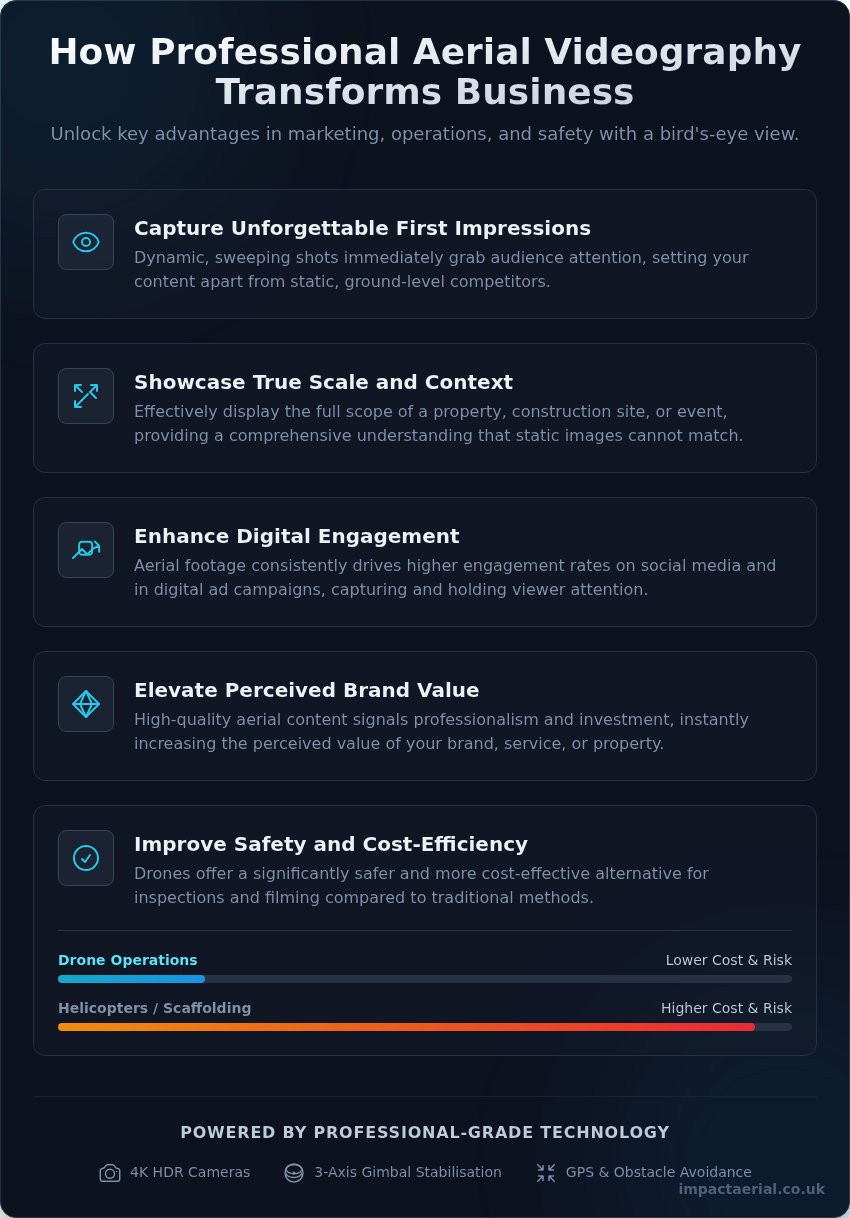
Beyond the initial ‘wow’ factor, professional aerial videography delivers tangible, measurable value to your business. It is a strategic tool that provides a unique perspective, enabling you to communicate your message, showcase your assets, and manage your operations with unparalleled clarity and impact. Integrating this high-level view transforms how stakeholders, customers, and team members perceive and interact with your brand and projects.

The core advantages of incorporating a bird’s-eye view are both commercial and operational. By leveraging advanced drone technology, businesses can achieve top-quality results that were once prohibitively expensive or logistically impossible.

  • Capture Unforgettable First Impressions: Dynamic, sweeping shots immediately grab audience attention, setting your content apart from ground-level competitors.
  • Showcase True Scale and Context: Effectively display the full scope of a commercial property, construction site, or event location, providing viewers with a comprehensive understanding that static images cannot match.
  • Enhance Digital Engagement: Video content, particularly aerial footage, consistently drives higher engagement rates on social media platforms and in digital advertising campaigns.
  • Elevate Perceived Brand Value: High-quality aerial content signals professionalism, investment, and a commitment to quality, instantly increasing the perceived value of your brand, service, or property listing.
  • Improve Safety and Cost-Efficiency: Drones offer a significantly more cost-effective and safer alternative to hiring helicopters or erecting scaffolding for inspections and filming, often saving thousands of pounds and reducing operational risk.

Elevating Your Marketing and Storytelling

In marketing, a compelling narrative is everything. Aerial footage provides the ultimate establishing shot, creating an epic, cinematic feel that draws viewers into your brand story. Whether used on your website’s homepage, in a targeted social media ad, or as part of a corporate video, these dynamic visuals demonstrate your product or service in its real-world environment, building trust and conveying a powerful sense of scale and ambition.

Improving Operational Insight and Safety

From a practical standpoint, aerial videography provides critical data-gathering capabilities. Construction project managers can monitor progress and identify potential issues across a vast site without extensive foot patrols. For asset management, inspecting hard-to-reach infrastructure like rooftops, turbines, or mobile towers can be done safely from the ground. This approach not only protects personnel but also ensures compliance with CAA regulations. Understanding How to Choose a Professional is paramount, as a certified pilot brings an essential layer of risk management and technical expertise to every operation, delivering clear visual data for stakeholders.

Key Industries & Applications: Putting Aerial Video to Work

The strategic application of professional aerial videography extends far beyond simple, scenic flyovers. It has become a powerful data-gathering and marketing tool, providing unique perspectives that drive efficiency, engagement, and sales. For any business looking to showcase scale, context, or progress, deploying a CAA GVC Certified operator delivers a tangible return on investment. Below, we explore key sectors where these high-quality services are making a significant impact.

Real Estate & Commercial Property

For property professionals, perspective is everything. Aerial footage provides the ultimate context, showcasing not just the building, but its relationship to the surrounding environment, transport links, and local amenities. This approach transforms standard property listings into compelling, cinematic experiences that capture buyer interest immediately.

  • Cinematic Property Tours: Create immersive videos that guide viewers from a sweeping overview of the location down to a detailed look at the grounds and exterior features.
  • Land & Development Sites: Clearly display the full scale of large land plots, highlighting boundaries, topography, and potential for development in a single, comprehensive view.
  • Hospitality Marketing: Produce breath-taking promotional content for hotels, resorts, and wedding venues that highlights their stunning location and extensive facilities.

Construction, Engineering & Surveying

On active and complex sites, safety and accuracy are paramount. Drones offer a safe and efficient method for monitoring progress, conducting inspections, and creating as-built records without putting personnel at risk. The complexity of operating in these environments underscores the need for strict adherence to safety protocols. These are governed in the UK by the CAA, but the principles of safe flight planning are universal. For instance, a look at the Official Drone Regulations from a leading US authority shows a similar global emphasis on operational safety and professionalism.

  • Project Progress Monitoring: Document project milestones with weekly or monthly flights, providing clear, visual updates for stakeholders and investors.
  • As-Built Records: Generate high-resolution video records of a completed project for client handover, training, and archival purposes.
  • Visual Asset Inspections: Safely inspect tall structures like towers, turbines, and building facades, identifying potential issues without the need for costly scaffolding.

Events, Tourism & Advertising

When it comes to creating high-impact visual content, aerial videography is unparalleled. It captures the energy and scale of live events or the beauty of a tourist destination in a way that ground-based cameras simply cannot. This dynamic footage is essential for creating marketing campaigns that stand out and leave a lasting impression on the audience.

  • Event Coverage: Capture the vibrant atmosphere of festivals, concerts, and sporting events from unique angles, creating dynamic after-movies and promotional material.
  • Tourism Promotion: Develop stunning promotional videos for local councils and tourist boards, showcasing landmarks, coastlines, and landscapes to attract visitors.
  • Brand Campaigns: Integrate powerful aerial shots into television commercials and digital ad campaigns to create a premium, high-budget feel that elevates brand perception.

The Professional Process: From Initial Brief to Final Film

Achieving breath-taking results with aerial videography is not a matter of chance; it is the outcome of a meticulous, safety-driven process. A professional service involves far more than simply arriving on-site and launching a drone. To provide our clients with complete peace of mind and top-quality results, we follow a structured workflow that ensures every project is executed safely, legally, and to the highest creative standard. Understanding this process helps you know exactly what to expect when you partner with us.

Step 1: Consultation and Pre-Flight Planning

Every successful project begins with a detailed consultation. We work closely with you to understand your vision, key objectives, and the specific shots required to tell your story. This brief informs our comprehensive pre-flight planning, which includes:

  • Desktop Surveys & Risk Assessments: We meticulously analyse the proposed location for potential hazards, obstacles, and public access points.
  • Airspace Checks: Our team verifies all airspace classifications and restrictions, ensuring full compliance with Civil Aviation Authority (CAA) regulations.
  • Permission & Authorisation: If required, we handle the application process for any necessary flight authorisations from air traffic control or landowners.

Step 2: The On-Site Filming Day

On the day of the shoot, safety remains our highest priority. Our CAA GVC certified pilot conducts thorough on-site safety checks, establishes a secure take-off and landing area, and briefs all personnel. We then execute the pre-planned flight paths and camera movements, working efficiently to capture the required footage. We maintain open communication with you on-site, allowing for real-time feedback to ensure the final shots perfectly align with your vision.

Step 3: Post-Production and Delivery

Capturing the footage is only half the journey. In the post-production phase, our editors transform the raw clips into a polished, compelling narrative. This includes selecting the best takes, applying professional colour grading for a cinematic look, and integrating licensed music, motion graphics, and your company branding. The final film is then delivered to you in the optimised formats required for your website, social media channels, or presentations.

Our structured approach to aerial videography ensures a seamless experience from concept to completion. To discuss your project and our meticulous process, contact our team today.

How to Choose a Professional Aerial Videography Provider

Selecting the right partner for your project is the most critical step in achieving a high-quality, legally compliant final product. The UK drone market is expanding, but not all operators adhere to the same professional standards. Using an unqualified or uninsured pilot exposes your business to significant legal and financial risk. A true professional delivers not only stunning visuals but also complete operational integrity.

To ensure you make an informed decision, use this checklist to vet any potential provider.

Essential: CAA Certification and Insurance

This is the absolute non-negotiable foundation of professional drone work in the UK. Before any discussion of creative concepts, you must verify the operator’s credentials. A commercial operator must hold a valid General Visual Line of Sight Certificate (GVC) issued by the Civil Aviation Authority (CAA). Furthermore, they must have adequate commercial liability insurance, typically for a minimum of £5 million. This protects you and your property from any liability in the unlikely event of an incident, offering essential peace of mind.

Evaluate Their Portfolio and Equipment

An operator’s showreel is their visual CV. When reviewing their portfolio, look beyond just the “wow” factor. Assess the technical quality: are the shots smooth and stable? Is the composition thoughtful and cinematic? Does their previous work align with the professional standard your brand requires? Also, inquire about their equipment. A commitment to using professional-grade drones, such as those from the DJI Enterprise series, indicates a serious investment in delivering top-quality, reliable results for their clients.

Assess Their Professionalism and Communication

The quality of your final aerial videography often reflects the quality of the planning process. A professional operator will act as a consultant, asking detailed questions about your project goals, the location, and potential airspace restrictions. Their communication should be clear, prompt, and transparent. They should be able to articulate a clear operational process, including pre-flight surveys, risk assessments, and flight planning. This meticulous approach is the hallmark of a seasoned and reliable specialist.

A provider who confidently meets these criteria demonstrates a deep commitment to safety, quality, and client success. See how Impact Aerial meets every professional standard.

Elevate Your Project with Professional Aerial Videography

As we’ve explored, aerial videography is far more than simply flying a drone; it is a powerful cinematic tool that delivers unparalleled perspectives and tangible business benefits. From transforming commercial property marketing to providing critical data for inspections, the applications are vast. The key to unlocking this potential lies in partnering with a provider who prioritises technical expertise, creative vision, and, above all, operational safety and regulatory compliance.

At Impact Aerial, we bring this professional standard to every project. Our pilots are CAA GVC Certified & Approved, and for your complete peace of mind, all operations are covered by £5m in commercial liability insurance. By utilising cutting-edge 4K HDR DJI Enterprise drones, we ensure the final result is not only visually stunning but also captured with the utmost precision and safety.

If you are ready to showcase your business or project from a breath-taking new angle, we are here to help. Request a professional aerial videography quote today and discover the impact of a higher perspective.

Frequently Asked Questions About Aerial Videography

How much does aerial videography cost in the UK?

The cost of professional aerial videography varies depending on project complexity, location, and the equipment required. A straightforward half-day shoot may start from £400-£600, while larger projects involving extensive risk assessments or multiple locations can cost £1,500 or more. Factors influencing the final price include the level of pre-production planning, post-production editing, and the specific operational permissions needed. We always provide a detailed, bespoke quote based on your unique requirements.

Is it legal to fly a drone anywhere for commercial filming?

No, it is not legal to fly a drone anywhere for commercial purposes. All flights are strictly regulated by the Civil Aviation Authority (CAA) in the UK. Operations are restricted near airports, crowds of people, and sensitive infrastructure. As fully qualified and insured operators holding a CAA General Visual Line of Sight Certificate (GVC), we conduct thorough pre-flight surveys and risk assessments to ensure every operation is conducted safely, legally, and with the correct permissions.

What happens if the weather is bad on the day of the shoot?

Client satisfaction and operational safety are our highest priorities. We do not operate our drones in unsafe weather conditions such as high winds or heavy rain. We diligently monitor the forecast leading up to a scheduled shoot and will communicate with you if conditions look unfavourable. If a shoot must be postponed due to weather, we will reschedule for the next suitable date at no additional cost, ensuring we capture top-quality footage in safe conditions.

How long does a typical aerial videography project take from start to finish?

A typical project timeline ranges from one to three weeks. This encompasses the initial consultation, detailed pre-flight planning and risk assessment (which can take several days), the on-site filming (usually a half or full day), and post-production editing. More complex aerial videography projects that require advanced permissions or extensive editing will have a longer lead time. We establish a clear timeline with you at the start of every project to manage expectations effectively.

What video resolution and format will I receive the final files in?

We provide high-quality, professional-grade video files suitable for a range of applications. Our standard delivery is in 4K Ultra HD (3840×2160 pixels), which offers outstanding clarity and flexibility for post-production. We can also provide footage in other resolutions, such as 1080p Full HD. Final files are typically exported in a versatile MP4 (H.264 or H.265) format, ensuring compatibility across websites, social media platforms, and corporate presentations.

Can you fly drones indoors or close to buildings?

Yes, we are fully equipped and qualified to conduct flights both indoors and in close proximity to buildings. These operations require meticulous planning, a detailed on-site survey, and a specific risk assessment to ensure maximum safety. Our experienced pilots use specialised equipment and advanced flight techniques to navigate complex environments, capturing breath-taking perspectives of architectural details or internal spaces while adhering to strict safety protocols at all times.