Choosing a Drone Videography Style: The Ultimate Guide for UK Businesses in 2026

The most expensive 8K aerial footage on the market will fail to deliver a return on investment if the visual language doesn’t align with your sector’s specific goals. In 2026, simply putting a camera in the air is no longer a competitive advantage. Success now depends on choosing a drone videography style that speaks directly to your audience; whether that is the high-octane energy of an FPV fly-through for a leisure facility or the steady, technical precision required for construction site monitoring.

You likely recognize that generic, drifting shots often feel disconnected from your brand’s core message, yet the technical jargon of the industry can make briefing a pilot feel like a gamble. This guide bridges that gap. You’ll discover how to select the perfect aerial aesthetic to elevate your brand, ranging from cinematic sweeps to high-speed FPV immersive tours. We provide a structured breakdown of the latest 2026 UK flight standards and aesthetic categories, ensuring you have the confidence to secure high-quality, compliant results that drive tangible business growth.

Key Takeaways

  • Understand how the intersection of movement and narrative intent drives project ROI by aligning visual style with your specific commercial objectives.
  • Learn the critical differences between cinematic sweeps and immersive FPV tours to assist in choosing a drone videography style that suits your brand identity.
  • Identify the specific aesthetics used for construction site monitoring and commercial property surveys to maximize engagement and data accuracy in your sector.
  • Master the technical essentials of professional aerial filming, including the impact of “Golden Hour” lighting and selecting the correct frame rates for your desired look.
  • Discover why technical qualifications and CAA GVC certifications are vital for executing high-stakes aerial projects safely and to a professional standard.

Why Choosing the Right Drone Videography Style Defines Your Project’s ROI

A professional drone videography style is far more than a simple flight path; it is the deliberate intersection of camera movement, lighting conditions, and narrative intent. In the current 2026 market, stakeholders demand more than generic bird’s-eye views. Achieving a high return on investment requires a foundational understanding aerial videography and how specific visual languages influence viewer psychology. For instance, a slow, high-altitude orbit provides an analytical, “God-view” perspective that suggests stability and scale, whereas a low-level, high-speed tracking shot generates adrenaline and urgency.

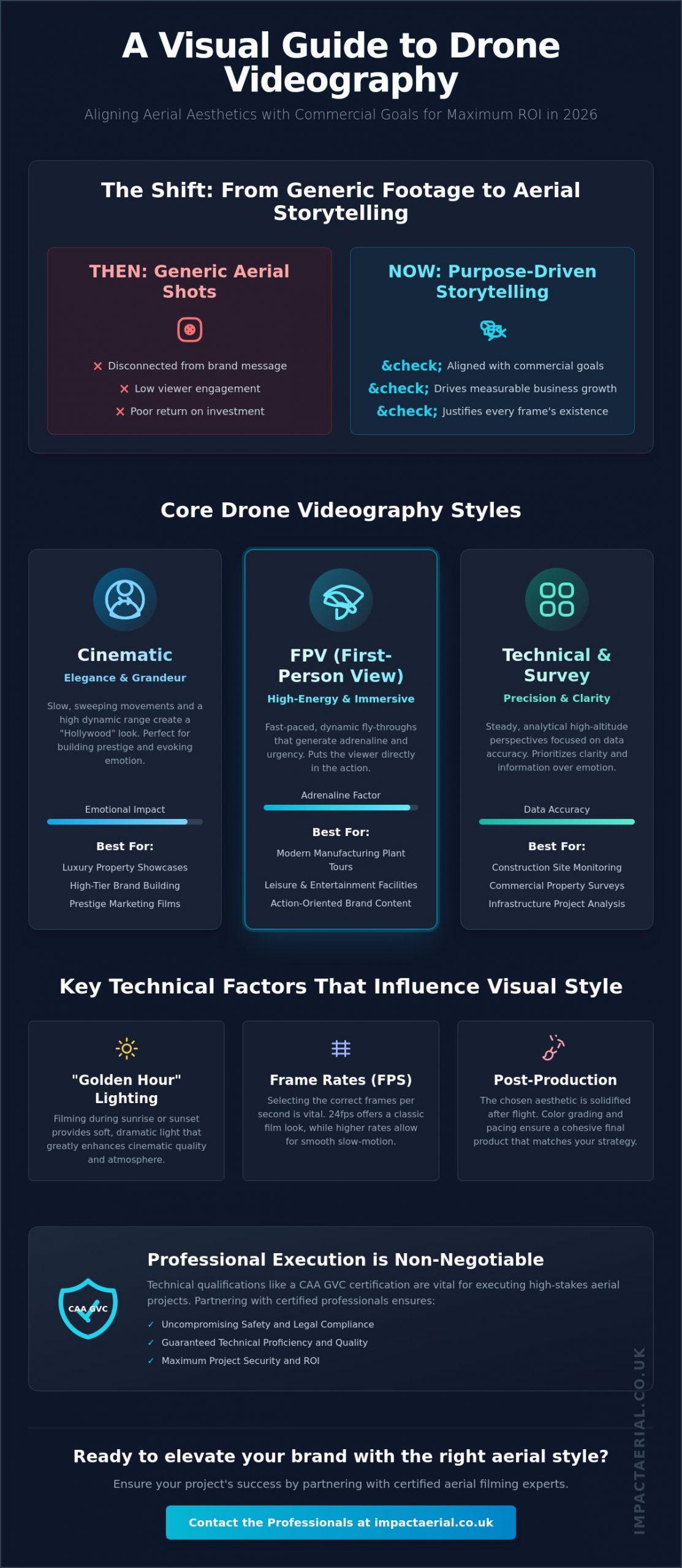
Choosing a drone videography style that clashes with your brand identity can be a costly error. An aggressive, high-speed FPV fly-through might work for a modern manufacturing plant, but using that same kinetic energy for a Grade I listed heritage site often feels jarring and disrespectful to the subject matter. As drone technology has matured, the 2026 trend has shifted decisively away from “generic b-roll” toward purpose-built visuals. Every frame must justify its existence by supporting a specific commercial goal, whether that is proving construction progress or selling the prestige of a luxury development.

To better understand this concept, watch this helpful video:

The Shift from “Aerial Footage” to “Aerial Storytelling”

The “wow” factor of seeing the world from above has largely evaporated as drones have become ubiquitous. Today, professional aerial filming drone services focus on functional visual communication. We use specific flight maneuvers to solve business problems; such as using a “reveal” shot to highlight a property’s proximity to transport links. Post-production also plays a critical role here. The color grading and pacing applied after the flight solidify the chosen aesthetic, ensuring the final output feels like a cohesive part of your broader marketing or technical strategy rather than a disconnected clip.

Setting Objectives Before Selecting a Visual Look

Before choosing a drone videography style, you must define the primary objective of your project. Information-heavy tasks, like construction site monitoring, require a steady, high-resolution style that prioritizes clarity and data over emotional impact. Conversely, brand-led campaigns for luxury properties rely on “hero” shots that emphasize atmosphere and prestige. Your primary KPI might be technical accuracy, speed of delivery, or perhaps pure brand elevation. Visual ROI is the measurable impact of a specific aesthetic choice on conversion rates, stakeholder engagement, or project clarity. By aligning the flight style with these KPIs, you ensure the footage serves as a tool for growth rather than a mere digital asset.

Exploring the Core Drone Videography Styles: From Cinematic to FPV

Selecting the right visual language is the most critical decision in the pre-production phase. Each aesthetic serves a distinct commercial purpose, utilizing different flight dynamics and sensor settings to communicate your message. In 2026, the industry has moved beyond simple “fly-overs” to specialized disciplines. Whether you are documenting a multi-million pound infrastructure project or launching a luxury brand, choosing a drone videography style that aligns with your technical requirements is essential for a professional result.

The Cinematic Aesthetic: Elegance and Grandeur

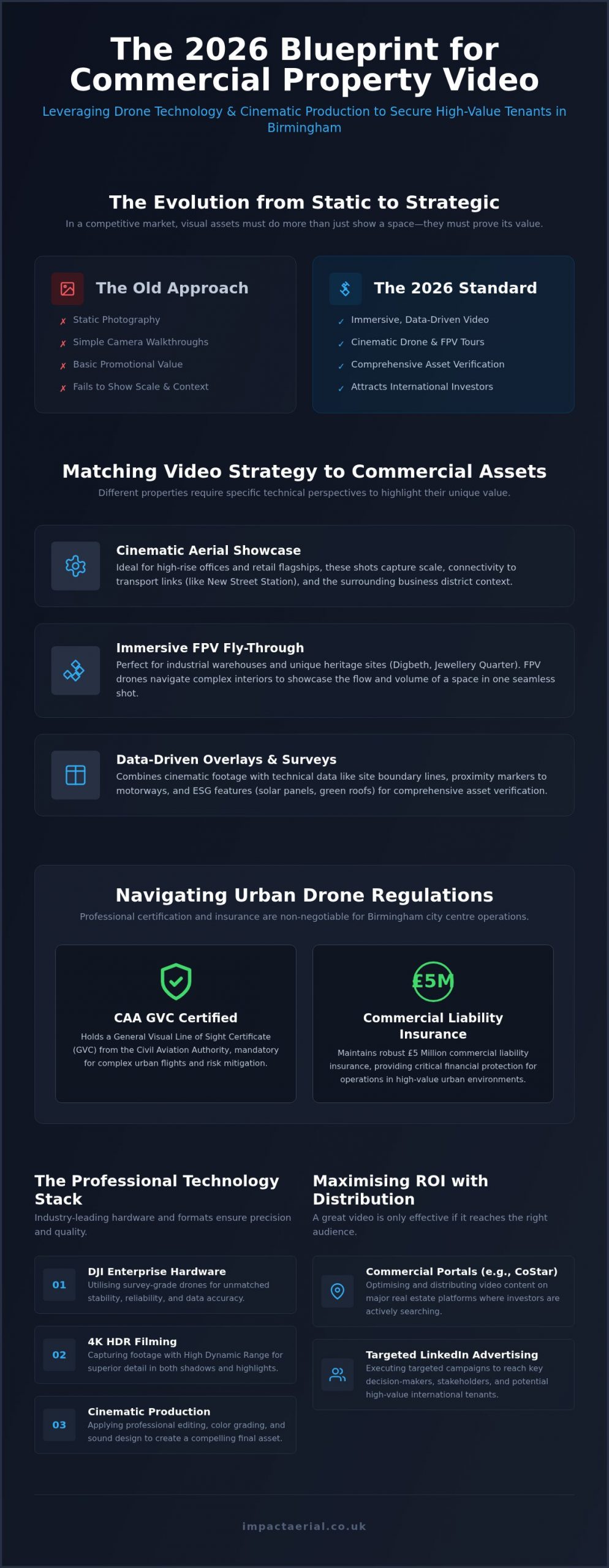
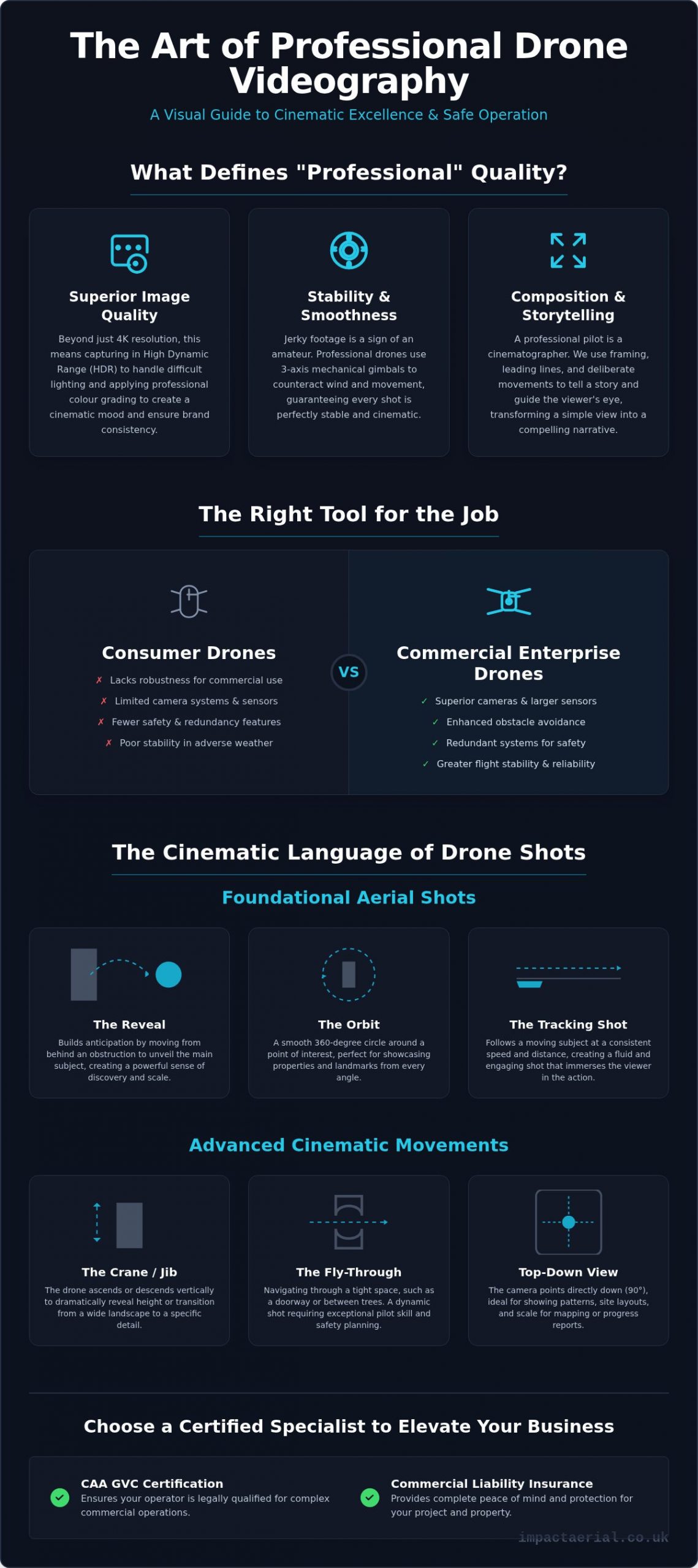
The cinematic style remains the benchmark for high-tier brand building and prestige marketing. This “Hollywood” look is defined by slow, sweeping movements and a high dynamic range that preserves detail in both shadows and highlights. Professional pilots utilize specific maneuvers like the “Reveal,” where the camera starts on a detail before rising to show the landscape, and the “Orbit,” a perfectly circular path around a central subject. To achieve this, we prioritize 4K HDR or 8K resolution with 10-bit color depth, providing the necessary data for high-end post-production grading. This style is most effective for tourism, corporate brand films, and luxury property marketing where the goal is to evoke an emotional response through scale and beauty.

FPV Drone Filming: Immersive Innovation

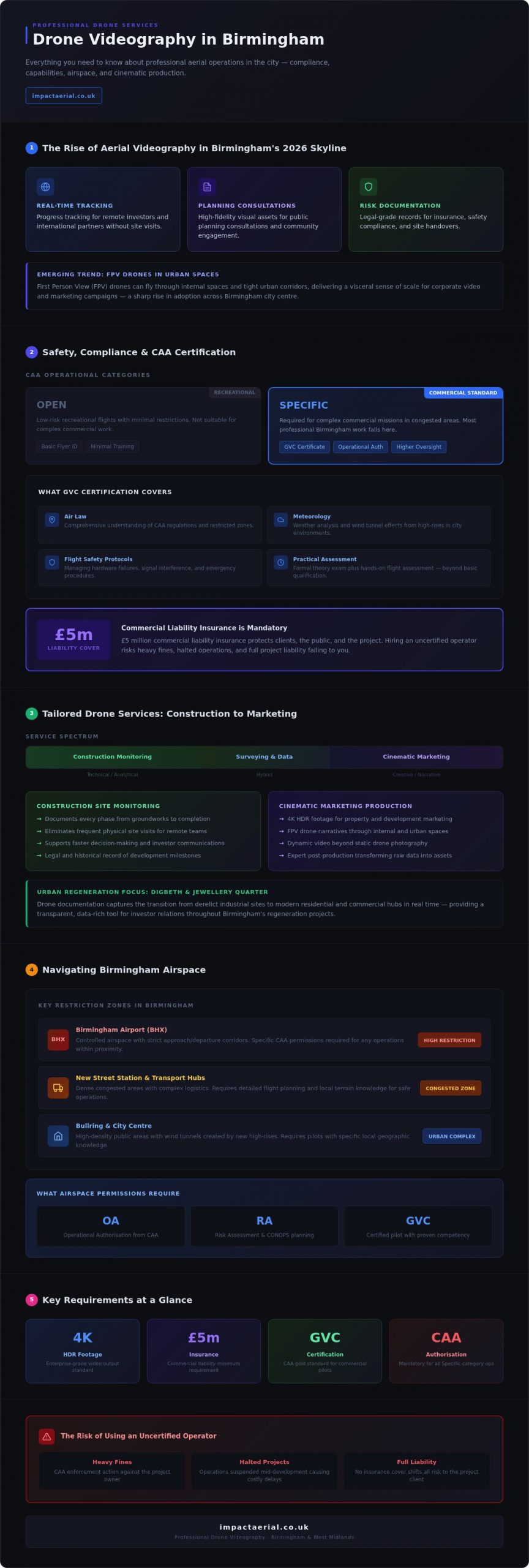
First Person View (FPV) drones offer a kinetic, “bird’s eye” experience that traditional platforms simply cannot replicate. These smaller, more agile craft allow for seamless “one-take” fly-throughs that navigate through tight spaces, such as moving from an outdoor courtyard directly through a warehouse door and into an office suite. This style is exceptionally effective for event highlights, dynamic sports, and immersive facility tours. Because FPV drones often fly in close proximity to structures and people, safety is paramount. In the UK, indoor FPV filming requires meticulous risk assessment and adherence to current CAA regulations regarding flight in congested areas. When choosing a drone videography style for high-energy projects, FPV provides a modern, high-impact perspective that captures viewer attention instantly.

The Narrative Style: Context and Scale

The narrative style focuses on establishing a “Sense of Place” by integrating aerial perspectives into a larger storytelling framework. It isn’t about the drone shot itself, but how that shot connects ground-level human experiences to their wider environment. This often involves combining low-altitude tracking shots with high-altitude wide views to show the relationship between a project and its surrounding infrastructure. Executing these complex, multi-layered flights legally and safely requires a valid drone license and a deep understanding of UK airspace restrictions. By bridging the gap between technical data and emotive visuals, the narrative style provides the context necessary for stakeholders to grasp the full scope of a project. If you’re unsure which aesthetic best serves your goals, consulting with a specialist in professional aerial filming can help clarify the most effective path forward for your specific sector.

For technical applications like construction site monitoring or commercial property surveys, the focus shifts toward architectural precision. These styles prioritize symmetry, structural lines, and top-down “nadir” views that provide accurate spatial data. By choosing a drone videography style that emphasizes these technical elements, businesses can track progress with millimeter precision while maintaining a professional visual standard that is suitable for investor reporting.

Choosing a Drone Videography Style: The Ultimate Guide for UK Businesses in 2026

Industry Match: Which Style Fits Your Specific Sector?

The effectiveness of an aerial campaign is measured by its ability to meet sector-specific KPIs. A visual approach that excels in the creative arts will likely fail in a heavy industrial context. When choosing a drone videography style, you must evaluate whether your primary goal is the acquisition of technical data, the emotional engagement of a buyer, or the documentation of project milestones. In 2026, UK businesses are increasingly moving away from multi-purpose footage in favor of “style-to-sector” alignment that ensures every flight minute contributes to the bottom line.

Construction: Progress vs. Promotion

In the construction and infrastructure sectors, drone footage serves two distinct masters: the site engineer and the marketing director. For technical oversight, a professional drone survey is the standard for capturing high-resolution orthomosaic data and site logistics. These flights utilize a top-down, “nadir” perspective, providing a flat, measurable map of the site that is essential for identifying bottlenecks. Conversely, for stakeholder reporting and promotion, a cinematic time-lapse style is preferred. This involves capturing the same flight path over several months to show the evolution of the build. By maintaining consistent GPS coordinates for each flight, we create a seamless visual record that demonstrates progress with authoritative clarity.

Real Estate: The Luxury Reveal

Commercial property and luxury residential listings require an aesthetic that emphasizes prestige and spatial flow. The “Dolly Zoom” and the “Orbit” have become the industry standards for high-end listings, as they provide a sense of three-dimensional depth that static photography lacks. To create a truly immersive experience, we often utilize FPV drones to execute a “one-take” sequence. This involves flying from the exterior grounds, through the front entrance, and into the primary living or office spaces without a single cut. This style doesn’t just show a property; it provides a virtual tour that establishes a “Sense of Place.” Highlighting local landmarks within the same frame as the property further increases perceived value by grounding the asset in its wider geographical context.

Renewable Energy and Marketing

The renewable energy sector, particularly solar farm management, relies on a technical “Grid” style. This involves automated flight paths that ensure 100% coverage for thermal imaging and visual inspections. These surveys are data-centric, focusing on identifying anomalies in PV panels with surgical precision. In contrast, the marketing and advertising sectors demand high-energy FPV and cinematic storytelling. These styles are designed to capture attention within the first three seconds of a social media scroll. Whether it’s a high-speed chase for a dynamic product launch or a sweeping 8K panoramic for a tourism board, choosing a drone videography style that matches the energy of your target demographic is the most reliable way to ensure a high return on investment.

Key Technical Factors That Influence Your Visual Style

Achieving a high-end visual result is impossible without mastering the technical variables that underpin every flight. When choosing a drone videography style, you aren’t just selecting a movement; you are selecting a specific configuration of light, frame rates, and hardware capabilities. These settings dictate whether the final output feels like a high-budget feature film or a sharp, clinical data set. In the professional sector, we use these technical levers to ensure the aesthetic aligns with your commercial objectives while maintaining the highest standards of precision.

Lighting remains the most influential factor in cinematic drone filming. The “Golden Hour,” occurring during the first hour of sunrise and the last hour of sunset, provides the soft, directional light and long shadows that define the cinematic aesthetic. For technical surveys or construction monitoring, we often prefer “Blue Hour” or high-noon lighting to minimize shadows and maximize the clarity of structural details. To control this light, we utilize Neutral Density (ND) filters. These act as “sunglasses” for the drone’s sensor, allowing us to maintain a slower shutter speed. This is essential for creating the natural motion blur that viewers associate with professional-grade production.

Frame rates also play a vital role in defining the look of your project. We typically use 24fps (frames per second) for a traditional “filmic” look, as it mimics the way the human eye perceives motion. Conversely, 60fps or higher is selected for high-speed action or FPV tours, allowing for smooth playback or the ability to slow down footage in post-production without losing detail. The final style is then solidified through professional post-production services, where color grading and sound design act as the final “brushstrokes” that align the footage with your brand’s visual identity.

Weather and Environmental Constraints in the UK

The unpredictable UK climate directly influences which styles are feasible on any given day. High winds and variable light conditions in regions like the West Midlands require robust hardware. We often deploy DJI Enterprise drones for these environments, as their superior stabilization systems ensure smooth footage even in gusty conditions. Planning for the “Birmingham Look” often involves working with specific urban textures and flat lighting, where technical expertise in exposure management is required to prevent footage from looking washed out or overly industrial.

Compliance as a Creative Constraint

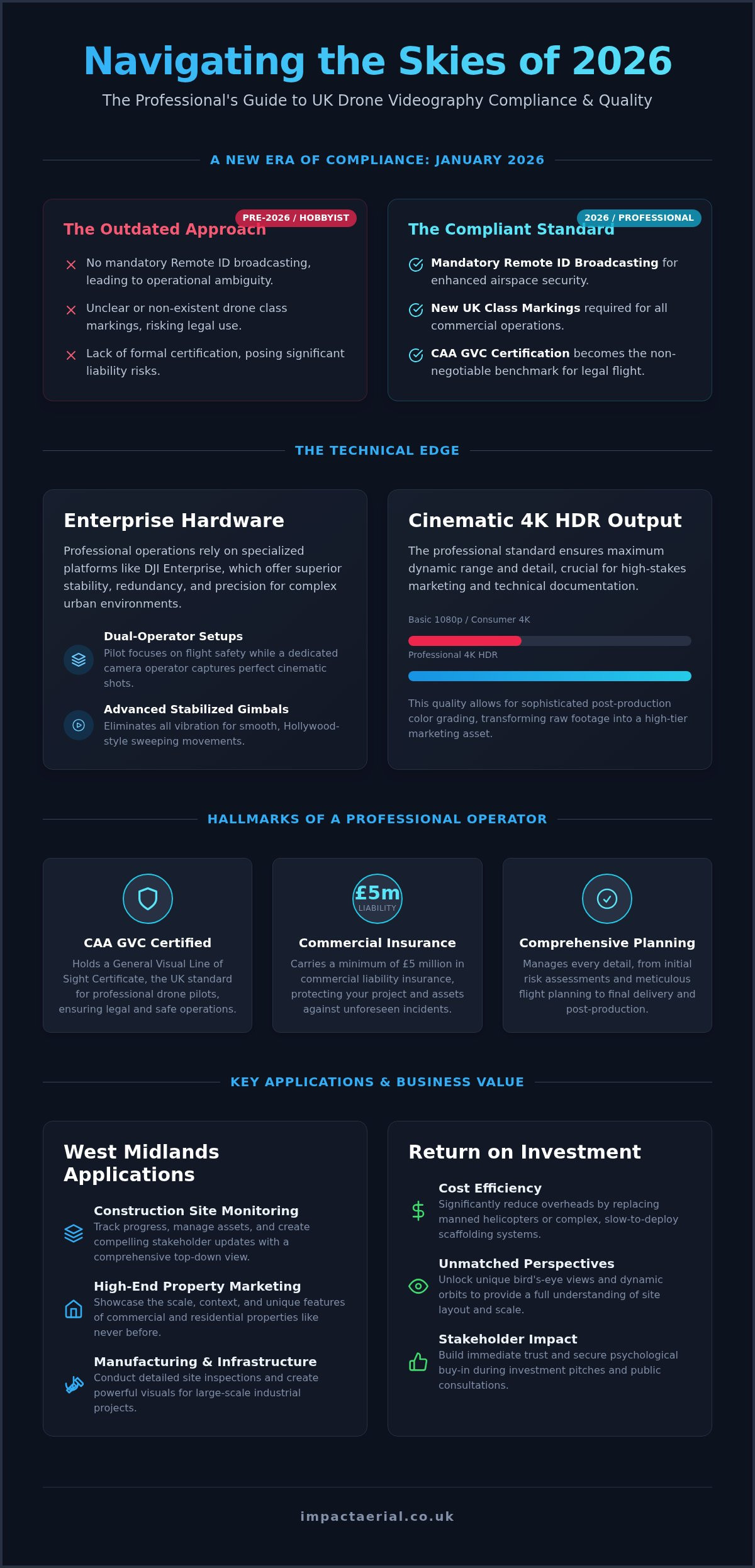
Safety and regulation are the primary filters through which all creative decisions must pass. While an aggressive FPV fly-through might look impressive, CAA regulations regarding “flight over people” or congested areas may limit where these maneuvers can be performed. Our commitment to meticulous risk mitigation includes maintaining £5m in commercial liability insurance, ensuring that your chosen style never compromises safety protocols. Before choosing a drone videography style for a complex urban shoot, it’s vital to consult with a qualified operator who understands how to balance creative ambition with legal compliance.

For a detailed assessment of how these technical factors will impact your next project, contact Impact Aerial today for a professional consultation.

Partnering with Impact Aerial: Professional Execution of Any Drone Style

Choosing a drone videography style is only the first step in creating a high-impact visual asset. The successful execution of that vision requires a partner who understands the intricate balance between creative ambition and stringent safety standards. At Impact Aerial, we don’t just provide footage; we offer a technical consultancy that ensures your chosen aesthetic is delivered with surgical precision. By bridging the gap between technical surveying and creative videography, we provide UK businesses with the reassurance that their projects are in expert hands.

Our operational excellence is built on a foundation of high-end hardware and elite certification. We utilize commercial-grade DJI Enterprise drones, capable of capturing 4K HDR data with the stability required for professional post-production. These platforms are essential for maintaining the visual integrity of cinematic sweeps or technical site monitoring in variable UK weather. Every flight is conducted by CAA GVC certified pilots, ensuring that even the most complex urban maneuvers are executed within the full framework of national aviation law. This meticulousness provides our clients with psychological comfort and tangible business benefits.

The Impact Aerial Project Management Process

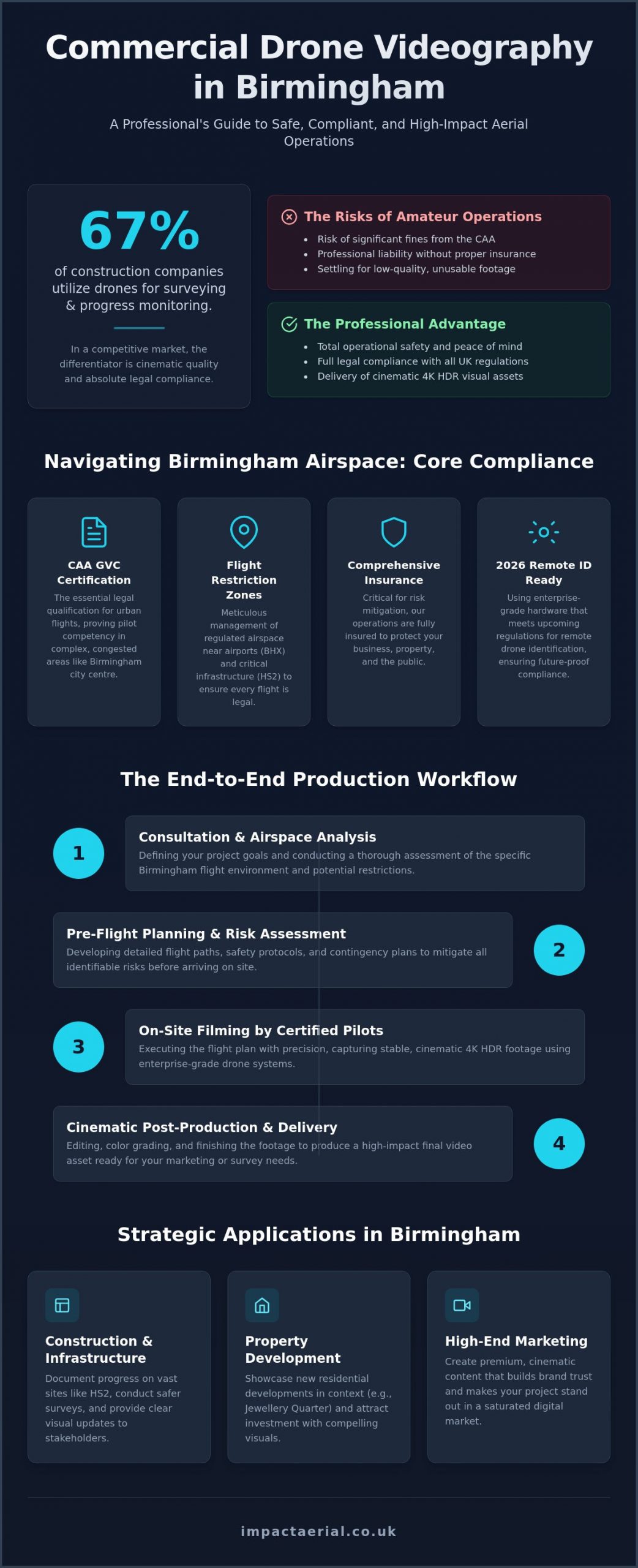
We approach every project with a structured, methodical workflow designed to eliminate risk and maximize visual ROI. Our process is divided into three distinct phases:

  • Consultation: We begin by defining your visual goals and industry requirements. Whether you are choosing a drone videography style for a promotional campaign or a technical survey, we align our flight plan with your specific KPIs.
  • Planning: Our team handles all necessary risk assessments and flight permissions. We tailor these permissions to your chosen style, ensuring that even high-stakes FPV tours or architectural reveals are fully compliant with local bylaws and CAA regulations.
  • Delivery: We provide high-end output that is ready for immediate use across social media, web, or broadcast platforms. Our post-production services ensure that the final edit reflects the precise aesthetic established during the consultation phase.

Request Your Custom Aerial Style Consultation

In the current market, a drone services provider should be a strategic partner rather than just a pilot. We have a proven track record of successful style implementations in Birmingham and across the UK, ranging from large-scale construction monitoring to immersive virtual tours for commercial property. We understand the specialized nature of the UK drone industry and remain at the forefront of regulatory changes to ensure your brand remains both innovative and compliant.

If you are ready to elevate your project with a specialized visual language, we invite you to discuss your project with Impact Aerial today. Our team is available to provide a detailed assessment of your requirements and help you navigate the complexities of choosing a drone videography style that delivers a measurable return on investment.

Elevate Your Brand with Strategic Aerial Perspective

The visual landscape of 2026 demands that UK businesses move beyond basic footage toward a more sophisticated, narrative-driven approach. Successfully choosing a drone videography style requires a deep understanding of how lighting, movement, and technical precision intersect to drive project ROI. From the adrenaline of FPV fly-throughs to the meticulous data captured in construction monitoring, the right aesthetic serves as a powerful tool for stakeholder engagement and brand differentiation.

Impact Aerial is committed to delivering these results through a blend of creative excellence and operational rigor. We provide the security of £5m Commercial Liability Insurance and the expertise of CAA GVC Certified Pilots, ensuring every mission is compliant and professional. By utilizing 4K HDR DJI Enterprise Equipment, we guarantee that your final output meets the highest industry standards for clarity and detail. It’s this focus on technical precision that ensures your brand stands out in a competitive market.

Book a consultation with our CAA-certified pilots today to discuss your project requirements. We look forward to helping you define an aerial strategy that provides lasting value to your business.

Frequently Asked Questions

What is the difference between FPV and traditional drone videography?

Traditional drone videography utilizes GPS-stabilized platforms and motorized gimbals to produce smooth, steady, and predictable footage. It’s the standard for cinematic sweeps and technical surveying. In contrast, First Person View (FPV) involves the pilot wearing goggles to fly smaller, highly agile drones manually. This allows for immersive, high-speed maneuvers and the ability to fly through tight internal spaces that traditional drones cannot access.

How do I know which drone filming style is right for my business?

The decision should be driven by your primary commercial objective. If your goal is to showcase the scale and prestige of a luxury development, a cinematic style with slow orbits is most effective. For high-energy marketing or event highlights, the kinetic feel of FPV is superior. Choosing a drone videography style requires aligning the visual energy of the flight with the expectations of your specific target audience.

Can I use FPV drone filming for indoor warehouse tours?

Yes, FPV is the industry standard for immersive indoor tours because these drones are compact and highly maneuverable. They can navigate through doorways, around machinery, and between staff safely when equipped with propeller guards. These flights require meticulous risk assessments and adherence to UK safety protocols, especially when operating in congested or confined commercial environments.

Does the time of day affect the style of my drone video?

Lighting conditions dictate the narrative tone of your footage. The “Golden Hour” at sunrise or sunset provides the soft, warm light required for high-end cinematic aesthetics. Midday light is better suited for technical applications like construction site monitoring, as it provides maximum clarity and minimal shadows. As of 2026, all night flights in the UK must utilize a mandatory green flashing anti-collision light for safety and compliance.

Are there legal restrictions on certain drone filming styles in the UK?

Yes, all commercial drone operations must comply with Civil Aviation Authority (CAA) regulations. Restrictions often apply to flying over uninvolved people or within congested urban areas, which can limit certain aggressive FPV styles. Professional operators must hold valid Flyer and Operator IDs; for drones over 100g in 2026; and maintain minimum third-party liability insurance to ensure all creative maneuvers are executed legally.

What technical specs should I look for when hiring a drone videographer?

For professional-grade results, prioritize 4K or 8K resolution and a bitrate of at least 200Mbps to allow for high-quality color grading. Ensure the equipment supports 10-bit color depth for cinematic projects. When choosing a drone videography style for technical work, ask about GPS precision and the availability of mechanical shutters to eliminate rolling shutter distortion in high-speed shots.

How much does a professional drone videography session cost in 2026?

Pricing for professional drone services is typically project-based, reflecting the complexity of the flight and the required post-production. Costs are influenced by factors such as the need for specialized FPV equipment, the duration of the shoot, and the level of risk mitigation required. While basic photography packages exist, high-end videography is generally quoted as half-day or full-day rates to account for technical planning and data processing.

Can drone filming styles be combined in a single project?

Combining multiple aesthetics often produces the most compelling results for corporate and promotional films. A single production might integrate cinematic wide shots for geographical context, technical top-down views to show project scale, and FPV fly-throughs to provide an immersive internal perspective. This multi-layered approach ensures that the footage serves both marketing and technical stakeholders effectively.

Drone Video Production Cost UK: The 2026 Pricing & Budgeting Guide

Why does one drone operator quote you a few hundred pounds while another demands triple that amount for the same brief? It’s a common frustration to receive wildly inconsistent figures when you’re trying to budget for high-quality aerial content. You likely feel the pressure to find a balance between visual excellence and strict safety standards, yet the gap between hobbyist rates and professional fees remains confusing. Understanding the true drone video production cost uk requires looking beyond the flight time to the technical credentials and risk mitigation that protect your brand.

We’ve created this guide to help you navigate the 2026 market with confidence. You’ll discover exactly how professional services are priced, from the impact of mandatory Remote ID systems to the value of a GVC-certified pilot. We’ll outline the non-negotiable safety requirements, such as the standard £1 million liability insurance required for commercial sites, and provide a clear framework for evaluating quotes. This overview ensures you can distinguish between a simple flight and a compliant, high-tier production that meets all UK aviation standards.

Key Takeaways

  • Understand why drone video production cost uk varies depending on whether you require a basic site capture or a complex, high-tier commercial campaign.
  • Identify the essential “invisible” cost drivers, including technical pre-flight planning and the regulatory compliance associated with CAA GVC certification.
  • Compare the differences between dry hire pilot rates and full-service packages that include professional post-production and data-centric delivery.
  • Learn how to optimize your project budget through strategic batch filming and precise pre-production briefing to minimize editing revisions.
  • Recognize the critical financial protection offered by professional certifications and the industry-standard £5 million public liability insurance for commercial operations.

Breaking Down Drone Video Production Cost in the UK (2026)

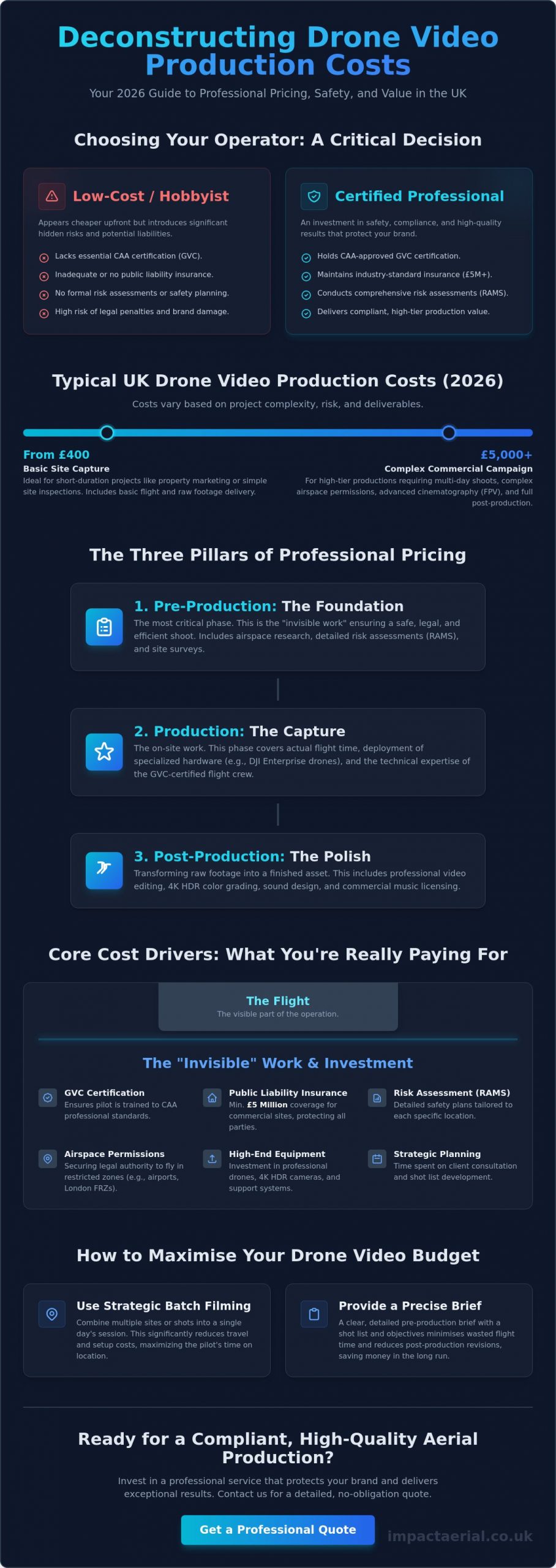
Professional drone video production is a specialized subset of commercial cinematography that demands a meticulous blend of aviation safety, technical precision, and creative storytelling. It isn’t merely about capturing a high-angle shot; it’s an integrated process that requires sophisticated hardware and strict adherence to UK drone flight regulations. In 2026, the drone video production cost uk typically ranges from £400 for basic, short-duration site captures to over £5,000 for complex, multi-day commercial campaigns. These figures represent the baseline for operators who maintain the necessary certifications and equipment standards required for professional delivery.

Low-cost alternatives often appear attractive at first glance, but they frequently signal a lack of essential credentials. Choosing an operator who lacks a valid drone license or adequate commercial insurance exposes your business to significant liability and potential legal penalties. Professional pricing ensures that every flight is conducted within a framework of risk mitigation and technical excellence, transitioning from raw aerial clips to a comprehensive, full-service video production that serves your specific business objectives.

To better understand the nuances of professional video pricing, watch this helpful video:

The Three Pillars of Professional Pricing

A professional quote is built on three distinct phases of operational work. Pre-production is perhaps the most critical, involving meticulous airspace research, detailed risk assessments, and site surveys to ensure the flight is both safe and legal. The production phase encompasses the actual flight time, the deployment of specialized hardware, and the technical expertise of the flight crew. Finally, post-production services transform raw data into a finished asset through professional editing, colour grading, sound design, and the licensing of music for commercial use. Each pillar requires specific skills and tools that contribute to the final project fee.

Why 2026 Market Rates Reflect Higher Standards

The current market landscape is shaped by rapid technological advancement and stricter regulatory oversight from the Civil Aviation Authority. The widespread adoption of DJI Enterprise technology has set a new benchmark for stability and image quality, allowing for high-end data capture that was previously impossible. Clients now expect 4K HDR delivery and dynamic cinematic FPV perspectives as standard, which necessitates more sophisticated equipment and higher pilot skill levels. Additionally, the rising cost of professional-grade liability insurance, which often requires £5 million in coverage for industrial or corporate sites, is reflected in modern pricing structures to ensure all parties are protected against unforeseen incidents.

Core Cost Drivers: What You Are Actually Paying For

When assessing the drone video production cost uk, it’s easy to focus only on the hours spent on site. However, the majority of professional overheads occur long before the rotors start spinning. Professional operators invest heavily in “invisible” work that ensures every flight is legal, safe, and insured. This includes detailed pre-flight planning and the maintenance of high-tier certifications like the General Visual Line of Sight Certificate (GVC). These elements are essential for risk mitigation and technical excellence, providing clients with the reassurance that their project is in expert hands.

Regulatory Compliance and Safety Planning

A professional drone operation is built on a foundation of rigorous safety protocols. This involves drafting a comprehensive Risk Assessment and Method Statement (RAMS) tailored to the specific environment, whether it’s a busy construction site or a congested urban area. Securing permissions for restricted airspace, such as the Flight Restricted Zones found across London, requires time-consuming coordination with Air Traffic Control and the Civil Aviation Authority (CAA) drone safety code. Operating without these permissions isn’t just dangerous; it risks heavy fines and the immediate invalidation of insurance policies. Meticulous planning ensures that every mission is compliant with national aviation standards.

Hardware and Technical Specifications

The equipment used significantly influences the project’s technical output and reliability. High-end aircraft like the Mavic 3 Enterprise require substantial capital investment and have high depreciation rates due to rapid technological cycles. Professional operators don’t just provide a camera; they offer specialized sensors such as thermal cameras for solar farm surveys or cinema-grade 8K sensors for broadcast quality. Reliability is also a cost driver. A specialist team will always carry redundant aircraft and multiple battery sets to ensure the project continues even if a primary component fails. This level of preparedness is a standard feature of any complete guide to professional drone services in the UK.

Insurance premiums represent another non-negotiable cost driver. While hobbyist insurance might cover basic damage, commercial projects often mandate a £5m commercial liability policy. This level of coverage is typically the entry requirement for UK construction and corporate sites. It provides the necessary financial protection against third-party claims, which averaged £18,000 in 2025. By hiring a fully insured operator, you’re investing in your own business’s security and legal protection. If you’re planning a complex project, you might consider our professional aerial filming services to ensure full compliance with these rigorous industry standards.

Drone Video Production Cost UK: The 2026 Pricing & Budgeting Guide

Typical Pricing Models: Day Rates vs. Full-Service Packages

Understanding the drone video production cost uk requires a clear distinction between “Dry Hire” and “Full Service” models. A dry hire arrangement typically provides a certified pilot and the necessary aircraft for a set duration, which is ideal for agencies that handle their own post-production. Conversely, full-service packages manage the entire creative workflow, from initial concept and airspace planning to the final edited delivery. For complex aerial filming drone projects involving multiple locations, project-based fees often provide better value than standard daily rates, as they account for the specific logistical demands of the campaign.

The commercial value of drone services is now well-established across infrastructure and corporate sectors, leading to more standardized pricing structures. Professional commercial pilots in the UK generally command day rates between £600 and £1,200. These figures reflect the pilot’s technical expertise, the sophistication of the hardware deployed, and the operational risks managed during the flight. While some clients request half-day rates, these typically cost 60 to 70 percent of a full day because the pre-flight planning and equipment preparation remain largely the same regardless of the time spent in the air.

Standard Day Rates and Half-Day Estimates

A standard 8-hour filming day includes more than just the time the drone is airborne. It encompasses site-specific safety briefings, battery management, and the meticulous execution of the flight plan. National projects often incur additional costs for travel, subsistence, and overnight stays, which are billed alongside the base rate. Professional operators rarely offer “per hour” pricing because the setup time and mandatory safety checks make short bookings inefficient for high-tier commercial work. Half-day estimates are usually reserved for simple site captures that don’t require extensive travel or complex airspace coordination.

Post-Production and Deliverable Fees

The work continues long after the flight crew leaves the site. Professional editing day rates typically range from £300 to £600, depending on the complexity of the grade and the volume of footage processed. This phase includes colour correction, sound design, and the integration of licensed music or stock assets. For technical clients, costs may also involve specialized data processing for a drone survey or 3D mapping project. These deliverables require powerful computing resources and specialized software, making them a distinct component of the overall project budget.

How to Maximise Your Drone Video Budget without Cutting Corners

Optimising your drone video production cost uk isn’t about selecting the lowest quote; it’s about maximizing the volume of high-quality assets captured during a single deployment. Professional efficiency allows you to leverage a single flight session for multiple business needs. For instance, a well-planned day can yield both marketing-ready Aerial Filming and Photography and technical data for Construction Site Monitoring. This multi-purpose approach ensures that the day rate is spread across several departments, significantly improving the return on investment for your project.

A precise brief is your most powerful tool for cost control. When the flight crew understands every required angle and technical specification before the first battery is connected, the need for expensive revisions in Post-Production Services is virtually eliminated. We recommend documenting your “must-have” shots versus “nice-to-have” perspectives. This clarity allows the pilot to manage their flight time and battery cycles with technical precision, ensuring no minute is wasted on site.

Weather policies are another critical component of a professional budget. While a hobbyist might take risks in marginal conditions, a professional operator prioritises the safety of the aircraft and the public. You should expect a clear “weather day” policy in your contract. These clauses protect your budget by outlining how re-scheduling works if wind speeds or precipitation exceed safe operational limits. Understanding these terms upfront prevents unexpected financial surprises and ensures your project remains compliant with safety standards.

Effective Project Planning for Cost Efficiency

Ensuring site access and all necessary local permissions are secured in advance prevents costly pilot standby fees. If a pilot is grounded because a site manager wasn’t informed or a gate is locked, you’re still paying for their technical expertise and time. We also suggest planning your shoot around the “Golden Hour” to achieve a high-end cinematic look. This natural lighting provides a superlative visual perspective without the need for additional lighting equipment or complex digital colour grading later.

Avoiding the Hidden Costs of Inexperience

The most significant budget killer is the need for a re-shoot. This typically happens when an uncertified operator captures sub-standard footage or, worse, is grounded by authorities for lacking a valid drone license. A suspiciously low drone video quote is often a red flag for a lack of £5 million liability insurance or a missing GVC certification. Professional reliability is a “one-and-done” investment. By hiring a vetted specialist, you avoid the legal risks and the double cost of hiring a professional to fix a novice’s mistakes.

If you’re ready to plan a safe and efficient shoot for your next project, explore our Aerial Filming and Photography services to see how we deliver high-tier results within your budget.

Why Professional Certification and Insurance Save Money in the Long Run

Investing in a professional service is a strategic decision to mitigate significant financial and legal liabilities. While a lower quote from an uncertified operator might seem appealing, it often ignores the “cost of non-compliance.” In the UK, operating a commercial drone without the correct CAA authorization can result in fines exceeding £5,000. When you consider the total drone video production cost uk, these potential penalties, alongside the risk of uninsured equipment damage or third-party injury, make hobbyist alternatives an expensive gamble for any serious business.

Standard commercial contracts for UK construction and corporate sites now almost universally mandate £5 million in public liability insurance. This isn’t just a bureaucratic hurdle; it’s a critical layer of protection for your project. A professional operator provides this coverage as a standard part of their service, ensuring that any incident is handled through formal legal and insurance channels. This level of protection provides the psychological comfort and tangible security necessary when operating in high-value or high-risk environments.

Mitigating Corporate Risk

A meticulous approach to aviation safety directly protects your brand reputation. Legal and safe operations prevent the negative publicity associated with drone incidents or regulatory investigations. Beyond physical safety, professional operators ensure strict adherence to data security and privacy compliance (GDPR) during filming. We provide the necessary documentation, including flight logs and risk assessments, which simplifies your internal health and safety audits. This transparency confirms that your project meets every national standard for operational excellence and corporate responsibility.

The Impact Aerial Advantage

Impact Aerial maintains a rigorous commitment to technical precision and operational safety. Our pilots are CAA GVC certified, possessing the advanced qualifications required for complex commercial work in congested areas. We exclusively utilize commercial-grade DJI Enterprise equipment to ensure high-end 4K HDR output and maximum reliability on every mission. From our Birmingham hub, we provide comprehensive UK-wide coverage, delivering consistent quality across multiple sectors, from Construction Site Monitoring to PV Solar Farm Thermal Surveys.

Our structured workflow ensures that your project is delivered on time, within budget, and in full compliance with current aviation laws. We focus on providing high-tier visual assets that drive business value without exposing your organization to unnecessary risk. Contact us today for a bespoke drone video production quote tailored to your specific project requirements.

Securing Professional Results for Your Next Aerial Project

Navigating the complexities of aerial budgeting requires a focus on operational safety and technical reliability. You’ve seen how the drone video production cost uk encompasses far more than flight time; it represents a commitment to CAA GVC certification and the deployment of professional-grade DJI Enterprise 4K HDR equipment. By choosing an operator with £5 million in commercial liability insurance, you ensure your project is grounded in legal compliance and robust risk mitigation.

Strategic planning and clear briefing allow you to maximize your budget while maintaining the high-tier quality your brand demands. This meticulous approach transforms aerial data into a powerful commercial asset that serves your business long after the shoot is complete. If you’re ready to elevate your visual content with a trusted, safety-conscious partner, request a bespoke drone video production quote from Impact Aerial today. We look forward to bringing a superlative perspective to your next project.

Frequently Asked Questions

How much does a 1-minute drone video cost in the UK?

Industry standard rates for a finished one-minute production typically include several hours of filming and a dedicated editing phase. While a basic three-hour flight session might start around £350, the final cost for a polished edit reflects the complexity of the grading and sound design. High-tier commercial projects often require more extensive pre-production to ensure the final minute of footage meets broadcast standards.

What is the average day rate for a CAA-certified drone pilot?

Professional commercial pilots with GVC certification generally command day rates between £600 and £1,200. This fee covers the pilot’s technical expertise, the use of specialized aircraft, and the mandatory pre-flight safety assessments. Rates at the higher end of this scale usually indicate the use of enterprise-grade sensors or the inclusion of basic post-production services to provide a complete project deliverable.

Are there extra costs for filming in restricted areas like London?

Filming in restricted zones like London or near major airports involves additional administrative and planning costs. These projects require extensive coordination with Air Traffic Control and the submission of detailed non-standard flight applications. The time required to secure these permissions and draft site-specific RAMS is reflected in the final project quote to ensure a fully compliant and legal operation.

Do drone video prices include editing and post-production?

Drone video prices are structured based on whether you choose a “Dry Hire” or “Full Service” model. Dry hire includes only the pilot and aircraft, whereas full-service packages integrate professional post-production. It’s essential to clarify if the quote includes colour grading, music licensing, and revisions, as these elements are critical for a professional final result that aligns with your brand standards.

What happens to my payment if the weather is too bad to fly?

Most professional operators implement a “weather day” policy that allows for re-scheduling if conditions are unsafe for flight. This typically involves a small mobilization fee or an agreed-upon alternative date at no extra cost. This meticulous approach to safety prevents the risk of equipment damage and ensures that the final footage is captured in optimal lighting and wind conditions for your project.

Can I hire a drone pilot for just one hour to save money?

Hourly bookings are rare in the professional industry because the setup, safety briefings, and mandatory risk assessments remain the same regardless of flight duration. Most specialists require a minimum two-hour booking to cover these essential pre-flight requirements. This structure ensures the drone video production cost uk remains sustainable while maintaining the highest standards of operational safety and technical precision on every site.

Why is professional drone insurance so expensive?

Professional insurance premiums reflect the significant financial risks managed during commercial flights. With the average third-party liability claim for UK drone incidents reaching £18,000 in 2025, a robust £5 million policy is a standard requirement for corporate and construction sites. This coverage provides the necessary financial security for both the operator and the client in the event of an unforeseen incident during complex operations.

Is it cheaper to use a freelancer or a drone production company?

Hiring a production company often provides greater redundancy and a wider range of specialized sensors compared to a solo freelancer. Companies typically maintain a fleet of backup aircraft and a team of GVC-certified pilots, ensuring your project stays on schedule even if technical issues arise. This integrated approach often includes professional post-production as standard, providing a more cohesive and reliable final result for your business.

Real Estate Drone Video Services: The Ultimate Guide for Agents

In today’s crowded UK property market, standard ground-level photography is no longer enough to capture the attention of discerning buyers. If you find your listings struggle to convey the true scale of a property, its impressive grounds, or its valuable context within the neighbourhood, it’s time for a new perspective. This is where professional real estate drone video services provide a decisive advantage, transforming your marketing strategy and helping you stand out. This guide is designed specifically for agents who are ready to elevate their listings, attract more qualified viewers, and ultimately, sell properties faster and for a higher price.

However, we understand that commissioning aerial work can seem daunting. Concerns over Civil Aviation Authority (CAA) regulations, operational safety, and the challenge of finding a genuinely certified and insured operator are perfectly valid. We are here to provide complete clarity. In this ultimate guide, we will demystify the process, showing you exactly how to leverage breath-taking aerial footage to create modern, compelling marketing. You will learn how to confidently hire a reliable partner and unlock the power to showcase a property in a way that ground-based shots simply cannot match.

Key Takeaways

  • Elevate your property listings beyond standard photography to captivate potential buyers and significantly increase online engagement.
  • Understand the essential aerial shots that showcase a property’s best features, from its unique setting to its full scale and layout.
  • Learn how to properly vet professional real estate drone video services by checking for crucial credentials like CAA certification and comprehensive insurance.
  • Reframe aerial videography as a strategic marketing investment designed to secure a faster sale and achieve a higher final asking price.

Why Drone Video is Essential for Modern Real Estate Marketing

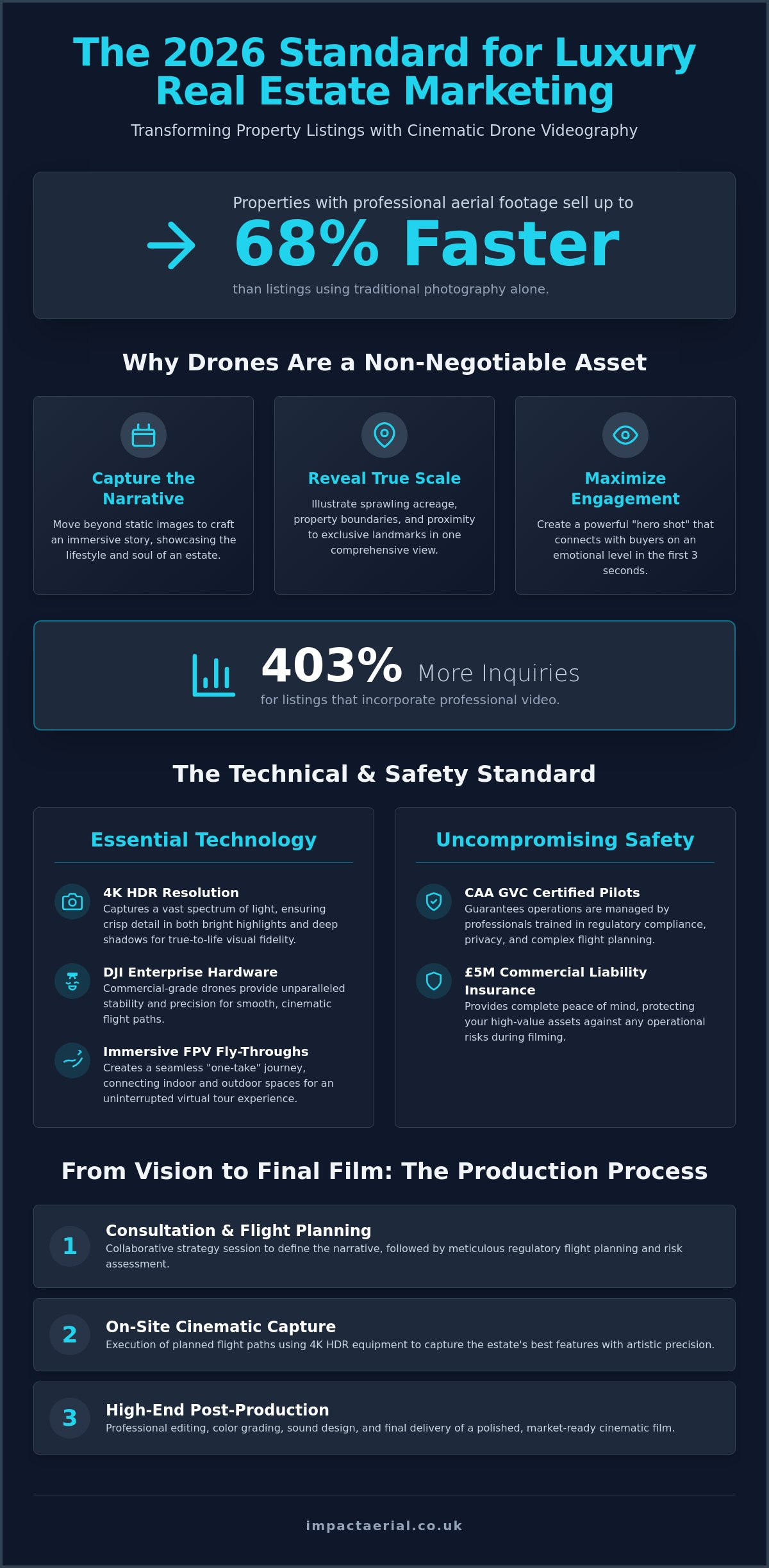
In today’s competitive property market, static photographs are no longer enough to capture the attention of discerning buyers. Professional real estate drone video services offer a dynamic and immersive way to present a property, moving beyond flat images to create a compelling narrative. The data is clear: property listings that include video content can generate over 400% more enquiries than those without. This dramatic increase in engagement highlights a fundamental shift in how buyers want to experience potential new homes online.

To see the power of aerial cinematography in action, consider these essential shots for any property listing:

The core advantage of using a professional unmanned aerial vehicle (UAV) is its ability to capture unique perspectives that are impossible with ground-level photography. This technology provides a bird’s-eye view, revealing the full story of a property and its place within the wider environment, offering a level of insight that standard photography simply cannot match.

Showcasing Property Scale and Context

Aerial footage excels at conveying the true scale and layout of a property. For large estates, homes with extensive gardens, or plots of land, a drone can effortlessly capture the entire scope in a single, elegant shot. This perspective clearly defines property boundaries and illustrates the property’s valuable proximity to local amenities such as parks, coastlines, schools, and transport links, providing crucial context for potential buyers.

Creating an Emotional Connection with Buyers

More than just a tour, a well-produced drone video tells a story. Cinematic sweeps and graceful shots evoke a feeling and a lifestyle, helping buyers to form an immediate emotional connection. This “wow factor” builds excitement and allows viewers to envision themselves living in the home, making your listing far more memorable than the competition’s. It transforms a simple viewing into an inspiring experience.

Gaining a Competitive Edge Online

Listings enhanced with high-quality video consistently perform better on major UK property portals like Rightmove and Zoopla. The engaging content is also highly shareable, making it a powerful asset for social media marketing campaigns. By integrating professional drone videography, your agency positions itself as a modern, tech-forward leader, demonstrating a commitment to providing the highest quality marketing for your clients.

The Key Drone Video Shots That Sell Properties

A high-impact property video is far more than arbitrary aerial footage; it is a meticulously planned visual narrative. A professional shot list is crucial for success, ensuring every flight path has a purpose. The goal of professional real estate drone video services is to combine distinct shots that, together, tell a compelling story about a property, its features, and its place in the world. While every property is unique, a core set of proven aerial shots forms the foundation of a video that captures attention and drives buyer interest.

A skilled, CAA-certified pilot will assess your listing and recommend a bespoke shot list, but understanding these key techniques reveals the immense value aerial videography brings to your marketing.

Cinematic Approach and Reveal Shots

First impressions are paramount. A cinematic reveal shot builds anticipation and establishes a premium feel from the outset. This technique involves flying the drone towards the property from a distance, or revealing it from behind a natural feature like a line of trees or a hill. This creates a dramatic unveiling that immediately positions the home as a significant and desirable listing, setting a high-end, professional tone for the entire video.

The 360-Degree Orbit

The 360-degree orbit is an essential component for providing a complete and comprehensive overview of the property. By smoothly circling the home, this shot showcases the building’s exterior from every angle, along with its immediate surroundings. It is the most effective way to highlight key features such as manicured gardens, swimming pools, patios, and the overall layout of the grounds. This shot gives potential buyers a true sense of the property’s scale and context.

Top-Down and Boundary Views

For providing pure, unadulterated information, the top-down shot is unparalleled. This “bird’s-eye” perspective acts like a dynamic map, clearly showing the plot size, shape, and precise property boundaries. It is exceptionally useful for highlighting the condition of the roof, the location of solar panels, or the scale of extensions and outbuildings. This data-rich view offers buyers clarity and confidence in what is included in the sale, answering key questions visually.

Neighbourhood and Amenity Fly-Overs

You aren’t just selling a house; you’re selling a location and a lifestyle. Fly-over shots are instrumental in this. A professional operator can trace the route to a nearby park, the local high street, or the closest train station, demonstrating connectivity and convenience. This technique showcases the quality of the surrounding neighbourhood and its amenities, adding immense value by helping buyers envision their life there. Executing these flights requires a deep understanding of aviation law, similar to the strict FAA regulations for commercial drone pilots in the US, ensuring all operations are conducted safely and legally within the community.

The Professional Process: From Consultation to Final Video

Engaging professional real estate drone video services should be a seamless, fully-managed experience. Our goal is to remove the complexity, handling all technical, regulatory, and creative aspects on your behalf. This meticulous, three-stage process ensures we deliver a top-quality, compelling video that elevates your property listing with minimal effort required from you, providing complete peace of mind from start to finish.

Step 1: Pre-Production and Planning

Every successful project begins with a detailed plan. We start with an initial consultation to understand your marketing objectives and identify the property’s most compelling features. Our team then conducts a thorough site assessment, including all necessary airspace checks and risk assessments to ensure a safe and legally compliant operation. We work collaboratively with you to create a detailed shot list, a crucial step that aligns with industry best practices for drone video and guarantees the final product meets your strategic goals.

Step 2: On-Site Filming Day

On filming day, our CAA GVC Certified pilot arrives on-site and conducts comprehensive pre-flight safety checks. We operate with maximum efficiency to capture all planned shots using our fleet of professional-grade 4K drones, ensuring minimal disruption to the property. Every flight is conducted in strict accordance with CAA regulations for commercial operations. This rigorous adherence to safety and legal standards is non-negotiable and fundamental to the professional service we provide, ensuring a smooth and secure filming process.

Step 3: Post-Production and Editing

This is where the raw footage is transformed into a powerful marketing asset. Our editing team professionally colour-grades the clips to achieve a rich, cinematic look that makes your property stand out. We then integrate licensed, royalty-free music, your agency’s branding, and any essential text overlays. The final cut is meticulously edited to create a compelling narrative that not only showcases the property but also evokes an emotional connection with potential buyers. See how our process works. Get in touch with Impact Aerial.

How to Choose a Real Estate Drone Video Service: A Checklist

In the rapidly growing market of aerial property marketing, it is crucial to understand that not all drone operators are created equal. Engaging an uncertified or uninsured pilot exposes you, your client, and your reputation to significant legal and financial risk. Vetting your provider is not just a recommendation; it is an essential step in professional due diligence. Using a structured checklist ensures you partner with a credible, safe, and legal operator who can deliver the high-quality results your listings deserve.

Verify CAA Certification and Commercial Insurance

This is the most critical, non-negotiable step. In the UK, any commercial drone operation requires the pilot to hold a valid General Visual Line of Sight Certificate (GVC), issued and regulated by the Civil Aviation Authority (CAA). Furthermore, they must hold specialist commercial drone liability insurance, with a minimum cover of £5 million being the industry standard. For your complete peace of mind, always ask to see copies of these documents before any work commences.

Review Their Portfolio and Equipment

A provider’s portfolio is a direct reflection of their skill and quality. Look for a strong collection of previous real estate video work, paying close attention to the technical execution. Is the footage smooth and stable, or is it shaky? Is the editing, colour grading, and music professional and suited to high-value property marketing? A professional operator will use commercial-grade drones from reputable manufacturers, not consumer-level toys, ensuring superior image quality and operational reliability.

Assess Their Professionalism and Communication

The best real estate drone video services operate as professional partners, not just pilots. Their professionalism should be evident from the very first interaction. A credible operator will be:

  • Responsive and Clear: They answer your queries promptly and explain the process, including any potential limitations, in clear terms.
  • Transparent in Quoting: You should receive a detailed quote or statement of work outlining exactly what is included, from on-site flight time to post-production edits.
  • Process-Driven: They will discuss the need for pre-flight site surveys and risk assessments to ensure a safe and compliant flight.

A professional will guide you through the entire process, ensuring a seamless experience and a breath-taking final product. At Impact Aerial, we are committed to upholding the highest standards of safety, quality, and professionalism on every project.

Maximising the ROI of Your Drone Video Investment

Viewing professional aerial videography as a marketing expense is a common mistake. In reality, it is a strategic investment designed to deliver a significant return. The ultimate goal of commissioning real estate drone video services is not simply to have an impressive video; it is to secure a faster sale at a better price. To achieve this, the final video asset should be leveraged across every available marketing channel-from property portals and your agency website to social media campaigns and email newsletters.

Impact on Listing Performance

A professionally produced drone video can dramatically increase online engagement. Listings featuring high-quality video consistently attract more clicks and hold viewer attention for longer periods. This immersive preview helps to pre-qualify prospective buyers, giving them a genuine feel for the property’s scale, layout, and setting. This ensures that physical viewings are with more serious, better-informed parties, which can directly contribute to reducing a property’s time on the market.

Justifying a Premium Asking Price

High-end marketing materials signal a high-value property. Cinematic aerial footage immediately elevates a listing, justifying a premium asking price by showcasing features that static photos cannot fully capture-such as the scale of the garden, the quality of the roof, or the property’s proximity to local amenities. This superior presentation attracts more discerning buyers who associate quality marketing with a quality home and are willing to pay accordingly.

Building Your Personal and Agency Brand

Utilising advanced marketing tools like drone videography does more than sell a single home; it builds your reputation as a leading agent. It serves as a clear demonstration to potential vendors that you invest in the best technology to achieve optimal results for your clients. This commitment to excellence helps you win more high-value listings in the future and clearly differentiates your agency from competitors relying on basic photography.

The strategic application of real estate drone video services is a proven method for enhancing listing performance and strengthening your professional brand. Elevate your listings and deliver exceptional results for your clients. Book your drone video service today.

Elevate Your Listings and Secure More Sales

In today’s competitive property market, drone video has transitioned from a novelty to a necessity. As we’ve explored, incorporating dynamic aerial perspectives is a powerful way to showcase a property’s full context, attract serious buyers, and ultimately accelerate sales. The key to success lies in a strategic approach, from identifying the most impactful shots to choosing a provider who understands how to maximise your return on investment.

By investing in professional real estate drone video services, you are investing directly in the perceived value of your listings and the strength of your brand. For agents across Birmingham and the West Midlands seeking a reliable partner, Impact Aerial offers complete peace of mind. Our pilots are CAA GVC Certified and fully insured, delivering top-quality, high-resolution 4K HDR video that makes every listing stand out.

Ready to transform your property marketing and achieve breath-taking results? Request a Professional Drone Video Consultation Today and discover how to make a lasting impression on potential buyers.

Frequently Asked Questions

How much do real estate drone video services cost in the UK?

The cost for professional real estate drone video services in the UK typically ranges from £300 to £800+, depending on several factors. The final price is influenced by the property’s size, the complexity of the flight plan, and the specific post-production requirements such as motion graphics or colour grading. We provide a detailed, itemised quote after an initial consultation to ensure our services are perfectly tailored to your project’s scope and budget, with no hidden fees.

Are there legal restrictions for flying drones over residential properties?

Yes, all commercial drone operations in the UK are strictly regulated by the Civil Aviation Authority (CAA) to ensure safety and privacy. As a CAA GVC Certified operator, we conduct thorough pre-flight risk assessments for every project. This ensures we adhere to all regulations, including maintaining legal distances from uninvolved people and properties. Choosing a certified professional provides you with the peace of mind that all operations are conducted legally, safely, and with full commercial liability insurance.

How long does it take to receive the final edited property video?

Our standard turnaround time for a fully edited and colour-graded property video is typically between 3 to 5 business days following the shoot. This timeframe allows our team to meticulously select the best footage and produce a high-quality video that showcases your property’s key features. Projects with more complex editing requirements, such as advanced graphics or multiple revisions, may require additional time, which will be clearly communicated in our project proposal.

What happens if the weather is bad on the day of the shoot?

Client and public safety is our highest priority, and we do not operate our drones in unsafe weather conditions such as high winds or rain. We continuously monitor the forecast in the days leading up to the scheduled shoot. If the weather is deemed unsuitable for a safe and legal flight, we will contact you to reschedule for the next available date that works for you, at no additional charge. This ensures we can capture top-quality footage without compromise.

Do I or the homeowner need to be present during the drone filming?

It is not a requirement for the estate agent or homeowner to be present during the filming process. We conduct a detailed pre-flight briefing to understand your exact requirements and the key features of the property you wish to highlight. As long as our pilot has safe and legal access to the exterior of the property and its grounds, we can complete the entire operation efficiently and independently, saving you valuable time while delivering breath-taking results.

Is drone video suitable for all types of properties?

Aerial video is exceptionally effective for most properties, particularly those with significant land, unique architectural designs, or scenic surroundings that cannot be fully appreciated from the ground. Even urban apartments with stunning views can benefit. Before any project, we perform a detailed site survey to assess the location and surrounding airspace for any restrictions, such as proximity to airports. This ensures that a safe, legal, and impactful operation is viable for your specific property.

Drone Videography for Marketing: The Ultimate Guide to Boosting Engagement

Have you seen those stunning aerial shots in a competitor’s advert and wondered if they deliver a genuine return on investment? For many UK businesses, integrating professional drone videography for marketing can feel complex, expensive, and tangled in safety regulations. You might be asking: Is it worth the cost? What shots would even work for my industry? And how can I ensure everything is done legally and safely under CAA guidelines? These are valid concerns that can make a powerful marketing tool feel inaccessible.

This ultimate guide is designed to provide clarity and confidence. We will demystify the entire process, demonstrating how stunning aerial footage is a strategic asset for elevating your brand and driving measurable marketing results. You will discover creative ideas for your specific industry, learn how to assess the value of your investment, and understand what to look for when hiring a fully certified and insured professional. By the end, you’ll be equipped to captivate your audience from a new perspective, with complete peace of mind.

Key Takeaways

  • Discover how aerial footage provides a unique perspective that instantly captures viewer attention and showcases the full scale of your projects or properties.
  • Learn to strategically match specific drone manoeuvres to distinct marketing objectives, moving beyond generic footage to tell a compelling brand story.
  • A structured 3-step planning process is essential for transforming a creative idea into a successful and briefable drone videography for marketing campaign.
  • Understand the critical importance of hiring a CAA-certified and fully insured professional to ensure your project is safe, compliant, and delivers high-quality results.

Why Drone Videography is a Marketing Game-Changer

In today’s saturated digital landscape, capturing and holding audience attention is the primary challenge. Standard, ground-level photography and videography often fail to cut through the noise. Drone videography offers a powerful solution, instantly elevating your content by providing a dynamic, bird’s-eye view that commands attention. This unique perspective creates a profound sense of scale, context, and awe that is simply unattainable from the ground, allowing you to tell a more compelling and comprehensive story about your project, property, or brand.

To better understand how these dynamic shots are planned and executed, this professional masterclass offers valuable insights:

The Unmatched Power of a New Perspective

Aerial footage provides a comprehensive overview that ground-level shots cannot replicate. For instance, a commercial property listing can show not just the building itself, but its entire footprint, its proximity to major transport links, and the surrounding local amenities in a single, flowing shot. This holistic view provides immediate context and answers questions before they are even asked. The psychological impact of seeing a project in its entirety gives viewers a superior understanding and fosters a greater sense of trust and transparency. A deeper dive into understanding drone technology reveals how these advanced systems are engineered to provide stable, high-resolution perspectives once reserved for blockbuster film budgets.

Boosting Key Digital Marketing Metrics

The unique and engaging nature of aerial video directly translates into improved performance metrics across all digital platforms. Professionally produced drone content is proven to deliver tangible results:

  • Increased Watch Time: The cinematic quality of drone footage keeps viewers captivated for longer on platforms like YouTube and LinkedIn, increasing the visibility of your message.
  • Higher Engagement Rates: Breathtaking visuals are inherently shareable. This leads to higher click-through rates on advertisements and a significant increase in likes, comments, and shares on social media.
  • Improved Website Performance: Embedding high-quality aerial videos on your website can dramatically increase average session duration, signalling to search engines that your site provides valuable content.

Building Brand Prestige and Authority

Employing professional drone videography for marketing is a powerful statement about your brand. It communicates high production values, attention to detail, and a commitment to quality. This immediately elevates your brand’s perception, signalling that you are a modern, innovative, and successful leader in your industry. Luxury property developers, high-end resorts, and leading construction firms use aerial footage to create an exclusive feel and build an aura of prestige that distinguishes them from the competition and justifies a premium positioning in the market.

Strategic Applications: Matching Drone Shots to Marketing Goals

Effective drone videography for marketing moves beyond generic scenic footage; it requires a deliberate, strategic approach where every flight path and camera angle serves a specific business objective. This means planning each shot to align with a particular stage of the customer journey, from initial awareness to the final conversion. A professional operator understands that this is a technical discipline governed by strict safety protocols. While our operations are governed by the UK’s Civil Aviation Authority (CAA), the importance of compliance is a global standard, reflected in frameworks like the FAA commercial drone regulations in the United States. This commitment to professional standards ensures that your aerial video is not just visually stunning, but also a precisely targeted storytelling tool.

For Brand Awareness: Epic Establishing & Context Shots

To capture attention and make a memorable first impression, your goal is to generate awe and establish context. These shots are designed to be dramatic and shareable, positioning your brand, project, or location on a grand scale. Key manoeuvres include:

  • Reveal Shots: The drone ascends over an obstacle, such as a treeline or hill, to dramatically unveil the subject-be it a new property development, a sprawling event, or a stunning landscape. This builds anticipation and delivers a powerful impact.
  • Top-Down Shots: A direct overhead perspective is ideal for showcasing patterns, scale, and the layout of a site. This is invaluable for commercial property, agriculture, or events, providing a clear, map-like view that ground-level cameras cannot achieve.
  • Orbit Shots: By circling a key subject, you build intrigue and provide a comprehensive 360° view. This technique is perfect for highlighting a landmark building, a new vehicle, or a central feature of a property.

For Consideration: Informative Fly-Throughs & Tours

Once you have a prospect’s attention, the next step is to provide valuable information in an engaging format. This is where drone videography for marketing excels at giving potential customers a deeper understanding of your offering. Fly-throughs and tracking shots serve as dynamic virtual tours, guiding the viewer through a space or along a journey. A seamless flight through a commercial building, a luxury hotel, or an industrial facility offers a perspective that is far more immersive than a simple photo gallery. Similarly, tracking a vehicle along a scenic route or following a person through a resort demonstrates products and experiences in a real-world, narrative context.

For Conversion: Highlighting Key Features & Benefits

At the decision-making stage, your aerial footage must focus on the specific details that drive conversions. Low-altitude, detailed shots can precisely highlight key selling points-such as premium roofing materials, solar panel installations, outdoor amenities, or proximity to local transport links. For a complete picture, this high-quality aerial footage is often combined with ground-level video to move from the grand overview to the intricate details that matter most to a buyer. This powerful combination provides undeniable proof of value and helps close the sale. See how our professional pilots capture the perfect shot.

Drone Videography Across Industries: Real-World Marketing Examples

The true value of professional aerial footage is its remarkable versatility. Far from a one-size-fits-all solution, the strategic application of drone videography for marketing provides a tangible competitive advantage across a diverse range of UK sectors. By offering unique perspectives that ground-based cameras simply cannot achieve, drones solve specific commercial challenges and create powerful new storytelling opportunities. Here, we explore its impact on our key client industries: property, construction, and corporate branding.

Transforming Real Estate & Property Marketing

For estate agents and property developers, context is everything. Drone footage moves beyond static images to sell a complete lifestyle and location. It provides an unparalleled perspective that allows potential buyers to fully appreciate a property’s scale, its grounds, and its position within the wider community, building desire and justifying asking prices.

  • Compelling Listing Videos: A sweeping aerial shot that reveals a home’s stunning garden before flying over to show the short walk to the local village pub or train station.
  • Land & Plot Visualisation: Clear, top-down video that accurately showcases the boundaries of a large plot of land, its topography, and access points.
  • Neighbourhood Tours: Highlighting a property’s proximity to desirable amenities like parks, outstanding schools, and key transport links, providing crucial context for buyers.

Showcasing Construction & Development Projects

Communicating the scale, progress, and ambition of a construction project is a significant challenge. Drone videography offers a comprehensive solution, providing clear visual data for stakeholders and creating impressive marketing assets that convey the full scope of a development. This visual evidence builds confidence and is invaluable for progress reports and investor relations.

  • Project Time-lapses: A professionally edited time-lapse documenting a commercial build from foundation to completion, perfect for a company website or case study.
  • Stakeholder Updates: Regular, scheduled flights providing clear video updates for investors and clients, demonstrating that milestones are being met on time and on budget.
  • Investor Pitches: A cinematic video of the development site, showcasing its strategic location and vast potential to secure funding and attract commercial tenants.

Elevating Corporate Videos & Brand Storytelling

In a crowded digital landscape, high-production-value video helps a brand stand out. The use of drone videography for marketing adds a layer of cinematic quality and professionalism that elevates any corporate production. It allows businesses to tell their story on a grander scale, reinforcing their credibility and market leadership.

  • Cinematic Establishing Shots: An impressive opening shot of a company’s headquarters or manufacturing facility at sunrise, setting an authoritative tone for a brand story video.
  • Dynamic Event Coverage: Capturing the energy of an outdoor company event, team-building day, or sponsored charity run from unique and engaging aerial angles.
  • High-Quality B-Roll: Adding aerial footage of company operations or the surrounding landscape to client testimonials to increase visual interest and production value.

Planning Your Drone Video Marketing Campaign: A 3-Step Framework

A successful project is built on a foundation of meticulous pre-production planning. Moving from a general idea to a tangible, high-quality video requires a structured approach. This framework ensures that your investment in drone videography for marketing delivers a powerful return, aligning every flight and every shot with your commercial objectives. By defining your goals upfront, you ensure a smooth production process and a final asset that truly resonates with your audience.

Step 1: Define Your Core Message & Objective

Before any drone takes flight, clarity on your strategic goals is paramount. Begin by identifying the single most important action or feeling you want to evoke in your viewer. Is the primary objective to generate qualified leads for a new property development, build brand awareness by showcasing your facility’s scale, or provide a detailed look at a finished project? Understanding your target audience and the platforms they use-be it your corporate website, LinkedIn, or YouTube-will dictate the video’s tone, length, and format.

Step 2: Storyboard Key Aerial & Ground Shots

Translate your objectives into a visual plan. A simple shot list is an invaluable tool, outlining the essential aerial perspectives required to tell your story. Consider how these dynamic drone shots will integrate with ground-level footage, interviews, or on-screen graphics to create a compelling narrative. Think in terms of a beginning (an expansive establishing shot), a middle (detailed orbits and fly-bys of key features), and an end (a final reveal or a shot that reinforces your call to action).

Step 3: Prepare a Brief for Your Drone Partner

A comprehensive brief is the cornerstone of an effective partnership with your aerial provider. This document consolidates your planning into a clear set of instructions, ensuring an accurate quote and an efficient workflow. Your brief should outline:

  • Project Goals: The core objectives defined in Step 1.
  • Location & Logistics: The precise site address, any access considerations, and potential on-site hazards.
  • Shot List: Your desired aerial and ground shots from Step 2.
  • Brand Guidelines: Any specific fonts, colours, logos, or musical styles to be incorporated.
  • Timeline: Key deadlines for filming and final delivery.

Presenting a detailed brief to a professional, CAA GVC Certified operator like Impact Aerial ensures that every technical and creative aspect of your project is perfectly aligned with your vision from the start.

Hiring a Professional Drone Operator: What to Look For

The accessibility of drone technology is a double-edged sword. While many individuals can fly a drone, using one for commercial purposes requires a level of professionalism, safety, and legal compliance that separates a hobbyist from a certified professional. When investing in drone videography for marketing, making an informed choice not only ensures a high-quality result but also protects your business from unnecessary risk.

Before you hire, ensure any potential provider meets these essential criteria.

Why CAA GVC Certification is Non-Negotiable

In the United Kingdom, it is a legal requirement for anyone operating a drone for commercial gain to hold the appropriate permission from the Civil Aviation Authority (CAA). A pilot with a General Visual Line of Sight Certificate (GVC) has undergone rigorous training and examination, proving their competence in flight planning, risk assessment, and emergency procedures. Hiring an uncertified operator is not just a risk to safety; it can invalidate your project and reflect poorly on your brand’s commitment to compliance.

The Importance of £5m Commercial Liability Insurance

Accidents are rare with trained professionals, but comprehensive insurance is a critical safety net. A reputable operator will hold specialist commercial drone liability insurance, often up to £5 million, to cover any potential damage to property or third parties. It is crucial to understand that standard business insurance policies do not extend to aviation activities. This level of cover demonstrates a provider’s professionalism and provides you with added peace of mind.

Assessing a Provider’s Portfolio and Equipment

Beyond the paperwork, the proof is in the final product. A provider’s portfolio is the best indicator of their skill and experience. Look for examples of work relevant to your industry and assess the quality of the cinematography. Key things to check for include:

  • Professional-Grade Drones: Are they using top-tier, industry-standard equipment?
  • High-Resolution Video: Is 4K video quality the standard offering?
  • Post-Production Capabilities: Do they have the editing skills to turn raw footage into a polished marketing asset?

High-quality drone videography for marketing depends on a combination of pilot skill, top-tier equipment, and expert editing. By prioritising these key criteria, you ensure your marketing investment is in safe, capable hands. View our portfolio and see the professional difference.

Elevate Your Marketing: The Next Step in Aerial Videography

As this guide has demonstrated, aerial footage is a transformative force in the modern marketing landscape. The key takeaway is that effective drone videography for marketing is not simply about capturing impressive views; it’s about strategic storytelling that aligns with specific business goals to boost engagement and drive conversions. True success hinges on meticulous planning and, most importantly, partnering with a qualified professional who understands both the creative potential and the critical safety regulations.

When you’re ready to translate strategy into breath-taking results, working with a team you can trust is paramount. At Impact Aerial, our operations are conducted by fully CAA GVC Certified pilots using professional DJI Enterprise 4K HDR drones, giving you access to top-quality, cinematic footage. For added peace of mind, every project is covered by our £5m commercial liability insurance, ensuring a compliant and secure process from start to finish.

Are you prepared to give your brand a new perspective? Discuss your aerial marketing project with our certified experts. The sky is no longer the limit-it’s your next great marketing opportunity.

Frequently Asked Questions About Drone Videography

How much does drone videography for marketing cost in the UK?

The cost for professional drone videography for marketing in the UK typically starts from £350-£500 for a half-day shoot. This price generally includes a CAA GVC certified pilot, commercial liability insurance, and pre-flight risk assessments. Final costs will vary based on project complexity, the required drone technology, location accessibility, and the extent of post-production editing. We provide a detailed, transparent quote tailored to your specific objectives to ensure you receive top-quality results for your investment.

What are the legal restrictions for flying drones for a marketing video?

In the UK, all commercial drone operations are strictly regulated by the Civil Aviation Authority (CAA). Any pilot undertaking a commercial project must hold a valid GVC (General Visual Line of Sight Certificate) and have appropriate insurance. Key restrictions include maintaining a visual line of sight with the drone, adhering to a maximum altitude of 120m (400ft), and avoiding flights directly over uninvolved people. Our operations are meticulously planned to ensure full compliance for your peace of mind.

How long does it take to produce a marketing video using drone footage?

The production timeline varies with project scope. Pre-production, including risk assessments and flight planning, can take a few days. The on-site filming is often completed within a half or full day. Post-production is the most variable stage, involving editing, colour grading, and sound design, which can range from several days to two weeks for a polished 1-2 minute marketing video. We provide a clear project schedule from the outset to align with your marketing campaign deadlines.

Can drones be used to create virtual tours or fly indoors for marketing?

Yes, indoor flights and virtual tours are highly effective marketing tools that we can facilitate. These operations require specialised, smaller drones equipped with propeller guards for safety. Flying indoors presents unique challenges, so a comprehensive on-site risk assessment is mandatory before any flight. This meticulous approach allows us to capture smooth, dynamic footage of internal spaces, from warehouses to property interiors, providing a unique perspective for your audience while maintaining the highest safety standards.

What is the difference between drone videography and drone photography?

The fundamental difference lies in the medium: drone videography captures moving video footage, while drone photography captures high-resolution still images. For marketing, videography is ideal for creating compelling narratives, dynamic property tours, and showcasing processes in action. Photography is better suited for providing top-quality images for property listings, construction progress reports, website banners, and print materials. Both serve distinct but complementary purposes in a comprehensive marketing strategy.

Do I need to get permission from people or properties before filming?

Absolutely. Obtaining permission from the landowner for take-off and landing is a legal requirement for any commercial drone operation. Furthermore, privacy laws must be respected. While filming in public spaces is generally permissible, if individuals are clearly identifiable, their consent may be required. As part of our professional service, we manage these considerations during the planning phase, ensuring all operations are conducted legally and ethically, protecting both your brand and the public.

Drone Videography: A Complete Guide for UK Businesses

The potential of aerial footage is undeniable, offering perspectives that can transform your marketing, inspections, or project oversight. Yet, for many UK businesses, navigating the world of professional drone videography can seem complex. Concerns over strict CAA regulations, public liability, and the risk of receiving unstable, low-quality footage from an uncertified operator are both valid and significant barriers to entry.

This comprehensive guide is designed to provide complete peace of mind. We will demystify the entire process, from the initial pre-flight survey to the delivery of breath-taking, high-quality video that achieves your business goals. You will discover the tangible benefits aerial videography can bring to your specific industry and, more importantly, gain the confidence to make an informed and safe decision when hiring a provider.

Read on to learn exactly what to look for in a partner-from essential CAA GVC certification and commercial liability insurance to the professional equipment and meticulous planning required for a successful operation. By the end, you’ll be fully equipped to choose a certified specialist who can elevate your business, legally and effectively.

What is Professional Drone Videography? (And Why It’s More Than Just Flying)

At its core, professional drone videography is the art and science of capturing cinematic, high-quality aerial video footage. It’s a sophisticated discipline that goes far beyond simply launching a drone into the air. While hobbyists might capture a nice view, a professional service delivers a polished, strategic asset for your business. This is achieved by blending advanced piloting skills with a deep understanding of cinematography, a commitment to safety protocols, and a mastery of post-production techniques. It is a modern evolution of traditional aerial photography, leveraging cutting-edge technology to create dynamic, moving perspectives that were once only possible with helicopters and enormous budgets.

To see the fundamental principles in action, the following video provides an excellent introduction:

The Key Elements of High-Quality Aerial Video

Achieving a professional result depends on several critical technical and creative components working in harmony:

  • Image Quality: This is about more than just resolution. While we capture in 4K or higher, we also utilise High Dynamic Range (HDR) to manage challenging light and apply professional colour grading in post-production to create a specific mood and ensure brand consistency.
  • Stability & Smoothness: Jerky, unstable footage is the hallmark of an amateur. Our drones are equipped with 3-axis mechanical gimbals that counteract wind and movement, ensuring every shot is perfectly smooth and cinematic.
  • Composition & Storytelling: A professional pilot is also a cinematographer. We don’t just show a location; we use leading lines, framing, and deliberate camera movements to tell a story and guide the viewer’s eye, transforming a simple view into a compelling narrative.

Consumer Drones vs. Commercial Enterprise Drones

While a consumer drone like a DJI Mini is a remarkable piece of technology for hobbyists, it lacks the robustness and advanced capabilities required for commercial operations. Professional operators utilise enterprise-grade drones, which feature superior camera systems with larger sensors, enhanced safety features like obstacle avoidance and redundant systems, and greater flight stability in adverse weather. This specialised equipment ensures not only top-quality, reliable data capture but also operational safety and compliance with CAA regulations, providing essential peace of mind for our clients.

The Cinematic Language: Key Drone Shots and Techniques

Effective drone videography is far more than simply launching a camera into the air. It is a form of cinematic language, where each movement and angle is deliberately chosen to evoke a specific emotion, reveal information, and tell a compelling story. An experienced, certified pilot is not just an operator; they are an aerial cinematographer who understands how to translate your project’s goals into dynamic, high-quality visuals. This expertise is what separates standard aerial footage from a truly professional production.

Foundational Aerial Shots

These core movements form the building blocks of most aerial sequences, each serving a distinct narrative purpose:

  • The Reveal: This classic shot builds anticipation by moving the drone forward or sideways from behind an obstruction (like a building or a treeline) to unveil the main subject. It creates a powerful sense of discovery and scale, perfect for introducing a property or location.
  • The Orbit: The drone flies in a smooth, 360-degree circle around a point of interest. This technique is invaluable for showcasing commercial properties, architectural landmarks, or event spaces, providing a comprehensive and contextual view from all angles.
  • The Tracking Shot: In this shot, the drone follows a moving subject, such as a vehicle, a person, or wildlife. A professional pilot can maintain a consistent speed and distance, creating a fluid and engaging shot that immerses the viewer in the action.

Advanced Cinematic Movements

Executing these complex manoeuvres requires a higher level of technical skill and precise control, adding significant production value:

  • The Crane/Jib Shot: Simulating a traditional camera crane, the drone ascends or descends vertically. This can be used to dramatically reveal the height of a structure or transition from a wide landscape view to a specific detail on the ground.
  • The Fly-Through: A highly dynamic shot where the drone navigates through a tight space, such as an open doorway, between trees, or within an unfinished building frame. This manoeuvre requires exceptional pilot skill and a meticulous approach to safety, operating strictly within the guidelines of The Drone and Model Aircraft Code.
  • Top-Down (Bird’s-Eye View): The camera points directly down at a 90-degree angle, capturing a unique perspective. This is ideal for showing patterns, layouts, and scale, making it highly effective for site progress reports, event planning, and mapping applications.

How These Shots Add Value to Your Project

An experienced drone videography partner knows precisely which shot will best achieve your objective. An orbit can provide the “money shot” for a property listing, while a series of tracking shots can create an energetic promotional video. By skilfully combining a variety of these foundational and advanced techniques, a pilot can create a final video that is far more engaging and professional, holding the viewer’s attention and communicating your message with clarity and impact. This thoughtful shot selection is a key differentiator that elevates your project from amateur footage to a polished, cinematic asset.

To understand how these techniques translate into high-impact visuals, see our showreel to see these shots in action.

Business Applications: How UK Industries Leverage Drone Videography

Beyond creating stunning visuals, professional drone videography is a powerful commercial tool that delivers a tangible return on investment. An experienced aerial partner understands how to translate a flight plan into tangible business outcomes, tailoring their approach to the unique operational and regulatory demands of different UK sectors. The versatility of this technology is unlocking new efficiencies and marketing opportunities for forward-thinking companies.

Property and Real Estate Marketing

For estate agents and property developers, perspective is everything. Aerial footage can capture an entire property, its boundaries, and the surrounding landscape in a single, compelling shot. This allows for the creation of high-quality marketing videos and virtual tours that not only showcase a building but also its valuable context-highlighting proximity to local schools, transport links, and green spaces. This comprehensive view gives potential buyers the confidence they need, often leading to faster sales cycles.

Construction and Development

In the construction sector, clear communication and safety are paramount. We produce detailed progress videos that provide stakeholders and investors with a clear, top-down view of site advancements. An experienced pilot understands the complexities of an active construction site, ensuring all operations are conducted safely and in full compliance with the UK Civil Aviation Authority’s Drone and Model Aircraft Code. From capturing ‘topping out’ ceremonies to creating powerful marketing assets for off-plan sales, aerial footage documents your project’s journey and helps secure future investment.

Marketing and Advertising

For marketing agencies and corporate brands, aerial footage delivers immediate impact. A sweeping establishing shot can set the scene for a corporate video or television commercial, conveying scale and professionalism instantly. We provide dynamic, cinematic content ideal for engaging social media campaigns that stop the scroll. Furthermore, for large-scale outdoor events, festivals, or brand activations, drones can capture the energy and scope of the occasion in a way that is simply impossible from the ground, creating unforgettable promotional material.

The Professional Workflow: From Initial Brief to Final Delivery

A breath-taking final video doesn’t happen by chance. It is the end product of a meticulous, safety-focused process that separates professional operators from hobbyists. An experienced partner demystifies this entire journey, providing clarity and peace of mind from the first conversation to the final file transfer. This structured workflow is what defines high-quality drone videography and ensures your project is delivered safely, legally, and to the highest standard.

Phase 1: Consultation and Pre-Production

The foundation of any successful project is laid long before the drone takes flight. This critical pre-production phase involves a methodical approach to planning and compliance.

  • Initial Consultation: We begin with a discovery call to fully understand your objectives, creative vision, and the specific shots required to achieve your goals.
  • Pre-Flight Survey & Risk Assessment: A detailed desktop survey of the location is conducted to identify potential hazards, obstacles, and environmental factors. This informs a comprehensive risk assessment, ensuring all operations are planned with safety as the priority.
  • Permissions & Airspace Checks: As a CAA GVC Certified operator, we handle all necessary compliance, including checking for airspace restrictions (e.g., proximity to airports or restricted zones) and securing permissions from landowners or relevant authorities.

Phase 2: The On-Site Filming Day

With a robust plan in place, the filming day is executed with precision and professionalism. The focus is on capturing the planned footage efficiently while maintaining an uncompromising commitment to safety on site.

  • On-Site Safety Briefing: Before any flight, our pilot conducts a thorough on-site safety briefing with all relevant personnel and establishes a secure flight area.
  • Expert Execution: The certified pilot executes the pre-agreed shot list, using their expertise to capture smooth, cinematic footage that aligns with the project’s creative brief.
  • Client Collaboration: Where practical and safe, clients can view a live feed from the drone’s camera. This real-time collaboration ensures the footage being captured meets your expectations instantly.

Phase 3: Post-Production and Delivery

Capturing the footage is only half the story. The raw data is then transformed into a polished, compelling video asset ready for your audience. This is where the full value of professional drone videography comes to life.

  • Editing & Colour Grading: Our post-production team edits the best takes into a cohesive narrative, applying professional colour grading to enhance the visual mood and ensure brand consistency.
  • Finishing Touches: We can incorporate branding elements such as logos and graphics, as well as licensed music and sound design, to create a complete, impactful final product.
  • Final Delivery: The completed video is delivered to you in your required formats, fully optimised for web, social media, or internal presentations.

How to Hire a Drone Videographer in the UK: A Non-Negotiable Checklist

Choosing the right partner for your drone videography project goes beyond impressive showreels. To protect your business and ensure a high-quality outcome, you need to verify their credentials. This checklist covers the non-negotiable markers of a professional, experienced, and legally compliant drone operator in the UK, empowering you to ask the right questions and hire with confidence.

Certification: CAA GVC is the Professional Standard

The Civil Aviation Authority (CAA) is the UK’s aviation regulator. Any operator flying for commercial purposes must hold the correct qualifications. The General Visual Line of Sight Certificate (GVC) is the current professional standard, demonstrating a pilot has the required knowledge and practical skills. Hiring a pilot without a valid GVC and the necessary CAA Operational Authorisation is a significant risk, both legally and in terms of safety.

Insurance: Verify Commercial Liability Cover

Accidents, though rare with professionals, can happen. An uninsured operator exposes your business to immense financial and legal liability. For added peace of mind, a professional drone service must carry substantial commercial liability insurance. At Impact Aerial, we hold a £5 million policy. Always ask for a copy of their current insurance certificate before any work begins; a reputable provider will supply it without hesitation.

Portfolio and Equipment

A portfolio is the ultimate proof of capability. Review a provider’s past work, paying close attention to projects within your industry or that match your desired creative style. This demonstrates their experience and ability to deliver relevant results. Don’t be afraid to ask about their equipment. A professional will use high-grade drones and cameras suited to your specific project needs, a clear differentiator from an amateur’s off-the-shelf drone.

The Importance of a Detailed Quote

A professional quote is more than just a final price; it’s a transparent plan. It should clearly break down every phase of the project, including:

  • Pre-flight planning, risk assessments, and airspace checks.
  • On-site flight time and personnel costs.
  • Post-production, including editing, colour grading, and final delivery.

This level of detail signals professionalism and ensures there are no hidden costs. To see how a professional drone videography project is structured, get a transparent, no-obligation quote from our team.

Elevate Your Vision with Professional Drone Videography

As we’ve explored, professional aerial footage offers a transformative perspective for UK businesses. It is a specialist discipline that combines cinematic skill with technical precision and, most importantly, a steadfast commitment to safety and regulatory compliance. From creating compelling marketing content to gathering critical project data, the key to success lies in partnering with a qualified, experienced operator.

When you’re ready to harness the power of an aerial perspective, it’s crucial to choose a partner who guarantees professionalism and quality. At Impact Aerial, we provide that assurance. Operating across the UK from our base in the West Midlands, we are CAA GVC Certified and fully insured for your complete peace of mind. Our state-of-the-art 4K HDR DJI Enterprise drones ensure every frame is captured with breath-taking clarity.

Ready to see your project from a new, impactful angle? Request a professional drone videography quote for your project and let’s discuss how we can bring your vision to life.

Frequently Asked Questions About Drone Videography

How much does professional drone videography cost in the UK?

The cost for professional drone videography in the UK typically ranges from £350 – £700 for a half-day to £700 – £1500+ for a full day. This price reflects not just the flight time, but the extensive pre-flight planning, risk assessments, CAA-certified pilot expertise, and high-end equipment involved. Factors like location complexity, editing requirements, and the need for specific operational authorisations will influence the final quote. A detailed proposal will always be provided for complete transparency.

Is it legal to fly a drone anywhere for a video shoot?

No, it is not legal to fly a drone anywhere in the UK. Operations are governed by strict Civil Aviation Authority (CAA) regulations. Flying is restricted near airports, over crowds, and above certain heights. A professional, CAA GVC Certified operator is essential as they are trained to conduct thorough pre-flight surveys and risk assessments to ensure every flight is conducted safely and legally, securing any necessary permissions for the proposed location and flight plan.

What happens if the weather is bad on the scheduled filming day?

Client and public safety is our highest priority. We cannot operate our drones in adverse weather conditions such as high winds or rain. If the forecast is unsuitable for a safe flight, we will contact you in advance to reschedule the shoot for the next suitable date at no additional cost. Our terms of service will clearly outline this weather contingency, providing you with complete peace of mind that we will only fly when it is safe to do so.

How long does it take to get the final edited video?

The turnaround time for a final edited video typically ranges from 5 to 10 working days after the filming is complete. This timeline can vary depending on the project’s complexity, the amount of footage captured, and specific post-production requirements such as colour grading, motion graphics, or music licensing. We will always provide a clear and realistic delivery schedule as part of our initial project proposal, ensuring you know exactly what to expect.

Can you fly drones indoors or close to buildings?

Yes, flights indoors or in close proximity to buildings are possible but require specialist expertise and equipment. Indoor operations often utilise smaller, specialised drones with propeller guards for enhanced safety. Flying close to structures requires a meticulous risk assessment and may require specific operational authorisation from the CAA. An experienced partner has the technical knowledge and procedural discipline to plan and execute these complex flights safely and effectively, capturing unique and dynamic perspectives.

What information do I need to provide to get an accurate quote?

To provide an accurate quote for your drone videography project, we require several key details. Please provide the precise location of the shoot (a postcode or What3Words is ideal), the primary objective of the video (e.g., marketing, inspection), and your required deliverables (raw footage or a fully edited film). Knowing your ideal filming dates also helps us conduct preliminary airspace checks and assess availability, ensuring our quote is both comprehensive and precise.

Videography Services: A Complete Guide to Hiring a Professional

Investing in high-quality video is a critical decision for any business, yet navigating the process can feel complex. From understanding the difference between videography and full-scale video production to concerns about project costs in the UK and the complexities of hiring, it’s easy to feel uncertain. That’s why a clear understanding of professional videography services is the essential first step toward achieving your business objectives. This complete guide is designed to provide clarity and confidence for your next project.

We will demystify the entire process, explaining exactly what professional services include and how to choose the right provider for your specific needs. You will learn how to vet a professional’s credentials, understand the crucial legal and insurance requirements-especially concerning CAA regulations for drone operations-and ultimately, feel assured in your investment. By the end, you’ll have the knowledge to commission a top-quality video that is delivered safely, legally, and professionally, ensuring it meets your goals and provides a tangible return.

Understanding the Scope: What Do Videography Services Truly Include?

At its core, videography is the art and process of capturing moving images on electronic media. While the term is often used interchangeably with filmmaking, it specifically refers to the crucial on-location capture phase of a project. Understanding what videography services include is the first step for any business looking to commission high-quality visual content. It is where technical expertise with cameras, lighting, and sound transforms a concept into professionally shot footage, forming the foundation of the final product.

To better understand this concept, watch this helpful video:

Videography vs. Video Production: A Critical Distinction

It is vital to distinguish between a videographer and a full video production company. A videographer is a specialist focused on the technical capture of footage. Their expertise lies in camera operation, lens selection, lighting composition, and clear audio recording. Conversely, a production company manages the entire project lifecycle, including pre-production (scripting, storyboarding, planning) and post-production (editing, colour grading, motion graphics). You might hire a videographer for direct-to-edit projects or to capture raw footage of an event, whereas a full production is necessary for complex marketing campaigns requiring end-to-end management.

Common Types of Videography Services for Business

Professional videography is tailored to meet specific business objectives. While the core skills are consistent, the application varies significantly across different sectors. Key specialisms include:

  • Corporate Videography: Essential for creating internal training materials, company-wide communications, and professional company profiles that build brand trust.
  • Event Videography: Focused on capturing the key moments, speaker sessions, and overall atmosphere of conferences, trade shows, and corporate functions for promotional use.
  • Marketing & Promotional Videography: The creation of dynamic visual content specifically designed for websites, social media campaigns, and compelling product showcases.
  • Aerial Videography: A powerful and highly specialised service using commercial drones to capture breath-taking perspectives, ideal for property marketing, site surveys, and large-scale industrial projects.

Ground vs. Air: Choosing the Right Videography for Your Project

In modern property marketing, professional videography is no longer a single-camera, fixed-perspective affair. The narrative you can build is defined by two primary viewpoints: traditional ground-level filming and dynamic aerial videography. The optimal choice is not a matter of one being superior to the other; it is entirely dependent on the project’s specific goals and the story you intend to tell. Selecting the right approach is a key part of the planning process, and understanding these differences is vital when you begin to research how to hire a professional videographer. Ultimately, the most compelling projects often leverage a strategic blend of both, creating a rich and comprehensive visual experience.

When to Use Traditional Ground Videography

Ground-level filming remains the cornerstone for capturing detail, emotion, and human connection. It is the ideal method for filming agent-led property introductions, client testimonials, and close-ups of high-end interior finishes. This perspective excels at conveying the texture of materials, the flow of a room, and intimate moments. For any content that requires clear dialogue or focuses on the human element of a space, traditional ground videography is essential.

The Unique Power of Aerial Videography

Utilising commercial drones operated by certified professionals provides a perspective that is simply unattainable from the ground. Aerial footage adds immediate cinematic quality, offering breathtaking establishing shots that reveal a property’s full scale, its boundaries, and its relationship to the surrounding landscape. This is perfect for showcasing large estates, commercial developments, or land parcels. Furthermore, our professional videography services use aerial platforms for dynamic tracking shots and for conducting essential surveys and inspections in hard-to-reach areas, ensuring comprehensive data gathering with maximum efficiency.

Industries That Benefit Most from Aerial Views

While many sectors can leverage aerial data, several industries see a transformative impact from high-quality aerial videography:

  • Real Estate: Showcasing an entire property, its gardens, and proximity to local amenities in a single, sweeping shot.
  • Construction: Providing stakeholders with clear progress monitoring, conducting site surveys, and creating high-impact marketing materials for finished projects.
  • Tourism & Hospitality: Creating stunning promotional videos that capture the grandeur of resorts, golf courses, and scenic locations to attract visitors.
  • Advertising: Adding a premium, cinematic feel to commercials that immediately captures audience attention and elevates brand perception.

How to Hire a Professional Videographer: A 5-Step Checklist

Selecting the right professional for your property marketing is a critical decision. High-quality videography services can transform your listings, but project success hinges on preparation and diligent vetting. This five-step checklist provides a structured approach to help you confidently hire the best provider, ensuring a smooth process from concept to completion.

Step 1: Define Your Project Goals & Brief

Before contacting any provider, define what success looks like. A detailed brief is the foundation of your project, ensuring the final video aligns with your business objectives. Understanding the core benefits of video marketing for business helps clarify your goals. Your brief should outline:

  • Purpose: Is it to drive sales for a listing, build your brand, or train staff?
  • Audience: Are you targeting first-time buyers or commercial investors?
  • Desired Outcome: List key shots, the overall tone (e.g., luxurious, modern), and a call to action.

Step 2: Review Portfolios and Showreels

A portfolio is more than a collection of impressive shots; it’s a direct reflection of a provider’s capabilities. Look for specific experience in property or architectural videography. Assess the technical quality-is the footage stable, well-lit, and in focus? Most importantly, does their creative style align with your brand’s image and the tone you defined in your brief?

Step 3: Verify Credentials and Insurance

This step is non-negotiable. For any aerial footage in the UK, your videographer must hold a valid General Visual Line of Sight Certificate (GVC) from the Civil Aviation Authority (CAA). They must also carry adequate commercial liability insurance-a minimum of £5 million is standard. Verifying these credentials is essential for legality, safety, and your own protection. Impact Aerial’s pilots are fully certified for your peace of mind.

Step 4: Discuss Logistics and Request a Quote

Once you’ve shortlisted candidates, provide your brief and discuss their process and timelines. A professional will ask clarifying questions to fully understand your vision. Always request a formal, itemised quote that breaks down all costs, including filming, editing, and music licensing, to avoid unexpected expenses.

Step 5: Finalise the Contract and Pre-Production

Before committing, carefully review the service agreement. It should clearly outline the scope of work, deliverables, payment schedule, and content ownership. Once signed, work with your provider on a pre-production plan. This involves confirming shoot dates, locations, and risk assessments to ensure the filming day is efficient and productive.

Key Questions to Ask Before You Commit to a Service

Choosing the right partner for your property marketing is a critical decision. To ensure you receive the high-quality results your project deserves and to avoid any misunderstandings, it is essential to conduct thorough due diligence. A professional provider of 3D virtual tour and videography services will welcome detailed questions and provide clear, confident answers, demonstrating their expertise and commitment to your project’s success.

Arming yourself with the right questions helps establish a foundation of trust and clarity from the outset. Here are the key areas to cover before you commit.

Questions About Experience and Equipment

Understanding a provider’s technical capabilities and relevant experience is paramount. Their answers will reveal their suitability for the specific demands of property marketing.

  • What specific cameras, lenses, and drone models do you use for a project of this nature?
  • Can you provide examples of projects you have filmed in similar locations or challenging conditions (e.g., low light, complex architecture)?
  • Could you share a portfolio piece or case study that had similar commercial goals to ours?

Questions About Process and Deliverables

A clearly defined process ensures a smooth collaboration and a final product that meets your specifications. It is vital to align on what will be delivered and who holds the rights to it.

  • What is your creative process for planning a shoot, from initial brief to on-site execution?
  • What are the specific deliverables? (e.g., raw footage, number of edited clips, file formats, resolution).
  • Who owns the final copyright and usage rights for the footage once the project is complete?

Questions About Timeline and Cost

Transparency on cost and scheduling is non-negotiable. These questions will help you budget effectively and plan your marketing launch with confidence.

  • How do you structure your pricing? Is it an hourly rate, a day rate, or a fixed project-based fee in GBP (£)?
  • What is included in the quote, and what are potential extra costs we should be aware of (e.g., travel, specific licensing, revisions)?
  • What is the estimated timeline from the shoot day to the final delivery of all assets?

A partner who can confidently address these points demonstrates the professionalism and meticulous planning necessary for outstanding results. At Impact Aerial, we pride ourselves on this level of transparency for added peace of mind.

Why Professional Videography is a Smart Business Investment

In today’s competitive property market, the conversation around visual marketing is shifting from cost to value. Investing in professional videography services is no longer a luxury but a strategic decision that delivers a tangible return on investment (ROI). High-quality video assets distinguish your brand, build trust with potential clients, and directly contribute to achieving your business objectives. It’s a clear signal to the market that you prioritise quality and attention to detail in every aspect of your operations.

Enhancing Brand Perception and Trust

Professionally produced video content immediately elevates your brand’s perception. Crisp visuals, smooth editing, and clear audio convey a level of competence and dedication that resonates with discerning clients. More than just showcasing a property, video allows you to tell a story, build an emotional connection, and demonstrate transparency. This commitment to high-quality presentation builds a foundation of trust before you’ve even met a potential buyer or partner.

Boosting Engagement and Conversions

The data consistently shows that video is a powerful tool for engagement. Social media platforms prioritise video content, leading to greater organic reach and visibility. Furthermore, when used on landing pages, video can be a conversion powerhouse. Industry studies have shown that including a video on a landing page can increase conversion rates by a significant margin, as it effectively communicates complex information and captures viewer attention far better than text alone. This translates directly into more enquiries, leads, and sales.

The Unmatched ROI of Aerial Videography

For a truly commanding presence, aerial videography offers a perspective that is simply unattainable from the ground. These breath-taking shots provide an immediate ‘wow factor’, capturing attention and making your marketing materials instantly more memorable. Aerial footage is unparalleled for conveying critical information such as the scale of a property, its proximity to local amenities, or the layout of a large commercial site. This unique viewpoint not only enriches your 3D virtual tours but also creates highly shareable content that amplifies your marketing reach. Discover how our aerial videography can elevate your next project.

Your Next Step Towards High-Impact Video Content

Choosing the right creative partner is a critical decision that directly impacts the quality and message of your final project. As we’ve outlined, the key to success lies in clearly defining your project’s scope, following a structured vetting process, and understanding that professional video is a powerful investment in your brand’s credibility. By asking the right questions and demanding a high standard of technical and regulatory compliance, you ensure your vision is not just met, but exceeded.

At Impact Aerial, we provide leading professional videography services designed to deliver breath-taking results with an unwavering commitment to safety. For your complete peace of mind, our pilots are fully CAA GVC Certified and insured, operating a fleet of high-end 4K HDR DJI Enterprise drones. Serving clients across the UK from our West Midlands base, we combine technical expertise with creative vision to capture stunning perspectives for your business.

Ready to transform your concept into a compelling visual reality? Get a professional quote for your videography project today.

Frequently Asked Questions

How much do videography services cost in the UK?

The cost of professional videography services in the UK is determined by project scope, duration, and equipment requirements. A standard half-day property shoot may start from £400-£600, while a full-day project with advanced editing and aerial footage can range from £800 to over £1,500. Factors such as multi-location filming, complex post-production, and the integration of 3D tour data will influence the final quotation. We provide a detailed proposal outlining all costs upfront for complete transparency.

What is the difference between a videographer and a cinematographer?

A videographer typically manages the entire video production process, from shooting to editing, often working as a sole operator on projects like corporate videos or events. A cinematographer, conversely, is a specialist focused purely on the art and science of capturing moving images. They are part of a larger crew and are responsible for the lighting, composition, camera choice, and overall visual narrative of a production, most commonly in filmmaking where artistic direction is paramount.

Do I get to keep the raw footage from the shoot?

As standard practice, we deliver the final, professionally edited video file, which represents the completed scope of work. Raw, unedited footage is not typically included in the project deliverables. This is because these files are often very large, require specialist software to process, and do not reflect the finished quality of our work. Should you require the raw files for a specific purpose, access can be discussed and arranged for an additional fee outlined in the project agreement.

How long does a typical videography project take from start to finish?

A typical property videography project is completed within 1-2 weeks from the date of the shoot. This timeline includes the on-site filming, followed by the post-production phase where our team handles editing, colour grading, audio mixing, and adding any required graphics or branding. The exact duration can vary depending on the project’s complexity and the number of client revisions. We always establish a clear delivery schedule during the initial project consultation to manage expectations effectively.

Why is CAA certification so important for a drone videographer?

CAA (Civil Aviation Authority) certification is a legal mandate for any commercial drone operation in the UK. This certification proves the operator has undergone rigorous training and assessment in air law, operational procedures, and safety protocols. Hiring a CAA-certified pilot ensures your project is conducted legally and safely, with comprehensive risk assessments and the necessary commercial liability insurance. Operating without this certification is illegal and poses significant risks to public safety and your business.

Can you provide videography services anywhere in the UK?

While we are based in the West Midlands, we provide our professional videography services to clients across the entire United Kingdom. Our teams are fully equipped and prepared to travel to your project location, whether it is in a major city or a remote rural area. For projects located outside our immediate service area, a transparent quotation will be provided that includes any necessary travel and accommodation expenses, ensuring there are no hidden costs for our national clients.