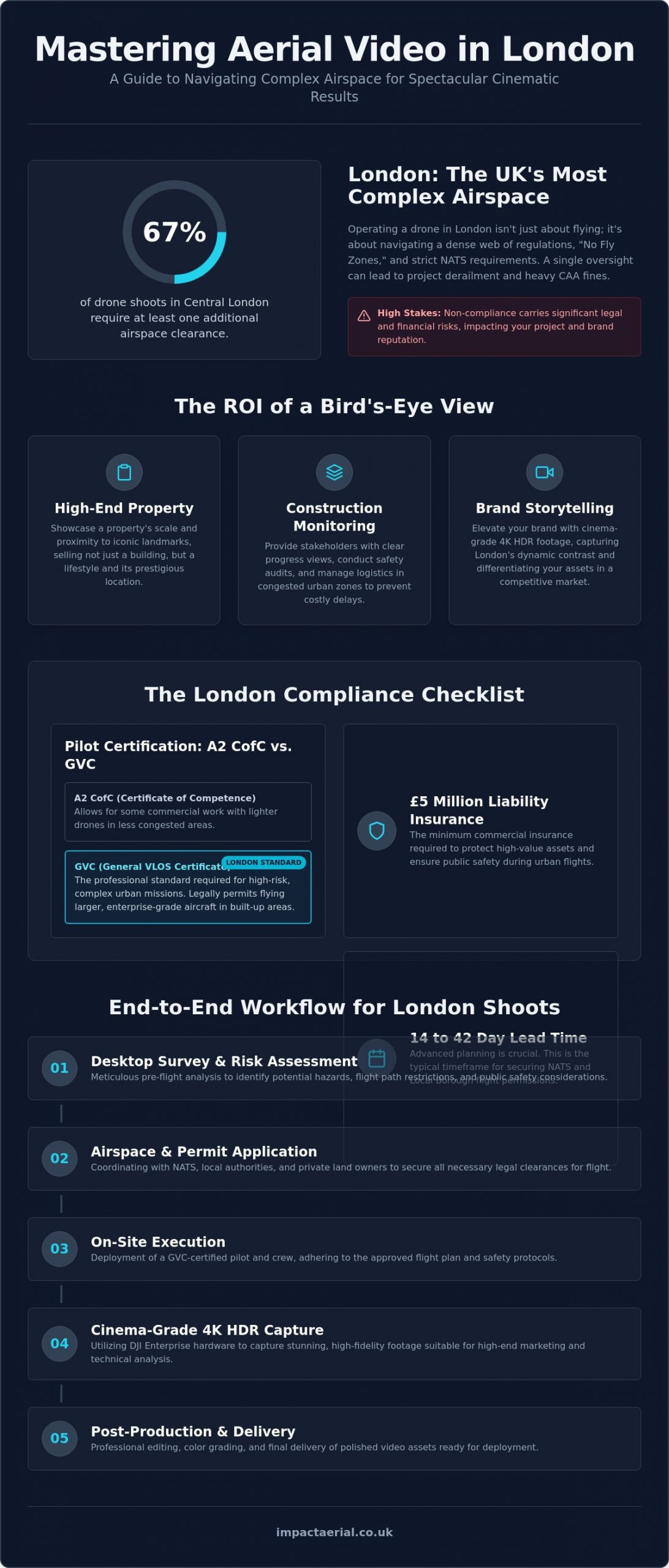
Legal Requirements for Commercial Drone Use in the UK: A 2026 Compliance Guide

Would your business reputation survive a £5,000 fine and a criminal record simply because you misjudged the legal distance between a drone and a congested area? It’s understandable why many UK operators feel overwhelmed by the transition from the old PfCO to the GVC or struggle to understand the legal requirements for commercial drone use uk in 2026. You want to focus on capturing high-quality data and professional imagery, not spending hours decoding a complex Civil Aviation Authority (CAA) CAP 722 document.

This guide simplifies the current regulatory framework, ensuring you understand the exact certifications and insurance mandates needed to fly legally. We’ll provide a clear checklist for compliance, explain the critical differences between the A2 CofC and GVC, and show you how to secure the necessary peace of mind for your next project. By the end of this article, you’ll know exactly how to protect your business from the risks of illegal flight operations while maintaining the highest safety standards.

Key Takeaways

  • Define “valuable consideration” in the 2026 landscape to ensure your business flights remain fully compliant with the latest CAA regulatory framework.
  • Determine whether your operations require a GVC or an A2 CofC to ensure your pilots hold the correct qualifications for Specific or Open category flights.
  • Master the legal requirements for commercial drone use uk, including the mandatory EC 785/2004 insurance standards required for professional data-gathering and surveys.
  • Implement essential safety protocols for Operator and Flyer IDs to maintain meticulous records and provide added peace of mind for your clients.
  • Protect your organisation from the “shared liability” trap by understanding the legal risks and potential fines associated with hiring uncertified drone operators.

Understanding the CAA Regulatory Framework in 2026

The Civil Aviation Authority (CAA) serves as the sole arbiter of UK airspace, managing a complex ecosystem that now includes over 600,000 registered drone users. By 2026, the regulatory landscape has matured into a sophisticated, risk-based framework where safety and accountability are paramount. Understanding the legal requirements for commercial drone use uk is no longer optional for businesses; it’s a fundamental prerequisite for operational continuity. The CAA ensures that every commercial flight operates within a system designed to protect the public while allowing the drone industry to contribute an estimated £45 billion to the UK economy by 2030.

Staying compliant is essential for maintaining a professional reputation. Unauthorised flights don’t just risk heavy fines; they invalidate commercial liability insurance. For professional operators, adhering to these rules provides clients with vital peace of mind, proving that the pilot is a meticulous, vetted specialist capable of handling high-value data-gathering tasks safely.

The Legal Definition of Commercial Drone Operations

The UK legal system defines commercial use through the concept of “valuable consideration.” If a pilot receives payment, goods, or even a reciprocal service in exchange for a flight, the operation is commercial. An estate agent filming a £500,000 listing is conducting a commercial flight. If a hobbyist captures sunset footage and later sells it to a marketing agency, that transition from personal use to business gain requires a professional qualification. Using “hobbyist” footage for commercial marketing without the correct certifications is a breach of the Air Navigation Order 2016, which can result in a £2,500 fine and a permanent black mark on a company’s safety record.

The Evolution of Drone Laws: What Changed for 2026?

The transition from the old PfCO (Permission for Commercial Operation) to the current GVC (General Visual Line of Sight Certificate) is now complete. The latest version of CAP 722, the UK’s primary drone guidance document updated in January 2026, reflects a shift toward total digital accountability. A major change is the full implementation of Remote ID for all commercial drones. This technology broadcasts the drone’s location and the operator’s ID in real-time, allowing the CAA to monitor the 20% increase in commercial drone traffic recorded since 2024. These legal requirements for commercial drone use uk ensure that professional services remain distinct from recreational flying, maintaining high standards for aerial inspections and photogrammetry across the West Midlands and the wider UK.

Mandatory Pilot Qualifications: GVC vs. A2 CofC

Understanding the legal requirements for commercial drone use uk begins with distinguishing between two primary certifications. Since the UK transitioned to its current regulatory framework on 31 December 2020, the Civil Aviation Authority (CAA) has categorised drone flights based on operational risk rather than the previous distinction between commercial and recreational use. This shift makes holding the correct qualification vital for insurance validity and site safety.

The GVC: The Gold Standard for Professional Operators

The General Visual Line of Sight Certificate (GVC) is the benchmark for high-level professional operations. It’s the mandatory requirement for pilots operating within the “Specific” category. The syllabus is rigorous, covering technical drone knowledge, meteorology, navigation, and aviation law. Unlike basic certificates, the GVC requires a formal practical flight assessment conducted by an Approved Training Organisation (RAE).

A critical component of GVC status is the Operations Manual. This document is a bespoke safety blueprint that must be submitted to the CAA to obtain an Operational Authorisation. It details exactly how an operator manages risks, maintains equipment, and handles emergencies. For complex industrial inspections or urban filming, this level of documentation isn’t just a preference; it’s a legal necessity. We prioritise GVC-certified pilots for our complex projects because this qualification permits flights that are often restricted for lower-level certificate holders.

A2 CofC: The Entry Level for Commercial Work

The A2 Certificate of Competence (A2 CofC) allows for operations in the “Open” category. It’s often sufficient for low-risk tasks using drones weighing less than 2kg. For example, a pilot using a 249g drone can fly commercially with an A2 CofC, provided they follow the “fly over people, but not over crowds” rule. However, the limitations are significant. For drones between 500g and 2kg, pilots must maintain a 50-metre horizontal separation from uninvolved persons.

  • A2 CofC: Best for small-scale estate agency photography or rural surveys.
  • GVC: Essential for construction sites, infrastructure inspections, and congested areas.
  • Separation Rules: GVC holders with an Operational Authorisation can often fly as close as 30 metres to uninvolved people during take-off, providing much greater flexibility.

Hiring a GVC-certified pilot typically offers a better return on investment for businesses. While an A2 pilot might be grounded by proximity restrictions, a GVC pilot has the training and legal standing to complete the mission safely. You can verify a pilot’s credentials by asking for their Flyer ID and checking the CAA digital portal. For added peace of mind, you can review our professional credentials to see how we maintain the highest standards of safety and compliance across the West Midlands and beyond.

Risk-Based Operational Categories: Where Does Your Project Fit?

The UK Civil Aviation Authority (CAA) organises all flights into three risk-based tiers. Your project’s category depends on the aircraft’s weight and how close you intend to fly to people or property. Identifying your tier early is vital for meeting the legal requirements for commercial drone use uk and ensuring your site remains compliant.

  • The Open Category: This covers low-risk flights. It is subdivided into A1, A2, and A3 based on the drone’s weight and its proximity to people. Limitations are strict; you generally cannot fly over uninvolved persons.
  • The Specific Category: This is where the majority of professional aerial work happens. It requires an Operational Authorisation from the CAA, allowing for missions that exceed the standard limits of the Open Category.
  • The Certified Category: This tier is reserved for high-risk operations. It includes future applications like large-scale cargo delivery or passenger-carrying “air taxis.” These missions are regulated similarly to manned aviation.

The Open Category and “Sub-250g” Myths

Many new operators believe that flying a drone weighing less than 250g removes all regulatory burdens. This isn’t true for professional work. While sub-250g drones in the A1 sub-category offer more freedom near people, they still require the pilot to have valid commercial insurance and an Operator ID. “Toy” drones lack the sensor stability and GPS precision required for high-grade data. Professional results demand hardware that can handle wind resistance and maintain sub-centimetre accuracy; features rarely found in the lightest consumer models.

Specific Category and Operational Authorisation

For added peace of mind, most commercial clients prefer operators working within the Specific Category. This requires an Operational Authorisation (OA), which is granted after the CAA reviews an operator’s safety manuals and risk assessments. It allows us to fly closer to buildings and people than the Open Category allows. This flexibility is essential for complex urban environments.

For example, we recently conducted a drone survey in the congested Birmingham city centre. Because the site was surrounded by high-rise offices and busy footpaths, Open Category rules were impossible to follow safely. By using our CAA-approved OA and a PDRA01 risk framework, we deployed a DJI Matrice 350 RTK with a 30m safety buffer. This meticulously planned approach ensured we met all legal requirements for commercial drone use uk while capturing high-resolution structural data that saved the client £5,000 in scaffolding costs.

Essential Compliance Checklist: Insurance, IDs, and Privacy

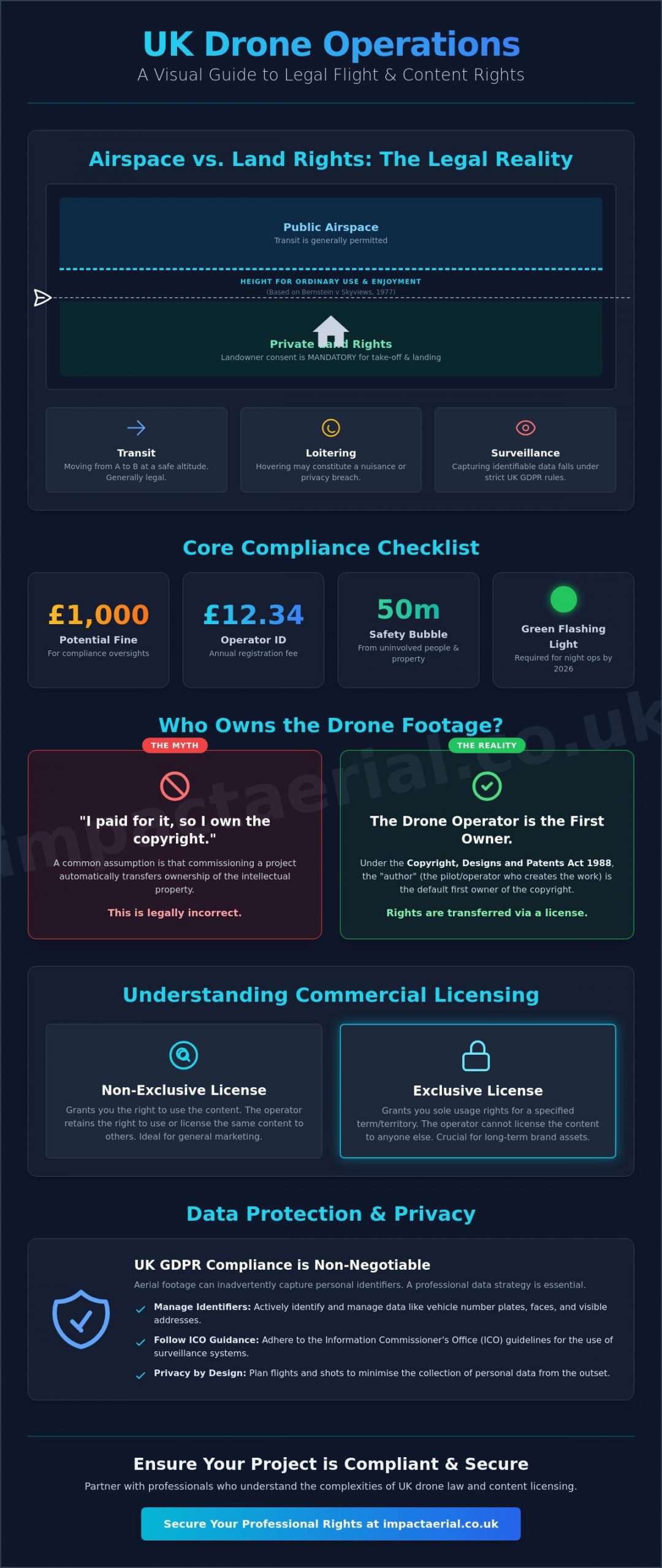
Operating a drone for profit requires more than just a steady hand on the controls. You must satisfy several legal requirements for commercial drone use uk to avoid hefty fines or equipment seizure. The Civil Aviation Authority (CAA) mandates two distinct identifications. The Flyer ID is held by the pilot and requires passing an online theory test to prove competency. The Operator ID is held by the business or individual responsible for the drone. This ID must be clearly displayed on the aircraft body. As of 2024, failing to display an Operator ID can result in a fine of up to £1,000.

Pilots must also remain vigilant regarding Flight Restriction Zones (FRZs). These zones typically extend in a 2 to 2.5 nautical mile radius around approximately 120 UK airports. Flying within these areas without specific permission from Air Traffic Control is a criminal offence under the Air Navigation Order 2016. Using apps like Drone Assist ensures you stay clear of restricted airspace and temporary hazards.

Commercial Liability Insurance: Protecting Your Assets

Professional operators usually carry £5 million in public liability insurance. This figure has become the standard requirement for contractors working with local councils or major construction firms. Standard hobbyist insurance does not cover professional drone services, meaning any accident during a paid job could leave you personally liable for damages. Regulation EC 785/2004 is the mandatory insurance regulation for all UK commercial drone flights as of 2026. This ensures that third parties are protected regardless of the drone’s weight or the complexity of the mission.

Privacy and the Surveillance Camera Code

The Information Commissioner’s Office (ICO) treats drone-captured footage as personal data if individuals or number plates are identifiable. You must comply with UK GDPR by implementing “privacy by design” into your flight planning. For missions in high-density urban environments, we recommend conducting a Privacy Impact Assessment (PIA) to identify risks before the rotors start spinning.

  • Notify residents or business owners 48 hours before a scheduled shoot using physical signage or digital notices.
  • Use post-processing software to blur faces and vehicle registrations that are not central to the project.
  • Securely store all raw data on encrypted drives and delete any footage that is not required for the final deliverable.

Following these steps provides peace of mind for both the operator and the client. Meticulous record-keeping and data management are the hallmarks of a professional service. If you need a fully compliant partner for your next project, you can book a certified drone specialist here.

The Risks of Non-Compliance and Why Professional Hire Matters

Ignoring the legal requirements for commercial drone use uk doesn’t just endanger the pilot. It triggers a shared liability trap. If a contractor operates illegally and causes an accident, the client often shares the legal and financial burden. Courts frequently examine whether a company performed adequate due diligence before commissioning a flight. If you didn’t verify that the operator was authorised, you’ve likely failed that legal test.

Financial and Reputational Consequences

The financial stakes for illegal flights are significant. Under the Air Navigation Order 2016, the Civil Aviation Authority (CAA) has the power to issue fines reaching £5,000 for safety breaches. In more severe cases involving the endangerment of aircraft or the public, criminal prosecution can lead to unlimited fines or custodial sentences.

Beyond legal penalties, an incident with an uninsured pilot can bankrupt a small firm. Standard public liability insurance doesn’t cover commercial drone activities; only specialist policies meeting EC 785/2004 standards are valid. A single crash into a glass facade or a crowded public space could result in millions of pounds in claims. Your brand’s reputation is also on the line. A viral video of a safety failure or a privacy breach linked to your project can destroy years of built-up consumer trust in seconds.

The Impact Aerial Advantage

Understanding the legal requirements for commercial drone use uk is essential for any project manager. Impact Aerial removes this burden through meticulous planning and expert execution. We hold full GVC certification and carry £5m in commercial liability insurance, providing the peace of mind that hobbyist flyers cannot offer.

Our team specialises in the West Midlands, where we regularly manage the complex Flight Restriction Zones (FRZs) around Birmingham Airport and the National Exhibition Centre (NEC). We handle all local authority coordination and airspace permissions, ensuring your data gathering or filming is 100% compliant. Contact us today to discuss how we can safely deliver high-quality aerial results for your next project.

Professional Hire Checklist

Before you book any aerial services, use this checklist to verify your pilot’s credentials:

  • Valid Certification: Ask to see their drone license (GVC or PfCO).
  • Operational Authorisation: Ensure they have a current document issued by the CAA.
  • Specialist Insurance: Confirm they have commercial insurance that specifically mentions drone operations.
  • Risk Assessment: A professional will always provide a site-specific safety plan before take-off.
  • Experience: Check for a portfolio that shows they’ve worked in similar environments, such as busy city centres or construction sites.

Don’t take risks with your business. Hiring a vetted, professional operator is the only way to ensure your project remains safe, legal, and insured.

Securing Your Skies with 2026 Regulatory Standards

Adhering to the legal requirements for commercial drone use uk is a vital step in protecting your business from liability and ensuring operational safety. The 2026 CAA framework demands a precise understanding of risk categories and pilot certifications, specifically the distinction between A2 CofC and GVC qualifications. It’s clear that maintaining a valid Operator ID and robust insurance coverage is the only way to operate legally in the UK’s increasingly busy airspace. Taking these steps prevents costly legal interruptions and ensures your data-gathering remains professional and ethical.

Impact Aerial simplifies this process by providing CAA GVC Certified Pilots who are experts in the latest regulatory changes. For added peace of mind, we carry £5m Commercial Liability Insurance and utilise DJI Enterprise Grade Equipment to deliver breath-taking, high-precision results. Our team manages every technical detail, from risk assessments to privacy compliance, so your project stays on track. Book a CAA-certified pilot for your next project and elevate your business with confidence.

Frequently Asked Questions

Do I need a license to use a drone for my business in the UK?

You don’t need a specific “commercial license” anymore, but you must hold valid CAA authorisations to operate legally. Since 31 December 2020, the legal requirements for commercial drone use uk dictate that you need an A2 Certificate of Competency (A2 CofC) or a General Visual Line of Sight Certificate (GVC). These qualifications prove you’ve reached the professional standards necessary to manage flight safety and risk assessments.

What is the difference between a Flyer ID and an Operator ID?

A Flyer ID is awarded to the individual pilot after passing a CAA theory exam, while the Operator ID is the registration number for the person or business responsible for the drone. You must be 18 or over to get an Operator ID, which costs £11.13 annually. It’s mandatory to label every drone in your fleet with this unique ID. The Flyer ID is free, lasts for five years, and confirms you understand the basic safety rules.

Can I fly a drone commercially in London or Birmingham city centres?

You can fly in these cities, but you must navigate complex Flight Restricted Zones (FRZs) and obtain specific permissions. In Birmingham, for example, operations within the 5km FRZ of Birmingham Airport require direct approval from Air Traffic Control. Professional pilots use the GVC qualification to fly closer to people and buildings in congested areas. We manage these legal requirements for commercial drone use uk by conducting meticulous site surveys and securing all necessary NSF approvals before take-off.

Is it illegal to hire a drone pilot who doesn’t have CAA insurance?

Hiring a pilot without EC 785/2004 compliant insurance is a significant breach of UK aviation safety regulations. Commercial operators must carry third-party liability insurance to fly for “valuable consideration,” which includes any business-related task. For added peace of mind, always verify that your pilot holds a specialist policy with at least £1 million in cover. Choosing an uninsured hobbyist puts your business at financial and legal risk if an incident occurs.

What happens if a commercial drone crashes and I hired the pilot?

The pilot in command is legally responsible for the flight, but your business could face secondary liability if you didn’t check their credentials. If the operator is GVC certified and carries commercial insurance, their policy covers property damage or personal injury. We provide full risk assessments and proof of insurance for every project. This professional approach ensures your company remains protected from the fallout of any technical failures or accidents.

How do I check if a drone pilot is actually CAA GVC certified?

You should ask the pilot to provide their GVC certificate and their CAA Operator ID number before hiring them. Legitimate professionals will also be listed on vetted platforms like the Drone Safe Register or ARPAS-UK. You can cross-reference their details against the CAA’s list of authorised operators. A trustworthy specialist will always be happy to share their documentation to demonstrate their commitment to safety and compliance.

Do I need to inform the police before a commercial drone flight?

You don’t typically need to notify the police for standard commercial operations, but you must follow CAA notification procedures in certain areas. For high-profile shoots in city centres, we often contact local authorities as a courtesy to prevent public concern. This proactive communication is a hallmark of professional services. It ensures that your project proceeds without interruptions from security or law enforcement officers.

How much does a commercial drone license cost in the UK in 2026?

Budgeting for 2026, you should expect a GVC training course to cost between £500 and £850 depending on the provider. The annual CAA Operator ID fee is currently £11.13, though this figure often increases by 5% to 10% every few years. When you include specialist commercial insurance, which starts at around £600 annually, the total cost to stay compliant is roughly £1,200 for the first year. These fees ensure your business operates within the legal framework established by the Civil Aviation Authority.

Best Drone for Property Photography 2026: The Professional’s Guide

Buying the wrong drone for your property business could cost you more than just the hardware; it could cost you thousands in CAA fines and invalidate your commercial liability insurance. It’s a common and expensive pitfall for professionals eager to capture those breathtaking, high-level perspectives that can accelerate a sale. You’re right to believe that high-quality aerial imagery is no longer a luxury but a necessity in a competitive market, but achieving it legally and safely is a complex challenge.

This guide is designed to provide complete operational clarity. We’ll identify the best drone for property photography 2026, breaking down the top models that deliver stunning 4K HDR results without an enterprise-level price tag of over £10,000. More importantly, we’ll demystify the operational requirements, from CAA compliance to insurance, ensuring your investment generates top-quality assets and total peace of mind, not legal headaches.

Key Takeaways

  • Understand the key specifications that make models like the DJI Mavic 4 Pro the best drone for property photography 2026, and learn why dual-lens systems are a game-changer.
  • Navigate the complexities of UK aviation law by clarifying the essential CAA GVC (General Visual Line of Sight Certificate) requirements for professional property marketing.
  • Calculate the true return on investment by weighing the purchase price against the often-overlooked costs of professional training, software, and ongoing maintenance.
  • Discover why the hardware is only half the battle and learn how professional post-production transforms raw footage into compelling, high-impact marketing assets.

The State of Property Photography in 2026: Why Quality Matters

The landscape of UK property marketing has been irreversibly altered by drone technology. What was once a luxury for multi-million-pound estates is now a fundamental expectation across the market. Today’s prospective buyers, conditioned by high-definition content in every aspect of their digital lives, no longer see professional aerial photography as a novelty. In 2026, its absence is often perceived as a sign of an incomplete or poorly managed listing.

To understand the cinematic potential and technical considerations involved, the following guide offers valuable insights into modern real estate videography:

This shift is backed by compelling data. A 2025 market analysis by Zoopla indicated that UK property listings incorporating professional aerial video see a 43% higher click-through rate from initial searches. More importantly, these properties experience an average reduction in ‘time on market’ of up to 22%. The reason is simple: aerial views provide an unparalleled sense of scale, context, and desirability that ground-level shots cannot replicate. They immediately answer buyers’ key questions about a property’s boundaries, garden size, orientation, and relationship to its neighbours.

This elevated standard is driven by advancements in sensor technology. The 1/2.3-inch sensors common in consumer drones just a few years ago are now obsolete for high-end work. The best drone for property photography 2026 will feature at least a 1-inch or Micro Four Thirds sensor. These larger sensors capture far more light and data, producing images with the wide dynamic range needed to show detail in both the bright sky and the shadowed eaves of a building simultaneously, eliminating the amateurish, washed-out look of older equipment.

Visual Standards for 2026 Real Estate

The standard has shifted decisively. 4K High Dynamic Range (HDR) video is now the absolute baseline for online listings, while 8K still photography is essential for premium print marketing and for allowing digital users to zoom into details without image degradation. Submitting grainy or poorly composed drone shots for a property valued over £750,000 can actively damage the brand of the estate agent and the perceived value of the listing itself. A skilled pilot doesn’t just capture a building; they tell its story, revealing its context within the neighbourhood. This practice is a sophisticated evolution from the early history of aerial photography, now focused on creating a compelling lifestyle narrative that sells not just a house, but a location.

This principle of storytelling through imagery is a hallmark of all high-end photography. The powerful portraiture from studios like Wow Photography, for example, excels at capturing the unique character of its subjects—a skill that translates directly to conveying the distinct personality of a home.

Commercial vs. Residential Requirements

While residential photography focuses on emotional appeal, commercial property requirements are far more data-driven. A commercial developer, construction firm, or facilities manager requires actionable intelligence, not just a pretty picture for a brochure. This is where professional drone services diverge into technical operations, moving from marketing into ‘Data Collection Surveys’. These CAA-regulated flights use specialised payloads and software for:

  • Photogrammetry Surveys: Creating centimetre-accurate 3D models of sites and structures for planning.
  • Topographical Mapping: Generating detailed land contour maps for development and architectural design.
  • Construction Progress Monitoring: Providing key stakeholders with verifiable visual data on project milestones.

Top 3 Drones for Property Photography: 2026 Technical Breakdown

Selecting the optimal drone for property photography is no longer about simply getting a camera in the air. For 2026, the decision hinges on the specific application, from residential marketing to complex commercial surveys. The market leader, DJI, offers a tiered range of professional aircraft, each engineered for distinct outcomes. Understanding the technical differences is paramount to delivering top-quality, legally compliant aerial imagery that provides a genuine return on investment.

Here we provide a technical breakdown of the three models that define the professional landscape, helping you identify the best drone for property photography 2026 for your specific commercial needs.

The Premium Choice: DJI Mavic 4 Pro

For high-end residential property marketing, the DJI Mavic 4 Pro remains the gold standard. Its primary advantage is the Hasselblad camera system, built around a Micro Four Thirds (MFT) sensor. This larger sensor captures significantly more light and data than the 1-inch sensors found in prosumer models, resulting in superior dynamic range and low-light performance. This is critical for capturing those coveted “golden hour” shots with deep, rich colours and minimal noise. The ability to shoot in 10-bit D-Log M provides immense flexibility in post-production, allowing for precise colour grading to match a client’s branding.

Its compact, sub-900g airframe and advanced omnidirectional obstacle avoidance make it perfect for navigating the tight confines of urban property shoots. Operating in congested areas, such as the dense residential streets of Birmingham and the West Midlands, demands not only pilot skill but also strict adherence to UK drone regulations, and the Mavic 4 Pro’s safety features provide an essential layer of risk mitigation.

  • Pros: Unmatched image quality in its class, exceptional low-light capability, and excellent portability for rapid deployment.
  • Cons: Lacks a mechanical shutter, making it less suitable for high-precision photogrammetry work where geometric accuracy is vital.

The Versatile Contender: DJI Air 3S

The DJI Air 3S carves out its niche with a powerful dual-lens system that is a genuine game-changer for creative property shots. While its main wide-angle camera features a capable 1/1.3-inch sensor, the inclusion of a 3x medium telephoto lens (a 70mm equivalent) unlocks the power of lens compression. This effect subtly flattens the perspective, making properties appear more majestic and allowing features like landscaped gardens or swimming pools to be framed without the wide-angle distortion that can plague single-lens drones. For agents looking to create a more cinematic and visually compelling portfolio, the Air 3S offers creative flexibility that was previously only available on much larger, more expensive platforms.

The Commercial Workhorse: DJI Mavic 3 Enterprise (M3E)

When the mission shifts from marketing to data-gathering, the DJI Mavic 3 Enterprise is the essential tool. Its key differentiator is a wide-angle camera equipped with a mechanical shutter. This is non-negotiable for professional survey work, as it eliminates the rolling shutter distortion that can corrupt data, ensuring every photograph is geometrically precise for creating crisp, blur-free orthomosaic maps and 3D models.

Furthermore, the M3E’s compatibility with an RTK (Real-Time Kinematic) module provides centimetre-level positioning accuracy. This is the standard required for professional land surveying, boundary mapping, and construction progress monitoring. For more advanced applications, the M3T variant includes a 640×512 resolution thermal camera, ideal for conducting building heat-loss inspections and identifying roof moisture ingress. Understanding which tool is right for your project is key, and our professional commercial drone services are tailored to these specific, data-critical needs.

UK Drone Regulations & Safety: The ‘Hidden’ Cost of 2026 Compliance

Selecting the hardware is only the first step. The true cost and value of professional aerial imaging are rooted in legal compliance and operational safety. For property professionals, overlooking these factors introduces significant financial and reputational risk. The impressive capabilities of the best drone for property photography 2026 are rendered useless, and even dangerous, without a certified pilot operating within the strict framework set by the UK’s Civil Aviation Authority (CAA).

Hiring an uncertified pilot simply to save a few hundred pounds is a high-risk gamble. In the event of an incident, the liability can fall directly on the commissioning business, leading to potential fines that, under the Air Navigation Order 2016, can be unlimited. This section unpacks the non-negotiable legal and insurance requirements that define professional drone services in the UK.

Navigating the Civil Aviation Authority (CAA)

Since the major regulatory overhaul on 31st December 2020, UK drone operations fall into distinct categories. The ‘Open’ category is for low-risk, recreational flights away from people. Commercial property photography, especially in urban areas, almost always falls into the ‘Specific’ category. This category requires the drone operator to hold an Operational Authorisation from the CAA, for which the General Visual Line of Sight Certificate (GVC) is the standard qualification. This certification, which replaced the older PfCO, proves a pilot has the theoretical knowledge and practical skill to operate safely, manage risk, and understand complex aviation principles. For operations in congested areas like central Birmingham or the dense urban centres of the West Midlands, a GVC isn’t just a recommendation; it’s a fundamental requirement for legal flight.

Insurance and Risk Management

A professional pilot’s commitment to safety extends far beyond their qualifications. Before a drone even leaves its case, a meticulous process of risk management begins. This is a key differentiator that hobbyist insurance simply doesn’t cover. Standard recreational policies are not valid for any form of commercial work, or ‘for valuable consideration’.

  • Commercial Liability: The industry standard for professional operators is a minimum of £5 million in commercial liability insurance, compliant with regulation EC785/2004. Always ask to see a current certificate.
  • Pre-Flight Risk Assessment: A certified pilot will conduct a detailed site survey and risk assessment, identifying potential hazards like air traffic, public footpaths, power lines, and data privacy concerns. This isn’t just paperwork; it’s a strategic plan to ensure a safe and successful shoot.
  • Brand Protection: An incident with an uninsured or uncertified pilot can cause irreparable damage to your brand. For added peace of mind, partnering with a fully compliant operator demonstrates due diligence and protects your business from legal entanglements and negative press. The expanding scope of commercial drone applications from simple photography to complex data-gathering makes this professional oversight more critical than ever.

Ultimately, the investment in a GVC-certified and properly insured drone pilot is an investment in certainty. It ensures your property marketing is not only visually stunning but also legally sound and professionally executed.

Buy vs. Hire: Calculating the ROI of Professional Drone Services

For many estate agencies, the question isn’t if they should use aerial imagery, but how. The temptation to purchase a drone in-house is strong, but a simple cost comparison between hardware and a day rate is dangerously misleading. A true Return on Investment (ROI) calculation reveals the extensive hidden costs and operational burdens of an in-house programme. The decision to buy or hire directly impacts your time, legal compliance, and the final quality of your property listings.

An in-house pilot doesn’t just fly a drone. They become a dedicated aviation manager, video editor, and legal compliance officer. Outsourcing to a professional service liberates your team from these roles, saving, on average, over 20 hours of non-core work per property. This includes pre-flight risk assessments, airspace checks, travel, on-site capture, data processing, and professional-grade editing. That’s time your agents can reinvest directly into sales and client management.

The Real Cost of In-House Drone Operations

The initial investment for what’s considered the best drone for property photography 2026 can range from £2,000 to over £10,000 for a commercial-grade system. For those looking to purchase, online retailers like DroneHundred offer a range of professional models. This capital expenditure is just the entry fee. The ongoing operational costs quickly eclipse the initial purchase price, creating a significant financial drain that a simple service fee avoids. A comprehensive breakdown includes:

  • Training & Certification: A commercial operator in the UK must hold a CAA-issued General Visual Line of Sight Certificate (GVC). The initial training and exam costs approximately £1,000, with ongoing professional development required to stay current with evolving 2026 regulations.
  • Commercial Insurance: Public Liability Insurance compliant with EC 785/2004 is a legal requirement for commercial drone work. Policies for new operators typically start at £750 per annum.
  • Software Subscriptions: Professional output demands professional tools. Monthly subscriptions for software like Adobe Creative Cloud for video editing (£51.98/month) and Pix4D for 3D mapping (£280/month) are standard.
  • Maintenance & Depreciation: A commercial drone depreciates rapidly. A £5,000 drone today may be worth less than £2,500 in 24 months. Factoring in battery replacements (£170 each) and potential repairs adds hundreds more to the annual cost.

The Professional Advantage

Partnering with a certified drone services provider offers far more than just aerial footage; it provides operational excellence and guaranteed quality control. A pilot with a CAA GVC isn’t just a hobbyist. They are a trained aviator, capable of conducting detailed risk assessments and securing permissions to fly in congested areas or near flight restriction zones, unlocking perspectives an untrained operator legally cannot achieve.

This expertise extends beyond the flight itself. Professional services deliver reliability. We handle all project management, from monitoring weather patterns with advanced forecasting tools to ensure optimal lighting, to managing all CAA-required documentation for full legal compliance. For added peace of mind, this process ensures every listing, whether it’s a single home in Birmingham or a portfolio of properties across the UK, is captured and produced to the exact same high-quality brand standard. You don’t just hire a pilot; you gain access to a full team of post-production experts who transform raw data into breath-taking, cinematic property tours. To ensure your listings benefit from this professional edge and achieve maximum market impact, contact our team for a professional consultation.

Elevating the Results: Beyond the Raw Drone Footage

Capturing high-resolution images and 4K video is only the first step. The true value in professional aerial property marketing is unlocked in post-production, where raw data is transformed into compelling assets. A top-tier drone provides the potential, but it’s the expert handling of that footage and data that delivers a tangible return on investment. The best drone for property photography 2026 isn’t just about the hardware; it’s about the entire ecosystem of services that turns aerial captures into breath-taking, actionable results.

At Impact Aerial, our process is meticulously designed to maximise the potential of every flight. From initial consultation and CAA-compliant flight planning to the final polished edit, we provide an end-to-end professional service. We understand that turning raw footage into a high-quality marketing film or a precise technical survey requires a distinct set of skills that goes far beyond piloting the drone itself.

Cinematic Editing for Property

The difference between raw drone footage and a finished property film is stark. Raw video, often shot in a flat colour profile to retain maximum data, can appear dull and uninviting. Our professional post-production process involves several critical stages to create a polished, engaging asset:

  • Colour Grading and Correction: We meticulously adjust colours to ensure the property looks its absolute best, making lawns appear lush and skies a vibrant blue. For shoots on overcast days, a common reality in the UK, we can perform professional sky replacements to present the property in its most appealing light.
  • Branding and Information: We integrate your company branding, logos, and contact details directly into the video. By adding a professionally licensed music track and clear call-to-actions, we transform a simple fly-over into a powerful marketing tool that actively generates leads.

Looking ahead to 2026, optimising for social media is non-negotiable. With over 70% of property searches starting on mobile devices, vertical video is essential. We re-frame our 4K footage for platforms like Instagram Reels and TikTok, creating dynamic, fast-paced edits in a 9:16 aspect ratio that are proven to hold viewer attention and increase share rates by up to 25%.

Technical Data and Virtual Tours

Beyond marketing, the data-gathering capabilities of modern drones offer immense value. We use advanced photogrammetry techniques to create assets that give potential buyers and investors unparalleled insight into a property before they ever set foot on site. This includes integrating high-resolution aerial shots into 3D virtual tours like Matterport, allowing a user to seamlessly transition from a “dollhouse” overview of the entire property and its grounds directly into an internal walk-through.

For commercial clients, this data becomes a critical tool for surveying and inspection, delivering significant cost savings. Our services include:

  • Roof and Building Inspections: Safely identify structural issues, water ingress, or damage without the cost and risk of scaffolding, reducing inspection costs by an average of 60%.
  • Thermal Assessments: Using specialised thermal sensors, we can pinpoint areas of heat loss in a building’s envelope, providing data that can lead to energy efficiency improvements saving a business thousands of pounds annually.
  • Large-Scale Surveys: We conduct detailed surveys for large sites, including commercial developments and PV Solar Farms, providing accurate data for planning and maintenance.

Leveraging the full spectrum of aerial capabilities, from cinematic video to precise technical data, is what separates an amateur operator from a professional partner. To discover how our comprehensive services can benefit your property portfolio, contact Impact Aerial for a professional property consultation.

Elevate Your 2026 Property Listings with Professional Aerial Imagery

Choosing the right aerial strategy for your properties in 2026 goes far beyond picking a drone from a list. It’s about understanding that superior image quality, strict adherence to UK drone regulations, and a positive return on investment are all interconnected. While owning the equipment seems appealing, the hidden costs of CAA compliance, insurance, and maintenance can easily surpass £2,000 per year. Navigating these complexities is crucial to successfully leveraging the best drone for property photography 2026.

Instead of managing the hardware and legalities yourself, partner with a trusted specialist. At Impact Aerial, our CAA GVC Certified pilots provide complete peace of mind with £5m in commercial liability insurance. As the leading specialists in Birmingham and the West Midlands, we deliver not just raw footage, but a full suite of services including expert post-production and immersive virtual tours. Let us handle the technical details so you can focus on selling.

Ready to make your listings stand out from the competition? Book Your Professional Property Drone Shoot with Impact Aerial and see the difference true expertise makes.

Frequently Asked Questions

Do I need a license to take drone photos of my own property listings in the UK?

Yes, you do. If you’re using drone photos for any commercial purpose, including marketing your own property listing, it’s considered ‘material consideration’ by the UK’s Civil Aviation Authority (CAA). This requires the operator to hold a relevant qualification, such as an A2 Certificate of Competency (A2 CofC) or a General Visual Line of Sight Certificate (GVC), and to have appropriate commercial insurance. Operating without these can result in significant legal penalties.

What is the best drone for real estate photography in 2026?

The best drone for real estate photography in 2026 is one that offers a superior camera sensor and robust flight stability, such as the DJI Mavic 3 Pro. Its triple-camera system provides exceptional versatility for capturing wide establishing shots and detailed telephoto images. For professionals seeking the best drone for property photography 2026 with a focus on value, the DJI Air 3’s dual-camera system also delivers professional-grade 48MP photos and stable 4K video, making it a leading contender.

How much does a professional drone property shoot cost in the UK?

A professional drone property shoot in the UK typically costs between £250 and £600. The final price is determined by the property’s size, location, and the required deliverables. A standard package for a residential property, including 10-15 high-resolution stills, will be at the lower end of that range. Larger commercial sites or projects requiring 4K video with extensive editing will naturally command a higher fee, often exceeding £500 due to the increased operational complexity.

Can drones fly in rain or high winds for property surveys?

No, professional drones cannot be operated safely in rain or high winds. Most commercial drones are not waterproof, and moisture can cause catastrophic failure to the electronic systems. Furthermore, CAA operational guidelines and manufacturer limits restrict flight in high winds, typically above 22 mph. To ensure flight stability, client safety, and the acquisition of high-quality data, all professional drone operations are rescheduled if adverse weather conditions are present.

What insurance does a drone pilot need for commercial work?

For any commercial work in the UK, a drone pilot must hold a specialist insurance policy that is compliant with regulation EC 785/2004. This policy must include public liability insurance, with the industry standard being a minimum coverage of £1 million. For added peace of mind, most reputable professional services carry higher indemnity levels, often between £5 million and £10 million, especially when operating on sensitive or large-scale commercial sites. Always ask to see a current insurance certificate.

How long does a typical drone property shoot take?

A typical drone shoot for a standard residential property takes approximately 60 to 90 minutes on-site. This time includes conducting essential pre-flight risk assessments and safety checks, followed by 20-40 minutes of active flight to capture all the required imagery. Larger commercial properties or rural estates can require 2-3 hours on-site to ensure full coverage. This timeframe does not include the off-site post-production time needed for photo and video editing.

What is the difference between a 4K and 8K drone for property?

The key difference is video resolution; an 8K drone captures four times the number of pixels as a 4K drone, offering far greater detail. This allows for significant cropping or digital zooming during post-production without a noticeable loss in quality. However, for over 95% of property marketing applications, 4K resolution provides an optimal balance of high-quality visuals and manageable file sizes. It’s perfectly suited for online property portals, websites, and social media.

Is it better to buy a DJI Mini or a Mavic for real estate?

For professional real estate photography, a DJI Mavic series drone is definitively the better choice over a DJI Mini. While the Mini is an excellent sub-250g drone, the Mavic series (like the Mavic 3) features significantly larger camera sensors, providing superior dynamic range and low-light performance. Mavics also offer better wind resistance and more advanced flight modes, which are critical for achieving the high-quality, stable, and safe results required in a commercial environment.

Finding a Drone Shop Near Me: A UK Buyer’s Guide for 2026

The prospect of capturing breathtaking aerial perspectives is incredibly exciting, yet the journey from aspiring pilot to confident operator can seem daunting. If you’re grappling with questions about which model is the right investment, feeling intimidated by UK drone laws, or simply trying to find a trustworthy drone shop near me, you are not alone. Making the wrong choice can lead to frustration, unexpected costs in insurance and training, and even legal complications.

This definitive 2025 UK buyer’s guide has been created to provide the clarity and peace of mind you need. We will walk you through locating reputable local and online retailers, demystify the essential Civil Aviation Authority (CAA) regulations that every operator must understand, and help you choose the right equipment without overspending. Furthermore, we’ll explore the critical question of when it’s more effective to hire a certified professional instead of buying. By the end, you’ll have the expert knowledge to purchase and fly with confidence.

Where to Find a Drone Shop: Online Specialists vs. High Street Retailers

When you begin your search for a “drone shop near me,” you will quickly discover two primary avenues: large high street retailers and dedicated online specialists. Each route offers distinct advantages and disadvantages, and the right choice depends entirely on your level of experience, your specific requirements, and the type of after-sales support you value. Making an informed decision at this stage is crucial for a successful purchase and a positive flying experience.

To help you navigate the key features to look for when buying your first drone, this guide offers a professional overview:

High Street Retailers (e.g., Currys, Argos)

High street chains offer the significant benefit of immediacy. You can see and handle the product, make an instant purchase, and benefit from straightforward returns policies. However, the selection is often limited to a few popular, consumer-grade models. Staff, while helpful, typically lack the deep, specialised knowledge required to advise on complex features or CAA regulations. This option is best suited for absolute beginners purchasing their first entry-level drone for recreational use.

Specialist Online Drone Shops (e.g., Leicester Drones)

For enthusiasts and professionals, specialist online stores are the superior choice. They provide an extensive range of models, from advanced consumer drones to commercial-grade platforms. Here, you can find a vast array of accessories, spare parts, and specialised payloads. These retailers employ experts who can offer professional advice on everything from the specific flight characteristics of a particular unmanned aerial vehicle (UAV) to its suitability for tasks like surveying or inspection. The main drawbacks are the inability to see the product before purchase and the wait for delivery.

Key Questions to Ask Any Drone Retailer

Regardless of where you decide to buy, a reputable seller-whether a local drone shop or a national online store-should provide clear, professional answers to critical questions. Before committing to a purchase, ensure you ask:

  • What manufacturer’s warranty is included, and what is your policy for repairs and after-sales support?
  • Can you provide guidance on the current CAA registration requirements and UK flight rules?
  • What are the essential accessories, such as extra batteries or propeller guards, that you recommend for this specific model?

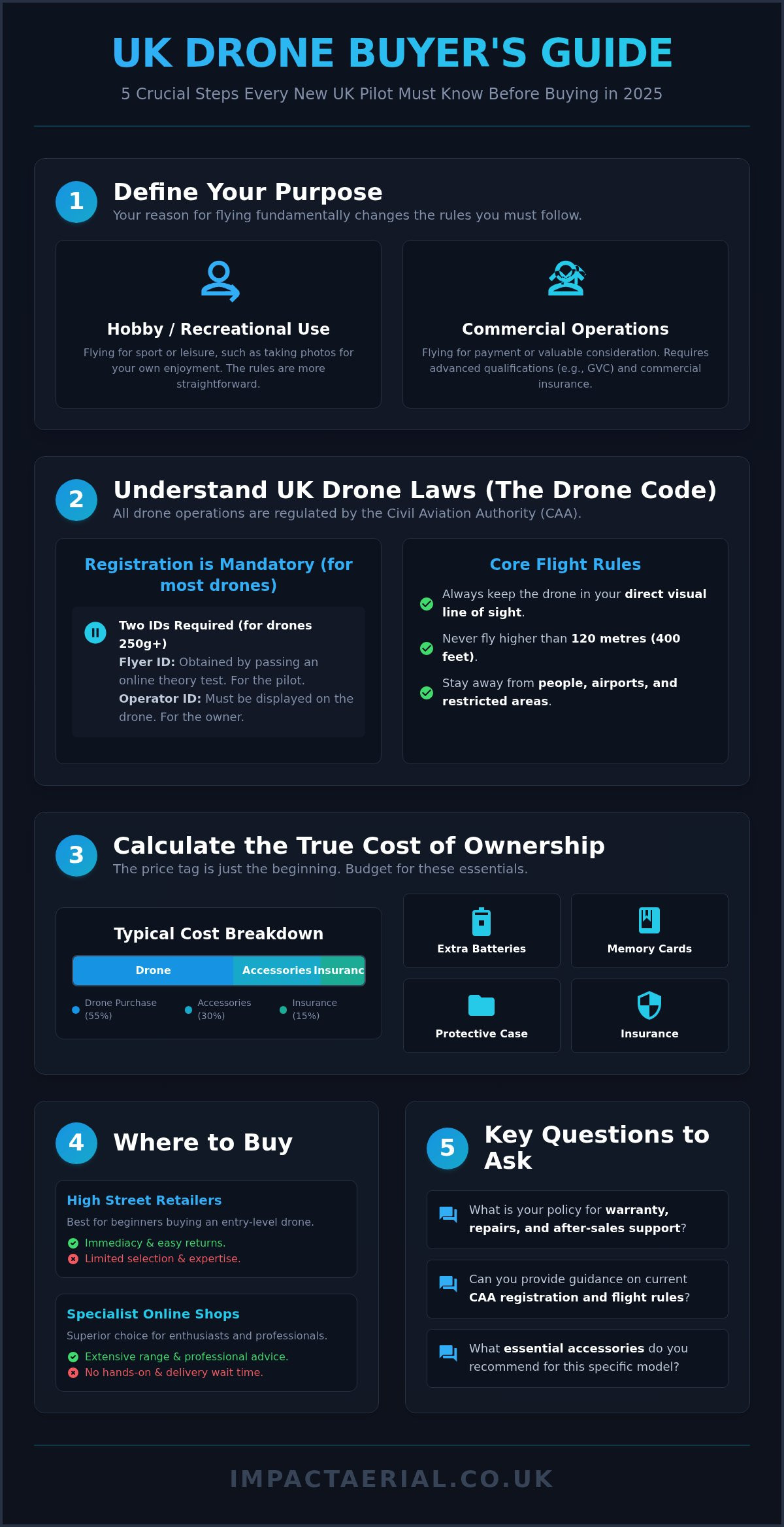
Before You Buy: 5 Crucial Things Every New UK Pilot Must Know

Purchasing a drone is an exciting first step, but it is just the beginning. Before you search for a “drone shop near me” and make a purchase, it’s crucial to understand that operating your new equipment safely and legally is paramount. This guide covers the non-negotiable considerations for any new pilot in the UK. Understanding your purpose, the governing laws, and the true costs involved will not only ensure you buy the right equipment but will also save you significant time, money, and potential legal trouble down the line.

1. Define Your Purpose: Hobby vs. Commercial Use

Your reason for flying fundamentally changes the rules you must follow. The Civil Aviation Authority (CAA) makes a clear distinction between recreational flying (for sport or leisure) and commercial operations (flying for any form of remuneration or valuable consideration). If you plan to take photos for your own enjoyment, the rules are more straightforward. However, if you intend to use the drone for professional services like estate agency photography or inspections, you will require more advanced qualifications, such as a GVC (General Visual Line of Sight Certificate), and commercial-grade insurance.

2. Understand Basic UK Drone Laws (The Drone Code)

In the UK, all drone operations are regulated by the CAA. Their framework, known as the Drone Code, is designed to keep the skies safe for everyone. For most drones (weighing 250g or more), you are legally required to obtain two separate IDs. The person flying must pass an online theory test to get a Flyer ID, and the person responsible for the drone must register for an Operator ID, which must be displayed on the aircraft. You can find the official registration and Flyer ID requirements directly on the CAA website. Key rules include:

  • Always keeping the drone within your direct visual line of sight.
  • Never flying higher than 120 metres (400 feet) from the surface.
  • Staying away from people, airports, and restricted areas.

3. Calculate the True Cost of Ownership

The price tag you see in a drone shop near me is rarely the final figure. To operate effectively and safely, you must budget for essential accessories. This includes extra batteries (as flight times are often limited to 20-30 minutes), high-speed memory cards to handle 4K video, and a protective carry case. Most importantly, you must factor in the cost of insurance. While not legally mandatory for hobbyists, public liability insurance is highly recommended and can start from as little as £20 a year. For commercial work, it is a legal necessity and a core part of any professional service.

From Box to Sky: The Reality of Your First Drone Flight

The excitement of unboxing a new drone is undeniable. After searching for a “drone shop near me” and making your purchase, the urge to immediately launch it is strong. However, this initial enthusiasm must be tempered with a methodical and safety-conscious approach. The journey from a sealed box to a successful, controlled flight involves critical preparation that separates a competent pilot from one destined for a costly accident.

Essential First Steps: Setup and Calibration

Before your drone’s propellers spin for the first time, a series of non-negotiable setup procedures is required. This begins with checking for and installing the latest firmware updates, which often contain vital safety patches and performance improvements. You must then calibrate the drone’s compass and Inertial Measurement Unit (IMU) to ensure stable flight and accurate positioning. Finally, take the time to familiarise yourself with the controller layout and the settings within the flight app, such as DJI Fly, to understand what each button and on-screen display means.

Practice Makes Perfect: Mastering Basic Manoeuvres

Your first flight should take place in a wide-open area, free from people, buildings, and trees. Before you even take off, ensure you are compliant with the UK Civil Aviation Authority drone rules regarding flight locations. Start with the basics: practice hovering at a low altitude, then gently ascend and descend. Master simple directional movements-forward, backward, left, and right-before attempting more complex manoeuvres. Crucially, test the ‘Return to Home’ (RTH) function so you can trust this essential safety feature to bring your drone back if you lose signal or orientation.

Recognising When You Need More Training

Relying solely on a drone’s GPS-assisted and automatic flight modes can create a false sense of security. True piloting skill is developed through manual control and understanding the aircraft’s behaviour. If you find yourself struggling with orientation or reacting slowly to environmental changes, it’s a clear sign that more structured training is needed. For those serious about flying safely and legally, pursuing a qualification like the A2 Certificate of Competency (A2 CofC) provides invaluable knowledge. Knowing your limits is the hallmark of a responsible pilot and underscores why the expertise offered by a professional service often outweighs the simple transaction at a drone shop near me.

When to Hire a Professional Drone Service Instead of Buying

While searching online for a “drone shop near me” seems like the logical first step for an aerial project, purchasing equipment is often not the most effective or economical solution. For any high-stakes or commercial application, buying a drone introduces unforeseen costs, steep learning curves, and significant legal responsibilities. A professional drone service provides a comprehensive solution that includes certified expertise, superior equipment, and guaranteed legal compliance, saving you both complexity and risk.

For Guaranteed, High-Quality Results

The difference in output between a consumer model and professional equipment is vast. Certified operators use commercial-grade drones, like the DJI Enterprise series, which carry specialised payloads for tasks such as high-resolution photogrammetry, detailed inspections, and thermal imaging. You are hiring a skilled pilot who understands cinematic composition and precise data capture. Crucially, professional services include post-production and data analysis to deliver a polished, actionable final product.

For Complex or Regulated Projects

Any drone work conducted for commercial gain in the UK is governed by strict Civil Aviation Authority (CAA) regulations. Projects like roof surveys, construction site monitoring, or filming near crowds require permissions that a hobbyist cannot legally obtain. A CAA GVC Certified operator is trained, assessed, and insured for these complex operations. Hiring a professional service mitigates significant legal and financial risks, ensuring your project is completed safely and in full compliance with UK law.

To Save Time and Long-Term Costs

Investing in professional-grade drone equipment is a major financial commitment, often running into thousands of pounds for the drone, batteries, and sensors. Beyond the hardware, there is the considerable time and cost required for pilot training, certification, and ongoing commercial liability insurance. For one-off or infrequent projects, this expenditure is rarely justifiable. Instead of looking for a drone shop near me, consider the value of hiring an expert on demand.

By engaging a professional service, you gain immediate access to top-tier technology and expertise without the long-term financial burden. Get a quote for your professional aerial project.

Why Choose a Local, Certified Drone Professional in the Midlands?

When your search for a “drone shop near me” leads you to consider your options, it’s vital to understand the fundamental difference between buying a product and procuring a professional solution. A shop sells you the hardware; a certified professional delivers a fully managed, compliant, and insured outcome. This is about hiring expertise and peace of mind, not just a drone.

Working with a local expert in the Midlands means partnering with a team that understands the specific operational landscape of our region, from the complex airspace around Birmingham to the unique geography of the surrounding countryside.

The Importance of CAA GVC Certification

In the UK, all commercial drone operations are strictly regulated by the Civil Aviation Authority (CAA). The General VLOS Certificate (GVC) is the professional qualification required for conducting more complex flights, demonstrating that the pilot possesses a high level of competency in flight planning, risk assessment, and aviation law. Before engaging any operator, you should always request to see their GVC certificate and CAA Operational Authorisation.

Benefits of Local Expertise and Commercial Insurance

A professional based in the West Midlands offers more than just flying skills; they bring invaluable local knowledge. This ensures your project is planned efficiently, with a deep understanding of regional airspace restrictions and local authority bylaws. For your added peace of mind, any reputable service will also hold substantial commercial liability insurance-we carry a policy of £10 million-to ensure your project, property, and the public are fully protected.

Access to Specialised Equipment

The capabilities of a professional drone service are defined by the quality of their equipment. Rather than the off-the-shelf models you might find at a drone shop, commercial operators invest tens of thousands of pounds in highly specialised platforms. This includes drones equipped with:

  • High-resolution thermal cameras for heat-loss surveys and solar farm inspections.
  • Survey-grade RTK/PPK sensors for creating centimetre-accurate 3D models and maps.
  • Powerful zoom lenses for conducting safe, standoff inspections of critical infrastructure like wind turbines and mobile phone masts.

This technology is prohibitively expensive for individual purchase but is fundamental to delivering the accurate, actionable data your business needs. Discover our range of professional drone services.

Your Path Forward: From Buying a Drone to Achieving Professional Results

Choosing the right drone is a significant first step. Whether you opt for an online specialist or a high street retailer, your search for a drone shop near me is just the beginning. As we’ve explored, true success in the air comes from understanding UK aviation regulations, respecting the learning curve of your first flight, and critically, recognising when a project’s complexity and risk demand a professional’s touch instead of a personal purchase.

For commercial applications in Birmingham and the West Midlands that require guaranteed quality and regulatory compliance, Impact Aerial provides the solution. Our team of CAA GVC Certified pilots are experts in advanced DJI Enterprise drones and operate with the full reassurance of £5m commercial liability insurance. We deliver the data-rich, high-quality results that off-the-shelf equipment cannot, ensuring your project is executed safely and professionally.

Instead of buying, elevate your project with proven expertise. Discuss your project with our CAA certified drone pilots today. Embark on your aerial journey with the confidence that comes from having the right professional support.

Frequently Asked Questions

Do I need a license to fly a drone in the UK?

In the UK, if your drone weighs 250g or more, you must register with the Civil Aviation Authority (CAA). This involves passing a theory test to obtain a Flyer ID and registering for an Operator ID, which must be displayed on your drone. These regulations are in place to ensure safe and responsible flying. Professional services handle all licensing and compliance, offering you complete peace of mind for any commercial aerial work you require, without the administrative burden.

How much does a good beginner drone cost in 2025?

In 2025, a good quality beginner drone with essential features like a stable camera and GPS positioning typically costs between £300 and £600. Models in this range offer excellent value and high-quality results for hobbyists. When you search for a “drone shop near me”, it’s important to remember that professional-grade equipment for commercial services represents a much larger investment, reflecting its superior data-gathering capabilities and operational reliability, which is why hiring a service is often more cost-effective.

What is the difference between a toy drone and a camera drone?

A toy drone is typically lightweight (under 250g), has a limited flight range, and lacks advanced features, making it suitable purely for recreation. A camera drone is a more sophisticated tool designed for capturing high-quality aerial photography and videography. These drones feature superior stability, GPS, longer flight times, and advanced sensors, which are essential for professional data-gathering and inspection services. They are also subject to stricter CAA regulations due to their increased capability.

Is drone insurance a legal requirement in the UK?

For any form of commercial drone operation in the UK, having specific commercial liability insurance is a legal requirement under regulation (EC) 785/2004. For recreational flyers, it is not legally mandatory but is highly recommended to cover potential damages. Professional operators carry comprehensive insurance policies, ensuring every flight is fully covered. This provides our clients with the essential reassurance that their project is protected against any eventuality and all legal obligations are met.

Can I fly a drone over my neighbour’s house?

Flying a drone over your neighbour’s house and garden without their permission is generally not permitted and can be a breach of privacy laws. UK CAA regulations also restrict flying over uninvolved people and congested areas. Professional pilots are trained in flight planning and risk assessment to ensure all operations are conducted safely and legally, respecting privacy and property boundaries at all times. This is a key reason why hiring a certified operator is crucial for any sensitive project.

What does CAA GVC Certified mean and why is it important?

The CAA GVC (General Visual Line of Sight Certificate) is a professional qualification that permits a drone pilot to conduct more complex commercial operations in the UK, such as flying closer to people or in built-up areas. It proves the pilot has demonstrated a high level of theoretical knowledge, practical flying skill, and operational competence. Choosing a GVC certified operator is crucial as it guarantees your project is managed by a pilot who meets the CAA’s stringent safety and professional standards.