Professional Drone Roof Survey in London: The 2026 Guide to Cost, Safety, and Data

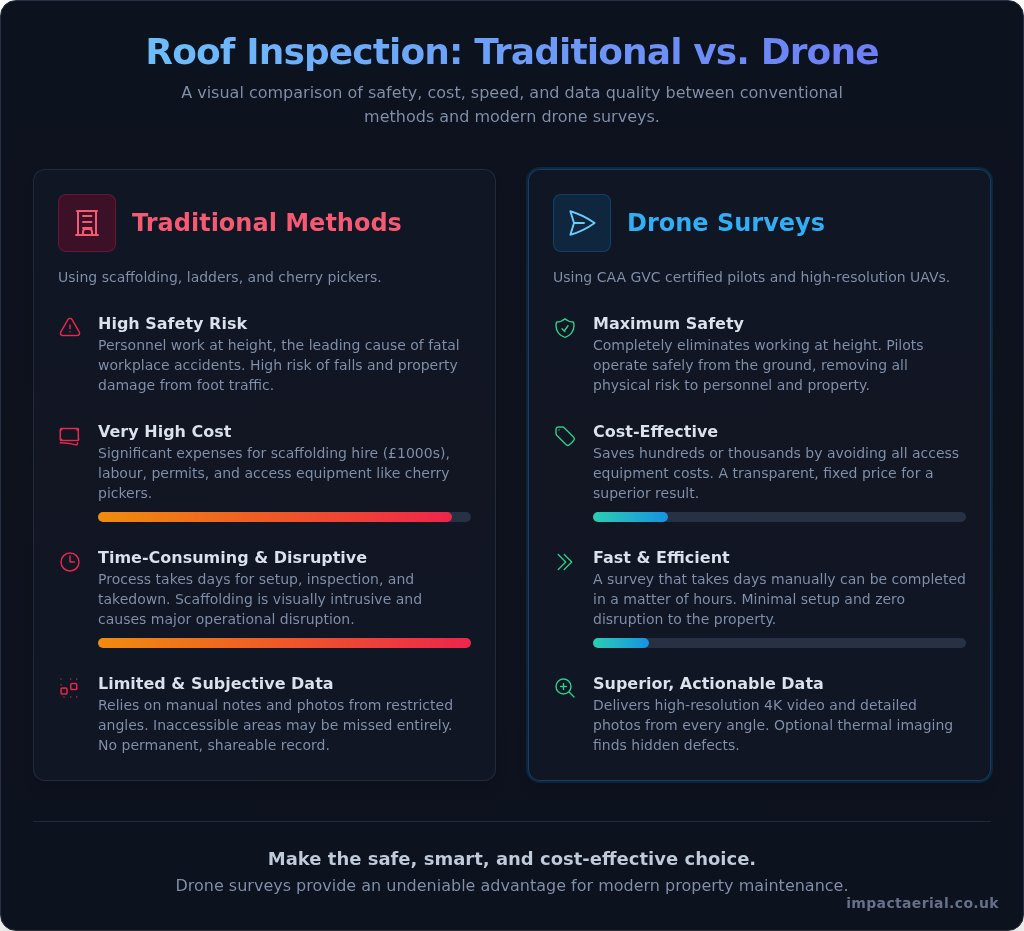
Why are London property managers still paying upwards of £3,000 just to erect scaffolding for a simple visual inspection? In a city where access is restricted and lead times often stretch beyond 21 days, the traditional approach to maintenance is becoming a significant financial liability. A professional drone roof survey london offers a smarter alternative, capturing high-resolution data from chimneys and valleys that often remain invisible from the ground.

You likely already know that scaffolding is not just expensive; it’s a logistical nightmare that disrupts tenants and risks damage to historic masonry. This 2026 guide promises to show you how professional aerial inspections deliver 100% safety and superior data while reducing your survey costs by as much as 70% compared to traditional methods. We’ll examine the latest CAA GVC compliance standards, fixed-cost pricing models, and how our 4K HDR fleet provides the high-resolution condition report you need for total peace of mind.

Key Takeaways

  • Learn why a professional drone roof survey london provides a safer, more cost-effective alternative to traditional scaffolding while delivering superior high-resolution data.
  • Understand how enterprise-grade DJI technology overcomes the unique challenges of London’s micro-climates, wind tunnels, and complex urban architecture.
  • Realise significant cost savings and reduced lead times by switching from weeks of scaffolding setup to just hours of precision aerial flight.
  • Navigate the legal requirements of London’s restricted airspace, including why CAA GVC certified pilots are essential for compliant urban operations.
  • Discover how meticulous risk management and expert post-production analysis provide the peace of mind required for managing high-value London property assets.

What is a Professional Drone Roof Survey in London?

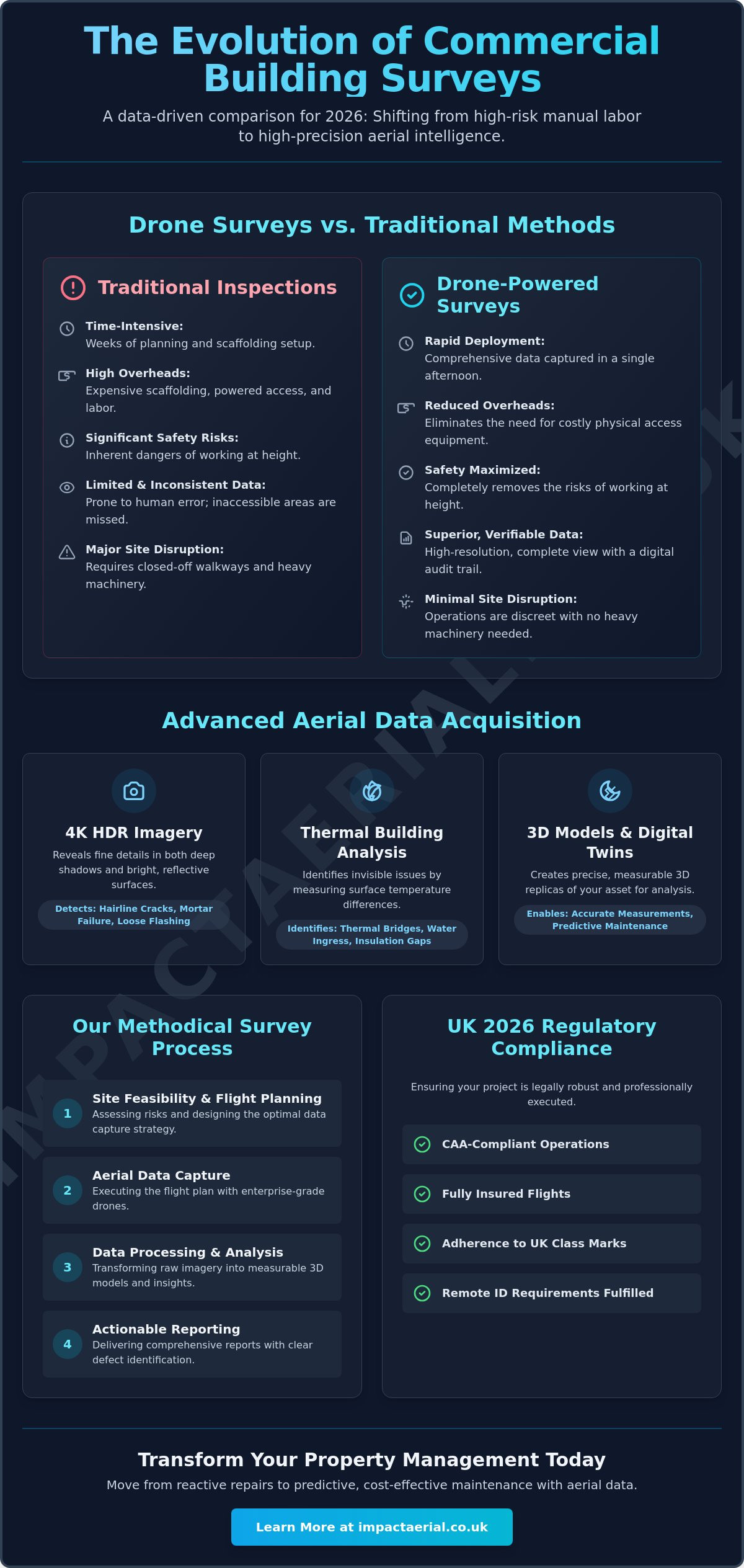
A professional drone roof survey in London is a non-intrusive aerial inspection that utilises advanced Unmanned Aerial Vehicles (UAVs) to capture high-resolution imagery and data of building envelopes. By 2026, the industry has transitioned from basic visual checks to sophisticated, data-driven asset management. This methodology allows for the rapid assessment of structures without the need for expensive scaffolding or high-access equipment, providing a safer and more efficient alternative to traditional methods.

London’s skyline features a unique blend of 18th-century heritage and modern glass structures. Operating within these high-density urban environments requires specialised knowledge of CAA GVC certification and local airspace restrictions. With over 19,000 listed buildings and complex clusters of high-rise developments, a drone roof survey london must account for tight flight paths and stringent safety protocols to ensure every centimetre of the structure is documented accurately.

Standard components of a modern survey include 4K HDR video and high-resolution stills. For added peace of mind, thermal mapping is frequently deployed to identify sub-surface moisture and insulation failures. These sensors detect heat signatures that remain invisible to the naked eye, allowing property owners to pinpoint leaks before they cause structural damage.

The Evolution of Aerial Inspections

Inspections have progressed from basic photography to centimetre-accurate data collection. By 2026, 4K HDR sensors have largely replaced the requirement for physical “hand-on” tile checks in 95% of commercial cases. We use photogrammetry to generate precise 3D models of complex London rooflines. These models allow surveyors to take millimetre-level measurements from their desktop, significantly reducing the time spent on-site while increasing the accuracy of the final report.

Key Industries Benefiting from Drone Surveys

Three primary sectors now rely on drone technology for their property maintenance strategies:

  • Commercial Property Managers: Professionals overseeing the 23 million square feet of office space in central London use drone data for proactive maintenance and insurance valuations.
  • Chartered Surveyors: Experts requiring high-definition visual evidence for RICS condition reports can now access areas that were previously unreachable.
  • Heritage and Residential Blocks: For buildings where scaffolding costs can exceed £5,000 for a simple inspection, a drone roof survey london provides a cost-effective, non-destructive solution that protects the fabric of the building.

The Technology Behind High-Precision London Surveys

Executing a high-precision drone roof survey london requires more than a standard off-the-shelf aircraft. The capital’s unique architecture, coupled with narrow wind tunnels created by skyscrapers in the City and Canary Wharf, demands enterprise-grade stability. Professional operators utilise the DJI Enterprise fleet, such as the Matrice 350 RTK, which is engineered to withstand wind speeds of up to 12 metres per second. These aircraft aren’t just drones; they’re flying workstations equipped with dual-redundancy systems for batteries and flight controllers, ensuring absolute safety when operating over congested urban streets.

The sensor is the heart of the survey. We use large-format sensors that excel in High Dynamic Range (HDR) capture. This is vital for London properties where tall neighbouring buildings cast deep shadows across roof pitches. Without HDR, a standard camera would lose all detail in these dark areas, potentially missing cracks or slipped tiles. For added peace of mind, our professional aerial inspection services provide the technical rigour needed for complex insurance and structural claims.

Enterprise Hardware vs. Consumer Drones

Consumer drones lack the optical zoom capabilities required for safe, detailed inspections. Our enterprise payloads feature up to 200x digital zoom, allowing us to inspect Victorian chimneys and ornate finials from a distance of 15 metres without compromising safety. A global shutter captures the entire frame simultaneously to prevent the motion blur or “jello effect” that occurs with cheaper rolling shutter sensors during flight. This hardware ensures every millimetre of the masonry is sharp and measurable.

  • RTK Positioning: Real-Time Kinematic satellite data provides centimetre-level accuracy for 3D modelling.
  • Obstacle Avoidance: Six-directional sensing prevents collisions in tight London alleyways.
  • IP55 Rating: Allows for data collection in the light rain often encountered during London winters.

Thermal and Multispectral Data

Standard photography only reveals surface issues. We use high-resolution thermal sensors to identify heat loss and moisture ingress that the naked eye can’t see. On commercial flat roofs, wet insulation retains heat differently than dry areas. By flying at dusk, we spot these “hot spots” or “cold spots” that indicate trapped water, preventing costly structural rot. Integrating this data into a wider drone survey workflow allows for a 360-degree view of building health.

Multispectral data adds another layer of intelligence. It identifies the early stages of organic growth, such as moss or lichen, by analysing light signatures invisible to humans. Catching this growth early prevents the premature decay of porous London brickwork and limestone. It’s a proactive approach that moves beyond simple reactive maintenance, giving asset managers a clear 2026 roadmap for their property portfolios.

ROI Analysis: Drone Surveys vs. Traditional Access Methods

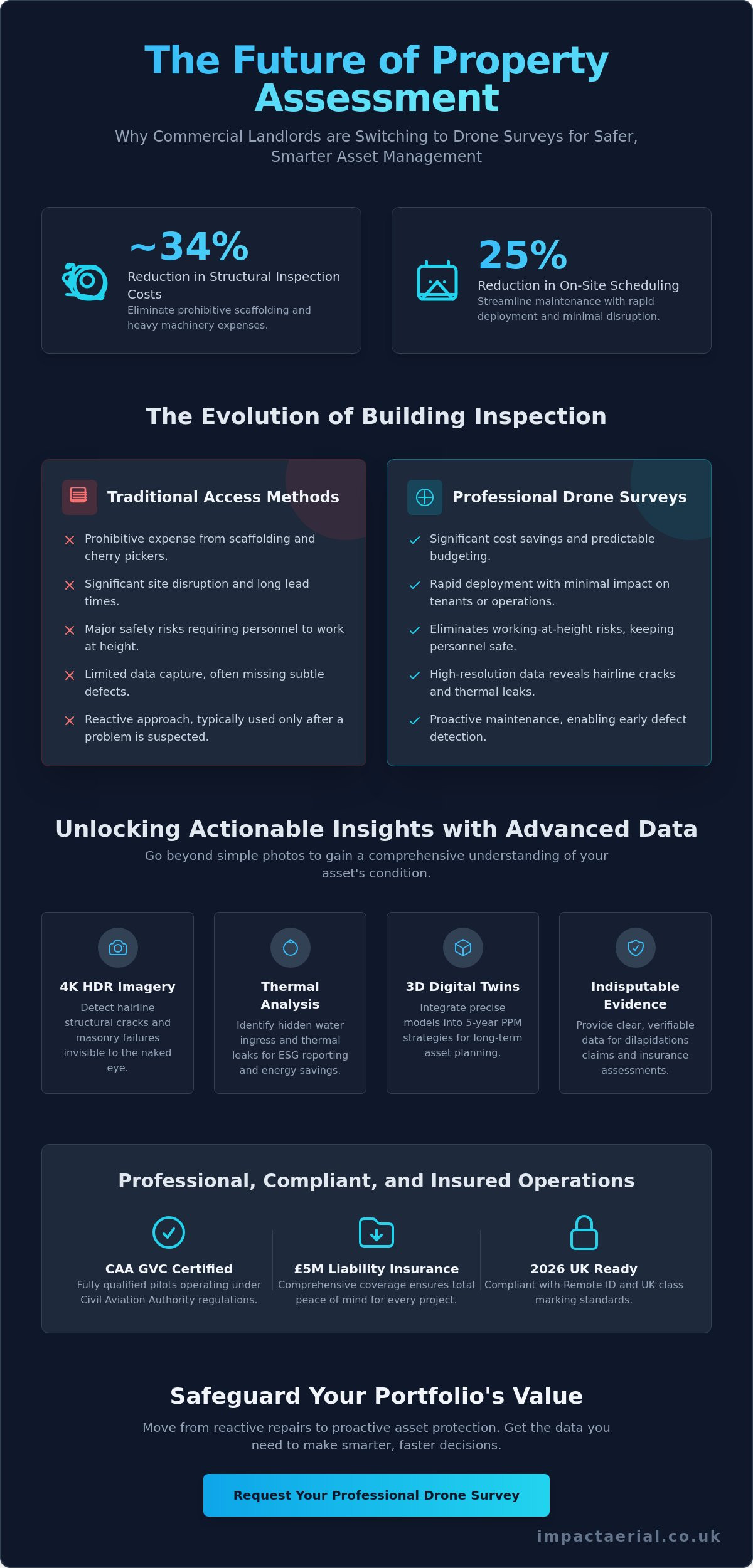
The financial risk of deferred maintenance in the capital is substantial. Industry data from 2025 suggests that minor leaks left unaddressed for six months often escalate into structural repairs exceeding £20,000 for mid-sized commercial blocks. For property managers, the “cost of doing nothing” is rarely zero. A drone roof survey london acts as a high-speed diagnostic tool that identifies defects before they necessitate major capital expenditure. While traditional methods require weeks of logistical planning, a drone flight is often completed in a single morning, providing immediate clarity on the building’s health.

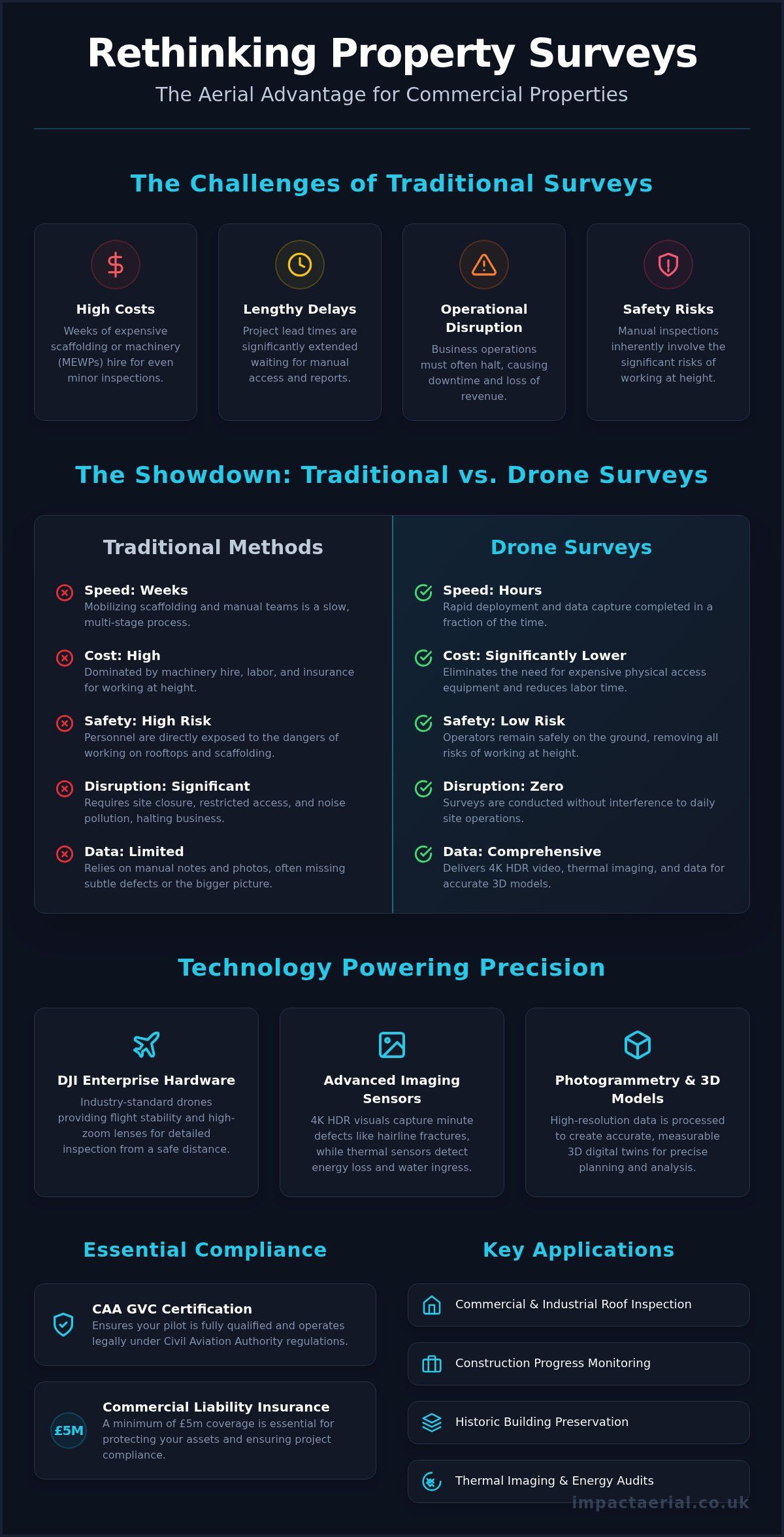
  • Lead Times: Scaffolding typically requires 14 to 21 days for permit approvals and assembly. A UAV deployment requires only a few hours of site preparation and flight time.
  • Health and Safety: By removing the need for personnel to work at height, you eliminate the primary cause of workplace fatalities in the UK construction sector. Our operations remain entirely ground-based.
  • Sustainability: Our fleet of electric UAVs produces zero operational emissions. This contrasts sharply with the carbon-heavy logistics of transporting tons of steel scaffolding or operating diesel-powered cherry pickers across London’s Ultra Low Emission Zone (ULEZ).

The Scaffolding Cost Trap in London

In 2026, the hidden expenses of traditional access in London often outweigh the actual labour costs. Pavement licences from local councils like Westminster or the City of London can cost hundreds of pounds per week. Parking suspensions on busy thoroughfares and the mandatory installation of scaffold alarms for security add further layers of expense. Drones serve as the ideal “first-response” method. They allow surveyors to pinpoint a specific leak location. If scaffolding is eventually required, it’s only erected exactly where it’s needed, which saves thousands in unnecessary rental fees and permit extensions.

Data Quality and Shareability

The transition from manual inspections to “digital twins” has revolutionised how data is handled. High-resolution 4K footage and 45-megapixel stills provide a level of detail that a surveyor on a ladder cannot match. This data is easily shared with contractors to secure fixed-price quotes, preventing the budget creep common in complex roof repairs. For storm damage claims, having date-stamped, high-definition evidence accelerates the insurance payout process by providing indisputable proof of the building’s condition. You can find more detail on these efficiencies in this drone roof survey comparison guide. Our CAA GVC Certified pilots ensure that every byte of data gathered meets the highest professional standards, giving you total peace of mind during the claims process.

Operating a professional drone roof survey london involves navigating some of the most strictly regulated airspace in the world. Central London is a patchwork of Flight Restricted Zones (FRZs) protecting Heathrow, London City Airport, and RAF Northolt. Flying within these zones without explicit permission from National Air Traffic Services (NATS) is a criminal offence under the Air Navigation Order 2016. We manage the entire coordination process, liaising with the Metropolitan Police and relevant air traffic control towers to ensure every flight is fully authorised and legal.

Safety in the capital’s congested boroughs like Westminster or Camden requires more than just technical skill. It demands a rigorous approach to risk management. We provide £5 million in commercial liability insurance for every project, offering the necessary protection for high-value commercial assets and the public. This level of cover is a prerequisite for most Tier 1 contractors and property management firms operating in the city. We don’t take risks with your liability or our reputation.

Permissions and Authorisations

Professional operators must hold the correct credentials for urban environments. While a basic drone license might suffice for rural areas, London missions often fall into the “Specific” category. This requires a CAA GVC (General Visual Line of Sight Certificate) and a formal Operating Authorisation. These documents allow us to fly heavier enterprise drones in areas where hobbyist flights are prohibited. We also prioritise privacy and GDPR compliance. Our protocols ensure that any incidental imagery of neighbours or the public is either not captured or is digitally masked during the data processing stage.

Safety Protocols in the Capital

London’s “urban canyons”—areas with tall, glass-fronted buildings—can cause GPS multi-pathing or signal interference. To counter this, we employ a Visual Observer (VO) on every complex drone roof survey london. The VO stays in constant radio contact with the pilot, monitoring the surrounding airspace for helicopters or cranes while the pilot focuses on the high-resolution data capture. Our drones are equipped with advanced obstacle avoidance sensors and redundant battery systems to prevent accidents in high-traffic environments.

  • The 1:1 Rule: In urban drone operations, the 1:1 rule requires the pilot to maintain a horizontal safety distance from uninvolved people that is at least equal to the drone’s current altitude.
  • Emergency Failsafes: Every aircraft is programmed with a “Return to Home” (RTH) protocol that triggers automatically if the command link is interrupted.
  • Pedestrian Management: We use physical cordons and ground marshals in busy boroughs to keep the take-off and landing zones clear of foot traffic.
For a compliant, safe, and fully insured inspection of your property portfolio, book your London drone survey with our expert team.

Choosing Impact Aerial for Your London Roof Survey

Selecting a partner for a drone roof survey london requires more than just finding an operator with a camera. It demands a team that understands the technical and regulatory complexities of the capital’s unique airspace. Impact Aerial brings years of expertise to every project, holding full CAA GVC certification to ensure every flight complies with the latest 2026 aviation standards. Our commitment to safety isn’t just a policy; it’s the foundation of our operations. We conduct meticulous risk assessments for every site, managing everything from pedestrian safety in busy streets to radio frequency interference in dense urban environments.

For added peace of mind, we maintain comprehensive commercial liability insurance, protecting your assets and our team throughout the process. Our end-to-end service ensures you aren’t left with raw data you can’t interpret. We guide you from the initial consultation through to post-production analysis that turns high-resolution imagery into actionable insights. This professional approach is why leading London estate managers and commercial developers trust us with their most sensitive structural assets.

Our Professional Methodology

We begin every project with a pre-flight site survey using advanced satellite data and real-time airspace maps. This allows us to identify potential hazards and flight restrictions before we even arrive on-site. Once we’re there, our pilots behave with the discretion and professionalism expected on a high-value estate or active construction site. You’ll receive a final report featuring high-resolution 4K and HDR imagery, meticulously organised and ready for immediate review by your architect or builder. We provide the technical depth required for precise structural assessments without the need for expensive scaffolding.

Ready to Organise Your Survey?

Waiting for a visible leak to appear is the most expensive maintenance strategy a property owner can adopt. Industry data suggests that reactive repairs often cost five times more than proactive maintenance. Our 3-step booking process makes it easy to stay ahead of structural issues:

  • Step 1: Request a Quote. Contact us for a bespoke London quotation based on your specific property coordinates and requirements.
  • Step 2: Site Execution. Our team handles all flight planning, notifications, and on-site data gathering.
  • Step 3: Data Delivery. Receive your high-resolution data and professional report within 48 hours of the flight.

Don’t leave your roof’s integrity to chance. Contact the Impact Aerial team today to secure your 2026 survey slot. You can also explore our professional drone services to see how we support commercial clients across the wider UK with leading aerial data solutions.

Future-Proof Your Property Maintenance with Precision Aerial Data

As we move into 2026, the transition from costly scaffolding to high-precision aerial intelligence has become a commercial necessity for London property managers. Investing in a professional drone roof survey london eliminates the inherent safety risks of working at height while reducing inspection timelines by up to 70% compared to traditional access methods. Impact Aerial provides the technical expertise required to navigate the capital’s complex Flight Restriction Zones and stringent urban regulations. Our operations are led by CAA GVC Certified Pilots and backed by £5m commercial liability insurance for added peace of mind. We utilise DJI Enterprise grade equipment to capture high-resolution 4K HDR imagery and detailed photogrammetry, identifying structural defects that manual inspections often miss. This data-driven approach ensures your maintenance budgets are spent where they’re needed most. Don’t leave your building’s structural integrity to chance. We’re ready to help you streamline your next inspection with a solution that prioritises safety, compliance, and actionable results.

Request a Bespoke London Drone Roof Survey Quote

Frequently Asked Questions

Do I need permission from the council for a drone roof survey in London?

You don’t usually need permission from the local council for a drone roof survey on private property, but you must comply with Civil Aviation Authority (CAA) flight regulations. Our pilots manage all necessary clearances for Flight Restricted Zones (FRZs) near major hubs like Heathrow or London City Airport. We ensure every operation follows the latest CAP 722 guidelines to guarantee legal compliance and safety for your project.

How much does a drone roof survey cost in London in 2026?

While individual project requirements vary, 2026 industry data from the Drone Safe Register indicates that a standard residential drone roof survey london typically ranges from £250 to £600. Commercial inspections for larger structures involve more complex data-gathering and often start at £800. These figures reflect the high-quality 4K imagery and professional risk assessments included in a standard specialist package for peace of mind.

Can a drone survey detect a leak that isn’t visible to the naked eye?

Drones detect leaks by using thermal sensors to identify moisture trapped under roofing membranes that isn’t visible to the human eye. These radiometric cameras highlight temperature differentials, where damp patches retain heat differently than dry areas. This advanced data-gathering method allows us to pinpoint ingress points with 95% accuracy before they cause structural damage or internal damp issues in your building.

What happens if it rains on the day of my scheduled drone survey?

We’ll reschedule your flight if it rains because moisture can interfere with the drone’s sensitive electronics and obscure the camera lens. Safety is our primary concern, and high winds or precipitation prevent us from capturing the high-quality, stable footage required for a professional report. Our team monitors Met Office forecasts 24 hours in advance to provide you with timely updates and ensure operational success.

Is the drone footage good enough for an insurance company to accept?

Insurance companies and loss adjusters widely accept our drone footage because it provides high-resolution, timestamped evidence of a roof’s condition. We use DJI Enterprise commercial drones to capture 4K HDR imagery that offers more detail than traditional ladder inspections. Since we’re CAA GVC Certified, the data we provide meets the professional standards required for formal claims and detailed structural assessments.

How close to my neighbours’ windows will the drone fly?

Our pilots adhere to strict UK privacy laws and CAA regulations, ensuring the drone remains a safe distance from neighbouring windows. Under current UK GDPR and Article 8 of the Human Rights Act, we focus our sensors exclusively on your property to protect local residents’ privacy. We use high-zoom lenses to capture detail from a distance, so we don’t need to fly directly alongside adjacent buildings.

Do I need to be present at the property during the drone survey?

You don’t need to be present at the property during the survey as long as we have clear access to the site. We conduct a thorough pre-flight site assessment remotely and can complete the entire inspection while you’re at work or away from the premises. Once the flight is finished, we’ll upload the high-quality data to a secure cloud folder for you to review at your convenience.

How long does it take to receive the final report and footage?

You’ll typically receive your final inspection report and high-resolution footage within 24 to 48 hours of the flight’s completion. This timeframe allows our technicians to process the raw data and highlights any specific defects found during the drone roof survey london. For urgent structural issues, we can often provide a preliminary gallery of the 4K images on the same day as the survey for immediate review.

Thermal Leak Detection Drone Surveys: The Expert Guide to Aerial Thermography

According to the UK Green Building Council, heating and cooling account for nearly 40% of energy use in commercial spaces, yet a staggering amount of this investment literally evaporates through unidentified structural defects. You likely know that even a minor breach in a flat roof or a failing insulation seal leads to astronomical energy bills and long-term structural decay. It’s frustrating to pay upwards of £2,000 for scaffolding just to locate a problem that’s invisible to the naked eye. For added peace of mind, our CAA GVC Certified pilots use advanced thermal leak detection drone technology to pinpoint these issues without the need for manual inspections or site downtime.

In this expert guide, you’ll discover how professional thermal drone surveys identify hidden leaks, reduce maintenance costs, and provide actionable data for UK commercial assets. We’ll examine the precision of 4K High Dynamic Range thermography and how our detailed data-gathering satisfies strict insurance requirements. By the end, you’ll understand how to implement a zero-downtime inspection process that protects your building’s integrity while keeping your operational costs firmly under control.

Key Takeaways

  • Learn how high-resolution radiometric sensors detect “invisible” energy to pinpoint moisture entrapment and insulation failures in commercial roofs.
  • Discover how a professional thermal leak detection drone survey delivers a higher ROI by eliminating the need for expensive scaffolding and reducing inspection times.
  • Understand the critical role of “thermal windows” and diurnal shifts in ensuring data accuracy for complex industrial assets and solar farms.
  • See why using CAA GVC Certified pilots ensures your survey remains fully compliant with UK drone laws while providing essential “at-height” safety.
  • Gain peace of mind by learning how expert pre-flight planning and risk assessments are conducted for assets across Birmingham and the West Midlands.

What is a Thermal Leak Detection Drone and How Does it Work?

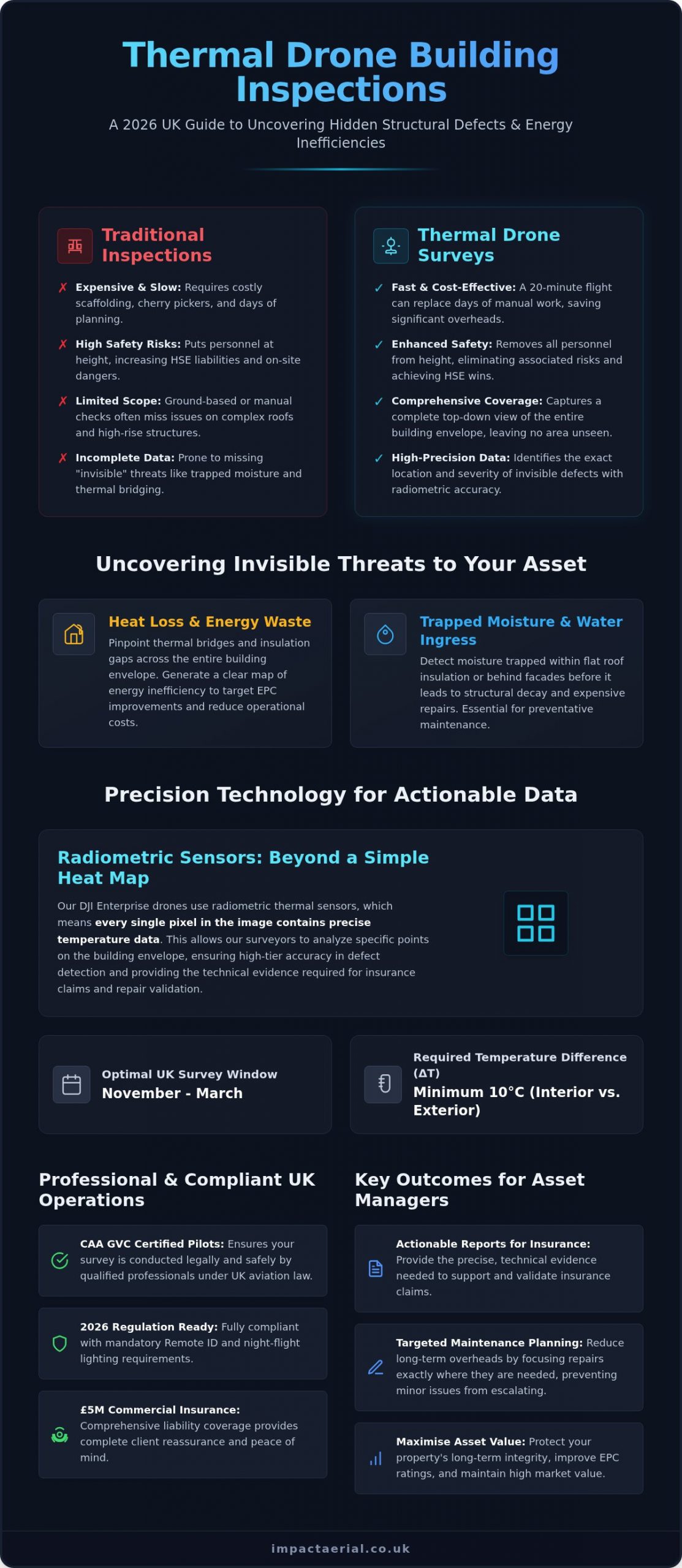
A thermal leak detection drone is a commercial-grade UAV integrated with high-resolution radiometric thermal sensors designed to visualise temperature variances across large structures. Unlike standard cameras that capture visible light, these sensors detect energy in the long-wave infrared spectrum. This allows Impact Aerial pilots to identify anomalies that are invisible to the naked eye, such as moisture trapped under roof membranes or heat escaping through failed insulation. To understand the core technology, we must look at What is Thermography?, which is the science of translating infrared energy into a visual map where every colour represents a specific thermal value.

To better understand this concept, watch this helpful video:

Professional surveys require more than just a heat-sensitive camera. We use radiometric sensors that record temperature data for every one of the 327,680 pixels in a standard 640×512 image. A basic heat map only shows relative differences, but radiometric data allows us to pinpoint the exact temperature of a specific spot to within 2 degrees Celsius. This precision is vital for commercial property managers who need to justify repair costs based on quantifiable data rather than visual guesswork. It’s the difference between seeing a “warm patch” and knowing a specific valve is operating at 75 degrees Celsius when it should be at 40.

Drones solve the massive scale issues associated with handheld thermal cameras. A technician on the ground might take 5 hours to inspect a 3,000 square metre warehouse roof using a handheld unit, often missing spots due to the shallow angle of view. Our DJI Enterprise drones cover that same area in a single 15-minute flight. By capturing data from a top-down nadir perspective, we eliminate the distortions caused by ground-level obstructions and provide a comprehensive orthomosaic map of the entire site.

Understanding Thermal Emissivity and Reflectivity

Different materials don’t radiate heat in the same way. A weathered concrete roof has high emissivity, while a new zinc or aluminium facade is highly reflective and can act like a thermal mirror, reflecting the cold sky. This often creates “false positives” where a surface looks like it’s leaking or freezing when it’s actually just reflecting its surroundings. Impact Aerial pilots use their CAA GVC training to adjust sensor parameters for these specific material properties in real-time. Emissivity is the measure of an object’s ability to emit infrared energy.

The Role of Dual-Sensor Payloads

Top-tier thermal leak detection drone operations rely on dual-sensor payloads, such as the DJI Zenmuse H20T. These systems carry a 4K visual camera and a thermal sensor simultaneously. Using a technique called MSX (Multi-Spectral Dynamic Imaging), the drone overlays high-contrast edges from the visual camera onto the thermal image. This adds structural detail, like bolts, seams, and lettering, to the heat map. It makes it significantly easier for maintenance teams to locate the exact position of a leak on a featureless flat roof. By using this DJI Enterprise hardware, we ensure that every thermal anomaly is backed by a high-resolution visual reference for 100% reporting accuracy.

Key Industrial Applications for Thermal Drone Surveys in the UK

The UK drone industry has evolved into a niche but increasingly diverse market where precision and safety are paramount. Deploying a professional thermal leak detection drone allows asset managers to move beyond reactive repairs into a regime of proactive maintenance. By using high-specification DJI Enterprise aircraft, we capture data that ground-based teams simply cannot access safely or efficiently. This technical approach is now standard practice for maintaining the integrity of large-scale infrastructure across the West Midlands and the wider UK.

Large-scale warehouses and distribution centres, particularly those exceeding 50,000 square feet, often suffer from thermal bridging. This occurs when heat bypasses insulation through structural components, leading to massive energy wastage. Mapping these air leaks provides a clear roadmap for remediation. Implementing these findings can reduce annual energy costs by 15% to 25% based on 2023 energy price benchmarks. Similarly, district heating networks in urban centres like Birmingham rely on sub-surface monitoring. Sub-surface leaks create distinct temperature anomalies in the soil that drones identify as “heat signatures” long before water reaches the surface. This prevents catastrophic pavement failures and avoids the £10,000+ costs associated with emergency utility excavations.

Roofing and Water Ingress Detection

Flat roofs on commercial properties are notoriously prone to moisture entrapment. Because water has a higher thermal mass than standard bitumen or single-ply membranes, it retains solar heat long after the sun sets. By deploying a thermal leak detection drone during the diurnal cooling period, our CAA GVC certified pilots pinpoint trapped moisture that stays invisible to the naked eye. This data is vital for BREEAM surveys and meets the rigorous standards required for commercial insurance compliance. It also identifies delamination, where layers of the roof membrane separate. Industry data suggests that delamination affects roughly 65% of UK commercial roofs over 15 years old. Technical research into aerial thermography techniques confirms that high-resolution thermal imaging is the only reliable method for detecting these subtle variances without invasive core sampling.

Solar Farm Thermal Surveys

For multi-megawatt PV installations, efficiency is the primary driver of ROI. Faulty cells or “hot spots” can reduce a farm’s total power output by as much as 30% if they aren’t replaced quickly. A ground team often takes three weeks to inspect a 100-acre site manually; our thermal drones complete the same task in a single day. This rapid data-gathering ensures asset managers have the information they need for targeted repairs without the high labour costs. For site managers looking to optimise their renewable assets, booking PV Solar Farm Thermal Surveys provides the granular detail needed to maintain peak performance. We provide high-quality reports that categorise faults by severity, giving you total peace of mind regarding your site’s operational health. If you’re managing a large portfolio, you might find that professional aerial inspections are the most cost-effective way to ensure long-term compliance and safety.

Drones vs. Traditional Leak Detection: A Comparison of ROI and Safety

Traditional leak detection often relies on manual labour and heavy machinery. For a standard 20,000 square foot industrial unit, erecting scaffolding or hiring a Mobile Elevated Working Platform (MEWP) can cost between £600 and £1,500 per day. These costs escalate quickly if the inspection takes several days. By contrast, a thermal leak detection drone can survey the same area in under 60 minutes. This speed doesn’t just save time; it slashes the capital expenditure required for basic maintenance assessments by approximately 70% in most commercial applications.

Safety is the most compelling argument for switching to aerial methods. Health and Safety Executive (HSE) data for 2023/24 shows that falls from height remain the single biggest cause of workplace fatalities in the UK. By keeping surveyors on the ground, firms eliminate the risks associated with fragile roof materials and inclement weather. While the U.S. Department of Energy explains thermography as a vital tool for identifying heat loss and air gaps, deploying this tech via drone provides a level of safety that manual inspections cannot match. Our CAA GVC certified pilots ensure every flight adheres to strict UK civil aviation regulations, providing professional results without the liability of “at-height” work.

Eliminating Business Downtime

Operational continuity is vital for any industrial site or retail park. Traditional inspections often require cordoning off car parks or shutting down loading bays to accommodate cherry pickers and safety zones. Drone surveys allow for “business as usual” because the flight path remains clear of ground-level operations. Drone surveys can be conducted without any physical contact with the asset. This non-contact approach is particularly beneficial for hazardous environments, such as chemical plants or high-voltage electrical substations, where physical proximity poses significant risks to personnel. We provide high-quality data-gathering without requiring a single minute of site closure.

Accuracy and Repeatability

Manual inspections are inherently subjective. A technician with a handheld thermal camera might miss small anomalies or fail to capture the full context of a leak. A thermal leak detection drone provides 100% site coverage, capturing thousands of data points in a single mission. We use high-resolution radiometric sensors that record the exact temperature of every pixel in the image. This data is far more robust than a simple visual report.

  • GPS-Tagged Imagery: Every thermal frame is embedded with precise coordinates. This allows our team to return to the exact same centimetre of space six months later to monitor if a leak has worsened.
  • Digital Twins: We can overlay thermal data onto 3D photogrammetry models. This gives stakeholders a clear, interactive map of their asset’s thermal health.
  • Objective Reporting: Move away from “best guesses” to digital reports that provide clear evidence for insurance claims or repair tenders.

The move from manual spot-checking to comprehensive UAV surveys represents a shift from reactive maintenance to proactive asset management. Instead of waiting for a ceiling to drip, facility managers can identify thinning insulation or moisture ingress months before it becomes a critical failure. This predictive capability is the ultimate return on investment, preventing emergency repair costs that often run into tens of thousands of pounds.

The Process: How We Organise a Professional Thermal Survey

Every successful thermal leak detection drone mission starts long before the propellers spin. For projects across Birmingham and the wider West Midlands, we begin with a rigorous pre-flight phase. This involves checking Restricted Area Zones (RAZs) and filing necessary notifications with the Civil Aviation Authority (CAA). Our GVC-certified pilots conduct a detailed site risk assessment to identify overhead hazards or privacy concerns, ensuring every flight remains 100% compliant with UK aviation law and our commercial liability insurance requirements.

Planning for the UK Climate

Thermal imaging relies on a specific “Delta T,” which is the temperature difference between the building’s interior and the outside air. We typically require a minimum differential of 10°C to produce high-contrast data. In the UK, this often means scheduling flights during “thermal windows” between 9:00 PM and 5:00 AM. During these hours, “solar loading” from the sun has dissipated, allowing trapped moisture within roof insulation to stand out clearly as it retains heat longer than dry materials.

  • Wind Speeds: We ground flights if gusts exceed 15mph to ensure sensor stability.
  • Precipitation: Surfaces must be dry; even light rain can mask thermal signatures through evaporative cooling.
  • Cloud Cover: Unlike traditional photography, 100% cloud cover is often ideal as it prevents “sky glow” reflections on metallic or glass surfaces.

Once on-site, we don’t rely on guesswork. We deploy enterprise-grade drones to fly methodical, automated grids with an 80% front and side overlap. This level of redundancy is vital. It ensures we capture every square inch of the structure from multiple angles, leaving no room for data gaps. For a standard 2,500 square metre warehouse roof, this process might generate 500 individual radiometric images, providing a comprehensive digital twin of the building’s thermal profile.

From Raw Data to Actionable Reports

The raw imagery captured by a thermal leak detection drone is just the beginning. We use specialist analytical software to process .R-JPEG files, which contain temperature data for every single pixel. This allows our technicians to retrospectively adjust emissivity settings and temperature scales to isolate specific defects. By integrating this data into our Drone Property Surveys, we provide a clear, visual map of your asset’s hidden issues.

We categorise every finding to help you manage your maintenance budget effectively. Critical defects indicate active leaks or safety risks that require immediate intervention. Major issues identify areas where the building envelope is failing and should be addressed within 90 days. Minor anomalies are flagged for monitoring during future inspections. This prioritised approach gives facilities managers the evidence they need to justify repair costs and prevent long-term structural rot.

Don’t let hidden leaks damage your property’s value and structural integrity. Book a professional thermal drone survey with our expert team to get the data you need for informed repairs.

Why Choose Impact Aerial for Your Thermal Leak Detection?

Impact Aerial operates at the intersection of technical precision and regulatory excellence. Based in Birmingham, we provide specialised aerial services across the West Midlands, from the industrial corridors of the Black Country to the commercial heart of the city. We don’t just fly drones; we provide actionable data that saves our clients thousands of pounds in unnecessary scaffolding and manual inspection costs. Our local knowledge of the region’s industrial architecture allows us to identify potential failure points before they become catastrophic expenses.

Our fleet consists of the latest DJI Enterprise hardware. These aircraft carry sensors with a 640×512 thermal resolution. This level of detail is critical for accuracy. Standard consumer drones often provide 160×120 resolution, which lacks the pixel density needed to pinpoint a 2mm crack in a steam pipe or a failing weld on a flat roof. By using a high-specification thermal leak detection drone, we ensure that every thermal anomaly is identified with surgical accuracy. We provide the clarity needed to make informed maintenance decisions without the guesswork.

A Safety-First Approach

Safety isn’t a checkbox for us. It’s our operational foundation. Every pilot at Impact Aerial is CAA GVC (General Visual Line of Sight Certificate) certified. This qualification is the gold standard for UK drone operations, allowing us to operate safely in complex, congested urban environments. We conduct a rigorous 5-step risk assessment before every take-off. This includes airspace checks, ground hazard identification, and real-time weather monitoring. Our affiliation with the Drone Safe Register and ARPAS-UK further validates our commitment to the highest industry standards. For added peace of mind, we carry £5m in commercial liability insurance, ensuring your assets and personnel are protected throughout the survey process.

Customised Solutions for Every Sector

We understand that a construction manager needs a different report than a corporate board member. Our data delivery is tailored to your specific requirements. For site engineers, we provide raw radiometric data and technical overlays that highlight precise temperature differentials. For stakeholders, we deliver breath-taking visual clarity that makes complex issues easy to understand at a glance. We bridge the gap between niche technical data and clear, high-quality business insights. Our reporting is designed to be shared across departments, ensuring everyone from the maintenance team to the CFO has the information they need.

Whether you are managing a 50,000 sq ft warehouse in Solihull or a heritage building in Coventry, our thermal leak detection drone services provide the precision you need. We’ve helped local firms reduce their inspection timelines by 80% compared to traditional manual methods. This efficiency doesn’t just save time; it reduces the carbon footprint of your maintenance operations by eliminating the need for heavy machinery and lifts.

Ready to secure your property and stop leaks in their tracks? Contact Impact Aerial for a professional thermal survey quote and see why we are the trusted choice for aerial inspections across the United Kingdom.

Secure Your Infrastructure with Precision Thermography

Traditional scaffolding or manual roof inspections often cost thousands in labour and equipment hire before a single leak is even identified. Switching to a thermal leak detection drone reduces these preliminary expenses by up to 70% while completely removing the safety risks associated with working at height. Our surveys provide high-resolution data that pinpoint heat loss or moisture ingress with sub-centimetre accuracy, allowing for surgical repairs rather than costly full-scale replacements.

Based in Birmingham, Impact Aerial serves the West Midlands and the wider UK with a focus on technical excellence and regulatory compliance. We operate as CAA GVC Certified pilots and maintain £5m commercial liability insurance to ensure every project meets the highest professional standards. You’ll receive a detailed thermal report that transforms complex aerial data into actionable insights for your maintenance team. It’s the most efficient way to protect your assets and improve energy efficiency across your entire property portfolio.

Book your professional thermal drone survey with Impact Aerial today and gain the clarity you need to manage your site effectively.

Frequently Asked Questions

Can a thermal drone find water leaks underground?

Thermal drones identify underground water leaks by detecting the specific temperature variances they create on the surface. While the sensor doesn’t see through soil, a thermal leak detection drone identifies where leaking fluid has changed the ground’s thermal mass or moisture levels. This is most effective when there’s a 5-degree temperature difference between the fluid and the surrounding earth. It allows us to pinpoint pipe bursts without invasive digging.

How much does a thermal drone survey cost in the UK?

A professional drone survey in the UK typically starts at £450 for a standard commercial roof. Larger industrial sites or complex infrastructure inspections often range from £900 to £1,600 per day. These figures include the pilot’s time, DJI Enterprise equipment hire, and the subsequent data analysis. For added peace of mind, our pricing includes £5 million in commercial liability insurance as standard for every project.

What weather conditions are needed for an accurate thermal survey?

Optimal results require dry conditions with wind speeds remaining below 18 mph and a total lack of precipitation. To find heat loss in buildings, we need a 10-degree Celsius differential between internal and external temperatures. We typically fly at dawn or dusk to avoid solar loading, which occurs when the sun heats surfaces and masks underlying anomalies. This ensures the 640×512 resolution data remains accurate and actionable.

Is it legal to fly a drone over my commercial property for an inspection?

It’s legal provided the operator holds the correct CAA GVC Certification and adheres to the UK Drone Code. We manage all necessary risk assessments and flight notifications required by the Civil Aviation Authority before arriving on-site. Our pilots are specifically trained to operate in congested areas, ensuring your 100% compliance with current aviation law. We provide all safety documentation before the flight to guarantee a professional service.

What is the difference between a standard drone and a thermal drone?

The primary difference lies in the sensor technology used to gather data during the flight. Standard drones use RGB sensors to capture visual light, whereas a thermal leak detection drone carries a radiometric microbolometer that measures infrared radiation. Our fleet uses dual-sensor payloads, allowing us to overlay thermal maps onto 4K visual images. This helps our team identify the exact tile or brick where a leak originates with millimetre precision.

Can thermal drones detect gas leaks or just heat changes?

Standard thermal sensors detect heat signatures rather than chemical compositions, though they can identify the cooling effect of escaping pressurised gas. While they’re excellent for finding hot water leaks, gas detection often requires specialised Optical Gas Imaging payloads. We use sensors capable of detecting temperature fluctuations as small as 0.05 degrees Celsius. This precision allows us to identify anomalies that are completely invisible to the naked eye or standard cameras.

How long does it take to receive the final thermographic report?

We deliver the finalised technical report within 72 hours of the site visit completion. This timeframe allows our specialists to process radiometric data and verify every thermal anomaly found during the flight. You’ll receive a detailed PDF report containing high-resolution imagery and GPS coordinates for every fault identified. We ensure the data is clear and actionable so your maintenance teams can start repairs immediately without further diagnostic delays.

Do I need to be on-site during the drone survey?

You don’t need to be present during the survey if we’ve arranged site access and permissions in advance. We perform a comprehensive pre-site assessment 48 hours before the flight to identify any hazards or restricted zones. Most of our commercial property clients prefer this remote approach because it doesn’t disrupt their daily operations or require staff downtime. We’ll send a digital confirmation once the data-gathering phase is complete.

Drone Roof Inspection Report Sample: What a Professional Survey Includes

What if the most valuable part of a drone roof inspection isn’t the drone, but the data it produces? It’s easy to be impressed by the high-resolution cameras and advanced flight capabilities of modern commercial drones. But for property managers and building surveyors, the real value lies in the final deliverable: a clear, comprehensive report that translates raw aerial data into actionable maintenance insights, saving thousands of pounds by avoiding the high costs and safety risks of traditional scaffolding.

This is precisely why understanding a professional drone roof inspection report sample is so critical for making informed decisions. This guide will walk you through the essential components of a top-quality survey, providing the clarity and confidence you need to commission work from a fully qualified, CAA GVC Certified operator. We will explore everything from orthomosaic mapping and thermal data analysis to detailed defect annotation, ensuring you can turn your next aerial survey into a powerful asset for proactive property management.

Key Takeaways

  • Learn to identify the most critical sections of a professional report, from the high-level executive summary to the detailed visual defect map.
  • Understand the legal standards a professional drone roof inspection report sample must meet, including CAA GVC compliance, to ensure its validity.
  • Discover how to leverage high-resolution, timestamped aerial data to streamline insurance claims and support planned maintenance schedules.
  • Recognise the difference between basic aerial photos and actionable survey data gathered using specialised DJI Enterprise drone technology.

What is a Drone Roof Inspection Report and Why Is a Sample Important?

A drone roof inspection report is a comprehensive digital document that details the structural condition of a roof using high-resolution aerial data. It represents a significant evolution from traditional surveying methods, which often required expensive scaffolding, cherry pickers, and high-risk roof walks. The industry’s shift towards these “contactless” inspections, accelerated since 2020, prioritises safety and efficiency, delivering precise data without a single person setting foot on the roof. This commitment to safety and modern data-gathering is governed by strict CAA protocols in the UK, which fit within a complex framework of international drone regulations that professional operators must master.

To see the clear advantages of using a drone for initial roof assessments, this short video provides an excellent overview:

The final deliverable is what truly separates a professional survey from an amateur flight. Anyone can fly a drone and send you a folder of images. This is nothing more than a “photo dump.” A structured surveying report, however, is an analytical tool. It organises the data, annotates defects, provides measurements, and offers actionable insights. For this reason, reviewing a drone roof inspection report sample is the only reliable method to verify a pilot’s technical capability and data processing expertise. It gives you, the client, total confidence in the quality and utility of the final product.

The Evolution of Roof Surveying in 2026

The technology underpinning these reports is advancing rapidly. Today’s commercial drones, equipped with 4K HDR sensors, capture such detailed imagery that physical roof walks for initial assessments are becoming obsolete. AI-driven software is now commonly integrated into the reporting process, automatically detecting and categorising potential issues like missing tiles, water pooling, or vegetation growth. This reduces the risk of human error and ensures a consistent standard of analysis. Critically, the speed of delivery is a key performance metric; a comprehensive report can now be delivered to your inbox within 24-48 hours of the flight, a process that once took over a week.

Key Metrics to Look for in a Report Sample

When you scrutinise a sample report, you aren’t just looking at pretty pictures. You are assessing the provider’s attention to detail and professional standards. For your peace of mind, focus on these critical components:

  • Image Clarity at 100% Zoom: The provider must supply original, high-resolution files. You should be able to zoom in to 100% and clearly identify hairline cracks in tiles, degradation in mortar, or failing lead flashing. If the image becomes pixelated, the data isn’t fit for purpose.
  • GPS Metadata: Every photograph must be geolocated. This embedded GPS data (EXIF) allows contractors to pinpoint the exact location of a defect, saving time and eliminating ambiguity during repair work. A professional report will often include an interactive map with clickable, geolocated photo points.
  • An Executive Summary: A quality report always begins with a one-page executive summary. This section is written for non-technical stakeholders like property managers or board members, summarising the roof’s overall condition, highlighting critical defects, and recommending next steps in plain English.

Anatomy of a Professional Drone Roof Survey: A Section-by-Section Breakdown

A professional drone inspection delivers far more than a simple folder of aerial photographs. It’s a structured, data-rich asset designed for decisive action by asset managers, surveyors, and property owners. Each section builds upon the last to provide a complete picture of the roof’s condition, moving from a high-level overview to granular, evidence-based detail. A top-quality drone roof inspection report sample will always contain four critical components: an executive summary, a defect map, high-resolution imagery, and often, thermal data.

Let’s break down what you should expect to see in each part of the report.

  • Executive Summary: This is the first page and arguably the most important for time-pressed decision-makers. It provides a concise, top-level assessment of the roof’s overall health. Crucially, it immediately flags any urgent “red-flag” issues that require immediate attention, such as visible water ingress, major structural damage, or safety hazards. Think of it as the 30-second brief that dictates immediate priorities.
  • The Defect Map (Orthomosaic): This is a high-resolution, top-down map of the entire roof area. Each identified defect is digitally tagged and numbered on this map, providing an exact geographical reference for every issue. This visual index allows you to understand the spatial relationship between different defects and plan repairs with pinpoint accuracy.
  • High-Resolution Imagery: This section contains the raw evidence. It’s a catalogue of detailed, close-up photographs and video clips of every defect identified on the map. Expect crystal-clear images of cracked tiles, failing flashing, blocked gutters, and deteriorating chimney stacks. Each image is cross-referenced with its tag on the orthomosaic map for easy navigation.
  • Thermal Data (Optional): For flat roofs or buildings where insulation performance is critical, thermal imaging provides an invaluable layer of data. Using a radiometric thermal camera, the drone can detect temperature differences across the roof surface that are invisible to the naked eye. These anomalies can pinpoint subsurface moisture retention or significant insulation gaps, identifying problems long before they become visible failures.

The Importance of the Orthomosaic Map

The orthomosaic map is created using a process called photogrammetry, where hundreds of overlapping aerial images are stitched together and geometrically corrected using specialised software. This meticulous data-gathering process must align with strict CAA GVC Compliance Standards to ensure accuracy and safety. The result isn’t just a picture; it’s a scaled map from which you can take precise measurements for area, distance, and pitch without ever setting foot on the roof, drastically improving safety and efficiency for quoting repairs.

Defect Categorisation and Risk Scoring

To make the data useful, every identified issue is categorised using a clear, intuitive traffic light system: Red (Urgent), Amber (Monitor), and Green (Sound). This allows facilities managers to instantly prioritise their maintenance budget, allocating funds to fix the critical Red issues first while scheduling the Amber items for future works. To understand how these detailed data points translate into tangible cost savings, explore our comprehensive survey services. Defect categorisation is the core of actionable surveying.

Technical Standards: Why Your Report Must Be CAA GVC Compliant

A drone roof inspection report is more than a collection of high-resolution images. It’s a technical document whose value is directly tied to the standards under which it was created. When you review a professional drone roof inspection report sample, you’re seeing the output of a highly regulated process. The accuracy, legality, and ultimate usefulness of your report depend entirely on three pillars: the operator’s legal certification, the quality of the equipment, and the robustness of their insurance.

In the UK, any drone flight conducted for commercial purposes, including roof inspections, legally requires the operator to hold a General Visual Line of Sight Certificate (GVC) issued by the Civil Aviation Authority (CAA). This isn’t just red tape. A GVC qualification proves the pilot has undergone rigorous training and examination on flight safety, risk assessment, and operational planning. A report from an uncertified pilot isn’t just unprofessional; it’s generated from an unlawful flight and may be deemed invalid for official purposes like insurance claims or legal disputes.

Superior Equipment for Accurate Data Capture

The quality of data capture is determined by the tool for the job. We utilise professional-grade inspection drones, which are built specifically for industrial inspections and differ significantly from consumer models. These advanced platforms feature mechanical shutters that prevent the motion blur and “jello” effect common with electronic shutters, ensuring every image is crisp and dimensionally accurate for analysis. Advanced zoom capabilities allow for detailed inspection of high-risk areas like damaged chimney stacks or fragile tiles from a safe standoff distance, protecting your property and our equipment. Crucially, their enhanced wind resistance (rated up to 27 mph) ensures stable, reliable flight and clear data capture, even in the unpredictable West Midlands climate.

Insurance and Peace of Mind

A professional drone report is backed by comprehensive insurance, providing a critical safety net for you and your property. Insurers are increasingly savvy and will often reject reports from uncertified or under-insured hobbyists. As the Insurance Information Institute notes, the use of Drones in Insurance Claims is predicated on safe, professional, and verifiable data collection. Before any flight, you should always ask to see the operator’s GVC certificate and their proof of commercial liability insurance. A professional will provide this without hesitation. The industry benchmark for coverage is £5 million, a figure that provides complete peace of mind. Our Commercial Drone Insurance policy meets this professional standard, ensuring every operation is fully protected.

Finally, data security is paramount. Your property’s data, from flight plans to high-resolution imagery, is handled with strict confidentiality. We use encrypted transfer methods and secure, UK-based storage solutions compliant with GDPR, ensuring your sensitive information remains protected throughout the reporting process. This combination of legal compliance, superior technology, and comprehensive insurance is what makes a professional drone roof inspection report sample a genuinely valuable asset for property management.

Practical Applications: Using Your Drone Report for Insurance and Maintenance

A professional drone roof inspection report is more than just a collection of high-resolution images. It’s a powerful data-driven asset that transforms how you manage your property, from validating insurance claims to planning long-term capital expenditure. The granular detail captured by our CAA GVC certified pilots provides objective, actionable intelligence that saves you time, reduces costs, and mitigates risk.

By leveraging this data, you shift from a reactive maintenance model to a proactive, predictive one. Instead of waiting for a leak to damage inventory or disrupt operations, you can monitor the rate of material degradation year-on-year. The orthomosaic maps and 3D models generated can be integrated directly into Building Information Modelling (BIM) workflows, allowing architects and facility managers to update digital twins with precise, real-world condition data. This historical record is invaluable for long-term asset management.

Winning the Insurance Argument

When you need to make a claim, your insurer will appoint a loss adjuster whose job is to scrutinise the damage. A drone report provides irrefutable, timestamped evidence. Geotagged images of specific tile damage or failed flashing prevent disputes over the extent of a storm’s impact, which can stop a £30,000 claim from being unfairly reduced. Furthermore, conducting an annual inspection gives you a clear “pre-loss” condition report, which can accelerate a claim’s approval by weeks. For hidden issues, our thermal imaging cameras detect moisture trapped beneath the roof surface, proving water ingress that is completely invisible to the naked eye and ensuring your claim covers the full extent of the damage.

Contractor Management

Providing every potential contractor with an identical, detailed report eliminates guesswork and standardises the quoting process. Vague requests are replaced with an exact scope of work, detailing specific defect locations and measurements. This process deters inflated “cowboy” quotes and ensures you are comparing like-for-like proposals. It also enhances site safety, complying with the Work at Height Regulations 2005 by reducing the need for contractors to conduct their own high-risk preliminary surveys. Once repairs are finished, a follow-up drone flight acts as the ultimate sign-off document, verifying the quality of work against the initial report.

A detailed drone roof inspection report sample from previous years becomes an invaluable asset for long-term capital planning. It allows you to track wear and tear, budget accurately for future works, and demonstrate due diligence to all stakeholders.

  • Streamline Insurance Claims: Use geotagged, high-resolution imagery as undeniable proof of damage.
  • Obtain Accurate Quotes: Provide contractors with a precise scope of work to receive comparable, fair bids.
  • Enhance Safety Compliance: Reduce the need for personnel to work at height during the initial survey phase.
  • Track Asset Condition: Compare annual reports to monitor degradation and plan capital expenditure effectively.

Stop relying on estimates and assumptions to manage your most critical asset. Transform your facility management from reactive to predictive. Request a consultation to see how our detailed reports can protect your property.

Get Your Professional Drone Roof Inspection from Impact Aerial

Viewing a template is one thing; receiving a detailed, actionable report tailored specifically to your asset is another. At Impact Aerial, we understand that every roof has its own history and challenges. That’s why our approach to reporting, for clients in Birmingham and across the UK, is entirely bespoke. We move beyond generic templates to deliver data-rich dossiers that directly address your objectives, whether for dilapidation schedules, insurance assessments, or preventative maintenance planning.

Our commitment to precision starts with our equipment. We operate a fleet of the latest DJI Enterprise commercial drones, ensuring every survey is conducted with leading technology. This isn’t just about capturing high-resolution images; it’s about deploying specialised payloads like thermal radiometric sensors to detect hidden moisture ingress or high-zoom cameras to inspect chimney stacks and fixings without compromising safety. This level of technical capability guarantees the data we gather is comprehensive, accurate, and forms the bedrock of a reliable report.

A survey is only as valuable as the solutions it enables. We see our role as supporting property professionals through the entire process, from initial data capture to final decision-making. The report we deliver is designed for clarity and action, providing chartered surveyors, facilities managers, and building consultants with the clear evidence they need to:

  • Accurately budget for repairs and maintenance.
  • Validate insurance claims with irrefutable visual proof.
  • Mitigate risks by identifying potential failures before they occur.
  • Streamline project management with precise topographical data.

We translate complex aerial data into a straightforward, strategic asset for your business.

Why Impact Aerial Stands Out

Our pilots are not just drone operators; they are CAA GVC Certified professionals with years of commercial surveying experience, specifically within the UK’s niche but increasingly diverse property market. This specialisation means we understand the unique demands of your industry. Our operations are underpinned by rigorous safety standards and comprehensive commercial liability insurance, providing you with added peace of mind from project start to finish.

Request Your Custom Quote

Based in Birmingham with a nationwide reach, our team is ready to demonstrate the power of professional aerial surveying. We invite you to experience the breath-taking end results that showcase never-before-seen angles and deliver critical insights. Contact Impact Aerial for a sample report and bespoke quote today to begin the conversation about your property.

Ready to see the full picture? The next step is simple. Reach out to our team to discuss your specific requirements. We can provide a complete PDF drone roof inspection report sample that showcases the full depth of our analysis or schedule a no-obligation site assessment to provide you with a detailed, fixed-price quotation. Let us show you how high-quality aerial data can protect your assets and inform your strategy.

Empower Your Maintenance Strategy with a Professional Report

Understanding the anatomy of a drone roof survey is the first step toward proactive asset management. A professional report delivers far more than aerial images; it provides structured, actionable data that is essential for planning preventative maintenance and substantiating insurance claims. For any operation in the UK, adhering to technical standards isn’t optional. A CAA GVC compliant survey ensures the data-gathering process is not only effective but also fully legal and safe.

Don’t leave your property’s integrity to chance. At Impact Aerial, our professional services provide the detailed insights you need. Our operations are conducted by CAA GVC Certified pilots and are backed by £5m in commercial liability insurance for your complete peace of mind. Utilising a state-of-the-art DJI Enterprise fleet, we deliver the high-quality data you’ve learned about. To see the level of detail we provide, we invite you to review our comprehensive drone roof inspection report sample.

See the difference expert data can make. Request a Professional Drone Roof Survey Sample from Impact Aerial today and take decisive action to protect your investment.

Frequently Asked Questions

Is a drone roof inspection as accurate as a manual survey?

Yes, in many cases, a drone inspection is more accurate and comprehensive than a manual survey. Our drones capture high-resolution 4K video and detailed 20-megapixel photographs, creating a complete and verifiable digital record of the roof’s condition. This data allows for close-up examination of every tile, gutter, and chimney stack without the physical risks or potential for human error associated with manual inspections at height. The level of detail is exceptional.

Can drones detect leaks that are not visible to the naked eye?

Yes, when equipped with specialist sensors, drones can identify potential leaks before they become major problems. By using thermal imaging cameras, our drones can detect temperature anomalies across the roof’s surface. These differences in temperature often indicate trapped moisture beneath the surface, a primary indicator of a leak’s source that is completely invisible to the naked eye. This allows for proactive repairs, saving significant costs on future water damage.

How much does a drone roof inspection report cost in the UK?

A standard drone roof inspection for a residential property in the UK typically costs between £250 and £600. The final price depends on the size and complexity of the building, the level of detail required in the report, and whether advanced services like thermal imaging or 3D modelling are included. We provide a detailed, fixed-price quotation before any work begins, ensuring complete transparency with no hidden fees.

Will my insurance company accept a drone roof survey report?

Yes, the vast majority of UK insurance companies and loss adjusters now accept, and often prefer, drone survey reports. They provide indisputable, time-stamped visual evidence that is crucial for processing claims, assessing storm damage, or for underwriting purposes. A professional report from a CAA GVC Certified operator ensures the data is captured safely and is reliable, making the entire claims process smoother and more efficient for all parties involved.

What happens if the drone crashes during the roof inspection?

While extremely unlikely, we are fully prepared for any eventuality. As a professional, CAA GVC Certified operator, Impact Aerial holds comprehensive commercial liability insurance that specifically covers our flight operations up to £5 million. For your added peace of mind, any accidental damage to your property is fully covered. We adhere to strict pre-flight risk assessments and operational safety procedures on every project to minimise all potential risks.

How long does it take to receive the final drone inspection report?

You can expect to receive your comprehensive report within 2 to 4 business days following the on-site inspection. The flight itself is efficient, often completed in under 90 minutes. The subsequent time is dedicated to meticulously processing the high-resolution imagery, analysing the data for defects, annotating key findings, and compiling the detailed written report that you can act upon. We’ll provide a precise timeline when you book our services.

Do I need to be present during the drone roof survey?

No, it’s not necessary for you to be present for the duration of the survey. Our primary requirement is safe and legal access to the exterior of your property so our pilot can establish a secure take-off and landing area. We can arrange all access details with you beforehand. This allows you to continue with your day without interruption while our certified team completes the data capture efficiently and safely.

Can drones inspect roofs in high-wind or rainy conditions?

No, we do not operate our drones in rain or high winds for critical safety and data quality reasons. Flying in rain can damage sensitive electronics and obscure the camera lens, compromising the accuracy of the report. We operate within strict CAA guidelines and our own operational limits, which typically restrict flights in winds exceeding 22 mph. We constantly monitor the forecast and will reschedule at no extra cost if conditions are unsuitable.

Thermal Imaging Drone Services: A UK Business Guide

What hidden problems are lurking within your commercial property, costing your business thousands in unseen energy loss or potential structural failures? Traditional inspection methods are often slow, expensive, and place personnel in high-risk situations, frequently without providing a complete and accurate picture. For UK businesses seeking a more effective approach to asset management, professional thermal imaging drone services provide a definitive, data-driven solution that is safer, faster, and more precise.

This advanced technology allows us to see what the naked eye cannot, identifying everything from water ingress and insulation gaps to faulty solar panels and electrical hotspots from a safe distance. In this comprehensive guide, we explore how employing a CAA-certified drone operator for thermal inspections can uncover critical issues early, improve site safety, and deliver significant cost savings on your maintenance programmes. Discover how to get the clear, actionable reports you need to protect your investments, justify repairs, and optimise operational performance.

Key Takeaways

  • Identify how thermal data pinpoints costly defects like water ingress, insulation gaps, and faulty solar panels before they escalate into major expenses.
  • Learn how professional thermal imaging drone services translate invisible heat signatures into clear data, enabling proactive asset management and maintenance.
  • Discover the methodical process involved, from an initial site assessment to the delivery of an actionable thermographic report for informed decision-making.
  • Understand why CAA certification and proven expertise are non-negotiable when hiring a drone provider in the UK to ensure operational safety and data accuracy.

What is Thermal Drone Imaging & How Does It Work?

In simple terms, where a standard camera sees visible light, a thermal imaging camera sees heat. Every object with a temperature above absolute zero emits invisible infrared radiation, creating a unique heat signature. Our professional thermal imaging drone services utilise advanced sensors to capture this thermal energy, translating it into a visual image where different colours represent different temperatures. This allows us to identify and analyse anomalies, defects, and inefficiencies that are completely invisible to the naked eye.

To better understand how this technology is deployed in the field, this short video provides an excellent overview:

The Science of Thermography Simplified

At its core, thermography is the practice of measuring surface temperature variations. Different materials absorb and radiate heat at different rates; for instance, moisture trapped within a flat roof will retain heat differently than the surrounding dry materials, creating a clear thermal contrast. Our drones are equipped with sophisticated radiometric sensors, which capture precise temperature data for every single pixel of the image. For a deeper dive into the technical aspects of how thermal imaging cameras work, this resource offers a comprehensive explanation. The final output is essentially a detailed heat map, providing a clear and actionable visualisation of thermal performance.

Why Drones are a Game-Changer for Inspections

Pairing thermal technology with a drone platform fundamentally transforms traditional inspection methods, which are often slow, costly, and inherently dangerous. By taking a sophisticated aerial perspective, we deliver comprehensive data while overcoming major logistical and safety hurdles. The key advantages include:

  • Enhanced Safety: We inspect high-risk assets like steep roofs, solar panels, and electrical substations from a safe distance, eliminating the need for personnel to work at height and mitigating on-site risk.
  • Unmatched Speed & Efficiency: A large commercial roof or solar farm that could take a team days to inspect on foot can be surveyed in just a few hours, significantly reducing asset downtime and operational disruption.
  • Superior Data Quality: Drones capture high-resolution, georeferenced thermal data from optimal angles, ensuring a complete and consistent overview that is simply unachievable from the ground.
  • Significant Cost Savings: Our services remove the need for expensive scaffolding, cherry pickers (MEWPs), or cranes, saving you not only direct hire costs but also the associated project delays and complex planning.

Key Industrial Applications for Thermal Drone Services

Modern thermal imaging drones are far more than just cameras; they are powerful, non-invasive diagnostic tools that provide critical data for asset management and predictive maintenance across a multitude of UK sectors. By detecting minute temperature differences invisible to the naked eye, our professional thermal imaging drone services identify potential failures, energy inefficiencies, and structural defects before they escalate into costly problems. The technology has proven its value across a vast range of industrial applications of thermal drones, transforming reactive repairs into proactive, data-driven maintenance strategies that deliver a significant return on investment.

Building Envelope & Roof Inspections

For facility managers and surveyors, identifying the root cause of energy loss or water ingress is paramount. Thermal inspections provide definitive, actionable evidence of building performance issues without the need for expensive scaffolding or disruptive access. This data-gathering is crucial for protecting asset value and reducing operational expenditure.

  • Detect Hidden Moisture: Pinpoint water ingress and trapped moisture within flat roof systems, a common source of premature failure and structural damage costing thousands of pounds in repairs.
  • Identify Heat Loss: Visualise thermal inefficiencies caused by failing insulation, faulty window seals, or poor construction, allowing for targeted retrofitting to lower energy bills.
  • Find Structural Faults: Locate thermal bridging and air leaks that compromise a building’s structural integrity and energy performance.
  • Validate Repairs & Claims: Provide clear, thermal evidence to support insurance claims or to verify that repair work has been completed to the required standard.

Solar Farm & Renewable Energy Audits

Maximising the output of renewable energy assets is key to their financial viability. Our aerial thermal audits offer a rapid and highly effective method for inspecting entire solar farms, identifying underperforming components that directly impact energy generation and revenue. Inspections are conducted safely and efficiently without any operational downtime.

  • Locate Defective Panels: Quickly identify faulty cells, diodes, or string connection issues that manifest as hotspots or cold spots, reducing overall plant efficiency.
  • Maximise Energy Output: By creating a precise “punch list” of defects, we enable maintenance teams to perform targeted repairs, restoring the solar farm to its peak generation capacity.
  • Protect Your Investment: Regular thermal inspections are a critical component of preventative maintenance, extending the operational life of the asset and safeguarding your ROI.

Utilities & Infrastructure Monitoring

Maintaining the safety and reliability of the UK’s utility networks is a critical task. Our thermal imaging drone services provide a safe and efficient solution for inspecting high-voltage or difficult-to-access infrastructure, helping to prevent failures, reduce service interruptions, and enhance public safety.

  • Inspect High-Voltage Components: Identify overheating components on power lines, transformers, and substations, which are clear indicators of an impending failure.
  • Monitor Pipelines & Networks: Assess energy pipelines and district heating networks for leaks or insulation weaknesses that result in significant energy and financial loss.
  • Enhance Predictive Maintenance: The accurate thermal data we provide allows utility operators to move from costly reactive repairs to a more efficient, predictive maintenance schedule.

The Process: From Initial Brief to Actionable Report

Delivering professional thermal imaging drone services is a meticulous, multi-stage process designed to ensure safety, accuracy, and actionable results. We believe in complete transparency, providing clients with a clear understanding of each step. This structured approach guarantees that every project is executed to the highest standards, transforming complex aerial data into clear, valuable intelligence for your business.

Step 1: Consultation & Project Scoping

Our process begins with a detailed consultation to fully understand your objectives. We don’t just fly a drone; we partner with you to solve a specific problem. This initial phase involves gathering critical information about the site or asset, defining the desired outcomes-such as locating water ingress, inspecting solar farm efficiency, or assessing building heat loss-and providing an initial assessment of feasibility. You will then receive a clear, comprehensive quotation based on the defined project scope.

Step 2: Flight Planning & Safety

Safety and compliance are paramount in all our operations. Before any flight, our team conducts thorough pre-flight surveys and produces a detailed risk assessment. Every mission is planned to adhere strictly to UK Civil Aviation Authority regulations, which includes securing necessary permissions and checking all airspace restrictions. We calculate optimal flight paths for complete data capture and carefully consider environmental conditions, as factors like solar radiation, wind, and ambient temperature are critical for collecting accurate thermal data.

Step 3: Data Capture & Analysis

With a robust plan in place, our CAA GVC certified pilots execute the survey using enterprise-grade drones equipped with high-resolution radiometric thermal and visual (RGB) sensors. Capturing both data types simultaneously provides essential context, allowing for precise identification of anomalies. Post-flight, the imagery is processed using specialised thermography software where our qualified analysts meticulously examine heat patterns, measure temperature differentials, and pinpoint specific issues with a high degree of accuracy.

Step 4: Reporting & Deliverables

The final stage is transforming raw data into a clear, actionable report. We compile a comprehensive document that includes high-resolution thermal and visual images, which are clearly annotated to highlight our findings. Each identified anomaly is detailed with its precise location, a severity classification, and our expert recommendations for maintenance, repair, or further investigation. For added peace of mind and usability, we can also provide all raw data files and interactive thermal maps as required by your project.

Choosing a Provider: Why UK Certification & Expertise Matter

When procuring professional thermal imaging drone services, the provider you choose is as critical as the technology itself. Entrusting your assets to an unqualified operator not only risks poor data quality but also exposes your business to significant legal and financial liabilities. True expertise is demonstrated through certified compliance, investment in enterprise-grade equipment, and the proven ability to translate thermal data into actionable intelligence.

CAA GVC Certification: The Non-Negotiable Standard

In the UK, all commercial drone operations are regulated by the Civil Aviation Authority (CAA). The current professional standard is the General Visual Line of Sight Certificate (GVC), which ensures a pilot is thoroughly trained in air law, safety procedures, and operational planning. Operating without this certification is illegal. For your added peace of mind, a reputable provider must also hold valid commercial liability insurance, with a minimum coverage of £5 million, to protect all parties involved.

The Right Equipment for the Job

Not all drones are created equal. Professional thermal inspections demand enterprise-level aircraft equipped with high-resolution radiometric thermal sensors. These sophisticated tools capture precise temperature data, which is essential for accurate analysis. Furthermore, the use of dual-camera systems, capturing both thermal and standard RGB visual data simultaneously, provides critical context. This allows our specialists to pinpoint the exact location of a thermal anomaly on a physical structure, from a faulty solar panel to a point of heat loss on a roof.

Beyond the Pilot: The Importance of a Thermographer

Flying the drone is only the first step; the real value lies in the expert interpretation of the thermal data. A certified pilot gets the drone in the right position, but a skilled thermographer understands what the data reveals. This requires industry-specific knowledge to distinguish meaningful anomalies from false positives caused by reflections or other environmental factors. The final deliverable should not be a folder of raw images, but a comprehensive report that provides clear, actionable insights to inform your maintenance, repair, or strategic decisions.

At Impact Aerial, we pride ourselves on a foundation of certified expertise and technological excellence. We are fully CAA GVC certified, insured, and equipped with the industry’s leading thermal imaging technology. Verify our credentials and see why clients trust Impact Aerial.

Partner with Certified Experts for Your Thermal Imaging Needs

As this guide has demonstrated, thermal drone technology is a powerful, non-invasive tool that provides UK businesses with critical, data-driven insights. From identifying heat loss in buildings and detecting moisture ingress to inspecting solar farm efficiency, the applications deliver a clear return on investment. The key to unlocking this value, however, lies in choosing the right partner. Ensuring your provider is fully certified and experienced is paramount for safe, compliant operations and, most importantly, for transforming thermal data into an actionable, high-quality report.

At Impact Aerial, we provide professional thermal imaging drone services built on a foundation of safety, precision, and expertise. Our pilots are CAA GVC Certified and fully insured, giving you complete peace of mind. As specialists in property, construction, and solar surveys, we serve clients in Birmingham, the West Midlands, and across the UK. Ready to see your assets in a new light? Request a professional thermal survey quote from our certified pilots and take the first step towards safer, smarter inspections.

Frequently Asked Questions

How much do thermal imaging drone services cost in the UK?

The cost of thermal imaging drone services in the UK is dependent on the project’s complexity, the size of the survey area, and the required data outputs. A standard half-day operation for a straightforward building inspection typically starts from around £450. For larger sites or more complex requirements, such as detailed reporting and analysis, we provide a bespoke quotation following an initial consultation to ensure our services align perfectly with your objectives and budget.

Is thermal imaging accurate for detecting building or roof leaks?

Yes, thermal imaging is an exceptionally accurate and efficient method for identifying potential building and roof leaks. The technology works by detecting the subtle temperature differences caused by trapped moisture or water ingress within a structure. This non-invasive technique allows our certified thermographers to pinpoint problem areas that are completely invisible to the naked eye, enabling targeted and cost-effective repairs before significant damage occurs.

Can you conduct thermal drone surveys in any weather condition?

For optimal data quality and operational safety, thermal surveys are best conducted in specific weather conditions. Ideal conditions are typically cool, overcast, and dry with low wind speeds. Rain can interfere with the sensor’s accuracy and poses a risk to the equipment, while strong, direct sunlight can cause solar loading on surfaces which can mask the thermal anomalies we are looking to identify. We meticulously plan all flights around suitable weather forecasts.

What is the difference between a thermal drone and a regular drone with a 4K camera?

A regular drone with a 4K camera captures high-resolution images in the visible light spectrum, essentially what we see with our own eyes. A thermal drone, however, is equipped with a specialised radiometric sensor that detects infrared radiation, or heat. This allows it to create a visual map of temperature differences across a surface, revealing issues like heat loss, electrical faults, or moisture ingress that are impossible to see with a standard camera.

How quickly can I get the results after a thermal drone survey?

An initial overview of the findings can often be discussed on-site immediately after the flight. You can typically expect to receive a comprehensive report, including fully processed thermal and visual images along with our analysis, within 48 to 72 hours of the survey’s completion. For more extensive projects requiring detailed data processing, we will confirm a specific delivery timeline with you before commencing any work.

Are thermal drone services safe and fully insured?

Absolutely. Safety is paramount in all our operations. Our pilots are fully CAA GVC Certified and adhere to stringent operational procedures, including detailed pre-flight risk assessments for every mission. For added peace of mind, all our professional services are covered by extensive commercial liability insurance. We are committed to upholding the highest industry safety standards, ensuring the complete protection of your assets, our team, and the public.

How to Conduct a Safe Roof Inspection Without Scaffolding

The spiralling costs, significant operational disruption, and inherent dangers of working at height make traditional roof inspections a major challenge for property managers and surveyors across the UK. Erecting scaffolding is not only a slow and expensive process, but it also introduces considerable Health and Safety Executive (HSE) compliance burdens. For many, finding a way to conduct a safe roof inspection without scaffolding has become a critical priority for both budget management and operational safety, moving beyond logistical headaches to a fundamental requirement for modern asset management.

Fortunately, a transformative, fully-compliant solution exists. In this article, we provide a comprehensive guide to how modern, CAA-certified drone technology delivers a superior alternative. You will discover how professional aerial survey services can eliminate the need for costly scaffolding, drastically reduce project timelines, and provide you with high-resolution, actionable data for precise maintenance planning. We will demonstrate how you can achieve a more thorough inspection with minimal disruption to your tenants or business operations, all while ensuring full compliance and providing complete peace of mind.

Key Takeaways

  • Understand why traditional methods like scaffolding introduce unnecessary project risks, delays, and significant costs compared to modern drone technology.
  • A safe roof inspection without scaffolding delivers high-resolution, actionable data to inform critical maintenance decisions, often in a fraction of the time.
  • Learn the structured, professional process behind a drone-based roof survey, from initial planning and risk assessment to on-site data capture and analysis.
  • Discover the essential CAA regulations and criteria for selecting a qualified and insured drone operator in the UK to ensure your project is both legally compliant and safe.

The Problem with Scaffolding: Why Traditional Roof Inspections Are Risky and Inefficient

Proactive roof maintenance is a non-negotiable aspect of protecting any commercial or residential property’s value. For decades, the standard approach involved manual surveys conducted from ladders or extensive scaffolding structures. While necessary, these traditional methods are fraught with risks, high costs, and logistical complexities. Today, modern technology offers a far superior alternative, establishing a safe roof inspection without scaffolding as the new industry benchmark for efficiency and data quality.

To see how this modern approach works in practice, consider this simple example of a drone-based check:

Unpacking the Safety Risks of Working at Height

Working at height remains one of the leading causes of workplace fatalities and major injuries. In the UK, the Health and Safety Executive (HSE) enforces the Work at Height Regulations 2005 to mitigate these dangers, but the inherent risks of slips, trips, and falls from scaffolding or ladders can never be eliminated. Furthermore, there is a constant danger of dropped tools or materials posing a significant threat to people and property below. An accident not only has devastating human consequences but also leads to severe liability issues and drastically increased insurance premiums.

The True Cost of Scaffolding: More Than Just Metal Poles

The financial outlay for scaffolding goes far beyond the daily hire rate. The true cost is an accumulation of direct and indirect expenses that can quickly escalate. These include:

  • Direct Costs: The fees for scaffold design, erection, dismantling, and weekly hire, plus the cost of any required council permits.
  • Indirect Costs: Significant operational disruption for businesses, project delays waiting for assembly, and potential lost revenue.
  • Damage and Complexity: Scaffolding can cause cosmetic damage to a building’s facade, pathways, or landscaping. For properties with complex roof shapes or listed status, these costs increase exponentially.

Logistical Headaches and Incomplete Data

Arranging scaffolding is a time-consuming process that creates numerous logistical challenges, including site security vulnerabilities from the new, unauthorised access points it creates. Critically, the data gathered from a manual inspection can be incomplete. Human error, combined with restricted access to hard-to-reach areas, often results in missed defects. This contrasts sharply with the comprehensive data-gathering seen in modern drone inspection applications. Manual reports are also subjective and difficult to replicate, making accurate year-on-year condition comparisons almost impossible.

Drone Technology: The Modern Solution for Scaffold-Free Roof Inspections

In the pursuit of a truly safe roof inspection without scaffolding, Unmanned Aerial Vehicles (UAVs), or drones, have emerged as the definitive modern solution. These are not consumer toys; commercial-grade drones are sophisticated data-gathering tools equipped with high-specification sensors and built-in safety features. Their deployment by a certified pilot revolutionises the inspection process, delivering unparalleled benefits across three key areas: safety, efficiency, and data quality. However, it is crucial to remember that the technology is only as effective as the CAA GVC Certified professional operating it.

Eliminating Working at Height for Unmatched Safety

The foremost advantage of using drones is the complete removal of personnel from dangerous heights. The pilot operates the UAV from the safety of the ground, mitigating the primary risk associated with traditional inspections. This method aligns perfectly with the HSE’s core principle of avoiding work at height wherever possible. Drones can access structurally-sensitive areas, such as fragile skylights or steep, unstable pitches, without any physical contact, providing comprehensive data without endangering a surveyor. This ground-based approach is a significant step towards eliminating workplace fatalities associated with falls, while also reducing liability and insurance premiums for building owners.

Drastic Reductions in Time and Cost

The efficiency gains offered by drone inspections are substantial. Where erecting scaffolding can take several days and cause significant disruption, a comprehensive drone survey is often completed in just a few hours. For example, a large commercial warehouse roof that would traditionally require a week of costly preparation can be thoroughly documented in a single morning. This minimal disruption is invaluable for active businesses and tenanted properties. Consequently, the financial savings are significant, with clients often seeing a cost reduction of 50-70% compared to the combined expense of scaffolding hire, labour, and permits.

Superior Data Quality with High-Resolution and Thermal Imaging

Drone technology provides a level of detail that is often impossible to achieve from scaffolding. The data captured is not only safer to acquire but is also demonstrably superior. Key data-gathering capabilities include:

  • High-Resolution Visuals: 4K cameras capture crystal-clear imagery, allowing for the identification of even minor defects like cracked tiles, degraded sealant, or blocked gutters.
  • Thermal Imaging: An infrared camera payload can detect anomalies invisible to the naked eye, such as trapped moisture beneath a flat roof membrane or areas of significant heat loss, pinpointing insulation failures.
  • Measurable Models: Using a technique called photogrammetry, the collected images can be processed to create dimensionally accurate 2D maps and 3D models of the entire roof structure for precise analysis and record-keeping.

Furthermore, pre-planned flight paths can be repeated with centimetre-level accuracy, enabling reliable condition monitoring and tracking of deterioration over time.

The Drone Roof Inspection Process: What to Expect from Start to Finish

Understanding the process behind a professional drone survey demystifies the service and highlights its value as a structured, data-driven project. Far from simply flying a drone over a building, a commercial aerial survey is a meticulous operation designed to deliver a safe roof inspection without scaffolding, providing actionable insights for facility managers and property owners. This structured approach is part of how modern aerial technologies revolutionize building inspections, transforming a complex task into a manageable, data-driven project. The process is typically broken down into three distinct phases.

Phase 1: Pre-Flight Planning and Risk Assessment

This foundational stage ensures all operations are safe, compliant, and tailored to your specific objectives. It is the most critical part of delivering a successful and safe roof inspection without scaffolding.

  • Initial Consultation: We begin by discussing your project goals, the specifics of the site, and the key data you need, whether it’s identifying water ingress, checking for damaged tiles, or assessing HVAC unit conditions.
  • Desktop Survey: Our team conducts a detailed off-site review, checking UK airspace regulations (using tools like Drone Assist), identifying potential ground hazards, and assessing the surrounding environment.
  • Flight Plan & RAMS: A comprehensive flight plan is created, alongside a detailed Risk Assessment and Method Statement (RAMS). This document outlines all procedures and safety protocols for client approval.
  • Scheduling: A suitable date is scheduled, taking into account weather forecasts, site access, and any operational requirements of your facility to minimise disruption.

Phase 2: On-Site Operations and Data Capture

With planning complete, the on-site phase is executed with precision and a primary focus on safety. A CAA-certified pilot arrives and conducts a series of pre-flight checks on the equipment and the immediate environment. A secure take-off and landing zone is established, and all relevant on-site personnel are briefed. The pilot then executes the pre-programmed automated flight paths to ensure comprehensive, overlapping coverage, supplemented by manual flights to capture specific areas of interest in high detail. Depending on the brief, this will include capturing both high-resolution visual (RGB) imagery and thermal data to identify hidden issues like moisture retention or heat loss.

Phase 3: Data Processing and Reporting

Once the flight is complete, the captured raw data is securely transferred and backed up. This data is then processed using specialised photogrammetry software to create detailed, measurable outputs such as high-resolution orthomosaic maps and 3D models of your roof. Our experts analyse these outputs to pinpoint defects, anomalies, and potential maintenance issues. The final deliverable is a comprehensive inspection report, complete with annotated images, clear descriptions of findings, and actionable recommendations, presented in an easy-to-understand format for your maintenance teams and stakeholders.

Beyond a Simple PDF: Actionable Data Deliverables from a Drone Survey

The true value of a professional drone survey lies not in a simple folder of photographs, but in the quality and usability of the data captured. A modern, safe roof inspection without scaffolding delivers a suite of actionable intelligence that transforms reactive repairs into proactive asset management. This detailed data provides a complete, verifiable record of your roof’s condition, empowering you to make informed, budget-conscious maintenance decisions with confidence.

High-Resolution Orthomosaic Maps

An orthomosaic map is a single, geometrically-corrected, high-resolution image stitched together from hundreds or thousands of individual photographs. It provides a complete, top-down, map-like view of your entire roof structure. This powerful tool allows for precise measurements of lengths and areas, and enables us to pinpoint the exact location of every defect, from cracked tiles to pooling water, forming the foundation of a comprehensive, annotated report.

Interactive 3D Models

Using a process called photogrammetry, we create a detailed and accurate 3D model of your entire building. This isn’t just a visual gimmick; it’s a powerful diagnostic tool. Clients can digitally navigate, zoom, and rotate the model on their own computer, inspecting complex geometry like chimneys, parapet walls, and skylights from any conceivable angle. This level of detail is invaluable for planning complex repairs or new installations, such as solar panels or HVAC units.

Annotated Reports and Thermal Maps

The culmination of our data-gathering is a clear, concise, and actionable report. We deliver more than just raw data; we provide analysis. Key findings are presented in a comprehensive PDF document where:

  • Defects are clearly annotated on high-resolution images, with descriptions and precise locations noted.
  • Thermal maps (where applicable) highlight temperature anomalies, clearly indicating potential water ingress, saturated insulation, or heat loss invisible to the naked eye.
  • Recommendations are provided, giving your maintenance teams or contractors a clear brief to work from.

This final document transforms a complex survey into a straightforward plan of action. To understand the level of detail we provide, you can see examples of our detailed reports. Contact Impact Aerial for a demonstration.

How to Choose a Compliant and Professional Drone Operator in the UK

Choosing a drone service provider is more than just finding someone with a drone; it’s about entrusting the safety and security of your property to a qualified professional. The UK’s commercial drone industry is highly regulated by the Civil Aviation Authority (CAA) to ensure public safety. Hiring a non-compliant operator not only exposes you to significant legal and financial risk but also compromises the quality and reliability of the inspection data. To ensure you commission a truly safe roof inspection without scaffolding, every potential operator must meet the following non-negotiable criteria.

Verify CAA Certification and Permissions

The Civil Aviation Authority (CAA) is the UK’s aviation regulator, and all commercial drone operations fall under its jurisdiction. A professional operator must hold a General Visual Line of Sight Certificate (GVC) and be able to present their official CAA Operational Authorisation document. This is not just a piece of paper; it is proof that the pilot is trained, competent, and legally permitted to fly commercially. Engaging an uncertified operator is a serious liability.

Confirm Adequate Commercial Insurance

Standard public liability insurance does not cover commercial drone flights. Your chosen operator must hold specialist aviation insurance that is compliant with regulation EC785/2004. For added peace of mind, we recommend a minimum public liability coverage of £5 million. This protects you, your property, and the public in the unlikely event of an incident. Always ask to see a current insurance certificate before any work commences.

Review Their Experience and Equipment

A proven track record is essential. Ask to see a portfolio of previous roof inspection projects, particularly in commercial or industrial settings similar to your own. A professional operator will use enterprise-grade equipment, including advanced drones specifically designed for commercial applications, which offer superior reliability and high-resolution imaging capabilities. Furthermore, they will have robust pre-flight safety procedures, risk assessments, and backup equipment to ensure the mission is completed safely and efficiently.

At Impact Aerial, we consider these standards the baseline for professional service. By prioritising compliance, insurance, and experience, you ensure your project is not only effective but also conducted with the highest degree of safety and professionalism.

The Future of Roof Inspections: Safe, Swift, and Scaffold-Free

The era of relying on costly, disruptive, and high-risk scaffolding for roof assessments is drawing to a close. As we’ve explored, drone technology provides a vastly superior alternative, delivering comprehensive, high-resolution data quickly and without putting personnel at risk. The key to unlocking these benefits lies in partnering with a qualified professional who understands the technical and regulatory landscape. Ultimately, a safe roof inspection without scaffolding is not just possible-it’s the new professional standard for proactive property management.

When you’re ready to embrace this modern approach, ensure you choose a partner with proven expertise. At Impact Aerial, we provide professional services backed by decades of commercial surveying experience. For your complete peace of mind, our operators are fully CAA GVC Certified and insured, utilising professional DJI Enterprise drones for top-quality data gathering. Don’t leave your asset’s integrity to chance.

Discover how our meticulous, compliant, and technologically advanced services can benefit your project. Request a professional quote for your scaffold-free roof inspection today and take the first step towards a more efficient and secure approach to your building maintenance.

Frequently Asked Questions

Is a drone roof inspection legally compliant in the UK?

Absolutely. A professional drone roof inspection is fully compliant with UK law, provided it is conducted by a commercially licensed operator holding a valid CAA GVC (General Visual Line of Sight Certificate). This certification ensures the pilot operates to the highest safety standards and possesses the required knowledge of UK airspace regulations. For added peace of mind, always verify your provider’s credentials and commercial liability insurance before commencing any work, ensuring a legally sound and secure operation.

What happens if the weather is bad on the scheduled inspection day?

Safety is our paramount concern. Commercial drones cannot be operated safely in adverse weather conditions such as high winds or heavy rain. If the weather is unsuitable on the scheduled day, we will proactively contact you to reschedule the inspection for the next available date with a suitable forecast. This is a standard professional practice, and there is no additional charge for weather-related postponements. Our priority is to gather high-quality data without compromising safety or asset integrity.

How accurate are the measurements taken from a drone survey?

Drone survey measurements are exceptionally accurate, often achieving precision to within 2-5 centimetres. By utilising advanced data-gathering techniques like photogrammetry, we create detailed 3D models and orthomosaic maps of your roof. These digital assets allow for precise measurements of lengths, areas, and volumes, providing engineers and surveyors with reliable data for assessments and planning. This level of accuracy is critical for detailed condition reports and accurate cost estimations for repairs.

Can a drone inspect every part of a complex roof?

Drones offer unparalleled access to complex roof structures, including intricate gables, steep pitches, and difficult-to-reach valleys that are hazardous for manual inspection. Our high-resolution cameras and manoeuvrable aircraft can capture detailed imagery of almost every external surface. While extremely confined spaces or internal voids may require alternative methods, a drone provides a far more comprehensive overview than can be achieved from the ground, making it an ideal solution for a safe roof inspection without scaffolding.

How much does a professional drone roof inspection cost compared to scaffolding?

A professional drone inspection offers substantial cost savings. While erecting scaffolding for a typical commercial building can cost several thousand pounds (£2,000 – £10,000+) and take days to assemble, a comprehensive drone survey is often completed in hours for a fraction of that price, typically starting from a few hundred pounds. This makes a drone-based inspection not only faster and less disruptive but also a significantly more cost-effective solution for routine maintenance and initial damage assessment.

Are drone inspections noisy or disruptive for building occupants?

Drone inspections are designed to be minimally disruptive. The commercial drones we operate produce a low level of noise, comparable to a household appliance, and are typically flying at a height where they are barely noticeable from inside the building. The entire data-gathering process is usually completed within a few hours, a stark contrast to the prolonged noise, visual intrusion, and access restrictions associated with erecting and dismantling scaffolding, ensuring business operations can continue as normal.

Drone Roof Survey: A Safer, Faster & More Cost-Effective Inspection

For property managers and building owners, the prospect of a roof inspection often brings to mind the high costs of scaffolding, significant operational downtime, and the unavoidable safety risks of working at height. This traditional approach, however, is no longer the only option. A professional drone roof survey offers a modern, efficient alternative, transforming how we assess and maintain building envelopes without the need for costly access equipment or putting personnel in hazardous situations.

This comprehensive guide will explore how this innovative technology provides a safer, faster, and remarkably more cost-effective solution for your property. We will detail how our CAA GVC certified pilots utilise high-resolution imaging and advanced data-gathering techniques to deliver a level of detail that is simply unattainable from the ground. You will discover how a drone-based inspection minimises disruption, eliminates physical risks, and provides you with a clear, actionable report to make informed maintenance decisions with complete peace of mind.

What is a Drone Roof Survey? The Modern Alternative to Scaffolding

A drone roof survey is a professional inspection service that utilises a commercial-grade unmanned aerial vehicle (UAV), equipped with high-resolution cameras, to conduct a thorough aerial assessment of a roof’s condition. This modern data-gathering technique replaces traditional methods that often involve expensive scaffolding, hazardous ladders, or access platforms like cherry pickers. Instead of putting personnel at risk, a certified pilot can safely and systematically capture detailed imagery from multiple angles, providing a complete and accurate picture of the roof structure.

To see how this process works in practice, this short video provides an excellent overview of a typical drone inspection flight plan:

The core deliverable of a professional drone roof survey is a comprehensive report. This document contains detailed, high-resolution photographs and video footage, with any defects, potential issues, or areas of concern clearly annotated. This approach offers several key advantages over manual inspections:

  • Enhanced Safety: It completely eliminates the need for working at height, mitigating the most significant risk associated with traditional roof inspections.
  • Speed and Efficiency: A survey that might take days to complete with scaffolding can often be finished in a matter of hours, minimising disruption to the property.
  • Cost-Effectiveness: By avoiding the significant costs of scaffolding hire and labour, a drone survey can save clients hundreds, if not thousands, of pounds.
  • Superior Data Quality: The high-resolution data captured provides an unambiguous and permanent record of the roof’s condition, which can be easily shared with contractors, surveyors, or insurers.

Who Needs a Drone Roof Survey?

This professional service is invaluable for a wide range of clients who require accurate and timely roof condition data. Key stakeholders include:

  • Property and Facilities Managers for scheduled maintenance programmes and creating condition reports for large commercial portfolios.
  • Building Surveyors and Chartered Surveyors conducting due diligence, dilapidation reports, or structural assessments.
  • Homeowners seeking a fast, safe assessment after storm damage or before finalising a property purchase.
  • Construction Companies for monitoring project progress on new builds and creating snagging lists without disrupting site work.

The Technology Behind the Survey

Our professional services are powered by leading-edge technology to ensure the highest quality results. We operate commercial-grade DJI Enterprise drones, renowned for their stability and reliability. The key components of our survey equipment include:

  • High-Resolution 4K Cameras that capture crystal-clear visual data, allowing us to zoom in on potential defects like cracked tiles or failing flashing.
  • Optional Thermal Imaging Cameras to detect hidden issues such as water ingress, moisture build-up, or areas of significant heat loss not visible to the naked eye.
  • GPS and Automated Flight Planning Software which enables us to perform systematic, grid-based flights for complete and comprehensive coverage of the entire roof area.

Safety First: Eliminating the Dangers of Working at Height

Traditional roof inspections are inherently dangerous. According to the Health and Safety Executive (HSE), falls from height remain the leading cause of fatal accidents for UK workers. Every time an inspector climbs a ladder or steps onto scaffolding, they face significant risks, from slips and falls to the structural instability of the roof itself. A professional drone roof survey fundamentally changes this dynamic by removing the human element from the point of risk. Our operators remain safely on the ground, eliminating the potential for life-altering accidents.

This modern approach not only protects personnel but also safeguards the property. Fragile materials like slate, clay tiles, or aged asbestos sheeting can be easily damaged by foot traffic, leading to costly secondary repairs. Drones capture high-resolution data without ever making physical contact, preserving the integrity of your asset.

Traditional Method Risks vs. Drone Safety

The logistical and financial burdens of conventional access methods are significant. Drones offer a superior alternative by sidestepping these common challenges:

  • Scaffolding: Erecting scaffolding is expensive, time-consuming, and visually intrusive, often requiring permits and disrupting daily operations. In contrast, a drone survey is swift and discreet, providing a clear cost-effectiveness and financial advantage with minimal setup.
  • Ladders: While quick to deploy, ladders are notoriously unstable, offer limited reach, and place the inspector in a precarious position, restricting their ability to conduct a thorough examination.
  • Cherry Pickers (MEWPs): These require stable, level ground and clear access, making them unsuitable for many sites. They are also costly to hire and operate.

The Role of Professional Certification and Insurance

The safety of a drone roof survey is underpinned by rigorous professional standards. Hiring a pilot with a Civil Aviation Authority (CAA) General Visual Line of Sight Certificate (GVC) is non-negotiable for any commercial operation in the UK. This certification proves the operator is trained in safe flight procedures, risk mitigation, and aviation law. For added peace of mind, we carry comprehensive commercial liability insurance up to £5 million. Every mission begins with a detailed pre-flight risk assessment and operational plan, ensuring all potential hazards are identified and managed. Our certified pilots ensure every survey is safe and compliant. Learn about our process.

Unmatched Speed & Minimal Disruption

In property management and maintenance, time is a critical resource. Traditional methods of roof inspection, such as erecting scaffolding, can take days or even weeks to arrange and construct, causing significant operational delays and disruption. This process often involves cordoning off large areas, creating noise, and inconveniencing tenants or customers, all before a single tile has been inspected.

A professional drone roof survey fundamentally changes this dynamic. The entire on-site data capture is typically completed in just one to two hours, even for large or complex commercial buildings. There is no need for heavy equipment, road closures, or restricted access. Our CAA GVC certified pilots operate efficiently and discreetly, ensuring your business operations continue uninterrupted. This efficiency extends to data delivery, with initial high-resolution findings often available on the same day for urgent assessments.

The Drone Survey Process: From Enquiry to Report

Our process is designed for maximum efficiency and clarity, providing you with actionable data swiftly. Each step is handled with meticulous attention to detail to ensure safety and quality.

  • Step 1: Initial Consultation: We discuss your specific requirements and conduct a preliminary desktop assessment of the site to identify any potential airspace restrictions or hazards.
  • Step 2: On-Site Assessment & Flight: Our pilot arrives on site, conducts a thorough risk assessment, establishes a safe flight zone, and executes the pre-planned flight path.
  • Step 3: Comprehensive Data Capture: The drone captures high-resolution imagery and video of the entire roof structure, including gutters, chimneys, and flashing, from multiple angles to ensure no detail is missed.
  • Step 4: Processing & Reporting: The captured data is processed to create a detailed digital report, complete with annotated images and expert observations, delivered to you securely online.

How Drones Accelerate Project Timelines

The speed of a drone roof survey creates a powerful ripple effect across your entire project or maintenance workflow. By providing clear, comprehensive data almost immediately, you can accelerate crucial next steps. Roofers can provide more accurate quotes faster without needing a site visit, and insurance claims can be processed more quickly with indisputable photographic evidence of damage. This rapid insight also enables a proactive maintenance schedule, allowing for more frequent, cost-effective inspections to identify minor issues before they escalate into expensive structural problems.

Cost-Effectiveness: A Clear Financial Advantage

When evaluating the options for inspecting a roof, the financial implications are a primary consideration. A professional drone roof survey presents a compelling case not just for its technological superiority, but for its significant cost savings over traditional methods. This modern approach eliminates many of the substantial, and often hidden, costs associated with manual, at-height inspections, delivering a higher return on investment.

Breaking Down the Costs of Traditional Surveys

Manual roof inspections rely on expensive access equipment, with costs that quickly accumulate and often lack transparency. Consider the typical expenses in the UK:

  • Scaffolding Hire: A standard setup for a semi-detached house can easily cost between £900 and £1,500, factoring in erection, weekly hire, and dismantling fees.
  • Cherry Picker (MEWP) Rental: This option involves hourly rates (typically £75-£150 per hour), in addition to delivery charges and the cost of a certified operator.
  • Associated Costs: These methods may also require costly permits from local councils for pavement or road closures, adding another layer of expense and administration.

What’s Included in a Drone Roof Survey Cost?

In stark contrast, a drone survey is typically offered at a fixed, all-inclusive price, providing complete cost certainty from the outset. For a clear, one-off fee, our professional service includes the deployment of a fully insured, CAA GVC Certified pilot, the use of professional-grade drone and camera systems, and the subsequent data processing to create a detailed, actionable PDF report. This transparent model ensures there are no surprise charges.

Indirect Savings and Added Value

The financial benefits extend far beyond the initial quote. The true value lies in the long-term ROI and operational advantages. Early detection of minor issues-such as a cracked tile or failing flashing identified in high-resolution detail-can prevent them from escalating into major structural repairs costing thousands of pounds. For commercial properties, the minimal disruption means business can continue as usual, avoiding costly downtime. You also receive a permanent digital record of your roof’s condition, providing invaluable evidence for insurance claims and a stronger negotiating position with contractors. For a detailed, fixed-price quotation for your property, contact our team.

Superior Data: See Your Roof in Unprecedented Detail

A key advantage of a professional drone roof survey is the sheer quality and comprehensiveness of the data collected. Where a ground-based inspection is limited by perspective and access, our advanced drones capture a complete, high-resolution digital record of your entire roof structure. This allows for the meticulous inspection of every component, including hard-to-reach areas like complex roof valleys, chimney stacks, and high-level guttering, without the risks associated with working at height.

The result is not just a set of photographs, but a complete visual archive of your asset’s condition at a specific point in time. This data is invaluable for future reference, allowing for direct comparison to identify degradation over time. Our deliverables extend beyond raw imagery to include detailed, annotated reports and high-definition videos that clearly communicate our findings.

Visual Inspections with 4K High-Resolution Imagery

Our drones are equipped with commercial-grade 4K cameras and powerful zoom capabilities. This technology allows us to identify even minor defects with exceptional clarity, such as cracked tiles, loose flashing, damaged mortar, or blockages in guttering. We can also perform orthomosaic mapping, a process where hundreds of individual photos are digitally stitched together to create a single, high-resolution, top-down image of your roof. This provides clear, irrefutable evidence of any issues for inclusion in maintenance reports or quotes from contractors.

Advanced Data: Thermal Imaging and 3D Models

For a deeper diagnostic insight, we offer advanced data-gathering services. A thermal drone roof survey uses infrared sensors to detect temperature variations across the roof surface, identifying problems invisible to the naked eye. This is highly effective for locating hidden water ingress, pinpointing areas of trapped moisture beneath the roof membrane, and highlighting insulation gaps that lead to significant energy loss. Furthermore, using a technique called photogrammetry, we can generate a dimensionally accurate 3D model of your property for precise measurements and planning. Need more than just photos? Ask about our advanced data services.

Make the Smart Choice for Your Property’s Roof Inspection

The days of relying on costly, disruptive scaffolding and accepting the inherent risks of working at height are over. As we’ve detailed, aerial inspections offer a modern, superior alternative by delivering unmatched safety, remarkable speed, and significant cost savings. Choosing a professional drone roof survey is a direct investment in operational efficiency and the acquisition of high-resolution visual and thermal data that traditional methods simply cannot replicate.

At Impact Aerial, we provide this leading service for the property and construction sectors across the UK. For your complete peace of mind, all our operations are conducted by CAA GVC Certified and Fully Insured pilots. We utilise advanced 4K and thermal data capture technology to identify potential issues with pinpoint accuracy, delivering the detailed, actionable insights you need to make critical decisions about your assets.

Ready to see the difference for yourself? Get a fast, no-obligation quote for your professional drone roof survey. Take the first step towards a smarter, safer inspection for your property today.

Frequently Asked Questions About Drone Roof Surveys

How much does a drone roof survey cost in the UK?

The cost of a drone roof survey in the UK typically starts from around £250 for a small residential property and can increase to £1,000 or more for large or complex commercial buildings. The final price is influenced by factors such as the roof’s size, the complexity of the structure, and the level of detail required in the final report. For an accurate, no-obligation quotation, we recommend contacting us directly to discuss your specific requirements.

Are drone roof surveys accurate and reliable?

Yes, when conducted by a qualified professional, drone surveys are exceptionally accurate. Our commercial-grade drones are equipped with high-resolution 4K cameras and optional thermal imaging sensors, capturing precise data that is often superior to traditional methods. This technology allows for the clear identification of subtle defects, water ingress, or heat loss that might be missed from ground level, providing a comprehensive and verifiable record of the roof’s condition.

What kind of report do I receive after a drone roof survey?

Following the survey, you will receive a comprehensive digital report package. This includes a portfolio of high-resolution still images, 4K video footage, and a detailed PDF document. The written report highlights key findings, with images annotated to pinpoint specific areas of concern such as damaged tiles, blocked gutters, or potential leaks. This provides you with clear, actionable data to inform maintenance decisions and share with roofing contractors or insurers.

Do I need to be present during the drone survey?

It is not a requirement for you to be present for the duration of the survey. Our CAA GVC Certified pilot will manage the entire operation safely and efficiently, following a pre-agreed flight plan and a thorough risk assessment. You are welcome to be on-site if you wish, but you can have complete peace of mind knowing the data-gathering process is in expert hands. All findings will be delivered to you in the comprehensive post-flight report.

Is a drone survey possible in bad weather like wind or rain?

For safety and data quality, a professional drone roof survey cannot be conducted in adverse weather conditions like rain or high winds. Rain can damage sensitive equipment and obscure the camera lens, while high winds affect the drone’s stability and safety. As a responsible, CAA-regulated operator, we always operate within strict safety parameters and will reschedule the survey for the next suitable day to ensure top-quality, reliable results are achieved.

How do I know if the drone company is properly licensed and insured?

A professional UK drone operator must hold a valid Operational Authorisation from the Civil Aviation Authority (CAA). You should always ask to see proof of this and their commercial liability insurance certificate, which must cover aviation risks. For added peace of mind, reputable operators are often members of professional bodies like the Drone Safe Register, which further validates their credentials and commitment to safe, legal operations.