Onboarding a Drone Services Company: The Professional Buyer’s Guide

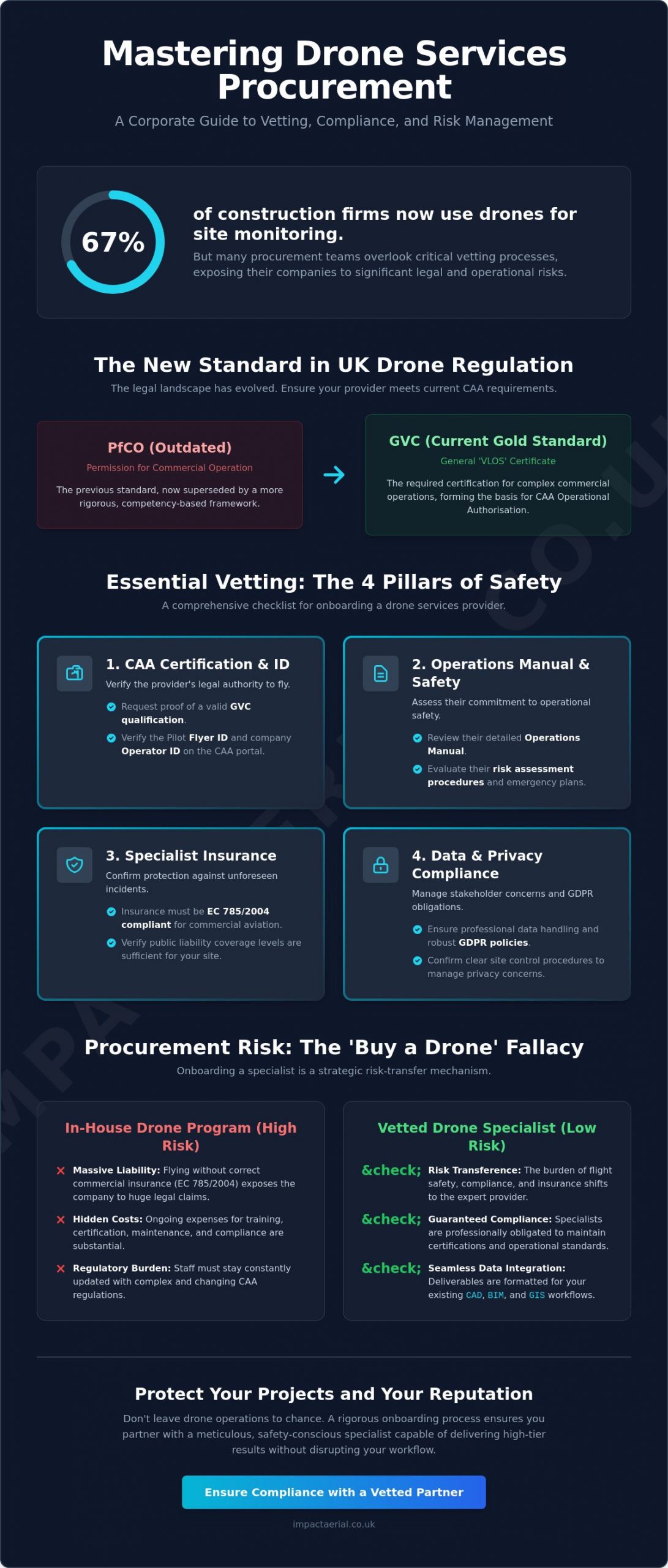
Did you know that 67% of construction firms now use drones for site monitoring, yet many procurement teams still treat these high-tech aerial assets like standard sub-contractors? When you’re onboarding a drone services company, the difference between a successful deployment and a legal nightmare often comes down to the quality of your vetting process. It’s common to feel uncertain about whether aerial data truly outperforms traditional methods, or to worry about the operational risks of having a drone over a live site.

We agree that the stakes are high. One oversight regarding CAA regulations or insurance can lead to significant liability. This guide is designed to help you master the corporate procurement process for drone services, ensuring full compliance and robust risk management. You’ll learn how to verify certifications, confirm specific insurance coverage, and ensure seamless data integration. We’ll provide a comprehensive checklist for vendor vetting, giving you the assurance that your provider is a meticulous, safety-conscious specialist capable of delivering high-tier results without disrupting your daily workflow.

Key Takeaways

  • Understand the critical shift from PfCO to the GVC framework to ensure your drone provider meets current CAA regulatory standards for commercial operations.
  • Master the strategic steps for onboarding a drone services company, focusing on rigorous legal vetting and operational alignment for complex corporate projects.
  • Learn to define high-value deliverables through a clear Statement of Work that supports seamless data integration with existing CAD, BIM, and GIS workflows.
  • Identify the essential insurance requirements, such as EC 785/2004 compliance, that protect your organization from liability and unforeseen site disruptions.
  • Discover how to proactively manage stakeholder concerns regarding GDPR and privacy through robust site control procedures and professional data handling.

What is Professional Onboarding for Drone Services?

The formal process of onboarding a drone services company is a rigorous procurement procedure that moves beyond simply hiring a pilot. It represents a structured alignment of vetting, legal verification, and operational integration. For Tier 1 contractors and ISO-compliant organisations, this process is essential for maintaining safety standards and mitigating corporate liability. It marks the definitive shift from hiring amateur photography enthusiasts to partnering with technical consultants focused on high-precision commercial data collection. This professional approach ensures that aerial technology serves as a reliable tool for business intelligence rather than a source of operational risk.

To better understand this concept, watch this helpful video:

The industry has undergone significant regulatory changes, specifically the transition from the old Permission for Commercial Operation (PfCO) to the current CAA GVC framework. This evolution reflects a more structured approach to Global drone regulations, prioritising competency and risk assessment over simple flight hours. In a market where 67% of construction firms now use drones for site monitoring, professional onboarding ensures that your data is accurate, legally obtained, and ready for integration into business workflows. This meticulous vetting process provides the psychological comfort and tangible benefits required by modern project managers.

The Legal Framework: CAA GVC and A2 CofC

A CAA GVC certified pilot is the gold standard for complex commercial work. While the A2 Certificate of Competency (A2 CofC) allows for flights in less restrictive environments, it often lacks the robust safety frameworks required for industrial or construction site monitoring. The GVC provides the necessary foundation for obtaining an Operational Authorisation, which is the specific legal “permission to fly” granted by the CAA to commercial entities for complex missions. This certification ensures the operator has undergone rigorous theoretical and practical assessments tailored to professional environments where precision is non-negotiable.

Why “Just Buying a Drone” is a Procurement Risk

It’s tempting for businesses to purchase hardware internally, but this often creates significant procurement risks. While the cost of professional drones has decreased, the expense of training, maintaining compliance, and securing commercial-grade insurance remains high. Internal staff flying without specific commercial liability insurance (EC 785/2004 compliant) exposes the company to massive legal liability if an incident occurs. Onboarding a drone services company acts as a strategic risk-transfer mechanism. By partnering with a specialist, you shift the burden of regulatory compliance, equipment maintenance, and flight safety to an expert who is fully insured and certified to operate in high-risk zones, ultimately protecting your organization’s reputation and bottom line.

Essential Compliance Vetting: The 4 Pillars of Safety

When you are onboarding a drone services company, your first priority is a rigorous vetting of their legal credentials. This isn’t just about ticking boxes; it’s about verifying that the operator has the technical competency and legal authority to fly in complex environments. Start by requesting the pilot’s Flyer ID and the company’s Operator ID. You can verify these details directly through the Civil Aviation Authority (CAA) portal. As of 2026, an Operator ID is mandatory for any drone with a camera weighing 100g or more. This verification ensures that the provider is registered and accountable under current UK law, providing the first layer of protection for your project.

The second pillar involves reviewing the provider’s Operations Manual and safety record. A professional operator will have a detailed manual that outlines their specific safety protocols, risk assessment procedures, and emergency contingency plans. This document is a requirement for obtaining an Operational Authorisation from the CAA. Don’t hesitate to ask for evidence of past safety performance or site-specific risk assessments. A company that is transparent about its safety culture is far more likely to integrate into your on-site operations without causing disruption. This level of meticulousness is what separates a technical consultant from a casual operator.

Commercial Drone Insurance: Why £5m Liability Matters

While the minimum insurance requirement for commercial drone operations in the UK is governed by Regulation (EC) 785/2004, most Tier 1 contractors and property managers require a higher standard. A £5m public liability policy has become the industry benchmark for construction and commercial property sites. This coverage is vital because it protects your organization against claims related to property damage, personal injury, and accidental privacy breaches. If you’re commissioning technical data, ensure the provider also carries professional indemnity insurance. This protects you if a decision made based on their survey data leads to financial loss. Verifying these professional insurance standards is a non-negotiable step in the procurement process for any high-value asset manager.

Hardware Standards: 4K HDR and Thermal Capabilities

The choice of equipment is a key indicator of a provider’s professionalism. Consumer-grade drones often lack the sensor quality and stability required for high-stakes commercial drone surveys. Professional operators typically utilize DJI Enterprise models or equivalent commercial hardware. These systems offer 4K HDR video for marketing purposes and high-resolution sensors that capture the level of detail needed for technical inspections. For specialized projects like PV solar farm surveys or roof inspections, thermal imaging capabilities are essential. High-end thermal sensors can detect heat signatures and anomalies that are invisible to the naked eye, providing actionable intelligence that traditional methods simply cannot match. Confirming that your partner uses hardware with UK class marks (UK0 to UK6) also ensures they are compliant with the latest 2026 hardware regulations.
Onboarding a Drone Services Company: The Professional Buyer’s Guide

Operational Integration: Aligning Drone Data with Project Goals

Successful onboarding a drone services company requires a clear transition from compliance verification to operational execution. This stage is defined by the creation of a robust Statement of Work (SoW), which acts as the technical blueprint for the entire engagement. A well-structured SoW must explicitly define the nature of the deliverables, distinguishing between RAW data for technical analysis and polished, edited assets for stakeholder presentations. Establishing these parameters early prevents scope creep and ensures that the aerial intelligence gathered aligns perfectly with your specific business objectives, whether you’re monitoring a multi-year construction project or conducting a one-off structural survey.

Effective integration also depends on setting clear communication protocols for site-specific flight windows. Professional operators work around your schedule to minimize site disruption, often coordinating with site managers to identify periods of low activity. For long-term projects, such as weekly construction site monitoring, a consistent data collection frequency is established to create a reliable chronological record of progress. This methodical approach allows project managers to overlay aerial data directly into existing CAD, BIM, or GIS software, transforming visual assets into measurable technical insights that drive informed decision-making.

From Raw Footage to Actionable Intelligence

The value of professional drone services lies in the post-production process. While a standard pilot might provide basic files, a technical specialist transforms raw data into actionable intelligence. For marketing and corporate communications, aerial filming and photography involves sophisticated color grading and editing to produce cinematic-quality video. In more technical sectors, 3D photogrammetry and point clouds are generated to create high-precision digital twins of land or structures. These models are essential for land surveying and volume calculations. Additionally, virtual tour creation provides property professionals and advertising agencies with immersive, 360-degree perspectives that traditional photography cannot replicate.

Site Access and Pre-Flight Planning

A meticulous operator handles all the logistical complexities of site access long before the drone leaves the ground. This includes conducting a Site-Specific Risk Assessment (SSRA) to identify hazards like overhead power lines or public footpaths. Gaining landowner permission and notifying local authorities are standard procedures for a compliant provider. In restricted airspace, the operator will manage the “Notice to Airmen” (NOTAM) process, ensuring that other airspace users are aware of the drone activity. This level of pre-flight planning ensures that operations are conducted safely and legally, providing you with the reassurance that your project is in expert hands.

Risk Management and Privacy: Addressing Stakeholder Concerns

Effective risk management is the cornerstone of professional aerial operations. When you are onboarding a drone services company, you must look beyond the flight itself and evaluate how the provider manages the psychological and physical concerns of your stakeholders. Addressing the fear of “drone crashes” is a primary step in this process. Professional operators utilize hardware with significant technical redundancy, including dual batteries, multiple IMUs, and sophisticated obstacle avoidance sensors. These systems, combined with the pilot’s advanced flight skills, ensure that the risk of equipment failure is minimized. This technical approach provides the reliability that corporate clients expect when operating in high-value or sensitive environments.

Weather-related delays are an inherent part of aviation, but they shouldn’t compromise your project timelines. A specialist operator monitors meteorological data days in advance and maintains flexible scheduling to capitalize on safe flight windows. By establishing clear communication protocols during the onboarding phase, you can ensure that any weather-related adjustments are handled without impacting ground-level operations. This proactive management allows for a seamless integration of drone technology into your existing project schedule, maintaining momentum while prioritizing safety above all else.

GDPR and Data Privacy in Aerial Photography

Privacy is a significant concern for urban projects where drones may inadvertently capture images of the public. A professional pilot understands their legal responsibility to protect individual privacy by blurring faces and vehicle number plates in any non-consensual footage. For large-scale urban developments, conducting a Data Protection Impact Assessment (DPIA) is a critical step in the onboarding process. This assessment identifies potential privacy risks and outlines the mitigation strategies used to protect data subjects. Our team ensures that all captured data is stored on encrypted, secure servers with strict access controls to maintain the highest standards of digital security.

Mitigating Operational Disruption

One of the most significant benefits of aerial technology is its “non-contact” nature. Unlike traditional methods that require scaffolding, cranes, or cherry pickers, drones can inspect assets from a safe distance without touching the structure. This eliminates the need for expensive and disruptive physical access equipment. The efficiency of rapid deployment is clear when completing a drone roof survey, which can often be finished in hours rather than days. This speed significantly reduces the time spent on-site, allowing your team to continue their work without interruption.

To ensure zero impact on your daily operations, professional operators coordinate closely with site managers to establish robust “cordon and control” procedures. These involve securing take-off and landing zones and ensuring that flight paths avoid active work areas where possible. This meticulous planning ensures that the drone remains an unobtrusive tool for data collection. If you are ready to enhance your site safety and data accuracy, contact Impact Aerial today to discuss your specific project requirements.

Partnering with Impact Aerial: Your UK Onboarding Solution

Impact Aerial provides a comprehensive solution for corporate clients looking to integrate aerial intelligence into their operations. Our Birmingham based team delivers nationwide coverage, ensuring that high tier filming and surveying services are accessible across the UK. When you are onboarding a drone services company, the complexity of managing multiple vendors can be overwhelming. We simplify this by providing full project management, guiding you from the initial technical consultation through to the final post production delivery. Our commitment to CAA GVC certified excellence ensures that every flight is conducted with the highest regard for safety and regulatory compliance.

For Tier 1 contractors and large scale property developers, our £5m commercial liability insurance provides the necessary psychological comfort and legal protection required for high stakes projects. This level of coverage, combined with our meticulous adherence to safety protocols, makes us a trusted specialist for organisations that value external validation and industry standards. We don’t just fly drones; we provide a risk mitigated service that delivers tangible business benefits. By choosing a partner with established credentials, you ensure that your aerial data collection is both legally sound and technically superior.

Our Technology Stack: DJI Enterprise and 4K HDR

We utilise a commercial grade technology stack centred around DJI Enterprise hardware. These systems provide the superior stability and image quality needed for 4K HDR cinematic filming and high resolution technical inspections. Our specialised thermal surveying capabilities are particularly valuable for PV solar farm assessments and commercial property surveys, where detecting heat anomalies is critical for asset maintenance. Beyond data collection, our in house post production suite allows us to create immersive virtual tours and high end marketing films that showcase your projects from unique and aspirational perspectives. This end to end capability ensures that the data we capture is transformed into actionable intelligence for your stakeholders.

Streamlined Procurement for Corporate Clients

We understand that procurement departments need efficiency and clarity. To speed up your vendor onboarding process, we provide all essential compliance documentation, including our Operations Manual, insurance certificates, and pilot credentials, upfront. This transparency reduces the administrative burden on your team and ensures a faster path to project commencement. Our extensive experience working across the property, construction, and advertising sectors allows us to align our services with your specific industry requirements and safety standards. Contact Impact Aerial today to discuss your project requirements and discover how our professional drone services can transform your data collection workflow.

Securing Your Project’s Aerial Future

Mastering the process of onboarding a drone services company transforms a complex regulatory challenge into a streamlined operational advantage. By prioritizing CAA GVC certification and verifying robust insurance standards, you protect your organization from liability while gaining access to high-precision data. We’ve explored how aligning technical deliverables with your existing CAD or BIM workflows ensures that aerial intelligence becomes a functional part of your project management strategy. This structured approach moves your procurement beyond simple photography and into the realm of professional technical consultancy.

Impact Aerial is ready to support your next mission with our team of CAA GVC Certified Pilots and £5m commercial liability insurance. Based in Birmingham, we provide comprehensive UK-wide coverage for filming and surveying projects of any scale. We handle the entire project lifecycle, from initial risk assessments to final post-production, so you can focus on your core business goals. Request a professional drone services quote from Impact Aerial to begin your next project with confidence. We look forward to helping you achieve a new perspective on your operations.

Frequently Asked Questions

What certifications should I look for when onboarding a drone company?

You should prioritize the General Visual Line of Sight Certificate (GVC) and a valid Operational Authorisation from the CAA. These credentials confirm the pilot has undergone rigorous training and has the legal permission to conduct complex commercial flights. Additionally, verify their Operator ID and Flyer ID through the CAA portal to ensure they are registered under the latest 2026 UK drone regulations.

How much public liability insurance does a professional drone pilot need?

While the legal minimum is set by Regulation (EC) 785/2004, most corporate clients and Tier 1 contractors require a minimum of £5 million in public liability insurance. This level of coverage protects against property damage, personal injury, and privacy breaches on industrial or construction sites. Always confirm that the policy is specifically tailored for commercial drone operations rather than general business activities.

Can a drone company fly in restricted airspace like London or near airports?

Yes, professional operators can fly in restricted zones by obtaining specific permissions from National Air Traffic Services (NATS) or local Air Traffic Control (ATC). This process involves submitting a flight plan and coordinating closely with authorities to ensure safety. When onboarding a drone services company for projects in cities like London, ensure they have experience managing these complex coordination procedures.

Do I need to notify the police before a drone flight on my property?

You typically don’t need to notify the police for standard commercial drone operations on private property. The primary requirement is obtaining permission from the landowner and ensuring the flight complies with CAA safety distances. However, for high profile locations or large public events, a professional operator might inform local authorities as a courtesy to prevent unnecessary security concerns.

What is the difference between a PfCO and a GVC for commercial drones?

The PfCO (Permission for Commercial Operation) is a legacy qualification that has been phased out in favor of the GVC (General Visual Line of Sight Certificate). The GVC is the current professional standard required to apply for an Operational Authorisation from the CAA. It reflects updated safety protocols and hardware classifications that came into effect to align with modern aviation standards.

How long does the onboarding process typically take for a new drone vendor?

The process of onboarding a drone services company usually takes between three to ten working days depending on the depth of your internal compliance checks. This timeframe allows for the verification of insurance, CAA certifications, and the review of the operator’s safety manual. Providing clear procurement requirements early can significantly speed up this transition and move your project into the operational phase faster.

What data formats will I receive after a drone survey or filming session?

You will receive industry standard formats tailored to your specific software requirements. For aerial filming, this typically includes 4K MOV or MP4 files and high resolution JPG or RAW images. For technical surveys, data is delivered in formats like GeoTIFF for maps, LAS or OBJ for 3D point clouds, and PDF for detailed inspection reports that integrate into CAD or BIM software.

Is a drone survey really cheaper than traditional scaffolding?

Yes, drone surveys are significantly more cost effective, often reducing inspection expenses by over 50% compared to traditional scaffolding or cherry pickers. Aerial inspections eliminate the high costs of equipment rental, labor for assembly, and site downtime. A drone can complete a comprehensive roof survey in hours rather than days, providing high resolution data without the physical risks of working at height.

Legal Requirements for Commercial Drone Use in the UK: A 2026 Compliance Guide

Would your business reputation survive a £5,000 fine and a criminal record simply because you misjudged the legal distance between a drone and a congested area? It’s understandable why many UK operators feel overwhelmed by the transition from the old PfCO to the GVC or struggle to understand the legal requirements for commercial drone use uk in 2026. You want to focus on capturing high-quality data and professional imagery, not spending hours decoding a complex Civil Aviation Authority (CAA) CAP 722 document.

This guide simplifies the current regulatory framework, ensuring you understand the exact certifications and insurance mandates needed to fly legally. We’ll provide a clear checklist for compliance, explain the critical differences between the A2 CofC and GVC, and show you how to secure the necessary peace of mind for your next project. By the end of this article, you’ll know exactly how to protect your business from the risks of illegal flight operations while maintaining the highest safety standards.

Key Takeaways

  • Define “valuable consideration” in the 2026 landscape to ensure your business flights remain fully compliant with the latest CAA regulatory framework.
  • Determine whether your operations require a GVC or an A2 CofC to ensure your pilots hold the correct qualifications for Specific or Open category flights.
  • Master the legal requirements for commercial drone use uk, including the mandatory EC 785/2004 insurance standards required for professional data-gathering and surveys.
  • Implement essential safety protocols for Operator and Flyer IDs to maintain meticulous records and provide added peace of mind for your clients.
  • Protect your organisation from the “shared liability” trap by understanding the legal risks and potential fines associated with hiring uncertified drone operators.

Understanding the CAA Regulatory Framework in 2026

The Civil Aviation Authority (CAA) serves as the sole arbiter of UK airspace, managing a complex ecosystem that now includes over 600,000 registered drone users. By 2026, the regulatory landscape has matured into a sophisticated, risk-based framework where safety and accountability are paramount. Understanding the legal requirements for commercial drone use uk is no longer optional for businesses; it’s a fundamental prerequisite for operational continuity. The CAA ensures that every commercial flight operates within a system designed to protect the public while allowing the drone industry to contribute an estimated £45 billion to the UK economy by 2030.

Staying compliant is essential for maintaining a professional reputation. Unauthorised flights don’t just risk heavy fines; they invalidate commercial liability insurance. For professional operators, adhering to these rules provides clients with vital peace of mind, proving that the pilot is a meticulous, vetted specialist capable of handling high-value data-gathering tasks safely.

The Legal Definition of Commercial Drone Operations

The UK legal system defines commercial use through the concept of “valuable consideration.” If a pilot receives payment, goods, or even a reciprocal service in exchange for a flight, the operation is commercial. An estate agent filming a £500,000 listing is conducting a commercial flight. If a hobbyist captures sunset footage and later sells it to a marketing agency, that transition from personal use to business gain requires a professional qualification. Using “hobbyist” footage for commercial marketing without the correct certifications is a breach of the Air Navigation Order 2016, which can result in a £2,500 fine and a permanent black mark on a company’s safety record.

The Evolution of Drone Laws: What Changed for 2026?

The transition from the old PfCO (Permission for Commercial Operation) to the current GVC (General Visual Line of Sight Certificate) is now complete. The latest version of CAP 722, the UK’s primary drone guidance document updated in January 2026, reflects a shift toward total digital accountability. A major change is the full implementation of Remote ID for all commercial drones. This technology broadcasts the drone’s location and the operator’s ID in real-time, allowing the CAA to monitor the 20% increase in commercial drone traffic recorded since 2024. These legal requirements for commercial drone use uk ensure that professional services remain distinct from recreational flying, maintaining high standards for aerial inspections and photogrammetry across the West Midlands and the wider UK.

Mandatory Pilot Qualifications: GVC vs. A2 CofC

Understanding the legal requirements for commercial drone use uk begins with distinguishing between two primary certifications. Since the UK transitioned to its current regulatory framework on 31 December 2020, the Civil Aviation Authority (CAA) has categorised drone flights based on operational risk rather than the previous distinction between commercial and recreational use. This shift makes holding the correct qualification vital for insurance validity and site safety.

The GVC: The Gold Standard for Professional Operators

The General Visual Line of Sight Certificate (GVC) is the benchmark for high-level professional operations. It’s the mandatory requirement for pilots operating within the “Specific” category. The syllabus is rigorous, covering technical drone knowledge, meteorology, navigation, and aviation law. Unlike basic certificates, the GVC requires a formal practical flight assessment conducted by an Approved Training Organisation (RAE).

A critical component of GVC status is the Operations Manual. This document is a bespoke safety blueprint that must be submitted to the CAA to obtain an Operational Authorisation. It details exactly how an operator manages risks, maintains equipment, and handles emergencies. For complex industrial inspections or urban filming, this level of documentation isn’t just a preference; it’s a legal necessity. We prioritise GVC-certified pilots for our complex projects because this qualification permits flights that are often restricted for lower-level certificate holders.

A2 CofC: The Entry Level for Commercial Work

The A2 Certificate of Competence (A2 CofC) allows for operations in the “Open” category. It’s often sufficient for low-risk tasks using drones weighing less than 2kg. For example, a pilot using a 249g drone can fly commercially with an A2 CofC, provided they follow the “fly over people, but not over crowds” rule. However, the limitations are significant. For drones between 500g and 2kg, pilots must maintain a 50-metre horizontal separation from uninvolved persons.

  • A2 CofC: Best for small-scale estate agency photography or rural surveys.
  • GVC: Essential for construction sites, infrastructure inspections, and congested areas.
  • Separation Rules: GVC holders with an Operational Authorisation can often fly as close as 30 metres to uninvolved people during take-off, providing much greater flexibility.

Hiring a GVC-certified pilot typically offers a better return on investment for businesses. While an A2 pilot might be grounded by proximity restrictions, a GVC pilot has the training and legal standing to complete the mission safely. You can verify a pilot’s credentials by asking for their Flyer ID and checking the CAA digital portal. For added peace of mind, you can review our professional credentials to see how we maintain the highest standards of safety and compliance across the West Midlands and beyond.

Risk-Based Operational Categories: Where Does Your Project Fit?

The UK Civil Aviation Authority (CAA) organises all flights into three risk-based tiers. Your project’s category depends on the aircraft’s weight and how close you intend to fly to people or property. Identifying your tier early is vital for meeting the legal requirements for commercial drone use uk and ensuring your site remains compliant.

  • The Open Category: This covers low-risk flights. It is subdivided into A1, A2, and A3 based on the drone’s weight and its proximity to people. Limitations are strict; you generally cannot fly over uninvolved persons.
  • The Specific Category: This is where the majority of professional aerial work happens. It requires an Operational Authorisation from the CAA, allowing for missions that exceed the standard limits of the Open Category.
  • The Certified Category: This tier is reserved for high-risk operations. It includes future applications like large-scale cargo delivery or passenger-carrying “air taxis.” These missions are regulated similarly to manned aviation.

The Open Category and “Sub-250g” Myths

Many new operators believe that flying a drone weighing less than 250g removes all regulatory burdens. This isn’t true for professional work. While sub-250g drones in the A1 sub-category offer more freedom near people, they still require the pilot to have valid commercial insurance and an Operator ID. “Toy” drones lack the sensor stability and GPS precision required for high-grade data. Professional results demand hardware that can handle wind resistance and maintain sub-centimetre accuracy; features rarely found in the lightest consumer models.

Specific Category and Operational Authorisation

For added peace of mind, most commercial clients prefer operators working within the Specific Category. This requires an Operational Authorisation (OA), which is granted after the CAA reviews an operator’s safety manuals and risk assessments. It allows us to fly closer to buildings and people than the Open Category allows. This flexibility is essential for complex urban environments.

For example, we recently conducted a drone survey in the congested Birmingham city centre. Because the site was surrounded by high-rise offices and busy footpaths, Open Category rules were impossible to follow safely. By using our CAA-approved OA and a PDRA01 risk framework, we deployed a DJI Matrice 350 RTK with a 30m safety buffer. This meticulously planned approach ensured we met all legal requirements for commercial drone use uk while capturing high-resolution structural data that saved the client £5,000 in scaffolding costs.

Essential Compliance Checklist: Insurance, IDs, and Privacy

Operating a drone for profit requires more than just a steady hand on the controls. You must satisfy several legal requirements for commercial drone use uk to avoid hefty fines or equipment seizure. The Civil Aviation Authority (CAA) mandates two distinct identifications. The Flyer ID is held by the pilot and requires passing an online theory test to prove competency. The Operator ID is held by the business or individual responsible for the drone. This ID must be clearly displayed on the aircraft body. As of 2024, failing to display an Operator ID can result in a fine of up to £1,000.

Pilots must also remain vigilant regarding Flight Restriction Zones (FRZs). These zones typically extend in a 2 to 2.5 nautical mile radius around approximately 120 UK airports. Flying within these areas without specific permission from Air Traffic Control is a criminal offence under the Air Navigation Order 2016. Using apps like Drone Assist ensures you stay clear of restricted airspace and temporary hazards.

Commercial Liability Insurance: Protecting Your Assets

Professional operators usually carry £5 million in public liability insurance. This figure has become the standard requirement for contractors working with local councils or major construction firms. Standard hobbyist insurance does not cover professional drone services, meaning any accident during a paid job could leave you personally liable for damages. Regulation EC 785/2004 is the mandatory insurance regulation for all UK commercial drone flights as of 2026. This ensures that third parties are protected regardless of the drone’s weight or the complexity of the mission.

Privacy and the Surveillance Camera Code

The Information Commissioner’s Office (ICO) treats drone-captured footage as personal data if individuals or number plates are identifiable. You must comply with UK GDPR by implementing “privacy by design” into your flight planning. For missions in high-density urban environments, we recommend conducting a Privacy Impact Assessment (PIA) to identify risks before the rotors start spinning.

  • Notify residents or business owners 48 hours before a scheduled shoot using physical signage or digital notices.
  • Use post-processing software to blur faces and vehicle registrations that are not central to the project.
  • Securely store all raw data on encrypted drives and delete any footage that is not required for the final deliverable.

Following these steps provides peace of mind for both the operator and the client. Meticulous record-keeping and data management are the hallmarks of a professional service. If you need a fully compliant partner for your next project, you can book a certified drone specialist here.

The Risks of Non-Compliance and Why Professional Hire Matters

Ignoring the legal requirements for commercial drone use uk doesn’t just endanger the pilot. It triggers a shared liability trap. If a contractor operates illegally and causes an accident, the client often shares the legal and financial burden. Courts frequently examine whether a company performed adequate due diligence before commissioning a flight. If you didn’t verify that the operator was authorised, you’ve likely failed that legal test.

Financial and Reputational Consequences

The financial stakes for illegal flights are significant. Under the Air Navigation Order 2016, the Civil Aviation Authority (CAA) has the power to issue fines reaching £5,000 for safety breaches. In more severe cases involving the endangerment of aircraft or the public, criminal prosecution can lead to unlimited fines or custodial sentences.

Beyond legal penalties, an incident with an uninsured pilot can bankrupt a small firm. Standard public liability insurance doesn’t cover commercial drone activities; only specialist policies meeting EC 785/2004 standards are valid. A single crash into a glass facade or a crowded public space could result in millions of pounds in claims. Your brand’s reputation is also on the line. A viral video of a safety failure or a privacy breach linked to your project can destroy years of built-up consumer trust in seconds.

The Impact Aerial Advantage

Understanding the legal requirements for commercial drone use uk is essential for any project manager. Impact Aerial removes this burden through meticulous planning and expert execution. We hold full GVC certification and carry £5m in commercial liability insurance, providing the peace of mind that hobbyist flyers cannot offer.

Our team specialises in the West Midlands, where we regularly manage the complex Flight Restriction Zones (FRZs) around Birmingham Airport and the National Exhibition Centre (NEC). We handle all local authority coordination and airspace permissions, ensuring your data gathering or filming is 100% compliant. Contact us today to discuss how we can safely deliver high-quality aerial results for your next project.

Professional Hire Checklist

Before you book any aerial services, use this checklist to verify your pilot’s credentials:

  • Valid Certification: Ask to see their drone license (GVC or PfCO).
  • Operational Authorisation: Ensure they have a current document issued by the CAA.
  • Specialist Insurance: Confirm they have commercial insurance that specifically mentions drone operations.
  • Risk Assessment: A professional will always provide a site-specific safety plan before take-off.
  • Experience: Check for a portfolio that shows they’ve worked in similar environments, such as busy city centres or construction sites.

Don’t take risks with your business. Hiring a vetted, professional operator is the only way to ensure your project remains safe, legal, and insured.

Securing Your Skies with 2026 Regulatory Standards

Adhering to the legal requirements for commercial drone use uk is a vital step in protecting your business from liability and ensuring operational safety. The 2026 CAA framework demands a precise understanding of risk categories and pilot certifications, specifically the distinction between A2 CofC and GVC qualifications. It’s clear that maintaining a valid Operator ID and robust insurance coverage is the only way to operate legally in the UK’s increasingly busy airspace. Taking these steps prevents costly legal interruptions and ensures your data-gathering remains professional and ethical.

Impact Aerial simplifies this process by providing CAA GVC Certified Pilots who are experts in the latest regulatory changes. For added peace of mind, we carry £5m Commercial Liability Insurance and utilise DJI Enterprise Grade Equipment to deliver breath-taking, high-precision results. Our team manages every technical detail, from risk assessments to privacy compliance, so your project stays on track. Book a CAA-certified pilot for your next project and elevate your business with confidence.

Frequently Asked Questions

Do I need a license to use a drone for my business in the UK?

You don’t need a specific “commercial license” anymore, but you must hold valid CAA authorisations to operate legally. Since 31 December 2020, the legal requirements for commercial drone use uk dictate that you need an A2 Certificate of Competency (A2 CofC) or a General Visual Line of Sight Certificate (GVC). These qualifications prove you’ve reached the professional standards necessary to manage flight safety and risk assessments.

What is the difference between a Flyer ID and an Operator ID?

A Flyer ID is awarded to the individual pilot after passing a CAA theory exam, while the Operator ID is the registration number for the person or business responsible for the drone. You must be 18 or over to get an Operator ID, which costs £11.13 annually. It’s mandatory to label every drone in your fleet with this unique ID. The Flyer ID is free, lasts for five years, and confirms you understand the basic safety rules.

Can I fly a drone commercially in London or Birmingham city centres?

You can fly in these cities, but you must navigate complex Flight Restricted Zones (FRZs) and obtain specific permissions. In Birmingham, for example, operations within the 5km FRZ of Birmingham Airport require direct approval from Air Traffic Control. Professional pilots use the GVC qualification to fly closer to people and buildings in congested areas. We manage these legal requirements for commercial drone use uk by conducting meticulous site surveys and securing all necessary NSF approvals before take-off.

Is it illegal to hire a drone pilot who doesn’t have CAA insurance?

Hiring a pilot without EC 785/2004 compliant insurance is a significant breach of UK aviation safety regulations. Commercial operators must carry third-party liability insurance to fly for “valuable consideration,” which includes any business-related task. For added peace of mind, always verify that your pilot holds a specialist policy with at least £1 million in cover. Choosing an uninsured hobbyist puts your business at financial and legal risk if an incident occurs.

What happens if a commercial drone crashes and I hired the pilot?

The pilot in command is legally responsible for the flight, but your business could face secondary liability if you didn’t check their credentials. If the operator is GVC certified and carries commercial insurance, their policy covers property damage or personal injury. We provide full risk assessments and proof of insurance for every project. This professional approach ensures your company remains protected from the fallout of any technical failures or accidents.

How do I check if a drone pilot is actually CAA GVC certified?

You should ask the pilot to provide their GVC certificate and their CAA Operator ID number before hiring them. Legitimate professionals will also be listed on vetted platforms like the Drone Safe Register or ARPAS-UK. You can cross-reference their details against the CAA’s list of authorised operators. A trustworthy specialist will always be happy to share their documentation to demonstrate their commitment to safety and compliance.

Do I need to inform the police before a commercial drone flight?

You don’t typically need to notify the police for standard commercial operations, but you must follow CAA notification procedures in certain areas. For high-profile shoots in city centres, we often contact local authorities as a courtesy to prevent public concern. This proactive communication is a hallmark of professional services. It ensures that your project proceeds without interruptions from security or law enforcement officers.

How much does a commercial drone license cost in the UK in 2026?

Budgeting for 2026, you should expect a GVC training course to cost between £500 and £850 depending on the provider. The annual CAA Operator ID fee is currently £11.13, though this figure often increases by 5% to 10% every few years. When you include specialist commercial insurance, which starts at around £600 annually, the total cost to stay compliant is roughly £1,200 for the first year. These fees ensure your business operates within the legal framework established by the Civil Aviation Authority.

Insured Drone Operator UK: A Complete Guide to Hiring Safely

What happens if a drone crashes into your property? Who is liable if someone is injured during filming? These are not hypothetical scenarios; they are critical risks that can expose your business to significant financial and legal damage. This is precisely why engaging a fully insured drone operator uk is not just a best practice-it’s an essential safeguard for your project, your reputation, and your finances. Hiring an operator based on a low price alone could end up costing you thousands in unforeseen damages and liability claims.

But how can you be certain an operator’s insurance is legitimate and sufficient for your specific needs? Navigating the complexities of commercial liability, aviation regulations, and policy verification can be a daunting task. This comprehensive guide is designed to provide you with complete peace of mind. We will break down exactly what to look for, the key questions you must ask, and how to confidently verify that you are partnering with a truly professional and compliant operator, protecting your business from risk and ensuring a safe, successful project from start to finish.

Key Takeaways

  • Understand that if you hire an uninsured operator, your business becomes legally and financially liable for any accidents, property damage, or injuries.
  • Learn the critical difference between basic recreational cover and the robust commercial liability insurance required for any professional drone work in the UK.
  • Discover the specific documents and CAA certifications you must request to confidently verify you are hiring a fully compliant and insured drone operator uk.
  • Recognise that comprehensive insurance is the foundation, not the ceiling, of a professional service that prioritises a deep culture of safety and operational excellence.

What ‘Insured Drone Operator’ Means for Your Project’s Safety

When you hire a professional for aerial work, the term ‘insured drone operator’ is more than just a reassuring buzzword; it’s a critical component of your project’s financial and legal security. It signifies that the operator holds a specialised commercial insurance policy designed specifically for aviation activities. This is a non-negotiable legal requirement for any commercial drone work in the UK, providing a vital safety net against unforeseen accidents. Without it, you, the client, could be exposed to significant liability.

To better understand the specifics of this coverage, this short guide provides a clear overview:

Commercial vs. Hobbyist Insurance: A Critical Distinction

A fundamental mistake is assuming any drone insurance will suffice. Hobbyist or recreational policies are designed purely for personal use and are immediately voided if the drone is flown for ‘hire and reward’. A professional, insured drone operator in the UK must carry a commercial policy that explicitly covers business activities. Hiring an operator with the wrong insurance is the same as hiring one with no insurance at all, leaving your project completely unprotected.

Key Coverage Types Explained Simply

Commercial drone insurance is not a single product but a package of protections. The most important one for you as a client is:

  • Public Liability Insurance (PLI): This is the cornerstone of commercial drone operations. It covers costs associated with injury to third parties or damage to their property. All commercial operators must hold PLI compliant with EC 785/2004, a standard mandated by the comprehensive UK drone regulations.
  • Equipment Insurance: This covers the drone, cameras, and other gear. While this is primarily the operator’s risk, it ensures they can continue work in the event of equipment failure.
  • Cyber & Data Liability: An increasingly vital cover for projects involving sensitive data capture, such as site surveys or infrastructure inspections.

Why Your Own Insurance Won’t Cover Drone Incidents

It is a dangerous assumption that your company’s general business or public liability insurance will cover an incident involving a drone. The vast majority of standard commercial policies contain specific exclusions for aviation activities and unmanned aircraft. Attempting to claim on your own policy would almost certainly result in denial, leaving your business liable for all costs. By hiring a properly insured drone operator, you correctly transfer this specialised risk to their insurer, providing essential peace of mind.

The Real Risks: What Happens When You Hire an Uninsured Operator?

While professional drone operations are meticulously planned to be safe, the potential for accidents due to technical malfunction or unforeseen environmental factors can never be completely eliminated. Choosing an uninsured operator transfers the enormous financial and legal risk directly onto you and your business. The savings of a cheaper, non-compliant quote are insignificant compared to the catastrophic costs of a single incident.

Understanding these real-world consequences is crucial for any business looking to leverage aerial data. Let’s explore what is truly at stake.

Scenario 1: Property Damage During a Survey

Imagine you have commissioned a drone to survey a commercial building’s roof. Mid-flight, the drone loses signal and collides with the building, damaging expensive cladding and smashing a series of high-level windows. Without operator insurance, the liability for the repair costs-potentially running into tens of thousands of pounds-falls directly on you as the client. A certified and insured drone operator uk carries robust Public Liability Insurance (PLI) specifically to cover these events, protecting your assets and ensuring repairs are handled without any financial impact on your business.

Scenario 2: Third-Party Injury at a Public Event

Consider a drone being used to film your corporate event or a local festival. If the aircraft fails and falls into a crowd, the consequences escalate from property damage to severe personal injury. This opens your business up to significant personal injury claims, protracted legal battles, and compensation awards that can be financially crippling. The subsequent negative press can also cause irreparable damage to your brand’s reputation. When the operator is uninsured, it is often the client who hired them that faces the full force of legal action.

Who is Legally Liable? The ‘Hirer Beware’ Principle

In the UK, the responsibility for ensuring a drone operation is compliant does not rest solely with the pilot. By engaging a non-compliant operator, you, the client, assume a significant portion of the risk. Failing to perform due diligence and verify that your chosen provider meets the legal Civil Aviation Authority insurance requirements can be viewed as negligence. In the event of a serious incident, the CAA may investigate your hiring process as well as the operator’s actions. This principle of ‘hirer beware’ underscores why working with a professional, fully insured drone operator in the UK is an non-negotiable part of project risk management.

Ensure your project is protected. Speak to our insured experts.

Decoding Drone Insurance in the UK: A Checklist for Clients

Verifying an operator’s insurance is more than just ticking a box; it’s a critical step in your due diligence process. A professional operator will readily provide their insurance certificate, but knowing what to look for is essential for your protection. To ensure you partner with a genuinely insured drone operator uk, use this checklist to assess their documentation and confirm their coverage is both valid and appropriate for your project.

Public Liability Limits: Is £1 Million Enough?

While the minimum Public Liability Insurance (PLI) for commercial drone operations is set at approximately £1 million, this level is rarely sufficient for professional, industrial, or commercial projects. For added peace of mind and comprehensive protection, the industry standard for high-value work, such as on construction sites, for asset inspections, or near public spaces, is typically £5 million or £10 million. Always ensure the operator’s cover limit matches the potential risks of your specific project.

What is EC 785/2004 Aviation Compliance?

This is the most critical detail to find on an insurance certificate. EC 785/2004 is a specific aviation regulation, adopted by the UK, that governs insurance for air carriers and aircraft operators. Standard public liability policies do not cover aviation activities. Any policy that is not compliant with this regulation is invalid for commercial drone work. This isn’t just a recommendation; it’s a legal mandate outlined in the official Civil Aviation Authority insurance requirements. The presence of this clause is a key indicator of a specialist, legitimate policy.

Checking the Policy’s Fine Print: What to Look For

When you receive an insurance certificate, don’t just file it away. Take a moment to perform these simple but vital checks. An authentic insured drone operator uk will have a policy that clearly states the following:

  • The Insured’s Name: Does the company or individual name on the policy match the operator you are hiring? Discrepancies here are a major red flag.
  • Policy Dates: Check the “effective from” and “expiry” dates to confirm the policy is current and will be valid for the entire duration of your project.
  • Coverage Level: Verify that the stated Public Liability limit meets your project’s requirements (e.g., £5 million or £10 million).
  • Aviation Compliance: Look for explicit mention of “EC 785/2004” to confirm it is a valid aviation-specific policy.

How to Confidently Verify an Operator’s Credentials

Understanding the importance of insurance is the first step; verifying it is the crucial next one. A truly professional and compliant operator will be transparent and readily provide documentation for your peace of mind. This practical guide will empower you to confidently assess an operator’s credentials before any work begins, ensuring you hire a legitimate insured drone operator UK businesses can rely on.

Step 1: Ask for the Certificate of Commercial Insurance

Any legitimate drone company will provide their Certificate of Commercial Insurance without hesitation. When you receive the document, take a moment to review the key details. First, ensure the business name on the policy matches the company you are hiring and cross-reference it with their website. Check that the policy is current and has not expired. Most importantly, the policy must explicitly cover commercial operations using ‘Unmanned Aerial Vehicles’ (UAVs), ‘Unmanned Aircraft Systems’ (UAS), or ‘Drones’.

Step 2: Request the CAA Operational Authorisation

Alongside insurance, the operator must hold a valid Operational Authorisation from the UK’s Civil Aviation Authority (CAA). This is the official legal permission required to conduct commercial drone flights, and it is a critical piece of the compliance puzzle. In fact, most specialist insurance policies are rendered invalid if the operator does not hold this authorisation. The document will clearly state the registered operator’s name and their unique CAA authorisation number.

Red Flags to Watch Out For

Your due diligence protects your project, your property, and your reputation. Be alert for these common warning signs that suggest an operator may not be compliant or properly insured:

  • Reluctance to Provide Documents: A professional will have their insurance and CAA authorisation ready. Hesitancy or outright refusal is a major red flag.
  • Unusually Low Prices: Professional insurance, equipment, and certification are significant business costs. A quote that is dramatically lower than others may indicate these essential overheads have been skipped.
  • Vague or Evasive Answers: Questions about insurance limits, CAA status, or safety procedures should be met with clear, confident answers.
  • Lack of Professional Presence: A missing or unprofessional website, no registered company details, or a lack of a portfolio can suggest a hobbyist rather than a certified commercial professional.

By following these steps, you ensure you are partnering with a credible and fully insured drone operator. At Impact Aerial, we pride ourselves on transparency and are always prepared to provide our full documentation for client review.

Beyond Insurance: Hallmarks of a Truly Professional Drone Service

While comprehensive commercial insurance is the non-negotiable foundation for any drone operation, it represents the baseline, not the complete picture of professionalism. A truly reliable and safe service is built upon a much broader culture of safety, compliance, and operational excellence. Choosing a properly insured drone operator uk is the first step; verifying their qualifications, planning procedures, and experience is what guarantees a successful and risk-free project.

These additional hallmarks are what separate a true specialist from a simple hobbyist with a policy. They demonstrate a deep-seated commitment to not only protecting your interests financially, but to proactively preventing incidents from ever occurring.

CAA GVC Certification: The Pilot’s Licence

In the UK, the key pilot qualification is the General Visual Line of Sight Certificate (GVC). This certification is a prerequisite for any operator applying to the Civil Aviation Authority (CAA) for an Operational Authorisation, which is required for most commercial work. Hiring a GVC-certified pilot provides assurance that they have been rigorously trained and tested on UK air law, flight planning, and critical safety procedures, ensuring a high standard of operational competence.

The Importance of Risk Assessments (RAMS)

A professional operator never arrives on-site and simply launches their drone. Every commercial flight is preceded by meticulous planning, including a detailed site survey and the creation of a Risk Assessment and Method Statement (RAMS). This crucial process involves:

  • Identifying all potential on-site hazards (e.g., public access, power lines, buildings, air traffic).
  • Assessing the level of risk associated with each hazard.
  • Defining clear, actionable steps to mitigate those risks and ensure a safe flight.

For complete peace of mind, you should always feel confident asking a potential operator to share an example of their RAMS documentation.

Why Experience Matters

A certificate proves theoretical knowledge, but only real-world experience builds true expertise. An experienced operator has the practical skills to manage dynamic situations, adapt to unexpected challenges like sudden weather changes, and understand the unique complexities of different environments, from busy construction sites to sensitive ecological surveys. This background ensures not only safety but also greater efficiency and higher-quality data collection. An experienced, insured drone operator uk transforms a potential risk into a reliable asset for your project.

These elements-robust insurance, official certification, meticulous planning, and deep industry knowledge-are what define a professional partner you can trust. Our team combines £5m insurance with years of industry experience, providing the comprehensive peace of mind your project deserves.

Your Final Check: Partnering with a Vetted and Insured Drone Operator

Hiring a drone operator in the UK is a decision that carries significant weight for your project’s safety and success. As we’ve explored, the distinction between a professional and an amateur lies in verifiable credentials. The key takeaways are clear: comprehensive insurance is non-negotiable for mitigating risk, and diligent verification of an operator’s CAA certification and policy documents is essential due diligence. Ultimately, selecting the right insured drone operator uk is about securing more than just aerial footage-it’s about ensuring compliance, safety, and total peace of mind.

At Impact Aerial, we provide this assurance as standard. Our pilots are all CAA GVC Certified and backed by £5m in Commercial Liability Insurance, offering professional services with nationwide UK coverage. Don’t leave your project’s outcome to chance. Protect your project. Request a quote from our fully insured and CAA-certified team today. Make the safe, professional choice and let’s achieve breath-taking results together.

Frequently Asked Questions

Is drone insurance a legal requirement for commercial operators in the UK?

Yes, it is an absolute legal requirement. Any individual or company operating a drone for commercial purposes in the UK must hold valid commercial drone insurance that complies with the EC 785/2004 regulation. This is not optional and applies to all commercial flights, regardless of the drone’s size or weight. Operating without this specific aviation insurance is illegal and carries significant penalties, highlighting the importance of verifying your chosen operator’s credentials before any work commences.

What is the minimum level of public liability insurance a drone operator must have?

The minimum level of public liability insurance is dictated by the regulation EC 785/2004 and is based on the aircraft’s weight. For most commercial drones, the legal minimum is 750,000 Special Drawing Rights, which equates to approximately £750,000. However, most professional operators carry significantly higher levels of cover, often between £5 million and £10 million, to provide comprehensive protection and peace of mind for their clients, especially when working on large-scale industrial or commercial sites.

What happens if I hire an uninsured drone pilot and there is an accident on my property?

Hiring an uninsured operator exposes you and your business to significant financial and legal risk. If an accident occurs causing property damage or personal injury, the liability could fall directly onto you as the client who commissioned the work. Without an appropriate insurance policy to claim against, you could be held personally or corporately responsible for covering all associated costs, from repairs to substantial personal injury claims. This is a primary reason to only work with a fully insured drone operator UK.

How is a drone operator’s insurance different from a photographer’s public liability insurance?

The distinction is critical. Standard public liability insurance, such as that held by a ground-based photographer, explicitly excludes aviation activities. Drone operations require a specialist aviation insurance policy that is compliant with EC 785/2004. This covers specific risks associated with flying an aircraft, including injury or damage caused by the drone itself. A photographer’s policy offers no protection for incidents involving an unmanned aircraft, making it entirely unsuitable and non-compliant for commercial drone work.

Can I check an operator’s CAA status online?

While the Civil Aviation Authority (CAA) does not have a public-facing database for instantly verifying an operator’s specific permissions, you can and should take direct steps. Always ask the operator to provide a copy of their Operational Authorisation certificate, which contains their Operator ID and outlines the scope of their permitted operations. A professional and legitimate operator will readily provide this documentation for your verification and peace of mind before commencing any project.

Does Impact Aerial operate with full commercial drone insurance?

Yes, absolutely. Impact Aerial operates with comprehensive commercial drone insurance that exceeds the minimum legal requirements set by the CAA. For our clients’ complete peace of mind, we hold a £10 million public liability policy, ensuring full compliance and protection for every project we undertake. We believe in absolute transparency and are happy to provide our insurance documentation and CAA Operational Authorisation certificate upon request, confirming you are working with a safe and professional insured drone operator UK.