Corporate Drone Video Production: UK Buyer’s Guide 2026

The most impressive aerial shot can still be the wrong choice for a corporate video. Effective corporate drone video production supports the message instead of distracting from it, and the right team needs to offer more than footage from the air. Permissions, site access, weather and safety planning can all affect what’s achievable on shoot day, so compare providers on their planning as well as their visuals.

This UK buyer’s guide explains how to compare providers on creative fit, technical capability and operational readiness before commissioning a shoot. You’ll learn what to ask about the brief, flight planning and relevant CAA credentials, and how to distinguish a drone operator from a team that can manage filming through editing and post-production. You’ll also find practical ways to assess whether aerial footage serves your business objective, identify risks to discuss in advance and create a clear process from consultation to final delivery.

Key Takeaways

  • Assess whether aerial footage will help show a site, communicate scale or support a campaign, rather than simply add spectacle.
  • Understand the steps from brief and feasibility checks through filming, review, editing and delivery. Prepare the details your provider will need.
  • Compare corporate drone video production providers on creative approach, service scope, credentials, insurance and post-production capability.
  • Use a focused brief to clarify your objective, audience, locations, stakeholders and intended channels before requesting proposals.
  • Consider how coordinated project management can support delivery. Impact Aerial is based in Birmingham and the West Midlands and serves projects across the UK.

What corporate drone video production can add to a business film

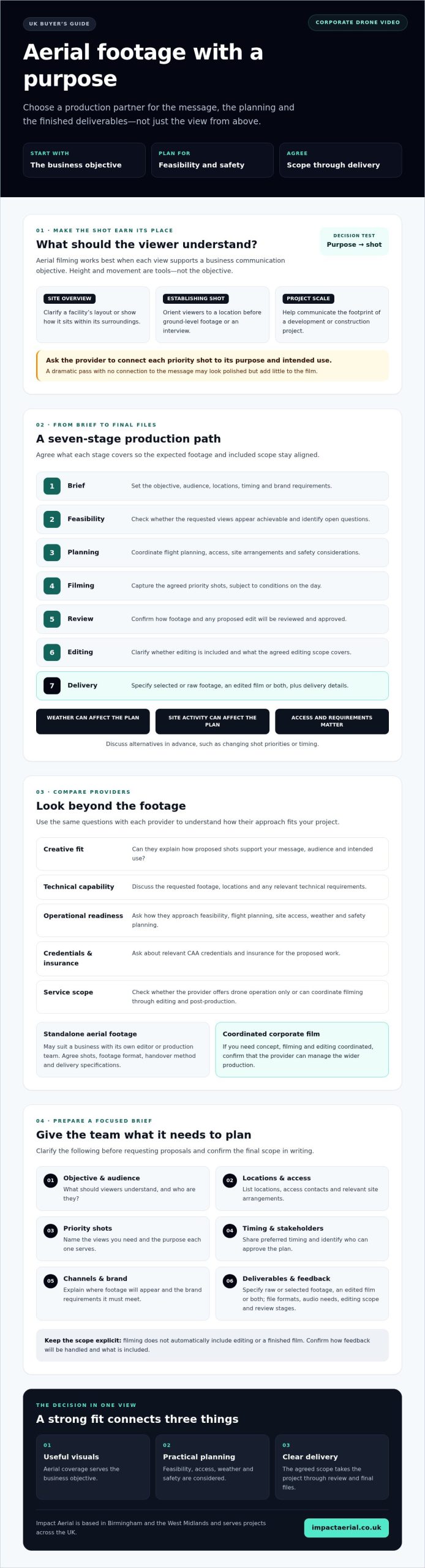
Corporate drone video production is aerial filming planned around a business communication objective. The camera’s height or movement isn’t the objective in itself. A useful shot might show how a facility sits within its surroundings, clarify the scale of a construction project, introduce a location before an interview or provide a distinctive view for a campaign.

Start with what viewers need to understand, then choose aerial coverage that helps communicate it. A site overview can clarify layout, while a wide establishing shot can orient viewers before ground-level footage or an interview. A dramatic pass with no connection to the message may look polished but add little to the film. Ask the provider to explain the purpose of each priority shot.

For a practical introduction to drone filming and composition, watch this video:

When aerial footage supports a corporate objective

Name your audience and the action you want them to take, such as understanding a development’s footprint, recognising a site’s setting or engaging with a campaign. Then decide which view would help them. A site overview may suit a project update where layout matters, while an establishing shot can place an interview in context. Ask the provider to link each planned shot to a purpose and intended use, rather than relying on a general promise of attractive footage.

This discussion also supports practical planning. Site access, surroundings and applicable requirements can affect what can be filmed. For general background, see this overview of UK drone regulations, then discuss the specific arrangements for your proposed shoot with the provider.

Standalone drone footage or a complete corporate film?

Standalone aerial footage may suit a business that already has an editor or production team. If that’s your plan, agree the required shots, footage format, handover method and other delivery specifications in advance. Don’t assume that filming automatically includes editing or a finished film.

If you need the concept, filming and editing coordinated, ask whether the provider can manage the wider production. Aerial footage can contribute to a corporate film, but it isn’t automatically a substitute for one. Specify whether you need selected clips or an edited film, where the footage will appear and what brand requirements the final delivery must meet. A clear scope helps the provider recommend relevant coverage instead of adding aerial shots for novelty.

How corporate drone video production moves from brief to edited footage

A clear workflow connects the business objective to the final files. Corporate drone video production typically moves through seven stages: brief, feasibility, planning, filming, review, editing and delivery. Agree what each stage covers so there’s no gap between the footage you expect and what the provider has included in the scope.

Share the project objective, intended viewers, locations, access contacts, preferred timing and brand requirements at the outset. The provider can then assess whether the requested shots appear feasible and identify questions about site access, location constraints or operational requirements. Weather and activity on site can affect the plan. Discuss alternatives, such as changing shot priorities or timing, instead of assuming every planned view will be possible on the day.

What to agree before the filming day

Before filming, confirm the key message, distribution channels and action you want viewers to take. List the locations and priority shots, identify who can arrange access and name the person responsible for approving the plan. This gives the production team a practical route from the creative brief to site arrangements.

Put the expected deliverables in writing. Specify whether you need raw or selected footage, an edited film or both. Note preferred file formats, editing scope, audio needs, brand requirements and how feedback will be handled. Clarify how many review stages are included in the agreed scope, rather than assuming every provider follows the same process.

What happens during filming and post-production

On the day, the team should check the agreed location and coordinate with your site contact before filming begins. A safety-led plan helps determine which shots are appropriate in the conditions and how filming can work around site activity. If access, weather or another constraint changes what’s practical, the team can discuss priorities with the client contact.

After filming, selected aerial shots can be combined with ground footage, interviews or graphics when these are part of the agreed project. During review, provide consolidated feedback from the relevant stakeholders to keep revisions focused on the brief. Before work begins, confirm the final formats, delivery method, editing scope and review arrangements. These details depend on the project agreement and shouldn’t be assumed.

Impact Aerial manages projects from consultation through editing and post-production. If you’re preparing a brief, you can discuss your corporate filming brief and clarify the footage and delivery scope you need.
Corporate Drone Video Production: UK Buyer’s Guide 2026

How to compare corporate drone video production providers

Compare providers against the same criteria, not just their most impressive showreel or drone specifications. A capable pilot may deliver well-framed aerial footage, while a wider production team may also plan the story, coordinate filming and manage editing. Decide which level of service your brief needs, then ask each provider for clear evidence of their approach and deliverables.

Use this framework to compare proposals consistently:

Area What to ask What to assess
Creative approach How will the proposed shots support our message and audience? Look for a clear link between shot choices and the business objective, not aerial spectacle for its own sake.
Service scope Who handles planning, filming, editing and project communication? Check whether the proposal covers standalone footage or a wider film, and what work is excluded.
Credentials and operations What current pilot qualifications and operational documents are relevant to this project? Ask how the provider will assess the proposed location and confirm any applicable permissions and requirements.
Insurance Can you confirm your current cover and provide the relevant details? Check that the documentation and cover are appropriate for your project requirements.
Delivery What files, edits and review arrangements are included? Compare formats, editing scope, feedback process and suitability for your intended channels and future reuse.

Which credentials and safety questions should a buyer ask?

Request evidence of current pilot qualifications and ask what operational documentation will inform the proposed work. Confirm insurance details rather than relying on a general claim. Location-specific permissions and requirements can affect whether planned filming is feasible, so ask who will check them and how any constraints will be communicated. Verify current UK CAA requirements for the specific operation before filming. Credentials support due diligence, but don’t assume they guarantee approval for a particular flight.

How to assess creative and delivery fit

Review examples for deliberate framing, controlled movement and consistency, then consider whether the style suits your audience. Ask who develops the shot plan, operates the drone, edits the footage and manages communication. Equipment specifications matter only when they suit the requested shots and final outputs. A camera feature alone doesn’t establish creative or production fit.

Aerial footage adds value when it makes a business message easier to understand, such as by showing a site’s layout or giving viewers useful context. If a proposal focuses on dramatic movement without explaining its purpose, ask how those shots serve the brief. Compare the deliverables with where the film will appear, whether accessibility elements such as captions are required and whether you need files for later reuse.

What to include in a corporate drone video production brief

A clear brief helps a production provider connect your business objective with suitable footage, practical planning and final deliverables. It also gives stakeholders a shared reference when comparing proposals. Use this checklist to prepare the essentials, and flag anything you’re unsure about for discussion.

  • Objective and audience: What should the film communicate, who needs to see it and what should viewers do next?
  • Locations and access: List each site, a named access contact, access arrangements and any timing or operating-hour limits.
  • Site activity and constraints: Note active work, people or vehicle movements, sensitive areas, known location concerns and other filming restrictions.
  • Stakeholders: Identify who will coordinate on site, provide approvals and consolidate feedback.
  • Creative direction: Share brand guidance, reference films, key messages and any required call to action.
  • Shot priorities: Separate must-have aerial shots from optional ideas. Include any interviews, voice-over, music or ground-camera footage the project may need.
  • Use and delivery: Specify intended channels, required formats, editing scope, review process and whether you may reuse the footage later.

The creative information your production team needs

Give the provider enough context to make creative choices with purpose. A site overview intended to explain a location may need different coverage from a short campaign film designed to introduce a project. Reference films can communicate pace and style, but explain which elements matter so they aren’t treated as instructions to copy. Clear priorities help the team distinguish essential shots from ideas that could be adjusted if conditions change.

The practical information that prevents avoidable delays

Name the site contact and clarify who handles access and stakeholder approvals. Share timing restrictions, active-site considerations and known location concerns early so feasibility and planning can account for them. Review current UK drone filming guidance and CAA information relevant to the proposed work, then ask the provider how location-specific requirements will be checked. A guide provides context, but doesn’t confirm that a particular flight is suitable or approved.

Before commissioning, make sure the brief describes the finished output as well as the filming. State whether you need footage for an existing editor or an edited film, for example, and explain how it will be used. These details help providers propose a scope that matches your needs rather than leaving key decisions until after filming.

Ready to turn your requirements into a production brief? Discuss your aerial filming brief with Impact Aerial.

Why consider Impact Aerial for corporate drone video production

Choosing a provider means looking beyond the aircraft and camera. Impact Aerial is based in Birmingham and the West Midlands, with aerial filming and photography available for projects across the UK. Its project management covers the process from initial consultation through editing and post-production. This may suit businesses looking for one coordinated point of contact for aerial footage and its final delivery.

A UK production partner with technical and operational credentials

Impact Aerial uses CAA GVC-certified pilots, commercial-grade drones with 4K HDR cameras and £5m commercial liability insurance. These details can support your supplier checks, but they don’t guarantee approval for a particular flight or location. Ask to review current qualification and insurance documentation, and discuss project-specific requirements before filming is agreed.

Equipment should fit the brief. A 4K HDR camera may be relevant to the intended footage and output, but the provider should confirm that the proposed setup suits your shots, location and delivery needs. Compare the provider’s aerial filming and post-production scope with the other professional drone services relevant to your project, rather than treating technical specifications as the whole evaluation.

Agree the next steps for your corporate video

For an initial consultation, prepare the details that will help the team assess your project: the business objective, audience, locations, preferred timing, access arrangements and requested deliverables. Include brand requirements and explain whether you need standalone aerial footage or editing and post-production too. This gives both sides a practical starting point for discussing scope.

Project feasibility depends on the specific location and requirements. Discuss site access, known constraints and the proposed filming plan before confirming the work. Impact Aerial can then consider how its aerial filming and post-production capabilities align with the brief. Any flight requirements should be assessed for the individual project.

To discuss your requirements, discuss your corporate drone video project with Impact Aerial.

Make your next filming brief count

Strong corporate drone video production starts with a business objective, not a shot list. Define what your audience needs to understand, then compare providers on creative fit, project scope, operational planning and deliverables. A clear brief covering locations, access, timing, stakeholders and intended use gives the production team a practical basis for assessing the work.

Impact Aerial is based in Birmingham and the West Midlands and serves projects across the UK, with project management from initial consultation through post-production. The company uses CAA GVC-certified pilots and holds £5m commercial liability insurance. Ask to confirm current qualification and insurance documentation, and discuss the requirements of your specific project before filming is agreed.

Share your objectives, locations, access details and requested deliverables to explore whether the service fits your needs. Discuss your corporate drone video project with Impact Aerial and take the next step with a clear, considered brief.

Frequently Asked Questions

What is corporate drone video production?

Corporate drone video production is planned aerial filming designed to support a business communication objective. It can show a site’s layout, illustrate the scale of a project, introduce a location or contribute footage to a campaign. The aerial shots may be delivered as standalone footage for an existing production team or edited into a wider film. Define the audience, message and intended use in the brief before shot planning begins.

How do I choose a corporate drone video production company?

Compare providers on creative fit, service scope, operational readiness and delivery. Review relevant footage for framing, movement and suitability for your audience, then ask who handles planning, filming, editing and communication. Request details of current pilot qualifications, relevant operational documentation and insurance, and clarify who checks project-specific requirements. Confirm the deliverables, formats and review process in writing. A strong proposal should explain how planned shots serve your business message.

Do I need a CAA-qualified drone pilot for corporate filming in the UK?

Requirements depend on the proposed operation, location and applicable UK Civil Aviation Authority rules, so there isn’t one qualification answer for every shoot. Ask the provider which current pilot qualifications and operational documents are relevant to your specific filming plan, and how location requirements will be checked. A qualification alone doesn’t guarantee permission or approval for a particular flight. Confirm current requirements and any project-specific permissions before filming is agreed.

Can drone footage be used in a corporate video without other filming?

Yes, if aerial footage alone meets the communication objective and your chosen format. It can work for a site overview or a visual introduction, for example, but it may not provide the interviews, detail or context needed for every corporate film. Decide whether you need standalone clips for an existing editor or a finished, edited film. Confirm the provider’s scope and deliverables rather than assuming aerial filming includes a complete production.

What should I include in a corporate drone video brief?

Include the business objective, intended audience, key message, locations and distribution channels. Name the site contact and explain access arrangements, timing restrictions, active-site considerations and known location concerns. Share brand guidance, reference films, must-have shots, optional ideas and any interview or ground-footage requirements. Also specify editing scope, preferred file formats, review responsibilities and intended reuse. These details help the provider assess feasibility and propose relevant deliverables.

How much does corporate drone video production cost?

There isn’t one standard price for corporate drone video production. A quote will depend on the project scope, including the locations and filming time involved, operational requirements, equipment suitability and whether editing or broader post-production is needed. Request an itemised proposal that explains what’s included, what’s excluded and how additional requirements would be handled. This makes it easier to compare providers on deliverables and production scope, not just the headline figure.

How long does a corporate drone video project take?

Project timing varies with the brief, site access, feasibility checks, filming requirements and editing scope. Weather or site activity may also affect the filming plan, while review and approval arrangements influence final delivery. Ask the provider to outline the stages from initial consultation and planning through filming, review, editing and delivery, with expected timings for your specific project. Share any fixed campaign or publication dates early so they can be considered during planning.
Professional Post-Production & Video Editing Services UK (2026)

You’ve captured the footage—the raw data is there. But transforming hours of unedited clips into a compelling, professional video that captivates your audience is a different challenge entirely. Many businesses find their raw footage looks flat and unengaging, and often lack the specialist software, technical skills, or time required to do it justice. This is where professional post-production video editing services UK-based companies rely on become an invaluable asset. It’s the critical stage where raw material is meticulously crafted into a powerful narrative that reflects the quality of your brand.

This guide demystifies the entire post-production journey. We will show you how our specialist team transforms your footage into a high-impact cinematic asset, detailing everything from advanced colour grading and sound design to motion graphics and final delivery. We’ll outline our clear, collaborative process, ensuring predictable timelines and costs, so you can move forward with confidence. Discover how to achieve a final video that not only looks breath-taking but actively works to meet your specific marketing and business objectives.

Key Takeaways

  • Learn how modern post-production shapes raw footage into a compelling narrative that aligns with your brand’s strategic goals.
  • Discover the unique technical challenges of editing aerial and drone footage that generalist video editors often overlook.
  • Explore the benefits of choosing integrated post-production video editing services uk that combine expert aerial capture with editing for a seamless workflow.
  • Identify the core components of a professional video edit, from colour grading to sound design, to better articulate your project requirements.

Beyond the Cut: What is Post-Production in 2026?

Post-production is the crucial, transformative stage where raw video footage is meticulously shaped into a compelling final product. Think of it this way: post-production is to video what a master chef is to raw ingredients. It’s where the magic happens—blending technical skill with creative vision to craft a narrative that resonates. Far more than just trimming clips, this process involves colour grading, sound design, motion graphics, and strategic editing to control the story’s pace, mood, and emotional impact. The technical definition of what is post-production covers this entire suite of disciplines, all working in unison to elevate your project from a collection of shots to an authoritative piece of communication.

To better understand this concept, this video provides a detailed overview of the entire process:

From Raw Data to Compelling Story

Raw footage, especially from high-resolution drones, is often visually flat, unstabilised, and lacks inherent narrative context. It is simply data. The post-production process breathes life into this data, building a clear story arc by establishing pacing, rhythm, and focus. Every cut, transition, and colour adjustment is a deliberate choice made to guide the viewer’s attention, build tension or excitement, and evoke a specific, intended response that aligns with your project’s goals.

Why Your Business Needs More Than a Simple Edit

In today’s visually saturated market, the quality of your video content directly reflects your brand’s credibility. A basic edit may convey information, but a professionally polished video builds viewer trust and drives meaningful engagement. Modern UK audiences have exceptionally high standards, conditioned by a constant stream of high-quality content. Leveraging professional post-production video editing services uk ensures your message not only stands out but also positions your brand as an authoritative, detail-oriented leader in its field.

The Core Services: A Breakdown of Our Editing Toolkit

Effective post-production is where raw footage is meticulously transformed into a polished, professional asset. It’s a multi-layered process that combines technical precision with creative vision to ensure your final video not only looks and sounds exceptional but also achieves its strategic business objectives. Our team’s expertise is grounded in the same core disciplines taught in leading UK courses, such as the professional editing and post-production training at Ravensbourne University London, ensuring we employ industry-best practices. As a leading provider of post-production video editing services uk-wide, we offer a comprehensive suite of capabilities.

Below is a detailed breakdown of the core services that form our editing toolkit, outlining both the technical process and the direct business benefit each delivers.

Visual Enhancement: Colour & Graphics

  • Colour Grading: This is the technical process of digitally manipulating the colour and tone of your footage. Business Benefit: We set the precise mood for your video—be it cinematic, corporate, or vibrant—while ensuring strict adherence to your brand guidelines for visual consistency across all marketing channels.
  • Motion Graphics & Titling: We design and integrate animated text, logos, and data visualisations directly into your video. Business Benefit: This adds a layer of professional polish, communicates complex information clearly, and provides powerful calls-to-action, directly guiding viewer engagement and conversion.
  • Visual Effects (VFX): From subtle digital clean-ups to more complex enhancements, VFX refines your footage beyond what was captured in-camera. Business Benefit: We can remove distracting elements, stabilise shaky shots, or add impactful effects to create a flawless and more compelling final product that holds audience attention.

Audio Excellence: Sound Design & Mixing

  • Sound Design: We build a rich, immersive soundscape using bespoke sound effects, foley, and atmospheric audio. Business Benefit: Professional sound design significantly elevates the viewing experience, making your video more engaging and emotionally resonant with your target audience.
  • Audio Mixing & Mastering: This critical step involves balancing dialogue, music, and sound effects to create a clear and cohesive final mix. Business Benefit: We guarantee crystal-clear dialogue and a balanced, broadcast-quality audio track that sounds professional on any device, from mobile phones to conference room sound systems.
  • Music Sourcing: We identify and license the perfect musical track to complement your visuals and message from extensive professional libraries. Business Benefit: The right music reinforces your brand’s identity and evokes the desired emotional response, all while ensuring full copyright compliance for peace of mind.

Why Aerial & Drone Footage Demands Specialist Post-Production

Capturing stunning aerial footage is only half the battle; transforming it into a polished, cinematic final product requires a distinct set of skills that go far beyond standard video editing. Unlike ground-based footage, drone video presents unique challenges related to motion, atmospheric conditions, and camera physics. A generalist editor may not possess the technical understanding to address these nuances, often resulting in footage that feels amateurish or jarring. At Impact Aerial, our expertise is built on a deep understanding of the entire aerial workflow, from flight to final cut, making us a leading provider of specialist post-production video editing services uk.

Mastering Stabilisation and Motion

Even the most advanced drone gimbals can’t eliminate every micro-jitter caused by wind or complex flight manoeuvres. Our technicians meticulously apply software stabilisation tools like Warp Stabilizer to create flawlessly smooth shots. We then elevate the footage by employing advanced techniques such as speed ramping to create dramatic transitions and precise motion control to guide the viewer’s eye. Furthermore, we correct the inherent lens distortion common in wide-angle drone cameras, ensuring straight lines and a natural, professional perspective.

Advanced Colour Correction for Landscapes

One of the greatest challenges in aerial cinematography is managing the extreme dynamic range between a bright sky and the darker ground below. Our colourists are experts in balancing these exposures, using advanced grading techniques, masks, and graduated filters to produce vibrant, natural-looking scenes without sacrificing detail. For projects filmed under imperfect weather conditions, we can perform sky enhancements or replacements, transforming a flat, overcast day into a visually compelling backdrop that complements your subject.

Integrating Ground and Air Footage Seamlessly

Many projects require a combination of aerial and ground-based shots to tell a complete story. A critical part of the professional post-production process is ensuring these different sources blend together cohesively. Our editors are adept at matching the distinct colour profiles and characteristics of various cameras—from DJI drone sensors to professional cinema cameras—to create a consistent visual style. This meticulous attention to detail ensures a seamless viewing experience and a high-quality, unified final video that reflects the professionalism of your brand.

Our Collaborative UK-Based Video Editing Process

At Impact Aerial, we believe that a transparent and structured workflow is fundamental to achieving exceptional results. Our process is designed to be fully collaborative, providing you with clarity and peace of mind at every stage. We have refined our approach to ensure efficiency, incorporate your vital feedback, and deliver a final product that aligns perfectly with your vision. This methodical system is the foundation of the professional post-production video editing services UK businesses trust us to provide.

Step 1: Consultation & Project Scoping

Every successful project begins with a detailed consultation. We work closely with you to establish a comprehensive brief, ensuring we fully understand your objectives, target audience, and key messages. Our team will review your raw footage, discuss the desired creative direction, and advise on the best approach. Following this, we provide a transparent quotation and a detailed project timeline, setting clear expectations from the outset.

Step 2: The First Draft (Assembly & Rough Cut)

With a clear brief in place, our skilled UK-based editors get to work. This foundational stage involves meticulously reviewing all footage and assembling the best takes into a cohesive narrative. We then share a watermarked first draft, or ‘rough cut’, for your review. The focus here is on the story, pacing, and overall structure, allowing you to provide critical feedback before we move on to detailed polishing and refinement.

Step 3: Refinement & Polishing

This is where your vision truly comes to life. We meticulously implement your feedback from the rough cut and begin the detailed technical work. This phase typically includes:

  • Colour Grading: Enhancing the footage to create a consistent, professional, and cinematic look.
  • Sound Design & Mixing: Cleaning up audio, adding music, and creating an immersive soundscape.
  • Graphics & Titles: Integrating branding, lower thirds, and motion graphics to reinforce your message.

Our service includes up to two rounds of revisions to ensure you are 100% satisfied with the result. We maintain clear communication throughout this stage, keeping you informed of our progress.

Step 4: Final Delivery & Support

Once you have given final approval, we prepare the master files for delivery. Your video is expertly encoded and exported into all the formats you require, whether it’s high-resolution 4K for your website, optimised versions for social media platforms, or specific codecs for broadcast. All files are delivered via a secure, high-speed download link. Our commitment doesn’t end there; we provide ongoing support for any future requirements or adjustments you may need.

To discuss your project specifics, contact our team today.

Partner with Impact Aerial for End-to-End Video Production

Choosing the right partner for your video project is crucial for achieving exceptional results. At Impact Aerial, we combine state-of-the-art aerial cinematography with comprehensive in-house editing to provide a complete, end-to-end solution. Our integrated approach eliminates the complexities of managing multiple suppliers, ensuring a streamlined process from initial capture to final delivery, all under the guidance of a single, expert team.

The Advantage of an Integrated Service

Our unique strength lies in our unified workflow. Our CAA-certified pilots are not just drone operators; they are filmmakers who shoot with the final edit in mind. This foresight ensures every flight captures the most dynamic, relevant, and high-quality footage, minimising wasted time on-site and maximising the creative potential in the editing suite. This seamless integration is what sets us apart from other providers of post-production video editing services uk.

This cohesive process guarantees that our editors have an innate understanding of the aerial footage they are working with. They know the capabilities of our equipment and the context of each shot, allowing for a more efficient and creatively aligned post-production phase. The result is a faster turnaround, a more consistent final product, and a significant reduction in project management complexity for you.

Your Trusted UK Video Partner

When you partner with Impact Aerial, you are choosing a fully accredited and insured UK-based specialist. Based in Birmingham, we are perfectly positioned to serve clients nationwide, bringing our technical expertise and creative vision to projects across the country. We provide complete assurance and professionalism at every stage.

  • Fully Certified & Compliant: We hold a CAA General Visual Line of Sight Certificate (GVC) and operate with strict adherence to all UK aviation regulations.
  • Comprehensive Insurance: For your added peace of mind, all our operations are covered by £5 million in commercial liability insurance.
  • Technical & Creative Mastery: Our team possesses a rare blend of expertise, mastering both the intricate technology of commercial drones and the timeless art of cinematic storytelling.

Elevate your next project with a partner who understands the complete picture. From breath-taking aerial capture to polished, professional editing, Impact Aerial delivers quality and reliability. Contact us today to discuss your post-production project.

Elevate Your Vision with Expert UK-Based Post-Production

As we’ve explored, professional post-production is the critical stage that transforms raw footage into a compelling narrative. This is especially true for the unique technical demands of aerial and drone footage, where expert colour grading, stabilisation, and editing are essential to achieve a polished, high-impact result. At Impact Aerial, we provide comprehensive post-production video editing services uk clients trust to deliver breath-taking final cuts that align precisely with their project goals.

Our collaborative, UK-based process ensures your vision is understood and executed with meticulous care. As specialists in aerial videography, our team is uniquely positioned to handle the complexities of drone footage. For added peace of mind, all our operations are conducted by fully CAA GVC Certified Pilots and are covered by £5m in commercial liability insurance, guaranteeing a professional and compliant service from initial capture to the final edit.

Don’t let your exceptional footage fall short in the final stage. Partner with a team that has the technical expertise and creative skill to make your project soar. Request a Professional Post-Production Quote today and let’s discuss how we can bring your story to life.

Frequently Asked Questions

How much do post-production video editing services cost in the UK?

The cost for professional post-production video editing services uk is determined by project complexity, video length, and the requirements for graphics or effects. A straightforward edit for a short social media video may start from approximately £250. More involved corporate projects requiring advanced colour grading, motion graphics, and sound design can range from £800 to £3,000+. We provide a detailed, itemised quote after an initial consultation to ensure complete transparency on all costs.

What is the typical turnaround time for a video editing project?

Our standard turnaround for a typical 2-3 minute promotional video is between 5 and 10 working days, commencing from the receipt of all necessary footage and assets. This schedule allows for a meticulous editing process, including the initial cut, colour correction, and audio mixing. While expedited services can be arranged for urgent projects, we always establish a clear delivery date before work begins to manage expectations and ensure a timely, high-quality delivery.

What file formats do you need from me to start editing?

For the highest quality results, we prefer to work with raw or high-resolution source files. We accept most professional formats, including MP4 (H.264/H.265), MOV (Apple ProRes), MXF, and AVI. Please supply footage in the highest available resolution, ideally 4K or at least 1080p Full HD. Providing camera log footage (e.g., D-Log, S-Log) is highly beneficial as it offers maximum flexibility during the professional colour grading process. We can provide a secure link for large file transfers.

Can you edit footage that was not filmed by Impact Aerial?

Yes, absolutely. While we specialise in editing our own high-quality aerial footage, our professional post-production services are available for all types of video content. We frequently edit footage supplied directly by clients, whether it was captured on a smartphone, a professional cinema camera, or by another production company. Our expertise in stabilisation, colour grading, and narrative structure can elevate any source material to produce a polished, professional final video.

How many rounds of revisions are included in your service?

Our standard video editing packages include two full rounds of revisions to ensure the final product aligns perfectly with your vision. Following the delivery of the first draft, you will have the opportunity to provide consolidated feedback for implementation. We then deliver a second version for final review and any minor adjustments. This structured process ensures efficiency and clarity, leading to a final video that you are completely satisfied with. Additional revisions can be arranged for a supplementary fee.

Do you provide licensed music and stock footage?

Yes, we maintain access to extensive libraries of commercially licensed, royalty-free music and high-quality 4K stock footage. Utilising these licensed assets guarantees your final video is free from copyright infringement issues, providing peace of mind for online and commercial use. We can source music tracks and video clips that perfectly match the tone and style of your project, seamlessly integrating them to enhance the overall production value.

What makes editing drone footage different from standard video editing?

Editing drone footage requires a specialised skill set. Key challenges include applying advanced digital stabilisation to ensure smooth, cinematic motion and expert colour grading to manage the wide dynamic range and variable lighting conditions common in aerial shots. Pacing is also critical; our editors skilfully select shots that convey a sense of scale and perspective without disorienting the viewer. Our expertise ensures these technical challenges are handled professionally for a breath-taking end result.

Can you create different versions of a video for social media platforms?

Certainly. We recognise the need to optimise video content for different platforms to maximise engagement. As part of our service, we can reformat your primary video into various aspect ratios. This includes creating square (1:1) versions for Instagram or Facebook feeds, vertical (9:16) cuts for Instagram Reels, TikTok, or YouTube Shorts, and shorter, punchier edits for use in advertising campaigns. This ensures your message is delivered with maximum impact across all channels.

Corporate Video Production Birmingham: The Ultimate 2026 Guide

Is your business struggling to stand out online, watching as competitors capture your audience with dynamic video content? Venturing into the world of corporate video production birmingham can feel daunting, filled with uncertainty about costs, the creative process, and the risk of hiring a company that delivers a sub-par result. This hesitation can leave your brand looking outdated and prevent you from generating the leads and engagement you need to grow.

This ultimate 2026 guide is designed to provide clarity and peace of mind. We will demystify the entire production journey, from initial concept and budgeting to selecting a professional, CAA-certified partner you can trust. You will learn how to craft a compelling narrative, understand what defines a high-quality video, and discover how breath-taking aerial footage can give your brand a truly unique perspective. Get ready to elevate your marketing and create a video that delivers tangible results.

Key Takeaways

  • Understand that corporate video is a powerful strategic tool, extending beyond marketing to enhance crucial areas like internal communications, recruitment, and staff training.
  • Elevate your video content with cinematic aerial footage to provide a unique, high-end perspective that captures attention and sets your brand apart from competitors.
  • Demystify the production journey with a clear, step-by-step process, providing the structure and peace of mind needed to move from initial concept to a polished final video.
  • Choosing the right partner for corporate video production birmingham requires looking beyond price to evaluate expertise, professionalism, and a proven track record.

What is Corporate Video Production and Why Does Your Birmingham Business Need It?

In today’s competitive digital landscape, professional corporate video production in Birmingham is far more than a marketing luxury; it is a strategic communication asset. A professional Corporate film is designed to serve a specific business objective, communicating a company’s message clearly and effectively to a target audience. This extends beyond promotional content to encompass vital internal and external communications, from employee training and recruitment to stakeholder updates.

To better understand this concept, take a look at this example of high-quality corporate video work:

The power of video lies in its ability to build trust and increase engagement at a scale that text and static images cannot match. For B2B companies, the impact is significant; studies show that over 90% of B2B buyers state that video is important in their purchasing decision-making process. Professionally produced video content also provides a substantial boost to your SEO, improving your visibility on search engines and driving qualified traffic to your website.

Key Benefits for West Midlands Businesses

For companies operating in the region, a local focus delivers distinct, tangible advantages. High-quality video allows you to:

  • Showcase Your Operations: Professionally capture your premises, manufacturing processes, and dedicated team, offering a transparent and impressive look inside your business.
  • Stand Out Locally: In a bustling economic hub like Birmingham, polished video content helps you rise above the competition and make a memorable first impression.
  • Connect with a Regional Audience: A local focus allows you to feature familiar landmarks and speak directly to the West Midlands community, fostering a deeper, more authentic connection.
  • Attract Top Talent: Use compelling recruitment videos to highlight your company culture and attract the best local talent in a competitive job market.

Types of Effective Corporate Videos

Corporate video is a versatile medium that can be tailored to meet a wide range of business goals. Common and effective formats include:

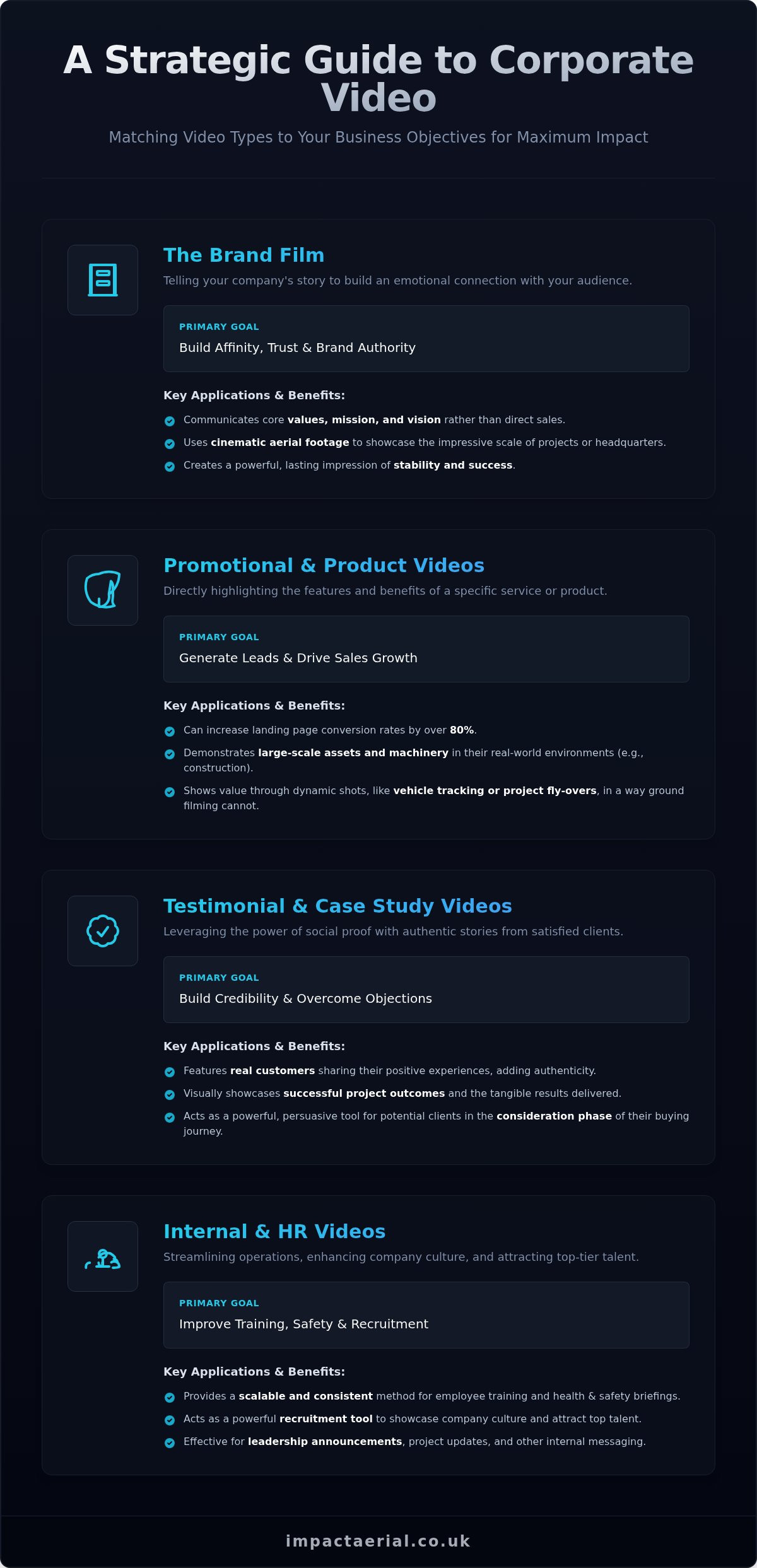
  • The Brand Film: A cinematic overview of your company’s story, mission, and values, designed to create an emotional connection with your audience.
  • Testimonial Videos: Leverage the power of social proof by featuring satisfied clients sharing their positive experiences, building essential credibility and trust.
  • Product or Service Demonstrations: Clearly and concisely explain how your offering works, highlighting key features and benefits to educate potential customers and drive conversions.
  • Internal Communications: Enhance your internal processes with high-quality videos for staff training, health and safety protocols, or company-wide announcements.

The Impact Aerial Difference: Elevating Videos with Cinematic Drone Footage

Standard, ground-level filming has its place, but to truly captivate your audience, you need a different perspective. At Impact Aerial, we integrate cinematic drone footage to move beyond the expected and create a genuine ‘wow’ factor. Aerial videography provides a unique, high-end perspective that instantly elevates your brand, showcasing your Birmingham headquarters, facilities, or operations on a grand and impressive scale. This isn’t just for property developers; dynamic aerial shots add energy and a sense of scale to any corporate story.

Crucially, all our operations are conducted with safety and legality as the highest priority. Our pilots are fully qualified and hold current CAA GVC certifications, providing you with complete peace of mind that your project is in expert, compliant hands. This commitment to professional standards is a core part of our service for corporate video production birmingham.

When to Use Aerial Videography in Your Corporate Film

Drone footage offers a powerful storytelling tool across a diverse range of commercial applications. It provides context and a sense of scale that is simply impossible to achieve from the ground. Consider incorporating aerial shots for:

  • Establishing Shots: Unveil your office, factory, or entire business park with a sweeping cinematic shot that establishes your market presence.
  • Covering Large-Scale Events: Capture the full scope and energy of a conference, product launch, or outdoor team-building day.
  • Tracking and Logistics: Showcase the efficiency of your transport and logistics operations by tracking vehicles or revealing your supply chain in motion.
  • Project Progression: Reveal the impressive scale of a construction or development project from a unique, top-down perspective.

The Technical Edge: What Professional Drones Offer

Achieving broadcast-quality results requires more than just a drone; it demands professional-grade equipment operated by certified experts. Our technical advantage ensures your footage is flawless. We provide:

  • Stunning 4K HDR Cameras: We capture incredibly detailed, vibrant, and broadcast-quality footage suitable for any screen.
  • Smooth Cinematic Movements: Our advanced gimbal systems produce fluid, stable shots-from slow, elegant pans to dynamic tracking-that handheld cameras cannot replicate.
  • Safe Access to Difficult Locations: Drones can operate in areas that are challenging or unsafe for human camera crews, capturing unique angles without risk.
  • Industry-Leading Fleet: Our fleet comprises cutting-edge commercial drones, renowned for their reliability, safety features, and imaging quality.

More Than Just Pretty Shots: The Strategic Value

Integrating aerial footage is a strategic decision that delivers a tangible return. It instantly conveys professionalism and a significant market presence, suggesting a company that invests in quality. In a digital world where first impressions are critical, the latest video marketing statistics confirm that visually compelling content is essential for capturing audience attention. A unique aerial perspective creates a memorable hook on your website or social media, setting you apart from competitors who rely on standard ground-level shots. See how our aerial filming can transform your project.

The Corporate Video Production Process: A Step-by-Step Guide

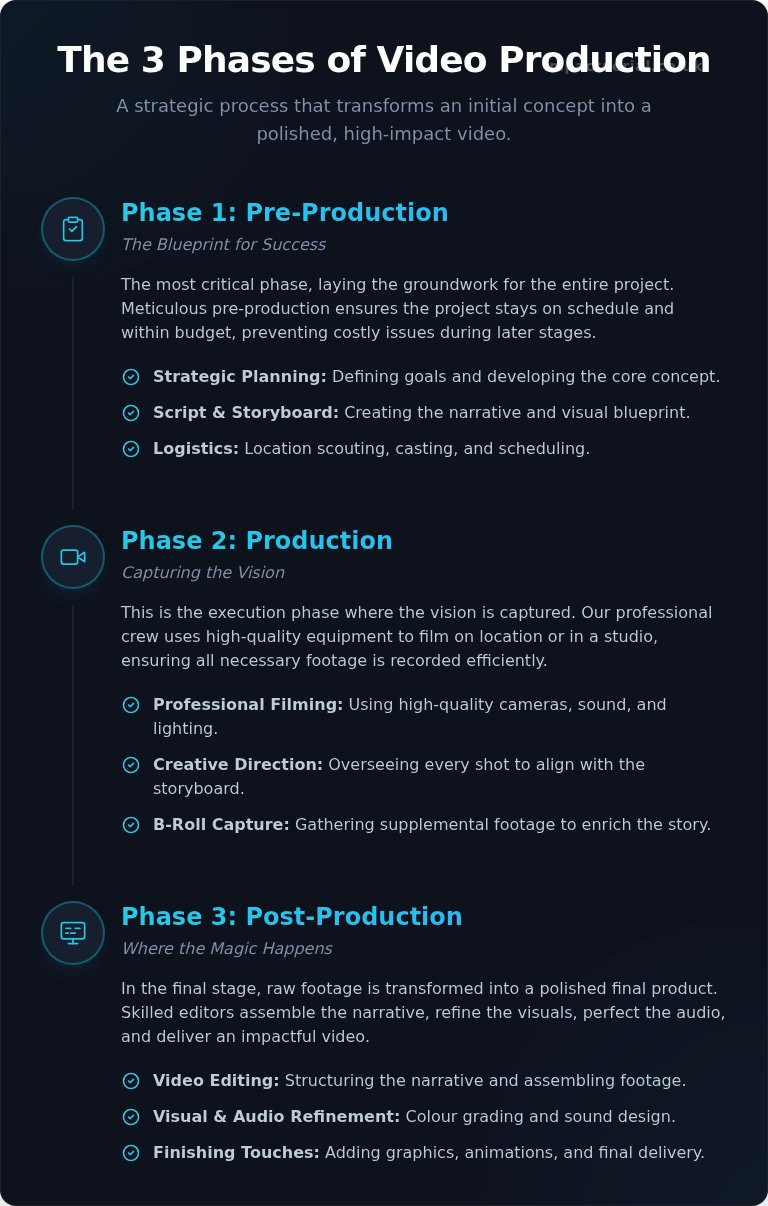
Transforming a concept into a high-impact corporate video requires a structured, collaborative, and meticulously managed process. We believe in complete transparency, providing our clients with clarity and peace of mind from the initial brief to the final delivery. Our three-phase approach ensures every project is delivered on time, on budget, and precisely to your specifications.

Phase 1: Discovery & Pre-Production

This foundational stage is where we align with your vision. It begins with an in-depth consultation to understand your business goals, target audience, and key messaging. From there, we develop the core concept, crafting professional scripts and storyboards for your approval. Our pre-production services include detailed logistical planning, from location scouting across Birmingham and the West Midlands to securing all necessary permits and developing CAA-compliant flight plans for any aerial cinematography.

Phase 2: The Shoot (Filming)

With a comprehensive plan in place, our professional crew arrives on-site with state-of-the-art 4K camera equipment. The shoot day is managed with precision and efficiency. Our director will guide interviews, capture compelling B-roll, and ensure every required shot is secured. Whether on the ground or in the air, our team executes the filming process safely and with minimal disruption to your operations, delivering a seamless experience for corporate video production in Birmingham.

Phase 3: Post-Production

This is where the narrative truly comes to life. Our skilled editors assemble the captured footage, weaving it into a compelling story that resonates with your audience. The post-production process includes:

  • Editing & Storytelling: Structuring the footage into a cohesive and engaging narrative.
  • Visual Enhancement: Professional colour grading and correction for a cinematic look.
  • Audio Engineering: Sound design, mixing, and the addition of licensed music.
  • Branding & Graphics: Integrating your logos, branded animations, and on-screen text.

We deliver drafts at key checkpoints, allowing for your feedback and revisions to ensure the final video perfectly aligns with your initial goals. Ready to start your project? Contact our team to discuss your video production needs.

How to Choose the Right Video Production Company in Birmingham

Selecting a partner for your corporate video production in Birmingham is a strategic business decision that extends far beyond comparing quotes. The right company becomes an extension of your marketing team, a creative partner invested in your success. To ensure you receive a high-quality, effective final product, focus on finding a provider with proven expertise, unwavering professionalism, and a deep understanding of your commercial objectives.

A company with extensive local knowledge of Birmingham and the West Midlands offers a significant advantage, understanding the best locations, logistics, and regional nuances to bring your project to life efficiently.

Evaluate Their Portfolio and Specialisms

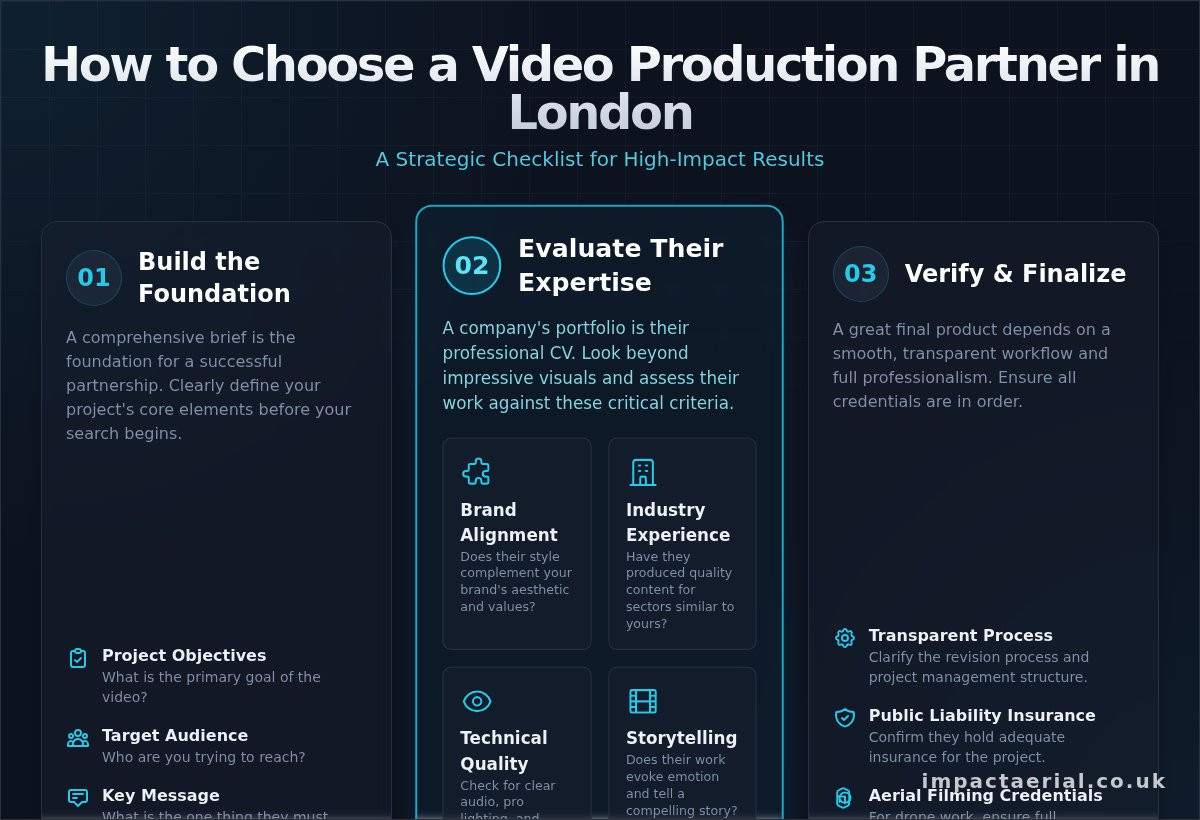
A portfolio is the most direct evidence of a company’s capabilities. Scrutinise their past work to see if their style aligns with your brand’s aesthetic. Look for high-quality examples of corporate video, paying close attention to projects within your industry. If your project requires aerial footage, review their aerial videography showreel to assess the quality, stability, and creativity of their drone operations. A strong portfolio demonstrates consistent, professional results.

Verify Certifications and Insurance (Crucial for Drones)

For any work involving drones, legal compliance is non-negotiable. A professional operator must hold a valid General Visual Line of Sight Certificate (GVC) issued by the Civil Aviation Authority (CAA). Ask for proof of this certification and confirm they hold adequate commercial liability insurance-we recommend a minimum of £5 million. This verification provides you with essential legal and financial protection and is a clear indicator of a reputable, safety-conscious company.

Discuss Their Process and Communication

A clear and structured production process is the backbone of a successful project. Enquire about their workflow, from initial concept and storyboarding to filming and post-production. It is vital to establish who your main point of contact will be and how they handle client feedback and revisions. A true partner will seek to understand your core business goals, ensuring the final video is not just visually impressive but also drives tangible results.

To help you make an informed decision, here is a checklist of essential questions to ask any potential video production partner:

  • Can you show us examples of corporate videos you have produced for businesses in our sector?
  • Are your drone pilots CAA GVC certified and can you provide proof of insurance?
  • What is your full production process, and how will we be involved at each stage?
  • Who will manage our project, and how will we communicate throughout?
  • How do you measure the success of a video project against business objectives?

Choosing a partner that satisfies these criteria ensures a smooth process and a powerful final asset for your business. For a fully certified and experienced team that combines creative vision with technical precision, learn more about our professional video services.

Partner with Birmingham’s Premier Corporate Video Specialists

As we’ve explored throughout this guide, investing in high-quality video is no longer an option but a strategic necessity for forward-thinking businesses in the West Midlands. The right video partner not only understands the meticulous step-by-step production process but also how to capture your brand’s unique story. Utilising advanced techniques like cinematic aerial footage offers a powerful way to stand out from the competition. Making the correct choice for your corporate video production birmingham project is the critical first step towards achieving a significant and measurable return on investment.

At Impact Aerial, we combine deep-rooted local Birmingham and West Midlands expertise with unparalleled technical excellence. As specialists in cinematic aerial videography, we are fully CAA GVC Certified and insured, offering you complete professional assurance and peace of mind. We are ready to bring a breathtaking, new perspective to your brand’s narrative. Request a professional consultation for your Birmingham video project. Let’s collaborate to create video content that not only engages but also delivers tangible results for your business in 2025 and beyond.

Frequently Asked Questions

How much does corporate video production cost in Birmingham?

The cost of corporate video production in Birmingham varies based on project complexity. A simple project with a small crew might start from around £1,500. However, factors such as the number of filming days, crew size, required equipment (like specialist drones), and the complexity of post-production (graphics, animation) will influence the final quote. We provide a detailed, transparent proposal tailored to your specific requirements and business objectives, ensuring there are no hidden fees.

How long does it take to produce a typical corporate video?

A standard corporate video project typically takes between 3 to 6 weeks from initial consultation to final delivery. This timeline is broken into three phases: pre-production (planning and scripting), production (filming), and post-production (editing, sound design, and revisions). Simpler videos can be completed more quickly, while more ambitious projects may require a longer timeframe. We establish a clear production schedule at the outset to align with your deadlines.

Do I need to write the script myself?

No, you do not need to provide a script. Our service includes a collaborative scriptwriting process where we work closely with you to understand your key messages, target audience, and goals. We can develop the concept and write the script from scratch, ensuring it aligns perfectly with your brand voice. Your input and approval are crucial at every stage, but we handle the professional script development to ensure a compelling and effective final narrative.

Is aerial drone filming suitable for my business, even if we’re not in property or construction?

Absolutely. While popular in property and construction, aerial filming offers a unique, cinematic perspective for any industry. It can be used to showcase the scale of a manufacturing facility, capture the energy of a corporate event, create a stunning opening for a brand film, or provide a dynamic view of your team in an outdoor setting. Drone footage elevates production value and provides breathtaking visuals that make your business stand out, regardless of your sector.

What areas do you serve outside of Birmingham?

Our primary operational area is Birmingham and the wider West Midlands. We regularly undertake projects across neighbouring counties, including Warwickshire, Worcestershire, and Staffordshire. As a fully certified and mobile team, we are also equipped to manage projects across the UK. We welcome enquiries for nationwide commissions and will conduct the necessary pre-flight planning and risk assessments required for any location to ensure a safe and successful operation.

What makes Impact Aerial different from other video production companies?

Impact Aerial uniquely combines creative video production with technically precise, CAA-certified commercial drone operations. Unlike many firms, our expertise is grounded in a meticulous, safety-first approach to aerial data gathering and cinematography. This specialism ensures not only stunning visuals but also full legal compliance and operational safety. Our focus on professional, compliant corporate video production in Birmingham gives our clients total peace of mind and technically superior results.

Are you fully licensed and insured for commercial drone flights in the UK?

Yes, we are. Impact Aerial holds a General Visual Line of Sight Certificate (GVC) issued by the Civil Aviation Authority (CAA), which is the current standard for professional drone operations in the UK. For added peace of mind, we are fully covered by specialist commercial drone liability insurance. This commitment to certification and safety ensures that every flight we conduct is fully compliant with UK regulations, protecting your business and the public.