In the highly competitive UK property market, are your listings getting the attention they deserve on portals like Rightmove and Zoopla? Wasting valuable time on viewings with unqualified leads and struggling to effectively market to remote buyers are significant challenges for today’s estate agents. For those looking to gain a decisive operational edge, implementing a professional 3d virtual tour for real estate uk strategy is no longer a luxury-it is a fundamental component of a successful marketing campaign.
This definitive 2026 guide is engineered for forward-thinking property professionals. We will provide a detailed analysis of how this immersive technology allows you to pre-qualify leads 24/7, attract serious offers from national and international buyers, and ultimately sell properties faster. Prepare to elevate your listings above the competition and discover how to integrate high-quality virtual tours to enhance your brand and achieve superior sales outcomes.
Key Takeaways
Increase buyer engagement and attract more qualified enquiries on UK property portals by understanding how immersive 3D tours outperform simple video walkthroughs.
Discover the professional step-by-step process for creating a high-quality 3d virtual tour for real estate uk, including critical property preparation tips for optimal results.
Learn why combining an interior tour with professional aerial drone footage is essential for showcasing a property’s true value, location, and surroundings.
Identify the key factors for choosing a reputable UK provider, from assessing their portfolio to verifying their technical capabilities and CAA certifications.
What is a 3D Virtual Tour in Real Estate?
In today’s competitive UK property market, static photographs are no longer sufficient to capture the true essence of a property. A 3D virtual tour moves beyond these limitations, offering a fully immersive and interactive digital model that potential buyers can navigate at their own pace. Unlike a simple slideshow, this technology provides a true sense of presence, allowing users to walk through rooms, look up at ceilings, and gain an accurate feel for the layout and flow of the space. While the general concept of what is a virtual tour has evolved, modern high-fidelity scans have become an indispensable tool for estate agents.
To see how these powerful digital assets are created, watch this short overview:
A professional 3d virtual tour for real estate uk listings empowers buyers with powerful, data-rich features that traditional marketing cannot match. These tools provide a level of detail and control that builds buyer confidence and qualifies leads more effectively. Key features typically include:
Dollhouse View: A unique 3D perspective that shows the entire property with the roof removed, giving a clear and immediate understanding of the complete layout.
Measurement Tools: An integrated tool allowing prospective buyers to measure walls, doorways, and windows to see if their furniture will fit, answering critical questions early on.
Info Tags: Embeddable points of interest within the tour that can highlight specific features, such as the brand of an appliance, the type of flooring, or links to additional information.
3D Tours vs. Video Walkthroughs
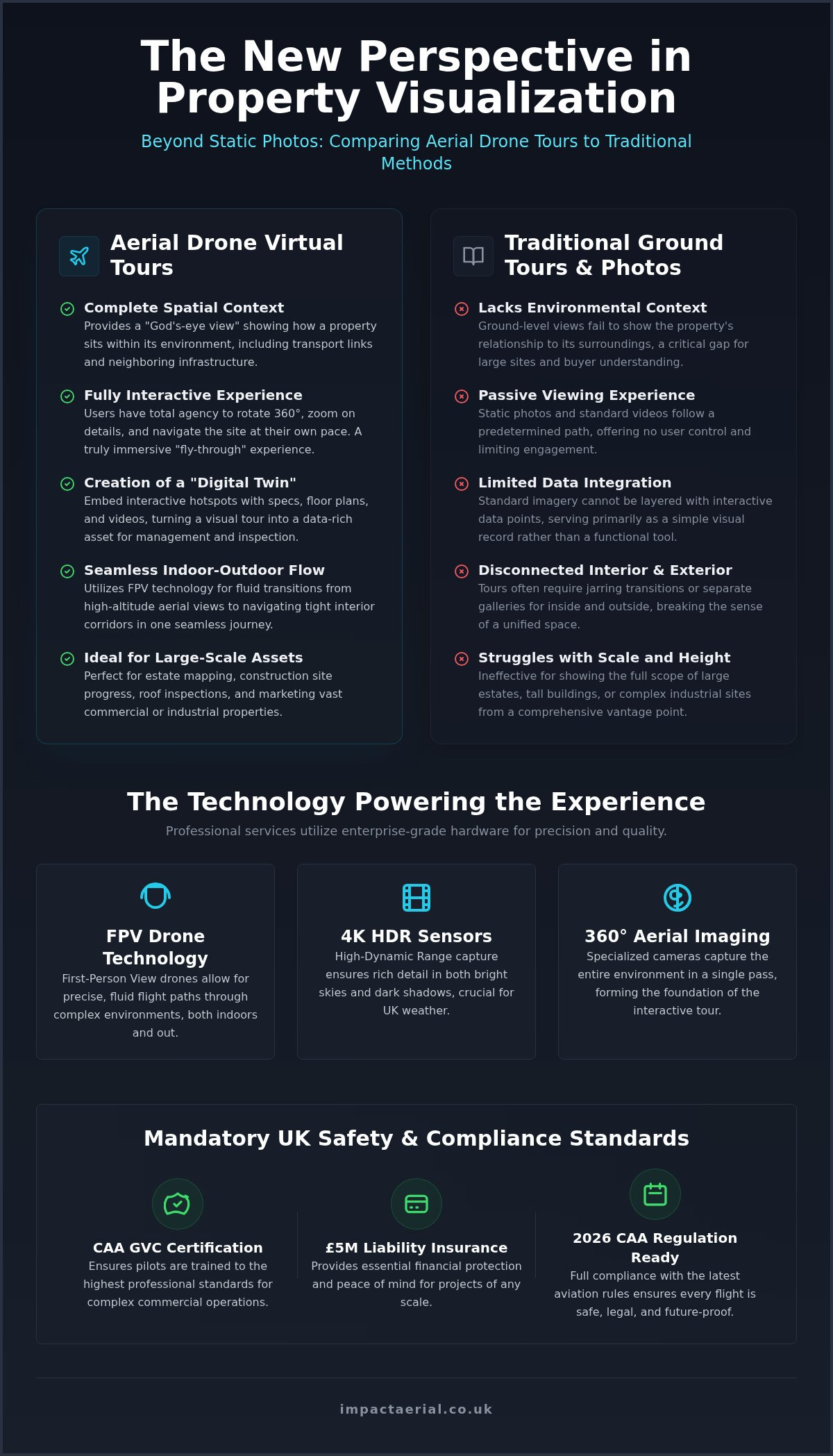
A key distinction lies in user control. A video walkthrough is a passive, linear experience where the viewer is guided along a pre-determined path. In contrast, a 3D tour is an active experience, placing the buyer in complete control. They choose where to go, what to look at, and how long to spend in each area. This self-directed exploration provides a far more accurate sense of space, scale, and connectivity between rooms, fostering a stronger emotional connection to the property.
The Technology Behind the Tour
High-quality tours are created using specialised equipment, with Matterport being the recognised industry standard. Their professional cameras use a combination of high-resolution photography and infrared sensors to capture both visual and spatial data. This process, known as photogrammetry, stitches together hundreds of scans to create a precise, dimensionally accurate ‘digital twin’ of the property. This is not just a visual representation; it is a complex data model that enables the interactive features buyers value.
The Business Case: Why Your UK Listings Need 3D Tours
In the fiercely competitive UK property market, standing out on portals like Rightmove and Zoopla is paramount. While high-quality photography is a standard expectation, integrating an immersive 3D virtual tour provides a decisive strategic advantage. This technology moves beyond static images, offering a dynamic and detailed preview that captures buyer attention, increases engagement, and delivers tangible business results for agents and developers alike.
Attracting More Qualified Leads
A 3D tour functions as a 24/7 digital open house, allowing prospective buyers to explore a property in detail from anywhere in the world. This powerful preview effectively filters out casual browsers or ‘tyre-kickers’, ensuring that those who proceed to book a physical viewing are genuinely interested and pre-qualified. This significantly reduces wasted time on unproductive appointments and focuses your efforts on serious, committed buyers who have already connected with the space.
Achieving Better Sales Outcomes
Increased and meaningful engagement translates directly to superior sales results. Industry reports consistently show that property listings featuring virtual tours receive significantly more time-on-page, which can lead to more enquiries, a higher volume of offers, and a faster sale. By allowing buyers to virtually walk through a home, you help them form an emotional connection and visualise their future life there before they even step through the door, strengthening their purchasing intent.
Enhancing Your Professional Brand
Offering a professional 3d virtual tour for real estate uk listings positions you as a forward-thinking, tech-savvy agent or developer. This premium service not only impresses vendors but also justifies your commission by demonstrating a clear commitment to cutting-edge marketing. Embracing this technology is not just a trend; the UK government itself has highlighted the economic impact of emerging technologies on national business growth. See how our virtual tours can transform your listings.
The Creation Process: From On-Site Capture to Online Listing
Creating a high-quality digital twin of a property is a meticulous, multi-stage process that blends on-site technical expertise with sophisticated post-production. Understanding these phases demystifies how a physical space is transformed into a powerful online marketing asset. This structured approach ensures every key feature is captured with precision, delivering a seamless and engaging experience for potential buyers across the UK.
Phase 1: Planning and Preparation
Success begins long before our operators arrive on site. An initial consultation allows us to understand the property’s unique selling points and plan the most logical and compelling user journey. To achieve the best results, the property must be presented immaculately. We provide clients with a simple preparation checklist:
Declutter: Remove personal items, excess furniture, and clear all surfaces.
Clean Thoroughly: Ensure windows, floors, and surfaces are spotless.
Optimise Lighting: Open all blinds and curtains and replace any non-working light bulbs.
Stage Key Areas: Arrange furniture to showcase the space and flow of each room.
Phase 2: The On-Site Scan
On the day of the shoot, our certified operators use industry-leading equipment, such as the Matterport Pro-series cameras, to perform a comprehensive scan. This is not simple photography; it is a technical data-gathering exercise. The operator moves systematically through the property, capturing data from multiple scan points in each room to build a complete 3D model. This methodical approach is crucial for a professional 3d virtual tour for real estate uk and, as noted in the Forbes guide to virtual tours, quality data capture is fundamental to an effective final product. A typical 3-bedroom house can take between 1 to 3 hours to scan thoroughly.
Phase 3: Post-Production and Delivery
Once the on-site capture is complete, the raw data is uploaded to secure cloud servers where powerful software stitches it together into a dimensionally accurate 3D model. During this phase, we embed your branding, contact information, and links directly into the tour. We can also add interactive info points (Mattertags) to highlight specific features like a newly fitted kitchen or premium appliances. Within 24-48 hours, you will receive the finalised links and embed codes, ready to be integrated into your website and major UK property portals like Rightmove and Zoopla.
Elevate Your Tour: Integrating Aerial Drone Photography and Video
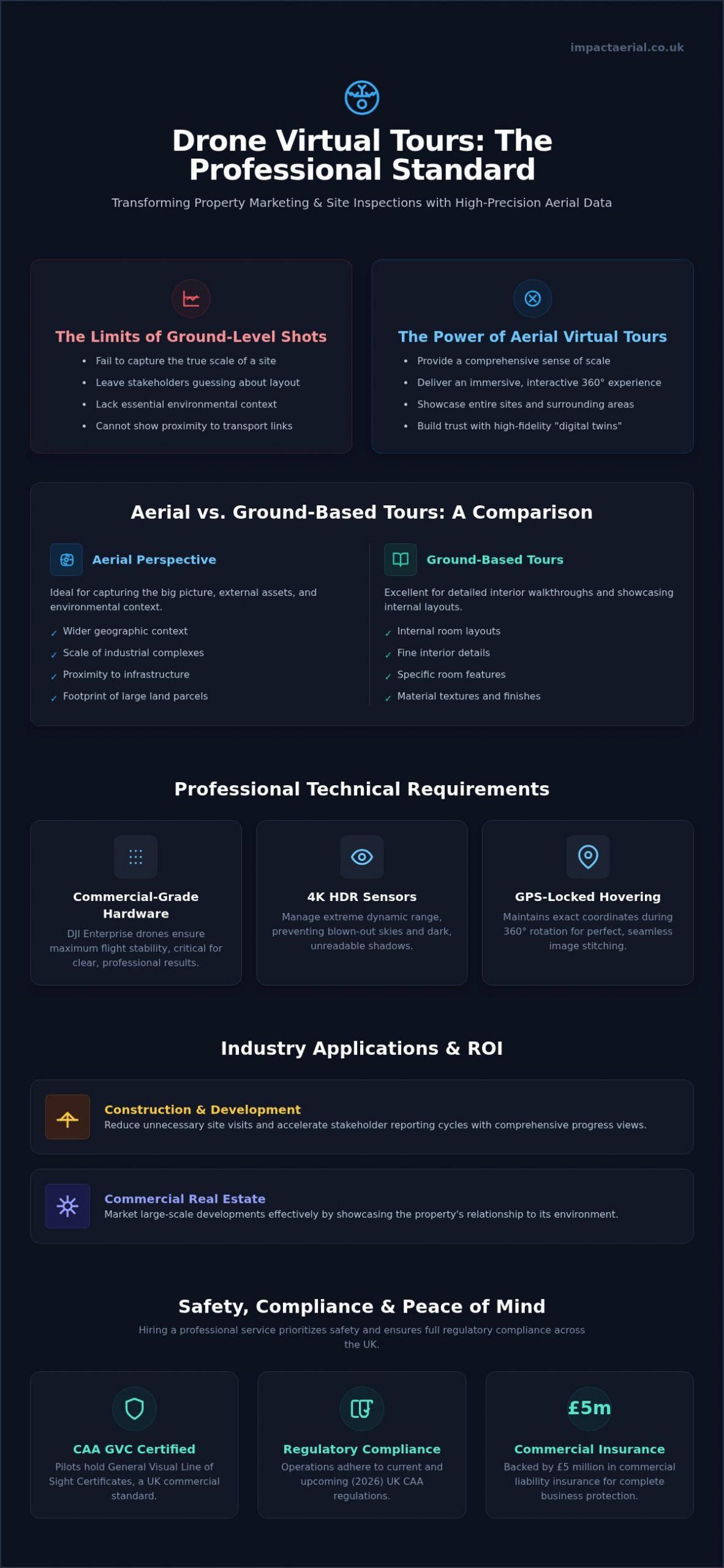
An immersive 3D virtual tour provides an unparalleled view of a property’s interior, but for a potential buyer, this is only half the story. To truly understand a property’s value, they need to see it in its complete setting. Integrating professional aerial drone photography and video moves beyond the four walls to showcase the location, plot, and surrounding environment, providing the critical context that ground-level shots simply cannot capture.
From a high-altitude perspective, you can create a powerful ‘hero’ shot that captures the entire property and its grounds in a single, compelling image. This is invaluable for highlighting key external features that are major selling points, such as expansive gardens, outbuildings, private driveways, and proximity to local amenities. This comprehensive approach is a key differentiator that distinguishes a professional drone company’s service from standard property marketing.
Providing Essential Context
Aerial imagery offers a unique perspective that answers buyers’ most pressing questions about a property’s location. It provides an immediate and clear understanding of the asset’s relationship to its surroundings. Key benefits include:
Situational Awareness: Showcasing proximity to neighbours, local parks, schools, and transport links.
Plot Definition: Clearly outlining the property’s boundaries, garden size, and land ownership from an unambiguous aerial view.
Unique Vistas: Capturing breath-taking views of coastlines, countryside, or cityscapes that are not visible from the ground and add significant emotional appeal.
Creating a Complete Marketing Package
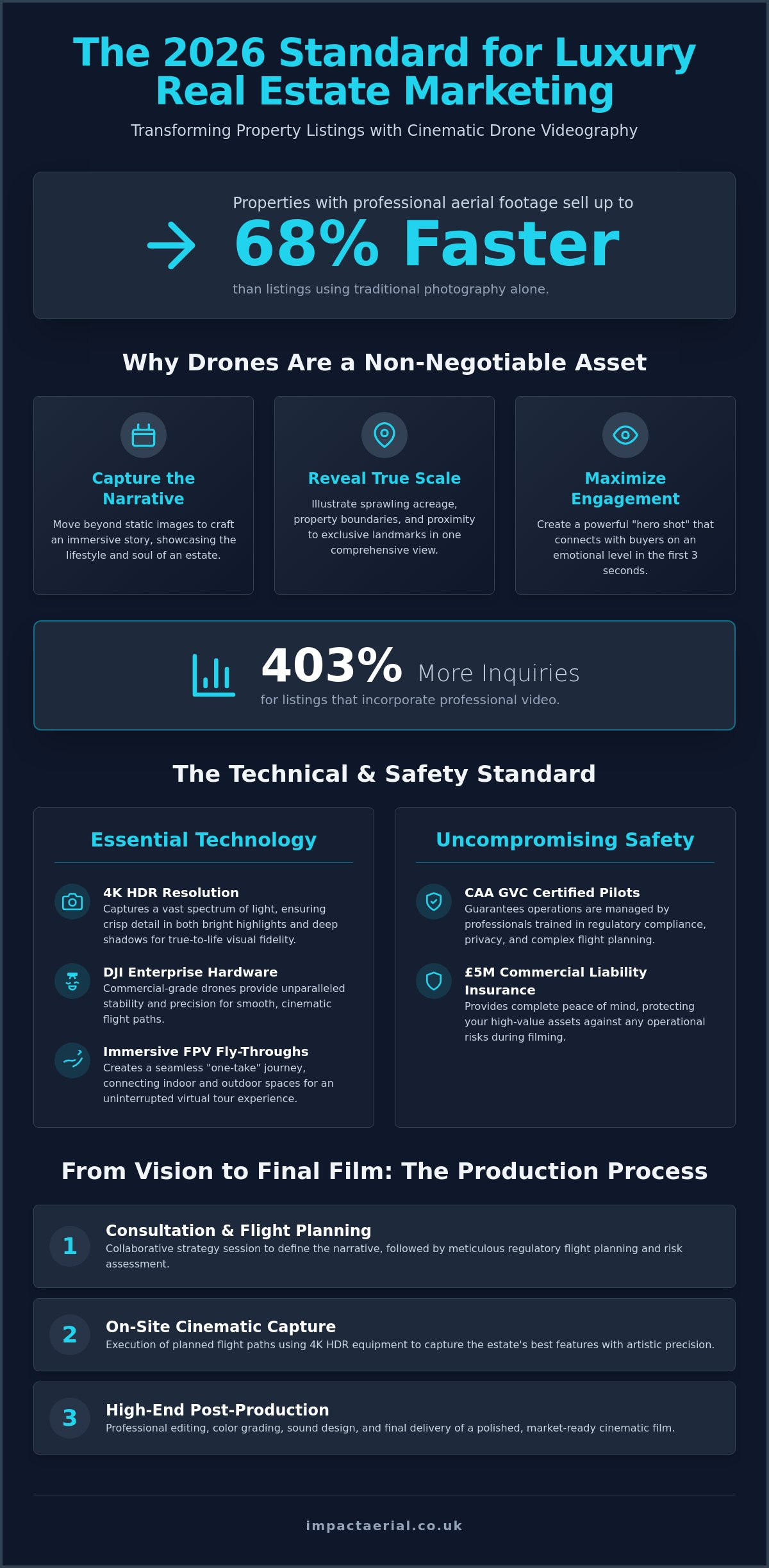
The most effective property listings combine multiple media formats into one cohesive presentation. By merging a sophisticated 3d virtual tour for real estate uk with high-resolution aerial photos and professional ground-level shots, you create a complete and compelling marketing package. A seamless video that begins with a sweeping aerial view, flies towards the front door, and transitions smoothly into the interior 3D tour offers a truly cinematic experience for potential buyers.
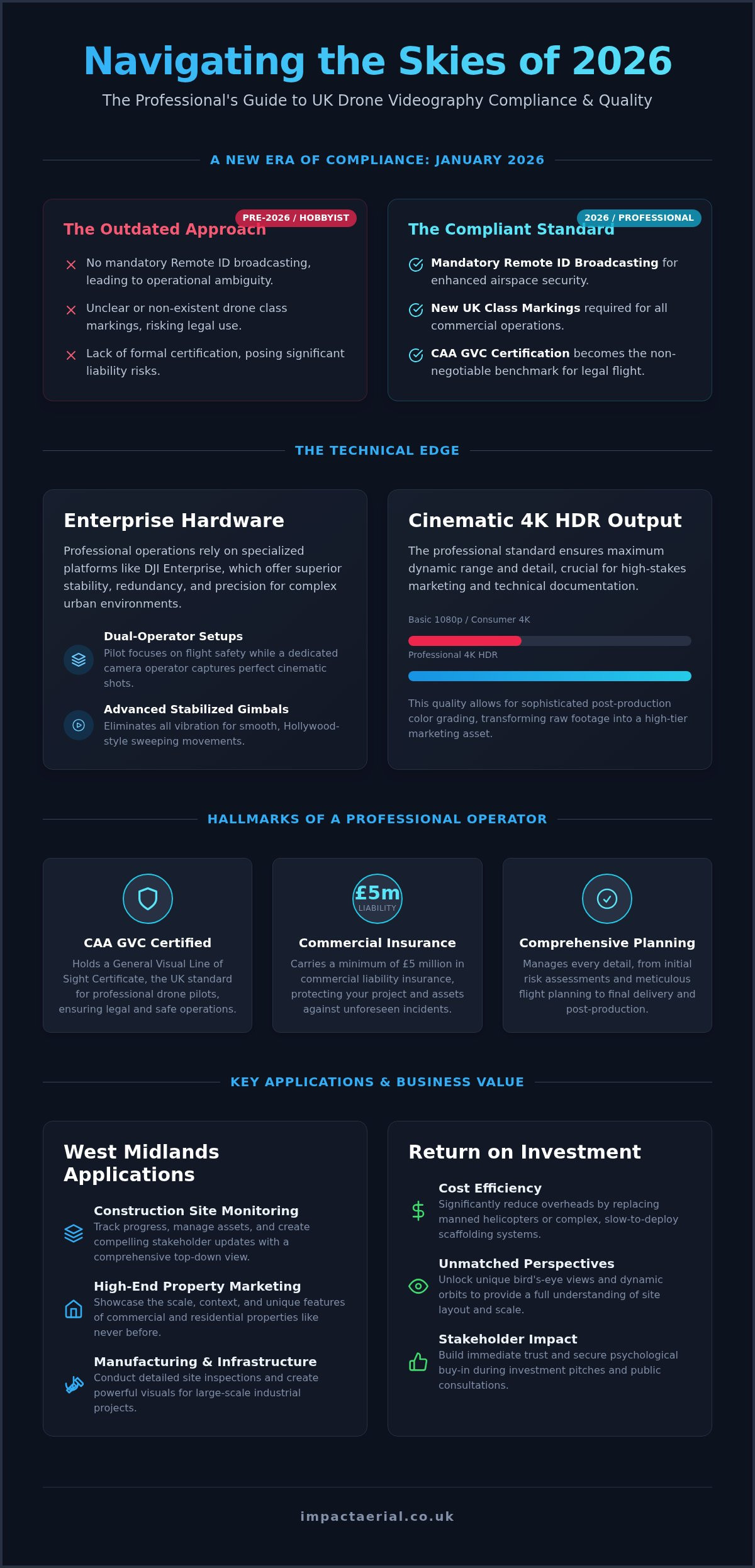
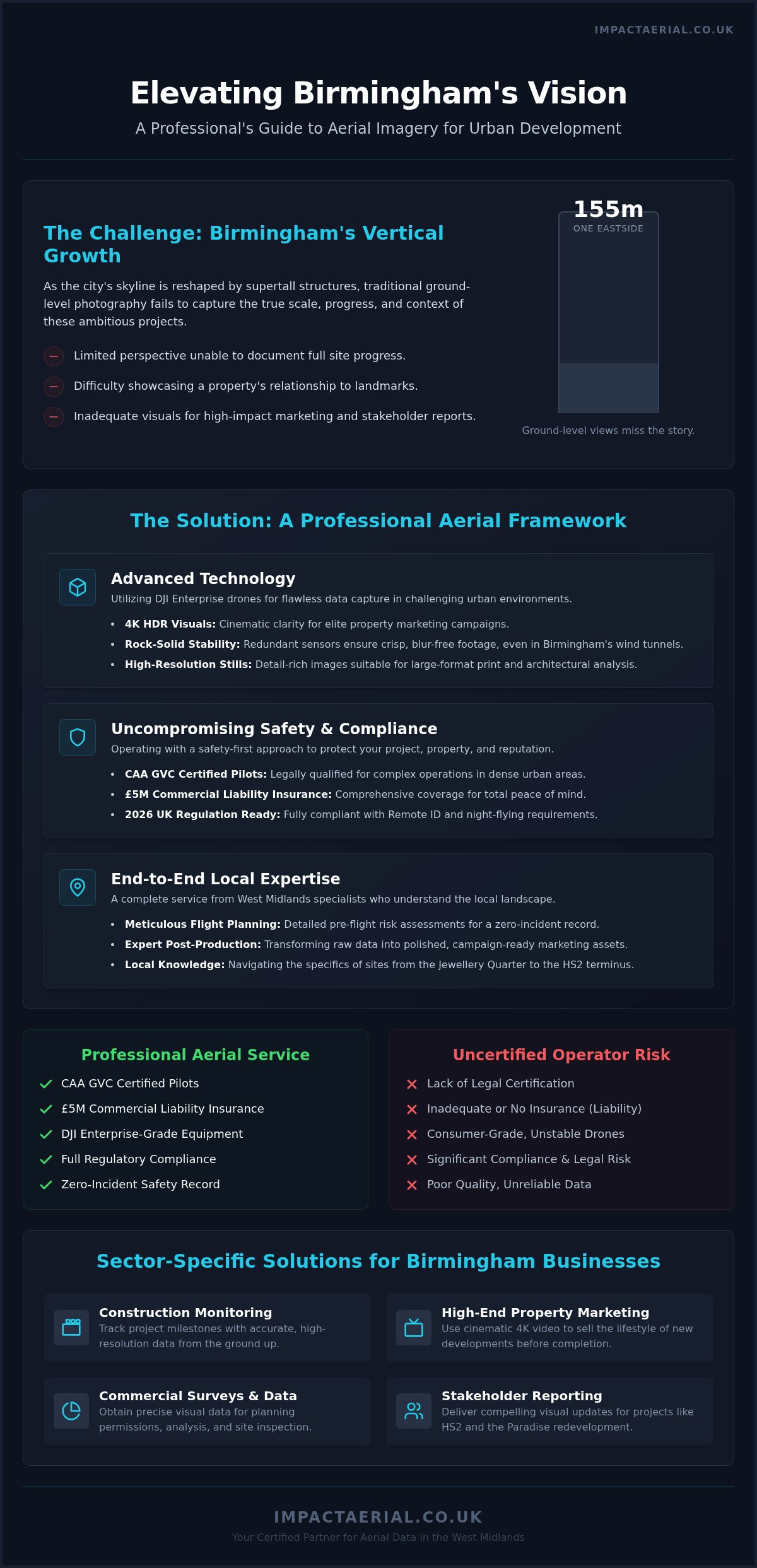
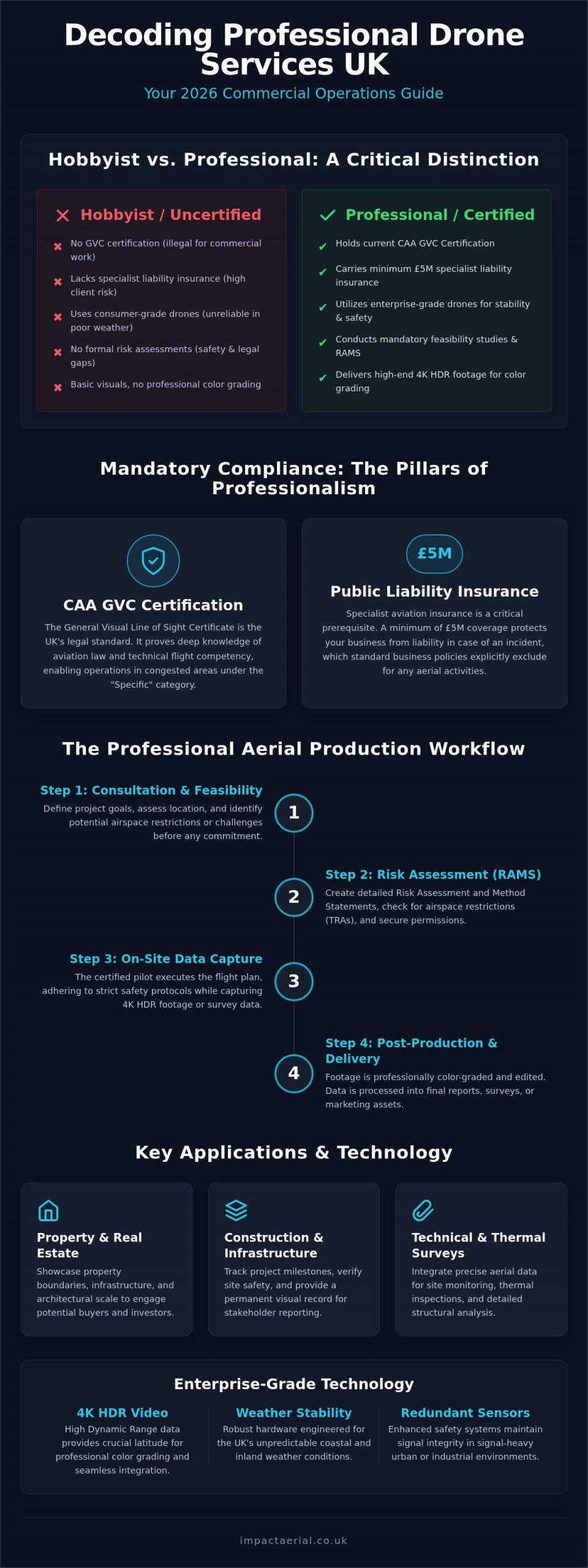
However, it is imperative that these operations are conducted safely and legally. When commissioning aerial work, you must ensure your provider holds a valid CAA (Civil Aviation Authority) GVC certification. This guarantees the operator is trained, insured, and compliant with UK aviation regulations, providing you with complete peace of mind. A professional firm like Impact Aerial provides these fully-certified, comprehensive services, ensuring top-quality, compliant results for your property portfolio.
How to Choose a 3D Virtual Tour Provider in the UK
Once you decide to invest in a 3D virtual tour, the next critical step is selecting the right professional partner. In the UK market, the quality and professionalism of providers can vary significantly. The final product is a direct reflection of your brand and the property you are marketing, so choosing a proficient, reliable, and fully compliant operator is essential for achieving the best results.
When evaluating potential providers, look beyond the price. Scrutinise their portfolio for high-quality examples specifically within the property sector. Do their tours look sharp, bright, and professional? The quality of the equipment used is paramount; a leading provider will use high-resolution cameras capable of producing clear, dimensionally accurate scans. Furthermore, clarify the deliverables from the outset. Understand exactly what you will receive-the tour link, embed codes, high-resolution still photos, or schematic floor plans-and the typical turnaround time from scan to delivery. When seeking a premium 3d virtual tour for real estate uk, these details distinguish a standard service from an exceptional one.
Essential Vetting Checklist
For your peace of mind and to guarantee a professional service, every potential provider should meet these non-negotiable standards. We recommend creating a simple checklist to ensure compliance and quality control before committing to a service.
Public Liability Insurance: Does the provider hold comprehensive public liability insurance? Always ask for proof of their current certificate to ensure you, your client, and the property are fully protected.
CAA Certification for Drone Services: If the service includes any form of aerial photography or video, the operator is legally required to be CAA GVC Certified. This certification proves they are trained, competent, and authorised to fly drones commercially in the UK.
Portfolio Quality: Review several examples of their previous work. Are the images crisp and well-lit? Is the tour navigation smooth and intuitive on both desktop and mobile devices? A high-quality portfolio is the best indicator of a high-quality end result.
Questions to Ask a Potential Provider
Arm yourself with the right questions to accurately gauge a provider’s service level and suitability for your real estate marketing needs. Their answers will provide clarity on their process and what you can expect.
What is your typical turnaround time from the completion of the property scan to the delivery of the final tour?
Can you add our company branding, logo, and contact information directly into the virtual tour interface?
How long will the 3D virtual tour be hosted online, and what are the costs or options for long-term hosting?
As we’ve explored, the UK property market has decisively shifted. 3D virtual tours are no longer a novelty but an essential tool for engaging prospective buyers, accelerating sales cycles, and setting your listings apart. By combining immersive interior walkthroughs with breath-taking aerial perspectives, you provide a comprehensive and compelling viewing experience that traditional photography simply cannot match. The key to success, however, lies in professional execution and regulatory compliance.
Choosing the right provider is paramount. A professional 3d virtual tour for real estate uk listings requires technical expertise and a commitment to safety. At Impact Aerial, we provide this with CAA GVC Certified pilots, state-of-the-art high-resolution 4K drones, and £5m commercial liability insurance for your complete peace of mind. We deliver the top-quality, authoritative results your portfolio deserves.
How much does a 3D virtual tour for real estate cost in the UK?
The cost for a 3d virtual tour for real estate in the UK varies based on the property’s size and complexity. For a small flat or a 1-2 bedroom house, prices typically start from around £150. For an average 3-4 bedroom family home, you can expect to invest between £250 and £400. This professional service includes the on-site scanning by a qualified technician, digital processing, and hosting of the final tour.
How long does it take to create a virtual tour for a typical 3-bedroom house?
The on-site capture process for a standard 3-bedroom property is highly efficient, typically taking between 60 to 90 minutes. Our technicians work methodically to ensure comprehensive coverage and high-quality data capture. Following the on-site visit, the digital processing and tour creation are completed, with the final, fully interactive virtual tour delivered to you within 24 to 48 hours, ready for immediate integration into your marketing.
Are 3D virtual tours compatible with Rightmove, Zoopla, and other UK property portals?
Yes, absolutely. Our 3D virtual tours are designed for seamless integration with all major UK property portals, including Rightmove, Zoopla, and OnTheMarket. We provide a simple web link or embed code for each tour, which can be easily added to your online listings. This ensures potential buyers can access the immersive experience directly from the platform they are using, significantly boosting engagement and enquiry levels for your property.
What is the difference between a ‘3D Tour’ and a ‘360 Tour’?
While often used interchangeably, there is a key technical difference. A ‘360 Tour’ is typically a series of linked, static panoramic photos, allowing viewers to look around from fixed points. A true ‘3D Tour’ uses advanced scanning technology to create a dimensionally accurate digital model of the property. This provides a fully immersive ‘walk-through’ experience, a unique ‘dollhouse’ perspective, and a much clearer sense of the property’s layout and flow.
How should I prepare a property before the virtual tour photographer arrives?
To achieve the best possible result, prepare the property as you would for an important viewing or professional photography. We advise a thorough cleaning and decluttering of all rooms and surfaces. It is also best to depersonalise spaces by storing away family photos and personal effects. Ensure all lightbulbs are working, and open all curtains and blinds to maximise natural light, creating a bright and welcoming environment for the scan.
Can you create virtual tours for commercial properties as well as residential?
Yes, our 3D scanning technology is perfectly suited for the commercial property sector. We provide professional virtual tours for a wide range of commercial assets, including office spaces, retail units, industrial warehouses, hospitality venues, and healthcare facilities. These tours serve as a powerful marketing tool, allowing potential tenants, buyers, and stakeholders to conduct detailed remote viewings and assess the space from anywhere in the world.
In the highly competitive UK property market, are your listings struggling to capture the attention they deserve? When standard ground-level images fail to convey the full scale, context, and value of a property, potential buyers can easily scroll past, leaving you with stagnant listings and missed opportunities. This common challenge requires a professional solution that elevates your portfolio above the noise and presents properties from a truly compelling perspective.
This guide is designed to demonstrate the transformative power of integrating professional drone services into your real estate photography strategy. We will explore how high-quality, CAA-compliant aerial imagery provides breath-taking views that not only showcase a property in its entirety but also its relationship to the surrounding landscape and local amenities. Discover how this strategic investment can make your listings irresistible, attract more qualified buyers, and secure faster, higher-value sales, all while enhancing your brand as a leading, technologically adept agent.
Why Professional Imagery is No Longer Optional in Real Estate
In today’s digital-first market, the modern property search begins not in an estate agent’s window, but on portals like Rightmove and Zoopla. This fundamental shift means your listing’s visual presentation is the single most critical first impression. Poorly lit, out-of-focus photos can cause a potential buyer to scroll past in seconds, dismissing a property before they have even read the description. Professional real estate photography transcends mere documentation; it crafts a narrative, sells a lifestyle, and creates an emotional connection that compels buyers to book a viewing.
To better understand the principles of high-quality property marketing in action, consider the techniques discussed in this video:
The Tangible ROI of High-Quality Photography
The investment in professional imaging services delivers a measurable and significant return. Data from across the property industry consistently shows a direct correlation between the quality of photography and a listing’s performance on the market. Key advantages include:
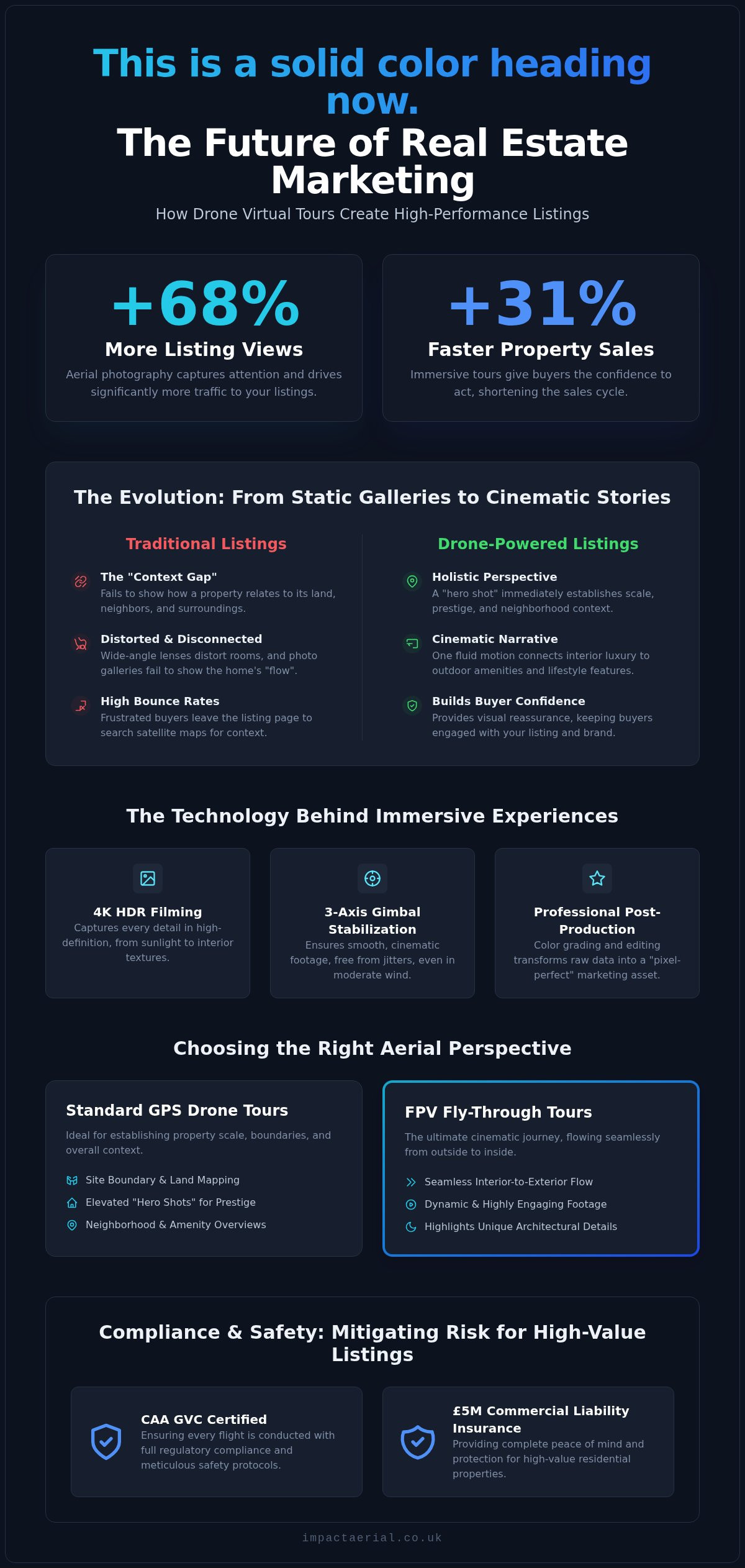
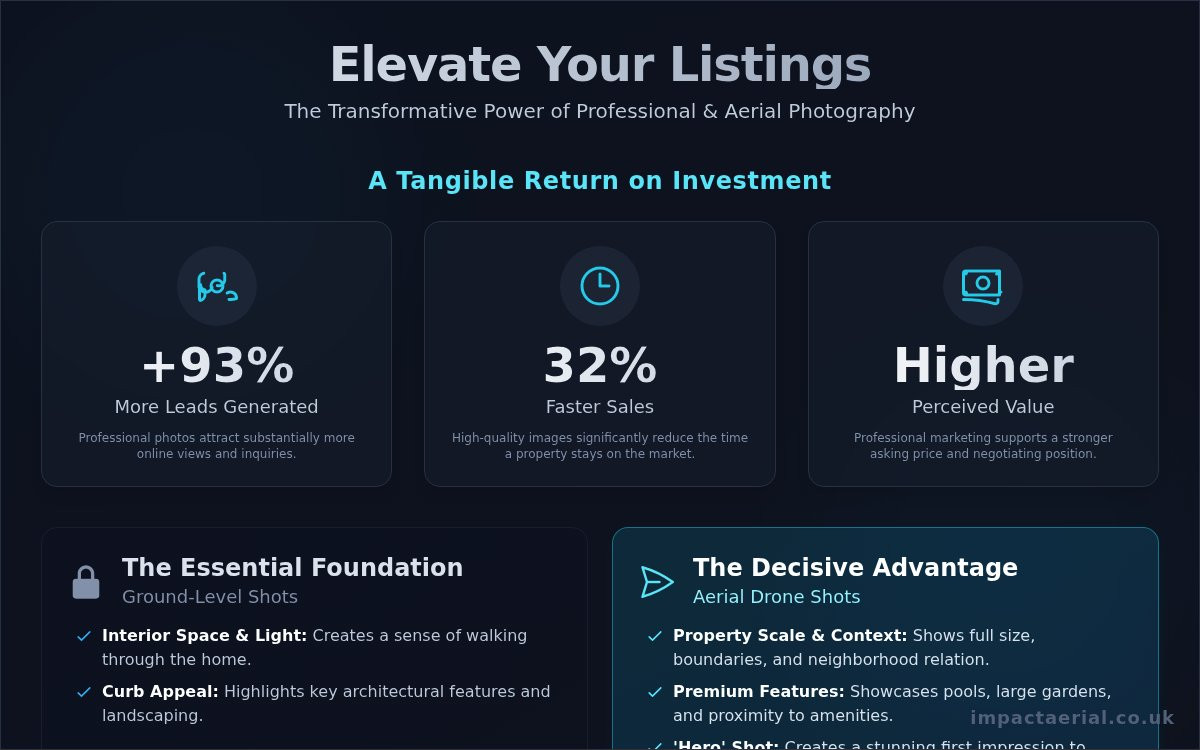
Increased Engagement: Listings featuring professional photos can generate up to 93% more leads and receive substantially more online views than those with amateur images.
Faster Sales: Industry studies indicate that properties marketed with high-quality images can sell up to 32% faster, reducing the time a property sits on the market.
Higher Perceived Value: Buyers instinctively associate professional marketing with a well-maintained, high-value property, which can support a stronger asking price and negotiating position.
Enhanced Agent Reputation: Consistently presenting polished, professional listings builds your brand as a quality agent dedicated to achieving the best results for your clients.
Ground-Level vs. Aerial: A Two-Part Strategy
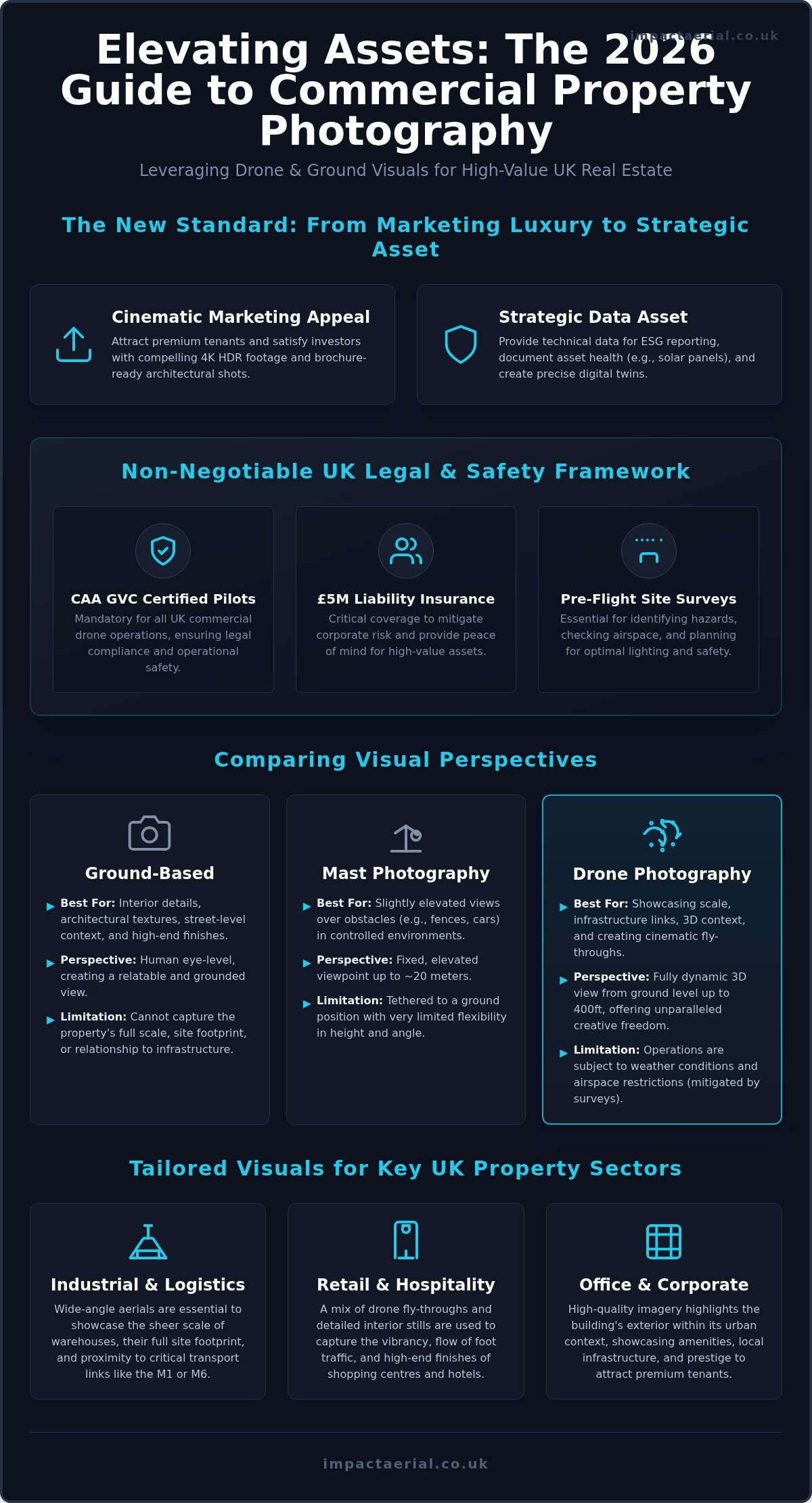
A comprehensive marketing package utilises two distinct but complementary perspectives. Professional ground-level shots-both interior and exterior-are essential. They create a sense of space and light inside, while highlighting key features and curb appeal outside, adhering to the core principles of architectural photography. These images allow a buyer to mentally walk through the home.
However, aerial drone photography provides the crucial context that ground shots simply cannot capture. It showcases the property’s full size, its exact boundaries, and its relationship to the surrounding neighbourhood, local parks, and amenities. Combining both ground and aerial views creates a complete and compelling visual narrative that answers buyers’ questions before they even need to ask them.
The Aerial Advantage: How Drone Photography Transforms Listings
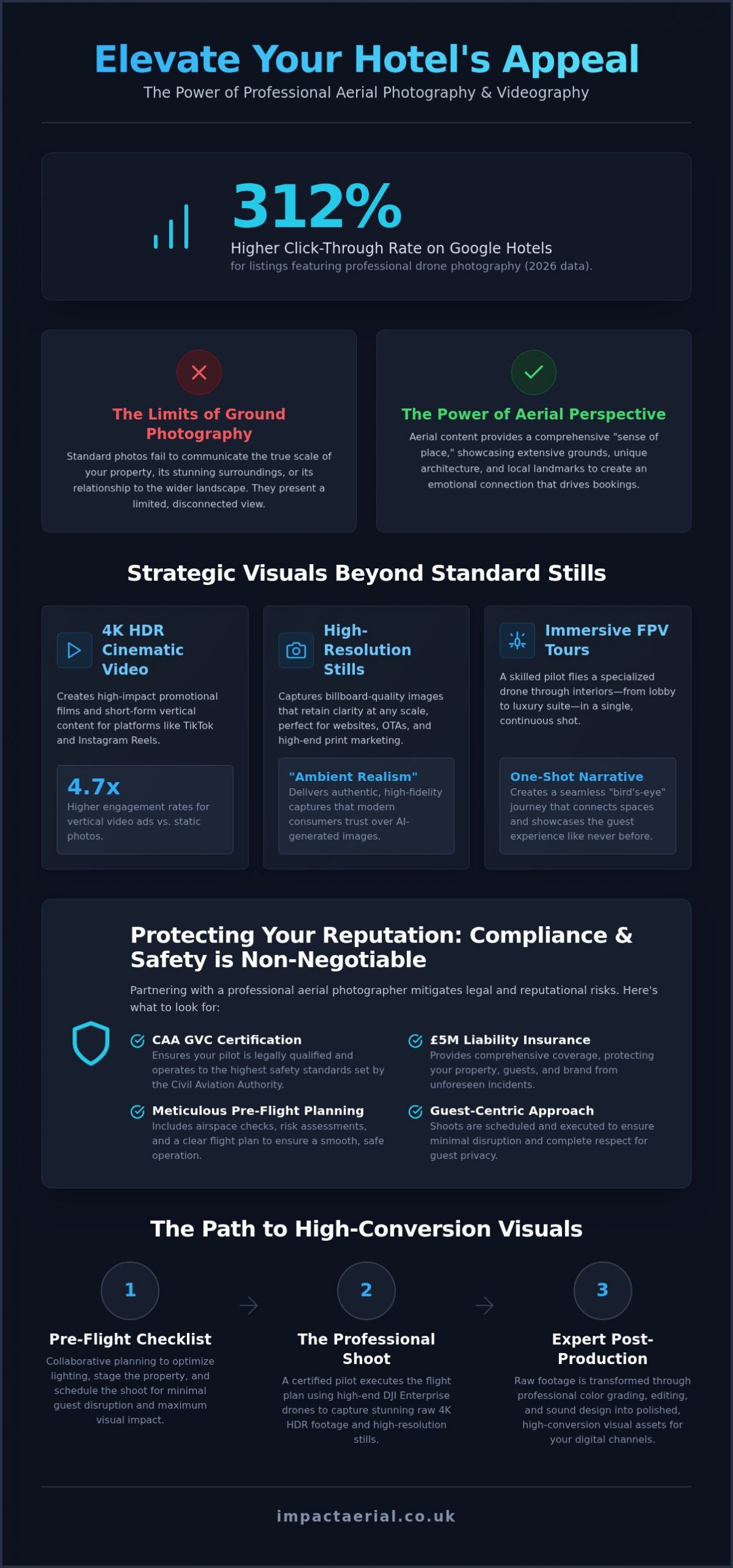
In a competitive property market, standard ground-level images are no longer enough to capture a buyer’s attention. Professional drone photography provides an immediate and powerful advantage, offering unique perspectives that were once prohibitively expensive or impossible to achieve. These aerial shots instantly elevate the perceived value and prestige of a property, creating a ‘wow factor’ that makes your listing unforgettable and helps justify a premium price point.
Showcasing Property Scale and Context
Standard photography often fails to convey the true scale and setting of a property. Aerial imaging solves this by capturing the full scope of large estates, extensive gardens, and precise land boundaries in a single, comprehensive shot. More importantly, it provides crucial context, clearly showing the property’s position within its neighbourhood and its proximity to key amenities like parks, schools, and transport links. This gives potential buyers a genuine understanding of the location before they even arrange a viewing.
Highlighting Premium Features and Amenities
Drones are the most effective tool for showcasing a property’s most desirable features. This high-impact form of real estate photography provides stunning, cinematic views that highlight key selling points and add significant appeal. A professional aerial service can effectively capture:
Expansive gardens, swimming pools, or tennis courts in their entirety.
A clear, top-down perspective of the roof condition and overall layout.
Desirable proximity to coastlines, lakes, or prestigious golf courses.
For commercial properties, an overview of car parking, access routes, and nearby infrastructure.
Creating a Compelling Marketing Narrative
A striking aerial image should be your ‘hero’ shot-the first photograph buyers see on portals like Rightmove and Zoopla. This single image can dramatically increase click-through rates and initial interest. Beyond the listing, this content is perfect for creating engaging, shareable videos and posts for social media marketing campaigns. By consistently using high-quality aerial real estate photography, you differentiate your listings and build a reputation for handling premium properties. This level of quality requires a certified operator who understands regulations; just as US operators follow strict FAA drone regulations, UK professionals are governed by the CAA to ensure safe and legal flights. See examples of our transformative property photography.
Beyond Still Photos: Using Video and Virtual Tours to Captivate Buyers
While high-quality still images are the foundation of any property listing, today’s competitive market demands more dynamic and engaging content. Professional real estate photography has evolved to include motion and interactivity, tools proven to hold user attention significantly longer than static pictures. These advanced formats move beyond simply showing a property; they create an immersive experience that builds an emotional connection and helps pre-qualify serious buyers before they even step through the door.
Executing these advanced techniques requires not only creative skill but also stringent adherence to operational safety and regulations. In the UK, this means hiring a CAA GVC Certified pilot. The importance of certified operation is a global standard; for instance, US-based professionals must comply with strict FAA regulations for commercial drone pilots to operate legally. This level of compliance ensures your project is conducted safely and to the highest professional standard, providing you with added peace of mind.
Cinematic Drone Video Tours
A cinematic video tour transforms a property viewing into a compelling narrative. By skillfully combining sweeping aerial shots that establish the property’s context with smooth, stabilised interior walkthroughs, we tell a story about the lifestyle the home offers. This technique is particularly effective for high-value residential listings and large commercial properties where showcasing scale and surroundings is paramount. Furthermore, video content is consistently favoured by social media algorithms, dramatically increasing the reach and engagement of your listing online.
Immersive 360° Virtual Tours
Virtual tours offer the ultimate in buyer convenience and agent efficiency. This technology empowers potential buyers to digitally explore every room of a property at their own pace, from anywhere in the world, 24/7. This is an indispensable tool for attracting overseas or out-of-town buyers and significantly reduces the number of physical viewings with non-serious parties. By offering this feature, you demonstrate a commitment to using leading technology, positioning yourself as a modern, client-focused agent who values a buyer’s time. This high-calibre approach to real estate photography sets your listings apart.
How to Choose a Professional and Compliant Drone Photography Provider
In the rapidly growing field of aerial imaging, not all drone operators are created equal. The difference between an amateur and a professional extends far beyond the quality of the final images; it encompasses legality, safety, and accountability. Hiring an uncertified or uninsured pilot for your real estate photography needs exposes you, your agency, and your client to significant financial and legal risks. To ensure you receive high-quality, safe, and legally compliant services, it is crucial to ask the right questions and partner with a true professional who acts as both a creative and technical expert.
Essential Non-Negotiables: CAA Certification and Insurance
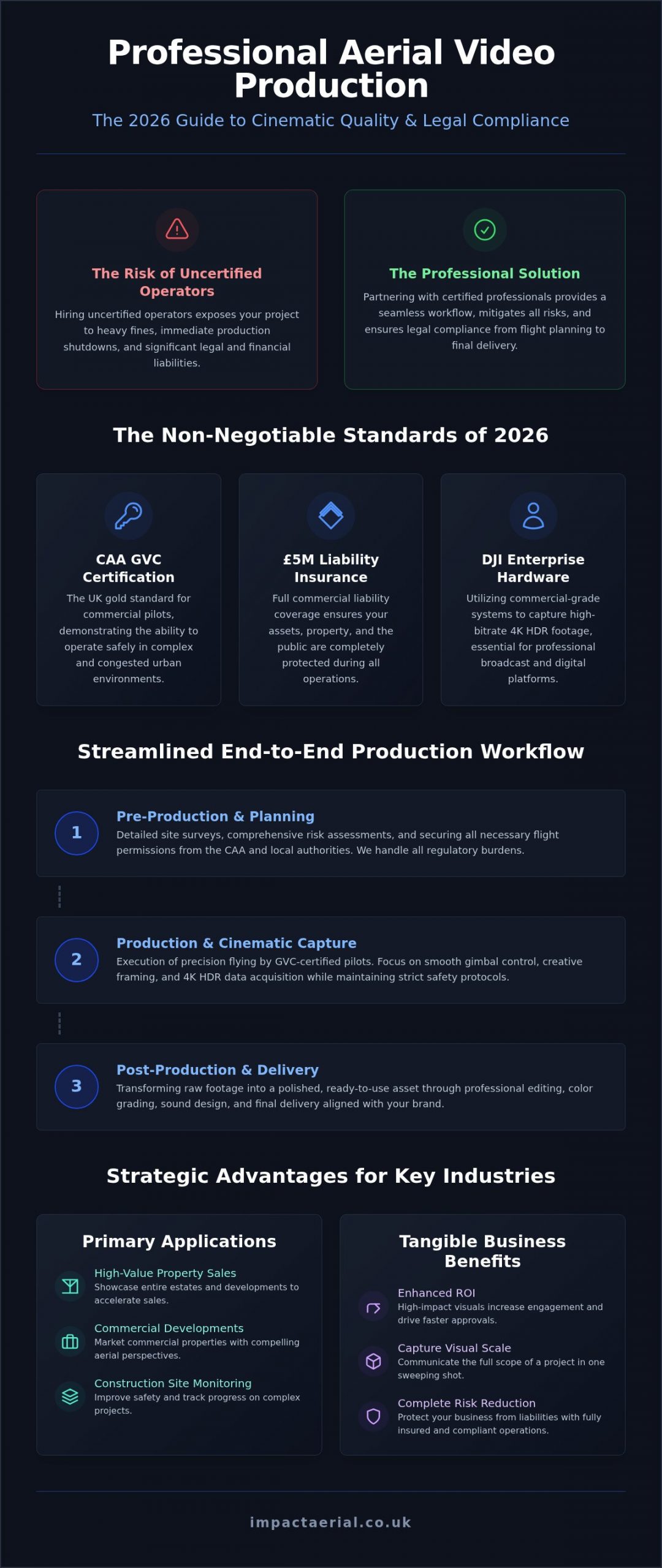
Before engaging any drone service, you must verify their credentials. This is non-negotiable for protecting all parties involved. A professional operator in the UK must be able to provide clear documentation for the following:
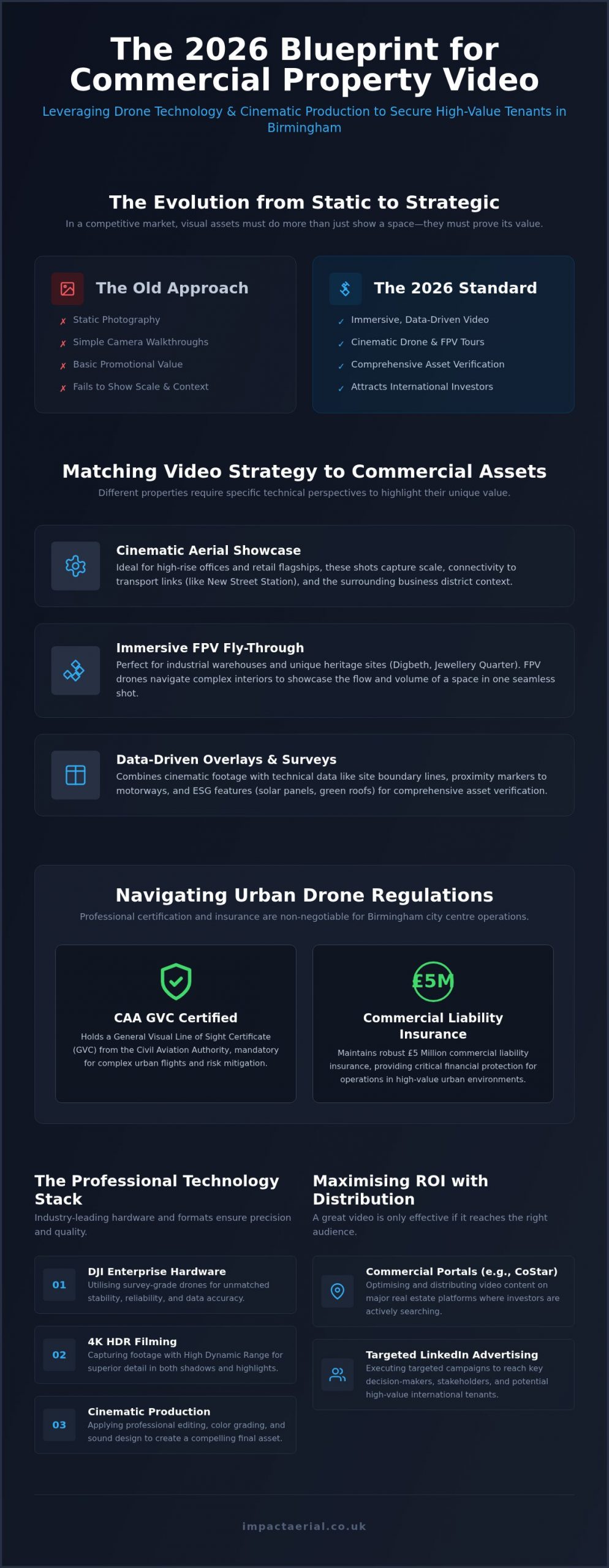
CAA Operational Authorisation: This proves they are legally permitted by the Civil Aviation Authority (CAA) to conduct commercial drone operations. This includes holding a valid GVC (General Visual Line of Sight Certificate).
Commercial Drone Insurance: Standard business insurance is insufficient. They must hold specialist commercial drone liability insurance, with a minimum coverage of £5 million being the industry standard for professional services.
Requesting to see this documentation will give you complete peace of mind that you are working with a compliant and responsible provider.
Evaluate their Portfolio and Technical Equipment
A provider’s portfolio is the ultimate proof of their skill and experience. When reviewing their past work, assess whether the style and quality align with your brand and the properties you represent. Do their images possess the clarity, composition, and professional finish you require? A credible provider will use professional-grade drones equipped with 4K High Dynamic Range (HDR) cameras to capture stunning detail. Furthermore, inquire about their post-production capabilities, as expert editing is what transforms raw footage into compelling marketing assets.
Assess Their Professionalism and Process
A professional drone pilot is also a meticulous project manager. Their process should always begin with detailed planning, including pre-flight site surveys and comprehensive risk assessments to ensure every operation is conducted safely. They will demonstrate a thorough understanding of local airspace restrictions and flight regulations. Clear communication, transparent pricing, and a collaborative approach are hallmarks of a top-tier service. A true partner in your marketing efforts will be committed to a safe, compliant, and seamless process from start to finish. Verify our credentials and commitment to safety.
Elevate Your Listings: The Final Word on Aerial Property Marketing
In today’s competitive UK property market, the conclusion is clear: high-quality, professional imagery is no longer a luxury but a necessity for a swift sale. As we’ve explored, the unique perspectives offered by drones provide an unparalleled advantage, showcasing a property’s full context, scale, and appeal in a way ground-level shots simply cannot. This elevated approach to real estate photography, combined with immersive video and virtual tours, is a proven strategy to captivate potential buyers and generate serious interest.
Choosing the right partner is paramount to achieving these results safely and legally. At Impact Aerial, our professional services provide complete peace of mind. We are CAA GVC Certified, fully insured, and utilise state-of-the-art 4K HDR DJI Enterprise drones to deliver breath-taking results. With extensive experience in both commercial and residential property marketing, we understand precisely how to make your listing stand out from the competition.
How much does real estate drone photography cost in the UK?
The cost for professional real estate drone photography in the UK varies based on project requirements. A standard package for a typical residential property, including a set of high-quality edited images, generally starts from £150 to £300. Prices are influenced by the property’s size, location, and the complexity of the flight plan. More extensive projects requiring video production or operating in complex airspace will be quoted on an individual basis to reflect the specific brief.
Is it legal and safe to use drones for photography in residential areas?
Yes, it is both legal and safe when conducted by a fully qualified and insured operator. Professional drone pilots hold a CAA GVC (General Visual Line of Sight Certificate) and conduct thorough pre-flight risk assessments for every operation. This ensures all flights adhere to strict UK regulations, including maintaining safe distances from uninvolved people and respecting privacy. For added peace of mind, all professional services should be covered by comprehensive commercial liability insurance.
How long does a typical property drone photography session take?
A typical drone photography session for a standard residential property is an efficient process, usually taking between 1 to 2 hours on-site. This timeframe allows for a comprehensive pre-flight safety check, the execution of several flight patterns to capture the property from optimal angles and elevations, and a final review of the captured data. Larger estates or more complex video sequences may require additional time to ensure complete coverage and top-quality results.
What happens if the weather is bad on the day of the shoot?
Safety and quality are our primary concerns, so we do not fly in adverse weather conditions such as high winds, rain, or poor visibility. If the forecast is unsuitable on the scheduled day, we will contact you to reschedule the shoot for the next available suitable date, at no additional charge. We continuously monitor weather patterns leading up to the appointment to provide as much notice as possible and ensure we capture your property in the best possible light.
Can you fly drones near airports or in other restricted flight zones?
Operating within Flight Restriction Zones (FRZs), such as those near airports, is highly regulated but can be possible for certified professionals. A pilot with the correct CAA operational authorisation must engage in detailed pre-planning and apply for specific permission from Air Traffic Control (ATC) or the relevant authority. This process requires significant lead time and is not guaranteed. Unauthorised flights in these areas are illegal and unsafe, which is why hiring a certified operator is essential.
What files and formats will I receive after the photoshoot?
Following the session, you will receive a curated selection of professionally edited, high-resolution images. These are typically delivered as JPEG files, optimised for both web listings and high-quality print marketing. If your package includes video, you will receive a fully edited film in a standard MP4 format, usually in 4K or 1080p HD. All digital assets are delivered securely via a private online gallery or a dedicated file transfer link for easy download.
Have you ever considered the significant business advantage of a bird’s-eye view, only to be stopped by concerns over complex regulations, safety, and the actual process of commissioning a flight? You’re not alone. While the visual appeal is undeniable, many businesses are unsure how to translate stunning aerial shots into tangible results. This is where understanding the full scope of professional drone photography becomes crucial, moving it beyond just ‘nice pictures’ to a powerful data-gathering and marketing tool that offers a genuine competitive edge.
This ultimate guide is designed to provide clarity and confidence. We will demystify the technology behind high-quality aerial imagery and explore key business applications, from detailed site inspections to compelling property marketing. Crucially, we will navigate the specifics of UK aviation law, ensuring you understand the legal requirements set by the Civil Aviation Authority (CAA). By the end, you’ll know exactly what to look for when hiring a certified professional and have a clear picture of the end-to-end process, giving you the peace of mind to harness the power of aerial perspectives for your business.
What is Drone Photography? A Modern Perspective
At its core, drone photography is the professional practice of capturing high-resolution still images using an unmanned aerial vehicle (UAV). However, to define it merely as ‘taking photos from the air’ is to overlook its profound commercial impact. It represents a significant evolution in aerial imaging, offering unprecedented flexibility and perspective. Unlike traditional aerial photography, which often requires chartering a helicopter or light aircraft at a cost of thousands of pounds, professional drone services provide a highly responsive and cost-effective solution for acquiring critical visual data from unique, low-altitude vantage points.
This accessibility has transformed the practice from a niche hobby into an essential commercial tool across numerous UK industries. It is the latest, most dynamic chapter in the long history of aerial photography, democratising a viewpoint that was once reserved for high-budget productions. To better understand the fundamentals, this video provides an excellent introduction:
Beyond Pretty Pictures: The Business Value
While the results are often visually breath-taking, the true value of professional drone photography lies in the actionable data it provides. For businesses, this translates into tangible benefits:
Scale and Context: For commercial property and construction projects, aerial images provide an unparalleled view of a site’s scale, boundaries, and surrounding environment.
High-Impact Marketing: Dynamic, elevated shots create compelling content for property listings, advertising campaigns, and corporate branding that immediately captures attention.
Safety and Efficiency: Conducting surveys and inspections of roofs, towers, or infrastructure with a drone eliminates the need for personnel to work at height, reducing risk and saving time.
Data for Planning: High-resolution imagery is crucial for site planning, progress monitoring, and creating detailed maps for logistical and architectural purposes.
Key Types of Aerial Images and Their Uses
Different project goals require specific types of aerial imagery. A professional operator will utilise several key techniques to deliver the required data:
Oblique Photography: Captured at an angle, these images are ideal for marketing as they highlight a property’s facade, features, and depth, providing a natural, human-like perspective from the air.
Top-Down (Orthomosaic): This involves stitching together numerous high-resolution, georeferenced images to create a single, distortion-free, map-like view of a site, essential for accurate measurements and planning.
360° Panoramas: These immersive images offer a complete, interactive view from a single point in the sky, allowing stakeholders to explore a location virtually.
Top Commercial Applications for Drone Photography
Once a niche technology, professional drone services are now an indispensable tool across a diverse range of UK industries. The ability to capture high-resolution aerial data and stunning cinematic visuals provides a significant competitive advantage. By offering unique perspectives, improving safety, and streamlining operations, drone photography delivers tangible value. At Impact Aerial, we specialise in providing these top-quality services to sectors where the benefits are most profound: property, construction, and marketing.
Real Estate & Commercial Property
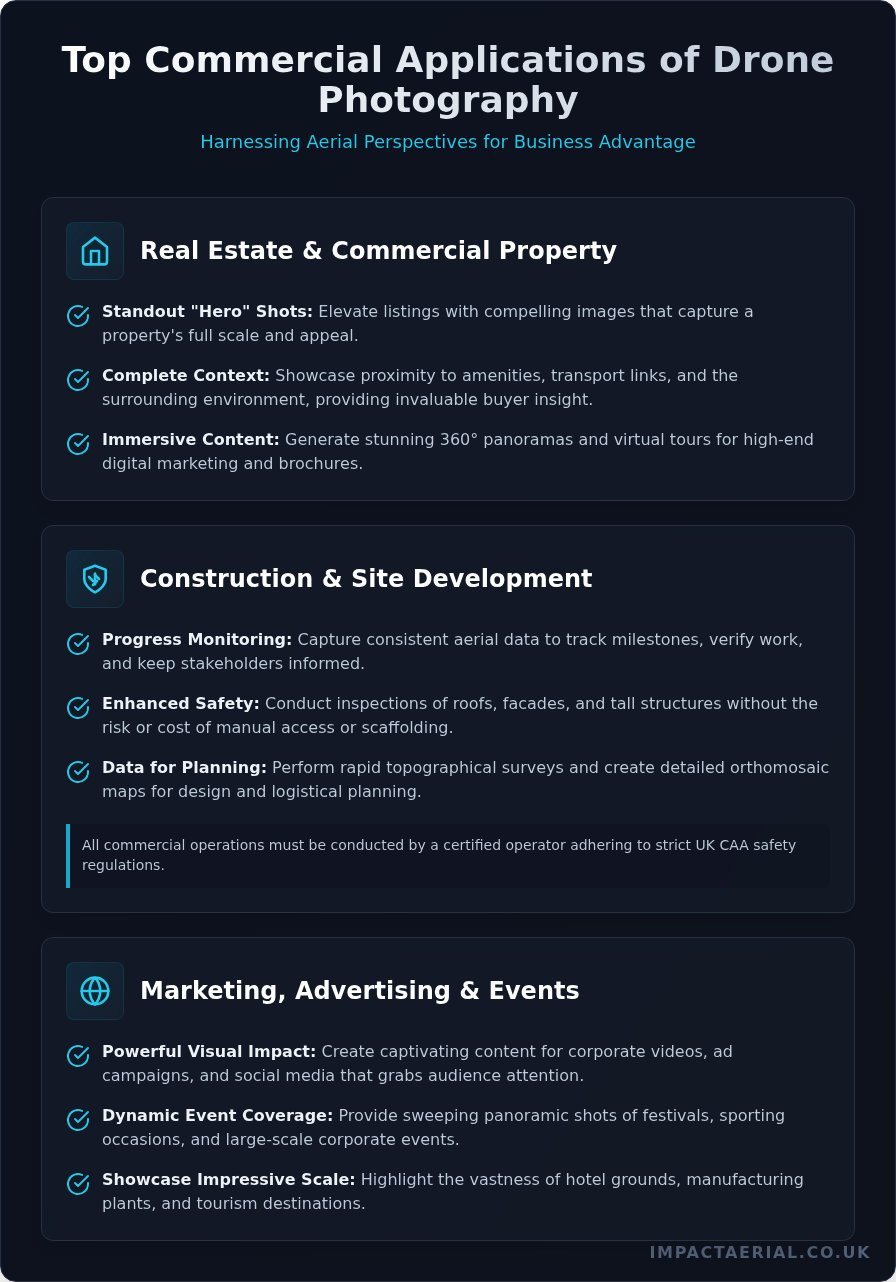
In a crowded property market, first impressions are critical. Drone photography elevates a listing from standard to standout, providing ‘hero shots’ that capture the full scale and context of a property in a single, compelling image. For potential buyers, seeing a building’s proximity to local amenities, transport links, and green spaces provides invaluable context that ground-level shots cannot. This service is also essential for documenting large tracts of land, showcasing development potential, and generating immersive content for virtual tours and high-end marketing brochures.
Construction & Site Development
On a modern construction site, efficiency and safety are paramount. Drones have become a vital data-gathering tool for project managers, surveyors, and architects. All commercial operations must be conducted by a certified operator adhering to strict UK drone laws and safety regulations, ensuring site integrity and personnel safety. Key applications include:
Pre-construction Surveys: Conducting rapid and accurate topographical mapping to inform planning and design.
Progress Monitoring: Capturing regular, consistent aerial imagery to track progress, verify work, and keep stakeholders informed.
Safety Inspections: Safely inspecting roofs, facades, and tall structures without the cost or risk associated with scaffolding or manual access.
As-Built Records: Creating detailed visual records of the completed project for handover documentation and future facility management.
Marketing, Advertising & Events
For brands looking to make a powerful visual impact, aerial imagery offers a perspective that captivates audiences. It allows marketers to tell a more dynamic and engaging story, whether for a corporate video, a national advertising campaign, or social media content. Drones can provide sweeping panoramic coverage of outdoor events like festivals and sporting occasions, create breath-taking visuals for the tourism and hospitality sectors, or showcase the impressive scale of commercial premises like manufacturing plants, distribution centres, and hotel grounds.
The Professional Process: From Initial Brief to Final Delivery
Executing a successful commercial drone photography project involves far more than simply launching a drone into the air. A professional, CAA-certified operator follows a meticulous, multi-stage process designed to guarantee safety, legal compliance, and the delivery of top-quality results. This structured approach is the key differentiator between a hobbyist flight and a reliable commercial service, providing clients with complete peace of mind from start to finish.
Phase 1: Consultation and Flight Planning
This foundational phase ensures every operation is planned for success and tailored to your specific goals. It begins with a detailed consultation to understand your objectives, whether for cinematic property marketing or technical data gathering for one of the many commercial applications for drones. Our pre-flight process includes:
Understanding Objectives: Defining the client’s vision and creating a detailed shot list to match.
Desktop Survey & Risk Assessment: Analysing the location remotely for potential hazards, obstacles, and environmental factors.
Airspace & Compliance Checks: Verifying the location is clear of flight restriction zones (FRZs) and applying for any necessary permissions from the CAA or Air Traffic Control.
Flight Plan Development: Creating a precise operational plan that outlines flight paths, altitudes, and camera angles.
Phase 2: On-Site Operations and Data Capture
With a robust plan in place, our focus shifts to safe execution on location. Every flight begins with a dynamic on-site risk assessment to account for any new hazards. Our certified pilots adhere to a strict operational checklist as mandated by the CAA to ensure the safety of people and property at all times.
On-Site Assessment: Establishing a sterile take-off and landing zone and briefing all personnel.
Pre-Flight Checks: Conducting comprehensive inspections of the drone, batteries, and control systems.
Mission Execution: Flying the pre-planned mission to capture high-resolution RAW images and data with precision.
Safety Protocols: Maintaining a visual line of sight (VLOS) with the aircraft and adhering to all safety procedures.
Phase 3: Post-Production and Image Delivery
The final stage transforms the captured data into polished, high-impact assets. Raw aerial images contain a vast amount of information, and professional post-production is essential to unlock their full potential. This critical step ensures the final deliverables meet the highest professional standards and are ready for immediate use in your marketing campaigns, reports, or presentations.
UK Drone Laws & Safety: Why a Certified Pilot is Non-Negotiable
When commissioning aerial work, one of the most significant concerns for any business is legal compliance and safety. The UK’s airspace is a highly regulated environment, and for professional drone photography, entrusting your project to an uncertified operator exposes your business to significant legal and financial risk. Understanding this regulatory landscape is crucial for protecting your investment and reputation. This is why partnering with a fully certified and insured pilot is not just a preference-it’s a non-negotiable requirement for a successful project.
Navigating CAA Regulations in the UK
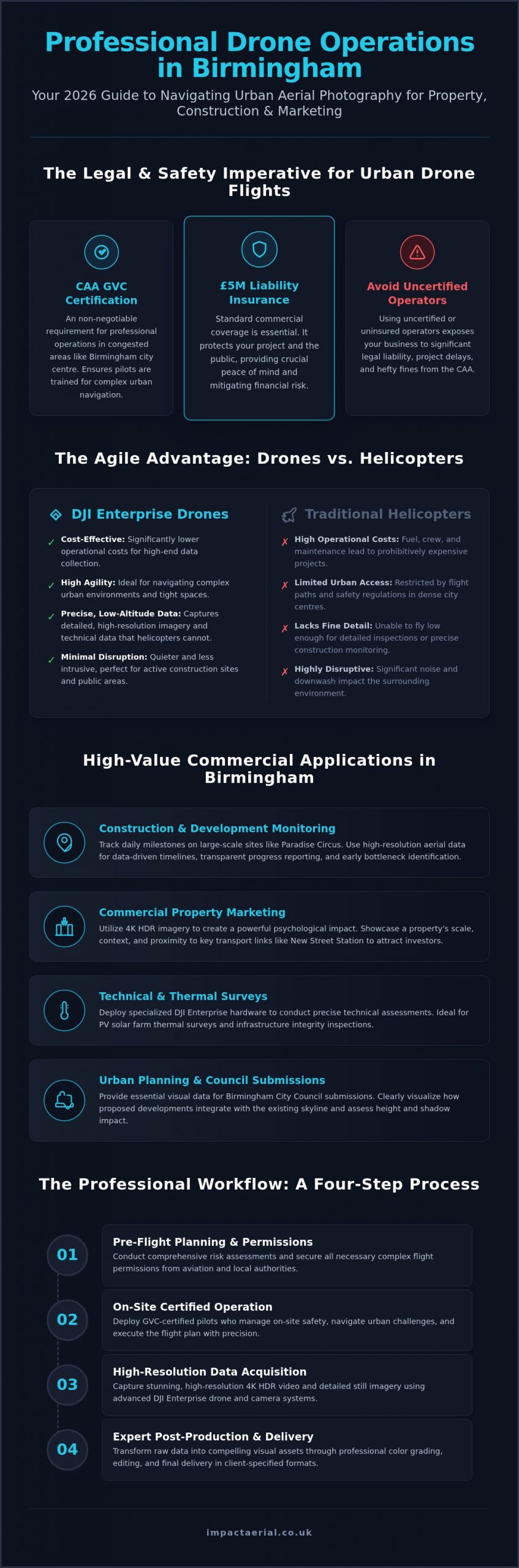
All drone operations in the United Kingdom are governed by the Civil Aviation Authority (CAA). The CAA sets the rules to ensure that all flights are conducted safely and responsibly. A professional pilot must adhere to strict operational guidelines, which include:
A maximum flight altitude of 400ft (120m) above ground level.
Maintaining specific separation distances from people and property not involved in the operation.
Respecting privacy laws and operating in a manner that does not cause a nuisance.
A professional operator will conduct a thorough risk assessment before every flight to ensure full compliance.
The Importance of GVC Certification
For most commercial drone operations in the UK, the pilot must hold a General Visual Line of Sight Certificate (GVC). This qualification is far more than a simple registration; it is a professional certification awarded after a pilot has undergone intensive theoretical training and passed a practical flight examination. A GVC demonstrates a pilot’s proven competence in critical areas such as air law, flight planning, risk management, and emergency procedures. Hiring a GVC-certified pilot ensures you are working with an expert who is qualified to operate safely and legally.
Commercial Drone Insurance Explained
Standard business insurance policies do not cover the unique risks associated with commercial drone flights. It is a legal requirement for any commercial operator to hold specialist drone insurance. This must include comprehensive public liability coverage, protecting you and your property in the unlikely event of an incident. For added peace of mind, the professional industry standard is a minimum of £5 million in coverage. An uncertified operator is almost certainly uninsured, placing all liability directly on you, the client. Verify our credentials and fly with confidence.
Understanding the Technology: Not All Drones Are Equal
The rapid growth of the drone market means that high-street retailers now sell consumer drones for a few hundred pounds. While impressive for hobbyists, this equipment is worlds apart from the technology used for professional drone photography. The quality, reliability, and safety of the final product depend entirely on the calibre of the tools used for the job.
Investing in a professional service ensures you are not just hiring a certified pilot, but also gaining access to leading-edge equipment designed for commercial precision and outstanding image quality.
Consumer vs. Professional ‘Enterprise’ Drones
The difference between a consumer model and a professional ‘enterprise’ drone is significant. Commercial-grade systems, like those used by Impact Aerial, are built for reliability and performance in challenging conditions. They are not toys; they are sophisticated data-gathering tools.
Superior Stability & Safety: Enterprise drones feature advanced GPS and multiple redundant systems, allowing them to hold a perfectly steady position, even in gusty winds. This stability is critical for sharp, clear imagery. They also have sophisticated multi-directional obstacle avoidance sensors for added peace of mind.
Longer Flight Times: Extended battery life allows for more comprehensive shoots. A professional drone can survey a large construction site or commercial property in a single flight, ensuring consistent lighting and a more efficient workflow.
Interchangeable Payloads: Unlike consumer drones with fixed cameras, professional systems can carry specialised payloads. This means we can switch from a high-resolution camera for marketing shots to a thermal sensor for an inspection, using the same reliable drone platform.
Why Camera and Sensor Quality Matters
The drone is simply the platform; the camera and sensor are what capture your final image. This is where professional drone photography truly distinguishes itself. A larger sensor, measured in inches rather than just megapixels, captures significantly more light. This results in cleaner, more detailed images with richer colours, especially in the variable light of a UK morning or an overcast day.
Furthermore, professionals shoot in RAW format. A standard JPEG image is compressed and processed by the camera, discarding a huge amount of data. A RAW file is the digital equivalent of a photographic negative-it contains all the original, unprocessed sensor data. This gives us maximum flexibility during editing to perfect the colour, exposure, and dynamic range, pulling detail from the darkest shadows and brightest highlights to deliver a truly breath-taking final image.
Ultimately, this combination of superior drone technology and high-end camera systems ensures the results we deliver are not just pictures, but valuable, high-quality assets for your business. To see how our equipment can benefit your next project, contact the team at Impact Aerial.
Elevate Your Project with Expert Drone Photography
As we’ve explored, aerial imagery has moved far beyond a novelty, offering tangible commercial advantages across diverse industries. From understanding the sophisticated technology involved to navigating the strict UK legal landscape, the key to success lies not just in the drone, but in the certified professional operating it. This distinction is what separates amateur snapshots from high-quality, legally compliant visuals that deliver real value.
This is where our expertise in professional drone photography becomes your greatest asset. At Impact Aerial, our pilots are fully CAA GVC Certified and insured, backed by £5m in commercial liability insurance for your complete peace of mind. As specialists in property, construction, and commercial surveys, we have the technical skill and regulatory knowledge to bring your vision to life safely and effectively.
Frequently Asked Questions About Drone Photography
How much does professional drone photography cost in the UK?
The cost for professional drone services in the UK typically ranges from £350 to over £1,000. A standard half-day rate often falls between £350 and £750. This price reflects not just the flight time, but also the extensive pre-flight planning, risk assessments, equipment maintenance, and commercial liability insurance. Project complexity, location, and the specific deliverables required will all influence the final quotation. Always ensure you are hiring a fully qualified and insured operator for your project.
What happens if the weather is bad on the day of the scheduled shoot?
Safety is our primary operational concern. We cannot fly our drones in adverse weather conditions, such as high winds (typically above 20-25 mph) or persistent rain. If the forecast is unsuitable for safe flight operations, we will contact you in advance to reschedule the shoot for the next suitable date. There is no additional charge for postponements due to weather, ensuring we can capture the best possible imagery for your project without compromising safety standards.
How long does a typical drone photography session take?
A typical on-site session is booked as a half-day, which usually lasts around four hours. This includes time for a final on-site risk assessment, equipment setup, multiple flights to capture various angles and altitudes, and equipment pack-down. The actual flight time within this period may be around 60-90 minutes, spread across several batteries. This structured approach ensures every aspect of the drone photography operation is conducted safely and efficiently, delivering high-quality results.
Are there any locations where you cannot legally fly a drone?
Yes, there are significant restrictions governed by the Civil Aviation Authority (CAA). Drones cannot be flown in Flight Restriction Zones (FRZs) around airports, near prisons, military sites, or over large crowds without specific permissions. Flying in congested urban areas also requires careful planning and potential authorisations. As CAA GVC Certified operators, we conduct thorough pre-flight surveys to check for all airspace restrictions, ensuring every operation is fully compliant and legal for your peace of mind.
What is the difference between drone photography and drone videography?
The core difference lies in the final output. Drone photography captures high-resolution still images from an aerial perspective, perfect for property marketing, site inspections, or promotional materials. Drone videography, on the other hand, captures moving video footage, often in 4K or higher resolutions. This is ideal for creating cinematic promotional films, dynamic event coverage, or compelling visual narratives. While the flight skills are similar, the creative approach and end product are distinct for each service.
How far in advance do I need to book a drone photography service?
We recommend booking at least one to two weeks in advance. This lead time is crucial for conducting the necessary pre-flight planning, which includes detailed site surveys, airspace checks, and comprehensive risk assessments. For more complex projects that may require special authorisations from Air Traffic Control or landowners, a longer lead time of three to four weeks is advisable. This ensures all regulatory and safety requirements are meticulously met before any flight takes place.