You’re likely losing thousands of pounds through your roof right now, and you can’t even see it. It’s a frustrating reality for UK commercial property managers and homeowners alike. Between skyrocketing energy prices and the eye-watering cost of erecting scaffolding just to “have a look,” traditional maintenance often feels like a financial trap. You already know that hidden moisture ingress or failing insulation could be compromising your building’s structural integrity, but the safety risks of working at height and the potential for site downtime often lead to expensive delays.
A professional drone thermal roof inspection uk changes this dynamic by turning invisible heat loss into actionable data. By choosing a specialist who operates under strict CAA GVC certification and carries £5m commercial liability insurance, you gain a high-tier aerial perspective that ladders simply can’t match. This complete 2026 guide explains how we use DJI Enterprise thermography to identify defects faster and more safely than ever before. We’ll walk you through the latest UK drone regulations, the science of moisture detection, and how these detailed thermal reports provide the evidence you need for insurance claims or repair tenders without the need for a single pole of scaffolding.
Key Takeaways
- Learn how infrared sensors detect non-destructive temperature variations to help your property meet the UK’s stricter 2026 energy efficiency standards.
- Understand the technical distinction between visual context and thermal performance to ensure your survey identifies hidden moisture ingress instead of just surface defects.
- Discover how a professional drone thermal roof inspection uk eliminates the high costs and safety risks of scaffolding while surveying large commercial areas in hours.
- Identify the essential compliance markers, such as CAA GVC certification and £5m liability insurance, required to operate safely in congested urban environments.
- See how sub-degree temperature accuracy and dual-sensor payloads provide the precise evidence needed for insurance claims and repair tenders.
What is a Drone Thermal Roof Inspection and Why is it Essential in 2026?
A drone thermal roof inspection uk is a specialised, non-destructive survey that utilises high-resolution infrared sensors to map temperature variations across a building’s envelope. Unlike a standard photograph, which only captures visible light, a thermal survey detects the heat energy emitted by the structure. This data allows property managers to see exactly where a building is failing. In 2026, this technology has become indispensable as the UK government enforces stricter building regulations focused on reducing carbon footprints and improving energy efficiency. For owners of industrial warehouses, commercial offices, and heritage buildings, these surveys provide the data-centric evidence required for modern compliance.
To better understand how this technology visualises heat and identifies defects, watch this helpful video:
Visual inspections often fail because they can’t detect what lies beneath the surface. Water ingress and insulation gaps frequently remain hidden until they cause structural damage or lead to astronomical energy bills. By the time a leak is visible from the inside, the damage is usually extensive. Aerial thermography identifies these issues at the earliest possible stage, ensuring that maintenance teams can target specific areas rather than replacing entire sections of a roof. This precision is vital for managing large-scale UK property portfolios where traditional manual inspections are both slow and prohibitively expensive.
Detecting the Invisible: Heat Loss and Moisture Ingress
Thermal sensors are exceptionally effective at identifying “cold bridging,” where heat escapes through structural elements or gaps in insulation. Our pilots use DJI Enterprise hardware to capture these thermal signatures with sub-degree accuracy. The process leverages the science of thermal mass; water-saturated insulation retains heat longer than dry materials. This means that after sunset, wet areas on a flat roof will appear as “hot spots” on the thermal map. Identifying these early-stage leaks prevents structural rot and ensures the building’s thermal envelope remains intact.
The Role of Aerial Thermography in Building Maintenance
Implementing aerial data allows property managers to transition from reactive, emergency repairs to proactive asset management. These detailed surveys directly support BREEAM assessments and EPC ratings by providing empirical proof of a building’s thermal performance. To clarify the technology, What is Thermography? Thermography is the measurement of emitted infrared radiation rather than reflected light. By integrating a drone thermal roof inspection uk into your annual maintenance schedule, you ensure your assets remain compliant with 2026 energy standards while avoiding the downtime associated with traditional scaffolding.
Thermal Imaging vs. Visual Drone Surveys: A Technical Comparison
While a visual drone survey is excellent for identifying physical damage like slipped tiles or blocked gutters, it only captures “what it looks like.” In contrast, a drone thermal roof inspection uk captures “how it performs.” Visual imagery remains surface-level; it can’t detect the moisture trapped beneath a waterproof membrane or the heat escaping through a gap in the insulation. By 2026, commercial reporting standards have evolved to require both visual and thermal data sets to provide a truly comprehensive overview of building health. This ensures that maintenance teams aren’t just looking for cracks, but are diagnosing the fundamental integrity of the structure.
Using dual-sensor payloads, such as those found on DJI Enterprise hardware, allows our pilots to overlay high-resolution RGB images with thermal data. This provides vital context. Without a visual reference, a heat signature might just be a reflection or a different material. Following the BS EN 13187 inspection standard ensures that we aren’t just taking pictures, but conducting a qualitative detection of thermal irregularities. This scientific approach separates professional thermography from basic aerial photography and provides the technical rigour required for industrial asset management.
When to Choose Thermal Over Visual
There are specific scenarios where thermal data is the only viable diagnostic tool. For flat roofs, the entry point of a leak is rarely directly above the internal damp patch. Thermal imaging identifies the moisture trail within the substrate, saving thousands in unnecessary repairs. Large-scale industrial units also benefit during energy audits, as thermal sensors highlight failing cladding or “cold bridges” that visual cameras miss entirely. Additionally, for properties with integrated renewables, we use these sensors for PV solar farm thermal surveys to identify defective cells that are overheating and reducing energy yield.
Understanding Emissivity and Atmospheric Conditions
The success of a thermal survey depends heavily on the “window of opportunity” provided by UK weather. High winds or recent rain can mask thermal signatures, which is why our meticulous planning process is so critical. Different materials also emit heat differently; a bitumen felt roof is far easier to read than a highly reflective metal surface. This is due to emissivity, the material’s effectiveness in emitting energy as thermal radiation. Thermal inspections are typically conducted at dusk or night to ensure accurate Delta-T readings once solar loading from the sun has dissipated. This ensures the data we collect is precise, reliable, and legally defensible for insurance or maintenance tenders.
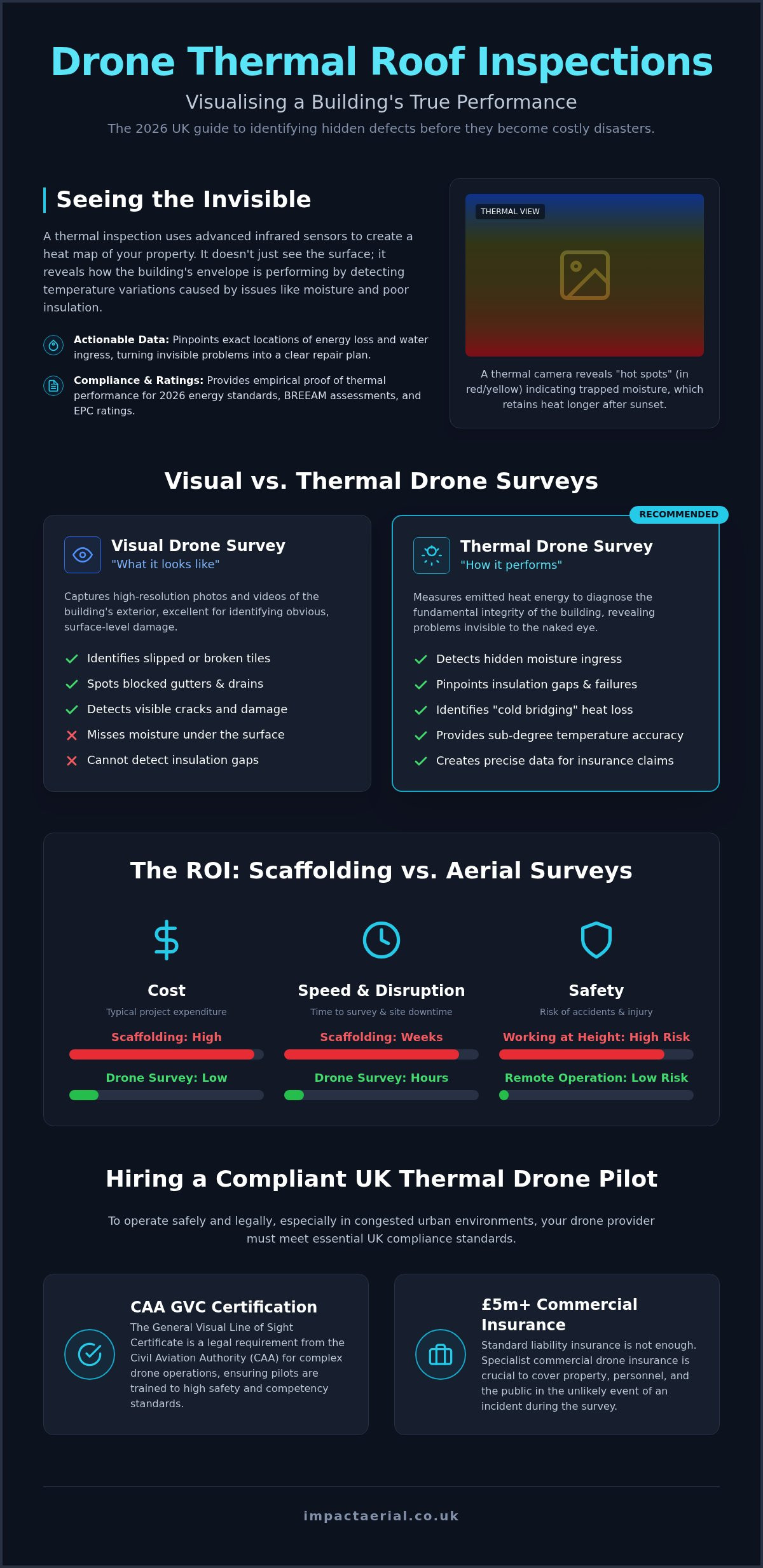
The ROI of Drone Inspections: Scaffolding vs. Aerial Surveys
The financial argument for a drone thermal roof inspection uk is compelling when compared to the heavy logistics of traditional access. For a large commercial property, erecting scaffolding often involves an entry price exceeding £2,000 before a single inspector has even stepped onto the roof. Aerial surveys provide a high-tier diagnostic output for a fraction of that cost. Speed is another critical factor. A manual survey of a 50,000 sq ft industrial facility can take several days of hazardous ladder work. A drone completes the same task in a matter of hours, delivering GPS-tagged imagery that is far more accurate than hand-written notes or handheld photos taken from a precarious angle.
Risk mitigation is at the heart of professional aerial operations. By using drones for initial assessments, we effectively remove the “Working at Height” requirement for your staff and contractors. Our pilots maintain £5m commercial liability insurance and follow strict safety protocols, providing the reassurance that your site remains compliant with national safety standards. This data-centric approach doesn’t just save money; it provides a definitive record of building health that can be referenced for years to come.
Reducing Operational Downtime
One of the most significant benefits of aerial thermography is the lack of disruption. Traditional inspections often require cordoned-off areas or site-wide shutdowns to accommodate scaffolding or cherry pickers. Drones operate from a distance, allowing your business to continue uninterrupted. We also simplify the administrative burden by reducing the need for extensive, site-wide Risk Assessment Method Statements (RAMS) typically required for physical roof access. This streamlined workflow allows for the easy integration of thermal data into existing Building Information Modelling (BIM) systems, enhancing your long-term asset management strategy.
Insurance and Warranty Validation
A professional thermal report is a powerful tool for satisfying UK insurance underwriters. These documents serve as a robust “Schedule of Condition,” providing empirical evidence of a roof’s integrity. For new builds or recent refurbishments, we provide the necessary data to validate contractor warranty sign-offs, ensuring that any installation defects are identified before they lead to structural failure. For a deeper look at how we process this information, refer to our drone survey guide. This proactive approach ensures your property remains protected by valid warranties and comprehensive insurance coverage.
UK Regulations and Safety: Hiring a Compliant Thermal Drone Pilot
Commercial drone operations in the UK are strictly governed by the Civil Aviation Authority (CAA). For any drone thermal roof inspection uk, the pilot must hold a General Visual Line of Sight Certificate (GVC). This is a legal requirement for complex commercial tasks. The GVC demonstrates that the operator has undergone rigorous theoretical and practical testing. They understand the intricacies of the UK’s specific airspace and can manage the risks associated with high-value assets. Hiring an uncertified pilot for commercial work is not just a safety risk; it can invalidate your property insurance.
Operating in congested urban hubs like Birmingham, London, or Manchester requires even greater technical precision. National aviation laws dictate strict separation distances from uninvolved people and buildings. To mitigate these risks, professional operators maintain £5m in commercial liability insurance as a standard benchmark. This level of coverage ensures that the client is fully protected during industrial or commercial surveys. Before any flight, a meticulous pilot conducts a comprehensive risk assessment, ensuring the operation is safe, legal, and efficient.
CAA Compliance and Certification
A significant gap exists between an amateur flyer and a professional drone license holder. Under 2026 regulations, professional operators must adhere to stricter logging and maintenance schedules for enterprise-grade hardware. This includes broadcasting Remote ID information as part of the UK’s updated safety standards. Every operator must also display a valid Operator ID on their aircraft, while the pilot must hold a current Flyer ID. These systems ensure accountability and safety across the UK’s increasingly busy skies.
Safety Protocols for Roof Inspections
Safety begins long before the drone leaves the ground. A professional pilot conducts a detailed pre-flight site survey and checks for a “Notice to Airmen” (NOTAM). This identifies temporary hazards such as crane operations or restricted airspace. We also prioritise privacy by ensuring that our flight paths are focused strictly on the target structure. In complex urban environments, we often deploy a Visual Observer to maintain a constant eye on the surrounding area. This allows the pilot to focus entirely on the precision of the thermal data collection. If you require a risk-managed survey for your property, contact the experts at Impact Aerial today.
Impact Aerial: Expert Thermal Data Collection and Reporting
Impact Aerial operates from a strategic Birmingham base, providing nationwide coverage for every drone thermal roof inspection uk we conduct. Our team leverages high-end DJI Enterprise thermal sensors to achieve sub-degree temperature accuracy, ensuring that even the most subtle thermal anomalies are recorded. We manage the entire lifecycle of the survey, from the initial regulatory flight planning to the complex post-production analysis of infrared data. This end-to-end service is underpinned by our deep sector expertise in commercial property and construction, alongside our specialised work in PV solar farm surveys. Our pilots are trained to identify the unique thermal signatures of different roofing substrates, ensuring that the data collected is both accurate and relevant to your specific building type.
The Impact Aerial Reporting Standard
A professional thermal report must be more than a collection of infrared images; it needs to be a diagnostic tool. We provide high-resolution thermal maps that use MSX overlays, a process that embosses visual detail onto thermal imagery to provide better structural context. This allows your maintenance team to see exactly where a defect sits in relation to roof vents, seams, or drainage points. We categorise every finding using a defect prioritisation scale, helping you allocate repair budgets where they are needed most. For clients managing extensive asset portfolios, we can integrate this thermal data with virtual tour creation, providing a comprehensive digital twin of your building’s exterior and thermal performance. This multi-layered approach ensures that the data is accessible to both technical engineers and commercial stakeholders.
Booking Your UK Thermal Roof Inspection
Our consultation process begins by defining your specific survey goals, whether you are validating a new installation or investigating a persistent leak. Because we are based in the West Midlands, we offer rapid deployment times across the UK, ensuring that we can hit the narrow weather windows required for accurate thermography. Once the flight is complete, our post-production specialists process the raw data to create actionable insights, delivering a final report that is both technically rigorous and easy to interpret. This meticulous attention to detail ensures that your maintenance decisions are based on empirical evidence rather than guesswork. To secure your survey date or request more information, Contact Impact Aerial for a professional thermal roof survey quote and ensure your property is managed with data-centric precision.
Protecting Your Assets with Precision Aerial Data
Transitioning to a data-centric maintenance strategy is no longer optional in 2026; it’s a necessity for energy efficiency and structural longevity. By moving beyond the limitations of visual surveys, you can identify moisture ingress and insulation failures before they escalate into costly structural repairs. A professional drone thermal roof inspection uk provides the high-tier evidence required for insurance validation and proactive asset management, all while eliminating the safety risks of working at height.
Our team at Impact Aerial combines technical rigour with operational excellence. We utilise DJI Enterprise Thermal Technology and deploy CAA GVC Certified Pilots to ensure every survey meets the highest national standards. With £5m Commercial Liability Insurance, we provide the reassurance you need to operate safely in any environment. Don’t leave your property’s health to guesswork or outdated manual inspections. Take the proactive step towards securing your building’s future today.
Request a Professional Drone Thermal Survey Quote and discover how our specialised aerial insights can protect your commercial portfolio.
Frequently Asked Questions
How much does a drone thermal roof inspection cost in the UK?
Costs vary based on the property size, roof complexity, and the specific level of data analysis required for your project. While a basic visual survey is the entry point, a drone thermal roof inspection uk requires specialised sensors and post-production expertise, which influences the total investment. We recommend requesting a bespoke quote to ensure the survey goals align with your specific requirements. Factors like location and the necessity for urban flight permissions will also affect the final pricing structure.
Can a thermal drone see through a roof to find leaks?
Thermal drones don’t see through solid objects; instead, they detect infrared radiation emitted from the roof surface. This technology identifies temperature variations caused by moisture trapped within the substrate or failing insulation. Because wet materials retain heat longer than dry ones, “hot spots” appear on the thermal map after sunset. This non-destructive method provides a clear diagnostic of subsurface issues without the need to physically dismantle any part of the structure or membrane.
What is the best time of day for a thermal roof survey?
The most accurate results are typically achieved at dusk or during the night. This timing ensures that “solar loading” from the sun has dissipated, allowing the thermal sensors to detect the true temperature of the building materials. A significant temperature difference, known as Delta-T, between the internal and external environment is essential. This contrast makes it much easier to identify insulation gaps, cold bridging, and moisture ingress across the entire roof surface with precision.
Do I need to notify my neighbours before a drone inspection?
You aren’t legally required to notify neighbours if the operation stays within the boundaries of the law and CAA regulations. However, we consider it best practice to inform adjacent property owners when conducting a drone thermal roof inspection uk in sensitive or residential areas. Our pilots prioritise privacy by focusing sensors strictly on the target structure. We always operate under strict safety protocols to ensure the survey is as discreet and professional as possible for all parties.
How long does it take to get the thermal inspection report?
Most clients receive their comprehensive thermal report within 48 to 72 hours of the flight. This timeframe allows our post-production team to process the raw infrared data, overlay visual imagery for context, and prioritise any detected defects. For large-scale industrial surveys or complex asset portfolios, the analysis might take slightly longer to ensure accuracy. We ensure that the final document is an actionable diagnostic tool rather than just a collection of raw infrared images.
Are drone roof inspections accepted by UK insurance companies?
Yes, UK insurance underwriters increasingly accept and even request drone thermal reports as empirical evidence of building health. These surveys provide a robust “Schedule of Condition” that can be used for warranty validation or insurance claims. Because our pilots are CAA GVC certified and carry £5m commercial liability insurance, the data we provide is considered technically accurate and legally defensible. This documentation offers a clear, high-tier record of maintenance for your professional property files.
What weather conditions prevent a thermal drone flight?
Flight operations are prevented by heavy rain, snow, or winds exceeding the drone’s safe operating limits, which is usually around 20 to 25mph. Moisture on the roof surface can mask thermal signatures, leading to inaccurate data collection. We constantly monitor local weather patterns to identify the ideal “window of opportunity” for your survey. If conditions aren’t perfect, we reschedule to ensure the data we collect for your property is of the highest possible quality and technical rigour.
Do you need special permission to fly a drone in a city centre like Birmingham?
Flying in a city centre like Birmingham requires specific CAA Operational Authorisation and adherence to strict urban flight laws. Our pilots hold the necessary GVC certification to operate in congested areas safely and legally. We manage the entire permission process, including site-specific risk assessments and notifying the relevant authorities where required. This meticulous planning ensures that your urban property survey is completed without legal complications, site downtime, or safety risks to the general public.
 2 Norton Drive, Wythall, Birmingham, B47 6HH Company registration number: 11138586. VAT Number: 366 9068 55