Drone Services for Advertising Agencies: The Ultimate 2026 Partnership Guide

A single breach of UK Air Navigation Orders can result in a £2,500 fine and an immediate halt to your production, yet a surprising number of creative projects still rely on uncertified pilots for their aerial shots. You understand that premium clients demand nothing less than flawless 4K HDR visuals. However, you shouldn’t have to choose between creative ambition and legal liability. It’s frustrating when unreliable freelancers or technical glitches threaten a tightly packed shoot schedule.

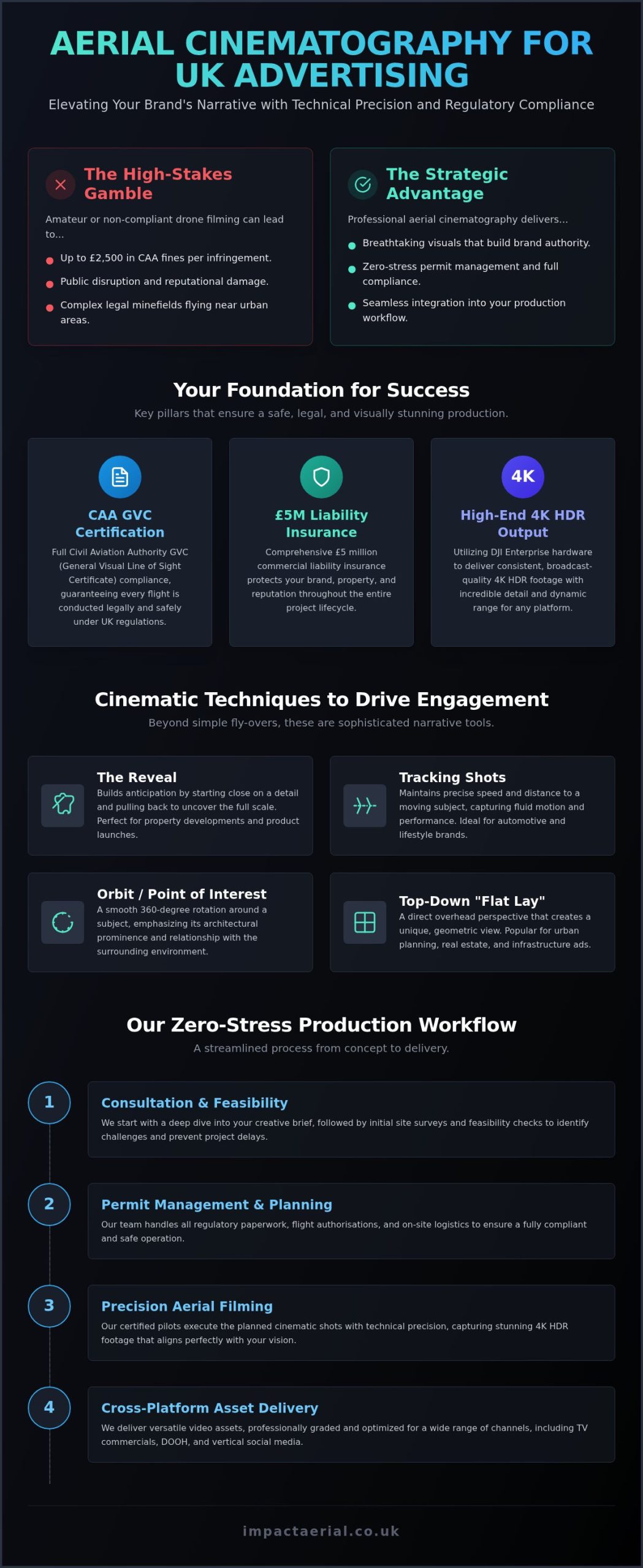
By partnering with specialist drone services for advertising agencies, you can secure breath-taking aerial perspectives while we handle every aspect of CAA GVC compliance and safety management. For added peace of mind, we provide £10 million in commercial liability insurance and a fleet of DJI Enterprise drones that match the quality of your high-end ground cameras. This guide explores how our meticulous technical standards and seamless production integration will elevate your next campaign while removing the logistical burden from your creative team.

Key Takeaways

  • Learn why modern aerial cinematography has replaced costly helicopter charters, offering unique perspectives that significantly influence consumer behaviour.
  • Understand how professional drone services for advertising agencies utilise 4K HDR DJI Enterprise technology to deliver cinematic, colour-grade-ready footage.
  • Discover the critical importance of CAA GVC certification and how hiring fully insured, certified pilots protects your agency and clients from legal liability.
  • Explore the collaborative process from initial site surveys to the final edit, ensuring your creative vision is seamlessly translated into high-impact visuals.
  • Find out why partnering with a Birmingham-based specialist provides the strategic advantage of rapid, UK-wide deployment for global brand campaigns.

The Strategic Value of Aerial Filming for Advertising

Modern advertising agencies have moved away from the restrictive costs of traditional aerial cinematography. Until 2015, capturing sweeping cityscapes or dramatic coastal shots required hiring a helicopter and a specialised camera gimbal, often costing over £2,500 for a single morning. Today, Unmanned Aerial Vehicle (UAV) technology allows for the same cinematic quality at a significantly lower price point. It’s now possible to achieve 4K or 6K RAW footage using compact, agile platforms that don’t require the massive logistical footprint of a flight crew and fuel truck.

Using professional drone services for advertising agencies provides a level of creative freedom that was previously impossible. Drones can fly from ground level to 400 feet in a single continuous take, creating a seamless narrative flow. This scale helps brands establish prestige. It positions products within a grander environment, whether that’s a luxury estate in the Cotswolds or a bustling Birmingham skyline. Our fleet provides the technical precision needed to ensure these shots are stable, high-quality, and fully compliant with UK aviation laws.

To better understand how this technology is changing the face of modern marketing, watch this helpful video:

Capturing the Modern Consumer’s Attention

Data from 2023 indicates that video content featuring dynamic movement sees a 27% increase in viewer retention compared to static shots. Aerial perspectives provide an immediate “wow” factor that stops the scroll on social media platforms. These unique angles trigger a psychological response of awe, helping a brand stand out in a saturated digital market. Whether it’s a fast-paced FPV chase or a slow, cinematic reveal, drone services for advertising agencies deliver the high-end production values that modern consumers expect.

Of course, powerful visuals are most effective when paired with a strong distribution strategy. To ensure this high-impact content reaches the right audience on social media, many agencies also discover Influencer to connect with creators who can amplify their campaigns.

Drones vs. Traditional Production Tools

Traditional jibs and dollies are heavy and limited by the terrain. A drone can effectively replace a 30-foot crane and a 50-foot dolly track in one portable device. Setup time for a heavy-duty crane can take 90 minutes. In contrast, our CAA GVC certified pilots can have a drone ready for flight in under 15 minutes. This efficiency allows production teams to capture up to 40% more shots per production day. Drones also reach restricted areas, such as flying over water or through tight architectural spaces, where ground crews cannot safely operate.

  • Increased Flexibility: Rapidly change angles without rebuilding heavy rigs.
  • Cost Efficiency: Achieve £50,000 production looks on a mid-range budget.
  • Expert Compliance: Operations backed by commercial liability insurance and CAA oversight.

Technical Capabilities: 4K HDR and DJI Enterprise Technology

Impact Aerial utilises a fleet of DJI Enterprise drones to deliver flight stability and image quality that consumer-grade hardware cannot match. High-end drone services for advertising agencies rely on these platforms to capture 4K HDR footage with a dynamic range often exceeding 13 stops. This technical overhead is vital for commercials that feature high-contrast environments, such as bright skylines paired with shaded street-level action. Precision is maintained through dual-operator setups. By separating flight control from camera movement, our pilot focuses on safety and positioning while a dedicated camera operator manages the gimbal. This results in fluid, cinematic shots that are impossible to achieve with a single pilot.

Technical specifications define the limit of what’s possible in the edit suite. We prioritise bitrates of 150Mbps or higher and 1-inch CMOS sensors to ensure every frame is packed with data. While our operations are governed by UK CAA GVC certifications, agencies coordinating international campaigns often look for alignment with global standards like FAA drone regulations to ensure cross-border consistency. Our commitment to these high standards provides the reliability required for multi-million pound productions.

High-End Imagery for Post-Production

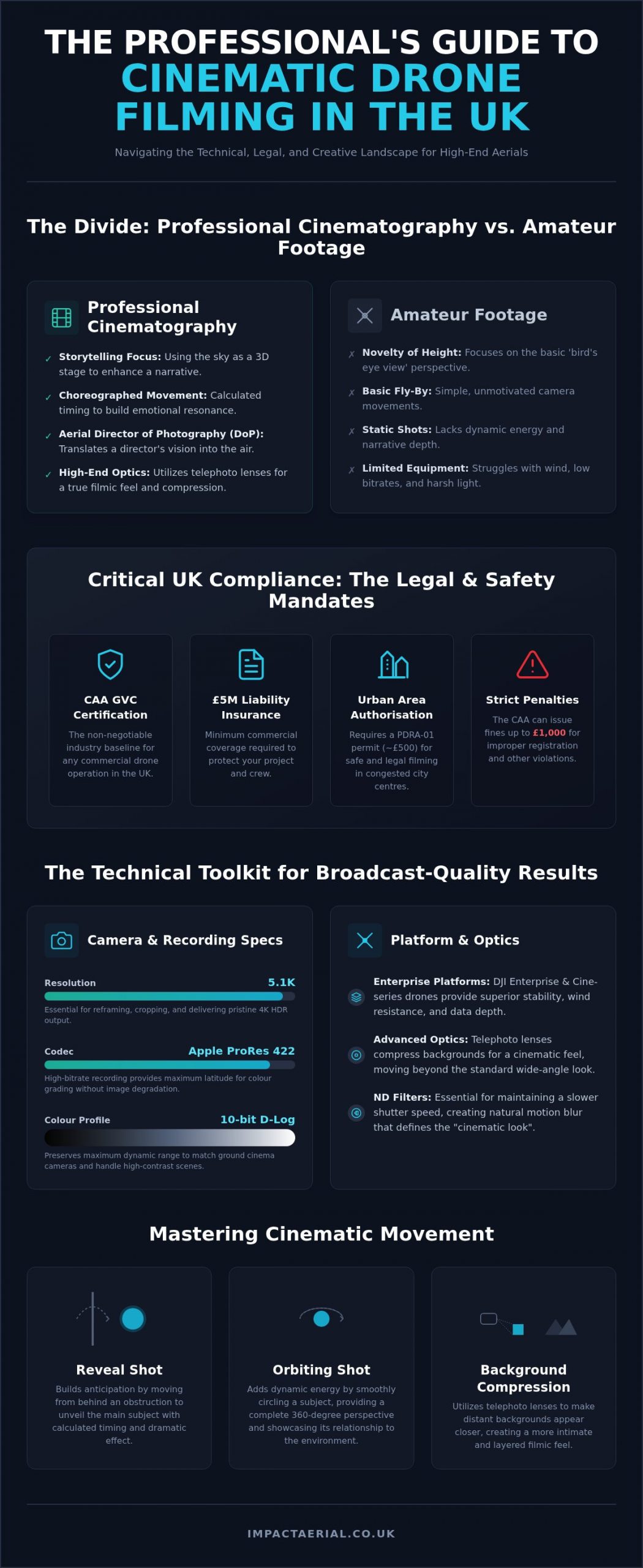
Recording in 10-bit D-Log is a non-negotiable requirement for professional workflows. This format captures over 1 billion colours, allowing colourists to match drone footage perfectly with ground-based Arri or RED camera systems. The 4K resolution provides 8.3 million pixels per frame, giving editors the flexibility to crop or reframe shots by up to 15% without any visible loss in quality. This technical headroom is essential for maintaining texture and skin tones across a cohesive campaign.

Specialist Drone Applications for Creative Briefs

Creative briefs often demand more than standard aerial views. FPV (First Person View) drones offer high-speed, immersive sequences, capable of flying through gaps as small as 50cm at speeds of 60mph. For conceptual ads, we deploy zoom lenses and low-light sensors with ISO capabilities reaching 12,800. These tools allow us to capture crisp, low-noise footage of city lights or industrial sites during the “blue hour.” If you are ready to push the boundaries of your next project, you can explore our equipment specifications to see how we support ambitious storyboards.

Risk Mitigation: Why CAA GVC Certification is Non-Negotiable

The UK drone regulatory landscape underwent a total overhaul on 31 December 2020. The Civil Aviation Authority (CAA) replaced the old PfCO system with the General Visual Line of Sight Certificate (GVC) and the A2 Certificate of Competence (A2 CofC). For any agency, hiring a pilot who hasn’t updated their qualifications is a significant risk. It’s not just about flight skill; it’s about legal accountability. If an accident occurs involving an uncertified pilot, the liability often falls on the hiring agency. While the FAA Commercial Drone Pilot Certification governs the US market, UK operators must prove their competence through these specific CAA-approved pathways to remain legal.

Operating in complex urban environments like Birmingham city centre requires advanced permissions. Most drone services for advertising agencies are limited by standard distance rules, often keeping them 50 metres away from people. We operate with an Operational Safety Case (OSC). This is a bespoke volume of operating procedures approved by the CAA that allows us to fly in congested areas where others cannot. We handle every aspect of the site survey and flight permission process. This gives your creative team the freedom to focus on the vision while we manage the technical risk.

The Importance of £5m Commercial Liability Insurance

Standard drone insurance policies frequently contain exclusions for commercial film sets or built-up areas. We carry £5m in commercial liability insurance specifically designed for high-end aerial work. This coverage protects the agency, the client, and the public from third-party claims. For every project, we produce comprehensive Risk Assessment and Method Statements (RAMS). These aren’t generic templates; they’re site-specific documents that outline exactly how we’ll mitigate hazards on your shoot day. This meticulous preparation provides the peace of mind required for high-stakes commercial productions.

Navigating UK Drone Laws in 2026

Current 2026 regulations enforce a strict 120-metre altitude ceiling and specific horizontal separation distances from uninvolved persons. We also manage the complexities of GDPR and privacy. When we collect aerial data, we ensure no private information is captured or stored illegally, protecting your agency from data breaches. If your campaign involves restricted UK airspace, such as areas near airports or government buildings, we manage the coordination with NATS and local Air Traffic Control. This professional approach to drone services for advertising agencies ensures that your production isn’t shut down by authorities or marred by privacy complaints.

The Collaborative Workflow: From Creative Brief to Final Edit

Impact Aerial transforms a creative director’s initial concept into a precise, executable flight plan. We don’t just show up and fly. Our process begins by meticulously analysing your brief to determine the most effective platform for the job. Whether your campaign requires a heavy-lift rig for high-end cinematic glass or a nimble FPV drone for a fast-paced factory tour, our technical approach ensures the visual output aligns perfectly with your brand’s narrative.

Pre-Shoot Planning and Visualisation

Our team uses Google Earth and advanced 3D mapping software to storyboard every aerial shot before the crew arrives on site. This technical preparation allows us to predict sun angles and shadow lengths with 98% accuracy, which is vital for high-end commercial work. We typically schedule primary filming during the “Golden Hour,” the 40-minute window before sunset, to capture the soft, natural lighting that defines premium brand content. Managing complex logistics for multi-location UK campaigns is a core component of our drone services for advertising agencies, ensuring all CAA permissions and local authority clearances are secured weeks in advance.

Seamless Integration on Production Day

On set, our CAA GVC certified pilots act as a seamless extension of your existing camera department. We provide a dedicated ground station equipped with a high-brightness monitor, allowing the director to view a live 1080p downlink from the drone in real-time. This allows for instant creative feedback and immediate adjustments to framing or flight speed. Because we operate as a two-person crew, with a dedicated pilot and a separate gimbal operator, we maintain a high level of precision without disrupting the main filming schedule or the pace of the ground crew.

Post-production support is tailored to your agency’s specific workflow. We can deliver raw 4K HDR 10-bit Log footage directly to your DIT (Digital Imaging Technician) on high-speed SSDs before we leave the site. If your project requires a faster turnaround, our in-house editors can provide fully stabilised and colour-graded cinematic sequences ready for the final cut. For added peace of mind, every flight we undertake is backed by £5 million in commercial drone liability insurance, meeting the rigorous compliance standards of the UK’s leading production houses.

Ready to plan your next campaign? Explore our professional aerial filming services for your production.

Why Advertising Agencies Partner with Impact Aerial

Impact Aerial provides a specialised bridge between complex aviation regulations and high-end creative vision. Based in Birmingham, our central location serves as a strategic hub for rapid UK-wide deployment. We can reach most major filming locations within four hours, which is a critical advantage for agencies managing tight production schedules for global brands. Our track record includes delivering high-resolution assets for leading creative firms, ensuring every frame meets the exacting standards required for broadcast and digital media.

We provide a comprehensive end-to-end service that removes the administrative burden from your production team. Our professional drone services for advertising agencies cover everything from initial site surveys and CAA paperwork to high-end post-production editing. By integrating the latest DJI Enterprise technology, we capture 4K and HDR footage that offers incredible dynamic range. This technical precision ensures that the raw data we gather integrates seamlessly into your agency’s existing colour grading and VFX workflows.

Expertise in the West Midlands and Beyond

Our pilots possess deep local knowledge of Birmingham and the wider West Midlands, including specific flight constraints and aesthetic opportunities in areas like the Jewellery Quarter or the city’s modern skyline. We scale our operations to suit national advertising campaigns, providing consistent quality across multiple UK sites. This scalability ensures that a multi-location shoot maintains a unified visual style. Contact our team to discuss your next creative brief and receive a tailored quote within 24 hours.

The Impact Aerial Difference

Meticulous attention to detail defines our approach to both flight safety and visual aesthetics. We operate with a “safety-first” culture that never compromises the creative end result. Every project is led by a CAA GVC Certified pilot, supported by £5 million in commercial liability insurance for added peace of mind. We understand that in the world of drone services for advertising agencies, technical reliability is just as important as the final shot. We manage the risks so your creative directors can focus on the storytelling. You can request a consultation for your agency today to explore how our aerial capabilities can enhance your next campaign.

Transform Your Creative Vision With Precision Aerial Filming

Integrating professional drone services for advertising agencies isn’t just about capturing a bird’s-eye view. It’s about precision storytelling backed by technical excellence. Our Birmingham-based team operates a DJI Enterprise 4K HDR fleet that delivers the high-definition, cinematic results modern brands demand. We prioritise safety and compliance, providing £5m commercial liability insurance alongside our CAA GVC certified pilots. This rigorous approach ensures your production stays on schedule and within legal boundaries across the UK. By choosing a partner that understands the nuances of a creative brief, you gain more than just a pilot; you gain a technical consultant dedicated to achieving breath-taking perspectives that set your campaign apart. We’ve built our reputation on reliability and meticulous operational standards. It’s time to bring those high-level visuals to your clients’ projects with total peace of mind.

Partner with Impact Aerial for your next campaign

Frequently Asked Questions

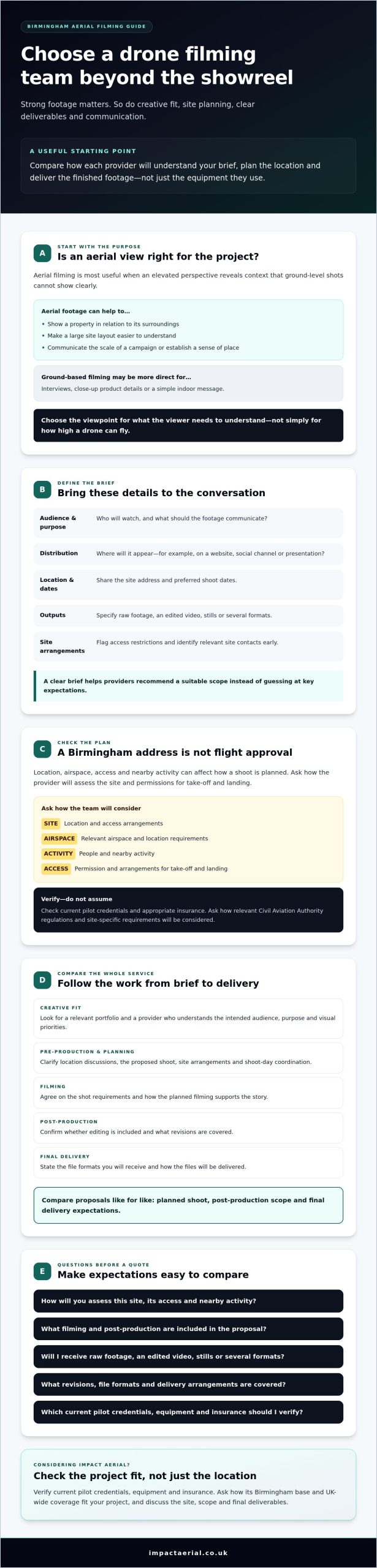
Do I need special permission to film with a drone in a UK city centre?

Yes, you almost always need specific permissions to fly in UK city centres. Our pilots coordinate directly with the Civil Aviation Authority (CAA) and local councils to secure necessary permits, which typically requires a 14-day lead time. We handle all the complex paperwork and safety assessments to ensure your drone services for advertising agencies are fully compliant with UK law.

How much do professional drone services for advertising cost?

Professional aerial filming costs typically range from £500 for a basic half-day shoot to £2,500 for complex, multi-pilot operations involving high-end cinema equipment. These rates cover our pilot’s technical expertise, equipment hire, and detailed pre-flight planning. We provide bespoke quotes based on your specific campaign requirements and the technical complexity of the flight path within the UK.

Can drones film in bad weather conditions like rain or high wind?

Most commercial drones cannot fly in heavy rain or winds exceeding 22mph due to safety risks and image stability issues. While some of our enterprise-grade drones have an IP45 rating for light moisture, we prioritise safety and visual quality. High winds cause camera shake, which compromises the professional standard required for high-end advertising campaigns and brand films.

What insurance coverage does Impact Aerial provide for agency shoots?

Impact Aerial provides £5 million in commercial drone liability insurance as standard for every project. This coverage is fully compliant with EC 785/2004 requirements and protects against third-party property damage or injury. For added peace of mind, we can increase this coverage to £10 million for specific high-risk locations or large-scale agency productions upon your request.

How do we ensure the drone footage matches our ground-based 4K cameras?

We ensure visual consistency by filming in 10-bit D-Log or Apple ProRes formats, which allow for extensive colour grading in post-production. Our fleet includes drones equipped with 1-inch or larger sensors that capture 4K or 5.1K resolution. This high dynamic range ensures the aerial shots blend seamlessly with your ground-based cinema cameras during the final edit of your commercial.

What happens if the weather is too poor to fly on the scheduled shoot day?

If the forecast predicts rain or high winds 24 hours before the shoot, we’ll consult with your team to reschedule. We don’t charge a pilot fee for weather-related postponements made within this timeframe. This flexibility ensures we only fly when conditions allow for the high-quality, stable footage your advertising campaign demands, keeping your production budget protected.

Are your pilots CAA GVC certified for commercial work?

Yes, all our pilots hold the General Visual Line of Sight Certificate (GVC) and are fully authorised by the CAA for commercial work. This certification is the current UK standard and allows us to operate under specific category rules. We maintain a strict operations manual and carry all necessary flight logs to ensure total regulatory compliance on every agency set.

Can you provide raw unedited footage for our in-house editors?

We provide raw, unedited footage directly to your in-house editors via secure cloud transfer or physical hard drives. This includes the original 4K or 5.1K source files in your preferred codec, such as H.264 or ProRes. Providing these raw assets gives your creative team complete control over the final look and feel of the drone services for advertising agencies.

Drone Footage for Television Commercials: The Professional’s Guide to Aerial Cinematography

What if your high-budget TV campaign was pulled from the airwaves because of a single missing CAA permit? It’s a risk that 92% of professional directors aren’t willing to take, yet the pressure to deliver breath-taking perspectives has never been higher. Securing professional drone footage for television commercials involves a meticulous balance of technical precision and strict adherence to UK aviation law.

The principles of choosing the right aerial tool are universal. For those interested in how professional teams apply these techniques in the European film and television industry, you can learn more to see examples of their work.

You already know that a stunning aerial shot is worthless if it doesn’t match the colour science of your ground-based cinema cameras or if it results in a £5,000 regulatory fine. It’s often difficult to find the right balance between creative ambition and the safety requirements of filming in dense urban centres like London or Birmingham. This article shows you how to achieve broadcast-ready 4K HDR results while maintaining full regulatory compliance for added peace of mind. We’ll cover everything from advanced aerial camera systems to the essential GVC certifications your production team needs to verify before the first take.

Key Takeaways

  • Learn how agile UAV technology has replaced expensive helicopter mounts to deliver high-resolution perspectives that deepen brand storytelling and emotional resonance.
  • Understand the technical standards for broadcast-quality imagery, including matching 5.1K HDR and Apple ProRes profiles for seamless colour grading with ground cameras.
  • Navigate UK aviation law by mastering the requirements for drone footage for television commercials, including CAA GVC certification and £5m commercial liability insurance.
  • Discover the essential pre-production workflow, from initial creative consultation to the completion of site surveys and robust Risk Assessments and Method Statements (RAMS).
  • See how utilising a specialist fleet of DJI Enterprise drones provides the precision, safety, and reliability required for high-stakes advertising campaigns.

The Evolution of Drone Footage for Television Commercials

The landscape of British advertising changed forever when heavy, expensive helicopter gimbals were replaced by agile Unmanned Aerial Vehicles (UAVs). Before 2010, capturing a sweeping cinematic shot of the Manchester skyline or the Scottish Highlands required a chartered helicopter, a specialised camera mount, and a budget exceeding £15,000 per day. Today, professional teams provide drone footage for television commercials using platforms like the DJI Inspire 3, which offers full-frame 8K resolution at a fraction of those legacy costs. This shift hasn’t just saved money; it’s expanded the creative vocabulary of directors. The Evolution of Aerial Cinematography shows that while the desire for height is a century old, the precision of modern GPS-stabilised flight allows for millimetre-perfect repeatability that was once impossible.

High-resolution UAVs now carry sensors capable of 14 stops of dynamic range, matching the industry-standard Arri Alexa or RED cameras used on primary ground units. This technical parity ensures that aerial sequences blend seamlessly with studio footage during the colour grading process. For national UK campaigns, the ability to launch a drone in under 15 minutes allows production crews to capture the “golden hour” light with a level of responsiveness that traditional aviation could never match.

To better understand how these systems operate on a live set, watch this helpful video:

Distinguishing between consumer-grade hobbyist shots and professional broadcast cinematography is vital for brand integrity. While a retail drone might capture 4K video, it often lacks the 10-bit ProRes 422 HQ or CinemaDNG codecs required for high-end television delivery. Professional operators hold CAA GVC certifications and carry specific commercial liability insurance, often up to £10 million, to operate in congested urban areas like London or Birmingham. By 2026, the industry expects a 40% increase in the use of specialised First Person View (FPV) drones for brand storytelling. These platforms offer an immersive, visceral experience that puts the viewer inside the action, moving through windows or following a vehicle at 90mph with inches of clearance.

Breaking the Fourth Wall: Why Aerials Matter

Aerial shots provide the necessary scale for national campaigns, instantly establishing a “big budget” feel for regional brands. In automotive advertising, dynamic tracking shots follow a car through winding Cotswold lanes, creating a sense of freedom and performance. These perspectives provide context that ground-based cameras cannot replicate, effectively bridging the gap between the product and its environment. For independent brands, a single well-executed aerial shot can elevate a 30-second spot to match the production value of a global conglomerate.

FPV vs. Traditional Aerial Filming

Choosing the right tool depends entirely on your creative brief. Traditional drones excel at stable, sweeping landscapes and slow, cinematic reveals that require rock-steady horizons. They’re the workhorses for drone footage for television commercials that need a polished, authoritative look. Conversely, FPV drones are designed for high-speed, proximity-based “fly-through” shots. They offer a kinetic energy perfect for lifestyle and sports brands. While traditional drones provide a “eye in the sky” perspective, FPV provides a “bird in flight” experience, diving through structures and maintaining tight orbits around moving subjects.

Technical Standards: Achieving Broadcast-Quality Aerials

Achieving broadcast-quality results requires more than just a flying camera; it demands a rigorous adherence to technical specifications that meet 2024 television delivery standards. High-end television production usually requires 4K or 5.1K resolution to provide the necessary flexibility in the edit suite. When capturing drone footage for television commercials, we utilise DJI Enterprise drones like the Mavic 3 Cine or the Inspire 3 because they support Apple ProRes 422 HQ. This codec records massive amounts of data, often exceeding 1.1Gbps, which allows colourists to push the image during post-production without the quality degrading. It’s vital that aerial shots match the “A-camera” used on the ground, whether that is an ARRI Alexa or a RED V-Raptor. By shooting in 10-bit D-Log, we ensure the sky’s highlights and the shadows of a city street retain detail, allowing for a seamless transition between a £50,000 ground rig and our aerial platforms.

Stability is another non-negotiable factor. Standard consumer gimbals often struggle with the “micro-jitters” caused by high-speed flight or wind resistance at altitude. Professional DJI Enterprise systems use advanced 3-axis mechanical stabilisation that keeps the frame rock-steady even when the aircraft is travelling at 50mph. This precision is what allows for the sweeping, cinematic movements that define modern TV advertising. For added peace of mind, our technical workflow includes redundant recording and real-time HD downlinks, so directors can monitor the shot from the ground with zero latency.

Safety and legality underpin every technical decision we make on set. Every pilot must follow UK Drone Laws for Commercial Use to ensure the production remains insured and compliant with Civil Aviation Authority standards. This meticulous approach to regulation is what separates hobbyists from professional aerial specialists. For brands looking to elevate their visual storytelling, choosing a partner with the right technical kit is essential. You can view our professional equipment list to see how we maintain these high standards.

Sensor Size and Dynamic Range

A 1-inch sensor is the absolute baseline for professional TV work, though we prefer Micro Four Thirds or Full Frame sensors for their superior light-gathering capabilities. These larger sensors handle high-contrast scenes, such as London city lights at dusk, with significantly less digital noise than smaller alternatives. Dynamic range represents the measurable span between the darkest shadows and brightest highlights that a sensor can record while maintaining detail across 1,024 distinct shades per colour channel.

Frame Rates and Shutter Speeds for TV

UK broadcast standards typically dictate a frame rate of 25fps. To maintain a cinematic motion blur that looks natural to the human eye, we adhere to the 180-degree shutter rule, which requires a shutter speed of 1/50th of a second. Achieving this in broad daylight requires high-quality Neutral Density (ND) filters to block excess light without shifting the colour balance. For product reveals or high-action sequences, we switch to 60fps or 100fps. This provides smooth, high-definition slow motion that adds a premium, polished feel to any brand campaign while avoiding the “stutter” often seen in poorly configured aerial shots.

Securing high-quality drone footage for television commercials involves more than just pressing a record button. It requires a deep understanding of the Civil Aviation Authority (CAA) regulations that govern UK airspace. Since the regulatory overhaul on 31 December 2020, the distinction between commercial and recreational flights has blurred, replaced by a system based on the weight of the drone and the level of risk involved. For production companies, this means hiring an operator who isn’t just a hobbyist with a camera, but a qualified professional who understands the Specific Category of operations.

Safety is our primary priority, which is why Impact Aerial maintains £5m in commercial liability insurance as a standard baseline. Most major UK broadcasters, including the BBC and ITV, require a minimum of £5m cover before a drone team can even step onto a set. This insurance provides peace of mind for production managers, covering potential third-party property damage or bodily injury. We also strictly adhere to the Data Protection Act 2018 and UK GDPR. When filming on location, we implement data management plans to ensure that any incidental capture of private information, such as vehicle registrations or faces in residential areas, is handled legally and ethically.

Managing flight permissions is a multi-layered process. Whether we’re dealing with Flight Restricted Zones (FRZs) near airports or temporary restricted areas around sensitive sites, we handle the bureaucracy. We use the latest Airspace Management tools to identify potential conflicts and submit non-standard flight applications where necessary. This meticulous preparation ensures that your shoot stays on schedule and remains fully compliant with the law.

The Role of the CAA GVC Certified Pilot

The General Visual Line of Sight Certificate (GVC) is the current gold standard for professional drone operators. While the old PfCO (Permission for Commercial Operation) served the industry for years, it was phased out during the 2020 regulatory transition. The GVC is specifically designed for the Specific Category, giving our pilots the authority to fly heavier aircraft and operate closer to people than standard hobbyist qualifications allow. At Impact Aerial, we take full responsibility for the technical risk assessment process. This includes a detailed site survey, weather monitoring, and the creation of a robust emergency response plan for every flight.

Filming in Urban Centres: Birmingham and Beyond

Filming in dense urban environments like Birmingham city centre or the Jewellery Quarter presents unique challenges. We regularly liaise with the West Midlands Police and Birmingham City Council to secure the necessary permissions for low-altitude filming. Public safety is managed through strict operational protocols, including:

  • Establishing 30-metre exclusion zones for take-off and landing.
  • Deploying professional marshals to manage pedestrian and vehicle traffic.
  • Using physical cordons and signage to mark operational areas.
  • Pre-notifying local businesses and residents to ensure transparency and cooperation.

By coordinating closely with local authorities, we can capture stunning drone footage for television commercials in busy city centres without compromising safety. Our experience in the West Midlands allows us to navigate these hurdles efficiently, ensuring your production gets the cinematic shots it needs while remaining on the right side of the law.

From Storyboard to Screen: The Aerial Filming Workflow

Successful aerial cinematography requires more than just a skilled pilot; it demands a structured, professional framework that aligns with rigorous UK aviation standards. The process begins with an intensive technical consultation. We bridge the gap between a Creative Director’s storyboard and the practicalities of flight. During this phase, we assess the feasibility of specific shots against the CAA GVC Certified standards that govern UK airspace. We determine which airframe suits the production, whether it’s the high-speed agility of a bespoke FPV drone or the stable, 8K resolution output of a DJI Inspire 3. This ensures the drone footage for television commercials meets the highest broadcast specifications without compromising on safety or legality.

Pre-production is where the foundation of a safe shoot is built. We produce a comprehensive RAMS (Risk Assessment and Method Statement) for every project. This document is a legal requirement for commercial operations in the UK and provides the production house with essential documentation for their own insurance and health and safety compliance. We conduct detailed site surveys to identify local hazards, such as 11kV overhead power lines or proximity to congested areas, ensuring all permissions from landowners or local authorities are secured well in advance of the shoot day.

Pre-Visualisation and Flight Planning

We use Google Earth Pro and specialised flight planning software to map out precise flight paths before the crew arrives on location. This allows us to identify the “money shots” and potential lighting issues 48 hours before the first take. By coordinating directly with the 1st AD, we integrate drone flights into the call sheet with precision. We plan for 20-minute flight windows that coincide with the best natural light, ensuring the drone is in the air exactly when the Director needs it, preventing costly delays for the rest of the cast and crew.

On-Set Collaboration and Safety

Safety remains our primary focus throughout the shoot day. We deploy trained visual observers, or “spotters,” to maintain a 360-degree visual line of sight, allowing the pilot to focus entirely on the composition of the frame. The Director and Cinematographer receive a zero-latency, live HD feed on their monitors, allowing for real-time adjustments to the flight path or camera tilt. To ensure zero downtime, we manage a strict battery cycle and maintain equipment redundancy. We always carry a secondary, identical airframe, providing 100% hardware backup for added peace of mind during tight production schedules.

Post-production is the final stage of our technical workflow. We understand that drone footage for television commercials must integrate seamlessly with ground-based Arri or RED footage. We deliver files in professional formats, typically 12-bit CinemaDNG or 10-bit Apple ProRes 422 HQ, depending on the colour grading requirements of the project. Data is transferred via high-speed SSDs on-site or through secure cloud servers, ensuring the editor has the raw or log files required to achieve a consistent cinematic look across the entire campaign.

Our meticulous approach to the aerial workflow ensures that every frame is captured with precision, compliance, and creative flair. If you’re ready to plan your next production, you can book a professional drone crew to discuss your project requirements and safety protocols.

Why Impact Aerial is Your Broadcast Partner of Choice

Impact Aerial operates in a niche but increasingly diverse market, providing high-end technical solutions for the advertising sector. We don’t just fly drones; we understand the visual language of broadcast media. Our team brings specialised expertise to every shoot, ensuring that drone footage for television commercials meets the rigorous technical standards required by major UK broadcasters like ITV, Channel 4, and Sky. We’ve spent years refining our workflows to integrate seamlessly with professional film crews, providing a level of reliability that production houses demand.

The core of our capability lies in our hardware. Our fleet includes the latest 4K, High Dynamic Range (HDR) DJI Enterprise commercial drones. These aircraft capture 10-bit D-Log M colour profiles, which provide over 1.07 billion colours for maximum flexibility in the grading suite. While we provide national coverage across the UK, our central hub in Birmingham and the West Midlands allows us to reach 90% of England within a four-hour drive. This local focus ensures we can be on-site quickly, while our national reach provides consistency for multi-location campaigns.

We provide full-service support that begins long before the propellers spin. Our team handles the entire lifecycle of the project, including:

  • Creative consultation to ensure our flight paths align with your storyboard.
  • Comprehensive airspace management and liaison with the Civil Aviation Authority (CAA).
  • Advanced data-gathering and photogrammetry for projects requiring CGI integration.
  • Post-production editing and colour grading to match your primary camera’s profile.

Our Commitment to Safety and Peace of Mind

Safety isn’t a checkbox for our pilots; it’s the foundation of every flight. We maintain £5m commercial liability insurance as a standard for every deployment, providing the level of protection required by local authorities and Tier 1 production houses. We operate with full CAA GVC Certification, staying current with the 2024 regulations regarding flight over congested areas. Our meticulous approach to documentation includes site-specific risk assessments (RAMS) and pre-flight surveys for every location. For added peace of mind, we invite you to read our guide on Choosing an aerial photographer for your project to understand the compliance benchmarks you should expect from a professional partner.

Ready to Elevate Your Next Campaign?

Every television campaign has unique requirements, and we’re here to provide the technical precision they deserve. We don’t offer “off-the-shelf” pricing because every flight path, lighting condition, and location brings its own variables. Our portfolio spans high-value property developments, massive construction sites, and national advertising campaigns, giving us a broad perspective on how to capture drone footage for television commercials that resonates with viewers. Whether you need a single cinematic hero shot or a comprehensive suite of b-roll, our team is ready to deliver. Contact Impact Aerial to discuss your TV production requirements today for a bespoke quote tailored to your specific production schedule and creative goals.

Elevating Your Next Production with Broadcast-Standard Aerials

Capturing high-end drone footage for television commercials requires more than just a pilot; it demands a technical partner who understands the rigours of UK broadcast standards. Our team operates a fleet of 4K HDR DJI Enterprise drones to deliver the precision and dynamic range that modern colourists expect. We prioritise safety and legality on every set, providing £5m commercial liability insurance and employing only CAA GVC Certified pilots. This ensures your production stays compliant with the latest UK Civil Aviation Authority regulations while capturing breath-taking perspectives. It’s about more than just a camera in the sky; it’s about a meticulous workflow that translates your storyboard into high-impact visuals. By integrating professional aerial cinematography, you’re investing in the technical excellence that defines leading brands. We handle the complex risk assessments and airspace permissions so you can focus on the creative vision. For added peace of mind, we ensure every frame meets the highest industry benchmarks. Request a professional aerial filming quote for your TV commercial to start your project. Let’s take your production to new heights together.

Frequently Asked Questions

Can you film drone footage in city centres like Birmingham or London for a TV advert?

You can film drone footage for television commercials in city centres like Birmingham or London provided the operator holds the correct CAA permissions. We operate under the Specific Category, which often requires an Operating Safety Case (OSC) for congested urban environments. This legal framework allows us to fly as close as 10 metres from uninvolved people in certain controlled conditions. We manage all ground hazard assessments and local authority permits to ensure every flight is 100% compliant.

What is the minimum resolution required for drone footage to be used on television?

Broadcast networks typically require a minimum of 4K resolution at a 10-bit colour depth for high-end television adverts. While 1080p was once the industry standard, 95% of modern commercial commissions now demand 4K or 5.1K to allow for stabilising or cropping in post-production. Our fleet utilises the latest 4K HDR DJI Enterprise drones to capture 4:2:2 chroma subsampling. This ensures the aerial clips integrate seamlessly with ground-based cinema cameras during the final colour grade.

How much does it cost to hire a professional drone team for a commercial shoot?

Hiring a professional drone team in the UK usually costs between £800 and £2,500 per day depending on the equipment and crew size. A single-pilot setup for basic 4K b-roll starts at approximately £800. For high-end TV productions requiring a dual-operator team and heavy-lift cinema drones, daily rates often exceed £1,500. These figures include pre-flight planning, RAMS documentation, and standard public liability insurance for the duration of the shoot.

Do I need special insurance if I hire a drone pilot for a TV production?

You don’t need to purchase separate insurance because a professional operator must carry EC 785/2004 compliant commercial drone insurance by law. We provide £10 million in public liability cover as standard for every TV production to protect against third-party injury or property damage. For added peace of mind, we provide copies of our insurance certificates and detailed risk assessments before any equipment leaves the van. This ensures your production remains fully protected and compliant with UK regulations.

What happens if the weather is bad on the day of the drone shoot?

If weather conditions exceed safe operating limits, such as wind speeds over 22mph or heavy precipitation, we typically reschedule the shoot to the next available window. Most professional drones are not waterproof, though our enterprise-grade models carry an IP55 rating for flight in light rain if the brief is mission-critical. We monitor forecasts 48 hours in advance using aviation-specific tools. If a “weather day” occurs, we work with your production schedule to find a suitable alternative date.

How long can a professional drone stay in the air during a filming session?

A professional drone can stay in the air for 25 to 45 minutes on a single battery charge depending on the payload and wind conditions. Our DJI Mavic 3 Pro units offer roughly 31 minutes of actual filming time per flight. We bring a minimum of 8 to 12 batteries to every shoot, along with portable charging stations for continuous rotation. This allows for near-constant operation throughout the day, ensuring we never miss a critical lighting window or choreographed sequence.

Can drone footage be integrated with CGI or 3D virtual tours?

Drone footage for television commercials integrates perfectly with CGI and 3D virtual tours using high-precision GNSS data. We use RTK-enabled drones that record sub-centimetre positioning metadata for every frame captured during the flight. This data allows VFX artists to track the camera’s path accurately in software like Maya or Cinema 4D. It’s a proven method for overlaying architectural visualisations onto real-world aerial backgrounds for property development adverts or infrastructure projects.

What certifications should I look for when hiring a drone pilot in the UK?

You should look for a pilot holding a CAA GVC (General Visual Line of Sight Certificate) for all complex commercial work. This qualification replaced the older PfCO in 2020 and is the current industry standard for professional aerial filming in the UK. Every pilot must also have a valid Flyer ID and Operator ID issued by the Civil Aviation Authority. We display these credentials prominently to prove our competence and commitment to the highest UK aviation safety standards.