Professional Drone Inspection for Telecoms Masts: The 2026 Industry Guide

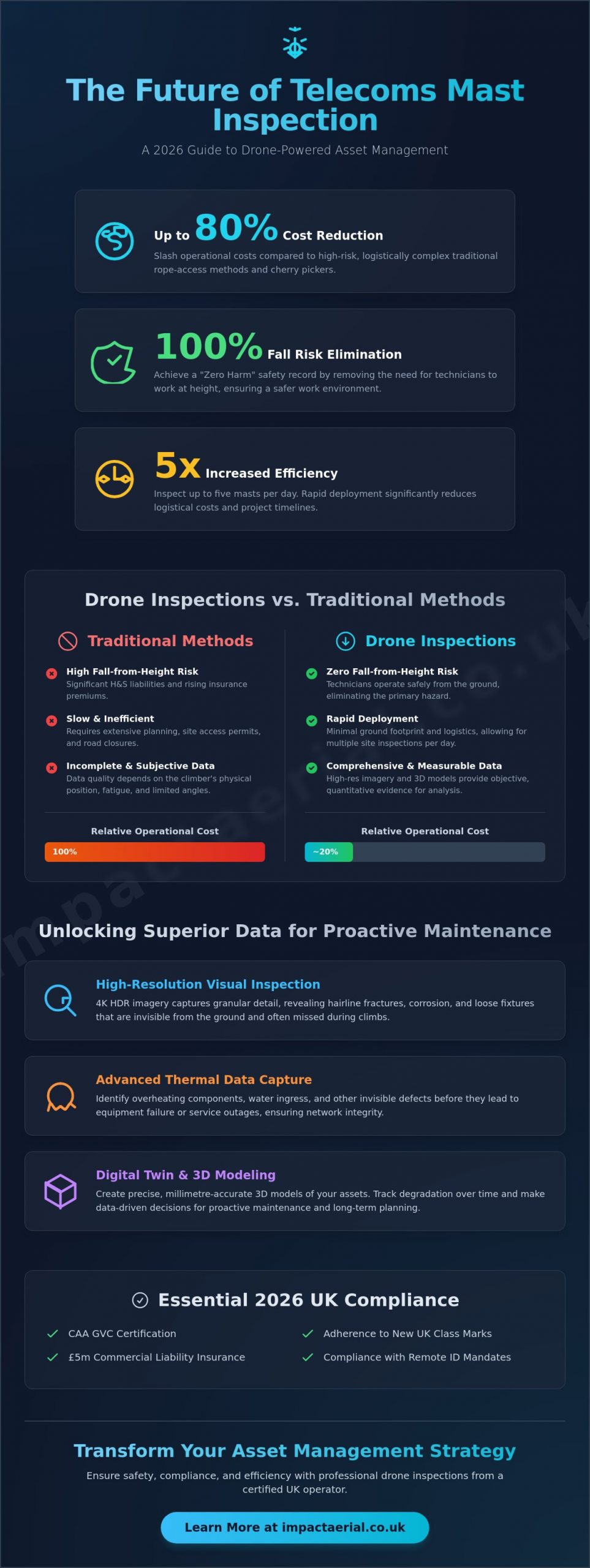
Did you know that switching to a professional drone inspection for telecoms masts can reduce your operational costs by up to 80% compared to traditional rope-access methods? For years, the industry has relied on high-risk tower climbs and expensive cherry pickers to gather even basic structural data. You’ve likely felt the pressure of rising insurance premiums and the constant concern for health and safety liabilities every time a technician leaves the ground. It’s a logistical challenge that often results in incomplete data or blurred images from ground-based inspections.

We understand that maintaining network integrity while ensuring a zero-incident safety record is your primary objective. This 2026 industry guide will show you how to leverage the latest UK-compliant hardware and high-resolution sensors to transform your asset management strategy. You’ll learn how rapid deployment and meticulous data capture provide the superior visual evidence needed for proactive maintenance. We’ll also cover the critical 2026 CAA regulatory updates, including new UK class marks and Remote ID mandates, to ensure your site surveys are both legal and precise.

Key Takeaways

  • Discover how drone inspection for telecoms masts eliminates 100% of fall-from-height risks, ensuring a safer work environment and a zero-incident record.
  • Learn how rapid deployment increases operational efficiency by inspecting up to five masts per day, significantly reducing the logistical costs of traditional methods.
  • Identify the role of 4K HDR imagery and thermal data in detecting structural defects like hairline fractures that are often missed during ground-based surveys.
  • Understand the essential 2026 compliance requirements, including CAA GVC certification and the necessity of £5m commercial liability insurance for all site operations.
  • Explore how high-tier asset data supports the shift toward proactive maintenance, allowing for more precise management of complex 5G infrastructure.

The Evolution of Drone Inspection for Telecoms Masts

In the modern telecommunications landscape, the definition of a structural survey has fundamentally changed. A drone inspection for telecoms masts is no longer just a series of high-angle photographs; it’s a sophisticated aerial data acquisition process. As network providers race to deploy 5G, the density and complexity of infrastructure have increased significantly. 5G hardware is often heavier and more sensitive than previous generations, meaning masts are under greater structural stress. This density necessitates a shift from occasional spot-checks to a rigorous, data-driven inspection schedule to ensure signal reliability and structural integrity.

This shift reflects broader trends in drone applications in infrastructure, where unmanned systems replace manual labor in hazardous environments. By integrating high-resolution sensors and stable flight platforms, operators can capture granular details that were previously inaccessible without a physical climb.

To better understand how these aerial surveys are conducted on site, watch this helpful video:

We’ve moved away from qualitative “visual checks” where a climber might miss a hairline fracture due to fatigue or limited angles. Today, the focus is on quantitative data collection. High-resolution sensors provide measurable evidence of an asset’s condition, allowing for precise engineering analysis. This methodology directly supports “Zero Harm” safety initiatives. The “Zero Harm” philosophy isn’t just about avoiding accidents; it’s about proactively removing the hazard altogether. Drones achieve this by providing a remote eye that eliminates the need for any person to be suspended at height.

Why Traditional Climbing Methods are Becoming Obsolete

Manual climbing carries significant hidden costs that impact the bottom line. Hiring cherry pickers or arranging road closures for heavy machinery requires extensive site access permits and complex logistical planning. Beyond the financial burden, human error remains a persistent factor. A climber’s perspective is limited by their physical position and the inherent stress of working at 200 feet. Consequently, liability concerns and insurance premiums for high-risk climbing tasks continue to rise, making traditional methods a commercial liability for modern operators.

The Role of a Survey Drone in Asset Management

Utilising a professional survey drone allows for the creation of a “digital twin.” This is a precise 3D model of the mast that serves as a baseline for long-term monitoring. These models help identify rust, delamination, or loose fixtures before they escalate into structural failure. By comparing data over time, engineers can track the rate of degradation with millimetre precision. For a deeper dive into the technology behind these professional flights, read our article: What is a Survey Drone? A Complete Guide for Professionals.

Technical Capabilities: Visual and Thermal Data Capture

Executing a precise drone inspection for telecoms masts requires hardware that can withstand the intense electromagnetic environments found near high-interference RF towers. Professional operators typically utilize DJI Enterprise platforms, such as the Matrice 30T or 350 RTK, which feature advanced shielding and redundant systems. These aircraft maintain stable flight even when positioned inches away from active 5G antennas; this stability is essential for capturing the high-resolution data required by structural engineers. Adhering to CAA regulations ensures that these technical captures are performed within a strict safety framework, especially when operating in congested urban areas.

High-Resolution Visual Inspection

The transition to 4K HDR imagery has revolutionized how we identify hairline fractures in galvanized steelwork. By utilizing powerful optical zoom lenses, pilots can maintain a safe offset distance from live equipment while still capturing granular details of nuts, bolts, and cable ties. This level of detail is vital for documenting environmental encroachment or bird nesting without disturbing the site. For operators managing broad portfolios, our professional drone commercial property surveys provide a scalable way to document these physical assets with total clarity.

Thermal and Multispectral Sensors

While visual data identifies physical wear, thermal imaging reveals the invisible health of the mast’s electronic components. High-sensitivity thermal sensors detect “hot spots” in active electronics, which often signal imminent hardware failure or faulty electrical junctions. By identifying these anomalies early, maintenance teams can replace specific components during scheduled downtime rather than reacting to a total network outage. Comparing thermal signatures across multiple sites also allows for the identification of fleet-wide equipment defects, ensuring all hardware operates within safe thermoregulatory parameters.

Modern aerial surveys also incorporate 3D mapping and LiDAR to generate dense point clouds. This data is used to perform mast verticality checks, ensuring the structure hasn’t shifted or leaned due to ground subsidence or extreme weather. These quantitative measurements offer a level of accuracy that traditional manual checks simply cannot match. By combining visual, thermal, and spatial data, a single flight provides a comprehensive health report that serves as a reliable foundation for any asset management strategy.

Professional Drone Inspection for Telecoms Masts: The 2026 Industry Guide

Drones vs. Traditional Methods: A Cost-Benefit Analysis

The commercial logic for adopting a drone inspection for telecoms masts is rooted in extreme efficiency gains. Traditional methods often require a team of two or more climbers and a full day to inspect a single structure. In contrast, a professional drone team can typically complete three to five mast inspections in a single day. This speed doesn’t come at the expense of detail; it actually enhances it. While a climber has a limited field of view and must focus on their own safety, a UAV provides 360-degree coverage of the asset. This perspective allows for a comprehensive assessment of every weld, bracket, and antenna from angles that are physically impossible to reach via a ladder or lift.

Safety remains the most significant driver for this technological shift. By deploying an unmanned system, you eliminate 100% of the fall-from-height risk for your inspection personnel. Keeping engineers on the ground reduces your health and safety liability and can lead to more favourable insurance terms over time. There’s also a clear environmental benefit to this approach. Drone operations require zero heavy machinery on-site, such as diesel-powered cherry pickers. This results in significantly reduced vehicle movements and a smaller carbon footprint for your maintenance cycles.

Reducing Operational Downtime

One of the most valuable aspects of modern aerial surveys is the ability to conduct “live site” inspections. Traditional climbing often necessitates planned outages to protect workers from RF radiation. Drones, however, can operate safely while the mast remains fully functional. This means you don’t have to sacrifice network uptime to perform structural checks. Real-time data streaming also allows remote engineers to view the high-resolution feed instantly. Decisions regarding repairs or hardware upgrades can be made on the spot, rather than waiting days for a climber to descend and file a manual report.

Long-term ROI and Predictive Maintenance

Shifting from reactive repairs to predictive maintenance is where the true return on investment lies. Early detection of minor issues like surface corrosion or loose cable ties can save millions in mast replacement costs over the asset’s lifecycle. Integrating this high-quality imagery into your existing Asset Management Software (AMS) creates a searchable, historical record of every mast in your fleet. For a broader look at how these processes work across different sectors, see our Drone Survey: The Complete Guide to Aerial Data Collection. By digitising your infrastructure, you move away from guesswork and toward a strategy based on verifiable, high-resolution evidence.

Safety, Compliance, and CAA Regulations in 2026

Compliance isn’t just a checkbox; it’s a fundamental risk management strategy. In 2026, the regulatory environment for a drone inspection for telecoms masts is more stringent than ever. Every commercial flight must align with the latest Civil Aviation Authority (CAA) standards to ensure public safety and asset protection. Operating near critical national infrastructure requires a level of oversight that goes far beyond basic flight skills. It demands a deep understanding of air law, technical limitations, and site-specific hazards.

Executing a drone inspection for telecoms masts in 2026 requires more than just technical skill; it demands total regulatory alignment. One of the most critical requirements for any telecoms project is a robust insurance policy. While standard commercial policies exist, the industry minimum for telecoms infrastructure is now £5m in commercial liability insurance. This level of coverage is necessary because masts are often located near public highways, residential areas, or high-value industrial sites. A professional operator provides more than just a drone; they provide a comprehensive Risk Assessment and Method Statement (RAMS) that outlines every safety protocol, from emergency landing zones to signal interference mitigation.

Professional pilots must also manage the technical challenge of RF interference. High-power antennas can disrupt standard GPS signals and control links. Our team uses shielded hardware and specific flight protocols to ensure the aircraft remains stable and responsive throughout the survey. This meticulousness is what separates a certified specialist from a generalist operator.

The Importance of GVC Certification

The CAA General Visual Line of Sight Certificate (GVC) is the mandatory qualification for pilots operating in the “Specific” category. This certification ensures that the pilot has undergone rigorous theoretical and practical testing. It covers everything from meteorology to complex navigation in congested areas. Hiring uncertified or “hobbyist” pilots creates an enormous legal and financial liability for telecoms firms. If an incident occurs, an uncertified operator’s insurance is often void, leaving the client exposed. To understand the full spectrum of legal requirements, read our UK Drone License: A Simple Guide to CAA Rules in 2026.

Risk Mitigation and Insurance

Meticulous pre-flight planning is the hallmark of a professional service. Every site survey begins with a detailed digital check of flight restrictions and local hazards. We also manage data privacy and GDPR compliance, which is a major concern when filming in urban environments. Our pilots use advanced software to identify potential interference zones before the drone ever leaves the ground. This proactive approach ensures hardware stability and data integrity. If you need a partner who prioritises compliance as much as quality, you can book a professional drone survey with our certified team today.

By adhering to these strict protocols, we ensure that every inspection is conducted with zero compromise on safety. This meticulousness allows us to operate in challenging urban environments where others cannot, providing the high-resolution data you need while maintaining a perfect safety record.

Impact Aerial: Professional Telecom Inspections Nationwide

Impact Aerial operates from a strategic base in Birmingham. This central location allows our team to serve the West Midlands and the entire UK with high-tier technical services. We recognize that a drone inspection for telecoms masts is a mission-critical task. It demands more than just basic flight skills. It requires a partner who understands the nuances of telecommunications infrastructure and the high stakes of network reliability. Our business is built on technical excellence. We utilize a commercial-grade DJI Enterprise fleet specifically equipped for precision work near high-interference towers.

We’ve established ourselves as a trusted specialist for the property, construction, and infrastructure sectors. Our approach is methodical and data-centric. We ensure that the information we provide is both accurate and legally compliant. By combining advanced hardware with meticulously trained pilots, we offer a level of reassurance that’s essential for large-scale asset management. We don’t just provide a service; we act as a technical consultant to help you improve your operational efficiency. Our team is proud of our professional affiliations and our commitment to industry standards.

Our Step-by-Step Inspection Process

The success of our surveys lies in a structured three-stage process. First, the Consultation phase ensures we understand your specific asset data requirements. We work with your engineers to identify critical components that need high-resolution documentation. Second, the Deployment phase involves our GVC-certified professional pilots arriving on-site for rapid data capture. They handle all logistical challenges, including site access and safety management. Finally, the Delivery phase sets us apart. We provide actionable insights through edited 4K video and high-resolution stills. This ensures the data is organized and ready for immediate engineering analysis.

Comprehensive Drone Solutions

Our expertise extends beyond structural checks to offer a complete suite of aerial services. We provide high-end aerial filming and photography for marketing materials. This helps you showcase your infrastructure projects to stakeholders with qualitative visual perspectives. For new builds, our construction site monitoring services allow for precise tracking of project milestones. We also offer virtual tour creation and drone commercial property surveys to support your broader portfolio management. We customize our reporting formats to fit your internal engineering workflows, which reduces the time your team spends on data entry.

Whether you’re managing a single rural site or a vast urban network, our team provides the reliability and precision you need. For a broader overview of how we support various industries, explore A Complete Guide to Professional Drone Services in the UK. We’re committed to delivering superior asset data while maintaining the highest standards of safety and compliance in the industry.

Elevate Your Asset Management Standards for 2026

The transition from manual tower climbing to data-centric aerial surveys is a strategic necessity for modern network providers. By adopting a professional drone inspection for telecoms masts, you replace high-risk logistics with high-resolution evidence. This ensures every weld and antenna is documented with millimetre precision. We’ve explored how 2026 CAA regulations and advanced thermal sensors have redefined what’s possible in structural health monitoring across the UK.

As you scale your 5G footprint or maintain legacy assets, the choice of partner is critical. Impact Aerial provides the technical expertise and regulatory reassurance needed to maintain a zero-incident safety record. Our team utilizes DJI Enterprise Commercial Hardware and carries £5m Commercial Liability Insurance. With our CAA GVC Certified Pilots, we’re ready to deliver actionable insights for your most complex sites. It’s time to move beyond reactive repairs and embrace a predictive maintenance strategy that protects your personnel and your bottom line.

Book a professional drone inspection for your telecoms assets with Impact Aerial today. Let’s work together to make your maintenance cycles faster, safer, and more cost-effective.

Frequently Asked Questions

Do I need to turn off the telecoms mast during a drone inspection?

No, you don’t need to power down the mast for a drone inspection. Unlike manual climbing where technicians must be protected from RF radiation, drones can operate safely while the equipment is active. This allows for continuous network uptime during the survey. It’s particularly useful for identifying thermal anomalies in active electronics that only appear when the system is under load, providing a more accurate health check.

Can drones fly near masts with high levels of RF interference?

Yes, professional drones can fly near high-interference towers. Commercial-grade DJI Enterprise models use advanced shielding and redundant GPS systems to maintain stability. Our pilots use specific flight protocols to mitigate signal disruption. This ensures the aircraft remains responsive even in dense electromagnetic environments. This capability is why a professional drone inspection for telecoms masts is superior to using consumer-level drones which often fail in these settings.

What is the maximum height a drone can reach for a mast survey?

Standard UK regulations limit drone flight to 120 metres (approximately 400 feet) above the ground. However, most cellular towers range from 50 to 200 feet, which falls well within the standard legal envelope. For taller structures, specific CAA authorization can be obtained. Our pilots manage all the necessary airspace notifications and permissions to ensure the survey remains fully compliant with current aviation law and safety requirements.

How long does a typical drone mast inspection take to complete?

A typical drone inspection for telecoms masts takes between 45 and 90 minutes on-site. This includes the initial safety briefing, pre-flight checks, and the actual data capture. The speed depends on the complexity of the hardware and the number of antennas. This rapid turnaround allows a single team to inspect multiple sites across a region in one day, significantly outperforming traditional rope-access methods.

What happens if the drone crashes into the infrastructure?

We prioritize prevention through meticulous risk assessments and hardware redundancies. Modern enterprise drones feature 360-degree obstacle avoidance sensors to prevent collisions. In the highly unlikely event of an incident, our £5m commercial liability insurance provides full coverage for any third-party property damage. Our pilots are trained in emergency procedures to ensure that the aircraft is safely recovered without compromising the integrity of your critical infrastructure or network.

Is a drone inspection for telecoms masts legal in urban areas?

Yes, it’s entirely legal to conduct drone inspections in urban environments provided the operator holds the correct certifications. Our pilots are CAA GVC certified, which allows us to operate in congested areas under specific safety protocols. We manage all the necessary Risk Assessments and Method Statements (RAMS) to ensure the flight is safe for the public and compliant with local council or highway regulations.

How much resolution can I expect from the inspection imagery?

You can expect high-resolution 4K HDR video and stills with at least 20 megapixels. This level of clarity allows engineers to zoom in on individual nuts, bolts, and cable ties with millimetre precision. Our equipment captures enough detail to identify hairline fractures or surface corrosion from a safe offset distance. This superior asset data is then delivered in a structured format ready for immediate technical review.

What certifications should I look for when hiring a drone pilot?

You should prioritize pilots with the CAA GVC (General Visual Line of Sight Certificate) for commercial operations in 2026. This ensures they’ve met the rigorous standards for air law and technical competency. Additionally, verify they hold at least £5m in commercial liability insurance. Look for providers listed on professional industry registers, as this indicates a commitment to the safety-conscious and meticulous approach required for high-value assets.

Cost of Drone Filming Per Hour UK: 2026 Pricing Guide

What if the cheapest drone quote you receive is actually the most expensive risk your project can take? It’s a critical question in a niche but increasingly diverse market. When you’re trying to budget, the vast difference in quotes can be confusing, making it difficult to understand what’s included and, more importantly, if the operator is fully compliant with Civil Aviation Authority (CAA) regulations. Many businesses find themselves navigating opaque pricing structures, unsure of the true value they are receiving.

This guide provides the transparency you need. We’ll demystify the cost of drone filming per hour uk for 2026, breaking down how factors like pilot certification, specialist equipment, and essential commercial liability insurance shape the final price. Our goal is to give you the confidence to assess quotes effectively, ensuring you invest in a professional service that guarantees both safety and breath-taking results. From understanding the value of a CAA GVC certified pilot to distinguishing between raw footage and a fully edited production, you’ll finish this article with a clear framework for budgeting your next aerial project with complete peace of mind.

Key Takeaways

  • Learn the 2026 baseline for drone filming rates, including typical day rates and why a minimum booking period is standard for professional, CAA-certified pilots.
  • The final cost of drone filming per hour uk is shaped by critical factors like pilot qualifications and the specific drone technology required for your project.
  • Discover why hourly rates can be misleading by understanding the essential ‘hidden’ costs, such as mandatory pre-flight risk assessments and post-production editing.
  • Compare the cost-effectiveness of professional drone services against traditional methods for tasks like roof inspections to see the potential for significant savings.

Understanding the Average Cost of Drone Filming Per Hour in the UK (2026)

Determining the true cost of drone filming per hour uk requires looking beyond a simple hourly figure. For 2026, the market baseline for a fully certified and insured professional pilot sits between £150 and £250 per hour, with full-day rates typically ranging from £600 to £1,200. These prices reflect not just the time the drone is in the air, but the comprehensive professional service that ensures safety, legality, and high-quality results. This includes pre-flight risk assessments, airspace checks, travel, and the use of high-end commercial equipment.

To better understand the factors that build up to these final costs, this short video provides an excellent overview of the UK commercial drone market.

Most professional operators enforce a “minimum 2-hour booking” policy. This industry standard exists because a significant portion of any job involves non-flight tasks. The pilot must travel to the site, conduct a thorough on-site survey, prepare the equipment, and complete pre-flight safety checks required by the Civil Aviation Authority (CAA). A one-hour flight can easily demand three hours of total professional time, making bookings under two hours financially unviable for a legitimate business.

Hourly Rates vs. Half-Day and Full-Day Packages

While an hourly rate is a useful benchmark, package deals offer superior value for planned projects. A half-day rate (typically 4 hours on-site) is often the sweet spot for residential and commercial property marketing, allowing sufficient time to capture multiple angles, lighting conditions, and detailed shots without rush. For larger-scale operations, such as construction site monitoring or event coverage, a full-day rate (8 hours) is the most cost-effective solution. It secures the pilot’s availability for the entire day, enabling them to capture key project milestones as they happen. The base rate is the foundational cost for engaging a professional, CAA-certified pilot with commercial liability insurance for any project.

The Price of Experience: Pricing Tiers in 2026

The UK drone market operates on distinct tiers, and the price directly reflects the level of qualification, equipment, and risk management involved. Understanding these tiers is crucial for protecting your project and ensuring legal compliance.

  • Entry-level / Hobbyist (The “£50/hr” Trap): Operators advertising extremely low rates often lack the mandatory CAA certifications and, critically, commercial liability insurance. Hiring an uncertified pilot for a commercial project is illegal in the UK and places all legal liability directly on you, the client.
  • Mid-tier Professional: This is the standard for most marketing and property filming. These pilots hold a CAA General Visual Line of Sight Certificate (GVC), operate professional-grade equipment like DJI Enterprise drones capable of 4K HDR video, and carry at least £1 million in public liability insurance. They are experts in operating a sophisticated unmanned aerial vehicle (UAV) safely and effectively for commercial purposes.
  • Enterprise-tier Specialist: This tier commands the highest rates due to highly specialised skills and equipment. It includes services like thermal imaging for building inspections, photogrammetry for 3D modelling, and complex operations in restricted airspace (FRZs). These missions require advanced qualifications and technology, reflecting a much higher operational cost.

5 Critical Factors That Influence Your Drone Filming Quote

An hourly rate for drone filming is never just a simple number. It’s a calculated figure reflecting a complex mix of risk, expertise, and technology. A quote for flying over an open field will look vastly different from one for a central Birmingham construction site. Understanding the key variables is essential for budgeting accurately and appreciating the value delivered. The overall cost of drone filming per hour uk is directly tied to the operational demands of your specific project.

Regulatory Compliance and CAA GVC Certification

The single most significant factor in professional pricing is legal compliance. A pilot holding a CAA-approved GVC (General Visual Line of Sight Certificate) has invested over £1,000 in initial training and examination, plus ongoing fees to maintain their qualification. This certification isn’t just a piece of paper; it’s your assurance that the operator is competent, safety-conscious, and legally permitted to conduct commercial operations. This cost is fundamentally built into any professional’s rate. Furthermore, complex flights require detailed risk assessments, pre-flight surveys, and sometimes the submission of a NOTAM (Notice to Airmen) to alert other aircraft. This administrative work is billable time that ensures a safe, legal flight. Hiring an uncertified operator to save money is a false economy; under UK law, the client commissioning the work can also be held liable and face significant fines for any illegal drone activity.

Advanced Equipment and Data Quality

The drone itself plays a huge role. There’s a world of difference between consumer-grade video and the 4K HDR cinematic footage captured by a professional platform like the DJI Mavic 3 Pro. For highly technical jobs, we utilise DJI Enterprise drones, which are designed for high-precision data gathering like photogrammetry or thermal imaging. The capital investment is substantial:

  • Cinematic Drone Kit (DJI Mavic 3 Pro): Approx. £3,500 with multiple batteries and accessories.
  • Enterprise Drone Kit (DJI Matrice 350 RTK): Can exceed £15,000 with specialist payloads.

Professionals also carry full redundancy. This means arriving on-site with at least two aircraft, multiple controllers, and over eight batteries. This backup system guarantees that an equipment failure won’t derail your project, but it doubles the initial hardware investment that must be factored into the pricing.

The complexity of the airspace is a major price driver. A flight over rural farmland is straightforward. A flight in a congested city centre or a “Restricted Area” near an airport is an entirely different operation. These locations require meticulous planning, potential liaison with Air Traffic Control (NATS), and advanced authorisations from the Civil Aviation Authority (CAA). Every commercial flight must strictly follow the UK’s Drone and Model Aircraft Code, but urban environments introduce layers of risk and permissions that add hours of expert planning to the job. For projects requiring this level of technical precision, our team’s expertise in complex airspace ensures compliant and successful outcomes.

Finally, robust insurance is non-negotiable. While the legal minimum for commercial drone insurance is £1 million, most corporate clients and construction sites mandate a higher level of coverage. We carry £5 million in commercial liability insurance as standard. This provides added peace of mind for everyone involved, especially on high-value industrial or commercial properties. The annual premium for this level of coverage is a significant business expense that is necessarily reflected in the final quote you receive.

The ‘Hidden’ Costs of Drone Filming: Why Hourly Rates Can Be Deceptive

When evaluating the cost of drone filming per hour uk, it’s easy to focus solely on the time the drone is in the air. This is a common oversight. A professional, CAA GVC Certified operator invests significant time and resources before and after every flight. These essential activities are rarely itemised in a simple hourly rate but are fundamental to delivering a safe, legal, and high-quality final product. Understanding these components provides a transparent view of the true investment required for professional aerial cinematography.

The Importance of Pre-Flight Planning and Risk Assessment

For every hour of flight, a minimum of one to two hours of desk-based preparation is required. This isn’t optional; it’s a legal mandate for commercial operators. This process involves detailed risk assessments, checking for airspace restrictions, temporary flight notifications (NOTAMs), and ensuring full compliance with the Civil Aviation Authority’s regulations, as outlined in The Drone and Model Aircraft Code. For clients like commercial property developers, an on-site survey is non-negotiable. This allows our pilots to identify potential hazards, establish safe take-off and landing zones, and plan precise flight paths to capture the required data efficiently. Professional drone filming begins on the ground, with meticulous planning that ensures every flight is both legal and efficient.

Post-Production and Final Delivery Fees

Capturing the footage is only half the job. The raw 4K HDR files from our drones require expert handling in post-production to become a polished, usable asset. A reliable industry estimate is a 2:1 editing ratio; for every one hour of filming, you should budget for at least two hours of editing. This covers data management, clip selection, assembly, colour correction, and grading. For more complex projects, this cost can increase with additional requirements:

  • Licensed Music: Sourcing and licensing a suitable audio track typically costs between £50 and £150 per track for commercial use.
  • Motion Graphics: Adding branded titles, callouts, or animated logos requires specialist skills and can add £200+ to the project cost.
  • Virtual Tour Creation: Stitching 360-degree aerial photographs into a seamless interactive tour is a highly technical process, often demanding a 3:1 or 4:1 editing-to-filming ratio.

Beyond the creative process, consider the practicalities of travel and data management. For projects outside the West Midlands, travel is billed at a standard £0.45 per mile. Operations in central London will also incur the £15 Congestion Charge and any ULEZ fees. For multi-day shoots across the UK, subsistence and accommodation costs, typically around £120 per night, are factored into the final quote. Finally, delivering the enormous data files (an hour of 4K footage can easily exceed 100GB) requires secure, high-speed cloud services or the dispatch of an encrypted hard drive, both of which represent a final, tangible cost in the delivery of your project.

Drone Filming vs. Traditional Methods: A Cost-Benefit Analysis

Analysing the cost of drone filming per hour uk in isolation misses the bigger picture. The true value emerges when you compare it directly to the operational expenses, timelines, and safety risks of traditional methods. For many industries, drones don’t just offer a marginal saving; they represent a fundamental shift in how projects are planned, executed, and budgeted, delivering a comprehensive return on investment that goes far beyond the hourly rate.

Drones vs. Scaffolding and Masted Photography

For property surveys, the financial case is compelling. A week of scaffolding can cost a business over £2,000 and cause major site disruption. In contrast, a two-hour drone inspection delivers higher-quality, actionable data on the same day for a fraction of that cost. This method eliminates the significant safety risks of working at height, providing an immediate and crucial safety ROI for building and facilities managers across the UK.

The “Safety ROI” is a critical, though often un-costed, benefit. By keeping personnel on the ground, you drastically reduce the potential for falls, which remain a leading cause of workplace injury. This proactive approach to safety can positively impact insurance premiums and demonstrates a commitment to modern, compliant operational standards. Furthermore, the speed of data collection is transformative. A drone using photogrammetry can survey a 20-hectare site in a few hours, a task that would take a traditional ground crew 3-4 days to complete.

Drones vs. Helicopter Filming for Large-Scale Projects

In cinematic production, the price gap is immense. A chartered helicopter with a pilot and camera operator can exceed £5,000 per hour. A professional, CAA GVC Certified drone crew offers far greater creative flexibility for between £500 and £1,500 for a half or full day’s work. Drones uniquely achieve the “low and slow” cinematic shots close to subjects, a feat impossible for a helicopter, delivering superior creative value alongside dramatic cost savings.

This isn’t just about saving money; it’s about achieving a better result. Helicopters are blunt instruments, restricted by altitude and safety limitations that make intimate, dynamic shots impossible. Drones are precision tools. They can track a vehicle along a winding road, rise slowly to reveal a landscape, or orbit a historic building from just metres away. This capability provides directors and marketing teams with a creative toolkit that was previously unavailable, allowing for more engaging and visually stunning storytelling.

Ultimately, professional drone services offer a multi-faceted value proposition. They reduce direct costs, compress project timelines, enhance worker safety, and deliver superior quality data and visuals. The technology has moved beyond being a novelty to become an essential tool for cost-conscious and safety-focused businesses. To see how our aerial data-gathering can provide a clear ROI on your next project, request a detailed quote for your aerial inspection needs.

Investing in Quality: How Impact Aerial Delivers Value Beyond the Hourly Rate

While many clients understandably focus on the base cost of drone filming per hour uk, the true value of a professional aerial service extends far beyond a simple timesheet. A cheaper hourly rate often conceals risks, inexperience, and a lack of strategic insight. At Impact Aerial, we operate on a principle of total value, combining technical expertise with a consultant’s mindset to solve your business challenges from the air. We aren’t just pilots for hire; we are your partners in data acquisition and visual storytelling.

Our approach is built on delivering “Added Peace of Mind.” This begins with our specialist expertise within Birmingham and the West Midlands, where our deep local knowledge allows for efficient and compliant operations. It extends to our transparent, bespoke quoting process, meticulously designed to eliminate the “bill shock” that can occur with ambiguous hourly billing. We don’t just fly a drone; we consult with you to understand your objectives and deliver a fixed-price solution that achieves them.

Safety-First Operations and Professional Affiliations

Our commitment to operational safety is absolute and non-negotiable. Every Impact Aerial pilot is CAA GVC Certified, a qualification that permits us to conduct more complex operations in challenging environments, far beyond the capabilities of basic licence holders. We are also vetted members of the Drone Safe Register, providing you with third-party assurance of our professionalism and compliance. This foundation of safety is supported by our investment in the latest DJI Enterprise technology, ensuring maximum reliability and data accuracy for every flight. For highly technical projects, this level of precision is critical, as detailed in our Drone Property Surveys. For added peace of mind, every project is protected by our standard £5 million commercial liability insurance.

Bespoke Quotes for Birmingham and Nationwide Projects

We believe a quote should be a clear and comprehensive proposal, not a vague estimate. Our process is designed for clarity and confidence:

  • Consultation: We start by discussing your project’s goals to understand the problem you need to solve or the story you want to tell.
  • Site Assessment: We conduct a thorough desk-based or on-site assessment to analyse airspace, identify risks, and plan logistical requirements.
  • Fixed Price Proposal: You receive a detailed, all-inclusive quote with no hidden fees. This is the final price.

For projects beyond the West Midlands, our nationwide capability is priced with the same transparency. Travel and logistics are calculated upfront, typically using a standard 45p per mile rate, and any accommodation costs are agreed upon in advance. This ensures your budget is respected, whether your project is in central Birmingham or the Scottish Highlands. Ready to see how professional aerial data can benefit your business?

Request a bespoke drone filming quote from Impact Aerial today.

Secure Your Project’s Vision with a Transparent Drone Filming Quote

Looking ahead to 2026, the cost of drone filming per hour uk is clearly more than a simple rate. It’s a comprehensive investment influenced by project complexity, location, and the level of technical expertise required. The most critical takeaway is that a low hourly price can hide risks and extra fees, whereas a professional quote encompasses safety, planning, and superior equipment. This is where true value lies, delivering a significant return on investment compared to many traditional methods.

At Impact Aerial, we provide that professional clarity. As specialists serving Birmingham and the West Midlands, our CAA GVC Certified pilots are fully insured with £5m in commercial liability, giving you complete peace of mind. We don’t just quote a price; we build a partnership to ensure your project’s success. Ready to move from estimates to a concrete plan for your aerial project?

Get a Professional Quote for Your Drone Project and let’s capture the breath-taking perspectives your vision deserves.

Frequently Asked Questions About Drone Filming Costs

Is drone filming cheaper than traditional photography?

Yes, drone filming is significantly more cost-effective than traditional aerial photography methods. Hiring a helicopter or light aircraft can cost upwards of £1,500 per hour, excluding crew and equipment. In contrast, a professional drone service provides comparable, and often superior, dynamic perspectives for a fraction of that price. This makes high-quality aerial footage accessible for projects with budgets that previously couldn’t accommodate manned aircraft operations, delivering exceptional value.

Do I need to pay for a drone license when hiring a pilot?

No, you don’t pay directly for a pilot’s license; this cost is an operational expense covered within their professional fees. When you hire a CAA GVC Certified pilot, you’re paying for their proven expertise, insurance, and regulatory compliance. It is the pilot’s legal responsibility to maintain their qualifications. For your peace of mind, always verify your chosen operator holds a valid GVC and has adequate commercial liability insurance before any work commences.

How much does it cost to film a commercial property in the UK?

The cost to film a standard commercial property in the UK typically starts from £350 to £500 for a basic package. This price point generally includes a 2-3 hour on-site session, capturing a set of high-resolution photos and 4K video clips. More complex projects, such as those in congested city centres or requiring advanced photogrammetry, will incur higher costs due to the extensive pre-flight planning and risk assessments mandated by the CAA.

What happens if the weather is bad on the day of the shoot?

If adverse weather conditions make it unsafe to fly, the shoot will be rescheduled for the next suitable day at no additional cost. Professional drone operators cannot operate legally or safely in high winds (typically above 22 mph) or any form of precipitation. Reputable providers will have a clear weather contingency in their terms. We monitor forecasts 48-72 hours in advance and will always liaise directly with you to find an alternative date.

Is post-production editing included in the hourly drone rate?

No, post-production and video editing are specialist services that are not included in the standard hourly flying rate. The hourly fee covers the on-site flight operation, risk assessment, and the delivery of raw, unedited digital footage. Editing services, such as colour grading, adding branding, and producing a finished video, are quoted separately. This allows you the flexibility to handle post-production in-house or to commission a fully tailored video package.

Do drone pilots charge for travel time in the UK?

Yes, the majority of professional drone pilots in the UK charge for travel, usually for any project located beyond a 25-30 mile radius from their operating base. This is often billed at a standard mileage rate, such as 45p per mile, in line with HMRC guidelines. For jobs requiring extensive travel or overnight stays, a fixed fee or day rate may be applied to cover the pilot’s time. Always ensure travel costs are clarified in your initial quote.

Why do prices for drone filming vary so much between companies?

Prices vary primarily based on a provider’s certification, insurance level, equipment quality, and operational experience. A fully insured, CAA GVC Certified operator using a £10,000 DJI Enterprise drone will necessarily charge more than a hobbyist. The cost of drone filming per hour uk providers quote reflects their investment in professional training, high-end equipment, and comprehensive liability insurance, often up to £10 million. A significantly lower price can indicate a lack of legal authorisation or adequate insurance.

What is the average day rate for a CAA GVC certified drone pilot in 2026?

In 2026, the average day rate for a CAA GVC certified drone pilot in the UK is projected to be between £600 and £950. A typical day rate includes up to 8 hours on-site, all necessary pre-flight planning, risk assessments, and the handover of raw 4K footage. The final price within this range depends on the project’s complexity, the specific drone and sensor payload required, and the operational location, reflecting the pilot’s professional expertise and overheads.