Virtual Tour for Gyms and Fitness Centres: The 2026 Marketing Guide

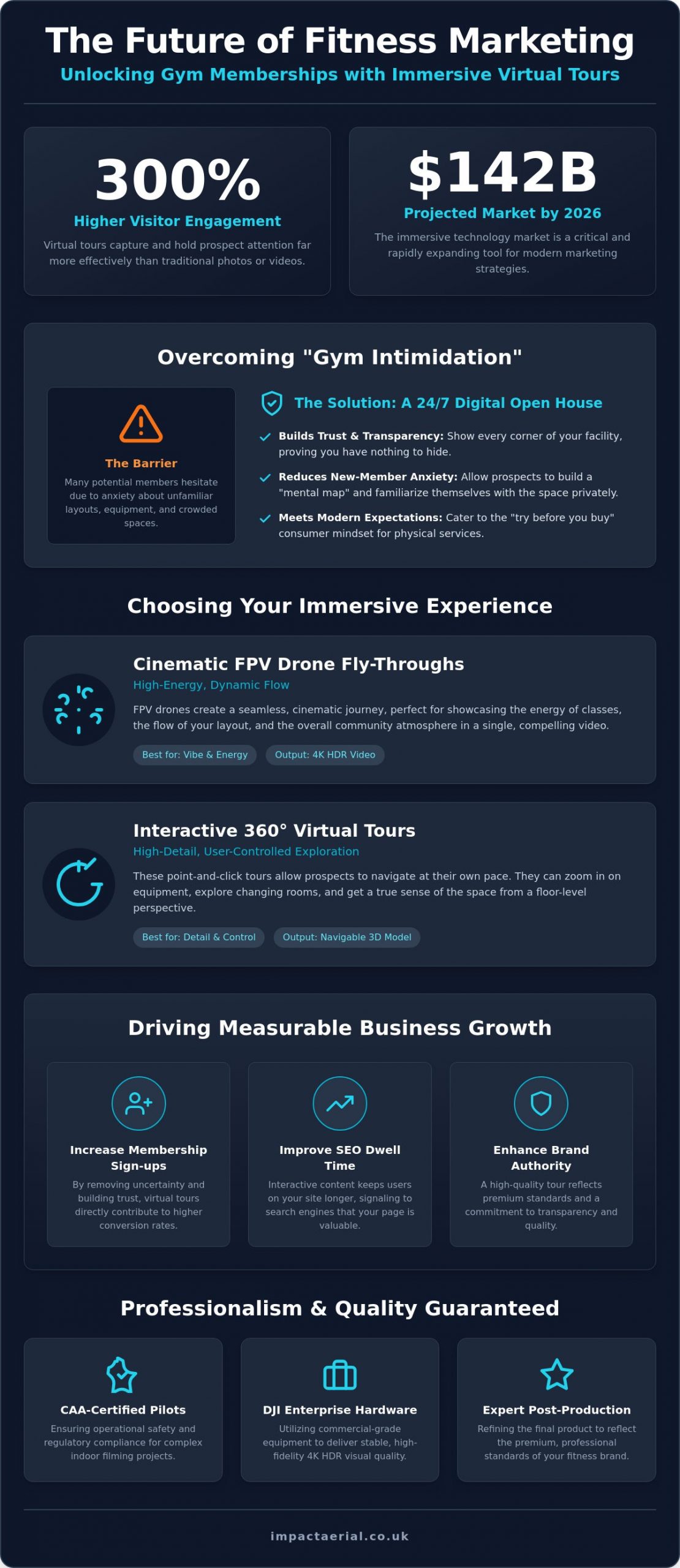
Did you know that visitor engagement with a 360 virtual tour is 300% higher than with traditional photos or videos? In a market projected to reach $142 billion by the end of 2026, standing out requires more than just a gallery of static equipment shots. Many potential members hesitate to join because they feel intimidated by unfamiliar environments or crowded spaces. Implementing a high-quality virtual tour for gyms and fitness centres solves this by providing a transparent, floor-level view of your facility before a prospect even packs their gym bag.

It’s frustrating to watch high bounce rates on your membership pages when you know your facility is top-tier. You likely want a way to capture the energy of your group classes and the precision of your layout without relying on flat imagery. This 2026 marketing guide will show you how professional FPV drone fly-throughs and immersive tours remove the “gym intimidation” barrier and drive membership sales. We’ll cover everything from safety-conscious indoor filming techniques to the latest data on maximizing your digital return on investment through “wow-factor” social content and transparent facility previews.

Key Takeaways

  • Lower the psychological barrier for prospective members by providing a transparent, 24/7 digital open house that builds trust before they even step foot in your facility.
  • Contrast the interactive detail of 360-degree tours with the cinematic energy of FPV drone fly-throughs to determine which technology best showcases your specific gym environment.
  • Ensure operational safety and regulatory compliance by understanding the importance of using CAA-certified pilots for complex indoor filming projects within commercial spaces.
  • Drive measurable business growth by integrating a virtual tour for gyms and fitness centres to improve SEO dwell time and significantly increase membership sign-up rates.
  • Leverage commercial-grade DJI Enterprise hardware and expert post-production to deliver 4K HDR visual quality that reflects the premium standards of your fitness brand.

Overcoming “Gym Intimidation” with Immersive Virtual Tours

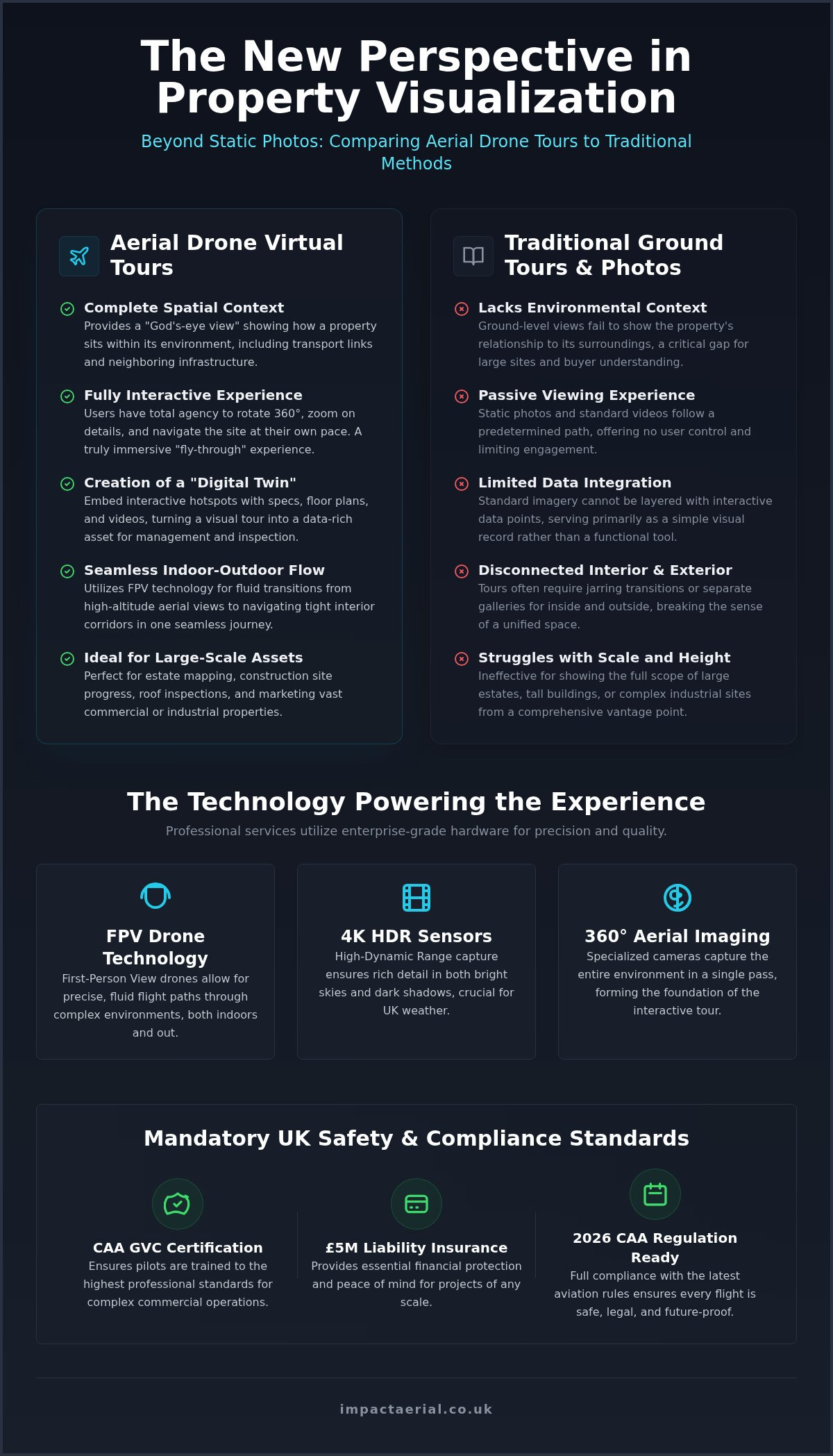
A virtual tour for gyms and fitness centres serves as a 24/7 digital open house, offering a transparent view of the facility that static image galleries cannot replicate. By 2026, the fitness industry has shifted away from curated, staged photography toward high-fidelity, interactive experiences. This shift is driven by a consumer demand for authenticity and a need to address the psychological barriers that prevent many individuals from ever stepping through the front door. To understand the technical foundation of these tools, it is helpful to look at the broader context of What is a Virtual Tour? and how it functions as a foundational marketing asset.

To see a practical example of how these digital environments operate for a fitness facility, watch this helpful video:

Transparency is the primary currency of trust in the modern fitness market. Prospective members often feel a sense of “gym intimidation,” a psychological barrier caused by the fear of the unknown. They worry about the layout, the condition of the equipment, and the privacy of the changing areas. A professional virtual tour for gyms and fitness centres removes these anxieties by allowing a self-paced, private exploration of the entire space. It provides a visual guarantee that the facility meets their standards for cleanliness, equipment variety, and social atmosphere.

The Psychology of the Digital Walkthrough

First-time gym-goers often experience anxiety regarding where to go and how to use the space. A digital walkthrough allows them to familiarise themselves with the reception area, the locker rooms, and the specific location of various machines. This familiarity reduces the fear of the unknown significantly. By showcasing the vibe and community atmosphere through cinematic movement, you provide psychological comfort. Users can explore recovery zones or high-end equipment areas at their own speed, building a mental map of their future workout routine before they arrive.

Why 2026 Members Expect Transparency

The “try before you buy” expectation has expanded from digital products into physical services. Modern consumers use virtual tours as a tool for inclusivity and accessibility planning. They need to see if the aisles are wide enough for a wheelchair or if the lighting in the yoga studio matches their preferences. Hiding nothing from prospective members builds immediate brand authority. When a facility is willing to show every corner, from the weight room to the showers, it signals a commitment to quality and professional standards that competitors using static photos simply cannot match.

FPV Drone Fly-Throughs vs. 360 Virtual Tours: A Comparison

Choosing the right visual medium depends on your specific marketing objectives and the physical layout of your facility. A professional virtual tour for gyms and fitness centres typically falls into two distinct categories: high-energy cinematic flow or high-detail interactive exploration. While both formats provide an immersive experience, they serve different psychological purposes for the prospective member. Understanding the technical distinction between the point-and-click nature of 360 tours and the one-shot flow of FPV drones is essential for a high-performing 2026 marketing strategy.

The hardware requirements for these services are equally specialized. Professional pilots utilize commercial-grade DJI Enterprise hardware to ensure 4K HDR clarity and stable flight paths during indoor operations. In contrast, interactive tours rely on high-resolution 360-degree cameras that stitch together multiple photospheres to create a navigable 3D model. These tools are proven to boost engagement and conversion rates by providing the transparency that modern consumers demand before committing to a membership.

Cinematic FPV Drone Fly-Throughs

FPV, or First Person View, drones create a sense of momentum that static imagery cannot replicate. The pilot operates the craft using immersive goggles, allowing for precise movement through narrow spaces like squat racks or between cardio machines. This creates a “thrill” factor that is highly effective for capturing the scale of large leisure centres and multi-floor gyms in a single, continuous shot. Beyond the website experience, these flights provide high-impact content for social media, as short, energetic clips can be extracted from the main footage to drive engagement on visual platforms.

Interactive 360-Degree Matterport Tours

While drones capture energy, 360-degree tours provide utility and detail. This technology allows a user to virtually “step inside” specific areas such as saunas, treatment rooms, or spin studios to inspect the facilities at their own pace. By using a virtual tour for gyms and fitness centres built on platforms like Matterport, you can integrate “Mattertags.” These are interactive hotspots that highlight premium equipment brands, class schedules, or specific membership benefits. These tours also integrate seamlessly with Google Street View, which significantly improves local search visibility and builds immediate trust through technical transparency.

For the most comprehensive results, many leading brands are now adopting “Hybrid Tours.” This approach combines the cinematic “wow-factor” of an FPV fly-through for social engagement with the practical, self-guided navigation of a 360 tour for final membership conversions. Implementing these advanced drone services ensures your facility is represented with the technical precision and safety standards expected in a professional commercial environment.

Virtual Tour for Gyms and Fitness Centres: The 2026 Marketing Guide

Ensuring Safety and Compliance for Indoor Drone Filming

Safety is the primary concern for any operator managing a high-traffic environment. When commissioning a virtual tour for gyms and fitness centres, the most common question involves the physical risk of indoor flight. Flying a drone in a confined space requires a level of precision that standard consumer equipment cannot provide. Professional operations rely on meticulous risk assessments and hardware equipped with 360-degree prop guards to ensure the safety of both the facility and its assets. Every flight path is pre-mapped to avoid equipment, lighting fixtures, and architectural obstacles.

Financial protection is another pillar of professional compliance. A reputable aerial filming company should hold at least £5m in commercial liability insurance specifically tailored for drone operations in fitness venues. This coverage provides psychological comfort and tangible security for gym owners. It ensures that in the unlikely event of a technical failure, the business is fully protected against property damage or operational downtime. Without this specific insurance, the gym owner could be held personally liable for any incidents occurring during the shoot.

The Role of CAA GVC Certification

Hiring a pilot without the proper credentials is a significant liability risk for your business. A CAA GVC certified pilot has undergone rigorous training and assessment to operate in complex environments. While survey drones are typically associated with outdoor technical inspections, the same principles of flight safety and data-centric precision apply to indoor gym tours. Verifying these credentials before signing a contract is a non-negotiable step for any compliant business. It guarantees that the pilot understands the latest regulatory transitions and safety protocols required for commercial work.

Disruption-Free Filming Strategies

Operational continuity is vital for a busy fitness facility. Most professional shoots are scheduled during off-peak hours or dedicated member-free windows to avoid any interaction with the public. We implement a “clean site” protocol to ensure the facility looks its best under 4K HDR lenses; this involves hiding loose cables, resetting equipment, and ensuring consistent lighting. Managing member privacy and GDPR compliance is also a priority. We ensure no identifiable personal data or faces are captured during the flight, maintaining the integrity of your brand and the privacy of your community. This structured, methodical approach guarantees a high-end output with zero impact on your members’ workout experience.

Maximising ROI: SEO and Conversion Benefits

Implementing a virtual tour for gyms and fitness centres is a strategic investment that generates measurable returns across multiple digital channels. From a technical SEO perspective, interactive 3D environments significantly increase “dwell time,” which is the duration a visitor spends engaging with your website. Google’s algorithms interpret high dwell time as a strong signal of content relevance and quality, which can lead to improved organic search rankings. When users stay on your site to explore the weight room or the yoga studio, they are providing the data-centric proof of engagement that search engines reward.

The impact on membership sales is equally quantifiable. Data from oVRworldwide indicates that online inquiries for memberships and services can increase by 200% when a virtual tour is present. This conversion lift occurs because the tour provides the psychological comfort discussed in earlier sections, moving a prospect from curiosity to a confirmed sign-up. Additionally, modern virtual tour platforms provide backend analytics that allow gym owners to see which areas of their facility are most popular. If the majority of users are zooming into the recovery zone or the functional fitness area, you can adjust your marketing focus to highlight those specific assets.

Local SEO and Google Business Profile

High-quality 360 imagery is a primary driver for appearing in the “Local Map Pack,” the group of three business listings that appear at the top of Google search results. There is a clear synergy between professional drone photography and local search authority. By uploading immersive tours directly to your Google Business Profile, you encourage users to click the “See Inside” button. This interaction not only improves your local ranking but also builds immediate trust by showing the live reality of your facility directly on the search engine results page.

Content Repurposing for Social Media

A single professional filming session provides a deep library of marketing assets. A two-minute FPV drone fly-through can be edited into ten or more 15-second TikTok and Instagram Reels, each focusing on a different aspect of the gym. These energetic, short-form clips provide the “wow factor” that drives social shares and viral engagement. Beyond video, high-resolution stills extracted from the 4K HDR footage are perfect for print marketing, internal signage, and member onboarding emails. This methodical approach to content ensures that every frame of the original flight is used to maximise your brand’s digital presence.

To begin planning your facility’s digital transformation, contact our specialist team to discuss a tailored virtual tour solution that aligns with your 2026 growth targets.

Partnering with Impact Aerial for Professional Gym Tours

Impact Aerial operates as a technical specialist in high-end drone services, delivering precision-engineered visual content specifically for the fitness sector. We utilize commercial-grade DJI Enterprise hardware to ensure every virtual tour for gyms and fitness centres meets the highest standards of 4K HDR clarity. This hardware selection is a deliberate choice; these systems provide the stability and low-light performance necessary to capture professional-tier footage in complex indoor environments. Our methodical approach ensures that the final output reflects the premium nature of your facility and brand, providing the reassurance that modern consumers require.

Our end-to-end process is built on a foundation of safety and technical excellence. We guide clients through a structured journey that begins with a comprehensive safety consultation and site survey, moving through to precision filming and expert post-production editing. While our roots are firmly in the West Midlands, our operational capacity extends UK-wide. This makes us a reliable partner for both boutique independent studios and national fitness chains that require consistent, high-quality visual assets across multiple locations. We handle the logistical complexities of multi-site shoots, ensuring a unified brand voice across your entire digital portfolio.

Our Technical Edge in Fitness Marketing

We employ proprietary indoor flight techniques to deliver smooth, cinematic fly-throughs that navigate narrow equipment aisles and multi-floor layouts with ease. Our post-production services are equally specialized, ensuring that the final edit matches your gym’s specific branding, color palette, and community energy. We maintain a rigorous commitment to operational safety, backed by £5m commercial liability coverage for every project we undertake. This meticulous attention to detail ensures that your marketing assets are produced without compromising the security of your facility or its members, giving you total peace of mind during the filming process.

Next Steps: Booking Your Gym Survey

The first step in the process is a structured initial consultation where we define your specific marketing goals and identify the unique facility highlights you wish to showcase. Whether your focus is on a new recovery suite, a high-tech spin studio, or a spacious functional training zone, we tailor the flight plan to meet those objectives. We offer bespoke quotes for single-site projects as well as enterprise-level packages for multi-location fitness brands seeking a unified digital presence. This collaborative approach ensures that the technical output aligns with your business’s data-centric goals for membership growth.

Contact Impact Aerial today for a professional virtual tour consultation to discover how our technical expertise can transform your gym’s online conversion rates and digital authority.

Future-Proofing Your Fitness Marketing Strategy

The integration of immersive technology is no longer a luxury; it’s a standard for high-performing fitness brands. By providing a transparent view of your facilities, you effectively dismantle the psychological barriers of gym intimidation while simultaneously boosting your local search authority. Whether you choose the cinematic energy of an FPV fly-through or the interactive utility of a 360-degree walkthrough, a professional virtual tour for gyms and fitness centres acts as a powerful conversion tool that works 24/7. Success in 2026 requires this blend of visual excellence and technical transparency to meet the rising expectations of modern members.

Impact Aerial provides the technical expertise and regulatory compliance necessary to execute these projects safely within commercial environments. Our team of CAA GVC Certified Pilots utilizes specialized hardware to deliver 4K HDR Cinematic Output, all while maintaining £5m Commercial Liability Insurance for your protection. We ensure a meticulous, disruption-free process that prioritizes your facility’s operational continuity and brand integrity. It’s time to provide your prospects with the psychological comfort they need to commit to their fitness journey.

Book Your Professional Gym Virtual Tour Consultation

Frequently Asked Questions

Do I need to close my gym during the virtual tour filming?

You don’t necessarily need to close your facility, but we strongly recommend filming during off-peak hours or dedicated member-free windows. This ensures a “clean site” protocol where equipment is perfectly staged and member privacy is maintained. For a high-quality virtual tour for gyms and fitness centres, capturing the space without crowds allows for better 4K HDR clarity and a more professional finish that highlights your facility’s premium assets.

How long does it take to create a full 3D tour and drone fly-through?

The onsite capture of a standard facility usually takes between four and eight hours, depending on the square footage and complexity. Following the shoot, our post-production team requires approximately five to ten working days to stitch 360-degree imagery and edit cinematic FPV footage. This structured timeline ensures that every frame is polished, branded, and optimized for high-speed web delivery and mobile compatibility.

Will the drone be loud enough to disturb members in other rooms?

Modern FPV drones used for indoor filming, often called “cinewhoops,” are significantly quieter than larger outdoor models. While there is a distinct hum during flight, it’s rarely loud enough to disturb members in separate studios or changing areas. We meticulously plan flight paths to minimize any auditory impact, ensuring that your gym’s daily operations continue smoothly while we capture high-energy, cinematic perspectives of your workout zones.

What is the difference between a standard 360 tour and an FPV drone tour?

A standard 360 tour offers a user-controlled, point-and-click experience where prospects can explore specific rooms at their own pace. In contrast, an FPV drone tour provides a continuous, cinematic “one-shot” fly-through that captures the energy and layout of the entire facility in motion. Combining both technologies creates a comprehensive marketing asset that offers both the utility of detailed inspection and the “wow factor” of high-speed aerial movement.

Can I use the virtual tour on my social media pages like Instagram and TikTok?

Yes, the content is highly repurposable for platforms like Instagram and TikTok. Short, high-impact clips from an FPV fly-through are particularly effective as Reels or TikTok videos, driving significantly higher engagement than static photos. We provide the edited files in formats optimized for vertical viewing, allowing you to integrate these visual assets into your social media strategy and member onboarding emails immediately after production.

Is indoor drone filming legal in the UK in 2026?

Indoor drone filming remains legal in the UK in 2026 because aviation regulations typically apply only to flights conducted in open airspace. However, commercial operations must still adhere to strict safety protocols and health and safety legislation. We maintain £5m commercial liability insurance and utilize CAA GVC certified pilots to ensure every indoor flight is conducted with the highest level of professional compliance and risk mitigation.

How much does a professional virtual tour for a gym typically cost?

The cost of a professional virtual tour for gyms and fitness centres varies based on several technical factors. These include the total square footage of the facility, the number of locations requiring surveys, and whether you opt for a hybrid package combining 360-degree tours with FPV drone fly-throughs. We provide bespoke quotes after an initial consultation to ensure the service matches your specific marketing goals and facility requirements accurately.

Do virtual tours work on mobile devices and VR headsets?

Every tour we create is fully responsive and optimized for mobile devices, tablets, and desktop computers. Our 360-degree tours are also compatible with modern VR headsets, providing an even more immersive “try before you buy” experience for prospective members. This cross-platform accessibility ensures that your digital open house reaches potential clients regardless of the hardware they use to research your fitness facility online.

Choosing a Drone Videography Style: The Ultimate Guide for UK Businesses in 2026

The most expensive 8K aerial footage on the market will fail to deliver a return on investment if the visual language doesn’t align with your sector’s specific goals. In 2026, simply putting a camera in the air is no longer a competitive advantage. Success now depends on choosing a drone videography style that speaks directly to your audience; whether that is the high-octane energy of an FPV fly-through for a leisure facility or the steady, technical precision required for construction site monitoring.

You likely recognize that generic, drifting shots often feel disconnected from your brand’s core message, yet the technical jargon of the industry can make briefing a pilot feel like a gamble. This guide bridges that gap. You’ll discover how to select the perfect aerial aesthetic to elevate your brand, ranging from cinematic sweeps to high-speed FPV immersive tours. We provide a structured breakdown of the latest 2026 UK flight standards and aesthetic categories, ensuring you have the confidence to secure high-quality, compliant results that drive tangible business growth.

Key Takeaways

  • Understand how the intersection of movement and narrative intent drives project ROI by aligning visual style with your specific commercial objectives.
  • Learn the critical differences between cinematic sweeps and immersive FPV tours to assist in choosing a drone videography style that suits your brand identity.
  • Identify the specific aesthetics used for construction site monitoring and commercial property surveys to maximize engagement and data accuracy in your sector.
  • Master the technical essentials of professional aerial filming, including the impact of “Golden Hour” lighting and selecting the correct frame rates for your desired look.
  • Discover why technical qualifications and CAA GVC certifications are vital for executing high-stakes aerial projects safely and to a professional standard.

Why Choosing the Right Drone Videography Style Defines Your Project’s ROI

A professional drone videography style is far more than a simple flight path; it is the deliberate intersection of camera movement, lighting conditions, and narrative intent. In the current 2026 market, stakeholders demand more than generic bird’s-eye views. Achieving a high return on investment requires a foundational understanding aerial videography and how specific visual languages influence viewer psychology. For instance, a slow, high-altitude orbit provides an analytical, “God-view” perspective that suggests stability and scale, whereas a low-level, high-speed tracking shot generates adrenaline and urgency.

Choosing a drone videography style that clashes with your brand identity can be a costly error. An aggressive, high-speed FPV fly-through might work for a modern manufacturing plant, but using that same kinetic energy for a Grade I listed heritage site often feels jarring and disrespectful to the subject matter. As drone technology has matured, the 2026 trend has shifted decisively away from “generic b-roll” toward purpose-built visuals. Every frame must justify its existence by supporting a specific commercial goal, whether that is proving construction progress or selling the prestige of a luxury development.

To better understand this concept, watch this helpful video:

The Shift from “Aerial Footage” to “Aerial Storytelling”

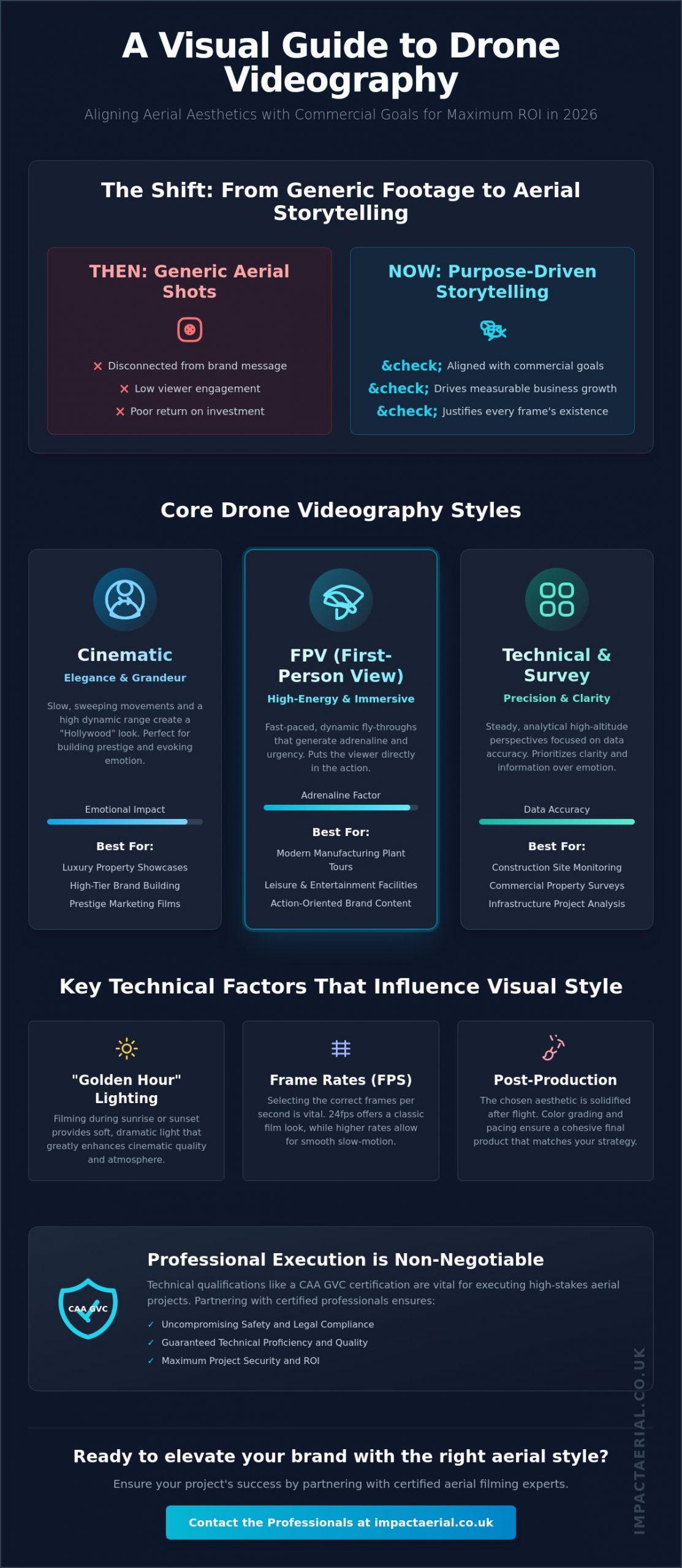
The “wow” factor of seeing the world from above has largely evaporated as drones have become ubiquitous. Today, professional aerial filming drone services focus on functional visual communication. We use specific flight maneuvers to solve business problems; such as using a “reveal” shot to highlight a property’s proximity to transport links. Post-production also plays a critical role here. The color grading and pacing applied after the flight solidify the chosen aesthetic, ensuring the final output feels like a cohesive part of your broader marketing or technical strategy rather than a disconnected clip.

Setting Objectives Before Selecting a Visual Look

Before choosing a drone videography style, you must define the primary objective of your project. Information-heavy tasks, like construction site monitoring, require a steady, high-resolution style that prioritizes clarity and data over emotional impact. Conversely, brand-led campaigns for luxury properties rely on “hero” shots that emphasize atmosphere and prestige. Your primary KPI might be technical accuracy, speed of delivery, or perhaps pure brand elevation. Visual ROI is the measurable impact of a specific aesthetic choice on conversion rates, stakeholder engagement, or project clarity. By aligning the flight style with these KPIs, you ensure the footage serves as a tool for growth rather than a mere digital asset.

Exploring the Core Drone Videography Styles: From Cinematic to FPV

Selecting the right visual language is the most critical decision in the pre-production phase. Each aesthetic serves a distinct commercial purpose, utilizing different flight dynamics and sensor settings to communicate your message. In 2026, the industry has moved beyond simple “fly-overs” to specialized disciplines. Whether you are documenting a multi-million pound infrastructure project or launching a luxury brand, choosing a drone videography style that aligns with your technical requirements is essential for a professional result.

The Cinematic Aesthetic: Elegance and Grandeur

The cinematic style remains the benchmark for high-tier brand building and prestige marketing. This “Hollywood” look is defined by slow, sweeping movements and a high dynamic range that preserves detail in both shadows and highlights. Professional pilots utilize specific maneuvers like the “Reveal,” where the camera starts on a detail before rising to show the landscape, and the “Orbit,” a perfectly circular path around a central subject. To achieve this, we prioritize 4K HDR or 8K resolution with 10-bit color depth, providing the necessary data for high-end post-production grading. This style is most effective for tourism, corporate brand films, and luxury property marketing where the goal is to evoke an emotional response through scale and beauty.

FPV Drone Filming: Immersive Innovation

The Narrative Style: Context and Scale

The narrative style focuses on establishing a “Sense of Place” by integrating aerial perspectives into a larger storytelling framework. It isn’t about the drone shot itself, but how that shot connects ground-level human experiences to their wider environment. This often involves combining low-altitude tracking shots with high-altitude wide views to show the relationship between a project and its surrounding infrastructure. Executing these complex, multi-layered flights legally and safely requires a valid drone license and a deep understanding of UK airspace restrictions. By bridging the gap between technical data and emotive visuals, the narrative style provides the context necessary for stakeholders to grasp the full scope of a project. If you’re unsure which aesthetic best serves your goals, consulting with a specialist in professional aerial filming can help clarify the most effective path forward for your specific sector.

For technical applications like construction site monitoring or commercial property surveys, the focus shifts toward architectural precision. These styles prioritize symmetry, structural lines, and top-down “nadir” views that provide accurate spatial data. By choosing a drone videography style that emphasizes these technical elements, businesses can track progress with millimeter precision while maintaining a professional visual standard that is suitable for investor reporting.

Choosing a Drone Videography Style: The Ultimate Guide for UK Businesses in 2026

Industry Match: Which Style Fits Your Specific Sector?

The effectiveness of an aerial campaign is measured by its ability to meet sector-specific KPIs. A visual approach that excels in the creative arts will likely fail in a heavy industrial context. When choosing a drone videography style, you must evaluate whether your primary goal is the acquisition of technical data, the emotional engagement of a buyer, or the documentation of project milestones. In 2026, UK businesses are increasingly moving away from multi-purpose footage in favor of “style-to-sector” alignment that ensures every flight minute contributes to the bottom line.

Construction: Progress vs. Promotion

In the construction and infrastructure sectors, drone footage serves two distinct masters: the site engineer and the marketing director. For technical oversight, a professional drone survey is the standard for capturing high-resolution orthomosaic data and site logistics. These flights utilize a top-down, “nadir” perspective, providing a flat, measurable map of the site that is essential for identifying bottlenecks. Conversely, for stakeholder reporting and promotion, a cinematic time-lapse style is preferred. This involves capturing the same flight path over several months to show the evolution of the build. By maintaining consistent GPS coordinates for each flight, we create a seamless visual record that demonstrates progress with authoritative clarity.

Real Estate: The Luxury Reveal

Commercial property and luxury residential listings require an aesthetic that emphasizes prestige and spatial flow. The “Dolly Zoom” and the “Orbit” have become the industry standards for high-end listings, as they provide a sense of three-dimensional depth that static photography lacks. To create a truly immersive experience, we often utilize FPV drones to execute a “one-take” sequence. This involves flying from the exterior grounds, through the front entrance, and into the primary living or office spaces without a single cut. This style doesn’t just show a property; it provides a virtual tour that establishes a “Sense of Place.” Highlighting local landmarks within the same frame as the property further increases perceived value by grounding the asset in its wider geographical context.

Renewable Energy and Marketing

The renewable energy sector, particularly solar farm management, relies on a technical “Grid” style. This involves automated flight paths that ensure 100% coverage for thermal imaging and visual inspections. These surveys are data-centric, focusing on identifying anomalies in PV panels with surgical precision. In contrast, the marketing and advertising sectors demand high-energy FPV and cinematic storytelling. These styles are designed to capture attention within the first three seconds of a social media scroll. Whether it’s a high-speed chase for a dynamic product launch or a sweeping 8K panoramic for a tourism board, choosing a drone videography style that matches the energy of your target demographic is the most reliable way to ensure a high return on investment.

Key Technical Factors That Influence Your Visual Style

Achieving a high-end visual result is impossible without mastering the technical variables that underpin every flight. When choosing a drone videography style, you aren’t just selecting a movement; you are selecting a specific configuration of light, frame rates, and hardware capabilities. These settings dictate whether the final output feels like a high-budget feature film or a sharp, clinical data set. In the professional sector, we use these technical levers to ensure the aesthetic aligns with your commercial objectives while maintaining the highest standards of precision.

Lighting remains the most influential factor in cinematic drone filming. The “Golden Hour,” occurring during the first hour of sunrise and the last hour of sunset, provides the soft, directional light and long shadows that define the cinematic aesthetic. For technical surveys or construction monitoring, we often prefer “Blue Hour” or high-noon lighting to minimize shadows and maximize the clarity of structural details. To control this light, we utilize Neutral Density (ND) filters. These act as “sunglasses” for the drone’s sensor, allowing us to maintain a slower shutter speed. This is essential for creating the natural motion blur that viewers associate with professional-grade production.

Frame rates also play a vital role in defining the look of your project. We typically use 24fps (frames per second) for a traditional “filmic” look, as it mimics the way the human eye perceives motion. Conversely, 60fps or higher is selected for high-speed action or FPV tours, allowing for smooth playback or the ability to slow down footage in post-production without losing detail. The final style is then solidified through professional post-production services, where color grading and sound design act as the final “brushstrokes” that align the footage with your brand’s visual identity.

Weather and Environmental Constraints in the UK

The unpredictable UK climate directly influences which styles are feasible on any given day. High winds and variable light conditions in regions like the West Midlands require robust hardware. We often deploy DJI Enterprise drones for these environments, as their superior stabilization systems ensure smooth footage even in gusty conditions. Planning for the “Birmingham Look” often involves working with specific urban textures and flat lighting, where technical expertise in exposure management is required to prevent footage from looking washed out or overly industrial.

Compliance as a Creative Constraint

Safety and regulation are the primary filters through which all creative decisions must pass. While an aggressive FPV fly-through might look impressive, CAA regulations regarding “flight over people” or congested areas may limit where these maneuvers can be performed. Our commitment to meticulous risk mitigation includes maintaining £5m in commercial liability insurance, ensuring that your chosen style never compromises safety protocols. Before choosing a drone videography style for a complex urban shoot, it’s vital to consult with a qualified operator who understands how to balance creative ambition with legal compliance.

For a detailed assessment of how these technical factors will impact your next project, contact Impact Aerial today for a professional consultation.

Partnering with Impact Aerial: Professional Execution of Any Drone Style

Choosing a drone videography style is only the first step in creating a high-impact visual asset. The successful execution of that vision requires a partner who understands the intricate balance between creative ambition and stringent safety standards. At Impact Aerial, we don’t just provide footage; we offer a technical consultancy that ensures your chosen aesthetic is delivered with surgical precision. By bridging the gap between technical surveying and creative videography, we provide UK businesses with the reassurance that their projects are in expert hands.

Our operational excellence is built on a foundation of high-end hardware and elite certification. We utilize commercial-grade DJI Enterprise drones, capable of capturing 4K HDR data with the stability required for professional post-production. These platforms are essential for maintaining the visual integrity of cinematic sweeps or technical site monitoring in variable UK weather. Every flight is conducted by CAA GVC certified pilots, ensuring that even the most complex urban maneuvers are executed within the full framework of national aviation law. This meticulousness provides our clients with psychological comfort and tangible business benefits.

The Impact Aerial Project Management Process

We approach every project with a structured, methodical workflow designed to eliminate risk and maximize visual ROI. Our process is divided into three distinct phases:

  • Consultation: We begin by defining your visual goals and industry requirements. Whether you are choosing a drone videography style for a promotional campaign or a technical survey, we align our flight plan with your specific KPIs.
  • Planning: Our team handles all necessary risk assessments and flight permissions. We tailor these permissions to your chosen style, ensuring that even high-stakes FPV tours or architectural reveals are fully compliant with local bylaws and CAA regulations.
  • Delivery: We provide high-end output that is ready for immediate use across social media, web, or broadcast platforms. Our post-production services ensure that the final edit reflects the precise aesthetic established during the consultation phase.

Request Your Custom Aerial Style Consultation

In the current market, a drone services provider should be a strategic partner rather than just a pilot. We have a proven track record of successful style implementations in Birmingham and across the UK, ranging from large-scale construction monitoring to immersive virtual tours for commercial property. We understand the specialized nature of the UK drone industry and remain at the forefront of regulatory changes to ensure your brand remains both innovative and compliant.

If you are ready to elevate your project with a specialized visual language, we invite you to discuss your project with Impact Aerial today. Our team is available to provide a detailed assessment of your requirements and help you navigate the complexities of choosing a drone videography style that delivers a measurable return on investment.

Elevate Your Brand with Strategic Aerial Perspective

Impact Aerial is committed to delivering these results through a blend of creative excellence and operational rigor. We provide the security of £5m Commercial Liability Insurance and the expertise of CAA GVC Certified Pilots, ensuring every mission is compliant and professional. By utilizing 4K HDR DJI Enterprise Equipment, we guarantee that your final output meets the highest industry standards for clarity and detail. It’s this focus on technical precision that ensures your brand stands out in a competitive market.

Book a consultation with our CAA-certified pilots today to discuss your project requirements. We look forward to helping you define an aerial strategy that provides lasting value to your business.

Frequently Asked Questions

What is the difference between FPV and traditional drone videography?

Traditional drone videography utilizes GPS-stabilized platforms and motorized gimbals to produce smooth, steady, and predictable footage. It’s the standard for cinematic sweeps and technical surveying. In contrast, First Person View (FPV) involves the pilot wearing goggles to fly smaller, highly agile drones manually. This allows for immersive, high-speed maneuvers and the ability to fly through tight internal spaces that traditional drones cannot access.

How do I know which drone filming style is right for my business?

The decision should be driven by your primary commercial objective. If your goal is to showcase the scale and prestige of a luxury development, a cinematic style with slow orbits is most effective. For high-energy marketing or event highlights, the kinetic feel of FPV is superior. Choosing a drone videography style requires aligning the visual energy of the flight with the expectations of your specific target audience.

Can I use FPV drone filming for indoor warehouse tours?

Yes, FPV is the industry standard for immersive indoor tours because these drones are compact and highly maneuverable. They can navigate through doorways, around machinery, and between staff safely when equipped with propeller guards. These flights require meticulous risk assessments and adherence to UK safety protocols, especially when operating in congested or confined commercial environments.

Does the time of day affect the style of my drone video?

Lighting conditions dictate the narrative tone of your footage. The “Golden Hour” at sunrise or sunset provides the soft, warm light required for high-end cinematic aesthetics. Midday light is better suited for technical applications like construction site monitoring, as it provides maximum clarity and minimal shadows. As of 2026, all night flights in the UK must utilize a mandatory green flashing anti-collision light for safety and compliance.

Are there legal restrictions on certain drone filming styles in the UK?

Yes, all commercial drone operations must comply with Civil Aviation Authority (CAA) regulations. Restrictions often apply to flying over uninvolved people or within congested urban areas, which can limit certain aggressive FPV styles. Professional operators must hold valid Flyer and Operator IDs; for drones over 100g in 2026; and maintain minimum third-party liability insurance to ensure all creative maneuvers are executed legally.

What technical specs should I look for when hiring a drone videographer?

For professional-grade results, prioritize 4K or 8K resolution and a bitrate of at least 200Mbps to allow for high-quality color grading. Ensure the equipment supports 10-bit color depth for cinematic projects. When choosing a drone videography style for technical work, ask about GPS precision and the availability of mechanical shutters to eliminate rolling shutter distortion in high-speed shots.

How much does a professional drone videography session cost in 2026?

Pricing for professional drone services is typically project-based, reflecting the complexity of the flight and the required post-production. Costs are influenced by factors such as the need for specialized FPV equipment, the duration of the shoot, and the level of risk mitigation required. While basic photography packages exist, high-end videography is generally quoted as half-day or full-day rates to account for technical planning and data processing.

Can drone filming styles be combined in a single project?

Combining multiple aesthetics often produces the most compelling results for corporate and promotional films. A single production might integrate cinematic wide shots for geographical context, technical top-down views to show project scale, and FPV fly-throughs to provide an immersive internal perspective. This multi-layered approach ensures that the footage serves both marketing and technical stakeholders effectively.

Drone Filming for Tourism Videos: A Strategic Guide for Destination Marketing

What if your destination’s most compelling story remains invisible because your marketing is restricted to ground-level photography? With the 2024 State of Video Marketing report showing that 91% of businesses now use video as a primary tool, professional drone filming for tourism videos has become the definitive way to capture the scale and soul of a location. It is understandable if you feel hesitant; the UK’s shifting CAA regulations and the presence of uninsured operators can make aerial projects feel like a significant risk.

We believe you deserve the peace of mind that comes with expert execution. This guide provides the technical clarity and strategic framework you need to produce breathtaking visual content while maintaining full regulatory compliance. You will learn how to navigate GVC certifications and integrate high-impact aerial footage into your 2024 social media campaigns to drive measurable booking growth.

Key Takeaways

  • Understand why aerial perspectives are now essential for driving travel inspiration and influencing booking behaviour in a competitive global market.
  • Discover how to utilise 4K HDR technology and immersive FPV drone fly-throughs to capture the true essence of British destinations and resorts.
  • Identify critical UK safety standards, including the requirement for CAA GVC certification and £5m public liability insurance for added peace of mind.
  • Master the strategic integration of drone filming for tourism videos across social media platforms like Instagram Reels and interactive virtual tours.
  • Learn how professional project management and enterprise-grade equipment can transform your destination marketing with high-impact, compliant aerial content.

The Impact of Drone Filming for Tourism Videos in 2026

By 2026, the standard for travel marketing has shifted. Static ground shots often fail to convey the true scale of a sprawling £10 million Highland estate or the rugged coastline of Cornwall. Modern travellers demand an immersive experience before they even pack a suitcase. Using drone filming for tourism videos allows brands to provide a comprehensive sense of geography that ground cameras cannot match. This perspective triggers a specific psychological response; it creates a feeling of discovery and mastery over a location. When a potential guest sees the exact proximity of a resort to the ocean, the “fear of the unknown” vanishes, replaced by a clear intent to book.

Recent data from Wyzowl’s 2025 marketing report indicates that websites featuring high-quality video content retain visitors for 88% longer than those using static imagery alone. We’ve moved past basic “fly-over” clips. Today’s destination marketing relies on complex cinematic storytelling. While the history of aerial videography began with balloons and fixed-wing aircraft, our current use of 4K HDR drones allows for intimate, low-altitude manoeuvres that were once impossible. This technology bridges the gap between a distant map and a tangible, lived experience.

Creating an Emotional Connection with Your Audience

Sweeping vistas establish grandeur, but the real power lies in highlighting hidden gems. We use drones to access remote waterfalls or private clifftop paths that are physically inaccessible to traditional camera crews. This exclusivity helps build a “favourite” brand identity. By showcasing these secret spots, you aren’t just selling a room; you’re selling a unique, gatekept experience that feels deeply personal to the viewer.

Standing Out in a Crowded Travel Market

Professional drone filming is now the industry standard for UK Destination Management Organisations (DMOs). Unique orbital angles and low-to-high reveals differentiate a luxury hotel from local competitors who rely on outdated stock footage. We utilise 4K HDR quality to ensure every frame meets the technical requirements of high-end brands. This level of precision provides the “peace of mind” that only a CAA GVC certified operator can deliver in a niche but increasingly diverse market. Key benefits include:

  • Increased dwell time: Visitors stay longer to watch cinematic sequences.
  • Higher conversion: Aerial clarity reduces booking hesitation.
  • Brand authority: High-production values signal a premium service.
  • Regulatory compliance: Using certified pilots ensures your marketing campaign isn’t derailed by legal issues or safety concerns.

Key Techniques for Creating Compelling Aerial Tourism Videos

Capturing the British landscape requires more than just a flying camera; it demands technical precision and high-specification equipment. Impact Aerial utilises 4K High Dynamic Range (HDR) technology to ensure that the subtle greens of the Cotswolds or the deep blues of the Cornish coast are rendered with absolute fidelity. Using 10-bit colour depth allows for over 1 billion colours, preventing the “banding” often seen in lower-quality footage. This technical rigour is vital when considering the relevance of drone videos for destination marketing, as viewers increasingly expect cinematic quality before committing to a booking.

Lighting is the most influential factor in high-end tourism assets. Our pilots prioritise the “Golden Hour,” the 60-minute window after sunrise or before sunset. During this period, the sun’s lower angle creates long shadows and a warm glow that adds texture to architectural features. To maintain this professional standard, we employ three-axis mechanical gimbals. These stabilise the camera against wind speeds of up to 22mph; this ensures that drone filming for tourism videos remains smooth and entirely free from vibration, even in unpredictable coastal conditions.

FPV Drones: The New Frontier for Hospitality

First Person View (FPV) drones have revolutionised how UK resorts present themselves. Unlike traditional drones, FPV craft can navigate through a 2-metre wide hotel lobby, fly over a spa pool, and transition into a luxury suite in one continuous movement. This “one-take” journey provides a visceral sense of scale that static photography cannot match. Because these drones lack standard automated collision sensors, they require a specialised pilot with high-speed precision skills. For those seeking this level of immersion, our professional aerial services provide the necessary technical expertise and CAA-certified safety assurance.

Post-Production: Where the Magic Happens

The raw footage is only the beginning of the process. Professional colour grading is used to lift the often-muted tones of the UK climate, making destinations look vibrant while remaining realistic. We often integrate 60fps aerial shots with 24fps ground-level footage to create a cohesive narrative. Adding motion graphics or 3D map overlays can increase viewer engagement by up to 40%, as it provides essential geographical context for international visitors. This meticulous approach ensures every frame serves the broader goal of attracting visitors to your location.

Drone Filming for Tourism Videos: A Strategic Guide for Destination Marketing

Commercial drone filming for tourism videos is a highly regulated activity that requires more than just a creative eye. In the UK, the Civil Aviation Authority (CAA) dictates strict frameworks to ensure public safety and privacy. Operating without the correct credentials isn’t just a safety risk; it’s a legal liability for the tourism board or brand involved. Professional operators must conduct a detailed site survey and risk assessment before any equipment leaves the ground. These documents aren’t mere formalities. They account for local weather patterns, magnetic interference, and emergency landing zones to ensure the shoot proceeds without incident.

Safety is underpinned by robust financial protection. We maintain £5 million in public liability insurance, which has become the 2024 industry benchmark for large-scale tourism projects. Most local councils and National Park authorities won’t even review a filming application without seeing proof of this specific cover. This high level of insurance provides peace of mind, protecting your organisation from the financial repercussions of equipment failure or accidental third-party damage in busy public areas.

Adhering to the UK drone regulations is the only way to guarantee a lawful production. This includes respecting the 120-metre (400ft) altitude limit and maintaining a constant line of sight with the aircraft. By following these established protocols, we capture breath-taking footage that showcases destinations from perspectives that were previously impossible to reach safely.

What is a CAA GVC Certified Pilot?

The General Visual Line of Sight Certificate (GVC) is the professional standard introduced in January 2021. It signifies that a pilot has undergone rigorous theoretical and practical testing. This qualification allows us to operate in the “Specific Category,” which is essential for drone filming for tourism videos near congested areas or buildings. Hiring a hobbyist without a GVC puts your project at risk of being shut down by the police. It also risks substantial fines for the commissioning body, as uncertified pilots cannot legally fly for commercial gain.

Securing Permissions for Iconic Landmarks

Filming at a 12th-century castle or a bustling city centre requires meticulous planning. We manage the entire permissions process, from liaising with local authorities to obtaining clearance for Flight Restriction Zones (FRZs) near airports. These zones usually extend 5km from a runway, requiring direct communication with Air Traffic Control. Furthermore, we ensure every project remains compliant with the Data Protection Act 2018. We use specific techniques to protect the privacy of the public, ensuring your marketing materials are both stunning and GDPR-compliant.

Strategic Uses of Aerial Content in Your Marketing Mix

Integrating aerial perspectives isn’t just a creative choice; it’s a commercial necessity for high-growth tourism brands. Data from 2023 indicates that video content on landing pages can increase conversion rates by up to 80%. By investing in professional drone filming for tourism videos, you create a versatile asset library that serves multiple channels simultaneously. Whether it’s a £50,000 billboard campaign or a weekly email newsletter, the ROI of aerial content stems from its ability to capture scale and emotion that ground-level photography cannot match.

Social Media: Short-Form Cinematic Content

Short-form video is the dominant force on platforms like TikTok and Instagram. To stop the scroll, you need 15-30 second ‘teaser’ clips that deliver immediate visual impact. We recommend capturing footage in 4K resolution to allow for vertical (9:16) cropping without losing detail. This mobile-first approach is essential, as 90% of social media users access platforms via handheld devices. Using smooth aerial transitions, such as a top-down reveal or a cinematic orbit, keeps viewers engaged for 45% longer during travel vlogs compared to static shots.

Virtual Tours and Immersive Experiences

Booking friction often occurs when a guest can’t visualise the layout of a resort or destination. You can solve this by combining 360-degree aerial panoramas with ground-level virtual tours. This hybrid approach lets prospective guests ‘walk through’ the property from their desktop or mobile. Statistics from the travel industry show that interactive tours can reduce booking hesitation for high-value holiday packages by 14%. It provides the peace of mind that what they see online is exactly what they’ll experience upon arrival. Our CAA GVC Certified pilots ensure these captures are precise, providing high-resolution data that integrates seamlessly into property management software.

Beyond digital, high-resolution drone stills are vital for print marketing. A single 48-megapixel aerial shot can be scaled for large-format billboards or high-end brochures without pixelation. In email marketing, including the word ‘video’ in a subject line has been shown to boost open rates by 19%. Using a GIF or a thumbnail of an aerial sweep encourages click-throughs to your booking engine.

Ready to elevate your brand’s visual identity? Discover how our professional drone filming for tourism videos can transform your marketing results.

Elevating Your Destination with Impact Aerial’s Professional Services

Impact Aerial provides a comprehensive, end-to-end solution for destination marketing. We manage every stage of the production process. This begins with an initial technical consultation and continues through to the final professional edit. Our fleet consists of the latest professional-grade commercial drones. These advanced aircraft capture 4K High Dynamic Range (HDR) footage to ensure every frame meets the standards required for modern digital platforms. We recognise that drone filming for tourism videos requires more than just a pilot; it needs a technical partner who prioritises safety and precision.

We are based in Birmingham and the West Midlands. However, our team provides nationwide coverage across the United Kingdom. For added peace of mind, we carry £5m in commercial liability insurance. This level of cover is essential for operating in public spaces and high-traffic tourist attractions safely. We handle all flight permissions and coordination with local authorities so you don’t have to worry about the logistics of your shoot.

Why Choose Impact Aerial for Your Tourism Project?

Our team brings extensive experience from the commercial property and advertising sectors. We don’t just fly drones. We plan every shot with a focus on data-gathering and visual impact. Every project is led by GVC certified pilots who follow a meticulous planning process. This includes detailed risk assessments and site-specific surveys to ensure total compliance with Civil Aviation Authority (CAA) regulations.

  • Expert Translation: We translate your brand vision into breath-taking aerial views that showcase unique perspectives.
  • Proven Results: Industry data shows that 73% of travellers are more likely to book after watching a video of a destination.
  • Technical Prowess: Our use of photogrammetry and high-spec sensors ensures top-quality results every time.

Start Your Aerial Journey Today

The journey starts with a consultation to identify your specific marketing goals. We identify which angles and landmarks will provide the most significant return on investment for your brand. We offer customised filming packages designed for hotels, heritage attractions, and regional tourism boards. Each package is tailored to your unique requirements and budget to ensure a bespoke service.

Ready to showcase your destination from a new perspective? Contact Impact Aerial for a bespoke drone filming quote and let our experts handle the technical details of your next project. We provide clear pricing and a structured timeline for every assignment we undertake.

Future-Proof Your Destination Marketing Strategy

As we head towards 2026, the standard for visual storytelling in the UK travel sector has shifted. Static imagery no longer suffices when competing for global attention. Integrating professional drone filming for tourism videos into your strategy allows you to showcase the British landscape from perspectives that were previously impossible to reach. Success in this field requires a meticulous approach to both creative execution and strict adherence to UK Civil Aviation Authority regulations.

Impact Aerial simplifies this process by providing a technical consultancy approach to every project. Our team consists of CAA GVC Certified Pilots who operate the latest 4K HDR DJI Enterprise fleet to ensure your content meets the highest production standards. For added peace of mind, every flight we conduct is supported by £5m commercial liability insurance. Don’t leave your destination’s reputation to chance; choose a partner that values safety and precision as much as the final shot.

Book your professional drone filming consultation with Impact Aerial to elevate your marketing campaign today. It’s time to show your audience the UK like they’ve never seen it before.

Frequently Asked Questions

Is it legal to use drone footage for commercial tourism marketing in the UK?

Yes, it’s legal to use drone footage for commercial purposes provided the operator holds the correct credentials from the Civil Aviation Authority (CAA). Professional pilots must possess either an A2 Certificate of Competency (A2 CofC) or a General Visual Line of Sight Certificate (GVC) to conduct drone filming for tourism videos legally. For added peace of mind, we also maintain £5 million in commercial drone liability insurance to protect all parties during the production.

How much does professional drone filming for a tourism video cost?

Professional drone filming for a tourism video typically costs between £500 and £1,500 per day depending on the project’s scale. A standard half-day shoot for a local attraction starts at approximately £350, while a comprehensive 2-day shoot for a large resort involving 4K HDR delivery can reach £2,500. These figures include pre-flight risk assessments, equipment transport, and the capture of raw aerial data.

Can drones film inside hotels or tourist attractions?

Drones can safely film inside hotels and attractions using specialised “Cinewhoop” aircraft that feature ducted propellers to prevent damage to interiors or guests. These compact drones weigh under 250g and allow us to fly through narrow doorways or over dining areas to create immersive “fly-through” tours. We conduct a 15-minute internal site survey before take-off to identify potential hazards like overhead fans or delicate light fixtures.

What happens if the weather is bad on the day of the drone shoot?

We monitor the Met Office forecast 48 hours before every scheduled shoot and will postpone the flight if wind speeds exceed 20mph or if there’s a 30% or higher chance of rain. Most professional contracts include one free weather-related rescheduling date to ensure you get the bright, clear footage needed for effective tourism marketing. Flying in poor conditions risks both the safety of the aircraft and the visual quality of the 4K stabilised footage.

Do I need to get permission from the CAA to film my resort?

You don’t need to contact the CAA yourself because the drone operator manages all necessary flight permissions and airspace clearances. If your resort is located within a Flight Restriction Zone (FRZ), such as those near one of the UK’s 40 plus major airports, we handle the coordination with Air Traffic Control on your behalf. We use the Drone Assist app and official CAA charts to ensure every flight is 100% compliant with current UK drone laws.

What is the difference between a hobbyist drone pilot and a professional service?

The main difference is that a professional service holds CAA-approved GVC certification and specialist commercial insurance, whereas hobbyists are legally restricted from flying for “valuable consideration.” Professionals use enterprise-grade equipment with 10-bit colour depth and dual-operator setups for precision shots that consumer drones can’t replicate. Choosing a certified expert ensures your project meets the safety standards required by local councils and corporate stakeholders.

How long does it take to produce a final edited tourism drone video?

It typically takes between 5 and 10 working days to deliver a fully edited tourism drone video after the filming is complete. This timeframe allows our editors to perform colour grading on the 4K files, select a licensed music track, and add any necessary 2D or 3D motion graphics. We usually provide a first draft for review within 72 hours, allowing for two rounds of client revisions before the final export.

Can you provide high-resolution still photos as well as video?

Yes, our flight teams capture 20-megapixel or 45-megapixel high-resolution still images alongside the video footage during the same session. These stills are processed as RAW files to ensure maximum detail for print brochures, large-scale billboards, or digital advertising banners. By capturing both formats in one visit, we provide a cost-effective way to build a complete library of marketing assets for your destination.