Why are you still authorizing thousands in scaffolding costs or cherry picker hire just to identify a few blocked downpipes? For many facility managers, the traditional approach to roof maintenance is a logistical headache that carries significant health and safety liabilities. You likely already know that manual working at height is a primary concern for site safety; it’s a risk that’s increasingly difficult to justify when a professional gutter inspection drone service offers a safer, more efficient alternative.
By utilizing these advanced aerial systems, you can transition from reactive guesswork to precise, data-driven maintenance. We understand that you need clear, actionable evidence of asset health without the operational downtime associated with traditional access methods. This article explores how commercial-grade drone surveys provide high-resolution visual evidence of gutter health without the site disruption of heavy machinery. We’ll examine the technical advantages of rapid aerial data collection, the importance of FAA Part 107 compliance for your risk assessments, and how rapid reporting turnaround helps you protect your property assets more efficiently.
Key Takeaways
- Understand how aerial surveys eliminate the significant health and safety liabilities associated with manual working at height and traditional access methods.
- Learn how a professional gutter inspection drone service captures high-resolution 4K data to identify critical defects that ground-based pole cameras frequently overlook.
- Discover the financial benefits of replacing expensive scaffolding and cherry picker hire with rapid, zero-disruption aerial assessments.
- Identify the mandatory regulatory credentials and insurance standards required to ensure your property surveys are fully compliant and legally robust.
- Gain insights into how digital data collection streamlines reporting and provides a clear visual audit trail for long-term commercial property maintenance.
The Evolution of Gutter Inspections: Moving Beyond Scaffolding
Traditional gutter maintenance has long been synonymous with high-risk manual labor. For decades, property managers relied on ladders and scaffolding; they accepted the inherent liabilities as an unavoidable cost of doing business. However, the modern property sector is undergoing a significant transition toward non-disruptive data collection. This shift is driven by a need for higher precision and a desire to mitigate the safety risks outlined in current ‘Work at Height’ regulations, which significantly impact commercial maintenance budgets.
Central to this evolution is the Unmanned Aerial Vehicle (UAV), which has moved from a niche technology to a cornerstone of commercial asset management. A professional gutter inspection drone service now provides a level of detail that manual inspections simply can’t match, allowing for a comprehensive overview of complex drainage networks without putting personnel at risk.
To better understand how this technology is changing the landscape of property maintenance, watch this helpful video showing aerial capabilities in action:
Limitations of Traditional Access Methods
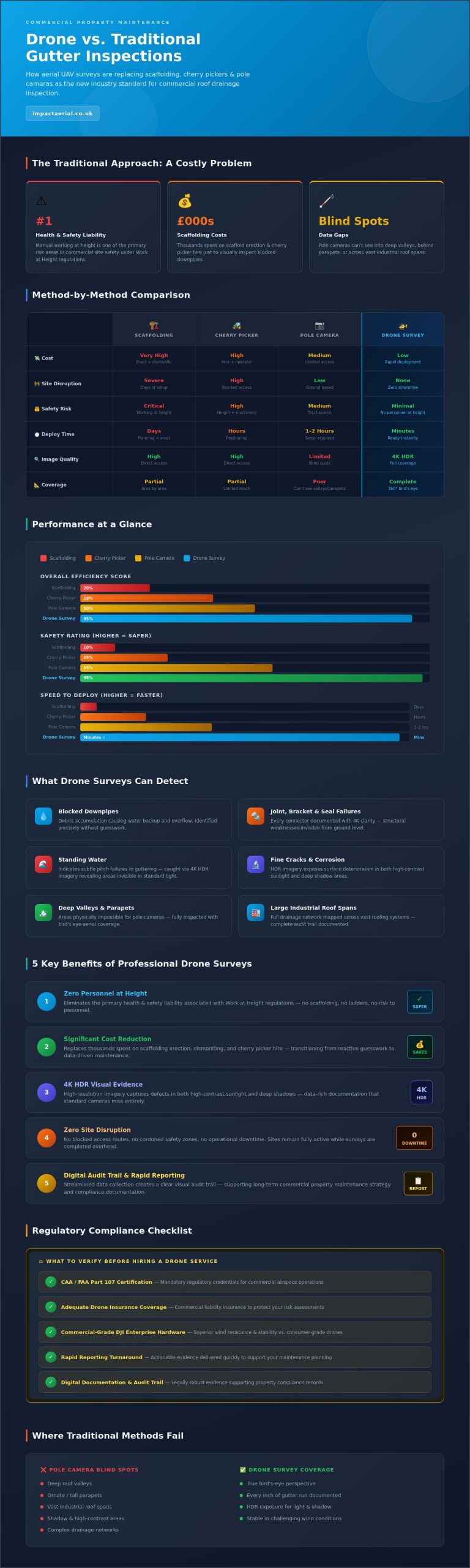
Manual inspections often involve significant logistical hurdles. Erecting scaffolding for a simple visual check is rarely cost-effective, yet skipping the check leads to expensive water damage. Mobile Elevated Work Platforms (MEWPs), or cherry pickers, offer more mobility but frequently cause disruption on active commercial sites. They block access and require cordoned-off safety zones that interfere with daily operations. Additionally, ground-based pole cameras are often physically limited. They struggle to see into deep valleys, behind ornate parapets, or across vast industrial roof spans. This leaves critical blind spots in your maintenance data, potentially hiding debris or structural failures until they become catastrophic.
The Rise of the Drone Survey
The adoption of a drone survey approach addresses these failings by providing a true ‘bird’s eye’ perspective of the entire drainage system. Unlike mechanical equipment that takes hours to position, a drone can be deployed in minutes to capture 4K visual data. This speed doesn’t come at the expense of quality. Modern aerial platforms are designed to remain stable in challenging conditions, ensuring that every inch of a gutter run is documented with crystal-clear resolution. This meticulous methodology has established aerial data collection as the new industry standard for high-level building inspections, providing property owners with psychological comfort and tangible financial benefits.
How Drone Technology Transforms Gutter Data Collection
A professional gutter inspection drone service is a specialized application of UAV technology designed to capture high-definition 4K visual data of roof drainage systems. This isn’t merely about taking aerial photographs; it’s a meticulous process of asset documentation. By utilizing commercial-grade hardware, operators can identify structural weaknesses that are invisible from the ground. Precision is the primary objective. Modern aerial platforms allow us to document every joint, bracket, and seal with a level of clarity that was previously impossible without significant manual effort.
The stability of these systems is a critical factor in professional environments. We utilize DJI Enterprise drones because they offer superior wind resistance and flight stability compared to consumer-grade models. This ensures that even on exposed industrial sites or during blustery conditions, the camera remains perfectly still. We capture 4K HDR imagery to expose details in both high-contrast sunlight and deep shadows. This dynamic range is essential for spotting fine-line cracks, subtle corrosion, or the presence of standing water that indicates a subtle pitch issue in the guttering.
Precision Hardware for Property Professionals
Success in aerial surveying relies on the specific capabilities of the flight platform. We employ the DJI Mavic 3 Enterprise or similar platforms because they are equipped with omnidirectional obstacle avoidance sensors. These sensors act as a safety net, protecting the building’s facade and the drone during close-proximity maneuvers. Additionally, GPS-stabilized flight is a standard requirement for our operations. It allows for repeatable inspections; we can return to the exact coordinates months or years later to monitor the progression of a known defect, providing a consistent audit trail for maintenance records.
High-Resolution Deliverables
The output of a professional survey must be actionable. We provide 20MP+ still images that allow property managers to zoom in on granular details like perished gaskets or loose fixings. For a broader understanding of site health, 4K video flyovers are indispensable. These videos help teams visualize water flow patterns and identify potential blockages across vast roof areas. The integration of aerial filming drone techniques ensures that the footage is cinematic yet technically precise, making it easy for stakeholders to review findings. If you require a comprehensive assessment of your building’s exterior, our drone commercial property surveys provide the high-tier data needed for informed decision-making.
Advanced zoom capabilities further enhance site safety. By utilizing high-powered optical zoom, we can inspect delicate areas without flying dangerously close to the structure. This reduces the risk of prop-wash disturbing loose debris and ensures the aircraft maintains a safe standoff distance at all times. The result is a comprehensive data set that serves as a professional foundation for your maintenance strategy.
Comparing Gutter Inspection Methods: ROI and Efficiency
The financial justification for adopting a professional gutter inspection drone service rests on the transition from subjective observation to objective data. Traditional methods often rely on a contractor’s verbal report after they’ve spent hours on a ladder or a cherry picker. This approach is inherently limited by what the individual can see at that moment. In contrast, aerial surveys provide a permanent, high-resolution digital record that can be reviewed by multiple stakeholders, including insurance adjusters and structural engineers, without anyone needing to leave the ground.
Efficiency is measurable in time and labor. A standard drone roof and gutter inspection typically takes between 30 and 60 minutes to complete. This is a significant improvement over manual inspections, which frequently require 2 to 4 hours of on-site labor plus the time needed to transport and set up heavy access equipment. For property managers overseeing multiple assets, these time savings translate directly into reduced operational costs and faster maintenance cycles.
Speed and Versatility on Site
A primary advantage of aerial technology is its ability to navigate complex site layouts with ease. We can complete a full perimeter inspection of a large industrial unit in a single morning, a task that would take days if scaffolding were required. Drones access confined areas and high-reach points that are physically impossible for mechanical platforms to reach safely. Because the aircraft is battery-powered and launched from a small designated area, there’s no heavy machinery to damage lawns, block car parks, or disrupt pedestrian flow. This minimal footprint makes it the ideal choice for active commercial environments where business continuity is a priority.
Actionable Maintenance Reports
The value of a survey extends far beyond the day of flight. Digital data serves as robust evidence for insurance documentation and claim support. Insurance companies are increasingly accepting and often preferring drone inspection reports because they provide unambiguous visual proof of an asset’s condition. By using this high-resolution imagery, multi-site managers can prioritize their maintenance spend based on actual urgency rather than a fixed schedule. This strategic approach prevents minor blockages from becoming major structural issues.
- Historical Auditing: We create a visual record that allows you to track gutter degradation over several years.
- Budget Optimization: Identify exactly which sections of a property portfolio require immediate attention.
- Risk Mitigation: Eliminate the primary cause of workplace falls by keeping personnel on the ground.
Beyond the financial and safety benefits, the environmental impact is a factor that modern businesses can’t ignore. Battery-powered UAVs have a negligible carbon footprint compared to the diesel-powered engines of MEWPs and transport trucks. This allows your facility management team to maintain high standards of building health while aligning with corporate sustainability goals. It’s a cleaner, faster, and more precise way to manage property assets.
Compliance and Safety: Hiring a Professional Drone Service
Selecting a gutter inspection drone service involves more than just evaluating camera specifications. In the UK, the legal framework governing Unmanned Aircraft Systems (UAS) is rigorous, and failing to verify a pilot’s credentials can leave a property manager liable for significant fines or uninsured damages. Hiring a hobbyist or an uncertified pilot for commercial work isn’t just a shortcut; it’s a professional risk that compromises site safety and legal standing. Professional operators treat every flight as a controlled aviation exercise, ensuring that data collection never comes at the expense of safety.
The distinction between a casual flyer and a professional lies in their adherence to officialdom and risk mitigation. For any commercial property survey, a minimum of £5 million commercial liability insurance is the industry standard. This coverage protects the client, the public, and the property itself in the unlikely event of an incident. Without this specific commercial-grade protection, any damage caused during a survey could become a direct financial burden on the property owner.
Navigating UK Drone Regulations
Understanding the current drone license requirements is essential for anyone procuring aerial services. In 2026, the General Visual Line of Sight Certificate (GVC) is the critical qualification for pilots operating in congested commercial environments. This certification demonstrates that the pilot has undergone formal theoretical and practical assessments approved by the Civil Aviation Authority (CAA). It grants the operator the legal right to fly in urban areas or near high-traffic zones where airspace restrictions are complex.
Privacy is another pillar of professional compliance. Meticulous operators ensure full GDPR adherence when filming near residential windows or sensitive commercial boundaries. This involves pre-flight notifications and post-production techniques to redact any unintended personal data, ensuring your maintenance audit doesn’t infringe on privacy laws.
Risk Mitigation and Insurance
Every professional mission begins long before the drone leaves the ground. We conduct thorough pre-flight site surveys to identify local hazards, such as overhead power lines, nesting birds, or nearby restricted airspace. This preparation is documented in a formal risk assessment that serves as a foundation for a safe mission. You should always request to see a pilot’s policy documents and CAA Operational Authorisation before work commences. Commercial drone insurance policies typically remain valid only when the operator is in full compliance with CAA regulations and holds the appropriate flight authorizations.
By prioritizing these standards, you protect your business from the operational and legal failures associated with unregulated flight. If you need a fully compliant, high-resolution assessment of your facility’s drainage system, you can trust our drone commercial property surveys to deliver professional results within a safe, regulated framework.
Impact Aerial: Expert Gutter Surveys and Data Analysis
Impact Aerial operates with a meticulous focus on quality and regulatory compliance. Based in the West Midlands, we provide specialized property data collection that goes beyond basic photography. Our drone services are designed to integrate seamlessly into your existing maintenance workflows, providing a technical foundation for long-term asset protection. We understand that property managers require more than just a bird’s eye view; they need a reliable partner who understands the operational complexities of commercial site management.
Our approach is rooted in technical precision. We don’t just fly; we conduct a systematic audit of your building’s drainage health. This involves capturing high-resolution data that identifies immediate risks while documenting the overall condition of the asset. By integrating gutter inspections with our broader drone commercial property surveys, we offer a holistic view of building envelopes that helps facility managers stay ahead of costly repairs. This proactive methodology ensures that your maintenance budget is allocated where it’s needed most, based on empirical evidence rather than guesswork.
Beyond the Flight: Data Management
We address a common industry weakness by prioritizing professional post-production and data management. Raw footage is often difficult for maintenance teams to interpret without context. To solve this, our team processes every survey into a structured, high-resolution digital file set. We provide annotated imagery that highlights specific defects, such as perished seals or localized debris buildup, directly on the photographs. This consultative approach helps you interpret aerial data for accurate budget planning and ensures that your on-site teams have clear, visual instructions for any necessary repairs. Our secure delivery system ensures that all stakeholders can access this critical data quickly and efficiently.
Specialised Survey Solutions
The versatility of our fleet allows us to offer specialized solutions tailored to your specific infrastructure. We can combine visual gutter inspections with thermal data collection to identify hidden moisture ingress or assess the efficiency of rooftop energy assets. This is particularly beneficial for sites requiring PV solar farm thermal surveys alongside standard roof maintenance. We also support construction site monitoring during project handovers, providing definitive, high-resolution proof that gutters are clean and clear before a building is officially transferred to the client. If you require a professional, data-centric gutter inspection drone service, request a consultation with our expert team to discuss your site’s specific requirements and ensure your assets are protected by industry-leading aerial technology.
Future-Proofing Your Property Maintenance Strategy
Transitioning to a professional gutter inspection drone service is no longer just a technological upgrade; it’s a strategic necessity for modern facility management. By eliminating the high costs and safety liabilities of manual access, you can secure high-resolution data that drives more accurate maintenance decisions. You’ve seen how aerial technology provides a clear audit trail and superior ROI for complex commercial portfolios. This shift toward data-centric surveying ensures that minor blockages don’t evolve into structural failures.
Ready to upgrade your site assessments? Request a Professional Drone Gutter Survey Quote from our expert team. We operate with CAA GVC Certified Pilots and carry £5m Commercial Liability Insurance, utilizing DJI Enterprise Grade Hardware to ensure your data is as precise as it is compliant. We look forward to helping you protect your property assets with the precision and reliability your business requires.
Frequently Asked Questions
How long does a drone gutter inspection take?
A standard inspection for a commercial unit usually takes between 30 and 60 minutes on site. This is significantly faster than manual methods which can require several hours of labor and equipment setup. The speed is due to the rapid deployment of the UAV and its ability to traverse roof perimeters without the need to reposition heavy access machinery.
Can drones see blockages inside downpipes?
Drones cannot see through solid materials or navigate the interior of narrow downpipes. However, they are highly effective at identifying blockages at the hopper or entry point where most debris accumulates. By observing standing water or overflow patterns at these specific junctions, a pilot can accurately infer a blockage exists further down the drainage system.
Is a drone inspection as accurate as a manual check?
Aerial inspections often provide greater accuracy than manual checks because they capture high-resolution 4K data from angles a person on a ladder cannot safely reach. While a manual check allows for the physical testing of joints, the visual evidence provided by a professional gutter inspection drone service identifies cracks, corrosion, and perished gaskets with extreme precision.
Do I need to be present during the drone survey?
You don’t need to be present on site during the survey as long as our team has clear access to the exterior of the building. We conduct our pre-flight risk assessments and manage the entire flight operation independently. Once the data collection is complete, we process the 20MP+ imagery and deliver a comprehensive maintenance report directly to your digital inbox.
What happens if the drone crashes into my building?
We mitigate the risk of collisions through the use of omnidirectional obstacle avoidance sensors and strict flight safety protocols. In the highly unlikely event of an incident, our £5 million commercial liability insurance provides full protection for your property and assets. This level of coverage is a mandatory standard for all our professional property survey operations.
Can you fly a drone for gutter inspections in the rain?
We typically avoid flying in active rain to ensure the highest image quality and protect the aircraft’s sensitive electronics. Water droplets on the camera lens can distort the 4K imagery, making it difficult to spot fine-line defects or subtle corrosion. We monitor weather forecasts closely and will reschedule to the nearest clear window to maintain the integrity of your data.
Are there any buildings where a drone cannot be used for inspection?
Drones can be restricted in certain high-security zones or near major airports where flight permissions are denied by the CAA. Additionally, extremely confined spaces or areas with high electromagnetic interference may pose operational challenges. We verify every site’s airspace status during our pre-flight planning phase to confirm if a professional gutter inspection drone service is viable for your specific location.
How much does a professional drone gutter survey cost?
The cost of a professional survey depends on the scale of the property and the complexity of the roof structure. Factors such as site location, the number of separate buildings, and specific reporting requirements will influence the final project fee. We provide bespoke quotes for each project to ensure you only pay for the specific data and analysis your facility management team requires.
 2 Norton Drive, Wythall, Birmingham, B47 6HH Company registration number: 11138586. VAT Number: 366 9068 55