What if you could walk a global stakeholder through every square metre of your plant floor without them ever stepping foot in the UK? Implementing a professional virtual tour for manufacturing facilities allows you to bypass the logistical headaches and high travel costs associated with physical site inspections. We understand that managing massive industrial sites often involves significant health and safety risks that make frequent visits impractical. It’s a challenge to maintain operational transparency when physical distance and strict safety protocols create constant barriers to entry for your partners and stakeholders.
This article demonstrates how these high-resolution digital twins allow you to showcase your operational scale with absolute precision. You’ll discover how to leverage immersive technology to improve transparency for remote auditing and streamline facility management from any location. We’ll explore how these tools enhance safety training efficiency and provide a compliant, data-rich perspective that physical walk-throughs simply cannot match. From CAA GVC certified drone captures to internal 4K HDR detail, learn how to bring your facility to the world safely and sustainably.
Key Takeaways
- Learn why 2026 is becoming the year of the industrial digital twin and how a virtual tour for manufacturing facilities provides a high-resolution, interactive representation of your entire site.
- Discover how combining aerial data from professional enterprise drones with internal 360° panoramas creates a seamless, comprehensive view of both macro-scale infrastructure and micro-scale details.
- Explore practical applications beyond simple walkthroughs, including virtual safety onboarding and documenting critical maintenance points for remote teams.
- Understand why CAA GVC certification and meticulous risk mitigation are essential for ensuring drone operations don’t disrupt active production lines.
- See how specialist drone expertise from Impact Aerial and £5m commercial liability insurance provide the security required to navigate high-risk industrial environments across the UK.
The Strategic Value of a Virtual Tour for Manufacturing Facilities
A virtual tour for manufacturing facilities is far more than a simple sequence of photographs. It is a high-resolution, interactive digital representation of an industrial site that allows users to move through production lines, storage bays, and technical areas with complete autonomy. In 2026, the industry is seeing a significant shift toward digital twin technology as the standard for operational documentation. This transition is partly driven by the evolving regulatory environment and the need for meticulous asset management. By creating a precise digital replica, businesses can bridge the gap between their physical infrastructure and the remote requirements of modern global commerce.
Large-scale facilities often face the “scale problem.” It’s notoriously difficult to communicate the sheer magnitude of a 100,000-square-foot production plant to a client on the other side of the world. Static brochures and standard video clips fail to capture the workflow and spatial relationships of complex machinery. Virtual tours solve this by providing an immersive sense of presence. Stakeholders can inspect the site’s layout and capacity without the logistical friction, health and safety risks, or the downtime often required for physical walkthroughs.
From Marketing to Remote Auditing
These tours have evolved from simple marketing tools into critical operational assets. Modern supply chains now demand unprecedented levels of transparency. A virtual tour allows you to satisfy these requirements by giving auditors a clear view of your safety protocols and facility standards. They facilitate remote ISO audits and stakeholder inspections by providing a reliable, high-fidelity visual record that can be accessed instantly. These interactive environments act as a 24/7 global showroom that remains open for inspection without ever disrupting your active production schedules. To maximise the impact of these digital assets, many firms partner with BCM Public Relations to ensure their facility’s technological story reaches the right industry media and global stakeholders.
The ROI of Industrial Digitalisation
The financial argument for digitalisation is compelling when you consider the direct savings on travel and accommodation for international site visits. Reducing the number of physical inspections directly lowers your carbon footprint, supporting corporate sustainability goals. Beyond travel costs, these tools shorten sales cycles by building trust faster. High-value contracts are often secured when a client can see the facility’s quality for themselves without waiting for a scheduled site visit.
- Significant reduction in international travel expenses and site-visit logistics.
- Enhanced brand authority through high-end, technical output and professional presentation.
- Improved safety compliance by limiting unnecessary foot traffic in high-risk zones.
The Technology: Fusing Aerial Drone Data with 360° Panoramas
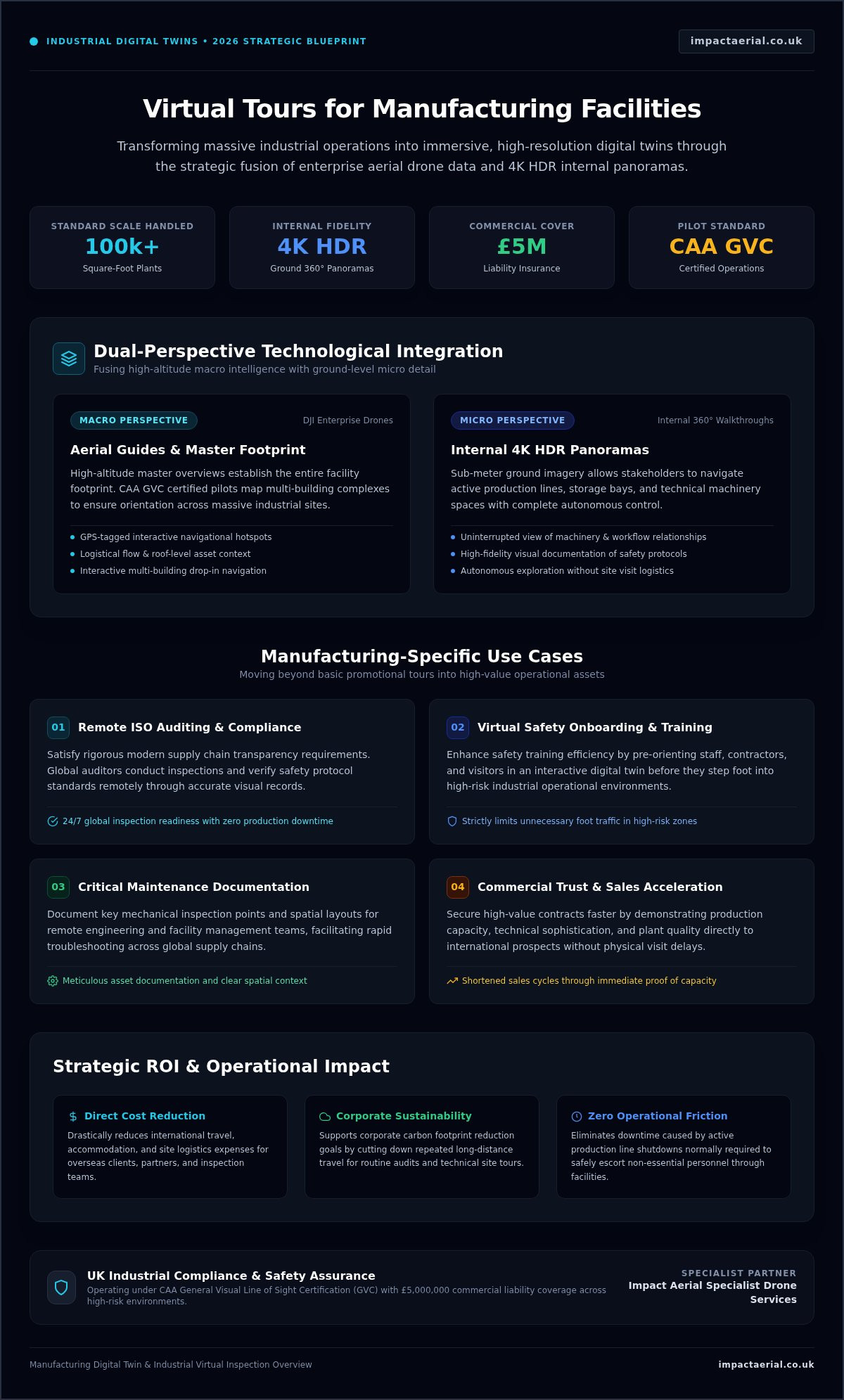
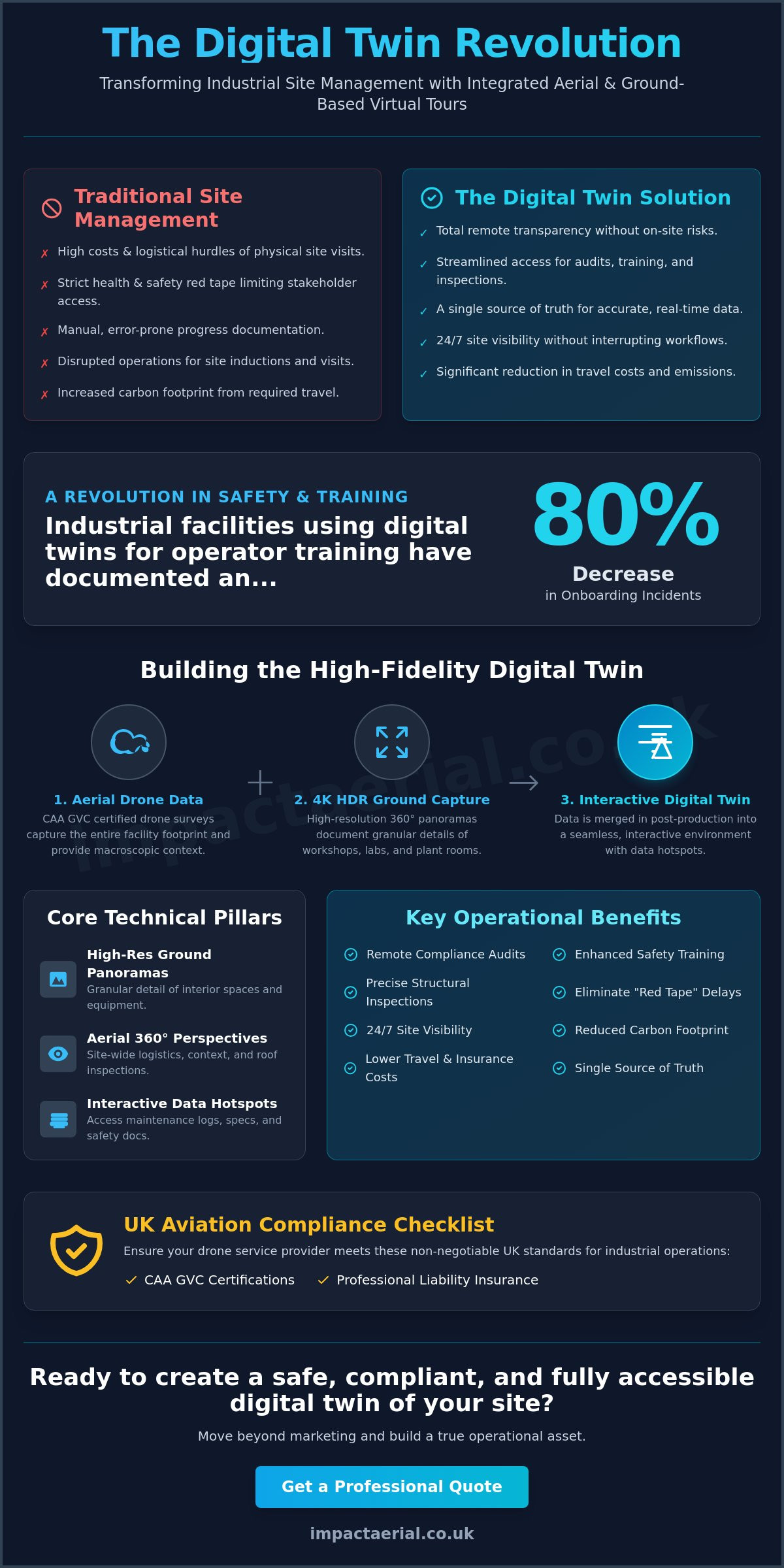
Creating a seamless virtual tour for manufacturing facilities requires more than just internal photography. It involves a technical fusion of macro-scale aerial data and micro-scale ground perspectives. While many providers treat drone surveys and 360 walkthroughs as separate assets, we integrate them into a single, cohesive environment. We utilise DJI Enterprise drones to establish the site’s footprint, providing a master overview that grounds the viewer before they transition into specific production zones. This dual-perspective approach ensures that stakeholders understand both the logistical layout and the internal operational flow.
Aerial Perspectives for Site Context
Using DJI Enterprise hardware allows for the creation of high-altitude “Aerial Guides,” which are essential for navigating massive multi-building complexes. Our CAA GVC certified pilots use these platforms to create interactive maps where users can click on specific buildings or roof sections to “drop in” to the internal 360° view. This spatial context is vital for understanding logistics and site flow. For a deeper look at how we gather this high-level information, see our Drone Survey: The Complete Guide to Aerial Data Collection. By using GPS-tagged hotspots, remote stakeholders can jump between production buildings without losing their sense of orientation.
Ground-Level Immersion and Technical Detail
Once inside the facility, the focus shifts to high-resolution technical detail. Industrial environments often present complex lighting challenges, from high-bay sodium lamps to dark machinery corners. We use 4K HDR imaging to ensure that every machine dial, safety sign, and technical label remains perfectly legible throughout the tour. We also implement “Point of Interest” (POI) tags. These allow site managers to embed technical manuals, safety videos, or live data feeds directly onto specific machinery within the tour. While a standard 360 photo provides a simple visual bubble, a professional industrial scan uses calibrated multi-exposure data to ensure spatial accuracy and legible technical detail across every square metre.
This technological bridge ensures that your digital twin is a functional tool rather than just a visual gimmick. Our methodical approach to Virtual Tour Creation combines these high-end perspectives into a data-rich experience that supports remote auditing and facility management. It’s about providing a compliant, safe, and authoritative view of your most valuable assets without the risks associated with physical site presence.
Manufacturing-Specific Use Cases: Beyond the Walkthrough
While the visual appeal of a virtual tour for manufacturing facilities is undeniable, its true value lies in operational efficiency and risk mitigation. In high-stakes industrial environments, these tours serve as a functional database for safety, maintenance, and stakeholder engagement. By moving beyond a simple walkthrough, facilities can leverage digital twins to solve complex logistical challenges and demonstrate technical excellence to global partners. This methodical approach ensures that every square metre of your facility works toward your broader business objectives. For organizations looking to bridge the communication gap, VISIOLAB offers a strategic way to transform these complex industrial messages into clear, high-impact visual content.
Immersive Safety Induction and Onboarding
Health and safety are the pillars of any UK manufacturing site. A professional virtual tour allows for comprehensive “virtual onboarding” before a staff member or contractor even arrives at the gate. New hires can map fire exits, identify hazard zones, and understand specific PPE requirements in a completely risk-free environment. This proactive approach significantly reduces the burden on floor managers during physical orientations, ensuring that when staff eventually step onto the factory floor, they’re already familiar with the site’s layout and safety protocols. Interactive “hotspots” can be embedded to link directly to machinery operation manuals or safety videos, providing a centralised training resource that’s available 24/7.
Supply Chain and Client Transparency
Building trust with Tier-1 clients often requires an “open-door” policy, yet frequent site visits can be disruptive to lean manufacturing processes. A virtual tour provides a high-resolution solution for showcasing quality control stations and production efficiency without pausing operations. It allows you to demonstrate your capital expenditure (CapEx) investments in new machinery to investors and clients remotely, providing proof of capacity and technological advancement. This level of transparency is essential for modern professional drone services in the UK, where data-centric reporting is as important as the visual output itself.
Beyond client relations, these tours are powerful recruitment tools. Top-tier engineering talent is increasingly selective about their working environments. By showcasing a modern, clean, and meticulously organised facility, you position your brand as an employer of choice. Additionally, for facility maintenance teams, the tour acts as a permanent record of critical infrastructure. Documenting the exact location of shut-off valves, electrical panels, and HVAC systems ensures that external contractors can plan their work with precision, reducing the time spent on-site and the potential for operational errors.
Our experience in providing these technical solutions across the UK’s manufacturing heartlands ensures that every tour is built with compliance in mind. Whether you’re managing a Birmingham-based automotive plant or a remote pharmaceutical hub, the ability to document and share your facility’s scale and safety standards is a significant competitive advantage in a digital-first market.
Planning and Safety: Navigating Complex Industrial Environments
Planning a virtual tour for manufacturing facilities requires a level of meticulous preparation that standard commercial photography cannot match. Industrial environments are dynamic, high-risk zones where safety protocols are absolute. We don’t just arrive and start filming; we integrate our operations into your existing site safety framework. This ensures that the data collection process is as safe as the final digital twin is useful. Every project begins with a detailed consultation to understand the specific hazards of your facility, from overhead cranes to chemical storage areas.
Regulatory Compliance and Pilot Qualifications
Operating drones near complex industrial assets is strictly regulated in the UK. It’s essential that your provider holds a valid CAA GVC certification, which demonstrates the technical competence required for complex flight operations. For a detailed breakdown of current regulations, see our guide on the UK Drone License: A Simple Guide to CAA Rules in 2026. Before any hardware is deployed, we conduct exhaustive pre-flight site surveys and provide a comprehensive Risk Assessment and Method Statement (RAMS). This documentation is a critical component of risk mitigation that aligns with your internal health and safety (H&S) standards, ensuring all personnel remain protected throughout the shoot.
Managing Data Sensitivity
Protecting proprietary information is a primary concern for many UK manufacturers. A virtual tour should showcase your scale without compromising trade secrets or sensitive machinery designs. We use selective scanning techniques to digitise only the approved zones, leaving R&D areas or confidential production lines off the map. In post-production, we meticulously redact sensitive signage, employee faces, and proprietary equipment details to ensure your intellectual property remains secure. Ensuring that your industrial tour data is hosted on secure, enterprise-grade servers is a non-negotiable standard for protecting against unauthorised access.
The industry standard for high-risk industrial work is £5m commercial liability insurance. This level of coverage provides the reassurance that your assets and personnel are protected throughout the project. We coordinate closely with site managers to schedule filming during low-activity periods or planned maintenance windows, ensuring zero disruption to your production output. If you’re ready to document your facility with a compliant, safety-first approach, contact our CAA GVC certified team to discuss your project requirements.
Why Specialist Drone Expertise Elevates Manufacturing Virtual Tours
Selecting a partner for a virtual tour for manufacturing facilities requires more than just finding a photographer with a 360-degree camera. In the technical landscape of 2026, the value lies in the fusion of DJI Enterprise drone data with immersive internal panoramas. Based in Birmingham, we are positioned at the centre of the UK’s manufacturing heartland. This regional expertise allows us to provide responsive, UK-wide deployment for facilities that require a sophisticated, data-centric approach to digitalisation. We understand the specific operational language of the West Midlands industrial sector, from automotive assembly to high-precision engineering hubs.
The Impact Aerial Process
Our methodical approach ensures that the final digital twin aligns with your specific technical and marketing objectives. The process begins with a detailed consultation where we define the scope of the project, identifying critical machinery, safety zones, and logistical flows that must be highlighted. During the capture phase, our CAA GVC certified pilots use high-end commercial hardware to perform a meticulous site scan. This isn’t just about taking pictures; it’s about gathering spatially accurate data. Finally, we handle the post-production and delivery, hosting the tour on secure servers and providing seamless integration for your corporate website or internal training portals.
Choosing a Certified Partner
Industrial environments are unforgiving. “Cheap” virtual tours often fail because they lack the technical depth to handle complex lighting or the legal credentials to operate safely near high-value assets. Working with a specialist who understands the nuances of Aerial Filming Drone: The Ultimate Guide to Professional Cinematic Video ensures that your tour has the high-tier visual quality required to impress global stakeholders. We provide the reassurance of £5m commercial liability insurance and a proven track record of operating within strict industrial health and safety protocols. This professional foundation is what transforms a simple visual walkthrough into a reliable, authoritative management tool.
Custom post-production is where raw data becomes a branded, interactive asset. We can embed technical specifications, live site data, or safety induction videos directly into the interface, creating a bespoke tool tailored to your operational needs. Whether you’re looking to streamline remote audits or showcase your production scale to international clients, our team provides the technical expertise to deliver a compliant and high-resolution result. If you’re ready to digitise your site, you can enquire about a virtual tour for your manufacturing facility today to begin the consultation process.
Digitise Your Operations for a Global Market
Implementing a professional virtual tour for manufacturing facilities transforms how you manage site transparency and remote audits. By fusing high-altitude drone data with internal 4K HDR detail, you create a functional asset that supports safety inductions and investor relations without the logistical friction of site visits. This transition toward industrial digital twins is a strategic shift that prioritises operational efficiency and carbon reduction. It’s about more than just visuals; it’s about building a reliable, data-rich record of your most valuable assets.
As Birmingham-based West Midlands experts, we provide UK-wide coverage backed by CAA GVC certified pilots and £5m commercial liability insurance. We ensure your data collection remains compliant with strict industrial health and safety protocols while delivering a high-resolution, branded interactive tool. Our team is ready to help you bridge the gap between your physical scale and your remote stakeholders’ needs.
Request a Consultation for Your Industrial Virtual Tour
Take the first step toward a more transparent and streamlined facility management strategy today.
Frequently Asked Questions
How long does it take to create a virtual tour for a large manufacturing plant?
The duration for creating a virtual tour for manufacturing facilities depends on the facility’s total square footage and operational complexity. Typically, on-site data capture for a large industrial site takes between one and three days. Following the site visit, our post-production team requires approximately one to two weeks to stitch the high-resolution 4K HDR imagery and integrate interactive hotspots. This methodical approach ensures every technical detail is accurate and the final digital twin is fully optimised.
Can we update the virtual tour if we install new machinery?
Yes, these digital environments are designed to be modular and future-proof. If you install new machinery or alter your production layout, we can return to perform a selective rescan of that specific zone. This new data is then integrated into the existing framework during post-production. This ensures your virtual tour remains an accurate representation of your facility’s current capacity without the need to recreate the entire project from scratch at full cost.
Is it safe to fly drones inside a manufacturing facility?
Safety is our primary priority in high-risk industrial zones. While internal areas are often captured using ground-based 360 equipment, we utilise DJI Enterprise drones for high-level perspectives in large atriums or warehouses. Our pilots are CAA GVC certified and operate under strict risk assessments to ensure zero disruption to your production. We use hardware with advanced obstacle avoidance sensors and hold £5m commercial liability insurance to provide complete reassurance during the data capture process.
How do virtual tours handle sensitive or proprietary information?
We implement several strategies to protect your proprietary trade secrets and sensitive machinery. During the planning phase, we identify specific zones that should be excluded from the scan. In post-production, our editors can meticulously redact or blur specific machinery, technical signage, or employee faces. This allows you to showcase your operational scale and safety standards while ensuring that your intellectual property remains secure and confidential for external stakeholders or global partners.
What technical equipment is needed to view a virtual tour?
No specialised hardware or software is required to view our industrial virtual tours. The final output is hosted on secure, high-speed servers and can be accessed through any standard modern web browser on a desktop PC, laptop, tablet, or smartphone. This accessibility makes it an ideal tool for global stakeholders who need to inspect your facility remotely. For a more immersive experience, the tours are also compatible with most standard VR headsets used in corporate training.
How much does a professional manufacturing virtual tour cost?
The investment required for a professional virtual tour for manufacturing facilities is calculated based on the specific requirements of each project. Factors influencing the final quote include the total area to be digitised, the number of internal perspectives required, and the complexity of the interactive hotspots. We provide bespoke quotes following an initial consultation to ensure the service aligns with your technical goals. We don’t offer generic pricing because industrial environments require a tailored, safety-first approach.
Can a virtual tour be used for official health and safety inductions?
Virtual tours are exceptionally effective tools for official health and safety inductions. They allow new staff and contractors to familiarise themselves with fire exits, PPE requirements, and hazard zones before they even arrive on-site. By embedding instructional videos and safety manuals into interactive hotspots, you create a consistent, repeatable training resource. This reduces the time floor managers spend on physical inductions and ensures that all personnel have a high level of spatial awareness and compliance.
What is the difference between a 360 video and an interactive virtual tour?
The primary difference lies in user autonomy and functionality. A 360 video is a linear, passive experience where the viewer follows a set path determined by the camera’s movement. In contrast, an interactive virtual tour allows the user to navigate the facility at their own pace, moving between production zones and zooming in on technical details. Tours also support data integration; such as clickable hotspots that reveal machine specifications or maintenance logs, which a standard video cannot provide.
 2 Norton Drive, Wythall, Birmingham, B47 6HH Company registration number: 11138586. VAT Number: 366 9068 55