Why Hire a GVC Certified Drone Pilot? The 2026 Business Risk & ROI Guide

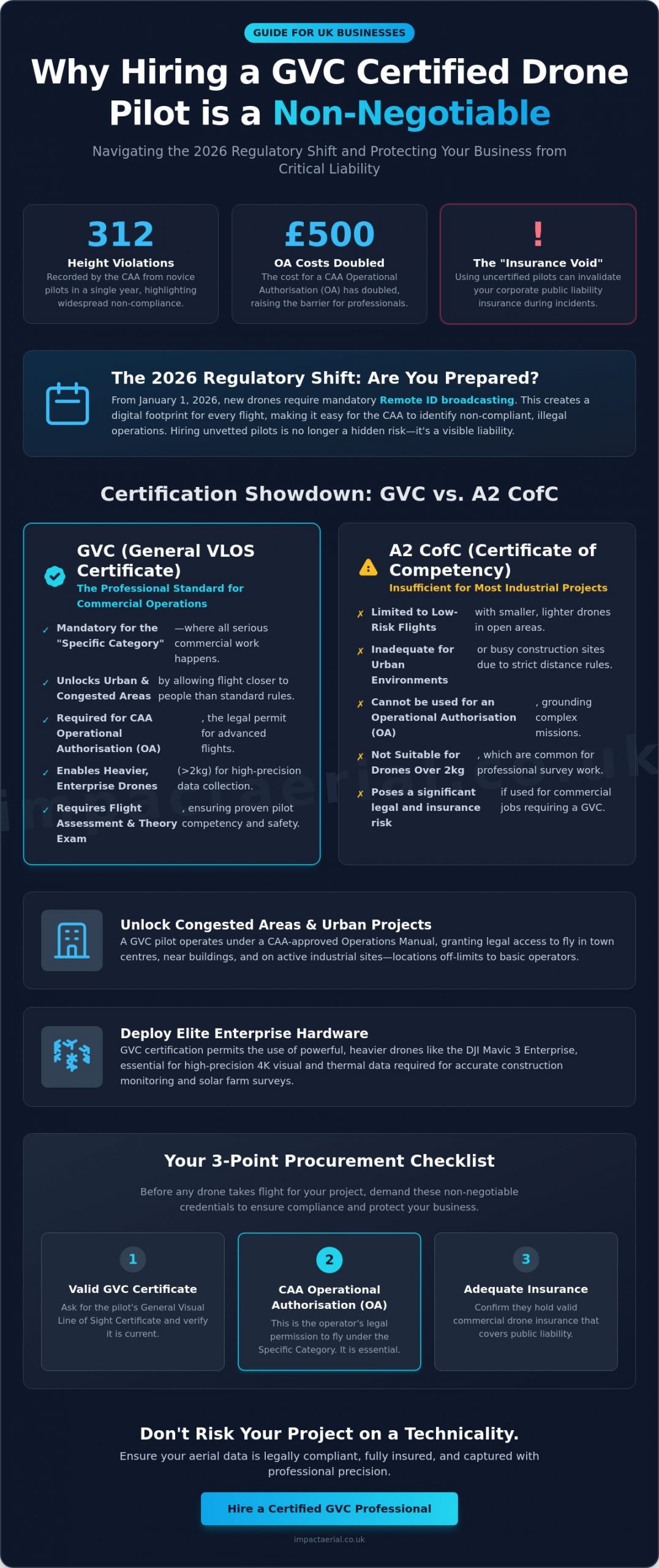
What if the drone data you collected for a construction site survey was legally inadmissible because of a certification technicality that didn’t exist last year? With the Civil Aviation Authority recording 312 height violations by novice pilots in a single year and the cost of operational authorizations doubling to £500, the margin for error in UK airspace has disappeared. Understanding why hire a gvc certified drone pilot is no longer just a matter of image quality; it’s a critical step in shielding your business from the 2026 regulatory shift and the substantial liability of non-compliant flights.

You likely recognize that aerial intelligence is vital for modern project management, yet the transition from the GVC to the new Remote Pilot Certificate (RPC) framework has left many corporate leaders uncertain about their insurance coverage. This guide explains how a certified professional mitigates these risks and unlocks complex operations in congested urban environments. We’ll preview the latest CAA requirements, the financial impact of the 2026 mandates, and how to ensure your project benefits from high-quality 4K or thermal data without exposing your firm to legal or physical hazards.

Key Takeaways

  • Understand why the GVC standard is the mandatory benchmark for the CAA’s Specific Category, ensuring your commercial projects remain legal under the 2026 framework.
  • Learn how GVC certification allows pilots to operate in congested urban environments that are legally off-limits to hobbyists or basic drone operators.
  • Discover the “Insurance Void” risk and understand why hire a gvc certified drone pilot to ensure your corporate public liability remains valid during aerial operations.
  • Use our professional procurement checklist to verify essential credentials, including the Operational Authorisation (OA) document and current certification expiry dates.
  • Identify how elite DJI Enterprise hardware provides the high-precision 4K and thermal data required for accurate construction monitoring and solar farm surveys.

Defining the GVC Standard: The Specific Category in 2026

The General Visual Line of Sight Certificate (GVC) stands as the definitive professional benchmark for commercial drone operations in the UK. While basic flyer IDs satisfy casual users, businesses requiring aerial intelligence must understand why hire a gvc certified drone pilot to ensure their projects meet the rigorous demands of the “Specific Category.” This category is where the professional work happens. It covers flights that fall outside the basic limitations of the Open Category, such as operating heavier aircraft or flying in complex environments. Under UK drone regulations, the GVC is the mandatory prerequisite for any operator seeking to obtain a formal CAA Operational Authorisation (OA).

The arrival of 2026 has brought a new level of scrutiny to the industry. Mandatory Remote ID broadcasting for new drones sold from January 1, 2026, has created a transparent digital footprint for every flight. This technology makes it easier for authorities to distinguish between compliant professionals and uncertified hobbyists. For corporate clients, this means that hiring an unvetted pilot is no longer a hidden risk; it’s a visible liability. Professional pilots with a GVC have undergone formal flight assessments and theoretical examinations to manage these risks effectively. This industry-wide focus on transparency and professional standards is also reflected in detailed service guides from instituteofphotographers.co.uk, which help clients navigate professional photography costs for the coming year.

GVC vs. A2 CofC: Which Does Your Project Require?

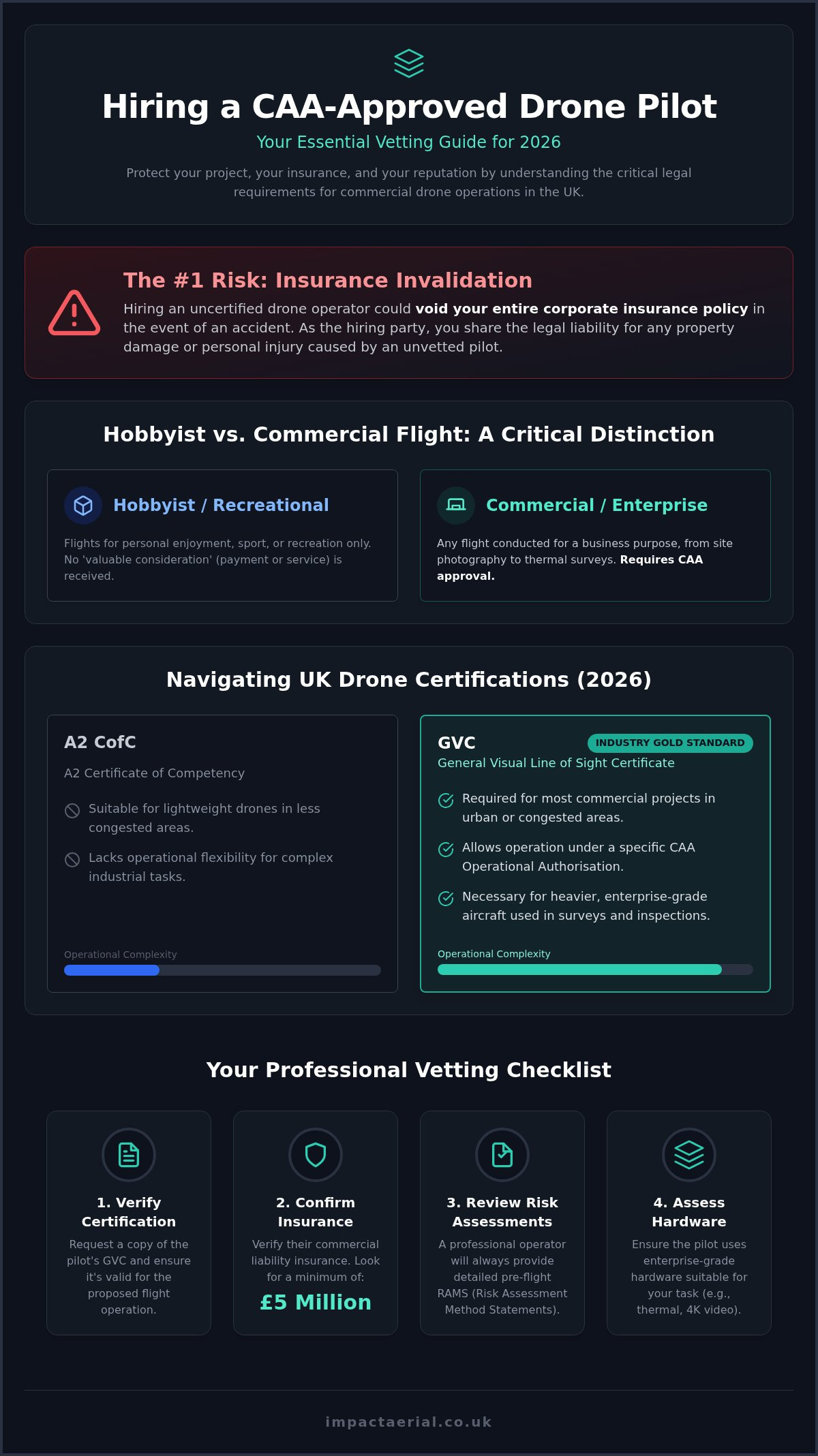
Many project managers mistakenly believe an A2 Certificate of Competency (A2 CofC) is enough for industrial work. It’s often insufficient. The A2 CofC is designed for low-risk flights with smaller drones. If your project involves a drone over 2kg or requires operations in a busy town centre, a GVC is usually the legal requirement. GVC pilots operate under an approved Operations Manual, which allows them to fly closer to uninvolved people than the standard 30m or 50m rules typically allow in the Open Category. Without this certification, your project could be legally grounded before the drone even takes off.

The Role of the Civil Aviation Authority (CAA) in 2026

The Civil Aviation Authority (CAA) has significantly tightened its oversight this year. They now monitor compliance through detailed flight logs and real-time Remote ID data. Hiring an uncertified operator for commercial gain isn’t just a safety risk; it’s a legal one that can lead to heavy fines for the hiring company. Impact Aerial prioritises total compliance, maintaining the highest drone license standards to protect our clients’ interests. We ensure every flight is logged, authorised, and fully transparent to the regulator, providing the reassurance that your data is collected legally and safely.

Unlocking Congested Areas: Where GVC Pilots Outperform Hobbyists

Operating a drone in a town centre or on a busy industrial estate isn’t just a technical challenge; it’s a legal one. While hobbyists and basic operators are often grounded by the strict distance requirements of the Open Category, GVC holders possess the qualifications to operate within the “Specific Category.” This distinction is a primary reason why hire a gvc certified drone pilot for urban projects. These professionals operate under a Civil Aviation Authority (CAA) approved Operations Manual, which provides the legal framework to fly closer to uninvolved persons than would otherwise be permitted. This capability is essential for executing high-precision town centre roof surveys or monitoring active construction sites where space is at a premium.

The technical advantage of a GVC holder extends to the hardware they can legally deploy in these sensitive zones. While lighter drones are common for simple photography, complex industrial tasks often require heavier, enterprise-grade aircraft like the DJI Mavic 3 Enterprise. These platforms offer superior stability and sensor quality but fall into weight classes that require specific permissions for urban use. By adhering to the Civil Aviation Authority (CAA) pilot competency requirements, GVC pilots ensure that these powerful tools are used safely and legally in environments where a less qualified operator would be committing a regulatory breach.

Operating Under PDRA-01 Framework

The PDRA-01 (Pre-Defined Risk Assessment) framework is the “gold standard” for professional drone operators in the UK. It simplifies the permissions process for GVC holders, allowing them to fly within 150m of residential, commercial, or industrial areas. For a project manager, this means more efficient drone survey workflows. Instead of spending weeks seeking bespoke permissions for every flight, a GVC pilot uses their standing Operational Authorisation to deploy rapidly. This agility is vital for construction site monitoring, where weekly or even daily progress updates are required in built-up locations.

Complex Missions: Beyond Simple Photography

Professional aerial work in 2026 involves far more than just taking pictures. Industrial applications like thermal solar farm surveys and 3D photogrammetry require a level of technical precision that hobbyist training simply doesn’t cover. Collecting data with a specialized survey drone involves complex flight paths and rigorous risk assessments that account for electromagnetic interference and local obstacles. If you’re planning a mission in a high-stakes industrial zone, consulting with an experienced GVC partner ensures that your data is accurate and your operational risk is managed to the highest professional standards.

Why Hire a GVC Certified Drone Pilot? The 2026 Business Risk & ROI Guide

Risk Mitigation: Why GVC Certification Protects Your Business

Hiring a drone operator isn’t just about the visual output; it’s about the legal and financial shield that professional certification provides. A primary reason why hire a gvc certified drone pilot is the assurance that your project is backed by a professional who can conduct rigorous, site-specific risk assessments. Without this qualification, a pilot lacks the formal training required to manage the complex variables of a commercial environment. This oversight often leads to the “Insurance Void,” a dangerous scenario where your corporate liability insurance is rendered useless because the flight was technically illegal.

Commercial drone insurance (EC 785/2004) is only valid if the pilot is operating within their legal permissions.

If an incident occurs during a flight that exceeds the pilot’s certification limits, the insurer has grounds to refuse the claim. For a business, this means you are personally liable for any damages or injuries. Beyond the financial impact, a CAA investigation can cause irreparable reputational damage to your brand. Following the Official GVC requirements ensures that the pilot has the competency to stay within the law, protecting your firm from both legal and public relations disasters.

The £5m Commercial Liability Standard

Impact Aerial maintains £5m in liability insurance for every UK project as a non-negotiable safety standard. There’s a vast difference between “hobbyist” insurance and professional commercial cover. Hobbyist policies often exclude commercial work entirely or have restrictive clauses regarding urban operations. When vetting a provider, always request their insurance certificate and check for specific drone exclusions. A GVC pilot’s insurance is specifically tailored to the high-stakes environment of commercial surveying and filming, providing the psychological comfort that your assets and stakeholders are protected.

Safety Protocols and the Operations Manual

A GVC pilot doesn’t just fly; they follow a legally binding Operations Manual approved by the CAA. This document outlines every safety protocol, from pre-flight site surveys to emergency procedure drills. These mandated standards are what make complex aerial filming drone missions safe and predictable. By adhering to these protocols, pilots identify hazards like overhead power lines or magnetic interference before the aircraft leaves the ground. This meticulous approach to safety is what separates a professional GVC pilot from a casual operator, ensuring that every flight is a controlled, low-risk event.

Vetting Your Drone Provider: A Procurement Checklist

Procuring aerial services requires more than a simple price comparison. To protect your business interests, you need a structured vetting process. Understanding why hire a gvc certified drone pilot is the foundation, but you must verify the pilot’s specific operational credentials before they arrive on site. Use this five-step checklist to ensure your provider is fully compliant with 2026 standards.

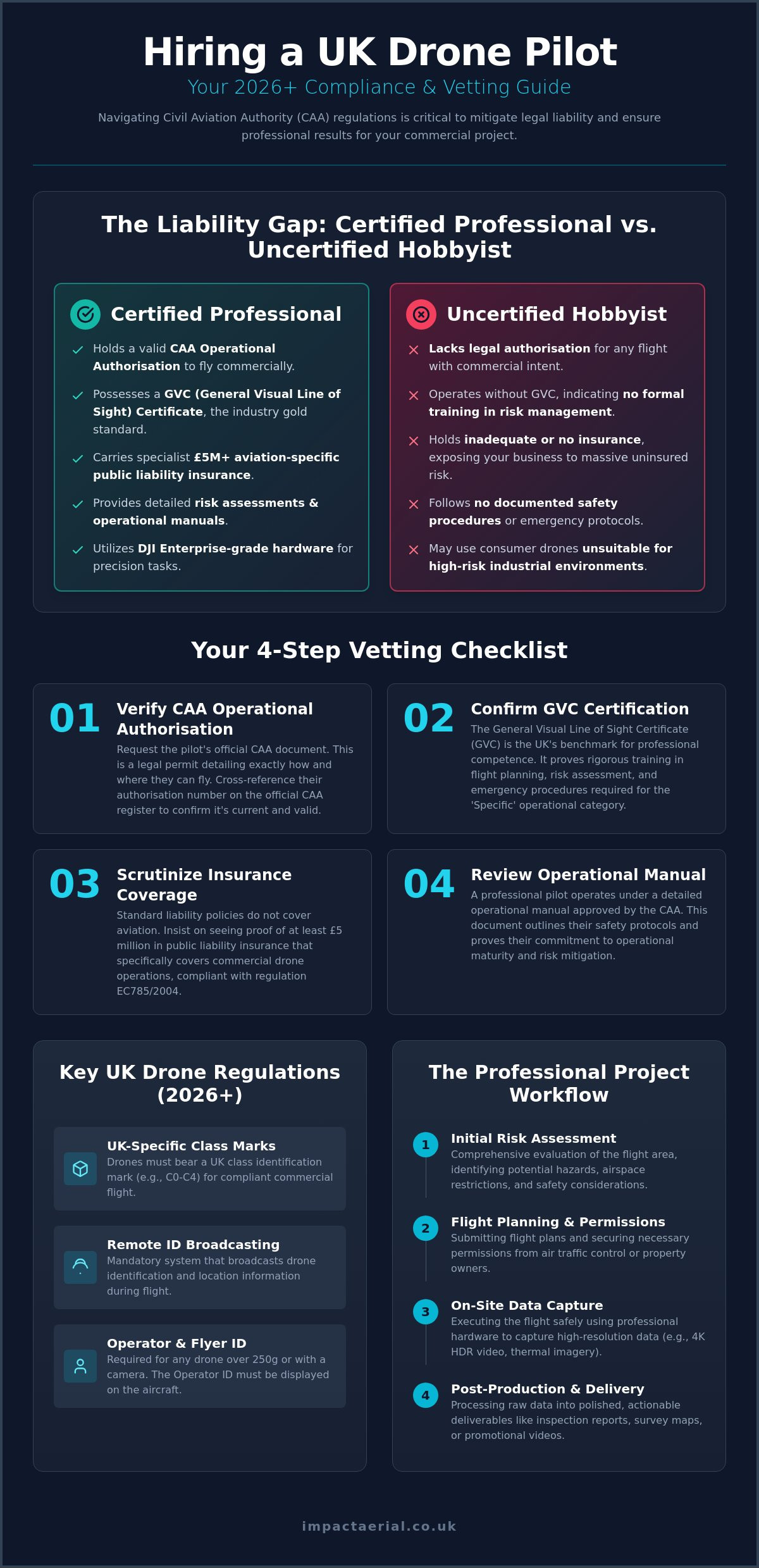
  • Step 1: Request the Operational Authorisation (OA) document. A basic Flyer ID is only for recreational use or very low-risk flights; professional commercial work in the Specific Category requires a valid OA.
  • Step 2: Verify the GVC certificate and its expiry date. This confirms the pilot has passed the necessary flight assessments and theoretical exams.
  • Step 3: Check for commercial-grade insurance compliant with EC 785/2004. Standard public liability is often insufficient for drone-related incidents.
  • Step 4: Review the provider’s experience in your specific sector. A pilot skilled in cinematic filming might not have the technical discipline required for a high-precision construction site survey.
  • Step 5: Confirm the use of 2026-compliant hardware. Ensure the aircraft has active Remote ID broadcasting, as this is now a mandatory requirement for most commercial operations in urban areas.

Reading the Operational Authorisation (OA)

The OA is the most critical document in a professional pilot’s folder. When reviewing it, look closely at the “Permissions” section to see exactly what the CAA has authorised them to do. Always check that the company name on the OA matches the name of your contractor. If the names don’t match, the pilot may not be legally covered under that specific authorisation. Pay attention to the expiry date as well; multi-month projects require an OA that remains valid for the duration of the work to avoid operational pauses.

Technical Capability and Hardware

Hardware choice directly impacts your project’s ROI. Enterprise drones deliver significantly better data quality than consumer models because they’re built for precision rather than recreation. Professional drone services rely on 4K HDR and thermal sensors to provide actionable insights for solar farm surveys or property inspections. Beyond the aircraft, ensure your pilot has the data processing capabilities to handle post-production. High-resolution data is only useful if it’s processed into a format your team can use for decision-making. If you’re ready to secure a fully vetted operator, contact Impact Aerial today for a compliant, professional consultation.

Why Impact Aerial is the UK’s Trusted GVC Partner

Choosing a drone partner in 2026 requires a shift from seeking simple photography to finding a technical consultancy that understands the intersection of aviation law and commercial data. Impact Aerial occupies this space as a specialist provider. Centrally based in Birmingham, our location allows for rapid deployment across the West Midlands and the wider UK, ensuring we’re on-site when your project timeline demands it. We don’t just fly; we operate an elite DJI Enterprise fleet equipped with the latest 4K and thermal sensors, providing the high-tier quality required for the high-stakes construction and property sectors.

Our team manages the entire operational lifecycle. This full-service approach starts with CAA-compliant flight planning and risk mitigation, extending through to professional post-production services. This end-to-end oversight is a significant reason why hire a gvc certified drone pilot from a dedicated firm rather than a freelance operator. We provide the administrative and technical infrastructure that ensures your aerial data is collected legally, safely, and to an exacting professional standard.

Expertise in Regulated Environments

We’ve built our reputation on navigating the most complex UK airspace. Whether your project is situated near a major airport or in the heart of a congested city centre, we possess the experience to secure the necessary permissions. Our team has a deep understanding of construction site monitoring safety requirements, where the environment is constantly changing and the margin for error is zero. We don’t just show up and fly. We take a collaborative approach, working closely with site managers and safety officers to ensure our operations cause zero disruption to your active workforce or machinery.

Data Precision and Commercial ROI

Our GVC-certified workflows are designed to deliver actionable data that drives decision-making. Pretty pictures have their place, but in a commercial context, you need precision. We provide custom reporting for drone commercial property surveys and PV solar farm thermal inspections, identifying defects or progress milestones with surgical accuracy. This level of detail ensures that your investment in drone technology translates directly into saved time and reduced operational costs. When you’re ready to future-proof your next project with a compliant and technologically adept partner, request a quote from Impact Aerial to secure your 2026 project schedule.

Future-Proof Your Aerial Strategy

As the UK’s aviation framework evolves, the distinction between a casual operator and a professional partner has never been more critical for corporate liability. We have outlined how GVC certification serves as a mandatory gatekeeper for the Specific Category, allowing for complex operations in congested urban environments that are legally restricted for others. Understanding why hire a gvc certified drone pilot is essential for any project manager who values regulatory compliance, insurance validity, and the technical precision of high-end data collection.

Impact Aerial provides the expertise needed to navigate these 2026 mandates with confidence. By combining our CAA GVC Certified Pilots with £5m in commercial liability insurance and the latest DJI Enterprise 4K and thermal technology, we ensure your project is delivered without operational or legal risk. Don’t leave your corporate reputation to chance in a shifting regulatory landscape.

Book a GVC-certified pilot for your next UK project and gain the aerial intelligence your business needs to lead its sector.

Frequently Asked Questions

What is the difference between a GVC and an A2 CofC?

The GVC allows pilots to operate in the Specific Category, whereas the A2 CofC is restricted to the Open Category. While an A2 CofC is suitable for low-risk flights with smaller aircraft, the GVC is the professional standard for complex missions in congested areas. It requires a more rigorous assessment and is the prerequisite for obtaining a CAA Operational Authorisation.

Do I legally need a GVC pilot for a drone roof survey in the UK?

You legally require a GVC-certified pilot if the roof survey is located in a congested area or town centre. Standard Open Category rules usually forbid flying close to uninvolved persons or buildings. A pilot with a GVC operates under an Operational Authorisation, which provides the necessary legal permissions to fly in these restricted urban environments safely and legally.

Will my company be liable if an uncertified drone pilot has an accident?

Yes, your company can face significant legal and financial liability if you hire an uncertified operator. This is a major reason why hire a gvc certified drone pilot; their certification ensures they are operating within the law. If an accident occurs during an illegal flight, your corporate insurance will likely be void, leaving your firm responsible for all damages.

How much insurance should a professional drone pilot have in 2026?

A professional drone pilot must have insurance that is compliant with EC 785/2004. While the legal minimum depends on the drone’s weight, the industry standard for commercial projects in 2026 is at least £5 million in public liability cover. This ensures that even high-stakes incidents on industrial or construction sites are fully covered without financial risk to your business.

What is a CAA Operational Authorisation (OA) and why is it important?

An Operational Authorisation is a formal document issued by the CAA that allows a pilot to fly outside standard Open Category limits. It’s important because it proves the pilot’s Operations Manual and safety protocols have been vetted by the regulator. Without a valid OA, a pilot cannot legally perform complex commercial tasks in congested areas or near uninvolved people.

Can a GVC pilot fly in restricted airspace or near airports?

A GVC pilot can fly in restricted airspace or Flight Restriction Zones near airports, provided they secure the correct ATC permissions. Their advanced training includes the communication protocols required to coordinate with Air Traffic Control. This expertise is another reason why hire a gvc certified drone pilot, as they can manage the complex logistics of flying in sensitive airspace.

How do I verify a drone pilot’s GVC credentials before hiring?

You should ask to see both the pilot’s GVC certificate and their company’s current Operational Authorisation document. Verify that the company name on the OA matches the contractor’s name and check the expiry dates. A legitimate professional will always be able to provide these documents along with proof of insurance that meets the EC 785/2004 commercial standard.

Are there specific drone rules for construction sites in 2026?

Yes, construction sites in 2026 are subject to strict Remote ID mandates and Specific Category regulations. Most sites are classified as congested or industrial areas, meaning a GVC is practically mandatory for legal flight. Pilots must also ensure their aircraft broadcast real-time identification data to remain compliant with the latest CAA safety and security standards during the project.

Why Hire a GVC Certified Drone Pilot in the UK? (2026 Professional Guide)

Does a basic drone license actually protect your business from a heavy CAA fine if an incident occurs on a congested construction site? You likely recognize that aerial technology provides invaluable data for PV solar farm surveys or commercial property inspections, but the regulatory landscape in 2026 can feel like a legal minefield. With the drone registration threshold now lowered to just 100g and new Remote ID mandates in full effect, the gap between a hobbyist and a professional has never been wider.

It’s natural to worry about insurance validity or the complexities of flying near people, but hiring the right expert removes that burden. This guide explains exactly why hire a gvc certified drone pilot uk to mitigate your operational risks and ensure you receive high-tier 4K or thermal data. We’ll explore how a GVC holder navigates the Specific Category requirements, manages rigorous risk assessments, and utilizes UK class-marked hardware to keep your project fully compliant and professionally executed.

Key Takeaways

  • Understand why hire a gvc certified drone pilot uk to unlock the Specific Category, which is required for complex missions that basic licenses cannot support.
  • Learn how GVC certification permits the legal operation of enterprise drones in congested areas like town centers and active construction sites.
  • Discover how to verify a pilot’s Operational Authorisation and insurance to protect your business from legal liability and ensure policy validity.
  • Identify critical professional documentation, including the PDRA-01 and the Operations Manual, to guarantee your contractor meets 2026 CAA standards.
  • Explore how specialized hardware delivers the precision 4K HDR and thermal data necessary for commercial property and PV solar farm surveys.

Understanding the GVC: Beyond the Basic UK Drone License

The General Visual Line of Sight Certificate (GVC) represents the technical benchmark for professional drone operations in the British Isles. It isn’t a mere “license” in the traditional sense; it’s a comprehensive competency qualification. Since the regulatory shift on January 1, 2026, understanding the nuances of UK drone operational categories has become a prerequisite for any business commissioning aerial work. While anyone can obtain a basic Flyer ID for free, the GVC is the mandatory foundation for pilots seeking an Operational Authorisation from the Civil Aviation Authority (CAA).

This distinction is vital because most high-value commercial projects, such as PV solar farm thermal surveys or construction site monitoring, operate within the “Specific Category.” This category covers flights that present a higher risk than standard recreational “Open Category” operations. When you consider why hire a gvc certified drone pilot uk, the primary reason is the ability to legally fly in areas where hobbyists are strictly prohibited. A GVC holder has undergone rigorous theory and practical assessments to prove they can safely manage aircraft up to 25kg in complex environments.

To better understand how these qualifications differ and what the training involves, watch this helpful guide:

GVC vs. A2 CofC: Which Does Your Project Need?

The A2 Certificate of Competency (A2 CofC) is often sufficient for lightweight drones in low-risk environments. It’s suitable for small-scale aerial filming where the drone stays far from uninvolved people. However, the GVC is the necessary standard for heavier commercial-grade drones and complex flights near buildings or active infrastructure. Most construction and commercial property surveys require GVC-level oversight because the operational risks demand the advanced mitigation strategies only taught at this level. If your project involves a town center or a congested industrial site, an A2 CofC pilot likely won’t have the legal permissions to get the job done safely.

The Role of the Civil Aviation Authority (CAA)

The CAA regulates the UK’s airspace to ensure that every drone flight is conducted without endangering the public or manned aviation. Every professional pilot must maintain a valid Flyer ID and an Operator ID, which currently costs £12.34 per year. The GVC acts as the CAA’s verification that a pilot is qualified to operate under a specific Operational Authorisation. Hiring an uncertified pilot isn’t just a safety risk; it’s a significant legal liability. If an incident occurs, the CAA can issue unlimited fines to businesses that fail to demonstrate proper “duty of care” when selecting their contractors. It’s your responsibility to ensure the pilot you hire has the credentials to match the complexity of the task.

The Commercial ‘Unlocks’: What GVC Pilots Can Do That Others Can’t

The General Visual Line of Sight Certificate (GVC) isn’t just a badge of expertise; it’s a legal key that unlocks restricted airspace and complex operational environments. While pilots in the Open Category are often restricted by drone weight or large distance buffers from uninvolved people, GVC holders operate under a different set of rules. This qualification allows for the safe operation of commercial-grade aircraft weighing up to 25kg. This weight capacity is essential for carrying the high-end thermal sensors and cinema-grade cameras required for professional-grade output. You can review the official GVC qualification details to see how this certificate serves as the backbone for advanced UK drone operations.

The most significant advantage for your business is the pairing of a GVC with a PDRA-01 (Pre-Defined Risk Assessment). This is the standard permission that allows a pilot to fly in congested areas. If your project requires capturing data in a city center or on a busy industrial estate, this is exactly why hire a gvc certified drone pilot uk. Under the current 2026 regulations, GVC pilots can fly closer to uninvolved persons than standard hobbyist rules allow, provided they follow the strict safety protocols outlined in their CAA-approved documentation. They don’t just fly; they manage the legal and physical risks of the flight path.

Urban Operations and Congested Areas

Major infrastructure projects in cities like London or Birmingham present unique challenges that an uncertified pilot simply cannot handle. You can’t launch a drone in a busy metropolitan area without a robust, site-specific flight plan. GVC pilots use their Operations Manual to define precise safety buffers, ensuring they maintain the required “duty of care” without sacrificing shot quality. They handle the complex liaison with local authorities and manage the ground-level safety teams necessary for urban flight success. If you’re planning a project in a high-traffic area, our team can help you assess your site-specific requirements.

Industrial Applications: Surveys and Inspections

Precision is the primary requirement for industrial clients. Executing high-detail drone surveys on active construction sites requires a pilot who understands how to manage complex airspace alongside heavy machinery. Whether it’s a PV solar farm thermal inspection or LiDAR data collection for 3D mapping, GVC pilots provide the professional-grade data needed for critical engineering decisions. Their advanced training ensures they can operate safely near sensitive infrastructure where any operational failure would have significant financial or safety repercussions. They provide the reliability that a hobbyist-level operator cannot guarantee.

Risk Mitigation: Why CAA Compliance Protects Your Business

When a business commissions a drone operation, they aren’t just buying data; they’re assuming a degree of legal responsibility. Under UK law, the person or company hiring a contractor has a “Duty of Care” to ensure that the contractor is competent and legally compliant. This is the fundamental reason why hire a gvc certified drone pilot uk. If an incident occurs on your site and the pilot lacks the correct Operational Authorisation, the legal repercussions can extend directly to your organization. A GVC-certified pilot acts as a safeguard, ensuring that every flight is conducted within the strict parameters of the law.

Professional-grade data collection, such as PV solar farm thermal surveys or construction monitoring, requires more than just a skilled hand; it requires valid commercial insurance. Most businesses don’t realize that standard drone insurance policies are often voided if the pilot operates outside the scope of their legal certification. The CAA provides Official CAA GVC Information which details the rigorous competency standards pilots must meet. This certification proves to both the regulator and your insurance provider that the pilot is a “competent person” capable of managing high-risk flights in the Specific Category.

The £5m Commercial Liability Standard

Commercial sites typically require a minimum of £5 million in public liability insurance. To meet the legal requirements for commercial drone work in the UK, insurance must comply with Regulation (EC) 785/2004. Hobbyist policies simply don’t offer this level of protection. By hiring a GVC-certified professional, you ensure that the aircraft is covered for third-party damage and bodily injury. This protects your project’s financial stability and provides the psychological comfort that comes from knowing you’re working with a vetted specialist.

Safety Protocols and Risk Assessments

A GVC pilot acts as the dedicated Safety Officer for the duration of the flight. Their process begins long before the drone leaves the ground. They conduct detailed pre-flight planning, which involves reviewing aeronautical charts, NOTAMs (Notices to Airmen), and site-specific hazards. On the day of the operation, they perform dynamic risk assessments to account for shifting weather conditions or the presence of uninvolved persons. This meticulous approach mitigates the PR risk of intrusive or illegal flights that could damage your brand’s reputation. A professional pilot has the technical expertise to say “no” to a flight if it’s unsafe, prioritizing the security of your site over a risky shot.

Evaluating Drone Providers: Operations Manuals and PDRA-01

Identifying a qualified pilot requires looking beyond their portfolio of cinematic shots. In the professional drone industry, the quality of a provider’s documentation is just as critical as their flight skill. A primary reason why hire a gvc certified drone pilot uk is the assurance that they operate under a robust, CAA-approved framework. This framework is anchored by two essential components: the Operations Manual and the PDRA-01 (Pre-Defined Risk Assessment). These documents prove that the pilot has moved beyond hobbyist flying and is operating as a legitimate aviation entity.

The PDRA-01 is the standard operational authorisation for professional pilots in the UK. It grants the legal permission to conduct Visual Line of Sight (VLOS) flights in congested areas, provided the pilot maintains a safe distance from uninvolved persons. Before you sign a contract, you should verify the pilot’s credentials on the official CAA register. A professional will always be happy to provide their Flyer ID and Operator ID, which currently requires an annual renewal fee of £12.34 to remain active. If a provider cannot produce these details or explain their current authorisation status, they aren’t equipped for commercial work.

The Operations Manual: The Pilot’s ‘Bible’

The Operations Manual is a comprehensive document, often exceeding 50 pages, that details every safety protocol and emergency procedure the pilot follows. The CAA requires this manual for any operator seeking an Operational Authorisation in the Specific Category. It ensures absolute consistency across different flight teams and projects. When evaluating a provider, ask if their manual has been updated to reflect the 2026 regulations, including the new requirements for Remote ID and UK class-marked hardware. A current manual demonstrates that the pilot is meticulous and stays ahead of shifting industry standards.

Vetting Your Drone Partner

Technical proficiency in one sector doesn’t always translate to another. You should ensure your chosen pilot has specific experience with professional drone services relevant to your industry. For example, the skills required for a cinema-grade aerial film are different from those needed for a high-precision 3D mapping project. Confirm that the team uses commercial-grade hardware, such as DJI Enterprise models, which offer the redundancy and sensor quality necessary for high-stakes surveys. If you’re unsure about the technical requirements for your project, you can consult with our certified flight team to review your site-specific needs.

During your initial consultation, ask the following key questions:

  • Can you provide a copy of your current CAA Operational Authorisation?
  • Does your insurance explicitly cover the specific location and flight type?
  • How do you handle dynamic risk assessments if site conditions change suddenly?
  • What is your protocol for managing data security and client confidentiality?

Why Impact Aerial is the UK’s Trusted GVC Partner

Impact Aerial operates with a clear mandate: to provide the highest standard of aerial data while maintaining absolute regulatory compliance. While previous sections of this guide detailed the legal necessity of certification, our focus is on the practical application of these standards. Our flight teams are entirely GVC-certified, ensuring that every mission, from a complex PV solar farm thermal survey to construction site monitoring, adheres to current 2026 CAA protocols. This is fundamentally why hire a gvc certified drone pilot uk through Impact Aerial; you aren’t just hiring a camera operator, but a technical consultant who understands the intersection of aviation law and data precision.

Based in the West Midlands, we provide nationwide coverage across the UK, bringing professional-grade aerial solutions to diverse industrial and creative sectors. We manage the entire lifecycle of your project. This includes securing site-specific CAA permissions, conducting detailed risk assessments, and delivering final post-production services. By centralizing these responsibilities, we remove the administrative burden from your team, allowing you to focus on the insights our data provides. Our meticulous approach ensures that your project is not only visually impressive but also fully compliant with the retained UK Regulations (EU) 2019/945 and 2019/947.

Enterprise Technology for Better Results

Superior results require more than just a certificate; they require the right tools for the environment. We utilize DJI Enterprise hardware equipped with RTK (Real-Time Kinematic) positioning to deliver centimeter-level accuracy for survey work. This level of precision is unattainable with consumer-grade drones. When it comes to visual storytelling, our cinematic drone video stands out because we use high-end sensors capable of capturing 4K HDR detail even in challenging lighting. These enterprise sensors allow us to identify thermal anomalies in solar arrays or structural defects in commercial properties that standard equipment would simply miss.

Start Your Compliant Project Today

Every project begins with a detailed consultation to understand your specific data requirements and site constraints. We don’t believe in a one-size-fits-all approach. Instead, we provide bespoke quotes that reflect the complexity and scale of your operation. Whether you need high-resolution mapping or immersive virtual tours, our process is designed to give you peace of mind. We handle the risk and the paperwork so that you receive professional-grade, actionable data. Our commitment to safety and precision makes us the preferred partner for businesses that value technical excellence.

Don’t leave your project’s legality or data quality to chance. Contact Impact Aerial for a GVC-certified drone pilot today to discuss your next commercial project and secure the aerial perspectives your business requires.

Securing Your Project’s Future with Certified Aerial Expertise

The regulatory landscape of 2026 makes it clear that professional drone operations require more than just technical skill; they demand a rigorous commitment to aviation law and safety. You now understand why hire a gvc certified drone pilot uk to navigate the complexities of the Specific Category and protect your organization from significant legal liability. Choosing a qualified partner ensures that your data collection is legally sound, your insurance remains valid, and your project site stays secure throughout the flight operation.

Impact Aerial provides the technical consultancy and operational excellence your project deserves. Our CAA GVC Certified Pilots utilize a DJI Enterprise Hardware Fleet to deliver precision data while maintaining £5m Commercial Liability Insurance for your total peace of mind. We handle the permissions and the risk so you can focus on the results. It’s time to elevate your project standards with a team that values compliance as much as visual quality. We look forward to helping you capture the perspectives your business needs to succeed.

Book a GVC Certified Pilot for Your UK Project

Frequently Asked Questions

Is a GVC drone license a legal requirement for commercial work in the UK?

A GVC is not a blanket legal requirement for every drone flight, but it’s mandatory for any operation within the Specific Category. If your project involves flying heavier drones or operating near people in congested areas, the pilot must hold this qualification. Commercial work in the Open Category is possible with an A2 CofC, but it lacks the operational flexibility required for most industrial or urban projects.

Can a pilot with only an A2 CofC fly on a construction site?

A pilot with an A2 CofC can fly on a construction site, but they’re limited by strict distance requirements from uninvolved persons. For example, they can’t fly drones over 250g within 30 meters of people. On a busy site, these buffers are often impossible to maintain without halting work. This is why hire a gvc certified drone pilot uk for construction monitoring, as they can operate under more flexible safety buffers.

What happens if I hire a drone pilot who isn’t GVC certified?

Hiring an uncertified pilot exposes your business to significant legal and financial risks. If an incident occurs, the CAA can issue unlimited fines for a failure in your duty of care during the procurement process. Additionally, the pilot’s insurance will likely be voided if they’re operating outside their legal competency. This leaves your organization fully liable for any third-party damages or injuries sustained during the flight.

How much does it cost to hire a GVC certified drone pilot?

The cost of hiring a GVC certified pilot varies based on the project’s complexity, location, and the specific data required. Professional fees reflect the pilot’s advanced training, high-end enterprise hardware, and the comprehensive risk assessments they conduct. While their day rates might be higher than hobbyist-level operators, they provide the legal compliance and professional-grade output that protects your project’s budget from unforeseen fines or data failures.

Does a GVC pilot need separate insurance for every flight?

No, professional pilots typically hold annual public liability insurance that covers all their operations, provided they remain within the scope of their GVC and Operational Authorisation. However, they must ensure every flight complies with Regulation (EC) 785/2004. For high-value or high-risk projects, a pilot may take out additional site-specific cover to meet your organization’s internal requirements, such as a £10 million indemnity limit.

What is the difference between a GVC and an Operational Authorisation?

A GVC is the qualification held by the individual remote pilot to prove their technical competency. An Operational Authorisation (OA) is the document issued by the CAA to the drone operator, allowing them to fly in the Specific Category. Think of the GVC as the pilot’s license and the OA as the permit for the specific business mission. You should ask to see both documents before any commercial work begins.

How long is a GVC certification valid for in the UK?

A GVC certification is valid for five years from the date of issue in the UK. After this period, the pilot must undergo a renewal process to maintain their competency status. It’s also important to note that while the GVC lasts five years, the Operator ID must be renewed annually at a cost of £12.34. Always check that your pilot’s certifications and IDs are current before they arrive on-site.

Can GVC pilots fly in restricted airspace near airports?

Yes, GVC pilots can fly in Flight Restriction Zones (FRZs) near airports, but they must obtain specific permission from Air Traffic Control (ATC). Their advanced training and GVC status make it easier to coordinate these complex permissions with the relevant authorities. While an A2 CofC pilot might struggle with the liaison process, a GVC professional handles all the necessary coordination to ensure the flight is both legal and safe.

Aerial Videography: The Ultimate Guide to Cinematic Drone Video

Have you ever considered the powerful perspective of aerial videography for your business, only to be held back by concerns over shaky footage, legal complexities, or simply not knowing where to begin? You’re not alone. Distinguishing between amateur drone clips and professional, cinematic video can be challenging, and the thought of navigating safety regulations and pilot certifications is often daunting. This uncertainty can prevent businesses from unlocking a truly transformative marketing and data-gathering tool.

This ultimate guide is designed to provide clarity and confidence. We will break down what elevates professional drone video to a cinematic standard, delivering the high-quality, stable footage your project deserves. You will discover concrete ways to apply aerial video in your industry for a tangible return on investment and, crucially, learn what to look for in a safe, fully-insured, and CAA-certified provider. By the end, you will have the knowledge to harness the power of aerial perspectives with complete peace of mind.

What is Aerial Videography? More Than Just Flying a Drone

In a professional context, what is aerial videography? It is the art and science of capturing cinematic, high-definition video from an airborne platform. This is a discipline that goes far beyond simply launching a consumer drone. The distinction lies in the quality and intent; while hobbyist videos are often shaky and unrefined, professional work delivers smooth, stabilised footage designed to tell a compelling story. The primary purpose is to offer unique perspectives that are impossible from the ground, conveying a true sense of scale, scope, and location that captivates an audience.

In today’s visual-first world, this capability has become a powerful tool across numerous sectors. From creating breath-taking marketing content that showcases a commercial property to conducting detailed industrial inspections or monitoring construction progress, professional aerial videography provides unparalleled insight and impact.

To see the fundamental techniques in action, the following guide provides an excellent overview:

The Technology That Makes It Possible

Achieving top-quality results is reliant on professional-grade equipment. Our operations utilise commercial drones from leading manufacturers like DJI Enterprise, renowned for their reliability and advanced features. The key to fluid, cinematic motion is 3-axis gimbal stabilisation, which mechanically isolates the camera from the drone’s movements. This is paired with high-resolution cameras shooting in 4K HDR (High Dynamic Range) to capture vibrant, detail-rich imagery. For added peace of mind, our fleet is equipped with robust safety systems, including precise GPS, comprehensive obstacle avoidance sensors, and geofencing to ensure compliance with UK airspace regulations.

Key Cinematic Drone Shots Explained

A professional drone pilot uses specific camera movements to create a narrative and evoke emotion. Some of the most effective techniques include:

  • The Reveal Shot: The drone starts low or behind an obstruction (like a building or treeline) and ascends or moves forward to dramatically reveal the main subject or landscape.
  • The Orbit Shot: A smooth, 360-degree flight path is executed around a stationary subject, such as a property or landmark, showcasing it from every angle.
  • The Tracking Shot: The drone follows a moving subject, like a vehicle on a road or a person walking through a site, keeping it perfectly framed to create a dynamic sense of action.
  • The Fly-Through: A highly skilled manoeuvre where the pilot navigates the drone through a structure, like an open warehouse or between bridge supports, for a truly immersive viewer experience.

Core Benefits: How Aerial Videography Transforms Your Business

Beyond the initial ‘wow’ factor, professional aerial videography delivers tangible, measurable value to your business. It is a strategic tool that provides a unique perspective, enabling you to communicate your message, showcase your assets, and manage your operations with unparalleled clarity and impact. Integrating this high-level view transforms how stakeholders, customers, and team members perceive and interact with your brand and projects.

The core advantages of incorporating a bird’s-eye view are both commercial and operational. By leveraging advanced drone technology, businesses can achieve top-quality results that were once prohibitively expensive or logistically impossible.

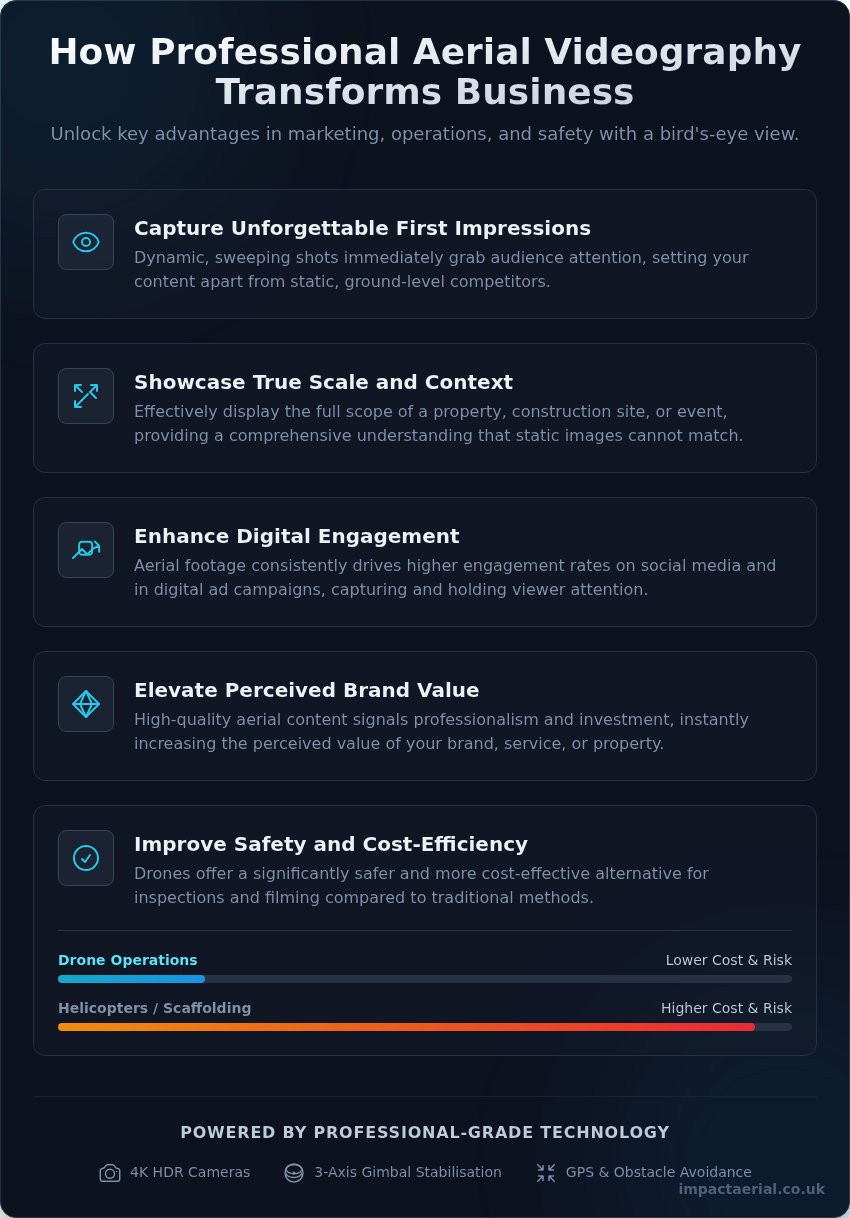
  • Capture Unforgettable First Impressions: Dynamic, sweeping shots immediately grab audience attention, setting your content apart from ground-level competitors.
  • Showcase True Scale and Context: Effectively display the full scope of a commercial property, construction site, or event location, providing viewers with a comprehensive understanding that static images cannot match.
  • Enhance Digital Engagement: Video content, particularly aerial footage, consistently drives higher engagement rates on social media platforms and in digital advertising campaigns.
  • Elevate Perceived Brand Value: High-quality aerial content signals professionalism, investment, and a commitment to quality, instantly increasing the perceived value of your brand, service, or property listing.
  • Improve Safety and Cost-Efficiency: Drones offer a significantly more cost-effective and safer alternative to hiring helicopters or erecting scaffolding for inspections and filming, often saving thousands of pounds and reducing operational risk.

Elevating Your Marketing and Storytelling

In marketing, a compelling narrative is everything. Aerial footage provides the ultimate establishing shot, creating an epic, cinematic feel that draws viewers into your brand story. Whether used on your website’s homepage, in a targeted social media ad, or as part of a corporate video, these dynamic visuals demonstrate your product or service in its real-world environment, building trust and conveying a powerful sense of scale and ambition.

Improving Operational Insight and Safety

From a practical standpoint, aerial videography provides critical data-gathering capabilities. Construction project managers can monitor progress and identify potential issues across a vast site without extensive foot patrols. For asset management, inspecting hard-to-reach infrastructure like rooftops, turbines, or mobile towers can be done safely from the ground. This approach not only protects personnel but also ensures compliance with CAA regulations. Understanding How to Choose a Professional is paramount, as a certified pilot brings an essential layer of risk management and technical expertise to every operation, delivering clear visual data for stakeholders.

Key Industries & Applications: Putting Aerial Video to Work

The strategic application of professional aerial videography extends far beyond simple, scenic flyovers. It has become a powerful data-gathering and marketing tool, providing unique perspectives that drive efficiency, engagement, and sales. For any business looking to showcase scale, context, or progress, deploying a CAA GVC Certified operator delivers a tangible return on investment. Below, we explore key sectors where these high-quality services are making a significant impact.

Real Estate & Commercial Property

For property professionals, perspective is everything. Aerial footage provides the ultimate context, showcasing not just the building, but its relationship to the surrounding environment, transport links, and local amenities. This approach transforms standard property listings into compelling, cinematic experiences that capture buyer interest immediately.

  • Cinematic Property Tours: Create immersive videos that guide viewers from a sweeping overview of the location down to a detailed look at the grounds and exterior features.
  • Land & Development Sites: Clearly display the full scale of large land plots, highlighting boundaries, topography, and potential for development in a single, comprehensive view.
  • Hospitality Marketing: Produce breath-taking promotional content for hotels, resorts, and wedding venues that highlights their stunning location and extensive facilities.

Construction, Engineering & Surveying

On active and complex sites, safety and accuracy are paramount. Drones offer a safe and efficient method for monitoring progress, conducting inspections, and creating as-built records without putting personnel at risk. The complexity of operating in these environments underscores the need for strict adherence to safety protocols. These are governed in the UK by the CAA, but the principles of safe flight planning are universal. For instance, a look at the Official Drone Regulations from a leading US authority shows a similar global emphasis on operational safety and professionalism.

  • Project Progress Monitoring: Document project milestones with weekly or monthly flights, providing clear, visual updates for stakeholders and investors.
  • As-Built Records: Generate high-resolution video records of a completed project for client handover, training, and archival purposes.
  • Visual Asset Inspections: Safely inspect tall structures like towers, turbines, and building facades, identifying potential issues without the need for costly scaffolding.

Events, Tourism & Advertising

When it comes to creating high-impact visual content, aerial videography is unparalleled. It captures the energy and scale of live events or the beauty of a tourist destination in a way that ground-based cameras simply cannot. This dynamic footage is essential for creating marketing campaigns that stand out and leave a lasting impression on the audience.

  • Event Coverage: Capture the vibrant atmosphere of festivals, concerts, and sporting events from unique angles, creating dynamic after-movies and promotional material.
  • Tourism Promotion: Develop stunning promotional videos for local councils and tourist boards, showcasing landmarks, coastlines, and landscapes to attract visitors.
  • Brand Campaigns: Integrate powerful aerial shots into television commercials and digital ad campaigns to create a premium, high-budget feel that elevates brand perception.

The Professional Process: From Initial Brief to Final Film

Achieving breath-taking results with aerial videography is not a matter of chance; it is the outcome of a meticulous, safety-driven process. A professional service involves far more than simply arriving on-site and launching a drone. To provide our clients with complete peace of mind and top-quality results, we follow a structured workflow that ensures every project is executed safely, legally, and to the highest creative standard. Understanding this process helps you know exactly what to expect when you partner with us.

Step 1: Consultation and Pre-Flight Planning

Every successful project begins with a detailed consultation. We work closely with you to understand your vision, key objectives, and the specific shots required to tell your story. This brief informs our comprehensive pre-flight planning, which includes:

  • Desktop Surveys & Risk Assessments: We meticulously analyse the proposed location for potential hazards, obstacles, and public access points.
  • Airspace Checks: Our team verifies all airspace classifications and restrictions, ensuring full compliance with Civil Aviation Authority (CAA) regulations.
  • Permission & Authorisation: If required, we handle the application process for any necessary flight authorisations from air traffic control or landowners.

Step 2: The On-Site Filming Day

On the day of the shoot, safety remains our highest priority. Our CAA GVC certified pilot conducts thorough on-site safety checks, establishes a secure take-off and landing area, and briefs all personnel. We then execute the pre-planned flight paths and camera movements, working efficiently to capture the required footage. We maintain open communication with you on-site, allowing for real-time feedback to ensure the final shots perfectly align with your vision.

Step 3: Post-Production and Delivery

Capturing the footage is only half the journey. In the post-production phase, our editors transform the raw clips into a polished, compelling narrative. This includes selecting the best takes, applying professional colour grading for a cinematic look, and integrating licensed music, motion graphics, and your company branding. The final film is then delivered to you in the optimised formats required for your website, social media channels, or presentations.

Our structured approach to aerial videography ensures a seamless experience from concept to completion. To discuss your project and our meticulous process, contact our team today.

How to Choose a Professional Aerial Videography Provider

Selecting the right partner for your project is the most critical step in achieving a high-quality, legally compliant final product. The UK drone market is expanding, but not all operators adhere to the same professional standards. Using an unqualified or uninsured pilot exposes your business to significant legal and financial risk. A true professional delivers not only stunning visuals but also complete operational integrity.

To ensure you make an informed decision, use this checklist to vet any potential provider.

Essential: CAA Certification and Insurance

This is the absolute non-negotiable foundation of professional drone work in the UK. Before any discussion of creative concepts, you must verify the operator’s credentials. A commercial operator must hold a valid General Visual Line of Sight Certificate (GVC) issued by the Civil Aviation Authority (CAA). Furthermore, they must have adequate commercial liability insurance, typically for a minimum of £5 million. This protects you and your property from any liability in the unlikely event of an incident, offering essential peace of mind.

Evaluate Their Portfolio and Equipment

An operator’s showreel is their visual CV. When reviewing their portfolio, look beyond just the “wow” factor. Assess the technical quality: are the shots smooth and stable? Is the composition thoughtful and cinematic? Does their previous work align with the professional standard your brand requires? Also, inquire about their equipment. A commitment to using professional-grade drones, such as those from the DJI Enterprise series, indicates a serious investment in delivering top-quality, reliable results for their clients.

Assess Their Professionalism and Communication

The quality of your final aerial videography often reflects the quality of the planning process. A professional operator will act as a consultant, asking detailed questions about your project goals, the location, and potential airspace restrictions. Their communication should be clear, prompt, and transparent. They should be able to articulate a clear operational process, including pre-flight surveys, risk assessments, and flight planning. This meticulous approach is the hallmark of a seasoned and reliable specialist.

A provider who confidently meets these criteria demonstrates a deep commitment to safety, quality, and client success. See how Impact Aerial meets every professional standard.

Elevate Your Project with Professional Aerial Videography

As we’ve explored, aerial videography is far more than simply flying a drone; it is a powerful cinematic tool that delivers unparalleled perspectives and tangible business benefits. From transforming commercial property marketing to providing critical data for inspections, the applications are vast. The key to unlocking this potential lies in partnering with a provider who prioritises technical expertise, creative vision, and, above all, operational safety and regulatory compliance.

At Impact Aerial, we bring this professional standard to every project. Our pilots are CAA GVC Certified & Approved, and for your complete peace of mind, all operations are covered by £5m in commercial liability insurance. By utilising cutting-edge 4K HDR DJI Enterprise drones, we ensure the final result is not only visually stunning but also captured with the utmost precision and safety.

If you are ready to showcase your business or project from a breath-taking new angle, we are here to help. Request a professional aerial videography quote today and discover the impact of a higher perspective.

Frequently Asked Questions About Aerial Videography

How much does aerial videography cost in the UK?

The cost of professional aerial videography varies depending on project complexity, location, and the equipment required. A straightforward half-day shoot may start from £400-£600, while larger projects involving extensive risk assessments or multiple locations can cost £1,500 or more. Factors influencing the final price include the level of pre-production planning, post-production editing, and the specific operational permissions needed. We always provide a detailed, bespoke quote based on your unique requirements.

Is it legal to fly a drone anywhere for commercial filming?

No, it is not legal to fly a drone anywhere for commercial purposes. All flights are strictly regulated by the Civil Aviation Authority (CAA) in the UK. Operations are restricted near airports, crowds of people, and sensitive infrastructure. As fully qualified and insured operators holding a CAA General Visual Line of Sight Certificate (GVC), we conduct thorough pre-flight surveys and risk assessments to ensure every operation is conducted safely, legally, and with the correct permissions.

What happens if the weather is bad on the day of the shoot?

Client satisfaction and operational safety are our highest priorities. We do not operate our drones in unsafe weather conditions such as high winds or heavy rain. We diligently monitor the forecast leading up to a scheduled shoot and will communicate with you if conditions look unfavourable. If a shoot must be postponed due to weather, we will reschedule for the next suitable date at no additional cost, ensuring we capture top-quality footage in safe conditions.

How long does a typical aerial videography project take from start to finish?

A typical project timeline ranges from one to three weeks. This encompasses the initial consultation, detailed pre-flight planning and risk assessment (which can take several days), the on-site filming (usually a half or full day), and post-production editing. More complex aerial videography projects that require advanced permissions or extensive editing will have a longer lead time. We establish a clear timeline with you at the start of every project to manage expectations effectively.

What video resolution and format will I receive the final files in?

We provide high-quality, professional-grade video files suitable for a range of applications. Our standard delivery is in 4K Ultra HD (3840×2160 pixels), which offers outstanding clarity and flexibility for post-production. We can also provide footage in other resolutions, such as 1080p Full HD. Final files are typically exported in a versatile MP4 (H.264 or H.265) format, ensuring compatibility across websites, social media platforms, and corporate presentations.

Can you fly drones indoors or close to buildings?

Yes, we are fully equipped and qualified to conduct flights both indoors and in close proximity to buildings. These operations require meticulous planning, a detailed on-site survey, and a specific risk assessment to ensure maximum safety. Our experienced pilots use specialised equipment and advanced flight techniques to navigate complex environments, capturing breath-taking perspectives of architectural details or internal spaces while adhering to strict safety protocols at all times.

What is an A2 CofC? A Simple Guide to the UK Drone Qualification

Navigating the world of UK drone regulations can often feel like deciphering a complex code. With acronyms like GVC, Open Category, and various subcategories, it’s easy to feel uncertain about what is legally required for a commercial drone operation. One of the most significant qualifications within this framework is the a2 cofc, or A2 Certificate of Competency. Understanding its place is fundamental for anyone looking to fly drones or hire a professional pilot for their project.

This simple guide is designed to provide clarity and professional assurance. We will break down exactly what the A2 CofC is, the specific operational advantages it grants a pilot, and how it differs from other Civil Aviation Authority (CAA) qualifications. By the end, you will be equipped with the knowledge to ensure any drone work you commission is not only high-quality but, most importantly, fully legal, insured, and conducted with the utmost safety.

What Exactly is the A2 CofC? A Plain English Explanation

Navigating the world of drone qualifications can seem complex, but understanding the key certifications is crucial for any professional or hobbyist pilot. At its core, the A2 CofC stands for the ‘A2 Certificate of Competency’. It is a key drone qualification issued by the UK’s Civil Aviation Authority (CAA) that sits a step above the mandatory, basic Drone and Model Aircraft Registration and Education Service (DMARES) requirements, which include the Flyer ID.

To provide a practical overview of what the qualification entails, this video offers an excellent first-hand account of the journey:

Holding an A2 CofC grants you greater operational freedom, specifically allowing you to fly closer to uninvolved people, albeit with strict limitations that we will cover later. This qualification operates within a specific regulatory framework known as the ‘Open Category’, which is designed to manage low-risk drone flights across the UK and Europe.

Understanding the UK’s ‘Open Category’ for Drones

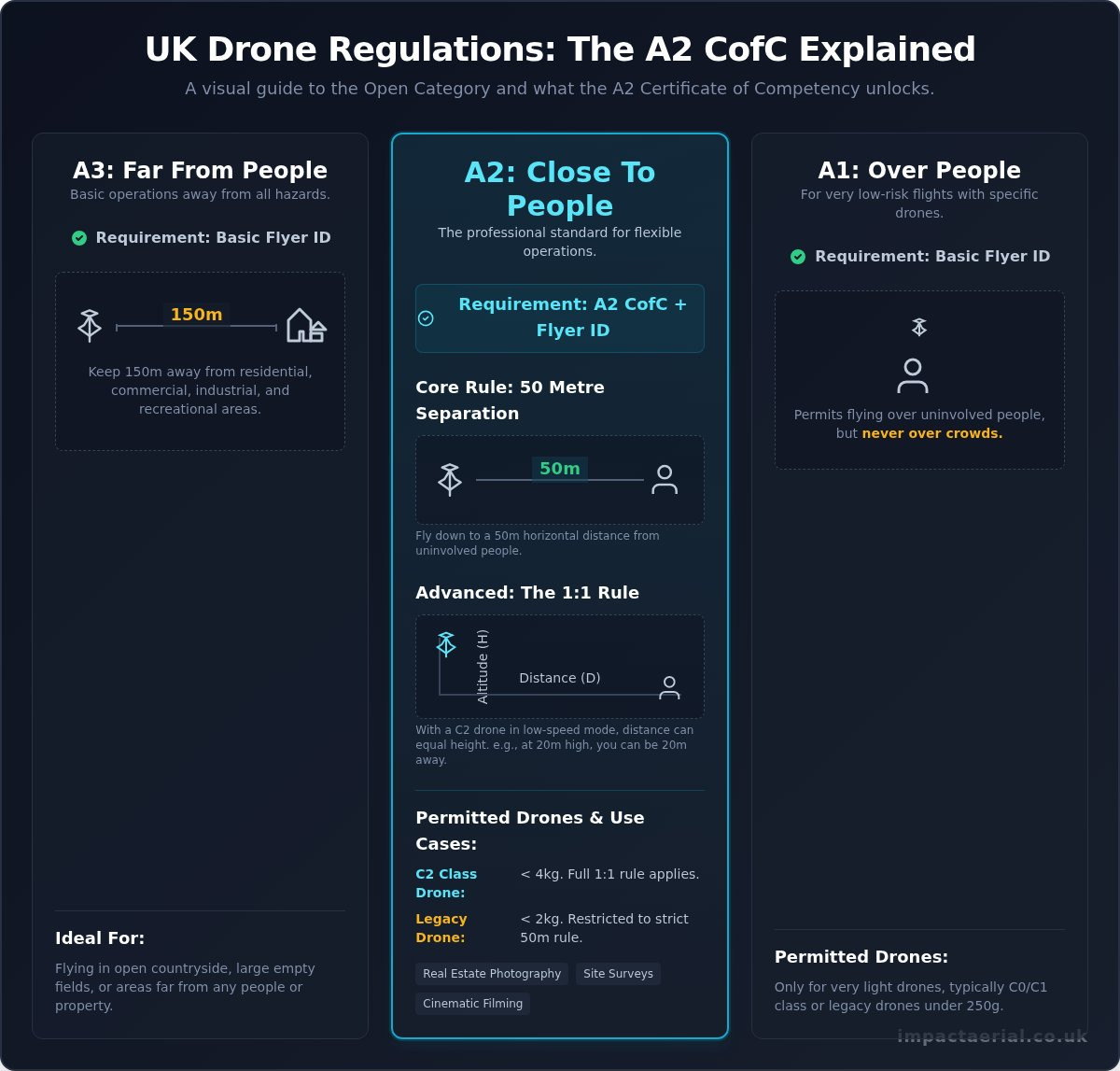
The Open Category is the foundation for most recreational and straightforward commercial drone operations. It is divided into three subcategories based on the level of risk involved. Think of it like driving licence categories, where different licences permit you to operate different types of vehicles. The overall framework is defined by comprehensive UK drone regulations, but the subcategories are:

  • A1: Flying over people (only with very light, specific drones).
  • A2: Flying close to people. This is the subcategory where the A2 CofC is required.
  • A3: Flying far from people and built-up areas.

A2 CofC vs. Flyer ID: What’s the Difference?

It is essential to distinguish between the Flyer ID and the A2 CofC. The Flyer ID is a mandatory, foundational requirement for anyone flying a drone weighing 250g or more in the UK. It is obtained by passing a simple online theory test covering basic safety rules. In contrast, the a2 cofc is an additional, optional qualification. Achieving it requires passing a more rigorous, formal examination with a CAA-approved entity, demonstrating a much deeper understanding of meteorology, flight performance, and operational risk management. This higher level of knowledge is what unlocks the privilege of operating with more freedom in the A2 subcategory.

What Can You Actually Do with an A2 CofC?

Holding an A2 Certificate of Competency, often referred to as the a2 cofc, fundamentally changes where and how you can operate your drone in the UK. Its primary benefit is granting you the permission to fly closer to uninvolved people than is permitted in the A3 (Open) subcategory, unlocking a wider range of commercial and recreational opportunities. This qualification, as detailed by the Civil Aviation Authority, is a crucial step for any pilot looking to operate with greater flexibility while maintaining full compliance with UK regulations. It signifies a higher level of theoretical knowledge, particularly concerning meteorology, drone performance, and mitigating ground risk.

Flying Closer to People: The 50-Metre Rule Explained

The core advantage of the A2 CofC is the reduction in separation distances. With this certificate, you can fly down to a horizontal distance of 50 metres from uninvolved people. It is critical to understand that you must never intentionally fly directly over them. Furthermore, if your C2-class drone is in a designated low-speed mode, you can get even closer using the ‘1:1 rule’. This allows you to reduce the horizontal separation distance to be equal to the drone’s height. For example, if you are flying at 15 metres high, you only need to be 15 metres away horizontally. This is a significant operational advantage compared to the A3 subcategory, which requires staying 150 metres away from residential, commercial, and industrial areas.

Drone Classes and Your A2 CofC

The permissions granted by your A2 CofC are directly linked to the class of drone you are flying. This certificate primarily applies to operations with C2 class drones, which have a maximum take-off mass of under 4kg. Popular examples include the DJI Mavic 3 series and the DJI Air 3. For pilots operating older drones without a C-class marking (known as ‘legacy’ drones), transitional rules apply. An A2 CofC holder can fly a legacy drone weighing up to 2kg, but must maintain a strict 50-metre horizontal separation from uninvolved people at all times; the 1:1 rule does not apply in this case. Always verify your drone’s classification before any flight to ensure compliant operations.

Practical Scenarios for A2 CofC Operations

These enhanced permissions open up numerous professional applications in lower-risk environments where maintaining a 150-metre buffer is impractical. Common scenarios include:

  • Real Estate Photography: Safely capturing high-quality images of a property in a suburban area, maintaining the required 50-metre distance from neighbouring houses and gardens.
  • Commercial Site Surveys: Conducting detailed inspections or creating photogrammetry models of a small commercial building or industrial unit where staff or the public may be nearby, but not within the immediate operational area.
  • Cinematic Filming: Flying in a park or on private land to capture establishing shots for a film or corporate video, where you can manage a 50-metre buffer from any members of the public.

The A2 CofC Exam and Training Process

Achieving your A2 Certificate of Competency is a structured and highly valuable process designed to elevate your drone piloting from a hobbyist level to a recognised standard of competence. The entire qualification, from training to examination, is delivered by Civil Aviation Authority (CAA) approved organisations known as Recognised Assessment Entities (RAEs). This ensures that every pilot holding an a2 cofc has met a consistent, high standard of theoretical knowledge and practical awareness.

The process is far more accessible than many assume and is broken down into two core components: a theoretical examination and a period of self-guided practical flight training. Upon successful completion, the certificate is valid for a period of five years, providing a long-term qualification for your operations.

What’s on the Theory Exam?

The theoretical exam is the cornerstone of the A2 CofC qualification. It is designed to ensure you have a robust understanding of the principles that govern safe flight, building upon the foundational knowledge outlined in The Drone and Model Aircraft Code. The exam is typically conducted online and consists of a minimum of 30 multiple-choice questions. Key syllabus topics include:

  • Meteorology: Understanding how weather conditions like wind, visibility, and precipitation affect drone flight.
  • UAS Flight Performance: A technical look at how a drone operates, including battery life, payload effects, and turning circles.
  • Mitigating Ground Risk: Assessing and managing risks to people and property on the ground, a critical skill for flying closer to uninvolved persons.

Self-Certified Practical Flight Training

One of the most distinct features of the A2 CofC process is the absence of a formal, in-person flight test with an examiner. Instead, candidates undertake a period of self-certified practical flight training. This means you are responsible for completing a set amount of flying practice in conditions that are representative of how you will operate under the A2 CofC.

Once you have completed this practical element and are confident in your abilities, you simply make a formal declaration to your RAE. This approach is designed to build genuine piloting skill and confidence, ensuring you have the hands-on experience needed to operate safely and effectively before you begin to utilise the privileges of the certificate.

A2 CofC vs. GVC: Which Qualification is for Professionals?

While the A2 CofC is an excellent qualification for skilled hobbyists and those undertaking very simple commercial work, its operational limits are important to understand. For professional pilots conducting complex commercial operations in the UK, the next level of certification is the General VLOS Certificate (GVC). The GVC is the key that unlocks the ability to operate in the ‘Specific Category’, which is where the vast majority of professional drone services take place.

Key Differences in Flying Permissions

The fundamental distinction between the two qualifications lies in the permissions they grant. An A2 CofC authorises a pilot to fly strictly within the rules of the Open A2 subcategory. The GVC, however, does not grant permissions directly; instead, it demonstrates a level of pilot competency that allows the holder to apply to the Civil Aviation Authority (CAA) for an Operational Authorisation. This authorisation provides bespoke permissions for flights that fall outside the standard rules, such as flying closer to buildings or people for a detailed structural inspection in a built-up area.

When is an A2 CofC Not Enough?

The limitations of an A2 CofC quickly become apparent when planning more demanding commercial projects. A GVC and an Operational Authorisation become essential for any operation that involves:

  • Flying in congested urban areas, like city centre roof surveys or construction site monitoring.
  • Operating closer than 50 metres horizontally to uninvolved people, a common requirement for detailed asset inspection.
  • Conducting specialised flights that require specific CAA permissions due to the nature of the task or the weight of the drone.

In these scenarios, relying solely on Open Category permissions would be both operationally restrictive and non-compliant.

Why Impact Aerial Operates with a GVC

At Impact Aerial, our pilots hold the GVC because it is the undisputed UK industry standard for professional drone services. This qualification is far more than a certificate; it demonstrates a deep, tested understanding of operational procedures, meticulous risk assessment, and robust safety protocols. It is the benchmark for competence and professionalism in the commercial drone sector.

For our clients, this provides complete peace of mind. It is an assurance that every operation is meticulously planned, fully compliant with CAA regulations, and backed by comprehensive commercial insurance. When precision, safety, and legality are paramount, there is no substitute for a GVC-qualified team. Trust our GVC-certified pilots for your project.

Hiring a Drone Pilot: Why Qualifications Matter

Understanding drone regulations is crucial not just for pilots, but also for clients commissioning aerial work. When you hire a drone service, you are also taking on a degree of responsibility for the operation. Pilot qualifications, from the foundational A2 CofC to the more advanced GVC, are not just certificates; they are your assurance of a pilot’s commitment to safety, legal compliance, and professionalism. Choosing a qualified operator is the single most important step in protecting your business and ensuring a high-quality result.

The Risks of Unqualified Operators

Engaging an unqualified or uninsured drone pilot exposes your business to significant and unnecessary risks. The potential cost savings are minuscule compared to the potential liabilities, which can include:

  • Invalid Insurance: If an operator lacks the correct commercial insurance, any accident or damage becomes your liability. Standard business insurance policies will not cover illegal drone flights, leaving you financially exposed.
  • Increased Accident Risk: A qualified pilot is trained in risk assessment and emergency procedures. An amateur is far more likely to cause property damage or, in the worst case, serious injury.
  • CAA Fines and Penalties: The Civil Aviation Authority (CAA) can impose significant fines for illegal commercial drone operations, which can apply to the person who commissioned the flight as well as the pilot.
  • Poor Quality Results: Professionalism goes beyond flying. It includes understanding client briefs, capturing high-quality data, and delivering a polished final product. An unqualified operator often lacks the experience to deliver on these fronts.

Checklist for Hiring a Drone Company

For your peace of mind, always verify a potential drone provider’s credentials before work begins. A professional company will expect these questions and have the answers ready. Here is a simple checklist to follow:

  • Do they hold a CAA Operational Authorisation? While an A2 CofC is an important pilot competency, most commercial work requires the operator to hold a General VLOS Certificate (GVC) and operate under a company-wide Operational Authorisation from the CAA.
  • Can they provide proof of insurance? Ask to see a current certificate of commercial drone insurance. This should show a minimum of £1 million in public liability coverage.
  • Do they have a robust safety process? A professional will always conduct detailed pre-flight site surveys and produce a comprehensive risk assessment and method statement (RAMS) for the specific operation.
  • Can they show a portfolio? Ask to see examples of their previous work to ensure their skills and quality align with your project’s requirements.

At Impact Aerial, we believe in complete transparency. We provide all our credentials upfront, ensuring every operation is safe, legal, and fully insured. To discuss your project with a fully qualified and CAA-authorised team, please contact us today.

Understanding the UK’s drone regulations is the first step towards safe and effective flight. As we’ve explored, the a2 cofc is an excellent qualification that grants greater flying freedom for hobbyists and some basic commercial work. However, the key takeaway is recognising the clear distinction between this certificate and the more comprehensive GVC, which is the standard for professional, high-risk commercial operations.

When your project demands precision, safety, and regulatory compliance, hiring a proven expert is non-negotiable. At Impact Aerial, our specialists in commercial drone surveys and filming provide exactly that. Our pilots hold the advanced CAA GVC certification, and for your complete peace of mind, every operation is covered by £5m in commercial liability insurance. We manage the complexities so you can focus on the outstanding data and visuals.

Ready to see the difference a qualified professional makes? Discuss your project with our fully-certified drone professionals.

Frequently Asked Questions About the A2 CofC

How much does an A2 CofC course cost in the UK?

The cost of an A2 CofC course in the UK typically ranges from £99 to £150. Prices vary between different CAA-approved Recognised Assessment Entities (RAEs), so it is advisable to compare providers. This fee generally covers access to online learning materials and the final theoretical examination. Always ensure the provider is officially recognised by the Civil Aviation Authority to guarantee your qualification is valid for professional and recreational drone operations within the UK.

How long is the A2 CofC certificate valid for?

An A2 Certificate of Competency (A2 CofC) is valid for a period of five years from the date of issue. This fixed duration ensures that pilots remain familiar with the latest aviation regulations and best practices for safe drone operation. Once the five-year period concludes, the pilot must undergo a renewal process to continue exercising the privileges granted by the certificate and maintain their legal status to fly in the A2 subcategory of the Open Category.

Can I fly commercially with just an A2 CofC?

Yes, you can conduct commercial drone operations with just an A2 CofC, provided your flights fall within the A2 subcategory of the Open Category. This allows for flights with C2-class drones closer to people than is permitted in the A3 subcategory. However, for more complex operations that require permissions beyond the scope of the Open Category, such as flying in restricted airspace, a General VLOS Certificate (GVC) and an Operational Authorisation from the CAA are required.

Do I need to renew my A2 CofC, and what does it involve?

Yes, renewal is mandatory every five years to keep your qualification current. The renewal process for your A2 CofC typically involves retaking the theoretical examination with a CAA-approved training provider. This ensures your knowledge of air law, meteorology, and operational procedures remains up-to-date with any regulatory changes. Some providers may offer a shorter refresher course before the exam, but passing the test is the essential component for successful recertification.

What happens if I fly a C2 drone without an A2 CofC?

Flying a C2-class drone in the A2 subcategory without a valid A2 Certificate of Competency is a serious breach of Civil Aviation Authority (CAA) regulations. The potential consequences are significant and can include substantial fines, criminal prosecution, and the seizure of your drone equipment. Furthermore, any commercial liability insurance you hold would likely be invalidated in the event of an incident, leaving you personally liable for any damages or injuries caused during the illegal flight.

Is the A2 CofC recognised outside of the UK?

The A2 CofC is issued by the UK Civil Aviation Authority (CAA) and is therefore fully valid for drone operations within the United Kingdom. While it is not a global qualification, it is currently recognised across all European Union Aviation Safety Agency (EASA) member states. This means you can use your UK-issued certificate to fly under the same A2 subcategory conditions in EU countries, Norway, Iceland, Liechtenstein, and Switzerland, providing valuable flexibility for cross-border operations.