Chimney Inspection with Drone Cost: 2026 UK Pricing & Buying Guide

Spending £1,250 on scaffolding just to identify a single loose chimney pot is an unnecessary expense that savvy UK property owners no longer accept. You probably recognize that traditional inspections are not only slow but also introduce avoidable safety risks to your site and personnel. It’s frustrating to pay more for the access equipment than for the actual repair work itself. Understanding the current chimney inspection with drone cost is the first step toward a more efficient, data-driven maintenance strategy for 2026.

For added peace of mind, our CAA GVC certified pilots provide a safe, non-intrusive alternative that delivers high-resolution 4K results without the need for ladders. You’ll discover the true costs of professional drone surveys in the UK and how to ensure your contractor is fully compliant to protect your insurance liability. We’ll examine the latest pricing structures, the technical benefits of HDR imaging, and the specific safety protocols that keep your project on schedule and significantly under budget.

Key Takeaways

  • Learn how to significantly reduce property maintenance expenses by opting for aerial surveys, which typically cost between £150 and £350 compared to traditional scaffolding.
  • Understand the specific variables that influence a chimney inspection with drone cost, including regional airspace complexity and the number of stacks requiring assessment.
  • Discover why CAA GVC certification and commercial liability insurance are non-negotiable requirements for ensuring your survey is legally compliant and provides added peace of mind.
  • Identify the critical technical standards, such as 4K high-resolution imagery, needed to produce insurance-grade reports that accurately document structural integrity.
  • Gain insight into the professional workflow of a drone survey, from the initial meticulous desktop airspace study to the final on-site risk assessment and data capture.

Chimney Inspection with Drone Cost: Scaffolding vs Aerial Surveys

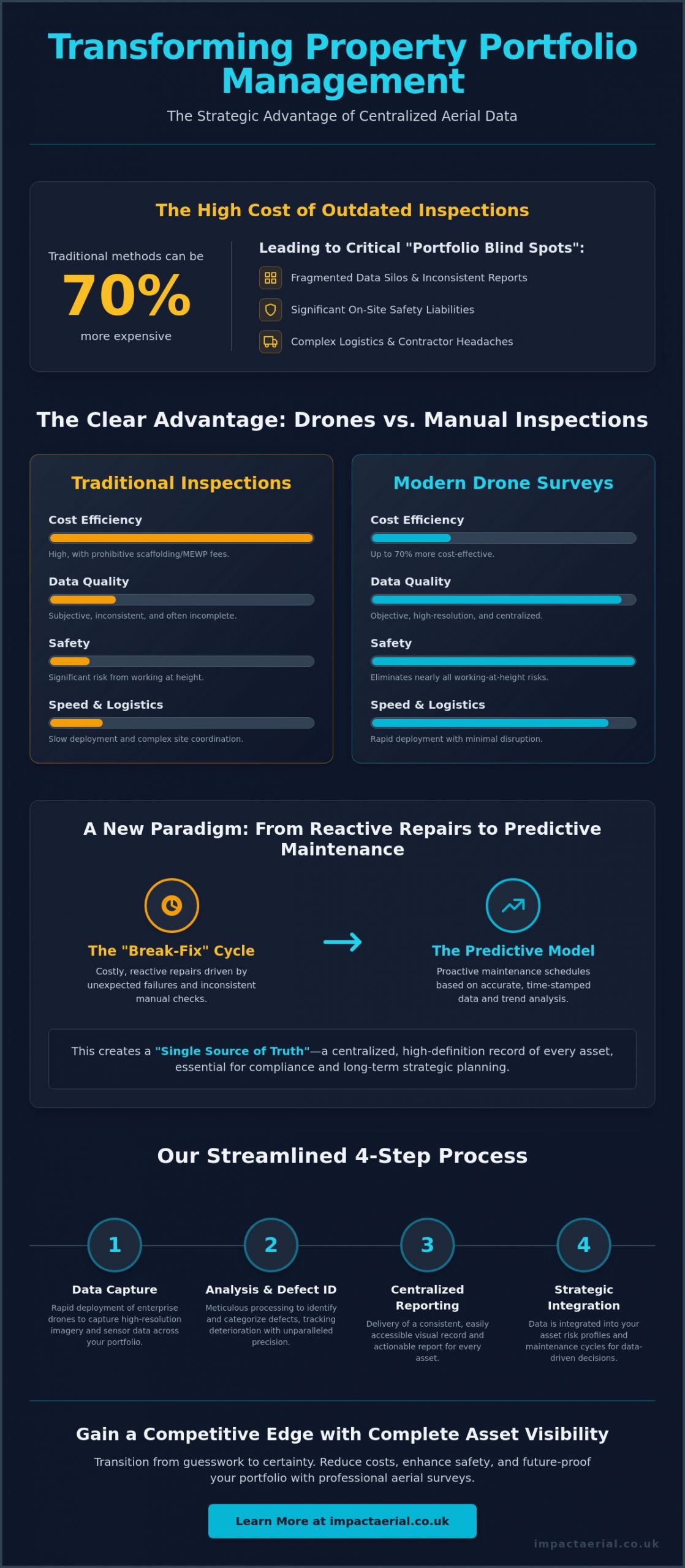
By 2026, the UK property maintenance industry has fully embraced digital transformation. For most homeowners and commercial managers, the chimney inspection with drone cost is the primary factor driving this shift. While traditional methods involve significant logistical hurdles, drone surveys offer a streamlined, data-driven alternative. You can expect to pay between £150 and £350 for a professional drone survey. In contrast, scaffolding costs frequently start at £500 and can escalate to £2,000 for complex residential properties.

Safety remains the most critical benefit for both the surveyor and the resident. By utilising an unmanned aerial vehicle (UAV), technical teams stay firmly on the ground. This removes the "work at height" risk entirely, which is a major concern for Health and Safety Executive (HSE) compliance. A drone survey is usually completed within 60 to 120 minutes. Scaffolding requires days of assembly and dismantling; it often blocks access to your property for an entire week.

To better understand this concept, watch this helpful video:

Traditional Scaffolding Costs in the UK

Scaffolding is often a disproportionate response for a simple visual check. Beyond the base hire fee, you must account for labour costs and pavement licenses. These licenses often add £100 to £150 to the bill in urban areas. There’s also a 12% to 15% risk of accidental damage to roof tiles from heavy poles and boards. For a preliminary chimney inspection with drone cost analysis, these traditional expenses are often considered overkill.

The Drone Advantage: Speed and Accessibility

Modern UAVs provide a level of detail that a person on a ladder cannot match. High-resolution 4K sensors capture 360-degree views of the chimney pot, flaunching, and masonry without any physical contact. This is vital for heritage buildings where preserving structural integrity is paramount. Electric drones also reduce the carbon footprint of your maintenance project. They require no heavy transport vehicles for equipment delivery, making them a much cleaner choice for the environment.

  • Drone Survey Cost: £150 – £350
  • Scaffolding Cost: £500 – £2,000+
  • Time to Site: 1-2 hours for drones; 2-3 days for scaffolding
  • Risk Factor: Zero “work at height” risk with UAVs

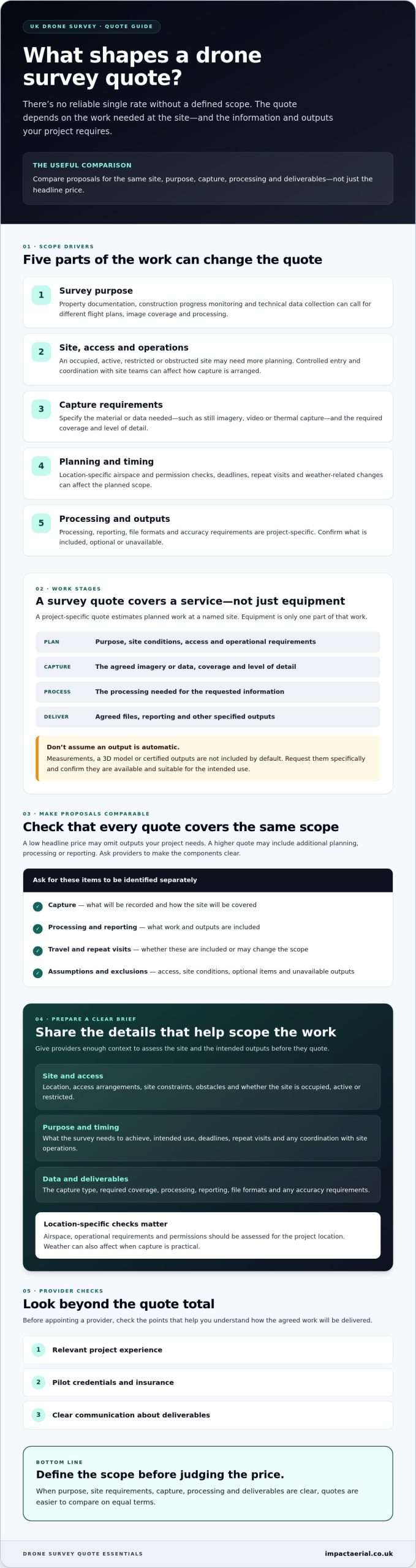
Key Factors Influencing Drone Chimney Survey Prices

Professional operators don’t pluck prices from thin air. The total chimney inspection with drone cost depends on several technical and operational variables. A single-stack domestic property in a rural village requires significantly less preparation than a multi-flue industrial site in central London. Most leading UK operators adopt a “per stack” pricing model because it’s the most transparent way to account for the time spent on-site and the volume of data captured.

Safety is the primary driver of cost. Every commercial flight requires a bespoke Risk Assessment and Method Statement (RAMS). In complex environments, this planning phase can take 2 to 4 hours before the drone even leaves the van. This meticulous approach ensures that all UK drone regulations are met, providing the client with peace of mind that the survey is fully legal and insured.

  • Reporting Depth: A basic transfer of raw JPG files is cheaper than a comprehensive technical PDF report that highlights specific defects with annotated imagery.
  • Volume Discounts: While the first stack carries the highest cost due to travel and set-up, subsequent stacks on the same roof often see a 40% reduction in price.
  • Insurance Requirements: Standard £5 million public liability is common, but some industrial sites require £10 million, which can slightly nudge the premium of the service.

Urban vs Rural Survey Considerations

Location dictates the complexity of the flight. Conducting a survey in congested urban centres like Birmingham or London often triggers the need for additional ground spotters to manage public footfall. If the chimney is adjacent to a busy pavement, the operator might need to deploy physical cordons or signage. Flight restrictions and No Fly Zones (NFZs) also play a role. Obtaining a flight waiver for restricted airspace can take up to 21 days and adds an administrative layer to the chimney inspection with drone cost. For projects in these challenging environments, professional drone services provide the necessary expertise to manage legal compliance effectively.

Equipment Grades and Tech Specs

The hardware used directly impacts the quality of the findings. While consumer drones are capable, they often lack the sensor size needed for granular detail. Impact Aerial utilizes DJI Enterprise platforms equipped with 4K HDR sensors and high-powered zoom capabilities. These sensors allow the pilot to stay 5 to 10 metres away from the stack while still spotting hairline cracks that a standard camera would miss. If you’re investigating heat loss or damp, a thermal imaging add-on with a 640×512 resolution is essential. This specialized tech usually adds a 25% premium to the standard visual survey price but provides data that visual cameras simply can’t see.

Professional Survey vs Budget Drone: Assessing Value and Quality

Choosing a provider based solely on the lowest chimney inspection with drone cost often leads to substandard results that insurers or mortgage lenders will reject. A hobbyist with a consumer-grade drone lacks the technical training to spot structural defects like sulphate attack or failing pargeting. Professional pilots deliver survey-grade data, which differs significantly from a simple collection of aerial photos. They use DJI Enterprise hardware to capture 4K HDR imagery, ensuring every mortar joint and lead flashing detail is visible for structural analysis.

Data integrity remains a primary differentiator between amateur and professional services. Leading operators implement 30-day encrypted storage protocols and provide structured reports where every image is GPS-tagged and timestamped. This level of organisation is vital for historical building maintenance. While a budget “photo-only” service might cost 30% less, it leaves you with a disorganised folder of images that lack the context required for a formal RICS building survey.

  • Resolution: Professionals use 20MP+ sensors for sub-centimetre detail.
  • Organisation: Data is delivered in annotated PDF reports, not just raw files.
  • Safety: Professional kits include redundant battery systems and obstacle avoidance.

The Role of CAA GVC Certification

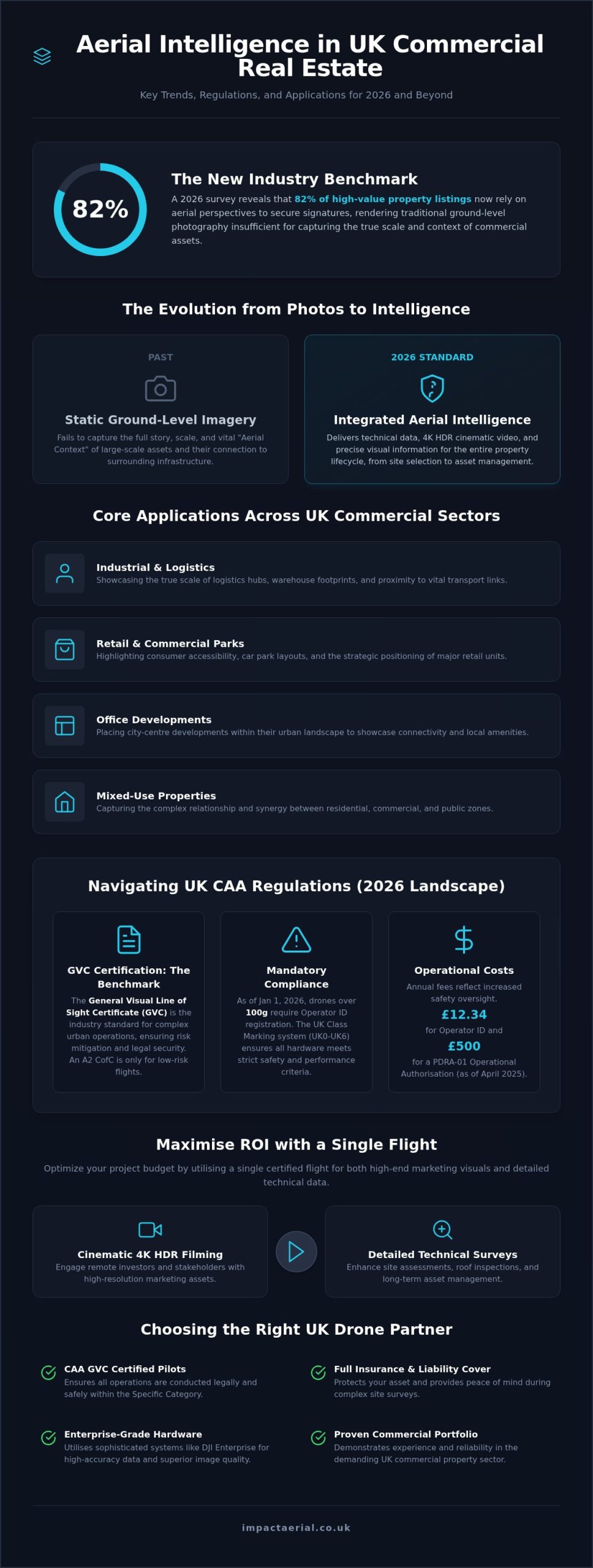
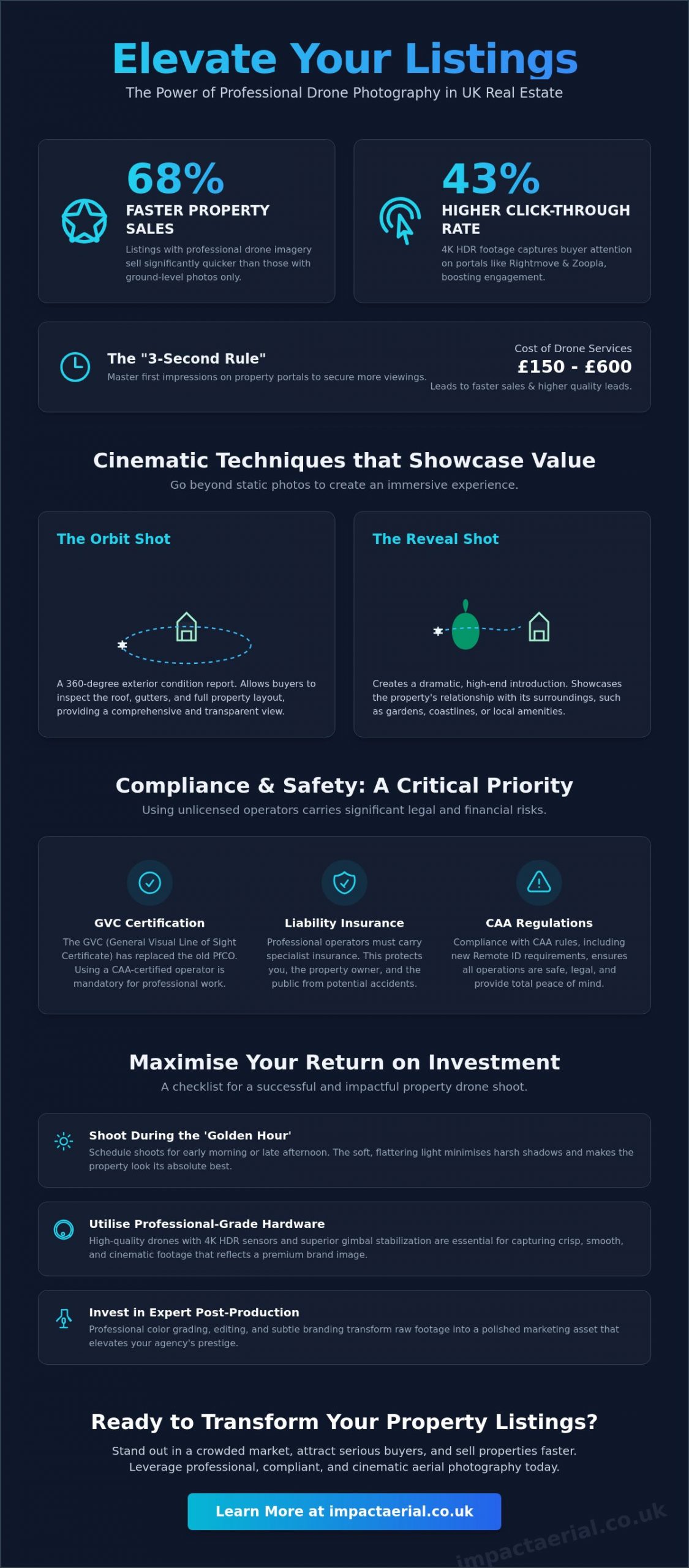
The General Visual Line of Sight Certificate (GVC) is the professional benchmark for operating drones in congested areas. It demonstrates that the pilot has passed rigorous flight assessments and understands the UK Civil Aviation Authority regulations regarding safety and privacy. You should never hire an operator who cannot produce a valid Flyer ID and Operator ID. Verifying these credentials on the Drone Safe Register ensures your chimney inspection with drone cost covers a legally compliant flight that won’t result in local authority fines.

Liability Insurance: Protecting Your Asset

Professional drone operators carry a minimum of £5m commercial liability insurance as an industry standard. This coverage is specific to aerial work; standard home or business insurance almost never covers drone-related accidents. If a technical failure causes a drone to strike a neighbouring property or a vehicle, the insurance provides total financial protection for the client. For added peace of mind, always request a copy of the provider’s insurance certificate before they arrive on-site. Commercial insurance is a mandatory legal requirement that protects property owners from the financial repercussions of unforeseen aerial accidents.

Understanding the Drone Chimney Inspection Process

Every professional survey begins long before the drone leaves the ground. Our team conducts a detailed desktop airspace study to verify flight legality under Civil Aviation Authority (CAA) regulations. We use specialized software to check for Flight Restriction Zones (FRZs) and temporary notices to airmen (NOTAMs). This step ensures that your property isn’t located in restricted airspace near airports or military installations, providing the necessary legal clearance for a safe operation.

Once on-site, the pilot performs a dynamic risk assessment. They identify local hazards like overhead power lines, high-frequency interference, or overhanging trees. Calibration follows; the pilot syncs the drone’s internal compass and IMU sensors to ensure 100% flight stability. During the flight, the aircraft captures high-detail imagery of the chimney pot, the flaunching, and the surrounding masonry. We focus heavily on the flaunching, as mortar degradation in this area causes 65% of chimney-related damp issues in UK homes.

The final stage involves post-production. We don’t just hand over a memory card. Our experts review every frame of the 4K footage to identify hairline cracks or loose bricks that aren’t visible to the naked eye. While the chimney inspection with drone cost includes the flight time, the real value is found in this technical analysis and the resulting data package.

Deliverables: What Do You Get?

Clients receive a comprehensive digital data pack. This includes 20-megapixel JPEG images captured from every cardinal direction, ensuring no side of the stack is hidden. We provide 4K video fly-arounds that offer a cinematic perspective of the entire roofline, which is vital for spotting slipped tiles near the chimney base. You’ll also receive an annotated PDF report. This document uses clear markers to highlight specific defects, making it easy to hand over to a builder for an accurate repair quote.

Weather and Scheduling Realities

Safety dictates our schedule. UK weather presents challenges, and pilots must ground aircraft if wind speeds exceed 22mph or if active precipitation occurs. Rain interferes with optical sensors and can damage sensitive internal electronics. For the most reliable results, we recommend scheduling surveys between April and September when light conditions are optimal and wind speeds are generally lower.

To prepare your property, please ensure the driveway is clear of vehicles to provide a safe take-off and landing zone. It’s also helpful to notify neighbours of the scheduled flight time. Because weather delays can impact the chimney inspection with drone cost by requiring a return visit, we monitor meteorological data 48 hours in advance to confirm your slot. This meticulous planning ensures we deliver the top-quality results Impact Aerial is known for.

For professional peace of mind and technical excellence, book your drone chimney survey with our CAA GVC certified team today.

Choosing Impact Aerial for Your Professional Chimney Survey

Impact Aerial provides specialized drone services across Birmingham, the West Midlands, and the entire UK. We don’t just fly drones; we deliver high-accuracy technical data for property owners who require precision. Our fleet utilizes the latest DJI Enterprise hardware, including high-resolution 4K HDR systems that capture 45-megapixel stills. This ensures every mortar joint, chimney pot, and lead flashing is visible in crystal-clear detail without the need for expensive scaffolding or ladders.

Safety is our absolute priority. Every pilot on our team holds a CAA GVC (General Visual Line of Sight Certificate) and adheres to strict operational manuals. For added peace of mind, we carry £5 million in commercial drone liability insurance. When you are evaluating your chimney inspection with drone cost, transparency is vital. We offer a fixed-fee structure with no hidden charges for travel within our standard service areas or for the generation of your initial data report. This professional approach ensures you know exactly what you’re paying for before the mission begins.

Our Experience with Heritage and Commercial Sites

We’ve successfully completed over 200 inspections on Grade I and Grade II Listed buildings where traditional access methods would be too invasive or physically impossible. Our team frequently collaborates with property developers and Tier 1 contractors to integrate aerial data into comprehensive maintenance plans. Our post-production service adds significant value by providing high-definition annotated imagery. This allows site managers to identify defects like masonry spalling or vegetation growth with 100% accuracy before any repair work starts, saving thousands in potential misdiagnoses.

Get Your Personalised Quote Today

Securing an accurate price for your project is a straightforward process. To receive a tailored breakdown of your chimney inspection with drone cost, please provide the following details in your enquiry:

  • The full postcode of the property to check airspace restrictions.
  • The total number of chimney stacks requiring a detailed survey.
  • Any known site hazards such as overhead power lines or nearby public highways.

Our team typically responds to new enquiries within 4 business hours with a comprehensive proposal. Contact Impact Aerial for a professional drone chimney survey quote to ensure your property remains safe and compliant throughout 2026 and beyond.

Secure Your Property with Data-Driven Aerial Insights

Choosing a modern aerial survey over traditional methods eliminates the need for expensive scaffolding, which frequently adds £600 to £1,500 to a project’s baseline. Our data shows that chimney inspection with drone cost variables depend largely on property height and location, yet they remain the most cost-effective way to obtain 4K visual proof of structural integrity. You aren’t just paying for a flight; you’re investing in high-resolution data that prevents minor leaks from becoming £5,000 roof replacements. Precision matters when it comes to identifying hairline cracks in masonry or failing lead flashing.

Impact Aerial provides the technical precision required for insurance-grade reporting. Our CAA GVC Certified Pilots operate a fleet of DJI Enterprise 4K HDR drones to capture every minute detail. For added peace of mind, we carry £5m Commercial Liability Insurance, ensuring your 2026 maintenance strategy is fully compliant with current UK safety regulations. Don’t settle for budget operators who lack the necessary credentials to protect your assets and provide professional-grade results.

Ready to assess your chimney with professional-grade technology? Request a Professional Drone Chimney Inspection Quote today. It’s the smartest way to protect your home and your budget.

Frequently Asked Questions

How much does a drone chimney inspection cost in the UK?

A standard residential chimney inspection with drone cost typically ranges between £200 and £450 in 2026. This price includes the flight, high-resolution 4K data-gathering, and a professional condition report. Costs vary based on your location; for example, a survey in London may cost 20% more than a similar project in Birmingham or the West Midlands.

Do I need to be at home during the drone chimney survey?

You don’t need to be present during the survey as long as our CAA GVC Certified pilots have clear access to the property exterior. Roughly 85% of our residential clients choose to receive their data via a secure digital link while they’re at work. We only require written permission to take off from your land to ensure 100% legal compliance.

Can a drone see inside the chimney flue?

Drones are designed to inspect the exterior masonry, pots, and cowls, but they can’t fly down the internal flue. For a full internal assessment, you’ll need a traditional CCTV flue camera. However, our DJI Enterprise drones use high-quality zoom lenses to capture detailed images of the chimney crown, identifying 90% of top-down entry issues like bird nests or cracked liners.

Is a drone chimney survey legal in a residential area?

Yes, drone surveys are entirely legal when conducted by a professional holding a CAA GVC Certification and valid commercial liability insurance. We adhere to all UK Civil Aviation Authority regulations regarding flight in congested areas. For added peace of mind, we carry £5 million in public liability insurance and perform a pre-flight risk assessment for every single residential project.

What happens if the weather is too bad for the drone to fly?

We’ll reschedule your inspection at no additional charge if wind speeds exceed 20mph or if precipitation levels are too high for safe operation. Our team monitors Met Office forecasts 24 hours before every flight to ensure conditions meet safety standards. Safety is our priority; we won’t risk your property or our equipment if the environment doesn’t allow for high-quality results.

How long does it take to receive the drone inspection report?

You’ll receive your comprehensive digital report and 4K media within 48 hours of the flight completion. This rapid turnaround allows you to address urgent maintenance issues or provide evidence to contractors quickly. Every report includes time-stamped, high-resolution images that pinpoint specific defects like mortar failure or lead flashing damage with 100% accuracy.

Can drone footage be used for insurance claims on roof damage?

Yes, 95% of UK insurance providers now accept high-definition drone imagery as primary evidence for storm damage claims. Providing clear, 20-megapixel photos of your chimney stack gives you a significant advantage when filing a claim. It’s a professional way to document the structure’s condition, giving you peace of mind that your evidence is indisputable and technically sound.

Is a drone inspection as good as a physical inspection by a surveyor?

A drone inspection is often more effective than a physical survey because it captures angles that are impossible to reach without £600 worth of scaffolding. While a drone can’t physically tap the bricks, its 4K zoom capabilities detect hairline fractures that the human eye might miss. It’s the most cost-effective way to manage your chimney inspection with drone cost while maintaining professional safety standards.

Drone Roof Survey Cost UK: A Complete 2026 Pricing Guide

Are you trying to budget for a vital roof inspection but finding the quotes confusing and the fear of hidden costs a genuine concern? When one provider quotes £250 and another over £800, it’s difficult to know what constitutes a fair price and what level of professional service you should expect for your investment. This uncertainty can make planning and decision-making a significant challenge for property managers and homeowners alike.

That is precisely why we have developed this definitive guide. Our goal is to demystify the drone roof survey cost uk 2026 pricing structure, providing you with the clarity needed to proceed with confidence. We will break down every key factor that influences the final price-from property size and access complexity to the required data detail and report format. By the end, you will understand what a fully compliant, CAA-certified operator provides, how to accurately evaluate different quotes, and how to budget for a high-quality survey that delivers true peace of mind.

Key Takeaways

  • Discover the typical 2026 price brackets for drone roof surveys, from small residential homes to large commercial properties, helping you set a realistic budget.
  • Understand the key variables that determine the final drone roof survey cost uk 2026, including property complexity, site access, and the required level of data analysis.
  • Learn what a professional survey report delivers, from high-resolution imagery and thermal data to annotated defect identification, providing actionable insights beyond simple photos.
  • Compare the all-in cost of a drone survey against traditional methods like scaffolding to see how modern technology can deliver significant savings in both time and money.

What is the Average Drone Roof Survey Cost in the UK for 2026?

In 2026, the average cost for a professional drone roof survey on a standard UK residential property is expected to range from £200 to £450. This price reflects a fully-certified and insured service utilising a sophisticated unmanned aerial vehicle (UAV) to capture high-resolution data safely and efficiently. These are not amateur prices; they represent the necessary investment in professional equipment, CAA (Civil Aviation Authority) certification, and comprehensive commercial liability insurance that guarantees a safe and compliant operation.

To see what a professional survey entails and why it’s a valuable investment, watch this helpful overview:

A standard package typically includes pre-flight risk assessments, the on-site flight operation by a qualified pilot, and the delivery of a high-resolution image and/or video gallery. However, the final drone roof survey cost uk 2026 can vary significantly based on factors such as the roof’s size and complexity, the property’s location (e.g., in congested urban areas), and the specific outputs required, such as thermal imaging or detailed written inspection reports.

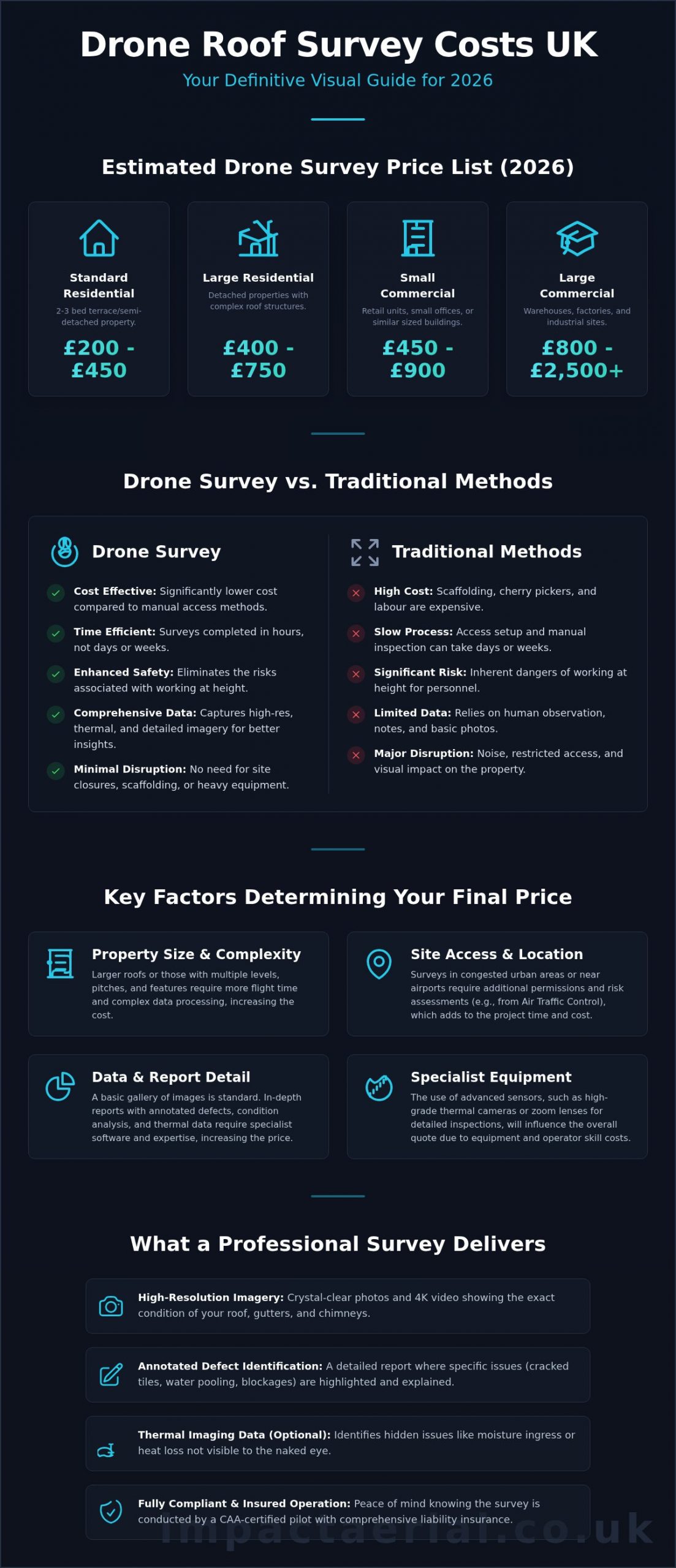
Estimated Drone Roof Survey Price List 2026

The following table provides guide prices for professional, insured drone roof surveys. These are estimates and a formal quote is always required.

Property Type Estimated Cost Range (2026)
Standard Residential Property (e.g., 2-3 bed terrace/semi) £200 – £450
Large Residential Property (e.g., detached, complex roof) £400 – £750
Small Commercial Building (e.g., retail unit, office) £450 – £900
Large Commercial / Industrial (e.g., warehouse, factory) £800 – £2,500+

Commercial vs. Residential Survey Pricing

Commercial surveys command a higher price due to significantly increased operational requirements. The process involves more extensive pre-flight planning, including detailed Risk Assessment Method Statements (RAMS) to ensure site safety and HSE compliance. Operations may be more complex, requiring coordination with multiple stakeholders or air traffic services. Furthermore, commercial clients often require more in-depth reporting, such as annotated imagery and condition analysis for asset management or insurance purposes, adding to the overall project scope and cost.

Key Factors That Determine Your Final Drone Survey Price

When you request a quote for a drone roof survey, the price you receive is not an arbitrary figure. It is a carefully calculated cost based on the unique requirements of your property and the specific data you need. Understanding these variables will help you better interpret any drone roof survey cost uk 2026 quote and appreciate the value delivered by a professional, certified operator. The final price reflects the time, technology, and expertise required to conduct a safe and effective inspection.

Property Size and Roof Complexity

The physical characteristics of your building are the primary cost driver. A vast industrial warehouse roof requires significantly more flight time and data capture than a standard semi-detached home. Beyond simple area, complexity plays a crucial role. A roof with multiple sections, steep pitches, or intricate features demands more detailed operational planning and longer post-processing times. Key complexity factors include:

  • Multiple roof levels and pitches
  • Numerous chimney stacks, dormer windows, or skylights
  • Difficult accessibility due to surrounding tall trees or power lines
  • Guttering systems that are difficult to access or view

Level of Detail & Required Deliverables

What you need the survey to produce has a direct impact on the cost. A standard package of high-resolution still images for a visual condition report is the baseline. However, more advanced data-gathering requires specialised equipment and extensive post-processing. For example, a thermal imaging survey to detect heat loss or water ingress uses a specific sensor and requires expert analysis. Likewise, creating dimensionally accurate orthomosaic maps or 3D models for architects involves sophisticated photogrammetry software and considerable processing power, adding to the final cost.

Location and Site Access

Where your property is located influences logistical costs. This includes the operator’s travel time and mileage to the site. Furthermore, operating in dense, congested urban areas like Central London or Manchester requires a more complex and detailed risk assessment and operational plan. These environments often necessitate additional safety measures, such as deploying a second crew member to act as a spotter, to comply with strict UK Civil Aviation Authority (CAA) regulations and ensure public safety. These essential compliance steps are factored into the overall project price, providing you with the peace of mind that the operation is fully legal and insured.

What’s Included in a Professional Drone Roof Survey Report?

When you invest in a professional drone roof survey, you are paying for more than just aerial photographs. The true value lies in the comprehensive, actionable data package you receive. This detailed report is the critical deliverable that separates a certified specialist from an amateur with a drone, and it is a key component reflected in the overall drone roof survey cost uk 2026. A professional report transforms raw data into clear insights, empowering you to make informed decisions about maintenance and repairs.

At Impact Aerial, we provide a meticulous and transparent reporting structure, ensuring you understand the precise condition of your roof asset. Here’s what you should expect as standard:

High-Resolution Imagery and Video

The foundation of any survey is top-quality visual evidence. A professional report will include a complete gallery of high-resolution still images, capturing every angle of the roof in sharp detail. Crucially, these are not just a simple collection of photos; key images are clearly annotated to highlight specific areas of concern, such as a cracked tile or failing mortar. This is complemented by 4K video footage, which provides a fluid, contextual overview of the entire roof structure, helping to identify broader issues like water pooling or widespread moss growth.

Detailed Anomaly Reporting

The centrepiece of the service is a written PDF report that summarises all findings in a clear, structured format. This document details every identified defect and categorises them by severity (e.g., Critical, Advisory, Observation) to help you prioritise repairs and budget effectively. This meticulous approach to data collection ensures our findings align with the RICS professional standards for aerial surveys, providing data you can trust. Common findings include:

  • Slipped, broken, or missing roof tiles/slates
  • Damaged or deteriorating flashing around chimneys and vents
  • Blocked gutters, downpipes, and drainage channels
  • Deterioration of chimney stacks and mortar joints
  • Evidence of ponding water or poor drainage

Furthermore, each identified fault is supported by geo-tagged data, pinpointing its exact location on the roof. This precision is invaluable for providing to roofing contractors, ensuring they can locate and address issues with maximum efficiency.

Data for Further Analysis (Optional)

For more complex commercial or industrial projects, we can provide raw data sets for use by other professionals such as chartered surveyors, architects, or structural engineers. This advanced data can include thermal radiometric imagery to detect heat loss or water ingress, highly accurate 3D point clouds for CAD integration, or detailed orthomosaic maps for large-scale site planning. This level of data-gathering capability is a significant factor when assessing the value behind any quoted drone roof survey cost uk 2026. See examples of our detailed survey reports.

Drone Survey vs. Traditional Methods: A 2026 Cost Comparison

When evaluating property maintenance options, a crucial question for building owners and facilities managers is: “Is a drone survey worth the money?” While traditional methods have an established, albeit high, price tag, a direct comparison reveals that the value of a drone survey extends far beyond its initial quote. It represents a strategic investment in efficiency, safety, and superior data.

The True Cost of Scaffolding and Manual Access

The conventional approach of erecting scaffolding and sending a roofer to perform a manual inspection comes with significant and often escalating costs. By 2026, the hire of scaffolding for even a standard commercial unit is projected to cost between £1,000 – £2,500 per week, often requiring a minimum hire period. Added to this is the labour cost for a qualified roofer, typically £300-£500 per day.

However, these figures don’t account for the hidden expenses, which include:

  • Permit Fees: Local council permits for pavement or public access obstruction.
  • Business Disruption: Downtime, noise, and restricted access can impact tenants or commercial operations.
  • Insurance Premiums: The inherent risks of working at height can increase liability insurance costs.
  • Time Delays: The entire process, from scaffold erection to dismantling, can span several days or even weeks.

The Hidden Value of Drone Surveys

In contrast, a professional drone survey offers a comprehensive, data-driven solution with a much lower total expenditure. The true value becomes clear when you analyse the efficiency and safety gains that directly influence the overall drone roof survey cost uk 2026.

A drone inspection is a streamlined process that delivers unparalleled benefits:

  • Speed and Minimal Disruption: A complete roof survey can be conducted in a matter of hours, not days. This rapid data-gathering process means no scaffolding, no site shutdowns, and minimal impact on daily operations.
  • Unmatched Safety: As a CAA GVC Certified operator, our primary focus is safety. Drone surveys eliminate the need for working at height, removing the most significant risk factor associated with roof inspections and ensuring full HSE compliance. For added peace of mind, this also mitigates associated insurance risks.
  • Superior Data Quality: Drones capture high-resolution 4K video, detailed still images, and even thermal data. This creates a complete, verifiable, and permanent digital record of your roof’s condition, invaluable for planned maintenance, asset management, and insurance claims.

When you compare the all-in cost, the efficiency, and the high-quality data delivered, it’s clear that drone technology offers a more intelligent and cost-effective solution. To understand how our professional services can benefit your property, contact Impact Aerial today.

How to Choose a Provider and Avoid Hidden Costs

Selecting the right drone survey provider is as critical as understanding the price. A low initial quote can often conceal future expenses or reflect a substandard, non-compliant service. To make an informed decision and accurately assess the true drone roof survey cost uk 2026, it is vital to scrutinise a provider’s credentials and approach.

Why ‘Free’ Roofer Surveys Aren’t Really Free

Some roofing contractors offer a ‘free’ drone survey, but this is typically a lead generation tool, not an impartial assessment. The objective is to secure repair work, which can lead to a biased report that exaggerates minor issues or misses complex ones. In contrast, a specialist drone survey company like Impact Aerial provides an independent, data-driven report. This unbiased evidence empowers you to obtain competitive quotes for any necessary repairs, ensuring you only pay for work that is genuinely required.

Essential Credentials to Verify

Before engaging any commercial drone operator in the UK, you must verify they hold the correct legal and professional qualifications. These non-negotiable credentials are a hallmark of a reputable provider.

  • CAA Certification: The operator must hold a valid General Visual Line of Sight Certificate (GVC) issued by the Civil Aviation Authority (CAA). This is the legal requirement for commercial drone operations.
  • Adequate Commercial Insurance: For added peace of mind, ensure the provider has comprehensive commercial liability insurance, with a minimum cover of £5 million.
  • Experience and Equipment: Review their portfolio or case studies. A professional service will use high-specification enterprise drones, not consumer-grade models, to capture top-quality, actionable data.

Questions to Ask Before You Hire

Arm yourself with the right questions to effectively vet potential suppliers and avoid unwelcome surprises. A professional operator will welcome this level of diligence.

  • What specific deliverables are included in the final report (e.g., high-resolution images, thermal data, annotations)?
  • Can you provide an anonymised sample report so I can see the quality of your work?
  • What is your process for pre-flight risk assessment and flight planning?
  • How do you manage postponements due to bad weather?

By prioritising these credentials and asking incisive questions, you ensure the quote you receive delivers genuine, long-term value. For a fully-certified and insured service that provides comprehensive, data-rich reports, we recommend you contact a professional operator to discuss your project requirements.

Making an Informed Investment in Your Property’s Health

As we’ve explored, drone roof surveys represent a significant advancement over traditional methods, offering superior safety, speed, and cost-efficiency. Understanding the key factors-from property size to report complexity-is crucial for budgeting accurately. Ultimately, the true value lies not just in a lower price, but in the high-resolution data and actionable insights that a professional survey provides. Planning ahead for your drone roof survey cost uk 2026 ensures you are making a proactive and informed decision to protect your valuable asset.

When you’re ready to move forward, choosing a certified professional is paramount. At Impact Aerial, our CAA GVC Certified & Insured Pilots utilise advanced high-resolution drone technology to deliver detailed reports for commercial and residential properties alike. For a transparent quote tailored to your exact requirements, we invite you to request a detailed, no-obligation quote for your property survey. Protect your investment and gain complete peace of mind with a professional aerial assessment.

Frequently Asked Questions About Drone Roof Surveys

How long does a typical drone roof survey take to complete?

A standard residential drone roof survey is remarkably efficient and is typically completed on-site within 1 to 2 hours. This is significantly faster and less disruptive than traditional methods involving scaffolding or ladders. The exact duration can vary based on the size and complexity of the roof. We conduct a thorough pre-flight assessment to provide a more precise time estimate for your specific property, ensuring a comprehensive data-gathering process.

Can you conduct a drone roof survey in bad weather like rain or high winds?

For safety and data quality reasons, we do not operate our drones in rain or high winds. Rain can damage sensitive electronics and obscure camera lenses, compromising the accuracy of the inspection. Furthermore, UK Civil Aviation Authority (CAA) regulations and our own strict safety protocols prohibit flight in winds exceeding 20-25 mph. If adverse weather is forecast, we will proactively contact you to reschedule for the next suitable day at no extra cost.

Is a drone survey as accurate and detailed as a person physically inspecting the roof?

Yes, and in many respects, a drone survey provides superior accuracy and detail. Our commercial drones capture high-resolution 4K images and thermal data, revealing subtle defects like hairline cracks or heat loss that are easily missed by the naked eye. This provides a complete, verifiable digital record of the roof’s condition from every angle. This objective evidence can be analysed by multiple experts, offering a more robust assessment than a traditional manual inspection alone.

Do I need to be at the property during the drone survey?

While your presence is not mandatory, it can be beneficial. As long as our pilot has safe, unobstructed access to the exterior of the property, the survey can be completed without you being there. However, many clients find it useful to be present to ask questions and receive a brief verbal summary of initial observations upon completion. We are flexible and can proceed according to your preference, ensuring minimal disruption to your day.

What happens if the drone survey discovers significant problems with my roof?

Following the survey, you will receive a comprehensive report containing detailed, high-resolution imagery and annotations pinpointing any identified issues. This objective data is invaluable; you can provide the report directly to roofing contractors to obtain accurate quotes for repairs. Understanding the full scope of work upfront ensures the initial drone roof survey cost uk 2026 provides a clear return on investment by preventing unforeseen expenses and allowing for precise budget planning.

Are your drone operations fully insured and legally compliant in the UK?

Absolutely. We operate with the highest standards of professionalism. Our pilots are fully qualified and hold current CAA GVC (General Visual Line of Sight Certificate) certification, which is the legal requirement for commercial drone operations in the UK. For added peace of mind, all our flights are covered by extensive commercial liability insurance. We handle all pre-flight checks and airspace authorisations to ensure every survey is conducted safely and in full compliance with UK law.

A Complete Guide to Drone Property Surveys for UK Professionals

For property professionals across the UK, the traditional approach to building inspections has long been a compromise between cost, safety, and detail. The reliance on expensive scaffolding, the significant time investment, and the inherent risks of working at height often mean that a complete overview is sacrificed, leaving hidden defects on roofs and high-level structures unnoticed. This can lead to inaccurate condition reports and unforeseen liabilities. Fortunately, professional drone property surveys are fundamentally transforming the industry by offering a modern, data-driven, and highly efficient alternative.

This complete guide is designed for UK professionals looking to leverage this powerful technology. We will demonstrate how CAA-certified drone operations deliver faster, safer, and more detailed data for your commercial and residential assessments. You will discover how to significantly reduce survey costs and timelines, obtain comprehensive high-resolution imagery for better decision-making, and produce meticulously detailed reports for clients and stakeholders. It’s time to enhance your professional services with the accuracy and efficiency of aerial technology.

What is a Drone Property Survey? The Modern Alternative

A drone property survey is a professional service that utilises advanced Unmanned Aerial Vehicles (UAVs) for comprehensive data-gathering and visual inspection of land and buildings. This modern approach to what is an aerial survey? replaces outdated methods by capturing incredibly detailed, high-resolution imagery and measurable data from a safe distance. This allows for a thorough assessment of a property’s condition, from complex roof structures and chimney stacks to large tracts of land, without ever leaving the ground.

To see the process and its key benefits in action, the following video provides a clear overview:

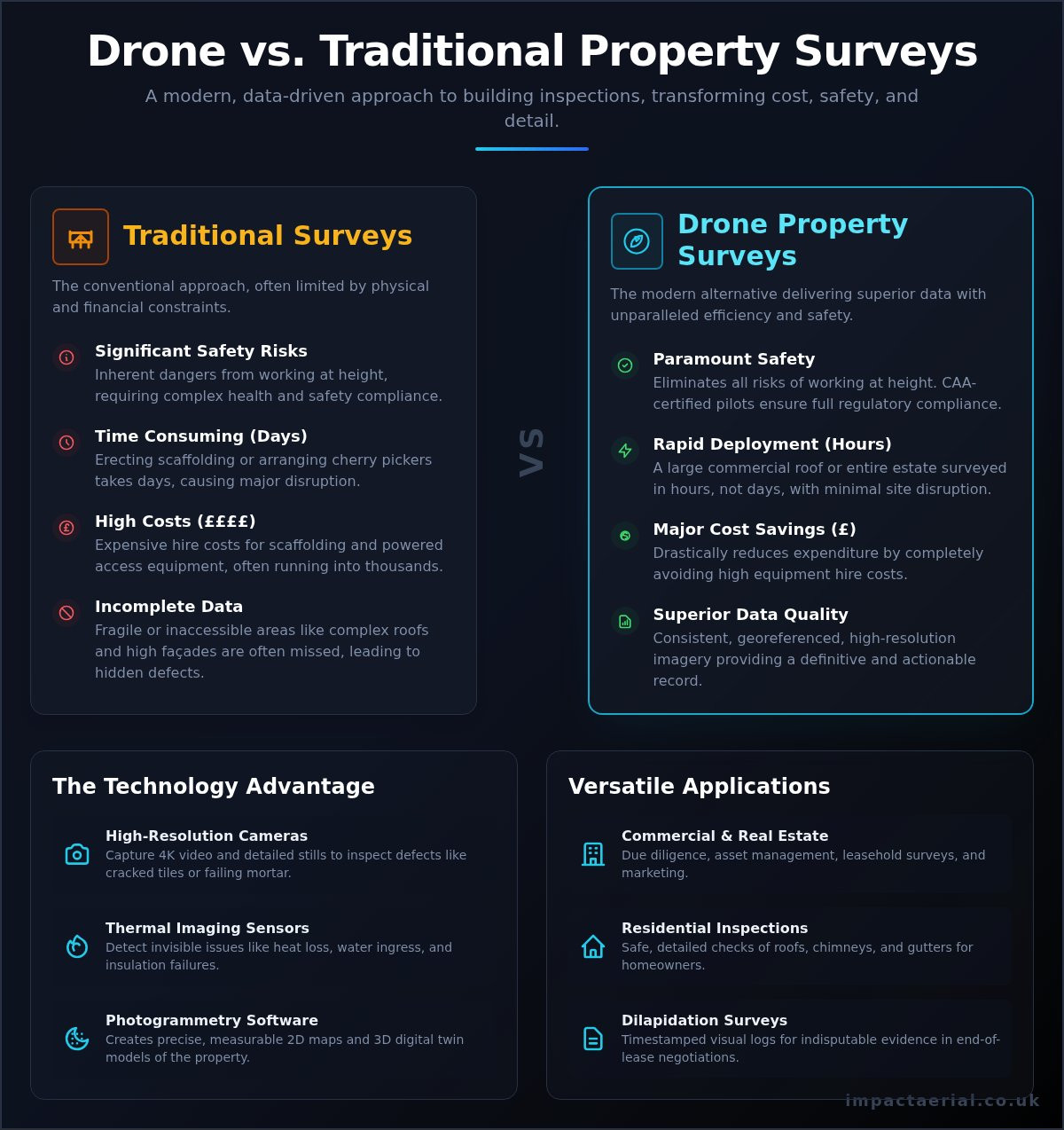
For decades, property inspections meant relying on costly and time-consuming methods like erecting scaffolding, hiring cherry pickers, or sending surveyors to work at dangerous heights. These traditional approaches not only introduce significant safety risks but also often provide an incomplete picture, as many areas like fragile roofs, complex gables, and high-level façades remain physically inaccessible. The use of drone property surveys fundamentally changes this dynamic for the better.

Key Advantages Over Traditional Surveying

  • Safety: The paramount advantage is the elimination of risks associated with working at height, ensuring full compliance with health and safety regulations and providing peace of mind.
  • Speed: A comprehensive survey of a large commercial roof or entire estate can be completed in a matter of hours, not days, minimising disruption to your operations.
  • Cost Savings: Drastically reduce expenditure by avoiding the high hire costs of scaffolding and powered access equipment, often saving thousands of pounds (£) on a single project.
  • Data Quality: Drones capture consistent, high-resolution visual data that is both georeferenced and measurable, providing a definitive and actionable record of the property’s condition.

The Technology Behind the Survey

  • High-Resolution Cameras: Our commercial drones are equipped with cameras capable of capturing 4K video and detailed still images, allowing for close-up inspection of potential defects like cracked tiles or failing mortar.
  • Thermal Imaging Sensors: Specialist thermal payloads can be used to detect otherwise invisible issues, such as heat loss, water ingress under flat roofs, and failing insulation.
  • Photogrammetry Software: The captured images are processed using sophisticated software to create precise, measurable 2D maps and 3D models (digital twins) of your property, forming the foundation of our detailed survey reports.

Applications: Types of Surveys for the UK Property Sector

In the UK property market, drone surveys are not a one-size-fits-all service. They are highly specialised data-gathering operations tailored to the specific requirements of a property’s lifecycle. From initial acquisition due diligence to ongoing asset management and end-of-lease assessments, the high-resolution imagery and data captured by our commercial drones provide a clear, objective, and actionable perspective. This versatility makes drone property surveys an invaluable tool for asset managers, surveyors, and property owners across the country.

Commercial Property and Real Estate

For commercial assets, drones provide critical intelligence that informs strategic decisions. Our professional services are deployed for a range of applications, ensuring clients have a complete visual record and understanding of their property’s condition. Key commercial uses include:

  • Pre-acquisition Due Diligence: A detailed assessment of the entire building envelope, including roofs, facades, and high-level structures, to identify potential liabilities before a transaction completes.
  • Leasehold Surveys: Accurately documenting Schedules of Condition at the start of a lease, providing a clear benchmark to mitigate future disputes.
  • Asset Management: Conducting regular, efficient monitoring of large or inaccessible property portfolios to proactively manage maintenance and repairs.
  • Marketing and Sales: Creating compelling aerial imagery, 3D models, and virtual tours that showcase a property’s scale, location, and key features.

Residential Property Inspections

For residential properties, safety and detail are paramount. Drones eliminate the risks and costs associated with scaffolding or ladders for high-level inspections. We can safely capture high-definition imagery of roofs, chimneys, and gutters to identify issues like slipped tiles, damaged flashing, or blockages. This service is invaluable for homebuyers seeking peace of mind, homeowners planning maintenance, and building surveyors requiring detailed evidence. All flights are conducted by CAA GVC certified pilots, strictly adhering to the UK Drone Code regulations to ensure maximum safety on site.

Building and Dilapidation Surveys

When a precise record of a property’s condition is required, particularly for legal or contractual purposes, drone data is unparalleled. Dilapidation surveys conducted via drone create a comprehensive and timestamped visual log of a building’s state at a specific moment. This is essential for end-of-lease negotiations, where the high-resolution data provides indisputable visual evidence for reports, strengthening a landlord’s or tenant’s position and helping to resolve potential disputes fairly and efficiently.

The Deliverables: What Data and Reports Will You Receive?

A professional drone property survey delivers far more than a collection of aerial photographs. The true value lies in the conversion of high-quality raw imagery into actionable data intelligence. Our data-gathering process is designed to produce clear, measurable, and verifiable outputs that integrate seamlessly into the workflows of surveyors, architects, property managers, and construction professionals. You will receive a comprehensive data package tailored to your project’s specific requirements, providing the clarity and precision needed for informed decision-making.

High-Resolution Imagery and 4K Video

We provide crystal-clear visual data that offers an unparalleled perspective on your property. This detailed visual evidence is fundamental for condition reports, marketing materials, and initial site assessments. Key visual assets include:

  • Orthomosaic Maps: A geometrically corrected, high-resolution aerial map of your entire site, stitched together from hundreds of individual photographs. This single, top-down image is fully scalable and provides accurate context for planning and measurement.
  • Annotated Photographs: High-resolution still images with specific points of interest, defects, or areas of concern clearly marked and described for unambiguous reporting.
  • Close-Up Inspection Footage: Detailed 4K video of hard-to-reach areas such as rooftops, chimneys, facades, and high structures, allowing for safe and efficient close-up inspections without the need for scaffolding.

3D Models and Digital Twins

Using advanced photogrammetry techniques, we transform our aerial data into precise, interactive 3D models of your property or site. These “digital twins” are powerful tools for analysis, measurement, and planning, allowing you to:

  • Conduct Virtual Inspections: Explore a complete virtual replica of your asset from any angle, allowing for a comprehensive understanding of its structure and condition from the safety of your office.
  • Take Accurate Measurements: Calculate distances, surface areas, and stockpile volumes directly from the model with a high degree of accuracy, removing the need for costly and time-consuming manual on-site measurements.
  • Streamline Project Planning: Utilise the model for planning maintenance schedules, visualising proposed developments, or collaborating with stakeholders on repair strategies with complete spatial awareness.

Thermal Imaging Reports

Our commercial drones can be equipped with radiometric thermal cameras to detect temperature variations invisible to the naked eye. This data is crucial for identifying hidden building performance issues and is presented in a detailed report. Thermal drone property surveys are essential for:

  • Detecting Hidden Defects: Pinpoint hidden moisture, water ingress, damp spots, and significant gaps in insulation that can lead to structural problems and energy loss.
  • Performing Energy Audits: Clearly identify areas of thermal bridging and heat loss across the building envelope, providing essential data for improving energy performance and reducing operational costs.
  • Assessing Building Health: A thermal report provides a non-invasive and highly effective method for assessing the overall health and performance of a building’s fabric.

These detailed outputs provide the clarity and precision required for confident asset management. See examples of our detailed survey reports.

The Process: Commissioning a Drone Survey Step-by-Step

Commissioning a drone survey is a straightforward and highly structured process when you partner with a professional, certified operator. We believe in complete transparency, ensuring you understand every stage from the initial conversation to the delivery of your final data. Our methodical approach is designed to guarantee safety, compliance with all UK regulations, and the highest quality results for your land or real estate project.

Step 1: Consultation and Project Scoping

Every successful project begins with a detailed consultation. We take the time to understand your specific objectives, whether you require a topographical land survey, a building condition report, or a boundary verification. Following this, we conduct a preliminary desktop survey using mapping software to assess the site’s location, identify potential ground hazards, and check for nearby obstacles. This allows us to provide a clear, detailed quotation with a full breakdown of costs, ensuring there are no hidden fees.

Step 2: Pre-Flight Planning and Risk Assessment

Safety and regulatory compliance are paramount in all our operations. Before any drone takes flight, we conduct comprehensive pre-flight planning. This critical stage includes:

  • Airspace Checks: Verifying the survey location against UK airspace regulations to identify any restrictions, such as proximity to airports, sensitive sites, or temporary flight restrictions.
  • Risk Assessment (RAMS): Developing a detailed Risk Assessment and Method Statement (RAMS) to outline the operational plan and mitigate any potential on-site hazards for our team and yours.
  • Permissions and Authorisations: Arranging any necessary permissions from Air Traffic Control (ATC) or other relevant bodies for flights in congested or restricted areas.

This meticulous preparation ensures the entire operation is conducted safely and legally, providing complete peace of mind.

Step 3: On-Site Data Capture and Post-Processing

On the scheduled day, our CAA GVC certified and commercially insured pilots arrive on-site to conduct the flight. The data capture is performed efficiently, following the pre-agreed flight plan to ensure comprehensive coverage while minimising any disruption to site activities. Once the raw data is collected, our work continues back at the office. We use specialist software to process the high-resolution imagery and sensor data, transforming it into the precise, actionable deliverables you need. The final output from our professional drone property surveys can include detailed orthomosaic maps, 3D point clouds, digital surface models, or a comprehensive inspection report. To discuss your specific requirements, please contact our team today.

How to Choose a Professional Drone Survey Provider in the UK

The UK’s commercial drone market is expanding, but not every operator possesses the qualifications, equipment, or specialist knowledge required for professional survey work. For property developers, surveyors, and estate managers, conducting thorough due diligence is essential for ensuring legal compliance, on-site safety, and the delivery of accurate, actionable data. Choosing an unqualified operator exposes your project to significant legal and financial risk.

To ensure you partner with a credible expert, use the following checklist to vet any potential provider before commissioning work.

Essential: CAA Certification and Permissions

This is the most critical legal requirement. Any professional drone operator conducting commercial work in the UK must hold the necessary permissions from the Civil Aviation Authority (CAA). Verify that the provider holds a valid General Visual Line of Sight Certificate (GVC) and can present their official CAA Operator ID and documentation upon request. An inability to provide this is an immediate red flag.

Crucial: Commercial Insurance Coverage

Standard hobbyist insurance is entirely inadequate for commercial operations. Your chosen provider must hold specialist commercial drone liability insurance to protect you, your property, and the public. For your peace of mind, a minimum coverage of £5 million is the industry standard for professional projects. Always ask for a copy of their insurance certificate.

Key: Equipment and Industry Experience

The quality of data from drone property surveys is directly linked to the technology used. A professional will use commercial-grade drones, such as those from the DJI Enterprise series, not consumer models. Furthermore, you should review their portfolio for demonstrable experience in the property and construction sectors. Ask for case studies or examples of similar projects to ensure they understand your specific requirements and deliverables.

At Impact Aerial, we pride ourselves on exceeding these benchmarks, providing fully certified and insured services with a proven track record in the property sector. We believe in transparency and providing our clients with complete confidence in our capabilities. Verify our credentials and book a consultation today.

Elevate Your Property Assessments with Professional Drone Surveys

As we have explored, the adoption of drone technology is revolutionising the UK property sector. By offering a safer, more efficient, and incredibly detailed alternative to traditional methods, drone property surveys provide actionable data that was previously difficult or costly to obtain. From comprehensive condition reports using thermal imaging to detailed 3D models for development planning and accurate roof inspections, the applications are transforming how professionals assess, manage, and market their assets.

When commissioning a survey, choosing a qualified partner is paramount for your peace of mind and the integrity of your data. At Impact Aerial, we are established experts in commercial property and building surveys, utilising the latest DJI Enterprise drones and thermal cameras to deliver top-quality, actionable intelligence. As a fully CAA GVC Certified and insured operator, we provide the professionalism, safety, and reliability your project demands. Ready to leverage this technology for your portfolio? Request a professional drone survey quote for your property.

Frequently Asked Questions

How much does a drone property survey cost in the UK?

The cost for professional drone property surveys in the UK typically starts from £350 and can exceed £1,500. Pricing is dependent on several factors, including the size and complexity of the site, the type of data required (e.g., 2D maps, 3D models, topographical data), and the level of post-processing and reporting involved. For an accurate and detailed quotation tailored to your specific project requirements, we recommend contacting our team directly to discuss the scope of your survey.

How long does it take to complete a drone survey and get the report?

The on-site data capture for a standard property is remarkably efficient, often completed within a few hours. The more time-intensive phase is the post-processing, where the captured data is converted into detailed models and reports. Depending on the complexity and scale of the project, you can typically expect to receive the final deliverables within 2-5 business days. We always provide a clear project timeline as part of our initial consultation and quotation for your complete peace of mind.

Are drone surveys possible in bad weather like wind or rain?

For safety and data quality reasons, we cannot operate our drones in rain, snow, or fog. Our commercial-grade drones are robust and can operate safely in wind speeds up to approximately 22 mph. However, for survey missions requiring the highest level of precision, calmer conditions are preferable. As part of our professional services, we meticulously monitor weather forecasts and will reschedule operations if conditions are not suitable, ensuring both safety and the integrity of your data.

What happens if the property is located in a restricted flight zone, like near an airport?

Operating in restricted airspace is often possible but requires detailed planning and official authorisation. As fully CAA GVC Certified operators, we are qualified to manage the entire process of applying for the necessary permissions from Air Traffic Control (ATC) and other relevant authorities. This process requires additional lead time and planning, so it is crucial to inform us of the location as early as possible. We handle all regulatory compliance to ensure a legal and safe operation.

Is the data from a drone survey accurate enough for a chartered surveyor?

Yes, the data is exceptionally accurate. By utilising Ground Control Points (GCPs) and advanced photogrammetry techniques, our drone property surveys can achieve survey-grade accuracy, often down to 20-50mm. The resulting outputs, such as high-resolution orthomosaic maps, point clouds, and Digital Surface Models (DSMs), are fully compatible with CAD and GIS software used by chartered surveyors, architects, and engineers for planning, design, and analysis. This provides a reliable and precise data set for professional use.

What information do I need to provide to get a quote for a drone survey?

To provide you with an accurate and comprehensive quote, we require some key information. Please provide the full site address, postcode, or what3words location, along with the approximate size of the area to be surveyed. It is also essential to specify the required data outputs (e.g., high-resolution photos, 3D model, topographical data) and the intended purpose of the survey. Detailing any known access issues or on-site hazards will also help us prepare a precise quotation.