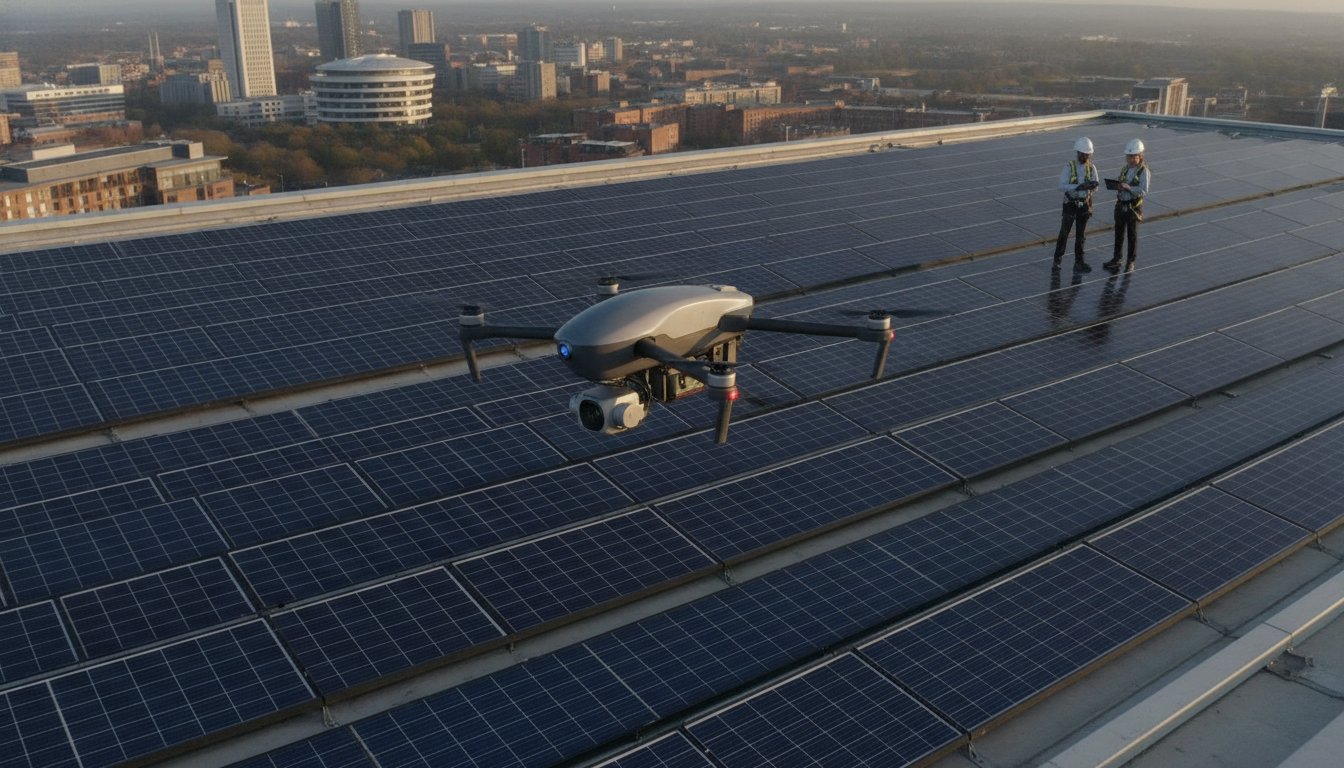
Is your solar business still relying on ground-level smartphone photos to justify five-figure commercial contracts? While your team works at height to install the future of energy, poor visual documentation often fails to capture the true scale and technical precision of your work. Adopting professional drone photography for solar panel installers has transitioned from a high-tech luxury to a fundamental operational standard in 2026. You recognize that manual roof inspections are inherently slow and introduce unnecessary safety risks that can complicate your compliance profile. It’s difficult to demonstrate the meticulous quality of a commercial-scale array to a stakeholder when your perspective is limited to the ladder’s edge.
This article explains how to transform aerial imagery into a dual-purpose engine for your business: a precision survey tool that mitigates risk and a high-performance marketing asset that justifies premium pricing. You’ll discover how to leverage the latest CAA regulatory frameworks and IEC 62446-3 compliant thermal data to streamline your workflow. We’ll also preview how AI-powered fault detection and high-resolution mapping are helping installers secure long-term maintenance contracts and deliver superior site assessments with absolute technical confidence.
Key Takeaways
- Learn why aerial perspectives are the only way to document large-scale commercial rooftop installs effectively, overcoming the visibility limitations of ground-level photography.
- Discover how thermographic surveys identify hidden “hot spots” and bypass diode failures that stay invisible to the naked eye.
- Understand the legal risks of DIY flights and why professional drone photography for solar panel installers is necessary to comply with strict CAA regulations.
- See how to transform technical survey footage into high-converting marketing assets, including time-lapse videos that showcase your team’s installation speed.
- Identify specific ways that precision-engineered aerial data helps you secure long-term maintenance contracts and increase your project ROI.
Why Drone Photography is Essential for Modern Solar Installers
The renewable energy sector is moving away from the limitations of ground-level documentation. For years, installers relied on ladders and handheld cameras, but these methods fail to capture the complexity of modern arrays. Adopting professional drone photography for solar panel installers allows you to document the entirety of a project from a perspective that ground-based photography simply cannot reach. This shift isn’t just about aesthetics; it’s about providing a comprehensive technical overview that builds trust with commercial stakeholders and provides a clear record of work quality.
To better understand this concept, watch this helpful video:
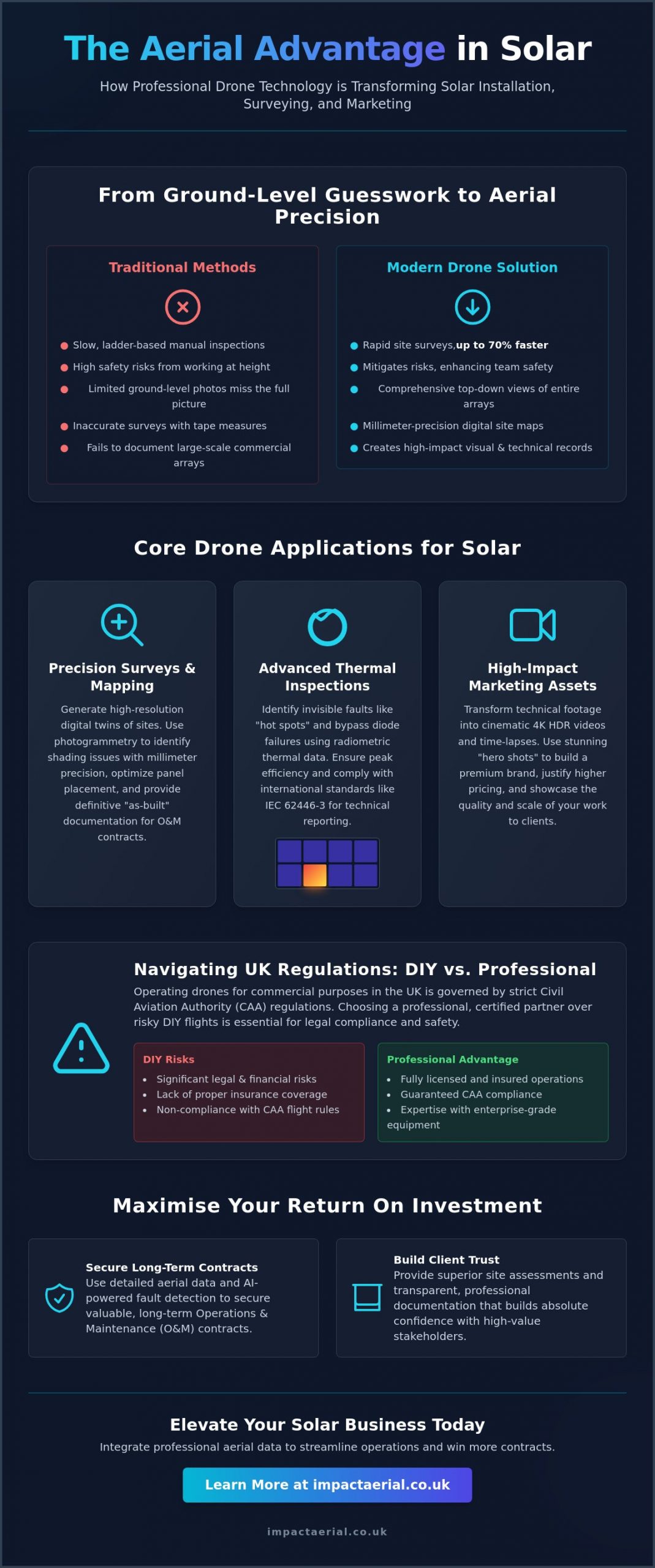
Large-scale commercial rooftops often present a ‘visibility problem’ where the pitch and scale of the building make ground-level shots nearly useless. Drones solve this by providing a top-down view that reveals the full scope of the installation. Using these tools can reduce site survey times by up to 70% compared to manual, ladder-based inspections. This efficiency lets your team complete more assessments per week while lowering the risk of falls from height. These advanced drone applications in infrastructure inspections ensure that every panel is accounted for and every structural obstacle is identified before your crew ever sets foot on the roof.
The Evolution of Solar Site Surveys
Relying on tape measures and physical climbing is becoming an obsolete practice. Modern installers use high-resolution photogrammetry to create digital twins of a site. These maps identify shading issues from nearby chimneys or trees with millimetre precision. By using detailed aerial maps, you can optimize panel placement during the design phase. This improves the accuracy of your generation quotes and minimizes costly on-site adjustments during the installation phase.
Building a Premium Brand through Aerial Assets
High-end residential and commercial clients expect professional documentation of their investment. They aren’t just buying hardware; they’re buying into a sustainable future. Cinematic 4K HDR visuals capture this ‘green energy’ narrative effectively. When you integrate drone photography for solar panel installers into your workflow, you’re not just improving surveys; you’re building a library of premium content. Using ‘hero’ shots of a completed project differentiates your business in a crowded market. It showcases the meticulous quality of your electrical work and the scale of your operations, turning a standard technical project into a high-converting marketing asset.
Technical Applications: Visual and Thermal Solar Inspections
While cinematic footage helps close the deal, the real operational value of drone photography for solar panel installers lies in the capture of technical, actionable data. It’s vital to distinguish between standard aerial photography and technical inspections. High-resolution visual sensors identify physical defects like micro-cracks in cells, bird nesting, or debris accumulation that are impossible to spot from the ground. These visual records serve as “as-built” documentation, providing a definitive baseline for Operations and Maintenance (O&M) contracts and insurance purposes.
The integration of DJI Enterprise hardware, such as the Mavic 3 Thermal or the Matrice 350 RTK, allows installers to capture radiometric data. Unlike standard thermal images, radiometric data stores temperature values for every individual pixel. This precision is required for technical reporting that meets international standards. If you are managing large-scale assets, a professional thermographic survey ensures your systems are operating at peak efficiency from day one.
Maximising Efficiency with Thermal Imaging
Thermal drones identify faults that are invisible to the naked eye. By detecting “hot spots” or bypass diode failures, these surveys prevent minor component issues from escalating into system-wide failures. According to industry data, an undetected 5% yield loss on a 10 MW solar site can cost approximately $40,000 annually in lost revenue. Following the IEC 62446-3 standard for thermographic inspections ensures that data is collected under correct irradiance levels, typically 600 W/m² or higher. This technical rigor allows you to identify string failures or faulty inverters in minutes, making thermal audits a high-value addition to your maintenance packages.
Visual Documentation and Quality Control
Quality control is about more than just checking panels. Professional drone photography for solar panel installers provides 4K HDR evidence of installation compliance with UK building standards. You can document the integrity of mounting hardware and the precision of cable management across the entire array. These high-resolution comparisons of “before and after” site conditions protect your business against future liability claims. They also provide your clients with absolute confidence in the mounting hardware’s integrity and the overall safety of the electrical work. Using these assets for warranty records ensures that any future claims are backed by indisputable visual evidence.
Professional Drone Services vs. DIY: Navigating UK Regulations
It’s tempting to assume that purchasing a consumer-grade drone and assigning a staff member to capture a few photos is a cost-effective solution. However, the hidden costs of a DIY approach often outweigh the perceived savings. Hardware like the DJI Mavic 3 Thermal or Matrice 30T represents a significant capital investment and suffers from rapid technical depreciation. Beyond the initial purchase, your business must account for ongoing software subscriptions for thermal analysis, the time lost to pilot training, and the logistical burden of maintaining a compliant flight log. Professional drone photography for solar panel installers delivers a level of consistency and technical accuracy that raw, unedited footage from an amateur pilot simply cannot match.
The legal reality in 2026 is uncompromising. The Civil Aviation Authority (CAA) distinguishes clearly between recreational flights and commercial operations. Any flight conducted to support a business, whether for marketing or a technical survey, is classified as a commercial operation. Using a hobbyist Flyer ID for these purposes violates CAA regulations and can lead to severe penalties. Furthermore, as of January 1, 2026, mandatory Remote ID requirements and new UK class marks (UK0 to UK6) mean that legacy equipment may no longer be compliant for certain mission profiles. Professional operators ensure that every flight is fully legal, protecting your brand from the reputational and financial risks of non-compliance.
CAA Compliance and the GVC Certification
For operations in complex environments, such as urban rooftops or near restricted airspace, a standard Flyer ID is insufficient. The General Visual Line of Sight Certificate (GVC) is the professional standard required for higher-risk missions. Obtaining a UK drone license through GVC training typically costs between £500 and £1,200, representing a significant investment in time and money for an installer. Professional pilots are trained to manage complex flight permissions and coordinate with National Air Traffic Services (NATS), ensuring that your solar project proceeds without legal delays or safety incidents.
Liability and Risk Management on Site
Safety is the primary concern for any solar installation team. Most commercial site managers and principal contractors require at least £5m in specialist commercial liability insurance before a drone is permitted to launch. Standard business insurance rarely covers aviation accidents, leaving your company exposed if a DIY pilot suffers a hardware failure over a client’s property. Professional drone services provide comprehensive risk assessments and Method Statements (RAMS) for every flight. This meticulous approach to risk mitigation provides total peace of mind, allowing your team to focus on the installation while experts handle the aerial data capture and safety protocols.
Maximising ROI: Using Aerial Content for Marketing and Lead Gen
The technical audits we’ve discussed in previous sections are vital for operations, but the visual output from these flights serves a second, equally important purpose: business growth. Converting raw technical data into high-converting marketing assets is where solar firms find their greatest return on investment. Professional drone photography for solar panel installers provides the “hero” content needed to move a prospect from curiosity to a signed contract. High-resolution time-lapse videos are particularly effective here. They demonstrate the speed, safety, and efficiency of your installation team in a way that ground-level progress photos never could.
Social Media and Digital Presence
Digital platforms like LinkedIn and Instagram require visually arresting content to capture the attention of commercial B2B leads. You can repurpose technical survey footage into Instagram Reels that showcase the technical precision of your mounting systems. The “reveal” shot creates an immediate emotional impact; it starts with a close-up on a single panel and pulls back to show the massive scale of a commercial rooftop array. These assets aren’t limited to digital use. High-resolution drone stills are perfect for premium print brochures, providing a level of detail that conveys industry leadership to potential clients during face-to-face meetings.
Winning Commercial Tenders with Data
Winning large-scale commercial tenders in 2026 requires you to prove technical superiority and meticulous planning. Including 3D site models and immersive virtual tours in your tender documents shows corporate sustainability officers that you have total command over the project environment. By leveraging drone survey data, you can provide more accurate energy yield estimates based on millimetre-precise shading analysis. This data-centric approach builds trust with corporate stakeholders who are responsible for multi-million pound renewable energy investments.
Aerial case studies also provide a significant boost to your website’s search engine performance. Embedding drone video on your project pages increases dwell time, which is a key metric for ranking on Google. It allows potential clients to explore the scale of your installations from their own offices, providing a sense of transparency and reliability. When you invest in professional drone photography for solar panel installers, every project you complete becomes a permanent, high-performing lead generation asset.
To transform your next installation into a high-converting marketing portfolio, explore our professional aerial filming and photography services.
Impact Aerial: Your Strategic Partner for Solar Drone Solutions
Impact Aerial provides specialized drone photography for solar panel installers, delivering more than just visual content. We act as a technical extension of your installation team, providing the high-tier imagery and data required to thrive in the 2026 renewable energy market. Our bespoke aerial filming and photography services are designed specifically for the unique demands of the UK solar industry. We don’t just capture photos; we produce precision-engineered assets that support both your marketing goals and your technical compliance requirements.
Our pilots are CAA GVC certified and operate the latest DJI Enterprise hardware, including the Mavic 3 Thermal and Matrice 350 RTK. This technology allows us to conduct highly accurate PV solar farm thermal surveys for large-scale assets, identifying faults that ground-level inspections would inevitably miss. Beyond the flight itself, our full post-production suite ensures that the raw data is transformed into ready-to-use assets. Whether you need a technical report for a maintenance contract or a cinematic reel for a commercial tender, we deliver polished, professional results every time.
Professionalism from Consultation to Delivery
Safety and compliance underpin every mission we fly. We take a methodical approach to project management, developing site-specific risk assessments and safety protocols that align with your existing workflow. This meticulous planning ensures that our aerial support is seamless and non-disruptive to your installation schedule. We are dedicated to delivering 4K HDR visual excellence alongside precision-engineered radiometric data for every installation. By outsourcing your aerial needs to a trusted specialist, you eliminate the overhead of in-house equipment maintenance and pilot training while gaining access to industry-leading expertise.
Get a Competitive Quote Today
We offer custom packages tailored to your specific business needs, whether you manage a portfolio of residential installs or oversee utility-scale commercial solar farms. While we provide national coverage across the UK, we maintain a strong local focus on Birmingham and the West Midlands, allowing for rapid deployment and regional site expertise. Our team understands the competitive pressures of the current solar market and provides the technical edge you need to justify premium pricing to your clients. Contact Impact Aerial today to elevate your solar installation brand and secure your competitive advantage in 2026.
Elevate Your Solar Operations with Precision Aerial Intelligence
Professional drone photography for solar panel installers is no longer a peripheral service; it’s a core operational requirement for firms aiming to lead the UK’s renewable transition in 2026. By integrating technical surveys with cinematic marketing, you transform routine installations into precision-engineered assets that justify premium pricing and win complex commercial tenders. You’ve seen how thermographic data prevents significant yield loss and how professional content builds a high-end brand profile that resonates with corporate stakeholders. This dual-purpose approach ensures your business remains compliant, safe, and highly visible in an increasingly crowded market.
Our team of CAA GVC certified pilots provides the safety and compliance you need, backed by £5m in commercial liability insurance and the latest DJI Enterprise 4K HDR hardware. We handle the technical complexities of flight permissions and data capture so your team can focus on delivering world-class solar energy solutions. It’s time to replace ground-level limitations with a comprehensive aerial strategy that protects your liability and drives your lead generation.
Request a Professional Drone Survey Quote for Your Next Solar Project
We’re ready to help you streamline your site assessments and amplify your marketing reach. Let’s build a more efficient, visually stunning future for your solar brand together.
Frequently Asked Questions
Do I need a special license to fly a drone for my solar business?
Yes, you must have a Flyer ID and an Operator ID from the Civil Aviation Authority (CAA) for any business-related flight. Most commercial solar projects also require the pilot to hold a General Visual Line of Sight Certificate (GVC). This qualification allows for legal operation in urban or congested areas where many rooftop installations occur. Operating without these certifications can lead to significant legal penalties and will invalidate your business insurance.
How much does professional drone photography for solar installers cost?
Project costs vary based on the scale of the installation and the specific data deliverables required. Factors that influence the final quote include the number of panels, the geographical location, and whether you need radiometric thermal data or cinematic marketing assets. Investing in professional drone photography for solar panel installers eliminates the hidden expenses of in-house hardware maintenance, specialist software subscriptions, and the significant time required for staff pilot training.
Can drones really detect faulty solar panels using thermal imaging?
Thermal sensors identify “hot spots” caused by cell failures or bypass diode issues that are invisible to the naked eye. By detecting these heat signatures, drones allow for a targeted maintenance approach that ensures the array operates at its peak generation capacity. This technical data is vital for large-scale assets where undetected faults can lead to substantial yield loss and reduced return on investment over the system’s lifespan.
What are the benefits of hiring a drone pilot vs doing it in-house?
Outsourcing your aerial needs removes the liability and regulatory burden from your internal team. Professional pilots bring industry-leading DJI Enterprise hardware and the expertise to manage complex UK airspace permissions and site-specific risk assessments. This meticulous approach ensures that your data is captured safely and accurately while your staff stays focused on the core electrical and structural aspects of the solar installation itself.
How long does a typical drone survey of a solar farm take?
Drones are incredibly efficient and can cover ten times more panels per hour than manual ground methods. A standard commercial rooftop survey typically takes between one and two hours to complete. For utility-scale solar farms, professional pilots can often document the entire site in a single day, providing a much faster turnaround for technical reports and marketing content compared to traditional inspection techniques.
Is drone photography safe to use around high-voltage solar equipment?
Yes, drones are inherently safer because they operate at a standoff distance from live electrical components. Pilots use high-magnification zoom lenses and thermal sensors to capture detailed data without the need for personnel to climb near high-voltage equipment. This reduces the risk of falls from height and electrical accidents, adhering to strict safety protocols and RAMS (Risk Assessment and Method Statements) for every flight.
What kind of insurance should a professional drone company have?
Commercial drone operators are legally required to have specialist third-party liability insurance that complies with EC Regulation 785/2004. Most commercial site managers require a minimum of £5 million in coverage before permitting a drone to launch. This specialist insurance is distinct from standard business liability and is essential for protecting your client’s property and your business in the event of an aviation-related incident.
Can drone footage be used for official UK building inspections?
High-resolution drone photography for solar panel installers is increasingly accepted as a valid tool for installation compliance and official inspections. It provides an indisputable, high-definition record of mounting hardware integrity and cable management precision. This documentation is often used to support building standard sign-offs, insurance audits, and warranty records, giving both the installer and the client total confidence in the quality of the work.
 2 Norton Drive, Wythall, Birmingham, B47 6HH Company registration number: 11138586. VAT Number: 366 9068 55