Drone Survey for Commercial Landlords: A Strategic Asset Management Guide

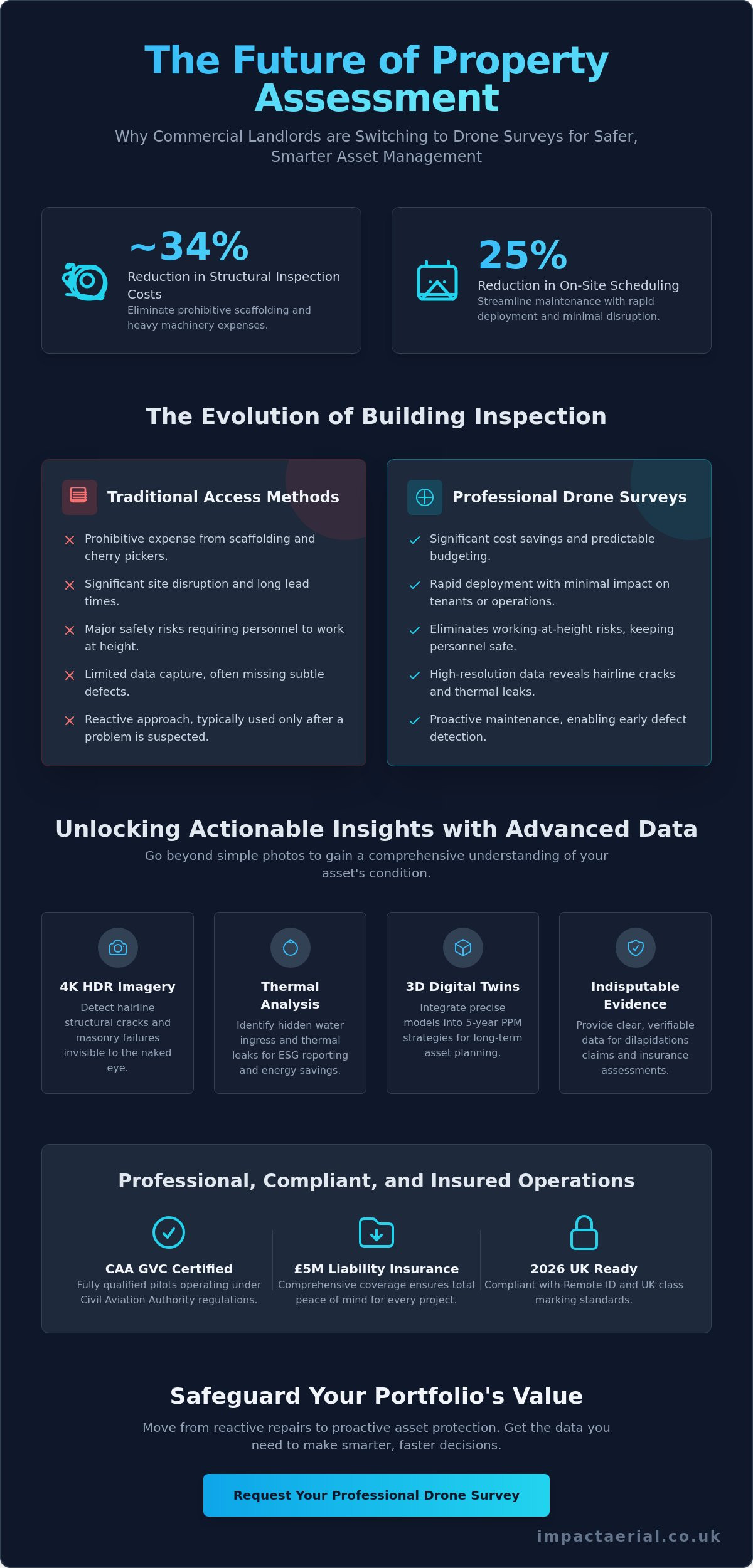
Did you know that integrating drone analytics into property assessments can reduce on-site scheduling by 25% while lowering structural inspection costs by approximately 34%? For many property owners, the traditional approach to asset management involves the prohibitive expense and logistical nightmare of erecting scaffolding just to investigate a suspected roof leak or structural defect. You likely already know that these delays don’t just drain your budget; they stall critical decision-making and leave your high-rise assets vulnerable to further deterioration. Utilizing a professional drone survey for commercial landlords offers a meticulous, data-centric alternative that prioritizes both safety and precision.

This guide reveals how professional aerial surveys mitigate risk and provide the actionable data you need to maintain portfolio value without the standard disruption. We’ll examine the latest 2026 UK regulatory standards, including mandatory Remote ID and UK class markings, to ensure your operations remain fully compliant with Civil Aviation Authority requirements. You’ll discover how moving away from lengthy manual reporting toward rapid, high-resolution aerial assessments allows for smarter, faster asset management.

Key Takeaways

  • Understand why commercial property owners are replacing expensive scaffolding and cherry pickers with rapid, high-precision aerial inspections to streamline site maintenance.
  • Discover how a professional drone survey for commercial landlords identifies hairline structural cracks and thermal leaks using state-of-the-art DJI Enterprise hardware.
  • Learn about the critical compliance standards, such as CAA GVC certification and £5m liability insurance, required to ensure safety and legal protection during operations.
  • See how integrating 4K HDR imagery and 3D mapping into your 5-year Planned Preventative Maintenance (PPM) strategy safeguards long-term asset value.
  • Gain insights into using indisputable aerial evidence to support dilapidations claims and provide clear data for complex insurance assessments.

Why Commercial Landlords are Switching to Drone Surveys in 2026

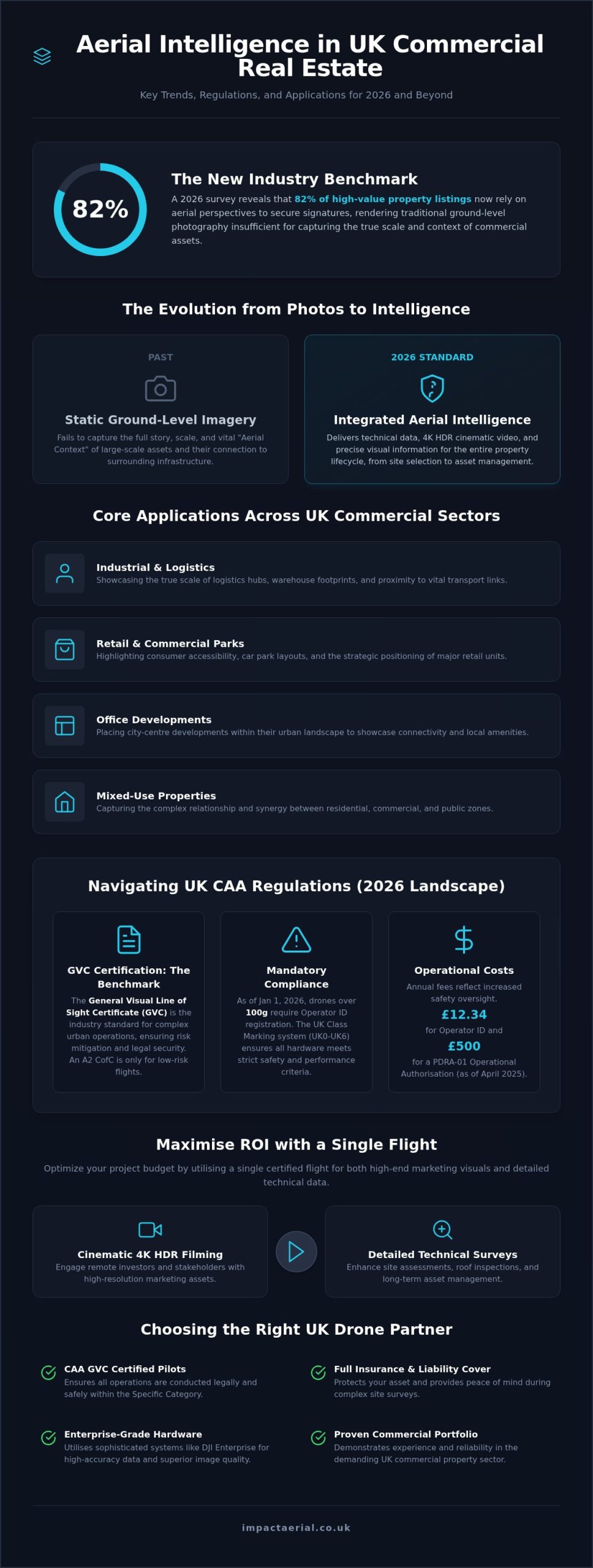
The landscape of property management has shifted. In 2026, a drone survey for commercial landlords is no longer a high-tech novelty but a core component of strategic asset management. As the UK’s regulatory framework has matured with specific class markings and mandatory Remote ID, these aerial survey methods have become the gold standard for building envelope inspections. This transition is driven by the need for high-tier data that traditional methods simply cannot match in speed or granularity.

Property owners face increasing pressure to provide detailed ESG (Environmental, Social, and Governance) data. High-resolution sensors allow for precise energy efficiency reporting by identifying thermal leaks that are invisible to the naked eye. This data-centric approach helps landlords meet 2026 sustainability targets while simultaneously reducing the disruption caused to tenants by heavy machinery or intrusive scaffolding. It’s a cleaner, faster, and more professional way to oversee large-scale assets.

To better understand the precision and capabilities of modern surveying technology, watch this helpful video:

The Financial Case: Scaffolding vs. UAV Surveys

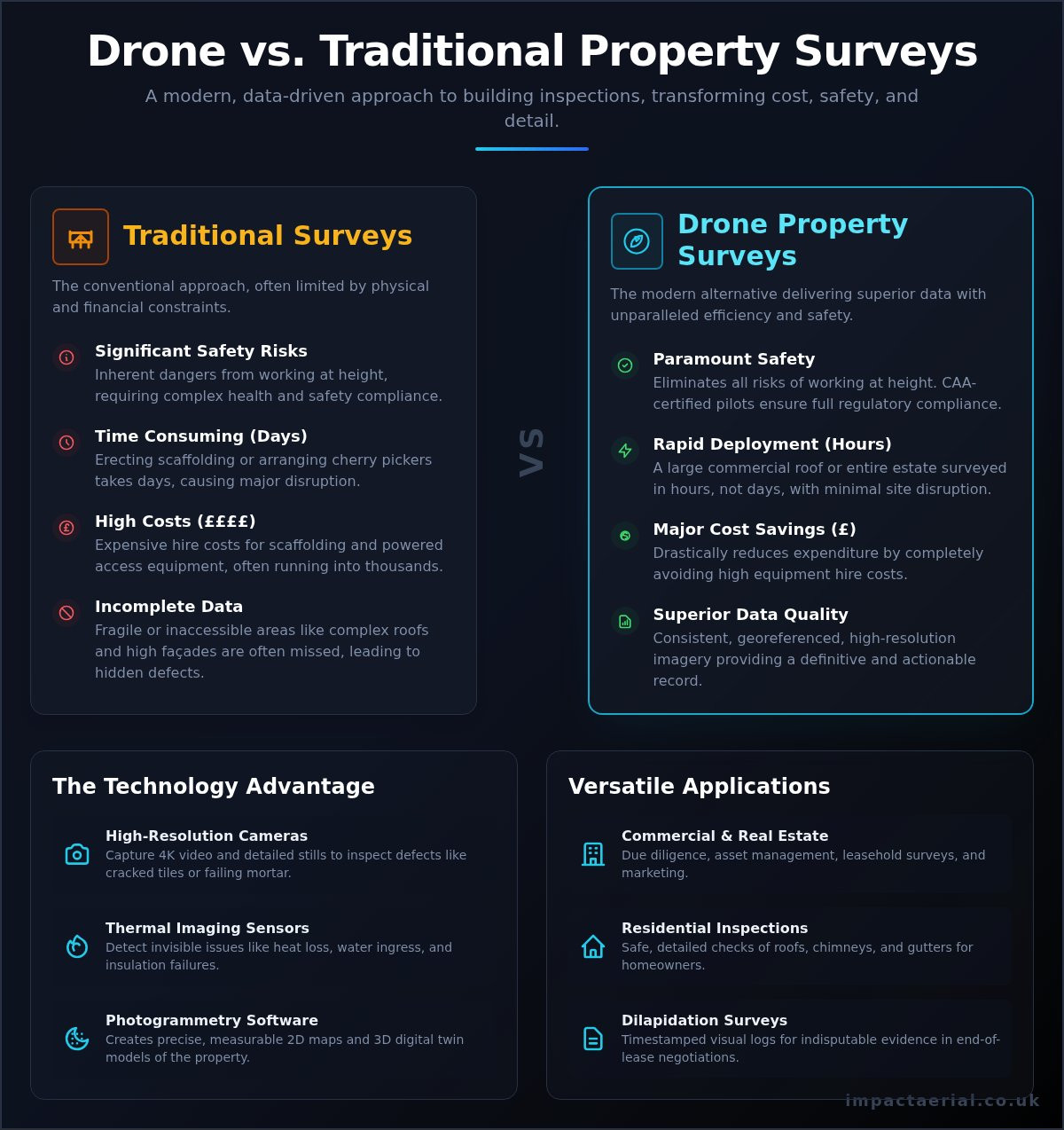
For a typical 50,000 sq ft warehouse, the logistics of traditional access methods are staggering. Erecting scaffolding requires significant lead times, specialized permits, and substantial manual labor. According to a study by the Royal Institution of Chartered Surveyors (RICS), integrating drone analytics into property assessments reduces on-site scheduling by 25%. By eliminating the “access cost” barrier, landlords can perform frequent preventative inspections rather than waiting for a visible failure. This proactive stance ensures that minor defects don’t escalate into catastrophic repair bills. Early detection is the most effective way to protect an asset’s bottom line.

Safety and Liability: Keeping Personnel on the Ground

Safety is the most compelling reason for the industry’s shift. Using a drone survey for commercial landlords fundamentally removes the necessity for personnel to work at height during initial assessments. This significantly reduces the complexity of Risk Assessments and Method Statements (RAMS), as there’s no need for fall-arrest systems or heavy plant equipment. The RICS study also found that using drones for structural inspections can lower costs by approximately 34% compared to traditional methods. Beyond the immediate safety benefits, regular and documented aerial inspections demonstrate a commitment to meticulous maintenance. Providing this level of transparent, survey-grade data can reassure stakeholders and provide a verifiable record of structural integrity for insurance purposes.

Advanced Data Collection: Thermal Imaging and 3D Mapping

Modern asset management has moved beyond simple visual snapshots. A professional drone survey for commercial landlords now utilizes DJI Enterprise platforms to capture survey-grade data that was once impossible to obtain without significant cost. These advanced tools revolutionize building inspections by providing 4K HDR imagery that reveals hairline structural cracks invisible from the ground. This level of precision is vital for identifying early signs of concrete fatigue or masonry failure before they necessitate major capital expenditure.

Beyond maintenance, this high-precision data serves as a powerful marketing asset. When you provide prospective tenants with a comprehensive visual record of the building’s condition, you demonstrate transparency and superior management standards. High-resolution imagery and virtual tours can significantly accelerate the leasing process by providing stakeholders with an immediate, detailed view of the asset’s integrity. It’s a strategic way to differentiate your portfolio in a competitive market.

Thermal Surveys for Commercial Energy Efficiency

Thermal sensors are indispensable for assessing building envelopes and meeting 2026 energy standards. They detect failing insulation and “cold bridges” where heat escapes, which is essential for accurate energy efficiency reporting. On flat roofs, thermal imaging identifies trapped moisture within the membrane, pinpointing leaks before they cause internal damage. This technology also optimizes PV solar farm efficiency by identifying malfunctioning cells that could compromise the entire array’s output. By utilizing these drone commercial property surveys, landlords can verify the performance of their green energy investments with absolute certainty.

3D Modelling and Digital Twins for Asset Managers

3D mapping creates a “digital twin” of your development, providing a measurable, interactive record of the site. By using photogrammetry, we generate high-density point clouds that integrate directly into existing Building Information Modelling (BIM) workflows. This allows asset managers to conduct remote inspections and coordinate with maintenance contractors using a single, accurate source of truth. These models are also excellent for investor reporting, as they offer a clear, three-dimensional perspective of large-scale developments that static photography cannot replicate. It ensures every stakeholder has a granular understanding of the asset’s current state without ever needing to step foot on a ladder.

Drone Survey for Commercial Landlords: A Strategic Asset Management Guide

Compliance and Risk Management: Navigating UK Drone Regulations

Operating a drone survey for commercial landlords involves more than just capturing high-resolution imagery. It requires strict adherence to a complex legal framework designed to protect the public and the property owner. In 2026, the Civil Aviation Authority (CAA) regulations have moved to a permanent structure based on UK-specific class markings, making it essential for landlords to vet their contractors with precision. Failing to do so doesn’t just result in poor data; it exposes you to significant legal liability and potential fines of up to £1,000 for improper registration.

Meticulous risk mitigation is particularly vital in congested urban environments like Birmingham. Conducting flights near high-rise assets or within Flight Restriction Zones (FRZs) requires advanced planning and official permissions. Every operation must be supported by a robust Risk Assessment and Method Statement (RAMS) that accounts for everything from pedestrian traffic to 2026 requirements like mandatory green flashing lights for night operations and active Remote ID broadcasting. This level of compliance ensures that your asset management remains professional, legal, and safe.

The Importance of CAA GVC Certified Pilots

For commercial sites, a “hobbyist” pilot or a basic A2 CofC holder is often insufficient. The General Visual Line of Sight Certificate (GVC) is the professional standard for complex commercial drone operations. It demonstrates that the pilot has undergone rigorous practical and theoretical testing to handle larger aircraft and more challenging environments. Commissioning a pilot without these credentials puts your business at risk. Before any work begins, you should verify the operator’s Flyer ID and Operator ID, ensuring they are current with the 2026 UK class-mark standards (UK1 through UK6) to maintain total operational legality.

Insurance and Liability Safeguards

Standard public liability insurance rarely covers aviation-related risks. Commercial property sites require specialized UAV insurance that meets EC 785/2004 standards to ensure landlords aren’t held liable for third-party damages. We maintain £5m in commercial liability insurance as a baseline, providing the psychological comfort that your assets and reputation are fully protected. Impact Aerial manages all necessary flight permissions in restricted airspaces, coordinating directly with National Air Traffic Services (NATS) when required. This professional oversight extends to data protection; we ensure all aerial photography complies with GDPR by meticulously blurring faces or vehicle registrations that are captured incidentally during the survey process.

Actionable Insights: Integrating Drone Data into Property Strategy

A drone survey for commercial landlords represents a shift from reactive repairs to proactive asset protection. While the technical capabilities of modern hardware are impressive, the true value lies in how this data integrates into your broader property strategy. High-resolution, timestamped 4K data serves as an indisputable record of truth that can significantly accelerate insurance claim processing. When a storm occurs, having “before and after” aerial evidence allows for rapid verification of damage, reducing the time spent in administrative limbo with adjusters.

This data also serves a dual purpose in asset marketing. High-end aerial videography and photography can be woven into commercial leasing brochures to provide a unique perspective that ground-based photography lacks. Prospective tenants, especially those seeking high-value industrial or office space, value the transparency of seeing the building’s exterior and roof condition upfront. It projects a professional image of a landlord who is meticulous about building maintenance and technologically adept in their management style. It’s a strategic way to build trust before a lease is even signed.

Dilapidations and Lease End Negotiations

Terminal schedules of dilapidations are frequently the source of friction and costly legal disputes at the end of a commercial lease. Research shows that boundary and property disputes in the UK can cost owners an average of £12,000 to £35,000 in legal fees if they go to court. By commissioning a drone survey for commercial landlords at the commencement of a lease, you create a baseline “schedule of condition” that is difficult to challenge. Documenting the state of gutters, flashings, and roofing membranes provides a clear visual audit trail. When the lease expires, a follow-up survey identifies exactly what has deteriorated, ensuring that repair costs are fairly and accurately recovered from outgoing tenants. This level of clarity reduces the need for lengthy legal mediation.

PPM and Asset Life Extension

Incorporating aerial reports into a 5-year Planned Preventative Maintenance (PPM) schedule allows for more efficient budget allocation. Instead of broad, speculative maintenance based on “best guesses,” you can target specific areas where sensors have identified minor issues like loose flashings or blocked drainage. Tracking building degradation with year-on-year aerial comparisons provides a longitudinal view of asset health that traditional surveys can’t match. This data-centric method ensures you’re only spending on necessary repairs, effectively extending the life of the building envelope while optimizing your maintenance fund. To safeguard your portfolio with high-precision data, book your professional drone commercial property survey today.

Impact Aerial: Professional Commercial Drone Surveys Across the UK

Impact Aerial operates at the intersection of technical excellence and regulatory compliance. Based in Birmingham, our team provides a specialized drone survey for commercial landlords throughout the West Midlands and across the UK. We don’t use consumer-grade equipment; our fleet consists exclusively of state-of-the-art DJI Enterprise aircraft. These platforms are equipped with high-resolution 4K HDR and thermal sensors, ensuring every data point we collect meets the meticulous standards required by modern asset managers and technical stakeholders. It’s about providing the reassurance that your property is in expert, safety-conscious hands.

We manage every phase of the project from start to finish. This end-to-end project management begins with complex CAA flight planning and coordination with local authorities, continuing through to professional post-production services. Industry leaders trust us for high-stakes property inspections because we prioritize precision and safety above all else. By ensuring every operation is conducted within the strict 2026 UK regulatory framework, we provide a reliable service that safeguards both your physical assets and your legal standing.

Bespoke Solutions for Commercial Portfolios

We don’t provide generic data. Our team delivers customized reporting formats that are tailored to the specific needs of surveyors, architects, and facilities managers. Whether you’re overseeing a single high-rise asset or a sprawling multi-site industrial park, our survey solutions are fully scalable and adaptable. We maintain a safety-first culture, especially in complex urban settings where pedestrian traffic and restricted airspace require expert oversight. Our deep understanding of professional standards ensures that our output is qualitative, aspirational, and ready for immediate integration into your asset management strategy.

Get Started with Your Commercial Drone Survey

Commissioning a drone survey for commercial landlords begins with a site-specific risk assessment. Once you provide the location details, our team evaluates the local airspace and operational requirements to provide a comprehensive, transparent quote. On a typical survey day, our GVC-certified pilots arrive on-site to conduct a final pre-flight safety briefing before deploying the DJI Enterprise fleet. The entire process is non-intrusive, allowing your tenants to continue their operations without the disruption or cost associated with traditional access methods. You can expect a structured, methodical flow from the initial enquiry to the final data delivery.

Book your professional drone survey today to secure your asset’s future with data-centric management and high-tier aerial insights.

Elevating Your Asset Management Strategy for 2026

Adopting a drone survey for commercial landlords is about more than just modernizing your toolkit; it’s about shifting to a data-centric model of asset protection. By replacing traditional, high-risk access methods with precision aerial technology, you can identify structural vulnerabilities early and maintain total transparency with tenants and investors. This strategic approach ensures your portfolio remains compliant with the latest UK aviation standards while significantly streamlining your maintenance budget.

Our team provides the technical expertise and regulatory oversight required for high-stakes commercial environments. We utilize DJI Enterprise 4K HDR Technology to capture survey-grade data, supported by CAA GVC Certified Pilots and £5m Commercial Liability Insurance. This combination of high-end hardware and professional certification offers the psychological comfort and tangible reliability your business deserves. Take the first step toward a more efficient, risk-averse property strategy today. Request a Quote for Your Commercial Property Survey.

Investing in professional aerial data is a commitment to the long-term health and value of your commercial assets. We look forward to helping you safeguard your portfolio with the precision and expertise that modern property management demands.

Frequently Asked Questions

Is a drone survey legal for a commercial property in a city centre?

Yes, drone operations in city centres are entirely legal when conducted by CAA-licensed pilots who adhere to strict safety protocols. For a drone survey for commercial landlords, we manage all necessary flight permissions and coordinate with local authorities to ensure compliance with 2026 UK class-mark regulations. This includes maintaining a direct Visual Line of Sight (VLOS) and ensuring the aircraft broadcasts its Remote ID as required by current law.

How much does a commercial drone survey cost compared to scaffolding?

Aerial surveys are substantially more cost-effective than traditional methods because they eliminate the need for expensive access equipment. While scaffolding or cherry pickers require significant labour and multi-day hire periods, a drone can complete the same inspection in a fraction of the time. This reduction in access costs allows landlords to perform more frequent preventative maintenance, ultimately protecting the asset’s long-term value without the standard financial burden.

What kind of reporting will I receive after the drone inspection?

Clients receive a comprehensive digital data package tailored to their specific asset management needs. This typically includes high-resolution 4K HDR imagery, thermal maps for identifying energy efficiency issues, and interactive 3D models or digital twins. Our post-production team processes this raw data into actionable reports that surveyors and architects can use for immediate decision-making, dilapidations claims, or long-term planned preventative maintenance (PPM) schedules.

Can drones identify specific leaks or thermal issues on flat roofs?

Drones equipped with specialized thermal sensors are highly effective at identifying moisture ingress and insulation failures on flat roofs. By detecting temperature differentials, these sensors pinpoint trapped water within roofing membranes that is invisible to the naked eye. This allows for targeted repairs of specific leaks, preventing the need for a full and costly roof replacement while helping you meet 2026 energy efficiency standards.

Do I need to inform my tenants before a drone survey takes place?

It’s standard professional practice to inform tenants of a scheduled aerial inspection to ensure transparency and privacy. While our pilots use meticulous methods to avoid capturing personal data, giving tenants notice helps maintain positive relations and ensures site safety. We can provide documentation to assist you in notifying occupants about the flight’s purpose, the safety protocols in place, and its non-intrusive nature.

What insurance coverage does Impact Aerial maintain for commercial sites?

We maintain £5m in commercial liability insurance specifically designed for UAV operations, which provides essential protection for high-value commercial assets. This coverage meets EC 785/2004 standards and ensures that landlords are not held liable for third-party risks during the survey. This level of insurance offers total reassurance that your property and reputation are fully safeguarded throughout every phase of the operation.

How long does it take to complete an aerial survey of a large industrial unit?

A typical drone survey for commercial landlords on a large industrial unit can often be completed within a few hours on-site. Traditional manual inspections might take several days to coordinate and execute, especially when scaffolding or heavy machinery is involved. Our efficient, data-centric workflow allows for rapid collection of high-tier imagery without disrupting the daily operations of your tenants or on-site staff.

Are drone surveys suitable for listed commercial buildings?

Drone surveys are an ideal solution for listed commercial buildings because they are entirely non-invasive. Since the aircraft never makes physical contact with the structure, there’s no risk of damaging delicate masonry, historic features, or original roofing materials. This makes aerial inspections a preferred method for heritage assets where maintaining structural integrity is a legal priority, providing detailed data without the risks associated with ladders or scaffolding.

The ROI of Virtual Tours for Property Sales: A 2026 Commercial Guide

Did you know that properties featuring immersive digital twins sell for up to 9% more and close 31% faster than those relying on static imagery? In a competitive 2026 market, the frustration of hosting unqualified leads or absorbing the high cost of physical viewings is a constant drain on development margins. You likely recognize that digital-first marketing is no longer optional, yet you need hard data to justify the spend. Understanding the roi of virtual tours for property sales involves more than just counting clicks; it’s about the “Aerial-to-Interior” continuity that qualifies a buyer before they ever set foot on-site.

This guide provides the measurable financial framework you need to calculate the exact return on investment for your next listing. We’ll examine why 75% of potential buyers now prioritize virtual tours in their decision-making process and how drone-integrated tours significantly reduce time-on-market. You’ll gain a clear breakdown of professional scanning costs, FAA Part 107 compliance requirements, and the specific metrics that drive higher final sale prices through deeper emotional engagement.

Key Takeaways

  • Learn why 75% of buyers now consider immersive content essential and how this shift dictates market competitiveness in 2026.
  • Analyze the data behind the roi of virtual tours for property sales, including how high-quality digital twins increase listing views by 87%.
  • Discover how “Aerial-to-Interior” continuity qualifies leads by providing critical context on local amenities and property boundaries.
  • Follow a structured framework to calculate your financial return by quantifying direct savings on physical viewings and marketing spend.
  • Understand why professional 4K HDR technology and CAA certification are vital for ensuring the precision required for a positive ROI.

The Digital-First Property Market: Why Virtual Tours are Non-Negotiable in 2026

By 2026, the real estate market has moved past the era where basic photo galleries suffice. A modern virtual tour is no longer just a series of stitched photos; it’s a sophisticated “digital twin” that integrates high-resolution 3D walkthroughs with expansive aerial context. For property professionals, understanding the roi of virtual tours for property sales in this modern context is essential for survival. Research indicates that 90% of buyers now actively prioritize listings that offer this level of immersion, seeing it as a baseline for transparency and professionalism. They don’t just want to see the property; they want to understand how it sits within its environment.

To see how these digital walkthroughs function in a real-world sales environment and provide the clarity buyers demand, watch this breakdown:

This technology has evolved from a marketing novelty into a critical tool for calculating the roi of virtual tours for property sales. Developers can now set an immediate hook using professional drone photography to capture the surrounding landscape before transitioning the viewer into the interior space. This seamless continuity builds a narrative that static images simply can’t achieve. If you are still asking what is a virtual tour, the answer in 2026 is that it’s your most powerful lead-qualification asset.

The Death of the Static Listing

Relying on 2D photos alone is a high-risk strategy. Data shows that listings without immersive content suffer from significantly higher bounce rates on property portals. This is largely due to “spatial presence,” a psychological state where the buyer feels they’ve physically entered the property. Without this, trust is harder to establish. Virtual tours effectively eliminate “viewing fatigue” by allowing serious buyers to explore every corner of a floor plan at their own pace. This ensures that when they do request a physical visit, their intent is already high.

Lead Qualification at Scale

One of the most immediate financial benefits is the ability to filter out “tyre-kickers” early in the sales funnel. Digital walkthroughs allow prospects to self-qualify, which has been shown to reduce unnecessary physical viewings by up to 40% in some commercial developments. This efficiency is particularly valuable for attracting international investors. These high-value clients often buy sight-unseen, relying entirely on the precision of a digital twin to make multi-million pound decisions. By providing technical accuracy, you’re providing the data-driven confidence required for a swift transaction.

Measuring the Tangible ROI: Engagement, Sales Velocity, and Lead Quality

Calculating the roi of virtual tours for property sales involves analyzing three distinct performance indicators: dwell time, transaction speed, and lead conversion. By 2026, buyers have become accustomed to high-fidelity digital twins. They no longer accept low-resolution or “clunky” navigation. When a listing provides a seamless 3D experience, the data shows a significant surge in engagement. Specifically, listings with professional 3D tours retain visitors for 5 to 10 times longer than those with static images. This extended “time-on-page” isn’t just a vanity metric. It represents a deeper psychological commitment to the property.

Sales velocity is the second pillar of a successful return. Research from early 2026 confirms that properties utilizing immersive tours sell up to 31% faster. This reduction in “Days on Market” (DOM) is critical for commercial developers. It minimizes interest payments on construction loans and frees up capital for the next project. When a property moves quickly, it maintains its “premium” status. It avoids the price-drop cycle that often plagues listings that sit idle for too long. If you want to see how these timelines can be compressed for your own listings, you might explore our technical post-production services to ensure your assets are optimized for speed.

Hard Data: What the Numbers Say

The conversion gap between static and immersive listings is widening. High-intent buyers are significantly more likely to click on a listing that features a virtual walkthrough. Lead Quality is the ratio of digital views to physical offers. By using a virtual tour as a primary filter, you ensure that every physical viewing is conducted by someone who has already “vetted” the layout. This efficiency allows agents to focus their energy on closing rather than basic site tours. The cost of a professional scan is often recovered by the time saved in just three avoided physical viewings with unqualified prospects.

Soft ROI: Brand Authority and Trust

Beyond the immediate sale, there’s a “Transparency Bonus” that builds long-term brand equity. Showing every corner of a development demonstrates a lack of hidden flaws. It positions your firm as a market leader that values data-driven honesty. Utilizing professional drone services to provide the initial aerial context further reinforces this image of professionalism. These assets don’t just sell one unit; they sell the credibility of your entire brand. This multiplier effect ensures that the content you create for one portal can be repurposed across social media and email campaigns with identical high-performance results.

The Aerial Advantage: Why Drone-Integrated Tours Maximise Value

A virtual tour that stops at the front door is a half-finished story. In the 2026 property market, buyers demand a comprehensive understanding of a property’s ecosystem before they commit to a physical viewing. If you only provide an internal walkthrough, you leave the most critical question unanswered: what does the surrounding environment look like? The roi of virtual tours for property sales increases significantly when you bridge the gap between the interior layout and the external context. By integrating high-resolution aerial views, you provide the “spatial logic” that static floor plans or isolated 3D scans cannot convey.

The initial hook is often emotional, driven by the cinematic “wow factor” of a 4K HDR drone approach shot. This isn’t just about aesthetics; it’s about establishing the lifestyle and location value immediately. Utilizing a professional aerial filming drone allows you to showcase local amenities, transport links, and neighborhood density in a single, fluid motion. When this footage is embedded directly into the virtual tour interface, the viewer experiences a seamless transition from a bird’s-eye view to a kitchen-counter perspective. This continuity builds a level of trust that directly influences the final sale price.

From Micro to Macro: The Full Property Story

For large-scale developments or rural estates, the aerial perspective is a logistical necessity. Drones enable the creation of “Digital Twin” site surveys long before construction is finalized, allowing investors to visualize the finished project in situ. This data-gathering capability assists in commercial property valuations by providing an objective view of land boundaries and surrounding acreage—details that are crucial for high-net-worth clients who may require helipad space or proximity to private hangars when using FlyEliteJets. Whether it’s highlighting the exact perimeter of a 50-acre estate or showing the proximity of a commercial unit to a major motorway, the aerial context provides the technical clarity that serious investors require to move forward.

Technical Synergy: Drones and 3D Scanning

The most effective roi of virtual tours for property sales comes from the technical synergy between photogrammetry and internal scanning. Photogrammetry uses overlapping aerial images to create accurate 3D models of entire estates, which can then be linked to internal walkthroughs. By incorporating data from a survey drone, you provide a layer of precision that reassures buyers about the structural and environmental integrity of the site. This level of detail, captured in 4K HDR, signals a premium project and justifies a higher asking price. It transforms a simple marketing asset into a comprehensive technical dossier that streamlines the entire due diligence process.

Calculating Your Return: A Framework for Property Professionals

Calculating the roi of virtual tours for property sales requires you to look beyond the initial production cost. A comprehensive framework accounts for three specific layers of financial impact. First, identify your direct operational savings. By reducing physical viewings by approximately 40%, you save on agent travel, site staffing, and high-end print brochures that often become obsolete before a sale is finalized. Second, quantify your marketing efficiency. In 2026, social media algorithms prioritize immersive 3D content, leading to a significantly lower Cost Per Lead (CPL) compared to static ad sets.

The third and most impactful layer is “Velocity Value.” This metric represents the financial gain of closing a transaction sooner. If a virtual tour helps you secure a buyer 21 days earlier than average, you’ve effectively reduced three weeks of holding costs, interest payments, and council tax. To simplify this, we use the 2026 ROI Formula: (Sale Premium + Operational Savings) / Production Investment. This calculation provides a clear percentage that justifies the use of professional digital assets to stakeholders and investors alike.

A Practical Example: Commercial vs Residential

Scalability is a key factor, as the roi of virtual tours for property sales often increases alongside property value. For a £500,000 residential listing, a 9% price premium adds £45,000 in value. For a £5 million commercial development, that same 9% represents a £450,000 gain. While the production cost for the commercial tour might be higher due to the complexity of the site, the percentage return on investment is significantly greater. It’s vital to remember that the production cost is a one-time fee for a perpetual asset that works 24/7 across every digital platform.

Hidden ROI: Risk Mitigation

There’s a secondary layer of return found in legal and operational security. High-fidelity 3D scans and aerial data act as a definitive “Visual Record” for insurance purposes or potential dispute resolution. Ensuring your provider holds a valid drone license is non-negotiable for compliance and liability protection. This meticulous approach reduces the risk of “misrepresentation” claims, as the buyer has been provided with a technically accurate digital twin of the property. For added peace of mind regarding your next project, you can contact our technical consultants for a bespoke quote.

Maximising ROI with Impact Aerial: Professionalism and Peace of Mind

Attempting a “DIY” approach with consumer-grade 360 cameras often leads to a negative return. A grainy, poorly lit 3D scan does more than just fail to impress; it actively damages buyer trust. Securing a positive roi of virtual tours for property sales requires a level of technical precision that off-the-shelf equipment cannot provide. Impact Aerial utilizes the latest 4K, High Dynamic Range (HDR) DJI Enterprise commercial drones and professional-grade scanning hardware to ensure every pixel serves a purpose. These tools capture the fine details that high-net-worth investors look for, from the texture of premium finishes to the structural integrity of a commercial facade.

Our meticulous approach extends beyond the camera lens. Every aerial operation is conducted by CAA GVC Certified pilots who possess a deep understanding of current UK flight regulations. This compliance isn’t just about safety; it’s about protecting your project from legal complications and fines. For added peace of mind, we provide £5 million in commercial liability insurance as standard. This level of officialdom signals to your stakeholders that you aren’t just hiring a creative agency, but a technical consultancy that values industry standards and operational security.

Post-Production Excellence

The raw data is only the beginning. Our post-production services transform standard scans into high-performance marketing assets. We focus on increasing the emotional resonance of each tour through professional color grading and lighting optimization. By adding interactive hotspots, we allow you to highlight technical property features that aren’t visible to the naked eye. This includes calling out underfloor heating systems, solar panel specifications, or high-spec insulation. We ensure every tour is fully optimized for a seamless experience across mobile devices, desktops, and VR headsets.

Your Next Steps to Enhanced Property ROI

Achieving the best roi of virtual tours for property sales starts with matching the right technology to your specific asset type. A residential listing may benefit most from a cinematic walkthrough, while a large-scale commercial asset requires the precision of a vetted drone survey to provide a technical baseline for valuation. Our team works directly with you to identify the most effective visualization strategy for your development, ensuring the final product aligns with your financial objectives.

We invite you to contact Impact Aerial today for a bespoke property visualisation quote. Let us help you set a new standard for your listings and secure the measurable financial returns your project deserves.

Future-Proofing Your Property Marketing Strategy

The transition to immersive property technology is no longer a trend; it’s a fundamental shift in how high-value assets are traded. By integrating 3D walkthroughs with cinematic aerial context, you address the 90% of buyers who now prioritize listings with digital twins. This approach doesn’t just improve engagement; it provides a measurable roi of virtual tours for property sales through a 31% reduction in time-on-market and a potential 9% price premium. Relying on verified data and technical precision ensures that your marketing spend translates directly into operational efficiency and faster capital recycling.

Impact Aerial provides the expert oversight needed to execute these complex visual projects safely and effectively. Our fleet of 4K HDR DJI Enterprise drones is operated by CAA GVC Certified pilots, ensuring full regulatory compliance for every flight. For added peace of mind, we maintain £5 million in commercial liability insurance as standard. This commitment to professional standards ensures your property is showcased with the highest level of detail and technical accuracy.

Maximise your property’s ROI; book a professional virtual tour consultation with Impact Aerial today and set a new standard for your next listing.

Frequently Asked Questions

What is the average cost of a professional virtual tour in the UK?

Industry data from early 2026 indicates that professional scanning for standard commercial properties typically ranges from £400 to £1,600. For large-scale venues or complex industrial sites, costs can range from £1,600 to over £4,000. These figures reflect the technical precision required for a positive roi of virtual tours for property sales. The investment is usually recovered through reduced marketing spend and faster transaction speeds.

How much faster do properties sell with a 3D virtual tour?

Research confirms that properties featuring immersive tours sell up to 31% faster than those relying on static imagery. This increased velocity is driven by the fact that 75% of buyers now prioritize listings with virtual content. By providing a digital twin, you compress the decision-making timeline for high-intent prospects. This efficiency minimizes holding costs and interest payments for developers and commercial owners.

Do I need a virtual tour for lower-priced properties, or is it only for luxury homes?

Virtual tours provide significant value for properties at all price points by reducing the operational overhead of physical viewings. Even for lower-priced listings, the ability to filter out unqualified leads saves hours of agent time and travel expenses. Data shows that high-quality professional photos and tours can increase the final sale price per square foot by up to 47% regardless of the initial valuation.

Can virtual tours be integrated with Rightmove and Zoopla?

Virtual tours integrate seamlessly with major UK portals like Rightmove and Zoopla through dedicated media fields. These platforms prioritize listings with immersive content, ensuring they’re prominently displayed to millions of monthly visitors. Listings that include a 3D walkthrough typically receive 87% more views than standard listings. This increased visibility is a core component of achieving a high roi of virtual tours for property sales.

What is the difference between a 360 tour and a 3D digital twin?

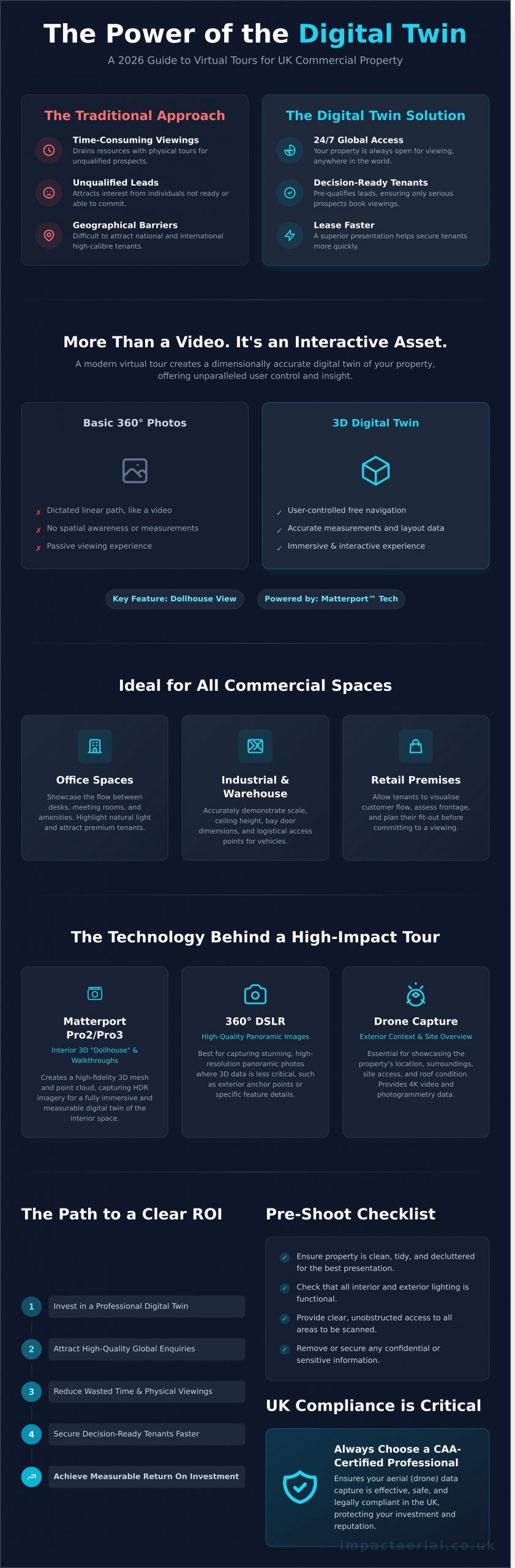
A 360 tour consists of stitched panoramic images, while a 3D digital twin utilizes spatial data to create a technically accurate model. Digital twins allow for precise measurements and a “dollhouse” perspective that reveals the property’s entire layout. This depth is essential for commercial assets where structural context and technical specifications are priorities for investors and surveyors. It moves the asset from a simple visual aid to a data-rich tool.

How do drone shots improve the ROI of an internal virtual tour?

Aerial shots provide the macro context that internal tours cannot offer alone, such as land boundaries and proximity to transport links. This “Aerial-to-Interior” continuity builds buyer trust by showing the property’s exact position within its environment. For international investors, this external context is often the deciding factor in making an offer sight-unseen. It qualifies the lead more effectively than interior walkthroughs could do in isolation.

Is it worth creating virtual tours for commercial property or just residential?

Commercial assets often realize a higher roi of virtual tours for property sales because the financial stakes and holding costs are greater. For a £5 million development, a small percentage increase in the final sale price represents a significant capital gain. Additionally, virtual tours serve as a permanent technical record for insurance purposes and due diligence. This reduces the risk of misrepresentation claims during complex commercial transactions.

What happens if the weather is bad for the drone filming portion of the tour?

We prioritize safety and CAA compliance; therefore, we don’t fly in adverse weather conditions like heavy rain or high winds. If the forecast is unsuitable, we reschedule the aerial portion for the next clear window at no additional cost to the client. This ensures we maintain the high-quality 4K HDR results required for professional marketing. Our pilots always monitor weather data to provide added peace of mind during the planning phase.

Virtual Tour for New Build Homes: The Developer’s Guide to Immersive Marketing in 2026

What if you could sell a property 31% faster and for up to 9% more, without spending tens of thousands on a physical show home? According to recent industry data from Matterport, that’s the precise advantage developers are gaining. It’s an undeniable reality in property development; the traditional model of relying on static 2D floor plans and costly show homes struggles to capture the imagination of today’s digitally-native buyers, especially for off-plan sales.

This guide is engineered to demonstrate how a professionally produced virtual tour for new build homes is no longer a luxury, but a fundamental component of a modern marketing strategy. You’ll discover exactly how immersive, drone-captured experiences can slash your time-on-market, generate qualified leads around the clock, and solidify a premium brand image that justifies higher asking prices. We’ll break down the technology, the return on investment, and the strategic steps you need to take to gain a decisive competitive edge in the 2026 property market.

Key Takeaways

  • Learn why static photography no longer meets the expectations of digital-first buyers and how immersive experiences provide a crucial competitive edge.
  • Discover how combining ground-level 360° cameras with aerial drone data creates a sales tool that showcases the entire development context.
  • Analyse the cost-benefit of a professional virtual tour for new build homes and see how it can accelerate off-plan sales while reducing marketing costs.
  • Understand the essential steps for planning a successful shoot and the importance of choosing a CAA GVC certified and fully insured operator for your project.

Beyond Show Homes: The Evolution of Virtual Tours for New Build Developments

The concept of a virtual tour is no longer a simple sequence of 360-degree photographs. By 2026, a professional virtual tour for new build homes is a fully-interactive, photorealistic digital twin of an unbuilt property. It’s a data-rich environment created from architectural plans and CGI, allowing prospective buyers to explore every room, customise finishes, and understand the spatial dynamics long before a single foundation is poured. For a technical overview, you can explore What is a Virtual Tour? to understand its core technology. This evolution is critical; static 2D photography simply doesn’t meet the expectations of today’s digital-native buyers, a demographic where, according to a 2022 Statista report, 98% of individuals under 30 own a smartphone and expect immersive digital experiences.

This immersive quality has a profound psychological impact on sales. When a potential buyer can virtually ‘walk through’ a property, they begin to form an emotional connection and a sense of ‘mental ownership’. This isn’t just a feeling; it translates into measurable results. Real estate listings featuring high-quality 3D tours see up to 40% more user engagement than those without. This heightened connection directly correlates with increased lead quality and faster conversion rates. Beyond the sales floor, this technology also supports the crucial ‘Green Building’ narrative. By providing a perfect digital replica, developers can significantly reduce the carbon footprint associated with property viewings, eliminating countless non-essential car and air journeys from speculative buyers.

The Shift to Off-Plan Digital Selling

For property developers, the most significant advantage is the ability to secure deposits months or even years before project completion. This digital-first approach drastically reduces the reliance on constructing and fitting out expensive physical show homes, which can cost anywhere from £50,000 to over £150,000 per unit. A virtual tour provides a superior, more flexible asset at a fraction of that cost, while also empowering sales teams to reach a global audience of international and out-of-area investors who can view and commit to a property from anywhere in the world.

Meeting the 2026 Buyer Expectations

The widespread availability of high-bandwidth 5G networks across the United Kingdom means buyers expect and receive a flawless, buffer-free tour experience on their mobile devices. Modern tours are enhanced with interactive hotspots; a user can click on the kitchen worktop to see material specifications, on an appliance to download the manufacturer’s warranty, or on a window to see the precise view. These tours are no longer standalone assets; they are designed for seamless integration with major UK property portals like Rightmove and Zoopla and are easily shared across social media platforms, amplifying marketing reach exponentially.

The Technology Powering Immersive Property Experiences

Creating a truly effective virtual tour for new build homes goes far beyond a simple 360-degree photograph. It involves a meticulous process of data acquisition, combining high-resolution ground-based imagery with comprehensive aerial data to build a complete digital asset. The goal isn’t just to show a property; it’s to deliver a spatially accurate, emotionally resonant experience that gives potential buyers the confidence to commit, often before a single brick is laid. This requires a professional, data-centric approach, ensuring every pixel serves a commercial purpose.

The foundation of a premium tour lies in its visual fidelity. We exclusively utilise camera systems capable of capturing 4K High Dynamic Range (HDR) imagery. HDR technology is critical for property, as it correctly exposes both the bright view through a window and the subtle details of the interior in a single, seamless shot. This prevents the washed-out windows or dark corners common in lower-quality tours, presenting your build with the premium feel it deserves.

A key technical decision is the choice between standard 360 photography and photogrammetry. While standard 360s create an immersive “bubble” from a fixed point, photogrammetry uses hundreds of overlapping images to construct a metrically accurate 3D model. For a simple interior walkthrough, a 360 tour may suffice. For a comprehensive development overview that allows for virtual measurements and a true sense of scale, photogrammetry is the superior professional service.

Aerial Integration: The Impact Aerial Advantage

Our CAA GVC Certified pilots utilise industry-leading drone systems to capture the vital context that ground-based cameras cannot. We can fly to the exact coordinates of a third-floor window before the frame is even built, capturing the genuine “view from the window” for your marketing materials. This unique capability allows you to sell a specific plot’s key advantage months in advance. The aerial perspective seamlessly maps out local amenities, from the distance to the nearest primary school to the walking paths in the local park, transitioning from a bird’s-eye view right to the front door.

Software and Interactivity

The captured data is then processed into an interactive experience. While platforms like Matterport offer a robust, industry-recognised solution, we also provide custom-coded tours for developers requiring bespoke branding or specific API integrations. Within these tours, we can embed interactive tags containing everything from downloadable floor plans and BIM data to specifications for the kitchen appliances. This transforms the tour from a passive viewing into an active exploration, providing buyers with all the information they need in one place.

Perhaps the most powerful component is the analytics. We can track user engagement to see exactly where potential buyers are spending their time. Discovering that 80% of users linger in the master suite and open-plan kitchen provides your sales team with invaluable intelligence. This level of data-driven insight is a key reason why virtual technologies are poised to revolutionize the real estate industry, turning a visual asset into a source of actionable business intelligence. Understanding which technology is right for your development is the first step; you can see our professional services in action on past projects to learn more.

Comparing Virtual Tours to Traditional Marketing: ROI and Engagement

Adopting a virtual tour for new build homes is not merely an aesthetic upgrade; it is a strategic investment with a measurable return. Traditional marketing methods, such as static photography and physical show homes, have inherent limitations in reach, cost, and buyer qualification. High-quality digital assets deliver a quantifiable advantage by fundamentally changing how prospective buyers interact with a property before a physical viewing is ever scheduled.

The data on user engagement is compelling. According to real estate technology analysts at Zillow, listings that include a 3D tour receive a 40% increase in user engagement. Viewers don’t just glance; they explore. Industry-wide metrics show that potential buyers spend up to 10 times longer on a property listing that features an immersive tour compared to one with only 2D images. This extended interaction time directly correlates with a deeper level of interest and a higher probability of conversion.

A direct cost-benefit analysis reveals significant efficiencies. Consider the typical expenses for a single show home:

  • Physical Staging: A 6-week hire for a standard 3-bedroom property in the UK can cost between £2,500 and £5,000.
  • Professional Photography: A one-off shoot can range from £400 to over £1,000 for a comprehensive package.
  • Ongoing Overheads: Staffing, utilities, and maintenance for a physical show home represent a continuous financial drain.

In contrast, a professional virtual tour is a one-time investment, typically costing between £400 and £900. This single digital asset can be used across all marketing channels indefinitely, from the initial off-plan launch to the final plot sale. It effectively pre-qualifies buyers by allowing them to rule a property in or out from their own home, leading to reports of a 40% reduction in wasted physical viewings. This frees up your sales team to focus on genuinely interested, high-intent purchasers.

The ROI of Immersive Content

The financial return extends beyond direct cost savings. Data from Matterport, a leading platform in 3D capture, indicates that properties with virtual tours can sell up to 31% faster, drastically shortening the sales cycle and improving cash flow for developers. When used on targeted landing pages, these tours can increase lead generation by as much as 49%. By pre-qualifying buyers and answering spatial questions visually, virtual tours significantly reduce the administrative burden on sales teams, allowing them to handle more qualified leads with greater efficiency.

Brand Positioning and Competitive Edge

In a competitive new build market, a tech-forward approach is a powerful differentiator. Offering a superior digital experience positions your brand as modern, transparent, and customer-focused. This technology is also invaluable for off-plan sales, where virtual architectural visualizations allow buyers to experience a property that doesn’t yet exist, building the confidence needed to secure early commitments. Furthermore, the virtual tour serves as a permanent, high-resolution digital archive of the property’s condition at handover, a valuable tool for snagging lists and future reference, providing peace of mind for both developer and buyer.

This tech-forward branding can extend beyond the screen to the physical sales environment itself. For high-impact launch events or unique pop-up marketing suites, some developers are now using innovative structures to stand out. Companies such as Immersive Experiences offer geodesic domes that create a futuristic and memorable setting, perfectly aligning a developer’s physical presence with their digital-first strategy.

Planning Your Virtual Tour: A Step-by-Step Implementation Guide

Executing a high-quality virtual tour for new build homes is a methodical process that extends far beyond a simple photoshoot. It requires a structured, multi-phase approach to guarantee the final asset not only looks professional but also functions as a powerful sales tool. At Impact Aerial, we manage this entire workflow, ensuring every detail aligns with your development’s unique selling proposition.

The process is broken down into five distinct, professionally managed phases:

  • Phase 1: Scoping & Strategy. We begin with a detailed consultation to define the project’s scope. This involves identifying the key plots to capture and pinpointing the unique selling points, from the premium quartz worktops in the kitchen to the energy efficiency rating and the orientation of the south-facing garden.
  • Phase 2: Site Preparation. This crucial phase involves preparing the property and the wider site for data capture. We coordinate with your site manager to schedule the work and identify the optimal weather window for aerial operations.
  • Phase 3: Data Capture. Our CAA GVC Certified pilots execute the shoot day with precision. This is a coordinated effort, utilising ground-based 360° cameras for internal spaces and our DJI Enterprise drones for breath-taking external and contextual aerial views.
  • Phase 4: Post-Production. Raw data is processed into a seamless, interactive tour. We embed custom ‘info tags’ to highlight specific features, integrate floor plans, and perform professional colour grading to ensure the property is presented in its best light.
  • Phase 5: Deployment & Integration. The completed tour is delivered in a format ready for immediate integration into your website, property portals like Rightmove, and your CRM systems.

Preparing the Site for Capture

A pristine site is non-negotiable for achieving top-quality results. Internally, show homes must be staged to perfection: all surfaces decluttered, lights on, and personal items removed. A flawless paint finish is critical for a high-end look, and using a professional service like Higher Impact Painting can ensure the property is camera-ready. Externally, the site must be clear of construction debris and unnecessary vehicles. For aerial capture, our certified pilots establish strict safety zones in compliance with CAA regulations, ensuring the operation is conducted safely and without interruption. We schedule our drone property surveys during the ‘Golden Hour’, the first and last hour of daylight, as the soft, angled light dramatically enhances the texture and visual appeal of brickwork and landscaping.

Integration and Deployment

A virtual tour’s value is only realised when prospective buyers can easily access it. We provide a simple iframe embed code that allows you to integrate the tour directly onto your website without impacting page load speeds, a key factor for SEO performance as of Google’s 2021 Core Web Vitals update. For on-site marketing, QR codes on hoardings and sales literature offer a direct link for passers-by. With QR code usage in the UK having grown by over 90% since 2018, this is a highly effective way to engage local prospects. Finally, we advise training your sales team to use the tour as an active closing tool, guiding clients through the property on a large screen in the sales suite to build desire and overcome objections in real time.

To ensure every phase of your project is handled with professional precision, contact our certified team for a detailed project consultation and get your new build development seen and sold faster.

Why Impact Aerial is the Trusted Partner for UK Developers

Selecting a partner to create a virtual tour for new build homes goes beyond finding someone with a drone. It’s a decision about professionalism, safety, and brand integrity. At Impact Aerial, we provide a fully managed, compliant, and insured professional service designed specifically for the demands of UK property developers. Our process is built on four pillars: stringent safety compliance, comprehensive insurance, bespoke creative output, and meticulous project management.

Compliance and Safety Standards

Operating drones in residential or built-up areas is a highly regulated activity. Our pilots are all CAA GVC Certified, the required standard for complex commercial operations in the UK. This isn’t just a certificate; it’s your assurance that we can legally and safely navigate flight restrictions near buildings and people. Before any flight, we conduct a detailed risk assessment and site survey, identifying potential hazards and establishing a safe operational plan. Using an uncertified operator exposes your project to significant legal and financial risks, including CAA fines of up to £2,500 and the potential invalidation of your site’s insurance. For added peace of mind, all our operations are covered by £5 million in commercial liability insurance.

Tailored Solutions for Property Professionals

We understand that every development is unique. From our base in Birmingham, we have delivered projects for property professionals across the West Midlands and the entire UK. Our experience isn’t just in flying; it’s in understanding what developers need to see and what prospective buyers want to experience. For a recent 75-home development in Warwickshire, our phased aerial progress reports helped the developer secure stage-based funding, while the final virtual tour contributed to a 30% increase in qualified viewing appointments within the first month of its launch.

Our service extends far beyond the flight. The post-production process is entirely bespoke to your brand. We ensure every element aligns with your marketing collateral, including:

  • Brand Integration: Seamlessly embedding your logos, contact information, and plot details directly into the tour.
  • Colour Grading: Matching the video’s colour palette to your brochures and brand guidelines for a cohesive campaign.
  • Information Overlays: Highlighting key features, local amenities, and transport links to add tangible value for viewers.

Our comprehensive project management means we handle every detail, from the initial consultation and flight planning to the final delivery of your assets. We deliver a complete virtual tour for new build homes that is ready to be deployed on your website, property portals like Rightmove, and across your social media channels. To discover how we can elevate your next project, contact our team today for a bespoke, no-obligation quote tailored to your development’s specific requirements.

Your Blueprint for Immersive Marketing Success

The landscape for property marketing is irrevocably shifting. As we approach 2026, it’s clear that immersive digital experiences aren’t just a supplement; they are a fundamental component of a successful sales strategy. They provide unparalleled access for off-plan buyers and can significantly shorten the sales cycle by building trust and excitement long before a show home is even complete.

Executing a top-quality virtual tour for new build homes demands technical expertise and operational precision, making your choice of partner critical. At Impact Aerial, we provide the professional services UK developers trust, backed by CAA GVC Certified pilots and a state-of-the-art 4K HDR DJI Enterprise fleet. For your complete peace of mind, our operations are fully covered by £5m in Commercial Liability Insurance.

Ready to showcase your development with breath-taking clarity and secure your competitive edge? Book your professional virtual tour consultation with Impact Aerial and let’s build the future of property marketing together.

Frequently Asked Questions

How much does a virtual tour for a new build home typically cost?

A virtual tour for a single new build property typically costs between £300 and £700. The final price depends on the home’s square footage and the number of scan points required to create a complete, high-quality model. For entire developments or multi-property projects, we provide a bespoke quotation based on the full scope of work, which can include aerial drone integration and custom branding. This investment provides a powerful, long-term marketing asset.

Can you create virtual tours for off-plan properties that haven’t been built yet?

Yes, we create photorealistic virtual tours for off-plan properties using advanced CGI (Computer-Generated Imagery). By working directly from your architectural plans, such as CAD or BIM files, our team builds a detailed and immersive 3D model of the property before construction begins. This allows prospective buyers to explore the layout and finishes months or even years before completion, helping to accelerate your off-plan sales cycle significantly.

How long does it take to shoot and produce a full development virtual tour?

On-site scanning for a single new build show home typically requires 2-4 hours. For a full development, on-site data capture can take one to two full days, depending on the number of individual plots and exterior areas that need to be covered. Post-production, which includes processing the scans and building the final interactive tour, is generally completed within 48 to 72 hours, delivering a market-ready asset to you promptly.

Do I need special permits for drone photography on a construction site?

No, you don’t need to arrange any permits; we manage all aviation-related permissions as your certified operator. Impact Aerial is fully CAA GVC Certified and we conduct meticulous pre-flight risk assessments for every operation. We handle all necessary airspace checks to ensure full compliance with UK drone regulations. Your only responsibility is to grant us permission to operate on the site itself, giving you complete peace of mind.

Are virtual tours mobile-friendly for buyers browsing on their phones?

Yes, all our virtual tours are fully responsive and optimised for mobile devices. They provide a seamless, high-quality experience on any smartphone or tablet, across both iOS and Android platforms. With over 60% of UK web traffic now on mobile, according to 2023 Statista data, we ensure your potential buyers can explore properties from anywhere. The tours load efficiently and feature intuitive touch-based navigation for ease of use.

What is the difference between a 360 tour and a 3D walkthrough?

A 360 tour connects a series of static panoramic photos, allowing a user to look around from fixed points. In contrast, a 3D walkthrough is created by scanning a property to build a complete, geometrically accurate 3D model. This provides a true sense of presence, enabling users to move freely through the space as if they were there. Our 3D walkthroughs also include unique perspectives like the ‘dollhouse’ view for a comprehensive understanding of the property’s layout.

Can virtual tours be used for snagging and construction site monitoring?

Yes, a virtual tour for new build homes is a highly effective tool for construction management. The high-resolution imagery allows project managers and clients to conduct remote snagging inspections, zooming in on details without needing to be on-site. When captured at regular intervals, these scans create a precise digital timeline of progress, providing an accurate as-built record for handover and facilities management.

What happens if the weather is bad on the day of the drone shoot?

Your project’s safety and the quality of the final assets are our top priorities. We cannot operate drones in high winds (above 22 mph) or heavy rain, as this violates CAA safety regulations and degrades image quality. If inclement weather is forecast, we will reschedule the aerial photography for the next suitable day at no additional charge. The internal 3D scanning of the property can often proceed as planned regardless of the weather.

Best Drone for Property Photography 2026: The Professional’s Guide

Buying the wrong drone for your property business could cost you more than just the hardware; it could cost you thousands in CAA fines and invalidate your commercial liability insurance. It’s a common and expensive pitfall for professionals eager to capture those breathtaking, high-level perspectives that can accelerate a sale. You’re right to believe that high-quality aerial imagery is no longer a luxury but a necessity in a competitive market, but achieving it legally and safely is a complex challenge.

This guide is designed to provide complete operational clarity. We’ll identify the best drone for property photography 2026, breaking down the top models that deliver stunning 4K HDR results without an enterprise-level price tag of over £10,000. More importantly, we’ll demystify the operational requirements, from CAA compliance to insurance, ensuring your investment generates top-quality assets and total peace of mind, not legal headaches.

Key Takeaways

  • Understand the key specifications that make models like the DJI Mavic 4 Pro the best drone for property photography 2026, and learn why dual-lens systems are a game-changer.
  • Navigate the complexities of UK aviation law by clarifying the essential CAA GVC (General Visual Line of Sight Certificate) requirements for professional property marketing.
  • Calculate the true return on investment by weighing the purchase price against the often-overlooked costs of professional training, software, and ongoing maintenance.
  • Discover why the hardware is only half the battle and learn how professional post-production transforms raw footage into compelling, high-impact marketing assets.

The State of Property Photography in 2026: Why Quality Matters

The landscape of UK property marketing has been irreversibly altered by drone technology. What was once a luxury for multi-million-pound estates is now a fundamental expectation across the market. Today’s prospective buyers, conditioned by high-definition content in every aspect of their digital lives, no longer see professional aerial photography as a novelty. In 2026, its absence is often perceived as a sign of an incomplete or poorly managed listing.

To understand the cinematic potential and technical considerations involved, the following guide offers valuable insights into modern real estate videography:

This shift is backed by compelling data. A 2025 market analysis by Zoopla indicated that UK property listings incorporating professional aerial video see a 43% higher click-through rate from initial searches. More importantly, these properties experience an average reduction in ‘time on market’ of up to 22%. The reason is simple: aerial views provide an unparalleled sense of scale, context, and desirability that ground-level shots cannot replicate. They immediately answer buyers’ key questions about a property’s boundaries, garden size, orientation, and relationship to its neighbours.

This elevated standard is driven by advancements in sensor technology. The 1/2.3-inch sensors common in consumer drones just a few years ago are now obsolete for high-end work. The best drone for property photography 2026 will feature at least a 1-inch or Micro Four Thirds sensor. These larger sensors capture far more light and data, producing images with the wide dynamic range needed to show detail in both the bright sky and the shadowed eaves of a building simultaneously, eliminating the amateurish, washed-out look of older equipment.

Visual Standards for 2026 Real Estate

The standard has shifted decisively. 4K High Dynamic Range (HDR) video is now the absolute baseline for online listings, while 8K still photography is essential for premium print marketing and for allowing digital users to zoom into details without image degradation. Submitting grainy or poorly composed drone shots for a property valued over £750,000 can actively damage the brand of the estate agent and the perceived value of the listing itself. A skilled pilot doesn’t just capture a building; they tell its story, revealing its context within the neighbourhood. This practice is a sophisticated evolution from the early history of aerial photography, now focused on creating a compelling lifestyle narrative that sells not just a house, but a location.

This principle of storytelling through imagery is a hallmark of all high-end photography. The powerful portraiture from studios like Wow Photography, for example, excels at capturing the unique character of its subjects—a skill that translates directly to conveying the distinct personality of a home.

Commercial vs. Residential Requirements

While residential photography focuses on emotional appeal, commercial property requirements are far more data-driven. A commercial developer, construction firm, or facilities manager requires actionable intelligence, not just a pretty picture for a brochure. This is where professional drone services diverge into technical operations, moving from marketing into ‘Data Collection Surveys’. These CAA-regulated flights use specialised payloads and software for:

  • Photogrammetry Surveys: Creating centimetre-accurate 3D models of sites and structures for planning.
  • Topographical Mapping: Generating detailed land contour maps for development and architectural design.
  • Construction Progress Monitoring: Providing key stakeholders with verifiable visual data on project milestones.

Top 3 Drones for Property Photography: 2026 Technical Breakdown

Selecting the optimal drone for property photography is no longer about simply getting a camera in the air. For 2026, the decision hinges on the specific application, from residential marketing to complex commercial surveys. The market leader, DJI, offers a tiered range of professional aircraft, each engineered for distinct outcomes. Understanding the technical differences is paramount to delivering top-quality, legally compliant aerial imagery that provides a genuine return on investment.

Here we provide a technical breakdown of the three models that define the professional landscape, helping you identify the best drone for property photography 2026 for your specific commercial needs.

The Premium Choice: DJI Mavic 4 Pro

For high-end residential property marketing, the DJI Mavic 4 Pro remains the gold standard. Its primary advantage is the Hasselblad camera system, built around a Micro Four Thirds (MFT) sensor. This larger sensor captures significantly more light and data than the 1-inch sensors found in prosumer models, resulting in superior dynamic range and low-light performance. This is critical for capturing those coveted “golden hour” shots with deep, rich colours and minimal noise. The ability to shoot in 10-bit D-Log M provides immense flexibility in post-production, allowing for precise colour grading to match a client’s branding.

Its compact, sub-900g airframe and advanced omnidirectional obstacle avoidance make it perfect for navigating the tight confines of urban property shoots. Operating in congested areas, such as the dense residential streets of Birmingham and the West Midlands, demands not only pilot skill but also strict adherence to UK drone regulations, and the Mavic 4 Pro’s safety features provide an essential layer of risk mitigation.

  • Pros: Unmatched image quality in its class, exceptional low-light capability, and excellent portability for rapid deployment.
  • Cons: Lacks a mechanical shutter, making it less suitable for high-precision photogrammetry work where geometric accuracy is vital.

The Versatile Contender: DJI Air 3S

The DJI Air 3S carves out its niche with a powerful dual-lens system that is a genuine game-changer for creative property shots. While its main wide-angle camera features a capable 1/1.3-inch sensor, the inclusion of a 3x medium telephoto lens (a 70mm equivalent) unlocks the power of lens compression. This effect subtly flattens the perspective, making properties appear more majestic and allowing features like landscaped gardens or swimming pools to be framed without the wide-angle distortion that can plague single-lens drones. For agents looking to create a more cinematic and visually compelling portfolio, the Air 3S offers creative flexibility that was previously only available on much larger, more expensive platforms.

The Commercial Workhorse: DJI Mavic 3 Enterprise (M3E)

When the mission shifts from marketing to data-gathering, the DJI Mavic 3 Enterprise is the essential tool. Its key differentiator is a wide-angle camera equipped with a mechanical shutter. This is non-negotiable for professional survey work, as it eliminates the rolling shutter distortion that can corrupt data, ensuring every photograph is geometrically precise for creating crisp, blur-free orthomosaic maps and 3D models.

Furthermore, the M3E’s compatibility with an RTK (Real-Time Kinematic) module provides centimetre-level positioning accuracy. This is the standard required for professional land surveying, boundary mapping, and construction progress monitoring. For more advanced applications, the M3T variant includes a 640×512 resolution thermal camera, ideal for conducting building heat-loss inspections and identifying roof moisture ingress. Understanding which tool is right for your project is key, and our professional commercial drone services are tailored to these specific, data-critical needs.

UK Drone Regulations & Safety: The ‘Hidden’ Cost of 2026 Compliance

Selecting the hardware is only the first step. The true cost and value of professional aerial imaging are rooted in legal compliance and operational safety. For property professionals, overlooking these factors introduces significant financial and reputational risk. The impressive capabilities of the best drone for property photography 2026 are rendered useless, and even dangerous, without a certified pilot operating within the strict framework set by the UK’s Civil Aviation Authority (CAA).

Hiring an uncertified pilot simply to save a few hundred pounds is a high-risk gamble. In the event of an incident, the liability can fall directly on the commissioning business, leading to potential fines that, under the Air Navigation Order 2016, can be unlimited. This section unpacks the non-negotiable legal and insurance requirements that define professional drone services in the UK.

Navigating the Civil Aviation Authority (CAA)

Since the major regulatory overhaul on 31st December 2020, UK drone operations fall into distinct categories. The ‘Open’ category is for low-risk, recreational flights away from people. Commercial property photography, especially in urban areas, almost always falls into the ‘Specific’ category. This category requires the drone operator to hold an Operational Authorisation from the CAA, for which the General Visual Line of Sight Certificate (GVC) is the standard qualification. This certification, which replaced the older PfCO, proves a pilot has the theoretical knowledge and practical skill to operate safely, manage risk, and understand complex aviation principles. For operations in congested areas like central Birmingham or the dense urban centres of the West Midlands, a GVC isn’t just a recommendation; it’s a fundamental requirement for legal flight.

Insurance and Risk Management

A professional pilot’s commitment to safety extends far beyond their qualifications. Before a drone even leaves its case, a meticulous process of risk management begins. This is a key differentiator that hobbyist insurance simply doesn’t cover. Standard recreational policies are not valid for any form of commercial work, or ‘for valuable consideration’.

  • Commercial Liability: The industry standard for professional operators is a minimum of £5 million in commercial liability insurance, compliant with regulation EC785/2004. Always ask to see a current certificate.
  • Pre-Flight Risk Assessment: A certified pilot will conduct a detailed site survey and risk assessment, identifying potential hazards like air traffic, public footpaths, power lines, and data privacy concerns. This isn’t just paperwork; it’s a strategic plan to ensure a safe and successful shoot.
  • Brand Protection: An incident with an uninsured or uncertified pilot can cause irreparable damage to your brand. For added peace of mind, partnering with a fully compliant operator demonstrates due diligence and protects your business from legal entanglements and negative press. The expanding scope of commercial drone applications from simple photography to complex data-gathering makes this professional oversight more critical than ever.

Ultimately, the investment in a GVC-certified and properly insured drone pilot is an investment in certainty. It ensures your property marketing is not only visually stunning but also legally sound and professionally executed.

Buy vs. Hire: Calculating the ROI of Professional Drone Services

For many estate agencies, the question isn’t if they should use aerial imagery, but how. The temptation to purchase a drone in-house is strong, but a simple cost comparison between hardware and a day rate is dangerously misleading. A true Return on Investment (ROI) calculation reveals the extensive hidden costs and operational burdens of an in-house programme. The decision to buy or hire directly impacts your time, legal compliance, and the final quality of your property listings.

An in-house pilot doesn’t just fly a drone. They become a dedicated aviation manager, video editor, and legal compliance officer. Outsourcing to a professional service liberates your team from these roles, saving, on average, over 20 hours of non-core work per property. This includes pre-flight risk assessments, airspace checks, travel, on-site capture, data processing, and professional-grade editing. That’s time your agents can reinvest directly into sales and client management.

The Real Cost of In-House Drone Operations

The initial investment for what’s considered the best drone for property photography 2026 can range from £2,000 to over £10,000 for a commercial-grade system. For those looking to purchase, online retailers like DroneHundred offer a range of professional models. This capital expenditure is just the entry fee. The ongoing operational costs quickly eclipse the initial purchase price, creating a significant financial drain that a simple service fee avoids. A comprehensive breakdown includes:

  • Training & Certification: A commercial operator in the UK must hold a CAA-issued General Visual Line of Sight Certificate (GVC). The initial training and exam costs approximately £1,000, with ongoing professional development required to stay current with evolving 2026 regulations.
  • Commercial Insurance: Public Liability Insurance compliant with EC 785/2004 is a legal requirement for commercial drone work. Policies for new operators typically start at £750 per annum.
  • Software Subscriptions: Professional output demands professional tools. Monthly subscriptions for software like Adobe Creative Cloud for video editing (£51.98/month) and Pix4D for 3D mapping (£280/month) are standard.
  • Maintenance & Depreciation: A commercial drone depreciates rapidly. A £5,000 drone today may be worth less than £2,500 in 24 months. Factoring in battery replacements (£170 each) and potential repairs adds hundreds more to the annual cost.

The Professional Advantage

Partnering with a certified drone services provider offers far more than just aerial footage; it provides operational excellence and guaranteed quality control. A pilot with a CAA GVC isn’t just a hobbyist. They are a trained aviator, capable of conducting detailed risk assessments and securing permissions to fly in congested areas or near flight restriction zones, unlocking perspectives an untrained operator legally cannot achieve.

This expertise extends beyond the flight itself. Professional services deliver reliability. We handle all project management, from monitoring weather patterns with advanced forecasting tools to ensure optimal lighting, to managing all CAA-required documentation for full legal compliance. For added peace of mind, this process ensures every listing, whether it’s a single home in Birmingham or a portfolio of properties across the UK, is captured and produced to the exact same high-quality brand standard. You don’t just hire a pilot; you gain access to a full team of post-production experts who transform raw data into breath-taking, cinematic property tours. To ensure your listings benefit from this professional edge and achieve maximum market impact, contact our team for a professional consultation.

Elevating the Results: Beyond the Raw Drone Footage

Capturing high-resolution images and 4K video is only the first step. The true value in professional aerial property marketing is unlocked in post-production, where raw data is transformed into compelling assets. A top-tier drone provides the potential, but it’s the expert handling of that footage and data that delivers a tangible return on investment. The best drone for property photography 2026 isn’t just about the hardware; it’s about the entire ecosystem of services that turns aerial captures into breath-taking, actionable results.

At Impact Aerial, our process is meticulously designed to maximise the potential of every flight. From initial consultation and CAA-compliant flight planning to the final polished edit, we provide an end-to-end professional service. We understand that turning raw footage into a high-quality marketing film or a precise technical survey requires a distinct set of skills that goes far beyond piloting the drone itself.

Cinematic Editing for Property

The difference between raw drone footage and a finished property film is stark. Raw video, often shot in a flat colour profile to retain maximum data, can appear dull and uninviting. Our professional post-production process involves several critical stages to create a polished, engaging asset:

  • Colour Grading and Correction: We meticulously adjust colours to ensure the property looks its absolute best, making lawns appear lush and skies a vibrant blue. For shoots on overcast days, a common reality in the UK, we can perform professional sky replacements to present the property in its most appealing light.
  • Branding and Information: We integrate your company branding, logos, and contact details directly into the video. By adding a professionally licensed music track and clear call-to-actions, we transform a simple fly-over into a powerful marketing tool that actively generates leads.

Looking ahead to 2026, optimising for social media is non-negotiable. With over 70% of property searches starting on mobile devices, vertical video is essential. We re-frame our 4K footage for platforms like Instagram Reels and TikTok, creating dynamic, fast-paced edits in a 9:16 aspect ratio that are proven to hold viewer attention and increase share rates by up to 25%.

Technical Data and Virtual Tours

Beyond marketing, the data-gathering capabilities of modern drones offer immense value. We use advanced photogrammetry techniques to create assets that give potential buyers and investors unparalleled insight into a property before they ever set foot on site. This includes integrating high-resolution aerial shots into 3D virtual tours like Matterport, allowing a user to seamlessly transition from a “dollhouse” overview of the entire property and its grounds directly into an internal walk-through.

For commercial clients, this data becomes a critical tool for surveying and inspection, delivering significant cost savings. Our services include:

  • Roof and Building Inspections: Safely identify structural issues, water ingress, or damage without the cost and risk of scaffolding, reducing inspection costs by an average of 60%.
  • Thermal Assessments: Using specialised thermal sensors, we can pinpoint areas of heat loss in a building’s envelope, providing data that can lead to energy efficiency improvements saving a business thousands of pounds annually.
  • Large-Scale Surveys: We conduct detailed surveys for large sites, including commercial developments and PV Solar Farms, providing accurate data for planning and maintenance.

Leveraging the full spectrum of aerial capabilities, from cinematic video to precise technical data, is what separates an amateur operator from a professional partner. To discover how our comprehensive services can benefit your property portfolio, contact Impact Aerial for a professional property consultation.

Elevate Your 2026 Property Listings with Professional Aerial Imagery

Choosing the right aerial strategy for your properties in 2026 goes far beyond picking a drone from a list. It’s about understanding that superior image quality, strict adherence to UK drone regulations, and a positive return on investment are all interconnected. While owning the equipment seems appealing, the hidden costs of CAA compliance, insurance, and maintenance can easily surpass £2,000 per year. Navigating these complexities is crucial to successfully leveraging the best drone for property photography 2026.

Instead of managing the hardware and legalities yourself, partner with a trusted specialist. At Impact Aerial, our CAA GVC Certified pilots provide complete peace of mind with £5m in commercial liability insurance. As the leading specialists in Birmingham and the West Midlands, we deliver not just raw footage, but a full suite of services including expert post-production and immersive virtual tours. Let us handle the technical details so you can focus on selling.

Ready to make your listings stand out from the competition? Book Your Professional Property Drone Shoot with Impact Aerial and see the difference true expertise makes.

Frequently Asked Questions

Do I need a license to take drone photos of my own property listings in the UK?

Yes, you do. If you’re using drone photos for any commercial purpose, including marketing your own property listing, it’s considered ‘material consideration’ by the UK’s Civil Aviation Authority (CAA). This requires the operator to hold a relevant qualification, such as an A2 Certificate of Competency (A2 CofC) or a General Visual Line of Sight Certificate (GVC), and to have appropriate commercial insurance. Operating without these can result in significant legal penalties.

What is the best drone for real estate photography in 2026?

The best drone for real estate photography in 2026 is one that offers a superior camera sensor and robust flight stability, such as the DJI Mavic 3 Pro. Its triple-camera system provides exceptional versatility for capturing wide establishing shots and detailed telephoto images. For professionals seeking the best drone for property photography 2026 with a focus on value, the DJI Air 3’s dual-camera system also delivers professional-grade 48MP photos and stable 4K video, making it a leading contender.

How much does a professional drone property shoot cost in the UK?

A professional drone property shoot in the UK typically costs between £250 and £600. The final price is determined by the property’s size, location, and the required deliverables. A standard package for a residential property, including 10-15 high-resolution stills, will be at the lower end of that range. Larger commercial sites or projects requiring 4K video with extensive editing will naturally command a higher fee, often exceeding £500 due to the increased operational complexity.

Can drones fly in rain or high winds for property surveys?

No, professional drones cannot be operated safely in rain or high winds. Most commercial drones are not waterproof, and moisture can cause catastrophic failure to the electronic systems. Furthermore, CAA operational guidelines and manufacturer limits restrict flight in high winds, typically above 22 mph. To ensure flight stability, client safety, and the acquisition of high-quality data, all professional drone operations are rescheduled if adverse weather conditions are present.

What insurance does a drone pilot need for commercial work?

For any commercial work in the UK, a drone pilot must hold a specialist insurance policy that is compliant with regulation EC 785/2004. This policy must include public liability insurance, with the industry standard being a minimum coverage of £1 million. For added peace of mind, most reputable professional services carry higher indemnity levels, often between £5 million and £10 million, especially when operating on sensitive or large-scale commercial sites. Always ask to see a current insurance certificate.

How long does a typical drone property shoot take?

A typical drone shoot for a standard residential property takes approximately 60 to 90 minutes on-site. This time includes conducting essential pre-flight risk assessments and safety checks, followed by 20-40 minutes of active flight to capture all the required imagery. Larger commercial properties or rural estates can require 2-3 hours on-site to ensure full coverage. This timeframe does not include the off-site post-production time needed for photo and video editing.

What is the difference between a 4K and 8K drone for property?

The key difference is video resolution; an 8K drone captures four times the number of pixels as a 4K drone, offering far greater detail. This allows for significant cropping or digital zooming during post-production without a noticeable loss in quality. However, for over 95% of property marketing applications, 4K resolution provides an optimal balance of high-quality visuals and manageable file sizes. It’s perfectly suited for online property portals, websites, and social media.

Is it better to buy a DJI Mini or a Mavic for real estate?

For professional real estate photography, a DJI Mavic series drone is definitively the better choice over a DJI Mini. While the Mini is an excellent sub-250g drone, the Mavic series (like the Mavic 3) features significantly larger camera sensors, providing superior dynamic range and low-light performance. Mavics also offer better wind resistance and more advanced flight modes, which are critical for achieving the high-quality, stable, and safe results required in a commercial environment.

Virtual Tour for Commercial Property: The Ultimate UK Guide (2026)

In the highly competitive UK commercial property market, standing out is more challenging than ever. Time-consuming physical viewings with unqualified prospects can drain resources, while attracting high-calibre tenants from across the country-or internationally-presents a significant logistical hurdle. This is where a professionally executed virtual tour for commercial property becomes an indispensable marketing asset, transforming how you connect with potential clients and showcasing your asset with the top-quality presentation it deserves.

Far more than a simple video walkthrough, this technology offers an immersive, data-rich experience that pre-qualifies leads before they even step foot on-site. In this definitive 2026 UK guide, we demystify the process and technology behind professional virtual tours. Discover how to commission a high-impact tour that not only attracts serious, decision-ready tenants but also helps you lease your property faster and deliver a clear, measurable return on your investment.

Key Takeaways

  • Discover how modern 3D technology creates an interactive digital twin of your asset, a marketing tool far more powerful than basic 360° photos.
  • A professional virtual tour for commercial property is a strategic investment that increases qualified enquiries and helps secure higher-quality tenants faster.
  • Utilise a simple pre-shoot checklist to prepare your property correctly, ensuring you receive the highest quality results from your provider.
  • Understand why choosing a CAA-certified professional in the UK is critical for ensuring your virtual tour is both effective and legally compliant.

What is a Commercial Property Virtual Tour (And Why It’s More Than a Gadget)

In today’s competitive commercial real estate market, a virtual tour for commercial property is no longer a novelty; it is a critical marketing and data-gathering tool. Far beyond a simple slideshow of 360° photos, a modern virtual tour is an interactive and dimensionally accurate digital twin of a physical space. This technology has evolved significantly, allowing potential tenants, buyers, and investors to explore a property from anywhere in the world, at any time. By capturing comprehensive spatial data, these tours offer an immersive experience that traditional photography or video walkthroughs simply cannot replicate. For a foundational understanding of the concept, it’s helpful to know what is a virtual tour and the technology that enables it.

To see this powerful technology in action, watch this short video demonstration:

The key differentiator is user control. While a video dictates a linear path, a virtual tour empowers the user to navigate the space freely, zoom in on details, and understand the layout in a way that feels like being there in person. This transforms your listing into an ‘always-on’ 24/7 open house, pre-qualifying leads and saving valuable time for both agents and serious prospects by allowing for detailed remote viewings.

Types of Commercial Spaces That Benefit Most

Virtually any commercial property can be enhanced with a virtual tour, but certain types see an exceptional return on investment:

  • Office Spaces: Showcase the flow between desks, meeting rooms, and breakout areas. Highlight key amenities and the quality of natural light to attract premium tenants.
  • Industrial & Warehouse Units: Accurately demonstrate the scale of the space, including critical metrics like ceiling height, bay door dimensions, and logistical access points for vehicles.
  • Retail Premises: Allow potential tenants to visualise customer flow, assess frontage, and plan their fit-out. This helps them see the unit’s potential before committing to a physical viewing.

Key Terminology You Need to Know

Understanding the language of virtual tours helps in commissioning the right professional service. 3D Digital Twin refers to the high-fidelity, data-rich model created, which is far superior to a photo gallery as it contains measurable spatial information. This is often created using technology from Matterport, a leading platform known for its high-quality cameras and seamless software. A standout feature is the Dollhouse View, a unique 3D perspective that shows the entire property with the roof removed, giving an unparalleled understanding of the complete layout at a glance.

The Technology Behind a High-Impact Virtual Tour

The effectiveness of a virtual tour for commercial property is directly tied to the quality of the technology used for its creation. The difference between a basic slideshow and a powerful sales tool lies in the data-gathering equipment. High-resolution imagery and dimensionally accurate measurements are not just features; they are foundational elements that build trust and allow potential buyers or tenants to make informed decisions remotely. In fact, recent academic research from Harvard Business School has quantified the impact of virtual tours on property sales, demonstrating a clear link between high-quality 3D tours and improved market performance.

Feature Matterport Pro2/Pro3 360° DSLR Drone Capture
Best Use Interior 3D “dollhouse” model & walkthroughs High-quality panoramic images Exterior context, site overview & ‘fly-ins’
Data Type 3D mesh, point cloud, HDR imagery High-resolution panoramic photos 4K video, high-res photos, photogrammetry data
Accuracy High (within 1% for measurements) Visual only, no measurement data High for mapping, not for interior measurements
User Experience Fully immersive, self-guided walkthrough Static, point-to-point navigation Cinematic video, interactive aerial maps

Ground-Based Capture: Inside the Property

Leading platforms like Matterport use specialised cameras that conduct a 360-degree scan at multiple points within a property. These devices combine high-dynamic-range (HDR) photography with infrared sensors to map a space in three dimensions. The infrared data builds an accurate 3D model, or “digital twin,” enabling features like the interactive dollhouse view and precise measurement tools. While this technology is advanced, it captures exactly what it sees; professional staging and lighting remain critical to ensure the property is presented in its best possible light.

Aerial Integration: The Drone’s-Eye View

A commercial property’s value is intrinsically linked to its location. Integrating aerial drone footage provides this crucial context that ground-based cameras cannot. Drones create compelling ‘fly-in’ introductions, showcasing the entire site, its boundaries, parking facilities, and proximity to key transport links and local amenities. Crucially, all commercial drone work in the UK must be conducted by CAA GVC Certified pilots. This is a legal requirement ensuring all operations are conducted safely and professionally, providing you with complete peace of mind.

Virtual Tour for Commercial Property: The Ultimate UK Guide (2026)

Calculating the ROI: How Virtual Tours Drive Commercial Lettings & Sales

Viewing a virtual tour for commercial property as an investment, rather than a cost, is the first step to understanding its significant financial impact. This is not about aesthetics; it is a strategic business tool designed to generate a measurable return. Industry data consistently shows that property listings with immersive 3D tours receive substantially more online engagement. This heightened interest is crucial, but the real value lies in its ability to refine your sales funnel, saving quantifiable time and resources.

By providing a comprehensive digital walkthrough, you immediately broaden your market, breaking down geographical barriers to attract national and international clients. This remote accessibility is a game-changer, a point reinforced by publications like Forbes on the impact of virtual reality, which highlights how the technology revolutionises the way buyers interact with properties. The tour acts as a 24/7 open house, qualifying leads before you ever schedule a physical viewing.

Time and Cost Savings for Agents and Landlords

The operational cost of a single, unproductive viewing is often underestimated. Consider an agent’s time, travel expenses, and preparation, which can easily total £50-£75 per appointment. A virtual tour for commercial property acts as a powerful pre-qualification filter, drastically reducing these wasted expenditures. It ensures that your team’s valuable time is spent only on serious, well-informed contenders who have already determined the property meets their core requirements. The benefits are direct and cumulative:

  • Reduced Wasted Viewings: Eliminates site visits from prospects whose needs (e.g., layout, size) do not match the space.
  • Lower Operational Costs: Minimises expenditure on staff hours and travel for appointments that won’t convert.
  • Accelerated Deal Flow: By focusing efforts on high-intent clients, the timeline from initial enquiry to a signed contract is significantly shortened.

Benefits for Prospective Tenants and Buyers

From the client’s perspective, the advantages are centred on convenience and confidence. A virtual tour allows them to explore multiple properties in detail from their own office, enabling them to create an accurate shortlist far more efficiently than traditional methods would allow. This modern approach empowers them with the data they need to make informed decisions. High-fidelity tours often include integrated measurement tools, allowing businesses to pre-plan office layouts or warehouse logistics, confirming the space’s suitability before committing to a visit. This transparency builds a foundation of trust and ensures that when a physical viewing does occur, the client arrives with a high degree of intent to lease or purchase.

How to Commission a Virtual Tour: A Checklist for Property Professionals

Securing a high-quality virtual tour for commercial property requires more than just booking a photographer. A methodical approach ensures the final asset aligns perfectly with your marketing objectives and delivers a tangible return on investment. Follow this five-step checklist to commission a professional tour that attracts the right tenants and shortens your leasing cycle.

Start by defining a clear objective. Are you aiming to reduce vacant periods, attract a specific high-value tenant, or simply pre-qualify viewers to save time on physical site visits? Your goal will inform the entire process, from the style of the tour to the key features you choose to highlight.

Choosing the Right Provider: Key Questions to Ask

Your choice of provider is the most critical decision. A specialist in commercial property will understand how to showcase space, scale, and facilities effectively. Before committing, ask these essential questions:

  • Do you have specific experience with commercial properties like mine (e.g., industrial units, office blocks, retail spaces)?
  • Can you provide a portfolio of previous work and client testimonials?
  • Are your drone pilots CAA GVC certified, and do you hold comprehensive commercial liability insurance? For added peace of mind, this is non-negotiable.
  • What is your process from the initial booking to the final delivery of all assets?

A professional operator, like Impact Aerial, will readily supply this information, demonstrating their commitment to safety, quality, and regulatory compliance.

Preparing the Space for the Scan

To achieve a top-quality result, the property must be prepared meticulously. A clean, decluttered space allows prospective tenants to visualise their own operations within the premises. Ensure the property is vacant during the scan to avoid interruptions and guarantee a seamless final tour. Pay attention to lighting, opening all blinds and ensuring all internal lights are functional to present the space in the best possible way. For warehouses, ensure clear gangways; for offices, tidy desks and manage cables; for retail, ensure displays are neat and floors are immaculate.

Finally, discuss deliverables and plan your marketing integration. Confirm exactly what you will receive-the tour link, high-resolution still images, 2D/3D floor plans, and any aerial drone footage. Plan precisely how you will embed the virtual tour on your website and leading UK commercial property portals like Rightmove and CoStar to maximise its reach and impact from day one.

The Impact Aerial Process: Professional, Compliant, and Effective

Creating a high-impact virtual tour for commercial property requires more than just advanced equipment; it demands a meticulous, professional, and fully compliant process. As a UK-based specialist, Impact Aerial provides an end-to-end service designed to deliver a powerful marketing asset that is both visually stunning and legally sound. Our process seamlessly integrates ground-based Matterport scanning with expert aerial drone capture to present your property from every crucial angle.

We understand that every project is unique. Our approach begins with a detailed consultation to understand your specific marketing objectives and the key features of your property. This ensures the final product is not just a 3D model, but a strategic tool built to attract qualified buyers and tenants. For your complete peace of mind, all aerial operations are conducted by CAA GVC certified pilots and are covered by £5m in commercial liability insurance.

Our End-to-End Service

We manage every stage of the project to ensure a seamless experience and a top-quality result. Our proven workflow includes:

  • Initial Consultation & Scoping: We collaborate with you to define project goals, identify key selling points, and plan the on-site capture to maximise efficiency and impact.
  • On-Site Data Capture: Our certified pilots utilise state-of-the-art Matterport Pro3 cameras for flawless interior scanning and high-performance drones for breath-taking, high-resolution aerial views.
  • Professional Post-Production: The captured data is expertly processed to create a fluid, intuitive, and high-quality virtual tour, complete with branding and informational tags.
  • Comprehensive Asset Delivery: You receive a complete package of marketing assets, including an easily embeddable tour link, accurate schematic floor plans, and a gallery of high-resolution still photographs.

Why Professional Execution Matters

Choosing a certified professional protects your investment and guarantees a superior outcome. Our expertise in creating a virtual tour for commercial property ensures we can effectively capture complex spaces, from vast industrial warehouses to multi-floor office buildings, with precision and clarity. Crucially, we guarantee full legal compliance for all aerial work, protecting you and your business from liability.

Our focus is on creating a strategic marketing asset that drives results. We combine technical skill with a deep understanding of commercial real estate marketing to produce a tour that not only showcases your property but actively helps to close deals faster. See the difference that a professional, compliant, and effective approach can make. Request a professional quote for your commercial property today.

Elevate Your Portfolio: The Future of Commercial Property Marketing

As we’ve explored, the right technology is no longer a novelty but a strategic necessity in a competitive UK market. A professionally produced virtual tour for commercial property delivers a clear return on investment, accelerating the lettings cycle and engaging qualified buyers from anywhere in the world. The key to unlocking these benefits lies in a meticulous, professional approach from commissioning to final delivery.

Choosing a partner to create these critical assets requires trust and assurance. At Impact Aerial, our CAA GVC Certified pilots operate with full transparency, backed by £5m in commercial liability insurance for your complete peace of mind. Our extensive experience spans the UK’s diverse office, industrial, and retail sectors, ensuring we understand the unique demands of your property and deliver top-quality results.

Ready to give your portfolio the competitive edge it deserves? Contact Impact Aerial to discuss your commercial property virtual tour needs. Let’s create an immersive experience that drives results.

Frequently Asked Questions

How much does a virtual tour for a commercial property cost in the UK?

The cost for a virtual tour for commercial property in the UK typically starts from around £250 for smaller units and can exceed £1,000 for large, complex industrial or office spaces. Pricing is influenced by the property’s square footage, the number of scan points required for a seamless experience, and its location. We provide a detailed, transparent quote based on a thorough assessment of your specific requirements to ensure you receive the most accurate and competitive pricing for our professional services.

How long does it take to create a virtual tour?

The on-site scanning process is highly efficient. A typical commercial unit of up to 5,000 sq ft can often be captured in 2-4 hours, while larger properties may take a full day. Post-production, which involves processing the data and building the digital model, is usually completed within 24-48 hours. We deliver the final, high-quality virtual tour promptly, allowing you to begin marketing your property without delay and secure viewings from qualified leads.

Can you create a virtual tour for a property that is currently tenanted or furnished?

Absolutely. We can conduct scans in tenanted or furnished commercial properties. For the best results, we recommend the space is decluttered and presented in a clean, professional manner before our arrival. We work efficiently and discreetly to minimise disruption to any current occupants. Clear communication with tenants beforehand is key to ensuring a smooth and successful capture process, resulting in a high-quality tour that accurately represents the space to prospective clients.

Is Matterport the only technology used for virtual tours?

While Matterport is the industry-leading platform, known for its immersive 3D “dollhouse” views and measurement tools, it is not the only technology available. Other systems like iGUIDE or custom 360° photography solutions exist. However, we primarily utilise Matterport due to its superior user experience, data accuracy, and broad compatibility with property portals. This ensures we deliver a top-quality, reliable, and highly functional asset for your commercial property marketing.

How can I add the virtual tour to property portals like Rightmove Commercial or Zoopla?

We provide you with a simple web link and an embed code for your completed virtual tour. Most major UK commercial property portals, including Rightmove Commercial, Zoopla, and EG Propertylink, have a dedicated field in their listing management system specifically for virtual tours. You or your agent simply copy and paste the provided link into this field. The portal will then automatically display the tour within your property listing for prospective clients to explore.

What is the difference between a virtual tour and a simple video walkthrough?

A video walkthrough is a linear, passive viewing experience directed by the videographer; the viewer cannot control the path or perspective. In contrast, a virtual tour is fully interactive. Users can navigate the space at their own pace, look in any direction, and often use features like measurement tools or view floor plans. This self-directed exploration provides a far more engaging and informative experience, allowing for a deeper understanding of the property’s layout and potential.

Do I need a virtual tour for a smaller commercial unit or just large ones?

Virtual tours are highly effective for commercial units of all sizes. For smaller spaces like retail units or small offices, a tour can effectively showcase the layout and potential, helping clients visualise their business in situ. It qualifies leads by allowing them to assess a property remotely, saving valuable time for both you and the prospective tenant or buyer. A professional tour signals a high-quality listing, regardless of its square footage, and helps it stand out in a competitive market.

Can you extract high-quality still photos from a Matterport virtual tour?

Yes, one of the significant advantages of the Matterport system is the ability to extract high-resolution, 4K still photographs directly from the captured 3D data. These “snapshots” can be taken from any angle within the tour, providing a comprehensive set of marketing images. This is a highly efficient and cost-effective way to generate a full suite of professional photographs for your property brochure and online listings, in addition to the immersive tour itself.

3D Virtual Tours for Real Estate: The Ultimate UK Guide (2026)

In the highly competitive UK property market, are your listings getting the attention they deserve on portals like Rightmove and Zoopla? Wasting valuable time on viewings with unqualified leads and struggling to effectively market to remote buyers are significant challenges for today’s estate agents. For those looking to gain a decisive operational edge, implementing a professional 3d virtual tour for real estate uk strategy is no longer a luxury-it is a fundamental component of a successful marketing campaign.

This definitive 2026 guide is engineered for forward-thinking property professionals. We will provide a detailed analysis of how this immersive technology allows you to pre-qualify leads 24/7, attract serious offers from national and international buyers, and ultimately sell properties faster. Prepare to elevate your listings above the competition and discover how to integrate high-quality virtual tours to enhance your brand and achieve superior sales outcomes.

Key Takeaways

  • Increase buyer engagement and attract more qualified enquiries on UK property portals by understanding how immersive 3D tours outperform simple video walkthroughs.
  • Discover the professional step-by-step process for creating a high-quality 3d virtual tour for real estate uk, including critical property preparation tips for optimal results.
  • Learn why combining an interior tour with professional aerial drone footage is essential for showcasing a property’s true value, location, and surroundings.
  • Identify the key factors for choosing a reputable UK provider, from assessing their portfolio to verifying their technical capabilities and CAA certifications.

What is a 3D Virtual Tour in Real Estate?

In today’s competitive UK property market, static photographs are no longer sufficient to capture the true essence of a property. A 3D virtual tour moves beyond these limitations, offering a fully immersive and interactive digital model that potential buyers can navigate at their own pace. Unlike a simple slideshow, this technology provides a true sense of presence, allowing users to walk through rooms, look up at ceilings, and gain an accurate feel for the layout and flow of the space. While the general concept of what is a virtual tour has evolved, modern high-fidelity scans have become an indispensable tool for estate agents.

To see how these powerful digital assets are created, watch this short overview:

A professional 3d virtual tour for real estate uk listings empowers buyers with powerful, data-rich features that traditional marketing cannot match. These tools provide a level of detail and control that builds buyer confidence and qualifies leads more effectively. Key features typically include:

  • Dollhouse View: A unique 3D perspective that shows the entire property with the roof removed, giving a clear and immediate understanding of the complete layout.
  • Measurement Tools: An integrated tool allowing prospective buyers to measure walls, doorways, and windows to see if their furniture will fit, answering critical questions early on.
  • Info Tags: Embeddable points of interest within the tour that can highlight specific features, such as the brand of an appliance, the type of flooring, or links to additional information.

3D Tours vs. Video Walkthroughs

A key distinction lies in user control. A video walkthrough is a passive, linear experience where the viewer is guided along a pre-determined path. In contrast, a 3D tour is an active experience, placing the buyer in complete control. They choose where to go, what to look at, and how long to spend in each area. This self-directed exploration provides a far more accurate sense of space, scale, and connectivity between rooms, fostering a stronger emotional connection to the property.

The Technology Behind the Tour

High-quality tours are created using specialised equipment, with Matterport being the recognised industry standard. Their professional cameras use a combination of high-resolution photography and infrared sensors to capture both visual and spatial data. This process, known as photogrammetry, stitches together hundreds of scans to create a precise, dimensionally accurate ‘digital twin’ of the property. This is not just a visual representation; it is a complex data model that enables the interactive features buyers value.

The Business Case: Why Your UK Listings Need 3D Tours

In the fiercely competitive UK property market, standing out on portals like Rightmove and Zoopla is paramount. While high-quality photography is a standard expectation, integrating an immersive 3D virtual tour provides a decisive strategic advantage. This technology moves beyond static images, offering a dynamic and detailed preview that captures buyer attention, increases engagement, and delivers tangible business results for agents and developers alike.

Attracting More Qualified Leads

A 3D tour functions as a 24/7 digital open house, allowing prospective buyers to explore a property in detail from anywhere in the world. This powerful preview effectively filters out casual browsers or ‘tyre-kickers’, ensuring that those who proceed to book a physical viewing are genuinely interested and pre-qualified. This significantly reduces wasted time on unproductive appointments and focuses your efforts on serious, committed buyers who have already connected with the space.

Achieving Better Sales Outcomes

Increased and meaningful engagement translates directly to superior sales results. Industry reports consistently show that property listings featuring virtual tours receive significantly more time-on-page, which can lead to more enquiries, a higher volume of offers, and a faster sale. By allowing buyers to virtually walk through a home, you help them form an emotional connection and visualise their future life there before they even step through the door, strengthening their purchasing intent.

Enhancing Your Professional Brand

Offering a professional 3d virtual tour for real estate uk listings positions you as a forward-thinking, tech-savvy agent or developer. This premium service not only impresses vendors but also justifies your commission by demonstrating a clear commitment to cutting-edge marketing. Embracing this technology is not just a trend; the UK government itself has highlighted the economic impact of emerging technologies on national business growth. See how our virtual tours can transform your listings.

The Creation Process: From On-Site Capture to Online Listing

Creating a high-quality digital twin of a property is a meticulous, multi-stage process that blends on-site technical expertise with sophisticated post-production. Understanding these phases demystifies how a physical space is transformed into a powerful online marketing asset. This structured approach ensures every key feature is captured with precision, delivering a seamless and engaging experience for potential buyers across the UK.

Phase 1: Planning and Preparation

Success begins long before our operators arrive on site. An initial consultation allows us to understand the property’s unique selling points and plan the most logical and compelling user journey. To achieve the best results, the property must be presented immaculately. We provide clients with a simple preparation checklist:

  • Declutter: Remove personal items, excess furniture, and clear all surfaces.
  • Clean Thoroughly: Ensure windows, floors, and surfaces are spotless.
  • Optimise Lighting: Open all blinds and curtains and replace any non-working light bulbs.
  • Stage Key Areas: Arrange furniture to showcase the space and flow of each room.

Phase 2: The On-Site Scan

On the day of the shoot, our certified operators use industry-leading equipment, such as the Matterport Pro-series cameras, to perform a comprehensive scan. This is not simple photography; it is a technical data-gathering exercise. The operator moves systematically through the property, capturing data from multiple scan points in each room to build a complete 3D model. This methodical approach is crucial for a professional 3d virtual tour for real estate uk and, as noted in the Forbes guide to virtual tours, quality data capture is fundamental to an effective final product. A typical 3-bedroom house can take between 1 to 3 hours to scan thoroughly.

Phase 3: Post-Production and Delivery

Once the on-site capture is complete, the raw data is uploaded to secure cloud servers where powerful software stitches it together into a dimensionally accurate 3D model. During this phase, we embed your branding, contact information, and links directly into the tour. We can also add interactive info points (Mattertags) to highlight specific features like a newly fitted kitchen or premium appliances. Within 24-48 hours, you will receive the finalised links and embed codes, ready to be integrated into your website and major UK property portals like Rightmove and Zoopla.

Elevate Your Tour: Integrating Aerial Drone Photography and Video

An immersive 3D virtual tour provides an unparalleled view of a property’s interior, but for a potential buyer, this is only half the story. To truly understand a property’s value, they need to see it in its complete setting. Integrating professional aerial drone photography and video moves beyond the four walls to showcase the location, plot, and surrounding environment, providing the critical context that ground-level shots simply cannot capture.

From a high-altitude perspective, you can create a powerful ‘hero’ shot that captures the entire property and its grounds in a single, compelling image. This is invaluable for highlighting key external features that are major selling points, such as expansive gardens, outbuildings, private driveways, and proximity to local amenities. This comprehensive approach is a key differentiator that distinguishes a professional drone company’s service from standard property marketing.

Providing Essential Context

Aerial imagery offers a unique perspective that answers buyers’ most pressing questions about a property’s location. It provides an immediate and clear understanding of the asset’s relationship to its surroundings. Key benefits include:

  • Situational Awareness: Showcasing proximity to neighbours, local parks, schools, and transport links.
  • Plot Definition: Clearly outlining the property’s boundaries, garden size, and land ownership from an unambiguous aerial view.
  • Unique Vistas: Capturing breath-taking views of coastlines, countryside, or cityscapes that are not visible from the ground and add significant emotional appeal.

Creating a Complete Marketing Package

The most effective property listings combine multiple media formats into one cohesive presentation. By merging a sophisticated 3d virtual tour for real estate uk with high-resolution aerial photos and professional ground-level shots, you create a complete and compelling marketing package. A seamless video that begins with a sweeping aerial view, flies towards the front door, and transitions smoothly into the interior 3D tour offers a truly cinematic experience for potential buyers.

However, it is imperative that these operations are conducted safely and legally. When commissioning aerial work, you must ensure your provider holds a valid CAA (Civil Aviation Authority) GVC certification. This guarantees the operator is trained, insured, and compliant with UK aviation regulations, providing you with complete peace of mind. A professional firm like Impact Aerial provides these fully-certified, comprehensive services, ensuring top-quality, compliant results for your property portfolio.

How to Choose a 3D Virtual Tour Provider in the UK

Once you decide to invest in a 3D virtual tour, the next critical step is selecting the right professional partner. In the UK market, the quality and professionalism of providers can vary significantly. The final product is a direct reflection of your brand and the property you are marketing, so choosing a proficient, reliable, and fully compliant operator is essential for achieving the best results.

When evaluating potential providers, look beyond the price. Scrutinise their portfolio for high-quality examples specifically within the property sector. Do their tours look sharp, bright, and professional? The quality of the equipment used is paramount; a leading provider will use high-resolution cameras capable of producing clear, dimensionally accurate scans. Furthermore, clarify the deliverables from the outset. Understand exactly what you will receive-the tour link, embed codes, high-resolution still photos, or schematic floor plans-and the typical turnaround time from scan to delivery. When seeking a premium 3d virtual tour for real estate uk, these details distinguish a standard service from an exceptional one.

Essential Vetting Checklist

For your peace of mind and to guarantee a professional service, every potential provider should meet these non-negotiable standards. We recommend creating a simple checklist to ensure compliance and quality control before committing to a service.

  • Public Liability Insurance: Does the provider hold comprehensive public liability insurance? Always ask for proof of their current certificate to ensure you, your client, and the property are fully protected.
  • CAA Certification for Drone Services: If the service includes any form of aerial photography or video, the operator is legally required to be CAA GVC Certified. This certification proves they are trained, competent, and authorised to fly drones commercially in the UK.
  • Portfolio Quality: Review several examples of their previous work. Are the images crisp and well-lit? Is the tour navigation smooth and intuitive on both desktop and mobile devices? A high-quality portfolio is the best indicator of a high-quality end result.

Questions to Ask a Potential Provider

Arm yourself with the right questions to accurately gauge a provider’s service level and suitability for your real estate marketing needs. Their answers will provide clarity on their process and what you can expect.

  • What is your typical turnaround time from the completion of the property scan to the delivery of the final tour?
  • Can you add our company branding, logo, and contact information directly into the virtual tour interface?
  • How long will the 3D virtual tour be hosted online, and what are the costs or options for long-term hosting?

Partnering with a fully certified and insured operator is the only way to guarantee a market-leading 3d virtual tour for real estate uk that elevates your property listings. Contact our certified professionals for a no-obligation quote.

The Future of UK Property Marketing is Here

As we’ve explored, the UK property market has decisively shifted. 3D virtual tours are no longer a novelty but an essential tool for engaging prospective buyers, accelerating sales cycles, and setting your listings apart. By combining immersive interior walkthroughs with breath-taking aerial perspectives, you provide a comprehensive and compelling viewing experience that traditional photography simply cannot match. The key to success, however, lies in professional execution and regulatory compliance.

Choosing the right provider is paramount. A professional 3d virtual tour for real estate uk listings requires technical expertise and a commitment to safety. At Impact Aerial, we provide this with CAA GVC Certified pilots, state-of-the-art high-resolution 4K drones, and £5m commercial liability insurance for your complete peace of mind. We deliver the top-quality, authoritative results your portfolio deserves.

Don’t let your properties be overlooked. It’s time to embrace the technology that is defining the future of real estate. Elevate your property listings. Contact Impact Aerial for a professional 3D tour consultation.

Frequently Asked Questions

How much does a 3D virtual tour for real estate cost in the UK?

The cost for a 3d virtual tour for real estate in the UK varies based on the property’s size and complexity. For a small flat or a 1-2 bedroom house, prices typically start from around £150. For an average 3-4 bedroom family home, you can expect to invest between £250 and £400. This professional service includes the on-site scanning by a qualified technician, digital processing, and hosting of the final tour.

How long does it take to create a virtual tour for a typical 3-bedroom house?

The on-site capture process for a standard 3-bedroom property is highly efficient, typically taking between 60 to 90 minutes. Our technicians work methodically to ensure comprehensive coverage and high-quality data capture. Following the on-site visit, the digital processing and tour creation are completed, with the final, fully interactive virtual tour delivered to you within 24 to 48 hours, ready for immediate integration into your marketing.

Are 3D virtual tours compatible with Rightmove, Zoopla, and other UK property portals?

Yes, absolutely. Our 3D virtual tours are designed for seamless integration with all major UK property portals, including Rightmove, Zoopla, and OnTheMarket. We provide a simple web link or embed code for each tour, which can be easily added to your online listings. This ensures potential buyers can access the immersive experience directly from the platform they are using, significantly boosting engagement and enquiry levels for your property.

What is the difference between a ‘3D Tour’ and a ‘360 Tour’?

While often used interchangeably, there is a key technical difference. A ‘360 Tour’ is typically a series of linked, static panoramic photos, allowing viewers to look around from fixed points. A true ‘3D Tour’ uses advanced scanning technology to create a dimensionally accurate digital model of the property. This provides a fully immersive ‘walk-through’ experience, a unique ‘dollhouse’ perspective, and a much clearer sense of the property’s layout and flow.

How should I prepare a property before the virtual tour photographer arrives?

To achieve the best possible result, prepare the property as you would for an important viewing or professional photography. We advise a thorough cleaning and decluttering of all rooms and surfaces. It is also best to depersonalise spaces by storing away family photos and personal effects. Ensure all lightbulbs are working, and open all curtains and blinds to maximise natural light, creating a bright and welcoming environment for the scan.

Can you create virtual tours for commercial properties as well as residential?

Yes, our 3D scanning technology is perfectly suited for the commercial property sector. We provide professional virtual tours for a wide range of commercial assets, including office spaces, retail units, industrial warehouses, hospitality venues, and healthcare facilities. These tours serve as a powerful marketing tool, allowing potential tenants, buyers, and stakeholders to conduct detailed remote viewings and assess the space from anywhere in the world.