In 2024, the Health and Safety Executive reported that falls from height remain the leading cause of workplace fatalities in the UK, accounting for 50 deaths. You’re likely aware that traditional roof inspections involving scaffolding or cherry pickers are not just hazardous; they are a logistical burden that can cost over £1,200 before a single photo is even taken. Using a professional drone survey for dilapidation reports eliminates the need for personnel to work at height, providing a safer and more efficient alternative to manual methods.
This guide shows you how high-fidelity aerial data provides the legally-defensible evidence required for modern dilapidation claims while reducing your survey costs by up to 70% compared to traditional access. You’ll discover the technical requirements for RICS-compliant reporting, the role of CAA GVC certified pilots, and how 4K HDR imagery ensures every defect is documented with absolute precision. We’ll also detail the compliance standards necessary to ensure your data holds up in court or during lease negotiations, giving you total peace of mind throughout the process.
Key Takeaways
- Learn how modern aerial data collection is replacing costly scaffolding and cherry pickers to provide comprehensive, high-resolution documentation of property conditions.
- Discover the technical advantage of 4K HDR imagery for identifying hairline cracks and minor structural defects that traditional manual inspections often overlook.
- Understand the “Zero Site Footprint” benefit of a drone survey for dilapidation reports, which significantly reduces operational costs and safety risks across UK sites.
- Explore the critical role of CAA GVC certification and professional data-gathering in providing legally-defensible evidence for commercial property claims and arbitration.
- Gain insight into how Birmingham-based specialists deliver meticulous, compliant results that offer added peace of mind for commercial property developers and surveyors.
The Evolution of Property Inspections: Drone Surveys for Dilapidation Reports
A drone survey for dilapidation reports represents the most significant shift in building surveying since the introduction of digital photography. By 2024, industry data indicated that over 65% of leading UK surveying firms had integrated unmanned aerial vehicles (UAVs) into their workflow to capture high-resolution aerial data. This technology documents property conditions with millimetre precision, providing a level of detail that ground-level inspections simply cannot achieve.
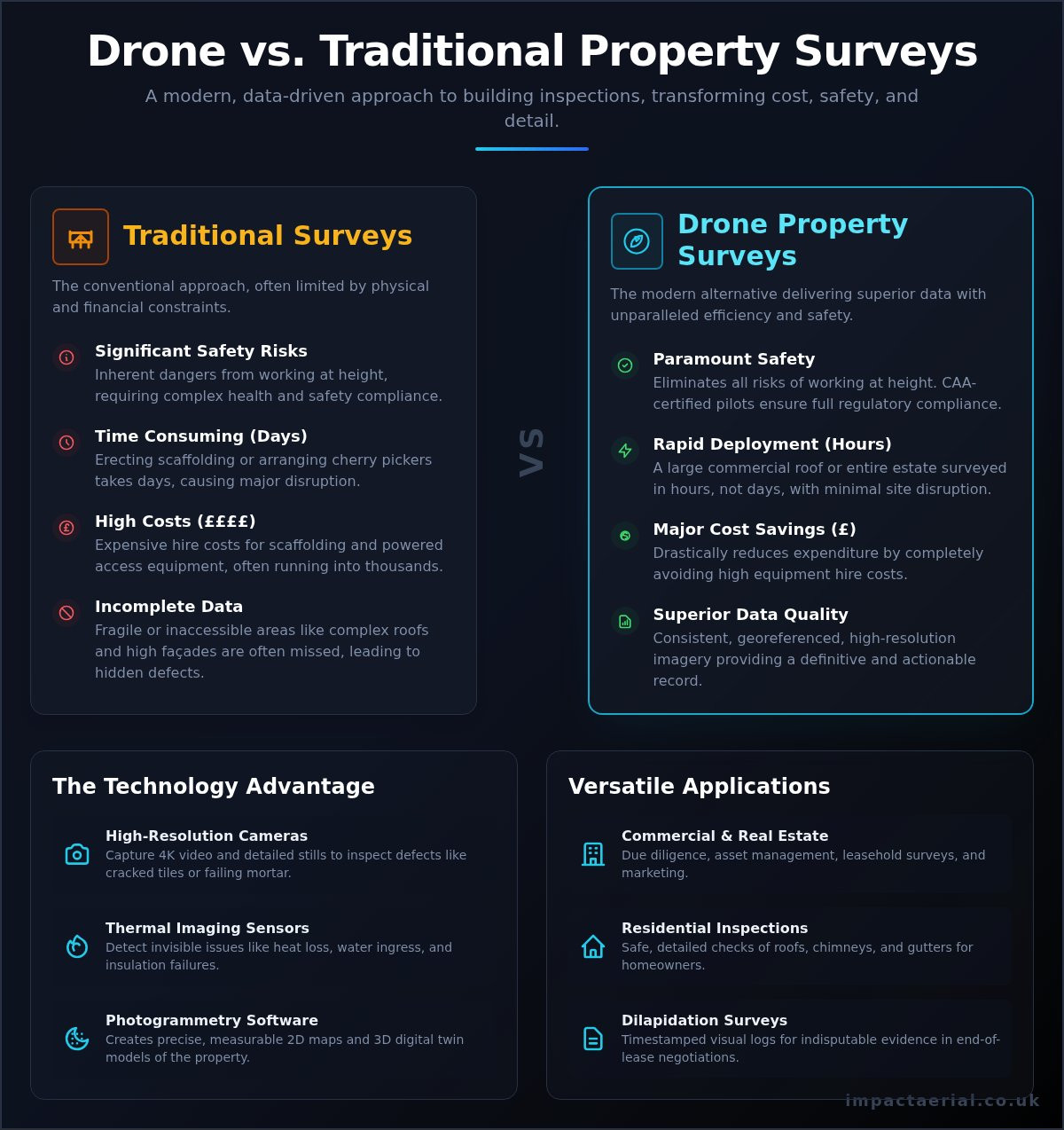
Traditional access methods like scaffolding or cherry pickers are becoming obsolete for initial assessments. These older methods often require 3 to 5 days of lead time for permits and can cost upwards of £1,500 for plant hire alone before a surveyor even sets foot on site. Drones eliminate these logistical hurdles, offering a 360-degree view of the asset that covers every angle of the building envelope.
To better understand how this technology is applied in a commercial setting, watch this helpful video:
What is a Dilapidation Survey?
A dilapidation survey is a technical assessment used to identify structural defects, maintenance needs, and breaches of lease covenants. For commercial property stakeholders, the resulting “Schedule of Dilapidations” is a critical document during lease-end negotiations. Landlords and tenants both benefit from accurate, timestamped visual evidence that proves the state of the building at a specific point in time.
These reports are typically categorised into two types. A terminal schedule is issued at the end of a lease to settle repair claims, while an interim schedule is conducted during the lease term to ensure the tenant is maintaining the property according to their agreement. Precise data reduces legal friction and ensures that financial settlements are based on objective facts rather than estimates.
Why Aerial Data is Changing the Industry
The speed of deployment is a primary driver for the adoption of drone technology. A professional team can arrive on site and begin gathering data within minutes, reaching inaccessible areas like valley gutters, high-level parapets, and complex roof structures that would otherwise remain hidden. This application of remote sensing technology
Technical Precision: Capturing High-Resolution Evidence for Surveyors
A professional drone survey for dilapidation reports requires more than just a clear photo; it demands forensic-level detail. Our fleet of DJI Enterprise drones provides the mechanical stability and sensor clarity needed to capture 4K HDR imagery that reveals hairline cracks as small as 0.2mm. This level of detail is non-negotiable for surveyors who must distinguish between superficial weathering and structural movement. High-resolution zoom cameras allow our CAA GVC Certified pilots to inspect chimneys, parapets, and fragile roof coverings from a safe distance. This approach eliminates the need for expensive scaffolding or cherry pickers. Industry experts suggest that these technological advancements revolutionize building inspections by providing a safer, more comprehensive data set for property managers.
4K HDR Imagery and Thermal Sensors
Standard photography often fails to capture the nuances of building defects in low-light or high-contrast environments. We use 45-megapixel sensors that ensure data quality meets the rigorous standards of RICS-qualified surveyors. Beyond visual light, thermal imaging identifies moisture ingress and heat loss within flat roof systems. By detecting temperature variances as small as 0.05°C, we pinpoint subsurface water ponding that’s invisible to the naked eye. This evidence is vital for Schedule of Dilapidations negotiations, providing undeniable proof of a building’s condition.
Photogrammetry and 3D Asset Mapping
Modern drone survey techniques go beyond simple video files. We use photogrammetry to create high-fidelity 3D models, or digital twins, of commercial properties. These models allow for accurate measurements of roof areas and guttering lengths with sub-centimetre precision. For large industrial sites, we produce orthomosaic maps. These are high-resolution, top-down views composed of thousands of individual images stitched together. Every drone survey for dilapidation reports we deliver includes GPS-tagged data, meaning surveyors can track the exact location of a defect across a 50,000 sq. ft. facility with total confidence.
Transitioning from raw footage to actionable data requires a meticulous approach to processing. We ensure all imagery is organised by asset, allowing property professionals to integrate the findings directly into their reports. For added peace of mind, you can speak with our technical team about the specific data outputs required for your next survey. This methodical workflow ensures that our clients receive a clear, defensible record of their property’s state.
Efficiency and Safety: Drones vs. Traditional Access Methods
Traditional building inspections often rely on heavy plant machinery or complex scaffolding structures. These methods are inherently slow and expensive. A drone survey for dilapidation reports offers a “Zero Site Footprint” approach. This means we don’t need to cordon off half a car park or block pedestrian access to gather high-definition data. By 2026, the efficiency gap has widened. Professional drone operators can capture a full site perimeter and roof plan in 90 minutes; a task that previously took a two-man team two full days using manual methods.
For insurance companies, this speed is a game-changer. High-resolution, time-stamped aerial imagery provides an indisputable record of condition. This clarity facilitates faster claim processing, often reducing the settlement window from several months to just a few weeks. It’s about precision and pace.
Eliminating the Need for Scaffolding and Cherry Pickers
Hiring a cherry picker often costs upwards of £400 per day, excluding transport and operator fees. If your site borders a public highway, local councils typically require a pavement licence. These permits often involve a 10 to 14-day waiting period and additional administrative fees. Drone technology bypasses these logistical hurdles entirely. We deploy quickly, reducing on-site time by approximately 75% compared to traditional access equipment. You save on plant hire, labour, and the administrative burden of permit applications.
Minimising Risk and Site Downtime
Safety is our primary driver. Falls from height remain the leading cause of workplace fatalities in the UK construction sector, accounting for 33% of all fatal injuries in 2023/24 according to HSE statistics. Using a drone survey for dilapidation reports removes the need for surveyors to climb onto fragile roof structures or navigate unstable parapets. Feet stay firmly on the ground.
- Dedicated Spotters: For added peace of mind, our operations include a dedicated spotter. This team member maintains situational awareness, ensuring the pilot focuses on precision data-gathering while keeping the site safe.
- Business Continuity: This remote approach allows tenant business activities to continue without interruption. There’s no need for noisy machinery or intrusive structures near entrances.
- Hazard Identification: Drones identify structural risks, such as loose masonry or blocked guttering, from a safe distance before any person ever needs to go near them.
As a CAA GVC Certified operator, we prioritise compliance and risk management. Our meticulous planning ensures that every flight is conducted within the latest UK regulations, providing a professional service that balances technical excellence with site safety. This structured, methodical approach ensures that your dilapidation report is both comprehensive and safely executed.
Compliance and Legal Validity in Dilapidation Claims
Hiring an uncertified hobbyist for commercial inspections is a significant liability for property firms. In the event of a dispute, data captured by “a guy with a drone” rarely survives the scrutiny of a courtroom or an arbitration tribunal. Professional drone survey for dilapidation reports provide an indisputable digital record that carries genuine legal weight. These surveys rely on high-resolution, time-stamped metadata that proves the exact state of a building at a specific moment in time.
Data protection is equally critical in 2026. Flying in dense urban environments like Birmingham or London requires strict adherence to GDPR. Professional operators use advanced software to redact faces and vehicle registration plates automatically, ensuring privacy compliance. For added peace of mind, we maintain £5 million in commercial liability insurance. This level of cover is often a prerequisite for entering tier-one construction sites and protects all stakeholders from unforeseen operational risks.
Meeting CAA Regulations and Insurance Standards
The UK regulatory landscape has evolved significantly. The transition from the old PfCO to the current drone license GVC (General Visual Line of Sight Certificate) requirements represents a shift toward higher pilot competency. In 2026, the CAA GVC certification is the gold standard for commercial work. It demonstrates that the pilot has undergone rigorous theoretical and practical testing. Every flight we conduct is underpinned by a comprehensive Risk Assessment and Method Statement (RAMS). This document outlines how we mitigate hazards, from bird strikes to signal interference, ensuring the safety of the public and the property.
Structuring Data for a Schedule of Dilapidations
Legal teams and surveyors don’t want thousands of unorganised photos. They need structured, actionable intelligence. We present imagery through cloud-based delivery platforms that allow stakeholders to click on a specific point on a 3D model to view the original high-resolution photograph. This seamless data sharing speeds up the negotiation process between landlords and tenants. For complex urban surveys, we develop a specific “Safety Case,” which is a detailed evidence-based document submitted to the CAA to justify operations in high-risk or congested areas. This meticulous approach ensures every drone survey for dilapidation reports meets the highest evidentiary standards.
Ensure your property data is legally robust and fully compliant. Contact Impact Aerial to secure a professional survey for your next schedule of dilapidations.
Professional Aerial Surveying with Impact Aerial
Based in Birmingham, Impact Aerial serves the West Midlands and the wider UK with a dedicated focus on technical excellence. We provide a professional drone survey for dilapidation reports that bridges the gap between raw data and actionable insights for property professionals. Our team is fully CAA GVC Certified. This means we operate under the most current UK drone regulations to ensure total safety and compliance on active construction sites or busy commercial environments. We carry £5 million in commercial liability insurance as standard. This provides the peace of mind required by major developers, local authorities, and national asset managers when commissioning aerial work.
Our Birmingham hub allows us to reach 90% of the UK mainland within a four-hour drive. This central location makes us a strategic partner for companies managing national property portfolios. We don’t just provide imagery; we deliver a comprehensive service that supports the legal and financial aspects of property management. Our commitment to precision ensures that every survey we conduct meets the rigorous standards expected by RICS surveyors and legal teams in 2026.
Expert Pilots and Enterprise Technology
We utilize a sophisticated fleet of DJI Enterprise drones equipped with 4K HDR sensors. These aircraft are specifically designed for the rigors of commercial inspections. They deliver breath-taking clarity that serves technical needs, allowing for the identification of hairline cracks or minor structural defects that ground-based inspections often miss. Our pilots possess deep knowledge of the property and construction sectors. They understand the specific requirements of a drone survey for dilapidation reports, focusing on critical areas like roof membranes, parapets, and high-level glazing.
- High-resolution 4K HDR imagery for granular detail.
- Thermal imaging capabilities for identifying hidden moisture ingress.
- Meticulous data collection protocols that ensure 100% site coverage.
- Zoom technology to inspect hazardous areas without risking the aircraft or personnel.
End-to-End Project Management
Our service covers the entire project lifecycle. We start with detailed remote visual inspection (RVI) planning and risk assessments. We then move to precision flight operations and conclude with secure, high-speed data delivery. We offer customized survey packages tailored to industrial, commercial, and retail assets. Whether you’re managing a single retail unit or a massive distribution center, we scale our operations to meet your timeline.
Our high-quality post-production process ensures that all data is organized and easy to navigate. This helps you avoid costly disputes during lease terminations or schedule of condition negotiations. We provide clear, timestamped evidence that stands up to scrutiny in legal proceedings. Contact us today to discuss your specific dilapidation reporting requirements and find out how our expert team can support your next project.
Future-Proof Your Property Documentation and Legal Protection
As we move toward 2026, the standard for property documentation has shifted from manual estimation to digital precision. A professional drone survey for dilapidation reports provides a comprehensive visual record that traditional methods simply can’t match. By capturing high-resolution 4K imagery and 3D models, surveyors identify structural defects with millimetre accuracy while keeping personnel safely on the ground. This approach reduces inspection times by up to 70% compared to erecting scaffolding or hiring mobile elevating work platforms.
Impact Aerial delivers this technical edge through our team of CAA GVC Certified Pilots. For added peace of mind, we carry £5m commercial liability insurance on every project we undertake. While we’re Birmingham-based, our specialists provide UK-wide coverage to support commercial landlords and tenants in settling claims with objective, data-driven evidence. It’s time to replace outdated access methods with a safer, more efficient surveying solution that stands up to legal scrutiny.
Contact Impact Aerial for a professional drone survey quote and ensure your next dilapidation report is backed by industry-leading aerial intelligence.
Frequently Asked Questions
Is drone footage legally admissible for a dilapidation report?
High-resolution drone footage is legally admissible in the UK as objective evidence for a dilapidation report. Under the Civil Procedure Rules (CPR), specifically Part 35, digital imagery provides a factual record of a building’s condition at a specific date. Our 4K HDR data-gathering ensures that every defect is documented with precision. This creates a robust evidence trail that surveyors and legal teams use to settle terminal or interim claims.
How much does a drone survey for a dilapidation report cost?
The cost of a drone survey for a dilapidation report typically ranges from £500 to £1,500 for a standard commercial site in 2026. This price varies based on the size of the warehouse or office block and the complexity of the airspace. Factors like the requirement for specific CAA flight permissions or the use of thermal sensors impact the final quote. We provide fixed-price proposals based on your site’s specific postcodes and risk assessments.
Do I need to notify my tenants before a drone survey takes place?
You must notify your tenants at least 24 to 48 hours before a drone survey takes place to comply with privacy laws and standard lease agreements. While the drone remains in public or authorized airspace, GDPR regulations require transparency regarding data collection near occupied premises. Providing tenants with a clear flight window ensures operational transparency. It also gives them peace of mind that their privacy is respected during our professional services.
What certifications should a drone pilot have for a commercial survey?
A professional drone pilot must hold a Civil Aviation Authority (CAA) GVC (General Visual Line of Sight Certificate) for commercial operations in the UK. This qualification replaced the old PfCO and ensures the pilot is trained in the latest safety protocols. For added peace of mind, ensure the operator holds at least £5 million in commercial liability insurance. We maintain all current certifications to ensure every flight is fully compliant with UK law.
Can drones detect moisture or leaks in a warehouse roof?
Drones equipped with radiometric thermal sensors can detect moisture and leaks in a warehouse roof by identifying temperature differentials. Trapped water retains heat longer than dry insulation, which shows up as hot spots on a thermal map after sunset. This non-destructive method allows us to pinpoint the exact 10cm area of a leak without stepping onto a fragile roof. It’s a vital tool for accurate building services assessments in a niche but increasingly diverse market.
How long does it take to receive the data after a drone survey?
You will typically receive the raw high-definition imagery within 24 hours of the flight completion. For more complex outputs like 3D photogrammetry models or detailed inspection reports, the processing time is usually 3 to 5 working days. We use cloud-based platforms to deliver data quickly. This allows your surveying team to begin their analysis of the drone survey for dilapidation reports without delay.
What happens if the weather is bad on the day of the flight?
We reschedule the flight to the next available clear-weather window if wind speeds exceed 20mph or if there’s precipitation. Our DJI Enterprise drones have high IP ratings, but optimal data quality requires stable conditions. Safety is our primary concern, and we monitor Met Office forecasts 48 hours in advance. There’s no additional mobilization fee for weather-related delays, ensuring your project stays on budget and remains meticulously managed.
Is a drone survey safer than a traditional roof inspection?
A drone survey is significantly safer than traditional methods because it eliminates the need for personnel to work at height. Falls from height accounted for 33 percent of all fatal workplace injuries in the UK during 2023/24 according to HSE statistics. By keeping boots on the ground, we remove the risks associated with ladders, scaffolding, or fragile roof surfaces. It’s a meticulous process that prioritizes site safety and provides high-quality results.
 2 Norton Drive, Wythall, Birmingham, B47 6HH Company registration number: 11138586. VAT Number: 366 9068 55