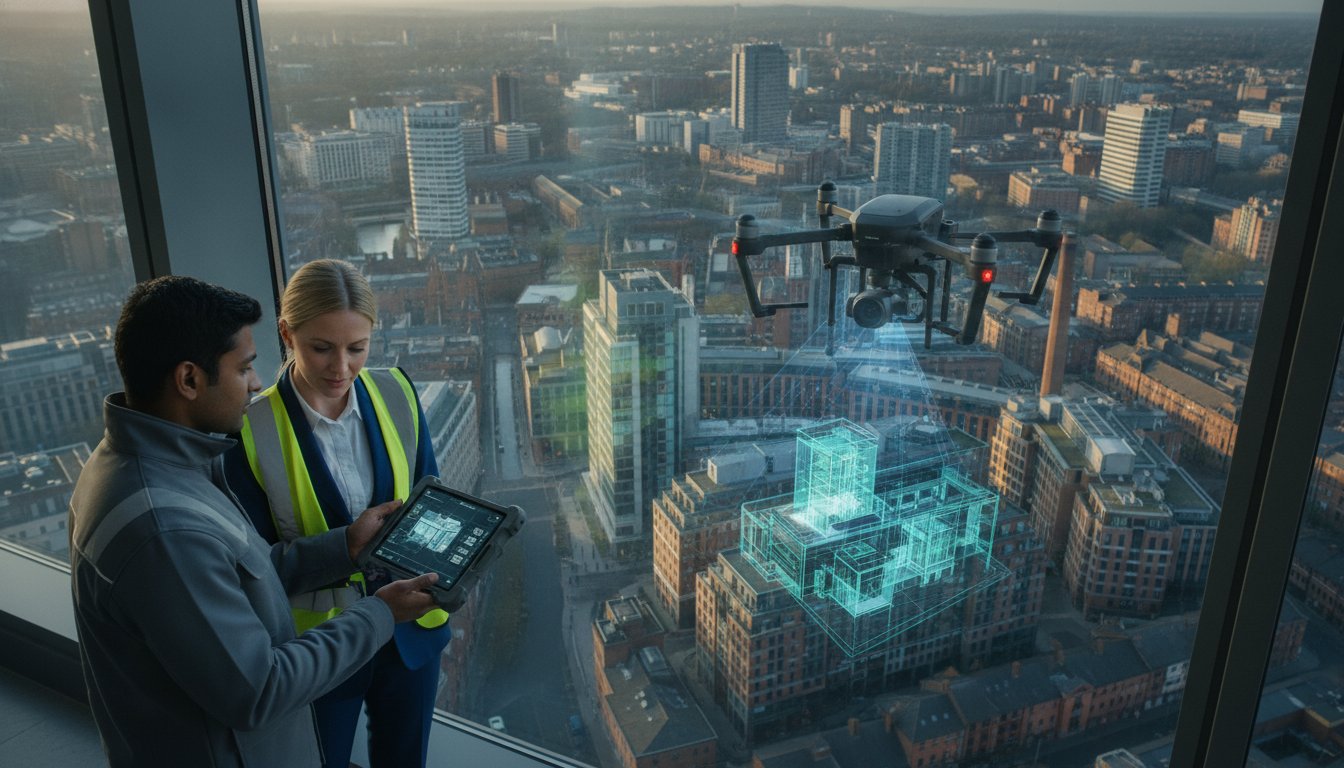
Did you know that over 60 UK local authorities have already authorized drone pilots to manage their regional assets? This shift marks the end of drones being viewed as a novelty. By 2026, they’ve become indispensable fiscal tools for managing the public realm. You’re likely feeling the pressure of ruthless budget cuts while managing aging infrastructure that requires constant oversight. The high cost and physical risk of traditional scaffolding or manual inspections often feel like a barrier to progress. Utilizing professional drone services for local councils offers a compliant, data-driven path forward that prioritizes both safety and the bottom line.
We’ve designed this guide to show you exactly how UK authorities are reducing maintenance lead times and improving public safety through expert aerial surveys. You’ll learn how to navigate the latest CAA hurdles, including mandatory Remote ID broadcasting, while securing the defensible evidence needed for audits. From thermal surveys of solar farms to detailed property inspections, we’ll preview the technical standards and operational workflows that turn complex aerial data into actionable asset management strategies. It’s time to replace guesswork with evidence-based decision making.
Key Takeaways
- Understand how to leverage professional UAV operations to manage regional assets more efficiently within the challenging 2026 fiscal landscape.
- Explore the diverse applications of drone services for local councils, from conducting 4K HDR building condition surveys to enhancing urban planning accuracy.
- Evaluate the safety and speed advantages of aerial data collection over traditional scaffolding and manual inspection methods.
- Identify the essential compliance standards for public sector partnerships, including the requirement for CAA GVC certification and comprehensive £5m liability insurance.
Why UK Local Authorities are Integrating Drone Technology in 2026
Professional drone services for local councils represent the deployment of a sophisticated Unmanned aerial vehicle (UAV) for the meticulous management of public assets. By 2026, the fiscal landscape for UK local authorities has become increasingly constrained. Councils are tasked with maintaining extensive infrastructure while facing significant budget shortfalls. This environment has accelerated the adoption of drone technology. It’s no longer an experimental hobbyist tool; it’s a critical component of professional service delivery.
Local authorities must meet strict statutory liabilities regarding community safety and structural integrity. Professional drone operations provide a high-tier, compliant method for meeting these obligations without the prohibitive costs of traditional methods. It allows departments to transition from reactive repairs to proactive asset management, ensuring that public funds are used with maximum efficiency.
To better understand the legal context of council interactions with drone technology, watch this helpful video:
The Economic Case for Council Drones
Aerial surveys provide a precise alternative to traditional inspection methods. Setting up scaffolding or implementing road closures for a simple roof or bridge inspection is often a logistical and financial burden. Using drone data streamlines these processes, allowing for rapid deployment and data-centric decision making. This efficiency extends the lifecycle of public buildings by identifying minor defects before they become catastrophic failures. Additionally, the high-resolution evidence captured during drone services for local councils often strengthens government funding and grant applications by providing undeniable, visual proof of asset condition and the necessity of investment.
Improving Community Safety and Response
Public safety is a primary concern for any district or borough council. When extreme weather events occur, traditional inspection teams are often delayed by safety risks or accessibility issues. Professional drone pilots can provide a rapid assessment of civic structures from a safe distance, identifying hazards immediately. This proactive monitoring is essential for preventing emergency infrastructure failures. High-resolution aerial perspectives allow for the detection of subtle changes in masonry or drainage that manual inspections might miss. It’s about providing psychological comfort to the community through reliable, technology-driven oversight and meticulous data collection.
Key Applications: From Asset Management to Urban Planning
The versatility of drone services for local councils allows departments to move beyond simple photography into high-precision data acquisition. A recent report on drone use by Local Government in England highlights how these tools are transitioning from novelty to necessity. Central to this utility is the deployment of 4K HDR imagery. This high dynamic range is vital for building condition surveys, as it captures detail in both deep shadows and bright highlights, ensuring that cracks in masonry or defects in dark roofing materials aren’t missed during the analysis phase.
Council officers don’t just need pictures; they need actionable data. Modern aerial platforms allow for the seamless integration of captured imagery and photogrammetry into existing Geographic Information Systems (GIS) and asset management software. This creates a “digital twin” of regional assets, allowing for precise temporal monitoring of deterioration. In regions like the West Midlands, this technology is actively supporting large-scale urban regeneration projects by providing accurate site overviews that traditional ground-level photography cannot match.
Infrastructure and Building Inspections
Maintaining the structural health of schools, libraries, and leisure centres is a constant challenge. Utilizing advanced drone survey techniques allows for rapid assessments of roofs and façades without the need for expensive access equipment. This is particularly beneficial for:
- Multi-storey car parks: Identifying concrete spalling and drainage issues in high-risk environments.
- Historic bridges: Monitoring structural integrity over water or active rail lines without service interruptions.
- Heritage sites: Providing a meticulous non-contact record of listed buildings without risking fragile masonry.
If your department is looking to enhance its oversight of civic assets, you can explore our professional drone survey services to see how we provide these detailed perspectives.
Environmental and Planning Support
Planning departments use drones to monitor flood plains and track coastal erosion with centimetre-level precision. This mapping data is essential for developing robust environmental protection strategies and supporting planning applications. Additionally, drones are effective tools for tracking fly-tipping and illegal land use in sprawling rural council areas, providing the defensible evidence required for enforcement. For new housing developments, aerial site data offers a comprehensive view of progress, ensuring that regeneration projects remain on schedule and within their regulatory bounds. This level of oversight ensures that every development phase is documented with technical precision and total compliance.
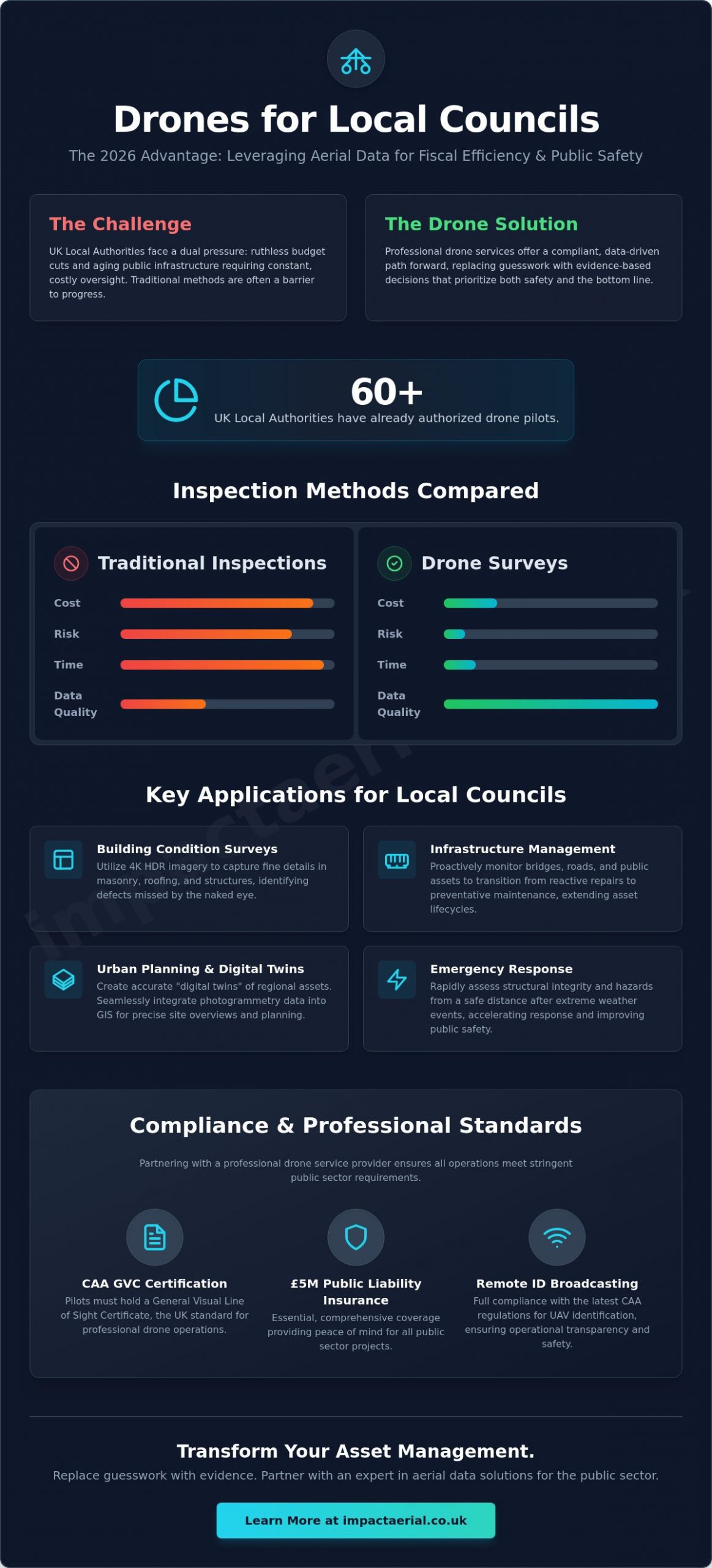
Comparing Drone Surveys to Traditional Inspection Methods
Traditional methods of inspecting council infrastructure are inherently resource-heavy and fraught with logistical challenges. For decades, local authorities have relied on scaffolding, cherry pickers, and rope access teams to assess the condition of civic buildings and bridges. Integrating drone services for local councils provides a safer, more sustainable alternative that addresses these historic pain points. By removing personnel from “Work at Height” environments, councils significantly reduce their liability and the potential for workplace accidents. This transition doesn’t just protect staff; it also aligns with modern sustainability goals. While traditional access platforms often require petrol-powered heavy machinery and transport vehicles, electric UAVs operate with a negligible carbon footprint and minimal noise pollution.
The speed of data acquisition is another critical differentiator. A manual inspection of a large leisure centre or housing estate can take weeks of planning and execution. In contrast, a professional drone flight can capture the same area in hours. This rapid time-to-data ensures that maintenance teams receive high-density information, such as 4K video and 3D virtual tours, almost immediately. This superior data density allows for a more nuanced understanding of asset health than a manual inspector with a clipboard could ever provide.
Cost and Time Efficiency Analysis
The return on investment when deploying a professional survey drone is evident in the reduction of project overheads. For large-scale council estates, the cost of erecting scaffolding alone can exceed the entire budget of an aerial survey. By avoiding these physical installations, councils can reduce topographic survey timelines from weeks to just a few days. Furthermore, aerial inspections minimise public disruption. There’s no need for extensive road closures or the deployment of heavy plant machinery that blocks pavements and disturbs residents. It’s a methodical approach that prioritises both the council’s budget and the community’s daily life.
Data Accuracy and Audit Trails
Meticulous record-keeping is a cornerstone of public sector accountability. Every image captured during an aerial mission is geo-tagged, providing precise location referencing that is vital for internal audits and statutory reporting. This allows councils to create a “digital twin” of their assets, enabling a direct year-on-year comparison to track structural deterioration with mathematical precision. When disputes arise, professional drone photography provides indisputable evidence for insurance claims or contractor assessments. This level of transparency ensures that every decision made by the council is supported by high-tier, defensible data, providing psychological comfort to stakeholders and ensuring total regulatory compliance.
Navigating Compliance: CAA Regulations and Public Safety for Councils
Compliance within the public sector is non-negotiable. As of January 1, 2026, the regulatory landscape has tightened significantly with the mandatory implementation of Remote ID broadcasting for the majority of professional-grade aircraft. When procuring drone services for local councils, the first point of verification must be the pilot’s certification. Councils should only engage pilots who hold a CAA General Visual Line of Sight Certificate (GVC). This qualification demonstrates a level of competence and safety awareness that far exceeds consumer-grade operations, ensuring that missions in complex environments are conducted with technical precision.
Risk mitigation is the cornerstone of every successful aerial operation. Public sector contracts typically mandate a minimum of £5 million in commercial liability insurance. This provides a necessary layer of financial security for the council, covering operations in high-traffic public areas. Impact Aerial, based in Birmingham, specialises in managing these complex flight permissions within congested urban environments. This involves meticulous coordination with local stakeholders and strict adherence to safety protocols that protect both the public and the council’s reputation. This ensures that drone services for local councils are delivered with the highest level of accountability.
If your authority requires a fully compliant aerial partner for upcoming urban projects, you can contact our Birmingham-based specialist team for a detailed consultation.
Understanding 2026 UK Drone Laws
The 2026 regulatory framework introduces strict requirements for UK class marks (UK0 to UK6) on all new hardware. Verifying a professional drone license is the only way to ensure your provider understands these technical nuances. There’s a vast difference between consumer hardware and DJI Enterprise commercial standards, which offer enhanced redundancy and data security. Every council project requires a site-specific risk assessment and a comprehensive flight plan. This meticulous planning is what separates a compliant professional service from a high-risk liability.
Privacy and Public Relations
Managing public perception is just as important as managing the flight itself. Local authorities must adhere to strict GDPR and data protection standards when surveying residential areas. Best practices include notifying residents well in advance of any aerial filming or surveying activities. All sensitive council data should be handled via encrypted storage and secure transfer protocols to prevent unauthorised access. Maintaining this level of transparency is essential for building community trust. When residents understand that the technology is being used for their safety and the improvement of local infrastructure, the transition to drone-led management becomes much smoother.
Partnering with Impact Aerial: Expert Drone Solutions for the Public Sector
Impact Aerial operates as a specialized technical consultant for the public sector, offering much more than a simple “pilot for hire” service. Based in Birmingham but providing comprehensive national UK coverage, we provide a structured, professional approach to drone services for local councils. Our operations utilize high-tier DJI Enterprise technology equipped with 4K HDR cameras. This hardware ensures that every frame of data meets the qualitative and technical standards required for official audits, structural assessments, and public records. We manage the entire lifecycle of an aerial project, from the initial regulatory consultation through to meticulous post-production services, ensuring a seamless flow of information from the site to the council office.
Our role as a technical partner means we don’t simply capture imagery; we provide the defensible evidence required for high-stakes decision making. By leveraging enterprise-grade hardware, we offer superior data security and operational redundancy, which is critical when working near sensitive public infrastructure. This meticulousness extends to our post-production workflow, where raw aerial data is transformed into structured reports or immersive virtual tours. These outputs allow council officers and stakeholders to visualize complex asset conditions without ever having to leave their desks, providing psychological comfort and tangible efficiency gains.
Why West Midlands Councils Choose Impact Aerial
Authorities across the West Midlands often require a partner who understands regional topography and the specific challenges of dense urban environments. Our team combines this deep local knowledge with strict CAA-certified professional standards, ensuring every flight is compliant and safe. We have a proven track record in complex aerial filming drone projects where safety-conscious execution is the priority. Whether it’s monitoring a multi-million pound regeneration site or conducting a sensitive heritage survey, our reliability ensures that council requirements are not just met, but exceeded. We invite council officers to discuss bespoke requirements for asset management or urban planning to see how our data-centric approach can support their specific goals.
Next Steps for Procurement and Asset Managers
For procurement officers and asset managers, the path to integrating professional drone services for local councils is clear and methodical. We offer technical consultations to determine the feasibility of specific sites and provide detailed, site-specific risk assessments before any flight takes place. Our pricing models are designed for flexibility, catering to both one-off emergency surveys and long-term asset management contracts. This allows councils to scale their drone usage according to their current fiscal needs and maintenance backlogs. To begin the process, you can contact the Impact Aerial team to request a professional quote and a comprehensive project plan tailored to your authority’s unique infrastructure challenges.
Future-Proofing Council Asset Management for 2026 and Beyond
Professional drone services for local councils have transitioned from an emerging technology to a fundamental requirement for efficient infrastructure oversight. By replacing costly manual inspections with high-precision aerial surveys, authorities can drastically reduce maintenance lead times and secure the defensible data needed for statutory audits. This methodical approach ensures that limited budgets are allocated where they’re most needed, based on indisputable visual evidence captured through technical precision.
Selecting a partner that values meticulous compliance is essential for public safety and risk mitigation. Impact Aerial provides this reassurance through the deployment of CAA GVC Certified Pilots and the use of high-tier DJI Enterprise 4K HDR technology. With £5m commercial liability insurance as standard, we offer the technical reliability required for complex regional projects across the UK. It’s time to move beyond traditional inspection hurdles and embrace a more agile, data-centric strategy for your district or borough.
Ready to enhance your department’s operational efficiency? Request a professional drone service quote for your council project to begin your transition to safer, more compliant asset management. Investing in expert aerial data today ensures a more resilient and well-maintained community for tomorrow.
Frequently Asked Questions
Can local councils use drones for roof inspections on schools?
Yes, local authorities frequently deploy drones for school roof inspections to avoid the high costs and safety risks of scaffolding. This method allows for a rapid assessment of tiles, gutters, and chimney stacks while the school remains operational. It’s a non-intrusive way to identify maintenance needs before they escalate into emergency repairs. By using 4K HDR cameras, maintenance teams can zoom in on specific defects with absolute clarity.
What insurance coverage is required for council drone operations?
Public sector contracts typically require a minimum of £5 million in commercial liability insurance. This coverage must specifically cater to professional UAV operations and comply with CAA standards. It provides the council with financial protection against third-party property damage or injury during complex aerial surveys in public spaces. This high level of insurance is a standard requirement for ensuring the council’s financial security and regulatory compliance.
Do drone pilots need specific certifications to work for local authorities?
Professional pilots must hold a CAA General Visual Line of Sight Certificate (GVC) to conduct drone services for local councils. This certification ensures the pilot has undergone rigorous training in flight safety, risk assessment, and regulatory compliance. It’s the industry benchmark for commercial competence in the UK, especially for missions in congested areas. Councils should always verify this qualification before awarding any survey contracts.
How do drones help councils manage fly-tipping and environmental issues?
Drones provide high-resolution aerial evidence that helps councils identify illegal dumping sites in remote or inaccessible areas. By capturing geo-tagged imagery, environmental officers can document the scale of fly-tipping for potential legal prosecutions. This proactive monitoring acts as a powerful deterrent and streamlines regional cleanup operations. It’s a data-centric approach that allows councils to manage vast rural areas more efficiently without the need for constant ground patrols.
Are drone surveys more cost-effective than traditional scaffolding?
Drone surveys are considerably more cost-effective than traditional scaffolding because they eliminate the need for heavy equipment and lengthy setup times. A project that might take days to scaffold can be completed by a drone in just a few hours. This efficiency directly reduces labor costs and minimizes disruption to local traffic or pedestrians. It’s a streamlined workflow that delivers high-tier data at a fraction of the traditional price.
How does a council ensure public privacy during a drone survey?
Councils ensure privacy by adhering to strict GDPR protocols and anonymizing sensitive data, such as faces or license plates, during post-production editing. Residents are typically notified through official channels before any aerial filming takes place in residential areas. We use encrypted storage systems to maintain the integrity and security of all captured information, ensuring that community trust remains high throughout the survey process.
What data formats do councils receive from professional drone surveys?
Professional drone services for local councils deliver a variety of high-tier formats, including 4K HDR video and high-resolution geo-tagged JPEGs for visual inspections. For engineering and planning departments, we also provide 3D point clouds and digital surface models compatible with standard GIS and asset management software. This allows for the creation of digital twins, facilitating precise year-on-year comparisons of critical council assets and infrastructure.
Can drones operate in high-density urban areas like Birmingham city centre?
Drones can operate in high-density areas like Birmingham city centre, provided the pilot has the necessary CAA permissions and a site-specific risk assessment. These missions require meticulous planning to manage public safety and navigate complex airspace restrictions in congested urban environments. Using professional DJI Enterprise hardware ensures the necessary redundancy and signal stability for safe operations in areas with significant architectural and electronic interference.
 2 Norton Drive, Wythall, Birmingham, B47 6HH Company registration number: 11138586. VAT Number: 366 9068 55