Drone Survey for Commercial Landlords: A Strategic Asset Management Guide

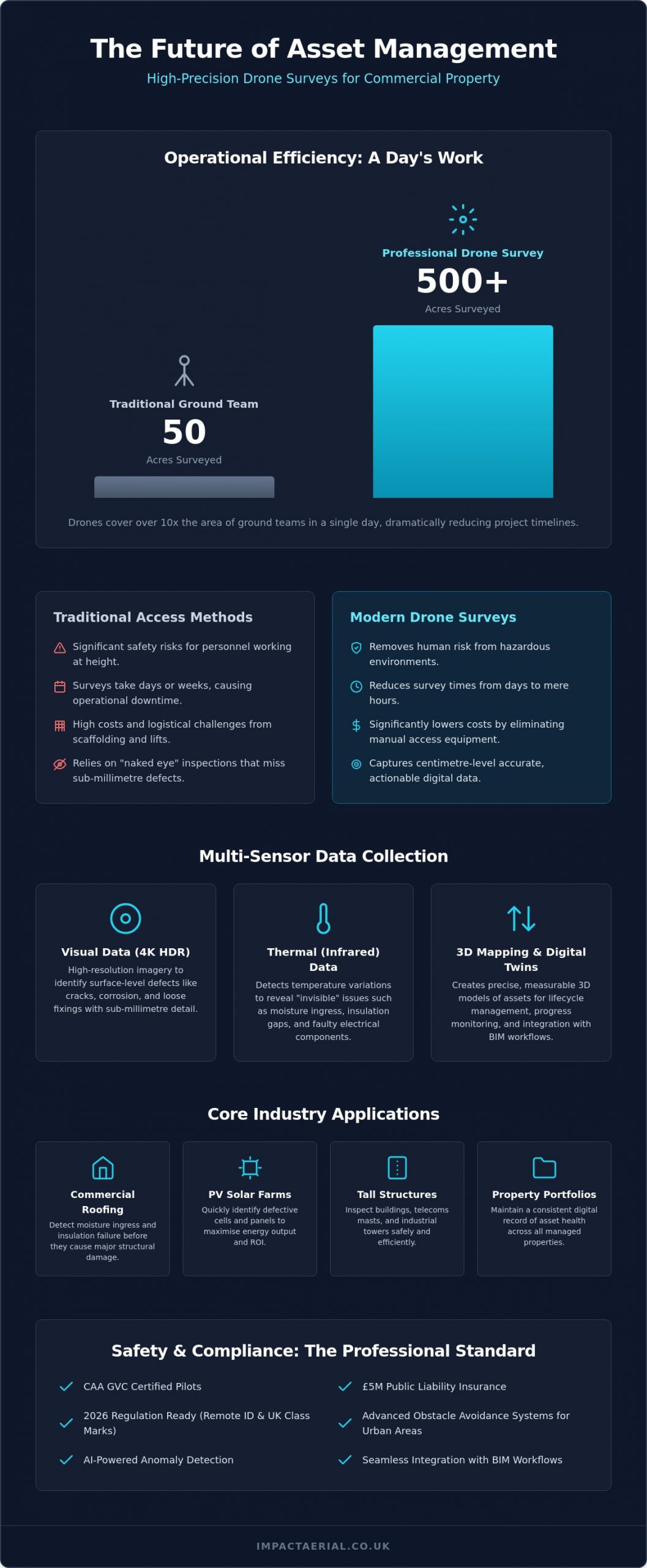
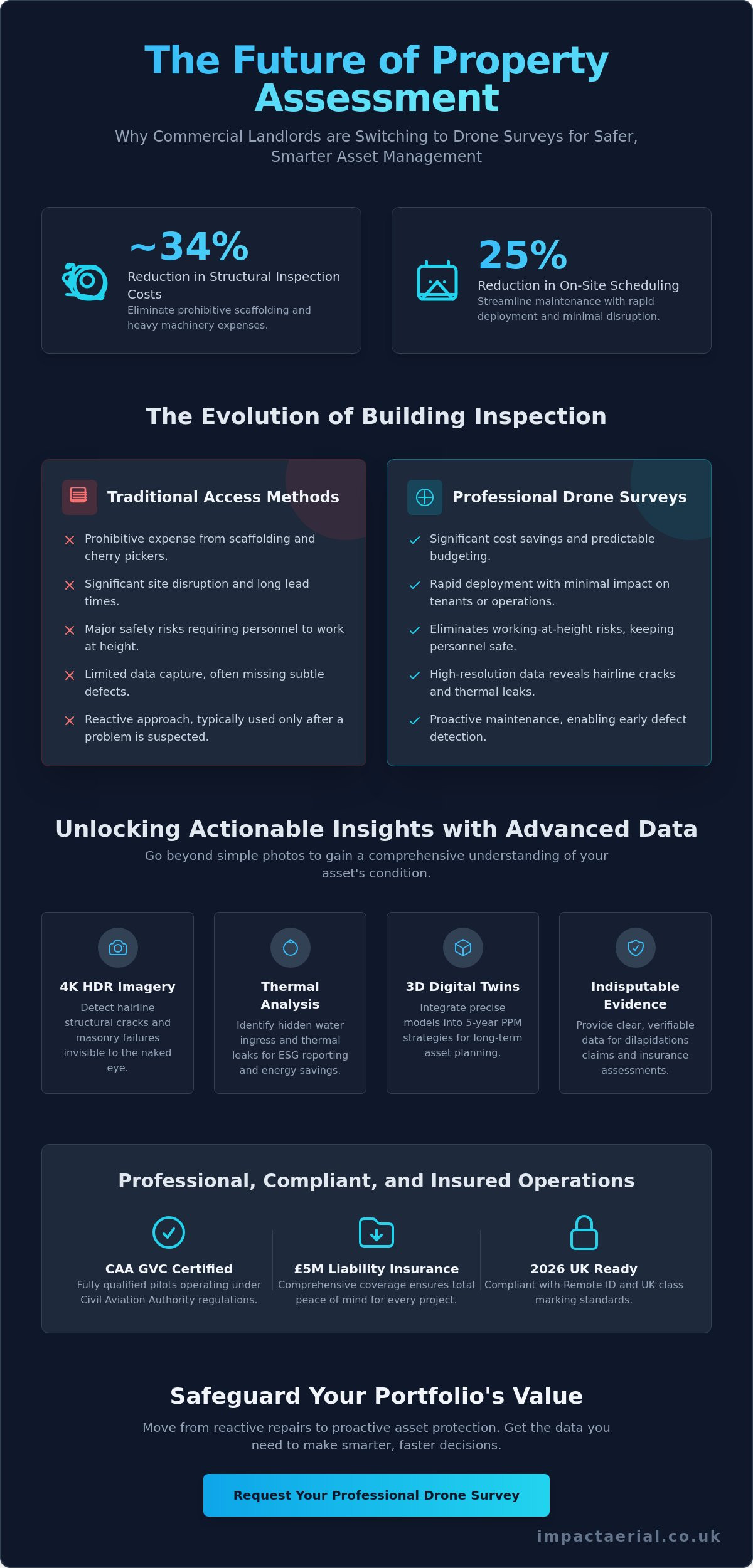
Did you know that integrating drone analytics into property assessments can reduce on-site scheduling by 25% while lowering structural inspection costs by approximately 34%? For many property owners, the traditional approach to asset management involves the prohibitive expense and logistical nightmare of erecting scaffolding just to investigate a suspected roof leak or structural defect. You likely already know that these delays don’t just drain your budget; they stall critical decision-making and leave your high-rise assets vulnerable to further deterioration. Utilizing a professional drone survey for commercial landlords offers a meticulous, data-centric alternative that prioritizes both safety and precision.

This guide reveals how professional aerial surveys mitigate risk and provide the actionable data you need to maintain portfolio value without the standard disruption. We’ll examine the latest 2026 UK regulatory standards, including mandatory Remote ID and UK class markings, to ensure your operations remain fully compliant with Civil Aviation Authority requirements. You’ll discover how moving away from lengthy manual reporting toward rapid, high-resolution aerial assessments allows for smarter, faster asset management.

Key Takeaways

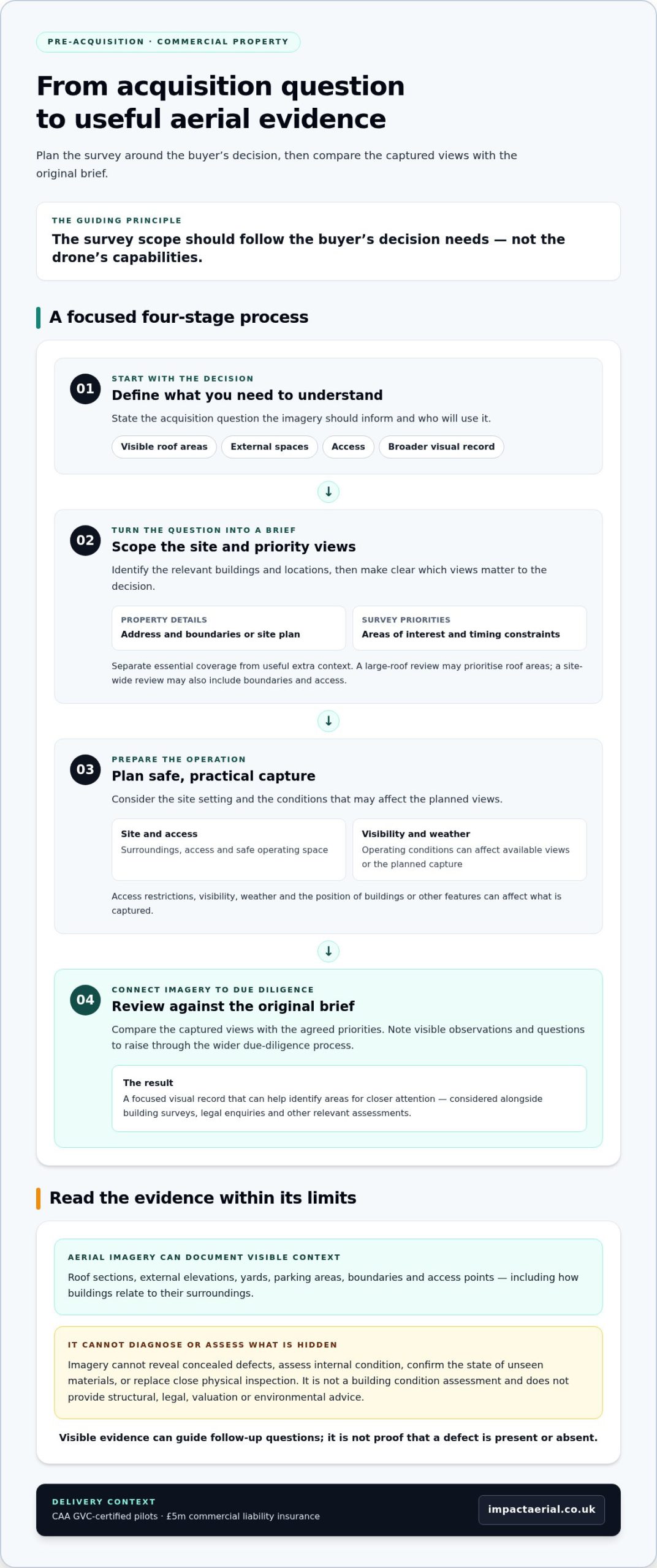
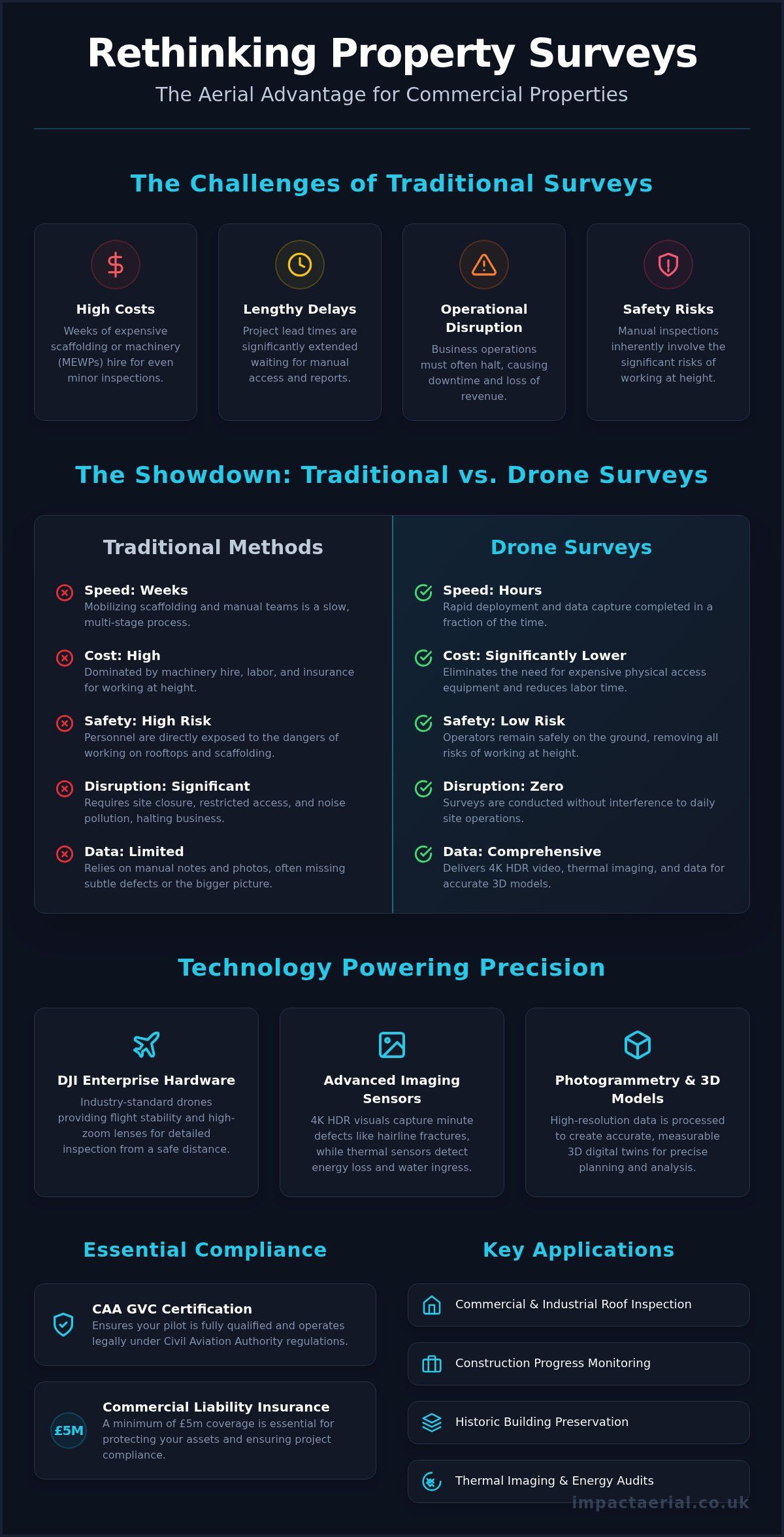
  • Understand why commercial property owners are replacing expensive scaffolding and cherry pickers with rapid, high-precision aerial inspections to streamline site maintenance.
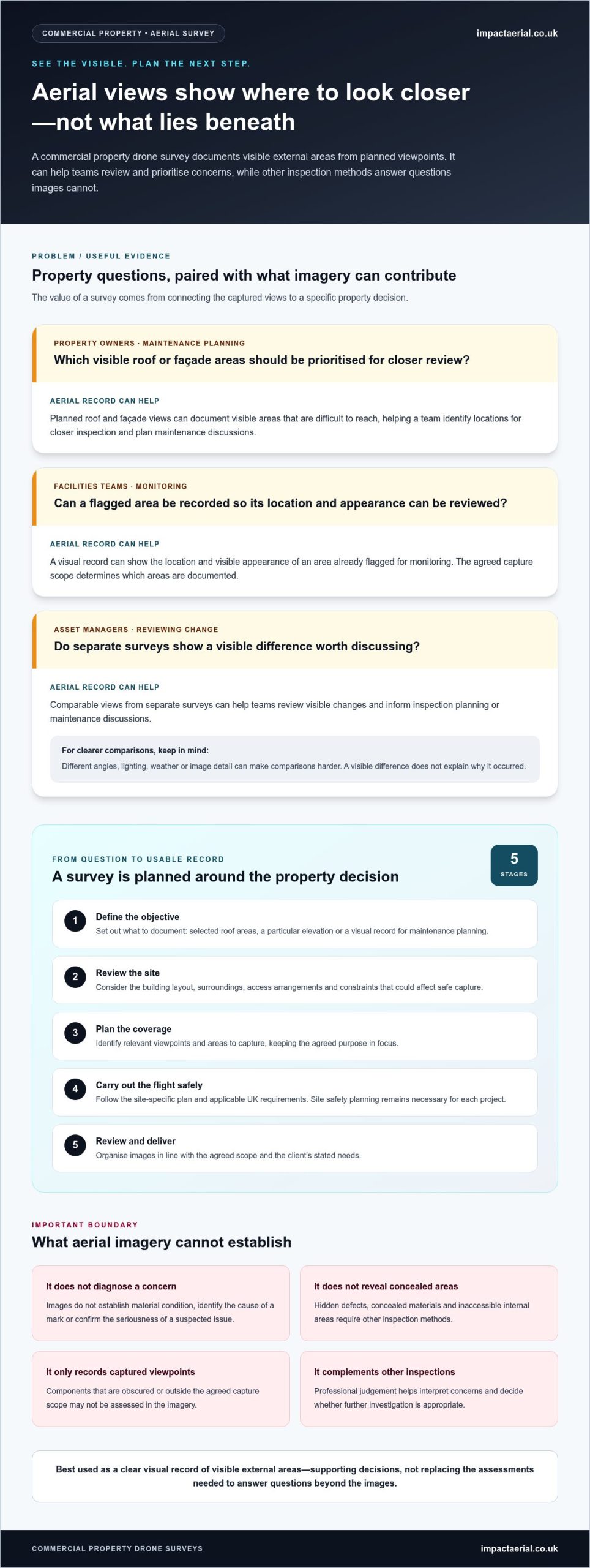
  • Discover how a professional drone survey for commercial landlords identifies hairline structural cracks and thermal leaks using state-of-the-art DJI Enterprise hardware.
  • Learn about the critical compliance standards, such as CAA GVC certification and £5m liability insurance, required to ensure safety and legal protection during operations.
  • See how integrating 4K HDR imagery and 3D mapping into your 5-year Planned Preventative Maintenance (PPM) strategy safeguards long-term asset value.
  • Gain insights into using indisputable aerial evidence to support dilapidations claims and provide clear data for complex insurance assessments.

Why Commercial Landlords are Switching to Drone Surveys in 2026

The landscape of property management has shifted. In 2026, a drone survey for commercial landlords is no longer a high-tech novelty but a core component of strategic asset management. As the UK’s regulatory framework has matured with specific class markings and mandatory Remote ID, these aerial survey methods have become the gold standard for building envelope inspections. This transition is driven by the need for high-tier data that traditional methods simply cannot match in speed or granularity.

Property owners face increasing pressure to provide detailed ESG (Environmental, Social, and Governance) data. High-resolution sensors allow for precise energy efficiency reporting by identifying thermal leaks that are invisible to the naked eye. This data-centric approach helps landlords meet 2026 sustainability targets while simultaneously reducing the disruption caused to tenants by heavy machinery or intrusive scaffolding. It’s a cleaner, faster, and more professional way to oversee large-scale assets.

To better understand the precision and capabilities of modern surveying technology, watch this helpful video:

The Financial Case: Scaffolding vs. UAV Surveys

For a typical 50,000 sq ft warehouse, the logistics of traditional access methods are staggering. Erecting scaffolding requires significant lead times, specialized permits, and substantial manual labor. According to a study by the Royal Institution of Chartered Surveyors (RICS), integrating drone analytics into property assessments reduces on-site scheduling by 25%. By eliminating the “access cost” barrier, landlords can perform frequent preventative inspections rather than waiting for a visible failure. This proactive stance ensures that minor defects don’t escalate into catastrophic repair bills. Early detection is the most effective way to protect an asset’s bottom line.

Safety and Liability: Keeping Personnel on the Ground

Safety is the most compelling reason for the industry’s shift. Using a drone survey for commercial landlords fundamentally removes the necessity for personnel to work at height during initial assessments. This significantly reduces the complexity of Risk Assessments and Method Statements (RAMS), as there’s no need for fall-arrest systems or heavy plant equipment. The RICS study also found that using drones for structural inspections can lower costs by approximately 34% compared to traditional methods. Beyond the immediate safety benefits, regular and documented aerial inspections demonstrate a commitment to meticulous maintenance. Providing this level of transparent, survey-grade data can reassure stakeholders and provide a verifiable record of structural integrity for insurance purposes.

Advanced Data Collection: Thermal Imaging and 3D Mapping

Modern asset management has moved beyond simple visual snapshots. A professional drone survey for commercial landlords now utilizes DJI Enterprise platforms to capture survey-grade data that was once impossible to obtain without significant cost. These advanced tools revolutionize building inspections by providing 4K HDR imagery that reveals hairline structural cracks invisible from the ground. This level of precision is vital for identifying early signs of concrete fatigue or masonry failure before they necessitate major capital expenditure.

Beyond maintenance, this high-precision data serves as a powerful marketing asset. When you provide prospective tenants with a comprehensive visual record of the building’s condition, you demonstrate transparency and superior management standards. High-resolution imagery and virtual tours can significantly accelerate the leasing process by providing stakeholders with an immediate, detailed view of the asset’s integrity. It’s a strategic way to differentiate your portfolio in a competitive market.

Thermal Surveys for Commercial Energy Efficiency

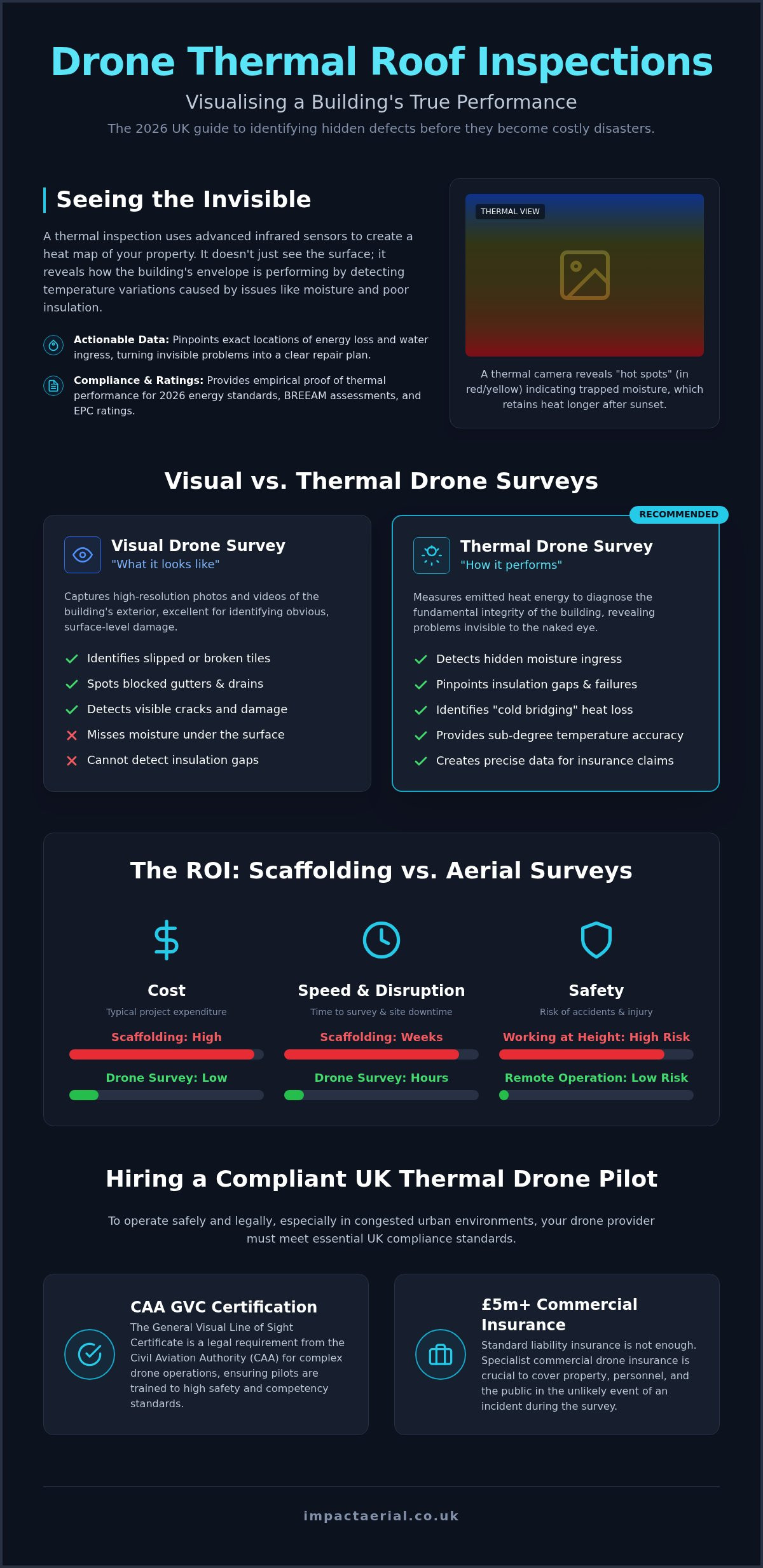
Thermal sensors are indispensable for assessing building envelopes and meeting 2026 energy standards. They detect failing insulation and “cold bridges” where heat escapes, which is essential for accurate energy efficiency reporting. On flat roofs, thermal imaging identifies trapped moisture within the membrane, pinpointing leaks before they cause internal damage. This technology also optimizes PV solar farm efficiency by identifying malfunctioning cells that could compromise the entire array’s output. By utilizing these drone commercial property surveys, landlords can verify the performance of their green energy investments with absolute certainty.

3D Modelling and Digital Twins for Asset Managers

3D mapping creates a “digital twin” of your development, providing a measurable, interactive record of the site. By using photogrammetry, we generate high-density point clouds that integrate directly into existing Building Information Modelling (BIM) workflows. This allows asset managers to conduct remote inspections and coordinate with maintenance contractors using a single, accurate source of truth. These models are also excellent for investor reporting, as they offer a clear, three-dimensional perspective of large-scale developments that static photography cannot replicate. It ensures every stakeholder has a granular understanding of the asset’s current state without ever needing to step foot on a ladder.

Drone Survey for Commercial Landlords: A Strategic Asset Management Guide

Compliance and Risk Management: Navigating UK Drone Regulations

Operating a drone survey for commercial landlords involves more than just capturing high-resolution imagery. It requires strict adherence to a complex legal framework designed to protect the public and the property owner. In 2026, the Civil Aviation Authority (CAA) regulations have moved to a permanent structure based on UK-specific class markings, making it essential for landlords to vet their contractors with precision. Failing to do so doesn’t just result in poor data; it exposes you to significant legal liability and potential fines of up to £1,000 for improper registration.

Meticulous risk mitigation is particularly vital in congested urban environments like Birmingham. Conducting flights near high-rise assets or within Flight Restriction Zones (FRZs) requires advanced planning and official permissions. Every operation must be supported by a robust Risk Assessment and Method Statement (RAMS) that accounts for everything from pedestrian traffic to 2026 requirements like mandatory green flashing lights for night operations and active Remote ID broadcasting. This level of compliance ensures that your asset management remains professional, legal, and safe.

The Importance of CAA GVC Certified Pilots

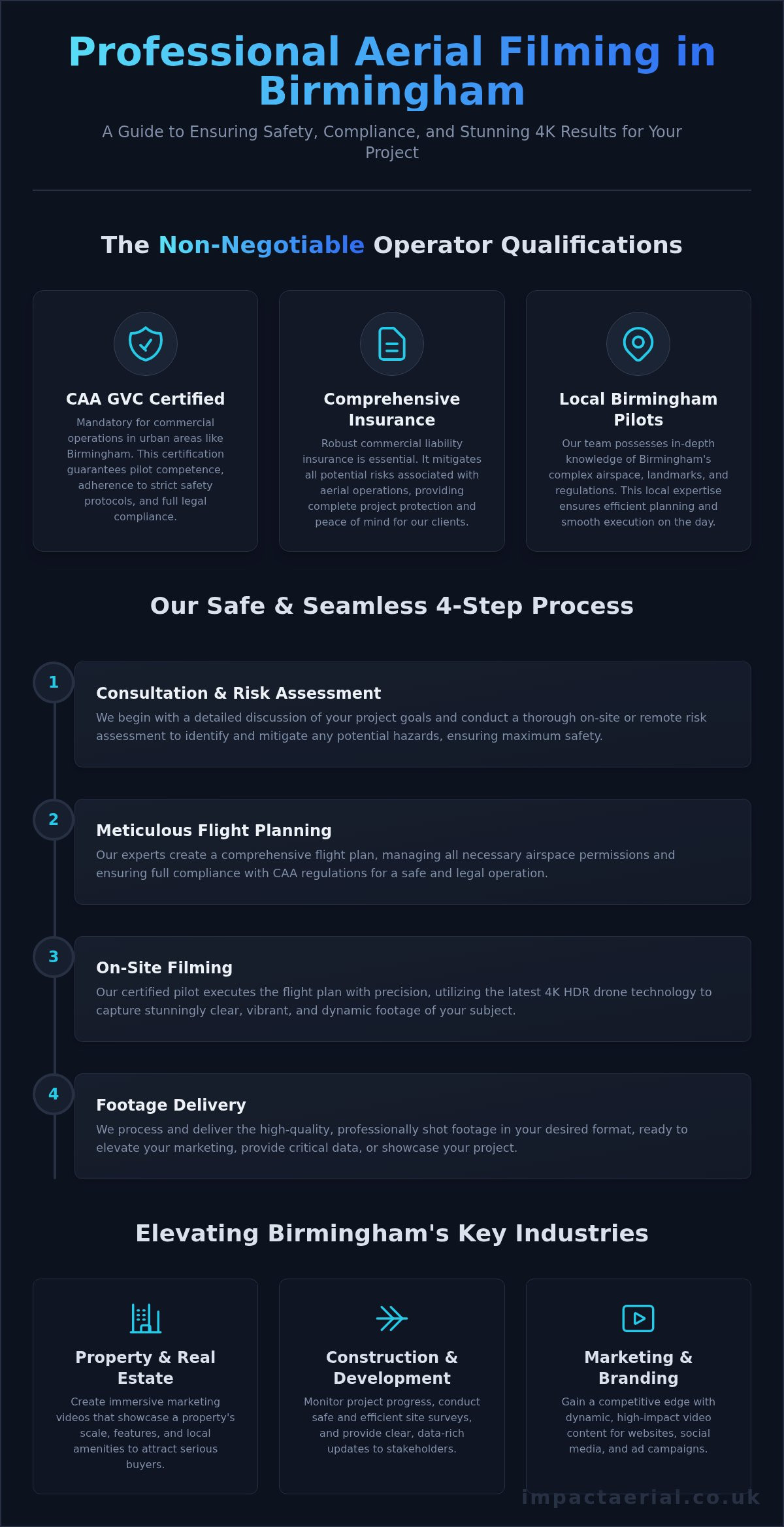
For commercial sites, a “hobbyist” pilot or a basic A2 CofC holder is often insufficient. The General Visual Line of Sight Certificate (GVC) is the professional standard for complex commercial drone operations. It demonstrates that the pilot has undergone rigorous practical and theoretical testing to handle larger aircraft and more challenging environments. Commissioning a pilot without these credentials puts your business at risk. Before any work begins, you should verify the operator’s Flyer ID and Operator ID, ensuring they are current with the 2026 UK class-mark standards (UK1 through UK6) to maintain total operational legality.

Insurance and Liability Safeguards

Standard public liability insurance rarely covers aviation-related risks. Commercial property sites require specialized UAV insurance that meets EC 785/2004 standards to ensure landlords aren’t held liable for third-party damages. We maintain £5m in commercial liability insurance as a baseline, providing the psychological comfort that your assets and reputation are fully protected. Impact Aerial manages all necessary flight permissions in restricted airspaces, coordinating directly with National Air Traffic Services (NATS) when required. This professional oversight extends to data protection; we ensure all aerial photography complies with GDPR by meticulously blurring faces or vehicle registrations that are captured incidentally during the survey process.

Actionable Insights: Integrating Drone Data into Property Strategy

A drone survey for commercial landlords represents a shift from reactive repairs to proactive asset protection. While the technical capabilities of modern hardware are impressive, the true value lies in how this data integrates into your broader property strategy. High-resolution, timestamped 4K data serves as an indisputable record of truth that can significantly accelerate insurance claim processing. When a storm occurs, having “before and after” aerial evidence allows for rapid verification of damage, reducing the time spent in administrative limbo with adjusters.

This data also serves a dual purpose in asset marketing. High-end aerial videography and photography can be woven into commercial leasing brochures to provide a unique perspective that ground-based photography lacks. Prospective tenants, especially those seeking high-value industrial or office space, value the transparency of seeing the building’s exterior and roof condition upfront. It projects a professional image of a landlord who is meticulous about building maintenance and technologically adept in their management style. It’s a strategic way to build trust before a lease is even signed.

Dilapidations and Lease End Negotiations

Terminal schedules of dilapidations are frequently the source of friction and costly legal disputes at the end of a commercial lease. Research shows that boundary and property disputes in the UK can cost owners an average of £12,000 to £35,000 in legal fees if they go to court. By commissioning a drone survey for commercial landlords at the commencement of a lease, you create a baseline “schedule of condition” that is difficult to challenge. Documenting the state of gutters, flashings, and roofing membranes provides a clear visual audit trail. When the lease expires, a follow-up survey identifies exactly what has deteriorated, ensuring that repair costs are fairly and accurately recovered from outgoing tenants. This level of clarity reduces the need for lengthy legal mediation.

PPM and Asset Life Extension

Incorporating aerial reports into a 5-year Planned Preventative Maintenance (PPM) schedule allows for more efficient budget allocation. Instead of broad, speculative maintenance based on “best guesses,” you can target specific areas where sensors have identified minor issues like loose flashings or blocked drainage. Tracking building degradation with year-on-year aerial comparisons provides a longitudinal view of asset health that traditional surveys can’t match. This data-centric method ensures you’re only spending on necessary repairs, effectively extending the life of the building envelope while optimizing your maintenance fund. To safeguard your portfolio with high-precision data, book your professional drone commercial property survey today.

Impact Aerial: Professional Commercial Drone Surveys Across the UK

Impact Aerial operates at the intersection of technical excellence and regulatory compliance. Based in Birmingham, our team provides a specialized drone survey for commercial landlords throughout the West Midlands and across the UK. We don’t use consumer-grade equipment; our fleet consists exclusively of state-of-the-art DJI Enterprise aircraft. These platforms are equipped with high-resolution 4K HDR and thermal sensors, ensuring every data point we collect meets the meticulous standards required by modern asset managers and technical stakeholders. It’s about providing the reassurance that your property is in expert, safety-conscious hands.

We manage every phase of the project from start to finish. This end-to-end project management begins with complex CAA flight planning and coordination with local authorities, continuing through to professional post-production services. Industry leaders trust us for high-stakes property inspections because we prioritize precision and safety above all else. By ensuring every operation is conducted within the strict 2026 UK regulatory framework, we provide a reliable service that safeguards both your physical assets and your legal standing.

Bespoke Solutions for Commercial Portfolios

We don’t provide generic data. Our team delivers customized reporting formats that are tailored to the specific needs of surveyors, architects, and facilities managers. Whether you’re overseeing a single high-rise asset or a sprawling multi-site industrial park, our survey solutions are fully scalable and adaptable. We maintain a safety-first culture, especially in complex urban settings where pedestrian traffic and restricted airspace require expert oversight. Our deep understanding of professional standards ensures that our output is qualitative, aspirational, and ready for immediate integration into your asset management strategy.

Get Started with Your Commercial Drone Survey

Commissioning a drone survey for commercial landlords begins with a site-specific risk assessment. Once you provide the location details, our team evaluates the local airspace and operational requirements to provide a comprehensive, transparent quote. On a typical survey day, our GVC-certified pilots arrive on-site to conduct a final pre-flight safety briefing before deploying the DJI Enterprise fleet. The entire process is non-intrusive, allowing your tenants to continue their operations without the disruption or cost associated with traditional access methods. You can expect a structured, methodical flow from the initial enquiry to the final data delivery.

Book your professional drone survey today to secure your asset’s future with data-centric management and high-tier aerial insights.

Elevating Your Asset Management Strategy for 2026

Adopting a drone survey for commercial landlords is about more than just modernizing your toolkit; it’s about shifting to a data-centric model of asset protection. By replacing traditional, high-risk access methods with precision aerial technology, you can identify structural vulnerabilities early and maintain total transparency with tenants and investors. This strategic approach ensures your portfolio remains compliant with the latest UK aviation standards while significantly streamlining your maintenance budget.

Our team provides the technical expertise and regulatory oversight required for high-stakes commercial environments. We utilize DJI Enterprise 4K HDR Technology to capture survey-grade data, supported by CAA GVC Certified Pilots and £5m Commercial Liability Insurance. This combination of high-end hardware and professional certification offers the psychological comfort and tangible reliability your business deserves. Take the first step toward a more efficient, risk-averse property strategy today. Request a Quote for Your Commercial Property Survey.

Investing in professional aerial data is a commitment to the long-term health and value of your commercial assets. We look forward to helping you safeguard your portfolio with the precision and expertise that modern property management demands.

Frequently Asked Questions

Is a drone survey legal for a commercial property in a city centre?

Yes, drone operations in city centres are entirely legal when conducted by CAA-licensed pilots who adhere to strict safety protocols. For a drone survey for commercial landlords, we manage all necessary flight permissions and coordinate with local authorities to ensure compliance with 2026 UK class-mark regulations. This includes maintaining a direct Visual Line of Sight (VLOS) and ensuring the aircraft broadcasts its Remote ID as required by current law.

How much does a commercial drone survey cost compared to scaffolding?

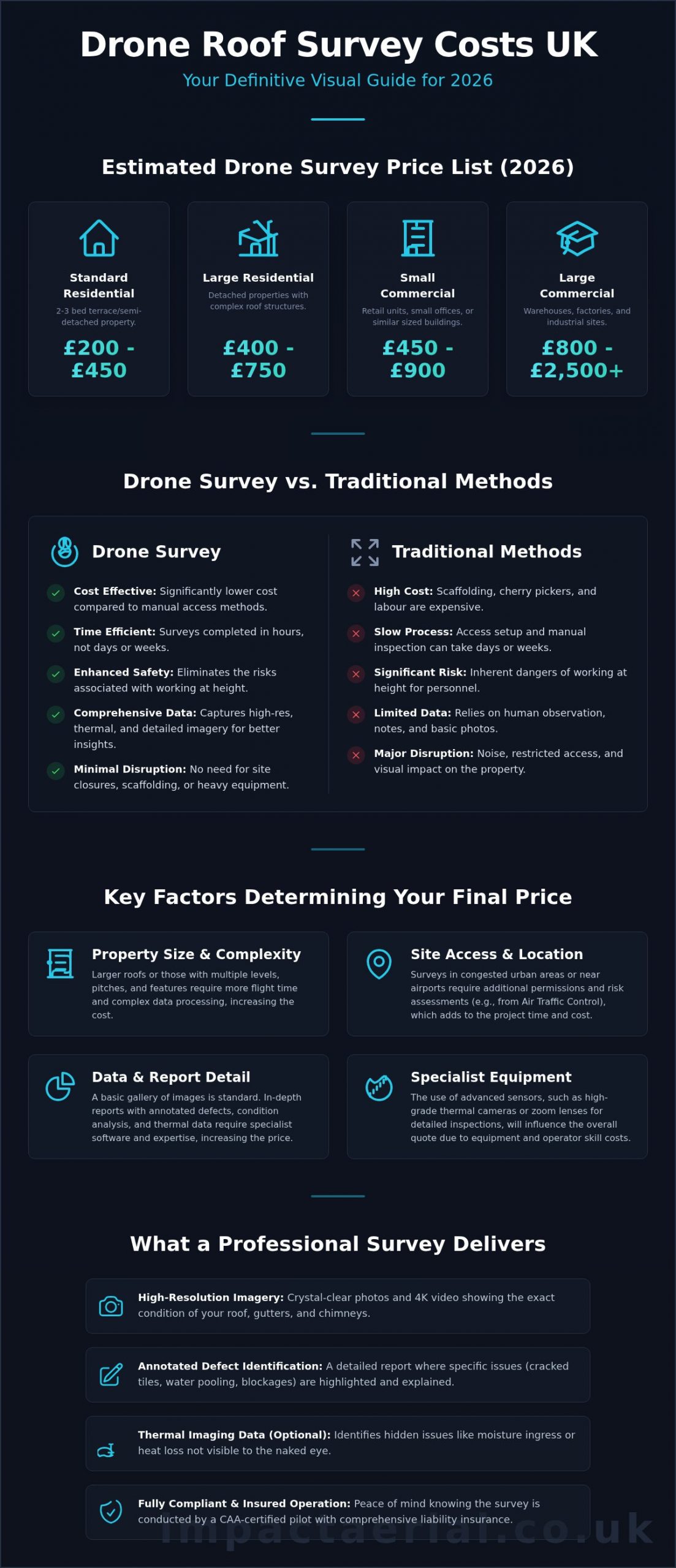
Aerial surveys are substantially more cost-effective than traditional methods because they eliminate the need for expensive access equipment. While scaffolding or cherry pickers require significant labour and multi-day hire periods, a drone can complete the same inspection in a fraction of the time. This reduction in access costs allows landlords to perform more frequent preventative maintenance, ultimately protecting the asset’s long-term value without the standard financial burden.

What kind of reporting will I receive after the drone inspection?

Clients receive a comprehensive digital data package tailored to their specific asset management needs. This typically includes high-resolution 4K HDR imagery, thermal maps for identifying energy efficiency issues, and interactive 3D models or digital twins. Our post-production team processes this raw data into actionable reports that surveyors and architects can use for immediate decision-making, dilapidations claims, or long-term planned preventative maintenance (PPM) schedules.

Can drones identify specific leaks or thermal issues on flat roofs?

Drones equipped with specialized thermal sensors are highly effective at identifying moisture ingress and insulation failures on flat roofs. By detecting temperature differentials, these sensors pinpoint trapped water within roofing membranes that is invisible to the naked eye. This allows for targeted repairs of specific leaks, preventing the need for a full and costly roof replacement while helping you meet 2026 energy efficiency standards.

Do I need to inform my tenants before a drone survey takes place?

It’s standard professional practice to inform tenants of a scheduled aerial inspection to ensure transparency and privacy. While our pilots use meticulous methods to avoid capturing personal data, giving tenants notice helps maintain positive relations and ensures site safety. We can provide documentation to assist you in notifying occupants about the flight’s purpose, the safety protocols in place, and its non-intrusive nature.

What insurance coverage does Impact Aerial maintain for commercial sites?

We maintain £5m in commercial liability insurance specifically designed for UAV operations, which provides essential protection for high-value commercial assets. This coverage meets EC 785/2004 standards and ensures that landlords are not held liable for third-party risks during the survey. This level of insurance offers total reassurance that your property and reputation are fully safeguarded throughout every phase of the operation.

How long does it take to complete an aerial survey of a large industrial unit?

A typical drone survey for commercial landlords on a large industrial unit can often be completed within a few hours on-site. Traditional manual inspections might take several days to coordinate and execute, especially when scaffolding or heavy machinery is involved. Our efficient, data-centric workflow allows for rapid collection of high-tier imagery without disrupting the daily operations of your tenants or on-site staff.

Are drone surveys suitable for listed commercial buildings?

Drone surveys are an ideal solution for listed commercial buildings because they are entirely non-invasive. Since the aircraft never makes physical contact with the structure, there’s no risk of damaging delicate masonry, historic features, or original roofing materials. This makes aerial inspections a preferred method for heritage assets where maintaining structural integrity is a legal priority, providing detailed data without the risks associated with ladders or scaffolding.

Drone Survey for Dilapidation Reports: The Professional Guide for 2026

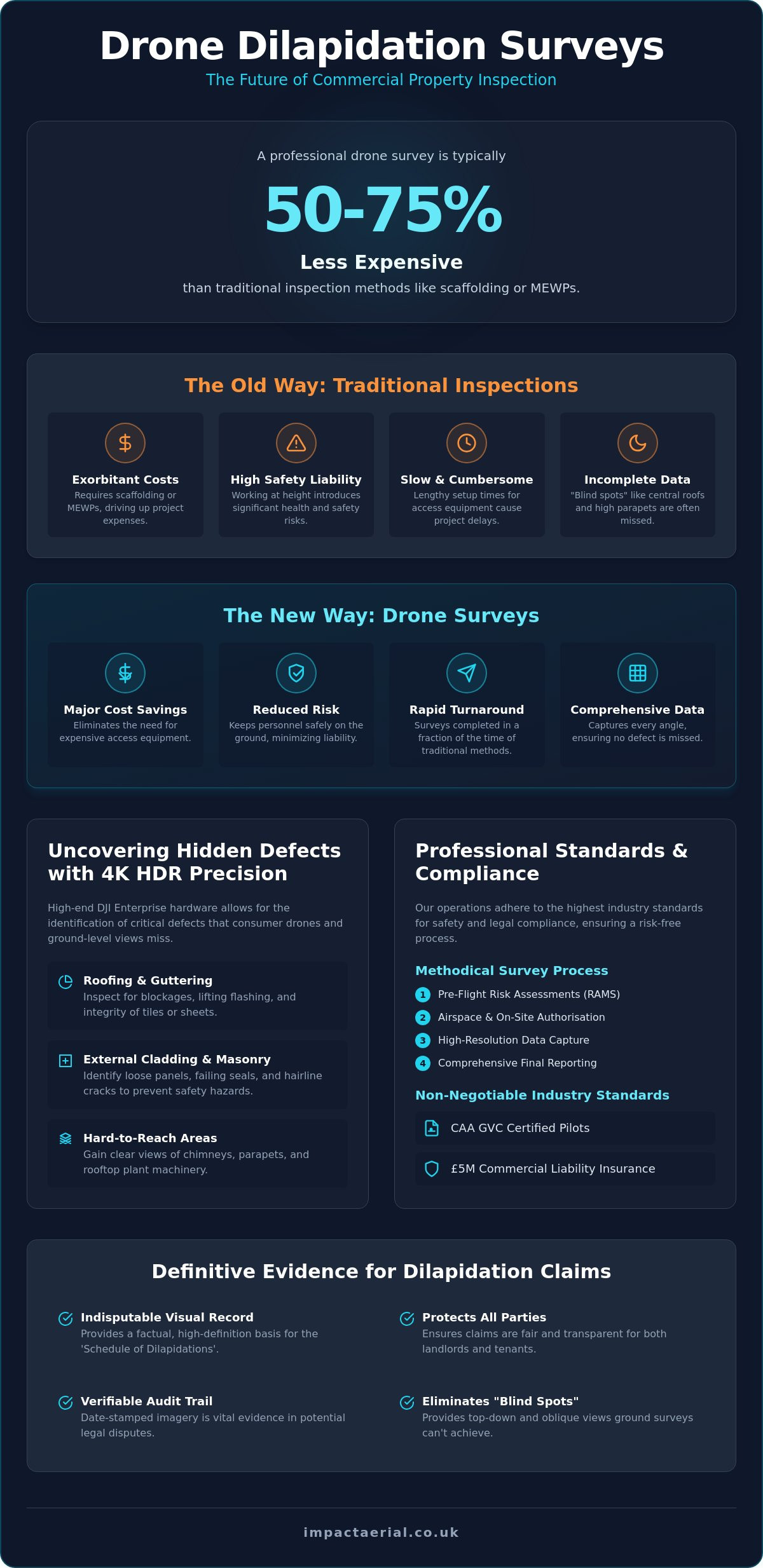
In 2024, the Health and Safety Executive reported that falls from height remain the leading cause of workplace fatalities in the UK, accounting for 50 deaths. You’re likely aware that traditional roof inspections involving scaffolding or cherry pickers are not just hazardous; they are a logistical burden that can cost over £1,200 before a single photo is even taken. Using a professional drone survey for dilapidation reports eliminates the need for personnel to work at height, providing a safer and more efficient alternative to manual methods.

This guide shows you how high-fidelity aerial data provides the legally-defensible evidence required for modern dilapidation claims while reducing your survey costs by up to 70% compared to traditional access. You’ll discover the technical requirements for RICS-compliant reporting, the role of CAA GVC certified pilots, and how 4K HDR imagery ensures every defect is documented with absolute precision. We’ll also detail the compliance standards necessary to ensure your data holds up in court or during lease negotiations, giving you total peace of mind throughout the process.

Key Takeaways

  • Learn how modern aerial data collection is replacing costly scaffolding and cherry pickers to provide comprehensive, high-resolution documentation of property conditions.
  • Discover the technical advantage of 4K HDR imagery for identifying hairline cracks and minor structural defects that traditional manual inspections often overlook.
  • Understand the “Zero Site Footprint” benefit of a drone survey for dilapidation reports, which significantly reduces operational costs and safety risks across UK sites.
  • Explore the critical role of CAA GVC certification and professional data-gathering in providing legally-defensible evidence for commercial property claims and arbitration.
  • Gain insight into how Birmingham-based specialists deliver meticulous, compliant results that offer added peace of mind for commercial property developers and surveyors.

The Evolution of Property Inspections: Drone Surveys for Dilapidation Reports

A drone survey for dilapidation reports represents the most significant shift in building surveying since the introduction of digital photography. By 2024, industry data indicated that over 65% of leading UK surveying firms had integrated unmanned aerial vehicles (UAVs) into their workflow to capture high-resolution aerial data. This technology documents property conditions with millimetre precision, providing a level of detail that ground-level inspections simply cannot achieve.

Traditional access methods like scaffolding or cherry pickers are becoming obsolete for initial assessments. These older methods often require 3 to 5 days of lead time for permits and can cost upwards of £1,500 for plant hire alone before a surveyor even sets foot on site. Drones eliminate these logistical hurdles, offering a 360-degree view of the asset that covers every angle of the building envelope.

To better understand how this technology is applied in a commercial setting, watch this helpful video:

What is a Dilapidation Survey?

A dilapidation survey is a technical assessment used to identify structural defects, maintenance needs, and breaches of lease covenants. For commercial property stakeholders, the resulting “Schedule of Dilapidations” is a critical document during lease-end negotiations. Landlords and tenants both benefit from accurate, timestamped visual evidence that proves the state of the building at a specific point in time.

These reports are typically categorised into two types. A terminal schedule is issued at the end of a lease to settle repair claims, while an interim schedule is conducted during the lease term to ensure the tenant is maintaining the property according to their agreement. Precise data reduces legal friction and ensures that financial settlements are based on objective facts rather than estimates.

Why Aerial Data is Changing the Industry

The speed of deployment is a primary driver for the adoption of drone technology. A professional team can arrive on site and begin gathering data within minutes, reaching inaccessible areas like valley gutters, high-level parapets, and complex roof structures that would otherwise remain hidden. This application of remote sensing technology

Technical Precision: Capturing High-Resolution Evidence for Surveyors

A professional drone survey for dilapidation reports requires more than just a clear photo; it demands forensic-level detail. Our fleet of DJI Enterprise drones provides the mechanical stability and sensor clarity needed to capture 4K HDR imagery that reveals hairline cracks as small as 0.2mm. This level of detail is non-negotiable for surveyors who must distinguish between superficial weathering and structural movement. High-resolution zoom cameras allow our CAA GVC Certified pilots to inspect chimneys, parapets, and fragile roof coverings from a safe distance. This approach eliminates the need for expensive scaffolding or cherry pickers. Industry experts suggest that these technological advancements revolutionize building inspections by providing a safer, more comprehensive data set for property managers.

4K HDR Imagery and Thermal Sensors

Standard photography often fails to capture the nuances of building defects in low-light or high-contrast environments. We use 45-megapixel sensors that ensure data quality meets the rigorous standards of RICS-qualified surveyors. Beyond visual light, thermal imaging identifies moisture ingress and heat loss within flat roof systems. By detecting temperature variances as small as 0.05°C, we pinpoint subsurface water ponding that’s invisible to the naked eye. This evidence is vital for Schedule of Dilapidations negotiations, providing undeniable proof of a building’s condition.

Photogrammetry and 3D Asset Mapping

Modern drone survey techniques go beyond simple video files. We use photogrammetry to create high-fidelity 3D models, or digital twins, of commercial properties. These models allow for accurate measurements of roof areas and guttering lengths with sub-centimetre precision. For large industrial sites, we produce orthomosaic maps. These are high-resolution, top-down views composed of thousands of individual images stitched together. Every drone survey for dilapidation reports we deliver includes GPS-tagged data, meaning surveyors can track the exact location of a defect across a 50,000 sq. ft. facility with total confidence.

Transitioning from raw footage to actionable data requires a meticulous approach to processing. We ensure all imagery is organised by asset, allowing property professionals to integrate the findings directly into their reports. For added peace of mind, you can speak with our technical team about the specific data outputs required for your next survey. This methodical workflow ensures that our clients receive a clear, defensible record of their property’s state.

Efficiency and Safety: Drones vs. Traditional Access Methods

Traditional building inspections often rely on heavy plant machinery or complex scaffolding structures. These methods are inherently slow and expensive. A drone survey for dilapidation reports offers a “Zero Site Footprint” approach. This means we don’t need to cordon off half a car park or block pedestrian access to gather high-definition data. By 2026, the efficiency gap has widened. Professional drone operators can capture a full site perimeter and roof plan in 90 minutes; a task that previously took a two-man team two full days using manual methods.

For insurance companies, this speed is a game-changer. High-resolution, time-stamped aerial imagery provides an indisputable record of condition. This clarity facilitates faster claim processing, often reducing the settlement window from several months to just a few weeks. It’s about precision and pace.

Eliminating the Need for Scaffolding and Cherry Pickers

Hiring a cherry picker often costs upwards of £400 per day, excluding transport and operator fees. If your site borders a public highway, local councils typically require a pavement licence. These permits often involve a 10 to 14-day waiting period and additional administrative fees. Drone technology bypasses these logistical hurdles entirely. We deploy quickly, reducing on-site time by approximately 75% compared to traditional access equipment. You save on plant hire, labour, and the administrative burden of permit applications.

Minimising Risk and Site Downtime

Safety is our primary driver. Falls from height remain the leading cause of workplace fatalities in the UK construction sector, accounting for 33% of all fatal injuries in 2023/24 according to HSE statistics. Using a drone survey for dilapidation reports removes the need for surveyors to climb onto fragile roof structures or navigate unstable parapets. Feet stay firmly on the ground.

  • Dedicated Spotters: For added peace of mind, our operations include a dedicated spotter. This team member maintains situational awareness, ensuring the pilot focuses on precision data-gathering while keeping the site safe.
  • Business Continuity: This remote approach allows tenant business activities to continue without interruption. There’s no need for noisy machinery or intrusive structures near entrances.
  • Hazard Identification: Drones identify structural risks, such as loose masonry or blocked guttering, from a safe distance before any person ever needs to go near them.

As a CAA GVC Certified operator, we prioritise compliance and risk management. Our meticulous planning ensures that every flight is conducted within the latest UK regulations, providing a professional service that balances technical excellence with site safety. This structured, methodical approach ensures that your dilapidation report is both comprehensive and safely executed.

Hiring an uncertified hobbyist for commercial inspections is a significant liability for property firms. In the event of a dispute, data captured by “a guy with a drone” rarely survives the scrutiny of a courtroom or an arbitration tribunal. Professional drone survey for dilapidation reports provide an indisputable digital record that carries genuine legal weight. These surveys rely on high-resolution, time-stamped metadata that proves the exact state of a building at a specific moment in time.

Data protection is equally critical in 2026. Flying in dense urban environments like Birmingham or London requires strict adherence to GDPR. Professional operators use advanced software to redact faces and vehicle registration plates automatically, ensuring privacy compliance. For added peace of mind, we maintain £5 million in commercial liability insurance. This level of cover is often a prerequisite for entering tier-one construction sites and protects all stakeholders from unforeseen operational risks.

Meeting CAA Regulations and Insurance Standards

The UK regulatory landscape has evolved significantly. The transition from the old PfCO to the current drone license GVC (General Visual Line of Sight Certificate) requirements represents a shift toward higher pilot competency. In 2026, the CAA GVC certification is the gold standard for commercial work. It demonstrates that the pilot has undergone rigorous theoretical and practical testing. Every flight we conduct is underpinned by a comprehensive Risk Assessment and Method Statement (RAMS). This document outlines how we mitigate hazards, from bird strikes to signal interference, ensuring the safety of the public and the property.

Structuring Data for a Schedule of Dilapidations

Legal teams and surveyors don’t want thousands of unorganised photos. They need structured, actionable intelligence. We present imagery through cloud-based delivery platforms that allow stakeholders to click on a specific point on a 3D model to view the original high-resolution photograph. This seamless data sharing speeds up the negotiation process between landlords and tenants. For complex urban surveys, we develop a specific “Safety Case,” which is a detailed evidence-based document submitted to the CAA to justify operations in high-risk or congested areas. This meticulous approach ensures every drone survey for dilapidation reports meets the highest evidentiary standards.

Ensure your property data is legally robust and fully compliant. Contact Impact Aerial to secure a professional survey for your next schedule of dilapidations.

Professional Aerial Surveying with Impact Aerial

Based in Birmingham, Impact Aerial serves the West Midlands and the wider UK with a dedicated focus on technical excellence. We provide a professional drone survey for dilapidation reports that bridges the gap between raw data and actionable insights for property professionals. Our team is fully CAA GVC Certified. This means we operate under the most current UK drone regulations to ensure total safety and compliance on active construction sites or busy commercial environments. We carry £5 million in commercial liability insurance as standard. This provides the peace of mind required by major developers, local authorities, and national asset managers when commissioning aerial work.

Our Birmingham hub allows us to reach 90% of the UK mainland within a four-hour drive. This central location makes us a strategic partner for companies managing national property portfolios. We don’t just provide imagery; we deliver a comprehensive service that supports the legal and financial aspects of property management. Our commitment to precision ensures that every survey we conduct meets the rigorous standards expected by RICS surveyors and legal teams in 2026.

Expert Pilots and Enterprise Technology

We utilize a sophisticated fleet of DJI Enterprise drones equipped with 4K HDR sensors. These aircraft are specifically designed for the rigors of commercial inspections. They deliver breath-taking clarity that serves technical needs, allowing for the identification of hairline cracks or minor structural defects that ground-based inspections often miss. Our pilots possess deep knowledge of the property and construction sectors. They understand the specific requirements of a drone survey for dilapidation reports, focusing on critical areas like roof membranes, parapets, and high-level glazing.

  • High-resolution 4K HDR imagery for granular detail.
  • Thermal imaging capabilities for identifying hidden moisture ingress.
  • Meticulous data collection protocols that ensure 100% site coverage.
  • Zoom technology to inspect hazardous areas without risking the aircraft or personnel.

End-to-End Project Management

Our service covers the entire project lifecycle. We start with detailed remote visual inspection (RVI) planning and risk assessments. We then move to precision flight operations and conclude with secure, high-speed data delivery. We offer customized survey packages tailored to industrial, commercial, and retail assets. Whether you’re managing a single retail unit or a massive distribution center, we scale our operations to meet your timeline.

Our high-quality post-production process ensures that all data is organized and easy to navigate. This helps you avoid costly disputes during lease terminations or schedule of condition negotiations. We provide clear, timestamped evidence that stands up to scrutiny in legal proceedings. Contact us today to discuss your specific dilapidation reporting requirements and find out how our expert team can support your next project.

As we move toward 2026, the standard for property documentation has shifted from manual estimation to digital precision. A professional drone survey for dilapidation reports provides a comprehensive visual record that traditional methods simply can’t match. By capturing high-resolution 4K imagery and 3D models, surveyors identify structural defects with millimetre accuracy while keeping personnel safely on the ground. This approach reduces inspection times by up to 70% compared to erecting scaffolding or hiring mobile elevating work platforms.

Impact Aerial delivers this technical edge through our team of CAA GVC Certified Pilots. For added peace of mind, we carry £5m commercial liability insurance on every project we undertake. While we’re Birmingham-based, our specialists provide UK-wide coverage to support commercial landlords and tenants in settling claims with objective, data-driven evidence. It’s time to replace outdated access methods with a safer, more efficient surveying solution that stands up to legal scrutiny.

Contact Impact Aerial for a professional drone survey quote and ensure your next dilapidation report is backed by industry-leading aerial intelligence.

Frequently Asked Questions

Is drone footage legally admissible for a dilapidation report?

High-resolution drone footage is legally admissible in the UK as objective evidence for a dilapidation report. Under the Civil Procedure Rules (CPR), specifically Part 35, digital imagery provides a factual record of a building’s condition at a specific date. Our 4K HDR data-gathering ensures that every defect is documented with precision. This creates a robust evidence trail that surveyors and legal teams use to settle terminal or interim claims.

How much does a drone survey for a dilapidation report cost?

The cost of a drone survey for a dilapidation report typically ranges from £500 to £1,500 for a standard commercial site in 2026. This price varies based on the size of the warehouse or office block and the complexity of the airspace. Factors like the requirement for specific CAA flight permissions or the use of thermal sensors impact the final quote. We provide fixed-price proposals based on your site’s specific postcodes and risk assessments.

Do I need to notify my tenants before a drone survey takes place?

You must notify your tenants at least 24 to 48 hours before a drone survey takes place to comply with privacy laws and standard lease agreements. While the drone remains in public or authorized airspace, GDPR regulations require transparency regarding data collection near occupied premises. Providing tenants with a clear flight window ensures operational transparency. It also gives them peace of mind that their privacy is respected during our professional services.

What certifications should a drone pilot have for a commercial survey?

A professional drone pilot must hold a Civil Aviation Authority (CAA) GVC (General Visual Line of Sight Certificate) for commercial operations in the UK. This qualification replaced the old PfCO and ensures the pilot is trained in the latest safety protocols. For added peace of mind, ensure the operator holds at least £5 million in commercial liability insurance. We maintain all current certifications to ensure every flight is fully compliant with UK law.

Can drones detect moisture or leaks in a warehouse roof?

Drones equipped with radiometric thermal sensors can detect moisture and leaks in a warehouse roof by identifying temperature differentials. Trapped water retains heat longer than dry insulation, which shows up as hot spots on a thermal map after sunset. This non-destructive method allows us to pinpoint the exact 10cm area of a leak without stepping onto a fragile roof. It’s a vital tool for accurate building services assessments in a niche but increasingly diverse market.

How long does it take to receive the data after a drone survey?

You will typically receive the raw high-definition imagery within 24 hours of the flight completion. For more complex outputs like 3D photogrammetry models or detailed inspection reports, the processing time is usually 3 to 5 working days. We use cloud-based platforms to deliver data quickly. This allows your surveying team to begin their analysis of the drone survey for dilapidation reports without delay.

What happens if the weather is bad on the day of the flight?

We reschedule the flight to the next available clear-weather window if wind speeds exceed 20mph or if there’s precipitation. Our DJI Enterprise drones have high IP ratings, but optimal data quality requires stable conditions. Safety is our primary concern, and we monitor Met Office forecasts 48 hours in advance. There’s no additional mobilization fee for weather-related delays, ensuring your project stays on budget and remains meticulously managed.

Is a drone survey safer than a traditional roof inspection?

A drone survey is significantly safer than traditional methods because it eliminates the need for personnel to work at height. Falls from height accounted for 33 percent of all fatal workplace injuries in the UK during 2023/24 according to HSE statistics. By keeping boots on the ground, we remove the risks associated with ladders, scaffolding, or fragile roof surfaces. It’s a meticulous process that prioritizes site safety and provides high-quality results.

Thermal Leak Detection Drone Surveys: The Expert Guide to Aerial Thermography

According to the UK Green Building Council, heating and cooling account for nearly 40% of energy use in commercial spaces, yet a staggering amount of this investment literally evaporates through unidentified structural defects. You likely know that even a minor breach in a flat roof or a failing insulation seal leads to astronomical energy bills and long-term structural decay. It’s frustrating to pay upwards of £2,000 for scaffolding just to locate a problem that’s invisible to the naked eye. For added peace of mind, our CAA GVC Certified pilots use advanced thermal leak detection drone technology to pinpoint these issues without the need for manual inspections or site downtime.

In this expert guide, you’ll discover how professional thermal drone surveys identify hidden leaks, reduce maintenance costs, and provide actionable data for UK commercial assets. We’ll examine the precision of 4K High Dynamic Range thermography and how our detailed data-gathering satisfies strict insurance requirements. By the end, you’ll understand how to implement a zero-downtime inspection process that protects your building’s integrity while keeping your operational costs firmly under control.

Key Takeaways

  • Learn how high-resolution radiometric sensors detect “invisible” energy to pinpoint moisture entrapment and insulation failures in commercial roofs.
  • Discover how a professional thermal leak detection drone survey delivers a higher ROI by eliminating the need for expensive scaffolding and reducing inspection times.
  • Understand the critical role of “thermal windows” and diurnal shifts in ensuring data accuracy for complex industrial assets and solar farms.
  • See why using CAA GVC Certified pilots ensures your survey remains fully compliant with UK drone laws while providing essential “at-height” safety.
  • Gain peace of mind by learning how expert pre-flight planning and risk assessments are conducted for assets across Birmingham and the West Midlands.

What is a Thermal Leak Detection Drone and How Does it Work?

A thermal leak detection drone is a commercial-grade UAV integrated with high-resolution radiometric thermal sensors designed to visualise temperature variances across large structures. Unlike standard cameras that capture visible light, these sensors detect energy in the long-wave infrared spectrum. This allows Impact Aerial pilots to identify anomalies that are invisible to the naked eye, such as moisture trapped under roof membranes or heat escaping through failed insulation. To understand the core technology, we must look at What is Thermography?, which is the science of translating infrared energy into a visual map where every colour represents a specific thermal value.

To better understand this concept, watch this helpful video:

Professional surveys require more than just a heat-sensitive camera. We use radiometric sensors that record temperature data for every one of the 327,680 pixels in a standard 640×512 image. A basic heat map only shows relative differences, but radiometric data allows us to pinpoint the exact temperature of a specific spot to within 2 degrees Celsius. This precision is vital for commercial property managers who need to justify repair costs based on quantifiable data rather than visual guesswork. It’s the difference between seeing a “warm patch” and knowing a specific valve is operating at 75 degrees Celsius when it should be at 40.

Drones solve the massive scale issues associated with handheld thermal cameras. A technician on the ground might take 5 hours to inspect a 3,000 square metre warehouse roof using a handheld unit, often missing spots due to the shallow angle of view. Our DJI Enterprise drones cover that same area in a single 15-minute flight. By capturing data from a top-down nadir perspective, we eliminate the distortions caused by ground-level obstructions and provide a comprehensive orthomosaic map of the entire site.

Understanding Thermal Emissivity and Reflectivity

Different materials don’t radiate heat in the same way. A weathered concrete roof has high emissivity, while a new zinc or aluminium facade is highly reflective and can act like a thermal mirror, reflecting the cold sky. This often creates “false positives” where a surface looks like it’s leaking or freezing when it’s actually just reflecting its surroundings. Impact Aerial pilots use their CAA GVC training to adjust sensor parameters for these specific material properties in real-time. Emissivity is the measure of an object’s ability to emit infrared energy.

The Role of Dual-Sensor Payloads

Top-tier thermal leak detection drone operations rely on dual-sensor payloads, such as the DJI Zenmuse H20T. These systems carry a 4K visual camera and a thermal sensor simultaneously. Using a technique called MSX (Multi-Spectral Dynamic Imaging), the drone overlays high-contrast edges from the visual camera onto the thermal image. This adds structural detail, like bolts, seams, and lettering, to the heat map. It makes it significantly easier for maintenance teams to locate the exact position of a leak on a featureless flat roof. By using this DJI Enterprise hardware, we ensure that every thermal anomaly is backed by a high-resolution visual reference for 100% reporting accuracy.

Key Industrial Applications for Thermal Drone Surveys in the UK

The UK drone industry has evolved into a niche but increasingly diverse market where precision and safety are paramount. Deploying a professional thermal leak detection drone allows asset managers to move beyond reactive repairs into a regime of proactive maintenance. By using high-specification DJI Enterprise aircraft, we capture data that ground-based teams simply cannot access safely or efficiently. This technical approach is now standard practice for maintaining the integrity of large-scale infrastructure across the West Midlands and the wider UK.

Large-scale warehouses and distribution centres, particularly those exceeding 50,000 square feet, often suffer from thermal bridging. This occurs when heat bypasses insulation through structural components, leading to massive energy wastage. Mapping these air leaks provides a clear roadmap for remediation. Implementing these findings can reduce annual energy costs by 15% to 25% based on 2023 energy price benchmarks. Similarly, district heating networks in urban centres like Birmingham rely on sub-surface monitoring. Sub-surface leaks create distinct temperature anomalies in the soil that drones identify as “heat signatures” long before water reaches the surface. This prevents catastrophic pavement failures and avoids the £10,000+ costs associated with emergency utility excavations.

Roofing and Water Ingress Detection

Flat roofs on commercial properties are notoriously prone to moisture entrapment. Because water has a higher thermal mass than standard bitumen or single-ply membranes, it retains solar heat long after the sun sets. By deploying a thermal leak detection drone during the diurnal cooling period, our CAA GVC certified pilots pinpoint trapped moisture that stays invisible to the naked eye. This data is vital for BREEAM surveys and meets the rigorous standards required for commercial insurance compliance. It also identifies delamination, where layers of the roof membrane separate. Industry data suggests that delamination affects roughly 65% of UK commercial roofs over 15 years old. Technical research into aerial thermography techniques confirms that high-resolution thermal imaging is the only reliable method for detecting these subtle variances without invasive core sampling.

Solar Farm Thermal Surveys

For multi-megawatt PV installations, efficiency is the primary driver of ROI. Faulty cells or “hot spots” can reduce a farm’s total power output by as much as 30% if they aren’t replaced quickly. A ground team often takes three weeks to inspect a 100-acre site manually; our thermal drones complete the same task in a single day. This rapid data-gathering ensures asset managers have the information they need for targeted repairs without the high labour costs. For site managers looking to optimise their renewable assets, booking PV Solar Farm Thermal Surveys provides the granular detail needed to maintain peak performance. We provide high-quality reports that categorise faults by severity, giving you total peace of mind regarding your site’s operational health. If you’re managing a large portfolio, you might find that professional aerial inspections are the most cost-effective way to ensure long-term compliance and safety.

Drones vs. Traditional Leak Detection: A Comparison of ROI and Safety

Traditional leak detection often relies on manual labour and heavy machinery. For a standard 20,000 square foot industrial unit, erecting scaffolding or hiring a Mobile Elevated Working Platform (MEWP) can cost between £600 and £1,500 per day. These costs escalate quickly if the inspection takes several days. By contrast, a thermal leak detection drone can survey the same area in under 60 minutes. This speed doesn’t just save time; it slashes the capital expenditure required for basic maintenance assessments by approximately 70% in most commercial applications.

Safety is the most compelling argument for switching to aerial methods. Health and Safety Executive (HSE) data for 2023/24 shows that falls from height remain the single biggest cause of workplace fatalities in the UK. By keeping surveyors on the ground, firms eliminate the risks associated with fragile roof materials and inclement weather. While the U.S. Department of Energy explains thermography as a vital tool for identifying heat loss and air gaps, deploying this tech via drone provides a level of safety that manual inspections cannot match. Our CAA GVC certified pilots ensure every flight adheres to strict UK civil aviation regulations, providing professional results without the liability of “at-height” work.

Eliminating Business Downtime

Operational continuity is vital for any industrial site or retail park. Traditional inspections often require cordoning off car parks or shutting down loading bays to accommodate cherry pickers and safety zones. Drone surveys allow for “business as usual” because the flight path remains clear of ground-level operations. Drone surveys can be conducted without any physical contact with the asset. This non-contact approach is particularly beneficial for hazardous environments, such as chemical plants or high-voltage electrical substations, where physical proximity poses significant risks to personnel. We provide high-quality data-gathering without requiring a single minute of site closure.

Accuracy and Repeatability

Manual inspections are inherently subjective. A technician with a handheld thermal camera might miss small anomalies or fail to capture the full context of a leak. A thermal leak detection drone provides 100% site coverage, capturing thousands of data points in a single mission. We use high-resolution radiometric sensors that record the exact temperature of every pixel in the image. This data is far more robust than a simple visual report.

  • GPS-Tagged Imagery: Every thermal frame is embedded with precise coordinates. This allows our team to return to the exact same centimetre of space six months later to monitor if a leak has worsened.
  • Digital Twins: We can overlay thermal data onto 3D photogrammetry models. This gives stakeholders a clear, interactive map of their asset’s thermal health.
  • Objective Reporting: Move away from “best guesses” to digital reports that provide clear evidence for insurance claims or repair tenders.

The move from manual spot-checking to comprehensive UAV surveys represents a shift from reactive maintenance to proactive asset management. Instead of waiting for a ceiling to drip, facility managers can identify thinning insulation or moisture ingress months before it becomes a critical failure. This predictive capability is the ultimate return on investment, preventing emergency repair costs that often run into tens of thousands of pounds.

The Process: How We Organise a Professional Thermal Survey

Every successful thermal leak detection drone mission starts long before the propellers spin. For projects across Birmingham and the wider West Midlands, we begin with a rigorous pre-flight phase. This involves checking Restricted Area Zones (RAZs) and filing necessary notifications with the Civil Aviation Authority (CAA). Our GVC-certified pilots conduct a detailed site risk assessment to identify overhead hazards or privacy concerns, ensuring every flight remains 100% compliant with UK aviation law and our commercial liability insurance requirements.

Planning for the UK Climate

Thermal imaging relies on a specific “Delta T,” which is the temperature difference between the building’s interior and the outside air. We typically require a minimum differential of 10°C to produce high-contrast data. In the UK, this often means scheduling flights during “thermal windows” between 9:00 PM and 5:00 AM. During these hours, “solar loading” from the sun has dissipated, allowing trapped moisture within roof insulation to stand out clearly as it retains heat longer than dry materials.

  • Wind Speeds: We ground flights if gusts exceed 15mph to ensure sensor stability.
  • Precipitation: Surfaces must be dry; even light rain can mask thermal signatures through evaporative cooling.
  • Cloud Cover: Unlike traditional photography, 100% cloud cover is often ideal as it prevents “sky glow” reflections on metallic or glass surfaces.

Once on-site, we don’t rely on guesswork. We deploy enterprise-grade drones to fly methodical, automated grids with an 80% front and side overlap. This level of redundancy is vital. It ensures we capture every square inch of the structure from multiple angles, leaving no room for data gaps. For a standard 2,500 square metre warehouse roof, this process might generate 500 individual radiometric images, providing a comprehensive digital twin of the building’s thermal profile.

From Raw Data to Actionable Reports

The raw imagery captured by a thermal leak detection drone is just the beginning. We use specialist analytical software to process .R-JPEG files, which contain temperature data for every single pixel. This allows our technicians to retrospectively adjust emissivity settings and temperature scales to isolate specific defects. By integrating this data into our Drone Property Surveys, we provide a clear, visual map of your asset’s hidden issues.

We categorise every finding to help you manage your maintenance budget effectively. Critical defects indicate active leaks or safety risks that require immediate intervention. Major issues identify areas where the building envelope is failing and should be addressed within 90 days. Minor anomalies are flagged for monitoring during future inspections. This prioritised approach gives facilities managers the evidence they need to justify repair costs and prevent long-term structural rot.

Don’t let hidden leaks damage your property’s value and structural integrity. Book a professional thermal drone survey with our expert team to get the data you need for informed repairs.

Why Choose Impact Aerial for Your Thermal Leak Detection?

Impact Aerial operates at the intersection of technical precision and regulatory excellence. Based in Birmingham, we provide specialised aerial services across the West Midlands, from the industrial corridors of the Black Country to the commercial heart of the city. We don’t just fly drones; we provide actionable data that saves our clients thousands of pounds in unnecessary scaffolding and manual inspection costs. Our local knowledge of the region’s industrial architecture allows us to identify potential failure points before they become catastrophic expenses.

Our fleet consists of the latest DJI Enterprise hardware. These aircraft carry sensors with a 640×512 thermal resolution. This level of detail is critical for accuracy. Standard consumer drones often provide 160×120 resolution, which lacks the pixel density needed to pinpoint a 2mm crack in a steam pipe or a failing weld on a flat roof. By using a high-specification thermal leak detection drone, we ensure that every thermal anomaly is identified with surgical accuracy. We provide the clarity needed to make informed maintenance decisions without the guesswork.

A Safety-First Approach

Safety isn’t a checkbox for us. It’s our operational foundation. Every pilot at Impact Aerial is CAA GVC (General Visual Line of Sight Certificate) certified. This qualification is the gold standard for UK drone operations, allowing us to operate safely in complex, congested urban environments. We conduct a rigorous 5-step risk assessment before every take-off. This includes airspace checks, ground hazard identification, and real-time weather monitoring. Our affiliation with the Drone Safe Register and ARPAS-UK further validates our commitment to the highest industry standards. For added peace of mind, we carry £5m in commercial liability insurance, ensuring your assets and personnel are protected throughout the survey process.

Customised Solutions for Every Sector

We understand that a construction manager needs a different report than a corporate board member. Our data delivery is tailored to your specific requirements. For site engineers, we provide raw radiometric data and technical overlays that highlight precise temperature differentials. For stakeholders, we deliver breath-taking visual clarity that makes complex issues easy to understand at a glance. We bridge the gap between niche technical data and clear, high-quality business insights. Our reporting is designed to be shared across departments, ensuring everyone from the maintenance team to the CFO has the information they need.

Whether you are managing a 50,000 sq ft warehouse in Solihull or a heritage building in Coventry, our thermal leak detection drone services provide the precision you need. We’ve helped local firms reduce their inspection timelines by 80% compared to traditional manual methods. This efficiency doesn’t just save time; it reduces the carbon footprint of your maintenance operations by eliminating the need for heavy machinery and lifts.

Ready to secure your property and stop leaks in their tracks? Contact Impact Aerial for a professional thermal survey quote and see why we are the trusted choice for aerial inspections across the United Kingdom.

Secure Your Infrastructure with Precision Thermography

Traditional scaffolding or manual roof inspections often cost thousands in labour and equipment hire before a single leak is even identified. Switching to a thermal leak detection drone reduces these preliminary expenses by up to 70% while completely removing the safety risks associated with working at height. Our surveys provide high-resolution data that pinpoint heat loss or moisture ingress with sub-centimetre accuracy, allowing for surgical repairs rather than costly full-scale replacements.

Based in Birmingham, Impact Aerial serves the West Midlands and the wider UK with a focus on technical excellence and regulatory compliance. We operate as CAA GVC Certified pilots and maintain £5m commercial liability insurance to ensure every project meets the highest professional standards. You’ll receive a detailed thermal report that transforms complex aerial data into actionable insights for your maintenance team. It’s the most efficient way to protect your assets and improve energy efficiency across your entire property portfolio.

Book your professional thermal drone survey with Impact Aerial today and gain the clarity you need to manage your site effectively.

Frequently Asked Questions

Can a thermal drone find water leaks underground?

Thermal drones identify underground water leaks by detecting the specific temperature variances they create on the surface. While the sensor doesn’t see through soil, a thermal leak detection drone identifies where leaking fluid has changed the ground’s thermal mass or moisture levels. This is most effective when there’s a 5-degree temperature difference between the fluid and the surrounding earth. It allows us to pinpoint pipe bursts without invasive digging.

How much does a thermal drone survey cost in the UK?

A professional drone survey in the UK typically starts at £450 for a standard commercial roof. Larger industrial sites or complex infrastructure inspections often range from £900 to £1,600 per day. These figures include the pilot’s time, DJI Enterprise equipment hire, and the subsequent data analysis. For added peace of mind, our pricing includes £5 million in commercial liability insurance as standard for every project.

What weather conditions are needed for an accurate thermal survey?

Optimal results require dry conditions with wind speeds remaining below 18 mph and a total lack of precipitation. To find heat loss in buildings, we need a 10-degree Celsius differential between internal and external temperatures. We typically fly at dawn or dusk to avoid solar loading, which occurs when the sun heats surfaces and masks underlying anomalies. This ensures the 640×512 resolution data remains accurate and actionable.

Is it legal to fly a drone over my commercial property for an inspection?

It’s legal provided the operator holds the correct CAA GVC Certification and adheres to the UK Drone Code. We manage all necessary risk assessments and flight notifications required by the Civil Aviation Authority before arriving on-site. Our pilots are specifically trained to operate in congested areas, ensuring your 100% compliance with current aviation law. We provide all safety documentation before the flight to guarantee a professional service.

What is the difference between a standard drone and a thermal drone?

The primary difference lies in the sensor technology used to gather data during the flight. Standard drones use RGB sensors to capture visual light, whereas a thermal leak detection drone carries a radiometric microbolometer that measures infrared radiation. Our fleet uses dual-sensor payloads, allowing us to overlay thermal maps onto 4K visual images. This helps our team identify the exact tile or brick where a leak originates with millimetre precision.

Can thermal drones detect gas leaks or just heat changes?

Standard thermal sensors detect heat signatures rather than chemical compositions, though they can identify the cooling effect of escaping pressurised gas. While they’re excellent for finding hot water leaks, gas detection often requires specialised Optical Gas Imaging payloads. We use sensors capable of detecting temperature fluctuations as small as 0.05 degrees Celsius. This precision allows us to identify anomalies that are completely invisible to the naked eye or standard cameras.

How long does it take to receive the final thermographic report?

We deliver the finalised technical report within 72 hours of the site visit completion. This timeframe allows our specialists to process radiometric data and verify every thermal anomaly found during the flight. You’ll receive a detailed PDF report containing high-resolution imagery and GPS coordinates for every fault identified. We ensure the data is clear and actionable so your maintenance teams can start repairs immediately without further diagnostic delays.

Do I need to be on-site during the drone survey?

You don’t need to be present during the survey if we’ve arranged site access and permissions in advance. We perform a comprehensive pre-site assessment 48 hours before the flight to identify any hazards or restricted zones. Most of our commercial property clients prefer this remote approach because it doesn’t disrupt their daily operations or require staff downtime. We’ll send a digital confirmation once the data-gathering phase is complete.

Drone Survey Return on Investment: The Commercial Case for Aerial Data in 2026

In 2024, a typical UK commercial property manager might spend £12,000 on scaffolding just to inspect a single warehouse roof, only to wait three weeks for a manual report. It’s a frustrating reality. Rising overheads make a high drone survey return on investment more critical than ever as your margins tighten. You’ve likely felt the sting of these costs and the constant anxiety of sending personnel into high-risk, hazardous areas. We understand that your priority is balancing a strict budget with the need for absolute precision and safety across your portfolio.

This article demonstrates how professional aerial data can reduce your operational costs by up to 70% while delivering high-resolution insights that manual methods simply can’t match. By utilising advanced drone technology and CAA GVC certified pilots, you’ll gain millimetre-accurate results without the traditional health and safety headaches. We provide a clear framework to calculate your specific savings and explain why partnering with a compliant UK operator ensures peace of mind for your 2026 commercial strategy.

Key Takeaways

  • Understand the “Efficiency Gap” and how transitioning from manual surveying to aerial data collection can increase your site coverage from 5 to 100 acres per hour.
  • Master a step-by-step framework to calculate your drone survey return on investment by auditing current labour costs and the hidden “Risk Premium” of traditional methods.
  • Identify how to slash operational overheads by up to 70% by eliminating expensive plant hire and scaffolding through CAA-certified aerial inspections.
  • Explore industry-specific ROI strategies for the UK construction, solar, and property sectors to ensure your data-gathering delivers maximum commercial value.
  • Discover why professional DJI Enterprise fleets and meticulous post-production provide the “peace of mind” and data accuracy required for complex UK commercial projects.

The Traditional Method Tax: Why Manual Surveying Costs More in 2026

Traditional surveying methods are rapidly becoming a financial liability for UK construction and property firms. In 2026, the “Traditional Method Tax” refers to the compounding costs of manual labour, plant hire, and extensive health and safety overheads that eat into project margins. A manual ground team typically covers 5 acres per hour. Our CAA GVC Certified pilots achieve 100 acres per hour using Enterprise-grade equipment. This 2,000% increase in efficiency directly influences the drone survey return on investment by slashing site time and removing the need for expensive “at-height” permits or road closures.

The financial drain of manual data collection isn’t just about the hourly rate of a surveyor. It includes the hidden costs of plant hire, such as cherry pickers or scaffolding, which often sit idle during weather delays. By leveraging the science of photogrammetry, we capture thousands of high-resolution data points in a single flight. This digital-first approach eliminates the “Efficiency Gap” that has plagued the industry for decades. For a clearer look at how these savings manifest, watch this breakdown of aerial data value:

Scaffolding vs. Drones: A Direct Cost Comparison

Scaffolding remains one of the largest “sunk costs” in commercial property maintenance. For a standard 500sqm commercial roof inspection in the West Midlands, scaffolding costs typically range between £3,500 and £8,000. This price excludes the 48-hour assembly period and the associated public liability risks. A professional drone inspection, providing 4K HDR imagery, costs approximately £650 and is completed in under 90 minutes. In a recent 2025 case study, a logistics firm reduced its annual inspection budget from £12,400 to just £1,800 by replacing physical access equipment with scheduled drone flights. This 85% reduction in expenditure provides an immediate boost to the drone survey return on investment for asset managers.

The Speed Advantage in Project Timelines

Project bottlenecks often occur when site managers wait for topographical data or structural reports. Traditional surveys can take 14 days to process and deliver. Drones remove this friction. With real-time 4K HDR aerial previews, stakeholders make informed decisions while the pilot is still on-site. Rapid data turnaround is vital in the competitive UK property sector where a three-week delay can result in thousands of pounds in liquidated damages. We’ve seen clients finish a survey in four hours that previously required two weeks of manual plotting. Finishing early isn’t just a convenience; it’s a strategic move that frees up capital and labour for the next phase of the build. This speed ensures that data is a catalyst for progress rather than a reason for a standstill.

The Four Pillars of Drone Survey ROI

Calculating the drone survey return on investment requires looking beyond the initial service invoice. It involves a total cost of ownership analysis that compares traditional manual methods against digital aerial data acquisition. For a typical commercial project in the UK, the financial benefits manifest through four distinct channels: direct expenditure reduction, risk avoidance, data fidelity, and project uptime. These pillars form the foundation of a modern, data-driven construction or maintenance strategy.

Direct cost savings are often the most immediate win for project managers. Traditional roof inspections or topographical surveys frequently necessitate scaffolding or cherry pickers, which can cost between £800 and £3,500 per week depending on the scale. By deploying a professional drone service, these hardware rentals become redundant. Labour hours also plummet; a task that previously required a two-person team three days to complete can now be finished in a single morning. This efficiency allows for more frequent site audits without inflating the budget. You’ll find that the speed of delivery is just as valuable as the reduced headcount.

Operational continuity ensures that your site remains productive. Unlike traditional surveying which might require closing a section of a live motorway or halting a railway line for safety reasons, drones operate overhead without interfering with ground-level activity. This lack of disruption preserves revenue streams that would otherwise be lost during a manual inspection shutdown. It’s a pragmatic approach to asset management that prioritises both safety and the bottom line.

Financial Gains from Enhanced Safety

Safety is a massive financial driver in the British construction industry. Falling from height remains the primary cause of workplace fatalities in the UK, accounting for 40 deaths in the 2022/23 HSE reporting period. A single serious injury can result in HSE fines exceeding £50,000 and legal fees that quickly spiral into six figures. By keeping staff on the ground, companies significantly lower their Work at Height (WAH) risk profile. This proactive stance often leads to lower insurance premiums and higher safety ratings during commercial tenders, giving you a competitive edge when bidding for high-value contracts. If you want to ensure your site meets these rigorous standards, you can book a professional consultation to review your specific requirements.

The Value of Superior Data Quality

High-resolution outputs provide a level of detail that manual notes simply cannot match. Using 4K HDR imagery and thermal sensors creates a definitive “source of truth” for every asset on site. This precision is backed by academic research on drone benefits, which highlights how digital twins and 3D mapping reduce rework costs by identifying structural issues months before they become critical failures.

In the UK construction sector, rework can account for up to 12% of total project costs. Eliminating even a fraction of these errors through accurate photogrammetry ensures the drone survey return on investment remains positive throughout the asset’s lifecycle. Predictive maintenance becomes a reality when you have a chronological record of high-quality aerial data to track wear and tear over time, allowing for targeted repairs rather than expensive, emergency overhauls. This data-first approach provides peace of mind for stakeholders and investors alike.

Industry-Specific ROI: Construction, Solar, and Property

Calculating a precise drone survey return on investment requires looking beyond the initial service fee. It’s about the specific operational bottlenecks we remove in each sector. A property developer in Birmingham has vastly different KPIs than a solar farm manager in Oxfordshire. By deploying specialised equipment like the DJI Matrice 350 RTK equipped with H20T thermal sensors, we provide data that isn’t just visual; it’s financial. The value lies in replacing 40 hours of manual labour with 4 hours of autonomous data capture, while simultaneously reducing the health and safety risks associated with working at height or in hazardous environments.

Solar Farm ROI: Detecting Faults Before They Cost Millions

For large-scale utility sites, the cost of an offline string or a cracked cell is cumulative and silent. Traditional manual string testing for a 50MW site can take a ground team up to 15 days to complete, often leaving the site vulnerable to intermittent faults. Our PV Solar Farm Thermal Surveys use radiometric data to identify “hot spots” and failing diodes in a fraction of that time. A single drone flight can cover the same 50MW site in just two days.

The revenue recovered is substantial. If a single faulty string goes undetected, it can result in a loss of approximately £450 to £600 per month depending on current energy prices. On a site where we identify 15 to 20 such anomalies, the drone survey return on investment is achieved before the final report is even delivered. We provide a prioritised list of defects, allowing maintenance teams to target high-loss areas first, rather than searching for needles in haystacks.

  • 90% reduction in inspection time compared to manual ground testing.
  • Immediate identification of bypass diode failures and PID (Potential Induced Degradation).
  • Zero-contact inspections ensure no accidental damage to panels during the testing process.

Construction and Property: Monitoring Progress and Defects

In the construction sector, drones have transformed the accuracy of earthworks and volume calculations. Traditional surveying methods for stockpiles often involve significant margins of error, sometimes as high as 15%. By using photogrammetry and DJI Enterprise drones, we deliver volumetric data with accuracy levels within 2 to 5 centimetres. This precision prevents contractors from overpaying for material removal or underestimating the fill required for a site, which can save thousands of pounds in a single phase of the project.

For commercial real estate, the ROI shifts towards marketing and maintenance. High-resolution Drone Property Surveys allow for rapid roof and facade inspections without the £2,000 to £5,000 cost of scaffolding or cherry pickers. Furthermore, cinematic 4K aerial filming has become a standard requirement for high-end commercial listings. Data from UK property portals suggests that listings featuring professional aerial perspectives receive up to 30% more engagement than those without. This visibility accelerates the sales cycle, reducing the time a capital-intensive asset sits idle on the market.

Whether it’s verifying a contractor’s progress against a BIM model or capturing breath-taking marketing assets, the data we provide is a tool for risk mitigation. We don’t just fly drones; we provide the evidence needed to make informed, cost-saving decisions. Our CAA GVC certified pilots ensure every operation is compliant, giving you peace of mind that your data gathering is as safe as it is precise.

Calculating Your ROI: A Framework for UK Businesses

Quantifying the drone survey return on investment requires a shift from viewing aerial work as a visual luxury to seeing it as a core financial efficiency tool. UK businesses must evaluate four specific pillars to determine the true value of transitioning from manual methods to professional drone services. This framework ensures that every pound spent on aerial data gathering contributes to the bottom line.

Step 1: Audit your current manual survey and inspection costs. For a standard 5,000 square metre commercial roof in the West Midlands, traditional inspection methods involving scaffolding or cherry pickers often start at £3,500 in equipment hire and labour. These costs don’t include the two to three days of site disruption. A professional drone survey completes this same task in roughly 90 minutes for a fraction of the setup cost. You’ll see an immediate reduction in overheads by eliminating heavy plant hire.

Step 2: Factor in the ‘Risk Premium’. The Health and Safety Executive (HSE) reported 40 fatal falls from height in the UK during the 2022/23 period. Every hour a staff member spends on a ladder or roof increases your liability. By keeping personnel on the ground, you achieve a 100% reduction in “at-height” man-hours. This lowers your risk profile and can lead to more favourable terms with commercial insurers over time.

Step 3: Evaluate the data utility. Manual surveys often result in static, subjective PDF reports that require manual data entry. Digital drone data allows for a 65% reduction in time spent on post-production analysis. Because the data is georeferenced and timestamped, it provides a definitive record that prevents costly disputes between contractors and clients.

Step 4: Account for compliance. Legal fines from the Civil Aviation Authority (CAA) for unauthorised commercial flights can exceed £5,000. Criminal prosecutions for safety breaches can be significantly higher. Ensuring your operator is fully vetted protects your business from these avoidable financial drains.

The ‘Cheap Pilot’ Trap: Why Compliance is an ROI Factor

Hiring an uncertified hobbyist might save £300 on the initial quote, but it creates a massive financial liability. Impact Aerial holds full CAA GVC certification, ensuring we operate within the latest UK legal frameworks. We carry £5m commercial liability insurance as a standard for added peace of mind. This insurance is non-negotiable for ROI protection; without it, a single operational mishap could wipe out your entire project budget and result in heavy legal fees. Professional operators provide the legal safety required to protect your corporate reputation.

Hidden ROI: Post-Production and Data Integration

The real value often emerges after the drone lands. High-quality aerial data integrates directly into existing Building Information Modelling (BIM) workflows and project management software. This allows site managers to spot structural anomalies 20% faster than traditional ground-based photography. Photogrammetry is the process of turning photos into measurable 3D models. These models allow stakeholders to perform accurate volumetric calculations and distance measurements from their desks. Using professional editing and virtual tours creates a high-quality visual narrative that secures stakeholder buy-in and speeds up planning approvals.

Secure your project’s financial future by booking a professional drone survey with our expert team today.

Maximise Your Return with Impact Aerial’s Professional Services

Achieving a positive drone survey return on investment requires more than just owning a quadcopter. It demands a fusion of high-end hardware and technical proficiency. At Impact Aerial, we use a DJI Enterprise fleet, including the Matrice series equipped with RTK (Real-Time Kinematic) modules. Unlike consumer-grade drones that rely on standard GPS with a 3-5 metre margin of error, our enterprise systems deliver 1-3cm horizontal accuracy. This precision prevents costly miscalculations in volume measurements or site boundaries that could otherwise set a project back by thousands of pounds.

Our methodology spans from initial consultation to high-resolution post-production. We don’t just provide raw footage. We process data through advanced photogrammetry software to create detailed 3D models and orthomosaic maps. This technical expertise translates into actionable data. You can measure distances, areas, and volumes directly from your desktop. It reduces the need for site revisits, which often cost upwards of £500 per day in surveyor fees and travel expenses.

Safety is our cornerstone. Every pilot at Impact Aerial is CAA GVC certified. This isn’t just a badge; it’s a rigorous standard that ensures we can operate legally and safely in complex environments. For added peace of mind, we carry £5 million in commercial liability insurance. This level of compliance is why 92% of our commercial clients return for subsequent phases of their projects. We provide a tailored ROI projection for every UK project, showing you exactly where you’ll save on labour, equipment hire, and time.

Bespoke Solutions for Complex Sites

Surveying urban centres like Birmingham or London presents unique challenges, from signal interference to strict airspace restrictions. Our team handles the entire permissions process with the Civil Aviation Authority and local councils. We’ve successfully mapped congested sites where traditional access methods would’ve required expensive scaffolding or road closures costing over £2,000 per day. Contact us today for a professional consultation and a bespoke quote tailored to your site’s specific geography.

Trusted Partner for UK Infrastructure

Commercial property developers and building services firms choose Impact Aerial because reliability is built into our workflow. We understand that a 24-hour delay on a construction site can cost a developer £5,000 in idle plant hire and labour. Our track record proves we deliver high-quality data on time, every time. Industry leaders trust our precision to inform their most critical decisions. If you’re ready to see the difference professional data makes, request a professional drone survey quote from Impact Aerial to start your next project.

Secure Your Competitive Edge with Data-Driven Surveying

Manual surveying in 2026 represents an unnecessary drain on your project budgets. By switching to aerial methods, UK firms typically see a significant reduction in site downtime and a 400% increase in data granularity compared to traditional ground-based checks. Achieving a high drone survey return on investment isn’t just about the initial cost saving; it’s about the long-term value of high-quality photogrammetry and LiDAR data that prevents costly rework on site.

Impact Aerial provides the technical expertise needed to turn these insights into reality. Based in Birmingham with full national coverage, our team uses a specialised DJI Enterprise fleet to deliver precision results for construction, solar, and property sectors. For added peace of mind, we operate with £5m commercial liability insurance and all our pilots are CAA GVC Certified. We don’t just fly drones; we provide a professional data-gathering service that protects your bottom line.

Book your professional UK drone survey with Impact Aerial today

The transition to aerial data is the smartest move your business can make this year.

Frequently Asked Questions

How much can a business save by switching to drone surveys?

Businesses typically reduce their surveying expenditure by 60% to 70% when they transition from traditional ground methods to aerial technology. For instance, a manual survey of a 50-hectare site often requires five days of labour costing roughly £5,000, whereas a drone captures the same data in four hours for approximately £1,500. This efficiency significantly boosts your drone survey return on investment by slashing labour hours and removing the need for expensive scaffolding.

Is a drone survey more accurate than a traditional land survey?

Modern drone surveys achieve a horizontal accuracy of 1cm to 3cm and vertical accuracy of 5cm when using RTK (Real-Time Kinematic) positioning. This level of precision matches total station standards for large-scale topographical maps. While a land surveyor is still vital for setting precise legal boundary pins, drones provide millions of data points across an entire site. This creates a far more detailed digital twin than the few hundred points gathered manually.

What are the legal requirements for commercial drone surveys in the UK?

Commercial operators must hold a valid GVC (General Visual Line of Sight Certificate) or A2 Certificate of Competency issued by the Civil Aviation Authority (CAA). It’s a legal requirement under UK Regulation (EU) 2019/947 to possess an Operational Authorisation for complex commercial flights. We strictly follow Article 174 of the Air Navigation Order, ensuring every mission stays within safety boundaries and below the 400-foot altitude limit to remain fully compliant.

How long does it take to see a return on investment from drone technology?

Most construction and surveying firms realise a full drone survey return on investment within 3 to 6 months. On a standard £2 million earthworks project, early detection of a 2% volumetric error can save £40,000 in haulage costs immediately. Because drones provide rapid data turnaround, project managers identify discrepancies in days rather than weeks, preventing the costly remedial work that frequently causes budget overruns on major UK infrastructure sites.

What happens if I hire a drone pilot without the correct insurance?

Hiring an uninsured pilot exposes your business to total financial liability for third-party property damage or personal injury, which can exceed £5 million in legal claims. Under EC 785/2004 regulations, commercial operators must carry specialist public liability insurance. If an accident occurs, your own corporate insurance will likely be void because you didn’t verify the contractor’s legal compliance. We provide proof of our £10 million commercial cover for added peace of mind.

Can drone surveys be conducted in poor weather conditions?

Our professional DJI Enterprise drones operate safely in sustained winds up to 27mph and carry an IP55 rating for light rain. We don’t fly in heavy precipitation or thick fog because moisture affects optical sensors and compromises data clarity. For the highest quality photogrammetry, we schedule flights during clear windows to ensure your 3D models are free from atmospheric distortion. We monitor Met Office aviation forecasts hourly to guarantee every mission is safe.

How does thermal imaging improve the ROI of solar farm inspections?

Thermal imaging increases solar farm ROI by identifying defective cells that reduce energy output by up to 15% annually. A drone can inspect 4,000 panels in a single hour, a task that takes a ground technician two full days. By pinpointing exact sub-string failures, maintenance teams only replace the faulty components. This targeted approach restores peak generation efficiency and prevents fire risks across a 5MW or 10MW installation without wasting man-hours.

What kind of data deliverables should I expect from a professional survey?

You’ll receive a comprehensive suite of high-quality digital assets including orthomosaic maps with 2cm/pixel resolution and detailed 3D point clouds in .LAS or .OBJ formats. We also provide digital elevation models (DEM) and volumetric reports for precise stock-pile measurements. All data is processed to be compatible with industry-standard CAD and BIM software. This ensures your engineering team can integrate the aerial intelligence directly into existing project workflows without any technical delays.

Emergency Drone Roof Inspection: Rapid Assessments for Storm Damage and Leaks

On a wet Tuesday morning after a severe Atlantic storm, you spot missing tiles and a spreading damp patch on your ceiling. You know that waiting for a traditional surveyor to erect scaffolding, which often costs upwards of £600 before the inspection even begins, risks turning a minor leak into a structural catastrophe. It’s stressful to feel like your property is deteriorating while you wait for a safe window to get a ladder up. You shouldn’t have to risk a fall or pay thousands in access fees just to see what’s happening on your own roof.

This is where a professional emergency drone roof inspection provides immediate peace of mind. Our CAA GVC Certified pilots at Impact Aerial utilize advanced 4K drone technology to deliver high-resolution clarity on your roof’s condition within minutes. You’ll get the precise visual evidence required for insurance claims without the safety risks of manual climbing. In the following guide, we’ll explain how aerial data gathering identifies hidden leaks, provides clear repair costings, and keeps your site fully operational during the assessment.

Key Takeaways

  • Learn how rapid-response 4K aerial surveys provide immediate clarity on storm damage and structural failures without the need for manual climbing or ladders.
  • Discover how DJI Enterprise optical zoom technology captures intricate details on chimney stacks and flashing that remain hidden from ground-level inspections.
  • Understand the significant commercial advantages of an emergency drone roof inspection, which offers a deployment time of minutes compared to days for scaffolding.
  • Identify the critical importance of CAA GVC certification and £5m commercial liability insurance to ensure your property assessment is fully compliant and safe.
  • Explore how a professional end-to-end workflow from West Midlands-based experts provides peace of mind and high-resolution data delivery across the UK.

What is an Emergency Drone Roof Inspection?

An emergency drone roof inspection is a specialised, rapid-response aerial survey designed to assess property damage immediately after a disruptive event. Unlike scheduled maintenance, this service prioritises speed and safety, deploying CAA GVC Certified pilots to capture high-resolution data within hours of a request. We utilise the latest 4K High Dynamic Range (HDR) DJI Enterprise commercial drones to identify defects that are often invisible from ground level. This technology allows for a comprehensive visual record of a roof’s condition without the need for expensive scaffolding or risky ladder work.

The primary distinction between a standard survey and an emergency inspection lies in the time-sensitivity and the “snapshot” nature of the data. During the peak of the UK storm season in January 2024, response times became the deciding factor in preventing total roof failure for many commercial clients. By using drones, we provide “feet on the ground” safety for surveyors. This means professional assessors can review crystal-clear footage from a safe distance, avoiding weakened structures or unstable masonry. The integration of drone applications in infrastructure inspections has revolutionised how we handle these high-pressure scenarios; it turns a three-day manual setup into a 30-minute flight.

Our fleet is equipped to handle the most demanding environments. Whether it’s identifying a single displaced slate or mapping 500 square metres of storm-damaged factory roofing, the precision of 4K imagery ensures no detail is missed. For added peace of mind, every emergency drone roof inspection we conduct is backed by comprehensive commercial liability insurance, ensuring that the data-gathering process is as secure as it is efficient.

When to Call for an Emergency Aerial Survey

Timing is everything when the structural integrity of a building is compromised. You should request an emergency survey immediately following high-wind events, such as the 80mph gusts recorded during Storm Isha. Heavy snowfall also presents a unique risk in the UK; the weight can cause older industrial roofs to bow or crack. If you notice sudden water ingress, a drone can pinpoint the entry source 90% faster than manual inspection. Post-fire assessments are another critical area where manual access is strictly prohibited by health and safety regulations. In these cases, our drones provide the only safe method to view internal collapses from above.

The Critical Risks of Delayed Roof Inspections

Delaying an inspection by even 48 hours can lead to catastrophic financial consequences. A minor leak can saturate glass wool insulation within a day, leading to rapid mould growth and structural timber rot that might cost upwards of £15,000 to remediate. There’s also the pressing issue of public liability. Loose masonry or tiles weighing just 2kg can be fatal if they fall from a height of ten metres onto a public pavement. Finally, insurance companies often require immediate “snapshot” evidence. If secondary weather events alter the damage site before it’s documented, your claim could be contested or undervalued. Capturing high-quality, dated evidence ensures your baseline for repairs is indisputable.

The Technology: How Drones See What Binoculars Miss

Traditional roof surveys often rely on a surveyor standing at ground level with a pair of binoculars or a telephoto lens. This method is fundamentally limited by perspective and distance. Our professional fleet utilizes DJI Enterprise drones equipped with 4K High Dynamic Range (HDR) imaging sensors that provide a level of detail invisible to the naked eye. These 2026-standard sensors outperform traditional manual photography by capturing 48 million pixels of data per frame. This ensures that every centimetre of the roof is documented with surgical precision. When a building manager requires an emergency drone roof inspection, they aren’t just looking for a photo; they need actionable data that identifies the exact point of failure.

The transition from manual inspections to drone-led surveys has reduced inspection times by 75% for typical commercial properties. We don’t just fly over a building. We use advanced flight paths to create a comprehensive visual map of the entire structure. This process captures angles that are physically impossible to reach with ladders or even expensive cherry pickers. By positioning the drone at an 85-degree pitch directly above a valley gutter or behind a parapet wall, we reveal hidden debris and structural weaknesses that ground-based tools simply cannot see. Our pilots are CAA GVC Certified, ensuring every flight is conducted with the meticulousness required for high-stakes environments.

High-Resolution 4K and Thermal Imaging Capabilities

High-resolution 4K HDR video is the backbone of a modern survey. It allows our technical team to spot hairline cracks in lead work or microscopic fissures in concrete tiles that would otherwise lead to internal water damage. We look for the subtle signs of “ponding” on flat roofs, where water collects and adds weight to the structure. Beyond visible light, our thermal sensors identify moisture trapped beneath flat roof membranes. Because water retains heat longer than dry insulation, a thermal scan conducted at dusk reveals exactly where a leak has permeated the sub-structure. This data-gathering capability allows for targeted repairs, often saving clients over £3,000 in unnecessary full-roof replacements. For those managing multiple sites, you can view our full range of aerial survey options to see how this technology scales.

Zoom Technology and Safety Distances

Safety is the primary driver of our operational protocols. We maintain strict safety buffers while achieving macro-level detail through powerful 30x optical zoom technology. This allows us to inspect dangerous areas, such as unstable gables or storm-damaged chimney stacks, from a safe distance of 15 to 20 metres. We don’t need to touch the building or cause vibrations that might worsen a structural failure. While our operations are governed by the UK Civil Aviation Authority, we frequently cross-reference our safety management systems with international benchmarks, such as the FAA Part 107 regulations, to ensure our protocols meet global best practices for unmanned aircraft.

For large commercial warehouses exceeding 50,000 square feet, high-altitude overviews provide a perspective that helps identify systemic drainage issues across the entire roof plane. The drone can hover at a consistent altitude to produce a perfectly orthomosaic map, where hundreds of images are stitched together into one massive, zoomable file. This level of detail is essential during an emergency drone roof inspection following a storm, as it provides insurers with undeniable evidence of the damage. We provide a professional, authoritative record that serves as a single source of truth for contractors, insurers, and property owners alike.

Drone vs. Traditional Access: The Competitive Advantage

Speed is the most critical factor when a building’s envelope is compromised. Traditional roof surveys often require a 48-hour lead time just for the delivery of plant machinery or scaffolding components. In contrast, a CAA GVC Certified pilot can complete a pre-flight site assessment and have a drone airborne in under 15 minutes. This rapid deployment makes an emergency drone roof inspection the only viable choice for immediate damage assessment following a storm or structural failure.

Traditional access methods also bring significant logistical headaches for commercial property managers. Hiring a cherry picker or erecting scaffolding often necessitates closing car parks, blocking pedestrian pavements, or cordoning off large sections of a site. Drones operate from a small, controlled take-off zone, typically no larger than two square metres. This “zero-disruption” approach ensures that business operations continue as normal while high-resolution data-gathering takes place overhead. Recent industry shifts, as noted in a 2020 report by Forbes, show how these technologies revolutionize building inspections by providing safer, faster alternatives to manual labour at height.

Eliminating Scaffolding and Cherry Picker Lead Times

Insurance companies often include “mitigation of loss” clauses in commercial policies. If a leak occurs, the policyholder is legally required to take reasonable steps to prevent further damage. Waiting five days for a scaffolding permit from the local council can lead to internal water ingress that an insurer might refuse to cover. A single pilot replaces a three-person scaffolding crew, eliminating the wait for heavy vehicle transport and complex assembly. Beyond speed, the environmental impact is stark; battery-powered flight produces zero site emissions, whereas a 20-tonne diesel cherry picker consumes significant fuel just to reach the roofline.

Cost-Efficiency and ROI During a Crisis

Financial savings are often the most persuasive argument for switching to aerial surveys. In UK urban centres like Birmingham or London, pavement licences and hoarding permits can cost between £500 and £1,500 before any work begins. Using a drone can reduce the “access cost” portion of a survey bill by up to 70%. These savings allow property managers to allocate more budget toward the actual repairs rather than the equipment needed to see the damage. High-quality 4K imagery provides contractors with the exact measurements and visual evidence they need to provide fixed-price quotes, preventing the “hidden extras” that often appear once a builder climbs a ladder. Providing this level of precision offers clients peace of mind during high-pressure recovery phases.

The transition from manual inspections to aerial data collection represents a shift toward more meticulous, safety-conscious property management. By choosing an emergency drone roof inspection, stakeholders bypass the traditional bottlenecks of the construction industry. The combination of reduced liability, lower overheads, and immediate data delivery creates a competitive advantage that traditional methods simply cannot match. Every minute saved in the assessment phase is a minute gained in securing the building and protecting the assets within.

Compliance and Safety: Why Professional Certification Matters

Compliance isn’t a box-ticking exercise; it’s the foundation of every emergency drone roof inspection we conduct. When a storm hits or a leak appears, the urge to get eyes on the roof quickly shouldn’t bypass legal requirements. Operating a commercial drone in the UK involves strict adherence to Civil Aviation Authority (CAA) regulations. These rules exist to protect the public, your property, and the integrity of the data we collect. Without the correct permissions, any imagery captured may be inadmissible for insurance claims or legal disputes, potentially costing you thousands in rejected payouts.

Every commercial flight we undertake is backed by £5 million in specialist commercial liability insurance. This isn’t the standard cover found in hobbyist policies. It specifically complies with Regulation (EC) 785/2004, which mandates minimum insurance requirements for air carriers and aircraft operators. If an incident occurs during a survey, this level of cover ensures the client is fully protected against third-party property damage or injury. Professionalism means carrying the weight of that responsibility so you don’t have to.

The Importance of CAA GVC Certified Pilots

The distinction between a hobbyist and a professional is defined by the General Visual Line of Sight (GVC) certification. Since the CAA regulatory overhaul in January 2021, the GVC has become the gold standard for commercial remote pilots. This qualification allows us to operate more complex aircraft in residential and industrial environments. While a standard flyer must stay 150 metres away from residential areas, our GVC-certified pilots can operate much closer, providing the high-resolution detail required for a thorough emergency drone roof inspection in dense urban centres.

Managing Weather Constraints and Safety Protocols

Safety is a binary choice: it’s either safe to fly, or it isn’t. Our fleet of DJI Enterprise drones is engineered to withstand challenging conditions, but they have hard limits. For example, the DJI Mavic 3 Enterprise is rated for wind speeds up to 12 metres per second (approx 27mph). We monitor real-time MET Office aviation data and use ground-based anemometers to check local gusting before every take-off. If the conditions exceed these safety margins, we won’t fly. This disciplined approach is why we maintain a 100% safety record across all our survey projects.

Risk assessments are a non-negotiable part of our workflow. Before the drone even leaves its case, we evaluate the site for overhead wires, nesting birds, or high-intensity radio interference. In congested urban areas like Birmingham or Manchester, we often coordinate with local authorities or air traffic control if the site sits within a Flight Restriction Zone (FRZ). We handle all the paperwork and permissions, ensuring your survey is 100% legal. This meticulous planning provides the added peace of mind that your building survey is being handled by technical specialists who value precision over shortcuts.

For professional surveys that meet every legal and safety standard, book your certified drone roof inspection with our expert team today.

Impact Aerial: Your Rapid Response Partner in the UK

Based in the heart of Birmingham and the West Midlands, Impact Aerial provides nationwide coverage for urgent aerial surveys. We understand that a leaking roof or structural failure doesn’t wait for a convenient appointment. Our team maintains constant readiness to deploy our fleet of DJI Enterprise drones across the UK. We hold full CAA GVC Certification and carry £5 million in commercial liability insurance. This ensures every emergency drone roof inspection we conduct meets the highest safety and legal standards. Property managers and site foremen rely on our technical expertise to mitigate risks immediately after a storm or fire.

Our Emergency Response and Data Delivery Workflow

We prioritise emergency enquiries to ensure a rapid turnaround. If you contact our team before 10:00 AM, we aim for same-day deployment; otherwise, we guarantee a next-day flight. Our end-to-end workflow is designed for speed without compromising on precision. Once the drone lands, the data-gathering phase transitions into our industry-leading post-production suite. We don’t just provide raw footage. We turn high-resolution imagery into actionable intelligence that property owners can use to make immediate decisions.

Clients receive their data through a secure, cloud-based platform. We often deliver these files within 4 hours of completing the flight. We don’t leave you with a mountain of unsorted files. We organise data into logical folders, such as “Lead Flashing,” “Valley Gutters,” and “Ridge Tiles.” This structure allows roofing contractors to identify defects in seconds rather than scrolling through hundreds of unsorted images, saving hours of administrative work.

Comprehensive Documentation for Insurance Claims

Accurate evidence is the foundation of any successful insurance claim. We provide date-stamped, 4K HDR footage that captures the minute details of storm damage or substrate failure. This clarity removes the ambiguity that often leads to claim disputes. Our high-resolution sensors capture 20-megapixel stills that show hairline cracks, shifted tiles, and loose fixings that a ground-based survey would miss. Professional drone data accelerates the claim approval process by providing irrefutable, high-definition evidence that eliminates the need for speculative manual assessments.

Loss adjusters require a clear audit trail to approve repairs. By providing a comprehensive digital record of the roof’s condition immediately following an incident, we help our clients secure the necessary funds for restoration. We support a wide range of property professionals, including:

  • Commercial property developers managing large-scale industrial units.
  • Construction firms requiring immediate site safety assessments.
  • Insurers and loss adjusters seeking precise damage valuations.
  • Facilities management teams overseeing schools and hospitals.

Our commitment to quality and compliance provides the peace of mind you need during a property crisis. We’ve built our reputation on being a meticulous and technologically adept partner. Whether you’re dealing with a single residential unit or a sprawling industrial complex, our emergency drone roof inspection service provides the breath-taking clarity and technical detail required for modern property maintenance. We are a trusted specialist in a niche but increasingly diverse market, dedicated to delivering top-quality results every time.

Secure Your Property with Rapid Aerial Intelligence

Waiting for scaffolding or manual surveys after a storm puts your building at risk of structural rot and costly interior damage. An emergency drone roof inspection bypasses these delays by deploying our DJI Enterprise 4K HDR fleet to capture high-resolution evidence of defects within minutes. You’ll receive clear data without the health and safety risks associated with working at height. Our operations are backed by £5m commercial liability insurance and conducted by CAA GVC certified pilots to ensure every flight meets strict UK aviation standards.

Precision matters when time is against you. We provide the technical expertise needed to document insurance claims and plan immediate repairs with total confidence. Don’t let a minor leak become a major structural failure. Our team is ready to provide the professional oversight and peace of mind your property deserves.

Contact Impact Aerial for an emergency roof inspection quote

Take the first step toward a safer, drier building today.

Frequently Asked Questions

How quickly can you attend an emergency drone roof inspection?

We aim to deploy a GVC certified pilot for an emergency drone roof inspection within 24 hours of your initial enquiry. Our team understands that structural failures or severe leaks require immediate visual data to prevent further internal damage. This rapid response is roughly 75% faster than traditional scaffolding companies, who typically require a 7-day lead time for installation and permits.

Can drones fly in rain or high winds for an inspection?

Our DJI Enterprise drones operate safely in wind speeds up to 22mph and light precipitation, but we ground flights during heavy rain or storm-force gusts. Safety is our primary concern to protect your property and our specialised equipment. If conditions exceed these limits, we reschedule for the next available weather window, which occurs in 90% of cases within a 24-hour period.

Is a drone roof survey as accurate as a physical inspection?

An emergency drone roof inspection is often more accurate than a manual survey because our 45-megapixel cameras capture details invisible to the naked eye. We identify hairline cracks as small as 1mm from a safe distance without stepping on fragile tiles. While a surveyor on a ladder has a limited field of vision, our drones provide a 360-degree perspective of every chimney stack and gutter.

Do I need to inform my neighbours before a drone inspection?

You should inform your neighbours as a matter of courtesy, although it isn’t a legal requirement if we remain within your property boundaries. We follow the Information Commissioner’s Office guidelines regarding privacy and data protection at all times. Our pilots ensure cameras are only active when pointed at the target structure. We provide a standard notification template for you to share with adjacent residents 24 hours before arrival.

What kind of report or data will I receive after the flight?

You’ll receive a comprehensive digital data pack including 4K video footage and high-resolution JPEG images within 24 hours of the flight. We also provide a detailed PDF inspection report that highlights specific defects with timestamped annotations. For complex projects, we can produce 3D orthomosaic maps consisting of over 500 individual images stitched together, allowing your contractor to zoom in with centimetre-level precision.

Are there any areas in the UK where drones cannot fly for inspections?

Drones cannot fly in Flight Restriction Zones near airports like Birmingham International or over sensitive sites like prisons without specific CAA authorisation. These zones cover approximately 2% of UK airspace. As professional operators, we handle all necessary permissions and airspace coordination. We check the NATS Drone Assist app for every location to ensure 100% legal compliance before taking off.

How much does an emergency drone roof inspection cost compared to scaffolding?

A drone inspection typically costs between £350 and £600, whereas scaffolding for a standard semi-detached house starts at £800 and often exceeds £1,500. You save roughly 60% on upfront costs by choosing an aerial survey. Beyond the financial saving, drones eliminate the risk of further roof damage caused by heavy equipment or foot traffic. We provide a fixed-price quote after reviewing your postcode.

Does insurance cover the cost of a drone roof survey?

Many UK commercial and residential insurers now accept or mandate drone surveys for claim processing. Since 2022, several leading providers have recognised aerial data as primary evidence for storm damage claims. You should check your specific policy, but providing high-resolution 4K imagery often speeds up the claims process by 50%. Our £5 million commercial liability insurance provides added peace of mind during the process.

Virtual Tour for Commercial Property: The Ultimate UK Guide (2026)

In the highly competitive UK commercial property market, standing out is more challenging than ever. Time-consuming physical viewings with unqualified prospects can drain resources, while attracting high-calibre tenants from across the country-or internationally-presents a significant logistical hurdle. This is where a professionally executed virtual tour for commercial property becomes an indispensable marketing asset, transforming how you connect with potential clients and showcasing your asset with the top-quality presentation it deserves.

Far more than a simple video walkthrough, this technology offers an immersive, data-rich experience that pre-qualifies leads before they even step foot on-site. In this definitive 2026 UK guide, we demystify the process and technology behind professional virtual tours. Discover how to commission a high-impact tour that not only attracts serious, decision-ready tenants but also helps you lease your property faster and deliver a clear, measurable return on your investment.

Key Takeaways

  • Discover how modern 3D technology creates an interactive digital twin of your asset, a marketing tool far more powerful than basic 360° photos.
  • A professional virtual tour for commercial property is a strategic investment that increases qualified enquiries and helps secure higher-quality tenants faster.
  • Utilise a simple pre-shoot checklist to prepare your property correctly, ensuring you receive the highest quality results from your provider.
  • Understand why choosing a CAA-certified professional in the UK is critical for ensuring your virtual tour is both effective and legally compliant.

What is a Commercial Property Virtual Tour (And Why It’s More Than a Gadget)

In today’s competitive commercial real estate market, a virtual tour for commercial property is no longer a novelty; it is a critical marketing and data-gathering tool. Far beyond a simple slideshow of 360° photos, a modern virtual tour is an interactive and dimensionally accurate digital twin of a physical space. This technology has evolved significantly, allowing potential tenants, buyers, and investors to explore a property from anywhere in the world, at any time. By capturing comprehensive spatial data, these tours offer an immersive experience that traditional photography or video walkthroughs simply cannot replicate. For a foundational understanding of the concept, it’s helpful to know what is a virtual tour and the technology that enables it.

To see this powerful technology in action, watch this short video demonstration:

The key differentiator is user control. While a video dictates a linear path, a virtual tour empowers the user to navigate the space freely, zoom in on details, and understand the layout in a way that feels like being there in person. This transforms your listing into an ‘always-on’ 24/7 open house, pre-qualifying leads and saving valuable time for both agents and serious prospects by allowing for detailed remote viewings.

Types of Commercial Spaces That Benefit Most

Virtually any commercial property can be enhanced with a virtual tour, but certain types see an exceptional return on investment:

  • Office Spaces: Showcase the flow between desks, meeting rooms, and breakout areas. Highlight key amenities and the quality of natural light to attract premium tenants.
  • Industrial & Warehouse Units: Accurately demonstrate the scale of the space, including critical metrics like ceiling height, bay door dimensions, and logistical access points for vehicles.
  • Retail Premises: Allow potential tenants to visualise customer flow, assess frontage, and plan their fit-out. This helps them see the unit’s potential before committing to a physical viewing.

Key Terminology You Need to Know

Understanding the language of virtual tours helps in commissioning the right professional service. 3D Digital Twin refers to the high-fidelity, data-rich model created, which is far superior to a photo gallery as it contains measurable spatial information. This is often created using technology from Matterport, a leading platform known for its high-quality cameras and seamless software. A standout feature is the Dollhouse View, a unique 3D perspective that shows the entire property with the roof removed, giving an unparalleled understanding of the complete layout at a glance.

The Technology Behind a High-Impact Virtual Tour

The effectiveness of a virtual tour for commercial property is directly tied to the quality of the technology used for its creation. The difference between a basic slideshow and a powerful sales tool lies in the data-gathering equipment. High-resolution imagery and dimensionally accurate measurements are not just features; they are foundational elements that build trust and allow potential buyers or tenants to make informed decisions remotely. In fact, recent academic research from Harvard Business School has quantified the impact of virtual tours on property sales, demonstrating a clear link between high-quality 3D tours and improved market performance.

Feature Matterport Pro2/Pro3 360° DSLR Drone Capture
Best Use Interior 3D “dollhouse” model & walkthroughs High-quality panoramic images Exterior context, site overview & ‘fly-ins’
Data Type 3D mesh, point cloud, HDR imagery High-resolution panoramic photos 4K video, high-res photos, photogrammetry data
Accuracy High (within 1% for measurements) Visual only, no measurement data High for mapping, not for interior measurements
User Experience Fully immersive, self-guided walkthrough Static, point-to-point navigation Cinematic video, interactive aerial maps

Ground-Based Capture: Inside the Property

Leading platforms like Matterport use specialised cameras that conduct a 360-degree scan at multiple points within a property. These devices combine high-dynamic-range (HDR) photography with infrared sensors to map a space in three dimensions. The infrared data builds an accurate 3D model, or “digital twin,” enabling features like the interactive dollhouse view and precise measurement tools. While this technology is advanced, it captures exactly what it sees; professional staging and lighting remain critical to ensure the property is presented in its best possible light.

Aerial Integration: The Drone’s-Eye View

A commercial property’s value is intrinsically linked to its location. Integrating aerial drone footage provides this crucial context that ground-based cameras cannot. Drones create compelling ‘fly-in’ introductions, showcasing the entire site, its boundaries, parking facilities, and proximity to key transport links and local amenities. Crucially, all commercial drone work in the UK must be conducted by CAA GVC Certified pilots. This is a legal requirement ensuring all operations are conducted safely and professionally, providing you with complete peace of mind.

Virtual Tour for Commercial Property: The Ultimate UK Guide (2026)

Calculating the ROI: How Virtual Tours Drive Commercial Lettings & Sales

Viewing a virtual tour for commercial property as an investment, rather than a cost, is the first step to understanding its significant financial impact. This is not about aesthetics; it is a strategic business tool designed to generate a measurable return. Industry data consistently shows that property listings with immersive 3D tours receive substantially more online engagement. This heightened interest is crucial, but the real value lies in its ability to refine your sales funnel, saving quantifiable time and resources.

By providing a comprehensive digital walkthrough, you immediately broaden your market, breaking down geographical barriers to attract national and international clients. This remote accessibility is a game-changer, a point reinforced by publications like Forbes on the impact of virtual reality, which highlights how the technology revolutionises the way buyers interact with properties. The tour acts as a 24/7 open house, qualifying leads before you ever schedule a physical viewing.

Time and Cost Savings for Agents and Landlords

The operational cost of a single, unproductive viewing is often underestimated. Consider an agent’s time, travel expenses, and preparation, which can easily total £50-£75 per appointment. A virtual tour for commercial property acts as a powerful pre-qualification filter, drastically reducing these wasted expenditures. It ensures that your team’s valuable time is spent only on serious, well-informed contenders who have already determined the property meets their core requirements. The benefits are direct and cumulative:

  • Reduced Wasted Viewings: Eliminates site visits from prospects whose needs (e.g., layout, size) do not match the space.
  • Lower Operational Costs: Minimises expenditure on staff hours and travel for appointments that won’t convert.
  • Accelerated Deal Flow: By focusing efforts on high-intent clients, the timeline from initial enquiry to a signed contract is significantly shortened.

Benefits for Prospective Tenants and Buyers

From the client’s perspective, the advantages are centred on convenience and confidence. A virtual tour allows them to explore multiple properties in detail from their own office, enabling them to create an accurate shortlist far more efficiently than traditional methods would allow. This modern approach empowers them with the data they need to make informed decisions. High-fidelity tours often include integrated measurement tools, allowing businesses to pre-plan office layouts or warehouse logistics, confirming the space’s suitability before committing to a visit. This transparency builds a foundation of trust and ensures that when a physical viewing does occur, the client arrives with a high degree of intent to lease or purchase.

How to Commission a Virtual Tour: A Checklist for Property Professionals

Securing a high-quality virtual tour for commercial property requires more than just booking a photographer. A methodical approach ensures the final asset aligns perfectly with your marketing objectives and delivers a tangible return on investment. Follow this five-step checklist to commission a professional tour that attracts the right tenants and shortens your leasing cycle.

Start by defining a clear objective. Are you aiming to reduce vacant periods, attract a specific high-value tenant, or simply pre-qualify viewers to save time on physical site visits? Your goal will inform the entire process, from the style of the tour to the key features you choose to highlight.

Choosing the Right Provider: Key Questions to Ask

Your choice of provider is the most critical decision. A specialist in commercial property will understand how to showcase space, scale, and facilities effectively. Before committing, ask these essential questions:

  • Do you have specific experience with commercial properties like mine (e.g., industrial units, office blocks, retail spaces)?
  • Can you provide a portfolio of previous work and client testimonials?
  • Are your drone pilots CAA GVC certified, and do you hold comprehensive commercial liability insurance? For added peace of mind, this is non-negotiable.
  • What is your process from the initial booking to the final delivery of all assets?

A professional operator, like Impact Aerial, will readily supply this information, demonstrating their commitment to safety, quality, and regulatory compliance.

Preparing the Space for the Scan

To achieve a top-quality result, the property must be prepared meticulously. A clean, decluttered space allows prospective tenants to visualise their own operations within the premises. Ensure the property is vacant during the scan to avoid interruptions and guarantee a seamless final tour. Pay attention to lighting, opening all blinds and ensuring all internal lights are functional to present the space in the best possible way. For warehouses, ensure clear gangways; for offices, tidy desks and manage cables; for retail, ensure displays are neat and floors are immaculate.

Finally, discuss deliverables and plan your marketing integration. Confirm exactly what you will receive-the tour link, high-resolution still images, 2D/3D floor plans, and any aerial drone footage. Plan precisely how you will embed the virtual tour on your website and leading UK commercial property portals like Rightmove and CoStar to maximise its reach and impact from day one.

The Impact Aerial Process: Professional, Compliant, and Effective

Creating a high-impact virtual tour for commercial property requires more than just advanced equipment; it demands a meticulous, professional, and fully compliant process. As a UK-based specialist, Impact Aerial provides an end-to-end service designed to deliver a powerful marketing asset that is both visually stunning and legally sound. Our process seamlessly integrates ground-based Matterport scanning with expert aerial drone capture to present your property from every crucial angle.

We understand that every project is unique. Our approach begins with a detailed consultation to understand your specific marketing objectives and the key features of your property. This ensures the final product is not just a 3D model, but a strategic tool built to attract qualified buyers and tenants. For your complete peace of mind, all aerial operations are conducted by CAA GVC certified pilots and are covered by £5m in commercial liability insurance.

Our End-to-End Service

We manage every stage of the project to ensure a seamless experience and a top-quality result. Our proven workflow includes:

  • Initial Consultation & Scoping: We collaborate with you to define project goals, identify key selling points, and plan the on-site capture to maximise efficiency and impact.
  • On-Site Data Capture: Our certified pilots utilise state-of-the-art Matterport Pro3 cameras for flawless interior scanning and high-performance drones for breath-taking, high-resolution aerial views.
  • Professional Post-Production: The captured data is expertly processed to create a fluid, intuitive, and high-quality virtual tour, complete with branding and informational tags.
  • Comprehensive Asset Delivery: You receive a complete package of marketing assets, including an easily embeddable tour link, accurate schematic floor plans, and a gallery of high-resolution still photographs.

Why Professional Execution Matters

Choosing a certified professional protects your investment and guarantees a superior outcome. Our expertise in creating a virtual tour for commercial property ensures we can effectively capture complex spaces, from vast industrial warehouses to multi-floor office buildings, with precision and clarity. Crucially, we guarantee full legal compliance for all aerial work, protecting you and your business from liability.

Our focus is on creating a strategic marketing asset that drives results. We combine technical skill with a deep understanding of commercial real estate marketing to produce a tour that not only showcases your property but actively helps to close deals faster. See the difference that a professional, compliant, and effective approach can make. Request a professional quote for your commercial property today.

Elevate Your Portfolio: The Future of Commercial Property Marketing

As we’ve explored, the right technology is no longer a novelty but a strategic necessity in a competitive UK market. A professionally produced virtual tour for commercial property delivers a clear return on investment, accelerating the lettings cycle and engaging qualified buyers from anywhere in the world. The key to unlocking these benefits lies in a meticulous, professional approach from commissioning to final delivery.

Choosing a partner to create these critical assets requires trust and assurance. At Impact Aerial, our CAA GVC Certified pilots operate with full transparency, backed by £5m in commercial liability insurance for your complete peace of mind. Our extensive experience spans the UK’s diverse office, industrial, and retail sectors, ensuring we understand the unique demands of your property and deliver top-quality results.

Ready to give your portfolio the competitive edge it deserves? Contact Impact Aerial to discuss your commercial property virtual tour needs. Let’s create an immersive experience that drives results.

Frequently Asked Questions

How much does a virtual tour for a commercial property cost in the UK?

The cost for a virtual tour for commercial property in the UK typically starts from around £250 for smaller units and can exceed £1,000 for large, complex industrial or office spaces. Pricing is influenced by the property’s square footage, the number of scan points required for a seamless experience, and its location. We provide a detailed, transparent quote based on a thorough assessment of your specific requirements to ensure you receive the most accurate and competitive pricing for our professional services.

How long does it take to create a virtual tour?

The on-site scanning process is highly efficient. A typical commercial unit of up to 5,000 sq ft can often be captured in 2-4 hours, while larger properties may take a full day. Post-production, which involves processing the data and building the digital model, is usually completed within 24-48 hours. We deliver the final, high-quality virtual tour promptly, allowing you to begin marketing your property without delay and secure viewings from qualified leads.

Can you create a virtual tour for a property that is currently tenanted or furnished?

Absolutely. We can conduct scans in tenanted or furnished commercial properties. For the best results, we recommend the space is decluttered and presented in a clean, professional manner before our arrival. We work efficiently and discreetly to minimise disruption to any current occupants. Clear communication with tenants beforehand is key to ensuring a smooth and successful capture process, resulting in a high-quality tour that accurately represents the space to prospective clients.

Is Matterport the only technology used for virtual tours?

While Matterport is the industry-leading platform, known for its immersive 3D “dollhouse” views and measurement tools, it is not the only technology available. Other systems like iGUIDE or custom 360° photography solutions exist. However, we primarily utilise Matterport due to its superior user experience, data accuracy, and broad compatibility with property portals. This ensures we deliver a top-quality, reliable, and highly functional asset for your commercial property marketing.

How can I add the virtual tour to property portals like Rightmove Commercial or Zoopla?

We provide you with a simple web link and an embed code for your completed virtual tour. Most major UK commercial property portals, including Rightmove Commercial, Zoopla, and EG Propertylink, have a dedicated field in their listing management system specifically for virtual tours. You or your agent simply copy and paste the provided link into this field. The portal will then automatically display the tour within your property listing for prospective clients to explore.

What is the difference between a virtual tour and a simple video walkthrough?

A video walkthrough is a linear, passive viewing experience directed by the videographer; the viewer cannot control the path or perspective. In contrast, a virtual tour is fully interactive. Users can navigate the space at their own pace, look in any direction, and often use features like measurement tools or view floor plans. This self-directed exploration provides a far more engaging and informative experience, allowing for a deeper understanding of the property’s layout and potential.

Do I need a virtual tour for a smaller commercial unit or just large ones?

Virtual tours are highly effective for commercial units of all sizes. For smaller spaces like retail units or small offices, a tour can effectively showcase the layout and potential, helping clients visualise their business in situ. It qualifies leads by allowing them to assess a property remotely, saving valuable time for both you and the prospective tenant or buyer. A professional tour signals a high-quality listing, regardless of its square footage, and helps it stand out in a competitive market.

Can you extract high-quality still photos from a Matterport virtual tour?

Yes, one of the significant advantages of the Matterport system is the ability to extract high-resolution, 4K still photographs directly from the captured 3D data. These “snapshots” can be taken from any angle within the tour, providing a comprehensive set of marketing images. This is a highly efficient and cost-effective way to generate a full suite of professional photographs for your property brochure and online listings, in addition to the immersive tour itself.

Drone Roof Survey Cost UK: A Complete 2026 Pricing Guide

Are you trying to budget for a vital roof inspection but finding the quotes confusing and the fear of hidden costs a genuine concern? When one provider quotes £250 and another over £800, it’s difficult to know what constitutes a fair price and what level of professional service you should expect for your investment. This uncertainty can make planning and decision-making a significant challenge for property managers and homeowners alike.

That is precisely why we have developed this definitive guide. Our goal is to demystify the drone roof survey cost uk 2026 pricing structure, providing you with the clarity needed to proceed with confidence. We will break down every key factor that influences the final price-from property size and access complexity to the required data detail and report format. By the end, you will understand what a fully compliant, CAA-certified operator provides, how to accurately evaluate different quotes, and how to budget for a high-quality survey that delivers true peace of mind.

Key Takeaways

  • Discover the typical 2026 price brackets for drone roof surveys, from small residential homes to large commercial properties, helping you set a realistic budget.
  • Understand the key variables that determine the final drone roof survey cost uk 2026, including property complexity, site access, and the required level of data analysis.
  • Learn what a professional survey report delivers, from high-resolution imagery and thermal data to annotated defect identification, providing actionable insights beyond simple photos.
  • Compare the all-in cost of a drone survey against traditional methods like scaffolding to see how modern technology can deliver significant savings in both time and money.

What is the Average Drone Roof Survey Cost in the UK for 2026?

In 2026, the average cost for a professional drone roof survey on a standard UK residential property is expected to range from £200 to £450. This price reflects a fully-certified and insured service utilising a sophisticated unmanned aerial vehicle (UAV) to capture high-resolution data safely and efficiently. These are not amateur prices; they represent the necessary investment in professional equipment, CAA (Civil Aviation Authority) certification, and comprehensive commercial liability insurance that guarantees a safe and compliant operation.

To see what a professional survey entails and why it’s a valuable investment, watch this helpful overview:

A standard package typically includes pre-flight risk assessments, the on-site flight operation by a qualified pilot, and the delivery of a high-resolution image and/or video gallery. However, the final drone roof survey cost uk 2026 can vary significantly based on factors such as the roof’s size and complexity, the property’s location (e.g., in congested urban areas), and the specific outputs required, such as thermal imaging or detailed written inspection reports.

Estimated Drone Roof Survey Price List 2026

The following table provides guide prices for professional, insured drone roof surveys. These are estimates and a formal quote is always required.

Property Type Estimated Cost Range (2026)
Standard Residential Property (e.g., 2-3 bed terrace/semi) £200 – £450
Large Residential Property (e.g., detached, complex roof) £400 – £750
Small Commercial Building (e.g., retail unit, office) £450 – £900
Large Commercial / Industrial (e.g., warehouse, factory) £800 – £2,500+

Commercial vs. Residential Survey Pricing

Commercial surveys command a higher price due to significantly increased operational requirements. The process involves more extensive pre-flight planning, including detailed Risk Assessment Method Statements (RAMS) to ensure site safety and HSE compliance. Operations may be more complex, requiring coordination with multiple stakeholders or air traffic services. Furthermore, commercial clients often require more in-depth reporting, such as annotated imagery and condition analysis for asset management or insurance purposes, adding to the overall project scope and cost.

Key Factors That Determine Your Final Drone Survey Price

When you request a quote for a drone roof survey, the price you receive is not an arbitrary figure. It is a carefully calculated cost based on the unique requirements of your property and the specific data you need. Understanding these variables will help you better interpret any drone roof survey cost uk 2026 quote and appreciate the value delivered by a professional, certified operator. The final price reflects the time, technology, and expertise required to conduct a safe and effective inspection.

Property Size and Roof Complexity

The physical characteristics of your building are the primary cost driver. A vast industrial warehouse roof requires significantly more flight time and data capture than a standard semi-detached home. Beyond simple area, complexity plays a crucial role. A roof with multiple sections, steep pitches, or intricate features demands more detailed operational planning and longer post-processing times. Key complexity factors include:

  • Multiple roof levels and pitches
  • Numerous chimney stacks, dormer windows, or skylights
  • Difficult accessibility due to surrounding tall trees or power lines
  • Guttering systems that are difficult to access or view

Level of Detail & Required Deliverables

What you need the survey to produce has a direct impact on the cost. A standard package of high-resolution still images for a visual condition report is the baseline. However, more advanced data-gathering requires specialised equipment and extensive post-processing. For example, a thermal imaging survey to detect heat loss or water ingress uses a specific sensor and requires expert analysis. Likewise, creating dimensionally accurate orthomosaic maps or 3D models for architects involves sophisticated photogrammetry software and considerable processing power, adding to the final cost.

Location and Site Access

Where your property is located influences logistical costs. This includes the operator’s travel time and mileage to the site. Furthermore, operating in dense, congested urban areas like Central London or Manchester requires a more complex and detailed risk assessment and operational plan. These environments often necessitate additional safety measures, such as deploying a second crew member to act as a spotter, to comply with strict UK Civil Aviation Authority (CAA) regulations and ensure public safety. These essential compliance steps are factored into the overall project price, providing you with the peace of mind that the operation is fully legal and insured.

What’s Included in a Professional Drone Roof Survey Report?

When you invest in a professional drone roof survey, you are paying for more than just aerial photographs. The true value lies in the comprehensive, actionable data package you receive. This detailed report is the critical deliverable that separates a certified specialist from an amateur with a drone, and it is a key component reflected in the overall drone roof survey cost uk 2026. A professional report transforms raw data into clear insights, empowering you to make informed decisions about maintenance and repairs.

At Impact Aerial, we provide a meticulous and transparent reporting structure, ensuring you understand the precise condition of your roof asset. Here’s what you should expect as standard:

High-Resolution Imagery and Video

The foundation of any survey is top-quality visual evidence. A professional report will include a complete gallery of high-resolution still images, capturing every angle of the roof in sharp detail. Crucially, these are not just a simple collection of photos; key images are clearly annotated to highlight specific areas of concern, such as a cracked tile or failing mortar. This is complemented by 4K video footage, which provides a fluid, contextual overview of the entire roof structure, helping to identify broader issues like water pooling or widespread moss growth.

Detailed Anomaly Reporting

The centrepiece of the service is a written PDF report that summarises all findings in a clear, structured format. This document details every identified defect and categorises them by severity (e.g., Critical, Advisory, Observation) to help you prioritise repairs and budget effectively. This meticulous approach to data collection ensures our findings align with the RICS professional standards for aerial surveys, providing data you can trust. Common findings include:

  • Slipped, broken, or missing roof tiles/slates
  • Damaged or deteriorating flashing around chimneys and vents
  • Blocked gutters, downpipes, and drainage channels
  • Deterioration of chimney stacks and mortar joints
  • Evidence of ponding water or poor drainage

Furthermore, each identified fault is supported by geo-tagged data, pinpointing its exact location on the roof. This precision is invaluable for providing to roofing contractors, ensuring they can locate and address issues with maximum efficiency.

Data for Further Analysis (Optional)

For more complex commercial or industrial projects, we can provide raw data sets for use by other professionals such as chartered surveyors, architects, or structural engineers. This advanced data can include thermal radiometric imagery to detect heat loss or water ingress, highly accurate 3D point clouds for CAD integration, or detailed orthomosaic maps for large-scale site planning. This level of data-gathering capability is a significant factor when assessing the value behind any quoted drone roof survey cost uk 2026. See examples of our detailed survey reports.

Drone Survey vs. Traditional Methods: A 2026 Cost Comparison

When evaluating property maintenance options, a crucial question for building owners and facilities managers is: “Is a drone survey worth the money?” While traditional methods have an established, albeit high, price tag, a direct comparison reveals that the value of a drone survey extends far beyond its initial quote. It represents a strategic investment in efficiency, safety, and superior data.

The True Cost of Scaffolding and Manual Access

The conventional approach of erecting scaffolding and sending a roofer to perform a manual inspection comes with significant and often escalating costs. By 2026, the hire of scaffolding for even a standard commercial unit is projected to cost between £1,000 – £2,500 per week, often requiring a minimum hire period. Added to this is the labour cost for a qualified roofer, typically £300-£500 per day.

However, these figures don’t account for the hidden expenses, which include:

  • Permit Fees: Local council permits for pavement or public access obstruction.
  • Business Disruption: Downtime, noise, and restricted access can impact tenants or commercial operations.
  • Insurance Premiums: The inherent risks of working at height can increase liability insurance costs.
  • Time Delays: The entire process, from scaffold erection to dismantling, can span several days or even weeks.

The Hidden Value of Drone Surveys

In contrast, a professional drone survey offers a comprehensive, data-driven solution with a much lower total expenditure. The true value becomes clear when you analyse the efficiency and safety gains that directly influence the overall drone roof survey cost uk 2026.

A drone inspection is a streamlined process that delivers unparalleled benefits:

  • Speed and Minimal Disruption: A complete roof survey can be conducted in a matter of hours, not days. This rapid data-gathering process means no scaffolding, no site shutdowns, and minimal impact on daily operations.
  • Unmatched Safety: As a CAA GVC Certified operator, our primary focus is safety. Drone surveys eliminate the need for working at height, removing the most significant risk factor associated with roof inspections and ensuring full HSE compliance. For added peace of mind, this also mitigates associated insurance risks.
  • Superior Data Quality: Drones capture high-resolution 4K video, detailed still images, and even thermal data. This creates a complete, verifiable, and permanent digital record of your roof’s condition, invaluable for planned maintenance, asset management, and insurance claims.

When you compare the all-in cost, the efficiency, and the high-quality data delivered, it’s clear that drone technology offers a more intelligent and cost-effective solution. To understand how our professional services can benefit your property, contact Impact Aerial today.

How to Choose a Provider and Avoid Hidden Costs

Selecting the right drone survey provider is as critical as understanding the price. A low initial quote can often conceal future expenses or reflect a substandard, non-compliant service. To make an informed decision and accurately assess the true drone roof survey cost uk 2026, it is vital to scrutinise a provider’s credentials and approach.

Why ‘Free’ Roofer Surveys Aren’t Really Free

Some roofing contractors offer a ‘free’ drone survey, but this is typically a lead generation tool, not an impartial assessment. The objective is to secure repair work, which can lead to a biased report that exaggerates minor issues or misses complex ones. In contrast, a specialist drone survey company like Impact Aerial provides an independent, data-driven report. This unbiased evidence empowers you to obtain competitive quotes for any necessary repairs, ensuring you only pay for work that is genuinely required.

Essential Credentials to Verify

Before engaging any commercial drone operator in the UK, you must verify they hold the correct legal and professional qualifications. These non-negotiable credentials are a hallmark of a reputable provider.

  • CAA Certification: The operator must hold a valid General Visual Line of Sight Certificate (GVC) issued by the Civil Aviation Authority (CAA). This is the legal requirement for commercial drone operations.
  • Adequate Commercial Insurance: For added peace of mind, ensure the provider has comprehensive commercial liability insurance, with a minimum cover of £5 million.
  • Experience and Equipment: Review their portfolio or case studies. A professional service will use high-specification enterprise drones, not consumer-grade models, to capture top-quality, actionable data.

Questions to Ask Before You Hire

Arm yourself with the right questions to effectively vet potential suppliers and avoid unwelcome surprises. A professional operator will welcome this level of diligence.

  • What specific deliverables are included in the final report (e.g., high-resolution images, thermal data, annotations)?
  • Can you provide an anonymised sample report so I can see the quality of your work?
  • What is your process for pre-flight risk assessment and flight planning?
  • How do you manage postponements due to bad weather?

By prioritising these credentials and asking incisive questions, you ensure the quote you receive delivers genuine, long-term value. For a fully-certified and insured service that provides comprehensive, data-rich reports, we recommend you contact a professional operator to discuss your project requirements.

Making an Informed Investment in Your Property’s Health

As we’ve explored, drone roof surveys represent a significant advancement over traditional methods, offering superior safety, speed, and cost-efficiency. Understanding the key factors-from property size to report complexity-is crucial for budgeting accurately. Ultimately, the true value lies not just in a lower price, but in the high-resolution data and actionable insights that a professional survey provides. Planning ahead for your drone roof survey cost uk 2026 ensures you are making a proactive and informed decision to protect your valuable asset.

When you’re ready to move forward, choosing a certified professional is paramount. At Impact Aerial, our CAA GVC Certified & Insured Pilots utilise advanced high-resolution drone technology to deliver detailed reports for commercial and residential properties alike. For a transparent quote tailored to your exact requirements, we invite you to request a detailed, no-obligation quote for your property survey. Protect your investment and gain complete peace of mind with a professional aerial assessment.

Frequently Asked Questions About Drone Roof Surveys

How long does a typical drone roof survey take to complete?

A standard residential drone roof survey is remarkably efficient and is typically completed on-site within 1 to 2 hours. This is significantly faster and less disruptive than traditional methods involving scaffolding or ladders. The exact duration can vary based on the size and complexity of the roof. We conduct a thorough pre-flight assessment to provide a more precise time estimate for your specific property, ensuring a comprehensive data-gathering process.

Can you conduct a drone roof survey in bad weather like rain or high winds?

For safety and data quality reasons, we do not operate our drones in rain or high winds. Rain can damage sensitive electronics and obscure camera lenses, compromising the accuracy of the inspection. Furthermore, UK Civil Aviation Authority (CAA) regulations and our own strict safety protocols prohibit flight in winds exceeding 20-25 mph. If adverse weather is forecast, we will proactively contact you to reschedule for the next suitable day at no extra cost.

Is a drone survey as accurate and detailed as a person physically inspecting the roof?

Yes, and in many respects, a drone survey provides superior accuracy and detail. Our commercial drones capture high-resolution 4K images and thermal data, revealing subtle defects like hairline cracks or heat loss that are easily missed by the naked eye. This provides a complete, verifiable digital record of the roof’s condition from every angle. This objective evidence can be analysed by multiple experts, offering a more robust assessment than a traditional manual inspection alone.

Do I need to be at the property during the drone survey?

While your presence is not mandatory, it can be beneficial. As long as our pilot has safe, unobstructed access to the exterior of the property, the survey can be completed without you being there. However, many clients find it useful to be present to ask questions and receive a brief verbal summary of initial observations upon completion. We are flexible and can proceed according to your preference, ensuring minimal disruption to your day.

What happens if the drone survey discovers significant problems with my roof?

Following the survey, you will receive a comprehensive report containing detailed, high-resolution imagery and annotations pinpointing any identified issues. This objective data is invaluable; you can provide the report directly to roofing contractors to obtain accurate quotes for repairs. Understanding the full scope of work upfront ensures the initial drone roof survey cost uk 2026 provides a clear return on investment by preventing unforeseen expenses and allowing for precise budget planning.

Are your drone operations fully insured and legally compliant in the UK?

Absolutely. We operate with the highest standards of professionalism. Our pilots are fully qualified and hold current CAA GVC (General Visual Line of Sight Certificate) certification, which is the legal requirement for commercial drone operations in the UK. For added peace of mind, all our flights are covered by extensive commercial liability insurance. We handle all pre-flight checks and airspace authorisations to ensure every survey is conducted safely and in full compliance with UK law.

Professional Aerial Filming Services in Birmingham

Finding a professional drone operator in a bustling urban environment like Birmingham presents a unique set of challenges. How can you be certain they are fully certified by the CAA, comprehensively insured, and experienced enough to navigate the city’s airspace safely and legally? When your project demands exceptional quality, selecting the right provider for aerial filming services birmingham is about more than just a camera-it’s about ensuring compliance, mitigating risk, and achieving professional peace of mind.

This guide is designed to provide that assurance. We will outline the critical qualifications to look for, from the mandatory CAA GVC certification to robust commercial liability insurance. Discover how our team of local, specialist pilots combines technical expertise with meticulous planning to capture stunning, high-quality 4K footage of your property, event, or construction site. We’ll demonstrate how to achieve breath-taking results that showcase your project from a new perspective, all while guaranteeing a safe, legal, and completely hassle-free process from start to finish.

Key Takeaways

  • Discover how professional aerial filming services birmingham can provide stunning 4K visuals to elevate your marketing and deliver critical project data.
  • Understand the specific applications of aerial filming for key local industries, from commercial property showcases to construction site monitoring.
  • Learn why choosing a CAA GVC certified and fully-insured operator is essential for the safety, legality, and success of your project.
  • Gain insight into the seamless, professional process from initial risk assessment and flight planning to the final delivery of your high-quality footage.

Transform Your Vision with Aerial Filming in Birmingham

In today’s visually-driven market, standing out is paramount. Aerial filming offers a powerful and unique perspective, transforming how businesses in Birmingham connect with their audience and manage their operations. From the striking modern architecture of the Bullring and Library of Birmingham to the intricate network of historic canals and the city’s rich industrial heritage, Birmingham provides a stunning canvas for high-quality drone videography.

To see the dynamic perspective our drone footage provides, watch this short video:

A bird’s-eye view can reveal patterns, scale, and beauty that are simply impossible to capture from the ground. While the history of aerial photography dates back over a century, modern drone technology has made this capability accessible and versatile. It allows for dynamic, close-range footage that provides a compelling new way to showcase a property, monitor a project, or tell a brand’s story.

What is Professional Aerial Videography?

Professional aerial videography is far more than simply flying a drone. It is the art of cinematic storytelling from the sky, combining skilled, CAA GVC certified piloting with expert camera operation. Our professional services utilise the latest 4K High Dynamic Range (HDR) cameras to capture stunningly clear, vibrant footage. This commitment to technology and skill ensures a top-quality, polished end result that elevates your project and truly represents your brand’s standards.

Why Your Birmingham Business Needs Drone Footage

Integrating our aerial filming services in Birmingham provides a tangible return on investment and a significant competitive advantage. For businesses throughout the West Midlands, the applications are diverse and impactful:

  • Boost Marketing Engagement: Create dynamic, breath-taking video content for websites, social media, and advertisements that captures and holds audience attention.
  • Monitor Construction Progress: Efficiently and safely track project development, conduct site surveys, and provide clear, data-rich updates to stakeholders.
  • Enhance Property Listings: Showcase commercial or residential properties with stunning visuals that highlight their scale, location, and key features to attract serious buyers.
  • Gain a Competitive Edge: Differentiate your corporate branding and advertising campaigns with unique, high-impact visuals that set you apart from the competition.

Our Aerial Filming Services for Birmingham’s Key Industries

Impact Aerial delivers professional, data-rich, and visually stunning drone videography tailored to the diverse commercial landscape of Birmingham and the West Midlands. We understand that each industry has unique requirements, whether it’s for compelling marketing assets or critical operational data. Our CAA GVC certified pilots provide specialised aerial filming services birmingham businesses can rely on for precision, safety, and top-quality results.

Property & Real Estate Videography

Give your property listings a decisive competitive edge. We produce breath-taking aerial videos that showcase commercial and residential properties in a way that ground-level photography cannot. Whether it’s a luxury apartment in the Jewellery Quarter or a family home in Edgbaston, our services provide a complete perspective, highlighting key features for potential buyers:

  • Immersive marketing videos and virtual tours that capture a property’s full scale and appeal.
  • Clear visuals of property boundaries, garden layouts, and surrounding land.
  • An elevated view of local amenities, green spaces, and vital transport links.

Construction & Development Site Monitoring

For major development projects, such as the regeneration of Smithfield, our drone services provide invaluable oversight. We operate with meticulous attention to safety regulations, ensuring all flights on active sites adhere strictly to the CAA Drone Code for added peace of mind. We transform raw footage into actionable intelligence, helping you keep projects on schedule and on budget through:

  • Regular high-resolution progress updates for stakeholders and investors.
  • Safe, efficient, and cost-effective site surveys and structural inspections.
  • Captivating time-lapse videos that document a project’s entire lifecycle from start to finish.

Corporate & Marketing Video Production

In a competitive market, stand-out visuals are essential. Our corporate aerial filming services for Birmingham businesses are designed to elevate your brand story and capture audience attention. We move beyond standard corporate videos to produce cinematic, dynamic content that makes a lasting impression. From capturing a large-scale outdoor corporate event to producing a compelling brand advertisement, we deliver high-impact marketing assets perfect for your website, presentations, and social media campaigns.

The Impact Aerial Advantage: Certified, Insured & Local

When commissioning aerial videography, the credentials of your operator are paramount. The difference between a hobbyist and a certified professional directly impacts the safety, legality, and ultimate quality of your project. At Impact Aerial, we build our service on a foundation of verifiable expertise, comprehensive protection, and invaluable local knowledge, giving you complete confidence from take-off to final delivery.

CAA GVC Certified Pilots for Urban Operations

Every Impact Aerial pilot holds a General Visual Line of Sight Certificate (GVC) issued by the UK’s Civil Aviation Authority (CAA). This is far more than a basic registration; it is a professional qualification demonstrating a high level of theoretical knowledge, flight competency, and operational safety. This certification is legally essential for conducting the complex flights required for high-quality aerial filming services birmingham, especially within congested urban areas. Our operations are meticulously planned and executed in full compliance with the official CAA Drone Code, ensuring every flight is both legal and safe.

Comprehensive £5m Commercial Liability Insurance

For your added peace of mind, all our operations are backed by a comprehensive £5 million commercial liability insurance policy. This is not an optional extra; it is a non-negotiable hallmark of a professional drone service. This extensive coverage protects our clients, the public, and property against any unforeseen circumstances. Choosing an insured operator like Impact Aerial mitigates risk and demonstrates a commitment to responsible business practices.

Why a Local Birmingham Team Matters

As a dedicated West Midlands-based company, our local expertise provides a tangible advantage for your project. We offer more than just premier aerial videography; we bring an intricate understanding of the city and its unique operational landscape.

  • Local Airspace Knowledge: We have in-depth familiarity with Birmingham’s specific airspace restrictions, local authority requirements, and ideal flight paths, ensuring smoother planning and permissions.
  • Faster Deployment: Being on the ground locally means we can offer more flexible scheduling and react quickly to changing weather conditions or project timelines for your aerial filming services birmingham.
  • Supporting Local Business: Partnering with us means you are investing in a local business dedicated to serving the West Midlands community with professional and reliable results.

Our Process: Safe & Seamless Aerial Filming from Start to Finish

Delivering exceptional aerial footage requires more than just advanced drone technology; it demands a meticulous, safety-first process. At Impact Aerial, we have developed a structured workflow to ensure every project is executed flawlessly, transparently, and in full compliance with CAA regulations. This approach provides our clients with complete peace of mind and guarantees a professional experience from the initial concept to the final delivery.

Step 1: Consultation & Project Scoping

Every successful project begins with a clear understanding of your goals. Our initial consultation is a collaborative discussion where we explore your creative vision, key objectives, and desired outcomes. We will review potential shot lists, discuss specific locations in and around Birmingham, and identify the unique perspectives you want to capture. Following this, we provide a detailed and transparent quotation with no hidden costs, ensuring you have all the information needed to proceed with confidence.

Step 2: Pre-Flight Planning & Risk Assessment

Safety and compliance are the cornerstones of our operations. Before our drones take to the sky, our team conducts extensive preparatory work. This critical phase includes:

  • Detailed Site Surveys: Using advanced digital mapping tools to analyse the Birmingham location, identifying potential hazards and optimal flight paths.
  • Airspace & Compliance Checks: Verifying all local airspace regulations and obtaining any necessary permissions from authorities to ensure a fully legal operation.
  • Comprehensive Flight Plan: Creating a detailed operational plan and a thorough risk assessment document to mitigate all potential on-site challenges.

This diligent planning is fundamental to the professional aerial filming services Birmingham businesses expect and deserve.

Step 3: On-Site Filming & Post-Production

On the day of the shoot, our CAA GVC certified pilot arrives fully briefed and ready to execute the pre-agreed flight plan with precision. Utilising our advanced fleet of professional drones, we capture stunning, stable 4K HDR footage that brings your vision to life. Once filming is complete, we can provide the raw footage directly or take it into our post-production suite. Our optional editing services include professional colour grading, sound design, and the integration of your company branding to deliver a polished, ready-to-use video asset.

Ready to elevate your perspective and plan your next project? Get a free quote today.

Choose Birmingham’s Premier Certified Aerial Filming Specialists

From capturing the dynamic city skyline to showcasing intricate construction progress, professional drone footage offers a perspective that ground-level cameras simply cannot match. However, achieving these stunning visuals requires more than just a drone; it demands technical expertise, strict adherence to regulations, and a deep understanding of local airspace. At Impact Aerial, we provide the professional aerial filming services birmingham businesses can trust. Our status as CAA GVC Certified and Approved operators, backed by comprehensive £5m commercial liability insurance, provides complete peace of mind. As local Birmingham and West Midlands experts, we combine this operational excellence with the latest 4K HDR video technology to deliver breath-taking results that meet your precise project goals.

Ready to elevate your project and capture imagery that commands attention? Let’s discuss how we can bring your vision to life. Request a No-Obligation Quote for Your Birmingham Project and discover the Impact Aerial difference today.

Frequently Asked Questions

Is it legal to fly a drone for filming in central Birmingham?

Yes, it is legal when conducted by a fully certified and insured commercial operator. Flying in a congested area like central Birmingham requires detailed pre-flight planning, comprehensive risk assessments, and often specific authorisations from the Civil Aviation Authority (CAA). As a CAA GVC Certified operator, we have the qualifications and experience to manage these complex urban flights, ensuring all operations are conducted safely and in full compliance with UK drone regulations for your complete peace of mind.

What kind of drones and camera equipment do you use?

Our fleet consists of industry-leading DJI commercial drones, selected for their stability, safety features, and superior imaging capabilities. We utilise high-end camera systems capable of capturing stunning, professional-grade footage in up to 5.2K resolution, as well as high-resolution 20MP stills in RAW format. This ensures we deliver top-quality, crystal-clear results suitable for any commercial project, from cinematic property tours to detailed aerial inspections, providing breath-taking end results every time.

How much do aerial filming services cost in Birmingham?

The cost for our professional aerial filming services in Birmingham is tailored to the specific requirements of each project. Pricing is influenced by factors such as the complexity of the flight, location, required permissions, and the duration of filming. Our packages are competitive and transparent, typically starting from around £350 for a half-day shoot. We recommend contacting us with your project details so we can provide a detailed, no-obligation quote that precisely meets your needs.

What happens if the weather is bad on the scheduled filming day?

Safety is our paramount concern, and we will not operate in unsafe weather conditions such as high winds or rain, which can compromise both safety and image quality. We constantly monitor the forecast in the days leading up to the shoot. If the weather is deemed unsuitable, we will work closely with you to reschedule the filming for the next available date that is convenient for you, at no additional charge. Your project’s success is our priority.

How far in advance do I need to book your services?

We recommend booking as far in advance as possible, ideally 2-4 weeks, especially for projects in complex or restricted airspace that may require special permissions from the CAA or local authorities. This lead time allows us to complete the necessary detailed planning and risk assessments required for a safe and successful operation. However, we can sometimes accommodate more urgent requests, so please do not hesitate to get in touch with your requirements.

Can you film both video and take high-resolution photos?

Absolutely. Our advanced drone and camera systems are highly versatile, enabling us to capture both stunning, cinematic 4K/5.2K video and high-resolution still photographs during the same flight. This dual capability provides excellent value and ensures you receive a comprehensive package of aerial assets. Whether you need dynamic video sequences or detailed still images for marketing, inspection, or survey purposes, we can deliver a full suite of top-quality media for your project.