Hiring the wrong person to fly a drone over your commercial site isn’t just a creative gamble; it’s a significant legal liability that can expose your business to heavy fines and uninsured risks. With the 2026 introduction of UK-specific class marks and mandatory Remote ID broadcasting, the gap between a hobbyist and a certified expert has never been wider. If you intend to hire professional drone pilot uk specialists, you need more than just a nice portfolio. You need a partner who understands the intricacies of the Civil Aviation Authority (CAA) framework and holds the correct Operational Authorisation.
It’s understandable if the recent shifts in aviation law feel confusing. You want the stunning 4K HDR perspectives that only aerial technology provides, but you don’t want the headache of managing flight permissions or worrying about safety protocols. This guide provides a clear roadmap to verify pilot credentials and insurance coverage. We will examine the specific 2026 requirements for GVC certification and the essential hardware standards that guarantee a safe, high-quality result for your project.
Key Takeaways
- Grasp the 2026 legal landscape, including the mandatory UK-specific class marks and Remote ID requirements that now define compliant commercial flight.
- Learn how to verify a pilot’s Operational Authorisation and ensure their insurance meets the rigorous standards required for high-risk industrial environments.
- Discover the essential steps to hire professional drone pilot uk specialists who utilize DJI Enterprise hardware for precision thermal surveys and construction monitoring.
- Understand the professional end-to-end workflow, from initial risk assessments to high-resolution 4K HDR post-production deliverables.
- Identify the critical red flags that distinguish certified professionals from uncertified hobbyists to mitigate your company’s legal and financial liability.
Understanding UK Drone Regulations for Commercial Projects
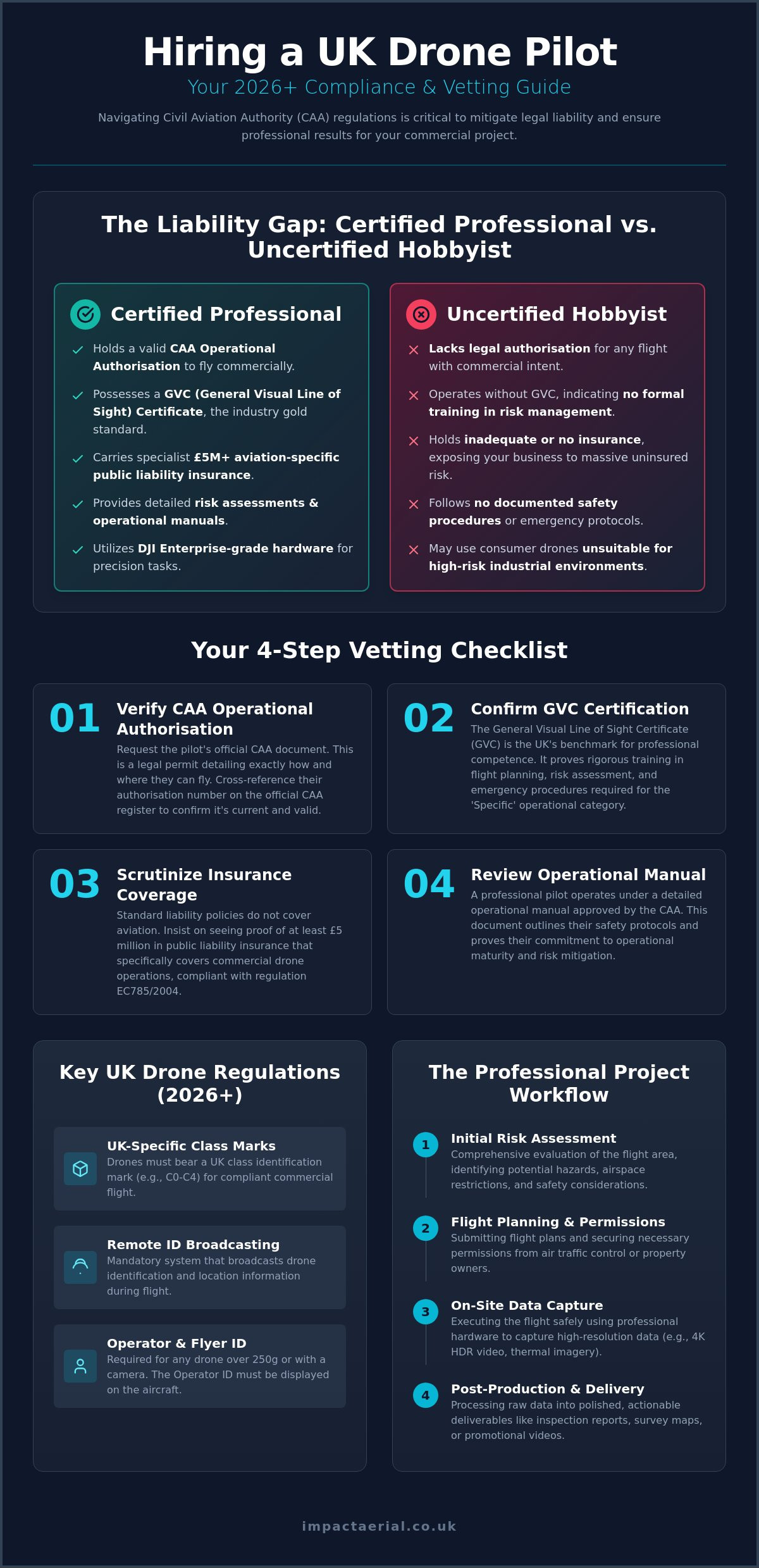
The legal framework for unmanned aircraft has evolved rapidly to keep pace with technological advancements. As of 2026, any drone equipped with a camera or exceeding a weight of 250g requires both a Flyer ID and an Operator ID. The Operator ID currently costs £12.34 per year and must be clearly displayed on the aircraft. While hobbyists might manage basic flights in isolated areas, commercial projects introduce a layer of legal complexity that requires professional oversight. Understanding drone regulations in the UK is the first step in protecting your business from liability.
The distinction between recreational and commercial use is critical. If your project has any “commercial intent,” the pilot must operate under a specific set of rules defined by the Civil Aviation Authority (CAA). This isn’t just about whether money changes hands; it includes any flight that advances a business interest, such as marketing a property or inspecting a construction site. To ensure your project is legally compliant, you should always hire professional drone pilot uk specialists who hold a valid Operational Authorisation.
To better understand the requirements for entering this professional field, watch this helpful video:
The Role of the Civil Aviation Authority (CAA)
The CAA maintains total oversight of UK airspace safety. They classify drone operations into Open, Specific, and Certified categories based on the level of risk involved. Most professional work, especially in congested urban environments or near uninvolved people, falls into the Specific category. This requires the pilot to have a robust operational manual and a proven safety record. Verifying a pilot’s credentials on the CAA register is a mandatory step for any responsible project manager. It confirms the operator has the legal right to fly for commercial gain and adheres to the Drone and Model Aircraft Code.
Why CAA GVC Certification is the Gold Standard
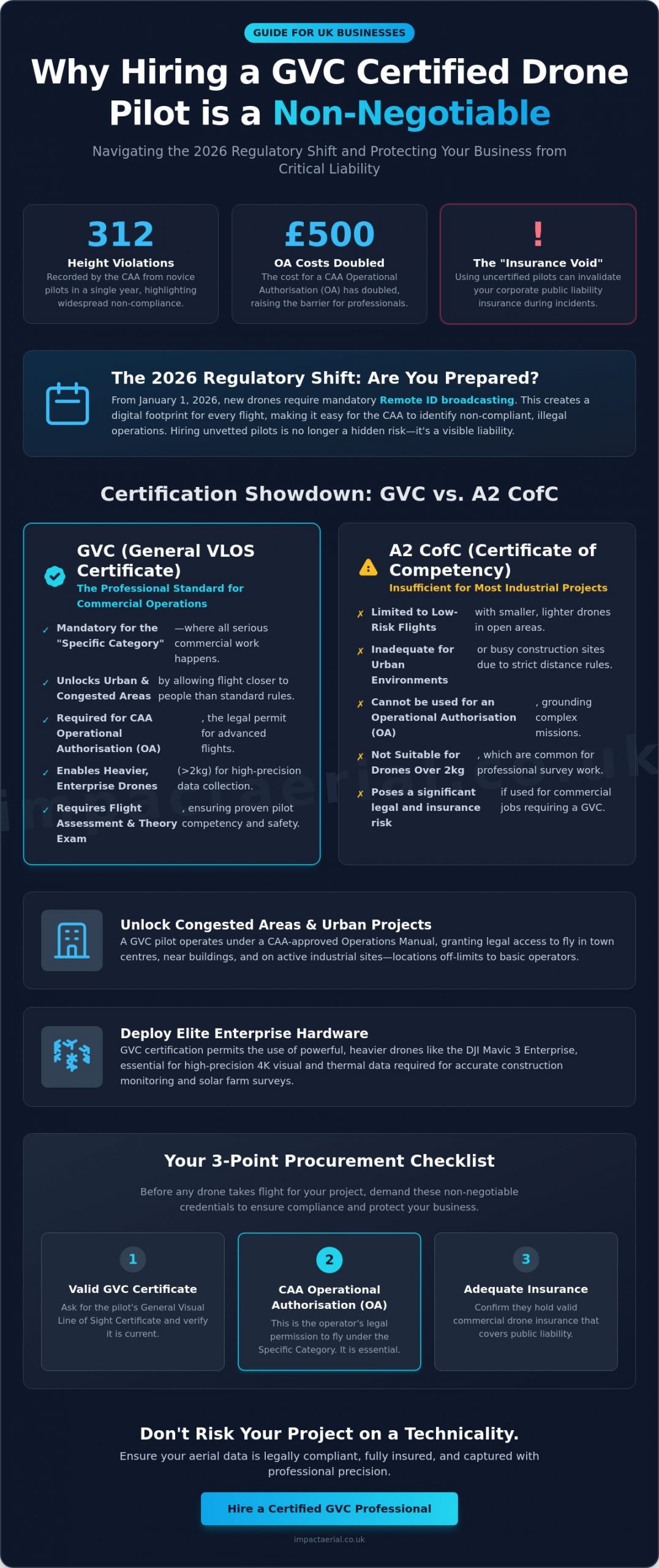
The General Visual Line of Sight Certificate (GVC) is the benchmark for professional competence in the UK drone industry. It proves that a pilot has undergone rigorous training in risk assessment, technical knowledge, and emergency procedures. GVC-certified pilots are uniquely qualified to handle complex tasks like PV solar farm thermal surveys or high-resolution property inspections while maintaining strict safety margins. For a deeper look at these industry standards, read our guide to professional drone services. Choosing an operator with GVC credentials and £5m liability insurance provides the peace of mind that your project is in expert hands. When you hire professional drone pilot uk experts, you’re investing in technical precision and regulatory security.
The Essential Checklist for Hiring a Professional Drone Pilot
When you decide to hire professional drone pilot uk services, the technical skill of the pilot is only one part of the equation. You must also evaluate their operational maturity and risk management procedures. Start by requesting their CAA Operational Authorisation document. This isn’t just a certificate; it’s a legal permission that details exactly how and where they are allowed to fly. A professional operator will also have a detailed operational manual that outlines their safety protocols and emergency procedures.
Checking these documents against the official register of the UK Civil Aviation Authority (CAA) ensures the pilot’s credentials are current. This verification process protects your organization from the legal fallout of an unauthorized flight. It’s a critical step that distinguishes a legitimate business from a hobbyist with a high-end camera. Without these documents, a pilot cannot legally operate for commercial gain in the UK.
Insurance: Why £5m Public Liability is the Benchmark
Standard public liability insurance often fails to cover aviation-specific risks. A professional drone pilot must hold a policy that complies with EC 785/2004, which is the legal standard for commercial flight in the UK. While the legal minimum might be lower for some operations, many corporate and industrial sites require at least £5 million in coverage. Impact Aerial maintains a £5m policy to provide absolute peace of mind. This ensures that even complex projects on sensitive sites, such as PV solar farm thermal surveys, are fully protected against unforeseen incidents.
Technical Proficiency and Hardware Standards
The quality of your deliverables depends heavily on the hardware used. Consumer-grade drones often lack the sensor size and stability required for professional 4K HDR filming or precise thermal inspections. Look for operators using DJI Enterprise equipment. These systems offer redundant batteries and GPS modules, which are vital for mission-critical work. If you’re conducting construction site monitoring or property surveys, the difference in data quality between a hobbyist drone and an enterprise-grade thermal sensor is vast. Redundant systems are not a luxury; they are a safety requirement for professional data collection.
Before signing a contract, review the pilot’s portfolio for industry-specific experience. A pilot who excels at wedding photography might not understand the safety complexities of a live construction site. Ask about their pre-flight site assessment process. A true professional will conduct a thorough risk assessment long before the drone leaves the ground. If you’re ready to secure a compliant flight for your next project, you can view our professional aerial services to see how we maintain these high standards on every mission.
Tailoring Drone Services to Your Specific Industry
Selecting the right operator depends entirely on the technical demands of your sector. A pilot specialized in cinematic brand storytelling might not possess the technical expertise required for high precision asset inspection. When you look to hire professional drone pilot uk services, you must ensure their equipment and certification match your project’s specific risk profile. Operating over a live construction site requires a different level of operational authorization than filming a corporate event in a private field. The UK Civil Aviation Authority (CAA) sets the baseline for safety, but industry specific experience is what delivers tangible ROI.
Drone Surveys and Data Collection
Professional drone operations have revolutionized how we approach asset management and site oversight. By using DJI Enterprise hardware, certified pilots capture high resolution data for 3D modeling and orthomosaic mapping with exceptional precision. This is particularly valuable for commercial property surveys, where aerial data often replaces the need for expensive scaffolding or risky manual roof inspections. These surveys provide a non-invasive way to assess structural integrity without disrupting daily operations.
Specialized services like PV solar farm thermal surveys allow for the detection of individual cell defects that are invisible to the naked eye. This data-centric approach provides several key benefits:
- Precise heat loss identification in industrial and commercial buildings.
- Accurate volume calculations and progress tracking for construction site monitoring.
- Rapid infrastructure inspections for towers, chimneys, and other high-reach assets.
- Detailed thermal reporting to optimize energy output on solar farms.
Aerial Filming for Visual Marketing
High end marketing requires a level of visual sophistication that standard consumer drones cannot achieve. Achieving true cinematic quality through professional aerial filming involves more than just flight skill; it requires an expert understanding of light, composition, and post-production. A professional workflow includes 4K HDR capture and meticulous color grading to ensure the final deliverables align with your brand’s aesthetic standards.
For corporate marketing and real estate, FPV (First Person View) drones offer an immersive “fly-through” perspective. These specialized aircraft navigate through doorways and tight spaces to create seamless, high-speed tours of commercial interiors. This type of storytelling builds brand awareness by providing a perspective that was previously impossible to capture. When you hire professional drone pilot uk experts, you’re securing a team that manages the entire process from pre-flight risk assessment to the final edited deliverable, ensuring the output is as safe as it is visually stunning.
The Professional Workflow: What to Expect When You Hire
Step 1: Consultation and Planning
The first phase involves defining the project brief. We need to determine if the objective is high-resolution 4K HDR marketing footage or technical data for a PV solar farm thermal survey. Once the goals are clear, the pilot conducts a site-specific risk assessment. This includes checking airspace restrictions, identifying nearby hazards, and securing necessary landowner permissions.
Professional operators provide a Risk Assessment and Method Statement (RAMS) to the client. This document is vital for corporate compliance and site safety. We also monitor UK weather patterns closely. High winds or heavy rain can compromise data quality, so we schedule “weather windows” to ensure the best possible results. This meticulous planning phase ensures that once we’re on-site, the operation runs smoothly and without unexpected delays.
Step 2: Execution and Data Delivery
On the day of the shoot, the pilot manages the site with professional conduct. This often involves setting up public cordons or coordinating with site managers to ensure the flight path is clear of uninvolved persons. Safety is the primary concern, especially on active construction sites or sensitive commercial properties. The pilot will follow the pre-defined flight plan to capture the exact data or visuals required by the brief.
The work doesn’t end when the drone lands. The data processing phase is where the raw footage or survey data becomes a usable asset. For marketing projects, this involves post-production editing and color grading to achieve cinematic quality. For surveys, it means generating detailed reports or 3D models. We utilize cloud-based delivery methods to share large 4K datasets and high-resolution maps efficiently. Typical turnaround times for edited video or survey reports range from 48 hours to a week, depending on the project’s scale. This structured delivery ensures you receive high-quality results without project management stress.
To ensure your next project is handled with technical precision and full regulatory compliance, you can hire professional drone pilot uk specialists from our expert team today.
Why Impact Aerial is the Trusted Choice for UK Drone Services
Selecting a partner for aerial operations requires more than just finding someone with a drone. It demands a specialist who integrates technical proficiency with a deep understanding of the UK’s regulatory environment. When businesses decide to hire professional drone pilot uk experts, they are often looking for a combination of creative excellence and industrial reliability. Impact Aerial provides this through a meticulous approach to flight safety, data integrity, and high-tier visual output.
Birmingham Excellence, National Reach
Our expertise is deeply rooted in the West Midlands, providing us with a granular understanding of the regional airspace and the specific challenges of operating in Birmingham’s industrial and urban landscapes. However, our capabilities are not limited by geography. We provide full UK-wide coverage, delivering consistent results for clients across the property, construction, and advertising sectors. Working with a boutique agency like ours offers a level of accountability that faceless national directories simply cannot match. You aren’t just another booking; you’re a partner receiving bespoke technical consulting.
Our track record spans a diverse range of applications. We’ve managed complex construction site monitoring projects and high-impact marketing campaigns for corporate brands. This breadth of experience allows us to anticipate site-specific risks and technical requirements before the aircraft even leaves the ground. We don’t just capture images; we provide a professional service journey that prioritizes your project’s legal and operational security.
Ready to Elevate Your Project?
The transition to the 2026 UK drone standards means that compliance is no longer optional. It’s a critical component of your business’s risk management strategy. We maintain a £5m commercial liability insurance policy and utilize DJI Enterprise hardware to ensure every mission is performed with maximum precision. Our commitment to the GVC standard and strict adherence to CAA protocols provides the psychological comfort you need when operating in sensitive or congested environments.
We pride ourselves on transparent communication and an end-to-end service model. This includes everything from the initial site-specific risk assessment to the final stages of professional post-production. Our goal is to deliver high-resolution 4K HDR assets that are ready for immediate use in your marketing or technical reports. If you want to hire professional drone pilot uk specialists who value safety as much as visual quality, our team is ready to assist.
Contact Impact Aerial to discuss your drone project today and let us help you navigate the complexities of aerial data collection with technical excellence and full regulatory compliance.
Secure Your Commercial Flight Strategy for 2026
The decision to hire professional drone pilot uk experts is a commitment to both creative excellence and operational safety. As regulations tighten, the difference between a simple flight and a compliant, high-tier mission lies in the pilot’s ability to navigate complex CAA frameworks. You now understand that verifying GVC certification and ensuring a robust £5m commercial liability insurance policy are non-negotiable steps for protecting your organization. Whether you’re conducting a technical thermal survey or capturing cinematic marketing visuals, the right hardware and professional workflow ensure your project remains safe and legal.
Impact Aerial provides the technical proficiency and specialized West Midlands expertise required for mission-critical work. Our CAA GVC certified pilots manage the entire process, from initial risk assessments to high-resolution post-production. We take the complexity out of aerial operations so you can focus on delivering results for your clients. We look forward to helping you reach new heights with precision and peace of mind.
Get a Professional Drone Service Quote from Impact Aerial
Frequently Asked Questions
Do I need to inform the police if I hire a drone pilot?
Standard commercial drone operations in the UK do not usually require police notification. However, if the flight involves specific local bylaws, road closures, or operations in sensitive urban areas, your pilot will coordinate with the relevant authorities as part of their pre-flight planning. A professional operator manages all necessary permissions to ensure the flight is entirely legal and minimizes any potential disruption to the public or local law enforcement.
How much does it cost to hire a professional drone pilot in the UK?
The total investment varies based on the technical complexity of the mission and the specific hardware required for the job. Factors such as the need for 4K HDR filming, specialized thermal sensors for solar surveys, or the duration of construction monitoring all influence the final quote. When you hire professional drone pilot uk specialists, you’re paying for their regulatory expertise, high-end equipment, and comprehensive insurance coverage rather than just basic flight time.
What happens if the weather is bad on the day of the drone shoot?
Safety is the absolute priority, so operations are typically rescheduled if conditions like high winds or heavy rain exceed the aircraft’s technical limits. Professional pilots monitor weather windows closely in the days leading up to the shoot to identify the best possible conditions for data quality. Most operators include a weather clause in their contracts, allowing for a flexible rescheduling process that ensures the final deliverables meet the required professional standards.
Can a drone pilot fly in a restricted area (NFZ) like near an airport?
Yes, a qualified pilot can operate within a No Fly Zone (NFZ) provided they secure the correct permissions from Air Traffic Control or the relevant authority. Pilots holding a GVC certification are trained to manage these complex applications through the Civil Aviation Authority’s digital systems. This process requires advanced planning and often involves specific radio communication with local control towers to ensure the safety of manned aviation throughout the mission. If you are traveling for work and encounter disruptions with your commercial flights, you can visit Airflix to understand your passenger rights and seek legal assistance with compensation claims.
What insurance should a professional drone pilot have?
A professional operator must hold commercial liability insurance that is strictly compliant with EC 785/2004 regulations. Standard public liability policies usually exclude aviation risks, which could leave your business exposed in the event of an incident. It’s recommended to hire professional drone pilot uk experts who maintain at least £5 million in specialist coverage to provide complete peace of mind for industrial or high-risk commercial sites where standard limits are insufficient.
Is a drone roof survey better than using scaffolding or a cherry picker?
Drone surveys are significantly safer and more cost-effective than traditional methods like scaffolding or cherry pickers. Aerial inspections allow for high-resolution data collection without the physical risks associated with working at height or the logistical delays of erecting platforms. This non-invasive approach captures detailed visuals of structural defects or thermal heat loss in a fraction of the time, providing a comprehensive data set that traditional methods often miss.
What is the difference between a Flyer ID and a GVC certification?
A Flyer ID is a basic legal requirement for anyone operating a drone over 250g, proving they have passed a foundational safety test. In contrast, the General Visual Line of Sight Certificate (GVC) is a professional qualification required for complex commercial work in the Specific category. GVC pilots have undergone rigorous practical and theoretical training, qualifying them to conduct detailed risk assessments and operate in more challenging environments than a standard recreational flyer.
 2 Norton Drive, Wythall, Birmingham, B47 6HH Company registration number: 11138586. VAT Number: 366 9068 55