How to Prepare a Site for a Drone Survey: A Professional UK Guide

A professional drone survey is won or lost on the ground before the rotors even spin. You likely recognize that high-precision aerial data is a game-changer for your project, yet the fear of receiving inaccurate results or falling foul of strict CAA regulations remains a significant hurdle. It’s frustrating to schedule a survey only to find that site access issues or ongoing work disruptions compromise the entire operation and lead to costly delays.

This guide provides a definitive framework on how to prepare a site for a drone survey, ensuring you master the physical and administrative requirements for a seamless, high-precision operation. By following these steps, you’ll gain the confidence that your site is ready for a safe, compliant mission. We will walk through essential ground control point placement, UK legal compliance under the 2026 standards, and strategies to maintain site productivity while GVC-certified pilots capture the technical data your business requires. Our goal is to provide a meticulously structured approach that ensures your data is accurate and your site remains fully operational throughout the process.

Key Takeaways

  • Understand the “clean data in, clean data out” principle to ensure your survey results meet professional precision standards.
  • Master the technical steps of how to prepare a site for a drone survey, including vegetation management and Ground Control Point (GCP) placement.
  • Ensure full regulatory compliance by verifying pilot qualifications and reviewing site-specific risk assessments before operations begin.
  • Coordinate site personnel effectively to maintain safety and productivity during the data collection process.
  • Learn how commercial-grade hardware and GVC-certified expertise mitigate risks and deliver superior data density.

Why Site Preparation is Critical for Accurate Drone Data

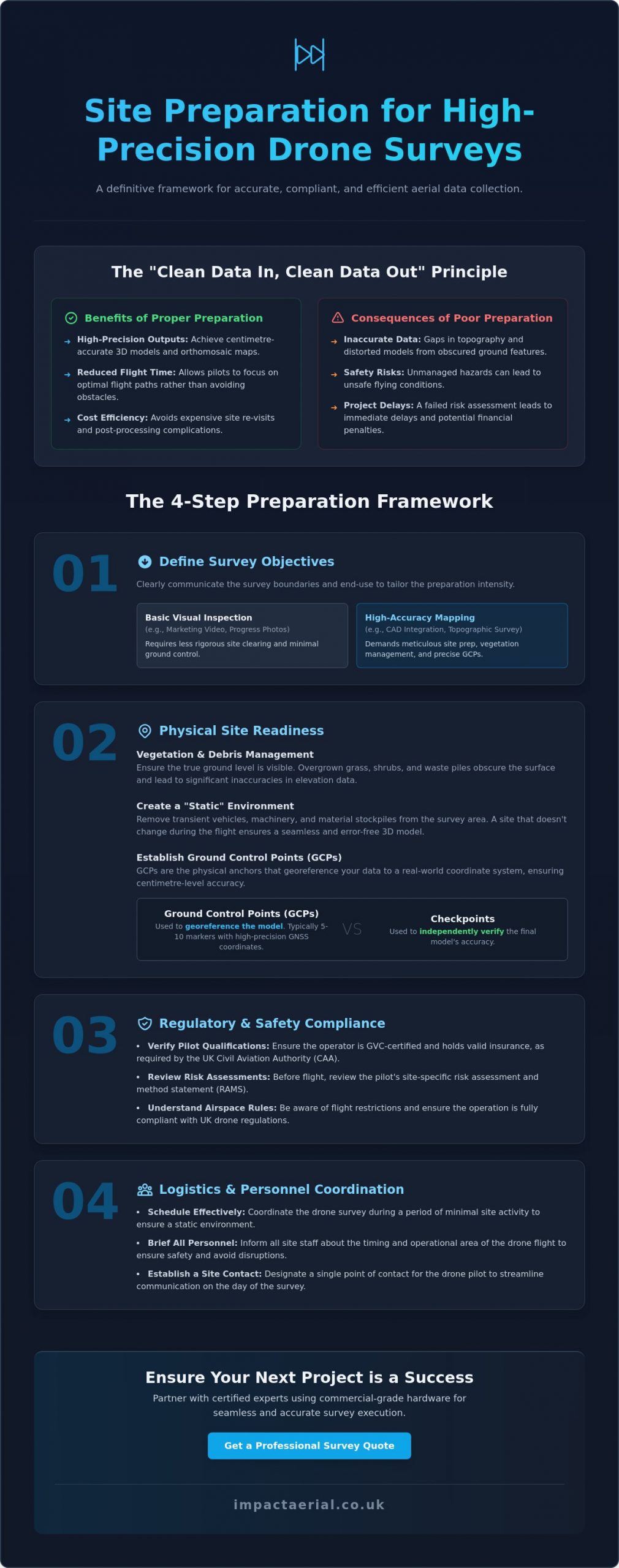
Site preparation isn’t just a preliminary chore; it’s the technical foundation of every successful drone survey. If you want high-precision outputs, you have to adopt the “Clean Data In, Clean Data Out” mindset. This process involves clearing physical obstacles and establishing precise data markers before the aircraft ever leaves the ground. Without this meticulous groundwork, the raw images captured will contain “noise” that compromises the integrity of your 3D models and orthomosaic maps.

Professional surveyors use the science of photogrammetry to turn these images into measurable data. If the site is cluttered or markers are obscured, the software struggles to align pixels accurately, leading to distorted results. Proper preparation ensures the digital twin of your site is a faithful, centimetre-accurate representation of reality.

To better understand this concept, watch this helpful video:

Meticulous preparation significantly reduces flight time. It ensures the pilot can focus on the flight path rather than dodging unexpected machinery or searching for hidden markers. More importantly, it avoids the high costs associated with site re-visits, which occur when data is found to be insufficient during post-production. It’s far more efficient to clear the site once than to pay for multiple mobilisations.

The Consequences of Inadequate Preparation

When ground features are obscured by overgrown vegetation or debris, it creates significant gaps in topographic data. The drone cannot see through solid objects; if it can’t see the ground, it can’t measure it accurately. Beyond data quality, unmanaged hazards pose serious safety risks. If a pilot identifies uncoordinated site activity or physical dangers during their risk assessment, they may deem the site unsafe. This leads to immediate project delays and potential financial penalties for lost operational windows.

Defining Your Survey Objectives

You must clearly communicate the exact survey boundaries to the pilot to ensure the flight plan covers every necessary square metre without missing critical edge data. Understanding how to prepare a site for a drone survey also depends on whether you need a basic visual inspection or high-accuracy mapping. A marketing video requires different prep than a survey intended for CAD integration. Your “End Use” dictates the intensity of the preparation; high-accuracy engineering projects require a far more rigorous setup of ground markers than a simple progress photo.

Physical Site Readiness: Ground Control and Surface Conditions

Achieving sub-centimetre precision requires more than just launching a drone; it demands a “static” and controlled environment. Understanding how to prepare a site for a drone survey starts with meticulous vegetation management. If you are commissioning a topographic survey, overgrown grass, thick shrubs, or piles of green waste will obscure the true ground level. This leads to significant inaccuracies in your digital terrain model. You should ensure that the ground surface is as visible as possible, particularly in areas where elevation changes are critical for your engineering data.

Lighting and timing are equally vital considerations for data quality. Deep shadows cast by buildings or large trees can hide essential details and confuse the photogrammetry software. While our pilots manage the specific flight windows to align with UK Civil Aviation Authority (CAA) regulations, your assistance in clearing transient vehicles and machinery creates a consistent dataset. A site that remains stationary during the flight ensures that the “stitching” process in post-production is seamless and error-free.

Ground Control Points (GCPs) vs. Checkpoints

GCPs are the physical anchors of your survey. These are markers placed on the ground with coordinates measured by a high-precision GNSS rover. For most commercial drone mapping projects, five to ten ground control points provide sufficient control to ensure global accuracy. You should use high-contrast markers, such as black and white “checkerboard” targets, which are easily identifiable from a flight altitude of 120 metres. While GCPs are used to “pin” the map to the earth, separate “checkpoints” are used by our team to independently verify the final accuracy of the model.

Managing Site Obstructions and Hazards

A successful mission requires a clear and secure Take-off and Landing Area (TOLA). This zone must be cordoned off from personnel and moving equipment to ensure a safe environment. You should also identify and communicate the presence of temporary hazards like cranes, scaffolding, or high-reach platforms that may not be present on satellite imagery. Clearing scattered debris is also helpful; loose materials can often be mistaken for permanent site features in complex 3D models. If you are unsure about specific site risks, our specialists can help you coordinate a drone survey plan that accounts for every physical variable on your premises.
How to Prepare a Site for a Drone Survey: A Professional UK Guide

Regulatory and Safety Compliance in the UK

A professional operation is built on a foundation of rigorous compliance. When considering how to prepare a site for a drone survey, your first administrative priority is verifying the credentials of your chosen operator. In the UK, professional pilots must hold a UK drone license, specifically the General Visual Line of Sight Certificate (GVC). This qualification demonstrates that the pilot has undergone formal theory and flight assessments and is authorized by the Civil Aviation Authority (CAA) to conduct complex commercial operations. You should always request a copy of their GVC and their current Operational Authorisation before work begins.

The technical preparation involves more than just checking a badge; it requires a comprehensive Pre-flight Information Bulletin (PFIB) and a site-specific risk assessment. These documents aren’t mere formalities. They outline the operational parameters, emergency procedures, and safety mitigations tailored to your specific environment. Our pilots consult the latest Civil Aviation Authority drone guidance (CAP 722) to ensure every flight path respects national airspace standards and safety protocols. Furthermore, high-risk commercial sites require substantial protection; we maintain £5m in commercial liability insurance to provide absolute peace of mind for our clients.

CAA Regulations and Site Access

The UK regulatory framework distinguishes between the “Open” and “Specific” categories of flight. Most commercial surveys on busy construction sites or industrial areas fall under the “Specific” category, which allows for flight closer to people and buildings than the basic regulations permit. You’ll need to assist the pilot by managing public rights of way and notifying neighbouring properties if the flight path overlaps their boundaries. It is a legal requirement that the CAA-certified pilot retains final authority on all safety matters; they have the right to pause or cancel a flight if the environment becomes unsafe.

Conducting a Pre-Flight Walkthrough

A joint walkthrough between the site manager and the UAV pilot is an essential step in your preparation. This physical inspection allows you to identify “No-Fly Zones” or sensitive infrastructure, such as nearby railway lines, high-voltage substations, or telecommunications towers, which may cause electromagnetic interference. During this time, the pilot will perform a final check of the Remote ID broadcast and local NOTAMs (Notices to Airmen) to ensure no temporary flight restrictions have been issued for the area. This collaborative approach ensures that the flight is both legally compliant and operationally efficient.

Logistics and Personnel: Coordinating Your Site Team

While physical ground prep and regulatory checks are essential, the success of an aerial mission often hinges on the human element. Mastering how to prepare a site for a drone survey requires a structured approach to internal communication. You must brief all site staff, subcontractors, and visiting stakeholders on the specific flight schedule well in advance. This avoids the “spectator effect” and ensures that ground-level work continues safely without personnel inadvertently wandering into active flight zones or take-off areas.

Establishing a secure “Staging Area” is a non-negotiable requirement for professional operations. This zone serves as the pilot’s command centre, where equipment is calibrated and batteries are managed. It must be cordoned off from heavy machinery and foot traffic to prevent accidental damage or interference. By providing a dedicated, quiet space for the survey team, you allow the pilot to focus entirely on the technical execution of the flight and the integrity of the data being captured.

Internal Communication and Staff Safety

Issuing a “Site-Wide Alert” via email or during the morning toolbox talk is the most effective way to manage expectations. This alert should clearly define the duration of the survey and the specific areas where the drone will be operating. It’s vital to remind personnel to stay clear of the Take-off and Landing Area (TOLA) during active rotors-turning periods. Additionally, site managers should be prepared to manage curious visitors or delivery drivers; a drone can be a significant distraction, and maintaining site focus is paramount for overall safety compliance.

Site Access and Logistics

Logistical delays are easily avoided with a bit of foresight. You should ensure the pilot has all necessary gate access codes and security clearances before they arrive at the perimeter. Providing high-resolution site maps or CAD overlays in advance allows our team to integrate your site’s specific geometry into the flight software. On-site, the survey vehicle needs safe parking as close to the take-off point as possible to facilitate equipment swaps. If the survey is extensive, confirming access to a 240v power source for battery charging or mobile base stations will ensure the team maintains a high operational tempo throughout the day.

Appointing a dedicated site liaison to work alongside the pilot is highly recommended. This individual can provide real-time updates on moving hazards, such as crane movements or concrete pours, which might not be visible from the pilot’s perspective. This level of coordination is what separates a basic flight from a professional, high-precision survey operation. To ensure your next project is managed with this level of meticulous care, contact us to discuss our construction site monitoring services.

Partnering with Impact Aerial for Seamless Survey Execution

While understanding how to prepare a site for a drone survey is a critical responsibility for any site manager, the ultimate success of the data collection rests on the technical proficiency of your aerial partner. Impact Aerial bridges the gap between raw physical preparation and high-tier engineering outputs. We utilise commercial-grade DJI Enterprise drones, which are specifically engineered for superior data density and stability in challenging UK environments. These aircraft allow us to capture high-resolution imagery that forms the basis of centimetre-accurate digital twins.

Our operational framework is built on a foundation of safety and compliance. Every pilot at Impact Aerial is CAA GVC certified; this qualification is essential for navigating the complex regulatory requirements of active construction sites and industrial facilities. We manage every aspect of the project lifecycle, from the initial pre-flight risk assessment to the final delivery of processed data. This end-to-end management ensures that you don’t have to worry about the intricacies of aviation law or hardware maintenance. We offer an unparalleled level of security for our clients by maintaining £5m in commercial liability insurance, ensuring that every stakeholder on your site is fully protected.

Our Technology and Expertise

We leverage the latest advancements in aerial technology to deliver actionable insights. By using a specialised survey drone equipped with 4K HDR cameras and high-precision sensors, we capture the fine details required for professional-grade analysis. Our expertise extends beyond the flight; our post-production team processes raw aerial data into sophisticated 3D models, topographic maps, and orthomosaics. This multi-sector experience includes:

  • Construction Site Monitoring: Tracking progress and identifying logistical bottlenecks in real-time.
  • PV Solar Farm Thermal Surveys: Detecting cell defects and equipment inefficiencies with thermal imaging.
  • Commercial Property Surveys: Providing high-resolution roof and facade inspections without the need for scaffolding.

Get Started with Your Professional Drone Survey

Choosing a professional drone service ensures that your site preparation efforts result in high-precision, usable data rather than just simple imagery. We understand the nuances of how to prepare a site for a drone survey and are ready to guide you through the administrative and physical requirements to ensure a successful mission. Our team is available to provide pre-survey consultations, helping you define your objectives and verify that your site is fully compliant before we mobilise.

Precision and safety are the core of our business. If you are ready to elevate your site data with professional aerial surveys, book your site assessment with Impact Aerial today.

Elevating Your Site Data with Professional Precision

A successful aerial mission is built on the rigorous groundwork established before the rotors even spin. By focusing on physical site readiness, ensuring strict CAA regulatory compliance, and maintaining clear internal communication, you eliminate the risks of data noise and operational delays. Mastering how to prepare a site for a drone survey transforms what could be a complex technical hurdle into a high-precision data asset for your project. This structured approach ensures that every flight is safe, efficient, and capable of producing the sub-centimetre accuracy your engineering or construction goals require.

Impact Aerial provides the technical expertise and operational security required for the most demanding UK sites. Based in the West Midlands and offering full UK coverage, our team utilizes a DJI Enterprise fleet and CAA GVC certified pilots to deliver superior data density. We provide total peace of mind through our £5m commercial liability insurance and end-to-end project management. Whether you require construction monitoring or a detailed topographic map, we ensure your data is accurate, compliant, and delivered on schedule.

Ready to capture high-precision insights for your next project? Request a Quote for Your Professional Drone Survey today and let our specialists manage the complexities of the airspace while you focus on your site’s success.

Frequently Asked Questions

Do I need to clear the entire site for a drone survey?

You don’t need to clear the entire premises, but you must ensure that the specific areas required for data collection are free from obstructions. For topographic mapping, the ground surface must be visible, so clearing overgrown vegetation and parked machinery in those zones is essential. If the survey is for a visual inspection of a roof or facade, clearing the ground level directly beneath the flight path is the priority to maintain safety cordons.

How long does a typical site preparation take?

Physical preparation usually takes a few hours to a full day, depending on the site’s complexity and size. Administrative tasks, such as securing permissions and notifying neighbours, should begin at least five working days before the flight. When planning how to prepare a site for a drone survey, it is best to complete debris removal and vegetation management forty-eight hours in advance to ensure the pilot has a clear environment upon arrival.

What happens if the weather is poor on the day of the survey?

The pilot makes a final “go or no-go” decision based on real-time weather data and safety parameters. High winds, typically exceeding 20mph, or any form of precipitation will usually result in a rescheduled flight to protect the equipment and ensure data integrity. We monitor forecasts closely in the forty-eight hours leading up to the mission to provide as much notice as possible if a delay is necessary due to adverse conditions.

Do I need to notify the police or CAA before the survey?

No, the responsibility for aviation notifications rests entirely with the drone operator. Professional pilots use specialized software to check for local flight restrictions and NOTAMs (Notices to Airmen) before every mission. If your site is located within an airport’s Flight Restriction Zone (FRZ), our team will coordinate directly with Air Traffic Control to secure the necessary flight permits and maintain legal compliance throughout the operation.

Can a drone survey be done while my staff are still working?

Yes, drone surveys are designed to minimize disruption, and work can usually continue as long as staff remain clear of the cordoned take-off and landing area. It is vital that all personnel are briefed on the flight schedule and understand the importance of staying outside the designated safety zones. Our pilots perform site-specific risk assessments to ensure that the flight path avoids active work areas where personnel density is highest.

What is the difference between a GCP and a checkpoint?

A Ground Control Point (GCP) is a marker used during the initial processing to “pin” the drone’s data to precise geographic coordinates. In contrast, a checkpoint is an independent marker used after the model is created to verify its accuracy. While GCPs build the map, checkpoints provide the mathematical proof that the survey meets the required precision standards. Using both ensures the highest level of data reliability for your project.

How much space does the pilot need for a take-off and landing area?

A clear, flat area of approximately 5m x 5m is generally sufficient for most DJI Enterprise drones used in commercial surveys. This Take-off and Landing Area (TOLA) must be free from overhead obstructions like power lines or tree branches and situated away from magnetic interference sources like large metal structures. The zone must be easily securable to prevent unauthorized personnel or vehicles from entering during the critical launch and recovery phases.

Is it necessary to have a site representative present during the flight?

It is highly recommended to have a dedicated site liaison available to assist the pilot with ground-level logistics. This representative manages personnel movements and provides the pilot with immediate updates on changing site hazards, such as crane activity or vehicle arrivals. Having a knowledgeable person on hand ensures the flight remains efficient and allows the pilot to focus entirely on the technical execution of the data capture.

Drone Survey Return on Investment: The Commercial Case for Aerial Data in 2026

In 2024, a typical UK commercial property manager might spend £12,000 on scaffolding just to inspect a single warehouse roof, only to wait three weeks for a manual report. It’s a frustrating reality. Rising overheads make a high drone survey return on investment more critical than ever as your margins tighten. You’ve likely felt the sting of these costs and the constant anxiety of sending personnel into high-risk, hazardous areas. We understand that your priority is balancing a strict budget with the need for absolute precision and safety across your portfolio.

This article demonstrates how professional aerial data can reduce your operational costs by up to 70% while delivering high-resolution insights that manual methods simply can’t match. By utilising advanced drone technology and CAA GVC certified pilots, you’ll gain millimetre-accurate results without the traditional health and safety headaches. We provide a clear framework to calculate your specific savings and explain why partnering with a compliant UK operator ensures peace of mind for your 2026 commercial strategy.

Key Takeaways

  • Understand the “Efficiency Gap” and how transitioning from manual surveying to aerial data collection can increase your site coverage from 5 to 100 acres per hour.
  • Master a step-by-step framework to calculate your drone survey return on investment by auditing current labour costs and the hidden “Risk Premium” of traditional methods.
  • Identify how to slash operational overheads by up to 70% by eliminating expensive plant hire and scaffolding through CAA-certified aerial inspections.
  • Explore industry-specific ROI strategies for the UK construction, solar, and property sectors to ensure your data-gathering delivers maximum commercial value.
  • Discover why professional DJI Enterprise fleets and meticulous post-production provide the “peace of mind” and data accuracy required for complex UK commercial projects.

The Traditional Method Tax: Why Manual Surveying Costs More in 2026

Traditional surveying methods are rapidly becoming a financial liability for UK construction and property firms. In 2026, the “Traditional Method Tax” refers to the compounding costs of manual labour, plant hire, and extensive health and safety overheads that eat into project margins. A manual ground team typically covers 5 acres per hour. Our CAA GVC Certified pilots achieve 100 acres per hour using Enterprise-grade equipment. This 2,000% increase in efficiency directly influences the drone survey return on investment by slashing site time and removing the need for expensive “at-height” permits or road closures.

The financial drain of manual data collection isn’t just about the hourly rate of a surveyor. It includes the hidden costs of plant hire, such as cherry pickers or scaffolding, which often sit idle during weather delays. By leveraging the science of photogrammetry, we capture thousands of high-resolution data points in a single flight. This digital-first approach eliminates the “Efficiency Gap” that has plagued the industry for decades. For a clearer look at how these savings manifest, watch this breakdown of aerial data value:

Scaffolding vs. Drones: A Direct Cost Comparison

Scaffolding remains one of the largest “sunk costs” in commercial property maintenance. For a standard 500sqm commercial roof inspection in the West Midlands, scaffolding costs typically range between £3,500 and £8,000. This price excludes the 48-hour assembly period and the associated public liability risks. A professional drone inspection, providing 4K HDR imagery, costs approximately £650 and is completed in under 90 minutes. In a recent 2025 case study, a logistics firm reduced its annual inspection budget from £12,400 to just £1,800 by replacing physical access equipment with scheduled drone flights. This 85% reduction in expenditure provides an immediate boost to the drone survey return on investment for asset managers.

The Speed Advantage in Project Timelines

Project bottlenecks often occur when site managers wait for topographical data or structural reports. Traditional surveys can take 14 days to process and deliver. Drones remove this friction. With real-time 4K HDR aerial previews, stakeholders make informed decisions while the pilot is still on-site. Rapid data turnaround is vital in the competitive UK property sector where a three-week delay can result in thousands of pounds in liquidated damages. We’ve seen clients finish a survey in four hours that previously required two weeks of manual plotting. Finishing early isn’t just a convenience; it’s a strategic move that frees up capital and labour for the next phase of the build. This speed ensures that data is a catalyst for progress rather than a reason for a standstill.

The Four Pillars of Drone Survey ROI

Calculating the drone survey return on investment requires looking beyond the initial service invoice. It involves a total cost of ownership analysis that compares traditional manual methods against digital aerial data acquisition. For a typical commercial project in the UK, the financial benefits manifest through four distinct channels: direct expenditure reduction, risk avoidance, data fidelity, and project uptime. These pillars form the foundation of a modern, data-driven construction or maintenance strategy.

Direct cost savings are often the most immediate win for project managers. Traditional roof inspections or topographical surveys frequently necessitate scaffolding or cherry pickers, which can cost between £800 and £3,500 per week depending on the scale. By deploying a professional drone service, these hardware rentals become redundant. Labour hours also plummet; a task that previously required a two-person team three days to complete can now be finished in a single morning. This efficiency allows for more frequent site audits without inflating the budget. You’ll find that the speed of delivery is just as valuable as the reduced headcount.

Operational continuity ensures that your site remains productive. Unlike traditional surveying which might require closing a section of a live motorway or halting a railway line for safety reasons, drones operate overhead without interfering with ground-level activity. This lack of disruption preserves revenue streams that would otherwise be lost during a manual inspection shutdown. It’s a pragmatic approach to asset management that prioritises both safety and the bottom line.

Financial Gains from Enhanced Safety

Safety is a massive financial driver in the British construction industry. Falling from height remains the primary cause of workplace fatalities in the UK, accounting for 40 deaths in the 2022/23 HSE reporting period. A single serious injury can result in HSE fines exceeding £50,000 and legal fees that quickly spiral into six figures. By keeping staff on the ground, companies significantly lower their Work at Height (WAH) risk profile. This proactive stance often leads to lower insurance premiums and higher safety ratings during commercial tenders, giving you a competitive edge when bidding for high-value contracts. If you want to ensure your site meets these rigorous standards, you can book a professional consultation to review your specific requirements.

The Value of Superior Data Quality

High-resolution outputs provide a level of detail that manual notes simply cannot match. Using 4K HDR imagery and thermal sensors creates a definitive “source of truth” for every asset on site. This precision is backed by academic research on drone benefits, which highlights how digital twins and 3D mapping reduce rework costs by identifying structural issues months before they become critical failures.

In the UK construction sector, rework can account for up to 12% of total project costs. Eliminating even a fraction of these errors through accurate photogrammetry ensures the drone survey return on investment remains positive throughout the asset’s lifecycle. Predictive maintenance becomes a reality when you have a chronological record of high-quality aerial data to track wear and tear over time, allowing for targeted repairs rather than expensive, emergency overhauls. This data-first approach provides peace of mind for stakeholders and investors alike.

Industry-Specific ROI: Construction, Solar, and Property

Calculating a precise drone survey return on investment requires looking beyond the initial service fee. It’s about the specific operational bottlenecks we remove in each sector. A property developer in Birmingham has vastly different KPIs than a solar farm manager in Oxfordshire. By deploying specialised equipment like the DJI Matrice 350 RTK equipped with H20T thermal sensors, we provide data that isn’t just visual; it’s financial. The value lies in replacing 40 hours of manual labour with 4 hours of autonomous data capture, while simultaneously reducing the health and safety risks associated with working at height or in hazardous environments.

Solar Farm ROI: Detecting Faults Before They Cost Millions

For large-scale utility sites, the cost of an offline string or a cracked cell is cumulative and silent. Traditional manual string testing for a 50MW site can take a ground team up to 15 days to complete, often leaving the site vulnerable to intermittent faults. Our PV Solar Farm Thermal Surveys use radiometric data to identify “hot spots” and failing diodes in a fraction of that time. A single drone flight can cover the same 50MW site in just two days.

The revenue recovered is substantial. If a single faulty string goes undetected, it can result in a loss of approximately £450 to £600 per month depending on current energy prices. On a site where we identify 15 to 20 such anomalies, the drone survey return on investment is achieved before the final report is even delivered. We provide a prioritised list of defects, allowing maintenance teams to target high-loss areas first, rather than searching for needles in haystacks.

  • 90% reduction in inspection time compared to manual ground testing.
  • Immediate identification of bypass diode failures and PID (Potential Induced Degradation).
  • Zero-contact inspections ensure no accidental damage to panels during the testing process.

Construction and Property: Monitoring Progress and Defects

In the construction sector, drones have transformed the accuracy of earthworks and volume calculations. Traditional surveying methods for stockpiles often involve significant margins of error, sometimes as high as 15%. By using photogrammetry and DJI Enterprise drones, we deliver volumetric data with accuracy levels within 2 to 5 centimetres. This precision prevents contractors from overpaying for material removal or underestimating the fill required for a site, which can save thousands of pounds in a single phase of the project.

For commercial real estate, the ROI shifts towards marketing and maintenance. High-resolution Drone Property Surveys allow for rapid roof and facade inspections without the £2,000 to £5,000 cost of scaffolding or cherry pickers. Furthermore, cinematic 4K aerial filming has become a standard requirement for high-end commercial listings. Data from UK property portals suggests that listings featuring professional aerial perspectives receive up to 30% more engagement than those without. This visibility accelerates the sales cycle, reducing the time a capital-intensive asset sits idle on the market.

Whether it’s verifying a contractor’s progress against a BIM model or capturing breath-taking marketing assets, the data we provide is a tool for risk mitigation. We don’t just fly drones; we provide the evidence needed to make informed, cost-saving decisions. Our CAA GVC certified pilots ensure every operation is compliant, giving you peace of mind that your data gathering is as safe as it is precise.

Calculating Your ROI: A Framework for UK Businesses

Quantifying the drone survey return on investment requires a shift from viewing aerial work as a visual luxury to seeing it as a core financial efficiency tool. UK businesses must evaluate four specific pillars to determine the true value of transitioning from manual methods to professional drone services. This framework ensures that every pound spent on aerial data gathering contributes to the bottom line.

Step 1: Audit your current manual survey and inspection costs. For a standard 5,000 square metre commercial roof in the West Midlands, traditional inspection methods involving scaffolding or cherry pickers often start at £3,500 in equipment hire and labour. These costs don’t include the two to three days of site disruption. A professional drone survey completes this same task in roughly 90 minutes for a fraction of the setup cost. You’ll see an immediate reduction in overheads by eliminating heavy plant hire.

Step 2: Factor in the ‘Risk Premium’. The Health and Safety Executive (HSE) reported 40 fatal falls from height in the UK during the 2022/23 period. Every hour a staff member spends on a ladder or roof increases your liability. By keeping personnel on the ground, you achieve a 100% reduction in “at-height” man-hours. This lowers your risk profile and can lead to more favourable terms with commercial insurers over time.

Step 3: Evaluate the data utility. Manual surveys often result in static, subjective PDF reports that require manual data entry. Digital drone data allows for a 65% reduction in time spent on post-production analysis. Because the data is georeferenced and timestamped, it provides a definitive record that prevents costly disputes between contractors and clients.

Step 4: Account for compliance. Legal fines from the Civil Aviation Authority (CAA) for unauthorised commercial flights can exceed £5,000. Criminal prosecutions for safety breaches can be significantly higher. Ensuring your operator is fully vetted protects your business from these avoidable financial drains.

The ‘Cheap Pilot’ Trap: Why Compliance is an ROI Factor

Hiring an uncertified hobbyist might save £300 on the initial quote, but it creates a massive financial liability. Impact Aerial holds full CAA GVC certification, ensuring we operate within the latest UK legal frameworks. We carry £5m commercial liability insurance as a standard for added peace of mind. This insurance is non-negotiable for ROI protection; without it, a single operational mishap could wipe out your entire project budget and result in heavy legal fees. Professional operators provide the legal safety required to protect your corporate reputation.

Hidden ROI: Post-Production and Data Integration

The real value often emerges after the drone lands. High-quality aerial data integrates directly into existing Building Information Modelling (BIM) workflows and project management software. This allows site managers to spot structural anomalies 20% faster than traditional ground-based photography. Photogrammetry is the process of turning photos into measurable 3D models. These models allow stakeholders to perform accurate volumetric calculations and distance measurements from their desks. Using professional editing and virtual tours creates a high-quality visual narrative that secures stakeholder buy-in and speeds up planning approvals.

Secure your project’s financial future by booking a professional drone survey with our expert team today.

Maximise Your Return with Impact Aerial’s Professional Services

Achieving a positive drone survey return on investment requires more than just owning a quadcopter. It demands a fusion of high-end hardware and technical proficiency. At Impact Aerial, we use a DJI Enterprise fleet, including the Matrice series equipped with RTK (Real-Time Kinematic) modules. Unlike consumer-grade drones that rely on standard GPS with a 3-5 metre margin of error, our enterprise systems deliver 1-3cm horizontal accuracy. This precision prevents costly miscalculations in volume measurements or site boundaries that could otherwise set a project back by thousands of pounds.

Our methodology spans from initial consultation to high-resolution post-production. We don’t just provide raw footage. We process data through advanced photogrammetry software to create detailed 3D models and orthomosaic maps. This technical expertise translates into actionable data. You can measure distances, areas, and volumes directly from your desktop. It reduces the need for site revisits, which often cost upwards of £500 per day in surveyor fees and travel expenses.

Safety is our cornerstone. Every pilot at Impact Aerial is CAA GVC certified. This isn’t just a badge; it’s a rigorous standard that ensures we can operate legally and safely in complex environments. For added peace of mind, we carry £5 million in commercial liability insurance. This level of compliance is why 92% of our commercial clients return for subsequent phases of their projects. We provide a tailored ROI projection for every UK project, showing you exactly where you’ll save on labour, equipment hire, and time.

Bespoke Solutions for Complex Sites

Surveying urban centres like Birmingham or London presents unique challenges, from signal interference to strict airspace restrictions. Our team handles the entire permissions process with the Civil Aviation Authority and local councils. We’ve successfully mapped congested sites where traditional access methods would’ve required expensive scaffolding or road closures costing over £2,000 per day. Contact us today for a professional consultation and a bespoke quote tailored to your site’s specific geography.

Trusted Partner for UK Infrastructure

Commercial property developers and building services firms choose Impact Aerial because reliability is built into our workflow. We understand that a 24-hour delay on a construction site can cost a developer £5,000 in idle plant hire and labour. Our track record proves we deliver high-quality data on time, every time. Industry leaders trust our precision to inform their most critical decisions. If you’re ready to see the difference professional data makes, request a professional drone survey quote from Impact Aerial to start your next project.

Secure Your Competitive Edge with Data-Driven Surveying

Manual surveying in 2026 represents an unnecessary drain on your project budgets. By switching to aerial methods, UK firms typically see a significant reduction in site downtime and a 400% increase in data granularity compared to traditional ground-based checks. Achieving a high drone survey return on investment isn’t just about the initial cost saving; it’s about the long-term value of high-quality photogrammetry and LiDAR data that prevents costly rework on site.

Impact Aerial provides the technical expertise needed to turn these insights into reality. Based in Birmingham with full national coverage, our team uses a specialised DJI Enterprise fleet to deliver precision results for construction, solar, and property sectors. For added peace of mind, we operate with £5m commercial liability insurance and all our pilots are CAA GVC Certified. We don’t just fly drones; we provide a professional data-gathering service that protects your bottom line.

Book your professional UK drone survey with Impact Aerial today

The transition to aerial data is the smartest move your business can make this year.

Frequently Asked Questions

How much can a business save by switching to drone surveys?

Businesses typically reduce their surveying expenditure by 60% to 70% when they transition from traditional ground methods to aerial technology. For instance, a manual survey of a 50-hectare site often requires five days of labour costing roughly £5,000, whereas a drone captures the same data in four hours for approximately £1,500. This efficiency significantly boosts your drone survey return on investment by slashing labour hours and removing the need for expensive scaffolding.

Is a drone survey more accurate than a traditional land survey?

Modern drone surveys achieve a horizontal accuracy of 1cm to 3cm and vertical accuracy of 5cm when using RTK (Real-Time Kinematic) positioning. This level of precision matches total station standards for large-scale topographical maps. While a land surveyor is still vital for setting precise legal boundary pins, drones provide millions of data points across an entire site. This creates a far more detailed digital twin than the few hundred points gathered manually.

What are the legal requirements for commercial drone surveys in the UK?

Commercial operators must hold a valid GVC (General Visual Line of Sight Certificate) or A2 Certificate of Competency issued by the Civil Aviation Authority (CAA). It’s a legal requirement under UK Regulation (EU) 2019/947 to possess an Operational Authorisation for complex commercial flights. We strictly follow Article 174 of the Air Navigation Order, ensuring every mission stays within safety boundaries and below the 400-foot altitude limit to remain fully compliant.

How long does it take to see a return on investment from drone technology?

Most construction and surveying firms realise a full drone survey return on investment within 3 to 6 months. On a standard £2 million earthworks project, early detection of a 2% volumetric error can save £40,000 in haulage costs immediately. Because drones provide rapid data turnaround, project managers identify discrepancies in days rather than weeks, preventing the costly remedial work that frequently causes budget overruns on major UK infrastructure sites.

What happens if I hire a drone pilot without the correct insurance?

Hiring an uninsured pilot exposes your business to total financial liability for third-party property damage or personal injury, which can exceed £5 million in legal claims. Under EC 785/2004 regulations, commercial operators must carry specialist public liability insurance. If an accident occurs, your own corporate insurance will likely be void because you didn’t verify the contractor’s legal compliance. We provide proof of our £10 million commercial cover for added peace of mind.

Can drone surveys be conducted in poor weather conditions?

Our professional DJI Enterprise drones operate safely in sustained winds up to 27mph and carry an IP55 rating for light rain. We don’t fly in heavy precipitation or thick fog because moisture affects optical sensors and compromises data clarity. For the highest quality photogrammetry, we schedule flights during clear windows to ensure your 3D models are free from atmospheric distortion. We monitor Met Office aviation forecasts hourly to guarantee every mission is safe.

How does thermal imaging improve the ROI of solar farm inspections?

Thermal imaging increases solar farm ROI by identifying defective cells that reduce energy output by up to 15% annually. A drone can inspect 4,000 panels in a single hour, a task that takes a ground technician two full days. By pinpointing exact sub-string failures, maintenance teams only replace the faulty components. This targeted approach restores peak generation efficiency and prevents fire risks across a 5MW or 10MW installation without wasting man-hours.

What kind of data deliverables should I expect from a professional survey?

You’ll receive a comprehensive suite of high-quality digital assets including orthomosaic maps with 2cm/pixel resolution and detailed 3D point clouds in .LAS or .OBJ formats. We also provide digital elevation models (DEM) and volumetric reports for precise stock-pile measurements. All data is processed to be compatible with industry-standard CAD and BIM software. This ensures your engineering team can integrate the aerial intelligence directly into existing project workflows without any technical delays.