Why would you spend thousands on scaffolding and manual inspections when the most critical structural threats remain invisible to the naked eye? It’s a common frustration for site managers and property owners who face recurring leaks that traditional surveys simply cannot locate. You shouldn’t have to risk a roofer’s safety or blow through your maintenance budget on guesswork and invasive testing.
We understand that maintaining a large-scale facility requires technical precision and a commitment to safety. This guide explores the significant benefits of thermal imaging for roofs, showing you how aerial infrared surveys pinpoint hidden moisture, insulation failures, and structural risks with surgical accuracy. By utilizing high-resolution radiometric sensors and adhering to ASTM C1153 standards, you can justify repair budgets with hard visual data while keeping your team safely on the ground. We’ll preview how CAA-certified drone operations are transforming asset management, from identifying hot spots after sunset to meeting the latest 2026 UK Remote ID regulations. Discover how to turn an invisible problem into a clear, actionable maintenance plan.
Key Takeaways
- Understand how infrared sensors detect subsurface moisture by identifying the unique heat signatures retained by wet insulation.
- Explore the primary benefits of thermal imaging for roofs, including the elimination of costly scaffolding and the ability to survey vast commercial areas rapidly.
- Learn why the timing of a survey is critical, specifically how solar loading and twilight conditions ensure the most accurate data capture.
- Identify hidden structural risks such as moisture entrapment and insulation gaps before they develop into expensive internal damage.
- Recognize the necessity of CAA GVC certified pilots and comprehensive commercial liability insurance to ensure a compliant and safe site survey.
What is Thermal Imaging for Roofs and How Does it Work?
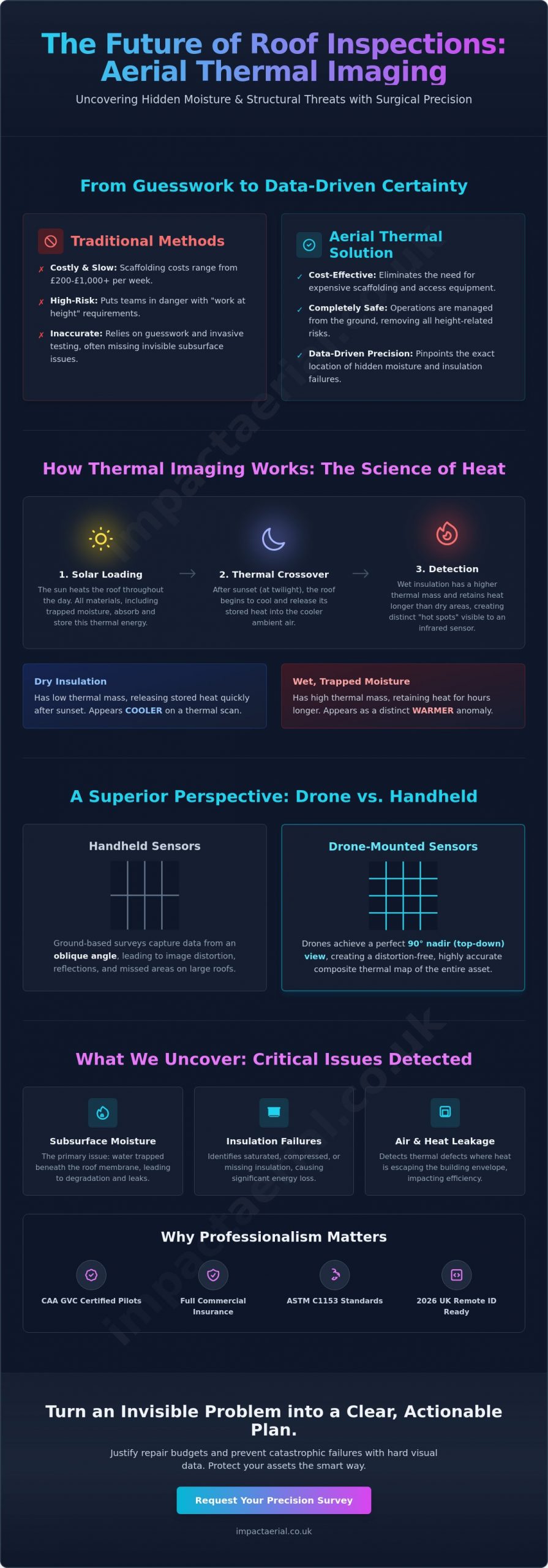
Thermal imaging for roofs is a non-destructive testing method that utilizes specialized infrared cameras to capture the heat signatures emitted by a building’s structure. Unlike standard photography, which relies on visible light, thermography detects radiation in the long-wave infrared spectrum. One of the standout benefits of thermal imaging for roofs is its ability to identify anomalies that are completely invisible to the human eye. By measuring these temperature variations, surveyors can create a detailed map of a roof’s thermal performance.
To understand the fundamentals of What is Thermography, one must recognize that every material absorbs and emits heat at different rates. When a roof is exposed to sunlight, it stores energy. As the environment cools at night, the roof begins to release that energy. Areas containing trapped moisture will appear warmer on a thermal scan because water has a higher thermal mass than dry insulation. This allows our sensors to “see” the thermal footprint of a leak through the surface-level membrane without ever cutting into the material.
To see a practical application of this technology on a commercial site, watch this thermal inspection in action:
The Science of Thermography
Thermodynamics is the core of this process. Thermal cameras don’t actually see through membranes; instead, they detect the heat energy being conducted from the materials underneath. In the context of moisture entrapment, thermal mass is the ability of wet insulation to store and retain heat energy significantly longer than the surrounding dry components. This temperature differential allows the camera to produce a thermogram, which is a visual representation where different colors correspond to specific temperature values. This data-centric approach removes the guesswork from traditional roof inspections.
Handheld vs. Drone-Mounted Thermal Sensors
Ground-based inspections using handheld cameras often struggle with perspective. On a large commercial flat roof, a surveyor on foot can only capture data from an oblique angle, which leads to image distortion and missed patches. DJI Enterprise drone sensors provide a significant upgrade in data quality. By flying at height, drones achieve a 90-degree nadir view. This top-down perspective is essential for creating an accurate, distortion-free moisture map of the entire site. This level of precision is one of the major benefits of thermal imaging for roofs, as it provides a comprehensive composite map that ground-based surveys simply cannot match.
The Primary Benefits of Aerial Thermal Roof Surveys
Transitioning from the science of thermography to practical application reveals why this technology is now a cornerstone of modern facility management. One of the most immediate benefits of thermal imaging for roofs is the sheer speed of data acquisition. A drone can survey a 50,000-square-foot industrial roof in a fraction of the time it takes a manual team to walk the site with handheld sensors. This rapid turnaround isn’t just about efficiency; it’s about capturing a snapshot of the entire roof under consistent environmental conditions, ensuring that temperature differentials aren’t skewed by changing weather during the survey.
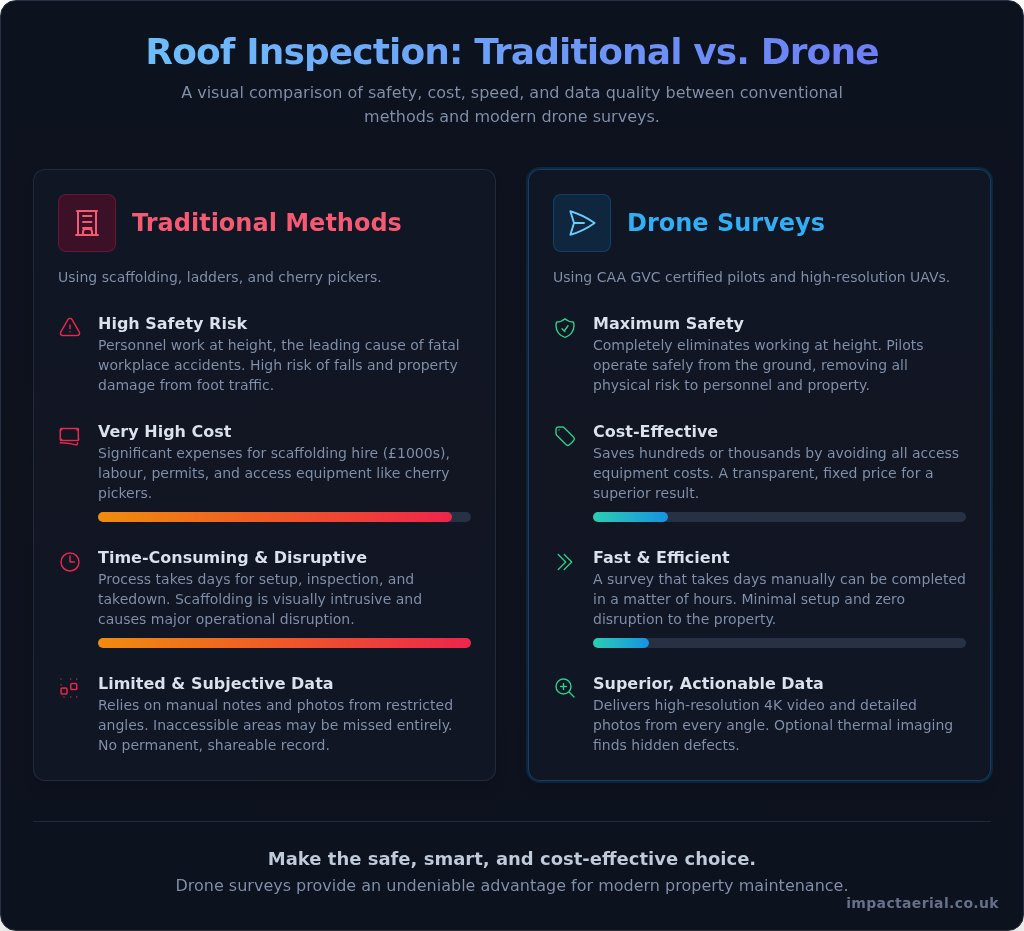
Cost reduction is equally significant. Traditional inspections often require expensive scaffolding or cherry pickers just to gain access to high-level structures. Research indicates that scaffolding costs in the UK typically range from £200 to £1,000 per week, an expense that aerial surveys completely bypass. By choosing an aerial approach, you’re investing in data rather than temporary hardware. This method constitutes a high-tier form of non-destructive testing, allowing us to detect thermal defects such as air leakage or wet insulation without compromising the integrity of the roof’s protective membrane.
Enhanced Safety and Risk Mitigation
Safety remains the primary driver for many commercial operators. By keeping surveyors on the ground, we eliminate the inherent “work at height” risks that complicate standard inspections. Our operations align strictly with modern HSE guidelines, significantly reducing the liability for property managers. When you remove the need for personnel to navigate fragile roof surfaces or steep pitches, you create a safer work environment and simplify the logistics of your routine maintenance schedule. It’s a proactive way to manage risk while maintaining full compliance with safety protocols.
Precision and Visual Documentation
The output of an aerial survey provides more than just a list of problems; it delivers undeniable visual proof. This radiometric data is invaluable when filing insurance claims or preparing repair tenders, as it offers a clear “heat map” of the damage. Establishing this baseline of roof health allows you to track deterioration over time with meticulous detail. For those managing multiple assets, integrating these findings into broader drone property surveys ensures that every structural component is accounted for. If you’re ready to secure your building’s future, our drone commercial property surveys provide the expert oversight needed to justify your maintenance budget and protect your investment.
Specific Issues Detected by Thermal Imaging
While the overarching benefits of thermal imaging for roofs include safety and cost-efficiency, the true value lies in the granular data it provides regarding structural failures. We don’t just look for water dripping through a ceiling. Instead, we identify the precise moment a roof’s integrity begins to fail, often years before a visible leak appears. This proactive approach allows for targeted repairs that extend the life of the entire asset. By utilizing high-resolution radiometric sensors, we can detect anomalies that traditional visual surveys consistently overlook.
Moisture Mapping and Leak Detection
In the UK, the best results occur after sunset when the roof surface cools. Wet insulation appears as distinct “hot spots” because it retains solar energy longer than dry material. This phenomenon allows us to map moisture entrapment with surgical precision. By adhering to professional standards for roof thermography, we can pinpoint the exact entry point of a leak rather than just observing where the water eventually pools inside the building. Flat roofing systems are the ideal candidates for thermal moisture scans because their uniform surface allows for a clear, unobstructed view of the thermal patterns created by subsurface anomalies. This detailed mapping prevents the common mistake of replacing an entire roof when only a specific section is compromised.
Energy Efficiency and Heat Loss
Thermal imaging is a powerful tool for businesses striving to meet ambitious ESG (Environmental, Social, and Governance) goals. By identifying “cold spots” on the roof surface during winter months, we can locate failed insulation boards that allow internal heat to escape. These insulation gaps represent a massive waste of HVAC energy and increase the building’s carbon footprint. We also look for thermal bypasses at roof-to-wall junctions, where air leakage often goes undetected. Addressing these thermal bridges ensures the building envelope remains airtight and energy-efficient. This data is essential for justifying energy-saving upgrades and proving the return on investment for insulation repairs.
Structural Anomalies and Drainage Monitoring
Beyond moisture and heat, infrared sensors reveal structural anomalies that might otherwise remain hidden. Thermal bridges, where highly conductive materials like steel beams penetrate the insulation layer, show up clearly on our scans. These areas are prone to condensation and eventual rot if left unmanaged. Additionally, we use thermal data to monitor the health of flat roof drainage systems. Pooling water has a different thermal signature than the rest of the roof, allowing us to identify blocked drains or subtle depressions in the roof deck that threaten structural stability. Integrating this data into your long-term asset management strategy ensures that minor maintenance issues don’t escalate into catastrophic failures.
Optimising Results: Timing and Conditions in the UK
Achieving high-quality radiometric data requires more than just high-end hardware. It demands a meticulous understanding of the UK’s environmental variables. The primary benefits of thermal imaging for roofs are only fully realized when the survey is conducted during the optimal “thermal window.” This window is dictated by the diurnal cycle, a 24-hour temperature swing that allows us to differentiate between dry and saturated materials. Without the correct environmental timing, even the most advanced sensors will fail to produce actionable data.
The process begins with “solar loading,” where the sun’s energy heats the roof structure throughout the day. To ensure accuracy, we strictly follow ASTM C1153 standards, which require specific conditions such as a dry roof surface for at least 24 hours and wind speeds typically below 15 mph. High winds can strip heat from the roof surface through convective cooling, which masks the subtle temperature differences we need to detect. We prioritize clear, cold nights following a day of significant solar loading to maximize the contrast between wet and dry insulation.
The Diurnal Cycle Explained
The most effective thermal scans happen at twilight or during early nightfall. After the sun sets, dry roofing materials cool down rapidly because they have low thermal mass. In contrast, wet insulation or trapped moisture retains that heat for much longer. If we launch a drone too early, the residual heat from the surface membrane can mask the underlying defects, a phenomenon known as the wash-out effect. By waiting for the peak temperature differential, usually two to four hours after sunset, we can pinpoint moisture entrapment with surgical precision. Managing the UK’s unpredictable rain patterns is the greatest challenge, as a wet surface will evaporate and cool the roof, creating false “cold spots” that invalidate the survey results.
Material Compatibility
Not all roofing materials react to infrared radiation in the same way. EPDM (rubber) and bituminous membranes are ideal for thermography because they have high emissivity, meaning they are very efficient at emitting thermal energy. Highly reflective “cool roofs” or new metal standing seams present a greater challenge because they act like mirrors, reflecting the cold temperature of the sky rather than emitting their own heat. Our pilots meticulously adjust emissivity settings and camera angles to compensate for these reflective surfaces. To ensure your asset is surveyed under these precise conditions, you can book our drone commercial property surveys to secure a data-rich report that accurately reflects your roof’s health.
Why Professional Drone Surveys are the Industry Standard
Professionalism in aerial thermography isn’t just about owning a drone; it’s about the technical rigour and regulatory compliance behind every flight. While the benefits of thermal imaging for roofs are clear, the quality of the data depends entirely on the operator’s expertise and the hardware used. We leverage DJI Enterprise systems, such as the Matrice 350 or 400 series equipped with high-resolution radiometric sensors, to capture precise temperature data. This technology allows us to measure the exact heat signature of any point on the roof surface, providing a level of detail that standard visual inspections can’t match. This data-centric approach ensures that stakeholders receive a definitive, evidence-based assessment of their property’s condition.
Compliance and Safety Standards
Operating a drone for commercial purposes in the UK requires strict adherence to aviation law. As of January 2026, regulations have become more stringent, requiring Remote ID for drones with cameras and lowering registration thresholds. We operate with full CAA General Visual Line of Sight Certificate (GVC) qualifications, which are essential for conducting surveys in complex urban or industrial environments. Understanding the specific requirements for a drone license is vital for site managers who must ensure their contractors are fully legal and current with 2026 standards. Beyond licensing, we provide detailed Risk Assessments and Method Statements (RAMS) and maintain £5m in commercial liability insurance. This meticulousness guarantees that your site survey is conducted with the highest safety standards in mind, providing the psychological comfort that your asset is in expert hands.
From Data to Decision Making
The true value of a survey lies in the transition from raw data to actionable intelligence. It’s easy to capture a thermal image, but it’s much harder to produce a report that a structural engineer or insurance provider can rely on. Our drone survey reports are designed to direct repair teams exactly where they are needed, eliminating the need for broad-spectrum “exploratory” repairs. We use advanced post-production software to analyze thermal anomalies, filtering out false positives like HVAC exhaust or solar reflections. This ensures that the benefits of thermal imaging for roofs translate into tangible cost savings and efficient maintenance schedules. By providing a clear visual baseline of roof health, we help property managers justify their repair budgets with hard evidence. If you’re ready to move away from guesswork and embrace data-driven asset management, contact Impact Aerial for a professional thermal roof survey quote and let our experts secure your building’s future.
Securing Your Building’s Future with Thermal Data
Aerial thermography has redefined how we protect large-scale commercial assets. By identifying subsurface moisture and insulation gaps long before they manifest as internal damage, you’re not just fixing leaks; you’re preserving the structural integrity of your property. The benefits of thermal imaging for roofs extend far beyond simple detection. They provide the hard evidence needed to justify maintenance budgets and ensure your site remains compliant with modern safety standards. This data-driven approach removes the high costs of scaffolding and the risks of manual inspections.
We combine high-end DJI Enterprise radiometric sensors with the expertise of CAA GVC certified pilots to deliver reports that are both technically precise and legally compliant. With £5m in commercial liability insurance, we provide the security and reliability that complex industrial sites demand. Don’t leave your roof’s health to guesswork or invasive testing that risks damaging your facility membrane. It’s time to gain total visibility over your assets with professional aerial oversight.
Request a Professional Thermal Roof Survey from Impact Aerial today to secure a comprehensive assessment of your building’s health. We’re ready to help you turn invisible risks into a clear, actionable plan for long-term success.
Frequently Asked Questions
Is thermal imaging for roofs accurate in finding all leaks?
Thermal imaging is exceptionally accurate at identifying moisture entrapment and thermal anomalies that standard visual inspections miss. However, it is a diagnostic tool that identifies temperature differentials rather than a definitive leak seeker in every scenario. To ensure 100% certainty, we recommend verifying thermal findings through non-destructive moisture meter testing or core sampling as per industry standards. This combined approach maximizes the benefits of thermal imaging for roofs by providing a verified roadmap for repairs.
Can you perform a thermal roof survey during the day?
Daytime surveys are generally ineffective because direct solar radiation creates thermal noise that masks subsurface temperature differences. For accurate results, we conduct surveys at twilight or during the night when the roof surface has cooled sufficiently. This specific timing allows the heat retained by wet insulation to become visible against the rapidly cooling dry sections. Scheduling during these hours is critical for capturing the high-contrast radiometric data required for a professional structural assessment.
What roof materials work best with infrared cameras?
Low-reflectivity materials with high emissivity, such as EPDM rubber, bituminous membranes, and modified bitumen, provide the most reliable results. These surfaces efficiently emit thermal energy, allowing our sensors to capture clear heat signatures. In contrast, highly reflective surfaces like new metal or cool roofs can act as mirrors, reflecting sky temperatures instead of emitting their own heat. Our pilots adjust camera settings and flight paths to mitigate these reflections, ensuring data accuracy across diverse commercial roofing systems.
How much does a drone thermal roof survey cost in the UK?
The cost of a drone thermal roof survey varies based on the total surface area, the complexity of the roof structure, and the specific reporting requirements. Factors such as the building’s location and the need for specialized flight permissions in restricted airspace also influence the final investment. We provide bespoke quotes that reflect the meticulous planning and high-end hardware required for a compliant, data-rich survey. Contacting us directly ensures you receive a quote tailored to your facility’s specific maintenance needs.
Do I need to shut down my building during the drone survey?
There is no need to shut down your building or interrupt daily operations during an aerial survey. Our drones operate at a safe altitude and remain entirely non-intrusive, allowing your staff and tenants to continue their work without distraction. Because we typically conduct thermal scans after sunset to optimize data quality, the impact on site activity is virtually non-existent. This operational flexibility is a key advantage for busy commercial and industrial facilities that cannot afford downtime.
What is the difference between a visual drone survey and a thermal one?
A visual drone survey uses high-resolution RGB cameras to identify surface-level defects like cracked tiles, blocked gutters, or loose flashings. A thermal survey utilizes radiometric infrared sensors to detect subsurface issues like moisture entrapment and insulation failure. While visual surveys show you what is broken on the exterior, thermal imaging reveals the hidden structural risks beneath the membrane. Combining both methods provides a comprehensive overview of your roof’s total health and energy performance.
Can thermal imaging see through standing water on a roof?
Thermal imaging cannot see through standing water or heavy ponding on a roof surface. Water on the surface acts as a thermal barrier, equalizing the temperature and masking the heat signatures of the materials underneath. For a successful survey, the roof must be completely dry for at least 24 hours prior to the flight. This ensures that the temperature differentials we detect are caused by internal moisture entrapment rather than surface-level evaporation or pooling water.
How long does it take to receive the thermal survey report?
You can typically expect to receive your comprehensive survey report within three to five working days following the flight. While the data capture itself is rapid, the post-production phase requires meticulous analysis by our technical team to identify and verify thermal anomalies. We convert raw radiometric data into actionable insights, providing you with a detailed map of leak locations and insulation gaps. This thorough process ensures the benefits of thermal imaging for roofs are translated into a clear maintenance strategy.
 2 Norton Drive, Wythall, Birmingham, B47 6HH Company registration number: 11138586. VAT Number: 366 9068 55