
Construction Marketing Video Production for UK Site Films

A construction marketing video doesn’t have to wait until a building is complete. Construction marketing video production in the UK can cover project progress, time-lapse sequences, completed-site showcases and short updates that explain the work behind a project. The right format depends on what you want viewers to understand.

It makes sense to want polished footage without disrupting a live site. This article explains how construction marketing video production in the UK can capture different project stages, how filming can be planned around active work, and what helps a finished film communicate clearly. It also looks at ways to use the footage, from project presentations to your website and social channels.

Key Takeaways

  • Choose a video format that fits the project stage, from progress footage and time-lapse to a finished-site showcase.
  • Filming on a working site can be planned around site activity, access and the views the final film needs to capture.
  • Match each edit to its destination, such as a project page, social post or campaign, so the footage serves a clear purpose.
  • Explore how aerial filming, construction site monitoring and post-production can support a consistent visual record of your project.

Can you film on active construction sites?

Yes. Drone filming can capture site-wide progress while work continues, provided the flight and camera plan suits site operations. Before filming, the team coordinates with site management, agrees access and working areas, and identifies the views to capture. Aerial photography can show the full footprint, while closer footage can focus on a crane installation or completed façade. Planned shots help stakeholders understand the project at each stage.

The right package depends on the material and finished film you need. Animation can explain a design or process that cameras cannot show; site filming records work and milestones; and interviews add first-hand perspectives. A package can combine these elements, but each serves a different purpose. Set out the audience, key message and intended use in the production brief so filming and editing contribute to one coherent video.

On an active UK site, filming plans need to account for access, moving machinery, changing work zones and site-specific safety arrangements. The team agrees locations and timing with site management, then adapts the shot list if activity changes. For drone operations, pilots plan flights around people, structures and equipment, taking the site environment into account.

To protect privacy, plan shots to avoid identifiable workers, visitors, badges, screens and sensitive site information unless their inclusion has been agreed. If interviews or recognisable people are part of the film, arrange consent and clarify how the footage will be used, stored and shared. Reviewing footage before publication can identify faces, vehicle registrations or documents to remove or obscure. Account for UK GDPR considerations in the production plan, not as an afterthought during editing.

When choosing a construction video specialist, assess relevant site footage, aerial image quality, safety planning and post-production capability. Ask how the team coordinates with site management, adapts to changing conditions and shapes footage for its audience. A useful portfolio should offer more than dramatic drone views: look for clear project context, considered filming and edits that explain progress. Confirm that the proposed deliverables meet stakeholders’ needs, from a concise update to a full project film.

Filming on active sites and in working environments

Construction video production can combine scheduled site filming, time-lapse and milestone footage. In the UK, the process includes planning, capture, editing and final production, shaped around the project’s audience and intended use.

A visual record can show potential clients how a project develops, not just how it looks when finished. The filming schedule and format depend on site activity, project duration and the stages worth showcasing.

Planning, Filming and Final Production

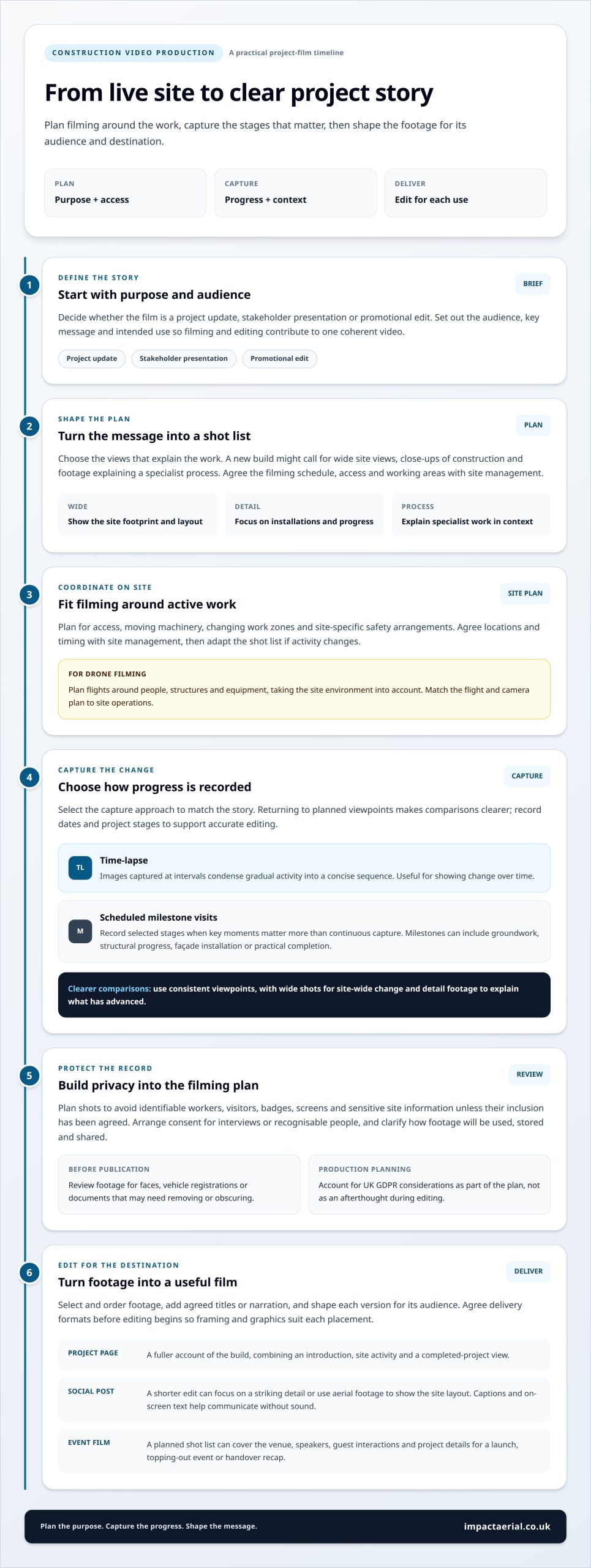
Start planning with the film’s purpose: a project update, stakeholder presentation or promotional edit. Turn that purpose into a shot list, filming schedule and clear production brief. For example, a new build might need wide site views, close-ups of construction and footage explaining a specialist process.

On filming days, the crew coordinates access and capture around site operations. Editing selects and orders footage, adds agreed titles or narration, and shapes the film for its intended audience. Review the deliverables and editing stages in advance so the plan covers both the captured material and the finished communication piece.

Progress and Milestone Footage

Milestone filming records specific changes, such as groundwork, structural progress, façade installation or practical completion. Returning to planned viewpoints makes comparisons clearer: a wide shot can show changes across the site, while detail footage explains what has advanced. Use a consistent shot list for each visit, and record dates and project stages to support accurate editing.

Time-lapse offers a different perspective. Depending on project duration, it can capture images at intervals and condense gradual activity into a concise sequence. Scheduled filming is suitable when key moments matter more than continuous capture. A series of visits, for example, can document the transition from an empty site to a completed building, helping stakeholders follow progress and potential clients understand the work involved.

Choose the approach by matching capture frequency to the story: time-lapse shows change over time, while milestone footage explains selected stages in context. Together, they can create a visual record that remains useful beyond the final edit. For developers and project teams seeking comprehensive visual tracking, providers like skyviewmediaco.com focus specifically on construction progress documentation to keep all stakeholders aligned.
Construction Marketing Video Production for UK Site Films

Using video across websites, social media and campaigns

One construction film can support several communications, but each placement has a different purpose. A project page can give potential clients a fuller account of the build, while a LinkedIn post can highlight a milestone. Before editing, match each version to its channel, audience and next step, such as viewing a case study or enquiring about a project.

For multi-platform use, select and shape footage for each destination. A website edit might combine an introduction, site activity and a completed-project view. A shorter social media version could focus on a striking detail, such as a structural installation, or use aerial footage to show the site layout. Captions and on-screen text help communicate the message when viewers watch without sound.

Event coverage can document a project launch, topping-out event or handover. A planned shot list helps capture the venue, speakers, guest interactions and project details, rather than relying on a single wide shot. The footage can become an event recap, with selected clips supporting follow-up posts and campaigns. For interviews, clear questions help keep each contribution relevant to the event’s purpose.

Agree on delivery formats before editing begins. Name the website placement, social channels, event use and required versions in the production brief, so framing and graphics suit their destinations. A wide project overview and a vertically framed social clip, for example, may need different edits despite using footage from the same session. Planning this way helps prevent a final film that works in one setting but feels awkward elsewhere.

Organise finished files by project, channel and intended use, with clear filenames for each edit. Keep a master version alongside approved social cuts, captions and stills selected from the footage. This helps marketing teams document progress, prepare future posts and reuse relevant material in later campaigns. Aerial filming and photography can add useful context when the site’s scale or layout is central to the message.

Construction marketing and promotional videos

A construction promotional video should give viewers a reason to understand the project, not just show attractive images. Begin with one audience and message: a developer may want to demonstrate delivery capability, while a potential client may need to understand a complex build. A focused film can combine site footage, interviews and concise explanations. A completed-project video, for example, can show the finished structure and explain the specialist work behind a visible detail.

Build the story around the project’s strongest evidence. A contractor could document a technical process, explain how a design challenge was addressed or showcase progress from early works to completion. Include details that support the message, such as the project’s purpose, notable construction stages and contributors. For construction marketing video production in the UK, define the audience, project story and intended use before filming starts.

Measure return on investment by setting a campaign objective before production, then comparing relevant outcomes with distribution and production costs. Integrating video assets into a broader evidence-led marketing strategy UK helps ensure campaigns target measurable business objectives. For lead generation, track qualified enquiries and conversions associated with the campaign; for awareness, review viewing and engagement data alongside audience reach. Views alone do not establish commercial return. A film supporting a project presentation may influence a decision without generating a direct website enquiry, so match measurement to its intended role.

Professional production supports this process by capturing useful evidence and shaping it into a focused film. Post-production can create a main project video alongside shorter edits for specific audiences or campaign placements. Keep the message and call to action aligned so potential clients understand the project and what to do next. A clear construction marketing video production UK plan also helps teams assess whether the finished film communicates the project accurately.

For a construction film built around project evidence and a clear marketing purpose, discuss your video project.

Impact Aerial: Construction Site Monitoring

Impact Aerial supports construction teams that need visual records of site activity or project progress. Construction Site Monitoring provides aerial views to help stakeholders review how a site develops, while Aerial Filming and Photography can capture footage for project communications. These services suit teams planning progress updates, documenting key stages or creating promotional material from a completed project.

Post-Production Services can shape captured footage into an edit for its intended audience, such as a project overview or concise stakeholder update. For solar developments, PV Solar Farm Thermal Surveys address a separate inspection need. The right service depends on whether you need ongoing monitoring, marketing footage or a finished film from existing material.

Contact Impact Aerial to discuss construction filming or site monitoring for your project.

Turn your project story into a clear next step

Before production begins, decide what viewers should understand or do after watching. This gives the film a practical purpose, whether it supports a project presentation, introduces your team’s work or documents a development for future communications. A focused brief keeps filming and editing aligned with that purpose.

For construction marketing video production in the UK, match the footage to your project and intended audience. Impact Aerial offers Aerial Filming and Photography, as well as PV Solar Farm Thermal Surveys and Drone Commercial Property Surveys for relevant site needs. These services address different requirements, from capturing project visuals to surveying commercial property or solar assets.

Share the project context, the key message and where you plan to use the finished video. That gives the production conversation a useful starting point, without committing to a format before the objective is clear. Contact Impact Aerial about your video to discuss the right approach for your construction project. A considered brief can help turn site activity into communication your audience can use.

Frequently Asked Questions

What types of video can you create?

Construction videos can include aerial project footage, progress documentation, time-lapse sequences and promotional edits. The format depends on the story: a site overview can introduce a development, while a focused edit can explain a construction stage. A contractor might use a progress film for stakeholder updates, then adapt selected footage into a project showcase. Aerial filming and photography can also provide material for future communications.

How much does video production cost?

The price depends on the project scope and is provided after a quote request. A single filming session with one final edit differs from work requiring several visits, extensive post-production or multiple versions. Clarify the audience, intended use, site locations and deliverables in the brief. This allows the quote to reflect the production requirements rather than an unsuitable general estimate.

WHY WORK WITH A CONSTRUCTION VIDEO SPECIALIST?

A construction specialist can make technical work understandable without losing important project context. The team can plan footage around the build sequence, identify useful visual evidence and shape the story for its audience. A film for prospective clients, for example, may need to explain a contractor’s role, while an internal update may focus on progress and coordination. This understanding helps keep the finished video relevant and accurate.

How much does construction video production cost in the UK?

UK project costs depend on scope, locations, filming requirements and the number of finished edits. UK Construction Marketing notes that a straightforward half-day video shoot may cost differently from a multi-location project producing several videos. For a useful quote, define the intended film, where it will be used and the footage or edits required. The price is then provided after a quote request.

What types of marketing videos work best for UK construction companies?

The most useful format depends on the company’s communication goal. A project showcase can demonstrate completed work, a progress film can keep stakeholders informed, and a concise promotional edit can introduce capabilities to prospective clients. Time-lapse can show change across a development, while interviews add individual perspectives. Choose the format by asking what viewers need to understand or do after watching.

How does a professional plan and produce a construction marketing video step by step?

Impact Aerial follows a defined workflow: Consultation, Site Survey, Safety Assessment, Flight, Post-Production, Presentation, Handover & Sign-Off. Consultation establishes the project’s purpose and intended audience. Site assessment and safety planning inform the filming approach; post-production shapes the captured footage into the agreed deliverable. Presentation and handover complete the process, providing finished material for the team’s planned communications.
Drone video for construction marketing and progress monitoring

A construction site can be a powerful marketing asset before the work is complete. Drone video for construction marketing shows a project’s scale, on-site activity and progress from above, offering prospective clients a clearer view than ground-level images alone. Footage of completed work can also showcase projects on a company website, social media or in print.

That visual record has practical value beyond promotion. Regular aerial updates can help communicate progress to building owners who aren’t local, while carefully planned flights can capture areas that are difficult to reach on foot. The strongest results come from matching the footage to a clear purpose, whether that’s a project update, a portfolio film or a record of a key construction stage.

This article explains how construction businesses use drone imagery in marketing, what to consider when planning progress documentation, and how aerial capture can support work in hard-to-reach areas. It also covers the factors that influence pricing, including the project, filming requirements and post-production, so you can understand what to plan for before commissioning a shoot.

Key Takeaways

  • Plan each flight around a defined use, such as a campaign film, a progress record or imagery for a proposal, so the footage serves a clear purpose.
  • Choose framing and edits for the intended channel: website and social media content can tell a different story from images prepared for print.
  • Set a consistent capture schedule to make changes across the build easier to compare; imagery can also support mapping and 3D models.
  • Pricing depends on the project scope, capture requirements, site conditions and post-production rather than a single standard rate.
  • Use aerial capture to document hard-to-reach areas and reduce the need for scaffolding, while planning each flight around site safety.

How do construction companies use drone photography and video for construction marketing?

Construction companies use aerial photography and video to show project scale, site activity and completed work from above. A well-planned drone video for construction marketing can turn that visual record into campaign material, website content and social posts.

To see a construction flight in practice, watch this demonstration of progress monitoring and aerial capture:

Production for Property and Construction Firms

Property and architectural firms can use aerial footage to present a building’s setting, layout and relationship to its surroundings. Construction businesses can show the progression from active work to a finished project, giving prospective clients a clearer view of the design and delivery.

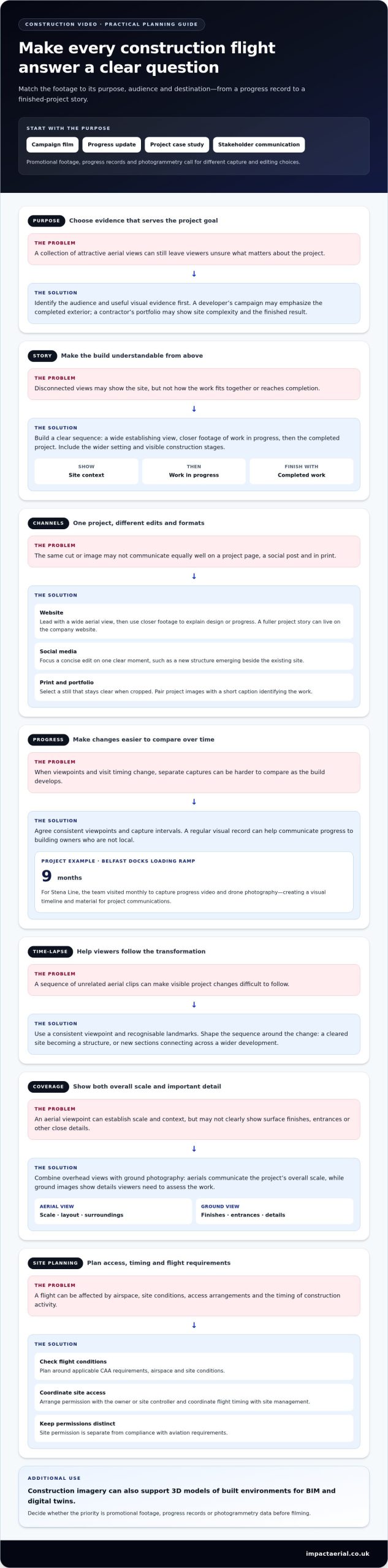
For each project, identify the intended audience and the most useful visual evidence. A developer’s campaign might focus on the completed exterior, while a contractor’s portfolio could highlight site complexity and the finished result. Aerial views can show context that ground-level photographs may miss.

Planning and Producing Project Videos

Start with the purpose: a brand campaign, progress update, project case study or stakeholder communication. Then choose the structures, site activity and viewpoints that support it. A useful edit may combine wide establishing shots, closer views of work in progress and clear footage of the completed project.

Construction-site filming in the UK must be planned around applicable CAA requirements, airspace and site conditions. Arrange access and permission with the owner or site controller, and coordinate flight timing with site management. Site permission is separate from compliance with aviation requirements.

A marketing video should make the project understandable, not simply collect attractive views. Include the wider setting, visible construction stages and finished work, then organise the footage into a clear story. Choose framing and edits for the intended channel, such as a website, social media page or print campaign.

For recurring documentation, agree consistent viewpoints and capture intervals so that separate visits can be compared. The Belfast Docks loading-ramp project for Stena Line took 9 months, with the team visiting monthly to capture progress video and drone photography. This approach can create a visual timeline as well as reusable material for project communications.

Construction imagery can also support 3D models of built environments for BIM and digital twins. Decide whether the priority is promotional footage, progress records or photogrammetry data before filming, because each purpose calls for different capture and editing choices.

Using drone footage on websites, social media and print materials

Construction companies can adapt aerial footage for websites, social media, portfolios and print advertising. The right format depends on the audience and the project details each channel needs to convey.

Footage for Digital and Print Materials

On a project page, lead with a wide aerial view, then use closer footage to explain the building’s design or progress. A social post can focus on one clear moment, such as a new structure emerging beside the existing site. For print, choose a still image that remains clear when cropped and placed beside project details.

Build a portfolio around specific examples rather than a reel of disconnected views. Pair aerial photography of each project with a short caption identifying the work, then use a fuller edit on the company website. This gives prospective clients a quick overview and a way to explore more context.

Construction Time-Lapse Footage

Time-lapse footage compresses visible project changes into a sequence. It can show a cleared site becoming a structure or record how new sections connect across a wider development. Plan the sequence around a consistent viewpoint and recognisable landmarks, so viewers can follow the transformation rather than watch unrelated aerial clips.

Before publishing, choose the stages that tell the clearest story. A project portfolio might use an opening site view, a transition through construction and a finished-project image. A shorter social media edit can highlight one visible change, while the website can host a fuller account of the build.

Brand Storytelling with Drone Footage

Aerial footage can make a company’s approach visible through the projects it presents. For example, a contractor could connect an establishing view of a site with footage of specialist work and the completed structure. That sequence links the result to the scale and character of the construction project.

Keep the story specific to the intended viewer. A building owner may value context and visible progress, while a prospective client may want evidence of the finished work. Clear captions, project descriptions and a consistent visual style help connect the footage with the company’s wider portfolio.

Ground photography still has an important role. It can show surface finishes, entrances and details that an aerial viewpoint may not make clear. Combine ground images with an overhead view to present both the project’s overall scale and the details a viewer needs to assess the work.

Prepare each version for its destination: use a concise edit for a social post, a wider project story for the website, and selected stills for print. Check crops, captions and project names before publishing, especially when one edit is reused across several channels. For support shaping construction imagery for different formats, explore construction footage for campaigns.

Construction progress monitoring and documentation

Regular aerial capture creates a visual record that teams can compare throughout a build. Construction companies can use the same imagery for progress updates, project records and marketing.

Imagery for Progress Marketing

Progress images help stakeholders understand what has changed since the previous update. A contractor can select clear views of completed sections, active work and the wider site, then use them in customer communications or internal updates.

When a building is being prepared for lease, imagery can help showcase its development to prospective tenants. Choose frames that explain the building’s scale and visible progress, rather than relying on dramatic angles that obscure important context.

Development Progress Imagery

For meaningful comparisons, plan repeat captures from consistent viewpoints and include recognisable site features. A tower crane, access road or building edge can act as a visual reference, making changes easier to follow across visits.

Many construction contractors schedule drone flights monthly for progress updates. High-resolution still images and video can document the site, while photogrammetry data supports mapping and progress tracking. The capture plan depends on whether the priority is a visual update, a measured map or both.

Construction Progress Records

Organise each visit’s images by capture date, location and project stage. This gives site teams a useful record for internal updates and customer communications, rather than a collection of files without context. Add captions identifying visible areas and changes.

Some construction events, including demolition and bridge segment laying, offer a one-shot opportunity to capture a key moment. Plan those flights around the activity, site access and intended output, then retain selected footage with the project record.

Progress monitoring can also create source material for digital models. Construction-site imagery can support 3D models of built environments in BIM and digital twins. Where mapping is required, photogrammetry capture needs to be planned for that purpose, rather than treated as a by-product of promotional filming.

Time-lapse cameras and drone visits serve different documentation needs. A fixed camera can show continuous change from one viewpoint, while aerial visits provide broader views of the site and its surroundings. Combining the two can help explain both the day-to-day sequence and the overall development.

Keep the record useful after construction moves on. Reuse suitable imagery for project updates, internal communication, security purposes and digital models. A consistent archive also helps the team select accurate material later, whether preparing a stakeholder summary or showcasing a completed building to prospective tenants.

Drone video for construction marketing and progress monitoring

Drone photography and video pricing

The cost of a construction drone shoot depends on its scope, deliverables and site conditions. A short aerial photography session for one completed building requires a different plan from a progress film covering several stages. Pricing depends on the case and is given after a quote request; the main factors include flight requirements, travel, editing and the intended outputs.

Start by defining what the footage needs to achieve. A portfolio project may need selected stills and a concise film, while a stakeholder update may need repeat visits and consistent viewpoints. A mapping brief requires different capture planning from a brand campaign. Clear objectives help identify essential work and align the scope with the intended result.

Capture time is one planning factor, but it isn’t the only one. Site size, access, surrounding activity and the number of viewpoints affect the flight plan. A compact site with one clear structure may need less coverage than a large development with several zones. Professional drone operations also require safe coordination around the working site.

  • Capture scope: One visit differs from repeat visits scheduled monthly for progress updates.
  • Deliverables: Still photography, edited video, raw footage and photogrammetry each require different work.
  • Post-production: Selecting clips, editing a project story, adding captions and preparing channel-specific versions affect the editing brief.
  • Site logistics: Travel, access arrangements, active work and the required viewpoints shape the practical plan.

Editing requirements can change the overall workload. A simple sequence of site views differs from a film built around project milestones, captions and stakeholder messages. If the footage needs versions for a website, social media and print, specify those uses early. Each format may require separate framing, cuts or still-image selection.

For repeat monitoring, define the capture interval and required views before the first visit. Monthly imagery from consistent positions can form a comparable record, while a one-off marketing shoot may focus on a finished structure. The schedule affects flight planning and editing, especially when several project stages need to appear together in one film.

To help define the scope, provide the site location, intended purpose, required outputs and any planned repeat capture. Include whether you need aerial stills, a finished video, mapping data or a combination. A clear brief makes it easier to align capture and post-production with the deliverables, rather than comparing projects with different requirements.

Capturing hard-to-reach or unsafe areas

A drone can capture imagery of hazardous or difficult-to-access construction areas without placing personnel in those locations. Examples include elevated roof sections, tall structures and areas where scaffolding might otherwise be needed for a visual overview.

That doesn’t remove the need for site safety planning. Before a flight, identify the area to capture, nearby workers, moving plant, overhead obstacles and a safe launch position. Coordinate timing with site management, and pause capture if site activity changes the planned operating area.

Safety and privacy planning centres on controlling the aircraft around people and structures and limiting unnecessary recording. Keep the camera focused on the construction task, avoid unnecessary images of neighbouring properties or identifiable people, and set clear access controls for stored footage. Use a service with suitable liability cover for the work.

Capturing a roof edge, façade or elevated installation can help a project team review visible conditions from the ground. A planned aerial view can also reduce the need for scaffolding used solely to obtain imagery. It doesn’t replace physical inspection where close contact or specialist testing is required.

  • Define the target: Mark the structure, face or access route that needs imagery.
  • Check the operating area: Note workers, cranes, cables and temporary structures before flight.
  • Agree site coordination: Set a flight window with the people managing activity below.
  • Limit recording: Frame the intended area and avoid unrelated people or properties.
  • Plan the output: Decide whether the team needs overview footage, still images or a documented visual record.

A high façade, bridge underside or rooftop plant area each calls for a different capture angle. Choose a viewpoint that shows the relevant feature clearly without bringing the aircraft closer than the task requires. For repeat reviews, retain matching views so the team can compare visible changes between visits.

Privacy planning matters on busy sites. A frame that includes a neighbouring home, passing pedestrians or workers’ faces can record more than the project needs. Tight framing, careful timing and controlled distribution help keep footage focused on construction activity.

Insurance is another operational consideration. Cover should suit the aerial work and site environment, including risks associated with operating near buildings, workers and equipment. A documented flight plan, site coordination and defined footage purpose help clarify the intended operation.

For aerial capture planned around construction access and site conditions, arrange a construction site flight.

Where scaffolding would otherwise be used solely to provide a visual overview, drone imagery can offer an alternative. Flight planning still needs to account for site conditions.

Impact Aerial: Aerial Filming and Photography

Impact Aerial provides aerial filming and photography for construction marketing, project updates and visual records.

For a construction campaign, Impact Aerial can capture site activity, project scale and completed work for use across marketing channels. Construction Site Monitoring supports teams seeking repeat aerial records, while Aerial Filming and Photography is suited to planned promotional content. Post-production can shape captured material into finished video and photography.

Share the project’s purpose, site conditions and intended outputs when planning a shoot. This helps align the capture with your needs, whether the priority is a portfolio film, progress documentation or views of hard-to-reach areas. Contact Impact Aerial to discuss aerial filming and photography for your construction project.

Plan the next useful view of your project

Before commissioning a shoot, decide what you want the imagery to help people understand. A new development may need a clear visual case study, while an active site may need a structured record for project communications. That purpose guides the viewpoints, capture schedule and finished formats, helping your drone video for construction marketing stay relevant beyond its first publication.

Impact Aerial’s Aerial Filming and Photography can create visual material for construction projects. Its wider work also includes PV Solar Farm Thermal Surveys and Drone Commercial Property Surveys, which serve different aerial imaging needs. Choose the service according to the task: promotional footage, property survey imagery or thermal assessment each calls for a distinct brief.

Set out your project goals, site context and intended use for the footage, then discuss a practical capture plan with the team. Contact Impact Aerial about your project to explore the next step and turn your site into a clear, useful visual record.

Frequently Asked Questions

What are the Benefits of Drone Filming for Marketing?

Drone filming gives construction marketing a viewpoint that ground-level content can’t provide. It can show how a project fits its surroundings, how different areas connect and how site access shapes the work. For example, a project case study can pair an overhead view of the site layout with closer details and a concise explanation of the completed work. This helps prospective clients understand the project’s context as well as its appearance.

How can drone video be used to market construction projects?

Use drone video to build a project story around a client’s priorities. A developer presenting a phased scheme could show the overall layout, then focus on a completed phase and its relationship to the next. Add concise captions to identify the work and explain its relevance. This makes footage useful in a proposal or project presentation, where viewers may need context before discussing design, delivery or the next phase.

What are the benefits of drone footage for construction company marketing?

Drone footage can help a construction company present visual evidence of the type and scale of work it undertakes. A portfolio entry, for example, can connect a completed structure with site constraints or surrounding infrastructure visible from above. This gives potential clients a more informative project reference than a finished-building image alone. Select examples that reflect the work the company wants to attract, and explain its role clearly in each case study.

How much does professional drone video cost in the UK?

Professional drone video pricing depends on the project and is given after a quote request. Cost factors include the site, capture requirements, travel, repeat visits, editing and the final formats needed. A single promotional film has a different scope from a project record requiring multiple visits or specialist data capture. For a useful quote, describe the intended audience, site context and deliverables, such as edited footage, stills or versions for different channels.

Aerial Marketing Video: The Ultimate Guide to Elevated Brand Storytelling in 2026

By 2026, a standard ground-level shot isn’t just safe; it’s effectively invisible to an audience conditioned for cinematic scale. To truly capture attention and convey authority, your brand needs the unique perspective that only a professional aerial marketing video can provide. Using high-altitude visuals isn’t about novelty anymore; it’s about demonstrating the full scope of your operations in a way that traditional filming simply cannot match.

You’ve likely felt the frustration of seeing a major project look flat on screen because the camera couldn’t capture its true magnitude. Many marketing managers also face the stress of navigating strict UK drone laws or the fear of hiring an uncertified operator who lacks the proper insurance. It’s a common hurdle that often prevents brands from reaching their visual potential and can lead to significant regulatory risks.

This guide will show you how to overcome these obstacles and deliver high-impact visuals that stop the scroll. You’ll learn the technical difference between hobbyist footage and commercial 4K HDR quality, while discovering how a fully managed production process ensures your project is both stunning and CAA compliant. We will walk through the essential certifications and workflows that turn elevated filming into a strategic, reliable brand asset.

Key Takeaways

  • Understand how a strategic aerial marketing video leverages a birds-eye perspective to build consumer trust and establish immediate brand authority.
  • Learn why commercial-grade DJI Enterprise hardware and 4K HDR are essential for capturing the vibrant, high-tier detail required for professional marketing.
  • Identify high-value applications for aerial filming in property and construction to effectively communicate scale and project capability to stakeholders.
  • Explore the end-to-end production process, from initial storyboard development to navigating complex UK flight regulations and safety protocols.
  • Discover the importance of professional certification and how CAA GVC certified pilots mitigate risk while delivering meticulous, high-impact results.

What is Aerial Marketing Video and Why Does Your Brand Need It?

An aerial marketing video is a strategic asset that combines cinematic drone filming with targeted commercial messaging. It moves beyond simple observation to tell a story about scale, location, and capability. While traditional Aerial photography has provided a static viewpoint for decades, modern UAV technology allows us to weave complex narratives through controlled, dynamic movement. By 2026, this technology has become the baseline standard for industries that rely on physical presence, such as large-scale industrial sectors, tourism, and high-end property development.

The psychological impact of the “birds-eye” perspective is profound. It provides a sense of transparency and authority that ground-level filming cannot replicate. When a customer sees the full extent of a facility or the surrounding context of a development, their perceived trust in the brand increases. This perspective removes the “hidden” elements often associated with tight, ground-based shots, offering a literal and metaphorical “big picture” view of your operations. When planning an aerial marketing video, the focus is often on the visual impact, but the real value lies in this immediate establishment of brand dominance.

The ROI of Aerial Visuals in 2026

High-impact aerial footage is a proven driver of engagement. Data suggests that websites featuring video content see a significant increase in “time on page,” as viewers are naturally drawn to the sweeping movement of drone shots. In social media feeds, these visuals are essential for breaking through the noise of static content. For high-value assets like commercial real estate, drone video shortens the sales cycle by providing stakeholders with all the contextual information they need in a single, immersive experience. Using drone video for commercial listings delivers a measurable conversion lift by providing a more comprehensive understanding of the property’s total value and surrounding infrastructure.

From Social Media to TV: Versatility of Aerial Content

One of the greatest advantages of modern aerial content is its technical flexibility. By filming in high-bitrate 4K HDR, we ensure the footage is future-proof and versatile across all marketing channels. This high-resolution output allows editors to crop horizontal footage for vertical platforms like TikTok or Instagram Reels without sacrificing the professional quality your brand demands. The detail captured by DJI Enterprise sensors remains crisp, even when reformatted for mobile-first consumption.

Beyond social media, this content serves as the backbone for corporate presentations, high-definition website headers, and broadcast-standard advertising. Whether it’s a 15-second “scroll-stopper” or a 5-minute investor overview, the quality remains consistent. For a deeper look at the technology behind these shots, explore our guide on the Aerial Filming Drone: The Ultimate Guide to Professional Cinematic Video. This versatility ensures that a single production schedule provides a library of assets for your entire annual marketing strategy.

The Technical Edge: 4K HDR and Commercial-Grade Drone Hardware

The visual quality of a professional aerial marketing video is determined by the hardware’s ability to manage light and movement with surgical precision. Unlike consumer models, DJI Enterprise hardware utilizes larger CMOS sensors that significantly improve the signal-to-noise ratio. This technical advantage allows our pilots to capture intricate details in deep shadows and bright highlights simultaneously. When filming a construction site or a sprawling commercial estate, this expanded dynamic range ensures that every architectural detail remains visible, regardless of the sun’s position.

4K HDR (High Dynamic Range) is a critical standard for any brand aiming for a premium market position in 2026. HDR technology ensures that colors are vibrant and “pop” on high-definition displays, from mobile screens to boardroom projectors. Without this, footage often looks washed out or overly dark in high-contrast environments. Furthermore, commercial drones provide the stability required for cinematic fluidity. High-torque motors and advanced GPS-stabilisation allow for steady flight paths even in challenging UK weather conditions, ensuring that “camera shake” never distracts from your brand message.

We also utilize specialized sensors and high-resolution zoom lenses to capture specific site features from a safe distance. This capability is essential for maintaining site privacy and adhering to strict safety protocols. While our operations are governed by UK CAA GVC standards, the industry’s commitment to safety is mirrored globally in frameworks like the FAA Part 107 regulations, which emphasize the importance of pilot certification and hardware reliability. If you’re unsure which technical specifications your project requires, you can view our technical filming capabilities to see how professional hardware transforms a shoot.

Hardware Spotlight: DJI Enterprise Capabilities

  • DJI Mavic 3 Series: This platform offers the perfect balance of agility and optical power for rapid marketing deployments across the UK.
  • 10-bit D-Log Profiles: Filming in a flat color profile allows our post-production team to apply Hollywood-standard color grading, ensuring your brand colors are perfectly represented.
  • Redundant Systems: Professional drones feature dual IMUs and compasses to ensure flight safety and data integrity throughout the production.

Why ‘Hobbyist’ Drones Fail Commercial Marketing Standards

The primary failure of consumer-grade drones lies in bitrate and compression. Low-bitrate footage often suffers from “blocky” artifacts during fast movement, which destroys the professional feel of the final edit. Non-professional setups are also prone to the “jello effect,” a visual distortion caused by camera vibration that makes the footage look amateurish and unstable. Professional-grade hardware is the non-negotiable foundation of high-end output, providing the reliability and image depth that your brand’s reputation depends on.

Industry Applications: Where Aerial Marketing Delivers the Most Value

While the technical specifications of sensors and bitrates establish the quality, the true value of an aerial marketing video is found in its specific industry applications. By 2026, several sectors have identified aerial content as a strategic necessity rather than an optional extra. These applications include:

  • Property and Real Estate: Capturing total site acreage, proximity to transport links, and surrounding landmarks in a single cinematic sequence.
  • Construction and Building: Utilizing progress filming to demonstrate operational capability and safety standards to future investors.
  • Hospitality and Tourism: Creating immersive fly-throughs of resorts, golf courses, and outdoor attractions to drive direct bookings.
  • Advertising and Media: Producing high-octane “hero” shots that establish immediate brand authority in commercials and social campaigns.

In the real estate sector, aerial filming provides the contextual data that ground-level cameras cannot replicate. It allows potential buyers to understand the location’s infrastructure and environmental setting, which is vital for high-value commercial and residential transactions. This visual evidence of scale builds immediate trust and shortens the decision-making process for stakeholders.

Commercial Property and Site Monitoring

Marketing massive industrial units and logistics hubs requires a perspective that effectively communicates volume and accessibility. An aerial view simplifies the explanation of complex sites, showing docking bays, access roads, and expansion potential with total clarity. There is a strategic crossover between marketing footage and technical data collection; for instance, our construction site monitoring services often provide the raw, high-resolution footage needed for high-impact social media updates. You can learn more about the technical side of this in our guide to Drone Survey: The Complete Guide to Aerial Data Collection.

Virtual Tours and Immersive Experiences

The hospitality sector increasingly relies on combined 360-degree aerial views and ground-level virtual tours to create a total marketing package. This allows potential guests to explore a venue before they book, providing a level of transparency that traditional photography lacks. Interactive aerial maps can also help buyers “walk” through a development before construction is even finished. The future of this immersion lies in FPV (First Person View) fly-throughs, where agile drones transition from wide outdoor sweeps to narrow interior spaces. Integrating this level of movement into an aerial marketing video stops the scroll on social feeds and drives measurable engagement with your brand.

The Production Journey: From Initial Consultation to Final Edit

A successful aerial marketing video isn’t born in the air; it’s built on the ground through a structured, four-stage production journey. We begin with a meticulous pre-production phase where we define the storyboard and identify your brand’s core messages. This planning ensures that every flight path and camera angle serves a specific purpose, whether you’re highlighting the scale of a logistics hub or the architectural detail of a new development. By aligning our creative vision with your commercial goals before the propellers even spin, we guarantee a more efficient shoot and a more effective final product.

Regulatory planning is the next critical step. Our team handles the complexities of risk assessments and secures the necessary flight permissions for challenging UK environments, such as congested urban centers or restricted airspace. During the shoot, our CAA GVC certified pilots work collaboratively with your team on-site. This professional partnership allows us to adjust to real-time conditions while maintaining the highest safety standards. The journey concludes with post-production, a phase where raw data is transformed into a polished, high-impact marketing asset that’s ready for distribution across all your digital channels.

Safety as a Brand Asset

Safety is more than a legal requirement; it’s a shield for your brand’s reputation. Hiring uncertified or uninsured operators exposes your business to significant legal liability and the risk of negative PR if an incident occurs. We mitigate these risks by maintaining £5m commercial liability insurance and strictly adhering to the latest aviation protocols. This commitment to compliance provides the psychological comfort you need when filming on high-value marketing sites. To better understand the current regulatory landscape, you can read our guide on the UK Drone License: A Simple Guide to CAA Rules in 2026.

The Power of Post-Production Editing

The edit suite is where your aerial marketing video truly takes shape. We use professional color grading to ensure the visual aesthetic perfectly matches your brand’s existing palette and style. This consistency is vital for maintaining a premium feel across your marketing ecosystem. We also integrate motion graphics, call-to-actions, and brand logos to turn cinematic footage into a functional sales tool. Sound design is equally important; audio accounts for 50% of the marketing experience. We use carefully selected, licensed music and immersive soundscapes to reinforce the emotional impact of the visuals. If you’re ready to elevate your brand’s perspective, you can book a professional drone production consultation with our expert team today.

Choosing Impact Aerial: Professionalism, Compliance, and Precision

Impact Aerial is headquartered in Birmingham, serving as a strategic central hub for nationwide UK operations. Our West Midlands roots provide us with unique regional expertise, yet our reach extends to every corner of the country, ensuring rapid deployment for large-scale national projects. We don’t just operate as a creative agency; we are technical consultants who bridge the gap between complex UAV operations and the high-end demands of modern advertising. This dual perspective ensures that every aerial marketing video we produce is both visually arresting and technically flawless.

Our commitment to the highest industry standards is absolute. Every pilot in our team is CAA GVC certified, maintaining an up-to-the-minute understanding of the evolving UK regulatory landscape. We understand that for our clients, compliance is a non-negotiable component of brand reputation. By handling all the complex paperwork, risk assessments, and flight permissions on your behalf, we remove the administrative burden from your team. This full-service project management approach allows you to dedicate your energy to your marketing strategy while we ensure the legal and operational integrity of the shoot.

Bespoke Solutions for Every Sector

We recognize that a “one size fits all” approach doesn’t work in professional filming. We offer customized filming packages tailored to the specific needs of your industry, whether you’re marketing a luxury residential development or documenting the massive scale of a PV solar farm. Our DJI Enterprise fleet is equipped with a range of specialized sensors, ensuring we always deploy the right tool for your specific marketing challenge. For a broader perspective on how our technology integrates with various business operations, explore our A Complete Guide to Professional Drone Services in the UK.

Get Started with Your Aerial Campaign

The path to a successful campaign begins with a detailed initial consultation and site assessment. During this stage, we work with you to identify the key visual assets required to meet your commercial objectives. To ensure the highest quality results on the day of the shoot, we recommend preparing your site by removing any distracting vehicles or temporary equipment from the primary filming zones. This attention to detail in the planning phase ensures that the final footage is clean, professional, and ready for high-impact use. Contact Impact Aerial today for a bespoke aerial marketing proposal and take the first step toward elevated brand storytelling.

Transforming Your Brand Perspective for 2026

The integration of a professional aerial marketing video is no longer a luxury for high-tier brands; it’s a fundamental tool for capturing scale and building authority. We’ve explored how 4K HDR cinematic output and specialized DJI Enterprise hardware elevate your visual storytelling far beyond the capabilities of consumer-grade drones. By prioritizing CAA GVC certified pilots and maintaining £5m commercial liability insurance, you ensure your project is compliant and your brand reputation remains secure throughout the production process.

Impact Aerial provides a meticulous, full-service approach from our Birmingham base, offering UK-wide coverage for projects that demand technical precision and operational reliability. We handle every regulatory requirement and post-production detail, allowing you to focus on your broader marketing objectives. The right perspective doesn’t just show your operations; it demonstrates your leadership and commitment to quality in an increasingly competitive market.

Elevate your brand with a professional aerial marketing video; request a quote from Impact Aerial.

We look forward to helping you capture the unique scale of your next project with the expert precision it deserves.

Frequently Asked Questions

Do I need a permit for an aerial marketing video shoot in the UK?

You must have the correct operational authorization from the Civil Aviation Authority (CAA) to conduct a commercial shoot. Our team manages the entire regulatory process, including site-specific risk assessments and securing any necessary flight permissions from local authorities or air traffic control. This ensures your project remains fully compliant with current UK aviation laws and safety standards.

How much does a professional aerial marketing video cost?

The investment for a professional production depends on several factors such as the location’s complexity, the required flight time, and the depth of post-production editing. We provide bespoke proposals for every aerial marketing video to ensure the scope of work aligns with your specific commercial goals. This approach allows us to provide the most efficient hardware and personnel for your project’s unique requirements.

Can you fly drones for marketing in city centres like Birmingham or London?

Yes, we can operate in urban environments provided the mission is planned meticulously. Flying in congested areas requires a pilot with a General Visual Line of Sight Certificate (GVC) and specific safety protocols to manage ground risk effectively. We coordinate with local councils and the police where necessary to ensure a safe and legal operation within busy city centres.

What happens if the weather is bad on the day of the drone shoot?

Safety is our primary concern; we don’t fly in conditions that exceed the technical limits of our DJI Enterprise hardware. We monitor weather systems 48 hours before the shoot and maintain a flexible scheduling policy. If high winds or precipitation make filming unsafe, we will reschedule the session to the next available window with optimal lighting and flight conditions.

How long does the post-production and editing process take?

A standard marketing edit typically takes between seven and fourteen working days from the date of the shoot. This timeframe allows our team to perform high-tier color grading, sound design, and the integration of any required motion graphics. We provide a structured delivery schedule during the pre-production phase so your marketing team can plan their campaign launch with confidence.

Is your drone pilot CAA GVC certified and insured for commercial work?

Every pilot at Impact Aerial is fully CAA GVC certified and operates under our comprehensive commercial authorization. We carry £5m in commercial liability insurance as standard, which provides essential protection for our clients when filming on high-value industrial or commercial sites. We are happy to provide copies of our certifications and insurance documents during the initial consultation.

Can you provide raw footage or only the finished edited marketing video?

We can provide both the final polished edit and the raw 4K HDR data depending on your project requirements. Most clients prefer a finished aerial marketing video that’s ready for social media or broadcast, but we understand that some internal teams require raw footage for future archives. We discuss these delivery formats during the storyboard phase to ensure you receive the exact assets you need.

How do you ensure privacy when filming in residential or busy commercial areas?

We ensure privacy by adhering to strict data protection regulations and CAA flight safety codes. Our pilots use high-resolution zoom lenses to capture detailed site features from a significant distance, which avoids the accidental collection of identifiable personal data. If any sensitive information is captured, we use advanced post-production techniques to mask identifiable features before the final delivery.

How Aerial Videography Increases Engagement: The Science of High-Altitude Marketing

Could a simple change in perspective be the difference between a high-value lead and a lost impression? You’ve likely felt the frustration of watching major construction projects or premium estates get buried under low engagement rates. It’s difficult to convey the true scale of a complex development through a standard handheld lens. Understanding how aerial videography increases engagement is now essential for brands that want to avoid looking generic next to competitors. We believe your marketing should reflect the same precision and quality as your physical assets.

The gap between consumer and enterprise equipment is significant. Our fleet includes DJI Enterprise grade drones equipped with 4K HDR sensors. These sensors capture a wider dynamic range, ensuring that shadows and highlights are preserved even in challenging lighting. This technical superiority is why professional aerial videography increases engagement; the resulting footage has a cinematic weight that hobbyist equipment cannot replicate. Specialists like Light Colour Sound use their 20 years of experience in Advertising, Cinema, and TV to ensure that high-altitude visuals achieve this premium production quality. Professional pilots possess the technical skill to execute complex lateral orbits and reveals that guide the viewer’s eye toward your primary call to action.

This article explores the psychological and strategic reasons why high-altitude visuals stop the scroll, increase dwell time, and convert viewers into customers. You’ll discover the science of cognitive pattern-interrupts that reset viewer attention spans. We’ll also examine the authority gained by using CAA GVC Certified operators to deliver top-quality results. As of May 2026, the transition to UK class marks and Remote ID requirements means that professional, compliant filming provides the peace of mind your brand needs to stand out as a market leader.

Key Takeaways

  • Learn why the ‘Scroll-Stop’ effect acts as a cognitive pattern interrupt that bypasses banner blindness in saturated digital feeds.
  • Explore the vestibular-visual connection and how 3D parallax effects drive viewer retention by creating a satisfying, immersive experience.
  • Identify how aerial videography increases engagement in the construction and property sectors by using contextual awareness to build immediate buyer trust.
  • Discover the strategic importance of the ‘First 3 Seconds’ rule and HDR post-production in converting casual viewers into high-value customers.
  • Understand why professional CAA GVC certification is a vital trust signal that separates premium brand authority from amateur efforts.

The ‘Scroll-Stop’ Effect: Why Aerial Videography Captures Attention Instantly

In the fast-moving feeds of LinkedIn or Instagram, the ‘Scroll-Stop’ effect is a cognitive pattern interrupt that forces a user to pause. Most digital content is filtered out by ‘banner blindness’, a mental shortcut where the brain ignores predictable advertising layouts. High-altitude marketing bypasses this by providing a perspective the human eye doesn’t experience daily. This immediate visual shift is a primary reason why aerial videography increases engagement, as it triggers ‘instant curiosity’ and improves click-through rates (CTR) compared to standard ground-level shots. Understanding the history and diverse applications of this technology shows that it has evolved from a niche military tool into an essential commercial asset.

To better understand how these visuals impact viewer behaviour, watch this helpful video:

Initial retention rates in the first 3 seconds are critical for social media success. If a video doesn’t provide immediate value or visual interest, the viewer moves on. Aerial perspectives provide that value instantly. By revealing the full scope of a project or the surrounding environment in the opening frame, you establish context that would otherwise take minutes of ground-level footage to explain. This efficiency is why professional firms are increasingly turning to high-altitude visuals to maintain audience attention in a saturated market.

Breaking the ‘Eye-Level’ Monopoly

Approximately 90% of marketing video content is filmed between 1.5 and 1.8 metres. This ‘eye-level’ perspective is the default for handheld cameras and smartphones, making it highly predictable. When a viewer encounters a sudden shift to an aerial view, the brain signals ‘new information’ and prioritises the visual. The sheer scale of a construction site or a 50-acre estate captured from above provides a sense of grandeur that ground-based cameras cannot replicate. This scale doesn’t just look better; it validates the importance of the project in the viewer’s mind.

Engagement Metrics: What ‘Success’ Looks Like

True engagement goes beyond vanity metrics like ‘likes’ or ‘shares’. For professional firms, success is measured by dwell time and the reduction of bounce rates on landing pages. Data suggests that including high-quality drone footage can keep a visitor on a page for significantly longer periods. In terms of performance, engagement for an aerial filming drone is defined by its ability to maintain high watch-time percentages by delivering perspectives that ground-based alternatives simply cannot provide. By capturing never-before-seen angles, brands improve their authority and create a ‘premium’ feel that converts casual viewers into serious enquiries.

The Psychology of Perspective: How Aerial Movement Drives Viewer Retention

Stopping the scroll is only the first step in a successful marketing campaign. To understand how aerial videography increases engagement, we must look at why the human brain remains fixed on high-altitude movement. This is largely driven by the ‘Vestibular-Visual Connection’. When a camera follows a smooth, stabilised path through space, it mimics the sensation of fluid movement. This creates a satisfying, almost hypnotic experience for the viewer. Unlike shaky handheld footage that can cause minor cognitive dissonance, professional drone paths feel intentional and authoritative. They signal to the viewer that they are in the hands of a specialist who values precision.

Elevated perspectives also trigger the ‘God View’ effect. This psychological phenomenon occurs when a viewer sees a landscape or project from a height that implies total oversight. It creates a sense of awe and establishes the brand as a dominant, organized entity. By showcasing a construction site or commercial property from 40 metres, you aren’t just showing a building; you are demonstrating the scale of your operation. This authority is a key driver in converting a curious viewer into a high-intent lead. If you want to see how these perspectives apply to your specific industry, you can view our professional filming services to see the impact of high-altitude storytelling.

The Power of Parallax in Drone Filming

Parallax is a technical effect where objects in the foreground appear to move faster than objects in the background. In professional drone videography, this creates an unmistakable sense of 3D depth. Standard ground shots often feel flat because the camera doesn’t have the freedom to move through multiple planes of depth simultaneously. By using a lateral ‘orbit’ or a ‘dolly’ move at height, we create an immersive feel that makes the subject matter look more valuable. This depth perception is a primary reason why aerial videography increases engagement; it provides a spatial understanding that ground-based cameras simply cannot replicate.

Storytelling Through Continuous Movement

The ‘One-Take’ allure is a powerful storytelling tool. Following a subject from ground level and rising into a sweeping skyward reveal builds anticipation. These cinematic reveals keep viewers watching until the final frame. To achieve a truly professional result, drone photography and videography work together to tell a cohesive brand story by providing both the detailed precision of a still image and the immersive narrative of continuous movement. This combination ensures that every angle is covered, providing peace of mind to clients who need their large-scale projects presented with absolute clarity.

Movement also serves a practical purpose by guiding the viewer’s eye. A slow, forward ‘push-in’ shot acts as a visual funnel, directing attention toward a specific call to action, such as a site entrance or a finished development. By the time the shot concludes, the viewer has been led exactly where you want them to go. This strategic use of movement ensures your marketing isn’t just visually impressive; it’s functionally effective.

Beyond the ‘Pretty Shot’: Practical Applications That Boost Industry Engagement

While cinematic visuals provide an immediate aesthetic lift, the true commercial value lies in how aerial videography increases engagement within specific industry sectors. It isn’t just about a “bird’s eye view”. It’s about providing data and context that ground-based photography lacks. For instance, aerial coverage of corporate events or industry trade shows leads to 40% higher shareability on platforms like LinkedIn and Instagram compared to standard event photography. This surge occurs because high-altitude shots capture the collective energy and scale of an event in a single, comprehensive frame. This makes the content more “share-worthy” for attendees and stakeholders alike.

Engagement in a professional context is often a byproduct of trust. By showing the full scope of a project or a property’s surroundings, you remove the “blind spots” that often lead to consumer hesitation. This transparency is a powerful tool for building brand authority. Whether you are managing a large-scale construction site or marketing a premium commercial estate, the ability to show the entire footprint from above provides your audience with a sense of security and clarity. Our professional services are designed to provide this exact peace of mind, ensuring that your marketing assets are as meticulous as your operations.

Real Estate: Selling the Lifestyle, Not Just the House

In the property sector, high-quality visuals are the primary driver of lead quality. Showing a building’s surroundings through “Contextual Awareness” builds immediate trust with prospective buyers. They don’t just want to see the interior; they want to see the proximity to transport links, green spaces, and local infrastructure. This comprehensive view increases time-on-page for listings by over 100% in many cases. For commercial developers, a professional drone survey acts as both a technical record and a high-engagement marketing asset. It proves the value of the property through undeniable visual evidence.

Construction and Infrastructure: Transparency as Engagement

Construction firms use “Progress Engagement” to keep stakeholders and investors informed throughout a multi-year project. Aerial monitoring provides a clear, methodical view of site development that ground cameras cannot replicate. By deploying survey drone technology, project managers deliver “insider” views that showcase precision and adherence to timelines. These data-gathering missions are often compiled into “Year in Review” videos. These videos serve as powerful authority-building tools for future bids. This methodical approach ensures that clients feel they are in safe, expert hands. It turns raw technical data into a compelling narrative of growth and reliability.

Optimising Your Aerial Content: Strategies for Maximum Engagement and ROI

Capturing high-altitude footage is only half the battle. To understand how aerial videography increases engagement, you must look at how that footage is refined and delivered. The ‘First 3 Seconds’ Rule is the most critical factor in digital marketing. Users decide whether to stay or scroll almost instantly, so your video must start with its most dramatic aerial reveal. This immediate visual hook is best presented using 4K High Dynamic Range (HDR) technology. Content that lacks professional colour grading or appears washed out will fail to build brand authority. When considering how aerial videography increases engagement, the technical precision of the final edit is just as vital as the flight itself.

Post-Production: Where Engagement is Won

The editing suite is where raw data is transformed into a compelling brand narrative. Professional post-production services ensure that fluid visual paths are perfectly synced with immersive sound design. Research from May 2026 suggests that pairing sweeping visuals with high-fidelity audio can double viewer retention rates compared to silent clips. Additionally, adding motion graphics or text overlays allows you to communicate project specifications without losing the viewer’s attention. A single methodical drone shoot can be repurposed into over 12 high-engagement social assets, ranging from short vertical clips for mobile to full-length widescreen features for corporate presentations.

Timing and Lighting for Maximum Visual Impact

Lighting determines the emotional response and perceived value of the subject matter. The ‘Golden Hour’, occurring shortly after sunrise or before sunset, provides the long shadows and warm tones that make commercial property and construction sites look their best. To maintain high engagement levels, individual aerial clips should follow a strict 5-second rule. Long, lingering shots without a clear focal point often lead to ‘drone fatigue’, causing viewers to drop off. Mixing these high-altitude reveals with ground-based footage creates a steady communication rhythm that keeps the audience invested in the story.

Format your content specifically for the intended platform to maximise your return on investment. Data indicates that vertical video formats see 28% higher completion rates on mobile devices compared to traditional landscape crops. Ensuring your content is optimised for every screen size is a hallmark of a meticulous marketing strategy. To start building your library of high-impact visual assets, contact our professional aerial filming team for a consultation.

Professionalism as an Engagement Driver: Why CAA Certification and Safety Matter

High-quality visuals are essential, but the technical execution of a flight is what preserves brand authority. Amateur drone footage often features jittery movement, poor exposure, or “propeller shadow” that can actually hurt brand engagement. When a viewer sees low-quality or unstable video, they subconsciously associate that lack of precision with your business. Professional drone services are a necessity for corporate clients who require a premium finish. Meticulous flight planning ensures that the focus remains on the subject matter rather than technical flaws.

Safety and compliance act as silent trust signals for your audience. Displaying that you work with a CAA GVC Certified operator demonstrates a commitment to industry standards and public safety. As of May 2026, the UK regulatory landscape requires strict adherence to Remote ID and UK class mark standards. Using a pilot who holds a valid drone license and follows the Drone Code provides the peace of mind necessary for large-scale projects. This professional alignment is a core component of how aerial videography increases engagement; it reassures stakeholders that your marketing assets were produced legally and ethically.

Risk mitigation is another factor that separates specialists from hobbyists. We maintain £5m in commercial liability insurance to protect our clients and the public during every mission. In a niche but increasingly diverse market, this level of officialdom prevents potential PR disasters associated with unlicensed or unsafe drone operations. By choosing a vetted operator in Birmingham and the West Midlands, you ensure that your brand remains a trusted leader in your sector.

The Difference Between a ‘Drone Hobbyist’ and a Professional Pilot

The gap between consumer and enterprise equipment is significant. Our fleet includes DJI Enterprise grade drones equipped with 4K HDR sensors. These sensors capture a wider dynamic range, ensuring that shadows and highlights are preserved even in challenging lighting. This technical superiority is why professional aerial videography increases engagement; the resulting footage has a cinematic weight that hobbyist equipment cannot replicate. Professional pilots possess the technical skill to execute complex lateral orbits and reveals that guide the viewer’s eye toward your primary call to action.

Your Next Steps: Elevating Your Visual Strategy

To maximise engagement, your aerial brief should focus on the specific outcomes you want to achieve. Are you looking to showcase the scale of a construction project or the luxury feel of a new estate? Integrating this content into your existing marketing funnel is straightforward. Aerial clips can be used as high-impact website headers, LinkedIn background videos, or short-form social media reels. Each asset should be designed to reduce bounce rates and improve dwell time.

If you are ready to move beyond generic marketing and embrace the science of high-altitude marketing, we can help. Contact Impact Aerial today for a professional consultation on your next project. We provide the technical expertise and regulatory compliance needed to showcase your business from a perspective that truly stops the scroll.

Transform Your Marketing with High-Altitude Precision

Mastering the science of high-altitude marketing is no longer optional for brands in the construction or commercial property sectors. We’ve explored how cognitive pattern-interrupts stop the scroll and how technical factors like 4K HDR sensors drive viewer retention. By now, it’s clear that understanding how aerial videography increases engagement involves a blend of psychological triggers and meticulous technical execution. Relying on amateur footage risks your brand’s reputation; instead, professional services provide the authority and safety required for high-stakes projects.

Impact Aerial provides the expertise you need for peace of mind. As specialists in Birmingham and the West Midlands, our team consists of CAA GVC Certified pilots backed by £5m commercial liability insurance. We ensure your content is fully compliant with the latest May 2026 UK drone regulations, including Remote ID and class mark standards. Don’t let your projects look generic next to the competition. Elevate your brand with professional aerial videography from Impact Aerial. We look forward to helping you capture perspectives that truly resonate with your audience.

Frequently Asked Questions

How much does aerial videography increase social media engagement?

Data from May 2026 indicates that social media posts featuring high-quality aerial footage see an 80% higher click-through rate (CTR) compared to standard image-based posts. This is largely due to the cognitive pattern-interrupt mentioned earlier in this article. By providing a perspective that bypasses banner blindness, brands see a significant lift in shares and comments across platforms like LinkedIn and Instagram.

Do I need a special license to use drone footage for my business in the UK?

Yes, you must comply with Civil Aviation Authority (CAA) regulations. As of May 2026, anyone responsible for a drone weighing 250g or more, or any drone with a camera weighing over 100g, must hold a valid Operator ID which costs £12.34 per year. For professional commercial work, using a CAA GVC Certified pilot ensures your project is legal and covered by specialist insurance.

What is the best length for a drone marketing video?

The optimal length for a comprehensive aerial feature is between 60 and 90 seconds. While short 5-second clips are best for social media “scroll-stopping”, longer features allow for a methodical narrative that keeps 50% of viewers engaged until the final frame. This duration provides enough time to showcase the scale of a project without causing viewer fatigue.

Can aerial videography be used for indoor engagement, like warehouses or factories?

Indoor aerial filming is a powerful tool for showcasing logistics and manufacturing scale. Specialist drones can navigate factory floors to provide a fluid, continuous tour that ground-based cameras can’t replicate. This immersive perspective helps potential clients understand your operational capacity, leading to higher trust and improved dwell time on your corporate website.

Is drone footage better than traditional ground-based video for real estate?

It is a vital secondary tool that provides spatial understanding. While ground shots show the interior, drone footage reveals the roof condition and land boundaries, which are priorities for 80% of commercial buyers. This transparency is a key reason how aerial videography increases engagement, as it provides the full visual data required to make an informed decision.

What industries benefit the most from aerial videography?

Construction, commercial property development, and large-scale infrastructure projects see the highest return on investment. These sectors rely on demonstrating scale and progress to stakeholders. By using 4K HDR sensors to capture site monitoring data, firms can provide “insider” views that keep investors engaged throughout the lifecycle of a multi-year project.

How does the weather in the UK affect the quality and engagement of drone shots?

UK weather requires meticulous planning to maintain high engagement levels. Professional pilots typically ground flights if wind speeds exceed 20mph or if heavy rain is present to ensure shot stability. We monitor weather patterns to capture footage during the “Golden Hour”, as the lighting at this time provides the best emotional response from viewers.

Does professional drone video provide a better ROI than DIY footage?

Professional video offers a superior ROI by protecting your brand authority. DIY footage often suffers from “propeller shadows” or jittery movement, which can drive away high-value leads. With £5m in commercial liability insurance and expert post-production, professional services provide the peace of mind and “premium” feel necessary to convert viewers into long-term customers.