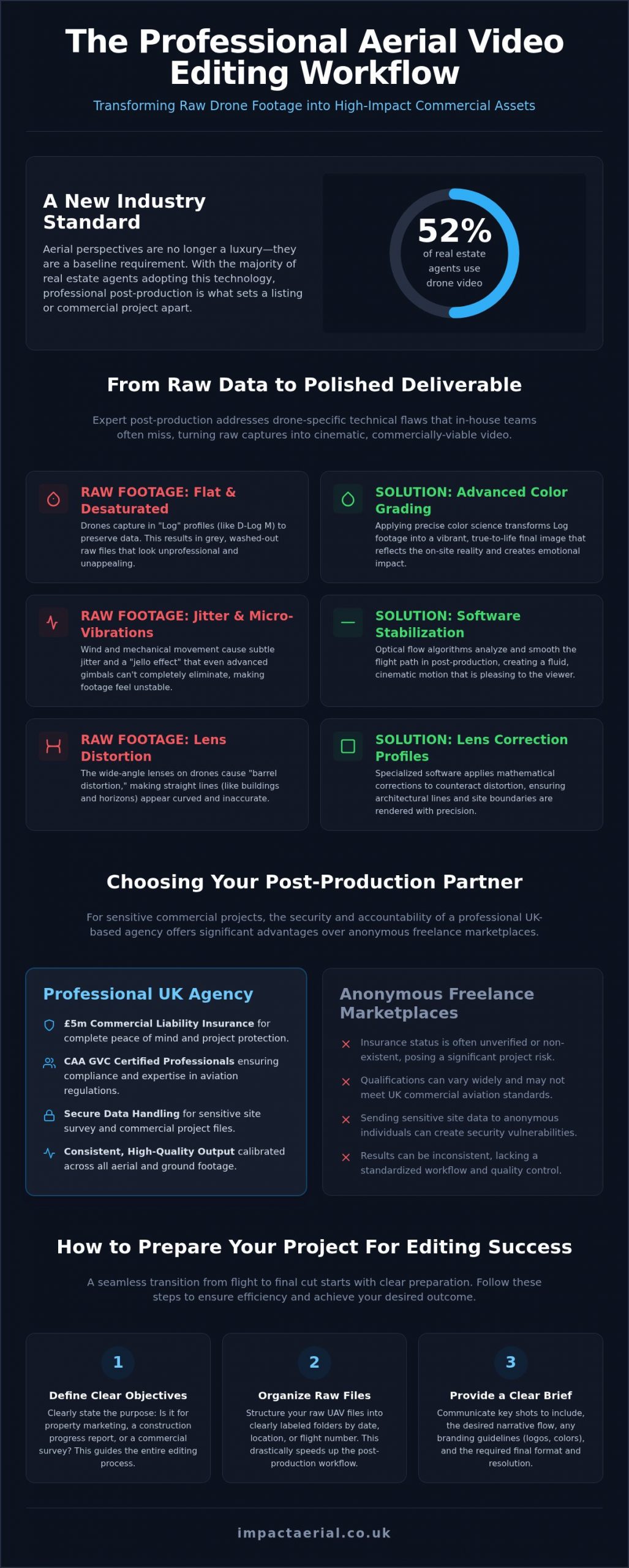
With 52% of real estate agents now using drone video as a standard marketing tool, aerial perspectives have shifted from a luxury to a baseline requirement for UK businesses. However, capturing high-bitrate 4K HDR footage is only the first step in a complex technical workflow. You likely understand the frustration of reviewing raw files only to find the horizon is slightly tilted, the colors appear flat, or the motion feels jittery due to mismatched frame rates. Managing these massive data sets in-house often proves inefficient and technically demanding for most marketing teams.
Professional aerial video editing services bridge the gap between raw data and a polished, high-impact deliverable. This guide explains how expert post-production transforms unrefined drone captures into cinematic marketing assets that drive ROI and precise commercial surveys for site monitoring. We will examine the essential role of specialized software, the importance of working with CAA GVC certified professionals who carry £5m commercial liability insurance, and the methods used to seamlessly integrate ground-based footage with aerial views for a cohesive, professional result in 2026.
Key Takeaways
- Understand why professional aerial video editing services are essential for managing high-bitrate 4K HDR files and transforming raw data into high-impact content.
- Learn how expert post-production solves common drone-specific issues like micro-vibration and inconsistent colour grading between aerial and ground-based sensors.
- Compare the security advantages of using a UK-based agency with £5m commercial liability insurance versus anonymous freelance marketplaces for sensitive site data.
- Master the preparation process by defining clear objectives and organising raw UAV files to ensure a seamless transition from flight to final cut.
What Are Professional Aerial Video Editing Services?
Rooted in a discipline that stretches back further than most people realise, the history of aerial videography shows that capturing the world from above has always demanded a distinct technical approach. Today, that principle is no different. Professional aerial video editing services are a specialised post-production discipline focused on transforming raw UAV captures into structured, commercially purposeful narratives. It’s a process that demands far more than a competent editor and a fast computer; it requires a precise understanding of drone-specific file formats, flight-induced artefacts, and the visual language required to communicate value to a target audience.
The core challenge is the raw material itself. DJI Enterprise drones capture footage in log colour profiles, such as D-Log M, to preserve the maximum possible dynamic range across bright skies and shadowed ground detail simultaneously. These flat, desaturated files are deliberately unfinished. Without expert colour science applied in post-production, the footage looks washed out and unprofessional. A skilled editor interprets that raw data and grades it into a final image that reflects what the human eye actually perceives on site.
The Distinction Between Basic Cutting and Professional Post-Production
Basic cutting is a trim-and-join operation. Clips are shortened, arranged in sequence, and exported. Professional post-production is an entirely different workflow. It involves colour grading calibrated to the specific log format used, sound design that reinforces the visual pace, motion stabilisation to eliminate wind-induced jitter, and a narrative-led editorial structure that guides a viewer from opening context through to a clear commercial conclusion. For property marketing or construction site monitoring, that structure is what converts a viewer into an enquiry.
The Importance of Specialised Tools for Drone Footage
Handling high-bitrate 4K HDR files demands industry-standard software. Platforms like DaVinci Resolve and Adobe Premiere Pro are built to manage the processing load these codecs require and provide the colour management pipelines necessary to work accurately within log colour spaces. Critically, specialised software also applies lens correction profiles that mathematically counteract the wide-angle barrel distortion inherent in drone camera optics, ensuring that straight building lines and site boundaries are rendered accurately in the final output.
This level of technical rigour is precisely what separates a professional service from a low-cost clip-trimming solution. For UK businesses commissioning drone content for property sales, commercial surveys, or construction monitoring, the quality of post-production directly determines the commercial value of the asset delivered.
Technical Challenges Solved by Expert Aerial Editors
Capturing raw data with a drone is only half the battle. Even with high-end DJI Enterprise hardware, environmental factors like wind resistance and light fluctuations introduce technical flaws that can undermine a project’s credibility. Professional aerial video editing services exist to rectify these specific issues, ensuring that the final deliverable meets the rigorous requirements of commercial stakeholders. By applying advanced post-production techniques, editors can salvage footage that would otherwise be unusable due to optical distortions or mechanical vibrations.
Stabilisation and Motion Smoothing
The physics of drone flight means that a UAV is constantly fighting against air resistance and turbulence. While modern 3-axis gimbals are remarkably effective, they cannot eliminate every micro-vibration. Professional editors use software-based stabilisation, often employing optical flow algorithms and point-tracking to smooth out the flight path. This process is essential for removing the “jello effect,” a common rolling shutter artifact caused by the CMOS sensor’s sequential line scanning. By correcting these timing discrepancies, the editor ensures the motion feels cinematic and fluid rather than mechanical and distracting.
Advanced Colour Grading for Commercial Impact
Most commercial drone footage is recorded in “Log” profiles to preserve the maximum amount of data in highlights and shadows. However, this leaves the raw files looking grey and desaturated. Editors must transform these profiles using precise colour science to achieve true-to-life vibrancy while maintaining brand consistency across multiple sites. Expert colour grading enhances the emotional appeal of real estate drone photography by creating a warm, inviting atmosphere that resonates with potential buyers. Adhering to professional standards in aerial imaging, these adjustments ensure that the visual output remains accurate for technical surveys while being aesthetically compelling for marketing.
Managing the dynamic range in 4K HDR files is another critical task. In high-contrast environments, such as a construction site at midday, the sky often appears “blown out” while the ground detail is lost in shadow. A skilled editor uses secondary colour correction and masking to recover these details, providing a balanced image that shows the full scope of a project. If your current raw data lacks this professional polish, our specialists at Impact Aerial can refine your footage into a high-impact commercial asset.
Finally, wide-angle lenses used on most drones naturally produce barrel distortion, making straight lines appear curved. This “fisheye” effect is particularly problematic for property and construction surveys where accuracy is paramount. Professional post-production applies mathematical lens correction profiles to straighten these lines, ensuring the structural integrity of the subject is represented correctly in every frame.
Professional Agency vs. Freelance Marketplaces: A Comparison
Selecting a partner for aerial video editing services often involves a choice between the perceived convenience of global freelance marketplaces and the structured reliability of a dedicated UK agency. For commercial projects, particularly in property and construction, the latter provides a level of accountability that anonymous platforms cannot match. A professional agency operates under UK-based contracts; this ensures that project management is transparent and that legal protections are in place for both parties. This structure is essential for businesses that require reliable delivery timelines and clear communication throughout the post-production cycle.
Security is a primary concern when handling high-resolution data from sensitive sites. Freelance platforms often involve offshore processing, which introduces significant risks regarding data protection and secure file handling. In contrast, a professional agency implements rigorous internal protocols to protect client data. This commitment to risk mitigation is evidenced by maintaining substantial £5m commercial liability insurance. While some may assume insurance only applies to the flight phase, it remains a critical marker of a business’s stability and professional standing throughout the entire service lifecycle in 2026.
The Risks of Low-Cost Offshore Editing
Low-cost offshore solutions frequently result in hidden costs that aren’t immediately apparent. Communication barriers often lead to excessive revision cycles, as editors may lack an understanding of specific UK property and construction standards. There is also a heightened risk of copyright infringement. Professional agencies ensure all music, stock assets, and fonts are correctly licensed for commercial use. This protects your business from future legal complications that can arise from using unlicensed assets found on unregulated marketplaces.
The Value of Integrated End-to-End Services
There is a distinct advantage to using a provider that understands the nuances of the flight itself. Our aerial filming drone services benefit directly from an integrated post-production workflow. When the editors are also experts in flight data and DJI Enterprise systems, they can interpret metadata more effectively to correct the technical optical issues discussed earlier. This streamlined approach, from the flight deck to the final export, ensures consistency in quality across multiple regional projects. By keeping the workflow in-house, we maintain a high standard of cinematic output while ensuring that technical survey data remains precise and secure.
How to Prepare Your Aerial Project for Editing Success
Efficient post-production begins long before the first clip is imported into the timeline. To maximise the ROI of your aerial video editing services, you need a structured approach to project preparation. Without a clear workflow, the technical complexities of 4K and 8K drone data can lead to extended revision cycles and increased costs. Following a methodical four-step process ensures that the transition from raw footage to a high-impact deliverable is seamless and secure.
- Step 1: Define the objective. Clearly state whether the output is a cinematic marketing promo designed for high engagement or a technical survey requiring precise data visualisation.
- Step 2: Organise raw files. Group your data by date, location, and shot type. This structure allows editors to locate specific assets quickly, saving billable hours.
- Step 3: Provide a comprehensive brief. Include your brand guidelines, preferred colour palettes, and licensed music references to ensure the final cut aligns with your corporate identity.
- Step 4: Establish a feedback loop. Define who has final sign-off authority and set clear dates for draft reviews to keep the project on schedule.
Defining Your Narrative and Project Scope
Before any cutting occurs, you must identify your target audience and key messaging. A marketing video for a luxury property development requires a different editorial rhythm than a construction progress report. You should also specify your required aspect ratios early. While 16:9 remains the standard for websites and presentations, 2026 social media trends often demand 9:16 vertical versions for platforms like LinkedIn or Instagram. Setting these parameters at the start allows the editor to frame shots correctly during the stabilisation and cropping phases.
Data Management and File Transfer
Handling massive 4K and 8K datasets requires high-speed cloud transfer solutions. We recommend using professional platforms that maintain the integrity of your files without compression. This is especially critical for technical projects. While marketing videos focus on aesthetics, drone survey data requires specific handling to preserve original metadata. This metadata contains essential flight information and GPS coordinates that are vital for survey accuracy. If you’re ready to transform your raw data into a professional commercial asset, you can contact our Birmingham-based team to discuss your specific project requirements.
Partner with Impact Aerial for UK-Based Video Editing Excellence
Centrally based in Birmingham, Impact Aerial provides a robust technical infrastructure for clients across the UK and international markets. Our aerial video editing services are built on a foundation of professional reliability and meticulous attention to detail. We specialise in high-stakes sectors where precision is non-negotiable, including commercial property, large-scale construction monitoring, and PV solar farm thermal surveys. By maintaining a strict focus on safety and compliance, we ensure that every project meets the rigorous standards required by corporate stakeholders and national regulatory bodies in 2026.
Our operation is underpinned by £5m commercial liability insurance and a team of CAA GVC certified professionals. This isn’t just about flight safety; it’s a commitment to professional accountability throughout the entire post-production lifecycle. We understand that raw drone data is a significant investment. Our role is to protect that investment by applying advanced DJI Enterprise workflows that preserve the integrity of your 4K HDR footage while delivering a polished, high-impact final product that drives tangible business results.
Our Post-Production Toolkit and Expertise
The Impact Aerial team combines creative flair with technical precision to ensure every edit serves a specific commercial purpose. We don’t just cut clips; we understand the nuances of aerial cinematography, such as how to manage parallax and depth of field from a moving UAV. This specialised knowledge allows us to highlight architectural features or site progress with a level of insight that generalist editors often miss. Our client-focused communication ensures your vision is realised on time, with a structured feedback loop that guarantees the final export aligns perfectly with your project requirements.
Ready to Elevate Your Aerial Content?
Choosing a partner with an integrated workflow offers significant advantages over fragmented service models. When you work with a comprehensive drone services provider, you benefit from a seamless transition from the flight deck to the final cut. This end-to-end approach eliminates the data loss and communication gaps that often occur when handing off files to third-party freelancers. It ensures that the technical survey data remains precise and that the marketing assets remain consistent with your brand identity.
If you have raw footage that needs a professional touch or are planning a new project from scratch, our team is ready to assist. We provide bespoke quotes tailored to the complexity and scale of your specific requirements. Contact Impact Aerial today for professional drone video editing and discover how we can transform your aerial data into high-impact commercial content.
Maximise the Commercial Value of Your Aerial Data
Professional post-production is the final, critical step in converting raw UAV data into a high-impact commercial asset. As the industry evolves in 2026, the technical requirements for handling 4K HDR drone files have become increasingly demanding. Relying on expert aerial video editing services ensures that your footage is not just trimmed, but technically corrected for lens distortion, colour-graded for brand consistency, and stabilised for a cinematic finish. This process turns raw data into a narrative that resonates with stakeholders.
Choosing a UK-based partner like Impact Aerial provides the security and accountability your business needs for sensitive site data. Our operation is grounded in meticulous safety standards, featuring CAA GVC Certified Pilots and £5m commercial liability insurance. We utilise expert DJI Enterprise workflows to maintain the highest levels of precision from the flight deck to the final export. By integrating these specialised skills, you can deliver precise technical surveys or compelling marketing narratives that drive real ROI.
If you’re ready to transform your raw footage into professional content, our Birmingham-based team is here to help. Request a Quote for Professional Aerial Video Editing today and take the first step toward elevating your aerial perspective.
Frequently Asked Questions
How much do aerial video editing services cost in the UK?
Costing for professional post-production depends on the project’s complexity, the volume of raw data, and the required final deliverable. Technical surveys for construction sites often involve different processing than cinematic property promos. Most UK agencies provide bespoke quotes based on your specific brief rather than fixed rates. This ensures you only pay for the exact level of colour grading and stabilisation your project requires in 2026.
Can you edit drone footage that I recorded myself?
Yes, we can process and refine raw footage provided by clients, provided the files meet professional technical standards. To achieve a high-impact finish, the original data should ideally be recorded in a high-bitrate 4K log format. Our aerial video editing services can correct common issues like horizon tilt or wind jitter. However, the final quality depends heavily on the source material’s resolution and the sensor capabilities used during the flight.
What is the typical turnaround time for a professional drone video edit?
Turnaround times vary based on the project’s scope, but a standard marketing edit typically takes between three to five working days once all files are received. More complex technical surveys or construction progress videos requiring detailed motion graphics may take longer. We establish clear timelines during the initial consultation to ensure your vision is realised on schedule. Efficient data management and a clear brief are the best ways to expedite this process.
Do I need to provide the music for my aerial video?
You don’t need to provide music, as we handle the sourcing and licensing of audio tracks for you. Using unlicensed music leads to significant legal risks and copyright strikes on commercial platforms. We use professional libraries to select high-quality, royalty-free tracks that match the tone of your footage. If you have specific brand-approved audio, we can integrate that into the final cut provided you hold the necessary commercial usage rights.
What file formats do you need for professional drone editing?
We work with most industry-standard formats, but we prefer receiving raw, uncompressed files directly from the SD card. Formats like .MOV or .MP4 recorded in D-Log or D-Cinelike are ideal for preserving dynamic range. For technical surveys, maintaining original metadata is essential for accuracy. We recommend using high-speed cloud transfers to send large 4K or 8K datasets without the quality loss associated with standard email attachments or messaging apps.
Can you add motion graphics or callouts to my construction drone video?
Yes, we specialise in adding technical overlays such as site boundaries, point-of-interest callouts, and motion-tracked labels to construction footage. These graphics are essential for communicating project progress to stakeholders or identifying specific structural elements in commercial surveys. By combining creative flair with technical precision, we ensure these elements are integrated seamlessly into the moving image. This provides a clear and professional overview of the site’s development for your project reports.
Why is colour grading so important for drone footage?
Colour grading is vital because raw drone footage is often captured in a “flat” profile to maximise the data stored in shadows and highlights. Without grading, the video appears grey and desaturated. Professional editors use colour science to restore vibrancy and ensure brand consistency across different lighting conditions. This process enhances the emotional appeal of property videos and ensures technical surveys are clear, accurate, and professional in appearance for every commercial stakeholder.
Is it better to hire a local UK editor or an offshore service?
Hiring a local UK editor provides significant advantages in terms of accountability and security. Impact Aerial is centrally based in Birmingham and operates under UK contracts with £5m commercial liability insurance. Offshore services often lack an understanding of UK property standards and present risks regarding data protection for sensitive sites. Working with a domestic agency ensures clear communication and a shared understanding of the regulatory landscape, providing psychological comfort and tangible business benefits.
 2 Norton Drive, Wythall, Birmingham, B47 6HH Company registration number: 11138586. VAT Number: 366 9068 55