Capturing a sweeping 4K HDR shot over a London skyline is no longer just about creative flair; it’s a high-stakes navigation of strict aviation law. In a landscape where the CAA can issue fines of up to £1,000 for improper registration, the margin for error in cinematic drone filming UK has never been slimmer. You likely know that aerial perspectives can transform a production’s scale, yet the technical hurdles of ProRes bitrates and the complexity of securing a £500 PDRA-01 authorisation for city filming often create more friction than footage.
We understand that you need breathtaking visuals without the legal headache or technical inconsistency of amateur operations. This guide will show you how to achieve high-end, cinematic aerials while navigating the 2026 UK class marking requirements and strict safety protocols. We’ll explore the synergy of DJI Enterprise hardware, the necessity of £5m commercial liability insurance, and how to seamlessly integrate drone units with your ground-based film crews for a polished, professional finish.
Key Takeaways
- Distinguish professional storytelling from standard aerial photography by utilizing 5.1K resolution and ProRes 422 for maximum post-production flexibility.
- Understand the critical legal requirements for cinematic drone filming UK, including the necessity of CAA GVC certification and £5m liability insurance for commercial operations.
- Master advanced flight techniques such as reveal shots and orbiting to add dynamic energy and narrative depth to your production.
- Learn how rigorous planning and PDRA-01 authorisations facilitate safe, legal operations within complex UK urban environments and congested city centres.
- Ensure high-end visual consistency by matching aerial footage with ground-based cinema cameras through the use of 10-bit D-Log colour profiles and professional post-production.
What Defines Cinematic Drone Filming in the UK?
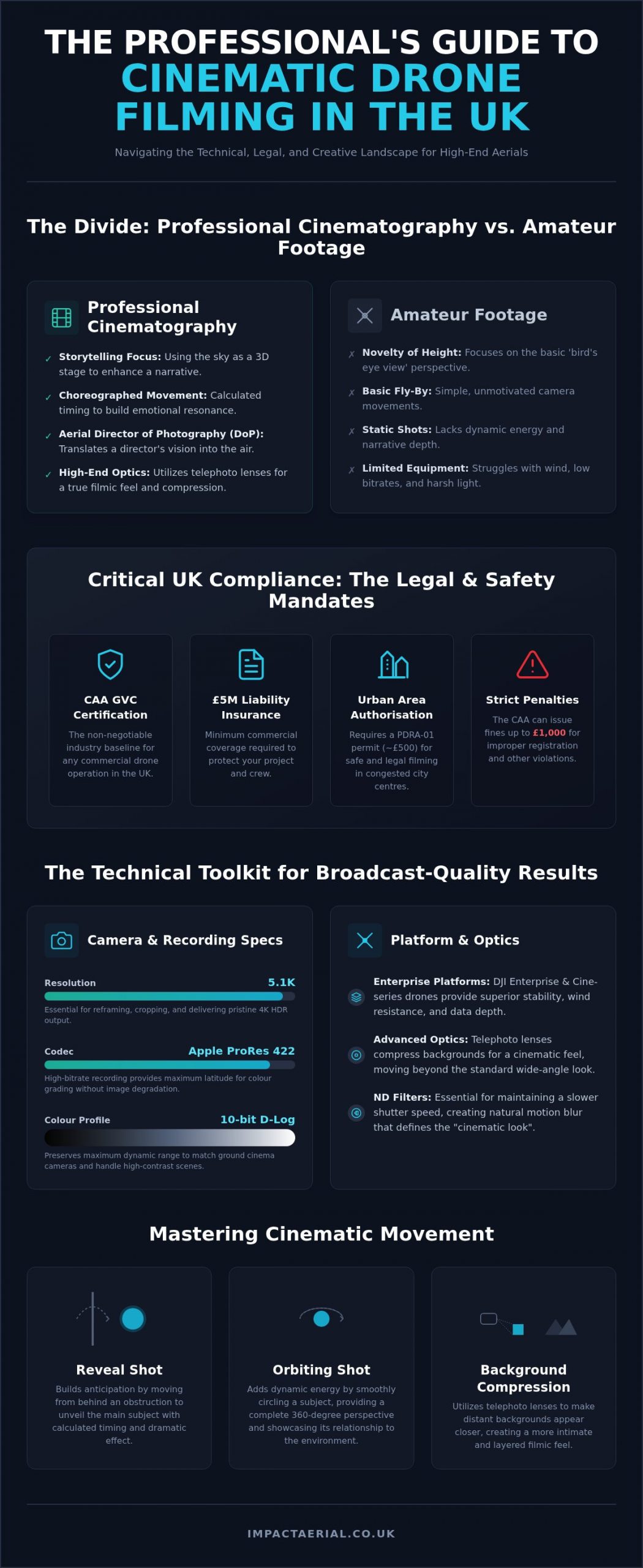
True cinematic drone filming UK is defined by storytelling, not simply the novelty of height. While a hobbyist might capture a basic ‘fly-by’ that shows a subject from above, professional aerial cinematography uses the sky as a three-dimensional stage to enhance a narrative. It’s the difference between a static shot and a choreographed movement that builds emotional resonance or reveals a subject with calculated timing.
To see the aesthetic quality achievable through professional techniques, watch this footage of the UK coastline:
In the professional UK media landscape, production companies don’t just look for a pilot; they require an Aerial Director of Photography (DoP). This specialist understands how to translate a director’s vision into the air, managing technical variables like shutter angle and lens compression while maintaining strict safety standards. Because the UK has rigorous aviation laws, working with a CAA GVC certified operator for cinematic drone filming UK is the industry baseline. It ensures that every shot is not only visually stunning but also fully compliant with current flight categories and insurance requirements.
Visual Language: Moving Beyond the ‘Bird’s Eye View’
Cinematic depth is often achieved by moving away from standard wide-angle perspectives. Professional operators utilize focal length diversity, using telephoto lenses to compress the background and create a more intimate, filmic feel. This approach is essential for high-end UK broadcast and commercial work where 4K HDR and high dynamic range are standard. These technical specs allow the footage to retain detail in both highlights and shadows, ensuring the aerial visuals serve the broader narrative of a property film or brand commercial without looking out of place alongside ground-based cinema cameras.
Why Professional Equipment Matters for UK Projects
The gap between consumer drones and professional platforms is significant. While a hobbyist drone might struggle with wind resistance or limited bitrates, platforms like the DJI Enterprise and Cine-series offer the stability and data depth needed for professional post-production. Stabilised gimbals are the backbone of this process, providing buttery-smooth movement even in the unpredictable UK weather. Cinematic drone filming is a blend of high-end optics and precise flight control. By using commercial-grade hardware, operators can deliver the ProRes 422 or 10-bit D-Log files that colourists require for a high-tier finish.
The Technical Toolkit: 4K HDR, ProRes, and High-End Optics
High-tier cinematic drone filming UK relies on more than just a stable flight path. It requires a camera system capable of capturing massive amounts of visual data to survive the rigours of a professional edit. Industry standards have shifted toward 5.1K resolution and Apple ProRes 422 codecs. These formats provide the “latitude” needed to adjust exposure and colour without the image breaking down. While standard consumer drones often use heavy compression, professional platforms capture every nuance of a scene, ensuring the aerial footage remains indistinguishable from high-end ground-based cinema cameras.
The UK’s weather presents a unique technical challenge. Our often flat, overcast skies can lead to “banding” in the clouds if the recording bitrate is too low. By utilizing high-bitrate recording and 10-bit D-Log colour profiles, we ensure smooth gradients in grey or white skies. This technical precision is paired with the use of Neutral Density (ND) filters. These act like sunglasses for the drone, allowing us to maintain a slower shutter speed. This is essential for creating the natural motion blur that defines the “cinematic look,” preventing the jittery, hyper-sharp appearance of amateur footage.
Mastering the Colour Grade with HDR and D-Log
Capturing in 10-bit D-Log is a necessity for matching aerial shots with a production’s primary camera. This “flat” profile preserves the maximum dynamic range, which is vital when filming high-contrast environments like the reflective glass of a London skyscraper or the deep shadows of a Welsh valley. These files are designed to be integrated into professional post-production services, where colourists can apply a final grade that makes 4K HDR visuals truly pop. This workflow ensures that whether the final output is for a broadcast commercial or a luxury property film, the visual consistency remains flawless.
Focal Lengths: The Aerial Cinematographer’s Secret
Traditional drone shots rely heavily on wide-angle lenses to establish a scene. However, modern cinematic work often uses telephoto lenses (70mm+) to create parallax and background compression. This technique makes buildings or landscapes appear closer to the subject, adding a sense of scale that wide lenses cannot achieve. DJI Enterprise drones allow for lens switching or zooming without the need to land. This capability saves valuable shoot time on busy construction sites or fast-moving film sets. Using these varied focal lengths helps us move beyond simple “bird’s eye” views into genuine storytelling. If you are planning a project that requires this level of technical depth, consider how professional aerial cinematography can elevate your final production.
Navigating UK Regulations and Congested Area Permissions
The Civil Aviation Authority (CAA) serves as the primary regulator for all airspace activity in the United Kingdom. For professional cinematic drone filming UK, a standard Flyer ID is merely the entry point; the industry benchmark is the GVC (General Visual Line of Sight Certificate). This qualification demonstrates that a pilot has the theoretical knowledge and practical skills to operate in the “Specific” category, which is where most high-end production work takes place. Without this certification, a pilot cannot legally undertake the complex manoeuvres required for cinematic storytelling in public spaces.
Filming in congested areas requires an Operational Authorisation, typically based on a PDRA-01 (Pre-Defined Risk Assessment). As of April 2025, the fee for this authorisation is £500 per year, reflecting the increased scrutiny placed on commercial operators. This permit is vital for any shoot that takes place within towns or cities. Alongside this, Impact Aerial maintains £5m commercial liability insurance. This level of cover is often a mandatory requirement for high-value production sets and local authority permissions, providing peace of mind that all risks are professionally mitigated.
Filming in UK Cities: Birmingham, London, and Beyond
Operating in urban centres like Birmingham or London involves a layered permissions process. It isn’t just about the flight itself; it’s about managing the take-off and landing points, which often require consent from local councils or private landowners. We handle the logistical headache of these applications, including notifying the police and NATS when flying in restricted airspace. Our strategic base in Birmingham allows us to deploy rapidly across the UK, bringing our experience in urban flight planning to every project. We ensure that every flight is preceded by a site-specific risk assessment that satisfies both the regulator and the client’s safety team.
Safety Protocols and Risk Mitigation
Rigorous safety protocols are what separate a professional cinematography unit from a hobbyist. A valid UK drone license is non-negotiable for commercial work, especially as regulations now require registration for any drone over 100g. During complex cinematic shoots, we often deploy a dedicated camera operator alongside the pilot. This allows the pilot to focus entirely on flight safety and spatial awareness while the operator manages the framing and focus. This dual-operator setup is essential for achieving the dynamic, precise movements required for high-end film. CAA compliance is the foundation of any safe UK drone operation.
Creative Techniques for Cinematic Drone Movement
Movement is the primary language of aerial cinema. While technical specifications provide the raw data, it’s the flight path that creates an emotional connection with the viewer. The ‘Reveal’ shot is a fundamental technique for property and tourism films across Britain. By starting the drone behind a natural or architectural obstacle and slowly rising or panning, we build anticipation before unveiling the primary subject. This creates a narrative ‘payoff’ that transforms a simple view into a memorable discovery.
Tracking and orbiting shots inject visceral energy into moving subjects like cars or boats. By maintaining a fixed radius around a subject in motion, we create a dynamic perspective that keeps the viewer engaged. This is often paired with the ‘parallax effect’, where foreground elements like trees or lamp posts move across the frame faster than the distant background. It creates a profound sense of scale and depth, grounding the drone’s position in the physical world. For cinematic drone filming UK, we also leverage ‘top-down’ graphic shots. This perspective utilizes the geometric symmetry found in UK urban architecture and historical sites to create striking, abstract visuals that offer a fresh look at familiar locations.
FPV vs. Traditional Cinematic Drones
The choice of flight platform depends on the desired emotional impact of the scene. High-speed FPV (First Person View) drones provide immersive, high-octane ‘fly-throughs’ that can navigate tight gaps or follow fast-moving subjects with extreme precision. Conversely, traditional GPS-stabilised drones offer a majestic, steady look ideal for vast landscapes or establishing shots. Most professional productions benefit from a comprehensive aerial filming drone package that combines both styles, ensuring a diverse and engaging shot list for the final edit.
Planning the Perfect Golden Hour Shoot
Lighting is the most critical variable in UK outdoor filming. The ‘Golden Hour’, that short window after sunrise or before sunset, provides the soft, directional light that makes textures pop and colours feel rich. We use sun-tracking apps to plan flight paths weeks in advance, ensuring the drone is positioned to capture the best possible light for every angle. However, planning must also account for the UK’s unpredictable weather. Managing wind speeds and sudden cloud cover requires a pilot who can adapt the creative plan on the fly without compromising safety. If you’re ready to capture these high-end visuals for your next production, speak with our specialist team to discuss your project requirements.
Choosing Your UK Drone Partner: The Impact Aerial Advantage
Selecting the right partner for cinematic drone filming UK involves more than just checking gear lists; it requires a commitment to safety and a deep understanding of the national regulatory landscape. Impact Aerial is strategically based in Birmingham, serving as a primary hub for rapid deployment across the West Midlands, London, and the wider UK. This central location ensures we can reach diverse filming sites quickly while maintaining the high standards of a national operator. Our fleet of DJI Enterprise drones is specifically chosen for its reliability and superior 4K HDR optics, ensuring that every frame we capture meets the rigorous demands of high-tier production.
Operational safety is the cornerstone of our service. We carry £5m commercial liability insurance and operate under strict CAA safety standards to ensure every project is fully compliant and insured. This meticulousness extends to our planning phase, where we manage the complex permissions required for urban environments and sensitive sites. We don’t just fly; we provide a vetted, professional service that mitigates risk for every stakeholder involved. Safety remains our priority. By providing a ‘headache-free’ experience, we allow our clients to focus on the creative direction while we handle the technical and legal intricacies of the flight.
From Consultation to Final Edit
We’ve built a collaborative workflow designed to support your project from the initial brief through to the delivery of the final assets. Whether you require high-resolution drone photography or complex aerial cinematography, we tailor our approach to your narrative goals. We manage all UK flight permissions and site-specific risk assessments as part of our standard service. Clients have the flexibility to receive ‘footage ready’ files in professional codecs like Apple ProRes or can utilize our full post-production suite for edited cinematic sequences. This ensures that the high dynamic range and colour depth captured in the air are perfectly translated to the screen.
Specialised Services Across UK Sectors
Our team provides tailored cinematic solutions across a range of industries, including luxury property, large-scale construction site monitoring, and high-end advertising. For brands seeking to amplify their campaign reach through specialized mobile outdoor displays, you can visit Gorilla Media Limited for expert support. The use of CAA GVC certified pilots is a non-negotiable standard for our team, ensuring that even the most challenging commercial environments are handled with professional precision. We manage it all. Our experience allows us to adapt our filming style to suit the specific tone of your brand, from majestic landscape reveals to high-energy tracking shots. To discover how our expertise can benefit your next production, contact us to request a bespoke quote for your UK-wide cinematic drone project.
Elevate Your Production with Professional Aerial Cinematography
Mastering cinematic drone filming UK requires balancing creative vision with technical precision and strict regulatory adherence. You’ve seen how 5.1K ProRes optics and advanced movement techniques like the ‘parallax effect’ can transform a standard project into a high-end narrative. By prioritizing CAA GVC certified pilots and commercial-grade hardware, you ensure that your production remains both visually stunning and fully compliant with current UK aviation laws. It’s about moving beyond the bird’s eye view to tell a compelling story through the sky.
We handle the logistical complexity of take-off permissions and risk assessments so you can focus on the creative direction. With our strategic base in Birmingham, we provide comprehensive UK-wide coverage backed by £5m commercial liability insurance. Our team is ready to integrate seamlessly with your ground-based film crew to deliver consistent, broadcast-quality results. If you’re ready to secure high-tier aerial visuals for your next project, contact Impact Aerial for a cinematic drone filming brief today. We look forward to bringing your vision to life with precision and safety.
Frequently Asked Questions
Do I need special permission for cinematic drone filming in London?
Yes, London is one of the most restricted environments in the country due to various Flight Restriction Zones. Professional filming in the capital requires a CAA Operational Authorisation and specific coordination with NATS for zones near major airports. We also secure take-off and landing consent from local councils or private landowners. This meticulous preparation ensures that your shoot remains fully compliant with metropolitan aviation safety protocols.
What is the difference between a standard drone and a ‘cinematic’ drone?
Cinematic drones are distinguished by their optics and data output rather than flight speed or portability. While standard drones use compressed formats, cinematic platforms record in 5.1K resolution and 10-bit D-Log. These systems feature interchangeable lenses and professional gimbals that eliminate micro-vibrations. This hardware allows us to match the visual texture and dynamic range of high-end ground cameras, which is essential for professional storytelling.
Why is CAA GVC certification important for hiring a UK drone pilot?
The GVC is the mandatory benchmark for any pilot operating in the CAA’s Specific category. It proves that the operator has passed rigorous theoretical and flight assessments tailored to commercial risks. For cinematic drone filming UK, hiring a GVC certified pilot is the only way to legally fly in congested town centres. It also validates the pilot’s £5m liability insurance, protecting your production from legal and financial risks.
Can drones film cinematically in bad UK weather like rain or high wind?
While professional DJI Enterprise drones have robust wind resistance, we avoid filming in heavy rain to protect image clarity and sensitive electronics. Moderate winds are manageable, but cinematic shots require absolute stability. We monitor Met Office data closely and use sun-tracking apps to find the best windows. If the weather compromises safety or visual quality, we reschedule to ensure your production meets professional standards.
How much does professional cinematic drone filming cost in the UK?
Pricing for professional aerial cinematography depends on your specific brief, location, and technical requirements. Fees account for pre-flight planning, crew size, and the specialized hardware utilized. We don’t use generic price lists because every project has unique permission requirements and post-production needs. We encourage clients to contact us for a bespoke quote, ensuring a transparent and accurate cost structure for their UK-wide cinematic projects.
What is ProRes 422 and why do I need it for my drone video?
ProRes 422 is a professional-grade codec that maintains significantly more visual information than consumer-grade H.264. It’s a technical necessity for cinematic drone filming UK because it allows colourists to manipulate the image in post-production without causing artifacts. By capturing more data in the highlights and shadows, ProRes ensures that your aerial sequences integrate seamlessly with high-end ground footage during the final colour grade.
How long does it take to get permissions for a UK drone shoot?
Permission timelines vary based on the complexity of the airspace. Rural flights often require minimal notice, but city centre shoots typically need 14 to 21 days for full coordination. This period allows us to secure council permits, notify the police, and obtain NATS clearance for restricted zones. We manage this entire process from start to finish, removing the administrative burden from your production team’s schedule.
Does Impact Aerial provide unedited raw footage or a final edited film?
We provide a flexible service tailored to your internal workflow. Many clients prefer unedited raw footage in 10-bit ProRes 422 for their own post-production teams to grade. Alternatively, we offer full post-production services, delivering a final edited film complete with colour grading and sound design. Whether you need raw data or a finished narrative sequence, we ensure the output meets your project’s high-end technical specifications.
 2 Norton Drive, Wythall, Birmingham, B47 6HH Company registration number: 11138586. VAT Number: 366 9068 55