By 2026, a standard ground-level shot isn’t just safe; it’s effectively invisible to an audience conditioned for cinematic scale. To truly capture attention and convey authority, your brand needs the unique perspective that only a professional aerial marketing video can provide. Using high-altitude visuals isn’t about novelty anymore; it’s about demonstrating the full scope of your operations in a way that traditional filming simply cannot match.
You’ve likely felt the frustration of seeing a major project look flat on screen because the camera couldn’t capture its true magnitude. Many marketing managers also face the stress of navigating strict UK drone laws or the fear of hiring an uncertified operator who lacks the proper insurance. It’s a common hurdle that often prevents brands from reaching their visual potential and can lead to significant regulatory risks.
This guide will show you how to overcome these obstacles and deliver high-impact visuals that stop the scroll. You’ll learn the technical difference between hobbyist footage and commercial 4K HDR quality, while discovering how a fully managed production process ensures your project is both stunning and CAA compliant. We will walk through the essential certifications and workflows that turn elevated filming into a strategic, reliable brand asset.
Key Takeaways
- Understand how a strategic aerial marketing video leverages a birds-eye perspective to build consumer trust and establish immediate brand authority.
- Learn why commercial-grade DJI Enterprise hardware and 4K HDR are essential for capturing the vibrant, high-tier detail required for professional marketing.
- Identify high-value applications for aerial filming in property and construction to effectively communicate scale and project capability to stakeholders.
- Explore the end-to-end production process, from initial storyboard development to navigating complex UK flight regulations and safety protocols.
- Discover the importance of professional certification and how CAA GVC certified pilots mitigate risk while delivering meticulous, high-impact results.
What is Aerial Marketing Video and Why Does Your Brand Need It?
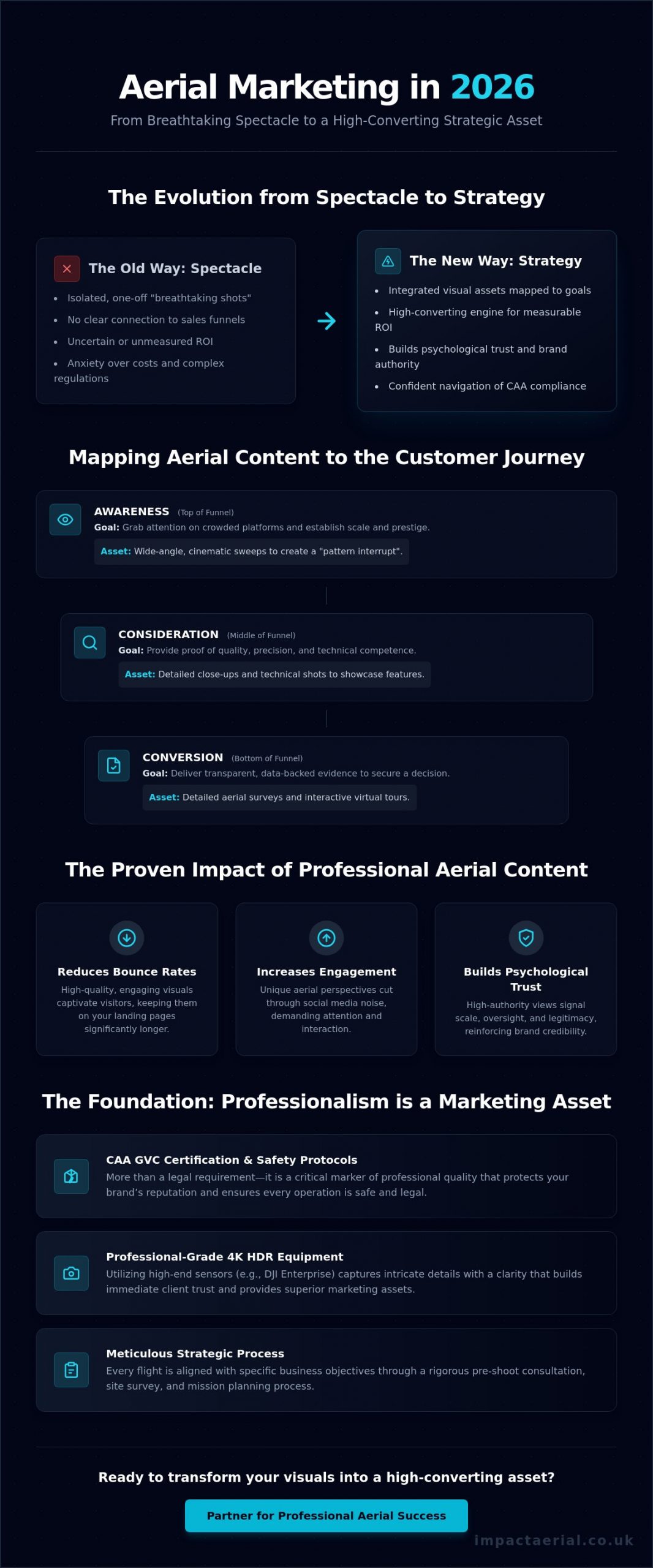
An aerial marketing video is a strategic asset that combines cinematic drone filming with targeted commercial messaging. It moves beyond simple observation to tell a story about scale, location, and capability. While traditional Aerial photography has provided a static viewpoint for decades, modern UAV technology allows us to weave complex narratives through controlled, dynamic movement. By 2026, this technology has become the baseline standard for industries that rely on physical presence, such as large-scale industrial sectors, tourism, and high-end property development.
The psychological impact of the “birds-eye” perspective is profound. It provides a sense of transparency and authority that ground-level filming cannot replicate. When a customer sees the full extent of a facility or the surrounding context of a development, their perceived trust in the brand increases. This perspective removes the “hidden” elements often associated with tight, ground-based shots, offering a literal and metaphorical “big picture” view of your operations. When planning an aerial marketing video, the focus is often on the visual impact, but the real value lies in this immediate establishment of brand dominance.
The ROI of Aerial Visuals in 2026
High-impact aerial footage is a proven driver of engagement. Data suggests that websites featuring video content see a significant increase in “time on page,” as viewers are naturally drawn to the sweeping movement of drone shots. In social media feeds, these visuals are essential for breaking through the noise of static content. For high-value assets like commercial real estate, drone video shortens the sales cycle by providing stakeholders with all the contextual information they need in a single, immersive experience. Using drone video for commercial listings delivers a measurable conversion lift by providing a more comprehensive understanding of the property’s total value and surrounding infrastructure.
From Social Media to TV: Versatility of Aerial Content
One of the greatest advantages of modern aerial content is its technical flexibility. By filming in high-bitrate 4K HDR, we ensure the footage is future-proof and versatile across all marketing channels. This high-resolution output allows editors to crop horizontal footage for vertical platforms like TikTok or Instagram Reels without sacrificing the professional quality your brand demands. The detail captured by DJI Enterprise sensors remains crisp, even when reformatted for mobile-first consumption.
Beyond social media, this content serves as the backbone for corporate presentations, high-definition website headers, and broadcast-standard advertising. Whether it’s a 15-second “scroll-stopper” or a 5-minute investor overview, the quality remains consistent. For a deeper look at the technology behind these shots, explore our guide on the Aerial Filming Drone: The Ultimate Guide to Professional Cinematic Video. This versatility ensures that a single production schedule provides a library of assets for your entire annual marketing strategy.
The Technical Edge: 4K HDR and Commercial-Grade Drone Hardware
The visual quality of a professional aerial marketing video is determined by the hardware’s ability to manage light and movement with surgical precision. Unlike consumer models, DJI Enterprise hardware utilizes larger CMOS sensors that significantly improve the signal-to-noise ratio. This technical advantage allows our pilots to capture intricate details in deep shadows and bright highlights simultaneously. When filming a construction site or a sprawling commercial estate, this expanded dynamic range ensures that every architectural detail remains visible, regardless of the sun’s position.
4K HDR (High Dynamic Range) is a critical standard for any brand aiming for a premium market position in 2026. HDR technology ensures that colors are vibrant and “pop” on high-definition displays, from mobile screens to boardroom projectors. Without this, footage often looks washed out or overly dark in high-contrast environments. Furthermore, commercial drones provide the stability required for cinematic fluidity. High-torque motors and advanced GPS-stabilisation allow for steady flight paths even in challenging UK weather conditions, ensuring that “camera shake” never distracts from your brand message.
We also utilize specialized sensors and high-resolution zoom lenses to capture specific site features from a safe distance. This capability is essential for maintaining site privacy and adhering to strict safety protocols. While our operations are governed by UK CAA GVC standards, the industry’s commitment to safety is mirrored globally in frameworks like the FAA Part 107 regulations, which emphasize the importance of pilot certification and hardware reliability. If you’re unsure which technical specifications your project requires, you can view our technical filming capabilities to see how professional hardware transforms a shoot.
Hardware Spotlight: DJI Enterprise Capabilities
- DJI Mavic 3 Series: This platform offers the perfect balance of agility and optical power for rapid marketing deployments across the UK.
- 10-bit D-Log Profiles: Filming in a flat color profile allows our post-production team to apply Hollywood-standard color grading, ensuring your brand colors are perfectly represented.
- Redundant Systems: Professional drones feature dual IMUs and compasses to ensure flight safety and data integrity throughout the production.
Why ‘Hobbyist’ Drones Fail Commercial Marketing Standards
The primary failure of consumer-grade drones lies in bitrate and compression. Low-bitrate footage often suffers from “blocky” artifacts during fast movement, which destroys the professional feel of the final edit. Non-professional setups are also prone to the “jello effect,” a visual distortion caused by camera vibration that makes the footage look amateurish and unstable. Professional-grade hardware is the non-negotiable foundation of high-end output, providing the reliability and image depth that your brand’s reputation depends on.
Industry Applications: Where Aerial Marketing Delivers the Most Value
While the technical specifications of sensors and bitrates establish the quality, the true value of an aerial marketing video is found in its specific industry applications. By 2026, several sectors have identified aerial content as a strategic necessity rather than an optional extra. These applications include:
- Property and Real Estate: Capturing total site acreage, proximity to transport links, and surrounding landmarks in a single cinematic sequence.
- Construction and Building: Utilizing progress filming to demonstrate operational capability and safety standards to future investors.
- Hospitality and Tourism: Creating immersive fly-throughs of resorts, golf courses, and outdoor attractions to drive direct bookings.
- Advertising and Media: Producing high-octane “hero” shots that establish immediate brand authority in commercials and social campaigns.
In the real estate sector, aerial filming provides the contextual data that ground-level cameras cannot replicate. It allows potential buyers to understand the location’s infrastructure and environmental setting, which is vital for high-value commercial and residential transactions. This visual evidence of scale builds immediate trust and shortens the decision-making process for stakeholders.
Commercial Property and Site Monitoring
Marketing massive industrial units and logistics hubs requires a perspective that effectively communicates volume and accessibility. An aerial view simplifies the explanation of complex sites, showing docking bays, access roads, and expansion potential with total clarity. There is a strategic crossover between marketing footage and technical data collection; for instance, our construction site monitoring services often provide the raw, high-resolution footage needed for high-impact social media updates. You can learn more about the technical side of this in our guide to Drone Survey: The Complete Guide to Aerial Data Collection.
Virtual Tours and Immersive Experiences
The hospitality sector increasingly relies on combined 360-degree aerial views and ground-level virtual tours to create a total marketing package. This allows potential guests to explore a venue before they book, providing a level of transparency that traditional photography lacks. Interactive aerial maps can also help buyers “walk” through a development before construction is even finished. The future of this immersion lies in FPV (First Person View) fly-throughs, where agile drones transition from wide outdoor sweeps to narrow interior spaces. Integrating this level of movement into an aerial marketing video stops the scroll on social feeds and drives measurable engagement with your brand.
The Production Journey: From Initial Consultation to Final Edit
A successful aerial marketing video isn’t born in the air; it’s built on the ground through a structured, four-stage production journey. We begin with a meticulous pre-production phase where we define the storyboard and identify your brand’s core messages. This planning ensures that every flight path and camera angle serves a specific purpose, whether you’re highlighting the scale of a logistics hub or the architectural detail of a new development. By aligning our creative vision with your commercial goals before the propellers even spin, we guarantee a more efficient shoot and a more effective final product.
Regulatory planning is the next critical step. Our team handles the complexities of risk assessments and secures the necessary flight permissions for challenging UK environments, such as congested urban centers or restricted airspace. During the shoot, our CAA GVC certified pilots work collaboratively with your team on-site. This professional partnership allows us to adjust to real-time conditions while maintaining the highest safety standards. The journey concludes with post-production, a phase where raw data is transformed into a polished, high-impact marketing asset that’s ready for distribution across all your digital channels.
Safety as a Brand Asset
Safety is more than a legal requirement; it’s a shield for your brand’s reputation. Hiring uncertified or uninsured operators exposes your business to significant legal liability and the risk of negative PR if an incident occurs. We mitigate these risks by maintaining £5m commercial liability insurance and strictly adhering to the latest aviation protocols. This commitment to compliance provides the psychological comfort you need when filming on high-value marketing sites. To better understand the current regulatory landscape, you can read our guide on the UK Drone License: A Simple Guide to CAA Rules in 2026.
The Power of Post-Production Editing
The edit suite is where your aerial marketing video truly takes shape. We use professional color grading to ensure the visual aesthetic perfectly matches your brand’s existing palette and style. This consistency is vital for maintaining a premium feel across your marketing ecosystem. We also integrate motion graphics, call-to-actions, and brand logos to turn cinematic footage into a functional sales tool. Sound design is equally important; audio accounts for 50% of the marketing experience. We use carefully selected, licensed music and immersive soundscapes to reinforce the emotional impact of the visuals. If you’re ready to elevate your brand’s perspective, you can book a professional drone production consultation with our expert team today.
Choosing Impact Aerial: Professionalism, Compliance, and Precision
Impact Aerial is headquartered in Birmingham, serving as a strategic central hub for nationwide UK operations. Our West Midlands roots provide us with unique regional expertise, yet our reach extends to every corner of the country, ensuring rapid deployment for large-scale national projects. We don’t just operate as a creative agency; we are technical consultants who bridge the gap between complex UAV operations and the high-end demands of modern advertising. This dual perspective ensures that every aerial marketing video we produce is both visually arresting and technically flawless.
Our commitment to the highest industry standards is absolute. Every pilot in our team is CAA GVC certified, maintaining an up-to-the-minute understanding of the evolving UK regulatory landscape. We understand that for our clients, compliance is a non-negotiable component of brand reputation. By handling all the complex paperwork, risk assessments, and flight permissions on your behalf, we remove the administrative burden from your team. This full-service project management approach allows you to dedicate your energy to your marketing strategy while we ensure the legal and operational integrity of the shoot.
Bespoke Solutions for Every Sector
We recognize that a “one size fits all” approach doesn’t work in professional filming. We offer customized filming packages tailored to the specific needs of your industry, whether you’re marketing a luxury residential development or documenting the massive scale of a PV solar farm. Our DJI Enterprise fleet is equipped with a range of specialized sensors, ensuring we always deploy the right tool for your specific marketing challenge. For a broader perspective on how our technology integrates with various business operations, explore our A Complete Guide to Professional Drone Services in the UK.
Get Started with Your Aerial Campaign
The path to a successful campaign begins with a detailed initial consultation and site assessment. During this stage, we work with you to identify the key visual assets required to meet your commercial objectives. To ensure the highest quality results on the day of the shoot, we recommend preparing your site by removing any distracting vehicles or temporary equipment from the primary filming zones. This attention to detail in the planning phase ensures that the final footage is clean, professional, and ready for high-impact use. Contact Impact Aerial today for a bespoke aerial marketing proposal and take the first step toward elevated brand storytelling.
Transforming Your Brand Perspective for 2026
The integration of a professional aerial marketing video is no longer a luxury for high-tier brands; it’s a fundamental tool for capturing scale and building authority. We’ve explored how 4K HDR cinematic output and specialized DJI Enterprise hardware elevate your visual storytelling far beyond the capabilities of consumer-grade drones. By prioritizing CAA GVC certified pilots and maintaining £5m commercial liability insurance, you ensure your project is compliant and your brand reputation remains secure throughout the production process.
Impact Aerial provides a meticulous, full-service approach from our Birmingham base, offering UK-wide coverage for projects that demand technical precision and operational reliability. We handle every regulatory requirement and post-production detail, allowing you to focus on your broader marketing objectives. The right perspective doesn’t just show your operations; it demonstrates your leadership and commitment to quality in an increasingly competitive market.
Elevate your brand with a professional aerial marketing video; request a quote from Impact Aerial.
We look forward to helping you capture the unique scale of your next project with the expert precision it deserves.
Frequently Asked Questions
Do I need a permit for an aerial marketing video shoot in the UK?
You must have the correct operational authorization from the Civil Aviation Authority (CAA) to conduct a commercial shoot. Our team manages the entire regulatory process, including site-specific risk assessments and securing any necessary flight permissions from local authorities or air traffic control. This ensures your project remains fully compliant with current UK aviation laws and safety standards.
How much does a professional aerial marketing video cost?
The investment for a professional production depends on several factors such as the location’s complexity, the required flight time, and the depth of post-production editing. We provide bespoke proposals for every aerial marketing video to ensure the scope of work aligns with your specific commercial goals. This approach allows us to provide the most efficient hardware and personnel for your project’s unique requirements.
Can you fly drones for marketing in city centres like Birmingham or London?
Yes, we can operate in urban environments provided the mission is planned meticulously. Flying in congested areas requires a pilot with a General Visual Line of Sight Certificate (GVC) and specific safety protocols to manage ground risk effectively. We coordinate with local councils and the police where necessary to ensure a safe and legal operation within busy city centres.
What happens if the weather is bad on the day of the drone shoot?
Safety is our primary concern; we don’t fly in conditions that exceed the technical limits of our DJI Enterprise hardware. We monitor weather systems 48 hours before the shoot and maintain a flexible scheduling policy. If high winds or precipitation make filming unsafe, we will reschedule the session to the next available window with optimal lighting and flight conditions.
How long does the post-production and editing process take?
A standard marketing edit typically takes between seven and fourteen working days from the date of the shoot. This timeframe allows our team to perform high-tier color grading, sound design, and the integration of any required motion graphics. We provide a structured delivery schedule during the pre-production phase so your marketing team can plan their campaign launch with confidence.
Is your drone pilot CAA GVC certified and insured for commercial work?
Every pilot at Impact Aerial is fully CAA GVC certified and operates under our comprehensive commercial authorization. We carry £5m in commercial liability insurance as standard, which provides essential protection for our clients when filming on high-value industrial or commercial sites. We are happy to provide copies of our certifications and insurance documents during the initial consultation.
Can you provide raw footage or only the finished edited marketing video?
We can provide both the final polished edit and the raw 4K HDR data depending on your project requirements. Most clients prefer a finished aerial marketing video that’s ready for social media or broadcast, but we understand that some internal teams require raw footage for future archives. We discuss these delivery formats during the storyboard phase to ensure you receive the exact assets you need.
How do you ensure privacy when filming in residential or busy commercial areas?
We ensure privacy by adhering to strict data protection regulations and CAA flight safety codes. Our pilots use high-resolution zoom lenses to capture detailed site features from a significant distance, which avoids the accidental collection of identifiable personal data. If any sensitive information is captured, we use advanced post-production techniques to mask identifiable features before the final delivery.
 2 Norton Drive, Wythall, Birmingham, B47 6HH Company registration number: 11138586. VAT Number: 366 9068 55