Did you know that consumers aged 18 to 34 are 130% more likely to book or visit a business if they can first engage with an immersive online experience? In a market where digital presence dictates physical success, a professional virtual tour for retail spaces has become the benchmark for commercial credibility. You probably recognize the difficulty of showcasing the true scale of a premium showroom through flat photography, especially when low footfall threatens your bottom line. It’s frustrating to invest in a high-end physical space that your online audience cannot fully appreciate or navigate with ease.
This guide provides a clear roadmap to transforming your retail environment into a high-converting 4K digital twin. We will examine how technical precision, aerial integration, and professional post-production create a seamless journey that increases website dwell time. By following these industry-leading standards, you can secure a significant competitive advantage and ensure your commercial space thrives in the 2026 retail landscape.
Key Takeaways
- Transition from static online galleries to immersive 4K digital twins to significantly increase user dwell time and customer trust.
- Learn how a virtual tour for retail spaces leverages advanced hardware like the Matterport Pro3 to provide high-resolution product clarity and spatial accuracy.
- Understand the critical importance of professional certifications, such as CAA GVC, to ensure your digital scan is conducted with full regulatory compliance and safety.
- Follow a practical planning checklist that prioritizes “Hero Product” placement and optimized lighting to create a high-converting customer path.
- Discover how integrating aerial perspectives with 3D walkthroughs creates a comprehensive digital ecosystem for your commercial property.
What is a Virtual Tour for Retail Spaces and Why Does it Matter?
A virtual tour for retail spaces is no longer just a series of stitched-together photos. It’s a high-resolution, 360-degree digital replica of your physical environment. By 2026, the technology has evolved from grainier “street view” clones into immersive 4K HDR digital twins. These sophisticated models allow customers to navigate a store with the same fluidity they’d experience in person. If you’re wondering What is a Virtual Tour? in a commercial context, it’s a data-rich environment where every product shelf and architectural detail is rendered with mathematical precision.
To better understand how these experiences come to life, watch this helpful video:
The Evolution of Retail Visuals in 2026
Traditional photography often fails to capture the scale of modern commercial properties. Static images don’t tell the full story. In 2026, leading brands use an aerial filming drone to establish the geographic context and impressive scale of a flagship site before transitioning into an indoor 3D walkthrough. This provides a macro to micro perspective that photography simply cannot match. Beyond marketing, 3D mapping serves as a vital tool for internal staff training; it allows new employees to learn store layouts and merchandising standards in a risk-free digital environment.
Key Benefits for Retailers and Showrooms
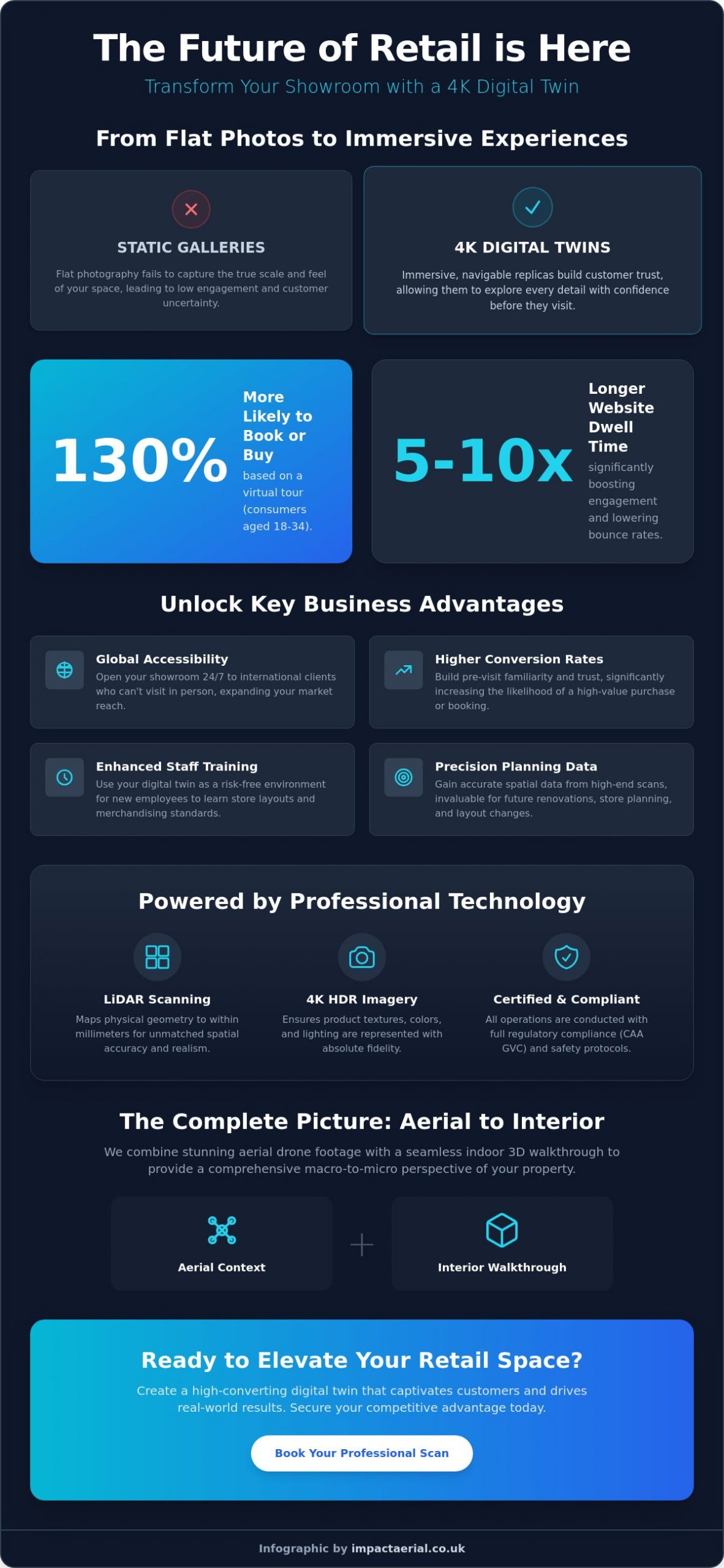
The commercial impact is measurable and immediate. Data suggests that websites featuring virtual tours are viewed 5 to 10 times longer than those without. This increased dwell time directly correlates with lower bounce rates and higher enquiry volumes. The meticulous nature of a 4K scan ensures your brand is perceived as a leader in your sector.
- Global Accessibility: Your London or Birmingham showroom is open 24/7 to international clients who can’t visit in person.
- Sustainability: By offering a qualified virtual visit, you reduce unnecessary travel for clients who only need to confirm specific details before purchasing.
- Conversion: Prospects aged 18 to 34 are 130% more likely to book or buy based on a virtual experience.
- Precision: High-end digital twins provide accurate spatial data, which is useful for future renovations or store planning.
The Technology Behind High-Conversion Virtual Experiences
High-conversion digital twins aren’t created with consumer-grade cameras. To achieve professional results, we utilize LiDAR-based systems like the Matterport Pro3. This hardware doesn’t just take pictures; it maps the physical geometry of a room to within millimeters. While custom 360 photography has its uses, it often lacks the spatial depth required for a truly navigable virtual tour for retail spaces. Research into The Technology Behind Virtual Experiences confirms that high-fidelity rendering and interactive elements are critical for maintaining customer engagement in a digital retail environment.
Visual clarity is non-negotiable for premium brands. We use 4K HDR imagery to ensure that product textures and colors are represented with absolute accuracy. This precision is vital for showrooms where material quality is a primary selling point. To drive actual sales, we integrate interactive “Mattertags”. These digital hotspots allow you to embed product videos, direct purchasing links, or booking forms directly into the 3D environment. If you want to see how these elements function in a live environment, you can explore our professional virtual tour creation services.
Indoor Immersive Walkthroughs
A successful tour must be intuitive for the end-user. We generate a “Dollhouse View”, which provides a 3D cutaway of the entire building. This is particularly effective for multi-floor department stores, as it allows customers to understand the layout instantly. Our technicians prioritize the strategic placement of information points near high-margin product lines. We also focus on smooth navigation. By carefully calculating the distance between scan points, we prevent the “digital motion sickness” that poorly executed tours often cause. This technical attention to detail ensures the user remains focused on your products rather than the interface.
Aerial Context and External Mapping
Indoor scans only tell half the story of a physical location. To provide a complete commercial perspective, we integrate high-resolution drone photography to capture building exteriors and car parks. This establishes the physical accessibility and prominence of your site. Using professional-grade commercial drones, we can create cinematic “fly-through” sequences. These start high above the retail park and transition smoothly into the indoor 3D display. For large-scale developments, the addition of drone survey data provides prospective tenants or buyers with precise site measurements and structural context that standard marketing materials lack.
Professional Standards: Safety, Insurance, and Compliance
Engaging a hobbyist for a virtual tour for retail spaces represents a significant operational risk that high-street brands simply cannot afford. The legal and reputational fallout of an uninsured accident or a regulatory breach far outweighs any perceived cost savings. Professional operators prioritize compliance with the same rigor they apply to image quality. For instance, operating drones in congested retail environments requires a specific level of competence. We hold the CAA GVC (General Visual Line of Sight Certificate), which is the industry standard for pilots working in complex urban settings. This certification ensures every flight is conducted within a strict safety framework, protecting both the public and your property.
Insurance is another non-negotiable factor in the commercial sector. A standard drone policy is rarely sufficient for high-traffic retail environments. We maintain £5m in commercial liability insurance, providing the necessary financial protection and peace of mind for our clients. During the filming process, our team implements rigorous risk mitigation strategies. We manage foot traffic and coordinate closely with store managers to ensure the scanning process doesn’t compromise public safety or the customer experience. This methodical approach is what separates a professional digital twin from a low-quality amateur attempt.
Navigating UK Drone Regulations in 2026
Understanding the current drone license requirements is essential for any business commissioning aerial content. In 2026, flight planning for busy urban retail centers involves more than just launching a craft. It requires detailed site surveys, weather monitoring, and often specific permissions from local authorities. Privacy is equally critical. To remain compliant with GDPR, we utilize advanced post-production techniques to blur faces and vehicle number plates. This ensures your virtual tour for retail spaces respects the privacy of the public while showcasing your brand in the best possible light.
Professional Accreditations and Reliability
Professional body memberships, such as ARPAS-UK, serve as a hallmark of quality and technical competence. These affiliations demonstrate a commitment to industry best practices and continuous professional development. At Impact Aerial, our approach is defined by meticulous planning and technical precision. By choosing accredited drone services, you protect your brand reputation from the pitfalls of amateur execution. We provide a structured, methodical workflow that ensures your project is delivered on time and in full compliance with all national safety standards.
Planning Your Retail Virtual Tour: A Practical Checklist
Successful execution of a virtual tour for retail spaces depends on meticulous preparation. You shouldn’t treat the scan as a casual photography session. Instead, view it as a high-stakes digital grand opening. Every detail captured by a 4K LiDAR sensor remains accessible to your customers indefinitely. Proper planning ensures that your digital twin reflects your brand’s highest standards while maximizing the technical capabilities of the hardware. To achieve a seamless result, follow this structured approach to site readiness.
- Step 1: Identify Hero Products. Determine which high-margin items or exclusive collections should act as the focal points of the tour. These areas will receive the highest density of interactive tags and links.
- Step 2: Master the Lighting. Contrary to traditional photography, natural light is often a hindrance in 3D scanning. Moving shadows and changing sun positions can cause “stitching errors” in the final model. We recommend consistent, high-quality artificial lighting for uniform results.
- Step 3: The Grand Opening Standard. Declutter every aisle. Remove temporary signage, cleaning equipment, or personal items. If it shouldn’t be there on your busiest Saturday, it shouldn’t be there for the camera.
- Step 4: Strategic Scheduling. We typically conduct shoots during “off-peak” hours. This minimizes disruption to your operations and ensures a clean, people-free environment for the most professional output.
- Step 5: Post-Production Audit. Once the scan is complete, we review the digital twin to ensure all embedded links, booking forms, and product tags are accurate and functional.
Staging Your Store for the 3D Camera
LiDAR sensors use light pulses to measure distance. Highly reflective surfaces, such as floor-to-ceiling mirrors or large glass partitions, can confuse these sensors and create “ghost rooms” or spatial distortions. We advise cleaning these surfaces thoroughly but also identifying potential problem areas during our pre-shoot site survey. Brand consistency is also vital. Ensure all visible signage is current and aligned with your 2026 marketing strategy. If you plan to include staff for “lifestyle” shots, they must be briefed on their positioning to avoid motion blur during the rotation of the 360-degree lens.
Technical Integration Post-Shoot
The value of your tour increases when it’s integrated into your wider digital ecosystem. Embedding the experience directly onto your website’s homepage or key product landing pages provides a significant SEO advantage by increasing user dwell time. You should also share the tour link across social media and your Google Business Profile to capture local search traffic. Success is measured through data. By tracking “walkthrough” paths and tag click-through rates, you gain valuable insights into customer behavior and showroom navigation. If you’re ready to begin the planning process, you can book your virtual tour consultation with our technical team today.
Why Choose Impact Aerial for Your Retail Space?
Impact Aerial provides a specialized service that integrates sophisticated indoor 3D mapping with cinematic aerial context. While many agencies offer basic scans, our Birmingham-based team delivers a comprehensive virtual tour for retail spaces that meets the exacting standards of luxury commercial brands. We operate across the UK, bringing nationwide delivery capabilities to retailers who require a consistent, high-tier digital presence for their entire portfolio. Our approach focuses on 4K HDR output, ensuring that the visual quality of your digital twin matches the prestige of your physical showroom.
Our technical advantage lies in our dual-certification. We aren’t just Matterport specialists; we’re also CAA-certified drone pilots. This means we manage the entire project from 100 feet in the air down to the finest product detail on your shelves. By handling end-to-end project management, from the initial consultation to final post-production editing, we ensure a cohesive narrative that guides your customers seamlessly from the street into your store. This level of professional integration is rarely found in the standard “walkthrough-only” market.
Our Meticulous Approach to Retail Projects
Safety is the cornerstone of our operational workflow. We conduct detailed pre-flight and pre-shoot surveys for every project to ensure a zero-incident delivery, even in busy urban environments. We utilize advanced, professional-tier drone platforms to achieve unparalleled visual clarity for building exteriors, which provides the necessary context for your virtual tour for retail spaces. Beyond the raw imagery, we offer customized multimedia overlays. These are tailored to your specific retail goals, whether that involves highlighting seasonal promotions or embedding direct links to your e-commerce platform.
Driving ROI for UK Retailers
Investing in a digital twin is a strategic move to turn digital views into physical visits. Our case studies demonstrate how high-fidelity tours increase customer confidence, leading to more “qualified” footfall from visitors who’ve already explored your layout online. We value long-term partnerships, offering efficient store refreshes and seasonal updates to keep your virtual presence current as your inventory evolves. This commitment to technical excellence and brand protection makes us the trusted choice for commercial property marketing in 2026.
Our goal is to provide a seamless, data-centric experience that drives tangible results for your business. If you’re ready to elevate your showroom’s digital profile, Enquire about a virtual tour for your retail space today and speak with our technical consultants.
Future-Proofing Your Commercial Presence
The shift toward immersive digital twins is no longer a luxury for flagship stores; it’s a commercial necessity. By combining high-resolution indoor scans with cinematic aerial context, you provide a level of transparency that builds immediate consumer trust. We have established that a professional virtual tour for retail spaces relies on three fundamental pillars: technical precision, strategic planning, and rigorous safety standards. Implementing these elements ensures your digital presence works as hard as your physical showroom to drive conversions and increase dwell time.
Impact Aerial provides the technical expertise and regulatory compliance required for high-stakes commercial projects. Our team of CAA GVC Certified Pilots uses 4K HDR commercial-grade equipment to deliver unparalleled visual clarity. With £5m in commercial liability insurance, we offer the reassurance that your brand and property are in expert hands. It’s time to bridge the gap between your online audience and your physical retail environment. You can Request a bespoke quote for your retail virtual tour to begin your transformation. We look forward to helping you lead the market in 2026.
Frequently Asked Questions
How long does it take to film a virtual tour for a retail store?
Most professional scans take between 2 and 6 hours depending on the total square footage and the complexity of the layout. A standard retail unit under 2,000 square feet can typically be completed in a single morning session. Larger showrooms or multi-floor department stores require a full day to ensure every LiDAR scan point is captured with the precision needed for a high-quality 4K output.
Do I need to close my shop during the virtual tour shoot?
We recommend scheduling the shoot during off-peak hours or while the store is closed to ensure a clean, unobstructed digital twin. While it’s technically possible to scan with people present, moving figures often cause “ghosting” artifacts in the 3D model. Most clients choose to book sessions before opening or after closing to maintain professional visual standards without disrupting their daily trade.
Can I update the products or tags in the virtual tour later?
You can update interactive Mattertags, product descriptions, and embedded links at any time without needing a new site visit. This flexibility allows you to refresh pricing, promotional videos, or direct booking links as your inventory changes. However, if you physically move walls or rearrange the entire store layout, a re-scan of those specific areas is necessary to maintain spatial accuracy.
Are virtual tours for retail spaces compatible with mobile devices?
Every virtual tour for retail spaces we produce is fully responsive and optimized for mobile, tablet, and desktop viewing. Modern 3D walkthroughs use WebGL technology to ensure smooth, lag-free navigation within all standard mobile browsers. This is essential because a significant portion of modern consumers use smartphones to research local showrooms and flagship stores before committing to a physical visit.
What is the difference between a 360 photo and a Matterport 3D tour?
A 360 photo is a static image from a single fixed point, whereas a Matterport 3D tour uses LiDAR data to create a navigable spatial model. This “digital twin” allows users to walk through the space and view it from any angle, including the specialized “Dollhouse” perspective. Matterport provides a much more immersive experience that accurately represents the true depth and scale of a commercial environment.
How much does a virtual tour for a commercial space cost in the UK?
Professional costs vary based on the square footage of the property and the complexity of the interactive elements required for the project. Industry rates typically reflect the level of technical expertise, the quality of 4K hardware used, and the inclusion of necessary commercial liability insurance. We provide bespoke quotes tailored to the specific dimensions and marketing goals of your unique retail environment.
Can you integrate drone footage into an indoor virtual tour?
We specialize in integrating high-resolution aerial perspectives with indoor walkthroughs to create a comprehensive digital ecosystem. Using DJI Enterprise drones, we capture the exterior context and site accessibility, which we then link directly to the 3D indoor scan. This macro-to-micro journey helps customers understand the location and scale of your site before they transition into the immersive indoor experience.
Is a virtual tour good for my website’s SEO?
Implementing a virtual tour for retail spaces significantly improves SEO by increasing user dwell time, which is a critical ranking signal for search engines. When visitors spend more time exploring your 3D showroom, it signals to Google that your content is highly relevant and engaging. Additionally, embedding these tours on your Google Business Profile can increase visibility in local search results and improve overall click-through rates.
 2 Norton Drive, Wythall, Birmingham, B47 6HH Company registration number: 11138586. VAT Number: 366 9068 55