Drone Filming Prices UK 2026: The Complete Budgeting & Hiring Guide

Hiring the cheapest drone operator isn’t just a budget risk; it’s a legal liability that could cost your business far more than the actual filming fee. You’ve likely encountered a confusing range of drone filming prices uk while planning your project, making it difficult to distinguish between a technical expert and an unvetted hobbyist. It’s natural to feel concerned about hidden costs or the validity of a pilot’s insurance, especially with the strict CAA regulations now in effect for 2026.

We understand that you need more than just high-end visuals; you require technical precision and full regulatory compliance to protect your brand. This guide will help you master the complexities of professional drone pricing, ensuring you know exactly what a fair market rate looks like for specialist aerial work. We’ll preview the essential safety standards, such as mandatory UK class marks and Remote ID requirements, while providing a clear framework to verify pilot credentials and secure a fully insured, compliant service with total confidence.

Key Takeaways

  • Understand the core components of a professional quote, from pre-flight risk assessments to the final delivery of technical data and visuals.
  • Learn how the 2026 UK drone regulations, including mandatory class marks and Remote ID, impact the selection and cost of a legal operator.
  • Master the different billing structures for drone filming prices uk, including hourly rates for quick shoots and project-based fees for complex surveys.
  • Use our 5-point verification checklist to spot red flags and ensure your chosen pilot is fully CAA compliant and insured.
  • Discover how to balance budget with quality by hiring specialists who offer transparent value through meticulous operational standards.

What Influences Drone Filming Prices in the UK?

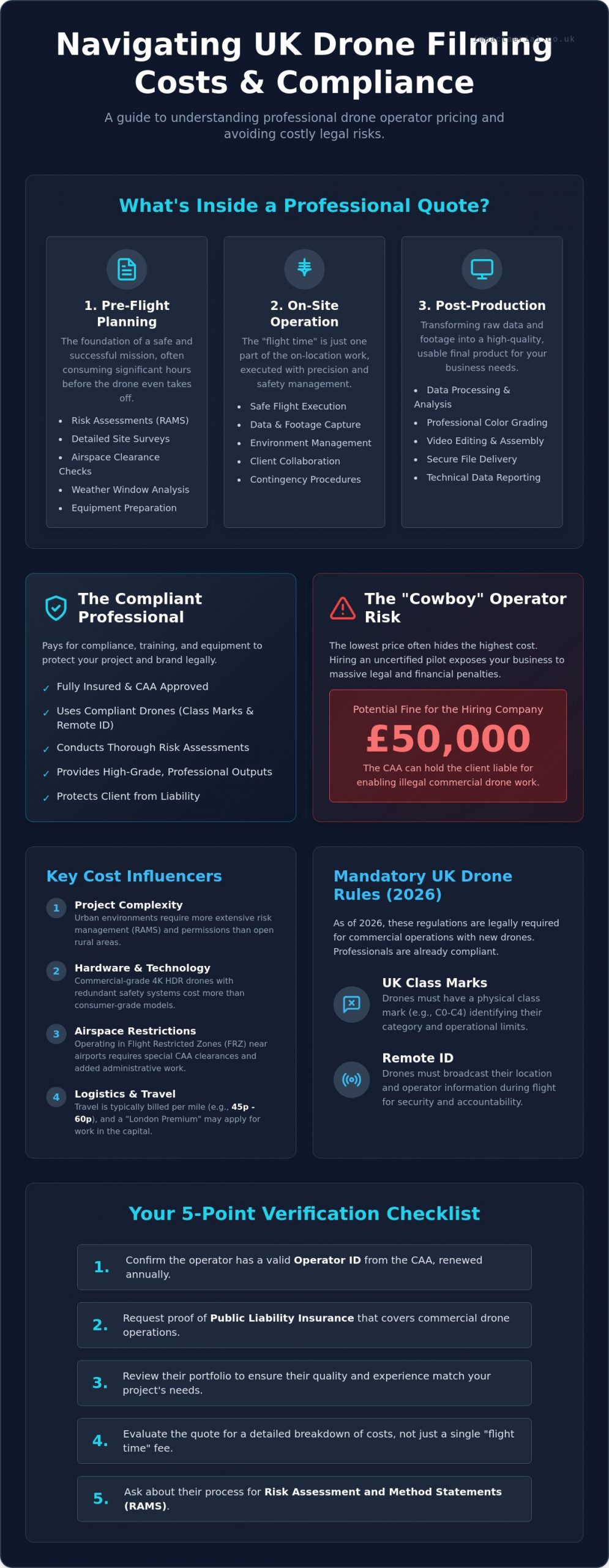
Understanding drone filming prices uk starts with looking beyond the flight time itself. A professional quote integrates three distinct phases: pre-flight planning, on-site operation, and post-production delivery. While a hobbyist might simply turn up and fly, a commercial operator spends significant hours conducting site surveys, checking weather windows, and preparing equipment to ensure every second of footage is usable and safe. The “time on site” you see is often just the tip of the iceberg in a professional workflow.

The hardware used also dictates the cost. There is a vast difference between consumer-grade video and the commercial-grade 4K HDR outputs required for high-end broadcast or construction monitoring. Professional Unmanned Aerial Vehicle (UAV) platforms offer better sensors, redundant safety systems, and the ability to capture data-rich files that stand up to professional colour grading. These high-tier outputs ensure that the final product meets the rigorous standards of modern commercial media.

To better understand the regulatory environment that influences these costs, watch this helpful video:

Operational challenges like Flight Restricted Zones (FRZ) add layers of administrative work. If your project sits near an airport or a sensitive government site, the pilot must secure specific CAA clearances before the drone even leaves the ground. This expertise in airspace management is a core component of the value provided by professional services, ensuring your project remains legal and uninterrupted.

Project Complexity and Risk Assessment

Filming in a dense urban environment like Birmingham city centre presents vastly different risks than a rural field in the Cotswolds. Urban shoots require meticulous Risk Assessment and Method Statements (RAMS) to manage pedestrian traffic and nearby structures. We don’t just fly; we manage the environment. Complex airspace permissions or CAA waivers for flying closer to people often require weeks of lead time and technical documentation, which naturally influences the final drone filming prices uk for that specific project.

Regional Logistics and Travel Factors

Geography plays a significant role in your budgeting. Many operators apply a “London Premium” due to the high costs of logistics and congestion within the capital. Conversely, basing operations in the West Midlands allows for more competitive structures while maintaining nationwide reach. Travel expenses are a standard addition, typically charged between 45p and 60p per mile. For long-term projects like construction site monitoring, multi-site contracts can often be negotiated at a more efficient rate than one-off shoots, providing better value over the duration of a build.

The Value of Compliance: Why Professional Pilots Cost More

Choosing an operator based solely on the lowest drone filming prices uk often ignores the hidden costs of non-compliance. As of January 1, 2026, the regulatory landscape has shifted significantly. Every new drone on the market must now carry a UK class mark, and Remote ID must be enabled during flight. These technical requirements aren’t just checkboxes; they’re legal mandates. When you hire a professional, you’re paying for an operator who has invested in compliant hardware and maintains a valid Operator ID, which currently costs £12.34 per year and requires annual renewal.

Hiring an uncertified “cowboy” operator introduces a massive financial risk to your business. The Civil Aviation Authority (CAA) takes illegal commercial work seriously. If a pilot operates without the necessary permissions or insurance, the client can be held liable for enabling the activity. This “Cowboy Risk” can lead to fines reaching £50,000 for the hiring company. Adhering to Civil Aviation Authority (CAA) regulations is the only way to insulate your brand from these legal repercussions. For a deep dive into these requirements, read our guide on the UK Drone License: A Simple Guide to CAA Rules in 2026.

Professional delivery also relies on enterprise-grade equipment. Operators using DJI Enterprise platforms or similar high-end systems provide better reliability and data security than those using consumer drones. These systems are designed for intensive commercial use, featuring redundant batteries and advanced obstacle avoidance. This hardware investment ensures that your project is delivered on time, without technical failures. If you need a partner who prioritises these standards, you can explore our professional aerial filming and photography options.

CAA GVC Certification and Operational Authorisation

The General Visual Line of Sight Certificate (GVC) is the gold standard for modern drone pilots. It proves the operator has undergone rigorous theoretical and practical testing. This certification is a prerequisite for obtaining an Operational Authorisation from the CAA, which allows for flights in more complex environments. Professional training costs and the administrative burden of maintaining these certifications are reflected in the day rate. However, this expertise ensures that emergency procedures are handled with precision, protecting both the public and your site.

Commercial Liability Insurance: The £5m Standard

Standard hobbyist insurance is fundamentally insufficient for commercial projects. Professional pilots carry insurance that is specifically EC 785/2004 compliant, which is the legal minimum for commercial flight in the UK. While some operators offer a basic £1m policy, many high-value commercial sites now require a £5m or even £10m public liability standard. This level of coverage protects the client from third-party claims and property damage, providing a layer of financial security that a budget operator simply cannot offer. This meticulous approach to risk mitigation is what separates a professional service from a risky alternative.
Drone Filming Prices UK 2026: The Complete Budgeting & Hiring Guide

Standard Drone Filming Rate Structures in the UK

Beyond standard time-based billing, many specialists provide “Project-Based” pricing for complex deliverables. This is particularly common for advanced services like 3D virtual tours or PV solar farm thermal surveys, where the value lies in the technical data produced rather than just the time spent on site. These fixed-fee arrangements give businesses budget certainty for intricate workflows that involve multiple stages of data capture and sophisticated processing.

Hourly vs. Day Rates: Which is Better?

Hourly rates are often the most efficient choice for straightforward tasks that require minimal set-up time. Quick property shots or routine construction site progress updates fall into this category. However, for more intensive projects, a half-day or full-day rate usually offers better value. A full-day booking allows the pilot to capture footage during optimal lighting windows and perform multiple battery cycles without the pressure of a ticking clock. Most professional day rates include the pilot’s expertise, the deployment of a primary and backup drone, basic commercial insurance, and the secure transfer of raw data. This comprehensive package ensures that the operation is resilient against minor technical hitches or changing site conditions.

Post-Production and Data Processing Costs

It’s a common misconception that the project ends when the drone lands. In reality, the post-production phase can sometimes double the base flight cost due to the intensive studio time required. Raw 4K or 5K footage is often flat and requires professional colour grading to meet commercial standards. For technical applications like construction site monitoring or thermal surveys, the data must be processed through specialised software to generate accurate orthomosaics or heat maps. Virtual tour creation is another area where the workload shifts heavily to the studio; stitching 360-degree aerial views into a seamless, interactive experience requires meticulous attention to detail. This studio work is what transforms raw aerial data into a polished, high-end asset that provides tangible business value.

How to Evaluate a Drone Filming Quote

Receiving a technical quote requires a meticulous eye for detail that goes beyond the bottom line. A proposal that seems significantly lower than the standard drone filming prices uk usually signals a compromise in safety, equipment quality, or legal compliance. When you compare operators, you aren’t just buying footage; you’re hiring a risk management specialist. Technical precision is non-negotiable. To ensure you’re making an informed decision, use this 5-point verification checklist before signing any contract:

  • CAA Operational Authorisation: Confirm the pilot holds a current OA for the specific category of flight required.
  • Specific Insurance: Verify the policy is EC 785/2004 compliant and covers the exact site activity, such as construction site monitoring or thermal surveys.
  • Industry-Specific Portfolio: Ensure the operator has experience in your sector; a pilot who excels at property photography may lack the technical rigour needed for commercial property surveys.
  • Equipment Redundancy: Ask if the pilot carries backup aircraft to prevent project delays in the event of a technical fault.
  • Transparent Deliverables: The quote must clearly define what you receive, including resolution, file formats, and usage rights.

Red flags often hide in what is missing from the paperwork. If an operator is reluctant to provide their Flyer ID or Operator ID, it’s a clear sign of professional negligence. For a more detailed framework on selecting the right partner, consult our A Complete Guide to Professional Drone Services in the UK.

Verifying Pilot Credentials and Insurance

Legitimate operators will proactively offer their credentials. You should request a copy of the pilot’s Flyer ID and the company’s Operator ID to verify their status on the national register. It’s equally vital to see the CAA Operational Authorisation (OA) document. This paperwork outlines the specific conditions under which the pilot can fly, including distance from uninvolved persons. Finally, check that their insurance isn’t just a generic public liability policy but one tailored for commercial drone operations that protects you from third-party claims on your specific site.

Reviewing Deliverables and Turnaround Times

Clarity on the final output prevents budget creep later in the project. Ensure the quote specifies commercial-grade 4K HDR resolution and the exact file formats your editors require. You should also agree on a concrete timeline for data delivery and any included revision cycles. Ownership is another critical factor. A professional quote should explicitly state that you hold the usage rights for the footage, ensuring your marketing or engineering teams can use the assets across all platforms without additional fees. Contact us today to receive a professional drone filming consultation tailored to your specific site requirements.

Impact Aerial: Professional Drone Services with Transparent Value

Impact Aerial bridges the gap between high-end technical precision and accessible drone filming prices uk. By maintaining a strategic operational base in Birmingham, we provide efficient nationwide coverage, reducing travel overheads for clients across the West Midlands and the rest of the UK. Our operations are built on a foundation of strict compliance, featuring a consistent commitment to £5m commercial liability insurance and full CAA GVC certification. This meticulous approach ensures that every project, regardless of scale, is executed within the highest safety and legal frameworks available in 2026.

We exclusively utilise DJI Enterprise drone systems to deliver superior data and visual quality. These platforms offer the technical redundancy and advanced sensor capabilities required for commercial-grade output, ensuring that our clients receive stable, high-resolution assets for every mission. We don’t just provide raw footage; we offer a reliable partnership that prioritises risk mitigation and technical excellence. Our team handles the complex administrative burden of flight planning and airspace permissions, allowing you to focus on your core business objectives while we capture the data you need.

Bespoke Quotes for Diverse Industries

Our pricing models are tailored to the specific demands of the property, construction, and advertising sectors. We understand that a construction site monitoring project requires a different technical approach and risk assessment than a high-end cinematic marketing campaign. Impact Aerial provides an end-to-end service, managing everything from the initial site consultation and RAMS preparation to the final post-production editing. This holistic approach ensures consistency and quality across the entire project lifecycle. For a detailed look at our visual standards and technical capabilities, explore our Aerial Filming Drone: The Ultimate Guide to Professional Cinematic Video.

Get a Professional Drone Filming Quote Today

Securing a transparent and accurate estimate for drone filming prices uk is a straightforward process with our technical team. To provide the most precise quote, we typically require the project location, the intended flight dates, and a brief overview of your required deliverables, such as raw data or fully edited films. Whether you need a one-off aerial survey or recurring construction monitoring, we offer detailed, no-obligation quotes that reflect the true value of professional expertise. Take the first step toward secure, high-end aerial data by choosing a partner that values compliance as much as you do. Request a Quote from Impact Aerial today to discuss your specific project requirements and receive a tailored proposal.

Securing Your Visual Assets with Technical Precision

Mastering drone filming prices uk requires a shift in perspective from viewing aerial work as a commodity to seeing it as a specialized technical service. By prioritizing CAA GVC certified pilots and verifying £5m commercial liability insurance, you protect your business from the significant legal and financial risks of non-compliance. Professional pricing isn’t just a fee for flight time; it’s an investment in meticulous risk management and the high-tier 4K HDR DJI Enterprise technology required for commercial-grade results.

Choosing an operator with transparent rate structures and a proven record in your specific industry ensures that your project is delivered on time and within budget. We provide the technical expertise and regulatory compliance necessary to transform complex aerial data into actionable business assets. You can Get a Professional Drone Filming Quote from Impact Aerial Today to start planning your next project with total confidence. We look forward to helping you achieve your commercial goals through precise, high-end aerial imaging.

Frequently Asked Questions

How much does a drone pilot cost per day in the UK?

Day rates for professional drone pilots depend on the complexity of the mission, the required hardware, and the pilot’s level of certification. A GVC-certified pilot using enterprise-grade equipment provides a comprehensive service that includes pre-flight site surveys, risk assessments, and technical data capture. This rate ensures you’re hiring a specialist who manages all legal and safety requirements, protecting your business from the liabilities associated with unvetted operators.

Do drone filming prices include travel expenses?

Travel expenses are typically calculated as a separate line item based on the distance from the pilot’s operational base. Most UK operators apply a standard mileage rate, often between 45p and 60p per mile, to cover fuel and vehicle maintenance costs. For long-distance projects or multi-day shoots requiring overnight stays, additional subsistence and accommodation fees may be detailed in your bespoke quote to ensure all logistics are covered.

Why is professional drone filming more expensive than a hobbyist?

Professional drone filming prices uk reflect the significant operational overheads required to maintain a legal and safe commercial service. Unlike hobbyists, professional pilots must hold valid CAA certifications, pay for annual Operator IDs, and carry specialist commercial liability insurance. They also invest in high-tier enterprise hardware with redundant safety systems, ensuring technical precision and data security that a recreational flyer cannot provide.

Are there extra costs for filming in London or major city centres?

Filming in dense urban environments like London or Birmingham city centres often incurs higher costs due to increased administrative and safety requirements. These locations frequently sit within Flight Restricted Zones (FRZ) or require specific CAA waivers to operate near people and buildings. The time spent coordinating with Air Traffic Control and local authorities, combined with the need for extra ground crew for pedestrian management, justifies a more complex pricing structure.

Does the price change based on the type of drone used?

The choice of aircraft is a primary factor in determining the final project cost. Operating high-end DJI Enterprise drones with thermal sensors or cinematic 4K HDR cameras requires a higher investment in equipment maintenance and technical training than using standard consumer models. These professional platforms offer the stability, data accuracy, and safety features essential for specialized tasks like construction site monitoring or commercial property surveys.

What is included in a standard drone photography package?

A standard professional package usually includes the pilot’s time, the deployment of a primary and backup aircraft, and the delivery of high-resolution images. Reputable quotes also encompass the pre-flight planning phase, site-specific risk assessments, and a minimum level of commercial insurance. You should receive a clear agreement on the number of final assets provided and the specific usage rights granted for your commercial or technical reports.

How much does it cost to add video editing to a drone shoot?

Post-production fees are generally calculated based on the total studio time required to process the raw data and create a finished film. Adding professional editing involves color grading, sound design, and the integration of your corporate branding or technical graphics. For complex projects, this phase might also include the creation of interactive virtual tours or the processing of thermal data, which requires specialized software and technical expertise.

Is insurance included in the drone filming quote?

Yes, any professional drone filming quote should include EC 785/2004 compliant commercial liability insurance as standard. While a basic £1m policy is common, many high-value commercial sites now require a £5m or £10m standard to mitigate third-party risks. You should always verify that the insurance covers your specific site activities and ask for a copy of the policy to ensure your project is fully protected from third-party claims.
Professional Drone Photography UK: The Complete 2026 Hiring Guide

The demand for stunning aerial imagery has never been greater, yet navigating the complexities of UK drone regulations can present a significant challenge for businesses. Hiring the wrong operator not only risks a substandard final product but can also expose your project to serious legal and financial liabilities. In a market where it’s difficult to differentiate between hobbyists and certified experts, how do you confidently select a provider for professional drone photography uk services that guarantees both compliance and quality?

This complete 2025 guide is designed to provide that essential peace of mind. We will demystify the key credentials every legitimate UK drone company must hold, from Civil Aviation Authority (CAA) certification to robust commercial liability insurance. You will learn precisely how to evaluate a provider’s portfolio, safety procedures, and technical capabilities to ensure you receive the breath-taking, high-impact results your commercial project demands. By the end, you will be fully equipped to commission a qualified aerial partner with absolute confidence.

Key Takeaways

  • Verify a provider’s professionalism by looking beyond their equipment; check for valid CAA certification, comprehensive insurance, and a strong technical portfolio.
  • Follow a structured checklist to confidently hire the right service for professional drone photography uk, ensuring you assess a provider’s credentials and value, not just their price.
  • Discover the key commercial applications where aerial imagery provides a unique advantage, from marketing large-scale properties to inspecting critical infrastructure.
  • Understand the end-to-end project process, from initial risk assessments to final asset delivery, so you know what to expect from a reliable and safety-conscious operator.

What Defines ‘Professional’ Drone Photography in the UK?

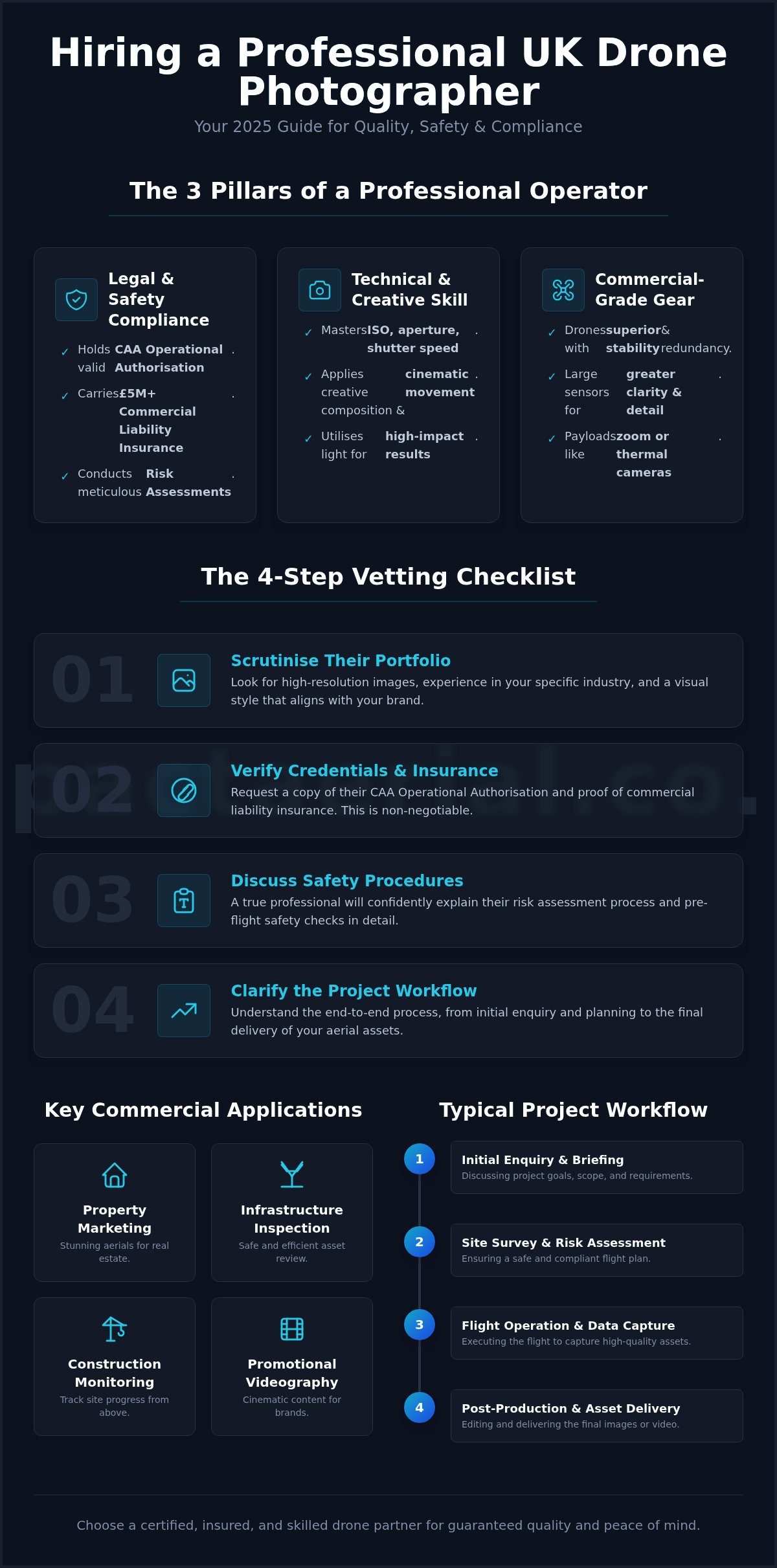
In the rapidly growing field of aerial imaging, the term ‘professional’ signifies far more than just owning an expensive drone. While a hobbyist may capture pleasant images, a true professional operator delivers consistent, high-quality, and legally compliant results that add tangible value to a commercial project. The distinction between an enthusiast and a certified expert is built upon three foundational pillars: stringent legal compliance, advanced technical skill, and the use of commercial-grade equipment.

To better understand the practical techniques that elevate drone imagery, this video offers some excellent tips:

Pillar 1: Mandatory Legal & Safety Compliance

All commercial drone operations in the UK are governed by the Civil Aviation Authority (CAA). A professional pilot must hold a General Visual Line of Sight Certificate (GVC) to operate legally. This is backed by comprehensive Commercial Liability Insurance, typically with a minimum of £5 million in coverage, for your complete peace of mind. Every flight is preceded by meticulous risk assessments and pre-flight safety checks, a non-negotiable procedure that protects your assets, the public, and your reputation.

Pillar 2: The Pilot’s Technical and Creative Skillset

Beyond legal certification lies the pilot’s craft. This includes a deep understanding of camera settings-mastering the interplay of ISO, aperture, and shutter speed to capture crisp, perfectly exposed aerial shots in varying light conditions. This technical knowledge, which builds upon the long history of aerial photography, is combined with a creative eye for composition, cinematic movement, and using light to create impactful imagery. Sector-specific experience, such as in construction or property marketing, is invaluable.

Pillar 3: Commercial-Grade Drones and Equipment

Professional services utilise equipment that far surpasses consumer models. Specialised professional drone systems offer superior stability, system redundancy, and the ability to carry specialised payloads such as high-resolution zoom or thermal cameras. Their larger sensors and high-quality lenses capture significantly more data, resulting in greater clarity, dynamic range, and detail-essential for commercial applications from site inspections to promotional videography. This reliability is critical for delivering consistent results on a deadline.

Engaging an uncertified operator exposes your business to significant legal liability and financial risk, often resulting in substandard imagery that fails to meet your objectives. Investing in genuine professional drone photography uk services ensures not only stunning visuals but also a safe, insured, and compliant operation from start to finish.

How to Choose the Right Drone Photography Company: A 4-Step Checklist

Selecting the right provider for professional drone photography UK services goes beyond comparing day rates. A cheap quote can hide a lack of insurance, experience, or legal compliance, putting your project and reputation at risk. This structured, four-step checklist will help you vet potential partners, ensuring you hire a safe, reliable, and highly skilled operator who delivers true value.

Step 1: Scrutinise Their Portfolio and Case Studies

A portfolio is the most direct evidence of a company’s capabilities. Move beyond the “wow factor” and look for technical quality. Are the images sharp and well-composed? Do they demonstrate experience relevant to your sector, such as detailed roof inspections or cinematic real estate videography? A strong portfolio shows:

  • High-resolution, sharp, and well-composed images.
  • Experience in your specific industry (e.g., construction, events, property).
  • A variety of shots, proving creative and technical capability.
  • A visual style that aligns with your brand’s aesthetic.

Step 2: Verify Credentials and Insurance

This step is non-negotiable for any commercial drone operation in the UK. A professional operator must be able to provide proof of their credentials without hesitation. For your added peace of mind, ask for:

  • CAA Operational Authorisation: A copy of their GVC certificate, the current standard for commercial operations.
  • Commercial Liability Insurance: Proof of a valid policy that covers aerial work.
  • Industry Affiliations: Membership with bodies like ARPAS-UK or Drone Safe Register indicates a commitment to professional standards and adherence to all UK drone laws.
  • Company Registration: Confirming they are a registered UK limited company adds a layer of accountability.

Step 3: Evaluate Their Briefing and Quoting Process

The initial consultation reveals a lot about a company’s professionalism. A true expert will ask detailed questions about your objectives, the location, and desired outcomes. Their quote should be transparent and itemised, breaking down costs for pilot day rates, editing, and travel. Be sure to clarify deliverables (e.g., 4K video, high-resolution RAW images) and, crucially, their policy for weather-related postponements or cancellations.

Step 4: Read Reviews and Testimonials

Independent reviews on platforms like Google or Trustpilot offer unfiltered insight into the client experience. Look for comments that mention communication, reliability, and problem-solving skills, not just the quality of the final images. Client testimonials can be particularly valuable, often highlighting how the provider handled unexpected challenges on a project. This feedback is a strong indicator of the service level you can expect.

See how our meticulous process ensures a smooth project from start to finish. Get in touch to discuss your requirements.

Professional Drone Photography UK: The Complete 2026 Hiring Guide

Key Applications for Professional Drone Photography in Business

Harnessing aerial imagery provides a unique perspective that ground-level photography simply cannot replicate. For businesses across the country, professional drone photography uk offers a powerful tool to showcase the scale of projects, provide essential data safely, and elevate marketing materials with high-impact visuals. Beyond simple aesthetics, it’s about delivering actionable intelligence and a compelling narrative, whether you’re demonstrating construction progress to stakeholders or creating cinematic brand stories.

Commercial Real Estate & Property Marketing

For the property sector, aerial imagery is a game-changer. It allows for stunning ‘hero shots’ that capture entire properties, estates, and surrounding landscapes in a single, compelling frame. This perspective is invaluable for showcasing a property’s location relative to key local amenities like transport links, parks, and schools. Advanced services can create immersive 3D virtual tours for remote viewings or overlay digital boundary lines to clearly highlight land development potential for prospective buyers and investors.

Construction Site Monitoring and Surveys

In construction and engineering, drones are indispensable tools for data-gathering and progress monitoring. A qualified operator can track a project’s evolution from a consistent bird’s-eye view, creating time-lapse videos and detailed orthomosaic maps. This provides a transparent and easily digestible progress report for stakeholders. Drones also significantly improve site safety by inspecting hard-to-reach or hazardous areas remotely. These complex operations require strict adherence to UK drone operator regulations, ensuring all data is captured safely, legally, and to a professional standard.

Marketing, Advertising, and Corporate Events

Dynamic aerial content can transform marketing and advertising campaigns, providing a viewpoint that captivates and holds audience attention. Drones are perfectly suited to capturing the true scale and energy of large-scale events, from music festivals and corporate functions to sporting fixtures. This footage can be crafted into breathtaking cinematic video content for brand storytelling or used to provide a unique ‘behind-the-scenes’ perspective for engaging social media posts. This unique viewpoint helps brands stand out in a crowded digital landscape, producing content that is inherently more shareable and memorable.

The Project Workflow: From Initial Enquiry to Final Delivery

Understanding the end-to-end process of a drone photography project demystifies the service and highlights the value of a meticulous, safety-first approach. A reputable provider of professional drone photography UK services operates with a structured workflow built on clear communication, rigorous planning, and regulatory compliance. This ensures not only breath-taking results but also a safe, efficient, and predictable experience from your first call to the final delivery of your high-quality assets.

Phase 1: Consultation and Pre-Flight Planning

The foundation of any successful aerial project is laid long before the drone takes flight. This critical phase is entirely focused on safety and achieving your specific objectives. It typically involves:

  • Initial Consultation: A detailed discussion to define your project’s scope, key objectives, and desired shot list. This ensures everyone is aligned on the creative and commercial goals.
  • Site & Airspace Survey: We conduct a thorough remote survey of the location using advanced software and CAA airspace charts to identify flight restrictions, ground hazards, and potential obstacles.
  • Risk Assessment: A comprehensive risk assessment is completed to identify and mitigate any potential hazards, ensuring the operation can be conducted safely and in full compliance with UK regulations.
  • Scheduling: A primary date for the shoot is scheduled, along with contingency dates to account for unpredictable British weather, giving you added peace of mind.

Phase 2: On-Site Operations and Image Capture

On the day of the shoot, our certified pilot arrives with ample time to prepare. A safe take-off and landing area is established, and a mandatory on-site safety briefing is conducted with you and your team. Once all checks are complete, the pre-agreed flight plan is executed with precision. You can view a live feed from the drone’s camera on a ground station monitor, allowing you to provide real-time feedback and ensure the captured shots perfectly match your vision before we leave the site.

Phase 3: Post-Production and Asset Delivery

Capturing the images is only half the story. Back in the studio, your raw aerial photographs are professionally processed to maximise their impact. This includes expert colour grading, sharpening, and enhancement to produce vibrant, top-quality final images. The assets are then exported in high-resolution formats suitable for both print and digital use. You will receive your final photos via a secure digital download link, and we maintain a clear feedback process to handle any requested revisions, ensuring your complete satisfaction with the end result.

Why Choose Impact Aerial for Your UK Drone Photography Needs?

When selecting a provider for your project, you need more than just a pilot with a drone. You need a dedicated partner who combines technical mastery with an unwavering commitment to safety and regulatory compliance. At Impact Aerial, we deliver a comprehensive service designed to provide exceptional results and complete peace of mind. Based in the West Midlands, our expert team serves clients across the entire United Kingdom, bringing a professional, structured process to every operation.

Our commitment to quality is reflected in our equipment. We operate a fleet of state-of-the-art DJI Enterprise drones, renowned for their stability and ability to capture superior, high-resolution imagery. This advanced technology, combined with our extensive experience across key sectors from construction and surveying to commercial property marketing, ensures we deliver visuals that are not just stunning, but actionable and insightful.

Fully Certified and Insured for Your Peace of Mind

Operating safely and legally is the cornerstone of our professional service. We provide complete assurance for every project through our strict adherence to UK aviation regulations and a deep-rooted, safety-first culture. For your protection and confidence, our operations are:

  • Fully authorised for commercial work with a CAA GVC (General Visual Line of Sight Certificate) Operational Authorisation.
  • Covered by specialist £5m commercial liability insurance.
  • Preceded by a thorough on-site risk assessment to identify and mitigate any potential hazards before flight.

A Proven Partner for UK Businesses

Our extensive portfolio is a testament to the high-quality results we consistently deliver for businesses nationwide. We understand that commercial clients require a seamless, reliable service that integrates smoothly with their project timelines and objectives. From the initial consultation to final asset delivery, we manage the entire process, making us a trusted provider of professional drone photography uk. Our proven track record demonstrates our ability to understand specific commercial needs and translate them into breath-taking, valuable aerial data. Ready to elevate your project with a leading expert? Request your free quote today.

Elevate Your Project: Partnering with a UK Drone Professional

Navigating the world of aerial imagery is straightforward when you know what to look for. The key is to partner with a provider whose professionalism is backed by verifiable credentials. As we’ve covered, this means prioritising operators with current CAA certification and comprehensive insurance to ensure every flight is safe, legal, and effective. This diligence is the foundation of successful professional drone photography uk.

At Impact Aerial, we deliver on these non-negotiable standards. Our team consists of CAA GVC Certified operators, fully covered by £5m in commercial liability insurance for your complete peace of mind. From our base in the West Midlands, we provide a UK-wide service, bringing specialist expertise to the Property and Construction sectors and delivering breath-taking, high-quality results.

Ready to see how our professional approach can transform your project’s perspective? Discuss your project with our certified drone pilots today.

Frequently Asked Questions

How much does professional drone photography cost in the UK?

The cost of professional drone photography services varies based on project complexity, location, and the required deliverables. A straightforward property shoot may start from £250, while larger commercial projects requiring extensive planning and risk assessments will be quoted individually. We provide a detailed, no-obligation quote that accounts for all pre-flight planning, operational time, CAA-certified pilot expertise, and post-production editing, ensuring complete transparency with no hidden fees.

What happens if the weather is bad on the scheduled day of the shoot?

Safety and quality are our primary concerns. We cannot operate our drones in adverse weather conditions such as high winds or rain, as per Civil Aviation Authority (CAA) regulations. If the weather is unsuitable on the scheduled day, we will not proceed. We will work closely with you to reschedule the flight for the next mutually convenient date at no additional charge, ensuring we can capture the highest quality results for your project.

Are you able to fly drones in cities like London or Birmingham?

Yes, as CAA GVC Certified operators, we are qualified to plan and execute drone operations in congested urban environments like London and Birmingham. These flights require detailed pre-flight surveys, comprehensive risk assessments, and sometimes additional permissions from local authorities or air traffic control. Our expertise in regulatory compliance ensures that all urban operations are conducted safely and legally, providing you with total peace of mind while capturing stunning city perspectives.

How long does it take to receive the final edited photographs?

Our standard turnaround time for delivering fully edited, high-resolution photographs is typically within 3-5 working days following the shoot. This process includes professional culling, colour grading, and optimisation of the images to ensure they meet our exacting quality standards. For larger or more complex projects, this timeline may be extended, but this will always be clearly communicated and agreed upon before the project commences.

What information do I need to provide to get an accurate quote?

To provide you with a precise and comprehensive quote, we require several key details. Please provide the full address and postcode of the location, a clear description of the subject to be photographed, the number of images required, and their intended use (e.g., marketing materials, website, survey). Any specific deadlines or a brief outlining the desired angles and perspectives will also help us tailor the quote to your exact operational needs.

Can you fly drones over private property or near people?

Flying over private property requires permission from the landowner. We handle this as part of our pre-flight planning process. Regarding flying near people, our CAA GVC Certification allows us to operate with reduced separation distances compared to recreational pilots. However, every operation is governed by a strict risk assessment where public safety is the absolute priority. We implement robust safety measures to mitigate all risks when operating in any proximity to uninvolved persons.

What is the difference between drone photography and a drone survey?

While both use drones, their purpose and output are fundamentally different. The goal of professional drone photography UK services is to capture aesthetically pleasing, high-quality images for marketing, real estate, or creative purposes. In contrast, a drone survey is a technical data-gathering operation. It uses techniques like photogrammetry or thermal imaging to create measurable outputs such as 2D orthomosaic maps, 3D models, or inspection reports for analysis and decision-making.

How to Choose a Video Production Company: A Complete UK Guide

Investing in professional video content is a significant decision for any UK business, but the process of finding the right partner can be fraught with uncertainty. How can you accurately assess quality? What are the red flags that signal potential budget overruns? And how do you ensure the video production company you select has the specific expertise to achieve your commercial goals? These are critical questions, and a misstep can lead to a wasted investment and a final product that fails to make an impact.

This comprehensive guide is designed to provide clarity and peace of mind. We will demystify the entire process, from initial briefing and quoting to the final delivery. You will learn the essential criteria for vetting potential partners, how to understand and compare proposals, and the key questions you must ask to avoid common pitfalls. Our goal is to equip you with the knowledge to confidently select a professional video production partner in the UK who will not only deliver a high-quality final product but also ensure a smooth, transparent, and successful collaboration from start to finish.

Before you begin searching for a professional partner, the most critical step is internal: defining your video strategy. A well-defined brief acts as a blueprint for success, ensuring that every potential video production company understands your objectives from the outset. This foundational work not only attracts the right creative partners but also guarantees more accurate quotes, ultimately saving significant time and resources later in the project.

To better understand the importance of this strategic foundation, the following video offers valuable insights:

Set Clear Objectives and KPIs

Your video must have a clear purpose. Without a defined objective, you cannot measure its return on investment. Begin by clarifying the primary commercial goal and how you will track its success. This initial clarity ensures the final creative is precisely aligned with your business needs. Ask yourself:

  • Primary Goal: Are you aiming to increase direct sales, generate qualified leads, build brand awareness, or train internal staff?
  • Key Performance Indicators (KPIs): How will you measure success? This could be conversion rates on a landing page, total view count, audience engagement rates, or lead form submissions.
  • Core Message: What is the single most important idea or feeling you want your audience to take away?

Identify Your Target Audience

A video designed for everyone will resonate with no one. A detailed understanding of your target audience dictates everything from the script’s tone to the choice of music and the distribution platform. Consider who you are trying to reach, where they consume content (e.g., LinkedIn for B2B professionals, YouTube for a broader demographic), and what creative style will capture their attention and build trust.

Establish a Realistic Budget Range

Establishing a realistic budget is essential for a productive conversation. Costs for video production in the UK can range from a few thousand pounds for a simple project to well over £50,000 for a high-end commercial. Providing a range (e.g., £5,000 – £10,000) allows a video production company to propose concepts that are both creative and achievable. Remember that the budget directly influences the complexity of the production process, affecting elements like crew size, equipment, and locations. Be sure to factor in costs beyond the production itself, such as ad spend for promotion.

Step 2: Understand the Types of Video Production Companies

The term “video production company” covers a wide spectrum of providers, each with distinct capabilities and specialisms. The critical first step in vetting a video production company is to understand these distinctions, as your project’s specific requirements-from scope and style to budget-will dictate the ideal partner. Choosing between a generalist and a niche expert is a foundational decision that impacts the entire creative process and the quality of the final result.

Full-Service Agencies vs. Boutique Studios

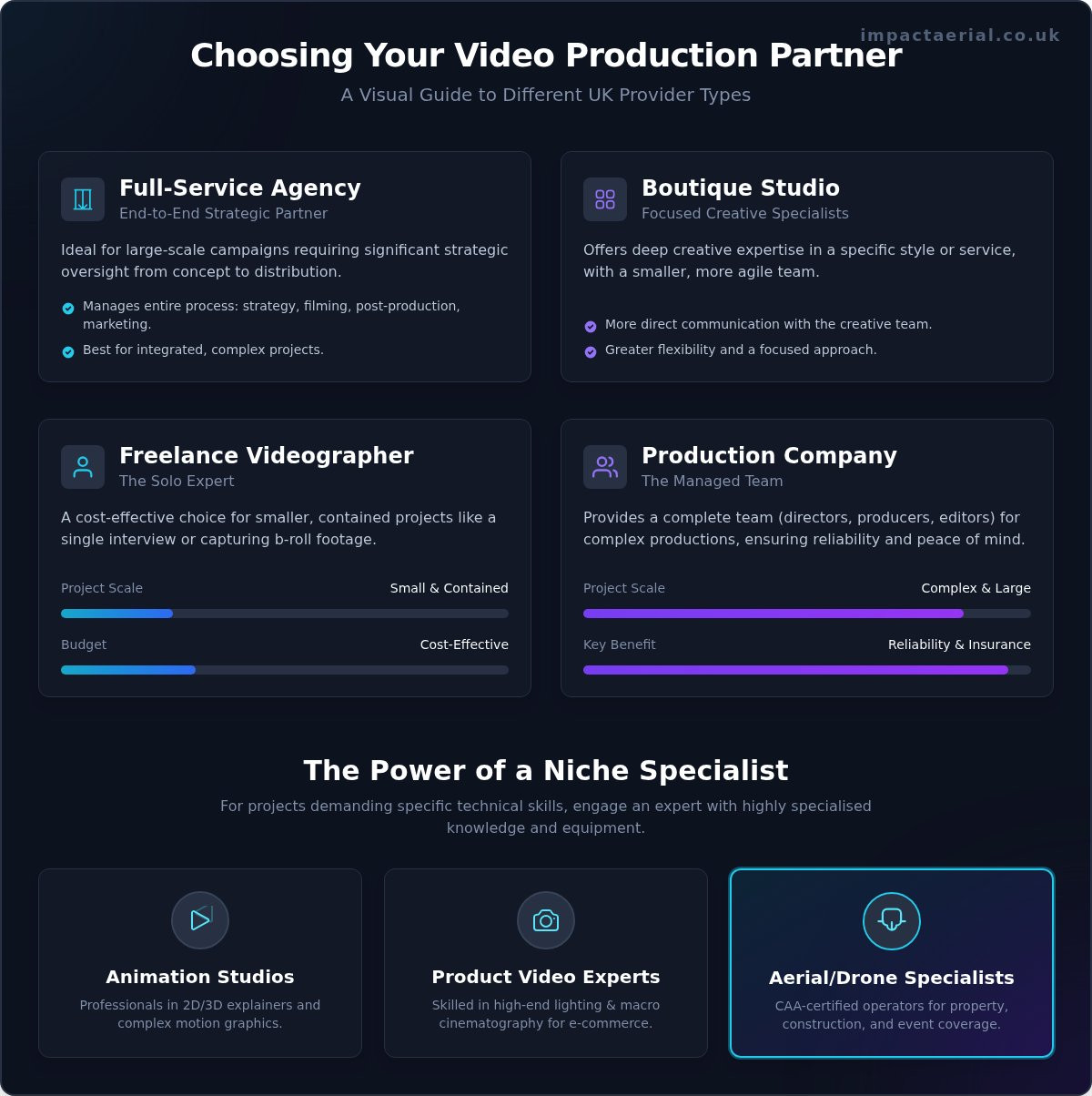
A full-service agency provides an end-to-end solution, managing everything from initial concept and strategy through to filming, post-production, and even marketing distribution. This integrated approach is ideal for large-scale campaigns requiring significant strategic oversight. In contrast, a boutique studio typically focuses on a specific style or service, offering deep creative expertise. Their smaller size often leads to more direct communication with the creative team and greater flexibility during the production schedule.

The Power of a Niche Specialist

For projects demanding specific technical skills, a niche specialist is often the most effective choice. These experts possess highly specialised knowledge and equipment that a generalist firm may not. Key examples include:

  • Animation Studios: Professionals in creating 2D or 3D explainer videos and complex motion graphics.
  • Product Video Experts: Skilled in high-end lighting and macro cinematography essential for e-commerce visuals.
  • Aerial/Drone Specialists: CAA-certified operators providing unique perspectives for construction progress, property marketing, or large-scale event coverage.

Engaging a specialist ensures you are working with a team that is at the forefront of their specific field, equipped with the correct tools and a deep understanding of relevant best practices.

Freelance Videographers vs. Production Companies

The scale of your project often determines whether a freelancer or a full company is more appropriate. A freelance videographer is an excellent, cost-effective choice for smaller, contained projects like a single interview or capturing b-roll footage. However, for more complex productions, a company provides a complete, managed team-including directors, producers, and editors. This structure offers greater reliability, access to a wider range of high-end equipment, and crucial operational safeguards like comprehensive public liability insurance, giving you complete peace of mind.

Step 3: The Ultimate Vetting Checklist: 7 Things to Evaluate

Once you have a shortlist of potential partners, it’s time for meticulous due diligence. A flashy showreel can be impressive, but it doesn’t always reveal the full picture of a company’s professionalism or process. This vetting checklist is designed to help you look deeper and identify a truly reliable and high-quality video production company that can deliver on its promises. Focus on verifying their expertise, operational processes, and regulatory compliance.

1. Analyse Their Portfolio and Showreel

Go beyond the highlight reel and critically examine their full portfolio. Does the quality of their work consistently meet the standard you require for your brand? Look for evidence that they have successfully completed projects within your industry or of a similar scope and style. A company with relevant experience will have a much deeper understanding of your objectives, audience, and key messaging, leading to a more impactful final product.

2. Scrutinise Testimonials and Case Studies

Authentic client feedback is invaluable. Seek out detailed case studies that outline a project’s challenges, the company’s solution, and the measurable results achieved. Don’t just rely on short quotes on their website; check for independent reviews on third-party platforms like Google or Clutch. The best testimonials will speak not only to the quality of the final video but also to the collaborative process, communication, and overall client experience.

3. Verify Credentials, Insurance, and Compliance

This step is non-negotiable for protecting your business and ensuring a professional engagement. A reputable video production company will readily provide proof of their credentials. For added peace of mind, you must verify the following:

  • Public Liability Insurance: Ask for a certificate confirming they hold adequate cover, typically a minimum of £5 million in the UK.
  • Specialist Certifications: For any aerial or drone work, the operator must hold a current CAA GVC (General Visual Line of Sight Certificate). This is a legal requirement for commercial operations.

Professionalism in compliance is a strong indicator of the company’s overall quality and commitment to safe, legal operations.

4. Assess Their Technical Capabilities and Equipment

The tools they use directly impact the final quality. Enquire about their primary cameras, audio equipment, lighting setups, and post-production software. Do they use professional, commercial-grade equipment, such as 4K cameras or DJI Enterprise drones for aerial shots? A polished, high-end look is impossible to achieve with substandard gear. The right technical capabilities are essential for delivering a video that reflects the quality of your brand.

How to Choose a Video Production Company: A Complete UK Guide

Step 4: Understanding the Production Process and Costs

A professional video production company will be transparent about their process. Understanding this workflow not only demystifies the project but also empowers you to be a more effective partner. It provides clarity on timelines and helps you interpret quotes accurately, ensuring there are no surprises down the line. This knowledge is crucial for managing expectations and ensuring the final product aligns perfectly with your vision and budget.

The Three Key Stages of Production

Every professional video project is built upon a three-stage framework. Pre-production is the critical planning phase, covering concept development, scriptwriting, storyboarding, and location scouting. Production is the active filming stage, whether on-location or in a studio. Finally, Post-production is where the raw footage is transformed through editing, colour grading, sound design, and the addition of graphics to create the final, polished video.

What Factors Influence the Final Price Tag?

The final cost of a video project is determined by several key variables. A detailed quote should account for these factors, which can range from a few hundred to many thousands of pounds (£). Be aware of:

  • Crew and Time: The number of filming days required and the size of the professional crew (e.g., director, camera operators, sound recordist).
  • Equipment: The use of specialist kit, such as high-end cinema cameras, lighting rigs, or professional-grade drones for aerial footage.
  • Post-Production Complexity: The amount of editing, motion graphics, animation, or visual effects needed to achieve the desired result.
  • Third-Party Costs: Expenses such as location hire fees, actor wages, travel, and licensing for music or stock footage.

How to Read a Quote and What to Look For

A quote from a reputable video production company should be more than just a single figure. Look for a detailed breakdown that itemises the costs associated with each stage of production. For added peace of mind, check the contract for specifics on deliverables, the project timeline, and the number of revision rounds included. Crucially, the agreement must clearly define ownership and usage rights, specifying where and for how long you can use the final video. This professional transparency is key to a successful partnership.

Step 5: Key Questions to Ask Before Signing the Contract

You’ve reviewed portfolios and checked credentials. The final, critical step before committing is the consultation. Treat this meeting as a formal interview; it’s your opportunity to gauge a company’s expertise, communication style, and project management capabilities. Their answers will reveal the true nature of the partnership you are entering into.

Coming prepared with specific, targeted questions ensures there are no ambiguities. This process guarantees that you and your chosen video production company are fully aligned on goals, processes, and deliverables before any work begins, providing the professional peace of mind necessary for a successful project.

Questions About Their Creative Approach

Understanding how a team thinks is just as important as seeing their previous work. These questions clarify the collaborative process and how your vision will be translated to the screen.

  • How will you approach our project brief and develop the creative concept? A professional partner should be able to outline their initial thoughts and creative methodology.
  • Who will be our main point of contact? Consistent, clear communication is vital. Knowing who manages the relationship prevents confusion.
  • How do you handle creative differences or client feedback? This reveals their flexibility and commitment to a collaborative, client-focused process.

Questions About Logistics and Timelines

A high-quality video is useless if it’s delivered late. Logistical clarity is a hallmark of a reliable production team. For services like aerial filming, contingency planning is non-negotiable.

  • What is your estimated timeline for each production stage? Ask for a breakdown of pre-production, filming, and post-production schedules.
  • How do you handle potential delays, such as adverse weather? A prepared team will have clear, safety-conscious protocols and contingency plans.
  • What do you need from our team to keep the project on track? This question clarifies your responsibilities regarding access, assets, and approvals.

Questions About Deliverables and Revisions

Finalising the details of what you will receive-and the process for perfecting it-prevents unexpected costs and disappointment. Be explicit about your requirements.

  • In what formats and resolutions will the final video be delivered? Ensure the files are suitable for all your intended platforms (e.g., website, social media, presentations).
  • How many rounds of revisions are included in the quoted price? This is a crucial detail for managing the post-production phase.
  • What is the cost for additional revisions or changes? A transparent company will provide a clear cost structure in British Pounds (£) for any work that falls outside the initial scope.

Asking these direct questions establishes clear expectations and forms the foundation of a successful partnership. Ready to discuss your project? Get a professional consultation with Impact Aerial.

Finalising Your Choice: Partnering with the Right Video Experts

Choosing a partner for your video project is a significant business decision. As this guide has shown, the process begins not with a search, but with a clear strategy. By thoroughly vetting credentials, understanding the production process, and asking the right questions, you can confidently select a video production company that aligns perfectly with your goals and budget.

For projects that demand a unique perspective from the air, this level of diligence is even more critical. At Impact Aerial, we specialise in professional aerial filming and surveys, delivering breath-taking results with an unwavering commitment to safety and compliance. Our pilots are CAA GVC Certified, and for your complete peace of mind, all operations are backed by £5m in commercial liability insurance.

If you’re ready to elevate your next project with stunning, high-quality aerial footage, we invite you to discuss your aerial filming project with our certified experts. Take the next step today to bring your vision to life from a whole new perspective.

Frequently Asked Questions

How much does professional video production typically cost in the UK?

The cost of professional video production in the UK varies significantly based on project scope. A simple corporate video with a small crew and minimal post-production might start from £1,500 – £3,000. More complex projects involving multiple locations, actors, advanced graphics, or aerial filming can range from £5,000 to £15,000 or more. Reputable companies provide detailed quotes outlining all pre-production, filming, and post-production costs, ensuring complete transparency and no hidden fees.

What is the difference between a videographer and a video production company?

A videographer is typically a single operator focused on capturing footage. They are an excellent choice for recording live events or simple shoots. In contrast, a video production company offers a comprehensive, end-to-end service. This includes a team of specialists for pre-production (strategy, scripting), production (directing, lighting, sound), and post-production (editing, motion graphics, sound design). They manage the entire project, transforming an initial concept into a polished, professional final product.

How long does the average corporate video project take from start to finish?

A typical corporate video project, such as a brand film or testimonial, usually takes between 4 to 8 weeks from the initial briefing to final delivery. This timeline includes 1-2 weeks for pre-production and planning, 1-3 days for filming, and 2-4 weeks for post-production, which covers editing, client feedback, and revisions. More complex projects requiring extensive animation or multiple filming days will naturally require a longer timeframe to ensure a high-quality result.

Do I need to provide a script for the video production company?

While you can provide your own script, it is not a requirement. A key service offered by a professional video production company is script development. During the pre-production phase, their team will work closely with you to understand your objectives, target audience, and key messages. They then use this information to craft a compelling and effective script that is structured perfectly for the visual medium, ensuring your message is communicated with maximum impact.

Why is CAA GVC certification essential when hiring a drone filming company?

CAA GVC (General Visual Line of Sight Certificate) is the UK’s standard qualification for commercial drone operations. Hiring a CAA GVC certified operator is essential as it confirms they are trained, competent, and operate with the required commercial liability insurance. This is a legal requirement for most commercial drone flights and guarantees the operation will be conducted safely and in full compliance with Civil Aviation Authority regulations, protecting your business from potential liability and ensuring professional conduct.

What should be included in a good video production brief?

A strong video production brief is the foundation of a successful project. It should clearly outline your primary objectives and what you want the video to achieve. Be sure to include details on your target audience, the core messages you need to communicate, and the desired tone and style. It is also crucial to specify the intended distribution platforms (e.g., website, social media, event) and provide an indication of your available budget and desired timeline.