
4 ways to inspect a fragile roof safely without walking on it

A fragile roof isn’t safe just because it looks sound. To understand how to safely inspect a fragile roof, treat it as unsafe until a competent person confirms otherwise, and don’t step onto it to inspect it. A drone or camera can capture roof views without putting an inspector on the surface. Any work that still requires access needs suitable planning and precautions.

It’s reasonable to want a clear assessment before deciding what work is needed. This guide explains what can make a roof fragile, which surfaces and features need particular caution, and how to assess them without walking on the roof. It also compares four inspection approaches, from viewing the roof from a safe position to using drone imagery, so you can understand what each may reveal and when a closer, professionally planned assessment may be needed.

Key Takeaways

  • Treat a roof as fragile until a competent person confirms it can safely support the planned work.
  • Consider whether a drone or camera inspection can provide the views needed without roof access.
  • Look out for rooflights, ageing sheets, corrosion and other signs of possible weakness, even when surfaces appear sound.
  • Use a risk assessment to identify fragile areas and plan suitable precautions before any work begins.

1. What is a fragile roof?

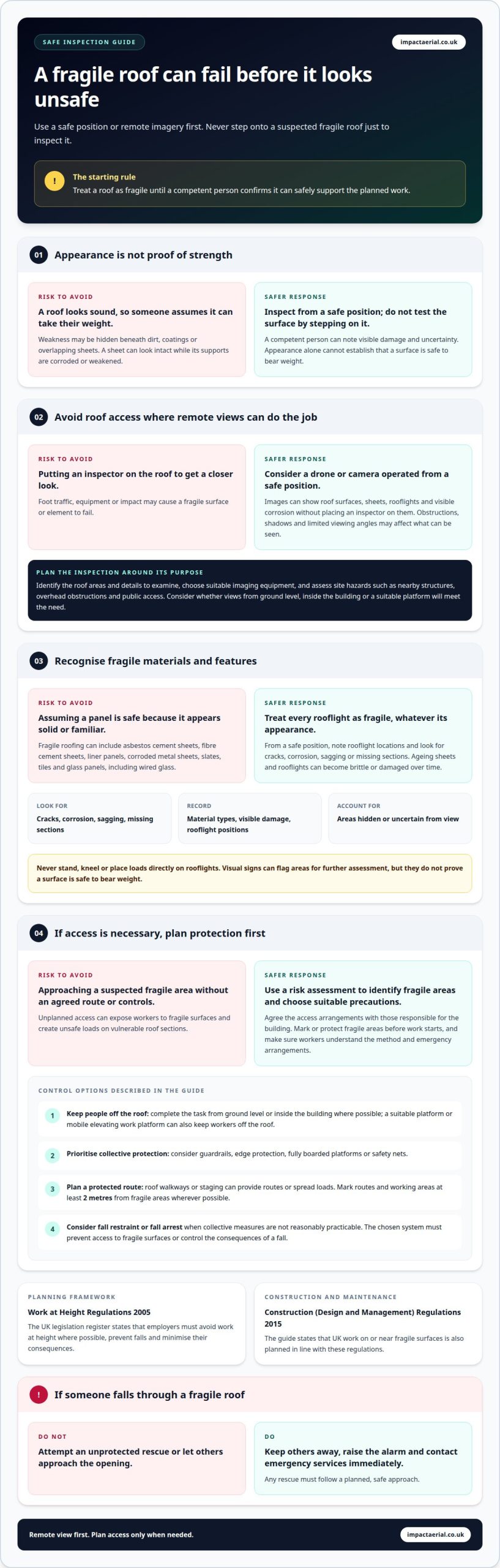
A roof is fragile if a surface or element may fail under foot traffic, an imposed load or impact. It may not support a person’s weight or the weight of equipment or materials. Treat it as fragile until a competent person confirms otherwise. A rooflight, corroded sheet or poorly supported panel can create a serious fall hazard, even when the roof looks intact from below. Knowing how to safely inspect a fragile roof starts with recognising that appearance alone cannot establish its strength.

The UK legislation register states that the Work at Height Regulations 2005 require employers to avoid work at height where possible, prevent falls and minimise their consequences. Planning should first consider whether the task can be completed from ground level, inside the building or by remote inspection. UK work on or near fragile surfaces is also planned in line with the Construction (Design and Management) Regulations 2015, according to the UK legislation register.

For construction and maintenance, contractors should plan before anyone approaches a suspected fragile area. Identify roof features and agree safe access arrangements with the people responsible for the building. Where a task can be done from below, a suitable platform or mobile elevating work platform can keep workers off the roof. If access remains necessary, mark or protect fragile areas before work starts.

There isn’t one fall-protection arrangement for every roof. A risk assessment should determine suitable controls, prioritising collective protection such as guardrails, edge protection, fully boarded platforms or safety nets. Roof walkways and staging can provide routes or spread loads. Fall restraint or fall arrest may be considered when collective measures aren’t reasonably practicable. The chosen system must prevent access to fragile surfaces or control the consequences of a fall.

Safe planning also depends on competent, trained workers and supervision suited to the task. Training should reflect site risks and equipment, such as a platform or fall-protection system. Before work starts, the team should understand the agreed method, the locations of fragile areas and the emergency arrangements. A sound plan for how to safely inspect a fragile roof also accounts for change: if site conditions shift or controls can’t be maintained, stop and reassess.

2. Avoiding roof access through drone or camera inspections

Before anyone approaches a fragile roof, the inspection plan should establish whether roof access is necessary. A drone or camera operated from a safe position can capture roof surfaces, sheets, rooflights and visible corrosion without placing an inspector on them. These images can help identify areas needing closer assessment, though obstructions, shadows or limited viewing angles may affect what is visible.

Professional pre-access planning starts with the inspection purpose. The team identifies the roof areas and details to examine, selects suitable imaging equipment, and assesses site hazards such as nearby structures, overhead obstructions and public access. Managing perimeter safety and restricting entry during maintenance can also involve dedicated physical security measures, which facilities managers can review at spyconsecurity.co.uk. The risk assessment should also consider whether the findings can be gathered from the ground, inside the building or from a suitable platform. This helps keep people away from fragile roofs wherever possible.

If people must work at height, the access route needs to avoid fragile surfaces. Routes and working areas should be marked at least 2 metres from fragile areas wherever possible. A competent specialist plans any required walkway, staging or protective system around the roof layout and intended task. Installation must be planned so equipment provides a suitable route without creating unsafe loads on vulnerable roof sections.

A competent roofing contractor or specialist should be involved when damage, corroded sheets, uncertain roof construction or necessary repairs call for closer assessment or physical access. UK inspection prices depend on the case, including roof size, complexity, access needs and the detail required. A price is provided after a quote request.

If someone falls through a fragile roof, keep others away from the opening and don’t attempt an unprotected rescue. Raise the alarm and contact emergency services immediately. Any rescue must follow a planned, safe approach.

For commercial property, drone-based roof imagery can provide a useful first view before access is considered.
4 ways to inspect a fragile roof safely without walking on it

3. Risks posed by fragile roof materials and rooflights

Fragile roofing can include asbestos cement sheets, fibre cement sheets, liner panels, corroded metal sheets, slates, tiles and glass panels, including wired glass. These materials may fail under a person’s weight, carried equipment or impact. A fall through fragile roofing can cause serious injury, particularly when the weakness is hidden beneath dirt, coatings or overlapping sheets.

Rooflights need particular care. Treat them as fragile regardless of their appearance, because a clear, weathered or discoloured panel may not support a person. Ageing rooflights and sheets can become brittle or damaged over time. From a safe position, a competent person can survey visible roof features, note rooflight locations and look for cracks, corrosion, sagging or missing sections.

Visual signs can help identify areas for further assessment, but they don’t prove a roof surface is safe to bear weight. For example, a metal sheet can appear intact while its supports are corroded or weakened. A professional survey should record identifiable material types, visible damage, rooflight positions and areas obscured from view. These findings can inform access planning without treating appearance as proof of strength.

Inspection images can help a competent person map vulnerable areas across a roof, including rooflights among otherwise similar sheets. This record supports clear communication with contractors and helps prevent someone mistaking a panel for a safe walking route. If the material or its support cannot be assessed visually, the work plan should account for that uncertainty rather than resolve it by stepping onto the surface.

Workers should never stand, kneel or place loads directly on rooflights. Any covers used must be secured and visible. Fall arrest may form part of a planned protection system, but it doesn’t make fragile materials safe to walk on. Keep people off vulnerable surfaces and use planned access protection when roof work is essential.

4. Risk assessment and identifying fragile surfaces

A professional risk assessment considers who could fall, where the hazard lies and how the task can avoid it. The Health and Safety Executive reports that falls through fragile surfaces account for 22% of all fatal injuries caused by falls from height in the UK construction industry. That risk affects roofers, maintenance staff, cleaners and contractors, including people carrying out brief tasks.

Before work starts, a competent person should review available building information and inspect the roof without assuming its appearance proves its strength. They identify surface materials, rooflights, damaged or corroded areas, weak supports and places hidden from view. A defect such as a loose sheet or deteriorated support can affect which routes and work methods are suitable.

The assessment should map each hazard against the planned task. For example, a worker replacing equipment near a rooflight faces different exposure from a team monitoring work from inside the building. The plan records who may enter the area, what equipment they need and how safe access will be maintained. Fragile zones must be clearly communicated and demarcated or protected before work begins.

Training and supervision must match the site and the equipment being used. A competent supervisor checks that workers understand the agreed method, access restrictions and protective measures, including edge protection where required. Less experienced workers need appropriate supervision. If the weather, roof condition or work changes, stop and reassess rather than continue under an outdated plan.

For active construction sites, construction site monitoring can support ongoing visibility of changing site conditions. It can complement, but does not replace, a competent roof assessment and a task-specific risk plan.

Impact Aerial

Impact Aerial can capture clear aerial imagery of a commercial roof without placing an inspector on fragile surfaces. Its Drone Commercial Property Surveys provide a visual record of visible roof features, supporting early assessment and decisions about whether further professional access is needed.

Drone imagery can show rooflights, surface damage or corrosion from perspectives that may be difficult to capture from ground level. It cannot confirm whether a roof can support a person’s weight or replace a competent person’s risk assessment. If physical inspection or repair is required, the work still needs suitable access planning and protective measures.

When discussing a survey, share the property details and areas of concern so the imagery can focus on your inspection needs. Contact Impact Aerial to discuss a drone survey for your roof.

Plan the next inspection with confidence

To decide how to safely inspect a fragile roof, start with the decision the inspection needs to support. Is the priority documenting visible condition, locating areas for further assessment, or monitoring changes over time? A clear purpose helps determine the imagery required and keeps the next steps focused on the property’s needs.

Impact Aerial provides aerial filming and photography, PV Solar Farm Thermal Surveys and Drone Commercial Property Surveys. The right approach depends on the site and the information needed. Aerial imagery can support assessment, but it doesn’t replace a competent person’s judgement about safe access or necessary repairs.

If you’re planning an inspection, share the roof’s location, the areas of concern and what you need the images to show. This gives the discussion a practical starting point. Contact Impact Aerial to discuss an inspection, and take the next step towards a clear, carefully planned view of your roof.

Frequently Asked Questions

What is a fragile roof?

A fragile roof has a surface or element that may fail under a person’s weight, carried materials, foot traffic or impact. The weak point might be a rooflight, sheet or support rather than the whole roof. A surface that looks sound isn’t proof of strength, so a competent person must assess its condition and construction before anyone relies on it for access.

Are old roofs automatically fragile?

No. Age alone doesn’t establish whether a roof is fragile, but deterioration over time can weaken sheets, fixings and supports. Corrosion, damage, poor support or hidden weakness can also affect its capacity. For example, an older metal roof with corroded supports raises different concerns from an older roof whose construction and condition have been properly assessed by a competent person.

What counts as a fragile roof in the UK?

A roof is fragile if a surface or element may fail under foot traffic, an imposed load or impact. Examples include rooflights, asbestos cement or fibre cement sheets, liner panels, corroded metal sheets, slates, tiles and glass panels such as wired glass. Treat rooflights as fragile regardless of their appearance, and don’t take a visual impression as proof of load-bearing capacity.

How do professionals identify fragile roof materials before inspection?

Professionals can review building and maintenance information, then use observations from safe positions to locate rooflights, sheet types, visible deterioration and potential support problems. Remote photographs can help document areas for review. If the material or underlying support is obscured, account for that uncertainty in the access plan. Workers shouldn’t step onto a surface to test whether it will hold their weight.

What UK laws and HSE guidance apply to working on fragile roofs?

The Work at Height Regulations 2005 set out requirements to avoid work at height where possible, prevent falls and minimise their consequences. The Construction (Design and Management) Regulations 2015 also apply to planning work on or near fragile surfaces. HSE’s Health and safety in roof work, HSG33, provides guidance on fragile-surface hazards and precautions in paragraphs 170-202.

How do professionals plan and risk-assess a roof inspection?

Define the inspection task, identify who could be exposed, and consider roof materials, access points, site conditions and the information needed. The plan should favour methods that avoid roof access, then specify suitable controls if access remains necessary. Before work starts, workers need clear instructions on restricted areas and the agreed system. Changed conditions require a fresh assessment.

Inaccessible roof inspection solutions for roof surveys and leak checks

A roof doesn’t always need to be walked on to be inspected. A roof survey documents visible condition, identifies signs of damage and helps determine whether further investigation is needed. For hard-to-reach roofs, inaccessible roof inspection solutions can make an assessment possible without placing an inspector on the roof. A visual survey can also record gutters and potential leak areas, although it can’t establish every hidden cause of water ingress.

It’s understandable to want clear answers without risking roof damage or putting people in an unsafe position. This article explains how visual roof surveys, gutter inspections and leak investigations can help assess difficult-to-access areas, what each method can reveal and where its limits lie. It also covers how the building, roof design and inspection objective shape the approach, and when aerial imagery can provide useful evidence for a property survey.

Key Takeaways

  • Match the inspection method to the roof’s access, layout and the evidence needed to investigate a leak.
  • Use visual roof and gutter checks to identify visible concerns while recognising when they can’t reveal hidden causes.
  • Reduce avoidable roof damage and inspector exposure by considering access risks before anyone approaches the roof surface.
  • Understand how UK drone rules and professional flight planning shape aerial inspections of commercial properties.

Roof surveys, gutter inspections and leak investigations

A roof survey records visible condition and helps target maintenance or further investigation. Commercial flat roofs should be inspected annually, while insurers may ask homeowners to arrange pitched-roof inspections. Inaccessible roof inspection solutions can gather useful visual evidence where direct access is difficult.

Survey Purposes and Benefits

A survey can document damaged coverings, blocked gutters, displaced materials and visible drainage issues. For example, images of a cracked roof covering near a damp ceiling can help focus a leak investigation. The report provides a record for maintenance planning or a property transaction. During conveyancing, a visual survey gives buyers information about visible condition, but doesn’t establish every concealed defect.

Survey Costs and Remedial Support

Survey costs depend on the project scope, roof complexity, access method and level of reporting. A visual review differs from work requiring multiple viewpoints, thermal imagery or measured roof data. A report can prioritise visible defects and help property managers plan remedial work. A survey is an assessment, not a repair: its findings help determine what needs attention and where closer inspection may be useful.

Drone and Thermographic Survey Options

A drone can photograph roof slopes, edges, rooflights and gutters from multiple angles without an inspector walking on the surface. Thermographic imagery records temperature patterns that may help identify areas for further investigation, but it doesn’t prove the cause of a leak. For solar installations, PV Solar Farm Thermal Surveys capture thermal patterns across panels. Choose a method according to the evidence the project needs.

Remote Inspection Arrangements and Drone Rules

To arrange a remote survey, provide the property location, roof type and concern, such as water ingress near a chimney. The operator plans the method, assesses site constraints, carries out flight-risk planning and captures imagery for a report. When choosing a UK provider, look for relevant CAA credentials, roof-survey experience and clear reporting. Drone-based inaccessible roof inspection solutions also require attention to permissions and the management of any drone exclusion zones.

Property damage and inspector safety

Walking on a roof can damage coverings or expose an inspector to an unsafe surface. A roof should only be walked on if it’s designed to support a person’s weight. Visual checks from the ground or aerial imagery can help assess slates, flashings and roof edges before anyone considers closer access. For a commercial building, recording the location of visible damage also helps distinguish urgent concerns from routine roofing maintenance.

After a storm, photographs can document displaced tiles, lifted flashing, damaged gutters or debris before repairs are planned. A remote survey can help identify affected areas and provide a visual record for property managers and repair teams. It doesn’t carry out emergency repairs or confirm hidden structural damage. If water is entering the building, images can help show where staining appears inside and where an exterior inspection should focus.

Chimneys need careful visual assessment because damage may involve the stack, mortar joints, flashing or chimney pot. A drone view can show whether a cap appears displaced or the chimney top has visible deterioration. That evidence can guide decisions about closer inspection and suitable repairs. A cap isn’t the solution to every leak: the report should distinguish visible defects from suspected causes that need further investigation.

Access points also need to be assessed before entry. If an inspector opens a roof-void manhole, they should check the surrounding area for damage and confirm it can support their weight. A weak ceiling edge or damaged access panel changes the safe approach. Remote imagery can reduce unnecessary contact with the roof, while a clear record helps plan follow-up work without assuming the roof can safely carry a person.

For buildings where roof access creates avoidable risk, drone commercial property surveys can provide exterior imagery to support inspection planning. The images help assess visible damage; repairs still require a separate, appropriate work plan.

Inaccessible roof inspection solutions for roof surveys and leak checks

Professional visual roof inspections

A professional visual inspection turns roof imagery into a structured record of visible condition. The survey can map roof slopes, ridges, valleys, chimney junctions, rooflights and drainage details, then label concerns by location. For example, a report can distinguish a displaced ridge tile from staining beside a rooflight. Inaccessible roof inspection solutions provide useful evidence, but photographs alone don’t establish hidden structural condition or prove the cause of water ingress.

Where a drone cannot safely or practically capture a useful angle, tripod-based scanning offers another method. A high tripod can scan from outside or through skylights without anyone walking on the roof. Terrestrial laser scanning requires positions around the building, as each captures different surfaces. Where access and roof complexity allow, a horizontal tripod can place a scanner outside, including at a window. The survey plan should account for chimneys and other sightline obstructions.

Photogrammetry creates three-dimensional roof geometry from multiple photographs while retaining detailed RGB colour information. This can help assess a complex roof installation and relate visible defects to nearby features. Processing the images takes time and computing resources. A UAV-mounted mobile laser scanner can capture three-dimensional information faster, but its point cloud is less accurate than photogrammetric surveying and provides less detailed RGB inspection.

Choosing between inaccessible roof inspection solutions depends on the required output. A visual condition record may suit maintenance planning, while measured geometry can support design or installation work. Digital roof measurement is faster and less error-prone than conventional manual measurement. The final report should identify the method used, imagery or scan data captured, visible areas and any limitations affecting interpretation. A survey can record a cracked chimney joint or displaced flashing, but cannot confirm concealed structural damage without further investigation. Clear labels help building owners and follow-on professionals use each observation.

What UK regulations apply to drone roof inspections and commercial drone operators?

In the UK, the Civil Aviation Authority (CAA) provides the framework for drone operations. A roof survey flight plan needs to account for the aircraft, location and task. Pilot credentials are one part of professional practice, alongside site-specific planning. Impact Aerial’s pilots are CAA-GVC Certified, and the company holds full UK CAA Operational Authorisation. Each property still requires its own operational assessment.

Before flight, the operator identifies the permissions required for the proposed operation and assesses site risks. A city-centre roof may have different constraints from an isolated industrial building. Nearby people, access points, surrounding structures and the intended flight path can all affect how imagery is captured. If an exclusion zone is needed, it should be managed as part of the planned operation, not improvised during the survey.

Commercial operators also need to consider whether the planned flight can gather the required evidence safely. A close view of a chimney, rooflight or parapet may call for a different camera position from a broad roof overview. Weather, visibility and obstacles can influence the practical method. The operator’s assessment should define the inspection area, planned viewpoints and conditions that would require the flight to change or stop.

For property owners, useful evidence of a professional process includes the pilot’s relevant credentials, a documented risk assessment and a clear explanation of the planned survey. The final imagery or report should identify what was observed and which areas couldn’t be assessed from the available views. This makes the results more useful for maintenance decisions without presenting a visual survey as a structural assessment.

For commercial buildings that need documented aerial imagery, arrange a drone commercial property survey with a defined inspection area and reporting purpose.

Impact Aerial

Impact Aerial helps property teams gather aerial imagery when roof access is difficult or could create avoidable risk. Its Drone Commercial Property Surveys can document visible roof areas, elevations and access constraints, giving building managers clearer visual information for inspection planning. The imagery supports assessment of visible condition, but doesn’t replace a specialist diagnosis or carry out repairs.

For a property project, define the areas of concern and the information needed, such as imagery of roof edges, drainage features or a chimney. This helps shape a focused survey and useful output. Contact Impact Aerial to discuss your roof inspection requirements.

Plan the next step for your roof

The most useful next step is to define what decision the inspection needs to support. A maintenance plan, a leak investigation and a property record may each call for different imagery and levels of detail. Clear objectives shape inaccessible roof inspection solutions around the building, access constraints and evidence required, rather than collecting images without a defined purpose.

Impact Aerial’s work includes Aerial Filming and Photography, PV Solar Farm Thermal Surveys and Drone Commercial Property Surveys. These services support projects that need aerial visual information, from commercial property assessments to thermal surveys of solar farms. A useful brief identifies the property, areas of concern and intended use of the survey output.

Share those details to discuss a practical approach for your building. Contact Impact Aerial about your roof inspection and take the next step with a clear project scope.

Frequently Asked Questions

What is the purpose of roof survey?

A roof survey provides evidence about visible condition so owners can plan maintenance, investigate concerns or make informed property decisions. For example, a survey may help distinguish a localised issue near a rooflight from wider deterioration across a roof slope. Its value depends on matching the inspection scope and report detail to the decision at hand, rather than treating every survey as a full structural assessment.

What surveying methods can identify hidden moisture or leaks?

Thermographic imagery can reveal temperature patterns that may point to areas needing closer moisture investigation, but it doesn’t prove a leak exists or identify its source on its own. A follow-up assessment can compare the flagged area with internal signs, such as staining below a roof junction. The appropriate method depends on the roof construction, suspected entry point and whether access is available from inside.

What methods are used to inspect inaccessible roofs in the UK?

Methods include drone imagery, tripod-mounted laser scanning, photogrammetry and access equipment such as scaffolding, mobile elevating work platforms or rope access. The choice depends on the building layout and the evidence needed. A complex roof with hidden surfaces may need several viewpoints or a combination of methods. For example, a chimney behind a parapet could require a different camera angle from an open roof slope.

How do drone roof inspections compare with scaffolding, cherry pickers and rope access?

A drone can capture exterior views without placing an inspector on the roof, making it useful for documenting broad areas or difficult elevations. Scaffolding, cherry pickers and rope access can bring people closer for hands-on examination or repairs, but each requires suitable access and site planning. For structures requiring physical examination, specialists such as Dangle® provide professional rope access and height safety expertise. Drone imagery cannot test materials, clear gutters or complete repairs, so it can inform physical work but not replace it.

How much does a drone roof inspection cost in the UK?

There isn’t one fixed UK price for every drone roof inspection. The fee depends on the property, survey scope, access constraints and reporting requirements. Impact Aerial offers a free, no-obligation quote on request, based on the project details. A useful quote should clarify the inspection area and expected deliverables, so you can assess whether the proposed survey suits your purpose.

What factors determine the cost of inspecting a hard-to-access roof?

Cost depends on the roof’s size and complexity, the number of areas needing coverage, site constraints and reporting requirements. A survey focused on one roof section differs from one documenting multiple elevations, rooflights and plant areas. Intended use also matters: maintenance records may need different outputs from a measured survey. A clear scope helps ensure the quote reflects the project.