What if the legal right to launch a drone has almost nothing to do with who owns the land beneath it? For many businesses and landowners, the question of gaining permission to fly drone over private property uk is clouded by a mix of outdated trespass laws and complex modern aviation codes. You likely feel a lingering anxiety about potential legal disputes with neighbours or uncertainty regarding who truly owns the data once the rotors stop spinning. It’s a valid concern in an industry where a single compliance oversight, such as missing a £12.34 Operator ID or failing to use a green flashing light for night operations as required by 2026 standards, can lead to fines of up to £1,000.
This guide provides the technical clarity you need to navigate UK airspace law, privacy regulations, and content usage rights with confidence. We’ll establish a clear framework for legal overflight and explain the critical difference between the right to fly and the right to use captured data. You’ll gain a professional approach to drone content licensing that ensures every project is meticulous, compliant, and secure, allowing you to focus on the high-end output your business requires.
Key Takeaways
- Distinguish between the right to traverse public airspace and the mandatory landowner consent required for taking off or landing on private grounds.
- Understand why drone operators are the legal first owners of footage under the Copyright, Designs and Patents Act 1988 and how this affects your project.
- Establish a robust data protection strategy to manage personal identifiers like number plates and addresses in accordance with current ICO guidance.
- Follow a professional framework for securing permission to fly drone over private property uk to mitigate the risk of legal disputes or privacy complaints.
- Identify the correct commercial licensing tier, whether exclusive or non-exclusive, to ensure your business retains the necessary usage rights for long-term assets.
Permission to Fly Drones Over Private Property: The Legal Reality
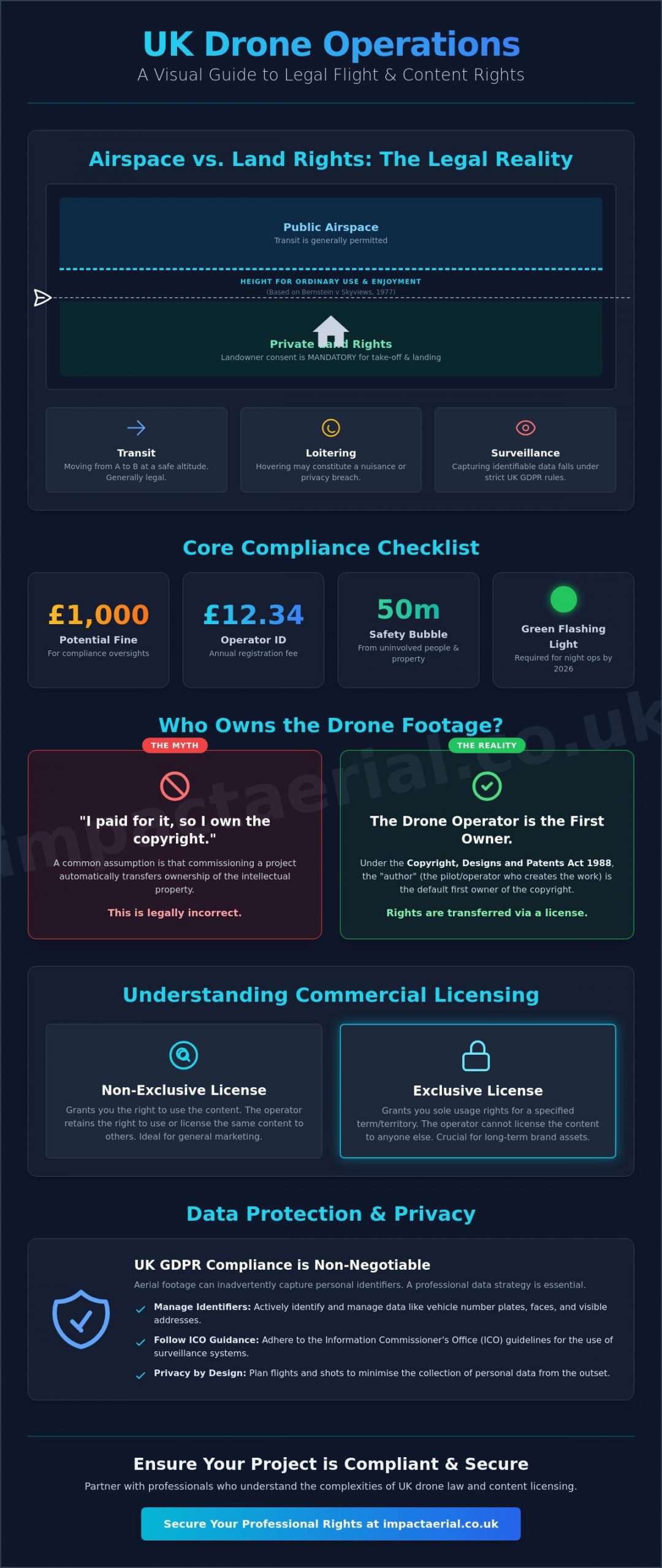
Landowners in Britain often hold the misconception that their property rights extend infinitely into the clouds. This is legally incorrect. Under English law, specifically the landmark case of Bernstein v Skyviews (1977), a property owner’s rights are limited to the height necessary for the ordinary use and enjoyment of their land. Above that height, the sky is essentially public space. This legal precedent allows aircraft, including drones, to transit through airspace without committing a trespass. However, obtaining permission to fly drone over private property uk isn’t just about the flight path; it’s about the operational impact on the ground and the technical classification of the mission.
To better understand how these regulations are evolving and how they impact your commercial operations, watch this authoritative breakdown:
While the air might be open, the ground is not. The Civil Aviation Authority (CAA) maintains strict oversight through the Drone Code, ensuring that while you might technically be passing through, you aren’t infringing on the privacy or safety of those below. A comprehensive understanding of UK Drone Regulations History reveals that the law balances the freedom of flight with the protection of private interests, particularly regarding the distinction between transit and loitering.
Airspace Ownership vs. Land Rights
In the context of professional aerial operations, the distinction between legal transit and “nuisance” is critical. If a drone passes over a property at a reasonable height, it’s generally considered legal. However, if that drone hovers for an extended period, it may transition into a legal nuisance or even a breach of privacy. Professional operators distinguish between these states to ensure compliance:
- Transit: Moving from point A to point B at a safe altitude, typically treated similarly to manned aviation.
- Loitering: Remaining stationary over a property, which can trigger claims of harassment or loss of quiet enjoyment of the land.
- Surveillance: Capturing identifiable data, which moves the issue from aviation law into the strict requirements of UK GDPR.
Take-off and Landing: The Landowner Consent Rule
The most common legal pitfall involves the ground phase of a mission. You don’t always need a landowner’s permission to fly over their house, but you absolutely need permission to take off from or land on their property. This physical contact constitutes a trespass if unauthorised. Meticulous pilots mitigate this risk by conducting pre-site surveys to identify legal launch zones, such as public highways or client-owned land. They also maintain the mandatory 50-metre safety bubble from uninvolved persons and properties, ensuring that every project involving permission to fly drone over private property uk is handled with the same level of precision as the filming itself.
UK Copyright Law: Who Actually Owns the Drone Content?
Securing the physical permission to fly drone over private property uk is only half the legal battle; the secondary challenge is identifying who legally owns the resulting digital assets. Many businesses assume that by paying for a drone shoot, they automatically own the copyright to the footage. Under the Copyright, Designs and Patents Act 1988 (CDPA), this isn’t the case. The default “First Owner” of any photograph or cinematic film is the author-the person who creates the work. In this context, the legal author is the pilot who operated the camera, not the client who commissioned the project.
This distinction creates a significant gap between possessing raw 4K HDR files and having the legal right to use them. While The Drone and Model Aircraft Code focuses on operational safety and proximity to property, the CDPA 1988 governs the commercial value of the data collected. If you hire a contractor without a clear written agreement, you’re effectively paying for a service but potentially leaving the intellectual property in the hands of the pilot. A professional aerial filming and photography specialist will always address this in their terms of service to ensure your business is protected.
Protecting Your Intellectual Property
Aerial media receives automatic protection in the UK. There’s no requirement for formal registration; the moment the drone’s sensor records data to the SD card, copyright is established. For aerial films and photographs, this protection typically lasts for 70 years after the death of the creator. Beyond ownership, pilots also hold “moral rights.” This includes the right to be identified as the author of the work, which can impact how you credit footage in marketing materials or broadcast productions.
The Deed of Assignment: Transferring Ownership
To move copyright from the pilot to the client, a “Deed of Assignment” is required. This isn’t a verbal handshake; it must be a written document signed by the assignor. Many clients find that an outright transfer of ownership is unnecessary and expensive. Instead, a broad commercial licence is often the more pragmatic choice. You should consider the following when reviewing your contract:
- Exclusive vs. Non-Exclusive: Does the pilot retain the right to sell the footage to stock libraries?
- Territory: Is the usage limited to the UK, or can you use the content for global campaigns?
- Duration: Do you have the rights in perpetuity, or do they expire after a set number of years?
Understanding these nuances ensures that your investment in drone technology provides long-term value without the risk of future copyright infringement claims. When you establish permission to fly drone over private property uk, ensure your paperwork covers the digital horizon as thoroughly as the physical one.
Commercial Licensing vs. Outright Transfer of Rights
The legal process of obtaining permission to fly drone over private property uk ensures the physical safety of an operation, but the commercial licence dictates how you can actually profit from that operation. A professional drone operator doesn’t just provide a flight; they provide a legal framework for content usage. Following UK drone safety and legal guidelines is the baseline for any flight, but the commercial agreement defines whether your footage is a temporary asset or a permanent piece of brand history. When securing permission to fly drone over private property uk, you’re managing physical risk; when signing a licence, you’re managing commercial risk.
Commercial rights are typically categorised into three main types. A non-exclusive licence is the standard industry default, allowing you to use the footage while the pilot retains the ability to licence it elsewhere, such as to stock libraries. A sole licence ensures only you and the pilot can use the media. An exclusive licence, the most protective tier, prevents the pilot from using the footage for any other purpose, including their own promotional reels. These agreements also specify territory and time limits, distinguishing between a UK-only campaign and worldwide usage in perpetuity.
Standard Professional Licensing Tiers
Professional operators structure their quotes based on the intended reach of the media to ensure cost-effectiveness for the client. These tiers typically include:
- Tier 1: Internal corporate use, stakeholder updates, and organic social media marketing.
- Tier 2: Paid advertising, property listings, and regional marketing campaigns.
- Tier 3: National broadcast, cinema, and high-budget advertising campaigns with significant audience reach.
This tiered approach ensures that a local construction firm isn’t paying the same premium as a global brand for media usage rights.
Evaluating the Buyout Model for Businesses
An outright transfer of rights, often called a “Full Buyout,” carries a higher initial cost because the pilot is forfeiting all future revenue potential from those assets. Despite the premium, this model is the most logical choice for large-scale brands. It simplifies multi-agency collaboration by removing the need for third parties to track usage limits or expiration dates. It also future-proofs your content, allowing you to repurpose high-end 4K assets years later without renegotiating terms or paying additional fees. A clear aerial filming drone licence provides the legal certainty required to deploy high-tier visual assets across global platforms without the risk of retroactive fees or copyright disputes.
GDPR, Privacy, and Data Rights in Aerial Filming
The intersection of aviation law and the UK Data Protection Act is where many amateur pilots falter. While you may have the physical permission to fly drone over private property uk, the capture of “personal data” triggers strict legal obligations under UK GDPR. Personal data in this context includes any information that can identify a living individual, such as clear facial features, vehicle number plates, or specific residential addresses. Operators must establish a legal basis for processing this data, typically choosing between “Legitimate Interest” for commercial surveying or “Consent” for targeted marketing. Failure to manage these rights can render high-end footage illegal to publish, regardless of the quality of the cinematic output.
The Information Commissioner’s Office (ICO) maintains that drone operators are data controllers. This means you’re responsible for the entire lifecycle of the data, from capture to storage and eventual deletion. If your flight path inadvertently captures a neighbour’s private activities, you risk legal action for harassment or a breach of the Human Rights Act 1998. Meticulous planning is the only way to mitigate these risks. Professional teams often conduct a Data Protection Impact Assessment (DPIA) for complex urban projects, ensuring that every byte of data collected has a verified purpose and a clear path for compliance.
Managing Privacy in Residential and Commercial Areas
Privacy expectations vary significantly by location. On a construction site, workers generally have a lower expectation of privacy due to site-wide safety protocols and the nature of the work. Conversely, a residential garden is a high-privacy zone where the “CCTV” analogy applies. Professional operators treat drones as mobile surveillance devices, often applying the same principles found in the ICO’s Code of Practice. Best practices involve using post-production techniques to blur sensitive identifiers and ensuring the drone is only recording when strictly necessary for the mission objectives.
Data Rights in Technical Drone Surveys
Technical outputs like 3D point clouds and thermal maps represent a different class of data. Unlike a marketing video, these assets are often proprietary and contain sensitive infrastructure details. When commissioning drone property surveys, it’s vital to define who owns the raw telemetry versus the final report. Using a specialised survey drone ensures the data is captured with precision, but the security of that data remains a corporate responsibility. In sensitive sectors like energy or telecommunications, the usage rights must strictly limit who can access and store these high-resolution data sets to prevent security breaches.
To ensure your next project is fully compliant with both aviation and data laws, book our professional drone commercial property surveys today.
Securing Professional Rights with Impact Aerial
Impact Aerial provides the technical expertise and regulatory rigour required to move your project from a legal concept to a commercial reality. While understanding the theory of permission to fly drone over private property uk is essential, executing a mission requires a certified specialist who can manage real-world variables. We only deploy CAA GVC certified pilots, ensuring that every flight is conducted within the “Specific” category of operations where necessary. This level of certification demonstrates a deep understanding of risk mitigation and complex airspace management that goes far beyond basic consumer requirements.
Safety isn’t just a protocol; it’s a financial safeguard for our clients. Every mission we undertake is backed by £5m in commercial liability insurance, providing absolute protection for your business and any third parties involved. When you secure permission to fly drone over private property uk through our team, you’re not just hiring a camera; you’re engaging a partner that prioritises your legal and operational security above all else. This professional approach ensures that your project remains compliant with national aviation standards and local privacy expectations.
The Impact Aerial Commercial Agreement
Our commercial agreements are designed for total transparency, eliminating the common confusion surrounding footage ownership. We provide clear definitions of “Permitted Use” tailored specifically to your industry, whether you’re in large-scale construction or high-end marketing. By offering flexible licensing tiers, we ensure you only pay for the rights you actually need. Our commitment to meticulous regulatory compliance means that every project is underpinned by a robust legal framework, protecting you from future copyright or privacy disputes.
Post-Production Excellence
The quality of the final asset is as important as the legality of the flight. We deliver high-end 4K HDR output that’s ready for immediate commercial distribution across broadcast, web, or social media platforms. All raw data and edited assets are transferred via secure, cloud-based delivery systems to maintain the integrity and confidentiality of your project. Impact Aerial maintains a rigorous data management protocol that guarantees your intellectual property remains secure from the moment of capture to final delivery. Our bespoke post-production services ensure that your visual assets are not only compliant but also of the highest cinematic calibre, meeting the same standards of excellence you would expect from the fine art collections at First4Frames Gallery.
Elevate Your Operations with Regulatory Certainty
Operating within the UK’s evolving aviation landscape requires more than just technical skill; it demands a comprehensive grasp of the legal frameworks that protect your brand. You now understand that while airspace is generally public, physical permission to fly drone over private property uk hinges on landowner consent for take-off and landing. The distinction between possessing raw files and holding a valid commercial licence is what secures your intellectual property for the long term. Balancing these flight rights with data privacy ensures your project remains above board and free from legal disputes.
Impact Aerial bridges the gap between complex CAA regulations and high-tier cinematic output. Our team of CAA GVC Certified Pilots utilises industry-leading drone technology to deliver precision results, all while protected by £5m Commercial Liability Insurance. We ensure every frame captured is not only visually stunning but also fully compliant with UK GDPR and copyright laws. This meticulous approach provides the psychological comfort and tangible benefits your business needs to move forward with confidence.
Ready to secure your next project’s legal and visual success? Request a professional drone filming quote with clear usage rights. We look forward to bringing a professional, safety-first perspective to your commercial operations.
Frequently Asked Questions
Do I own the copyright if I pay for drone photography in the UK?
No, you don’t automatically own the copyright. Under the Copyright, Designs and Patents Act 1988, the pilot or the company employing them is the default legal author. You must secure a written “Deed of Assignment” or a specific commercial licence to use the assets. Professional agencies define these rights in their initial quotes to prevent ownership disputes later.
Can I fly a drone over my neighbour’s garden without their permission?
You can technically fly through the airspace above a neighbour’s garden at a safe altitude without permission to fly drone over private property uk. However, you must adhere to the CAA Drone Code, which often mandates a 50-metre safety distance from uninvolved properties. Loitering or recording can lead to harassment or privacy claims under the Human Rights Act 1998.
What is the difference between an Operator ID and a Flyer ID for businesses?
An Operator ID is required for the person or business responsible for the drone and costs £12.34 per year. The Flyer ID is for the pilot who actually operates the controls and requires passing a free online safety test. Most commercial projects require the business to hold a valid Operator ID while each individual pilot maintains their own Flyer ID.
Can a drone pilot use my commissioned footage for their own portfolio?
Yes, a pilot can typically use the footage unless your contract explicitly states otherwise. Most standard non-exclusive licences allow the creator to retain self-promotional rights. If your project involves sensitive infrastructure or proprietary data, you should request an exclusive licence or a full buyout to restrict the pilot’s use of the media.
Is it legal to include people’s faces in commercial drone video?
It’s legal to include faces only if you have a valid legal basis under UK GDPR, such as informed consent or a proven legitimate interest. In public spaces, professional editors often blur faces and number plates during post-production to maintain compliance. Recording identifiable personal data without these safeguards can make the footage illegal to publish or distribute commercially.
Do I need a separate licence for TV broadcasting compared to YouTube?
Licensing requirements differ based on the platform’s audience reach and commercial intent. A Tier 1 licence might cover organic social media use, but national TV broadcasting typically requires a Tier 3 licence due to the higher commercial value. Always verify that your agreement covers the specific distribution channels you intend to use to avoid retroactive fees.
What are the penalties for using drone footage without the correct rights?
Using footage without the correct rights can result in significant legal costs and injunctions preventing you from using your marketing assets. On the regulatory side, flying without a valid Operator ID can lead to a fine of up to £1,000. More serious breaches, such as endangering an aircraft or violating data protection laws, can result in criminal prosecution or heavy ICO fines.
How much commercial drone insurance should a professional pilot have?
Professional drone pilots should carry at least £5m in commercial liability insurance as an industry standard. While EU Regulation EC 785/2004 sets lower minimums, many corporate clients and construction sites won’t allow an operator on-site without higher coverage levels. This insurance protects your business from financial liability in the event of hardware failure or accidental property damage during a flight.
 2 Norton Drive, Wythall, Birmingham, B47 6HH Company registration number: 11138586. VAT Number: 366 9068 55