
Outsourced vs In-House Drone Inspections in the UK: Compare Costs

The option that looks cheaper can cost more overall. When comparing outsourced vs in-house drone inspection in the UK, assess the full operating cost, not just the aircraft purchase or service fee. In-house work also requires equipment, software, training and staff time; outsourcing gives an external provider responsibility for flight operations and data processing. The right fit depends on inspection frequency, site requirements and your organisation’s capacity.

It is easy to focus on the visible bill, but a drone inspection also involves planning, safe flight operations and turning captured data into useful outputs. Weather and airspace restrictions can affect either approach. Consider insurance and operational responsibilities alongside cost.

This comparison sets out how to weigh total costs and practical trade-offs, including who manages equipment, training, compliance, insurance and reporting. It also covers weather and airspace constraints, helping you decide whether an in-house programme or managed outsourced service better suits your inspection needs.

Key Takeaways

  • Compare the complete cost of each approach, including staff time, equipment, training, data processing and reporting, rather than focusing on one visible expense.
  • Map operational responsibilities before choosing: outsourced services shift flight and processing tasks to a provider, while in-house programmes require internal capability and procedures.
  • Factor airspace restrictions, insurance and weather into inspection planning, as each can affect whether and when a flight can take place.
  • Use inspection frequency, site needs and the value of managed delivery to decide whether to build an internal programme or outsource the work.

Outsourced drone services and provider responsibilities

Outsourcing assigns flight planning, equipment, drone operations and data capture to a specialist provider. For a commercial property survey, the provider can capture roof and façade imagery and process it into material your team can use. Before work begins, agree who will sort, analyse and present the files, especially when an inspection produces a large volume of imagery.

UK commercial drone flights for building inspections are regulated by the Civil Aviation Authority. Operators must meet the applicable registration and competence requirements for their aircraft. Outsourcing transfers operational delivery, not responsibility for defining the inspection outcome. Give the provider site access details, areas of concern and the decisions the survey needs to support.

What are the data security, privacy and ownership risks of outsourced drone inspections in the UK? Images may include neighbouring property, people or sensitive site details, and files may pass through provider systems during processing. Agree in writing who owns the original footage and reports, who can access or reuse them, how files are transferred and stored, and when retained copies are deleted.

Before commissioning, specify the deliverables: image formats, annotated findings, report structure, handover method and expected turnaround. A full written condition report with annotated imagery typically takes 48 to 72 hours, but outsourced turnaround times and data formats can vary. Requesting a sample report helps your team assess whether its detail supports maintenance planning.

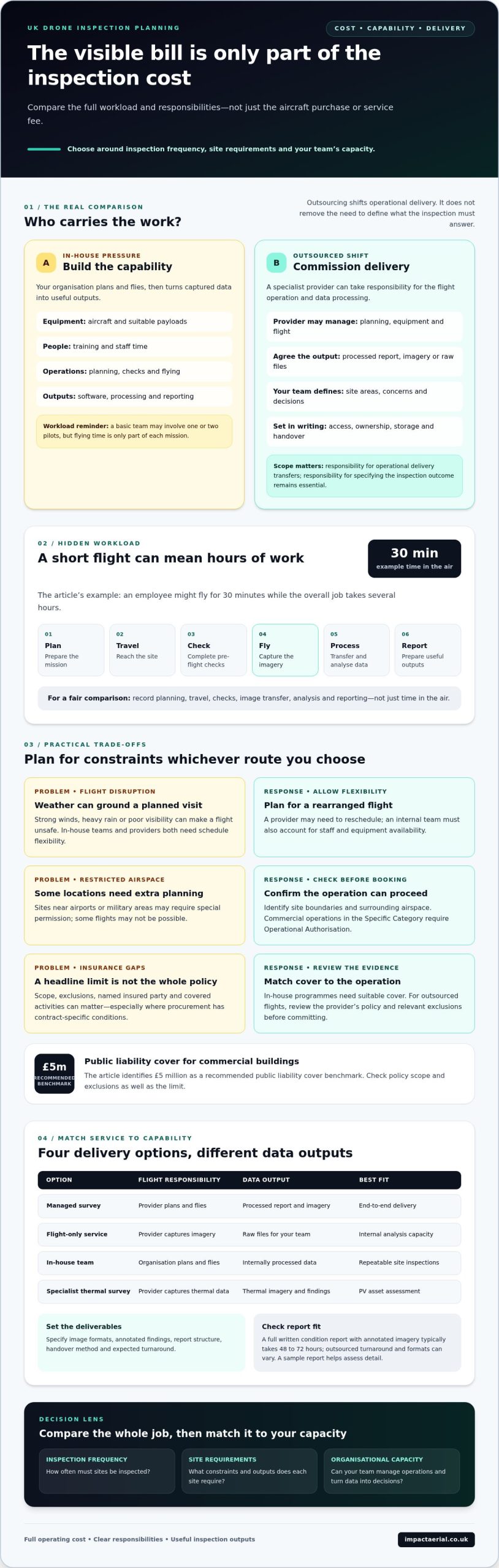
Option Flight responsibility Data output Best fit
Managed survey Provider plans and flies Processed report and imagery End-to-end delivery
Flight-only service Provider captures imagery Raw files for your team Internal analysis capacity
In-house team Organisation plans and flies Internally processed data Repeatable site inspections
Specialist thermal survey Provider captures thermal data Thermal imagery and findings PV asset assessment

Choose a service whose deliverables match your team’s analysis capability, then document data ownership, access and handover terms.

Airspace restrictions, insurance and weather

Airspace, weather and insurance affect both outsourced and in-house drone operations. Strong winds, heavy rain or poor visibility can make a planned flight unsafe, so allow for schedule flexibility. A provider may need to rearrange a visit; an in-house team must manage the same disruption alongside staff and equipment availability.

What UK CAA rules and certifications apply to commercial drone inspections? The Civil Aviation Authority regulates commercial building inspection flights, and operators must meet the applicable registration and competence requirements for their aircraft. Commercial operations in the Specific Category require Operational Authorisation.

Location also affects whether a flight can proceed. Sites near airports or military areas may require special permission, and some flights may not be possible. Before setting an inspection date, identify the site boundaries and surrounding airspace, then establish whether the proposed operation can proceed. Advanced operations may require additional planning and authorisation.

Insurance deserves separate attention. Public liability cover addresses potential third-party claims, but the policy’s scope and exclusions matter as much as its headline limit. For commercial buildings, £5 million is a recommended public liability cover benchmark. An in-house programme needs suitable cover for its own operations; outsourcing shifts the flight activity to a provider, so procurement teams should review the provider’s evidence of cover and relevant exclusions.

Public-sector procurement can include contract-specific insurance conditions. Compare tender requirements with the provider’s policy documents, including the named insured party, covered activities and any limits relevant to the site. Do this before committing to a flight rather than assuming a general policy meets every contract requirement.

Thermal work adds another weather consideration: building surveys using thermal imaging need suitable temperature conditions, and early morning or late evening can help reveal thermal points. For PV sites, match the survey plan to the inspection objective and environmental conditions. PV thermal inspection planning can help frame the practical requirements before comparing delivery options.
Outsourced vs In-House Drone Inspections in the UK: Compare Costs

Full costs of building an in-house drone inspection programme

An in-house programme requires more than an aircraft. Budget for suitable equipment, payloads, software and training, as well as staff time for planning, flying and processing. The useful comparison is the full cost of operating the capability across the sites and inspections it must cover.

A basic team may involve one or two pilots, but their flying time is only part of each mission. An employee might spend 30 minutes in the air while the overall job takes several hours. Planning, travelling, pre-flight checks, image transfer, analysis and reporting all consume working time. Record these tasks for each aerial survey before estimating the programme’s annual workload.

Software and data handling also affect total costs. High-resolution images need to be organised, reviewed and shared in useful formats. Decide whether your team has the tools and skills to turn captured data into maintenance decisions or whether specialist processing is still needed. Repeatable procedures can help maintain consistent coverage across sites, but they take time to develop and maintain.

In-house capability can make scheduling more flexible: staff can plan flights around operational priorities rather than an external team’s availability. Drone imagery can also identify areas for closer examination before arranging scaffolding or specialist access. However, it remains a visual inspection; it cannot test materials or reveal concealed defects. Where the significance of a defect matters, a qualified surveyor should interpret the findings.

Inspection frequency is central to the financial case. Occasional work may leave equipment and staff capability underused, while frequent inspections across large or multiple sites can spread setup costs across more missions. A utility inspecting many transmission structures regularly is one example of a workload that may support an internal programme. Before committing capital, compare expected missions, employee hours, processing demands and access savings.

Managed outsourced drone inspection services

A managed service can cover the inspection workflow, not just the flight. The provider agrees the survey objective, plans the mission, supplies the pilot and equipment, captures data and processes it into usable outputs. This gives an organisation access to specialist expertise without having to build every operational capability in-house.

That distinction matters when inspections are occasional or technically demanding. Buying equipment and training staff for a single roof assessment may be costly if the aircraft and skills then go unused. A managed provider can also support projects requiring specialist platforms or processing workflows. Your organisation still defines the question the assessment must answer, such as identifying visible roof defects for targeted follow-up.

Set the scope before booking. Specify the site areas, inspection purpose, access arrangements, required images, report format and handover method. Agree who processes the data and interprets the findings. Drone imagery can identify areas of concern, but it cannot test materials or inspect concealed structures. A visual inspection does not replace a full building survey.

Managed delivery has trade-offs. Provider availability can delay work, sometimes by a week or more, and outsourced turnaround times or data formats may vary. Reduce friction by agreeing a delivery schedule, file types and report contents in the work order. For repeat sites, use the same capture points and reporting structure where practical, making comparisons between inspections more useful.

After delivery, check whether the output supports a decision, such as maintenance prioritisation, a closer survey or further access planning. Request annotated imagery when location-specific findings matter, and identify who will assess the significance of defects. A clear handover helps ensure raw files become an operational tool rather than the end point.

Choose managed outsourcing when specialist expertise, processing or a one-off assessment outweighs the value of maintaining internal capability. For frequent, predictable inspections, compare provider scheduling with the full cost of an in-house programme. Discuss a managed inspection brief to define the survey scope and useful deliverables.

Impact Aerial: Aerial Filming and Photography

Impact Aerial can support organisations that need professional aerial imagery or drone-based site information without building an internal flight programme. Its CAA GVC certified pilots use commercial-grade professional drones with 4K HDR cameras, and the company maintains £5m commercial liability insurance.

For building inspections, Drone Commercial Property Surveys provide aerial views that can help teams review visible roof and building conditions. PV Solar Farm Thermal Surveys suit projects requiring thermal imagery, while Construction Site Monitoring supports aerial progress documentation. Aerial Filming and Photography is available where the brief calls for polished visual content rather than inspection data.

These services are relevant when specialist equipment and flight expertise are more practical than maintaining those capabilities in-house. Contact Impact Aerial to discuss your project brief and request a free, no-obligation quote.

Make your next inspection decision practical

Choosing between outsourced and in-house drone inspections in the UK is also an opportunity to define what your team needs from the data. Start with the decision the inspection must support, such as prioritising maintenance, documenting site progress or assessing a commercial property. Then align the survey scope and deliverables with that purpose, so the imagery leads to a clear next step rather than another folder of files.

Where specialist aerial capture is the practical route, Impact Aerial offers Drone Commercial Property Surveys and PV Solar Farm Thermal Surveys, alongside Aerial Filming and Photography. These services suit different project objectives, from visual property information to thermal imagery or professional aerial content.

Share your inspection objective and site requirements to begin a focused conversation about the right approach. Contact Impact Aerial to discuss inspections, and take the next step with a clearly defined brief.

Frequently Asked Questions

How Do You Compare the Total Cost?

Compare the full cost of completing the same inspection scope, not simply the cost of buying equipment against paying for a flight. Build a like-for-like worksheet covering aircraft and payloads, software, staff time, training, insurance, processing and reporting. Include the time needed to turn captured images into decisions. Then compare the expected workload and useful outputs for each option across your sites.

Is it worth you investing in your own equipment?

In-house operation may be worthwhile when inspections are frequent, sites are extensive and your organisation can keep pilots competent and equipment operational. Consider whether staff can plan missions, capture consistent imagery and produce useful reports, not just fly. For occasional surveys, ownership may tie up capital and leave specialist equipment underused. Compare expected inspection demand with the ongoing work of maintaining an internal capability.

What Does Outsourcing Drone Operations Mean?

Outsourcing means commissioning an external specialist to carry out agreed drone work instead of operating the aircraft with your own team. The scope may include flight planning, site capture and data processing, or cover a defined part of the workflow. For example, a property team may commission roof imagery and a structured handover while retaining responsibility for deciding what maintenance follows.

What Is an In-House Drone Program?

An in-house drone programme is an organisation’s own capability to plan and conduct flights, manage equipment and handle the resulting data. It requires assigned staff, suitable aircraft and payloads, operating procedures, training and a process for reporting findings. A facilities team, for example, could standardise capture points across its buildings, then compare imagery internally to track visible changes between inspections.

What are the advantages and disadvantages of outsourced vs in-house drone inspections in the UK?

Outsourcing provides access to specialist equipment and operational expertise without requiring your organisation to maintain a flight team. Drawbacks can include dependence on provider availability and differences in turnaround or data formats. In-house operations offer greater control over scheduling and repeatable site processes, but bring equipment, training, staff-time and data-handling responsibilities. The right choice depends on inspection frequency and internal capacity.

How much does outsourced drone inspection cost in the UK?

The cost depends on the site, inspection scope, flight requirements and deliverables, including whether the work includes processed imagery or a written report. Request a quote based on the specific project. For a useful comparison, define the areas to inspect, intended use of the findings, access conditions and required data formats, so each quote covers comparable work.
Professional Drone Filming in London: The 2026 Guide to Compliance and Quality

In the high-stakes environment of drone filming london, the gap between a successful cinematic shoot and a heavy regulatory fine often rests on a single overlooked notification to the Metropolitan Police. You likely recognize that capturing the city’s iconic skyline or a complex construction site isn’t as simple as launching a drone and hitting record. It’s understandable why many commercial project managers feel overwhelmed by the bureaucracy involved in modern aerial operations. You need the visual impact of high-tier footage without the legal headache of a compliance breach.

This 2026 guide is designed to help you master these complexities and secure the high-resolution 4K HDR footage your brand deserves. We’ll clarify the current distinctions between CAA GVC and A2 CofC certifications, ensuring your project remains fully compliant from takeoff to delivery. You will learn how a professional, safety-led approach manages the logistics of council permissions and risk mitigation, allowing your team to focus on the creative results. We’ll examine the essential hardware and coordination strategies that deliver elite visual perspectives with zero disruption to your daily site operations.

Key Takeaways

  • Understand why professional drone filming london requires operating within the “Specific Category” to legally bypass standard consumer flight restrictions.
  • Master the logistics of Flight Restriction Zones, including the essential notification processes for the Metropolitan Police and local borough councils.
  • Discover how 4K HDR cinematic filming and technical construction monitoring provide high-end visual assets for complex commercial projects.
  • Identify the specific DJI Enterprise hardware and post-production standards required to achieve industry-leading results in dense urban environments.
  • Learn how to mitigate operational risk through CAA GVC certified pilots and the security of £5m commercial liability insurance.

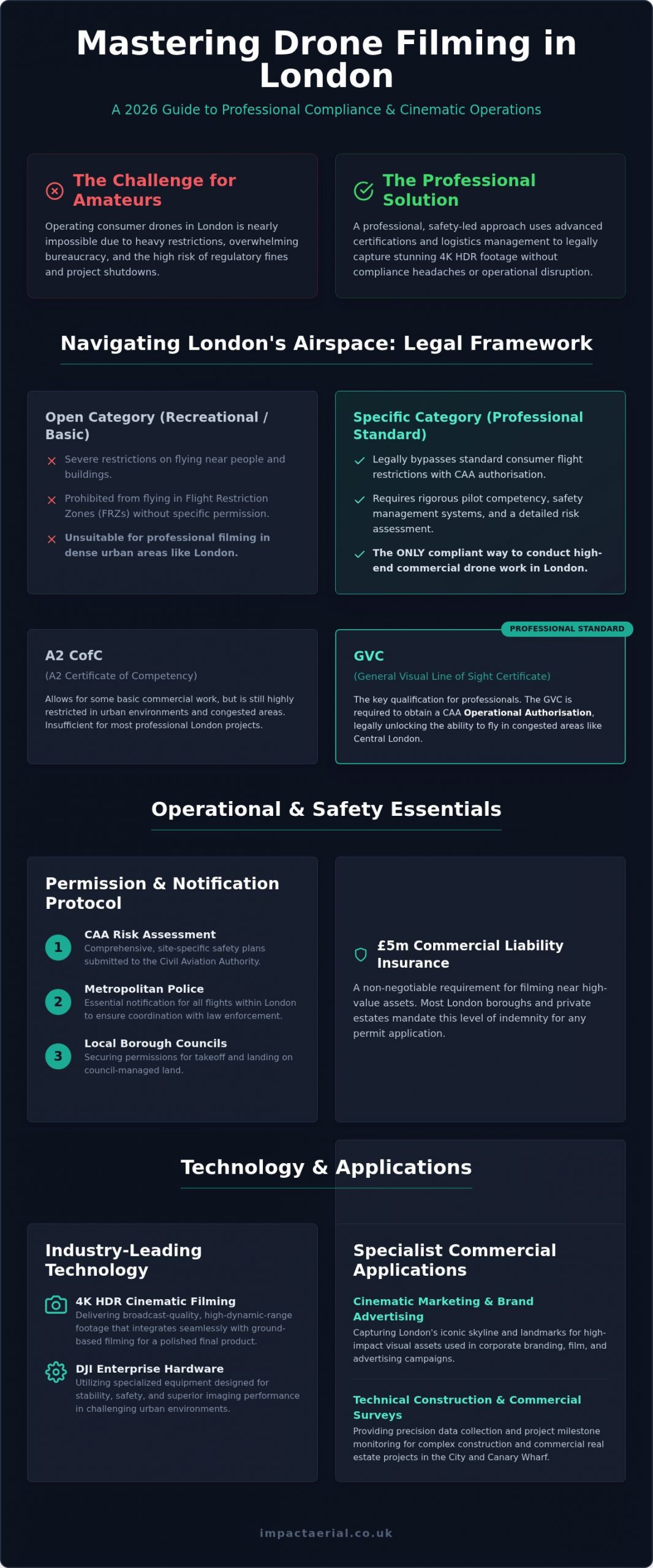
London’s airspace is a complex grid of flight restriction zones and high-density urban corridors. For anyone pursuing drone filming london, understanding that standard consumer rules simply don’t apply is the first step toward a successful project. Most recreational flyers operate in the “Open Category,” which carries severe limitations on where a drone can fly relative to people and buildings. In a metropolis like London, these restrictions make professional work nearly impossible without moving into the “Specific Category.” This classification is reserved for operators who have demonstrated a higher level of competency and safety management.

To better understand the visual potential of these operations within the capital, watch this helpful video:

The Civil Aviation Authority (CAA) acts as the ultimate arbiter for flight safety in the UK. For professional drone filming london, the CAA requires a comprehensive risk assessment for every flight within congested areas. This includes detailed plans for emergency procedures and site-specific safety measures. By operating under a current Operational Authorisation, we provide a level of oversight that consumer-grade operators cannot match. This ensures your project moves forward without the risk of being shut down by local authorities or the police.

The Legal Framework: GVC vs A2 CofC

The distinction between the GVC (General Visual Line of Sight Certificate) and the A2 CofC (A2 Certificate of Competency) is critical for commercial stakeholders. While the A2 CofC allows for some basic commercial work, the GVC is the professional standard required to hold an Operational Authorisation. This document is the legal key that allows us to fly in the capital’s congested areas. It proves we’ve undergone rigorous flight examinations and maintain a detailed Operations Manual vetted by the CAA to ensure maximum safety.

Safety and the Necessity of £5m Insurance

Safety in London isn’t just a preference; it’s a legal mandate. Standard rules often require maintaining a 50-metre horizontal distance from uninvolved persons. In high-density environments like the City or Canary Wharf, achieving this is difficult without specific permissions and risk mitigations. This is why our £5m commercial liability insurance is a non-negotiable asset. Most London boroughs and private estates won’t even consider a filming application without proof of high-tier indemnity. It provides the financial and legal security necessary for operations near high-value assets and public thoroughfares.

Privacy, Copyright, and Data Protection

Filming in populated London squares involves more than just flight physics. It requires strict adherence to GDPR. We manage the “reasonable expectation of privacy” by ensuring no identifiable personal data is captured or stored unnecessarily. Every frame of your aerial videography is legally cleared for commercial use. This meticulous approach to data protection ensures your project isn’t just visually stunning, but also legally resilient against privacy claims.

Specialist Applications: From Cinematic Marketing to Commercial Surveys

London’s commercial landscape demands more than just a camera in the air. Success in the capital requires a dual-purpose approach that blends high-end cinematic aesthetics with precision data collection. While some providers focus solely on creative media, professional drone filming london often serves multiple stakeholders, from marketing departments needing 4K HDR assets to site managers requiring accurate project milestones. This versatility is essential for projects in the City and Canary Wharf, where operational efficiency is as valuable as the visual output. It’s about delivering a complete project management solution from the initial consultation to the final post-production phase.

Aerial Filming for Brand and Advertising

Capturing London’s iconic skyline requires a sophisticated eye for corporate identity and broadcast standards. We deliver 4K HDR content that seamlessly integrates with ground-level footage, creating a cohesive narrative for luxury property marketing and advertising campaigns. By adhering to the strict safety codes of the Civil Aviation Authority (CAA), we ensure that high-stakes shoots are conducted legally within the city’s complex airspace. This meticulous planning results in high-bitrate, broadcast-ready footage that elevates a brand’s visual presence. It’s a reliable way to secure elite perspectives without the logistical risks associated with uncertified operators.

Technical Surveys and Data Collection

Beyond marketing, drones have revolutionized how property developers and asset managers gather critical site information. Utilizing drone surveys significantly reduces the costs and safety risks associated with traditional roof inspections or extensive scaffolding. In dense urban areas, the speed of aerial data collection is a strategic advantage that keeps site operations moving.

Our technical team uses specialized hardware to capture precise aerial data that property developers rely on for verifying project milestones. This data-centric process includes:

  • Thermal imaging to identify energy efficiency gaps in commercial buildings.
  • High-resolution sensors for detailed building envelope inspections.
  • Construction site monitoring to provide stakeholders with clear, visual progress reports.

Integrating these technical capabilities with cinematic quality provides a comprehensive solution for London’s commercial real estate sector. Whether you’re coordinating a virtual tour for a new development or need a thermal survey of a solar installation, our drone filming london services provide the necessary precision. You can explore how these specialized aerial services can benefit your next project by consulting with our technical team today.

Professional Drone Filming in London: The 2026 Guide to Compliance and Quality

Securing Permissions: The Logistics of Filming in Restricted Zones

London is one of the most heavily regulated airspaces in the world. For anyone planning drone filming london, it’s vital to recognize that the city is effectively a patchwork of Flight Restriction Zones (FRZ) and prohibited areas. These restrictions exist to protect critical infrastructure, government buildings, and the heavy traffic corridors of Heathrow and London City Airport. We manage these complexities by treating every shoot as a logistical operation where safety and compliance are established long before the drone leaves the ground. This meticulous preparation is what allows for the capture of high-end cinematic content without the risk of legal complications.

The 5-Step London Permission Process

Securing a “yes” from the authorities requires a structured approach. Unlike rural operations, London shoots demand a lead time that accounts for multiple layers of approval. We follow a methodical timeline to ensure every project is legally resilient and fully vetted by the necessary agencies.

  • Initial Feasibility Check: We analyze the specific GPS coordinates against current NATS charts to identify permanent or temporary restrictions that may affect the flight path.
  • NATS and ATC Coordination: If the site falls within an Aerodrome Traffic Zone, we submit flight plans to National Air Traffic Services. This is critical for areas near Heathrow or London City Airport approach paths.
  • Landowner Take-off and Landing (TOL): We secure formal agreements from the owners of the launch site. This includes managing permissions for private rooftops, balconies, or public spaces managed by local councils.
  • Metropolitan Police Notification: We notify the relevant authorities to secure a CAD (Computer Aided Despatch) reference number. This typically requires a lead time of at least 14 days for complex urban environments.
  • Final Site Safety Audit: On the day of the shoot, a final risk assessment is conducted to account for local weather, public density, and any new temporary flight restrictions issued by the CAA.

Working Near London Landmarks

Filming near the capital’s most famous structures involves additional specialist coordination. The “R157” zone covers much of the City of London and requires specific non-standard flight permissions that go beyond a basic license. If your project involves the River Thames, we coordinate directly with the Port of London Authority (PLA). They oversee the tidal river and have specific requirements for drones operating over the water or near iconic bridges. Managing these logistics allows us to schedule shoots for the best lighting conditions while ensuring the highest standards of public safety. By handling the bureaucracy, we provide the reassurance that your drone filming london project will proceed without the threat of fines or site shutdowns.

The Tech Behind the Lens: Why DJI Enterprise & FPV Matter

Professional drone filming london requires hardware that prioritizes signal stability and mechanical redundancy. We utilize DJI Enterprise systems because they’re engineered for the high-interference environments of Central London. Unlike consumer models, these drones feature omnidirectional obstacle sensing and dual-redundancy systems that ensure flight stability near skyscrapers and high-voltage infrastructure. This level of technical reliability is the foundation of our safety-first approach. It’s why we can operate in tight urban corridors where lesser equipment might struggle with signal attenuation or GPS multipathing.

Cinematic Excellence with 4K HDR

High-bitrate recording is essential for capturing the complex textures of London’s glass and steel architecture. Standard 8-bit footage often fails to resolve the subtle gradients found in urban skylines, leading to “banding” or loss of detail in high-contrast scenes. By shooting in 4K HDR, we preserve a wider dynamic range, allowing for professional colour grading in post-production. This meticulous attention to data quality ensures that the final output is broadcast-ready, whether it’s destined for a large-scale corporate display or a high-impact social media campaign. Our post-production services transform raw aerial data into a polished cinematic story that reflects your brand’s leadership.

The FPV Advantage for London Interiors

FPV (First Person View) drones provide a dynamic perspective that traditional platforms cannot replicate. These specialized aircraft allow for immersive “fly-through” shots, navigating commercial interiors and tight urban environments with surgical precision. It’s an ideal solution for showcasing the scale of a new London development or providing a virtual tour of a corporate headquarters. The unique “one-take” perspective creates a sense of continuous motion that keeps viewers engaged from start to finish. Because FPV drones are smaller and more agile, they can transition from outdoor aerials to indoor detail shots in a single flight, offering a seamless visual experience.

Our commitment to using the latest hardware, such as the DJI Mavic 3 Enterprise, ensures that every project benefits from advanced safety features and elite imaging sensors. This technology allows our team to operate with confidence in the most challenging locations while delivering superior visual results. You can explore our full range of technical drone services to see how we equip our teams for professional London projects.

Partnering with Impact Aerial for Your London Project

Choosing a provider for drone filming london is a decision that impacts your project’s legal standing as much as its visual quality. We operate with a compliance-led mindset, ensuring that every flight is anchored in strict CAA standards and meticulous safety protocols. While our strategic base in Birmingham allows for efficient national coverage, we maintain a specialized focus on the capital’s unique operational requirements. We don’t just provide a pilot; we offer a technical consultancy that manages the entire lifecycle of your aerial project, from the first feasibility check to the final post-production edit.

A primary differentiator for our corporate clients is the security provided by our £5m commercial liability insurance. In high-density urban environments, standard indemnity levels are often insufficient for the requirements of major landowners, borough councils, and the Port of London Authority. This high-tier coverage is a non-negotiable asset for operations near high-value assets or public thoroughfares. It provides the essential reassurance that your business is protected against the unique risks of urban drone operations. We take full responsibility for the logistical burden, allowing your team to focus on the creative and commercial objectives of the shoot.

Why Corporate Clients Trust Impact Aerial

Our expertise in professional drone services is built on years of experience within the property, construction, and advertising sectors. We understand that a London construction site or a luxury property development requires a different approach than a rural shoot. Every mission is preceded by a site-specific risk assessment that accounts for local footfall, signal interference, and airspace restrictions. We also believe in a transparent commercial relationship. You can easily access information regarding aerial filming prices in the UK to ensure your project remains within budget while maintaining the highest possible quality standards.

Starting Your London Drone Project

The process begins with an initial consultation where we define your creative and technical goals. Whether you need high-resolution 4K HDR footage for a marketing campaign or precise data for a commercial survey, we tailor our hardware and flight plans to your specific needs. Our team handles the entire bureaucratic process, including NATS coordination and police notifications, so you don’t have to manage the paperwork. We’re committed to delivering high-end cinematic content with minimal disruption to your daily operations. Contact us today to discuss your vision for the London skyline and let our experts handle the complexities of your next aerial mission.

Elevate Your Commercial Vision with Compliant Aerial Operations

Successful drone filming london in 2026 requires a meticulous balance between high-end cinematic output and strict regulatory adherence. You’ve seen that navigating the capital’s restricted airspace is a structured process involving complex NATS coordination and mandatory Metropolitan Police notifications. By prioritizing certified expertise and advanced DJI Enterprise hardware, your project benefits from both visual excellence and total operational safety. This approach ensures your commercial goals are met without the logistical risks of site shutdowns or legal breaches.

Our team of CAA GVC Certified Pilots specializes in securing restricted airspace permissions for high-stakes urban environments. With the added security of £5m public liability insurance, we provide the professional reassurance corporate clients require for complex London shoots. We handle every bureaucratic detail, from the initial feasibility check to the final post-production delivery, so you don’t have to manage the administrative burden.

Ready to capture the capital from a new perspective? Book your London drone filming consultation with Impact Aerial to ensure your next project is handled with precision and full legal compliance. We look forward to helping you transform the London skyline into your most compelling visual asset yet.

Frequently Asked Questions

Do I need a special permit for drone filming in London?

Yes, commercial drone filming london requires an Operational Authorisation from the CAA. Additionally, specific areas like the City of London (R157) or land managed by the Royal Parks require separate landowner permits. It’s not just about the pilot’s license; it’s about the specific site permissions and risk assessments. We handle this entire logistical process, ensuring that all necessary notifications and CAD reference numbers are secured before any mission commences.

How much does professional drone filming in London cost?

Professional aerial service pricing depends on the complexity of the airspace and the specific project requirements. Factors like the number of police notifications, council fees, and the level of post-production influence the final quote. Because every London project carries unique logistical challenges, we provide bespoke estimates after an initial consultation. This ensures your technical goals are met while maintaining a transparent approach to the overall project budget.

Can drones fly over the River Thames?

Drones can fly over the River Thames, but this requires direct coordination with the Port of London Authority (PLA). The PLA manages the tidal river and has strict safety requirements for any aerial activity within their jurisdiction. Pilots must demonstrate a robust safety case and often need to secure specific take-off and landing permissions from riverside landowners. We manage these multi-agency permissions to ensure your riverfront shoot is fully compliant.

How long does it take to get permission for a London drone shoot?

You should typically allow at least 14 to 21 days to secure the necessary permissions for a London drone shoot. This timeframe accounts for Metropolitan Police notifications, local borough council approvals, and coordination with NATS for airport restricted zones. Complex missions involving iconic landmarks or public events may require longer lead times. Planning ahead is essential to ensure every legal requirement is met without delaying your production schedule.

Are there weight restrictions for drones flying in Central London?

Weight restrictions depend on the drone’s classification and the pilot’s specific Operational Authorisation. For professional drone filming london, we utilize DJI Enterprise aircraft that fall within weight categories optimized for urban safety. These systems allow us to maintain required separation distances from uninvolved people while delivering high-bitrate 4K HDR footage. The specific weight and class of the drone dictate the safety protocols we must follow in high-density areas.

What happens if a drone pilot flies illegally in London?

Unauthorized drone flights in London can lead to significant fines, equipment seizure, and criminal prosecution. The Metropolitan Police monitor the city’s airspace using sophisticated detection technology to identify illegal operators. Beyond the legal risks, flying without the correct CAA certifications or commercial insurance puts the project owner at massive financial risk. Hiring a compliant operator ensures your brand isn’t associated with unsafe or illegal aerial activity.

Can you fly drones at night in London?

Night flights are possible and often provide spectacular views of the city’s illuminated architecture. Pilots must hold a valid Operational Authorisation and perform a specific night-time risk assessment. These missions require hardware with advanced sensors and obstacle avoidance to manage the reduced visibility. We often recommend night shoots for projects where public density needs to be minimized, provided that all safety lighting and battery management protocols are strictly followed.

Is £5m liability insurance standard for London drone operations?

While smaller commercial shoots elsewhere might use lower indemnity, £5m public liability insurance is the standard requirement for London drone operations. Most local authorities, major landowners, and the Port of London Authority won’t grant filming permits without proof of this level of coverage. It provides the essential financial protection needed for high-risk urban environments. We carry £5m insurance as a baseline to ensure our clients have total peace of mind.