
Last Updated: 22 November 2026
Quick Summary
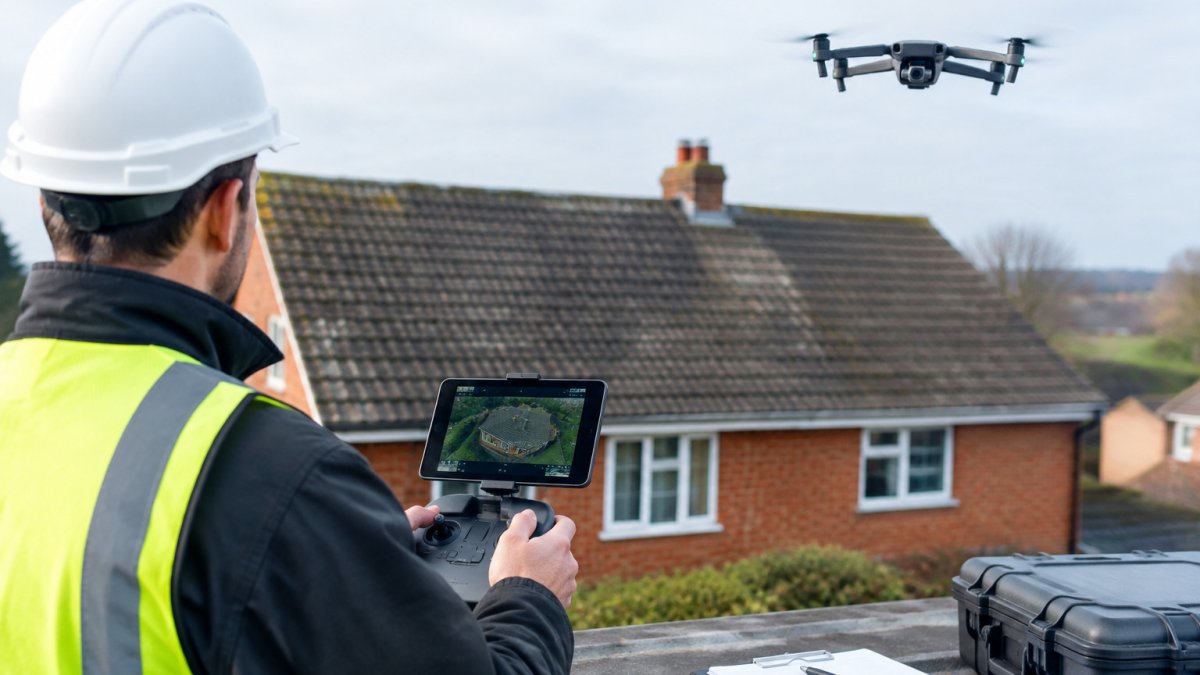
Drone roof inspection privacy rules in the UK sit across three areas of law: CAA aviation rules, privacy expectations such as nuisance and harassment, and data protection law. You need a valid Operator ID and Flyer ID, and UK GDPR applies as soon as footage captures an identifiable person, so frame the roof only and crop or blur people, plates and house numbers before sharing.
- Aviation rules are enforced by the CAA, while data protection means the UK GDPR and the Data Protection Act 2018.
- Incidental capture is not automatically a breach, but it becomes one if you keep, share or misuse the footage.
- Notify immediate neighbours in writing before the flight and give them a contact number for questions or complaints.
- Set a retention period of 30-90 days after report delivery and limit viewing to named, password-protected staff.
- A professional operator brings CAA GVC certification, commercial liability insurance and experience flying within the rules.
Table of Contents
- Why Drone Roof Inspection Privacy Rules Catch People Out
- The CAA Rules That Apply Before Any Drone Roof Inspection
- Drone Filming Neighbours UK: Windows, Gardens and Incidental Capture
- Drone Survey Consent: Permission, Access and Informing Affected People
- UK GDPR Drone Footage: What Counts as Personal Data
- Building a Drone Footage Retention Policy That Holds Up
- Hiring a Professional Operator vs Flying It Yourself
- Commission Your Next Roof Survey With a CAA GVC Certified Team
- Frequently Asked Questions
Why Drone Roof Inspection Privacy Rules Catch People Out
Most roof surveys never raise a privacy question. A drone flight can raise several at once. Pilots assume that because a flight is legal under aviation rules, everything else is fine. It usually is not.
Drone roof inspection privacy rules in the UK sit across three areas of law: aviation law governs how and where you fly; privacy expectations govern how neighbours feel about being filmed; data protection law governs what you do with the footage. Our article on drone inspection safety regulations for construction covers the overlapping safety rules that often get confused with privacy obligations. A flight can pass one test and fail the other two.
Privacy questions come up on many drone jobs, and they are worth settling before the first flight. Below, we break down what the rules require, what counts as personal data, and how to handle neighbours, consent and footage.
Aviation Rules, Privacy Expectations and Data Law Are Three Different Things
Aviation rules are enforced by the Civil Aviation Authority. They cover registration, distance limits, and where you can fly.
Privacy expectations are not a single statute. They come from the common law of nuisance and harassment, plus general expectations of quiet enjoyment of a home.
Data protection law means the UK GDPR and the Data Protection Act 2018. It applies the moment your camera captures an identifiable person.
The CAA Rules That Apply Before Any Drone Roof Inspection
The CAA rules come first because they are the easiest to check and the easiest to breach. Before any flight over a roof, the operator needs a valid Operator ID and the remote pilot needs a Flyer ID, both obtained through the CAA’s official registration scheme.
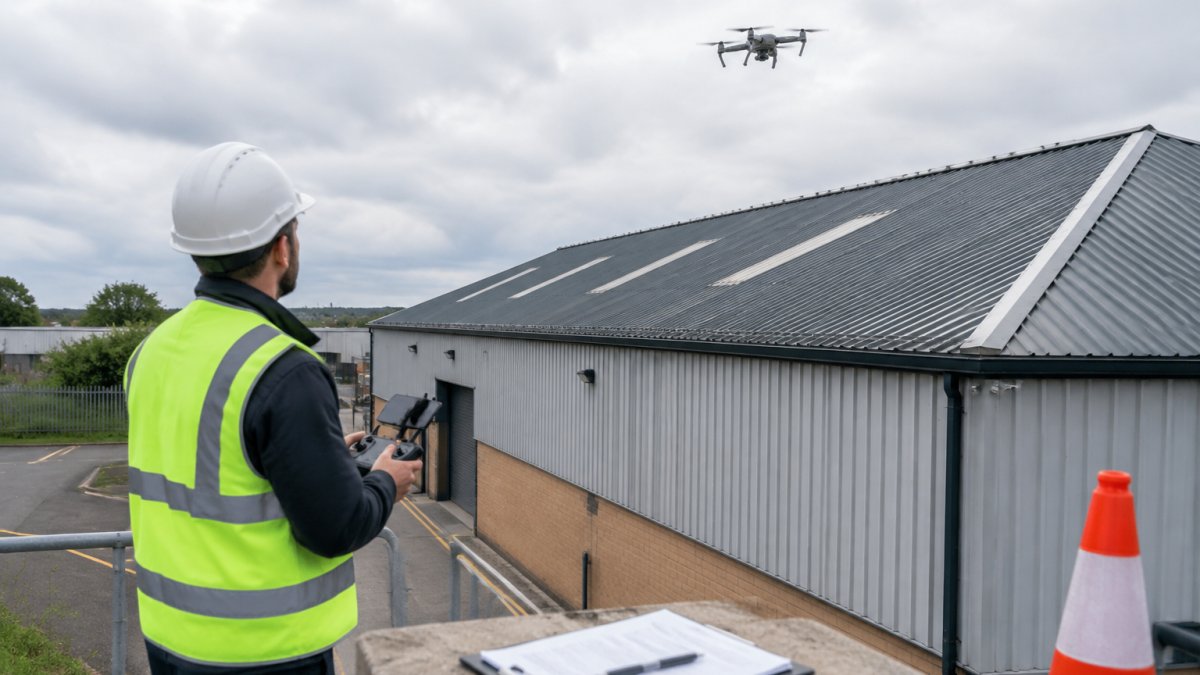
The rest of the pre-flight checklist is short but important:
- Keep the aircraft in direct visual line of sight at all times
- Stay below the legal height ceiling
- Avoid congested areas unless the correct category of operation applies
For a commercial roof survey, the appropriate category of operation depends on the flight; operators should confirm the correct category with the CAA. If you are also filming for marketing, separate permissions apply; our guide on how to get a drone filming permit walks through the steps.
Flyer ID, Operator ID and Visual Line of Sight
The Operator ID belongs to the organisation that manages the flight. The Flyer ID belongs to the person at the controls. Both must be current, and the operator is responsible for keeping records.
Visual line of sight means you can see the aircraft directly, without goggles or a screen, at all times. A spotter can help, but the remote pilot must still maintain sight.
Drone Filming Neighbours UK: Windows, Gardens and Incidental Capture
Here is where aviation and privacy collide.
The key distinction is between intentional capture and incidental capture. Intentional capture means you are deliberately filming a person or their private space.
Incidental capture is not automatically a breach.
A common mistake is assuming that because the drone is above the property line, the camera is free to point anywhere. It is not.
A Practical Privacy Decision Tree for Roof Surveys
Most disputes are avoidable if the pilot works through the same short sequence before every flight and again before any footage leaves the memory card.
Step 1, Is the flight itself lawful? Confirm Operator ID and Flyer ID, visual line of sight, height and distance limits, and any airspace restriction.
Step 2, What is the camera actually pointed at? Frame the roof and only the roof.
Worked Scenarios
A back garden in use. A neighbour is gardening while the survey is underway.
Shared or communal buildings. Flats and converted houses often have shared roofs, access and courtyards.
Incidental capture of a passer-by. Someone walks along the pavement behind the property while the drone is filming the roof.
A car registration in a driveway. Registrations are personal data because they can be linked to a keeper.
Practical Rules That Keep You Out of Trouble
- Frame the roof, not the garden
- Avoid hovering over boundaries or shared spaces
- Brief the pilot on which windows to avoid
Watch out: a pilot who assumes altitude alone settles the privacy question will usually be the one explaining a clip to a neighbour, a client or the Information Commissioner’s Office.
Drone Survey Consent: Permission, Access and Informing Affected People
Consent is often misunderstood. You do not need a neighbour’s consent to fly over your own roof in most cases. You do need permission to take off or land on land you do not own, and you should inform anyone whose property will be overflown closely or repeatedly.
The practical steps look like this:
- Identify the landowner for the take-off and landing point
- Confirm whether the flight path crosses private land at low level
- Notify immediate neighbours in writing before the flight
- Explain the purpose, the date and the approximate time window
- Give a contact number for questions or complaints
- Keep a record of who was informed and when
If you are flying over or from private land, our guide on drone flight permission for private land covers the consent process in more detail.
A simple notification template works well:
“We are carrying out a drone roof survey at [address] on [date] between [time] and [time]. The drone will remain above the roofline and will not film into your property. If you have any concerns, please contact [name] on [number].”
UK GDPR Drone Footage: What Counts as Personal Data
UK GDPR drone footage is personal data whenever it shows an identifiable person, faces, but also distinctive clothing, house numbers, car registrations, and any combination of details that could identify someone.
Once footage is personal data, several obligations kick in:
- You need a lawful basis for processing it
- You must tell people what you are doing with it
- You must keep it only as long as necessary
For most commercial roof surveys, the lawful basis is legitimate interests: you are inspecting a building for safety or maintenance, and the footage is a by-product.
A privacy policy that covers drone use is not optional for commercial operators. It should explain what you capture, why, how long you keep it, and who you share it with.
Building a Drone Footage Retention Policy That Holds Up
A drone footage retention policy is the written rule that says how long you keep footage, who can access it, and how it gets deleted. Without one, you are storing personal data indefinitely, which is a breach in itself.
A workable policy covers five things:
| Element | What to Specify | Typical Approach |
|---|---|---|
| Retention period | How long raw footage is kept | 30-90 days after report delivery |
| Access control | Who can view footage | Named staff only, password protected |
| Sharing rules | When footage leaves the business | Client delivery only, no social use without consent |
| Deletion process | How and when footage is erased | Scheduled deletion with a log |
| Client responsibilities | What the client must do with their copy | Written guidance on storage and use |
The client side matters more than most operators admit. If you hand over footage containing identifiable neighbours, the client becomes a data controller too. Brief them in writing.
Retention Periods in Practice
There is no single statutory retention period for drone roof-survey footage. The UK GDPR requires personal data be kept no longer than necessary, so the period must be justified by purpose.
A defensible policy states the period, the reason for it, and the trigger that starts the clock. A policy should state a specific period and the trigger that starts the clock.
Access Controls That Actually Work
Access control is more than a password on a shared folder. A practical setup for a small operator looks like this:
- Footage stored in a named, access-controlled cloud account rather than on a personal device or an unsecured USB stick
- Viewing rights limited to named staff who need the footage for the survey or the report
- A simple access log recording who downloaded or shared a file and when
Watch out: a single shared login for the whole team defeats the access log, because you cannot show who viewed or shared a clip.
Sharing With Clients, Insurers and Contractors
Roof-survey footage is often shared beyond the client: an insurer may ask for evidence of storm damage, or a roofing contractor may need the clip to quote for repairs.
A workable approach is to:
- Confirm in the contract who the client may share the footage with and for what purpose
- Crop or blur identifiable neighbours, plates and house numbers before any external share
- Share through expiring links rather than attaching files to email
- Record each external share in the access log
- Ask the recipient to delete their copy when the purpose is complete, and say so in writing
If an insurer or contractor asks for raw footage, provide only the clips needed for the claim or the quote. Sending the full card is rarely necessary and is hard to justify under the minimisation principle.
Handling Access and Deletion Requests
A neighbour or passer-by who appears in footage can ask to see it, ask for a copy, or ask for it to be deleted. These are subject access and erasure requests under the UK GDPR.
Deletion should be evidenced, not assumed. A short deletion log recording the date, the files removed, the method (for example, permanent deletion from the cloud account and any local copies) and the person who carried it out is enough for most small operators.
Client Responsibilities in Writing
When footage is handed to a client, the client takes on obligations of its own. A short written note with the delivery should cover:
- What the footage may be used for (the inspection and related maintenance decisions)
- That it should not be published or used in marketing without checking for identifiable people
- How long the client should keep it
This note is not a substitute for the client’s own privacy notice, but it closes the most common gap: a homeowner or facilities manager who shares a clip on social media without realising it contains a recognisable neighbour.
Hiring a Professional Operator vs Flying It Yourself
The DIY route can look cheaper until something goes wrong.
A professional operator brings several things that are hard to replicate:
- CAA GVC certification
- Commercial liability insurance
- Experience flying within the rules
If you are weighing up the two, our drone roof measurement services page shows what a professional survey actually delivers.
The honest limitation: a drone cannot assess everything. The Balmore Group’s analysis of the limits of drone roofing inspections notes that drone surveys may not be sufficient for every roofing assessment.
Commission Your Next Roof Survey With a CAA GVC Certified Team
The drone roof inspection privacy rules in the UK are not designed to stop you flying. They exist to make sure the flight, the footage and the people around it are handled properly.
Impact Aerial flies CAA GVC certified missions with a fleet of 4K HDR DJI Enterprise drones and £5m commercial liability insurance. Our professional drone building inspection service covers commercial and residential properties across the region.
Get started with Impact Aerial and contact us to discuss your roof survey requirements.
If your next roof survey needs to stand up to scrutiny, the flight plan matters as much as the camera.
Frequently Asked Questions
Can a drone operator film a neighbour’s property during a roof inspection?
Only with a lawful basis. A drone roof inspection aimed at your own building can still capture a neighbour’s windows, garden or shared boundary, and that footage may count as their personal data. The operator should plan the flight path to avoid adjacent private spaces where possible, keep only the frames needed for the survey, and avoid publishing anything that identifies neighbours. If incidental capture is unavoidable, record why it happened and delete it once the report is complete.
Do drone roof inspections need to comply with UK GDPR?
Yes, where the footage captures identifiable people or information about them. UK GDPR applies to images and video just as it does to text records. That means a lawful basis for processing, a clear idea of how long footage is kept, and a way to handle access or deletion requests. Commercial operators should also have a privacy notice explaining what they record, why, and who it is shared with, including the client who commissioned the survey.
Can neighbours ask a drone operator to delete footage of their property?
They can make a request, and the operator must respond. Under UK GDPR, individuals can ask for footage showing them to be erased where there is no overriding reason to keep it. In practice, most operators will review the clip, confirm whether the neighbour is identifiable, and delete or crop the relevant material if the survey does not need it. A written drone footage retention policy makes this process faster and shows the request was handled properly.
What should a drone operator do if people appear in roof inspection footage?
Stop recording people where the survey does not need them. If someone walks into frame, note it, keep the footage only as long as the inspection report requires, and avoid sharing unedited clips with clients or on social media. Where a face or vehicle registration is clearly visible, blur or crop it before delivery. Operators should also brief the client that any onward sharing of drone footage is their responsibility too, and set out that expectation in the drone survey consent paperwork.

 2 Norton Drive, Wythall, Birmingham, B47 6HH Company registration number: 11138586. VAT Number: 366 9068 55


